EP3917153B1 - Allgemeine lautsprecherbox - Google Patents
Allgemeine lautsprecherbox Download PDFInfo
- Publication number
- EP3917153B1 EP3917153B1 EP21175450.2A EP21175450A EP3917153B1 EP 3917153 B1 EP3917153 B1 EP 3917153B1 EP 21175450 A EP21175450 A EP 21175450A EP 3917153 B1 EP3917153 B1 EP 3917153B1
- Authority
- EP
- European Patent Office
- Prior art keywords
- loudspeaker
- acoustic
- modular equipment
- orifice
- face
- Prior art date
- Legal status (The legal status is an assumption and is not a legal conclusion. Google has not performed a legal analysis and makes no representation as to the accuracy of the status listed.)
- Active
Links
Images




Classifications
-
- H—ELECTRICITY
- H04—ELECTRIC COMMUNICATION TECHNIQUE
- H04R—LOUDSPEAKERS, MICROPHONES, GRAMOPHONE PICK-UPS OR LIKE ACOUSTIC ELECTROMECHANICAL TRANSDUCERS; ELECTRIC HEARING AIDS; PUBLIC ADDRESS SYSTEMS
- H04R1/00—Details of transducers, loudspeakers or microphones
- H04R1/02—Casings; Cabinets ; Supports therefor; Mountings therein
- H04R1/025—Arrangements for fixing loudspeaker transducers, e.g. in a box, furniture
-
- H—ELECTRICITY
- H04—ELECTRIC COMMUNICATION TECHNIQUE
- H04R—LOUDSPEAKERS, MICROPHONES, GRAMOPHONE PICK-UPS OR LIKE ACOUSTIC ELECTROMECHANICAL TRANSDUCERS; ELECTRIC HEARING AIDS; PUBLIC ADDRESS SYSTEMS
- H04R1/00—Details of transducers, loudspeakers or microphones
- H04R1/20—Arrangements for obtaining desired frequency or directional characteristics
- H04R1/32—Arrangements for obtaining desired frequency or directional characteristics for obtaining desired directional characteristic only
- H04R1/34—Arrangements for obtaining desired frequency or directional characteristics for obtaining desired directional characteristic only by using a single transducer with sound reflecting, diffracting, directing or guiding means
- H04R1/345—Arrangements for obtaining desired frequency or directional characteristics for obtaining desired directional characteristic only by using a single transducer with sound reflecting, diffracting, directing or guiding means for loudspeakers
-
- H—ELECTRICITY
- H04—ELECTRIC COMMUNICATION TECHNIQUE
- H04R—LOUDSPEAKERS, MICROPHONES, GRAMOPHONE PICK-UPS OR LIKE ACOUSTIC ELECTROMECHANICAL TRANSDUCERS; ELECTRIC HEARING AIDS; PUBLIC ADDRESS SYSTEMS
- H04R1/00—Details of transducers, loudspeakers or microphones
- H04R1/02—Casings; Cabinets ; Supports therefor; Mountings therein
-
- H—ELECTRICITY
- H04—ELECTRIC COMMUNICATION TECHNIQUE
- H04R—LOUDSPEAKERS, MICROPHONES, GRAMOPHONE PICK-UPS OR LIKE ACOUSTIC ELECTROMECHANICAL TRANSDUCERS; ELECTRIC HEARING AIDS; PUBLIC ADDRESS SYSTEMS
- H04R1/00—Details of transducers, loudspeakers or microphones
- H04R1/02—Casings; Cabinets ; Supports therefor; Mountings therein
- H04R1/026—Supports for loudspeaker casings
-
- H—ELECTRICITY
- H04—ELECTRIC COMMUNICATION TECHNIQUE
- H04R—LOUDSPEAKERS, MICROPHONES, GRAMOPHONE PICK-UPS OR LIKE ACOUSTIC ELECTROMECHANICAL TRANSDUCERS; ELECTRIC HEARING AIDS; PUBLIC ADDRESS SYSTEMS
- H04R1/00—Details of transducers, loudspeakers or microphones
- H04R1/06—Arranging circuit leads; Relieving strain on circuit leads
-
- H—ELECTRICITY
- H04—ELECTRIC COMMUNICATION TECHNIQUE
- H04R—LOUDSPEAKERS, MICROPHONES, GRAMOPHONE PICK-UPS OR LIKE ACOUSTIC ELECTROMECHANICAL TRANSDUCERS; ELECTRIC HEARING AIDS; PUBLIC ADDRESS SYSTEMS
- H04R1/00—Details of transducers, loudspeakers or microphones
- H04R1/20—Arrangements for obtaining desired frequency or directional characteristics
- H04R1/22—Arrangements for obtaining desired frequency or directional characteristics for obtaining desired frequency characteristic only
- H04R1/26—Spatial arrangements of separate transducers responsive to two or more frequency ranges
-
- H—ELECTRICITY
- H04—ELECTRIC COMMUNICATION TECHNIQUE
- H04R—LOUDSPEAKERS, MICROPHONES, GRAMOPHONE PICK-UPS OR LIKE ACOUSTIC ELECTROMECHANICAL TRANSDUCERS; ELECTRIC HEARING AIDS; PUBLIC ADDRESS SYSTEMS
- H04R1/00—Details of transducers, loudspeakers or microphones
- H04R1/20—Arrangements for obtaining desired frequency or directional characteristics
- H04R1/22—Arrangements for obtaining desired frequency or directional characteristics for obtaining desired frequency characteristic only
- H04R1/30—Combinations of transducers with horns, e.g. with mechanical matching means, i.e. front-loaded horns
-
- H—ELECTRICITY
- H04—ELECTRIC COMMUNICATION TECHNIQUE
- H04R—LOUDSPEAKERS, MICROPHONES, GRAMOPHONE PICK-UPS OR LIKE ACOUSTIC ELECTROMECHANICAL TRANSDUCERS; ELECTRIC HEARING AIDS; PUBLIC ADDRESS SYSTEMS
- H04R5/00—Stereophonic arrangements
- H04R5/02—Spatial or constructional arrangements of loudspeakers
-
- H—ELECTRICITY
- H04—ELECTRIC COMMUNICATION TECHNIQUE
- H04R—LOUDSPEAKERS, MICROPHONES, GRAMOPHONE PICK-UPS OR LIKE ACOUSTIC ELECTROMECHANICAL TRANSDUCERS; ELECTRIC HEARING AIDS; PUBLIC ADDRESS SYSTEMS
- H04R9/00—Transducers of moving-coil, moving-strip, or moving-wire type
- H04R9/02—Details
-
- H—ELECTRICITY
- H04—ELECTRIC COMMUNICATION TECHNIQUE
- H04R—LOUDSPEAKERS, MICROPHONES, GRAMOPHONE PICK-UPS OR LIKE ACOUSTIC ELECTROMECHANICAL TRANSDUCERS; ELECTRIC HEARING AIDS; PUBLIC ADDRESS SYSTEMS
- H04R9/00—Transducers of moving-coil, moving-strip, or moving-wire type
- H04R9/06—Loudspeakers
-
- H—ELECTRICITY
- H04—ELECTRIC COMMUNICATION TECHNIQUE
- H04R—LOUDSPEAKERS, MICROPHONES, GRAMOPHONE PICK-UPS OR LIKE ACOUSTIC ELECTROMECHANICAL TRANSDUCERS; ELECTRIC HEARING AIDS; PUBLIC ADDRESS SYSTEMS
- H04R1/00—Details of transducers, loudspeakers or microphones
- H04R1/02—Casings; Cabinets ; Supports therefor; Mountings therein
- H04R1/028—Casings; Cabinets ; Supports therefor; Mountings therein associated with devices performing functions other than acoustics, e.g. electric candles
-
- H—ELECTRICITY
- H04—ELECTRIC COMMUNICATION TECHNIQUE
- H04R—LOUDSPEAKERS, MICROPHONES, GRAMOPHONE PICK-UPS OR LIKE ACOUSTIC ELECTROMECHANICAL TRANSDUCERS; ELECTRIC HEARING AIDS; PUBLIC ADDRESS SYSTEMS
- H04R1/00—Details of transducers, loudspeakers or microphones
- H04R1/20—Arrangements for obtaining desired frequency or directional characteristics
- H04R1/22—Arrangements for obtaining desired frequency or directional characteristics for obtaining desired frequency characteristic only
- H04R1/28—Transducer mountings or enclosures modified by provision of mechanical or acoustic impedances, e.g. resonator, damping means
- H04R1/2807—Enclosures comprising vibrating or resonating arrangements
- H04R1/283—Enclosures comprising vibrating or resonating arrangements using a passive diaphragm
- H04R1/2834—Enclosures comprising vibrating or resonating arrangements using a passive diaphragm for loudspeaker transducers
-
- H—ELECTRICITY
- H04—ELECTRIC COMMUNICATION TECHNIQUE
- H04R—LOUDSPEAKERS, MICROPHONES, GRAMOPHONE PICK-UPS OR LIKE ACOUSTIC ELECTROMECHANICAL TRANSDUCERS; ELECTRIC HEARING AIDS; PUBLIC ADDRESS SYSTEMS
- H04R2201/00—Details of transducers, loudspeakers or microphones covered by H04R1/00 but not provided for in any of its subgroups
- H04R2201/02—Details casings, cabinets or mounting therein for transducers covered by H04R1/02 but not provided for in any of its subgroups
- H04R2201/028—Structural combinations of loudspeakers with built-in power amplifiers, e.g. in the same acoustic enclosure
-
- H—ELECTRICITY
- H04—ELECTRIC COMMUNICATION TECHNIQUE
- H04R—LOUDSPEAKERS, MICROPHONES, GRAMOPHONE PICK-UPS OR LIKE ACOUSTIC ELECTROMECHANICAL TRANSDUCERS; ELECTRIC HEARING AIDS; PUBLIC ADDRESS SYSTEMS
- H04R2205/00—Details of stereophonic arrangements covered by H04R5/00 but not provided for in any of its subgroups
- H04R2205/021—Aspects relating to docking-station type assemblies to obtain an acoustical effect, e.g. the type of connection to external loudspeakers or housings, frequency improvement
-
- H—ELECTRICITY
- H04—ELECTRIC COMMUNICATION TECHNIQUE
- H04R—LOUDSPEAKERS, MICROPHONES, GRAMOPHONE PICK-UPS OR LIKE ACOUSTIC ELECTROMECHANICAL TRANSDUCERS; ELECTRIC HEARING AIDS; PUBLIC ADDRESS SYSTEMS
- H04R2205/00—Details of stereophonic arrangements covered by H04R5/00 but not provided for in any of its subgroups
- H04R2205/022—Plurality of transducers corresponding to a plurality of sound channels in each earpiece of headphones or in a single enclosure
-
- H—ELECTRICITY
- H04—ELECTRIC COMMUNICATION TECHNIQUE
- H04R—LOUDSPEAKERS, MICROPHONES, GRAMOPHONE PICK-UPS OR LIKE ACOUSTIC ELECTROMECHANICAL TRANSDUCERS; ELECTRIC HEARING AIDS; PUBLIC ADDRESS SYSTEMS
- H04R2400/00—Loudspeakers
- H04R2400/11—Aspects regarding the frame of loudspeaker transducers
-
- H—ELECTRICITY
- H04—ELECTRIC COMMUNICATION TECHNIQUE
- H04R—LOUDSPEAKERS, MICROPHONES, GRAMOPHONE PICK-UPS OR LIKE ACOUSTIC ELECTROMECHANICAL TRANSDUCERS; ELECTRIC HEARING AIDS; PUBLIC ADDRESS SYSTEMS
- H04R2420/00—Details of connection covered by H04R, not provided for in its groups
- H04R2420/09—Applications of special connectors, e.g. USB, XLR, in loudspeakers, microphones or headphones
-
- H—ELECTRICITY
- H04—ELECTRIC COMMUNICATION TECHNIQUE
- H04R—LOUDSPEAKERS, MICROPHONES, GRAMOPHONE PICK-UPS OR LIKE ACOUSTIC ELECTROMECHANICAL TRANSDUCERS; ELECTRIC HEARING AIDS; PUBLIC ADDRESS SYSTEMS
- H04R2499/00—Aspects covered by H04R or H04S not otherwise provided for in their subgroups
- H04R2499/10—General applications
- H04R2499/15—Transducers incorporated in visual displaying devices, e.g. televisions, computer displays, laptops
Definitions
- the invention relates to the field of acoustic loudspeakers, and, in particular, loudspeakers comprising several loudspeakers and integrated into electronic equipment of the decoder box type.
- the plurality of loudspeakers comprises for example a treble loudspeaker (or tweeter ), a bass loudspeaker also called a low frequency loudspeaker (or woofer ) , a mid-frequency loudspeaker (or medium) , etc.
- the restitution can be active, when the loudspeaker is equipped with a motor, or else passive.
- Some loudspeakers are called full range, because they cover all (or almost all) audible frequencies thanks to these speakers.
- Set-top boxes are usually bulky. Some decoder boxes incorporating loudspeakers are thus too bulky to be integrated near a television. The performance of the acoustic reproduction are generally disappointing. The price of the set-top box is often very high.
- the documents CN 206 024 070 U , US 2016/234599 A1 And US 2001/053231 A1 disclose equipment comprising: a casing comprising internal partitions which define a plurality of distinct acoustic chambers separated from each other by said internal partitions, each acoustic chamber comprising an orifice opening outwards from the casing in a different direction; and a plurality of loudspeakers each comprising a diaphragm, each loudspeaker being integrated in one of the acoustic chambers so that a diaphragm of said loudspeaker extends at the level of the orifice.
- the object of the invention is to reduce the volume and the cost, and to improve the acoustic performance of equipment in which are integrated a loudspeaker and at least one additional electronic module, such as a digital television decoder.
- acoustic chambers are therefore defined in the casing of the acoustic enclosure according to the invention. These different chambers make it possible to avoid interference between the audio channels and to obtain excellent acoustic reproduction.
- the size of the box and the performance of the loudspeaker can be optimized by integrating treble and/or mid-frequency loudspeakers in chambers of reduced volume positioned laterally, and a bass loudspeaker in a central chamber of greater volume.
- the first connector mounted on the acoustic enclosure can be connected very easily to different types of additional electronic module to form different types of modular equipment.
- the acoustic enclosure can therefore be used without modification in different types of equipment, in which it is very easily integrated, which reduces the cost of said equipment.
- the generic acoustic enclosure comprises a plurality of first loudspeakers each integrated in a first acoustic chamber comprising a first orifice which opens outwards at the level of one face separate side of the box, and at least one second loudspeaker integrated in a second acoustic chamber comprising a second orifice which opens outwards at the level of a non-lateral face, which is an upper face or a lower face of the box.
- the second acoustic chamber has as its second volume an entire internal volume of the box with the exception of the first volumes of the first acoustic chambers.
- the first loudspeakers comprise a first front loudspeaker integrated into a first front acoustic chamber comprising a first front orifice opening outwards at the level of a front face of the box, a first left loudspeaker integrated in a first left acoustic chamber comprising a first left orifice opening outwards at the level of a left face of the box, and a first right loudspeaker integrated in a first right acoustic chamber comprising a first straight orifice opening outwards at the level of a straight face of the box.
- the second loudspeaker is a bass loudspeaker.
- modular equipment is proposed as previously described, in which the second orifice extends to the bottom of a first recess formed in an outer wall of the non-lateral face.
- the generic acoustic enclosure also comprises a third loudspeaker integrated in the second acoustic chamber of the box, the second acoustic chamber comprising a third orifice which opens outwards at a face opposite the non-lateral face, the third loudspeaker being a passive radiator.
- modular equipment is proposed as previously described, in which the second orifice and the third orifice of the second acoustic chamber are offset relative to each other along a length or a width of the acoustic box.
- modular equipment is proposed as previously described, in which the third orifice is positioned at the bottom of a second recess formed in an outer wall of the face opposite the non-lateral face.
- stiffening ribs are formed in an internal wall of an upper face and/or of a lower face of the box.
- modular equipment is proposed as previously described, in which the first connector, or the second connector to which the first connector is complementary, comprises Pogo pins.
- modular equipment is proposed as previously described, the modular equipment being a decoder box and the additional electronic module being a digital television decoder.
- first disbursement or the second disbursement being defined between feet of the modular equipment.
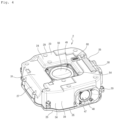
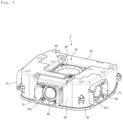
- the invention is implemented in a modular piece of equipment 1 which comprises a generic acoustic enclosure 2.
- module it is meant that the equipment 1 comprises, in addition to the acoustic enclosure 2, one or more other distinct additional modules, comprising at least one electronic module, which are integrated with the acoustic enclosure 2 to form the equipment 1. It is therefore possible, by using different additional modules, to obtain different types of equipment whose functionalities and/or external design are different, and which all incorporate the same acoustic enclosure 2.
- acoustic enclosure 2 can be associated with this or these additional modules without it being necessary to make modifications to the acoustic enclosure 2, to obtain the different types of equipment.
- the equipment 1 comprises in this case, in addition to the acoustic enclosure 2, a first additional module 3 and a second additional module 4.
- the first additional module 3 corresponds to the upper part of the equipment 1
- the second additional module 4 corresponds to the lower part of the equipment 1
- the acoustic enclosure 2 is positioned between the first additional module 3 and the second module additional 4.
- the equipment 1 has the general shape of a parallelepiped whose corners are rounded and which has an upper face 5, a lower face 6 and four side faces: a front face 7, a rear face 8, a left face 9 and a right face. 10.
- the first additional module 3 comprises an upper cover 12 and an additional electronic module which is a digital television decoder 14.
- the upper cover 12 forms the upper face 5 of the equipment 1. Threaded studs 15 are formed near the corners of the upper cover 12 and extend vertically from an internal wall of the upper cover 12.
- the first additional module 3 also comprises electronic cards and electronic components which are mounted on the electronic cards and which implement a plurality of functions, and in particular the conventional functions of a digital television decoder: acquisition of audio streams /video, stream processing, etc.
- the electronic components also fulfill the function of voice recognition and the function of voice assistant with decoding functionality.
- the voice assistant function uses loudspeaker 2.
- the electronic components include in particular connectors 16 making it possible in particular to connect the decoder 14 of the first additional module 3 to a television, to the network, to the mains, etc.
- the electronic components also include microphones for implementing voice recognition, a user interface comprising luminous displays and buttons, an infrared module which makes it possible to control the equipment 1 using a remote control, etc.
- the electronic cards comprise a main card 17, mounted under the upper cover 12 parallel thereto and close to the internal wall of the upper cover 12, as well as a secondary card 18 positioned at the level of an upper portion of the face. front 7 of the equipment 1.
- the secondary card 18 notably comprises electronic components for implementing the user interface.
- the second additional module 4 comprises a support plate 20 forming the underside 6 of the equipment 1 and comprising feet on which the equipment 1 rests when it is placed.
- the acoustic enclosure 2 for its part, first of all comprises a box 23 which also has the general shape of a parallelepiped or a trapezium shape, and whose corners are rounded, and which has an upper face 24, a lower face 25 and four side faces: a front face 26, a rear face 27, a left face 28 and a right face 29 (these faces correspond to the equivalent faces of the equipment 1).
- a front recess 30 is formed on the upper part of the front face 26 of the casing 23, to integrate the secondary card 18.
- a rear recess 31 is formed on the rear part of the upper face 24 of the box 23, to integrate the connectors 16.
- Tabs 33 each comprising a hole, extend horizontally from the side faces of box 23 close to the corners of box 23.
- the box 23 comprises a main portion 34 comprising the upper face 24 and the side faces of the box 23, and a lower cover 35 which closes the box 23 and which forms the lower face 25 of the box 23.
- the box 23 is therefore open at the level of its lower face 25 when the lower cover 35 is not positioned on the main portion 34 of the box 23.
- the box 23 has a groove 36 which extends along the lower surface of its side faces, against which the lower cover 35 is placed to close the box 23.
- the groove 36 also extends along the lower surface of the internal walls which will be described below.
- the seal between the main portion 34 of the casing 23 and the lower cover 35 of the casing 23 is ensured by a gasket 37 placed in the groove 36.
- the main portion 34 of the casing 23 comprises a plurality of threaded studs 38 which extend vertically from a bottom of the main portion 35, that is to say from an internal wall of the upper face 24 of the casing 23. Screws 39 extend through the lower cover 35 and are screwed into the threaded studs 38, which makes it possible to fix the lower cover 35 to the casing 23 to close the casing 23, and to compress the seal 37 to ensure the seal between the main portion 34 of the casing 23 and the lower cover 35. It is noted that the seal between the main portion 34 of the box 23 and the lower cover 35 could have been ensured by other means, for example by assembling the main portion 34 of the box 23 and the lower cover 35 by welding or by gluing.
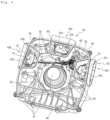
- the box 23 further comprises internal partitions 40 which extend vertically from the bottom of the main portion 34, that is to say from the internal wall of the upper face 24 of the box 23.
- the internal partitions 40 define a plurality of sealed acoustic chambers, distinct and separated from each other by said internal partitions 40, each acoustic chamber comprising an orifice opening outwards from the box in a different direction.
- the seal between the chambers is provided by the internal partitions 40 and by the seal 37 deposited in the groove 36 which has just been mentioned.
- the four acoustic chambers comprise three first acoustic chambers 41 and a second acoustic chamber 42.
- Each first acoustic chamber 41 occupies a first volume.
- the second acoustic chamber 42 occupies a second volume greater than each of the first volumes.
- the second acoustic chamber is a central chamber, that is to say it includes a central portion of the box.
- the second volume of the second acoustic chamber 42 corresponds to the entire internal volume of the box 23 with the exception of the first volumes of the first acoustic chambers 41.
- Each first acoustic chamber 41 comprises a first orifice 43 which opens outwards at a separate side face of the box 23.
- the first three acoustic chambers 41 comprise a first front acoustic chamber 41a comprising a first front orifice 43a opening outwards outside at the level of the front face 26 of the box 23, a first left acoustic chamber 41b comprising a first left orifice 43b opening outwards at the level of the left face 28 of the box 23, and a first right acoustic chamber 41c comprising a first right orifice 43c opening outwards at the level of the right face 29 of the box 23.
- the second acoustic chamber 42 comprises a second orifice 44, positioned in the central portion of the box 23, which opens outwards at a non-lateral face, which is the upper face 24 or the lower face 25 of the box 23.
- the non-lateral face is in this case the upper face 24 of the box 23.
- the second acoustic chamber 42 comprises a third orifice 45 which opens outwards at a face opposite the non-lateral face, that is to say here at the level of the lower face 25 of the box 23.
- the third orifice 45 is made in the lower cover 35 of the box 23.
- the second orifice 44 and the third orifice 45 of the second acoustic chamber 42 are offset relative to each other along a length or a width of the box 23, here along a length of the box 23 (by "length means the dimension of the box 23 between its front face 26 and its rear face 27).
- box 23 is plastic injection which makes it possible to obtain shapes economically complex.
- the acoustic enclosure 2 comprises a plurality of loudspeakers each comprising a membrane, each loudspeaker being integrated into one of the acoustic chambers so that the membrane of said loudspeaker extends at the level of an orifice of said acoustic chamber.
- the enclosure therefore comprises a plurality of first loudspeakers 47 each integrated in a first acoustic chamber 41 of the box 23, as well as a second loudspeaker 48 integrated in the second acoustic chamber 42, and a third loudspeaker 49 integrated also in the second acoustic chamber 42.
- the first loudspeakers 47 comprise a first front loudspeaker 47a integrated in the first front acoustic chamber 41a, a first left loudspeaker 47b integrated in the first left acoustic chamber 41b, and a first right loudspeaker 47c integrated in the first right acoustic chamber 41c.
- the membrane 48 of each first loudspeaker 47 extends at the level of the first orifice 43 of the first associated acoustic chamber 41.
- the first three loudspeakers 47 are identical.
- the second loudspeaker 49 whose membrane 50 extends at the level of the second orifice 44 of the second acoustic chamber 42, is a bass loudspeaker 49 also called a low-frequency loudspeaker, that is to say say a woofer.
- the third loudspeaker 51 (visible on the figure 1 ) is a passive radiator 51, the membrane 52 of which extends at the level of the third orifice 45 of the second acoustic chamber 42.
- each loudspeaker coincides, or at least extends in the immediate vicinity of the edge of the orifice of the acoustic chamber associated.
- the interface between the membrane and the orifice is sealed, so that the acoustic chamber is perfectly sealed when the associated loudspeaker is mounted.
- the audio sources requiring a smaller audio volume to operate i.e. the first loudspeakers 47
- the audio sources requiring a smaller audio volume to operate are therefore integrated into the first acoustic chambers 41 and are thus separated from the main volume, i.e. ie of the second acoustic chamber 42, by the internal partitions 40, in order to create separate acoustic chambers.
- This configuration makes it possible to avoid interference between the different channels, which would be likely to occur if the different channels shared a common volume of air in the same acoustic chamber.
- the first three loudspeakers 47 are identical, and therefore reproduce the same frequency ranges (unlike a configuration with several loudspeakers in a "conventional" enclosure which only reproduce single channel), which makes them particularly susceptible to cross-interference.
- the positioning and orientation of the acoustic chambers correspond to an optimization of the acoustics for the customer.
- the left orifice and the right orifice are oriented slightly forwards (towards the user), so that these orifices are as close as possible to the outside of the equipment 1 and this, whatever ie the design of equipment 1.
- the first front acoustic chamber 41a corresponds to the central channel.
- the basses occupy the rest of the volume, i.e. the second acoustic chamber 42.
- the second acoustic chamber 42 therefore includes the bass speaker ( woofer ) 49 and the passive radiator 51.
- the Passive Radiator 51 further enhances bass.
- the woofer 49 opens onto the upper face 24 of the box 23 and the passive radiator on the lower face 25 of the box 23.
- the reverse configuration, with the woofer 49 opening onto the lower face 25 of the box 23 and the passive radiator 51 opening onto the upper face 24 of the box 23 is of course also possible.
- the bass speaker 49 and the passive radiator 51 are therefore in opposition, one upwards and the other downwards. This configuration makes it possible to limit the mechanical pumping effect which could result from the combined presence of the bass loudspeaker 49 and the passive radiator 51, and therefore to limit the vibrations of the equipment 1.
- the second orifice 44 and the third orifice 45 of the second acoustic chamber 42 are offset relative to each other along the length of the box 23.
- the position of the passive radiator 51 is therefore not exactly aligned with that of the bass speaker 49, that is to say that one is not exactly above the other in the box 23.
- This offset makes it possible to limit the height of the box 23 and therefore of equipment 1. Indeed, since passive radiator 51 has both inward and outward travel, if passive radiator 51 and woofer 49 were aligned, additional thickness would be necessary to allow movement of the passive radiator 51.
- the use of the passive radiator 51 is optional. When it is decided not to integrate in the equipment 1 passive radiator 51, the third orifice 45 made in the lower cover 35 of the box 23 is blocked. Two versions of the injection tool of the plastic part constituting the lower cover 35: a first tool for the version without passive radiator 51 and a second tool for the version with passive radiator 51.
- the second orifice 44 extends to the bottom of a first recess 54 formed in an outer wall of the upper face 24 of the box 23.
- the third orifice 45 is positioned at the bottom of a second recess 55 formed in an outer wall of the lower face 25. This allows the outer movement of the membrane 50 of the bass speaker 49 and of the membrane 52 of the passive radiator 51 without these coming into contact with the parts located at the above and below.
- first disbursement 54 or the second disbursement 55 can be defined between the feet of the equipment 1.
- second disbursement 55 can be defined between the feet of the equipment 1.
- Stiffening ribs 57 are formed in an internal wall of an upper face and/or of a lower face of the box, in this case here in the internal wall of the upper face 24 of the box 23. Indeed, the vibrations at low frequencies, produced mainly by the woofer 49 and the passive radiator 51, can create distortions of the plastic parts forming the box 23, which could result in the loss of the tightness of the acoustic enclosure 2.
- the stiffening ribs 57 make it possible to overcome this problem by stiffening the assembly.
- the stiffening ribs 57 are positioned according to the results of digital simulations of the deformation of the parts using material strength software calculated by finite elements.
- the arrangement of the loudspeakers and their integration in the acoustic enclosure 2 makes it possible to obtain a spatialization of the sound, which, coupled with algorithms, makes it possible to obtain an acoustic rendering comparable to that of a more complex and expensive system. .
- the acoustic enclosure 2 is thus compatible with the DOLBY ATMOS specification.
- the loudspeakers of the acoustic enclosure 2 are electrically connected to the main board 17 of the first additional module 3 (that is to say of the digital television decoder 14).
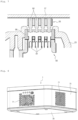
- a first connector 60 is mounted on the casing 23, here on the upper face 24 of the casing 23.
- the first connector 60 is a female connector whose contacts are receiving pads 61 intended to cooperate with Pogo pins.
- Pogo pin is meant a pin comprising a spring-loaded piston.
- Electric wires 62 (visible on the figure 6 ), traveling in the box 23, connect the loudspeakers to the first connector 60.
- Each of these electric wires 62 has one end connected to a loudspeaker and the other end soldered to a reception area 61 of the first connector 60.
- a second connector 63 is mounted on an underside of the main board 17 of the decoder 14.
- the second connector 63 is a male connector comprising pogo pins 64.
- the main board 17 of the decoder 14 is mounted on the upper face 24 of the box 23, and the first connector 60 is connected to the second connector 63.
- the Pogo pins 64 of the second connector 63 are thus in contact with the beaches reception 61 of the first connector 60, which makes it possible to establish an electrical connection between the main board 17 of the decoder 14 and the loudspeakers.
- a seal 66 is applied over the entire circumference of the first connector 60, so that the first connector 60 is mounted in a sealed manner on the casing 23.
- This solution is very advantageous.
- this solution makes it possible not to use cables to connect the acoustic enclosure 2 to the decoder.
- the use of cables has in fact several drawbacks.
- the cables require complicated mounting for assembly. Cables present an increased risk of acoustic leakage where the cables exit the acoustic enclosure.
- the acoustic enclosure with several first connectors, possibly positioned on different faces of the box, and in particular in the case where the equipment comprises not one but several additional electronic modules.
- the equipment 1 comprises an outer casing 70 which at least partially covers the casing 23.
- the outer casing 70 surrounds and covers the side faces of the casing 23.
- the outer casing 70 is made of a rigid plastic but could be made of any type of material, rigid or not.
- the outer envelope 70 is covered with an acoustic fabric.
- the outer envelope 70 is itself covered with a decorative outline 73 (visible on the figure 1 ).
- the outer envelope 70 comprises sets of at least one hole 71, each set of at least one hole 71 comprising one or more holes, here several holes.
- Each set of holes 71 is intended to be positioned opposite of the membrane of a first loudspeaker 47 when the outer casing 70 is mounted around the side faces of the box 23.
- the sets of holes 71 allow the sounds generated by the first loudspeakers to come out.
- each first loudspeaker 47 there is a set of holes 71.
- the holes of a set of holes 71 are arranged in a honeycomb network, which makes it possible to maximize the number of holes of a set of holes 71 while stiffening the outer casing 70 at the level of the set of holes 71.
- the outer casing 70 also includes a set of holes 71 positioned opposite the rear face 27 of the box 23.
- the sounds produced by the bass speaker 49 are guided between the first additional module 3 and the box 23 towards the rear face 27 of the box 23 and towards the set of holes 71 positioned opposite the rear face 27 of the box 23 Similarly, the sounds produced by the passive radiator 51 are guided between the second additional module 4 and the box 23 towards the rear face 27 of the box 23 and towards the set of holes 71 positioned opposite the rear face 27 of the box 23.
- the outer casing 70 can have a different shape and/or dimensions to give a particular piece of equipment its own design.
- a plurality of items of equipment 1a, 1b, 1c which each incorporate an identical acoustic enclosure 2, and whose external shape is conferred, at least at the level of the side faces of the equipment, by the outer envelope 70.
- the acoustic enclosure 2, and in particular the box 23, is therefore dimensioned to be compatible with different shapes and dimensions of the equipment 1.
- the contours of the box 23 have therefore been designed to fit into the smallest design, or the one which has the largest radii of curvature.
- this difference is compensated by adding an additional, optional part between the membrane 48 of each first loudspeaker 47 and the outer casing 70.
- These parts are acoustic horns 75, the role of which is to avoid the cavity mentioned above and to guide the sound towards the outside of the product.
- each acoustic horn 75 has a shape and/or dimensions which depend on the shape and/or dimensions of the external envelope 70. It is for example the thickness e of the acoustic horn which depends on the shape and/or dimensions of the outer envelope.
- An acoustic horn 75 intended to be mounted between the first left loudspeaker 47b or the first right loudspeaker 47c and the outer casing 70 is described.
- the acoustic horn 75 comprises an upper face 76, a lower face 77, and an internal lateral surface 78 defining a through cavity 79 formed in the thickness e of the horn 75 and having an upper edge 80 defined on the upper face 76 and an edge bottom 81 defined on the lower face 77.
- the upper edge 80 has the shape of an ellipse and the lower edge 81 has a circular shape.
- the lower face 77 of the acoustic horn 75 is in contact with the box 23 so that the lower edge 81 of the through-cavity 79 surrounds the membrane 48 of the first loudspeaker 47.
- the upper face 76 of the acoustic horn 75 is in contact with the outer casing 70 so that the set of holes 71 of the outer casing 70, positioned opposite the membrane 48 of the first loudspeaker 47, is inside a surface delimited by the upper edge 80 of the through-cavity 79. It is possible that the assembly of holes 71, which is inside the surface delimited by the upper edge 80, has only one hole.
- the lower edge 81 of the through-cavity 79 is tangent to a circumference of the membrane 48 of the first loudspeaker 47 at any point thereof.
- the inner side surface 78 of the acoustic horn 75 guides the sounds produced by the first loudspeaker 47 outwards via the set of holes 71 of the outer casing 70.
- the through-cavity 79 widens, in a first direction D1, from the lower edge 81 towards the upper edge 80.
- the widening of the through-cavity 79 is greater at the level of the front part than at the level of the rear part. of pavilion 75.
- the through-cavity 79 is therefore arranged to guide the sounds in at least one direction, in this case here in the first direction D1.
- the through cavity 79 is also arranged to guide the sounds towards one of the directions of the first direction D1.
- This first direction D1 corresponds to the horizontal direction when the acoustic horn 75 is attached to the box 23; the direction is forward. The sound is therefore guided in a privileged way in the horizontal direction and forwards when the acoustic horn 75 is fixed to the box 23.
- the cavity could be flared so as to guide the sounds in both directions from the same direction, and even in several directions.
- At least a first portion of the internal lateral surface 78, through which the first direction D1 passes, has a hyperbolic shape when it is seen in section in a first plane P1 parallel to the thickness e of the acoustic horn 75 and including the first direction D1.
- the shape of the first portions 82 makes it possible to broadcast the sound signals at 180°.
- At least a second portion 83 of the internal lateral surface 78 through which a second direction D2 passes perpendicular to the first direction D1, has a straight shape and inclined towards the upper edge when it is seen in section in a second plane P2 parallel to the thickness e of the acoustic horn 75 and including the second direction D2.
- the shape of the second portions 83 makes it possible to guide the sounds as far as the set of holes 71 of the outer casing 70 which is located opposite the first loudspeaker 47.
- Each second portion 83 is inclined at an angle ⁇ between 1° and 10°, here equal to 5°.
- the thickness e of the acoustic horn 75 is greater in its front part than in its rear part.
- the acoustic horn 75 is therefore not symmetrical along the second plane P2.
- the acoustic horn 75 is however symmetrical with respect to the foreground P1, with the exception of the means for fixing the acoustic horn 75 which here are not symmetrical with respect to said foreground (but which could be).
- keying means are used to avoid assembling the left and right acoustic horns 75 in the wrong direction, which would make it impossible to assemble the acoustic enclosure 2 and the outer envelope 70.
- the keying means here comprise keying ribs 85 formed in the casing 23, and keying recesses 86 formed on the acoustic horn 75 at the front and at the rear thereof, at the level of two corners of the same length of flag 75.
- the keying ribs 85 are located under the first left orifice 43b of the first acoustic chamber left 41b, on either side of said first left orifice 43b.
- the keying ribs 85 are located above the first straight orifice 43c of the first straight acoustic chamber 41c, on either side of said first straight orifice 43c.
- the keying means could have a different setup. However, it is advantageous for the configuration of the keying means formed on the right face 29 to be similar to the configuration of the keying means formed on the left face 28 after the latter has undergone a rotation of 180°.
- the roof 75 comprises at least one fixing recess 88, in this case two fixing recesses 88, which are each made in the internal lateral surface 78 to emerge at the level of the upper face 76 of the roof 75.
- the two fixing recesses 88 are diametrically opposed with respect to the circular lower edge 81 of the through-cavity 79.
- the flag 75 further comprises at least one cache recess 89, in this case two cache recesses 89 opening at the level of the lower face 77.
- the two cache recesses 89 are diametrically opposed relative to the lower edge 81 of the through-cavity 79.
- the two fixing recesses 88 and the two cover recesses 89 are each positioned on the corners of a virtual rectangle (which may be a square) inside which extends the lower edge 81.
- the cover recesses 89 are each intended to cover a head of a first screw 91 used to fix (only) the loudspeaker to the box.
- the fixing recesses 88 are each intended to accommodate a head of a second screw 90 used to fix the acoustic horn and the loudspeaker to the box.
- Fixing the first loudspeaker 47 and the horn 75 is made as follows.
- the first loudspeaker 47 is positioned on the casing 23.
- Two first screws 91 are first of all used to fix the first loudspeaker 47 to the casing 23.
- the horn 75 is then placed against the casing 23.
- the two recesses of cover 89 cover the first two screws 91.
- Two second screws 90 are then used to fix both the acoustic horn 75 and the first loudspeaker 47 to the box 23.
- the two second screws 90 each extend into one of the fixing recesses 88, each of which accommodates the screw head of one of the second screws 90 when the first loudspeaker 47 and the acoustic horn 75 are fixed to the box 23.
- the fixing solution which has just been described has the following advantages. If the acoustic horn 75 was fixed by the four screws with which the first loudspeaker 47 is fixed, it would have been difficult to disassemble the acoustic horn 75 after the complete assembly of the equipment 1 without dropping the first loudspeaker 47 inside the box 23. Each first loudspeaker 47 is therefore fixed only by the first two screws 91 at first, to then allow the acoustic horn 75 to be screwed on using the two second screws 90 remaining. The first two screws 91 which initially hold the first loudspeaker 47 are embedded under the acoustic horn 75 (by being positioned in the recesses of the cover 89).
- a visual indicator 94 present on the casing 23, shows the location of the first two screws 91 to be screwed in first.
- additional plugging parts can optionally be inserted into the fixing recesses 88 allowing screwing.
- each of the fixing recesses 88 of the acoustic horn 75 at least one guide notch which will help correct alignment with the plugging piece.
- the plugging piece then includes a guide (or vice versa, the notch possibly being on the plugging piece and the guide on the bell 75).
- the surface of the flag 75 having a different shape at the level of the two fixing recesses 88, two different shapes of plugging parts are provided to adapt to the shape of the flag 75.
- the acoustic horn 75 can be made of more or less rigid plastic.
- the acoustic horn 75 can also be made of rubber to optimize the acoustic and vibratory behavior.
- the horn 75 then comprises a deformable lip 93 which on the one hand provides acoustic sealing between the output of the first loudspeaker 47 and the ambient environment, and which on the other hand dampens any vibrations of the outer casing 70.
- This configuration requires making pavilions specific for each design of the equipment whose outline is different, in order to come back optimally on the external envelope.
- the bell 75 comprises both a rigid portion, made for example of rigid plastic, and a flexible portion at the level of the interface with the outer casing, made for example of rubber.
- a roof in two distinct parts superposed in the thickness of the roof: a first, thinner part, which is made of rigid plastic, and a second, thicker part, which is made of rubber.
- the first part is a generic part while the second part depends on the shape and/or dimensions of the external envelope.
- the first part and the second part can optionally be fixed by the same screws, the first part being sandwiched between the acoustic box and the second part.
Landscapes
- Physics & Mathematics (AREA)
- Engineering & Computer Science (AREA)
- Acoustics & Sound (AREA)
- Signal Processing (AREA)
- Health & Medical Sciences (AREA)
- Otolaryngology (AREA)
- Details Of Audible-Bandwidth Transducers (AREA)
Claims (16)
- Modulares Gerät, umfassend eine allgemeine Lautsprecherbox (2), wobei die allgemeine Lautsprecherbox umfasst:- einen Kasten (23), der Innentrennwände (40) umfasst, die eine Vielzahl von dichten akustischen Kammern (41, 42) definieren, die verschieden und durch die genannten Innentrennwände voneinander getrennt sind, wobei jede akustische Kammer eine Öffnung (43, 44, 45) umfasst, die in einer anderen Richtung nach außerhalb des Kastens mündet;- eine Vielzahl von Lautsprechern (47, 49; 51), die jeweils eine Membran umfassen, wobei jeder Lautsprecher derart in eine der akustischen Kammern integriert ist, dass sich eine Membran des genannten Lautsprechers im Bereich der Öffnung erstreckt;- mindestens einen ersten Verbinder (60), der auf dichte Weise an dem Kasten angebracht ist, wobei der erste Verbinder Kontakte umfasst, die elektrisch mit den Lautsprechern verbunden sind;wobei das modulare Gerät ferner einen äußeren Mantel (70) umfasst, der zumindest teilweise Seitenflächen des Kastens umschließt und mindestens einen Satz aus mindestens einem Loch (71) umfasst, wobei das modulare Gerät ferner mindestens einen akustischen Trichter (75) umfasst, der zwischen dem Kasten und dem äußeren Mantel angebracht ist, wobei der akustische Trichter eine Form und/oder Abmessungen aufweist, die von der Form und/oder den Abmessungen des äußeren Mantels abhängen, wobei der akustische Trichter so ausgebildet ist, dass er eine Membran eines Lautsprechers (47) umschließt und sowohl mit dem Kasten als auch dem äußeren Mantel in Kontakt steht, sodass der akustische Trichter von dem genannten Lautsprecher (47) erzeugte Töne über den Satz von mindestens einem Loch (71) des äußeren Mantels nach außen führt.
- Modulares Gerät nach einem der vorhergehenden Ansprüche, ferner umfassend ein zusätzliches elektronisches Modul (14), das mindestens eine Leiterplatte (17) umfasst, wobei der erste Verbinder (60) ausgebildet ist, die Lautsprecher (47, 49; 51) mit der Leiterplatte des zusätzlichen elektronischen Moduls zu verbinden, über einen zweiten Verbinder (63), der an dem genannten zusätzlichen elektronischen Modul angebracht und komplementär zu dem ersten Verbinder ist, wobei der erste Verbinder (60) der allgemeinen Lautsprecherbox und der zweite Verbinder (63) des zusätzlichen elektronischen Moduls miteinander verbunden sind.
- Modulares Gerät nach einem der vorhergehenden Ansprüche, bei dem die allgemeine Lautsprecherbox eine Vielzahl von ersten Lautsprechern (47) umfasst, die jeweils in eine erste akustische Kammer (41) integriert sind, die eine erste Öffnung (43) umfasst, die im Bereich einer jeweils anderen Seitenfläche des Kastens nach außen mündet, und mindestens einen zweiten Lautsprecher, der in eine zweite akustische Kammer integriert ist, die eine zweite Öffnung (44) umfasst, die im Bereich einer nicht-seitlichen Fläche (24), die eine obere Fläche (24) oder eine untere Fläche (25) des Kastens ist, nach außen mündet.
- Modulares Gerät nach Anspruch 3, bei dem die zweite Öffnung (44) in einem zentralen Abschnitt des Kastens positioniert ist.
- Modulares Gerät nach einem der Ansprüche 3 oder 4, bei dem die zweite akustische Kammer als zweites Volumen eine Gesamtheit des Innenvolumens des Kastens mit Ausnahme von ersten Volumen der ersten akustischen Kammern (41) hat.
- Modulares Gerät nach einem der Ansprüche 3 bis 5, bei dem die ersten Lautsprecher einen vorderen ersten Lautsprecher (47a) umfassen, der in eine vordere erste akustische Kammer (41a) integriert ist, die eine vordere erste Öffnung (43a) umfasst, die im Bereich einer Vorderseite des Kastens nach außen mündet, einen linken ersten Lautsprecher (47b), der in eine linke erste akustische Kammer (41b) integriert ist, die eine linke erste Öffnung (43b) umfasst, die im Bereich einer linken Seite des Kastens nach außen mündet, und einen rechten ersten Lautsprecher (47c), der in eine rechte erste akustische Kammer (41c) integriert ist, die eine rechte erste Öffnung (43c) umfasst, die im Bereich einer rechten Seite des Kastens nach außen mündet.
- Modulares Gerät nach einem der Ansprüche 3 bis 6, bei dem die ersten Lautsprecher identisch sind.
- Modulares Gerät nach einem der Ansprüche 3 bis 7, bei dem der zweite Lautsprecher ein Basslautsprecher ist.
- Modulares Gerät nach einem der Ansprüche 3 bis 8, bei dem sich die zweite Öffnung im Boden einer ersten Vertiefung (54) erstreckt, die in einer Außenwand der nicht-seitlichen Fläche (24) ausgebildet ist.
- Modulares Gerät nach einem der Ansprüche 3 bis 9, bei dem die allgemeine Lautsprecherbox ferner einen dritten Lautsprecher (51) umfasst, der in die zweite akustische Kammer des Kastens integriert ist, wobei die zweite akustische Kammer eine dritte Öffnung (45) umfasst, die im Bereich einer der nicht-seitlichen Fläche (24) gegenüberliegenden Fläche (25) nach außen mündet, wobei der dritte Lautsprecher ein Passivradiator ist.
- Modulares Gerät nach Anspruch 10, bei dem die zweite Öffnung (44) und die dritte Öffnung (45) der zweiten akustischen Kammer zueinander gemäß einer Länge oder einer Breite des akustischen Kastens versetzt sind.
- Modulares Gerät nach einem der Ansprüche 10 oder 11, bei dem die dritte Öffnung im Boden einer Vertiefung (55) positioniert ist, die in einer Außenwand der Fläche ausgebildet ist, die der nicht-seitlichen Fläche gegenüberliegt.
- Modulares Gerät nach den Ansprüchen 9 und 12, wobei die erste Vertiefung oder die zweite Vertiefung zwischen Füßen des modularen Geräts definiert ist.
- Modulares Gerät nach einem der vorhergehenden Ansprüche, bei dem Versteifungsrippen (57) in einer Innenwand einer oberen Fläche (24) und/oder einer unteren Fläche (25) des Kastens ausgebildet sind.
- Modules Gerät nach einem der vorhergehenden Ansprüche, bei dem der erste Verbinder (60) oder der zweite Verbinder (63), zu dem der erste Verbinder komplementär ist, Federkontaktstifte (64) umfasst.
- Modulares Gerät nach einem der vorhergehenden Ansprüche, wobei das modulare Gerät eine Set-Top-Box und das zusätzliche elektronische Modul ein digitaler Fernsehdecoder ist.
Priority Applications (1)
| Application Number | Priority Date | Filing Date | Title |
|---|---|---|---|
| EP23185358.1A EP4250766B1 (de) | 2020-05-25 | 2021-05-21 | Allgemeine lautsprecherbox |
Applications Claiming Priority (1)
| Application Number | Priority Date | Filing Date | Title |
|---|---|---|---|
| FR2005499A FR3110799B1 (fr) | 2020-05-25 | 2020-05-25 | Enceinte acoustique générique |
Related Child Applications (2)
| Application Number | Title | Priority Date | Filing Date |
|---|---|---|---|
| EP23185358.1A Division EP4250766B1 (de) | 2020-05-25 | 2021-05-21 | Allgemeine lautsprecherbox |
| EP23185358.1A Division-Into EP4250766B1 (de) | 2020-05-25 | 2021-05-21 | Allgemeine lautsprecherbox |
Publications (2)
| Publication Number | Publication Date |
|---|---|
| EP3917153A1 EP3917153A1 (de) | 2021-12-01 |
| EP3917153B1 true EP3917153B1 (de) | 2023-08-23 |
Family
ID=72356121
Family Applications (2)
| Application Number | Title | Priority Date | Filing Date |
|---|---|---|---|
| EP23185358.1A Active EP4250766B1 (de) | 2020-05-25 | 2021-05-21 | Allgemeine lautsprecherbox |
| EP21175450.2A Active EP3917153B1 (de) | 2020-05-25 | 2021-05-21 | Allgemeine lautsprecherbox |
Family Applications Before (1)
| Application Number | Title | Priority Date | Filing Date |
|---|---|---|---|
| EP23185358.1A Active EP4250766B1 (de) | 2020-05-25 | 2021-05-21 | Allgemeine lautsprecherbox |
Country Status (6)
| Country | Link |
|---|---|
| US (1) | US11843911B2 (de) |
| EP (2) | EP4250766B1 (de) |
| CN (1) | CN113727224B (de) |
| ES (1) | ES3045367T3 (de) |
| FR (1) | FR3110799B1 (de) |
| PT (1) | PT4250766T (de) |
Families Citing this family (5)
| Publication number | Priority date | Publication date | Assignee | Title |
|---|---|---|---|---|
| DE202019102830U1 (de) * | 2019-05-20 | 2019-06-25 | Häfele Berlin Gmbh & Co Kg | Kunststoff-Möbelwandteil |
| FR3139405A1 (fr) * | 2022-12-06 | 2024-03-08 | Sagemcom Broadband Sas | Equipement comportant un caisson acoustique doté d’au moins un amplificateur |
| FR3147897B1 (fr) * | 2023-04-17 | 2025-05-30 | Sagemcom Broadband Sas | Enceinte acoustique de hauteur réduite |
| USD1079669S1 (en) * | 2023-09-11 | 2025-06-17 | Haipeng Chen | Speakerphone |
| EP4576451A1 (de) * | 2023-12-22 | 2025-06-25 | Sagemcom Broadband Sas | Verbinder zur maximierung des verfügbaren technischen volumens |
Citations (3)
| Publication number | Priority date | Publication date | Assignee | Title |
|---|---|---|---|---|
| US20010053231A1 (en) * | 1999-08-25 | 2001-12-20 | Henry E. Juszkiewicz | Audio speaker system for personal computer |
| US20110111643A1 (en) * | 2009-11-07 | 2011-05-12 | Yin Te-Hung | Audio Connector |
| US20160234599A1 (en) * | 2004-12-01 | 2016-08-11 | Todd Beauchamp | Multi-channel loudspeaker enclosure with laterally projecting wings and method for orienting and driving multiple loudspeakers |
Family Cites Families (11)
| Publication number | Priority date | Publication date | Assignee | Title |
|---|---|---|---|---|
| US4168762A (en) * | 1978-01-13 | 1979-09-25 | Amanita Sound, Inc. | Loudspeaker enclosure |
| DE3128462C2 (de) * | 1981-07-18 | 1983-07-07 | Standard Elektrik Lorenz Ag, 7000 Stuttgart | Fernsehempfangsgerät für stereophone Tonwiedergabe |
| US4624337A (en) * | 1985-10-02 | 1986-11-25 | Shavers Glynn S | Speaker enclosure |
| US8175304B1 (en) * | 2008-02-12 | 2012-05-08 | North Donald J | Compact loudspeaker system |
| US8995697B2 (en) * | 2010-06-16 | 2015-03-31 | Definitive Technology, Llc | Bipolar speaker with improved clarity |
| CN111405418B (zh) * | 2014-09-30 | 2022-11-04 | 苹果公司 | 具有减小的由来自表面的反射导致的音频染色的扬声器 |
| US9883265B2 (en) * | 2015-01-05 | 2018-01-30 | Braven, Lc | Wireless speaker and system |
| CN206024070U (zh) * | 2016-07-20 | 2017-03-15 | 张文川 | 全角度高保真立体声音箱 |
| US10911863B2 (en) * | 2016-09-23 | 2021-02-02 | Apple Inc. | Illuminated user interface architecture |
| CN207427379U (zh) * | 2017-09-26 | 2018-05-29 | 歌尔科技有限公司 | 一种可拆卸音箱的连接结构 |
| US11640108B1 (en) * | 2020-04-06 | 2023-05-02 | Amazon Technologies, Inc. | Sealed speaker and speaker back volume without wires |
-
2020
- 2020-05-25 FR FR2005499A patent/FR3110799B1/fr not_active Expired - Fee Related
-
2021
- 2021-05-21 PT PT231853581T patent/PT4250766T/pt unknown
- 2021-05-21 ES ES23185358T patent/ES3045367T3/es active Active
- 2021-05-21 EP EP23185358.1A patent/EP4250766B1/de active Active
- 2021-05-21 EP EP21175450.2A patent/EP3917153B1/de active Active
- 2021-05-25 US US17/329,726 patent/US11843911B2/en active Active
- 2021-05-25 CN CN202110571665.8A patent/CN113727224B/zh active Active
Patent Citations (3)
| Publication number | Priority date | Publication date | Assignee | Title |
|---|---|---|---|---|
| US20010053231A1 (en) * | 1999-08-25 | 2001-12-20 | Henry E. Juszkiewicz | Audio speaker system for personal computer |
| US20160234599A1 (en) * | 2004-12-01 | 2016-08-11 | Todd Beauchamp | Multi-channel loudspeaker enclosure with laterally projecting wings and method for orienting and driving multiple loudspeakers |
| US20110111643A1 (en) * | 2009-11-07 | 2011-05-12 | Yin Te-Hung | Audio Connector |
Also Published As
| Publication number | Publication date |
|---|---|
| EP4250766B1 (de) | 2025-07-23 |
| CN113727224A (zh) | 2021-11-30 |
| EP4250766A2 (de) | 2023-09-27 |
| FR3110799B1 (fr) | 2023-06-23 |
| US20210368261A1 (en) | 2021-11-25 |
| ES3045367T3 (en) | 2025-11-28 |
| EP3917153A1 (de) | 2021-12-01 |
| EP4250766A3 (de) | 2023-11-15 |
| US11843911B2 (en) | 2023-12-12 |
| PT4250766T (pt) | 2025-10-23 |
| CN113727224B (zh) | 2026-02-17 |
| FR3110799A1 (fr) | 2021-11-26 |
Similar Documents
| Publication | Publication Date | Title |
|---|---|---|
| EP3917159B1 (de) | Schalltrichter für allgemeine lautsprecherbox | |
| EP4250766B1 (de) | Allgemeine lautsprecherbox | |
| CN101600142B (zh) | 电子装置的音箱结构 | |
| FR2538985A1 (fr) | Agencement de haut-parleurs a une ou plusieurs membranes plates | |
| BE1029479B1 (fr) | Sous–système de protection contre les infiltrions pour les microphones dans les appareils informatiques mobile | |
| FR2919454A1 (fr) | Systeme de reproduction sonore a enceinte a events. | |
| FR2631195A1 (fr) | Installation sonore, en particulier stereophonique pour televiseurs a haut-parleur integre de frequences basses de grandes dimensions | |
| EP2870032B1 (de) | Lautsprechersystem für ein kraftfahrzeug | |
| EP4029288A1 (de) | Vorrichtung zur schalldiffusion mit kontrollierter breitbandrichtcharakteristik | |
| EP4576814B1 (de) | Kompaktes gehäuse mit modularem aussendesign | |
| EP4451700B1 (de) | Dekodergehäuse mit reduzierter höhe | |
| EP4478699A1 (de) | Kamera-einsatzmodul mit vertikaler montage | |
| FR2822012A1 (fr) | Appareil electrique a transducteur electro-acoustique | |
| EP4383748A1 (de) | Ausrüstung mit einem akustischen gehäuse mit mindestens einem verstärker | |
| FR3065135A1 (fr) | Enceinte acoustique | |
| FR2545302A1 (fr) | Filtre acoustique pour transducteur en particulier du type electromagnetique de combine telephonique | |
| WO2026022145A1 (fr) | Enceinte acoustique à deux haut-parleurs tête-bêche radialement fixés sur une âme centrale | |
| FR2880768A1 (fr) | Haut parleur aquatique a membrane | |
| FR3087987A1 (fr) | Dispositif de stereophonie elargie pour enceintes acoustiques monobloc amplifiees | |
| WO1999034641A1 (fr) | Tunnel acoustique | |
| FR2924523A1 (fr) | Etui pour microphone unidirectionnel et appareil electronique comportant un tel etui | |
| FR2652978A1 (fr) | Enceinte acoustique. | |
| WO2023062301A1 (fr) | Oreillette circum-auriculaire ou supra auriculaire d'un casque audio et procede de montage associe | |
| FR2744587A1 (fr) | Dispositif de decouplage acoustique entre un transducteur electroacoustique et une coque le renfermant, combine telepnonique et poste telephonique correspondants | |
| FR2864415A1 (fr) | Arrangement structurel d'un dispositif comprenant un transducteur sonore |
Legal Events
| Date | Code | Title | Description |
|---|---|---|---|
| PUAI | Public reference made under article 153(3) epc to a published international application that has entered the european phase |
Free format text: ORIGINAL CODE: 0009012 |
|
| STAA | Information on the status of an ep patent application or granted ep patent |
Free format text: STATUS: EXAMINATION IS IN PROGRESS |
|
| 17P | Request for examination filed |
Effective date: 20210521 |
|
| AK | Designated contracting states |
Kind code of ref document: A1 Designated state(s): AL AT BE BG CH CY CZ DE DK EE ES FI FR GB GR HR HU IE IS IT LI LT LU LV MC MK MT NL NO PL PT RO RS SE SI SK SM TR |
|
| B565 | Issuance of search results under rule 164(2) epc |
Effective date: 20211014 |
|
| GRAP | Despatch of communication of intention to grant a patent |
Free format text: ORIGINAL CODE: EPIDOSNIGR1 |
|
| STAA | Information on the status of an ep patent application or granted ep patent |
Free format text: STATUS: GRANT OF PATENT IS INTENDED |
|
| RIC1 | Information provided on ipc code assigned before grant |
Ipc: H04R 1/28 20060101ALN20221006BHEP Ipc: H04R 1/26 20060101ALI20221006BHEP Ipc: H04R 5/02 20060101ALI20221006BHEP Ipc: H04R 1/30 20060101ALI20221006BHEP Ipc: H04R 1/02 20060101AFI20221006BHEP |
|
| INTG | Intention to grant announced |
Effective date: 20221021 |
|
| GRAJ | Information related to disapproval of communication of intention to grant by the applicant or resumption of examination proceedings by the epo deleted |
Free format text: ORIGINAL CODE: EPIDOSDIGR1 |
|
| STAA | Information on the status of an ep patent application or granted ep patent |
Free format text: STATUS: EXAMINATION IS IN PROGRESS |
|
| GRAP | Despatch of communication of intention to grant a patent |
Free format text: ORIGINAL CODE: EPIDOSNIGR1 |
|
| STAA | Information on the status of an ep patent application or granted ep patent |
Free format text: STATUS: GRANT OF PATENT IS INTENDED |
|
| INTC | Intention to grant announced (deleted) | ||
| RIC1 | Information provided on ipc code assigned before grant |
Ipc: H04R 1/28 20060101ALN20230228BHEP Ipc: H04R 1/26 20060101ALI20230228BHEP Ipc: H04R 5/02 20060101ALI20230228BHEP Ipc: H04R 1/30 20060101ALI20230228BHEP Ipc: H04R 1/02 20060101AFI20230228BHEP |
|
| INTG | Intention to grant announced |
Effective date: 20230315 |
|
| GRAS | Grant fee paid |
Free format text: ORIGINAL CODE: EPIDOSNIGR3 |
|
| GRAA | (expected) grant |
Free format text: ORIGINAL CODE: 0009210 |
|
| STAA | Information on the status of an ep patent application or granted ep patent |
Free format text: STATUS: THE PATENT HAS BEEN GRANTED |
|
| AK | Designated contracting states |
Kind code of ref document: B1 Designated state(s): AL AT BE BG CH CY CZ DE DK EE ES FI FR GB GR HR HU IE IS IT LI LT LU LV MC MK MT NL NO PL PT RO RS SE SI SK SM TR |
|
| REG | Reference to a national code |
Ref country code: GB Ref legal event code: FG4D Free format text: NOT ENGLISH |
|
| REG | Reference to a national code |
Ref country code: CH Ref legal event code: EP |
|
| REG | Reference to a national code |
Ref country code: DE Ref legal event code: R096 Ref document number: 602021004442 Country of ref document: DE |
|
| REG | Reference to a national code |
Ref country code: IE Ref legal event code: FG4D Free format text: LANGUAGE OF EP DOCUMENT: FRENCH |
|
| REG | Reference to a national code |
Ref country code: LT Ref legal event code: MG9D |
|
| RAP4 | Party data changed (patent owner data changed or rights of a patent transferred) |
Owner name: SAGEMCOM BROADBAND SAS |
|
| REG | Reference to a national code |
Ref country code: NL Ref legal event code: MP Effective date: 20230823 |
|
| REG | Reference to a national code |
Ref country code: AT Ref legal event code: MK05 Ref document number: 1603963 Country of ref document: AT Kind code of ref document: T Effective date: 20230823 |
|
| PG25 | Lapsed in a contracting state [announced via postgrant information from national office to epo] |
Ref country code: GR Free format text: LAPSE BECAUSE OF FAILURE TO SUBMIT A TRANSLATION OF THE DESCRIPTION OR TO PAY THE FEE WITHIN THE PRESCRIBED TIME-LIMIT Effective date: 20231124 |
|
| PG25 | Lapsed in a contracting state [announced via postgrant information from national office to epo] |
Ref country code: IS Free format text: LAPSE BECAUSE OF FAILURE TO SUBMIT A TRANSLATION OF THE DESCRIPTION OR TO PAY THE FEE WITHIN THE PRESCRIBED TIME-LIMIT Effective date: 20231223 |
|
| PG25 | Lapsed in a contracting state [announced via postgrant information from national office to epo] |
Ref country code: SE Free format text: LAPSE BECAUSE OF FAILURE TO SUBMIT A TRANSLATION OF THE DESCRIPTION OR TO PAY THE FEE WITHIN THE PRESCRIBED TIME-LIMIT Effective date: 20230823 Ref country code: RS Free format text: LAPSE BECAUSE OF FAILURE TO SUBMIT A TRANSLATION OF THE DESCRIPTION OR TO PAY THE FEE WITHIN THE PRESCRIBED TIME-LIMIT Effective date: 20230823 Ref country code: PT Free format text: LAPSE BECAUSE OF FAILURE TO SUBMIT A TRANSLATION OF THE DESCRIPTION OR TO PAY THE FEE WITHIN THE PRESCRIBED TIME-LIMIT Effective date: 20231226 Ref country code: NO Free format text: LAPSE BECAUSE OF FAILURE TO SUBMIT A TRANSLATION OF THE DESCRIPTION OR TO PAY THE FEE WITHIN THE PRESCRIBED TIME-LIMIT Effective date: 20231123 Ref country code: NL Free format text: LAPSE BECAUSE OF FAILURE TO SUBMIT A TRANSLATION OF THE DESCRIPTION OR TO PAY THE FEE WITHIN THE PRESCRIBED TIME-LIMIT Effective date: 20230823 Ref country code: LV Free format text: LAPSE BECAUSE OF FAILURE TO SUBMIT A TRANSLATION OF THE DESCRIPTION OR TO PAY THE FEE WITHIN THE PRESCRIBED TIME-LIMIT Effective date: 20230823 Ref country code: LT Free format text: LAPSE BECAUSE OF FAILURE TO SUBMIT A TRANSLATION OF THE DESCRIPTION OR TO PAY THE FEE WITHIN THE PRESCRIBED TIME-LIMIT Effective date: 20230823 Ref country code: IS Free format text: LAPSE BECAUSE OF FAILURE TO SUBMIT A TRANSLATION OF THE DESCRIPTION OR TO PAY THE FEE WITHIN THE PRESCRIBED TIME-LIMIT Effective date: 20231223 Ref country code: HR Free format text: LAPSE BECAUSE OF FAILURE TO SUBMIT A TRANSLATION OF THE DESCRIPTION OR TO PAY THE FEE WITHIN THE PRESCRIBED TIME-LIMIT Effective date: 20230823 Ref country code: GR Free format text: LAPSE BECAUSE OF FAILURE TO SUBMIT A TRANSLATION OF THE DESCRIPTION OR TO PAY THE FEE WITHIN THE PRESCRIBED TIME-LIMIT Effective date: 20231124 Ref country code: FI Free format text: LAPSE BECAUSE OF FAILURE TO SUBMIT A TRANSLATION OF THE DESCRIPTION OR TO PAY THE FEE WITHIN THE PRESCRIBED TIME-LIMIT Effective date: 20230823 Ref country code: AT Free format text: LAPSE BECAUSE OF FAILURE TO SUBMIT A TRANSLATION OF THE DESCRIPTION OR TO PAY THE FEE WITHIN THE PRESCRIBED TIME-LIMIT Effective date: 20230823 |
|
| PG25 | Lapsed in a contracting state [announced via postgrant information from national office to epo] |
Ref country code: PL Free format text: LAPSE BECAUSE OF FAILURE TO SUBMIT A TRANSLATION OF THE DESCRIPTION OR TO PAY THE FEE WITHIN THE PRESCRIBED TIME-LIMIT Effective date: 20230823 |
|
| PG25 | Lapsed in a contracting state [announced via postgrant information from national office to epo] |
Ref country code: ES Free format text: LAPSE BECAUSE OF FAILURE TO SUBMIT A TRANSLATION OF THE DESCRIPTION OR TO PAY THE FEE WITHIN THE PRESCRIBED TIME-LIMIT Effective date: 20230823 |
|
| PG25 | Lapsed in a contracting state [announced via postgrant information from national office to epo] |
Ref country code: SM Free format text: LAPSE BECAUSE OF FAILURE TO SUBMIT A TRANSLATION OF THE DESCRIPTION OR TO PAY THE FEE WITHIN THE PRESCRIBED TIME-LIMIT Effective date: 20230823 Ref country code: RO Free format text: LAPSE BECAUSE OF FAILURE TO SUBMIT A TRANSLATION OF THE DESCRIPTION OR TO PAY THE FEE WITHIN THE PRESCRIBED TIME-LIMIT Effective date: 20230823 Ref country code: ES Free format text: LAPSE BECAUSE OF FAILURE TO SUBMIT A TRANSLATION OF THE DESCRIPTION OR TO PAY THE FEE WITHIN THE PRESCRIBED TIME-LIMIT Effective date: 20230823 Ref country code: EE Free format text: LAPSE BECAUSE OF FAILURE TO SUBMIT A TRANSLATION OF THE DESCRIPTION OR TO PAY THE FEE WITHIN THE PRESCRIBED TIME-LIMIT Effective date: 20230823 Ref country code: DK Free format text: LAPSE BECAUSE OF FAILURE TO SUBMIT A TRANSLATION OF THE DESCRIPTION OR TO PAY THE FEE WITHIN THE PRESCRIBED TIME-LIMIT Effective date: 20230823 Ref country code: CZ Free format text: LAPSE BECAUSE OF FAILURE TO SUBMIT A TRANSLATION OF THE DESCRIPTION OR TO PAY THE FEE WITHIN THE PRESCRIBED TIME-LIMIT Effective date: 20230823 Ref country code: SK Free format text: LAPSE BECAUSE OF FAILURE TO SUBMIT A TRANSLATION OF THE DESCRIPTION OR TO PAY THE FEE WITHIN THE PRESCRIBED TIME-LIMIT Effective date: 20230823 |
|
| REG | Reference to a national code |
Ref country code: DE Ref legal event code: R097 Ref document number: 602021004442 Country of ref document: DE |
|
| PG25 | Lapsed in a contracting state [announced via postgrant information from national office to epo] |
Ref country code: IT Free format text: LAPSE BECAUSE OF FAILURE TO SUBMIT A TRANSLATION OF THE DESCRIPTION OR TO PAY THE FEE WITHIN THE PRESCRIBED TIME-LIMIT Effective date: 20230823 |
|
| PLBE | No opposition filed within time limit |
Free format text: ORIGINAL CODE: 0009261 |
|
| STAA | Information on the status of an ep patent application or granted ep patent |
Free format text: STATUS: NO OPPOSITION FILED WITHIN TIME LIMIT |
|
| 26N | No opposition filed |
Effective date: 20240524 |
|
| PG25 | Lapsed in a contracting state [announced via postgrant information from national office to epo] |
Ref country code: SI Free format text: LAPSE BECAUSE OF FAILURE TO SUBMIT A TRANSLATION OF THE DESCRIPTION OR TO PAY THE FEE WITHIN THE PRESCRIBED TIME-LIMIT Effective date: 20230823 |
|
| PG25 | Lapsed in a contracting state [announced via postgrant information from national office to epo] |
Ref country code: BG Free format text: LAPSE BECAUSE OF FAILURE TO SUBMIT A TRANSLATION OF THE DESCRIPTION OR TO PAY THE FEE WITHIN THE PRESCRIBED TIME-LIMIT Effective date: 20230823 |
|
| PG25 | Lapsed in a contracting state [announced via postgrant information from national office to epo] |
Ref country code: BG Free format text: LAPSE BECAUSE OF FAILURE TO SUBMIT A TRANSLATION OF THE DESCRIPTION OR TO PAY THE FEE WITHIN THE PRESCRIBED TIME-LIMIT Effective date: 20230823 |
|
| REG | Reference to a national code |
Ref country code: CH Ref legal event code: PL |
|
| PG25 | Lapsed in a contracting state [announced via postgrant information from national office to epo] |
Ref country code: MC Free format text: LAPSE BECAUSE OF FAILURE TO SUBMIT A TRANSLATION OF THE DESCRIPTION OR TO PAY THE FEE WITHIN THE PRESCRIBED TIME-LIMIT Effective date: 20230823 |
|
| PG25 | Lapsed in a contracting state [announced via postgrant information from national office to epo] |
Ref country code: LU Free format text: LAPSE BECAUSE OF NON-PAYMENT OF DUE FEES Effective date: 20240521 |
|
| PG25 | Lapsed in a contracting state [announced via postgrant information from national office to epo] |
Ref country code: MC Free format text: LAPSE BECAUSE OF FAILURE TO SUBMIT A TRANSLATION OF THE DESCRIPTION OR TO PAY THE FEE WITHIN THE PRESCRIBED TIME-LIMIT Effective date: 20230823 Ref country code: LU Free format text: LAPSE BECAUSE OF NON-PAYMENT OF DUE FEES Effective date: 20240521 Ref country code: CH Free format text: LAPSE BECAUSE OF NON-PAYMENT OF DUE FEES Effective date: 20240531 |
|
| REG | Reference to a national code |
Ref country code: BE Ref legal event code: MM Effective date: 20240531 |
|
| PG25 | Lapsed in a contracting state [announced via postgrant information from national office to epo] |
Ref country code: IE Free format text: LAPSE BECAUSE OF NON-PAYMENT OF DUE FEES Effective date: 20240521 |
|
| PG25 | Lapsed in a contracting state [announced via postgrant information from national office to epo] |
Ref country code: BE Free format text: LAPSE BECAUSE OF NON-PAYMENT OF DUE FEES Effective date: 20240531 |
|
| PGFP | Annual fee paid to national office [announced via postgrant information from national office to epo] |
Ref country code: DE Payment date: 20250423 Year of fee payment: 5 |
|
| PGFP | Annual fee paid to national office [announced via postgrant information from national office to epo] |
Ref country code: GB Payment date: 20250423 Year of fee payment: 5 |
|
| PGFP | Annual fee paid to national office [announced via postgrant information from national office to epo] |
Ref country code: FR Payment date: 20250424 Year of fee payment: 5 |
|
| PG25 | Lapsed in a contracting state [announced via postgrant information from national office to epo] |
Ref country code: CY Free format text: LAPSE BECAUSE OF FAILURE TO SUBMIT A TRANSLATION OF THE DESCRIPTION OR TO PAY THE FEE WITHIN THE PRESCRIBED TIME-LIMIT; INVALID AB INITIO Effective date: 20210521 |
|
| PG25 | Lapsed in a contracting state [announced via postgrant information from national office to epo] |
Ref country code: HU Free format text: LAPSE BECAUSE OF FAILURE TO SUBMIT A TRANSLATION OF THE DESCRIPTION OR TO PAY THE FEE WITHIN THE PRESCRIBED TIME-LIMIT; INVALID AB INITIO Effective date: 20210521 |