EP3916186B1 - Motor unit for sunroof - Google Patents
Motor unit for sunroof Download PDFInfo
- Publication number
- EP3916186B1 EP3916186B1 EP21169456.7A EP21169456A EP3916186B1 EP 3916186 B1 EP3916186 B1 EP 3916186B1 EP 21169456 A EP21169456 A EP 21169456A EP 3916186 B1 EP3916186 B1 EP 3916186B1
- Authority
- EP
- European Patent Office
- Prior art keywords
- worm wheel
- bush
- drive shaft
- motor unit
- pinion gear
- Prior art date
- Legal status (The legal status is an assumption and is not a legal conclusion. Google has not performed a legal analysis and makes no representation as to the accuracy of the status listed.)
- Active
Links
Images





Classifications
-
- E—FIXED CONSTRUCTIONS
- E05—LOCKS; KEYS; WINDOW OR DOOR FITTINGS; SAFES
- E05F—DEVICES FOR MOVING WINGS INTO OPEN OR CLOSED POSITION; CHECKS FOR WINGS; WING FITTINGS NOT OTHERWISE PROVIDED FOR, CONCERNED WITH THE FUNCTIONING OF THE WING
- E05F15/00—Power-operated mechanisms for wings
- E05F15/60—Power-operated mechanisms for wings using electrical actuators
- E05F15/603—Power-operated mechanisms for wings using electrical actuators using rotary electromotors
- E05F15/632—Power-operated mechanisms for wings using electrical actuators using rotary electromotors for horizontally-sliding wings
- E05F15/655—Power-operated mechanisms for wings using electrical actuators using rotary electromotors for horizontally-sliding wings specially adapted for vehicle wings
- E05F15/662—Motor units therefor, e.g. geared motors
-
- H—ELECTRICITY
- H02—GENERATION; CONVERSION OR DISTRIBUTION OF ELECTRIC POWER
- H02K—DYNAMO-ELECTRIC MACHINES
- H02K5/00—Casings; Enclosures; Supports
- H02K5/02—Casings or enclosures characterised by the material thereof
-
- B—PERFORMING OPERATIONS; TRANSPORTING
- B60—VEHICLES IN GENERAL
- B60J—WINDOWS, WINDSCREENS, NON-FIXED ROOFS, DOORS, OR SIMILAR DEVICES FOR VEHICLES; REMOVABLE EXTERNAL PROTECTIVE COVERINGS SPECIALLY ADAPTED FOR VEHICLES
- B60J7/00—Non-fixed roofs; Roofs with movable panels, e.g. rotary sunroofs
- B60J7/02—Non-fixed roofs; Roofs with movable panels, e.g. rotary sunroofs of sliding type, e.g. comprising guide shoes
- B60J7/04—Non-fixed roofs; Roofs with movable panels, e.g. rotary sunroofs of sliding type, e.g. comprising guide shoes with rigid plate-like element or elements, e.g. open roofs with harmonica-type folding rigid panels
- B60J7/043—Sunroofs e.g. sliding above the roof
-
- B—PERFORMING OPERATIONS; TRANSPORTING
- B60—VEHICLES IN GENERAL
- B60J—WINDOWS, WINDSCREENS, NON-FIXED ROOFS, DOORS, OR SIMILAR DEVICES FOR VEHICLES; REMOVABLE EXTERNAL PROTECTIVE COVERINGS SPECIALLY ADAPTED FOR VEHICLES
- B60J7/00—Non-fixed roofs; Roofs with movable panels, e.g. rotary sunroofs
- B60J7/02—Non-fixed roofs; Roofs with movable panels, e.g. rotary sunroofs of sliding type, e.g. comprising guide shoes
- B60J7/04—Non-fixed roofs; Roofs with movable panels, e.g. rotary sunroofs of sliding type, e.g. comprising guide shoes with rigid plate-like element or elements, e.g. open roofs with harmonica-type folding rigid panels
- B60J7/057—Driving or actuating arrangements e.g. manually operated levers or knobs
- B60J7/0573—Driving or actuating arrangements e.g. manually operated levers or knobs power driven arrangements, e.g. electrical
-
- F—MECHANICAL ENGINEERING; LIGHTING; HEATING; WEAPONS; BLASTING
- F16—ENGINEERING ELEMENTS AND UNITS; GENERAL MEASURES FOR PRODUCING AND MAINTAINING EFFECTIVE FUNCTIONING OF MACHINES OR INSTALLATIONS; THERMAL INSULATION IN GENERAL
- F16H—GEARING
- F16H55/00—Elements with teeth or friction surfaces for conveying motion; Worms, pulleys or sheaves for gearing mechanisms
- F16H55/02—Toothed members; Worms
- F16H55/06—Use of materials; Use of treatments of toothed members or worms to affect their intrinsic material properties
-
- F—MECHANICAL ENGINEERING; LIGHTING; HEATING; WEAPONS; BLASTING
- F16—ENGINEERING ELEMENTS AND UNITS; GENERAL MEASURES FOR PRODUCING AND MAINTAINING EFFECTIVE FUNCTIONING OF MACHINES OR INSTALLATIONS; THERMAL INSULATION IN GENERAL
- F16H—GEARING
- F16H57/00—General details of gearing
- F16H57/02—Gearboxes; Mounting gearing therein
- F16H57/039—Gearboxes for accommodating worm gears
-
- H—ELECTRICITY
- H02—GENERATION; CONVERSION OR DISTRIBUTION OF ELECTRIC POWER
- H02K—DYNAMO-ELECTRIC MACHINES
- H02K5/00—Casings; Enclosures; Supports
- H02K5/04—Casings or enclosures characterised by the shape, form or construction thereof
-
- H—ELECTRICITY
- H02—GENERATION; CONVERSION OR DISTRIBUTION OF ELECTRIC POWER
- H02K—DYNAMO-ELECTRIC MACHINES
- H02K5/00—Casings; Enclosures; Supports
- H02K5/04—Casings or enclosures characterised by the shape, form or construction thereof
- H02K5/22—Auxiliary parts of casings not covered by groups H02K5/06-H02K5/20, e.g. shaped to form connection boxes or terminal boxes
- H02K5/225—Terminal boxes or connection arrangements
-
- H—ELECTRICITY
- H02—GENERATION; CONVERSION OR DISTRIBUTION OF ELECTRIC POWER
- H02K—DYNAMO-ELECTRIC MACHINES
- H02K7/00—Arrangements for handling mechanical energy structurally associated with dynamo-electric machines, e.g. structural association with mechanical driving motors or auxiliary dynamo-electric machines
- H02K7/10—Structural association with clutches, brakes, gears, pulleys or mechanical starters
- H02K7/116—Structural association with clutches, brakes, gears, pulleys or mechanical starters with gears
- H02K7/1163—Structural association with clutches, brakes, gears, pulleys or mechanical starters with gears where at least two gears have non-parallel axes without having orbital motion
- H02K7/1166—Structural association with clutches, brakes, gears, pulleys or mechanical starters with gears where at least two gears have non-parallel axes without having orbital motion comprising worm and worm-wheel
-
- E—FIXED CONSTRUCTIONS
- E05—LOCKS; KEYS; WINDOW OR DOOR FITTINGS; SAFES
- E05Y—INDEXING SCHEME ASSOCIATED WITH SUBCLASSES E05D AND E05F, RELATING TO CONSTRUCTION ELEMENTS, ELECTRIC CONTROL, POWER SUPPLY, POWER SIGNAL OR TRANSMISSION, USER INTERFACES, MOUNTING OR COUPLING, DETAILS, ACCESSORIES, AUXILIARY OPERATIONS NOT OTHERWISE PROVIDED FOR, APPLICATION THEREOF
- E05Y2201/00—Constructional elements; Accessories therefor
- E05Y2201/60—Suspension or transmission members; Accessories therefor
- E05Y2201/622—Suspension or transmission members elements
- E05Y2201/696—Screw mechanisms
- E05Y2201/704—Worm wheels
-
- E—FIXED CONSTRUCTIONS
- E05—LOCKS; KEYS; WINDOW OR DOOR FITTINGS; SAFES
- E05Y—INDEXING SCHEME ASSOCIATED WITH SUBCLASSES E05D AND E05F, RELATING TO CONSTRUCTION ELEMENTS, ELECTRIC CONTROL, POWER SUPPLY, POWER SIGNAL OR TRANSMISSION, USER INTERFACES, MOUNTING OR COUPLING, DETAILS, ACCESSORIES, AUXILIARY OPERATIONS NOT OTHERWISE PROVIDED FOR, APPLICATION THEREOF
- E05Y2201/00—Constructional elements; Accessories therefor
- E05Y2201/60—Suspension or transmission members; Accessories therefor
- E05Y2201/622—Suspension or transmission members elements
- E05Y2201/706—Shafts
-
- E—FIXED CONSTRUCTIONS
- E05—LOCKS; KEYS; WINDOW OR DOOR FITTINGS; SAFES
- E05Y—INDEXING SCHEME ASSOCIATED WITH SUBCLASSES E05D AND E05F, RELATING TO CONSTRUCTION ELEMENTS, ELECTRIC CONTROL, POWER SUPPLY, POWER SIGNAL OR TRANSMISSION, USER INTERFACES, MOUNTING OR COUPLING, DETAILS, ACCESSORIES, AUXILIARY OPERATIONS NOT OTHERWISE PROVIDED FOR, APPLICATION THEREOF
- E05Y2600/00—Mounting or coupling arrangements for elements provided for in this subclass
- E05Y2600/50—Mounting methods; Positioning
- E05Y2600/506—Plastic deformation
-
- E—FIXED CONSTRUCTIONS
- E05—LOCKS; KEYS; WINDOW OR DOOR FITTINGS; SAFES
- E05Y—INDEXING SCHEME ASSOCIATED WITH SUBCLASSES E05D AND E05F, RELATING TO CONSTRUCTION ELEMENTS, ELECTRIC CONTROL, POWER SUPPLY, POWER SIGNAL OR TRANSMISSION, USER INTERFACES, MOUNTING OR COUPLING, DETAILS, ACCESSORIES, AUXILIARY OPERATIONS NOT OTHERWISE PROVIDED FOR, APPLICATION THEREOF
- E05Y2600/00—Mounting or coupling arrangements for elements provided for in this subclass
- E05Y2600/60—Mounting or coupling members; Accessories therefor
- E05Y2600/634—Spacers
- E05Y2600/636—Washers
-
- E—FIXED CONSTRUCTIONS
- E05—LOCKS; KEYS; WINDOW OR DOOR FITTINGS; SAFES
- E05Y—INDEXING SCHEME ASSOCIATED WITH SUBCLASSES E05D AND E05F, RELATING TO CONSTRUCTION ELEMENTS, ELECTRIC CONTROL, POWER SUPPLY, POWER SIGNAL OR TRANSMISSION, USER INTERFACES, MOUNTING OR COUPLING, DETAILS, ACCESSORIES, AUXILIARY OPERATIONS NOT OTHERWISE PROVIDED FOR, APPLICATION THEREOF
- E05Y2900/00—Application of doors, windows, wings or fittings thereof
- E05Y2900/50—Application of doors, windows, wings or fittings thereof for vehicles
- E05Y2900/53—Type of wing
- E05Y2900/542—Roof panels
Definitions
- the present disclosure relates to a new type of a motor unit for a sunroof, in which during the opening and closing of a sunroof, different kinds of noises are prevented from occurring according to directions of the opening and closing, and adjustment of intervals between a worm wheel and a bush and between a pinion gear and the bush is easily performed, and the intervals are constantly maintained for a long period of time.
- a sunroof is a structure configured to open and close an opening part provided on a ceiling of a vehicle, and is configured by including sunroof glass and a motor unit for a sunroof.
- Such a sunroof is configured to open or close the opening part on the ceiling of a vehicle while the sunroof glass is moved forward or backward along rails at opposite sides of the opening part by the clockwise/counterclockwise driving of the motor unit for a sunroof according to the needs of a user.
- the motor unit for a sunroof is a driving source which automatically operates the sunroof glass.
- Such a motor unit for a sunroof is disclosed in Korean Utility Model Registration No. 20-0428305 (Patent Document 1), Korean Patent Application Publication No. 10-2015-0072227 (Patent Document 2), and Korean Patent Application Publication No. 10-2019-0003073 (Patent Document 3).
- US 2013/167680 A1 also discloses an example of a motor unit.
- the motor unit for a sunroof is configured such that a pinion gear is rotated by driving a worm and a worm wheel by the driving force of a drive motor, and a wire for operating the sunroof glass (hereinbelow, referred to as an operation wire) connected to the pinion gear is operated.
- the worm wheel and the pinion gear are connected to each other such that power is transmitted between the worm wheel and the pinion gear by a drive shaft.
- the worm wheel is integrated with the circumference of a lower end part of the drive shaft by injection molding, and is configured to operate the drive shaft by receiving the driving force of the worm.
- the pinion gear is press-fitted over and coupled to an upper end part of the drive shaft and is configured to rotate with the drive shaft.
- the worm and the worm wheel are provided in installation space provided between an upper housing and a bottom cover so as to be protected from an external environment, and the pinion gear is configured to be connected to the operation wire by being exposed to an upper side of the upper housing.
- an operation performance of the conventional motor unit for opening and closing the sunroof glass changes.
- the bottom cover is configured to support the lower end of the drive shaft, and the worm wheel is configured to be in contact with the lower surface of the bush, so the pinion gear is spaced apart from the bush while continuously maintaining a predetermined interval therefrom.
- the bush is made of metal
- the worm wheel is made of a mold material
- contact noise therebetween occurs as friction noise between the metal and resin.
- the drive shaft and the bottom cover are both made of metal, so contact noise therebetween occurs as friction noise between the metals. Accordingly, noises different from each other are generated according to the operation of the sunroof, which affects a user's mood.
- the bottom cover may be formed of a mold material instead of metal.
- the bottom cover is required to continuously support the drive shaft with a predetermined pressure, in a case in which the bottom cover is made of the mold material instead of the metal, the bottom cover suffers from continuous wear and is damaged during long use of the bottom cover, so continuous maintenance thereof is required to be performed. Accordingly, it is impossible to exchange the metal material with the mold material.
- an interval between the worm wheel and the bush and an interval between the pinion gear and the bush are adjusted by the bottom cover, so the bottom cover is required to be tightly coupled to the upper housing, and predetermined coupling force is required to be supplied thereto.
- the present disclosure has been made keeping in mind the above problems occurring in the related art, and the present disclosure is intended to propose a motor unit for a sunroof, in which irrespective of the opening/closing direction of the sunroof, the same kind of contact noise may be generated to improve emotional quality.
- the present disclosure is intended to propose a motor unit for a sunroof, in which adjustment of intervals between a worm wheel and a bush and between a pinion gear and the bush may be easily performed and the intervals may be constantly maintained for a long period of time.
- a motor unit for a sunroof including: an upper housing constituting an upper body of the motor unit and configured as a box body having an open lower surface, the upper housing having a protruding hub formed at a center portion thereof; a bush provided in the protruding hub of the upper housing; a worm wheel having a hub part formed at a center thereof by protruding therefrom such that the hub part is rotatably installed by passing through an inside of the bush, and having a circumference configured to be engaged with a worm gear; a drive shaft installed to be fixed to the worm wheel by passing through the hub part of the worm wheel; a pinion gear coupled to an upper end part of the drive shaft such that power is transmitted therebetween; a washer located between the pinion gear and the hub part of the worm wheel; and a bottom cover covering and blocking the open lower surface of the upper housing, wherein a bent part is formed at an upper end of the motor
- the bent part of the drive shaft may be formed through riveting after the pinion gear is coupled to the drive shaft.
- the bush may be made of metal, and the worm wheel may be made of resin.
- the washer may be configured to be in contact with an upper surface of the hub part of the worm wheel.
- a receiving part may be formed in the bottom cover such that the hub part of the worm wheel is received in the receiving part, and a through hole may be formed in the receiving part such that the drive shaft passes through the through hole.
- the contact part may be located to be in contact with the bush.
- the contact part may be located to be in contact with the bush.
- the lower end of the bush may be configured to bend toward the upper housing.
- the washer may be configured to cover the upper surface of the hub part of the worm wheel and the upper surface of the bush.
- the same noise may be generated irrespective of clockwise/counterclockwise rotation of the pinion gear, thereby preventing complaints of a user caused by different contact noises occurring during the opening and closing of the sunroof glass.
- the pinion gear may be maintained to be in continuous contact with the washer, thereby enabling the drive shaft to continuously and efficiently operate without being shaken horizontally by force applied to the pinion gear.
- the bottom cover may not be a structure supporting the drive shaft, and the drive shaft may be configured to be pulled to the upper surface of the pinion gear by riveting such that there is no interval between each component, thereby making a design for preventing the downward bending of the bottom cover unnecessary.
- the bottom cover may be formed of a resin material, thereby facilitating the manufacturing and assembly of the motor unit for a sunroof.
- FIGS. 1 to 13 an exemplary embodiment of a motor unit for a sunroof according to the present disclosure will be described with reference to FIGS. 1 to 13 .
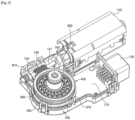
- FIG. 1 is an exploded perspective view illustrating a motor unit for a sunroof according to an embodiment of the present disclosure
- FIG. 2 is a perspective view illustrating the exterior structure of the motor unit for a sunroof according to the embodiment of the present disclosure
- FIG. 3 is a perspective view illustrating a structure of the motor unit for a sunroof from which an upper housing is removed according to the embodiment of the present disclosure
- FIG. 4 is a perspective view illustrating a state in which a bottom cover is mounted to a lower housing in the motor unit for a sunroof according to the embodiment of the present disclosure.
- FIG. 5 is a top plan view illustrating the motor unit for a sunroof according to the embodiment of the present disclosure
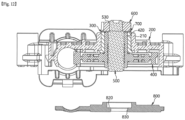
- FIG. 6 is a sectional view illustrated to describe the inner structure of the motor unit for a sunroof according to the embodiment of the present disclosure.
- the motor unit for a sunroof may be configured by largely including a lower housing 100, an upper housing 200, a bush 300, a worm wheel 400, a drive shaft 500, a pinion gear 600, a washer 700, and a bottom cover 800.
- the worm wheel 400 may be configured to be in contact with the washer 700 and the bush 300 such that friction noise between metals is prevented from being generated, and no spacing distance may exist between the pinion gear 600 and the washer 700, between the washer 700 and the bush 300, and between the bush 300 and the worm wheel 400, so the change of contact portion between each component and the generation of different noises due to the spacing distance may be prevented.
- the lower housing 100 may be a part constituting a lower body of the motor unit for a sunroof.
- Such lower housing 100 may be configured as a box body having a closed bottom part and an open upper surface, and a printed circuit board 110 may be provided inside the lower housing 100.
- a connector 120 may be provided at a portion of the lower housing 100 such that the connector 120 is connected to an external power supply, and a drive motor 130 may be provided at another portion of the lower housing 100 such that the drive motor is driven by receiving power.
- the drive motor 130 may be configured as a brushless DC motor that can rotate clockwise and counterclockwise.
- a worm gear 140 may be provided on a motor shaft 131 rotated by receiving driving force of the drive motor 130.
- the upper housing 200 may be a part constituting an upper body of the motor unit for a sunroof.
- Such an upper housing 200 may be configured as a box body having an open lower surface and to cover the open upper surface of the lower housing 100.
- a protruding hub 210 may be formed at a center portion of the upper housing 200.
- the protruding hub 210 may be formed as a tubular body open vertically.
- the upper housing 200 and the lower housing 100 may be configured to be coupled to each other by a hook structure.
- a plurality of hooks 250 may be formed on a surface of an outer boundary of the upper housing 200
- a plurality of hook holders 150 may be formed on a surface of an outer boundary of the lower housing 100 such that the upper housing 200 and the lower housing 100 may be easily coupled to or removed from each other.
- the bush 300 may be a part provided to support the rotation of the worm wheel 400 to be described later.
- Such a bush 300 may be made of metal to have a pipe shape and may be fixed to the inside of the protruding hub 210 of the upper housing 200.
- the lower end of the bush 300 may be formed to bend outward, so the bush 300 may be provided from excessively protruding upward from the protruding hub 210.
- the bush 300 may be configured to be integrated with the upper housing 200 by being inserted thereto during the injection molding of the upper housing 200.
- Such a worm wheel 400 may be made of synthetic resin for molding which can be injection molded, and may be installed in a direction perpendicular to the drive motor 130, and a gear part 410 may be formed on an outer circumferential surface of the worm wheel 400 such that the gear part 410 is rotated in engagement with the worm gear 140.
- a hub part 420 may be formed at the center of the worm wheel 400 by protruding therefrom, and may be rotatably installed by passing through the inside of the bush 300.
- a contact part 430 may be formed on the upper surface of the worm wheel 400.
- the contact part 430 may be a part protruding from the upper surface of the worm wheel 400 such that the contact part 430 is in contact with the lower surface of the bush 300.
- the contact part 430 may be located to be in contact with the bush 300.
- the drive shaft 500 may be a part transmitting the driving force of the worm wheel 400 to the pinion gear 600 to be described later.
- the drive shaft 500 may be configured to be integrated with the hub part 420 through insert injection.
- a knurling part 510 may be formed on the circumferential surface of the drive shaft 500 to increase a contact area between the drive shaft 500 and the hub part 420 and to maintain a stable fixed state to each other.
- a serration part 520 having a plurality of ridges and grooves formed alternately thereon may be formed at the top of the drive shaft 500.
- Such a pinion gear 600 may be formed as a metal gear, and may be installed to be coupled to the serration part 520 formed at the top of the drive shaft 500 such that the pinion gear 600 receives power from the drive shaft 500.
- ridges and grooves corresponding to the ridges and grooves of the serration part 520 may be formed in the inner circumferential surface of the pinion gear 600 such that the pinion gear 600 is engaged with the serration part 520.
- the washer 700 may be a part provided to support the rotation of the pinion gear 600.
- Such a washer 700 may be formed of the same metal material as the material of the pinion gear 600 and may be formed of the same resin material as the material of the worm wheel 400.
- the washer 700 may be located between the lower surface of the pinion gear 600 and the upper surfaces of the hub part 420 and the bush 300, and may be configured to be in contact with the hub part 420 by being placed thereon. In this case, the washer 700 may be configured to cover the upper surfaces of the hub part 420 and the bush 300.
- the washer 700 wear of the pinion gear 600 caused by direct contact of the pinion gear 600 with the bush 300 or the worm wheel 400 may be prevented.
- the drive shaft 500 may not be pulled excessively but may be pulled such that there is no interval between the lower surface of the bush 300 and the worm wheel 400, so the malfunction of the rotation of the pinion gear 600 may be prevented.
- the upper surface of the hub part 420 and the upper surface of the bush 300 may be configured to have the same heights, so the washer 700 may be simultaneously in contact with the upper surfaces of the hub part 420 and the bush 300.
- a bent part 530 may be formed at an upper end of the drive shaft 500, the bent part 530 covering a portion of an upper surface of the pinion gear 600 to be described later.
- the bent part 530 may be formed through the riveting. That is, while the drive shaft 500 is moved maximally upward by the riveting, a portion of the upper surface of the drive shaft 500 may be bent to cover the upper surface of the pinion gear 600.
- the pinion gear 600 when coupling the pinion gear 600 to the drive shaft 500 through the riveting, the pinion gear 600 may be in contact with the washer 700 and the rotation of the pinion gear 600 may be difficult.
- the washer 700 since the washer 700 may be made of metal, the washer 700 may only be in contact with the upper surface of the bush 300 during the riveting and may not be transformed by being pressed thereby. Accordingly, despite the riveting, the washer 700 may efficiently rotate, and thus the pinion gear 600 placed on the washer 700 may also rotate efficiently.
- the bottom cover 800 may be a part on which the worm wheel 400 is installed to sit and rotate.
- Such a bottom cover 800 may be installed to block a bottom of the worm wheel 400.
- a plurality of hook holders 810 may be formed on an outer boundary of the bottom cover 800, and the plurality of hooks 250 may be formed on the outer boundary of the upper housing 200 such that the hooks 250 may be detachably engaged with the hook holders 810, respectively.
- the bottom cover 800 provided in the conventional motor unit for a sunroof, to contact the worm wheel 400 with the bush 300, a center portion of the bottom cover 800 on which the drive shaft 500 is located is required to be configured to be prevented from bending downward.
- the bottom cover 800 is formed of metal, and the drive shaft 500 and the lower surface of the worm wheel 400 are required to be configured to be raised by screw fastening or a stacking structure (see FIG. 1 of patent document 2). Accordingly, the conventional motor unit has difficulty in assembling, and requires continuous maintenance for preventing the downward bending.
- the pinion gear 600 and the drive shaft 500 may be coupled to each other by riveting, so there may be no vertical interval in each contact surface between the worm wheel 400, the bush 300, the washer 700, and the pinion gear 600. Accordingly, the downward bending of the bottom cover 800 may not be required to be considered.
- the bottom cover 800 may be configured as a structure assembled only by hooking, so the assembling of the bottom cover 800 may be easily performed. Furthermore, the bottom cover 800 may be made of resin instead of metal, so the weight and manufacturing cost of the motor unit for a sunroof may be reduced.
- a receiving part 820 may be formed at the center portion of the bottom cover 800 such that the hub part 420 of the worm wheel 400 is received to the receiving part 820.
- a receiving part 820 may function to guide the precise rotation of the hub part 420.
- the hub part 420 may be configured not to be in contact with the receiving part 820.
- the hub part 420 and the receiving part 820 may be made of the same (or similar) resin materials, so contact noise therebetween may not be generated to disturb a user.
- a through hole 830 may be formed in the receiving part 820 such that the drive shaft 500 passes through the through hole.
- the inner diameter of the through hole 830 may be configured to be larger than the outer diameter of the drive shaft 500.
- the drive shaft 500 may not be in contact with the bottom cover 800. Accordingly, despite the operation of the drive shaft 500, contact noise between the drive shaft 500 and the bottom cover 800 may not be generated.
- the bush 300 may be press-fitted into and fixed to the protruding hub 210 of the upper housing 200 made individually.
- the upper housing 200 may be manufactured by injection molding, and the bush 300 may be press-fitted to the protruding hub 210 by being inserted thereto from the lower side of the protruding hub 210.
- the lower end of the bush 300 may be configured to bend outward, so the bush 300 may be prevented from excessively protruding from the protruding hub 210.
- the assembly of the worm wheel may be coupled to the bush 300 as illustrated in FIG. 10 .
- the assembly of the worm wheel may be an assembly composed of the worm wheel 400 and the drive shaft 500.
- the worm wheel 400 and the drive shaft 500 may be configured to be integrated with each other through the insert injection.
- the hub part 420 of the worm wheel 400 constituting the assembly of the worm wheel may be inserted into the bush 300 from a lower side thereof to pass through the inside of the bush 300.
- the hub part 420 may be inserted into the bush 300.
- the serration part 520 which is a part of the upper end side of the drive shaft 500 may pass through the bush 300 and be exposed to the upper side thereof, and the upper surface of the hub part 420 may be located to reach approximately the same height as the height of the bush 300. This is as illustrated in FIG. 11 .
- the pinion gear 600 may be coupled thereto as illustrated in FIG. 12 .
- the washer 700 may first be installed at the circumference of the drive shaft 500 exposed to the upper side of the bush 300, and then the pinion gear 600 may be coupled to the serration part 520 of the drive shaft 500.
- the washer 700 may be located between the upper surface of the hub part 420 and the lower surface of the pinion gear 600.
- the bent part 530 may be formed at the upper end of the drive shaft 500 as illustrated in FIG. 12 .
- a portion of the upper surface of the drive shaft 500 may be transformed through the riveting to form the bent part 530.
- the upper surface of the contact part 430 of the worm wheel 400 may be in contact with the lower surface of the bush 300 by the riveting described above. Additionally, the lower surface of the washer 700 on which the pinion gear 600 is placed may be located to be in contact with the upper surface of the bush 300. Accordingly, the drive shaft 500, the worm wheel 400 fixed thereto, the pinion gear 600, and the bush 300 have no vertical interval therebetween, but may rotate.
- the drive shaft 500, the worm wheel 400, the bush 300, the pinion gear 600, and the washer 700 may be configured to be integrated with each other. Accordingly, no vertical interval between the pinion gear 600 and the washer 700, no vertical interval between the washer 700 and the bush 300, and no vertical interval between the bush 300 and the worm wheel 400 may exist.
- the bottom cover 800 provided separately may be coupled to the upper housing 200.
- the bottom cover 800 may be provided by being mounted to the upper side of the printed circuit board 110 located inside the lower housing 100.
- the drive motor 130 may be provided by being mounted to the lower housing 100.
- the worm gear 140 may be provided by being installed on the motor shaft 131 of the drive motor 130, which is illustrated in FIG. 6 .
- the worm wheel 400 may be coupled to the worm gear 140 such that power is transmitted therebetween with the circumference of the worm wheel 400 engaged with the worm gear 140, and the bottom of the worm wheel 400 may be located to be blocked by the bottom cover 800. Accordingly, the assembly of the motor unit for a sunroof may be completed.
- the sunroof glass (not shown) may be operated to be opened or closed according to the operation direction of the drive motor 130.
- the sunroof glass may be operated to be opened or closed.
- force of moving the pinion gear 600 upward may be supplied to the pinion gear 600 such that the pinion gear 600 moves upward.
- force of moving the pinion gear 600 downward may be supplied to the pinion gear 600 such that the pinion gear 600 moves downward.
- the pinion gear 600 may be riveted to the drive shaft 500, and the drive shaft 500 may be configured to be integrated with the worm wheel 400.
- the upper surface of the contact part 430 of the worm wheel 400 may be maintained to be in contact with the lower surface of the bush 300, and the upper surface of the hub part 420 of the worm wheel 400 may be maintained to be in contact with the lower surface of the washer 700. Accordingly, the drive shaft 500, the worm wheel 400 fixed thereto, and the pinion gear 600 may have no vertical interval therebetween.
- the pinion gear 600 may be prevented from shaking vertically.
- contact between the bush 300 and the worm wheel 400 and contact between the washer 700 and the bush 300 may be continuously performed in the same manners, so contact noise therebetween may be prevented from being changed according to the state of the rotation of the pinion gear 600.
- the same noise may be generated irrespective to the clockwise/counterclockwise rotation of the pinion gear 600, thereby preventing complaints of a user caused by contact noises different from each other occurring during the opening and closing of the sunroof glass.
- the pinion gear 600 may be maintained to be in continuous contact with the washer 700, thereby enabling the drive shaft 500 to continuously and efficiently operate without being shaken horizontally by force applied to the pinion gear.
- each component may be configured to have no interval therebetween while the drive shaft 500 is pulled to the upper surface of the pinion gear 600 by the riveting, so the downward bending of the bottom cover 800 may not occur. That is, a design for preventing the downward bending of the bottom cover 800 may not be required.
- the bottom cover 800 may be made of a resin material, so the manufacturing and assembly of the motor unit for a sunroof may be easily performed.
- the motor unit for a sunroof may not be limited to the embodiment described above.
- the upper surface of the hub part 420 constituting the worm wheel 400 may be configured to protrude more than the upper surface of the bush 300.
- the lower surface of the washer 700 may be in contact with only the upper surface of the hub part 420. Accordingly, although the washer 700 is formed of metal, the washer 700 may be in contact with the hub part 420 made of resin, which may further reduce entire noise.
- interval may not exist between the pinion gear 600 and the washer 700 and the bush 300 (or the hub part), so the uneven wear or malfunction of the motor unit for a sunroof which may be caused by the interval may be prevented.
- the motor unit for a sunroof may be transformed into various forms within the scope of the claims.
Landscapes
- Engineering & Computer Science (AREA)
- Mechanical Engineering (AREA)
- Power Engineering (AREA)
- General Engineering & Computer Science (AREA)
- Physics & Mathematics (AREA)
- Electromagnetism (AREA)
- Thermal Sciences (AREA)
- Connection Of Motors, Electrical Generators, Mechanical Devices, And The Like (AREA)
Description
- The present application claims priority to
Korean Patent Application No. 10-2020-0062139, filed May 25, 2020 - The present disclosure relates to a new type of a motor unit for a sunroof, in which during the opening and closing of a sunroof, different kinds of noises are prevented from occurring according to directions of the opening and closing, and adjustment of intervals between a worm wheel and a bush and between a pinion gear and the bush is easily performed, and the intervals are constantly maintained for a long period of time.
- Generally, a sunroof is a structure configured to open and close an opening part provided on a ceiling of a vehicle, and is configured by including sunroof glass and a motor unit for a sunroof.
- Such a sunroof is configured to open or close the opening part on the ceiling of a vehicle while the sunroof glass is moved forward or backward along rails at opposite sides of the opening part by the clockwise/counterclockwise driving of the motor unit for a sunroof according to the needs of a user.
- The motor unit for a sunroof is a driving source which automatically operates the sunroof glass. Such a motor unit for a sunroof is disclosed in Korean Utility Model Registration No.
20-0428305 Korean Patent Application Publication No. 10-2015-0072227 Korean Patent Application Publication No. 10-2019-0003073 US 2013/167680 A1 also discloses an example of a motor unit. - The motor unit for a sunroof according to each of the prior arts described above is configured such that a pinion gear is rotated by driving a worm and a worm wheel by the driving force of a drive motor, and a wire for operating the sunroof glass (hereinbelow, referred to as an operation wire) connected to the pinion gear is operated.
- Particularly, the worm wheel and the pinion gear are connected to each other such that power is transmitted between the worm wheel and the pinion gear by a drive shaft.
- That is, the worm wheel is integrated with the circumference of a lower end part of the drive shaft by injection molding, and is configured to operate the drive shaft by receiving the driving force of the worm. The pinion gear is press-fitted over and coupled to an upper end part of the drive shaft and is configured to rotate with the drive shaft.
- In this case, the worm and the worm wheel are provided in installation space provided between an upper housing and a bottom cover so as to be protected from an external environment, and the pinion gear is configured to be connected to the operation wire by being exposed to an upper side of the upper housing.
- Meanwhile, in the conventional motor unit for a sunroof having the above mentioned configuration, according to an interval between the upper housing and the pinion gear (more specifically, an interval between the bush in the upper housing and the pinion gear), an operation performance of the conventional motor unit for opening and closing the sunroof glass changes.
- That is, as the pinion gear is located away from the bush of the upper housing, shaking of the drive shaft occurs, so the operation performance of the operation wire deteriorates. When the pinion gear is in contact with the upper housing, due to friction therebetween, the pinion gear wears and the operation performance thereof deteriorates.
- Accordingly, in the conventional motor unit, the bottom cover is configured to support the lower end of the drive shaft, and the worm wheel is configured to be in contact with the lower surface of the bush, so the pinion gear is spaced apart from the bush while continuously maintaining a predetermined interval therefrom.
- However, in a structure according to such a conventional technology, when the drive shaft rotates clockwise, the worm wheel and the bush operate in contact with each other, and when the drive shaft rotates counterclockwise, the drive shaft and the bottom cover operate in contact with each other, so contact noises different from each other occur according to the rotating directions of the drive shaft.
- That is, the bush is made of metal, and the worm wheel is made of a mold material, so contact noise therebetween occurs as friction noise between the metal and resin. However, the drive shaft and the bottom cover are both made of metal, so contact noise therebetween occurs as friction noise between the metals. Accordingly, noises different from each other are generated according to the operation of the sunroof, which affects a user's mood.
- Of course, the bottom cover may be formed of a mold material instead of metal. However, since the bottom cover is required to continuously support the drive shaft with a predetermined pressure, in a case in which the bottom cover is made of the mold material instead of the metal, the bottom cover suffers from continuous wear and is damaged during long use of the bottom cover, so continuous maintenance thereof is required to be performed. Accordingly, it is impossible to exchange the metal material with the mold material.
- In addition, according to the conventional technology described above, an interval between the worm wheel and the bush and an interval between the pinion gear and the bush are adjusted by the bottom cover, so the bottom cover is required to be tightly coupled to the upper housing, and predetermined coupling force is required to be supplied thereto.
-
- (Patent Document 1) Korean Utility Model Registration No.
20-0428305 - (Patent Document 2)
Korean Patent Application Publication No. 10-2015-0072227 - (Patent Document 3)
Korean Patent Application Publication No. 10-2019-0003073 - Accordingly, the present disclosure has been made keeping in mind the above problems occurring in the related art, and the present disclosure is intended to propose a motor unit for a sunroof, in which irrespective of the opening/closing direction of the sunroof, the same kind of contact noise may be generated to improve emotional quality.
- In addition, the present disclosure is intended to propose a motor unit for a sunroof, in which adjustment of intervals between a worm wheel and a bush and between a pinion gear and the bush may be easily performed and the intervals may be constantly maintained for a long period of time.
- In order to achieve the above objectives, according to one aspect of the present disclosure, there is provided a motor unit for a sunroof, the motor unit including: an upper housing constituting an upper body of the motor unit and configured as a box body having an open lower surface, the upper housing having a protruding hub formed at a center portion thereof; a bush provided in the protruding hub of the upper housing; a worm wheel having a hub part formed at a center thereof by protruding therefrom such that the hub part is rotatably installed by passing through an inside of the bush, and having a circumference configured to be engaged with a worm gear; a drive shaft installed to be fixed to the worm wheel by passing through the hub part of the worm wheel; a pinion gear coupled to an upper end part of the drive shaft such that power is transmitted therebetween; a washer located between the pinion gear and the hub part of the worm wheel; and a bottom cover covering and blocking the open lower surface of the upper housing, wherein a bent part is formed at an upper end of the drive shaft, the bent part covering a portion of an upper surface of the pinion gear, and a contact part is formed at an upper surface of the worm wheel, the contact part configured to be in contact with a lower surface of the bush.
- Here, the bent part of the drive shaft may be formed through riveting after the pinion gear is coupled to the drive shaft.
- In addition, the bush may be made of metal, and the worm wheel may be made of resin.
- Furthermore, the washer may be configured to be in contact with an upper surface of the hub part of the worm wheel.
- Additionally, a receiving part may be formed in the bottom cover such that the hub part of the worm wheel is received in the receiving part, and a through hole may be formed in the receiving part such that the drive shaft passes through the through hole.
- In addition, when the drive shaft fixed to the worm wheel moves upward, the contact part may be located to be in contact with the bush.
- Furthermore, when the drive shaft fixed to the worm wheel moves maximally upward, the contact part may be located to be in contact with the bush.
- In addition, the lower end of the bush may be configured to bend toward the upper housing.
- Additionally, the washer may be configured to cover the upper surface of the hub part of the worm wheel and the upper surface of the bush.
- As described above, in the motor unit for a sunroof according to the present disclosure, the same noise may be generated irrespective of clockwise/counterclockwise rotation of the pinion gear, thereby preventing complaints of a user caused by different contact noises occurring during the opening and closing of the sunroof glass.
- In addition, in the motor unit for a sunroof according to the present disclosure, the pinion gear may be maintained to be in continuous contact with the washer, thereby enabling the drive shaft to continuously and efficiently operate without being shaken horizontally by force applied to the pinion gear.
- Furthermore, in the motor unit for a sunroof according to the present disclosure, the bottom cover may not be a structure supporting the drive shaft, and the drive shaft may be configured to be pulled to the upper surface of the pinion gear by riveting such that there is no interval between each component, thereby making a design for preventing the downward bending of the bottom cover unnecessary. Particularly, the bottom cover may be formed of a resin material, thereby facilitating the manufacturing and assembly of the motor unit for a sunroof.
- The above and other objectives, features, and other advantages of the present disclosure will be more clearly understood from the following detailed description when taken in conjunction with the accompanying drawings, in which:
-
FIG. 1 is an exploded perspective view illustrating a motor unit for a sunroof according to an embodiment of the present disclosure; -
FIG. 2 is a perspective view illustrating the exterior structure of the motor unit for a sunroof according to the embodiment of the present disclosure; -
FIG. 3 is a perspective view illustrating a structure of the motor unit for a sunroof from which an upper housing is removed according to the embodiment of the present disclosure; -
FIG. 4 is a perspective view illustrating a state in which a bottom cover is mounted to a lower housing in the motor unit for a sunroof according to the embodiment of the present disclosure; -
FIG. 5 is a top plan view illustrating the motor unit for a sunroof according to the embodiment of the present disclosure; -
FIG. 6 is a sectional view taken along line I-I ofFIG. 5 ; -
FIG. 7 is an enlarged view of an "A" part ofFIG. 6 ; -
FIG. 8 is an enlarged view of a "B" part ofFIG. 6 ; and -
FIGS. 9 to 13 are state views illustrating the assembly process of the motor unit for a sunroof in an assembly order according to the embodiment of the present disclosure. - Hereinbelow, an exemplary embodiment of a motor unit for a sunroof according to the present disclosure will be described with reference to
FIGS. 1 to 13 . -
FIG. 1 is an exploded perspective view illustrating a motor unit for a sunroof according to an embodiment of the present disclosure;FIG. 2 is a perspective view illustrating the exterior structure of the motor unit for a sunroof according to the embodiment of the present disclosure;FIG. 3 is a perspective view illustrating a structure of the motor unit for a sunroof from which an upper housing is removed according to the embodiment of the present disclosure; andFIG. 4 is a perspective view illustrating a state in which a bottom cover is mounted to a lower housing in the motor unit for a sunroof according to the embodiment of the present disclosure. - In addition,
FIG. 5 is a top plan view illustrating the motor unit for a sunroof according to the embodiment of the present disclosure, andFIG. 6 is a sectional view illustrated to describe the inner structure of the motor unit for a sunroof according to the embodiment of the present disclosure. - As illustrated in these drawings, the motor unit for a sunroof according to the embodiment of the present disclosure may be configured by largely including a
lower housing 100, anupper housing 200, abush 300, aworm wheel 400, adrive shaft 500, apinion gear 600, awasher 700, and abottom cover 800. Particularly, contact between thedrive shaft 500 and thebottom cover 800 may be prevented and theworm wheel 400 may be configured to be in contact with thewasher 700 and thebush 300 such that friction noise between metals is prevented from being generated, and no spacing distance may exist between thepinion gear 600 and thewasher 700, between thewasher 700 and thebush 300, and between thebush 300 and theworm wheel 400, so the change of contact portion between each component and the generation of different noises due to the spacing distance may be prevented. - Hereinafter, this will be described further in detail for each component.
- First, the
lower housing 100 may be a part constituting a lower body of the motor unit for a sunroof. - Such
lower housing 100 may be configured as a box body having a closed bottom part and an open upper surface, and a printedcircuit board 110 may be provided inside thelower housing 100. - In addition, a
connector 120 may be provided at a portion of thelower housing 100 such that theconnector 120 is connected to an external power supply, and adrive motor 130 may be provided at another portion of thelower housing 100 such that the drive motor is driven by receiving power. - In this case, the
drive motor 130 may be configured as a brushless DC motor that can rotate clockwise and counterclockwise. - In addition, a
worm gear 140 may be provided on amotor shaft 131 rotated by receiving driving force of thedrive motor 130. - Next, the
upper housing 200 may be a part constituting an upper body of the motor unit for a sunroof. - Such an
upper housing 200 may be configured as a box body having an open lower surface and to cover the open upper surface of thelower housing 100. - In addition, a protruding
hub 210 may be formed at a center portion of theupper housing 200. In this case, the protrudinghub 210 may be formed as a tubular body open vertically. - Additionally, the
upper housing 200 and thelower housing 100 may be configured to be coupled to each other by a hook structure. For example, a plurality ofhooks 250 may be formed on a surface of an outer boundary of theupper housing 200, and a plurality ofhook holders 150 may be formed on a surface of an outer boundary of thelower housing 100 such that theupper housing 200 and thelower housing 100 may be easily coupled to or removed from each other. - Next, the
bush 300 may be a part provided to support the rotation of theworm wheel 400 to be described later. - Such a
bush 300 may be made of metal to have a pipe shape and may be fixed to the inside of the protrudinghub 210 of theupper housing 200. - In this case, the lower end of the
bush 300 may be formed to bend outward, so thebush 300 may be provided from excessively protruding upward from the protrudinghub 210. - Of course, the
bush 300 may be configured to be integrated with theupper housing 200 by being inserted thereto during the injection molding of theupper housing 200. - Next, the
worm wheel 400 may be a component rotated by receiving the driving force from thedrive motor 130. - Such a
worm wheel 400 may be made of synthetic resin for molding which can be injection molded, and may be installed in a direction perpendicular to thedrive motor 130, and agear part 410 may be formed on an outer circumferential surface of theworm wheel 400 such that thegear part 410 is rotated in engagement with theworm gear 140. - In addition, a
hub part 420 may be formed at the center of theworm wheel 400 by protruding therefrom, and may be rotatably installed by passing through the inside of thebush 300. - Furthermore, a
contact part 430 may be formed on the upper surface of theworm wheel 400. Thecontact part 430 may be a part protruding from the upper surface of theworm wheel 400 such that thecontact part 430 is in contact with the lower surface of thebush 300. When thedrive shaft 500 fixed to theworm wheel 400 moves maximally upward, thecontact part 430 may be located to be in contact with thebush 300. - Next, the
drive shaft 500 may be a part transmitting the driving force of theworm wheel 400 to thepinion gear 600 to be described later. - Such a
drive shaft 500 may be formed as a metal shaft, and may be configured to be fixed to theworm wheel 400 by passing through thehub part 420 of theworm wheel 400. - The
drive shaft 500 may be configured to be integrated with thehub part 420 through insert injection. To this end, aknurling part 510 may be formed on the circumferential surface of thedrive shaft 500 to increase a contact area between thedrive shaft 500 and thehub part 420 and to maintain a stable fixed state to each other. - In addition, a
serration part 520 having a plurality of ridges and grooves formed alternately thereon may be formed at the top of thedrive shaft 500. - Next, the
pinion gear 600 may be connected to a wire for operating the sunroof glass (hereinbelow, referred to as an operation wire) (not shown) installed to operate the sunroof glass and may be a part manipulating the operation wire. - Such a
pinion gear 600 may be formed as a metal gear, and may be installed to be coupled to theserration part 520 formed at the top of thedrive shaft 500 such that thepinion gear 600 receives power from thedrive shaft 500. - In this case, ridges and grooves corresponding to the ridges and grooves of the
serration part 520 may be formed in the inner circumferential surface of thepinion gear 600 such that thepinion gear 600 is engaged with theserration part 520. - Next, the
washer 700 may be a part provided to support the rotation of thepinion gear 600. - Such a
washer 700 may be formed of the same metal material as the material of thepinion gear 600 and may be formed of the same resin material as the material of theworm wheel 400. - In addition, the
washer 700 may be located between the lower surface of thepinion gear 600 and the upper surfaces of thehub part 420 and thebush 300, and may be configured to be in contact with thehub part 420 by being placed thereon. In this case, thewasher 700 may be configured to cover the upper surfaces of thehub part 420 and thebush 300. - That is, due to the provision of the
washer 700, wear of thepinion gear 600 caused by direct contact of thepinion gear 600 with thebush 300 or theworm wheel 400 may be prevented. In addition, during the riveting of thedrive shaft 500, thedrive shaft 500 may not be pulled excessively but may be pulled such that there is no interval between the lower surface of thebush 300 and theworm wheel 400, so the malfunction of the rotation of thepinion gear 600 may be prevented. - The upper surface of the
hub part 420 and the upper surface of thebush 300 may be configured to have the same heights, so thewasher 700 may be simultaneously in contact with the upper surfaces of thehub part 420 and thebush 300. - Of course, the upper surface of the
hub part 420 may be configured to be higher than the upper surface of thebush 300, so thewasher 700 may be in contact with only the upper surface of thehub part 420. Alternatively, the upper surface of thebush 300 may be configured to be higher than the upper surface of thehub part 420, so thewasher 700 may be in contact with only the upper surface of thebush 300. - Meanwhile, a
bent part 530 may be formed at an upper end of thedrive shaft 500, thebent part 530 covering a portion of an upper surface of thepinion gear 600 to be described later. - In this case, the
bent part 530 may be formed through the riveting. That is, while thedrive shaft 500 is moved maximally upward by the riveting, a portion of the upper surface of thedrive shaft 500 may be bent to cover the upper surface of thepinion gear 600. - Particularly, when coupling the
pinion gear 600 to thedrive shaft 500 through the riveting, thepinion gear 600 may be in contact with thewasher 700 and the rotation of thepinion gear 600 may be difficult. However, since thewasher 700 may be made of metal, thewasher 700 may only be in contact with the upper surface of thebush 300 during the riveting and may not be transformed by being pressed thereby. Accordingly, despite the riveting, thewasher 700 may efficiently rotate, and thus thepinion gear 600 placed on thewasher 700 may also rotate efficiently. - Next, the
bottom cover 800 may be a part on which theworm wheel 400 is installed to sit and rotate. - Such a
bottom cover 800 may be installed to block a bottom of theworm wheel 400. - A plurality of
hook holders 810 may be formed on an outer boundary of thebottom cover 800, and the plurality ofhooks 250 may be formed on the outer boundary of theupper housing 200 such that thehooks 250 may be detachably engaged with thehook holders 810, respectively. - In the case of the
bottom cover 800 provided in the conventional motor unit for a sunroof, to contact theworm wheel 400 with thebush 300, a center portion of thebottom cover 800 on which thedrive shaft 500 is located is required to be configured to be prevented from bending downward. To this end, in the conventional motor unit, thebottom cover 800 is formed of metal, and thedrive shaft 500 and the lower surface of theworm wheel 400 are required to be configured to be raised by screw fastening or a stacking structure (seeFIG. 1 of patent document 2). Accordingly, the conventional motor unit has difficulty in assembling, and requires continuous maintenance for preventing the downward bending. - However, in the embodiment of the present disclosure, the
pinion gear 600 and thedrive shaft 500 may be coupled to each other by riveting, so there may be no vertical interval in each contact surface between theworm wheel 400, thebush 300, thewasher 700, and thepinion gear 600. Accordingly, the downward bending of thebottom cover 800 may not be required to be considered. - That is, according to the embodiment of the present disclosure, due to the coupling structure of the
pinion gear 600 to thedrive shaft 500 by the riveting, thebottom cover 800 may be configured as a structure assembled only by hooking, so the assembling of thebottom cover 800 may be easily performed. Furthermore, thebottom cover 800 may be made of resin instead of metal, so the weight and manufacturing cost of the motor unit for a sunroof may be reduced. - Meanwhile, a receiving
part 820 may be formed at the center portion of thebottom cover 800 such that thehub part 420 of theworm wheel 400 is received to the receivingpart 820. Such a receivingpart 820 may function to guide the precise rotation of thehub part 420. - In this case, the
hub part 420 may be configured not to be in contact with the receivingpart 820. Of course, although thehub part 420 is in contact with the receivingpart 820, thehub part 420 and the receivingpart 820 may be made of the same (or similar) resin materials, so contact noise therebetween may not be generated to disturb a user. - In addition, a through
hole 830 may be formed in the receivingpart 820 such that thedrive shaft 500 passes through the through hole. In this case, the inner diameter of the throughhole 830 may be configured to be larger than the outer diameter of thedrive shaft 500. - That is, due to the through
hole 830, thedrive shaft 500 may not be in contact with thebottom cover 800. Accordingly, despite the operation of thedrive shaft 500, contact noise between thedrive shaft 500 and thebottom cover 800 may not be generated. - Hereinbelow, the assembly process and operation process of the motor unit for a sunroof according to the embodiment of the present disclosure described above will be described further in detail.
- First, as illustrated in
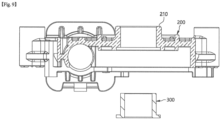
FIG. 9 , thebush 300 may be press-fitted into and fixed to the protrudinghub 210 of theupper housing 200 made individually. - The
upper housing 200 may be manufactured by injection molding, and thebush 300 may be press-fitted to the protrudinghub 210 by being inserted thereto from the lower side of the protrudinghub 210. In this case, the lower end of thebush 300 may be configured to bend outward, so thebush 300 may be prevented from excessively protruding from the protrudinghub 210. - Next, as described above, when the assembly of the
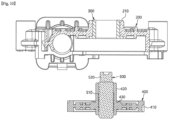
bush 300 is completed, the assembly of the worm wheel may be coupled to thebush 300 as illustrated inFIG. 10 . - The assembly of the worm wheel may be an assembly composed of the
worm wheel 400 and thedrive shaft 500. In such an assembly of the worm wheel, theworm wheel 400 and thedrive shaft 500 may be configured to be integrated with each other through the insert injection. - In addition, when coupling the assembly of the worm wheel to the
bush 300, thehub part 420 of theworm wheel 400 constituting the assembly of the worm wheel may be inserted into thebush 300 from a lower side thereof to pass through the inside of thebush 300. - In this case, until the
contact part 430 of theworm wheel 400 is in contact with the lower surface of thebush 300, thehub part 420 may be inserted into thebush 300. - Accordingly, the
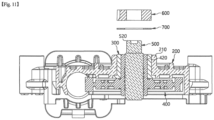
serration part 520 which is a part of the upper end side of thedrive shaft 500 may pass through thebush 300 and be exposed to the upper side thereof, and the upper surface of thehub part 420 may be located to reach approximately the same height as the height of thebush 300. This is as illustrated inFIG. 11 . - Next, when the assembly of the worm wheel is completed, the
pinion gear 600 may be coupled thereto as illustrated inFIG. 12 . - In this case, during the coupling of the
pinion gear 600, thewasher 700 may first be installed at the circumference of thedrive shaft 500 exposed to the upper side of thebush 300, and then thepinion gear 600 may be coupled to theserration part 520 of thedrive shaft 500. - Accordingly, the
washer 700 may be located between the upper surface of thehub part 420 and the lower surface of thepinion gear 600. - Next, the
bent part 530 may be formed at the upper end of thedrive shaft 500 as illustrated inFIG. 12 . - That is, while the
drive shaft 500 is pulled maximally upward, a portion of the upper surface of thedrive shaft 500 may be transformed through the riveting to form thebent part 530. - Accordingly, the upper surface of the
contact part 430 of theworm wheel 400 may be in contact with the lower surface of thebush 300 by the riveting described above. Additionally, the lower surface of thewasher 700 on which thepinion gear 600 is placed may be located to be in contact with the upper surface of thebush 300. Accordingly, thedrive shaft 500, theworm wheel 400 fixed thereto, thepinion gear 600, and thebush 300 have no vertical interval therebetween, but may rotate. - That is, the
drive shaft 500, theworm wheel 400, thebush 300, thepinion gear 600, and thewasher 700 may be configured to be integrated with each other. Accordingly, no vertical interval between thepinion gear 600 and thewasher 700, no vertical interval between thewasher 700 and thebush 300, and no vertical interval between thebush 300 and theworm wheel 400 may exist. - In addition, when the
drive shaft 500 is coupled to thepinion gear 600 by the riveting as described above, as illustrated inFIGS. 12 and13 , thebottom cover 800 provided separately may be coupled to theupper housing 200. - The
bottom cover 800 may be provided by being mounted to the upper side of the printedcircuit board 110 located inside thelower housing 100. - The
drive motor 130 may be provided by being mounted to thelower housing 100. In this case, theworm gear 140 may be provided by being installed on themotor shaft 131 of thedrive motor 130, which is illustrated inFIG. 6 . - Accordingly, when the
bottom cover 800, theupper housing 200, and thelower housing 100 are simultaneously coupled to each other, theworm wheel 400 may be coupled to theworm gear 140 such that power is transmitted therebetween with the circumference of theworm wheel 400 engaged with theworm gear 140, and the bottom of theworm wheel 400 may be located to be blocked by thebottom cover 800. Accordingly, the assembly of the motor unit for a sunroof may be completed. - Next, the operation state of the motor unit for a sunroof assembled as described above according to the embodiment of the present disclosure will be described further in detail.
- In the motor unit for a sunroof according to the embodiment of the present disclosure, the sunroof glass (not shown) may be operated to be opened or closed according to the operation direction of the
drive motor 130. - That is, while the
pinion gear 600 operates clockwise or counterclockwise according to the clockwise/counterclockwise operation of thedrive motor 130, the sunroof glass may be operated to be opened or closed. - Particularly, due to the clockwise/counterclockwise rotation of the
drive motor 130, direction of force applied to the wire for operating the sunroof glass (not shown) connected to thepinion gear 600 may be changed, so thepinion gear 600 may move upward or downward. - That is, when the
drive motor 130 is driven clockwise to open the sunroof glass, force of moving thepinion gear 600 upward may be supplied to thepinion gear 600 such that thepinion gear 600 moves upward. Furthermore, when thedrive motor 130 is driven counterclockwise to close the sunroof glass, force of moving thepinion gear 600 downward may be supplied to thepinion gear 600 such that thepinion gear 600 moves downward. - However, the
pinion gear 600 may be riveted to thedrive shaft 500, and thedrive shaft 500 may be configured to be integrated with theworm wheel 400. In addition, the upper surface of thecontact part 430 of theworm wheel 400 may be maintained to be in contact with the lower surface of thebush 300, and the upper surface of thehub part 420 of theworm wheel 400 may be maintained to be in contact with the lower surface of thewasher 700. Accordingly, thedrive shaft 500, theworm wheel 400 fixed thereto, and thepinion gear 600 may have no vertical interval therebetween. - That is, although the upward or downward movement of the
pinion gear 600 as described above occurs, thepinion gear 600 may be prevented from shaking vertically. - Accordingly, irrespective of the clockwise/counterclockwise rotation of the
pinion gear 600, contact between thebush 300 and theworm wheel 400 and contact between thewasher 700 and thebush 300 may be continuously performed in the same manners, so contact noise therebetween may be prevented from being changed according to the state of the rotation of thepinion gear 600. - Finally, in the motor unit for a sunroof according to the present disclosure, the same noise may be generated irrespective to the clockwise/counterclockwise rotation of the
pinion gear 600, thereby preventing complaints of a user caused by contact noises different from each other occurring during the opening and closing of the sunroof glass. - Furthermore, in the motor unit for a sunroof according to the present disclosure, the
pinion gear 600 may be maintained to be in continuous contact with thewasher 700, thereby enabling thedrive shaft 500 to continuously and efficiently operate without being shaken horizontally by force applied to the pinion gear. - In addition, in the motor unit for a sunroof according to the present disclosure, each component may be configured to have no interval therebetween while the
drive shaft 500 is pulled to the upper surface of thepinion gear 600 by the riveting, so the downward bending of thebottom cover 800 may not occur. That is, a design for preventing the downward bending of thebottom cover 800 may not be required. Particularly, thebottom cover 800 may be made of a resin material, so the manufacturing and assembly of the motor unit for a sunroof may be easily performed. - Meanwhile, the motor unit for a sunroof according to the present disclosure may not be limited to the embodiment described above.
- For example, the upper surface of the
hub part 420 constituting theworm wheel 400 may be configured to protrude more than the upper surface of thebush 300. - In this case, the lower surface of the
washer 700 may be in contact with only the upper surface of thehub part 420. Accordingly, although thewasher 700 is formed of metal, thewasher 700 may be in contact with thehub part 420 made of resin, which may further reduce entire noise. - Of course, despite the above mentioned configuration, interval may not exist between the
pinion gear 600 and thewasher 700 and the bush 300 (or the hub part), so the uneven wear or malfunction of the motor unit for a sunroof which may be caused by the interval may be prevented. - Accordingly, the motor unit for a sunroof according to the present disclosure may be transformed into various forms within the scope of the claims.
Claims (9)
- A motor unit for a sunroof comprising:a lower housing (100) configured as a box body having an open upper surface and having a drive motor (130) provided therein, the drive motor (130) driving a motor shaft (131) having a worm gear (140) provided thereon;an upper housing (200) configured as a box body having an open lower surface so as to cover the open upper surface of the lower housing (100), the upper housing (200) having a protruding hub (210) formed at a center portion thereof;a bush (300) provided in the protruding hub (210) of the upper housing (200);a worm wheel (400) having a circumference configured to be rotated in engagement with the worm gear (140) and having a hub part (420) formed at a center of the worm wheel (400) by protruding therefrom, the hub part (420) being rotatably installed by passing through an inside of the bush (300);a drive shaft (500) installed to be fixed to the worm wheel (400) by passing through the hub part (420) of the worm wheel (400);a pinion gear (600) coupled to an upper end part of the drive shaft (500) such that power is transmitted therebetween;a washer (700) located between the pinion gear (600) and the hub part (420) of the worm wheel (400); anda bottom cover (800) allowing the worm wheel (400) to be rotatably mounted thereto,wherein a bent part (530) is formed at an upper end of the drive shaft (500), the bent part (530) covering a portion of an upper surface of the pinion gear (600), anda contact part (430) is formed at an upper surface of the worm wheel (400), the contact part (430) configured to be in contact with a lower surface of the bush (300).
- The motor unit of claim 1, characterized in that the bent part (530) of the drive shaft (500) is formed through riveting after the pinion gear (600) is coupled to the drive shaft (500).
- The motor unit of claim 1, characterized in that the bush (300) and the washer (700) are made of metals, and the worm wheel (400) is made of resin.
- The motor unit of claim 1, characterized in that the washer (700) is configured to be in contact with an upper surface of the hub part (420) of the worm wheel (400).
- The motor unit of claim 1, characterized in that a receiving part (820) is formed in the bottom cover (800) such that the hub part (420) of the worm wheel (400) is received in the receiving part (820), and
a through hole (830) is formed in the receiving part (820) such that the drive shaft (500) passes through the through hole (830) . - The motor unit of claim 1, characterized in that when the drive shaft (500) fixed to the worm wheel (400) moves upward, the contact part (430) is located to be in contact with the bush (300).
- The motor unit of claim 1, characterized in that when the drive shaft (500) fixed to the worm wheel (400) moves maximally upward, the contact part (430) is located to be in contact with the bush (300).
- The motor unit of claim 1, characterized in that the bush (300) has a lower end formed to bend toward the upper housing (200) such that the bush (300) is restricted from moving upward from the upper housing (200).
- The motor unit of claim 1, characterized in that the washer (700) is configured to cover an upper surface of the hub part (420) of the worm wheel (400) and an upper surface of the bush (300).
Applications Claiming Priority (1)
| Application Number | Priority Date | Filing Date | Title |
|---|---|---|---|
| KR1020200062139A KR102291071B1 (en) | 2020-05-25 | 2020-05-25 | motor unit for sunroof |
Publications (2)
| Publication Number | Publication Date |
|---|---|
| EP3916186A1 EP3916186A1 (en) | 2021-12-01 |
| EP3916186B1 true EP3916186B1 (en) | 2023-02-22 |
Family
ID=75625379
Family Applications (1)
| Application Number | Title | Priority Date | Filing Date |
|---|---|---|---|
| EP21169456.7A Active EP3916186B1 (en) | 2020-05-25 | 2021-04-20 | Motor unit for sunroof |
Country Status (4)
| Country | Link |
|---|---|
| US (1) | US11557938B2 (en) |
| EP (1) | EP3916186B1 (en) |
| KR (1) | KR102291071B1 (en) |
| CN (1) | CN113726063B (en) |
Family Cites Families (17)
| Publication number | Priority date | Publication date | Assignee | Title |
|---|---|---|---|---|
| DE19706871A1 (en) * | 1997-02-21 | 1998-08-27 | Bosch Gmbh Robert | Electromotive drive device |
| EP1101968B1 (en) * | 1998-08-03 | 2016-09-28 | Asmo Co. Ltd. | Drive device having motor and speed reduction mechanism |
| JP2001069722A (en) * | 1999-08-31 | 2001-03-16 | Jidosha Denki Kogyo Co Ltd | Motor fitted with rotation detecting sensor for switchgear |
| US6591707B2 (en) * | 2000-07-31 | 2003-07-15 | Asmo Co., Ltd. | Geared motor having worm wheel drivingly connected to output shaft |
| KR100729408B1 (en) * | 2006-01-13 | 2007-06-18 | 주식회사 캄코 | Housing structure connected to the vehicle power lift motor |
| KR200428305Y1 (en) | 2006-07-25 | 2006-10-12 | 정종필 | Power transmission structure for sunroof motor |
| JP5006592B2 (en) * | 2006-07-28 | 2012-08-22 | 株式会社ミツバ | Electric motor with reduction mechanism |
| JP5075444B2 (en) * | 2007-03-28 | 2012-11-21 | 株式会社ミツバ | Electric motor with reduction gear and noise prevention device |
| JP5173668B2 (en) * | 2008-08-18 | 2013-04-03 | 株式会社ミツバ | Motor with reduction mechanism |
| JP5126249B2 (en) * | 2010-02-25 | 2013-01-23 | ブラザー工業株式会社 | Gear mechanism and image forming apparatus |
| CN103185130B (en) * | 2011-12-31 | 2017-10-24 | 德昌电机(深圳)有限公司 | Drive device and its gear |
| DE102012219743B4 (en) * | 2012-10-29 | 2025-06-26 | Robert Bosch Gmbh | Drive device for an adjustable element of a vehicle |
| CN104969454B (en) * | 2013-09-06 | 2018-09-21 | 株式会社美姿把 | electric motor |
| KR101569432B1 (en) | 2013-12-19 | 2015-11-16 | 주식회사 동희홀딩스 | Wireless Brushless DC motor Unit |
| US10876595B2 (en) * | 2016-06-17 | 2020-12-29 | Mitsuba Corporation | Speed reducer-attached motor and speed reducer-attached motor assembly method |
| KR101955554B1 (en) | 2017-06-30 | 2019-03-07 | (주)베바스토동희 홀딩스 | Motor controller for sunroof |
| GB2575300B (en) * | 2018-07-05 | 2022-11-09 | Johnson Electric Int Ag | Rotor assembly for electric motor |
-
2020
- 2020-05-25 KR KR1020200062139A patent/KR102291071B1/en active Active
-
2021
- 2021-04-15 US US17/231,475 patent/US11557938B2/en active Active
- 2021-04-20 EP EP21169456.7A patent/EP3916186B1/en active Active
- 2021-04-20 CN CN202110425786.1A patent/CN113726063B/en not_active Expired - Fee Related
Also Published As
| Publication number | Publication date |
|---|---|
| US11557938B2 (en) | 2023-01-17 |
| US20210367480A1 (en) | 2021-11-25 |
| CN113726063B (en) | 2023-11-21 |
| KR102291071B1 (en) | 2021-08-23 |
| CN113726063A (en) | 2021-11-30 |
| EP3916186A1 (en) | 2021-12-01 |
Similar Documents
| Publication | Publication Date | Title |
|---|---|---|
| EP2746690B1 (en) | Indoor air-conditioner | |
| CN109520109B (en) | Door drive device and air conditioner | |
| KR101866306B1 (en) | Console height adjusting device of car | |
| TW202142087A (en) | Preassembled friction hinge module, hinged system, and method for making preassembled friction hinge modules and systems | |
| EP3916186B1 (en) | Motor unit for sunroof | |
| CN112046415A (en) | Sliding door structure | |
| KR101817530B1 (en) | Device for covering a child anchor, and vehicle rear package tray having the same | |
| CN114652226B (en) | Bottom shell | |
| CN110145855B (en) | Top cover assembly of air conditioner indoor unit and air conditioner indoor unit | |
| CN109394120B (en) | Door lock actuator and dish washer | |
| KR101515682B1 (en) | A open and shut motor | |
| CN213228278U (en) | Driving device and vehicle skylight | |
| CN211551992U (en) | Air outlet closing mechanism and air conditioner comprising same | |
| CN214743051U (en) | Gear box and driving device thereof | |
| KR101610537B1 (en) | Pully assembly of window regulator for vehicle | |
| JP3962986B2 (en) | Shutter bracket structure | |
| CN223484475U (en) | Air-out structure and have its air conditioner | |
| KR20110012553A (en) | Opening and closing apparatus for window glass in vehicles | |
| CN222068674U (en) | Air conditioner | |
| JP4299037B2 (en) | Door mirror electric storage device | |
| CN223709871U (en) | Air guide assembly and air conditioner | |
| CN223805944U (en) | Novel transmission box and door and window thereof | |
| CN216977143U (en) | Air deflector and air conditioner | |
| CN109520106B (en) | Shutter drive and air conditioner | |
| CN119910418B (en) | screw box |
Legal Events
| Date | Code | Title | Description |
|---|---|---|---|
| PUAI | Public reference made under article 153(3) epc to a published international application that has entered the european phase |
Free format text: ORIGINAL CODE: 0009012 |
|
| STAA | Information on the status of an ep patent application or granted ep patent |
Free format text: STATUS: THE APPLICATION HAS BEEN PUBLISHED |
|
| AK | Designated contracting states |
Kind code of ref document: A1 Designated state(s): AL AT BE BG CH CY CZ DE DK EE ES FI FR GB GR HR HU IE IS IT LI LT LU LV MC MK MT NL NO PL PT RO RS SE SI SK SM TR |
|
| B565 | Issuance of search results under rule 164(2) epc |
Effective date: 20211014 |
|
| STAA | Information on the status of an ep patent application or granted ep patent |
Free format text: STATUS: REQUEST FOR EXAMINATION WAS MADE |
|
| 17P | Request for examination filed |
Effective date: 20220502 |
|
| RBV | Designated contracting states (corrected) |
Designated state(s): AL AT BE BG CH CY CZ DE DK EE ES FI FR GB GR HR HU IE IS IT LI LT LU LV MC MK MT NL NO PL PT RO RS SE SI SK SM TR |
|
| RIC1 | Information provided on ipc code assigned before grant |
Ipc: E05F 15/662 20150101AFI20220809BHEP |
|
| GRAP | Despatch of communication of intention to grant a patent |
Free format text: ORIGINAL CODE: EPIDOSNIGR1 |
|
| STAA | Information on the status of an ep patent application or granted ep patent |
Free format text: STATUS: GRANT OF PATENT IS INTENDED |
|
| INTG | Intention to grant announced |
Effective date: 20220922 |
|
| GRAS | Grant fee paid |
Free format text: ORIGINAL CODE: EPIDOSNIGR3 |
|
| GRAA | (expected) grant |
Free format text: ORIGINAL CODE: 0009210 |
|
| STAA | Information on the status of an ep patent application or granted ep patent |
Free format text: STATUS: THE PATENT HAS BEEN GRANTED |
|
| AK | Designated contracting states |
Kind code of ref document: B1 Designated state(s): AL AT BE BG CH CY CZ DE DK EE ES FI FR GB GR HR HU IE IS IT LI LT LU LV MC MK MT NL NO PL PT RO RS SE SI SK SM TR |
|
| REG | Reference to a national code |
Ref country code: GB Ref legal event code: FG4D |
|
| REG | Reference to a national code |
Ref country code: CH Ref legal event code: EP |
|
| REG | Reference to a national code |
Ref country code: AT Ref legal event code: REF Ref document number: 1549621 Country of ref document: AT Kind code of ref document: T Effective date: 20230315 Ref country code: IE Ref legal event code: FG4D |
|
| REG | Reference to a national code |
Ref country code: DE Ref legal event code: R096 Ref document number: 602021001439 Country of ref document: DE |
|
| REG | Reference to a national code |
Ref country code: LT Ref legal event code: MG9D |
|
| REG | Reference to a national code |
Ref country code: NL Ref legal event code: MP Effective date: 20230222 |
|
| REG | Reference to a national code |
Ref country code: AT Ref legal event code: MK05 Ref document number: 1549621 Country of ref document: AT Kind code of ref document: T Effective date: 20230222 |
|
| PG25 | Lapsed in a contracting state [announced via postgrant information from national office to epo] |
Ref country code: RS Free format text: LAPSE BECAUSE OF FAILURE TO SUBMIT A TRANSLATION OF THE DESCRIPTION OR TO PAY THE FEE WITHIN THE PRESCRIBED TIME-LIMIT Effective date: 20230222 Ref country code: PT Free format text: LAPSE BECAUSE OF FAILURE TO SUBMIT A TRANSLATION OF THE DESCRIPTION OR TO PAY THE FEE WITHIN THE PRESCRIBED TIME-LIMIT Effective date: 20230622 Ref country code: NO Free format text: LAPSE BECAUSE OF FAILURE TO SUBMIT A TRANSLATION OF THE DESCRIPTION OR TO PAY THE FEE WITHIN THE PRESCRIBED TIME-LIMIT Effective date: 20230522 Ref country code: NL Free format text: LAPSE BECAUSE OF FAILURE TO SUBMIT A TRANSLATION OF THE DESCRIPTION OR TO PAY THE FEE WITHIN THE PRESCRIBED TIME-LIMIT Effective date: 20230222 Ref country code: LV Free format text: LAPSE BECAUSE OF FAILURE TO SUBMIT A TRANSLATION OF THE DESCRIPTION OR TO PAY THE FEE WITHIN THE PRESCRIBED TIME-LIMIT Effective date: 20230222 Ref country code: LT Free format text: LAPSE BECAUSE OF FAILURE TO SUBMIT A TRANSLATION OF THE DESCRIPTION OR TO PAY THE FEE WITHIN THE PRESCRIBED TIME-LIMIT Effective date: 20230222 Ref country code: HR Free format text: LAPSE BECAUSE OF FAILURE TO SUBMIT A TRANSLATION OF THE DESCRIPTION OR TO PAY THE FEE WITHIN THE PRESCRIBED TIME-LIMIT Effective date: 20230222 Ref country code: ES Free format text: LAPSE BECAUSE OF FAILURE TO SUBMIT A TRANSLATION OF THE DESCRIPTION OR TO PAY THE FEE WITHIN THE PRESCRIBED TIME-LIMIT Effective date: 20230222 Ref country code: AT Free format text: LAPSE BECAUSE OF FAILURE TO SUBMIT A TRANSLATION OF THE DESCRIPTION OR TO PAY THE FEE WITHIN THE PRESCRIBED TIME-LIMIT Effective date: 20230222 |
|
| PG25 | Lapsed in a contracting state [announced via postgrant information from national office to epo] |
Ref country code: SE Free format text: LAPSE BECAUSE OF FAILURE TO SUBMIT A TRANSLATION OF THE DESCRIPTION OR TO PAY THE FEE WITHIN THE PRESCRIBED TIME-LIMIT Effective date: 20230222 Ref country code: PL Free format text: LAPSE BECAUSE OF FAILURE TO SUBMIT A TRANSLATION OF THE DESCRIPTION OR TO PAY THE FEE WITHIN THE PRESCRIBED TIME-LIMIT Effective date: 20230222 Ref country code: IS Free format text: LAPSE BECAUSE OF FAILURE TO SUBMIT A TRANSLATION OF THE DESCRIPTION OR TO PAY THE FEE WITHIN THE PRESCRIBED TIME-LIMIT Effective date: 20230622 Ref country code: GR Free format text: LAPSE BECAUSE OF FAILURE TO SUBMIT A TRANSLATION OF THE DESCRIPTION OR TO PAY THE FEE WITHIN THE PRESCRIBED TIME-LIMIT Effective date: 20230523 Ref country code: FI Free format text: LAPSE BECAUSE OF FAILURE TO SUBMIT A TRANSLATION OF THE DESCRIPTION OR TO PAY THE FEE WITHIN THE PRESCRIBED TIME-LIMIT Effective date: 20230222 |
|
| PG25 | Lapsed in a contracting state [announced via postgrant information from national office to epo] |
Ref country code: SM Free format text: LAPSE BECAUSE OF FAILURE TO SUBMIT A TRANSLATION OF THE DESCRIPTION OR TO PAY THE FEE WITHIN THE PRESCRIBED TIME-LIMIT Effective date: 20230222 Ref country code: RO Free format text: LAPSE BECAUSE OF FAILURE TO SUBMIT A TRANSLATION OF THE DESCRIPTION OR TO PAY THE FEE WITHIN THE PRESCRIBED TIME-LIMIT Effective date: 20230222 Ref country code: EE Free format text: LAPSE BECAUSE OF FAILURE TO SUBMIT A TRANSLATION OF THE DESCRIPTION OR TO PAY THE FEE WITHIN THE PRESCRIBED TIME-LIMIT Effective date: 20230222 Ref country code: DK Free format text: LAPSE BECAUSE OF FAILURE TO SUBMIT A TRANSLATION OF THE DESCRIPTION OR TO PAY THE FEE WITHIN THE PRESCRIBED TIME-LIMIT Effective date: 20230222 Ref country code: CZ Free format text: LAPSE BECAUSE OF FAILURE TO SUBMIT A TRANSLATION OF THE DESCRIPTION OR TO PAY THE FEE WITHIN THE PRESCRIBED TIME-LIMIT Effective date: 20230222 |
|
| REG | Reference to a national code |
Ref country code: DE Ref legal event code: R097 Ref document number: 602021001439 Country of ref document: DE |
|
| PG25 | Lapsed in a contracting state [announced via postgrant information from national office to epo] |
Ref country code: SK Free format text: LAPSE BECAUSE OF FAILURE TO SUBMIT A TRANSLATION OF THE DESCRIPTION OR TO PAY THE FEE WITHIN THE PRESCRIBED TIME-LIMIT Effective date: 20230222 |
|
| PG25 | Lapsed in a contracting state [announced via postgrant information from national office to epo] |
Ref country code: LU Free format text: LAPSE BECAUSE OF NON-PAYMENT OF DUE FEES Effective date: 20230420 |
|
| PLBE | No opposition filed within time limit |
Free format text: ORIGINAL CODE: 0009261 |
|
| STAA | Information on the status of an ep patent application or granted ep patent |
Free format text: STATUS: NO OPPOSITION FILED WITHIN TIME LIMIT |
|
| REG | Reference to a national code |
Ref country code: BE Ref legal event code: MM Effective date: 20230430 |
|
| PG25 | Lapsed in a contracting state [announced via postgrant information from national office to epo] |
Ref country code: MC Free format text: LAPSE BECAUSE OF FAILURE TO SUBMIT A TRANSLATION OF THE DESCRIPTION OR TO PAY THE FEE WITHIN THE PRESCRIBED TIME-LIMIT Effective date: 20230222 |
|
| 26N | No opposition filed |
Effective date: 20231123 |
|
| PG25 | Lapsed in a contracting state [announced via postgrant information from national office to epo] |
Ref country code: SI Free format text: LAPSE BECAUSE OF FAILURE TO SUBMIT A TRANSLATION OF THE DESCRIPTION OR TO PAY THE FEE WITHIN THE PRESCRIBED TIME-LIMIT Effective date: 20230222 Ref country code: MC Free format text: LAPSE BECAUSE OF FAILURE TO SUBMIT A TRANSLATION OF THE DESCRIPTION OR TO PAY THE FEE WITHIN THE PRESCRIBED TIME-LIMIT Effective date: 20230222 Ref country code: FR Free format text: LAPSE BECAUSE OF NON-PAYMENT OF DUE FEES Effective date: 20230422 |
|
| REG | Reference to a national code |
Ref country code: IE Ref legal event code: MM4A |
|
| PG25 | Lapsed in a contracting state [announced via postgrant information from national office to epo] |
Ref country code: BE Free format text: LAPSE BECAUSE OF NON-PAYMENT OF DUE FEES Effective date: 20230430 |
|
| PG25 | Lapsed in a contracting state [announced via postgrant information from national office to epo] |
Ref country code: IE Free format text: LAPSE BECAUSE OF NON-PAYMENT OF DUE FEES Effective date: 20230420 |
|
| PG25 | Lapsed in a contracting state [announced via postgrant information from national office to epo] |
Ref country code: IE Free format text: LAPSE BECAUSE OF NON-PAYMENT OF DUE FEES Effective date: 20230420 |
|
| PG25 | Lapsed in a contracting state [announced via postgrant information from national office to epo] |
Ref country code: IT Free format text: LAPSE BECAUSE OF FAILURE TO SUBMIT A TRANSLATION OF THE DESCRIPTION OR TO PAY THE FEE WITHIN THE PRESCRIBED TIME-LIMIT Effective date: 20230222 |
|
| PGFP | Annual fee paid to national office [announced via postgrant information from national office to epo] |
Ref country code: DE Payment date: 20240430 Year of fee payment: 4 |
|
| PG25 | Lapsed in a contracting state [announced via postgrant information from national office to epo] |
Ref country code: BG Free format text: LAPSE BECAUSE OF FAILURE TO SUBMIT A TRANSLATION OF THE DESCRIPTION OR TO PAY THE FEE WITHIN THE PRESCRIBED TIME-LIMIT Effective date: 20230222 |
|
| PG25 | Lapsed in a contracting state [announced via postgrant information from national office to epo] |
Ref country code: BG Free format text: LAPSE BECAUSE OF FAILURE TO SUBMIT A TRANSLATION OF THE DESCRIPTION OR TO PAY THE FEE WITHIN THE PRESCRIBED TIME-LIMIT Effective date: 20230222 |
|
| REG | Reference to a national code |
Ref country code: CH Ref legal event code: PL |
|
| PG25 | Lapsed in a contracting state [announced via postgrant information from national office to epo] |
Ref country code: CH Free format text: LAPSE BECAUSE OF NON-PAYMENT OF DUE FEES Effective date: 20240430 |
|
| PG25 | Lapsed in a contracting state [announced via postgrant information from national office to epo] |
Ref country code: CY Free format text: LAPSE BECAUSE OF FAILURE TO SUBMIT A TRANSLATION OF THE DESCRIPTION OR TO PAY THE FEE WITHIN THE PRESCRIBED TIME-LIMIT; INVALID AB INITIO Effective date: 20210420 |
|
| PG25 | Lapsed in a contracting state [announced via postgrant information from national office to epo] |
Ref country code: HU Free format text: LAPSE BECAUSE OF FAILURE TO SUBMIT A TRANSLATION OF THE DESCRIPTION OR TO PAY THE FEE WITHIN THE PRESCRIBED TIME-LIMIT; INVALID AB INITIO Effective date: 20210420 |
|
| REG | Reference to a national code |
Ref country code: DE Ref legal event code: R119 Ref document number: 602021001439 Country of ref document: DE |
|
| PG25 | Lapsed in a contracting state [announced via postgrant information from national office to epo] |
Ref country code: TR Free format text: LAPSE BECAUSE OF FAILURE TO SUBMIT A TRANSLATION OF THE DESCRIPTION OR TO PAY THE FEE WITHIN THE PRESCRIBED TIME-LIMIT Effective date: 20230222 |
|
| GBPC | Gb: european patent ceased through non-payment of renewal fee |
Effective date: 20250420 |
|
| PG25 | Lapsed in a contracting state [announced via postgrant information from national office to epo] |
Ref country code: DE Free format text: LAPSE BECAUSE OF NON-PAYMENT OF DUE FEES Effective date: 20251104 |
|
| PG25 | Lapsed in a contracting state [announced via postgrant information from national office to epo] |
Ref country code: GB Free format text: LAPSE BECAUSE OF NON-PAYMENT OF DUE FEES Effective date: 20250420 |