EP3914819B1 - Baugruppe für eine luftversorgung eines verbrennungsmotors und luftversorgungstrakt für einen verbrennungsmotor mit einer solchen - Google Patents
Baugruppe für eine luftversorgung eines verbrennungsmotors und luftversorgungstrakt für einen verbrennungsmotor mit einer solchen Download PDFInfo
- Publication number
- EP3914819B1 EP3914819B1 EP20701721.1A EP20701721A EP3914819B1 EP 3914819 B1 EP3914819 B1 EP 3914819B1 EP 20701721 A EP20701721 A EP 20701721A EP 3914819 B1 EP3914819 B1 EP 3914819B1
- Authority
- EP
- European Patent Office
- Prior art keywords
- flow
- line
- assembly
- gas
- compressor
- Prior art date
- Legal status (The legal status is an assumption and is not a legal conclusion. Google has not performed a legal analysis and makes no representation as to the accuracy of the status listed.)
- Active
Links
Images



Classifications
-
- F—MECHANICAL ENGINEERING; LIGHTING; HEATING; WEAPONS; BLASTING
- F02—COMBUSTION ENGINES; HOT-GAS OR COMBUSTION-PRODUCT ENGINE PLANTS
- F02B—INTERNAL-COMBUSTION PISTON ENGINES; COMBUSTION ENGINES IN GENERAL
- F02B37/00—Engines characterised by provision of pumps driven at least for part of the time by exhaust
-
- B—PERFORMING OPERATIONS; TRANSPORTING
- B01—PHYSICAL OR CHEMICAL PROCESSES OR APPARATUS IN GENERAL
- B01F—MIXING, e.g. DISSOLVING, EMULSIFYING OR DISPERSING
- B01F25/00—Flow mixers; Mixers for falling materials, e.g. solid particles
- B01F25/40—Static mixers
- B01F25/42—Static mixers in which the mixing is affected by moving the components jointly in changing directions, e.g. in tubes provided with baffles or obstructions
- B01F25/43—Mixing tubes, e.g. wherein the material is moved in a radial or partly reversed direction
- B01F25/431—Straight mixing tubes with baffles or obstructions that do not cause substantial pressure drop; Baffles therefor
- B01F25/4316—Straight mixing tubes with baffles or obstructions that do not cause substantial pressure drop; Baffles therefor the baffles being flat pieces of material, e.g. intermeshing, fixed to the wall or fixed on a central rod
-
- B—PERFORMING OPERATIONS; TRANSPORTING
- B01—PHYSICAL OR CHEMICAL PROCESSES OR APPARATUS IN GENERAL
- B01F—MIXING, e.g. DISSOLVING, EMULSIFYING OR DISPERSING
- B01F25/00—Flow mixers; Mixers for falling materials, e.g. solid particles
- B01F25/40—Static mixers
- B01F25/42—Static mixers in which the mixing is affected by moving the components jointly in changing directions, e.g. in tubes provided with baffles or obstructions
- B01F25/43—Mixing tubes, e.g. wherein the material is moved in a radial or partly reversed direction
- B01F25/431—Straight mixing tubes with baffles or obstructions that do not cause substantial pressure drop; Baffles therefor
- B01F25/43197—Straight mixing tubes with baffles or obstructions that do not cause substantial pressure drop; Baffles therefor characterised by the mounting of the baffles or obstructions
- B01F25/431971—Mounted on the wall
-
- B—PERFORMING OPERATIONS; TRANSPORTING
- B01—PHYSICAL OR CHEMICAL PROCESSES OR APPARATUS IN GENERAL
- B01F—MIXING, e.g. DISSOLVING, EMULSIFYING OR DISPERSING
- B01F25/00—Flow mixers; Mixers for falling materials, e.g. solid particles
- B01F25/40—Static mixers
- B01F25/42—Static mixers in which the mixing is affected by moving the components jointly in changing directions, e.g. in tubes provided with baffles or obstructions
- B01F25/43—Mixing tubes, e.g. wherein the material is moved in a radial or partly reversed direction
- B01F25/431—Straight mixing tubes with baffles or obstructions that do not cause substantial pressure drop; Baffles therefor
- B01F25/43197—Straight mixing tubes with baffles or obstructions that do not cause substantial pressure drop; Baffles therefor characterised by the mounting of the baffles or obstructions
- B01F25/431972—Mounted on an axial support member, e.g. a rod or bar
-
- F—MECHANICAL ENGINEERING; LIGHTING; HEATING; WEAPONS; BLASTING
- F02—COMBUSTION ENGINES; HOT-GAS OR COMBUSTION-PRODUCT ENGINE PLANTS
- F02M—SUPPLYING COMBUSTION ENGINES IN GENERAL WITH COMBUSTIBLE MIXTURES OR CONSTITUENTS THEREOF
- F02M26/00—Engine-pertinent apparatus for adding exhaust gases to combustion-air, main fuel or fuel-air mixture, e.g. by exhaust gas recirculation [EGR] systems
- F02M26/02—EGR systems specially adapted for supercharged engines
-
- F—MECHANICAL ENGINEERING; LIGHTING; HEATING; WEAPONS; BLASTING
- F02—COMBUSTION ENGINES; HOT-GAS OR COMBUSTION-PRODUCT ENGINE PLANTS
- F02M—SUPPLYING COMBUSTION ENGINES IN GENERAL WITH COMBUSTIBLE MIXTURES OR CONSTITUENTS THEREOF
- F02M26/00—Engine-pertinent apparatus for adding exhaust gases to combustion-air, main fuel or fuel-air mixture, e.g. by exhaust gas recirculation [EGR] systems
- F02M26/02—EGR systems specially adapted for supercharged engines
- F02M26/04—EGR systems specially adapted for supercharged engines with a single turbocharger
-
- F—MECHANICAL ENGINEERING; LIGHTING; HEATING; WEAPONS; BLASTING
- F02—COMBUSTION ENGINES; HOT-GAS OR COMBUSTION-PRODUCT ENGINE PLANTS
- F02M—SUPPLYING COMBUSTION ENGINES IN GENERAL WITH COMBUSTIBLE MIXTURES OR CONSTITUENTS THEREOF
- F02M26/00—Engine-pertinent apparatus for adding exhaust gases to combustion-air, main fuel or fuel-air mixture, e.g. by exhaust gas recirculation [EGR] systems
- F02M26/02—EGR systems specially adapted for supercharged engines
- F02M26/09—Constructional details, e.g. structural combinations of EGR systems and supercharger systems; Arrangement of the EGR and supercharger systems with respect to the engine
-
- F—MECHANICAL ENGINEERING; LIGHTING; HEATING; WEAPONS; BLASTING
- F02—COMBUSTION ENGINES; HOT-GAS OR COMBUSTION-PRODUCT ENGINE PLANTS
- F02M—SUPPLYING COMBUSTION ENGINES IN GENERAL WITH COMBUSTIBLE MIXTURES OR CONSTITUENTS THEREOF
- F02M26/00—Engine-pertinent apparatus for adding exhaust gases to combustion-air, main fuel or fuel-air mixture, e.g. by exhaust gas recirculation [EGR] systems
- F02M26/02—EGR systems specially adapted for supercharged engines
- F02M26/09—Constructional details, e.g. structural combinations of EGR systems and supercharger systems; Arrangement of the EGR and supercharger systems with respect to the engine
- F02M26/10—Constructional details, e.g. structural combinations of EGR systems and supercharger systems; Arrangement of the EGR and supercharger systems with respect to the engine having means to increase the pressure difference between the exhaust and intake system, e.g. venturis, variable geometry turbines, check valves using pressure pulsations or throttles in the air intake or exhaust system
-
- F—MECHANICAL ENGINEERING; LIGHTING; HEATING; WEAPONS; BLASTING
- F02—COMBUSTION ENGINES; HOT-GAS OR COMBUSTION-PRODUCT ENGINE PLANTS
- F02M—SUPPLYING COMBUSTION ENGINES IN GENERAL WITH COMBUSTIBLE MIXTURES OR CONSTITUENTS THEREOF
- F02M26/00—Engine-pertinent apparatus for adding exhaust gases to combustion-air, main fuel or fuel-air mixture, e.g. by exhaust gas recirculation [EGR] systems
- F02M26/13—Arrangement or layout of EGR passages, e.g. in relation to specific engine parts or for incorporation of accessories
- F02M26/17—Arrangement or layout of EGR passages, e.g. in relation to specific engine parts or for incorporation of accessories in relation to the intake system
- F02M26/19—Means for improving the mixing of air and recirculated exhaust gases, e.g. venturis or multiple openings to the intake system
-
- F—MECHANICAL ENGINEERING; LIGHTING; HEATING; WEAPONS; BLASTING
- F02—COMBUSTION ENGINES; HOT-GAS OR COMBUSTION-PRODUCT ENGINE PLANTS
- F02M—SUPPLYING COMBUSTION ENGINES IN GENERAL WITH COMBUSTIBLE MIXTURES OR CONSTITUENTS THEREOF
- F02M35/00—Combustion-air cleaners, air intakes, intake silencers, or induction systems specially adapted for, or arranged on, internal-combustion engines
- F02M35/10—Air intakes; Induction systems
- F02M35/10209—Fluid connections to the air intake system; their arrangement of pipes, valves or the like
- F02M35/10222—Exhaust gas recirculation [EGR]; Positive crankcase ventilation [PCV]; Additional air admission, lubricant or fuel vapour admission
-
- F—MECHANICAL ENGINEERING; LIGHTING; HEATING; WEAPONS; BLASTING
- F02—COMBUSTION ENGINES; HOT-GAS OR COMBUSTION-PRODUCT ENGINE PLANTS
- F02M—SUPPLYING COMBUSTION ENGINES IN GENERAL WITH COMBUSTIBLE MIXTURES OR CONSTITUENTS THEREOF
- F02M35/00—Combustion-air cleaners, air intakes, intake silencers, or induction systems specially adapted for, or arranged on, internal-combustion engines
- F02M35/10—Air intakes; Induction systems
- F02M35/10242—Devices or means connected to or integrated into air intakes; Air intakes combined with other engine or vehicle parts
- F02M35/10262—Flow guides, obstructions, deflectors or the like
-
- F—MECHANICAL ENGINEERING; LIGHTING; HEATING; WEAPONS; BLASTING
- F04—POSITIVE - DISPLACEMENT MACHINES FOR LIQUIDS; PUMPS FOR LIQUIDS OR ELASTIC FLUIDS
- F04D—NON-POSITIVE-DISPLACEMENT PUMPS
- F04D29/00—Details, component parts, or accessories
- F04D29/40—Casings; Connections of working fluid
- F04D29/42—Casings; Connections of working fluid for radial or helico-centrifugal pumps
- F04D29/44—Fluid-guiding means, e.g. diffusers
- F04D29/441—Fluid-guiding means, e.g. diffusers especially adapted for elastic fluid pumps
-
- B—PERFORMING OPERATIONS; TRANSPORTING
- B01—PHYSICAL OR CHEMICAL PROCESSES OR APPARATUS IN GENERAL
- B01F—MIXING, e.g. DISSOLVING, EMULSIFYING OR DISPERSING
- B01F23/00—Mixing according to the phases to be mixed, e.g. dispersing or emulsifying
- B01F23/10—Mixing gases with gases
-
- B—PERFORMING OPERATIONS; TRANSPORTING
- B01—PHYSICAL OR CHEMICAL PROCESSES OR APPARATUS IN GENERAL
- B01F—MIXING, e.g. DISSOLVING, EMULSIFYING OR DISPERSING
- B01F25/00—Flow mixers; Mixers for falling materials, e.g. solid particles
- B01F25/10—Mixing by creating a vortex flow, e.g. by tangential introduction of flow components
- B01F25/103—Mixing by creating a vortex flow, e.g. by tangential introduction of flow components with additional mixing means other than vortex mixers, e.g. the vortex chamber being positioned in another mixing chamber
-
- F—MECHANICAL ENGINEERING; LIGHTING; HEATING; WEAPONS; BLASTING
- F04—POSITIVE - DISPLACEMENT MACHINES FOR LIQUIDS; PUMPS FOR LIQUIDS OR ELASTIC FLUIDS
- F04D—NON-POSITIVE-DISPLACEMENT PUMPS
- F04D29/00—Details, component parts, or accessories
- F04D29/40—Casings; Connections of working fluid
- F04D29/42—Casings; Connections of working fluid for radial or helico-centrifugal pumps
- F04D29/4206—Casings; Connections of working fluid for radial or helico-centrifugal pumps especially adapted for elastic fluid pumps
- F04D29/4213—Casings; Connections of working fluid for radial or helico-centrifugal pumps especially adapted for elastic fluid pumps suction ports
-
- F—MECHANICAL ENGINEERING; LIGHTING; HEATING; WEAPONS; BLASTING
- F05—INDEXING SCHEMES RELATING TO ENGINES OR PUMPS IN VARIOUS SUBCLASSES OF CLASSES F01-F04
- F05D—INDEXING SCHEME FOR ASPECTS RELATING TO NON-POSITIVE-DISPLACEMENT MACHINES OR ENGINES, GAS-TURBINES OR JET-PROPULSION PLANTS
- F05D2220/00—Application
- F05D2220/40—Application in turbochargers
-
- F—MECHANICAL ENGINEERING; LIGHTING; HEATING; WEAPONS; BLASTING
- F05—INDEXING SCHEMES RELATING TO ENGINES OR PUMPS IN VARIOUS SUBCLASSES OF CLASSES F01-F04
- F05D—INDEXING SCHEME FOR ASPECTS RELATING TO NON-POSITIVE-DISPLACEMENT MACHINES OR ENGINES, GAS-TURBINES OR JET-PROPULSION PLANTS
- F05D2250/00—Geometry
- F05D2250/50—Inlet or outlet
- F05D2250/51—Inlet
-
- Y—GENERAL TAGGING OF NEW TECHNOLOGICAL DEVELOPMENTS; GENERAL TAGGING OF CROSS-SECTIONAL TECHNOLOGIES SPANNING OVER SEVERAL SECTIONS OF THE IPC; TECHNICAL SUBJECTS COVERED BY FORMER USPC CROSS-REFERENCE ART COLLECTIONS [XRACs] AND DIGESTS
- Y02—TECHNOLOGIES OR APPLICATIONS FOR MITIGATION OR ADAPTATION AGAINST CLIMATE CHANGE
- Y02T—CLIMATE CHANGE MITIGATION TECHNOLOGIES RELATED TO TRANSPORTATION
- Y02T10/00—Road transport of goods or passengers
- Y02T10/10—Internal combustion engine [ICE] based vehicles
- Y02T10/12—Improving ICE efficiencies
Definitions
- the invention relates to an assembly for an air supply of an internal combustion engine of a motor vehicle, which is designed to mix at least two different gas flows, in particular fresh air and recirculated exhaust gas, with one another.
- Exhaust gas recirculation is well known, particularly in vehicles with combustion engines. It is used to de-throttle the engine at certain operating points and to achieve a composition of the cylinder charge that is optimally matched to the respective operating point. Exhaust gas recirculation also allows the combustion temperature and thus nitrogen oxide emissions to be reduced. This results in a reduction in pollutant emissions and a reduction in the engine's tendency to knock.
- exhaust gas recirculation part of the exhaust gas flow is usually fed into the fresh air that is to be supplied to the combustion unit.
- an exhaust gas recirculation line branches off from the exhaust duct and flows into the air line of the combustion engine.
- the problem with this feed and the mixture of exhaust gas and fresh air that is to be produced is that turbulence usually results in pressure losses in the area of the inlet point, and the mixture of exhaust gas and fresh air is inhomogeneously distributed.
- turbulence and dead water areas there is a risk that deposits will form in the lines, which can prevent optimal flow. This problem is particularly exacerbated when very high proportions of exhaust gas are added.
- disruptive influences on the fresh air flow can occur if no exhaust gas is recirculated.
- the DE 31 06 588 A1 discloses a connection of an exhaust gas recirculation line, in which the exhaust gas mass flow can enter the fresh air line through a large number of overflow openings.
- the overflow openings are arranged in such a way that a rotational movement of the individual partial exhaust gas mass flows generated thereby corresponds to the rotational movement of the incoming fresh air in order to avoid turbulence.
- dead water areas will form, which can lead to sooting.
- the KR 2013 0060422 A discloses an exhaust gas recirculation and a compressor of an exhaust gas turbocharger, as well as a mixing of exhaust gas and air.
- the exhaust gas flow is guided in a first line and fed through several openings in the line for the air flow.
- the mass flow of the two gases is finally mixed in this line.
- the mixing is designed in such a way that the two gases can then be compressed with relatively low losses.
- the mixing of the two gases in this system does not proceed optimally and the previously mentioned undesirable phenomena occur.
- WO 2016/096 813 A1 discloses an intake tract of an internal combustion engine, comprising a compressor of an exhaust gas turbocharger, a gas supply unit which is arranged upstream of the compressor and is designed to mix fresh air and a second gas flow with one another, and an air guiding device which is designed to parallelize a flow of the mixed gas flow upstream of the compressor.
- a gas supply system that can supply recirculated exhaust gas to the combustion engine with low pressure loss and without disturbing the air flow is described DE 10 2011 117 360 A1
- the component is located in front of the Compressor.
- the disadvantage is that the exhaust gas is subject to swirl behind the point of introduction into the air line and the swirl-affected flow can have a negative effect on the compressor behavior.
- the exhaust gas wraps around the air inside like a hose after it has been fed in.
- the exhaust gas is generally hotter than the air. This means that the tips of the compressor blades in particular, where the highest mechanical load is already present, can be subject to even greater mechanical stress due to the hotter temperatures.
- the object of the invention is to provide a component for the air supply of an internal combustion engine that at least partially overcomes the aforementioned disadvantages.
- the aim is to enable the most efficient and quietest possible mixing and compression of fresh air and exhaust gas, a compact design, and a long service life of the components involved.
- the assembly according to the invention for supplying air to an internal combustion engine comprises a compressor of an exhaust gas turbocharger; a gas supply unit which is arranged upstream of the compressor (with respect to a flow direction of the gas flows) and which is designed to mix a first gas flow and a second gas flow with one another; and a flow straightener which is designed to substantially parallelize a flow of the mixed gas flow upstream of the compressor.
- the first gas stream is preferably a fresh air stream for supplying air to an internal combustion engine and the second gas stream is an exhaust gas stream that is recirculated via exhaust gas recirculation.
- the mixed gas of fresh air and exhaust gas thus represents the supply air to be fed to the internal combustion engine to fill the cylinder.
- the swirl formation of the supplied exhaust gas and the mixed gas is neutralized directly at the flow straightener. This means that the compressor behavior is not affected by the swirling flow.
- the straightener ensures better mixing of the gas flows and thus a homogeneous temperature distribution in the mixed gas. This reduces the thermal load on the tips of the compressor blades and extends the service life of the compressor.
- the "essentially parallelized flow” refers in particular to an essentially turbulent flow in which the flow direction over the entire flow cross-section is aligned essentially parallel to the flow channel when viewed more macroscopically, i.e. is essentially swirl-free.
- the degree of parallelization is at least greater than in a corresponding assembly without the flow straightener according to the invention.
- a completely parallelized flow is even achieved.
- the essentially parallelized flow also has reduced speed fluctuations compared to an assembly according to the prior art.
- the assembly thus enables swirl-free or low-swirl, low-pressure loss and/or trouble-free mixing and compression of the different gas flows.
- the noise level is also reduced.
- the assembly Due to the arrangement of the gas supply unit upstream of the compressor, the assembly relates in particular to a low-pressure exhaust gas recirculation, in which the recirculated exhaust gas is introduced into the fresh air flow on the low-pressure side of the compressor.
- the flow straightener comprises a plurality of radial flow elements.
- a "radial flow element” is understood to mean a structure that is essentially flat, for example leaf- or wing-shaped, and extends essentially radially in its longitudinal extension (in relation to the flow direction of the gas flows).
- the radial flow elements are arranged in such a way that their main surface runs essentially parallel to the flow direction and the gas flow thus only "sees" the comparatively small inflow surfaces (flow cross-section).
- the radial flow elements reduce the swirl of the gas flows or even achieve almost complete parallelization.
- Suitable radial flow elements can vary and are preferably adapted to the geometry of the assembly in such a way that the parallelization of the gas flow is as great as possible with the lowest possible pressure losses and minimal installation space requirements.
- Suitable radial flow elements are, for example, trapezoidal in relation to a flow cross-section.
- the flow straightener comprises a hollow-cylindrical line section, on the inner circumference of which the radial flow elements are arranged.
- a straightener can be arranged within a flow-conducting line of the gas supply unit or can be flush with it.
- the hollow-cylindrical line section and the radial flow elements are preferably formed in one piece.
- the flow straightener comprises an axial flow element, on the outer circumference of which the radial flow elements are arranged.
- the axial flow element and the radial flow elements can be formed as one piece.
- the axial flow element results in better flow to the radial flow elements and thus improved mixing of the two gas flows.
- the axial flow element also improves the flow to the compressor blades.
- the elements of the flow straightener are preferably made of a metallic material.
- a metallic material In particular, one or more of the following materials are used: titanium, titanium alloy, aluminum, steel, cast iron.
- the elements of the flow straightener are made of the same material.
- the flow straightener is integrated within the gas supply unit, in particular within a flow-carrying line of the gas supply unit.
- the close placement of the three components - gas supply system, straightener and compressor - allows the flow paths to be shortened, which results in a particularly rapid load build-up of the combustion engine. This significantly improves the dynamics during driving, such as starting behavior or acceleration.
- the gas supply unit essentially has the task of feeding the second gas stream to the first gas stream and mixing the two.
- the gas supply unit is designed as a jet pump, so that the first gas stream (in particular fresh air stream) serves as a driving stream for sucking in the second gas stream (exhaust gas stream). In this way Passive suction of the exhaust gas flow can be achieved, particularly at low exhaust gas pressures.
- the jet pump preferably comprises a first line for guiding the first gas flow and a second line for supplying the second gas flow, which is connected to the first line by means of an inlet.
- the inlet is preferably designed as an annular gap on the first line.
- the second line runs azimuthally around the first line over at least half the circumferential length, in particular at least the entire circumferential length of the first line, the second line having a flow cross-section that decreases in the flow direction of the second gas flow. This results in an acceleration of the second gas flow and thus a more efficient mixing with the first gas flow.
- the hollow-cylindrical line section of the flow straightener is arranged on or in the first line for guiding the first gas flow, in particular at its downstream end, or it is formed integrally with it. This enables simple integration of the flow straightener in or on the gas supply unit.
- an axial length between the junction of the second line of the gas supply unit and an inlet plane on the flow inlet side into the flow straightener is at most 30 mm, in particular at most 20 mm, preferably at most 10 mm.
- the inlet plane on the flow inlet side into the flow straightener is defined by the leading edge of the radial flow elements.
- an axial length between the junction of the second line of the gas supply unit and an inlet into the compressor is at most 80 mm, in particular at most 60 mm, preferably at most 50 mm. This further improves the dynamic behavior during driving and further increases the degree of compaction of the assembly.
- the compressor comprises a housing which is formed in one piece with the gas supply unit and the flow straightener. This results in the advantage of simple production of these components, for example by means of casting.
- the compressor of the exhaust gas turbocharger can have a known structure and in particular comprise a compressor impeller with at least one compressor blade.
- the exhaust gas turbocharger also has a turbine arranged in an exhaust gas channel, which is driven by the exhaust gas and is connected to the compressor via a shaft, so that the compressor impeller is driven by the turbine.
- the second gas flow is preferably a partial exhaust gas flow, which is taken from the total exhaust gas flow in particular downstream of the turbine and is fed back to the internal combustion engine via the second line of the gas feed unit.
- a further aspect of the present invention relates to an air supply tract for an internal combustion engine, which comprises the assembly according to the invention for supplying air to the internal combustion engine.
- the assembly with its compressor is preferably connected directly to an air manifold of the internal combustion engine.
- the air supply tract can comprise further components, for example an air filter, a throttle valve, etc.
- a further aspect of the present invention relates to a motor vehicle with an internal combustion engine and an air supply tract with the assembly according to the invention.
- the motor vehicle relates in particular to a passenger vehicle or a truck.
- the assembly can be manufactured in particular by a casting process, whereby at least one component or several components of the assembly or all components of the assembly can be manufactured as a one-piece (integral) component from a single casting. This advantageously makes it possible to produce a cost-effective and assembly-friendly assembly with low manufacturing effort.
- Figure 1 shows an assembly according to the invention, designated overall by 1, for supplying air to an internal combustion engine.
- the assembly 1 comprises a compressor 2, which is part of a turbocharger (not shown in detail); a gas supply unit 3, which is arranged upstream of the compressor 2 and is designed to mix a first gas flow 10 and a second gas flow 12 with one another; and a flow straightener 4, which is designed to essentially parallelize a flow of the mixed gas flow upstream of the compressor 2.
- the assembly 1 is integrated in an air supply tract (not shown in detail) that supplies an internal combustion engine with compressed air.
- the first gas stream 10 is thus a fresh air stream that is sucked in from the environment and preferably cleaned via an air filter
- the second gas stream 12 is an exhaust gas stream that is taken from an exhaust tract of the internal combustion engine, in particular downstream of a turbine of the exhaust gas turbocharger arranged in the exhaust duct, and is returned.
- the compressor 2 has a structure known per se and comprises a housing 25 and a compressor impeller 21 arranged therein, which is rotatably mounted on a shaft 23 and has several compressor blades 22. On the inlet side (low pressure side), the compressor 2 has a flow constriction, so that a nozzle 24 is formed here.
- the compressor 2 can be connected to the combustion engine (not shown), in particular to an air manifold of the latter.
- the gas supply unit 3 has a central first line 32 for guiding the air flow 10.
- the gas supply unit 3 also comprises a second line 33 for supplying the exhaust gas flow 12.
- the second line 33 runs azimuthally around the first line 32 over slightly more than a circumferential length of the first line 32. In the process, a clear flow cross-section of the second line 33 decreases continuously and finally opens into an inlet 34.
- the inlet 34 of the second line 33 into the first line 32 is designed in the form of an annular gap 35 which essentially coaxially surrounds the first line 32. In the area of the inlet 34, the first line 32 has a constriction 36, whereby a nozzle is formed. Due to the narrowing of the flow cross-section of the second line 33 leading into the annular gap 35 and the narrowing 36 of the first line 32, both gas flows 10, 12 are accelerated.
- the flow straightener 4 Downstream of the inlet 34, the flow straightener 4 is connected.
- a sectional view of the assembly 1 at the level of the flow straightener 4 according to the Figure 1 The section line shown is in Figure 2 shown.
- the flow straightener 4 comprises a hollow cylindrical line section 41 which, according to the example shown, is directly connected to an outlet-side end of the first line 32, in particular is formed integrally with the first line 32.
- the line section 41 can alternatively also be flanged to the first line 32.
- the flow straightener 4 also comprises an axially arranged conical flow element 43 which has a rounded tip on the flow inlet side.
- the flow cross-section of the conical flow element 43 essentially corresponds to that of the hub which supports the shaft 23 of the compressor.
- the tip of the axial flow element 43 is optimized in terms of fluid mechanics.
- the axial flow element 43 causes the fresh air flow 10, which initially flows centrally and axially, to spread out in the radial direction, thus improving the flow to the compressor impeller 21 with its compressor blades 22.
- a plurality of radial flow elements 42 are arranged equidistant from one another and extend radially outward in the direction of the hollow cylindrical line section 41, thus achieving improved mixing with the exhaust gas flow 12 and a substantially parallelized flow.
- the flow straightener 4 When executing according to Figure 1 the flow straightener 4 is integrated in the gas supply unit 3 in such a way that the hollow cylindrical line section 41 is formed in one piece with the first line 32 of the gas supply unit 3. (According to an equivalent alternative description, the flow straightener 4, consisting of the radial flow elements 42 and the axial conical flow element 43, is arranged within the gas supply unit 3, namely within the first line 32.)
- the gas supply unit 3 consisting of the lines 32 and 33, is formed in one piece with the housing 25 of the compressor. This results in an advantage in production and assembly, since these components can be manufactured, in particular cast, as a single integral component.
- the distance between the inlet 34 of the second line 33 and the flow inlet-side entry plane into the flow straightener 4, which is defined by the position of the inflow surface of the flow elements 42, is preferably at most 15 mm.
- This compact arrangement of the functional elements, consisting of gas supply unit 3, flow straightener 4 and compressor 2, enables them to be accommodated even in confined spaces. Furthermore, the short gas flow lengths significantly improve the dynamics of the engine during driving, for example when starting or accelerating.
- FIG 3 a further embodiment of the flow straightener 4 is shown.
- the straightener 4 is designed here as a one-piece component, again comprising a hollow cylinder 41 and six equidistantly arranged radial flow elements 42, which in this example are arranged in an identical flow plane.
- This straightener 4 can be used in any lines, in particular can be used/integrated within the outlet end of the gas supply unit 3.
- the hollow cylindrical line section 41 does not form the extension of the first line 32 of the gas supply unit 3, but is arranged within it, so that the hollow cylindrical line section 41 rests with its outer surface on the inner surface of the first line 32.
- the first line 32 of the gas supply unit 3 can thus be connected directly to the housing 25 of the compressor 2 or can be designed in one piece with it.
- FIG. 4 Another variant of the flow straightener 4 shows Figure 4
- the flow straightener shown here differs from that of the Figure 3 in that the flow elements 42 alternately with a slight stagger with respect to the plane of the flow cross-section.
- a first group of flow elements 42.1 is arranged in an inlet-side plane and a second group of flow elements 42.2 in an outlet-side plane.
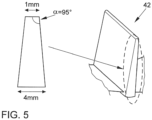
- FIG. 5 A detailed view of an exemplary embodiment of a radial flow element 42 of the flow straightener 4 and its dimensions is shown Figure 5 It can be seen that the flow element 42 has a relatively wide base area with a width of 4 mm, which faces the hollow cylindrical line section 41. Radially in the direction of the flow axis of the gas flow, the flow element 42 tapers to a width of 1 mm, for example, so that a trapezoidal cross-sectional area or inflow area is created, which is flowed against by the gas flow.
- the term 'trapezoidal' refers here to a quadrilateral with two base sides running parallel to one another and two legs which do not run parallel to one another. The legs are preferably symmetrical. The angle between the legs and the second base side is approximately 95°.
- the height (radial extent) of the element 42 is approximately 20 mm, while a length in the axial flow direction is approximately 30 mm. This results in a flow area of 6 cm 2 on both sides of the flow element 42, over which
- the specific dimensions and number of flow elements 42 should be adapted depending on the component geometry, in particular the flow cross-section of the hollow cylindrical line section 41, which essentially corresponds to that of the first line 32.
- the rectification i.e. the parallelization of the flow
- the pressure loss increases at the same time, so a compromise must be found here.
- a number of 5 flow elements 42 has proven to be particularly effective in terms of rectifying the gas flow (approx. 98% rectification) with a comparatively low pressure loss.
- Figures 6 and 7 illustrate the simulated flow pattern in an assembly 1 similar Figure 1 , but with a flow straightener 4 inserted into the first line 32 of the gas supply unit 3 according to Figure 4 .
- Figure 6 the flow pattern directly after the merging of the two gas streams 10, 12 behind the inlet 34 but still upstream of the rectifier 4 and
- Figure 7 the flow pattern directly downstream of the rectifier 4.
Landscapes
- Engineering & Computer Science (AREA)
- Chemical & Material Sciences (AREA)
- Mechanical Engineering (AREA)
- General Engineering & Computer Science (AREA)
- Combustion & Propulsion (AREA)
- Dispersion Chemistry (AREA)
- Chemical Kinetics & Catalysis (AREA)
- Supercharger (AREA)
- Structures Of Non-Positive Displacement Pumps (AREA)
Description
- Die Erfindung betrifft eine Baugruppe für eine Luftversorgung eines Verbrennungsmotors eines Kraftfahrzeugs, welche ausgebildet ist, wenigstens zwei unterschiedliche Gasströme, insbesondere Frischluft und rückgeführtes Abgas, miteinander zu vermischen.
- Abgasrückführungen sind insbesondere bei Kraftfahrzeugen mit Verbrennungsmotoren hinlänglich bekannt. Sie dienen einerseits zur Entdrosselung des Motors in bestimmten Betriebspunkten sowie andererseits zur Herbeiführung einer auf den jeweiligen Betriebspunkt optimal abgestimmten Zusammensetzung der Zylinderladung. Zudem erlaubt die Abgasrückführung die Verringerung der Verbrennungstemperatur und damit der Stickoxidemissionen. Es resultieren eine Verringerung von Schadstoffemissionen sowie eine Senkung der Klopfneigung des Motors.
- Bei der Abgasrückführung wird üblicherweise ein Teil des Abgasstroms der dem Verbrennungsaggregat zuzuführenden Frischluft zugeführt. Hierzu zweigt eine Abgasrückführungsleitung von dem Abgaskanal ab und mündet in die Luftleitung des Verbrennungsmotors. Problematisch bei dieser Zuführung und der herzustellenden Mischung aus Abgas und Frischluft ist, dass sich aufgrund von Turbulenzen üblicherweise Druckverluste im Bereich der Einleitstelle ergeben, sowie die Mischung aus Abgas und Frischluft inhomogen verteilt ist. Des Weiteren besteht bei vorhandenen Turbulenzen und Totwassergebieten die Gefahr, dass sich Ablagerungen in den Leitungen bilden, die eine optimale Durchströmung verhindern können. Diese Problematik verschärft sich im Besonderen, wenn sehr hohe Anteile an Abgas beigemischt werden. Zudem können sich Störeinflüsse auf den Frischluftstrom ergeben, wenn kein Abgas zurückgeführt wird.
- Ansätze zur Lösung der genannten Problematik bestehen insbesondere darin, die Zusammenführung der beiden Massenströme über relativ lange Mischwege zu erzeugen. Derartige Ausführungsformen weisen jedoch den Nachteil eines relativ großen Bauraumbedarfs sowie eines negativen Einflusses auf die dynamische Regelbarkeit des Verbrennungsaggregats auf. Aufgrund der auftretenden Druckverluste in den Zuführungsleitungen sind unter Umständen weitere Maßnahmen zur Förderung des Abgases zur Frischluft sowie der Zuführung zu einem gegebenenfalls vorhandenen Verdichter zu treffen, wie zum Beispiel Druckerhöhung in der Abgaszuleitung und/oder Druckminderung in der Frischluftleitung.
- Aus der
DE 39 31 811 C1 ist ein zylindrischer Rohrleitungsabschnitt in einer Luftansaugleitung einer Brennkraftmaschine bekannt, welcher einen Mischraum aufweist, in den die Abgasrückführungsleitung mit einer tangential gerichteten Öffnung einmündet. Dabei kann jedoch die Ausbildung von Turbulenzen nicht ausgeschlossen werden. - Die
DE 31 06 588 A1 offenbart einen Anschluss einer Abgasrückführungsleitung, bei der der Abgas-Massenstrom durch eine Vielzahl von Überströmöffnungen in die Frischluftleitung gelangen kann. Dabei sind die Überströmöffnungen derart angeordnet, dass eine dadurch erzeugte Rotationsbewegung der einzelnen Teil-Abgasmassenströme der Drehbewegung der anströmenden Frischluft entspricht, um Turbulenzen zu vermeiden. Dabei kann jedoch nicht ausgeschlossen werden, dass sich Totwassergebiete ausbilden, welche zu einer Versottung führen können. - Die
KR 2013 0060422 A -
WO 2016/096 813 A1 offenbart einen Ansaugtrakt eines Verbrennungsmotors, umfassend einen Verdichter eines Abgasturboladers, eine Gaszuführungseinheit, die stromauf des Verdichters angeordnet ist und ausgebildet ist, Frischluft und einen zweiten Gasstrom miteinander zu vermischen, und eine Luftleiteinrichtung, welche ausgebildet ist, eine Strömung des vermischten Gasstroms stromauf des Verdichters zu parallelisieren. - Ein Gaszuführungssystem, das rückgeführtes Abgas dem Verbrennungsmotor druckverlustarm und ohne störende Einflüsse auf die Luftströmung zuführen kann, beschreibt
DE 10 2011 117 360 A1 . Im Fall von Niederdruck-Abgasrückführung liegt das Bauteil allerdings vor dem Verdichter. Nachteilig ist dann, dass das Abgas hinter der Einleitstelle in die Luftleitung drallbehaftet ist und die drallbehaftete Strömung negative Auswirkungen auf das Verdichterverhalten haben kann. Zudem legt sich das Abgas nach seiner Zuleitung wie ein Schlauch um die innen geführte Luft. Das Abgas ist allerdings generell heißer als die Luft. Damit können insbesondere die Spitzen der Verdichterschaufeln, wo ohnehin die höchste mechanische Belastung vorliegt, durch die heißeren Temperaturen noch stärker mechanischen Beanspruchungen unterlegen sein. - Die Aufgabe der Erfindung besteht darin, ein Bauteil für die Luftversorgung eines Verbrennungsmotors bereitzustellen, das die vorgenannten Nachteile zumindest teilweise überwindet. Insbesondere soll eine möglichst effiziente und geräuscharme Vermischung und Verdichtung von Frischluft und Abgas, eine kompakte Bauweise, sowie eine hohe Lebensdauer der beteiligten Bauteile ermöglicht werden.
- Diese Aufgaben werden zumindest teilweise durch eine Baugruppe, einen Luftversorgungstrakt für einen Verbrennungsmotor sowie ein entsprechendes Fahrzeug mit den Merkmalen des unabhängigen Anspruchs gelöst. Vorteilhafte Ausgestaltungen der Erfindung ergeben sich aus den abhängigen Ansprüchen.
- Die erfindungsgemäße Baugruppe für eine Luftversorgung eines Verbrennungsmotors umfasst einen Verdichter eines Abgasturboladers; eine Gaszuführungseinheit, die (in Bezug auf eine Strömungsrichtung der Gasströme) stromauf des Verdichters angeordnet ist und die ausgebildet ist, einen ersten Gasstrom und einen zweiten Gasstrom miteinander zu vermischen; und einen Strömungsgleichrichter, welcher ausgebildet ist, eine Strömung des vermischten Gasstroms stromauf des Verdichters im Wesentlichen zu parallelisieren.
- Dabei handelt es sich bei dem ersten Gasstrom vorzugsweise um einen Frischluftstrom zur Luftversorgung eines Verbrennungsmotors und bei dem zweiten Gasstrom um einen im Wege einer Abgasrückführung rückgeführten Abgasstrom. Somit stellt das Mischgas aus Frischluft und Abgas die dem Verbrennungsmotor zuzuführende Versorgungsluft zur Darstellung der Zylinderfüllung dar.
- Durch die Anordnung des Strömungsgleichrichters stromauf des Verdichters wird die Drallbildung des zugeleiteten Abgases und des Mischgases direkt am Strömungsgleichrichter neutralisiert. Somit wird das Verdichterverhalten nicht durch die drallbehaftete Strömung beeinträchtigt. Zudem sorgt der Gleichrichter für eine bessere Durchmischung der Gasströme und damit eine homogene Temperaturverteilung im Mischgas. Hierdurch wird die thermische Belastung der Spitzen der Verdichterschaufeln gesenkt und die Lebensdauer des Verdichters verlängert.
- Die "im Wesentlichen parallelisierte Strömung" bezieht sich hierbei insbesondere auf eine im Wesentlichen turbulente Strömung, bei der die Strömungsrichtung über den gesamten Strömungsquerschnitt bei einer makroskopischeren Betrachtungsweise im Wesentlichen parallel zum Strömungskanal ausgerichtet ist, das heißt im Wesentlichen drallfrei ausgebildet ist. Dabei ist der Grad der Parallelisierung zumindest größer als in einer entsprechenden Baugruppe ohne den erfindungsgemäßen Strömungsgleichrichter. Idealerweise wird, soweit physikalisch möglich, sogar eine vollständig parallelisierte Strömung erzielt. Vorzugsweise weist die im Wesentlichen parallelisierte Strömung auch reduzierte Geschwindigkeitsschwankungen gegenüber einer Baugruppe gemäß Stand der Technik auf.
- Die Baugruppe ermöglicht somit eine drallfreie oder -arme, druckverlustarme und/oder störungsfreie Mischung und Verdichtung der unterschiedlichen Gasströme. Weiterhin wird der Geräuschpegel reduziert.
- Aufgrund der Anordnung der Gaszuführungseinheit stromauf des Verdichters bezieht sich die Baugruppe insbesondere auf eine Niederdruck-Abgasrückführung, bei der die Einleitung des rückgeführten Abgases in den Frischluftstrom auf der Niederdruckseite des Verdichters erfolgt.
- In bevorzugter Ausgestaltung umfasst der Strömungsgleichrichter eine Mehrzahl radialer Strömungselemente. Dabei wird unter einem "radialen Strömungselement" ein Gebilde verstanden, das im Wesentlichen flächig ausgebildet ist, beispielsweise blatt- oder flügelförmig, und sich in seiner Längserstreckung im Wesentlichen radial (bezogen auf die Strömungsrichtung der Gasströme) erstreckt. Die radialen Strömungselemente sind so angeordnet, dass ihre Hauptfläche im Wesentlichen parallel zur Strömungsrichtung verläuft und die Gasströmung somit lediglich die vergleichsweise kleinflächigen Anströmflächen (Strömungsquerschnitt) "sieht". Die radialen Strömungselemente bewirken eine Verminderung des Dralls der Gasströme oder sogar eine weitestgehend vollständige Parallelisierung. Anzahl, konkrete geometrische Ausgestaltung und Abmessungen der radialen Strömungselemente können variieren und sind vorzugsweise an die Geometrie der Baugruppe derart angepasst, dass die Parallelisierung des Gasstroms möglichst groß wird bei möglichst geringen Druckverlusten und geringem Bauraumbedarf. Geeignete radiale Strömungselemente sind beispielsweise in Bezug auf einen Strömungsquerschnitt trapezförmig ausgebildet.
- Gemäß einer Ausführung der Erfindung umfasst der Strömungsgleichrichter einen hohlzylinderförmigen Leitungsabschnitt, an dessen innerem Umfang die radialen Strömungselemente angeordnet sind. Dabei kann ein solcher Gleichrichter innerhalb einer strömungsführenden Leitung der Gaszuführungseinheit angeordnet sein oder fluchtend an diese anschließen. Vorzugsweise sind der hohlzylinderförmige Leitungsabschnitt und die radialen Strömungselemente insbesondere einstückig ausgebildet.
- In einer vorteilhaften alternativen Ausgestaltung umfasst der Strömungsgleichrichter ein axiales Strömungselement, an dessen äußeren Umfang die radialen Strömungselemente angeordnet sind. Auch hier können das axiale Strömungselement und die radialen Strömungselemente einstückig ausgebildet sein. Durch das axiale Strömungselement wird eine bessere Anströmung der radialen Strömungselemente und damit eine verbesserte Durchmischung der beiden Gasströme bewirkt. Insbesondere bei einem direkten Anschluss des Strömungsgleichrichters an den Verdichter verbessert das axiale Strömungselement auch die Anströmung der Verdichterschaufeln.
- Die Elemente des Strömungsgleichrichters (radiale Strömungselemente, axiales Strömungselement, hohlzylinderförmiger Leitungsabschnitt) sind vorzugsweise aus einem metallischen Material hergestellt. Insbesondere wird eines oder mehrere der folgenden Materialien verwendet: Titan, Titanlegierung, Aluminium, Stahl, Gusseisen. Insbesondere sind die Elemente des Strömungsgleichrichters aus dem gleichen Material gefertigt.
- Bevorzugt ist der Strömungsgleichrichter innerhalb der Gaszuführungseinheit integriert, insbesondere innerhalb einer strömungsführenden Leitung der Gaszuführungseinheit. Auf diese Weise wird eine besonders kompakte Gestaltung erzielt, die eine Anordnung auch in den bei den meisten modernen Fahrzeugkonzepten extrem geringen Bauräumen ermöglicht. Zudem lassen sich durch die nahe Unterbringung der drei Bauteile - Gaszuführungssystem, Gleichrichter und Verdichter - die Strömungswege verkürzen, wodurch ein besonders schneller Lastaufbau des Verbrennungsmotors bewirkt wird. Hierdurch verbessert sich die Dynamik im Fahrbetrieb, etwa das Anfahrverhalten oder die Beschleunigung, erheblich.
- Die Gaszuführungseinheit hat im Wesentlichen die Aufgabe, den zweiten Gasstrom dem ersten Gasstrom zuzuleiten und beide zu vermischen. Erfindungsgemäß ist die Gaszuführungseinheit als eine Strahlpumpe ausgebildet, sodass der erste Gasstrom (insbesondere Frischluftstrom) als Treibstrom zum Ansaugen des zweiten Gasstroms (Abgasstrom) dient. Auf diese Weise kann insbesondere bei geringen Abgasdrücken eine passive Ansaugung des Abgasstroms realisiert werden. Dabei umfasst die Strahlpumpe vorzugsweise eine erste Leitung zur Führung des ersten Gasstroms und eine zweite Leitung zur Zuführung des zweiten Gasstroms, die mittels einer Einmündung an die erste Leitung angeschlossen ist. Dabei ist die Einmündung vorzugsweise als ein Ringspalt an der ersten Leitung ausgeführt. Eine im Rahmen der Erfindung besonders geeignete Ausführung einer solchen Gaszuführungseinheit ist in
DE 10 2011 117 360 A1 beschrieben. - Gemäß einer bevorzugten Ausführung umläuft die zweite Leitung die erste Leitung azimutal über zumindest eine halbe Umfangslänge, insbesondere zumindest eine gesamte Umfangslänge der ersten Leitung, wobei die zweite Leitung einen sich in Strömungsrichtung des zweiten Gasstroms verringernden Strömungsquerschnitt aufweist. Hierdurch werden eine Beschleunigung des zweiten Gasstroms und damit eine effizientere Vermischung mit dem ersten Gasstrom erzielt.
- Der hohlzylinderförmige Leitungsabschnitt des Strömungsgleichrichters ist in bevorzugter Ausführung an oder in der ersten Leitung zur Führung des ersten Gasstroms, insbesondere an ihrem stromabwärtigen Ende, angeordnet oder er ist einstückig mit dieser ausgebildet. Hierdurch wird eine einfache Integration des Strömungsgleichrichters in oder an der Gaszuführungseinheit ermöglicht.
- Erfindungsgemäß beträgt eine axiale Länge zwischen der Einmündung der zweiten Leitung der Gaszuführungseinheit und einer strömungseingangsseitigen Eintrittsebene in den Strömungsgleichrichter höchstens 30 mm, insbesondere höchstens 20 mm, vorzugsweise höchstens 10 mm. Dabei ist die strömungseingangsseitige Eintrittsebene in den Strömungsgleichrichter durch die Anströmkante der radialen Strömungselemente definiert. Ferner beträgt erfindungsgemäß eine axiale Länge zwischen der Einmündung der zweiten Leitung der Gaszuführungseinheit und einem Eintritt in den Verdichter höchstens 80 mm, insbesondere höchstens 60 mm, vorzugsweise höchstens 50 mm. Hierdurch wird das Dynamikverhalten im Fahrbetrieb noch weiter verbessert und der Kompaktierungsgrad der Baugruppe weiter vergrößert.
- Erfindungsgemäß umfasst der Verdichter ein Gehäuse, welches einstückig mit der Gaszuführungseinheit und dem Strömungsgleichrichter ausgebildet ist. Hierdurch ergibt sich der Vorteil einer einfachen Herstellung dieser Komponenten, beispielsweise mittels Gießens.
- Der Verdichter des Abgasturboladers kann einen bekannten Aufbau aufweisen und insbesondere ein Verdichterlaufrad mit wenigstens einer Verdichterschaufel umfassen. In einem Kraftfahrzeug weist der Abgasturbolader ferner eine in einem Abgaskanal angeordnete Turbine auf, die vom Abgas angetrieben wird und über eine Welle mit dem Verdichter verbunden ist, sodass das Verdichterlaufrad von der Turbine angetrieben wird. Der zweite Gasstrom ist vorzugsweise ein Abgasteilstrom, der insbesondere stromab der Turbine dem Gesamtabgasstrom entnommen und über die zweite Leitung der Gaszuführungseinheit dem Verbrennungsmotor wieder zugeführt wird.
- Ein weiterer Aspekt der vorliegenden Erfindung betrifft einen Luftversorgungstrakt für einen Verbrennungsmotor, der die erfindungsgemäße Baugruppe für die Luftversorgung des Verbrennungsmotors umfasst. Dabei ist die Baugruppe mit ihrem Verdichter vorzugsweise unmittelbar mit einem Luftkrümmer des Verbrennungsmotors verbunden. Der Luftversorgungstrakt kann weitere Komponenten umfassen, beispielsweise einen Luftfilter, eine Drosselklappe etc.
- Ein weiterer Aspekt der vorliegenden Erfindung betrifft ein Kraftfahrzeug mit einem Verbrennungsmotor und einem Luftversorgungstrakt mit der erfindungsgemäßen Baugruppe. Das Kraftfahrzeug bezieht sich hierbei insbesondere auf ein Personenkraftfahrzeug oder ein Lastkraftfahrzeug.
- Die Herstellung der Baugruppe kann insbesondere durch ein Gussverfahren erfolgen, wobei wenigstens ein Bauteil oder mehrere Bauteile der Baugruppe oder alle Bauteile der Baugruppe als einstückiges (integrales) Bauteil aus einem Guss hergestellt werden können. Vorteilhafter Weise kann dadurch eine kostengünstige und montagefreundliche Baugruppe mit geringem Fertigungsaufwand realisiert werden.
- Die verschiedenen in dieser Anmeldung genannten Ausführungsformen der Erfindung sind, sofern im Einzelfall nicht anders ausgeführt, mit Vorteil miteinander kombinierbar.
- Die Erfindung wird nachfolgend in Ausführungsbeispielen anhand der zugehörigen Zeichnungen erläutert. Es zeigen:
- Figur 1
- Baugruppe gemäß einer Ausgestaltung der Erfindung, umfassend Gaszuführungseinheit, Strömungsgleichrichter und Verdichter;
- Figur 2
- Schnittansicht der Baugruppe aus
Figur 1 in der Ebene des Strömungsgleichrichters; - Figur 3
- Einzelansicht einer Ausführungsvariante des Strömungsgleichrichters; und
- Figur 4
- Einzelansicht einer weiteren Ausführungsvariante des Strömungsgleichrichters;
- Figur 5
- Detailansicht eines Strömungselements der Strömungsgleichrichter aus
Figur 3 oder 4 ; - Figur 6
- Strömungsbild eines Mischgases in einem Bauteil gemäß
Figur 1 in der Ebene stromab der Einmündung und stromauf des Strömungsgleichrichters, ermittelt mit numerischer Strömungssimulation (CFD); und - Figur 7
- Strömungsbild eines Mischgases in dem Bauteil gemäß
Figur 1 stromab des Strömungsgleichrichters, ermittelt mit CFD. -
Figur 1 zeigt eine erfindungsgemäße, insgesamt mit 1 bezeichnete Baugruppe für eine Luftversorgung eines Verbrennungsmotors. Die Baugruppe 1 umfasst einen Verdichter 2, der Teil eines nicht weiter dargestellten Turboladers ist; eine Gaszuführungseinheit 3, die stromauf des Verdichters 2 angeordnet und ausgebildet ist, einen ersten Gasstrom 10 und einen zweiten Gasstrom 12 miteinander zu vermischen; und einen Strömungsgleichrichter 4, der ausgebildet ist, eine Strömung des vermischten Gasstroms stromauf des Verdichters 2 im Wesentlichen zu parallelisieren. - Die Baugruppe 1 ist in einem nicht weiter dargestellten Luftversorgungstrakt integriert, der einen Verbrennungsmotor mit verdichteter Luft versorgt. Somit handelt es sich bei dem ersten Gasstrom 10 um einen Frischluftstrom, der aus der Umgebung angesaugt und vorzugsweise über einen Luftfilter gereinigt wird, und bei dem zweiten Gasstrom 12 um einen Abgasstrom, der einem Abgastrakt des Verbrennungsmotors, insbesondere stromab einer im Abgaskanal angeordneten Turbine des Abgasturboladers entnommen und zurückgeführt wird.
- Der Verdichter 2 hat einen an sich bekannten Aufbau und umfasst ein Gehäuse 25 und ein darin angeordnetes Verdichterlaufrad 21, das drehbar auf einer Welle 23 gelagert ist und mehrere Verdichterschaufeln 22 aufweist. Eingangsseitig (niederdruckseitig) weist der Verdichter 2 eine Strömungsverengung auf, sodass hier eine Düse 24 ausgebildet wird.
- Ausgangsseitig (hochdruckseitig, in der Darstellung rechts) ist der Verdichter 2 an den nicht dargestellten Verbrennungsmotor anschließbar, insbesondere an einen Luftkrümmer von diesem.
- Die Gaszuführungseinheit 3 weist eine zentrale erste Leitung 32 zur Führung des Luftstroms 10 auf. Ferner umfasst die Gaszuführungseinheit 3 eine zweite Leitung 33 zur Zuführung des Abgasstroms 12. Die zweite Leitung 33 umläuft die erste Leitung 32 azimutal über etwas mehr als eine Umfangslänge der ersten Leitung 32. Dabei verringert sich ein lichter Strömungsquerschnitt der zweiten Leitung 33 stetig und mündet schließlich in eine Einmündung 34. Die Einmündung 34 der zweiten Leitung 33 in die erste Leitung 32 ist in Form eines Ringspalts 35 ausgebildet, der die erste Leitung 32 im Wesentlichen koaxial umgibt. Im Bereich der Einmündung 34 weist die erste Leitung 32 eine Verengung 36 auf, wodurch eine Düse ausgebildet wird. Durch die Verengung des Strömungsquerschnitts der zweiten Leitung 33 mündend in den Ringspalt 35 sowie die Verengung 36 der ersten Leitung 32 werden beide Gasströme 10, 12 beschleunigt.
- Stromab der Einmündung 34 schließt der Strömungsgleichrichter 4 an. Eine Schnittdarstellung der Baugruppe 1 in Höhe des Strömungsgleichrichters 4 gemäß der in
Figur 1 dargestellten Schnittlinie ist inFigur 2 gezeigt. Der Strömungsgleichrichter 4 umfasst einen hohlzylinderförmigen Leitungsabschnitt 41, der gemäß dem dargestellten Beispiel unmittelbar an einem ausgangsseitigen Ende der ersten Leitung 32 anschließt, insbesondere einstückig mit der ersten Leitung 32 ausgebildet ist. Der Leitungsabschnitt 41 kann alternativ auch an die erste Leitung 32 angeflanscht sein. Ferner umfasst der Strömungsgleichrichter 4 ein axial angeordnetes konisches Strömungselement 43, das strömungseingangsseitig eine abgerundete Spitze aufweist. Der Strömungsquerschnitt des konischen Strömungselements 43 entspricht im Wesentlichen dem der Nabe, welche die Welle 23 des Verdichters lagert. Die Spitze des axialen Strömungselements 43 ist strömungsmechanisch optimiert. Durch das axiale Strömungselement 43 wird ein Aufspreizen des zunächst zentral und axial strömenden Frischluftstroms 10 in radialer Richtung bewirkt und damit ein verbessertes Anströmen des Verdichterlaufrades 21 mit seinen Verdichterschaufeln 22 bewirkt. Entlang eines äußeren Umfangs des axialen Strömungselements 43 sind mehrere radiale Strömungselemente 42 äquidistant zueinander angeordnet und erstrecken sich radial nach außen in Richtung des hohlzylinderförmigen Leitungsabschnitt 41, womit eine verbesserte Durchmischung mit dem Abgasstrom 12 und eine im Wesentlichen parallelisierte Strömung erzielt wird. - Bei der Ausführung gemäß
Figur 1 ist der Strömungsgleichrichter 4 in der Gaszuführungseinheit 3 derart integriert, dass der hohlzylinderförmige Leitungsabschnitt 41 einstückig mit der ersten Leitung 32 der Gaszuführungseinheit 3 ausgebildet ist. (Gemäß einer gleichwertigen alternativen Beschreibung ist der Strömungsgleichrichter 4, bestehend aus den radialen Strömungselementen 42 und dem axialen konischen Strömungselement 43, innerhalb der Gaszuführungseinheit 3, nämlich innerhalb der ersten Leitung 32 angeordnet.) - Die Gaszuführungseinheit 3, bestehend aus den Leitungen 32 und 33, ist einstückig mit dem Gehäuse 25 des Verdichters ausgebildet. Hierdurch ergibt sich ein Vorteil in der Fertigung und Montage, da diese Bauteile als ein einziges integrales Bauteil hergestellt, insbesondere gegossen werden können.
- Dabei beträgt der Abstand zwischen der Einmündung 34 der zweiten Leitung 33 und der strömungseingangsseitigen Eintrittsebene in den Strömungsgleichrichter 4, die durch die Lage der Anströmfläche der Strömungselemente 42 definiert ist, vorzugsweise höchstens 15 mm. Durch diese kompakte Anordnung der funktionalen Elemente, bestehend aus Gaszuführungseinheit 3, Strömungsgleichrichter 4 und Verdichter 2, wird eine Unterbringung auch in beengten Bauräumen ermöglicht. Ferner wird aufgrund der kurzen Gaslauflängen die Dynamik des Motors im Fahrbetrieb erheblich verbessert, beispielsweise beim Anfahren oder Beschleunigen.
- In
Figur 3 ist eine weitere Ausführungsvariante des Strömungsgleichrichters 4 dargestellt. Der Gleichrichter 4 ist hier als ein einstückiges Bauteil ausgebildet, wiederum umfassend einen Hohlzylinder 41 und sechs äquidistant angeordnete radiale Strömungselemente 42, die in diesem Bespiel in einer identischen Strömungsebene angeordnet sind. Dieser Gleichrichter 4 kann in beliebige Leitungen eingesetzt werden, insbesondere innerhalb des ausgangsseitigen Endes der Gaszuführungseinheit 3 eingesetzt/integriert werden. In dieser Variante bildet der hohlzylinderförmige Leitungsabschnitt 41 somit nicht den Fortsatz der ersten Leitung 32 der Gaszuführungseinheit 3, sondern wird innerhalb von dieser angeordnet, sodass der hohlzylinderförmige Leitungsabschnitt 41 mit seiner Außenfläche an der Innerfläche der ersten Leitung 32 anliegt. Somit kann die erste Leitung 32 der Gaszuführungseinheit 3 direkt mit dem Gehäuse 25 des Verdichters 2 verbunden oder einstückig mit diesem ausgeführt sein. - Eine weitere Ausführungsvariante des Strömungsgleichrichters 4 zeigt
Figur 4 . Der hier dargestellte Strömungsgleichrichter unterscheidet sich von dem derFigur 3 dadurch, dass die Strömungselemente 42 wechselseitig mit einer geringen Staffelung bezüglich der Ebene des Strömungsquerschnitts angeordnet sind. Insbesondere ist eine erste Gruppe von Strömungselementen 42.1 in einer eingangsseitigen Ebene angeordnet und eine zweite Gruppe von Strömungselementen 42.2 in einer ausgangsseitigen Ebene. - Eine Detailansicht einer bespielhaften Ausführung eines radialen Strömungselements 42 des Strömungsgleichrichters 4 sowie seine Abmessungen zeigt
Figur 5 . Es ist erkennbar, dass das Strömungselement 42 eine relativ breite Basisfläche mit 4 mm Breite aufweist, welche dem hohlzylinderförmigen Leitungsabschnitt 41 zugewandt ist. Radial in Richtung der Strömungsachse des Gasstroms verjüngt sich das Strömungselement 42 beispielsweise auf eine Breite von 1 mm, sodass sich eine trapezförmige Querschnittsfläche beziehungsweise Anströmfläche ergibt, die von dem Gasstrom angeströmt wird. Der Begriff trapezförmig' bezieht sich hierbei auf ein Viereck mit zwei parallel zueinander verlaufenden Grundseiten und zwei Schenkeln, welche nicht parallel zueinander verlaufen. Die Schenkel sind vorzugsweise symmetrisch. Der Winkel zwischen den Schenkeln und der zweiten Grundseite beträgt hier ca. 95°. Die Höhe (radiale Erstreckung) des Elements 42 beträgt ca. 20 mm, während eine Länge in axialer Strömungsrichtung ca. 30 mm beträgt. Somit ergibt sich beidseitig des Strömungselements 42 jeweils eine Strömungsfläche von 6 cm2, die von dem Gasstrom überströmt wird. - Die konkreten Abmessungen und Anzahl der Strömungselemente 42 sollten in Abhängigkeit von der Bauteilgeometrie angepasst werden, insbesondere vom Strömungsquerschnitt des hohlzylinderförmigen Leitungsabschnitts 41, welcher im Wesentlichen dem der ersten Leitung 32 entspricht. Hinsichtlich der Anzahl der Strömungselemente 42 gilt, dass mit einer größer werdenden Anzahl von in einer Strömungsebene angeordneten Strömungselementen 42 die Gleichrichtung, also die Parallelisierung der Strömung verbessert wird. Allerdings steigt gleichzeitig der Druckverlust, sodass hier ein Kompromiss zu finden ist. Als besonders effektiv im Sinne der Gleichrichtung der Gasströmung (ca. 98 % Gleichrichtung) bei vergleichsweise geringem Druckverlust hat sich eine Anzahl von 5 Strömungselementen 42 erwiesen.
-
Figur 6 und 7 veranschaulichen das simulierte Strömungsbild in einer Baugruppe 1 ähnlichFigur 1 , jedoch mit einem in die erste Leitung 32 der Gaszuführungseinheit 3 eingesetzten Strömungsgleichrichter 4 gemäßFigur 4 . Dabei zeigtFigur 6 das Strömungsbild direkt nach der Zusammenführung der zwei Gasströme 10, 12 hinter der Einmündung 34 aber noch stromauf des Gleichrichters 4 undFigur 7 das Strömungsbild direkt stromab des Gleichrichters 4. - Aus
Figur 6 wird einerseits ersichtlich, dass der Abgasstrom 12 stromauf des Gleichrichters 4 einem starken Drall unterliegt (symbolisiert durch die starke Neigung der Strömungspfeile), während der zentrale Frischluftstrom 10 weiterhin gleichgereichtet ist (symbolisiert durch die axial ausgerichteten Strömungspfeile). Weiterhin geht ausFigur 6 hervor, dass der Abgasstrom 12 einen Ring oder Schlauch ausbildet, der den Frischluftstrom 10 umgibt. Es findet somit kaum stoffliche und thermische Vermischung der beiden Gasströme 10, 12 statt. Somit weist der äußere Abgasstrom 12 eine deutlich höhere Temperatur auf als der zentrale Frischluftstrom 10. - Demgegenüber liegt, wie
Figur 7 veranschaulicht, stromab des Strömungsgleichrichters 4 eine gute stoffliche und thermische Durchmischung des Abgasstroms 10 mit dem Luftstrom 12 vor und eine sehr gute Gleichrichtung (angezeigt durch die axiale Ausrichtung aller Strömungspfeile). Der inFigur 6 ersichtliche Drall des Abgasstroms 12 ist im Wesentlichen vollständig verschwunden. - Dies zeigt, dass die radialen Strömungselemente 42 eine Drall vermindernde Wirkung entfalten, indem sie die Strömungsfäden des Gasstroms gleichsam "aufrichten" und in axialer Strömungsrichtung parallelisieren.
-
- 1
- Baugruppe
- 10
- erster Gasstrom, Frischluft
- 12
- zweiter Gasstrom, Abgas
- 2
- Verdichter
- 21
- Verdichterlaufrad
- 22
- Verdichterschaufel
- 23
- Welle
- 24
- Düse
- 25
- Gehäuse
- 3
- Gaszuführungseinheit
- 31
- Strahlpumpe
- 32
- erste Leitung zur Führung des ersten Gasstroms
- 33
- zweite Leitung zur Zuführung des zweiten Gasstroms
- 34
- Einmündung
- 35
- Ringspalt
- 36
- Verengung, Düse
- 4
- Gleichrichter
- 41
- hohlzylinderförmiger Leitungsabschnitt, Hohlzylinder
- 42
- radiales Strömungselement
- 43
- konisches Strömungselement
Claims (9)
- Baugruppe (1) für eine Luftversorgung eines Verbrennungsmotors, umfassend:einen Verdichter (2) eines Abgasturboladers,eine Gaszuführungseinheit (3), die stromauf des Verdichters (2) angeordnet ist und ausgebildet ist, einen ersten Gasstrom (10) und einen zweiten Gasstrom (12) miteinander zu vermischen, undeinen Strömungsgleichrichter (4), welcher ausgebildet ist, eine Strömung des vermischten Gasstroms stromauf des Verdichters (2) zu parallelisieren,dadurch gekennzeichnet, dassdie Gaszuführungseinheit (3) als eine Strahlpumpe (31) ausgebildet ist, umfassend eine erste Leitung (32) zur Führung des ersten Gasstroms (10) und eine zweite Leitung (33) zur Zuführung des zweiten Gasstroms (12), die mittels einer Einmündung (34) an die erste Leitung (32) angeschlossen ist, wobei die Einmündung (34) als ein Ringspalt (35) an der ersten Leitung (32) ausgeführt ist,wobei eine axiale Länge zwischen der Einmündung (34) der zweiten Leitung (33) und einer strömungseingangsseitigen Eintrittsebene in den Strömungsgleichrichter (4) höchstens 30 mm beträgt und/oder eine axiale Länge zwischen der Einmündung (34) der zweiten Leitung (33) und einem Eintritt in den Verdichter (2) höchstens 80 mm beträgt, undder Verdichter (2) ein Gehäuse (25) umfasst, welches einstückig mit dem Strömungsgleichrichter (4) und der Gaszuführungseinheit (3) ausgebildet ist.
- Baugruppe (1) nach einem der vorhergehenden Ansprüche, dadurch gekennzeichnet, dass der Strömungsgleichrichter (4) eine Mehrzahl radialer Strömungselemente (42) umfasst.
- Baugruppe (1) nach Anspruch 2, dadurch gekennzeichnet, dass der Strömungsgleichrichter (4) einen hohlzylinderförmigen Leitungsabschnitt (41) umfasst, an dessen innerem Umfang die radialen Strömungselemente (42) angeordnet sind, wobei der hohlzylinderförmige Leitungsabschnitt (41) und die radialen Strömungselemente (42) insbesondere einstückig ausgebildet sind.
- Baugruppe (1) nach Anspruch 2, dadurch gekennzeichnet, dass der Strömungsgleichrichter (4) ein axiales Strömungselement (43) umfasst, an dessen äußeren Umfang die radialen Strömungselemente (42) angeordnet sind, wobei das axiale Strömungselement (43) und die radialen Strömungselemente (42) insbesondere einstückig ausgebildet sind.
- Baugruppe (1) nach einem der vorhergehenden Ansprüche, dadurch gekennzeichnet, dass der Strömungsgleichrichter (4) innerhalb der Gaszuführungseinheit (3) integriert ist.
- Baugruppe (1) nach einem der vorhergehenden Ansprüche, dadurch gekennzeichnet, dass die zweite Leitung (33) die erste Leitung (32) zumindest über eine halbe Umfangslänge der ersten Leitung (32) azimutal umläuft und einen sich in Strömungsrichtung des zweiten Gasstroms (12) verringernden Strömungsquerschnitt aufweist.
- Baugruppe (1) nach einem der vorhergehenden Ansprüche, dadurch gekennzeichnet, dass der hohlzylinderförmige Leitungsabschnitt (41) des Strömungsgleichrichters (4) an oder in der ersten Leitung (32) zur Führung des ersten Gasstroms (10) angeordnet ist oder einstückig mit dieser ausgebildet ist.
- Luftversorgungstrakt für einen Verbrennungsmotor, umfassend eine Baugruppe (1) nach einem der Ansprüche 1 bis 7.
- Kraftfahrzeug mit einem Verbrennungsmotor und einem Luftversorgungstrakt mit einer Baugruppe (1) nach einem der Ansprüche 1 bis 7.
Applications Claiming Priority (2)
| Application Number | Priority Date | Filing Date | Title |
|---|---|---|---|
| DE102019101396.8A DE102019101396A1 (de) | 2019-01-21 | 2019-01-21 | Baugruppe für eine Luftversorgung eines Verbrennungsmotors und Luftversorgungstrakt für einen Verbrennungsmotor mit einer solchen |
| PCT/EP2020/051374 WO2020152143A1 (de) | 2019-01-21 | 2020-01-21 | Baugruppe für eine luftversorgung eines verbrennungsmotors und luftversorgungstrakt für einen verbrennungsmotor mit einer solchen |
Publications (2)
| Publication Number | Publication Date |
|---|---|
| EP3914819A1 EP3914819A1 (de) | 2021-12-01 |
| EP3914819B1 true EP3914819B1 (de) | 2024-11-27 |
Family
ID=69190772
Family Applications (1)
| Application Number | Title | Priority Date | Filing Date |
|---|---|---|---|
| EP20701721.1A Active EP3914819B1 (de) | 2019-01-21 | 2020-01-21 | Baugruppe für eine luftversorgung eines verbrennungsmotors und luftversorgungstrakt für einen verbrennungsmotor mit einer solchen |
Country Status (3)
| Country | Link |
|---|---|
| EP (1) | EP3914819B1 (de) |
| DE (1) | DE102019101396A1 (de) |
| WO (1) | WO2020152143A1 (de) |
Family Cites Families (10)
| Publication number | Priority date | Publication date | Assignee | Title |
|---|---|---|---|---|
| DE3106588C2 (de) | 1981-02-21 | 1983-04-14 | Daimler-Benz Ag, 7000 Stuttgart | "Anschluß einer Abgasrückführungsleitung" |
| DE3931811A1 (de) | 1989-09-23 | 1991-04-04 | Daimler Benz Ag | Zylindrischer rohrleitungsabschnitt mit einer tangential einmuendenden oeffnung einer zufuehrleitung |
| DE4201677C1 (de) * | 1992-01-23 | 1992-12-03 | Mercedes-Benz Aktiengesellschaft, 7000 Stuttgart, De | |
| EP1245789B1 (de) * | 2001-03-30 | 2005-12-07 | ABB Turbo Systems AG | Abgasturbolader |
| JP2010090806A (ja) * | 2008-10-08 | 2010-04-22 | Toyota Industries Corp | 排気ガス再循環システム |
| US9091275B2 (en) * | 2009-09-03 | 2015-07-28 | Honeywell International Inc. | Integrated EGR mixer and ported shroud housing compressor |
| JP2012041836A (ja) * | 2010-08-17 | 2012-03-01 | Denso Corp | Egr混合器 |
| DE102011117360A1 (de) | 2011-10-29 | 2013-05-02 | Volkswagen Ag | Gaszuführungssystem, Verfahren zur Zuführung von Gas, Verbrennungsaggregat und Kraftfahrzeug |
| KR101294189B1 (ko) | 2011-11-30 | 2013-08-08 | 기아자동차주식회사 | 저압 배기가스재순환 시스템용 터보차져의 컴프레서 |
| DE102014019147A1 (de) * | 2014-12-19 | 2016-06-23 | Daimler Ag | Luftleitung für einen Ansaugtrakt einer Verbrennungskraftmaschine, insbesondere eines Kraftwagens |
-
2019
- 2019-01-21 DE DE102019101396.8A patent/DE102019101396A1/de active Pending
-
2020
- 2020-01-21 WO PCT/EP2020/051374 patent/WO2020152143A1/de not_active Ceased
- 2020-01-21 EP EP20701721.1A patent/EP3914819B1/de active Active
Also Published As
| Publication number | Publication date |
|---|---|
| DE102019101396A1 (de) | 2020-07-23 |
| EP3914819A1 (de) | 2021-12-01 |
| WO2020152143A1 (de) | 2020-07-30 |
Similar Documents
| Publication | Publication Date | Title |
|---|---|---|
| EP2137397B1 (de) | Verbrennungsluft- und abgasanordnung eines verbrennungsmotors | |
| DE60016937T2 (de) | Antiwirbelsystem für kreiselverdichter | |
| EP3303849B1 (de) | Verdichter, abgasturbolader und brennkraftmaschine | |
| DE112012002727T5 (de) | Mit Düsen versehene Turboladerturbine und zugehöriger Motor und Verfahren | |
| DE112011102556T5 (de) | Turboladerturbine mit Düsen | |
| EP2495425A2 (de) | Strahltriebwerksvorrichtung mit einem Nebenstromkanal | |
| EP2278133A2 (de) | Misch- und/oder Verdampfungseinrichtung | |
| DE102014106849A1 (de) | Turbolader-Baugruppe | |
| EP3108194B1 (de) | Abgaswärmeübertrager | |
| DE112010000970T5 (de) | Turbolader | |
| EP3027881B1 (de) | Ansaugmodul für eine brennkraftmaschine | |
| EP1881173B1 (de) | Multidiffusor für eine Hubkolbenbrennkraftmaschine, sowie Hubkolbenbrennkraftmaschine | |
| WO2006117073A1 (de) | Abgasturbolader für eine brennkraftmaschine | |
| EP3473930B1 (de) | Düse für eine brennkammer eines triebwerks | |
| EP3234337A1 (de) | Luftleitung für einen ansaugtrakt einer verbrennungskraftmaschine, insbesondere eines kraftwagens | |
| EP3698021B1 (de) | Diffusoranordnung einer abgasturbine | |
| DE102013001231B4 (de) | Abgasführung einer Abgasnutzturbine für ein Turbocompound-System und Turbocompound-System | |
| DE102008060943B4 (de) | Mehrflutiges Turbinengehäuse | |
| DE102017205696B4 (de) | Abgasnachbehandlungssystem für einen Verbrennungsmotor sowie Verbrennungsmotor | |
| DE102020106842A1 (de) | Düse mit Strahlerzeugerkanal für in eine Brennkammer eines Triebwerks einzuspritzenden Kraftstoff | |
| DE102020112870B4 (de) | Verdichtervorrichtung einer Aufladevorrichtung für eine Brennkraftmaschine | |
| DE102014226341A1 (de) | Verdichter, Abgasturbolader und Brennkraftmaschine | |
| AT525743B1 (de) | Brennkraftmaschine | |
| WO2020152143A1 (de) | Baugruppe für eine luftversorgung eines verbrennungsmotors und luftversorgungstrakt für einen verbrennungsmotor mit einer solchen | |
| DE102004025254A1 (de) | Brennkraftmaschine mit Abgasrückführung |
Legal Events
| Date | Code | Title | Description |
|---|---|---|---|
| STAA | Information on the status of an ep patent application or granted ep patent |
Free format text: STATUS: UNKNOWN |
|
| STAA | Information on the status of an ep patent application or granted ep patent |
Free format text: STATUS: THE INTERNATIONAL PUBLICATION HAS BEEN MADE |
|
| PUAI | Public reference made under article 153(3) epc to a published international application that has entered the european phase |
Free format text: ORIGINAL CODE: 0009012 |
|
| STAA | Information on the status of an ep patent application or granted ep patent |
Free format text: STATUS: REQUEST FOR EXAMINATION WAS MADE |
|
| 17P | Request for examination filed |
Effective date: 20210823 |
|
| AK | Designated contracting states |
Kind code of ref document: A1 Designated state(s): AL AT BE BG CH CY CZ DE DK EE ES FI FR GB GR HR HU IE IS IT LI LT LU LV MC MK MT NL NO PL PT RO RS SE SI SK SM TR |
|
| DAV | Request for validation of the european patent (deleted) | ||
| DAX | Request for extension of the european patent (deleted) | ||
| STAA | Information on the status of an ep patent application or granted ep patent |
Free format text: STATUS: EXAMINATION IS IN PROGRESS |
|
| 17Q | First examination report despatched |
Effective date: 20230208 |
|
| REG | Reference to a national code |
Ref country code: DE Ref legal event code: R079 Free format text: PREVIOUS MAIN CLASS: F02B0037000000 Ipc: B01F0025100000 Ref document number: 502020009831 Country of ref document: DE |
|
| GRAP | Despatch of communication of intention to grant a patent |
Free format text: ORIGINAL CODE: EPIDOSNIGR1 |
|
| STAA | Information on the status of an ep patent application or granted ep patent |
Free format text: STATUS: GRANT OF PATENT IS INTENDED |
|
| RIC1 | Information provided on ipc code assigned before grant |
Ipc: F04D 29/42 20060101ALI20240624BHEP Ipc: B01F 25/431 20220101ALI20240624BHEP Ipc: B01F 25/10 20220101AFI20240624BHEP |
|
| INTG | Intention to grant announced |
Effective date: 20240715 |
|
| GRAS | Grant fee paid |
Free format text: ORIGINAL CODE: EPIDOSNIGR3 |
|
| GRAA | (expected) grant |
Free format text: ORIGINAL CODE: 0009210 |
|
| STAA | Information on the status of an ep patent application or granted ep patent |
Free format text: STATUS: THE PATENT HAS BEEN GRANTED |
|
| AK | Designated contracting states |
Kind code of ref document: B1 Designated state(s): AL AT BE BG CH CY CZ DE DK EE ES FI FR GB GR HR HU IE IS IT LI LT LU LV MC MK MT NL NO PL PT RO RS SE SI SK SM TR |
|
| REG | Reference to a national code |
Ref country code: GB Ref legal event code: FG4D Free format text: NOT ENGLISH |
|
| REG | Reference to a national code |
Ref country code: CH Ref legal event code: EP |
|
| REG | Reference to a national code |
Ref country code: DE Ref legal event code: R096 Ref document number: 502020009831 Country of ref document: DE |
|
| P01 | Opt-out of the competence of the unified patent court (upc) registered |
Free format text: CASE NUMBER: APP_60659/2024 Effective date: 20241111 |
|
| REG | Reference to a national code |
Ref country code: IE Ref legal event code: FG4D Free format text: LANGUAGE OF EP DOCUMENT: GERMAN |
|
| REG | Reference to a national code |
Ref country code: LT Ref legal event code: MG9D |
|
| REG | Reference to a national code |
Ref country code: NL Ref legal event code: MP Effective date: 20241127 |
|
| PG25 | Lapsed in a contracting state [announced via postgrant information from national office to epo] |
Ref country code: HR Free format text: LAPSE BECAUSE OF FAILURE TO SUBMIT A TRANSLATION OF THE DESCRIPTION OR TO PAY THE FEE WITHIN THE PRESCRIBED TIME-LIMIT Effective date: 20241127 Ref country code: PT Free format text: LAPSE BECAUSE OF FAILURE TO SUBMIT A TRANSLATION OF THE DESCRIPTION OR TO PAY THE FEE WITHIN THE PRESCRIBED TIME-LIMIT Effective date: 20250327 Ref country code: IS Free format text: LAPSE BECAUSE OF FAILURE TO SUBMIT A TRANSLATION OF THE DESCRIPTION OR TO PAY THE FEE WITHIN THE PRESCRIBED TIME-LIMIT Effective date: 20250327 |
|
| PG25 | Lapsed in a contracting state [announced via postgrant information from national office to epo] |
Ref country code: FI Free format text: LAPSE BECAUSE OF FAILURE TO SUBMIT A TRANSLATION OF THE DESCRIPTION OR TO PAY THE FEE WITHIN THE PRESCRIBED TIME-LIMIT Effective date: 20241127 Ref country code: NL Free format text: LAPSE BECAUSE OF FAILURE TO SUBMIT A TRANSLATION OF THE DESCRIPTION OR TO PAY THE FEE WITHIN THE PRESCRIBED TIME-LIMIT Effective date: 20241127 |
|
| PG25 | Lapsed in a contracting state [announced via postgrant information from national office to epo] |
Ref country code: BG Free format text: LAPSE BECAUSE OF FAILURE TO SUBMIT A TRANSLATION OF THE DESCRIPTION OR TO PAY THE FEE WITHIN THE PRESCRIBED TIME-LIMIT Effective date: 20241127 |
|
| PG25 | Lapsed in a contracting state [announced via postgrant information from national office to epo] |
Ref country code: ES Free format text: LAPSE BECAUSE OF FAILURE TO SUBMIT A TRANSLATION OF THE DESCRIPTION OR TO PAY THE FEE WITHIN THE PRESCRIBED TIME-LIMIT Effective date: 20241127 |
|
| PG25 | Lapsed in a contracting state [announced via postgrant information from national office to epo] |
Ref country code: NO Free format text: LAPSE BECAUSE OF FAILURE TO SUBMIT A TRANSLATION OF THE DESCRIPTION OR TO PAY THE FEE WITHIN THE PRESCRIBED TIME-LIMIT Effective date: 20250227 |
|
| PG25 | Lapsed in a contracting state [announced via postgrant information from national office to epo] |
Ref country code: GR Free format text: LAPSE BECAUSE OF FAILURE TO SUBMIT A TRANSLATION OF THE DESCRIPTION OR TO PAY THE FEE WITHIN THE PRESCRIBED TIME-LIMIT Effective date: 20250228 Ref country code: LV Free format text: LAPSE BECAUSE OF FAILURE TO SUBMIT A TRANSLATION OF THE DESCRIPTION OR TO PAY THE FEE WITHIN THE PRESCRIBED TIME-LIMIT Effective date: 20241127 |
|
| PG25 | Lapsed in a contracting state [announced via postgrant information from national office to epo] |
Ref country code: PL Free format text: LAPSE BECAUSE OF FAILURE TO SUBMIT A TRANSLATION OF THE DESCRIPTION OR TO PAY THE FEE WITHIN THE PRESCRIBED TIME-LIMIT Effective date: 20241127 |
|
| PG25 | Lapsed in a contracting state [announced via postgrant information from national office to epo] |
Ref country code: RS Free format text: LAPSE BECAUSE OF FAILURE TO SUBMIT A TRANSLATION OF THE DESCRIPTION OR TO PAY THE FEE WITHIN THE PRESCRIBED TIME-LIMIT Effective date: 20250227 |
|
| PG25 | Lapsed in a contracting state [announced via postgrant information from national office to epo] |
Ref country code: SM Free format text: LAPSE BECAUSE OF FAILURE TO SUBMIT A TRANSLATION OF THE DESCRIPTION OR TO PAY THE FEE WITHIN THE PRESCRIBED TIME-LIMIT Effective date: 20241127 |
|
| PG25 | Lapsed in a contracting state [announced via postgrant information from national office to epo] |
Ref country code: DK Free format text: LAPSE BECAUSE OF FAILURE TO SUBMIT A TRANSLATION OF THE DESCRIPTION OR TO PAY THE FEE WITHIN THE PRESCRIBED TIME-LIMIT Effective date: 20241127 |
|
| PG25 | Lapsed in a contracting state [announced via postgrant information from national office to epo] |
Ref country code: EE Free format text: LAPSE BECAUSE OF FAILURE TO SUBMIT A TRANSLATION OF THE DESCRIPTION OR TO PAY THE FEE WITHIN THE PRESCRIBED TIME-LIMIT Effective date: 20241127 |
|
| PG25 | Lapsed in a contracting state [announced via postgrant information from national office to epo] |
Ref country code: RO Free format text: LAPSE BECAUSE OF FAILURE TO SUBMIT A TRANSLATION OF THE DESCRIPTION OR TO PAY THE FEE WITHIN THE PRESCRIBED TIME-LIMIT Effective date: 20241127 |
|
| PG25 | Lapsed in a contracting state [announced via postgrant information from national office to epo] |
Ref country code: SK Free format text: LAPSE BECAUSE OF FAILURE TO SUBMIT A TRANSLATION OF THE DESCRIPTION OR TO PAY THE FEE WITHIN THE PRESCRIBED TIME-LIMIT Effective date: 20241127 |
|
| PG25 | Lapsed in a contracting state [announced via postgrant information from national office to epo] |
Ref country code: CZ Free format text: LAPSE BECAUSE OF FAILURE TO SUBMIT A TRANSLATION OF THE DESCRIPTION OR TO PAY THE FEE WITHIN THE PRESCRIBED TIME-LIMIT Effective date: 20241127 |
|
| PG25 | Lapsed in a contracting state [announced via postgrant information from national office to epo] |
Ref country code: IT Free format text: LAPSE BECAUSE OF FAILURE TO SUBMIT A TRANSLATION OF THE DESCRIPTION OR TO PAY THE FEE WITHIN THE PRESCRIBED TIME-LIMIT Effective date: 20241127 |
|
| REG | Reference to a national code |
Ref country code: DE Ref legal event code: R097 Ref document number: 502020009831 Country of ref document: DE |
|
| REG | Reference to a national code |
Ref country code: CH Ref legal event code: PL |
|
| PG25 | Lapsed in a contracting state [announced via postgrant information from national office to epo] |
Ref country code: SE Free format text: LAPSE BECAUSE OF FAILURE TO SUBMIT A TRANSLATION OF THE DESCRIPTION OR TO PAY THE FEE WITHIN THE PRESCRIBED TIME-LIMIT Effective date: 20241127 |
|
| PG25 | Lapsed in a contracting state [announced via postgrant information from national office to epo] |
Ref country code: MC Free format text: LAPSE BECAUSE OF FAILURE TO SUBMIT A TRANSLATION OF THE DESCRIPTION OR TO PAY THE FEE WITHIN THE PRESCRIBED TIME-LIMIT Effective date: 20241127 Ref country code: LU Free format text: LAPSE BECAUSE OF NON-PAYMENT OF DUE FEES Effective date: 20250121 |
|
| PLBE | No opposition filed within time limit |
Free format text: ORIGINAL CODE: 0009261 |
|
| STAA | Information on the status of an ep patent application or granted ep patent |
Free format text: STATUS: NO OPPOSITION FILED WITHIN TIME LIMIT |
|
| REG | Reference to a national code |
Ref country code: DE Ref legal event code: R082 Ref document number: 502020009831 Country of ref document: DE |
|
| PG25 | Lapsed in a contracting state [announced via postgrant information from national office to epo] |
Ref country code: BE Free format text: LAPSE BECAUSE OF NON-PAYMENT OF DUE FEES Effective date: 20250131 |
|
| PG25 | Lapsed in a contracting state [announced via postgrant information from national office to epo] |
Ref country code: FR Free format text: LAPSE BECAUSE OF NON-PAYMENT OF DUE FEES Effective date: 20250127 |
|
| PG25 | Lapsed in a contracting state [announced via postgrant information from national office to epo] |
Ref country code: CH Free format text: LAPSE BECAUSE OF NON-PAYMENT OF DUE FEES Effective date: 20250131 |
|
| REG | Reference to a national code |
Ref country code: BE Ref legal event code: MM Effective date: 20250131 |
|
| GBPC | Gb: european patent ceased through non-payment of renewal fee |
Effective date: 20250227 |
|
| 26N | No opposition filed |
Effective date: 20250828 |
|
| PG25 | Lapsed in a contracting state [announced via postgrant information from national office to epo] |
Ref country code: GB Free format text: LAPSE BECAUSE OF NON-PAYMENT OF DUE FEES Effective date: 20250227 |
|
| PG25 | Lapsed in a contracting state [announced via postgrant information from national office to epo] |
Ref country code: IE Free format text: LAPSE BECAUSE OF NON-PAYMENT OF DUE FEES Effective date: 20250121 |
|
| REG | Reference to a national code |
Ref country code: AT Ref legal event code: MM01 Ref document number: 1745202 Country of ref document: AT Kind code of ref document: T Effective date: 20250121 |
|
| PGFP | Annual fee paid to national office [announced via postgrant information from national office to epo] |
Ref country code: DE Payment date: 20260131 Year of fee payment: 7 |
|
| PG25 | Lapsed in a contracting state [announced via postgrant information from national office to epo] |
Ref country code: AT Free format text: LAPSE BECAUSE OF NON-PAYMENT OF DUE FEES Effective date: 20250121 |