EP3914049B1 - Verfahren zur kontrolle einer öffentlichen beleuchtung - Google Patents
Verfahren zur kontrolle einer öffentlichen beleuchtung Download PDFInfo
- Publication number
- EP3914049B1 EP3914049B1 EP21174395.0A EP21174395A EP3914049B1 EP 3914049 B1 EP3914049 B1 EP 3914049B1 EP 21174395 A EP21174395 A EP 21174395A EP 3914049 B1 EP3914049 B1 EP 3914049B1
- Authority
- EP
- European Patent Office
- Prior art keywords
- model
- data
- zone
- population flow
- people
- Prior art date
- Legal status (The legal status is an assumption and is not a legal conclusion. Google has not performed a legal analysis and makes no representation as to the accuracy of the status listed.)
- Active
Links
Images

Classifications
-
- H—ELECTRICITY
- H05—ELECTRIC TECHNIQUES NOT OTHERWISE PROVIDED FOR
- H05B—ELECTRIC HEATING; ELECTRIC LIGHT SOURCES NOT OTHERWISE PROVIDED FOR; CIRCUIT ARRANGEMENTS FOR ELECTRIC LIGHT SOURCES, IN GENERAL
- H05B47/00—Circuit arrangements for operating light sources in general, i.e. where the type of light source is not relevant
- H05B47/10—Controlling the light source
- H05B47/105—Controlling the light source in response to determined parameters
- H05B47/115—Controlling the light source in response to determined parameters by determining the presence or movement of objects or living beings
-
- H—ELECTRICITY
- H05—ELECTRIC TECHNIQUES NOT OTHERWISE PROVIDED FOR
- H05B—ELECTRIC HEATING; ELECTRIC LIGHT SOURCES NOT OTHERWISE PROVIDED FOR; CIRCUIT ARRANGEMENTS FOR ELECTRIC LIGHT SOURCES, IN GENERAL
- H05B47/00—Circuit arrangements for operating light sources in general, i.e. where the type of light source is not relevant
- H05B47/10—Controlling the light source
- H05B47/175—Controlling the light source by remote control
- H05B47/196—Controlling the light source by remote control characterised by user interface arrangements
- H05B47/1965—Controlling the light source by remote control characterised by user interface arrangements using handheld communication devices
-
- G—PHYSICS
- G06—COMPUTING OR CALCULATING; COUNTING
- G06N—COMPUTING ARRANGEMENTS BASED ON SPECIFIC COMPUTATIONAL MODELS
- G06N20/00—Machine learning
- G06N20/20—Ensemble learning
-
- G—PHYSICS
- G06—COMPUTING OR CALCULATING; COUNTING
- G06N—COMPUTING ARRANGEMENTS BASED ON SPECIFIC COMPUTATIONAL MODELS
- G06N3/00—Computing arrangements based on biological models
- G06N3/02—Neural networks
- G06N3/08—Learning methods
-
- G—PHYSICS
- G06—COMPUTING OR CALCULATING; COUNTING
- G06N—COMPUTING ARRANGEMENTS BASED ON SPECIFIC COMPUTATIONAL MODELS
- G06N5/00—Computing arrangements using knowledge-based models
- G06N5/01—Dynamic search techniques; Heuristics; Dynamic trees; Branch-and-bound
-
- Y—GENERAL TAGGING OF NEW TECHNOLOGICAL DEVELOPMENTS; GENERAL TAGGING OF CROSS-SECTIONAL TECHNOLOGIES SPANNING OVER SEVERAL SECTIONS OF THE IPC; TECHNICAL SUBJECTS COVERED BY FORMER USPC CROSS-REFERENCE ART COLLECTIONS [XRACs] AND DIGESTS
- Y02—TECHNOLOGIES OR APPLICATIONS FOR MITIGATION OR ADAPTATION AGAINST CLIMATE CHANGE
- Y02B—CLIMATE CHANGE MITIGATION TECHNOLOGIES RELATED TO BUILDINGS, e.g. HOUSING, HOUSE APPLIANCES OR RELATED END-USER APPLICATIONS
- Y02B20/00—Energy efficient lighting technologies, e.g. halogen lamps or gas discharge lamps
- Y02B20/40—Control techniques providing energy savings, e.g. smart controller or presence detection
Definitions
- the invention relates to the field of public lighting. More specifically, the invention relates to a method for controlling public lighting.
- FR 3 081 646 A1 describes a method for deactivating street lights during predetermined time periods when they are unlikely to be useful.
- WO 2018/091315 A1 describes a system for improving the experience of customers moving around a commercial area, in which telecommunications data makes it possible to determine, using machine learning algorithms, movement patterns.
- the estimation geographical area may correspond to the predetermined geographical area or, alternatively, cover all or part of the predetermined geographical area.
- the estimation area may be an area different from the predetermined geographical area, and of the same category as the predetermined geographical area.
- Geographical areas of the same category are understood to mean geographical areas having at least one identical intrinsic characteristic, for example the presence of a shopping centre, a stadium, a residential area.
- the population flow model may thus be determined directly for the geographical area concerned or may be determined for a geographical area of the same category and transposed to the predetermined geographical area.
- the data set provided may comprise a plurality of indicators relating to the presence and/or mobility of people in the geographical estimation area over time in a given overall time interval.
- the population flow model may comprise one or more values representative of the correlation, linear or not, of these indicators with each other. The population flow model is thus a representation of the movement habits of the population within the area.
- the population flow in the predetermined geographical area can be modeled from a data set reflecting the position of users over time in an estimation zone.
- This model is then used to define a public lighting control law which is particularly adapted to the movement habits of the population in this predetermined geographical area while respecting constraints imposed by an economic and/or ecological policy of the predetermined geographical area.
- public lighting can be controlled in a simple manner, without requiring each light source to be equipped with a presence sensor.
- the data set provided comprises an estimate of the number of people entering, present and leaving the estimation zone during a plurality of elementary time intervals of a given overall time interval.
- Other indicators relating to the presence of people in the estimation zone may be provided, cumulatively or alternatively, and in particular an estimate of the change in population density within the estimation zone over time, an estimate of the change in the number of residents of the estimation zone present in the estimation zone over time, an estimate of the change in the time of presence of people present in the estimation zone over time, or any other indicator representative of the mobility of people in the estimation zone over time.
- said estimation of the number of people entering, present in and leaving the estimation zone can be obtained from information relating to the position over time of a plurality of mobile terminals, this information being determined from data generated by relay antennas of a mobile telephone network located in the estimation zone, to which or to which these mobile terminals have connected at a given time. Indeed, for each elementary time interval, it is possible to determine the position of each of the mobile terminals of said plurality of mobile terminals, for example by triangulation.
- Each mobile terminal connecting regularly, during the same elementary time interval, to at least two or three relay antennas which are close to it, it is possible to determine the distance of this terminal, for example by measuring the flight time, to each of these relay antennas and thus to estimate, by triangulation, the position of this mobile terminal during this elementary time interval. According to the invention, it is thus possible to determine, from these distances, whether a mobile terminal has entered or left the estimation zone.
- the data set provided may include information relating to the mobility of people in the estimation area over time, obtained from geolocation data provided directly by the mobile terminals of these people, for example collected and aggregated by means of one or more software applications installed on these mobile terminals.
- the step of determining the model comprises a sub-step of generating a plurality of population flow models in said predetermined geographical area, called test models, each test model being generated by a separate machine learning algorithm from said data set, each test model being associated with an evaluation metric, and a sub-step of selecting a population flow model from the plurality of test models according to the evaluation metrics of said plurality of test models.
- the model determined at the end of the determination step is the selected test model.
- the data set comprising a plurality of indicators relating to the presence and/or mobility of people in the geographical area of estimation over time in a given overall time interval
- each machine learning algorithm determines, in the generation sub-step, regression or correlation coefficients between two or more of these indicators, according to a given mathematical method and one or more given hyperparameters, the set of coefficients forming said test model.
- the distinct machine learning algorithms may be algorithms implementing distinct mathematical methods and/or algorithms implementing the same mathematical method with one or more distinct hyperparameters.
- regressor-type algorithms supervised or not, and in particular algorithms such as: decision trees, random forest, simple linear regression, multiple linear regression, logistic regression, k-nearest neighbors method (also called KNN), data partitioning, in particular K-means, neural network.
- the generation sub-step comprises a step of separating the provided data set into a so-called training set and a so-called evaluation set, each test model being generated from said training set and a step of evaluating each test model, in which the evaluation metric is determined by comparing data predicted by the test model and the evaluation set.
- a simple separation or a cross-validation type separation may be provided.
- an evaluation metric of one of the following types may be determined for each test model: confusion matrix, area under the ROC curve (Receiver Operating Characteristic), root mean square error (also called RMSE), relative square error, coefficient of determination.
- the step of selecting a population flow model from among the plurality of test models may for example consist of selecting the test model having the largest area under the ROC curve.
- the method may comprise a step of providing at least one additional set of contextual data relating to said predetermined geographical area.
- the population flow model in said predetermined geographical area is determined from said data set and the additional set of data. It may, for example, be data relating to an event in the predetermined geographical area, meteorological data in the predetermined geographical area and/or so-called counting data in the predetermined geographical area, for example corresponding to a count of the number of people crossing one or more streets, or a sub-area of the predetermined geographical area over time, in particular obtained by means of one or more magnetic induction loops installed in this or these streets or this sub-area. This provides enrich the provided dataset with data from other sources so as to obtain a population flow model allowing reliable prediction in the predetermined geographical area.
- the method comprises a step of classifying the data of the data set among data categories each associated with a geographical sub-area.
- the step of determining the model comprises, for each geographical sub-area, a sub-step of determining a sub-model of population flow in this geographical sub-area from the data classified in the data category associated with this geographical sub-area.
- the method may comprise a step of providing one or more additional sets of data relating to the presence of people in another or more other geographical estimation areas, obtained from mobile terminals of these people.
- the classification step may be carried out using one or more automatic classification algorithms based on supervised or unsupervised machine learning.
- the method comprises a step of providing a prior data set relating to the presence of people in the geographical estimation area at a given time, a step of predicting a population flow model at a future time relative to the given time from the population flow model determined during the determination step and the prior data set, the control law being defined from the predicted population flow model.
- the population flow model at a future time may be predicted by means of a machine learning algorithm, from said prior data set and the model determined at the end of the determination step.
- the step of predicting the population flow model may consist of selecting a model from a plurality of test models generated using a plurality of machine learning algorithms from the model determined during the determining step and said prior data set, the model being selected based on an evaluation metric.
- the method may comprise a step of providing at least one piece of information relating to a future state of said predetermined geographical area at said future time, the step of predicting a population flow model at a future time being carried out from the population flow model determined during the determination step, the previous data set and said information relating to the future state of said area.
- predetermined geographic area Information relating to a future state to be information relating to an upcoming event in the predetermined geographic area, a weather prediction in the predetermined geographic area.
- the method may comprise a step of providing a posterior data set relating to the presence of people in the geographical area of estimation at said future time, this step being carried out at the future time or later than this future time, and a step of correcting said predicted population flow model using said posterior data set.
- the step of predicting the population flow model may consist of selecting a corrected model from a plurality of test models generated using a plurality of machine learning algorithms from the model determined during the determination step and said prior data set, the corrected model being the one that minimizes a prediction error, measured from a comparison between data predicted by the predicted model and the posterior data set. Relearning is thus carried out to adapt the model to changes in the population's travel habits.
- the steps of providing a prior data set, predicting a population flow model, defining and applying a control law to public lighting, providing a posterior data set and correcting the predicted population flow model are repeated recurrently.
- the corrected population flow model and the posterior data flow provided during an iteration of these steps being respectively the population flow model provided for the prediction step and the prior data set provided during the following iteration of these steps.
- the step of defining a control law for public lighting in said geographical area comprises defining at least one period of switching off and/or decreasing and/or switching on and/or increasing the public lighting as a function of said population flow model.
- the method may comprise a step of determining, from the determined or predicted population flow model, at least a first period in which the population flow is less than a given first threshold and/or at least a second period in which the population flow is greater than a given second threshold, in which the public lighting control law defines a setpoint for the quantity of luminous flux to be emitted for each light source of the public lighting in the predetermined geographical area, the control law defining a first luminous flux setpoint for the first and/or second period.
- the first luminous flux setpoint may be identical for all the light sources of the public lighting in the predetermined geographical area or, alternatively, may be specific to each light source of the public lighting in the predetermined geographical area.
- the control law may consist of switching off this light source, the first luminous flux setpoint then being zero.
- the first luminous flux setpoint may be zero or, alternatively, may be a non-zero value and substantially lower than the nominal luminous flux that this light source is capable of emitting.
- the method comprises a step of determining, from the determined or predicted population flow model, at least a third period in which the population flow is between the first given threshold and the second given threshold, the control law defining a second luminous flux setpoint for the third period.
- the control law may consist of switching on this light source, the second luminous flux setpoint then being identical to the nominal luminous flux that this light source is capable of emitting.
- the second luminous flux setpoint may be substantially equal to the nominal luminous flux that this light source is capable of emitting or, alternatively, be greater than the first luminous flux setpoint.
- the method comprises a step of providing an overall energy consumption instruction, and the periods of switching off, decreasing, switching on and/or increasing the public lighting are defined according to the population flow model and so that the energy consumption of the public lighting during all of these periods complies with said instruction.
- the method may include a step of providing information relating to the ambient brightness of the predetermined geographical area, the periods of switching off, decreasing, switching on and/or increasing the public lighting being defined as a function of the population flow model and this ambient brightness information.
- the information relating to the ambient brightness may, for example, be meteorological information, information relating to the duration of dawn and/or dusk, information on the lunar phase, information relating to the presence of commercial lighting installations. It is thus also possible to adapt the public lighting according to the local ambient brightness of the predetermined geographical area.
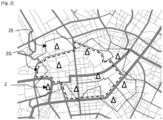
- the geographical area ZG (represented by long dotted lines) is an urban residential area, gridded by a set of streets equipped with light sources, for example street lamps, candelabras, lampposts, forming public lighting for this ZG area.
- light sources for example street lamps, candelabras, lampposts, forming public lighting for this ZG area.
- a plurality of relay antennas 2 of a mobile telephone network are distributed in and around the geographical area ZG by defining an estimation zone ZE (represented by short dotted lines).
- the estimation zone ZE can for example be defined by the perimeter of a Voronoi diagram obtained from the positions of these antennas 2.
- a user's mobile terminal When a user's mobile terminal is in the estimation zone ZE, it connects, in a sufficiently short time interval, to at least three relay antennas 2 which are close to it. It is thus possible to estimate, by triangulation, its position in the zone ZE. These connections to the relay antennas 2 being made regularly, it is thus possible to follow the position of the mobile terminal over time.
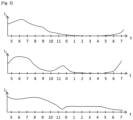
- the relay antennas 2 can thus generate data translating the movements of the users in the estimation zone ZE. For example, it is possible to obtain a series of data I1 indicating the number of users entering the zone ZE during an elementary time interval, for example every 30 minutes, during a global time interval, for example a day, by identifying the new mobile terminals entering the zone.
- the data set provided in step E11 may comprise M series of data I 1 to I M of different types, acquired or not by means of the relay antennas 2, each series of data I 1 to I M being an indicator relating to the presence and/or mobility of people in the zone ZE over time.
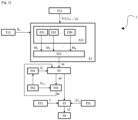
- a step E2 the method determines, from the data set D, a model M of population flow in the geographical area ZG.
- the dataset D is enriched using an additional dataset D G , provided in a step E12.
- the set D G is a contextual dataset relating to the geographical area ZG, comprising information relating to events having taken place during the overall time interval in the area ZG, meteorological data in the area ZG during the overall time interval, as well as data on counting people moving in the area ZG during the overall time interval, recorded in situ.
- the enriched dataset D, D G is separated into a training set and a validation set.
- a step E21 a plurality of test population flow models M 1 to M N is generated. More specifically, step E21 comprises a plurality of steps E31 to E3N.
- a test model M i is generated by a distinct machine learning algorithm from the training set.
- the machine learning algorithms employed in these steps E31 to E3N may implement distinct mathematical methods and/or the same mathematical method employing one or more distinct hyperparameters.
- each of the models M 1 to M N is a model of the number of people moving in the zone ZG over time, generated by an algorithm implementing a multiple polynomial regression type method with a distinct set of hyperparameters for each step E31 to E3N, from the training set.
- Each population flow model is thus defined by a set of regression coefficients making it possible to mathematically predict the number of people moving in the ZG zone over time from new data.
- each test model M 1 to M N is evaluated by comparing data predicted by this test model and the data of the validation set, and thus determining an evaluation metric, for example a root mean square error.
- a step E22 the population flow model M having the best metric among the test models M1 to MN is selected.
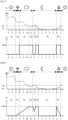
- Fig. 4 represents, at the top, the population flow model M, for example representing an estimate of the number of people moving in the geographical area ZG over time.
- a population flow model at a future time M' is predicted, from the model M.
- a so-called prior data set D T relating to the presence of people in the area ZE during a time interval preceding the future time.
- this prior data set D T may be acquired in a similar way to the data set D.
- a model M' is then predicted, at step E4, using the model M from step E2 and the previous dataset D T .
- the bottom graph of the [ Fig. 4 ] represents an example of a predicted model M', the model M being represented by a dotted line.
- the prediction step E4 can be similar to step E2, by selecting the best metric model from a plurality of models generated by distinct machine learning algorithms, from the model M and the prior dataset D T .
- a control law LC for the public lighting of the geographical zone ZG is defined, using the model M' predicted in step E4.
- the method comprises a step E51 of providing an overall energy consumption instruction C and a step of receiving information D' G relating to the ambient brightness of the geographical area ZG.
- this involves meteorological information and the times of sunrise and sunset, as well as the durations of dawn and dusk.
- the step of defining the control law LC comprises a step of defining periods T1 in which the model M' is lower than a given threshold A1 defined as a function of the consumption instruction C, for example 2 people, periods T2 in which the model M' is higher than a given threshold A2 higher than the threshold A1 and defined as a function of the consumption instruction C, for example 30 people, and periods T3 in which the model M' is between the threshold A1 and the threshold A2.
- the bottom graph of the [ Fig. 5 ] represents a control law LC defined, in a step E32, as a function of these periods T1, T2 and T3 and of this information D' G .
- This control law LC defines a luminous flux instruction to be emitted by each of the light sources of the public lighting of the geographical zone ZG.
- the luminous flux setpoint of the public lighting of the ZG area is zero.
- the brightness decreases due to sunset. However, this brightness is still sufficient, and the number of people moving in the geographical area ZG according to the M' model does not require lighting.
- the control law LC thus defines a non-zero luminous flux setpoint, corresponding for example to 100% of the nominal luminous flux that each light source of the public lighting in the geographical area ZG is likely to emit.
- the clouds have disappeared and the ambient brightness increases.
- the number of people moving in the geographical area ZG according to the M' model increases. Under these conditions, it is considered that it is not necessary to illuminate the geographical area ZG, the number of people being sufficient in itself to generate a feeling of security.
- the LC control law thus defines a zero luminous flux setpoint.
- the situation is equivalent to the first period T3, so that the LC control law defines a luminous flux setpoint at 100% of the nominal flux.
- the control law LC thus defines a zero luminous flux setpoint.
- the situation is equivalent to the first period T3, so that the LC control law defines a luminous flux setpoint at 100% of the nominal flux.
- step E5 The different periods for switching on and off public lighting are thus defined in step E5 so as to comply with consumption instruction C.
- control law LC is then transmitted to the light sources of the public lighting of the geographical zone ZG, which apply it to respect the setpoint values that this control law LC defines.
- step E4 of predicting the model M' is repeated recurrently.
- the method comprises a step E42 of providing a posterior data set D T+1 , relating to the presence of people in the zone ZE during a time interval at the future time, is provided.
- this posterior data set D T+1 may be acquired in a similar manner to the data set D, at the future time, and provided during step E42, during the future time or later.
- the method comprises a step E43 of correcting the model M' into a corrected model M, using this posterior data set D T+1 .
- the correction step E43 can be similar to step E2, by selecting the model M from a plurality of models generated by distinct machine learning algorithms, from the model M', which minimizes the prediction error between the data it predicts and the posterior data set D T+1 .
- the corrected model M from the correction step E43 of the previous iteration as well as the posterior data set D T+1 are then used to predict the next model M'.
- the LC control law defines two binary setpoint values, since the public lighting in the geographical area considered is discharge lamp type lighting, the light intensity of which can be difficult to control.
- the luminous flux setpoint gradually increases from a zero value to a value of 100% of the nominal flux.
- this instruction decreases then increases, depending on the number of people moving in the geographical zone ZG according to the model M.
- this setpoint decreases from a value of 100% of the nominal flow to a zero value.
- the invention cannot be limited to the embodiments specifically described in this document, and extends in particular to any equivalent means and to any technically effective combination of these means.
Landscapes
- Engineering & Computer Science (AREA)
- Theoretical Computer Science (AREA)
- Software Systems (AREA)
- Physics & Mathematics (AREA)
- Artificial Intelligence (AREA)
- Evolutionary Computation (AREA)
- Computing Systems (AREA)
- General Engineering & Computer Science (AREA)
- General Physics & Mathematics (AREA)
- Mathematical Physics (AREA)
- Data Mining & Analysis (AREA)
- Computational Linguistics (AREA)
- Medical Informatics (AREA)
- Health & Medical Sciences (AREA)
- Computer Vision & Pattern Recognition (AREA)
- Life Sciences & Earth Sciences (AREA)
- Biomedical Technology (AREA)
- Biophysics (AREA)
- General Health & Medical Sciences (AREA)
- Molecular Biology (AREA)
- Circuit Arrangement For Electric Light Sources In General (AREA)
Claims (11)
- Verfahren (1) für eine Steuerung öffentlicher Beleuchtung in einem vorbestimmten geografischen Gebiet (ZG), das Verfahren umfassend die folgenden Schritte:• (E11) Bereitstellen eines Datensatzes (D) bezogen auf die Anwesenheit von Personen in einem geografischen Schätzgebiet (ZE), der von mobilen Endgeräten dieser Personen erhalten wird;• (E2) Bestimmen von mindestens einem Modell (M) eines Bevölkerungsstroms in dem vorbestimmten geografischen Gebiet aus dem Datensatz;• (E5) Definieren eines Regelungsgesetzes (LC) für die öffentliche Beleuchtung in dem geografischen Gebiet in Abhängigkeit von dem Bevölkerungsstrommodell und (E6) Anwenden des Regelungsgesetzes auf diese öffentliche Beleuchtung;
dadurch gekennzeichnet, dass der Schritt des Bestimmens (E2) des Modells (M) einen Unterschritt eines Erzeugens (E21) einer Vielzahl von Bevölkerungsstrommodellen (M1, M2, MN) in dem vorbestimmten geografischen Gebiet (ZG), die als Testmodelle bezeichnet werden, wobei jedes Testmodell durch einen separaten Maschinenlernalgorithmus aus dem Datensatz (D) erzeugt wird, wobei jedem Testmodell eine Bewertungsmetrik zugeordnet ist, und einen Unterschritt (E22) eines Auswählens eines Bevölkerungsstrommodells (M) unter der Vielzahl von Testmodellen in Abhängigkeit von den Bewertungsmetriken der Vielzahl von Testmodellen umfasst. - Verfahren (1) nach dem vorstehenden Anspruch, wobei der bereitgestellte Datensatz (D) eine Schätzung (I1, I2, I3) der Anzahl der Personen umfasst, die während einer Vielzahl von Elementarzeitintervallen eines gegebenen Gesamtzeitintervalls das Schätzgebiet (ZE) betreten, sich dort aufhalten und es verlassen.
- Verfahren (1) nach dem vorstehenden Anspruch, wobei das Schätzen (I1, I2, I3) der Anzahl der Personen, die das Schätzgebiet (ZE) betreten, sich dort aufhalten und es verlassen, aus Informationen bezüglich der zeitlichen Position einer Vielzahl von mobilen Endgeräten erhalten wird, wobei diese Informationen aus Daten bestimmt werden, die durch Relaisantennen (2) eines in dem Schätzgebiet gelegenen Mobilfunknetzes erzeugt werden, mit dem oder denen diese mobilen Endgeräte sich zu einem gegebenen Zeitpunkt verbunden haben.
- Verfahren (1) nach einem der vorstehenden Ansprüche,
dadurch gekennzeichnet, dass es einen Schritt des Bereitstellens (E12) von mindestens einem zusätzlichen Kontextdatensatz (DG) bezogen auf das vorbestimmte geografische Gebiet (ZG) umfasst, und wobei das Bevölkerungsstrommodell (M) in dem vorbestimmten geografischen Gebiet aus dem Datensatz (D) und dem zusätzlichen Datensatz bestimmt wird. - Verfahren (1) nach einem der vorstehenden Ansprüche,
dadurch gekennzeichnet, dass es einen Schritt eines Klassifizierens der Daten des Datensatzes (D) unter Datenkategorien, die jeweils einem geografischen Untergebiet zugeordnet sind, umfasst, und wobei der Schritt des Bestimmens (E2) des Modells (M) für jedes geografische Untergebiet einen Unterschritt des Bestimmens eines Bevölkerungsstromuntermodells in diesem geografischen Untergebiet aus den Daten umfasst, die in der Datenkategorie klassifiziert sind, die diesem geografischen Untergebiet zugeordnet ist. - Verfahren (1) nach einem der vorstehenden Ansprüche,
dadurch gekennzeichnet, dass es einen Schritt des Bereitstellens (E41) eines vorherigen Datensatzes (DT) bezogen auf die Anwesenheit von Personen in dem geografischen Schätzbereich (ZE) zu einem gegebenen Zeitpunkt, einen Schritt (E4) des Vorhersagens eines Bevölkerungsstrommodells (M') zu einem zukünftigen Zeitpunkt relativ zu dem gegebenen Zeitpunkt aus dem während des Bestimmungsschritts (E2) bestimmten Bevölkerungsstrommodell (M) und dem vorherigen Datensatz umfasst, wobei das Regelungsgesetz (LC) aus dem vorhergesagten Bevölkerungsstrommodell definiert wird. - Verfahren (1) nach dem vorstehenden Anspruch, wobei das Verfahren einen Schritt des Bereitstellens von mindestens einer Information bezogen auf einen zukünftigen Zustand des vorbestimmten geografischen Gebiets (ZG) zu dem zukünftigen Zeitpunkt umfasst, wobei der Schritt des Vorhersagens (E4) eines Bevölkerungsstrommodells (M') zu einem zukünftigen Zeitpunkt aus dem während des Bestimmungsschritts (E2) bestimmten Bevölkerungsstrommodell (M), dem vorherigen Datensatz (DT) und den Informationen bezogen auf den zukünftigen Zustand des vorbestimmten geografischen Gebiets durchgeführt wird.
- Verfahren (1) nach einem der Ansprüche 6 oder 7, das Verfahren umfassend einen Schritt des Bereitstellens (E42) eines nachfolgenden Datensatzes (DT+1) bezogen auf die Anwesenheit von Personen in dem geografischen Schätzgebiet (ZE) zu dem zukünftigen Zeitpunkt, wobei dieser Schritt zu dem zukünftigen Zeitpunkt oder anschließend an diesen zukünftigen Zeitpunkt durchgeführt wird, dadurch gekennzeichnet, dass es einen Schritt (E43) des Korrigierens des vorhergesagten Bevölkerungsstrommodells (M') mittels des folgenden Datensatzes umfasst.
- Verfahren (1) nach einem der vorstehenden Ansprüche, wobei der Schritt des Definierens eines Regelungsgesetzes (LC) für die öffentliche Beleuchtung des geografischen Gebiets (ZG) das Definieren von mindestens einem Zeitraum (T1, T2, T3) des Ausschaltens und/oder Reduzierens und/oder Einschaltens und/oder Erhöhens der öffentlichen Beleuchtung in Abhängigkeit von dem Bevölkerungsstrommodell (M) umfasst.
- Verfahren (1) nach dem vorstehenden Anspruch, wobei das Verfahren einen Schritt des Bereitstellens (E51) einer Anweisung (C) zum Gesamtenergieverbrauch umfasst, in der die Zeiträume (T1, T2, T3) des Ausschaltens, Reduzierens, Einschaltens und/oder Erhöhens der öffentlichen Beleuchtung in Abhängigkeit von dem Bevölkerungsstrommodell (M) und so definiert werden, dass der Energieverbrauch der öffentlichen Beleuchtung während aller dieser Zeiträume dieser Anweisung entspricht.
- Verfahren (1) nach einem der Ansprüche 9 bis 10, wobei das Verfahren einen Schritt des Bereitstellens (E52) von Informationen bezogen auf die Umgebungslichtstärke (IL) des vorbestimmten geografischen Gebiets (ZG) umfasst, wobei die Zeiträume des Ausschaltens, Reduzierens, Einschaltens und/oder Erhöhens der öffentlichen Beleuchtung (T1, T2, T3) in Abhängigkeit von dem Bevölkerungsstrommodell (M) und diesen Umgebungslichtstärkeinformationen definiert werden.
Applications Claiming Priority (1)
| Application Number | Priority Date | Filing Date | Title |
|---|---|---|---|
| FR2005001A FR3110720B1 (fr) | 2020-05-19 | 2020-05-19 | Procédé de contrôle d’un éclairage public |
Publications (3)
| Publication Number | Publication Date |
|---|---|
| EP3914049A1 EP3914049A1 (de) | 2021-11-24 |
| EP3914049C0 EP3914049C0 (de) | 2025-05-07 |
| EP3914049B1 true EP3914049B1 (de) | 2025-05-07 |
Family
ID=72178712
Family Applications (1)
| Application Number | Title | Priority Date | Filing Date |
|---|---|---|---|
| EP21174395.0A Active EP3914049B1 (de) | 2020-05-19 | 2021-05-18 | Verfahren zur kontrolle einer öffentlichen beleuchtung |
Country Status (2)
| Country | Link |
|---|---|
| EP (1) | EP3914049B1 (de) |
| FR (1) | FR3110720B1 (de) |
Families Citing this family (2)
| Publication number | Priority date | Publication date | Assignee | Title |
|---|---|---|---|---|
| US12579336B2 (en) | 2024-05-10 | 2026-03-17 | Evarilabs Llc. | Geographic setpoint matching system for outdoor street lighting |
| CN118574286B (zh) * | 2024-06-24 | 2025-06-17 | 浙江德枫节能环保科技有限公司 | 一种智能型厂房照明控制方法及系统 |
Family Cites Families (4)
| Publication number | Priority date | Publication date | Assignee | Title |
|---|---|---|---|---|
| CN105191505B (zh) * | 2013-03-18 | 2019-01-15 | 飞利浦灯具控股公司 | 用于室外照明网络的信息管理和控制的方法和装置 |
| WO2018091315A1 (en) * | 2016-11-17 | 2018-05-24 | Philips Lighting Holding B.V. | System and method for managing lighting based on population mobility patterns |
| JP6886869B2 (ja) * | 2017-06-09 | 2021-06-16 | 川崎重工業株式会社 | 動作予測システム及び動作予測方法 |
| FR3081646A1 (fr) * | 2018-06-29 | 2019-11-29 | Orange | Procede et dispositif de pilotage d'un ensemble de dispositifs electroniques situes dans une zone geographique |
-
2020
- 2020-05-19 FR FR2005001A patent/FR3110720B1/fr active Active
-
2021
- 2021-05-18 EP EP21174395.0A patent/EP3914049B1/de active Active
Non-Patent Citations (1)
| Title |
|---|
| ANONYMOUS: "Apprentissage automatique - Wikipédia", 5 February 2020 (2020-02-05), XP093062980, Retrieved from the Internet <URL:https%3A%2F%2Ffr.wikipedia.org%2Fw%2Findex.php%3Ftitle%3DApprentissage_automatique%26oldid%3D167085298> [retrieved on 20230711] * |
Also Published As
| Publication number | Publication date |
|---|---|
| EP3914049C0 (de) | 2025-05-07 |
| FR3110720B1 (fr) | 2022-07-15 |
| EP3914049A1 (de) | 2021-11-24 |
| FR3110720A1 (fr) | 2021-11-26 |
Similar Documents
| Publication | Publication Date | Title |
|---|---|---|
| EP3914049B1 (de) | Verfahren zur kontrolle einer öffentlichen beleuchtung | |
| FR3017691B1 (fr) | Lampe electrique portative dotee d'un systeme de communication sans-fil | |
| EP2211300B1 (de) | Prognoseverfahren der Stromproduktion einer Photovoltaik-Anlage | |
| US9788400B2 (en) | Intelligent lighting system with predictive maintenance scheduling and method of operation thereof | |
| WO2015132687A1 (en) | Intelligent lighting system with predictive maintenance scheduling and method of operation thereof | |
| US20160269854A1 (en) | Energy management for wireless sensor networks | |
| CN113597071B (zh) | 照明方法及系统 | |
| FR3029373A1 (fr) | Dispositif electronique associe a un module photovoltaique pour optimiser le debit d'une transmission bidirectionnelle de type vlc | |
| FR3028114A1 (fr) | Procede de diagnostic d'un systeme photovoltaique | |
| Koffi et al. | Modelisation De La Consommation En Eau Potable Dans Les Capitales Africaines Au Sud Du Sahara: Application Des Reseaux De Neurones Formels A La Ville De Yamoussoukro, Capitale Politique De La Cote D'ivoire | |
| WO2019149702A1 (fr) | Procédé de fonctionnement d'un appareil électronique communiquant sans fil et appareil électronique communiquant sans fil mettant en oeuvre ce procédé | |
| Lukkien et al. | The case of Dynamic Street Lighting an exploration of long-term data collection | |
| FR2979451A1 (fr) | Procede de determination de la part de la consommation electrique liee aux temperatures exterieures | |
| FR3127062A1 (fr) | Dispositif autonome et procédé pour détecter si des emplacements sont occupés ou non | |
| FR3081646A1 (fr) | Procede et dispositif de pilotage d'un ensemble de dispositifs electroniques situes dans une zone geographique | |
| EP2540569A1 (de) | Betriebsverfahren einer Signalisierungsvorrichtung eines Kraftfahrzeugs | |
| EP2850402B1 (de) | Schätzung des drifts bei einem sonnenstrahlungssensor | |
| KR102860339B1 (ko) | Gps 및 타이머 기능이 탑재된 조명용 제어장치 | |
| EP1997354B1 (de) | Verfahren zur verwaltung einer beleuchtungsschaltung und entsprechende vorrichtung | |
| EP4390765A1 (de) | Schätzung einer elektrischen produktion für einen satz von produktionsstellen durch individuell optimierte neuronale netze | |
| FR2991545A1 (fr) | Dispositif et procede de pilotage de peripherique luminaire par programme de controle importe | |
| FR3023671B1 (fr) | Procede d’alimentation et systeme d’eclairage | |
| WO2025061855A1 (fr) | Dispositif de modification d'un feu de signalisation routier à l'aide d'une ampoule mixte lumière/caméra branchée à la place de la source lumineuse traditionnelle | |
| EP4357988A1 (de) | Verfahren zur verwaltung der energie mindestens eines ausrüstungsgegenstands, elektronische vorrichtungen und computerprogrammprodukte dafür | |
| EP2950421B1 (de) | Vorrichtung zur Kontrolle der elektrischen Parameter, die mit dem Internet verbunden ist |
Legal Events
| Date | Code | Title | Description |
|---|---|---|---|
| PUAI | Public reference made under article 153(3) epc to a published international application that has entered the european phase |
Free format text: ORIGINAL CODE: 0009012 |
|
| STAA | Information on the status of an ep patent application or granted ep patent |
Free format text: STATUS: THE APPLICATION HAS BEEN PUBLISHED |
|
| AK | Designated contracting states |
Kind code of ref document: A1 Designated state(s): AL AT BE BG CH CY CZ DE DK EE ES FI FR GB GR HR HU IE IS IT LI LT LU LV MC MK MT NL NO PL PT RO RS SE SI SK SM TR |
|
| B565 | Issuance of search results under rule 164(2) epc |
Effective date: 20211001 |
|
| STAA | Information on the status of an ep patent application or granted ep patent |
Free format text: STATUS: REQUEST FOR EXAMINATION WAS MADE |
|
| 17P | Request for examination filed |
Effective date: 20220524 |
|
| RBV | Designated contracting states (corrected) |
Designated state(s): AL AT BE BG CH CY CZ DE DK EE ES FI FR GB GR HR HU IE IS IT LI LT LU LV MC MK MT NL NO PL PT RO RS SE SI SK SM TR |
|
| STAA | Information on the status of an ep patent application or granted ep patent |
Free format text: STATUS: EXAMINATION IS IN PROGRESS |
|
| 17Q | First examination report despatched |
Effective date: 20230719 |
|
| GRAP | Despatch of communication of intention to grant a patent |
Free format text: ORIGINAL CODE: EPIDOSNIGR1 |
|
| STAA | Information on the status of an ep patent application or granted ep patent |
Free format text: STATUS: GRANT OF PATENT IS INTENDED |
|
| INTG | Intention to grant announced |
Effective date: 20241209 |
|
| RIC1 | Information provided on ipc code assigned before grant |
Ipc: G06N 20/20 20190101ALI20241129BHEP Ipc: G06N 5/01 20230101ALI20241129BHEP Ipc: G06N 3/08 20060101ALI20241129BHEP Ipc: H05B 47/19 20200101ALI20241129BHEP Ipc: H05B 47/115 20200101AFI20241129BHEP |
|
| GRAS | Grant fee paid |
Free format text: ORIGINAL CODE: EPIDOSNIGR3 |
|
| GRAA | (expected) grant |
Free format text: ORIGINAL CODE: 0009210 |
|
| STAA | Information on the status of an ep patent application or granted ep patent |
Free format text: STATUS: THE PATENT HAS BEEN GRANTED |
|
| AK | Designated contracting states |
Kind code of ref document: B1 Designated state(s): AL AT BE BG CH CY CZ DE DK EE ES FI FR GB GR HR HU IE IS IT LI LT LU LV MC MK MT NL NO PL PT RO RS SE SI SK SM TR |
|
| REG | Reference to a national code |
Ref country code: GB Ref legal event code: FG4D Free format text: NOT ENGLISH |
|
| REG | Reference to a national code |
Ref country code: CH Ref legal event code: EP |
|
| REG | Reference to a national code |
Ref country code: DE Ref legal event code: R096 Ref document number: 602021030273 Country of ref document: DE |
|
| REG | Reference to a national code |
Ref country code: IE Ref legal event code: FG4D Free format text: LANGUAGE OF EP DOCUMENT: FRENCH |
|
| U01 | Request for unitary effect filed |
Effective date: 20250603 |
|
| U07 | Unitary effect registered |
Designated state(s): AT BE BG DE DK EE FI FR IT LT LU LV MT NL PT RO SE SI Effective date: 20250611 |
|
| U20 | Renewal fee for the european patent with unitary effect paid |
Year of fee payment: 5 Effective date: 20250610 |
|
| PG25 | Lapsed in a contracting state [announced via postgrant information from national office to epo] |
Ref country code: ES Free format text: LAPSE BECAUSE OF FAILURE TO SUBMIT A TRANSLATION OF THE DESCRIPTION OR TO PAY THE FEE WITHIN THE PRESCRIBED TIME-LIMIT Effective date: 20250507 |
|
| PG25 | Lapsed in a contracting state [announced via postgrant information from national office to epo] |
Ref country code: NO Free format text: LAPSE BECAUSE OF FAILURE TO SUBMIT A TRANSLATION OF THE DESCRIPTION OR TO PAY THE FEE WITHIN THE PRESCRIBED TIME-LIMIT Effective date: 20250807 Ref country code: GR Free format text: LAPSE BECAUSE OF FAILURE TO SUBMIT A TRANSLATION OF THE DESCRIPTION OR TO PAY THE FEE WITHIN THE PRESCRIBED TIME-LIMIT Effective date: 20250808 |
|
| PG25 | Lapsed in a contracting state [announced via postgrant information from national office to epo] |
Ref country code: PL Free format text: LAPSE BECAUSE OF FAILURE TO SUBMIT A TRANSLATION OF THE DESCRIPTION OR TO PAY THE FEE WITHIN THE PRESCRIBED TIME-LIMIT Effective date: 20250507 |
|
| PG25 | Lapsed in a contracting state [announced via postgrant information from national office to epo] |
Ref country code: HR Free format text: LAPSE BECAUSE OF FAILURE TO SUBMIT A TRANSLATION OF THE DESCRIPTION OR TO PAY THE FEE WITHIN THE PRESCRIBED TIME-LIMIT Effective date: 20250507 |
|
| PG25 | Lapsed in a contracting state [announced via postgrant information from national office to epo] |
Ref country code: RS Free format text: LAPSE BECAUSE OF FAILURE TO SUBMIT A TRANSLATION OF THE DESCRIPTION OR TO PAY THE FEE WITHIN THE PRESCRIBED TIME-LIMIT Effective date: 20250807 |
|
| PG25 | Lapsed in a contracting state [announced via postgrant information from national office to epo] |
Ref country code: IS Free format text: LAPSE BECAUSE OF FAILURE TO SUBMIT A TRANSLATION OF THE DESCRIPTION OR TO PAY THE FEE WITHIN THE PRESCRIBED TIME-LIMIT Effective date: 20250907 |
|
| REG | Reference to a national code |
Ref country code: CH Ref legal event code: H13 Free format text: ST27 STATUS EVENT CODE: U-0-0-H10-H13 (AS PROVIDED BY THE NATIONAL OFFICE) Effective date: 20251223 |
|
| PG25 | Lapsed in a contracting state [announced via postgrant information from national office to epo] |
Ref country code: SM Free format text: LAPSE BECAUSE OF FAILURE TO SUBMIT A TRANSLATION OF THE DESCRIPTION OR TO PAY THE FEE WITHIN THE PRESCRIBED TIME-LIMIT Effective date: 20250507 |
|
| PG25 | Lapsed in a contracting state [announced via postgrant information from national office to epo] |
Ref country code: CH Free format text: LAPSE BECAUSE OF NON-PAYMENT OF DUE FEES Effective date: 20250531 |
|
| PG25 | Lapsed in a contracting state [announced via postgrant information from national office to epo] |
Ref country code: CZ Free format text: LAPSE BECAUSE OF FAILURE TO SUBMIT A TRANSLATION OF THE DESCRIPTION OR TO PAY THE FEE WITHIN THE PRESCRIBED TIME-LIMIT Effective date: 20250507 |
|
| PG25 | Lapsed in a contracting state [announced via postgrant information from national office to epo] |
Ref country code: SK Free format text: LAPSE BECAUSE OF FAILURE TO SUBMIT A TRANSLATION OF THE DESCRIPTION OR TO PAY THE FEE WITHIN THE PRESCRIBED TIME-LIMIT Effective date: 20250507 |
|
| PG25 | Lapsed in a contracting state [announced via postgrant information from national office to epo] |
Ref country code: MC Free format text: LAPSE BECAUSE OF FAILURE TO SUBMIT A TRANSLATION OF THE DESCRIPTION OR TO PAY THE FEE WITHIN THE PRESCRIBED TIME-LIMIT Effective date: 20250507 |
|
| PLBE | No opposition filed within time limit |
Free format text: ORIGINAL CODE: 0009261 |
|
| STAA | Information on the status of an ep patent application or granted ep patent |
Free format text: STATUS: NO OPPOSITION FILED WITHIN TIME LIMIT |
|
| REG | Reference to a national code |
Ref country code: CH Ref legal event code: L10 Free format text: ST27 STATUS EVENT CODE: U-0-0-L10-L00 (AS PROVIDED BY THE NATIONAL OFFICE) Effective date: 20260318 |
|
| PG25 | Lapsed in a contracting state [announced via postgrant information from national office to epo] |
Ref country code: IE Free format text: LAPSE BECAUSE OF NON-PAYMENT OF DUE FEES Effective date: 20250518 |
|
| 26N | No opposition filed |
Effective date: 20260210 |