EP2850402B1 - Schätzung des drifts bei einem sonnenstrahlungssensor - Google Patents
Schätzung des drifts bei einem sonnenstrahlungssensor Download PDFInfo
- Publication number
- EP2850402B1 EP2850402B1 EP13727278.7A EP13727278A EP2850402B1 EP 2850402 B1 EP2850402 B1 EP 2850402B1 EP 13727278 A EP13727278 A EP 13727278A EP 2850402 B1 EP2850402 B1 EP 2850402B1
- Authority
- EP
- European Patent Office
- Prior art keywords
- radiation
- sensor
- account
- drift
- estimate
- Prior art date
- Legal status (The legal status is an assumption and is not a legal conclusion. Google has not performed a legal analysis and makes no representation as to the accuracy of the status listed.)
- Active
Links
Images


Classifications
-
- G—PHYSICS
- G01—MEASURING; TESTING
- G01J—MEASUREMENT OF INTENSITY, VELOCITY, SPECTRAL CONTENT, POLARISATION, PHASE OR PULSE CHARACTERISTICS OF INFRARED, VISIBLE OR ULTRAVIOLET LIGHT; COLORIMETRY; RADIATION PYROMETRY
- G01J1/00—Photometry, e.g. photographic exposure meter
- G01J1/10—Photometry, e.g. photographic exposure meter by comparison with reference light or electric value provisionally void
-
- G—PHYSICS
- G01—MEASURING; TESTING
- G01J—MEASUREMENT OF INTENSITY, VELOCITY, SPECTRAL CONTENT, POLARISATION, PHASE OR PULSE CHARACTERISTICS OF INFRARED, VISIBLE OR ULTRAVIOLET LIGHT; COLORIMETRY; RADIATION PYROMETRY
- G01J1/00—Photometry, e.g. photographic exposure meter
Definitions
- the present invention generally relates to sensors for evaluating solar radiation, such as pyranometers or reference cells, and, more particularly, to the estimation of the drift and the calibration of a sensor of this type.
- Sensors for evaluating solar radiation are increasingly used with the development of solar installations, whether for the production of heat or electricity. These sensors are used, in particular, to measure the radiation (watt/m 2 ) on the premises of the solar energy production installations. These measurements are used, among other things, to estimate the solar resource or monitor the correct operation and energy production of solar power plants.
- sensors consisting of reference photovoltaic cells, and pyranometers which are specific sensors dedicated to measuring the radiation from the sky (solar radiation).
- a pyranometer is a heat flux sensor that measures the radiation received.
- the ISO 9847 standard describes devices for calibrating solar collectors when returning to the workshop or by comparison with other collectors specially brought to the site by a maintenance service. These devices are not suitable for calibration or drift correction, on site, continuous over time and automatic.
- the document EP-A-2211300 describes a method for predicting the electrical production of a photovoltaic device and proposes the diagnosis of a photovoltaic installation by comparing an actual production with an estimated production. It is a measurement of the actual electrical production of the photovoltaic modules.
- Another object of an embodiment of the present invention is to provide a calibration technique suitable for on-site operation.
- Another object of an embodiment of the present invention is to propose a technique for estimating the drift and calibrating without external intervention.
- Another object of an embodiment of the present invention is to make it possible to increase the frequency of calibrations of a radiation sensor.
- Another object of an embodiment of the present invention is to provide a solution requiring no structural modification of the radiation sensor.
- the figure 1 illustrates an example of a centrally operated solar energy installation for power distribution management purposes.
- solar power plants 12 each consisting of one or more sets of photovoltaic panels (solar panels) 122, and of an energy management and conversion system 124 (including in particular an inverter) are distributed over a territory F
- the system 124 is generally associated with a radiation sensor 2 (for example of the pyranometer type). This sensor measures radiation in the Earth's atmosphere.
- each power station 12 can, for example, be injected into the electricity distribution network of the territory F and, at the same time, the various power stations 12 send data (links 126) to a computer system 3 centralizing the management of the energy.
- This system 3 generally comprises a network control and operation room, equipped with one or more computers 32, one or more screens 34 and one or more databases 36 receiving information from the various power stations.
- the system 3 enables one or more operators to manage the distribution of energy from information, known a priori or collected from the various power stations, which they view(s) on the screens.
- This information includes, among other things, the geographical location of the power plants (map 341), information 342 on production and demand and, for example, information on the radiation 343 received by one or more several plants, allowing a comparison with expected production.
- the representation of the figure 1 is an illustrative example of a possible application of the embodiments which will be described. This illustration is of course simplified, the described embodiments not relating to the exploitation of the measurements obtained by the solar radiation sensors to predict an energy production capacity or to manage the distribution.
- the exploitation of the production capacities calls upon usual techniques, generally independent of the nature of the source of energy.
- a particularity of the production of solar energy is however the need to predict, in particular on the basis of meteorological conditions, the production capacity of solar power plants in relation to other sources of energy.
- Another peculiarity is the dissemination of power plants with low production capacity (less than 10 kW) throughout the territory.
- the calibration of a radiation sensor consists in determining the coefficients of an affine function applied to the measured values. This function corrects the measurements and provides an radiation value.
- G MES the measurement taken
- G MY you ⁇ ⁇ where ⁇ and ⁇ are coefficients of the affine function determined for the calibration of the sensor.
- the calibration method proposed below is based on an estimation of the drift of the sensor using periods during which the sensor is in a clear sky condition (absence of clouds).
- a radiation model is then used providing a theoretical curve of the radiation, in clear sky conditions, for the zone in which the collector and the solar power plant are positioned.
- This theoretical curve can take into account other parameters such as the date, the inclination and the orientation of the sensor.
- the value of the correction coefficient ⁇ (which also represents an estimate of the drift) to be applied to the measurements is adapted, for the current day, according to an exploitation of the measurements of one or, preferably, of several previous days.
- the picture 3 is a block diagram illustrating steps of an embodiment of the method for calibrating a solar radiation sensor.
- the method is implemented by a digital processing circuit of the microprocessor type, programmed to implement the various steps which will be described.
- Digital processing circuits and memories are used which are usually fitted either to the radiation sensor 2 itself, or to a possible device (124, figure 1 ) management which receives the information from the radiation sensor 2, or more generally any computing device capable of communicating with the sensor.
- a daily pattern 51 of radiation in clear weather of the zone in which the sensor is placed is stored (block 41, TEMPLATE) in the processing device.
- This storage is carried out, for example, during the installation of the solar power plant and the collector.
- the model is calculated on the fly, which makes it easier to take into account parameters other than location (date, inclination, orientation, etc.).
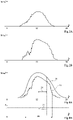
- the model being established on a daily cycle the rate of the radiation measured by the sensor during a day is stored (rate 53, figure 4A ).
- rate 53 rate of the radiation measured by the sensor during a day
- the measurements of the day which precedes the instant of the calibration are stored (block 42, DAY-1).
- midnight 24h
- the real pace obtained 53 is then compared (block 43) with the clear weather model 51.
- the objective of this comparison is to determine one or more time windows or ranges 54 during which the real pace 53 can be considered as corresponding to exposure in clear weather.
- the comparison is carried out on numerical values, insofar as the sensor generally provides discrete values over time (it provides a value for each measurement).
- the comparison is preferably carried out on all the measurements taken by the sensor, which improves the reliability of the result or, as a variant to save calculation resources or consume less, on only one measurement out of a predefined number of measurements (for example , one measure out of two, one measure out of four, etc.). It is also possible to provide several consecutive aggregated measurements (by their mean, their median, etc.).
- the choice of the number of measurements taken into account depends, among other things, on the measurement frequency of the sensor. If it takes a very large number of measurements (for example, every second or several per second), it is possible not to take into account all measurements without losing too much information. If, on the other hand, the frequency of the measurements is lower (for example, every minute), it is preferable to take into account all the measurements for the calibration.
- the inventors have observed that the difference between the real radiation over a period of clear weather with respect to a model of this radiation directly provides an at least approximate value of the coefficient ⁇ of the correction to be made to the sensor for its calibration.
- This positive quantity d is all the lower when the sky is overcast and is theoretically equal to unity if the sensor is perfectly calibrated and the sky is clear.
- the figure 4B illustrates the pattern 55 obtained over the time window 54. This pattern gives an indication of the defect of the coefficient ⁇ (in fact of its inverse).
- the determination of the clear weather time window takes place within a 56 day period.
- This period of the day is chosen, by way of example and arbitrarily, as corresponding to a period in which the radiation according to the clear weather model is greater than a given value, typically 50 Watt/m 2 . It is in fact generally considered that the periods in which the radiation is between 0 and 50 Watt/m 2 correspond to dawn and dusk. This absolute threshold of 50 Watt/m 2 is of course adapted according to the location.
- the selection of the day period can be made from a calendar and the indication of the time.
- the average of the values obtained over the different periods is performed, for example.
- the reliability of the sensor calibration correction depends, among other things, on the determination of the clear sky moments.
- the more efficient the detection of clear weather moments that is to say, the more false positives and false negatives will be discarded), the better the determination of the coefficient a.
- the ratio d between the measurements and the theoretical model
- the ratio d shows relatively small variations and a sufficient level. For example, if the ratio d, over the time window around a given instant (for example, 1 hour before and 1 hour after the chosen instant), has a standard deviation lower than a threshold value and belongs to an interval deemed reasonable, the moment chosen may be considered as a moment when the sky is clear.
- the range of plus or minus one hour is an example that can be modified.
- the choice of the width of the time window can be modified by taking into account (among other things) the sampling of the data considered. The shorter the time interval between two measurements, the smaller the window size can be. If no acceptable time window is available on a given day, the calibration is postponed to the next day.
- the calculations on time windows allowing the detection of clear weather instants are carried out iteratively on each of the samples. Such iterative determination is particularly suited to software-driven digital processing systems.
- the adaptation of the sensor (block 47, SENSOR ADAPT) is carried out from the coefficient ⁇ obtained.
- the estimation of the coefficient ⁇ varies from one day to another, whether due to a drift in the operation of the sensor, this drift being progressive, due to a small quantity of time instants clear during the day, or following inaccuracies in the detection of periods of clear weather (for example periods of cloudy gray weather but stable throughout the day).
- a weighting of several determinations of the coefficient ⁇ is preferably carried out as a function of one or more factors.
- the importance given to the various factors is itself weighted.
- the inventors consider that the seniority of the day is the most important factor, the reliability of the day coming second and the absolute level of the day being the least important.
- weightings may be considered to make the determination even more reliable. For example, we can take into account the deviation of the current day from the average of the previous days.
- the reliability of the day and the absolute level of the day we can, for example, use the following factors.
- a factor takes into account a weighted average of the coefficients of the previous days by assigning a weight that is all the lower to the coefficient of a given day as this day is older than the current day.
- Another factor takes into account the estimated reliability of the day considered. This reliability corresponds to the number of reports d taken into consideration on the day considered, which amounts to classifying the days, or the coefficients a, according to the number of periods of clear weather on which the value is based. The greater this number, the greater the weight given to the coefficient ⁇ considered.
- a threshold z for determining measurements that are too dark or aberrant is fixed. For example, if d(i) is less than 1-z, the sky is considered “dark” at time i, if d(i) is greater than 1+z, the sky is considered “abnormally clear” at time i (aberrant measurement). Following a long period of drift, a sensor may return values outside the interval [1-z, 1+z]. It is however possible to guard against an inappropriate elimination of these values by normalizing the values G MES from the estimation of the coefficient ⁇ of the previous day. In this case, once the check has been made, the inverse operation will be carried out so as not to disturb the rest of the calculation.
Landscapes
- Physics & Mathematics (AREA)
- General Physics & Mathematics (AREA)
- Spectroscopy & Molecular Physics (AREA)
- Photometry And Measurement Of Optical Pulse Characteristics (AREA)
- Light Receiving Elements (AREA)
- Measurement Of Radiation (AREA)
Claims (10)
- Ein Verfahren zum Schätzen der Verschiebung bzw. Drift eines Sonneneinstrahlungssensors (2), wobei der Sensor ein Pyranometer oder eine Referenzzelle ist, die mit photovoltaischen Platten verbunden ist, und wobei:die Einstrahlung, die von diesem Sensor unter seinen Einsatzbedingungen gemessen wird (GMES), und ein Einstrahlungsmodell (51) berücksichtigt werden, wobei momentane Verhältnisse (d, a) von gemessenen Einstrahlungswerten (GMES) zu Werten (GTEMP), die durch das Modell (51) gegeben sind, oder von Werten (GTEMP), die durch das Modell (51) gegeben sind, zu gemessenen Einstrahlungswerten (GMES) verwendet werden;das Modell (51) eine Schätzung der Einstrahlung liefert, die bei einem klaren Himmel zu erwarten ist, und den geografischen Standort des Sensors berücksichtigt, wobei sich dieser in der Erdatmosphäre befindet;die gemessene Einstrahlung (GMES) mit der erwarteten Einstrahlung (GTEMP) verglichen wird (43), die von dem Modell (51) während der Perioden, die einem klaren Himmel entsprechen, geliefert wird; unddie Schätzung der Sensorverschiebung unter Berücksichtigung früherer Schätzungen der Verschiebung berechnet wird.
- Das Verfahren nach Anspruch 1, wobei die Schätzung der Sensorverschiebung täglich berechnet wird.
- Das Verfahren nach Anspruch 1 oder 2, wobei ein momentanes Verhältnis (d) berücksichtigt wird, wenn die Zeit innerhalb eines Zeitbereichs (54) liegt, in dem die Verhältnisänderung kleiner als ein Schwellenwert ist.
- Das Verfahren nach einem der Ansprüche 1 bis 3, bei dem ein Verhältnis (d) berücksichtigt wird, wenn sein Wert zwischen zwei Schwellenwerten liegt.
- Das Verfahren nach einem der Ansprüche 1 bis 4, wobei ein Verhältnis (d) berücksichtigt wird, wenn es einer Tagzeitperiode entspricht.
- Das Verfahren nach einem der Ansprüche 1 bis 5, wobei die Schätzung der Verschiebung aus einem gewichteten Durchschnitt von Schätzungen gewonnen wird, die während der vorangegangenen Tage berechnet wurden.
- Das Verfahren nach Anspruch 6, wobei die Gewichtung den Abstand in der Vergangenheit der berücksichtigten Tage berücksichtigt.
- Das Verfahren nach Anspruch 6 oder 7, wobei die Gewichtung einen Zuverlässigkeitskoeffizienten berücksichtigt, der der Schätzung des betrachteten Tages zugeordnet ist.
- Das Verfahren nach einem der Ansprüche 6 bis 8, wobei bei der Gewichtung der Wert der Schätzung berücksichtigt wird.
- Ein Verfahren zur Kalibrierung eines Sonneneinstrahlungssensors, wobei ein Korrekturkoeffizient (a), der auf die Messungen anzuwenden ist, aus einer Schätzung der Sensorverschiebung nach einem der Ansprüche 1 bis 9 erhalten wird.
Applications Claiming Priority (2)
| Application Number | Priority Date | Filing Date | Title |
|---|---|---|---|
| FR1254377A FR2990509B1 (fr) | 2012-05-14 | 2012-05-14 | Estimation de la derive d'un capteur de rayonnement solaire |
| PCT/FR2013/051040 WO2013171414A1 (fr) | 2012-05-14 | 2013-05-13 | Estimation de la derive d'un capteur de rayonnement solaire |
Publications (2)
| Publication Number | Publication Date |
|---|---|
| EP2850402A1 EP2850402A1 (de) | 2015-03-25 |
| EP2850402B1 true EP2850402B1 (de) | 2022-12-28 |
Family
ID=47351764
Family Applications (1)
| Application Number | Title | Priority Date | Filing Date |
|---|---|---|---|
| EP13727278.7A Active EP2850402B1 (de) | 2012-05-14 | 2013-05-13 | Schätzung des drifts bei einem sonnenstrahlungssensor |
Country Status (5)
| Country | Link |
|---|---|
| US (2) | US20150100266A1 (de) |
| EP (1) | EP2850402B1 (de) |
| ES (1) | ES2939586T3 (de) |
| FR (1) | FR2990509B1 (de) |
| WO (1) | WO2013171414A1 (de) |
Families Citing this family (1)
| Publication number | Priority date | Publication date | Assignee | Title |
|---|---|---|---|---|
| CN114662947B (zh) * | 2022-03-29 | 2025-01-10 | 阳光智维科技股份有限公司 | 设备状态监测方法、装置、非易失性存储介质及辐照仪 |
Family Cites Families (7)
| Publication number | Priority date | Publication date | Assignee | Title |
|---|---|---|---|---|
| US7166825B1 (en) | 2005-05-17 | 2007-01-23 | Itt Manufacturing Enterprises, Inc. | Solar calibration device and method |
| US20080046387A1 (en) * | 2006-07-23 | 2008-02-21 | Rajeev Gopal | System and method for policy based control of local electrical energy generation and use |
| CN100414253C (zh) | 2007-07-06 | 2008-08-27 | 北京航空航天大学 | 一种数字式太阳敏感器标定方法及装置 |
| US7576346B1 (en) | 2007-10-01 | 2009-08-18 | Itt Manufacturing Enterprises, Inc. | Use of solar illumination and baffles to calibrate visible sensors |
| FR2941328B1 (fr) * | 2009-01-19 | 2012-11-02 | Commissariat Energie Atomique | Procede de prevision de la production electrique d'un dispositif photovoltaique |
| US8217326B1 (en) * | 2009-08-18 | 2012-07-10 | Exelis, Inc. | Method of calibrating earth, lunar and solar spectrometers |
| US20120053867A1 (en) * | 2010-08-24 | 2012-03-01 | Atonometrics, Inc. | System and methods for high-precision string-level measurement of photovoltaic array performance |
-
2012
- 2012-05-14 FR FR1254377A patent/FR2990509B1/fr active Active
-
2013
- 2013-05-13 WO PCT/FR2013/051040 patent/WO2013171414A1/fr not_active Ceased
- 2013-05-13 US US14/401,176 patent/US20150100266A1/en not_active Abandoned
- 2013-05-13 EP EP13727278.7A patent/EP2850402B1/de active Active
- 2013-05-13 ES ES13727278T patent/ES2939586T3/es active Active
-
2019
- 2019-11-29 US US16/699,212 patent/US20200103272A1/en not_active Abandoned
Also Published As
| Publication number | Publication date |
|---|---|
| FR2990509B1 (fr) | 2015-09-25 |
| US20150100266A1 (en) | 2015-04-09 |
| ES2939586T3 (es) | 2023-04-25 |
| US20200103272A1 (en) | 2020-04-02 |
| WO2013171414A1 (fr) | 2013-11-21 |
| EP2850402A1 (de) | 2015-03-25 |
| FR2990509A1 (fr) | 2013-11-15 |
Similar Documents
| Publication | Publication Date | Title |
|---|---|---|
| EP2211300B1 (de) | Prognoseverfahren der Stromproduktion einer Photovoltaik-Anlage | |
| EP3198311B1 (de) | Detektionseinheit und verfahren zur identifizierung und überwachung von wolken in einem beobachteten bereich des himmels | |
| AU2018426277B2 (en) | Solar irradiation prediction using deep learning with end-to- end training | |
| CN107912067A (zh) | 太阳能发电量预测装置以及太阳能发电量预测方法 | |
| WO2023222401A1 (fr) | Procede de prevision d'une puissance produite par au moins un panneau photovoltaique | |
| EP2085901A1 (de) | Verfahren, Vorrichtung und Anlage für die Bewertung des elektrischen Energiepotenzials einer Photovoltaikanlage an einem vorgegebenen Standort | |
| Bâra et al. | Embedding the weather prediction errors (WPE) into the photovoltaic (PV) forecasting method using deep learning | |
| EP3662575B1 (de) | Verfahren zur prüfung der kompatibilität | |
| EP2850402B1 (de) | Schätzung des drifts bei einem sonnenstrahlungssensor | |
| FR3019408A1 (fr) | Procede de prevision de rayonnement solaire au sol au voisinage d'un site | |
| FR3028114A1 (fr) | Procede de diagnostic d'un systeme photovoltaique | |
| Lanzilao et al. | Intraday spatiotemporal PV power prediction at national scale using satellite-based solar forecast models | |
| Wendlandt et al. | Photovoltaic Energy Yield Prediction Using An Irradiance Forecast Model Based On Machine Learning For Decentralized Energy Systems | |
| EP4277122B1 (de) | Verfahren und vorrichtung zur bestimmung der verluste einer planaren photovoltaik-anordnung | |
| WO2014096664A2 (fr) | Procédé de commande d'un actionneur pour un équipement mobile du bâtiment | |
| Danner et al. | Two-Stage Photovoltaic Forecasting: Separating Weather Prediction from Plant-Characteristics | |
| Wandji Nyamsi et al. | A new method for estimating cloud optical depth from photovoltaic power measurements | |
| Marion | Albedo data for bifacial PV systems | |
| Lorenzo | Short-Term Irradiance Forecasting Using an Irradiance Monitoring Network, Satellite Imagery, and Data Assimilation | |
| EP3311365A1 (de) | Verfahren zur schätzung und vorhersage eines energieerzeugungsindikators für eine solaranlage | |
| WO2021239581A1 (fr) | Système et procédé de surveillance d'installations d'énergie solaire | |
| De Vrieze et al. | Disaggregating Household Electricity Production and Consumption from Smart Meter Data | |
| Wandji Nyamsi et al. | A new method for estimating cloud optical depth from photovoltaic power measurements | |
| Tong et al. | Research on Aerosol Optical Depth Remote Sensing Retrieval Over Urban Areas Using FY-4B Satellite | |
| CN120612002A (zh) | 一种光伏电站发电效能评价方法、设备、介质及产品 |
Legal Events
| Date | Code | Title | Description |
|---|---|---|---|
| PUAI | Public reference made under article 153(3) epc to a published international application that has entered the european phase |
Free format text: ORIGINAL CODE: 0009012 |
|
| 17P | Request for examination filed |
Effective date: 20141114 |
|
| AK | Designated contracting states |
Kind code of ref document: A1 Designated state(s): AL AT BE BG CH CY CZ DE DK EE ES FI FR GB GR HR HU IE IS IT LI LT LU LV MC MK MT NL NO PL PT RO RS SE SI SK SM TR |
|
| AX | Request for extension of the european patent |
Extension state: BA ME |
|
| DAX | Request for extension of the european patent (deleted) | ||
| STAA | Information on the status of an ep patent application or granted ep patent |
Free format text: STATUS: EXAMINATION IS IN PROGRESS |
|
| 17Q | First examination report despatched |
Effective date: 20201012 |
|
| GRAP | Despatch of communication of intention to grant a patent |
Free format text: ORIGINAL CODE: EPIDOSNIGR1 |
|
| STAA | Information on the status of an ep patent application or granted ep patent |
Free format text: STATUS: GRANT OF PATENT IS INTENDED |
|
| INTG | Intention to grant announced |
Effective date: 20220805 |
|
| RIN1 | Information on inventor provided before grant (corrected) |
Inventor name: LE PIVERT, XAVIER Inventor name: LESPINATS, SYLVAIN |
|
| GRAS | Grant fee paid |
Free format text: ORIGINAL CODE: EPIDOSNIGR3 |
|
| GRAA | (expected) grant |
Free format text: ORIGINAL CODE: 0009210 |
|
| STAA | Information on the status of an ep patent application or granted ep patent |
Free format text: STATUS: THE PATENT HAS BEEN GRANTED |
|
| AK | Designated contracting states |
Kind code of ref document: B1 Designated state(s): AL AT BE BG CH CY CZ DE DK EE ES FI FR GB GR HR HU IE IS IT LI LT LU LV MC MK MT NL NO PL PT RO RS SE SI SK SM TR |
|
| REG | Reference to a national code |
Ref country code: GB Ref legal event code: FG4D Free format text: NOT ENGLISH |
|
| REG | Reference to a national code |
Ref country code: CH Ref legal event code: EP |
|
| REG | Reference to a national code |
Ref country code: DE Ref legal event code: R096 Ref document number: 602013083141 Country of ref document: DE |
|
| REG | Reference to a national code |
Ref country code: AT Ref legal event code: REF Ref document number: 1540781 Country of ref document: AT Kind code of ref document: T Effective date: 20230115 |
|
| REG | Reference to a national code |
Ref country code: IE Ref legal event code: FG4D Free format text: LANGUAGE OF EP DOCUMENT: FRENCH |
|
| REG | Reference to a national code |
Ref country code: LT Ref legal event code: MG9D |
|
| REG | Reference to a national code |
Ref country code: ES Ref legal event code: FG2A Ref document number: 2939586 Country of ref document: ES Kind code of ref document: T3 Effective date: 20230425 |
|
| PG25 | Lapsed in a contracting state [announced via postgrant information from national office to epo] |
Ref country code: SE Free format text: LAPSE BECAUSE OF FAILURE TO SUBMIT A TRANSLATION OF THE DESCRIPTION OR TO PAY THE FEE WITHIN THE PRESCRIBED TIME-LIMIT Effective date: 20221228 Ref country code: NO Free format text: LAPSE BECAUSE OF FAILURE TO SUBMIT A TRANSLATION OF THE DESCRIPTION OR TO PAY THE FEE WITHIN THE PRESCRIBED TIME-LIMIT Effective date: 20230328 Ref country code: LT Free format text: LAPSE BECAUSE OF FAILURE TO SUBMIT A TRANSLATION OF THE DESCRIPTION OR TO PAY THE FEE WITHIN THE PRESCRIBED TIME-LIMIT Effective date: 20221228 Ref country code: FI Free format text: LAPSE BECAUSE OF FAILURE TO SUBMIT A TRANSLATION OF THE DESCRIPTION OR TO PAY THE FEE WITHIN THE PRESCRIBED TIME-LIMIT Effective date: 20221228 |
|
| REG | Reference to a national code |
Ref country code: NL Ref legal event code: MP Effective date: 20221228 |
|
| REG | Reference to a national code |
Ref country code: AT Ref legal event code: MK05 Ref document number: 1540781 Country of ref document: AT Kind code of ref document: T Effective date: 20221228 |
|
| PG25 | Lapsed in a contracting state [announced via postgrant information from national office to epo] |
Ref country code: RS Free format text: LAPSE BECAUSE OF FAILURE TO SUBMIT A TRANSLATION OF THE DESCRIPTION OR TO PAY THE FEE WITHIN THE PRESCRIBED TIME-LIMIT Effective date: 20221228 Ref country code: LV Free format text: LAPSE BECAUSE OF FAILURE TO SUBMIT A TRANSLATION OF THE DESCRIPTION OR TO PAY THE FEE WITHIN THE PRESCRIBED TIME-LIMIT Effective date: 20221228 Ref country code: HR Free format text: LAPSE BECAUSE OF FAILURE TO SUBMIT A TRANSLATION OF THE DESCRIPTION OR TO PAY THE FEE WITHIN THE PRESCRIBED TIME-LIMIT Effective date: 20221228 Ref country code: GR Free format text: LAPSE BECAUSE OF FAILURE TO SUBMIT A TRANSLATION OF THE DESCRIPTION OR TO PAY THE FEE WITHIN THE PRESCRIBED TIME-LIMIT Effective date: 20230329 |
|
| PG25 | Lapsed in a contracting state [announced via postgrant information from national office to epo] |
Ref country code: NL Free format text: LAPSE BECAUSE OF FAILURE TO SUBMIT A TRANSLATION OF THE DESCRIPTION OR TO PAY THE FEE WITHIN THE PRESCRIBED TIME-LIMIT Effective date: 20221228 |
|
| PG25 | Lapsed in a contracting state [announced via postgrant information from national office to epo] |
Ref country code: SM Free format text: LAPSE BECAUSE OF FAILURE TO SUBMIT A TRANSLATION OF THE DESCRIPTION OR TO PAY THE FEE WITHIN THE PRESCRIBED TIME-LIMIT Effective date: 20221228 Ref country code: RO Free format text: LAPSE BECAUSE OF FAILURE TO SUBMIT A TRANSLATION OF THE DESCRIPTION OR TO PAY THE FEE WITHIN THE PRESCRIBED TIME-LIMIT Effective date: 20221228 Ref country code: PT Free format text: LAPSE BECAUSE OF FAILURE TO SUBMIT A TRANSLATION OF THE DESCRIPTION OR TO PAY THE FEE WITHIN THE PRESCRIBED TIME-LIMIT Effective date: 20230428 Ref country code: EE Free format text: LAPSE BECAUSE OF FAILURE TO SUBMIT A TRANSLATION OF THE DESCRIPTION OR TO PAY THE FEE WITHIN THE PRESCRIBED TIME-LIMIT Effective date: 20221228 Ref country code: CZ Free format text: LAPSE BECAUSE OF FAILURE TO SUBMIT A TRANSLATION OF THE DESCRIPTION OR TO PAY THE FEE WITHIN THE PRESCRIBED TIME-LIMIT Effective date: 20221228 Ref country code: AT Free format text: LAPSE BECAUSE OF FAILURE TO SUBMIT A TRANSLATION OF THE DESCRIPTION OR TO PAY THE FEE WITHIN THE PRESCRIBED TIME-LIMIT Effective date: 20221228 |
|
| PG25 | Lapsed in a contracting state [announced via postgrant information from national office to epo] |
Ref country code: SK Free format text: LAPSE BECAUSE OF FAILURE TO SUBMIT A TRANSLATION OF THE DESCRIPTION OR TO PAY THE FEE WITHIN THE PRESCRIBED TIME-LIMIT Effective date: 20221228 Ref country code: PL Free format text: LAPSE BECAUSE OF FAILURE TO SUBMIT A TRANSLATION OF THE DESCRIPTION OR TO PAY THE FEE WITHIN THE PRESCRIBED TIME-LIMIT Effective date: 20221228 Ref country code: IS Free format text: LAPSE BECAUSE OF FAILURE TO SUBMIT A TRANSLATION OF THE DESCRIPTION OR TO PAY THE FEE WITHIN THE PRESCRIBED TIME-LIMIT Effective date: 20230428 Ref country code: AL Free format text: LAPSE BECAUSE OF FAILURE TO SUBMIT A TRANSLATION OF THE DESCRIPTION OR TO PAY THE FEE WITHIN THE PRESCRIBED TIME-LIMIT Effective date: 20221228 |
|
| REG | Reference to a national code |
Ref country code: DE Ref legal event code: R097 Ref document number: 602013083141 Country of ref document: DE |
|
| PG25 | Lapsed in a contracting state [announced via postgrant information from national office to epo] |
Ref country code: DK Free format text: LAPSE BECAUSE OF FAILURE TO SUBMIT A TRANSLATION OF THE DESCRIPTION OR TO PAY THE FEE WITHIN THE PRESCRIBED TIME-LIMIT Effective date: 20221228 |
|
| PLBE | No opposition filed within time limit |
Free format text: ORIGINAL CODE: 0009261 |
|
| STAA | Information on the status of an ep patent application or granted ep patent |
Free format text: STATUS: NO OPPOSITION FILED WITHIN TIME LIMIT |
|
| 26N | No opposition filed |
Effective date: 20230929 |
|
| REG | Reference to a national code |
Ref country code: CH Ref legal event code: PL |
|
| PG25 | Lapsed in a contracting state [announced via postgrant information from national office to epo] |
Ref country code: MC Free format text: LAPSE BECAUSE OF FAILURE TO SUBMIT A TRANSLATION OF THE DESCRIPTION OR TO PAY THE FEE WITHIN THE PRESCRIBED TIME-LIMIT Effective date: 20221228 |
|
| REG | Reference to a national code |
Ref country code: BE Ref legal event code: MM Effective date: 20230531 |
|
| PG25 | Lapsed in a contracting state [announced via postgrant information from national office to epo] |
Ref country code: SI Free format text: LAPSE BECAUSE OF FAILURE TO SUBMIT A TRANSLATION OF THE DESCRIPTION OR TO PAY THE FEE WITHIN THE PRESCRIBED TIME-LIMIT Effective date: 20221228 Ref country code: MC Free format text: LAPSE BECAUSE OF FAILURE TO SUBMIT A TRANSLATION OF THE DESCRIPTION OR TO PAY THE FEE WITHIN THE PRESCRIBED TIME-LIMIT Effective date: 20221228 Ref country code: LU Free format text: LAPSE BECAUSE OF NON-PAYMENT OF DUE FEES Effective date: 20230513 Ref country code: LI Free format text: LAPSE BECAUSE OF NON-PAYMENT OF DUE FEES Effective date: 20230531 Ref country code: CH Free format text: LAPSE BECAUSE OF NON-PAYMENT OF DUE FEES Effective date: 20230531 |
|
| REG | Reference to a national code |
Ref country code: IE Ref legal event code: MM4A |
|
| PG25 | Lapsed in a contracting state [announced via postgrant information from national office to epo] |
Ref country code: IE Free format text: LAPSE BECAUSE OF NON-PAYMENT OF DUE FEES Effective date: 20230513 |
|
| PG25 | Lapsed in a contracting state [announced via postgrant information from national office to epo] |
Ref country code: IE Free format text: LAPSE BECAUSE OF NON-PAYMENT OF DUE FEES Effective date: 20230513 |
|
| PG25 | Lapsed in a contracting state [announced via postgrant information from national office to epo] |
Ref country code: BE Free format text: LAPSE BECAUSE OF NON-PAYMENT OF DUE FEES Effective date: 20230531 |
|
| PG25 | Lapsed in a contracting state [announced via postgrant information from national office to epo] |
Ref country code: BG Free format text: LAPSE BECAUSE OF FAILURE TO SUBMIT A TRANSLATION OF THE DESCRIPTION OR TO PAY THE FEE WITHIN THE PRESCRIBED TIME-LIMIT Effective date: 20221228 |
|
| PG25 | Lapsed in a contracting state [announced via postgrant information from national office to epo] |
Ref country code: BG Free format text: LAPSE BECAUSE OF FAILURE TO SUBMIT A TRANSLATION OF THE DESCRIPTION OR TO PAY THE FEE WITHIN THE PRESCRIBED TIME-LIMIT Effective date: 20221228 |
|
| PGFP | Annual fee paid to national office [announced via postgrant information from national office to epo] |
Ref country code: DE Payment date: 20250519 Year of fee payment: 13 |
|
| PGFP | Annual fee paid to national office [announced via postgrant information from national office to epo] |
Ref country code: GB Payment date: 20250527 Year of fee payment: 13 Ref country code: ES Payment date: 20250616 Year of fee payment: 13 |
|
| PGFP | Annual fee paid to national office [announced via postgrant information from national office to epo] |
Ref country code: IT Payment date: 20250530 Year of fee payment: 13 |
|
| PGFP | Annual fee paid to national office [announced via postgrant information from national office to epo] |
Ref country code: FR Payment date: 20250526 Year of fee payment: 13 |
|
| PG25 | Lapsed in a contracting state [announced via postgrant information from national office to epo] |
Ref country code: CY Free format text: LAPSE BECAUSE OF FAILURE TO SUBMIT A TRANSLATION OF THE DESCRIPTION OR TO PAY THE FEE WITHIN THE PRESCRIBED TIME-LIMIT; INVALID AB INITIO Effective date: 20130513 |
|
| PG25 | Lapsed in a contracting state [announced via postgrant information from national office to epo] |
Ref country code: HU Free format text: LAPSE BECAUSE OF FAILURE TO SUBMIT A TRANSLATION OF THE DESCRIPTION OR TO PAY THE FEE WITHIN THE PRESCRIBED TIME-LIMIT; INVALID AB INITIO Effective date: 20130513 |
|
| PG25 | Lapsed in a contracting state [announced via postgrant information from national office to epo] |
Ref country code: TR Free format text: LAPSE BECAUSE OF FAILURE TO SUBMIT A TRANSLATION OF THE DESCRIPTION OR TO PAY THE FEE WITHIN THE PRESCRIBED TIME-LIMIT Effective date: 20221228 |