EP3909809B1 - Dispositif de transport d'objets comportant une navette autoguidée - Google Patents
Dispositif de transport d'objets comportant une navette autoguidée Download PDFInfo
- Publication number
- EP3909809B1 EP3909809B1 EP21164937.1A EP21164937A EP3909809B1 EP 3909809 B1 EP3909809 B1 EP 3909809B1 EP 21164937 A EP21164937 A EP 21164937A EP 3909809 B1 EP3909809 B1 EP 3909809B1
- Authority
- EP
- European Patent Office
- Prior art keywords
- shuttle
- trolley
- wheels
- base
- arms
- Prior art date
- Legal status (The legal status is an assumption and is not a legal conclusion. Google has not performed a legal analysis and makes no representation as to the accuracy of the status listed.)
- Active
Links
Images

Classifications
-
- B—PERFORMING OPERATIONS; TRANSPORTING
- B60—VEHICLES IN GENERAL
- B60P—VEHICLES ADAPTED FOR LOAD TRANSPORTATION OR TO TRANSPORT, TO CARRY, OR TO COMPRISE SPECIAL LOADS OR OBJECTS
- B60P3/00—Vehicles adapted to transport, to carry or to comprise special loads or objects
-
- B—PERFORMING OPERATIONS; TRANSPORTING
- B60—VEHICLES IN GENERAL
- B60P—VEHICLES ADAPTED FOR LOAD TRANSPORTATION OR TO TRANSPORT, TO CARRY, OR TO COMPRISE SPECIAL LOADS OR OBJECTS
- B60P1/00—Vehicles predominantly for transporting loads and modified to facilitate loading, consolidating the load, or unloading
- B60P1/64—Vehicles predominantly for transporting loads and modified to facilitate loading, consolidating the load, or unloading the load supporting or containing element being readily removable
- B60P1/6418—Vehicles predominantly for transporting loads and modified to facilitate loading, consolidating the load, or unloading the load supporting or containing element being readily removable the load-transporting element being a container or similar
- B60P1/6427—Vehicles predominantly for transporting loads and modified to facilitate loading, consolidating the load, or unloading the load supporting or containing element being readily removable the load-transporting element being a container or similar the load-transporting element being shifted horizontally in a fore and aft direction, combined or not with a vertical displacement
Definitions
- the field of the invention is that of devices for transporting objects such as parcels, packets or bins used in logistics platforms.
- the objects to be handled can be transported with trolleys having a rectangular base equipped with free wheels at its four corners and carrying a container in the form of a cage for storing the objects to be transported.
- These rolling cage carts are usually pushed manually or with a manual or motorized pallet truck.
- the laden weight of these cage trolleys can reach 200-300 kg.
- an automatic object transport device for automatically transporting objects such as parcels, packets or bins in a postal sorting logistics platform, for example.
- This known device comprises a transport trolley adapted for the transport of a single object and equipped with free rollers and a rolling self-guided shuttle arranged to be coupled to the trolley so as to move it with its load by pushing or towing it in the logistics platform.
- the object of the invention is to provide a transport device as indicated above with a shuttle which adapts to the movement kinematics of a trolley-cage in particular to a kinematics of the tricycle or car type, without carrying it and offering great compactness of maneuver both in the movement of the shuttle-trolley crew and in the approach phase of the shuttle towards the trolley to carry out the 'coupling.
- the subject of the invention is a device for transporting objects for transporting objects such as parcels, packages or bins in a logistics platform, comprising a self-guided wheeled shuttle arranged to be coupled to a wheeled trolley for transporting objects so as to move it with its load in the logistics platform, this rolling cart being movable according to a kinematic model of the tricycle or car type, characterized in that the shuttle comprises omnidirectional driving wheels to move in a holonomic way, in that the shuttle and trolley are designed to fit together such that the drive wheels of the shuttle fit globally around the wheels of the trolley and the drive wheels of the shuttle are slaved to follow the kinematics of the trolley wheels.
- the device according to the invention may have the following particularities.
- the shuttle advantageously has an overall U-shape with a base and two parallel arms perpendicular to the base, the arms of the U each being provided with a steering drive wheel at their free end and the base of the U being provided with a pair of steered drive wheels arranged respectively at the two opposite ends of the base of the U which join the arm and the carriage comprises a rectangular base fitted with wheels and a container on top of the base for storing the objects to be transported, the two arms of the U of the shuttle coming to marry from the outside two opposite and parallel sides of the base in such a way so that the wheels of the shuttle are placed globally around the wheels of the carriage when the base of the carriage is embedded in the shuttle.
- the carriage may comprise two braked wheels and the shuttle may comprise on its arms a lifting device for lifting the base of the carriage at the level of the braked wheels when the base of the carriage is embedded in the shuttle.
- the shuttle may include LIDAR sensors and electronics which, in response to the detection of a collision situation, activates the lifting device to rest the wheels on the ground.
- the carriage may have a face provided with a reflector detectable by optical sensors of the shuttle and the shuttle may include guidance electronics which is arranged to cause the base of the carriage to be embedded in the shuttle by the side of the face of the carriage carrying the reflector.
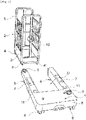
- FIG. 1 there is shown very schematically in perspective a rolling self-guided shuttle 1 and a trolley 2 intended to form a crew to automatically move various objects not shown, such as parcels or packages or even mail trays in a logistics platform postal sorting for example.
- the carriage 2 here comprises a rectangular base 3 and has a movement kinematics of the tricycle or car type. It comprises here at the front two idler wheels 4 and at the rear two fixed wheels 4'.
- a container 5 in the form of a cage is fixed on top of the base 3. This container is used to store the objects to be transported in bulk.
- the rolling self-guided shuttle 1 according to the invention comprises omnidirectional drive wheels 8 to move holonometically.
- the shuttle 1 and the carriage 2 are designed to mutually embed one inside the other in such a way that the omnidirectional drive wheels 8 of the shuttle come to be placed globally around the wheels 4,4' of the trolley and the omnidirectional drive wheels 8 of the shuttle are controlled (in orientation in space along the vertical axis) to follow the kinematics of the wheels 4.4' of the trolley.
- the shuttle is slaved to copy the tricycle or car kinematics of the trolley and as illustrated in the picture 3 , the enslavement can consist of a controlled orientation of the wheels 8 of the shuttle in such a way that the generatrices of the wheels 4,4' of the carriage 2 and the generatrices of the wheels 8 of the shuttle 1 intersect at a point of coincidence P.
- the shuttle 1 has a frame having an overall U-shape with a base 6 and two parallel arms 7 perpendicular to the base.
- the arms of the U are each provided with an omnidirectional drive wheel 8 at their free end and the base of the U is provided with a pair of omnidirectional drive wheels 8 arranged respectively at the two opposite ends of the base of the U which join the arms. With these drive wheels arranged in this way, the shuttle is endowed with a capacity for holonomic movement.
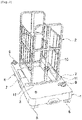
- the carriage 2 is embedded in the U of the shuttle against the base of the U of the frame of the shuttle and between the two arms of the U of the frame of the shuttle.
- the two arms 7 of the U come to marry from the outside two opposite and parallel sides of the base 3 of the carriage in such a way that the driving and steering wheels 8 of the shuttle come to be placed globally around the wheels 4,4 'of the carriage when the base of the carriage is embedded in the shuttle, which has the effect that the carriage can be guided in holonomic movement by the shuttle.
- the wheels 8 at the front of the arms 7 are in front of the front wheels 4 of the carriage, which gives great traction to the shuttle to move the carriage.
- the spacing of the two arms corresponds (with a certain clearance) to the width of the base between the two opposite sides of the base.
- the shuttle is equipped with electric motors to drive the driving wheels.
- Control/command electronics are provided to control these motors both during movement of the shuttle and for the start-up and stop phases and also to slave the orientation of the wheels to those of the carriage.
- the shuttle is guided automatically on the move, for example using QR codes stuck to the floor of the platform which are read by a camera on board the shuttle.
- An LED display on the ground of the instantaneous state of the shuttle can be provided for visual inspection by the Operator.
- a remote sensing system 9 by laser or LIDAR can also be on board the shuttle to detect obstacles for example or to detect a reflector 10 placed on one side of the carriage so as to orient the shuttle to carry out the embedding in the right direction. of the carriage.
- a LIDAR 9 is arranged at a free end of an arm of the U and another lidar 9 is arranged on an end of the base of the U opposite to this end of the arm along a diagonal .
- Each LIDAR can scan an angle of 270° and the two LIDARs can therefore monitor an entire horizontal plane above the ground to detect possible collision situations.
- LIDARs can be supplemented by ultrasonic sensors that cover cones of detection around the shuttle. The LIDARs are exploited by the electronic control of the shuttle to finely adjust the movement of the shuttle relative to the carriage during the approach phase of the carriage.
- the docking of the trolley to the shuttle can be achieved by a system of hooks articulated on the frame of the shuttle and which close automatically on the vertical uprights of the trolley.
- Two wheels of the carriage for example the two wheels 4' placed on the side of the face carrying the reflector, have a brake which is always activated, which can be deactivated but by a precise maneuver, for example by a human operator.
- a lifting device 11 for example a screw jack or an inflatable air cushion, which makes it possible to lift the trolley by a few centimeters at the level of the braked wheels when the carriage is embedded in the shuttle.
- the lifting device is activated urgently to rest the braked wheels of the trolley on the ground.
- U-shaped frame shuttles can be operated in combination with self-guided shuttles as described in the patent EP-3564164 precisely for the transport of letter trays in a postal sorting logistics platform.
Landscapes
- Engineering & Computer Science (AREA)
- Transportation (AREA)
- Mechanical Engineering (AREA)
- Health & Medical Sciences (AREA)
- Public Health (AREA)
- Handcart (AREA)
- Warehouses Or Storage Devices (AREA)
- Vending Machines For Individual Products (AREA)
Description
- Le domaine de l'invention est celui des dispositifs de transport d'objets tels que colis, paquets ou bacs utilisés dans les plateformes logistiques.
- Le document
WO 2019/141257 A1 divulgue un dispositif de transport d'objets selon le préambule de la revendication 1. - Dans les plateformes logistiques, les objets à manipuler peuvent être transportés avec des chariots ayant un socle rectangulaire équipé de roulettes libres à ses quatre coins et portant un conteneur en forme de cage pour entreposer les objets à transporter. Ces chariots-cages roulants sont généralement poussés manuellement ou avec un transpalette manuel ou motorisé. Le poids en charge de ces chariots-cages peut atteindre 200 à 300 kg.
- On connait aussi du document de brevet
EP-3564164 un dispositif de transport automatique d'objets pour transporter automatiquement des objets tels que colis, paquets ou bacs dans une plateforme logistique de tri postal par exemple. Ce dispositif connu comprend un chariot de transport adapté pour le transport d'un objet unique et équipé de roulettes libres et une navette autoguidée roulante agencée pour être accouplée au chariot de façon à le déplacer avec son chargement en le poussant ou en le tractant dans la plateforme logistique. - Le but de l'invention est de proposer un dispositif de transport tel qu'indiqué plus haut avec une navette qui s'adapte à la cinématique de déplacement d'un chariot-cage notamment à une cinématique du type tricycle ou voiture, sans le porter et offrant une grande compacité de manœuvre tant dans le déplacement de l'équipage navette-chariot que dans la phase d'approche de la navette vers le chariot pour réaliser l'attelage.
- A cet effet, l'invention a pour objet un dispositif de transport d'objets pour transporter des objets tels que colis, paquets ou bacs dans une plateforme logistique, comprenant une navette roulante autoguidée agencée pour être accouplée à un chariot roulant de transport des objets de façon à le déplacer avec son chargement dans la plateforme logistique, ce chariot roulant étant déplaçable selon un modèle cinématique de type tricycle ou voiture, caractérisé en ce que la navette comporte des roues motrices omnidirectionnelles pour se déplacer de façon holonome, en ce que la navette et le chariot sont conçus pour s'encastrer l'un dans l'autre de telle façon que les roues motrices de la navette viennent se placer globalement autour des roues du chariot et en ce que les roues motrices de la navette sont asservies pour suivre la cinématique des roues du chariot.
- Le dispositif selon l'invention peut présenter les particularités suivantes.
- La navette présente avantageusement une forme globale en U avec une base et deux bras parallèles perpendiculaires à la base, les bras du U étant munis chacun d'une roue motrice directrice à leur extrémité libre et la base du U étant munie d'une paire de roues motrices directrices disposées respectivement aux deux extrémités opposées de la base du U qui rejoignent les bras et le chariot comporte un socle rectangulaire équipé de roulettes et un conteneur sur le dessus du socle pour entreposer les objets à transporter, les deux bras du U de la navette venant épouser par l'extérieur deux flancs opposés et parallèles du socle de telle façon à ce que les roues de la navette viennent se placer globalement autour des roulettes du chariot quand le socle du chariot est encastré dans la navette.
- Le chariot peut comporter deux roues freinées et la navette peut comporter sur ses bras un organe de levage pour soulever le socle du chariot au niveau des roues freinées quand le socle du chariot est encastré dans la navette.
- La navette peut comporter des capteurs LIDAR et une électronique qui en réponse à la détection d'une situation de collision, active l'organe de levage pour reposer les roues au sol.
- Le chariot peut avoir une face munie d'un catadioptre détectable par des capteurs optiques de la navette et la navette peut comporter une électronique de guidage qui est agencée pour provoquer l'encastrement du socle du chariot dans la navette par le côté de la face du chariot portant le catadioptre.
- Un exemple de machine de tri selon l'invention est illustré par les dessins.
-
- [
Fig.1 ] Lafigure 1 montre de façon très schématique un équipage navette-chariot selon l'invention non encore accouplé. - [
Fig.2 ] Lafigure 2 montre de façon très schématique l'équipage navette-chariot de lafigure 1 mais en position d'accouplement c'est-à-dire d'encastrement du chariot dans la navette selon l'invention. - [
Fig.3 ] illustre l'asservissement des roues de la navette pour suivre la cinématique du chariot logistique. - Sur la
figure 1 , on a représenté de façon très schématique en perspective une navette 1 autoguidée roulante et un chariot 2 destiné à former un équipage pour déplacer de façon automatique des objets divers non représentés, comme des colis ou paquets ou encore des bacs de courrier dans une plateforme logistique de tri postal par exemple. - Le chariot 2 comporte ici un socle rectangulaire 3 et a une cinématique de déplacement de type tricycle ou voiture. Il comprend ici à l'avant deux roues folles 4 et à l'arrière deux roues fixes 4'.
- Un conteneur 5 en forme de cage est fixé sur le dessus du socle 3. Ce conteneur sert à entreposer en vrac les objets à transporter.
- La navette 1 autoguidée roulante selon l'invention comporte des roues motrices omnidirectionnelles 8 pour se déplacer de façon holonome.
- Selon l'invention, la navette 1 et le chariot 2 sont conçus pour s'encastrer mutuellement l'un dans l'autre de telle façon que les roues motrices omnidirectionnelles 8 de la navette viennent se placer globalement autour des roues 4,4' du chariot et les roues motrices omnidirectionnelles 8 de la navette sont asservies (en orientation dans l'espace suivant l'axe vertical) pour suivre la cinématique des roues 4,4' du chariot.
- En d'autres termes, la navette est asservie pour copier la cinématique tricycle ou voiture du chariot et comme illustré sur la
figure 3 , l'asservissement peut consister en une orientation pilotée des roues 8 de la navette de telle façon à ce que les génératrices des roues 4,4' du chariot 2 et les génératrices des roues 8 de la navette 1 se croisent en un point de coïncidence P. - Dans un mode de réalisation préféré de l'invention, la navette 1 présente un châssis ayant une forme globale en U avec une base 6 et deux bras 7 parallèles perpendiculaires à la base.
- Les bras du U sont munis chacun d'une roue motrice omnidirectionnelle 8 à leur extrémité libre et la base du U est munie d'une paire de roues motrices omnidirectionnelles 8 disposées respectivement aux deux extrémités opposées de la base du U qui rejoignent les bras. Avec ces roues motrices directrices disposées ainsi, la navette est dotée d'une capacité de déplacement holonome.
- Sur la
figure 2 , le chariot 2 est encastré dans le U de la navette contre la base du U du châssis de la navette et entre les deux bras du U du châssis de la navette. - En particulier sur la
figure 2 , les deux bras 7 du U viennent épouser par l'extérieur deux flancs opposés et parallèles du socle 3 du chariot de telle façon à ce que les roues motrices et directrices 8 de la navette viennent se placer globalement autour des roues 4,4' du chariot quand le socle du chariot est encastré dans la navette ce qui a pour effet que le chariot peut être guidé en déplacement holonome par la navette. A noter que dans le cas d'exemple de lafigure 3 , les roues 8 à l'avant des bras 7 sont devant les roues avant 4 du chariot ce qui confère une grande motricité à la navette pour déplacer le chariot. - On comprendra que l'écartement des deux bras correspond (avec un certain jeu) à la largeur du socle entre les deux flancs opposés du socle.
- La navette est équipée de moteurs électriques pour entrainer les roues motrices. Une électronique de contrôle/commande est prévue pour commander ces moteurs tant pendant le déplacement de la navette que pour les phases de démarrage et d'arrêt et aussi pour asservir l'orientation des roues à celles du chariot.
- La navette est guidée automatiquement en déplacement par exemple à l'aide de QR codes collés au sol de la plateforme qui sont lus par une caméra embarquée sur la navette.
- Il peut être prévu un affichage par LED au sol de l'état instantané de la navette pour un contrôle visuel par Opérateur.
- Un système de télédétection 9 par laser ou LIDAR peut également être embarqué sur la navette pour détecter des obstacles par exemple ou encore pour détecter un catadioptre 10 placé sur une face du chariot de façon à orienter la navette pour réaliser l'encastrement dans le bon sens du chariot.
- Dans l'exemple de réalisation illustré sur les figures, un LIDAR 9 est disposé à une extrémité libre d'un bras du U et un autre lidar 9 est disposé sur une extrémité de la base du U opposée à cette extrémité du bras selon une diagonale.
- Chaque LIDAR peut balayer un angle de 270° et les deux LIDAR peuvent donc surveiller tout un plan horizontal au-dessus du sol pour détecter de possibles situations de collision. Les LIDAR peuvent être complétés par des capteurs à ultra-son qui couvrent des cônes de détection autour de la navette. Les LIDAR sont exploités par la commande électronique de la navette pour ajuster finement le déplacement de la navette par rapport au chariot pendant la phase d'approche du chariot.
- L'arrimage du chariot à la navette peut être réalisé par un système de crochets articulés sur le châssis de la navette et qui viennent se fermer automatiquement sur des montants verticaux du chariot.
- Pour des raisons de sécurité dans la plateforme logistique, on peut prévoir d'utiliser un chariot à roues freinées. Deux roues du chariot, par exemple les deux roues 4' placées du côté de la face portant le catadioptre, ont un frein toujours activé, lequel peut être désactivé mais par une manœuvre précise par exemple d'un Opérateur humain.
- Dans cette situation, il est prévu sur chaque bras du châssis en U, un organe de levage 11, par exemple un vérin à vis ou un coussin d'air gonflable, qui permet de soulever de quelques centimètres le chariot au niveau des roues freinées quand le chariot est encastré dans la navette. En cas de situation de collision détectée par l'électronique de commande la navette, l'organe de levage est activé en urgence pour reposer les roues freinées du chariot au sol. Ce système présente plusieurs avantages.
- D'abord il n'est pas nécessaire de désactiver le frein des roues du chariot pour que la navette déplace le chariot au sol. Le transfert de poids sur les roues de la navette crée un supplément d'adhérence de la navette au sol.
- Ces navettes à châssis en forme de U peuvent être exploitées en combinaison avec des navettes autoguidées telles que décrites dans le brevet
EP-3564164 précisément pour le transport de bacs de lettres dans une plateforme logistique de tri postal.
Claims (5)
- Dispositif de transport d'objets pour transporter des objets tels que colis, paquets ou bacs dans une plateforme logistique, comprenant une navette (1) roulante autoguidée agencée pour être accouplée à un chariot roulant (2) de transport des objets de façon à le déplacer avec son chargement dans la plateforme logistique, ce chariot roulant étant déplaçable selon un modèle cinématique de type tricycle ou voiture, la navette comportant des roues motrices omnidirectionnelles pour se déplacer de façon holonome, caractérisé en ce que la navette et le chariot sont conçus pour s'encastrer l'un dans l'autre de telle façon que les roues motrices de la navette viennent se placer globalement autour des roues du chariot et en ce que les roues motrices de la navette sont asservies pour suivre la cinématique des roues du chariot.
- Dispositif selon la revendication 1, caractérisé en ce que la navette présente une forme globale en U avec une base (6) et deux bras (7) parallèles perpendiculaires à la base, les bras du U étant munis chacun d'une roue motrice directrice (8) à leur extrémité libre et la base du U étant munie d'une paire de roues motrices directrices (8) disposées respectivement aux deux extrémités opposées de la base du U qui rejoignent les bras et en ce que le chariot (2) comporte un socle (3) rectangulaire équipé de roulettes et un conteneur sur le dessus du socle (4) pour entreposer les objets à transporter, et en ce que les deux bras du U de la navette viennent épouser par l'extérieur deux flancs opposés et parallèles du socle de telle façon à ce que les roues de la navette viennent se placer globalement autour des roulettes du chariot quand le socle du chariot est encastré dans la navette.
- Dispositif selon la revendication 2, caractérisé en ce que le chariot comporte deux roues freinées (4) et en ce que la navette comporte sur ses bras un organe de levage (11) pour soulever le socle du chariot au niveau des roues freinées quand le socle du chariot est encastré dans la navette.
- Dispositif selon la revendication 3, caractérisé en ce que la navette comporte des capteurs LIDAR (9) et une électronique qui en réponse à la détection d'une situation de collision, active l'organe de levage pour reposer les roues au sol.
- Dispositif selon l'une des revendications 2 à 4, caractérisé en ce que le chariot a une face munie d'un catadioptre (10) détectable par des capteurs optiques de la navette et en ce que la navette comporte une électronique de guidage qui est agencée pour provoquer l'encastrement du socle du chariot dans la navette par le côté de la face du chariot portant le catadioptre.
Applications Claiming Priority (1)
| Application Number | Priority Date | Filing Date | Title |
|---|---|---|---|
| FR2004812A FR3110120B1 (fr) | 2020-05-15 | 2020-05-15 | Dispositif de transport d’objets comportant une navette autoguidée et un chariot logistique qui s’encastre dans la navette |
Publications (2)
| Publication Number | Publication Date |
|---|---|
| EP3909809A1 EP3909809A1 (fr) | 2021-11-17 |
| EP3909809B1 true EP3909809B1 (fr) | 2022-06-08 |
Family
ID=71784291
Family Applications (1)
| Application Number | Title | Priority Date | Filing Date |
|---|---|---|---|
| EP21164937.1A Active EP3909809B1 (fr) | 2020-05-15 | 2021-03-25 | Dispositif de transport d'objets comportant une navette autoguidée |
Country Status (3)
| Country | Link |
|---|---|
| EP (1) | EP3909809B1 (fr) |
| ES (1) | ES2924911T3 (fr) |
| FR (1) | FR3110120B1 (fr) |
Family Cites Families (4)
| Publication number | Priority date | Publication date | Assignee | Title |
|---|---|---|---|---|
| DE202011050891U1 (de) * | 2011-08-03 | 2011-09-07 | Lr Intralogistik Gmbh | Anhänger für einen Trailerzug |
| DE102017203514A1 (de) * | 2017-03-03 | 2018-09-20 | Robert Bosch Gmbh | Flurförderfahrzeug mit verbessertem Sensorkonzept sowie Flurfördersystem |
| CN108177147B (zh) * | 2018-01-18 | 2019-10-11 | 东莞理工学院 | 应用于智能仓库的全方位移动机器人 |
| FR3080848B1 (fr) | 2018-05-04 | 2021-02-26 | Solystic | Cellule de stockage/destockage pour plate-forme logistique de traitement de colis |
-
2020
- 2020-05-15 FR FR2004812A patent/FR3110120B1/fr not_active Expired - Fee Related
-
2021
- 2021-03-25 ES ES21164937T patent/ES2924911T3/es active Active
- 2021-03-25 EP EP21164937.1A patent/EP3909809B1/fr active Active
Also Published As
| Publication number | Publication date |
|---|---|
| FR3110120B1 (fr) | 2022-04-22 |
| EP3909809A1 (fr) | 2021-11-17 |
| FR3110120A1 (fr) | 2021-11-19 |
| ES2924911T3 (es) | 2022-10-11 |
Similar Documents
| Publication | Publication Date | Title |
|---|---|---|
| AU2022201542B2 (en) | Free ranging automated guided vehicle and operational system | |
| CN112977670A (zh) | 全方向台车运输机构 | |
| US8523224B2 (en) | Restraint system for walkie/rider pallet truck | |
| EP3297876B1 (fr) | Convoyeurs mobiles destinés au déplacement d'un véhicule à 4 roues | |
| JP5476551B2 (ja) | 物品の輸送及び貯蔵のためのカート | |
| EP2797832B1 (fr) | Véhicule à pilotage automatique doté d'un positionnement de capteur qui améliore le champ de vision et procédé de réalisation de ce dernier | |
| US9823662B2 (en) | Transport vehicle for the transport of load shelves with partially autonomous operation and method for operating said transport vehicle | |
| JP7303660B2 (ja) | 搬送車 | |
| EP3909809B1 (fr) | Dispositif de transport d'objets comportant une navette autoguidée | |
| JP7754228B2 (ja) | 運搬装置及び運搬方法 | |
| JP5253839B2 (ja) | 移動台車 | |
| US20220363182A1 (en) | A pallet, a transport device, and system for transporting goods | |
| EP4146503B1 (fr) | Système porteur de chariot | |
| WO2020187517A1 (fr) | Dispositif d'aide a la conduite de roue de systeme de propulsion electrique amovible pour un objet roulant | |
| JP2021079874A (ja) | カゴ車搬送補助装置 | |
| FR3048963A1 (fr) | Chariot elevateur a conducteur accompagnant | |
| WO2020187516A1 (fr) | Dispositif de levage de roue de systeme de propulsion electrique amovible pour un objet roulant | |
| WO2020187499A1 (fr) | Dispositif de prehension de roue de systeme de propulsion electrique amovible pour un objet roulant | |
| JP2014186449A (ja) | 無人搬送車 | |
| EP4400453B1 (fr) | Dispositif de déplacement automatique et système de distribution | |
| FR2740766A1 (fr) | Chariot elevateur preparateur des commandes | |
| FR3146867A1 (fr) | Véhicule de transport de palettes avec fenêtre virtuelle | |
| EP3645446B1 (fr) | Chariot élévateur comportant une butée de chargement | |
| WO2024100917A1 (fr) | Dispositif de transport de palette | |
| WO2025032822A1 (fr) | Véhicule de transport sans pilote et procédé de commande de véhicule de transport sans pilote |
Legal Events
| Date | Code | Title | Description |
|---|---|---|---|
| PUAI | Public reference made under article 153(3) epc to a published international application that has entered the european phase |
Free format text: ORIGINAL CODE: 0009012 |
|
| STAA | Information on the status of an ep patent application or granted ep patent |
Free format text: STATUS: THE APPLICATION HAS BEEN PUBLISHED |
|
| STAA | Information on the status of an ep patent application or granted ep patent |
Free format text: STATUS: REQUEST FOR EXAMINATION WAS MADE |
|
| AK | Designated contracting states |
Kind code of ref document: A1 Designated state(s): AL AT BE BG CH CY CZ DE DK EE ES FI FR GB GR HR HU IE IS IT LI LT LU LV MC MK MT NL NO PL PT RO RS SE SI SK SM TR |
|
| B565 | Issuance of search results under rule 164(2) epc |
Effective date: 20210907 |
|
| 17P | Request for examination filed |
Effective date: 20211104 |
|
| RBV | Designated contracting states (corrected) |
Designated state(s): AL AT BE BG CH CY CZ DE DK EE ES FI FR GB GR HR HU IE IS IT LI LT LU LV MC MK MT NL NO PL PT RO RS SE SI SK SM TR |
|
| GRAP | Despatch of communication of intention to grant a patent |
Free format text: ORIGINAL CODE: EPIDOSNIGR1 |
|
| STAA | Information on the status of an ep patent application or granted ep patent |
Free format text: STATUS: GRANT OF PATENT IS INTENDED |
|
| RIC1 | Information provided on ipc code assigned before grant |
Ipc: B66F 9/06 20060101ALI20220303BHEP Ipc: B65G 1/00 20060101ALI20220303BHEP Ipc: B60P 1/64 20060101ALI20220303BHEP Ipc: B60P 3/00 20060101AFI20220303BHEP |
|
| INTG | Intention to grant announced |
Effective date: 20220324 |
|
| GRAS | Grant fee paid |
Free format text: ORIGINAL CODE: EPIDOSNIGR3 |
|
| GRAA | (expected) grant |
Free format text: ORIGINAL CODE: 0009210 |
|
| STAA | Information on the status of an ep patent application or granted ep patent |
Free format text: STATUS: THE PATENT HAS BEEN GRANTED |
|
| AK | Designated contracting states |
Kind code of ref document: B1 Designated state(s): AL AT BE BG CH CY CZ DE DK EE ES FI FR GB GR HR HU IE IS IT LI LT LU LV MC MK MT NL NO PL PT RO RS SE SI SK SM TR |
|
| REG | Reference to a national code |
Ref country code: AT Ref legal event code: REF Ref document number: 1496713 Country of ref document: AT Kind code of ref document: T Effective date: 20220615 Ref country code: CH Ref legal event code: EP |
|
| REG | Reference to a national code |
Ref country code: DE Ref legal event code: R096 Ref document number: 602021000129 Country of ref document: DE |
|
| REG | Reference to a national code |
Ref country code: IE Ref legal event code: FG4D Free format text: LANGUAGE OF EP DOCUMENT: FRENCH |
|
| REG | Reference to a national code |
Ref country code: FI Ref legal event code: FGE |
|
| REG | Reference to a national code |
Ref country code: NL Ref legal event code: FP |
|
| REG | Reference to a national code |
Ref country code: SE Ref legal event code: TRGR |
|
| REG | Reference to a national code |
Ref country code: LT Ref legal event code: MG9D |
|
| REG | Reference to a national code |
Ref country code: ES Ref legal event code: FG2A Ref document number: 2924911 Country of ref document: ES Kind code of ref document: T3 Effective date: 20221011 |
|
| PG25 | Lapsed in a contracting state [announced via postgrant information from national office to epo] |
Ref country code: NO Free format text: LAPSE BECAUSE OF FAILURE TO SUBMIT A TRANSLATION OF THE DESCRIPTION OR TO PAY THE FEE WITHIN THE PRESCRIBED TIME-LIMIT Effective date: 20220908 Ref country code: LT Free format text: LAPSE BECAUSE OF FAILURE TO SUBMIT A TRANSLATION OF THE DESCRIPTION OR TO PAY THE FEE WITHIN THE PRESCRIBED TIME-LIMIT Effective date: 20220608 Ref country code: HR Free format text: LAPSE BECAUSE OF FAILURE TO SUBMIT A TRANSLATION OF THE DESCRIPTION OR TO PAY THE FEE WITHIN THE PRESCRIBED TIME-LIMIT Effective date: 20220608 Ref country code: GR Free format text: LAPSE BECAUSE OF FAILURE TO SUBMIT A TRANSLATION OF THE DESCRIPTION OR TO PAY THE FEE WITHIN THE PRESCRIBED TIME-LIMIT Effective date: 20220909 Ref country code: BG Free format text: LAPSE BECAUSE OF FAILURE TO SUBMIT A TRANSLATION OF THE DESCRIPTION OR TO PAY THE FEE WITHIN THE PRESCRIBED TIME-LIMIT Effective date: 20220908 |
|
| REG | Reference to a national code |
Ref country code: AT Ref legal event code: MK05 Ref document number: 1496713 Country of ref document: AT Kind code of ref document: T Effective date: 20220608 |
|
| PG25 | Lapsed in a contracting state [announced via postgrant information from national office to epo] |
Ref country code: RS Free format text: LAPSE BECAUSE OF FAILURE TO SUBMIT A TRANSLATION OF THE DESCRIPTION OR TO PAY THE FEE WITHIN THE PRESCRIBED TIME-LIMIT Effective date: 20220608 Ref country code: LV Free format text: LAPSE BECAUSE OF FAILURE TO SUBMIT A TRANSLATION OF THE DESCRIPTION OR TO PAY THE FEE WITHIN THE PRESCRIBED TIME-LIMIT Effective date: 20220608 |
|
| PG25 | Lapsed in a contracting state [announced via postgrant information from national office to epo] |
Ref country code: SM Free format text: LAPSE BECAUSE OF FAILURE TO SUBMIT A TRANSLATION OF THE DESCRIPTION OR TO PAY THE FEE WITHIN THE PRESCRIBED TIME-LIMIT Effective date: 20220608 Ref country code: SK Free format text: LAPSE BECAUSE OF FAILURE TO SUBMIT A TRANSLATION OF THE DESCRIPTION OR TO PAY THE FEE WITHIN THE PRESCRIBED TIME-LIMIT Effective date: 20220608 Ref country code: RO Free format text: LAPSE BECAUSE OF FAILURE TO SUBMIT A TRANSLATION OF THE DESCRIPTION OR TO PAY THE FEE WITHIN THE PRESCRIBED TIME-LIMIT Effective date: 20220608 Ref country code: PT Free format text: LAPSE BECAUSE OF FAILURE TO SUBMIT A TRANSLATION OF THE DESCRIPTION OR TO PAY THE FEE WITHIN THE PRESCRIBED TIME-LIMIT Effective date: 20221010 Ref country code: EE Free format text: LAPSE BECAUSE OF FAILURE TO SUBMIT A TRANSLATION OF THE DESCRIPTION OR TO PAY THE FEE WITHIN THE PRESCRIBED TIME-LIMIT Effective date: 20220608 Ref country code: CZ Free format text: LAPSE BECAUSE OF FAILURE TO SUBMIT A TRANSLATION OF THE DESCRIPTION OR TO PAY THE FEE WITHIN THE PRESCRIBED TIME-LIMIT Effective date: 20220608 Ref country code: AT Free format text: LAPSE BECAUSE OF FAILURE TO SUBMIT A TRANSLATION OF THE DESCRIPTION OR TO PAY THE FEE WITHIN THE PRESCRIBED TIME-LIMIT Effective date: 20220608 |
|
| PG25 | Lapsed in a contracting state [announced via postgrant information from national office to epo] |
Ref country code: PL Free format text: LAPSE BECAUSE OF FAILURE TO SUBMIT A TRANSLATION OF THE DESCRIPTION OR TO PAY THE FEE WITHIN THE PRESCRIBED TIME-LIMIT Effective date: 20220608 Ref country code: IS Free format text: LAPSE BECAUSE OF FAILURE TO SUBMIT A TRANSLATION OF THE DESCRIPTION OR TO PAY THE FEE WITHIN THE PRESCRIBED TIME-LIMIT Effective date: 20221008 |
|
| REG | Reference to a national code |
Ref country code: DE Ref legal event code: R097 Ref document number: 602021000129 Country of ref document: DE |
|
| PG25 | Lapsed in a contracting state [announced via postgrant information from national office to epo] |
Ref country code: AL Free format text: LAPSE BECAUSE OF FAILURE TO SUBMIT A TRANSLATION OF THE DESCRIPTION OR TO PAY THE FEE WITHIN THE PRESCRIBED TIME-LIMIT Effective date: 20220608 |
|
| PLBE | No opposition filed within time limit |
Free format text: ORIGINAL CODE: 0009261 |
|
| STAA | Information on the status of an ep patent application or granted ep patent |
Free format text: STATUS: NO OPPOSITION FILED WITHIN TIME LIMIT |
|
| PG25 | Lapsed in a contracting state [announced via postgrant information from national office to epo] |
Ref country code: DK Free format text: LAPSE BECAUSE OF FAILURE TO SUBMIT A TRANSLATION OF THE DESCRIPTION OR TO PAY THE FEE WITHIN THE PRESCRIBED TIME-LIMIT Effective date: 20220608 |
|
| 26N | No opposition filed |
Effective date: 20230310 |
|
| P01 | Opt-out of the competence of the unified patent court (upc) registered |
Effective date: 20230526 |
|
| PG25 | Lapsed in a contracting state [announced via postgrant information from national office to epo] |
Ref country code: MC Free format text: LAPSE BECAUSE OF FAILURE TO SUBMIT A TRANSLATION OF THE DESCRIPTION OR TO PAY THE FEE WITHIN THE PRESCRIBED TIME-LIMIT Effective date: 20220608 |
|
| PG25 | Lapsed in a contracting state [announced via postgrant information from national office to epo] |
Ref country code: LU Free format text: LAPSE BECAUSE OF NON-PAYMENT OF DUE FEES Effective date: 20230325 |
|
| REG | Reference to a national code |
Ref country code: IE Ref legal event code: MM4A |
|
| PG25 | Lapsed in a contracting state [announced via postgrant information from national office to epo] |
Ref country code: IE Free format text: LAPSE BECAUSE OF NON-PAYMENT OF DUE FEES Effective date: 20230325 |
|
| REG | Reference to a national code |
Ref country code: CH Ref legal event code: PL |
|
| PG25 | Lapsed in a contracting state [announced via postgrant information from national office to epo] |
Ref country code: BG Free format text: LAPSE BECAUSE OF FAILURE TO SUBMIT A TRANSLATION OF THE DESCRIPTION OR TO PAY THE FEE WITHIN THE PRESCRIBED TIME-LIMIT Effective date: 20220608 |
|
| PG25 | Lapsed in a contracting state [announced via postgrant information from national office to epo] |
Ref country code: BG Free format text: LAPSE BECAUSE OF FAILURE TO SUBMIT A TRANSLATION OF THE DESCRIPTION OR TO PAY THE FEE WITHIN THE PRESCRIBED TIME-LIMIT Effective date: 20220608 |
|
| PG25 | Lapsed in a contracting state [announced via postgrant information from national office to epo] |
Ref country code: CH Free format text: LAPSE BECAUSE OF NON-PAYMENT OF DUE FEES Effective date: 20240331 |
|
| PGFP | Annual fee paid to national office [announced via postgrant information from national office to epo] |
Ref country code: ES Payment date: 20250429 Year of fee payment: 5 |
|
| PG25 | Lapsed in a contracting state [announced via postgrant information from national office to epo] |
Ref country code: CY Free format text: LAPSE BECAUSE OF FAILURE TO SUBMIT A TRANSLATION OF THE DESCRIPTION OR TO PAY THE FEE WITHIN THE PRESCRIBED TIME-LIMIT; INVALID AB INITIO Effective date: 20210325 |
|
| PG25 | Lapsed in a contracting state [announced via postgrant information from national office to epo] |
Ref country code: HU Free format text: LAPSE BECAUSE OF FAILURE TO SUBMIT A TRANSLATION OF THE DESCRIPTION OR TO PAY THE FEE WITHIN THE PRESCRIBED TIME-LIMIT; INVALID AB INITIO Effective date: 20210325 |
|
| PG25 | Lapsed in a contracting state [announced via postgrant information from national office to epo] |
Ref country code: TR Free format text: LAPSE BECAUSE OF FAILURE TO SUBMIT A TRANSLATION OF THE DESCRIPTION OR TO PAY THE FEE WITHIN THE PRESCRIBED TIME-LIMIT Effective date: 20220608 |
|
| PGFP | Annual fee paid to national office [announced via postgrant information from national office to epo] |
Ref country code: FI Payment date: 20251230 Year of fee payment: 6 |
|
| PG25 | Lapsed in a contracting state [announced via postgrant information from national office to epo] |
Ref country code: SI Free format text: LAPSE BECAUSE OF FAILURE TO SUBMIT A TRANSLATION OF THE DESCRIPTION OR TO PAY THE FEE WITHIN THE PRESCRIBED TIME-LIMIT Effective date: 20220608 |
|
| PGFP | Annual fee paid to national office [announced via postgrant information from national office to epo] |
Ref country code: SE Payment date: 20260323 Year of fee payment: 6 |
|
| PGFP | Annual fee paid to national office [announced via postgrant information from national office to epo] |
Ref country code: GB Payment date: 20260323 Year of fee payment: 6 |
|
| PGFP | Annual fee paid to national office [announced via postgrant information from national office to epo] |
Ref country code: DE Payment date: 20260325 Year of fee payment: 6 |
|
| PGFP | Annual fee paid to national office [announced via postgrant information from national office to epo] |
Ref country code: BE Payment date: 20260323 Year of fee payment: 6 Ref country code: IT Payment date: 20260317 Year of fee payment: 6 |
|
| PGFP | Annual fee paid to national office [announced via postgrant information from national office to epo] |
Ref country code: NL Payment date: 20260323 Year of fee payment: 6 |
|
| PGFP | Annual fee paid to national office [announced via postgrant information from national office to epo] |
Ref country code: FR Payment date: 20260325 Year of fee payment: 6 |