EP3906910B1 - Elastic member and disposable wearable article having elastic member - Google Patents
Elastic member and disposable wearable article having elastic member Download PDFInfo
- Publication number
- EP3906910B1 EP3906910B1 EP20773997.0A EP20773997A EP3906910B1 EP 3906910 B1 EP3906910 B1 EP 3906910B1 EP 20773997 A EP20773997 A EP 20773997A EP 3906910 B1 EP3906910 B1 EP 3906910B1
- Authority
- EP
- European Patent Office
- Prior art keywords
- stretchable
- sheet
- joining
- sheet layer
- elastic sheet
- Prior art date
- Legal status (The legal status is an assumption and is not a legal conclusion. Google has not performed a legal analysis and makes no representation as to the accuracy of the status listed.)
- Active
Links
Images









Classifications
-
- A—HUMAN NECESSITIES
- A61—MEDICAL OR VETERINARY SCIENCE; HYGIENE
- A61F—FILTERS IMPLANTABLE INTO BLOOD VESSELS; PROSTHESES; DEVICES PROVIDING PATENCY TO, OR PREVENTING COLLAPSING OF, TUBULAR STRUCTURES OF THE BODY, e.g. STENTS; ORTHOPAEDIC, NURSING OR CONTRACEPTIVE DEVICES; FOMENTATION; TREATMENT OR PROTECTION OF EYES OR EARS; BANDAGES, DRESSINGS OR ABSORBENT PADS; FIRST-AID KITS
- A61F13/00—Bandages or dressings; Absorbent pads
- A61F13/15—Absorbent pads, e.g. sanitary towels, swabs or tampons for external or internal application to the body; Supporting or fastening means therefor; Tampon applicators
- A61F13/51—Absorbent pads, e.g. sanitary towels, swabs or tampons for external or internal application to the body; Supporting or fastening means therefor; Tampon applicators characterised by the outer layers of the pads
- A61F13/514—Backsheet, i.e. the impermeable cover or layer furthest from the skin
- A61F13/51474—Backsheet, i.e. the impermeable cover or layer furthest from the skin characterised by its structure
- A61F13/51478—Backsheet, i.e. the impermeable cover or layer furthest from the skin characterised by its structure being a laminate, e.g. multi-layered or with several layers
-
- A—HUMAN NECESSITIES
- A61—MEDICAL OR VETERINARY SCIENCE; HYGIENE
- A61F—FILTERS IMPLANTABLE INTO BLOOD VESSELS; PROSTHESES; DEVICES PROVIDING PATENCY TO, OR PREVENTING COLLAPSING OF, TUBULAR STRUCTURES OF THE BODY, e.g. STENTS; ORTHOPAEDIC, NURSING OR CONTRACEPTIVE DEVICES; FOMENTATION; TREATMENT OR PROTECTION OF EYES OR EARS; BANDAGES, DRESSINGS OR ABSORBENT PADS; FIRST-AID KITS
- A61F13/00—Bandages or dressings; Absorbent pads
- A61F13/15—Absorbent pads, e.g. sanitary towels, swabs or tampons for external or internal application to the body; Supporting or fastening means therefor; Tampon applicators
- A61F13/45—Absorbent pads, e.g. sanitary towels, swabs or tampons for external or internal application to the body; Supporting or fastening means therefor; Tampon applicators characterised by the shape
- A61F13/49—Absorbent pads, e.g. sanitary towels, swabs or tampons for external or internal application to the body; Supporting or fastening means therefor; Tampon applicators characterised by the shape specially adapted to be worn around the waist, e.g. diapers or nappies
- A61F13/49007—Form-fitting, self-adjusting disposable diapers
- A61F13/49009—Form-fitting, self-adjusting disposable diapers with elastic means
- A61F13/49019—Form-fitting, self-adjusting disposable diapers with elastic means the elastic means being placed longitudinally, transversely or diagonally over the article
-
- A—HUMAN NECESSITIES
- A61—MEDICAL OR VETERINARY SCIENCE; HYGIENE
- A61F—FILTERS IMPLANTABLE INTO BLOOD VESSELS; PROSTHESES; DEVICES PROVIDING PATENCY TO, OR PREVENTING COLLAPSING OF, TUBULAR STRUCTURES OF THE BODY, e.g. STENTS; ORTHOPAEDIC, NURSING OR CONTRACEPTIVE DEVICES; FOMENTATION; TREATMENT OR PROTECTION OF EYES OR EARS; BANDAGES, DRESSINGS OR ABSORBENT PADS; FIRST-AID KITS
- A61F13/00—Bandages or dressings; Absorbent pads
- A61F13/15—Absorbent pads, e.g. sanitary towels, swabs or tampons for external or internal application to the body; Supporting or fastening means therefor; Tampon applicators
- A61F13/15203—Properties of the article, e.g. stiffness or absorbency
-
- A—HUMAN NECESSITIES
- A61—MEDICAL OR VETERINARY SCIENCE; HYGIENE
- A61F—FILTERS IMPLANTABLE INTO BLOOD VESSELS; PROSTHESES; DEVICES PROVIDING PATENCY TO, OR PREVENTING COLLAPSING OF, TUBULAR STRUCTURES OF THE BODY, e.g. STENTS; ORTHOPAEDIC, NURSING OR CONTRACEPTIVE DEVICES; FOMENTATION; TREATMENT OR PROTECTION OF EYES OR EARS; BANDAGES, DRESSINGS OR ABSORBENT PADS; FIRST-AID KITS
- A61F13/00—Bandages or dressings; Absorbent pads
- A61F13/15—Absorbent pads, e.g. sanitary towels, swabs or tampons for external or internal application to the body; Supporting or fastening means therefor; Tampon applicators
- A61F13/51—Absorbent pads, e.g. sanitary towels, swabs or tampons for external or internal application to the body; Supporting or fastening means therefor; Tampon applicators characterised by the outer layers of the pads
- A61F13/514—Backsheet, i.e. the impermeable cover or layer furthest from the skin
- A61F13/51496—Backsheet, i.e. the impermeable cover or layer furthest from the skin having visual effects
-
- B—PERFORMING OPERATIONS; TRANSPORTING
- B32—LAYERED PRODUCTS
- B32B—LAYERED PRODUCTS, i.e. PRODUCTS BUILT-UP OF STRATA OF FLAT OR NON-FLAT, e.g. CELLULAR OR HONEYCOMB, FORM
- B32B27/00—Layered products comprising a layer of synthetic resin
- B32B27/06—Layered products comprising a layer of synthetic resin as the main or only constituent of a layer, which is next to another layer of the same or of a different material
- B32B27/10—Layered products comprising a layer of synthetic resin as the main or only constituent of a layer, which is next to another layer of the same or of a different material of paper or cardboard
-
- B—PERFORMING OPERATIONS; TRANSPORTING
- B32—LAYERED PRODUCTS
- B32B—LAYERED PRODUCTS, i.e. PRODUCTS BUILT-UP OF STRATA OF FLAT OR NON-FLAT, e.g. CELLULAR OR HONEYCOMB, FORM
- B32B27/00—Layered products comprising a layer of synthetic resin
- B32B27/12—Layered products comprising a layer of synthetic resin next to a fibrous or filamentary layer
-
- B—PERFORMING OPERATIONS; TRANSPORTING
- B32—LAYERED PRODUCTS
- B32B—LAYERED PRODUCTS, i.e. PRODUCTS BUILT-UP OF STRATA OF FLAT OR NON-FLAT, e.g. CELLULAR OR HONEYCOMB, FORM
- B32B27/00—Layered products comprising a layer of synthetic resin
- B32B27/18—Layered products comprising a layer of synthetic resin characterised by the use of special additives
- B32B27/20—Layered products comprising a layer of synthetic resin characterised by the use of special additives using fillers, pigments, thixotroping agents
-
- B—PERFORMING OPERATIONS; TRANSPORTING
- B32—LAYERED PRODUCTS
- B32B—LAYERED PRODUCTS, i.e. PRODUCTS BUILT-UP OF STRATA OF FLAT OR NON-FLAT, e.g. CELLULAR OR HONEYCOMB, FORM
- B32B27/00—Layered products comprising a layer of synthetic resin
- B32B27/32—Layered products comprising a layer of synthetic resin comprising polyolefins
-
- B—PERFORMING OPERATIONS; TRANSPORTING
- B32—LAYERED PRODUCTS
- B32B—LAYERED PRODUCTS, i.e. PRODUCTS BUILT-UP OF STRATA OF FLAT OR NON-FLAT, e.g. CELLULAR OR HONEYCOMB, FORM
- B32B29/00—Layered products comprising a layer of paper or cardboard
- B32B29/02—Layered products comprising a layer of paper or cardboard next to a fibrous or filamentary layer
-
- B—PERFORMING OPERATIONS; TRANSPORTING
- B32—LAYERED PRODUCTS
- B32B—LAYERED PRODUCTS, i.e. PRODUCTS BUILT-UP OF STRATA OF FLAT OR NON-FLAT, e.g. CELLULAR OR HONEYCOMB, FORM
- B32B3/00—Layered products comprising a layer with external or internal discontinuities or unevennesses, or a layer of non-planar shape; Layered products comprising a layer having particular features of form
- B32B3/02—Layered products comprising a layer with external or internal discontinuities or unevennesses, or a layer of non-planar shape; Layered products comprising a layer having particular features of form characterised by features of form at particular places, e.g. in edge regions
- B32B3/04—Layered products comprising a layer with external or internal discontinuities or unevennesses, or a layer of non-planar shape; Layered products comprising a layer having particular features of form characterised by features of form at particular places, e.g. in edge regions characterised by at least one layer folded at the edge, e.g. over another layer ; characterised by at least one layer enveloping or enclosing a material
-
- B—PERFORMING OPERATIONS; TRANSPORTING
- B32—LAYERED PRODUCTS
- B32B—LAYERED PRODUCTS, i.e. PRODUCTS BUILT-UP OF STRATA OF FLAT OR NON-FLAT, e.g. CELLULAR OR HONEYCOMB, FORM
- B32B3/00—Layered products comprising a layer with external or internal discontinuities or unevennesses, or a layer of non-planar shape; Layered products comprising a layer having particular features of form
- B32B3/26—Layered products comprising a layer with external or internal discontinuities or unevennesses, or a layer of non-planar shape; Layered products comprising a layer having particular features of form characterised by a particular shape of the outline of the cross-section of a continuous layer; characterised by a layer with cavities or internal voids ; characterised by an apertured layer
- B32B3/266—Layered products comprising a layer with external or internal discontinuities or unevennesses, or a layer of non-planar shape; Layered products comprising a layer having particular features of form characterised by a particular shape of the outline of the cross-section of a continuous layer; characterised by a layer with cavities or internal voids ; characterised by an apertured layer characterised by an apertured layer, the apertures going through the whole thickness of the layer, e.g. expanded metal, perforated layer, slit layer regular cells B32B3/12
-
- B—PERFORMING OPERATIONS; TRANSPORTING
- B32—LAYERED PRODUCTS
- B32B—LAYERED PRODUCTS, i.e. PRODUCTS BUILT-UP OF STRATA OF FLAT OR NON-FLAT, e.g. CELLULAR OR HONEYCOMB, FORM
- B32B3/00—Layered products comprising a layer with external or internal discontinuities or unevennesses, or a layer of non-planar shape; Layered products comprising a layer having particular features of form
- B32B3/26—Layered products comprising a layer with external or internal discontinuities or unevennesses, or a layer of non-planar shape; Layered products comprising a layer having particular features of form characterised by a particular shape of the outline of the cross-section of a continuous layer; characterised by a layer with cavities or internal voids ; characterised by an apertured layer
- B32B3/30—Layered products comprising a layer with external or internal discontinuities or unevennesses, or a layer of non-planar shape; Layered products comprising a layer having particular features of form characterised by a particular shape of the outline of the cross-section of a continuous layer; characterised by a layer with cavities or internal voids ; characterised by an apertured layer characterised by a layer formed with recesses or projections, e.g. hollows, grooves, protuberances, ribs
-
- B—PERFORMING OPERATIONS; TRANSPORTING
- B32—LAYERED PRODUCTS
- B32B—LAYERED PRODUCTS, i.e. PRODUCTS BUILT-UP OF STRATA OF FLAT OR NON-FLAT, e.g. CELLULAR OR HONEYCOMB, FORM
- B32B5/00—Layered products characterised by the non- homogeneity or physical structure, i.e. comprising a fibrous, filamentary, particulate or foam layer; Layered products characterised by having a layer differing constitutionally or physically in different parts
- B32B5/02—Layered products characterised by the non- homogeneity or physical structure, i.e. comprising a fibrous, filamentary, particulate or foam layer; Layered products characterised by having a layer differing constitutionally or physically in different parts characterised by structural features of a fibrous or filamentary layer
- B32B5/022—Non-woven fabric
-
- B—PERFORMING OPERATIONS; TRANSPORTING
- B32—LAYERED PRODUCTS
- B32B—LAYERED PRODUCTS, i.e. PRODUCTS BUILT-UP OF STRATA OF FLAT OR NON-FLAT, e.g. CELLULAR OR HONEYCOMB, FORM
- B32B5/00—Layered products characterised by the non- homogeneity or physical structure, i.e. comprising a fibrous, filamentary, particulate or foam layer; Layered products characterised by having a layer differing constitutionally or physically in different parts
- B32B5/02—Layered products characterised by the non- homogeneity or physical structure, i.e. comprising a fibrous, filamentary, particulate or foam layer; Layered products characterised by having a layer differing constitutionally or physically in different parts characterised by structural features of a fibrous or filamentary layer
- B32B5/08—Layered products characterised by the non- homogeneity or physical structure, i.e. comprising a fibrous, filamentary, particulate or foam layer; Layered products characterised by having a layer differing constitutionally or physically in different parts characterised by structural features of a fibrous or filamentary layer the fibres or filaments of a layer being of different substances, e.g. conjugate fibres, mixture of different fibres
-
- B—PERFORMING OPERATIONS; TRANSPORTING
- B32—LAYERED PRODUCTS
- B32B—LAYERED PRODUCTS, i.e. PRODUCTS BUILT-UP OF STRATA OF FLAT OR NON-FLAT, e.g. CELLULAR OR HONEYCOMB, FORM
- B32B5/00—Layered products characterised by the non- homogeneity or physical structure, i.e. comprising a fibrous, filamentary, particulate or foam layer; Layered products characterised by having a layer differing constitutionally or physically in different parts
- B32B5/22—Layered products characterised by the non- homogeneity or physical structure, i.e. comprising a fibrous, filamentary, particulate or foam layer; Layered products characterised by having a layer differing constitutionally or physically in different parts characterised by the presence of two or more layers which are next to each other and are fibrous, filamentary, formed of particles or foamed
- B32B5/24—Layered products characterised by the non- homogeneity or physical structure, i.e. comprising a fibrous, filamentary, particulate or foam layer; Layered products characterised by having a layer differing constitutionally or physically in different parts characterised by the presence of two or more layers which are next to each other and are fibrous, filamentary, formed of particles or foamed one layer being a fibrous or filamentary layer
- B32B5/26—Layered products characterised by the non- homogeneity or physical structure, i.e. comprising a fibrous, filamentary, particulate or foam layer; Layered products characterised by having a layer differing constitutionally or physically in different parts characterised by the presence of two or more layers which are next to each other and are fibrous, filamentary, formed of particles or foamed one layer being a fibrous or filamentary layer another layer next to it also being fibrous or filamentary
-
- B—PERFORMING OPERATIONS; TRANSPORTING
- B32—LAYERED PRODUCTS
- B32B—LAYERED PRODUCTS, i.e. PRODUCTS BUILT-UP OF STRATA OF FLAT OR NON-FLAT, e.g. CELLULAR OR HONEYCOMB, FORM
- B32B7/00—Layered products characterised by the relation between layers; Layered products characterised by the relative orientation of features between layers, or by the relative values of a measurable parameter between layers, i.e. products comprising layers having different physical, chemical or physicochemical properties; Layered products characterised by the interconnection of layers
- B32B7/02—Physical, chemical or physicochemical properties
-
- B—PERFORMING OPERATIONS; TRANSPORTING
- B32—LAYERED PRODUCTS
- B32B—LAYERED PRODUCTS, i.e. PRODUCTS BUILT-UP OF STRATA OF FLAT OR NON-FLAT, e.g. CELLULAR OR HONEYCOMB, FORM
- B32B7/00—Layered products characterised by the relation between layers; Layered products characterised by the relative orientation of features between layers, or by the relative values of a measurable parameter between layers, i.e. products comprising layers having different physical, chemical or physicochemical properties; Layered products characterised by the interconnection of layers
- B32B7/02—Physical, chemical or physicochemical properties
- B32B7/022—Mechanical properties
-
- B—PERFORMING OPERATIONS; TRANSPORTING
- B32—LAYERED PRODUCTS
- B32B—LAYERED PRODUCTS, i.e. PRODUCTS BUILT-UP OF STRATA OF FLAT OR NON-FLAT, e.g. CELLULAR OR HONEYCOMB, FORM
- B32B7/00—Layered products characterised by the relation between layers; Layered products characterised by the relative orientation of features between layers, or by the relative values of a measurable parameter between layers, i.e. products comprising layers having different physical, chemical or physicochemical properties; Layered products characterised by the interconnection of layers
- B32B7/02—Physical, chemical or physicochemical properties
- B32B7/023—Optical properties
-
- B—PERFORMING OPERATIONS; TRANSPORTING
- B32—LAYERED PRODUCTS
- B32B—LAYERED PRODUCTS, i.e. PRODUCTS BUILT-UP OF STRATA OF FLAT OR NON-FLAT, e.g. CELLULAR OR HONEYCOMB, FORM
- B32B7/00—Layered products characterised by the relation between layers; Layered products characterised by the relative orientation of features between layers, or by the relative values of a measurable parameter between layers, i.e. products comprising layers having different physical, chemical or physicochemical properties; Layered products characterised by the interconnection of layers
- B32B7/04—Interconnection of layers
- B32B7/12—Interconnection of layers using interposed adhesives or interposed materials with bonding properties
-
- A—HUMAN NECESSITIES
- A61—MEDICAL OR VETERINARY SCIENCE; HYGIENE
- A61F—FILTERS IMPLANTABLE INTO BLOOD VESSELS; PROSTHESES; DEVICES PROVIDING PATENCY TO, OR PREVENTING COLLAPSING OF, TUBULAR STRUCTURES OF THE BODY, e.g. STENTS; ORTHOPAEDIC, NURSING OR CONTRACEPTIVE DEVICES; FOMENTATION; TREATMENT OR PROTECTION OF EYES OR EARS; BANDAGES, DRESSINGS OR ABSORBENT PADS; FIRST-AID KITS
- A61F13/00—Bandages or dressings; Absorbent pads
- A61F13/15—Absorbent pads, e.g. sanitary towels, swabs or tampons for external or internal application to the body; Supporting or fastening means therefor; Tampon applicators
- A61F13/15203—Properties of the article, e.g. stiffness or absorbency
- A61F2013/15243—Properties of the article, e.g. stiffness or absorbency printed or coloured, e.g. to match skin
-
- A—HUMAN NECESSITIES
- A61—MEDICAL OR VETERINARY SCIENCE; HYGIENE
- A61F—FILTERS IMPLANTABLE INTO BLOOD VESSELS; PROSTHESES; DEVICES PROVIDING PATENCY TO, OR PREVENTING COLLAPSING OF, TUBULAR STRUCTURES OF THE BODY, e.g. STENTS; ORTHOPAEDIC, NURSING OR CONTRACEPTIVE DEVICES; FOMENTATION; TREATMENT OR PROTECTION OF EYES OR EARS; BANDAGES, DRESSINGS OR ABSORBENT PADS; FIRST-AID KITS
- A61F13/00—Bandages or dressings; Absorbent pads
- A61F13/15—Absorbent pads, e.g. sanitary towels, swabs or tampons for external or internal application to the body; Supporting or fastening means therefor; Tampon applicators
- A61F13/15203—Properties of the article, e.g. stiffness or absorbency
- A61F2013/15284—Properties of the article, e.g. stiffness or absorbency characterized by quantifiable properties
- A61F2013/15544—Permeability
- A61F2013/15552—Air permeability
-
- A—HUMAN NECESSITIES
- A61—MEDICAL OR VETERINARY SCIENCE; HYGIENE
- A61F—FILTERS IMPLANTABLE INTO BLOOD VESSELS; PROSTHESES; DEVICES PROVIDING PATENCY TO, OR PREVENTING COLLAPSING OF, TUBULAR STRUCTURES OF THE BODY, e.g. STENTS; ORTHOPAEDIC, NURSING OR CONTRACEPTIVE DEVICES; FOMENTATION; TREATMENT OR PROTECTION OF EYES OR EARS; BANDAGES, DRESSINGS OR ABSORBENT PADS; FIRST-AID KITS
- A61F13/00—Bandages or dressings; Absorbent pads
- A61F13/15—Absorbent pads, e.g. sanitary towels, swabs or tampons for external or internal application to the body; Supporting or fastening means therefor; Tampon applicators
- A61F13/45—Absorbent pads, e.g. sanitary towels, swabs or tampons for external or internal application to the body; Supporting or fastening means therefor; Tampon applicators characterised by the shape
- A61F13/49—Absorbent pads, e.g. sanitary towels, swabs or tampons for external or internal application to the body; Supporting or fastening means therefor; Tampon applicators characterised by the shape specially adapted to be worn around the waist, e.g. diapers or nappies
- A61F13/49007—Form-fitting, self-adjusting disposable diapers
- A61F13/49009—Form-fitting, self-adjusting disposable diapers with elastic means
- A61F2013/49038—Form-fitting, self-adjusting disposable diapers with elastic means the elastic means is located all around the absorbent article's perimeter
-
- A—HUMAN NECESSITIES
- A61—MEDICAL OR VETERINARY SCIENCE; HYGIENE
- A61F—FILTERS IMPLANTABLE INTO BLOOD VESSELS; PROSTHESES; DEVICES PROVIDING PATENCY TO, OR PREVENTING COLLAPSING OF, TUBULAR STRUCTURES OF THE BODY, e.g. STENTS; ORTHOPAEDIC, NURSING OR CONTRACEPTIVE DEVICES; FOMENTATION; TREATMENT OR PROTECTION OF EYES OR EARS; BANDAGES, DRESSINGS OR ABSORBENT PADS; FIRST-AID KITS
- A61F13/00—Bandages or dressings; Absorbent pads
- A61F13/15—Absorbent pads, e.g. sanitary towels, swabs or tampons for external or internal application to the body; Supporting or fastening means therefor; Tampon applicators
- A61F13/51—Absorbent pads, e.g. sanitary towels, swabs or tampons for external or internal application to the body; Supporting or fastening means therefor; Tampon applicators characterised by the outer layers of the pads
- A61F13/514—Backsheet, i.e. the impermeable cover or layer furthest from the skin
- A61F13/51401—Backsheet, i.e. the impermeable cover or layer furthest from the skin characterised by the material
- A61F2013/51441—Backsheet, i.e. the impermeable cover or layer furthest from the skin characterised by the material being a fibrous material
- A61F2013/51452—Backsheet, i.e. the impermeable cover or layer furthest from the skin characterised by the material being a fibrous material being nonwovens
-
- B—PERFORMING OPERATIONS; TRANSPORTING
- B32—LAYERED PRODUCTS
- B32B—LAYERED PRODUCTS, i.e. PRODUCTS BUILT-UP OF STRATA OF FLAT OR NON-FLAT, e.g. CELLULAR OR HONEYCOMB, FORM
- B32B2255/00—Coating on the layer surface
- B32B2255/02—Coating on the layer surface on fibrous or filamentary layer
-
- B—PERFORMING OPERATIONS; TRANSPORTING
- B32—LAYERED PRODUCTS
- B32B—LAYERED PRODUCTS, i.e. PRODUCTS BUILT-UP OF STRATA OF FLAT OR NON-FLAT, e.g. CELLULAR OR HONEYCOMB, FORM
- B32B2255/00—Coating on the layer surface
- B32B2255/10—Coating on the layer surface on synthetic resin layer or on natural or synthetic rubber layer
-
- B—PERFORMING OPERATIONS; TRANSPORTING
- B32—LAYERED PRODUCTS
- B32B—LAYERED PRODUCTS, i.e. PRODUCTS BUILT-UP OF STRATA OF FLAT OR NON-FLAT, e.g. CELLULAR OR HONEYCOMB, FORM
- B32B2264/00—Composition or properties of particles which form a particulate layer or are present as additives
- B32B2264/10—Inorganic particles
- B32B2264/102—Oxide or hydroxide
-
- B—PERFORMING OPERATIONS; TRANSPORTING
- B32—LAYERED PRODUCTS
- B32B—LAYERED PRODUCTS, i.e. PRODUCTS BUILT-UP OF STRATA OF FLAT OR NON-FLAT, e.g. CELLULAR OR HONEYCOMB, FORM
- B32B2264/00—Composition or properties of particles which form a particulate layer or are present as additives
- B32B2264/10—Inorganic particles
- B32B2264/104—Oxysalt, e.g. carbonate, sulfate, phosphate or nitrate particles
-
- B—PERFORMING OPERATIONS; TRANSPORTING
- B32—LAYERED PRODUCTS
- B32B—LAYERED PRODUCTS, i.e. PRODUCTS BUILT-UP OF STRATA OF FLAT OR NON-FLAT, e.g. CELLULAR OR HONEYCOMB, FORM
- B32B2307/00—Properties of the layers or laminate
- B32B2307/40—Properties of the layers or laminate having particular optical properties
- B32B2307/402—Coloured
- B32B2307/4023—Coloured on the layer surface, e.g. ink
-
- B—PERFORMING OPERATIONS; TRANSPORTING
- B32—LAYERED PRODUCTS
- B32B—LAYERED PRODUCTS, i.e. PRODUCTS BUILT-UP OF STRATA OF FLAT OR NON-FLAT, e.g. CELLULAR OR HONEYCOMB, FORM
- B32B2307/00—Properties of the layers or laminate
- B32B2307/40—Properties of the layers or laminate having particular optical properties
- B32B2307/41—Opaque
-
- B—PERFORMING OPERATIONS; TRANSPORTING
- B32—LAYERED PRODUCTS
- B32B—LAYERED PRODUCTS, i.e. PRODUCTS BUILT-UP OF STRATA OF FLAT OR NON-FLAT, e.g. CELLULAR OR HONEYCOMB, FORM
- B32B2307/00—Properties of the layers or laminate
- B32B2307/50—Properties of the layers or laminate having particular mechanical properties
- B32B2307/51—Elastic
-
- B—PERFORMING OPERATIONS; TRANSPORTING
- B32—LAYERED PRODUCTS
- B32B—LAYERED PRODUCTS, i.e. PRODUCTS BUILT-UP OF STRATA OF FLAT OR NON-FLAT, e.g. CELLULAR OR HONEYCOMB, FORM
- B32B2307/00—Properties of the layers or laminate
- B32B2307/50—Properties of the layers or laminate having particular mechanical properties
- B32B2307/54—Yield strength; Tensile strength
-
- B—PERFORMING OPERATIONS; TRANSPORTING
- B32—LAYERED PRODUCTS
- B32B—LAYERED PRODUCTS, i.e. PRODUCTS BUILT-UP OF STRATA OF FLAT OR NON-FLAT, e.g. CELLULAR OR HONEYCOMB, FORM
- B32B2307/00—Properties of the layers or laminate
- B32B2307/70—Other properties
- B32B2307/718—Weight, e.g. weight per square meter
-
- B—PERFORMING OPERATIONS; TRANSPORTING
- B32—LAYERED PRODUCTS
- B32B—LAYERED PRODUCTS, i.e. PRODUCTS BUILT-UP OF STRATA OF FLAT OR NON-FLAT, e.g. CELLULAR OR HONEYCOMB, FORM
- B32B2307/00—Properties of the layers or laminate
- B32B2307/70—Other properties
- B32B2307/724—Permeability to gases, adsorption
-
- B—PERFORMING OPERATIONS; TRANSPORTING
- B32—LAYERED PRODUCTS
- B32B—LAYERED PRODUCTS, i.e. PRODUCTS BUILT-UP OF STRATA OF FLAT OR NON-FLAT, e.g. CELLULAR OR HONEYCOMB, FORM
- B32B2307/00—Properties of the layers or laminate
- B32B2307/70—Other properties
- B32B2307/726—Permeability to liquids, absorption
- B32B2307/7265—Non-permeable
-
- B—PERFORMING OPERATIONS; TRANSPORTING
- B32—LAYERED PRODUCTS
- B32B—LAYERED PRODUCTS, i.e. PRODUCTS BUILT-UP OF STRATA OF FLAT OR NON-FLAT, e.g. CELLULAR OR HONEYCOMB, FORM
- B32B2307/00—Properties of the layers or laminate
- B32B2307/70—Other properties
- B32B2307/732—Dimensional properties
-
- B—PERFORMING OPERATIONS; TRANSPORTING
- B32—LAYERED PRODUCTS
- B32B—LAYERED PRODUCTS, i.e. PRODUCTS BUILT-UP OF STRATA OF FLAT OR NON-FLAT, e.g. CELLULAR OR HONEYCOMB, FORM
- B32B2437/00—Clothing
-
- B—PERFORMING OPERATIONS; TRANSPORTING
- B32—LAYERED PRODUCTS
- B32B—LAYERED PRODUCTS, i.e. PRODUCTS BUILT-UP OF STRATA OF FLAT OR NON-FLAT, e.g. CELLULAR OR HONEYCOMB, FORM
- B32B2555/00—Personal care
- B32B2555/02—Diapers or napkins
Definitions
- the present invention relates to a stretchable member having a stretchable structure wherein an elastic sheet, such as an elastic film, is interposed between first and second sheet layers, as well as to a disposable wearable article having the stretchable member.
- an elastic sheet such as an elastic film
- a stretchable member including such an elastic sheet is formed by interposing the elastic film between first and second sheet layers and joining, with the elastic film stretched in the stretchable direction, the first and second sheet layers through joining holes formed in the elastic film at multiple dot-shaped sheet joining portions arranged at intervals in the stretchable direction and the direction orthogonal thereto.
- the intervals between the sheet joining portions are narrowed as the elastic sheet between the sheet joining portions contracts, to form ridges extending in the direction intersecting the stretchable direction between the sheet joining portions of the first and second sheet layers.
- the intervals between the sheet joining portions and the ridges of the first and second sheet layers are expanded as the elastic sheet between the sheet joining portions stretches, to allow elastic stretching of the first and second sheet layers to the completely spread state.
- a stretchable region with such an elastic sheet has an advantage not only of excellent plane fitting, but also of remarkable flexibility due to the absence of joining between the elastic sheet and the first and second sheet layers and quite a little joining between the first and second sheet layers, and the joining holes in the elastic sheet also contribute to the improvement in air permeability.
- the stretchable member used in the disposable wearable articles are demanded to have the appearance close to fabric, in addition to the functional requirements, such as air permeability, fitting, and flexibility.
- the sheet joining portions and the joining holes in the elastic film are basically arranged in a non-directional pattern, such as a staggered pattern, so that the stretchable member in essence is recognized as having a plain appearance even with the ridges formed thereon, and provides poor aesthetic appearance.
- the stretchable member and the disposable wearable article having the stretchable member solving the above problem are as follows.
- a stretchable member including:
- Each vent hole opened in the present elastic sheet stretchable structure is part of each joining hole penetrating the elastic sheet and improves air permeability, so that visual observation of these vent holes by users means the same as imparting of functional aesthetic appearance to the product.
- the shape of the vent holes may be observed faintly therethrough.
- the shape of the vent holes is not readily observable.
- the shape of the vent holes is readily observable through the outer sheet layer due to the difference between the color of the external surface of the elastic sheet and the color of the portions of the external surface of the base sheet layer observable through the vent holes.
- the aesthetic appearance of the present stretchable member is improved.
- the color of the external surface of the elastic sheet and the color of the external surface of the base sheet layer may suitably be decided.
- the color of the external surface of the elastic sheet is white or a pale color close to white, while the color of the external surface of the base sheet layer is deeper than that of the elastic sheet, so that the vent holes are observed in a deeper color while the remaining portions are observed in a lighter color, resulting in a net-like appearance.
- the present stretchable member is suitable for imparting a light tone, due to the net-like continuity of white color or a pale color close to white.
- the present stretchable member may be realized simply by coloring the base sheet layer without coloring the elastic sheet.
- the color of the external surface of the elastic sheet and the color of the external surface of the base sheet layer may suitably be decided.
- the color of the external surface of the base sheet layer is white or a pale color close to white, while the color of the external surface of the elastic sheet is deeper than that of the base sheet layer, so that the vent holes are observed in a pale color while the remaining portions are observed in a deeper color, resulting in a net-like appearance.
- the present stretchable member is suitable for imparting a deep or dark tone, due to the net-like continuity of a deep color. Further, it is also preferred that the present stretchable member may be realized simply by coloring the elastic sheet without coloring the base sheet layer.
- the stretchable member according to any one of the first to third aspects, wherein the outer sheet layer is of nonwoven fabric having a transmittance of 50% or higher according to translucency provided in JIS L 1913: 2010 (JIS method).
- the translucency of the outer sheet layer is not particularly limited as long as the color of the external surface of the elastic sheet and the color of the portions of the external surface of the base sheet layer observed through the vent holes are observable through the outer sheet layer, and using nonwoven fabric having a transmittance of 50% or higher is preferred for excellent visibility of the shape of the vent holes.
- vent holes are formed by displacement of the edge of each joining hole away from the circumferential edge of each sheet joining portion in the stretchable direction, the vent holes are deformed as the elastic sheet stretches and become larger towards the spread state.
- the edge of the joining hole may be in close contact with the circumferential edge of the sheet joining portion in the natural length state to sometimes form no vent hole.
- the vent holes are opened at least on both sides in the stretchable direction of the sheet joining portion as the joining hole is stretched in the stretchable direction.
- the elastic sheet is present in a diagonal lattice pattern (the first and second unjoined zones intersect obliquely with each other), which is readily observable due to the color difference discussed above, so that an excellent aesthetic appearance in the diagonal lattice pattern is imparted.
- a disposable wearable article including an outer member integrally extending from a front body to a back body or an outer member having separate front and back bodies, an inner member attached to an intermediate portion in a width direction of the outer member across front and back sides of a crotch portion, side seal portions each formed by joining each side portion of the outer member in the front body and each side portion of the outer member in the back body, and a waist opening and a pair of right and left leg openings, wherein the outer member in at least one of the front body and the back body is a stretchable member having the elastic sheet stretchable structure according to any one of the first to sixth aspects, the elastic sheet stretchable structure being arranged over a width direction area corresponding to an area between the side seal portions in at least part of a front-back direction area, with the stretchable direction of the stretchable region arranged in a width direction.
- the stretchable member discussed above is suitable for an outer member of an underpants-type disposable wearable article as in the present aspect.
- dotted pattern regions represent adhesives as joining means for joining the components on the front or back surface side of the respective regions, and may be formed by, for example, solid, bead, curtain, summit, or spiral application, or pattern coating (transfer of a hot melt adhesive by relief printing) of a hot melt adhesive, and fixed portions of the elastic member may be formed, in place of or in addition to this, by application of a hot melt adhesive to the external surface of the elastic member with a comb gun or a surewrap.
- hot melt adhesive examples include, but not limited to, EVA-based, adherent rubber-based (elastomer-based), polyolefin-based, and polyester/polyamide-based adhesives.
- the joining means for joining the components may alternatively be material welding, such as heat sealing or ultrasonic sealing.
- nonwoven fabric in the description hereinbelow, commonly known nonwoven fabric may suitably be used depending on the sites or purposes.
- the constituent fibers of the nonwoven fabric include, but not limited to, synthetic fibers, such as polyolefin-based, e.g., polyethylene or polypropylene, polyester-based, or polyamide-based fibers (including not only single component fibers, but also composite fibers, such as of core/sheath type), as well as regenerated fibers, such as rayon or cuprammonium, or natural fibers, such as cotton, and also mixtures thereof.
- the constituent fibers may preferably be crimped fibers.
- the constituent fibers of the nonwoven fabric may also be hydrophilic fibers (including those rendered hydrophilic with hydrophilizers), hydrophobic fibers, or water-repelling fibers (including those rendered water-repelling with water repellents).
- nonwoven fabric may generally be categorized into short fiber nonwoven, long fiber nonwoven, spunbond nonwoven, melt blown nonwoven, spunlace nonwoven, thermal bonded (air through) nonwoven, needle-punched nonwoven, point-bonded nonwoven, composite nonwoven (SSS nonwoven fabric having the same or similar nonwoven layers laid one on top of another, as well as SMS or SMMS nonwoven fabric having different nonwoven layers laid one on top of another, i.e., melt blown layer interposed between spunbond layers), or the like nonwoven fabric, depending on the length of the fibers, method of forming the sheet, method of joining the fibers, or layered structure, and any of these nonwoven fabric may be used.
- the composite nonwoven fabric refers to those having all the layers integrally manufactured and subjected to fiber joining
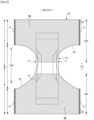
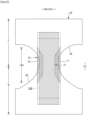
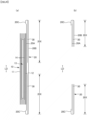
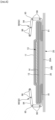
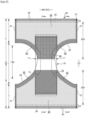
- Figs. 1 to 6 show an underpants-type disposable diaper.
- Reference sign LD longitudinal direction
- WD the width direction.
- This underpants-type disposable diaper (also referred to simply as the diaper hereinbelow) has outer member 20 forming front body F and back body B, and inner member 10 integrally fixed on the internal surface side of the outer member 20, and the inner member 10 has liquid pervious top sheet 11, liquid impervious sheet 12, and absorbent body 13 interposed therebetween.
- the back surface of the inner member 10 is joined to the internal surface (upper surface) of the outer member 20 by joining means, such as a hot melt adhesive, then the inner and outer members 10, 20 are folded along the center of the front-back direction LD (longitudinal direction), which center is the boundary between the front body F and the back body B, and each side portion of the front body F and each side portion of the back body B are joined together by means of thermal welding or a hot melt adhesive to form side seal portions 21, to thereby obtain an underpants-type disposable diaper having a waist opening and a pair of right and left leg openings thus formed.
- joining means such as a hot melt adhesive
- the inner member 10 has a structure, as shown in Figs. 4 to 6 , including top sheet 11, liquid impervious sheet 12 made of, for example, polyethylene, and absorbent body 13 interposed therebetween, to absorb and hold excrement liquid passing through the top sheet 11.
- the planar shape of the inner member 10 is not particularly limited, and may generally be approximately rectangular, as shown in Fig. 1 .
- top sheet 11 covering the front surface side (skin side) of the absorbent body 13 perforated or imperforate nonwoven fabric or a porous plastic sheet may preferably be used.
- a liquid impervious plastic sheet such as of polyethylene or polypropylene
- those having moisture permeability may preferably be used for preventing stuffiness, such as microporous sheets obtained by, for example, melting and kneading an inorganic filler in a polyolefin resin, such as polyethylene or polypropylene, forming the kneaded mixture into a sheet, and then uniaxially or biaxially drawing the sheet.
- the absorbent body 13 may be a conventional one, for example, accumulated pulp fibers, an assembly of filaments, such as of cellulose acetate, or nonwoven fabric, to which super absorbent polymers are optionally admixed or fixed.
- the absorbent body 13 may optionally be wrapped in liquidpervious liquid-holding wrapping sheet 14, such as crepe paper, for maintaining its shape and the polymer therein.
- the absorbent body 13 is formed generally in an hourglass shape having, in the crotch portion, narrower portion 13N with a width narrower than those of the front and back side portions.
- the dimensions of the narrower portion 13N may suitably be decided; its length in the front-back direction may be about 20 to 50% of the entire length of the diaper, and the width of its narrowest portion may be about 40 to 60% of the entire width of the absorbent body 13.
- the liquid impervious sheet 12, together with the top sheet 11, is folded back onto the back surface side on both sides of the width of the absorbent body 13.
- an opaque sheet may preferably be used so as not to show the brown color of feces and urine.
- pigments or fillers such as calcium carbonate, titanium oxide, zinc oxide, white carbon, clay, talc, and barium sulfate, are internally added to plastics, which is formed into films and preferably used.
- Each three-dimensional gather 90 has, as shown in Figs. 5 and 6 , fixed portion 91 fixed to each side portion of the back surface of the inner member 10, main body portion 92 extending from the fixed portion 91 through the side of the inner member 10 to above the corresponding side portion of the front surface of the inner member 10, laid-down portions 93 formed by each of the front and back end portions of the main body portion 92 fixed in a laid-down state to the corresponding side portion of the front surface of the inner member 10 (top sheet 11 in the illustrated embodiment), and free portion 94 formed between the laid-down portion 93 without the fixing.
- gather sheets 95 are duplicate sheets formed by folding a sheet, such as of non-woven fabric.
- the gather sheets 95 are fixed to the inner member 10 all along its front-back direction, with the laid-down portions 93 being arranged forward and backward of the no-absorbent side portion 17, and the free portion 94 extending to the front and back sides of the no-absorbent side portion 17.
- gather elastic members 96 are arranged at positions including the tip of the free portion. In the finished product, as shown in Fig. 5 , the gather elastic members 96 function to raise the free portions 94 by means of their elastic contraction force.
- the fixed structure of the gather elastic members 96 and the gather sheets 95 are not particularly limited and, for example, a structure of an embodiment shown in Figs. 5 and 5 may be adopted wherein, in the portions other than the laid-down portions 93, the gather elastic members 96 are adhered and fixed to the gather sheets 95 with a hot melt adhesive arranged at the positions of the gather elastic members 96, and the facing surfaces of the gather sheets 95 are adhered to each other, whereas in the laid-down portions 93, no hot melt adhesive is arranged at the positions of the gather elastic members 96, so that the gather elastic members 96 are not adhered to the gather sheets 95, and the facing surfaces of the gather sheets 95 are not adhered to each other at the positions of the gather elastic members 96.
- the gather elastic members 96 may be of a generally used material, such as styrene rubber, polyolefin rubber, urethane rubber, ester rubber, polyurethane, polyethylene, polystyrene, styrene-butadiene, silicone, or polyester. Further, for not being observed readily from outside, it is preferred that the gather elastic members 96 have a thickness of 925 dtex or less and are arranged at a tension of 150 to 350% and at intervals of 7.0 mm or less. In addition, the gather elastic members 96 may be in the form of strings as shown in the drawings, or in the form of tapes having a certain width.
- the gather sheets 95 may be selected from various nonwoven fabric and particularly, nonwoven fabric having a limited basis weight and excellent air permeability is preferred for preventing stuffiness. Further, the gather sheets 95 may preferably be of water-repelling nonwoven fabric with a coating of a silicone-based, paraffin-metal-based, or alkyl chromic chloride-based water repelling agent for preventing permeation of urine or the like as well as for preventing rash and improving a touch to the skin (dryness).
- the inner member 10 is bonded on its back surface to the internal surface of the outer member 20 in inner-outer fixed region 10B (hatched region) with a hot melt adhesive or the like.
- the inner-outer fixed region 10B may suitably be decided, and may cover almost all of the width direction WD of the inner member 10, but preferably is not fixed to the outer member 20 on both ends thereof in the width direction.
- the outer member 20 has at least lower torso portion T of the front body F and lower torso portion T of the back body B and, in the illustrated embodiment, further has intermediate portion L, which is a front-back area between the lower torso portion T of the front body F and the lower torso portion T of the back body B.
- the side edge portions of the outer member 20 may be located either closer to the center in the width direction than the side edge portions of the inner member 10 as shown in the drawings, or further outward in the width direction than the side edge portions of the inner member 10.
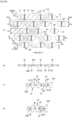
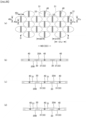
- the outer member 20 in the illustrated embodiment except for the middle region in the front-back direction of the intermediate portion L thereof, has elastic sheet stretchable structure 20X wherein elastic sheet 30 is interposed between first sheet layer 20A and second sheet layer 20B as shown in Fig. 2 and Figs. 4 to 6 , and the first sheet layer 20A and the second sheet layer 20B are joined through joining holes 31 penetrating the elastic sheet 30 at multiple joining portions 40 arranged at intervals as shown in Fig. 9 .
- the regions having this elastic sheet stretchable structure have stretchable regions contracted in the width direction due to contraction of the elastic sheet 30 and stretchable in the width direction (i.e., the stretchable direction ED is the width direction WD of the diaper).
- the planar shape of the outer member 20 is formed with concave around-leg lines 29 so that each side edge in the width direction of the intermediate portion L forms a leg opening, and is hourglass-like shape as a whole.
- the outer member 20 may be formed of separate front body F and back body B, which are arranged in the crotch portion spaced apart from each other in the front-back direction LD of the diaper.
- the elastic sheet stretchable structure 20X is extended to waist end portions 23. Since adoption of the elastic sheet stretchable structure 20X to the waist end portions 23 may result in insufficient tightening at the waist end portions 23, as necessary, the waist end portions 23 may be provided with a stretchable structure of conventional elongated waist portion elastic members 24, without the elastic sheet stretchable structure 20X, as shown in Figs. 7 and 8 .
- the waist portion elastic members 24 are elongate elastic members, such as a plurality of rubber threads, arranged at intervals in the front-back direction LD, and provide stretchable force to constrict the torso of the body.
- the waist portion elastic members 24 are not arranged substantially as one bundle with little intervals, but three or more, preferably five or more of them are arranged at intervals of about 3 to 8 mm in the front-back direction to form a prescribed stretchable zone.
- the stretch rate of the waist portion elastic members 24 when fixed may suitably be decided, and may be about 230 to 320% for ordinary adults.
- rubber threads are used in the illustrated embodiment, but other elongate elastic members, such as flat rubber bands, may also be used.
- the waist end portions 23 may be provided with the elastic sheet 30 and also the elongate waist portion elastic members 24 at the locations overlapping the elastic sheet 30, to thereby provide a stretchable structure employing both of the elastic members.
- the edge portions of the leg openings of the outer member 20 are not provided with elongate elastic members extending along the leg openings, but these portions may be provided with elongate elastic members at the locations overlapping the elastic sheet 30, or in place of the elastic sheet 30 in these portions.
- the elastic sheet stretchable structure 20X is not provided in the intermediate portion L between the lower torso portion T of the front body F and the lower torso portion T of the back body B; the elastic sheet stretchable structure 20X is provided continuously in the front-back direction LD from the lower torso portion T of the front body F through the intermediate portion L to the lower torso portion T of the back body B; or the elastic sheet stretchable structure 20X is provided only either in the front body F or the back body B.
- the regions of the outer member 20 having the elastic sheet stretchable structure 20X have stretchable regions stretchable in the width direction WD.
- the stretchable regions 80 are contracted in the width direction WD due to contraction of the elastic sheet 30 and stretchable in the width direction WD. More specifically, such stretchability may be imparted by means of formation of the elastic sheet stretchable structure 20X by, with the elastic sheet 30 being stretched in the width direction WD, joining the first sheet layer 20A and the second sheet layer 20B through the joining holes 31 in the elastic sheet 30 at intervals in the width direction WD and in the front-back direction LD orthogonal thereto (direction LD orthogonal to the stretchable direction) to thereby form multiple sheet joining portions 40, and by means of arrangement of the sheet joining portions 40 such that the elastic sheet 30 remains continuous in the width direction WD in the stretchable regions 80 and the first sheet layer 20A and the second sheet layer 20B are contracted due to the contraction force of the elastic sheet 30 to form contracted ridges 25.
- the stretchable regions 80 may have portions 32 wherein the elastic sheet 30 extends linearly continuously along the width direction WD as in the embodiment shown in Fig. 9 , or may not have the portions 32 as in the embodiment shown in Figs. 11 and the embodiment shown in Fig. 15 .
- the first sheet layer 20A and the second sheet layer 20B between the sheet joining portions 40 are puffed in the directions away from each other to form contraction ridges 25 each extending in the front-back direction LD as shown in Figs. 9 and 14(b) , and in the worn state in which the stretchable regions 80 are stretched to some extent in the width direction WD, the ridges 25F are stretched but remain.
- the first sheet layer 20A and the second sheet layer 20B are not joined with the elastic sheet 30 except for at least the first sheet layer 20A and the second sheet layer 20B at the sheet joining portions 40, as can be seen from Fig. 9(c) simulating the worn state and Fig.
- the joining holes 31 are narrowed due to further contraction of the elastic sheet 30 in the natural length state, resulting in little gaps between each joining hole 31 and each corresponding sheet joining portion 40, whereas without the portions wherein the elastic sheet 30 extends linearly continuously along the width direction WD, the vent holes 33 remain.
- the stretchable regions 80 preferably have a maximum elongation in the width direction WD of 190% or more (preferably 200 to 2200).
- the maximum elongation of the stretchable regions 80 is virtually decided by the stretch rate of the as-manufactured elastic sheet 30, but is lowered from this base stretch rate by the factors that limit contraction in the width direction WD.
- a major limiting factor is the rate of the length L of the sheet joining portions 40 occupying the unit length in the width direction WD, and the larger this rate, the lower the maximum elongation.
- the length L of the joining portions 40 is related to the area rate of the sheet joining portions 40, so that the maximum elongation of the stretchable regions 80 may be adjusted by the area rate of the joining portions 40.
- the stretching stress of the stretchable regions 80 may be adjusted generally by the sum of the orthogonal dimension 32w of the portions 32 (see Fig. 9(a) ) wherein the elastic sheet 30 is linearly continuous along the width direction WD (equivalent to the spaced intervals 31d between the joining holes 31).
- the stretchable regions 80 have no portions wherein the elastic sheet 30 is linearly continuous along the width direction WD as in the embodiment shown in Fig. 11 and the embodiment shown in Fig.
- the stretching stress of the stretchable regions 80 may be adjusted by the angle of intersection between the stretchable direction ED and the continuous direction of unjoined zones 51, 52 wherein a portion without the sheet joining portions continuously extends, and usually the acute angles of intersection ⁇ 1, ⁇ 2 formed between the stretchable direction ED and the continuous direction of each of the unjoined zones 51, 52, respectively, in the spread state are preferably in the range of larger than 0 degree and not larger than 45 degrees, particularly in the range of 10 to 30 degrees.
- the area rate of the sheet joining portions 40 and the area of each sheet joining portion 40 in the stretchable regions 80 may suitably be decided, and the following ranges are usually preferred:
- the stretchable regions 80 may be provided with a plurality of sections with different area rates of the sheet joining portions 40 as shown in Fig. 7 , to vary fitting at different sites.
- edge regions 82 along the leg openings are made to have a higher area rate of the sheet joining portions 40 compared to the remaining regions, and thus have a lower stretching stress and stretch and contract flexibly.
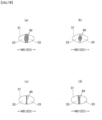
- each sheet joining portion 40 and each joining hole 31 in the natural length state may suitably be decided, and may be an arbitrary shape, for example, exact circle, ellipse, polygon, such as triangle, rectangle (see Fig. 9 , Fig. 11 , and Fig. 15 ), or diamond (see Fig. 10(b) ), or a convex lens shape (see Fig. 10(a) ), a concave lens shape (see Fig. 10(c) ), a star shape, or a cloud shape.
- each sheet joining portion is not particularly limited, and its maximum length 40y (substantially equal to orthogonal dimension 31y of joining hole 31) is preferably 0.5 to 3.0 mm, particularly 0.7 to 1.1 mm, while its maximum width 40x is preferably 0.1 to 3.0 mm, and particularly 0.1 to 1.1 mm when the shape is elongated in the direction XD orthogonal to the stretchable direction.
- the layout pattern of the sheet joining portions 40 in the stretchable regions 80 is not particularly limited, and various patterns (see, e.g., Patent Literature 1 to 8) may be adopted.
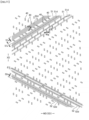
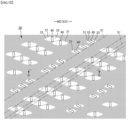
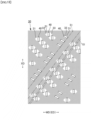
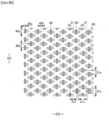
- the unjoined zones wherein the portions without the sheet joining portions continuously extend are arranged in a diagonal lattice pattern, as in the embodiment shown in Fig. 11 and the embodiment shown in Fig. 15 .
- first unjoined zones 51 extending linearly continuously along first direction 51d intersecting the stretchable direction ED at an acute angle (acute angle of intersection ⁇ 1) is repeatedly present at intervals in the direction orthogonal to the first direction 51d.
- acute angle of intersection ⁇ 1 acute angle of intersection
- a unit structure including a plurality of first unjoined zones 51 of different first widths 51w, each of which is defined as a width in the direction orthogonal to the first direction 51d, is repeatedly present in the direction orthogonal to the first direction 51d in the stretchable regions 80.
- width change of corresponding magnitude relation is also formed in the continuous portions of the elastic sheet 30 inside the first unjoined zones 51. That is, when the width 51w of the first unjoined zones 51 is narrow, the width of the continuous portions of the elastic sheet 30 inside thereof is also narrow, whereas when the width 51w of the first unjoined zones 51 is wide, the width of the continuous portions of the elastic sheet 30 inside thereof is also wide.
- both the wider continuous portions of the elastic sheet 30 inside the first unjoined zones 51 and the narrower continuous portions of the elastic sheet 30 inside the first unjoined zones 51 are visually emphasized, and as a result, the stretchable regions 80, even in the natural length state (see Figs. 13 and 17 ) or in the worn state stretched to some extent, present aesthetic appearance of oblique stripes.
- the sizes of the contraction ridges 25 in the first unjoined zones 51 change depending on the first widths 51w of the first unjoined zones 51, so that the oblique stripes more clearly emerge due to the contraction ridges 25.
- the unit structure mentioned above is not particularly limited by the magnitude of the sizes of the widths 51w, as long as the unit structure includes a plurality of first unjoined zones 51 of different first widths 51w, and the first width 51w of a first unjoined zone 51 is preferably 1.2 to 60 times as large, or 0.01 to 0.8 times as small as the first width 51w of the nearest first unjoined zone 51.
- the first widths 51w of all the first unjoined zone 51 may be different, or the first widths 51w of part of and a plurality of the first unjoined zones 51 are different from the first widths 51w of the remaining one or more first unjoined zones 51.
- the maximum value of the first widths 51w of the first unjoined zones 51 is the maximum value of the widths in the direction orthogonal to the continuous directions of all the unjoined zones 51, 52 of the same or different slant directions, the oblique stripes of the contraction ridges 25 of the first unjoined zones 51 and the continuous portions of the elastic sheet 30 inside thereof are more strongly recognized visually in the stretchable regions 80, which is preferred.
- the maximum value of the first widths 51w of the first unjoined zones 51 may suitably be decided, and is preferably 1.2 to 60 times the first width 51w of the nearest first unjoined zone 51.
- the widths in the direction orthogonal to the continuous direction are not limited, and are usually within the preferred range of 0.02 to 5 mm. It is indisputable that the width in the direction orthogonal to the continuous direction of the unjoined zones 51, 52 is the first width 51w for the first unjoined zones 51, and is fixed as the zones are linearly continuous.
- First intervals 51s each of which is defined as an interval between first unjoined zones 51 adjacent in the direction orthogonal to the first direction 51d may suitably be decided.
- the first intervals 51s may be the same as, wider than, or narrower than the first widths 51w of the adjacent first unjoined zones 51.
- a preferred example is an embodiment wherein the maximum value of the first widths 51w of the first unjoined zones 51 is smaller than the maximum value of the first intervals 51s in the unit structure. In this way, by forming wider interval portions in the unit structure, the oblique stripes of the contraction ridges 25 of the first unjoined zones 51 and the continuous portions of the elastic sheet 30 inside thereof are more strongly recognized visually.
- the maximum value of the first widths 51w of the first unjoined zones 51 may suitably be decided, and is preferably 0.01 to 9 times the maximum value of the first intervals 51s.
- the intervals in the direction orthogonal to the continuous directions of all the unjoined zones 51, 52 including the first unjoined zones 51 are not particularly limited, and are usually within a preferred range of 0.3 to 50 mm. Obviously, the intervals in the direction orthogonal to the continuous directions of the unjoined zones 51, 52 mean the first intervals 51s as for the first unjoined zones 51, and are constant in the continuous direction.
- second unjoined zones 52 extending linearly continuously along second direction 52d, other than the first direction 51d, intersecting the stretchable direction ED at an acute angle (acute angle of intersection ⁇ 2) may repeatedly be present at intervals in the direction orthogonal to the second direction 52d, or the second unjoined zone 52 may not be present.
- a preferred embodiment having the second unjoined zones 52 is the stretchable regions 80 having the unjoined zones 51, 52 formed in a diagonal lattice pattern, wherein the first unjoined zones 51 extend continuously in one of the directions of the diagonal lattice of the unjoined zones 51, 52, while the second unjoined zones 52 extend continuously in the other of the diagonal lattice of the unjoined zones 51, 52.
- the first direction 51d and the second direction 52d have opposite positive/negative inclinations with respect to the stretchable direction ED.
- stretchability in the stretchable regions 80 may sufficiently be secured by respectively setting the acute angles of intersection ⁇ 1, ⁇ 2 of the first direction 51d and the second direction 52d with respect to the stretchable direction ED to 5 to 45 degrees, particularly 10 to 30 degrees, in the spread state of the stretchable regions 80.
- the oblique stripes of the contraction ridges 25 of the first unjoined zones 51 and the continuous portions of the elastic sheet 30 inside thereof may disadvantageously be obscured if the oblique stripes of the second unjoined zones 52 along the oblique direction in the same stretchable region 80 is visually recognized more strongly.
- the sheet joining portions 40 such that all of the second widths 52w, each of which is defined as a width in the direction orthogonal to the second direction of the second unjoined zones 52, are the same or no second unjoined zone 52 is present. In this way, the oblique stripes of the contraction ridges 25 of the first unjoined zones 51 and the continuous portions of the elastic sheet 30 inside thereof are visually recognized more strongly in the stretchable regions 80.
- the sheet joining portions 40 are aligned in the first direction 51d between the adjacent first unjoined zones 51.
- the acute angle of interaction ⁇ 3 between their longitudinal direction and the direction orthogonal to the stretchable direction ED is not larger than 10 degrees, and formed in elongate shapes with the maximum dimension 40e in the stretchable direction ED of 0.1 to 0.4 mm, which allows larger dimensions of the first unjoined zones 51 in the stretchable direction ED to be secured to suppress lowering of stretchability.
- the sheet joining portions 40 are aligned in the first direction 51d at intervals, which sheet joining portions 40 are arranged with the acute angle of intersection of not larger than 5 degrees between their longitudinal direction and the second direction 52d, and formed in elongate shapes with the maximum dimension 40f in the direction orthogonal to their longitudinal direction of 0.1 to 0.4 mm.
- the sheet joining portions 40 are aligned in the first direction 51d at intervals, which sheet joining portions 40 are arranged with the acute angle of intersection ⁇ 3 of 45 degrees or larger between their longitudinal direction and the first direction 51d, and formed in elongate shapes with the maximum dimension 40g in the direction orthogonal to their longitudinal direction of 0.1 to 0.4 mm.
- the ridges 25 of the first unjoined zones 51 and the continuous portions of the elastic sheet 30 inside thereof are particularly visually emphasized with a smaller area of the sheet joining portions 40.
- the line of the sheet joining portions 40 located between the adjacent unjoined zones 51, 52 may be a single line or a plurality of lines.
- the sheet joining portions 40 are aligned in the direction of the line preferably at regular intervals, but all the intervals are not necessarily constant, and part of the intervals may be different.
- the regions of the outer member 20 having the elastic sheet stretchable structure 20X may be provided with a non-stretchable region 70 on at least one of the sides in the width direction of the stretchable regions 80, as shown in Fig. 7 .
- a non-stretchable region 70 means that the maximum elongation in the stretchable direction of the region is 120% or less.
- the maximum elongation of the non-stretchable region 70 is preferably 110% or less, more preferably 100%.
- the arrangement of the stretchable regions 80 and the non-stretchable regions 70 may suitably be decided.
- the non-stretchable regions 70 may be arranged from the region overlapping the absorbent body 13 toward the region not overlapping the absorbent body 13 located in the width direction WD or the front-back direction LD to the overlapping region, or may be arranged only in the regions not overlapping the absorbent body 13.
- each sheet joining portion 40 is not particularly limited, and may be selected from the shapes similar to the ones mentioned in regard to the stretchable regions 80.
- the area rate of the sheet joining portions 40 and the area of each sheet joining portion 40 may suitably be decided, and may usually be preferred to fall within the following ranges for keeping the non-stretchable regions 70 from becoming hard owing to the small area of each sheet joining portion 40 and the low area rate of the sheet joining portions 40:
- the non-stretchable regions 70 may be formed by densely arranging the sheet joining portions 40, or the like means, so that the ridges are not formed by contraction of the first sheet layer 20A and the second sheet layer 20B due to the contraction force of the elastic sheet 30.
- Specific examples of the means for forming the non-stretchable regions 70 may be found in Patent Literatures 3 to 6, for example.
- Figs. 25 and 26 illustrate the examples of the non-stretchable regions 70 disclosed in Patent Literature 6.
- the joining holes 31 are laid out above a certain density level in a staggered arrangement, and the elastic sheet 30 extends continuously in the stretchable direction ED, but does not extend linearly continuously along the stretchable direction ED in the presence of the joining holes 31.
- the vent holes 33 are opened in almost same size either in the natural length state or in the spread state.
- Joining of the first sheet layer 20A and the second sheet layer 20B at the sheet joining portions 40, when made through the joining holes 31 in the elastic sheet 30, is preferably performed such that the first sheet layer 20A and the second sheet layer 20B are not joined to the elastic sheet 30 except for at least the first sheet layer 20A and the second sheet layer 20B at the sheet joining portions 40.
- the means for joining the first sheet layer 20A and the second sheet layer 20B at the sheet joining portion 40 are not particularly limited.
- the joining of the first sheet layer 20A and the second sheet layer 20B at the sheet joining portions 40 may be made by means of a hot melt adhesive or joining means employing material welding, such as heat sealing or ultrasonic sealing.
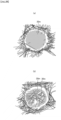
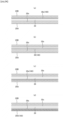
- the structure of the sheet joining portions 40 formed by material welding may be any of first weld mode wherein the first sheet layer 20A and the second sheet layer 20B are joined only by solidified molten products 20m of most or part of at least one of the first sheet layer 20A and the second sheet layer 20B at the sheet joining portions 40 (see Fig. 18(a) ), second weld mode wherein the first sheet layer 20A and the second sheet layer 20B are joined only by solidified molten products 30m of all, most, or part of the elastic sheet 30 at the sheet joining portions 40 (see Fig. 18(b) ), and third weld mode, which is the combination of these structures (see Fig. 21(c)).
- the second and the third structures are preferred.
- the solidified molten products 20m of the fibers of the first sheet layer 20A and the second sheet layer 20B shown in black among the solidified molten products 20m of the fibers of the first sheet layer 20A and the second sheet layer 20B shown in black, the solidified molten products 30m of the elastic sheet 30 shown in white may be observed, whereas in the first weld mode shown in Fig. 20(a) , among the solidified molten products 20m of the fibers of the first sheet layer 20A and the second sheet layer 20B, no solidified welded product of the elastic sheet 30 may be observed.
- the first sheet layer 20A and the second sheet layer 20B are joined by means of the solidified molten products 20m of most or part of at least one of the first sheet layer 20A and the second sheet layer 20B as an adhesive, it is preferred that part of the first sheet layer 20A and the second sheet layer 20B is not molten, as the sheet joining portions 40 are not hardened.
- the joint structure wherein part of the first sheet layer 20A and the second sheet layer 20B are not molten includes a structure wherein the cores (including not only the cores of composite fibers, but also the central portions of single component fibers) of all the fibers at the sheet joining portions 40 remain while the portions around the cores (including not only the sheathes of composite fibers, but also the surficial portions of single component fibers) are molten, and a structure wherein part of the fibers are not molten at all, but the remaining fibers are molten in their entirety or the cores remain while the portions around the cores are molten.
- the second weld mode may be formed by interposing the elastic sheet 30 between the first sheet layer 20A and the second sheet layer 20B wherein the melting point of at least one of the first sheet layer 20A and the second sheet layer 20B is higher than the melting point of the elastic sheet 30 and the heating temperature for forming the sheet joining portions 40, and heating under pressure the portions to be the sheet joining portions 40, to thereby melt only the elastic sheet 30.
- the third weld mode may be formed by interposing the elastic sheet 30 between the first sheet layer 20A and the second sheet layer 20B wherein the melting point of at least one of the first sheet layer 20A and the second sheet layer 20B is higher than the melting point of the elastic sheet 30and heating under pressure the portions to be the sheet joining portions 40, to thereby melt at least one of the first sheet layer 20A and the second sheet layer 20B as well as the elastic sheet 30.
- the melting point of the elastic sheet 30 is preferably about 80 to 145°C
- the melting points of the first sheet layer 20A and the second sheet layer 20B are preferably about 85 to 190°C, particularly preferably 150 to 190°C
- the difference between the melting point of the elastic sheet 30 and the melting points of the first sheet layer 20A and the second sheet layer 20B is preferably about 60 to 90°C.
- the heating temperature is preferably about 100 to 150°C.
- the solidified molten product 30m of the elastic sheet 30 may permeate the fibers all over the thicknesses of the first sheet layer 20A and the second sheet layer 20B at the sheet joining portions 40 as shown in Fig. 19(c) .
- higher flexibility of the sheet joining portions 40 may be achieved in the structure in which the permeation is halfway through the thicknesses as shown in Fig. 19(a) , or the structure in which the permeation hardly occurs into the fibers of the first sheet layer 20A and the second sheet layer 20B as shown in Fig. 19(b) .
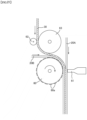
- Fig. 21 illustrates an example of ultrasonic sealing apparatus preferred for the second weld mode and the third weld mode.
- this ultrasonic sealing apparatus for forming the sheet joining portions 40, the first sheet layer 20A, the elastic sheet 30, and the second sheet layer 20B are fed between the ultrasonic horn 61 and the anvil roll 60 having protrusions 60a on its periphery corresponding to the pattern of the sheet joining portions 40.
- the elastic sheet 30 is stretched in the MD direction (machine direction, flow direction) to a predetermined stretch rate in the pathway from the nipping position between the feeding driving roller 63 and the nip roller 62 to the sealing position between the anvil roll 60 and the ultrasonic horn 61.
- the stretch rate of the elastic sheet 30 may be set by selecting the velocity difference between the anvil roll 60 and the feeding driving roller 63, and may be, for example, about 300% to 500%.
- the first sheet layer 20A, the elastic sheet 30, and the second sheet layer 20B fed between the anvil roll 60 and the ultrasonic horn 61 are, in the state laid one on top of another in this order, pressed between the protrusions 60a and the ultrasonic horn 61 while heated with the ultrasonic vibration energy from the ultrasonic horn 61, to melt only the elastic sheet 30 or the elastic sheet 30 and at least one of the first sheet layer 20A and the second sheet layer 20B, to thereby form the joining holes 31 in the elastic sheet 30, while the first sheet layer 20A and the second sheet layer 20B are joined through the joining holes 31.
- the area rate of the sheet joining portions 40 may be selected by the selection of the size, shape, spaced intervals, arrangement pattern in the roll length direction and the roll circumferential direction, of the protrusions 60a on the anvil roll 60.
- the reason for the joining holes 31 to be formed is not necessarily clear, but it is assumed that the portions of the elastic sheet 30 corresponding to the protrusions 60a on the anvil roll 60 are welded and removed from the around to form open holes.
- the portion of the elastic sheet 30 between the joining holes 31 adjacent to each other in the starching-contracting direction ED is, as shown in Figs.
- the constituting materials of the first sheet layer 20A and the second sheet layer 20B are not particularly limited, and preferably has air permeability. In view of this as well as flexibility, nonwoven fabric is preferably used.
- the nonwoven fabric when adopted, preferably has a basis weight of about 10 to 25 g/m 2 . Further, part or all of the first sheet layer 20A and the second sheet layer 20B may be a pair of facing layers formed by folding a sheet of material.
- the constituting material located externally may be referred to as the second sheet layer 20B
- the folded portion 20C formed by folding the constituting material onto the internal surface side at each waist opening edge may be referred to as the first sheet layer 20A
- the elastic sheet 30 may be interposed therebetween
- the constituting material located internally may be referred to as the first sheet layer 20A
- the constituting material located externally may be referred to as the second sheet layer 20B
- the elastic sheet 30 may be interposed therebetween.
- the constituting material of the first sheet layer 20A and the constituting material of the second sheet layer 20B may be separately provided all over the front-back direction LD, and the elastic sheet 30 may be interposed between the constituting material of the first sheet layer 20A and the constituting material of the second sheet layer 20B without folding the constituting materials.
- the elastic sheet 30 is not particularly limited, and may be of an elastic film or a stretchable nonwoven fabric, as long as it is a sheet of a thermoplastic resin which elastically stretches and contracts by itself. Further, the elastic sheet 30 may be non-porous, or may be provided with multiple pores or slits for air permeability.
- the elastic sheet 30 preferably has a tensile strength in the width direction WD (stretchable direction ED, MD direction) of 8 to 25 N/35 mm, a tensile strength in the front-back direction LD (direction XD orthogonal to the stretchable direction, CD direction) of 5 to 20 N/35 mm, a tensile elongation in the width direction WD of 450 to 1050%, and a tensile elongation in the front-back direction LD of 450 to 1400%.
- the thickness of the elastic sheet 30 is not particularly limited, and is preferably about 20 to 40 ⁇ m.
- the vent holes 33 are formed by displacement of the edge of each joining hole 31 away from the circumferential edge of each sheet joining portion 40 in the stretchable direction ED, and thus deformed as the elastic sheet 30 stretches and become larger towards the spread state.
- the edge of each joining hole 31 may be in close contact with the circumferential edge of each sheet joining portion 40 in the natural length state to sometimes form no vent hole 33.
- the vent holes 33 are opened at least on both sides in the stretchable direction ED of the sheet joining portion 40 as the joining hole 31 is stretched in the stretchable direction ED.
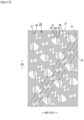
- vent holes 33 are provided for improving air permeability, visual observation of the vent holes by users means imparting of functional aesthetic appearance to the product. It is thus preferred to set the color difference ⁇ E between the color of the external surface of the elastic sheet 30 and the color of the external surface of the first sheet layer 20A (base sheet layer) to 30 or more so that the shapes of the vent holes 33 are readily observable visually through the second sheet layer 20B (outer sheet layer), as illustrated in Figs. 12 and 13 , 16 and 17 , and 22 and 23 , due to the difference between the color of the external surface of the elastic sheet 30 and the color of the portions of the external surface of the first sheet layer 20A observed through the vent holes 33.
- the color difference ⁇ E between the color of the external surface 30s of the elastic sheet 30 and the color of the external surface 20s of the first sheet layer 20A is particularly preferably 40 or more.
- the region wherein the color difference ⁇ E between the color of the external surface 30s of the elastic sheet 30 and the color of the external surface 20s of the first sheet layer 20A is 30 or more may be all of the regions having the elastic sheet stretchable structure 20X, or part of those regions, such as the exposed portions exposed externally.
- the region of improved aesthetic appearance preferably includes one or a plurality of the vent holes 33 (preferably the joining holes 31) in their entirety.
- the region of improved aesthetic appearance may be provided in either or both of the stretchable regions 80 and the non-stretchable regions 70.
- region of improved aesthetic appearance may be provided at a plurality of locations at intervals, or a plurality of regions of improved aesthetic appearance with different color differences may be provided at intervals or juxtaposed.
- the stretching regions 80 and the non-stretching regions may be provided with the regions of improved aesthetic appearances with different color differences, or the waist end portion 23 regions and the remaining regions may be provided with the regions of improved aesthetic appearance with different color differences.
- vent holes 33 are opened in the natural length state as in the stretchable regions 80 illustrated in Figs. 12 and 13 , 16 and 17 , and 22 and 23 , and in the non-stretchable regions 70 illustrated in Figs. 25 and 26 .
- the pattern of the joining holes 31 is not particularly limited, and when the unjoined zones 51, 52 wherein the portions without the sheet joining portions 40 extend continuously are present in a diagonal lattice pattern as in the embodiments shown in Figs. 12 and 13 , 16 and 17 , and 22 and 23, the joining holes 31 are arranged accordingly.
- the elastic sheet 30 is present in the diagonal lattice pattern (the first unjoined zones 51 and the second unjoined zones 52 intersect obliquely), and visually recognizable readily due to the above-mentioned color difference to provide excellent aesthetic appearance in the diagonal lattice pattern, which is preferable.
- either one or both of the elastic sheet 30 and the first sheet layer 20A may be colored.
- the method for coloring is not particularly limited, and coloring of a single material into a plurality of colors may be carried out by means of printing or piece-dyeing, whereas coloring of the entire material into a single color may also be carried out by means of printing or piece-dyeing, but means of mixing of dyes or pigments in the stock material (so called spin-dyeing.
- nonwoven fabric is produced from spun-dyed fibers obtained by coloring the spinning solution with dyes or pigments before spinning) may be adopted.
- Fig. 24(a) shows an example of the elastic sheet 30 having on its external surface 30s colored layer 100 colored by printing
- Fig. 24(b) shows an example of the elastic sheet 30 colored by spin-dyeing
- Fig. 24(c) shows an example of the first sheet layer 20A having on its external surface 20s colored layer 100 colored by printing
- Fig. 24(d) shows an example of the first sheet layer 20A colored by spin-dyeing.
- the example shown in Fig. 24(c) in particular simulates the case wherein the first sheet layer 20A is of nonwoven fabric, and the colored layer 100 is provided not only on the external surface 20s but also into inside of the first sheet layer 20A due to permeation of the ink.
- the first sheet layer 20A is colored all over its thickness direction in the example shown in Fig. 24(d) , but may alternatively be colored only partly in its thickness direction by making the first sheet layer 20A with a composite nonwoven fabric and spin-dyeing only part of its layers (e.g., the layer including the external surface 20s).
- the regions of improved aesthetic appearance may be colored, or boarder regions including the regions of improved aesthetic appearance, for example, the overall material, may be colored.
- coloring may differ for each region of improved aesthetic appearance.
- the color of the external surface 30s of the elastic sheet 30 and the color of the external surface 20s of the first sheet layer 20A may suitably be decided.
- the coloring of the first sheet layer 20A has a CIELAB L* value of 20 to 60, and an absolute value of at least one of a* and b* values is 0 to 40
- the color of the external surface 30s of the elastic sheet 30 has a CIELAB L* value of 50 to 90, and an absolute value of at least one of a* and b* values is 0 to 40.
- Figs. 22 and 23 as well as Fig.
- the color of the external surface 30s of the elastic sheet 30 is white or a pale color close to white, while the color of the external surface 20s of the first sheet layer 20A is deeper (shown dotted in the figures) than that of the elastic sheet 30, so that the vent holes 33 are observed in a deeper color while the remaining portions are observed in a lighter color, resulting in a net-like appearance.
- this coloration is suitable for imparting a light tone to the product external surface due to the net-like continuity of white color or a pale color close to white.
- this coloration may be realized simply by coloring the first sheet layer 20A without coloring the elastic sheet 30 (i.e., in the material color per se).
- the coloring of the elastic sheet 30 has a CIELAB L* value of 20 to 60, and an absolute value of at least one of a* and b* values is 0 to 40, while the color of the external surface 20s of the first sheet layer 20A has a CIELAB L* value of 50 to 90, and an absolute value of at least one of a* and b* values is 0 to 40.
- the coloring of the elastic sheet 30 has a CIELAB L* value of 20 to 60, and an absolute value of at least one of a* and b* values is 0 to 40
- the color of the external surface 20s of the first sheet layer 20A has a CIELAB L* value of 50 to 90
- an absolute value of at least one of a* and b* values is 0 to 40.
- the color of the external surface 20s of the first sheet layer 20A is white or a pale color close to white, while the color of the external surface 30s of the elastic sheet 30 is deeper than that of the first sheet layer 20A, so that the vent holes 33 are observed in a lighter color while the remaining portions are observed in a deeper color (shown dotted in the figures), resulting in a net-like appearance.
- this coloration is suitable for imparting a deep or dark tone due to the net-like continuity of a deep color.
- this coloration may be realized simply by coloring the elastic sheet 30 without coloring the first sheet layer 20A (i.e., in the material color per se), and is thus preferable.
- the translucency of the second sheet layer 20B is not particularly limited as long as the color of the external surface 30s of the elastic sheet 30 and the color of the portions of the external surface 20s of the first sheet layer 20A observed through the vent holes 33 are observable through the second sheet layer 20B, and nonwoven fabric having a transmittance of 50% or higher, particularly 65% or higher according to the translucency provided in JIS L 1913: 2010 (JIS method) is preferred for excellent visibility of the shape of the vent holes 33.
- the second sheet layer 20B is preferably not colored (i.e., in the material color per se), but may be colored.
- the "thickness" other than the above is automatically determined using an automatic thickness measurement equipment (KES-G5 handy compression testing program) under the load of 0.098 N/cm 2 and the compression area of 2 cm 2 .
- KS-G5 handy compression testing program automatic thickness measurement equipment
- the present invention may be applied to a stretchable member in general disposable wearable articles, including, in addition to the underpants-type disposable diapers of the embodiments discussed above, various disposable diapers, such as of tape type or pad type, sanitary napkins, disposable wearable articles for swimming or playing with water, as long as the article has a stretchable region to which the elastic sheet stretchable structure may be applied.
Landscapes
- Health & Medical Sciences (AREA)
- Engineering & Computer Science (AREA)
- Animal Behavior & Ethology (AREA)
- General Health & Medical Sciences (AREA)
- Biomedical Technology (AREA)
- Heart & Thoracic Surgery (AREA)
- Vascular Medicine (AREA)
- Life Sciences & Earth Sciences (AREA)
- Veterinary Medicine (AREA)
- Epidemiology (AREA)
- Public Health (AREA)
- Dermatology (AREA)
- Mechanical Engineering (AREA)
- Textile Engineering (AREA)
- Absorbent Articles And Supports Therefor (AREA)
- Laminated Bodies (AREA)
- Professional, Industrial, Or Sporting Protective Garments (AREA)
- Orthopedics, Nursing, And Contraception (AREA)
Applications Claiming Priority (2)
| Application Number | Priority Date | Filing Date | Title |
|---|---|---|---|
| JP2019050236A JP7103986B2 (ja) | 2019-03-18 | 2019-03-18 | 伸縮部材及びこの伸縮部材を有する使い捨て着用物品 |
| PCT/JP2020/007036 WO2020189178A1 (ja) | 2019-03-18 | 2020-02-21 | 伸縮部材及びこの伸縮部材を有する使い捨て着用物品 |
Publications (3)
| Publication Number | Publication Date |
|---|---|
| EP3906910A1 EP3906910A1 (en) | 2021-11-10 |
| EP3906910A4 EP3906910A4 (en) | 2022-09-14 |
| EP3906910B1 true EP3906910B1 (en) | 2024-11-20 |
Family
ID=72519822
Family Applications (1)
| Application Number | Title | Priority Date | Filing Date |
|---|---|---|---|
| EP20773997.0A Active EP3906910B1 (en) | 2019-03-18 | 2020-02-21 | Elastic member and disposable wearable article having elastic member |
Country Status (6)
| Country | Link |
|---|---|
| US (1) | US12150843B2 (enExample) |
| EP (1) | EP3906910B1 (enExample) |
| JP (1) | JP7103986B2 (enExample) |
| CN (1) | CN113316439B (enExample) |
| TW (1) | TWI810434B (enExample) |
| WO (1) | WO2020189178A1 (enExample) |
Families Citing this family (3)
| Publication number | Priority date | Publication date | Assignee | Title |
|---|---|---|---|---|
| US12599513B2 (en) | 2020-11-13 | 2026-04-14 | Zuiko Corporation | Stretch layered sheet, disposable wearing article, and method and device for manufacturing stretch layered sheet |
| JP7576998B2 (ja) * | 2021-03-08 | 2024-11-01 | 大王製紙株式会社 | パンツタイプ使い捨て着用物品及びその製造方法 |
| EP4410251A1 (en) * | 2023-01-31 | 2024-08-07 | ConvaTec Limited | Ostomy pouch |
Family Cites Families (26)
| Publication number | Priority date | Publication date | Assignee | Title |
|---|---|---|---|---|
| JP3527368B2 (ja) * | 1996-09-03 | 2004-05-17 | ユニ・チャーム株式会社 | 使い捨ておむつ |
| JP4750557B2 (ja) * | 2003-12-02 | 2011-08-17 | 大王製紙株式会社 | 着色衛生薄葉紙の製造方法 |
| JP4845383B2 (ja) * | 2005-01-19 | 2011-12-28 | ユニ・チャーム株式会社 | 使い捨て着用物品 |
| JP5102504B2 (ja) * | 2007-02-02 | 2012-12-19 | ユニ・チャーム株式会社 | 吸収性物品 |
| JP5383064B2 (ja) * | 2008-03-04 | 2014-01-08 | ユニ・チャーム株式会社 | 図柄入り吸収性物品 |
| JP5773604B2 (ja) * | 2010-09-30 | 2015-09-02 | ユニ・チャーム株式会社 | 吸収性物品および使い捨ておむつ |
| JP5745576B2 (ja) * | 2013-07-23 | 2015-07-08 | ユニ・チャーム株式会社 | 吸収性物品 |
| JP6311872B2 (ja) | 2014-04-18 | 2018-04-18 | 日本製紙クレシア株式会社 | パンツ型吸収性物品 |
| CN107072835B (zh) | 2014-11-06 | 2021-03-02 | 宝洁公司 | 包括面向衣服的层合体的吸收制品 |
| JP6049228B1 (ja) | 2015-09-30 | 2016-12-21 | 大王製紙株式会社 | 吸収性物品 |
| JP5980367B1 (ja) | 2015-03-31 | 2016-08-31 | 大王製紙株式会社 | 吸収性物品の製造方法 |
| US11103389B2 (en) * | 2015-01-30 | 2021-08-31 | Daio Paper Corporation | Absorbent article having stretchable region with high peeling strength and method for producing same |
| JP5980355B2 (ja) | 2015-01-30 | 2016-08-31 | 大王製紙株式会社 | 吸収性物品の伸縮構造、及びこれを用いたパンツタイプ使い捨ておむつ |
| JP5918877B1 (ja) | 2015-03-31 | 2016-05-18 | 大王製紙株式会社 | 吸収性物品及びその製造方法 |
| JP5967736B1 (ja) | 2015-03-31 | 2016-08-10 | 大王製紙株式会社 | 吸収性物品 |
| CN108348370B (zh) * | 2015-05-11 | 2021-04-23 | 易希提卫生与保健公司 | 裤型吸收性物品例如尿裤、卫生裤或失禁裤 |
| JP6703381B2 (ja) * | 2015-08-14 | 2020-06-03 | ユニ・チャーム株式会社 | 使い捨ての着用物品 |
| MX377934B (es) * | 2015-10-30 | 2025-03-11 | Kimberly Clark Co | Articulo absorbente con canales y miembros elasticos de conformacion. |
| JP6219422B2 (ja) | 2016-02-23 | 2017-10-25 | 大王製紙株式会社 | 吸収性物品及びその製造方法 |
| JP6240701B2 (ja) * | 2016-03-30 | 2017-11-29 | 大王製紙株式会社 | パンツタイプ使い捨ておむつ |
| US20170290713A1 (en) * | 2016-04-07 | 2017-10-12 | The Procter & Gamble Company | Absorbent articles comprising graphics |
| JP6723087B2 (ja) | 2016-06-20 | 2020-07-15 | 大王製紙株式会社 | 使い捨て着用物品 |
| JP6240733B1 (ja) * | 2016-09-30 | 2017-11-29 | 大王製紙株式会社 | 使い捨て着用物品及びその製造方法 |
| JP7105620B2 (ja) | 2018-06-04 | 2022-07-25 | 大王製紙株式会社 | 使い捨て着用物品 |
| JP2020032071A (ja) * | 2018-08-31 | 2020-03-05 | 日本製紙クレシア株式会社 | パンツ型吸収性物品 |
| JP7121679B2 (ja) * | 2019-03-18 | 2022-08-18 | 大王製紙株式会社 | 使い捨て着用物品 |
-
2019
- 2019-03-18 JP JP2019050236A patent/JP7103986B2/ja active Active
-
2020
- 2020-02-19 TW TW109105296A patent/TWI810434B/zh active
- 2020-02-21 WO PCT/JP2020/007036 patent/WO2020189178A1/ja not_active Ceased
- 2020-02-21 CN CN202080009394.0A patent/CN113316439B/zh active Active
- 2020-02-21 EP EP20773997.0A patent/EP3906910B1/en active Active
- 2020-02-21 US US17/422,936 patent/US12150843B2/en active Active
Also Published As
| Publication number | Publication date |
|---|---|
| TW202034879A (zh) | 2020-10-01 |
| TWI810434B (zh) | 2023-08-01 |
| EP3906910A4 (en) | 2022-09-14 |
| JP7103986B2 (ja) | 2022-07-20 |
| JP2020151868A (ja) | 2020-09-24 |
| US20220087878A1 (en) | 2022-03-24 |
| WO2020189178A1 (ja) | 2020-09-24 |
| CN113316439A (zh) | 2021-08-27 |
| EP3906910A1 (en) | 2021-11-10 |
| US12150843B2 (en) | 2024-11-26 |
| CN113316439B (zh) | 2022-10-04 |
Similar Documents
| Publication | Publication Date | Title |
|---|---|---|
| EP3689309B1 (en) | Stretchable member and disposable article for wearing having stretchable member | |
| JP6723087B2 (ja) | 使い捨て着用物品 | |
| EP3906909A1 (en) | Disposable wearable article | |
| EP3437605B1 (en) | Underpants-type disposable diaper | |
| US12121427B2 (en) | Disposable wearable article | |
| US12150843B2 (en) | Stretchable member and disposable wearable article having stretchable member | |
| JP2017176494A5 (enExample) | ||
| EP3473225B1 (en) | Pants-type disposable diaper | |
| EP3689310B1 (en) | Elastic member and disposable wearable item using this elastic member | |
| JP6739962B2 (ja) | パンツタイプ使い捨ておむつ | |
| JP2020151868A5 (enExample) | ||
| KR102669403B1 (ko) | 신축 부재 및 이 신축 부재를 갖는 일회용 착용 물품 | |
| JP6276215B2 (ja) | パンツタイプ使い捨ておむつ | |
| EP4393463A1 (en) | Underpants-type disposable wearable article | |
| JP2016187387A5 (enExample) | ||
| EP4169495A1 (en) | Disposable wearable article | |
| EP3689311B1 (en) | Elastic member, disposable wearable item using this elastic member, and method for producing elastic member | |
| EP3689308B1 (en) | Elastic member and disposable wearable item using this elastic member | |
| US20260115057A1 (en) | Elastic member and disposable wearing article including elastic member | |
| JP7576998B2 (ja) | パンツタイプ使い捨て着用物品及びその製造方法 | |
| JP2019166217A5 (enExample) |
Legal Events
| Date | Code | Title | Description |
|---|---|---|---|
| STAA | Information on the status of an ep patent application or granted ep patent |
Free format text: STATUS: THE INTERNATIONAL PUBLICATION HAS BEEN MADE |
|
| PUAI | Public reference made under article 153(3) epc to a published international application that has entered the european phase |
Free format text: ORIGINAL CODE: 0009012 |
|
| STAA | Information on the status of an ep patent application or granted ep patent |
Free format text: STATUS: REQUEST FOR EXAMINATION WAS MADE |
|
| 17P | Request for examination filed |
Effective date: 20210802 |
|
| AK | Designated contracting states |
Kind code of ref document: A1 Designated state(s): AL AT BE BG CH CY CZ DE DK EE ES FI FR GB GR HR HU IE IS IT LI LT LU LV MC MK MT NL NO PL PT RO RS SE SI SK SM TR |
|
| DAV | Request for validation of the european patent (deleted) | ||
| DAX | Request for extension of the european patent (deleted) | ||
| A4 | Supplementary search report drawn up and despatched |
Effective date: 20220811 |
|
| RIC1 | Information provided on ipc code assigned before grant |
Ipc: B32B 27/20 20060101ALI20220805BHEP Ipc: B32B 5/02 20060101ALI20220805BHEP Ipc: B32B 29/02 20060101ALI20220805BHEP Ipc: B32B 27/32 20060101ALI20220805BHEP Ipc: B32B 27/12 20060101ALI20220805BHEP Ipc: B32B 27/10 20060101ALI20220805BHEP Ipc: B32B 7/12 20060101ALI20220805BHEP Ipc: B32B 7/023 20190101ALI20220805BHEP Ipc: B32B 7/02 20190101ALI20220805BHEP Ipc: B32B 5/26 20060101ALI20220805BHEP Ipc: B32B 5/08 20060101ALI20220805BHEP Ipc: B32B 3/30 20060101ALI20220805BHEP Ipc: B32B 3/26 20060101ALI20220805BHEP Ipc: B32B 3/04 20060101ALI20220805BHEP Ipc: A61F 13/514 20060101AFI20220805BHEP |
|
| REG | Reference to a national code |
Ref country code: DE Free format text: PREVIOUS MAIN CLASS: A61F0013490000 Ref country code: DE Ref legal event code: R079 Ref document number: 602020041719 Country of ref document: DE Free format text: PREVIOUS MAIN CLASS: A61F0013490000 Ipc: A61F0013514000 |
|
| GRAP | Despatch of communication of intention to grant a patent |
Free format text: ORIGINAL CODE: EPIDOSNIGR1 |
|
| STAA | Information on the status of an ep patent application or granted ep patent |
Free format text: STATUS: GRANT OF PATENT IS INTENDED |
|
| RIC1 | Information provided on ipc code assigned before grant |
Ipc: B32B 27/20 20060101ALI20240614BHEP Ipc: B32B 5/02 20060101ALI20240614BHEP Ipc: B32B 29/02 20060101ALI20240614BHEP Ipc: B32B 27/32 20060101ALI20240614BHEP Ipc: B32B 27/12 20060101ALI20240614BHEP Ipc: B32B 27/10 20060101ALI20240614BHEP Ipc: B32B 7/12 20060101ALI20240614BHEP Ipc: B32B 7/023 20190101ALI20240614BHEP Ipc: B32B 7/02 20190101ALI20240614BHEP Ipc: B32B 5/26 20060101ALI20240614BHEP Ipc: B32B 5/08 20060101ALI20240614BHEP Ipc: B32B 3/30 20060101ALI20240614BHEP Ipc: B32B 3/26 20060101ALI20240614BHEP Ipc: B32B 3/04 20060101ALI20240614BHEP Ipc: A61F 13/514 20060101AFI20240614BHEP |
|
| INTG | Intention to grant announced |
Effective date: 20240703 |
|
| GRAS | Grant fee paid |
Free format text: ORIGINAL CODE: EPIDOSNIGR3 |
|
| GRAA | (expected) grant |
Free format text: ORIGINAL CODE: 0009210 |
|
| STAA | Information on the status of an ep patent application or granted ep patent |
Free format text: STATUS: THE PATENT HAS BEEN GRANTED |
|
| AK | Designated contracting states |
Kind code of ref document: B1 Designated state(s): AL AT BE BG CH CY CZ DE DK EE ES FI FR GB GR HR HU IE IS IT LI LT LU LV MC MK MT NL NO PL PT RO RS SE SI SK SM TR |
|
| REG | Reference to a national code |
Ref country code: GB Ref legal event code: FG4D |
|
| REG | Reference to a national code |
Ref country code: CH Ref legal event code: EP |
|
| REG | Reference to a national code |
Ref country code: DE Ref legal event code: R096 Ref document number: 602020041719 Country of ref document: DE |
|
| REG | Reference to a national code |
Ref country code: IE Ref legal event code: FG4D |
|
| REG | Reference to a national code |
Ref country code: LT Ref legal event code: MG9D |
|
| REG | Reference to a national code |
Ref country code: NL Ref legal event code: MP Effective date: 20241120 |
|
| PG25 | Lapsed in a contracting state [announced via postgrant information from national office to epo] |
Ref country code: PT Free format text: LAPSE BECAUSE OF FAILURE TO SUBMIT A TRANSLATION OF THE DESCRIPTION OR TO PAY THE FEE WITHIN THE PRESCRIBED TIME-LIMIT Effective date: 20250320 Ref country code: HR Free format text: LAPSE BECAUSE OF FAILURE TO SUBMIT A TRANSLATION OF THE DESCRIPTION OR TO PAY THE FEE WITHIN THE PRESCRIBED TIME-LIMIT Effective date: 20241120 Ref country code: IS Free format text: LAPSE BECAUSE OF FAILURE TO SUBMIT A TRANSLATION OF THE DESCRIPTION OR TO PAY THE FEE WITHIN THE PRESCRIBED TIME-LIMIT Effective date: 20250320 |
|
| PG25 | Lapsed in a contracting state [announced via postgrant information from national office to epo] |
Ref country code: FI Free format text: LAPSE BECAUSE OF FAILURE TO SUBMIT A TRANSLATION OF THE DESCRIPTION OR TO PAY THE FEE WITHIN THE PRESCRIBED TIME-LIMIT Effective date: 20241120 Ref country code: NL Free format text: LAPSE BECAUSE OF FAILURE TO SUBMIT A TRANSLATION OF THE DESCRIPTION OR TO PAY THE FEE WITHIN THE PRESCRIBED TIME-LIMIT Effective date: 20241120 |
|
| REG | Reference to a national code |
Ref country code: AT Ref legal event code: MK05 Ref document number: 1742918 Country of ref document: AT Kind code of ref document: T Effective date: 20241120 |
|
| PG25 | Lapsed in a contracting state [announced via postgrant information from national office to epo] |
Ref country code: BG Free format text: LAPSE BECAUSE OF FAILURE TO SUBMIT A TRANSLATION OF THE DESCRIPTION OR TO PAY THE FEE WITHIN THE PRESCRIBED TIME-LIMIT Effective date: 20241120 |
|
| PG25 | Lapsed in a contracting state [announced via postgrant information from national office to epo] |
Ref country code: ES Free format text: LAPSE BECAUSE OF FAILURE TO SUBMIT A TRANSLATION OF THE DESCRIPTION OR TO PAY THE FEE WITHIN THE PRESCRIBED TIME-LIMIT Effective date: 20241120 |
|
| PG25 | Lapsed in a contracting state [announced via postgrant information from national office to epo] |
Ref country code: NO Free format text: LAPSE BECAUSE OF FAILURE TO SUBMIT A TRANSLATION OF THE DESCRIPTION OR TO PAY THE FEE WITHIN THE PRESCRIBED TIME-LIMIT Effective date: 20250220 |
|
| PG25 | Lapsed in a contracting state [announced via postgrant information from national office to epo] |
Ref country code: LV Free format text: LAPSE BECAUSE OF FAILURE TO SUBMIT A TRANSLATION OF THE DESCRIPTION OR TO PAY THE FEE WITHIN THE PRESCRIBED TIME-LIMIT Effective date: 20241120 Ref country code: AT Free format text: LAPSE BECAUSE OF FAILURE TO SUBMIT A TRANSLATION OF THE DESCRIPTION OR TO PAY THE FEE WITHIN THE PRESCRIBED TIME-LIMIT Effective date: 20241120 Ref country code: GR Free format text: LAPSE BECAUSE OF FAILURE TO SUBMIT A TRANSLATION OF THE DESCRIPTION OR TO PAY THE FEE WITHIN THE PRESCRIBED TIME-LIMIT Effective date: 20250221 |
|
| PG25 | Lapsed in a contracting state [announced via postgrant information from national office to epo] |
Ref country code: PL Free format text: LAPSE BECAUSE OF FAILURE TO SUBMIT A TRANSLATION OF THE DESCRIPTION OR TO PAY THE FEE WITHIN THE PRESCRIBED TIME-LIMIT Effective date: 20241120 |
|
| PG25 | Lapsed in a contracting state [announced via postgrant information from national office to epo] |
Ref country code: RS Free format text: LAPSE BECAUSE OF FAILURE TO SUBMIT A TRANSLATION OF THE DESCRIPTION OR TO PAY THE FEE WITHIN THE PRESCRIBED TIME-LIMIT Effective date: 20250220 |
|
| PG25 | Lapsed in a contracting state [announced via postgrant information from national office to epo] |
Ref country code: SM Free format text: LAPSE BECAUSE OF FAILURE TO SUBMIT A TRANSLATION OF THE DESCRIPTION OR TO PAY THE FEE WITHIN THE PRESCRIBED TIME-LIMIT Effective date: 20241120 |
|
| PG25 | Lapsed in a contracting state [announced via postgrant information from national office to epo] |
Ref country code: DK Free format text: LAPSE BECAUSE OF FAILURE TO SUBMIT A TRANSLATION OF THE DESCRIPTION OR TO PAY THE FEE WITHIN THE PRESCRIBED TIME-LIMIT Effective date: 20241120 |
|
| PG25 | Lapsed in a contracting state [announced via postgrant information from national office to epo] |
Ref country code: EE Free format text: LAPSE BECAUSE OF FAILURE TO SUBMIT A TRANSLATION OF THE DESCRIPTION OR TO PAY THE FEE WITHIN THE PRESCRIBED TIME-LIMIT Effective date: 20241120 |
|
| PG25 | Lapsed in a contracting state [announced via postgrant information from national office to epo] |
Ref country code: RO Free format text: LAPSE BECAUSE OF FAILURE TO SUBMIT A TRANSLATION OF THE DESCRIPTION OR TO PAY THE FEE WITHIN THE PRESCRIBED TIME-LIMIT Effective date: 20241120 |
|
| PG25 | Lapsed in a contracting state [announced via postgrant information from national office to epo] |
Ref country code: SK Free format text: LAPSE BECAUSE OF FAILURE TO SUBMIT A TRANSLATION OF THE DESCRIPTION OR TO PAY THE FEE WITHIN THE PRESCRIBED TIME-LIMIT Effective date: 20241120 |
|
| PG25 | Lapsed in a contracting state [announced via postgrant information from national office to epo] |
Ref country code: CZ Free format text: LAPSE BECAUSE OF FAILURE TO SUBMIT A TRANSLATION OF THE DESCRIPTION OR TO PAY THE FEE WITHIN THE PRESCRIBED TIME-LIMIT Effective date: 20241120 |
|
| PG25 | Lapsed in a contracting state [announced via postgrant information from national office to epo] |
Ref country code: IT Free format text: LAPSE BECAUSE OF FAILURE TO SUBMIT A TRANSLATION OF THE DESCRIPTION OR TO PAY THE FEE WITHIN THE PRESCRIBED TIME-LIMIT Effective date: 20241120 |
|
| REG | Reference to a national code |
Ref country code: DE Ref legal event code: R097 Ref document number: 602020041719 Country of ref document: DE |
|
| PG25 | Lapsed in a contracting state [announced via postgrant information from national office to epo] |
Ref country code: SE Free format text: LAPSE BECAUSE OF FAILURE TO SUBMIT A TRANSLATION OF THE DESCRIPTION OR TO PAY THE FEE WITHIN THE PRESCRIBED TIME-LIMIT Effective date: 20241120 |
|
| PG25 | Lapsed in a contracting state [announced via postgrant information from national office to epo] |
Ref country code: MC Free format text: LAPSE BECAUSE OF FAILURE TO SUBMIT A TRANSLATION OF THE DESCRIPTION OR TO PAY THE FEE WITHIN THE PRESCRIBED TIME-LIMIT Effective date: 20241120 |
|
| PLBE | No opposition filed within time limit |
Free format text: ORIGINAL CODE: 0009261 |
|
| STAA | Information on the status of an ep patent application or granted ep patent |
Free format text: STATUS: NO OPPOSITION FILED WITHIN TIME LIMIT |
|
| REG | Reference to a national code |
Ref country code: CH Ref legal event code: PL |
|
| PG25 | Lapsed in a contracting state [announced via postgrant information from national office to epo] |
Ref country code: LU Free format text: LAPSE BECAUSE OF NON-PAYMENT OF DUE FEES Effective date: 20250221 |
|
| PG25 | Lapsed in a contracting state [announced via postgrant information from national office to epo] |
Ref country code: CH Free format text: LAPSE BECAUSE OF NON-PAYMENT OF DUE FEES Effective date: 20250228 |
|
| 26N | No opposition filed |
Effective date: 20250821 |
|
| REG | Reference to a national code |
Ref country code: BE Ref legal event code: MM Effective date: 20250228 |
|
| PGFP | Annual fee paid to national office [announced via postgrant information from national office to epo] |
Ref country code: FR Payment date: 20251231 Year of fee payment: 7 |
|
| PG25 | Lapsed in a contracting state [announced via postgrant information from national office to epo] |
Ref country code: BE Free format text: LAPSE BECAUSE OF NON-PAYMENT OF DUE FEES Effective date: 20250228 |
|
| PG25 | Lapsed in a contracting state [announced via postgrant information from national office to epo] |
Ref country code: IE Free format text: LAPSE BECAUSE OF NON-PAYMENT OF DUE FEES Effective date: 20250221 |
|
| PGFP | Annual fee paid to national office [announced via postgrant information from national office to epo] |
Ref country code: GB Payment date: 20260106 Year of fee payment: 7 |
|
| PGFP | Annual fee paid to national office [announced via postgrant information from national office to epo] |
Ref country code: DE Payment date: 20251230 Year of fee payment: 7 |
|
| PGFP | Annual fee paid to national office [announced via postgrant information from national office to epo] |
Ref country code: TR Payment date: 20260219 Year of fee payment: 7 |
|
| PG25 | Lapsed in a contracting state [announced via postgrant information from national office to epo] |
Ref country code: CY Free format text: LAPSE BECAUSE OF FAILURE TO SUBMIT A TRANSLATION OF THE DESCRIPTION OR TO PAY THE FEE WITHIN THE PRESCRIBED TIME-LIMIT Effective date: 20241120 |
|
| PG25 | Lapsed in a contracting state [announced via postgrant information from national office to epo] |
Ref country code: LT Free format text: LAPSE BECAUSE OF FAILURE TO SUBMIT A TRANSLATION OF THE DESCRIPTION OR TO PAY THE FEE WITHIN THE PRESCRIBED TIME-LIMIT Effective date: 20241120 |