EP3906352B1 - Integrated tube for vacuum insulated glass (vig) unit evacuation and hermetic sealing, vig unit including integrated tube, and associated methods - Google Patents
Integrated tube for vacuum insulated glass (vig) unit evacuation and hermetic sealing, vig unit including integrated tube, and associated methods Download PDFInfo
- Publication number
- EP3906352B1 EP3906352B1 EP20701511.6A EP20701511A EP3906352B1 EP 3906352 B1 EP3906352 B1 EP 3906352B1 EP 20701511 A EP20701511 A EP 20701511A EP 3906352 B1 EP3906352 B1 EP 3906352B1
- Authority
- EP
- European Patent Office
- Prior art keywords
- vig
- substrates
- glass
- pump
- cavity
- Prior art date
- Legal status (The legal status is an assumption and is not a legal conclusion. Google has not performed a legal analysis and makes no representation as to the accuracy of the status listed.)
- Active
Links
Images


Classifications
-
- E—FIXED CONSTRUCTIONS
- E06—DOORS, WINDOWS, SHUTTERS, OR ROLLER BLINDS IN GENERAL; LADDERS
- E06B—FIXED OR MOVABLE CLOSURES FOR OPENINGS IN BUILDINGS, VEHICLES, FENCES OR LIKE ENCLOSURES IN GENERAL, e.g. DOORS, WINDOWS, BLINDS, GATES
- E06B3/00—Window sashes, door leaves, or like elements for closing wall or like openings; Layout of fixed or moving closures, e.g. windows in wall or like openings; Features of rigidly-mounted outer frames relating to the mounting of wing frames
- E06B3/66—Units comprising two or more parallel glass or like panes permanently secured together
- E06B3/6612—Evacuated glazing units
-
- E—FIXED CONSTRUCTIONS
- E06—DOORS, WINDOWS, SHUTTERS, OR ROLLER BLINDS IN GENERAL; LADDERS
- E06B—FIXED OR MOVABLE CLOSURES FOR OPENINGS IN BUILDINGS, VEHICLES, FENCES OR LIKE ENCLOSURES IN GENERAL, e.g. DOORS, WINDOWS, BLINDS, GATES
- E06B3/00—Window sashes, door leaves, or like elements for closing wall or like openings; Layout of fixed or moving closures, e.g. windows in wall or like openings; Features of rigidly-mounted outer frames relating to the mounting of wing frames
- E06B3/66—Units comprising two or more parallel glass or like panes permanently secured together
- E06B3/663—Elements for spacing panes
- E06B3/66304—Discrete spacing elements, e.g. for evacuated glazing units
-
- E—FIXED CONSTRUCTIONS
- E06—DOORS, WINDOWS, SHUTTERS, OR ROLLER BLINDS IN GENERAL; LADDERS
- E06B—FIXED OR MOVABLE CLOSURES FOR OPENINGS IN BUILDINGS, VEHICLES, FENCES OR LIKE ENCLOSURES IN GENERAL, e.g. DOORS, WINDOWS, BLINDS, GATES
- E06B3/00—Window sashes, door leaves, or like elements for closing wall or like openings; Layout of fixed or moving closures, e.g. windows in wall or like openings; Features of rigidly-mounted outer frames relating to the mounting of wing frames
- E06B3/66—Units comprising two or more parallel glass or like panes permanently secured together
- E06B3/663—Elements for spacing panes
- E06B3/66309—Section members positioned at the edges of the glazing unit
- E06B3/66342—Section members positioned at the edges of the glazing unit characterised by their sealed connection to the panes
-
- E—FIXED CONSTRUCTIONS
- E06—DOORS, WINDOWS, SHUTTERS, OR ROLLER BLINDS IN GENERAL; LADDERS
- E06B—FIXED OR MOVABLE CLOSURES FOR OPENINGS IN BUILDINGS, VEHICLES, FENCES OR LIKE ENCLOSURES IN GENERAL, e.g. DOORS, WINDOWS, BLINDS, GATES
- E06B3/00—Window sashes, door leaves, or like elements for closing wall or like openings; Layout of fixed or moving closures, e.g. windows in wall or like openings; Features of rigidly-mounted outer frames relating to the mounting of wing frames
- E06B3/66—Units comprising two or more parallel glass or like panes permanently secured together
- E06B3/663—Elements for spacing panes
- E06B3/667—Connectors therefor
- E06B3/6675—Connectors therefor for connection between the spacing elements and false glazing bars
-
- E—FIXED CONSTRUCTIONS
- E06—DOORS, WINDOWS, SHUTTERS, OR ROLLER BLINDS IN GENERAL; LADDERS
- E06B—FIXED OR MOVABLE CLOSURES FOR OPENINGS IN BUILDINGS, VEHICLES, FENCES OR LIKE ENCLOSURES IN GENERAL, e.g. DOORS, WINDOWS, BLINDS, GATES
- E06B3/00—Window sashes, door leaves, or like elements for closing wall or like openings; Layout of fixed or moving closures, e.g. windows in wall or like openings; Features of rigidly-mounted outer frames relating to the mounting of wing frames
- E06B3/66—Units comprising two or more parallel glass or like panes permanently secured together
- E06B3/677—Evacuating or filling the gap between the panes ; Equilibration of inside and outside pressure; Preventing condensation in the gap between the panes; Cleaning the gap between the panes
-
- Y—GENERAL TAGGING OF NEW TECHNOLOGICAL DEVELOPMENTS; GENERAL TAGGING OF CROSS-SECTIONAL TECHNOLOGIES SPANNING OVER SEVERAL SECTIONS OF THE IPC; TECHNICAL SUBJECTS COVERED BY FORMER USPC CROSS-REFERENCE ART COLLECTIONS [XRACs] AND DIGESTS
- Y02—TECHNOLOGIES OR APPLICATIONS FOR MITIGATION OR ADAPTATION AGAINST CLIMATE CHANGE
- Y02A—TECHNOLOGIES FOR ADAPTATION TO CLIMATE CHANGE
- Y02A30/00—Adapting or protecting infrastructure or their operation
- Y02A30/24—Structural elements or technologies for improving thermal insulation
- Y02A30/249—Glazing, e.g. vacuum glazing
-
- Y—GENERAL TAGGING OF NEW TECHNOLOGICAL DEVELOPMENTS; GENERAL TAGGING OF CROSS-SECTIONAL TECHNOLOGIES SPANNING OVER SEVERAL SECTIONS OF THE IPC; TECHNICAL SUBJECTS COVERED BY FORMER USPC CROSS-REFERENCE ART COLLECTIONS [XRACs] AND DIGESTS
- Y02—TECHNOLOGIES OR APPLICATIONS FOR MITIGATION OR ADAPTATION AGAINST CLIMATE CHANGE
- Y02B—CLIMATE CHANGE MITIGATION TECHNOLOGIES RELATED TO BUILDINGS, e.g. HOUSING, HOUSE APPLIANCES OR RELATED END-USER APPLICATIONS
- Y02B80/00—Architectural or constructional elements improving the thermal performance of buildings
- Y02B80/22—Glazing, e.g. vaccum glazing
Definitions
- This invention relates to vacuum insulated glass (VIG) units, and/or methods of making the same.
- Vacuum insulating glass (VIG) units typically include at least two spaced apart glass substrates that enclose an evacuated or low-pressure space/cavity therebetween.
- the substrates are interconnected by a peripheral edge seal and typically include spacers between the glass substrates to maintain spacing between the glass substrates and to avoid collapse of the glass substrates that may be caused due to the low pressure environment that exists between the substrates.
- Some example VIG configurations are disclosed, for example, in U.S. Patent Nos. 5,657,607 , 5,664,395 , 5,902,652 , 6,506,472 and 6,383,580 .
- WO9748650A1 relates to vacuum double glazing and a method for producing the same.
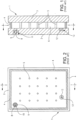
- VIG unit 1 may include two spaced apart substantially parallel glass substrates 2, 3, which enclose an evacuated low-pressure space/cavity 6 therebetween. Glass sheets or substrates 2,3 are interconnected by a peripheral edge seal 4 which may be made of fused solder glass, for example.
- An array of support pillars/spacers 5 may be included between the glass substrates 2, 3 to maintain the spacing of substrates 2, 3 of the VIG unit 1 in view of the low-pressure space/gap 6 present between the substrates 2, 3.
- a pump-out tube 8 may be hermetically sealed by, for example, solder glass 9 to an aperture/hole 10 that passes from an interior surface of one of the glass substrates 2 to the bottom of an optional recess 11 in the exterior surface of the glass substrate 2, or optionally to the exterior surface of the glass substrate 2.
- a vacuum is attached to pump-out tube 8 to evacuate the interior cavity 6 to a low pressure, for example, using a sequential pump down operation. After evacuation of the cavity 6, a portion (e.g., the tip) of the tube 8 is melted to seal the vacuum in low pressure cavity/space 6.
- the optional recess 11 may retain the sealed pump-out tube 8.
- a chemical getter 12 may be included within a recess 13 that is disposed in an interior face of one of the glass substrates, e.g., glass substrate 2.
- the chemical getter 12 may be used to absorb or bind with certain residual impurities that may remain after the cavity 6 is evacuated and sealed.
- VIG units with fused solder glass peripheral edge seals 4 are typically manufactured by depositing glass frit, in a solution (e.g., frit paste), around the periphery of substrate 2 (or on substrate 3). This glass frit paste ultimately forms the glass solder edge seal 4.
- the other substrate e.g., 3) is brought down on substrate 2 so as to sandwich spacers/pillars 5 and the glass frit solution between the two substrates 2, 3.
- the entire assembly including the glass substrates 2, 3, the spacers/pillars 5 and the seal material e.g., glass frit in solution or paste
- the seal material e.g., glass frit in solution or paste
- a vacuum is drawn via the pump-out tube 8 to form low pressure space/cavity 6 between the substrates 2, 3.
- the pressure in space 6 may be produced by way of an evacuation process to a level below atmospheric pressure, e.g., below about 10 -2 Torr.
- substrates 2, 3 are hermetically sealed. Small, high strength spacers/pillars 5 are provided between the substrates to maintain separation of the approximately parallel substrates against atmospheric pressure.
- the pump-out tube 8 may be sealed, for example, by melting its tip using a laser.
- a typical process for installing the pump-out tube 8 in the hole or aperture 10 includes inserting a pre-formed glass pump-out tube 8 in an aperture/hole 10 that has previously been formed (e.g., by drilling) in one of the glass substrates 2. After the pump-out tube 8 has been seated in the aperture/hole 10, an adhesive frit paste is applied to the pump-out tube 8, typically in a region close to the opening of the hole 10 proximate an exterior surface of the glass substrate 2. As noted above, the pump-out tube may be sealed after evacuation or purging of the VIG unit cavity.
- sealing of the pump-out tube may be accomplished by heating an end of the pump-out tube that is used to evacuate or purge the cavity to melt the opening and thus seal the cavity of the VIG unit.
- this heating and melting may be accomplished by laser irradiation of the tip of the pump-out tube.
- the pump-out tube may not be properly seated in the hole formed in the glass substrate.
- the pump-out tube may lean or tilt to one side, and thus not be substantially perpendicular to the surface of the glass substrate in which the hole is formed.
- it can become difficult to properly seal the pump-out tube because the laser cannot consistently melt the tip of the pump-out tube because of, for example, differences in distance between various portions of the angled pump-out tube top and the laser source.
- Inconsistent melting of the top of the pump-out tube may result in incomplete sealing and thus air leakage, which may, depending on the quality of the seal, occur rapidly or more slowly over time.
- the laser could hit the tube wall instead of the top. If the laser hits the tube wall, the laser could potentially bypass the tube and hit the frit, which may damage the frit or cause undesirable outgassing into the cavity.
- the pump-out tube is formed from, and integral with, one of the substrates comprising the VIG unit. According to the invention, there is no need for a separate pump-out tube that is to be inserted into the VIG unit subassembly. This arrangement in certain example instances simplifies the manufacturing process, e.g., by removing the need to provide and seal a separate, properly-aligned tube.
- Another aspect of certain example embodiments relates to the sealing of the integral pump-out tube such that the sealed tube does not protrude past (e.g., is flush with or lies below) an outermost surface of the VIG unit.
- This arrangement is advantageous in certain example instances because it can reduce and sometimes eliminate the need for a separate protruding protective cap placed above the tube.
- the removal of the protective cap in turn, can be advantageous from an aesthetic perspective.
- the removal of the protective cap can be advantageous in terms of reducing the likelihood of damage to the VIG unit and making shipping easier.
- bumping the cap can translate force to the sealed tube, which can cause it to move and/or break, compromising the quality of the vacuum of the VIG.
- the cap is missing, it may be possible to avoid having to use special shipping and/or packaging materials that accommodate such caps.
- a method of making a vacuum insulating glass (VIG) unit is provided.
- First and second glass substrates are provided.
- An integrated pump-out tube is formed in the first substrate such that, when viewed in cross-section, the first glass substrate includes (a) first and second channel portions provided adjacent to opposite sides of a through-hole and (b) first and second sealing wall portions defined therebetween.
- the first and second substrates are sealed together in connection with an edge seal provided around peripheral edges of the first and/or second substrates, a cavity being defined by the first and second substrates, and a plurality of spacers being provided between the first and second substrates in the cavity and helping to maintain the first and second substrates in substantially parallel, spaced-apart relation to one another.
- the cavity is evacuated to a pressure less than atmospheric.
- the first and second sealing wall portions are preferentially heated to cause them to sag together and form a bridge covering the through-hole and hermetically sealing the VIG unit.
- a substrate for use in a vacuum insulating glass (VIG) unit comprises an integrated pump-out tube in the substrate such that, when viewed in cross-section, the first glass substrate includes (a) first and second channel portions provided adjacent to opposite sides of a through-hole and (b) first and second sealing wall portions defined therebetween.
- a vacuum insulating glass (VIG) unit comprises first and second glass substrates maintained in substantially parallel, spaced apart relation to one another via a hermetic edge seal and a plurality of spacers disposed in a cavity defined between the first and second glass substrates, the cavity being evacuated to a pressure less than atmospheric using a plugless pump-out port hermetically sealed with a glass bridge melted from a portion of the first glass substrate surrounding the plugless pump-out port.
- the present invention relates to improved techniques for evacuating vacuum insulated glass (VIG) units. More particularly, this invention relates to a VIG unit made using an integrated tube, and/or associated methods.
- a pump-out port is used to allow an evacuation path. Conventionally, this port is often sealed by inserting a tube with frit applied thereon into a hole drilled in the glass, firing the frit around the hole, sealing the frit in place, and sealing the tube by melting it with a laser or similar focused energy source, thereby hermetically sealing the VIG unit.
- Certain example embodiments improve upon this approach by forming a pump-out tube feature into the glass itself, e.g., by drilling.
- the tube which is integral with the substrate, is melted using a laser or other focused energy source.
- a laser or other focused energy source is used in certain example embodiments.
- Product yield can be improved without having to add an additional tube and seal it using frit, as the subassembly is already hermetic to the degree desired. This approach advantageously simplifies the VIG process, eliminating assembly and sealing steps, while also reducing complexity of the finished VIG unit.
- the sealed integrated tube is flush with, or recessed with respect to, the outer surface of the glass of the VIG.
- a protective cap need not be applied thereover. This in turn can lead to easier processing, especially for secondary processes such as lamination, hybrid VIG manufacturing, etc.
- the elimination of an external tube that protrudes outwardly from the substrate may allow for improvements to be realized in shipping approaches, e.g., as additional packing dunnage to properly space apart the VIG units to account for the extra protrusion need not be provided.
- Standard, or more standard, packaging may be used in certain example embodiments.
- the profiles may be formed by creating a through-hole, and a channel or groove around the through-hole.
- the glass that is left between the through-hole and the channel forms one or more side walls for the through-hole and/or sealing arms for the VIG unit itself.
- Fig. 3B is a top plan view of a substrate 32 incorporating a second example integrated pump-out tube, in accordance with certain example embodiments.
- the Fig. 3B configuration is similar to the Fig. 3A configuration.
- the through-hole 30 and groove, channel, or recess 22' both are generally rectangularly-shaped when viewed from a top plan view.
- the side-wall 22' defined by inner and outer wall surfaces 22a', 22b' also is generally rectangularly-shaped when viewed from a top plan view.
- Fig. 3C is a top plan view of a substrate incorporating a third example integrated pump-out tube, in accordance with certain example embodiments.
- Fig. 3C is somewhat similar to Fig. 3B in that it includes a generally rectangularly-shaped through-hole 30. However, at least first and second sidewalls or sealing arms 20a, 20b are provided on opposite sides of the through-hole 30. These side walls are formed in connection with first and second grooves, channels, or recesses 22a, 22b.
- first and second grooves, channels, or recesses 22a, 22b are formed in connection with first and second grooves, channels, or recesses 22a, 22b.
- the sealing arms 20a, 20b have a height that is the same as or similar to the height of the through-hole 30 but less than the height of the first and second grooves, channels, or recesses 22a, 22b, but other configurations may be used in different example embodiments. For instance, some or all of the height of the through-hole, sealing arms, and recesses may be the same or different, depending on the example embodiments. Although two sealing arms 20a, 20b and two recesses 22a, 22b are shown in Fig. 3C , it will be appreciated that more or fewer sealing arms and/or recesses may be used in different example embodiments.
- an example embodiment may use other shapes for such features. For instance, generally square-shaped, ovular, and/or other configurations, when viewed from a plan view, may be used in different example embodiments. It also will be appreciated that differently shaped features may be used in connection with a single embodiment. For instance, when viewed from a plan view, an example embodiment may include a generally circular through-hole and a groove, channel, or recess that at its outer extent is generally square shaped, rectangular, etc.
- an example embodiment when viewed from a plan view, may include a generally rectangular or square-shaped through-hole and a groove, channel, or recess that at its outer extent is generally circular, ovular, etc. Similar observations apply with respect to the Fig. 3C example plan view. For instance, different shapes may be used for the different features (at least when viewed from a plan view) such that, for example, generally rectangular side arms may be used in connection with a generally ovular through-hole and/or generally ovular recesses, channels, or grooves, etc.
- Figs. 4-6 are cross-sectional views of a substrate incorporating example cross-sections / profiles that may be used as an integrated pump-out tube, in accordance with certain example embodiments. It will be appreciated that Figs. 4-6 encompass a range of tube dimensions such that a given thickness of glass would be able to adequately seal upon itself when melted with a focused energy source such as, for example, a laser. It will be appreciated that the example cross-sections / profiles shown in and described in connection with Figs. 4-6 are described as including multiple shoulder portions, multiple upwardly extending arms, multiple reduced thickness portions, and multiple recesses, it will be appreciated that those portions may be discrete structures (e.g., in accordance with the Fig. 3C example plan view) or may be different parts of different respective integral structures (e.g., in accordance with the Fig. 3A and Fig. 3B example plan views).
- Fig. 4 shows a first example cross-section.
- the integrated pump-out tube 30 is a through-hole in the substrate 32.
- the substrate 32 when viewed in cross section includes shoulder portions 34a, 34b, and the shoulder portions have a thickness that matches the full thickness of the substrate 32.
- a reduced thickness area 36a, 36b surrounds the pump-out tube 30.
- Upwardly extending arms 38a, 38b help define the depth of the pump-out tube 30.
- the shoulder portions 34a, 34b, reduced thickness area 36a, 36b, and upwardly extending arms 38a, 38b define a U-shaped recesses 40a, 40b.
- the U-shaped recesses 40a, 40b may be formed by drilling or other suitable means, leaving the upwardly extending arms 38a, 38b proximate to, and at least partially defining, the tube 30.
- the upwardly extending arms 38a, 38b will be collapsed via the laser or other direct energy source to seal the tube 30 and form a bridge portion, as explained in greater detail below.
- the upwardly extending arms 38a, 38b have a thickness sufficient to cave in or sag towards one another when heated, and connect to form a cover over the hole 30. The thickness of this cover is thick enough to hermetically seal the VIG unit and avoid collapse under the weight of the vacuum.
- a single groove, channel, or recess may be provide around the through-hole 30 in Fig. 4 and may include multiple sections (including sections 40a, 40b).
- the Fig. 4 embodiment may have one or more sidewalls / one or more sealing arms.
- the upwardly extending arms 38a, 38b shown in Fig. 4 may simply be different parts of a single sidewall or sealing arm, different parts of two or more different sidewall(s) / sealing arm(s) in different example embodiments.
- the Fig. 4 example when viewed in cross-section, the Fig. 4 example includes one or more substantially U-shaped grooves, channels, or recesses.
- Fig. 5 is somewhat similar to Fig. 4 in that it includes generally rectangular shoulder portions 34a, 34b, and reduced thickness areas 36a', 36b'.
- the arms 38a', 38b' are substantially trapezoidally shaped, causing the reduced thickness areas 36a', 36b' to in essence be shorter.
- the substantially trapezoidal shape of the arms 38a', 38b' is formed so that the height thereof helps define the integrated pump-out tube at the through-hole 30, with the base being broader towards the interior of the VIG unit and shorter towards the exterior of the VIG unit. This shape also helps define generally trapezoidal recesses 40a', 40b'.
- the Fig. 5 example arrangement may be advantageous in certain example embodiments because there is more material in the arms 38a', 38b' for use in sealing the integrated tube (e.g., compared to the Fig. 4 example arrangement).
- the substantially trapezoidal profile may be approximated, e.g., by using a series of drills with differently sized bores / hole cutters, e.g., to form a more stepped or step-like pattern for the profile. For instance, smaller diameter bores may be used closer to the interior surface of the substrate, and the bore size may progressively increase moving outwardly towards the exterior surface of the substrate.
- a single groove, channel, or recess may be provide around the through-hole 30 in Fig. 5 and may include multiple sections (including sections 40a', 40b').
- the Fig. 5 embodiment may have one or more sidewalls / one or more sealing arms.
- the upwardly extending arms 38a', 38b' shown in Fig. 5 may simply be different parts of a single sidewall or sealing arm, different parts of two or more different sidewall(s) / sealing arm(s) in different example embodiments.
- the Fig. 5 example when viewed in cross-section, the Fig. 5 example includes one or more substantially trapezoidially-shaped grooves, channels, or recesses.
- Fig. 6 is another example cross-section that may be used in connection with certain example embodiments.
- the recesses 40a", 40b" surrounding the pump-out tube 30 are more curved (e.g., semi-circular), which causes changes in the shapes of the shoulder portions 34a", 34b", the reduced thickness portions 36a", 36b'', and the arms 38a", 38b''.
- the curved recesses 40a", 40b" may be substantially U-shaped in certain example embodiments.
- the U-shape may, for example, be skewed to one side in some instances.
- the U-shape is skewed such that the slope is steeper towards the tube 30, although a skew more like that shown in Fig. 5 may be used in some instances.
- a single groove, channel, or recess may be provide around the through-hole 30 in Fig. 6 and may include multiple sections (including sections 40a", 40b'').
- the Fig. 6 embodiment may have one or more sidewalls / one or more sealing arms.
- the upwardly extending arms 38a", 38b'' shown in Fig. 6 may simply be different parts of a single sidewall or sealing arm, different parts of two or more different sidewall(s) / sealing arm(s) in different example embodiments.
- the Fig. 6 example when viewed in cross-section, the Fig. 6 example includes one or more substantially trapezoidially-shaped grooves, channels, or recesses.
- Figs. 4-6 are cross-sectional views. It thus will be appreciated that the integrated pump-out tube may be any suitable size, shape, or configuration. Consistent with the discussion of Figs. 3A-3C above, for example, from a plan view, the integrated pump-out tube may by substantially circular, ovular, and/or rectangular. Similarly, consistent with the discussion of Figs. 3A-3C above, it will be appreciated that there are multiple profiles / cross sections that are suitable to providing the appropriate tube dimensions, and different profiles may be used in different example embodiments.
- Figs. 7A-7C schematically illustrate successive stages of the Fig. 4 example profile being selectively heated in sealing the integrated pump-out tube, in accordance with certain example embodiments.
- Example details as to how the heating can be accomplished are provided below in connection with Fig. 9 .
- the arm(s) Via exposure to the laser or other energy source, the arm(s) is/are caused to collapse or sag inwardly towards one another.
- tip portions 61a, 61b begin to close up the tube 30a in Fig. 7A .
- Continued exposure to heat further closes the tube 30b, bringing the tips 61a', 61b' yet closer together in Fig. 7B .
- the tube 30C is nearly entirely closed, as the tip portions 61a", 61b" sag even closer towards one another.
- the heating may be preferential heating that includes a first or core heating phase to substantially melt the sealing wall, followed by a second phase that causes the first and second sealing wall portions to sag together and form the bridge.
- a first or core heating phase to substantially melt the sealing wall
- a second phase that causes the first and second sealing wall portions to sag together and form the bridge.
- One or both of these phases may preferentially heat the sealing wall relative to the rest of the VIG unit subassembly.
- Laser heating may be used for either or both phases in different example embodiments. Although laser heating is mentioned herein, it will be appreciated that infrared (IR) heating may be used in connection with any heating procedure described herein.
- Fig. 8 is a cross-sectional view of a substrate incorporating a sealed integrated tube, in accordance with certain example embodiments.
- the tube is sealed.
- the pocket 71 is interior to the VIG unit and is held at vacuum.
- the cover 73 is flush or substantially flush with the shoulder portions of the substrate, as can be appreciated from Fig. 8 .
- the cover 73 is not flush with the outer surface of the substrate but does not protrude beyond it.
- a structural or non-structural sealant material may be provided around the cover 73, e.g., to "fill in" any recessed area relative to the outer surface of the substrate.
- the through-hole may be 0.5-5 mm in diameter or major distance, more preferably 1.5-4 mm in diameter or major distance, and still more preferably 2-3.5 mm in diameter or major distance.
- the tube sidewall thickness may be 0.2-0.5 mm thick, more preferably 0.25-0.45 mm thick.
- U.S. Patent No. 9,371,683 may be used to seal the integrated tube, e.g., by tracing smaller and smaller circles or other connected patterns around the tube proximate to the sidewall(s) / sealing arm(s) so as to cause opposing edges of the sidewall(s) / sealing arm(s) to sag towards one another and form a bridge (e.g., as shown in Fig. 8 ).
- progressive scans of narrower width may be used to similar effect.
- one or more lasers may be used to scan along first and second upwardly projecting sealing arms to cause them to sag towards one another.
- the laser(s) may be focused along scan lines or scan areas that are increasingly close to one another, e.g., as the sag continues to develop in the formation of the bridge.
- Fig. 9 is a flowchart showing an example process for making a VIG unit in connection with an integrated pump-out tube, in accordance with certain example embodiments.
- step S81 the integrated pump-out tube profile is formed in the first substrate, e.g., via one or more drilling operations. Spacers or pillars are placed on the second substrate in step S83.
- step S85 frit material is applied to peripheral edges of the second substrate.
- the first and second substrates are booked together in step S87 so that a cavity is formed therebetween, and a hermetic edge seal is formed in step S89 (e.g., via laser heating, heating in an oven, and/or using infrared heaters).
- the cavity is evacuated to a pressure less than atmospheric in step S91.
- the integrated tube optionally is pre-heated in step S93, e.g., while maintaining the vacuum. This may be accomplished using an oven, using infrared heaters, via a laser, etc. Core heating is performed in step S95, and chase heating is performed in step S97 repeatedly until a sealed (e.g., as indicated in step S99).
- the core heating process of step S95 provides the bulk of the melting process
- the chase heating of step S97 is provided at progressively smaller circumferences, and/or areas, e.g., depending on the configuration of the sidewall(s) / sealing arm(s), the through-hole, the developing sag, etc.
- the unit may be moved for further processing in step S101.
- a tube profile will be formed in the first substrate, the first and/or second substrate may be tempered, frit may be applied to the peripheral edges of the first and/or second substrate, spacers may be placed, and then other operations may be performed, e.g., as shown in Fig. 9 .
- Fig. 10 is an assembled VIG unit made in accordance with certain example embodiments.
- the first substrate 32' includes the cover or bridge 73 resulting from the integrated pump-out tube as described above.
- the first and second substrates 32', 2 are hermetically sealed together via the frit-based edge seal 4 and are held in substantially parallel spaced apart relation via pillars 5 such that a gap or cavity 6 is defined therebetween.
- VIG window applications merchandizers, laminated products, hybrid VIG units (e.g., units where a substrate is spaced apart from a VIG unit via a spacer system), etc.
- VIG window applications merchandizers, laminated products
- hybrid VIG units e.g., units where a substrate is spaced apart from a VIG unit via a spacer system
- heat treatment and "heat treating” as used herein mean heating the article to a temperature sufficient to achieve thermal tempering and/or heat strengthening of the glass inclusive article.
- This definition includes, for example, heating a coated article in an oven or furnace at a temperature of at least about 550 degrees C, more preferably at least about 580 degrees C, more preferably at least about 600 degrees C, more preferably at least about 620 degrees C, and most preferably at least about 650 degrees C for a sufficient period to allow tempering and/or heat strengthening. This may be for at least about two minutes, or up to about 10 minutes, in certain example embodiments. These processes may be adapted to involve different times and/or temperatures.
- a first layer may be said to be “on” or “supported by” a second layer, even if there are one or more layers therebetween.
- a method of making a vacuum insulating glass (VIG) unit is provided.
- First and second glass substrates are provided.
- An integrated pump-out tube is formed in the first substrate such that, when viewed in cross-section, the first glass substrate includes (a) first and second channel portions provided adjacent to opposite sides of a through-hole and (b) first and second sealing wall portions defined therebetween.
- the first and second substrates are sealed together in connection with an edge seal provided around peripheral edges of the first and/or second substrates, a cavity being defined by the first and second substrates, and a plurality of spacers being provided between the first and second substrates in the cavity and helping to maintain the first and second substrates in substantially parallel, spaced-apart relation to one another.
- the cavity is evacuated to a pressure less than atmospheric.
- the first and second sealing wall portions are preferentially heated to cause them to sag together and form a bridge covering the through-hole and hermetically sealing the VIG unit.
- the channel portions may be formed to be parts of a single channel surrounding the through-hole and/or the sealing wall portions are formed to be parts of a single sealing wall surrounding the through-hole.
- the channel portions may be formed to at least initially be substantially U-shaped, substantially semi-circular, and/or substantially trapezoidal, when viewed in cross-section.
- the channel portions may be formed via drilling.
- the preferential heating may include a core heating phase to substantially melt the sealing wall portions, followed by laser heating that causes the first and second sealing wall portions to sag together and form the bridge.
- the preferential heating may be laser heating, e.g., performed such that the laser heating includes tracing the sealing wall portions as they sag towards one another in forming the bridge.
- Certain example embodiments relate to a vacuum insulating glass (VIG) unit made by the method of any of the 7 previous paragraphs.
- a vacuum insulating glass (VIG) unit comprises first and second glass substrates maintained in substantially parallel, spaced apart relation to one another via a hermetic edge seal and a plurality of spacers disposed in a cavity defined between the first and second glass substrates, the cavity being evacuated to a pressure less than atmospheric using a plugless pump-out port hermetically sealed with a glass bridge melted from a portion of the first glass substrate surrounding the plugless pump-out port.
Landscapes
- Engineering & Computer Science (AREA)
- Civil Engineering (AREA)
- Structural Engineering (AREA)
- Joining Of Glass To Other Materials (AREA)
- Securing Of Glass Panes Or The Like (AREA)
Applications Claiming Priority (2)
| Application Number | Priority Date | Filing Date | Title |
|---|---|---|---|
| US16/239,971 US10900275B2 (en) | 2019-01-04 | 2019-01-04 | Integrated tube for vacuum insulated glass (VIG) unit evacuation and hermetic sealing, VIG unit including integrated tube, and associated methods |
| PCT/IB2020/050053 WO2020141491A1 (en) | 2019-01-04 | 2020-01-06 | Integrated tube for vacuum insulated glass (vig) unit evacuation and hermetic sealing, vig unit including integrated tube, and associated methods |
Publications (2)
| Publication Number | Publication Date |
|---|---|
| EP3906352A1 EP3906352A1 (en) | 2021-11-10 |
| EP3906352B1 true EP3906352B1 (en) | 2025-03-12 |
Family
ID=69185660
Family Applications (1)
| Application Number | Title | Priority Date | Filing Date |
|---|---|---|---|
| EP20701511.6A Active EP3906352B1 (en) | 2019-01-04 | 2020-01-06 | Integrated tube for vacuum insulated glass (vig) unit evacuation and hermetic sealing, vig unit including integrated tube, and associated methods |
Country Status (9)
| Country | Link |
|---|---|
| US (1) | US10900275B2 (pl) |
| EP (1) | EP3906352B1 (pl) |
| JP (1) | JP7513617B2 (pl) |
| KR (1) | KR102911568B1 (pl) |
| CN (1) | CN113227527A (pl) |
| CA (1) | CA3125404C (pl) |
| DK (1) | DK3906352T3 (pl) |
| PL (1) | PL3906352T3 (pl) |
| WO (1) | WO2020141491A1 (pl) |
Families Citing this family (1)
| Publication number | Priority date | Publication date | Assignee | Title |
|---|---|---|---|---|
| WO2025212134A1 (en) * | 2024-04-01 | 2025-10-09 | LuxWall, Inc. | Vacuum insulated panel with glass evacuation tube tip seal and method |
Family Cites Families (21)
| Publication number | Priority date | Publication date | Assignee | Title |
|---|---|---|---|---|
| HUT60009A (en) * | 1989-08-23 | 1992-07-28 | Univ Sydney | Heat-insulating glass panel and method for producing same |
| US5657607A (en) | 1989-08-23 | 1997-08-19 | University Of Sydney | Thermally insulating glass panel and method of construction |
| ATE194205T1 (de) | 1992-01-31 | 2000-07-15 | Univ Sydney | Verbesserungen für thermisch isolierende glasscheiben |
| CN1078659C (zh) | 1993-06-30 | 2002-01-30 | 悉尼大学 | 制造真空玻璃窗的方法 |
| US5717284A (en) * | 1995-05-26 | 1998-02-10 | Matsushita Electric R & D Laboratory | Method of manufacturing substantially flat compact fluorescent lamp |
| US5695844A (en) | 1996-01-11 | 1997-12-09 | Mve, Inc. | Vacuum insulation panel with improved braze seal-off and method for manufacturing same |
| JP3859771B2 (ja) | 1996-06-17 | 2006-12-20 | 日本板硝子株式会社 | 真空複層ガラス及びその製造方法 |
| FR2774373B1 (fr) | 1998-02-04 | 2000-03-10 | Saint Gobain Vitrage | Procede pour realiser le vide dans un vitrage isolant |
| CN1273621A (zh) | 1998-07-14 | 2000-11-15 | 日本板硝子株式会社 | 玻璃面板及其形成方法 |
| PL343803A1 (en) | 1999-03-05 | 2001-09-10 | Uni Charm Co | Composite sheet and production method thereof |
| US6383580B1 (en) | 1999-11-12 | 2002-05-07 | Guardian Industries Corp. | Vacuum IG window unit with edge mounted pump-out tube |
| JP2003192400A (ja) * | 2001-12-25 | 2003-07-09 | Nippon Sheet Glass Co Ltd | ガラスパネル |
| US8460493B2 (en) | 2007-12-14 | 2013-06-11 | Guardian Industries Corp. | Evacuation and port sealing techniques for vacuum insulating glass units, and/or vacuum oven for accomplishing the same |
| US8794033B2 (en) | 2011-12-15 | 2014-08-05 | Guardian Industries Corp. | Apparatuses for vacuum insulating glass (VIG) unit tip-off, and/or associated methods |
| US9695628B2 (en) | 2012-05-08 | 2017-07-04 | Guardian Industries Corp. | Vacuum insulated glass (VIG) window unit including pump-out tube protection ring and/or cap and methods for making same |
| US9371683B2 (en) | 2012-05-18 | 2016-06-21 | Guardian Industries Corp. | Method and apparatus for making vacuum insulated glass (VIG) window unit including pump-out tube |
| US10829984B2 (en) | 2012-05-18 | 2020-11-10 | Guardian Glass, LLC | Method and apparatus for making vacuum insulated glass (VIG) window unit including pump-out tube |
| US8833105B2 (en) | 2012-05-18 | 2014-09-16 | Guardian Industries Corp. | Method and apparatus for making vacuum insulated glass (VIG) window unit including pump-out tube sealing technique |
| US9428952B2 (en) * | 2012-05-31 | 2016-08-30 | Guardian Industries Corp. | Vacuum insulated glass (VIG) window unit with reduced seal height variation and method for making same |
| CN103420582B (zh) | 2013-07-17 | 2016-03-30 | 戴长虹 | 有圆管和密封槽的平面双真空层玻璃的安装孔 |
| EP3357885B1 (en) * | 2015-09-29 | 2020-01-01 | Panasonic Intellectual Property Management Co., Ltd. | Glass panel unit and glass window |
-
2019
- 2019-01-04 US US16/239,971 patent/US10900275B2/en active Active
-
2020
- 2020-01-06 CA CA3125404A patent/CA3125404C/en active Active
- 2020-01-06 PL PL20701511.6T patent/PL3906352T3/pl unknown
- 2020-01-06 JP JP2021536766A patent/JP7513617B2/ja active Active
- 2020-01-06 WO PCT/IB2020/050053 patent/WO2020141491A1/en not_active Ceased
- 2020-01-06 KR KR1020217023454A patent/KR102911568B1/ko active Active
- 2020-01-06 CN CN202080007742.0A patent/CN113227527A/zh active Pending
- 2020-01-06 EP EP20701511.6A patent/EP3906352B1/en active Active
- 2020-01-06 DK DK20701511.6T patent/DK3906352T3/da active
Also Published As
| Publication number | Publication date |
|---|---|
| KR102911568B1 (ko) | 2026-01-14 |
| BR112021012857A2 (pt) | 2021-09-21 |
| CA3125404C (en) | 2024-06-04 |
| US20200217126A1 (en) | 2020-07-09 |
| US10900275B2 (en) | 2021-01-26 |
| EP3906352A1 (en) | 2021-11-10 |
| CN113227527A (zh) | 2021-08-06 |
| PL3906352T3 (pl) | 2025-04-28 |
| WO2020141491A1 (en) | 2020-07-09 |
| JP7513617B2 (ja) | 2024-07-09 |
| JP2022516056A (ja) | 2022-02-24 |
| DK3906352T3 (da) | 2025-03-24 |
| CA3125404A1 (en) | 2020-07-09 |
| KR20210110632A (ko) | 2021-09-08 |
Similar Documents
| Publication | Publication Date | Title |
|---|---|---|
| EP0953719B1 (en) | Methods of construction of evacuated glazing | |
| EP3987143B1 (en) | Flanged tube for vacuum insulated glass (vig) unit evacuation and hermetic sealing, vig unit including flanged tube, and associated methods | |
| US20130074445A1 (en) | Vacuum insulating glass (vig) unit pump-out tube protecting techniques, and/or vig units incorporating the same | |
| WO2013173169A1 (en) | Method and apparatus for making vacuum insulated glass (vig) window unit including pump-out tube | |
| US20180305972A1 (en) | Vacuum insulated glass unit with glass-to-metal seal and methods of assembling same | |
| EP3906352B1 (en) | Integrated tube for vacuum insulated glass (vig) unit evacuation and hermetic sealing, vig unit including integrated tube, and associated methods | |
| KR101322585B1 (ko) | 진공유리 및 그 제조방법 | |
| US10358861B2 (en) | Vacuum insulated glazing unit | |
| US7476426B2 (en) | Evacuated glass panel having degassing device | |
| US20200217125A1 (en) | Internal tube for vacuum insulated glass (vig) unit evacuation and hermetic sealing, vig unit including internal tube, and associated methods | |
| RU2774750C1 (ru) | Встроенная трубка для удаления воздуха и герметизации стеклопакета с вакуумной изоляцией, стеклопакет с вакуумной изоляцией, включающий в себя встроенную трубку, и связанные с ними способы | |
| US11060342B2 (en) | Vacuum insulated glazing unit | |
| US11465938B2 (en) | Manufacturing method of glass panel unit, manufacturing method of glass window, and glass panel unit | |
| BR112021012857B1 (pt) | Tubo integrado para evacuação de unidade de vidro isolado a vácuo (vig) e vedação hermética, unidade de vig que inclui tubo integrado e métodos associados | |
| US11193322B2 (en) | Manufacturing method of glass panel unit and manufacturing method of glass window |
Legal Events
| Date | Code | Title | Description |
|---|---|---|---|
| STAA | Information on the status of an ep patent application or granted ep patent |
Free format text: STATUS: UNKNOWN |
|
| STAA | Information on the status of an ep patent application or granted ep patent |
Free format text: STATUS: THE INTERNATIONAL PUBLICATION HAS BEEN MADE |
|
| PUAI | Public reference made under article 153(3) epc to a published international application that has entered the european phase |
Free format text: ORIGINAL CODE: 0009012 |
|
| STAA | Information on the status of an ep patent application or granted ep patent |
Free format text: STATUS: REQUEST FOR EXAMINATION WAS MADE |
|
| 17P | Request for examination filed |
Effective date: 20210727 |
|
| AK | Designated contracting states |
Kind code of ref document: A1 Designated state(s): AL AT BE BG CH CY CZ DE DK EE ES FI FR GB GR HR HU IE IS IT LI LT LU LV MC MK MT NL NO PL PT RO RS SE SI SK SM TR |
|
| DAV | Request for validation of the european patent (deleted) | ||
| DAX | Request for extension of the european patent (deleted) | ||
| STAA | Information on the status of an ep patent application or granted ep patent |
Free format text: STATUS: EXAMINATION IS IN PROGRESS |
|
| 17Q | First examination report despatched |
Effective date: 20230504 |
|
| GRAP | Despatch of communication of intention to grant a patent |
Free format text: ORIGINAL CODE: EPIDOSNIGR1 |
|
| STAA | Information on the status of an ep patent application or granted ep patent |
Free format text: STATUS: GRANT OF PATENT IS INTENDED |
|
| INTG | Intention to grant announced |
Effective date: 20241008 |
|
| GRAS | Grant fee paid |
Free format text: ORIGINAL CODE: EPIDOSNIGR3 |
|
| GRAA | (expected) grant |
Free format text: ORIGINAL CODE: 0009210 |
|
| STAA | Information on the status of an ep patent application or granted ep patent |
Free format text: STATUS: THE PATENT HAS BEEN GRANTED |
|
| AK | Designated contracting states |
Kind code of ref document: B1 Designated state(s): AL AT BE BG CH CY CZ DE DK EE ES FI FR GB GR HR HU IE IS IT LI LT LU LV MC MK MT NL NO PL PT RO RS SE SI SK SM TR |
|
| REG | Reference to a national code |
Ref country code: GB Ref legal event code: FG4D |
|
| REG | Reference to a national code |
Ref country code: CH Ref legal event code: EP |
|
| REG | Reference to a national code |
Ref country code: DK Ref legal event code: T3 Effective date: 20250319 |
|
| REG | Reference to a national code |
Ref country code: DE Ref legal event code: R096 Ref document number: 602020047548 Country of ref document: DE |
|
| REG | Reference to a national code |
Ref country code: IE Ref legal event code: FG4D |
|
| PG25 | Lapsed in a contracting state [announced via postgrant information from national office to epo] |
Ref country code: RS Free format text: LAPSE BECAUSE OF FAILURE TO SUBMIT A TRANSLATION OF THE DESCRIPTION OR TO PAY THE FEE WITHIN THE PRESCRIBED TIME-LIMIT Effective date: 20250612 |
|
| PG25 | Lapsed in a contracting state [announced via postgrant information from national office to epo] |
Ref country code: FI Free format text: LAPSE BECAUSE OF FAILURE TO SUBMIT A TRANSLATION OF THE DESCRIPTION OR TO PAY THE FEE WITHIN THE PRESCRIBED TIME-LIMIT Effective date: 20250312 |
|
| PG25 | Lapsed in a contracting state [announced via postgrant information from national office to epo] |
Ref country code: ES Free format text: LAPSE BECAUSE OF FAILURE TO SUBMIT A TRANSLATION OF THE DESCRIPTION OR TO PAY THE FEE WITHIN THE PRESCRIBED TIME-LIMIT Effective date: 20250312 |
|
| REG | Reference to a national code |
Ref country code: LT Ref legal event code: MG9D |
|
| PG25 | Lapsed in a contracting state [announced via postgrant information from national office to epo] |
Ref country code: NO Free format text: LAPSE BECAUSE OF FAILURE TO SUBMIT A TRANSLATION OF THE DESCRIPTION OR TO PAY THE FEE WITHIN THE PRESCRIBED TIME-LIMIT Effective date: 20250612 |
|
| PG25 | Lapsed in a contracting state [announced via postgrant information from national office to epo] |
Ref country code: HR Free format text: LAPSE BECAUSE OF FAILURE TO SUBMIT A TRANSLATION OF THE DESCRIPTION OR TO PAY THE FEE WITHIN THE PRESCRIBED TIME-LIMIT Effective date: 20250312 |
|
| REG | Reference to a national code |
Ref country code: NL Ref legal event code: MP Effective date: 20250312 |
|
| PG25 | Lapsed in a contracting state [announced via postgrant information from national office to epo] |
Ref country code: LV Free format text: LAPSE BECAUSE OF FAILURE TO SUBMIT A TRANSLATION OF THE DESCRIPTION OR TO PAY THE FEE WITHIN THE PRESCRIBED TIME-LIMIT Effective date: 20250312 |
|
| PG25 | Lapsed in a contracting state [announced via postgrant information from national office to epo] |
Ref country code: GR Free format text: LAPSE BECAUSE OF FAILURE TO SUBMIT A TRANSLATION OF THE DESCRIPTION OR TO PAY THE FEE WITHIN THE PRESCRIBED TIME-LIMIT Effective date: 20250613 Ref country code: BG Free format text: LAPSE BECAUSE OF FAILURE TO SUBMIT A TRANSLATION OF THE DESCRIPTION OR TO PAY THE FEE WITHIN THE PRESCRIBED TIME-LIMIT Effective date: 20250312 |
|
| REG | Reference to a national code |
Ref country code: AT Ref legal event code: MK05 Ref document number: 1775125 Country of ref document: AT Kind code of ref document: T Effective date: 20250312 |
|
| PG25 | Lapsed in a contracting state [announced via postgrant information from national office to epo] |
Ref country code: NL Free format text: LAPSE BECAUSE OF FAILURE TO SUBMIT A TRANSLATION OF THE DESCRIPTION OR TO PAY THE FEE WITHIN THE PRESCRIBED TIME-LIMIT Effective date: 20250312 |
|
| PG25 | Lapsed in a contracting state [announced via postgrant information from national office to epo] |
Ref country code: SE Free format text: LAPSE BECAUSE OF FAILURE TO SUBMIT A TRANSLATION OF THE DESCRIPTION OR TO PAY THE FEE WITHIN THE PRESCRIBED TIME-LIMIT Effective date: 20250312 |
|
| PG25 | Lapsed in a contracting state [announced via postgrant information from national office to epo] |
Ref country code: SM Free format text: LAPSE BECAUSE OF FAILURE TO SUBMIT A TRANSLATION OF THE DESCRIPTION OR TO PAY THE FEE WITHIN THE PRESCRIBED TIME-LIMIT Effective date: 20250312 |
|
| PG25 | Lapsed in a contracting state [announced via postgrant information from national office to epo] |
Ref country code: PT Free format text: LAPSE BECAUSE OF FAILURE TO SUBMIT A TRANSLATION OF THE DESCRIPTION OR TO PAY THE FEE WITHIN THE PRESCRIBED TIME-LIMIT Effective date: 20250714 |
|
| PG25 | Lapsed in a contracting state [announced via postgrant information from national office to epo] |
Ref country code: IT Free format text: LAPSE BECAUSE OF FAILURE TO SUBMIT A TRANSLATION OF THE DESCRIPTION OR TO PAY THE FEE WITHIN THE PRESCRIBED TIME-LIMIT Effective date: 20250312 |
|
| PG25 | Lapsed in a contracting state [announced via postgrant information from national office to epo] |
Ref country code: AT Free format text: LAPSE BECAUSE OF FAILURE TO SUBMIT A TRANSLATION OF THE DESCRIPTION OR TO PAY THE FEE WITHIN THE PRESCRIBED TIME-LIMIT Effective date: 20250312 |
|
| PG25 | Lapsed in a contracting state [announced via postgrant information from national office to epo] |
Ref country code: CZ Free format text: LAPSE BECAUSE OF FAILURE TO SUBMIT A TRANSLATION OF THE DESCRIPTION OR TO PAY THE FEE WITHIN THE PRESCRIBED TIME-LIMIT Effective date: 20250312 Ref country code: EE Free format text: LAPSE BECAUSE OF FAILURE TO SUBMIT A TRANSLATION OF THE DESCRIPTION OR TO PAY THE FEE WITHIN THE PRESCRIBED TIME-LIMIT Effective date: 20250312 |
|
| PG25 | Lapsed in a contracting state [announced via postgrant information from national office to epo] |
Ref country code: RO Free format text: LAPSE BECAUSE OF FAILURE TO SUBMIT A TRANSLATION OF THE DESCRIPTION OR TO PAY THE FEE WITHIN THE PRESCRIBED TIME-LIMIT Effective date: 20250312 |
|
| PG25 | Lapsed in a contracting state [announced via postgrant information from national office to epo] |
Ref country code: SK Free format text: LAPSE BECAUSE OF FAILURE TO SUBMIT A TRANSLATION OF THE DESCRIPTION OR TO PAY THE FEE WITHIN THE PRESCRIBED TIME-LIMIT Effective date: 20250312 |
|
| PG25 | Lapsed in a contracting state [announced via postgrant information from national office to epo] |
Ref country code: IS Free format text: LAPSE BECAUSE OF FAILURE TO SUBMIT A TRANSLATION OF THE DESCRIPTION OR TO PAY THE FEE WITHIN THE PRESCRIBED TIME-LIMIT Effective date: 20250712 |
|
| REG | Reference to a national code |
Ref country code: DE Ref legal event code: R097 Ref document number: 602020047548 Country of ref document: DE |
|
| PGFP | Annual fee paid to national office [announced via postgrant information from national office to epo] |
Ref country code: GB Payment date: 20251220 Year of fee payment: 7 |
|
| PGFP | Annual fee paid to national office [announced via postgrant information from national office to epo] |
Ref country code: DK Payment date: 20251217 Year of fee payment: 7 |
|
| PGFP | Annual fee paid to national office [announced via postgrant information from national office to epo] |
Ref country code: FR Payment date: 20251217 Year of fee payment: 7 |
|
| PLBE | No opposition filed within time limit |
Free format text: ORIGINAL CODE: 0009261 |
|
| STAA | Information on the status of an ep patent application or granted ep patent |
Free format text: STATUS: NO OPPOSITION FILED WITHIN TIME LIMIT |
|
| REG | Reference to a national code |
Ref country code: CH Ref legal event code: L10 Free format text: ST27 STATUS EVENT CODE: U-0-0-L10-L00 (AS PROVIDED BY THE NATIONAL OFFICE) Effective date: 20260121 |
|
| PGFP | Annual fee paid to national office [announced via postgrant information from national office to epo] |
Ref country code: PL Payment date: 20251219 Year of fee payment: 7 |