EP3906112B1 - Oleophile hydrophobe magnetische poröse materialien - Google Patents
Oleophile hydrophobe magnetische poröse materialien Download PDFInfo
- Publication number
- EP3906112B1 EP3906112B1 EP19907115.0A EP19907115A EP3906112B1 EP 3906112 B1 EP3906112 B1 EP 3906112B1 EP 19907115 A EP19907115 A EP 19907115A EP 3906112 B1 EP3906112 B1 EP 3906112B1
- Authority
- EP
- European Patent Office
- Prior art keywords
- ohm
- graphite
- nanocomposite
- layers
- oil
- Prior art date
- Legal status (The legal status is an assumption and is not a legal conclusion. Google has not performed a legal analysis and makes no representation as to the accuracy of the status listed.)
- Active
Links
Images






Classifications
-
- C—CHEMISTRY; METALLURGY
- C01—INORGANIC CHEMISTRY
- C01B—NON-METALLIC ELEMENTS; COMPOUNDS THEREOF; METALLOIDS OR COMPOUNDS THEREOF NOT COVERED BY SUBCLASS C01C
- C01B32/00—Carbon; Compounds thereof
- C01B32/20—Graphite
- C01B32/21—After-treatment
- C01B32/22—Intercalation
-
- B—PERFORMING OPERATIONS; TRANSPORTING
- B01—PHYSICAL OR CHEMICAL PROCESSES OR APPARATUS IN GENERAL
- B01J—CHEMICAL OR PHYSICAL PROCESSES, e.g. CATALYSIS OR COLLOID CHEMISTRY; THEIR RELEVANT APPARATUS
- B01J20/00—Solid sorbent compositions or filter aid compositions; Sorbents for chromatography; Processes for preparing, regenerating or reactivating thereof
- B01J20/02—Solid sorbent compositions or filter aid compositions; Sorbents for chromatography; Processes for preparing, regenerating or reactivating thereof comprising inorganic material
-
- B—PERFORMING OPERATIONS; TRANSPORTING
- B01—PHYSICAL OR CHEMICAL PROCESSES OR APPARATUS IN GENERAL
- B01J—CHEMICAL OR PHYSICAL PROCESSES, e.g. CATALYSIS OR COLLOID CHEMISTRY; THEIR RELEVANT APPARATUS
- B01J20/00—Solid sorbent compositions or filter aid compositions; Sorbents for chromatography; Processes for preparing, regenerating or reactivating thereof
- B01J20/02—Solid sorbent compositions or filter aid compositions; Sorbents for chromatography; Processes for preparing, regenerating or reactivating thereof comprising inorganic material
- B01J20/06—Solid sorbent compositions or filter aid compositions; Sorbents for chromatography; Processes for preparing, regenerating or reactivating thereof comprising inorganic material comprising oxides or hydroxides of metals not provided for in group B01J20/04
-
- B—PERFORMING OPERATIONS; TRANSPORTING
- B01—PHYSICAL OR CHEMICAL PROCESSES OR APPARATUS IN GENERAL
- B01J—CHEMICAL OR PHYSICAL PROCESSES, e.g. CATALYSIS OR COLLOID CHEMISTRY; THEIR RELEVANT APPARATUS
- B01J20/00—Solid sorbent compositions or filter aid compositions; Sorbents for chromatography; Processes for preparing, regenerating or reactivating thereof
- B01J20/02—Solid sorbent compositions or filter aid compositions; Sorbents for chromatography; Processes for preparing, regenerating or reactivating thereof comprising inorganic material
- B01J20/20—Solid sorbent compositions or filter aid compositions; Sorbents for chromatography; Processes for preparing, regenerating or reactivating thereof comprising inorganic material comprising free carbon; comprising carbon obtained by carbonising processes
-
- B—PERFORMING OPERATIONS; TRANSPORTING
- B01—PHYSICAL OR CHEMICAL PROCESSES OR APPARATUS IN GENERAL
- B01J—CHEMICAL OR PHYSICAL PROCESSES, e.g. CATALYSIS OR COLLOID CHEMISTRY; THEIR RELEVANT APPARATUS
- B01J20/00—Solid sorbent compositions or filter aid compositions; Sorbents for chromatography; Processes for preparing, regenerating or reactivating thereof
- B01J20/22—Solid sorbent compositions or filter aid compositions; Sorbents for chromatography; Processes for preparing, regenerating or reactivating thereof comprising organic material
- B01J20/26—Synthetic macromolecular compounds
- B01J20/262—Synthetic macromolecular compounds obtained otherwise than by reactions only involving carbon to carbon unsaturated bonds, e.g. obtained by polycondensation
-
- B—PERFORMING OPERATIONS; TRANSPORTING
- B01—PHYSICAL OR CHEMICAL PROCESSES OR APPARATUS IN GENERAL
- B01J—CHEMICAL OR PHYSICAL PROCESSES, e.g. CATALYSIS OR COLLOID CHEMISTRY; THEIR RELEVANT APPARATUS
- B01J20/00—Solid sorbent compositions or filter aid compositions; Sorbents for chromatography; Processes for preparing, regenerating or reactivating thereof
- B01J20/28—Solid sorbent compositions or filter aid compositions; Sorbents for chromatography; Processes for preparing, regenerating or reactivating thereof characterised by their form or physical properties
- B01J20/28002—Solid sorbent compositions or filter aid compositions; Sorbents for chromatography; Processes for preparing, regenerating or reactivating thereof characterised by their form or physical properties characterised by their physical properties
- B01J20/28004—Sorbent size or size distribution, e.g. particle size
- B01J20/28007—Sorbent size or size distribution, e.g. particle size with size in the range 1-100 nanometers, e.g. nanosized particles, nanofibers, nanotubes, nanowires or the like
-
- B—PERFORMING OPERATIONS; TRANSPORTING
- B01—PHYSICAL OR CHEMICAL PROCESSES OR APPARATUS IN GENERAL
- B01J—CHEMICAL OR PHYSICAL PROCESSES, e.g. CATALYSIS OR COLLOID CHEMISTRY; THEIR RELEVANT APPARATUS
- B01J20/00—Solid sorbent compositions or filter aid compositions; Sorbents for chromatography; Processes for preparing, regenerating or reactivating thereof
- B01J20/28—Solid sorbent compositions or filter aid compositions; Sorbents for chromatography; Processes for preparing, regenerating or reactivating thereof characterised by their form or physical properties
- B01J20/28002—Solid sorbent compositions or filter aid compositions; Sorbents for chromatography; Processes for preparing, regenerating or reactivating thereof characterised by their form or physical properties characterised by their physical properties
- B01J20/28009—Magnetic properties
-
- B—PERFORMING OPERATIONS; TRANSPORTING
- B01—PHYSICAL OR CHEMICAL PROCESSES OR APPARATUS IN GENERAL
- B01J—CHEMICAL OR PHYSICAL PROCESSES, e.g. CATALYSIS OR COLLOID CHEMISTRY; THEIR RELEVANT APPARATUS
- B01J20/00—Solid sorbent compositions or filter aid compositions; Sorbents for chromatography; Processes for preparing, regenerating or reactivating thereof
- B01J20/28—Solid sorbent compositions or filter aid compositions; Sorbents for chromatography; Processes for preparing, regenerating or reactivating thereof characterised by their form or physical properties
- B01J20/28014—Solid sorbent compositions or filter aid compositions; Sorbents for chromatography; Processes for preparing, regenerating or reactivating thereof characterised by their form or physical properties characterised by their form
- B01J20/28042—Shaped bodies; Monolithic structures
- B01J20/28045—Honeycomb or cellular structures; Solid foams or sponges
-
- B—PERFORMING OPERATIONS; TRANSPORTING
- B01—PHYSICAL OR CHEMICAL PROCESSES OR APPARATUS IN GENERAL
- B01J—CHEMICAL OR PHYSICAL PROCESSES, e.g. CATALYSIS OR COLLOID CHEMISTRY; THEIR RELEVANT APPARATUS
- B01J20/00—Solid sorbent compositions or filter aid compositions; Sorbents for chromatography; Processes for preparing, regenerating or reactivating thereof
- B01J20/30—Processes for preparing, regenerating, or reactivating
- B01J20/3085—Chemical treatments not covered by groups B01J20/3007 - B01J20/3078
-
- B—PERFORMING OPERATIONS; TRANSPORTING
- B01—PHYSICAL OR CHEMICAL PROCESSES OR APPARATUS IN GENERAL
- B01J—CHEMICAL OR PHYSICAL PROCESSES, e.g. CATALYSIS OR COLLOID CHEMISTRY; THEIR RELEVANT APPARATUS
- B01J20/00—Solid sorbent compositions or filter aid compositions; Sorbents for chromatography; Processes for preparing, regenerating or reactivating thereof
- B01J20/30—Processes for preparing, regenerating, or reactivating
- B01J20/32—Impregnating or coating ; Solid sorbent compositions obtained from processes involving impregnating or coating
-
- B—PERFORMING OPERATIONS; TRANSPORTING
- B01—PHYSICAL OR CHEMICAL PROCESSES OR APPARATUS IN GENERAL
- B01J—CHEMICAL OR PHYSICAL PROCESSES, e.g. CATALYSIS OR COLLOID CHEMISTRY; THEIR RELEVANT APPARATUS
- B01J20/00—Solid sorbent compositions or filter aid compositions; Sorbents for chromatography; Processes for preparing, regenerating or reactivating thereof
- B01J20/30—Processes for preparing, regenerating, or reactivating
- B01J20/32—Impregnating or coating ; Solid sorbent compositions obtained from processes involving impregnating or coating
- B01J20/3202—Impregnating or coating ; Solid sorbent compositions obtained from processes involving impregnating or coating characterised by the carrier, support or substrate used for impregnation or coating
- B01J20/3206—Organic carriers, supports or substrates
- B01J20/3208—Polymeric carriers, supports or substrates
-
- B—PERFORMING OPERATIONS; TRANSPORTING
- B01—PHYSICAL OR CHEMICAL PROCESSES OR APPARATUS IN GENERAL
- B01J—CHEMICAL OR PHYSICAL PROCESSES, e.g. CATALYSIS OR COLLOID CHEMISTRY; THEIR RELEVANT APPARATUS
- B01J20/00—Solid sorbent compositions or filter aid compositions; Sorbents for chromatography; Processes for preparing, regenerating or reactivating thereof
- B01J20/30—Processes for preparing, regenerating, or reactivating
- B01J20/32—Impregnating or coating ; Solid sorbent compositions obtained from processes involving impregnating or coating
- B01J20/3202—Impregnating or coating ; Solid sorbent compositions obtained from processes involving impregnating or coating characterised by the carrier, support or substrate used for impregnation or coating
- B01J20/3206—Organic carriers, supports or substrates
- B01J20/3208—Polymeric carriers, supports or substrates
- B01J20/3212—Polymeric carriers, supports or substrates consisting of a polymer obtained by reactions otherwise than involving only carbon to carbon unsaturated bonds
-
- B—PERFORMING OPERATIONS; TRANSPORTING
- B01—PHYSICAL OR CHEMICAL PROCESSES OR APPARATUS IN GENERAL
- B01J—CHEMICAL OR PHYSICAL PROCESSES, e.g. CATALYSIS OR COLLOID CHEMISTRY; THEIR RELEVANT APPARATUS
- B01J20/00—Solid sorbent compositions or filter aid compositions; Sorbents for chromatography; Processes for preparing, regenerating or reactivating thereof
- B01J20/30—Processes for preparing, regenerating, or reactivating
- B01J20/32—Impregnating or coating ; Solid sorbent compositions obtained from processes involving impregnating or coating
- B01J20/3214—Impregnating or coating ; Solid sorbent compositions obtained from processes involving impregnating or coating characterised by the method for obtaining this coating or impregnating
-
- B—PERFORMING OPERATIONS; TRANSPORTING
- B01—PHYSICAL OR CHEMICAL PROCESSES OR APPARATUS IN GENERAL
- B01J—CHEMICAL OR PHYSICAL PROCESSES, e.g. CATALYSIS OR COLLOID CHEMISTRY; THEIR RELEVANT APPARATUS
- B01J20/00—Solid sorbent compositions or filter aid compositions; Sorbents for chromatography; Processes for preparing, regenerating or reactivating thereof
- B01J20/30—Processes for preparing, regenerating, or reactivating
- B01J20/32—Impregnating or coating ; Solid sorbent compositions obtained from processes involving impregnating or coating
- B01J20/3231—Impregnating or coating ; Solid sorbent compositions obtained from processes involving impregnating or coating characterised by the coating or impregnating layer
- B01J20/3234—Inorganic material layers
- B01J20/3236—Inorganic material layers containing metal, other than zeolites, e.g. oxides, hydroxides, sulphides or salts
-
- B—PERFORMING OPERATIONS; TRANSPORTING
- B01—PHYSICAL OR CHEMICAL PROCESSES OR APPARATUS IN GENERAL
- B01J—CHEMICAL OR PHYSICAL PROCESSES, e.g. CATALYSIS OR COLLOID CHEMISTRY; THEIR RELEVANT APPARATUS
- B01J20/00—Solid sorbent compositions or filter aid compositions; Sorbents for chromatography; Processes for preparing, regenerating or reactivating thereof
- B01J20/30—Processes for preparing, regenerating, or reactivating
- B01J20/32—Impregnating or coating ; Solid sorbent compositions obtained from processes involving impregnating or coating
- B01J20/3231—Impregnating or coating ; Solid sorbent compositions obtained from processes involving impregnating or coating characterised by the coating or impregnating layer
- B01J20/3234—Inorganic material layers
- B01J20/324—Inorganic material layers containing free carbon, e.g. activated carbon
-
- B—PERFORMING OPERATIONS; TRANSPORTING
- B01—PHYSICAL OR CHEMICAL PROCESSES OR APPARATUS IN GENERAL
- B01J—CHEMICAL OR PHYSICAL PROCESSES, e.g. CATALYSIS OR COLLOID CHEMISTRY; THEIR RELEVANT APPARATUS
- B01J20/00—Solid sorbent compositions or filter aid compositions; Sorbents for chromatography; Processes for preparing, regenerating or reactivating thereof
- B01J20/30—Processes for preparing, regenerating, or reactivating
- B01J20/32—Impregnating or coating ; Solid sorbent compositions obtained from processes involving impregnating or coating
- B01J20/3291—Characterised by the shape of the carrier, the coating or the obtained coated product
- B01J20/3295—Coatings made of particles, nanoparticles, fibers, nanofibers
-
- B—PERFORMING OPERATIONS; TRANSPORTING
- B01—PHYSICAL OR CHEMICAL PROCESSES OR APPARATUS IN GENERAL
- B01J—CHEMICAL OR PHYSICAL PROCESSES, e.g. CATALYSIS OR COLLOID CHEMISTRY; THEIR RELEVANT APPARATUS
- B01J20/00—Solid sorbent compositions or filter aid compositions; Sorbents for chromatography; Processes for preparing, regenerating or reactivating thereof
- B01J20/30—Processes for preparing, regenerating, or reactivating
- B01J20/34—Regenerating or reactivating
- B01J20/3433—Regenerating or reactivating of sorbents or filter aids other than those covered by B01J20/3408 - B01J20/3425
-
- B—PERFORMING OPERATIONS; TRANSPORTING
- B01—PHYSICAL OR CHEMICAL PROCESSES OR APPARATUS IN GENERAL
- B01J—CHEMICAL OR PHYSICAL PROCESSES, e.g. CATALYSIS OR COLLOID CHEMISTRY; THEIR RELEVANT APPARATUS
- B01J20/00—Solid sorbent compositions or filter aid compositions; Sorbents for chromatography; Processes for preparing, regenerating or reactivating thereof
- B01J20/30—Processes for preparing, regenerating, or reactivating
- B01J20/34—Regenerating or reactivating
- B01J20/3441—Regeneration or reactivation by electric current, ultrasound or irradiation, e.g. electromagnetic radiation such as X-rays, UV, light, microwaves
-
- B—PERFORMING OPERATIONS; TRANSPORTING
- B82—NANOTECHNOLOGY
- B82Y—SPECIFIC USES OR APPLICATIONS OF NANOSTRUCTURES; MEASUREMENT OR ANALYSIS OF NANOSTRUCTURES; MANUFACTURE OR TREATMENT OF NANOSTRUCTURES
- B82Y30/00—Nanotechnology for materials or surface science, e.g. nanocomposites
-
- C—CHEMISTRY; METALLURGY
- C01—INORGANIC CHEMISTRY
- C01B—NON-METALLIC ELEMENTS; COMPOUNDS THEREOF; METALLOIDS OR COMPOUNDS THEREOF NOT COVERED BY SUBCLASS C01C
- C01B32/00—Carbon; Compounds thereof
- C01B32/20—Graphite
-
- C—CHEMISTRY; METALLURGY
- C02—TREATMENT OF WATER, WASTE WATER, SEWAGE, OR SLUDGE
- C02F—TREATMENT OF WATER, WASTE WATER, SEWAGE, OR SLUDGE
- C02F1/00—Treatment of water, waste water, or sewage
- C02F1/28—Treatment of water, waste water, or sewage by sorption
- C02F1/281—Treatment of water, waste water, or sewage by sorption using inorganic sorbents
-
- C—CHEMISTRY; METALLURGY
- C02—TREATMENT OF WATER, WASTE WATER, SEWAGE, OR SLUDGE
- C02F—TREATMENT OF WATER, WASTE WATER, SEWAGE, OR SLUDGE
- C02F1/00—Treatment of water, waste water, or sewage
- C02F1/28—Treatment of water, waste water, or sewage by sorption
- C02F1/283—Treatment of water, waste water, or sewage by sorption using coal, charred products, or inorganic mixtures containing them
-
- C—CHEMISTRY; METALLURGY
- C02—TREATMENT OF WATER, WASTE WATER, SEWAGE, OR SLUDGE
- C02F—TREATMENT OF WATER, WASTE WATER, SEWAGE, OR SLUDGE
- C02F1/00—Treatment of water, waste water, or sewage
- C02F1/28—Treatment of water, waste water, or sewage by sorption
- C02F1/288—Treatment of water, waste water, or sewage by sorption using composite sorbents, e.g. coated, impregnated, multi-layered
-
- C—CHEMISTRY; METALLURGY
- C09—DYES; PAINTS; POLISHES; NATURAL RESINS; ADHESIVES; COMPOSITIONS NOT OTHERWISE PROVIDED FOR; APPLICATIONS OF MATERIALS NOT OTHERWISE PROVIDED FOR
- C09K—MATERIALS FOR MISCELLANEOUS APPLICATIONS, NOT PROVIDED FOR ELSEWHERE
- C09K3/00—Materials not provided for elsewhere
- C09K3/32—Materials not provided for elsewhere for absorbing liquids to remove pollution, e.g. oil, gasoline, fat
-
- C—CHEMISTRY; METALLURGY
- C10—PETROLEUM, GAS OR COKE INDUSTRIES; TECHNICAL GASES CONTAINING CARBON MONOXIDE; FUELS; LUBRICANTS; PEAT
- C10G—CRACKING HYDROCARBON OILS; PRODUCTION OF LIQUID HYDROCARBON MIXTURES, e.g. BY DESTRUCTIVE HYDROGENATION, OLIGOMERISATION, POLYMERISATION; RECOVERY OF HYDROCARBON OILS FROM OIL-SHALE, OIL-SAND, OR GASES; REFINING MIXTURES MAINLY CONSISTING OF HYDROCARBONS; REFORMING OF NAPHTHA; MINERAL WAXES
- C10G25/00—Refining of hydrocarbon oils in the absence of hydrogen, with solid sorbents
- C10G25/003—Specific sorbent material, not covered by C10G25/02 or C10G25/03
-
- C—CHEMISTRY; METALLURGY
- C10—PETROLEUM, GAS OR COKE INDUSTRIES; TECHNICAL GASES CONTAINING CARBON MONOXIDE; FUELS; LUBRICANTS; PEAT
- C10G—CRACKING HYDROCARBON OILS; PRODUCTION OF LIQUID HYDROCARBON MIXTURES, e.g. BY DESTRUCTIVE HYDROGENATION, OLIGOMERISATION, POLYMERISATION; RECOVERY OF HYDROCARBON OILS FROM OIL-SHALE, OIL-SAND, OR GASES; REFINING MIXTURES MAINLY CONSISTING OF HYDROCARBONS; REFORMING OF NAPHTHA; MINERAL WAXES
- C10G25/00—Refining of hydrocarbon oils in the absence of hydrogen, with solid sorbents
- C10G25/006—Refining of hydrocarbon oils in the absence of hydrogen, with solid sorbents of waste oils, e.g. PCB's containing oils
-
- C—CHEMISTRY; METALLURGY
- C11—ANIMAL OR VEGETABLE OILS, FATS, FATTY SUBSTANCES OR WAXES; FATTY ACIDS THEREFROM; DETERGENTS; CANDLES
- C11B—PRODUCING, e.g. BY PRESSING RAW MATERIALS OR BY EXTRACTION FROM WASTE MATERIALS, REFINING OR PRESERVING FATS, FATTY SUBSTANCES, e.g. LANOLIN, FATTY OILS OR WAXES; ESSENTIAL OILS; PERFUMES
- C11B13/00—Recovery of fats, fatty oils or fatty acids from waste materials
- C11B13/04—Recovery of fats, fatty oils or fatty acids from waste materials from spent adsorption materials
-
- H—ELECTRICITY
- H01—ELECTRIC ELEMENTS
- H01M—PROCESSES OR MEANS, e.g. BATTERIES, FOR THE DIRECT CONVERSION OF CHEMICAL ENERGY INTO ELECTRICAL ENERGY
- H01M4/00—Electrodes
- H01M4/02—Electrodes composed of, or comprising, active material
- H01M4/36—Selection of substances as active materials, active masses, active liquids
- H01M4/58—Selection of substances as active materials, active masses, active liquids of inorganic compounds other than oxides or hydroxides, e.g. sulfides, selenides, tellurides, halogenides or LiCoFy; of polyanionic structures, e.g. phosphates, silicates or borates
- H01M4/583—Carbonaceous material, e.g. graphite-intercalation compounds or CFx
-
- H—ELECTRICITY
- H01—ELECTRIC ELEMENTS
- H01M—PROCESSES OR MEANS, e.g. BATTERIES, FOR THE DIRECT CONVERSION OF CHEMICAL ENERGY INTO ELECTRICAL ENERGY
- H01M4/00—Electrodes
- H01M4/02—Electrodes composed of, or comprising, active material
- H01M4/64—Carriers or collectors
- H01M4/66—Selection of materials
- H01M4/665—Composites
- H01M4/667—Composites in the form of layers, e.g. coatings
-
- B—PERFORMING OPERATIONS; TRANSPORTING
- B82—NANOTECHNOLOGY
- B82Y—SPECIFIC USES OR APPLICATIONS OF NANOSTRUCTURES; MEASUREMENT OR ANALYSIS OF NANOSTRUCTURES; MANUFACTURE OR TREATMENT OF NANOSTRUCTURES
- B82Y40/00—Manufacture or treatment of nanostructures
-
- C—CHEMISTRY; METALLURGY
- C02—TREATMENT OF WATER, WASTE WATER, SEWAGE, OR SLUDGE
- C02F—TREATMENT OF WATER, WASTE WATER, SEWAGE, OR SLUDGE
- C02F1/00—Treatment of water, waste water, or sewage
- C02F1/40—Devices for separating or removing fatty or oily substances or similar floating material
-
- C—CHEMISTRY; METALLURGY
- C02—TREATMENT OF WATER, WASTE WATER, SEWAGE, OR SLUDGE
- C02F—TREATMENT OF WATER, WASTE WATER, SEWAGE, OR SLUDGE
- C02F2101/00—Nature of the contaminant
- C02F2101/30—Organic compounds
- C02F2101/32—Hydrocarbons, e.g. oil
-
- C—CHEMISTRY; METALLURGY
- C02—TREATMENT OF WATER, WASTE WATER, SEWAGE, OR SLUDGE
- C02F—TREATMENT OF WATER, WASTE WATER, SEWAGE, OR SLUDGE
- C02F2103/00—Nature of the water, waste water, sewage or sludge to be treated
- C02F2103/007—Contaminated open waterways, rivers, lakes or ponds
-
- C—CHEMISTRY; METALLURGY
- C02—TREATMENT OF WATER, WASTE WATER, SEWAGE, OR SLUDGE
- C02F—TREATMENT OF WATER, WASTE WATER, SEWAGE, OR SLUDGE
- C02F2303/00—Specific treatment goals
- C02F2303/16—Regeneration of sorbents, filters
-
- C—CHEMISTRY; METALLURGY
- C10—PETROLEUM, GAS OR COKE INDUSTRIES; TECHNICAL GASES CONTAINING CARBON MONOXIDE; FUELS; LUBRICANTS; PEAT
- C10G—CRACKING HYDROCARBON OILS; PRODUCTION OF LIQUID HYDROCARBON MIXTURES, e.g. BY DESTRUCTIVE HYDROGENATION, OLIGOMERISATION, POLYMERISATION; RECOVERY OF HYDROCARBON OILS FROM OIL-SHALE, OIL-SAND, OR GASES; REFINING MIXTURES MAINLY CONSISTING OF HYDROCARBONS; REFORMING OF NAPHTHA; MINERAL WAXES
- C10G2300/00—Aspects relating to hydrocarbon processing covered by groups C10G1/00 - C10G99/00
- C10G2300/10—Feedstock materials
- C10G2300/1003—Waste materials
-
- C—CHEMISTRY; METALLURGY
- C10—PETROLEUM, GAS OR COKE INDUSTRIES; TECHNICAL GASES CONTAINING CARBON MONOXIDE; FUELS; LUBRICANTS; PEAT
- C10G—CRACKING HYDROCARBON OILS; PRODUCTION OF LIQUID HYDROCARBON MIXTURES, e.g. BY DESTRUCTIVE HYDROGENATION, OLIGOMERISATION, POLYMERISATION; RECOVERY OF HYDROCARBON OILS FROM OIL-SHALE, OIL-SAND, OR GASES; REFINING MIXTURES MAINLY CONSISTING OF HYDROCARBONS; REFORMING OF NAPHTHA; MINERAL WAXES
- C10G2300/00—Aspects relating to hydrocarbon processing covered by groups C10G1/00 - C10G99/00
- C10G2300/10—Feedstock materials
- C10G2300/1011—Biomass
- C10G2300/1014—Biomass of vegetal origin
-
- H—ELECTRICITY
- H01—ELECTRIC ELEMENTS
- H01M—PROCESSES OR MEANS, e.g. BATTERIES, FOR THE DIRECT CONVERSION OF CHEMICAL ENERGY INTO ELECTRICAL ENERGY
- H01M4/00—Electrodes
- H01M4/02—Electrodes composed of, or comprising, active material
- H01M2004/021—Physical characteristics, e.g. porosity, surface area
-
- Y—GENERAL TAGGING OF NEW TECHNOLOGICAL DEVELOPMENTS; GENERAL TAGGING OF CROSS-SECTIONAL TECHNOLOGIES SPANNING OVER SEVERAL SECTIONS OF THE IPC; TECHNICAL SUBJECTS COVERED BY FORMER USPC CROSS-REFERENCE ART COLLECTIONS [XRACs] AND DIGESTS
- Y02—TECHNOLOGIES OR APPLICATIONS FOR MITIGATION OR ADAPTATION AGAINST CLIMATE CHANGE
- Y02E—REDUCTION OF GREENHOUSE GAS [GHG] EMISSIONS, RELATED TO ENERGY GENERATION, TRANSMISSION OR DISTRIBUTION
- Y02E60/00—Enabling technologies; Technologies with a potential or indirect contribution to GHG emissions mitigation
- Y02E60/10—Energy storage using batteries
Definitions
- Oil spills are a worldwide problem that cause great damage to the environment, especially marine life. Oil removal is an expensive and complicated process.
- the third is in situ burning which involves igniting the oil as it is floating on water.
- In situ burning increases carbon emission while dispersants have been found to be harmful to marine wildlife. Skimmers are inefficient since they collect water along with oil, thus requiring additional work to separate water from oil. In some cases, the oil cannot be recovered. All of the approaches are expensive and none of them can be reused.
- OHM porous materials which are formed from a porous substrate that has been coated with a nanocomposite. Also provided are methods of making and using the OHM porous materials, including methods of recovering oil from oil-water mixtures.
- An oleophilic-hydrophobic-magnetic (OHM) porous material which comprises a porous substrate having a solid matrix defining a plurality of pores distributed through the solid matrix, the OHM porous material further comprising a coating of a nanocomposite on surfaces of the solid matrix.
- the nanocomposite comprises a multilayer stack of a plurality of layers of graphite, each graphite layer in the plurality of layers of graphite comprising multiple graphene layers and each graphite layer having nucleation sites thereon.
- OHM porous materials which are formed from a porous substrate that has been coated with a nanocomposite. Also provided are methods of making and using the OHM porous materials, including methods of recovering oil from oil-water mixtures.
- the nanocomposites used to coat the porous substrate comprise a base material and a plurality of nanoparticles anchored onto a surface of the base material.
- the unique method of making the nanocomposites facilitates heterogeneous nucleation of the nanoparticles from a nanoparticle precursor material directly at nucleation sites on a surface of the base material. These nucleation sites may be defect sites present in the base material or, in embodiments, sites which are synthesized by chemical modification or functionalization of the surface of the base material. This heterogeneous nucleation enables nanoparticles to be directly anchored onto the surface of the base material via an associated nucleation site.
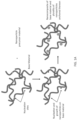
- FIG. 1B Such a nanocomposite is illustrated in FIG. 1B , showing a nanocomposite 100 comprising graphite as the two-dimensional, layered base material.
- the plurality of layers 102 of graphite includes multiple layers 102a-d of graphene (an individual layer of graphite is a graphene layer).
- the plurality of layers 104 of nanoparticles includes individual layers 104a-d of nanoparticles.
- the multiple layers 102a-d and the individual layers 104a-d are interleaved with one another to form the larger stack which constitutes the nanocomposite.
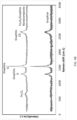
- FIG. 4A shows XRD spectra of a nanocomposite (top) formed using a method similar to that shown in FIG. 2 (see “method 3" described in the Example, below).
- the nanocomposite is composed of graphite as the base material and a plurality of Fe 3 O 4 nanoparticles.
- the inset marks the characteristic peaks associated with graphite (cross) and with Fe 3 O 4 nanoparticles ( ⁇ ).
- the large (002) peak at 20 24-28° confirms that the nanocomposite contains graphite and is free of isolated graphene.
- a nanocomposite containing graphene would have at most a minor bump and no distinct peak at this range.
- a nanocomposite containing graphene would have its 2D peak signficantly higher than the G peak and there would be no shoulder in the 2D peak.By "free” it is meant that the amount of isolated graphene is zero or small enough not to materially affect the properties of the nanocomposite (e.g., the oil-absorbing capacity of a sponge coated with the nanocomposite).
- similar confirmation may be carried out to confirm that the nanocomposite is free of isolated layers of the two-dimensional, layered material.
- base material may be used as the base material besides graphite.
- base materials include transition metal dichalcogenides, e.g., MX 2 , wherein M is Mo or W and X is S, Se or Te.
- Combinations of different base materials may be used in the nanocomposite.
- the nanoparticles are magnetic nanoparticles.
- Hard magnetic materials may be used, e.g., CoCrPt, Co, Co 3 Pt, FePd, FePt, CoPt, CoPd, FeCo, MnAl, Fe 14 Nd 2 B, SmCo 5 .
- Soft magnetic materials may be used, e.g., Fe 3 O 4 , MnFe 2 O 4 , NiFe 2 O 4 , MgFe 2 O 4 .
- Soft magnetic materials include the following soft magnetic ferrite compounds having the formula M' x M" 1-x Fe 2 O 4 , wherein M' and M" are different and are independently selected from Co, Ni, Zn, Ba, Sr, Mg, Mn and 0 ⁇ x ⁇ 1. In some such embodiments, 0.1 ⁇ x ⁇ 0.9.
- Other soft magnetic materials include Fe-Si alloy, Ni-Fe alloy, and nano-crystalline alloy of Fe, Ni and/or Co with B, C, P, or Si.
- the nanoparticles may be distributed uniformly (by which it is meant that the nanoparticles are separated by approximately equal distances) across the surfaces of the adjacent material (i.e., the layers of the two-dimensional, layered base material) with which they are in contact.
- the individual layers of nanoparticles may be free from aggregated nanoparticles. By “free” it is meant that the amount of aggregates is zero or small enough not to materially affect the properties of the nanocomposite (e.g., the oil-absorbing capacity of a sponge coated with the nanocomposite).
- Nanoparticles having a variety of different sizes and shapes may be used.
- the term “nanoparticles” or “nanocomposite” is not meant to be limiting to a particular size.
- the nanoparticles may have each of their three dimensions on the order of 1000 nm or less.
- the nanoparticles may be spherical, but this term encompasses irregularly shaped particles which are still reasonably well defined three dimensions which are of similar magnitude.
- the nanoparticles may be characterized by an average diameter.
- the intimate association of the base material and the nanoparticles described above may be accomplished without any functionalization (i.e., covalently bound functional groups) of either the base material or the nanoparticles. That is, in embodiments, the base material, the nanoparticles, and thus, the nanocomposite are unfunctionalized. However, in embodiments, the nanoparticles are functionalized.
- the nanoparticles can be functionalized with one or more moieties during/after nanocomposite formation or during/after nanocomposite coating on porous substrates.
- the functional moieties can be oleophilic, superoleophilic, hydrophobic, or superhydrophobic or their combination to improve oleophilicity and/or hydrophobicity of the OHM porous material.
- the functional moieties can also be chosen to bind other pollutants in water such as heavy metals, bacteria, and microplastics, volatile organic compounds (VOCs), organic pollutants, pesticides, etc.
- the nanocomposite may include various relative amounts of the base material component and the nanoparticles component, depending upon the desired properties for the OHM porous material and the desired application.
- the loading of the nanoparticles in the nanocomposite is in the range of from 10 weight% to 90 weight%.
- weight% is (weight of the nanoparticles)/(total weight of the nanocomposite)* 100. This includes a range of from 20 weight% to 80 weight%, from 30 weight% to 70 weight%, from 40 weight% to 60 weight%, etc.
- porous substrates may be used to form the OHM porous materials.
- the porous substrate may be composed of natural or synthetic materials; be woven or nonwoven; and may assume a variety of forms (e.g., two-dimensional forms such as membranes, sheets, strips, etc. or three-dimensional forms such as pads, balls, blocks, etc.)
- the porous substrates may be referred to as sponges, foams, filters, etc.
- the porous substrates may be described as a solid matrix in the form of network of interconnected strands which extend (e.g., randomly, although regularly oriented strands such as those in woven textiles may be used) in three-dimensions to define a plurality of pores and elongated, tortuous channels distributed throughout the solid matrix.
- this solid matrix may be composed of a variety of natural or synthetic materials (including combinations thereof).
- Illustrative materials for the solid matrix include polyurethane, cellulose, melamine, polyimide, acrylic, polyamide, polyester, polycarbonate, and polyaramide.
- the "surfaces" of the solid matrix may refer to external surfaces (those facing away from the body of the solid matrix) as well as internal surfaces (those facing towards the interior of the body of the solid matrix).
- the size and shape of the pores/channels of the solid matrix, as well as its porosity, are not particularly limited.
- these parameters may be tuned as desired, e.g., to provide a particular absorbency for a particular type of oil, particular mechanical properties (e.g., rigidity/flexibility) for a particular type of application, etc.
- the overall size and shape of the solid matrix is also not particularly limited, but depends upon the application.
- the porous substrates are coated with any of the nanocomposites described above to form the OHM porous materials.
- Various loadings of the nanocomposite onto the solid matrix of the porous substrate may be used.
- the loading of the nanocomposite in the OHM porous material is in the range of from 1 weight% to 20 weight%.
- “weight%” is (weight of the nanocomposite)/(total weight of the OHM porous material)*100. This includes a range of from 1 weight% to 18 weight%, from 5 weight% to 15 weight%, from 12 weight% to 14 weight%, etc.
- the loading may also be tuned to provide a certain surface coverage of the nanocomposite on the surfaces of the solid matrix (e.g., to provide a continuous coating) as well as to provide a nanocomposite coating having a desired thickness.
- the nanocomposite coating has an average thickness in the range of from 300 nm to 3 ⁇ m, from 10 ⁇ m to 100 ⁇ m, from 20 ⁇ m to 75 ⁇ m, or from 30 ⁇ m to 50 ⁇ m. However, in embodiments, the average thickness is less than 10 ⁇ m, e.g., in a range of from 1 ⁇ m to 10 ⁇ m.
- hydrophobicity may be quantified by measuring a contact angle for a droplet of water (e.g., pure water) deposited on a surface of the OHM porous material.
- the contact angle for a droplet of water deposited on a surface of the OHM porous material is at least 120°, at least 122°, at least 125°, at least 130°, at least 135°, or at least 140°.
- Such a method comprises immersing any of the disclosed porous substrates in a formulation comprising any of the disclosed nanocomposites for a period of time to form a coating of the nanocomposite on surfaces of the solid matrix of the porous substrate.
- Immersion may be accompanied by mixing the formulation, including by sonication.
- Immersion may be carried out at room temperature (20 to 25°C). However, in embodiments, higher temperatures may be used.
- the coated solid matrix may then be heated at an elevated temperature (i.e., greater than room temperature) for a period of time to provide the OHM porous material.
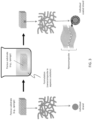
- An illustrative method of making an OHM porous material using a commercially available sponge as the porous substrate is depicted in FIG. 3 .
- Such a method comprises combining a first input stream of flowing fluid (i.e., gas or liquid or both) comprising a base material, a second input stream of flowing fluid comprising a nanoparticle precursor material, and a third input stream of flowing fluid comprising a nanoparticle nucleation agent, to form an output stream of flowing fluid.
- the fluid is a liquid.
- the input streams need not be continuous in nature, e.g., discrete or repeated injections of the respective materials/agents may be used.
- the output stream is heated or sonicated or both for a period of time.
- the result of this step is nucleation and growth of a plurality of nanoparticles on a surface of the base material from the nanoparticle precursor material and the nucleation agent. That is, nanoparticle nucleation and growth, induced by the nucleation agent, occurs on the surface of the base material to provide a nanoparticle directly anchored thereon.
- the nanoparticles essentially become a part of, or embedded within, the base material. This is different than nanoparticles adsorbed onto a surface of a substrate or covalently bound via a functional group.
- this step also achieves or maintains exfoliation (separation) of the base material into sub-stacks of multiple layers of the two-dimensional, layered material as well as nucleation and growth of nanoparticles on those sub-stacks.
- the base material may be pre-exfoliated, e.g., by being sonicated prior to being combined to form the output stream (i.e., pre-sonicated).
- a nanocomposite formed within the fluid of the output stream is collected. This may comprise collecting the output stream and subjecting it to a processing step(s) to recover the nanocomposite.
- precipitation of the nanocomposite within the liquid of the output stream may be induced. Precipitation may be induced by stopping the sonication for another period of time. The flow rate of the output stream may also be decreased or stopped. Precipitation may be induced by collecting the output stream, e.g., into a container in the absence of sonication so the precipitate may settle out of the liquid.
- the base material is the two-dimensional, layered material
- precipitation also achieves self-assembly of the sub-stacks to form the larger stack constitutes the nanocomposite as described above.
- the use/type of sonication, the periods of time, and the flow rate may be adjusted to facilitate formation of nanoparticles and nanocomposites having the characteristics described above. Illustrative conditions are described in the Example, below (see “method 3").
- the flowing liquid may be water or an aqueous solution. However, organic solvents may also be used.
- the method may be carried out at room temperature, although in embodiments, higher temperatures may be used.
- the Example also shows how other methods do not necessarily achieve nanocomposites having all the characteristics described above (see “method 1" and "method 2").
- a flow reactor may be used to carry out the method described above.
- An embodiment of such a flow reactor is shown in FIG. 2 .
- the nucleating agent is a separate input stream added downstream of the other input streams.
- Various numbers of input streams and various orders of combining them may be used (provided they are combined into the single output stream).
- Other types of input streams may include input streams comprising other additives (e.g., reducing agents, surfactants), other solvents, etc.
- the specific nanoparticle precursor materials and nucleating agents depends upon the choice of the desired nanocomposite.
- transition metal-containing magnetic nanoparticles transition metal salts may be used as the nanoparticle precursor materials.
- the nucleation agent may be an oxidizing agent (e.g., a base such as NaOH).
- a base such as NaOH.
- FIG. 2 for two-dimensional, layered materials such as graphite, exfoliation of the graphite to sub-stacks, nanoparticle nucleation and formation on the sub-stacks, and restacking of decorated sub-stacks to form the larger stack occurs, in situ, within the flowing liquid of the output stream.
- the precipitate may be separated, washed and dried prior to use.
- the nanocomposite is in the form of a powder.
- the nanocomposite may be provided as a formulation comprising water or an aqueous solution. That formulation may be used in the immersion step to form the coating on the solid matrix of the porous substrate.
- the OHM porous materials may be used in a variety of applications. However, the OHM porous materials are particularly useful in recovering hydrophobic materials, e.g., oil from a mixture comprising water and a hydrophobic material.
- such a method comprises contacting any of the disclosed OHM porous materials with a mixture comprising water and a hydrophobic material for a period of time to absorb the hydrophobic material from the mixture. Absorption of the hydrophobic material from the mixture by the OHM porous material results in a hydrophobic material-containing OHM porous material and reduces the content of the hydrophobic material in the mixture.
- "reducing" can include reducing the content of the hydrophobic material in the mixture to zero (or so close to zero that any small amount of the hydrophobic material remaining does not materially affect the properties of the water).
- the mixture from which the hydrophobic material is to be recovered may include various relative amounts of the hydrophobic material and the water.
- the mixture may be an emulsion comprising either relatively small amounts of the hydrophobic component as compared to water or relatively small amounts of water as compared to the hydrophobic component.
- Hydrophobic materials include oils such as crude oil, diesel, gasoline, paraffin oil, motor oil, pump oil, lubricating oil, kerosene, petroleum ether, vegetable oils (e.g., soybean oil, sunflower oil, etc.), fatty oils (also fatty acids and alcohols), etc.
- Hydrophobic materials also include smaller organic molecules which are insoluble and/or immiscible with water such as chloroform, toluene, hexane, octane, decane, dodecane, phenixin, benzene, chlorobenzene, nitrobenzene, dichloromethane, etc.
- the hydrophobic materials may be present on a surface of the water or below the surface of the water. A variety of other components may be present in the mixture, depending upon its source.
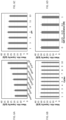
- commercial sponges coated with graphite/magnetic nanoparticle nanocomposites effectively and efficiently absorb a wide variety of oils and smaller organic molecules from mixtures having various pHs (1 to 13) and salinity levels (0 to 1 M NaCl). (See also, FIGs. 6A-6D and 7. )
- the mixture from which the hydrophobic material is to be recovered may be that which has been generated in a laboratory or a manufacturing plant or the like; a household environment (e.g., kitchen) or the like (e.g., restaurant); etc.
- the mixture may also be that which is part of a body of water such as a pool, a pond, lake, ocean, creek, stream, river, etc.
- the OHM porous materials may be used when such bodies of water become contaminated with oil due to leaks from windmills, boats, yachts, shipping vessels, cargo ships, etc.
- Another similar application includes soil remediation in which the mixture is a soil-water mixture contaminated with a hydrophobic material.
- Another similar application includes wastewater treatment in which water has become contaminated with a hydrophobic material, e.g., during fracking.
- the type of contact of the OHM porous material and the water/hydrophobic material mixture is not particularly limited, but rather depends upon the morphology of the porous substrate of the OHM porous material, the type of hydrophobic material, and the application environment.
- the porous substrate may be in the form of a planar membrane or a column packed with the porous substrate (e.g., in bead form) and the contact is carried out by passing the water/hydrophobic material mixture through the membrane or column.
- the porous substrate may be in the form of a sheet or pad (e.g., facial/body wipe, mop head, sponge, etc.) and the contact is carried out by placing the OHM porous material on the water/hydrophobic material mixture.
- the porous substrate may be in the form of a sponge or a foam and the contact is carried out by immersing (partially or completely) the OHM porous material into the body of water.
- the OHM porous material may be used as the filling in booms configured to contain an oil spill.
- the type of contact and the period of time of contact may be adjusted to optimize (e.g., maximize) the absorption/recovery of the hydrophobic material by the OHM porous material.
- These parameters also depend upon the morphology of the porous substrate of the OHM porous material, the type of hydrophobic material, the application environment, as well as the relative size of the OHM porous material to the volume of the mixture. These parameters may be adjusted so that the OHM porous material absorbs/recovers at least 80%, at least 85%, at least 90%, at least 95%, at least 98% or 100% of the hydrophobic material from the mixture. At the same time, these parameters may be adjusted to minimize the amount of water absorbed by the OHM porous material.
- the OHM porous material absorbs no more than 20% water, no more than 15% water, no more than 10% water, no more than 5% water, no more than 1% water or 0% water from the mixture.
- the OHM porous material absorbs 30 times its weight of hydrophobic material from the mixture.
- the recovery of the hydrophobic material from the mixture by the OHM porous material may be 100%.
- the absorbed hydrophobic material may be released from the OHM porous material.
- the release technique may depend upon the morphology of the porous substrate of the OHM porous material, the type of hydrophobic material, and the application environment.
- An illustrative release technique is depicted in FIG. 10 , showing an OHM sponge containing absorbed oil that is deformed (e.g., by compressing, squeezing, etc.) to release the absorbed oil from the OHM sponge. Some or all of the released oil may be recycled for use in other applications.
- Another illustrative release technique leverages the magnetic nanoparticles present in the nanocomposite coating.
- Such a technique comprises exposing the hydrophobic material-containing OHM porous material to a radio-frequency (RF) field for a period of time.
- the RF field thermally activates the magnetic nanoparticles of the nanocomposite to generate heat.
- the RF field strength, frequency, and time may be adjusted to optimize (e.g., maximize) release of the hydrophobic material.
- the nanocomposite coating may include other materials that may be stimulated via other techniques and which may facilitate the release of the hydrophobic material.
- Au nanorods and/or MoS 2 can be photothermally activated and hence can generate heat in presence of near infra-red light.
- the method of recovering hydrophobic materials may further comprise repeating the contact and release steps one or more additional times, thereby highlighting another advantage of the OHM porous materials-reusability.
- the Example below demonstrates that commercial sponges coated with graphite/magnetic nanoparticle nanocomposites may be reused many times to recover oil from oil-water mixtures with little change in their absorption capabilities. (See also, FIGs. 6B and 7 .)
- the presence of magnetic nanoparticles in the OHM porous materials provides an additional advantage in that the OHM porous materials may be exposed to a magnetic field (e.g., from a permanent magnet, an electromagnet, gradient magnetic field, etc.) at any point during the recovery method to move the OHM porous material, e.g., to a different location including a different location within the water/hydrophobic material mixture. This is particularly useful when the volume of the water/hydrophobic material is significantly greater than the size or capacity of an individual OHM porous material.
- a magnetic field e.g., from a permanent magnet, an electromagnet, gradient magnetic field, etc.
- Polyurethane (PU) sponge was purchased from McMaster Carr and cut into pieces of size 1 cm x 1 cm x 2 cm. The cut pieces were used as it is.
- Method 1- 800 mg Fe 3 O 4 Nanoparticles (5 nm) (from above), 800 mg graphite (flake size ⁇ 50 ⁇ m), and 800 mL of deionized (DI) water were charged into a 2L beaker and probe sonicated for 1 hour. The mixture was left to settle down and the precipitate was collected and washed with water and dried in the oven at 60°C overnight.
- DI deionized
- Method 2- 500 mg graphite and 50 ml 1 M NaOH solution in water were mixed and sonicated. After 10 minutes, stock solution (25 ml 0.2 M FeCl 3 .4H 2 O + 25 ml 0.1 M FeCl 2 .6H 2 O) was added during sonication and sonication was continued for 10 minutes to 1 hour. The mixture was left to settle down and the precipitate was collected and washed with water and dried in the oven at 60°C overnight.
- stock solution 25 ml 0.2 M FeCl 3 .4H 2 O + 25 ml 0.1 M FeCl 2 .6H 2 O
- Method 3 A flow reactor with three channels (although four may be used as shown in FIG. 2 ) was used for this method.
- channel 1 partially exfoliated graphite (pre-sonicated 10 mins, 5 mg/ml, 100 ml) in water was used.
- nanoparticle precursors 25 ml 0.2 M FeCl 3 .4H 2 O + 25 ml 0.1 M FeCl 2 .6H 2 O
- channel 3 1 M NaOH solution in water was used. All three stock solutions were run through 3 different channels via peristaltic pump and mixed.
- the output stream was sonicated. Different flow rates were used for the output stream, e.g., from 30 mL/min to 150 mL/min. Next, the mixture was left to settle down to induce precipitation. The precipitate was collected and washed with water and dried in the oven at 60 °C overnight.
- PU sponges were wetted in water first and then dipped into the graphite/Fe 3 O 4 nanocomposite solution (formed either via method 1, 2, or 3) in such a way that they were hanging 3 cm below the meniscus of the nanocomposite solution. Probe sonication was applied for 10 minutes and was turned off afterwards, resulting in the in-situ formation of a coating of the graphite/Fe 3 O 4 nanocomposite on the PU sponge.
- the mixture was allowed to settle down and the nanocomposite coated PU sponges (referred to as OHM sponges) were removed from solution after 1 hour and washed with water to remove any excess nanocomposite material from the sponge.
- the nanocomposite coated PU sponges were left in the oven at 60°C for 1 hour.
- X-ray Diffraction (XRD): The crystal structure of the composite was observed on Scintag powder XRD.
- Raman spectra were taken on a Horiba LabRam Confocal Raman with the 633 nm laser using the HJY Detector, x100 objective sense, 600 gr/mm filter and 10% filter. This pattern represents an average of 207 spectra in a small map area, where each spectrum had an acquisition time of 3 seconds for 2 accumulations.
- Electron energy loss spectroscopy was performed on ultramicrotomed sections of the OHM sponge in Dual EELS acquisition mode with a Gatan GIF Quantum ER mounted on a JEOL ARM200CF. The instrument was operated at 200kV in STEM mode with a camera length of 6 cm. Beam-induced changes to the ⁇ peak in the material after spectra were not observed.
- the convergence semi-angle of the probe was 21 mrad and spectrometer was operated with a dispersion of 0.025 eV/channel and a high loss energy shift in Dual EELS of 270 eV; the full width at half maximum of the zero-loss peak was measured as 1 eV under these conditions.
- Using a spectrometer entrance aperture of 5 mm gave a collection semiangle of 60 mrad.
- Energy dispersive X-Ray spectroscopy (EDS) was performed simultaneously to EELS.
- EDS on ultramicrotomed sections of the OHM sponge was performed with a Hitachi HD 2300 Scanning Transmission Electron Microscope operated at 200 kV and equipped with 2 SDD EDS detectors. For the EDS map, 100 frames were collected and averaged over nearby pixels using a 5x5 kernel.
- ICP-MS Inductively Coupled Plasma-Mass Spectrometry
- M-H hysteresis loops and field-cooled (FC)/zero-field-cooled (ZFC) magnetization curves of MFe 2 O 4 magnetic nanoparticles were recorded using a physical property measurement system (Quantum Design Dyanacool-PPMS).
- FIG. 3 illustrates the process of coating the PU sponge with the graphite/Fe 3 O 4 nanocomposite.
- FIGs. 5A-5B The oleophilic and hydrophobic characteristics of the OHM sponge are demonstrated in FIGs. 5A-5B .
- the water droplet stays as it is on the OHM sponge while as shown in FIG. 5B , the oil spreads out and gets absorbed into the sponge.
- FIG. 5A shows the results of contact angle measurements with water and oil on the OHM sponge, respectively.
- the high contact angle of 122.5° for water confirms the hydrophobic nature of the OHM sponge while the ⁇ 0° contact angle for oil confirms its oleophilic nature.
- the hydrophobicity of OHM sponge remained the same for water droplets with different pHs and salinity levels. Similar water contact angles were observed for pH 3 to 10 (133° to 138°) and salinity levels of 0M to 2M NaCl (123° to 133°).
- the OHM sponge selectively absorbs oil from oil/water mixtures, including hydrophobic materials that are heavier than water (such as chloroform).
- hydrophobic materials that are heavier than water (such as chloroform).
- the OHM sponge was been tested with 7 types of oil/hydrophobic materials varying in density and viscosity including hexane (0.66 g/mL/0.30 cP), octane (0.70 g/mL/0.54 cP), decane (0.73 g/mL/0.80 cP), dodecane (0.75 g/mL/1.36 cP), chloroform (1.47 g/mL/0.53 cP), motor oil (0.87 g/mL/180 cP), and pump oil (0.88 g/mL/150 cP).
- a value of 30 g/g means that 100 g of hydrophobic material can be absorbed by 3.33 g of OHM sponge.
- graphite constitutes of only 3 weight % of the OHM sponge.
- effectively 100 g of hydrophobic material is absorbed by 0.1 g of graphite.
- This makes the absorption capacity of the graphite in the OHM sponge 1000.
- This extremely high number is believed to be due to enhancement in graphite's morphology due to the intercalation of the Fe 3 O 4 nanoparticles as well as the 95-97% porosity of the PU sponge.
- this provides the OHM sponge with an enormous capacity to capture and store hydrophobic materials such as oil.
- magnetic nanoparticles such as Fe 3 O 4 nanoparticles also provides additional functionality to the OHM sponge, including the ability to achieve controlled movement of the OHM sponge in presence of external magnetic field.
- the magnetic response of the OHM sponge was evaluated. When a permanent magnet (NdFeB) is brought close to the OHM sponge, the OHM sponge immediately responds and sticks to the magnet due to the high magnetic susceptibility and superparamagnetic properties of the magnetic nanoparticles. Any type of permanent magnet or strong magnet or electromagnet may be used.
- the magnetic properties of the magnetic nanoparticles were confirmed by M-H hysteresis loops (not shown).
- the saturation magnetization (Ms) of Fe 3 O 4 and MnFe 2 O 4 magnetic nanoparticles were found to be 65 and 75 emu/g, respectively.
- T b blocking temperature
- FC field-cooling
- ZFC zero-field-cooling
- the ability of the magnetic nanoparticles to heat under radio-frequency (RF) field provides an additional mode to release the adsorbed component without any squeezing or mechanical operation. Since the magnetic nanoparticles are uniformly dispersed throughout the nanocomposite coating in the OHM sponge, components (e.g. oil) absorbed in the OHM sponge may be desorbed due to local heating provided by the magnetic nanoparticles.
- a time temperature plot of a MnFe 2 O 4 /graphite nanocomposite slurry under RF field showed it can be thermally activated to generate significant heating under RF field (data not shown). The whole release process can be programmed in a stimulated and remote manner by controlling the RF field.
- Azerbaijan heavy crude oil (viscosity of 8000-10000 cP) was used.
- MnFe 2 O 4 magnetic nanoparticles were selected due to their high thermal activation properties (or SAR).
- a graphite/MnFe 2 O 4 nanocomposite was formed according to method 3 and used to coat PU sponges, thus forming OHM sponges.
- Two OHM sponges, laden with Azerbaijan heavy crude oil, were selected and one was kept under RF field (300 kHz, 5 kW) for 50 minutes while other was kept at ambient conditions as a control sample. Both the OHM sponges were weighed before and after application of RF field and the amount of released oil was calculated.
- this Example reports the formation of an OHM sponge by coating a commercially available polyurethane sponge with a multifunctional nanocomposite material.
- the OHM sponge serves as a versatile oil remediation platform.
- the porosity of the sponge provides a high volume in which to store hydrophobic materials such as oil while the nanocomposite coating provides a multifunctional surface for selectively adsorbing the hydrophobic material from water.
- the OHM sponge is superior to existing oil remediation approaches: First, it is eco-friendly as it has no carbon footprint or and does not present a danger to marine life. Second, it is efficient due to its re-usability, selectivity, and on-demand recovery.
- the OHM sponge may be used for a variety of water and air remediation applications.
- modulating the nanocomposite coating on a sponge or other porous substrate By modulating the nanocomposite coating on a sponge or other porous substrate, other pollutants in water and air can be selectively removed and recovered.
- the RF stimulated release of adsorbed components in a remote manner allows one to remove and recover the pollutants that cannot be recovered by squeezing or wringing the porous substrate.
- recovery can be further tuned by modulating the RF field strength, frequency, and time.
- OHM sponge as an oil-water separator (filter).
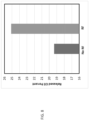
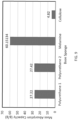
- the OHM sponge was used as an oil-water separator from a mixture in which oil was present in the minority (1-2000 ppm).
- oil-water mixture is passed through a column of pieces of the OHM sponge, the oil gets absorbed into OHM sponge and clean water passes through as a filtrate.
- an oil-water emulsion with 2000 ppm oil in water was prepared by mixing 2g of oil in 1 L of water and pulsing it in a blender for 30 seconds.
- a column was set up in which an OHM sponge prepared as described above was cut into small cubic pieces having dimensions of 0.25" to 0.5" to maximize the surface area and residence time (time taken to pass the oil-water mixture through the column).
- the sponge pieces were placed into a cylindrical column having a diameter of 0.5" and a height of 3".
- the oil-water mixture was poured into the column at the top and the filtrate was collected from the bottom of the column.
- Oil Removal Capacity (%) (Abs@470 nm before filtration - Abs@470 nm after filtration)/(Abs@470 nm before filtration).
Landscapes
- Chemical & Material Sciences (AREA)
- Organic Chemistry (AREA)
- Chemical Kinetics & Catalysis (AREA)
- Analytical Chemistry (AREA)
- Engineering & Computer Science (AREA)
- Inorganic Chemistry (AREA)
- Life Sciences & Earth Sciences (AREA)
- Materials Engineering (AREA)
- Oil, Petroleum & Natural Gas (AREA)
- Environmental & Geological Engineering (AREA)
- Nanotechnology (AREA)
- General Chemical & Material Sciences (AREA)
- Hydrology & Water Resources (AREA)
- Water Supply & Treatment (AREA)
- Crystallography & Structural Chemistry (AREA)
- General Life Sciences & Earth Sciences (AREA)
- Geology (AREA)
- Health & Medical Sciences (AREA)
- Electrochemistry (AREA)
- Composite Materials (AREA)
- Public Health (AREA)
- Physics & Mathematics (AREA)
- Wood Science & Technology (AREA)
- Condensed Matter Physics & Semiconductors (AREA)
- General Physics & Mathematics (AREA)
- Electromagnetism (AREA)
- Toxicology (AREA)
- General Health & Medical Sciences (AREA)
- Carbon And Carbon Compounds (AREA)
- Battery Electrode And Active Subsutance (AREA)
- Hard Magnetic Materials (AREA)
- Laminated Bodies (AREA)
- Physical Or Chemical Processes And Apparatus (AREA)
- Manufacturing Of Micro-Capsules (AREA)
Claims (12)
- Oleophiles hydrophobes magnetisches (OHM) poröses Material zum Rückgewinnen eines hydrophoben Materials aus einem Gemisch, das OHM poröse Material umfassend ein poröses Substrat, das eine feste Matrix aufweist, die eine Vielzahl von Poren definiert, die durch die feste Matrix verteilt sind, das OHM poröse Material ferner umfassend eine Beschichtung aus einem Nanoverbundstoff (100) auf Oberflächen der festen Matrix, dadurch gekennzeichnet, dassder Nanoverbundstoff (100) einen mehrschichtigen Stapel aus einer Vielzahl von Schichten aus Graphit (102) umfasst, jede Graphitschicht (102a-d) in der Vielzahl von Schichten aus Graphit (102) umfassend mehrere Graphenschichten und jede Graphitschicht (102a-d) Keimbildungsstellen darauf aufweist, der Nanoverbundstoff (100) ferner umfassend eine Vielzahl von Schichten aus magnetischen Nanopartikeln (104), die mit der Vielzahl von Schichten aus Graphit (102) verschachtelt sind, wobei einzelne Schichten aus magnetischen Nanopartikeln (104a-d) in der Vielzahl von Schichten aus magnetischen Nanopartikeln (104) über die Keimbildungsstellen jeweils direkt auf einer Oberfläche einer Graphitschicht (102a-d) der Vielzahl von Schichten aus Graphit (102) verankert sind und einzelne Schichten aus magnetischen Nanopartikeln (104a-d) jeweils durch eine Graphitschicht (102a-d) der Vielzahl von Schichten aus Graphit (102) getrennt sind,ferner wobei benachbarte Schichten in dem mehrschichtigen Stapel durch van-der-Waals-Kräfte zusammengehalten werden, sodass der Nanoverbundstoff (100) frei von isolierten Graphenschichten ist.
- OHM poröses Material nach Anspruch 1, wobei die Nanopartikel und die Vielzahl von Schichten aus Graphit (102) nicht funktionalisiert sind; wobei die magnetischen Nanopartikel Eisen, Eisenoxid oder eine Legierung aus Eisen oder Eisenoxid umfassen; wobei der Nanoverbundstoff (100) frei von aggregierten magnetischen Nanopartikeln ist; oder wobei die magnetischen Nanopartikel einen durchschnittlichen Durchmesser aufweisen, sodass die magnetischen Nanopartikel ein superparamagnetisches Verhalten zeigen.
- OHM poröses Material nach Anspruch 1, wobei die feste Matrix aus Polyurethan, Cellulose, Melamin, Polyimid, Acryl, Polyamid, Polyester, Polycarbonat, Polyaramid oder Kombinationen davon besteht.
- OHM poröses Material nach Anspruch 1, wobei der Nanoverbundstoff (100) eine Beschichtung auf der festen Matrix mit einer durchschnittlichen Stärke in einem Bereich von 300 nm bis 3 µm bildet.
- Verfahren zum Rückgewinnen eines hydrophoben Materials aus einem Gemisch, das Verfahren umfassend ein Inkontaktbringen des OHM porösen Materials nach Anspruch 1 mit einem Gemisch, umfassend ein hydrophobes Material, über eine bestimmte Zeitdauer, um mindestens einen Teil des hydrophoben Materials aus dem Gemisch auf dem OHM porösen Material zu absorbieren und das Gemisch mit einer reduzierten Menge des hydrophoben Materials zu versehen.
- Verfahren nach Anspruch 5, wobei das hydrophobe Material ein Öl oder eine wasserunlösliche organische Verbindung oder eine mit Wasser nicht mischbare organische Verbindung oder Kombinationen davon ist.
- Verfahren nach Anspruch 5, ferner umfassend ein Freisetzen des absorbierten hydrophoben Materials aus dem OHM porösen Material.
- Verfahren nach Anspruch 7, wobei das Freisetzen dadurch erreicht wird, dass das OHM poröse Material einem externen Reiz zum Erzeugen von Wärme ausgesetzt wird, wobei der externe Reiz generell ein Feld mit Hochfrequenz (RF) ist, das über eine bestimmte Zeitdauer angelegt wird.
- Verfahren nach Anspruch 7, ferner umfassend ein Wiederholen des Inkontaktbringungs- und des Freisetzungsschritts ein oder mehrere zusätzliche Male.
- Verfahren zur Herstellung des OHM porösen Materials nach Anspruch 1, das Verfahren umfassend ein Eintauchen des porösen Substrats in eine Formulierung, umfassend den Nanoverbundstoff (100), über eine bestimmte Zeitdauer, um die Beschichtung der Oberflächen der festen Matrix zu bilden.
- Verfahren nach Anspruch 10, ferner umfassend ein Bilden des Nanoverbundstoffs (100) durch:(a) Kombinieren eines ersten Eingangsstroms eines fließenden Fluids, der von einem Strömungsreaktor bereitgestellt wird, der erste Eingangsstrom umfassend Graphit, eines zweiten Eingangsstroms eines fließenden Fluids, der von dem Strömungsreaktor bereitgestellt wird, der zweite Eingangsstrom umfassend ein magnetisches Nanopartikelvorläufermaterial, und eines dritten Eingangsstroms eines fließenden Fluids, der von dem Strömungsreaktor bereitgestellt wird, der dritte Eingangsstrom umfassend ein Nanopartikel-Keimbildungsmittel, um einen Ausgangsstrom eines fließenden Fluids zu bilden;(b) Beschallen des Ausgangsstroms über eine bestimmte Zeitdauer, um Exfoliation des Graphits in die Graphitschichten (102a-d) der Vielzahl von Schichten aus Graphit (102) und eine Keimbildung und Wachstum von magnetischen Nanopartikeln an den Keimbildungsstellen zu induzieren, um mit magnetischen Nanopartikeln dekorierte Graphitschichten zu bilden; und(c) Induzieren einer Wiederzusammensetzung der mit magnetischen Nanopartikeln dekorierten Graphitschichten und Präzipitation des Nanoverbundstoffs (100) in der Flüssigkeit des Ausgangsstroms.
- OHM poröses Material nach Anspruch 1, wobei der Nanoverbundstoff (100) frei von aggregierten magnetischen Nanopartikeln ist.
Applications Claiming Priority (3)
| Application Number | Priority Date | Filing Date | Title |
|---|---|---|---|
| US201962788347P | 2019-01-04 | 2019-01-04 | |
| US201962788321P | 2019-01-04 | 2019-01-04 | |
| PCT/US2019/067839 WO2020142267A1 (en) | 2019-01-04 | 2019-12-20 | Oleophilic hydrophobic magnetic porous materials |
Publications (4)
| Publication Number | Publication Date |
|---|---|
| EP3906112A1 EP3906112A1 (de) | 2021-11-10 |
| EP3906112A4 EP3906112A4 (de) | 2022-02-23 |
| EP3906112C0 EP3906112C0 (de) | 2025-03-26 |
| EP3906112B1 true EP3906112B1 (de) | 2025-03-26 |
Family
ID=71407407
Family Applications (2)
| Application Number | Title | Priority Date | Filing Date |
|---|---|---|---|
| EP19907115.0A Active EP3906112B1 (de) | 2019-01-04 | 2019-12-20 | Oleophile hydrophobe magnetische poröse materialien |
| EP19907789.2A Withdrawn EP3906215A4 (de) | 2019-01-04 | 2019-12-20 | Nanokomposite und verwandte verfahren |
Family Applications After (1)
| Application Number | Title | Priority Date | Filing Date |
|---|---|---|---|
| EP19907789.2A Withdrawn EP3906215A4 (de) | 2019-01-04 | 2019-12-20 | Nanokomposite und verwandte verfahren |
Country Status (5)
| Country | Link |
|---|---|
| US (2) | US12246968B2 (de) |
| EP (2) | EP3906112B1 (de) |
| ES (1) | ES3020958T3 (de) |
| MX (2) | MX2021008118A (de) |
| WO (2) | WO2020142267A1 (de) |
Families Citing this family (6)
| Publication number | Priority date | Publication date | Assignee | Title |
|---|---|---|---|---|
| EP3906112B1 (de) | 2019-01-04 | 2025-03-26 | Northwestern University | Oleophile hydrophobe magnetische poröse materialien |
| US20230159769A1 (en) * | 2019-03-20 | 2023-05-25 | Michael Podstawa | Methods of oil spill removal with a formulation and methods of manufacturing the formulation |
| WO2021173608A1 (en) * | 2020-02-24 | 2021-09-02 | Northwestern University | Magnetic nanoparticle coated porous materials for recovery of contaminants |
| CN112337137B (zh) * | 2020-10-19 | 2022-06-07 | 中国人民警察大学 | 新型磁性溢油污染洗消材料的制备方法及其应用 |
| CN114471440B (zh) * | 2022-01-28 | 2023-08-22 | 华北理工大学 | 二硫化钼@钴铁氧体萃取吸附剂及其制备方法与应用 |
| EP4375240A1 (de) * | 2022-11-22 | 2024-05-29 | Universidad Autónoma de Madrid | Verfahren zur abtrennung von nanokunststoffen aus wässrigen matrizen unter verwendung von russpartikeln |
Family Cites Families (23)
| Publication number | Priority date | Publication date | Assignee | Title |
|---|---|---|---|---|
| AU2001211277A1 (en) * | 2000-07-19 | 2002-01-30 | Neofytou Christodoulos Christodoulou | Porous and magnetic, inorganic-based composite material used as sorbent for cleaning water and the environment from oil spill |
| US6872330B2 (en) | 2002-05-30 | 2005-03-29 | The Regents Of The University Of California | Chemical manufacture of nanostructured materials |
| US7932408B2 (en) | 2006-09-29 | 2011-04-26 | Scientific Design Company, Inc. | Catalyst with bimodal pore size distribution and the use thereof |
| CA2741778C (en) | 2008-10-27 | 2018-05-01 | Advantageous Systems, Llc | Liquid purification using magnetic nanoparticles |
| WO2012155196A1 (en) | 2011-05-13 | 2012-11-22 | University Of Wollongong | Spray pyrolysis method for in situ production of graphene oxide based composites |
| WO2012174616A1 (ru) | 2011-06-21 | 2012-12-27 | Бакинский Государственный Университет | Пористый магнитный сорбент |
| EP2743232A4 (de) | 2011-08-08 | 2015-11-25 | Ajinomoto Kk | Poröse struktur und herstellungsverfahren dafür |
| US9911974B2 (en) | 2011-10-14 | 2018-03-06 | Wayne State University | Composite anode for lithium ion batteries |
| IN2015DN01933A (de) | 2012-08-17 | 2015-08-07 | Su Holding Ab | |
| KR20140073720A (ko) | 2012-12-06 | 2014-06-17 | 연세대학교 산학협력단 | 전이금속 산화물/그래핀 나노복합소재 및 이의 제조방법 |
| US20140183415A1 (en) * | 2012-12-31 | 2014-07-03 | Cheil Industries Inc. | Graphene-Based Composite and Method of Preparing the Same |
| US20160243523A1 (en) | 2013-09-30 | 2016-08-25 | Council Of Scientific & Industrial Research | Magnetic nanoparticles decorated activated carbon nanocomposites for purification of water |
| CN103965835A (zh) | 2014-05-13 | 2014-08-06 | 西南石油大学 | 一种超轻的磁性吸油材料及其制备方法 |
| US10581062B2 (en) * | 2015-01-14 | 2020-03-03 | Northwestern University | Nanocubic Co3O4/few-layer graphene composites and related anode components |
| EP3325143A4 (de) | 2015-07-23 | 2019-01-23 | The Regents of the University of California | Magnetischer hydrophober poröser graphenschwamm für umweltanwendungen und biologische/medizinische anwendungen |
| US10149862B2 (en) * | 2015-11-17 | 2018-12-11 | Alfaisal University | Method of making nanocomposites of metal oxide and reduced graphene oxide and use for cancer treatment |
| WO2017125819A1 (en) | 2016-01-18 | 2017-07-27 | King Abdullah University Of Science And Technology | Expansion and exfoliation of graphite to form graphene |
| KR101943941B1 (ko) | 2016-10-05 | 2019-04-17 | 한국에너지기술연구원 | 자성 철산화물 나노입자를 함유한 산소분리용 중공사막의 제조방법 |
| US10211455B2 (en) | 2017-02-20 | 2019-02-19 | Nanotek Instruments, Inc. | Lithium secondary batteries containing protected particles of anode active materials and method of manufacturing |
| US11591223B2 (en) | 2017-08-15 | 2023-02-28 | Northwestern University | Nanocomposites, nanocomposite sensors and related methods |
| US11492272B2 (en) | 2018-06-22 | 2022-11-08 | Board Of Trustees Of The University Of Arkansas | Magnetic, superhydrophobic and superoleophilic medium, synthesizing methods and applications of same |
| EP3906112B1 (de) | 2019-01-04 | 2025-03-26 | Northwestern University | Oleophile hydrophobe magnetische poröse materialien |
| WO2021173608A1 (en) | 2020-02-24 | 2021-09-02 | Northwestern University | Magnetic nanoparticle coated porous materials for recovery of contaminants |
-
2019
- 2019-12-20 EP EP19907115.0A patent/EP3906112B1/de active Active
- 2019-12-20 US US17/417,684 patent/US12246968B2/en active Active
- 2019-12-20 MX MX2021008118A patent/MX2021008118A/es unknown
- 2019-12-20 WO PCT/US2019/067839 patent/WO2020142267A1/en not_active Ceased
- 2019-12-20 EP EP19907789.2A patent/EP3906215A4/de not_active Withdrawn
- 2019-12-20 ES ES19907115T patent/ES3020958T3/es active Active
- 2019-12-20 WO PCT/US2019/067782 patent/WO2020142261A1/en not_active Ceased
- 2019-12-20 US US17/417,328 patent/US12281017B2/en active Active
- 2019-12-20 MX MX2021008119A patent/MX2021008119A/es unknown
Also Published As
| Publication number | Publication date |
|---|---|
| MX2021008118A (es) | 2021-08-05 |
| US20220059839A1 (en) | 2022-02-24 |
| ES3020958T3 (en) | 2025-05-23 |
| EP3906112C0 (de) | 2025-03-26 |
| EP3906215A4 (de) | 2022-02-23 |
| US12281017B2 (en) | 2025-04-22 |
| US20220118422A1 (en) | 2022-04-21 |
| WO2020142267A1 (en) | 2020-07-09 |
| EP3906112A1 (de) | 2021-11-10 |
| US12246968B2 (en) | 2025-03-11 |
| WO2020142261A1 (en) | 2020-07-09 |
| MX2021008119A (es) | 2021-08-05 |
| EP3906112A4 (de) | 2022-02-23 |
| EP3906215A1 (de) | 2021-11-10 |
Similar Documents
| Publication | Publication Date | Title |
|---|---|---|
| US12246968B2 (en) | Oleophilic hydrophobic magnetic porous materials | |
| Deng et al. | Fabrication of a novel NiFe2O4/Zn-Al layered double hydroxide intercalated with EDTA composite and its adsorption behavior for Cr (VI) from aqueous solution | |
| Gallo-Cordova et al. | Superparamagnetic nanosorbent for water purification: Assessment of the adsorptive removal of lead and methyl orange from aqueous solutions | |
| Zahid et al. | Metal ferrites and their graphene-based nanocomposites: synthesis, characterization, and applications in wastewater treatment | |
| Vergis et al. | Removal of Evans Blue dye from aqueous solution using magnetic spinel ZnFe2O4 nanomaterial: Adsorption isotherms and kinetics | |
| Talebzadeh et al. | CeO2 nanoparticles supported on CuFe2O4 nanofibers as novel adsorbent for removal of Pb (II), Ni (II), and V (V) ions from petrochemical wastewater | |
| Han et al. | Highly efficient organic dye removal from waters by magnetically recoverable La2O2CO3/ZnFe2O4-reduced graphene oxide nanohybrid | |
| Zhang et al. | Magnetic hollow carbon nanospheres for removal of chromium ions | |
| Xu et al. | Removal of Pb (II) from aqueous solution by hydrous manganese dioxide: adsorption behavior and mechanism | |
| Zhou et al. | Glycine-assisted hydrothermal synthesis and adsorption properties of crosslinked porous α-Fe2O3 nanomaterials for p-nitrophenol | |
| Zhang et al. | Fabrication of magnetic cryptomelane-type manganese oxide nanowires for water treatment | |
| Atta et al. | Retracted Article: Synthesis and application of monodisperse hydrophobic magnetite nanoparticles as an oil spill collector using an ionic liquid | |
| Inyang et al. | Filtration of engineered nanoparticles in carbon-based fixed bed columns | |
| Zhang et al. | Magnetic carbon-coated palygorskite loaded with cobalt nanoparticles for Congo Red removal from waters | |
| López et al. | Magnetic detergent with potential application for diesel spills removal from seawater | |
| Tian et al. | Effective recovery of oil slick using the prepared high hydrophobic and oleophilic Fe3O4 magnetorheological fluid | |
| Al-Hetlani et al. | An effective magnetic nanoadsorbent based on a carbonaceous/spinel ferrite nanocomposite for the removal of pharmaceutical pollutants from wastewater | |
| US12390790B2 (en) | Magnetic nanoparticle-coated porous materials for recovery of contaminants | |
| Tao et al. | Ultrasound-assisted bottom-up synthesis of Ni-graphene hybrid composites and their excellent rhodamine B removal properties | |
| Lellala et al. | Fe3O4 nanoparticles decorated on N-doped graphene oxide nanosheets for elimination of heavy metals from industrial wastewater and desulfurization | |
| Fei et al. | Barium (II)-doped zinc ferrite-reduced graphene oxide nanohybrids for superior adsorption and magnetic properties | |
| Wang et al. | Design of magnetic nanoparticles with high magnetic separation efficiencies and durability for Cu2+ adsorption | |
| Zohrabi et al. | Synthesis, structural, magnetic property, and Cd (II) adsorption behavior of Ca-substituted MgFe2O4 nanomaterials in aqueous solutions | |
| Ma et al. | Acetylacetone functionalized magnetic carbon microspheres for the highly-efficient adsorption of heavy metal ions from aqueous solutions | |
| Konicki et al. | Removal of Ni2+ from aqueous solutions by adsorption onto magnetic multiwalled carbon nanotube nanocomposite |
Legal Events
| Date | Code | Title | Description |
|---|---|---|---|
| STAA | Information on the status of an ep patent application or granted ep patent |
Free format text: STATUS: THE INTERNATIONAL PUBLICATION HAS BEEN MADE |
|
| PUAI | Public reference made under article 153(3) epc to a published international application that has entered the european phase |
Free format text: ORIGINAL CODE: 0009012 |
|
| STAA | Information on the status of an ep patent application or granted ep patent |
Free format text: STATUS: REQUEST FOR EXAMINATION WAS MADE |
|
| 17P | Request for examination filed |
Effective date: 20210705 |
|
| AK | Designated contracting states |
Kind code of ref document: A1 Designated state(s): AL AT BE BG CH CY CZ DE DK EE ES FI FR GB GR HR HU IE IS IT LI LT LU LV MC MK MT NL NO PL PT RO RS SE SI SK SM TR |
|
| A4 | Supplementary search report drawn up and despatched |
Effective date: 20220126 |
|
| RIC1 | Information provided on ipc code assigned before grant |
Ipc: C09K 3/32 20060101ALI20220120BHEP Ipc: C02F 1/40 20060101ALI20220120BHEP Ipc: C02F 1/28 20060101ALI20220120BHEP Ipc: C01B 32/22 20170101ALI20220120BHEP Ipc: B01J 20/34 20060101ALI20220120BHEP Ipc: B01J 20/30 20060101ALI20220120BHEP Ipc: B01J 20/28 20060101ALI20220120BHEP Ipc: B01J 20/20 20060101ALI20220120BHEP Ipc: B01J 20/06 20060101ALI20220120BHEP Ipc: B82Y 30/00 20110101ALI20220120BHEP Ipc: B01J 20/32 20060101ALI20220120BHEP Ipc: B01J 20/26 20060101ALI20220120BHEP Ipc: B01J 20/02 20060101AFI20220120BHEP |
|
| DAV | Request for validation of the european patent (deleted) | ||
| DAX | Request for extension of the european patent (deleted) | ||
| STAA | Information on the status of an ep patent application or granted ep patent |
Free format text: STATUS: EXAMINATION IS IN PROGRESS |
|
| 17Q | First examination report despatched |
Effective date: 20240710 |
|
| GRAP | Despatch of communication of intention to grant a patent |
Free format text: ORIGINAL CODE: EPIDOSNIGR1 |
|
| STAA | Information on the status of an ep patent application or granted ep patent |
Free format text: STATUS: GRANT OF PATENT IS INTENDED |
|
| INTG | Intention to grant announced |
Effective date: 20241021 |
|
| GRAS | Grant fee paid |
Free format text: ORIGINAL CODE: EPIDOSNIGR3 |
|
| GRAA | (expected) grant |
Free format text: ORIGINAL CODE: 0009210 |
|
| STAA | Information on the status of an ep patent application or granted ep patent |
Free format text: STATUS: THE PATENT HAS BEEN GRANTED |
|
| AK | Designated contracting states |
Kind code of ref document: B1 Designated state(s): AL AT BE BG CH CY CZ DE DK EE ES FI FR GB GR HR HU IE IS IT LI LT LU LV MC MK MT NL NO PL PT RO RS SE SI SK SM TR |
|
| REG | Reference to a national code |
Ref country code: GB Ref legal event code: FG4D |
|
| REG | Reference to a national code |
Ref country code: CH Ref legal event code: EP |
|
| REG | Reference to a national code |
Ref country code: DE Ref legal event code: R096 Ref document number: 602019067939 Country of ref document: DE |
|
| REG | Reference to a national code |
Ref country code: IE Ref legal event code: FG4D |
|
| U01 | Request for unitary effect filed |
Effective date: 20250326 |
|
| U07 | Unitary effect registered |
Designated state(s): AT BE BG DE DK EE FI FR IT LT LU LV MT NL PT RO SE SI Effective date: 20250401 |
|
| REG | Reference to a national code |
Ref country code: ES Ref legal event code: FG2A Ref document number: 3020958 Country of ref document: ES Kind code of ref document: T3 Effective date: 20250523 |
|
| PG25 | Lapsed in a contracting state [announced via postgrant information from national office to epo] |
Ref country code: RS Free format text: LAPSE BECAUSE OF FAILURE TO SUBMIT A TRANSLATION OF THE DESCRIPTION OR TO PAY THE FEE WITHIN THE PRESCRIBED TIME-LIMIT Effective date: 20250626 |
|
| PG25 | Lapsed in a contracting state [announced via postgrant information from national office to epo] |
Ref country code: NO Free format text: LAPSE BECAUSE OF FAILURE TO SUBMIT A TRANSLATION OF THE DESCRIPTION OR TO PAY THE FEE WITHIN THE PRESCRIBED TIME-LIMIT Effective date: 20250626 |
|
| PG25 | Lapsed in a contracting state [announced via postgrant information from national office to epo] |
Ref country code: HR Free format text: LAPSE BECAUSE OF FAILURE TO SUBMIT A TRANSLATION OF THE DESCRIPTION OR TO PAY THE FEE WITHIN THE PRESCRIBED TIME-LIMIT Effective date: 20250326 |
|
| PG25 | Lapsed in a contracting state [announced via postgrant information from national office to epo] |
Ref country code: GR Free format text: LAPSE BECAUSE OF FAILURE TO SUBMIT A TRANSLATION OF THE DESCRIPTION OR TO PAY THE FEE WITHIN THE PRESCRIBED TIME-LIMIT Effective date: 20250627 |
|
| PG25 | Lapsed in a contracting state [announced via postgrant information from national office to epo] |
Ref country code: SM Free format text: LAPSE BECAUSE OF FAILURE TO SUBMIT A TRANSLATION OF THE DESCRIPTION OR TO PAY THE FEE WITHIN THE PRESCRIBED TIME-LIMIT Effective date: 20250326 |
|
| PG25 | Lapsed in a contracting state [announced via postgrant information from national office to epo] |
Ref country code: PL Free format text: LAPSE BECAUSE OF FAILURE TO SUBMIT A TRANSLATION OF THE DESCRIPTION OR TO PAY THE FEE WITHIN THE PRESCRIBED TIME-LIMIT Effective date: 20250326 |
|
| PG25 | Lapsed in a contracting state [announced via postgrant information from national office to epo] |
Ref country code: SK Free format text: LAPSE BECAUSE OF FAILURE TO SUBMIT A TRANSLATION OF THE DESCRIPTION OR TO PAY THE FEE WITHIN THE PRESCRIBED TIME-LIMIT Effective date: 20250326 |
|
| PG25 | Lapsed in a contracting state [announced via postgrant information from national office to epo] |
Ref country code: IS Free format text: LAPSE BECAUSE OF FAILURE TO SUBMIT A TRANSLATION OF THE DESCRIPTION OR TO PAY THE FEE WITHIN THE PRESCRIBED TIME-LIMIT Effective date: 20250726 |
|
| PGFP | Annual fee paid to national office [announced via postgrant information from national office to epo] |
Ref country code: GB Payment date: 20251229 Year of fee payment: 7 |
|
| PG25 | Lapsed in a contracting state [announced via postgrant information from national office to epo] |
Ref country code: CZ Free format text: LAPSE BECAUSE OF FAILURE TO SUBMIT A TRANSLATION OF THE DESCRIPTION OR TO PAY THE FEE WITHIN THE PRESCRIBED TIME-LIMIT Effective date: 20250326 |
|
| U20 | Renewal fee for the european patent with unitary effect paid |
Year of fee payment: 7 Effective date: 20251229 |
|
| PLBE | No opposition filed within time limit |
Free format text: ORIGINAL CODE: 0009261 |
|
| STAA | Information on the status of an ep patent application or granted ep patent |
Free format text: STATUS: NO OPPOSITION FILED WITHIN TIME LIMIT |
|
| REG | Reference to a national code |
Ref country code: CH Ref legal event code: L10 Free format text: ST27 STATUS EVENT CODE: U-0-0-L10-L00 (AS PROVIDED BY THE NATIONAL OFFICE) Effective date: 20260211 |
|
| 26N | No opposition filed |
Effective date: 20260105 |
|
| PGFP | Annual fee paid to national office [announced via postgrant information from national office to epo] |
Ref country code: ES Payment date: 20260102 Year of fee payment: 7 |
|
| PG25 | Lapsed in a contracting state [announced via postgrant information from national office to epo] |
Ref country code: MC Free format text: LAPSE BECAUSE OF FAILURE TO SUBMIT A TRANSLATION OF THE DESCRIPTION OR TO PAY THE FEE WITHIN THE PRESCRIBED TIME-LIMIT Effective date: 20250326 |
|
| REG | Reference to a national code |
Ref country code: CH Ref legal event code: H13 Free format text: ST27 STATUS EVENT CODE: U-0-0-H10-H13 (AS PROVIDED BY THE NATIONAL OFFICE) Effective date: 20260723 |