EP3902843B1 - Modifiziertes dienhaltiges (co)polymer, verfahren zu dessen herstellung und verwendung als flammschutzmittel - Google Patents
Modifiziertes dienhaltiges (co)polymer, verfahren zu dessen herstellung und verwendung als flammschutzmittel Download PDFInfo
- Publication number
- EP3902843B1 EP3902843B1 EP18905911.6A EP18905911A EP3902843B1 EP 3902843 B1 EP3902843 B1 EP 3902843B1 EP 18905911 A EP18905911 A EP 18905911A EP 3902843 B1 EP3902843 B1 EP 3902843B1
- Authority
- EP
- European Patent Office
- Prior art keywords
- polymer
- diene
- modified diene
- bromine
- bromide
- Prior art date
- Legal status (The legal status is an assumption and is not a legal conclusion. Google has not performed a legal analysis and makes no representation as to the accuracy of the status listed.)
- Active
Links
Images


Classifications
-
- C—CHEMISTRY; METALLURGY
- C08—ORGANIC MACROMOLECULAR COMPOUNDS; THEIR PREPARATION OR CHEMICAL WORKING-UP; COMPOSITIONS BASED THEREON
- C08C—TREATMENT OR CHEMICAL MODIFICATION OF RUBBERS
- C08C19/00—Chemical modification of rubber
- C08C19/12—Incorporating halogen atoms into the molecule
- C08C19/14—Incorporating halogen atoms into the molecule by reaction with halogens
-
- C—CHEMISTRY; METALLURGY
- C08—ORGANIC MACROMOLECULAR COMPOUNDS; THEIR PREPARATION OR CHEMICAL WORKING-UP; COMPOSITIONS BASED THEREON
- C08C—TREATMENT OR CHEMICAL MODIFICATION OF RUBBERS
- C08C19/00—Chemical modification of rubber
- C08C19/04—Oxidation
- C08C19/06—Epoxidation
-
- C—CHEMISTRY; METALLURGY
- C08—ORGANIC MACROMOLECULAR COMPOUNDS; THEIR PREPARATION OR CHEMICAL WORKING-UP; COMPOSITIONS BASED THEREON
- C08F—MACROMOLECULAR COMPOUNDS OBTAINED BY REACTIONS ONLY INVOLVING CARBON-TO-CARBON UNSATURATED BONDS
- C08F212/00—Copolymers of compounds having one or more unsaturated aliphatic radicals, each having only one carbon-to-carbon double bond, and at least one being terminated by an aromatic carbocyclic ring
- C08F212/02—Monomers containing only one unsaturated aliphatic radical
- C08F212/04—Monomers containing only one unsaturated aliphatic radical containing one ring
- C08F212/06—Hydrocarbons
- C08F212/08—Styrene
-
- C—CHEMISTRY; METALLURGY
- C08—ORGANIC MACROMOLECULAR COMPOUNDS; THEIR PREPARATION OR CHEMICAL WORKING-UP; COMPOSITIONS BASED THEREON
- C08F—MACROMOLECULAR COMPOUNDS OBTAINED BY REACTIONS ONLY INVOLVING CARBON-TO-CARBON UNSATURATED BONDS
- C08F236/00—Copolymers of compounds having one or more unsaturated aliphatic radicals, at least one having two or more carbon-to-carbon double bonds
- C08F236/02—Copolymers of compounds having one or more unsaturated aliphatic radicals, at least one having two or more carbon-to-carbon double bonds the radical having only two carbon-to-carbon double bonds
- C08F236/04—Copolymers of compounds having one or more unsaturated aliphatic radicals, at least one having two or more carbon-to-carbon double bonds the radical having only two carbon-to-carbon double bonds conjugated
- C08F236/10—Copolymers of compounds having one or more unsaturated aliphatic radicals, at least one having two or more carbon-to-carbon double bonds the radical having only two carbon-to-carbon double bonds conjugated with vinyl-aromatic monomers
-
- C—CHEMISTRY; METALLURGY
- C08—ORGANIC MACROMOLECULAR COMPOUNDS; THEIR PREPARATION OR CHEMICAL WORKING-UP; COMPOSITIONS BASED THEREON
- C08J—WORKING-UP; GENERAL PROCESSES OF COMPOUNDING; AFTER-TREATMENT NOT COVERED BY SUBCLASSES C08B, C08C, C08F, C08G or C08H
- C08J9/00—Working-up of macromolecular substances to porous or cellular articles or materials; After-treatment thereof
- C08J9/0061—Working-up of macromolecular substances to porous or cellular articles or materials; After-treatment thereof characterized by the use of several polymeric components
-
- C—CHEMISTRY; METALLURGY
- C08—ORGANIC MACROMOLECULAR COMPOUNDS; THEIR PREPARATION OR CHEMICAL WORKING-UP; COMPOSITIONS BASED THEREON
- C08J—WORKING-UP; GENERAL PROCESSES OF COMPOUNDING; AFTER-TREATMENT NOT COVERED BY SUBCLASSES C08B, C08C, C08F, C08G or C08H
- C08J9/00—Working-up of macromolecular substances to porous or cellular articles or materials; After-treatment thereof
- C08J9/04—Working-up of macromolecular substances to porous or cellular articles or materials; After-treatment thereof using blowing gases generated by a previously added blowing agent
- C08J9/12—Working-up of macromolecular substances to porous or cellular articles or materials; After-treatment thereof using blowing gases generated by a previously added blowing agent by a physical blowing agent
- C08J9/14—Working-up of macromolecular substances to porous or cellular articles or materials; After-treatment thereof using blowing gases generated by a previously added blowing agent by a physical blowing agent organic
- C08J9/141—Hydrocarbons
-
- C—CHEMISTRY; METALLURGY
- C08—ORGANIC MACROMOLECULAR COMPOUNDS; THEIR PREPARATION OR CHEMICAL WORKING-UP; COMPOSITIONS BASED THEREON
- C08J—WORKING-UP; GENERAL PROCESSES OF COMPOUNDING; AFTER-TREATMENT NOT COVERED BY SUBCLASSES C08B, C08C, C08F, C08G or C08H
- C08J9/00—Working-up of macromolecular substances to porous or cellular articles or materials; After-treatment thereof
- C08J9/16—Making expandable particles
-
- C—CHEMISTRY; METALLURGY
- C08—ORGANIC MACROMOLECULAR COMPOUNDS; THEIR PREPARATION OR CHEMICAL WORKING-UP; COMPOSITIONS BASED THEREON
- C08J—WORKING-UP; GENERAL PROCESSES OF COMPOUNDING; AFTER-TREATMENT NOT COVERED BY SUBCLASSES C08B, C08C, C08F, C08G or C08H
- C08J9/00—Working-up of macromolecular substances to porous or cellular articles or materials; After-treatment thereof
- C08J9/16—Making expandable particles
- C08J9/20—Making expandable particles by suspension polymerisation in the presence of the blowing agent
-
- C—CHEMISTRY; METALLURGY
- C08—ORGANIC MACROMOLECULAR COMPOUNDS; THEIR PREPARATION OR CHEMICAL WORKING-UP; COMPOSITIONS BASED THEREON
- C08L—COMPOSITIONS OF MACROMOLECULAR COMPOUNDS
- C08L15/00—Compositions of rubber derivatives
-
- C—CHEMISTRY; METALLURGY
- C08—ORGANIC MACROMOLECULAR COMPOUNDS; THEIR PREPARATION OR CHEMICAL WORKING-UP; COMPOSITIONS BASED THEREON
- C08L—COMPOSITIONS OF MACROMOLECULAR COMPOUNDS
- C08L25/00—Compositions of, homopolymers or copolymers of compounds having one or more unsaturated aliphatic radicals, each having only one carbon-to-carbon double bond, and at least one being terminated by an aromatic carbocyclic ring; Compositions of derivatives of such polymers
- C08L25/02—Homopolymers or copolymers of hydrocarbons
- C08L25/04—Homopolymers or copolymers of styrene
- C08L25/06—Polystyrene
-
- C—CHEMISTRY; METALLURGY
- C09—DYES; PAINTS; POLISHES; NATURAL RESINS; ADHESIVES; COMPOSITIONS NOT OTHERWISE PROVIDED FOR; APPLICATIONS OF MATERIALS NOT OTHERWISE PROVIDED FOR
- C09K—MATERIALS FOR MISCELLANEOUS APPLICATIONS, NOT PROVIDED FOR ELSEWHERE
- C09K21/00—Fireproofing materials
- C09K21/14—Macromolecular materials
-
- C—CHEMISTRY; METALLURGY
- C08—ORGANIC MACROMOLECULAR COMPOUNDS; THEIR PREPARATION OR CHEMICAL WORKING-UP; COMPOSITIONS BASED THEREON
- C08F—MACROMOLECULAR COMPOUNDS OBTAINED BY REACTIONS ONLY INVOLVING CARBON-TO-CARBON UNSATURATED BONDS
- C08F2810/00—Chemical modification of a polymer
-
- C—CHEMISTRY; METALLURGY
- C08—ORGANIC MACROMOLECULAR COMPOUNDS; THEIR PREPARATION OR CHEMICAL WORKING-UP; COMPOSITIONS BASED THEREON
- C08J—WORKING-UP; GENERAL PROCESSES OF COMPOUNDING; AFTER-TREATMENT NOT COVERED BY SUBCLASSES C08B, C08C, C08F, C08G or C08H
- C08J2203/00—Foams characterized by the expanding agent
- C08J2203/14—Saturated hydrocarbons, e.g. butane; Unspecified hydrocarbons
-
- C—CHEMISTRY; METALLURGY
- C08—ORGANIC MACROMOLECULAR COMPOUNDS; THEIR PREPARATION OR CHEMICAL WORKING-UP; COMPOSITIONS BASED THEREON
- C08J—WORKING-UP; GENERAL PROCESSES OF COMPOUNDING; AFTER-TREATMENT NOT COVERED BY SUBCLASSES C08B, C08C, C08F, C08G or C08H
- C08J2203/00—Foams characterized by the expanding agent
- C08J2203/22—Expandable microspheres, e.g. Expancel®
-
- C—CHEMISTRY; METALLURGY
- C08—ORGANIC MACROMOLECULAR COMPOUNDS; THEIR PREPARATION OR CHEMICAL WORKING-UP; COMPOSITIONS BASED THEREON
- C08J—WORKING-UP; GENERAL PROCESSES OF COMPOUNDING; AFTER-TREATMENT NOT COVERED BY SUBCLASSES C08B, C08C, C08F, C08G or C08H
- C08J2315/00—Characterised by the use of rubber derivatives
- C08J2315/02—Rubber derivatives containing halogen
-
- C—CHEMISTRY; METALLURGY
- C08—ORGANIC MACROMOLECULAR COMPOUNDS; THEIR PREPARATION OR CHEMICAL WORKING-UP; COMPOSITIONS BASED THEREON
- C08J—WORKING-UP; GENERAL PROCESSES OF COMPOUNDING; AFTER-TREATMENT NOT COVERED BY SUBCLASSES C08B, C08C, C08F, C08G or C08H
- C08J2325/00—Characterised by the use of homopolymers or copolymers of compounds having one or more unsaturated aliphatic radicals, each having only one carbon-to-carbon double bond, and at least one being terminated by an aromatic carbocyclic ring; Derivatives of such polymers
- C08J2325/02—Homopolymers or copolymers of hydrocarbons
- C08J2325/04—Homopolymers or copolymers of styrene
- C08J2325/06—Polystyrene
-
- C—CHEMISTRY; METALLURGY
- C08—ORGANIC MACROMOLECULAR COMPOUNDS; THEIR PREPARATION OR CHEMICAL WORKING-UP; COMPOSITIONS BASED THEREON
- C08J—WORKING-UP; GENERAL PROCESSES OF COMPOUNDING; AFTER-TREATMENT NOT COVERED BY SUBCLASSES C08B, C08C, C08F, C08G or C08H
- C08J2409/00—Characterised by the use of homopolymers or copolymers of conjugated diene hydrocarbons
-
- C—CHEMISTRY; METALLURGY
- C08—ORGANIC MACROMOLECULAR COMPOUNDS; THEIR PREPARATION OR CHEMICAL WORKING-UP; COMPOSITIONS BASED THEREON
- C08J—WORKING-UP; GENERAL PROCESSES OF COMPOUNDING; AFTER-TREATMENT NOT COVERED BY SUBCLASSES C08B, C08C, C08F, C08G or C08H
- C08J2409/00—Characterised by the use of homopolymers or copolymers of conjugated diene hydrocarbons
- C08J2409/06—Copolymers with styrene
-
- C—CHEMISTRY; METALLURGY
- C08—ORGANIC MACROMOLECULAR COMPOUNDS; THEIR PREPARATION OR CHEMICAL WORKING-UP; COMPOSITIONS BASED THEREON
- C08J—WORKING-UP; GENERAL PROCESSES OF COMPOUNDING; AFTER-TREATMENT NOT COVERED BY SUBCLASSES C08B, C08C, C08F, C08G or C08H
- C08J2425/00—Characterised by the use of homopolymers or copolymers of compounds having one or more unsaturated aliphatic radicals, each having only one carbon-to-carbon double bond, and at least one being terminated by an aromatic carbocyclic ring; Derivatives of such polymers
- C08J2425/02—Homopolymers or copolymers of hydrocarbons
- C08J2425/04—Homopolymers or copolymers of styrene
- C08J2425/08—Copolymers of styrene
- C08J2425/10—Copolymers of styrene with conjugated dienes
-
- C—CHEMISTRY; METALLURGY
- C08—ORGANIC MACROMOLECULAR COMPOUNDS; THEIR PREPARATION OR CHEMICAL WORKING-UP; COMPOSITIONS BASED THEREON
- C08J—WORKING-UP; GENERAL PROCESSES OF COMPOUNDING; AFTER-TREATMENT NOT COVERED BY SUBCLASSES C08B, C08C, C08F, C08G or C08H
- C08J2439/00—Characterised by the use of homopolymers or copolymers of compounds having one or more unsaturated aliphatic radicals, each having only one carbon-to-carbon double bond, and at least one being terminated by a single or double bond to nitrogen or by a heterocyclic ring containing nitrogen; Derivatives of such polymers
- C08J2439/04—Homopolymers or copolymers of monomers containing heterocyclic rings having nitrogen as ring member
- C08J2439/06—Homopolymers or copolymers of N-vinyl-pyrrolidones
-
- C—CHEMISTRY; METALLURGY
- C08—ORGANIC MACROMOLECULAR COMPOUNDS; THEIR PREPARATION OR CHEMICAL WORKING-UP; COMPOSITIONS BASED THEREON
- C08J—WORKING-UP; GENERAL PROCESSES OF COMPOUNDING; AFTER-TREATMENT NOT COVERED BY SUBCLASSES C08B, C08C, C08F, C08G or C08H
- C08J2447/00—Characterised by the use of homopolymers or copolymers of compounds having one or more unsaturated aliphatic radicals, at least one having two or more carbon-to-carbon double bonds; Derivatives of such polymers
-
- C—CHEMISTRY; METALLURGY
- C08—ORGANIC MACROMOLECULAR COMPOUNDS; THEIR PREPARATION OR CHEMICAL WORKING-UP; COMPOSITIONS BASED THEREON
- C08L—COMPOSITIONS OF MACROMOLECULAR COMPOUNDS
- C08L2201/00—Properties
- C08L2201/02—Flame or fire retardant/resistant
-
- C—CHEMISTRY; METALLURGY
- C08—ORGANIC MACROMOLECULAR COMPOUNDS; THEIR PREPARATION OR CHEMICAL WORKING-UP; COMPOSITIONS BASED THEREON
- C08L—COMPOSITIONS OF MACROMOLECULAR COMPOUNDS
- C08L2203/00—Applications
- C08L2203/14—Applications used for foams
-
- C—CHEMISTRY; METALLURGY
- C08—ORGANIC MACROMOLECULAR COMPOUNDS; THEIR PREPARATION OR CHEMICAL WORKING-UP; COMPOSITIONS BASED THEREON
- C08L—COMPOSITIONS OF MACROMOLECULAR COMPOUNDS
- C08L2205/00—Polymer mixtures characterised by other features
- C08L2205/02—Polymer mixtures characterised by other features containing two or more polymers of the same C08L -group
- C08L2205/025—Polymer mixtures characterised by other features containing two or more polymers of the same C08L -group containing two or more polymers of the same hierarchy C08L, and differing only in parameters such as density, comonomer content, molecular weight, structure
-
- C—CHEMISTRY; METALLURGY
- C08—ORGANIC MACROMOLECULAR COMPOUNDS; THEIR PREPARATION OR CHEMICAL WORKING-UP; COMPOSITIONS BASED THEREON
- C08L—COMPOSITIONS OF MACROMOLECULAR COMPOUNDS
- C08L2205/00—Polymer mixtures characterised by other features
- C08L2205/03—Polymer mixtures characterised by other features containing three or more polymers in a blend
Definitions
- the present invention relates to the field of modified diene-containing (co)polymers, particularly to a modified styrene-butadiene copolymer that may be used as a flame retardant for polymer compositions comprising expandable polystyrene.
- the invention relates to a modified diene-containing (co)polymer, a method for preparing thereof, and use as a flame retardant for polystyrene, including expandable polystyrene.
- Flame retardants are widely used in articles made of different polymers and polymer compositions, e.g., in articles comprising an expandable polystyrene to provide them flame retardant properties [Stockholm Convention on Persistent Organic Pollutants, UNEP/POPS/POPRC.6/10, October 15, 2010].
- Various low-molecular brominated compounds e.g., hexabromocyclododecane (HBCD), are usually used in these polymer compositions as flame retardants.
- processing temperatures often are very high, as a result of which the flame retardant may decompose during the processing treatment of the polymer composition.
- application WO2008021418 proposes a process of preparing a brominated styrene-butadiene copolymer having a 5% weight loss temperature of at least 200°C.
- the known process of preparing a brominated styrenebutadiene copolymer comprises (a) contacting a solution of a starting copolymer in a solvent with elemental bromine in an amount of from 0.5 to 1.5 equivalents per equivalent of aliphatic carbon-carbon double bonds in the starting copolymer, wherein said contact being in the presence of at least 0.5 mole of an aliphatic alcohol per mole of the bromine; and (b) maintaining the reaction solution under reaction conditions for a period of time sufficient to brominate more than 50 percent of aliphatic double bonds contained in the starting copolymer.
- the process known from D 1 is characterized by using as a brominating agent the elemental bromine, which results in the formation of tertiary bromides in the molecule of a flame retardant that in turn results in the decrease in thermal stability of the obtained ( co )polymer flame retardants.
- thermostable brominated butadiene copolymers by conducting the selective bromination reaction to provide the absence in the molecule of the flame retardant of tertiary bromides, where preferably tribromides are used as a brominating agent, such as a tetraalkylammonium tribromide or pyridinium tribromide, which minimize or exclude the formation of moieties containing the tertiary bromine such as tertiary bromides.
- the bromination preferably proceeds according to ionic, in particular, cationic mechanism, not via free-radical mechanism.
- the ionic bromination is preferable in comparison with the free-radical bromination, since the latter results in the formation of products containing tertiary bromine, which in turn represent the main factor that introduces the contribution into the very poor thermostability of the obtained flame retardant.
- patent RU2414479 (D4) describes a thermostable brominated styrene-butadiene copolymer that may be used as a flame retardantin expanded and non- expanded polymer materials.
- the known brominated styrene-butadiene copolymer is characterized by a 5% weight loss temperature that is at least 200°C being determined according to the thermogravimetric analysis (TGA) method.
- patent RU2414479 (D4) proposes a polymer mixture comprising the indicated thermostable brominated styrene-butadiene copolymer, and a moulded article comprising the indicated polymer mixture is also proposed.
- the flame retardant known from D4 possesses low thermal stability that becomes apparent under high temperatures of processing an expandable polystyrene, and also the limited compatibility of high-brominated styrene-butadiene copolymers with polystyrene, which can make it difficult to obtain a homogeneous structure of the expanded polystyrene at high thicknesses of articles made thereof.
- Patent application WO2016123263 discloses examples of polymer flame retardants for expandable polystyrene comprising hydroxybrominated styrene-butadiene copolymers.
- the flame retardant described in application WO2016123263 (D3) is obtained by the bromination of from 50 to 98 % butadiene repeating units in the starting styrenebutadiene copolymer with a quaternary ammonium tribromide to obtain a partially brominated copolymer, followed by reacting the partially brominated copolymer with N-haloimide compound, e.g., an N-chlorosuccinimide or N-bromosuccinimide, in the presence of water and a water-miscible solvent to halohydrate a part of the butadiene repeating units to produce a hydroxybrominated styrene-butadiene copolymer.
- N-haloimide compound e.g., an N-chlorosuccinimide or N-bromosuccinimide
- the resulted hydroxybrominated styrene-butadiene copolymer comprises from 2 to 50 wt.% butadiene units which are hydroxybrominated and from 50 to 98 wt.% butadiene units which are brominated, and has a 5% weight loss temperature of at least 250°C.
- the flame retardant known from WO2016123263 (D3) possesses low thermal stability that becomes apparent under high processing temperatures of the expandable polystyrene, and also the absence of functional groups capable of absorbing the HBr 5 released under high temperatures.
- the process for preparing a flame retardant proposed according to the known invention is characterized by large amount of time spent in the step of preparing a hydroxybrominated styrene-butadiene copolymer, and in the step of it's isolation from a reaction mass, and also the necessity of the use of expensive 10 reagents, in particular, N-haloimide.
- patent RU253002 I selected by the authors as the prototype of the present invention discloses the use of brominated and epoxidized styrene-butadiene copolymer as a flame retardant for the expandable polystyrene.
- the flame retardant is obtained by a method comprising the epoxidation step and bromination step to obtain a brominated and epoxidized styrene-butadiene copolymer.
- the flame retardant obtained in accordance with the known invention is characterized by a molecular weight of at least 1500 g/mol, the bromine content of at least 35 wt.% and a 5% weight loss temperature of at least 180°C.
- brominated and epoxidized organic compounds are useful flame retardants for polymers such as polystyrene.
- the organic compounds contain both bromine and oxirane groups, and have molecular weights of at least 1500.
- the brominated and epoxidized organic compounds can be prepared by sequentially brominating and epoxiding (in either order) a starting compound that contains multiple non-conjugated carbon-carbon double bonds.
- flame retardants comprising diene-containing ( co )polymers and methods of preparing them known from prior art are not enough effective and also require great economical and time costs.
- the technical result of the present invention is the preparation of a modified diene-containing (co)polymer characterized by high thermal stability, namely a 5% weight loss temperature of at least I 80°C, a molecular weight of at least 1500 g/mol and a halogen content of at least 35 wt.%, by a content of tertiary and/or allyl halogenides in the range from O to less than 1.5 wt.%, that does not adversely affect a process of the polymerization and the formation of polystyrene granules, and also allow to obtain polystyrene granules having the yellowness index from 2 to 6 units, comparable with the yellowness index of polystyrene granules containing HBCD (from Oto 3 units) as it is defined below.
- a modified diene-containing ( co )polymer comprising epoxy groups, hydroxyl groups, and also halogen atoms, and that is substantially free of tertiary and/or allyl halogenides that may be obtained by reacting a starting diene-containing ( co )polymer and a halogenating agent in the presence of water in an admissible amount from O to less than 0.5 w.%, followed by reacting with a modifying system comprising halogen and water, in the presence of an aliphatic alcohol.
- the modified diene-containing ( co )polymer comprising epoxy groups, hydroxyl groups, and also halogen atoms, comprising tertiary and/or allyl halogenides in the range from O to less than 1.5 wt.%, more preferably from Oto less than 1.0 wt.%, even more preferably from 0 to less than 0.5 wt.%, is thermostable, does not adversely affect a process of the polymerization and the formation of polystyrene granules, and allows to obtain polystyrene granules having the yellowness index from 2 to 6 units, preferably less than 6 units, more preferably less than 5 units, the most preferably less than 3 units, comparable with the yellowness index of polystyrene granules containing HBCD (from 0 to 3 units).
- the indicated modified diene-containing ( co )polymer may be obtained by a method comprising a halogenation step with the use of a halogenating agent under the substantial absence of water in a reaction system, in particular, the admissible water content in the system is from Oto less than 0.5 wt.%, followed by the conduction of the modification step using as a modifying system a mixture of halogen and water in the presence of an aliphatic alcohol.
- the presence of the significant amount of water in the system at the halogenation step results in the formation of allyl halogenides which in turn results in lowering the thermal stability of the obtained modified diene-containing ( co )polymer.
- the claimed method allows to incorporate into the structure of the starting ( co )polymer hydroxyl groups and halogen atoms followed by partial proceeding the dehydrohalogenation reaction to form epoxy groups in the ( co )polymer structure.
- the modified diene-containing ( co )polymer obtained in accordance with the present invention and comprising epoxy and hydroxyl groups, and also halogen atoms, and characterized by the presence of tertiary and/or allyl halogenides in the range from 0 to less than 1.5 wt.% may be used as the flame retardant in different polymer compositions, e.g., polymer compositions comprising polystyrene, including expandable polystyrene.
- the distinctive peculiarity of the modified diene-containing ( co )polymer obtained in accordance with the present invention is the low content of tertiary and/or allyl halogenides in the range from O to less than 1.5 wt.%, more preferably from Oto 1.0 wt.%, more preferably from Oto less than 0.5 wt.%, even more preferable the full absence of tertiary and/or allyl halogenides in the molecule of the obtained modified diene-containing ( co )polymer, i.e. the most preferable content of tertiary and/or allyl halogenides is O wt.%.
- thermogravimetric analysis in the present invention means a 5% weight loss temperature of the modified diene-containing ( co )polymer, defined by the thermogravimetric analysis (TGA) method described below.
- thermostable modified diene-containing ( co )polymer obtained in accordance with the invention comprises at least one epoxy group, wherein an amount of epoxy groups in the obtained modified diene-containing (co)polymer is from 0.01 to 5 wt.%, preferably from 0.05 to 3 wt.%, more preferably from 1 to 2 wt.%.
- thermostable modified diene-containing ( co )polymer comprises at least one hydroxyl group, wherein an amount of hydroxyl groups in the obtained modified diene-containing (co)polymer is from 0.05 to 5 wt.%, preferably from 0.1 to 3 wt.%, more preferably from 0.15 to 1 wt.%.
- the 5% weight loss temperature of the modified diene-containing (co )polymer is at least 180°C, preferably at least 220°C, more preferably at least 240°C.
- the modified diene-containing ( co )polymer represents, but is not limited to it, a modified diene-containing ( co )polymer of the general formula (1): wherein R 1 -R 4 are the same or different and may represent hydrogen or a hydrocarbon group having from 1 to 6 carbon atoms, in particular, an alkyl group; Hal is halogen; n - a quantity of polymer chain units that is 1 ⁇ n ⁇ 400, preferably 100 ⁇ n ⁇ 350, more preferably 140 ⁇ n ⁇ 250; k, m, I, p, o, q may be the same or different and constitute l ⁇ k ⁇ 37, O ⁇ m ⁇ 19, 2 ⁇ (l+p) ⁇ 3660, O ⁇ o ⁇ 8, O ⁇ q ⁇ 8, preferably 6 ⁇ k ⁇ 12, 3 ⁇ m ⁇ 6, 610 ⁇ (l+p) ⁇ I220, O ⁇ o ⁇ 5, O ⁇ q ⁇ 5, more preferably 7 ⁇ k ⁇ 10, 4 ⁇ m ⁇ 5, 730 ⁇ (l+p ) ⁇
- the substantial absence of water means that the admissible amount of water in the system ranges from O to less than 0.5 wt.%, more preferably from O to less than 0.3 wt.%, even more preferably from O to less than 0.1 wt.%, followed by conducting the modification step with the use as a modifying system of a mixture of halogen and water in the presence of an aliphatic alcohol.
- the indicated halogen atom in the structure of the modified diene-containing ( co )polymer according to the present invention is selected from the group consisting of chlorine, bromine or iodine.
- the modified diene-containing ( co )polymer comprises bromine atoms as halogen.
- the present invention is in the other aspect a method for producing a modified diene-containing ( co )polymer comprising the following steps of:
- step a) of the claimed method optionally the preliminary grinding of a starting diene-containing ( co )polymer is carried out, followed by the dissolution thereof in an organic solvent while stirring.
- the starting diene-containing ( co )polymer according to the present invention is a polymer or copolymer of a conjugated diene.
- the preferable conjugated dienes are conjugated dienes having from 4 to 12 carbon atoms, e.g., selected from the group consisting of 1,3-butadiene, 2-methyl-1,3- butadiene (isoprene), 2-ethyl-1,3-butadiene, 2,3-di(CI-C5 alkyl)-1,3-butadienes, such as 2,3-dimethyl-1,3-butadiene, 2,3-diethyl-1,3-butadiene, 2-methyl-3-ethyl-1,3-butadiene, 2-methyl-3-isopropyl-1,3-butadiene, phenyl-1,3-butadiene, 1,3-pentadiene, 2,4- hexadiene, 2-methyl-pentadiene, 4-methyl-pentadiene, or mixtures thereof.
- 1,3-butadiene or isoprene are used.
- Suitable comonomers in the starting diene-containing ( co )polymer according to the present invention are vinylaromatic compounds selected from the group consisting of styrene, a-methylstyrene, ortho-, meta- and para-methylstyrene, 3-vinyltoluene, ethylvinyl benzene, 4-cyclohexylstyrene, para-tert-butylstyrene, methoxystyrenes, vinyl mesitylene, divinylbenzene, 1-vinylnaphthalene, 2,4,6-trimethylstyrene, or a mixture thereof.
- styrene or a-methylstyrene are used.
- Suitable polymers and copolymers of the conjugated diene comprise at least 30 wt.%, preferably at least 50 wt.%, more preferably 70 wt.% of polymerized units of the conjugated diene.
- butadiene, styrene-butadiene and styrene-butadiene-isoprene ( co )polymers the most preferably - styrene-butadiene copolymer that is di- and triblock- copolymers of butadiene and styrene are used as the starting diene-containing ( co )polymer.
- Examples of commercially available diene-containing ( co )polymers are, but are not limited to them, butadiene polymers with trade names BR-1243 Nd grade B (LP), BR-1243 Nd grade B, BR-1243 ND HV; styrene and butadiene block copolymers with trade names DST R 30-00, SBS L 30-0IA, SBS R 30-00A, DST L 30-01, DST L 30-01 (SR); styrene-butadiene copolymers obtained by the solution polymerization method, with the trade names DSSK-2560-M27 (grade AA), DSSK-2560-M27 BB (grade A), DSSK-4040-M27 (grade A) of the PJC SIBUR-Holding manufacture.
- LP BR-1243 Nd grade B
- BR-1243 ND HV BR-1243 Nd grade B
- SR styrene and butadiene block copolymers with trade names DST R
- Suitable starting diene-containing ( co )polymers according to the present invention have an average molecular weight of at least 700 g/mol, preferably from 1000 to 400000 g/mol, more preferably from 2000 to 300000 g/mol, more preferably from 5000 to 200000 g/mol, more preferably from 20000 to 120000 g/mol, the most preferably from 20000 to 50000 g/mol, and are characterized by a polydispersity index from 0.8 to 3, more preferably from 1 to 1.8, the most preferably from 1.1 to 1.5, and by a quantity of 1,2-units that is at least from 10 to 100 wt.%, preferably at least from 50 to 99 wt.%, more preferably from 60 to 80 wt.% per the polybutadiene part of the ( co )polymer.
- a mixture of elemental bromine (Bn) and quaternary ammonium bromides or quaternary phosphonium bromides is used as the halogenating agent.
- the use of quaternary ammonium bromide or quaternary phosphonium bromide allows to avoid the substantial substitution of hydrogen with bromine in tertiary and/or allyl carbon atoms, which in turn has an influence on the thermostability of the obtained modified diene-containing (co)polymer.
- alcohols having from 1 to 6 carbon atoms such as methanol, ethanol, propanol, iso-propanol, butanol, iso-butanol, pentanol, hexanol, but are not limited to them, are used.
- propanol, butanol, iso-butanol, pentanol are used; more preferably butanol, iso-butanol and pentanol are used.
- the partial halogenation step b) can be carried out for any time sufficient to achieve the required halogenation degree of the starting diene-containing ( co )polymer, as described above.
- the time of the partial halogenation step b) is at least 15 minutes, at least 20 minutes, at least 25 minutes, at least 30 minutes, at least 45 minutes, at least 60 minutes, at least 120 minutes.
- Alcohols having from 1 to 6 carbon atoms such as methanol, ethanol, propanol, iso-propanol, butanol, iso-butanol, pentanol, hexanol, are used as the aliphatic alcohol, but are not limited to them, in the formulation of the modifying system in step d).
- propanol, butanol, iso-butanol, pentanol are used as the aliphatic alcohol; more preferably - butanol, iso-butanol and pentanol are used.
- the halogen is introduced into the reaction mass in the form of a solution in an organic solvent, as described above, after pre-mixing such a solution with water.
- the one-time addition of the total volume of the halogen solution to the starting diene-containing ( co )polymer solution may result in the crosslinking thereof, to local overheating of the reaction mass, to the increase in the viscosity of the reaction mass, which may also result in the preparation of the modified diene-containing ( co )polymer with a low (less than 35 wt.%) halogen atom content.
- the modification step d) is carried out in any batch or continuous equipment known from the prior art.
- the suitable equipment is, but is not limited to, a continuous stirred tank reactor, a batch stirred tank reactor, an autoclave with a mixer, which are designed to work with highly corrosive media.
- the modification step d) of the partial halogenated diene-containing (co)polymer is carried out without exposure to light, e.g., by carrying out the modification process in dark glass vessels, by wrapping the reactor with foil, or by carrying out the process in metal reactors to reduce the probability of non-selective photocatalytic halogenation reactions.
- the modification step d) is carried out at a temperature of from 0 to 50°C, preferably from 20 to 45°C, more preferably from 30 to 40°C, and under atmospheric pressure.
- the stirring rate of the reaction mass after adding the modifying system is from 50 to 600 rpm, preferably from 100 to 500 rpm, more preferably from 200 to 300 rpm.
- the modification step d) can be carried out for any time sufficient to achieve the required modification degree of the partially halogenated diene-containing ( co )polymer, as described above.
- the time of the modification step d) is at least 15 minutes, at least 20 minutes, at least 25 minutes, at least 30 minutes, at least 45 minutes, at least 60 minutes, at least 120 minutes.
- the mass obtained after the modification step d) contains the target product, namely the modified diene-containing ( co )polymer.
- aqueous base solutions known from the prior art are used, e.g., aqueous solutions of sodium hydroxide, sodium thiosulfate, sodium bisulfite, sodium carbonate, but are not limited to them.
- the aqueous solution of sodium hydroxide is used.
- the washing with water is carried out using at least one-fold, preferably at least two-fold, more preferably at least three-fold excess of water relative to the volume of the reaction mass subjected to the neutralization, resulting in the separation of the reaction mass into two layers - an organic layer containing a modified diene-containing (co)polymer, and an aqueous layer.
- an alcohol precipitant is added to organic layer containing modified diene-containing ( co )polymer in a mass ratio of an alcohol-precipitant:a modified (co)polymer within the range from 15:1 to 1:1, preferably from 10:1 to 3:1, more preferably from 5:1 to 4:1.
- step t water is added to the organic layer obtained in step e), followed by distilling off a water-solvent mixture at a high temperature and under reduced pressure in order to isolate the target modified diene-containing (co)polymer and remove therefrom water and/or vapors thereof, the solvent and/or vapors thereof.
- the temperature of water when it is added to the system in step f) is not more than 30°C, preferably not more than 25°C, more preferably not more than 20°C.
- water having a temperature above 30°C there is the boiling and the subsequent abrupt evaporation of the solvent, which often results in the undesirable change in the physical and mechanical characteristics of the resulting modified diene-containing (co)polymer.
- the duration of the degassing step in step f) is at least 30 minutes, more preferably at least 60 minutes, the most preferably at least 120 minutes.
- the filtration is carried out in any apparatuses known from the prior art, e.g., in filters equipped with porous filter partitions, nutsch-filters and similar devices.
- the filtration of the modified diene-containing ( co )polymer is carried out at a temperature of from 20 to 40°C inclusive.
- said ( co )polymer is dried.
- the process of drying the modified diene-containing ( co )polymer can be performed by physical methods commonly used for separating and purifying organic substances ( distilling off the solvent under the reduced pressure, drying in a vacuum drying oven), as well as using drying agents that remove moisture due to adsorption, the hydrate formation or a chemical reaction with water and solvents.
- the drying is carried out at a temperature of from 50 to 105 °C and a pressure of from 1 to 20 kPa.
- Fig. 1 shows a flowchart of preparing a modified diene-containing (co)polymer, wherein 101 is a dissolution unit of a starting diene-containing (co)polymer, 102 is a partial halogenation unit of the dissolved starting diene-containing (co)polymer, 103 is a washing and separation unit, 104 is a modification unit of a partially halogenated diene-containing (co)polymer, 105 is a neutralization and separation unit, 106 is an isolation unit, 107 is a filtration unit, 108 is a drying unit.
- the grinded, if necessary, starting diene-containing (co)polymer (1) is fed to the dissolution unit 101, where it is admixed with an organic solvent (2) to obtain a solution of the starting diene-containing ( co )polymer (3).
- said (co)polymer solution (3) goes into the partial halogenation unit 102, into which a halogenating agent (4) and, optionally, an aliphatic alcohol (5) are also supplied.
- the partially halogenated diene-containing ( co )polymer (6) obtained in the unit 102 is directed to the washing and separating unit 103, into which water (7) is fed, after which the separation of the organic layer (9) containing the partially halogenated diene-containing (co)polymer and an aqueous layer (8) is performed.
- the organic layer (9) containing the partially halogenated diene-containing ( co )polymer goes into the modification unit 104, into which a modifying system (10) and an aliphatic alcohol (11) are also fed.
- the modified diene-containing ( co )polymer (12) obtained in the unit 104 is sent to the neutralization and separation unit 105, which is supplied with a neutralizing agent (15) followed by water supply (14) for washing the neutralized reaction mass, after which the separation of the organic layer (16) containing the modified diene-containing ( co )polymer and the aqueous layer (15) is performed. Then the organic layer (16) containing the modified diene-containing (co)polymer goes into the isolation unit 106 to isolate the modified diene-containing (co)polymer.
- the isolated modified diene-containing ( co )polymer sequentially (17, 18) is fed to the filtration unit 107 and to the drying unit 108 to obtain the final product, namely the modified diene-containing ( co )polymer (19).
- the method of preparing the modified diene-containing ( co )polymer may also comprise an organic solvent regeneration unit with its subsequent recirculation into the dissolution unit 101 of the starting diene-containing (co)polymer (is not shown in FIG. 1 ).
- FIG. 1 The flowchart presented in FIG. 1 is the example of the embodiment of the present invention and does not limit it.
- the one more aspect of the present invention is the use of the modified diene- containing (co)polymer obtained in accordance with the present invention as a flame retardant in various polymers and polymer compositions, e.g., based on expandable polystyrene, to impart them flame retardant properties.
- the flame retardants are compatible with the polymer or the polymer composition.
- the modified diene-containing (co)polymer is introduced into the expandable polystyrene at the step of the preparation thereof according to a method comprising the production of polystyrene by the polymerization of styrene in the presence of a polymerization initiator, a polymerization stabilizer and other technological additives, followed by expanding of the prepared polystyrene (see, e.g., patent US5086078 ).
- an amount of the modified diene-containing (co)polymer used as the flame retardant should not be less than 0.5 weight parts, preferably not less than 0.7 weight parts, more preferably not less than 1 weight part, otherwise the efficiency of improving the flame retardant characteristics of the resulting expandable polystyrene reduces.
- one more aspect of the present invention is the expandable polystyrene that includes traditional additives ensuring the achievement of the necessary complex of technological, physical-mechanical and operational characteristics, such as antistatic agents, stabilizers, dyes, lubricants, fillers, and adhesion reducing agents.
- expandable polystyrenes are used for the production of a wide range of articles, such as building heat and sound insulation, in particular, heat and sound insulation plates, fixed formwork, components for automobiles, floating articles, as well as raw materials for polystyrene foam blocks required in the construction of roads and bridges, the package of household appliances.
- articles such as building heat and sound insulation, in particular, heat and sound insulation plates, fixed formwork, components for automobiles, floating articles, as well as raw materials for polystyrene foam blocks required in the construction of roads and bridges, the package of household appliances.
- Such expandable polystyrenes contain as a flame retardant the modified diene-containing (co)polymer according to the present invention, since said modified diene-containing (co)polymer is characterized by high thermostability, in particular, a 5% weight loss temperature of at least I 80°C, measured by the thermogravimetric analysis method, does not affect the polymerization process and the formation of polystyrene granules, which is confirmed by particle size distribution of the prepared polystyrene.
- the flame retardant obtained in accordance with the present invention imparts flame retardant properties to the expandable polystyrene and does not affect the remaining characteristics and properties thereof.
- the modified diene-containing ( co )polymer obtained according to the present invention also allows to obtain polystyrene granules with a yellowness index of from 2 to 6 units, preferably less than 6 units, more preferably less than 5 units, the most preferably less than 3 units, comparable to the yellowness index of polystyrene granules containing HBCD (from Oto 3 units).
- the method for determining the yellowness index of polystyrene granules is presented below.
- the flame retardant obtained in accordance with the present invention imparts flame retardant properties to the expandable polystyrene, which makes it possible to classify the expandable polystyrene, which contains the flame retardant proposed in accordance with the present invention, to moderate flammable materials with flammability class B2 (in accordance with clause 7 of article 13 of the "Technical Rules on Flame Safety Requirements" (Federal Act No. 123 dated July 22, 2008, as amended on July 29, 2017).
- microstructure of a polymer chain of modified diene-containing ( co )polymer samples was determined by the NMR spectroscopy on 1 H hydrogen nuclei using the apparatus Bruker Avance III (400 MHz). To prepare the solution for the study, a sample having a weight of 30 mg was dissolved in 0.6 ml of the deuterated chloroform. The number of scans on 1 H nuclei is 32.
- the molecular mass characteristics of samples of the starting diene-containing ( co )polymer and the modified diene-containing ( co )polymer were determined by the low-temperature GPC method in accordance with ISO 16014-3, according to the invention, on in Agilent 1200 liquid chromatography system with a refractometric detector.
- an eluent is tetrahydrofuran; a temperature of dissolution and measurement is 40°C; a flow rate of the eluent is 1.0 ml/min; the column PLgel Mixed-C (2-3 pieces).
- GC-MS gas chromatography-mass spectrometry
- Example 1 Preparation of a modified styrene-butadiene copolymer that is free of tertiary and allyl bromides (according to the invention)
- the aqueous layer is drained, and an orgamc layer containing a partially brominated styrene-butadiene copolymer is loaded into the dark glass flask having a volume of 500 ml, equipped with a stirrer, and the stirring is started.
- a modifying system 0.3 g of bromine and 8.3 g of water is dosed into the flask and the contents are stirred for 30 minutes at 35°C.
- a solution of bromine in dichloromethane (9.56 g of bromine per 9.56 g of dichloromethane) is dosed into the flask and the solution is stirred for 30 minutes at 35°C.
- a sodium hydroxide solution is added to the flask and the neutralization is carried out for 60 minutes.
- Example 2 modified styrene-butadiene copolymer is obtained without the conduction of the preliminary partial halogenation.
- the resulting modified styrene-butadiene copolymer is filtered followed by the precipitation thereof with isopropanol, after which it is dried by distilling off the solvent at a temperature of 30-95°C and a pressure of 3 kPa, followed by the further additional drying in a vacuum drying oven at 70°C and under 0.5 kPa.
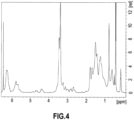
- the 1 H NMR spectrum of the resulting modified styrene-butadiene copolymer is shown in FIG. 4 .
- Characteristics of the modified styrene-butadiene ( co )polymer comprising allyl bromides and obtained according to Example 4 are presented in Table 1. Table 1. Characteristics of modified styrene-butadiene copolymers No. of example A weight-average molecular weight 10 3 , g/mol Decomposition temperature (5% weight loss), °C Unit content, wt.%.
- Example 1 100 241 20.20 2.19 - 76.92 0.13 0.05 - - Example 2 80 230 27.02 6.05 0.30 56.76 0.06 0.03 - 9.78
- Example 3 120 220 20.85 - - 76.32 0.53 0.78 1.52 -
- Example 4 100 231 24.88 6.53 - 61.42 0.11 0.04 - 7.51
- 87 parts of water, 0.43 parts of a polymerization stabilizer (a mixture of sodium pyrophosphate and magnesium sulfate) are mixed in a flask at a temperature of 25°C.
- the mixture is stirred for 2 hours at a temperature of up to 85°C, then it is heated to 1 l 5°C for 4.5 hours.
- a 10% aqueous solution of polyvin ylpyrrolidone is added to the reaction mixture.
- a solution of 0.10 parts of a chain transfer agent in 4.7 parts of an expanding agent, namely n-heptane is added to the reaction mass to expand polystyrene.
- the flask is maintained at the constant temperature for 3 hours, after which the mixture is cooled to a temperature of 25°C for 3 hours.
- Granules of the expanded polystyrene containing the flame retardantaccording to Example 3 have a yellowish tint (Table 2).
- the authors of the present invention presumably associate this with the fact that during the conduction of the step of expanding polystyrene at the high temperature of 1 l 5°C bromine radicals start to be released from the unstable positions of the flame retardant molecule, in particular, from the allyl and/or tertiary positions.
- the bromine radicals catalyze chain radical processes of the oxidation of aromatic nuclei in the system in the presence of peroxides, which results to the formation of small amounts of parabenzoquinone (approximately 0.89 wt.%), the formation of which is recorded by the gas chromatography-mass spectrometry (GC-MS) method.
- the starting styrene did not contain hydroquinone (a tert-butylpyrocatechin stabilizer).
- Parabenzoquinone is colored into the bright-yellow, so in a small concentration it imparts the yellowish color to the final product.
- Table 2 presents the results of the companson of the yellowness index (an average yellowness index) for the expanded polystyrene granules, containing flame retardants in accordance with the Examples 1 and 3, and HBCD. Table 2. The comparison of the yellowness index of the expanded polystyrene granules comprising flame retardants Flame retardant The average yellowness index HBCD 1.42-2.1 Example 1 3 Example 3 7.36
- the authors of the present invention believe that the presence of a significant amount of water in the reaction system at the halogenation step results in the formation of allyl halogenides, which, in turn, results in the decrease in the thermostability of the resulting modified ( co )polymer.
- the presence of two types of functional groups, in addition to halogen atoms, in the modified diene-containing ( co )polymer allows to solve several problems, namely, epoxy groups function as absorbers of the HBr that, as mentioned above, can be released during the processing of polymers and polymer compositions comprising a flame retardant, at high temperatures.
- the hydroxyl groups impart a polar and hydrophilic character to the ( co )polymer.
- the flame retardant obtained in accordance with the present invention is characterized by the preferable absence of tertiary and/or allyl halogenides in the structure thereof, which also results in the increase in the thermostability of the resulting flame retardant.
- This is characterized by the absence of halogen radicals, which at high temperatures, including in the process of expanding polystyrene, can be released from all unstable positions, in particular, tertiary and/or allyl, and enter into radical reactions, which can result in the appearance of the chromaticity of the expanded polystyrene compared with the expanded polystyrene containing HBCD. This is confirmed by the comparison of the chromaticity of granules of polystyrene containing HBCD and the granules of polystyrene containing the flame retardant according to the present invention.
Landscapes
- Chemical & Material Sciences (AREA)
- Organic Chemistry (AREA)
- Chemical Kinetics & Catalysis (AREA)
- Health & Medical Sciences (AREA)
- Medicinal Chemistry (AREA)
- Polymers & Plastics (AREA)
- Engineering & Computer Science (AREA)
- Materials Engineering (AREA)
- General Chemical & Material Sciences (AREA)
- Addition Polymer Or Copolymer, Post-Treatments, Or Chemical Modifications (AREA)
- Manufacture Of Porous Articles, And Recovery And Treatment Of Waste Products (AREA)
- Compositions Of Macromolecular Compounds (AREA)
- Fireproofing Substances (AREA)
Claims (29)
- Modifiziertes dienhaltiges (Co)polymer, wobei die Temperatur des 5-Gewichtsverlusts mindestens 180 °C beträgt, gemessen durch das Verfahren der simultanen thermischen Analyse (STA) gemäß ISO 11358, mit einem durchschnittlichen Molekulargewicht von mindestens 1500 g/mol, gemessen durch Tieftemperatur-GPC gemäß ISO 16014-3, und einem Halogengehalt von mindestens 35 Gew.-%, dadurch gekennzeichnet, dass es in seiner Struktur zusätzlich zu Halogenatomen mindestens eine Epoxygruppe, mindestens eine Hydroxylgruppe und 0 bis weniger als 1,5 Gew.-% tertiäre und/oder Allylhalogenide umfasst.
- Das modifizierte dienhaltige (Co)polymer gemäß Anspruch 1,
dadurch gekennzeichnet, dass das angegebene (Co)polymer eine 5 %-Gewichtsverlusttemperatur von mindestens 220 °C, vorzugsweise mindestens 240 °C, aufweist. - Das modifizierte dienhaltige (Co)polymer gemäß Anspruch 1,
dadurch gekennzeichnet, dass das (Co)polymer ein gewichtsmittleres Molekulargewicht von 2000 bis 280000 g/mol, vorzugsweise von 10000 bis 150000 g/mol, stärker bevorzugt von 60000 bis 100000 g/mol, aufweist. - Das modifizierte dienhaltige (Co)polymer gemäß Anspruch 1,
dadurch gekennzeichnet, dass der Gehalt an Halogenatomen mindestens 60 Gew.-%, vorzugsweise mindestens 75 Gew.-% beträgt. - Das modifizierte dienhaltige (Co)polymer gemäß Anspruch 1,
dadurch gekennzeichnet, dass der Gehalt an Epoxygruppen 0,01 bis 5 Gew.-%, vorzugsweise 0,05 bis 3 Gew.-% und insbesondere 1 bis 2 Gew.-% beträgt. - Das modifizierte dienhaltige (Co)polymer gemäß Anspruch 1,
dadurch gekennzeichnet, dass der Gehalt an Hydroxylgruppen 0,05 bis 5 Gew.-%, vorzugsweise 0,1 bis 3 Gew.-% und insbesondere 0,15 bis 1 Gew.-% beträgt. - Das modifizierte dienhaltige (Co)Polymer gemäß Anspruch 1,
dadurch gekennzeichnet, dass der Gehalt an tertiären und/oder Allylhalogeniden 0 bis weniger als 1 Gew.-%, vorzugsweise 0 bis weniger als 0,5 Gew.-% beträgt. - Das modifizierte dienhaltige (Co)polymer gemäß einem der Ansprüche 1-7, dadurch gekennzeichnet, dass es ein modifiziertes Butadienpolymer, Styrol-Butadien-Copolymer, Styrol-Butadien-Isopren-Copolymer, vorzugsweise ein modifiziertes Styrol-Butadien-Copolymer ist.
- Das modifizierte dienhaltige (Co)Polymer gemäß einem der 10 Ansprüche 1-8, dadurch gekennzeichnet, dass das Halogen in der Struktur des modifizierten dienhaltigen (Co)Polymers Chlor, Brom oder lod, vorzugsweise Brom, ist.
- Das modifizierte dienhaltige (Co)Polymer gemäß einem der Ansprüche 1-9, dadurch gekennzeichnet, dass es die allgemeine Formel (1) aufweist:

- Verfahren zur Herstellung eines modifizierten dienhaltigen (Co)polymers gemäß einem der Ansprüche 1 bis 10, das die folgenden Schritte umfasst:a) Auflösungsschritt, umfassend das Auflösen eines dienhaltigen (Co)polymer-Ausgangsmaterials in einem organischen Lösungsmittel;b) Teilhalogenierungsschritt, der die Verwendung eines Halogenierungsmittels und gegebenenfalls eines aliphatischen Alkohols umfasst, um das dienhaltige (Co)polymer bis zu einem Halogenierungsgrad von mindestens 60 % teilweise zu halogenieren;c) Wasch- und Trennschritt, der die Zugabe von Wasser zu einer in Schritt b) erhaltenen Reaktionsmasse und die anschließende Trennung einer wässrigen Schicht und einer organischen Schicht umfasst;d) Modifizierungsschritt, umfassend die Zugabe von Komponenten eines Modifizierungssystems und gegebenenfalls eines aliphatischen Alkohols zu der in Schritt c) erhaltenen organischen Schicht, die ein teilweise halogeniertes dienhaltiges (Co)polymer umfasst;e) Neutralisierungs- und Trennschritt, umfassend die Zugabe einer wässrigen Lösung eines Neutralisierungsmittels zu der in Schritt d) erhaltenen Reaktionsmasse, gefolgt von der Trennung einer wässrigen Schicht und einer organischen Schicht;f) Isolierungsschritt, umfassend das Ausfällen oder Entgasen eines modifizierten dienhaltigen (Co)polymers;g) Filtrations- und anschließender Trocknungsschritt, umfassend die Filtration und Trocknung des isolierten modifizierten dienhaltigen (Co)polymers,dadurch gekennzeichnet, dass in dem Teilhalogenierungsschritt b) der zulässige Wassergehalt in dem System 0 bis weniger als 0,5 Gew.-% beträgt und in dem Modifizierungsschritt d) als Modifizierungssystem eine Mischung aus Halogen und Wasser in einem Halogen:Wasser-Verhältnis von 1:0,01 bis 1:1, bezogen auf die Gesamtmenge an Doppelbindungen in dem dienhaltigen (Co)Polymer, verwendet wird.
- Verfahren nach Anspruch 11, dadurch gekennzeichnet, dass in der Teilhalogenierungsstufe b) der zulässige Wassergehalt im System 0 bis weniger als 0,3 Gew.-%, vorzugsweise 0 bis weniger als 0,1 Gew.-% beträgt.
- Verfahren nach Anspruch 11, dadurch gekennzeichnet, dass das dienhaltige (Co)polymer als Ausgangsmaterial Butadienpolymer, Styrol-Butadien-Copolymer, Styrol-Butadien-Isopren-Copolymer, vorzugsweise Styrol-Butadien-Copolymer ist.
- Verfahren nach Anspruch 11, dadurch gekennzeichnet, dass Tetrahydrofuran, Chloroform, Dichlormethan, Dichlorethan, Cyclohexan, Toluol, vorzugsweise Tetrahydrofuran, Chloroform, Dichlormethan als Lösungsmittel in dem Auflösungsschritt a) verwendet werden.
- Verfahren nach Anspruch 11, dadurch gekennzeichnet, dass der Halogenierungsgrad in der Teilhalogenierungsstufe b) mindestens 90 %, vorzugsweise mindestens 95 % beträgt.
- Verfahren nach Anspruch 11, dadurch gekennzeichnet, dass in der Teilhalogenierungsstufe b) Chlor, Brom oder lod, vorzugsweise Brom, als Halogen in einem Halogenierungsmittel verwendet wird.
- Verfahren nach Anspruch 11, dadurch gekennzeichnet, dass ein Halogenierungsmittel Brom als solches, eine Lösung, die nicht mehr als 70 Gew.-% Brom, vorzugsweise nicht mehr als 60 Gew.-%, stärker bevorzugt nicht mehr als 50 Gew.-%, umfasst, quaternäre Ammoniumbromide, quaternäre Phosphoniumbromide oder Mischungen davon ist.
- Verfahren nach Anspruch 17, dadurch gekennzeichnet, dass elementares Brom und quaternäre Ammoniumbromide wie Phenyltriethylammoniumbromid, Benzyltrimethylammoniumbromid, Tetramethylammoniumbromid, Tetraethylammoniumbromid, Tetrapropylammoniumbromid, Tetra-n-butylammoniumbromid oder Gemische davon als quaternäres Ammoniumbromid oder quaternäre Phosphoniumbromide wie Tetramethylphosphoniumbromid, Tetraethylphosphoniumbromid, Tetrapropylphosphoniumbromid, Tetra-n-butylphosphoniumbromid oder Mischungen davon verwendet werden, werden vorzugsweise gleichzeitig als Halogenierungsmittel verwendet.
- Verfahren nach Anspruch 11, dadurch gekennzeichnet, dass das Molverhältnis von einem dienhaltigen (Co)polymer als Ausgangsmaterial: Halogenierungsmittel: aliphatischem Alkohol 1:1,5:3 bis 1:5:3, vorzugsweise 1:2:3 bis 1:4:3 und besonders bevorzugt 1:2,5:3 bis 1:3:3 beträgt.
- Verfahren nach Anspruch 11, dadurch gekennzeichnet, dass das Molverhältnis von elementarem Brom zu Bromatomen in dem quaternären Ammoniumbromid oder quaternären Phosphoniumbromid 1:1 bis 1:4, vorzugsweise 1:2 bis 1:3, stärker bevorzugt 1:1 bis 1:1,5 beträgt.
- Verfahren nach Anspruch 11, dadurch gekennzeichnet, dass Methanol, Ethanol, Propanol, Isopropanol, Butanol, Isobutanol, Pentanol, Hexanol, vorzugsweise Propanol, Butanol, Isobutanol, Pentanol, stärker bevorzugt Butanol, Isobutanol, Pentanol, als aliphatischer Alkohol in Schritt b) der Teilhalogenierung und im Modifizierungsschritt d) verwendet werden.
- Verfahren nach Anspruch 11, dadurch gekennzeichnet, dass das Halogen:Wasser-Verhältnis in einem Modifizierungssystem in Schritt d) 1:0,5 bis 1:0,7, vorzugsweise 1:0,25 bis 1:0,7 beträgt.
- Verfahren nach Anspruch 11, dadurch gekennzeichnet, dass als Halogen in dem Modifizierungssystem in Schritt d) Chlor, Brom oder lod, vorzugsweise Brom, verwendet wird.
- Verfahren nach Anspruch 11, dadurch gekennzeichnet, dass Brom in dem Modifizierungssystem in Schritt d) in Form von Brom als solchem oder in Form einer Lösung, die nicht mehr als 70 Gew.-% Brom, vorzugsweise nicht mehr als 60 Gew.-% und stärker bevorzugt nicht mehr als 50 Gew.-% Brom enthält, verwendet wird.
- Verfahren nach Anspruch 11, dadurch gekennzeichnet, dass in dem Modifizierungsschritt d) das Verhältnis von Ausgangsdien-enthaltendem (Co)polymer: Modifizierungssystem: aliphatischem Alkohol 1:1,5:3 bis 1:5:3, vorzugsweise 1:2:3 bis 1:4:3, stärker bevorzugt 1:2,5:3 bis 1:3:3 beträgt.
- Verwendung eines modifizierten dienhaltigen (Co)polymers gemäß einem der Ansprüche 1-10 als Flammschutzmittel.
- Verwendung gemäß Anspruch 26, dadurch gekennzeichnet, dass das modifizierte dienhaltige (Co)polymer als Flammschutzmittel in einem expandierbaren Polystyrol verwendet wird.
- Ein expandierbares Polystyrol, das ein modifiziertes dienhaltiges (Co)polymer gemäß einem der Ansprüche 1 bis 10 als Flammschutzmittel umfasst.
- Eine Polymerzusammensetzung auf der Basis eines expandierbaren Polystyrols, die ein modifiziertes dienhaltiges (Co)polymer gemäß einem der Ansprüche 1 bis 10 als Flammschutzmittel und Additive umfasst, die einen Komplex aus technologischen, physikalisch-mechanischen und betrieblichen Eigenschaften bereitstellen.
Applications Claiming Priority (1)
| Application Number | Priority Date | Filing Date | Title |
|---|---|---|---|
| PCT/RU2018/000887 WO2020139112A1 (en) | 2018-12-27 | 2018-12-27 | Modified diene-containing (co)polymer, method for preparing thereof and use as a flame retardant |
Publications (2)
| Publication Number | Publication Date |
|---|---|
| EP3902843A1 EP3902843A1 (de) | 2021-11-03 |
| EP3902843B1 true EP3902843B1 (de) | 2025-01-29 |
Family
ID=67659923
Family Applications (1)
| Application Number | Title | Priority Date | Filing Date |
|---|---|---|---|
| EP18905911.6A Active EP3902843B1 (de) | 2018-12-27 | 2018-12-27 | Modifiziertes dienhaltiges (co)polymer, verfahren zu dessen herstellung und verwendung als flammschutzmittel |
Country Status (9)
| Country | Link |
|---|---|
| US (1) | US12203025B2 (de) |
| EP (1) | EP3902843B1 (de) |
| JP (1) | JP7186883B2 (de) |
| CN (1) | CN113260637B (de) |
| CA (1) | CA3124794A1 (de) |
| EA (1) | EA202191702A1 (de) |
| IL (1) | IL284394B2 (de) |
| MX (1) | MX2021007857A (de) |
| WO (1) | WO2020139112A1 (de) |
Citations (4)
| Publication number | Priority date | Publication date | Assignee | Title |
|---|---|---|---|---|
| EP0845486A1 (de) | 1996-06-17 | 1998-06-03 | Daicel Chemical Industries, Ltd. | Epoxidierte polyene, epoxidharzzusammensetzung und gehärteter gegenstand daraus hergestelt und pulverbeschichtungsmaterial |
| WO2009139942A2 (en) | 2008-03-06 | 2009-11-19 | Dow Global Technologies Inc. | Process for brominating butadiene copolymers by the addition of water or certain solvents |
| WO2011008417A1 (en) | 2009-06-30 | 2011-01-20 | Dow Global Technologies Inc. | Brominated and epoxidized flame retardants |
| WO2016123263A1 (en) | 2015-01-30 | 2016-08-04 | Dow Global Technologies Llc | Method for producing brominated and halohydrated polymers |
Family Cites Families (10)
| Publication number | Priority date | Publication date | Assignee | Title |
|---|---|---|---|---|
| US5086078A (en) | 1990-11-26 | 1992-02-04 | Basf Corporation | Process for making expanded polymeric product with low level of emission of blowing agent |
| TW222006B (de) * | 1992-04-03 | 1994-04-01 | Shell Internat Res Schappej B V | |
| ATE455796T1 (de) * | 2005-11-12 | 2010-02-15 | Dow Global Technologies Inc | Brominierte butadien-/vinylaromatische copolymere,mischungen solcher copolymere mit einem vinylaromatischen polymer und aus solchen mischungen geformte polymerschaumstoffe |
| WO2008021417A2 (en) | 2006-08-16 | 2008-02-21 | Dow Global Technologies, Inc. | Process for brominating butadiene/vinyl aromatic copolymers |
| EP2054446B1 (de) | 2006-08-16 | 2019-07-24 | Dow Global Technologies LLC | Verfahren zur brominierung aromatischer butadien/vinyl-copolymere |
| US7745544B2 (en) * | 2006-11-30 | 2010-06-29 | Exxonmobil Chemical Patents Inc. | Catalytic epoxidation and hydroxylation of olefin/diene copolymers |
| WO2009134628A1 (en) | 2008-05-01 | 2009-11-05 | Dow Global Technologies Inc. | Two-step process for brominating butadiene copolymers |
| CN102257050B (zh) * | 2008-12-18 | 2013-09-04 | 陶氏环球技术有限责任公司 | 含有在脂族上结合的溴的阻燃剂聚合物用的稳定剂 |
| WO2011031317A2 (en) * | 2009-09-10 | 2011-03-17 | The Board Of Regents Of The University Of Texas System | Vaccine for control of trypanosoma cruzi infection and chagas disease |
| JP6262384B1 (ja) | 2016-10-03 | 2018-01-17 | 東洋スチレン株式会社 | 難燃性樹脂組成物及び難燃性樹脂成形体 |
-
2018
- 2018-12-27 WO PCT/RU2018/000887 patent/WO2020139112A1/en not_active Ceased
- 2018-12-27 MX MX2021007857A patent/MX2021007857A/es unknown
- 2018-12-27 CA CA3124794A patent/CA3124794A1/en active Pending
- 2018-12-27 JP JP2021537854A patent/JP7186883B2/ja active Active
- 2018-12-27 EA EA202191702A patent/EA202191702A1/ru unknown
- 2018-12-27 CN CN201880100532.9A patent/CN113260637B/zh active Active
- 2018-12-27 EP EP18905911.6A patent/EP3902843B1/de active Active
- 2018-12-27 US US17/418,599 patent/US12203025B2/en active Active
-
2021
- 2021-06-27 IL IL284394A patent/IL284394B2/en unknown
Patent Citations (4)
| Publication number | Priority date | Publication date | Assignee | Title |
|---|---|---|---|---|
| EP0845486A1 (de) | 1996-06-17 | 1998-06-03 | Daicel Chemical Industries, Ltd. | Epoxidierte polyene, epoxidharzzusammensetzung und gehärteter gegenstand daraus hergestelt und pulverbeschichtungsmaterial |
| WO2009139942A2 (en) | 2008-03-06 | 2009-11-19 | Dow Global Technologies Inc. | Process for brominating butadiene copolymers by the addition of water or certain solvents |
| WO2011008417A1 (en) | 2009-06-30 | 2011-01-20 | Dow Global Technologies Inc. | Brominated and epoxidized flame retardants |
| WO2016123263A1 (en) | 2015-01-30 | 2016-08-04 | Dow Global Technologies Llc | Method for producing brominated and halohydrated polymers |
Non-Patent Citations (4)
| Title |
|---|
| AGUIAR MARCELO, DE MENEZES SONIA CABRAL, AKCELRUD LENI: "Configurational double bond selectivity in the epoxidation of hydroxyâterminated polybutadiene with m âchloroperbenzoic acid", MACROMOLECULAR CHEMISTRY AND PHYSICS, WILEY-VCH VERLAG, WEINHEIM., DE, vol. 195, no. 12, 1 December 1994 (1994-12-01), DE , pages 3937 - 3948, XP093335492, ISSN: 1022-1352, DOI: 10.1002/macp.1994.021951219 |
| BEACH MARK W.; HULL JOHN W.; KING BRUCE A.; BEULICH INKEN I.; STOBBY BILL G.; KRAM SHARI L.; GORMAN DAVE B.: "Development of a new class of brominated polymeric flame retardants based on copolymers of styrene and polybutadiene", POLYMER DEGRADATION AND STABILITY, BARKING, GB, vol. 135, 1 January 1900 (1900-01-01), GB , pages 99 - 110, XP029854639, ISSN: 0141-3910, DOI: 10.1016/j.polymdegradstab.2016.11.008 |
| CHIH-CHEMG PENG, VOLKER ABETZ: "A simple pathway toward quantitative modification of polybutadiene: a new appoach to thermoreversible cross-linking rubber comprising supramolecular hydrogen-bonding networks", MACROMOLECULES, AMERICAN CHEMICAL SOCIETY, US, vol. 38, no. 13, 3 June 2005 (2005-06-03) - 2005-06-03, US , pages 5575 - 5580, XP002714630, ISSN: 0024-9297, DOI: 10.1021/MA050419F |
| GOLDMAN H.N. NAÃ, VOFSI D.: "Epoxidation of Bromostyrene - Butadiene Cotelomers", JOURNAL OF POLYMER SCIENCE PART A: POLYMER CHEMISTRY, JOHN WILEY & SONS, INC., US, vol. 24, 1 January 1986 (1986-01-01), US , pages 1239 - 1249, XP002602855, ISSN: 0887-624X, DOI: 10.1002/pola.1986.080240612 |
Also Published As
| Publication number | Publication date |
|---|---|
| US12203025B2 (en) | 2025-01-21 |
| US20220073823A1 (en) | 2022-03-10 |
| IL284394B (en) | 2022-10-01 |
| EA202191702A1 (ru) | 2021-09-09 |
| CN113260637A (zh) | 2021-08-13 |
| JP2022516723A (ja) | 2022-03-02 |
| WO2020139112A1 (en) | 2020-07-02 |
| IL284394B2 (en) | 2023-02-01 |
| CN113260637B (zh) | 2023-06-16 |
| MX2021007857A (es) | 2021-08-11 |
| JP7186883B2 (ja) | 2022-12-09 |
| IL284394A (en) | 2021-08-31 |
| CA3124794A1 (en) | 2020-07-02 |
| EP3902843A1 (de) | 2021-11-03 |
Similar Documents
| Publication | Publication Date | Title |
|---|---|---|
| JP5807074B2 (ja) | 低分子量臭素化アニオン性連鎖移動芳香族ビニルポリマーを含む難燃性組成物 | |
| EP2410016B1 (de) | Bromierte Polymere als flammhemmende Zusatzstoffe und Polymersysteme damit | |
| KR101419669B1 (ko) | 브롬화 스티렌계 중합체 및 이의 제조 | |
| EP3902843B1 (de) | Modifiziertes dienhaltiges (co)polymer, verfahren zu dessen herstellung und verwendung als flammschutzmittel | |
| US20080096992A1 (en) | Flame Retardant Extruded Polystyrene Foam Compositions | |
| RU2732776C1 (ru) | Способ получения модифицированного диенсодержащего (cо)полимера | |
| WO2020139114A1 (en) | Modified diene-containing (co)polymer, method for preparing thereof and use of the same as flame retardant | |
| HUE032417T2 (en) | Self-extinguishing polymer composition | |
| EP3902842B1 (de) | Modifiziertes (co) polymer, verfahren zu seiner herstellung und seine verwendung | |
| WO2020139111A1 (en) | Modified diene-containing (co)polymer, method for producing the same and use of the same as a flame retardant | |
| RU2782606C2 (ru) | Модифицированный диенсодержащий (cо)полимер, способ его получения и применение в качестве антипирена | |
| EA043961B1 (ru) | Модифицированный диенсодержащий (со)полимер, способ его получения и применения в качестве антипирена | |
| RU2795580C2 (ru) | Модифицированный диенсодержащий (cо)полимер, способ его получения и применение в качестве антипирена | |
| RU2794096C2 (ru) | Модифицированный диенсодержащий (cо)полимер, способ его получения и применение в качестве антипирена | |
| KR102647492B1 (ko) | 브롬화 난연제 | |
| RU2802716C1 (ru) | Модифицированный диенсодержащий (cо)полимер и применение его в качестве антипирена в полимерных и битумных композициях | |
| RU2808730C1 (ru) | Блок-сополимер сопряженного диена и моновинилароматического углеводорода, модифицированный галогеном блок-сополимер на его основе, способ получения модифицированного галогеном блок-сополимера, применение модифицированного блок-сополимера в качестве антипирена и материал на основе полистирола, содержащий антипирен | |
| EA043962B1 (ru) | Модифицированный (со)полимер, способ его получения и применение | |
| WO2020139113A1 (en) | Modified diene-containing (co)polymer, method for preparing thereof and use of the same as flame retardant | |
| RU2803288C1 (ru) | Галогенированный полимер на основе бутадиен-нитрильного каучука и способ его получения | |
| JP2010505010A (ja) | 燃焼遅延性を有する押出されたポリスチレン発泡体組成物 |
Legal Events
| Date | Code | Title | Description |
|---|---|---|---|
| STAA | Information on the status of an ep patent application or granted ep patent |
Free format text: STATUS: UNKNOWN |
|
| STAA | Information on the status of an ep patent application or granted ep patent |
Free format text: STATUS: THE INTERNATIONAL PUBLICATION HAS BEEN MADE |
|
| PUAI | Public reference made under article 153(3) epc to a published international application that has entered the european phase |
Free format text: ORIGINAL CODE: 0009012 |
|
| STAA | Information on the status of an ep patent application or granted ep patent |
Free format text: STATUS: REQUEST FOR EXAMINATION WAS MADE |
|
| 17P | Request for examination filed |
Effective date: 20210709 |
|
| AK | Designated contracting states |
Kind code of ref document: A1 Designated state(s): AL AT BE BG CH CY CZ DE DK EE ES FI FR GB GR HR HU IE IS IT LI LT LU LV MC MK MT NL NO PL PT RO RS SE SI SK SM TR |
|
| DAV | Request for validation of the european patent (deleted) | ||
| DAX | Request for extension of the european patent (deleted) | ||
| P01 | Opt-out of the competence of the unified patent court (upc) registered |
Effective date: 20230508 |
|
| STAA | Information on the status of an ep patent application or granted ep patent |
Free format text: STATUS: EXAMINATION IS IN PROGRESS |
|
| 17Q | First examination report despatched |
Effective date: 20230802 |
|
| GRAP | Despatch of communication of intention to grant a patent |
Free format text: ORIGINAL CODE: EPIDOSNIGR1 |
|
| STAA | Information on the status of an ep patent application or granted ep patent |
Free format text: STATUS: GRANT OF PATENT IS INTENDED |
|
| INTG | Intention to grant announced |
Effective date: 20240529 |
|
| GRAS | Grant fee paid |
Free format text: ORIGINAL CODE: EPIDOSNIGR3 |
|
| GRAA | (expected) grant |
Free format text: ORIGINAL CODE: 0009210 |
|
| STAA | Information on the status of an ep patent application or granted ep patent |
Free format text: STATUS: GRANT OF PATENT IS INTENDED |
|
| AK | Designated contracting states |
Kind code of ref document: B1 Designated state(s): AL AT BE BG CH CY CZ DE DK EE ES FI FR GB GR HR HU IE IS IT LI LT LU LV MC MK MT NL NO PL PT RO RS SE SI SK SM TR |
|
| REG | Reference to a national code |
Ref country code: GB Ref legal event code: FG4D |
|
| PUAC | Information related to the publication of a b1 document modified or deleted |
Free format text: ORIGINAL CODE: 0009299EPPU |
|
| REG | Reference to a national code |
Ref country code: CH Ref legal event code: PK Free format text: DIE ERTEILUNG WURDE VOM EPA WIDERRUFEN. Ref country code: CH Ref legal event code: EP |
|
| REG | Reference to a national code |
Ref country code: DE Ref legal event code: R096 Ref document number: 602018076422 Country of ref document: DE |
|
| REG | Reference to a national code |
Ref country code: IE Ref legal event code: FG4D |
|
| DB1 | Publication of patent cancelled |
Effective date: 20241107 |
|
| REG | Reference to a national code |
Ref country code: DE Ref country code: DE Ref legal event code: R107 Ref document number: 602018076422 Country of ref document: DE |
|
| GRAA | (expected) grant |
Free format text: ORIGINAL CODE: 0009210 |
|
| STAA | Information on the status of an ep patent application or granted ep patent |
Free format text: STATUS: THE PATENT HAS BEEN GRANTED |
|
| REG | Reference to a national code |
Ref country code: DE Ref legal event code: R081 Ref document number: 602018076422 Country of ref document: DE Owner name: PUBLIC JOINT STOCK COMPANY "SIBUR HOLDING", TO, RU Free format text: FORMER OWNER: PUBLIC JOINT STOCK COMPANY "SIBUR HOLDING", TYUMEN, RU |
|
| AK | Designated contracting states |
Kind code of ref document: B1 Designated state(s): AL AT BE BG CH CY CZ DE DK EE ES FI FR GB GR HR HU IE IS IT LI LT LU LV MC MK MT NL NO PL PT RO RS SE SI SK SM TR |
|
| REG | Reference to a national code |
Ref country code: CH Ref legal event code: EP |
|
| REG | Reference to a national code |
Ref country code: DE Ref legal event code: R096 Ref document number: 602018076422 Country of ref document: DE |
|
| PG25 | Lapsed in a contracting state [announced via postgrant information from national office to epo] |
Ref country code: IS Free format text: LAPSE BECAUSE OF FAILURE TO SUBMIT A TRANSLATION OF THE DESCRIPTION OR TO PAY THE FEE WITHIN THE PRESCRIBED TIME-LIMIT Effective date: 20250306 |
|
| PG25 | Lapsed in a contracting state [announced via postgrant information from national office to epo] |
Ref country code: NO Free format text: LAPSE BECAUSE OF FAILURE TO SUBMIT A TRANSLATION OF THE DESCRIPTION OR TO PAY THE FEE WITHIN THE PRESCRIBED TIME-LIMIT Effective date: 20250206 |
|
| PG25 | Lapsed in a contracting state [announced via postgrant information from national office to epo] |
Ref country code: GR Free format text: LAPSE BECAUSE OF FAILURE TO SUBMIT A TRANSLATION OF THE DESCRIPTION OR TO PAY THE FEE WITHIN THE PRESCRIBED TIME-LIMIT Effective date: 20250207 |
|
| PG25 | Lapsed in a contracting state [announced via postgrant information from national office to epo] |
Ref country code: NL Free format text: LAPSE BECAUSE OF FAILURE TO SUBMIT A TRANSLATION OF THE DESCRIPTION OR TO PAY THE FEE WITHIN THE PRESCRIBED TIME-LIMIT Effective date: 20250129 |
|
| PG25 | Lapsed in a contracting state [announced via postgrant information from national office to epo] |
Ref country code: RS Free format text: LAPSE BECAUSE OF FAILURE TO SUBMIT A TRANSLATION OF THE DESCRIPTION OR TO PAY THE FEE WITHIN THE PRESCRIBED TIME-LIMIT Effective date: 20250429 |
|
| PG25 | Lapsed in a contracting state [announced via postgrant information from national office to epo] |
Ref country code: FI Free format text: LAPSE BECAUSE OF FAILURE TO SUBMIT A TRANSLATION OF THE DESCRIPTION OR TO PAY THE FEE WITHIN THE PRESCRIBED TIME-LIMIT Effective date: 20250129 |
|
| PG25 | Lapsed in a contracting state [announced via postgrant information from national office to epo] |
Ref country code: ES Free format text: LAPSE BECAUSE OF FAILURE TO SUBMIT A TRANSLATION OF THE DESCRIPTION OR TO PAY THE FEE WITHIN THE PRESCRIBED TIME-LIMIT Effective date: 20250129 |
|
| REG | Reference to a national code |
Ref country code: LT Ref legal event code: MG9D |
|
| PG25 | Lapsed in a contracting state [announced via postgrant information from national office to epo] |
Ref country code: NO Free format text: LAPSE BECAUSE OF FAILURE TO SUBMIT A TRANSLATION OF THE DESCRIPTION OR TO PAY THE FEE WITHIN THE PRESCRIBED TIME-LIMIT Effective date: 20250429 |
|
| PG25 | Lapsed in a contracting state [announced via postgrant information from national office to epo] |
Ref country code: HR Free format text: LAPSE BECAUSE OF FAILURE TO SUBMIT A TRANSLATION OF THE DESCRIPTION OR TO PAY THE FEE WITHIN THE PRESCRIBED TIME-LIMIT Effective date: 20250129 |
|
| PG25 | Lapsed in a contracting state [announced via postgrant information from national office to epo] |
Ref country code: PT Free format text: LAPSE BECAUSE OF FAILURE TO SUBMIT A TRANSLATION OF THE DESCRIPTION OR TO PAY THE FEE WITHIN THE PRESCRIBED TIME-LIMIT Effective date: 20250529 Ref country code: LV Free format text: LAPSE BECAUSE OF FAILURE TO SUBMIT A TRANSLATION OF THE DESCRIPTION OR TO PAY THE FEE WITHIN THE PRESCRIBED TIME-LIMIT Effective date: 20250129 |
|
| PG25 | Lapsed in a contracting state [announced via postgrant information from national office to epo] |
Ref country code: BG Free format text: LAPSE BECAUSE OF FAILURE TO SUBMIT A TRANSLATION OF THE DESCRIPTION OR TO PAY THE FEE WITHIN THE PRESCRIBED TIME-LIMIT Effective date: 20250129 |
|
| PG25 | Lapsed in a contracting state [announced via postgrant information from national office to epo] |
Ref country code: SK Free format text: LAPSE BECAUSE OF FAILURE TO SUBMIT A TRANSLATION OF THE DESCRIPTION OR TO PAY THE FEE WITHIN THE PRESCRIBED TIME-LIMIT Effective date: 20250129 |
|
| PG25 | Lapsed in a contracting state [announced via postgrant information from national office to epo] |
Ref country code: SM Free format text: LAPSE BECAUSE OF FAILURE TO SUBMIT A TRANSLATION OF THE DESCRIPTION OR TO PAY THE FEE WITHIN THE PRESCRIBED TIME-LIMIT Effective date: 20250129 |
|
| PG25 | Lapsed in a contracting state [announced via postgrant information from national office to epo] |
Ref country code: DK Free format text: LAPSE BECAUSE OF FAILURE TO SUBMIT A TRANSLATION OF THE DESCRIPTION OR TO PAY THE FEE WITHIN THE PRESCRIBED TIME-LIMIT Effective date: 20250129 |
|
| PG25 | Lapsed in a contracting state [announced via postgrant information from national office to epo] |
Ref country code: CZ Free format text: LAPSE BECAUSE OF FAILURE TO SUBMIT A TRANSLATION OF THE DESCRIPTION OR TO PAY THE FEE WITHIN THE PRESCRIBED TIME-LIMIT Effective date: 20250129 |
|
| PG25 | Lapsed in a contracting state [announced via postgrant information from national office to epo] |
Ref country code: RO Free format text: LAPSE BECAUSE OF FAILURE TO SUBMIT A TRANSLATION OF THE DESCRIPTION OR TO PAY THE FEE WITHIN THE PRESCRIBED TIME-LIMIT Effective date: 20250129 |
|
| REG | Reference to a national code |
Ref country code: DE Ref legal event code: R026 Ref document number: 602018076422 Country of ref document: DE |
|
| GBPC | Gb: european patent ceased through non-payment of renewal fee |
Effective date: 20250206 |
|
| PLBI | Opposition filed |
Free format text: ORIGINAL CODE: 0009260 |
|
| PLAB | Opposition data, opponent's data or that of the opponent's representative modified |
Free format text: ORIGINAL CODE: 0009299OPPO |
|
| PLAX | Notice of opposition and request to file observation + time limit sent |
Free format text: ORIGINAL CODE: EPIDOSNOBS2 |
|
| 26 | Opposition filed |
Opponent name: LANXESS DEUTSCHLAND GMBH Effective date: 20251028 |
|
| R26 | Opposition filed (corrected) |
Opponent name: LANXESS DEUTSCHLAND GMBH Effective date: 20251028 |
|
| PGFP | Annual fee paid to national office [announced via postgrant information from national office to epo] |
Ref country code: DE Payment date: 20251205 Year of fee payment: 8 |
|
| PG25 | Lapsed in a contracting state [announced via postgrant information from national office to epo] |
Ref country code: GB Free format text: LAPSE BECAUSE OF NON-PAYMENT OF DUE FEES Effective date: 20250206 |
|
| PGFP | Annual fee paid to national office [announced via postgrant information from national office to epo] |
Ref country code: AT Payment date: 20251215 Year of fee payment: 8 |
|
| PGFP | Annual fee paid to national office [announced via postgrant information from national office to epo] |
Ref country code: FR Payment date: 20251218 Year of fee payment: 8 |
|
| PGFP | Annual fee paid to national office [announced via postgrant information from national office to epo] |
Ref country code: TR Payment date: 20251222 Year of fee payment: 8 |