EP3898326B1 - Einstellvorrichtung für einen kraftfahrzeugscheinwerfer - Google Patents
Einstellvorrichtung für einen kraftfahrzeugscheinwerfer Download PDFInfo
- Publication number
- EP3898326B1 EP3898326B1 EP19808815.5A EP19808815A EP3898326B1 EP 3898326 B1 EP3898326 B1 EP 3898326B1 EP 19808815 A EP19808815 A EP 19808815A EP 3898326 B1 EP3898326 B1 EP 3898326B1
- Authority
- EP
- European Patent Office
- Prior art keywords
- transmission element
- engagement portion
- adjusting
- adjusting device
- motor vehicle
- Prior art date
- Legal status (The legal status is an assumption and is not a legal conclusion. Google has not performed a legal analysis and makes no representation as to the accuracy of the status listed.)
- Active
Links
Images


Classifications
-
- B—PERFORMING OPERATIONS; TRANSPORTING
- B60—VEHICLES IN GENERAL
- B60Q—ARRANGEMENT OF SIGNALLING OR LIGHTING DEVICES, THE MOUNTING OR SUPPORTING THEREOF OR CIRCUITS THEREFOR, FOR VEHICLES IN GENERAL
- B60Q1/00—Arrangement of optical signalling or lighting devices, the mounting or supporting thereof or circuits therefor
- B60Q1/02—Arrangement of optical signalling or lighting devices, the mounting or supporting thereof or circuits therefor the devices being primarily intended to illuminate the way ahead or to illuminate other areas of way or environments
- B60Q1/04—Arrangement of optical signalling or lighting devices, the mounting or supporting thereof or circuits therefor the devices being primarily intended to illuminate the way ahead or to illuminate other areas of way or environments the devices being headlights
- B60Q1/06—Arrangement of optical signalling or lighting devices, the mounting or supporting thereof or circuits therefor the devices being primarily intended to illuminate the way ahead or to illuminate other areas of way or environments the devices being headlights adjustable, e.g. remotely-controlled from inside vehicle
- B60Q1/068—Arrangement of optical signalling or lighting devices, the mounting or supporting thereof or circuits therefor the devices being primarily intended to illuminate the way ahead or to illuminate other areas of way or environments the devices being headlights adjustable, e.g. remotely-controlled from inside vehicle by mechanical means
- B60Q1/0683—Adjustable by rotation of a screw
-
- B—PERFORMING OPERATIONS; TRANSPORTING
- B60—VEHICLES IN GENERAL
- B60Q—ARRANGEMENT OF SIGNALLING OR LIGHTING DEVICES, THE MOUNTING OR SUPPORTING THEREOF OR CIRCUITS THEREFOR, FOR VEHICLES IN GENERAL
- B60Q1/00—Arrangement of optical signalling or lighting devices, the mounting or supporting thereof or circuits therefor
- B60Q1/02—Arrangement of optical signalling or lighting devices, the mounting or supporting thereof or circuits therefor the devices being primarily intended to illuminate the way ahead or to illuminate other areas of way or environments
- B60Q1/04—Arrangement of optical signalling or lighting devices, the mounting or supporting thereof or circuits therefor the devices being primarily intended to illuminate the way ahead or to illuminate other areas of way or environments the devices being headlights
- B60Q1/06—Arrangement of optical signalling or lighting devices, the mounting or supporting thereof or circuits therefor the devices being primarily intended to illuminate the way ahead or to illuminate other areas of way or environments the devices being headlights adjustable, e.g. remotely-controlled from inside vehicle
- B60Q1/076—Arrangement of optical signalling or lighting devices, the mounting or supporting thereof or circuits therefor the devices being primarily intended to illuminate the way ahead or to illuminate other areas of way or environments the devices being headlights adjustable, e.g. remotely-controlled from inside vehicle by electrical means including means to transmit the movements, e.g. shafts or joints
-
- B—PERFORMING OPERATIONS; TRANSPORTING
- B60—VEHICLES IN GENERAL
- B60Q—ARRANGEMENT OF SIGNALLING OR LIGHTING DEVICES, THE MOUNTING OR SUPPORTING THEREOF OR CIRCUITS THEREFOR, FOR VEHICLES IN GENERAL
- B60Q2200/00—Special features or arrangements of vehicle headlamps
- B60Q2200/30—Special arrangements for adjusting headlamps, e.g. means for transmitting the movements for adjusting the lamps
- B60Q2200/32—Ball-joints
Definitions
- the invention relates to an adjustment device for adjusting at least one optically relevant structural unit of a motor vehicle headlight.
- the invention relates to a motor vehicle headlight with a housing and at least one adjusting device according to the invention.
- a relevant optical structural unit is, for example, a light module, for example consisting of at least one light source, at least one reflector, at least one lens, etc.; but it can also be individual components such as reflectors, lenses, etc., which are adjusted accordingly.
- the at least one optically relevant structural unit is often mounted in the headlight such that it can be pivoted about one or more axes, for example about a horizontal and/or vertical axis.
- one or more light modules are mounted on a support frame, and the support frame is mounted pivotably about one or two axes, as described above.
- Adjusting devices for adjusting optically relevant components of motor vehicle headlights such as light sources, reflectors and/or lenses, allow the light image generated by the headlight to be adapted to specified requirements. This allows deviations from target specifications, which are determined, for example, after the headlight has been installed in a motor vehicle, to be subsequently compensated for by using an adjustment device.
- a typical task of adjusting devices is to adjust the headlight range of a headlight, this technical area being known in particular under the term “headlight range adjustment”—called LWR for short.
- At least one drive device is generally provided for the adjustment, with the drive device usually being able to be actuated manually.
- the drive device includes a rotary wheel or an adjusting screw, the rotational movement of which is converted via a suitable mechanism into a linear movement of a sliding element, which is displaceably guided in corresponding slideways in the headlight housing.
- An adjustment point of the optically relevant structural unit e.g. the support frame, to which the structural unit is attached, is mounted in the sliding element, so that the structural unit or the supporting frame can be pivoted when the sliding element is displaced.
- An adjusting device for adjusting at least one optically relevant structural unit of a motor vehicle headlight according to the preamble of claim 1 is known from document DE102014200237 A1 known.
- the bearing bush acts on the support frame or indirectly on at least one optically relevant structural unit in such a way that a movement of the first as well as the second actuating element can be converted into a changed orientation of the optically relevant structural unit.
- the optically relevant structural unit can be, for example, screens (arrangements), light sources, reflectors, lenses, entire light modules or assemblies, etc.
- the fine adjustment of the movement of the transmission element along the displacement axis is determined via the second adjusting element by the thread pitch of the thread of the first adjusting element and the corresponding counter-thread of the transmission element.
- the bearing section to be formed in one piece or in one piece with the transmission element, with the transmission element preferably being formed in one piece or in one piece with the mating thread and the bearing section and/or other elements of the transmission element.
- the second actuating element can be in the form of an actuating rod.
- the longitudinal axis of the actuating rod extends along the displacement axis.
- the first counter-engagement section of the transmission element is designed as a thread and the first engagement section of the first adjusting element is designed as a first opening with a counter-thread corresponding to the thread, the first adjusting element being at least partially on the transmission element via the counter-thread - Or is screwed, but this is not according to the claimed invention.
- the second engagement section of the second control element is designed as a second opening, the second counter-engagement section of the transmission element being mounted displaceably along the displacement axis in the second opening of the second control element, but this is also not in accordance with the claimed invention.
- a rotary movement of the second actuating element which is preferably arranged so that it cannot move in relation to the transmission element or the support frame, for example on a housing of a motor vehicle headlight, leads to a rotary movement of the transmission element due to the mechanically interlocking second engagement or second counter-engagement sections, with the Transmission element transmitted rotational movement of the second actuating element generates a lifting movement of the transmission element, in the sense that the transmission element is further up and / or unscrewed due to the counter-thread screwed onto the thread of the first actuating element.
- the first actuating element is arranged in a rotationally fixed manner in relation to the transmission element.
- the second actuating element is at least partially accommodated in the essentially circular second opening of the transmission element, which is arranged concentrically to the displacement axis, wherein the transmission element has elastic tongues as overtightening protection, which are arranged on the circumference of the second opening and extend along the Extend displacement axis, wherein the elastic tongues have projections which are adapted to engage in arranged on the second actuating element, corresponding depressions.
- the projections are in the form of axis-parallel pins and the corresponding depressions are designed as axis-parallel grooves.
- the drive device can be in the form of a linear servomotor.
- the drive device is arranged so that it cannot move in relation to the support frame.
- the adjustment device comprises a blocking element which, in combination with a stop arranged on the outside of the transmission element, is set up to limit a rotational movement of the transmission element about the displacement axis.
- the maximum and minimum stroke of the transmission element during an adjustment or a rotary movement of the second adjusting element along the displacement axis is limited by the blocking element and the corresponding stop arranged on the transmission element.
- the bearing section of the transmission element can be shaped as a symmetrical spherical segment, with the bearing bushing having an opening which corresponds to the symmetrical spherical segment.
- a spherical slice also called a spherical slice, is a portion of a solid sphere that is intersected by two parallel planes.
- the curved part of the surface is also called the spherical zone.
- the supporting frame is arranged horizontally.
- the displacement axis is arranged vertically.
- the support frame thus rests on the bearing bush or the adjustment device in such a way that there is no play in the system or the respective “actuators” of the adjustment device are preloaded.
- tolerance chains within the system can be reduced or reduced, so that the Adjusting device is more accurate overall or at least one optically relevant structural unit can be adjusted more finely.
- a motor vehicle headlight with a housing and at least one optically relevant structural unit and with at least one adjusting device according to the invention.
- the drive device is firmly connected to the housing of the motor vehicle headlight.
- the optically relevant structural unit can be an individual part of a motor vehicle headlight or a lighting unit, such as a reflector, a lens, a light source, a diaphragm arrangement, etc., or the optically relevant structural unit can comprise one or more such components or one or several lighting units on a common carrier that can be pivoted.
- a lighting unit such as a reflector, a lens, a light source, a diaphragm arrangement, etc.
- the optically relevant structural unit can comprise one or more such components or one or several lighting units on a common carrier that can be pivoted.
- a light module is assumed to be the optically relevant structural unit.
- Figure 1A shows an exemplary adjustment device 10 for adjusting at least one optically relevant structural unit of a motor vehicle headlight, which adjustment device 10 has a drive device 100, which can be embodied as a linear servomotor, with a first adjustment element 110 that can be linearly adjusted along a displacement axis X , which is arranged in a rotationally fixed manner, and a first engagement section has, includes.
- the first engagement section is in the form of a thread 111 .
- Adjusting device 10 also includes a transmission element 200 that is mechanically engaged with first adjusting element 110 , wherein transmission element 200 has a first counter-engagement section that corresponds to thread 111 of first adjusting element 110 and that, as a first opening 210 , has a counter-thread 211 that corresponds to thread 111 is trained.
- FIG. 1B A cross-sectional view of the adjustment device 10 can be seen, in which the thread 111 and the mating thread 211, which engage in one another, can be seen better and it can be seen that the transmission element 200 is at least partially screwed onto the first adjusting element 110 via the mating thread 211 , ie that further screwing or unscrewing is still possible.
- the adjustment device 10 further comprises a bearing bushing 300, in which the transmission element 200 is mounted rotatably about the displacement axis X by means of a bearing section 230 of the transmission element 200 , with the bearing section 230 in the example shown being formed in one piece or in one piece, for example produced by an injection molding process.
- a second actuating element 500 in Figure 1A and 1B which is rotatably mounted about the displacement axis X and has a second engagement section 510 , the transmission element 200 having a second counter-engagement section 220 , which second counter-engagement section 220 is arranged opposite the first opening 210 of the transmission element 200 on the displacement axis X.
- the second counter-engagement section of the transmission element 200 is designed as a second opening 220 , the second actuating element 500 being mounted in the second opening 220 of the transmission element 200 so that it can be displaced along the displacement axis X.
- the second actuating element 500 is at least partially accommodated in the essentially circular second opening 220 of the transmission element 200 , which is arranged concentrically to the displacement axis X , as shown in FIG Figure 1B
- the transmission element 200 has elastic tongues 240 as over-rotation protection, which are arranged on the periphery of the second opening 220 and extend along the displacement axis X.
- FIG. 2 shows a cross-sectional view through the elastic tongues 240 and the second actuating element 500, the elastic tongues 240 having projections 241 which are designed to engage in corresponding depressions 510 arranged on the second actuating element 500 .
- the projections 241 are in the form of axially parallel pins and the corresponding depressions 510 are in the form of axially parallel grooves that mechanically engage with one another, the second adjusting element 500 in combination with the thread 111 of the first adjusting element 110 being set up to cause a rotational movement of the second To convert actuating element 500 into a lifting movement of the transmission element 200 along the displacement axis X , with the transmission element 200 being further screwed on or off on the first actuating element 110 , which is fixed in relation to the transmission element 200 , and a lifting movement of the transmission element 200 being thereby achieved.
- the adjustment device 10 In order to limit the rotational movement or the lifting movement of the transmission element 200 , the adjustment device 10 also has a blocking element 600 which, in combination with a stop 250 arranged on the outside of the transmission element 200 , is set up to prevent a rotational movement of the transmission element 200 about the displacement axis X limit, wherein the blocking element 600 and the stop 250 of the transmission element 200 in Figure 1B are more visible.
- FIG. 3 shows an exemplary motor vehicle headlight 30 with a housing 31 in which the adjustment device 10 described above is arranged, with the displacement axis X being arranged vertically in the motor vehicle headlight 30 .
- the adjustment device 10 comprises a support frame 400 which is firmly connected to the bearing bushing 300 (in 3 not visible) and is arranged horizontally or orthogonally to the displacement axis X.
- An optically relevant structural unit 20 is arranged on the support frame 400 , as in 4 you can see. It should be noted that a number of optical assemblies can also be arranged on the support frame 400 .
- the optically relevant structural unit 20 can be moved along the displacement axis X or its alignment can be changed, on the one hand, based on a rotational movement of the second actuating element 500, as described above, and on the other hand, with a linear movement of the first actuating element 110 by the servomotor 100 .
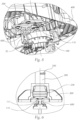
- FIG. 5 is how in figure 5 to see the drive device 100 firmly connected by a mounting element 32 to the housing 31 of the motor vehicle headlight 30 , not shown here.
- the exemplary adjustment device 100 can be provided for headlight range adjustment, for which purpose, for example, the support frame 400 is additionally connected at one point to the housing 31 of the motor vehicle headlight 30 .
- the bearing section 230 of the transmission element 200 is designed as a symmetrical layer of spheres, where 6 a detailed view of Bearing bushing 300 and the bearing section 230 of the transmission element 200 rotatably mounted in the bearing bushing 300 .
- the bearing section 230 is shaped as a symmetrical spherical segment, with the bearing bushing 300 having an opening corresponding to the symmetrical spherical segment. In this way, the bearing bushing 300 can tilt about a horizontal plane, which also allows the support frame 400 to tilt if it is fixed at a point on the housing 31 of the motor vehicle headlight 30 .
- Adjustment device 10 Optically relevant unit... 20 Motor vehicle headlights... 30 Housing ... 31 bracket element ... 32 Drive device... 100 First actuator... 110 Thread... 111 transmission element... 200 counter thread... 211 Second opening... 220 storage section... 230 Elastic tongues... 240 protrusions... 241 Attack... 250 bearing bush... 300 Carrying frame... 400 Second actuator... 500 indentations... 510 blocking element... 600
Landscapes
- Engineering & Computer Science (AREA)
- Mechanical Engineering (AREA)
- Non-Portable Lighting Devices Or Systems Thereof (AREA)
- Lighting Device Outwards From Vehicle And Optical Signal (AREA)
- Mounting And Adjusting Of Optical Elements (AREA)
Description
- Die Erfindung betrifft eine Einstellvorrichtung zur Einstellung zumindest einer optisch relevanten Baueinheit eines Kraftfahrzeugscheinwerfers.
- Ferner betrifft die Erfindung einen Kraftfahrzeugscheinwerfer mit einem Gehäuse und zumindest einer erfindungsgemäßen Einstellvorrichtung.
- Zur gesetzeskonformen Einstellung des mit einem Kraftfahrzeugscheinwerfer erzeugten Lichtbildes ist es notwendig, dass ein oder mehrere optisch relevante Baueinheiten des Scheinwerfers unter anderem in Höhenrichtung und/oder seitlich einstellbar sind. Bei einer solchen relevanten optischen Baueinheit handelt es sich beispielsweise um ein Lichtmodul, etwa bestehend aus zumindest einer Lichtquelle, zumindest einem Reflektor, zumindest einer Linse etc.; es kann sich aber auch um einzelne Bauteile wie Reflektoren, Linsen etc. handeln, die entsprechend verstellt werden.
- Dabei ist die zumindest eine optisch relevante Baueinheit häufig um eine oder mehrere Achsen, beispielsweise um eine horizontale und/oder vertikale Achse verschwenkbar in dem Scheinwerfer gelagert. Beispielsweise sind eine oder mehrere Lichtmodule an einem Tragerahmen gelagert, und der Tragerahmen ist um eine oder zwei Achsen, wie vorstehend beschrieben, verschwenkbar gelagert.
- Einstellvorrichtungen zur Einstellung von optisch relevanten Baueinheiten von Kraftfahrzeugscheinwerfern, wie beispielsweise Lichtquellen, Reflektoren und/oder Linsen, erlauben eine Anpassung des durch den Scheinwerfer erzeugten Lichtbildes an vorgegebene Anforderungen. Dies erlaubt es, dass Abweichungen von Sollvorgaben, die beispielsweise nach einem Einbauvorgang des Scheinwerfers in ein Kraftfahrzeug festgestellt werden, nachträglich durch Verwendung einer Einstellvorrichtung ausgeglichen werden können.
- Eine typische Aufgabe von Einstellvorrichtungen liegt in der Anpassung der Leuchtweite eines Scheinwerfers, wobei dieses technische Gebiet insbesondere unter dem Ausdruck "Leuchtweitenregulierung" - kurz LWR genannt - bekannt geworden ist.
- Zur Verstellung ist in der Regel zumindest eine Antriebseinrichtung vorgesehen, wobei die Antriebseinrichtung üblicherweise manuell betätigbar ist. Beispielsweise umfasst die Antriebseinrichtung ein Drehrad bzw. eine Einstellschraube, deren Drehbewegung über eine geeignete Mechanik in eine Linearbewegung eines Gleitelements umgesetzt wird, welches in entsprechenden Gleitbahnen in dem Scheinwerfergehäuse verschiebbar geführt ist. Ein Verstellpunkt der optisch relevanten Baueinheit, z.B. des Tragerahmens, an welchem die Baueinheit angebracht ist, ist in dem Gleitelement gelagert, sodass bei einem Verschieben des Gleitelements die Baueinheit bzw. der Tragerahmen verschwenkt werden.
- Eine Einstellvorrichtung zur Einstellung zumindest einer optisch relevanten Baueinheit eines Kraftfahrzeugscheinwerfers nach dem Oberbegriff des Anspruchs 1 ist aus dem Dokument
DE102014200237 A1 bekannt. - Es ist eine Aufgabe der Erfindung eine verbesserte Einstellvorrichtung zur Einstellung zumindest einer optisch relevanten Baueinheit bereitzustellen.
- Diese Aufgabe wird durch die Merkmale des Kennzeichens des Anspruchs 1 gelöst.
- Die Lagerungsbuchse greift dergestalt an dem Tragerahmen bzw. indirekt an zumindest einer optisch relevanten Baueinheit, dass eine Bewegung des ersten als auch des zweiten Stellelements in eine geänderte Ausrichtung der optisch relevanten Baueinheit gewandelt werden kann. Bei der optisch relevanten Baueinheit kann es sich beispielsweise um Blenden(anordnungen), Lichtquellen, Reflektoren, Linsen, ganze Lichtmodule bzw. Baugruppen etc. handeln.
- Weiters wird die Feinjustierung der Bewegung des Übertragungselements entlang der Verschubachse über das zweite Stellelement durch die Gewindesteigung des Gewindes des ersten Stellelements und des dazu korrespondierenden Gegengewindes des Übertragungselements bestimmt.
- Es kann vorgesehen sein, dass der Lagerungsabschnitt einstückig bzw. einteilig mit dem Übertragungselement ausgebildet ist, wobei vorzugsweise das Übertragungselement mit dem Gegengewinde und dem Lagerungsabschnitt und/oder weiteren Elementen des Übertragungselements einstückig bzw. einteilig ausgebildet ist.
- Es kann vorgesehen sein, dass das zweite Stellelement als Stellstange ausgebildet ist. Die Längsachse der Stellstange erstreckt sich hierbei entlang der Verschubachse.
- Es kann jedoch auch vorgesehen sein, dass der erste Gegeneingriffsabschnitt des Übertragungselements als Gewinde ausgebildet ist und der erste Eingriffsabschnitt des ersten Stellelements als erste Öffnung mit einem zu dem Gewinde korrespondierenden Gegengewinde ausgebildet ist, wobei das erste Stellelement über das Gegengewinde zumindest teilweise auf dem Übertragungselement auf- bzw. angeschraubt ist, was aber nicht gemäß der beanspruchte Erfindung ist.
- Es kann auch vorgesehen sein, dass der zweite Eingriffsabschnitt des zweiten Stellelements als zweite Öffnung ausgebildet ist, wobei das der zweite Gegeneingriffsabschnitt des Übertragungselements verschiebbar entlang der Verschubachse in der zweiten Öffnung des zweiten Stellelements gelagert ist, was aber auch nicht gemäß der beanspruchte Erfindung ist.
- Eine Drehbewegung des zweiten Stellelements, welche vorzugsweise in Bezug auf das Übertragungselement bzw. den Tragerahmen bewegungsfest angeordnet ist, beispielsweise an einem Gehäuse eines Kraftfahrzeugscheinwerfers, führt zu einer Drehbewegung des Übertragungselements aufgrund der mechanisch ineinandergreifenden zweiten Eingriffs- bzw. zweiten Gegeneingriffsabschnitte, wobei die auf das Übertragungselement übertragene Drehbewegung des zweiten Stellelements eine Hubbewegung des Übertragungselements erzeugt, und zwar in dem Sinne, dass das Übertragungselement aufgrund des auf dem Gewinde des ersten Stellelements aufgeschraubte Gegengewinde weiter auf- und/oder abgeschraubt wird. Das erste Stellelement ist hierbei in Bezug auf das Übertragungselement drehfest angeordnet.
- Mit Vorteil kann vorgesehen sein, dass das zweite Stellelement zumindest teilweise in der im Wesentlichen kreisförmigen, konzentrisch zur Verschubachse angeordneten zweiten Öffnung des Übertragungselements aufgenommen ist, wobei das Übertragungselement als Überdrehschutz elastische Zungen aufweist, die am Umfang der zweiten Öffnung angeordnet sind und sich entlang der Verschubachse erstrecken, wobei die elastischen Zungen Vorsprünge aufweisen, die dazu eingerichtet sind, in auf dem zweiten Stellelement angeordnete, korrespondierende Vertiefungen einzugreifen.
- Hierbei kann vorgesehen sein, dass die Vorsprünge in Form von achsenparallelen Zapfen und die dazu korrespondierenden Vertiefungen als achsenparallele Rillen ausgeführt sind.
- Vorteilhafterweise kann vorgesehen sein, dass die Antriebseinrichtung als linearer Stellmotor ausgebildet ist.
- Ferner kann vorgesehen sein, dass die Antriebseinrichtung in Bezug auf den Tragerahmen bewegungsfest angeordnet ist.
- Es kann vorgesehen sein, dass die Einstellvorrichtung ein Blockierungselement umfasst, welches in Kombination mit einem auf der Außenseite der Übertragungselements angeordneten Anschlages eingerichtet ist, eine Drehbewegung des Übertragungselements um die Verschubachse zu begrenzen.
- Der Maximal- sowie der Minimalhub des Übertragungselements bei einer Verstellung bzw. einer Drehbewegung des zweiten Stellelements entlang der Verschubachse wird durch das Blockierungselement und dem korrespondierenden, an dem Übertragungselement angeordneten Anschlag begrenzt.
- Es kann vorgesehen sein, dass der Lagerungsabschnitt des Übertragungselements als symmetrische Kugelschicht geformt ist, wobei die Lagerungsbuchse eine zu der symmetrischen Kugelschicht korrespondierende Öffnung aufweist.
- Eine Kugelschicht, auch Kugelscheibe genannt, ist ein Teil einer Vollkugel, der von zwei parallelen Ebenen ausgeschnitten wird. Der gekrümmte Flächenteil wird auch Kugelzone genannt.
- Gemäß der Erfindung ist der Tragerahmen horizontal angeordnet.
- Weiters ist die Verschubachse vertikal angeordnet.
- Dadurch liegt der Tragerahmen aufgrund seines Eigengewichts derart auf der Lagerbuchse bzw. der Einstellvorrichtung auf, dass kein Spiel in dem System vorhanden ist bzw. die jeweiligen "Aktuatoren" der Einstellvorrichtung vorbelastet sind. Dadurch können Toleranzketten innerhalb des Systems verkleinert bzw. verringert werden, sodass die Einstellvorrichtung insgesamt genauer ist bzw. die zumindest eine optisch relevante Baueinheit feiner justierbar ist.
- Dementsprechend sind auch keine schwierig abzustimmenden Gleitelemente notwendig, wodurch ein Kraftfahrzeugscheinwerfergehäuse deutlich einfacher konstruiert und hergestellt werden kann.
- Die Aufgabe wird ebenso durch einen Kraftfahrzeugscheinwerfer mit einem Gehäuse und zumindest einer optisch relevanten Baueinheit sowie mit zumindest einer erfindungsgemäßen Einstellvorrichtung gelöst.
- Hierbei kann vorgesehen sein, dass die Antriebseinrichtung mit dem Gehäuse des Kraftfahrzeugscheinwerfers fest verbunden ist.
- Nachfolgend wird die Erfindung anhand von beispielhaften Zeichnungen näher erläutert. Hierbei zeigt
-
Fig. 1A eine beispielhafte Einstellvorrichtung mit einem Antriebsmittel, welches ein erstes Stellelement aufweist, einem Übertragungselement mit elastischen Zungen, einer Lagerungsbuchse, in welcher das Übertragungselement gelagert ist und einem zweiten Stellelement, -
Fig. 1B eine Querschnittsansicht der Einstellvorrichtung ausFig. 1A , -
Fig. 2 eine Querschnittsansicht durch das zweite Stellelement und der elastischen Zungen der Einstellvorrichtung ausFig. 1A , -
Fig. 3 einen beispielhaften Kraftfahrzeugscheinwerfer mit einem Gehäuse, einer beispielhaften Einstellvorrichtung und einem horizontal angeordneten Tragerahmen, der mit der Einstellvorrichtung verbunden ist, -
Fig. 4 den Kraftfahrzeugscheinwerfer ausFig. 3 , wobei auf dem Tragerahmen eine optisch relevante Baueinheit angeordnet ist, -
Fig. 5 eine Detailansicht der über der Lagerungsbuchse mit dem Tragerahmen verbundenen Einstellvorrichtung ausFig. 1A , und -
Fig. 6 eine Detailansicht des in der Lagerbuchse angeordneten Übertragungselements, wobei das Übertragungselement mittels einem Lagerungsabschnitt in der Lagerungsbuchse angeordnet ist. - Grundsätzlich kann es sich bei der optisch relevanten Baueinheit aber um ein Einzelteil eines Kraftfahrzeugscheinwerfers oder einer Leuchteinheit, etwa um einen Reflektor, eine Linse, eine Lichtquelle, eine Blendenanordnung etc. handeln, oder die optisch relevante Baueinheit umfasst ein oder mehrere solcher Bauteile oder ein oder mehrere Leuchteinheiten auf einem gemeinsamen Träger, der verschwenkbar ist.
- Im Folgenden wird der Einfachheit halber von einem Lichtmodul als optisch relevante Baueinheit ausgegangen.
-
Fig. 1A zeigt eine beispielhafte Einstellvorrichtung 10 zur Einstellung zumindest einer optisch relevanten Baueinheit eines Kraftfahrzeugscheinwerfers, welche Einstellvorrichtung 10 eine Antriebseinrichtung 100, welcher als linearer Stellmotor ausgebildet sein kann, mit einem entlang einer Verschubachse X linear verstellbaren ersten Stellelement 110, welches drehfest angeordnet ist und einen ersten Eingriffsabschnitt aufweist, umfasst. Der erste Eingriffsabschnitt ist hierbei als Gewinde 111 ausgebildet. - Ferner umfasst die Einstellvorrichtung 10 ein mit dem ersten Stellelement 110 in mechanischen Eingriff stehendes Übertragungselement 200, wobei das Übertragungselement 200 einen zu dem Gewinde 111 des ersten Stellelements 110 korrespondierenden ersten Gegeneingriffsabschnitt aufweist, welcher als erste Öffnung 210 mit einem zu dem Gewinde 111 korrespondierenden Gegengewinde 211 ausgebildet ist.
- In
Fig. 1B ist eine Querschnittsansicht der Einstellvorrichtung 10 zu sehen, wobei das Gewinde 111 und das Gegengewinde 211, welche ineinander greifen, besser zu erkennen sind und zu sehen ist, dass das Übertragungselement 200 über das Gegengewinde 211 auf dem ersten Stellelement 110 zumindest teilweise aufgeschraubt ist, d.h. dass ein weiteres Auf- bzw. Abschrauben noch möglich ist. - Die Einstellvorrichtung 10 umfasst weiters eine Lagerungsbuchse 300, in welcher das Übertragungselement 200 mittels einem Lagerungsabschnitt 230 des Übertragungselements 200 drehbar um die Verschubachse X gelagert ist, wobei der Lagerungsabschnitt 230 in dem gezeigten Beispiel einstückig bzw. einteilig ausgebildet ist, beispielsweise durch ein Spritzgussverfahren hergestellt.
- Ferner ist ein zweites Stellelement 500 in
Fig. 1A bzw. 1B zu sehen, das um die Verschubachse X drehbar gelagert ist und einen zweiten Eingriffsabschnitt 510 aufweist, wobei das Übertragungselement 200 einen zweiten Gegeneingriffsabschnitt 220 aufweist, welcher zweite Gegeneingriffsabschnitt 220 der ersten Öffnung 210 des Übertragungselements 200 auf der Verschubachse X gegenüberliegend angeordnet ist. Der zweite Gegeneingriffsabschnitt des Übertragungselements 200 ist hierbei als zweite Öffnung 220 ausgebildet, wobei das zweite Stellelement 500 verschiebbar entlang der Verschubachse X in der zweiten Öffnung 220 des Übertragungselements 200 gelagert ist. - Das zweite Stellelement 500 ist zumindest teilweise in der im Wesentlichen kreisförmigen, konzentrisch zur Verschubachse X angeordneten zweiten Öffnung 220 des Übertragungselements 200 aufgenommen, wie in insbesondere in
Fig. 1B ersichtlich ist, wobei das Übertragungselement 200 als Überdrehschutz elastische Zungen 240 aufweist, die am Umfang der zweiten Öffnung 220 angeordnet sind und sich entlang der Verschubachse X erstrecken. -
Fig. 2 zeigt eine Querschnittsansicht durch die elastischen Zungen 240 und das zweite Stellelement 500, wobei die elastischen Zungen 240 Vorsprünge 241 aufweisen, die dazu eingerichtet sind, in auf dem zweiten Stellelement 500 angeordnete, korrespondierende Vertiefungen 510 einzugreifen. Die Vorsprünge 241 sind in Form von achsenparallelen Zapfen und die dazu korrespondierenden Vertiefungen 510 als achsenparallele Rillen ausgeführt, welche miteinander mechanisch in Eingriff stehen, wobei das zweite Stellelement 500 in Kombination mit dem Gewinde 111 des ersten Stellelements 110 dazu eingerichtet ist, eine Drehbewegung des zweiten Stellelements 500 in eine Hubbewegung des Übertragungselements 200 entlang der Verschubachse X zu wandeln, wobei das Übertragungselement 200 auf dem in Bezug auf das Übertragungselement 200 feststehenden ersten Stellelement 110 weiter auf- bzw. abgeschraubt wird und dadurch eine Hubbewegung des Übertragungselements 200 erreicht wird. - Um die Drehbewegung bzw. die Hubbewegung des Übertragungselements 200 zu begrenzen, weist die Einstellvorrichtung 10 ferner ein Blockierungselement 600 auf, welches in Kombination mit einem auf der Außenseite der Übertragungselements 200 angeordneten Anschlages 250 eingerichtet ist, eine Drehbewegung des Übertragungselements 200 um die Verschubachse X zu begrenzen, wobei das Blockierungselement 600 und der Anschlag 250 des Übertragungselements 200 in
Fig. 1B besser ersichtlich sind. -
Fig. 3 zeigt einen beispielhaften Kraftfahrzeugscheinwerfer 30 mit einem Gehäuse 31, in welchem die zuvor beschriebene Einstellvorrichtung 10 angeordnet ist, wobei die Verschubachse X vertikal in dem Kraftfahrzeugscheinwerfer 30 angeordnet ist. Weiters ist zu sehen, dass die Einstellvorrichtung 10 einen Tragerahmen 400 umfasst, welcher mit der Lagerungsbuchse 300 fest verbunden ist (inFig. 3 nicht zu sehen) und horizontal bzw. orthogonal zur Verschubachse X angeordnet ist. - Es sei angemerkt, dass Begriffe wie "vertikal", "horizontal", "oben" und "unten" im Zusammenhang mit einem ordnungsgemäß verbauten Kraftfahrzeugscheinwerfer zu verstehen sind.
- Auf dem Tragerahmen 400 ist eine optisch relevante Baueinheit 20 angeordnet, wie in
Fig. 4 zu sehen ist. Es sei angemerkt, dass auch mehrere optische Baueinheiten auf dem Tragerahmen 400 angeordnet werden können. - Die optisch relevante Baueinheit 20 kann einerseits ausgehend von einer Drehbewegung des zweiten Stellelements 500, wie weiter oben beschrieben, und andererseits mit einer linearen Bewegung des ersten Stellelements 110 durch den Stellmotor 100 entlang der Verschubachse X bewegt bzw. in ihrer Ausrichtung verändert werden. Dabei ist, wie in
Fig. 5 zu sehen, die Antriebseinrichtung 100 durch ein Halterungselement 32 fest mit dem hier nicht dargestellten Gehäuse 31 des Kraftfahrzeugscheinwerfers 30 verbunden. - Beispielsweise kann die beispielhafte Einstellvorrichtung 100 für eine Leuchtweitenregulierung vorgesehen sein, wobei hierzu beispielsweise der Tragerahmen 400 zusätzlich an einem Punkt mit dem Gehäuse 31 des Kraftfahrzeugscheinwerfers 30 verbunden ist. Hierzu ist der Lagerungsabschnitt 230 des Übertragungselements 200 als symmetrische Kugelschicht ausgebildet, wobei
Fig. 6 eine Detailansicht der Lagerungsbuchse 300 und des in der Lagerungsbuchse 300 drehbar gelagerten Lagerungsabschnittes 230 des Übertragungselements 200 zeigt. InFig. 6 ist der Lagerungsabschnitt 230 - wie bereits erwähnt - als symmetrische Kugelschicht geformt, wobei die Lagerungsbuchse 300 eine zu der symmetrischen Kugelschicht korrespondierende Öffnung aufweist. Auf diese Weise kann die Lagerungsbuchse 300 eine Verkippung um eine horizontale Ebene aufweisen, wodurch auch Verkippungen des Tragerahmens 400 möglich werden, wenn dieser an einem Punkt des Gehäuses 31 des Kraftfahrzeugscheinwerfers 30 fixiert ist. -
Einstellvorrichtung... 10 Optisch relevante Baueinheit... 20 Kraftfahrzeugscheinwerfer... 30 Gehäuse ... 31 Halterungselement ... 32 Antriebseinrichtung... 100 Erstes Stellelement... 110 Gewinde... 111 Übertragungselement... 200 Gegengewinde... 211 Zweite Öffnung... 220 Lagerungsabschnitt... 230 Elastische Zungen... 240 Vorsprünge... 241 Anschlag... 250 Lagerungsbuchse... 300 Tragerahmen... 400 Zweites Stellelement... 500 Vertiefungen... 510 Blockierungselement... 600
Claims (9)
- Einstellvorrichtung (10) zur Einstellung zumindest einer optisch relevanten Baueinheit (20) eines Kraftfahrzeugscheinwerfers, welche Einstellvorrichtung (10) Folgendes umfasst:- eine Antriebseinrichtung (100) mit einem entlang einer Verschubachse (X) linear verstellbaren ersten Stellelement (110), welches drehfest angeordnet ist und einen ersten Eingriffsabschnitt (111) aufweist,- ein mit dem ersten Stellelement (110) in mechanischen Eingriff stehendes Übertragungselement (200), wobei das Übertragungselement (200) einen zu dem ersten Eingriffsabschnitt (111) des ersten Stellelements (110) korrespondierenden ersten Gegeneingriffsabschnitt (210) aufweist,- eine Lagerungsbuchse (300), in welcher das Übertragungselement (200) mittels einem Lagerungsabschnitt (230) des Übertragungselements (200) drehbar um die Verschubachse (X) gelagert ist, wobei die Lagerungsbuchse (300) mit einem Tragerahmen (400) fest verbunden ist, wobei auf dem Tragerahmen (400) die zumindest eine optisch relevante Baueinheit (20) anordenbar ist, und- ein zweites Stellelement (500), das um die Verschubachse (X) drehbar gelagert ist und einen zweiten Eingriffsabschnitt (510) aufweist, wobei das Übertragungselement (200) einen zweiten Gegeneingriffsabschnitt (220) aufweist, welcher zweite Gegeneingriffsabschnitt (220) dem ersten Gegeneingriffsabschnitt (210) des Übertragungselements (200) auf der Verschubachse (X) gegenüberliegend angeordnet ist, und wobei der zweite Gegeneingriffsabschnitt (220) mit dem zweiten Eingriffsabschnitt (510) in mechanischem Eingriff steht, und wobei das zweite Stellelement (500) in Kombination mit dem ersten Eingriffsabschnitt (111) des ersten Stellelements (110) dazu eingerichtet ist, eine Drehbewegung des zweiten Stellelements (500) in eine Hubbewegung des Übertragungselements (200) entlang der Verschubachse (X) zu wandeln, wobeider zweite Gegeneingriffsabschnitt des Übertragungselements (200) als zweite Öffnung (220) ausgebildet ist, wobei das zweite Stellelement (500) verschiebbar entlang der Verschubachse (X) in der zweiten Öffnung (220) des Übertragungselements (200) gelagert ist,dadurch gekennzeichnet, dassder erste Eingriffsabschnitt des ersten Stellelements (110) als Gewinde (111) ausgebildet ist und der erste Gegeneingriffsabschnitt des Übertragungselements (200) als erste Öffnung (210) mit einem zu dem Gewinde (111) korrespondierenden Gegengewinde (211) ausgebildet ist, wobei das Übertragungselement (200) über das Gegengewinde (211) zumindest teilweise auf dem ersten Stellelement (110) aufgeschraubt ist, wobeider Tragerahmen (400) horizontal angeordnet ist, wenn die Einstellvorrichtung (10) in einem ordnungsgemäß verbauten Kraftfahrzeugscheinwerfer eingebaut ist, und wobeidie Verschubachse (X) vertikal angeordnet ist, wobei der Tragerahmen aufgrund seines Eigengewichts derart auf der Lagerbuchse aufliegt, sodass die Einstellvorrichtung vorbelastet ist.
- Einstellvorrichtung nach Anspruch 1, dadurch gekennzeichnet, dass das zweite Stellelement (500) zumindest teilweise in der im Wesentlichen kreisförmigen, konzentrisch zur Verschubachse (X) angeordneten zweiten Öffnung (220) des Übertragungselements (200) aufgenommen ist, wobei das Übertragungselement (200) als Überdrehschutz elastische Zungen (240) aufweist, die am Umfang der zweiten Öffnung (220) angeordnet sind und sich entlang der Verschubachse (X) erstrecken, wobei die elastischen Zungen (240) Vorsprünge (241) aufweisen, die dazu eingerichtet sind, in auf dem zweiten Stellelement (500) angeordnete, korrespondierende Vertiefungen (510) einzugreifen.
- Einstellvorrichtung nach Anspruch 2, dadurch gekennzeichnet, dass die Vorsprünge (241) in Form von achsenparallelen Zapfen und die dazu korrespondierenden Vertiefungen (510) als achsenparallele Rillen ausgeführt sind.
- Einstellvorrichtung nach einem der Ansprüche 1 bis 3, dadurch gekennzeichnet, dass die Antriebseinrichtung (100) als linearer Stellmotor ausgebildet ist.
- Einstellvorrichtung nach einem der Ansprüche 1 bis 4, dadurch gekennzeichnet, dass die Antriebseinrichtung (100) in Bezug auf den Tragerahmen (400) bewegungsfest angeordnet ist.
- Einstellvorrichtung nach einem der Ansprüche 1 bis 5, dadurch gekennzeichnet, dass die Einstellvorrichtung (10) ein Blockierungselement (600) umfasst, welches in Kombination mit einem auf der Außenseite der Übertragungselements (200) angeordneten Anschlages (250) eingerichtet ist, eine Drehbewegung des Übertragungselements (200) um die Verschubachse (X) zu begrenzen.
- Einstellvorrichtung nach einem der Ansprüche 1 bis 6, dadurch gekennzeichnet, dass der Lagerungsabschnitt (230) des Übertragungselements (200) als symmetrische Kugelschicht geformt ist, wobei die Lagerungsbuchse (300) eine zu der symmetrischen Kugelschicht korrespondierende Öffnung aufweist.
- Kraftfahrzeugscheinwerfer (30) mit einem Gehäuse (31) und zumindest einer optisch relevanten Baueinheit (20) sowie mit zumindest einer Einstellvorrichtung (10) gemäß der Ansprüche 1 bis 7.
- Kraftfahrzeugscheinwerfer nach Anspruch 8, dadurch gekennzeichnet, dass die Antriebseinrichtung (100) mit dem Gehäuse (31) des Kraftfahrzeugscheinwerfers (30) fest verbunden ist.
Applications Claiming Priority (2)
| Application Number | Priority Date | Filing Date | Title |
|---|---|---|---|
| EP18213382.7A EP3670257A1 (de) | 2018-12-18 | 2018-12-18 | Einstellvorrichtung für einen kraftfahrzeugscheinwerfer |
| PCT/EP2019/082582 WO2020126349A1 (de) | 2018-12-18 | 2019-11-26 | Einstellvorrichtung für einen kraftfahrzeugscheinwerfer |
Publications (2)
| Publication Number | Publication Date |
|---|---|
| EP3898326A1 EP3898326A1 (de) | 2021-10-27 |
| EP3898326B1 true EP3898326B1 (de) | 2023-08-16 |
Family
ID=64744613
Family Applications (2)
| Application Number | Title | Priority Date | Filing Date |
|---|---|---|---|
| EP18213382.7A Withdrawn EP3670257A1 (de) | 2018-12-18 | 2018-12-18 | Einstellvorrichtung für einen kraftfahrzeugscheinwerfer |
| EP19808815.5A Active EP3898326B1 (de) | 2018-12-18 | 2019-11-26 | Einstellvorrichtung für einen kraftfahrzeugscheinwerfer |
Family Applications Before (1)
| Application Number | Title | Priority Date | Filing Date |
|---|---|---|---|
| EP18213382.7A Withdrawn EP3670257A1 (de) | 2018-12-18 | 2018-12-18 | Einstellvorrichtung für einen kraftfahrzeugscheinwerfer |
Country Status (6)
| Country | Link |
|---|---|
| US (1) | US11458883B2 (de) |
| EP (2) | EP3670257A1 (de) |
| JP (1) | JP7250930B2 (de) |
| KR (1) | KR102620454B1 (de) |
| CN (1) | CN113195305B (de) |
| WO (1) | WO2020126349A1 (de) |
Families Citing this family (4)
| Publication number | Priority date | Publication date | Assignee | Title |
|---|---|---|---|---|
| DE102021104945A1 (de) * | 2021-03-02 | 2022-09-22 | HELLA GmbH & Co. KGaA | Beleuchtungsvorrichtung für ein Fahrzeug |
| EP4186751B1 (de) * | 2021-11-24 | 2024-10-02 | ZKW Group GmbH | Einstellsystem für einen fahrzeugscheinwerfer |
| EP4190635B1 (de) * | 2021-12-03 | 2024-05-01 | ZKW Group GmbH | Beleuchtungsvorrichtung für ein kraftfahrzeug mit verstelleinrichtung zur gleichzeitigen verstellung von lichtmodulen |
| EP4296120B1 (de) * | 2022-06-21 | 2025-01-08 | ZKW Group GmbH | Stossabsorbierendes fahrzeugscheinwerfersystem |
Family Cites Families (16)
| Publication number | Priority date | Publication date | Assignee | Title |
|---|---|---|---|---|
| JPH0788152B2 (ja) * | 1988-05-07 | 1995-09-27 | 株式会社小糸製作所 | 車輌用前照灯のレベリング装置 |
| FR2695709B1 (fr) * | 1992-09-17 | 1994-12-02 | Valeo Vision | Projecteur comportant un dispositif correcteur et des moyens de réglage du zéro du dispositif correcteur. |
| JP4085451B2 (ja) * | 1997-10-23 | 2008-05-14 | 市光工業株式会社 | 自動車用前照灯の光軸調整装置 |
| FR2826709B1 (fr) * | 2001-06-29 | 2004-02-13 | Valeo Vision | Dispositif d'eclairage a orientation variable |
| DE10332976A1 (de) * | 2003-07-21 | 2005-04-21 | Hella Kgaa Hueck & Co | Scheinwerfer für Fahrzeuge |
| CN2828560Y (zh) * | 2005-06-09 | 2006-10-18 | 何社宏 | 车用摆角电动变焦灯装置 |
| DE102005038829B4 (de) * | 2005-08-17 | 2017-07-13 | Automotive Lighting Reutlingen Gmbh | Vorrichtung zur Einstellung der Neigung eines Kraftfahrzeugscheinwerfers |
| ATE500093T1 (de) * | 2008-04-25 | 2011-03-15 | Hella Kgaa Hueck & Co | Scheinwerfer für fahrzeuge |
| EP2213513B1 (de) * | 2009-01-28 | 2016-09-07 | Automotive Lighting Italia S.p.A. | Vorrichtung zur Einstellung der Neigung einer optischen Achse einer Beleuchtungsvorrichtung für Fahrzeuge |
| FR2961289B1 (fr) * | 2010-06-10 | 2012-07-27 | Valeo Vision | Systeme de correction manuel commun pour deux dispositifs d'eclairage dont un a correction automatique |
| CN102673465B (zh) * | 2012-05-23 | 2015-07-01 | 常州星宇车灯股份有限公司 | 汽车前照灯内置调光电机装置 |
| AT514113B1 (de) * | 2013-04-04 | 2019-08-15 | Zkw Group Gmbh | Fahrzeugscheinwerfer mit einer Verstelleinrichtung |
| DE102014200237B4 (de) * | 2014-01-09 | 2024-11-14 | Automotive Lighting Reutlingen Gmbh | Scheinwerfer eines Kraftfahrzeugs |
| AT515451B1 (de) * | 2014-03-10 | 2016-02-15 | Zizala Lichtsysteme Gmbh | Einstellvorrichtung für einen Fahrzeugscheinwerfer |
| KR101846206B1 (ko) * | 2016-12-08 | 2018-04-06 | 현대오트론 주식회사 | 헤드램프 액추에이터 및 그 제어 방법 |
| EP3915835A1 (de) * | 2020-05-27 | 2021-12-01 | ZKW Group GmbH | Einstellungsvorrichtung |
-
2018
- 2018-12-18 EP EP18213382.7A patent/EP3670257A1/de not_active Withdrawn
-
2019
- 2019-11-26 US US17/414,525 patent/US11458883B2/en active Active
- 2019-11-26 EP EP19808815.5A patent/EP3898326B1/de active Active
- 2019-11-26 CN CN201980084343.1A patent/CN113195305B/zh active Active
- 2019-11-26 KR KR1020217017828A patent/KR102620454B1/ko active Active
- 2019-11-26 JP JP2021534942A patent/JP7250930B2/ja active Active
- 2019-11-26 WO PCT/EP2019/082582 patent/WO2020126349A1/de not_active Ceased
Also Published As
| Publication number | Publication date |
|---|---|
| US11458883B2 (en) | 2022-10-04 |
| CN113195305A (zh) | 2021-07-30 |
| KR102620454B1 (ko) | 2024-01-03 |
| US20220048427A1 (en) | 2022-02-17 |
| EP3898326A1 (de) | 2021-10-27 |
| JP7250930B2 (ja) | 2023-04-03 |
| WO2020126349A1 (de) | 2020-06-25 |
| EP3670257A1 (de) | 2020-06-24 |
| CN113195305B (zh) | 2024-03-08 |
| KR20210089236A (ko) | 2021-07-15 |
| JP2022514846A (ja) | 2022-02-16 |
Similar Documents
| Publication | Publication Date | Title |
|---|---|---|
| EP3898326B1 (de) | Einstellvorrichtung für einen kraftfahrzeugscheinwerfer | |
| EP3616993B1 (de) | Kraftfahrzeugscheinwerfer mit einer einstellvorrichtung | |
| EP2918447B1 (de) | Einstellvorrichtung für einen Fahrzeugscheinwerfer | |
| DE102014200237B4 (de) | Scheinwerfer eines Kraftfahrzeugs | |
| AT516973B1 (de) | Einstellsystem für einen fahrzeugscheinwerfer | |
| AT516100B1 (de) | Einstellsystem für einen Fahrzeugscheinwerfer sowie Fahrzeugscheinwerfer | |
| DE102005012303B4 (de) | Scheinwerfer | |
| EP3566902B1 (de) | Einstellvorrichtung für einen kraftfahrzeugscheinwerfer | |
| EP3616992B1 (de) | Einstellvorrichtung für einen kraftfahrzeugscheinwerfer | |
| DE102014105963A1 (de) | Scheinwerferanordnung mit einstellbarer Leuchtweite | |
| EP3737585A1 (de) | Einstellsystem zum verschwenken zumindest eines optisch relevanten bauteils eines fahrzeugscheinwerfers um eine erste und eine zweite achse | |
| DE102015219211B4 (de) | Lichtmodul für eine Kfz-Beleuchtungseinrichtung | |
| EP3927580B1 (de) | Beleuchtungsvorrichtung für einen kraftfahrzeugscheinwerfer | |
| AT508605A1 (de) | Verstellvorrichtung zum verstellen eines optisch relevanten bauteiles eines fahrzeugscheinwerfers | |
| EP4204733B1 (de) | Kraftfahrzeugscheinwerfer | |
| EP4094049B1 (de) | Einstellvorrichtung zum verschwenken zumindest eines relevanten bauteils für einen kraftfahrzeugscheinwerfer | |
| WO2019076914A1 (de) | Justierbare reflektoranordnung sowie verfahren zur justierung einer reflektoranordnung | |
| AT513338B1 (de) | Verstelleinrichtung für einen Kraftfahrzeugscheinwerfer sowie Kraftfahrzeugscheinwerfer | |
| DE202020005947U1 (de) | Einstellvorrichtung zur Einstellung einer optisch relevanten Baueinheit eines Kraftfahrzeugscheinwerfers | |
| DE102015109149B4 (de) | Mikroskop mit reibschlüssigen Antrieben | |
| EP3875315A1 (de) | Einstellvorrichtung zur einstellung einer optisch relevanten baueinheit eines kraftfahrzeugscheinwerfers | |
| EP4259486B1 (de) | Einstellvorrichtung zur einstellung von zumindest zwei optisch relevanten baueinheiten eines kraftfahrzeugscheinwerfers | |
| EP0568086A1 (de) | Diopter |
Legal Events
| Date | Code | Title | Description |
|---|---|---|---|
| STAA | Information on the status of an ep patent application or granted ep patent |
Free format text: STATUS: UNKNOWN |
|
| STAA | Information on the status of an ep patent application or granted ep patent |
Free format text: STATUS: THE INTERNATIONAL PUBLICATION HAS BEEN MADE |
|
| PUAI | Public reference made under article 153(3) epc to a published international application that has entered the european phase |
Free format text: ORIGINAL CODE: 0009012 |
|
| STAA | Information on the status of an ep patent application or granted ep patent |
Free format text: STATUS: REQUEST FOR EXAMINATION WAS MADE |
|
| 17P | Request for examination filed |
Effective date: 20210510 |
|
| AK | Designated contracting states |
Kind code of ref document: A1 Designated state(s): AL AT BE BG CH CY CZ DE DK EE ES FI FR GB GR HR HU IE IS IT LI LT LU LV MC MK MT NL NO PL PT RO RS SE SI SK SM TR |
|
| DAV | Request for validation of the european patent (deleted) | ||
| DAX | Request for extension of the european patent (deleted) | ||
| GRAP | Despatch of communication of intention to grant a patent |
Free format text: ORIGINAL CODE: EPIDOSNIGR1 |
|
| STAA | Information on the status of an ep patent application or granted ep patent |
Free format text: STATUS: GRANT OF PATENT IS INTENDED |
|
| GRAJ | Information related to disapproval of communication of intention to grant by the applicant or resumption of examination proceedings by the epo deleted |
Free format text: ORIGINAL CODE: EPIDOSDIGR1 |
|
| STAA | Information on the status of an ep patent application or granted ep patent |
Free format text: STATUS: REQUEST FOR EXAMINATION WAS MADE |
|
| INTG | Intention to grant announced |
Effective date: 20230504 |
|
| GRAP | Despatch of communication of intention to grant a patent |
Free format text: ORIGINAL CODE: EPIDOSNIGR1 |
|
| STAA | Information on the status of an ep patent application or granted ep patent |
Free format text: STATUS: GRANT OF PATENT IS INTENDED |
|
| INTC | Intention to grant announced (deleted) | ||
| GRAS | Grant fee paid |
Free format text: ORIGINAL CODE: EPIDOSNIGR3 |
|
| INTG | Intention to grant announced |
Effective date: 20230609 |
|
| GRAA | (expected) grant |
Free format text: ORIGINAL CODE: 0009210 |
|
| STAA | Information on the status of an ep patent application or granted ep patent |
Free format text: STATUS: THE PATENT HAS BEEN GRANTED |
|
| AK | Designated contracting states |
Kind code of ref document: B1 Designated state(s): AL AT BE BG CH CY CZ DE DK EE ES FI FR GB GR HR HU IE IS IT LI LT LU LV MC MK MT NL NO PL PT RO RS SE SI SK SM TR |
|
| REG | Reference to a national code |
Ref country code: CH Ref legal event code: EP |
|
| REG | Reference to a national code |
Ref country code: DE Ref legal event code: R096 Ref document number: 502019008989 Country of ref document: DE |
|
| REG | Reference to a national code |
Ref country code: IE Ref legal event code: FG4D Free format text: LANGUAGE OF EP DOCUMENT: GERMAN |
|
| P01 | Opt-out of the competence of the unified patent court (upc) registered |
Effective date: 20230814 |
|
| REG | Reference to a national code |
Ref country code: LT Ref legal event code: MG9D |
|
| REG | Reference to a national code |
Ref country code: NL Ref legal event code: MP Effective date: 20230816 |
|
| PG25 | Lapsed in a contracting state [announced via postgrant information from national office to epo] |
Ref country code: GR Free format text: LAPSE BECAUSE OF FAILURE TO SUBMIT A TRANSLATION OF THE DESCRIPTION OR TO PAY THE FEE WITHIN THE PRESCRIBED TIME-LIMIT Effective date: 20231117 |
|
| PG25 | Lapsed in a contracting state [announced via postgrant information from national office to epo] |
Ref country code: IS Free format text: LAPSE BECAUSE OF FAILURE TO SUBMIT A TRANSLATION OF THE DESCRIPTION OR TO PAY THE FEE WITHIN THE PRESCRIBED TIME-LIMIT Effective date: 20231216 |
|
| PG25 | Lapsed in a contracting state [announced via postgrant information from national office to epo] |
Ref country code: SE Free format text: LAPSE BECAUSE OF FAILURE TO SUBMIT A TRANSLATION OF THE DESCRIPTION OR TO PAY THE FEE WITHIN THE PRESCRIBED TIME-LIMIT Effective date: 20230816 Ref country code: RS Free format text: LAPSE BECAUSE OF FAILURE TO SUBMIT A TRANSLATION OF THE DESCRIPTION OR TO PAY THE FEE WITHIN THE PRESCRIBED TIME-LIMIT Effective date: 20230816 Ref country code: PT Free format text: LAPSE BECAUSE OF FAILURE TO SUBMIT A TRANSLATION OF THE DESCRIPTION OR TO PAY THE FEE WITHIN THE PRESCRIBED TIME-LIMIT Effective date: 20231218 Ref country code: NO Free format text: LAPSE BECAUSE OF FAILURE TO SUBMIT A TRANSLATION OF THE DESCRIPTION OR TO PAY THE FEE WITHIN THE PRESCRIBED TIME-LIMIT Effective date: 20231116 Ref country code: NL Free format text: LAPSE BECAUSE OF FAILURE TO SUBMIT A TRANSLATION OF THE DESCRIPTION OR TO PAY THE FEE WITHIN THE PRESCRIBED TIME-LIMIT Effective date: 20230816 Ref country code: LV Free format text: LAPSE BECAUSE OF FAILURE TO SUBMIT A TRANSLATION OF THE DESCRIPTION OR TO PAY THE FEE WITHIN THE PRESCRIBED TIME-LIMIT Effective date: 20230816 Ref country code: LT Free format text: LAPSE BECAUSE OF FAILURE TO SUBMIT A TRANSLATION OF THE DESCRIPTION OR TO PAY THE FEE WITHIN THE PRESCRIBED TIME-LIMIT Effective date: 20230816 Ref country code: IS Free format text: LAPSE BECAUSE OF FAILURE TO SUBMIT A TRANSLATION OF THE DESCRIPTION OR TO PAY THE FEE WITHIN THE PRESCRIBED TIME-LIMIT Effective date: 20231216 Ref country code: HR Free format text: LAPSE BECAUSE OF FAILURE TO SUBMIT A TRANSLATION OF THE DESCRIPTION OR TO PAY THE FEE WITHIN THE PRESCRIBED TIME-LIMIT Effective date: 20230816 Ref country code: GR Free format text: LAPSE BECAUSE OF FAILURE TO SUBMIT A TRANSLATION OF THE DESCRIPTION OR TO PAY THE FEE WITHIN THE PRESCRIBED TIME-LIMIT Effective date: 20231117 Ref country code: FI Free format text: LAPSE BECAUSE OF FAILURE TO SUBMIT A TRANSLATION OF THE DESCRIPTION OR TO PAY THE FEE WITHIN THE PRESCRIBED TIME-LIMIT Effective date: 20230816 |
|
| PG25 | Lapsed in a contracting state [announced via postgrant information from national office to epo] |
Ref country code: PL Free format text: LAPSE BECAUSE OF FAILURE TO SUBMIT A TRANSLATION OF THE DESCRIPTION OR TO PAY THE FEE WITHIN THE PRESCRIBED TIME-LIMIT Effective date: 20230816 |
|
| PG25 | Lapsed in a contracting state [announced via postgrant information from national office to epo] |
Ref country code: ES Free format text: LAPSE BECAUSE OF FAILURE TO SUBMIT A TRANSLATION OF THE DESCRIPTION OR TO PAY THE FEE WITHIN THE PRESCRIBED TIME-LIMIT Effective date: 20230816 |
|
| PG25 | Lapsed in a contracting state [announced via postgrant information from national office to epo] |
Ref country code: SM Free format text: LAPSE BECAUSE OF FAILURE TO SUBMIT A TRANSLATION OF THE DESCRIPTION OR TO PAY THE FEE WITHIN THE PRESCRIBED TIME-LIMIT Effective date: 20230816 Ref country code: RO Free format text: LAPSE BECAUSE OF FAILURE TO SUBMIT A TRANSLATION OF THE DESCRIPTION OR TO PAY THE FEE WITHIN THE PRESCRIBED TIME-LIMIT Effective date: 20230816 Ref country code: ES Free format text: LAPSE BECAUSE OF FAILURE TO SUBMIT A TRANSLATION OF THE DESCRIPTION OR TO PAY THE FEE WITHIN THE PRESCRIBED TIME-LIMIT Effective date: 20230816 Ref country code: EE Free format text: LAPSE BECAUSE OF FAILURE TO SUBMIT A TRANSLATION OF THE DESCRIPTION OR TO PAY THE FEE WITHIN THE PRESCRIBED TIME-LIMIT Effective date: 20230816 Ref country code: DK Free format text: LAPSE BECAUSE OF FAILURE TO SUBMIT A TRANSLATION OF THE DESCRIPTION OR TO PAY THE FEE WITHIN THE PRESCRIBED TIME-LIMIT Effective date: 20230816 Ref country code: CZ Free format text: LAPSE BECAUSE OF FAILURE TO SUBMIT A TRANSLATION OF THE DESCRIPTION OR TO PAY THE FEE WITHIN THE PRESCRIBED TIME-LIMIT Effective date: 20230816 Ref country code: SK Free format text: LAPSE BECAUSE OF FAILURE TO SUBMIT A TRANSLATION OF THE DESCRIPTION OR TO PAY THE FEE WITHIN THE PRESCRIBED TIME-LIMIT Effective date: 20230816 |
|
| REG | Reference to a national code |
Ref country code: DE Ref legal event code: R097 Ref document number: 502019008989 Country of ref document: DE |
|
| PLBE | No opposition filed within time limit |
Free format text: ORIGINAL CODE: 0009261 |
|
| STAA | Information on the status of an ep patent application or granted ep patent |
Free format text: STATUS: NO OPPOSITION FILED WITHIN TIME LIMIT |
|
| REG | Reference to a national code |
Ref country code: CH Ref legal event code: PL |
|
| PG25 | Lapsed in a contracting state [announced via postgrant information from national office to epo] |
Ref country code: MC Free format text: LAPSE BECAUSE OF FAILURE TO SUBMIT A TRANSLATION OF THE DESCRIPTION OR TO PAY THE FEE WITHIN THE PRESCRIBED TIME-LIMIT Effective date: 20230816 |
|
| PG25 | Lapsed in a contracting state [announced via postgrant information from national office to epo] |
Ref country code: LU Free format text: LAPSE BECAUSE OF NON-PAYMENT OF DUE FEES Effective date: 20231126 |
|
| PG25 | Lapsed in a contracting state [announced via postgrant information from national office to epo] |
Ref country code: CH Free format text: LAPSE BECAUSE OF NON-PAYMENT OF DUE FEES Effective date: 20231130 |
|
| 26N | No opposition filed |
Effective date: 20240517 |
|
| GBPC | Gb: european patent ceased through non-payment of renewal fee |
Effective date: 20231126 |
|
| PG25 | Lapsed in a contracting state [announced via postgrant information from national office to epo] |
Ref country code: MC Free format text: LAPSE BECAUSE OF FAILURE TO SUBMIT A TRANSLATION OF THE DESCRIPTION OR TO PAY THE FEE WITHIN THE PRESCRIBED TIME-LIMIT Effective date: 20230816 Ref country code: LU Free format text: LAPSE BECAUSE OF NON-PAYMENT OF DUE FEES Effective date: 20231126 Ref country code: IT Free format text: LAPSE BECAUSE OF FAILURE TO SUBMIT A TRANSLATION OF THE DESCRIPTION OR TO PAY THE FEE WITHIN THE PRESCRIBED TIME-LIMIT Effective date: 20230816 Ref country code: CH Free format text: LAPSE BECAUSE OF NON-PAYMENT OF DUE FEES Effective date: 20231130 Ref country code: SI Free format text: LAPSE BECAUSE OF FAILURE TO SUBMIT A TRANSLATION OF THE DESCRIPTION OR TO PAY THE FEE WITHIN THE PRESCRIBED TIME-LIMIT Effective date: 20230816 |
|
| REG | Reference to a national code |
Ref country code: BE Ref legal event code: MM Effective date: 20231130 |
|
| REG | Reference to a national code |
Ref country code: IE Ref legal event code: MM4A |
|
| PG25 | Lapsed in a contracting state [announced via postgrant information from national office to epo] |
Ref country code: IE Free format text: LAPSE BECAUSE OF NON-PAYMENT OF DUE FEES Effective date: 20231126 |
|
| PG25 | Lapsed in a contracting state [announced via postgrant information from national office to epo] |
Ref country code: GB Free format text: LAPSE BECAUSE OF NON-PAYMENT OF DUE FEES Effective date: 20231126 |
|
| PG25 | Lapsed in a contracting state [announced via postgrant information from national office to epo] |
Ref country code: BE Free format text: LAPSE BECAUSE OF NON-PAYMENT OF DUE FEES Effective date: 20231130 |
|
| PG25 | Lapsed in a contracting state [announced via postgrant information from national office to epo] |
Ref country code: IE Free format text: LAPSE BECAUSE OF NON-PAYMENT OF DUE FEES Effective date: 20231126 Ref country code: GB Free format text: LAPSE BECAUSE OF NON-PAYMENT OF DUE FEES Effective date: 20231126 Ref country code: BE Free format text: LAPSE BECAUSE OF NON-PAYMENT OF DUE FEES Effective date: 20231130 |
|
| PG25 | Lapsed in a contracting state [announced via postgrant information from national office to epo] |
Ref country code: BG Free format text: LAPSE BECAUSE OF FAILURE TO SUBMIT A TRANSLATION OF THE DESCRIPTION OR TO PAY THE FEE WITHIN THE PRESCRIBED TIME-LIMIT Effective date: 20230816 |
|
| PG25 | Lapsed in a contracting state [announced via postgrant information from national office to epo] |
Ref country code: BG Free format text: LAPSE BECAUSE OF FAILURE TO SUBMIT A TRANSLATION OF THE DESCRIPTION OR TO PAY THE FEE WITHIN THE PRESCRIBED TIME-LIMIT Effective date: 20230816 |
|
| PG25 | Lapsed in a contracting state [announced via postgrant information from national office to epo] |
Ref country code: CY Free format text: LAPSE BECAUSE OF FAILURE TO SUBMIT A TRANSLATION OF THE DESCRIPTION OR TO PAY THE FEE WITHIN THE PRESCRIBED TIME-LIMIT; INVALID AB INITIO Effective date: 20191126 |
|
| PG25 | Lapsed in a contracting state [announced via postgrant information from national office to epo] |
Ref country code: HU Free format text: LAPSE BECAUSE OF FAILURE TO SUBMIT A TRANSLATION OF THE DESCRIPTION OR TO PAY THE FEE WITHIN THE PRESCRIBED TIME-LIMIT; INVALID AB INITIO Effective date: 20191126 |
|
| PG25 | Lapsed in a contracting state [announced via postgrant information from national office to epo] |
Ref country code: TR Free format text: LAPSE BECAUSE OF FAILURE TO SUBMIT A TRANSLATION OF THE DESCRIPTION OR TO PAY THE FEE WITHIN THE PRESCRIBED TIME-LIMIT Effective date: 20230816 |
|
| PGFP | Annual fee paid to national office [announced via postgrant information from national office to epo] |
Ref country code: DE Payment date: 20251118 Year of fee payment: 7 |
|
| PG25 | Lapsed in a contracting state [announced via postgrant information from national office to epo] |
Ref country code: AT Free format text: LAPSE BECAUSE OF NON-PAYMENT OF DUE FEES Effective date: 20241126 |
|
| PGFP | Annual fee paid to national office [announced via postgrant information from national office to epo] |
Ref country code: FR Payment date: 20251125 Year of fee payment: 7 |
|
| REG | Reference to a national code |
Ref country code: AT Ref legal event code: MM01 Ref document number: 1599743 Country of ref document: AT Kind code of ref document: T Effective date: 20241126 |
|
| PGFP | Annual fee paid to national office [announced via postgrant information from national office to epo] |
Ref country code: AT Payment date: 20260410 Year of fee payment: 5 |