EP3887694B1 - Antrieb, koppelelement sowie verfahren zum betreiben eines antriebes - Google Patents
Antrieb, koppelelement sowie verfahren zum betreiben eines antriebes Download PDFInfo
- Publication number
- EP3887694B1 EP3887694B1 EP20800860.7A EP20800860A EP3887694B1 EP 3887694 B1 EP3887694 B1 EP 3887694B1 EP 20800860 A EP20800860 A EP 20800860A EP 3887694 B1 EP3887694 B1 EP 3887694B1
- Authority
- EP
- European Patent Office
- Prior art keywords
- output shaft
- claw
- window
- drive
- input shaft
- Prior art date
- Legal status (The legal status is an assumption and is not a legal conclusion. Google has not performed a legal analysis and makes no representation as to the accuracy of the status listed.)
- Active
Links
Images




Classifications
-
- F—MECHANICAL ENGINEERING; LIGHTING; HEATING; WEAPONS; BLASTING
- F16—ENGINEERING ELEMENTS AND UNITS; GENERAL MEASURES FOR PRODUCING AND MAINTAINING EFFECTIVE FUNCTIONING OF MACHINES OR INSTALLATIONS; THERMAL INSULATION IN GENERAL
- F16H—GEARING
- F16H61/00—Control functions within control units of change-speed- or reversing-gearings for conveying rotary motion ; Control of exclusively fluid gearing, friction gearing, gearings with endless flexible members or other particular types of gearing
- F16H61/04—Smoothing ratio shift
- F16H61/0403—Synchronisation before shifting
-
- B—PERFORMING OPERATIONS; TRANSPORTING
- B60—VEHICLES IN GENERAL
- B60L—PROPULSION OF ELECTRICALLY-PROPELLED VEHICLES; SUPPLYING ELECTRIC POWER FOR AUXILIARY EQUIPMENT OF ELECTRICALLY-PROPELLED VEHICLES; ELECTRODYNAMIC BRAKE SYSTEMS FOR VEHICLES IN GENERAL; MAGNETIC SUSPENSION OR LEVITATION FOR VEHICLES; MONITORING OPERATING VARIABLES OF ELECTRICALLY-PROPELLED VEHICLES; ELECTRIC SAFETY DEVICES FOR ELECTRICALLY-PROPELLED VEHICLES
- B60L15/00—Methods, circuits, or devices for controlling the traction-motor speed of electrically-propelled vehicles
- B60L15/20—Methods, circuits, or devices for controlling the traction-motor speed of electrically-propelled vehicles for control of the vehicle or its driving motor to achieve a desired performance, e.g. speed, torque, programmed variation of speed
- B60L15/2045—Methods, circuits, or devices for controlling the traction-motor speed of electrically-propelled vehicles for control of the vehicle or its driving motor to achieve a desired performance, e.g. speed, torque, programmed variation of speed for optimising the use of energy
-
- F—MECHANICAL ENGINEERING; LIGHTING; HEATING; WEAPONS; BLASTING
- F16—ENGINEERING ELEMENTS AND UNITS; GENERAL MEASURES FOR PRODUCING AND MAINTAINING EFFECTIVE FUNCTIONING OF MACHINES OR INSTALLATIONS; THERMAL INSULATION IN GENERAL
- F16D—COUPLINGS FOR TRANSMITTING ROTATION; CLUTCHES; BRAKES
- F16D11/00—Clutches in which the members have interengaging parts
- F16D11/14—Clutches in which the members have interengaging parts with clutching members movable only axially
-
- F—MECHANICAL ENGINEERING; LIGHTING; HEATING; WEAPONS; BLASTING
- F16—ENGINEERING ELEMENTS AND UNITS; GENERAL MEASURES FOR PRODUCING AND MAINTAINING EFFECTIVE FUNCTIONING OF MACHINES OR INSTALLATIONS; THERMAL INSULATION IN GENERAL
- F16D—COUPLINGS FOR TRANSMITTING ROTATION; CLUTCHES; BRAKES
- F16D23/00—Details of mechanically-actuated clutches not specific for one distinct type
- F16D23/02—Arrangements for synchronisation, also for power-operated clutches
-
- F—MECHANICAL ENGINEERING; LIGHTING; HEATING; WEAPONS; BLASTING
- F16—ENGINEERING ELEMENTS AND UNITS; GENERAL MEASURES FOR PRODUCING AND MAINTAINING EFFECTIVE FUNCTIONING OF MACHINES OR INSTALLATIONS; THERMAL INSULATION IN GENERAL
- F16H—GEARING
- F16H3/00—Toothed gearings for conveying rotary motion with variable gear ratio or for reversing rotary motion
- F16H3/02—Toothed gearings for conveying rotary motion with variable gear ratio or for reversing rotary motion without gears having orbital motion
- F16H3/08—Toothed gearings for conveying rotary motion with variable gear ratio or for reversing rotary motion without gears having orbital motion exclusively or essentially with continuously meshing gears, that can be disengaged from their shafts
- F16H3/087—Toothed gearings for conveying rotary motion with variable gear ratio or for reversing rotary motion without gears having orbital motion exclusively or essentially with continuously meshing gears, that can be disengaged from their shafts characterised by the disposition of the gears
- F16H3/089—Toothed gearings for conveying rotary motion with variable gear ratio or for reversing rotary motion without gears having orbital motion exclusively or essentially with continuously meshing gears, that can be disengaged from their shafts characterised by the disposition of the gears all of the meshing gears being supported by a pair of parallel shafts, one being the input shaft and the other the output shaft, there being no countershaft involved
-
- B—PERFORMING OPERATIONS; TRANSPORTING
- B60—VEHICLES IN GENERAL
- B60Y—INDEXING SCHEME RELATING TO ASPECTS CROSS-CUTTING VEHICLE TECHNOLOGY
- B60Y2200/00—Type of vehicle
- B60Y2200/90—Vehicles comprising electric prime movers
- B60Y2200/91—Electric vehicles
-
- F—MECHANICAL ENGINEERING; LIGHTING; HEATING; WEAPONS; BLASTING
- F16—ENGINEERING ELEMENTS AND UNITS; GENERAL MEASURES FOR PRODUCING AND MAINTAINING EFFECTIVE FUNCTIONING OF MACHINES OR INSTALLATIONS; THERMAL INSULATION IN GENERAL
- F16H—GEARING
- F16H55/00—Elements with teeth or friction surfaces for conveying motion; Worms, pulleys or sheaves for gearing mechanisms
- F16H55/02—Toothed members; Worms
- F16H55/17—Toothed wheels
- F16H2055/178—Toothed wheels combined with clutch means, e.g. gear with integrated synchroniser clutch
-
- F—MECHANICAL ENGINEERING; LIGHTING; HEATING; WEAPONS; BLASTING
- F16—ENGINEERING ELEMENTS AND UNITS; GENERAL MEASURES FOR PRODUCING AND MAINTAINING EFFECTIVE FUNCTIONING OF MACHINES OR INSTALLATIONS; THERMAL INSULATION IN GENERAL
- F16H—GEARING
- F16H61/00—Control functions within control units of change-speed- or reversing-gearings for conveying rotary motion ; Control of exclusively fluid gearing, friction gearing, gearings with endless flexible members or other particular types of gearing
- F16H61/04—Smoothing ratio shift
- F16H61/0403—Synchronisation before shifting
- F16H2061/0422—Synchronisation before shifting by an electric machine, e.g. by accelerating or braking the input shaft
-
- F—MECHANICAL ENGINEERING; LIGHTING; HEATING; WEAPONS; BLASTING
- F16—ENGINEERING ELEMENTS AND UNITS; GENERAL MEASURES FOR PRODUCING AND MAINTAINING EFFECTIVE FUNCTIONING OF MACHINES OR INSTALLATIONS; THERMAL INSULATION IN GENERAL
- F16H—GEARING
- F16H61/00—Control functions within control units of change-speed- or reversing-gearings for conveying rotary motion ; Control of exclusively fluid gearing, friction gearing, gearings with endless flexible members or other particular types of gearing
- F16H61/04—Smoothing ratio shift
- F16H2061/0474—Smoothing ratio shift by smoothing engagement or release of positive clutches; Methods or means for shock free engagement of dog clutches
-
- F—MECHANICAL ENGINEERING; LIGHTING; HEATING; WEAPONS; BLASTING
- F16—ENGINEERING ELEMENTS AND UNITS; GENERAL MEASURES FOR PRODUCING AND MAINTAINING EFFECTIVE FUNCTIONING OF MACHINES OR INSTALLATIONS; THERMAL INSULATION IN GENERAL
- F16H—GEARING
- F16H63/00—Control outputs from the control unit to change-speed- or reversing-gearings for conveying rotary motion or to other devices than the final output mechanism
- F16H63/02—Final output mechanisms therefor; Actuating means for the final output mechanisms
- F16H63/30—Constructional features of the final output mechanisms
- F16H2063/3093—Final output elements, i.e. the final elements to establish gear ratio, e.g. coupling sleeves or other means establishing coupling to shaft
-
- F—MECHANICAL ENGINEERING; LIGHTING; HEATING; WEAPONS; BLASTING
- F16—ENGINEERING ELEMENTS AND UNITS; GENERAL MEASURES FOR PRODUCING AND MAINTAINING EFFECTIVE FUNCTIONING OF MACHINES OR INSTALLATIONS; THERMAL INSULATION IN GENERAL
- F16H—GEARING
- F16H2200/00—Transmissions for multiple ratios
- F16H2200/0021—Transmissions for multiple ratios specially adapted for electric vehicles
-
- F—MECHANICAL ENGINEERING; LIGHTING; HEATING; WEAPONS; BLASTING
- F16—ENGINEERING ELEMENTS AND UNITS; GENERAL MEASURES FOR PRODUCING AND MAINTAINING EFFECTIVE FUNCTIONING OF MACHINES OR INSTALLATIONS; THERMAL INSULATION IN GENERAL
- F16H—GEARING
- F16H2200/00—Transmissions for multiple ratios
- F16H2200/003—Transmissions for multiple ratios characterised by the number of forward speeds
- F16H2200/0034—Transmissions for multiple ratios characterised by the number of forward speeds the gear ratios comprising two forward speeds
Definitions
- the invention relates to a drive according to claim 1.
- the invention also relates to a coupling element for a drive.
- the invention relates to a method for operating a drive, according to claim 13.
- WO 2013/072609 A1 WO 2019/141684 A1 and FR 2 701 679 A1 become known, in which sometimes a speed of the electric motor is changed during a shift.
- the document US 2019/0078686 A1 discloses in particular a switching device for a transmission for producing a switchable non-rotatable connection either between a first idler wheel and a second idler wheel or between the first idler wheel and a shaft.
- the connection is made with a sliding sleeve, which is always non-rotatably and at the same time axially displaceably connected to a first loose wheel via extensions engaging in a form-fitting manner in openings.
- the components involved are synchronized, specifically with a synchronizing device or an unsynchronized claw toothing.
- the drives disclosed in these documents only have a low level of efficiency and, at the same time, high shifting times, so that they are not suitable for a comfortable driving experience, but rather cause a noticeable interruption in the tractive force of the driver during a shifting process.
- the object of the invention is to specify a drive of the type mentioned at the outset, which can be produced in a particularly simple and cost-effective manner.
- a coupling element is to be specified with which a drive shaft can be detachably coupled to an output shaft of such a drive via a gear.
- the first object is achieved according to the invention by a drive of the type mentioned at the outset, in which the drive shaft can be detachably coupled to the output shaft via a gear by means of at least one claw engaging in a recess, the recess being arranged in a window which extends along one direction extends along which a member coupled to the input shaft is movable relative to a member coupled to the output shaft when the output shaft is not coupled to the input shaft during a shift, such that the pawl is movable from a disengaged condition through the window into the recess.
- the drive can be designed in a particularly simple and cost-effective manner if the shaft connected to the motor is not mechanically synchronized with the shaft connected to the output in the transmission, for example as is customary in transmissions of the prior art via synchronizing rings or by means of friction, but synchronization takes place electrically, in that the electric motor is accelerated or decelerated to the corresponding speed, the speed of the electric motor usually being greater than zero before and after the switching process.
- this electrical acceleration or deceleration can be carried out in a simple manner by correspondingly controlling an inverter, with which a speed of the motor is defined, as is known from the prior art.
- a drive according to the invention can also be implemented with a DC motor.
- the transmission can then be designed without a corresponding mechanical synchronization device based on friction, so that it can not only be inexpensive and simple, but also low-wear and small, especially since in the transmission, in contrast to transmissions of the prior art, kinetic energy is not or only in to a very small extent, if, despite the electrical synchronization, there is still a small relative speed, it must be converted into heat in order to achieve synchronization.
- the transmission can be designed with a smaller surface, since only a smaller amount of heat has to be dissipated via the surface.
- the gear does not have to be designed for mechanical synchronization of the speed of the motor or for mechanical acceleration or braking by means of friction, the gear can also be made of simple and inexpensive materials, for example case-hardened steel.
- the drive shaft is coupled to the output shaft by means of a form fit, which enables particularly rapid engagement, in particular in comparison with conventional friction-locking clutches of the prior art.
- the drive in order to produce a detachable rotary positive connection between the drive shaft and the output shaft, has a rotatable first element with a window in which a stop is arranged, and a rotatable second element with a projection that can be inserted into the window, in particular a Claw having, wherein by means of the projection, a rotational movement from the second element to the first element can be positively transmitted.
- the positive connection for coupling a rotational movement of the drive shaft to the output shaft can thus be effected in a simple manner by inserting the projection into the window.
- the protrusion is inserted into the window by reducing a distance between the first member and the second member in a direction of an axis about which the first member and the second member rotate or in the axial direction until the protrusion is positioned inside the window is.
- the projection can then be moved to the stop by rotating the second element relative to the first element about the axis.
- the window is usually made larger than the projection, so that the projection can be easily introduced into the window even when there is a relative speed between the first element and the second element about the axis. Furthermore, a relative movement between the projection and the window is then also possible when the projection has already been inserted into the window until the projection rests against the stop in the window, as a result of which the form fit takes place.
- the window can be formed as a circular arc-shaped recess in the first element, in which Recess can engage the projection, wherein the stop is formed by one end of the arcuate recess in the circumferential direction.
- the contact of the projection against the stop means that there is a form fit in the direction of rotation, but there is still no form fit against the direction of rotation.
- a recess is arranged in the window, which can correspond with the projection without play.
- the first element can, for example, be axially displaceable and non-rotatable with the output shaft or the drive shaft and the second element can be non-rotatably connected with a gear wheel of a gear or be formed by a gear wheel in order to create a rotational coupling between the drive shaft and the drive shaft by inserting the projection into the window To produce the output shaft via one of the gears.
- the first element which has the window, can also be connected to a gear wheel or formed by the gear wheel and the second element can be connected to the drive shaft or output shaft in a torque-proof manner.
- Sensors are usually provided, with which the speeds of the drive shaft and the output shaft can be detected in order to enable the electric motor to be precisely regulated to the second speed.
- the first gear has a transmission ratio of 4, so that an input speed of the electric motor of, for example, 4000 revolutions per minute or rpm is translated to an output speed at the transmission output of 1000 rpm
- the second gear has a transmission ratio of 2
- an input speed of the electric motor of 4000 min -1 is translated to an output speed of 2000 min -1 at the transmission output
- the electric motor has to open the gears during the shifting process for the smoothest possible and therefore comfortable shifting a speed can be braked which corresponds to the quotient of the second transmission ratio and the first transmission ratio, i.e. the quotient of 2 and 4, i.e. 0.5.
- the speed of the electric motor is 1000 revolutions per minute at the beginning of the shifting process, it must be slowed down to 500 revolutions per minute by the electrical synchronizing device during the shifting process in order to ensure a constant speed of the output shaft of 250 rpm during the shifting process.
- a synchronization speed in a drive according to the invention is usually dependent in particular on a motor used, a switching time and an application of the drive, for example in an electric vehicle.
- the output shaft can be connected, for example, to the wheels of a motor vehicle in order to drive it.
- This electrical synchronization is possible, for example, with an inverter, which is connected to an appropriately dimensioned accumulator, in a simple manner without wearing elements.
- the translations of the individual gears can be any positive and negative values, which can be greater or smaller than 1.0, so that both faster and slower translations are possible with a drive according to the invention.
- the drive is designed to carry out a switching process in which the duration of the switching process is less than one second, in particular less than 150 milliseconds. This ensures a particularly quick change of gears or a change in a translation of a speed of the electric motor to an output speed at the transmission output, which can be connected to the wheels of an electric vehicle, for example.
- the electric motor is designed with a low moment of inertia of the moving masses or the armature and/or the electrical synchronizing device is designed to absorb or deliver high power. This can be achieved, for example, by electronics such as an inverter, which is suitable for correspondingly large currents or powers.
- an electrical energy store is provided, which is set up both to receive and to deliver large amounts of electrical power. It is favorable when an accumulator is connected to the electric motor, in which electrical energy can be stored, which is in the electric motor at a Braking process is generated.
- an accumulator is connected to the electric motor, in which electrical energy can be stored, which is in the electric motor at a Braking process is generated.
- a heating resistor and/or an electrically driven flywheel can be provided for this purpose.
- An accumulator is usually connected to the electric motor via an inverter, so that the electric motor can be driven by the accumulator and, when the electric motor is braked, electrical energy generated in the electric motor as a generator can be stored in the accumulator via the inverter.
- the electric motor can also be designed as a DC motor, so that an inverter is not required.
- At least one coupling element is provided, which is positively connected in a first direction, in particular in a circumferential direction, and movable in a second direction, in particular in an axial direction, to the input shaft or the output shaft in order to be detachable by at least one gear the input shaft or the output shaft.
- first direction in particular in a circumferential direction
- second direction in particular in an axial direction
- the designations “circumferential direction” and “axial direction” are to be understood in relation to the shaft, ie the drive shaft or the output shaft, to which the coupling element is connected.
- the coupling element can be embodied as a sleeve that can be displaced axially on the output shaft, which is non-rotatably connected to the output shaft and is suitable for producing a positive non-rotatable connection of the output shaft to a gear wheel of a gear by axial displacement of the sleeve.
- the individual gears which can be formed, for example, by gearwheel pairs with different translations, cannot be connected to the input shaft and the output shaft at the same time, since this would lead to kinematic overdetermination. Therefore, only one gear can be engaged at the same time, which defines a translation of the input shaft to the output shaft. All other gears must then be kinematically separated from the input shaft and/or the output shaft, so that a rotational movement of the input shaft is translated into a rotational movement of the output shaft via only one gear.
- the individual gears must therefore be releasably connected to the drive shaft and/or the output shaft, with a kinematic connection having to be releasable or releasable during a shifting process.
- a corresponding connection can be made, for example, with a coupling element, which can be frictionally or positively connected in the circumferential direction, i.e. non-rotatably, to the input shaft or the output shaft, so that the coupling element rotates with the input shaft or the output shaft and for establishing or releasing a connection of the input shaft or the output shaft with a gear wheel of the respective gear can be displaced axially on the input shaft or the output shaft in order to produce a form fit also in the circumferential direction with the respective gear wheel from a predefined axial position, so that the gear wheel in the circumferential direction via the coupling element is form-fit, i.e. non-rotatable connected to the input shaft or the output shaft.
- a gear can thus be connected to the input shaft or the output shaft in a simple and at the same time quick manner by an axial movement of the coupling element on the input shaft or the output shaft. In the same way, a connection can be easily released.
- the coupling element can interact in various ways with a gear or a gearwheel of the gear which is to be connected to the drive shaft or the output shaft via the coupling element, for example frictionally or magnetically, in order to establish a non-rotatable connection.
- a particularly simple structure results in particular when at least one coupling element can be positively releasably connected to at least one gear. As a result, large torques can also be transmitted reliably and without slip.
- the coupling element is preferably also connected to the drive shaft or the output shaft in a form-fitting manner in the circumferential direction, in particular via internal teeth or a splined shaft.
- a positive fit in the circumferential direction with the gearwheel of the gear, which is to be connected to the drive shaft or the output shaft via the coupling element, can also be achieved via a tooth system, a claw or the like.
- the coupling element is connected to the first gear on a first side, in particular an end face, and on a second side, in particular one opposite the first side End face, can be connected to the second gear.
- a single coupling element is then sufficient to selectively engage one of two gears or to produce a coupling of one of the two gears with the input shaft or the output shaft.
- the coupling element can then be arranged, for example, on the output shaft between gears of the first gear and gears of the second gear in order to connect first gear or second gear to the output shaft, depending on an axial position of the coupling element on the output shaft.
- a corresponding arrangement on the drive shaft would also be possible.
- the drive shaft can be detachably coupled to the output shaft via a gear by means of at least one claw engaging in a recess.
- a releasable form-fitting connection for the transmission of a torque can thus be established in a simple manner via the claw.
- a drive according to the invention can be implemented particularly advantageously if it is used in a vehicle, in particular an electric vehicle, in order to drive or brake the vehicle. It is therefore advantageous in an electric vehicle with a drive, in particular in an electric car, an electric boat or an electric motorcycle, if the drive is designed according to the invention.
- electric vehicles are understood here to mean both vehicles that are driven exclusively electrically and so-called hybrid vehicles in which an internal combustion engine can also be provided in addition to an electric motor.
- the claw and the recess are designed in such a way that, when the drive shaft is coupled to the output shaft, the claw has a play of less than 20 mm, in particular less than 10 mm, preferably less than 5 mm, relative to the recess , having.
- the claw can also be easily introduced into the recess, for example, if the claw or the recess has an undercut, in order to easily avoid unintentional removal of the claw from the recess.
- a game can, for example, be a rotation of a die Permit the component having the claw relative to a component having the depression of less than 5°, in particular less than 2°.
- the claw can be positioned in the recess essentially without play. This avoids unpleasant noises or vibrations in the transmission.
- the claw can also have an undercut so that an unintentional removal of the claw from the recess is easily avoided.
- the recess is arranged in a window which extends along a direction along which an element coupled to the input shaft can be moved relative to an element coupled to the output shaft when the output shaft is no longer connected to the input shaft during a shifting operation is coupled such that the claw is movable from a disengaged condition through the window into the recess.
- the window is usually arranged in an end face of the coupling element, which end face of the coupling element is moved over the claw during a coupling process with a gear wheel, so that the claw can engage in the recess arranged in the window in the end face.
- the window thus has a smaller depth than the indentation, but a greater extent in the circumferential direction than the indentation, so that the claw is caught by the window even with a relative movement between the claw and the indentation, so to speak, through the window and over a form fit in the circumferential direction in relation to a circumferential speed with the window or a component having the window can be synchronized with a component having the claw.
- This allows, for example, a gear wheel having one or more claws to be synchronized in a simple manner with a coupling device formed by a claw disk, which has depressions that correspond to the claws and are arranged in windows, in order to establish a non-rotatable connection between the coupling device and the gear wheel.
- window is understood broadly and defines an area which has a floor which is at least partially, preferably entirely between a part of the end face of the coupling element, in particular between a plane of the Face, and a latching plane is located in which latching plane is an axial end of the claw when the claw is in the recess and the input shaft is coupled to the output shaft.
- the window generally has a greater extent in the circumferential direction than the indentation and an extent of the window in the radial direction corresponds to at least one extent of the indentation in the radial direction, so that the claw from the end face can be pushed completely into the Window can be moved, after which the claw can slide in the window at the bottom of the window up to the recess, after which the claw can be inserted into the recess by a further movement in the axial direction. Consequently, it is not relevant whether a radial extension of the window corresponds exactly to a radial extension of the claw or is larger.
- a radial extent of the window extends, for example, over an entire radial extent of the end face or of the coupling element, ie from an inner diameter of the coupling element to an outer diameter.
- the term window is therefore synonymous with one of the terms recess in the face or pre-depression.
- the bottom of the window forms an intermediate plane which is at least partially located between the end face and a snap-in plane.
- the window with the depression arranged therein consequently has the effect of producing synchronization in a structurally particularly simple manner by means of the claw by first moving the claw in the axial direction and thereby inserting it into the window, which is larger than the claw, after which the claw rests against one end of the window, so that there is a positive fit between the claw and window in the circumferential direction and this positive fit synchronizes the speed of the claw and the speed of the window, after which the claw is positioned in the recess by further movement in the axial direction, so that the claw is connected to the recess in a substantially form-fitting manner in the circumferential direction, possibly with a small amount of play.
- a shifting process is also possible when the gear wheel and the coupling element or the shaft, i.e. usually the drive shaft or the output shaft to which the corresponding gear wheel is to be connected, have different speeds, especially since synchronization to exactly the same angular speed is then takes place via a form fit or the claw being carried along by the stop of the window.
- the claw can then be inserted in a simple manner into the depression, which is preferably located at the end of the window at which the stop is also located, with which the claw can be taken along.
- the electric motor is brought to a slightly faster or slower speed during a shift by the electrical synchronizing device than the first speed at the beginning of the shift multiplied by the quotient of the second translation and the first translation corresponds to a to allow a slight relative rotation reliable switching and safe insertion of the claw into the recess, especially since at exactly the same angular velocity, the claw would never be inserted into the recess even with a small offset.
- the window is thus also located on the end face of the coupling element.
- the window has a smaller depth than the depression, so that the claw is first inserted to a bottom of the window and then into the depression when the claw is moved in the axial direction towards the gear in order to engage the gear with the To connect the drive shaft or the output shaft via the coupling element.
- the indentation is usually arranged at the end of the window, in particular at a peripheral end of the window, in order to achieve a reliable connection between the claw and the indentation.
- the individual gears can be formed by a wide variety of elements, such as friction wheels or push rods, it has proven particularly useful that the first gear is formed by a first pair of gears and the second gear by a second pair of gears. As a result, low wear and a long service life can be achieved even at high speeds.
- the gear wheel pairs are connected to the drive shaft in a rotationally fixed manner and can be connected to the output shaft via at least one coupling element designed as a claw disk, the claw disk being connected to the output shaft in a form-fitting manner in the circumferential direction and being displaceable in an axial direction relative to the output shaft.
- a gear or a pair of gears can then be connected to the output shaft or released from the drive shaft via an axial movement of the claw disk.
- one or more claw disks can also be provided for the detachable coupling of one or more gear wheel pairs to the drive shaft.
- the output-side gears of the gear pairs each have at least one claw, preferably two to seven, in particular three to five, claws, which extend in the axial direction and correspond to depressions in an end face of the claw disk.
- a torque to be transmitted is distributed over a number of contact surfaces, so that mechanical stresses that occur are reduced.
- a corresponding number it is also ensured that all discs are in contact and forces are transmitted evenly.
- each of the depressions in the claw disk corresponding to the claws is arranged in a window running along a circumferential direction, with the depression being arranged at the end in the window in the circumferential direction. It is thus a two-stage gear for coupling the drive shaft to the output shaft via one gear Enables a coupling process in which the claw can first be inserted into the window, even if there is a speed difference between the gear wheel and the claw disk, in which the claw is brought to a speed corresponding to the speed of the window by abutting against a stop, after which the claw opens can easily be inserted into the depression arranged in the window.
- the window has a ramp at the end opposite the recess, which preferably extends to the end face. This makes it easy to prevent the claw from being inserted into a wrong gear window in the event of a software error. Rather, the claw then slides over the ramp back out of the window onto the front side.
- the ramp usually has an angle of 10° to 80°, in particular 20° to 60°, preferably 30° to 50°, with respect to a plane parallel to the end face.
- protection can also take place in the software, so that no ramp is required to prevent a claw, which can be arranged both on the gearwheel and on the coupling element, from being inserted into a wrong window, in which window the depression is arranged and which Window can also be arranged both on the coupling element and in the gear.
- the ramp typically connects a bottom of the window to the face so that the claw can slide over the ramp with continuous contact from the face to the bottom of the window.
- the ramp has a surface which is arranged at an angle relative to a bottom of the window and connects the bottom of the window to the end face.
- the bottom of the window is preferably approximately parallel to the face. Consequently, the angle at which the ramp is arranged relative to the end face, usually corresponds to the angle at which the ramp relative to the Floor is arranged, the angle is preferably 10 ° to 80 °, in particular 20 ° to 60 °, preferably 30 ° to 50.
- the at least one claw has a chamfer on one edge, with an angle of the chamfer corresponding to an angle of the ramp, so that the claw slides over the ramp from the end face into the window by means of surface contact between the chamfer and the ramp can.
- the at least one claw has a top surface, with an orientation of the top surface corresponding to an orientation of a bottom of the window, so that the claw slides over the bottom of the ramp into the recess by means of surface contact between the top surface and the bottom can.
- a stop can also be provided at the peripheral end of the window in order to recuperate energy in the event of an unusual driving situation via a form fit between the claw and the window.
- energy can also be transmitted via a partial engagement of the claw, which in this case is not engaged in the depression but is engaged in the window.
- the claw washer is usually arranged in the transmission via a spring in the axial direction by means of an actuator such as a linear motor.
- an actuator such as a linear motor.
- the claw disc is actuated via a shift fork, which is guided in the claw disc in an external groove, with the shift fork in the transmission, which is usually designed as an automatic transmission, being able to be actuated via a spring by means of an actuator in order to move the claw disc along a To shift the axial direction of the output shaft or parallel to an axis of rotation of the output shaft, so that different gears can be coupled to the output shaft.
- a coupling element of the type mentioned at the outset in which at least one window is provided on an end face and extends over part of a circumference of the coupling element, with a recess being arranged on a circumferential end of the window, into which a claw corresponding to the depression can engage.
- the recess is larger than the recess in a circumferential direction, so that a claw, which with the Deepening can be coupled without play, for example, can be caught in a relative movement between the claw and the deepening in the circumferential direction through the window in order to insert the claw into the deepening in the window.
- the depression thus has a greater depth from the end face or an end face of the coupling element than the window.
- a corresponding coupling element is designed for a two-stage coupling process, in which a coupling process is possible even at relative speeds between a gear wheel, which has a claw for the recess, and the coupling element, in that the claw first penetrates into the window and then in the window by abutting at one end of the window is brought up to the speed of the coupling element, after which the claw can enter the recess.
- a coupling element is usually used in a drive according to the invention.
- the coupling element is in the form of a claw disk which is approximately symmetrical in particular with respect to a central plane.
- the claw disc can then be arranged on an output shaft between two gears or between two pairs of gears, which each form gears, in order to optionally connect one of the two gears to the driven disc by axial displacement of the claw disc, in that claws on the gears of the gears move into the wells are introduced.
- the center plane is then normal to an axis of rotation about which the claw disc is arranged to rotate in the transmission or an axis of rotation of the output shaft. Faces of the claw disc are then usually parallel to the center plane.
- a particularly narrow claw disc and thus a gear with a small space requirement are possible.
- the coupling element has internal teeth for a form-fitting coupling to an output shaft.
- the coupling element can then easily form a positive fit in the circumferential direction be connected to the output shaft, so that a rotational movement of the output shaft can be transmitted without slip to the coupling element.
- the coupling element can be displaced along an axial direction if the coupling element is arranged in a form-fitting manner on the output shaft in the circumferential direction in order to be able to connect various gears to the output shaft via the coupling element.
- the output shaft then usually has a corresponding external toothing for a form fit, with the individual teeth being arranged axially parallel or designed as straight toothing.
- the coupling element which is preferably designed as a claw disk, can usually be mounted so that it can rotate about an axis of rotation or an axis direction and can have a groove on an outer circumference that is rotationally symmetrical to the axis of rotation, which can serve as a guide for a shift fork in order to move the coupling element axially along the axis direction.
- the coupling element can be actuated via a spring. Displacement of the coupling element by means of a spring along the axial direction has proven itself in order to easily bring the coupling element into a form-fitting connection with a claw of the gear wheel. An axial force is thus applied via the spring, which presses an end face of the coupling element against a claw on a gear wheel. If a relative movement between the gear wheel and the coupling element causes a window in the coupling element to be located in the area of the claw, the axial force applied via the spring causes the claw to move axially into the recess of the claw disc. This ensures low wear and at the same time a quick switching time.
- the further object is achieved according to the invention by a method of the type mentioned at the outset, with which a drive according to the invention is operated, in which a speed of the electric motor is changed by means of an electrical synchronizing device during the duration of the shifting process, for example to a second speed, by accelerating the electric motor or is braked, the second speed corresponding to the first speed multiplied by the quotient of the second transmission ratio and the first transmission ratio, after which the drive shaft is rotationally coupled to the output shaft by means of a form fit.
- a mechanical synchronization which is usually associated with a conversion of kinetic energy into heat, was essentially replaced by an electrical synchronization, which is easily possible with electric motors.
- the method can be implemented with less friction, and thus more efficiently, and at the same time with a simpler drive.
- Coupling by means of a form fit which preferably takes place by inserting one or more projections into one or more windows, enables a particularly quick and low-friction gear change, so that a drive with a high level of comfort and imperceptible interruptions in traction is possible, which is particularly important in an application in an electric vehicle is advantageous.
- the electric motor can be designed both as a direct current motor and as an alternating current, synchronous or asynchronous motor.
- the method can thus be implemented in a simple manner with a drive in a vehicle, with the accumulator being moved by the drive with the vehicle. It is favorable if, during braking, kinetic energy is converted into electrical energy and at least partially stored in an accumulator.
- the accumulator in which the electrical energy generated as a generator when braking is stored is identical to the accumulator mentioned, from which energy is taken to accelerate the electric motor when shifting down.
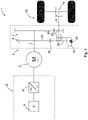
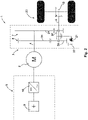
- Figures 1 to 3 show a schematic representation of a drive 1 according to the invention in different working states.
- the drive 1 has an electric motor 2 embodied, for example, as a synchronous motor, which acts on a drive shaft 4 of a transmission 3 .
- the transmission 3 has two gears 6, 7 with different transmission ratios, which are formed by two gearwheel pairs, one gearwheel 24 of each gearwheel pair being non-rotatably connected to the drive shaft 4.
- a first pair of gears forms a first gear 6, which has a translation from a speed of the drive shaft 4 to a speed of the output shaft 5 of about 0.5.
- a second gear 7 is formed by a second pair of gears, in which the translation is about 0.2.
- the output shaft 5 rotates about five times around its own axis, while at the same time the drive shaft 4 rotates only once around its own axis, so that the electric motor 2 rotates more slowly than the output shaft 5 .
- the transmission 3 can be implemented with practically any gear ratios, which can be greater or smaller than 1, so that it can be a matter of gear ratios as well as reductions or gearing down.
- the output-side gears 24 of the pairs of gears can be detachably and non-rotatably connected to the output shaft 5 via a coupling element that can be displaced in the axial direction on the output shaft 5 .
- the coupling element is non-rotatably connected to the output shaft 5 and can be positively connected in the circumferential direction 11 to each of the output-side gears 24 of the gear pairs, in particular via a claw connection, so that the output-side gears 24 can be non-rotatably connected to the output shaft 5 via the coupling element.
- FIG. 1 shows a state in which the coupling element connects the output-side gear 24 of the first gear 6 to the output shaft 5 in a torque-proof manner, so that in this operating state the first gear 6 is engaged and the transmission ratio between the input shaft 4 and the output shaft 5, i.e. a quotient of a speed the drive shaft 4 to a speed of the output shaft 5, is about 0.5.
- the drive 1 shown can be used, for example, as in Figures 1 to 3 indicated be arranged in a vehicle, so that the output shaft 5 of the transmission 3 acts on driven wheels 23 of the vehicle to drive the vehicle, for example, on a road.
- a shifting process which can have a duration of 150 ms, for example, a rotational speed of the output shaft 5 remains essentially constant, in particular due to the inertia of the vehicle.
- braking of drive shaft 4 is therefore necessary for a comfortable shifting operation in order to avoid a jolt or the like when second gear 7 is engaged.
- this takes place via synchronizing rings or the like, ie mechanical acceleration or braking of the drive shaft 4, as a result of which kinetic energy is converted into thermal energy in the transmission 3.
- a corresponding synchronization is carried out essentially electrically by an electrical synchronizing device 8, which the Electric motor 2, which at the beginning of the switching process as in 1 shown has a first speed, after a disengagement of the first gear 6 accelerates or decelerates approximately to a second speed, which second speed corresponds to the first speed multiplied by a quotient of the second gear ratio and the first gear ratio. If the speed of the electric motor 2 is thus at the in 1 shown start of the shifting process is 1000 min-1, this is during the shifting process, after disengaging the first gear 6 and before engaging the second gear 7 by the electrical synchronization device 8, to a second speed of 1000.
- the electrical synchronization device 8 has an inverter 10 or three-phase controller and an accumulator 9 connected to it, so that electrical energy generated during braking by operation of the electric motor 2 as a generator can also be stored, for example to enable the electric motor 2 to shift from second gear later 7 to accelerate into first gear 6 accordingly to 2.5 times the speed.
- the coupling element can thus be designed very simply, for example as a claw disk 13 corresponding to the claws 14 of the gear wheels 24 and made of case-hardened steel or the like.
- the claw disk 13 can be actuated in the exemplary embodiment by means of an actuator 22, for example a linear motor, via a spring 21.
- an easily definable pressure can be applied via the spring 21 to an end face 25 of the gear wheel 24 to which the claw disc 13 is to be connected, so that in a relative position of gear wheel 24 and claw disc 13 at which the claw 14 of the gear wheel 24 is located in a region of a window 15 arranged in the end face 25, the claw disk 13 is moved in the axial direction towards the gear wheel 24, so that the claw 14 is inserted into the window 15 in which a recess 16 corresponding to the claw 14 is arranged.
- claws 14 can of course alternatively or additionally also be arranged in the coupling element and the depressions 16 cooperating with the claws 14 can be arranged in the gear wheels 24 or elements connected non-rotatably with the gear wheels 24 .
- a rotational connection is understood to mean a connection in which a rotation of the drive shaft 4 in at least one direction of rotation necessarily causes a rotation of the output shaft 5, possibly at a different speed.
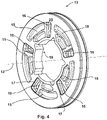
- Figures 4 to 6 show a coupling element designed as a claw disk 13 according to the invention in detail in different views, which for example in the in the Figures 1 to 3 Drive 1 shown can be used.
- the claw disk 13 has an inner toothing 19 on an inner diameter in order to be positively connected to the output shaft 5 in the circumferential direction 11 .
- the teeth of the internal toothing 19 are aligned parallel to an axis, so that the claw disc 13 can be displaced on the output shaft 5 in the axial direction 12 in order to create a positive connection between the output shaft 5 and different gears, for example arranged coaxially with the output shaft 5 along the axial direction 12 24 to produce.
- the claw disc 13 is disc-shaped and has two end faces 25 which are approximately normal to the axis, each end face 25 containing five windows 15 in which a recess 16 is arranged at one end of the window 15 in the circumferential direction 11 .
- the five indentations 16 correspond to five claws 14 of the gear wheels 24 on the output side, with which the claw disc 13 in the transmission 3 can be connected in order to connect the gear wheel 24 to the claw disc 13 in a form-fitting manner and essentially without play.
- the windows 15 each have a bottom 28, which has a distance from the end face, which distance is less than a maximum depth of the Indentations 16 or less than a distance from an imaginary latching plane, in which latching plane there is an axial end of the claw 14 or a cover surface 29 of the claw 14 when the claw 14 is in the depression 16 and the drive shaft 4 is connected to the output shaft 5 is coupled.
- the window 15 or the bottom 28 of the window 15 thus forms an intermediate plane, which lies between a plane of the end face 25 and the latching plane or the depression 16, so that the claw 14 can first be pushed into the window 15 up to the bottom 28 by means of an axial movement can be inserted, after which the claws 14 can be inserted with a further movement in the same axial direction into the recess 16, in which the claw 14 is usually non-rotatably, optionally while maintaining a game, positively coupled to the recess 16.
- the bottom 28 is preferably approximately flat and, as illustrated, is designed parallel to the end face 25 , but in principle it can also be non-flat and not parallel to the end face 25 .
- the base 28 can fill the entire window 15 or, as here, only part of the window 15 in order to guide the claw 14 to the recess 16, and further recesses can be provided in the window 15 next to the base 28 in order to optimize weight.
- the window 15 is larger than the recess 16 in the circumferential direction 11 and has an extent in the radial direction which at least corresponds to the extent of the claw 14 , so that the claw 14 can be inserted into the window 15 .
- the window 15 can also extend beyond this in the radial direction.
- the window 15 can extend in the radial direction over the entire coupling element or the entire end face 25 .
- the term recess in the end face 25 or pre-depression which is equivalent in the sense of this application, can therefore also be used.
- a circumferential groove 26 can be seen, into which a shift fork can engage for an axial displacement of the claw disk 13 on an output shaft 5 .
- the shift fork can be actuated manually or connected to an actuator 22 directly or via a spring 21 to form an automatic transmission.
- the windows 15 serve to enable a simple coupling or the production of a form-fitting connection between the claw disk 13 and the gearwheel 24 even when the gearwheel 24 has a different speed from the claw disk 13 .
- an axial force is applied to the claw disk 13, usually via a spring 21, in the direction of the gear wheel 24.
- Controlling the electric motor 2 also ensures that the speed of the claw disc 13 relative to the speed of the gear wheel 24 is dimensioned in such a way that when the claws 14 are in the windows 15, the claws 14 come up against the stop 17 at the end of the Window 15 can be moved, at which end the depressions 16 are also located, so that a further axial force, which is usually as in Figures 1 to 3 shown is applied via a spring 21, the depressions 16 are pushed over the claws 14 or the claws 14 are inserted into the depressions 16, in which they are then arranged substantially without play.
- the indentations 16 extend through the claw disk 13 so that they are accessible from both end faces 25 .
- the claw disc 13 can be very narrow and the transmission 3 can thus be designed with a small installation space.
- ramps 18 are arranged in the windows 15, so that in the event of a software error, the indentations 16 can be coupled into the window 15 reliably and simultaneously easily avoided.
- a ramp 18 here has an angle ⁇ of approximately 30° with respect to the end face 25, so that the claw 14 is reliably guided out of the window 15.
- Figures 7 to 9 show schematically an output-side gear 24 of the first gear 6 or the second gear 7 or the gear pair forming the first gear 6 or the second gear 7 .
- the gear wheel 24 has teeth all around the circumference, which can be designed parallel to the axis or, as shown, as helical gearing. In gear 3, these teeth mesh with teeth of the in 3 illustrated drive 1 gear wheel 24 connected in a rotationally fixed manner to the drive shaft 4.
- the gear wheel 24 shown also has five claws 14 on an end face 25, which correspond to the indentations 16 of the claw disc 13 and can engage in the indentations 16 in order to rotate the gear wheel 24 on the output side in a rotationally fixed manner with the output shaft 5 to connect, and thus to connect the input shaft 4 via the corresponding gear with the output shaft 5.
- the claws 14 have chamfers 27 on the peripheral edges, with an angle ⁇ of the chamfers 27 corresponding to an angle ⁇ of the ramp 18 .
- the claws 14 have a top surface 29 at an upper end or an axial end, which in terms of orientation corresponds to an orientation of the bottom 28 of the window 15 . This enables continuous surface contact between the claw 14 and the claw disc 13 during an engagement process, namely first between the chamfer 27 and the ramp 18 and then, when the claw 14 has reached the bottom 28 of the window 15, between the top surface 29 and the bottom 28 of the window 15 until the claw snaps into the indentation.
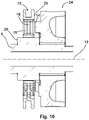
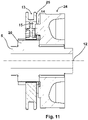
- Figures 10 to 12 show a coupling process in different procedural states, in which a in the Figures 7 to 9 shown gear 24 rotatably with a claw disc 13 according to Figures 4 to 6 is rotatably connected.
- the output shaft 5 of an external toothing 20 is shown, on which the claw disk 13 is arranged so that it can move in the axial direction and is connected to the output shaft 5 in a rotationally fixed manner, as well as a gear wheel 24 of a gear pair, which is connected to the output shaft 5 via the claw disk 13.
- the claw disk 13 is at a distance from the gear wheel 24 so that the gear wheel 24 is not kinematically coupled to the output shaft 5 in the circumferential direction 11 . In other words, the corresponding gear is not engaged.
- FIG. 11 12 shows a state in which the claw washer 13 has been moved axially toward the gear 24.
- the window 15 is larger in the circumferential direction 11 than the claw 14 is thus still a relative movement between the claw disc 13 and the output shaft 5, which is rotatably connected to the claw disc 13, and the gear 24 is possible.
- an output-side gear wheel 24 of a further gear which is not shown here for the sake of clarity, can be positioned on the second end face 25 of the claw disc 13, so that by means of a displacement of the claw disc 13, one of the two gears 6, 7 can be selected with the output shaft 5 can be connected. It is also possible to place the claw disc 13 in an in 11 to position the middle position shown, in which neither of the two gears 6, 7 is engaged.
- the two gears 6, 7 are usually formed by gear wheel pairs with different translations, which can be permanently non-rotatably connected to the drive shaft 4 and alternately via the claw disc 13 to the output shaft 5.
- the electric motor 2 is accelerated or braked electrically in order to produce an almost synchronous speed between the claw disc 13 and the gear wheel 24, which is to be connected to the output shaft 5 via the claw disc 13.
- a corresponding switching process usually takes less than a second, preferably within less than 150 milliseconds, so that the electric motor 2 must be accelerated or braked in a correspondingly short time. As a rule, this takes place via an inverter 10 and an accumulator 9, in which electrical energy can be stored or from which electrical energy can be taken in order to effect the speed change.
- the transmission 3 can be of a simple design, usually using components made of case-hardened steel or the like. Furthermore, because of the electrical synchronization, a low cooling capacity is sufficient, so that a transmission housing can also have a simple design.
- the drive 1 can be designed particularly cost-effectively and at the same time robustly, because the synchronization function has essentially been taken from the mechanical area of the transmission 3 and shifted to the electrical part.
Landscapes
- Engineering & Computer Science (AREA)
- General Engineering & Computer Science (AREA)
- Mechanical Engineering (AREA)
- Power Engineering (AREA)
- Transportation (AREA)
- Structure Of Transmissions (AREA)
- Transmission Devices (AREA)
Description
- Die Erfindung betrifft einen Antrieb gemäß Anspruch 1.
- Weiter betrifft die Erfindung ein Koppelelement für einen Antrieb.
- Darüber hinaus betrifft die Erfindung ein Verfahren zum Betreiben eines Antriebes, gemäß Anspruch 13.
- Aus dem Stand der Technik sind verschiedene Antriebe der eingangs genannten Art bekannt geworden, welche allerdings aufwendig und teuer in einer Herstellung sind und bei einer Anwendung nur eine geringe Effizienz aufweisen.
- Beispielsweise sind Antriebe mit Elektromotoren aus den Dokumenten
-
WO 2013/072609 A1 ,WO 2019/141684 A1 undFR 2 701 679 A1 - Aus dem Dokument
US 5,827,148 A ist ein Antrieb mit einem zwei Gänge aufweisenden Getriebe bekannt geworden, wobei der Motor über in Lücken eingreifende Vertiefungen entweder direkt oder über ein zweistufiges Stirnradgetriebe mit einem Abtrieb gekoppelt wird. - Das Dokument
US 2019/0078686 A1 offenbart insbesondere eine Schalteinrichtung für ein Getriebe zum Herstellen einer schaltbaren drehfesten Verbindung wahlweise zwischen einem ersten Losrad und zweiten Losrad oder zwischen dem ersten Losrad und einer Welle. Die Verbindung erfolgt dabei mit einer Schiebemuffe, welche über in Öffnungen formschlüssig eingreifende Fortsätze stets drehfest und gleichzeitig axial verschiebbar mit einem ersten Losrad verbunden ist. Vor Herstellung der jeweiligen drehfesten Verbindung werden dabei die beteiligten Bauelemente synchronisiert, und zwar mit einer Synchronisiereinrichtung oder einer unsynchronisierten Klauenverzahnung. Dennoch weisen die in diesen Dokumenten offenbarten Antriebe nur eine geringe Effizienz und gleichzeitig hohe Schaltzeiten auf, sodass diese nicht für ein komfortables Fahrerlebnis geeignet sind, sondern vielmehr eine bei einem Fahrer spürbare Zugkraftunterbrechung während eines Schaltvorganges bewirken. - Hier setzt die Erfindung an. Aufgabe der Erfindung ist es, einen Antrieb der eingangs genannten Art anzugeben, welcher auf besonders einfache und kostengünstige Weise herstellbar ist.
- Ferner soll ein Koppelelement angegeben werden, mit welchem eine Antriebswelle mit einer Abtriebswelle eines solchen Antriebes lösbar über einen Gang koppelbar ist.
- Weiter soll ein Verfahren der eingangs genannten Art angegeben werden, welches in kostengünstiger Weise umsetzbar und mit einem einfach aufgebauten Antrieb durchführbar ist.
- Die erste Aufgabe wird erfindungsgemäß durch einen Antrieb der eingangs genannten Art gelöst, bei welchem die Antriebswelle mit der Abtriebswelle über einen Gang lösbar mittels zumindest einer in eine Vertiefung eingreifende Klaue koppelbar ist, wobei die Vertiefung in einem Fenster angeordnet ist, welches sich entlang einer Richtung erstreckt, entlang welcher ein mit der Antriebswelle gekoppeltes Element relativ zu einem mit der Abtriebswelle gekoppelten Element bewegbar ist, wenn die Abtriebswelle bei einem Schaltvorgang nicht mit der Antriebswelle gekoppelt ist, sodass die Klaue von einem ausgekuppelten Zustand durch das Fenster in die Vertiefung bewegbar ist.
- Im Rahmen der Erfindung wurde erkannt, dass der Antrieb dann besonders einfach und kostengünstig ausgebildet sein kann, wenn eine Synchronisierung der mit dem Motor verbundenen Welle mit der mit dem Abtrieb verbundenen Welle im Getriebe nicht mechanisch erfolgt, beispielsweise wie bei Getrieben des Standes der Technik üblich über Synchronringe bzw. mittels Reibung, sondern eine Synchronisierung elektrisch erfolgt, indem der Elektromotor auf die entsprechende Geschwindigkeit beschleunigt bzw. abgebremst wird, wobei die Drehzahl des Elektromotors üblicherweise vor und nach dem Schaltvorgang größer als Null ist. Dieses elektrische Beschleunigen bzw. Abbremsen kann beispielsweise bei einem Synchron- oder Asynchronmotor auf einfache Weise durch entsprechende Ansteuerung eines Wechselrichters erfolgen, mit welchem eine Drehzahl des Motors wie aus dem Stand der Technik bekannt definiert wird. Natürlich ist ein erfindungsgemäßer Antrieb auch mit einem Gleichstrommotor umsetzbar. Das Getriebe kann dann ohne eine entsprechende und auf Reibung basierende mechanische Synchronisiereinrichtung ausgebildet sein, sodass dieses nicht nur kostengünstig und einfach, sondern auch verschleißarm und klein ausgebildet sein kann, zumal im Getriebe im Unterschied zu Getrieben des Standes der Technik kinetische Energie nicht oder nur in sehr geringem Ausmaß, wenn trotz der elektrischen Synchronisierung noch eine kleine Relativgeschwindigkeit besteht, in Wärme gewandelt werden muss, um eine Synchronisierung zu erreichen. Entsprechend kann das Getriebe mit geringerer Oberfläche ausgebildet sein, da über die Oberfläche nur eine geringere Wärmemenge abgegeben werden muss. Nachdem das Getriebe nicht für eine mechanische Synchronisierung der Drehzahl des Motors bzw. für einen mechanischen Beschleunigungs- bzw. Abbremsvorgang mittels Reibung ausgebildet sein muss, kann das Getriebe auch aus einfachen und kostengünstig herstellbaren Materialien ausgebildet sein, beispielsweise aus einem Einsatzstahl. Eine Koppelung der Antriebswelle mit der Abtriebswelle erfolgt erfindungsgemäß mittels eines Formschlusses, wodurch ein besonders rasches Einkuppeln, insbesondere im Vergleich mit üblichen reibschlüssigen Kupplungen des Standes der Technik, ermöglicht ist.
- Günstig ist es, wenn der Antrieb zur Herstellung einer lösbaren rotatorischen formschlüssigen Verbindung zwischen der Antriebswelle und der Abtriebswelle ein rotierbares erstes Element mit einem Fenster, in welchem ein Anschlag angeordnet ist, und ein rotierbares zweites Element mit einem in das Fenster einführbaren Vorsprung, insbesondere einer Klaue, aufweist, wobei mittels des Vorsprunges eine Rotationsbewegung vom zweiten Element auf das erste Element formschlüssig übertragbar ist. Der Formschluss zur Koppelung einer Rotationsbewegung der Antriebswelle mit der Abtriebswelle kann somit auf einfache Weise durch ein Einführen des Vorsprunges in das Fenster erfolgen. Üblicherweise wird der Vorsprung in das Fenster eingeführt, indem ein Abstand zwischen dem ersten Element und dem zweiten Element in Richtung einer Achse, um welche das erste Element und das zweite Element rotieren, bzw. in Achsrichtung verringert wird, bis der Vorsprung innerhalb des Fensters positioniert ist. Es kann dann der Vorsprung zum Anschlag bewegt werden, indem das zweite Element relativ zum ersten Element um die Achse gedreht wird.
- Das Fenster ist üblicherweise größer ausgebildet als der Vorsprung, sodass der Vorsprung auch bei eine Relativgeschwindigkeit zwischen erstem Element und zweitem Element um die Achse leicht in das Fenster einführt werden kann. Ferner ist dadurch auch dann noch eine Relativbewegung zwischen Vorsprung und Fenster möglich, wenn der Vorsprung bereits in das Fenster eingeführt ist, bis der Vorsprung am Anschlag im Fenster anliegt, wodurch der Formschluss erfolgt. Beispielsweise kann das Fenster als kreisbogenförmige Ausnehmung im ersten Element ausgebildet sein, in welche Ausnehmung der Vorsprung eingreifen kann, wobei der Anschlag durch ein Ende der kreisbogenförmigen Ausnehmung in Umfangsrichtung gebildet ist.
- Es versteht sich, dass durch das Anliegen des Vorsprunges am Anschlag ein Formschluss in Rotationsrichtung gegeben ist, jedoch noch kein Formschluss entgegen der Rotationsrichtung gegeben ist. Um eine im Wesentlichen spielfreie rotatorische Verbindung zwischen der Antriebswelle und der Abtriebswelle herzustellen, ist im Fenster eine Vertiefung angeordnet, welche spielfrei mit dem Vorsprung korrespondieren kann. Der Vorsprung kann dann nach Herstellung der formschlüssigen Verbindung durch ein Anliegen am Anschlag durch eine weitere Bewegung in Achsrichtung in die Vertiefung eingeführt werden, um eine spielfreie Verbindung herzustellen. Nachdem bei einem Anliegen des Vorsprunges am Anschlag keine Relativgeschwindigkeit mehr zwischen erstem Element und zweitem Element in Umfangsrichtung besteht, ist ein Einführen in die Vertiefung, die kleiner als das Fenster ist, dann einfach möglich. Das erste Element kann beispielsweise axial verschiebbar und drehfest mit der Abtriebswelle oder der Antriebswelle sein und das zweite Element kann drehfest mit einem Zahnrad eines Ganges verbunden oder durch ein Zahnrad gebildet sein, um durch das Einführen des Vorsprunges in das Fenster eine rotatorische Koppelung zwischen Antriebswelle und Abtriebswelle über den einen der Gänge herzustellen. Selbstverständlich kann auch das erste Element, welches das Fenster aufweist, mit einem Zahnrad verbunden oder durch das Zahnrad gebildet und das zweite Element drehfest mit der Antriebswelle oder Abtriebswelle verbunden sein. Üblicherweise sind Sensoren vorgesehen, mit welchen Drehzahlen der Antriebswelle und der Abtriebswelle erfassbar sind, um eine exakte Regelung des Elektromotors auf die zweite Geschwindigkeit zu ermöglichen.
- Wenn beispielsweise der erste Gang ein Übersetzungsverhältnis von 4 hat, sodass eine Eingangsdrehzahl des Elektromotors von beispielsweise 4000 Umdrehungen pro Minute bzw. min-1 auf eine Ausgangsdrehzahl am Getriebeausgang von 1000 min-1 übersetzt wird, und der zweite Gang ein Übersetzungsverhältnis von 2 hat, sodass eine Eingangsdrehzahl des Elektromotors von 4000 min-1 auf eine Ausgangsdrehzahl am Getriebeausgang von 2000 min-1 übersetzt wird, muss der Elektromotor für ein möglichst sanftes und somit komfortables Schalten der Gänge während des Schaltvorganges auf eine Drehzahl abgebremst werden, welche dem Quotienten aus zweitem Übersetzungsverhältnis und erstem Übersetzungsverhältnis, also dem Quotienten aus 2 und 4, somit 0,5 entspricht. Wenn die Drehzahl des Elektromotors somit zu Beginn des Schaltvorganges 1000 Umdrehungen pro Minute beträgt, muss diese während des Schaltvorganges durch die elektrische Synchronisiereinrichtung auf 500 Umdrehungen pro Minute abgebremst werden, um während des Schaltvorganges eine konstante Drehzahl der Abtriebswelle von 250 min-1 zu gewährleisten. Es versteht sich, dass diese Drehzahlen beispielhaft zu verstehen sind und eine Synchronisierungsdrehzahl bei einem erfindungsgemäßen Antrieb üblicherweise insbesondere abhängig von einem verwendeten Motor, einer Schaltzeit und einer Anwendung des Antriebes, beispielsweise in einem Elektrofahrzeug, ist. Die Abtriebswelle kann beispielsweise mit Rädern eines Kraftfahrzeuges verbunden sein, um dieses anzutreiben. Diese elektrische Synchronisierung ist beispielsweise mit einem Wechselrichter, welcher mit einem entsprechend dimensionierenten Akkumulator verbunden ist, auf einfache Weise ohne Verschleißelemente möglich. Es versteht sich, dass die Übersetzungen der einzelnen Gänge beliebige positive und negative Werte sein können, welche größer und kleiner als 1,0 sein können, sodass also sowohl Übersetzungen ins Schnelle als auch Übersetzungen ins Langsame mit einem erfindungsgemäßen Antrieb möglich sind.
- Günstig ist es, wenn der Antrieb zur Durchführung eines Schaltvorganges ausgebildet ist, bei welchem die Dauer des Schaltvorganges weniger als eine Sekunde, insbesondere weniger als 150 Millisekunden, beträgt. Dies gewährleistet ein besonders rasches Wechseln der Gänge bzw. ein Wechseln einer Übersetzung einer Drehzahl des Elektromotors auf eine Ausgangsdrehzahl am Getriebeausgang, welcher beispielsweise mit Rädern eines Elektrofahrzeuges verbunden sein kann. Um entsprechend kurze Schaltvorgänge gewährleisten zu können, ist es günstig, wenn der Elektromotor mit einem geringen Trägheitsmoment der bewegenden Massen bzw. des Ankers ausgebildet ist und/oder die elektrische Synchronisiereinrichtung zur Aufnahme bzw. zur Abgabe großer Leistungen ausgebildet ist. Dies kann beispielsweise durch eine Elektronik wie einen Wechselrichter erreicht werden, welcher für entsprechend große Ströme bzw. Leistungen geeignet ist. Ferner ist es vorteilhaft, wenn ein elektrischer Energiespeicher vorgesehen ist, welcher sowohl zur Aufnahme als auch zur Abgabe großer elektrischer Leistungen eingerichtet ist. Günstig ist es, wenn ein Akkumulator mit dem Elektromotor verbunden ist, in welchem elektrische Energie speicherbar ist, welche im Elektromotor bei einem Abbremsvorgang erzeugt wird. Selbstverständlich ist es alternativ oder ergänzend auch möglich, im Elektromotor bei einem Abbremsvorgang erzeugte elektrische Energie teilweise oder vollständig in Wärme umzuwandeln anstatt diese zu speichern. Beispielsweise können hierzu ein Heizwiderstand und/oder ein elektrisch angetriebenes Schwungrad vorgesehen sein.
- Üblicherweise ist ein Akkumulator über einen Wechselrichter mit dem Elektromotor verbunden, sodass der Elektromotor einerseits durch den Akkumulator angetrieben und andererseits bei einem Abbremsen des Elektromotors eine im Elektromotor generatorisch erzeugte elektrische Energie über den Wechselrichter in den Akkumulator eingespeichert werden kann. Selbstverständlich kann der Elektromotor auch als Gleichstrommotor ausgebildet sein, sodass ein Wechselrichter nicht erforderlich ist.
- Günstig ist es, wenn zumindest ein Koppelelement vorgesehen ist, welches in einer ersten Richtung, insbesondere in einer Umfangsrichtung, formschlüssig und in einer zweiten Richtung, insbesondere in einer Achsrichtung, bewegbar mit der Antriebswelle oder der Abtriebswelle verbunden ist, um zumindest einen Gang lösbar mit der Antriebswelle oder der Abtriebswelle zu verbinden. Es versteht sich, dass die Bezeichnungen "Umfangsrichtung" und "Achsrichtung" dabei jeweils in Bezug zu der Welle, also der Antriebswelle oder der Abtriebswelle, zu verstehen sind, mit welcher das Koppelelement verbunden ist. Beispielsweise kann das Koppelelement als auf der Abtriebswelle axial verschiebbare Hülse ausgebildet sein, welche drehfest mit der Abtriebswelle verbunden ist und zur Herstellung einer formschlüssigen drehfesten Verbindung der Abtriebswelle mit einem Zahnrad eines Ganges durch axiale Verschiebung der Hülse geeignet ist.
- Die einzelnen Gänge, welche beispielsweise durch Zahnradpaare mit unterschiedlichen Übersetzungen gebildet sein können, können nicht gleichzeitig mit der Antriebswelle und der Abtriebswelle verbunden sein, da dies zu einer kinematischen Überbestimmung führen würde. Es kann daher nur maximal ein Gang gleichzeitig eingelegt sein, durch welchen eine Übersetzung der Antriebswelle auf die Abtriebswelle definiert ist. Alle anderen Gänge müssen dann von der Antriebswelle und/oder der Abtriebswelle kinematisch getrennt sein, sodass eine Drehbewegung der Antriebswelle nur über einen Gang in eine Drehbewegung der Abtriebswelle übersetzt wird. Die einzelnen Gänge müssen somit mit der Antriebswelle und/oder der Abtriebswelle lösbar verbunden sein, wobei eine kinematische Verbindung während eines Schaltvorganges lösbar bzw. herstellbar sein muss. Eine entsprechende Verbindung kann beispielsweise mit einem Koppelelement hergestellt werden, welches kraftschlüssig oder formschlüssig in Umfangsrichtung, also drehfest, mit der Antriebswelle oder der Abtriebswelle verbunden sein kann, sodass das Koppelelement mit der Antriebswelle oder der Abtriebswelle mitrotiert und zum Herstellen oder Lösen einer Verbindung der Antriebswelle oder der Abtriebswelle mit einem Zahnrad des jeweiligen Ganges axial auf der Antriebswelle oder der Abtriebswelle verschiebbar ist, um ab einer vordefinierten axialen Position einen Formschluss auch in Umfangsrichtung mit dem jeweiligen Zahnrad herzustellen, sodass das Zahnrad in Umfangsrichtung über das Koppelelement formschlüssig, also drehfest, mit der Antriebswelle oder der Abtriebswelle verbunden ist. Ein Gang kann somit mit der Antriebswelle oder der Abtriebswelle auf einfache und gleichzeitig rasche Weise durch eine axiale Bewegung des Koppelelementes auf der Antriebswelle oder der Abtriebswelle verbunden werden. In gleicher Weise kann eine Verbindung auf einfache Weise gelöst werden.
- Das Koppelelement kann grundsätzlich auf verschiedene Weisen mit einem Gang bzw. einem Zahnrad des Ganges, welcher über das Koppelelement mit der Antriebswelle oder der Abtriebswelle verbunden werden soll, zusammenwirken, beispielsweise reibschlüssig oder magnetisch, um eine drehfeste Verbindung herzustellen. Ein besonders einfacher Aufbau ergibt sich insbesondere dann, wenn zumindest ein Koppelelement formschlüssig lösbar mit zumindest einem Gang verbindbar ist. Dadurch können auch große Drehmomente auf zuverlässige Weise und schlupffrei übertragen werden.
- Bevorzugt ist das Koppelelement auch mit der Antriebswelle oder der Abtriebswelle in Umfangsrichtung formschlüssig verbunden, insbesondere über eine Innenverzahnung oder eine Keilwelle. Ein Formschluss in Umfangsrichtung mit dem Zahnrad des Ganges, welcher über das Koppelelement mit der Antriebswelle oder der Abtriebswelle verbunden werden soll, kann ebenfalls über eine Verzahnung, eine Klaue oder dergleichen erfolgen.
- Um einen besonders einfachen Aufbau zu erreichen, ist es günstig, wenn das Koppelelement an einer ersten Seite, insbesondere einer Stirnseite, mit dem ersten Gang und an einer zweiten Seite, insbesondere einer der ersten Seite gegenüberliegenden Stirnseite, mit dem zweiten Gang verbindbar ist. Es ist dann ein einziges Koppelelement ausreichend, um wahlweise einen von zwei Gängen einzukuppeln bzw. eine Koppelung von einem der beiden Gänge mit der Antriebswelle oder der Abtriebswelle herzustellen. Das Koppelelement kann dann beispielsweise auf der Abtriebswelle zwischen Zahnrädern des ersten Ganges und Zahnrädern des zweiten Ganges angeordnet sein, um je nach einer Axialposition des Koppelelementes auf der Abtriebswelle den ersten Gang oder den zweiten Gang mit der Abtriebswelle zu verbinden. Analog wäre auch eine entsprechende Anordnung auf der Antriebswelle möglich.
- Erfindungsgemäß ist vorgesehen, dass die Antriebswelle mit der Abtriebswelle über einen Gang lösbar mittels zumindest einer in eine Vertiefung eingreifenden Klaue koppelbar ist. Über die Klaue kann somit auf einfache Weise eine lösbare formschlüssige Verbindung zur Übertragung eines Drehmomentes hergestellt werden. Durch ein Bewegen der Klaue aus der Vertiefung wird der Formschluss auf einfache Weise gelöst, sodass die Antriebswelle mit der Abtriebswelle nicht mehr über den entsprechenden Gang verbunden ist.
- Besonders vorteilhaft können die Vorteile eines erfindungsgemäßen Antriebes umgesetzt werden, wenn dieser in einem Fahrzeug, insbesondere einem Elektrofahrzeug, eingesetzt wird, um das Fahrzeug anzutreiben bzw. zu bremsen. Es ist somit bei einem Elektrofahrzeug mit einem Antrieb, insbesondere bei einem Elektroauto, einem Elektroboot oder einem Elektromotorrad, vorteilhaft, wenn der Antrieb erfindungsgemäß ausgebildet ist. Es versteht sich, dass hier unter Elektrofahrzeuge sowohl Fahrzeuge verstanden werden, welche ausschließlich elektrisch angetrieben werden, als auch sogenannte Hybrid-Fahrzeuge, bei welchen ergänzend zu einem Elektromotor auch ein Verbrennungsmotor vorgesehen sein kann.
- Günstig ist es, wenn die Klaue und die Vertiefung derart ausgebildet sind, dass die Klaue dann, wenn die Antriebswelle mit der Abtriebswelle gekoppelt ist, relativ zur Vertiefung ein Spiel von weniger als 20 mm, insbesondere weniger als 10 mm, vorzugsweise weniger als 5 mm, aufweist. Dadurch kann die Klaue beispielsweise auch dann einfach in die Vertiefung eingebracht werden, wenn an der Klaue bzw. die Vertiefung einen Hinterschnitt aufweisen, um ein unbeabsichtigtes Entfernen der Klaue aus der Vertiefung auf einfache Weise zu vermeiden. Ein Spiel kann dabei beispielsweise eine Rotation von einem die Klaue aufweisenden Bauteil relativ zu einem die Vertiefung aufweisenden Bauteil von weniger als 5°, insbesondere weniger als 2°, erlauben.
- Um einen hohen Komfort beispielsweise bei Einsatz des Getriebes in einem Kraftfahrzeug zu erreichen, ist es günstig, wenn die Klaue im Wesentlichen spielfrei in der Vertiefung positionierbar ist. Dadurch werden unangenehm wirkende Geräusche bzw. Vibrationen im Getriebe vermieden. Die Klaue kann auch einen Hinterschnitt aufweisen, sodass ein unbeabsichtigtes Entfernen der Klaue aus der Vertiefung auf einfache Weise vermieden wird.
- Erfindungsgemäß ist vorgesehen, dass die Vertiefung in einem Fenster angeordnet ist, welches sich entlang einer Richtung erstreckt, entlang welcher ein mit der Antriebswelle gekoppeltes Element relativ zu einem mit der Abtriebswelle gekoppelten Element bewegbar ist, wenn die Abtriebswelle bei einem Schaltvorgang nicht mehr mit der Antriebswelle gekoppelt ist, sodass die Klaue von einem ausgekoppelten Zustand durch das Fenster in die Vertiefung bewegbar ist. Üblicherweise ist das Fenster in einer Stirnfläche des Koppelelementes angeordnet, welche Stirnfläche des Koppelelementes bei einem Koppelvorgang mit einem Zahnrad über die Klaue bewegt wird, sodass die Klaue in die im Fenster in der Stirnfläche angeordnete Vertiefung eingreifen kann. Das Fenster weist somit ausgehend von der Stirnseite eine geringere Tiefe als die Vertiefung, jedoch eine größere Erstreckung in Umfangsrichtung als die Vertiefung auf, sodass die Klaue mittels des Fensters auch bei einer Relativbewegung zwischen der Klaue und der Vertiefung sozusagen durch das Fenster gefangen wird und über einen Formschluss in Umfangsrichtung in Bezug auf eine Umfangsgeschwindigkeit mit dem Fenster bzw. ein das Fenster aufweisendes Bauteil mit einem die Klaue aufweisenden Bauteil synchronisiert werden kann. Dadurch kann beispielsweise ein eine oder mehrere Klauen aufweisendes Zahnrad auf einfache Weise mit einer durch eine Klauenscheibe, welche zu den Klauen korrespondierende Vertiefungen aufweist, die in Fenstern angeordnet sind, gebildeten Koppeleinrichtung synchronisiert werden, um eine drehfeste Verbindung zwischen der Koppeleinrichtung und dem Zahnrad herzustellen.
- Der Begriff Fenster wird hierbei breit verstanden und definiert einen Bereich, welcher einen Boden aufweist, der zumindest teilweise, vorzugsweise gänzlich zwischen einem Teil der Stirnfläche des Koppelelementes, insbesondere zwischen einer Ebene der Stirnfläche, und einer Einrastebene liegt, in welcher Einrastebene sich ein axiales Ende der Klaue befindet, wenn sich die Klaue in der Vertiefung befindet und die Antriebswelle mit der Abtriebswelle gekoppelt ist. Weiter weist das Fenster in Umfangsrichtung in der Regel eine größere Erstreckung als die Vertiefung auf und entspricht eine Erstreckung des Fensters in radialer Richtung zumindest einer Erstreckung der Vertiefung in radialer Richtung, sodass die Klaue von der Stirnfläche aus durch eine Bewegung in axialer Richtung vollständig in das Fenster bewegt werden kann, wonach die Klaue im Fenster am Boden des Fensters bis zur Vertiefung gleiten kann, wonach die Klaue durch eine weitere Bewegung in axialer Richtung in die Vertiefung eingeführt werden kann. Es ist folglich nicht relevant, ob eine radiale Erstreckung des Fensters exakt einer radialen Erstreckung der Klaue entspricht oder größer ist. Insbesondere kann vorgesehen sein, dass sich eine radiale Erstreckung des Fensters beispielsweise über eine gesamte radiale Erstreckung der Stirnseite bzw. des Koppelementes, also von einem Innendurchmesser des Koppelelementes bis zu einem Außendurchmesser, erstreckt. Der Begriff Fenster ist folglich gleichbedeutend mit einem der Begriffe Ausnehmung in der Stirnseite oder Vorvertiefung.
- Weiter kann vorgesehen sein, dass der Boden des Fensters eine Zwischenebene bildet, welche sich zumindest teilweise zwischen der Stirnseite und einer Einrastebene befindet.
- Das Fenster mit der darin angeordneten Vertiefung hat folglich die Wirkung, eine Synchronisierung auf konstruktiv besonders einfache Weise mittels der Klaue herzustellen, indem die Klaue zunächst in axialer Richtung bewegt und dabei in das Fenster eingeführt wird, welches größer als die Klaue ist, wonach die Klaue an einem Ende des Fensters anliegt, sodass ein Formschluss zwischen Klaue und Fenster in Umfangsrichtung erfolgt und durch diesen Formschluss eine Synchronisierung der Geschwindigkeit der Klaue und der Geschwindigkeit des Fensters erfolgt, wonach die Klaue durch weitere Bewegung in axialer Richtung in der Vertiefung positioniert wird, sodass die Klaue in Umfangsrichtung im Wesentlichen formschlüssig, gegebenenfalls mit einem geringen Spiel, mit der Vertiefung verbunden ist.
- Dadurch ist auch bei hohen Drehzahlen ein zuverlässiges Einkuppeln möglich, indem die Klaue zunächst axial in das Fenster eingeführt wird, welches eine größere Erstreckung als die Vertiefung aufweist, sodass auch bei einem vergleichsweise hohen Drehzahlunterschied ein Eindringen der Klaue in das Fenster möglich ist bzw. die Klaue durch das Fenster gefangen werden kann. Wenn sich die Klaue im Bereich des Fensters befindet, ist eine Relativbewegung zwischen der Klaue und der Koppeleinrichtung nur mehr möglich, bis die Klaue an einer Begrenzung des Fensters anliegt oder wieder aus dem Fenster entfernt wird. Wenn die Klaue an einer Begrenzung bzw. an einem Anschlag des Fensters anliegt, wird diese am Anschlag bzw. einem Ende des Fensters in Umfangsrichtung mitgenommen, sodass eine Geschwindigkeit der Klaue einer Geschwindigkeit des Fensters bzw. der Vertiefung entspricht. Anders ausgedrückt ist somit auch dann ein Schaltvorgang möglich, wenn das Zahnrad und das Koppelelement bzw. die Welle, also üblicherweise die Antriebswelle oder die Abtriebswelle, mit welcher das entsprechende Zahnrad verbunden werden soll, unterschiedliche Geschwindigkeiten aufweisen, zumal eine Synchronisierung auf exakt dieselbe Winkelgeschwindigkeit dann über einen Formschluss bzw. ein Mitnehmen der Klaue durch den Anschlag des Fensters erfolgt. Anschließend kann die Klaue dann auf einfache Weise in die Vertiefung eingeführt werden, welche sich bevorzugt an dem Ende des Fensters befindet, an welchem sich auch der Anschlag befindet, mit dem die Klaue mitgenommen werden kann. Es kann auch vorgesehen sein, dass der Elektromotor bei einem Schaltvorgang durch die elektrische Synchronisiereinrichtung auf eine geringfügig schnellere oder langsamere Drehzahl gebracht wird, als es der ersten Drehzahl zu Beginn des Schaltvorganges multipliziert mit dem Quotienten aus zweiter Übersetzung und erster Übersetzung entspricht, um über eine geringfügige Relativdrehung ein zuverlässiges Schalten und sicheres Einführen der Klaue in die Vertiefung zu ermöglichen, zumal bei exakt gleicher Winkelgeschwindigkeit die Klaue bereits bei einem geringen Versatz nie in die Vertiefung einführbar wäre.
- Wenn die Klaue an einem Zahnrad eines Ganges und die Vertiefung in dem Koppelelement, beispielsweise an einer Stirnseite des Koppelelementes, angeordnet sind, befindet sich das Fenster somit ebenfalls an der Stirnseite des Koppelelementes. Das Fenster weist ausgehend von der Stirnseite eine geringere Tiefe als die Vertiefung auf, sodass die Klaue zunächst bis an einen Grund des Fensters und anschließend in die Vertiefung eingeführt wird, wenn die Klaue in axialer Richtung zum Zahnrad hin bewegt wird, um das Zahnrad mit der Antriebswelle oder der Abtriebswelle über das Koppelelement zu verbinden.
- Üblicherweise ist die Vertiefung endseitig im Fenster, insbesondere an einem umfangseitigen Ende des Fensters, angeordnet, um eine zuverlässige Verbindung zwischen der Klaue und der Vertiefung zu erreichen.
- Wenngleich die einzelnen Gänge durch verschiedenste Elemente gebildet sein können, beispielsweise Reibräder oder Schubstangen, hat es sich besonders bewährt, dass der erste Gang durch eine erste Zahnradpaarung und der zweite Gang durch eine zweite Zahnradpaarung gebildet sind. Dadurch können auch bei hohen Drehzahlen ein geringer Verschleiß sowie eine hohe Lebensdauer erreicht werden.
- Bevorzugt ist vorgesehen, dass die Zahnradpaarungen drehfest mit der Antriebswelle verbunden und über zumindest ein als Klauenscheibe ausgebildetes Koppelelement mit der Abtriebswelle verbindbar sind, wobei die Klauenscheibe formschlüssig in Umfangsrichtung mit der Abtriebswelle verbunden und in einer Achsrichtung relativ zur Abtriebswelle verschiebbar ist. Über eine axiale Bewegung der Klauenscheibe kann ein Gang bzw. eine Zahnradpaarung dann mit der Abtriebswelle verbunden oder von der Antriebswelle gelöst werden. Es versteht sich, dass alternativ oder ergänzend auch eine oder mehrere Klauenscheiben zur lösbaren Koppelung einer oder mehrerer Zahnradpaarungen mit der Antriebswelle vorgesehen sein können.
- Es hat sich bewährt, dass die abtriebsseitigen Zahnräder der Zahnradpaarungen jeweils zumindest eine Klaue, vorzugsweise zwei bis sieben, insbesondere drei bis fünf, Klauen, aufweisen, welche sich in axialer Richtung erstrecken, und mit Vertiefungen in einer Stirnseite der Klauenscheibe korrespondieren. Dadurch wird einerseits ein zu übertragendes Drehmoment auf mehrere Kontaktflächen aufgeteilt, sodass auftretende mechanische Spannungen reduziert werden. Gleichzeitig wird bei einer entsprechenden Anzahl auch sichergestellt, dass alle Scheiben in Kontakt sind und Kräfte gleichmäßig übertragen werden.
- Um ein zuverlässiges Einkuppeln zu gewährleisten, ist es günstig, wenn jede der zu den Klauen korrespondierenden Vertiefungen in der Klauenscheibe in einem entlang einer Umfangsrichtung verlaufenden Fenster angeordnet ist, wobei die Vertiefung in Umfangsrichtung endseitig im Fenster angeordnet ist. Es wird zum Koppeln der Antriebswelle mit der Abtriebswelle über einen Gang somit ein zweistufiger Einkuppelprozess ermöglicht, in welchem die Klaue auch bei einer Drehzahldifferenz zwischen dem Zahnrad und der Klauenscheibe zunächst in das Fenster eingeführt werden kann, in welchem die Klaue durch ein Anliegen an einem Anschlag auf eine der Geschwindigkeit des Fensters entsprechende Geschwindigkeit gebracht wird, wonach die Klaue auf einfache Weise in die im Fenster angeordnete Vertiefung eingeführt werden kann. Ohne ein entsprechendes Fenster wäre ein Einführen der Klaue in die Vertiefung, welche vorzugsweise im Wesentlichen die Abmessungen der Klaue aufweist, bei einer Relativgeschwindigkeit zwischen Vertiefung und Klaue nahezu nicht oder nur mit einer sehr hohen axialen Kraft zwischen Klauenscheibe und Klaue möglich, welche wiederum zu einem erhöhten Verschleiß führen würde.
- Günstig ist es, wenn das Fenster an dem der Vertiefung gegenüberliegenden Ende eine Rampe aufweist, welche bevorzugt bis zur Stirnseite reicht. Dadurch kann auf einfache Weise verhindert werden, dass die Klaue bei einem Softwarefehler in ein Fenster eines falschen Zahnrades eingeführt wird. Vielmehr gleitet die Klaue dann über die Rampe wieder aus dem Fenster zurück auf die Stirnseite. Die Rampe hat üblicherweise einen Winkel von 10° bis 80°, insbesondere 20° bis 60°, vorzugsweise 30° bis 50°, gegenüber einer zur Stirnseite parallelen Ebene. Alternativ kann eine Absicherung auch in der Software erfolgen, sodass keine Rampe erforderlich ist, um ein Einführen einer Klaue, welche sowohl am Zahnrad als auch am Koppelelement angeordnet sein kann, in ein falsches Fenster zu verhindern, in welchem Fenster die Vertiefung angeordnet ist und welches Fenster ebenfalls sowohl am Koppelelement als auch im Zahnrad angeordnet sein kann.
- Die Rampe verbindet üblicherweise einen Boden des Fensters mit der Stirnseite, sodass die Klaue über die Rampe mit durchgehendem Kontakt von der Stirnseite zum Boden des Fensters gleiten kann.
- Bevorzugt ist vorgesehen, dass die Rampe eine Fläche aufweist, welche unter einem Winkel relativ zu einem Boden des Fensters angeordnet ist und den Boden des Fensters mit der Stirnseite verbindet. Der Boden des Fensters ist bevorzugt etwa parallel zur Stirnseite. Folglich entspricht der Winkel, unter welchem die Rampe relativ zur Stirnseite angeordnet ist, in der Regel auch dem Winkel, unter welchem die Rampe relativ zum Boden angeordnet ist, Der Winkel beträgt bevorzugt 10° bis 80°, insbesondere 20° bis 60°, vorzugsweise 30° bis 50.
- Günstig ist es, wenn die zumindest eine Klaue an einer Kante eine Fase aufweist, wobei ein Winkel der Fase mit einem Winkel der Rampe korrespondiert, sodass die Klaue mittels einen Flächenkontaktes zwischen der Fase und der Rampe über die Rampe von der Stirnfläche in das Fenster gleiten kann.
- Es hat sich bewährt, dass die zumindest eine Klaue eine Deckfläche aufweist, wobei eine Ausrichtung der Deckfläche mit einer Ausrichtung eines Bodens des Fensters korrespondiert, sodass die Klaue mittels einen Flächenkontaktes zwischen der Deckfläche und dem Boden über den Boden von der Rampe in die Vertiefung gleiten kann.
- Anstelle der Rampe kann auch ein Anschlag am umfangsseitigen Ende des Fensters vorgesehen sein, um über einen Formschluss zwischen der Klaue und dem Fenster Energie im Fall einer ungewöhnlichen Fahrsituation zu rekuperieren. In diesem Fall kann auch über einen Teileingriff der Klaue, welche in diesem Fall zwar nicht in der Vertiefung, jedoch im Fenster eingerastet ist, Energie übertragen werden.
- Die Klauenscheibe ist üblicherweise über eine Feder in axialer Richtung mittels eines Aktuators wie eines Linearmotors im Getriebe angeordnet. In der Regel wird die Klauenscheibe über eine Schaltgabel betätigt, welche in der Klauenscheibe in einer außenseitigen Rille geführt ist, wobei die Schaltgabel im Getriebe, welches üblicherweise als Automatikgetriebe ausgebildet ist, über eine Feder mittels eines Aktuators betätigbar sein kann, um die Klauenscheibe entlang einer Achsrichtung der Abtriebswelle bzw. parallel zu einer Rotationsachse der Abtriebswelle zu verschieben, sodass unterschiedliche Gänge mit der Abtriebswelle gekoppelt werden können.
- Die weitere Aufgabe wird erfindungsgemäß durch ein Koppelelement der eingangs genannten Art gelöst, bei welchem an einer Stirnseite zumindest ein Fenster vorgesehen ist, welches sich über einen Teil eines Umfanges des Koppelelementes erstreckt, wobei an einem umfangseitigen Ende des Fensters eine Vertiefung angeordnet ist, in welche eine mit der Vertiefung korrespondierende Klaue eingreifen kann. Die Vertiefung ist in einer Umfangsrichtung größer als die Vertiefung, sodass eine Klaue, welche mit der Vertiefung etwa spielfrei koppelbar ist, bei einer Relativbewegung zwischen der Klaue und der Vertiefung in Umfangsrichtung durch das Fenster sozusagen gefangen werden kann, um die Klaue in die im Fenster befindliche Vertiefung einzuführen. Die Vertiefung weist somit von der Stirnfläche bzw. einer Stirnseite des Koppelelementes eine größere Tiefe als das Fenster auf.
- Ein entsprechendes Koppelelement ist für einen zweistufigen Einkoppelvorgang ausgebildet, bei welchem auch bei Relativgeschwindigkeiten zwischen einem Zahnrad, welches eine Klaue für die Vertiefung aufweist, und dem Koppelelement ein Einkoppelvorgang möglich ist, indem die Klaue zunächst in das Fenster eindringt, anschließend im Fenster durch ein Anliegen an einem Ende des Fensters auf die Geschwindigkeit des Koppelelementes gebracht wird, wonach die Klaue in die Vertiefung eindringen kann. Üblicherweise wird ein derartiges Koppelelement in einem erfindungsgemäßen Antrieb eingesetzt.
- Bevorzugt ist vorgesehen, dass das Koppelelement als Klauenscheibe ausgebildet ist, welche insbesondere gegenüber einer Mittelebene etwa symmetrisch ist. Die Klauenscheibe kann dann zwischen zwei Gängen bzw. zwischen zwei Zahnradpaarungen, welche jeweils Gänge bilden, auf einer Abtriebswelle angeordnet sein, um wahlweise einen der beiden Gänge durch eine Axialverschiebung der Klauenscheibe mit der Abtriebsscheibe zu verbinden, indem Klauen an den Zahnrädern der Gänge in die Vertiefungen eingeführt werden. Die Mittelebene ist dann normal zu einer Drehachse, um welche die Klauenscheibe drehbar im Getriebe angeordnet ist bzw. einer Drehachse der Abtriebswelle. Stirnseiten der Klauenscheibe sind dann üblicherweise parallel zur Mittelebene. Es kann auch vorgesehen sein, dass die Fenster an den beiden Stirnseiten derart angeordnet sind, dass sich eine Vertiefung durch die Klauenscheibe erstreckt und von beiden Stirnseiten aus zugänglich und gleichzeitig in Fenstern auf beiden Stirnseiten angeordnet ist. Dadurch ist eine besonders schmale Klauenscheibe und somit ein Getriebe mit geringem Platzbedarf möglich.
- Um das Koppelelement auf einfache Weise mit einer Antriebswelle oder einer Abtriebswelle verbinden zu können, ist es günstig, wenn das Koppelelement eine Innenverzahnung für eine formschlüssige Koppelung mit einer Abtriebswelle aufweist. Das Koppelelement kann dann auf einfache Weise in Umfangsrichtung formschlüssig mit der Abtriebswelle verbunden sein, sodass eine Rotationsbewegung der Abtriebswelle schlupffrei auf das Koppelelement übertragbar ist. Gleichzeitig kann das Koppelelement entlang einer Achsrichtung verschoben werden, wenn das Koppelelement auf der Abtriebswelle in Umfangsrichtung formschlüssig angeordnet ist, um verschiedene Zahnräder über das Koppelelement mit der Abtriebswelle verbinden zu können. Es versteht sich, dass die Abtriebswelle dann üblicherweise für einen Formschluss eine entsprechende Außenverzahnung aufweist, wobei die einzelnen Zähne achsparallel angeordnet bzw. als Geradverzahnung ausgebildet sind.
- Das bevorzugt als Klauenscheibe ausgebildete Koppelelement ist üblicherweise um eine Drehachse bzw. eine Achsrichtung drehbar lagerbar und kann an einem zur Drehachse rotationssymmetrischen Außenumfang eine Rille aufweisen, welche als Führung für eine Schaltgabel dienen kann, um das Koppelelement axial entlang der Achsrichtung zu verschieben.
- Günstig ist es, wenn das Koppelelement über eine Feder betätigbar ist. Eine Verschiebung des Koppelelementes über eine Feder entlang der Achsrichtung hat sich bewährt, um das Koppelelement auf einfache Weise in formschlüssige Verbindung mit einer Klaue des Zahnrades zu bringen. So wird über die Feder eine axiale Kraft aufgebracht, welche eine Stirnseite des Koppelelementes gegen eine Klaue an einem Zahnrad drückt. Wenn eine Relativbewegung zwischen Zahnrad und Koppelelement bewirkt, dass sich ein Fenster des Koppelelementes im Bereich der Klaue befindet, wird durch die über die Feder aufgebrachte Axialkraft eine axiale Bewegung der Klaue in die Vertiefung der Klauenscheibe bewirkt. Dadurch wird ein geringer Verschleiß bei gleichzeitig rascher Schaltdauer gewährleistet.
- Die weitere Aufgabe wird erfindungsgemäß durch ein Verfahren der eingangs genannten Art gelöst, mit welchem ein erfindungsgemäßer Antrieb betrieben wird, bei welchem eine Drehzahl des Elektromotors mittels einer elektrischen Synchronisiereinrichtung während einer Dauer des Schaltvorganges etwa auf eine zweite Drehzahl geändert wird, indem der Elektromotor beschleunigt oder gebremst wird, wobei die zweite Drehzahl der ersten Drehzahl multipliziert mit dem Quotienten aus zweitem Übersetzungsverhältnis und erstem Übersetzungsverhältnis entspricht, wonach die Antriebswelle mit der Abtriebswelle mittels eines Formschlusses rotatorisch gekoppelt wird.
- Erfindungsgemäß wurde somit eine mechanische Synchronisierung, welche üblicherweise mit einer Umwandlung von kinetischer Energie in Wärme verbunden ist, im Wesentlichen durch eine elektrische Synchronisierung ersetzt, welche bei Elektromotoren auf einfache Weise möglich ist. Dadurch kann das Verfahren mit weniger Reibung, somit effizienter, und gleichzeitig mit einem einfacheren Antrieb umgesetzt werden. Durch die Koppelung mittels eines Formschlusses, welcher vorzugsweise durch ein Einführen von einem oder mehreren Vorsprüngen in ein oder mehrere Fenster erfolgt, ist ein besonders rascher und reibungsarmer Gangwechsel möglich, sodass ein Antrieb mit einem hohen Komfort und nicht wahrnehmbaren Zugkraftunterbrechungen möglich ist, welcher insbesondere bei einer Anwendung in einem Elektrofahrzeug vorteilhaft ist.
- Günstig ist es, wenn eine Energie zum Beschleunigen des Elektromotors aus einem Akkumulator entnommen wird. Der Elektromotor kann sowohl als Gleichstrommotor als auch als Wechselstrom-, Synchron- oder Asynchronmotor ausgebildet sein. Das Verfahren kann mit einem Antrieb in einem Fahrzeug somit auf einfache Weise umgesetzt werden, wobei der Akkumulator durch den Antrieb mit dem Fahrzeug bewegt wird. Günstig ist es, wenn beim Abbremsen kinetische Energie in elektrische Energie gewandelt und zumindest teilweise in einem Akkumulator gespeichert wird. Üblicherweise ist der Akkumulator, in welchem die generatorisch beim Abbremsen erzeugte elektrische Energie gespeichert wird, ident mit dem genannten Akkumulator, aus welchem Energie zum Beschleunigen des Elektromotors beim Herunterschalten entnommen wird.
- Weitere Merkmale, Vorteile und Wirkungen der Erfindung ergeben sich anhand des nachfolgend dargestellten Ausführungsbeispiels. In den Zeichnungen, auf welche dabei Bezug genommen wird, zeigen:
-
Fig. 1 bis 3 einen erfindungsgemäßen Antrieb in schematischer Darstellung; -
Fig. 4 bis 6 ein erfindungsgemäßes Koppelelement in unterschiedlichen Ansichten; -
Fig. 7 bis 9 ein Zahnrad eines Ganges eines erfindungsgemäßen Antriebes in unterschiedlichen Ansichten; -
Fig. 10 bis 12 verschiedene Verfahrensschritte eines Auskuppelvorganges im Detail. -
Fig. 1 bis 3 zeigen in schematischer Darstellung einen erfindungsgemäßen Antrieb 1 in unterschiedlichen Arbeitszuständen. Wie ersichtlich weist der Antrieb 1 einen beispielsweise als Synchronmotor ausgebildeten Elektromotor 2 auf, welcher auf eine Antriebswelle 4 eines Getriebes 3 wirkt. Das Getriebe 3 weist im dargestellten Ausführungsbeispiel zwei Gänge 6, 7 mit unterschiedlichen Übersetzungen auf, welche durch zwei Zahnradpaare gebildet werden, wobei jeweils ein Zahnrad 24 jeder Zahnradpaarung drehfest mit der Antriebswelle 4 verbunden ist. Ein erstes Zahnradpaar bildet dabei einen ersten Gang 6, welcher eine Übersetzung von einer Drehzahl der Antriebswelle 4 auf eine Drehzahl der Abtriebswelle 5 von etwa 0,5 aufweist. Ein zweiter Gang 7 wird durch ein zweites Zahnradpaar gebildet, bei welchem die Übersetzung etwa 0,2 beträgt. Anders ausgedrückt rotiert die Abtriebswelle 5 bei eingelegtem zweiten Gang 7 etwa fünfmal um die eigene Achse, während in der gleichen Zeit die Antriebswelle 4 nur ein einziges Mal um die eigene Achse rotiert, sodass der Elektromotor 2 langsamer als die Abtriebswelle 5 dreht. Es versteht sich, dass das Getriebe 3 praktisch mit beliebigen Übersetzungen, welche größer und kleiner als 1 sein können, umgesetzt werden kann, sodass es sich sowohl um Übersetzungen als auch um Untersetzungen bzw. eine Übersetzung ins Langsame handeln kann. - Um eine kinematische Überbestimmung zu vermeiden, kann nur maximal einer der beiden Gänge 6, 7 auch mit der Abtriebswelle 5 gekoppelt sein, und erfolgt ein Gangwechsel durch ein Auskuppeln eines Ganges und ein Einkuppeln des anderen Ganges. Dies wird konstruktiv dadurch erreicht, dass die abtriebsseitigen Zahnräder 24 der Zahnradpaare lösbar drehfest mit der Abtriebswelle 5 verbindbar sind, und zwar über ein in axialer Richtung auf der Abtriebswelle 5 verschiebbares Koppelelement. Das Koppelelement ist drehfest mit der Abtriebswelle 5 verbunden und in Umfangsrichtung 11 formschlüssig mit jedem einzelnen der abtriebsseitigen Zahnräder 24 der Zahnradpaarungen verbindbar, insbesondere über eine Klauenverbindung, sodass die abtriebsseitigen Zahnräder 24 über das Koppelelement drehfest mit der Abtriebswelle 5 verbindbar sind.
Fig. 1 zeigt dabei einen Zustand, bei welchem das Koppelelement das abtriebsseitige Zahnrad 24 des ersten Ganges 6 drehfest mit der Abtriebswelle 5 verbindet, sodass in diesem Betriebszustand der erste Gang 6 eingelegt ist und die Übersetzung zwischen Antriebswelle 4 und Abtriebswelle 5, also ein Quotient aus einer Drehzahl der Antriebswelle 4 zu einer Drehzahl der Abtriebswelle 5, etwa 0,5 beträgt. -
Fig. 2 zeigt einen Zustand des Getriebes 3 während eines Gangwechsels, in welchem sich das Koppelelement axial zwischen den beiden Gängen 6, 7 befindet, sodass kein Gang eingelegt ist und die Antriebswelle 4 mit der Abtriebswelle 5 in Umfangsrichtung 11 nicht gekoppelt ist. -
Fig. 3 zeigt das Getriebe 3 in einem Zustand, in welchem der zweite Gang 7 eingelegt ist, sodass eine Übersetzung einer Drehzahl der Antriebswelle 4 auf eine Drehzahl der Abtriebswelle 5 etwa 0,2 beträgt. - Der dargestellte Antrieb 1 kann beispielsweise wie in
Fig. 1 bis 3 angedeutet in einem Fahrzeug angeordnet sein, sodass die Abtriebswelle 5 des Getriebes 3 auf angetriebene Räder 23 des Fahrzeuges wirkt, um das Fahrzeug beispielsweise auf einer Straße anzutreiben. Während eines Schaltvorganges, welcher eine Dauer von beispielsweise 150 ms haben kann, bleibt eine Drehzahl der Abtriebswelle 5 insbesondere aufgrund einer Trägheit des Fahrzeuges im Wesentlichen konstant. Bei einem Hochschaltvorgang vom ersten Gang 6 in den zweiten Gang 7 ist somit für einen komfortablen Schaltvorgang ein Abbremsen der Antriebswelle 4 erforderlich, um einen Ruck oder dergleichen beim Einkuppeln des zweiten Ganges 7 zu vermeiden. Bei Antrieben 1 des Standes der Technik erfolgt dies über Synchronringe oder dergleichen, also ein mechanisches Beschleunigen bzw. Bremsen der Antriebswelle 4, wodurch im Getriebe 3 kinetische Energie in thermische Energie gewandelt wird. - Beim erfindungsgemäßen Antrieb 1 erfolgt eine entsprechende Synchronisierung im Wesentlichen elektrisch durch eine elektrische Synchronisiereinrichtung 8, welche den Elektromotor 2, welcher zu Beginn des Schaltvorganges wie in
Fig. 1 dargestellt eine erste Drehzahl aufweist, nach einem Auskuppeln des ersten Ganges 6 etwa auf eine zweite Drehzahl beschleunigt bzw. abbremst, welche zweite Drehzahl der ersten Drehzahl multipliziert mit einem Quotienten aus zweitem Übersetzungsverhältnis und erstem Übersetzungsverhältnis entspricht. Wenn die Drehzahl des Elektromotors 2 somit bei dem inFig. 1 dargestellten Beginn des Schaltvorganges 1000 min-1 beträgt, wird diese während des Schaltvorganges, nach Auskuppeln des ersten Ganges 6 und vor Einkuppeln des zweiten Ganges 7 durch die elektrische Synchronisiereinrichtung 8, auf eine zweite Drehzahl von 1000 . 0,2/0,5 = 400 min-1 abgebremst, sodass bei einer Verbindung des Koppelelementes mit dem abtriebsseitigen Zahnrad 24 des zweiten Zahnradpaares nahezu keine Relativgeschwindigkeit zwischen diesem Zahnrad 24 und dem mit der Winkelgeschwindigkeit der Abtriebswelle 5 rotierenden Koppelelement besteht. Dadurch muss im Getriebe 3 kinetische Energie allenfalls zu einem sehr geringen Anteil in Wärme gewandelt werden, während die beim Abbremsen des Elektromotors 2 freiwerdende kinetische Energie überwiegend oder gänzlich über die elektrische Synchronisiereinrichtung 8 in elektrische Energie gewandelt und gespeichert wird. Hierzu weist die elektrische Synchronisiereinrichtung 8 einen Wechselrichter 10 oder Drehstromsteller und einen mit diesem verbundenen Akkumulator 9 auf, sodass beim Abbremsen durch einen generatorischen Betrieb des Elektromotors 2 erzeugte elektrische Energie auch gespeichert werden kann, beispielsweise um den Elektromotor 2 bei einem späteren Schaltvorgang vom zweiten Gang 7 in den ersten Gang 6 entsprechend auf ein 2,5-faches der Drehzahl zu beschleunigen. Das Koppelelement kann somit sehr einfach, beispielsweise als mit Klauen 14 der Zahnräder 24 korrespondierende Klauenscheibe 13 aus einem Einsatzstahl oder dergleichen ausgebildet sein. - Um ein zuverlässiges Einrasten des hier als Klauenscheibe 13 ausgebildeten Koppelelementes bei gleichzeitig geringen Reibungsverlusten zu gewährleisten, ist die Klauenscheibe 13 im Ausführungsbeispiel mittels eines Aktuators 22, beispielsweise eines Linearmotors, über eine Feder 21 betätigbar. Somit kann über die Feder 21 ein einfach definierbarer Druck auf eine Stirnseite 25 des Zahnrades 24, mit welchem die Klauenscheibe 13 verbunden werden soll, aufgebracht werden, sodass bei einer Relativposition von Zahnrad 24 und Klauenscheibe 13, bei welcher sich die Klaue 14 des Zahnrades 24 in einem Bereich eines in der Stirnseite 25 angeordneten Fensters 15 befindet, die Klauenscheibe 13 in axialer Richtung auf das Zahnrad 24 zu bewegt wird, sodass die Klaue 14 in das Fenster 15 eingeführt wird, in welchem eine mit der Klaue 14 korrespondierende Vertiefung 16 angeordnet ist.
- Anstelle der Klauen 14 können selbstverständlich auch andere Einrichtungen, insbesondere ein oder mehrere Vorsprünge, zur Herstellung einer formschlüssigen rotatorischen Verbindung vorgesehen sein. Weiter können die Klauen 14 natürlich alternativ oder ergänzend auch im Koppelelement und die mit den Klauen 14 zusammenwirkenden Vertiefungen 16 in den Zahnrädern 24 oder mit den Zahnrädern 24 drehfest verbundenen Elementen angeordnet sein. Als rotatorische Verbindung wird eine Verbindung verstanden, bei welcher eine Rotation der Antriebswelle 4 in zumindest einer Rotationsrichtung zwingend eine Rotation der Abtriebswelle 5 bewirkt, gegebenenfalls mit anderer Geschwindigkeit.
-
Fig. 4 bis 6 zeigen ein als Klauenscheibe 13 ausgebildetes erfindungsgemäßes Koppelelement im Detail in unterschiedlichen Ansichten, welches beispielsweise in den in denFig. 1 bis 3 dargestellten Antrieb 1 einsetzbar ist. Wie dargestellt weist die Klauenscheibe 13 an einem Innendurchmesser eine Innenverzahnung 19 auf, um in Umfangsrichtung 11 formschlüssig mit der Abtriebswelle 5 verbunden zu werden. Die Zähne der Innenverzahnung 19 sind parallel zu einer Achse ausgerichtet, sodass die Klauenscheibe 13 auf der Abtriebswelle 5 in Achsrichtung 12 verschoben werden kann, um eine formschlüssige Verbindung zwischen der Abtriebswelle 5 und unterschiedlichen, beispielsweise entlang der Achsrichtung 12 koaxial zur Abtriebswelle 5 angeordneten, Zahnrädern 24 herzustellen. - Die Klauenscheibe 13 ist scheibenförmig ausgebildet und weist zwei Stirnseiten 25 auf, welche etwa normal zur Achse sind, wobei jede Stirnseite 25 fünf Fenster 15 enthält, in welchen an einem Ende des Fensters 15 in Umfangsrichtung 11 jeweils eine Vertiefung 16 angeordnet ist. Die fünf Vertiefungen 16 korrespondieren mit fünf Klauen 14 der abtriebsseitigen Zahnräder 24, mit welchen die Klauenscheibe 13 im Getriebe 3 verbindbar ist, um das Zahnrad 24 formschlüssig und im Wesentlichen spielfrei mit der Klauenscheibe 13 zu verbinden.
- Die Fenster 15 weisen dabei jeweils einen Boden 28 auf, welcher einen Abstand zur Stirnfläche aufweist, welcher Abstand geringer ist als eine maximale Tiefe der Vertiefungen 16 bzw. geringer als ein Abstand einer gedachten Einrastebene, in welcher Einrastebene sich ein axiales Ende der Klaue 14 bzw. eine Deckfläche 29 der Klaue 14 befindet, wenn sich die Klaue 14 in der Vertiefung 16 befindet und die Antriebswelle 4 mit der Abtriebswelle 5 gekoppelt ist. Das Fenster 15 bzw. der Boden 28 des Fensters 15 bildet somit eine Zwischenebene, welche zwischen einer Ebene der Stirnseite 25 und der Einrastebene bzw. der Vertiefung 16 liegt, sodass die Klaue 14 zunächst mittels einer axialen Bewegung in das Fenster 15 bis zum Boden 28 eingeführt werden können, wonach die Klauen 14 mit einer weiteren Bewegung in derselben axialen Richtung in die Vertiefung 16 eingeführt werden können, in welcher die Klaue 14 in der Regel drehfest, gegebenenfalls unter Beibehaltung eines Spiels, formschlüssig mit der Vertiefung 16 gekoppelt ist. Es versteht sich, dass der Boden 28 zwar bevorzugt etwa eben und wie dargestellt parallel zur Stirnseite 25 ausgebildet ist, jedoch grundsätzlich auch nicht eben und nicht parallel zur Stirnseite 25 sein kann. Weiter kann der Boden 28 das gesamte Fenster 15 ausfüllen oder wie hier nur einen Teil des Fensters 15, um die Klaue 14 zur Vertiefung 16 zu führen, und können neben dem Boden 28 weitere Aussparungen im Fenster 15 vorgesehen sein, um ein Gewicht zu optimieren.
- Das Fenster 15 ist in Umfangsrichtung 11 größer als die Vertiefung 16 ausgebildet und weist in radialer Richtung eine Erstreckung auf, welcher zumindest der Erstreckung der Klaue 14 entspricht, sodass die Klaue 14 in das Fenster 15 eingeführt werden kann. Das Fenster 15 kann sich in radialer Richtung jedoch auch darüber hinaus erstrecken. Insbesondere kann sich das Fenster 15 in radialer Richtung über das gesamte Koppelelement bzw. die gesamte Stirnseite 25 erstrecken. Anstelle des Begriffes Fenster 15 kann daher auch der im Sinne dieser Anmeldung gleichwertige Begriff Ausnehmung in der Stirnseite 25 oder Vorvertiefung verwendet werden.
- An einer bezüglich der Achse bevorzugt etwa zylinderförmigen Außenkontur der Klauenscheibe 13 ist wie in
Fig. 5 ersichtlich eine umlaufende Rille 26 vorgesehen, in welche für eine Axialverschiebung der Klauenscheibe 13 auf einer Abtriebswelle 5 eine Schaltgabel eingreifen kann. Die Schaltgabel kann manuell betätigbar oder zur Bildung eines Automatikgetriebes direkt oder über eine Feder 21 mit einem Aktuator 22 verbunden sein. - Die Fenster 15 dienen dazu, ein Einkuppeln bzw. die Herstellung einer formschlüssigen Verbindung zwischen der Klauenscheibe 13 und dem Zahnrad 24 auch dann einfach zu ermöglichen, wenn das Zahnrad 24 eine von der Klauenscheibe 13 verschiedene Geschwindigkeit aufweist. So wird bei einem Koppelvorgang auf die Klauenscheibe 13 eine axiale Kraft, üblicherweise über eine Feder 21, in Richtung des Zahnrades 24 aufgebracht. Durch eine Regelung des Elektromotors 2 ist weiter sichergestellt, dass eine Geschwindigkeit der Klauenscheibe 13 relativ zur Geschwindigkeit des Zahnrades 24 derart bemessen ist, dass dann, wenn sich die Klauen 14 in den Fenstern 15 befinden, die Klauen 14 zum Anschlag 17 an dem Ende des Fensters 15 bewegt werden, an welchem Ende sich auch die Vertiefungen 16 befinden, sodass durch eine weitere axiale Kraft, welche üblicherweise wie in
Fig. 1 bis 3 dargestellt über eine Feder 21 aufgebracht wird, die Vertiefungen 16 über die Klauen 14 geschoben werden bzw. die Klauen 14 in die Vertiefungen 16 eingeführt werden, in welchen diese dann im Wesentlichen spielfrei angeordnet sind. Dadurch ist eine einfache und gleichzeitig zuverlässige Koppelung der Klauenscheibe 13 mit den Zahnrädern 24 gewährleistet, um unterschiedliche Gänge 6, 7 bzw. Zahnradpaarungen unterschiedlicher Gänge 6, 7 mit einer Antriebswelle 4 oder einer Abtriebswelle 5 eines Getriebes 3 zu verbinden. Wie ersichtlich erstrecken sich die Vertiefungen 16 durch die Klauenscheibe 13, sodass diese von beiden Stirnseiten 25 aus zugänglich sind. Dadurch kann die Klauenscheibe 13 sehr schmal und somit das Getriebe 3 mit kleinem Bauraum ausgebildet sein. - An dem umfangsseitigen Ende der Fenster 15, welches den Enden der Fenster 15 gegenüberliegen, an welchen die Vertiefungen 16 angeordnet sind, sind in den Fenstern 15 Rampen 18 angeordnet, sodass bei einem Softwarefehler ein Einkoppeln der Vertiefungen 16 in die Fenster 15 auf zuverlässige und gleichzeitig einfache Weise vermieden ist. Eine Rampe 18 weist hier einen Winkel α von etwa 30° gegenüber der Stirnseite 25 auf, sodass die Klaue 14 zuverlässig aus dem Fenster 15 geführt wird.
-
Fig. 7 bis 9 zeigen schematisch ein abtriebsseitiges Zahnrad 24 des ersten Ganges 6 oder des zweiten Ganges 7 bzw. der den ersten Gang 6 oder den zweiten Gang 7 bildenden Zahnradpaarung. Wenngleich nur drei Zähne dargestellt sind, versteht es sich, dass das Zahnrad 24 umfangsseitig vollumfänglich Zähne aufweist, welche parallel zur Achse oder wie dargestellt als Schrägverzahnung ausgebildet sein können. Diese Zähne sind im Getriebe 3 in Eingriff mit Zähnen des bei dem inFig. 3 dargestellten Antrieb 1 drehfest mit der Antriebswelle 4 verbundenen Zahnrades 24. Das dargestellte Zahnrad 24 weist weiter an einer Stirnseite 25 fünf Klauen 14 auf, welche mit den Vertiefungen 16 der Klauenscheibe 13 korrespondieren und in die Vertiefungen 16 einrasten können, um das abtriebsseitige Zahnrad 24 drehfest mit der Abtriebswelle 5 zu verbinden, und somit die Antriebswelle 4 über den entsprechenden Gang mit der Abtriebswelle 5 zu verbinden. - Wie in
Fig. 8 ersichtlich weisen die Klauen 14 an umfangsseitigen Kanten Fasen 27 auf, wobei ein Winkel α der Fasen 27 mit einem Winkel α der Rampe 18 korrespondiert. Wie weiter ersichtlich weisen die Klauen 14 an einem oberen Ende bzw. einem axialen Ende eine Deckfläche 29 auf, welche in Bezug auf die Ausrichtung mit einer Ausrichtung des Bodens 28 des Fensters 15 korrespondiert. Dadurch ist bei einem Einkuppelvorgang ein durchgängiger Flächenkontakt zwischen der Klaue 14 und der Klauenscheibe 13 möglich, und zwar zunächst zwischen der Fase 27 und der Rampe 18 und anschließend, wenn die Klaue 14 den Boden 28 des Fensters 15 erreicht hat, zwischen der Deckfläche 29 und dem Boden 28 des Fensters 15, bis die Klaue in die Vertiefung einrastet. -
Fig. 10 bis 12 zeigen einen Einkoppelvorgang in unterschiedlichen Verfahrenszuständen, in welchem ein in denFig. 7 bis 9 dargestelltes Zahnrad 24 drehfest mit einer Klauenscheibe 13 gemäßFig. 4 bis 6 drehfest verbunden wird. - Dargestellt sind jeweils die Abtriebswelle 5 einer Außenverzahnung 20, auf welcher die Klauenscheibe 13 in axialer Richtung bewegbar sowie drehfest mit der Abtriebswelle 5 verbunden angeordnet ist sowie ein Zahnrad 24 einer Zahnradpaarung, welches über die Klauenscheibe 13 mit der Abtriebswelle 5 verbunden wird.
- In dem in
Fig. 10 dargestellten Zustand ist die Klauenscheibe 13 vom Zahnrad 24 beabstandet, sodass das Zahnrad 24 kinematisch in Umfangsrichtung 11 nicht mit der Abtriebswelle 5 gekoppelt ist. Anders ausgedrückt ist der entsprechende Gang nicht eingelegt. -
Fig. 11 zeigt einen Zustand, in welchem die Klauenscheibe 13 axial zum Zahnrad 24 hin bewegt wurde. Die Klaue 14 ist in diesem Zustand bereits im Fenster 15 der Klauenscheibe 13 positioniert, jedoch noch nicht in die Vertiefung 16 eingerastet. Nachdem das Fenster 15 in Umfangsrichtung 11 größer als die Klaue 14 ist, ist somit noch eine Relativbewegung zwischen der Klauenscheibe 13 bzw. der Abtriebswelle 5, welche drehfest mit der Klauenscheibe 13 verbunden ist, und dem Zahnrad 24 möglich. -
Fig. 12 zeigt einen voll eingekoppelten Zustand, in welchem die Klauen 14 des Zahnrades 24 in den Vertiefungen 16 der Klauenscheibe 13 angeordnet sind, sodass eine drehfeste und im Wesentlichen spielfreie Verbindung gegeben ist. In Umfangsrichtung 11 sind die Klauen 14 dann am Anschlag 17 in den Fenstern 15 positioniert. Nachdem die Vertiefungen 16 mit den Klauen 14 korrespondieren, sind die Klauen 14 im Wesentlichen spielfrei in den Vertiefungen 16 angeordnet, sodass keine Relativbewegung mehr möglich ist. Als im Wesentlichen spielfreie Verbindung kann dabei auch eine Verbindung angesehen, bei welcher ein Spiel von weniger als 5°, insbesondere weniger als 2°, und/oder eine Spiel von weniger als 20 mm, insbesondere weniger als 10 mm, vorzugsweise weniger als 5 mm, in Umfangsrichtung 11 möglich ist. Dadurch ist insbesondere die Einbringung einer einen Hinterschnitt aufweisenden Klaue 14 in die Vertiefung 16 leicht möglich. - Es versteht sich, dass ein abtriebsseitiges Zahnrad 24 eines weiteren Ganges, welches hier zur besseren Veranschaulichung nicht dargestellt ist, an der zweiten Stirnseite 25 der Klauenscheibe 13 positioniert sein kann, sodass mittels einer Verschiebung der Klauenscheibe 13 wahlweise einer der beiden Gänge 6, 7 mit der Abtriebswelle 5 verbunden werden kann. Weiter ist es möglich, die Klauenscheibe 13 in einer in
Fig. 11 dargestellten Mittelposition zu positionieren, in welcher keiner der beiden Gänge 6, 7 eingelegt ist. - Die beiden Gänge 6, 7 werden üblicherweise durch Zahnradpaarungen mit unterschiedlichen Übersetzungen gebildet, welche dauerhaft drehfest mit der Antriebswelle 4 und abwechselnd über die Klauenscheibe 13 mit der Abtriebswelle 5 verbunden sein können.
- Während eines Schaltvorganges von einem Gang zu einem anderen wird der Elektromotor 2 elektrisch beschleunigt oder gebremst, um eine nahezu synchrone Drehzahl zwischen der Klauenscheibe 13 und dem Zahnrad 24, welches über die Klauenscheibe 13 mit der Abtriebswelle 5 verbunden werden soll, herzustellen. Üblicherweise erfolgt ein entsprechender Schaltvorgang in weniger als einer Sekunde, vorzugsweise innerhalb von weniger als 150 Millisekunden, sodass der Elektromotor 2 in einer entsprechend kurzen Zeit beschleunigt bzw. gebremst werden muss. In der Regel erfolgt dies über einen Wechselrichter 10 und einen Akkumulator 9, in welchem elektrische Energie eingespeichert bzw. aus welchem elektrische Energie entnommen werden kann, um die Drehzahländerung zu bewirken.
- Nachdem die Synchronisierung elektrisch erfolgt, kann auf Reibungsflächen im Getriebe 3 weitestgehend verzichtet werden, sodass das Getriebe 3 einfach ausgebildet sein kann, üblicherweise durch aus einem Einsatzstahl oder dergleichen bestehende Bauteile. Weiter ist aufgrund der elektrischen Synchronisierung eine geringe Kühlleistung ausreichend, sodass auch ein Getriebegehäuse einfach aufgebaut sein kann.
- Mit einem erfindungsgemäßen Antrieb 1 ist ein Umschaltvorgang zwischen Gängen 6, 7 eines Antriebes 1, welcher beispielsweise in einem Elektrofahrzeug angeordnet sein kann, auf einfache Weise möglich. Der Antrieb 1 kann besonders kostengünstig und gleichzeitig robust ausgebildet sein, weil die Funktion der Synchronisierung im Wesentlichen aus dem mechanischen Bereich des Getriebes 3 entnommen und in den elektrischen Teil verschoben wurde.
Claims (15)
- Antrieb (1) mit einem Elektromotor (2) und einem Getriebe (3), mit welchem der Elektromotor (2) an einer Antriebswelle (4) verbunden ist, insbesondere für ein Elektrofahrzeug, wobei das Getriebe (3) zumindest zwei Gänge (6, 7) mit unterschiedlichen Übersetzungen aufweist, über welche eine Abtriebswelle (5) mit der Antriebswelle (4) abwechselnd koppelbar ist, um unterschiedliche Übersetzungsverhältnisse von einer Drehzahl der Antriebswelle (4) auf eine Drehzahl der Abtriebswelle (5) zu erreichen, wobei das Getriebe (3) zur Durchführung eines Schaltvorganges ausgebildet ist, bei welchem zunächst eine Koppelung der durch den mit einer ersten Drehzahl rotierenden Elektromotor (2) angetriebenen Antriebswelle (4) mit der Abtriebswelle (5) über einen ersten Gang (6) mit einem ersten Übersetzungsverhältnis gelöst wird, sodass die Antriebswelle (4) mit der Abtriebswelle (5) nicht mehr rotatorisch gekoppelt ist, wonach die Antriebswelle (4) mit der Abtriebswelle (5) über einen zweiten Gang (7) mit einem zweiten Übersetzungsverhältnis rotatorisch gekoppelt wird, wobei eine elektrische Synchronisiereinrichtung (8) vorgesehen ist, mit welcher eine Drehzahl des Elektromotors (2) während einer Dauer des Schaltvorganges auf eine zweite Drehzahl änderbar ist, wobei die zweite Drehzahl der ersten Drehzahl multipliziert mit einem Quotienten aus zweitem Übersetzungsverhältnis und erstem Übersetzungsverhältnis entspricht, wobei der Antrieb (1) zur Herstellung einer lösbaren rotatorischen Koppelung zwischen der Antriebswelle (4) und der Abtriebswelle (5) über den zweiten Gang (7) mittels eines Formschlusses ausgebildet ist, dadurch gekennzeichnet, dass die Antriebswelle (4) mit der Abtriebswelle (5) über einen Gang lösbar mittels zumindest einer in eine Vertiefung (16) eingreifende Klaue (14) koppelbar ist, wobei die Vertiefung (16) in einem Fenster (15) angeordnet ist, welches sich entlang einer Richtung erstreckt, entlang welcher ein mit der Antriebswelle (4) gekoppeltes Element relativ zu einem mit der Abtriebswelle (5) gekoppelten Element bewegbar ist, wenn die Abtriebswelle (5) bei einem Schaltvorgang nicht mit der Antriebswelle (4) gekoppelt ist, sodass die Klaue (14) von einem ausgekuppelten Zustand durch das Fenster (15) in die Vertiefung (16) bewegbar ist.
- Antrieb (1) nach Anspruch 1, dadurch gekennzeichnet, dass der Antrieb (1) zur Herstellung einer lösbaren rotatorischen formschlüssigen Verbindung zwischen der Antriebswelle (4) und der Abtriebswelle (5) ein rotierbares erstes Element mit einem Fenster (15), in welchem ein Anschlag (17) angeordnet ist, und ein rotierbares zweites Element mit einem in das Fenster (15) einführbaren Vorsprung, insbesondere einer Klaue (14), aufweist, wobei mittels des Vorsprunges eine Rotationsbewegung vom zweiten Element auf das erste Element formschlüssig übertragbar ist.
- Antrieb (1) nach Anspruch 1 oder 2, dadurch gekennzeichnet, dass der Antrieb (1) zur Durchführung eines Schaltvorganges ausgebildet ist, bei welchem die Dauer des Schaltvorganges weniger als eine Sekunde, insbesondere weniger als 150 ms, beträgt.
- Antrieb (1) nach einem der Ansprüche 1 bis 3, dadurch gekennzeichnet, dass zumindest ein Koppelelement vorgesehen ist, welches in einer ersten Richtung, insbesondere in einer Umfangsrichtung (11), formschlüssig und in einer zweiten Richtung, insbesondere in einer Achsrichtung (12), bewegbar mit der Antriebswelle (4) oder der Abtriebswelle (5) verbunden ist, um zumindest einen Gang lösbar mit der Antriebswelle (4) oder der Abtriebswelle (5) zu verbinden.
- Antrieb (1) nach einem der Ansprüche 1 bis 4, dadurch gekennzeichnet, dass die Klaue und die Vertiefung derart ausgebildet sind, dass die Klaue dann, wenn die Antriebswelle mit der Abtriebswelle gekoppelt ist, relativ zur Vertiefung ein Spiel von weniger als 20 mm, insbesondere weniger als 10 mm, vorzugsweise weniger als 5 mm, aufweist.
- Antrieb (1) nach einem der Ansprüche 1 bis 5, dadurch gekennzeichnet, dass die Vertiefung (16) endseitig am Fenster (15) angeordnet ist.
- Antrieb (1) nach Anspruch 6, dadurch gekennzeichnet, dass die Zahnradpaarungen drehfest mit der Antriebswelle (4) verbunden und über zumindest ein als Klauenscheibe (13) ausgebildetes Koppelelement mit der Abtriebswelle (5) verbindbar sind, wobei die Klauenscheibe (13) formschlüssig in Umfangsrichtung (11) mit der Abtriebswelle (5) verbunden und in einer Achsrichtung (12) relativ zur Abtriebswelle (5) verschiebbar ist.
- Antrieb (1) nach Anspruch 7, dadurch gekennzeichnet, dass die abtriebsseitigen Zahnräder der Zahnradpaarungen jeweils zumindest eine Klaue (14), vorzugsweise zwei bis sieben, insbesondere drei bis fünf, Klauen (14), aufweisen, welche sich in axialer Richtung erstrecken, und mit Vertiefungen (16) in einer Stirnseite (25) der Klauenscheibe (13) korrespondieren.
- Antrieb (1) nach Anspruch 7 oder 8, dadurch gekennzeichnet, dass jede der zu den Klauen (14) korrespondierenden Vertiefungen (16) in der Klauenscheibe (13) in einem entlang einer Umfangsrichtung (11) verlaufenden Fenster (15) angeordnet ist, wobei die Vertiefung (16) in Umfangsrichtung (11) endseitig im Fenster (15) angeordnet ist, wobei bevorzugt vorgesehen ist, dass das Fenster (15) an dem der Vertiefung (16) gegenüberliegenden Ende eine Rampe (18) aufweist.
- Antrieb (1) nach Anspruch 9, dadurch gekennzeichnet, dass die Rampe (18) eine Fläche aufweist, welche unter einem Winkel relativ zu einem Boden des Fensters (15) angeordnet ist und den Boden des Fensters (15) mit der Stirnseite (25) verbindet.
- Elektrofahrzeug mit einem Antrieb (1), dadurch gekennzeichnet, dass der Antrieb (1) nach einem der Ansprüche 1 bis 10 ausgebildet ist.
- Koppelelement für einen Antrieb (1) nach einem der Ansprüche 1 bis 10, dadurch gekennzeichnet, dass an einer Stirnseite (25) zumindest ein Fenster (15) vorgesehen ist, welches sich über einen Teil eines Umfangs des Koppelelementes erstreckt, wobei an einem umfangsseitigen Ende des Fensters (15) eine Vertiefung (16) angeordnet ist, in welche eine mit der Vertiefung (16) korrespondierende Klaue (14) eingreifen kann.
- Verfahren zum Betreiben eines Antriebes (1) nach einem der Ansprüche 1 bis 10, welcher einen Elektromotor (2) und ein mit dem Elektromotor (2) verbundenes Getriebe (3) aufweist, wobei das Getriebe (3) zumindest zwei Gänge (6, 7) mit unterschiedlichen Übersetzungen aufweist, über welche eine Abtriebswelle (5) mit einer Antriebswelle (4) koppelbar ist, um unterschiedliche Übersetzungsverhältnisse von einer Drehzahl der Antriebswelle (4) auf eine Drehzahl der Abtriebswelle (5) zu erreichen, wobei ein Schaltvorgang erfolgt, indem zunächst eine rotatorische Koppelung der durch den mit einer ersten Drehzahl rotierenden Elektromotor (2) angetriebenen Antriebswelle (4) mit der Abtriebswelle (5) über einen ersten Gang (6) mit einem ersten Übersetzungsverhältnis gelöst wird, sodass die Antriebswelle (4) mit der Abtriebswelle (5) nicht mehr rotatorisch gekoppelt ist, wonach die Antriebswelle (4) mit der Abtriebswelle (5) über einen zweiten Gang (7) mit einem zweiten Übersetzungsverhältnis rotatorisch gekoppelt wird, dadurch gekennzeichnet, dass eine Drehzahl des Elektromotors (2) mittels einer elektrischen Synchronisiereinrichtung (8) während einer Dauer des Schaltvorganges etwa auf eine zweite Drehzahl geändert wird, indem der Elektromotor (2) beschleunigt oder gebremst wird, wobei die zweite Drehzahl der ersten Drehzahl multipliziert mit dem Quotienten aus zweitem Übersetzungsverhältnis und erstem Übersetzungsverhältnis entspricht, wonach die Antriebswelle (4) mit der Abtriebswelle (5) mittels eines Formschlusses rotatorisch gekoppelt wird.
- Verfahren nach Anspruch 13, dadurch gekennzeichnet, dass eine Energie zum Beschleunigen des Elektromotors (2) aus einem Akkumulator (9) entnommen wird.
- Verfahren nach Anspruch 13, dadurch gekennzeichnet, dass beim Abbremsen kinetische Energie in elektrische Energie gewandelt und zumindest teilweise in einem Akkumulator (9) gespeichert wird.
Applications Claiming Priority (2)
| Application Number | Priority Date | Filing Date | Title |
|---|---|---|---|
| PCT/EP2019/079611 WO2021083502A1 (de) | 2019-10-30 | 2019-10-30 | Antrieb, koppelelement sowie verfahren zum betreiben eines antriebes |
| PCT/EP2020/080591 WO2021084107A1 (de) | 2019-10-30 | 2020-10-30 | Antrieb, koppelelement sowie verfahren zum betreiben eines antriebes |
Publications (2)
| Publication Number | Publication Date |
|---|---|
| EP3887694A1 EP3887694A1 (de) | 2021-10-06 |
| EP3887694B1 true EP3887694B1 (de) | 2022-08-17 |
Family
ID=68424896
Family Applications (1)
| Application Number | Title | Priority Date | Filing Date |
|---|---|---|---|
| EP20800860.7A Active EP3887694B1 (de) | 2019-10-30 | 2020-10-30 | Antrieb, koppelelement sowie verfahren zum betreiben eines antriebes |
Country Status (4)
| Country | Link |
|---|---|
| US (1) | US11959546B2 (de) |
| EP (1) | EP3887694B1 (de) |
| BR (1) | BR112022001257A2 (de) |
| WO (2) | WO2021083502A1 (de) |
Families Citing this family (2)
| Publication number | Priority date | Publication date | Assignee | Title |
|---|---|---|---|---|
| AT525961B1 (de) * | 2022-11-25 | 2023-10-15 | Miba Sinter Austria Gmbh | Kupplungselement |
| DE102024119051A1 (de) * | 2024-07-04 | 2026-01-08 | Bayerische Motoren Werke Aktiengesellschaft | Antriebsstrang für ein Kraftfahrzeug und Kraftfahrzeug mit einem solchen Antriebsstrang |
Citations (1)
| Publication number | Priority date | Publication date | Assignee | Title |
|---|---|---|---|---|
| EP1104712A2 (de) * | 1999-12-01 | 2001-06-06 | Rover Group Limited | Gangwahleinrichtung für ein Schaltgetriebe |
Family Cites Families (15)
| Publication number | Priority date | Publication date | Assignee | Title |
|---|---|---|---|---|
| US3896914A (en) * | 1974-05-31 | 1975-07-29 | Gen Motors Corp | Vehicle drive with clutch engagement control |
| DE4305054A1 (de) | 1993-02-18 | 1994-08-25 | Steyr Daimler Puch Ag | Antriebsvorrichtung für ein Elektromobil |
| JPH09196128A (ja) * | 1996-01-23 | 1997-07-29 | Seiko Epson Corp | 電気自動車の変速駆動装置及び変速駆動方法 |
| US9377061B2 (en) * | 2010-12-10 | 2016-06-28 | Means Industries, Inc. | Electromagnetic system for controlling the operating mode of an overrunning coupling assembly and overrunning coupling and control assembly including the system |
| GB201109100D0 (en) * | 2011-05-27 | 2011-07-13 | Zeroshift Ltd | Transmission system |
| DE102011112091A1 (de) * | 2011-09-02 | 2013-03-07 | Lsp Innovative Automotive Systems Gmbh | Elektrisches Antriebssystem für ein batteriegetriebenes Leichtfahrzeug |
| FR2982823A1 (fr) | 2011-11-17 | 2013-05-24 | Segula Matra Technologies | Groupe motopropulseur pour vehicule electrique de competition et procede de commande. |
| US9394973B1 (en) * | 2013-12-30 | 2016-07-19 | Daniel Theobald | Methods and systems for shifting gears of a transmission |
| EP3292325B1 (de) | 2015-05-04 | 2020-04-01 | Volvo Truck Corporation | Verfahren zum auslegen eines inaktiven ganges eines doppelkupplungsgetriebes und entsprechendes getriebe |
| EP3139054B1 (de) * | 2015-09-04 | 2023-06-07 | Lappeenrannan-Lahden teknillinen yliopisto LUT | Magnetisches stellglied und getriebesystem damit |
| US9651131B2 (en) * | 2015-09-11 | 2017-05-16 | American Axle & Manufacturing, Inc. | Clutch system configured to enhance engagement performance of clutch teeth |
| JP6654751B2 (ja) * | 2016-09-14 | 2020-02-26 | トヨタ自動車株式会社 | 車両用変速機 |
| DE102017216322A1 (de) * | 2017-09-14 | 2019-03-14 | Zf Friedrichshafen Ag | Schalteinrichtung für ein Getriebe |
| EP3473894B1 (de) | 2017-10-20 | 2021-05-19 | Ningbo Geely Automobile Research & Development Co. Ltd. | Verfahren zur synchronisation eines ersten getriebeteils |
| EP3514410A1 (de) | 2018-01-17 | 2019-07-24 | Dana Italia S.r.L. | Elektrischer antriebsstrang und verfahren zum schalten von gängen |
-
2019
- 2019-10-30 WO PCT/EP2019/079611 patent/WO2021083502A1/de not_active Ceased
-
2020
- 2020-10-30 BR BR112022001257A patent/BR112022001257A2/pt unknown
- 2020-10-30 WO PCT/EP2020/080591 patent/WO2021084107A1/de not_active Ceased
- 2020-10-30 EP EP20800860.7A patent/EP3887694B1/de active Active
- 2020-10-30 US US17/639,350 patent/US11959546B2/en active Active
Patent Citations (1)
| Publication number | Priority date | Publication date | Assignee | Title |
|---|---|---|---|---|
| EP1104712A2 (de) * | 1999-12-01 | 2001-06-06 | Rover Group Limited | Gangwahleinrichtung für ein Schaltgetriebe |
Also Published As
| Publication number | Publication date |
|---|---|
| WO2021083502A1 (de) | 2021-05-06 |
| EP3887694A1 (de) | 2021-10-06 |
| US20220299107A1 (en) | 2022-09-22 |
| WO2021084107A1 (de) | 2021-05-06 |
| BR112022001257A2 (pt) | 2022-05-17 |
| US11959546B2 (en) | 2024-04-16 |
Similar Documents
| Publication | Publication Date | Title |
|---|---|---|
| DE2342771C2 (de) | Wechselgetriebe mit Bereichsumschaltung | |
| DE19631983C1 (de) | Verfahren zum Schalten eines Doppelkupplungsgetriebes und Doppelkupplungsgetriebe mit Synchronisiereinrichtung | |
| EP1610038B1 (de) | Doppelkupplungsgetriebe und Verfahren zur Steuerung eines Doppelkupplungsgetriebes | |
| EP2118527B1 (de) | Verfahren zum betreiben eines antriebsstranges eines fahrzeugs | |
| WO2013000830A1 (de) | Doppelkupplungsgetriebe für ein fahrzeug und verfahren zum betreiben eines solchen getriebes | |
| DE102009002805A1 (de) | Parallel-Hybridantrieb für Kraftfahrzeuge | |
| DE102019128160B3 (de) | Zweiganggetriebe für Elektromotoren | |
| DE102013224853A1 (de) | Verfahren zur Schaltsteuerung eines automatisierten Schaltgetriebes | |
| WO2015014453A1 (de) | Schaltgetriebe für eine antriebseinheit eines elektrofahrzeugs und verfahren zum betrieb des schaltgetriebes | |
| AT507523A2 (de) | Parallelhybridantrieb für ein kraftfahrzeug | |
| EP3887694B1 (de) | Antrieb, koppelelement sowie verfahren zum betreiben eines antriebes | |
| DE112014000378B4 (de) | Getriebe für ein Fahrzeug und Fahrzeug mit einem derartigen Getriebe | |
| DE112014000411T5 (de) | Getriebe für ein Fahrzeug und Fahrzeug, das ein derartiges Getriebe einschließt | |
| WO2014095157A1 (de) | Schalteinrichtung für ein planetengetriebe | |
| AT520476B1 (de) | Schaltvorrichtung | |
| DE1077072B (de) | Kupplungsaggregat, insbesondere fuer Kraftfahrzeuge mit Synchrongetriebe | |
| DE4241239A1 (en) | Automatic spur gear reduction transmission for motor vehicle - is formed as 3-shaft transmission with parallel drive shaft and two gear shafts meshing with pinion and ring gear to drive wheels | |
| DE102016207634B4 (de) | Rotierende elektrische Maschine | |
| DE102012204470A1 (de) | Getriebestufe und Verfahren zum Betrieb einer Getriebestufe | |
| DE10033424A1 (de) | Elektrische Maschine | |
| DE102016202719A1 (de) | Motorradgetriebe mit elektromechanischen Energiewandler | |
| DE112016005063B4 (de) | Verfahren zum Schalten in einem Getriebe, Getriebe und Fahrzeug | |
| WO2003085287A2 (de) | Lastschaltgetriebe und verfahren zur steuerung eines doppelkupplungsgetriebes | |
| WO2011088856A1 (de) | Formschlusskupplungsvorrichtung | |
| EP2004895B1 (de) | Verfahren und antriebsanordnung zum betreiben einer webmaschine |
Legal Events
| Date | Code | Title | Description |
|---|---|---|---|
| STAA | Information on the status of an ep patent application or granted ep patent |
Free format text: STATUS: UNKNOWN |
|
| STAA | Information on the status of an ep patent application or granted ep patent |
Free format text: STATUS: THE INTERNATIONAL PUBLICATION HAS BEEN MADE |
|
| PUAI | Public reference made under article 153(3) epc to a published international application that has entered the european phase |
Free format text: ORIGINAL CODE: 0009012 |
|
| STAA | Information on the status of an ep patent application or granted ep patent |
Free format text: STATUS: REQUEST FOR EXAMINATION WAS MADE |
|
| 17P | Request for examination filed |
Effective date: 20210630 |
|
| AK | Designated contracting states |
Kind code of ref document: A1 Designated state(s): AL AT BE BG CH CY CZ DE DK EE ES FI FR GB GR HR HU IE IS IT LI LT LU LV MC MK MT NL NO PL PT RO RS SE SI SK SM TR |
|
| GRAP | Despatch of communication of intention to grant a patent |
Free format text: ORIGINAL CODE: EPIDOSNIGR1 |
|
| STAA | Information on the status of an ep patent application or granted ep patent |
Free format text: STATUS: GRANT OF PATENT IS INTENDED |
|
| DAV | Request for validation of the european patent (deleted) | ||
| DAX | Request for extension of the european patent (deleted) | ||
| INTG | Intention to grant announced |
Effective date: 20220601 |
|
| GRAS | Grant fee paid |
Free format text: ORIGINAL CODE: EPIDOSNIGR3 |
|
| GRAA | (expected) grant |
Free format text: ORIGINAL CODE: 0009210 |
|
| STAA | Information on the status of an ep patent application or granted ep patent |
Free format text: STATUS: THE PATENT HAS BEEN GRANTED |
|
| AK | Designated contracting states |
Kind code of ref document: B1 Designated state(s): AL AT BE BG CH CY CZ DE DK EE ES FI FR GB GR HR HU IE IS IT LI LT LU LV MC MK MT NL NO PL PT RO RS SE SI SK SM TR |
|
| REG | Reference to a national code |
Ref country code: CH Ref legal event code: EP |
|
| REG | Reference to a national code |
Ref country code: DE Ref legal event code: R096 Ref document number: 502020001554 Country of ref document: DE |
|
| REG | Reference to a national code |
Ref country code: IE Ref legal event code: FG4D Free format text: LANGUAGE OF EP DOCUMENT: GERMAN |
|
| REG | Reference to a national code |
Ref country code: AT Ref legal event code: REF Ref document number: 1512394 Country of ref document: AT Kind code of ref document: T Effective date: 20220915 |
|
| REG | Reference to a national code |
Ref country code: NL Ref legal event code: MP Effective date: 20220817 |
|
| REG | Reference to a national code |
Ref country code: LT Ref legal event code: MG9D |
|
| PG25 | Lapsed in a contracting state [announced via postgrant information from national office to epo] |
Ref country code: SE Free format text: LAPSE BECAUSE OF FAILURE TO SUBMIT A TRANSLATION OF THE DESCRIPTION OR TO PAY THE FEE WITHIN THE PRESCRIBED TIME-LIMIT Effective date: 20220817 Ref country code: RS Free format text: LAPSE BECAUSE OF FAILURE TO SUBMIT A TRANSLATION OF THE DESCRIPTION OR TO PAY THE FEE WITHIN THE PRESCRIBED TIME-LIMIT Effective date: 20220817 Ref country code: PT Free format text: LAPSE BECAUSE OF FAILURE TO SUBMIT A TRANSLATION OF THE DESCRIPTION OR TO PAY THE FEE WITHIN THE PRESCRIBED TIME-LIMIT Effective date: 20221219 Ref country code: NO Free format text: LAPSE BECAUSE OF FAILURE TO SUBMIT A TRANSLATION OF THE DESCRIPTION OR TO PAY THE FEE WITHIN THE PRESCRIBED TIME-LIMIT Effective date: 20221117 Ref country code: NL Free format text: LAPSE BECAUSE OF FAILURE TO SUBMIT A TRANSLATION OF THE DESCRIPTION OR TO PAY THE FEE WITHIN THE PRESCRIBED TIME-LIMIT Effective date: 20220817 Ref country code: LV Free format text: LAPSE BECAUSE OF FAILURE TO SUBMIT A TRANSLATION OF THE DESCRIPTION OR TO PAY THE FEE WITHIN THE PRESCRIBED TIME-LIMIT Effective date: 20220817 Ref country code: LT Free format text: LAPSE BECAUSE OF FAILURE TO SUBMIT A TRANSLATION OF THE DESCRIPTION OR TO PAY THE FEE WITHIN THE PRESCRIBED TIME-LIMIT Effective date: 20220817 Ref country code: FI Free format text: LAPSE BECAUSE OF FAILURE TO SUBMIT A TRANSLATION OF THE DESCRIPTION OR TO PAY THE FEE WITHIN THE PRESCRIBED TIME-LIMIT Effective date: 20220817 |
|
| PG25 | Lapsed in a contracting state [announced via postgrant information from national office to epo] |
Ref country code: PL Free format text: LAPSE BECAUSE OF FAILURE TO SUBMIT A TRANSLATION OF THE DESCRIPTION OR TO PAY THE FEE WITHIN THE PRESCRIBED TIME-LIMIT Effective date: 20220817 Ref country code: IS Free format text: LAPSE BECAUSE OF FAILURE TO SUBMIT A TRANSLATION OF THE DESCRIPTION OR TO PAY THE FEE WITHIN THE PRESCRIBED TIME-LIMIT Effective date: 20221217 Ref country code: HR Free format text: LAPSE BECAUSE OF FAILURE TO SUBMIT A TRANSLATION OF THE DESCRIPTION OR TO PAY THE FEE WITHIN THE PRESCRIBED TIME-LIMIT Effective date: 20220817 Ref country code: GR Free format text: LAPSE BECAUSE OF FAILURE TO SUBMIT A TRANSLATION OF THE DESCRIPTION OR TO PAY THE FEE WITHIN THE PRESCRIBED TIME-LIMIT Effective date: 20221118 |
|
| PG25 | Lapsed in a contracting state [announced via postgrant information from national office to epo] |
Ref country code: SM Free format text: LAPSE BECAUSE OF FAILURE TO SUBMIT A TRANSLATION OF THE DESCRIPTION OR TO PAY THE FEE WITHIN THE PRESCRIBED TIME-LIMIT Effective date: 20220817 Ref country code: RO Free format text: LAPSE BECAUSE OF FAILURE TO SUBMIT A TRANSLATION OF THE DESCRIPTION OR TO PAY THE FEE WITHIN THE PRESCRIBED TIME-LIMIT Effective date: 20220817 Ref country code: ES Free format text: LAPSE BECAUSE OF FAILURE TO SUBMIT A TRANSLATION OF THE DESCRIPTION OR TO PAY THE FEE WITHIN THE PRESCRIBED TIME-LIMIT Effective date: 20220817 Ref country code: DK Free format text: LAPSE BECAUSE OF FAILURE TO SUBMIT A TRANSLATION OF THE DESCRIPTION OR TO PAY THE FEE WITHIN THE PRESCRIBED TIME-LIMIT Effective date: 20220817 Ref country code: CZ Free format text: LAPSE BECAUSE OF FAILURE TO SUBMIT A TRANSLATION OF THE DESCRIPTION OR TO PAY THE FEE WITHIN THE PRESCRIBED TIME-LIMIT Effective date: 20220817 |
|
| REG | Reference to a national code |
Ref country code: DE Ref legal event code: R097 Ref document number: 502020001554 Country of ref document: DE |
|
| PG25 | Lapsed in a contracting state [announced via postgrant information from national office to epo] |
Ref country code: SK Free format text: LAPSE BECAUSE OF FAILURE TO SUBMIT A TRANSLATION OF THE DESCRIPTION OR TO PAY THE FEE WITHIN THE PRESCRIBED TIME-LIMIT Effective date: 20220817 Ref country code: MC Free format text: LAPSE BECAUSE OF FAILURE TO SUBMIT A TRANSLATION OF THE DESCRIPTION OR TO PAY THE FEE WITHIN THE PRESCRIBED TIME-LIMIT Effective date: 20220817 Ref country code: EE Free format text: LAPSE BECAUSE OF FAILURE TO SUBMIT A TRANSLATION OF THE DESCRIPTION OR TO PAY THE FEE WITHIN THE PRESCRIBED TIME-LIMIT Effective date: 20220817 |
|
| PLBE | No opposition filed within time limit |
Free format text: ORIGINAL CODE: 0009261 |
|
| STAA | Information on the status of an ep patent application or granted ep patent |
Free format text: STATUS: NO OPPOSITION FILED WITHIN TIME LIMIT |
|
| PG25 | Lapsed in a contracting state [announced via postgrant information from national office to epo] |
Ref country code: LU Free format text: LAPSE BECAUSE OF NON-PAYMENT OF DUE FEES Effective date: 20221030 Ref country code: AL Free format text: LAPSE BECAUSE OF FAILURE TO SUBMIT A TRANSLATION OF THE DESCRIPTION OR TO PAY THE FEE WITHIN THE PRESCRIBED TIME-LIMIT Effective date: 20220817 |
|
| 26N | No opposition filed |
Effective date: 20230519 |
|
| PG25 | Lapsed in a contracting state [announced via postgrant information from national office to epo] |
Ref country code: SI Free format text: LAPSE BECAUSE OF FAILURE TO SUBMIT A TRANSLATION OF THE DESCRIPTION OR TO PAY THE FEE WITHIN THE PRESCRIBED TIME-LIMIT Effective date: 20220817 |
|
| REG | Reference to a national code |
Ref country code: DE Ref legal event code: R082 Ref document number: 502020001554 Country of ref document: DE Representative=s name: ZEUNER SUMMERER STUETZ, PATENT- UND RECHTSANWA, DE |
|
| PG25 | Lapsed in a contracting state [announced via postgrant information from national office to epo] |
Ref country code: IE Free format text: LAPSE BECAUSE OF NON-PAYMENT OF DUE FEES Effective date: 20221030 |
|
| PG25 | Lapsed in a contracting state [announced via postgrant information from national office to epo] |
Ref country code: CY Free format text: LAPSE BECAUSE OF FAILURE TO SUBMIT A TRANSLATION OF THE DESCRIPTION OR TO PAY THE FEE WITHIN THE PRESCRIBED TIME-LIMIT Effective date: 20220817 |
|
| PG25 | Lapsed in a contracting state [announced via postgrant information from national office to epo] |
Ref country code: MK Free format text: LAPSE BECAUSE OF FAILURE TO SUBMIT A TRANSLATION OF THE DESCRIPTION OR TO PAY THE FEE WITHIN THE PRESCRIBED TIME-LIMIT Effective date: 20220817 Ref country code: IT Free format text: LAPSE BECAUSE OF FAILURE TO SUBMIT A TRANSLATION OF THE DESCRIPTION OR TO PAY THE FEE WITHIN THE PRESCRIBED TIME-LIMIT Effective date: 20220817 |
|
| PG25 | Lapsed in a contracting state [announced via postgrant information from national office to epo] |
Ref country code: HU Free format text: LAPSE BECAUSE OF FAILURE TO SUBMIT A TRANSLATION OF THE DESCRIPTION OR TO PAY THE FEE WITHIN THE PRESCRIBED TIME-LIMIT; INVALID AB INITIO Effective date: 20201030 Ref country code: BG Free format text: LAPSE BECAUSE OF FAILURE TO SUBMIT A TRANSLATION OF THE DESCRIPTION OR TO PAY THE FEE WITHIN THE PRESCRIBED TIME-LIMIT Effective date: 20220817 |
|
| PG25 | Lapsed in a contracting state [announced via postgrant information from national office to epo] |
Ref country code: MT Free format text: LAPSE BECAUSE OF FAILURE TO SUBMIT A TRANSLATION OF THE DESCRIPTION OR TO PAY THE FEE WITHIN THE PRESCRIBED TIME-LIMIT Effective date: 20220817 |
|
| REG | Reference to a national code |
Ref country code: CH Ref legal event code: U11 Free format text: ST27 STATUS EVENT CODE: U-0-0-U10-U11 (AS PROVIDED BY THE NATIONAL OFFICE) Effective date: 20251101 |
|
| PG25 | Lapsed in a contracting state [announced via postgrant information from national office to epo] |
Ref country code: TR Free format text: LAPSE BECAUSE OF FAILURE TO SUBMIT A TRANSLATION OF THE DESCRIPTION OR TO PAY THE FEE WITHIN THE PRESCRIBED TIME-LIMIT Effective date: 20220817 |
|
| PGFP | Annual fee paid to national office [announced via postgrant information from national office to epo] |
Ref country code: DE Payment date: 20251021 Year of fee payment: 6 |
|
| PGFP | Annual fee paid to national office [announced via postgrant information from national office to epo] |
Ref country code: GB Payment date: 20251022 Year of fee payment: 6 |
|
| PGFP | Annual fee paid to national office [announced via postgrant information from national office to epo] |
Ref country code: AT Payment date: 20250916 Year of fee payment: 6 |
|
| PGFP | Annual fee paid to national office [announced via postgrant information from national office to epo] |
Ref country code: FR Payment date: 20251030 Year of fee payment: 6 |
|
| PGFP | Annual fee paid to national office [announced via postgrant information from national office to epo] |
Ref country code: BE Payment date: 20251021 Year of fee payment: 6 |
|
| PGFP | Annual fee paid to national office [announced via postgrant information from national office to epo] |
Ref country code: CH Payment date: 20251101 Year of fee payment: 6 |