EP3883926B1 - Bis-octahydrophenanthrene carboxamide derivatives and protein conjugates thereof for use as lxr agonists - Google Patents
Bis-octahydrophenanthrene carboxamide derivatives and protein conjugates thereof for use as lxr agonists Download PDFInfo
- Publication number
- EP3883926B1 EP3883926B1 EP19827877.2A EP19827877A EP3883926B1 EP 3883926 B1 EP3883926 B1 EP 3883926B1 EP 19827877 A EP19827877 A EP 19827877A EP 3883926 B1 EP3883926 B1 EP 3883926B1
- Authority
- EP
- European Patent Office
- Prior art keywords
- alkyl
- compound
- amino acid
- antibody
- residue
- Prior art date
- Legal status (The legal status is an assumption and is not a legal conclusion. Google has not performed a legal analysis and makes no representation as to the accuracy of the status listed.)
- Active
Links
Images





Classifications
-
- C—CHEMISTRY; METALLURGY
- C08—ORGANIC MACROMOLECULAR COMPOUNDS; THEIR PREPARATION OR CHEMICAL WORKING-UP; COMPOSITIONS BASED THEREON
- C08L—COMPOSITIONS OF MACROMOLECULAR COMPOUNDS
- C08L5/00—Compositions of polysaccharides or of their derivatives not provided for in groups C08L1/00 or C08L3/00
- C08L5/16—Cyclodextrin; Derivatives thereof
-
- A—HUMAN NECESSITIES
- A61—MEDICAL OR VETERINARY SCIENCE; HYGIENE
- A61K—PREPARATIONS FOR MEDICAL, DENTAL OR TOILETRY PURPOSES
- A61K47/00—Medicinal preparations characterised by the non-active ingredients used, e.g. carriers or inert additives; Targeting or modifying agents chemically bound to the active ingredient
- A61K47/50—Medicinal preparations characterised by the non-active ingredients used, e.g. carriers or inert additives; Targeting or modifying agents chemically bound to the active ingredient the non-active ingredient being chemically bound to the active ingredient, e.g. polymer-drug conjugates
- A61K47/51—Medicinal preparations characterised by the non-active ingredients used, e.g. carriers or inert additives; Targeting or modifying agents chemically bound to the active ingredient the non-active ingredient being chemically bound to the active ingredient, e.g. polymer-drug conjugates the non-active ingredient being a modifying agent
- A61K47/68—Medicinal preparations characterised by the non-active ingredients used, e.g. carriers or inert additives; Targeting or modifying agents chemically bound to the active ingredient the non-active ingredient being chemically bound to the active ingredient, e.g. polymer-drug conjugates the non-active ingredient being a modifying agent the modifying agent being an antibody, an immunoglobulin or a fragment thereof, e.g. an Fc-fragment
- A61K47/6801—Drug-antibody or immunoglobulin conjugates defined by the pharmacologically or therapeutically active agent
- A61K47/6803—Drugs conjugated to an antibody or immunoglobulin, e.g. cisplatin-antibody conjugates
-
- A—HUMAN NECESSITIES
- A61—MEDICAL OR VETERINARY SCIENCE; HYGIENE
- A61K—PREPARATIONS FOR MEDICAL, DENTAL OR TOILETRY PURPOSES
- A61K47/00—Medicinal preparations characterised by the non-active ingredients used, e.g. carriers or inert additives; Targeting or modifying agents chemically bound to the active ingredient
- A61K47/50—Medicinal preparations characterised by the non-active ingredients used, e.g. carriers or inert additives; Targeting or modifying agents chemically bound to the active ingredient the non-active ingredient being chemically bound to the active ingredient, e.g. polymer-drug conjugates
- A61K47/51—Medicinal preparations characterised by the non-active ingredients used, e.g. carriers or inert additives; Targeting or modifying agents chemically bound to the active ingredient the non-active ingredient being chemically bound to the active ingredient, e.g. polymer-drug conjugates the non-active ingredient being a modifying agent
- A61K47/68—Medicinal preparations characterised by the non-active ingredients used, e.g. carriers or inert additives; Targeting or modifying agents chemically bound to the active ingredient the non-active ingredient being chemically bound to the active ingredient, e.g. polymer-drug conjugates the non-active ingredient being a modifying agent the modifying agent being an antibody, an immunoglobulin or a fragment thereof, e.g. an Fc-fragment
- A61K47/6835—Medicinal preparations characterised by the non-active ingredients used, e.g. carriers or inert additives; Targeting or modifying agents chemically bound to the active ingredient the non-active ingredient being chemically bound to the active ingredient, e.g. polymer-drug conjugates the non-active ingredient being a modifying agent the modifying agent being an antibody, an immunoglobulin or a fragment thereof, e.g. an Fc-fragment the modifying agent being an antibody or an immunoglobulin bearing at least one antigen-binding site
- A61K47/6849—Medicinal preparations characterised by the non-active ingredients used, e.g. carriers or inert additives; Targeting or modifying agents chemically bound to the active ingredient the non-active ingredient being chemically bound to the active ingredient, e.g. polymer-drug conjugates the non-active ingredient being a modifying agent the modifying agent being an antibody, an immunoglobulin or a fragment thereof, e.g. an Fc-fragment the modifying agent being an antibody or an immunoglobulin bearing at least one antigen-binding site the antibody targeting a receptor, a cell surface antigen or a cell surface determinant
-
- A—HUMAN NECESSITIES
- A61—MEDICAL OR VETERINARY SCIENCE; HYGIENE
- A61K—PREPARATIONS FOR MEDICAL, DENTAL OR TOILETRY PURPOSES
- A61K47/00—Medicinal preparations characterised by the non-active ingredients used, e.g. carriers or inert additives; Targeting or modifying agents chemically bound to the active ingredient
- A61K47/50—Medicinal preparations characterised by the non-active ingredients used, e.g. carriers or inert additives; Targeting or modifying agents chemically bound to the active ingredient the non-active ingredient being chemically bound to the active ingredient, e.g. polymer-drug conjugates
- A61K47/51—Medicinal preparations characterised by the non-active ingredients used, e.g. carriers or inert additives; Targeting or modifying agents chemically bound to the active ingredient the non-active ingredient being chemically bound to the active ingredient, e.g. polymer-drug conjugates the non-active ingredient being a modifying agent
- A61K47/68—Medicinal preparations characterised by the non-active ingredients used, e.g. carriers or inert additives; Targeting or modifying agents chemically bound to the active ingredient the non-active ingredient being chemically bound to the active ingredient, e.g. polymer-drug conjugates the non-active ingredient being a modifying agent the modifying agent being an antibody, an immunoglobulin or a fragment thereof, e.g. an Fc-fragment
- A61K47/6835—Medicinal preparations characterised by the non-active ingredients used, e.g. carriers or inert additives; Targeting or modifying agents chemically bound to the active ingredient the non-active ingredient being chemically bound to the active ingredient, e.g. polymer-drug conjugates the non-active ingredient being a modifying agent the modifying agent being an antibody, an immunoglobulin or a fragment thereof, e.g. an Fc-fragment the modifying agent being an antibody or an immunoglobulin bearing at least one antigen-binding site
- A61K47/6883—Polymer-drug antibody conjugates, e.g. mitomycin-dextran-Ab; DNA-polylysine-antibody complex or conjugate used for therapy
-
- A—HUMAN NECESSITIES
- A61—MEDICAL OR VETERINARY SCIENCE; HYGIENE
- A61K—PREPARATIONS FOR MEDICAL, DENTAL OR TOILETRY PURPOSES
- A61K47/00—Medicinal preparations characterised by the non-active ingredients used, e.g. carriers or inert additives; Targeting or modifying agents chemically bound to the active ingredient
- A61K47/50—Medicinal preparations characterised by the non-active ingredients used, e.g. carriers or inert additives; Targeting or modifying agents chemically bound to the active ingredient the non-active ingredient being chemically bound to the active ingredient, e.g. polymer-drug conjugates
- A61K47/51—Medicinal preparations characterised by the non-active ingredients used, e.g. carriers or inert additives; Targeting or modifying agents chemically bound to the active ingredient the non-active ingredient being chemically bound to the active ingredient, e.g. polymer-drug conjugates the non-active ingredient being a modifying agent
- A61K47/68—Medicinal preparations characterised by the non-active ingredients used, e.g. carriers or inert additives; Targeting or modifying agents chemically bound to the active ingredient the non-active ingredient being chemically bound to the active ingredient, e.g. polymer-drug conjugates the non-active ingredient being a modifying agent the modifying agent being an antibody, an immunoglobulin or a fragment thereof, e.g. an Fc-fragment
- A61K47/6889—Conjugates wherein the antibody being the modifying agent and wherein the linker, binder or spacer confers particular properties to the conjugates, e.g. peptidic enzyme-labile linkers or acid-labile linkers, providing for an acid-labile immuno conjugate wherein the drug may be released from its antibody conjugated part in an acidic, e.g. tumoural or environment
-
- A—HUMAN NECESSITIES
- A61—MEDICAL OR VETERINARY SCIENCE; HYGIENE
- A61P—SPECIFIC THERAPEUTIC ACTIVITY OF CHEMICAL COMPOUNDS OR MEDICINAL PREPARATIONS
- A61P25/00—Drugs for disorders of the nervous system
- A61P25/28—Drugs for disorders of the nervous system for treating neurodegenerative disorders of the central nervous system, e.g. nootropic agents, cognition enhancers, drugs for treating Alzheimer's disease or other forms of dementia
-
- A—HUMAN NECESSITIES
- A61—MEDICAL OR VETERINARY SCIENCE; HYGIENE
- A61P—SPECIFIC THERAPEUTIC ACTIVITY OF CHEMICAL COMPOUNDS OR MEDICINAL PREPARATIONS
- A61P29/00—Non-central analgesic, antipyretic or antiinflammatory agents, e.g. antirheumatic agents; Non-steroidal antiinflammatory drugs [NSAID]
-
- A—HUMAN NECESSITIES
- A61—MEDICAL OR VETERINARY SCIENCE; HYGIENE
- A61P—SPECIFIC THERAPEUTIC ACTIVITY OF CHEMICAL COMPOUNDS OR MEDICINAL PREPARATIONS
- A61P3/00—Drugs for disorders of the metabolism
-
- A—HUMAN NECESSITIES
- A61—MEDICAL OR VETERINARY SCIENCE; HYGIENE
- A61P—SPECIFIC THERAPEUTIC ACTIVITY OF CHEMICAL COMPOUNDS OR MEDICINAL PREPARATIONS
- A61P3/00—Drugs for disorders of the metabolism
- A61P3/06—Antihyperlipidemics
-
- C—CHEMISTRY; METALLURGY
- C07—ORGANIC CHEMISTRY
- C07C—ACYCLIC OR CARBOCYCLIC COMPOUNDS
- C07C237/00—Carboxylic acid amides, the carbon skeleton of the acid part being further substituted by amino groups
- C07C237/52—Carboxylic acid amides, the carbon skeleton of the acid part being further substituted by amino groups having the nitrogen atom of at least one of the carboxamide groups further acylated
-
- C—CHEMISTRY; METALLURGY
- C07—ORGANIC CHEMISTRY
- C07D—HETEROCYCLIC COMPOUNDS
- C07D225/00—Heterocyclic compounds containing rings of more than seven members having one nitrogen atom as the only ring hetero atom
- C07D225/04—Heterocyclic compounds containing rings of more than seven members having one nitrogen atom as the only ring hetero atom condensed with carbocyclic rings or ring systems
- C07D225/08—Heterocyclic compounds containing rings of more than seven members having one nitrogen atom as the only ring hetero atom condensed with carbocyclic rings or ring systems condensed with two six-membered rings
-
- C—CHEMISTRY; METALLURGY
- C07—ORGANIC CHEMISTRY
- C07D—HETEROCYCLIC COMPOUNDS
- C07D233/00—Heterocyclic compounds containing 1,3-diazole or hydrogenated 1,3-diazole rings, not condensed with other rings
- C07D233/54—Heterocyclic compounds containing 1,3-diazole or hydrogenated 1,3-diazole rings, not condensed with other rings having two double bonds between ring members or between ring members and non-ring members
- C07D233/64—Heterocyclic compounds containing 1,3-diazole or hydrogenated 1,3-diazole rings, not condensed with other rings having two double bonds between ring members or between ring members and non-ring members with substituted hydrocarbon radicals attached to ring carbon atoms, e.g. histidine
-
- C—CHEMISTRY; METALLURGY
- C07—ORGANIC CHEMISTRY
- C07D—HETEROCYCLIC COMPOUNDS
- C07D249/00—Heterocyclic compounds containing five-membered rings having three nitrogen atoms as the only ring hetero atoms
- C07D249/16—Heterocyclic compounds containing five-membered rings having three nitrogen atoms as the only ring hetero atoms condensed with carbocyclic rings or ring systems
-
- C—CHEMISTRY; METALLURGY
- C07—ORGANIC CHEMISTRY
- C07H—SUGARS; DERIVATIVES THEREOF; NUCLEOSIDES; NUCLEOTIDES; NUCLEIC ACIDS
- C07H17/00—Compounds containing heterocyclic radicals directly attached to hetero atoms of saccharide radicals
- C07H17/02—Heterocyclic radicals containing only nitrogen as ring hetero atoms
-
- C—CHEMISTRY; METALLURGY
- C08—ORGANIC MACROMOLECULAR COMPOUNDS; THEIR PREPARATION OR CHEMICAL WORKING-UP; COMPOSITIONS BASED THEREON
- C08B—POLYSACCHARIDES; DERIVATIVES THEREOF
- C08B37/00—Preparation of polysaccharides not provided for in groups C08B1/00 - C08B35/00; Derivatives thereof
- C08B37/0006—Homoglycans, i.e. polysaccharides having a main chain consisting of one single sugar, e.g. colominic acid
- C08B37/0009—Homoglycans, i.e. polysaccharides having a main chain consisting of one single sugar, e.g. colominic acid alpha-D-Glucans, e.g. polydextrose, alternan, glycogen; (alpha-1,4)(alpha-1,6)-D-Glucans; (alpha-1,3)(alpha-1,4)-D-Glucans, e.g. isolichenan or nigeran; (alpha-1,4)-D-Glucans; (alpha-1,3)-D-Glucans, e.g. pseudonigeran; Derivatives thereof
- C08B37/0012—Cyclodextrin [CD], e.g. cycle with 6 units (alpha), with 7 units (beta) and with 8 units (gamma), large-ring cyclodextrin or cycloamylose with 9 units or more; Derivatives thereof
-
- C—CHEMISTRY; METALLURGY
- C07—ORGANIC CHEMISTRY
- C07C—ACYCLIC OR CARBOCYCLIC COMPOUNDS
- C07C2603/00—Systems containing at least three condensed rings
- C07C2603/02—Ortho- or ortho- and peri-condensed systems
- C07C2603/04—Ortho- or ortho- and peri-condensed systems containing three rings
- C07C2603/22—Ortho- or ortho- and peri-condensed systems containing three rings containing only six-membered rings
- C07C2603/26—Phenanthrenes; Hydrogenated phenanthrenes
Definitions
- Liver X Receptor includes LXR ⁇ and LXR ⁇ which are ligand-dependent transcription factors that control the expression of genes involved in cholesterol, lipid and glucose homeostasis, inflammation, and innate immunity.
- LXR ⁇ is highly expressed in liver, intestine, adipose tissue, and differentiated macrophages; and LXR ⁇ is ubiquitously expressed.
- LXRs have various biological functions including (i) stimulating the expression of cholesterol transporters, for example, ABCA1 and ABCG1, both of which mediate cellular cholesterol efflux; and (ii) negatively regulating macrophage inflammatory gene expression via repression of NF-kB activation.
- LXRs have also been implicated in atherosclerosis, proliferative disorders, neurodegenerative disorders, and inflammation.
- Proliferative disorders include melanomas, lung cancer, oral squamous carcinoma, and prostate cancer.
- Proliferative disorders include melanomas, lung cancer, oral squamous carcinoma, and prostate cancer.
- Neurodegenerative disorders include Alzheimer's disease and myelin gene expression.
- Inflammation includes inflammatory bowel disease, ulcerative colitis, Crohn's disease, and arthritis.
- compounds useful for example, for the treatment of metabolic diseases including, without limitation, dyslipidemia.
- compounds useful for example, for the treatment of inflammation or a neurodegenerative disease.
- compositions and methods useful for treating, for example, dyslipidemia, a metabolic disease, inflammation, or a neurodegenerative disease, in a subject.
- alkylene refers to a divalent alkyl group. Unless specified otherwise, alkylene includes, but is not limited to, 1-20 carbon atoms. The alkylene group is optionally substituted as described herein for alkyl. In some embodiments, alkylene is unsubstituted.
- O-amino acid or "HO-amino acid” designates an amino acid wherein the native amino group at the N-terminus of an amino acid or an amino acid sequence has been replaced with an oxygen or hydroxyl group, respectively.
- O-AAAA or “HO-AAAA” is intended to designate an amino acid sequence (AAAA) wherein the native amino group at the N-terminus has been replaced with an oxygen or hydroxyl group, respectively (e.g., where each R is an amino acid side chain).
- O-amino acid residue or “HO-amino acid residue” refers to the chemical moiety within a compound that remains after a chemical reaction.
- O-amino acid residue or "HO-amino acid residue” refers to the product of an amide coupling or peptide coupling of an O-amino acid or a HO-amino acid to a suitable coupling partner; wherein, for example, a water molecule is expelled after the amide or peptide coupling of the O-amino acid or a HO-amino acid, resulting in the product having the O-amino acid residue or a HO-amino acid residue incorporated therein.
- Designation of an amino acid or amino acid residue without specifying its stereochemistry is intended to encompass the L- form of the amino acid, the D- form of the amino acid, or a racemic mixture thereof.
- haloalkyl refers to alkyl, as defined above, wherein the alkyl includes at least one substituent selected from a halogen, for example, fluorine (F), chlorine (Cl), bromine (Br), or iodine (I).
- haloalkyl include, but are not limited to, -CF 3 , -CH 2 CF 3 , -CCl 2 F, and -CCl 3 .
- alkynyl refers to a monovalent hydrocarbon radical moiety containing at least two carbon atoms and one or more carbon-carbon triple bonds. Alkynyl is optionally substituted and can be linear, branched, or cyclic.
- Alkynyl includes, but is not limited to, those radicals having 2-20 carbon atoms, i.e ., C 2-20 alkynyl; 2-12 carbon atoms, i.e ., C 2-12 alkynyl; 2-8 carbon atoms, i.e ., C 2-8 alkynyl; 2-6 carbon atoms, i.e., C 2-6 alkynyl; and 2-4 carbon atoms, i.e ., C 2-4 alkynyl.
- alkynyl moieties include, but are not limited to ethynyl, propynyl, and butynyl.
- alkoxy refers to a monovalent and saturated hydrocarbon radical moiety wherein the hydrocarbon includes a single bond to an oxygen atom and wherein the radical is localized on the oxygen atom, e.g ., CH 3 CH 2 -O ⁇ for ethoxy.
- Alkoxy substituents bond to the compound which they substitute through this oxygen atom of the alkoxy substituent.
- Alkoxy is optionally substituted and can be linear, branched, or cyclic, i.e., cycloalkoxy.
- Alkoxy includes, but is not limited to, those having 1-20 carbon atoms, i.e.
- haloalkoxy refers to alkoxy, as defined above, wherein the alkoxy includes at least one substituent selected from a halogen, e.g., F, Cl, Br, or I.
- aryl refers to a monovalent moiety that is a radical of an aromatic compound wherein the ring atoms are carbon atoms.
- Aryl is optionally substituted and can be monocyclic or polycyclic, e.g ., bicyclic or tricyclic.
- aryl moieties include, but are not limited to, those having 6 to 20 ring carbon atoms, i.e. , C 6-20 aryl; 6 to 15 ring carbon atoms, i.e., C 6-15 aryl, and 6 to 10 ring carbon atoms, i.e. , C 6-10 aryl.
- Examples of aryl moieties include, but are not limited to phenyl, naphthyl, fluorenyl, azulenyl, anthryl, phenanthryl, and pyrenyl.
- arylalkyl refers to a monovalent moiety that is a radical of an alkyl compound, wherein the alkyl compound is substituted with an aromatic substituent, i.e. , the aromatic compound includes a single bond to an alkyl group and wherein the radical is localized on the alkyl group.
- An arylalkyl group bonds to the illustrated chemical structure via the alkyl group.
- An arylalkyl can be represented by the structure, e.g ., wherein B is an aromatic moiety, e.g., phenyl.
- Arylalkyl is optionally substituted, i.e., the aryl group and/or the alkyl group, can be substituted as disclosed herein. Examples of arylalkyl include, but are not limited to, benzyl.
- alkylaryl refers to a monovalent moiety that is a radical of an aryl compound, wherein the aryl compound is substituted with an alkyl substituent, i.e., the aryl compound includes a single bond to an alkyl group and wherein the radical is localized on the aryl group.
- An alkylaryl group bonds to the illustrated chemical structure via the aryl group.
- An alkylaryl can be represented by the structure, e.g., wherein B is an aromatic moiety, e.g ., phenyl.
- Alkylaryl is optionally substituted, i.e ., the aryl group and/or the alkyl group, can be substituted as disclosed herein. Examples of alkylaryl include, but are not limited to, toluyl.
- aryloxy refers to a monovalent moiety that is a radical of an aromatic compound wherein the ring atoms are carbon atoms and wherein the ring is substituted with an oxygen radical, i.e., the aromatic compound includes a single bond to an oxygen atom and wherein the radical is localized on the oxygen atom, e.g ., for phenoxy.
- Aryloxy substituents bond to the compound which they substitute through this oxygen atom. Aryloxy is optionally substituted.
- Aryloxy includes, but is not limited to, those radicals having 6 to 20 ring carbon atoms, i.e ., C 6-20 aryloxy; 6 to 15 ring carbon atoms, i.e., C 6-15 aryloxy, and 6 to 10 ring carbon atoms, i.e ., C 6-10 aryloxy.
- aryloxy moieties include, but are not limited to phenoxy, naphthoxy, and anthroxy.
- R a R b N-aryloxy refers to a monovalent moiety that is a radical of an aromatic compound wherein the ring atoms are carbon atoms and wherein the ring is substituted with at least one R a R b N- substituent and at least one oxygen radical, i.e., the aromatic compound includes a single bond to an R a R b N- substituent and a single bond to an oxygen atom and wherein the radical is localized on the oxygen atom, e.g ., R a R b N-aryloxy substituents bond to the compound which they substitute through this oxygen atom.
- R a R b N-aryloxy is optionally substituted.
- arylene refers to a divalent moiety of an aromatic compound wherein the ring atoms are only carbon atoms.
- Arylene is optionally substituted and can be monocyclic or polycyclic, e.g ., bicyclic or tricyclic.
- Examples of arylene moieties include, but are not limited to those having 6 to 20 ring carbon atoms, i.e ., C 6-20 arylene; 6 to 15 ring carbon atoms, i.e., C 6-15 arylene, and 6 to 10 ring carbon atoms, i.e ., C 6-10 arylene.
- heteroalkyl refers to an alkyl in which one or more carbon atoms are replaced by heteroatoms.
- heteroalkenyl refers to an alkenyl in which one or more carbon atoms are replaced by heteroatoms.
- heteroalkynyl refers to an alkynyl in which one or more carbon atoms are replaced by heteroatoms. Suitable heteroatoms include, but are not limited to, nitrogen, oxygen, and sulfur atoms. Heteroalkyl is optionally substituted.
- heteroalkyl moieties include, but are not limited to, aminoalkyl, sulfonylalkyl, and sulfinylalkyl.
- heteroalkyl moieties also include, but are not limited to, methylamino, methylsulfonyl, and methylsulfinyl.
- heteroalkylene “heteroalkenylene,” and “heteroalkynylene” are divalent forms of heteroalkyl, heteroalkenyl, and heteroalkynyl, respectively.
- heteroaryl refers to a monovalent moiety that is a radical of an aromatic compound wherein the ring atoms contain carbon atoms and at least one oxygen, sulfur, nitrogen, or phosphorus atom.
- heteroaryl moieties include, but are not limited to those having 5 to 20 ring atoms; 5 to 15 ring atoms; and 5 to 10 ring atoms. Heteroaryl is optionally substituted.
- heteroarylene refers to an arylene in which one or more ring atoms of the aromatic ring are replaced with an oxygen, sulfur, nitrogen, or phosphorus atom. Heteroarylene is optionally substituted.
- heterocycloalkyl refers to a cycloalkyl in which one or more carbon atoms are replaced by heteroatoms. Suitable heteroatoms include, but are not limited to, nitrogen, oxygen, and sulfur atoms. Heterocycloalkyl is optionally substituted. Examples of heterocycloalkyl moieties include, but are not limited to, morpholinyl, piperidinyl, tetrahydropyranyl, pyrrolidinyl, imidazolidinyl, oxazolidinyl, thiazolidinyl, dioxolanyl, dithiolanyl, oxanyl, or thianyl.
- Illustrative Lewis acids include, but are not limited to, AlBr 3 , AlC1 3 , BCl 3 , boron trichloride methyl sulfide, BF 3 , boron trifluoride methyl etherate, boron trifluoride methyl sulfide, boron trifluoride tetrahydrofuran, dicyclohexylboron trifluoromethanesulfonate, iron (III) bromide, iron (III) chloride, tin (IV) chloride, titanium (IV) chloride, titanium (IV) isopropoxide, Cu(OTf) 2 , CuCl 2 , CuBr 2 , zinc chloride, alkylaluminum halides (R n AlX 3-n , wherein R is hydrocarbyl), Zn(OTf) 2 , ZnCl 2 , Yb(OTf) 3 , Sc(OTf) 3 , MgBr 2 , NiCl
- N -containing heterocycloalkyl refers to a cycloalkyl in which one or more carbon atoms are replaced by heteroatoms and wherein at least one heteroatom is a nitrogen atom. Suitable heteroatoms in addition to nitrogen, include, but are not limited to oxygen and sulfur atoms. N -containing heterocycloalkyl is optionally substituted. Examples of N-containing heterocycloalkyl moieties include, but are not limited to, morpholinyl, piperidinyl, pyrrolidinyl, imidazolidinyl, oxazolidinyl, or thiazolidinyl.
- O-PEG n1 refers to a monovalent moiety attached via the terminal oxygen atom, where n1 is from 1 to 100. For example, when n1 is 1, then O-PEG n1 is -O-CH 2 CH 2 OH; when n1 is two, then O-PEG n1 is -O-CH 2 CH 2 O-CH 2 CH 2 OH; and when n1 is three, then O-PEG n1 is -O-CH 2 CH 2 O-CH 2 CH 2 O-CH 2 CH 2 OH.
- a radical moiety is optionally substituted with an optionally substituted heteroaryl, optionally substituted heterocycloalkyl, or optionally substituted saturated or unsaturated carbocyclic ring
- the substituents on the optionally substituted heteroaryl, optionally substituted heterocycloalkyl, or optionally substituted saturated or unsaturated carbocyclic ring, if they are substituted, are not substituted with substituents which are further optionally substituted with additional substituents.
- the substituent bonded to the group is unsubstituted unless otherwise specified.
- acyl refers to where R A is alkyl, or optionally substituted alkyl.
- optionally substituted acyl refers to when R A is optionally substituted.
- binding agent refers to an antibody, or an antigen-binding fragment thereof.
- amide synthesis conditions refers to reaction conditions suitable to effect the formation of an amide, e.g ., by the reaction of a carboxylic acid, activated carboxylic acid, or acyl halide with an amine.
- amide synthesis conditions refers to reaction conditions suitable to effect the formation of an amide bond between a carboxylic acid and an amine.
- the carboxylic acid is first converted to an activated carboxylic acid before the activated carboxylic acid reacts with an amine to form an amide.
- a carboxylic acid is first converted to an activated carboxylic ester before treating the activated carboxylic ester with an amine to form an amide bond.
- the carboxylic acid is treated with a reagent.
- the reagent activates the carboxylic acid by deprotonating the carboxylic acid and then forming a product complex with the deprotonated carboxylic acid as a result of nucleophilic attack by the deprotonated carboxylic acid onto the protonated reagent.
- the activated carboxylic esters for certain carboxylic acids are subsequently more susceptible to nucleophilic attack by an amine than the carboxylic acid is before it is activated. This results in amide bond formation.
- the carboxylic acid is described as activated.
- Exemplary reagents include DCC and DIC.
- regioisomer refers to the product(s) of 1,3-cycloadditions or strain-promoted alkyne-azide cycloadditions (SPAACs)-otherwise known as click reactions-that derive from suitable azides (e.g., -N 3 , or PEG-N 3 derivitized antibodies) treated with suitable alkynes.
- SPAACs strain-promoted alkyne-azide cycloadditions
- regioisomers and mixtures of regioisomers are characterized by the click reaction products shown below: and
- more than one suitable azide and more than one suitable alkyne can be utilized within a synthetic scheme en route to a product, where each pair of azide-alkyne can participate in one or more independent click reactions to generate a mixture of regioisomeric click reaction products.
- a first suitable azide may independently react with a first suitable alkyne
- a second suitable azide may independently react with a second suitable alkyne, en route to a product, resulting in the generation of four possible click reaction regioisomers or a mixture of the four possible click reaction regioisomers in a sample of an LP described herein.
- a phenyl group that is substituted with a propyl group depicted as: has the following structure:
- illustrations showing substituents bonded to a cyclic group e.g ., aromatic, heteroaromatic, fused ring, and saturated or unsaturated cycloalkyl or heterocycloalkyl
- substituents bonded to a cyclic group e.g ., aromatic, heteroaromatic, fused ring, and saturated or unsaturated cycloalkyl or heterocycloalkyl
- a bond between ring atoms are meant to indicate, unless specified otherwise, that the cyclic group may be substituted with that substituent at any ring position in the cyclic group or on any ring in the fused ring group, according to techniques set forth herein or which are known in the field to which the instant disclosure pertains.
- the group, wherein subscript q is an integer from 0 to 4 and in which the positions of substituent R 1 are described generically, i.e ., not directly attached to any vertex of the bond line structure, i.e ., specific ring carbon atom, includes the following, non-limiting examples of groups in which the substituent R 1 is bonded to a specific ring carbon atom:
- RL refers to a monovalent group that includes a reactive group and spacer group, depicted for example, as RG-SP- , wherein RG is the reactive group and SP is the spacer group.
- a reactive linker may include more than one reactive group and more than one spacer group.
- the spacer group is any divalent moiety that bridges the reactive group to another group, such as a payload.
- the reactive linkers ( RL ), together with the payloads to which they are bonded, provide intermediates ("linker-payloads”) useful as synthetic precursors for the preparation of the antibody conjugates described herein.
- the reactive linker includes a reactive group (" RG "), which is a functional group or moiety that is capable of reacting with a reactive portion of another group, for instance, an antibody, modified antibody, or antigen binding fragment thereof, or an enhancement group.
- RG reactive group
- the "reactive group” is a functional group or moiety (e.g ., maleimide or N -hydroxysuccinimide (NHS) ester) that reacts with a cysteine or lysine residue of an antibody or antigen-binding fragment thereof.
- the "reactive group” is a functional group or moiety that is capable of undergoing a click chemistry reaction (see , e.g., click chemistry, Huisgen Proc. Chem. Soc. 1961 , Wang et al. J. Am. Chem. Soc. 2003 , and Agard et al. J. Am. Chem. Soc. 2004 ).
- the reactive group is an alkyne that is capable of undergoing a 1,3-cycloaddition reaction with an azide.
- Suitable alkynes also include, but are not limited to, dibenzoazacyclooctyne or (DIBAC), dibenzocyclooctyne or (DIBO), biarylazacyclooctynone or (BARAC), difluorinated cyclooctyne or or (DIFO), substituted, e.g ., fluorinated alkynes, aza-cycloalkynes, bicycle[6.1.0]nonyne or (BCN, where R is alkyl, alkoxy, or acyl), and derivatives thereof.
- Particularly useful alkynes include Linker-payloads including such reactive groups are useful for conjugating antibodies that have been functionalized with azido groups.
- the reactive group is an alkyne, e.g ., which can react via click chemistry with an azide, e.g ., to form a click chemistry product, e.g. , In some examples, the group reacts with an azide on a modified antibody or antigen binding fragment thereof. In some examples, the reactive group is an alkyne, e.g. , which can react via click chemistry with an azide, e.g. , to form a click chemistry product, e.g. , In some examples, the reactive group is an alkyne, e.g. , which can react via click chemistry with an azide, e.g. , to form a click chemistry product, e.g.
- the reactive group is a functional group, e.g., which reacts with a cysteine residue on an antibody or antigen-binding fragment thereof, to form a bond thereto, e.g., wherein Ab refers to an antibody or antigen-binding fragment thereof and S refers to the S atom on a cysteine residue through which the functional group bonds to the Ab.
- the phrases "effective amount,” “physiologically effective amount,” or “prophylactically effective amount” refer to that amount of compound that is sufficient to effect treatment, when administered to a subject in need of such treatment.
- a “physiologically effective amount” of an active substance indicates an efficacious amount of the active substances to have a significant, externally observable effect on the patient.
- a physiologically effective amount affects one or more of the characteristics (e.g., phenotype) in the patient without the need for special equipment to determine the effect.
- a physiologically effective amount of a compound disclosed herein has a significant, externally observable effect on the behavior of the patient by reducing one or more of the symptoms of the condition to be treated. Accordingly, one can determine whether an efficacious amount of the active substance has been administered by observing the patient and observing whether changes have occurred in the patient due to the active substance.
- Linkers can be cleavable or non-cleavable.
- Cleavable linkers are linkers that are cleaved by intracellular metabolism following internalization, e.g ., cleavage via hydrolysis, reduction, or enzymatic reaction.
- Non-cleavable linkers are linkers that release an attached payload via lysosomal degradation of the antibody following internalization.
- Suitable linkers include, but are not limited to, acid-labile linkers, hydrolysis-labile linkers, enzymatically cleavable linkers, reduction labile linkers, self-immolative linkers, and non-cleavable linkers.
- provided herein is a compound having the following structure, or a pharmaceutically acceptable salt or solvate thereof.
- Non-limiting, exemplary configurations of variable and constant domains that may be found within an antigen-binding fragment of an antibody of the present invention include: (i) V H -C H 1; (ii) V H -C H 2; (iii) V H -C H 3; (iv) V H -C H 1-C H 2; (v) V H -C H 1-C H 2-C H 3; (vi) V H -C H 2-C H 3; (vii) V H -C L ; (viii) V L -C H 1, (ix) V L -C H 2; (x) V L -C H 3; (xi) V L -C H 1-C H 2; (xii) V L -C H 1-C H 2-C H 3; (xiii) V L -C H 2-C H 3; and (xiv) V L -C L .
- a multispecific antigen-binding fragment of an antibody will typically comprise at least two different variable domains, wherein each variable domain is capable of specifically binding to a separate antigen or to a different epitope on the same antigen.
- Any multispecific antibody format including the exemplary bispecific antibody formats disclosed herein, may be adapted for use in the context of an antigen-binding fragment of an antibody of the present disclosure using routine techniques available in the art.
- antibodies described herein are human antibodies.
- the term "human antibody,” as used herein, is intended to include antibodies having variable and constant regions derived from human germline immunoglobulin sequences.
- the human antibodies of this disclosure may include amino acid residues not encoded by human germline immunoglobulin sequences (e.g.
- human antibody is not intended to include antibodies in which CDR sequences derived from the germline of another mammalian species, such as a mouse, have been grafted onto human framework sequences.
- human antibody does not include naturally occurring molecules that normally exist without modification or human intervention/manipulation, in a naturally occurring, unmodified living organism.
- the antibodies of this disclosure may, in some embodiments, be recombinant human antibodies.
- the instant disclosure encompasses antibodies having one or more mutations in the hinge region, C H 2 region, or C H 3 region which may be desirable, for example, in production, to improve the yield of the desired antibody form.
- the antibodies described herein may be isolated antibodies.
- An "isolated antibody,” as used herein, refers to an antibody that has been identified and separated and/or recovered from at least one component of its natural environment. For example, an antibody that has been separated or removed from at least one component of an organism, or from a tissue or cell in which the antibody naturally exists or is naturally produced, is an "isolated antibody" for purposes of the instant disclosure.
- An isolated antibody also includes an antibody in situ within a recombinant cell.
- Isolated antibodies are antibodies that have been subjected to at least one purification or isolation step. According to certain embodiments, an isolated antibody may be substantially free of other cellular material and/or chemicals.
- the antibodies used herein can comprise one or more amino acid substitutions, insertions, and/or deletions in the framework and/or CDR regions of the heavy and light chain variable domains as compared to the corresponding germline sequences from which the antibodies were derived. Such mutations can be readily ascertained by comparing the amino acid sequences disclosed herein to germline sequences available from, for example, public antibody sequence databases.
- the present disclosure includes antibodies, and antigen-binding fragments thereof, which are derived from any of the amino acid sequences disclosed herein, wherein one or more amino acids within one or more framework and/or CDR regions are mutated to the corresponding residue(s) of the germline sequence from which the antibody was derived, or to the corresponding residue(s) of another human germline sequence, or to a conservative amino acid substitution of the corresponding germline residue(s) (such sequence changes are referred to herein collectively as "germline mutations").
- Germline mutations A person of ordinary skill in the art, starting with the heavy and light chain variable region sequences disclosed herein, can produce numerous antibodies and antigen-binding fragments which comprise one or more individual germline mutations or combinations thereof.
- the antibodies of the present disclosure may contain any combination of two or more germline mutations within the framework and/or CDR regions, e.g ., wherein certain individual residues are mutated to the corresponding residue of a particular germline sequence while certain other residues that differ from the original germline sequence are maintained or are mutated to the corresponding residue of a different germline sequence.
- antibodies and antigen-binding fragments that contain one or more germline mutations can be tested for one or more desired property such as, improved binding specificity, increased binding affinity, improved or enhanced antagonistic or agonistic biological properties (as the case may be), and reduced immunogenicity, etc.
- Antibodies and antigen-binding fragments obtained in this general manner are encompassed within the present disclosure.
- Antibodies useful for the compounds or payloads herein also include antibodies comprising variants of any of the HCVR, LCVR, and/or CDR amino acid sequences disclosed herein having one or more conservative substitutions.
- the term "epitope" refers to an antigenic determinant that interacts with a specific antigen-binding site in the variable region of an antibody molecule known as a paratope. A single antigen may have more than one epitope. Thus, different antibodies may bind to different areas on an antigen and may have different biological effects. Epitopes may be either conformational or linear.
- the antibody comprises a light chain. In certain embodiments, the light chain is a kappa light chain. In certain embodiments, the light chain is a lambda light chain. In certain embodiments, the antibody comprises a heavy chain. In some embodiments, the heavy chain is an IgA. In some embodiments, the heavy chain is an IgD. In some emobodiments, the heavy chain is an IgE. In some embodiments, the heavy chain is an IgG. In some embodiments, the heavy chain is an IgM. In some embodiments, the heavy chain is an IgG1. In some embodiments, the heavy chain is an IgG2. In some embodiments, the heavy chain is an IgG3. In some embodiments, the heavy chain is an IgG4. In some embodiments, the heavy chain is an IgA1. In some embodiments, the heavy chain is an IgA2.
- the antibody is a chimeric antibody. In some embodiments, the antibody is a humanized antibody. In some embodiments, the antibody is a human antibody.
- the antigen is a transmembrane molecule (e.g., receptor) or a growth factor.
- exemplary antigens include, but are not limited to, molecules such as class A scavenger receptors including scavenger receptor A (SR-A, or MSR1), macrophage receptor with collagenous structure (MARCO), scavenger receptor with C-type lectin (SRCL), and scavenger receptor A-5 (SCARA5), COLEC12, class B macrophage scavenger receptors including CD36, LIMPII, SRBI, SRBII, class D scavenger receptor CD68, and lysosomal membrane glycoprotein (LAMP), class E scavenger receptor including lectin-like oxidized low density lipoprotein receptor 1 LOX-1 and Dectin-1, class F scavenger receptors including scavenger receptor expressed by endot
- SR-A scavenger receptor A
- MARCO macrophage receptor with collagen
- the antigen is PRLR or HER2. In some embodiments, the antibody is an anti-PRLR or anti HER2 antibody. In some embodiments, the antibody is an anti-MSR1 antibody. Exemplary anti-MSR1 antibodies are described herein.
- Binding agent linkers can be bonded to the binding agent, e.g., antibody or antigen-binding molecule, through an attachment at a particular amino acid within the antibody or antigen-binding molecule.
- Exemplary amino acid attachments that can be used in the context of this aspect of the disclosure include, e.g., lysine ( see , e.g. , US 5,208,020 ; US 2010/0129314 ; Hollander et al., Bioconjugate Chem., 2008, 19:358-361 ; WO 2005/089808 ; US 5,714,586 ; US 2013/0101546 ; and US 2012/0585592 ), cysteine ( see , e.g.
- Linkers can also be conjugated to an antigen-binding protein via attachment to carbohydrates ( see, e.g., US 2008/0305497 , WO 2014/065661 , and Ryan et al., Food & Agriculture Immunol., 2001, 13:127-130 ).
- the binding agent is an antibody or antigen binding molecule, and the antibody is bonded to the linker through a lysine residue. In some embodiments, the antibody or antigen binding molecule is bonded to the linker through a cysteine residue.
- Linkers can also be conjugated to one or more glutamine residues via transglutaminase-based chemo-enzymatic conjugation (see, e.g., Dennler et al., Bioconjugate Chem. 2014, 25, 569-578 , and WO 2017/147542 ).
- transglutaminase one or more glutamine residues of an antibody can be coupled to a primary amine compound.
- an antibody having a glutamine residue e.g. , a Gln295 residue
- a primary amine compound described in more detail below, in the presence of the enzyme transglutaminase.
- Primary amine compounds include, e.g., payloads, or linker-payloads, which directly provide antibody drug conjugates via transglutaminase-mediated coupling.
- Primary amine compounds also include linkers and spacers that are functionalized with reactive groups that can be subsequently treated with further compounds towards the synthesis of antibody drug conjugates.
- Antibodies comprising glutamine residues can be isolated from natural sources or engineered to comprise one or more glutamine residues. Techniques for engineering glutamine residues into an antibody polypeptide chain (glutaminyl-modified antibodies or antigen binding molecules) are within the skill of the practitioners in the art. In certain embodiments, the antibody is aglycosylated.
- the antibody comprises a glutamine residue at one or more heavy chain positions numbered 295 in the EU numbering system. In the present disclosure, this position is referred to as glutamine 295, or as Gln295, or as Q295. Those of skill will recognize that this is a conserved glutamine residue in the wild type sequence of many antibodies.
- the antibody can be engineered to comprise a glutamine residue. Techniques for modifying an antibody sequence to include a glutamine residue are within the skill of those in the art (see, e.g., Ausubel et al. Current Protoc. Mol. Biol . ).
- the antibody or a glutaminyl-modified antibody or antigen binding molecule comprises at least one glutamine residue in at least one polypeptide chain sequence. In certain embodiments, the antibody or a glutaminyl-modified antibody or antigen binding molecule comprises two heavy chain polypeptides, each with one Gln295 residue. In further embodiments, the antibody or a glutaminyl-modified antibody or antigen binding molecule comprises one or more glutamine residues at a site other than a heavy chain 295. Included herein are antibodies of this section bearing Asn297Gln (N297Q) mutation(s) described herein. Included herein are antibodies of this section bearing Gln55 (Q55) residues. As described herein, residue numbering is according to the EU numbering system.
- the primary amine compounds useful for the transglutaminase mediated coupling of an antibody (or antigen binding compound) comprising a glutamine can be any primary amine compound deemed useful by the practitioner of ordinary skill.
- the primary amine compound has the formula H 2 N-R, where R can be any group compatible with the antibody and reaction conditions.
- R is alkyl, substituted alkyl, heteroalkyl, or substituted heteroalkyl.
- the primary amine compound comprises a reactive group or protected reactive group.
- Useful reactive groups include azides, alkynes, cycloalkynes, thiols, alcohols, ketones, aldehydes, acids, esters, hydrazides, anilines, and amines.
- the reactive group is selected from the group consisting of azide, alkyne, sulfhydryl, cycloalkyne, aldehyde, and carboxyl.
- the primary amine compound is according to the formula H 2 N- LL - X , where LL is a divalent spacer and X is a reactive group or protected reactive group.
- LL is a divalent polyethylene glycol (PEG) group.
- X is selected from the group consisting of -SH, -N 3 , alkyne, aldehyde, and tetrazole. In particular embodiments, X is -N 3 .
- the primary amine compound is according to one of the following formulas: H 2 N-(CH 2 ) n - X ; H 2 N-(CH 2 CH 2 O) n -(CH 2 ) p -X ; H 2 N-(CH 2 ) n -N(H)C(O)-(CH 2 ) m -X ; H 2 N-(CH 2 CH 2 O) n -N(H)C(O)-(CH 2 CH 2 O) m -(CH 2 ) p - X ; H 2 N-(CH 2 ) n -C(O)N(H)-(CH 2 ) m -X ; H 2 N-(CH 2 CH 2 O) n -C(O)N(H)-(CH 2 CH 2 O) m -(CH 2 ) p - X ; H 2 N-(CH 2 ) n -N(H)C(O)-(CH 2 CH 2 O) m
- any of the alkyl (i.e., -CH 2 -) groups can optionally be substituted, for example, with C 1-8 alkyl, methylformyl, or -SO 3 H. In certain embodiments, the alkyl groups are unsubstituted.
- the primary amine compound is selected from the group consisting of:
- the primary amine compound is Exemplary conditions for the above reactions are provided in the Examples below.
- the linker L portion of the conjugates described herein is a moiety, for instance, a divalent moiety, that covalently links a binding agent to a payload compound described herein.
- the linker L is a trivalent or multivalent moiety that covalently links a binding agent to a payload compound described herein.
- Suitable linkers may be found, for example, in Antibody-Drug Conjugates and Immunotoxins; Phillips, G.
- Payload compounds are compounds of Formulae I, II, and III above, and their residues following bonding or incorporation with linker L, wherein the combination of compounds or payloads with linker L are linker-payloads (LPs).
- LPs linker-payloads
- the linkers are stable in physiological conditions.
- the linkers are cleavable, for instance, able to release at least the compound or payload portion in the presence of an enzyme or at a particular pH range or value.
- a linker comprises an enzyme-cleavable moiety.
- Illustrative enzyme-cleavable moieties include, but are not limited to, peptide bonds, ester linkages, hydrazones, and disulfide linkages.
- the linker comprises a cathepsin-cleavable linker.
- the linker comprises a non-cleavable moiety. In some embodiments, the non-cleavable linker is derived from or a residue thereof. In some embodiments, the non-cleavable linker-payload is or a regioisomer thereof. In some embodiments, the non-cleavable linker is derived from or a residue thereof. In some embodiments, the non-cleavable linker-payload is or a regioisomer thereof. In one embodiment, the linker is maleimide cyclohexane carboxylate or 4-(N-maleimidomethyl)cyclohexanecarboxylic acid (MCC). In the structures, indicates a bond to a binding agent. In the structures, in some examples, indicates a click chemistry residue which results from the reaction of, for example, a binding agent and a linker payload.
- MCC 4-(N-maleimidomethyl)cyclohexanecarboxylic acid
- suitable linkers include, but are not limited to, those that are chemically bonded to two cysteine residues of a single binding agent, e.g., antibody. Such linkers can serve to mimic the antibody's disulfide bonds that are disrupted as a result of the conjugation process.
- the linker comprises one or more amino acids. Suitable amino acids include natural, non-natural, standard, non-standard, proteinogenic, non-proteinogenic, and L-, or D- ⁇ -amino acids.
- the linker comprises alanine, valine, glycine, leucine, isoleucine, methionine, tryptophan, phenylalanine, proline, serine, threonine, cysteine, tyrosine, asparagine, glutamine, aspartic acid, glutamic acid, lysine, arginine, histidine, or citrulline, a derivative thereof, or combination thereof.
- one or more side chains of the amino acids is linked to a side chain group, described below.
- the linker comprises valine and citrulline.
- the linker comprises lysine, valine, and citrulline.
- the linker comprises lysine, valine, and alanine.
- the linker comprises valine and alanine.
- the linker comprises a self-immolative group.
- the self-immolative group can be any such group known to those of skill.
- the self-immolative group is p -aminobenzyl (PAB), or a derivative thereof.
- PAB p -aminobenzyl
- Useful derivatives include p -aminobenzyloxycarbonyl (PABC).
- PABC p -aminobenzyloxycarbonyl
- the SP 1 spacer is a moiety that connects the ( AA ) p1 moiety to the binding agent ( BA ) or to a reactive group residue which is bonded to BA.
- Suitable SP 1 spacers include, but are not limited to, those comprising alkylene or polyether, or both.
- the ends of the spacers e.g ., the portion of the spacer bonded to the binding agent or an AA, can be moieties derived from reactive moieties that are used for purposes of coupling the antibody or an AA to the spacer during chemical synthesis of the conjugate.
- p1 is 0, 1, 2, 3, or 4.
- p1 is 0.
- p1 is 2.
- p1 is 3.
- p1 is 4.
- the SP 1 spacer comprises an alkylene. In some embodiments, the SP 1 spacer comprises a C 5-7 alkylene. In some embodiments, the SP 1 spacer comprises a polyether. In some embodiments, the SP 1 spacer comprises a polymer of ethylene oxide such as polyethylene glycol.
- the SP 1 spacer is: wherein:
- the reactive group RG can be any reactive group known to those of skill in the art to be capable of forming one or more bonds to the binding agent.
- the reactive group RG is a moiety comprising a portion in its structure that is capable of reacting with the binding agent (e.g., reacting with an antibody at its cysteine or lysine residues, or at an azide moiety, for example, a PEG-N 3 functionalized antibody at one or more glutamine residues) to form a compound of Formula A, B, C, D, A', B', C', D', or A".
- the reactive group becomes the reactive group residue ( RG' ).
- Illustrative reactive groups include, but are not limited to, those that comprise haloacetyl, isothiocyanate, succinimide, N-hydroxysuccinimide, or maleimide portions that are capable of reacting with the binding agent.
- reactive groups include, but are not limited to, alkynes.
- the alkynes are alkynes capable of undergoing 1,3-cycloaddition reactions with azides in the absence of copper catalysts such as strained alkynes.
- Strained alkynes are suitable for strain-promoted alkyne-azide cycloadditions (SPAAC), cycloalkynes, e.g ., cyclooctynes, ane benzannulated alkynes.
- SPAAC strain-promoted alkyne-azide cycloadditions
- Suitable alkynes include, but are not limited to, dibenzoazacyclooctyne or (DIBAC), dibenzocyclooctyne or (DIBO), biarylazacyclooctynone or (BARAC), difluorinated cyclooctyne or or (DIFO), substituted, e.g ., fluorinated alkynes, aza-cycloalkynes, bicycle[6.1.0]nonyne or (BCN), and derivatives thereof.
- Particularly useful alkynes include
- the binding agent is bonded directly to RG'.
- the binding agent is bonded to RG' via a spacer, for instance SP 4 , below.
- the binding agent is bonded to RG' via a PEG spacer.
- the binding agent is prepared by functionalizing with one or more azido groups. Each azido group is capable of reacting with RG to form RG'.
- the binding agent is derivatized with -PEG-N 3 linked to a glutamine residue. Exemplary -N 3 derivatized binding agents, methods for their preparation, and methods for their use in reacting with RG are provided herein.
- RG is an alkyne suitable for participation in 1,3-cycloadditions
- RG' is a 1,2,3-triazolyl moiety formed from the reaction of RG with an azido-functionalized binding agent.
- RG' is linked to the binding agent as shown in or a mixture of each regioisomer. Each R and R' is as described herein.
- the SP 2 spacer is a moiety that connects the ( AA ) p1 moiety to the payload.
- Suitable spacers include, but are not limited to, those described above as SP 1 spacers.
- Further suitable SP 2 spacers include, but are not limited to, those comprising alkylene or polyether, or both.
- the ends of the SP 2 spacers e.g ., the portion of the spacer directly bonded to the payload or an AA, can be moieties derived from reactive moieties that are used for purposes of coupling the payload or AA to the SP 2 spacer during the chemical synthesis of the conjugate.
- the ends of the SP 2 spacers e.g. , the portion of the SP 2 spacer directly bonded to the payload or an AA, can be residues of reactive moieties that are used for purposes of coupling the payload or an AA to the spacer during the chemical synthesis of the conjugate.
- the SP 2 spacer is selected from the group consisting of -O-, -N( R 6 ')-, - R 4 '-, -R 5 '-, - OR 5 '-, and -OP(O)(O R 6 ' )O-, wherein:
- the SP 2 spacer is selected from the group consisting of - O-, -N(H) -, In certain embodiments, each is a bond to the payload, and each is a bond to ( AA ) p1 .
- each AA is an amino acid or, optionally, p- aminobenzyloxycarbonyl residue (PABC), or wherein c is 1, 2, 3, 4, 5, or 6.
- PABC p- aminobenzyloxycarbonyl residue
- the PABC residue if present, is bonded to a terminal AA in the ( AA ) p1 group, proximal to the payload. If is present, then preferably c is 2.
- the residue, if present and c is 2 is bonded to a terminal AA in the ( AA ) p1 group, distal to the payload.
- Suitable amino acids for each AA include natural, non-natural, standard, non-standard, proteinogenic, non-proteinogenic, and L-, or D- ⁇ -amino acids.
- the linker AA comprises alanine, valine, leucine, isoleucine, methionine, tryptophan, phenylalanine, proline, serine, threonine, cysteine, tyrosine, asparagine, glutamine, aspartic acid, glutamic acid, lysine, arginine, histidine, or citrulline, a derivative thereof, or a combination thereof.
- one or more side chains of the amino acids is linked to a side chain group, described below.
- ( AA ) p1 is citrulline-valine-PABC. In some embodiments, the ( AA ) p1 is lysine-valine-citrulline-PABC. In some embodiments, ( AA ) p1 is glutamate-valine-citrulline. In some embodiments, ( AA ) p1 is glutamine-valine-citrulline. In some embodiments, ( AA ) p1 is lysine-valine-alanine. In some embodiments, ( AA ) p1 is lysine-valine-citrulline. In some embodiments, p1 is four.
- the ( AA ) p1 group can be modified with one or more enhancement groups.
- the enhancement group can be linked to the side chain of any amino acid in ( AA ) p1 .
- Useful amino acids for linking enhancement groups include lysine, asparagine, aspartate, glutamine, glutamate, and citrulline.
- the link to the enhancement group can be a direct bond to the amino acid side chain, or the link can be indirect via a spacer and/or reactive group.
- Useful spacers and reactive groups include any described above.
- the enhancement group can be any group deemed useful by those of skill in the art.
- the alkyl, heteroalkyl, alkylenyl, or heteroalkylenyl sulfonic acid is -(CH 2 CH 2 O) m2 -C(O)NH-(CH 2 ) 1-5 SO 3 H, wherein m2 is 1, 2, 3, 4, or 5.
- the alkyl, heteroalkyl, alkylenyl, or heteroalkylenyl sulfonic acid is -(CH 2 ) n2 -N((CH 2 ) 1-5 C(O)NH(CH 2 ) 1-5 SO 3 H) 2 , wherein n2 is 1, 2, 3, 4, or 5.
- the alkyl, heteroalkyl, alkylenyl, or heteroalkylenyl sulfonic acid is -(CH 2 ) n2 -C(O)N((CH 2 ) 1-5 C(O)NH(CH 2 ) 1-5 SO 3 H) 2 , wherein n2 is 1, 2, 3, 4, or 5.
- the alkyl, heteroalkyl, alkylenyl, or heteroalkylenyl sulfonic acid is -(CH 2 CH 2 O) m2 -C(O)N((CH 2 ) 1-5 C(O)NH(CH 2 ) 1-5 SO 3 H) 2 , wherein m2 is 1, 2, 3, 4, or 5.
- the linker is: wherein:
- the ends of the SP 3 spacers i.e ., the portion of the spacer directly bonded to the enhancement group or an AA, can be residues of reactive moieties that are used for purposes of coupling the enhancement group or an AA to the spacer during the chemical synthesis of the conjugate.
- SP 3 is a spacer, linked to one and only one AA of (AA) p1 .
- the SP 3 spacer is linked to the side chain of a lysine residue of (AA) p1 .
- the reactive group RG can be any reactive group known to those of skill in the art to be capable of forming one or more bonds to the enhancement agent.
- the reactive group RG is a moiety comprising a portion in its structure that is capable of reacting with the enhancement group to form a compound of Formula LPa, LPb, LPc, LPd, LPa', LPb', LPc', LPd', A, B, C, D, A', B', C', D', or A" .
- the reactive group becomes the reactive group residue (RG').
- the reactive group RG can be any reactive group described above. Illustrative reactive groups include, but are not limited to, those that comprise haloacetyl, isothiocyanate, succinimide, N-hydroxysuccinimide, or maleimide portions that are capable of reacting with the binding agent.
- Suitable alkynes include, but are not limited to, dibenzoazacyclooctyne or dibenzocyclooctyne or (DIBO), biarylazacyclooctynone or (BARAC), difluorinated cyclooctyne or or (DIFO), substituted, e.g. , fluorinated alkynes, aza-cycloalkynes, bicycle[6.1.0]nonyne or (BCN), and derivatives thereof.
- Particularly useful alkynes include
- the linker is: or a pharmaceutically acceptable salt, solvate, or stereoisomeric form thereof, or a regioisomer thereof, or mixture of regioisomers thereof, wherein:
- the linker is: or a pharmaceutically acceptable salt, solvate, or stereoisomeric form thereof, or a regioisomer thereof, or mixture of regioisomers thereof, wherein:
- the linker is: or or or a pharmaceutically acceptable salt, solvate, or stereoisomeric form thereof, or a regioisomer thereof, or mixture of regioisomers thereof, wherein:
- the linker is: or wherein:
- the linker is: or a pharmaceutically acceptable salt, solvate, or stereoisomeric form thereof, or a regioisomer thereof, or mixture of regioisomers thereof, wherein:
- the linker-payload has a structure of Formula LPa': wherein SP 1 and SP 2 are spacers as described above, each AA is an amino acid residue as described above, Q 1 , Q 2 , W , -R 1 -, R 2 , R 4 , R 5 , and R 6 are as described in the context of Formula I, and p1 is an integer from 1 to 10.
- the linker-payload has a structure of Formula LPd': wherein SP 1 and SP 2 are spacers as described above, each AA is an amino acid residue as described above, Q 1 , Q 2 , W , R 1 , R 2 , R 4 , R 5 , and - R 6 - are as described in the context of Formula I, and p1 is an integer from 1 to 10. In any of the embodiments in this parargraph, p1 is 1, 2, 3, 4, 5, 6, 7, 8, 9, or 10. In any of the embodiments in this paragraph, the linker L or spacer SP 2 is bonded to an aryl nitrogen, or an amino acid residue alone or within a peptide.
- each R 4 is, independently in each instance, hydrogen, an amino acid residue, an N-alkyl amino acid residue, a peptide residue, a biodegradable moiety, alkyl, substituted alkyl, acyl, or substituted acyl. In any of the embodiments in this paragraph, each R 4 is, independently in each instance, hydrogen, an amino acid residue, an N -alkyl amino acid residue, a peptide residue, a biodegradable moiety, or alkyl.
- the linker-payload or reactive linker-payload is: or or a pharmaceutically acceptable salt, solvate, or stereoisomeric form thereof wherein:
- the linker-payload or reactive linker-payload is: or or a pharmaceutically acceptable salt, solvate, or stereoisomeric form thereof wherein:
- the linker-payload or reactive linker-payload is: or or a pharmaceutically acceptable salt, solvate, or stereoisomeric form thereof wherein:
- the reactive linker-payload is: or a pharmaceutically acceptable salt, solvate, or stereoisomeric form thereof, or a regioisomer thereof, wherein:
- the reactive linker-payload is: or a pharmaceutically acceptable salt, solvate, or stereoisomeric form thereof, or a regioisomer thereof, wherein:
- the linker-payload or reactive linker-payload is: or a pharmaceutically acceptable salt, solvate, or stereoisomeric form thereof, wherein:
- the linker-payload or reactive linker-payload is: or a pharmaceutically acceptable salt, solvate, or stereoisomeric form thereof, or a regioisomer thereof, wherein:
- the linker-payload or reactive linker-payload is: or a pharmaceutically acceptable salt, solvate, or stereoisomeric form thereof, or a regioisomer thereof, wherein:
- the linker-payload or reactive linker-payload is selected from: and or a pharmaceutically acceptable salt or solvate thereof.
- linker-payloads selected from the group consisting of: and a pharmaceutically acceptable salt or solvate thereof.
- linkers linker-payloads, or reactive linker-payloads are useful for providing the following conjugates.
- k is a range from 1-2, 1-3, 2-3, 2-4, 3-4, or 1-4. In any of the embodiments in this paragraph, k is 1. In any of the embodiments in this paragraph, k is 2. In any of the embodiments in this paragraph, k is 3. In any of the embodiments in this paragraph, k is 4. In any of the embodiments in this paragraph, each R 4 is, independently in each instance, hydrogen, an amino acid residue, an N -alkyl amino acid residue, a peptide residue, a biodegradable moiety, alkyl, substituted alkyl, acyl, or substituted acyl. In any of the embodiments in this paragraph, each R 4 is, independently in each instance, hydrogen, an amino acid residue, an N -alkyl amino acid residue, a peptide residue, a biodegradable moiety, or alkyl.
- compounds or conjugates of Formula B or a pharmaceutically acceptable salt, or stereoisomeric form thereof, wherein BA is a binding agent, L is a linker, Q 1 , Q 2 , W , R 1 , - R 2 -, R 4 , R 5 , and R 6 are as decribed above in the context of Formula I, and k is 1, 2, 3, 4, 5, 6, 7, 8, 9, or 10.
- compounds or payloads conjugated to - L-BA in Formula B include one or more compounds of Formulae I, II, and/or III as described above, wherein BA is a binding agent; L is a linker; and k is 1, 2, 3, 4, 5, 6, 7, 8, 9, or 10.
- BA is antibody, or antigen binding fragment thereof, wherein the antibody is conjugated to a compound of Formula I, as described above. In any embodiment in this paragraph, BA is antibody, or antigen binding fragment thereof, wherein the antibody is conjugated to a compound of Formula II, as described above. In any embodiment in this paragraph, BA is antibody, or antigen binding fragment thereof, wherein the antibody is conjugated to a compound of Formula III, as described above.
- k is a range from 1-2, 1-3, 2-3, 2-4, 3-4, or 1-4. In any of the embodiments in this paragraph, k is 1. In any of the embodiments in this paragraph, k is 2. In any of the embodiments in this paragraph, k is 3.
- compounds or conjugates of Formula D or a pharmaceutically acceptable salt, or stereoisomeric form thereof, wherein BA is a binding agent, L is a linker, Q 1 , Q 2 , W, R 1 , R 2 , R 4 , R 5 , and -R 6 - are as decribed above in the context of Formula I, and k is 1, 2, 3, 4, 5, 6, 7, 8, 9, or 10.
- compounds or payloads conjugated to - L-BA in Formula D include one or more compounds of Formulae I, II, and/or III as described above, wherein BA is a binding agent; L is a linker; and k is 1, 2, 3, 4, 5, 6, 7, 8, 9, or 10.
- BA is antibody, or antigen binding fragment thereof, wherein the antibody is conjugated to a compound of Formula I, as described above. In any embodiment in this paragraph, BA is antibody, or antigen binding fragment thereof, wherein the antibody is conjugated to a compound of Formula II, as described above. In any embodiment in this paragraph, BA is antibody, or antigen binding fragment thereof, wherein the antibody is conjugated to a compound of Formula III, as described above.
- k is a range from 1-2, 1-3, 2-3, 2-4, 3-4, or 1-4. In any of the embodiments in this paragraph, k is 1. In any of the embodiments in this paragraph, k is 2. In any of the embodiments in this paragraph, k is 3.
- the compound or conjugate is Formula A', or a pharmaceutically acceptable salt, or stereoisomeric form thereof, wherein BA is a binding agent, Q 1 , Q 2 , W, -R 1 -, R 2 , R 4 , R 5 , and R 6 are as decribed above in the context of Formula I, SP 1 and SP 2 , when present, are spacer groups, each AA is an amino acid residue, and p1 is an integer from 1 to 10.
- the compound or conjugate is Formula B', or a pharmaceutically acceptable salt, or stereoisomeric form thereof, wherein BA is a binding agent, Q 1 , Q 2 , W, R 1 , -R 2 -, R 4 , R 5 , and R 6 are as decribed above in the context of Formula I, SP 1 and SP 2 , when present, are spacer groups, each AA is an amino acid residue, and p1 is an integer from 1 to 10.
- the compound or conjugate is Formula C', or a pharmaceutically acceptable salt, or stereoisomeric form thereof, wherein BA is a binding agent, Q 1 , Q 2 , W, R 1 , R 2 , R 4 , R 5 , and -R 6 - are as decribed above in the context of Formula I, SP 1 and SP 2 , when present, are spacer groups, each AA is an amino acid residue, and p1 is an integer from 1 to 10.
- the alkyl or alkylenyl sulfonic acid is -(CH 2 ) 1-5 SO 3 H.
- the heteroalkyl or heteroalkylenyl sulfonic acid is -(CH 2 ) n2 -NH-(CH 2 ) 1-5 SO 3 H, wherein n2 is 1, 2, 3, 4, or 5.
- the alkyl, heteroalkyl, alkylenyl, or heteroalkylenyl sulfonic acid is -(CH 2 ) n2 -C(O)NH-(CH 2 ) 1-5 SO 3 H, wherein n2 is 1, 2, 3, 4, or 5.
- the compound or conjugate is: or or a pharmaceutically acceptable salt, solvate, or stereoisomeric form thereof, or a regioisomer thereof, wherein:
- the compound or conjugate is: or a pharmaceutically acceptable salt, solvate, or stereoisomeric form thereof, or a regioisomer thereof, wherein:
- the alkyl, heteroalkyl, alkylenyl, or heteroalkylenyl sulfonic acid is -(CH 2 CH 2 O) m2 -C(O)NH-(CH 2 ) 1-5 SO 3 H, wherein m2 is 1, 2, 3, 4, or 5.
- the alkyl, heteroalkyl, alkylenyl, or heteroalkylenyl sulfonic acid is -(CH 2 ) n2 -N((CH 2 ) 1-5 C(O)NH(CH 2 ) 1-5 SO 3 H) 2 , wherein n2 is 1, 2, 3, 4, or 5.
- the alkyl, heteroalkyl, alkylenyl, or heteroalkylenyl sulfonic acid is -(CH 2 ) n2 -C(O)N((CH 2 ) 1-5 C(O)NH(CH 2 ) 1-5 SO 3 H) 2 , wherein n2 is 1, 2, 3, 4, or 5.
- the alkyl, heteroalkyl, alkylenyl, or heteroalkylenyl sulfonic acid is -(CH 2 CH 2 O) m2 -C(O)N((CH 2 ) 1-5 C(O)NH(CH 2 ) 1-5 SO 3 H) 2 , wherein m2 is 1, 2, 3, 4, or 5.
- the compound or conjugate is: or a pharmaceutically acceptable salt, solvate, or stereoisomeric form thereof, or a regioisomer thereof, wherein:
- the compound or conjugate is: or a pharmaceutically acceptable salt, solvate, or stereoisomeric form thereof, or a regioisomer thereof, wherein:
- the compound or conjugate is: or a pharmaceutically acceptable salt, solvate, or stereoisomeric form thereof, or a regioisomer thereof, wherein:
- the compound or conjugate is: or a pharmaceutically acceptable salt, solvate, or stereoisomeric form thereof, or a regioisomer thereof, wherein:
- the compound or conjugate is: or a pharmaceutically acceptable salt, solvate, or stereoisomeric form thereof, or a regioisomer thereof, wherein:
- the conjugates can be prepared from binding agents functionalized with azide groups, and residues thereof, as described in the sections below.
- the triazole residue in several structures above is depicted within parentheses. Those of skill will recognize that the triazole can be formed from an azide group of an azide-derivatized binding agent and an alkyne of the linker-payload LP.
- ADCs selected from the group consisting of:
- B1 is oxidatively decarboxylated to provide B2, and then B2 is substituted with payloads (HO-payload or H 2 N-payload) to give B3 or B4.
- B5 is esterified or peptide coupled with payloads (HO-payload or H 2 N-payload, respectively) to give B6 or B7.
- diseases, conditions, or disorders comprising administering a therapeutically or prophylactically effective amount or one or more of the compounds or payloads disclosed herein, for example, one or more of the compounds of a formula provided herein.
- Diseases, disorders, and/or conditions include, but are not limited to, those associated with the antigens listed herein.
- Suitable additional therapeutic agents include, but are not limited to: a second glucocorticoid, an autoimmune therapeutic agent, a hormone, a biologic, or a monoclonal antibody.
- Suitable therapeutic agents also include, but are not limited to any pharmaceutically acceptable salts, acids, or derivatives of a compound set forth herein.
- set forth herein are methods for treating or preventing any disease, disorder, or condition responsive to modulation of LXR signaling.
- the disease or disorder is associated with LXR function, LXR polymorphisms, LXR agonist activity, or LXR antagonist activity.
- set forth herein is a method of treating or preventing a disease, disorder, or condition selected from the group consisting of a proliferative disorder, a neurodegenerative disorder, an immunological disorder, an autoimmune disease, an inflammatory disorder, a dermatological disease, a metabolic disease, cardiovascular disease, and a gastrointestinal disease.
- the proliferative disorder can be any proliferative disorder known to those of skill.
- proliferative disorders include, without limitation, oncology disorders, where the oncology disorder can be any cancer disorder known to those of skill.
- provided herein are methods of treating or preventing a melanoma.
- provided herein are methods of treating or preventing metastatic melanoma.
- provided herein are methods of treating or preventing lung cancer.
- provided herein are methods of treating or preventing EGFR-tyrosine kinase inhibitor resistant lung cancer.
- provided herein are methods of treating or preventing oral cancer.
- provided herein are methods of treating or preventing aortic aneurysm. In certain embodiments, provided herein are methods of treating or preventing endocarditis. In certain embodiments, provided herein are methods of treating or preventing peripheral artery disease. In certain embodiments, provided herein are methods of treating or preventing combinations of any of the diseases provided in this paragraph.
- Method B for HPLC-MS measurement included, as the Mobile Phase: A: Water (10 mM NH 4 HCO 3 ) and B: acetonitrile.
- the Gradient Phase was 5% of B increased to 95% of B over 15 min at 1.0 mL/min.
- the column used was a XBridge C18, 4.6 x 50 mm, 3.5 ⁇ m.
- the column temperature was 50 °C.
- the detectors included an ADC ELSD, DAD (214 nm and 254 nm), and a mass-selective detector (MSD ES-API).
- Pentafluorophenyl (1 S ,4a S ,10a R )-6-(dibenzylamino)-1,4a-dimethyl-1,2,3,4,4a,9,10,10a-octahydrophenanthrene-1-carboxylate (10b)
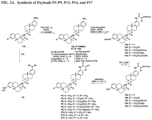
- This example demonstrates general methods for the synthesis of the podocarpic acid derivative P3 in Table 1, above. This example refers to the compounds numbered from 11b and P3 in FIG. 2A .
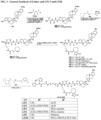
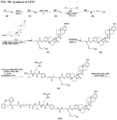
- Azido intermediate ⁇ -CD-N 3 (105a) was synthesized according to J. Am. Chem. Soc., 2012, 134(46), 19108-19117 ( FIG. 10 ).
- linker-payload LP3 (60 mg, 52% yield) was obtained as a white solid.
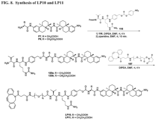
- This example demonstrates methods for the synthesis of the linker-payload LP7 in Table 2, above. This example refers to the compounds numbered 14a, 107, 114 and 115 and linker-payload LP7 in FIG. 5 .
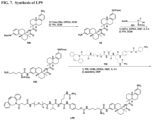
- This example demonstrates methods for the synthesis of the linker-payload LP9 in Table 2, above. This example refers to the compounds numbered 12b, 15, 112, 121, and 122 and linker-payload LP9 in FIG. 7 .
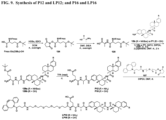
- This example demonstrates methods for the synthesis of the payload P12 and P16 in Table 1, above, and the linker-payload LP12 and LP16 in Table 2, above.
- This example refers to the compounds numbered 12b, 107, 124, 125, and 126; and payload P12 and P16; and linker-payload LP12 and LP16 in FIG. 9
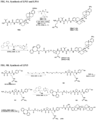
- This example demonstrates methods for the synthesis of the linker-payloads LP13 and LP14 in Table 2, above.
- This example refers to the compounds numbered 102a, 127a/b, 128a/b, 107, and linker-payloads LP13 and LP14 in FIG. 9A .
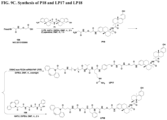
- This example demonstrates methods for the synthesis of the linker-payload LP15 in Table 2, above.
- This example refers to the compounds numbered 129, 130, 131, 132, 133, Ser-P1, and linker-payload LP15 in FIG. 9B .
- Compound 129 was synthesized according to WO 2015/095124 A1 .
Landscapes
- Health & Medical Sciences (AREA)
- Chemical & Material Sciences (AREA)
- Organic Chemistry (AREA)
- Engineering & Computer Science (AREA)
- Bioinformatics & Cheminformatics (AREA)
- Life Sciences & Earth Sciences (AREA)
- Medicinal Chemistry (AREA)
- General Health & Medical Sciences (AREA)
- Veterinary Medicine (AREA)
- Pharmacology & Pharmacy (AREA)
- Animal Behavior & Ethology (AREA)
- Public Health (AREA)
- Immunology (AREA)
- Epidemiology (AREA)
- Chemical Kinetics & Catalysis (AREA)
- General Chemical & Material Sciences (AREA)
- Nuclear Medicine, Radiotherapy & Molecular Imaging (AREA)
- Biotechnology (AREA)
- Biomedical Technology (AREA)
- Neurology (AREA)
- Neurosurgery (AREA)
- Polymers & Plastics (AREA)
- Cell Biology (AREA)
- Diabetes (AREA)
- Obesity (AREA)
- Hematology (AREA)
- Molecular Biology (AREA)
- Biochemistry (AREA)
- Psychiatry (AREA)
- Pain & Pain Management (AREA)
- Rheumatology (AREA)
- Hospice & Palliative Care (AREA)
- Genetics & Genomics (AREA)
- Materials Engineering (AREA)
- Peptides Or Proteins (AREA)
- Medicinal Preparation (AREA)
- Medicines That Contain Protein Lipid Enzymes And Other Medicines (AREA)
- Acyclic And Carbocyclic Compounds In Medicinal Compositions (AREA)
- Pharmaceuticals Containing Other Organic And Inorganic Compounds (AREA)
- Organic Low-Molecular-Weight Compounds And Preparation Thereof (AREA)
Priority Applications (1)
| Application Number | Priority Date | Filing Date | Title |
|---|---|---|---|
| EP24186656.5A EP4428142A3 (en) | 2018-11-20 | 2019-11-19 | Bis-octahydrophenanthrene carboxamide derivatives and protein conjugates thereof |
Applications Claiming Priority (2)
| Application Number | Priority Date | Filing Date | Title |
|---|---|---|---|
| US201862769946P | 2018-11-20 | 2018-11-20 | |
| PCT/US2019/062302 WO2020106780A1 (en) | 2018-11-20 | 2019-11-19 | Bis-octahydrophenanthrene carboxamide derivatives and protein conjugates thereof for use as lxr agonists |
Related Child Applications (1)
| Application Number | Title | Priority Date | Filing Date |
|---|---|---|---|
| EP24186656.5A Division EP4428142A3 (en) | 2018-11-20 | 2019-11-19 | Bis-octahydrophenanthrene carboxamide derivatives and protein conjugates thereof |
Publications (2)
| Publication Number | Publication Date |
|---|---|
| EP3883926A1 EP3883926A1 (en) | 2021-09-29 |
| EP3883926B1 true EP3883926B1 (en) | 2024-07-10 |
Family
ID=69005818
Family Applications (2)
| Application Number | Title | Priority Date | Filing Date |
|---|---|---|---|
| EP19827877.2A Active EP3883926B1 (en) | 2018-11-20 | 2019-11-19 | Bis-octahydrophenanthrene carboxamide derivatives and protein conjugates thereof for use as lxr agonists |
| EP24186656.5A Pending EP4428142A3 (en) | 2018-11-20 | 2019-11-19 | Bis-octahydrophenanthrene carboxamide derivatives and protein conjugates thereof |
Family Applications After (1)
| Application Number | Title | Priority Date | Filing Date |
|---|---|---|---|
| EP24186656.5A Pending EP4428142A3 (en) | 2018-11-20 | 2019-11-19 | Bis-octahydrophenanthrene carboxamide derivatives and protein conjugates thereof |
Country Status (20)
Families Citing this family (11)
| Publication number | Priority date | Publication date | Assignee | Title |
|---|---|---|---|---|
| CA3042428A1 (en) | 2016-11-08 | 2018-05-17 | Regeneron Pharmaceuticals, Inc. | Steroids and protein-conjugates thereof |
| KR20250008984A (ko) | 2017-05-18 | 2025-01-16 | 리제너론 파마슈티칼스 인코포레이티드 | 사이클로덱스트린 단백질 약물 접합체 |
| WO2019217591A1 (en) | 2018-05-09 | 2019-11-14 | Regeneron Pharmaceuticals, Inc. | Anti-msr1 antibodies and methods of use thereof |
| CA3120528A1 (en) * | 2018-11-20 | 2020-05-28 | Regeneron Pharmaceuticals, Inc. | Bis-octahydrophenanthrene carboxamide derivatives and protein conjugates thereof for use as lxr agonists |
| US12605459B2 (en) * | 2020-07-13 | 2026-04-21 | Regeneron Pharmaceuticals, Inc. | Protein-drug conjugates comprising camptothecin analogs and methods of use thereof |
| MX2023004935A (es) | 2020-11-10 | 2023-07-07 | Regeneron Pharma | Conjugados de anticuerpos y selenio. |
| US11806405B1 (en) | 2021-07-19 | 2023-11-07 | Zeno Management, Inc. | Immunoconjugates and methods |
| CA3224492A1 (en) | 2021-07-19 | 2023-01-26 | Xiaojun Han | Immunoconjugates and methods |
| CA3228214A1 (en) * | 2021-11-02 | 2023-05-11 | Changjiang Huang | Antibody-drug conjugate intermediate comprising sn38 and preparation method therefor |
| CN115594766A (zh) * | 2021-12-30 | 2023-01-13 | 辽宁键凯科技有限公司(Cn) | 一种缀合物及用其制备的抗体偶联药物 |
| CN115505028A (zh) * | 2022-09-16 | 2022-12-23 | 辽宁键凯科技有限公司 | 一种分支型聚乙二醇连接子及其用途 |
Family Cites Families (35)
| Publication number | Priority date | Publication date | Assignee | Title |
|---|---|---|---|---|
| US5208020A (en) | 1989-10-25 | 1993-05-04 | Immunogen Inc. | Cytotoxic agents comprising maytansinoids and their therapeutic use |
| US5714586A (en) | 1995-06-07 | 1998-02-03 | American Cyanamid Company | Methods for the preparation of monomeric calicheamicin derivative/carrier conjugates |
| EP1239855A4 (en) | 1999-12-13 | 2004-04-21 | Merck & Co Inc | METHOD FOR PREVENTING AND TREATING ARTERIOSCLEROSIS |
| US20070258987A1 (en) | 2000-11-28 | 2007-11-08 | Seattle Genetics, Inc. | Recombinant Anti-Cd30 Antibodies and Uses Thereof |
| US6908934B2 (en) * | 2001-06-11 | 2005-06-21 | Merck & Co., Inc. | Therapeutic compounds for treating dyslipidemic conditions |
| EP1398032A1 (en) | 2002-09-10 | 2004-03-17 | PheneX Pharmaceuticals AG | 4-Oxo-quinazolines as LXR nuclear receptor binding compounds |
| TW200539855A (en) | 2004-03-15 | 2005-12-16 | Wyeth Corp | Calicheamicin conjugates |
| CA2570496A1 (en) | 2004-06-24 | 2006-01-05 | Galapagos N.V. | Methods and compositions to promote bone homeostasis |
| US7750116B1 (en) | 2006-02-18 | 2010-07-06 | Seattle Genetics, Inc. | Antibody drug conjugate metabolites |
| EP2121621B1 (en) | 2006-12-08 | 2014-05-07 | Exelixis Patent Company LLC | Lxr and fxr modulators |
| US8993628B2 (en) | 2007-02-23 | 2015-03-31 | City Of Hope | Synthetic ligands selective for LXRβ over LXRα, identification and methods of use thereof |
| WO2008122039A2 (en) | 2007-04-02 | 2008-10-09 | The Government Of The United States Of America, As Represented By The Secretary, Department Of Health And Human Services | Selenocysteine mediated hybrid antibody molecules |
| US7985557B2 (en) | 2007-05-23 | 2011-07-26 | Ventana Medical Systems, Inc. | Polymeric carriers for immunohistochemistry and in situ hybridization |
| UA108598C2 (xx) | 2008-04-30 | 2015-05-25 | Високоефективні кон'югати та гідрофільні зшиваючі агенти (лінкери) | |
| KR101000067B1 (ko) | 2008-12-30 | 2010-12-10 | 엘지전자 주식회사 | 고효율 태양전지용 레이저 소성장치 및 고효율 태양전지 제조방법 |
| PT2528625E (pt) | 2010-04-15 | 2013-10-17 | Spirogen Sarl | Pirrolobenzodiazepinas e conjugados das mesmas |
| US20130244905A1 (en) | 2010-07-06 | 2013-09-19 | Ed Grabczyk | Reporter for RNA Polymerase II Termination |
| DK2714685T3 (en) | 2011-05-27 | 2017-01-09 | Ambrx Inc | FORMATIONS CONTAINING, METHODS INVOLVING, AND USES OF NON-NATURAL AMINO ACID BOUND dolastatin |
| US8815226B2 (en) | 2011-06-10 | 2014-08-26 | Mersana Therapeutics, Inc. | Protein-polymer-drug conjugates |
| AU2012322934B2 (en) | 2011-10-14 | 2016-09-08 | Medimmune Limited | Pyrrolobenzodiazepines |
| CA2850373C (en) | 2011-10-14 | 2019-07-16 | Seattle Genetics, Inc. | Pyrrolobenzodiazepines and targeted conjugates |
| JP6166728B2 (ja) | 2011-10-14 | 2017-07-19 | メドイミューン・リミテッドMedImmune Limited | ピロロベンゾジアゼピンの製造に有用な合成方法及び中間体 |
| CA2850375C (en) | 2011-10-14 | 2019-07-02 | Seattle Genetics, Inc. | Pyrrolobenzodiazepines and targeted conjugates |
| WO2013068874A1 (en) | 2011-11-11 | 2013-05-16 | Pfizer Inc. | Antibody-drug conjugates |
| HRP20180268T4 (hr) | 2012-10-23 | 2026-03-27 | Synaffix B.V. | Modificirano antitijelo, konjugat antitijela i postupak za njihovu pripremu |
| BR112016014126B1 (pt) | 2013-12-16 | 2023-02-14 | Medimmune Limited | Composto não-peptídico, conjugados de anticorpo-fármaco do mesmo, uso dos ditos conjugados para o tratamento de câncer e composição farmacêutica que compreende os mesmos |
| SG11201605437YA (en) | 2014-01-27 | 2016-08-30 | Pfizer | Bifunctional cytotoxic agents |
| TWI871999B (zh) | 2014-04-10 | 2025-02-01 | 日商第一三共股份有限公司 | 抗her3抗體-藥物結合物 |
| US20160324981A1 (en) | 2015-05-08 | 2016-11-10 | The California Institute For Biomedical Research | Liver x receptor agonists and uses thereof |
| CA3001938A1 (en) * | 2015-11-04 | 2017-05-11 | Borealis Ag | A process for producing a multilayer laminate |
| EP3419670A2 (en) | 2016-02-26 | 2019-01-02 | Regeneron Pharmaceuticals, Inc. | Optimized transglutaminase site-specific antibody conjugation |
| CA3042428A1 (en) | 2016-11-08 | 2018-05-17 | Regeneron Pharmaceuticals, Inc. | Steroids and protein-conjugates thereof |
| EP3625209A1 (en) | 2017-05-18 | 2020-03-25 | Regeneron Pharmaceuticals, Inc. | Bis-octahydrophenanthrene carboxamides and protein conjugates thereof |
| WO2019217591A1 (en) | 2018-05-09 | 2019-11-14 | Regeneron Pharmaceuticals, Inc. | Anti-msr1 antibodies and methods of use thereof |
| CA3120528A1 (en) * | 2018-11-20 | 2020-05-28 | Regeneron Pharmaceuticals, Inc. | Bis-octahydrophenanthrene carboxamide derivatives and protein conjugates thereof for use as lxr agonists |
-
2019
- 2019-11-19 CA CA3120528A patent/CA3120528A1/en active Pending
- 2019-11-19 IL IL283313A patent/IL283313B2/en unknown
- 2019-11-19 EA EA202191430A patent/EA202191430A1/ru unknown
- 2019-11-19 EP EP19827877.2A patent/EP3883926B1/en active Active
- 2019-11-19 CN CN201980089547.4A patent/CN113382985A/zh active Pending
- 2019-11-19 US US17/295,420 patent/US12209180B2/en active Active
- 2019-11-19 SG SG11202105175WA patent/SG11202105175WA/en unknown
- 2019-11-19 MA MA53455A patent/MA53455B1/fr unknown
- 2019-11-19 ES ES19827877T patent/ES2984190T3/es active Active
- 2019-11-19 JP JP2021527836A patent/JP7702866B2/ja active Active
- 2019-11-19 AU AU2019384136A patent/AU2019384136B2/en active Active
- 2019-11-19 WO PCT/US2019/062302 patent/WO2020106780A1/en not_active Ceased
- 2019-11-19 MX MX2021005822A patent/MX2021005822A/es unknown
- 2019-11-19 MY MYPI2021002708A patent/MY206542A/en unknown
- 2019-11-19 KR KR1020217018084A patent/KR20210094568A/ko active Pending
- 2019-11-19 EP EP24186656.5A patent/EP4428142A3/en active Pending
- 2019-11-19 BR BR112021009673A patent/BR112021009673A2/pt unknown
-
2021
- 2021-05-19 CL CL2021001308A patent/CL2021001308A1/es unknown
- 2021-05-20 ZA ZA2021/03431A patent/ZA202103431B/en unknown
- 2021-05-20 PH PH12021551153A patent/PH12021551153A1/en unknown
- 2021-06-10 CO CONC2021/0007581A patent/CO2021007581A2/es unknown
-
2024
- 2024-12-16 US US18/983,183 patent/US20250171622A1/en active Pending
-
2025
- 2025-06-24 JP JP2025106091A patent/JP2025138724A/ja active Pending
Also Published As
| Publication number | Publication date |
|---|---|
| CL2021001308A1 (es) | 2022-03-11 |
| MX2021005822A (es) | 2021-07-15 |
| EP4428142A3 (en) | 2024-11-20 |
| MY206542A (en) | 2024-12-20 |
| MA53455B1 (fr) | 2022-11-30 |
| AU2019384136A1 (en) | 2021-06-10 |
| IL283313B1 (en) | 2025-04-01 |
| KR20210094568A (ko) | 2021-07-29 |
| EP4428142A2 (en) | 2024-09-11 |
| PH12021551153A1 (en) | 2021-11-03 |
| JP7702866B2 (ja) | 2025-07-04 |
| IL283313B2 (en) | 2025-08-01 |
| JP2022507781A (ja) | 2022-01-18 |
| IL283313A (en) | 2021-07-29 |
| US20250171622A1 (en) | 2025-05-29 |
| CA3120528A1 (en) | 2020-05-28 |
| WO2020106780A1 (en) | 2020-05-28 |
| ES2984190T3 (es) | 2024-10-29 |
| CN113382985A (zh) | 2021-09-10 |
| MA53455A1 (fr) | 2021-12-31 |
| AU2019384136B2 (en) | 2024-06-06 |
| ZA202103431B (en) | 2024-09-25 |
| CO2021007581A2 (es) | 2021-06-21 |
| SG11202105175WA (en) | 2021-06-29 |
| EA202191430A1 (ru) | 2021-11-29 |
| US12209180B2 (en) | 2025-01-28 |
| JP2025138724A (ja) | 2025-09-25 |
| BR112021009673A2 (pt) | 2021-12-14 |
| EP3883926A1 (en) | 2021-09-29 |
| US20220080052A1 (en) | 2022-03-17 |
Similar Documents
| Publication | Publication Date | Title |
|---|---|---|
| US20250171622A1 (en) | Bis-octahydrophenanthrene carboxamide derivatives and protein conjugates thereof for use as lxr agonists | |
| US12338199B2 (en) | Bis-octahydrophenanthrene carboxamides and protein conjugates thereof | |
| US12589101B2 (en) | Cyclodextrin protein drug conjugates | |
| KR102877468B1 (ko) | 흔적이 없는 링커 및 이의 단백질-접합체 | |
| EP3898651A2 (en) | Tubulysins and protein-tubulysin conjugates | |
| US20230119539A1 (en) | Traceless linkers and protein-conjugates thereof | |
| HK40116735A (en) | Bis-octahydrophenanthrene carboxamide derivatives and protein conjugates thereof | |
| HK40060716B (en) | Bis-octahydrophenanthrene carboxamide derivatives and protein conjugates thereof for use as lxr agonists | |
| HK40060716A (en) | Bis-octahydrophenanthrene carboxamide derivatives and protein conjugates thereof for use as lxr agonists | |
| EA049882B1 (ru) | Производные бис-октагидрофенантренкарбоксамида и их белковые конъюгаты | |
| EA047045B1 (ru) | Бис-октагидрофенантрена карбоксамиды и их белковые конъюгаты |
Legal Events
| Date | Code | Title | Description |
|---|---|---|---|
| STAA | Information on the status of an ep patent application or granted ep patent |
Free format text: STATUS: UNKNOWN |
|
| STAA | Information on the status of an ep patent application or granted ep patent |
Free format text: STATUS: THE INTERNATIONAL PUBLICATION HAS BEEN MADE |
|
| PUAI | Public reference made under article 153(3) epc to a published international application that has entered the european phase |
Free format text: ORIGINAL CODE: 0009012 |
|
| STAA | Information on the status of an ep patent application or granted ep patent |
Free format text: STATUS: REQUEST FOR EXAMINATION WAS MADE |
|
| 17P | Request for examination filed |
Effective date: 20210513 |
|
| AK | Designated contracting states |
Kind code of ref document: A1 Designated state(s): AL AT BE BG CH CY CZ DE DK EE ES FI FR GB GR HR HU IE IS IT LI LT LU LV MC MK MT NL NO PL PT RO RS SE SI SK SM TR |
|
| DAV | Request for validation of the european patent (deleted) | ||
| REG | Reference to a national code |
Ref country code: HK Ref legal event code: DE Ref document number: 40060716 Country of ref document: HK |
|
| STAA | Information on the status of an ep patent application or granted ep patent |
Free format text: STATUS: EXAMINATION IS IN PROGRESS |
|
| 17Q | First examination report despatched |
Effective date: 20220527 |
|
| GRAP | Despatch of communication of intention to grant a patent |
Free format text: ORIGINAL CODE: EPIDOSNIGR1 |
|
| STAA | Information on the status of an ep patent application or granted ep patent |
Free format text: STATUS: GRANT OF PATENT IS INTENDED |
|
| INTG | Intention to grant announced |
Effective date: 20231005 |
|
| GRAJ | Information related to disapproval of communication of intention to grant by the applicant or resumption of examination proceedings by the epo deleted |
Free format text: ORIGINAL CODE: EPIDOSDIGR1 |
|
| STAA | Information on the status of an ep patent application or granted ep patent |
Free format text: STATUS: EXAMINATION IS IN PROGRESS |
|
| GRAP | Despatch of communication of intention to grant a patent |
Free format text: ORIGINAL CODE: EPIDOSNIGR1 |
|
| STAA | Information on the status of an ep patent application or granted ep patent |
Free format text: STATUS: GRANT OF PATENT IS INTENDED |
|
| INTC | Intention to grant announced (deleted) | ||
| GRAJ | Information related to disapproval of communication of intention to grant by the applicant or resumption of examination proceedings by the epo deleted |
Free format text: ORIGINAL CODE: EPIDOSDIGR1 |
|
| STAA | Information on the status of an ep patent application or granted ep patent |
Free format text: STATUS: EXAMINATION IS IN PROGRESS |
|
| INTG | Intention to grant announced |
Effective date: 20240118 |
|
| GRAP | Despatch of communication of intention to grant a patent |
Free format text: ORIGINAL CODE: EPIDOSNIGR1 |
|
| STAA | Information on the status of an ep patent application or granted ep patent |
Free format text: STATUS: GRANT OF PATENT IS INTENDED |
|
| INTG | Intention to grant announced |
Effective date: 20240223 |
|
| P01 | Opt-out of the competence of the unified patent court (upc) registered |
Effective date: 20240425 |
|
| GRAS | Grant fee paid |
Free format text: ORIGINAL CODE: EPIDOSNIGR3 |
|
| GRAA | (expected) grant |
Free format text: ORIGINAL CODE: 0009210 |
|
| STAA | Information on the status of an ep patent application or granted ep patent |
Free format text: STATUS: THE PATENT HAS BEEN GRANTED |
|
| AK | Designated contracting states |
Kind code of ref document: B1 Designated state(s): AL AT BE BG CH CY CZ DE DK EE ES FI FR GB GR HR HU IE IS IT LI LT LU LV MC MK MT NL NO PL PT RO RS SE SI SK SM TR |
|
| REG | Reference to a national code |
Ref country code: CH Ref legal event code: EP |
|
| REG | Reference to a national code |
Ref country code: DE Ref legal event code: R096 Ref document number: 602019055079 Country of ref document: DE |
|
| REG | Reference to a national code |
Ref country code: NL Ref legal event code: FP |
|
| REG | Reference to a national code |
Ref country code: ES Ref legal event code: FG2A Ref document number: 2984190 Country of ref document: ES Kind code of ref document: T3 Effective date: 20241029 |
|
| REG | Reference to a national code |
Ref country code: LT Ref legal event code: MG9D |
|
| PG25 | Lapsed in a contracting state [announced via postgrant information from national office to epo] |
Ref country code: PT Free format text: LAPSE BECAUSE OF FAILURE TO SUBMIT A TRANSLATION OF THE DESCRIPTION OR TO PAY THE FEE WITHIN THE PRESCRIBED TIME-LIMIT Effective date: 20241111 |
|
| REG | Reference to a national code |
Ref country code: AT Ref legal event code: MK05 Ref document number: 1701970 Country of ref document: AT Kind code of ref document: T Effective date: 20240710 |
|
| PG25 | Lapsed in a contracting state [announced via postgrant information from national office to epo] |
Ref country code: PT Free format text: LAPSE BECAUSE OF FAILURE TO SUBMIT A TRANSLATION OF THE DESCRIPTION OR TO PAY THE FEE WITHIN THE PRESCRIBED TIME-LIMIT Effective date: 20241111 |
|
| PG25 | Lapsed in a contracting state [announced via postgrant information from national office to epo] |
Ref country code: NO Free format text: LAPSE BECAUSE OF FAILURE TO SUBMIT A TRANSLATION OF THE DESCRIPTION OR TO PAY THE FEE WITHIN THE PRESCRIBED TIME-LIMIT Effective date: 20241010 |
|
| PG25 | Lapsed in a contracting state [announced via postgrant information from national office to epo] |
Ref country code: GR Free format text: LAPSE BECAUSE OF FAILURE TO SUBMIT A TRANSLATION OF THE DESCRIPTION OR TO PAY THE FEE WITHIN THE PRESCRIBED TIME-LIMIT Effective date: 20241011 Ref country code: FI Free format text: LAPSE BECAUSE OF FAILURE TO SUBMIT A TRANSLATION OF THE DESCRIPTION OR TO PAY THE FEE WITHIN THE PRESCRIBED TIME-LIMIT Effective date: 20240710 Ref country code: PL Free format text: LAPSE BECAUSE OF FAILURE TO SUBMIT A TRANSLATION OF THE DESCRIPTION OR TO PAY THE FEE WITHIN THE PRESCRIBED TIME-LIMIT Effective date: 20240710 |
|
| PG25 | Lapsed in a contracting state [announced via postgrant information from national office to epo] |
Ref country code: BG Free format text: LAPSE BECAUSE OF FAILURE TO SUBMIT A TRANSLATION OF THE DESCRIPTION OR TO PAY THE FEE WITHIN THE PRESCRIBED TIME-LIMIT Effective date: 20240710 |
|
| PG25 | Lapsed in a contracting state [announced via postgrant information from national office to epo] |
Ref country code: LV Free format text: LAPSE BECAUSE OF FAILURE TO SUBMIT A TRANSLATION OF THE DESCRIPTION OR TO PAY THE FEE WITHIN THE PRESCRIBED TIME-LIMIT Effective date: 20240710 |
|
| PG25 | Lapsed in a contracting state [announced via postgrant information from national office to epo] |
Ref country code: AT Free format text: LAPSE BECAUSE OF FAILURE TO SUBMIT A TRANSLATION OF THE DESCRIPTION OR TO PAY THE FEE WITHIN THE PRESCRIBED TIME-LIMIT Effective date: 20240710 Ref country code: IS Free format text: LAPSE BECAUSE OF FAILURE TO SUBMIT A TRANSLATION OF THE DESCRIPTION OR TO PAY THE FEE WITHIN THE PRESCRIBED TIME-LIMIT Effective date: 20241110 |
|
| PG25 | Lapsed in a contracting state [announced via postgrant information from national office to epo] |
Ref country code: HR Free format text: LAPSE BECAUSE OF FAILURE TO SUBMIT A TRANSLATION OF THE DESCRIPTION OR TO PAY THE FEE WITHIN THE PRESCRIBED TIME-LIMIT Effective date: 20240710 |
|
| PG25 | Lapsed in a contracting state [announced via postgrant information from national office to epo] |
Ref country code: RS Free format text: LAPSE BECAUSE OF FAILURE TO SUBMIT A TRANSLATION OF THE DESCRIPTION OR TO PAY THE FEE WITHIN THE PRESCRIBED TIME-LIMIT Effective date: 20241010 |
|
| PG25 | Lapsed in a contracting state [announced via postgrant information from national office to epo] |
Ref country code: RS Free format text: LAPSE BECAUSE OF FAILURE TO SUBMIT A TRANSLATION OF THE DESCRIPTION OR TO PAY THE FEE WITHIN THE PRESCRIBED TIME-LIMIT Effective date: 20241010 Ref country code: PL Free format text: LAPSE BECAUSE OF FAILURE TO SUBMIT A TRANSLATION OF THE DESCRIPTION OR TO PAY THE FEE WITHIN THE PRESCRIBED TIME-LIMIT Effective date: 20240710 Ref country code: NO Free format text: LAPSE BECAUSE OF FAILURE TO SUBMIT A TRANSLATION OF THE DESCRIPTION OR TO PAY THE FEE WITHIN THE PRESCRIBED TIME-LIMIT Effective date: 20241010 Ref country code: LV Free format text: LAPSE BECAUSE OF FAILURE TO SUBMIT A TRANSLATION OF THE DESCRIPTION OR TO PAY THE FEE WITHIN THE PRESCRIBED TIME-LIMIT Effective date: 20240710 Ref country code: IS Free format text: LAPSE BECAUSE OF FAILURE TO SUBMIT A TRANSLATION OF THE DESCRIPTION OR TO PAY THE FEE WITHIN THE PRESCRIBED TIME-LIMIT Effective date: 20241110 Ref country code: HR Free format text: LAPSE BECAUSE OF FAILURE TO SUBMIT A TRANSLATION OF THE DESCRIPTION OR TO PAY THE FEE WITHIN THE PRESCRIBED TIME-LIMIT Effective date: 20240710 Ref country code: GR Free format text: LAPSE BECAUSE OF FAILURE TO SUBMIT A TRANSLATION OF THE DESCRIPTION OR TO PAY THE FEE WITHIN THE PRESCRIBED TIME-LIMIT Effective date: 20241011 Ref country code: FI Free format text: LAPSE BECAUSE OF FAILURE TO SUBMIT A TRANSLATION OF THE DESCRIPTION OR TO PAY THE FEE WITHIN THE PRESCRIBED TIME-LIMIT Effective date: 20240710 Ref country code: BG Free format text: LAPSE BECAUSE OF FAILURE TO SUBMIT A TRANSLATION OF THE DESCRIPTION OR TO PAY THE FEE WITHIN THE PRESCRIBED TIME-LIMIT Effective date: 20240710 Ref country code: AT Free format text: LAPSE BECAUSE OF FAILURE TO SUBMIT A TRANSLATION OF THE DESCRIPTION OR TO PAY THE FEE WITHIN THE PRESCRIBED TIME-LIMIT Effective date: 20240710 |
|
| REG | Reference to a national code |
Ref country code: DE Ref legal event code: R097 Ref document number: 602019055079 Country of ref document: DE |
|
| PG25 | Lapsed in a contracting state [announced via postgrant information from national office to epo] |
Ref country code: RO Free format text: LAPSE BECAUSE OF FAILURE TO SUBMIT A TRANSLATION OF THE DESCRIPTION OR TO PAY THE FEE WITHIN THE PRESCRIBED TIME-LIMIT Effective date: 20240710 Ref country code: DK Free format text: LAPSE BECAUSE OF FAILURE TO SUBMIT A TRANSLATION OF THE DESCRIPTION OR TO PAY THE FEE WITHIN THE PRESCRIBED TIME-LIMIT Effective date: 20240710 Ref country code: SM Free format text: LAPSE BECAUSE OF FAILURE TO SUBMIT A TRANSLATION OF THE DESCRIPTION OR TO PAY THE FEE WITHIN THE PRESCRIBED TIME-LIMIT Effective date: 20240710 |
|
| PG25 | Lapsed in a contracting state [announced via postgrant information from national office to epo] |
Ref country code: EE Free format text: LAPSE BECAUSE OF FAILURE TO SUBMIT A TRANSLATION OF THE DESCRIPTION OR TO PAY THE FEE WITHIN THE PRESCRIBED TIME-LIMIT Effective date: 20240710 |
|
| PG25 | Lapsed in a contracting state [announced via postgrant information from national office to epo] |
Ref country code: CZ Free format text: LAPSE BECAUSE OF FAILURE TO SUBMIT A TRANSLATION OF THE DESCRIPTION OR TO PAY THE FEE WITHIN THE PRESCRIBED TIME-LIMIT Effective date: 20240710 |
|
| PG25 | Lapsed in a contracting state [announced via postgrant information from national office to epo] |
Ref country code: SK Free format text: LAPSE BECAUSE OF FAILURE TO SUBMIT A TRANSLATION OF THE DESCRIPTION OR TO PAY THE FEE WITHIN THE PRESCRIBED TIME-LIMIT Effective date: 20240710 |
|
| PLBE | No opposition filed within time limit |
Free format text: ORIGINAL CODE: 0009261 |
|
| STAA | Information on the status of an ep patent application or granted ep patent |
Free format text: STATUS: NO OPPOSITION FILED WITHIN TIME LIMIT |
|
| 26N | No opposition filed |
Effective date: 20250411 |
|
| PG25 | Lapsed in a contracting state [announced via postgrant information from national office to epo] |
Ref country code: MC Free format text: LAPSE BECAUSE OF FAILURE TO SUBMIT A TRANSLATION OF THE DESCRIPTION OR TO PAY THE FEE WITHIN THE PRESCRIBED TIME-LIMIT Effective date: 20240710 |
|
| PG25 | Lapsed in a contracting state [announced via postgrant information from national office to epo] |
Ref country code: LU Free format text: LAPSE BECAUSE OF NON-PAYMENT OF DUE FEES Effective date: 20241119 |
|
| PG25 | Lapsed in a contracting state [announced via postgrant information from national office to epo] |
Ref country code: SE Free format text: LAPSE BECAUSE OF FAILURE TO SUBMIT A TRANSLATION OF THE DESCRIPTION OR TO PAY THE FEE WITHIN THE PRESCRIBED TIME-LIMIT Effective date: 20240710 |
|
| PGFP | Annual fee paid to national office [announced via postgrant information from national office to epo] |
Ref country code: NL Payment date: 20251022 Year of fee payment: 7 |
|
| REG | Reference to a national code |
Ref country code: CH Ref legal event code: U11 Free format text: ST27 STATUS EVENT CODE: U-0-0-U10-U11 (AS PROVIDED BY THE NATIONAL OFFICE) Effective date: 20251201 |
|
| PGFP | Annual fee paid to national office [announced via postgrant information from national office to epo] |
Ref country code: DE Payment date: 20251022 Year of fee payment: 7 |
|
| PGFP | Annual fee paid to national office [announced via postgrant information from national office to epo] |
Ref country code: GB Payment date: 20251022 Year of fee payment: 7 |
|
| PGFP | Annual fee paid to national office [announced via postgrant information from national office to epo] |
Ref country code: IT Payment date: 20251022 Year of fee payment: 7 |
|
| PGFP | Annual fee paid to national office [announced via postgrant information from national office to epo] |
Ref country code: FR Payment date: 20251022 Year of fee payment: 7 |
|
| PGFP | Annual fee paid to national office [announced via postgrant information from national office to epo] |
Ref country code: BE Payment date: 20251022 Year of fee payment: 7 |
|
| PGFP | Annual fee paid to national office [announced via postgrant information from national office to epo] |
Ref country code: CH Payment date: 20251201 Year of fee payment: 7 |
|
| PGFP | Annual fee paid to national office [announced via postgrant information from national office to epo] |
Ref country code: IE Payment date: 20251024 Year of fee payment: 7 |
|
| PGFP | Annual fee paid to national office [announced via postgrant information from national office to epo] |
Ref country code: ES Payment date: 20251201 Year of fee payment: 7 |
|
| PG25 | Lapsed in a contracting state [announced via postgrant information from national office to epo] |
Ref country code: HU Free format text: LAPSE BECAUSE OF FAILURE TO SUBMIT A TRANSLATION OF THE DESCRIPTION OR TO PAY THE FEE WITHIN THE PRESCRIBED TIME-LIMIT; INVALID AB INITIO Effective date: 20191119 |
|
| PG25 | Lapsed in a contracting state [announced via postgrant information from national office to epo] |
Ref country code: CY Free format text: LAPSE BECAUSE OF FAILURE TO SUBMIT A TRANSLATION OF THE DESCRIPTION OR TO PAY THE FEE WITHIN THE PRESCRIBED TIME-LIMIT; INVALID AB INITIO Effective date: 20191119 |
|
| PG25 | Lapsed in a contracting state [announced via postgrant information from national office to epo] |
Ref country code: TR Free format text: LAPSE BECAUSE OF FAILURE TO SUBMIT A TRANSLATION OF THE DESCRIPTION OR TO PAY THE FEE WITHIN THE PRESCRIBED TIME-LIMIT Effective date: 20240710 |
|
| PG25 | Lapsed in a contracting state [announced via postgrant information from national office to epo] |
Ref country code: SI Free format text: LAPSE BECAUSE OF FAILURE TO SUBMIT A TRANSLATION OF THE DESCRIPTION OR TO PAY THE FEE WITHIN THE PRESCRIBED TIME-LIMIT Effective date: 20240710 |
|
| PG25 | Lapsed in a contracting state [announced via postgrant information from national office to epo] |
Ref country code: LT Free format text: LAPSE BECAUSE OF FAILURE TO SUBMIT A TRANSLATION OF THE DESCRIPTION OR TO PAY THE FEE WITHIN THE PRESCRIBED TIME-LIMIT Effective date: 20240710 |