EP3878836A1 - O-substituted serine derivative production method - Google Patents
O-substituted serine derivative production method Download PDFInfo
- Publication number
- EP3878836A1 EP3878836A1 EP19881712.4A EP19881712A EP3878836A1 EP 3878836 A1 EP3878836 A1 EP 3878836A1 EP 19881712 A EP19881712 A EP 19881712A EP 3878836 A1 EP3878836 A1 EP 3878836A1
- Authority
- EP
- European Patent Office
- Prior art keywords
- solvate
- general formula
- acceptable salt
- compound represented
- chemically acceptable
- Prior art date
- Legal status (The legal status is an assumption and is not a legal conclusion. Google has not performed a legal analysis and makes no representation as to the accuracy of the status listed.)
- Granted
Links
- 0 C*=C(*C(CO*)IN*)O* Chemical compound C*=C(*C(CO*)IN*)O* 0.000 description 13
- VUNBZHYPHYZUEV-GFCCVEGCSA-N CC(C)(C)OC(N([C@H](CO1)C(OCc2ccccc2)=O)S1(=O)=O)=O Chemical compound CC(C)(C)OC(N([C@H](CO1)C(OCc2ccccc2)=O)S1(=O)=O)=O VUNBZHYPHYZUEV-GFCCVEGCSA-N 0.000 description 1
- OVDCZLMQFQJFOQ-JMXUPQJJSA-N CC(C)(C)OC(N([C@H](CO1)C(OCc2ccccc2)=O)S1=O)=O Chemical compound CC(C)(C)OC(N([C@H](CO1)C(OCc2ccccc2)=O)S1=O)=O OVDCZLMQFQJFOQ-JMXUPQJJSA-N 0.000 description 1
- BMETVMYQMWUFPM-GFCCVEGCSA-N CC(C)(C)OC(N1SOC[C@@H]1C(OCc1ccccc1)=O)=O Chemical compound CC(C)(C)OC(N1SOC[C@@H]1C(OCc1ccccc1)=O)=O BMETVMYQMWUFPM-GFCCVEGCSA-N 0.000 description 1
- BQADRZHPZVQGCW-GFCCVEGCSA-N CC(C)(C)OC(N[C@H](CO)C(OCc1ccccc1)=O)=O Chemical compound CC(C)(C)OC(N[C@H](CO)C(OCc1ccccc1)=O)=O BQADRZHPZVQGCW-GFCCVEGCSA-N 0.000 description 1
Classifications
-
- C—CHEMISTRY; METALLURGY
- C07—ORGANIC CHEMISTRY
- C07C—ACYCLIC OR CARBOCYCLIC COMPOUNDS
- C07C269/00—Preparation of derivatives of carbamic acid, i.e. compounds containing any of the groups, the nitrogen atom not being part of nitro or nitroso groups
- C07C269/04—Preparation of derivatives of carbamic acid, i.e. compounds containing any of the groups, the nitrogen atom not being part of nitro or nitroso groups from amines with formation of carbamate groups
-
- C—CHEMISTRY; METALLURGY
- C07—ORGANIC CHEMISTRY
- C07D—HETEROCYCLIC COMPOUNDS
- C07D307/00—Heterocyclic compounds containing five-membered rings having one oxygen atom as the only ring hetero atom
- C07D307/02—Heterocyclic compounds containing five-membered rings having one oxygen atom as the only ring hetero atom not condensed with other rings
- C07D307/34—Heterocyclic compounds containing five-membered rings having one oxygen atom as the only ring hetero atom not condensed with other rings having two or three double bonds between ring members or between ring members and non-ring members
- C07D307/38—Heterocyclic compounds containing five-membered rings having one oxygen atom as the only ring hetero atom not condensed with other rings having two or three double bonds between ring members or between ring members and non-ring members with substituted hydrocarbon radicals attached to ring carbon atoms
- C07D307/40—Radicals substituted by oxygen atoms
- C07D307/42—Singly bound oxygen atoms
-
- C—CHEMISTRY; METALLURGY
- C07—ORGANIC CHEMISTRY
- C07C—ACYCLIC OR CARBOCYCLIC COMPOUNDS
- C07C227/00—Preparation of compounds containing amino and carboxyl groups bound to the same carbon skeleton
- C07C227/14—Preparation of compounds containing amino and carboxyl groups bound to the same carbon skeleton from compounds containing already amino and carboxyl groups or derivatives thereof
- C07C227/18—Preparation of compounds containing amino and carboxyl groups bound to the same carbon skeleton from compounds containing already amino and carboxyl groups or derivatives thereof by reactions involving amino or carboxyl groups, e.g. hydrolysis of esters or amides, by formation of halides, salts or esters
-
- C—CHEMISTRY; METALLURGY
- C07—ORGANIC CHEMISTRY
- C07C—ACYCLIC OR CARBOCYCLIC COMPOUNDS
- C07C229/00—Compounds containing amino and carboxyl groups bound to the same carbon skeleton
- C07C229/02—Compounds containing amino and carboxyl groups bound to the same carbon skeleton having amino and carboxyl groups bound to acyclic carbon atoms of the same carbon skeleton
- C07C229/04—Compounds containing amino and carboxyl groups bound to the same carbon skeleton having amino and carboxyl groups bound to acyclic carbon atoms of the same carbon skeleton the carbon skeleton being acyclic and saturated
- C07C229/22—Compounds containing amino and carboxyl groups bound to the same carbon skeleton having amino and carboxyl groups bound to acyclic carbon atoms of the same carbon skeleton the carbon skeleton being acyclic and saturated the carbon skeleton being further substituted by oxygen atoms
-
- C—CHEMISTRY; METALLURGY
- C07—ORGANIC CHEMISTRY
- C07C—ACYCLIC OR CARBOCYCLIC COMPOUNDS
- C07C269/00—Preparation of derivatives of carbamic acid, i.e. compounds containing any of the groups, the nitrogen atom not being part of nitro or nitroso groups
- C07C269/06—Preparation of derivatives of carbamic acid, i.e. compounds containing any of the groups, the nitrogen atom not being part of nitro or nitroso groups by reactions not involving the formation of carbamate groups
-
- C—CHEMISTRY; METALLURGY
- C07—ORGANIC CHEMISTRY
- C07C—ACYCLIC OR CARBOCYCLIC COMPOUNDS
- C07C271/00—Derivatives of carbamic acids, i.e. compounds containing any of the groups, the nitrogen atom not being part of nitro or nitroso groups
- C07C271/06—Esters of carbamic acids
- C07C271/08—Esters of carbamic acids having oxygen atoms of carbamate groups bound to acyclic carbon atoms
- C07C271/10—Esters of carbamic acids having oxygen atoms of carbamate groups bound to acyclic carbon atoms with the nitrogen atoms of the carbamate groups bound to hydrogen atoms or to acyclic carbon atoms
- C07C271/22—Esters of carbamic acids having oxygen atoms of carbamate groups bound to acyclic carbon atoms with the nitrogen atoms of the carbamate groups bound to hydrogen atoms or to acyclic carbon atoms to carbon atoms of hydrocarbon radicals substituted by carboxyl groups
-
- C—CHEMISTRY; METALLURGY
- C07—ORGANIC CHEMISTRY
- C07D—HETEROCYCLIC COMPOUNDS
- C07D291/00—Heterocyclic compounds containing rings having nitrogen, oxygen and sulfur atoms as the only ring hetero atoms
- C07D291/02—Heterocyclic compounds containing rings having nitrogen, oxygen and sulfur atoms as the only ring hetero atoms not condensed with other rings
- C07D291/04—Five-membered rings
-
- C—CHEMISTRY; METALLURGY
- C07—ORGANIC CHEMISTRY
- C07D—HETEROCYCLIC COMPOUNDS
- C07D291/00—Heterocyclic compounds containing rings having nitrogen, oxygen and sulfur atoms as the only ring hetero atoms
- C07D291/02—Heterocyclic compounds containing rings having nitrogen, oxygen and sulfur atoms as the only ring hetero atoms not condensed with other rings
- C07D291/06—Six-membered rings
-
- C—CHEMISTRY; METALLURGY
- C07—ORGANIC CHEMISTRY
- C07D—HETEROCYCLIC COMPOUNDS
- C07D333/00—Heterocyclic compounds containing five-membered rings having one sulfur atom as the only ring hetero atom
- C07D333/02—Heterocyclic compounds containing five-membered rings having one sulfur atom as the only ring hetero atom not condensed with other rings
- C07D333/04—Heterocyclic compounds containing five-membered rings having one sulfur atom as the only ring hetero atom not condensed with other rings not substituted on the ring sulphur atom
- C07D333/06—Heterocyclic compounds containing five-membered rings having one sulfur atom as the only ring hetero atom not condensed with other rings not substituted on the ring sulphur atom with only hydrogen atoms, hydrocarbon or substituted hydrocarbon radicals, directly attached to the ring carbon atoms
- C07D333/14—Radicals substituted by singly bound hetero atoms other than halogen
- C07D333/16—Radicals substituted by singly bound hetero atoms other than halogen by oxygen atoms
-
- C—CHEMISTRY; METALLURGY
- C07—ORGANIC CHEMISTRY
- C07B—GENERAL METHODS OF ORGANIC CHEMISTRY; APPARATUS THEREFOR
- C07B2200/00—Indexing scheme relating to specific properties of organic compounds
- C07B2200/07—Optical isomers
-
- C—CHEMISTRY; METALLURGY
- C07—ORGANIC CHEMISTRY
- C07C—ACYCLIC OR CARBOCYCLIC COMPOUNDS
- C07C2603/00—Systems containing at least three condensed rings
- C07C2603/02—Ortho- or ortho- and peri-condensed systems
- C07C2603/04—Ortho- or ortho- and peri-condensed systems containing three rings
- C07C2603/06—Ortho- or ortho- and peri-condensed systems containing three rings containing at least one ring with less than six ring members
- C07C2603/10—Ortho- or ortho- and peri-condensed systems containing three rings containing at least one ring with less than six ring members containing five-membered rings
- C07C2603/12—Ortho- or ortho- and peri-condensed systems containing three rings containing at least one ring with less than six ring members containing five-membered rings only one five-membered ring
- C07C2603/18—Fluorenes; Hydrogenated fluorenes
-
- Y—GENERAL TAGGING OF NEW TECHNOLOGICAL DEVELOPMENTS; GENERAL TAGGING OF CROSS-SECTIONAL TECHNOLOGIES SPANNING OVER SEVERAL SECTIONS OF THE IPC; TECHNICAL SUBJECTS COVERED BY FORMER USPC CROSS-REFERENCE ART COLLECTIONS [XRACs] AND DIGESTS
- Y02—TECHNOLOGIES OR APPLICATIONS FOR MITIGATION OR ADAPTATION AGAINST CLIMATE CHANGE
- Y02P—CLIMATE CHANGE MITIGATION TECHNOLOGIES IN THE PRODUCTION OR PROCESSING OF GOODS
- Y02P20/00—Technologies relating to chemical industry
- Y02P20/50—Improvements relating to the production of bulk chemicals
- Y02P20/55—Design of synthesis routes, e.g. reducing the use of auxiliary or protecting groups
Definitions
- the present invention relates to O-substituted serine derivatives useful as pharmaceutical intermediates and cyclic sulfamidates useful for producing them, and methods for producing those compounds.
- middle molecule compounds (molecular weight of 500 - 2,000) may be superior to small molecule compounds. Middle molecule compounds may also be superior to antibodies in that they can be internalized into cells.
- peptide pharmaceuticals are valuable molecular species, and more than 40 types are already in the market (Non-Patent Literature (NPL) 1).
- Representative examples of peptide pharmaceuticals include cyclosporin A and polymyxin B. By focusing on their structures, it can be understood that they are peptide compounds comprising some unnatural amino acids.
- Unnatural amino acids refer to amino acids that are not coded on mRNAs in nature, and it is very interesting that naturally occurring cyclosporin A and polymyxin B contain unnatural amino acids, and that these unnatural structural sites interact with sites of action in a living body to develop pharmacological activities.
- the study of the interaction between O-substituted serine on lacosamide and sodium channel (NPL 2) is known.
- the method using an aziridine derived from serine described in PTL 1 and 2 has a problem regarding the regioselectivity of the reactive site.
- the method using an aziridine derived from serine described in NPL 2 has a problem regarding the regioselectivity of the reactive site.
- the substituent on the oxygen in the producible O-substituted serine derivative is limited to an allyl group.
- the substituent on the oxygen in the producible O-substituted serine derivative is limited to an allyl group.
- the O-substituted serine derivative that is producible in high yield is limited only to those substituted with an aromatic ring such as phenol, and only one case has been reported regarding synthesis of O-alkyl substituted serine derivative obtained by the reaction with an alkyl alcohol where the yield was only 16%. That is, synthetic examples of O-alkyl substituted serine derivatives that achieved satisfactory regioselectivity, yield, and optical purity by reacting cyclic sulfamidate with alcohol are extremely limited.
- the objective of the present invention is to provide methods for producing O-substituted serine derivatives useful as pharmaceutical intermediates and sulfamidates useful for producing them with satisfactory regioselectivity, chemical yield, and optical purity.
- the present inventors dedicatedly investigated the reaction of a cyclic sulfamidate derived from an amino acid derivative with an alcohol, and as a result, discovered methods for producing O-substituted serine derivative (I) with excellent regioselectivity and chemical yield, while keeping high optical purity, using the following Scheme 1 or Scheme 2, and completed the present invention.
- the present invention comprises the following.
- unnatural amino acids useful for exploring peptide pharmaceuticals, and/or for supplying active ingredients of pharmaceuticals can be provided with high regioselectivity, chemical yield, and optical purity.
- alkyl means a monovalent group induced by removing an arbitrary hydrogen atom from an aliphatic hydrocarbon, which does not contain hetero atoms (atoms other than carbon and hydrogen atoms) or unsaturated carbon-carbon bonds, and which has a subset of hydrocarbyl or hydrocarbon group structure containing hydrogen and carbon atoms.
- the alkyl groups include straight-chain or branched-chain groups.
- the alkyl groups include alkyl groups of 1 to 20 carbon atoms (C 1 -C 20 , and herein below, "C p -C q " means that the number of carbon atoms is from p to q), preferably C 1 -C 6 alkyl groups.
- the alkyl groups specifically include methyl, ethyl, propyl, butyl, pentyl, hexyl, isopropyl, tert-butyl group, and sec-butyl group.
- cycloalkyl means a saturated or partially saturated cyclic monovalent aliphatic hydrocarbon group, and includes monocyclic, bicyclic, and spirocyclic ring. Preferable examples include C 3 -C 8 cycloalkyl.
- the cycloalkyl group may be partially unsaturated.
- the cycloalkyls specifically include, for example, cyclopropyl, cyclobutyl, cyclopentyl, and cyclohexyl.
- aryl means a monovalent aromatic hydrocarbon ring, and preferably includes C 6 -C 10 aryl.
- the aryls specifically include, for example, phenyl and naphthyl (e.g., 1-naphthyl and 2-naphthyl).
- heteroaryl means a group of a monovalent aromatic ring containing preferably 1 to 4 hetero atoms among those which compose the ring (also referred to as “in the ring” herein), and may be partially saturated.
- the ring may be a monocyclic ring, or a fused ring of two (e.g., bicyclic heteroaryl fused with benzene or monocyclic heteroaryl).
- the number of atoms which compose the ring is preferably from 5 to 10 (5 to 10 membered heteroaryl).
- heteroaryls specifically include, for example, furyl, thienyl, pyrrolyl, imidazolyl, pyrazolyl, thiazolyl, pyridyl, pyrimidyl, pyridazinyl, pyrazinyl, benzofuranyl, benzothienyl, quinolyl, isoquinolyl, quinazolinyl, and quinoxalinyl.
- arylalkyl means a group containing both an aryl and an alkyl, that is for example a group in which at least one hydrogen atom in the alkyl is replaced with an aryl, and preferably includes "C 6 -C 10 aryl-C 1 -C 6 alkyl".
- the arylalkyl groups specifically include, for example, benzyl and phenethyl.
- heteroarylalkyl (heteroaralkyl) means a group containing both a heteroaryl and an alkyl, that is for example a group in which at least one hydrogen atom in the alkyl is replaced with a heteroaryl, and preferably includes "5 to 10 membered heteroaryl-C 1 -C 6 alkyl".
- the heteroarylalkyls specifically include, for example, pyridylmethyl, thienylmethyl, and furanylmethyl.
- alkylene means a bivalent group induced by further removing an arbitrary hydrogen atom from the “alkyl”, and preferably the alkylene includes C 1 -C 6 alkylene.
- alkylenes specifically include, for example, methylene, 1,2-ethylene, 1,1-ethylene, 1,3-propylene, tetramethylene, pentamethylene, and hexamethylene.
- phosphate salt means a salt in which the negative ion is a phosphate ion (PO 4 3- ) or a hydrogen phosphate ion (H 2 PO 4 - or HPO 4 2- ), and the positive ion is a metal ion.
- the metal ion is selected from alkaline metal ions or alkaline earth metal ions, and is preferably an alkaline metal ion, preferably a sodium, potassium, or cesium ion.
- the phosphate salts preferably include disodium hydrogen phosphate anhydride, dipotassium hydrogen phosphate anhydride, or dicesium hydrogen phosphate anhydride, and hydrates thereof.
- acid salt means a salt that yields hydrogen ions when dissolved in a solvent, and includes sodium dihydrogen phosphate anhydride (NaH 2 PO 4 ), potassium dihydrogen phosphate anhydride (KH 2 PO 4 ), cesium dihydrogen phosphate anhydride (CsH 2 PO 4 ), disodium hydrogen phosphate anhydride, dipotassium hydrogen phosphate anhydride, dicesium hydrogen phosphate anhydride, sodium hydrogen sulfate anhydride, potassium hydrogen sulfate anhydride, cesium hydrogen sulfate anhydride, and hydrates thereof.
- production of the compounds of the present invention can be performed using techniques such as protection and deprotection of functional groups.
- Selection of protecting groups and deprotection procedures include, for example, the methods described in " Greene's, “Protective Groups in Organic Synthesis” (fifth edition, John Wiley & Sons 2014 )", which may be appropriately used according to the reaction conditions.
- the order of the reaction steps such as the introduction of the substituents can be changed as needed.
- protecting groups of an amino group include Fmoc, Boc, Cbz, or Alloc groups.
- carbamate groups can be introduced by reacting amino groups with a carbamating agent in the presence of a base catalyst.
- Carbamating agents include, for example, Boc 2 O, BocOPh, FmocOSu, FmocCl, CbzCl, and AllocCl.
- Base catalysts include, for example, lithium carbonate, sodium carbonate, sodium hydrogen carbonate, potassium carbonate, potassium hydrogen carbonate, cesium carbonate, cesium hydrogen carbonate, lithium hydroxide, sodium hydroxide, potassium hydroxide, cesium hydroxide, sodium phosphate, potassium phosphate, N-methylmorpholine, triethylamine, diisopropylethylamine, and N,N-dimethylaminopyridine.
- Carbamate groups which are amino protecting groups, can be removed under basic conditions, under acidic conditions, or under hydrolysis conditions.
- Protecting groups a carboxyl group include alkyl and benzyl groups.
- the protecting groups such as alkyl and benzyl groups can be removed by hydrolysis reaction under basic or acidic conditions, or hydrolysis reaction in the presence of a transition metal catalyst and the like.
- the compounds of the present invention represented by each formula may be their chemically acceptable salts, or chemically acceptable solvates thereof.
- Chemically acceptable salts of the compound represented by each formula include, for example, hydrochloride; hydrobromide; hydroiodide; phosphate; phosphonate; sulfate; sulfonate such as methanesulfonate and p-toluenesulfonate; carboxylate such as acetate, citrate, malate, tartrate, succinate, and salicylate; or alkaline metal salt such as sodium salt and potassium salt; alkaline earth metal salt such as magnesium salt and calcium salt; ammonium salt such as ammonium salt, alkyl ammonium salt, dialkyl ammonium salt, trialkyl ammonium salt, and tetraalkyl ammonium salt.
- solvates of the compounds of the present invention imply a phenomenon in which a solute molecule strongly attracts a solvent molecule in a solution to form a molecular group, and the term hydrates is used when the solvent is water.
- Solvates of the compounds of the present invention include solvates not only with a single solvent such as water, alcohol (e.g., methanol, ethanol, 1-propanol, and 2-propanol), and dimethylformamide, but also with multiple solvents.
- amino acids herein include natural amino acids and unnatural amino acids (amino acid derivatives).
- the compounds of the present invention may be amino acids, preferably amino acid derivatives.
- Natural amino acids herein refer to Gly, Ala, Ser, Thr, Val, Leu, Ile, Phe, Tyr, Trp, His, Glu, Asp, Gln, Asn, Cys, Met, Lys, Arg, and Pro.
- Unnatural amino acids include, but not limited to, N-alkyl-amino acids, ⁇ -amino acids, ⁇ -amino acids, D-amino acids, N-substituted serine, ⁇ , ⁇ -disubstituted serine, amino acids with side chains different from those in natural amino acids, and O-substituted serine.
- a substituent attached to the amino acid backbone (referred to as a side chain of the amino acid) and may be freely selected from, for example, alkyl, aryl, heteroaryl, aralkyl, heteroaralkyl, or cycloalkyl groups, in addition to a hydrogen atom, and 1 or 2 methylene groups in these substituents that are not directly attached to the amino acid backbone are optionally substituted with atoms or groups selected from the group consisting of an oxygen atom, a nitrogen atom, a carbonyl group (-CO-), and a sulfonyl group (-SO 2 -), each of which is optionally substituted with any substituents, and the substituents are also not limited.
- amino acids herein may be compounds having carboxy and amino groups in the same molecule.
- the amino acids in the present specification may have any configuration.
- amino acids herein include all isotopic compounds corresponding to each one. Isotopic compounds of "amino acids” are those in which at least one atom is replaced with an atom that has the same atomic number (proton number) and different mass number (sum of numbers of proton and neutron).
- Examples of the isotopes included in the "amino acids” herein are a hydrogen, carbon, nitrogen, oxygen, phosphorus, sulfur, fluorine, and chlorine atom, and include 2 H, 3 H, 13 C, 14 C, 17 O, 18 O, 32 P, 35 S, 18 F, and 36 Cl, respectively.
- halogen atom means a fluorine, chlorine, bromine, and an iodine atom.
- a halogen atom when a halogen atom is a substituent of an aromatic carbocyclic ring, an aromatic heterocyclic ring, or the like, a preferable halogen atom includes a fluorine or chlorine atom.
- Specific examples include 2-fluorophenyl group, 3-fluorophenyl group, 4-fluorophenyl group, 2-chlorophenyl group, 3-chlorophenyl group, 4-chlorophenyl group, 5-fluoro-2-pyridyl group, or 5-fluoro-3-pyridyl group.
- a preferable halogen atom when a halogen atom is a substituent of an alkyl or alkoxy group, includes a fluorine atom.
- Specific examples include trifluoromethyl group, 2,2,2-trifluoroethyl group, pentafluoroethyl group, 2,2,3,3-tetrafluoropropyl group, heptafluoropropyl group, trifluoromethoxy group, 2,2,2-trifluoroethoxy group, pentafluoroethoxy group, 2,2,3,3-tetrafluoropropoxy group, or heptafluoropropoxy group.
- having a hetero atom in a ring means to contain a hetero atom among the atoms which compose the ring, and such groups include heteroaryl groups such as pyridyl group or thienyl group, piperidyl group, and morpholino group.
- heteroaryl groups such as pyridyl group or thienyl group, piperidyl group, and morpholino group.
- the hetero atom is an oxygen atom, it is referred to as “having an oxygen atom in a ring” or the like.
- an "oxidizing agent" is used for a reaction in which a sulfur atom in a ring of a cyclic sulfamidite is oxidized from a sulfoxide to a sulfone to yield a cyclic sulfamidate
- examples include hydrogen peroxide, organic peroxide, persulfate, halogen oxide, or a combination of halogen oxide and transition metal catalyst.
- examples include 3-chloroperbenzoic acid, oxone, and a combination of periodate and ruthenium catalyst.
- Periodate includes sodium periodate or potassium periodate.
- Ruthenium catalyst includes ruthenium trichloride anhydride or ruthenium trichloride hydrate.
- One embodiment of the present invention is to provide unnatural amino acids useful for exploring peptide pharmaceuticals.
- Another embodiment of the present invention is to provide methods for producing high quality unnatural amino acids for supplying active ingredients of pharmaceuticals.
- the compound represented by formula (I) can be produced according, for example, to Production Method 1 comprising Step C (ring-opening addition reaction) shown below.
- R 1 in the formula above is optionally substituted C 1 -C 6 alkyl, optionally substituted C 3 -C 8 cycloalkyl, optionally substituted aralkyl, or optionally substituted heteroaralkyl.
- R 1 is preferably C 1 -C 6 alkyl, C 3 -C 8 cycloalkyl, aralkyl, or heteroaralkyl, which is optionally substituted with one or more substituents independently selected from halogen, aryl (the aryl is optionally substituted with halogen or the like), or hydroxyl.
- R 1 specifically includes, for example, methyl, ethyl, i-propyl, n-propyl, n-butyl, i-pentyl, 3,3,3-trifluoro-2-hydroxypropyl, 2,2,3,3-tetrafluoropropyl, 2-hydroxypropyl, 2-hydroxy-2-methyl-propyl, 3-hydroxy-3-methyl-butyl, cyclopropyl, benzyl, fluorobenzyl, thienylmethyl, and furanylmethyl.
- R 2 in the formula above is C 1 -C 6 alkyl or a protecting group of an amino group.
- R 2 includes, for example, methyl, ethyl, benzyl, Fmoc, Boc, Cbz, or Alloc group.
- R 4 in the formula above is a protecting group of a carboxyl group.
- R 4 includes, for example, alkyl such as t-butyl, and trityl, cumyl, allyl, and benzyl.
- L 1 in the formula above is a single bond or -CH 2 -
- L 2 is a single bond or -CH 2 -.
- L 1 is a single bond
- L 2 is a single bond
- L 1 is a single bond
- n represents the number of methylene group, and n is 1 or 2.
- Step C is a step in which R 1 is introduced by a nucleophilic substitution reaction of cyclic sulfamidate derivative (II) with alcohol derivative (III) to produce O-substituted serine derivative (I).
- This step can be performed by stirring the reaction mixture for 1 to 48 hours in the presence or absence of a dissolution aid solvent, in the presence or absence of an acid salt, and at a temperature from -20°C to about the boiling point of the solvent, preferably from 0°C to 180°C.
- any alcohol derivative having R 1 defined above can be used.
- Non-limiting examples of such alcohol derivative include methanol, ethanol, 1-propanol, 2-propanol, 1-butanol, 3-methylbutanol, 3,3,3-trifluoropropane-1,2-diol, 2,2,3,3-tetrafluoropropylalcohol, 2-hydroxypropylalcohol, 2-methylpropane-1,2-diol, 3-hydroxy-3-methyl-butylalcohol, cyclopropylalcohol, benzylalcohol, 3-fluorobenzylalcohol, 2-thiophenemethanol, and 2-furfurylalcohol.
- Dissolution aid solvents include, for example, halogenated solvent such as 2,2,2-trifluoroethanol, 1,1,1,3,3,3-hexafluoro-2-propanol, dichloromethane, and chloroform, ether type solvent such as diethyl ether, tetrahydrofuran, 2-methyltetrahydrofuran, dioxane, methyl tert-butyl ether, cyclopentyl methyl ether, and dimethoxyethane, benzene type solvent such as toluene and benzotrifluoride, ester type solvent such as ethyl acetate, isopropyl acetate, and butyl acetate, ketone type solvent such as acetone and methyl ethyl ketone, among which 2,2,2-trifluoroethanol, 1,1,1,3,3,3-hexafluoro-2-propanol, or 2-methyltetrahydrofuran is used preferably.
- Acid salts include, for example, sodium dihydrogen phosphate anhydride (NaH 2 PO 4 ), potassium dihydrogen phosphate anhydride (KH 2 PO 4 ), cesium dihydrogen phosphate anhydride (CsH 2 PO 4 ), disodium hydrogen phosphate anhydride, dipotassium hydrogen phosphate anhydride, dicesium hydrogen phosphate anhydride, sodium hydrogen sulfate anhydride, potassium hydrogen sulfate anhydride, cesium hydrogen sulfate anhydride, and hydrates thereof, among which NaH 2 PO 4 , KH 2 PO 4 , or CsH 2 PO 4 is preferable.
- these acid salt are used at 2 to 5 equivalents to the starting material. By using acid salts, the objective compounds can be obtained efficiently.
- Step C can further comprise a step of extracting the reaction mixture with an organic solvent, and the extract can be used in the next step without concentration to dryness.
- the compound of the present invention represented by formula (I) above can be produced according, for example, to Production Method 2 comprising Step C (ring-opening addition reaction) shown below.
- R 1 in the formula above is optionally substituted C 1 -C 6 alkyl, optionally substituted C 3 -C 8 cycloalkyl, optionally substituted aralkyl, or optionally substituted heteroaralkyl.
- R 1 is preferably C 1 -C 6 alkyl, C 3 -C 8 cycloalkyl, aralkyl, or heteroaralkyl, which is optionally substituted with one or more substituents independently selected from halogen, aryl (the aryl is optionally substituted with halogen or the like), or hydroxyl.
- R 1 specifically includes, for example, methyl, ethyl, i-propyl, n-propyl, n-butyl, i-pentyl, 3,3,3-trifluoro-2-hydroxypropyl, 2,2,3,3-tetrafluoropropyl, 2-hydroxypropyl, 2-hydroxy-2-methyl-propyl, 3-hydroxy-3-methyl-butyl, cyclopropyl, benzyl, fluorobenzyl, thienylmethyl, and furanylmethyl.
- R 2 in the formula above is a hydrogen.
- R 2' in the formula above is a protecting group of an amino group.
- R 2' includes, for example, Fmoc, Boc, Cbz, or Alloc group.
- R 4 in the formula above is a protecting group of a carboxyl group.
- R 4 includes, for example, alkyl such as t-butyl, and trityl, cumyl, allyl, and benzyl.
- L 1 in the formula above is a single bond or -CH 2 -
- L 2 is a single bond or -CH 2 -.
- L 1 is a single bond
- L 2 is a single bond
- L 1 is a single bond
- n represents the number of methylene group, and n is 1 or 2.
- Step C ring-opening addition reaction in Production Method 2 is a step in which R 1 is introduced by a nucleophilic substitution reaction of cyclic sulfamidate derivative (II') with alcohol derivative (III), and R 2' is removed to produce O-substituted serine derivative (I) having a free amino group.
- This reaction can be performed by stirring the reaction mixture for 1 to 48 hours in the presence or absence of a dissolution aid solvent, in the presence or absence of an acid salt, and at a temperature from -20°C to about the boiling point of the solvent, preferably from 0°C to 180°C.
- alcohol derivative (III) represented by Ri-OH any alcohol derivative having R 1 defined above can be used.
- Non-limiting examples of such alcohol derivative include methanol, ethanol, 1-propanol, 2-propanol, 1-butanol, 3-methylbutanol, 3,3,3-trifluoropropane-1,2-diol, 2,2,3,3-tetrafluoropropylalcohol, 2-hydroxypropylalcohol, 2-methylpropane-1,2-diol, 3-hydroxy-3-methyl-butylalcohol, cyclopropylalcohol, benzylalcohol, 3-fluorobenzylalcohol, 2-thiophenemethanol, and 2-furfurylalcohol.
- Step C can further comprise a step of extracting the reaction mixture with an organic solvent, and the extract can be used in the next step without concentration to dryness.
- Step C The compound of formula (I) obtained via Step C can further be subjected to Step D (deprotection reaction) shown below, and this step is also comprised in Production Method 1 or Production Method 2.
- R 1 , R 2 , R 4 , L 1 , L 2 , and n in the formula above are synonymous with R 1 , R 2 , R 4 , L 1 , L 2 , and n in Production Method 1 and Production Method 2, respectively.
- This step is a step in which the carboxyl protecting group of O-substituted serine derivative of formula (I) (R 4 ) is deprotected to produce O-substituted serine derivative (I').
- This reaction can be performed by stirring the reaction mixture for 1 to 24 hours in the presence or absence of a metal catalyst, preferably a Pd catalyst, or an acid catalyst, in the presence or absence of a hydrogen source, and at a temperature from 0°C to about the boiling point of the solvent.
- Metal catalysts include, for example, those in which metal catalyst is carried on a solid support represented by active carbon, such as palladium on carbon and palladium hydroxide on carbon, and palladium oxide, platinum oxide, Raney nickel, tetrakis(triphenylphosphine) palladium, bis(triphenylphosphine) palladium dichloride, tris(dibenzylideneacetone) dipalladium, and palladium acetate.
- active carbon such as palladium on carbon and palladium hydroxide on carbon
- palladium oxide platinum oxide
- Raney nickel tetrakis(triphenylphosphine) palladium
- bis(triphenylphosphine) palladium dichloride tris(dibenzylideneacetone) dipalladium
- palladium acetate such as palladium on carbon and palladium hydroxide on carbon
- Acid catalysts include, for example, hydrochloric acid, hydrobromic acid, trifluoromethanesulfonic acid, and sulfuric acid.
- Hydrogen sources include hydrogen gas, formic acid, or ammonium formate.
- the reaction can be performed in a solvent such as ethyl acetate, isopropyl acetate, butyl acetate, methanol, and ethanol.
- a solvent such as ethyl acetate, isopropyl acetate, butyl acetate, methanol, and ethanol.
- Step D The compound of formula (I') obtained via Step D can further be subjected to Step E (R 3 -introduction reaction) shown below, and this step is also comprised in Production Method 1 or Production Method 2.
- R 1 , R 2 , L 1 , L 2 , and n in the formula above are synonymous with R 1 , R 2 , L 1 , L 2 , and n in Production Method 1 and Production Method 2, respectively.
- R 3 in the formula above is an amino protecting group or C 1 -C 4 alkyl.
- Amino protecting groups preferably include Boc group, Fmoc group, Cbz group, or Alloc group, and C 1 -C 4 alkyl is preferably methyl, ethyl, or propyl.
- the introduction of a protecting group (R 3 ) to the amino group can be performed by reacting the ⁇ -amino group portion of O-substituted serine derivative (I') with a carbamating agent. This reaction can be performed by stirring the reaction mixture for 1 to 24 hours in the presence or absence of a base catalyst, and at a temperature from -10°C to about the boiling point of the solvent.
- Carbamating agents include, for example, Boc 2 O, BocOPh, FmocOSu, FmocCl, CbzCl, and AllocCl.
- Base catalysts include, for example, lithium carbonate, sodium carbonate, sodium hydrogen carbonate, potassium carbonate, potassium hydrogen carbonate, cesium carbonate, cesium hydrogen carbonate, lithium hydroxide, sodium hydroxide, potassium hydroxide, cesium hydroxide, sodium phosphate, potassium phosphate, N-methylmorpholine, triethylamine, diisopropylethylamine, and N,N-dimethylamino pyridine.
- acetonitrile As a solvent, acetonitrile, DMF, NMP, or the like can preferably be used.
- alkyl group (R 3 ) to the amino group can be performed using the method of Freidinger et al. (U.S. Patent No.: 4535167 ), in which the ⁇ -amino group portion of O-substituted serine derivative (I') is reacted with alkylaldehyde in a solvent in the presence of an acid catalyst to form oxazolidinone ring, and then reductive ring-opening is carried out using trialkylsilane in the presence of an acid. These reactions can be performed by stirring the reaction mixture for 1 to 24 hours at a reaction temperature from 0°C to about the boiling point of the solvent.
- alkylaldehydes include formaldehyde, acetaldehyde, propanal, butanal, and 2-methylpropanal
- trialkylsilanes include triethylsilane
- acid catalysts include 4-toluenesulfonic acid and camphorsulfonic acid
- solvents include toluene and THF.
- acids include trifluoroacetic acid.
- an alkyl group (R 3 ) to the amino group can also be performed using the method of Shimokawa et al. (Bioorg. Med. Chem. Lett., 2009, 19(1), 92-95 ) or Prashad et al. (Org. Lett., 2003, 5(2), 125-128 ), in which an amino acid with a protected N-terminal is reacted with an alkylating agent in an organic solvent in the presence of a base to yield N-alkyl amino acid.
- This reaction can be performed by stirring the reaction mixture for 1 to 24 hours at a reaction temperature from 0°C to about the boiling point of the solvent.
- alkylating agents include, for example, alkyl halide such as methyl iodide, ethyl iodide, propyl iodide, and butyl iodide, or dialkyl sulfuric acid such as dimethyl sulfuric acid, diethyl sulfuric acid, dipropyl sulfuric acid, and dibutyl sulfuric acid
- organic solvents include THF, DMF, DMA, or NMP
- bases include sodium hydride, sodium carbonate, potassium carbonate, and cesium carbonate.
- the compound of the present invention can be produced according to Production Method 3 shown below.
- This production method is one embodiment of Production Method 1, in which the compound of formula (I'b) is obtained via Step C and Step D, using the compound of formula (IIb), i.e., the compound of formula (II) where R 2 is Fmoc, as a starting material.
- R 1 , R 4 , L 1 , L 2 , and n in the formula above are synonymous with R 1 , R 4 , L 1 , L 2 , and n in Production Method 1, respectively.
- Step C is a step in which R 1 is introduced by a nucleophilic substitution reaction of cyclic sulfamidate derivative (IIb) that is protected with Fmoc group with alcohol derivative (III) to produce O-substituted serine derivative (Ib) that is protected with Fmoc group.
- This reaction can be performed by stirring the reaction mixture for 1 to 48 hours in the presence or absence of a dissolution aid solvent, in the presence or absence of an acid salt, and at a temperature from -20°C to about the boiling point of the solvent, preferably from 0°C to 180°C.
- the same dissolution aid solvents and the same acid salts as in Step C in Production Method 1 can be used, respectively.
- Step D is a step of producing O-substituted serine derivative (I'b), in which the carboxyl group is deprotected while the amino group remains protected with Fmoc group, by deprotecting the carboxyl protecting group (R 4 ) of O-substituted serine derivative (Ib) that is protected with Fmoc group.
- This reaction can be performed by stirring the reaction mixture for 1 to 24 hours in the presence or absence of a metal catalyst, preferably a Pd catalyst, or an acid catalyst, in the presence or absence of a hydrogen source, and at a temperature from 0°C to about the boiling point of the solvent.
- metal catalysts carried on a solid support represented by active carbon, such as palladium on carbon and palladium hydroxide on carbon, and palladium oxide, platinum oxide, Raney nickel, tetrakis(triphenylphosphine) palladium, bis(triphenylphosphine) palladium dichloride, tris(dibenzylideneacetone) dipalladium, and palladium acetate as a metal catalyst; for example, hydrochloric acid, hydrobromic acid, trifluoromethanesulfonic acid, and sulfuric acid as an acid catalyst; hydrogen gas, formic acid, or ammonium formate, and the like as a hydrogen source; and short-chain alkyl alcohol such as methanol and ethanol, and acetate ester derivative such as ethyl acetate and isopropy
- the compound of the present invention can be produced according to Production Method 4-1 shown below.
- This production method is one embodiment of Production Method 1, in which the compound of formula (I'c) that is N-alkyl amino acid is obtained via Step C and Step D, using the compound of formula (IIc), i.e., the compound of formula (II) where R 2 is alkyl, as a starting material, and then the compound of formula (I"c) is obtained via Step E.
- R 1 , R 3 , R 4 , L 1 , L 2 , and n in the formula above are synonymous with R 1 , R 3 , R 4 , L 1 , L 2 , and n in Production Method 1, respectively, and Alk is C 1 -C 4 alkyl.
- Step C is a step in which R 1 is introduced by a nucleophilic substitution reaction of alcohol derivative (III) with cyclic sulfamidate derivative (IIc) that is substituted with alkyl group to produce O-substituted serine derivative (Ic) that is substituted with alkyl group.
- This reaction can be performed by stirring the reaction mixture for 1 to 48 hours in the presence or absence of a dissolution aid solvent, in the presence or absence of an acid salt, and at a temperature from -20°C to about the boiling point of the solvent, preferably from 0°C to 180°C.
- the same dissolution aid solvents and the same acid salts as in Step C in Production Method 1 can be used, respectively.
- Step D is a step of producing O-substituted serine derivative (I'c), in which the carboxyl group is deprotected while the amino group remains substituted with alkyl group, by deprotecting the carboxyl protecting group (R 4 ) of O-substituted serine derivative (Ic) that is substituted with alkyl group.
- This reaction can be performed by stirring the reaction mixture for 1 to 24 hours in the presence or absence of a metal catalyst, preferably a Pd catalyst, or an acid catalyst, in the presence or absence of a hydrogen source, and at a temperature from 0°C to about the boiling point of the solvent.
- metal catalysts carried on a solid support represented by active carbon, such as palladium on carbon and palladium hydroxide on carbon, and palladium oxide, platinum oxide, Raney nickel, tetrakis(triphenylphosphine) palladium, bis(triphenylphosphine) palladium dichloride, tris(dibenzylideneacetone) dipalladium, and palladium acetate as a metal catalyst; for example, hydrochloric acid, hydrobromic acid, trifluoromethanesulfonic acid, and sulfuric acid as an acid catalyst; hydrogen gas, formic acid, or ammonium formate, and the like as a hydrogen source; and short-chain alkyl alcohol such as methanol and ethanol, and acetate ester derivative such as ethyl acetate and isopropy
- Step E protecting group-introduction reaction is a step in which a protecting group (R 3 ) is introduced to an amino group by reacting the amino group of O-substituted serine derivative (I'c), where the amino group is substituted with alkyl group and the carboxyl group is deprotected, with a carbamating agent, to produce O-disubstituted serine derivative (I"c).
- This reaction can be performed by stirring the reaction mixture for 1 to 24 hours in the presence or absence of a base catalyst, and at a temperature from -10°C to about the boiling point of the solvent.
- the same carbamating agents, base catalysts, and solvents as in Step E in Production Method 1 can be used, respectively.
- the compound of the present invention can be produced according to Production Method 4-2 shown below.
- This production method is one embodiment of Production Method 2, in which the compound of formula (I') having a free amino group that is synthesized via Step C and Step D is subjected to Step E to produce the compound of formula (I"c) that is N-alkyl amino acid.
- R 1 , R 2 , L 1 , L 2 , and n in the formula above are synonymous with R 1 , R 2 , L 1 , L 2 , and n in Production Method 2, respectively, and Alk is C 1 -C 4 alkyl.
- Step E alkyl group-introduction reaction
- the method of Freidinger et al. U.S. Patent No.: 4535167
- Shimokawa et al. Bioorg. Med. Chem. Lett., 2009, 19(1), 92-95
- Prashad et al. Org. Lett., 2003, 5(2), 125-128 ), as described above.
- the compound of the present invention can be produced according to Production Method 5-1 shown below.
- This production method is one embodiment of Production Method 1, in which the compound of formula (I'd) is obtained via Step C, using the compound of formula (IId), i.e., the compound of formula (II) where R 4 is -C(R 5 ) 3 , as a starting material.
- R 1 , R 2 , L 1 , L 2 , and n in the formula above are synonymous with R 1 , R 2 , L 1 , L 2 , and n in Production Method 1, respectively.
- R 5 in the formula above is optionally substituted C 1 -C 6 alkyl group or an aromatic ring.
- Such R 5 includes, for example, methyl, ethyl, and phenyl.
- Step C is a step in which N,O-disubstituted serine derivative (I'd) is produced by a nucleophilic substitution reaction of cyclic sulfamidate derivative (IId) with alcohol derivative (III).
- This reaction can be performed by stirring the reaction mixture for 1 to 48 hours in the presence or absence of a dissolution aid solvent, in the presence or absence of an acid salt, and at a temperature from -20°C to about the boiling point of the solvent, preferably from 0°C to 180°C.
- the same dissolution aid solvents and the same acid salts as in Step C in Production Method 1 can be used, respectively.
- the compound of the present invention can be produced according to Production Method 5-2 shown below.
- This production method is one embodiment of Production Method 2, in which the compound of formula (I'd) is obtained via Step C, using the compound of formula (II'd), i.e., the compound of formula (II) where R 4 is -C(R 5 ) 3 , as a starting material.
- R 1 , R 2 , R 2' , L 1 , L 2 , and n in the formula above are synonymous with R 1 , R 2 , R 2' , L 1 , L 2 , and n in Production Method 2, respectively.
- R 5 in the formula above is optionally substituted C 1 -C 6 alkyl group or an aromatic ring.
- Such R 5 includes, for example, methyl, ethyl, and phenyl.
- This Step C is a step in which O-substituted serine derivative (Id) is produced by a nucleophilic substitution reaction of cyclic sulfamidate derivative (II'd) with alcohol derivative (III).
- This reaction can be performed by stirring the reaction mixture for 1 to 48 hours in the presence or absence of a dissolution aid solvent, in the presence or absence of an acid salt, and at a temperature from -20°C to about the boiling point of the solvent, preferably from 0°C to 180°C.
- the same dissolution aid solvents and the same acid salts as in Step C in Production Method 2 can be used, respectively.
- the compound of the present invention can be produced according, for example, to Production Method 6 shown below.
- This production method is one embodiment of Production Method 2, in which the compound of formula (I"e) is produced via Steps C to E, using as a starting material the compound of formula (II'e), i.e., the compound of formula (II') where R 2' is a Boc group, and R 4 is C(R 5 ) 3 .
- R 1 , R 2 , R 3 , L 1 , L 2 , and n in the formula above are synonymous with R 1 , R 2 , R 3 , L 1 , L 2 , and n in Production Method 2, respectively.
- R 5 in the formula above is optionally substituted C 1 -C 6 alkyl or an aromatic ring.
- Such R 5 includes, for example, methyl, ethyl, and phenyl.
- Step C is a step in which O-substituted serine derivative (Ie) having a free amino group is produced by a nucleophilic substitution reaction of N-Boc cyclic sulfamidate derivative (II'e) with alcohol derivative (III).
- This reaction can be performed by stirring the reaction mixture for 1 to 48 hours in the presence or absence of a dissolution aid solvent, in the presence or absence of an acid salt, and at a temperature from -20°C to about the boiling point of the solvent, preferably from 0°C to 180°C.
- the same dissolution aid solvents and the same acid salts as in Step C in Production Method 2 can be used, respectively.
- Step D is a step in which O-substituted serine derivative (I'e) having a free amino group and a free carboxyl group is produced by deprotecting the carboxyl protecting group (C(R 5 ) 3 ) of O-substituted serine derivative (Ie).
- This reaction can be performed by stirring the reaction mixture for 1 to 24 hours in the presence or absence of a metal catalyst, preferably a Pd catalyst, or an acid catalyst, in the presence or absence of a hydrogen source, and at a temperature from 0°C to about the boiling point of the solvent.
- metal catalysts carried on a solid support represented by active carbon, such as palladium on carbon and palladium hydroxide on carbon, and palladium oxide, platinum oxide, Raney nickel, tetrakis(triphenylphosphine) palladium, bis(triphenylphosphine) palladium dichloride, tris(dibenzylideneacetone) dipalladium, and palladium acetate as a metal catalyst; for example, hydrochloric acid, hydrobromic acid, trifluoromethanesulfonic acid, and sulfuric acid as an acid catalyst; hydrogen gas, formic acid, or ammonium formate, and the like as a hydrogen source; and short-chain alkyl alcohol such as methanol and ethanol, and acetate ester derivative such as ethyl acetate and isopropy
- Step E protecting group-introduction reaction is a step in which R 3 (i.e., an amino protecting group or an alkyl group) is introduced to an amino group of O-substituted serine derivative (I'e) to produce O-substituted serine derivative (I"e) having a free carboxyl group.
- R 3 i.e., an amino protecting group or an alkyl group
- a carbamating agent When introducing an amino protecting group, a carbamating agent is reacted to an ⁇ -amino group portion of O-substituted serine derivative (I'e).
- This reaction can be performed by stirring the reaction mixture for 1 to 24 hours in the presence or absence of a base catalyst and at a temperature from -10°C to about the boiling point of the solvent.
- the same carbamating agents, base catalysts, and solvents as in Step E in Production Method 2 can be used, respectively.
- cyclic sulfamidate derivative (II) of the present invention used as a starting material in Step C in Production Method 1 can be produced according to a method comprising Step A and Step B shown below, using a known compound as a starting material.
- R 2 in the formula above is C 1 -C 6 alkyl group or an amino protecting group.
- R 2 includes, for example, methyl, ethyl, benzyl, Fmoc, Boc, Cbz, or Alloc groups.
- R 4 in the formula above is a carboxyl protecting group.
- R 4 includes, for example, alkyl such as t-butyl, and trityl, cumyl, allyl, and benzyl.
- L 1 in the formula above is a single bond or -CH 2 -
- L 2 is a single bond or -CH 2 -.
- L 1 is a single bond
- L 2 is a single bond
- L 1 is a single bond
- n represents the number of methylene group, and n is 1 or 2.
- Step A is a step in which ⁇ -amino acid (V) having a hydroxyl group is cyclized using a cyclization reagent to produce cyclic sulfamidite derivative (IV).
- This reaction can be performed by stirring the reaction mixture for 1 to 24 hours in the presence or absence of a solvent, in the presence or absence of a base, and at a temperature from -40°C to 25°C, preferably from -40°C to 0°C.
- Cyclization reagents specifically include thionyl chloride, sulfuryl chloride, and such, and thionyl chloride is preferably used.
- a cyclization reagent that is 1.5 to 5 equivalents to the starting material can preferably be used.
- Solvents include ethyl acetate, isopropyl acetate, butyl acetate, dichloromethane, and acetonitrile.
- Bases include pyridine, TEA, and DIPEA, and pyridine can preferably be used.
- Step B is a step in which a sulfur atom in a ring of cyclic sulfamidite derivative (IV) is oxidized to a sulfone using an oxidizing agent to produce cyclic sulfamidate derivative (II).
- This reaction can be performed by stirring the reaction mixture for 1 to 24 hours in the presence or absence of a solvent and at a temperature from -20°C to 25°C.
- Oxidizing agents specifically include hydrogen peroxide, organic peroxide, persulfate, halogen oxide, or a combination of halogen oxide and transition metal catalyst.
- 3-chloroperbenzoic acid, oxone, or a combination of periodate and ruthenium catalyst is preferably used, and as periodate, more specifically, sodium periodate or potassium periodate can preferably be used.
- ruthenium catalyst more specifically, ruthenium trichloride anhydride or ruthenium trichloride hydrate is preferably used.
- periodate that is 1.5 to 5 equivalents to the starting material and ruthenium catalyst that is 0.01 to 0.2 equivalents to the starting material are preferably used.
- acetonitrile As a solvent, acetonitrile, water, ethyl acetate, isopropyl acetate, and a combination thereof is preferably used, and a solvent mixture of acetonitrile and water is more preferably used.
- cyclic sulfamidate derivative (II') of the present invention used as a starting material in Step C in Production Method 2 can be produced according to a method comprising Step A and Step B shown below, using a known compound as a starting material.
- R 2' in the formula above is an amino protecting group.
- R 2' includes, for example, Fmoc, Boc, Cbz, or Alloc groups.
- R 4 in the formula above is a carboxyl protecting group.
- R 4 includes, for example, alkyl such as t-butyl, and trityl, cumyl, allyl, and benzyl.
- L 1 in the formula above is a single bond or -CH 2 -
- L 2 is a single bond or -CH 2 -.
- L 1 is a single bond
- L 2 is a single bond
- L 1 is a single bond
- n represents the number of methylene group, and n is 1 or 2.
- Step A is a step in which ⁇ -amino acid (V') having a hydroxyl group is cyclized using a cyclization reagent to produce cyclic sulfamidite derivative (IV').
- This reaction can be performed by stirring the reaction mixture for 1 to 24 hours in the presence or absence of a solvent, in the presence or absence of a base, and at a temperature from -40°C to 25°C, preferably from -40°C to 0°C.
- Cyclization reagents specifically include thionyl chloride and sulfuryl chloride, and thionyl chloride is preferably used.
- a cyclization reagent that is 1.5 to 5 equivalents to the starting material can preferably be used.
- Solvents include ethyl acetate, isopropyl acetate, butyl acetate, dichloromethane, and acetonitrile.
- Bases include pyridine, TEA, and DIPEA, and pyridine can preferably be used.
- Step B is a step in which a sulfur atom in a ring of cyclic sulfamidite derivative (IV') is oxidized to a sulfone using an oxidizing agent to produce cyclic sulfamidate derivative (II').
- This reaction can be performed by stirring the reaction mixture for 1 to 24 hours in the presence or absence of a solvent and at a temperature from -20°C to 25°C.
- Oxidizing agents specifically include hydrogen peroxide, organic peroxide, persulfate, halogen oxide, or a combination of halogen oxide and transition metal catalyst.
- 3-chloroperbenzoic acid, oxone, or a combination of periodate and ruthenium catalyst is preferably used, and as periodate, more specifically, sodium periodate or potassium periodate can preferably be used.
- ruthenium catalyst more specifically, ruthenium trichloride anhydride or ruthenium trichloride hydrate is preferably used.
- periodate that is 1.5 to 5 equivalents to the starting material and ruthenium catalyst that is 0.01 to 0.2 equivalents to the starting material are preferably used.
- acetonitrile As a solvent, acetonitrile, water, ethyl acetate, isopropyl acetate, and a combination thereof is preferably used, and a solvent mixture of acetonitrile and water is more preferably used.
- cyclic sulfamidate derivative (IId or IIe) used as a starting material in Step C can be produced according to a method comprising Step A and Step B shown below, using a known compound as a starting material.
- R 5 in the formula above is optionally substituted C 1 -C 6 alkyl or an aromatic ring, preferably, for example, methyl, ethyl, and phenyl.
- L 1 in the formula above is a single bond or -CH 2 -
- L 2 is a single bond or -CH 2 -.
- L 1 is a single bond
- L 2 is a single bond
- L 1 is a single bond
- n represents the number of methylene group, and n is 1 or 2.
- Step A is a step in which ⁇ -amino acid (Vd) or (Ve) having a hydroxyl group is cyclized using a cyclization reagent to produce cyclic sulfamidite derivative (IVd) or (IVe).
- This reaction can be performed by stirring the reaction mixture for 1 to 24 hours in the presence or absence of a solvent, in the presence or absence of a base, and at a temperature from -40°C to 25°C, preferably from -40°C to 0°C.
- Step B is a step in which a sulfur atom in a ring of cyclic sulfamidite derivative (IVd) or (IVe) is oxidized to a sulfone using an oxidizing agent to produce cyclic sulfamidate derivative (IId) or (IIe).
- This reaction can be performed by stirring the reaction mixture for 1 to 24 hours in the presence or absence of a solvent and at a temperature from -20°C to 25°C.
- Step A and Step B the reactions can be performed using a cyclization reagent, an oxidizing agent, a solvent, and a base, respectively described above.
- the cyclic sulfamidate derivative (IId) or (IIe) obtained can be used as a starting material not only in Production Method 1 but also in Production Method 2.
- R 2 in the formula above is read as R 2' .
- the isolation and purification of the objective compounds obtained via each reaction step described above can be performed using conventional chemical operations such as extraction, concentration, distillation, crystallization, filtration, recrystallization, and various chromatography techniques.
- the compounds of the present invention and the chemically acceptable salts thereof include all of the stereoisomers (e.g., enantiomers and diastereomers (including cis- and trans-geometrical isomers)) of the objective compounds obtained via each reaction step described above, the racemate of the isomers, and other mixtures.
- the compounds of the present invention of formula (I), (I'), (I"), and (II) above may have one or more asymmetric points, and the racemic mixture, diastereomeric mixture, and enantiomers of such compounds are included in the present invention.
- the compounds of the present invention When the compounds of the present invention are obtained as the free forms, the compounds can be converted to the salts which may be formed with the compounds, or the hydrates or the solvates thereof, according to conventional methods.
- the compounds of the present invention When the compounds of the present invention are obtained as the salts, the hydrates, or the solvates of the compounds, they can be converted to the free forms thereof according to conventional methods.
- Reaction mixture A mixture consisting of benzyl (4R)-5-t-butoxycarbonyl-1,2,5-sulfamidatecarboxylate 1.00 g (2.8 mmol) and 1-propanol 20 mL was stirred for 15 hours while heating at 90°C, and the reaction mixture was analyzed with HPLC.
- Example 9 Two types of ethyl acetate solution prepared in Example 9 were left to stand at room temperature for 5 days, and were analyzed with HPLC.
- Example 9 Two types of ethyl acetate solution prepared in Example 9 were left to stand at room temperature for 10 days, and were analyzed with HPLC.
- UV intensity ratio 82.4% (detection wavelength 205 nm, retention time 3.54 min., condition 2 for high performance liquid chromatography)
- UV intensity ratio 1.0% (detection wavelength 205 nm, retention time 3.41 min., condition 2 for high performance liquid chromatography)
- UV intensity ratio 7.7% (detection wavelength 205 nm, retention time 2.87 min., condition 2 for high performance liquid chromatography)
- the objective compound was produced in 82.4%, and Fmoc-Ser-OBzl that resulted from ring-opening of the sulfamidate without reaction with 2-propanol was produced in 7.7%.
- an acid salt in this case sodium dihydrogenphosphate
- the production of the byproduct was decreased by nearly 3 times compared to Example 16 in which the same starting material was used but an acid salt was not used.
- UV intensity ratio 77.8% (detection wavelength 205 nm, retention time 2.70 min., condition 2 for high performance liquid chromatography)
- UV intensity ratio 70.1% (detection wavelength 205 nm, retention time 3.53 min., condition 2 for high performance liquid chromatography)
- UV intensity ratio 1.93% (detection wavelength 205 nm, retention time 3.42 min., condition 2 for high performance liquid chromatography)
- UV intensity ratio 21.6% (detection wavelength 205 nm, retention time 2.87 min., condition 2 for high performance liquid chromatography)
- UV intensity ratio 81.3% (detection wavelength 205 nm, retention time 3.56 min., condition 2 for high performance liquid chromatography)
- UV intensity ratio 1.4% (detection wavelength 205 nm, retention time 3.46 min., condition 2 for high performance liquid chromatography)
- UV intensity ratio 3.5% (detection wavelength 205 nm, retention time 2.87 min., condition 2 for high performance liquid chromatography)
- the objective compound was produced in 81.3%, and a byproduct (Fmoc-Ser(n-Pr)-O(n-Pr) that resulted from the additional reaction of the objective compound with 1-propanol to cause transesterification was produced in 1.4%.
- an acid salt in this case sodium dihydrogenphosphate
- the yield of the objective compound was improved by nearly 10%, and the production of the byproduct was decreased by nearly 6 times compared to Example 18 in which the same starting material was used but an acid salt was not used to perform the reaction.
- UV intensity ratio 68.2% (detection wavelength 205 nm, retention time 3.56 min., condition 2 for high performance liquid chromatography)
- UV intensity ratio 8.0% (detection wavelength 205 nm, retention time 3.46 min., condition 2 for high performance liquid chromatography)
- UV intensity ratio 4.1% (detection wavelength 205 nm, retention time 2.87 min., condition 2 for high performance liquid chromatography)
- UV intensity ratio 42.8% (detection wavelength 205 nm, retention time 3.09 min., condition 2 for high performance liquid chromatography)
- UV intensity ratio 11.3% (detection wavelength 205 nm, retention time 2.31 min., condition 2 for high performance liquid chromatography)
- UV intensity ratio 20.0% (detection wavelength 205 nm, retention time 2.87 min., condition 2 for high performance liquid chromatography)
- UV intensity ratio 3.8% (detection wavelength 205 nm, retention time 2.08 min., condition 2 for high performance liquid chromatography)
- the present invention provides novel methods for producing O-substituted serine derivatives. Using the production methods of the present invention, unnatural amino acids useful for exploring peptide pharmaceuticals, and/or for supplying active ingredients of pharmaceuticals can be provided with high regioselectivity, chemical yield, and optical purity.
Landscapes
- Chemical & Material Sciences (AREA)
- Organic Chemistry (AREA)
- Chemical Kinetics & Catalysis (AREA)
- Organic Low-Molecular-Weight Compounds And Preparation Thereof (AREA)
- Furan Compounds (AREA)
- Low-Molecular Organic Synthesis Reactions Using Catalysts (AREA)
Abstract
Description
- The present invention relates to O-substituted serine derivatives useful as pharmaceutical intermediates and cyclic sulfamidates useful for producing them, and methods for producing those compounds.
- Regarding access to tough targets represented by the inhibition of protein - protein interactions, middle molecule compounds (molecular weight of 500 - 2,000) may be superior to small molecule compounds. Middle molecule compounds may also be superior to antibodies in that they can be internalized into cells. Among the bioactive middle molecule compounds, peptide pharmaceuticals are valuable molecular species, and more than 40 types are already in the market (Non-Patent Literature (NPL) 1). Representative examples of peptide pharmaceuticals include cyclosporin A and polymyxin B. By focusing on their structures, it can be understood that they are peptide compounds comprising some unnatural amino acids. Unnatural amino acids refer to amino acids that are not coded on mRNAs in nature, and it is very interesting that naturally occurring cyclosporin A and polymyxin B contain unnatural amino acids, and that these unnatural structural sites interact with sites of action in a living body to develop pharmacological activities. As an example of the interaction between an unnatural amino acid and a site of action in a living body, the study of the interaction between O-substituted serine on lacosamide and sodium channel (NPL 2) is known.
- Among the methods for producing O-substituted serine derivatives, the following methods are known as methods for producing O-alkyl substituted serine derivatives.
- 1. The method for producing O-alkyl substituted serine derivatives from serine and alkyl halide in the presence of a base using Williamson ether synthesis, or the modified method thereof (NPL 3).
- 2. The synthetic method for producing O-alkyl substituted serine derivatives from serine and trichloroacetimidate in the presence of an acid catalyst by applying Schmidt Glycosylation (NPL 4).
- 3. The synthetic method for producing O-alkyl substituted serine derivatives from serine and allyl carbonate ester in the presence of a palladium catalyst (NPL 5).
- The above are methods in which an alkyl group is directly incorporated into serine.
- 4. The synthetic method for producing O-alkyl substituted serine derivatives in which an aziridine compound derived from serine is reacted with an alcohol in the presence of a Lewis acid or a Broensted acid catalyst (Patent Literature (PTL) 1, 2).
- 5. The method for producing O-alkyl substituted serine derivatives in which a cyclic sulfamidate derived from serine is reacted with an alcohol in the presence of a base (NPL 6).
- The above are methods for producing O-alkyl substituted serine derivatives via an intermediate derived from serine.
-
- [PTL 1]
Japanese Patent Application Kokai Publication No. (JP-A): S57-159747 - [PTL 2]
WO 2010/053050 -
- [NPL 1] Future Med. Chem. 2009, 1, 1289-1310
- [NPL 2] J. Med. Chem., 2010, 53(15), 5716-5726
- [NPL 3] Tetrahedron Letters, 2012, 53, 3225-3229
- [NPL 4] Bioorganic & Medicinal Chemistry Letters, 1992, 2, 579-582
- [NPL 5] Journal of the American Chemical Society, 2014, 136, 12469-12478
- [NPL 6] Organic and Biomolecular Chemistry, 2014, 12, 6507-6515
- The method using an aziridine derived from serine described in PTL 1 and 2 has a problem regarding the regioselectivity of the reactive site.
- The method using an aziridine derived from serine described in NPL 2 has a problem regarding the regioselectivity of the reactive site.
- In the method performed in the presence of a base described in NPL 3, it is known that the hydroxyl group in serine is eliminated, and the method is limited to the production of a highly reactive benzyl ether.
- In the method of production from trichloroacetimidate described in NPL 4, the substituent on the oxygen in the producible O-substituted serine derivative is limited to an allyl group.
- In the method based on the coupling reaction of an allyl ether described in NPL 5, the substituent on the oxygen in the producible O-substituted serine derivative is limited to an allyl group.
- In the method using a sulfamidate derived from serine described in NPL 6, the O-substituted serine derivative that is producible in high yield is limited only to those substituted with an aromatic ring such as phenol, and only one case has been reported regarding synthesis of O-alkyl substituted serine derivative obtained by the reaction with an alkyl alcohol where the yield was only 16%. That is, synthetic examples of O-alkyl substituted serine derivatives that achieved satisfactory regioselectivity, yield, and optical purity by reacting cyclic sulfamidate with alcohol are extremely limited.
- The objective of the present invention is to provide methods for producing O-substituted serine derivatives useful as pharmaceutical intermediates and sulfamidates useful for producing them with satisfactory regioselectivity, chemical yield, and optical purity.
- The present inventors dedicatedly investigated the reaction of a cyclic sulfamidate derived from an amino acid derivative with an alcohol, and as a result, discovered methods for producing O-substituted serine derivative (I) with excellent regioselectivity and chemical yield, while keeping high optical purity, using the following Scheme 1 or Scheme 2, and completed the present invention.

- In one non-limiting and specific embodiment, the present invention comprises the following.
- [1] A method for producing a compound represented by general formula (I):

- R1 is optionally substituted C1-C6 alkyl, optionally substituted C3-C8 cycloalkyl, optionally substituted aralkyl, or optionally substituted heteroaralkyl,
- R2 is C1-C6 alkyl or an amino protecting group,
- R4 is a carboxyl protecting group,
- L1 is a single bond or -CH2-,
- L2 is a single bond or -CH2-, and
- n is 1 or 2,
its chemically acceptable salt, or a solvate thereof, the method comprising the following steps:- Step A: reacting a compound represented by general formula (V):

its chemically acceptable salt, or a solvate thereof with a cyclization reagent to obtain a compound represented by general formula (IV):
- Step B: reacting the compound represented by general formula (IV), its chemically acceptable salt, or a solvate thereof with an oxidizing agent to obtain a compound represented by general formula (II):

its chemically acceptable salt, or a solvate thereof, and - Step C: reacting the compound represented by general formula (II), its chemically acceptable salt, or a solvate thereof with R1OH (wherein, R1 is synonymous with those described above) to obtain the compound represented by general formula (I), its chemically acceptable salt, or a solvate thereof.
- [2] A method for producing a compound represented by general formula (I):

- R1 is optionally substituted C1-C6 alkyl, optionally substituted C3-C8 cycloalkyl, optionally substituted aralkyl, or optionally substituted heteroaralkyl,
- R2 is a hydrogen,
- R4 is a carboxyl protecting group,
- L1 is a single bond or -CH2-,
- L2 is a single bond or -CH2-, and
- n is 1 or 2,
its chemically acceptable salt, or a solvate thereof,
the method comprising the following steps:- Step A: reacting a compound represented by general formula (V'):

its chemically acceptable salt, or a solvate thereof with a cyclization reagent to obtain a compound represented by general formula (IV'):
its chemically acceptable salt, or a solvate thereof, - Step B: reacting the compound represented by general formula (IV'), its chemically acceptable salt, or a solvate thereof with an oxidizing agent to obtain a compound represented by general formula (II'):

its chemically acceptable salt, or a solvate thereof, and - Step C: reacting the compound represented by general formula (II'), its chemically acceptable salt, or a solvate thereof with R1OH (wherein, R1 is synonymous with that described above) to obtain the compound represented by general formula (I), its chemically acceptable salt, or a solvate thereof.
- [3] The method of [1] or [2], further comprising a step (Step D) of deprotecting the carboxyl protecting group represented by R4 of the compound represented by general formula (I), its chemically acceptable salt, or a solvate thereof to obtain a compound represented by general formula (I'):

its chemically acceptable salt, or a solvate thereof. - [4] The method of [3], further comprising a step (Step E) of introducing a group represented by R3 to the amino group of the compound represented by general formula (I'), its chemically acceptable salt, or a solvate thereof to obtain a compound represented by general formula (I"):

its chemically acceptable salt, or a solvate thereof. - [5] The method of [1], [3], or [4], wherein
- R1 is C1-C6 alkyl, C3-C8 cycloalkyl, aralkyl, or heteroaralkyl, which is optionally substituted with one or more substituents independently selected from halogen, aryl that is optionally substituted with halogen, or hydroxyl,
- R2 is selected from Boc, Fmoc, Cbz, or Alloc, and
- R4 is benzyl or tert-Bu.
- [6] The method of any one of [2] to [4], wherein
- R1 is C1-C6 alkyl, C3-C8 cycloalkyl, aralkyl, or heteroaralkyl, which is optionally substituted with one or more substituents independently selected from halogen, aryl that is optionally substituted with halogen, or hydroxyl,
- R2' is selected from Boc, Fmoc, Cbz, or Alloc, and
- R4 is benzyl or tert-Bu.
- [7] The method of [4], wherein R3 is selected from Boc, Fmoc, Cbz, Alloc, or methyl.
- [8] The method of any one of [1] to [7], wherein the cyclization reagent used in Step A is thionyl chloride.
- [9] The method of any one of [1] to [8], wherein the oxidizing agent used in Step B is a combination of periodate and ruthenium catalyst.
- [10] The method of [9], wherein periodate that is 1.5 to 5 equivalents and ruthenium catalyst that is 0.01 to 0.2 equivalents to the compound represented by general formula (IV), its chemically acceptable salt, or a solvate thereof, or to the compound represented by general formula (IV'), its chemically acceptable salt, or a solvate thereof, are used.
- [11] The method of any one of [1] to [10], wherein Step B is performed in a solvent mixture of acetonitrile and water.
- [12] The method of any one of [1] to [11], wherein Step C is performed in the presence of an acid salt.
- [13] The method of [12], wherein the acid salt is NaH2PO4, KH2PO4, or CsH2PO4.
- [14] The method of [13], wherein NaH2PO4, KH2PO4, or CsH2PO4 that is 2 to 5 equivalents to the compound represented by general formula (II), its chemically acceptable salt, or a solvate thereof, or to the compound represented by general formula (II'), its chemically acceptable salt, or a solvate thereof, are used.
- [15] The method of any one of [1] to [14], wherein Step C is performed in 2,2,2-trifluoroethanol, 1,1,1,3,3,3-hexafluoro-2-propanol, or 2-methyltetrahydrofuran.
- [16] The method of any one of [1] to [15], wherein Step C is performed at a temperature from -20°C to about the boiling point of the solvent used in the step.
- [17] The method of any one of [1] to [16], wherein Step C further comprises a step of extracting the reaction mixture with an organic solvent, and the extract is used in Step D without concentration to dryness.
- [18] The method of any one of [3] to [17], wherein Step D is performed in the presence of a Pd catalyst.
- [19] The method of [18], wherein Step D is performed in the presence of hydrogen gas, formic acid, or ammonium formate.
- [20] The method of any one of [1] to [19], wherein Step A is performed in ethyl acetate, isopropyl acetate, or butyl acetate, and thionyl chloride that is 1.5 to 5 equivalents to the compound represented by general formula (V), its chemically acceptable salt, or a solvate thereof, or to the compound represented by general formula (V'), its chemically acceptable salt, or a solvate thereof is used.
- [21] The method of [20], wherein Step A is performed at a temperature from -30°C to 0°C.
- According to the present invention, unnatural amino acids useful for exploring peptide pharmaceuticals, and/or for supplying active ingredients of pharmaceuticals can be provided with high regioselectivity, chemical yield, and optical purity.
- Abbreviations used herein are shown below:
- AcOEt: ethyl acetate
- Alloc group: allyloxycarbonyl group
- t-Bu group: tert-butyl group
- Boc group: tert-butoxycarbonyl group
- Cbz group: benzyloxycarbonyl group
- DIPEA: N,N-diisopropylethylamine
- DMA: N,N-dimethylacetamide
- DME: 1,2-dimethoxyethane
- DMF: N,N-dimethylformamide
- DMSO: dimethylsulfoxide
- EtOH: ethanol
- Fmoc group: 9-fluorenylmethyloxycarbonyl group
- MeCN: acetonitrile
- NMP: N-methylpyrrolidone
- TEA: triethylamine
- TFE: 2,2,2-trifluoroethanol
- THF: tetrahydrofuran
- As used herein, "alkyl" means a monovalent group induced by removing an arbitrary hydrogen atom from an aliphatic hydrocarbon, which does not contain hetero atoms (atoms other than carbon and hydrogen atoms) or unsaturated carbon-carbon bonds, and which has a subset of hydrocarbyl or hydrocarbon group structure containing hydrogen and carbon atoms. The alkyl groups include straight-chain or branched-chain groups. The alkyl groups include alkyl groups of 1 to 20 carbon atoms (C1-C20, and herein below, "Cp-Cq" means that the number of carbon atoms is from p to q), preferably C1-C6 alkyl groups. The alkyl groups specifically include methyl, ethyl, propyl, butyl, pentyl, hexyl, isopropyl, tert-butyl group, and sec-butyl group.
- As used herein, "cycloalkyl" means a saturated or partially saturated cyclic monovalent aliphatic hydrocarbon group, and includes monocyclic, bicyclic, and spirocyclic ring. Preferable examples include C3-C8 cycloalkyl. The cycloalkyl group may be partially unsaturated. The cycloalkyls specifically include, for example, cyclopropyl, cyclobutyl, cyclopentyl, and cyclohexyl.
- As used herein, "aryl" means a monovalent aromatic hydrocarbon ring, and preferably includes C6-C10 aryl. The aryls specifically include, for example, phenyl and naphthyl (e.g., 1-naphthyl and 2-naphthyl).
- As used herein, "heteroaryl" means a group of a monovalent aromatic ring containing preferably 1 to 4 hetero atoms among those which compose the ring (also referred to as "in the ring" herein), and may be partially saturated. The ring may be a monocyclic ring, or a fused ring of two (e.g., bicyclic heteroaryl fused with benzene or monocyclic heteroaryl). The number of atoms which compose the ring is preferably from 5 to 10 (5 to 10 membered heteroaryl). The heteroaryls specifically include, for example, furyl, thienyl, pyrrolyl, imidazolyl, pyrazolyl, thiazolyl, pyridyl, pyrimidyl, pyridazinyl, pyrazinyl, benzofuranyl, benzothienyl, quinolyl, isoquinolyl, quinazolinyl, and quinoxalinyl.
- As used herein, "arylalkyl (aralkyl)" means a group containing both an aryl and an alkyl, that is for example a group in which at least one hydrogen atom in the alkyl is replaced with an aryl, and preferably includes "C6-C10 aryl-C1-C6 alkyl". The arylalkyl groups specifically include, for example, benzyl and phenethyl.
- As used herein, "heteroarylalkyl (heteroaralkyl)" means a group containing both a heteroaryl and an alkyl, that is for example a group in which at least one hydrogen atom in the alkyl is replaced with a heteroaryl, and preferably includes "5 to 10 membered heteroaryl-C1-C6 alkyl". The heteroarylalkyls specifically include, for example, pyridylmethyl, thienylmethyl, and furanylmethyl.
- As used herein, "alkylene" means a bivalent group induced by further removing an arbitrary hydrogen atom from the "alkyl", and preferably the alkylene includes C1-C6 alkylene. Such alkylenes specifically include, for example, methylene, 1,2-ethylene, 1,1-ethylene, 1,3-propylene, tetramethylene, pentamethylene, and hexamethylene.
- As used herein, "phosphate salt" means a salt in which the negative ion is a phosphate ion (PO4 3-) or a hydrogen phosphate ion (H2PO4 - or HPO4 2-), and the positive ion is a metal ion. The metal ion is selected from alkaline metal ions or alkaline earth metal ions, and is preferably an alkaline metal ion, preferably a sodium, potassium, or cesium ion. The phosphate salts preferably include disodium hydrogen phosphate anhydride, dipotassium hydrogen phosphate anhydride, or dicesium hydrogen phosphate anhydride, and hydrates thereof.
- As used herein, "acid salt" means a salt that yields hydrogen ions when dissolved in a solvent, and includes sodium dihydrogen phosphate anhydride (NaH2PO4), potassium dihydrogen phosphate anhydride (KH2PO4), cesium dihydrogen phosphate anhydride (CsH2PO4), disodium hydrogen phosphate anhydride, dipotassium hydrogen phosphate anhydride, dicesium hydrogen phosphate anhydride, sodium hydrogen sulfate anhydride, potassium hydrogen sulfate anhydride, cesium hydrogen sulfate anhydride, and hydrates thereof.
- In the production methods described below, if the group defined herein undergoes an undesired chemical conversion under the conditions of the methods of implementation, production of the compounds of the present invention can be performed using techniques such as protection and deprotection of functional groups. Selection of protecting groups and deprotection procedures include, for example, the methods described in "Greene's, "Protective Groups in Organic Synthesis" (fifth edition, John Wiley & Sons 2014)", which may be appropriately used according to the reaction conditions. The order of the reaction steps such as the introduction of the substituents can be changed as needed. For example, protecting groups of an amino group include Fmoc, Boc, Cbz, or Alloc groups. These carbamate groups can be introduced by reacting amino groups with a carbamating agent in the presence of a base catalyst. Carbamating agents include, for example, Boc2O, BocOPh, FmocOSu, FmocCl, CbzCl, and AllocCl. Base catalysts include, for example, lithium carbonate, sodium carbonate, sodium hydrogen carbonate, potassium carbonate, potassium hydrogen carbonate, cesium carbonate, cesium hydrogen carbonate, lithium hydroxide, sodium hydroxide, potassium hydroxide, cesium hydroxide, sodium phosphate, potassium phosphate, N-methylmorpholine, triethylamine, diisopropylethylamine, and N,N-dimethylaminopyridine. Carbamate groups, which are amino protecting groups, can be removed under basic conditions, under acidic conditions, or under hydrolysis conditions.
- Protecting groups a carboxyl group include alkyl and benzyl groups. The protecting groups such as alkyl and benzyl groups can be removed by hydrolysis reaction under basic or acidic conditions, or hydrolysis reaction in the presence of a transition metal catalyst and the like.
- The compounds of the present invention represented by each formula may be their chemically acceptable salts, or chemically acceptable solvates thereof. Chemically acceptable salts of the compound represented by each formula include, for example, hydrochloride; hydrobromide; hydroiodide; phosphate; phosphonate; sulfate; sulfonate such as methanesulfonate and p-toluenesulfonate; carboxylate such as acetate, citrate, malate, tartrate, succinate, and salicylate; or alkaline metal salt such as sodium salt and potassium salt; alkaline earth metal salt such as magnesium salt and calcium salt; ammonium salt such as ammonium salt, alkyl ammonium salt, dialkyl ammonium salt, trialkyl ammonium salt, and tetraalkyl ammonium salt. These salts can be produced by contacting the compounds with an acid or a base usable in the production of pharmaceuticals. Chemically acceptable solvates of the compounds of the present invention represented by each formula imply a phenomenon in which a solute molecule strongly attracts a solvent molecule in a solution to form a molecular group, and the term hydrates is used when the solvent is water. Solvates of the compounds of the present invention include solvates not only with a single solvent such as water, alcohol (e.g., methanol, ethanol, 1-propanol, and 2-propanol), and dimethylformamide, but also with multiple solvents.
- "Amino acids" herein include natural amino acids and unnatural amino acids (amino acid derivatives). The compounds of the present invention may be amino acids, preferably amino acid derivatives. "Natural amino acids" herein refer to Gly, Ala, Ser, Thr, Val, Leu, Ile, Phe, Tyr, Trp, His, Glu, Asp, Gln, Asn, Cys, Met, Lys, Arg, and Pro. Unnatural amino acids include, but not limited to, N-alkyl-amino acids, β-amino acids, γ-amino acids, D-amino acids, N-substituted serine, α,α-disubstituted serine, amino acids with side chains different from those in natural amino acids, and O-substituted serine. There is no limitation on the selection of a substituent attached to the amino acid backbone (referred to as a side chain of the amino acid) and may be freely selected from, for example, alkyl, aryl, heteroaryl, aralkyl, heteroaralkyl, or cycloalkyl groups, in addition to a hydrogen atom, and 1 or 2 methylene groups in these substituents that are not directly attached to the amino acid backbone are optionally substituted with atoms or groups selected from the group consisting of an oxygen atom, a nitrogen atom, a carbonyl group (-CO-), and a sulfonyl group (-SO2-), each of which is optionally substituted with any substituents, and the substituents are also not limited. Examples include optionally substituted alkyl, aryl, heteroaryl, aralkyl, heteroaralkyl, cycloalkyl, or alkoxyalkyl groups (e.g., methoxymethyl group). Also, the amino acids herein may be compounds having carboxy and amino groups in the same molecule. The amino acids in the present specification may have any configuration.
- An amino group in the amino acid backbone may be unsubstituted (NH2), or optionally substituted. A carboxyl group in the amino acid backbone may be unsubstituted (CO2H), or optionally substituted. "Amino acids" herein include all isotopic compounds corresponding to each one. Isotopic compounds of "amino acids" are those in which at least one atom is replaced with an atom that has the same atomic number (proton number) and different mass number (sum of numbers of proton and neutron). Examples of the isotopes included in the "amino acids" herein are a hydrogen, carbon, nitrogen, oxygen, phosphorus, sulfur, fluorine, and chlorine atom, and include 2H, 3H, 13C, 14C, 17O, 18O, 32P, 35S, 18F, and 36Cl, respectively.
- As used herein, "halogen atom" means a fluorine, chlorine, bromine, and an iodine atom.
- In the present specification, when a halogen atom is a substituent of an aromatic carbocyclic ring, an aromatic heterocyclic ring, or the like, a preferable halogen atom includes a fluorine or chlorine atom. Specific examples include 2-fluorophenyl group, 3-fluorophenyl group, 4-fluorophenyl group, 2-chlorophenyl group, 3-chlorophenyl group, 4-chlorophenyl group, 5-fluoro-2-pyridyl group, or 5-fluoro-3-pyridyl group.
- In the present specification, when a halogen atom is a substituent of an alkyl or alkoxy group, a preferable halogen atom includes a fluorine atom. Specific examples include trifluoromethyl group, 2,2,2-trifluoroethyl group, pentafluoroethyl group, 2,2,3,3-tetrafluoropropyl group, heptafluoropropyl group, trifluoromethoxy group, 2,2,2-trifluoroethoxy group, pentafluoroethoxy group, 2,2,3,3-tetrafluoropropoxy group, or heptafluoropropoxy group.
- As used herein, "having a hetero atom in a ring" means to contain a hetero atom among the atoms which compose the ring, and such groups include heteroaryl groups such as pyridyl group or thienyl group, piperidyl group, and morpholino group. When the hetero atom is an oxygen atom, it is referred to as "having an oxygen atom in a ring" or the like.
- In the present specification, an "oxidizing agent" is used for a reaction in which a sulfur atom in a ring of a cyclic sulfamidite is oxidized from a sulfoxide to a sulfone to yield a cyclic sulfamidate, and examples include hydrogen peroxide, organic peroxide, persulfate, halogen oxide, or a combination of halogen oxide and transition metal catalyst. Preferably, examples include 3-chloroperbenzoic acid, oxone, and a combination of periodate and ruthenium catalyst. Periodate includes sodium periodate or potassium periodate. Ruthenium catalyst includes ruthenium trichloride anhydride or ruthenium trichloride hydrate.
- One embodiment of the present invention is to provide unnatural amino acids useful for exploring peptide pharmaceuticals. Another embodiment of the present invention is to provide methods for producing high quality unnatural amino acids for supplying active ingredients of pharmaceuticals.
- General production methods of the compounds of the present invention are explained.
- In a certain aspect, the compound represented by formula (I) can be produced according, for example, to Production Method 1 comprising Step C (ring-opening addition reaction) shown below.
-

- R1 in the formula above is optionally substituted C1-C6 alkyl, optionally substituted C3-C8 cycloalkyl, optionally substituted aralkyl, or optionally substituted heteroaralkyl. R1 is preferably C1-C6 alkyl, C3-C8 cycloalkyl, aralkyl, or heteroaralkyl, which is optionally substituted with one or more substituents independently selected from halogen, aryl (the aryl is optionally substituted with halogen or the like), or hydroxyl. R1 specifically includes, for example, methyl, ethyl, i-propyl, n-propyl, n-butyl, i-pentyl, 3,3,3-trifluoro-2-hydroxypropyl, 2,2,3,3-tetrafluoropropyl, 2-hydroxypropyl, 2-hydroxy-2-methyl-propyl, 3-hydroxy-3-methyl-butyl, cyclopropyl, benzyl, fluorobenzyl, thienylmethyl, and furanylmethyl.
- R2 in the formula above is C1-C6 alkyl or a protecting group of an amino group. Such R2 includes, for example, methyl, ethyl, benzyl, Fmoc, Boc, Cbz, or Alloc group.
- R4 in the formula above is a protecting group of a carboxyl group. Such R4 includes, for example, alkyl such as t-butyl, and trityl, cumyl, allyl, and benzyl.
- L1 in the formula above is a single bond or -CH2-, and L2 is a single bond or -CH2-. Herein, when L1 is -CH2-, L2 is a single bond, and when L2 is -CH2-, L1 is a single bond. Namely, a combination of L1 and L2 specifically includes the following three: (i) L1 = a single bond and L2 = a single bond; (ii) L1 = -CH2- and L2 = a single bond; and (iii) L1 = a single bond and L2 = -CH2-.
- In the formula above, n represents the number of methylene group, and n is 1 or 2.
- Step C (ring-opening addition reaction) in Production Method 1 is a step in which R1 is introduced by a nucleophilic substitution reaction of cyclic sulfamidate derivative (II) with alcohol derivative (III) to produce O-substituted serine derivative (I). This step can be performed by stirring the reaction mixture for 1 to 48 hours in the presence or absence of a dissolution aid solvent, in the presence or absence of an acid salt, and at a temperature from -20°C to about the boiling point of the solvent, preferably from 0°C to 180°C.
- As the alcohol derivative (III) represented by R1-OH, any alcohol derivative having R1 defined above can be used. Non-limiting examples of such alcohol derivative include methanol, ethanol, 1-propanol, 2-propanol, 1-butanol, 3-methylbutanol, 3,3,3-trifluoropropane-1,2-diol, 2,2,3,3-tetrafluoropropylalcohol, 2-hydroxypropylalcohol, 2-methylpropane-1,2-diol, 3-hydroxy-3-methyl-butylalcohol, cyclopropylalcohol, benzylalcohol, 3-fluorobenzylalcohol, 2-thiophenemethanol, and 2-furfurylalcohol.
- Dissolution aid solvents include, for example, halogenated solvent such as 2,2,2-trifluoroethanol, 1,1,1,3,3,3-hexafluoro-2-propanol, dichloromethane, and chloroform, ether type solvent such as diethyl ether, tetrahydrofuran, 2-methyltetrahydrofuran, dioxane, methyl tert-butyl ether, cyclopentyl methyl ether, and dimethoxyethane, benzene type solvent such as toluene and benzotrifluoride, ester type solvent such as ethyl acetate, isopropyl acetate, and butyl acetate, ketone type solvent such as acetone and methyl ethyl ketone, among which 2,2,2-trifluoroethanol, 1,1,1,3,3,3-hexafluoro-2-propanol, or 2-methyltetrahydrofuran is used preferably.
- Acid salts include, for example, sodium dihydrogen phosphate anhydride (NaH2PO4), potassium dihydrogen phosphate anhydride (KH2PO4), cesium dihydrogen phosphate anhydride (CsH2PO4), disodium hydrogen phosphate anhydride, dipotassium hydrogen phosphate anhydride, dicesium hydrogen phosphate anhydride, sodium hydrogen sulfate anhydride, potassium hydrogen sulfate anhydride, cesium hydrogen sulfate anhydride, and hydrates thereof, among which NaH2PO4, KH2PO4, or CsH2PO4 is preferable. Preferably, these acid salt are used at 2 to 5 equivalents to the starting material. By using acid salts, the objective compounds can be obtained efficiently.
- Step C can further comprise a step of extracting the reaction mixture with an organic solvent, and the extract can be used in the next step without concentration to dryness.
- In a certain aspect, the compound of the present invention represented by formula (I) above can be produced according, for example, to Production Method 2 comprising Step C (ring-opening addition reaction) shown below.
-

- R1 in the formula above is optionally substituted C1-C6 alkyl, optionally substituted C3-C8 cycloalkyl, optionally substituted aralkyl, or optionally substituted heteroaralkyl. R1 is preferably C1-C6 alkyl, C3-C8 cycloalkyl, aralkyl, or heteroaralkyl, which is optionally substituted with one or more substituents independently selected from halogen, aryl (the aryl is optionally substituted with halogen or the like), or hydroxyl. R1 specifically includes, for example, methyl, ethyl, i-propyl, n-propyl, n-butyl, i-pentyl, 3,3,3-trifluoro-2-hydroxypropyl, 2,2,3,3-tetrafluoropropyl, 2-hydroxypropyl, 2-hydroxy-2-methyl-propyl, 3-hydroxy-3-methyl-butyl, cyclopropyl, benzyl, fluorobenzyl, thienylmethyl, and furanylmethyl.
- R2 in the formula above is a hydrogen.
- R2' in the formula above is a protecting group of an amino group. Such R2' includes, for example, Fmoc, Boc, Cbz, or Alloc group.
- R4 in the formula above is a protecting group of a carboxyl group. Such R4 includes, for example, alkyl such as t-butyl, and trityl, cumyl, allyl, and benzyl.
- L1 in the formula above is a single bond or -CH2-, and L2 is a single bond or -CH2-. Herein, when L1 is -CH2-, L2 is a single bond, and when L2 is -CH2-, L1 is a single bond. Namely, a combination of L1 and L2 specifically includes the following three: (i) L1 = a single bond and L2 = a single bond; (ii) L1 = -CH2- and L2 = a single bond; and (iii) L1 = a single bond and L2 = -CH2-.
- In the formula above, n represents the number of methylene group, and n is 1 or 2.
- Step C (ring-opening addition reaction) in Production Method 2 is a step in which R1 is introduced by a nucleophilic substitution reaction of cyclic sulfamidate derivative (II') with alcohol derivative (III), and R2' is removed to produce O-substituted serine derivative (I) having a free amino group. This reaction can be performed by stirring the reaction mixture for 1 to 48 hours in the presence or absence of a dissolution aid solvent, in the presence or absence of an acid salt, and at a temperature from -20°C to about the boiling point of the solvent, preferably from 0°C to 180°C.
- As alcohol derivative (III) represented by Ri-OH, any alcohol derivative having R1 defined above can be used. Non-limiting examples of such alcohol derivative include methanol, ethanol, 1-propanol, 2-propanol, 1-butanol, 3-methylbutanol, 3,3,3-trifluoropropane-1,2-diol, 2,2,3,3-tetrafluoropropylalcohol, 2-hydroxypropylalcohol, 2-methylpropane-1,2-diol, 3-hydroxy-3-methyl-butylalcohol, cyclopropylalcohol, benzylalcohol, 3-fluorobenzylalcohol, 2-thiophenemethanol, and 2-furfurylalcohol.
- The same dissolution aid solvents as in Step C in Production Method 1 can be used.
- The same acid salts as in Step C in Production Method 1 can be used.
- Step C can further comprise a step of extracting the reaction mixture with an organic solvent, and the extract can be used in the next step without concentration to dryness.
- The compound of formula (I) obtained via Step C can further be subjected to Step D (deprotection reaction) shown below, and this step is also comprised in Production Method 1 or Production Method 2.

- R1, R2, R4, L1, L2, and n in the formula above are synonymous with R1, R2, R4, L1, L2, and n in Production Method 1 and Production Method 2, respectively.
- This step is a step in which the carboxyl protecting group of O-substituted serine derivative of formula (I) (R4) is deprotected to produce O-substituted serine derivative (I'). This reaction can be performed by stirring the reaction mixture for 1 to 24 hours in the presence or absence of a metal catalyst, preferably a Pd catalyst, or an acid catalyst, in the presence or absence of a hydrogen source, and at a temperature from 0°C to about the boiling point of the solvent.
- Metal catalysts include, for example, those in which metal catalyst is carried on a solid support represented by active carbon, such as palladium on carbon and palladium hydroxide on carbon, and palladium oxide, platinum oxide, Raney nickel, tetrakis(triphenylphosphine) palladium, bis(triphenylphosphine) palladium dichloride, tris(dibenzylideneacetone) dipalladium, and palladium acetate.
- Acid catalysts include, for example, hydrochloric acid, hydrobromic acid, trifluoromethanesulfonic acid, and sulfuric acid.
- Hydrogen sources include hydrogen gas, formic acid, or ammonium formate.
- The reaction can be performed in a solvent such as ethyl acetate, isopropyl acetate, butyl acetate, methanol, and ethanol.
- The compound of formula (I') obtained via Step D can further be subjected to Step E (R3-introduction reaction) shown below, and this step is also comprised in Production Method 1 or Production Method 2.

- R1, R2, L1, L2, and n in the formula above are synonymous with R1, R2, L1, L2, and n in Production Method 1 and Production Method 2, respectively.
- R3 in the formula above is an amino protecting group or C1-C4 alkyl. Amino protecting groups preferably include Boc group, Fmoc group, Cbz group, or Alloc group, and C1-C4 alkyl is preferably methyl, ethyl, or propyl.
- The introduction of a protecting group (R3) to the amino group can be performed by reacting the α-amino group portion of O-substituted serine derivative (I') with a carbamating agent. This reaction can be performed by stirring the reaction mixture for 1 to 24 hours in the presence or absence of a base catalyst, and at a temperature from -10°C to about the boiling point of the solvent.
- Carbamating agents include, for example, Boc2O, BocOPh, FmocOSu, FmocCl, CbzCl, and AllocCl.
- Base catalysts include, for example, lithium carbonate, sodium carbonate, sodium hydrogen carbonate, potassium carbonate, potassium hydrogen carbonate, cesium carbonate, cesium hydrogen carbonate, lithium hydroxide, sodium hydroxide, potassium hydroxide, cesium hydroxide, sodium phosphate, potassium phosphate, N-methylmorpholine, triethylamine, diisopropylethylamine, and N,N-dimethylamino pyridine.
- As a solvent, acetonitrile, DMF, NMP, or the like can preferably be used.
- The introduction of an alkyl group (R3) to the amino group can be performed using the method of
Freidinger et al. (U.S. Patent No.: 4535167 ), in which the α-amino group portion of O-substituted serine derivative (I') is reacted with alkylaldehyde in a solvent in the presence of an acid catalyst to form oxazolidinone ring, and then reductive ring-opening is carried out using trialkylsilane in the presence of an acid. These reactions can be performed by stirring the reaction mixture for 1 to 24 hours at a reaction temperature from 0°C to about the boiling point of the solvent. - Regarding the step of forming an oxazolidinone ring, alkylaldehydes include formaldehyde, acetaldehyde, propanal, butanal, and 2-methylpropanal, trialkylsilanes include triethylsilane, acid catalysts include 4-toluenesulfonic acid and camphorsulfonic acid, and solvents include toluene and THF. Regarding the reductive ring-opening step, acids include trifluoroacetic acid.
- The introduction of an alkyl group (R3) to the amino group can also be performed using the method of Shimokawa et al. (Bioorg. Med. Chem. Lett., 2009, 19(1), 92-95) or Prashad et al. (Org. Lett., 2003, 5(2), 125-128), in which an amino acid with a protected N-terminal is reacted with an alkylating agent in an organic solvent in the presence of a base to yield N-alkyl amino acid. This reaction can be performed by stirring the reaction mixture for 1 to 24 hours at a reaction temperature from 0°C to about the boiling point of the solvent.
- In this case, alkylating agents include, for example, alkyl halide such as methyl iodide, ethyl iodide, propyl iodide, and butyl iodide, or dialkyl sulfuric acid such as dimethyl sulfuric acid, diethyl sulfuric acid, dipropyl sulfuric acid, and dibutyl sulfuric acid, organic solvents include THF, DMF, DMA, or NMP, and bases include sodium hydride, sodium carbonate, potassium carbonate, and cesium carbonate.
- In a certain aspect, the compound of the present invention can be produced according to Production Method 3 shown below. This production method is one embodiment of Production Method 1, in which the compound of formula (I'b) is obtained via Step C and Step D, using the compound of formula (IIb), i.e., the compound of formula (II) where R2 is Fmoc, as a starting material.
-

- R1, R4, L1, L2, and n in the formula above are synonymous with R1, R4, L1, L2, and n in Production Method 1, respectively.
- Step C (ring-opening addition reaction) is a step in which R1 is introduced by a nucleophilic substitution reaction of cyclic sulfamidate derivative (IIb) that is protected with Fmoc group with alcohol derivative (III) to produce O-substituted serine derivative (Ib) that is protected with Fmoc group. This reaction can be performed by stirring the reaction mixture for 1 to 48 hours in the presence or absence of a dissolution aid solvent, in the presence or absence of an acid salt, and at a temperature from -20°C to about the boiling point of the solvent, preferably from 0°C to 180°C.
- The same dissolution aid solvents and the same acid salts as in Step C in Production Method 1 can be used, respectively. In this production method, it is preferable to use trifluoroethanol, hexafluoroisopropyl alcohol, dioxane, tetrahydrofuran, or NMP as a dissolution aid solvent, and NaH2PO4, KH2PO4, or CsH2PO4 as an acid salt.
- Step D (deprotection reaction) is a step of producing O-substituted serine derivative (I'b), in which the carboxyl group is deprotected while the amino group remains protected with Fmoc group, by deprotecting the carboxyl protecting group (R4) of O-substituted serine derivative (Ib) that is protected with Fmoc group. This reaction can be performed by stirring the reaction mixture for 1 to 24 hours in the presence or absence of a metal catalyst, preferably a Pd catalyst, or an acid catalyst, in the presence or absence of a hydrogen source, and at a temperature from 0°C to about the boiling point of the solvent.
- The same metal catalysts, acid catalysts, hydrogen sources, and solvents as in Step D in Production Method 1 can be used, respectively. In this production method, it is preferable to use, for example, metal catalysts carried on a solid support represented by active carbon, such as palladium on carbon and palladium hydroxide on carbon, and palladium oxide, platinum oxide, Raney nickel, tetrakis(triphenylphosphine) palladium, bis(triphenylphosphine) palladium dichloride, tris(dibenzylideneacetone) dipalladium, and palladium acetate as a metal catalyst; for example, hydrochloric acid, hydrobromic acid, trifluoromethanesulfonic acid, and sulfuric acid as an acid catalyst; hydrogen gas, formic acid, or ammonium formate, and the like as a hydrogen source; and short-chain alkyl alcohol such as methanol and ethanol, and acetate ester derivative such as ethyl acetate and isopropyl acetate as a solvent.
- In a certain aspect, the compound of the present invention can be produced according to Production Method 4-1 shown below. This production method is one embodiment of Production Method 1, in which the compound of formula (I'c) that is N-alkyl amino acid is obtained via Step C and Step D, using the compound of formula (IIc), i.e., the compound of formula (II) where R2 is alkyl, as a starting material, and then the compound of formula (I"c) is obtained via Step E.
-

- R1, R3, R4, L1, L2, and n in the formula above are synonymous with R1, R3, R4, L1, L2, and n in Production Method 1, respectively, and Alk is C1-C4 alkyl.
- Step C (ring-opening addition reaction) is a step in which R1 is introduced by a nucleophilic substitution reaction of alcohol derivative (III) with cyclic sulfamidate derivative (IIc) that is substituted with alkyl group to produce O-substituted serine derivative (Ic) that is substituted with alkyl group. This reaction can be performed by stirring the reaction mixture for 1 to 48 hours in the presence or absence of a dissolution aid solvent, in the presence or absence of an acid salt, and at a temperature from -20°C to about the boiling point of the solvent, preferably from 0°C to 180°C.
- The same dissolution aid solvents and the same acid salts as in Step C in Production Method 1 can be used, respectively. In this production method, it is preferable to use trifluoroethanol, hexafluoroisopropyl alcohol, dioxane, tetrahydrofuran, or NMP as a dissolution aid solvent, and NaH2PO4, KH2PO4, or CsH2PO4 as an acid salt.
- Step D (deprotection reaction) is a step of producing O-substituted serine derivative (I'c), in which the carboxyl group is deprotected while the amino group remains substituted with alkyl group, by deprotecting the carboxyl protecting group (R4) of O-substituted serine derivative (Ic) that is substituted with alkyl group. This reaction can be performed by stirring the reaction mixture for 1 to 24 hours in the presence or absence of a metal catalyst, preferably a Pd catalyst, or an acid catalyst, in the presence or absence of a hydrogen source, and at a temperature from 0°C to about the boiling point of the solvent.
- The same metal catalysts, acid catalysts, hydrogen sources, and solvents as in Step D in Production Method 1 can be used, respectively. In this production method, it is preferable to use, for example, metal catalysts carried on a solid support represented by active carbon, such as palladium on carbon and palladium hydroxide on carbon, and palladium oxide, platinum oxide, Raney nickel, tetrakis(triphenylphosphine) palladium, bis(triphenylphosphine) palladium dichloride, tris(dibenzylideneacetone) dipalladium, and palladium acetate as a metal catalyst; for example, hydrochloric acid, hydrobromic acid, trifluoromethanesulfonic acid, and sulfuric acid as an acid catalyst; hydrogen gas, formic acid, or ammonium formate, and the like as a hydrogen source; and short-chain alkyl alcohol such as methanol and ethanol, and acetate ester derivative such as ethyl acetate and isopropyl acetate as a solvent.
- Step E (protecting group-introduction reaction) is a step in which a protecting group (R3) is introduced to an amino group by reacting the amino group of O-substituted serine derivative (I'c), where the amino group is substituted with alkyl group and the carboxyl group is deprotected, with a carbamating agent, to produce O-disubstituted serine derivative (I"c). This reaction can be performed by stirring the reaction mixture for 1 to 24 hours in the presence or absence of a base catalyst, and at a temperature from -10°C to about the boiling point of the solvent.
- The same carbamating agents, base catalysts, and solvents as in Step E in Production Method 1 can be used, respectively. In this production method, it is preferable to use, for example, Boc2O, BocOPh, FmocOSu, FmocCl, CbzCl, and AllocCl as a carbamating agent; for example, lithium carbonate, sodium carbonate, sodium hydrogen carbonate, potassium carbonate, potassium hydrogen carbonate, cesium carbonate, cesium hydrogen carbonate, lithium hydroxide, sodium hydroxide, potassium hydroxide, cesium hydroxide, sodium phosphate, potassium phosphate, N-methylmorpholine, triethylamine, diisopropylethylamine, and N,N-dimethylaminopyridine as a base catalyst; and acetonitrile, dichloromethane, tetrahydrofuran, dioxane, dimethylformamide, dimethylacetamide, and NMP as a solvent.
- In a certain aspect, the compound of the present invention can be produced according to Production Method 4-2 shown below. This production method is one embodiment of Production Method 2, in which the compound of formula (I') having a free amino group that is synthesized via Step C and Step D is subjected to Step E to produce the compound of formula (I"c) that is N-alkyl amino acid.
-

- R1, R2, L1, L2, and n in the formula above are synonymous with R1, R2, L1, L2, and n in Production Method 2, respectively, and Alk is C1-C4 alkyl.
- Step E (alkyl group-introduction reaction) can be performed using the method of
Freidinger et al. (U.S. Patent No.: 4535167 ), or the method of Shimokawa et al. (Bioorg. Med. Chem. Lett., 2009, 19(1), 92-95) or Prashad et al. (Org. Lett., 2003, 5(2), 125-128), as described above. - In a certain aspect, the compound of the present invention can be produced according to Production Method 5-1 shown below. This production method is one embodiment of Production Method 1, in which the compound of formula (I'd) is obtained via Step C, using the compound of formula (IId), i.e., the compound of formula (II) where R4 is -C(R5)3, as a starting material.
-

- R1, R2, L1, L2, and n in the formula above are synonymous with R1, R2, L1, L2, and n in Production Method 1, respectively.
- R5 in the formula above is optionally substituted C1-C6 alkyl group or an aromatic ring. Such R5 includes, for example, methyl, ethyl, and phenyl.
- This Step C (ring-opening addition reaction) is a step in which N,O-disubstituted serine derivative (I'd) is produced by a nucleophilic substitution reaction of cyclic sulfamidate derivative (IId) with alcohol derivative (III). This reaction can be performed by stirring the reaction mixture for 1 to 48 hours in the presence or absence of a dissolution aid solvent, in the presence or absence of an acid salt, and at a temperature from -20°C to about the boiling point of the solvent, preferably from 0°C to 180°C.
- The same dissolution aid solvents and the same acid salts as in Step C in Production Method 1 can be used, respectively. In this production method, it is preferable to use trifluoroethanol, hexafluoroisopropyl alcohol, dioxane, tetrahydrofuran, or NMP as a dissolution aid solvent, and NaH2PO4, KH2PO4, or CsH2PO4 as an acid salt.
- In a certain aspect, the compound of the present invention can be produced according to Production Method 5-2 shown below. This production method is one embodiment of Production Method 2, in which the compound of formula (I'd) is obtained via Step C, using the compound of formula (II'd), i.e., the compound of formula (II) where R4 is -C(R5)3, as a starting material.
-

- R1, R2, R2', L1, L2, and n in the formula above are synonymous with R1, R2, R2', L1, L2, and n in Production Method 2, respectively.
- R5 in the formula above is optionally substituted C1-C6 alkyl group or an aromatic ring. Such R5 includes, for example, methyl, ethyl, and phenyl.
- This Step C (ring-opening addition reaction) is a step in which O-substituted serine derivative (Id) is produced by a nucleophilic substitution reaction of cyclic sulfamidate derivative (II'd) with alcohol derivative (III). This reaction can be performed by stirring the reaction mixture for 1 to 48 hours in the presence or absence of a dissolution aid solvent, in the presence or absence of an acid salt, and at a temperature from -20°C to about the boiling point of the solvent, preferably from 0°C to 180°C.
- The same dissolution aid solvents and the same acid salts as in Step C in Production Method 2 can be used, respectively. In this production method, it is preferable to use trifluoroethanol, hexafluoroisopropyl alcohol, dioxane, tetrahydrofuran, or NMP as a dissolution aid solvent, and NaH2PO4, KH2PO4, or CsH2PO4 as an acid salt.
- In a certain aspect, the compound of the present invention can be produced according, for example, to Production Method 6 shown below. This production method is one embodiment of Production Method 2, in which the compound of formula (I"e) is produced via Steps C to E, using as a starting material the compound of formula (II'e), i.e., the compound of formula (II') where R2' is a Boc group, and R4 is C(R5)3.
-

- R1, R2, R3, L1, L2, and n in the formula above are synonymous with R1, R2, R3, L1, L2, and n in Production Method 2, respectively.
- R5 in the formula above is optionally substituted C1-C6 alkyl or an aromatic ring. Such R5 includes, for example, methyl, ethyl, and phenyl.
- Step C (ring-opening addition reaction) is a step in which O-substituted serine derivative (Ie) having a free amino group is produced by a nucleophilic substitution reaction of N-Boc cyclic sulfamidate derivative (II'e) with alcohol derivative (III). This reaction can be performed by stirring the reaction mixture for 1 to 48 hours in the presence or absence of a dissolution aid solvent, in the presence or absence of an acid salt, and at a temperature from -20°C to about the boiling point of the solvent, preferably from 0°C to 180°C.
- The same dissolution aid solvents and the same acid salts as in Step C in Production Method 2 can be used, respectively. In this production method, it is preferable to use trifluoroethanol, hexafluoroisopropyl alcohol, dioxane, tetrahydrofuran, or NMP as a dissolution aid solvent, and NaH2PO4, KH2PO4, or CsH2PO4 as an acid salt.
- Step D (deprotection reaction) is a step in which O-substituted serine derivative (I'e) having a free amino group and a free carboxyl group is produced by deprotecting the carboxyl protecting group (C(R5)3) of O-substituted serine derivative (Ie). This reaction can be performed by stirring the reaction mixture for 1 to 24 hours in the presence or absence of a metal catalyst, preferably a Pd catalyst, or an acid catalyst, in the presence or absence of a hydrogen source, and at a temperature from 0°C to about the boiling point of the solvent.
- The same metal catalysts, acid catalysts, hydrogen sources, and solvents as in Step D in Production Method 1 can be used, respectively. In this production method, it is preferable to use, for example, metal catalysts carried on a solid support represented by active carbon, such as palladium on carbon and palladium hydroxide on carbon, and palladium oxide, platinum oxide, Raney nickel, tetrakis(triphenylphosphine) palladium, bis(triphenylphosphine) palladium dichloride, tris(dibenzylideneacetone) dipalladium, and palladium acetate as a metal catalyst; for example, hydrochloric acid, hydrobromic acid, trifluoromethanesulfonic acid, and sulfuric acid as an acid catalyst; hydrogen gas, formic acid, or ammonium formate, and the like as a hydrogen source; and short-chain alkyl alcohol such as methanol and ethanol, and acetate ester derivative such as ethyl acetate and isopropyl acetate as a solvent.
- Step E (protecting group-introduction reaction) is a step in which R3 (i.e., an amino protecting group or an alkyl group) is introduced to an amino group of O-substituted serine derivative (I'e) to produce O-substituted serine derivative (I"e) having a free carboxyl group.
- When introducing an amino protecting group, a carbamating agent is reacted to an α-amino group portion of O-substituted serine derivative (I'e). This reaction can be performed by stirring the reaction mixture for 1 to 24 hours in the presence or absence of a base catalyst and at a temperature from -10°C to about the boiling point of the solvent.
- The same carbamating agents, base catalysts, and solvents as in Step E in Production Method 2 can be used, respectively. In this production method, it is preferable to use, for example, Boc2O, BocOPh, FmocOSu, FmocCl, CbzCl, and AllocCl as a carbamating agent; for example, lithium carbonate, sodium carbonate, sodium hydrogen carbonate, potassium carbonate, potassium hydrogen carbonate, cesium carbonate, cesium hydrogen carbonate, lithium hydroxide, sodium hydroxide, potassium hydroxide, cesium hydroxide, sodium phosphate, potassium phosphate, N-methylmorpholine, triethylamine, diisopropylethylamine, and N,N-dimethylaminopyridine as a base catalyst; and acetonitrile, dichloromethane, tetrahydrofuran, dioxane, dimethylformamide, dimethylacetamide, and NMP as a solvent.
- When introducing an alkyl group, the method of
Freidinger et al. (U.S. Patent No.: 4535167 ), or the method of Shimokawa et al. (Bioorg. Med. Chem. Lett., 2009, 19(1), 92-95) or Prashad et al. (Org. Lett., 2003, 5(2), 125-128), as described above, can be used. - In a certain aspect, cyclic sulfamidate derivative (II) of the present invention used as a starting material in Step C in Production Method 1 can be produced according to a method comprising Step A and Step B shown below, using a known compound as a starting material.

- R2 in the formula above is C1-C6 alkyl group or an amino protecting group. Such R2 includes, for example, methyl, ethyl, benzyl, Fmoc, Boc, Cbz, or Alloc groups.
- R4 in the formula above is a carboxyl protecting group. Such R4 includes, for example, alkyl such as t-butyl, and trityl, cumyl, allyl, and benzyl.
- L1 in the formula above is a single bond or -CH2-, and L2 is a single bond or -CH2-. Herein, when L1 is -CH2-, L2 is a single bond, and when L2 is -CH2-, L1 is a single bond. Namely, a combination of L1 and L2 includes the following three: (i) L1 = a single bond and L2 = a single bond; (ii) L1 = -CH2- and L2 = a single bond; and (iii) L1 = a single bond and L2 = -CH2-.
- In the formula above, n represents the number of methylene group, and n is 1 or 2.
- Step A is a step in which α-amino acid (V) having a hydroxyl group is cyclized using a cyclization reagent to produce cyclic sulfamidite derivative (IV). This reaction can be performed by stirring the reaction mixture for 1 to 24 hours in the presence or absence of a solvent, in the presence or absence of a base, and at a temperature from -40°C to 25°C, preferably from -40°C to 0°C.
- Cyclization reagents specifically include thionyl chloride, sulfuryl chloride, and such, and thionyl chloride is preferably used. A cyclization reagent that is 1.5 to 5 equivalents to the starting material can preferably be used.
- Solvents include ethyl acetate, isopropyl acetate, butyl acetate, dichloromethane, and acetonitrile.
- Bases include pyridine, TEA, and DIPEA, and pyridine can preferably be used.
- Step B is a step in which a sulfur atom in a ring of cyclic sulfamidite derivative (IV) is oxidized to a sulfone using an oxidizing agent to produce cyclic sulfamidate derivative (II). This reaction can be performed by stirring the reaction mixture for 1 to 24 hours in the presence or absence of a solvent and at a temperature from -20°C to 25°C.
- Oxidizing agents specifically include hydrogen peroxide, organic peroxide, persulfate, halogen oxide, or a combination of halogen oxide and transition metal catalyst. Of these, 3-chloroperbenzoic acid, oxone, or a combination of periodate and ruthenium catalyst is preferably used, and as periodate, more specifically, sodium periodate or potassium periodate can preferably be used. As ruthenium catalyst, more specifically, ruthenium trichloride anhydride or ruthenium trichloride hydrate is preferably used. When a combination of periodate and ruthenium catalyst is used as an oxidizing agent, periodate that is 1.5 to 5 equivalents to the starting material and ruthenium catalyst that is 0.01 to 0.2 equivalents to the starting material are preferably used.
- As a solvent, acetonitrile, water, ethyl acetate, isopropyl acetate, and a combination thereof is preferably used, and a solvent mixture of acetonitrile and water is more preferably used.
- In a certain aspect, cyclic sulfamidate derivative (II') of the present invention used as a starting material in Step C in Production Method 2 can be produced according to a method comprising Step A and Step B shown below, using a known compound as a starting material.

- R2' in the formula above is an amino protecting group. Such R2' includes, for example, Fmoc, Boc, Cbz, or Alloc groups.
- R4 in the formula above is a carboxyl protecting group. Such R4 includes, for example, alkyl such as t-butyl, and trityl, cumyl, allyl, and benzyl.
- L1 in the formula above is a single bond or -CH2-, and L2 is a single bond or -CH2-. Herein, when L1 is -CH2-, L2 is a single bond, and when L2 is -CH2-, L1 is a single bond. Namely, a combination of L1 and L2 includes the following three: (i) L1 = a single bond and L2 = a single bond; (ii) L1 = -CH2- and L2 = a single bond; and (iii) L1 = a single bond and L2 = -CH2-.
- In the formula above, n represents the number of methylene group, and n is 1 or 2.
- Step A is a step in which α-amino acid (V') having a hydroxyl group is cyclized using a cyclization reagent to produce cyclic sulfamidite derivative (IV'). This reaction can be performed by stirring the reaction mixture for 1 to 24 hours in the presence or absence of a solvent, in the presence or absence of a base, and at a temperature from -40°C to 25°C, preferably from -40°C to 0°C.
- Cyclization reagents specifically include thionyl chloride and sulfuryl chloride, and thionyl chloride is preferably used. A cyclization reagent that is 1.5 to 5 equivalents to the starting material can preferably be used.
- Solvents include ethyl acetate, isopropyl acetate, butyl acetate, dichloromethane, and acetonitrile.
- Bases include pyridine, TEA, and DIPEA, and pyridine can preferably be used.
- Step B is a step in which a sulfur atom in a ring of cyclic sulfamidite derivative (IV') is oxidized to a sulfone using an oxidizing agent to produce cyclic sulfamidate derivative (II'). This reaction can be performed by stirring the reaction mixture for 1 to 24 hours in the presence or absence of a solvent and at a temperature from -20°C to 25°C.
- Oxidizing agents specifically include hydrogen peroxide, organic peroxide, persulfate, halogen oxide, or a combination of halogen oxide and transition metal catalyst. Of these, 3-chloroperbenzoic acid, oxone, or a combination of periodate and ruthenium catalyst is preferably used, and as periodate, more specifically, sodium periodate or potassium periodate can preferably be used. As ruthenium catalyst, more specifically, ruthenium trichloride anhydride or ruthenium trichloride hydrate is preferably used. When a combination of periodate and ruthenium catalyst is used as an oxidizing agent, periodate that is 1.5 to 5 equivalents to the starting material and ruthenium catalyst that is 0.01 to 0.2 equivalents to the starting material are preferably used.
- As a solvent, acetonitrile, water, ethyl acetate, isopropyl acetate, and a combination thereof is preferably used, and a solvent mixture of acetonitrile and water is more preferably used.
- In a certain aspect, cyclic sulfamidate derivative (IId or IIe) used as a starting material in Step C can be produced according to a method comprising Step A and Step B shown below, using a known compound as a starting material.

- R5 in the formula above is optionally substituted C1-C6 alkyl or an aromatic ring, preferably, for example, methyl, ethyl, and phenyl.
- L1 in the formula above is a single bond or -CH2-, and L2 is a single bond or -CH2-. Herein, when L1 is -CH2-, L2 is a single bond, and when L2 is -CH2-, L1 is a single bond. Namely, a combination of L1 and L2 includes the following three: (i) L1 = a single bond and L2 = a single bond; (ii) L1 = -CH2- and L2 = a single bond; and (iii) L1 = a single bond and L2 = -CH2-.
- In the formula above, n represents the number of methylene group, and n is 1 or 2.
- Step A is a step in which α-amino acid (Vd) or (Ve) having a hydroxyl group is cyclized using a cyclization reagent to produce cyclic sulfamidite derivative (IVd) or (IVe). This reaction can be performed by stirring the reaction mixture for 1 to 24 hours in the presence or absence of a solvent, in the presence or absence of a base, and at a temperature from -40°C to 25°C, preferably from -40°C to 0°C.
- Step B is a step in which a sulfur atom in a ring of cyclic sulfamidite derivative (IVd) or (IVe) is oxidized to a sulfone using an oxidizing agent to produce cyclic sulfamidate derivative (IId) or (IIe). This reaction can be performed by stirring the reaction mixture for 1 to 24 hours in the presence or absence of a solvent and at a temperature from -20°C to 25°C.
- In Step A and Step B, the reactions can be performed using a cyclization reagent, an oxidizing agent, a solvent, and a base, respectively described above. The cyclic sulfamidate derivative (IId) or (IIe) obtained can be used as a starting material not only in Production Method 1 but also in Production Method 2. In this case, R2 in the formula above is read as R2'.
- The isolation and purification of the objective compounds obtained via each reaction step described above can be performed using conventional chemical operations such as extraction, concentration, distillation, crystallization, filtration, recrystallization, and various chromatography techniques.
- The compounds of the present invention and the chemically acceptable salts thereof include all of the stereoisomers (e.g., enantiomers and diastereomers (including cis- and trans-geometrical isomers)) of the objective compounds obtained via each reaction step described above, the racemate of the isomers, and other mixtures. For example, the compounds of the present invention of formula (I), (I'), (I"), and (II) above may have one or more asymmetric points, and the racemic mixture, diastereomeric mixture, and enantiomers of such compounds are included in the present invention.
- When the compounds of the present invention are obtained as the free forms, the compounds can be converted to the salts which may be formed with the compounds, or the hydrates or the solvates thereof, according to conventional methods.
- When the compounds of the present invention are obtained as the salts, the hydrates, or the solvates of the compounds, they can be converted to the free forms thereof according to conventional methods.
- All of the prior art literatures cited herein are incorporated herein by reference.
- Herein below, the present invention is explained in further detail with reference to Examples, but it is not to be construed as being limited thereto.
-
- Equipment: UPLC ACQUITY, Waters Corporation;
- Column: BEH (1.7 µm, 2.1 mm I.D. x 50 mm, Waters Corporation);
- Mobile phase: water containing 0.05% trifluoroacetic acid (A) and acetonitrile containing 0.05% trifluoroacetic acid (B);
- Elution: stepwise solvent gradient elution with 5% B to 100% B (4.0 min.), hold at 100% B (0.5 min.);
- Flow rate: 0.5 mL/min.
- Column temperature: 35°C.
-
- Equipment: UPLC ACQUITY, Waters Corporation;
- Column: BEH (1.7 µm, 2.1 mm I.D. x 50 mm, Waters Corporation);
- Mobile phase: water containing 0.1% formic acid (A) and acetonitrile containing 0.1% formic acid (B);
- Elution: stepwise solvent gradient elution with 5% B to 100% B (4.0 min.), hold at 100% B (0.5 min.);
- Flow rate: 0.5 mL/min.
- Column temperature: 25°C.
-
- Equipment: UPLC ACQUITY, Waters Corporation;
- Column: CHIRALCELL OD-3R (3.0 µm, 4.6 mm I.D. x 50 mm, Daicel Corporation);
- Mobile phase: water containing 0.1% formic acid (A) and acetonitrile containing 0.1% formic acid (B);
- Elution: stepwise solvent gradient elution with 5% B to 100% B (4.0 min.), hold at 100% B (0.5 min.);
- Flow rate: 1.5 mL/min.
- Column temp.: 25°C.
-
- Equipment: UPLC ACQUITY, Waters Corporation;
- Column: CHIRALPAK IA-3 (3.0 µm, 4.6 mm I.D. x 50 mm, Daicel Corporation);
- Mobile phase: water containing 10 mM ammonium acetate (A) and methanol containing 10 mM ammonium acetate (B);
- Elution: stepwise solvent gradient elution with 5% B to 60% B (0.5 min.), 60% B to 80% B (3.0 min.), 80% B to 100% B (0.5 min.), hold at 100% B (0.5 min.);
- Flow rate: 1.2 mL/min.
- Column temperature: 25°C.
-
- Equipment: UPLC ACQUITY, Waters Corporation;
- Column: CHIRALPAK IG-3 (3.0 µm, 4.6 mm I.D. x 50 mm, Daicel Corporation);
- Mobile phase: water containing 10 mM ammonium acetate (A) and methanol containing 10 mM ammonium acetate (B);
- Elution: stepwise solvent gradient elution with 5% B to 60% B (0.1 min.), 60% B to 100% B (3.4 min.), hold at 100% B (1.0 min.);
- Flow rate: 1.2 mL/min.
- Column temperature: 25°C.
- 1H-NMR spectrum was measured using AVANCE III HD 400 BBFO-SMART probe (Bruker corporation), where the chemical shift of Me4Si used as an internal standard was set to be 0 ppm, and the deuterium lock signal from the sample solvent was used as a reference. The chemical shifts of the signals of the analyte compound were expressed in ppm. The abbreviations for signal splitting were: s = singlet, brs = broad singlet, d = doublet, t = triplet, q = quartet, dd = double doublet, and m = multiplet, and the separation in a split signal was expressed in J (Hz). The integrated value of a signal was calculated based on the ratio of signal area intensity of the signals.
-

- 1) To a solution consisting of thionyl chloride 16.1 g (135 mmol) and ethyl acetate 400 mL cooled to -15°C, a solution consisting of Boc-Ser-OBzl 20 g (68 mmol) and ethyl acetate 50 mL was added dropwise over 5 minutes. The reaction mixture was stirred at the same temperature for 5 minutes, and then pyridine 26.8 g (338 mmol) was added dropwise over 5 minutes. The reaction mixture was stirred at the same temperature for 15 minutes, and then at room temperature for 22 hours. To the reaction mixture, water 200 mL was added, and the organic layer and the aqueous layer were separated. The organic layer obtained was washed with 1N-hydrochloric acid 200 mL and 10% brine 200 mL, and concentrated under reduced pressure to give a crude product of benzyl (4S)-5-t-butoxycarbonyl-1,2,5-sulfamiditecarboxylate 23.9 g as a diastereomeric mixture.
- 2) To a solution consisting of the crude product of benzyl (4S)-5-t-butoxycarbonyl-1,2,5-sulfamiditecarboxylate 23.9 g and acetonitrile 100 mL cooled to 0°C, a solution consisting of sodium periodate 21.7 g (101 mmol), ruthenium chloride hydrate 0.14 g (0.68 mmol), and water 300 mL was added dropwise over 8 minutes. The reaction mixture was stirred at the same temperature for 22 minutes, and then at room temperature for 1 hour. To the reaction mixture, 10% aqueous sodium carbonate 60 mL, water 100 mL, and ethyl acetate 220 mL were added, and the organic layer and the aqueous layer were separated. To the aqueous layer obtained, ethyl acetate 100 mL was added again, and the organic layer and the aqueous layer were separated. The organic layers obtained were combined, washed with 10% brine 200 mL, and concentrated under reduced pressure to give benzyl (4S)-5-t-butoxycarbonyl-1,2,5-sulfamidatecarboxylate 22.3 g as a crude product.
- 3) To a mixture consisting of the crude product of benzyl (4S)-5-t-butoxycarbonyl-1,2,5-sulfamidatecarboxylate 22.3 g and ethyl acetate 70 mL heated to 50°C, hexane 280 mL was added, and after a precipitate appeared, the reaction mixture was stirred at room temperature for 2 hours, and the precipitate was collected by filtration under reduced pressure. The crystals obtained were dried under reduced pressure to give benzyl (4S)-5-t-butoxycarbonyl-1,2,5-sulfamidatecarboxylate 19.8 g (yield: 81.6% in 2 steps) as white crystals.
-

UV intensity ratio: 99.2% (detection wavelength 205 nm, retention time 2.77 min., condition 2 for high performance liquid chromatography)
1H-NMR (CDCl3, 400 MHz) δ: 1.50 (9H, s), 4.67 (1H, dd, J = 9.6, 2.0), 4.76 (1H, dd, J = 9.6, 6.4), 4.80-4.86 (1H, m), 5.23 (1H, d, J=12.0), 5.32 (1H, d, J = 12.0), 7.30-7.42 (5H, m) -

- 1) A mixture consisting of benzyl (4S)-5-t-butoxycarbonyl-1,2,5-sulfamidatecarboxylate 6.00 g (16.7 mmol) and 1-propanol 120 mL was stirred for 12 hours while heating at 90°C. To the reaction mixture, ethyl acetate 240 mL and 5% aqueous sodium hydrogen carbonate 240 mL were added, and the organic layer and the aqueous layer were separated. The organic layer obtained was washed with 10% brine 240 mL to give H-Ser(n-Pr)-OBzl as an ethyl acetate solution.
-

UV intensity ratio: 87.3% (detection wavelength 205 nm, retention time 1.42 min., condition 2 for high performance liquid chromatography) - 2) To a solution of H-Ser(n-Pr)-OBzl in ethyl acetate, a mixture of 10% palladium on carbon 0.6 g and methanol 30 mL was added, and the reaction mixture was stirred under hydrogen gas atmosphere at room temperature for 2 hours. Palladium catalyst was filtered out using Celite under reduced pressure, and the mixture obtained was concentrated under reduced pressure to give H-Ser(n-Pr)-OH 7.82 g as a crude product.
- 3) To a solution consisting of H-Ser(n-Pr)-OH 7.82 g, water 96 mL, and sodium carbonate 4.80 g (45.2 mmol) cooled to 0°C, a solution consisting of FmocOSu 4.00 g (11.8 mmol) and acetonitrile 96 mL was added dropwise over 5 minutes. The reaction mixture was stirred at room temperature for 24 hours, 2N-hydrochloric acid 48 mL and water 48 mL were added thereto over 10 minutes and after a precipitate appeared, the reaction mixture was stirred at room temperature for 2 hours. To the reaction mixture, water 24 mL was added, and the mixture was stirred for 1 hour, additional water 24 mL was added, and the mixture was stirred for 2 hours, and then the precipitate was collected by filtration under reduced pressure. The crystals obtained were dried under reduced pressure to give Fmoc-Ser(n-Pr)-OH 3.60 g (yield: 58.4% in 3 steps) as white crystals.
-

UV intensity ratio: 96.2% (detection wavelength 205 nm, retention time 2.74 min., condition 2 for high performance liquid chromatography)
1H-NMR (DMSO-d6, 400 MHz) δ: 0.84 (3H, t, J = 7.2), 1.42-1.56 (2H, m), 3.28-3.42 (2H, m), 3.56-3.70 (2H, m), 4.16-4.34 (4H, m), 7.32 (2H, dt, J = 7.2, 0.8), 7.42 (2H, t, J = 7.6), 7.61 (1H, d, J = 8.0), 7.74 (2H, d, J = 7.8), 7.89 (2H, d, J = 7.6), 12.76 (1H, brs) yy -

- 1) A mixture consisting of benzyl (4S)-5-t-butoxycarbonyl-1,2,5-sulfamidatecarboxylate 1.00 g (2.8 mmol) and 2-propanol 20 mL was stirred for 36 hours while heating at 80°C. To the reaction mixture, ethyl acetate 20 mL, 5% aqueous sodium hydrogen carbonate 20 mL, and 10% brine 20 mL were added, and the organic layer and the aqueous layer were separated. The organic layer was obtained as an ethyl acetate solution of H-Ser(i-Pr)-OBzl.
-

UV intensity ratio: 84.4% (detection wavelength 205 nm, retention time 1.38 min., condition 2 for high performance liquid chromatography) - 2) To a solution of H-Ser(i-Pr)-OBzl in ethyl acetate, a mixture of 10% palladium on carbon 0.15 g and methanol 5 mL was added, and the reaction mixture was stirred under hydrogen gas atmosphere at room temperature for 2 hours. Palladium catalyst was filtered out using Celite under reduced pressure, and the mixture obtained was concentrated under reduced pressure to give H-Ser(i-Pr)-OH 842 mg as a crude product.
- 3) To a solution consisting of H-Ser(i-Pr)-OH 842 mg, water 6 mL, and sodium carbonate 0.31 g (2.9 mmol) cooled to 0°C, a solution consisting of FmocOSu 0.66 g (2.0 mmol) and acetonitrile 6 mL was added dropwise over 2 minutes. The reaction mixture was stirred at room temperature for 3 hours, 1N-hydrochloric acid 10 mL was added thereto over 5 minutes, and after a precipitate appeared, the reaction mixture was stirred at room temperature for 3 hours. After stirring the reaction mixture for 3 hours, the precipitate was collected by filtration under reduced pressure. The crystals obtained were dried under reduced pressure to give Fmoc-Ser(i-Pr)-OH 667 mg (yield: 63.5% in 3 steps) as white crystals.
-

UV intensity ratio: 98.7% (detection wavelength 205 nm, retention time 2.74 min., condition 2 for high performance liquid chromatography)
1H-NMR (DMSO-d6, 400 MHz) δ: 1.06 (3H, d, J = 6.0), 1.08 (3H, d, J = 6.0), 3.48-3.66 (3H, m), 4.10-4.32 (4H, m), 7.33 (2H, dt, J = 7.6, 0.8), 7.42 (2H, t, J = 7.0), 7.56 (1H, d, J = 8.0), 7.74 (2H, d, J = 7.8), 7.89 (2H, d, J = 7.6), 12.73 (1H, brs) -

-
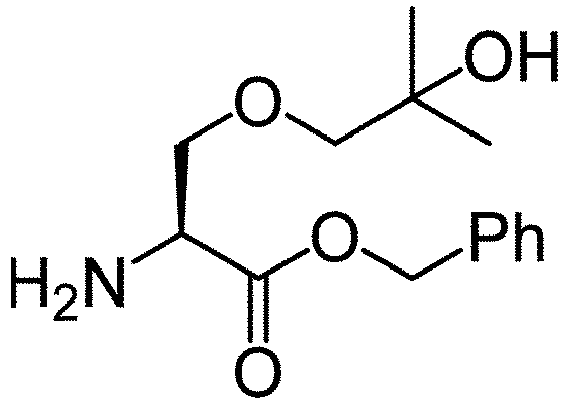
UV intensity ratio: 73.3% (detection wavelength 205 nm, retention time 1.22 min., condition 2 for high performance liquid chromatography) -

- A mixture consisting of benzyl (4S)-5-t-butoxycarbonyl-1,2,5-sulfamidatecarboxylate 25 mg (0.07 mmol) and 1-butanol 0.50 mL was stirred for 24 hours while heating at 80°C, and the reaction mixture was analyzed with HPLC.
-
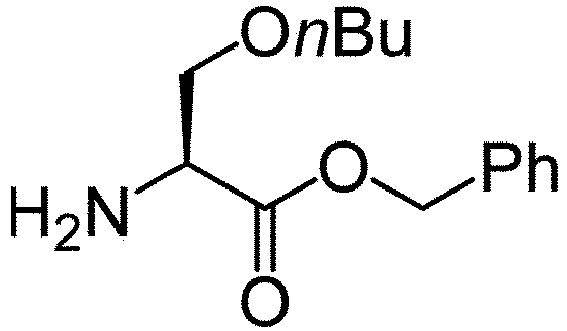
ESI (LC/MS positive mode) m/z: 252.48 (M+H+) -

- A mixture consisting of benzyl (4S)-5-t-butoxycarbonyl-1,2,5-sulfamidatecarboxylate 25 mg (0.07 mmol) and 3-methylbutanol 0.50 mL was stirred for 24 hours while heating at 80°C, and the reaction mixture was analyzed with HPLC.
-

ESI (LC/MS positive mode) m/z: 266.52 (M+H+) -

- A mixture consisting of benzyl (4S)-5-t-butoxycarbonyl-1,2,5-sulfamidatecarboxylate 1.00 g (2.8 mmol) and 2,2,2-trifluoroethanol 10 mL was stirred for 4 hours while heating at 70°C. To the reaction mixture, ethyl acetate 20 mL and 5% brine 40 mL were added, and the organic layer and the aqueous layer were separated. The organic layer was concentrated under reduced pressure to give benzyl (4S)-1,2,5-sulfamidatecarboxylate 734 mg as a crude product.
- The crude product obtained was purified with silica gel column chromatography (elution solvent: ethyl acetate-hexane) to give benzyl (4S)-1,2,5-sulfamidatecarboxylate 649 mg (yield: 90.2%) as a pale yellow solid.
-

- UV intensity ratio: 99.6% (detection wavelength 205 nm, retention time 1.94 min., condition 1 for high performance liquid chromatography)
1H-NMR (CDCl3, 400 MHz) δ: 4.44-4.52 (1H, m), 4.56 (1H, dd, J = 8.8, 5.6), 4.74 (1H, dd, J = 8.8, 7.6), 5.09-5.18 (1H, m), 5.27 (1H, d, J = 11.6), 5.30 (1H, d, J = 11.6), 7.32-7.44 (5H, m) -

- 1) To a solution consisting of thionyl chloride 8.05 g (67.7 mmol) and acetonitrile 140 mL cooled to -40°C, a solution consisting of D-Boc-Ser-OBzl 10.0 g (33.8 mmol) and acetonitrile 30 mL was added dropwise over 5 minutes. The reaction mixture was stirred at the same temperature for 5 minutes, and then pyridine 13.4 g (169 mmol) was added dropwise over 5 minutes. The reaction mixture was stirred at the same temperature for 5 minutes, and then at room temperature for 4 hours. To the reaction mixture, water 340 mL and ethyl acetate 170 mL were added, and the organic layer and the aqueous layer were separated. The organic layer obtained was washed with 5% aqueous sodium hydrogen carbonate 170 mL, and with a mixed solution of 0.5N-hydrochloric acid 170 mL and 10% brine 170 mL, and concentrated under reduced pressure to give a crude product of benzyl (4R)-5-t-butoxycarbonyl-1,2,5-sulfamiditecarboxylate 10.76 g as a diastereomeric mixture.
- 2) To a solution consisting of the crude product of benzyl (4R)-5-t-butoxycarbonyl-1,2,5-sulfamiditecarboxylate 10.76 g and acetonitrile 160 mL cooled to 0°C, a solution consisting of sodium periodate 10.7 g (50 mmol), ruthenium chloride hydrate 62 mg (0.30 mmol), and water 160 mL was added dropwise over 15 minutes. The reaction mixture was stirred at the same temperature for 2 hours. To the reaction mixture, 5% aqueous sodium hydrogen carbonate 160 mL and ethyl acetate 160 mL were added, and the organic layer and the aqueous layer were separated. To the aqueous layer obtained, ethyl acetate 160 mL was added again, and the organic layer and the aqueous layer were separated. The organic layers obtained were combined, washed with 10% brine 160 mL, and concentrated under reduced pressure to give benzyl (4R)-5-t-butoxycarbonyl-1,2,5-sulfamidatecarboxylate 10.44 g as a crude product.
- 3) To a mixture consisting of the crude product of benzyl (4R)-5-t-butoxycarbonyl-1,2,5-sulfamidatecarboxylate 10.44 g and ethyl acetate 30 mL heated to 40°C, hexane 120 mL was added, and after a precipitate appeared, the reaction mixture was stirred at room temperature for 2 hours, and the precipitate was collected by filtration under reduced pressure. The crystals obtained were dried under reduced pressure to give benzyl (4R)-5-t-butoxycarbonyl-1,2,5-sulfamidatecarboxylate 9.00 g (yield: 74.5% in 2 steps) as white crystals.
-

UV intensity ratio: 97.7% (detection wavelength 205 nm, retention time 2.77 min., condition 2 for high performance liquid chromatography)
1H-NMR (CDCl3, 400 MHz) δ: 1.49 (9H, s), 4.67 (1H, dd, J = 9.6, 2.2), 4.76 (1H, dd, J = 9.6, 6.4), 4.80-4.86 (1H, m), 5.23 (1H, d, J = 12.0), 5.32 (1H, d, J = 12.0), 7.30-7.42 (5H, m) -

- 1) Reaction mixture: A mixture consisting of benzyl (4R)-5-t-butoxycarbonyl-1,2,5-sulfamidatecarboxylate 1.00 g (2.8 mmol) and 1-propanol 20 mL was stirred for 15 hours while heating at 90°C, and the reaction mixture was analyzed with HPLC.
-
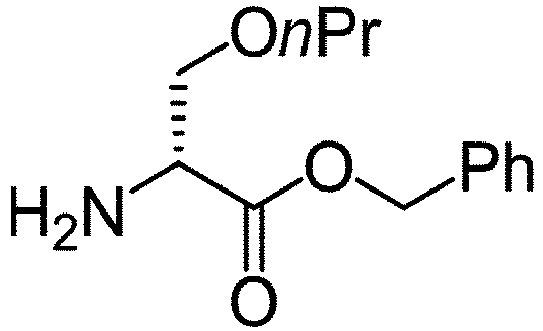
UV intensity ratio: 82.1% (detection wavelength 205 nm, retention time 1.40 min., condition 2 for high performance liquid chromatography) - 2) Ethyl acetate solution 1: To the reaction mixture, ethyl acetate 40 mL and 5% aqueous sodium hydrogen carbonate 40 mL were added, and the organic layer and the aqueous layer were separated. The organic layer obtained was analyzed with HPLC.
Optical purity: 99.9% ee (detection wavelength 205 nm, retention time 2.55 min., condition 4 for high performance liquid chromatography)
UV intensity ratio: 84.7% (detection wavelength 205 nm, retention time 1.42 min., condition 2 for high performance liquid chromatography) - 3) Ethyl acetate solution 2: The ethyl acetate solution 1 obtained was divided into two, and one part of them was washed twice with 10% brine 20 mL, and the organic layer obtained was analyzed with HPLC.
Optical purity: 99.8% ee (detection wavelength 205 nm, retention time 2.55 min., condition 4 for high performance liquid chromatography)
UV intensity ratio: 85.1% (detection wavelength 205 nm, retention time 1.42 min., condition 2 for high performance liquid chromatography) - 4) Crude product 1: The ethyl acetate solution 2 obtained was divided into two, and one part of them was concentrated under reduced pressure in a water bath set at 25°C, and the crude product of D-H-Ser(n-Pr)-OBzl obtained was analyzed with HPLC.
Optical purity: 82.8% ee (detection wavelength 205 nm, retention time 2.54 min., condition 4 for high performance liquid chromatography)
UV intensity ratio: 79.7% (detection wavelength 205 nm, retention time 1.39 min., condition 2 for high performance liquid chromatography) - 5) Crude product 2: The other part of the organic layer that was divided into two was concentrated under reduced pressure in a water bath set at 50°C, and the crude product of D-H-Ser(n-Pr)-OBzl obtained was analyzed with HPLC.
Optical purity: 72.6% ee (detection wavelength 205 nm, retention time 2.53 min., condition 4 for high performance liquid chromatography)
UV intensity ratio: 79.1% (detection wavelength 205 nm, retention time 1.39 min., condition 2 for high performance liquid chromatography) - 1) Two types of ethyl acetate solution prepared in Example 9 were left to stand at room temperature for 3 days, and were analyzed with HPLC.
- Optical purity: 91.5% ee (detection wavelength 205 nm, retention time 2.54 min., condition 4 for high performance liquid chromatography)
- Optical purity: 94.7% ee (detection wavelength 205 nm, retention time 2.54 min., condition 4 for high performance liquid chromatography)
- 2) Two types of ethyl acetate solution prepared in Example 9 were left to stand at room temperature for 5 days, and were analyzed with HPLC.
- Optical purity: 85.6% ee (detection wavelength 205 nm, retention time 2.56 min., condition 4 for high performance liquid chromatography)
- Optical purity: 88.9% ee (detection wavelength 205 nm, retention time 2.55 min., condition 4 for high performance liquid chromatography)
- 3) Two types of ethyl acetate solution prepared in Example 9 were left to stand at room temperature for 10 days, and were analyzed with HPLC.
- Optical purity: 76.8% ee (detection wavelength 205 nm, retention time 2.55 min., condition 4 for high performance liquid chromatography)
- Optical purity: 82.9% ee (detection wavelength 205 nm, retention time 2.54 min., condition 4 for high performance liquid chromatography)
-

- 1) To the other part of the ethyl acetate solution 1, which was produced in Example 9 and divided into two, a mixture of 10% palladium on carbon 0.15 g and methanol 5 mL was added, and the reaction mixture was stirred under hydrogen gas atmosphere at room temperature for 2 hours. Palladium catalyst was filtered out using Celite under reduced pressure, and the mixture obtained was concentrated under reduced pressure to give D-H-Ser(n-Pr)-OH 854 mg as a crude product.
- 2) To a solution consisting of D-H-Ser(n-Pr)-OH 845 mg, water 8 mL, and sodium carbonate 0.40 g (3.77 mmol) cooled to 0°C, a solution consisting of FmocOSu 337 mg (1.00 mmol) and acetonitrile 8 mL was added dropwise over 5 minutes. The reaction mixture was stirred at room temperature for 3 hours, 1N-hydrochloric acid 8 mL was added thereto, and after a precipitate appeared, the reaction mixture was stirred at room temperature for 1hour and 20 minutes. To the reaction mixture, 0.1N-hydrochloric acid 2 mL was added, and the mixture was stirred for additional 1 hour and 20 minutes, and then the precipitate was collected by filtration under reduced pressure. The crystals obtained were dried under reduced pressure to give D-Fmoc-Ser(n-Pr)-OH 3.60 g (yield: 58.4% in 3 steps) as white crystals.
-

UV intensity ratio: 97.3% (detection wavelength 205 nm, retention time 2.74 min., condition 2 for high performance liquid chromatography)
1H-NMR (DMSO-d6, 400 MHz) δ: 0.84 (3H, t, J = 7.2), 1.42-1.56 (2H, m), 3.28-3.42 (2H, m), 3.56-3.70 (2H, m), 4.16-4.34 (4H, m), 7.32 (2H, dt, J = 7.2, 0.8), 7.42 (2H, t, J = 7.6), 7.61 (1H, d, J = 8.0), 7.74 (2H, d, J = 7.8), 7.89 (2H, d, J = 7.6), 12.76 (1H, brs) -

- 1) A mixture consisting of benzyl (4R)-5-t-butoxycarbonyl-1,2,5-sulfamidatecarboxylate 50 mg (0.14 mmol) and 2-propanol 1 mL was stirred for 30 hours while heating at 80°C. To the reaction mixture, ethyl acetate 1 mL, 5% aqueous sodium hydrogen carbonate 0.5 mL, and 10% brine 0.5 mL were added, and the organic layer and the aqueous layer were separated. The organic layer was obtained as an ethyl acetate solution of D-H-Ser(i-Pr)-OBzl.
-

UV intensity ratio: 78.5% (detection wavelength 205 nm, retention time 1.36 min., condition 2 for high performance liquid chromatography) - 2) To a solution of D-H-Ser(i-Pr)-OBzl in ethyl acetate, a mixture of 10% palladium on carbon 15 mg and methanol 1 mL was added, and the reaction mixture was stirred under hydrogen gas atmosphere at room temperature for 1 hour. Palladium catalyst was filtered out using Celite under reduced pressure, and the mixture obtained was concentrated under reduced pressure to give D-H-Ser(i-Pr)-OH 27 mg as a crude product.
- 3) To a solution consisting of D-H-Ser(i-Pr)-OH 27 mg, water 0.5 mL, and sodium carbonate 25 mg (0.235 mmol) cooled to 0°C, a solution consisting of FmocOSu 33 mg (0.098 mmol) and acetonitrile 0.5 mL was added dropwise over 2 minutes. The reaction mixture was stirred at room temperature for 5 hours, 1N-hydrochloric acid 10 mL was added thereto over 5 minutes, and after a precipitate appeared, the reaction mixture was stirred at room temperature for 2 hours, and analyzed with HPLC.
-

UV intensity ratio: 85.6% (detection wavelength 205 nm, retention time 2.70 min., condition 2 for high performance liquid chromatography) -

- A mixture consisting of benzyl (4R)-5-t-butoxycarbonyl-1,2,5-sulfamidatecarboxylate 50 mg (0.14 mmol) and 2-methylpropane-1,2-diol 1 mL was stirred for 30 hours while heating at 80°C, and the reaction mixture was analyzed with HPLC.
-

UV intensity ratio: 73.4% (detection wavelength 205 nm, retention time 1.22 min., condition 2 for high performance liquid chromatography) -

- 1) To a solution consisting of thionyl chloride 14.3 g (120 mmol) and ethyl acetate 350 mL cooled to -15°C, a solution consisting of Fmoc-Ser-OBzl 25 g (60 mmol) and ethyl acetate 100 mL was added dropwise over 10 minutes. The reaction mixture was stirred at the same temperature for 5 minutes, and then pyridine 23.7 g (300 mmol) was added dropwise over 10 minutes. The reaction mixture was stirred at the same temperature for 5 minutes, and then at room temperature for 24 hours. To the reaction mixture, water 200 mL was added, and the organic layer and the aqueous layer were separated. The organic layer obtained was washed with 1N-hydrochloric acid 200 mL and 10% brine 200 mL, and concentrated under reduced pressure to give a crude product of benzyl (4S)-5-(9-fluorenyl)methoxycarbonyl-1,2,5-sulfamiditecarboxylate 28.0 g as a diastereomeric mixture.
- 2) To a solution consisting of the crude product of benzyl (4S)-5-(9-fluorenyl)methoxycarbonyl-1,2,5-sulfamiditecarboxylate 28.0 g and acetonitrile 200 mL cooled to -10°C, a solution consisting of sodium periodate 19.3 g (90 mmol), ruthenium chloride hydrate 0.12 g (0.6 mmol), and water 300 mL was added dropwise over 15 minutes. The reaction mixture was stirred at the same temperature for 15 minutes, and then at room temperature for 23 hours. To the reaction mixture, water 100 mL and ethyl acetate 300 mL were added, and the organic layer and the aqueous layer were separated. The organic layer obtained was washed with 10% brine 200 mL, and concentrated under reduced pressure to give benzyl (4S)-5-(9-fluorenyl)methoxycarbonyl-1,2,5-sulfamidatecarboxylate 28.7 g as a crude product.
- 3) The crude product obtained was purified with silica gel column chromatography (elution solvent: ethyl acetate-hexane) to give benzyl (4S)-5-(9-fluorenyl)methoxycarbonyl-1,2,5-sulfamidatecarboxylate 15.2 g (yield: 53.0% in 2 steps) as a white powder.
-

UV intensity ratio: 95.2% (detection wavelength 205 nm, retention time 3.31 min., condition 2 for high performance liquid chromatography)
1H-NMR (CDCl3, 400 MHz) δ: 4.22-4.34 (1H, m), 4.46 (1H, dd, J = 10.4, 7.2), 4.58 (1H, dd, J = 10.4, 7.2), 4.70-4.96 (3H, m), 5.20-5.32 (2H, m), 7.28-7.38 (7H, m), 7.42 (2H, t, J = 7.6), 7.62-7.80 (4H, m) -

- 1) A mixture consisting of benzyl (4S)-5-(9-fluorenyl)methoxycarbonyl-1,2,5-sulfamidatecarboxylate 1.00 g (2.0 mmol), sodium dihydrogenphosphate 1.00 g, 2-propanol 4 mL, and 2,2,2-trifluoroethanol 2 mL was stirred for 6 hours while heating at 70°C. To the reaction mixture, ethyl acetate 20 mL and 10% brine 20 mL were added, and the organic layer and the aqueous layer were separated. The organic layer was obtained as an ethyl acetate solution of Fmoc-Ser(i-Pr)-OBzl.
-

-

-

- The objective compound was produced in 82.4%, and Fmoc-Ser-OBzl that resulted from ring-opening of the sulfamidate without reaction with 2-propanol was produced in 7.7%. When an acid salt (in this case sodium dihydrogenphosphate) was used, the production of the byproduct was decreased by nearly 3 times compared to Example 16 in which the same starting material was used but an acid salt was not used.
- 2) To an ethyl acetate solution of Fmoc-Ser(i-Pr)-OBzl, a mixture of 10% palladium on carbon 0.10 g and methanol 4 mL was added, and the reaction mixture was stirred under hydrogen gas atmosphere at room temperature for 1 hour and 30 minutes. Palladium catalyst was filtered out using Celite under reduced pressure, and the mixture obtained was concentrated under reduced pressure to give Fmoc-Ser(i-Pr)-OH 0.80 g as a crude product.
-

- 3) A solution consisting of Fmoc-Ser(i-Pr)-OH 0.80 g, water 6 mL, sodium carbonate 0.30 g (2.8 mmol), and acetonitrile 2 mL was stirred at room temperature for 3 hours, and to the reaction mixture, ethyl acetate 5 mL was added, and the organic layer and the aqueous layer were separated. The aqueous layer was obtained as an aqueous solution of Fmoc-Ser(i-Pr)-OH. To the aqueous solution of Fmoc-Ser(i-Pr)-OH obtained, IN-hydrochloric acid 6 mL was added, and after a precipitate appeared, the reaction mixture was stirred at room temperature for 4 hours. The precipitate was collected by filtration under reduced pressure, and the wet powder obtained was analyzed with HPLC.
-

UV intensity ratio: 87.0% (detection wavelength 205 nm, retention time 2.70 min., condition 2 for high performance liquid chromatography) -

- A mixture consisting of benzyl (4S)-5-(9-fluorenyl)methoxycarbonyl-1,2,5-sulfamidatecarboxylate 50 mg (0.10 mmol) and 2-propanol 0.30 mL was stirred for 2 hours while heating at 80°C, and the reaction mixture was analyzed with HPLC.
-

-

-

-

- A mixture consisting of benzyl (4S)-5-(9-fluorenyl)methoxycarbonyl-1,2,5-sulfamidatecarboxylate 50 mg (0.10 mmol), sodium dihydrogenphosphate 24 mg, 1-propanol 0.20 mL, and 2,2,2-trifluoroethanol 0.10 mL was stirred for 2 hours while heating at 70°C, and the reaction mixture was analyzed with HPLC.
-

-

-

- The objective compound was produced in 81.3%, and a byproduct (Fmoc-Ser(n-Pr)-O(n-Pr) that resulted from the additional reaction of the objective compound with 1-propanol to cause transesterification was produced in 1.4%. When an acid salt (in this case sodium dihydrogenphosphate) was used, the yield of the objective compound was improved by nearly 10%, and the production of the byproduct was decreased by nearly 6 times compared to Example 18 in which the same starting material was used but an acid salt was not used to perform the reaction.
-

- A mixture consisting of benzyl (4S)-5-(9-fluorenyl)methoxycarbonyl-1,2,5-sulfamidatecarboxylate 0.59 g (1.23 mmol), 1-propanol 2.4 mL, and 2,2,2-trifluoroethanol 1.2 mL was stirred for 2 hours while heating at 70°C, and the reaction mixture was analyzed with HPLC.
-

-

-

-
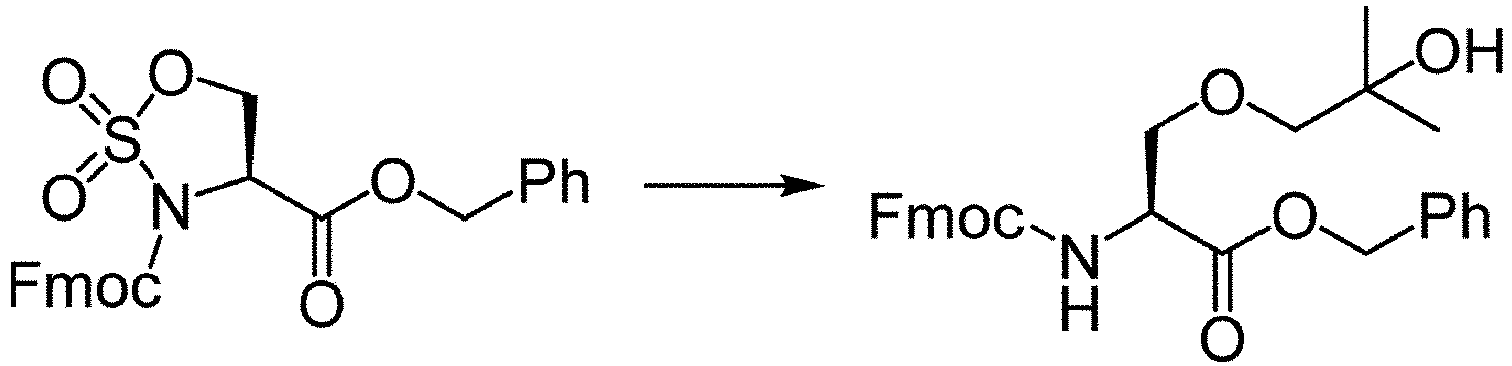
- A mixture consisting of benzyl (4S)-5-(9-fluorenyl)methoxycarbonyl-1,2,5-sulfamidatecarboxylate 0.59 g (1.23 mmol), 2-methylpropane-1,2-diol 2.4 mL, and 2,2,2-trifluoroethanol 1.2 mL was stirred for 4 hours while heating at 70°C, and the reaction mixture was analyzed with HPLC.
-

-

-

-
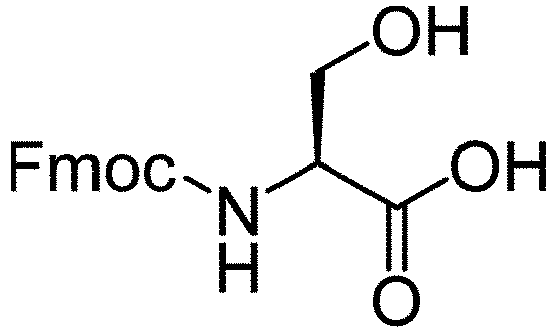
-

- A mixture consisting of benzyl (4S)-5-(9-fluorenyl)methoxycarbonyl-1,2,5-sulfamidatecarboxylate 50 mg (0.1 mmol), pyridine hydrochloride 23 mg (0.2 mmol), 1-propanol 0.20 mL, and 2,2,2-trifluoroethanol 0.10 mL was stirred for 1 hour while heating at 70°C, and the reaction mixture was analyzed with HPLC.
-

ESI (LC/MS positive mode) m/z: 436.41 (M+H+) - When pyridine hydrochloride was used as an acid salt, the starting material did not react with 1-propanol, and the chlorinated compound (Fmoc-Ala(Cl)-OBzl) that was ring-opened with chloride ion derived from pyridine hydrochloride was obtained. When sodium dihydrogenphosphate was used as an acid salt, the objective compound was found to be produced efficiently.
-

- 1) To a solution consisting of thionyl chloride 1.61 g (13.5 mmol) and dichloromethane 20 mL cooled to -40°C, a solution consisting of Fmoc-Ser-Ot-Bu 2.00 g (5.2 mmol) and dichloromethane 5 mL was added dropwise over 5 minutes. The reaction mixture was stirred at the same temperature for 15 minutes, and then pyridine 2.68 g (33.8 mmol) was added dropwise over 5 minutes. The reaction mixture was stirred at the same temperature for 20 minutes, then at 0°C for 20 minutes and at room temperature for 1 hour and 30 minutes. To the reaction mixture, water 30 mL was added, and the organic layer and the aqueous layer were separated. To the aqueous layer obtained, dichloromethane 20 mL was added, and the organic layer and the aqueous layer were separated again. The organic layers obtained were combined, washed with 5% NaHCO3 30 mL and 10% brine 30 mL, and then concentrated under reduced pressure to give a crude product of t-butyl (4S)-5-(9-fluorenyl)methoxycarbonyl-1,2,5-sulfamiditecarboxylate 2.22 g as a diastereomeric mixture.
- 2) To a solution consisting of the crude product of t-butyl (4S)-5-(9-fluorenyl)methoxycarbonyl-1,2,5-sulfamiditecarboxylate 2.22 g and acetonitrile 30 mL cooled to 0°C, a solution consisting of sodium periodate 1.67 g (7.8 mmol), ruthenium chloride hydrate 11 mg (0.05 mmol), and water 30 mL was added dropwise over 5 minutes. The reaction mixture was stirred at the same temperature for 1 hour and 30 minutes, and then at room temperature for 20 minutes. To the reaction mixture, 5% NaHCO3 60 mL, water 60 mL, and ethyl acetate 40 mL were added, and the organic layer and the aqueous layer were separated. To the aqueous layer obtained, ethyl acetate 40 mL was added, and the organic layer and the aqueous layer were separated again. The organic layers obtained were combined, washed with 10% brine 30 mL, and then concentrated under reduced pressure to give t-butyl (4S)-5-(9-fluorenyl)methoxycarbonyl-1,2,5-sulfamidatecarboxylate 2.25 g as a crude product.
- 3) The crude product obtained was purified with silica gel column chromatography (elution solvent: ethyl acetate-hexane) to give t-butyl (4S)-5-(9-fluorenyl)methoxycarbonyl-1,2,5-sulfamidatecarboxylate 1.87 g (yield: 83.9% in 2 steps) as a white powder.
-

1H-NMR (CDCl3, 400 MHz) δ: 1.50 (9H, s), 4.35 (1H, t, J = 7.6), 4.48 (1H, dd, J = 10.4, 7.6), 4.61 (1H, dd, J = 10.4, 7.6), 4.70-4.88 (3H, m), 7.31-7.37 (2H, m), 7.39-7.45 (2H, m), 7.58-7.80 (4H, m)
ESI (LC/MS negative mode) m/z: 444.33 (M-H+) -

- 1) To a solution consisting of thionyl chloride 2.38 g (20 mmol) and dichloromethane 50 mL cooled to -15°C, H-MeSer-OBzl hydrochloride 2.50 g (10 mmol) was added. The reaction mixture was stirred at the same temperature for 5 minutes, and then pyridine 4.75 g (60 mmol) was added dropwise over 5 minutes. The reaction mixture was stirred at the same temperature for 5 minutes, and then at room temperature for 1 hour. To the reaction mixture, water 25 mL was added, and the organic layer and the aqueous layer were separated. The organic layer obtained was washed with 1N-hydrochloric acid 25 mL and 10% brine 25 mL, and then concentrated under reduced pressure to give a crude product of benzyl (4S)-5-methyl-1,2,5-sulfamiditecarboxylate 2.06 g as a diastereomeric mixture.
- 2) To a solution consisting of the crude product of benzyl (4S)-5-methyl-1,2,5-sulfamiditecarboxylate 2.06 g and acetonitrile 20 mL cooled to -5°C, a solution consisting of sodium periodate 3.21 g (15 mmol), ruthenium chloride hydrate 62 mg (0.3 mmol), and water 30 mL was added dropwise over 5 minutes. The reaction mixture was stirred at the same temperature for 5 minutes, and then at room temperature for 30 minutes. To the reaction mixture, water 20 mL and ethyl acetate 40 mL were added, and the organic layer and the aqueous layer were separated. The organic layer obtained was washed with 10% brine 20 mL, and then concentrated under reduced pressure to give benzyl 5-methyl-1,2,5-sulfamidatecarboxylate 1.87 g as a crude product.
- 3) A mixture consisting of the crude product obtained and ethyl acetate 4 mL was heated to 40°C, hexane 12 mL was added thereto, and after a precipitate appeared, the reaction mixture was stirred at room temperature for 50 minutes, and the precipitate was collected by filtration under reduced pressure. The crystals obtained were dried under reduced pressure to give benzyl (4S)-5-methyl-1,2,5-sulfamidatecarboxylate 1.14 g (yield: 42.0% in 2 steps) as pale yellow crystals.
-

1H-NMR (CDCl3, 400 MHz) δ: 2.95 (3H, s), 4.10 (1H, dd, J = 7.6, 6.4), 4.60-4.72 (2H, m), 5.24 (1H, d, J = 12.0), 5.28 (1H, d, J = 12.0), 7.32-7.44 (5H, m) -

- A mixture consisting of benzyl (4S)-5-methyl-1,2,5-sulfamidatecarboxylate 0.28 g (1.0 mmol) and 2-propanol 5.6 mL was stirred for 13 hours while heating at 90°C. To the reaction mixture, dichloromethane 16.4 mL and 5% aqueous sodium hydrogen carbonate 16.4 mL were added, and the organic layer and the aqueous layer were separated. The organic layer was obtained as an ethyl acetate solution of H-MeSer(n-Pr)-OBzl, and analyzed with HPLC. UV intensity ratio: 91.8% (detection wavelength 205 nm, retention time 1.65 min., condition 1 for high performance liquid chromatography)
ESI (LC/MS positive mode) m/z: 252.48 (M+H+) -

- 1) A mixture consisting of benzyl (4S)-5-(9-fluorenyl)methoxycarbonyl-1,2,5-sulfamidatecarboxylate 100 mg (0.208 mmol), sodium dihydrogenphosphate 100 mg, 3,3,3-trifluoropropane-1,2-diol 0.543 g (4.17 mmol), and 2,2,2-trifluoroethanol 0.2 mL was stirred for 48 hours while heating at 70°C. To the reaction mixture, ethyl acetate 1 mL and 2N aqueous hydrochloric acid 1 mL were added, and the organic layer and the aqueous layer were separated. Additional ethyl acetate 1 mL was added to the aqueous layer, and the organic layer and the aqueous layer were separated. The organic layers obtained were combined to give an ethyl acetate solution of Fmoc-Ser(CH2CH(OH)CF3)-OBzl.
-

ESI (LC/MS positive mode) m/z: 530.59 (M+H+) - 2) To an ethyl acetate solution of Fmoc-Ser(CH2CH(OH)CF3)-OBzl, 10% palladium on carbon 20 mg was added, and the reaction mixture was stirred under hydrogen gas atmosphere at room temperature for 3 hours to give Fmoc-Ser(CH2CH(OH)CF3)-OH as an ethyl acetate solution.
-

ESI (LC/MS negative mode) m/z: 438.39 (M-H+) -

- A mixture consisting of t-butyl (4S)-5-(9-fluorenyl)methoxycarbonyl-1,2,5-sulfamidatecarboxylate 50 mg (0.11 mmol), sodium dihydrogenphosphate 50 mg, and benzyl alcohol 0.30 mL (2.91 mmol) was stirred for 2 hours while heating at 90°C, and the reaction mixture was analyzed with HPLC.
-

ESI (LC/MS negative mode) m/z: 416.43 (M-H+) -

ESI (LC/MS positive mode) m/z: 474.68 (M+H+) -

ESI (LC/MS positive mode) m/z: 474.68 (M+H+) -

- A mixture consisting of t-butyl (4S)-5-(9-fluorenyl)methoxycarbonyl-1,2,5-sulfamidatecarboxylate 50 mg (0.11 mmol), sodium dihydrogenphosphate 50 mg, and 3-fluorobenzyl alcohol 0.30 mL (2.78 mmol) was stirred for 2 hours while heating at 90°C, and the reaction mixture was analyzed with HPLC.
-

ESI (LC/MS negative mode) m/z: 434.51 (M-H+) -
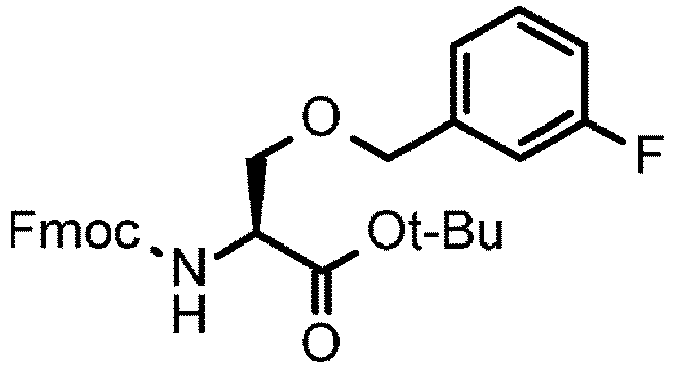
ESI (LC/MS positive mode) m/z: 492.65 (M+H+) -

ESI (LC/MS positive mode) m/z: 544.67 (M+H+) -

- A mixture consisting of t-butyl (4S)-5-(9-fluorenyl)methoxycarbonyl-1,2,5-sulfamidatecarboxylate 45 mg (0.11 mmol), sodium dihydrogenphosphate 45 mg, and 2-thiophene methanol 0.27 mL (2.86 mmol) was stirred at room temperature for 48 hours, and the reaction mixture was analyzed with HPLC.
-

ESI (LC/MS positive mode) m/z: 422.37 (M+H+) -

ESI (LC/MS negative mode) m/z: 480.70 (M-H+) -

- A mixture consisting of t-butyl (4S)-5-(9-fluorenyl)methoxycarbonyl-1,2,5-sulfamidatecarboxylate 45 mg (0.11 mmol), sodium dihydrogenphosphate 45 mg, and 2-furfuryl alcohol 0.27 mL (3.11 mmol) was stirred at room temperature for 48 hours, and the reaction mixture was analyzed with HPLC.
-

ESI (LC/MS positive mode) m/z: 464.64 (M+H+) -

- 1) To a solution consisting of thionyl chloride 7.46 g (62.7 mmol) and ethyl acetate 200 mL cooled to -15°C, a solution consisting of Boc-homoSer-OBzl 10.00 g (31.3 mmol) and ethyl acetate 30 mL was added dropwise over 5 minutes. The reaction mixture was stirred at the same temperature for 5 minutes, and then pyridine 12.4 g (157 mmol) was added dropwise over 5 minutes. The reaction mixture was stirred at -15°C for 5 minutes and then at room temperature for 3 hours. To the reaction mixture, water 100 mL was added, and the organic layer and the aqueous layer were separated. To the organic layer obtained, 1N HCl 100 mL was added, and the organic layer and the aqueous layer were separated again. The organic layer obtained was washed with 10% brine 100 mL, and then concentrated under reduced pressure to give benzyl (4S)-3-t-butoxycarbonyl-2-oxo-1,2,3-oxathiazinane-4-carboxylate 10.90 g as a crude product of a diastereomeric mixture.
- 2) To a solution consisting of the crude product of benzyl (4S)-3-t-butoxycarbonyl-2-oxo-1,2,3-oxathiazinane-4-carboxylate 10.90 g and acetonitrile 90 mL cooled to -10°C, a solution consisting of sodium periodate 10.05 g (47.0 mmol), ruthenium chloride hydrate 195 mg (0.94 mmol), and water 150 mL was added dropwise over 10 minutes. The reaction mixture was stirred at -10°C for 15 minutes, and then at room temperature for 1 hour and 40 minutes. To the reaction mixture, water 50 mL and ethyl acetate 150 mL were added, and the organic layer and the aqueous layer were separated. To the aqueous layer obtained, ethyl acetate 40 mL was added, and the organic layer and the aqueous layer were separated again. The organic layer obtained was washed with a mixture consisting of 2N aqueous HCl 20 mL and 10% brine 200 mL, and then concentrated under reduced pressure to give benzyl (4S)-3-t-butoxycarbonyl-2,2-dioxo-1,2,3-oxathiazinane-4-carboxylate 6.72 g as a crude product.
- 3) The crude product obtained was purified with silica gel column chromatography (elution solvent: ethyl acetate-hexane) to give benzyl (4S)-3-t-butoxycarbonyl-2,2-dioxo-1,2,3-oxathiazinane-4-carboxylate 1.75 g (yield: 15.1% in 2 steps) as a white powder and (S)-Boc-Gly(2-chloroethyl)-OBzl 2.50 g (yield: 22.5% in 2 steps) as a pale yellow powder.
-
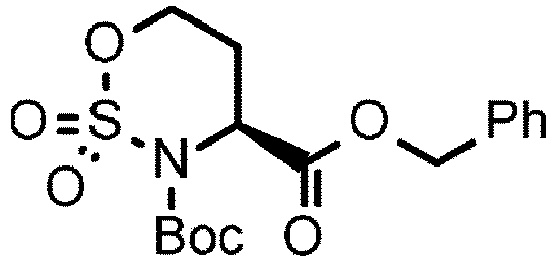
UV intensity ratio: 96.3% (detection wavelength 205 nm, retention time 2.83 min., condition 2 for high performance liquid chromatography)
1H-NMR (CDCl3, 400 MHz) δ: 1.43 (9H, s), 2.35-2.50 (1H, m), 2.60-2.70 (1H, m), 4.55-4.65 (1H, m), 4.72 (1H, dt, J = 11.2, 4.8), 5.21 (2H, d, J = 2.4), 5.24 (1H, dd, 5.6, 2.4), 7.30-7.40 (5H, m) -
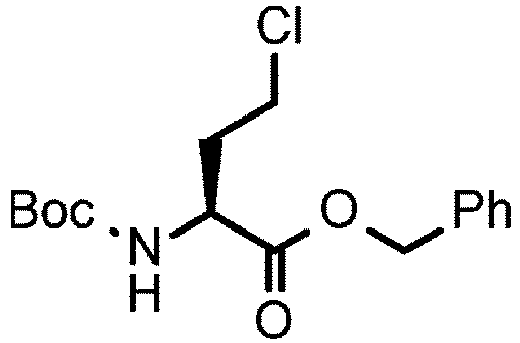
UV intensity ratio: 98.3% (detection wavelength 205 nm, retention time 3.71 min., condition 2 for high performance liquid chromatography)
1H-NMR (CDCl3, 400 MHz) δ: 1.44 (9H, s), 2.08-2.20 (1H, m), 2.28-2.40 (1H, m), 3.57 (2H, t, 7.2), 4.43-4.53 (1H, m), 5.08-5.20 (1H, m), 4.18 (2H, dd, J = 14.8, 12.0), 7.31-7.41 (5H, m) ESI (LC/MS positive mode) m/z: 328.57, 330.55 (M+H+) -

- A mixture consisting of benzyl (4S)-3-t-butoxycarbonyl-2,2-dioxo-1,2,3-oxathiazinane-4-carboxylate 50 mg (0.134 mmol) and 1-propanol 1 mL was stirred for 40 hours while heating at 80°C, and the reaction mixture was analyzed with HPLC.
-

ESI (LC/MS positive mode) m/z: 252.60 (M+H+) -

- A mixture consisting of benzyl (4S)-3-t-butoxycarbonyl-2,2-dioxo-1,2,3-oxathiazinane-4-carboxylate 50 mg (0.134 mmol) and 2-propanol 1 mL was stirred for 40 hours while heating at 80°C, and the reaction mixture was analyzed with HPLC.
-

ESI (LC/MS positive mode) m/z: 252.60 (M+H+) -

- A mixture consisting of benzyl (4S)-3-t-butoxycarbonyl-2,2-dioxo-1,2,3-oxathiazinane-4-carboxylate 50 mg (0.134 mmol) and 3-methylbutanol 1 mL was stirred for 40 hours while heating at 80°C, and the reaction mixture was analyzed with HPLC.
-

ESI (LC/MS positive mode) m/z: 280.62 (M+H+) -
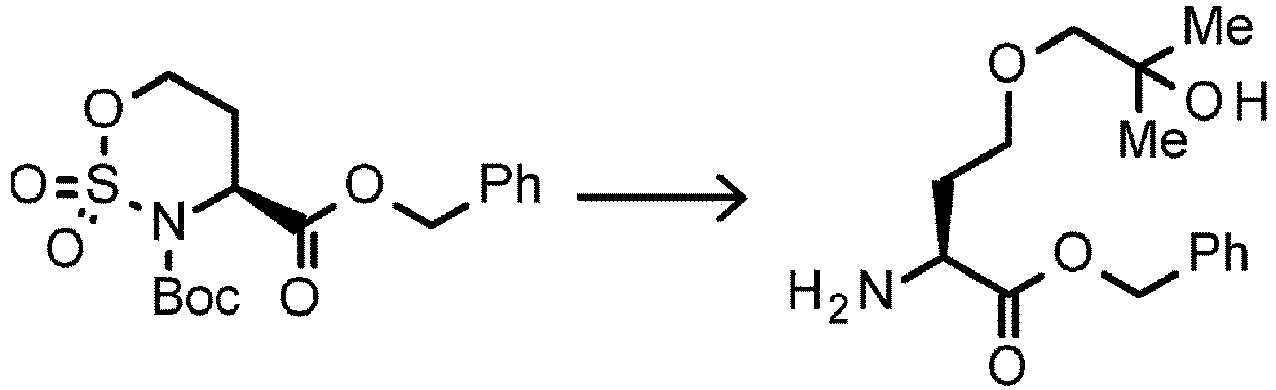
- A mixture consisting of benzyl (4S)-3-t-butoxycarbonyl-2,2-dioxo-1,2,3-oxathiazinane-4-carboxylate 50 mg (0.134 mmol) and 2-methylpropane-1,2-diol 1 mL was stirred for 40 hours while heating at 80°C, and the reaction mixture was analyzed with HPLC.
-

ESI (LC/MS positive mode) m/z: 282.60 (M+H+) -

- 1) To a solution consisting of thionyl chloride 2.38 g (20.0 mmol) and ethyl acetate 80 mL cooled to -40°C, a solution consisting of Fmoc-Asp(Ot-Bu)-OL 4.00 g (10.0 mmol) and dichloromethane 12 mL was added dropwise over 5 minutes. The reaction mixture was stirred at the same temperature for 5 minutes, and then pyridine 3.96 g (50.0 mmol) was added dropwise over 5 minutes. The reaction mixture was stirred at -40°C for 5 minutes and then at room temperature for 2 hours. To the reaction mixture, water 40 mL was added, and the organic layer and the aqueous layer were separated. To the organic layer obtained, 1N HCl 40 mL was added, and the organic layer and the aqueous layer were separated again. The organic layer obtained was washed with 10% brine 40 mL, and then concentrated under reduced pressure to give t-butyl (4R)-5-(9-fluorenyl)methoxycarbonyl-1,2,5-sulfamidite-4-acetate 4.65 g as a crude product of a diastereomeric mixture.
- 2) To a solution consisting of the crude product of t-butyl (4R)-5-(9-fluorenyl)methoxycarbonyl-1,2,5-sulfamidite-4-acetate 4.65 g and acetonitrile 20 mL cooled to -10°C, a solution consisting of sodium periodate 3.21 g (15.0 mmol), ruthenium chloride hydrate 21 mg (0.1 mmol), and water 60 mL was added dropwise over 10 minutes. The reaction mixture was stirred at -20°C for 5 minutes, and then at room temperature for 3 hours. To the reaction mixture, sodium carbonate 1.20 g (11.3 mmol), water 60 mL, and ethyl acetate 90 mL were added, and the organic layer and the aqueous layer were separated. The organic layer obtained was washed with a mixture consisting of NaCl 6.00 g (102 mmol) and water 54 mL, and then concentrated under reduced pressure to give t-butyl (4S)-5-(9-fluorenyl)methoxycarbonyl-1,2,5-sulfamidate-4-acetate 4.31 g as a crude product.
-
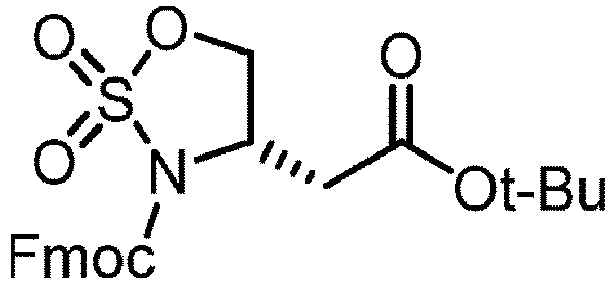
UV intensity ratio: 79.2% (detection wavelength 205 nm, retention time 3.43 min., condition 2 for high performance liquid chromatography)
1H-NMR (CDCl3, 400 MHz) δ: 1.44 (9H, s), 2.68-2.80 (1H, m), 2.82-2.96 (1H, m), 4.33 (1H, t, J = 7.2), 4.48-4.53 (4H, m), 4.81 (1H, dd, 9.6, 6.0), 7.31-7.45 (4H, m), 7.66-7.79 (4H, m)
ESI (LC/MS negative mode) m/z: 504.49 (M+HCO2 -) -

- A mixture consisting of t-butyl (4S)-5-(9-fluorenyl)methoxycarbonyl-1,2,5-sulfamidate-4-acetate 50 mg (0.108 mmol), sodium dihydrogenphosphate 50 mg, and 1-propanol 1 mL was stirred for 2 hours while heating at 70°C, and the reaction mixture was analyzed with HPLC.
-

UV intensity ratio: 24.6% (detection wavelength 205 nm, retention time 2.67 min., condition 2 for high performance liquid chromatography)
ESI (LC/MS negative mode) m/z: 428.42 (M+HCO2 -) -

UV intensity ratio: 29.9% (detection wavelength 205 nm, retention time 3.61 min., condition 2 for high performance liquid chromatography)
ESI (LC/MS positive mode) m/z: 440.70 (M+H+) -

- A mixture consisting of t-butyl (4S)-5-(9-fluorenyl)methoxycarbonyl-1,2,5-sulfamidate-4-acetate 30 mg (0.065 mmol), sodium dihydrogenphosphate 30 mg, and 2-propanol 0.6 mL was stirred for 2 hours while heating at 70°C, and the reaction mixture was analyzed with HPLC.
-

UV intensity ratio: 7.2% (detection wavelength 205 nm, retention time 2.64 min., condition 2 for high performance liquid chromatography)
ESI (LC/MS negative mode) m/z: 382.63 (M-H+) -

UV intensity ratio: 22.2% (detection wavelength 205 nm, retention time 3.57 min., condition 2 for high performance liquid chromatography)
ESI (LC/MS positive mode) m/z: 440.70 (M+H+) - Production example using benzyl (2S)-3-(9-fluorenyl)methoxycarbonylamino-2-hydroxymethylpropionate as a starting material
-

- 1) To a solution consisting of thionyl chloride 2.38 g (20.0 mmol) and ethyl acetate 80 mL cooled to -40°C, a solution consisting of benzyl (2S)-3-(9-fluorenyl)methoxycarbonylamino-2-hydroxymethylpropionate 4.32 g (10.0 mmol) and dichloromethane 12 mL is added dropwise over 5 minutes. The reaction mixture is stirred at the same temperature for 5 minutes, and then pyridine 3.96 g (50.0 mmol) is added dropwise over 5 minutes. The reaction mixture is stirred at -40°C for 5 minutes And then at room temperature for 2 hours. To the reaction mixture, water 40 mL is added, and the organic layer and the aqueous layer are separated. To the organic layer obtained, 1N HCl 40 mL is added, and the mixture is separated into the organic layer and the aqueous layer again. The organic layer obtained is washed with 10% brine 40 mL, and concentrated under reduced pressure to give benzyl (5S)-3-(9-fluorenyl)methoxycarbonyl-2,2-dioxo-1,2,3-oxathiazinane-5-carboxylate as a crude product of a diastereomeric mixture.
- 2) To a solution consisting of the crude product of benzyl (5S)-3-(9-fluorenyl)methoxycarbonyl-2,2-dioxo-1,2,3-oxathiazinane-5-carboxylate and acetonitrile 20 mL cooled to -10°C, a solution consisting of sodium periodate 3.21 g (15.0 mmol), ruthenium chloride hydrate 21 mg (0.1 mmol), and water 60 mL is added dropwise over 10 minutes. The reaction mixture is stirred at -20°C for 5 minutes, and then at room temperature for 3 hours. To the reaction mixture, sodium carbonate 1.20 g (11.3 mmol), water 60 mL, and ethyl acetate 90 mL are added, and the mixture is separated into the organic layer and the aqueous layer. The organic layer obtained is washed with a mixture consisting of NaCl 6.00 g (102 mmol) and water 54 mL, and concentrated under reduced pressure to give benzyl (5S)-3-(9-fluorenyl)methoxycarbonyl-2,2-dioxo-1,2,3-oxathiazinane-5-carboxylate as a crude product.
-

- A mixture consisting of benzyl (5S)-3-(9-fluorenyl)methoxycarbonyl-2,2-dioxo-1,2,3-oxathiazinane-5-carboxylate 50 mg (0.104 mmol), sodium dihydrogenphosphate 50 mg, and 1-propanol 1 mL is stirred for 2 hours while heating at 70°C, and the reaction mixture is analyzed with HPLC.
-

- A mixture consisting of benzyl (5S)-3-(9-fluorenyl)methoxycarbonyl-2,2-dioxo-1,2,3-oxathiazinane-5-carboxylate 50 mg (0.104 mmol), sodium dihydrogenphosphate 50 mg, and 2-propanol 1 mL is stirred for 2 hours while heating at 70°C, and the reaction mixture is analyzed with HPLC.
-

- 1) To a solution consisting of thionyl chloride 2.38 g (20.0 mmol) and ethyl acetate 80 mL cooled to -40°C, a solution consisting of benzyl (2R)-3-(9-fluorenyl)methoxycarbonylamino-2-hydroxymethylpropionate 4.32 g (10.0 mmol) and dichloromethane 12 mL is added dropwise over 5 minutes. The reaction mixture is stirred at the same temperature for 5 minutes, and then pyridine 3.96 g (50.0 mmol) is added dropwise over 5 minutes. The reaction mixture is stirred at -40°C for 5 minutes and then at room temperature for 2 hours. To the reaction mixture, water 40 mL is added, and the mixture is separated into the organic layer and the aqueous layer. To the organic layer obtained, 1N HCl 40 mL is added, and the obtained mixture is separated into the organic layer and the aqueous layer again. The organic layer obtained is washed with 10% brine 40 mL, and concentrated under reduced pressure to give benzyl (5R)-3-(9-fluorenyl)methoxycarbonyl-2,2-dioxo-1,2,3-oxathiazinane-5-carboxylate as a crude product of a diastereomeric mixture.
- 2) To a solution consisting of the crude product of benzyl (5R)-3-(9-fluorenyl)methoxycarbonyl-2,2-dioxo-1,2,3-oxathiazinane-5-carboxylate and acetonitrile 20 mL cooled to -10°C, a solution consisting of sodium periodate 3.21 g (15.0 mmol), ruthenium chloride hydrate 21 mg (0.1 mmol), and water 60 mL is added dropwise over 10 minutes. The reaction mixture is stirred at -20°C for 5 minutes, and then at room temperature for 3 hours. To the reaction mixture, sodium carbonate 1.20 g (11.3 mmol), water 60 mL, and ethyl acetate 90 mL are added, and the mixture is separated into the organic layer and the aqueous layer. The organic layer obtained is washed with a mixture consisting of NaCl 6.00 g (102 mmol) and water 54 mL, and concentrated under reduced pressure to give benzyl (5R)-3-(9-fluorenyl)methoxycarbonyl-2,2-dioxo-1,2,3-oxathiazinane-5-carboxylate as a crude product.
-

- A mixture consisting of benzyl (5R)-3-(9-fluorenyl)methoxycarbonyl-2,2-dioxo-1,2,3-oxathiazinane-5-carboxylate 50 mg (0.104 mmol), sodium dihydrogenphosphate 50 mg, and 1-propanol 1 mL is stirred for 2 hours while heating at 70°C, and the reaction mixture is analyzed with HPLC.
-

- A mixture consisting of benzyl (5R)-3-(9-fluorenyl)methoxycarbonyl-2,2-dioxo-1,2,3-oxathiazinane-5-carboxylate 50 mg (0.104 mmol), sodium dihydrogenphosphate 50 mg, and 2-propanol 1 mL is stirred for 2 hours while heating at 70°C, and the reaction mixture is analyzed with HPLC.
- The present invention provides novel methods for producing O-substituted serine derivatives. Using the production methods of the present invention, unnatural amino acids useful for exploring peptide pharmaceuticals, and/or for supplying active ingredients of pharmaceuticals can be provided with high regioselectivity, chemical yield, and optical purity.
Claims (15)
- A method for producing a compound represented by general formula (I):
 R1 is optionally substituted C1-C6 alkyl, optionally substituted C3-C8 cycloalkyl, optionally substituted aralkyl, or optionally substituted heteroaralkyl,R2 is C1-C6 alkyl or an amino protecting group,R4 is a carboxyl protecting group,L1 is a single bond or -CH2-,L2 is a single bond or -CH2-, andn is 1 or 2,with the proviso that when L1 is -CH2-, L2 is a single bond, and when L2 is -CH2-, L1 is a single bond],its chemically acceptable salt, or a solvate thereof,
the method comprising the following steps:Step A: reacting a compound represented by general formula (V):
its chemically acceptable salt, or a solvate thereof with a cyclization reagent to obtain a compound represented by general formula (IV):
its chemically acceptable salt, or a solvate thereof,Step B: reacting the compound represented by general formula (IV), its chemically acceptable salt, or a solvate thereof with an oxidizing agent to obtain a compound represented by general formula (II):
its chemically acceptable salt, or a solvate thereof, andStep C: reacting the compound represented by general formula (II), its chemically acceptable salt, or a solvate thereof with R1OH (wherein, R1 is synonymous with those described above) to obtain the compound represented by general formula (I), its chemically acceptable salt, or a solvate thereof. - A method for producing a compound represented by general formula (I):
 R1 is optionally substituted C1-C6 alkyl, optionally substituted C3-C8 cycloalkyl, optionally substituted aralkyl, or optionally substituted heteroaralkyl,R2 is a hydrogen,R4 is a carboxyl protecting group,L1 is a single bond or -CH2-,L2 is a single bond or -CH2-, andn is 1 or 2,with the proviso that when L1 is -CH2-, L2 is a single bond, and when L2 is -CH2-, L1 is a single bond],its chemically acceptable salt, or a solvate thereof,
the method comprising the following steps:Step A: reacting a compound represented by general formula (V'):
its chemically acceptable salt, or a solvate thereof with a cyclization reagent to obtain a compound represented by general formula (IV'):
its chemically acceptable salt, or a solvate thereof,Step B: reacting the compound represented by general formula (IV'), its chemically acceptable salt, or a solvate thereof with an oxidizing agent to obtain a compound represented by general formula (II'):
its chemically acceptable salt, or a solvate thereof, andStep C: reacting the compound represented by general formula (II'), its chemically acceptable salt, or a solvate thereof with R1OH (wherein, R1 is synonymous with that described above) to obtain the compound represented by general formula (I), its chemically acceptable salt, or a solvate thereof. - The method of claim 1 or 2, further comprising a step (Step D) of deprotecting the carboxyl protecting group represented by R4 of the compound represented by general formula (I), its chemically acceptable salt, or a solvate thereof to obtain a compound represented by general formula (I'):

its chemically acceptable salt, or a solvate thereof. - The method of claim 3, further comprising a step (Step E) of introducing a group represented by R3 to the amino group of the compound represented by general formula (I'), its chemically acceptable salt, or a solvate thereof to obtain a compound represented by general formula (I"):

its chemically acceptable salt, or a solvate thereof. - The method of claim 1, 3, or 4, whereinR1 is C1-C6 alkyl, C3-C8 cycloalkyl, aralkyl, or heteroaralkyl, which is optionally substituted with one or more substituents independently selected from halogen, aryl that is optionally substituted with halogen, or hydroxyl,R2 is selected from Boc, Fmoc, Cbz, or Alloc, andR4 is benzyl or tert-Bu.
- The method of any one of claims 2 to 4, whereinR1 is C1-C6 alkyl, C3-C8 cycloalkyl, aralkyl, or heteroaralkyl, which is optionally substituted with one or more substituents independently selected from halogen, aryl that is optionally substituted with halogen, or hydroxyl,R2' is selected from Boc, Fmoc, Cbz, or Alloc, andR4 is benzyl or tert-Bu.
- The method of claim 4, wherein R3 is selected from Boc, Fmoc, Cbz, Alloc, or methyl.
- The method of any one of claims 1 to 7, wherein the oxidizing agent used in Step B is a combination of periodate and ruthenium catalyst.
- The method of claim 8, wherein periodate that is 1.5 to 5 equivalents and ruthenium catalyst that is 0.01 to 0.2 equivalents to the compound represented by general formula (IV), its chemically acceptable salt, or a solvate thereof, or to the compound represented by general formula (IV'), its chemically acceptable salt, or a solvate thereof, are used.
- The method of any one of claims 1 to 9, wherein Step B is performed in a solvent mixture of acetonitrile and water.
- The method of any one of claims 1 to 10, wherein Step C is performed in the presence of an acid salt.
- The method of any one of claims 1 to 11, wherein Step C is performed in 2,2,2-trifluoroethanol, 1,1,1,3,3,3-hexafluoro-2-propanol, or 2-methyltetrahydrofuran.
- The method of any one of claims 1 to 12, wherein Step C further comprises a step of extracting the reaction mixture with an organic solvent, and the extract is used in Step D without concentration to dryness.
- The method of any one of claims 3 to 13, wherein Step D is performed in the presence of a Pd catalyst, and/or in the presence of hydrogen gas, formic acid, or ammonium formate.
- The method of any one of claims 1 to 14, wherein Step A is performed in ethyl acetate, isopropyl acetate, or butyl acetate, and thionyl chloride that is 1.5 to 5 equivalents to the compound represented by general formula (V), its chemically acceptable salt, or a solvate thereof, or to the compound represented by general formula (V'), its chemically acceptable salt, or a solvate thereof is used.
Applications Claiming Priority (2)
| Application Number | Priority Date | Filing Date | Title |
|---|---|---|---|
| JP2018209602 | 2018-11-07 | ||
| PCT/JP2019/043626 WO2020095983A1 (en) | 2018-11-07 | 2019-11-07 | O-substituted serine derivative production method |
Publications (3)
| Publication Number | Publication Date |
|---|---|
| EP3878836A1 true EP3878836A1 (en) | 2021-09-15 |
| EP3878836A4 EP3878836A4 (en) | 2022-08-10 |
| EP3878836B1 EP3878836B1 (en) | 2025-07-23 |
Family
ID=70612042
Family Applications (1)
| Application Number | Title | Priority Date | Filing Date |
|---|---|---|---|
| EP19881712.4A Active EP3878836B1 (en) | 2018-11-07 | 2019-11-07 | O-substituted serine derivative production method |
Country Status (6)
| Country | Link |
|---|---|
| US (2) | US12312297B2 (en) |
| EP (1) | EP3878836B1 (en) |
| JP (3) | JP7279073B2 (en) |
| KR (2) | KR102841441B1 (en) |
| CN (1) | CN112969683B (en) |
| WO (1) | WO2020095983A1 (en) |
Families Citing this family (15)
| Publication number | Priority date | Publication date | Assignee | Title |
|---|---|---|---|---|
| TWI852183B (en) | 2011-12-28 | 2024-08-11 | 日商中外製藥股份有限公司 | Cyclization method of peptide compounds |
| US10815489B2 (en) | 2015-03-13 | 2020-10-27 | Chugai Seiyaku Kabushiki Kaisha | Modified aminoacyl-tRNA synthetase and use thereof |
| US12391971B2 (en) | 2017-01-31 | 2025-08-19 | Chugai Seiyaku Kabushiki Kaisha | Method for synthesizing peptides in cell-free translation system |
| EP3636656A4 (en) | 2017-06-09 | 2021-04-14 | Chugai Seiyaku Kabushiki Kaisha | PROCESS FOR SYNTHESIS OF A PEPTIDE CONTAINING AN N-SUBSTITUTED AMINO ACID |
| CN111479819B (en) | 2017-12-15 | 2024-06-14 | 中外制药株式会社 | Method for preparing peptide and method for treating base |
| US12312297B2 (en) | 2018-11-07 | 2025-05-27 | Chugai Seiyaku Kabushiki Kaisha | O-substituted serine derivative production method |
| CN119143631A (en) | 2018-11-30 | 2024-12-17 | 中外制药株式会社 | Deprotection method for peptide compound or amide compound and resin removal method in solid phase reaction and method for producing peptide compound |
| KR102994657B1 (en) | 2019-03-15 | 2026-07-22 | 추가이 세이야쿠 가부시키가이샤 | Method for preparing aromatic amino acid derivatives |
| WO2021090856A1 (en) | 2019-11-07 | 2021-05-14 | 中外製薬株式会社 | Method for producing peptide compound comprising highly sterically hindered amino acid |
| EP4043478A4 (en) | 2019-11-07 | 2024-01-03 | Chugai Seiyaku Kabushiki Kaisha | Cyclic peptide compound having kras inhibiting action |
| CN112479933A (en) * | 2020-12-11 | 2021-03-12 | 吉尔生化(上海)有限公司 | Preparation method of N-fluorenylmethoxycarbonyl-3-chloro-alanine benzyl ester |
| CN114685277A (en) * | 2020-12-31 | 2022-07-01 | 苏州瑞博生物技术股份有限公司 | Compound and method for purifying hydroxypropionate compound |
| AR125800A1 (en) | 2021-05-07 | 2023-08-16 | Chugai Pharmaceutical Co Ltd | METHODS FOR PRODUCING CYCLIC COMPOUNDS COMPRISING N-SUBSTITUTED AMINO ACIDS RESIDUES |
| IL316253A (en) | 2022-05-06 | 2025-01-01 | Chugai Pharmaceutical Co Ltd | Cyclic compound having selective kras inhibitory effect on hras and nras |
| EP4541787A4 (en) * | 2022-07-29 | 2026-07-01 | Chugai Pharmaceutical Co Ltd | METHOD FOR THE PREPARATION OF AN O-SUBSTITUTED SERINE DERIVATIVE |
Family Cites Families (85)
| Publication number | Priority date | Publication date | Assignee | Title |
|---|---|---|---|---|
| JPS4935607B1 (en) | 1970-08-21 | 1974-09-25 | Takeda Chemical Industries Ltd | |
| JPS5545679B2 (en) | 1972-08-11 | 1980-11-19 | ||
| JPS57159747A (en) | 1981-03-27 | 1982-10-01 | Kenji Okawa | Synthesis of amino acid derivative |
| US4535167A (en) | 1981-12-14 | 1985-08-13 | Merck & Co. Inc. | Chiral, N-protected, N-substituted α-amino acids |
| JPS60169451A (en) | 1984-02-13 | 1985-09-02 | Mitsui Toatsu Chem Inc | Separation and purification of l-phenylalanine |
| FR2583432B1 (en) | 1985-06-13 | 1988-11-04 | Inst Francais Du Petrole | PROCESS FOR THE ENZYMATIC PRODUCTION OF L-A-AMINOACIDS FROM A-CETOACIDS |
| ES8607214A1 (en) | 1985-10-16 | 1986-06-01 | Gema Sa | Method for splitting and purifying n-phenylacetylamino compound |
| US4859736A (en) | 1987-03-30 | 1989-08-22 | Ciba-Geigy Corporation | Synthetic polystyrene resin and its use in solid phase peptide synthesis |
| DE3733198A1 (en) | 1987-10-01 | 1989-04-13 | Kernforschungsanlage Juelich | ENZYMATIC METHOD FOR PRODUCING DIPEPTIDES |
| JPH0681759B2 (en) | 1988-03-31 | 1994-10-19 | 信越化学工業株式会社 | Method for producing polypeptide |
| GB9103454D0 (en) | 1991-02-19 | 1991-04-03 | Pfizer Ltd | Therapeutic agents |
| IL131016A (en) | 1997-01-21 | 2004-12-15 | Gen Hospital Corp | Selection of proteins using rna-protein fusions |
| HUP0004400A3 (en) | 1997-11-05 | 2002-10-28 | Novartis Ag | Dipeptide nitriles, process for their preparation, pharmaceutical compositions comprising thereof and their use |
| JP4502293B2 (en) | 1999-06-04 | 2010-07-14 | 長瀬産業株式会社 | Optically active quaternary ammonium salt having axial asymmetry, its production method and application to asymmetric synthesis of α-amino acid derivatives |
| DE19942624A1 (en) | 1999-08-28 | 2001-03-08 | Chemotopix Gmbh | Process for the preparation of cyclic peptidomimetics |
| AU2001253621A1 (en) | 2000-04-19 | 2001-11-07 | Schering Corporation | Macrocyclic NS3-serine protease inhibitors of hepatitis C virus comprising alkyl and aryl alanine P2 moieties |
| HK1049331A1 (en) | 2000-04-21 | 2003-05-09 | Nagase & Co., Ltd. | OPTICALLY ACTIVE QUATERNARY AMMONIUM SALT WITH AXIAL ASYMMETRY, PROCESS FOR PRODUCING THE SAME, AND APPLICATION TO ASYMMETRIC SYNTHESIS OF α-AMINO ACID DERIVATIVE |
| ES2464532T3 (en) | 2001-04-19 | 2014-06-03 | The Scripps Research Institute | Methods and compositions for the production of orthogonal pairs of tRNA-aminoacyl-tRNA synthetase |
| US7393670B2 (en) | 2001-08-01 | 2008-07-01 | Japan Science And Technology Agency | Tyrosyl-tRNA synthetase variants |
| US7288372B2 (en) | 2002-01-17 | 2007-10-30 | Ambergen, Inc. | Methods for the preparation of chemically misaminoacylated tRNA via protective groups |
| EP1504111A4 (en) | 2002-04-19 | 2005-11-23 | California Inst Of Techn | PEPTIDES NUCLEIC ACID PEPTIDE DISPLAY LIBRARS CONTAINING UNNATURELY AMINO-ACID-RESISTANT AND METHOD FOR THE PRODUCTION THEREOF |
| JP4490663B2 (en) | 2003-09-22 | 2010-06-30 | 株式会社東京大学Tlo | MesJ gene product and its homologous gene (COG0037) as lysidine synthase (TilS) of isoleucine tRNA (tRNAIle) |
| WO2005063791A2 (en) | 2003-12-31 | 2005-07-14 | F. Hoffmann-La Roche Ag | Process for peptide synthesis using a reduced amount of deprotection agent |
| US20080221303A1 (en) | 2004-02-18 | 2008-09-11 | Jehoshua Katzhendler | Method for the Preparation of Peptide-Oligonucleotide Conjugates |
| US7211573B2 (en) | 2004-12-08 | 2007-05-01 | Hoffmann-La Roche Inc. | Malonamide derivatives |
| EP1964916B1 (en) | 2005-12-06 | 2012-08-01 | The University of Tokyo | Multi-purpose acylation catalayst and use thereof |
| AU2007224019A1 (en) | 2006-03-03 | 2007-09-13 | California Institute Of Technology | Site-specific incorporation of amino acids into molecules |
| EP2010556B1 (en) | 2006-04-11 | 2015-09-23 | Sloan-Kettering Institute for Cancer Research | Homogeneous erythropoietin and method for their preparation |
| JP2007319064A (en) | 2006-05-31 | 2007-12-13 | Japan Science & Technology Agency | Method for expressing a protein in which a modified amino acid is introduced site-specifically |
| JP5200241B2 (en) | 2006-11-17 | 2013-06-05 | 国立大学法人 東京大学 | Translational synthesis of polypeptides with non-natural backbone at the N-terminus and their applications |
| US9090668B2 (en) | 2007-03-26 | 2015-07-28 | The University Of Tokyo | Process for synthesizing cyclic peptide compound |
| JP2009096791A (en) | 2007-09-26 | 2009-05-07 | Kaneka Corp | Method for producing amino acid |
| EP2177533A1 (en) | 2008-10-09 | 2010-04-21 | TU München | Multiple N-methylated cyclic hexapeptides for treatment of neurogenic inflammation |
| TWI468375B (en) | 2008-10-27 | 2015-01-11 | Janssen Pharmaceutica Nv | Process for the preparation of protected l-alanine derivatives |
| WO2010053050A1 (en) | 2008-11-04 | 2010-05-14 | 株式会社カネカ | O-alkylserine, and process for producing n-benzyl-o-alkylserine |
| CN102239176A (en) | 2008-12-03 | 2011-11-09 | 弗·哈夫曼-拉罗切有限公司 | Process for preparing therapeutic peptide |
| EP2408759A4 (en) | 2009-03-20 | 2012-09-26 | Valorisation Rech Soc En Commandite | PROCESSES FOR SYNTHESIS OF AMINO-SUBSTITUTED GAMMA-LACTAMS |
| WO2010125079A2 (en) | 2009-05-01 | 2010-11-04 | F. Hoffmann-La Roche Ag | Insulinotropic peptide synthesis using solid and solution phase combination techniques |
| JP5174971B2 (en) | 2009-10-22 | 2013-04-03 | ペプチドリーム株式会社 | RAPID display method in peptide translation synthesis |
| GB0919194D0 (en) | 2009-11-02 | 2009-12-16 | Lytix Biopharma As | Compounds |
| US20110118314A1 (en) | 2009-11-16 | 2011-05-19 | Weiya Yun | Piperidine analogs as glycogen synthase activators |
| JP2011139667A (en) | 2010-01-07 | 2011-07-21 | Tottori Univ | DIPEPTIDE HAVING PROLINE OR beta-ALANINE AT N-TERMINUS AND METHOD FOR ENZYMATICALLY SYNTHESIZING CYCLIC DIPEPTIDE THEREOF |
| EP2380596A1 (en) | 2010-04-20 | 2011-10-26 | Technische Universität München | Cyclopentapeptide derivatives and uses thereof |
| JP5725467B2 (en) | 2010-08-27 | 2015-05-27 | 国立大学法人 東京大学 | New artificial translation synthesis system |
| JP5818237B2 (en) | 2010-09-09 | 2015-11-18 | 国立大学法人 東京大学 | Translational construction and search for active species of special peptide compound library containing N-methylamino acid and other special amino acids |
| JP6206943B2 (en) | 2010-12-03 | 2017-10-04 | 国立大学法人 東京大学 | Method for producing peptide library, peptide library, and screening method |
| ES2586411T3 (en) | 2011-03-04 | 2016-10-14 | New York University | Hydrogen bond substitute macrocycles as Ras modulators |
| WO2012173762A1 (en) | 2011-06-13 | 2012-12-20 | Trustees Of Boston College | Cyclic lactadherin peptide mimetics and their uses |
| TWI852183B (en) | 2011-12-28 | 2024-08-11 | 日商中外製藥股份有限公司 | Cyclization method of peptide compounds |
| GB201215538D0 (en) | 2012-08-31 | 2012-10-17 | Stetsenko Dmitry | Method and compositions for removing acid-labile protecting groups |
| JP6440055B2 (en) | 2013-05-10 | 2018-12-19 | 国立大学法人 東京大学 | Method for producing peptide library, peptide library, and screening method |
| CN105980350B (en) | 2013-08-05 | 2018-11-27 | 米迪缪尼有限公司 | Amino acid derivativges |
| EP3031915B1 (en) | 2013-08-05 | 2019-03-06 | The University of Tokyo | Production method for charged non-protein amino acid-containing peptide |
| TN2016000127A1 (en) | 2013-12-20 | 2017-10-06 | Novartis Ag | Heteroaryl butanoic acid derivatives as lta4h inhibitors. |
| WO2015155676A1 (en) | 2014-04-08 | 2015-10-15 | Novartis Ag | Novel aldehyde acetal based processes for the manufacture of macrocyclic depsipeptides and new intermediates |
| WO2015179434A1 (en) | 2014-05-20 | 2015-11-26 | Ohio State Innovation Foundation | Small molecule ras inhibitors |
| CN106573959B (en) | 2014-06-06 | 2022-03-25 | 慕尼黑工业大学 | Modified cyclic pentapeptides and uses thereof |
| WO2016115168A1 (en) | 2015-01-12 | 2016-07-21 | Synthorx, Inc. | Incorporation of unnatural nucleotides and methods thereof |
| US10815489B2 (en) | 2015-03-13 | 2020-10-27 | Chugai Seiyaku Kabushiki Kaisha | Modified aminoacyl-tRNA synthetase and use thereof |
| US20180171321A1 (en) | 2015-03-27 | 2018-06-21 | The University Of Queensland | Platform for a non-natural amino acid incorporation into proteins |
| WO2017150732A1 (en) | 2016-03-03 | 2017-09-08 | 中外製薬株式会社 | Production method for noncyclic peptide-nucleic acid complex having, at n-terminal, amino acid with thiol group near amino group, library thereof, and cyclic peptide-nucleic acid complex library derived from same |
| EP3442991A4 (en) | 2016-04-15 | 2019-11-20 | RA Pharmaceuticals, Inc. | PIN BINDING PEPTIDES AND METHODS OF USE |
| IT201600122363A1 (en) | 2016-12-02 | 2018-06-02 | Dolores Fregona | COMPOUNDS OF COORDINATION, SYNTHESIS, NANOFORMULATION AND USE OF THE SAME IN ONCOLOGY |
| JP7173870B2 (en) | 2016-12-28 | 2022-11-16 | 中外製薬株式会社 | Self-emulsifying formulations to improve membrane permeability of compounds |
| US12391971B2 (en) | 2017-01-31 | 2025-08-19 | Chugai Seiyaku Kabushiki Kaisha | Method for synthesizing peptides in cell-free translation system |
| EP3636807A4 (en) | 2017-06-09 | 2021-07-28 | Chugai Seiyaku Kabushiki Kaisha | HIGH PERMEABILITY CYCLIC PEPTIDE COMPOUND OF MEMBRANE AND LIBRARY CONTAINING IT |
| EP3636656A4 (en) | 2017-06-09 | 2021-04-14 | Chugai Seiyaku Kabushiki Kaisha | PROCESS FOR SYNTHESIS OF A PEPTIDE CONTAINING AN N-SUBSTITUTED AMINO ACID |
| CN111479819B (en) | 2017-12-15 | 2024-06-14 | 中外制药株式会社 | Method for preparing peptide and method for treating base |
| US12312297B2 (en) | 2018-11-07 | 2025-05-27 | Chugai Seiyaku Kabushiki Kaisha | O-substituted serine derivative production method |
| CN119143631A (en) | 2018-11-30 | 2024-12-17 | 中外制药株式会社 | Deprotection method for peptide compound or amide compound and resin removal method in solid phase reaction and method for producing peptide compound |
| WO2020122182A1 (en) | 2018-12-12 | 2020-06-18 | 中外製薬株式会社 | Amino acid having functional group capable of intermolecular hydrogen bonding, peptide compound containing same and method for production thereof |
| KR102850080B1 (en) | 2018-12-26 | 2025-08-22 | 추가이 세이야쿠 가부시키가이샤 | Mutant tRNA for codon expansion |
| KR102994657B1 (en) | 2019-03-15 | 2026-07-22 | 추가이 세이야쿠 가부시키가이샤 | Method for preparing aromatic amino acid derivatives |
| WO2021090856A1 (en) | 2019-11-07 | 2021-05-14 | 中外製薬株式会社 | Method for producing peptide compound comprising highly sterically hindered amino acid |
| EP4043478A4 (en) | 2019-11-07 | 2024-01-03 | Chugai Seiyaku Kabushiki Kaisha | Cyclic peptide compound having kras inhibiting action |
| CN114641569A (en) | 2019-12-26 | 2022-06-17 | 中外制药株式会社 | Composition for translation and method for producing peptide |
| JP7709920B2 (en) | 2019-12-27 | 2025-07-17 | 中外製薬株式会社 | Method for synthesizing peptide compounds |
| WO2021246471A1 (en) | 2020-06-03 | 2021-12-09 | 中外製薬株式会社 | Efficient peptide condensation method for difficult sequences |
| KR20230028363A (en) | 2020-06-25 | 2023-02-28 | 추가이 세이야쿠 가부시키가이샤 | Translation system with altered genetic code table |
| WO2022138891A1 (en) | 2020-12-25 | 2022-06-30 | 中外製薬株式会社 | Method for producing peptide compound containing n-substituted-amino acid residue |
| EP4249496A4 (en) | 2020-12-28 | 2024-11-13 | Chugai Seiyaku Kabushiki Kaisha | METHOD FOR SUPPORTING AMINO ACID ON RESIN FOR SOLID PHASE SYNTHESIS |
| AR125796A1 (en) | 2021-05-07 | 2023-08-16 | Chugai Pharmaceutical Co Ltd | CYCLIC COMPOUND THAT HAS A SELECTIVE INHIBITORY ACTION IN KRAS ON HRAS AND NRAS |
| AR125800A1 (en) | 2021-05-07 | 2023-08-16 | Chugai Pharmaceutical Co Ltd | METHODS FOR PRODUCING CYCLIC COMPOUNDS COMPRISING N-SUBSTITUTED AMINO ACIDS RESIDUES |
| CA3237911A1 (en) | 2021-12-28 | 2023-07-06 | Chugai Seiyaku Kabushiki Kaisha | Method for producing n-alkyl amino acid and peptide including n-alkyl amino acid |
| IL316253A (en) | 2022-05-06 | 2025-01-01 | Chugai Pharmaceutical Co Ltd | Cyclic compound having selective kras inhibitory effect on hras and nras |
-
2019
- 2019-11-07 US US17/291,099 patent/US12312297B2/en active Active
- 2019-11-07 KR KR1020217016797A patent/KR102841441B1/en active Active
- 2019-11-07 CN CN201980073341.2A patent/CN112969683B/en active Active
- 2019-11-07 JP JP2020555577A patent/JP7279073B2/en active Active
- 2019-11-07 EP EP19881712.4A patent/EP3878836B1/en active Active
- 2019-11-07 KR KR1020257024858A patent/KR20250119653A/en active Pending
- 2019-11-07 WO PCT/JP2019/043626 patent/WO2020095983A1/en not_active Ceased
-
2023
- 2023-05-10 JP JP2023077853A patent/JP7685551B2/en active Active
-
2025
- 2025-04-25 US US19/189,700 patent/US20250263365A1/en active Pending
- 2025-05-19 JP JP2025083076A patent/JP2025113333A/en active Pending
Also Published As
| Publication number | Publication date |
|---|---|
| JP7685551B2 (en) | 2025-05-29 |
| US12312297B2 (en) | 2025-05-27 |
| US20220017456A1 (en) | 2022-01-20 |
| KR20250119653A (en) | 2025-08-07 |
| WO2020095983A1 (en) | 2020-05-14 |
| US20250263365A1 (en) | 2025-08-21 |
| EP3878836B1 (en) | 2025-07-23 |
| CN112969683B (en) | 2024-05-14 |
| JP2025113333A (en) | 2025-08-01 |
| EP3878836A4 (en) | 2022-08-10 |
| JP2023099607A (en) | 2023-07-13 |
| KR102841441B1 (en) | 2025-07-31 |
| JP7279073B2 (en) | 2023-05-22 |
| CN112969683A (en) | 2021-06-15 |
| JPWO2020095983A1 (en) | 2021-10-07 |
| KR20210088619A (en) | 2021-07-14 |
Similar Documents
| Publication | Publication Date | Title |
|---|---|---|
| EP3878836B1 (en) | O-substituted serine derivative production method | |
| US12331072B2 (en) | Deprotection method and resin removal method in solid-phase reaction for peptide compound or amide compound, and method for producing peptide compound | |
| EP3896056A1 (en) | Amino acid having functional group capable of intermolecular hydrogen bonding, peptide compound containing same and method for production thereof | |
| JP7430297B2 (en) | Method for producing N-alkylamino acids and peptides containing N-alkylamino acids | |
| Pellegrino et al. | Antiproliferative activity on human prostate carcinoma cell lines of new peptidomimetics containing the spiroazepinoindolinone scaffold | |
| US10421716B2 (en) | Process for preparing alpha-carboxamide pyrrolidine derivatives | |
| JP2002502378A (en) | Guanidylating reagent | |
| CN105585583B (en) | A kind of non-peptides apoptosis inhibitory protein antagonist and its synthetic method and application | |
| US9840534B2 (en) | Process for the manufacture of cyclic undecapeptides | |
| EP4534104A1 (en) | Preparation method for drug linker conjugate and intermediate thereof | |
| JP2020529472A (en) | Cross-references to related applications for cyclization and release of peptide compounds | |
| CN117304253A (en) | Preparation method and application of a diazabicyclic peptidomimetic derivative | |
| Zhang et al. | Synthesis of Enediamino amino acid analogues and peptides | |
| CN118239883A (en) | Preparation method of a class of lysine specific demethylase 1 (LSD1) inhibitors | |
| HK40056052A (en) | Collections of peptides, peptide agents, and methods of use thereof | |
| Courtemanche | Bioactive Cyclic Peptides and Chemical Probes | |
| HK1245792B (en) | Process for preparing alpha-carboxamide pyrrolidine derivatives | |
| JPH06239884A (en) | Phosphorylated amino acid derivative or peptide derivative and method for producing the same |
Legal Events
| Date | Code | Title | Description |
|---|---|---|---|
| STAA | Information on the status of an ep patent application or granted ep patent |
Free format text: STATUS: THE INTERNATIONAL PUBLICATION HAS BEEN MADE |
|
| PUAI | Public reference made under article 153(3) epc to a published international application that has entered the european phase |
Free format text: ORIGINAL CODE: 0009012 |
|
| STAA | Information on the status of an ep patent application or granted ep patent |
Free format text: STATUS: REQUEST FOR EXAMINATION WAS MADE |
|
| 17P | Request for examination filed |
Effective date: 20210604 |
|
| AK | Designated contracting states |
Kind code of ref document: A1 Designated state(s): AL AT BE BG CH CY CZ DE DK EE ES FI FR GB GR HR HU IE IS IT LI LT LU LV MC MK MT NL NO PL PT RO RS SE SI SK SM TR |
|
| DAV | Request for validation of the european patent (deleted) | ||
| DAX | Request for extension of the european patent (deleted) | ||
| A4 | Supplementary search report drawn up and despatched |
Effective date: 20220712 |
|
| RIC1 | Information provided on ipc code assigned before grant |
Ipc: C07D 291/04 20060101ALI20220706BHEP Ipc: C07B 61/00 20060101ALI20220706BHEP Ipc: C07D 333/16 20060101ALI20220706BHEP Ipc: C07D 307/42 20060101ALI20220706BHEP Ipc: C07C 271/22 20060101ALI20220706BHEP Ipc: C07C 269/06 20060101ALI20220706BHEP Ipc: C07C 269/04 20060101ALI20220706BHEP Ipc: C07C 269/00 20060101ALI20220706BHEP Ipc: C07C 229/22 20060101ALI20220706BHEP Ipc: C07C 227/18 20060101AFI20220706BHEP |
|
| GRAP | Despatch of communication of intention to grant a patent |
Free format text: ORIGINAL CODE: EPIDOSNIGR1 |
|
| STAA | Information on the status of an ep patent application or granted ep patent |
Free format text: STATUS: GRANT OF PATENT IS INTENDED |
|
| INTG | Intention to grant announced |
Effective date: 20250206 |
|
| GRAS | Grant fee paid |
Free format text: ORIGINAL CODE: EPIDOSNIGR3 |
|
| GRAA | (expected) grant |
Free format text: ORIGINAL CODE: 0009210 |
|
| STAA | Information on the status of an ep patent application or granted ep patent |
Free format text: STATUS: THE PATENT HAS BEEN GRANTED |
|
| P01 | Opt-out of the competence of the unified patent court (upc) registered |
Free format text: CASE NUMBER: APP_26888/2025 Effective date: 20250605 |
|
| RAP3 | Party data changed (applicant data changed or rights of an application transferred) |
Owner name: CHUGAI SEIYAKU KABUSHIKI KAISHA |
|
| AK | Designated contracting states |
Kind code of ref document: B1 Designated state(s): AL AT BE BG CH CY CZ DE DK EE ES FI FR GB GR HR HU IE IS IT LI LT LU LV MC MK MT NL NO PL PT RO RS SE SI SK SM TR |
|
| REG | Reference to a national code |
Ref country code: GB Ref legal event code: FG4D |
|
| REG | Reference to a national code |
Ref country code: CH Ref legal event code: EP |
|
| REG | Reference to a national code |
Ref country code: DE Ref legal event code: R096 Ref document number: 602019073054 Country of ref document: DE |
|
| REG | Reference to a national code |
Ref country code: IE Ref legal event code: FG4D |
|
| REG | Reference to a national code |
Ref country code: NL Ref legal event code: MP Effective date: 20250723 |
|
| REG | Reference to a national code |
Ref country code: CH Ref legal event code: U11 Free format text: ST27 STATUS EVENT CODE: U-0-0-U10-U11 (AS PROVIDED BY THE NATIONAL OFFICE) Effective date: 20251201 |
|
| PG25 | Lapsed in a contracting state [announced via postgrant information from national office to epo] |
Ref country code: PT Free format text: LAPSE BECAUSE OF FAILURE TO SUBMIT A TRANSLATION OF THE DESCRIPTION OR TO PAY THE FEE WITHIN THE PRESCRIBED TIME-LIMIT Effective date: 20251124 |
|
| PG25 | Lapsed in a contracting state [announced via postgrant information from national office to epo] |
Ref country code: NL Free format text: LAPSE BECAUSE OF FAILURE TO SUBMIT A TRANSLATION OF THE DESCRIPTION OR TO PAY THE FEE WITHIN THE PRESCRIBED TIME-LIMIT Effective date: 20250723 |
|
| REG | Reference to a national code |
Ref country code: AT Ref legal event code: MK05 Ref document number: 1816329 Country of ref document: AT Kind code of ref document: T Effective date: 20250723 |
|
| PG25 | Lapsed in a contracting state [announced via postgrant information from national office to epo] |
Ref country code: IS Free format text: LAPSE BECAUSE OF FAILURE TO SUBMIT A TRANSLATION OF THE DESCRIPTION OR TO PAY THE FEE WITHIN THE PRESCRIBED TIME-LIMIT Effective date: 20251123 |
|
| PGFP | Annual fee paid to national office [announced via postgrant information from national office to epo] |
Ref country code: DE Payment date: 20251022 Year of fee payment: 7 |
|
| PGFP | Annual fee paid to national office [announced via postgrant information from national office to epo] |
Ref country code: GB Payment date: 20251023 Year of fee payment: 7 |
|
| PG25 | Lapsed in a contracting state [announced via postgrant information from national office to epo] |
Ref country code: NO Free format text: LAPSE BECAUSE OF FAILURE TO SUBMIT A TRANSLATION OF THE DESCRIPTION OR TO PAY THE FEE WITHIN THE PRESCRIBED TIME-LIMIT Effective date: 20251023 |
|
| REG | Reference to a national code |
Ref country code: LT Ref legal event code: MG9D |
|
| PG25 | Lapsed in a contracting state [announced via postgrant information from national office to epo] |
Ref country code: AT Free format text: LAPSE BECAUSE OF FAILURE TO SUBMIT A TRANSLATION OF THE DESCRIPTION OR TO PAY THE FEE WITHIN THE PRESCRIBED TIME-LIMIT Effective date: 20250723 |
|
| PG25 | Lapsed in a contracting state [announced via postgrant information from national office to epo] |
Ref country code: FI Free format text: LAPSE BECAUSE OF FAILURE TO SUBMIT A TRANSLATION OF THE DESCRIPTION OR TO PAY THE FEE WITHIN THE PRESCRIBED TIME-LIMIT Effective date: 20250723 |
|
| PG25 | Lapsed in a contracting state [announced via postgrant information from national office to epo] |
Ref country code: HR Free format text: LAPSE BECAUSE OF FAILURE TO SUBMIT A TRANSLATION OF THE DESCRIPTION OR TO PAY THE FEE WITHIN THE PRESCRIBED TIME-LIMIT Effective date: 20250723 |
|
| PGFP | Annual fee paid to national office [announced via postgrant information from national office to epo] |
Ref country code: FR Payment date: 20251022 Year of fee payment: 7 |
|
| PG25 | Lapsed in a contracting state [announced via postgrant information from national office to epo] |
Ref country code: GR Free format text: LAPSE BECAUSE OF FAILURE TO SUBMIT A TRANSLATION OF THE DESCRIPTION OR TO PAY THE FEE WITHIN THE PRESCRIBED TIME-LIMIT Effective date: 20251024 |
|
| PGFP | Annual fee paid to national office [announced via postgrant information from national office to epo] |
Ref country code: CH Payment date: 20251201 Year of fee payment: 7 |
|
| PG25 | Lapsed in a contracting state [announced via postgrant information from national office to epo] |
Ref country code: SE Free format text: LAPSE BECAUSE OF FAILURE TO SUBMIT A TRANSLATION OF THE DESCRIPTION OR TO PAY THE FEE WITHIN THE PRESCRIBED TIME-LIMIT Effective date: 20250723 |
|
| PG25 | Lapsed in a contracting state [announced via postgrant information from national office to epo] |
Ref country code: LV Free format text: LAPSE BECAUSE OF FAILURE TO SUBMIT A TRANSLATION OF THE DESCRIPTION OR TO PAY THE FEE WITHIN THE PRESCRIBED TIME-LIMIT Effective date: 20250723 |
|
| PG25 | Lapsed in a contracting state [announced via postgrant information from national office to epo] |
Ref country code: BG Free format text: LAPSE BECAUSE OF FAILURE TO SUBMIT A TRANSLATION OF THE DESCRIPTION OR TO PAY THE FEE WITHIN THE PRESCRIBED TIME-LIMIT Effective date: 20250723 Ref country code: PL Free format text: LAPSE BECAUSE OF FAILURE TO SUBMIT A TRANSLATION OF THE DESCRIPTION OR TO PAY THE FEE WITHIN THE PRESCRIBED TIME-LIMIT Effective date: 20250723 |
|
| PG25 | Lapsed in a contracting state [announced via postgrant information from national office to epo] |
Ref country code: RS Free format text: LAPSE BECAUSE OF FAILURE TO SUBMIT A TRANSLATION OF THE DESCRIPTION OR TO PAY THE FEE WITHIN THE PRESCRIBED TIME-LIMIT Effective date: 20251023 |
|
| PG25 | Lapsed in a contracting state [announced via postgrant information from national office to epo] |
Ref country code: ES Free format text: LAPSE BECAUSE OF FAILURE TO SUBMIT A TRANSLATION OF THE DESCRIPTION OR TO PAY THE FEE WITHIN THE PRESCRIBED TIME-LIMIT Effective date: 20250723 |
|
| PG25 | Lapsed in a contracting state [announced via postgrant information from national office to epo] |
Ref country code: RO Free format text: LAPSE BECAUSE OF FAILURE TO SUBMIT A TRANSLATION OF THE DESCRIPTION OR TO PAY THE FEE WITHIN THE PRESCRIBED TIME-LIMIT Effective date: 20250723 |
|
| PG25 | Lapsed in a contracting state [announced via postgrant information from national office to epo] |
Ref country code: SM Free format text: LAPSE BECAUSE OF FAILURE TO SUBMIT A TRANSLATION OF THE DESCRIPTION OR TO PAY THE FEE WITHIN THE PRESCRIBED TIME-LIMIT Effective date: 20250723 |
|
| PG25 | Lapsed in a contracting state [announced via postgrant information from national office to epo] |
Ref country code: DK Free format text: LAPSE BECAUSE OF FAILURE TO SUBMIT A TRANSLATION OF THE DESCRIPTION OR TO PAY THE FEE WITHIN THE PRESCRIBED TIME-LIMIT Effective date: 20250723 |
|
| PG25 | Lapsed in a contracting state [announced via postgrant information from national office to epo] |
Ref country code: IT Free format text: LAPSE BECAUSE OF FAILURE TO SUBMIT A TRANSLATION OF THE DESCRIPTION OR TO PAY THE FEE WITHIN THE PRESCRIBED TIME-LIMIT Effective date: 20250723 |
|
| PG25 | Lapsed in a contracting state [announced via postgrant information from national office to epo] |
Ref country code: CZ Free format text: LAPSE BECAUSE OF FAILURE TO SUBMIT A TRANSLATION OF THE DESCRIPTION OR TO PAY THE FEE WITHIN THE PRESCRIBED TIME-LIMIT Effective date: 20250723 |
|
| REG | Reference to a national code |
Ref country code: DE Ref legal event code: R097 Ref document number: 602019073054 Country of ref document: DE |
|
| PG25 | Lapsed in a contracting state [announced via postgrant information from national office to epo] |
Ref country code: EE Free format text: LAPSE BECAUSE OF FAILURE TO SUBMIT A TRANSLATION OF THE DESCRIPTION OR TO PAY THE FEE WITHIN THE PRESCRIBED TIME-LIMIT Effective date: 20250723 Ref country code: SK Free format text: LAPSE BECAUSE OF FAILURE TO SUBMIT A TRANSLATION OF THE DESCRIPTION OR TO PAY THE FEE WITHIN THE PRESCRIBED TIME-LIMIT Effective date: 20250723 |
|
| PLBE | No opposition filed within time limit |
Free format text: ORIGINAL CODE: 0009261 |
|
| STAA | Information on the status of an ep patent application or granted ep patent |
Free format text: STATUS: NO OPPOSITION FILED WITHIN TIME LIMIT |
|
| REG | Reference to a national code |
Ref country code: CH Ref legal event code: L10 Free format text: ST27 STATUS EVENT CODE: U-0-0-L10-L00 (AS PROVIDED BY THE NATIONAL OFFICE) Effective date: 20260604 |
|
| PG25 | Lapsed in a contracting state [announced via postgrant information from national office to epo] |
Ref country code: LT Free format text: LAPSE BECAUSE OF FAILURE TO SUBMIT A TRANSLATION OF THE DESCRIPTION OR TO PAY THE FEE WITHIN THE PRESCRIBED TIME-LIMIT Effective date: 20250723 Ref country code: MC Free format text: LAPSE BECAUSE OF FAILURE TO SUBMIT A TRANSLATION OF THE DESCRIPTION OR TO PAY THE FEE WITHIN THE PRESCRIBED TIME-LIMIT Effective date: 20250723 |
|
| 26N | No opposition filed |
Effective date: 20260424 |
|
| PG25 | Lapsed in a contracting state [announced via postgrant information from national office to epo] |
Ref country code: LU Free format text: LAPSE BECAUSE OF NON-PAYMENT OF DUE FEES Effective date: 20251107 |