WO2020122182A1 - Amino acid having functional group capable of intermolecular hydrogen bonding, peptide compound containing same and method for production thereof - Google Patents
Amino acid having functional group capable of intermolecular hydrogen bonding, peptide compound containing same and method for production thereof Download PDFInfo
- Publication number
- WO2020122182A1 WO2020122182A1 PCT/JP2019/048720 JP2019048720W WO2020122182A1 WO 2020122182 A1 WO2020122182 A1 WO 2020122182A1 JP 2019048720 W JP2019048720 W JP 2019048720W WO 2020122182 A1 WO2020122182 A1 WO 2020122182A1
- Authority
- WO
- WIPO (PCT)
- Prior art keywords
- group
- compound
- formula
- hydrogen
- amino acid
- Prior art date
- Legal status (The legal status is an assumption and is not a legal conclusion. Google has not performed a legal analysis and makes no representation as to the accuracy of the status listed.)
- Ceased
Links
- 0 CC(C)C[C@@](C(N[C@@](CC(N([C@@]1C)N2[C@@](Cc3ccccc3)C(N[C@@](C)C(N3CCCCC3)=O)=O)=*=C1N[C@@](Cc1ccccc1)C(N(C)[C@@](CC(C)C)C(N[C@@](Cc1c[s]cn1)C(N(C)[C@@](Cc1ccccc1)C(NCC(N(C)[C@@](CC(C)C)C(N(C)[C@]1CC(C)C)=O)=O)=O)=O)=O)=O)C2=O)=O)NC1=O Chemical compound CC(C)C[C@@](C(N[C@@](CC(N([C@@]1C)N2[C@@](Cc3ccccc3)C(N[C@@](C)C(N3CCCCC3)=O)=O)=*=C1N[C@@](Cc1ccccc1)C(N(C)[C@@](CC(C)C)C(N[C@@](Cc1c[s]cn1)C(N(C)[C@@](Cc1ccccc1)C(NCC(N(C)[C@@](CC(C)C)C(N(C)[C@]1CC(C)C)=O)=O)=O)=O)=O)=O)C2=O)=O)NC1=O 0.000 description 2
- HPUIBRYCCDZJIC-AKEBHFNQSA-N CC(C)C[C@@H](C(N(C)CC(N[C@@H]([C@@H](C)O)C(N(C)[C@@H](C(C)C)C(N[C@@H](CCc1ccccc1)C(N(C)[C@@H](CC(C)C)C(N(C)[C@@H](Cc1ccccc1)C(N[C@@H](CC(N(C)[C@@H](C(C)C)C(NC(C(N(C)[C@H]1Cc2ccccc2)=O)=C)=O)=O)C(N2CCCCC2)=O)=O)=O)=O)=O)=O)=O)=O)N(C)C1=O Chemical compound CC(C)C[C@@H](C(N(C)CC(N[C@@H]([C@@H](C)O)C(N(C)[C@@H](C(C)C)C(N[C@@H](CCc1ccccc1)C(N(C)[C@@H](CC(C)C)C(N(C)[C@@H](Cc1ccccc1)C(N[C@@H](CC(N(C)[C@@H](C(C)C)C(NC(C(N(C)[C@H]1Cc2ccccc2)=O)=C)=O)=O)C(N2CCCCC2)=O)=O)=O)=O)=O)=O)=O)=O)N(C)C1=O HPUIBRYCCDZJIC-AKEBHFNQSA-N 0.000 description 1
- AUELSOQYRISSCI-QKWQJRFLSA-N CC(C)C[C@@H](C(N(C)[C@@H](CC(C)C)C(N[C@@H]([C@@H](C)O)C(N(C)CC(N(C)[C@@H](C(C)C)C(N[C@@H](COC(C)(C)C)C(N(C)[C@@H](Cc1ccccc1)C(N(C)[C@@H](Cc1ccccc1)C(N(C)[C@@H](CC(N(CCC1)[C@@H]1C(N(C)[C@H]1Cc2ccccc2)=O)=O)C(N2CCCCC2)=O)=O)=O)=O)=O)=O)=O)=O)=O)NC1=O Chemical compound CC(C)C[C@@H](C(N(C)[C@@H](CC(C)C)C(N[C@@H]([C@@H](C)O)C(N(C)CC(N(C)[C@@H](C(C)C)C(N[C@@H](COC(C)(C)C)C(N(C)[C@@H](Cc1ccccc1)C(N(C)[C@@H](Cc1ccccc1)C(N(C)[C@@H](CC(N(CCC1)[C@@H]1C(N(C)[C@H]1Cc2ccccc2)=O)=O)C(N2CCCCC2)=O)=O)=O)=O)=O)=O)=O)=O)=O)NC1=O AUELSOQYRISSCI-QKWQJRFLSA-N 0.000 description 1
- JYUCCSPOAZJQNB-DBPNMAKSSA-N CC(C)C[C@@H](C(N(C)[C@@H](CC(C)C)C(N[C@@H]([C@@H](C)O)C(N(C)CC(N(C)[C@@H](CC(C)C)C(N[C@@H](CCc1ccc(C(NC)=O)c(OC)c1)C(N(C)[C@@H](CC(C)C)C(N(C)[C@@H](CC(C)C)C(N[C@@H](CC(N[C@H](C(C)C)C(N(C)[C@H]1Cc2ccccc2)=O)=O)C(N2CCCCC2)=O)=O)=O)=O)=O)=O)=O)=O)=O)NC1=O Chemical compound CC(C)C[C@@H](C(N(C)[C@@H](CC(C)C)C(N[C@@H]([C@@H](C)O)C(N(C)CC(N(C)[C@@H](CC(C)C)C(N[C@@H](CCc1ccc(C(NC)=O)c(OC)c1)C(N(C)[C@@H](CC(C)C)C(N(C)[C@@H](CC(C)C)C(N[C@@H](CC(N[C@H](C(C)C)C(N(C)[C@H]1Cc2ccccc2)=O)=O)C(N2CCCCC2)=O)=O)=O)=O)=O)=O)=O)=O)=O)NC1=O JYUCCSPOAZJQNB-DBPNMAKSSA-N 0.000 description 1
- AQJXUWRLJSXPJP-VJCSGHBVSA-N CC(C)C[C@@H](C(N(C)[C@@H](Cc1ccccc1)C(N[C@@H](COC(C)(C)C)C(N(C)[C@@H](Cc1ccccc1)C(N[C@@H]([C@@H](C)O)C(N(C)[C@@H](C)C(N(C)[C@@H](Cc1ccccc1)C(N(C)[C@@H](Cc1ccccc1)C(N[C@@H](CC(N[C@H](C)C(N(C)[C@H]1CC(C)C)=O)=O)C(N2CCCCC2)=O)=O)=O)=O)=O)=O)=O)=O)=O)NC1=O Chemical compound CC(C)C[C@@H](C(N(C)[C@@H](Cc1ccccc1)C(N[C@@H](COC(C)(C)C)C(N(C)[C@@H](Cc1ccccc1)C(N[C@@H]([C@@H](C)O)C(N(C)[C@@H](C)C(N(C)[C@@H](Cc1ccccc1)C(N(C)[C@@H](Cc1ccccc1)C(N[C@@H](CC(N[C@H](C)C(N(C)[C@H]1CC(C)C)=O)=O)C(N2CCCCC2)=O)=O)=O)=O)=O)=O)=O)=O)=O)NC1=O AQJXUWRLJSXPJP-VJCSGHBVSA-N 0.000 description 1
- NQLRWLWIAKNWSN-KDTWXVJPSA-N CC(C)C[C@@H](C(NC(COCC(C)(C)CO)C(N(C)C(CC(C)C)C(N(C)[C@@H](Cc1ccccc1)C(N/C(/C(N(C)[C@@H](Cc1ccccc1)C(N(C)/C(/C(NC([C@@H](C)O)C(N(C)CC(N(C)C(CC(C)C)C(N[C@@H](C1)C(N2CCCCC2)=O)=O)=O)=O)=O)=C\C(C)C)=O)=O)=C/C(C)C)=O)=O)=O)=O)N(C)C1=O Chemical compound CC(C)C[C@@H](C(NC(COCC(C)(C)CO)C(N(C)C(CC(C)C)C(N(C)[C@@H](Cc1ccccc1)C(N/C(/C(N(C)[C@@H](Cc1ccccc1)C(N(C)/C(/C(NC([C@@H](C)O)C(N(C)CC(N(C)C(CC(C)C)C(N[C@@H](C1)C(N2CCCCC2)=O)=O)=O)=O)=O)=C\C(C)C)=O)=O)=C/C(C)C)=O)=O)=O)=O)N(C)C1=O NQLRWLWIAKNWSN-KDTWXVJPSA-N 0.000 description 1
- BJCKCMMCZJNJRY-CLRMZFCCSA-N CC(C)C[C@@H](C(N[C@@H](C(C)C)C(N(C)[C@@H](Cc1ccccc1)C(N(C)[C@@H](Cc1ccccc1)C(N[C@@H](COC(C)(C)C)C(N(C)[C@@H](CC(C)C)C(N[C@@H](CCCC(C(F)(F)F)O)C(N(C)[C@@H](CC(C)C)C(N(C)[C@@H](CC(C)C)C(N[C@@H](CC(N(C)CCC1)=O)C(N2CCCCC2)=O)=O)=O)=O)=O)=O)=O)=O)=O)=O)N(C)C1=O Chemical compound CC(C)C[C@@H](C(N[C@@H](C(C)C)C(N(C)[C@@H](Cc1ccccc1)C(N(C)[C@@H](Cc1ccccc1)C(N[C@@H](COC(C)(C)C)C(N(C)[C@@H](CC(C)C)C(N[C@@H](CCCC(C(F)(F)F)O)C(N(C)[C@@H](CC(C)C)C(N(C)[C@@H](CC(C)C)C(N[C@@H](CC(N(C)CCC1)=O)C(N2CCCCC2)=O)=O)=O)=O)=O)=O)=O)=O)=O)=O)N(C)C1=O BJCKCMMCZJNJRY-CLRMZFCCSA-N 0.000 description 1
- DFAQTPPZWBGHPY-TZDMAYCNSA-N CC(C)C[C@@H](C(N[C@@H](CCc(cc1)cc(OC)c1C(NC)=O)C(N(C)C(CC(C)C)C(N(C)[C@@H](Cc1ccccc1)C(N[C@@H](COC(C)(C)C)C(N(C)[C@@H](CC(C)C)C(N[C@@H]([C@@H](C)O)C(N(C)[C@@H](CC(C)C)C(N(C)[C@@H](CC(C)C)C(N[C@@H](CC(N(C)CCC1)=O)C(N2CCCCC2)=O)=O)=O)=O)=O)=O)=O)=O)=O)=O)N(C)C1=O Chemical compound CC(C)C[C@@H](C(N[C@@H](CCc(cc1)cc(OC)c1C(NC)=O)C(N(C)C(CC(C)C)C(N(C)[C@@H](Cc1ccccc1)C(N[C@@H](COC(C)(C)C)C(N(C)[C@@H](CC(C)C)C(N[C@@H]([C@@H](C)O)C(N(C)[C@@H](CC(C)C)C(N(C)[C@@H](CC(C)C)C(N[C@@H](CC(N(C)CCC1)=O)C(N2CCCCC2)=O)=O)=O)=O)=O)=O)=O)=O)=O)=O)N(C)C1=O DFAQTPPZWBGHPY-TZDMAYCNSA-N 0.000 description 1
- ZXDCQXVNXUFIGS-VRYVOHGFSA-N CC(C)C[C@@H](C(N[C@@H](COC(C)(C)C)C(N(C)[C@@H](Cc1ccccc1)C(N(C)[C@@H](C(C)C)C(N[C@@H](CC(N[C@H](C)C(N(C)[C@@H](Cc1ccccc1)C(NC(COc1cccc(Cl)c1)C(N(C)[C@@H](C(C)C)C(N[C@H]1[C@@H](C)O)=O)=O)=O)=O)=O)C(N2CCCCC2)=O)=O)=O)=O)=O)N(C)C2=[O]C2CN(C)C1=O Chemical compound CC(C)C[C@@H](C(N[C@@H](COC(C)(C)C)C(N(C)[C@@H](Cc1ccccc1)C(N(C)[C@@H](C(C)C)C(N[C@@H](CC(N[C@H](C)C(N(C)[C@@H](Cc1ccccc1)C(NC(COc1cccc(Cl)c1)C(N(C)[C@@H](C(C)C)C(N[C@H]1[C@@H](C)O)=O)=O)=O)=O)=O)C(N2CCCCC2)=O)=O)=O)=O)=O)N(C)C2=[O]C2CN(C)C1=O ZXDCQXVNXUFIGS-VRYVOHGFSA-N 0.000 description 1
- UPLJMTTZDNPYJM-NRXHODDDSA-N CC(C)C[C@@H](C(N[C@@H]([C@@H](C)O)C(N(C)CC(N(C)[C@@H](CC(C)C)C(N(C)[C@@H](CCc1ccccc1)C(N[C@@H](COC(C)(C)C)C(N(C)[C@@H](C)C(N[C@@H](CC(N(C)[C@@H](C)C(N(C)[C@@H](Cc1ccccc1)C(N[C@H]1CCc2ccccc2)=O)=O)=O)C(N2CCCCC2)=O)=O)=O)=O)=O)=O)=O)=O)N(C)C1=O Chemical compound CC(C)C[C@@H](C(N[C@@H]([C@@H](C)O)C(N(C)CC(N(C)[C@@H](CC(C)C)C(N(C)[C@@H](CCc1ccccc1)C(N[C@@H](COC(C)(C)C)C(N(C)[C@@H](C)C(N[C@@H](CC(N(C)[C@@H](C)C(N(C)[C@@H](Cc1ccccc1)C(N[C@H]1CCc2ccccc2)=O)=O)=O)C(N2CCCCC2)=O)=O)=O)=O)=O)=O)=O)=O)N(C)C1=O UPLJMTTZDNPYJM-NRXHODDDSA-N 0.000 description 1
- VIIFORDSOUKRPR-WXLSUELNSA-N CC(C)C[C@@H](C(N[C@@H]([C@@H](C)O)C(N(C)CC(N(C)[C@@H](CC(C)C)C(N(C)[C@@H](Cc1ccccc1)C(N[C@@H](COC(C)(C)C)C(N(C)[C@@H](C)C(N[C@@H](CC(N(C)[C@@H](C)C(N(C)[C@@H](Cc1ccccc1)C(N[C@H]1CCc2ccccc2)=O)=O)=O)C(N2CCCCC2)=O)=O)=O)=O)=O)=O)=O)=O)N(C)C1=O Chemical compound CC(C)C[C@@H](C(N[C@@H]([C@@H](C)O)C(N(C)CC(N(C)[C@@H](CC(C)C)C(N(C)[C@@H](Cc1ccccc1)C(N[C@@H](COC(C)(C)C)C(N(C)[C@@H](C)C(N[C@@H](CC(N(C)[C@@H](C)C(N(C)[C@@H](Cc1ccccc1)C(N[C@H]1CCc2ccccc2)=O)=O)=O)C(N2CCCCC2)=O)=O)=O)=O)=O)=O)=O)=O)N(C)C1=O VIIFORDSOUKRPR-WXLSUELNSA-N 0.000 description 1
- ZCDYTNZJBGSKFI-UHFFFAOYSA-N CC(c1c(C)cccc1)N Chemical compound CC(c1c(C)cccc1)N ZCDYTNZJBGSKFI-UHFFFAOYSA-N 0.000 description 1
- CBYBHLAAQBWFSN-OWCCKUAASA-N CCCCC(CC)C[C@@H](C(N(C)CC(N(C)[C@@H](CC(C)C)C(N[C@@H](C)C(N(C)[C@@H](Cc1ccccc1)C(N(C)[C@@H](C(C)C)C(N[C@@H](CC(N(C)[C@@H](C)C(N(C)[C@@H](Cc1ccccc1)C(N[C@@H](CC(C)C)C(N(C)[C@H]1CC(C)C)=O)=O)=O)=O)C(N2CCCCC2)=O)=O)=O)=O)=O)=O)=O)NC1=O Chemical compound CCCCC(CC)C[C@@H](C(N(C)CC(N(C)[C@@H](CC(C)C)C(N[C@@H](C)C(N(C)[C@@H](Cc1ccccc1)C(N(C)[C@@H](C(C)C)C(N[C@@H](CC(N(C)[C@@H](C)C(N(C)[C@@H](Cc1ccccc1)C(N[C@@H](CC(C)C)C(N(C)[C@H]1CC(C)C)=O)=O)=O)=O)C(N2CCCCC2)=O)=O)=O)=O)=O)=O)=O)NC1=O CBYBHLAAQBWFSN-OWCCKUAASA-N 0.000 description 1
- UDOJNAFSQOHLBO-OFESFFRBSA-N CCCCN(CC(N(C)[C@@H](C(C)C)C(N[C@@H](COC(C)(C)C)C(N(C)[C@@H](Cc1ccccc1)C(N(C)[C@@H](CC(C)C)C(N[C@@H](CC(N[C@H](C(C)C)C(N(C)[C@@H](Cc1ccccc1)C(N[C@@H](COCC[C@@H](C)O)C(N(C)[C@@H](CC(C)C)C(N[C@H]1[C@@H](C)O)=O)=O)=O)=O)=O)C(N2CCCCC2)=O)=O)=O)=O)=O)=O)C1=O Chemical compound CCCCN(CC(N(C)[C@@H](C(C)C)C(N[C@@H](COC(C)(C)C)C(N(C)[C@@H](Cc1ccccc1)C(N(C)[C@@H](CC(C)C)C(N[C@@H](CC(N[C@H](C(C)C)C(N(C)[C@@H](Cc1ccccc1)C(N[C@@H](COCC[C@@H](C)O)C(N(C)[C@@H](CC(C)C)C(N[C@H]1[C@@H](C)O)=O)=O)=O)=O)=O)C(N2CCCCC2)=O)=O)=O)=O)=O)=O)C1=O UDOJNAFSQOHLBO-OFESFFRBSA-N 0.000 description 1
- HHHMQKGBQLMPPZ-CKZABATQSA-N CCCCN(CC(N(C)[C@@H](CC(C)C)C(NC[C@@H](COCCO)C(N(C)/C(/C(N(C)[C@@H](CC(C)C)C(N[C@@H](CC(N[C@H](CC(C)C)C(N(C)[C@@H](CC(C)C)CN[C@@H](Cc1ccccc1)C(N(C)[C@@H](CC(C)C)C(N[C@H]1[C@@H](C)O)=O)=O)=O)=O)C(N2CCCCC2)=O)=O)=O)=C/c2ccccc2)=O)=O)=O)C1=O Chemical compound CCCCN(CC(N(C)[C@@H](CC(C)C)C(NC[C@@H](COCCO)C(N(C)/C(/C(N(C)[C@@H](CC(C)C)C(N[C@@H](CC(N[C@H](CC(C)C)C(N(C)[C@@H](CC(C)C)CN[C@@H](Cc1ccccc1)C(N(C)[C@@H](CC(C)C)C(N[C@H]1[C@@H](C)O)=O)=O)=O)=O)C(N2CCCCC2)=O)=O)=O)=C/c2ccccc2)=O)=O)=O)C1=O HHHMQKGBQLMPPZ-CKZABATQSA-N 0.000 description 1
- QXJMTNBZDWZANA-VWSFQUFSSA-N CCCCN(CC(N(C)[C@@H](CC(C)C)C(N[C@@H](CC(N(C)[C@@H](C)C(N[C@@H](COCC(C)(C)CO)C(N(C)[C@@H](CC(C)C)C(N(C)/C(/C(N[C@@H](C(C)C)C(N(C)[C@@H](Cc1ccccc1)C(N(C)[C@@H](CC(C)C)C(N[C@H]1[C@@H](C)O)=O)=O)=O)=O)=C\c2ccccc2)=O)=O)=O)=O)C(N2CCCCC2)=O)=O)=O)C1=O Chemical compound CCCCN(CC(N(C)[C@@H](CC(C)C)C(N[C@@H](CC(N(C)[C@@H](C)C(N[C@@H](COCC(C)(C)CO)C(N(C)[C@@H](CC(C)C)C(N(C)/C(/C(N[C@@H](C(C)C)C(N(C)[C@@H](Cc1ccccc1)C(N(C)[C@@H](CC(C)C)C(N[C@H]1[C@@H](C)O)=O)=O)=O)=O)=C\c2ccccc2)=O)=O)=O)=O)C(N2CCCCC2)=O)=O)=O)C1=O QXJMTNBZDWZANA-VWSFQUFSSA-N 0.000 description 1
- LAKMXHCQDUOTDG-TWJDDVTBSA-N CCCCN(CC(N(C)[C@@H](Cc1cccc(Cl)c1)C(N(C)[C@@H](CC(C)C)C(N[C@@H](COCC[C@H](C)O)C(N(C)[C@@H](CC(C)C)C(NC(CC(N(C)CC(N(C)[C@@H](Cc1ccccc1)C(N[C@@H](C(C)C)C(N(C)[C@@H](CC(C)C)C(N[C@H]1[C@@H](C)O)=O)=O)=O)=O)=O)C(N2CCCCC2)=O)=O)=O)=O)=O)=O)C1=O Chemical compound CCCCN(CC(N(C)[C@@H](Cc1cccc(Cl)c1)C(N(C)[C@@H](CC(C)C)C(N[C@@H](COCC[C@H](C)O)C(N(C)[C@@H](CC(C)C)C(NC(CC(N(C)CC(N(C)[C@@H](Cc1ccccc1)C(N[C@@H](C(C)C)C(N(C)[C@@H](CC(C)C)C(N[C@H]1[C@@H](C)O)=O)=O)=O)=O)=O)C(N2CCCCC2)=O)=O)=O)=O)=O)=O)C1=O LAKMXHCQDUOTDG-TWJDDVTBSA-N 0.000 description 1
- NIBJFGOECABCIC-QQCOAIBHSA-N CCCCN(CC(N(C)[C@@H](Cc1ccccc1)C(N(C)[C@@H](C(C)C)C(N[C@@H](COC(C)(C)C)C(N(C)[C@@H](CC(C)C)C(N[C@@H](CC(N(C)CC(N(C)[C@@H](Cc1cccc(Cl)c1)C(N[C@@H](COCC(C)(C)CO)C(N(C)[C@@H](CC(C)C)C(N[C@H]1[C@@H](C)O)=O)=O)=O)=O)=O)C(N2CCCCC2)=O)=O)=O)=O)=O)=O)C1=O Chemical compound CCCCN(CC(N(C)[C@@H](Cc1ccccc1)C(N(C)[C@@H](C(C)C)C(N[C@@H](COC(C)(C)C)C(N(C)[C@@H](CC(C)C)C(N[C@@H](CC(N(C)CC(N(C)[C@@H](Cc1cccc(Cl)c1)C(N[C@@H](COCC(C)(C)CO)C(N(C)[C@@H](CC(C)C)C(N[C@H]1[C@@H](C)O)=O)=O)=O)=O)=O)C(N2CCCCC2)=O)=O)=O)=O)=O)=O)C1=O NIBJFGOECABCIC-QQCOAIBHSA-N 0.000 description 1
- DXNMIXCKAYWEBI-LHFWSPFISA-N CCCCN(CC(N(C)[C@@H](Cc1ccccc1)C(N(C)[C@](CC(C)C)(CN[C@@H](COCC(C)(C)CO)C(N(C)[C@@H](CC(C)C)C(N[C@@H](CC(N(C)CC(N(C)[C@@H](Cc1ccccc1)C(N[C@@H](C(C)C)C(N(C)[C@@H](CC(C)C)C(N[C@H]1[C@@H](C)O)=O)=O)=O)=O)=O)C(N2CCCCC2)=O)=O)=O)C=O)=O)=O)C1=O Chemical compound CCCCN(CC(N(C)[C@@H](Cc1ccccc1)C(N(C)[C@](CC(C)C)(CN[C@@H](COCC(C)(C)CO)C(N(C)[C@@H](CC(C)C)C(N[C@@H](CC(N(C)CC(N(C)[C@@H](Cc1ccccc1)C(N[C@@H](C(C)C)C(N(C)[C@@H](CC(C)C)C(N[C@H]1[C@@H](C)O)=O)=O)=O)=O)=O)C(N2CCCCC2)=O)=O)=O)C=O)=O)=O)C1=O DXNMIXCKAYWEBI-LHFWSPFISA-N 0.000 description 1
- ZQLMNBDEJVKTIY-BPBYABOKSA-N CCCN(CC(N(C)[C@@H](CC(C)C)C(N[C@@H](CC(C)C)C(N(C)[C@@H](Cc1ccccc1)C(N(C)[C@@H](CC(C)C)C(N[C@@H](CC(NC(CC(C)C)C(N(C)[C@@H](Cc1ccccc1)C(NC[C@@H](COCCO)C(N(C)[C@@H](CC(C)C)C(N[C@H]1[C@@H](C)O)=O)=O)=O)=O)=O)C(N2CCCCC2)=O)=O)=O)=O)=O)=O)C1=O Chemical compound CCCN(CC(N(C)[C@@H](CC(C)C)C(N[C@@H](CC(C)C)C(N(C)[C@@H](Cc1ccccc1)C(N(C)[C@@H](CC(C)C)C(N[C@@H](CC(NC(CC(C)C)C(N(C)[C@@H](Cc1ccccc1)C(NC[C@@H](COCCO)C(N(C)[C@@H](CC(C)C)C(N[C@H]1[C@@H](C)O)=O)=O)=O)=O)=O)C(N2CCCCC2)=O)=O)=O)=O)=O)=O)C1=O ZQLMNBDEJVKTIY-BPBYABOKSA-N 0.000 description 1
- SVFSVBIZLIBYJP-KWDANQMSSA-N CCCN(CC(N(C)[C@@H](CC(C)C)C(N[C@@H](COC(C)(C)C)C(N(C)[C@@H](Cc1ccccc1)C(N(C)[C@@H](Cc1ccccc1)C(N[C@@H](CC(N[C@H](C)C(N(C)[C@@H](Cc1ccccc1)C(N[C@@H](C(C)C)C(N(C)[C@@H](CC(C)C)C(N[C@H]1[C@@H](C)O)=O)=O)=O)=O)=O)C(N2CCCCC2)=O)=O)=O)=O)=O)=O)C1=O Chemical compound CCCN(CC(N(C)[C@@H](CC(C)C)C(N[C@@H](COC(C)(C)C)C(N(C)[C@@H](Cc1ccccc1)C(N(C)[C@@H](Cc1ccccc1)C(N[C@@H](CC(N[C@H](C)C(N(C)[C@@H](Cc1ccccc1)C(N[C@@H](C(C)C)C(N(C)[C@@H](CC(C)C)C(N[C@H]1[C@@H](C)O)=O)=O)=O)=O)=O)C(N2CCCCC2)=O)=O)=O)=O)=O)=O)C1=O SVFSVBIZLIBYJP-KWDANQMSSA-N 0.000 description 1
- QEQYKFURPASBDQ-KAXMKOBWSA-N CCCN(CC(N(C)[C@@H](Cc1ccccc1)C(N[C@@H]([C@@H](C)CC)C(N(C)[C@@H](Cc1ccccc1)C(N[C@@H]([C@@H](C)O)C(N(C)CC(N(C)[C@@H](Cc1ccccc1)C(N(C)[C@@H](CC(C)C)C(N[C@@H](COC(C)(C)C)C(N(C)[C@@H](C(C)C)C(N[C@@H](C1)C(N2CCCCC2)=O)=O)=O)=O)=O)=O)=O)=O)=O)=O)=O)C1=O Chemical compound CCCN(CC(N(C)[C@@H](Cc1ccccc1)C(N[C@@H]([C@@H](C)CC)C(N(C)[C@@H](Cc1ccccc1)C(N[C@@H]([C@@H](C)O)C(N(C)CC(N(C)[C@@H](Cc1ccccc1)C(N(C)[C@@H](CC(C)C)C(N[C@@H](COC(C)(C)C)C(N(C)[C@@H](C(C)C)C(N[C@@H](C1)C(N2CCCCC2)=O)=O)=O)=O)=O)=O)=O)=O)=O)=O)=O)C1=O QEQYKFURPASBDQ-KAXMKOBWSA-N 0.000 description 1
- RTZYEAOMDPFIBT-FIQDSTCUSA-N CC[C@@H](C(N(C)[C@@H](Cc1ccccc1)C(N[C@@H](CC(C)C)C(N(C)[C@@H](Cc1ccccc1)C(N(C)[C@@](CN[C@@H](CCCC(C(F)(F)F)O)C(N(C)CC(N(C)[C@@H](CC(C)C)C(N[C@@H](CC(N(C)[C@@H](C)C(N[C@H]1CC(C)C)=O)=O)C(N2CCCCC2)=O)=O)=O)=O)(C(C)C)C=O)=O)=O)=O)=O)N(C)C1=O Chemical compound CC[C@@H](C(N(C)[C@@H](Cc1ccccc1)C(N[C@@H](CC(C)C)C(N(C)[C@@H](Cc1ccccc1)C(N(C)[C@@](CN[C@@H](CCCC(C(F)(F)F)O)C(N(C)CC(N(C)[C@@H](CC(C)C)C(N[C@@H](CC(N(C)[C@@H](C)C(N[C@H]1CC(C)C)=O)=O)C(N2CCCCC2)=O)=O)=O)=O)(C(C)C)C=O)=O)=O)=O)=O)N(C)C1=O RTZYEAOMDPFIBT-FIQDSTCUSA-N 0.000 description 1
- LOJASVLPVQXALK-ZHGDGUHFSA-N CC[C@@H](C(N[C@@H](CC(C)C)C(N(C)[C@@H](CC(C)C)C(N(C)[C@@H](Cc1ccccc1)C(NC(COCC(C)(C)CO)C(N(C)[C@@H](Cc1ccccc1)C(N(C)[C@@H](CC(C)C)C(N[C@@H]([C@@H](C)O)C(N(C)CC(N(C)[C@@H](CC(C)C)C(N[C@@H](C1)C(N2CCCCC2)=O)=O)=O)=O)=O)=O)=O)=O)=O)=O)=O)N(C)C1=O Chemical compound CC[C@@H](C(N[C@@H](CC(C)C)C(N(C)[C@@H](CC(C)C)C(N(C)[C@@H](Cc1ccccc1)C(NC(COCC(C)(C)CO)C(N(C)[C@@H](Cc1ccccc1)C(N(C)[C@@H](CC(C)C)C(N[C@@H]([C@@H](C)O)C(N(C)CC(N(C)[C@@H](CC(C)C)C(N[C@@H](C1)C(N2CCCCC2)=O)=O)=O)=O)=O)=O)=O)=O)=O)=O)=O)N(C)C1=O LOJASVLPVQXALK-ZHGDGUHFSA-N 0.000 description 1
- VGLZFKCRXBITOG-CTKORFLVSA-N CC[C@H](C)[C@@H](C(N(C)[C@@H](CC(C)C)C(N(C)[C@@H](CC(C)C)C(N[C@@H](CC(N(C)CCCC(N(C)[C@@H](CC)C(N[C@@H](CCCC(C(F)(F)F)O)C(N(C)[C@@H](Cc1ccccc1)C(N(C)[C@@H](Cc1ccccc1)C(N[C@@H](COC(C)(C)C)C(N(C)[C@H]1CC(C)C)=O)=O)=O)=O)=O)=O)=O)C(N2CCCCC2)=O)=O)=O)=O)NC1=O Chemical compound CC[C@H](C)[C@@H](C(N(C)[C@@H](CC(C)C)C(N(C)[C@@H](CC(C)C)C(N[C@@H](CC(N(C)CCCC(N(C)[C@@H](CC)C(N[C@@H](CCCC(C(F)(F)F)O)C(N(C)[C@@H](Cc1ccccc1)C(N(C)[C@@H](Cc1ccccc1)C(N[C@@H](COC(C)(C)C)C(N(C)[C@H]1CC(C)C)=O)=O)=O)=O)=O)=O)=O)C(N2CCCCC2)=O)=O)=O)=O)NC1=O VGLZFKCRXBITOG-CTKORFLVSA-N 0.000 description 1
- OSPWUODJPVGFBY-UGPVPSPFSA-N CC[C@H](C)[C@@H](C(N(C)[C@@H](Cc1ccccc1)C(N(C)[C@@H](CC(C)C)C(N[C@@H](CCc(cc1)cc(OC)c1C(NC)=O)C(N(C)[C@@H](CC(C)C)C(N[C@@H]([C@@H](C)O)C(N(C)[C@@H](CC(C)C)C(N(C)[C@@H](CC(C)C)C(N[C@@H](CC(N(C)CCCC(N(C)[C@H]1CC(C)C)=O)=O)C(N2CCCCC2)=O)=O)=O)=O)=O)=O)=O)=O)=O)NC1=O Chemical compound CC[C@H](C)[C@@H](C(N(C)[C@@H](Cc1ccccc1)C(N(C)[C@@H](CC(C)C)C(N[C@@H](CCc(cc1)cc(OC)c1C(NC)=O)C(N(C)[C@@H](CC(C)C)C(N[C@@H]([C@@H](C)O)C(N(C)[C@@H](CC(C)C)C(N(C)[C@@H](CC(C)C)C(N[C@@H](CC(N(C)CCCC(N(C)[C@H]1CC(C)C)=O)=O)C(N2CCCCC2)=O)=O)=O)=O)=O)=O)=O)=O)=O)NC1=O OSPWUODJPVGFBY-UGPVPSPFSA-N 0.000 description 1
- CCTPMTIURKHUDG-MULLBPGRSA-N CC[C@H](C)[C@@H](C(N[C@@H](C(C)C)C(N(C)CC(N(C)[C@@H](CC(C)C)C(N[C@@H](CC(N(C)[C@@H](C)C(N[C@@H](CCCC(C(F)(F)F)O)C(N(C)[C@@H](CC(C)C)C(N(C)[C@@H](Cc1ccccc1)C(N[C@@H](CC(C)C)C(N(C)[C@H]1Cc2ccccc2)=O)=O)=O)=O)=O)=O)C(N2CCCCC2)=O)=O)=O)=O)=O)N(C)C1=O Chemical compound CC[C@H](C)[C@@H](C(N[C@@H](C(C)C)C(N(C)CC(N(C)[C@@H](CC(C)C)C(N[C@@H](CC(N(C)[C@@H](C)C(N[C@@H](CCCC(C(F)(F)F)O)C(N(C)[C@@H](CC(C)C)C(N(C)[C@@H](Cc1ccccc1)C(N[C@@H](CC(C)C)C(N(C)[C@H]1Cc2ccccc2)=O)=O)=O)=O)=O)=O)C(N2CCCCC2)=O)=O)=O)=O)=O)N(C)C1=O CCTPMTIURKHUDG-MULLBPGRSA-N 0.000 description 1
- VNMHEZQICDRVEM-WOJGMQOQSA-N CN(/C(/C(O)=O)=C/OCC(C(F)(F)F)O)C(OCC1C(C=CCC2)=C2c2ccccc12)=O Chemical compound CN(/C(/C(O)=O)=C/OCC(C(F)(F)F)O)C(OCC1C(C=CCC2)=C2c2ccccc12)=O VNMHEZQICDRVEM-WOJGMQOQSA-N 0.000 description 1
- CJOISDUTEOTEHX-MBMZGMDYSA-N CN(C(c1ccc(C[C@@H](C(O)=O)NC(OCC2c3ccccc3-c3c2cccc3)=O)cc1)=O)OC1OCCCC1 Chemical compound CN(C(c1ccc(C[C@@H](C(O)=O)NC(OCC2c3ccccc3-c3c2cccc3)=O)cc1)=O)OC1OCCCC1 CJOISDUTEOTEHX-MBMZGMDYSA-N 0.000 description 1
- HTDWMNDUFNXBIA-FQEVSTJZSA-N CN([C@@H](CC(OCC=C)=O)C(O)=O)C(OCC(c1ccccc1-1)c2c-1cccc2)=O Chemical compound CN([C@@H](CC(OCC=C)=O)C(O)=O)C(OCC(c1ccccc1-1)c2c-1cccc2)=O HTDWMNDUFNXBIA-FQEVSTJZSA-N 0.000 description 1
- MWJPOLRMZHFFLL-SFHVURJKSA-N CNC(CC[C@@H](C(O)=O)NC(OCC1c2ccccc2-c2ccccc12)=O)=O Chemical compound CNC(CC[C@@H](C(O)=O)NC(OCC1c2ccccc2-c2ccccc12)=O)=O MWJPOLRMZHFFLL-SFHVURJKSA-N 0.000 description 1
- IOHSXVPCMIYNCL-SFHVURJKSA-N CNC(COC[C@@H](C(O)=O)NC(OCC1c2ccccc2-c2c1cccc2)=O)=O Chemical compound CNC(COC[C@@H](C(O)=O)NC(OCC1c2ccccc2-c2c1cccc2)=O)=O IOHSXVPCMIYNCL-SFHVURJKSA-N 0.000 description 1
- KLTLIGBOCPHNGZ-LBPRGKRZSA-N COC([C@H](CCCC=O)N(C(c1c2cccc1)=O)C2=O)=O Chemical compound COC([C@H](CCCC=O)N(C(c1c2cccc1)=O)C2=O)=O KLTLIGBOCPHNGZ-LBPRGKRZSA-N 0.000 description 1
- NJDSRMVYAFOBIZ-FTNKSUMCSA-N C[C@@H]1OC(c2ccccc2)OCC1 Chemical compound C[C@@H]1OC(c2ccccc2)OCC1 NJDSRMVYAFOBIZ-FTNKSUMCSA-N 0.000 description 1
- SEINCOLPXCLPDL-SNVBAGLBSA-N C[C@H](CCO)OCc1ccccc1 Chemical compound C[C@H](CCO)OCc1ccccc1 SEINCOLPXCLPDL-SNVBAGLBSA-N 0.000 description 1
- XPDFLMWIBWUCRC-XLIONFOSSA-N C[C@H](COC[C@@H](C(O)=O)N(C)C(OCc1ccccc1)=O)OCc1ccccc1 Chemical compound C[C@H](COC[C@@H](C(O)=O)N(C)C(OCc1ccccc1)=O)OCc1ccccc1 XPDFLMWIBWUCRC-XLIONFOSSA-N 0.000 description 1
- LELUAYLNMNZFCY-UHNVWZDZSA-N C[C@H](COC[C@@H](C(O)=O)N)O Chemical compound C[C@H](COC[C@@H](C(O)=O)N)O LELUAYLNMNZFCY-UHNVWZDZSA-N 0.000 description 1
- SXLQXHDUCLWZIE-YJYMSZOUSA-N C[C@H](COC[C@@H](C(O)=O)NC(OCC1c2ccccc2-c2ccccc12)=O)O Chemical compound C[C@H](COC[C@@H](C(O)=O)NC(OCC1c2ccccc2-c2ccccc12)=O)O SXLQXHDUCLWZIE-YJYMSZOUSA-N 0.000 description 1
- SYUXEUKEPIMBRP-XLIONFOSSA-N C[C@H](COC[C@@H](C(OC)=O)NC(OCc1ccccc1)=O)OCc1ccccc1 Chemical compound C[C@H](COC[C@@H](C(OC)=O)NC(OCc1ccccc1)=O)OCc1ccccc1 SYUXEUKEPIMBRP-XLIONFOSSA-N 0.000 description 1
- PXSOUUMARVNCPJ-UVKLAMSESA-N OC([C@H](COCC(C(F)(F)F)OC1OCCCC1)NC(OCC1c2ccccc2-c2c1cccc2)=O)=O Chemical compound OC([C@H](COCC(C(F)(F)F)OC1OCCCC1)NC(OCC1c2ccccc2-c2c1cccc2)=O)=O PXSOUUMARVNCPJ-UVKLAMSESA-N 0.000 description 1
Images


Classifications
-
- C—CHEMISTRY; METALLURGY
- C07—ORGANIC CHEMISTRY
- C07K—PEPTIDES
- C07K5/00—Peptides containing up to four amino acids in a fully defined sequence; Derivatives thereof
-
- C—CHEMISTRY; METALLURGY
- C07—ORGANIC CHEMISTRY
- C07C—ACYCLIC OR CARBOCYCLIC COMPOUNDS
- C07C229/00—Compounds containing amino and carboxyl groups bound to the same carbon skeleton
- C07C229/02—Compounds containing amino and carboxyl groups bound to the same carbon skeleton having amino and carboxyl groups bound to acyclic carbon atoms of the same carbon skeleton
- C07C229/04—Compounds containing amino and carboxyl groups bound to the same carbon skeleton having amino and carboxyl groups bound to acyclic carbon atoms of the same carbon skeleton the carbon skeleton being acyclic and saturated
- C07C229/22—Compounds containing amino and carboxyl groups bound to the same carbon skeleton having amino and carboxyl groups bound to acyclic carbon atoms of the same carbon skeleton the carbon skeleton being acyclic and saturated the carbon skeleton being further substituted by oxygen atoms
-
- C—CHEMISTRY; METALLURGY
- C07—ORGANIC CHEMISTRY
- C07C—ACYCLIC OR CARBOCYCLIC COMPOUNDS
- C07C229/00—Compounds containing amino and carboxyl groups bound to the same carbon skeleton
- C07C229/02—Compounds containing amino and carboxyl groups bound to the same carbon skeleton having amino and carboxyl groups bound to acyclic carbon atoms of the same carbon skeleton
- C07C229/34—Compounds containing amino and carboxyl groups bound to the same carbon skeleton having amino and carboxyl groups bound to acyclic carbon atoms of the same carbon skeleton the carbon skeleton containing six-membered aromatic rings
- C07C229/36—Compounds containing amino and carboxyl groups bound to the same carbon skeleton having amino and carboxyl groups bound to acyclic carbon atoms of the same carbon skeleton the carbon skeleton containing six-membered aromatic rings with at least one amino group and one carboxyl group bound to the same carbon atom of the carbon skeleton
-
- C—CHEMISTRY; METALLURGY
- C07—ORGANIC CHEMISTRY
- C07C—ACYCLIC OR CARBOCYCLIC COMPOUNDS
- C07C235/00—Carboxylic acid amides, the carbon skeleton of the acid part being further substituted by oxygen atoms
- C07C235/02—Carboxylic acid amides, the carbon skeleton of the acid part being further substituted by oxygen atoms having carbon atoms of carboxamide groups bound to acyclic carbon atoms and singly-bound oxygen atoms bound to the same carbon skeleton
- C07C235/04—Carboxylic acid amides, the carbon skeleton of the acid part being further substituted by oxygen atoms having carbon atoms of carboxamide groups bound to acyclic carbon atoms and singly-bound oxygen atoms bound to the same carbon skeleton the carbon skeleton being acyclic and saturated
- C07C235/06—Carboxylic acid amides, the carbon skeleton of the acid part being further substituted by oxygen atoms having carbon atoms of carboxamide groups bound to acyclic carbon atoms and singly-bound oxygen atoms bound to the same carbon skeleton the carbon skeleton being acyclic and saturated having the nitrogen atoms of the carboxamide groups bound to hydrogen atoms or to acyclic carbon atoms
-
- C—CHEMISTRY; METALLURGY
- C07—ORGANIC CHEMISTRY
- C07C—ACYCLIC OR CARBOCYCLIC COMPOUNDS
- C07C237/00—Carboxylic acid amides, the carbon skeleton of the acid part being further substituted by amino groups
- C07C237/02—Carboxylic acid amides, the carbon skeleton of the acid part being further substituted by amino groups having the carbon atoms of the carboxamide groups bound to acyclic carbon atoms of the carbon skeleton
- C07C237/20—Carboxylic acid amides, the carbon skeleton of the acid part being further substituted by amino groups having the carbon atoms of the carboxamide groups bound to acyclic carbon atoms of the carbon skeleton the carbon skeleton containing six-membered aromatic rings
-
- C—CHEMISTRY; METALLURGY
- C07—ORGANIC CHEMISTRY
- C07C—ACYCLIC OR CARBOCYCLIC COMPOUNDS
- C07C237/00—Carboxylic acid amides, the carbon skeleton of the acid part being further substituted by amino groups
- C07C237/28—Carboxylic acid amides, the carbon skeleton of the acid part being further substituted by amino groups having the carbon atom of at least one of the carboxamide groups bound to a carbon atom of a non-condensed six-membered aromatic ring of the carbon skeleton
- C07C237/30—Carboxylic acid amides, the carbon skeleton of the acid part being further substituted by amino groups having the carbon atom of at least one of the carboxamide groups bound to a carbon atom of a non-condensed six-membered aromatic ring of the carbon skeleton having the nitrogen atom of the carboxamide group bound to hydrogen atoms or to acyclic carbon atoms
-
- C—CHEMISTRY; METALLURGY
- C07—ORGANIC CHEMISTRY
- C07C—ACYCLIC OR CARBOCYCLIC COMPOUNDS
- C07C239/00—Compounds containing nitrogen-to-halogen bonds; Hydroxylamino compounds or ethers or esters thereof
- C07C239/08—Hydroxylamino compounds or their ethers or esters
- C07C239/18—Hydroxylamino compounds or their ethers or esters having nitrogen atoms of hydroxylamino groups further bound to carbon atoms of hydrocarbon radicals substituted by carboxyl groups
-
- C—CHEMISTRY; METALLURGY
- C07—ORGANIC CHEMISTRY
- C07C—ACYCLIC OR CARBOCYCLIC COMPOUNDS
- C07C259/00—Compounds containing carboxyl groups, an oxygen atom of a carboxyl group being replaced by a nitrogen atom, this nitrogen atom being further bound to an oxygen atom and not being part of nitro or nitroso groups
- C07C259/04—Compounds containing carboxyl groups, an oxygen atom of a carboxyl group being replaced by a nitrogen atom, this nitrogen atom being further bound to an oxygen atom and not being part of nitro or nitroso groups without replacement of the other oxygen atom of the carboxyl group, e.g. hydroxamic acids
- C07C259/10—Compounds containing carboxyl groups, an oxygen atom of a carboxyl group being replaced by a nitrogen atom, this nitrogen atom being further bound to an oxygen atom and not being part of nitro or nitroso groups without replacement of the other oxygen atom of the carboxyl group, e.g. hydroxamic acids having carbon atoms of hydroxamic groups bound to carbon atoms of six-membered aromatic rings
-
- C—CHEMISTRY; METALLURGY
- C07—ORGANIC CHEMISTRY
- C07C—ACYCLIC OR CARBOCYCLIC COMPOUNDS
- C07C311/00—Amides of sulfonic acids, i.e. compounds having singly-bound oxygen atoms of sulfo groups replaced by nitrogen atoms, not being part of nitro or nitroso groups
- C07C311/01—Sulfonamides having sulfur atoms of sulfonamide groups bound to acyclic carbon atoms
- C07C311/02—Sulfonamides having sulfur atoms of sulfonamide groups bound to acyclic carbon atoms of an acyclic saturated carbon skeleton
-
- C—CHEMISTRY; METALLURGY
- C07—ORGANIC CHEMISTRY
- C07C—ACYCLIC OR CARBOCYCLIC COMPOUNDS
- C07C311/00—Amides of sulfonic acids, i.e. compounds having singly-bound oxygen atoms of sulfo groups replaced by nitrogen atoms, not being part of nitro or nitroso groups
- C07C311/50—Compounds containing any of the groups, X being a hetero atom, Y being any atom
- C07C311/51—Y being a hydrogen or a carbon atom
-
- C—CHEMISTRY; METALLURGY
- C07—ORGANIC CHEMISTRY
- C07D—HETEROCYCLIC COMPOUNDS
- C07D207/00—Heterocyclic compounds containing five-membered rings not condensed with other rings, with one nitrogen atom as the only ring hetero atom
- C07D207/02—Heterocyclic compounds containing five-membered rings not condensed with other rings, with one nitrogen atom as the only ring hetero atom with only hydrogen or carbon atoms directly attached to the ring nitrogen atom
- C07D207/04—Heterocyclic compounds containing five-membered rings not condensed with other rings, with one nitrogen atom as the only ring hetero atom with only hydrogen or carbon atoms directly attached to the ring nitrogen atom having no double bonds between ring members or between ring members and non-ring members
- C07D207/10—Heterocyclic compounds containing five-membered rings not condensed with other rings, with one nitrogen atom as the only ring hetero atom with only hydrogen or carbon atoms directly attached to the ring nitrogen atom having no double bonds between ring members or between ring members and non-ring members with hetero atoms or with carbon atoms having three bonds to hetero atoms with at the most one bond to halogen, e.g. ester or nitrile radicals, directly attached to ring carbon atoms
-
- C—CHEMISTRY; METALLURGY
- C07—ORGANIC CHEMISTRY
- C07D—HETEROCYCLIC COMPOUNDS
- C07D207/00—Heterocyclic compounds containing five-membered rings not condensed with other rings, with one nitrogen atom as the only ring hetero atom
- C07D207/02—Heterocyclic compounds containing five-membered rings not condensed with other rings, with one nitrogen atom as the only ring hetero atom with only hydrogen or carbon atoms directly attached to the ring nitrogen atom
- C07D207/04—Heterocyclic compounds containing five-membered rings not condensed with other rings, with one nitrogen atom as the only ring hetero atom with only hydrogen or carbon atoms directly attached to the ring nitrogen atom having no double bonds between ring members or between ring members and non-ring members
- C07D207/10—Heterocyclic compounds containing five-membered rings not condensed with other rings, with one nitrogen atom as the only ring hetero atom with only hydrogen or carbon atoms directly attached to the ring nitrogen atom having no double bonds between ring members or between ring members and non-ring members with hetero atoms or with carbon atoms having three bonds to hetero atoms with at the most one bond to halogen, e.g. ester or nitrile radicals, directly attached to ring carbon atoms
- C07D207/16—Carbon atoms having three bonds to hetero atoms with at the most one bond to halogen, e.g. ester or nitrile radicals
-
- C—CHEMISTRY; METALLURGY
- C07—ORGANIC CHEMISTRY
- C07D—HETEROCYCLIC COMPOUNDS
- C07D211/00—Heterocyclic compounds containing hydrogenated pyridine rings, not condensed with other rings
- C07D211/04—Heterocyclic compounds containing hydrogenated pyridine rings, not condensed with other rings with only hydrogen or carbon atoms directly attached to the ring nitrogen atom
- C07D211/06—Heterocyclic compounds containing hydrogenated pyridine rings, not condensed with other rings with only hydrogen or carbon atoms directly attached to the ring nitrogen atom having no double bonds between ring members or between ring members and non-ring members
- C07D211/08—Heterocyclic compounds containing hydrogenated pyridine rings, not condensed with other rings with only hydrogen or carbon atoms directly attached to the ring nitrogen atom having no double bonds between ring members or between ring members and non-ring members with hydrocarbon or substituted hydrocarbon radicals directly attached to ring carbon atoms
- C07D211/18—Heterocyclic compounds containing hydrogenated pyridine rings, not condensed with other rings with only hydrogen or carbon atoms directly attached to the ring nitrogen atom having no double bonds between ring members or between ring members and non-ring members with hydrocarbon or substituted hydrocarbon radicals directly attached to ring carbon atoms with substituted hydrocarbon radicals attached to ring carbon atoms
- C07D211/34—Heterocyclic compounds containing hydrogenated pyridine rings, not condensed with other rings with only hydrogen or carbon atoms directly attached to the ring nitrogen atom having no double bonds between ring members or between ring members and non-ring members with hydrocarbon or substituted hydrocarbon radicals directly attached to ring carbon atoms with substituted hydrocarbon radicals attached to ring carbon atoms with hydrocarbon radicals, substituted by carbon atoms having three bonds to hetero atoms with at the most one bond to halogen, e.g. ester or nitrile radicals
-
- C—CHEMISTRY; METALLURGY
- C07—ORGANIC CHEMISTRY
- C07D—HETEROCYCLIC COMPOUNDS
- C07D213/00—Heterocyclic compounds containing six-membered rings, not condensed with other rings, with one nitrogen atom as the only ring hetero atom and three or more double bonds between ring members or between ring members and non-ring members
- C07D213/02—Heterocyclic compounds containing six-membered rings, not condensed with other rings, with one nitrogen atom as the only ring hetero atom and three or more double bonds between ring members or between ring members and non-ring members having three double bonds between ring members or between ring members and non-ring members
- C07D213/04—Heterocyclic compounds containing six-membered rings, not condensed with other rings, with one nitrogen atom as the only ring hetero atom and three or more double bonds between ring members or between ring members and non-ring members having three double bonds between ring members or between ring members and non-ring members having no bond between the ring nitrogen atom and a non-ring member or having only hydrogen or carbon atoms directly attached to the ring nitrogen atom
- C07D213/24—Heterocyclic compounds containing six-membered rings, not condensed with other rings, with one nitrogen atom as the only ring hetero atom and three or more double bonds between ring members or between ring members and non-ring members having three double bonds between ring members or between ring members and non-ring members having no bond between the ring nitrogen atom and a non-ring member or having only hydrogen or carbon atoms directly attached to the ring nitrogen atom with substituted hydrocarbon radicals attached to ring carbon atoms
- C07D213/54—Radicals substituted by carbon atoms having three bonds to hetero atoms with at the most one bond to halogen, e.g. ester or nitrile radicals
- C07D213/55—Acids; Esters
-
- C—CHEMISTRY; METALLURGY
- C07—ORGANIC CHEMISTRY
- C07D—HETEROCYCLIC COMPOUNDS
- C07D265/00—Heterocyclic compounds containing six-membered rings having one nitrogen atom and one oxygen atom as the only ring hetero atoms
- C07D265/28—1,4-Oxazines; Hydrogenated 1,4-oxazines
- C07D265/30—1,4-Oxazines; Hydrogenated 1,4-oxazines not condensed with other rings
-
- C—CHEMISTRY; METALLURGY
- C07—ORGANIC CHEMISTRY
- C07D—HETEROCYCLIC COMPOUNDS
- C07D271/00—Heterocyclic compounds containing five-membered rings having two nitrogen atoms and one oxygen atom as the only ring hetero atoms
- C07D271/02—Heterocyclic compounds containing five-membered rings having two nitrogen atoms and one oxygen atom as the only ring hetero atoms not condensed with other rings
- C07D271/06—1,2,4-Oxadiazoles; Hydrogenated 1,2,4-oxadiazoles
- C07D271/07—1,2,4-Oxadiazoles; Hydrogenated 1,2,4-oxadiazoles with oxygen, sulfur or nitrogen atoms, directly attached to ring carbon atoms, the nitrogen atoms not forming part of a nitro radical
-
- C—CHEMISTRY; METALLURGY
- C07—ORGANIC CHEMISTRY
- C07D—HETEROCYCLIC COMPOUNDS
- C07D271/00—Heterocyclic compounds containing five-membered rings having two nitrogen atoms and one oxygen atom as the only ring hetero atoms
- C07D271/02—Heterocyclic compounds containing five-membered rings having two nitrogen atoms and one oxygen atom as the only ring hetero atoms not condensed with other rings
- C07D271/08—1,2,5-Oxadiazoles; Hydrogenated 1,2,5-oxadiazoles
-
- C—CHEMISTRY; METALLURGY
- C07—ORGANIC CHEMISTRY
- C07D—HETEROCYCLIC COMPOUNDS
- C07D277/00—Heterocyclic compounds containing 1,3-thiazole or hydrogenated 1,3-thiazole rings
- C07D277/02—Heterocyclic compounds containing 1,3-thiazole or hydrogenated 1,3-thiazole rings not condensed with other rings
- C07D277/20—Heterocyclic compounds containing 1,3-thiazole or hydrogenated 1,3-thiazole rings not condensed with other rings having two or three double bonds between ring members or between ring members and non-ring members
- C07D277/22—Heterocyclic compounds containing 1,3-thiazole or hydrogenated 1,3-thiazole rings not condensed with other rings having two or three double bonds between ring members or between ring members and non-ring members with only hydrogen atoms, hydrocarbon or substituted hydrocarbon radicals, directly attached to ring carbon atoms
- C07D277/30—Radicals substituted by carbon atoms having three bonds to hetero atoms with at the most one bond to halogen, e.g. ester or nitrile radicals
-
- C—CHEMISTRY; METALLURGY
- C07—ORGANIC CHEMISTRY
- C07D—HETEROCYCLIC COMPOUNDS
- C07D309/00—Heterocyclic compounds containing six-membered rings having one oxygen atom as the only ring hetero atom, not condensed with other rings
- C07D309/02—Heterocyclic compounds containing six-membered rings having one oxygen atom as the only ring hetero atom, not condensed with other rings having no double bonds between ring members or between ring members and non-ring members
- C07D309/08—Heterocyclic compounds containing six-membered rings having one oxygen atom as the only ring hetero atom, not condensed with other rings having no double bonds between ring members or between ring members and non-ring members with hetero atoms or with carbon atoms having three bonds to hetero atoms with at the most one bond to halogen, e.g. ester or nitrile radicals, directly attached to ring carbon atoms
- C07D309/10—Oxygen atoms
-
- C—CHEMISTRY; METALLURGY
- C07—ORGANIC CHEMISTRY
- C07D—HETEROCYCLIC COMPOUNDS
- C07D413/00—Heterocyclic compounds containing two or more hetero rings, at least one ring having nitrogen and oxygen atoms as the only ring hetero atoms
- C07D413/02—Heterocyclic compounds containing two or more hetero rings, at least one ring having nitrogen and oxygen atoms as the only ring hetero atoms containing two hetero rings
- C07D413/12—Heterocyclic compounds containing two or more hetero rings, at least one ring having nitrogen and oxygen atoms as the only ring hetero atoms containing two hetero rings linked by a chain containing hetero atoms as chain links
-
- C—CHEMISTRY; METALLURGY
- C07—ORGANIC CHEMISTRY
- C07D—HETEROCYCLIC COMPOUNDS
- C07D455/00—Heterocyclic compounds containing quinolizine ring systems, e.g. emetine alkaloids, protoberberine; Alkylenedioxy derivatives of dibenzo [a, g] quinolizines, e.g. berberine
- C07D455/03—Heterocyclic compounds containing quinolizine ring systems, e.g. emetine alkaloids, protoberberine; Alkylenedioxy derivatives of dibenzo [a, g] quinolizines, e.g. berberine containing quinolizine ring systems directly condensed with at least one six-membered carbocyclic ring, e.g. protoberberine; Alkylenedioxy derivatives of dibenzo [a, g] quinolizines, e.g. berberine
-
- C—CHEMISTRY; METALLURGY
- C07—ORGANIC CHEMISTRY
- C07D—HETEROCYCLIC COMPOUNDS
- C07D471/00—Heterocyclic compounds containing nitrogen atoms as the only ring hetero atoms in the condensed system, at least one ring being a six-membered ring with one nitrogen atom, not provided for by groups C07D451/00 - C07D463/00
- C07D471/12—Heterocyclic compounds containing nitrogen atoms as the only ring hetero atoms in the condensed system, at least one ring being a six-membered ring with one nitrogen atom, not provided for by groups C07D451/00 - C07D463/00 in which the condensed system contains three hetero rings
- C07D471/14—Ortho-condensed systems
-
- C—CHEMISTRY; METALLURGY
- C07—ORGANIC CHEMISTRY
- C07D—HETEROCYCLIC COMPOUNDS
- C07D498/00—Heterocyclic compounds containing in the condensed system at least one hetero ring having nitrogen and oxygen atoms as the only ring hetero atoms
- C07D498/12—Heterocyclic compounds containing in the condensed system at least one hetero ring having nitrogen and oxygen atoms as the only ring hetero atoms in which the condensed system contains three hetero rings
- C07D498/14—Ortho-condensed systems
-
- C—CHEMISTRY; METALLURGY
- C07—ORGANIC CHEMISTRY
- C07K—PEPTIDES
- C07K11/00—Depsipeptides having up to 20 amino acids in a fully defined sequence; Derivatives thereof
- C07K11/02—Depsipeptides having up to 20 amino acids in a fully defined sequence; Derivatives thereof cyclic, e.g. valinomycins ; Derivatives thereof
-
- C—CHEMISTRY; METALLURGY
- C07—ORGANIC CHEMISTRY
- C07K—PEPTIDES
- C07K14/00—Peptides having more than 20 amino acids; Gastrins; Somatostatins; Melanotropins; Derivatives thereof
-
- C—CHEMISTRY; METALLURGY
- C07—ORGANIC CHEMISTRY
- C07K—PEPTIDES
- C07K5/00—Peptides containing up to four amino acids in a fully defined sequence; Derivatives thereof
- C07K5/04—Peptides containing up to four amino acids in a fully defined sequence; Derivatives thereof containing only normal peptide links
- C07K5/12—Cyclic peptides with only normal peptide bonds in the ring
-
- C—CHEMISTRY; METALLURGY
- C07—ORGANIC CHEMISTRY
- C07K—PEPTIDES
- C07K7/00—Peptides having 5 to 20 amino acids in a fully defined sequence; Derivatives thereof
-
- C—CHEMISTRY; METALLURGY
- C07—ORGANIC CHEMISTRY
- C07K—PEPTIDES
- C07K7/00—Peptides having 5 to 20 amino acids in a fully defined sequence; Derivatives thereof
- C07K7/50—Cyclic peptides containing at least one abnormal peptide link
-
- C—CHEMISTRY; METALLURGY
- C07—ORGANIC CHEMISTRY
- C07K—PEPTIDES
- C07K7/00—Peptides having 5 to 20 amino acids in a fully defined sequence; Derivatives thereof
- C07K7/50—Cyclic peptides containing at least one abnormal peptide link
- C07K7/54—Cyclic peptides containing at least one abnormal peptide link with at least one abnormal peptide link in the ring
- C07K7/56—Cyclic peptides containing at least one abnormal peptide link with at least one abnormal peptide link in the ring the cyclisation not occurring through 2,4-diamino-butanoic acid
-
- C—CHEMISTRY; METALLURGY
- C40—COMBINATORIAL TECHNOLOGY
- C40B—COMBINATORIAL CHEMISTRY; LIBRARIES, e.g. CHEMICAL LIBRARIES
- C40B40/00—Libraries per se, e.g. arrays, mixtures
- C40B40/04—Libraries containing only organic compounds
- C40B40/06—Libraries containing nucleotides or polynucleotides, or derivatives thereof
- C40B40/08—Libraries containing RNA or DNA which encodes proteins, e.g. gene libraries
-
- C—CHEMISTRY; METALLURGY
- C40—COMBINATORIAL TECHNOLOGY
- C40B—COMBINATORIAL CHEMISTRY; LIBRARIES, e.g. CHEMICAL LIBRARIES
- C40B40/00—Libraries per se, e.g. arrays, mixtures
- C40B40/04—Libraries containing only organic compounds
- C40B40/10—Libraries containing peptides or polypeptides, or derivatives thereof
Definitions
- the present invention relates to an amino acid capable of improving the membrane permeability of a peptide compound, a peptide compound containing the amino acid, and a method for producing them.
- Non-patent Document 1 Non-patent Document 1
- Cyclosporine A and polymyxin B are typical examples of peptide drugs. Focusing on these structures, the characteristic point is that the peptide is a peptide containing some unnatural amino acids represented by N-methyl amino acids, or that it is a cyclic peptide.
- An unnatural amino acid is an amino acid that is not naturally encoded in mRNA.
- these unnatural structural sites or cyclic structures are also included. It is very interesting that the drug contributes to the site of action in the living body and the pharmacokinetics by contributing to the pharmacokinetics.
- Non-Patent Document 1 As a condition for improving membrane permeability (a condition necessary to satisfy drug-likeness) in which a medium-molecular peptide can contribute to improvement in pharmacokinetics, for example, having a cyclic portion, N-substituted amino acid number, Conditions such as the range of the number of amino acid residues and lipophilicity have been reported (Patent Document 1). There is also a report that an N-methyl amino acid which is an unnatural amino acid was focused on and an N-methyl peptide library was produced by translational synthesis (Patent Document 2). Further, in order for the target and the drug to form a complex, the interaction between the target and the drug is important, and the important one among them is the hydrogen bond (Non-Patent Document 3).
- Non-Patent Document 1 A proton donor is essential for forming hydrogen bonds, but it can have a negative effect on membrane permeability.
- N-methylation of amino acids is known to be successful as one of the methods for improving membrane permeability (Patent Document 1).
- Other than N-methylation of amino acids it has been considered that the masking of protons by utilizing an amide bond contained in the main chain affects the membrane permeability (Non-Patent Document 2).
- the improvement of the interaction between the target molecule and the peptide is essential for the creation of a peptide useful for medicine.
- Patent Documents 1 and 2 describe suggestions from the viewpoint of N-methylation of the amide bond site of amino acids, which are the constituent units of peptides, the number of amino acid residues, and lipophilicity, , Consideration on the structural characteristics when a heteroatom represented by an oxygen atom or a nitrogen atom necessary for forming a hydrogen bond which is considered to be advantageous for binding to a target molecule is introduced into the side chain of an amino acid Not done.
- Non-Patent Document 1 describes examples of peptide drugs and cyclization methods for cyclic peptides, but does not suggest a correlation between membrane permeability and amino acid structure.
- Non-Patent Document 2 exemplifies peptide drugs, there is no suggestion that the structural conversion of the amino acids that make up the peptides is linked to their usefulness for drugs, and the consideration of known compounds is only made. However, its versatility in medicine is limited.
- the present invention has been made in view of the situation in which the design of peptide compounds, particularly the effect on the membrane permeability, has been carried out without paying attention to the structural characteristics of each amino acid.
- An object of the present invention is to provide an amino acid that improves the amino acid and a peptide compound containing the amino acid.
- the present inventors have found the following as means for solving the above problems and completed the invention. That is, an amino acid that has a heteroatom necessary for improving the interaction with the target molecule in the side chain of the amino acid and can further mask the proton on the amino acid side chain by intramolecular hydrogen bonding within the same amino acid side chain.
- a peptide compound containing the amino acid was produced, and membrane permeability was evaluated.
- the peptide compound containing the amino acid was compared with a peptide compound containing an amino acid that does not undergo intramolecular hydrogen bonding. Then, it was found that the membrane permeability is excellent.
- the amino acid having a side chain for intramolecular hydrogen bonding is designed so that the proton donor and the proton acceptor can have a pseudo cyclic structure, preferably a 4-membered ring, 5-membered ring, 6-membered ring, or 7-membered ring. It was found that such a structure is effective.
- the number of amino acid residues constituting the peptide optimal for membrane permeation of the peptide compound containing the amino acid the number of N-substituted amino acid residues, the ratio of N-substituted amino acid residues contained in the peptide, the range of cLogP, the aroma, The number of rings was found.
- This invention includes the following in one specific, non-limiting aspect.
- [1] A peptide compound in which two or more amino acids are linked, wherein at least one of the amino acids can form a hydrogen bond in its side chain.
- [2] The peptide compound according to [1], wherein the amino acid capable of forming a hydrogen bond in the side chain can form a pseudo 4- to 7-membered ring in the side chain.
- R 1 is hydrogen, or C 1 -C 6 alkyl, or a group represented by formula 1 or formula 2
- R 2A and R 2B are hydrogen in which R 2A is hydrogen or C 1 -.
- R 2B is hydrogen or C 1 -C 6 alkyl, or R 2A and R 2B are the groups to which they are attached.
- R 2B is hydrogen or C 1 -C 6 alkyl
- R 3 is a single bond or —CHR 4 —
- R 4 is hydrogen, or C 1 -C 4 alkyl, or a group represented by formula 1 or formula 2
- Formula 1 and Formula 2 are respectively the following formulas: Is expressed in the formula, * Indicates the point of attachment
- Q 1 and Q 2 are independently a single bond, C 1 -C 4 alkylene, or C 2 -C 4 heteroalkylene containing one oxygen atom
- a 1 is -O- or -S-
- L 1 is a direct group which may be substituted with one or more substituents selected from the group consisting of fluorine, C 1 -C 2 alkyl group, C 1 -C 2 fluoroalkyl, and oxo ( ⁇ O).
- a chain C 1 -C 3 alkylene, A 2 is a single bond, —O—, or —S—, L 2 is a single bond or is one or more substituents selected from the group consisting of fluorine, C 1 -C 2 alkyl group, C 1 -C 2 fluoroalkyl, and oxo ( ⁇ O).
- a linear C 1 -C 3 alkylene which may be substituted X is —OH, —NR Z1 R Z2 , or —CONR Z1 R Z2 , or contains 1 to 3 heteroatoms, optionally substituted by oxo or one or more halogen 5 ⁇ 6-membered saturated or unsaturated heterocyclyl;
- R Z1 and R Z2 are independently selected from the group consisting of hydrogen, —OH, C 1 -C 4 alkyl, and C 1 -C 4 alkylsulfonyl
- Y is —OH, C 1 -C 4 alkylsulfonylamino, —NR Z3 R Z4 , or —CONR Z3 R Z4 , or contains 1 to 3 heteroatoms and is substituted by oxo or halogen.
- R Z3 and R Z4 are independently selected from the group consisting of hydrogen, —OH, C 1 -C 4 alkyl, and C 1 -C 4 alkylsulfonyl, Z is hydrogen or C 1 -C 4 alkyl, However, when A 2 is —O— or —S—, Z is not hydrogen,
- the amino acid represented by formula A contains at least one group represented by formula 1 or formula 2.
- R 1 is a group represented by formula 1 or formula 2
- R 2A and R 2B are independently hydrogen, or C 1 -C 6 alkyl, or R 2A and R 2B are 4-6 membered together with the carbon atom to which they are attached.
- R 3 is a single bond or —CHR 4 —
- R 1 forms a 4- to 6-membered heterocycle together with the nitrogen atom to which R 1 is bonded, R 2A , and the carbon atom to which R 2A is bonded, and the heterocycle has the formula 1 or Having a group represented by formula 2,
- R 2B is hydrogen or C 1 -C 6 alkyl
- R 3 is a single bond or —CHR 4 —,
- R 1 is hydrogen or C 1 -C 6 alkyl
- R 2A is a group represented by formula 1 or formula 2
- R 2B is hydrogen or C 1 -C 6 alkyl
- R 3 is a single bond or —CHR 4 —
- R 1 is hydrogen or C 1 -C 6 alkyl
- R 2A and R 2B are independently hydrogen, or C 1 -C 6 alkyl
- R 2A and R 2B are 4-6 membered together with the carbon atom to which they are attached.
- R 3 is —CHR 4 —
- R 4 is a group represented by formula 1 or formula 2,
- Q 1 is C 1 -C 4 alkylene
- a 1 is —O— or —S—
- L 1 is a straight chain which may be substituted with one or more substituents selected from the group consisting of C 1 -C 2 alkyl groups, C 1 -C 2 fluoroalkyl, and oxo ( ⁇ O).
- X is -OH
- Q 1 is C 1 -C 4 alkylene
- a 1 is —O— or —S—
- L 1 is a straight chain which may be substituted with one or more substituents selected from the group consisting of C 1 -C 2 alkyl groups, C 1 -C 2 fluoroalkyl, and oxo ( ⁇ O).
- X is -CONR Z1 R Z2
- R Z1 is C 1 -C 4 alkyl
- R Z2 is hydrogen
- the peptide compound according to any one of [3] to [7].
- Q 1 is C 1 -C 4 alkylene
- a 1 is —O— or —S—
- L 1 is a straight chain which may be substituted with one or more substituents selected from the group consisting of C 1 -C 2 alkyl groups, C 1 -C 2 fluoroalkyl, and oxo ( ⁇ O).
- X is a 5-6 membered saturated or unsaturated heterocyclyl containing 1-3 heteroatoms and optionally substituted by oxo or by one or more halogens
- the peptide compound according to any one of [3] to [7].
- Q 1 is a single bond
- a 1 is —O— or —S—
- L 1 is a straight chain which may be substituted with one or more substituents selected from the group consisting of C 1 -C 2 alkyl groups, C 1 -C 2 fluoroalkyl, and oxo ( ⁇ O).
- X is -OH
- [12] The peptide compound according to any one of [3] to [11], wherein Q 1 is CH 2 —.
- [13] The peptide compound according to any one of [3] to [12], wherein A 1 is —O—.
- L 1 is —CH 2 —, —(CH 2 ) 2 —, —(CH 2 ) 3 —, —CH 2 CH(CH 3 )—, —CH 2 CH(CF 3 )—, —CH 2 C(CH 3 ) 2 —, —(CH 2 ) 2 CH(CH 3 )—, —CH 2 C(CH 3 ) 2 CH 2 —, —(CH 2 ) 2 C(CH 3 ) 2 —, and
- Q 2 is C 1 -C 4 alkylene, L 2 is a single bond, Y is -CONR Z3 R Z4 , A 2 is -O-, or -S-, Z is C 1 -C 4 alkyl, The peptide compound according to any one of [3] to [7].
- Q 2 is C 1 -C 4 alkylene, L 2 is a single bond, Y is -CONR Z3 R Z4 , A 2 is a single bond, Z is hydrogen, The peptide compound according to any one of [3] to [7].
- Q 2 is C 1 -C 4 alkylene, L 2 is a single bond, Y is C 1 -C 4 alkylsulfonylaminocarbonyl, A 2 is -O-, or -S-, Z is C 1 -C 4 alkyl, The peptide compound according to any one of [3] to [7].
- Q 2 is C 1 -C 4 alkylene, L 2 is a single bond, Y is -OH, A 2 is -O-, or -S-, Z is C 1 -C 4 alkyl, The peptide compound according to any one of [3] to [7].
- [29] The peptide compound according to any one of [1] to [28], wherein the ratio of the number of N-substituted amino acids to the total number of amino acids is 30% or more.
- [34] A group consisting of: The amino acid according to [33], which is selected from: [35] A protected amino acid, wherein the amino group and/or the carboxyl group contained in the amino acid according to [33] or [34] is protected by a protecting group.
- the amino-protecting group is selected from the group consisting of Fmoc group, Boc group, Cbz group, Alloc group, nosyl group, dinitronosyl group, t-Bu group, trityl group, and cumyl group, and/or The protected amino acid according to [35], wherein the protective group for the carboxyl group is selected from the group consisting of a methyl group, an allyl group, a t-Bu group, a trityl group, a cumyl group, a methoxytrityl group, and a benzyl group.
- FIG. 6 is a diagram showing a relationship between ClogP/totalAA and Papp when a cyclic peptide compound having no Trp side chain is used as a population.
- FIG. 3 is a diagram showing a relationship between ClogP/totalAA and Papp when a cyclic peptide compound having a Trp side chain is used as a population. It is a figure showing the relation between ARC of a cyclic peptide compound and cell membrane permeability. For example, it is a diagram of a potential energy surface (Potential energy surface) in the side chain partial structure of Ser(NMe-Aca).
- FIG. 1 it is a diagram showing the conformational distribution of crystal structures (Crystal structures) using the results of X-ray structural analysis registered in CSD in the side chain partial structure of Ser(NMe-Aca).
- FIG. 1 it is a diagram of a potential energy curved surface in a side chain partial structure of Ser(EtOH), bAla(3R-MeOEtOH), and bAla(2S-MeOEtOH).
- the conformational distribution of the crystal structure was calculated. It is the figure shown.
- alkyl is a monovalent group derived from an aliphatic hydrocarbon by removing one arbitrary hydrogen atom, and refers to a hetero atom (an atom other than carbon and hydrogen atoms) in the skeleton. ) Or unsaturated carbon-carbon bonds and has a subset of hydrocarbyl or hydrocarbon radical structures containing hydrogen and carbon atoms.
- the alkyl group includes a straight chain or a branched chain.
- the alkyl group is an alkyl group having 1 to 20 carbon atoms (C 1 -C 20 , hereinafter "C p -C q "means that the carbon number is p to q).
- a C 1 -C 6 alkyl group a C 1 -C 5 alkyl group, a C 1 -C 4 alkyl group, a C 1 -C 3 alkyl group and the like can be mentioned.
- the alkyl include methyl, ethyl, propyl, butyl, pentyl, hexyl, isopropyl, tert-butyl group, sec-butyl group, 1-methylpropyl group, 1,1-dimethylpropyl group and 2,2.
- heteroalkyl means a group containing preferably 1 to 5 heteroatoms in the skeleton of the “alkyl”, preferably C 2 -C 10 heteroalkyl, C 2 -C 6 hetero. Examples thereof include alkyl. Specific examples of the heteroalkyl include —CH 2 OCH 3 , —CH 2 OCH 2 CH 3 , —CH(CH 3 )OCH 3 , and —CH 2 CH 2 N(CH 3 ) 2 .
- halogen atom in the present specification includes F, Cl, Br, and I, and F or Cl is preferably exemplified.
- fluoroalkyl in the present specification means a group in which one or more hydrogen atoms of the above “alkyl” are substituted with a fluorine atom, preferably C 1 -C 6 fluoroalkyl, C 1 -C 4 fluoro Alkyl, C 1 -C 2 fluoroalkyl and the like can be mentioned.
- fluoroalkyl include trifluoromethyl group, 2,2,2-trifluoroethyl group, pentafluoroethyl group, 2,2,3,3-tetrafluoropropyl group, heptafluoropropyl group, trifluoromethoxy group.
- 2,2,2-trifluoroethoxy group pentafluoroethoxy group, 2,2,3,3-tetrafluoropropoxy group, heptafluoropropoxy group and the like.
- alkylsulfonyl used herein means a sulfonyl group to which the above “alkyl” is bonded (ie, —SO 2 -alkyl).
- alkylsulfonyl include C 1 -C 6 alkylsulfonyl, C 1 -C 4 alkylsulfonyl and the like, and specific examples include methylsulfonyl, ethylsulfonyl, n-propylsulfonyl, i-propylsulfonyl and the like. Be done.
- alkylsulfonylamino means a group in which one hydrogen atom of an amino group (—NH 2 ) is substituted with the above “alkylsulfonyl”.
- alkylsulfonylamino include C 1 -C 6 alkylsulfonylamino, C 1 -C 4 alkylsulfonylamino and the like, and specific examples include methylsulfonylamino, ethylsulfonylamino, n-propylsulfonylamino, i. -Propylsulfonylamino and the like.
- alkenyl group in the present specification is a monovalent group having at least one double bond (two adjacent sp 2 carbon atoms). Depending on the arrangement of double bonds and substituents (if present), the double bond geometry can assume the Mais (E) or sixteen (Z), cis or trans configurations.
- alkenyl group include linear or branched ones, and include linear chains containing an internal olefin and the like. Preferred is a C 2 -C 10 alkenyl group, and more preferred is a C 2 -C 6 alkenyl group.
- alkenyl examples include, for example, vinyl group, allyl group, 1-propenyl group, 2-propenyl group, 1-butenyl group, 2-butenyl group (including cis and trans), and 3-butenyl group. , A pentenyl group, a hexenyl group and the like.
- alkynyl is a monovalent group having at least one triple bond (two adjacent SP carbon atoms). Included are straight or branched chain alkynyl groups, including internal alkylene. A C 2 -C 10 alkynyl group is preferable, and a C 2 -C 6 alkynyl group is more preferable. Specific examples of alkynyl include an ethynyl group, a 1-propynyl group, a propargyl group, a 3-butynyl group, a pentynyl group and a hexynyl group.
- cycloalkyl means a saturated or partially saturated cyclic monovalent aliphatic hydrocarbon group and includes a monocycle, a bicyclo ring and a spiro ring. Preferable one is C 3 -C 10 cycloalkyl.
- the cycloalkyl group may be partially unsaturated. Specific examples of cycloalkyl include cyclopropyl, cyclobutyl, cyclopentyl, cyclohexyl, cycloheptyl, cyclooctyl, bicyclo[2.2.1]heptyl and the like.
- aryl means a monovalent aromatic hydrocarbon ring, and preferably C 6 -C 10 aryl is mentioned. Specific examples of the aryl include phenyl and naphthyl.
- heteroaryl refers to one aromatic ring containing preferably 1 to 5 heteroatoms in the atoms constituting the ring (also referred to as “in the ring” in the present specification).
- a valent group is meant and may be partially saturated.
- the ring may be monocyclic or two fused rings (eg, bicyclic heteroaryl fused with benzene or monocyclic heteroaryl).
- the number of atoms constituting the ring is preferably 5-10 (5-10 membered heteroaryl).
- heteroaryl examples include imidazolyl, thiazolyl, oxadiazolyl, thiadiazolyl, oxadiazolonyl, thiadiazolonyl, tetrazolyl, pyridyl, indolyl and the like.
- “having a hetero atom in the ring” means containing a hetero atom in the atoms constituting the ring, and examples of such a ring include an aromatic heterocycle such as pyridine and piperidine. , Non-aromatic heterocycles such as morpholine, pyrrolidine, or azetidine. Further, when the hetero atom is an oxygen atom, it is described as “having an oxygen atom in the ring”.
- the “heterocyclic group” means a group having at least one hetero atom (eg, N, O, S, etc.) in the ring, and is also called a saturated heterocyclyl group or an unsaturated heterocyclyl group.
- the hetero atom is preferably N or O, the number of hetero atoms is preferably 1 or 2, and is preferably a 4- to 6-membered ring.
- the heterocyclic group may be substituted with an alkyl group, a fluoroalkyl group, oxo or a halogen atom.
- heterocyclic group examples include a pyridyl group, a piperidino group, a morpholino group, a pyrrolidino group, an oxadiazolonyl group, and an azetidinyl group.
- arylalkyl is a group containing both aryl and alkyl, and means, for example, a group in which at least one hydrogen atom of the alkyl is substituted with aryl, and preferably "C" 5 -C 10 aryl C 1 -C 6 alkyl".
- benzyl and the like can be mentioned.
- alkylene means a divalent group derived by removing any one hydrogen atom from the above “alkyl”.
- alkylene include C 1 -C 2 alkylene, C 1 -C 3 alkylene, C 1 -C 4 alkylene, C 1 -C 5 alkylene and C 1 -C 6 alkylene.
- alkylene examples include —CH 2 —, —(CH 2 ) 2 —, —(CH 2 ) 3 —, CH(CH 3 )CH 2 —, —C(CH 3 ) 2 —, —(CH 2 ) 4 —, CH(CH 3 )CH 2 CH 2 —, —C(CH 3 ) 2 CH 2 —, —CH 2 CH(CH 3 )CH 2 —, —CH 2 C(CH 3 ) 2 —, — CH 2 CH 2 CH(CH 3 )—, —(CH 2 ) 5 —, —(CH 2 ) 6 — and the like can be mentioned.
- heteroalkylene means a divalent group derived by removing one arbitrary hydrogen atom from the above “heteroalkyl”, and is a C 2 -C 6 heteroalkylene, C 2 -C 5 Heteroalkylene, C 2 -C 4 heteroalkylene, C 2 -C 3 heteroalkylene, C 2 heteroalkylene and the like can be mentioned.
- specific examples of the heteroalkylene containing an oxygen atom as a hetero atom in the group include —CH 2 O—, —OCH 2 —, —CH 2 OCH 2 —, —OCH 2 CH 2 —, —CH 2 CH 2 O- and the like.
- the “arylene” means a divalent group derived by removing one arbitrary hydrogen atom from the aryl.
- Arylene may be a single ring or a condensed ring.
- the number of atoms constituting the ring is not particularly limited, but is preferably 6 to 10 (C 6 -C 10 arylene).
- Specific examples of the arylene include phenylene and the like.
- heteroarylene means a divalent group derived by removing one arbitrary hydrogen atom from the above heteroaryl.
- the heteroarylene may be a single ring or a condensed ring.
- the number of atoms constituting the ring is not particularly limited, but is preferably 5 to 10 (5- to 10-membered heteroarylene).
- Specific examples of the heteroarylene include imidazoldiyl, pyridinediyl, oxadiazolediyl, thiazolediyl, thiadiazolediyl and the like. ..
- the “condensed ring structure” refers to a cyclic structure in which a plurality of rings share two or more atoms in a cyclic compound having two or more rings.
- the “condensed ring structure with two or more aromatic rings” refers to a cyclic compound having two or more aromatic rings, in which a plurality of aromatic rings share two or more atoms.
- examples of the condensed ring structure include an indole skeleton, a benzofuran skeleton, a benzimidazole skeleton, a quinoline skeleton, and a bicyclo[4.4.0]decane.
- the substituent is, for example, an alkyl group, a fluoroalkyl group, an alkoxy group, a fluoroalkoxy group, an alkenyl group, or an alkenyloxy group.
- heterocycle in the present specification means a non-aromatic monovalent or divalent heterocycle having preferably 1 to 5 heteroatoms in the atoms constituting the ring.
- the heterocycle may have a double and/or triple bond in the ring, a carbon atom in the ring may be oxidized to form a carbonyl, and may be a monocycle, a condensed ring or a spiro ring.
- the number of atoms constituting the ring is preferably 3 to 12 (3 to 12 membered heterocycle), more preferably 4 to 7 (4 to 7 membered heterocycle), and further preferably 5 to 6 ( 5-6 membered heterocycle).
- heterocycle examples include piperazine, pyrrolidine, piperidine, morpholine, homomorpholine, (R)-hexahydropyrrolo[1,2-a]pyrazine, (S)-hexahydropyrrolo[1,2-a ] Pyrazine, 3-oxopiperazine, 2-oxopyrrolidine, azetidine, 2-oxoimidazolidine, oxetane, dihydrofuran, tetrahydrofuran, dihydropyran, tetrahydropyran, tetrahydropyridine, thiomorpholine, pyrazolidine, imidazoline, oxazolidine, isoxazolidine, thiazolidine , Imidazolidine, isothiazolidine, thiadiazolidine, oxazolidone, benzodioxane, benzoxazoline, dioxolane, dioxane and tetrahydrothiopyran
- the present invention provides a peptide compound in which two or more amino acids are linked, wherein at least one amino acid (specifically, for example, one, two, three, four, or more) Is a amino acid capable of forming a hydrogen bond in its side chain.
- the “peptide compound” in the present invention includes a linear or cyclic peptide compound in which two or more amino acids are linked.
- the cyclic peptide compound has the same meaning as "a peptide compound having a cyclic portion".
- amino acid in the present specification includes natural amino acids and unnatural amino acids.
- the “natural amino acid” in the present specification means Gly, Ala, Ser, Thr, Val, Leu, Ile, Phe, Tyr, Trp, His, Glu, Asp, Gln, Asn, Cys, Met, Lys, Arg, Pro.
- the unnatural amino acid is not particularly limited, but examples thereof include ⁇ -amino acids, D-type amino acids, N-substituted amino acids, ⁇ , ⁇ -disubstituted amino acids, amino acids whose side chains differ from natural amino acids, and hydroxycarboxylic acids. As the amino acid in the present specification, any configuration is allowed.
- the selection of the side chain of the amino acid is not particularly limited, but in addition to a hydrogen atom, for example, an alkyl group, an alkenyl group, an alkynyl group, an aryl group, a heteroaryl group, an aralkyl group, a cycloalkyl group, a spiro-bonded cycloalkyl group.
- a hydrogen atom for example, an alkyl group, an alkenyl group, an alkynyl group, an aryl group, a heteroaryl group, an aralkyl group, a cycloalkyl group, a spiro-bonded cycloalkyl group.
- Freely selected from the base may have a substituent, and the substituent is not limited, and any substituent including a halogen atom, an O atom, an S atom, an N atom, a B atom, a Si atom, or a P atom can be given.
- One or two or more
- examples thereof include an optionally substituted alkyl group, alkenyl group, alkynyl group, aryl group, heteroaryl group, aralkyl group, cycloalkyl group and the like.
- the amino acid in the present specification may have a side chain “which can form an intramolecular hydrogen bond” described later.
- the amino acid in the present specification may be a compound having a carboxy group and an amino group in the same molecule (even in this case, imino acids such as proline and hydroxyproline are also amino acids). included).
- substituent derived from halogen examples include fluoro (-F), chloro (-Cl), bromo (-Br), iodo (-I) and the like.
- oxy examples include alkoxy, cycloalkoxy, alkenyloxy, alkynyloxy, aryloxy, heteroaryloxy, aralkyloxy and the like.
- carbonyl examples include formyl (—C ⁇ O—H), alkylcarbonyl, cycloalkylcarbonyl, alkenylcarbonyl, alkynylcarbonyl, arylcarbonyl, heteroarylcarbonyl, aralkylcarbonyl and the like. ..
- Examples of carbonyloxy include alkylcarbonyloxy, cycloalkylcarbonyloxy, alkenylcarbonyloxy, alkynylcarbonyloxy, arylcarbonyloxy, heteroarylcarbonyloxy, aralkylcarbonyloxy and the like. ..
- thiocarbonyl examples include alkylthiocarbonyl, cycloalkylthiocarbonyl, alkenylthiocarbonyl, alkynylthiocarbonyl, arylthiocarbonyl, heteroarylthiocarbonyl, aralkylthiocarbonyl and the like.
- carbonylthio examples include alkylcarbonylthio, cycloalkylcarbonylthio, alkenylcarbonylthio, alkynylcarbonylthio, arylcarbonylthio, heteroarylcarbonylthio, aralkylcarbonylthio and the like. ..
- aminocarbonyl examples include alkylaminocarbonyl, cycloalkylaminocarbonyl, alkenylaminocarbonyl, alkynylaminocarbonyl, arylaminocarbonyl, heteroarylaminocarbonyl, aralkylaminocarbonyl and the like.
- Examples of carbonylamino include alkylcarbonylamino, cycloalkylcarbonylamino, alkenylcarbonylamino, alkynylcarbonylamino, arylcarbonylamino, heteroarylcarbonylamino, aralkylcarbonylamino and the like. ..
- compounds in which the H atom bonded to the N atom in —NH—C ⁇ O—R is further substituted with alkyl, cycloalkyl, alkenyl, alkynyl, aryl, heteroaryl, or aralkyl are included.
- Examples of oxycarbonylamino include alkoxycarbonylamino, cycloalkoxycarbonylamino, alkenyloxycarbonylamino, alkynyloxycarbonylamino, aryloxycarbonylamino, heteroaryloxycarbonylamino, aralkyloxy. Carbonylamino and the like can be mentioned. In addition to these, compounds in which the H atom bonded to the N atom in —NH—C ⁇ O—OR is further substituted with alkyl, cycloalkyl, alkenyl, alkynyl, aryl, heteroaryl, or aralkyl are included.
- Examples of sulfonylamino include alkylsulfonylamino, cycloalkylsulfonylamino, alkenylsulfonylamino, alkynylsulfonylamino, arylsulfonylamino, heteroarylsulfonylamino, aralkylsulfonylamino and the like.
- compounds in which the H atom bonded to the N atom in —NH—SO 2 —R is further substituted with alkyl, cycloalkyl, alkenyl, alkynyl, aryl, heteroaryl, or aralkyl are included.
- aminosulfonyl examples include alkylaminosulfonyl, cycloalkylaminosulfonyl, alkenylaminosulfonyl, alkynylaminosulfonyl, arylaminosulfonyl, heteroarylaminosulfonyl, aralkylaminosulfonyl and the like.
- compounds in which the H atom bonded to the N atom in —SO 2 —NHR is further substituted with alkyl, cycloalkyl, alkenyl, alkynyl, aryl, heteroaryl, or aralkyl are included.
- sulfamoylamino examples include alkylsulfamoylamino, cycloalkylsulfamoylamino, alkenylsulfamoylamino, alkynylsulfamoylamino, arylsulfamoylamino, hetero Arylsulfamoylamino, aralkylsulfamoylamino and the like can be mentioned.
- the two H atoms bonded to the N atom in —NH—SO 2 —NHR are substituents independently selected from the group consisting of alkyl, cycloalkyl, alkenyl, alkynyl, aryl, heteroaryl, and aralkyl. They may be substituted, and these two substituents may form a ring.
- thio are selected from alkylthio, cycloalkylthio, alkenylthio, alkynylthio, arylthio, heteroarylthio, aralkylthio and the like.
- sulfinyl examples include alkylsulfinyl, cycloalkylsulfinyl, alkenylsulfinyl, alkynylsulfinyl, arylsulfinyl, heteroarylsulfinyl, aralkylsulfinyl and the like.
- sulfonyl examples include alkylsulfonyl, cycloalkylsulfonyl, alkenylsulfonyl, alkynylsulfonyl, arylsulfonyl, heteroarylsulfonyl, aralkylsulfonyl and the like.
- secondary amino examples include alkylamino, cycloalkylamino, alkenylamino, alkynylamino, arylamino, heteroarylamino, aralkylamino and the like.
- tertiary amino are each independently selected from alkyl(aralkyl)amino and the like, alkyl, cycloalkyl, alkenyl, alkynyl, aryl, heteroaryl, aralkyl and the like. , And an amino group having any two substituents, and these two optional substituents may form a ring.
- Examples of substituted amidino include three substituents R, R', and R" on the N atom are alkyl, cycloalkyl, alkenyl, alkynyl, aryl, hetero. Examples include groups independently selected from aryl and aralkyl, such as alkyl(aralkyl)(aryl)amidino.
- R, R', R", and R"' are alkyl, cycloalkyl, alkenyl, alkynyl, aryl. , A heteroaryl, an aralkyl, a group independently selected from the above, or a group in which these form a ring.
- aminocarbonylamino examples include R, R′, and R′′ selected from hydrogen atom, alkyl, cycloalkyl, alkenyl, alkynyl, aryl, heteroaryl, and aralkyl. Examples include groups independently selected from each other, or groups forming a ring.
- substituent derived from the B atom examples include boryl (-BR(R')) and dioxyboryl (-B(OR)(OR')). These two substituents R and R'are each independently selected from alkyl, cycloalkyl, alkenyl, alkynyl, aryl, heteroaryl, aralkyl, etc., or they may form a ring. ..
- an amino acid means a molecule having at least one amino group and at least one carboxyl group in the molecule, but in the present specification.
- a hydroxycarboxylic acid having a hydroxyl group and a carboxyl group in the molecule can also be included in the amino acid of the present invention.
- hydroxycarboxylic acid may be referred to as hydroxyamino acid.
- ⁇ amino acid means that the amino group and the carboxyl group in the amino acid molecule have the same carbon bonded to each other, and the substituent on the carbon is called the side chain of the amino acid.
- the amino group, the carboxyl group, and the series of carbon atoms to which they are bound in the amino acid molecule are called the main chain of the amino acid.
- the main chain amino group of an amino acid may be unsubstituted (NH 2 group) or may be substituted (that is, —NHR group: R is an optionally substituted alkyl, alkenyl, alkynyl, aryl, Represents a heteroaryl, aralkyl or cycloalkyl, and a carbon chain bonded to the N atom and a carbon atom at the ⁇ -position may form a ring like proline).
- An amino acid in which the main chain amino group is substituted is referred to as “N-substituted amino acid” in the present specification.
- N-substituted amino acid in the present specification is preferably N-alkyl amino acid, N—C 1 -C 6 alkyl amino acid, N—C 1 -C 4 alkyl amino acid, N-methyl amino acid, “intramolecular hydrogen bond Examples include, but are not limited to, N-substituted amino acids having "formable" side chains.
- amino acid constituting the peptide compound in the present specification includes all isotopes corresponding to each.
- An “amino acid” isotope is one in which at least one atom has been replaced with an atom having the same atomic number (proton number) but different mass numbers (sum of protons and neutrons).
- isotopes contained in the "amino acid" constituting the peptide compound of the present invention include a hydrogen atom, a carbon atom, a nitrogen atom, an oxygen atom, a phosphorus atom, a sulfur atom, a fluorine atom, a chlorine atom, and the like, respectively, 2 H, 3 H, 13 C, 14 C, 15 N, 17 O, 18 O, 32 P, 35 S, 18 F, 36 Cl and the like are included.
- the “linear peptide compound” in the present invention is a compound formed by linking a natural amino acid and/or an unnatural amino acid with an amide bond or an ester bond, and as long as it is a compound having no cyclic portion, It is not particularly limited.
- the total number of natural amino acids or non-natural amino acids constituting the linear peptide compound is 1, 2, 3, 4, 5, 6, 7, 8, 9, 10, 11, 12, 13, 14, 15, 20. , 25, 30 and a preferable range is 6 to 20, 7 to 19, 7 to 18, 7 to 17, 7 to 16, 7 to 15, 8 to 14, 9 It is up to 13.
- the “cyclic peptide compound” in the present invention is formed by connecting a natural amino acid and/or an unnatural amino acid with an amide bond or an ester bond, and is not particularly limited as long as it is a compound having a cyclic portion.
- the total number of natural amino acids or unnatural amino acids constituting the cyclic peptide compound is 1, 2, 3, 4, 5, 6, 7, 8, 9, 10, 11, 12, 13, 14, 15, 20, 25. , 30 can be used, and the preferred range is 6 to 20, 7 to 19, 7 to 18, 7 to 17, 7 to 16, 7 to 15, 8 to 14, 9 to 13. It is an individual.
- the “cyclic portion” of a peptide compound means a cyclic portion formed by connecting two or more amino acid residues.
- the “linear portion” used when referring to the partial structure of the cyclic peptide compound is a portion that is not included in the main chain structure of the cyclic portion and has at least one on the chain of the portion. It has one amide bond and/or ester bond.
- the number of amino acids constituting the cyclic portion of the cyclic peptide compound in the present specification is not limited, for example, 2 or more, 3 or more, 4 or more, 6 or more, 7 or more, 8 or more, 9 or more, 10 or more, 11 or more, 12 or more, 30 or less, 20 or less, 18 or less, 16 or less, 15 or less, 14 or less, 13 or less, 12 or less, 11 or less, 7, 8, 9, 10, 11, 12, 13, 13, 14, 15, and 16 Is mentioned.
- the number of amino acids forming the cyclic portion is preferably 2 to 30, 2 to 15, or 5 to 15 and 5 to 14, 7 to 14, or 8 to 14 is more preferable, 8 to 13, 9 to 13, 8 to 12, 8 to 11, or 9 to 12 is further preferable, and 9 to 11 is particularly preferable.
- the number of amino acids in the linear portion is preferably 0 to 8, more preferably 0 to 5, and even more preferably 0 to 3.
- the “linear portion” in the present specification may include natural amino acids and unnatural amino acids (including amino acids that have been chemically modified or skeleton-converted).
- the peptide compound or cyclic peptide compound in the present specification is preferably one that does not have an ester bond in the cyclic portion or the linear portion.
- the cyclic peptide compound in the present specification does not have at least one selected from the group consisting of (A) to (C) below in the side chain of the peptide moiety of the cyclic portion or linear portion. It may be a cyclic peptide compound: (A) Indole skeleton; (B) a condensed ring structure with two or more aromatic rings; (C) an unsubstituted hydroxyphenyl group. Among these, a cyclic peptide compound having no (A) or (C) in the side chain of the cyclic part is preferable, and a cyclic peptide compound having no (B) or (C) in the side chain of the cyclic part is more preferable.
- the “condensed ring structure of two or more aromatic rings” may be a “condensed ring structure”.
- the cyclic peptide compounds herein can have a molecular weight of 500-2000.
- the cyclic peptide compound in the present specification is at least one selected from the group consisting of (A) methylthio group and (B) thiol group in the side chain of the peptide moiety of the cyclic moiety or the linear moiety. Or a cyclic peptide compound having neither or both.
- the OH group of the carboxyl group of the main chain in the first amino acid is the nitrogen of the amino group of the main chain in the second amino acid. Substitution with atomic moieties forms peptide compounds.
- the OH group of the carboxyl group of the main chain in the first amino acid is the oxygen of the hydroxyl group of the main chain in the second hydroxyamino acid. Substitution with atomic moieties forms peptide compounds.
- a peptide compound when a peptide compound is formed by linking a natural amino acid and/or an unnatural amino acid with an amide bond or an ester bond, two or more amino acids are consecutively connected by an amide bond and/or an ester bond. Are bound to form a peptide compound.
- a site linked by an amide bond and/or an ester bond of a peptide compound may be referred to as a “peptide site” in the present specification.
- the bonding mode of the cyclization part is not limited to an amide bond or an ester bond.
- the bonding mode of the cyclized portion include an amide bond, a carbon-carbon bond, a disulfide bond, an ester bond, a thioester bond, a thioether bond, a lactam bond, a bond via a triazole structure, and a bond via a fluorophore structure.
- the cyclic peptide compound in the present specification preferably has an amide bond in the cyclized portion.
- the “bonding mode of the cyclized portion” refers to the bonding mode of the site where cyclization is formed by the cyclization reaction.
- the “peptide compound” in the present invention in addition to the above-mentioned condition of the total number of natural amino acids and unnatural amino acids, or alone, at least two N-substituted amino acids (preferably 2, 3, 4, 5, 6, 7,8,9,10,11,12,13,14,15,20,25,30, particularly preferably 5,6 or 7, with a preferred range of 2 to 30, 3 to 30, 6 to (20, 7 to 19, 7 to 18, 7 to 17, 7 to 16, 7 to 15, 8 to 14, 9 to 13), and at least one amino acid that is not N-substituted It can be a linear or cyclic peptide, including.
- N-substituted examples include, but are not limited to, substitution of a hydrogen atom bonded to an N atom with a methyl group, an ethyl group, a propyl group, a butyl group, a hexyl group, or the like.
- the N-substituted amino acid include amino acids in which an amino group contained in a natural amino acid is N-methylated, N-ethylated, N-propylated, N-butylated, or N-pentylated. -Methyl amino acid, N-ethyl amino acid, N-propyl amino acid, N-butyl amino acid, N-pentyl amino acid.
- N-substituted Converting an N-unsubstituted amino acid to an N-substituted amino acid is called N-substituted, and is sometimes called N-alkylation, N-methylation, or N-ethylation.
- the ratio of the number of N-substituted amino acids contained in the peptide compound in the present invention is 30% or more, 40% or more, 50% or more, 60% or more, 70% or more, 80% or more of the total number of amino acids constituting the peptide compound. It is illustrated.
- the number of N-substituted amino acids contained in the peptide moiety of the cyclic peptide compound in the present specification is preferably 2 or more or 3 or more, more preferably 4 or more, 5 or more, or 6 or more, and 7 or more. Is more preferable, 8 or more is particularly preferable, and 20 or less, 15 or less, 14 or less, 13 or less, 12 or less, 10 or less, 9 or less are preferably exemplified.
- the number of N-substituted amino acids contained in the cyclic peptide compound in the present specification is 30% or more, 40% or more, 50% or more, 60% or more, 70% or more, 80% or more of the number of amino acids constituting the cyclic portion.
- the N-substituted amino acid referred to herein may be preferably an N-alkyl amino acid, more preferably an N-methyl amino acid. That is, in one non-limiting aspect, the number of N-substituted amino acids is exemplified as the number of N-alkyl amino acids or the number of N-methyl amino acids. When the number of amino acids constituting the cyclic portion is 8, the number of N-substituted amino acids is preferably 3-7. When the number of amino acids constituting the cyclic portion is 9, the number of N-substituted amino acids is preferably 3-8.
- the number of amino acids constituting the cyclic portion is 10
- the number of N-substituted amino acids is preferably 3-8.
- the number of N-substituted amino acids is preferably 4-9.
- the number of amino acids constituting the cyclic portion is 12, the number of N-substituted amino acids is preferably 4-10.
- the number of amino acids constituting the cyclic portion is 13, the number of N-substituted amino acids is preferably 4-11.
- the number of amino acids constituting the cyclic portion is 14, the number of N-substituted amino acids is preferably 5-12.
- amino acid that constitutes a peptide compound may be referred to as “amino acid residue”.
- the “peptide compound” in the present specification may include a pharmaceutically acceptable salt thereof or a solvate thereof.
- side chain is used in a context such as a side chain of an amino acid or a side chain of a cyclic portion of a cyclic peptide compound, and means a portion not included in each main chain structure.
- the “number of amino acids” refers to the number of amino acid residues (amino acid units) constituting a peptide compound, and includes the amide bond, the ester bond, and the bond of the cyclization part that connect amino acids. It means the number of amino acid units generated upon cleavage.
- the pKa used in the present specification refers to the actually measured pKa.
- a pKa value obtained by ADMET Predictor described later is referred to as a calculated pKa.
- the Basic pKa used in the present specification refers to the actually measured Basic pKa unless otherwise indicated.
- the Basic pKa value obtained by ADMET Predictor described later is referred to as Basic calculated pKa.
- ⁇ pKa and Basic pKa can be obtained by the usual method. For example, it can be measured by the method described in Experimental Chemistry Course 5 "Thermal Measurement and Equilibrium", page 460 (edited by The Chemical Society of Japan, published by Maruzen Co., Ltd.). More specifically, it can be measured by the method described in Reference Example 3-1. Also, when the pKa value of the side chain of the amino acid to be measured and the Basic pKa value are difficult to obtain due to the influence of other functional groups, only the pKa of the target functional group and Basic pKa can be measured, It is possible to measure by appropriately protecting other functional groups with a protecting group or the like.
- acidic side chain means a side chain having a pKa of 10 or less
- basic side chain means a side chain having a Basic pKa of 4 or more.
- a side chain having a pKa of more than 10 and a side chain having a Basic pKa of less than 4 are defined as neutral side chains.
- the peptide compound or cyclic peptide compound in the present specification may contain an amino acid having an acidic side chain that does not hydrogen bond intramolecularly in addition to an amino acid having a side chain capable of intramolecular hydrogen bonding. it can.
- the pKa of the acidic side chain may be 3.5-10.
- the pKa of the acidic side chain is preferably 3.5 or more, more preferably 3.9 or more, more preferably 4.5 or more, more preferably 5.0 or more, more preferably 5.5 or more, More preferably, it is 5.7 or more.
- the Basic pKa is preferably 10 or less.
- the preferable pKa range is preferably 3.5 to 10, 3.9 to 10, 4.5 to 10, 5.0 to 10, or 5.5 to 10, 5.7 to 10.
- the calculated pKa is preferably 3.5 or more, more preferably 4.5 or more, 5.0 or more, 5.4 or more, 8.0 or more, 8.3 or more.
- the calculated pKa is preferably 10 or less.
- the preferable range of the calculated pKa is preferably 3.5 to 10, 4.5 to 10, 5.0 to 10, 5.4 to 10, 8.0 to 10, or 8.3 to 10.
- the peptide compound or the cyclic peptide compound in the present specification contains an amino acid having a basic side chain that does not intramolecularly hydrogen bond other than an amino acid having a side chain capable of intramolecular hydrogen bonding.
- the Basic pKa of the basic side chain may be 4.0-10.
- the basic side chain has a Basic pKa of preferably 10 or less, more preferably 9.5 or less, 9.0 or less, 8.5 or less, 7.5 or less, or 7.2 or less, and 6.5. The following are particularly preferred.
- the Basic pKa is preferably 4.0 or more.
- the range of the Basic pKa is 4.0 to 10, 4.0 to 9.5, 4.0 to 9.0, 4.0 to 8.5, 4.0 to 7.5, 4.0 to 7.2, 4.0 to 6.5 are preferably exemplified.
- the Basic calculated pKa is preferably 10 or less, 9.5 or less, 9.0 or less, 8.8 or less, 8.6 or less, 8.5 or less, 7.5 or less. Or less, or 6.5 or less is more preferable.
- the Basic calculation pKa is preferably 4.0 or more.
- the range of the basic calculation pKa is 4.0 to 10, 4.0 to 9.5, 4.0 to 9.0, 4.0 to 8.8, 4.0 to 8.6, 4.0. ⁇ 8.5, 4.0 to 7.5, and 4.0 to 6.5 are preferably exemplified.
- the number or ratio of aromatic rings contained in the side chain of the peptide moiety may influence the membrane permeability of the cyclic peptide compound, as shown in the reference example below. If the number or ratio of aromatic rings contained in the side chain of the peptide moiety exceeds a certain number, the probability of obtaining a compound having high membrane permeability may be reduced. That is, the number of aromatic rings can negatively affect the membrane permeability.
- negative impact used in the context of the effect of the invention means an effect that cancels the effect of the invention. For example, assuming that the effect of the invention that should originally be exerted is 100%, and the effect is 30%, 20%, 10%, or 5% or less, there is a "negative effect". be able to.
- the number of aromatic rings contained in the side chain of the peptide moiety of the cyclic peptide compound in the present specification is preferably 5 or less, and 0, 1, 2, for high membrane permeability. , Or 3 is preferred, and 0 to 3, 1 to 3 are preferred ranges.
- the ratio of the number of aromatic rings contained in the side chain of the peptide moiety to the number of amino acids constituting the peptide moiety is preferably 40% or less, 35% or less, 30% or less, 27% or less, 25% or less. , Preferably 20% or less.
- the “number of aromatic rings” refers to the number of aromatic rings contained in the side chain of the peptide portion of the cyclic peptide compound.
- high membrane permeability limits the number of aromatic rings that can be included in the cyclic peptide compounds herein, while including side chains that can form intramolecular hydrogen bonds.
- the amino acid is preferably present in the cyclic portion, which is a site that can contribute to binding with the target molecule. That is, in one embodiment, the peptide compound in the present specification is a cyclic peptide compound, and the cyclic portion of the cyclic peptide compound contains an amino acid containing an aromatic ring in a side chain capable of forming an intramolecular hydrogen bond.
- the number of aromatic rings contained in the cyclic portion of the peptide compound is 1, 2, or 3, and the number of aromatic rings is, for example, 1 to 3 or 2 to 3.
- the peptide compound in the present specification is a cyclic peptide compound, and the cyclic portion of the cyclic peptide compound contains an amino acid containing an aromatic ring in a side chain capable of forming an intramolecular hydrogen bond
- the ratio of the number of aromatic rings contained in the cyclic portion to the total number of aromatic rings contained in the compound is, for example, 30% or more, 40% or more, 60% or more, 80% or more, or 100%.
- the membrane permeability of the peptide compound in the present invention can be measured by the method for measuring membrane permeability described in International Publication No. 2018/124162.
- P app of the peptide compound of the present invention is 1.0 ⁇ 10 ⁇ 7 cm/sec or more, 5.0 ⁇ 10 ⁇ 7 cm/sec or more, 8.0 ⁇ 10 ⁇ 7 cm/sec. Seconds or more is preferable, 9.0 ⁇ 10 ⁇ 7 cm/sec or more is more preferable, 1.0 ⁇ 10 ⁇ 6 cm/sec or more is further preferable, and 3.0 ⁇ 10 ⁇ 6 cm/sec or more is particularly preferable.
- the “membrane permeability coefficient (P app )” in the present specification means a value measured using the measuring method (improved method) described in WO2018/124162.
- ClogP of the cyclic peptide compound in the present specification is preferably 4 or more, more preferably 5 or more, further preferably 6 or more, particularly preferably 8 or more, and 18 or less, 17 or less, 16 or less. It is preferably exemplified, and 4 to 18, 5 to 17, and 6 to 16 are exemplified.
- ClogP in this specification is a distribution coefficient calculated by a computer, and can be calculated using Daylight Version 4.9 of Daylight Chemical Information Systems, Inc.
- the lower limit of ClogP/totalaa of the cyclic peptide compound in the present specification is preferably 1.0 or higher, more preferably 1.1 or higher, and even more preferably 1.2 or higher.
- the upper limit of ClogP/totalaa is preferably 1.8 or less, 1.7 or less, 1.6 or less, 1.5 or less. Examples of the ClogP/totalaa range are 1.0 to 1.8, 1.0 to 1.7, 1.1 to 1.6, and 1.1 to 1.5.
- total aa (also referred to as “total AA”) means the number of amino acids constituting the peptide site of the peptide compound.
- the total aa of a cyclic peptide compound in which the cyclic portion is composed of 10 amino acids and the linear portion is composed of 1 amino acid is 11.
- ClogP/totalaa is calculated by dividing ClogP by totalaa.
- the peptide compounds herein preferably have good metabolic stability.
- the number of amino acids contained in the peptide compound is preferably 8 or more, more preferably 9 or more, still more preferably 11 or more.
- the peptide compound of the present invention has at least one amino acid capable of forming a hydrogen bond (ie, intramolecular hydrogen bond) in its side chain, specifically, for example, one or two amino acids. Includes three, four, or more.
- the side chain of an amino acid in the present specification includes a chain bonded to a carbon atom (eg, ⁇ , ⁇ , or ⁇ -carbon atom) contained in an amino acid and a chain bonded to a nitrogen atom.
- a carbon atom eg, ⁇ , ⁇ , or ⁇ -carbon atom
- the length of the amino acid side chain can be determined by the method described in Reference Example 1.
- the N-terminal of the amino acid unit is capped with an acetyl group and the C-terminal with a methylamino group, and conformation is generated by LowModeMD of the molecular modeling software MOE (Chemical Computing Group), and the side chain site is bound to the atom (
- MOE Chemical Computing Group
- the side chain site is bound to the atom (
- it can be determined by measuring the distance from the ⁇ -carbon atom (C ⁇ carbon)) to the farthest atom on the same side chain (excluding hydrogen atom).
- the “long side chain” refers to a side chain having a length of 5.4 ⁇ or more.
- the side chains of amino acids are preferably long side chains due to intramolecular hydrogen bonding.
- the length of the long side chain is preferably 5.4 angstroms or more, more preferably 5.6 angstroms or more, further preferably 5.8 angstroms or more, and particularly preferably 6.0 angstroms or more.
- the upper limit of the length of the side chain is not particularly limited, but 20 angstroms or less, 15 angstroms or less, 13 angstroms or less, 12 angstroms or less, 11 angstroms or less, 10 angstroms or less, 9.0 angstroms or less, 8.8 angstroms or less, Examples are 8.5 angstroms or less, and 8.0 angstroms or less.
- Examples of the length of the long side chain include 5.4 to 20 angstrom, 6.0 to 20 angstrom, 6.0 to 15 angstrom, 6.0 to 13 angstrom, and 6.0 to 10 angstrom. ..
- the "long side chain” is preferably (i) a side chain that does not contain an amide bond on its side chain or contains one amide bond, and (ii) an amide bond on that side chain. It may be a side chain containing no bond. That is, in one non-limiting embodiment, a cyclic peptide compound having in its cyclic portion an amino acid which does not have two or more amide bonds in its side chain and has a long side chain of 6.0 to 11 angstroms in length. Are preferably exemplified. The long side chain in the present specification may or may not have an aromatic ring.
- the amino acid capable of forming an intramolecular hydrogen bond is preferably a long side chain amino acid.
- the presence or absence of an intramolecular hydrogen bond can be determined by, for example, X-ray structure analysis or chemical shift by 1 H NMR. In general, it is said that when the temperature-dependent chemical shift change amount is ⁇ 2 ppb/K, there is a clear hydrogen bond, and when it is >4 ppb/K, there is no hydrogen bond.
- the conformational analysis by computational chemistry as exemplified in Example 3 is also a method used to judge whether there is a possibility of forming an intramolecular hydrogen bond.
- the peptide compound of the present invention has at least one amino acid capable of forming a pseudo W-membered ring in its side chain, specifically, for example, 1, 2, 3, 4, or Including more.
- the “pseudo W-membered ring” does not have a cyclic structure formed by a covalent bond, but means that a conformation is fixed by an intramolecular hydrogen bond to form a pseudo cyclic structure.
- “W” represents the size of a ring selected from a natural number of 3 or more, and the atom forming the pseudo ring portion is a hydrogen atom that is a proton donor and an atom that is directly bonded to the hydrogen atom, It must contain 3 atoms of proton acceptor capable of forming hydrogen bond with proton donor.
- W representing the ring size of the ring structure of the pseudo ring structure may be 3 or more, preferably 4 to 7, or 5 to 7, and more preferably 5 to 6.
- a hydrogen atom of a hydroxyl group which is a proton donor and an oxygen atom of a hydroxyl group to which the hydrogen atom is directly bonded, and an oxygen atom of an ether group which is a proton acceptor are respectively It corresponds to the above 3 atoms and forms a pseudo 6-membered ring.
- the intramolecular hydrogen bond is characterized in that it can be structurally converted into a cyclized form and a non-cyclized form according to the surrounding environment. By adopting such a cyclized structure, it is expected that a compound having a functional group capable of intramolecular hydrogen bonding is improved in membrane permeability.
- the compound having a functional group for intramolecular hydrogen bonding has a non-cyclized structure, thereby providing a proton donor Both or one of the proton acceptors is expected to bind to the target molecule, and it becomes possible to more efficiently form an intermolecular hydrogen bond between the compound and the target molecule.
- a schematic diagram in which a part of the structure capable of intramolecular hydrogen bonding forms an intermolecular mutual bond with the amide site of the target molecule is shown below (* indicates the ⁇ carbon of Ser(nPrOH) , And ** and *** represent the binding points of the target molecule to the protein).
- an amino acid having a side chain capable of intramolecular hydrogen bonding may form a pseudo 4- to 7-membered ring in the partial structure forming the intramolecular hydrogen bond, and a pseudo 5- to 7-membered ring.
- a pseudo 4- to 7-membered ring in the partial structure forming the intramolecular hydrogen bond
- a pseudo 5- to 7-membered ring are preferably formed, and it is particularly preferable to form a pseudo 5- to 6-membered ring.
- the structure of the present invention that can form an intramolecular hydrogen bond is exemplified below (* represents a point of attachment to Q 1 of Formula 1 or Q 2 of Formula 2).
- amino acids that can form hydrogen bonds within the side chain can be represented by Formula A below.
- R 1 is hydrogen, or C 1 -C 6 alkyl, or a group represented by formula 1 or formula 2, wherein (a) R 2A and or R 2B, either R 2A is hydrogen or C 1 -C 6 alkyl, or a group represented by formula 1 or formula 2, and R 2B is hydrogen or C 1 -C 6 alkyl Alternatively, (b) R 2A and R 2B together with the carbon atom to which they are attached form a 4-6 membered ring. When R 1 is C 1 -C 6 alkyl, R 1 is preferably methyl. When R 2B is C 1 -C 6 alkyl, R 2B is preferably methyl.
- R 2A is preferably a group represented by formula 1 or formula 2 or C 1 -C 6 alkyl.
- R 2A and R 2B together with the carbon atom to which they are bonded form a 4- to 6-membered ring the 4- to 6-membered ring may be cyclopropyl, cyclobutyl, cyclopentyl, cyclohexyl. Is preferred.
- R 1 together with the nitrogen atom to which R 1 is bonded, R 2A , and the carbon atom to which R 2A is bonded form a 4- to 6-membered heterocycle
- R 2B is hydrogen or C 1 -C 6 alkyl.
- R 2B is preferably methyl.
- the 4- to 6-membered heterocycle may have one or more substituents selected from the group consisting of the group represented by Formula 1 or Formula 2, —OH, and an alkoxy group.
- the 4- to 6-membered heterocycle is preferably pyrrolidine (that is, a proline-like structure).
- R 1 , R 2A and R 2B when R 2A is a group represented by formula 1 or formula 2, R 1 is hydrogen or C 1 -C 6 alkyl, and R 2B is hydrogen or is preferably a C 1 -C 6 alkyl, it is preferred that the C 1 -C 6 alkyl is methyl.
- R 1 is a group represented by formula 1 or formula 2
- R 2A is hydrogen or C 1 -C 6 alkyl
- R 2B is hydrogen, C 1 -C 6 alkyl, or R 2A and R 2B are preferably taken together to form a 4 to 6 membered ring, and the C 1 -C 6 alkyl is preferably methyl.
- R 3 is a single bond or —CHR 4 —, wherein R 4 is hydrogen, C 1 -C 4 alkyl, or is represented by formula 1 or formula 2. It is a base.
- R 4 is preferably hydrogen or a group represented by Formula 1 or Formula 2.
- R 1 is a group represented by formula 1 or formula 2
- R 2A is hydrogen, or C 1 -C 6 alkyl, preferably hydrogen
- R 2B is hydrogen or C 1 -C 6 Alkyl, preferably hydrogen
- R 3 is a single bond, or —CHR 4 —
- R 4 is hydrogen, or C 1 -C 4 alkyl, preferably hydrogen.
- R 1 is hydrogen or C 1 -C 6 alkyl
- R 2A is a group represented by formula 1 or formula 2
- R 2B is hydrogen or C 1 -C 6 alkyl, preferably hydrogen
- R 3 is a single bond, or —CHR 4 —, preferably a single bond
- R 4 is hydrogen or C 1 -C 4 alkyl, preferably hydrogen.
- R 1 is hydrogen or C 1 -C 6 alkyl
- R 2A is hydrogen, or C 1 -C 6 alkyl, preferably hydrogen
- R 2B is hydrogen, or C 1 -C 6 alkyl, preferably Is hydrogen
- R 3 is —CHR 4 —
- R 4 is a group represented by Formula 1 or Formula 2.
- R 1 a nitrogen atom to which R 1 is bound, R 2A , and a carbon atom to which R 2A is bound together form a 4- to 6-membered heterocycle (preferably a pyrrolidine ring),
- the ring has a group represented by formula 1 or formula 2,
- R 2B is hydrogen or C 1 -C 6 alkyl, preferably hydrogen
- R 3 is a single bond, or —CHR 4 —, preferably It is a single bond
- R 4 is hydrogen or C 1 -C 4 alkyl, preferably hydrogen.
- Formula 1 and Formula 2 are respectively the following formulas: Is shown in the formula, and * in the formula represents a point of attachment.
- the amino acid represented by formula A contains at least one of the groups represented by formula 1 or formula 2.
- the amino acid represented by Formula A can include either one of the groups represented by Formula 1 or Formula 2, in which case any of R 1 , R 2 , or R 4 in Formula A can be included.
- Q 1 is a single bond, C 1 -C 4 alkylene, or C 2 -C 4 heteroalkylene containing one oxygen atom.
- Q 1 is preferably —CH 2 — or —(CH 2 ) 2 —.
- a 1 is —O— or —S—, preferably —O—.
- L 1 is substituted with one or more substituents selected from the group consisting of fluorine, C 1 -C 2 alkyl group, C 1 -C 2 fluoroalkyl, and oxo ( ⁇ O). It may be a straight chain C 1 -C 3 alkylene.
- L 1 examples include —CH 2 —, —(CH 2 ) 2 —, —(CH 2 ) 3 —, —CH 2 CH(CH 3 )—, —CH 2 CH(CF 3 )—, — CH 2 C(CH 3 ) 2 —, —(CH 2 ) 2 CH(CH 3 )—, —CH 2 C(CH 3 ) 2 CH 2 —, —(CH 2 ) 2 C(CH 3 ) 2 —, —CH 2 CO— and the like can be mentioned. In one aspect, it is preferred that L 1 is not unsubstituted —(CH 2 ) 2 —.
- X is —OH, —NR Z1 R Z2 , or —CONR Z1 R Z2 , or contains 1 to 3 heteroatoms, and is substituted with oxo or one or more halogens. 5 to 6 membered saturated or unsaturated heterocyclyl, wherein R Z1 and R Z2 are independently hydrogen, —OH, C 1 -C 4 alkyl, and C 1 -C 4 alkylsulfonyl. Is selected from the group consisting of When X is -NR Z1 R Z2 , X is preferably -NH 2 , -NHMe, -NHEt, -NH(nPr), -NH(iPr), -NH(tBu).
- X is preferably -CONH 2 , -CONHMe, -CONHEt, -CONH(nPr), -CONH(iPr), -CONH(tBu).
- X is oxo or a 5- to 6-membered saturated or unsaturated heterocyclyl optionally substituted with one or more halogen
- the saturated or unsaturated heterocyclyl is 4,5-dihydro-1,2,4 -Oxadiazolyl, 4,5-dihydro-1,2,4-thiadiazolyl and pyrrolidyl are preferable, and the following groups are represented as X: Is preferred.
- Q 1 is C 1 -C 4 alkylene, preferably —CH 2 —
- a 1 is —O— or —S—, preferably —O—
- L 1 is C 1 -C
- X is --OH.
- Q 1 is C 1 -C 4 alkylene, preferably —CH 2 —
- a 1 is —O— or —S—, preferably —O—
- L 1 is C 1 -C. 2 alkyl groups, C 1 -C 2 fluoroalkyl, and straight chain C 1 -C 3 alkylene optionally substituted by one or more substituents selected from the group consisting of oxo ( ⁇ O), preferably Is —CH 2 —
- X is —NR Z1 R Z2
- R Z1 is C 1 -C 4 alkyl
- R Z2 is hydrogen.
- Q 1 is C 1 -C 4 alkylene, preferably —CH 2 —
- a 1 is —O— or —S—, preferably —O—
- L 1 is C 1 -C. 2 alkyl groups, C 1 -C 2 fluoroalkyl, and straight chain C 1 -C 3 alkylene optionally substituted by one or more substituents selected from the group consisting of oxo ( ⁇ O), preferably Is —CH 2 —
- X is —CONR Z1 R Z2
- R Z1 is C 1 -C 4 alkyl and R Z2 is hydrogen.
- Q 1 is C 1 -C 4 alkylene, preferably —CH 2 —
- a 1 is —O— or —S—, preferably —O—
- L 1 is C 1 -C. 2 alkyl groups, C 1 -C 2 fluoroalkyl, and straight chain C 1 -C 3 alkylene optionally substituted by one or more substituents selected from the group consisting of oxo ( ⁇ O), preferably Is —CH 2 —, wherein X contains 1 to 3 heteroatoms and is 5 to 6 membered saturated or unsaturated optionally substituted by oxo or one or more halogen (preferably fluorine). It is a saturated heterocyclyl.
- Q 1 is a single bond
- a 1 is —O— or —S—, preferably —O—
- L 1 is a C 1 -C 2 alkyl group, C 1 -C 2 fluoroalkyl, And a linear C 1 -C 3 alkylene optionally substituted by one or more substituents selected from the group consisting of and oxo ( ⁇ O), and X is —OH.
- Q 2 is a single bond, C 1 -C 4 alkylene, or C 2 -C 4 heteroalkylene containing one oxygen atom.
- Q 2 is preferably —CH 2 — or —(CH 2 ) 2 —.
- L 2 is a single bond, or one or more selected from the group consisting of fluorine, C 1 -C 2 alkyl group, C 1 -C 2 fluoroalkyl, and oxo ( ⁇ O) Is a linear C 1 -C 3 alkylene which may be substituted by the substituent of.
- Specific examples of L 2 include a single bond, —CH 2 —, —CO—, —(CH 2 ) 2 —, —(CH 2 ) 3 —, —CH 2 CH(CH 3 )—, —CH 2 CH.
- Y is —OH, C 1 -C 4 alkylsulfonylamino, —NR Z3 R Z4 , or —CONR Z3 R Z4 , or contains 1 to 3 heteroatoms, and is oxo or halogen. 5 to 6 membered saturated or unsaturated heterocyclyl optionally substituted by wherein R Z3 and R Z4 are independently hydrogen, —OH, C 1 -C 4 alkyl, and C 1 -C It is selected from the group consisting of 4 alkylsulfonyl.
- Y is preferably —NH 2 , NHMe, NHEt, NH(nPr), NH(iPr), NH(tBu).
- Y is C 1 -C 4 alkylsulfonylamino
- Y is preferably methylsulfonylamino.
- L 2 is —CO—.
- a 2 is a single bond, —O—, or —S—, and preferably —O—.
- Z is hydrogen or C 1 -C 4 alkyl, and when Z is C 1 -C 4 alkyl, the C 1 -C 4 alkyl is preferably methyl.
- Q 2 is C 1 -C 4 alkylene, preferably —CH 2 —
- L 2 is fluorine, C 1 -C 2 alkyl group, C 1 -C 2 fluoroalkyl, and oxo
- Y is —NR Z3 R Z4 , preferably methyl.
- a 2 is —O—, or —S—, preferably —O—, and Z is C 1 -C 4 alkyl, preferably methyl.
- Q 2 is C 1 -C 4 alkylene, preferably —CH 2 —, L 2 is a single bond, and Y is —CONR Z3 R Z4 , preferably methylaminocarbonyl or —CON(OH).
- a 2 is —O—, or —S—, preferably —O—, and Z is C 1 -C 4 alkyl, preferably methyl.
- Q 2 is C 1 -C 4 alkylene, preferably —CH 2 —
- L 2 is fluorine, a C 1 -C 2 alkyl group, a C 1 -C 2 fluoroalkyl, and oxo ( ⁇ O) Is a straight chain C 1 -C 3 alkylene optionally substituted by one or more substituents selected from the group consisting of, preferably —CO—
- Y is —NR Z3 R Z4 , preferably — N(OH)Me
- a 2 is a single bond
- Z is hydrogen.
- Q 2 is C 1 -C 4 alkylene, preferably —CH 2 —, L 2 is a single bond, Y is —CONR Z3 R Z4 , preferably —CON(OH)Me, A 2 is a single bond and Z is hydrogen.
- Q 2 is C 1 -C 4 alkylene, preferably —CH 2 —
- L 2 is fluorine, C 1 -C 2 alkyl group, C 1 -C 2 fluoroalkyl, and oxo ( ⁇ O)
- a linear C 1 -C 3 alkylene optionally substituted by one or more substituents selected from the group consisting of, preferably —CO—
- Y is a C 1 -C 4 alkylsulfonylamino, It is preferably methylsulfonylamino
- a 2 is —O—, or —S—, preferably —O—
- Z is C 1 -C 4 alkyl, preferably methyl.
- Q 2 is C 1 -C 4 alkylene, preferably —CH 2 —
- L 2 is a single bond
- Y is C 1 -C 4 alkylsulfonylaminocarbonyl, preferably methylsulfonylaminocarbonyl.
- a 2 is —O—, or —S—, preferably —O—
- Z is C 1 -C 4 alkyl, preferably methyl.
- Q 2 is C 1 -C 4 alkylene, preferably —CH 2 —, L 2 is a single bond, Y is —OH, A 2 is —O—, or —S—, It is preferably —O— and Z is C 1 -C 4 alkyl, preferably methyl.
- amino acid capable of forming a hydrogen bond in the side chain and/or the amino acid capable of forming a pseudo 4- to 7-membered ring in the side chain include the following amino acids.
- the amino acid represented by the formula A of the present invention when the amino acid represented by the formula A of the present invention is contained in a peptide compound, it is preferable to link the adjacent amino acid by an amino group and a carboxyl group of the main chain of the amino acid.
- the amino acid represented by the formula (A) can also be represented as follows (* represents a bonding point with an adjacent amino acid in the peptide compound).
- the present invention relates to a protected amino acid in which an amino group and/or a carboxyl group of the amino acid capable of forming an intramolecular hydrogen bond are protected with a protecting group.
- the protecting group for the amino group of the protected amino acid include Fmoc group, Boc group, Cbz group, Alloc group, nosyl group, dinitronosyl group, t-Bu group, trityl group and cumyl group.
- the protective group for the carboxyl group of the protected amino acid include a methyl group, an allyl group, a t-Bu group, a trityl group, a cumyl group, a methoxytrityl group and a benzyl group.
- these protecting groups can be introduced using the method described in "Greene's, "Protective Groups in Organic Synthesis” (5th edition, John Wiley & Sons 2014).
- the position of the proton donor is limited to the position close to the main chain amide bond that can form hydrogen bonds. It will be what was done.
- the amino acid of the present specification can form a hydrogen bond “inside the side chain” thereof, which may increase the degree of freedom in side chain design. For example, it is possible to lengthen the side chains while maintaining the formation of hydrogen bonds that may mask the protons, which may increase the likelihood that the protons on the side chains will be used for interaction with the target.
- an amino acid having an ether bond in its side chain can be produced by the following two synthetic methods.
- Manufacturing method 1 A compound having an aziridine in which an amino group and a carboxylic acid group are protected is reacted with an alcohol having an appropriate corresponding protecting group in the presence of Lewis acid to perform a ring-opening reaction, and then an unnecessary protecting group is deprotected.
- Cbz group as P 1 Fmoc group, Alloc group, and nosyl groups (Ns group), as the P 2 Me group, an allyl group, can be used a benzyl group.
- the Lewis acid used in the ring-opening reaction is preferably exemplified by a catalytic amount of BF 3 .OEt 2 .
- Dichloromethane is preferably exemplified as the solvent, but alcohol (ROH) used as a reagent can also be used as the solvent.
- R contains a functional group that may participate in the reaction, it is preferable to protect the functional group with a protective group that is stable in the presence of Lewis acid.
- R contains a hydroxyl group, it is preferable to protect the hydroxyl group with a benzyl group or the like, and when R contains a secondary amino group, the amino group is protected with an Alloc group or the like.
- the desired amino acid (P 3 is a Cbz group, Fmoc group, Boc group, Alloc group, nosyl group (Ns group), etc.) Protected amino acids or unprotected amino acids where P 3 is hydrogen).
- Manufacturing method 2 After performing an alkylation reaction between an amino group-protected amino acid having a hydroxyl group in the side chain and an ⁇ -halocarbonyl compound such as 2-bromo-N-methylacetamide, or bromoacetonitrile, the following functional group conversion is performed.
- the production shown in the scheme can be carried out.
- P 1 is preferably a protective group that is stable under basic conditions such as a Cbz group, a Boc group, and a Trt group.
- Preferable examples of the ⁇ -halocarbonyl compound include those in which R a is NMe, NtBu, or the like.
- X 1 is halogen and is preferably a bromo group.
- Examples of the base used in the alkylation reaction include NaH, NaOtBu, and NaOt-Pent, and the hydroxyl group of the amino acid is selectively selected by using 2 equivalents or more of the amino acid having a hydroxyl group in the side chain and having an amino group protected.
- the site can be alkylated.
- Preferable examples of the solvent used include DMF and DMI.
- an amino acid basic skeleton can be constructed by constructing a heterocycle based on the obtained nitrile group. In the scheme below, hydroxylamine is allowed to act on the resulting nitrile group, and then an oxadiazolone ring cyclized with CDI is constructed.
- Desired amino acid is Cbz group by performing the appropriate transformation of the protective group after building the backbone of an amino acid, Fmoc group, Boc group, Alloc group, nosyl group (Ns group) protected amino acids, etc. Alternatively, it can be converted to an unprotected amino acid) in which P 3 is hydrogen.
- the phenylalanine derivative is a method described in Jackson-Negishi coupling (Journal of Organic Chemistry, 2010, 75, 245) or asymmetric benzylation of benzophenone imine of glycine tert-butyl ester using a phase transfer catalyst (J. Am. Chem. Soc. 1999, 121, 6519) and the like. It can also be produced by carrying out a cross-coupling reaction involving decarboxylation using an N-hydroxyphthalimide ester (NHPI ester) represented by the following general formula and an aromatic iodine compound or an aromatic bromo compound as raw materials. ..
- NHPI ester N-hydroxyphthalimide ester
- P 1 a group that is stable under cross-coupling conditions is used, and preferably a Fmoc group is exemplified.
- R 4 -X 1 is an aromatic halogen compound, and R 4 represents an aromatic moiety.
- R 4 contains a functional group that can be converted under the cross-coupling reaction conditions, it is preferably protected with a protective group that is stable under the cross-coupling reaction conditions.
- R 4 contains a hydroxyl group, it is preferable to protect the hydroxyl group with a tetrahydropyranyl (THP) group or the like.
- THP tetrahydropyranyl
- X 1 is a halogen, preferably a bromo (Br) group or an iodo (I) group.
- the catalyst used in the cross-coupling reaction is preferably nickel and zinc, and the ligand of the catalyst is 4,4′-di-tert-butyl-2,2′-bipyridyl (dtbbby). Is preferred. It is preferable to use dimethylacetamide as the solvent.
- a desired amino acid (P 3 is a Cbz group, an Fmoc group, a Boc group, an Alloc group, a nosyl group (P 3 is Ns group) or the like, or an unprotected amino acid in which P 3 is hydrogen.
- P 3 is a side chain site on the N atom of the amino acid.
- the corresponding ⁇ -amino acid can be produced by using Arndt-Eistert synthesis (organic synthetic strategy learned from personal name reaction, p18).
- a ring-opening reaction with ammonia is performed on an epoxide having a corresponding functional group, a protecting group is introduced at the amine site of the resulting compound, and then the resulting secondary alcohol is converted to a leaving group. It can be produced by converting to a nitrile group accompanied by steric inversion by a nucleophilic substitution reaction, and then converting to a carboxylic acid.
- R contains a functional group involved in the reaction, it is preferable to protect with a suitable protecting group.
- R contains a hydroxyl group, it is preferable to protect the hydroxyl group with a Trt group.
- Preferred examples of P 1 which is the amino-protecting group obtained after the ring-opening reaction include Cbz group, Boc group and Alloc group.
- the produced secondary alcohol is converted into a leaving group X 2 (preferably, X 2 is exemplified by a mesyl group (OMs group) and the like).
- a basic skeleton of an amino acid can be constructed by converting the resulting leaving group into a nitrile group by nucleophilic substitution reaction with cyanohydrin (CN ⁇ ) with steric inversion and converting it into a carboxylic acid.
- the conversion of a nitrile group into a carboxylic acid is exemplified by hydrolysis under acidic conditions.
- the desired amino acid (P 3 was protected with a Cbz group, Fmoc group, Boc group, Alloc group, nosyl group (Ns group), etc. Amino acid or an unprotected amino acid in which P 3 is hydrogen).
- a cyclic amino acid having a hydroxyl group and protected with an amino group and a halogen compound are subjected to an alkylation reaction using a base, and then a suitable functional group is converted to give a cyclic amino acid as shown in the following scheme.
- the cyclic amino acid used as a starting material is preferably a 4- to 8-membered cyclic amino acid, and a 5-membered ring is exemplified in the following scheme.
- the position of the hydroxyl group present in the cyclic portion is not particularly limited, but as shown in the general formula, it is preferably at a position separated by 2 or more atoms from the N atom of the amino acid.
- Cbz group, Boc group, Alloc group, nosyl group (Ns group) or the like can be used as P 1 .
- the base used in the alkylation reaction is preferably sodium hydride (NaH), and the solvent is preferably dimethylformamide.
- the halogen compound (R—X) when the halogen compound (R—X) has a functional group on R that may participate in the reaction, it is preferable to protect the functional group with a stable protecting group under basic conditions. ..
- R when R contains a hydroxyl group, it is preferable to protect the hydroxyl group with a silyl ether such as a tetrahydropyranyl (THP) group, a benzyl (Bn) group and a t-butyldimethylsilyl (TBDMS) group.
- a silyl ether such as a tetrahydropyranyl (THP) group, a benzyl (Bn) group and a t-butyldimethylsilyl (TBDMS) group.
- THP tetrahydropyranyl
- Bn benzyl
- TDMS t-butyldimethylsilyl
- X 1 is halogen, and examples thereof include a chloro (Cl) group, a bromo (Br) group, and an iodo (I) group.
- the desired amino acid (P 3 is a Cbz group, Fmoc group, Boc group, Alloc group, nosyl group (Ns group), etc.) Protected amino acids or unprotected amino acids where P 3 is hydrogen).
- Process 7 According to the scheme below, the above amino acid undergoes a cyclization reaction using paraformaldehyde under acidic conditions, and then the resulting cyclized product is subjected to ring opening under acidic conditions to reduce the resulting imine. , N-methylation can be performed.
- the basic unit is not particularly limited as long as it is a combination having an Fmoc-protected amino group and a carboxyl group.
- a dipeptide may be used as a basic unit.
- the basic unit placed at the N-terminus may be other than the Fmoc amino acid.
- it may be a Boc amino acid or a carboxylic acid analog having no amino group.
- a side chain carboxyl group of an amino acid having a carboxyl group on the main chain carboxyl group or a side chain whose main chain carboxyl group is protected by a suitable protecting group is supported on a solid phase by a chemical reaction with a functional group of a solid phase carrier.
- the Fmoc group is deprotected with a base such as piperidine or DBU, and the newly formed amino group is subjected to a condensation reaction with a protected amino acid having a basic unit carboxyl group to be subsequently added to form a peptide bond.
- a base such as piperidine or DBU
- various combinations such as a combination of DIC and HOBt, a combination of DIC and HOAt, and a combination of HATU and DIPEA can be used as the carboxyl group activator.
- the desired peptide sequence can be generated by repeating the Fmoc-eliminating group and the subsequent peptide bond formation reaction.
- cleavage from the solid phase and, if necessary, deprotection of the protecting group of the introduced side chain functional group are performed. It is also possible to carry out structural conversion or cyclization of the peptide before excising it from the solid phase. Cleavage from the solid phase and deprotection may be performed under the same conditions, for example, 90:10 TFA/H 2 O, or may be deprotected under different conditions if necessary.
- Cleavage from the solid phase some can be cleaved with a weak acid such as 1% TFA, and Pd or the like can be used as a protecting group to utilize the orthogonality of both chemical reactions. Steps such as cyclization can also be carried out between or at the end of these steps.
- a side chain carboxylic acid can be condensed with an amino group of the N-terminal main chain, or a side chain amino group can be condensed with a carboxylic acid of a C-terminal main chain.
- the reaction orthogonality is required between the carboxylic acid on the C-terminal side and the side-chain carboxylic acid to be cyclized, or between the main chain amino group or hydroxy group on the N-terminal side and the side-chain amino group to be cyclized.
- the protecting group is selected in consideration of the orthogonality of the protecting group.
- the reaction product thus obtained can be purified by a reverse phase column, a molecular sieve column or the like.
- the resin for solid phase synthesis a commercially available resin can be used, and examples thereof include CTC resin, Wang resin, and SASRIN resin.
- the compound when the defined group undergoes an undesired chemical conversion under the conditions of the method for carrying out the method, for example, by protecting the functional group, deprotecting it,
- the compound can be prepared.
- the protective group selection and desorption operations include the method described in “Greene's, “Protective Groups in Organic Synthesis” (5th edition, John Wiley & Sons 2014)”, and these are used as reaction conditions. It may be used as appropriate. Further, the order of reaction steps such as introduction of substituents can be changed as necessary.
- the protecting group for the amino group is exemplified by Fmoc, Boc, Cbz, or Alloc group.
- carbamate groups can be introduced by reacting an amino group with a carbamate agent in the presence of a base catalyst.
- a carbamate agent include Boc 2 O, BocOPh, FmocOSu, FmocCl, CbzCl, AllocCl and the like.
- the base catalyst include lithium carbonate, sodium carbonate, sodium hydrogen carbonate, potassium carbonate, potassium hydrogen carbonate, cesium carbonate, cesium hydrogen carbonate, lithium hydroxide, sodium hydroxide, potassium hydroxide, cesium hydroxide, sodium phosphate and phosphorus.
- Examples thereof include potassium acid salt, N-methylmorpholine, triethylamine, diisopropylethylamine, N,N-dimethylaminopyridine and the like.
- the carbamate group which is a protective group for the amino group, can be removed under basic conditions, acidic conditions, hydrogenolysis reaction conditions, or the like.
- Method for Translational Synthesis of Peptide Compound As a method for translational synthesis of a peptide compound in the present specification, a method of synthesizing using a cell-free translation system is exemplified, and the method includes a method of synthesizing by a reconstituted cell-free translation system. It is preferable to use the reconstituted cell-free translation system because the factor to be eliminated can be removed.
- the present specification provides a method for translationally synthesizing a peptide compound according to the present specification, which comprises at least one kind, two or more kinds, or three or more kinds of amino acids in the present specification.
- Such translation synthesis methods may include, but are not limited to, the following (i) and (ii): (i) a step of preparing a tRNA having at least one kind, two or more kinds, or three or more kinds of amino acids in the present specification bound thereto; (ii) a step of translating a nucleic acid containing at least one codon corresponding to the anticodon of the tRNA in a cell-free translation system to obtain the peptide compound.
- the method of translational synthesis herein may be a method of translational synthesis of a cyclic peptide compound.
- the "cell-free translation system” is a combination of a ribosome extracted from a cell, a protein factor group involved in translation, an energy source such as tRNA, amino acid, ATP, and its regeneration system. However, it is not limited as long as it can translate mRNA into protein. A system in which a translation synthesis reaction is in progress may also be included in the "cell-free translation system" in the present specification.
- the cell-free translation system in the present specification may include a nucleic acid serving as a template for translating a peptide, and may further include an initiation factor, an elongation factor, a dissociation factor, an aminoacyl-tRNA synthetase, and the like. .
- the cells for purifying the factor can include, for example, prokaryotic cells or eukaryotic cells.
- Prokaryotic cells can include E. coli cells, hyperthermophilic cells, or Bacillus subtilis cells.
- Known eukaryotic cells are yeast cells, wheat germ, rabbit reticulocytes, plant cells, insect cells, or animal cells.
- tRNAs and aminoacyl-tRNA synthetases ARS
- artificial tRNAs and artificial aminoacyl-tRNA synthetases that recognize unnatural amino acids can be used.
- RNA polymerase such as T7 RNA polymerase can be added to the cell-free translation system to cause transcription from the template DNA.
- the phrase "comprising a substance having a cell-free translation system” means that the substance is synthesized and contained in the system during the translation synthesis process even if the substance is not contained at the initiation of translation synthesis. It also includes a mode that becomes. For example, when a tRNA in which an amino acid is acylated is synthesized in the process of translation synthesis, it is understood that the cell-free translation system includes the aminoacyl tRNA.
- PURESYSTEM (registered trademark) (BioComber, Japan) is a reconstituted cell-free translation that extracts and purifies protein factors, energy regeneration system enzymes, and ribosomes required for E. coli translation, and mixes them with tRNA, amino acids, ATP, GTP, etc. It is a system. Not only is the content of impurities small, but since it is a reconstituted system, it is possible to easily prepare a system that does not contain the protein factor or amino acid to be excluded. ((i)Nat Biotechnol. 2001;19:751-5. Cell-free translationreconstituted with purified components.
- translational synthesis includes, for example, protein factors necessary for translation of E. coli (methionyl tRNA transformylase, EF-G, RF1, RF2, RF3, RRF, IF1, IF2, IF3, EF-Tu, EF-Ts, ARS (AlaRS, ArgRS, AsnRS, AspRS, CysRS, GlnRS, GluRS, GlyRS, HisRS, IleRS, LeuRS, LysRS, MetRS, PheRS, ProRS, SerRS, ThrRS, TrpRS, TyrRS, ValRS )), ribosome, amino acid, creatine kinase, myokinase, inorganic pyrophosphatase, nucleoside diphosphate kinase, E.
- E. coli methionyl tRNA transformylase, EF-G, RF1, RF2, RF3, RRF, IF1, IF2, IF3, EF-Tu, EF-Ts
- coli tRNA creatine phosphate, potassium glutamate, HEPES-KOH pH 7.6, magnesium acetate, spermidine, dithiothrey. It can be performed by adding mRNA to a known cell-free translation system such as PURE SYSTEM in which Tol, GTP, ATP, CTP, UTP and the like are appropriately selected and mixed.
- PURE SYSTEM in which Tol, GTP, ATP, CTP, UTP and the like are appropriately selected and mixed.
- T7 RNA polymerase is added, transcription and translation from the template DNA containing the T7 promoter can be performed in a coupled manner.
- a peptide compound containing an unnatural amino acid can be translationally synthesized by adding to the system an unnatural amino acid group (for example, F-Tyr) allowed by a desired aminoacyl-tRNA group or aminoacyl-tRNA synthetase (ARS) ( Kawakami T, et al. Ribosomal synthesis polypeptoids and peptoid-peptide hybrids. J Am Chem Soc. 2008, 130, 16861-3., Kawakami T, et al. Diverse backbone-cyclized peptides via codon at , 5, 888-90.).
- an unnatural amino acid group for example, F-Tyr
- ARS aminoacyl-tRNA synthetase
- a peptide compound containing an unnatural amino acid can be translationally synthesized by including a modified form of ARS in the system instead of or in addition to the natural ARS and by including an unnatural amino acid group in the system.
- it is possible to increase the efficiency of translation introduction of unnatural amino acids by utilizing variants such as ribosomes and EF-Tu (DedkovaLM, et al. Construction of modified ribosomes for incorporation D-amino acids toto proteins. Biochemistry. 2006, 45, 15541-51., Doi Y, et al. Elongation factor Tumutants expand amino acid tolerance of protein biosynthesis system. J AmChem Soc. 2007, 129, 14458-62., Park HS, etal. Expanding the genetic code of Escherichia coli with phosphoserine.Science. 2011, 333, 1151-4.).
- the cell-free translation system herein may be a translation system for producing a peptide compound, preferably a cyclic peptide compound. Is a translation system for manufacturing.
- the translation system herein may include 5 to 32, 5 to 28, or 5 to 20 unnatural amino acids, 8 to 20, 10 to 20, Preferable examples are 13 to 20 kinds. In one embodiment, 50% or more, 60% or more, 70% or more, 80% or more of the number of types of amino acids contained in the translation system in the present specification may be unnatural amino acids.
- the translation system herein may include 5 to 28 kinds, or 5 to 20 kinds of N-substituted amino acids, and 5 to 18 kinds and 5 to 15 kinds are preferably exemplified.
- 40% or more, 50% or more, 60% or more, 70% or more of the number of types of amino acids contained in the translation system in the present specification may be N-substituted amino acids.
- the N-substituted amino acid herein may mean an N-alkyl amino acid or an N-methyl amino acid, but even in that case, it is not necessary for the translation system in the present specification to include other N-substituted amino acids. I do not deny it.
- the translation system in the present specification may be adjusted so that the average number of aromatic rings contained in the peptide compound produced using the translation system is within a certain range. ..
- the average ratio of the number of amino acids having an aromatic ring to the number of amino acids constituting the cyclic portion is 40% or less, 35% or less, 30% or less, 27% or less, 25%. Or less, or 20% or less, or the average number of aromatic rings contained in the side chain of the cyclic part of the peptide compound having a cyclic part composed of 8 to 11 amino acids becomes 0 to 3
- the translation system herein may be adjusted.
- the adjusting method is not particularly limited, and examples thereof include adjusting the number of kinds of amino acids having an aromatic ring in the number of kinds of amino acids contained in the translation system.
- the translation system herein may include an amino acid having an aromatic ring, and the ratio of the number of amino acid types having an aromatic ring to the number of amino acid types included in the translation system is 40% or less is preferable, and 35% or less, 30% or less, 27% or less, 25% or less, 20% or less are preferably exemplified.
- the cell-free translation system herein comprises a cell-free translation system for producing a peptide compound of the present specification, which comprises at least one amino acid of the present specification, two or more, or three or more of them. It may be a translation system.
- Such cell-free translation systems may include, but are not limited to, the following (i) and (ii): (i) tRNA having at least one kind, two or more kinds, or three or more kinds of amino acids in the present specification bound thereto; (ii) a nucleic acid encoding the peptide compound,
- the nucleic acid may include at least one codon corresponding to the anticodon of the tRNA.
- tRNA For translational introduction of unnatural amino acids into peptides, tRNA ((i)Biochemistry. 2003;42:9598-608. Adaptation of an orthogonal archaeal leucyl-tRNA and synthetase pair for four-base, amber, and opal suppression.Anderson JC, Schultz PG., (ii)Chem Biol. 2003;10:1077-84.
- a solid-phase ribozyme aminoacylation system to reprogram the genetic code.Murakami H, Kourouklis D , Suga H.
- the following five methods can be used for aminoacylating tRNA.
- aminoacyl-tRNA synthetase is prepared for each amino acid as an enzyme for aminoacylation of tRNA. Therefore, as the first method, a method of utilizing that certain ARS allows unnatural amino acids such as N-MeHis and a mutant aminoacyl-tRNA synthetase that allows unnatural amino acids are prepared and used. ((I)Proc Natl Acad Sci U S A. 2002;99:9715-20.
- aminoacyl-tRNA can be obtained by ligating the 3'-terminal CCA sequence of tRNA without CA and separately prepared aminoacylated pdCpA with RNA ligase (Biochemistry. 1984;23:1468). -73.T4 RNAligase mediated preparation of of novel "chemically misacylated" tRNAPheS.Heckler TG, Chang LH, Zama Y, Naka T, ChorghadeMS, Hecht SM.). There is also aminoacylation by flexizyme, which is a ribozyme that supports active esters of various unnatural amino acids on tRNA (J Am Chem Soc.
- aminoacylation is also possible by adding to the tRNA the amino acid active ester linked to the PNA complementary to the 3'end of the tRNA (J Am ChemSoc. 2004;126:15984-9. In situ chemical aminoacylation with amino acid thioesters linkedto to a peptide.Nucleic acid.NinomiyaK,MinohataT,NishimuraM,Sisido M.).
- aminoacyl-tRNA can be produced using the following method. Prepare a template DNA that encodes the desired tRNA sequence and has a T7, T3 or SP6 promoter placed upstream, and synthesizes RNA by transcription using RNA polymerase suitable for the promoter such as T7 RNA polymerase or T3, SP6 RNA polymerase. You can do it. It is also possible to extract and purify tRNA from cells, and to extract the target tRNA produced using a probe having a sequence complementary to the tRNA sequence. At this time, a cell transformed with the target tRNA expression vector can also be used as a source. RNA having a target sequence can also be synthesized by chemical synthesis.
- an aminoacyl-tRNA can be obtained by ligating the tRNA obtained by removing the CA from the CCA sequence at the 3′ end thus obtained with separately prepared aminoacylated pdCpA or pCpA with RNA ligase (the pdCpA method). , PCpA method).
- the tRNA is useful in the production of peptide compounds.
- full-length tRNA is prepared, and aminoacylation with flexizyme, which is a ribozyme supporting various active esters of unnatural amino acids on tRNA, is also possible.
- naturally occurring ARS or its variants can also be used to make aminoacyl tRNAs.
- the aminoacyl tRNA once consumed in the translation system can be regenerated by the natural ARS or its modified form. Therefore, it is necessary to make a large amount of aminoacyl tRNA produced in advance in the translation system. Absent. Such ARS variants are described in WO2016/148044. These aminoacyl-tRNA production methods can be combined as appropriate.
- the cyclic portion of the peptide compound is formed by subjecting a linear peptide compound to a cyclization reaction.
- the “cyclization reaction” means a reaction for forming a cyclic part at the peptide site of a peptide compound.
- a peptide compound obtained by further chemically modifying or reacting a peptide compound having a cyclic portion formed by a cyclization reaction is also included in the peptide compound in the present specification. Moreover, you may perform chemical modification etc. before cyclization reaction.
- Scheme A shows an example of the cyclization reaction of the peptide moiety of the peptide compound in the present specification.
- a black circle ( ⁇ ) unit main chain unit
- a D unit aspartic acid unit
- a triangle ( ⁇ ) unit cyclized N-terminal unit
- White circles represent resins for solid phase synthesis.
- the ring portion is a portion composed of one triangular unit, nine black circle units and one D unit. Each unit may be the same amino acid or different amino acids.
- the cyclic peptide of the present invention can be produced, for example, by the method described in WO 2013/100132.
- the “unit” means any of an amino acid after synthesis of the chain peptide compound before cyclization, an amino acid after cyclization, and an amino acid at the time of completion of chemical modification after cyclization.
- the amino acid residue at the time of completion of the chemical modification after the cyclization includes, for example, an amino acid residue chemically or skeleton-converted by the chemical modification after the production of the peptide compound.
- a peptide compound or a library of nucleic acids encoding them in the present disclosure is a library consisting essentially of the peptide compounds described herein or nucleic acids encoding them, respectively.
- the libraries herein include libraries containing the peptide compounds herein, and libraries containing nucleic acids encoding the peptide compounds herein.
- the library in the present specification includes a peptide compound library and a peptide compound-nucleic acid complex library in the present specification. Among them, a cyclic peptide compound or a cyclic peptide-nucleic acid complex library is preferable, and a cyclic peptide-particularly A library of mRNA complexes is preferred.
- a display library is preferable as the library.
- Examples of the display library include a library using a display, and among them, an mRNA display library, a DNA display library, and a ribosome display library are preferable, and an mRNA display library is more preferable.
- the present inventors think as follows. In peptide libraries so far, it has been accidentally relied on to mask the proton donors contained in the side chains of the amino acids that make up the peptide by intramolecular hydrogen bond formation. In particular, in a peptide library in which constituent amino acids are randomly arranged to give diversity, it has been difficult to form hydrogen bonds between amino acids in a targeted manner. In the case of a peptide compound containing an amino acid of the present specification, an amino acid in which a hydrogen bond has already been formed at the proton donor site contained in the side chain of an amino acid is used, and therefore a hydrogen atom in the molecule at the side chain site of the peptide compound The bond can be formed intentionally.
- the peptide compound library obtained by using the amino acid of the present specification is a peptide compound having a high frequency of appearance of a peptide compound capable of masking a side-chain proton donor by forming a hydrogen bond in the molecule, that is, a peptide compound having high membrane permeability. Can be more likely to be included.
- a peptide compound may be a “peptide compound encoded by a nucleic acid”.
- the term "peptide compound encoded by a nucleic acid” is not limited to a peptide compound directly synthesized by translating the nucleic acid as a template, but includes a peptide compound that can be synthesized by post-translational modification. There is.
- the cyclic peptide compound may be referred to as a cyclic peptide compound encoded by the nucleic acid. ..
- a peptide compound that is translationally synthesized using a nucleic acid as a template, or a complex of the peptide compound that has been post-translationally modified with the nucleic acid is also encoded by the nucleic acid. Included in (cyclic) peptide compounds.
- the number of unnatural amino acids, N-substituted amino acids, or amino acids having an aromatic ring contained in the peptide compound contained in the library or the peptide compound encoded by the nucleic acid contained in the library is used.
- the average can be adjusted by the appearance frequency of the codon assigned to the amino acid when the DNA library is synthesized. For example, in a library of peptides containing variable positions of 10 amino acid residues, assuming that the amino acids are selected from 20 kinds, by setting 10 kinds of N-substituted amino acids in the 20 kinds, the codon unit of the N-substituted amino acids can be obtained. Can be synthesized so that each variable point occupies 10/20 (50%). In this way, the average of the ratio of the number of unnatural amino acids, the number of N-substituted amino acids, the number of aromatic rings, or the number of amino acids having an aromatic ring in the present specification may be calculated.
- the phrase “consisting essentially of” means the theory of variations of the peptide compounds contained in the library and/or the nucleic acids encoding them.
- the ratio of the theoretical number of variations of the listed peptide compounds and/or nucleic acids encoding them to the above total number is 90% or more, 93% or more, 95% or more, 97% or more, 98% Or more, or 99% or more, but not limited to these.
- a codon table in which one set of codon units corresponds to one type of amino acid is used, and a peptide having 11 residues is selected from a base sequence in which the codon units are randomly arranged.
- the theoretical number of variations is 20 10 .
- the library herein comprises peptide compounds, and/or nucleic acids encoding them, as well as other components necessary for screening peptide compounds capable of specifically binding to a target molecule. You can stay. Further, other components may be contained within a range not negatively affecting the effect of the library in the present specification.
- the library in the present specification includes a plurality of peptide compounds or nucleic acids encoding them.
- the number of variations (types) of peptide compounds contained in the library is called “diversity”.
- the diversity of the peptide compounds contained in the library in the present specification, or the nucleic acids encoding these is not particularly limited, but 10 3 or more, 10 4 or more, 10 5 or more, 10 6 or more, 10 7 or more, 10 8 or more, Examples include 10 9 or more, 10 10 or more, 10 11 or more, and 10 12 or more. These varieties are not limited to actually measured values and may be theoretical values.
- the average molecular weight of the peptide portion other than the nucleic acid junction of the peptide compound contained in the library or encoded by the nucleic acid contained in the library, or the molecular weight of the cyclic portion of the cyclic peptide compound is used. May average from 500 to 2000.
- a display library is a library in which a phenotypic peptide is associated with an RNA or a DNA encoding the genotypic peptide.
- This library can be used to identify peptide compounds that can specifically bind to a target molecule. For example, by contacting the library with a desired fixed target and washing away molecules that do not bind to the target, it is possible to concentrate the peptide that binds to the target (panning method). The sequence of the peptide bound to the target can be clarified by analyzing the genetic information associated with the selected peptide through such a process.
- a method utilizing the fact that the antibiotic puromycin, which is an analog of aminoacyl-tRNA, is nonspecifically linked to a protein during mRNA translation elongation by the ribosome is mRNA display (Proc Natl Acad Sci USA. 1997;94:12297- 302.RNA-peptide fusions for the in vitro selection of peptides and proteins.Roberts RW, Szostak JW.) or in vitro virus (FEBS Lett. 1997;414:405-8.
- In vitro virus bonding of mRNA bearing puromycin at the 3'-terminal end to the C-terminal end of its encoded protein on the ribosome in vitro. Nemoto N, Miyamoto-Sato E, Husimi Y, Yanagawa H.).
- a spacer such as puromycin is bound to the 3'end of a library of mRNA obtained by transcription from a DNA library containing a promoter such as T7 promoter, and the mRNA is translated into a protein in a cell-free translation system, puromycin becomes a ribosome. Is mistakenly taken as an amino acid into a protein and linked to the mRNA and the protein encoded by the mRNA, resulting in a library in which the mRNA and its product are associated with each other. Since this process does not involve transformation of E. coli and the like, high efficiency is realized and a large-scale display library can be constructed.
- the sequence of the bound protein can be clarified by synthesizing cDNA from mRNA, which is a tag containing gene information of the molecule selected and enriched by panning, PCR-amplified, and analyzing the nucleotide sequence.
- a display library utilizing a cell-free translation system is a cDNA display library (Nucleic Acids Res. 2009; 37, which is a library consisting of a cDNA encoding a peptide in which a peptide-puromycin complex is bound).
- CISdisplay Invitro selection of peptides from libraries of protein-DNA complexes. Odegrip R, Coomber D, Eldridge B, HedererR, Kuhlman PA, Ullman C, FitzGerald K, McGregor.D. In addition, in vitro compartmentalization (Nat Biotechnol. 1998;16:652-6. Man- made cell-like compartmentsfor molecular evolution.Tawfik DS, Griffiths AD.) are also known. The above method can be appropriately used by using a known method.
- Nucleic acid library The "nucleic acid” in the present invention can also include deoxyribonucleic acid (DNA), ribonucleic acid (RNA), or a nucleotide derivative having an artificial base. It may also include peptide nucleic acid (PNA).
- the nucleic acid of the present invention may be any of these nucleic acids or a hybrid thereof as long as the desired genetic information is retained. That is, a chimeric nucleic acid in which different nucleic acids such as a DNA-RNA hybrid nucleotide and DNA and RNA are linked in a single strand is also included in the nucleic acid of the present invention.
- a nucleic acid library can be obtained by synthesizing bases at positions where amino acid residues are not fixed on the peptide sequence. For example, for a DNA library, A, T, G, C, and for an RNA library, each of A, U, G, and C is a multiple of 3 repeated 4 nucleotides (N).
- the third letter is synthesized as a mixture of two bases such as N, the third letter is W, M, K, S, etc., and if the number of introduced amino acids is 16 or less, the third letter should be one type of base. There is also a way to do it.
- the appearance frequency of amino acid residues can be freely adjusted by preparing codon units corresponding to the three letters of the codon, mixing them at an arbitrary ratio and using them for synthesis.
- nucleic acid libraries can be translated using a cell-free translation system.
- a sequence encoding a spacer downstream of the target nucleic acid examples include, but are not limited to, sequences including glycine and serine.
- a linker formed of RNA, DNA, a polymer of hexaethylene glycol (spc18) (for example, 5 polymers) is included between the nucleic acid library and a compound that is incorporated into a peptide during translation by the ribosome, such as puromycin or a derivative thereof.
- spc18 hexaethylene glycol
- the library according to the present disclosure can be produced according to the above-described method for producing a peptide compound according to the present disclosure, and can be appropriately combined with a known method.
- the cell-free translation system of the present disclosure described above can be used to produce a library of peptide compounds of the present disclosure. That is, the method for producing a library according to the present disclosure may include a step of synthesizing a peptide compound using the cell-free translation system according to the present disclosure.
- the exemplification, the preferred range, and the aspect described in the cell-free translation system of the present disclosure can be directly applied to the method for producing a library of the present disclosure.
- the mRNA display library can be produced as follows in a non-limiting aspect. First, a library of DNA in which a desired sequence is arranged downstream of a promoter such as T7 promoter is chemically synthesized, and this is used as a template to form a double-stranded DNA by a primer extension reaction. Using this as a template, RNA polymerase such as T7 RNA polymerase is used to transcribe it into mRNA. A linker (spacer) in which an antibiotic puromycin or the like which is an analog of aminoacyl-tRNA is connected to the 3'end of this RNA is bound.
- a promoter such as T7 promoter
- the library in the present disclosure is a peptide compound containing a peptide compound containing at least one, two or more, or three or more amino acids selected from the group consisting of the amino acids described herein. It may be a library.
- a method for producing such a library may include a step of translationally synthesizing a peptide compound in a cell-free translation system including the following (i) and (ii): (i) tRNA having at least one, two or more, or three or more amino acids selected from the group consisting of the amino acids described in the present specification; (ii) a nucleic acid library encoding the peptide compound library,
- the nucleic acid library may include a nucleic acid containing at least one codon corresponding to the anticodon of the tRNA.
- the reaction solvent used for peptide synthesis and solid phase synthesis was used for peptide synthesis (purchased from Watanabe Kagaku and Wako Pure Chemical Industries). For example, DCM, DMF, NMP, 2% DBU in DMF, 20% piperidine in DMF and the like. Further, in the reaction in which water was not added as a solvent, a dehydrated solvent, a super dehydrated solvent, or an anhydrous solvent (purchased from Kanto Kagaku, Wako Pure Chemical Industries, Ltd.) was used.
- the LC/MS analysis conditions are as follows.
- Example 1 Chemical Synthesis of Peptide Compound According to the peptide synthesis method by the Fmoc method described in WO2013/100132, the peptide was extended according to the following basic route. That is, 1) the carboxylic acid of the Asp side chain was carried on 2-chlorotrityl resin, but the peptide extension reaction by the Fmoc method from the N terminus of Asp was performed, 2) the process of excising the peptide from 2-chlorotrityl resin, 3 ) Amide cyclization by condensation of the carboxylic acid of the Asp side chain generated outside the 2-chlorotrityl resin by the excision process and the amino group at the N-terminal (triangle unit) of the peptide chain, 4) side chain function contained in the peptide chain It is a 5-step process including deprotection of the protecting group of the group, 5) purification of the compound by prepparative HPLC.
- Fmoc-nPrGly-OH, Fmoc-MePhe(3-Cl)-OH, Fmoc-MeAla(4-Thz)-OH and the like were synthesized by the method described in WO2013/100132.
- Fmoc-Thr(THP)-OH (Compound aa01), Fmoc-nBuGly-OH (Compound aa02), Fmoc-Ser(iPen)-OH (Compound aa04), Fmoc-MeHph-OH (Compound aa05), Fmoc- Ser(3-F-5-Me-Pyr)-OH (Compound aa12), Fmoc-Ser(Ph-3-Cl)-OH (Compound aa16), Fmoc-Nle(6-OTHP)-OH (Compound aa17) , Fmoc-Ser(EtOTHP)-OH (Compound aa22), Fmoc-MeSer(EtOTHP)-OH (Compound aa27), Fmoc-Ser(S-2-PrOTHP)-OH (Compound aa34), Fmoc-MeSer(S-).
- BuOTHP -OH (Compound aa64), Fmoc-Hnl(7-F3-6-OH)-OH (Compound aa68), Fmoc-Ser(1-CF3-EtOH)-OH (Compound aa70), Fmoc-MeSer(1).
- a sequence containing an amino acid having a tertiary alcohol in the side chain for example, Ser(tBuOH), MeSer(tBuOH), Ser(2-Me-2-BuOH), MeSer(2-Me-2-BuOH), etc.
- the peptide was extended without any problem even if an Fmoc amino acid in which the tertiary alcohol portion of the side chain was not protected with THP was used (eg, Fmoc-Ser(tBuOH)-OH (compound aa53), Fmoc-Ser(2-Me-2). -BuOH)-OH (compound aa61) was used).
- An amino acid having a structure in which the side chain is a secondary alcohol and the carbon to which the alcohol is bonded has a CF3 group bonded thereto eg, Hnl(7-F3-6-OH), Ser(1-CF3-EtOH) ) Etc.
- the peptide was extended (eg, Fmoc-Hnl(7-F3-6-OH)-OH) without any problem even if an Fmoc amino acid that does not protect the side chain secondary alcohol site with THP was used.
- Compound aa68 Fmoc-Ser(1-CF3-EtOH)-OH (Compound aa70) and the like were used).
- a saturated aqueous sodium chloride solution (30 mL) was added to wash the organic layer, and the aqueous layer was extracted with ethyl acetate (30 mL). All the obtained organic layers were mixed, and this was further washed twice with a saturated aqueous sodium chloride solution (30 mL). The organic layer was dried over sodium sulfate, and the solvent was evaporated under reduced pressure to give a crude product (9.3 g). Of the obtained crude product, 4.65 g was dissolved in tetrahydrofuran (THF) (30 mL), and then 1.0 M phosphate buffer (30 mL) adjusted to pH 8.0 was added. The mixture was stirred at 50 degrees for 4 hours.
- THF tetrahydrofuran
- N-(tert-butoxycarbonyl)-O-isopentyl-L-serine (Boc-Ser(iPen)-OH) (183 g). ..
- the obtained N-(tert-butoxycarbonyl)-O-isopentyl-L-serine (Boc-Ser(iPen)-OH) (175 g) was dissolved in 1,4-dioxane (500 mL), and concentrated hydrochloric acid ( (300 mL) was added, and the mixture was stirred at room temperature for 16 hours.
- the reaction mixture was concentrated under reduced pressure, the obtained crude product (122 g) was dissolved in 1,4-dioxane/water (1000 mL/1000 mL), potassium carbonate (239 g, 1.73 mol) and N- (9-Fluorenylmethoxycarbonyloxy)succinimide (Fmoc-OSu) (234 g, 694.36 mmol) was added, and the mixture was stirred at room temperature for 16 hours. Then, the reaction solution was washed with hexane three times. After washing, a hydrochloric acid aqueous solution (6M) was added to adjust the pH of the aqueous layer to 2 to 3, and the mixture was extracted twice with ethyl acetate.
- 1,4-dioxane/water 1000 mL/1000 mL
- potassium carbonate 239 g, 1.73 mol
- N- (9-Fluorenylmethoxycarbonyloxy)succinimide Fm
- Triethylsilane (Et 3 SiH) and trifluoroacetic acid (TFA) (700 mL) were added, and the mixture was stirred at 25° C. for 16 hr.
- the reaction mixture was concentrated under reduced pressure, aqueous potassium carbonate solution was added to the obtained residue, and the mixture was washed with petroleum ether.
- reaction solution was cooled to ⁇ 60° C. or lower, and a THF solution of LiAlH 4 (lithium aluminum hydride) (2.5 M, 40 mL, 100 mmol) was added to the reaction solution ⁇ 20.
- LiAlH 4 lithium aluminum hydride
- the solution was added dropwise over 5 minutes so that the temperature did not exceed °C.
- the reaction solution was stirred at ⁇ 78° C. for 3 hours, and ethyl acetate (69 mL) was added so that the reaction solution did not exceed ⁇ 20° C.
- the mixture was further stirred for 1 hour using an ice bath, water (18 mL) was added, and the mixture was stirred for 15 minutes at room temperature.
- reaction solution was stirred at room temperature for another hour, and water (125 mL) was added.
- the obtained mixed liquid was washed with t-butyl methyl ether (TBME), and the organic layer was extracted with water.
- TBME t-butyl methyl ether
- the obtained organic layers were combined, washed three times with a solution obtained by diluting saturated saline twice, and then washed twice with saturated saline.
- N-succinimidyl carbonate 9-fluorenylmethyl carbonate (Fmoc-OSu) (7.86 g, 23.3 mmol) was added to the reaction solution at room temperature, and the mixture was stirred at room temperature.
- water (56.2 mL) was added to the reaction solution at room temperature, and the mixture was washed twice with a 25% t-butyl methyl ether (MTBE)/hexane solution.
- MTBE 25% t-butyl methyl ether
- the obtained residue was dissolved in tetrahydrofuran (15 mL), dihydropyran (5.41 mL, 56.8 mmol) was added, and the mixture was stirred at 50°C for 1 hr. Ethyl acetate was added to the reaction solution at room temperature, and the organic layer was washed twice with saturated saline, then, the obtained organic layer was dried over anhydrous sodium sulfate, filtered, and concentrated under reduced pressure. The obtained residue was dissolved in tetrahydrofuran (30 mL), phosphate buffer (30 mL) with pH adjusted to 8 was added, and the mixture was stirred at 50° C. for 3 hours.
- the reaction solution was extracted twice with ethyl acetate at room temperature, the obtained organic layer was washed with saturated brine, the organic layer was dried over anhydrous sodium sulfate, filtered, and concentrated under reduced pressure.
- the obtained residue was dissolved in diethyl ether (50 mL), heptane (50 mL) was added thereto to precipitate a crude product, which was concentrated under reduced pressure to remove diethyl ether, and the remaining supernatant solution was added. It was removed by decantation. A crude product was obtained by repeating this operation twice.
- the obtained crude product was dissolved in tert-butyl methyl ether (150 mL), 0.05M phosphoric acid aqueous solution (150 mL) was added, and the mixture was stirred at room temperature for 1 hr. The organic layer was collected, and the aqueous layer was extracted with ethyl acetate.
- Triethylsilane (24.4 g, 210 mmol) and trifluoroacetic acid (450 mL) were added to the solution (450 mL), and the mixture was stirred at room temperature for 48 hours.
- the reaction solution was evaporated under reduced pressure, dried under reduced pressure using a vacuum pump, redissolved in an aqueous potassium carbonate solution, washed with diethyl ether, and concentrated hydrochloric acid was added until pH 2 was reached. Extracted.
- reaction solution was evaporated under reduced pressure, further dried under reduced pressure with a vacuum pump, redissolved in an aqueous potassium carbonate solution, washed with diethyl ether, and concentrated hydrochloric acid was added until pH 2 was reached. Extracted. The obtained organic layers were mixed and dried over anhydrous sodium sulfate, the solvent was evaporated under reduced pressure, and the residue was dried under reduced pressure with a vacuum pump to give N-((benzyloxy)carbonyl)-O-((S)-2.
- Methyl N-((benzyloxy)carbonyl)-O-((R)-2-(benzyloxy)propyl)-L-serinate (Compound aa42, Cbz-Ser(R-2-PrOBn)-OMe)( A solution of 25.0 g, 62.3 mmol) in 2-propanol/tetrahydrofuran (1.50 L/150 mL) was added at room temperature, and the mixture was stirred for 5 hours. A 2M aqueous hydrochloric acid solution was added until the pH reached 2, the organic layer was removed, and the aqueous layer was extracted 3 times with ethyl acetate.
- the pH of the aqueous layer was adjusted to 1 by adding a 2 M aqueous hydrochloric acid solution (26.9 mL, 53.8 mmol) to the aqueous layer, and then extracted with t-butyl methyl ether (60 mL) three times.
- the organic layer is dried over anhydrous magnesium sulfate, filtered, and t-butyl methyl ether is concentrated under reduced pressure.
- the residue obtained is purified by reverse phase column chromatography (0.1% formic acid aqueous solution/0.1 formic acid acetonitrile solution).
- the obtained residue was dissolved in tetrahydrofuran (24.0 mL), 1.0 M phosphate buffer (24.0 mL) adjusted to pH 6.8 was added, and the mixture was stirred at 50° C. for 3 hr.
- the reaction solution was diluted with ethyl acetate (45 mL), washed with saturated brine (45 mL) three times, and the organic layer was dried over anhydrous sodium sulfate.
- a toluene/methanol (90 mL/60 mL) solution was added to the residue obtained by concentrating the reaction solution under reduced pressure using a rotary evaporator, and after dissolving it, a 2M (trimethylsilyl)diazomethane/hexane solution (24.26) was added. (mL, 48.5 mmol) was added dropwise at room temperature, and the mixture was stirred for 6 hours.
- the reaction solution was concentrated under reduced pressure using a rotary evaporator to give a crude product of methyl (S)-2-((tert-butoxycarbonyl)amino)-6-hydroxyhexanoate (Boc-Nle(6-OH)- OMe) (13 g) was obtained.
- reaction solution was concentrated under reduced pressure with a rotary evaporator to remove tetrahydrofuran, ethyl acetate and a 1N aqueous hydrochloric acid solution were added, and the mixture was extracted twice with ethyl acetate. The organic layer was washed with saturated brine, dried over anhydrous magnesium sulfate, filtered, and concentrated under reduced pressure.
- the obtained residue was purified by reverse phase column chromatography (0.1% formic acid aqueous solution/0.1% formic acid acetonitrile solution) and normal phase column chromatography (dichloromethane/methanol), and then further reverse phase column chromatography ( Fractions obtained by purification with 10 mM ammonium acetate aqueous solution/methanol) were collected, methanol was evaporated under reduced pressure, extraction was performed twice with ethyl acetate, and the extract was washed with saturated potassium hydrogen sulfate solution and saturated saline.
- the obtained residue was dissolved in dichloromethane (60 mL) and heptane (60 mL), and dichloromethane was concentrated under reduced pressure to precipitate an oily crude product.
- the heptane solution was removed by decantation. This operation was repeated twice.
- the obtained crude product was dissolved in ethyl acetate and washed twice with a 0.05 M phosphoric acid aqueous solution and once with a saturated saline solution.
- N,N-diisopropylethylamine (DIPEA) 127 mL
- DIPEA 9H-fluoren-9-yl)methyl carbonochloride
- Fmoc-Cl 9H-fluoren-9-ylmethyl carbonochloride
- 1,4-dioxane solution 145 mL was added dropwise, and the reaction mixture was stirred at 0° C. for 1 hr 30 min.
- the solvent of the reaction solution was evaporated under reduced pressure, diluted with ethyl acetate, and then washed twice with water and a saturated aqueous solution of ammonium chloride and twice with a saturated saline solution.
- N-ethyl-isopropylpropan-2-amine DIPEA
- DIPEA N-ethyl-isopropylpropan-2-amine
- DIPEA 1,4-dioxane
- DIPEA N-ethyl-isopropylpropan-2-amine
- Succinimide Fmoc-OSu (22.3 g, 231 mmol) was added, and the mixture was stirred at 25° C. for 16 hours.
- boron trifluoride diethyl ether complex (BF 3 ⁇ OEt 2 ) (0.580 mL, 4.57 mmol) was added, and the mixture was stirred at room temperature for 24 hours.
- a saturated aqueous ammonium chloride solution was added to the reaction solution, the mixture was stirred at room temperature for 40 minutes, and then extracted twice with dichloromethane (DCM).
- DCM dichloromethane
- the reaction solution was added to a mixed solution of ethyl acetate (300 mL), water (60 mL) and 1N aqueous hydrochloric acid solution (4.8 mL), and the obtained organic layer was evaporated under reduced pressure to obtain a crude product.
- the above two crude products were combined and purified by reverse phase column chromatography (0.1% formic acid aqueous solution/0.1% formic acid acetonitrile solution) to give O-(2-(methylamino)-2-oxoethyl).
- -N-Trityl-L-serine (Trt-Ser(NMe-Aca)-OH) (2.5 g) was obtained.
- N-Ethyl-N-isopropylpropan-2-amine (DIPEA) (2.231 mL, 12.77 mmol) in 1,4-dioxane (14.0 mL) was added at room temperature, and then N- (9-Fluorenylmethoxycarbonyloxy)succinimide (Fmoc-OSu) (1.723 g, 5.11 mmol) was added at room temperature, and the mixture was stirred for 30 minutes.
- the reaction solution was added to a mixed solution of ethyl acetate (150 mL), water (30 mL) and 1N hydrochloric acid aqueous solution (3.0 mL), and the obtained organic layer was evaporated under reduced pressure.
- a tetrahydrofuran solution (134 mL) of 762 mmol) was added at room temperature and stirred for 5 hours.
- a 6N aqueous hydrochloric acid solution was added to the reaction solution until the pH reached 3, the organic solvent was removed under reduced pressure, and the aqueous layer was extracted with ethyl acetate.
- N-(9-Fluorenylmethoxycarbonyloxy)succinimide (Fmoc-OSu) (388 mg, 1.15 mmol) was added again to the reaction solution at 0° C., and the mixture was stirred for 40 minutes.
- Water and t-butyl methyl ether (TBME) were added to the reaction solution, the obtained aqueous layer was acidified with a 1N aqueous hydrochloric acid solution, and extracted three times with ethyl acetate. The obtained organic layers were combined, washed with saturated brine, dried over anhydrous magnesium sulfate and filtered, and then the solvent was evaporated under reduced pressure.
- TMS diazomethane 2-methylsilyldiazomethane (2.62 mL, 5.23 mmol) was again added dropwise to the reaction solution at 0 degrees, and then 2.0M trimethylsilyldiazomethane (TMS diazomethane) was added in hexane.
- the solution (3.93 mL, 7.85 mmol) was further added dropwise at 0°C.
- the reaction was stopped by adding acetic acid (2.0 mL), 50% saturated aqueous sodium hydrogen carbonate solution and ethyl acetate were added, and the mixture was washed with ethyl acetate.
- a diethyl ether solution of diazomethane separately prepared was added dropwise to the reaction solution while cooling using an ice bath prepared with ice and sodium chloride, and the mixture was stirred for 30 minutes.
- Acetic acid (0.88 mL, 15.37 mmol) was added to the reaction mixture, the mixture was stirred for 10 minutes, ethyl acetate and water were added, the mixture was extracted with ethyl acetate, and the obtained organic layer was washed with saturated brine, It was dried over anhydrous sodium sulfate and filtered.
- Diazomethane Diethyl Ether Solution 1-Methyl-3-nitro-1-nitrosoguanidine (5.0 g, purchased from Tokyo Kasei or Fuji Film Wako Pure Chemical Industries) containing about 50% water was added with diethyl ether (17. 0 mL) was added, and a 50% aqueous potassium hydroxide solution (9.5 mL) was added dropwise at 0°C. After stirring the reaction solution for 1 hour, the yellow diethyl ether layer was separated using a Pasteur with a tanned tip, and the obtained solution was used as it was in the above reaction.
- the obtained organic layer was washed with saturated saline, dried over anhydrous sodium sulfate, and filtered.
- Water 50 mL was added to the reaction solution, and the mixture was extracted with t-butyl methyl ether/hexane (40 mL/10 mL).
- the obtained organic layer was washed with saturated saline, dried over anhydrous sodium sulfate, and filtered.
- methyltriphenylphosphonium bromide 562 mg, 1.57 mmol
- diethyl ether solution 3.57 mmol
- potassium 2-methylpropane-2-olate tBuOK
- 0.57 mmol was added and the mixture was stirred at room temperature for 2 hours.
- a separately prepared aldehyde intermediate (185 mg, 0.786 mmol) in diethyl ether (0.79 mL) was added to the reaction solution, and the mixture was stirred at room temperature for 1 hour.
- a 10% aqueous ammonium chloride solution was added to the reaction solution, followed by extraction with ethyl acetate, and the obtained organic layer was washed with water.
- Second generation Hoveyda-Grubbs catalyst (0.94 g, 1.50 mmol) was added to the solution and stirred at 60° C. overnight. After cooling to room temperature, it was filtered through Celite, and the filtrate was concentrated under reduced pressure. The obtained residue was purified by reverse phase silica gel column chromatography (0.1% formic acid aqueous solution/0.1% formic acid acetonitrile solution) to obtain a crude product (7.58 g).
- the obtained crude product (7.58 g) was dissolved in methanol (186 mL), 10% palladium carbon (1.6 g) was added, and the mixture was stirred under a hydrogen atmosphere at room temperature for 2 days.
- the reaction solution was filtered through Celite, and the filtrate was concentrated under reduced pressure.
- the obtained residue was dissolved in methanol (34.9 mL), saturated aqueous sodium hydrogen carbonate solution (34.9 mL), N-(9-fluorenylmethoxycarbonyloxy)succinimide (Fmoc-OSu) (7.07). g, 20.95 mmol) was added and the mixture was stirred at room temperature for 2 hours.
- the insoluble material was filtered off, the filtrate was acidified with a 1M aqueous hydrochloric acid solution, and then extracted with ethyl acetate. The organic layer was washed with saturated brine, dried over anhydrous magnesium sulfate, filtered, and concentrated under reduced pressure.
- Tetrahydrofuran (THF) of (S)-4,4-difluoropyrrolidine-1,2-dicarboxylic acid 2-methyl 1-allyl (compound aa123) (6.81 g, 27.3 mmol) obtained as described above
- a lithium borohydride/tetrahydrofuran (THF) solution (10.24 mL, 41.0 mmol) was added dropwise to the solution (82.0 mL) at 0° C., and the mixture was stirred at room temperature for 2 hours.
- lithium hydroxide monohydrate (1.89 g, 44.9 mmol) was added at room temperature to an aqueous solution (46.8 mL) of calcium chloride (18.7 g, 168 mmol), and at room temperature. Stir for 5 minutes.
- (2S,4R)-1-((benzyloxy)carbonyl)-4-hydroxypyrrolidine-2-carboxylic acid (Cbz-Hyp-OH) (12.0 g, 45 at ⁇ 10° C.
- Step 1 Methyl 3-((2-(tert-butoxy)-2-oxoethyl)amino)propanoate (31.0) prepared by the method described in the literature (Journal of Medicinal Chemistry (1991), 34(4), 1297-1301). g, 142.683 mmol) and N-(9-fluorenylmethoxycarbonyloxy)succinimide (Fmoc-OSu) (48.13 g, 142.683 mmol) in 1,4-dioxane solution (200 mL) was carbonated. An aqueous solution (200 mL) of sodium (30.25 g, 285.366 mmol) was added at room temperature, and the mixture was stirred for 16 hours.
- Step 2 After adding water (250 mL) and isopropanol (1000 mL) to calcium chloride (84.54 g, 761.761 mmol) and lithium hydroxide monohydrate (8.52 g, 203.136 mmol), The above crude product methyl 3-((((9H-fluoren-9-yl)methoxy)carbonyl)(2-(tert-butoxy)-2-oxoethyl)amino)propanoate (62 g, 50.784) A tetrahydrofuran solution (250 mL) of (mmol) was added at 0° C., and the mixture was stirred for 16 hours.
- Step 3 Under a nitrogen atmosphere, the above crude product 3-((((9H-fluoren-9-yl)methoxy)carbonyl)(2-(tert-butoxy)-2-oxoethyl)amino)propanoic acid (14 g, 32.904 mmol), N-hydroxyphthalimide (5.90 g, 36.194 mmol), N,N'-dicyclohexylcarbodiimide (DCC) (7.47 g, 36.194 mmol) in tetrahydrofuran (140 mL) was stirred at room temperature for 16 hours.
- N-hydroxyphthalimide 5.90 g, 36.194 mmol
- DCC N,N'-dicyclohexylcarbodiimide
- Step 4 Under a nitrogen atmosphere, trihydrate nickel bromide (II) (NiBr 2 ⁇ 3H 2 O) (5.73 g, 21.031mmol) and 4,4'-di -tert- butyl-2,2'- A solution of bipyridyl (dtbbpy) (5.64 g, 21.031 mmol) in dimethylacetamide (DMA) (200 mL) was stirred at 50° C. for 3 hours and then cooled to room temperature to obtain a nickel catalyst solution. Under a nitrogen atmosphere, zinc powder (22.93 g, 350.509 mmol), crude product 3-((((9H-fluoren-9-yl)methoxy)carbonyl)(2) obtained as described above.
- II trihydrate nickel bromide
- DMA dimethylacetamide
- Step 5 The above tert-butyl N-(((9H-fluoren-9-yl)methoxy)carbonyl)-N-(3-methoxy-4-(methylcarbamoyl)phenethyl)glycinate (14.0 g, 25.705 mmol) 4N hydrochloric acid/1,4-dioxane solution (65 mL) was stirred at room temperature for 48 hours. The reaction mixture was concentrated under reduced pressure, and the obtained residue was purified by reverse phase column chromatography (water/acetonitrile) to give N-(((9H-fluoren-9-yl)methoxy)carbonyl)-N.
- Step 1 Commercially available (S)-4-((((9H-fluoren-9-yl)methoxy)carbonyl)amino)-5-(tert-butoxy)-5-oxopentanoic acid (Fmoc-Glu-OtBu) under nitrogen atmosphere.
- Step 2 Under a nitrogen atmosphere, nickel (II) bromide trihydrate (NiBr 2 .3H 2 O) (141 mg, 0.526 mmol) and 4,4′-di-tert-butyl-2,2′-bipyridyl were used.
- a dimethylacetamide (DMA) solution (5 mL) of (dtbbpy) (140 mg, 0.526 mmol) was stirred at 50° C. for 3 hours and then cooled to room temperature to obtain a nickel catalyst solution.
- DMA dimethylacetamide
- Zinc powder (617 mg, 8.75 mmol) under a nitrogen atmosphere, (((9H-fluoren-9-yl)methoxy)carbonyl)-L-glutamic acid 5-(1,3-di) obtained as described above.
- DMA dimethylacetamide
- Step 3 (S)-2-((((9H-fluoren-9-yl)methoxy)carbonyl)amino)-4-(3-methoxy-4-(methylcarbamoyl)phenyl)butanoic acid tert obtained as described above -Chlorotrimethylsilane (TMS-Cl) (1.80 g, 16.568 mmol) was added to a trifluoroethanol (TFE) solution (30 mL) of butyl (3.00 g, 5.508 mmol) at room temperature. Stir for 3 hours.
- TFE trifluoroethanol
- Aqueous ammonium chloride solution was added to the reaction solution, the mixture was extracted twice with ethyl acetate, and the obtained organic layer was concentrated under reduced pressure.
- An aqueous solution of sodium hydrogen carbonate was added to the residue to dissolve it, and the mixture was washed 3 times with hexane/ethyl acetate (5/1).
- the organic layer was washed with water and saturated brine, dried over anhydrous sodium sulfate and filtered, and the filtrate was concentrated under reduced pressure.
- (2S)-2-((((9H-fluoren-9-yl)methoxy)carbonyl)amino)-3-(4-(methyl((tetrahydro-2H-pyran-2-yl)oxy)carbamoyl)phenyl) Propanic acid compound aa139, Fmoc-Phe(4-CONMeOTHP)-OH
- (2S)-2-((((9H-fluoren-9-yl)methoxy)carbonyl)amino)-3-(3-methoxy- 4-(((tetrahydro-2H-pyran-2-yl)oxy)carbamoyl)phenyl)propanoic acid compound aa140, Fmoc-Phe(3-OMe-4-CONHOTHP)-OH was synthesized according to the following scheme.
- Zinc powder (17.13 g, 261.856 mmol) under nitrogen atmosphere, (((9H-fluoren-9-yl)methoxy)carbonyl)-L-aspartic acid 1-methyl 4-(synthesized as above. 1,3-dioxoisoindoline-2-yl) (26.94 g, 52.371 mmol), tert-butyl 4-iodo-2-methoxybenzoate (35 as the crude product synthesized as described above).
- Step 1 Under a nitrogen atmosphere, an aqueous solution (100 mL) of commercially available (S)-morpholine-3-carboxylic acid (CAS. No. 741288-31-3) (14.0 g, 107 mmol) was added at room temperature to sodium hydrogen carbonate ( 20.26 g, 241.172 mmol) was added. A 1,4-dioxane solution (100 mL) of allyl chloroformate (Alloc-Cl) (17.44 g, 120.53 mmol) was added dropwise to the reaction solution at room temperature, and the mixture was stirred for 2 hours. Water was added to the reaction solution, followed by extraction with ethyl acetate.
- Step 2 A solution of 3-methyl-4-allyl (S)-morpholine-3,4-dicarboxylate (19.5 g, 85.067 mmol) obtained as described above in a tetrahydrofuran (THF) solution (283 mL) was added at 0 degree. Lithium borohydride (5.56 g, 255.233)/tetrahydrofuran (THF) solution was added dropwise, and the mixture was stirred at room temperature for 2 hours. Water and a 2N hydrochloric acid aqueous solution were added to the reaction solution at 0° C., followed by extraction with ethyl acetate.
- THF tetrahydrofuran
- Step 3 In a nitrogen atmosphere, (S) was synthesized by the above-mentioned allyl (R)-3-(hydroxymethyl)morpholine-4-carboxylate (7.0 g, 34.8 mmol) and the method described in the patent (WO2015/179823).
- -Aziridin-1,2-dicarboxylic acid 2-methyl-1-((9H-fluoren-9-yl)methyl) (7.50 g, 23.2 mmol) in dichloromethane solution (47 mL) at 0°C.
- a dichloromethane solution of boron fluoride-ethyl ether complex (1.48 g, 10.45 mmol) was added dropwise, and the mixture was stirred for 2 hours.
- Step 4 Under a nitrogen atmosphere, lithium hydroxide monohydrate (0.91 g, 37.999 mmol) was added at room temperature to an aqueous solution (50 mL) of calcium chloride (15.87 g, 142.974 mmol), and at room temperature. Stir for 10 minutes.
- Resin synthesis used for peptide synthesis by peptide synthesizer was synthesized as follows. 2-Chlorotrityl chloride resin (100-200 mesh, 1% DVB) was purchased from Watanabe Chemical Industry and Chem-Impex.
- the polymer or resin portion when a polymer or resin and a compound are bound to each other, the polymer or resin portion may be indicated by a circle.
- the reaction site of the resin site it may be connected to a circle to indicate the chemical structure of the reaction site.
- the 2-chlorotrityl group on the resin is bonded to the side chain carboxylic acid of Asp via an ester bond. It shows how they are doing.
- a 5% aqueous sodium hydrogen carbonate solution was added to the reaction solution, and the mixture was washed twice with t-butyl methyl ether (TBME).
- TBME t-butyl methyl ether
- the pH of the obtained aqueous layer was acidified with a 6 M aqueous hydrochloric acid solution and then extracted with ethyl acetate.
- the obtained organic layer was washed twice with 50% saline, dried over anhydrous magnesium sulfate, and the obtained mixture was filtered and concentrated under reduced pressure.
- Peptide solid phase synthesis by an automatic synthesizer was performed by Fmoc method using a peptide synthesizer (Multipep RS; manufactured by Intavis) by the method described in WO2013/100132. The detailed procedure of the operation was according to the manual attached to the synthesizer.
- 2-Chlorotritylresin eg (S)-3-((((9H-fluoren-9-yl)methoxy)carbonyl)carbonyl having a side chain carboxylic acid moiety of aspartic acid with N-terminal Fmoc protected attached to the synthesizer )Amino)-4-oxo-4-(piperidin-1-yl)butanoic acid-2-chlorotrityl resin (compound pd01, Fmoc-Asp(O-Trt(2-Cl)-resin)-pip))(1 100 mg per column), various Fmoc-amino acids (0.6 mol/L) and 1-hydroxy-7-azabenzotriazole (HOAt) or oxyma (0.375 mol/L) N-methyl-2-pyrrolidone A (NMP) solution and a N,N-dimethylformamide (DMF) solution of diisopropylcarbodiimide (DIC)
- Fmoc-Thr(THP)-OH (compound aa01) is made to coexist with oxyma in an NMP solution, and molecular sieves 4A1/8 (Wako Pure Chemical Industries) or molecular sieves 4A1/16 (Wako Pure Chemical Industries) is added to set. did.
- molecular sieves 4A1/8 (Wako Pure Chemical Industries) or molecular sieves 4A1/16 (Wako Pure Chemical Industries) is added to set.
- an amino acid having a THP group as a protecting group of the amino acid side chain eg, Fmoc-Ser(EtOTHP)-OH (Compound aa22) is also oxyma in NMP solution.
- a peptide containing an amino acid having an Alloc group in its side chain is Zinc chloride (1.0 equivalent to the number of moles on the resin used), tetrakis(triphenylphosphine)palladium(0)(Pd(PPh 3 ) 4 ) (based on the number of moles on the resin used) 1.0 equivalent), poly(methylhydrosiloxane) (PMHS, CAS#63148-57-2) (0.9 M relative to the number of moles on the resin used), tetrahydrofuran (number of moles on the resin used) 0.1 M) was used to deprotect the Alloc group by stirring at room temperature for 3 hours and 30 minutes or more, and then 0.05 M tetramethylammonium hydrogensulfate/1,1M prepared in the reaction solution was prepared.
- Zinc chloride 1.0 equivalent to the number of moles on the resin used
- tetrakis(triphenylphosphine)palladium(0)(Pd(PPh 3 ) 4 )
- HFIP 1,3,3,3-hexafluoroisopropyl alcohol
- TIPS triisopropylsilane
- DIPEA diisopropylethylamine
- TMDS tetramethyldisiloxane
- Example 2 Evaluation of membrane permeability of an amino acid having a donor in the side chain and an intramolecular hydrogen bond in the donor moiety 2-1
- Membrane permeability comparison of amino acids having a donor in the side chain and those not having an intramolecular hydrogen bond in the donor moiety There are amino acids having a donor in the side chain and those having an intramolecular hydrogen bond in the donor moiety
- two cyclic peptides containing each amino acid were synthesized, and the membrane permeability was compared by the improved method described in International Publication No. 2018/124162. ..
- the generality was confirmed by synthesizing and evaluating a plurality of combinations of the above two cyclic peptides.
- sequences of the two cyclic peptides to be compared were designed to minimize the influence of factors related to the membrane permeability other than the side chain partial structure having the donor.
- the amino acids to be compared were inserted so that they would be at the same position in the two cyclic peptides, and the number of amino acids constituting the cyclic part and linear part was made the same (resulting in the same total AA).
- the two cyclic peptides were arranged so that the number of donors in the side chain was the same (Thr and the like can be mentioned as examples of amino acids having a donor in the side chain in addition to the amino acid to be evaluated).
- the positions were designed to be the same.
- the number of N-alkyl groups in the amide group portion on the two main chains of the cyclic peptide was made uniform.
- N-alkyl groups eg NMe groups
- NH groups N-alkyl patterns
- amide groups eg, amide groups on two cyclic peptide main chains and Gly derivatives
- the positions and positions of cyclic amino acids such as Pro were designed to have the same conformation.
- the ClogP/totalAA value of the two peptides to be compared was adjusted to be between ⁇ 0.03 so that Trp was not included.
- the number of aromatic rings (Aromatic Ring Count: ARC) was made uniform.
- ClogP in this specification is a distribution coefficient calculated by a computer, and was calculated using Daylight Version 4.9 of Daylight Chemical Information Systems, Inc.
- A01 is a cyclic peptide consisting of 11 residues and forms a ring with 11 residues of amino acids.
- the cyclized portion is defined as the first amino acid, and Asp corresponds in the case of A01.
- the amino acid that constitutes the cyclic part next to Asp is defined as the second amino acid (MeLeu in the case of A01), and is repeated up to the third, fourth and N-terminals (the third MePhe, the fourth Ser(A01). iPen) and the cyclic part consists of 11 residues, so the N-terminus is the 11th D-Val).
- the C-term column means a functional group that condenses with the carboxylic acid site of the C-terminal amino acid, and pip means piperidine.
- Table 4 Table 6, Table 8, Table 10, Table 12, and Table 14, it is a peptide in which the N-terminal amino group and the side chain carboxylic acid of the amino acid in the cyclization part are cyclized by an amide bond.
- cyclic peptides A01 to B10 are shown below. (Note that in the structural formula of the cyclic peptide, the hydrogen atom bonded to the hetero atom may be omitted in order to clarify the structure.)
- cyclic peptides C01 to D17 are shown below. (Note that in the structural formula of the cyclic peptide, the hydrogen atom bonded to the hetero atom may be omitted in order to clarify the structure.)
- cyclic peptides E01 to F08 are shown below. (Note that in the structural formula of the cyclic peptide, the hydrogen atom bonded to the hetero atom may be omitted in order to clarify the structure.)
- cyclic peptides G01 to H10 The structures of cyclic peptides G01 to H10 are shown below. (Note that in the structural formula of the cyclic peptide, the hydrogen atom bonded to the hetero atom may be omitted in order to clarify the structure.)
- cyclic peptides I01 to J06 The structures of cyclic peptides I01 to J06 are shown below. (Note that in the structural formula of the cyclic peptide, the hydrogen atom bonded to the hetero atom may be omitted in order to clarify the structure.)
- cyclic peptides AP01 to AP143 and AP200 to AP266 evaluated for membrane permeability are shown below. (Note that in the structural formula of the cyclic peptide, the hydrogen atom bonded to the hetero atom may be omitted in order to clarify the structure.)
- Example 3 Conformational analysis of side chain partial structure
- Example 3-1 Calculation Method of Low Energy Conformation of Side Chain Partial Structure
- the low energy conformation of the side chain partial structure uses a partial structure in which the side chain part of the amino acid is extracted from the side chain ⁇ position (carbon directly connected to the main chain). Calculated.
- Examples of Ser(EtOH), bAla(3R-MeOEtOH), bAla(2S-MeOEtOH), Phe(3-OMe-4-CONMe) are shown in the scheme below.
- Hyp(2-EtOH) pyrrolidine ring in the case of Hyp(2-EtOH)
- Hyp(2-EtOH) pyrrolidine ring in the case of Hyp(2-EtOH)
- Ser(EtOH), bAla(3R-MeOEtOH), bAla(2S-MeOEtOH), Hyp(2-EtOH) can be considered to have the same side chain partial structure.
- an amino acid of a type having a substituent on the amino group of an amino acid such as (Ph(3-OMe-4-CONMe)Et)Gly has a partial structure in which the side chain portion of the amino acid is extracted from the atom directly connected to the N atom.
- Low energy conformation was calculated by the following procedure.
- (1) Generation of initial structure The initial dihedral angles of rotatable single bonds were given as 0, 90, 180 and 270 degrees. The initial dihedral angle was given as 0,180 degrees for the amide bond and the bond between C and OH.
- the initial dihedral angles of 4 for each of the two single bonds and the initial dihedral angles of 2 for the bond between C and OH are taken into consideration.
- 32 initial conformations were generated.
- Structural optimization Using Gaussian09, structural optimization of all the conformations generated in (1) was performed. Structural optimization in pseudo water was performed by adding Polarizable Continuum Model (PCM) to B3LYP/6-31G(d) level.
- PCM Polarizable Continuum Model
- Example 3-2 Calculation Method of Potential Energy Surface 1
- potential energy surface (FIG. 3-1) in the following partial structure (eg, side chain partial structure of Ser(NMe-Aca))
- Low energy conformations were calculated by the above procedure.
- Energy calculation of each conformation (grid point)
- ⁇ 1 is 180° ⁇ 2
- ⁇ 3 is 0°
- 15°...24x24 576 as grid points are generated at 15° intervals up to 345°.
- ⁇ 1 is 0°
- 270° ⁇ 2 is 0°
- ⁇ 3 is 0° 180°
- ⁇ 2 180°
- 90°, 180°, 270° ⁇ 3 0°
- ⁇ 2 fixed at the initial value
- Structural optimization in pseudo water was performed by adding Polarizable Continuum Model (PCM) to B3LYP/6-31G(d) level.
- PCM Polarizable Continuum Model
- E( ⁇ 2) The lowest energy among E( ⁇ 2) was defined as E lowest ( ⁇ 2).
- the energies ( ⁇ E( ⁇ 2)) of 24 conformations in which ⁇ 2 was calculated at 15° intervals were calculated by the following formula.
- Example 3-3 Investigation of conformational distribution of crystal structures (FIGS. 3-2 and 4-2) using the results of X-ray structural analysis registered in CSD (The Cambridge Structural Database) The following queries were searched using CSD (The Cambridge Structural Database) 5.39+2 updates.
- amide NH group which is the donor moiety that forms the intramolecular hydrogen bond
- Fig. 3-1 membrane permeation
- intermolecular hydrogen bond that is advantageous for bond formation when interacting with a target. It was confirmed that the conformation can be set according to the surrounding environment, such as the conformation that forms the.
- Example 3-4 Low energy conformation calculation result of side chain partial structure
- the side chain partial structure is computationally shown to be a structure having an intramolecular hydrogen bond and easily in a conformation. It was Ser(EtOH), bAla(3R-MeOEtOH), bAla(2S-MeOEtOH), Hyp(2-EtOH): These three amino acids have the same side chain partial structure. The calculation result shows that the conformation having intramolecular hydrogen bond is the most stable conformation.
- Ser(1-CF3-EtOH) This amino acid has a racemic carbon moiety to which a CF 3 group is bonded, and therefore Ser (R-1-CF3-EtOH) which is an R-form and Ser (R-CF3-EtOH) which is an S-form
- the stable conformation was calculated for each (S-1-CF3-EtOH). In all the calculation results, the conformation having an intramolecular hydrogen bond was the most stable conformation. Only the most stable conformation is described in the calculation result column of Table 18.
- Ser (3-Me-5-Oxo-Odz) The calculation result shows that the conformation having an intramolecular hydrogen bond is 0.89 kJ/mol away from the most stable conformation.
- the column of the calculation result in the table describes the column that is 0.89 kJ/mol away from the most stable conformation.
- the side chain of an amino acid is a chain bonded to a carbon atom (eg, ⁇ , ⁇ , or ⁇ -carbon atom) contained in an amino acid. , And chains attached to the nitrogen atom.
- the side chain length of amino acids can be determined by the following method.
- the N-terminal of the amino acid unit is capped with an acetyl group and the C-terminal with a methylamino group, a conformation is generated by LowModeMD of molecular modeling software MOE (Chemical Computing Group), and the atom to which the side chain site is bonded ( In the case of a natural amino acid, it can be determined by measuring the distance from the ⁇ -carbon atom (C ⁇ carbon)) to the farthest atom on the same side chain (excluding hydrogen atom). As an example, the method for determining the length of the side chain of Phe or nBuGly is shown below.
- the amino acid side chain forms a ring with a part of the main chain structure, there are a plurality of atoms to which the side chain part is bonded.
- the length of the side chain is calculated by performing the same calculation as above for the atom to which each side chain is bonded and the atom of the farthest side chain (excluding hydrogen atom), and calculate the longest distance. Let's be long.
- Hyp(Et) the side chain distance obtained from the nitrogen atom is 6.04 ⁇
- the side chain distance obtained from C ⁇ carbon is 6.09 ⁇ .
- the distance is 6.09 ⁇ .
- the length of the amino acid side chain calculated by the above method is shown below.
- the calculated pKa of the side chain force ruboxi group of Asp is 4.3
- the calculated pKa of the side differential phenolic hydroxyl group of Tyr is 9.9
- 3-fluorotyrosine (Tyr(Tyr( 3-F)) had a calculated pKa for the laterally differential phenolic hydroxyl group of 8.7 and a calculated pKa for tetrazole of 3.7.
- the base the basic calculated pKa of the side chain guanidino group of Arg was 12.7
- the basic calculated pKa of the imidazolyl group of His was 7.6, and the basic calculated pKa of pyridine was 5.4. .
- Examplementation procedure 0.15 M KCl was added to about 100 mg of a test substance powder (about 1 mg) or 10 mM DMSO solution, and in the case of a basic compound, 0.5 M HCl was added until pH 2 was reached, and then 0.5 M KOH was added. Titration was performed to pH 12. In the case of an acidic compound, 0.5 M KOH was added until the pH reached 12, and then titration was performed with 0.5 M HCl until the pH reached 2. The titration operation was automatically performed by T3 manufactured by Sirius, and pKa was determined from the obtained titration curve using sirius T3 Refinement software.
- pKa was similarly determined using imipramine.HCl, propranolol.HCl, and warfarin as reference compounds, and it was confirmed that the pKa was within the test result range obtained by Sirius.
- the pKa of the amino acid side chain was determined by synthesizing a sequence in which the amino acid to be evaluated was introduced into the second residue (position X in the table below) of the peptide consisting of the three residues shown below.
- N-(((9H-fluoren-9-yl)methoxy)carbonyl)-N-methylglycine-2-chlorotrityl resin (compound pd11, Fmoc-MeGly-Trt(2-Cl)-resin) (14.4 mg) was placed in a reaction vessel, DMF (2 mL) was added, and the mixture was shaken for 1 hour. DBU (0.04 mL) was added to the reaction solution, shaken for 30 minutes, DMF (10 mL) was added, 1 mL was taken out, and further diluted with DMF until the solution amount became 12.5 mL.
- the absorbance (294 nm) of the obtained solution was measured (Shimadzu, UV-1600PC (cell length 1.0 cm) was used), and N-(((9H-fluoren-9-yl)methoxy)carbonyl)-N was measured.
- the loading amount of -methylglycine-2-chlorotrityl resin (compound pd11, Fmoc-MeGly-Trt(2-Cl)-resin) was calculated to be 0.789 mmol/g.
- the sequence containing Ser(Et-2-NMe2) which is an amino acid having a measured basic pKa of 9.1 and a calculated basic pKa of 8.9, has a range of 1.21 ⁇ ClogP/total aa ⁇ 1.36.
- MeAbu pip-4-F2
- MeAbu MeAbu
- Ser Et-2-Mor
- MeAbu pip-3-F2
- Abu Abu (5-Oxo-Odz) in the sequence including the membrane permeability. Examples of those achieving P app ⁇ 1.0 ⁇ 10 ⁇ 6 cm/sec are shown below (pd386-pd395, pd452-pd454, pd482-pd487).
- cyclic peptides pd50 to pd70 are shown below. (Note that in the structural formula of the cyclic peptide, the hydrogen atom bonded to the hetero atom may be omitted in order to clarify the structure.)
- the obtained residue was dissolved in 2,2,2-trifluoroethanol (10 mL), trimethylchlorosilane (745 ⁇ L, 5.83 mmol) was added, and the mixture was stirred at room temperature for 1 hr.
- the reaction mixture was concentrated under reduced pressure, the obtained residue was dissolved in 1,4-dioxane (5 mL) and 2N hydrochloric acid aqueous solution (10 mL), and the mixture was stirred at room temperature for 1 hr.
- the reaction solution was extracted twice with tert-butyl methyl ether, and the organic layer was concentrated under reduced pressure.
- the reaction mixture was concentrated under reduced pressure, dissolved in dichloromethane, washed with saturated aqueous sodium hydrogen carbonate solution, water, and saturated brine, and the obtained organic layer was dried over anhydrous sodium sulfate, filtered, and concentrated under reduced pressure.
- the obtained residue was purified by normal phase silica gel column chromatography (petroleum ether/ethyl acetate) to obtain an intermediate (S)-4-(2-(4,4-difluoropiperidin-1-yl)ethyl). There was obtained (9H-fluoren-9-yl)methyl-5-oxooxazolidin-3-carboxylic acid (10.9 g, 82%).
- the obtained intermediate (6 g, 13.14 mmol) was dissolved in trifluoroacetic acid (65 mL) and dichloroethane (65 mL), triethylsilane (13.5 g, 116.1 mmol) was added at room temperature, and the temperature was 70° C. for 4 hours. It was stirred. The reaction solution was returned to room temperature and then concentrated under reduced pressure, and the obtained residue was dissolved in dichloromethane. The organic layer was washed with water, dried over anhydrous sodium sulfate, filtered, and concentrated under reduced pressure.
- N′-Dicyclohexylcarbodiimide (2.756 g, 1.337 mmol) was added. After stirring at room temperature for 5 hours, the solid was removed by filtration. The filtrate was diluted with dichloromethane (DCM), washed with saturated brine, dried over anhydrous sodium sulfate, filtered, and concentrated under reduced pressure.
- DCM dichloromethane
Landscapes
- Chemical & Material Sciences (AREA)
- Organic Chemistry (AREA)
- Health & Medical Sciences (AREA)
- Life Sciences & Earth Sciences (AREA)
- Molecular Biology (AREA)
- Biochemistry (AREA)
- Medicinal Chemistry (AREA)
- General Health & Medical Sciences (AREA)
- Genetics & Genomics (AREA)
- Proteomics, Peptides & Aminoacids (AREA)
- Biophysics (AREA)
- General Chemical & Material Sciences (AREA)
- Chemical Kinetics & Catalysis (AREA)
- Gastroenterology & Hepatology (AREA)
- Peptides Or Proteins (AREA)
- Organic Low-Molecular-Weight Compounds And Preparation Thereof (AREA)
- Medicines That Contain Protein Lipid Enzymes And Other Medicines (AREA)
Abstract
Description
本発明は、ペプチド化合物の膜透過性を向上させることのできるアミノ酸、および該アミノ酸を含むペプチド化合物、およびそれらの製造方法に関する。 The present invention relates to an amino acid capable of improving the membrane permeability of a peptide compound, a peptide compound containing the amino acid, and a method for producing them.
タンパク―タンパク相互作用の阻害に代表される、tough targetへのアクセスは低分子化合物と比較して、中分子化合物(分子量:500~2000)が優れている可能性がある。また、抗体と比較して、中分子化合物は細胞内に移行できる点でも優れている可能性がある。生理活性を有する中分子化合物の中でもペプチド医薬品はすでに40種類以上が上市されている価値の高い分子種である(非特許文献1)。 Access to tough target, which is represented by inhibition of protein-protein interaction, may be better for medium-molecular compounds (molecular weight: 500-2000) than for low-molecular compounds. In addition, the medium-molecular compound may be superior to the antibody in that it can be transferred into cells. Among middle-molecular compounds having physiological activity, 40 or more kinds of peptide drugs are already on the market and are valuable molecular species (Non-patent Document 1).
ペプチド医薬品の代表例として、シクロスポリンAやポリミキシンBが挙げられる。これらの構造に着目してみるとN-メチルアミノ酸に代表される、いくつかの非天然アミノ酸を含むペプチドである点、あるいは、環状ペプチドである点が特徴点として挙げられる。非天然アミノ酸とは、天然でmRNA上にコードされていないアミノ酸のことで、天然由来のシクロスポリンAやポリミキシンBに非天然アミノ酸が含まれていることに加え、これら非天然の構造部位や環状構造が生体内の作用部位と相互作用や体内動態に寄与して薬理活性を発現することは非常に興味深い。 Cyclosporine A and polymyxin B are typical examples of peptide drugs. Focusing on these structures, the characteristic point is that the peptide is a peptide containing some unnatural amino acids represented by N-methyl amino acids, or that it is a cyclic peptide. An unnatural amino acid is an amino acid that is not naturally encoded in mRNA. In addition to the fact that naturally-occurring cyclosporin A or polymyxin B contains the unnatural amino acid, these unnatural structural sites or cyclic structures are also included. It is very interesting that the drug contributes to the site of action in the living body and the pharmacokinetics by contributing to the pharmacokinetics.
近年、中分子ペプチドが体内動態の改善に寄与しうる膜透過性の向上のための条件(ドラッグライクネスを満たすために必要な条件)として、例えば、環状部を有すること、N置換アミノ酸数、アミノ酸残基数の範囲、脂溶性などの条件が報告されている(特許文献1)。また、非天然アミノ酸であるN-メチルアミノ酸に着目し、翻訳合成によりN-メチルペプチドライブラリを作製したとの報告もある(特許文献2)。また、標的と薬物が複合体を形成するためには標的と薬物との相互作用が重要であり、その中で重要であるものが水素結合である(非特許文献3)。水素結合を形成するためにはプロトンドナーが必須であるが、膜透過性に対しては負の影響を与えうる。実際、膜透過性の改善方法のひとつとして、アミノ酸のN-メチル化が奏功することが知られている(特許文献1)。アミノ酸のN-メチル化以外でも、主鎖に含まれるアミド結合を利用してプロトンをマスクすることの膜透過性への影響が考察されている(非特許文献2)。 In recent years, as a condition for improving membrane permeability (a condition necessary to satisfy drug-likeness) in which a medium-molecular peptide can contribute to improvement in pharmacokinetics, for example, having a cyclic portion, N-substituted amino acid number, Conditions such as the range of the number of amino acid residues and lipophilicity have been reported (Patent Document 1). There is also a report that an N-methyl amino acid which is an unnatural amino acid was focused on and an N-methyl peptide library was produced by translational synthesis (Patent Document 2). Further, in order for the target and the drug to form a complex, the interaction between the target and the drug is important, and the important one among them is the hydrogen bond (Non-Patent Document 3). A proton donor is essential for forming hydrogen bonds, but it can have a negative effect on membrane permeability. In fact, N-methylation of amino acids is known to be successful as one of the methods for improving membrane permeability (Patent Document 1). Other than N-methylation of amino acids, it has been considered that the masking of protons by utilizing an amide bond contained in the main chain affects the membrane permeability (Non-Patent Document 2).
一方で、アミノ酸の側鎖にプロトンとプロトンをマスクできるような官能基を有する非天然アミノ酸をデザインし、そのプロトンをマスクする機能によってペプチドの膜透過性が改善されたという報告はない。 On the other hand, there is no report that the membrane permeability of peptides was improved by designing an unnatural amino acid having a proton and a functional group capable of masking the proton in the side chain of the amino acid and masking the proton.
医薬に有用なペプチドの創生には、標的分子とペプチドとの相互作用の向上が必須といえる。標的分子とペプチドとの相互作用の向上には、アミノ酸の主鎖だけでなく、側鎖の構造が標的分子と相互作用することがさらに重要といえる。標的分子との相互作用を改善するためには、20種類の天然アミノ酸からなるペプチドだけでなく、標的分子との相互作用がより強固になるようにデザインされた非天然アミノ酸をペプチドに組み込むことがより有利である。特許文献1、および特許文献2に記載の方法では、ペプチドの構成単位であるアミノ酸のアミド結合部位のN-メチル化、アミノ酸残基数、脂溶性の観点からの示唆が記載されている一方で、標的分子との結合に有利であると考えられる水素結合を形成するために必要な酸素原子や窒素原子などに代表されるヘテロ原子がアミノ酸の側鎖に導入された場合の構造特性に関する考察はなされていない。非特許文献1では、ペプチド医薬品や環状ペプチドの環化方法の例示は記載されているものの、膜透過性とアミノ酸の構造との相関の示唆はない。非特許文献2では、ペプチド医薬品の例示はされているが、ペプチドを構成するアミノ酸の構造変換が、医薬への有用性に結びついているという示唆はなく、あくまでも既知化合物の考察がなされているにすぎず、医薬への汎用性は限定的である。
It can be said that the improvement of the interaction between the target molecule and the peptide is essential for the creation of a peptide useful for medicine. In order to improve the interaction between the target molecule and the peptide, it can be said that not only the main chain of the amino acid but also the side chain structure interacts with the target molecule. In order to improve the interaction with the target molecule, it is necessary to incorporate not only a peptide consisting of 20 kinds of natural amino acids into the peptide but also an unnatural amino acid designed to make the interaction with the target molecule stronger. More advantageous. While the methods described in
本発明は、ペプチド化合物のデザイン、特に膜透過性に与える影響の研究が、アミノ酸各々の構造特性に着目されずに行われてきた状況を鑑みてなされたものであり、ペプチド化合物の膜透過性を改善するアミノ酸、および該アミノ酸を含むペプチド化合物を提供することを課題とする。 The present invention has been made in view of the situation in which the design of peptide compounds, particularly the effect on the membrane permeability, has been carried out without paying attention to the structural characteristics of each amino acid. An object of the present invention is to provide an amino acid that improves the amino acid and a peptide compound containing the amino acid.
本発明者らは、上記課題の解決手段として、以下を見出し、発明を完成した。すなわち、標的分子との相互作用の向上に必要なヘテロ原子をアミノ酸の側鎖に持ち、さらにそのアミノ酸側鎖上のプロトンを、同一のアミノ酸側鎖内で分子内水素結合によりマスクできるようなアミノ酸側鎖をデザインし、該アミノ酸を含むペプチド化合物を製造して膜透過性を評価したところ、驚くべきことに、該アミノ酸を含むペプチド化合物は、分子内水素結合をしないアミノ酸を含むペプチド化合物と比較して、膜透過性が優れていることを見出した。また、分子内水素結合をする側鎖を有するアミノ酸のデザインは、プロトンドナーとプロトンアクセプターが疑似環状構造、好ましくは4員環、5員環、6員環、あるいは7員環を取りうるような構造が効果を発揮することを見出した。また、該アミノ酸を含むペプチド化合物の膜透過に最適なペプチドを構成するアミノ酸残基の数、N置換アミノ酸残基の数、N置換アミノ酸残基がペプチド中に含まれる割合、cLogPの範囲、芳香環の数を見出した。 The present inventors have found the following as means for solving the above problems and completed the invention. That is, an amino acid that has a heteroatom necessary for improving the interaction with the target molecule in the side chain of the amino acid and can further mask the proton on the amino acid side chain by intramolecular hydrogen bonding within the same amino acid side chain. When the side chain was designed, a peptide compound containing the amino acid was produced, and membrane permeability was evaluated. Surprisingly, the peptide compound containing the amino acid was compared with a peptide compound containing an amino acid that does not undergo intramolecular hydrogen bonding. Then, it was found that the membrane permeability is excellent. In addition, the amino acid having a side chain for intramolecular hydrogen bonding is designed so that the proton donor and the proton acceptor can have a pseudo cyclic structure, preferably a 4-membered ring, 5-membered ring, 6-membered ring, or 7-membered ring. It was found that such a structure is effective. In addition, the number of amino acid residues constituting the peptide optimal for membrane permeation of the peptide compound containing the amino acid, the number of N-substituted amino acid residues, the ratio of N-substituted amino acid residues contained in the peptide, the range of cLogP, the aroma, The number of rings was found.
本発明は、非限定の具体的な一態様において以下を包含する。
〔1〕2以上のアミノ酸が連結されたペプチド化合物であって、アミノ酸の少なくとも1つがその側鎖内で水素結合を形成し得る、ペプチド化合物。
〔2〕側鎖内で水素結合を形成し得るアミノ酸が、側鎖内で擬似4~7員環を形成し得る、〔1〕に記載のペプチド化合物。
〔3〕側鎖内で水素結合を形成し得るアミノ酸が、下記式Aで表される、〔1〕または〔2〕に記載のペプチド化合物:

R1は、水素、もしくはC1-C6アルキルであるか、または式1もしくは式2で表される基であり、この場合、R2AおよびR2Bは、R2Aが水素、もしくはC1-C6アルキルであるか、または式1もしくは式2で表される基であり、かつR2Bは、水素またはC1-C6アルキルであるか、あるいは、R2AおよびR2Bは、それらが結合している炭素原子と一緒になって4~6員の環を形成し、あるいは
R1は、R1が結合する窒素原子、R2A、およびR2Aが結合する炭素原子と一緒になって4~6員の複素環を形成し、該複素環は、式1もしくは式2で表される基、-OH、およびアルコキシ基からなる群より選択される、1つまたは複数の置換基を有していてもよく、この場合、R2Bは、水素またはC1-C6アルキルであり、
R3は、単結合、または-CHR4-であり、
R4は、水素、もしくはC1-C4アルキルであるか、または式1もしくは式2で表される基であり、
式1および式2は、それぞれ下記式:

*は、結合点を示し、
Q1およびQ2は、独立して、単結合、C1-C4アルキレン、または酸素原子を1つ含むC2-C4ヘテロアルキレンであり、
A1は、-O-、または-S-であり、
L1は、フッ素、C1-C2アルキル基、C1-C2フルオロアルキル、およびオキソ(=O)からなる群より選択される1つまたは複数の置換基によって置換されていてもよい直鎖のC1-C3アルキレンであり、
A2は、単結合、-O-、または-S-であり、
L2は、単結合であるか、またはフッ素、C1-C2アルキル基、C1-C2フルオロアルキル、およびオキソ(=O)からなる群より選択される1つまたは複数の置換基によって置換されていてもよい直鎖のC1-C3アルキレンであり、
Xは、-OH、-NRZ1RZ2、もしくは-CONRZ1RZ2であるか、または1~3個のヘテロ原子を含有し、オキソもしくは1つまたは複数のハロゲンによって置換されていてもよい5~6員の飽和もしくは不飽和ヘテロシクリルであり;
RZ1およびRZ2は、独立して、水素、-OH、C1-C4アルキル、およびC1-C4アルキルスルホニルからなる群より選択され、
Yは、-OH、C1-C4アルキルスルホニルアミノ、-NRZ3RZ4、もしくは-CONRZ3RZ4であるか、または1~3個のヘテロ原子を含有し、オキソもしくはハロゲンによって置換されていてもよい5~6員の飽和もしくは不飽和ヘテロシクリルであり、
RZ3およびRZ4は、独立して、水素、-OH、C1-C4アルキル、およびC1-C4アルキルスルホニルからなる群より選択され、
Zは、水素またはC1-C4アルキルであり、
但し、A2が-O-、または-S-である場合、Zは水素ではなく、
ここで、式Aで表されるアミノ酸は、式1または式2で表される基のいずれかを少なくとも1つ含む。
〔4〕R1が、式1または式2で表される基であり、
R2AおよびR2Bが、独立して水素、もしくはC1-C6アルキルであるか、あるいは、R2AおよびR2Bは、それらが結合している炭素原子と一緒になって4~6員の環を形成し、
R3が、単結合、または-CHR4-であり、
R4が、水素、またはC1-C4アルキルである
〔3〕に記載のペプチド化合物。
〔5〕R1が、R1が結合する窒素原子、R2A、およびR2Aが結合する炭素原子と一緒になって4~6員の複素環を形成し、該複素環は、式1または式2で表される基を有しており、
R2Bが、水素またはC1-C6アルキルであり、
R3が、単結合、または-CHR4-であり、
R4が、水素、またはC1-C4アルキルである
〔3〕に記載のペプチド化合物。
〔6〕R1が、水素、もしくはC1-C6アルキルであり
R2Aが、式1もしくは式2で表される基であり、
R2Bは、水素またはC1-C6アルキルであり、
R3が、単結合、または-CHR4-であり、
R4が、水素、またはC1-C4アルキルである
〔3〕に記載のペプチド化合物。
〔7〕R1が、水素、もしくはC1-C6アルキルであり、
R2AおよびR2Bが、独立して水素、もしくはC1-C6アルキルであるか、あるいは、R2AおよびR2Bは、それらが結合している炭素原子と一緒になって4~6員の環を形成し、
R3が、-CHR4-であり、
R4が、式1もしくは式2で表される基である、
〔3〕に記載のペプチド化合物。
〔8〕Q1がC1-C4アルキレンであり、
A1が-O-または-S-であり、
L1が、C1-C2アルキル基、C1-C2フルオロアルキル、およびオキソ(=O)からなる群より選択される1つまたは複数の置換基によって置換されていてもよい直鎖のC1-C3アルキレンであり、
Xが-OHである、
〔3〕~〔7〕のいずれかに記載のペプチド化合物。
〔9〕Q1がC1-C4アルキレンであり、
A1が-O-または-S-であり、
L1が、C1-C2アルキル基、C1-C2フルオロアルキル、およびオキソ(=O)からなる群より選択される1つまたは複数の置換基によって置換されていてもよい直鎖のC1-C3アルキレンであり、
Xが-CONRZ1RZ2であり、
RZ1がC1-C4アルキルであり、
RZ2が水素である、
〔3〕~〔7〕のいずれかに記載のペプチド化合物。
〔10〕Q1がC1-C4アルキレンであり、
A1が-O-または-S-であり、
L1が、C1-C2アルキル基、C1-C2フルオロアルキル、およびオキソ(=O)からなる群より選択される1つまたは複数の置換基によって置換されていてもよい直鎖のC1-C3アルキレンであり、
Xが1~3個のヘテロ原子を含有し、オキソもしくは1つまたは複数のハロゲンによって置換されていてもよい5~6員の飽和もしくは不飽和ヘテロシクリルである、
〔3〕~〔7〕のいずれかに記載のペプチド化合物。
〔11〕Q1が単結合であり、
A1が-O-または-S-であり、
L1が、C1-C2アルキル基、C1-C2フルオロアルキル、およびオキソ(=O)からなる群より選択される1つまたは複数の置換基によって置換されていてもよい直鎖のC1-C3アルキレンであり、
Xが-OHである、
〔3〕~〔7〕のいずれかに記載のペプチド化合物。
〔12〕Q1がCH2-である、〔3〕~〔11〕のいずれかに記載のペプチド化合物。
〔13〕A1が-O-である、〔3〕~〔12〕のいずれかに記載のペプチド化合物。
〔14〕L1が、-CH2-、-(CH2)2-、-(CH2)3-、-CH2CH(CH3)-、-CH2CH(CF3)-、-CH2C(CH3)2-、-(CH2)2CH(CH3)-、-CH2C(CH3)2CH2-、-(CH2)2C(CH3)2-、および-CH2CO-からなる群より選択される、〔3〕~〔13〕のいずれかに記載のペプチド化合物。
〔15〕Q2がC1-C4アルキレンであり、
L2が単結合であり、
Yが-CONRZ3RZ4であり、
A2が-O-、または-S-であり、
ZがC1-C4アルキルである、
〔3〕~〔7〕のいずれかに記載のペプチド化合物。
〔16〕Q2がC1-C4アルキレンであり、
L2が単結合であり、
Yが-CONRZ3RZ4であり、
A2が単結合であり、
Zが水素である、
〔3〕~〔7〕のいずれかに記載のペプチド化合物。
〔17〕Q2がC1-C4アルキレンであり、
L2が単結合であり、
YがC1-C4アルキルスルホニルアミノカルボニルであり、
A2が-O-、または-S-であり、
ZがC1-C4アルキルである、
〔3〕~〔7〕のいずれかに記載のペプチド化合物。
〔18〕Q2がC1-C4アルキレンであり、
L2が単結合であり、
Yが-OHであり、
A2が-O-、または-S-であり、
ZがC1-C4アルキルである、
〔3〕~〔7〕のいずれかに記載のペプチド化合物。
〔19〕Q2が-CH2-である、〔3〕~〔7〕、〔16〕~〔18〕のいずれかに記載のペプチド化合物。
〔20〕Yが、メチルアミノカルボニル、-CON(OH)Me、または-CONH(OH)である、〔3〕~〔7〕、〔15〕、および〔19〕のいずれかに記載のペプチド化合物。
〔21〕Yが、-CON(OH)Meである、〔3〕~〔7〕、〔16〕、および〔19〕のいずれかに記載のペプチド化合物。
〔22〕A2が-O-である、〔3〕~〔7〕、〔15〕、および〔17〕~〔21〕のいずれかに記載のペプチド化合物。
〔23〕Zがメチルである、〔3〕~〔7〕、〔15〕、〔17〕~〔22〕のいずれかに記載のペプチド化合物。
〔24〕式Aで表されるアミノ酸が以下からなる群:


〔25〕5~30のアミノ酸から構成される、〔1〕~〔24〕のいずれかに記載のペプチド化合物。
〔26〕環状である、〔1〕~〔25〕のいずれかに記載のペプチド化合物。
〔27〕2~15のアミノ酸から構成される環状部を含む、〔26〕に記載のペプチド化合物。
〔28〕2~30のN置換アミノ酸を含む、〔1〕~〔27〕のいずれかに記載のペプチド化合物。
〔29〕全アミノ酸数に対するN置換アミノ酸数の割合が30%以上である、〔1〕~〔28〕のいずれかに記載のペプチド化合物。
〔30〕4.0~18のClogPを有する、〔1〕~〔29〕のいずれかに記載のペプチド化合物。
〔31〕1.0x10⁻⁷cm/秒以上のPappを有する、〔1〕~〔30〕のいずれかに記載のペプチド化合物。
〔32〕〔1〕~〔31〕のいずれかに記載のペプチドおよび/または当該ペプチドをコードする核酸を含むライブラリ。
〔33〕〔3〕~〔23〕のいずれかに記載の式Aで表されるアミノ酸。
〔34〕以下からなる群:


〔35〕〔33〕または〔34〕に記載のアミノ酸に含まれるアミノ基、および/またはカルボキシル基が保護基で保護されている、保護アミノ酸。
〔36〕アミノ基の保護基が、Fmoc基、Boc基、Cbz基、Alloc基、ノシル基、ジニトロノシル基、t-Bu基、トリチル基、およびクミル基からなる群より選択される、および/または
カルボキシル基の保護基が、メチル基、アリル基、t-Bu基、トリチル基、クミル基、メトキシトリチル基、およびベンジル基からなる群より選択される、〔35〕に記載の保護アミノ酸。
This invention includes the following in one specific, non-limiting aspect.
[1] A peptide compound in which two or more amino acids are linked, wherein at least one of the amino acids can form a hydrogen bond in its side chain.
[2] The peptide compound according to [1], wherein the amino acid capable of forming a hydrogen bond in the side chain can form a pseudo 4- to 7-membered ring in the side chain.
[3] The peptide compound according to [1] or [2], wherein the amino acid capable of forming a hydrogen bond in the side chain is represented by the following formula A:
R 1 is hydrogen, or C 1 -C 6 alkyl, or a group represented by
R 3 is a single bond or —CHR 4 —,
R 4 is hydrogen, or C 1 -C 4 alkyl, or a group represented by
* Indicates the point of attachment,
Q 1 and Q 2 are independently a single bond, C 1 -C 4 alkylene, or C 2 -C 4 heteroalkylene containing one oxygen atom,
A 1 is -O- or -S-,
L 1 is a direct group which may be substituted with one or more substituents selected from the group consisting of fluorine, C 1 -C 2 alkyl group, C 1 -C 2 fluoroalkyl, and oxo (═O). A chain C 1 -C 3 alkylene,
A 2 is a single bond, —O—, or —S—,
L 2 is a single bond or is one or more substituents selected from the group consisting of fluorine, C 1 -C 2 alkyl group, C 1 -C 2 fluoroalkyl, and oxo (═O). A linear C 1 -C 3 alkylene which may be substituted,
X is —OH, —NR Z1 R Z2 , or —CONR Z1 R Z2 , or contains 1 to 3 heteroatoms, optionally substituted by oxo or one or
R Z1 and R Z2 are independently selected from the group consisting of hydrogen, —OH, C 1 -C 4 alkyl, and C 1 -C 4 alkylsulfonyl,
Y is —OH, C 1 -C 4 alkylsulfonylamino, —NR Z3 R Z4 , or —CONR Z3 R Z4 , or contains 1 to 3 heteroatoms and is substituted by oxo or halogen. 5 to 6 membered saturated or unsaturated heterocyclyl which may be
R Z3 and R Z4 are independently selected from the group consisting of hydrogen, —OH, C 1 -C 4 alkyl, and C 1 -C 4 alkylsulfonyl,
Z is hydrogen or C 1 -C 4 alkyl,
However, when A 2 is —O— or —S—, Z is not hydrogen,
Here, the amino acid represented by formula A contains at least one group represented by
[4] R 1 is a group represented by
R 2A and R 2B are independently hydrogen, or C 1 -C 6 alkyl, or R 2A and R 2B are 4-6 membered together with the carbon atom to which they are attached. Forming a ring,
R 3 is a single bond or —CHR 4 —,
The peptide compound according to [3], wherein R 4 is hydrogen or C 1 -C 4 alkyl.
[5] R 1 forms a 4- to 6-membered heterocycle together with the nitrogen atom to which R 1 is bonded, R 2A , and the carbon atom to which R 2A is bonded, and the heterocycle has the
R 2B is hydrogen or C 1 -C 6 alkyl,
R 3 is a single bond or —CHR 4 —,
The peptide compound according to [3], wherein R 4 is hydrogen or C 1 -C 4 alkyl.
[6] R 1 is hydrogen or C 1 -C 6 alkyl, R 2A is a group represented by
R 2B is hydrogen or C 1 -C 6 alkyl,
R 3 is a single bond or —CHR 4 —,
The peptide compound according to [3], wherein R 4 is hydrogen or C 1 -C 4 alkyl.
[7] R 1 is hydrogen or C 1 -C 6 alkyl,
R 2A and R 2B are independently hydrogen, or C 1 -C 6 alkyl, or R 2A and R 2B are 4-6 membered together with the carbon atom to which they are attached. Forming a ring,
R 3 is —CHR 4 —,
R 4 is a group represented by
The peptide compound according to [3].
[8] Q 1 is C 1 -C 4 alkylene,
A 1 is —O— or —S—,
L 1 is a straight chain which may be substituted with one or more substituents selected from the group consisting of C 1 -C 2 alkyl groups, C 1 -C 2 fluoroalkyl, and oxo (═O). C 1 -C 3 alkylene,
X is -OH,
The peptide compound according to any one of [3] to [7].
[9] Q 1 is C 1 -C 4 alkylene,
A 1 is —O— or —S—,
L 1 is a straight chain which may be substituted with one or more substituents selected from the group consisting of C 1 -C 2 alkyl groups, C 1 -C 2 fluoroalkyl, and oxo (═O). C 1 -C 3 alkylene,
X is -CONR Z1 R Z2 ,
R Z1 is C 1 -C 4 alkyl,
R Z2 is hydrogen,
The peptide compound according to any one of [3] to [7].
[10] Q 1 is C 1 -C 4 alkylene,
A 1 is —O— or —S—,
L 1 is a straight chain which may be substituted with one or more substituents selected from the group consisting of C 1 -C 2 alkyl groups, C 1 -C 2 fluoroalkyl, and oxo (═O). C 1 -C 3 alkylene,
X is a 5-6 membered saturated or unsaturated heterocyclyl containing 1-3 heteroatoms and optionally substituted by oxo or by one or more halogens,
The peptide compound according to any one of [3] to [7].
[11] Q 1 is a single bond,
A 1 is —O— or —S—,
L 1 is a straight chain which may be substituted with one or more substituents selected from the group consisting of C 1 -C 2 alkyl groups, C 1 -C 2 fluoroalkyl, and oxo (═O). C 1 -C 3 alkylene,
X is -OH,
The peptide compound according to any one of [3] to [7].
[12] The peptide compound according to any one of [3] to [11], wherein Q 1 is CH 2 —.
[13] The peptide compound according to any one of [3] to [12], wherein A 1 is —O—.
[14] L 1 is —CH 2 —, —(CH 2 ) 2 —, —(CH 2 ) 3 —, —CH 2 CH(CH 3 )—, —CH 2 CH(CF 3 )—, —CH 2 C(CH 3 ) 2 —, —(CH 2 ) 2 CH(CH 3 )—, —CH 2 C(CH 3 ) 2 CH 2 —, —(CH 2 ) 2 C(CH 3 ) 2 —, and The peptide compound according to any one of [3] to [13], which is selected from the group consisting of —CH 2 CO—.
[15] Q 2 is C 1 -C 4 alkylene,
L 2 is a single bond,
Y is -CONR Z3 R Z4 ,
A 2 is -O-, or -S-,
Z is C 1 -C 4 alkyl,
The peptide compound according to any one of [3] to [7].
[16] Q 2 is C 1 -C 4 alkylene,
L 2 is a single bond,
Y is -CONR Z3 R Z4 ,
A 2 is a single bond,
Z is hydrogen,
The peptide compound according to any one of [3] to [7].
[17] Q 2 is C 1 -C 4 alkylene,
L 2 is a single bond,
Y is C 1 -C 4 alkylsulfonylaminocarbonyl,
A 2 is -O-, or -S-,
Z is C 1 -C 4 alkyl,
The peptide compound according to any one of [3] to [7].
[18] Q 2 is C 1 -C 4 alkylene,
L 2 is a single bond,
Y is -OH,
A 2 is -O-, or -S-,
Z is C 1 -C 4 alkyl,
The peptide compound according to any one of [3] to [7].
[19] The peptide compound according to any one of [3] to [7] and [16] to [18], wherein Q 2 is —CH 2 —.
[20] The peptide compound according to any one of [3] to [7], [15], and [19], wherein Y is methylaminocarbonyl, -CON(OH)Me, or -CONH(OH). ..
[21] The peptide compound according to any one of [3] to [7], [16], and [19], wherein Y is —CON(OH)Me.
[22] The peptide compound according to any one of [3] to [7], [15], and [17] to [21], wherein A 2 is -O-.
[23] The peptide compound according to any one of [3] to [7], [15], and [17] to [22], wherein Z is methyl.
[24] A group in which the amino acid represented by formula A consists of:
[25] The peptide compound according to any one of [1] to [24], which is composed of 5 to 30 amino acids.
[26] The peptide compound according to any one of [1] to [25], which is cyclic.
[27] The peptide compound according to [26], which comprises a cyclic moiety composed of 2 to 15 amino acids.
[28] The peptide compound according to any one of [1] to [27], which comprises 2 to 30 N-substituted amino acids.
[29] The peptide compound according to any one of [1] to [28], wherein the ratio of the number of N-substituted amino acids to the total number of amino acids is 30% or more.
[30] The peptide compound according to any one of [1] to [29], which has a ClogP of 4.0 to 18.
[31] The peptide compound according to any one of [1] to [30], which has a P app of 1.0×10 −7 cm/sec or more.
[32] A library containing the peptide according to any one of [1] to [31] and/or a nucleic acid encoding the peptide.
[33] The amino acid represented by the formula A described in any of [3] to [23].
[34] A group consisting of:
[35] A protected amino acid, wherein the amino group and/or the carboxyl group contained in the amino acid according to [33] or [34] is protected by a protecting group.
[36] the amino-protecting group is selected from the group consisting of Fmoc group, Boc group, Cbz group, Alloc group, nosyl group, dinitronosyl group, t-Bu group, trityl group, and cumyl group, and/or The protected amino acid according to [35], wherein the protective group for the carboxyl group is selected from the group consisting of a methyl group, an allyl group, a t-Bu group, a trityl group, a cumyl group, a methoxytrityl group, and a benzyl group.
本発明によれば、ペプチド医薬品の探索、具体的には膜透過性に優れ標的分子に特異的に結合するアミノ酸、および該アミノ酸を含むペプチド、またはこれらアミノ酸及びペプチドを供給することが可能となる。 INDUSTRIAL APPLICABILITY According to the present invention, it becomes possible to search for a peptide drug, specifically, to supply an amino acid having excellent membrane permeability and specifically binding to a target molecule, a peptide containing the amino acid, or these amino acids and peptides. ..
以下に、本明細書の好ましい非限定的な実施態様を説明する。 The following describes preferred non-limiting embodiments of the present specification.
後述する本実施例に記載されるあらゆる要素(element)は、本特許出願の権利化を意図する国における、実施例に記載の内容を限定的に解釈しようとし得るいかなる特許実務、慣習、法令等の制限に縛られることなく、本「発明を実施するための形態」においても同等に記載されていると当然にみなされることを意図して記載される。 All elements described in the examples described below are any patent practices, customs, laws, etc. in the country where the patent application is intended to be patented, and the contents described in the examples can be limitedly interpreted. Without being bound by the limitation of the above, it is described with the intention that they are naturally considered to be equivalently described in the “mode for carrying out the invention”.
本明細書におけるいずれかに記載の一又は複数の要素(element)の一部又は全部を任意に組み合わせたものも、当業者の技術常識に基づいて技術的に矛盾しない限り、本明細書に含まれることが意図され、かつ、当業者には当然に理解されるものとして記載される。 Any combination of a part or all of one or more elements described in any of the present specification is also included in the present specification unless technically contradictory based on the common general technical knowledge of those skilled in the art. Are described as being intended to be done and will be understood by those skilled in the art.
本明細書では、以下の略号を用いる。Ala(アラニン)、Arg(アルギニン)、Asn(アスパラギン)、Asp(アスパラギン酸)、Cys(システイン)、Glu(グルタミン酸)、Gln(グルタミン)、Gly(グリシン)、His(ヒスチジン)、Ile(イソロイシン)、Leu(ロイシン)、Lys(リシン)、Met(メチオニン)、Phe(フェニルアラニン)、Pro(プロリン)、Ser(セリン)、Thr(トレオニン)、Trp(トリプトファン)、Tyr(チロシン)、Val(バリン)。また、これらに加えて、後述の略号表および表1に記載した略号を用いる。 The following abbreviations are used in this specification. Ala (alanine), Arg (arginine), Asn (asparagine), Asp (aspartic acid), Cys (cysteine), Glu (glutamic acid), Gln (glutamine), Gly (glycine), His (histidine), Ile (isoleucine). , Leu (leucine), Lys (lysine), Met (methionine), Phe (phenylalanine), Pro (proline), Ser (serine), Thr (threonine), Trp (tryptophan), Tyr (tyrosine), Val (valine). .. In addition to these, the abbreviations described in the abbreviation table and Table 1 described later are used.
(官能基等の定義)
本明細書において「アルキル」とは、脂肪族炭化水素から任意の水素原子を1個除いて誘導される1価の基であり、骨格中にヘテロ原子(炭素及び水素原子以外の原子をいう。)または不飽和の炭素-炭素結合を含有せず、水素及び炭素原子を含有するヒドロカルビルまたは炭化水素基構造の部分集合を有する。該アルキル基は直鎖状、又は分枝鎖状のものを含む。アルキル基としては、炭素原子数1~20(C1-C20、以下「Cp-Cq」とは炭素原子数がp~q個であることを意味する。)のアルキル基であり、好ましくはC1-C6アルキル基、C1-C5アルキル基、C1-C4アルキル基、C1-C3アルキル基などが挙げられる。アルキルとしては、具体的には、メチル、エチル、プロピル、ブチル、ペンチル、ヘキシル、イソプロピル、tert-ブチル基、sec-ブチル基、1-メチルプロピル基、1,1-ジメチルプロピル基、2,2-ジメチルプロピル、1,2-ジメチルプロピル、1,1,2-トリメチルプロピル、1,2,2-トリメチルプロピル、1,1,2,2-テトラメチルプロピル、1-メチルブチル、2-メチルブチル、3-メチルブチル、1,1-ジメチルブチル、1,2-ジメチルブチル、1,1-ジメチルブチル、1,2-ジメチルブチル、1,3-ジメチルブチル、2,2-ジメチルブチル、2,3-ジメチルブチル、3,3-ジメチルブチル、1-エチルブチル、2-エチルブチル、イソペンチル、ネオペンチル等が挙げられる。
(Definition of functional groups, etc.)
In the present specification, “alkyl” is a monovalent group derived from an aliphatic hydrocarbon by removing one arbitrary hydrogen atom, and refers to a hetero atom (an atom other than carbon and hydrogen atoms) in the skeleton. ) Or unsaturated carbon-carbon bonds and has a subset of hydrocarbyl or hydrocarbon radical structures containing hydrogen and carbon atoms. The alkyl group includes a straight chain or a branched chain. The alkyl group is an alkyl group having 1 to 20 carbon atoms (C 1 -C 20 , hereinafter "C p -C q "means that the carbon number is p to q). Preferably, a C 1 -C 6 alkyl group, a C 1 -C 5 alkyl group, a C 1 -C 4 alkyl group, a C 1 -C 3 alkyl group and the like can be mentioned. Specific examples of the alkyl include methyl, ethyl, propyl, butyl, pentyl, hexyl, isopropyl, tert-butyl group, sec-butyl group, 1-methylpropyl group, 1,1-dimethylpropyl group and 2,2. -Dimethylpropyl, 1,2-dimethylpropyl, 1,1,2-trimethylpropyl, 1,2,2-trimethylpropyl, 1,1,2,2-tetramethylpropyl, 1-methylbutyl, 2-methylbutyl, 3 -Methylbutyl, 1,1-dimethylbutyl, 1,2-dimethylbutyl, 1,1-dimethylbutyl, 1,2-dimethylbutyl, 1,3-dimethylbutyl, 2,2-dimethylbutyl, 2,3-dimethyl Examples thereof include butyl, 3,3-dimethylbutyl, 1-ethylbutyl, 2-ethylbutyl, isopentyl, neopentyl and the like.
本明細書における「ヘテロアルキル」は、前記「アルキル」の骨格中に好ましくは1~5個のヘテロ原子を含む基を意味し、好ましくはC2-C10ヘテロアルキル、C2-C6ヘテロアルキルなどが挙げられる。ヘテロアルキルとして具体的には、-CH2OCH3、-CH2OCH2CH3、-CH(CH3)OCH3、-CH2CH2N(CH3)2などが挙げられる。 In the present specification, “heteroalkyl” means a group containing preferably 1 to 5 heteroatoms in the skeleton of the “alkyl”, preferably C 2 -C 10 heteroalkyl, C 2 -C 6 hetero. Examples thereof include alkyl. Specific examples of the heteroalkyl include —CH 2 OCH 3 , —CH 2 OCH 2 CH 3 , —CH(CH 3 )OCH 3 , and —CH 2 CH 2 N(CH 3 ) 2 .
本明細書における「ハロゲン原子」としては、F、Cl、Br、及びIが挙げられ、F又はClが好ましく例示される。 The “halogen atom” in the present specification includes F, Cl, Br, and I, and F or Cl is preferably exemplified.
本明細書における「フルオロアルキル」は、前記「アルキル」の1つまたは複数の水素原子がフッ素原子で置換された基を意味し、好ましくはC1-C6フルオロアルキル、C1-C4フルオロアルキル、C1-C2フルオロアルキルなどが挙げられる。フルオロアルキルとして具体的には、トリフルオロメチル基、2,2,2-トリフルオロエチル基,ペンタフルオロエチル基、2,2,3,3-テトラフルオロプロピル基、ヘプタフルオロプロピル基、トリフルオロメトキシ基、2,2,2-トリフルオロエトキシ基、ペンタフルオロエトキシ基、2,2,3,3-テトラフルオロプロポキシ基、ヘプタフルオロプロポキシ基などが挙げられる。 The "fluoroalkyl" in the present specification means a group in which one or more hydrogen atoms of the above "alkyl" are substituted with a fluorine atom, preferably C 1 -C 6 fluoroalkyl, C 1 -C 4 fluoro Alkyl, C 1 -C 2 fluoroalkyl and the like can be mentioned. Specific examples of fluoroalkyl include trifluoromethyl group, 2,2,2-trifluoroethyl group, pentafluoroethyl group, 2,2,3,3-tetrafluoropropyl group, heptafluoropropyl group, trifluoromethoxy group. Group, 2,2,2-trifluoroethoxy group, pentafluoroethoxy group, 2,2,3,3-tetrafluoropropoxy group, heptafluoropropoxy group and the like.
本明細書における「アルキルスルホニル」は、前記「アルキル」が結合したスルホニル基(即ち、-SO2-アルキル)であることを意味する。アルキルスルホニルとして、好ましくは、C1-C6アルキルスルホニル、C1-C4アルキルスルホニルなどが挙げられ、具体的には、メチルスルホニル、エチルスルホニル、n-プロピルスルホニル、i-プロピルスルホニルなどが挙げられる。 The term “alkylsulfonyl” used herein means a sulfonyl group to which the above “alkyl” is bonded (ie, —SO 2 -alkyl). Preferable examples of the alkylsulfonyl include C 1 -C 6 alkylsulfonyl, C 1 -C 4 alkylsulfonyl and the like, and specific examples include methylsulfonyl, ethylsulfonyl, n-propylsulfonyl, i-propylsulfonyl and the like. Be done.
本明細書における「アルキルスルホニルアミノ」は、アミノ基(-NH2)の一つの水素原子が、前記「アルキルスルホニル」で置換された基を意味する。アルキルスルホニルアミノとして、好ましくは、C1-C6アルキルスルホニルアミノ、C1-C4アルキルスルホニルアミノなどが挙げられ、具体的には、メチルスルホニルアミノ、エチルスルホニルアミノ、n-プロピルスルホニルアミノ、i-プロピルスルホニルアミノなどが挙げられる。 In the present specification, the “alkylsulfonylamino” means a group in which one hydrogen atom of an amino group (—NH 2 ) is substituted with the above “alkylsulfonyl”. Preferable examples of the alkylsulfonylamino include C 1 -C 6 alkylsulfonylamino, C 1 -C 4 alkylsulfonylamino and the like, and specific examples include methylsulfonylamino, ethylsulfonylamino, n-propylsulfonylamino, i. -Propylsulfonylamino and the like.
本明細書における「アルケニル基」は、少なくとも1個の二重結合(2個の隣接sp2炭素原子)を有する1価の基である。二重結合および置換分(存在する場合)の配置によって、二重結合の幾何学的形態は、エントゲーゲン(E)またはツザンメン(Z)、シスまたはトランス配置をとることができる。アルケニル基としては、直鎖状または分枝鎖状のものが挙げられ、内部オレフィンを含む直鎖などを含む。好ましくはC2-C10アルケニル基、さらに好ましくはC2-C6アルケニル基が挙げられる。このようなアルケニルは、具体的には、たとえば、ビニル基、アリル基、1-プロペニル基、2-プロペニル基、1-ブテニル基、2-ブテニル基(シス、トランスを含む)、3-ブテニル基、ペンテニル基、ヘキセニル基などが挙げられる。 The “alkenyl group” in the present specification is a monovalent group having at least one double bond (two adjacent sp 2 carbon atoms). Depending on the arrangement of double bonds and substituents (if present), the double bond geometry can assume the entgegen (E) or zusammen (Z), cis or trans configurations. Examples of the alkenyl group include linear or branched ones, and include linear chains containing an internal olefin and the like. Preferred is a C 2 -C 10 alkenyl group, and more preferred is a C 2 -C 6 alkenyl group. Specific examples of such alkenyl include, for example, vinyl group, allyl group, 1-propenyl group, 2-propenyl group, 1-butenyl group, 2-butenyl group (including cis and trans), and 3-butenyl group. , A pentenyl group, a hexenyl group and the like.
本明細書において「アルキニル」は、少なくとも1個の三重結合(2個の隣接SP炭素原子)を有する、1価の基である。直鎖状または分枝鎖状のアルキニル基が挙げられ、内部アルキレンを含む。好ましくはC2-C10アルキニル基、さらに好ましくはC2-C6アルキニル基が挙げられる。アルキニルとしては具体的には、たとえば、エチニル基、1-プロピニル基、プロパルギル基、3-ブチニル基、ペンチニル基、ヘキシニル基などが挙げられる。 As used herein, “alkynyl” is a monovalent group having at least one triple bond (two adjacent SP carbon atoms). Included are straight or branched chain alkynyl groups, including internal alkylene. A C 2 -C 10 alkynyl group is preferable, and a C 2 -C 6 alkynyl group is more preferable. Specific examples of alkynyl include an ethynyl group, a 1-propynyl group, a propargyl group, a 3-butynyl group, a pentynyl group and a hexynyl group.
本明細書において「シクロアルキル」とは、飽和または部分的に飽和した環状の1価の脂肪族炭化水素基を意味し、単環、ビシクロ環、スピロ環を含む。好ましくはC3-C10シクロアルキルが挙げられる。シクロアルキル基は、部分的に不飽和であってもよい。シクロアルキルとしては具体的には、たとえば、シクロプロピル、シクロブチル、シクロペンチル、シクロヘキシル、シクロヘプチル、シクロオクチル、ビシクロ[2.2.1]ヘプチルなどが挙げられる。 In the present specification, the “cycloalkyl” means a saturated or partially saturated cyclic monovalent aliphatic hydrocarbon group and includes a monocycle, a bicyclo ring and a spiro ring. Preferable one is C 3 -C 10 cycloalkyl. The cycloalkyl group may be partially unsaturated. Specific examples of cycloalkyl include cyclopropyl, cyclobutyl, cyclopentyl, cyclohexyl, cycloheptyl, cyclooctyl, bicyclo[2.2.1]heptyl and the like.
本明細書において「アリール」とは1価の芳香族炭化水素環を意味し、好ましくはC6-C10アリールが挙げられる。アリールとしては具体的には、例えば、フェニル、ナフチルが挙げられる。 In the present specification, the “aryl” means a monovalent aromatic hydrocarbon ring, and preferably C 6 -C 10 aryl is mentioned. Specific examples of the aryl include phenyl and naphthyl.
本明細書において「ヘテロアリール」とは、環を構成する原子中(本明細書において「環内」ともいう。)に好ましくは1~5個のヘテロ原子を含有する芳香族性の環の1価の基を意味し、部分的に飽和されていてもよい。環は単環、または2個の縮合環(例えば、ベンゼンまたは単環へテロアリールと縮合した2環式ヘテロアリール)であってもよい。環を構成する原子の数は好ましくは5~10である(5員-10員ヘテロアリール)。ヘテロアリールとしては具体的には、例えば、イミダゾリル、チアゾリル、オキサジアゾリル、チアジアゾリル、オキサジアゾロニル、チアジアゾロニル、テトラゾリル、ピリジル、インドリルなどが挙げられる。 In the present specification, the term “heteroaryl” refers to one aromatic ring containing preferably 1 to 5 heteroatoms in the atoms constituting the ring (also referred to as “in the ring” in the present specification). A valent group is meant and may be partially saturated. The ring may be monocyclic or two fused rings (eg, bicyclic heteroaryl fused with benzene or monocyclic heteroaryl). The number of atoms constituting the ring is preferably 5-10 (5-10 membered heteroaryl). Specific examples of the heteroaryl include imidazolyl, thiazolyl, oxadiazolyl, thiadiazolyl, oxadiazolonyl, thiadiazolonyl, tetrazolyl, pyridyl, indolyl and the like.
本明細書において、「ヘテロ原子を環内に有する」とは、環を構成する原子中にヘテロ原子を含有することを意味し、そのような環としては、ピリジンなどの芳香族複素環、ピペリジン、モルホリン、ピロリジン、またはアゼチジンなどの非芳香族複素環が例示される。また、前記ヘテロ原子が酸素原子の場合に、「環内に酸素原子を有する」などと表記される。 In the present specification, “having a hetero atom in the ring” means containing a hetero atom in the atoms constituting the ring, and examples of such a ring include an aromatic heterocycle such as pyridine and piperidine. , Non-aromatic heterocycles such as morpholine, pyrrolidine, or azetidine. Further, when the hetero atom is an oxygen atom, it is described as “having an oxygen atom in the ring”.
本明細書において「複素環基」とは、ヘテロ原子(例えばN、O、Sなど)を環内に少なくとも一つ有する基をいい、飽和ヘテロシクリル基、または不飽和ヘテロシクリル基ともいう。ヘテロ原子としてはN又はOが好ましく、ヘテロ原子の数は1又は2個が好ましく、4~6員環であることが好ましい。また複素環基は、アルキル基、フルオロアルキル基、オキソ、ハロゲン原子で置換されていてもよい。複素環基としては、ピリジル基、ピペリジノ基、モルホリノ基、ピロリジノ基、オキサジアゾロニル基、またはアゼチジニル基が好ましく例示される。 In the present specification, the “heterocyclic group” means a group having at least one hetero atom (eg, N, O, S, etc.) in the ring, and is also called a saturated heterocyclyl group or an unsaturated heterocyclyl group. The hetero atom is preferably N or O, the number of hetero atoms is preferably 1 or 2, and is preferably a 4- to 6-membered ring. Further, the heterocyclic group may be substituted with an alkyl group, a fluoroalkyl group, oxo or a halogen atom. Preferred examples of the heterocyclic group include a pyridyl group, a piperidino group, a morpholino group, a pyrrolidino group, an oxadiazolonyl group, and an azetidinyl group.
本明細書において「アリールアルキル(アラルキル)」とは、アリールとアルキルを共に含む基であり、例えば、前記アルキルの少なくとも一つの水素原子がアリールで置換された基を意味し、好ましくは、「C5-C10アリールC1-C6アルキル」が挙げられる。たとえば、ベンジルなどが挙げられる。 In the present specification, "arylalkyl (aralkyl)" is a group containing both aryl and alkyl, and means, for example, a group in which at least one hydrogen atom of the alkyl is substituted with aryl, and preferably "C" 5 -C 10 aryl C 1 -C 6 alkyl". For example, benzyl and the like can be mentioned.
本明細書において「アルキレン」とは、前記「アルキル」からさらに任意の水素原子を1個除いて誘導される二価の基を意味する。アルキレンとしては好ましくはC1-C2アルキレン、C1-C3アルキレン、C1-C4アルキレン、C1-C5アルキレン、C1-C6アルキレンが挙げられる。アルキレンとして具体的には、-CH2-、-(CH2)2-、-(CH2)3-、CH(CH3)CH2-、-C(CH3)2-、-(CH2)4-、CH(CH3)CH2CH2-、-C(CH3)2CH2-、-CH2CH(CH3)CH2-、-CH2C(CH3)2-、-CH2CH2CH(CH3)-、-(CH2)5-、-(CH2)6-などが挙げられる。 In the present specification, “alkylene” means a divalent group derived by removing any one hydrogen atom from the above “alkyl”. Preferable examples of alkylene include C 1 -C 2 alkylene, C 1 -C 3 alkylene, C 1 -C 4 alkylene, C 1 -C 5 alkylene and C 1 -C 6 alkylene. Specific examples of the alkylene include —CH 2 —, —(CH 2 ) 2 —, —(CH 2 ) 3 —, CH(CH 3 )CH 2 —, —C(CH 3 ) 2 —, —(CH 2 ) 4 —, CH(CH 3 )CH 2 CH 2 —, —C(CH 3 ) 2 CH 2 —, —CH 2 CH(CH 3 )CH 2 —, —CH 2 C(CH 3 ) 2 —, — CH 2 CH 2 CH(CH 3 )—, —(CH 2 ) 5 —, —(CH 2 ) 6 — and the like can be mentioned.
本明細書において「ヘテロアルキレン」とは、前記「ヘテロアルキル」からさらに任意の水素原子を1個除いて誘導される二価の基を意味しC2-C6ヘテロアルキレン、C2-C5ヘテロアルキレン、C2-C4ヘテロアルキレン、C2-C3ヘテロアルキレン、C2ヘテロアルキレンなどが挙げられる。例えば、ヘテロ原子として酸素原子を基中に含むヘテロアルキレンとして具体的には、-CH2O-、-OCH2-、-CH2OCH2-、-OCH2CH2-、-CH2CH2O-などが挙げられる。 In the present specification, “heteroalkylene” means a divalent group derived by removing one arbitrary hydrogen atom from the above “heteroalkyl”, and is a C 2 -C 6 heteroalkylene, C 2 -C 5 Heteroalkylene, C 2 -C 4 heteroalkylene, C 2 -C 3 heteroalkylene, C 2 heteroalkylene and the like can be mentioned. For example, specific examples of the heteroalkylene containing an oxygen atom as a hetero atom in the group include —CH 2 O—, —OCH 2 —, —CH 2 OCH 2 —, —OCH 2 CH 2 —, —CH 2 CH 2 O- and the like.
本明細書において「アリーレン」とは、前記アリールからさらに任意の水素原子を1個除いて誘導される2価の基を意味する。アリーレンは、単環でも縮合環でもよい。環を構成する原子の数は特に限定されないが、好ましくは6~10である(C6-C10アリーレン)。アリーレンとして具体的には、たとえば、フェニレンなどが挙げられる。 In the present specification, the “arylene” means a divalent group derived by removing one arbitrary hydrogen atom from the aryl. Arylene may be a single ring or a condensed ring. The number of atoms constituting the ring is not particularly limited, but is preferably 6 to 10 (C 6 -C 10 arylene). Specific examples of the arylene include phenylene and the like.
本明細書において「ヘテロアリーレン」とは、前記ヘテロアリールからさらに任意の水素原子を1個除いて誘導される2価の基を意味する。ヘテロアリーレンは、単環でも縮合環でもよい。環を構成する原子の数は特に限定されないが、好ましくは5~10である(5員~10員ヘテロアリーレン)。ヘテロアリーレンとして具体的には、イミダゾールジイル、ピリジンジイル、オキサジアゾールジイル、チアゾールジイル、チアジアゾールジイルなどが挙げられる。 In the present specification, the term “heteroarylene” means a divalent group derived by removing one arbitrary hydrogen atom from the above heteroaryl. The heteroarylene may be a single ring or a condensed ring. The number of atoms constituting the ring is not particularly limited, but is preferably 5 to 10 (5- to 10-membered heteroarylene). Specific examples of the heteroarylene include imidazoldiyl, pyridinediyl, oxadiazolediyl, thiazolediyl, thiadiazolediyl and the like. ‥
本明細書において「縮環構造」とは、二つまたはそれ以上の環を有する環式化合物において、複数の環が2個またはそれ以上の原子を共有している環式構造をいう。「2以上の芳香環による縮環構造」とは、二つまたはそれ以上の芳香環を有する環式化合物において、複数の芳香環が2個またはそれ以上の原子を共有している環式構造をいう。限定を意図しないが、縮環構造としては、インドール骨格、ベンゾフラン骨格、ベンゾイミダゾール骨格、キノリン骨格、ビシクロ[4.4.0]デカンなどが例示される。 In the present specification, the “condensed ring structure” refers to a cyclic structure in which a plurality of rings share two or more atoms in a cyclic compound having two or more rings. The “condensed ring structure with two or more aromatic rings” refers to a cyclic compound having two or more aromatic rings, in which a plurality of aromatic rings share two or more atoms. Say. Although not intended to be limited, examples of the condensed ring structure include an indole skeleton, a benzofuran skeleton, a benzimidazole skeleton, a quinoline skeleton, and a bicyclo[4.4.0]decane.
本明細書において、「置換されていてもよい」という修飾語句が付与されている場合、その置換基としては、例えば、アルキル基、フルオロアルキル基、アルコシキ基、フルオロアルコキシ基、アルケニル基、アルケニルオキシ基、アルキニル基、アルキニルオキシ基、シクロアルキル基、アリール基、ヘテロアリール基、ヘテロシクリル基、アリールアルキル基、ヘテロアリールアルキル基、ハロゲン原子、ニトロ基、アミノ基、モノアルキルアミノ基、ジアルキルアミノ基、シアノ基、カルボキシル基、アルコキシカルボニル基、ホルミル基などが挙げられる。 In the present specification, when the modifier “optionally substituted” is given, the substituent is, for example, an alkyl group, a fluoroalkyl group, an alkoxy group, a fluoroalkoxy group, an alkenyl group, or an alkenyloxy group. Group, alkynyl group, alkynyloxy group, cycloalkyl group, aryl group, heteroaryl group, heterocyclyl group, arylalkyl group, heteroarylalkyl group, halogen atom, nitro group, amino group, monoalkylamino group, dialkylamino group, Examples thereof include a cyano group, a carboxyl group, an alkoxycarbonyl group and a formyl group.
本明細書における「複素環」は、環を構成する原子中に好ましくは1~5個のヘテロ原子を含有する、非芳香族の1価または2価の複素環を意味する。複素環は、環中に二重およびまたは三重結合を有していてもよく、環中の炭素原子は酸化されてカルボニルを形成してもよく、単環、縮合環、スピロ環でもよい。環を構成する原子の数は好ましくは3~12であり(3~12員複素環)、より好ましくは4~7であり(4~7員複素環)、さらに好ましくは5~6である(5~6員複素環)。複素環として具体的には、たとえば、ピペラジン、ピロリジン、ピペリジン、モルホリン、ホモモルホリン、(R)-ヘキサヒドロピロロ[1,2-a]ピラジン、(S)-ヘキサヒドロピロロ[1,2-a]ピラジン、3-オキソピペラジン、2-オキソピロリジン、アゼチジン、2-オキソイミダゾリジン、オキセタン、ジヒドロフラン、テトラヒドロフラン、ジヒドロピラン、テトラヒドロピラン、テトラヒドロピリジン、チオモルホリン、ピラゾリジン、イミダゾリン、オキサゾリジン、イソオキサゾリジン、チアゾリジン、イミダゾリジン、イソチアゾリジン、チアジアゾリジン、オキサゾリドン、ベンゾジオキサン、ベンゾオキサゾリン、ジオキソラン、ジオキサン、テトラヒドロチオピランなどが挙げられる。 The “heterocycle” in the present specification means a non-aromatic monovalent or divalent heterocycle having preferably 1 to 5 heteroatoms in the atoms constituting the ring. The heterocycle may have a double and/or triple bond in the ring, a carbon atom in the ring may be oxidized to form a carbonyl, and may be a monocycle, a condensed ring or a spiro ring. The number of atoms constituting the ring is preferably 3 to 12 (3 to 12 membered heterocycle), more preferably 4 to 7 (4 to 7 membered heterocycle), and further preferably 5 to 6 ( 5-6 membered heterocycle). Specific examples of the heterocycle include piperazine, pyrrolidine, piperidine, morpholine, homomorpholine, (R)-hexahydropyrrolo[1,2-a]pyrazine, (S)-hexahydropyrrolo[1,2-a ] Pyrazine, 3-oxopiperazine, 2-oxopyrrolidine, azetidine, 2-oxoimidazolidine, oxetane, dihydrofuran, tetrahydrofuran, dihydropyran, tetrahydropyran, tetrahydropyridine, thiomorpholine, pyrazolidine, imidazoline, oxazolidine, isoxazolidine, thiazolidine , Imidazolidine, isothiazolidine, thiadiazolidine, oxazolidone, benzodioxane, benzoxazoline, dioxolane, dioxane and tetrahydrothiopyran.
(ペプチド化合物)
ある局面において、本発明は、2以上のアミノ酸が連結されたペプチド化合物であって、アミノ酸の少なくとも1つ(具体的には、例えば、1つ、2つ、3つ、4つ、またはそれ以上)がその側鎖内で水素結合を形成し得るアミノ酸である、ペプチド化合物に関する。
(Peptide compound)
In one aspect, the present invention provides a peptide compound in which two or more amino acids are linked, wherein at least one amino acid (specifically, for example, one, two, three, four, or more) Is a amino acid capable of forming a hydrogen bond in its side chain.
ペプチド化合物の構造
本発明における「ペプチド化合物」には、2以上のアミノ酸が連結された、直鎖状または環状のペプチド化合物が含まれる。なお、環状ペプチド化合物は、「環状部を有するペプチド化合物」と同意義である。
Structure of Peptide Compound The “peptide compound” in the present invention includes a linear or cyclic peptide compound in which two or more amino acids are linked. The cyclic peptide compound has the same meaning as "a peptide compound having a cyclic portion".
本明細書における「アミノ酸」には、天然アミノ酸、及び非天然アミノ酸が含まれる。本明細書における「天然アミノ酸」とは、Gly、Ala、Ser、Thr、Val、Leu、Ile、Phe、Tyr、Trp、His、Glu、Asp、Gln、Asn、Cys、Met、Lys、Arg、Proを指す。非天然アミノ酸は特に限定されないが、β-アミノ酸、D型アミノ酸、N置換アミノ酸、α,α-二置換アミノ酸、側鎖が天然アミノ酸と異なるアミノ酸、ヒドロキシカルボン酸などが例示される。本明細書におけるアミノ酸としては、任意の立体配置が許容される。アミノ酸の側鎖の選択は特に制限を設けないが、水素原子の他にも例えばアルキル基、アルケニル基、アルキニル基、アリール基、ヘテロアリール基、アラルキル基、シクロアルキル基、スピロ結合した、シクロアルキル基から自由に選択される。それぞれには置換基が付与されていてもよく、それら置換基も制限されず、例えば、ハロゲン原子、O原子、S原子、N原子、B原子、Si原子、又はP原子を含む任意の置換基の中から独立して1つ又は2つ以上自由に選択されてよい。すなわち、置換されていてもよいアルキル基、アルケニル基、アルキニル基、アリール基、ヘテロアリール基、アラルキル基、シクロアルキル基などが例示される。また、本明細書におけるアミノ酸は、後述する「分子内水素結合を形成し得る」側鎖として有していてもよい。非限定の一態様において、本明細書におけるアミノ酸は、同一分子内にカルボキシ基とアミノ基を有する化合物であってよい(この場合であっても、プロリン、ヒドロキシプロリンのようなイミノ酸もアミノ酸に含まれる)。 “Amino acid” in the present specification includes natural amino acids and unnatural amino acids. The “natural amino acid” in the present specification means Gly, Ala, Ser, Thr, Val, Leu, Ile, Phe, Tyr, Trp, His, Glu, Asp, Gln, Asn, Cys, Met, Lys, Arg, Pro. Refers to. The unnatural amino acid is not particularly limited, but examples thereof include β-amino acids, D-type amino acids, N-substituted amino acids, α,α-disubstituted amino acids, amino acids whose side chains differ from natural amino acids, and hydroxycarboxylic acids. As the amino acid in the present specification, any configuration is allowed. The selection of the side chain of the amino acid is not particularly limited, but in addition to a hydrogen atom, for example, an alkyl group, an alkenyl group, an alkynyl group, an aryl group, a heteroaryl group, an aralkyl group, a cycloalkyl group, a spiro-bonded cycloalkyl group. Freely selected from the base. Each of them may have a substituent, and the substituent is not limited, and any substituent including a halogen atom, an O atom, an S atom, an N atom, a B atom, a Si atom, or a P atom can be given. One or two or more may be independently selected from among these. That is, examples thereof include an optionally substituted alkyl group, alkenyl group, alkynyl group, aryl group, heteroaryl group, aralkyl group, cycloalkyl group and the like. In addition, the amino acid in the present specification may have a side chain “which can form an intramolecular hydrogen bond” described later. In a non-limiting embodiment, the amino acid in the present specification may be a compound having a carboxy group and an amino group in the same molecule (even in this case, imino acids such as proline and hydroxyproline are also amino acids). included).
ハロゲン由来の置換基としては、フルオロ(-F)、クロロ(-Cl)、ブロモ(-Br)、ヨウド(-I)などが挙げられる。 Examples of the substituent derived from halogen include fluoro (-F), chloro (-Cl), bromo (-Br), iodo (-I) and the like.
O原子由来の置換基としては、ヒドロキシル(-OH)、オキシ(-OR)、カルボニル(-C=O-R)、カルボキシル(-CO2H)、オキシカルボニル(-C=O-OR)、カルボニルオキシ(-O-C=O-R)、チオカルボニル(-C=O-SR)、カルボニルチオ基(-S-C=O-R)、アミノカルボニル(-C=O-NHR)、カルボニルアミノ(-NH-C=O-R)、オキシカルボニルアミノ(-NH-C=O-OR)、スルホニルアミノ(-NH-SO2-R)、アミノスルホニル(-SO2-NHR)、スルファモイルアミノ(-NH-SO2-NHR)、チオカルボキシル(-C(=O)-SH)、カルボキシルカルボニル(-C(=O)-CO2H)が挙げられる。 Examples of the substituent derived from the O atom include hydroxyl (—OH), oxy (—OR), carbonyl (—C═O—R), carboxyl (—CO 2 H), oxycarbonyl (—C═O—OR), Carbonyloxy (-OC=OR), thiocarbonyl (-C=O-SR), carbonylthio group (-SC=OR), aminocarbonyl (-C=O-NHR), carbonyl Amino (-NH-C=O-R), Oxycarbonylamino (-NH-C=O-OR), Sulfonylamino (-NH-SO 2 -R), Aminosulfonyl (-SO 2 -NHR), Sulfa Examples include moylamino (-NH-SO 2 -NHR), thiocarboxyl (-C(=O)-SH) and carboxylcarbonyl (-C(=O)-CO 2 H).
オキシ(-OR)の例としては、アルコキシ、シクロアルコキシ、アルケニルオキシ、アルキニルオキシ、アリールオキシ、ヘテロアリールオキシ、アラルキルオキシなどが挙げられる。 Examples of oxy (-OR) include alkoxy, cycloalkoxy, alkenyloxy, alkynyloxy, aryloxy, heteroaryloxy, aralkyloxy and the like.
カルボニル(-C=O-R)の例としては、ホルミル(-C=O-H)、アルキルカルボニル、シクロアルキルカルボニル、アルケニルカルボニル、アルキニルカルボニル、アリールカルボニル、ヘテロアリールカルボニル、アラルキルカルボニルなどが挙げられる。 Examples of carbonyl (—C═O—R) include formyl (—C═O—H), alkylcarbonyl, cycloalkylcarbonyl, alkenylcarbonyl, alkynylcarbonyl, arylcarbonyl, heteroarylcarbonyl, aralkylcarbonyl and the like. ..
オキシカルボニル(-C=O-OR)の例としては、アルキルオキシカルボニル、シクロアルキルオキシカルボニル、アルケニルオキシカルボニル、アルキニルオキシカルボニル、アリールオキシカルボニル、ヘテロアリールオキシカルボニル、アラルキルオキシカルボニルなどが挙げられる。
(-C=O-OR)
Examples of oxycarbonyl (-C=O-OR) include alkyloxycarbonyl, cycloalkyloxycarbonyl, alkenyloxycarbonyl, alkynyloxycarbonyl, aryloxycarbonyl, heteroaryloxycarbonyl, aralkyloxycarbonyl and the like.
(-C=O-OR)
カルボニルオキシ(-O-C=O-R)の例としては、アルキルカルボニルオキシ、シクロアルキルカルボニルオキシ、アルケニルカルボニルオキシ、アルキニルカルボニルオキシ、アリールカルボニルオキシ、ヘテロアリールカルボニルオキシ、アラルキルカルボニルオキシなどが挙げられる。 Examples of carbonyloxy (-OC=OR) include alkylcarbonyloxy, cycloalkylcarbonyloxy, alkenylcarbonyloxy, alkynylcarbonyloxy, arylcarbonyloxy, heteroarylcarbonyloxy, aralkylcarbonyloxy and the like. ..
チオカルボニル(-C=O-SR)の例としては、アルキルチオカルボニル、シクロアルキルチオカルボニル、アルケニルチオカルボニル、アルキニルチオカルボニル、アリールチオカルボニル、ヘテロアリールチオカルボニル、アラルキルチオカルボニルなどが挙げられる。 Examples of thiocarbonyl (-C=O-SR) include alkylthiocarbonyl, cycloalkylthiocarbonyl, alkenylthiocarbonyl, alkynylthiocarbonyl, arylthiocarbonyl, heteroarylthiocarbonyl, aralkylthiocarbonyl and the like.
カルボニルチオ(-S-C=O-R)の例としては、アルキルカルボニルチオ、シクロアルキルカルボニルチオ、アルケニルカルボニルチオ、アルキニルカルボニルチオ、アリールカルボニルチオ、ヘテロアリールカルボニルチオ、アラルキルカルボニルチオなどが挙げられる。 Examples of carbonylthio (—S—C═O—R) include alkylcarbonylthio, cycloalkylcarbonylthio, alkenylcarbonylthio, alkynylcarbonylthio, arylcarbonylthio, heteroarylcarbonylthio, aralkylcarbonylthio and the like. ..
アミノカルボニル(-C=O-NHR)の例としては、アルキルアミノカルボニル、シクロアルキルアミノカルボニル、アルケニルアミノカルボニル、アルキニルアミノカルボニル、アリールアミノカルボニル、ヘテロアリールアミノカルボニル、アラルキルアミノカルボニルなどが挙げられる。これらに加えて、-C=O-NHR中のN原子と結合したH原子が、アルキル、シクロアルキル、アルケニル、アルキニル、アリール、ヘテロアリール、アラルキルでさらに置換された化合物が挙げられる。 Examples of aminocarbonyl (-C=O-NHR) include alkylaminocarbonyl, cycloalkylaminocarbonyl, alkenylaminocarbonyl, alkynylaminocarbonyl, arylaminocarbonyl, heteroarylaminocarbonyl, aralkylaminocarbonyl and the like. In addition to these, compounds in which the H atom bonded to the N atom in -C=O-NHR is further substituted with alkyl, cycloalkyl, alkenyl, alkynyl, aryl, heteroaryl or aralkyl are included.
カルボニルアミノ(-NH-C=O-R)の例としては、アルキルカルボニルアミノ、シクロアルキルカルボニルアミノ、アルケニルカルボニルアミノ、アルキニルカルボニルアミノ、アリールカルボニルアミノ、ヘテロアリールカルボニルアミノ、アラルキルカルボニルアミノなどが挙げられる。これらに加えて-NH-C=O-R中のN原子と結合したH原子が、アルキル、シクロアルキル、アルケニル、アルキニル、アリール、ヘテロアリール、アラルキルでさらに置換された化合物が挙げられる。 Examples of carbonylamino (-NH-C=OR) include alkylcarbonylamino, cycloalkylcarbonylamino, alkenylcarbonylamino, alkynylcarbonylamino, arylcarbonylamino, heteroarylcarbonylamino, aralkylcarbonylamino and the like. .. In addition to these, compounds in which the H atom bonded to the N atom in —NH—C═O—R is further substituted with alkyl, cycloalkyl, alkenyl, alkynyl, aryl, heteroaryl, or aralkyl are included.
オキシカルボニルアミノ(-NH-C=O-OR)の例としては、アルコキシカルボニルアミノ、シクロアルコキシカルボニルアミノ、アルケニルオキシカルボニルアミノ、アルキニルオキシカルボニルアミノ、アリールオキシカルボニルアミノ、ヘテロアリールオキシカルボニルアミノ、アラルキルオキシカルボニルアミノなどが挙げられる。これらに加えて、-NH-C=O-OR中のN原子と結合したH原子がアルキル、シクロアルキル、アルケニル、アルキニル、アリール、ヘテロアリール、アラルキルでさらに置換された化合物が挙げられる。 Examples of oxycarbonylamino (-NH-C=O-OR) include alkoxycarbonylamino, cycloalkoxycarbonylamino, alkenyloxycarbonylamino, alkynyloxycarbonylamino, aryloxycarbonylamino, heteroaryloxycarbonylamino, aralkyloxy. Carbonylamino and the like can be mentioned. In addition to these, compounds in which the H atom bonded to the N atom in —NH—C═O—OR is further substituted with alkyl, cycloalkyl, alkenyl, alkynyl, aryl, heteroaryl, or aralkyl are included.
スルホニルアミノ(-NH-SO2-R)の例としては、アルキルスルホニルアミノ、シクロアルキルスルホニルアミノ、アルケニルスルホニルアミノ、アルキニルスルホニルアミノ、アリールスルホニルアミノ、ヘテロアリールスルホニルアミノ、アラルキルスルホニルアミノなどが挙げられる。これらに加えて、-NH-SO2-R中のN原子と結合したH原子がアルキル、シクロアルキル、アルケニル、アルキニル、アリール、ヘテロアリール、アラルキルでさらに置換された化合物が挙げられる。 Examples of sulfonylamino (—NH—SO 2 —R) include alkylsulfonylamino, cycloalkylsulfonylamino, alkenylsulfonylamino, alkynylsulfonylamino, arylsulfonylamino, heteroarylsulfonylamino, aralkylsulfonylamino and the like. In addition to these, compounds in which the H atom bonded to the N atom in —NH—SO 2 —R is further substituted with alkyl, cycloalkyl, alkenyl, alkynyl, aryl, heteroaryl, or aralkyl are included.
アミノスルホニル(-SO2-NHR)の例としては、アルキルアミノスルホニル、シクロアルキルアミノスルホニル、アルケニルアミノスルホニル、アルキニルアミノスルホニル、アリールアミノスルホニル、ヘテロアリールアミノスルホニル、アラルキルアミノスルホニルなどが挙げられる。これらに加えて、-SO2-NHR中のN原子と結合したH原子がアルキル、シクロアルキル、アルケニル、アルキニル、アリール、ヘテロアリール、アラルキルでさらに置換された化合物が挙げられる。 Examples of aminosulfonyl (—SO 2 —NHR) include alkylaminosulfonyl, cycloalkylaminosulfonyl, alkenylaminosulfonyl, alkynylaminosulfonyl, arylaminosulfonyl, heteroarylaminosulfonyl, aralkylaminosulfonyl and the like. In addition to these, compounds in which the H atom bonded to the N atom in —SO 2 —NHR is further substituted with alkyl, cycloalkyl, alkenyl, alkynyl, aryl, heteroaryl, or aralkyl are included.
スルファモイルアミノ(-NH-SO2-NHR)の例としては、アルキルスルファモイルアミノ、シクロアルキルスルファモイルアミノ、アルケニルスルファモイルアミノ、アルキニルスルファモイルアミノ、アリールスルファモイルアミノ、ヘテロアリールスルファモイルアミノ、アラルキルスルファモイルアミノなどが挙げられる。さらに、-NH-SO2-NHR中のN原子と結合した2つのH原子はアルキル、シクロアルキル、アルケニル、アルキニル、アリール、ヘテロアリール、およびアラルキルからなる群より独立して選択される置換基で置換されていてもよく、またこれらの2つの置換基は環を形成しても良い。 Examples of sulfamoylamino (—NH—SO 2 —NHR) include alkylsulfamoylamino, cycloalkylsulfamoylamino, alkenylsulfamoylamino, alkynylsulfamoylamino, arylsulfamoylamino, hetero Arylsulfamoylamino, aralkylsulfamoylamino and the like can be mentioned. Further, the two H atoms bonded to the N atom in —NH—SO 2 —NHR are substituents independently selected from the group consisting of alkyl, cycloalkyl, alkenyl, alkynyl, aryl, heteroaryl, and aralkyl. They may be substituted, and these two substituents may form a ring.
S原子由来の置換基として、チオール(-SH)、チオ(-S-R)、スルフィニル(-S=O-R)、スルホニル(-S(O)2-R)、スルホ(-SO3H)が挙げられる。 As the substituent derived from the S atom, thiol (-SH), thio (-SR), sulfinyl (-S=O-R), sulfonyl (-S(O) 2 -R), sulfo (-SO 3 H) ) Is mentioned.
チオ(-S-R)の例としては、アルキルチオ、シクロアルキルチオ、アルケニルチオ、アルキニルチオ、アリールチオ、ヘテロアリールチオ、アラルキルチオなどの中から選択される。 Examples of thio (-SR) are selected from alkylthio, cycloalkylthio, alkenylthio, alkynylthio, arylthio, heteroarylthio, aralkylthio and the like.
スルフィニル(-S=O-R)の例としては、アルキルスルフィニル、シクロアルキルスルフィニル、アルケニルスルフィニル、アルキニルスルフィニル、アリールスルフィニル、ヘテロアリールスルフィニル、アラルキルスルフィニルなどが挙げられる。 Examples of sulfinyl (-S=OR) include alkylsulfinyl, cycloalkylsulfinyl, alkenylsulfinyl, alkynylsulfinyl, arylsulfinyl, heteroarylsulfinyl, aralkylsulfinyl and the like.
スルホニル(-S(O)2-R)の例としては、アルキルスルホニル、シクロアルキルスルホニル、アルケニルスルホニル、アルキニルスルホニル、アリールスルホニル、ヘテロアリールスルホニル、アラルキルスルホニルなどが挙げられる。 Examples of sulfonyl (—S(O) 2 —R) include alkylsulfonyl, cycloalkylsulfonyl, alkenylsulfonyl, alkynylsulfonyl, arylsulfonyl, heteroarylsulfonyl, aralkylsulfonyl and the like.
N原子由来の置換基として、アジド(-N3、「アジド基」ともいう)、シアノ(-CN)、1級アミノ(-NH2)、2級アミノ(-NH-R)、3級アミノ(-NR(R'))、アミジノ(-C(=NH)-NH2)、置換アミジノ(-C(=NR)-NR'R")、グアニジノ(-NH-C(=NH)-NH2)、置換グアニジノ(-NR-C(=NR''')-NR'R")、アミノカルボニルアミノ(-NR-CO-NR'R")が挙げられる。 As the substituent derived from the N atom, azide (—N 3 , also referred to as “azide group”), cyano (—CN), primary amino (—NH 2 ), secondary amino (—NH—R), tertiary amino (-NR (R ')), amidino (-C (= NH) -NH 2 ), substituted amidino (-C (= NR) -NR'R " ), guanidino (-NH-C (= NH) -NH 2 ), substituted guanidino (-NR-C(=NR''')-NR'R") and aminocarbonylamino (-NR-CO-NR'R").
2級アミノ(-NH-R)の例としては、アルキルアミノ、シクロアルキルアミノ、アルケニルアミノ、アルキニルアミノ、アリールアミノ、ヘテロアリールアミノ、アラルキルアミノなどが挙げられる。 Examples of secondary amino (—NH—R) include alkylamino, cycloalkylamino, alkenylamino, alkynylamino, arylamino, heteroarylamino, aralkylamino and the like.
3級アミノ(-NR(R'))の例としては、例えばアルキル(アラルキル)アミノなど、アルキル、シクロアルキル、アルケニル、アルキニル、アリール、ヘテロアリール、アラルキルなどの中からそれぞれ独立して選択される、任意の2つの置換基を有するアミノ基が挙げられ、これらの任意の2つの置換基は環を形成しても良い。 Examples of tertiary amino (—NR(R′)) are each independently selected from alkyl(aralkyl)amino and the like, alkyl, cycloalkyl, alkenyl, alkynyl, aryl, heteroaryl, aralkyl and the like. , And an amino group having any two substituents, and these two optional substituents may form a ring.
置換アミジノ(-C(=NR)-NR'R")の例としては、N原子上の3つの置換基R、R'、およびR"が、アルキル、シクロアルキル、アルケニル、アルキニル、アリール、ヘテロアリール、アラルキルの中からそれぞれ独立して選択された基、例えばアルキル(アラルキル)(アリール)アミジノなどが挙げられる。 Examples of substituted amidino (-C(=NR)-NR'R") include three substituents R, R', and R" on the N atom are alkyl, cycloalkyl, alkenyl, alkynyl, aryl, hetero. Examples include groups independently selected from aryl and aralkyl, such as alkyl(aralkyl)(aryl)amidino.
置換グアニジノ(-NR-C(=NR''')-NR'R")の例としては、R,R'、R"、およびR'''が、アルキル、シクロアルキル、アルケニル、アルキニル、アリール、ヘテロアリール、アラルキルの中からそれぞれ独立して選択された基、あるいはこれらが環を形成した基などが挙げられる。 Examples of substituted guanidino (-NR-C(=NR''')-NR'R") are R, R', R", and R"' are alkyl, cycloalkyl, alkenyl, alkynyl, aryl. , A heteroaryl, an aralkyl, a group independently selected from the above, or a group in which these form a ring.
アミノカルボニルアミノ(-NR-CO-NR'R")の例としては、R、R'、およびR"が、水素原子、アルキル、シクロアルキル、アルケニル、アルキニル、アリール、ヘテロアリール、アラルキルの中からそれぞれ独立して選択された基、あるいはこれらは環を形成した基などが挙げられる。 Examples of aminocarbonylamino (—NR—CO—NR′R″) include R, R′, and R″ selected from hydrogen atom, alkyl, cycloalkyl, alkenyl, alkynyl, aryl, heteroaryl, and aralkyl. Examples include groups independently selected from each other, or groups forming a ring.
B原子由来の置換基として、ボリル(-BR(R'))やジオキシボリル(-B(OR)(OR'))などが挙げられる。これらの2つの置換基RおよびR'は、アルキル、シクロアルキル、アルケニル、アルキニル、アリール、ヘテロアリール、アラルキルなどの中からそれぞれ独立して選択されるか、あるいはこれらは環を形成してもよい。 Examples of the substituent derived from the B atom include boryl (-BR(R')) and dioxyboryl (-B(OR)(OR')). These two substituents R and R'are each independently selected from alkyl, cycloalkyl, alkenyl, alkynyl, aryl, heteroaryl, aralkyl, etc., or they may form a ring. ..
一般には、アミノ酸とは、分子内にアミノ基とカルボキシル基をそれぞれ1つ以上有する分子のことを意味するが、本明細書においては。分子内にヒドロキシル基とカルボキシル基を有するヒドロキシカルボン酸も本発明のアミノ酸に含めることができる。本明細書では、ヒドロキシカルボン酸をヒドロキシアミノ酸ということもある。 Generally, an amino acid means a molecule having at least one amino group and at least one carboxyl group in the molecule, but in the present specification. A hydroxycarboxylic acid having a hydroxyl group and a carboxyl group in the molecule can also be included in the amino acid of the present invention. In the present specification, hydroxycarboxylic acid may be referred to as hydroxyamino acid.
αアミノ酸は、アミノ酸分子内のアミノ基とカルボキシル基が結合している炭素が同一のものを意味し、該炭素上の置換基をアミノ酸の側鎖という。アミノ酸分子内のアミノ基、カルボキシル基、およびこれらが結合している炭素の一連の部分をアミノ酸の主鎖という。 伪α amino acid means that the amino group and the carboxyl group in the amino acid molecule have the same carbon bonded to each other, and the substituent on the carbon is called the side chain of the amino acid. The amino group, the carboxyl group, and the series of carbon atoms to which they are bound in the amino acid molecule are called the main chain of the amino acid.
アミノ酸の主鎖アミノ基は、非置換(NH2基)でもよく、置換されていてもよい(即ち、-NHR基:Rは置換基を有していてもよいアルキル、アルケニル、アルキニル、アリール、ヘテロアリール、アラルキル、シクロアルキルを示し、またプロリンのようにN原子に結合した炭素鎖とα位の炭素原子とが環を形成していてもよい。)。このような主鎖アミノ基が置換されているアミノ酸を、本明細書において「N置換アミノ酸」と称する。本明細書における「N置換アミノ酸」としては、好ましくはN-アルキルアミノ酸、N-C1-C6アルキルアミノ酸、N-C1-C4アルキルアミノ酸、N-メチルアミノ酸、「分子内水素結合を形成し得る」側鎖を有するN置換アミノ酸が例示されるが、これらに限定されるものではない。 The main chain amino group of an amino acid may be unsubstituted (NH 2 group) or may be substituted (that is, —NHR group: R is an optionally substituted alkyl, alkenyl, alkynyl, aryl, Represents a heteroaryl, aralkyl or cycloalkyl, and a carbon chain bonded to the N atom and a carbon atom at the α-position may form a ring like proline). An amino acid in which the main chain amino group is substituted is referred to as “N-substituted amino acid” in the present specification. The “N-substituted amino acid” in the present specification is preferably N-alkyl amino acid, N—C 1 -C 6 alkyl amino acid, N—C 1 -C 4 alkyl amino acid, N-methyl amino acid, “intramolecular hydrogen bond Examples include, but are not limited to, N-substituted amino acids having "formable" side chains.
本明細書におけるペプチド化合物を構成する「アミノ酸」にはそれぞれに対応する全ての同位体を含む。「アミノ酸」の同位体は、少なくとも1つの原子が、原子番号(陽子数)が同じで、質量数(陽子と中性子の数の和)が異なる原子で置換されたものである。本発明のペプチド化合物を構成する「アミノ酸」に含まれる同位体の例としては、水素原子、炭素原子、窒素原子、酸素原子、リン原子、硫黄原子、フッ素原子、塩素原子などがあり、それぞれ、2H、3H、13C、14C、15N、17O、18O、32P、35S、18F、36Cl等が含まれる。 The “amino acid” constituting the peptide compound in the present specification includes all isotopes corresponding to each. An "amino acid" isotope is one in which at least one atom has been replaced with an atom having the same atomic number (proton number) but different mass numbers (sum of protons and neutrons). Examples of isotopes contained in the "amino acid" constituting the peptide compound of the present invention include a hydrogen atom, a carbon atom, a nitrogen atom, an oxygen atom, a phosphorus atom, a sulfur atom, a fluorine atom, a chlorine atom, and the like, respectively, 2 H, 3 H, 13 C, 14 C, 15 N, 17 O, 18 O, 32 P, 35 S, 18 F, 36 Cl and the like are included.
本発明における「直鎖状のペプチド化合物」は、天然アミノ酸および/または非天然アミノ酸がアミド結合あるいはエステル結合で連結されることにより形成されたものであり、環状部を有しない化合物である限り、特に限定されない。直鎖状のペプチド化合物を構成する天然アミノ酸あるいは非天然アミノ酸の総数は、1、2、3、4、5、6、7、8、9、10、11、12、13、14、15、20、25、30個であることができ、好ましい範囲は6~20個、7~19個、7~18個、7~17個、7~16個、7~15個、8~14個、9~13個である。 The “linear peptide compound” in the present invention is a compound formed by linking a natural amino acid and/or an unnatural amino acid with an amide bond or an ester bond, and as long as it is a compound having no cyclic portion, It is not particularly limited. The total number of natural amino acids or non-natural amino acids constituting the linear peptide compound is 1, 2, 3, 4, 5, 6, 7, 8, 9, 10, 11, 12, 13, 14, 15, 20. , 25, 30 and a preferable range is 6 to 20, 7 to 19, 7 to 18, 7 to 17, 7 to 16, 7 to 15, 8 to 14, 9 It is up to 13.
本発明における「環状ペプチド化合物」は、天然アミノ酸および/または非天然アミノ酸がアミド結合あるいはエステル結合で連結されることにより形成されたものであり、環状部を有する化合物である限り、特に限定されない。環状のペプチド化合物を構成する天然アミノ酸あるいは非天然アミノ酸の総数は、1、2、3、4、5、6、7、8、9、10、11、12、13、14、15、20、25、30個であることができ、好ましい範囲は6~20個、7~19個、7~18個、7~17個、7~16個、7~15個、8~14個、9~13個である。 The “cyclic peptide compound” in the present invention is formed by connecting a natural amino acid and/or an unnatural amino acid with an amide bond or an ester bond, and is not particularly limited as long as it is a compound having a cyclic portion. The total number of natural amino acids or unnatural amino acids constituting the cyclic peptide compound is 1, 2, 3, 4, 5, 6, 7, 8, 9, 10, 11, 12, 13, 14, 15, 20, 25. , 30 can be used, and the preferred range is 6 to 20, 7 to 19, 7 to 18, 7 to 17, 7 to 16, 7 to 15, 8 to 14, 9 to 13. It is an individual.
本明細書において、ペプチド化合物の「環状部」とは、2以上のアミノ酸残基が連結され、形成されている環状の部分を意味する。また本明細書において、環状ペプチド化合物の部分構造を指す際に使用される「直鎖部」とは、環状部の主鎖構造に含まれない部分であって、該部分の鎖上に少なくとも一つのアミド結合及び/又はエステル結合を有するものをいう。 In the present specification, the “cyclic portion” of a peptide compound means a cyclic portion formed by connecting two or more amino acid residues. Further, in the present specification, the “linear portion” used when referring to the partial structure of the cyclic peptide compound is a portion that is not included in the main chain structure of the cyclic portion and has at least one on the chain of the portion. It has one amide bond and/or ester bond.
本明細書における環状ペプチド化合物の環状部を構成するアミノ酸の数は限定されないが、例えば、2以上、3以上、4以上、6以上、7以上、8以上、9以上、10以上、11以上、12以上、30以下、20以下、18以下、16以下、15以下、14以下、13以下、12以下、11以下、7、8、9、10、11、12、13、14、15、及び16が挙げられる。膜透過性と代謝安定性の両立を考慮すると、前記環状部を構成するアミノ酸の数は、2~30、2~15、又は5~15が好ましく、5~14、7~14、又は8~14がより好ましく、8~13、9~13、8~12、8~11、又は9~12がさらに好ましく、9~11が特に好ましい。 Although the number of amino acids constituting the cyclic portion of the cyclic peptide compound in the present specification is not limited, for example, 2 or more, 3 or more, 4 or more, 6 or more, 7 or more, 8 or more, 9 or more, 10 or more, 11 or more, 12 or more, 30 or less, 20 or less, 18 or less, 16 or less, 15 or less, 14 or less, 13 or less, 12 or less, 11 or less, 7, 8, 9, 10, 11, 12, 13, 13, 14, 15, and 16 Is mentioned. In consideration of compatibility between membrane permeability and metabolic stability, the number of amino acids forming the cyclic portion is preferably 2 to 30, 2 to 15, or 5 to 15 and 5 to 14, 7 to 14, or 8 to 14 is more preferable, 8 to 13, 9 to 13, 8 to 12, 8 to 11, or 9 to 12 is further preferable, and 9 to 11 is particularly preferable.
非限定の一態様において、直鎖部のアミノ酸の数(ユニットの数)は0~8であることが好ましく、0~5がより好ましく、0~3がより好ましい。なお、非限定の一態様において、本明細書における「直鎖部」には天然アミノ酸や非天然アミノ酸(化学修飾や骨格変換されたアミノ酸を含む)が含まれる場合がある。 In one non-limiting aspect, the number of amino acids in the linear portion (the number of units) is preferably 0 to 8, more preferably 0 to 5, and even more preferably 0 to 3. In one non-limiting aspect, the “linear portion” in the present specification may include natural amino acids and unnatural amino acids (including amino acids that have been chemically modified or skeleton-converted).
非限定の一態様において、本明細書におけるペプチド化合物、または環状ペプチド化合物は環状部または直鎖部にエステル結合を有さないものが好ましい。 In a non-limiting embodiment, the peptide compound or cyclic peptide compound in the present specification is preferably one that does not have an ester bond in the cyclic portion or the linear portion.
非限定の一態様において、本明細書における環状ペプチド化合物は、環状部又は直鎖部のペプチド部位の側鎖に以下(A)~(C)からなる群より選択される少なくとも一つを有しない環状ペプチド化合物であってよい:
(A)インドール骨格;
(B)2以上の芳香環による縮環構造;
(C)無置換のヒドロキシフェニル基。
このうち、環状部の側鎖に前記(A)、(C)を有しない環状ペプチド化合物が好ましく、環状部の側鎖に前記(B)、(C)を有しない環状ペプチド化合物がより好ましい。前記「2以上の芳香環による縮環構造」は、「縮環構造」であってもよい。
In one non-limiting embodiment, the cyclic peptide compound in the present specification does not have at least one selected from the group consisting of (A) to (C) below in the side chain of the peptide moiety of the cyclic portion or linear portion. It may be a cyclic peptide compound:
(A) Indole skeleton;
(B) a condensed ring structure with two or more aromatic rings;
(C) an unsubstituted hydroxyphenyl group.
Among these, a cyclic peptide compound having no (A) or (C) in the side chain of the cyclic part is preferable, and a cyclic peptide compound having no (B) or (C) in the side chain of the cyclic part is more preferable. The “condensed ring structure of two or more aromatic rings” may be a “condensed ring structure”.
非限定の一態様において、本明細書における環状ペプチド化合物の分子量は500~2000であってよい。 In one non-limiting aspect, the cyclic peptide compounds herein can have a molecular weight of 500-2000.
非限定の一態様において、本明細書における環状ペプチド化合物は、環状部又は直鎖部のペプチド部位の側鎖に(A)メチルチオ基および(B)チオール基からなる群より選択される少なくとも一つ、又は両方を有しない、環状ペプチド化合物であることができる。 In one non-limiting embodiment, the cyclic peptide compound in the present specification is at least one selected from the group consisting of (A) methylthio group and (B) thiol group in the side chain of the peptide moiety of the cyclic moiety or the linear moiety. Or a cyclic peptide compound having neither or both.
本発明において、2つのアミノ酸がアミド結合することによりペプチド化合物が形成される場合、第一のアミノ酸中の主鎖のカルボキシル基のOH基が、第二のアミノ酸中の主鎖のアミノ基の窒素原子部分で置換することによってペプチド化合物が形成される。 In the present invention, when a peptide compound is formed by amide bond of two amino acids, the OH group of the carboxyl group of the main chain in the first amino acid is the nitrogen of the amino group of the main chain in the second amino acid. Substitution with atomic moieties forms peptide compounds.
本発明において、2つのアミノ酸がエステル結合することによりペプチド化合物が形成される場合、第一のアミノ酸中の主鎖のカルボキシル基のOH基が、第二のヒドロキシアミノ酸中の主鎖の水酸基の酸素原子部分で置換することによってペプチド化合物が形成される。 In the present invention, when a peptide compound is formed by ester bond of two amino acids, the OH group of the carboxyl group of the main chain in the first amino acid is the oxygen of the hydroxyl group of the main chain in the second hydroxyamino acid. Substitution with atomic moieties forms peptide compounds.
本発明において、天然アミノ酸および/または非天然アミノ酸がアミド結合あるいはエステル結合で連結されることによりペプチド化合物が形成される場合、2つ以上のアミノ酸が、アミド結合および/またはエステル結合により、連続して結合していることにより、ペプチド化合物が形成される。 In the present invention, when a peptide compound is formed by linking a natural amino acid and/or an unnatural amino acid with an amide bond or an ester bond, two or more amino acids are consecutively connected by an amide bond and/or an ester bond. Are bound to form a peptide compound.
本明細書におけるペプチド化合物のアミド結合及び/又はエステル結合により連結される部位を本明細書において「ペプチド部位」ということがある。ただし、ペプチド化合物が環状である場合には、環化部の結合様式はアミド結合やエステル結合に限定されない。環化部の結合様式としては、例えば、アミド結合、炭素-炭素結合、ジスルフィド結合、エステル結合、チオエステル結合、チオエーテル結合、ラクタム結合、トリアゾール構造を介した結合、フルオロフォア構造を介した結合などの共有結合が挙げられ、これらのうちでは代謝安定性が高いことから、アミド結合が好ましい。すなわち、一態様において、本明細書における環状ペプチド化合物は、環化部にアミド結合を有することが好ましい。「環化部の結合様式」とは、環化反応により環化が形成された部位の結合様式のことである。 In the present specification, a site linked by an amide bond and/or an ester bond of a peptide compound may be referred to as a “peptide site” in the present specification. However, when the peptide compound is cyclic, the bonding mode of the cyclization part is not limited to an amide bond or an ester bond. Examples of the bonding mode of the cyclized portion include an amide bond, a carbon-carbon bond, a disulfide bond, an ester bond, a thioester bond, a thioether bond, a lactam bond, a bond via a triazole structure, and a bond via a fluorophore structure. Examples thereof include a covalent bond, and among these, an amide bond is preferable because of its high metabolic stability. That is, in one aspect, the cyclic peptide compound in the present specification preferably has an amide bond in the cyclized portion. The “bonding mode of the cyclized portion” refers to the bonding mode of the site where cyclization is formed by the cyclization reaction.
本発明における「ペプチド化合物」としては、上述の天然アミノ酸及び非天然アミノ酸の総数の条件に加えて、又は単独で、N置換アミノ酸を少なくとも2つ(好ましくは2、3、4、5、6、7、8、9、10、11、12、13、14、15、20、25、30個、特に好ましくは5、6または7個、好ましい範囲は2~30個、3~30個、6~20個、7~19個、7~18個、7~17個、7~16個、7~15個、8~14個、9~13個)含み、N置換されていないアミノ酸を少なくとも1つ含む、直鎖または環状ペプチドであることができる。「N置換」としてはN原子に結合した水素原子のメチル基、エチル基、プロピル基、ブチル基、ヘキシル基への置換などが挙げられるがこれに限定されない。N置換アミノ酸として、好ましくは天然アミノ酸に含まれるアミノ基がN-メチル化、N-エチル化、N-プロピル化、N-ブチル化、N-ペンチル化されたアミノ酸が挙げられ、これらを、N-メチルアミノ酸、N-エチルアミノ酸、N-プロピルアミノ酸、N-ブチルアミノ酸、N-ペンチルアミノ酸という。N未置換アミノ酸をN置換アミノ酸に変換することをN置換化するといい、N-アルキル化、N-メチル化、またはN-エチル化ということがある。本発明におけるペプチド化合物に含まれるN置換アミノ酸数の割合としては、ペプチド化合物を構成する総アミノ酸数の30%以上、40%以上、50%以上、60%以上、70%以上、80%以上が例示される。 As the “peptide compound” in the present invention, in addition to the above-mentioned condition of the total number of natural amino acids and unnatural amino acids, or alone, at least two N-substituted amino acids (preferably 2, 3, 4, 5, 6, 7,8,9,10,11,12,13,14,15,20,25,30, particularly preferably 5,6 or 7, with a preferred range of 2 to 30, 3 to 30, 6 to (20, 7 to 19, 7 to 18, 7 to 17, 7 to 16, 7 to 15, 8 to 14, 9 to 13), and at least one amino acid that is not N-substituted It can be a linear or cyclic peptide, including. Examples of “N-substituted” include, but are not limited to, substitution of a hydrogen atom bonded to an N atom with a methyl group, an ethyl group, a propyl group, a butyl group, a hexyl group, or the like. Examples of the N-substituted amino acid include amino acids in which an amino group contained in a natural amino acid is N-methylated, N-ethylated, N-propylated, N-butylated, or N-pentylated. -Methyl amino acid, N-ethyl amino acid, N-propyl amino acid, N-butyl amino acid, N-pentyl amino acid. Converting an N-unsubstituted amino acid to an N-substituted amino acid is called N-substituted, and is sometimes called N-alkylation, N-methylation, or N-ethylation. The ratio of the number of N-substituted amino acids contained in the peptide compound in the present invention is 30% or more, 40% or more, 50% or more, 60% or more, 70% or more, 80% or more of the total number of amino acids constituting the peptide compound. It is illustrated.
非限定の一態様において、本明細書における環状ペプチド化合物のペプチド部位に含まれるN置換アミノ酸の数は、2以上又は3以上が好ましく、4以上、5以上、又は6以上がより好ましく、7以上が更に好ましく、8以上が特に好ましく、また、20以下、15以下、14以下、13以下、12以下、10以下、9以下が好ましく例示される。本明細書における環状ペプチド化合物に含まれるN置換アミノ酸の数としては、環状部を構成するアミノ酸の数の30%以上、40%以上、50%以上、60%以上、70%以上、80%以上が例示される。ここでいうN置換アミノ酸は、好ましくはN-アルキルアミノ酸、より好ましくはN-メチルアミノ酸であってよい。すなわち、非限定の一態様においては、前記N置換アミノ酸の数は、N-アルキルアミノ酸の数、又はN-メチルアミノ酸の数として、例示される。環状部を構成するアミノ酸の数が8の場合、N置換アミノ酸の数は3~7が好ましい。環状部を構成するアミノ酸の数が9の場合、N置換アミノ酸の数は3~8が好ましい。環状部を構成するアミノ酸の数が10の場合、N置換アミノ酸の数は3~8が好ましい。環状部を構成するアミノ酸の数が11の場合、N置換アミノ酸の数は4~9が好ましい。環状部を構成するアミノ酸の数が12の場合、N置換アミノ酸の数は4~10が好ましい。環状部を構成するアミノ酸の数が13の場合、N置換アミノ酸の数は4~11が好ましい。環状部を構成するアミノ酸の数が14の場合、N置換アミノ酸の数は5~12が好ましい。 In a non-limiting embodiment, the number of N-substituted amino acids contained in the peptide moiety of the cyclic peptide compound in the present specification is preferably 2 or more or 3 or more, more preferably 4 or more, 5 or more, or 6 or more, and 7 or more. Is more preferable, 8 or more is particularly preferable, and 20 or less, 15 or less, 14 or less, 13 or less, 12 or less, 10 or less, 9 or less are preferably exemplified. The number of N-substituted amino acids contained in the cyclic peptide compound in the present specification is 30% or more, 40% or more, 50% or more, 60% or more, 70% or more, 80% or more of the number of amino acids constituting the cyclic portion. Is exemplified. The N-substituted amino acid referred to herein may be preferably an N-alkyl amino acid, more preferably an N-methyl amino acid. That is, in one non-limiting aspect, the number of N-substituted amino acids is exemplified as the number of N-alkyl amino acids or the number of N-methyl amino acids. When the number of amino acids constituting the cyclic portion is 8, the number of N-substituted amino acids is preferably 3-7. When the number of amino acids constituting the cyclic portion is 9, the number of N-substituted amino acids is preferably 3-8. When the number of amino acids constituting the cyclic portion is 10, the number of N-substituted amino acids is preferably 3-8. When the number of amino acids constituting the cyclic portion is 11, the number of N-substituted amino acids is preferably 4-9. When the number of amino acids constituting the cyclic portion is 12, the number of N-substituted amino acids is preferably 4-10. When the number of amino acids constituting the cyclic portion is 13, the number of N-substituted amino acids is preferably 4-11. When the number of amino acids constituting the cyclic portion is 14, the number of N-substituted amino acids is preferably 5-12.
本明細書において、ペプチド化合物を構成する「アミノ酸」を「アミノ酸残基」ということがある。 In the present specification, “amino acid” that constitutes a peptide compound may be referred to as “amino acid residue”.
本明細書における「ペプチド化合物」には、その薬学的に許容される塩、またはこれらの溶媒和物が含まれてもよい。 The “peptide compound” in the present specification may include a pharmaceutically acceptable salt thereof or a solvate thereof.
本明細書において「側鎖」とは、アミノ酸の側鎖、又は環状ペプチド化合物の環状部の側鎖などの文脈で使用され、それぞれの主鎖構造に含まれない部分を意味する。 In the present specification, the “side chain” is used in a context such as a side chain of an amino acid or a side chain of a cyclic portion of a cyclic peptide compound, and means a portion not included in each main chain structure.
本明細書において「アミノ酸の数」とは、ペプチド化合物を構成するアミノ酸残基(アミノ酸ユニット)の数のことであり、アミノ酸を連結しているアミド結合、エステル結合、及び環化部の結合を切断した際に生じるアミノ酸ユニットの数を意味する。 In the present specification, the “number of amino acids” refers to the number of amino acid residues (amino acid units) constituting a peptide compound, and includes the amide bond, the ester bond, and the bond of the cyclization part that connect amino acids. It means the number of amino acid units generated upon cleavage.
ペプチド化合物の膜透過性
非限定の一態様において、本明細書におけるペプチド化合物、または環状ペプチド化合物は、高い膜透過性を達成するために、中性(例えばpH=7.0)で極度にイオン化される官能基を有しない環状ペプチド化合物であってよい。本明細書で用いるpKaは別段示さない限り実測値のpKaのことを指す。また、後述するADMETPredictorによって求めたpKa値を計算pKaと称する。本明細書で用いるBasic pKaは別段示さない限り実測値のBasic pKaのことを指す。また、後述するADMETPredictorによって求めたBasic pKa値をBasic計算pKaと称する。
Membrane Permeability of Peptide Compounds In one non-limiting aspect, the peptide compounds herein, or cyclic peptide compounds, are extremely ionized at neutral (eg, pH=7.0) to achieve high membrane permeability. It may be a cyclic peptide compound having no functional group. Unless otherwise specified, the pKa used in the present specification refers to the actually measured pKa. In addition, a pKa value obtained by ADMET Predictor described later is referred to as a calculated pKa. The Basic pKa used in the present specification refers to the actually measured Basic pKa unless otherwise indicated. In addition, the Basic pKa value obtained by ADMET Predictor described later is referred to as Basic calculated pKa.
pKa、及びBasic pKaは、常法により求めることができる。例えば、実験化学講座5「熱的測定および平衡」、460頁(日本化学会編、丸善株式会社発行)に記載の方法などにより測定することができる。より具体的には、参照例3-1に記載の方法で測定できる。また、測定しようとするアミノ酸の側鎖のpKa値、及びBasic pKa値が他の官能基の影響を受けて求められにくい時は、目的の官能基のpKa、及びBasic pKaのみが測定できるよう、適宜他の官能基を保護基などで保護して測定することができる。
▽ pKa and Basic pKa can be obtained by the usual method. For example, it can be measured by the method described in
本明細書において「酸性の側鎖」とは、pKaが10以下の側鎖を意味し、「塩基性の側鎖」とは、Basic pKaが4以上の側鎖を意味する。本明細書において、pKaが10を超える側鎖、Basic pKaが4未満の側鎖は、中性の側鎖と定義される。 In the present specification, "acidic side chain" means a side chain having a pKa of 10 or less, and "basic side chain" means a side chain having a Basic pKa of 4 or more. In the present specification, a side chain having a pKa of more than 10 and a side chain having a Basic pKa of less than 4 are defined as neutral side chains.
非限定の一態様において、本明細書におけるペプチド化合物、または環状ペプチド化合物は、分子内水素結合をしうる側鎖を持つアミノ酸以外に分子内水素結合しない酸性の側鎖を有するアミノ酸を含むことができる。この場合、その酸性の側鎖のpKaは3.5~10であってよい。前記酸性の側鎖のpKaは3.5以上であることが好ましく、3.9以上がより好ましく、4.5以上がより好ましく、5.0以上がより好ましく、5.5以上がより好ましく、5.7以上がより好ましい。また前記Basic pKaは、10以下であることが好ましい。前記pKaの範囲としては、3.5~10、3.9~10、4.5~10、5.0~10、又は5.5~10、5.7~10が好ましく例示される。これらpKaを計算値であらわすと、計算pKaは3.5以上であることが好ましく、4.5以上、5.0以上、5.4以上、8.0以上、8.3以上がより好ましい。また計算pKaは、10以下であることが好ましい。前記計算pKaの範囲としては、3.5~10、4.5~10、5.0~10、5.4~10、8.0~10、又は8.3~10が好ましく例示される。 In one non-limiting aspect, the peptide compound or cyclic peptide compound in the present specification may contain an amino acid having an acidic side chain that does not hydrogen bond intramolecularly in addition to an amino acid having a side chain capable of intramolecular hydrogen bonding. it can. In this case, the pKa of the acidic side chain may be 3.5-10. The pKa of the acidic side chain is preferably 3.5 or more, more preferably 3.9 or more, more preferably 4.5 or more, more preferably 5.0 or more, more preferably 5.5 or more, More preferably, it is 5.7 or more. The Basic pKa is preferably 10 or less. The preferable pKa range is preferably 3.5 to 10, 3.9 to 10, 4.5 to 10, 5.0 to 10, or 5.5 to 10, 5.7 to 10. When these pKa are represented by calculated values, the calculated pKa is preferably 3.5 or more, more preferably 4.5 or more, 5.0 or more, 5.4 or more, 8.0 or more, 8.3 or more. The calculated pKa is preferably 10 or less. The preferable range of the calculated pKa is preferably 3.5 to 10, 4.5 to 10, 5.0 to 10, 5.4 to 10, 8.0 to 10, or 8.3 to 10.
非限定の一態様において、本明細書におけるペプチド化合物、または環状ペプチド化合物は、分子内水素結合をしうる側鎖を持つアミノ酸以外に分子内水素結合しない塩基性の側鎖を有するアミノ酸を含むことができる。この場合、その塩基性の側鎖のBasic pKaは4.0~10であってよい。前記塩基性の側鎖のBasic pKaは10以下であることが好ましく、9.5以下、9.0以下、8.5以下、7.5以下、または7.2以下がより好ましく、6.5以下が特に好ましい。また前記Basic pKaは、4.0以上であることが好ましい。前記Basic pKaの範囲としては、4.0~10、4.0~9.5、4.0~9.0、4.0~8.5、4.0~7.5、4.0~7.2、4.0~6.5好ましく例示される。これらBasic pKaを計算値であらわすと、Basic計算pKaは10以下であることが好ましく、9.5以下、9.0以下、8.8以下、8.6以下、8.5以下、7.5以下、または6.5以下がより好ましい。また前記Basic計算pKaは、4.0以上であることが好ましい。前記Basic計算pKaの範囲としては、4.0~10、4.0~9.5、4.0~9.0、4.0~8.8、4.0~8.6、4.0~8.5、4.0~7.5、4.0~6.5が好ましく例示される。 In one non-limiting embodiment, the peptide compound or the cyclic peptide compound in the present specification contains an amino acid having a basic side chain that does not intramolecularly hydrogen bond other than an amino acid having a side chain capable of intramolecular hydrogen bonding. You can In this case, the Basic pKa of the basic side chain may be 4.0-10. The basic side chain has a Basic pKa of preferably 10 or less, more preferably 9.5 or less, 9.0 or less, 8.5 or less, 7.5 or less, or 7.2 or less, and 6.5. The following are particularly preferred. The Basic pKa is preferably 4.0 or more. The range of the Basic pKa is 4.0 to 10, 4.0 to 9.5, 4.0 to 9.0, 4.0 to 8.5, 4.0 to 7.5, 4.0 to 7.2, 4.0 to 6.5 are preferably exemplified. When these Basic pKa are represented by calculated values, the Basic calculated pKa is preferably 10 or less, 9.5 or less, 9.0 or less, 8.8 or less, 8.6 or less, 8.5 or less, 7.5 or less. Or less, or 6.5 or less is more preferable. The Basic calculation pKa is preferably 4.0 or more. The range of the basic calculation pKa is 4.0 to 10, 4.0 to 9.5, 4.0 to 9.0, 4.0 to 8.8, 4.0 to 8.6, 4.0. ˜8.5, 4.0 to 7.5, and 4.0 to 6.5 are preferably exemplified.
限定を意図しないが、後述の参照例に示されるように、ペプチド部位の側鎖に含まれる芳香環の数、又は割合は、環状ペプチド化合物の膜透過性に影響を与え得る。ペプチド部位の側鎖に含まれる芳香環の数、又は割合が一定数を超えると、高い膜透過性を有する化合物が得られる確率が低下し得る。すなわち、芳香環の数は、膜透過性に負の影響を与えうる。 Although not intended to be limiting, the number or ratio of aromatic rings contained in the side chain of the peptide moiety may influence the membrane permeability of the cyclic peptide compound, as shown in the reference example below. If the number or ratio of aromatic rings contained in the side chain of the peptide moiety exceeds a certain number, the probability of obtaining a compound having high membrane permeability may be reduced. That is, the number of aromatic rings can negatively affect the membrane permeability.
本明細書において、発明の効果に関する文脈で使用される「負の影響」とは、発明の効果を打ち消してしまうような影響をいう。例えば、本来発揮されるはずの発明の効果を100%とした場合に、その効果が30%、20%、10%、又は5%以下になるような場合に「負の影響」があるとすることができる。 In this specification, the term “negative impact” used in the context of the effect of the invention means an effect that cancels the effect of the invention. For example, assuming that the effect of the invention that should originally be exerted is 100%, and the effect is 30%, 20%, 10%, or 5% or less, there is a "negative effect". be able to.
非限定の一態様において、高い膜透過性のためには、本明細書における環状ペプチド化合物のペプチド部位の側鎖に含まれる芳香環の数は5以下であることが好ましく、0、1、2、又は3が好ましく例示され、0~3、1~3が好ましい範囲として例示される。また、ペプチド部位を構成するアミノ酸の数に対する、ペプチド部位の側鎖に含まれる芳香環の数の割合としては、40%以下が好ましく、35%以下、30%以下、27%以下、25%以下、20%以下が好ましく例示される。 In one non-limiting embodiment, the number of aromatic rings contained in the side chain of the peptide moiety of the cyclic peptide compound in the present specification is preferably 5 or less, and 0, 1, 2, for high membrane permeability. , Or 3 is preferred, and 0 to 3, 1 to 3 are preferred ranges. The ratio of the number of aromatic rings contained in the side chain of the peptide moiety to the number of amino acids constituting the peptide moiety is preferably 40% or less, 35% or less, 30% or less, 27% or less, 25% or less. , Preferably 20% or less.
本明細書において「芳香環の数」(「Aromatic Ring Count」(ARC)ともいう。)とは、環状ペプチド化合物のペプチド部位の側鎖に含まれる芳香環の数をいい、例えば、フェノール基は1個、インドール骨格のような二環式縮環は2個、アントラセンのような三環式縮環は3個と数える。 In the present specification, the “number of aromatic rings” (also referred to as “Aromatic Ring Count” (ARC)) refers to the number of aromatic rings contained in the side chain of the peptide portion of the cyclic peptide compound. One, two bicyclic condensed rings such as indole skeleton, and three tricyclic condensed rings such as anthracene are counted.
非限定の一態様において、高い膜透過性のためには、本明細書における環状ペプチド化合物に含んでよい芳香環の数に制限がある一方で、分子内水素結合を形成し得る側鎖を含むアミノ酸は、標的分子との結合に寄与し得る部位である環状部に存在するのが好ましい。すなわち、一態様において、本明細書におけるペプチド化合物が、環状ペプチド化合物であり、かつ該環状ペプチド化合物の環状部に、分子内水素結合を形成し得る側鎖に芳香環を含むアミノ酸が含まれる場合には、ペプチド化合物の環状部に含まれる芳香環の数として、1、2、又は3が例示され、芳香環数の範囲として1~3又は2~3が例示される。また、本明細書におけるペプチド化合物が、環状ペプチド化合物であり、かつ該環状ペプチド化合物の環状部に、分子内水素結合を形成し得る側鎖に芳香環を含むアミノ酸が含まれる場合には、ペプチド化合物に含まれる芳香環の総数のうち環状部に含まれる芳香環の数の割合としては、30%以上、40%以上、60%以上、80%以上、又は100%が例示される。 In one non-limiting aspect, high membrane permeability limits the number of aromatic rings that can be included in the cyclic peptide compounds herein, while including side chains that can form intramolecular hydrogen bonds. The amino acid is preferably present in the cyclic portion, which is a site that can contribute to binding with the target molecule. That is, in one embodiment, the peptide compound in the present specification is a cyclic peptide compound, and the cyclic portion of the cyclic peptide compound contains an amino acid containing an aromatic ring in a side chain capable of forming an intramolecular hydrogen bond. The number of aromatic rings contained in the cyclic portion of the peptide compound is 1, 2, or 3, and the number of aromatic rings is, for example, 1 to 3 or 2 to 3. Further, when the peptide compound in the present specification is a cyclic peptide compound, and the cyclic portion of the cyclic peptide compound contains an amino acid containing an aromatic ring in a side chain capable of forming an intramolecular hydrogen bond, The ratio of the number of aromatic rings contained in the cyclic portion to the total number of aromatic rings contained in the compound is, for example, 30% or more, 40% or more, 60% or more, 80% or more, or 100%.
本発明におけるペプチド化合物の膜透過性は、国際公開第2018/124162号に記載の膜透過性の測定方法により測定することができる。 The membrane permeability of the peptide compound in the present invention can be measured by the method for measuring membrane permeability described in International Publication No. 2018/124162.
非限定の一態様において、本発明のペプチド化合物のPappは、1.0×10⁻⁷cm/秒以上、5.0×10-7cm/秒以上、8.0×10-7cm/秒以上が好ましく、9.0×10-7cm/秒以上がより好ましく、1.0×10-6cm/秒以上が更に好ましく、3.0×10-6cm/秒以上が特に好ましい。
本明細書における「膜透過係数(Papp)」は、特に断りがない限り、国際公開第2018/124162号に記載の測定方法(改良法)を用いて測定した値を意味する。
In one non-limiting embodiment, P app of the peptide compound of the present invention is 1.0×10 −7 cm/sec or more, 5.0×10 −7 cm/sec or more, 8.0×10 −7 cm/sec. Seconds or more is preferable, 9.0×10 −7 cm/sec or more is more preferable, 1.0×10 −6 cm/sec or more is further preferable, and 3.0×10 −6 cm/sec or more is particularly preferable.
Unless otherwise specified, the “membrane permeability coefficient (P app )” in the present specification means a value measured using the measuring method (improved method) described in WO2018/124162.
非限定の一態様において、本明細書における環状ペプチド化合物のClogPは、4以上が好ましく、5以上がより好ましく、6以上が更に好ましく、8以上が特に好ましく、18以下、17以下、16以下が好ましく例示され、4~18、5~17、及び6~16が例示される。本明細書におけるClogPは、コンピューターで計算した分配係数であって、Daylight Chemical Information Systems, Inc.のDaylight Version 4.9を用いて計算できる。 In one non-limiting embodiment, ClogP of the cyclic peptide compound in the present specification is preferably 4 or more, more preferably 5 or more, further preferably 6 or more, particularly preferably 8 or more, and 18 or less, 17 or less, 16 or less. It is preferably exemplified, and 4 to 18, 5 to 17, and 6 to 16 are exemplified. ClogP in this specification is a distribution coefficient calculated by a computer, and can be calculated using Daylight Version 4.9 of Daylight Chemical Information Systems, Inc.
非限定の一態において、本明細書における環状ペプチド化合物のClogP/total aaの下限としては、1.0以上が好ましく、1.1以上がより好ましく、1.2以上が更に好ましい。またClogP/total aaの上限としては、1.8以下、1.7以下、1.6以下、1.5以下が好ましい。ClogP/total aaの範囲としては、1.0~1.8、1.0~1.7、1.1~1.6、及び1.1~1.5が例示される。本明細書において「total aa」 (「total AA」とも表記される。)とは、ペプチド化合物のペプチド部位を構成するアミノ酸の数を意味する。例えば、環状部が10個のアミノ酸からなり、直鎖部が1個のアミノ酸からなる環状ペプチド化合物のtotal aaは11である。本明細書においてClogP/total aaとは、ClogPをtotal aaで除することにより算出される。 In one non-limiting embodiment, the lower limit of ClogP/totalaa of the cyclic peptide compound in the present specification is preferably 1.0 or higher, more preferably 1.1 or higher, and even more preferably 1.2 or higher. The upper limit of ClogP/totalaa is preferably 1.8 or less, 1.7 or less, 1.6 or less, 1.5 or less. Examples of the ClogP/totalaa range are 1.0 to 1.8, 1.0 to 1.7, 1.1 to 1.6, and 1.1 to 1.5. In the present specification, “total aa” (also referred to as “total AA”) means the number of amino acids constituting the peptide site of the peptide compound. For example, the total aa of a cyclic peptide compound in which the cyclic portion is composed of 10 amino acids and the linear portion is composed of 1 amino acid is 11. In the present specification, ClogP/totalaa is calculated by dividing ClogP by totalaa.
ペプチド化合物の代謝安定性
非限定の一態様において、本明細書におけるペプチド化合物は、良好な代謝安定性を有することが好ましい。良好な代謝安定性のためには、ペプチド化合物中に含まれるアミノ酸の数が8以上であることが好ましく、9以上がより好ましく、11以上が更に好ましい。また、一態様において、容易に酸化される可能性のあるチオエーテル結合を有しないことが好ましい。また、一態様において、酸化されやすく代謝安定性の妨げとなり得ることから、メチルチオ基を有しないことが好ましい。
Metabolic Stability of Peptide Compounds In one non-limiting aspect, the peptide compounds herein preferably have good metabolic stability. For good metabolic stability, the number of amino acids contained in the peptide compound is preferably 8 or more, more preferably 9 or more, still more preferably 11 or more. Further, in one embodiment, it is preferable that the compound does not have a thioether bond which may be easily oxidized. Further, in one aspect, it is preferable that the compound does not have a methylthio group because it is easily oxidized and may hinder metabolic stability.
(分子内水素結合を形成し得るアミノ酸)
非限定の一態様において、本発明のペプチド化合物は、その側鎖内で水素結合(即ち、分子内水素結合)を形成できるアミノ酸を少なくとも1つ、具体的には、例えば、1つ、2つ、3つ、4つ、またはそれ以上含む。
(Amino acid capable of forming intramolecular hydrogen bond)
In one non-limiting embodiment, the peptide compound of the present invention has at least one amino acid capable of forming a hydrogen bond (ie, intramolecular hydrogen bond) in its side chain, specifically, for example, one or two amino acids. Includes three, four, or more.
本明細書におけるアミノ酸の側鎖には、アミノ酸に含まれる炭素原子(例えば、α、β、又はγ-炭素原子)に結合している鎖、及び窒素原子に結合している鎖が含まれる。本明細書において、アミノ酸の側鎖の長さは、参照例1に記載の方法により求めることができる。すなわち、アミノ酸単位のN末をアセチル基、C末をメチルアミノ基でキャッピングし、分子モデリングソフトMOE(Chemical Computing Group社)のLowModeMDにより配座を発生させ、側鎖部位が結合している原子(天然アミノ酸の場合はα-炭素原子(Cα炭素))から最も遠い同側鎖の原子(水素原子は除く)までの距離を測定することで求めることができる。 The side chain of an amino acid in the present specification includes a chain bonded to a carbon atom (eg, α, β, or γ-carbon atom) contained in an amino acid and a chain bonded to a nitrogen atom. In the present specification, the length of the amino acid side chain can be determined by the method described in Reference Example 1. That is, the N-terminal of the amino acid unit is capped with an acetyl group and the C-terminal with a methylamino group, and conformation is generated by LowModeMD of the molecular modeling software MOE (Chemical Computing Group), and the side chain site is bound to the atom ( In the case of a natural amino acid, it can be determined by measuring the distance from the α-carbon atom (Cα carbon)) to the farthest atom on the same side chain (excluding hydrogen atom).
本明細書において「長側鎖」とは、5.4オングストローム以上の長さの側鎖をいう。分子内水素結合のためにアミノ酸の側鎖は長側鎖であることが好ましい。長側鎖の長さとしては、5.4オングストローム以上が好ましく、5.6オングストローム以上がより好ましく、5.8オングストローム以上がさらに好ましく、6.0オングストローム以上が特に好ましい。前記側鎖の長さの上限は特に限定されないが、20オングストローム以下、15オングストローム以下、13オングストローム以下、12オングストローム以下、11オングストローム以下、10オングストローム以下、9.0オングストローム以下、8.8オングストローム以下、8.5オングストローム以下、及び8.0オングストローム以下が例示される。前記長側鎖の長さの範囲としては、5.4~20オングストローム、6.0~20オングストローム、6.0~15オングストローム、6.0~13オングストローム、6.0~10オングストロームが例示される。 In the present specification, the “long side chain” refers to a side chain having a length of 5.4 Å or more. The side chains of amino acids are preferably long side chains due to intramolecular hydrogen bonding. The length of the long side chain is preferably 5.4 angstroms or more, more preferably 5.6 angstroms or more, further preferably 5.8 angstroms or more, and particularly preferably 6.0 angstroms or more. The upper limit of the length of the side chain is not particularly limited, but 20 angstroms or less, 15 angstroms or less, 13 angstroms or less, 12 angstroms or less, 11 angstroms or less, 10 angstroms or less, 9.0 angstroms or less, 8.8 angstroms or less, Examples are 8.5 angstroms or less, and 8.0 angstroms or less. Examples of the length of the long side chain include 5.4 to 20 angstrom, 6.0 to 20 angstrom, 6.0 to 15 angstrom, 6.0 to 13 angstrom, and 6.0 to 10 angstrom. ..
非限定の一態様において、「長側鎖」は、(i)その側鎖上にアミド結合を含まないか又は1個のアミド結合を含む側鎖が好ましく、(ii)その側鎖上にアミド結合を含まない側鎖であってもよい。すなわち、非限定の一態様において、その側鎖に2個以上のアミド結合を有さず、かつ、長さが6.0~11オングストロームの長側鎖を有するアミノ酸を環状部に有する環状ペプチド化合物が好ましく例示される。本明細書における長側鎖は、芳香環を有していても、有していなくてもよい。 In one non-limiting embodiment, the "long side chain" is preferably (i) a side chain that does not contain an amide bond on its side chain or contains one amide bond, and (ii) an amide bond on that side chain. It may be a side chain containing no bond. That is, in one non-limiting embodiment, a cyclic peptide compound having in its cyclic portion an amino acid which does not have two or more amide bonds in its side chain and has a long side chain of 6.0 to 11 angstroms in length. Are preferably exemplified. The long side chain in the present specification may or may not have an aromatic ring.
非限定の一態様において、分子内水素結合を形成し得るアミノ酸は長側鎖のアミノ酸であることが好ましい。 In one non-limiting embodiment, the amino acid capable of forming an intramolecular hydrogen bond is preferably a long side chain amino acid.
分子内水素結合の有無は例えばX線構造解析や1HNMRによるケミカルシフトにより判別できる。一般的に、温度依存的化学シフト変化量が<2 ppb/Kの場合は明確な水素結合をしており、>4 ppb/Kの場合は水素結合していないとされている。また実施例3に例示されるような計算化学によるコンフォメーション解析も分子内水素結合を形成する可能性があるか判断するのに用いられる手法である。 The presence or absence of an intramolecular hydrogen bond can be determined by, for example, X-ray structure analysis or chemical shift by 1 H NMR. In general, it is said that when the temperature-dependent chemical shift change amount is <2 ppb/K, there is a clear hydrogen bond, and when it is >4 ppb/K, there is no hydrogen bond. In addition, the conformational analysis by computational chemistry as exemplified in Example 3 is also a method used to judge whether there is a possibility of forming an intramolecular hydrogen bond.
ある局面において、本発明のペプチド化合物は、その側鎖内で擬似W員環を形成し得るアミノ酸を少なくとも1つ、具体的には、例えば、1つ、2つ、3つ、4つ、またはそれ以上含む。 In one aspect, the peptide compound of the present invention has at least one amino acid capable of forming a pseudo W-membered ring in its side chain, specifically, for example, 1, 2, 3, 4, or Including more.
本明細書において「擬似W員環」とは、共有結合による環状構造は有していないが、分子内水素結合により配座が固定されることで擬似的な環状構造を形成することを意味する。「W」は、3以上の自然数から選ばれる環の大きさを表しており、擬似的な環状部分を構成する原子にはプロトンドナーである水素原子およびその水素原子と直接結合している原子、プロトンドナーと水素結合を形成できるプロトンアクセプターの3原子が必ず含まれる。疑似環状構造の環状構造の環の大きさを表すWは、3以上であればよく、好ましくは4~7、または5~7、さらに好ましくは5~6である。以下に例示するSer(nPrOH)の側鎖部分構造の場合は、プロトンドナーである水酸基の水素原子およびその水素原子が直接結合する水酸基の酸素原子、プロトンアクセプターであるエーテル基の酸素原子がそれぞれ前記3原子に該当し、擬似6員環を形成している。また、分子内水素結合は周辺の環境に合わせて環化体と、非環化体とに構造変換できることが特徴であり、生体膜中のような疎水性の環境下ではプロトンドナーをマスクするような環化体構造をとることで、分子内水素結合をする官能基を有する化合物の膜透過性向上が期待できる。一方で、標的分子の阻害剤として、ある化合物が該標的分子と結合する場合を例示すると、分子内水素結合をする官能基を有する該化合物が非環化体構造をとることで、プロトンドナーとプロトンアクセプターの双方もしくはいずれか一方が該標的分子と結合することが期待され、該化合物と標的分子との間で、より効率よく分子間水素結合を形成することが可能となる。下記にはその1例として分子内水素結合をしうる構造の一部が、標的分子のアミド部位と分子間相互結合を形成する模式図を記載している(*はSer(nPrOH)のα炭素との、**、および***はそれぞれ標的分子のタンパクとの結合点をあらわす)。

非限定の一態様において、分子内水素結合し得る側鎖を有するアミノ酸は、その分子内水素結合を形成する部分構造において擬似4~7員環を形成してもよく、擬似5~7員環を形成することが好ましく、擬似5~6員環を形成することが特に好ましい。 In one non-limiting embodiment, an amino acid having a side chain capable of intramolecular hydrogen bonding may form a pseudo 4- to 7-membered ring in the partial structure forming the intramolecular hydrogen bond, and a pseudo 5- to 7-membered ring. Are preferably formed, and it is particularly preferable to form a pseudo 5- to 6-membered ring.
非限定の一態様において、本明細書において、分子内水素結合を形成し得る構造として以下が例示される(*は式1のQ1または式2のQ2との結合点をあらわす)。


非限定の一態様において、側鎖内で水素結合を形成し得るアミノ酸は、下記式Aで表すことができる。

ある局面において、式(A)中、R1は、水素、もしくはC1-C6アルキルであるか、または式1もしくは式2で表される基であり、この場合、(a)R2AおよびR2Bは、R2Aが水素、もしくはC1-C6アルキルであるか、または式1もしくは式2で表される基であり、かつR2Bは、水素またはC1-C6アルキルであるか、あるいは、(b)R2AおよびR2Bは、それらが結合している炭素原子と一緒になって4~6員の環を形成する。R1がC1-C6アルキルである場合、R1として好ましくはメチルである。R2BがC1-C6アルキルである場合、R2Bはメチルが好ましい。またR2BがC1-C6アルキルである場合、R2Aは式1もしくは式2で表される基であるか、またはC1-C6アルキルであることが好ましい。またR2AおよびR2Bが、それらが結合している炭素原子と一緒になって4~6員の環を形成する場合、該4~6員環として、シクロプロピル、シクロブチル、シクロペンチル、シクロへキシルが好ましい。
In one aspect, in formula (A), R 1 is hydrogen, or C 1 -C 6 alkyl, or a group represented by
別の局面において、式(A)中、R1は、R1が結合する窒素原子、R2A、およびR2Aが結合する炭素原子と一緒になって4~6員の複素環を形成し、この場合、R2Bは、水素またはC1-C6アルキルである。R2BがC1-C6アルキルである場合、R2Bはメチルが好ましい。前記4~6員の複素環は、式1もしくは式2で表される基、-OH、およびアルコキシ基からなる群より選択される、1つまたは複数の置換基を有していてもよい。また前記4~6員の複素環としては、ピロリジン(即ち、プロリン様の構造)が好ましい。
In another aspect, in the formula (A), R 1 together with the nitrogen atom to which R 1 is bonded, R 2A , and the carbon atom to which R 2A is bonded form a 4- to 6-membered heterocycle, In this case, R 2B is hydrogen or C 1 -C 6 alkyl. When R 2B is C 1 -C 6 alkyl, R 2B is preferably methyl. The 4- to 6-membered heterocycle may have one or more substituents selected from the group consisting of the group represented by
R1、R2A、R2Bの組み合わせとしては、R2Aが式1または式2で表される基である場合、R1が水素またはC1-C6アルキルであり、かつR2Bが水素またはC1-C6アルキルであることが好ましく、該C1-C6アルキルはメチルであることが好ましい。また、R1が式1または式2で表される基である場合、R2Aが水素またはC1-C6アルキルであり、かつR2Bは水素、C1-C6アルキルであるか、あるいはR2AとR2Bは一緒になって4~6員の環を形成することが好ましく、該C1-C6アルキルはメチルが好ましい。
As a combination of R 1 , R 2A and R 2B , when R 2A is a group represented by
式(A)中、R3は、単結合、または-CHR4-であり、ここでR4は、水素、もしくはC1-C4アルキルであるか、または式1もしくは式2で表される基である。R3が-CHR4-である場合、R4として好ましくは水素、または式1もしくは式2で表される基である。
In formula (A), R 3 is a single bond or —CHR 4 —, wherein R 4 is hydrogen, C 1 -C 4 alkyl, or is represented by
式(A)中、式1および/または式2で表される基は2つ以上含まれていてもよいが、式1または式2で表される基のいずれか1つのみが含まれていることが好ましい。式1または式2で表される基のいずれかが1つが含まれている態様として具体的には、たとえば、以下が挙げられる。
(i)R1が、式1または式2で表される基であり、R2Aが水素、またはC1-C6アルキル、好ましくは水素であり、R2Bが、水素またはC1-C6アルキル、好ましくは水素であり、R3が、単結合、または-CHR4-であり、R4が、水素、もしくはC1-C4アルキル、好ましくは水素である。
(ii)R1が水素またはC1-C6アルキルであり、R2Aが式1または式2で表される基であり、R2Bが水素またはC1-C6アルキル、好ましくは水素であり、R3が、単結合、または-CHR4-、好ましくは単結合であり、R4が、水素、もしくはC1-C4アルキル、好ましくは水素である。
(iii)R1が水素またはC1-C6アルキルであり、R2Aが水素、またはC1-C6アルキル、好ましくは水素であり、R2Bが水素、またはC1-C6アルキル、好ましくは水素であり、R3が-CHR4-であり、R4が式1または式2で表される基である。
(iv) R1、R1が結合する窒素原子、R2A、およびR2Aが結合する炭素原子が一緒になって、4~6員の複素環(好ましくはピロリジン環)を形成し、該複素環が式1もしくは式2で表される基を有し、R2Bが、水素またはC1-C6アルキル、好ましくは水素であり、R3が、単結合、または-CHR4-、好ましくは単結合であり、R4が、水素、もしくはC1-C4アルキル、好ましくは水素である。
In Formula (A), two or more groups represented by
(i) R 1 is a group represented by
(ii) R 1 is hydrogen or C 1 -C 6 alkyl, R 2A is a group represented by
(iii) R 1 is hydrogen or C 1 -C 6 alkyl, R 2A is hydrogen, or C 1 -C 6 alkyl, preferably hydrogen, R 2B is hydrogen, or C 1 -C 6 alkyl, preferably Is hydrogen, R 3 is —CHR 4 —, and R 4 is a group represented by
(iv) R 1 , a nitrogen atom to which R 1 is bound, R 2A , and a carbon atom to which R 2A is bound together form a 4- to 6-membered heterocycle (preferably a pyrrolidine ring), The ring has a group represented by
式1および式2は、それぞれ下記式:

式1中、Q1は、単結合、C1-C4アルキレン、または酸素原子を1つ含むC2-C4ヘテロアルキレンである。Q1がC1-C4アルキレンである場合、Q1として好ましくは-CH2-もしくは-(CH2)2-である。
In
式1中、A1は、-O-、または-S-であり、好ましくは-O-である。
In
式1中、L1は、フッ素、C1-C2アルキル基、C1-C2フルオロアルキル、およびオキソ(=O)からなる群より選択される1つまたは複数の置換基によって置換されていてもよい直鎖のC1-C3アルキレンである。L1として具体的には、-CH2-、-(CH2)2-、-(CH2)3-、-CH2CH(CH3)-、-CH2CH(CF3)-、-CH2C(CH3)2-、-(CH2)2CH(CH3)-、-CH2C(CH3)2CH2-、-(CH2)2C(CH3)2-、-CH2CO-などが挙げられる。ある局面において、L1は、非置換の-(CH2)2-でないことが好ましい。
In
式1中、Xは、-OH、-NRZ1RZ2、もしくは-CONRZ1RZ2であるか、または1~3個のヘテロ原子を含有し、オキソもしくは1つまたは複数のハロゲンによって置換されていてもよい5~6員の飽和もしくは不飽和ヘテロシクリルであり、ここでRZ1およびRZ2は、独立して、水素、-OH、C1-C4アルキル、およびC1-C4アルキルスルホニルからなる群より選択される。Xが-NRZ1RZ2である場合、Xは-NH2、-NHMe、-NHEt、-NH(nPr)、-NH(iPr)、-NH(tBu)が好ましい。Xが-CONRZ1RZ2である場合、Xは-CONH2、-CONHMe、-CONHEt、-CONH(nPr)、-CONH(iPr)、-CONH(tBu)が好ましい。またXがオキソもしくは1つまたは複数のハロゲンによって置換されていてもよい5~6員の飽和もしくは不飽和ヘテロシクリルである場合、該飽和もしくは不飽和ヘテロシクリルとして4,5-ジヒドロ-1,2,4-オキサジアゾリル、4,5-ジヒドロ-1,2,4-チアジアゾリル、ピロリジルが好ましく、Xとして以下の基:

このような-Q1-A1-L1-Xの好ましい組み合わせとして、具体的には、以下が挙げられる。
(i) Q1がC1-C4アルキレン、好ましくは、-CH2-であり、A1が-O-または-S-、好ましくは-O-であり、L1が、C1-C2アルキル基、C1-C2フルオロアルキル、およびオキソ(=O)からなる群より選択される1つまたは複数の置換基によって置換されていてもよい直鎖のC1-C3アルキレンであり、Xが-OHである。
(ii) Q1がC1-C4アルキレン、好ましくは、-CH2-であり、A1が-O-または-S-、好ましくは-O-であり、L1が、C1-C2アルキル基、C1-C2フルオロアルキル、およびオキソ(=O)からなる群より選択される1つまたは複数の置換基によって置換されていてもよい直鎖のC1-C3アルキレン、好ましくは、-CH2-であり、Xが-NRZ1RZ2であり、RZ1がC1-C4アルキルであり、RZ2が水素である。
(iii) Q1がC1-C4アルキレン、好ましくは、-CH2-であり、A1が-O-または-S-、好ましくは-O-であり、L1が、C1-C2アルキル基、C1-C2フルオロアルキル、およびオキソ(=O)からなる群より選択される1つまたは複数の置換基によって置換されていてもよい直鎖のC1-C3アルキレン、好ましくは、-CH2-であり、Xが-CONRZ1RZ2であり、RZ1がC1-C4アルキルであり、RZ2が水素である。
(iv) Q1がC1-C4アルキレン、好ましくは、-CH2-であり、A1が-O-または-S-、好ましくは-O-であり、L1が、C1-C2アルキル基、C1-C2フルオロアルキル、およびオキソ(=O)からなる群より選択される1つまたは複数の置換基によって置換されていてもよい直鎖のC1-C3アルキレン、好ましくは、-CH2-であり、Xが1~3個のヘテロ原子を含有し、オキソもしくは1つまたは複数のハロゲン(好ましくはフッ素)によって置換されていてもよい5~6員の飽和もしくは不飽和ヘテロシクリルである。
(v) Q1が単結合であり、A1が-O-または-S-、好ましくは-O-であり、L1が、C1-C2アルキル基、C1-C2フルオロアルキル、およびオキソ(=O)からなる群より選択される1つまたは複数の置換基によって置換されていてもよい直鎖のC1-C3アルキレンであり、Xが-OHである。
Specific examples of preferable combinations of -Q 1 -A 1 -L 1 -X include the following.
(i) Q 1 is C 1 -C 4 alkylene, preferably —CH 2 —, A 1 is —O— or —S—, preferably —O—, and L 1 is C 1 -C A straight chain C 1 -C 3 alkylene optionally substituted by one or more substituents selected from the group consisting of a 2 alkyl group, a C 1 -C 2 fluoroalkyl, and oxo (═O) , X is --OH.
(ii) Q 1 is C 1 -C 4 alkylene, preferably —CH 2 —, A 1 is —O— or —S—, preferably —O—, and L 1 is C 1 -C. 2 alkyl groups, C 1 -C 2 fluoroalkyl, and straight chain C 1 -C 3 alkylene optionally substituted by one or more substituents selected from the group consisting of oxo (═O), preferably Is —CH 2 —, X is —NR Z1 R Z2 , R Z1 is C 1 -C 4 alkyl, and R Z2 is hydrogen.
(iii) Q 1 is C 1 -C 4 alkylene, preferably —CH 2 —, A 1 is —O— or —S—, preferably —O—, and L 1 is C 1 -C. 2 alkyl groups, C 1 -C 2 fluoroalkyl, and straight chain C 1 -C 3 alkylene optionally substituted by one or more substituents selected from the group consisting of oxo (═O), preferably Is —CH 2 —, X is —CONR Z1 R Z2 , R Z1 is C 1 -C 4 alkyl and R Z2 is hydrogen.
(iv) Q 1 is C 1 -C 4 alkylene, preferably —CH 2 —, A 1 is —O— or —S—, preferably —O—, and L 1 is C 1 -C. 2 alkyl groups, C 1 -C 2 fluoroalkyl, and straight chain C 1 -C 3 alkylene optionally substituted by one or more substituents selected from the group consisting of oxo (═O), preferably Is —CH 2 —, wherein X contains 1 to 3 heteroatoms and is 5 to 6 membered saturated or unsaturated optionally substituted by oxo or one or more halogen (preferably fluorine). It is a saturated heterocyclyl.
(v) Q 1 is a single bond, A 1 is —O— or —S—, preferably —O—, L 1 is a C 1 -C 2 alkyl group, C 1 -C 2 fluoroalkyl, And a linear C 1 -C 3 alkylene optionally substituted by one or more substituents selected from the group consisting of and oxo (═O), and X is —OH.
式2中、Q2は、単結合、C1-C4アルキレン、または酸素原子を1つ含むC2-C4ヘテロアルキレンである。Q2がC1-C4アルキレンである場合、Q2として好ましくは-CH2-もしくは-(CH2)2-である。
In
式2中、L2は、単結合であるか、またはフッ素、C1-C2アルキル基、C1-C2フルオロアルキル、およびオキソ(=O)からなる群より選択される1つまたは複数の置換基によって置換されていてもよい直鎖のC1-C3アルキレンである。L2として具体的には、単結合、-CH2-、-CO-、-(CH2)2-、-(CH2)3-、-CH2CH(CH3)-、-CH2CH(CF3)-、-CH2C(CH3)2-、-(CH2)2CH(CH3)-、-CH2C(CH3)2CH2-、-(CH2)2C(CH3)2-、-CH2CO-などが挙げられる。
In
式2中、Yは、-OH、C1-C4アルキルスルホニルアミノ、-NRZ3RZ4、もしくは-CONRZ3RZ4であるか、または1~3個のヘテロ原子を含有し、オキソもしくはハロゲンによって置換されていてもよい5~6員の飽和もしくは不飽和ヘテロシクリルであり、ここでRZ3およびRZ4は、独立して、水素、-OH、C1-C4アルキル、およびC1-C4アルキルスルホニルからなる群より選択される。Yが-NRZ3RZ4である場合、Yは-NH2、NHMe、NHEt、NH(nPr)、NH(iPr)、NH(tBu)が好ましい。また、YがC1-C4アルキルスルホニルアミノである場合、Yはメチルスルホニルアミノが好ましい。さらにまた、YがC1-C4アルキルスルホニルアミノである場合、L2は-CO-であることが好ましい。
In
式2中、A2は、単結合、-O-、または-S-であり、好ましくは-O-である。
In
式2中、Zは、水素、またはC1-C4アルキルであり、ZがC1-C4アルキルである場合、該C1-C4アルキルとして好ましくはメチルである。
In
式2中、A2が-O-、または-S-である場合、Zは水素ではない。すなわち、-A2-Zとして具体的には、A2が単結合であり、かつZが水素であるか、A2が-O-であり、かつZがC1-C4アルキルであるか、またはA2が-S-であり、かつZがC1-C4アルキルである。
In
このような-Q2-、-L2-Y、および-A2-Zの好ましい組み合わせとして、具体的には、以下が挙げられる。
(i) Q2がC1-C4アルキレン、好ましくは、-CH2-であり、L2がフッ素、C1-C2アルキル基、C1-C2フルオロアルキル、およびオキソ(=O)からなる群より選択される1つまたは複数の置換基によって置換されていてもよい直鎖のC1-C3アルキレン、好ましくは-CO-であり、Yが-NRZ3RZ4、好ましくはメチルアミノ、-N(OH)Me、または-NH(OH)であり、A2が-O-、または-S-、好ましくは-O-であり、ZがC1-C4アルキル、好ましくはメチルである。
(ii) Q2がC1-C4アルキレン、好ましくは、-CH2-であり、L2が単結合であり、Yが-CONRZ3RZ4、好ましくはメチルアミノカルボニルまたは-CON(OH)Me、または-CONH(OH)であり、A2が-O-、または-S-、好ましくは-O-であり、ZがC1-C4アルキル、好ましくはメチルである。
(iii) Q2がC1-C4アルキレン、好ましくは、-CH2-であり、L2がフッ素、C1-C2アルキル基、C1-C2フルオロアルキル、およびオキソ(=O)からなる群より選択される1つまたは複数の置換基によって置換されていてもよい直鎖のC1-C3アルキレン、好ましくは-CO-であり、Yが-NRZ3RZ4、好ましくは-N(OH)Meであり、A2が単結合であり、Zが水素である。
(iv) Q2がC1-C4アルキレン、好ましくは、-CH2-であり、L2が単結合であり、Yが-CONRZ3RZ4、好ましくは-CON(OH)Meであり、A2が単結合であり、Zが水素である。
(v) Q2がC1-C4アルキレン、好ましくは、-CH2-であり、L2がフッ素、C1-C2アルキル基、C1-C2フルオロアルキル、およびオキソ(=O)からなる群より選択される1つまたは複数の置換基によって置換されていてもよい直鎖のC1-C3アルキレン、好ましくは-CO-であり、YがC1-C4アルキルスルホニルアミノ、好ましくはメチルスルホニルアミノであり、A2が-O-、または-S-、好ましくは-O-であり、ZがC1-C4アルキル、好ましくはメチルである。
(vi) Q2がC1-C4アルキレン、好ましくは、-CH2-であり、L2が単結合であり、YがC1-C4アルキルスルホニルアミノカルボニル、好ましくはメチルスルホニルアミノカルボニルであり、A2が-O-、または-S-、好ましくは-O-であり、ZがC1-C4アルキル、好ましくはメチルである。
(vii) Q2がC1-C4アルキレン、好ましくは、-CH2-であり、L2が単結合であり、Yが-OHであり、A2が-O-、または-S-、好ましくは-O-であり、ZがC1-C4アルキル、好ましくはメチルである。
Specific examples of preferable combinations of -Q 2 -, -L 2 -Y, and -A 2 -Z include the following.
(i) Q 2 is C 1 -C 4 alkylene, preferably —CH 2 —, L 2 is fluorine, C 1 -C 2 alkyl group, C 1 -C 2 fluoroalkyl, and oxo (═O) A linear C 1 -C 3 alkylene optionally substituted by one or more substituents selected from the group consisting of, preferably —CO—, and Y is —NR Z3 R Z4 , preferably methyl. Amino, —N(OH)Me, or —NH(OH), A 2 is —O—, or —S—, preferably —O—, and Z is C 1 -C 4 alkyl, preferably methyl. Is.
(ii) Q 2 is C 1 -C 4 alkylene, preferably —CH 2 —, L 2 is a single bond, and Y is —CONR Z3 R Z4 , preferably methylaminocarbonyl or —CON(OH). Me or —CONH(OH), A 2 is —O—, or —S—, preferably —O—, and Z is C 1 -C 4 alkyl, preferably methyl.
(iii) Q 2 is C 1 -C 4 alkylene, preferably —CH 2 —, L 2 is fluorine, a C 1 -C 2 alkyl group, a C 1 -C 2 fluoroalkyl, and oxo (═O) Is a straight chain C 1 -C 3 alkylene optionally substituted by one or more substituents selected from the group consisting of, preferably —CO—, and Y is —NR Z3 R Z4 , preferably — N(OH)Me, A 2 is a single bond, and Z is hydrogen.
(iv) Q 2 is C 1 -C 4 alkylene, preferably —CH 2 —, L 2 is a single bond, Y is —CONR Z3 R Z4 , preferably —CON(OH)Me, A 2 is a single bond and Z is hydrogen.
(v) Q 2 is C 1 -C 4 alkylene, preferably —CH 2 —, L 2 is fluorine, C 1 -C 2 alkyl group, C 1 -C 2 fluoroalkyl, and oxo (═O) A linear C 1 -C 3 alkylene optionally substituted by one or more substituents selected from the group consisting of, preferably —CO—, and Y is a C 1 -C 4 alkylsulfonylamino, It is preferably methylsulfonylamino, A 2 is —O—, or —S—, preferably —O—, and Z is C 1 -C 4 alkyl, preferably methyl.
(vi) Q 2 is C 1 -C 4 alkylene, preferably —CH 2 —, L 2 is a single bond, and Y is C 1 -C 4 alkylsulfonylaminocarbonyl, preferably methylsulfonylaminocarbonyl. And A 2 is —O—, or —S—, preferably —O—, and Z is C 1 -C 4 alkyl, preferably methyl.
(vii) Q 2 is C 1 -C 4 alkylene, preferably —CH 2 —, L 2 is a single bond, Y is —OH, A 2 is —O—, or —S—, It is preferably —O— and Z is C 1 -C 4 alkyl, preferably methyl.
このような側鎖内で水素結合を形成し得るアミノ酸、および/または側鎖内で擬似4~7員環を形成し得るアミノ酸としてより具体的には、以下のアミノ酸が挙げられる。


非限定の一態様において、本発明の式Aで表されるアミノ酸が、ペプチド化合物に含まれる場合、該アミノ酸の主鎖のアミノ基およびカルボキシル基によって隣接するアミノ酸と連結することが好ましい。この場合、式(A)で表されるアミノ酸は、以下のように表すこともできる(*はペプチド化合物中で、隣接するアミノ酸との結合点をあらわす)。

非限定の一態様において、本発明は、前記分子内水素結合を形成し得るアミノ酸のアミノ基、および/またはカルボキシル基が保護基で保護されている保護アミノ酸に関する。保護アミノ酸のアミノ基の保護基としては、Fmoc基、Boc基、Cbz基、Alloc基、ノシル基、ジニトロノシル基、t-Bu基、トリチル基、クミル基などが挙げられる。また保護アミノ酸のカルボキシル基の保護基としては、メチル基、アリル基、t-Bu基、トリチル基、クミル基、メトキシトリチル基、ベンジル基などが挙げられる。例えば、「Greene’s,“Protective Groups in Organic Synthesis″(第5版,John Wiley & Sons 2014)」に記載の方法を利用してこれらの保護基を導入することができる。 In one non-limiting aspect, the present invention relates to a protected amino acid in which an amino group and/or a carboxyl group of the amino acid capable of forming an intramolecular hydrogen bond are protected with a protecting group. Examples of the protecting group for the amino group of the protected amino acid include Fmoc group, Boc group, Cbz group, Alloc group, nosyl group, dinitronosyl group, t-Bu group, trityl group and cumyl group. Examples of the protective group for the carboxyl group of the protected amino acid include a methyl group, an allyl group, a t-Bu group, a trityl group, a cumyl group, a methoxytrityl group and a benzyl group. For example, these protecting groups can be introduced using the method described in "Greene's, "Protective Groups in Organic Synthesis" (5th edition, John Wiley & Sons 2014).
特定の理論に拘束されることを意図しないが、本発明者らは以下のように考える。ペプチドに含まれるアミノ酸の側鎖上のプロトンを水素結合でマスクする手段として、ペプチドの主鎖に含まれるアミド結合を利用する場合、ペプチドのコンフォメーションがペプチドごとに異なることから、側鎖上のプロトンをマスクするような水素結合の形成は偶然に頼らざるを得ない。したがって、側鎖のプロトンを常に水素結合の形成によってマスクすることは難しい。また、隣接するアミノ酸の主鎖に含まれるアミド結合を利用して側鎖のプロトンをマスクするような水素結合を形成させる場合、採用し得る側鎖のバリエーションが限られてしまう。隣接するアミノ酸の主鎖に含まれるアミド結合と水素結合を形成することが想定されるアミノ酸の場合、プロトンドナーの位置は水素結合を形成することが可能な主鎖のアミド結合と近い位置に限定されたものになる。一方、非限定の一態様において、本明細書のアミノ酸はその「側鎖内」で水素結合を形成することが可能なため、側鎖デザインの自由度が高まり得る。例えば、プロトンをマスクし得る水素結合の形成を維持したまま側鎖を長くすることも可能であり、側鎖上のプロトンが標的との相互作用に用いられる可能性が高まり得る。 Although not intended to be bound by a particular theory, the present inventors think as follows. When using an amide bond contained in the main chain of a peptide as a means of masking a proton on the side chain of an amino acid contained in the peptide with a hydrogen bond, the conformation of the peptide varies from peptide to peptide, The formation of hydrogen bonds that mask the protons must be resorted to by chance. Therefore, it is difficult to always mask the side chain protons by forming hydrogen bonds. Further, when an amide bond contained in the main chain of an adjacent amino acid is used to form a hydrogen bond that masks a proton of a side chain, variations of the side chain that can be adopted are limited. For amino acids that are expected to form hydrogen bonds with amide bonds contained in the main chain of adjacent amino acids, the position of the proton donor is limited to the position close to the main chain amide bond that can form hydrogen bonds. It will be what was done. On the other hand, in one non-limiting embodiment, the amino acid of the present specification can form a hydrogen bond “inside the side chain” thereof, which may increase the degree of freedom in side chain design. For example, it is possible to lengthen the side chains while maintaining the formation of hydrogen bonds that may mask the protons, which may increase the likelihood that the protons on the side chains will be used for interaction with the target.
(一般的製造方法)
次に本発明の側鎖内で水素結合を形成し得るアミノ酸、およびペプチド化合物の一般的な製造方法について説明する。
(General manufacturing method)
Next, a general method for producing an amino acid capable of forming a hydrogen bond in the side chain of the present invention and a peptide compound will be described.
(分子内水素結合を形成し得るアミノ酸の製造方法)
側鎖に分子内水素結合を有するアミノ酸の製造において、側鎖にエーテル結合を有するアミノ酸に関しては、以下の2つの合成法により製造できる。
(Method for producing amino acid capable of forming intramolecular hydrogen bond)
In producing an amino acid having an intramolecular hydrogen bond in its side chain, an amino acid having an ether bond in its side chain can be produced by the following two synthetic methods.
製法1:
アミノ基とカルボン酸基が保護されたアジリジンを有する化合物と対応する適切な保護基を有するアルコールをLewis酸存在下反応させ、開環反応を行った後、不要な保護基の脱保護を行う。下記一般式中、P1としてはCbz基、Fmoc基、Alloc基、ノシル基(Ns基)などを、P2としてはMe基、アリル基、ベンジル基などを用いることが出来る。開環反応に用いるLewis酸としては触媒量のBF3・OEt2が好ましく例示される。溶媒はジクロロメタンが好ましく例示されるが、試薬として使用するアルコール(ROH)を溶媒として用いることも可能である。R上に反応に関与する可能性のある官能基が含まれる場合、該官能基をLewis酸存在下において安定な保護基で保護することが好ましい。例えばRが水酸基を含む場合はベンジル基などで該水酸基を、2級アミノ基を含む場合はAlloc基などで該アミノ基を保護することが好ましい。開環反応によりアミノ酸の基本骨格を構築した後は保護基の適切な変換を行うことで所望のアミノ酸(P3がCbz基、Fmoc基、Boc基、Alloc基、ノシル基(Ns基)などで保護されたアミノ酸あるいはP3が水素である無保護のアミノ酸)に変換できる。

A compound having an aziridine in which an amino group and a carboxylic acid group are protected is reacted with an alcohol having an appropriate corresponding protecting group in the presence of Lewis acid to perform a ring-opening reaction, and then an unnecessary protecting group is deprotected. In the following formulas, Cbz group as P 1, Fmoc group, Alloc group, and nosyl groups (Ns group), as the P 2 Me group, an allyl group, can be used a benzyl group. The Lewis acid used in the ring-opening reaction is preferably exemplified by a catalytic amount of BF 3 .OEt 2 . Dichloromethane is preferably exemplified as the solvent, but alcohol (ROH) used as a reagent can also be used as the solvent. When R contains a functional group that may participate in the reaction, it is preferable to protect the functional group with a protective group that is stable in the presence of Lewis acid. For example, when R contains a hydroxyl group, it is preferable to protect the hydroxyl group with a benzyl group or the like, and when R contains a secondary amino group, the amino group is protected with an Alloc group or the like. After constructing the basic skeleton of the amino acid by the ring-opening reaction, by appropriately converting the protecting group, the desired amino acid (P 3 is a Cbz group, Fmoc group, Boc group, Alloc group, nosyl group (Ns group), etc.) Protected amino acids or unprotected amino acids where P 3 is hydrogen).
製法2:
側鎖に水酸基を有する、アミノ基が保護されたアミノ酸と2―ブロモ―N―メチルアセトアミドのようなαハロカルボニル化合物あるいはブロモアセトニトリルとのアルキル化反応を行った後、適切な官能基変換により下記スキームに示す製造を実施することができる。下記一般式中、P1としてはCbz基、Boc基、Trt基などの塩基性条件下で安定な保護基が好ましい。αハロカルボニル化合物としては、RaがNMeやNtBuなどであるものが好ましく例示される。X1はハロゲンであり、ブロモ基が好ましい。アルキル化反応において用いられる塩基はNaH、NaOtBu、NaOt-Pentなどが例示され、側鎖に水酸基を有する、アミノ基が保護されたアミノ酸に対し、2当量以上用いることで選択的に該アミノ酸の水酸基部位をアルキル化することができる。用いる溶媒としてはDMF、DMIなどが好ましく例示される。ブロモアセトニトリルを用いたアルキル化の後、得られたニトリル基を元にヘテロ環を構築することでアミノ酸基本骨格を構築できる。下記スキームには生じたニトリル基にヒドロキシルアミンを作用させた後、CDIで環化したオキサジアゾロン環を構築したものを例示している。アミノ酸の基本骨格を構築した後は保護基の適切な変換を行うことで所望のアミノ酸(P3がCbz基、Fmoc基、Boc基、Alloc基、ノシル基(Ns基)などで保護されたアミノ酸あるいはP3が水素である無保護のアミノ酸)に変換できる。

After performing an alkylation reaction between an amino group-protected amino acid having a hydroxyl group in the side chain and an α-halocarbonyl compound such as 2-bromo-N-methylacetamide, or bromoacetonitrile, the following functional group conversion is performed. The production shown in the scheme can be carried out. In the following general formula, P 1 is preferably a protective group that is stable under basic conditions such as a Cbz group, a Boc group, and a Trt group. Preferable examples of the α-halocarbonyl compound include those in which R a is NMe, NtBu, or the like. X 1 is halogen and is preferably a bromo group. Examples of the base used in the alkylation reaction include NaH, NaOtBu, and NaOt-Pent, and the hydroxyl group of the amino acid is selectively selected by using 2 equivalents or more of the amino acid having a hydroxyl group in the side chain and having an amino group protected. The site can be alkylated. Preferable examples of the solvent used include DMF and DMI. After alkylation with bromoacetonitrile, an amino acid basic skeleton can be constructed by constructing a heterocycle based on the obtained nitrile group. In the scheme below, hydroxylamine is allowed to act on the resulting nitrile group, and then an oxadiazolone ring cyclized with CDI is constructed. Desired amino acid (P 3 is Cbz group by performing the appropriate transformation of the protective group after building the backbone of an amino acid, Fmoc group, Boc group, Alloc group, nosyl group (Ns group) protected amino acids, etc. Alternatively, it can be converted to an unprotected amino acid) in which P 3 is hydrogen.
製法3:
フェニルアラニン誘導体はJackson-Negishi coupling (Journal of Organic Chemistry, 2010, 75, 245)に記載の方法や、相関移動触媒を用いたグリシンtert-ブチルエステルのベンゾフェノンイミンの不斉ベンジル化(J. Am. Chem. Soc. 1999, 121, 6519)などを用いて製造することができる。また、下記一般式に示すようなN-ヒドロキシフタルイミドエステル(NHPIエステル)と芳香族ヨウ素化合物あるいは芳香族ブロモ化合物を原料に用いた脱炭酸をともなうクロスカップリング反応を行うことでも製造することができる。下記一般式中、nは炭素原子の数を表しており、特に限定はされないが、n=1、もしくは2が好ましい。P1としてはクロスカップリング条件下で安定な基が用いられ、好ましくはFmoc基が例示される。R4-X1は芳香族ハロゲン化合物であり、R4が芳香族部位を表している。R4にクロスカップリング反応条件下で変換されうる官能基が含まれる場合、クロスカップリング反応条件下において安定な保護基で保護することが好ましい。例えばR4に水酸基が含まれる場合、水酸基をテトラヒドロピラニル(THP)基などで保護することが好ましい。X1はハロゲンであり、好ましくはブロモ(Br)基、ヨード(I)基が例示される。クロスカップリング反応に用いる触媒としてはニッケルと亜鉛を触媒として用いるのが好ましく、触媒の配位子としては4,4’-ジ-tert-ブチル-2,2’-ビピリジル(dtbbpy)を用いるのが好ましい。溶媒としてはジメチルアセトアミドを用いるのが好ましい。脱炭酸をともなうクロスカップリング反応によりアミノ酸の基本骨格を構築した後は保護基の適切な変換を行うことで所望のアミノ酸(P3がCbz基、Fmoc基、Boc基、Alloc基、ノシル基(Ns基)などで保護されたアミノ酸あるいはP3が水素である無保護のアミノ酸)に変換できる。


The phenylalanine derivative is a method described in Jackson-Negishi coupling (Journal of Organic Chemistry, 2010, 75, 245) or asymmetric benzylation of benzophenone imine of glycine tert-butyl ester using a phase transfer catalyst (J. Am. Chem. Soc. 1999, 121, 6519) and the like. It can also be produced by carrying out a cross-coupling reaction involving decarboxylation using an N-hydroxyphthalimide ester (NHPI ester) represented by the following general formula and an aromatic iodine compound or an aromatic bromo compound as raw materials. .. In the following general formula, n represents the number of carbon atoms and is not particularly limited, but n=1 or 2 is preferable. As P 1 , a group that is stable under cross-coupling conditions is used, and preferably a Fmoc group is exemplified. R 4 -X 1 is an aromatic halogen compound, and R 4 represents an aromatic moiety. When R 4 contains a functional group that can be converted under the cross-coupling reaction conditions, it is preferably protected with a protective group that is stable under the cross-coupling reaction conditions. For example, when R 4 contains a hydroxyl group, it is preferable to protect the hydroxyl group with a tetrahydropyranyl (THP) group or the like. X 1 is a halogen, preferably a bromo (Br) group or an iodo (I) group. The catalyst used in the cross-coupling reaction is preferably nickel and zinc, and the ligand of the catalyst is 4,4′-di-tert-butyl-2,2′-bipyridyl (dtbbby). Is preferred. It is preferable to use dimethylacetamide as the solvent. After constructing the basic skeleton of the amino acid by a cross-coupling reaction accompanied by decarboxylation, a desired amino acid (P 3 is a Cbz group, an Fmoc group, a Boc group, an Alloc group, a nosyl group (P 3 is Ns group) or the like, or an unprotected amino acid in which P 3 is hydrogen.
製法4:
アーント・アイシュタート(Arndt-Eistert)合成(人名反応に学ぶ有機合成戦略 、p18)を用いることで対応するβ―アミノ酸を製造することができる。

The corresponding β-amino acid can be produced by using Arndt-Eistert synthesis (organic synthetic strategy learned from personal name reaction, p18).
製法5:
β―アミノ酸は、対応する官能基を有するエポキシドに対しアンモニアを用いた開環反応を行い、得られる化合物のアミン部位に保護基を導入し、次いで生じる2級アルコールを脱離基に変換した後、求核置換反応による立体反転を伴ったニトリル基への変換を行い、これに続くカルボン酸への変換を行うことで製造できる。下記一般式中、Rに反応に関与する官能基が含まれる場合、適切な保護基で保護することが好ましく、例えばRに水酸基が含まれる場合、該水酸基をTrt基で保護することが好ましい。開環反応後に得られるアミノ基の保護基であるP1としてはCbz基、Boc基、Alloc基などが好ましく例示される。生じた2級アルコールは脱離基X2へと変換され(X2としては好ましくはメシル基(OMs基)などが例示される)。得られた脱離基をシアノヒドリン(CN-)による求核置換反応により立体反転を伴いながらニトリル基へと誘導し、カルボン酸へと変換することでアミノ酸の基本骨格を構築できる。ニトリル基からカルボン酸への変換は例えば酸性条件下における加水分解が例示される。アミノ酸の基本骨格を構築した後は保護基の適切な架けかえを行うことで所望のアミノ酸(P3がCbz基、Fmoc基、Boc基、Alloc基、ノシル基(Ns基)などで保護されたアミノ酸あるいはP3が水素である無保護のアミノ酸)に変換できる。

For β-amino acids, a ring-opening reaction with ammonia is performed on an epoxide having a corresponding functional group, a protecting group is introduced at the amine site of the resulting compound, and then the resulting secondary alcohol is converted to a leaving group. It can be produced by converting to a nitrile group accompanied by steric inversion by a nucleophilic substitution reaction, and then converting to a carboxylic acid. In the following general formula, when R contains a functional group involved in the reaction, it is preferable to protect with a suitable protecting group. For example, when R contains a hydroxyl group, it is preferable to protect the hydroxyl group with a Trt group. Preferred examples of P 1 which is the amino-protecting group obtained after the ring-opening reaction include Cbz group, Boc group and Alloc group. The produced secondary alcohol is converted into a leaving group X 2 (preferably, X 2 is exemplified by a mesyl group (OMs group) and the like). A basic skeleton of an amino acid can be constructed by converting the resulting leaving group into a nitrile group by nucleophilic substitution reaction with cyanohydrin (CN − ) with steric inversion and converting it into a carboxylic acid. The conversion of a nitrile group into a carboxylic acid is exemplified by hydrolysis under acidic conditions. After constructing the basic skeleton of the amino acid, by appropriately replacing the protecting group, the desired amino acid (P 3 was protected with a Cbz group, Fmoc group, Boc group, Alloc group, nosyl group (Ns group), etc. Amino acid or an unprotected amino acid in which P 3 is hydrogen).
製法6
水酸基を有し、かつアミノ基が保護された環状アミノ酸とハロゲン化合物とを、塩基を用いたアルキル化反応に供した後、適切な官能基の変換を行うことにより下記スキームに示すとおりに環状アミノ酸を製造することができる。用いる原料の環状アミノ酸としては4~8員環のものが好ましく、下記スキームでは5員環のものを例示した。環状部分に存在する水酸基の位置は特に限定されないが、一般式にあるようにアミノ酸のN原子から2原子以上離れた位置にあることが好ましい。下記一般式中、P1としてはCbz基、Boc基、Alloc基、ノシル基(Ns基)などを用いることが出来る。アルキル化反応に用いる塩基としては水素化ナトリウム(NaH)が好ましく例示され、溶媒はジメチルホルムアミドが好ましく例示される。アルキル化反応において、ハロゲン化合物(R-X)がR上に該反応に関与する可能性のある官能基を有する場合、その官能基を塩基性条件下において安定な保護基で保護することが好ましい。例えばRが水酸基を含む場合はテトラヒドロピラニル(THP)基、ベンジル(Bn)基、t-ブチルジメチルシリル(TBDMS)基などのシリルエーテルなどで該水酸基を保護することが好ましい。またX1はハロゲンであり、クロロ(Cl)基、ブロモ(Br)基、ヨード(I)基が例示される。アルキル化反応によりアミノ酸の基本骨格を構築した後は保護基の適切な変換を行うことで所望のアミノ酸(P3がCbz基、Fmoc基、Boc基、Alloc基、ノシル基(Ns基)などで保護されたアミノ酸あるいはP3が水素である無保護のアミノ酸)に変換できる。

A cyclic amino acid having a hydroxyl group and protected with an amino group and a halogen compound are subjected to an alkylation reaction using a base, and then a suitable functional group is converted to give a cyclic amino acid as shown in the following scheme. Can be manufactured. The cyclic amino acid used as a starting material is preferably a 4- to 8-membered cyclic amino acid, and a 5-membered ring is exemplified in the following scheme. The position of the hydroxyl group present in the cyclic portion is not particularly limited, but as shown in the general formula, it is preferably at a position separated by 2 or more atoms from the N atom of the amino acid. In the following general formula, Cbz group, Boc group, Alloc group, nosyl group (Ns group) or the like can be used as P 1 . The base used in the alkylation reaction is preferably sodium hydride (NaH), and the solvent is preferably dimethylformamide. In the alkylation reaction, when the halogen compound (R—X) has a functional group on R that may participate in the reaction, it is preferable to protect the functional group with a stable protecting group under basic conditions. .. For example, when R contains a hydroxyl group, it is preferable to protect the hydroxyl group with a silyl ether such as a tetrahydropyranyl (THP) group, a benzyl (Bn) group and a t-butyldimethylsilyl (TBDMS) group. X 1 is halogen, and examples thereof include a chloro (Cl) group, a bromo (Br) group, and an iodo (I) group. After constructing the basic skeleton of the amino acid by the alkylation reaction, by appropriately converting the protective group, the desired amino acid (P 3 is a Cbz group, Fmoc group, Boc group, Alloc group, nosyl group (Ns group), etc.) Protected amino acids or unprotected amino acids where P 3 is hydrogen).
製法7
上記のアミノ酸は、下記スキームに沿って、酸性条件下、パラホルムアルデヒドを用いた環化反応を行い、続いて得られた環化体を酸性条件下で開環しながら生じるイミンを還元することで、N-メチル化を行うことができる。

According to the scheme below, the above amino acid undergoes a cyclization reaction using paraformaldehyde under acidic conditions, and then the resulting cyclized product is subjected to ring opening under acidic conditions to reduce the resulting imine. , N-methylation can be performed.
(ペプチド化合物の製造方法)
ペプチド化合物の化学合成方法
本明細書におけるペプチド化合物、または環状ペプチド化合物の化学合成方法としては、液相合成法、Fmoc合成やBoc合成等を用いた固相合成法、及びこれらの組み合わせ等が例示される。Fmoc合成では、主鎖アミノ基がFmoc基により保護され、側鎖官能基が必要に応じてピペリジンやt-Bu基、THP基、Trt基などの塩基性で切断されない保護基で保護され、主鎖カルボン酸を保護しないアミノ酸を基本単位とする。基本単位としては、その他、Fmoc保護されたアミノ基とカルボキシル基を有する組み合わせであれば、特に限定されない。例えばジペプチドを基本単位としてもよい。N末端に配置させる基本単位は、Fmocアミノ酸以外であってもよい。例えば、Bocアミノ酸であってもよく、アミノ基を有しないカルボン酸類縁体であってもよい。主鎖カルボキシル基あるいは主鎖カルボキシル基が適切な保護基で保護された側鎖にカルボキシル基を有するアミノ酸の側鎖カルボキシル基を固相担体の官能基との化学反応により固相に担持させる。続いてピペリジンやDBUなどの塩基によりFmoc基を脱保護し、新たに生じたアミノ基と続いて添加される基本単位のカルボキシル基を有する保護アミノ酸とを縮合反応させることで、ペプチド結合を生成させる。縮合反応では、カルボキシル基の活性化剤として、DICとHOBtの組み合わせ、DICとHOAtの組み合わせ、HATUとDIPEAとの組み合わせなど様々な組み合わせが可能である。脱Fmoc基とそれに続くペプチド結合生成反応の繰り返しにより、望みのペプチド配列を生成させることができる。望みの配列が得られた後、固相からの切り出しと必要に応じて導入した側鎖官能基の保護基の脱保護が行われる。また、固相からの切り出しを行う前にペプチドの構造変換や環化を行うことも可能である。固相からの切り出しと、脱保護は同一の条件、例えば90:10のTFA/H2Oで行っても良いし、必要に応じて別々の条件で脱保護しても良い。固相からの切り出しは、1% TFAなどの弱酸での切り出しが可能なものもあれば、保護基としてPdなどを利用して、両者の化学反応の直行性を利用することが可能である。これらの工程の間もしくは最後に、環化などの工程を実施することもできる。例えば、側鎖カルボン酸とN末端主鎖のアミノ基とを縮合させることや、側鎖アミノ基とC末端主鎖のカルボン酸を縮合させることができる。この際、C末端側のカルボン酸と環化させる側鎖カルボン酸の間、もしくはN末端側の主鎖アミノ基またはヒドロキシ基と環化させる側鎖アミノ基の間で反応直行性が必要であり、前述のとおり保護基の直行性を考慮して保護基の選択が行われる。このようにして得られた反応物を逆相カラムや、分子ふるいカラムなどで精製することができる。これらの詳細は、例えばメルク株式会社が平成14年5月1日に発行した固相合成ハンドブックなどに記載されている。固相合成用樹脂は市販されているものを使うことができ、CTC樹脂、Wang樹脂、またはSASRIN樹脂が例示される。
(Method for producing peptide compound)
Chemical Synthesis Method of Peptide Compound Examples of the chemical synthesis method of the peptide compound or the cyclic peptide compound in the present specification include a liquid phase synthesis method, a solid phase synthesis method using Fmoc synthesis or Boc synthesis, and a combination thereof. To be done. In Fmoc synthesis, the main chain amino group is protected by the Fmoc group, and the side chain functional group is protected by a basic, non-cleavable protecting group such as piperidine, t-Bu group, THP group, Trt group, etc. The basic unit is an amino acid that does not protect the chain carboxylic acid. The basic unit is not particularly limited as long as it is a combination having an Fmoc-protected amino group and a carboxyl group. For example, a dipeptide may be used as a basic unit. The basic unit placed at the N-terminus may be other than the Fmoc amino acid. For example, it may be a Boc amino acid or a carboxylic acid analog having no amino group. A side chain carboxyl group of an amino acid having a carboxyl group on the main chain carboxyl group or a side chain whose main chain carboxyl group is protected by a suitable protecting group is supported on a solid phase by a chemical reaction with a functional group of a solid phase carrier. Subsequently, the Fmoc group is deprotected with a base such as piperidine or DBU, and the newly formed amino group is subjected to a condensation reaction with a protected amino acid having a basic unit carboxyl group to be subsequently added to form a peptide bond. .. In the condensation reaction, various combinations such as a combination of DIC and HOBt, a combination of DIC and HOAt, and a combination of HATU and DIPEA can be used as the carboxyl group activator. The desired peptide sequence can be generated by repeating the Fmoc-eliminating group and the subsequent peptide bond formation reaction. After the desired sequence is obtained, cleavage from the solid phase and, if necessary, deprotection of the protecting group of the introduced side chain functional group are performed. It is also possible to carry out structural conversion or cyclization of the peptide before excising it from the solid phase. Cleavage from the solid phase and deprotection may be performed under the same conditions, for example, 90:10 TFA/H 2 O, or may be deprotected under different conditions if necessary. As for the cleavage from the solid phase, some can be cleaved with a weak acid such as 1% TFA, and Pd or the like can be used as a protecting group to utilize the orthogonality of both chemical reactions. Steps such as cyclization can also be carried out between or at the end of these steps. For example, a side chain carboxylic acid can be condensed with an amino group of the N-terminal main chain, or a side chain amino group can be condensed with a carboxylic acid of a C-terminal main chain. At this time, the reaction orthogonality is required between the carboxylic acid on the C-terminal side and the side-chain carboxylic acid to be cyclized, or between the main chain amino group or hydroxy group on the N-terminal side and the side-chain amino group to be cyclized. As described above, the protecting group is selected in consideration of the orthogonality of the protecting group. The reaction product thus obtained can be purified by a reverse phase column, a molecular sieve column or the like. Details of these are described in, for example, the solid phase synthesis handbook issued by Merck Ltd. on May 1, 2002. As the resin for solid phase synthesis, a commercially available resin can be used, and examples thereof include CTC resin, Wang resin, and SASRIN resin.
本明細書に記載の化合物の製造において、定義した基が実施方法の条件下で望まない化学的変換を受けてしまう場合、例えば、官能基の保護、脱保護等の手段を用いることにより、該化合物を製造することができる。ここで保護基の選択および脱着操作は、例えば、「Greene’s,“Protective Groups in Organic Synthesis″(第5版,John Wiley & Sons 2014)」に記載の方法を挙げることができ、これらを反応条件に応じて適宜用いればよい。また、必要に応じて置換基導入等の反応工程の順序を変えることもできる。たとえば、アミノ基の保護基は、Fmoc、Boc、Cbz、またはAlloc基などが例示される。これらカーバメート基は、アミノ基をカーバメート化剤と塩基触媒存在下、反応させることで導入することができる。カーバメート化剤は、例えばBoc2O、BocOPh、FmocOSu、FmocCl、CbzCl、AllocCl等が挙げられる。塩基触媒としては例えば炭酸リチウム、炭酸ナトリウム、炭酸水素ナトリウム、炭酸カリウム、炭酸水素カリウム、炭酸セシウム、炭酸水素セシウム、水酸化リチウム、水酸化ナトリウム、水酸化カリウム、水酸化セシウム、リン酸ナトリウム、リン酸カリウム、N-メチルモルホリン、トリエチルアミン、ジイソプロピルエチルアミン、N,N-ジメチルアミノピリジン等を挙げることができる。アミノ基の保護基であるカーバメート基は、塩基性条件下、酸性条件下、または加水素分解反応の条件下などで除去することができる。 In the production of the compounds described in the present specification, when the defined group undergoes an undesired chemical conversion under the conditions of the method for carrying out the method, for example, by protecting the functional group, deprotecting it, The compound can be prepared. Examples of the protective group selection and desorption operations include the method described in “Greene's, “Protective Groups in Organic Synthesis” (5th edition, John Wiley & Sons 2014)”, and these are used as reaction conditions. It may be used as appropriate. Further, the order of reaction steps such as introduction of substituents can be changed as necessary. For example, the protecting group for the amino group is exemplified by Fmoc, Boc, Cbz, or Alloc group. These carbamate groups can be introduced by reacting an amino group with a carbamate agent in the presence of a base catalyst. Examples of the carbamate agent include Boc 2 O, BocOPh, FmocOSu, FmocCl, CbzCl, AllocCl and the like. Examples of the base catalyst include lithium carbonate, sodium carbonate, sodium hydrogen carbonate, potassium carbonate, potassium hydrogen carbonate, cesium carbonate, cesium hydrogen carbonate, lithium hydroxide, sodium hydroxide, potassium hydroxide, cesium hydroxide, sodium phosphate and phosphorus. Examples thereof include potassium acid salt, N-methylmorpholine, triethylamine, diisopropylethylamine, N,N-dimethylaminopyridine and the like. The carbamate group, which is a protective group for the amino group, can be removed under basic conditions, acidic conditions, hydrogenolysis reaction conditions, or the like.
ペプチド化合物の翻訳合成方法
本明細書におけるペプチド化合物の翻訳合成方法としては、無細胞翻訳系を用いて合成する方法が例示され、同方法には再構成無細胞翻訳系による合成法が含まれる。排除したい因子を除くことができる点で、再構成無細胞翻訳系を利用するのが好ましい。
Method for Translational Synthesis of Peptide Compound As a method for translational synthesis of a peptide compound in the present specification, a method of synthesizing using a cell-free translation system is exemplified, and the method includes a method of synthesizing by a reconstituted cell-free translation system. It is preferable to use the reconstituted cell-free translation system because the factor to be eliminated can be removed.
一局面において、本明細書は、本明細書におけるアミノ酸を少なくとも1種、2種以上、又は3種以上含む、本明細書におけるペプチド化合物の翻訳合成方法を提供する。限定はされないが、このような翻訳合成方法は、以下(i)および(ii)を含んでよい:
(i) 本明細書におけるアミノ酸を少なくとも1種、2種以上、又は3種以上結合したtRNAを用意する工程;
(ii) 前記tRNAのアンチコドンに対応するコドンを少なくとも1つ含む核酸を無細胞翻訳系で翻訳し、前記ペプチド化合物を得る工程。
非限定の一態様において、本明細書における翻訳合成方法は、環状ペプチド化合物の翻訳合成方法であってよい。
In one aspect, the present specification provides a method for translationally synthesizing a peptide compound according to the present specification, which comprises at least one kind, two or more kinds, or three or more kinds of amino acids in the present specification. Such translation synthesis methods may include, but are not limited to, the following (i) and (ii):
(i) a step of preparing a tRNA having at least one kind, two or more kinds, or three or more kinds of amino acids in the present specification bound thereto;
(ii) a step of translating a nucleic acid containing at least one codon corresponding to the anticodon of the tRNA in a cell-free translation system to obtain the peptide compound.
In one non-limiting aspect, the method of translational synthesis herein may be a method of translational synthesis of a cyclic peptide compound.
無細胞翻訳系
本明細書において「無細胞翻訳系」とは、細胞より抽出したリボソームの他、翻訳に関与する蛋白因子群、tRNA、アミノ酸、ATPなどのエネルギー源、その再生系を組み合わせたもので、mRNAを蛋白質に翻訳することが出来るものであれば限定されない。また、翻訳合成反応が進行している間の系も、本明細書における「無細胞翻訳系」に含まれてよい。本明細書における無細胞翻訳系は、ペプチドを翻訳する際の鋳型となる核酸を含んでいてよく、これら以外にも、開始因子、伸長因子、解離因子、アミノアシルtRNA合成酵素などを含むことができる。これらの因子は、種々の細胞の抽出液から精製することによって得ることができる。因子を精製するための細胞は、例えば原核細胞、または真核細胞を挙げることができる。原核細胞としては、大腸菌細胞、高度好熱菌細胞、または枯草菌細胞を挙げることができる。真核細胞としては、酵母細胞、小麦胚芽、ウサギ網状赤血球、植物細胞、昆虫細胞、または動物細胞を材料にしたものが知られている。またtRNAやアミノアシルtRNA合成酵素(ARS)は天然に存在するものに加え、人工tRNAや非天然アミノ酸を認識する人工アミノアシルtRNA合成酵素を用いることもできる。人工tRNAや人工アミノアシルtRNA合成酵素を用いることにより部位特異的に非天然アミノ酸を導入したペプチドを合成することができる。なお、必要に応じて、無細胞翻訳系にT7 RNA polymeraseなどのRNAポリメラーゼを加えることで、鋳型DNAから転写させることもできる。
Cell-free translation system In the present specification, the "cell-free translation system" is a combination of a ribosome extracted from a cell, a protein factor group involved in translation, an energy source such as tRNA, amino acid, ATP, and its regeneration system. However, it is not limited as long as it can translate mRNA into protein. A system in which a translation synthesis reaction is in progress may also be included in the "cell-free translation system" in the present specification. The cell-free translation system in the present specification may include a nucleic acid serving as a template for translating a peptide, and may further include an initiation factor, an elongation factor, a dissociation factor, an aminoacyl-tRNA synthetase, and the like. . These factors can be obtained by purification from extracts of various cells. The cells for purifying the factor can include, for example, prokaryotic cells or eukaryotic cells. Prokaryotic cells can include E. coli cells, hyperthermophilic cells, or Bacillus subtilis cells. Known eukaryotic cells are yeast cells, wheat germ, rabbit reticulocytes, plant cells, insect cells, or animal cells. In addition to naturally occurring tRNAs and aminoacyl-tRNA synthetases (ARS), artificial tRNAs and artificial aminoacyl-tRNA synthetases that recognize unnatural amino acids can be used. By using artificial tRNA or artificial aminoacyl-tRNA synthetase, a peptide in which an unnatural amino acid is site-specifically introduced can be synthesized. In addition, if necessary, RNA polymerase such as T7 RNA polymerase can be added to the cell-free translation system to cause transcription from the template DNA.
本明細書において、「無細胞翻訳系がある物質を含む」とは、翻訳合成の開始時に該物質を含んでいなくても、翻訳合成の過程において系内で該物質が合成され含まれることになる態様も含む。例えば、翻訳合成の過程で、アミノ酸がアシル化されたtRNAが合成される場合には、無細胞翻訳系が該アミノアシルtRNAを含むと理解される。 In the present specification, the phrase "comprising a substance having a cell-free translation system" means that the substance is synthesized and contained in the system during the translation synthesis process even if the substance is not contained at the initiation of translation synthesis. It also includes a mode that becomes. For example, when a tRNA in which an amino acid is acylated is synthesized in the process of translation synthesis, it is understood that the cell-free translation system includes the aminoacyl tRNA.
PURESYSTEM(登録商標)(BioComber, Japan)は大腸菌の翻訳に必要な蛋白因子類、エネルギー再生系酵素、リボソームそれぞれを抽出、精製し、tRNA、アミノ酸、ATP、GTPなどと混合した再構成無細胞翻訳系である。不純物の含有量が少ないだけでなく、再構成系であるため排除したい蛋白因子、アミノ酸を含まない系を容易に作製することができる。((i)Nat Biotechnol. 2001;19:751-5. Cell-free translation reconstituted with purified components. Shimizu Y, Inoue A, Tomari Y, Suzuki T, Yokogawa T, Nishikawa K, Ueda T.(ii)Methods Mol Biol. 2010;607:11-21.PURE technology.Shimizu Y, Ueda T.)。 PURESYSTEM (registered trademark) (BioComber, Japan) is a reconstituted cell-free translation that extracts and purifies protein factors, energy regeneration system enzymes, and ribosomes required for E. coli translation, and mixes them with tRNA, amino acids, ATP, GTP, etc. It is a system. Not only is the content of impurities small, but since it is a reconstituted system, it is possible to easily prepare a system that does not contain the protein factor or amino acid to be excluded. ((i)Nat Biotechnol. 2001;19:751-5. Cell-free translationreconstituted with purified components. Shimizu Y, Inoue A, Tomari Y, Suzuki T, Yokogawa T, Nishikawa K, Ueda T.(ii)MethodsMol Biol. 2010;607:11-21.PURE technology.Shimizu Y, Ueda T.).
例えば、非天然アミノ酸を導入するコドンとして終止コドンを利用する方法が多く報告されているが、前述のPURESYSTEMを用いることで天然アミノ酸、ARSを除いた合成系を構築できる。これにより、除外する天然アミノ酸をコードするコドンに、非天然アミノ酸を対応付けることが出来る(J Am Chem Soc. 2005;127:11727-35.Ribosomal synthesis of unnatural peptides. Josephson K, Hartman MC, Szostak JW.)。さらにコドンの縮重を解くことにより天然アミノ酸を除外することなく非天然アミノ酸を加えることが出来る(Kwon I,et al. Breaking the degeneracy of the genetic code. J Am Chem Soc. 2003, 125, 7512-3.)。N-メチルアミノ酸を含むペプチドがPURESYSTEMなどの無細胞翻訳系の活用によりリボソームにて合成できる。 For example, many methods have been reported that use a stop codon as a codon for introducing an unnatural amino acid. By using the above-mentioned PURE SYSTEM, a synthetic system excluding the natural amino acid and ARS can be constructed. As a result, the unnatural amino acid can be associated with the codon encoding the natural amino acid to be excluded (J AmChemSoc. 2005;127:11727-35. ). Furthermore, unnatural amino acids can be added without excluding natural amino acids by removing the degeneracy of codons (Kwon I,et al. Breaking the degeneracy of the genetic code. J Am Chem 2003, 125, 7512- 3.). Peptides containing N-methyl amino acids can be synthesized on the ribosome by utilizing a cell-free translation system such as PURE SYSTEM.
より具体的には、翻訳合成は、例えば、大腸菌の翻訳に必要な蛋白因子類(メチオニルtRNAトランスフォルミラーゼ、EF-G、RF1、RF2、RF3、RRF、IF1、IF2、IF3、EF-Tu、EF-Ts、ARS(AlaRS、ArgRS、AsnRS、AspRS、CysRS、GlnRS、GluRS、GlyRS、HisRS、IleRS、LeuRS、LysRS、MetRS、PheRS、ProRS、SerRS、ThrRS、TrpRS、TyrRS、ValRSから必要なものを選ぶ))、リボソーム、アミノ酸、クレアチンキナーゼ、ミオキナーゼ、無機ピロフォスファターゼ、ヌクレオシド二リン酸キナーゼ、E. coli 由来tRNA、クレアチンリン酸、グルタミン酸カリウム、HEPES-KOH pH7.6、酢酸マグネシウム、スペルミジン、ジチオスレイトール、GTP、ATP、CTP、UTPなどを適宜取捨選択して混合したPURESYSTEM等の公知の無細胞翻訳系にmRNAを加えることによって行うことが出来る。また、T7 RNA polymeraseを加えておけば、T7プロモーターを含む鋳型DNAからの転写、翻訳を共役して行なうこともできる。また、所望のアミノアシルtRNA群やアミノアシルtRNA合成酵素(ARS)が許容する非天然アミノ酸群(例えばF-Tyr)を系に添加することによって非天然アミノ酸を含むペプチド化合物を翻訳合成することが出来る(Kawakami T, et al. Ribosomal synthesis of polypeptoids and peptoid-peptide hybrids. J Am Chem Soc. 2008, 130, 16861-3., Kawakami T, et al. Diverse backbone-cyclized peptides via codon reprogramming. Nat Chem Biol. 2009, 5, 888-90.)。さらに、天然のARSに代えて又はこれら加えて、ARSの改変体を系に含めるとともに、非天然アミノ酸群を系に含めることによっても、非天然アミノ酸を含むペプチド化合物を翻訳合成することが出来る。あるいは、リボソームやEF-Tuなどの変異体を利用することによって非天然アミノ酸の翻訳導入の効率を高めることも出来る(Dedkova LM, et al. Construction of modified ribosomes for incorporation of D-amino acids into proteins. Biochemistry. 2006, 45, 15541-51., Doi Y, et al. Elongation factor Tu mutants expand amino acid tolerance of protein biosynthesis system. J Am Chem Soc. 2007, 129, 14458-62., Park HS, et al. Expanding the genetic code of Escherichia coli with phosphoserine. Science. 2011, 333, 1151-4.)。 More specifically, translational synthesis includes, for example, protein factors necessary for translation of E. coli (methionyl tRNA transformylase, EF-G, RF1, RF2, RF3, RRF, IF1, IF2, IF3, EF-Tu, EF-Ts, ARS (AlaRS, ArgRS, AsnRS, AspRS, CysRS, GlnRS, GluRS, GlyRS, HisRS, IleRS, LeuRS, LysRS, MetRS, PheRS, ProRS, SerRS, ThrRS, TrpRS, TyrRS, ValRS )), ribosome, amino acid, creatine kinase, myokinase, inorganic pyrophosphatase, nucleoside diphosphate kinase, E. coli tRNA, creatine phosphate, potassium glutamate, HEPES-KOH pH 7.6, magnesium acetate, spermidine, dithiothrey. It can be performed by adding mRNA to a known cell-free translation system such as PURE SYSTEM in which Tol, GTP, ATP, CTP, UTP and the like are appropriately selected and mixed. In addition, if T7 RNA polymerase is added, transcription and translation from the template DNA containing the T7 promoter can be performed in a coupled manner. In addition, a peptide compound containing an unnatural amino acid can be translationally synthesized by adding to the system an unnatural amino acid group (for example, F-Tyr) allowed by a desired aminoacyl-tRNA group or aminoacyl-tRNA synthetase (ARS) ( Kawakami T, et al. Ribosomal synthesis polypeptoids and peptoid-peptide hybrids. J Am Chem Soc. 2008, 130, 16861-3., Kawakami T, et al. Diverse backbone-cyclized peptides via codon at , 5, 888-90.). Furthermore, a peptide compound containing an unnatural amino acid can be translationally synthesized by including a modified form of ARS in the system instead of or in addition to the natural ARS and by including an unnatural amino acid group in the system. Alternatively, it is possible to increase the efficiency of translation introduction of unnatural amino acids by utilizing variants such as ribosomes and EF-Tu (DedkovaLM, et al. Construction of modified ribosomes for incorporation D-amino acids toto proteins. Biochemistry. 2006, 45, 15541-51., Doi Y, et al. Elongation factor Tumutants expand amino acid tolerance of protein biosynthesis system. J AmChem Soc. 2007, 129, 14458-62., Park HS, etal. Expanding the genetic code of Escherichia coli with phosphoserine.Science. 2011, 333, 1151-4.).
非限定の一態様において、本明細書にける無細胞翻訳系(「本明細書における翻訳系」ともいう。)は、ペプチド化合物を製造するための翻訳系であってよく、好ましくは環状ペプチド化合物を製造するための翻訳系である。 In a non-limiting embodiment, the cell-free translation system herein (also referred to as “translation system herein”) may be a translation system for producing a peptide compound, preferably a cyclic peptide compound. Is a translation system for manufacturing.
非限定の一態様において、本明細書における翻訳系は、5~32種類、5~28種類、又は5~20種類の非天然アミノ酸を含んでいてよく、8~20種類、10~20種類、13~20種類が好ましく例示される。一態様において、本明細書における翻訳系に含まれるアミノ酸の種類の数のうち、50%以上、60%以上、70%以上、80%以上が非天然アミノ酸であってよい。 In one non-limiting aspect, the translation system herein may include 5 to 32, 5 to 28, or 5 to 20 unnatural amino acids, 8 to 20, 10 to 20, Preferable examples are 13 to 20 kinds. In one embodiment, 50% or more, 60% or more, 70% or more, 80% or more of the number of types of amino acids contained in the translation system in the present specification may be unnatural amino acids.
非限定の一態様において、本明細書における翻訳系は、5~28種類、又は5~20種類のN置換アミノ酸を含んでいてよく、5~18種類、5~15種類が好ましく例示される。一態様において、本明細書における翻訳系に含まれるアミノ酸の種類の数のうち、40%以上、50%以上、60%以上、70%以上がN置換アミノ酸であってよい。ここでのN置換アミノ酸は、N-アルキルアミノ酸、又はN-メチルアミノ酸を意味してもよいが、その場合であっても、本明細書における翻訳系に他のN置換アミノ酸が含まれることを否定するものではない。 In one non-limiting aspect, the translation system herein may include 5 to 28 kinds, or 5 to 20 kinds of N-substituted amino acids, and 5 to 18 kinds and 5 to 15 kinds are preferably exemplified. In one aspect, 40% or more, 50% or more, 60% or more, 70% or more of the number of types of amino acids contained in the translation system in the present specification may be N-substituted amino acids. The N-substituted amino acid herein may mean an N-alkyl amino acid or an N-methyl amino acid, but even in that case, it is not necessary for the translation system in the present specification to include other N-substituted amino acids. I do not deny it.
非限定の一態様において、本明細書における翻訳系は、該翻訳系を用いて製造されるペプチド化合物に含まれる芳香環の数の平均が一定の範囲内となるように調整されていてもよい。例えば、翻訳合成されるペプチド化合物において、環状部を構成するアミノ酸の数に占める芳香環を有するアミノ酸の数の割合の平均が40%以下、35%以下、30%以下、27%以下、25%以下、若しくは20%以下になるように、又は、8~11個のアミノ酸から構成される環状部を有するペプチド化合物の環状部の側鎖に含まれる芳香環の数の平均が0~3になるように、本明細書における翻訳系を調整してよい。調整方法は特に限定されないが、例えば、翻訳系に含まれるアミノ酸の種類の数に占める芳香環を有するアミノ酸の種類の数を調整することが挙げられる。 In a non-limiting embodiment, the translation system in the present specification may be adjusted so that the average number of aromatic rings contained in the peptide compound produced using the translation system is within a certain range. .. For example, in a translationally synthesized peptide compound, the average ratio of the number of amino acids having an aromatic ring to the number of amino acids constituting the cyclic portion is 40% or less, 35% or less, 30% or less, 27% or less, 25%. Or less, or 20% or less, or the average number of aromatic rings contained in the side chain of the cyclic part of the peptide compound having a cyclic part composed of 8 to 11 amino acids becomes 0 to 3 As such, the translation system herein may be adjusted. The adjusting method is not particularly limited, and examples thereof include adjusting the number of kinds of amino acids having an aromatic ring in the number of kinds of amino acids contained in the translation system.
非限定の一態様において、本明細書における翻訳系は、芳香環を有するアミノ酸を含んでいてよく、翻訳系に含まれるアミノ酸の種類の数に占める芳香環を有するアミノ酸の種類の数の割合は40%以下が好ましく、35%以下、30%以下、27%以下、25%以下、20%以下が好ましく例示される。 In one non-limiting embodiment, the translation system herein may include an amino acid having an aromatic ring, and the ratio of the number of amino acid types having an aromatic ring to the number of amino acid types included in the translation system is 40% or less is preferable, and 35% or less, 30% or less, 27% or less, 25% or less, 20% or less are preferably exemplified.
非限定の一態様において、本明細書における無細胞翻訳系は、本明細書におけるアミノ酸を少なくとも1種、2種以上、又は3種以上含む、本明細書におけるペプチド化合物を製造するための無細胞翻訳系であってよい。限定はされないが、このような無細胞翻訳系は、以下(i)および(ii)を含んでよい:
(i) 本明細書におけるアミノ酸を少なくとも1種、2種以上、又は3種以上結合したtRNA;
(ii) 前記ペプチド化合物をコードする核酸、
ここで該核酸は前記tRNAのアンチコドンに対応するコドンを少なくとも1つ含んでよい。
In a non-limiting aspect, the cell-free translation system herein comprises a cell-free translation system for producing a peptide compound of the present specification, which comprises at least one amino acid of the present specification, two or more, or three or more of them. It may be a translation system. Such cell-free translation systems may include, but are not limited to, the following (i) and (ii):
(i) tRNA having at least one kind, two or more kinds, or three or more kinds of amino acids in the present specification bound thereto;
(ii) a nucleic acid encoding the peptide compound,
Here, the nucleic acid may include at least one codon corresponding to the anticodon of the tRNA.
tRNA
非天然アミノ酸のペプチドへの翻訳導入には、直交性を有し効率よくリボソームに取り込まれるtRNA((i)Biochemistry. 2003;42:9598-608.Adaptation of an orthogonal archaeal leucyl-tRNA and synthetase pair for four-base, amber, and opal suppression. Anderson JC, Schultz PG., (ii)Chem Biol. 2003;10:1077-84.Using a solid-phase ribozyme aminoacylation system to reprogram the genetic code.Murakami H, Kourouklis D, Suga H.)のアミノアシル化が必要である。tRNAをアミノアシル化する方法として以下の5つの方法を用いることができる。
tRNA
For translational introduction of unnatural amino acids into peptides, tRNA ((i)Biochemistry. 2003;42:9598-608. Adaptation of an orthogonal archaeal leucyl-tRNA and synthetase pair for four-base, amber, and opal suppression.Anderson JC, Schultz PG., (ii)Chem Biol. 2003;10:1077-84.Using a solid-phase ribozyme aminoacylation system to reprogram the genetic code.Murakami H, Kourouklis D , Suga H.) aminoacylation is required. The following five methods can be used for aminoacylating tRNA.
細胞内ではtRNAのアミノアシル化のための酵素として、アミノ酸別にアミノアシルtRNA合成酵素(ARS)が用意されている。そのため第一の方法としては、ある種のARSがN-Me Hisなど非天然アミノ酸を許容することを利用する方法や、非天然アミノ酸を許容する変異アミノアシルtRNA合成酵素を用意し、これを利用する方法が挙げられる((i)Proc Natl Acad Sci U S A. 2002;99:9715-20. An engineered Escherichia coli tyrosyl-tRNA synthetase for site-specific incorporation of an unnatural amino acid into proteins in eukaryotic translationand its application in a wheat germ cell-free system.Kiga D, Sakamoto K, Kodama K, Kigawa T, Matsuda T, Yabuki T, Shirouzu M, Harada Y, Nakayama H, Takio K, Hasegawa Y, Endo Y, Hirao I, Yokoyama S.(ii)Science. 2003;301:964-7.An expanded eukaryotic genetic code.Chin JW, Cropp TA, Anderson JC, Mukherji M, Zhang Z, Schultz PG. Chin,JW.(iii) Proc Natl Acad Sci U S A. 2006;103:4356-61.Enzymatic aminoacylation of tRNA with unnatural amino acids.Hartman MC, Josephson K, Szostak JW.)。第二に、試験管内でtRNAをアミノアシル化しその後アミノ酸を化学修飾する方法も用いることができる(J Am Chem Soc. 2008;130:6131-6.Ribosomal synthesis of N-methyl peptides.Subtelny AO, Hartman MC, Szostak JW.)。第三に、tRNAの3'末端のCCA配列からCAを除いたものと別途調製したアミノアシル化したpdCpAとをRNAリガーゼで結合させることでアミノアシルtRNAを得ることが出来る(Biochemistry. 1984;23:1468-73.T4 RNA ligase mediated preparation of novel "chemically misacylated" tRNAPheS.Heckler TG, Chang LH, Zama Y, Naka T, Chorghade MS, Hecht SM.)。種々の非天然アミノ酸の活性エステルをtRNAに担持させるリボザイムであるフレキシザイムによるアミノアシル化もある(J Am Chem Soc. 2002;124:6834-5.Aminoacyl-tRNA synthesis by a resin-immobilized ribozyme.Murakami H, Bonzagni NJ, Suga H.)。第四に、tRNAとアミノ酸活性エステルとをカチオン性ミセル中で超音波混合する方法も用いることができる(Chem Commun (Camb). 2005;(34):4321-3.Simple and quick chemical aminoacylation of tRNA in cationic micellar solution under ultrasonic agitation. Hashimoto N, Ninomiya K, Endo T, Sisido M.)。第五として、tRNAの3'末端付近に相補的なPNAにアミノ酸活性エステルを結合したものをtRNAに加えることによってもアミノアシル化が可能である(J Am Chem Soc. 2004;126:15984-9.In situ chemical aminoacylation with amino acid thioesters linked to a peptide nucleic acid.Ninomiya K, Minohata T, NishimuraM, Sisido M.)。 In the cell, aminoacyl-tRNA synthetase (ARS) is prepared for each amino acid as an enzyme for aminoacylation of tRNA. Therefore, as the first method, a method of utilizing that certain ARS allows unnatural amino acids such as N-MeHis and a mutant aminoacyl-tRNA synthetase that allows unnatural amino acids are prepared and used. ((I)Proc Natl Acad Sci U S A. 2002;99:9715-20. An engineered Escherichia coli tyrosyl-tRNA synthetase for site-specific incorporation of an unnatural amino acid intoproteins independent and eukaryotic a heatergerm cell-free system.Kiga D, Sakamoto K, Kodama K, Kigawa T, Matsuda T, Yabuki T, Shirouzu M, Harada Y, Nakayama H, Takio K, Hasegawa Y, Endo I,Hira (ii)Science. 2003;301:964-7.An expanded eukaryotic genetic code.Chin JW, Cropp TA, Anderson JC, Mukherji M, Zhang Z, Schultz PG. Chin,JW.(iii) Proc Natl Acad Sci U A.2006;103:4356-61.Enzymatic aminoacylation of tRNA with unnatural amino acids.Hartman MC, Josephson K, Szostak JW.). Second, the method of aminoacylating tRNA in vitro and then chemically modifying the amino acid can also be used (J AmChemSoc. 2008;130:6131-6.Ribosomal synthesis N-methyl peptides.Subtelny AO, Hartman MC. ,SzostakJW.). Thirdly, aminoacyl-tRNA can be obtained by ligating the 3'-terminal CCA sequence of tRNA without CA and separately prepared aminoacylated pdCpA with RNA ligase (Biochemistry. 1984;23:1468). -73.T4 RNAligase mediated preparation of of novel "chemically misacylated" tRNAPheS.Heckler TG, Chang LH, Zama Y, Naka T, ChorghadeMS, Hecht SM.). There is also aminoacylation by flexizyme, which is a ribozyme that supports active esters of various unnatural amino acids on tRNA (J Am Chem Soc. 2002;124:6834-5.Aminoacyl-tRNA synthesis by a resin-immobilized ribozyme.Murakami H , Bonzagni NJ, Suga H.). Fourth, a method of ultrasonically mixing tRNA and an amino acid active ester in a cationic micelle can also be used (ChemCommun (Camb).2005;(34):4321-3.Simple and quick chemical aminoacylation of tRNA. in cationic micellar solution under under ultrasonic agitation.Hashimoto N, Ninomiya K, Endo T, Sisido M.). Fifth, aminoacylation is also possible by adding to the tRNA the amino acid active ester linked to the PNA complementary to the 3'end of the tRNA (J Am ChemSoc. 2004;126:15984-9. In situ chemical aminoacylation with amino acid thioesters linkedto to a peptide.Nucleic acid.NinomiyaK,MinohataT,NishimuraM,Sisido M.).
より具体的には、以下のような方法を用いてアミノアシルtRNAを作製することができる。所望のtRNA配列をコードし、上流にT7、T3もしくはSP6プロモーターを配置した鋳型DNAを用意し、T7 RNA polymeraseやT3, SP6 RNA polymeraseなどプロモーターに適応したRNAポリメラーゼを利用して転写によってRNAを合成することが出来る。細胞からtRNAを抽出精製し、tRNAの配列の相補配列のプローブを用いて目的の生成tRNAを抽出することも出来る。この際目的のtRNAの発現ベクターで形質転換した細胞をソースにすることも出来る。化学合成によって目的の配列のRNAを合成することも出来る。例えば、このようにして得られた3'末端のCCA配列からCAを除いたtRNAと別途調製したアミノアシル化したpdCpAまたはpCpAとをRNAリガーゼで結合させることでアミノアシルtRNAを得ることが出来る(pdCpA法、pCpA法)。当該tRNAは、ペプチド化合物の製造において有用である。あるいは、全長tRNAを用意し、種々の非天然アミノ酸の活性エステルをtRNAに担持させるリボザイムであるフレキシザイムによるアミノアシル化も可能である。また、限定を意図しないが、天然のARS又はその改変体を用いて、アミノアシルtRNAを作製することもできる。天然ARS又はその改変体を用いると、翻訳系内で一旦消費されたアミノアシルtRNAが、天然ARSやその改変体によって再生成され得るため、予め作製したアミノアシルtRNAを翻訳系に大量に存在させる必要がない。このようなARS改変体は、WO2016/148044に記載される。これらのアミノアシルtRNAの作製方法を適宜組み合わせることもできる。 More specifically, aminoacyl-tRNA can be produced using the following method. Prepare a template DNA that encodes the desired tRNA sequence and has a T7, T3 or SP6 promoter placed upstream, and synthesizes RNA by transcription using RNA polymerase suitable for the promoter such as T7 RNA polymerase or T3, SP6 RNA polymerase. You can do it. It is also possible to extract and purify tRNA from cells, and to extract the target tRNA produced using a probe having a sequence complementary to the tRNA sequence. At this time, a cell transformed with the target tRNA expression vector can also be used as a source. RNA having a target sequence can also be synthesized by chemical synthesis. For example, an aminoacyl-tRNA can be obtained by ligating the tRNA obtained by removing the CA from the CCA sequence at the 3′ end thus obtained with separately prepared aminoacylated pdCpA or pCpA with RNA ligase (the pdCpA method). , PCpA method). The tRNA is useful in the production of peptide compounds. Alternatively, full-length tRNA is prepared, and aminoacylation with flexizyme, which is a ribozyme supporting various active esters of unnatural amino acids on tRNA, is also possible. Although not intended to be limiting, naturally occurring ARS or its variants can also be used to make aminoacyl tRNAs. When the natural ARS or its modified form is used, the aminoacyl tRNA once consumed in the translation system can be regenerated by the natural ARS or its modified form. Therefore, it is necessary to make a large amount of aminoacyl tRNA produced in advance in the translation system. Absent. Such ARS variants are described in WO2016/148044. These aminoacyl-tRNA production methods can be combined as appropriate.
環状部の形成
非限定の一態様において、ペプチド化合物の環状部は、直鎖状のペプチド化合物を環化反応に供することにより形成される。
Formation of Cyclic Portion In one non-limiting embodiment, the cyclic portion of the peptide compound is formed by subjecting a linear peptide compound to a cyclization reaction.
本明細書において「環化反応」とは、ペプチド化合物のペプチド部位に環状部を形成させる反応をいう。一態様において、環化反応により環状部が形成されたペプチド化合物を更に化学修飾、又は反応させて得られるペプチド化合物も、本明細書におけるペプチド化合物に含まれる。また、環化反応の前に化学修飾等を行ってもよい。 In the present specification, the “cyclization reaction” means a reaction for forming a cyclic part at the peptide site of a peptide compound. In one embodiment, a peptide compound obtained by further chemically modifying or reacting a peptide compound having a cyclic portion formed by a cyclization reaction is also included in the peptide compound in the present specification. Moreover, you may perform chemical modification etc. before cyclization reaction.
スキームAに、本明細書におけるペプチド化合物のペプチド部位の環化反応の一例を示す。黒丸(●)ユニット(主鎖ユニット)、Dユニット(アスパラギン酸ユニット)、三角(▲)ユニット(環化N末端ユニット)はそれぞれペプチド部位を構成するアミノ酸残基を意味する。白丸は固相合成用樹脂をあらわす。スキームAにおいては、環状部とは1つの三角ユニットと9つの黒丸ユニット及び1つのDユニットからなる部位である。それぞれのユニットは同一のアミノ酸であっても、異なるアミノ酸であってもよい。本発明の環状ペプチドは、例えば、国際公開第2013/100132号に記載の方法によって製造することができる。

本明細書における「ユニット」とは、本明細書における鎖状ペプチド化合物の合成後環化前のアミノ酸、環化後のアミノ酸、環化後の化学修飾が完了した時点でのアミノ酸のいずれかを意味する。環化後の化学修飾が完了した時点でのアミノ酸残基には、例えば、ペプチド化合物の製造後の化学修飾により、化学変換や骨格変換されたアミノ酸残基が含まれる。 In the present specification, the “unit” means any of an amino acid after synthesis of the chain peptide compound before cyclization, an amino acid after cyclization, and an amino acid at the time of completion of chemical modification after cyclization. means. The amino acid residue at the time of completion of the chemical modification after the cyclization includes, for example, an amino acid residue chemically or skeleton-converted by the chemical modification after the production of the peptide compound.
ライブラリ
非限定の一態様において、本開示におけるペプチド化合物、又はこれらをコードする核酸のライブラリは、それぞれ、本明細書に記載のペプチド化合物、又はこれらをコードする核酸から実質的になるライブラリであってよい。
本明細書におけるライブラリには、本明細書におけるペプチド化合物を含むライブラリ、及び本明細書におけるペプチド化合物をコードする核酸を含むライブラリが含まれる。本明細書におけるライブラリには、本明細書におけるペプチド化合物のライブラリ、ペプチド化合物-核酸複合体のライブラリが含まれ、中でも環状ペプチド化合物、又は環状ペプチド-核酸複合体のライブラリが好ましく、特に環状ペプチド-mRNA複合体のライブラリが好ましい。ライブラリとしては、ディスプレイライブラリが好ましい。ディスプレイライブラリとしては、ディスプレイを利用したライブラリが例示され、中でもmRNAディスプレイライブラリ、DNAディスプレイライブラリ、リボソームディスプレイライブラリが好ましく、mRNAディスプレイライブラリがより好ましい。
Library In one non-limiting aspect, a peptide compound or a library of nucleic acids encoding them in the present disclosure is a library consisting essentially of the peptide compounds described herein or nucleic acids encoding them, respectively. Good.
The libraries herein include libraries containing the peptide compounds herein, and libraries containing nucleic acids encoding the peptide compounds herein. The library in the present specification includes a peptide compound library and a peptide compound-nucleic acid complex library in the present specification. Among them, a cyclic peptide compound or a cyclic peptide-nucleic acid complex library is preferable, and a cyclic peptide-particularly A library of mRNA complexes is preferred. A display library is preferable as the library. Examples of the display library include a library using a display, and among them, an mRNA display library, a DNA display library, and a ribosome display library are preferable, and an mRNA display library is more preferable.
特定の理論に拘束されることを意図しないが、本発明者らは以下のように考える。これまでのペプチドライブラリでは、ペプチドを構成するアミノ酸の側鎖に含まれるプロトンドナーを分子内水素結合形成によりマスクさせることは偶然に頼ってきた。特に、構成アミノ酸をランダムに配置して多様性を持たせるようなペプチドライブラリにおいては、アミノ酸の間で狙い通りに水素結合を形成させることは困難であった。本明細書のアミノ酸を含むペプチド化合物であれば、アミノ酸の側鎖に含まれるプロトンドナー部位に水素結合がすでに形成されているアミノ酸を用いているため、ペプチド化合物の側鎖部位において分子内で水素結合を意図的に形成させることが可能になる。本明細書のアミノ酸を用いて得られるペプチド化合物のライブラリは、分子内で水素結合形成することで側鎖のプロトンドナーをマスクし得るペプチド化合物の出現頻度が高い、すなわち膜透過性の高いペプチド化合物を含む確率が高くなり得る。 Although not intended to be bound by a particular theory, the present inventors think as follows. In peptide libraries so far, it has been accidentally relied on to mask the proton donors contained in the side chains of the amino acids that make up the peptide by intramolecular hydrogen bond formation. In particular, in a peptide library in which constituent amino acids are randomly arranged to give diversity, it has been difficult to form hydrogen bonds between amino acids in a targeted manner. In the case of a peptide compound containing an amino acid of the present specification, an amino acid in which a hydrogen bond has already been formed at the proton donor site contained in the side chain of an amino acid is used, and therefore a hydrogen atom in the molecule at the side chain site of the peptide compound The bond can be formed intentionally. The peptide compound library obtained by using the amino acid of the present specification is a peptide compound having a high frequency of appearance of a peptide compound capable of masking a side-chain proton donor by forming a hydrogen bond in the molecule, that is, a peptide compound having high membrane permeability. Can be more likely to be included.
本明細書において、ペプチド化合物は「核酸によりコードされるペプチド化合物」であってよい。本明細書において「核酸によりコードされるペプチド化合物」とは、該核酸を鋳型として翻訳することにより直接合成されるペプチド化合物に限定されず、翻訳後修飾を受けて合成され得るペプチド化合物を含むことがある。例えば、核酸を翻訳することにより直鎖ペプチド化合物が合成され、その後の環化工程により環状ペプチド化合物が合成される場合、該環状ペプチド化合物を、前記核酸によりコードされる環状ペプチド化合物ということがある。また、一態様において、核酸を鋳型として翻訳合成されるペプチド化合物、又はその後に翻訳後修飾を受けたペプチド化合物と該核酸との複合体(ペプチド化合物-核酸複合体)も、核酸によりコードされる(環状)ペプチド化合物に含まれる。 As used herein, a peptide compound may be a “peptide compound encoded by a nucleic acid”. As used herein, the term "peptide compound encoded by a nucleic acid" is not limited to a peptide compound directly synthesized by translating the nucleic acid as a template, but includes a peptide compound that can be synthesized by post-translational modification. There is. For example, when a linear peptide compound is synthesized by translating a nucleic acid and a cyclic peptide compound is synthesized by the subsequent cyclization step, the cyclic peptide compound may be referred to as a cyclic peptide compound encoded by the nucleic acid. .. In one aspect, a peptide compound that is translationally synthesized using a nucleic acid as a template, or a complex of the peptide compound that has been post-translationally modified with the nucleic acid (peptide compound-nucleic acid complex) is also encoded by the nucleic acid. Included in (cyclic) peptide compounds.
非限定の一態様において、本明細書におけるライブラリに含まれるペプチド化合物、又はライブラリに含まれる核酸によりコードされるペプチド化合物に含まれる非天然アミノ酸、N置換アミノ酸、又は芳香環を有するアミノ酸の数の平均は、DNAライブラリを合成する際に、前記アミノ酸に当てたコドンの出現頻度にて調整することができる。例えば10のアミノ酸残基可変箇所を含むペプチドのライブラリでは、アミノ酸が20種類から選択されると仮定した場合、該20種類のうちN置換アミノ酸を10種類とすることで、N置換アミノ酸のコドンユニットが可変箇所1箇所当り10/20(50%)を占めるように合成することができる。このようにして、本明細書における非天然アミノ酸の数、N置換アミノ酸の数、芳香環の数、又は芳香環を有するアミノ酸の数の割合の平均を算出してもよい。 In a non-limiting embodiment, the number of unnatural amino acids, N-substituted amino acids, or amino acids having an aromatic ring contained in the peptide compound contained in the library or the peptide compound encoded by the nucleic acid contained in the library is used. The average can be adjusted by the appearance frequency of the codon assigned to the amino acid when the DNA library is synthesized. For example, in a library of peptides containing variable positions of 10 amino acid residues, assuming that the amino acids are selected from 20 kinds, by setting 10 kinds of N-substituted amino acids in the 20 kinds, the codon unit of the N-substituted amino acids can be obtained. Can be synthesized so that each variable point occupies 10/20 (50%). In this way, the average of the ratio of the number of unnatural amino acids, the number of N-substituted amino acids, the number of aromatic rings, or the number of amino acids having an aromatic ring in the present specification may be calculated.
本明細書におけるペプチド化合物、及び/又はこれらをコードする核酸のライブラリについて、「~から実質的になる」とは、該ライブラリに含まれるペプチド化合物、及び/又はこれらをコードする核酸のバリエーションの理論上の総数に対する、そこに挙げられたペプチド化合物、及び/又はこれらをコードする核酸のバリエーションの理論上の数の割合が、90%以上、93%以上、95%以上、97%以上、98%以上、又は99%以上であってよいが、これらに限定されるものではない。 In the present specification, with respect to a library of peptide compounds and/or nucleic acids encoding the same, the phrase “consisting essentially of” means the theory of variations of the peptide compounds contained in the library and/or the nucleic acids encoding them. The ratio of the theoretical number of variations of the listed peptide compounds and/or nucleic acids encoding them to the above total number is 90% or more, 93% or more, 95% or more, 97% or more, 98% Or more, or 99% or more, but not limited to these.
本明細書におけるライブラリにおいて、ペプチド化合物の「バリエーションの理論上の(総)数」を求める際、実際にペプチド化合物として製造され得ないものは、理論上の(総)数には算入しない。例えば、以下(1)及び(2)のような場合には、該当するアミノ酸は翻訳合成されないことから、このようなアミノ酸を含むペプチド化合物は、理論上の(総)数に算入しない:(1)ペプチド化合物の材料として翻訳液中にアミノ酸が添加されていても、同アミノ酸をコードする核酸を鋳型として含まない場合;(2)ペプチド化合物の鋳型となる核酸には塩基配列を含むが、これに対応するアミノ酸を含まない翻訳液を使用する場合。また、環状ペプチド化合物を製造する過程での副反応物や未反応物が存在する場合には、これらは前記理論上の(総)数には算入しない。 When determining the “theoretical (total) number of peptide compounds in the library in the present specification, those that cannot be actually manufactured as peptide compounds are not included in the theoretical (total) number. For example, in the following cases (1) and (2), since the corresponding amino acid is not translationally synthesized, peptide compounds containing such amino acid are not included in the theoretical (total) number: (1 ) Even if an amino acid is added to the translation solution as a material for the peptide compound, but the nucleic acid encoding the amino acid is not included as a template; (2) The nucleic acid serving as the template for the peptide compound contains a base sequence. When using a translation solution that does not contain the corresponding amino acid. Further, when there are by-products and unreacted products in the process of producing the cyclic peptide compound, these are not included in the theoretical (total) number.
例えば、計20種類の天然アミノ酸を用いて、1種のアミノ酸に対して1組のコドンユニットを対応させたコドン表により、前記コドンユニットがランダムに配置された塩基配列から、11残基のペプチドを翻訳合成する場合において、翻訳開始アミノ酸がメチオニンに固定されていたとすると、バリエーションの理論上の数は、2010となる。 For example, using a total of 20 types of natural amino acids, a codon table in which one set of codon units corresponds to one type of amino acid is used, and a peptide having 11 residues is selected from a base sequence in which the codon units are randomly arranged. When the translation initiation amino acid is fixed to methionine in the case of translationally synthesizing, the theoretical number of variations is 20 10 .
非限定の一態様において、本明細書におけるライブラリは、ペプチド化合物、及び/又はこれらをコードする核酸に加えて、標的分子に特異的に結合できるペプチド化合物のスクリーニングに必要な他の成分を含んでいてよい。また、本明細書におけるライブラリの効果に負の影響を与えない範囲で他の成分を含んでよい。 In one non-limiting aspect, the library herein comprises peptide compounds, and/or nucleic acids encoding them, as well as other components necessary for screening peptide compounds capable of specifically binding to a target molecule. You can stay. Further, other components may be contained within a range not negatively affecting the effect of the library in the present specification.
本明細書におけるライブラリには、ペプチド化合物、又はこれらをコードする核酸が複数含まれる。本明細書において、ライブラリに含まれるペプチド化合物のバリエーション(種類)の数のことを「多様性」という。本明細書におけるライブラリに含まれるペプチド化合物、又はこれらをコードする核酸の多様性は特に限定されないが、103以上、104以上、105以上、106以上、107以上、108以上、109以上、1010以上、1011以上、及び1012以上が例示される。これら多様性は、実測値に限定されるものではなく、理論値であってよい。 The library in the present specification includes a plurality of peptide compounds or nucleic acids encoding them. In the present specification, the number of variations (types) of peptide compounds contained in the library is called “diversity”. The diversity of the peptide compounds contained in the library in the present specification, or the nucleic acids encoding these is not particularly limited, but 10 3 or more, 10 4 or more, 10 5 or more, 10 6 or more, 10 7 or more, 10 8 or more, Examples include 10 9 or more, 10 10 or more, 10 11 or more, and 10 12 or more. These varieties are not limited to actually measured values and may be theoretical values.
非限定の一態様において、本明細書におけるライブラリに含まれる、又はライブラリに含まれる核酸によりコードされるペプチド化合物の核酸連結部以外のペプチド部位の分子量の平均、又は環状ペプチド化合物の環状部の分子量の平均は500~2000であってよい。 In a non-limiting embodiment, the average molecular weight of the peptide portion other than the nucleic acid junction of the peptide compound contained in the library or encoded by the nucleic acid contained in the library, or the molecular weight of the cyclic portion of the cyclic peptide compound, is used. May average from 500 to 2000.
ディスプレイライブラリ
ディスプレイライブラリは表現型であるペプチドとその遺伝子型であるペプチドをコードするRNAもしくはDNAが対応付けられているライブラリである。このライブラリを使用して、標的分子に特異的に結合できるペプチド化合物を同定することができる。例えば、所望の固定した標的にライブラリを接触させ、標的に結合しない分子を洗い流すことで、標的に結合するペプチドの濃縮が可能である(パニング法)。このような過程を経て選択されたペプチドに対応付けられている遺伝子情報を解析することで標的に結合したペプチドの配列を明らかにすることができる。例えば、アミノアシルtRNAのアナログである抗生物質ピューロマイシンがリボソームによるmRNA翻訳伸長中の蛋白質に非特異的に連結されることを利用する方法がmRNAディスプレイ(Proc Natl Acad Sci USA. 1997;94:12297-302. RNA-peptide fusions for the in vitro selection of peptides and proteins. Roberts RW, Szostak JW.)ないしはin vitro virus(FEBS Lett. 1997;414:405-8. In vitro virus: bonding of mRNA bearing puromycin at the 3'-terminal end to the C-terminal end of its encoded protein on the ribosome in vitro. Nemoto N, Miyamoto-Sato E, Husimi Y, Yanagawa H.)として報告されている。
Display Library A display library is a library in which a phenotypic peptide is associated with an RNA or a DNA encoding the genotypic peptide. This library can be used to identify peptide compounds that can specifically bind to a target molecule. For example, by contacting the library with a desired fixed target and washing away molecules that do not bind to the target, it is possible to concentrate the peptide that binds to the target (panning method). The sequence of the peptide bound to the target can be clarified by analyzing the genetic information associated with the selected peptide through such a process. For example, a method utilizing the fact that the antibiotic puromycin, which is an analog of aminoacyl-tRNA, is nonspecifically linked to a protein during mRNA translation elongation by the ribosome is mRNA display (Proc Natl Acad Sci USA. 1997;94:12297- 302.RNA-peptide fusions for the in vitro selection of peptides and proteins.Roberts RW, Szostak JW.) or in vitro virus (FEBS Lett. 1997;414:405-8. In vitro virus: bonding of mRNA bearing puromycin at the 3'-terminal end to the C-terminal end of its encoded protein on the ribosome in vitro. Nemoto N, Miyamoto-Sato E, Husimi Y, Yanagawa H.).
T7プロモーターなどのプロモーターを含むDNAライブラリから転写にて得たmRNAのライブラリの3'端にピューロマイシンなどのスペーサーを結合しておき、無細胞翻訳系でmRNAをタンパク質に翻訳させるとピューロマイシンがリボソームによってアミノ酸と間違ってタンパク質に取り込まれ、mRNAとこれにコードされる蛋白質が連結され、mRNAとその産物が対応付けられたライブラリになる。この過程では大腸菌などの形質転換を含まないため高い効率が実現され、大規模なディスプレイライブラリを構築することが出来る。パニングで濃縮、選択された分子についている遺伝子情報を含むタグであるmRNAからcDNAを合成し、PCR増幅し、塩基配列を解析することで結合した蛋白の配列を明らかにすることが出来る。 If a spacer such as puromycin is bound to the 3'end of a library of mRNA obtained by transcription from a DNA library containing a promoter such as T7 promoter, and the mRNA is translated into a protein in a cell-free translation system, puromycin becomes a ribosome. Is mistakenly taken as an amino acid into a protein and linked to the mRNA and the protein encoded by the mRNA, resulting in a library in which the mRNA and its product are associated with each other. Since this process does not involve transformation of E. coli and the like, high efficiency is realized and a large-scale display library can be constructed. The sequence of the bound protein can be clarified by synthesizing cDNA from mRNA, which is a tag containing gene information of the molecule selected and enriched by panning, PCR-amplified, and analyzing the nucleotide sequence.
無細胞翻訳系を利用したディスプレイライブラリには、mRNAディスプレイの他に、ペプチドとピューロマイシンの複合体が結合しているペプチドをコードするcDNAからなるライブラリであるcDNAディスプレイ(Nucleic Acids Res. 2009;37(16):e108.cDNA display: a novel screening method for functional disulfide-rich peptides by solid-phase synthesis and stabilization ofmRNA-protein fusions.Yamaguchi J, Naimuddin M, Biyani M, Sasaki T, Machida M, Kubo T, Funatsu T, Husimi Y, Nemoto N.)、mRNA翻訳中にリボソームと翻訳産物が比較的安定な複合体であることを利用したリボソームディスプレイ(Proc Natl Acad Sci U S A. 1994;91:9022-6. An in vitro polysome display system for identifying ligands from very large peptide libraries. Mattheakis LC, Bhatt RR, Dower WJ.)、bacteriophage endonuclease P2AがDNAと共有結合を形成することを利用したcovalent display(Nucleic AcidsRes. 2005;33:e10.Covalent antibody display--an in vitro antibody-DNA library selection system.Reiersen H, Lobersli I, Loset GA, Hvattum E, Simonsen B, Stacy JE, McGregor D, Fitzgerald K, Welschof M, Brekke OH, Marvik OJ.)、微生物のプラスミドの複製開始蛋白RepAが複製開始点oriに結合することを利用したCIS display(Proc Natl Acad Sci U S A. 2004;101:2806-10. CIS display: In vitro selection of peptides from librariesof protein-DNA complexes. Odegrip R, Coomber D, Eldridge B, HedererR, Kuhlman PA, Ullman C, FitzGerald K, McGregor D.)が知られている。また、DNAライブラリを構成するDNAの1分子毎に転写翻訳系をwater-in-oilエマルジョンやリポソームに封入し、翻訳反応を行うin vitro compartmentalization(Nat Biotechnol. 1998;16:652-6. Man-made cell-like compartments for molecular evolution. Tawfik DS, Griffiths AD.)も知られている。適宜、公知の方法を用いて上記方法を使用することができる。 In addition to mRNA display, a display library utilizing a cell-free translation system is a cDNA display library (Nucleic Acids Res. 2009; 37, which is a library consisting of a cDNA encoding a peptide in which a peptide-puromycin complex is bound). (16):e108.cDNA display: a novel screening method for functional disulfide-rich peptides by solid-phase synthesis and stabilization mRNA-protein fusions.Yamaguchi J, Naimuddin M, Biyani M, Sasaki T, MachidaatsuM, Kubo T., Husimi, Y, Nemoto N.), Ribosome display (Proc Natl Acad Sci UU S. A. 1994; 91:9022-6. An introtropolysome display system for identifying ligands from very large peptide libraries. MattheakisLC, Bhatt RR, Dower WJ.), bacteriophage endonuclease P2A uses covalent bond with DNA to form covalent display(Nucleic.Acid;Res.2005) :e10.Covalent antibody display--an in vitro antibody-DNA library selection system.Reiersen H, Loversli I, Loset GA, Hvattum E, Simonsen B, Stacy JE, McGregor D, Fitzgerald K,JO,Brewke, .), CIS display (ProcNatl Acad Sci U S A. 2004;101:2806-10.) that utilizes the replication initiation protein RepA of the microbial plasmid to bind to the replication origin ori. CISdisplay: Invitro selection of peptides from libraries of protein-DNA complexes. Odegrip R, Coomber D, Eldridge B, HedererR, Kuhlman PA, Ullman C, FitzGerald K, McGregor.D. In addition, in vitro compartmentalization (Nat Biotechnol. 1998;16:652-6. Man- made cell-like compartmentsfor molecular evolution.Tawfik DS, Griffiths AD.) are also known. The above method can be appropriately used by using a known method.
核酸ライブラリ
本発明における「核酸」には、デオキシリボ核酸(DNA)、リボ核酸(RNA)あるいは、人工塩基を有するヌクレオチド誘導体を含むこともできる。また、ペプチド核酸(PNA)を含むこともできる。本発明の核酸は、目的とする遺伝情報が保持される限り、これらの核酸のいずれか、あるいは混成とすることもできる。すなわち、DNA-RNAのハイブリッドヌクレオチドやDNAとRNAのような異なる核酸が一本鎖に連結されたキメラ核酸も本発明における核酸に含まれる。
Nucleic acid library The "nucleic acid" in the present invention can also include deoxyribonucleic acid (DNA), ribonucleic acid (RNA), or a nucleotide derivative having an artificial base. It may also include peptide nucleic acid (PNA). The nucleic acid of the present invention may be any of these nucleic acids or a hybrid thereof as long as the desired genetic information is retained. That is, a chimeric nucleic acid in which different nucleic acids such as a DNA-RNA hybrid nucleotide and DNA and RNA are linked in a single strand is also included in the nucleic acid of the present invention.
ペプチド化合物ライブラリに含まれるペプチド化合物の鋳型となる核酸のライブラリとしては、mRNAライブラリ、DNAライブラリ等が例示される。ペプチド配列上でアミノ酸残基を固定しない箇所は塩基を混ぜて合成することによって、核酸ライブラリを得ることができる。例えば、DNAライブラリとしては、A、T、G、C、RNAライブラリとしては、A、U、G、Cのそれぞれ4塩基の混合(N)の3の倍数個の繰り返し、もしくはコドンの一文字目二文字目はN、三文字目はW、M、K、Sなどの2塩基の混合として合成する、さらに導入するアミノ酸の種類を16以下に抑えるのであれば、三文字目を1種類の塩基にする方法もある。また、コドンの3文字に相当するコドンユニットを用意し、これを任意の割合で混合して合成に用いることによってアミノ酸残基の出現頻度を自由に調整できる。 Examples of nucleic acid libraries that serve as templates for peptide compounds contained in the peptide compound library include mRNA libraries and DNA libraries. A nucleic acid library can be obtained by synthesizing bases at positions where amino acid residues are not fixed on the peptide sequence. For example, for a DNA library, A, T, G, C, and for an RNA library, each of A, U, G, and C is a multiple of 3 repeated 4 nucleotides (N). The third letter is synthesized as a mixture of two bases such as N, the third letter is W, M, K, S, etc., and if the number of introduced amino acids is 16 or less, the third letter should be one type of base. There is also a way to do it. In addition, the appearance frequency of amino acid residues can be freely adjusted by preparing codon units corresponding to the three letters of the codon, mixing them at an arbitrary ratio and using them for synthesis.
無細胞翻訳系を用いてこれら核酸ライブラリを翻訳することができる。無細胞翻訳系を使用する場合、目的の核酸の下流にスペーサーをコードする配列を含むことが好ましい。スペーサー配列としては、グリシンやセリンを含む配列が挙げられるがこれに限定しない。またピューロマイシン、その誘導体などリボソームによる翻訳時にペプチドに取り込まれる化合物と核酸ライブラリの間には、RNA、DNA、ヘキサエチレングリコール(spc18)のポリマー(例えば5つのポリマー)などで形成されるリンカーを含むことが好ましい。 -These nucleic acid libraries can be translated using a cell-free translation system. When using a cell-free translation system, it is preferable to include a sequence encoding a spacer downstream of the target nucleic acid. Examples of the spacer sequence include, but are not limited to, sequences including glycine and serine. In addition, a linker formed of RNA, DNA, a polymer of hexaethylene glycol (spc18) (for example, 5 polymers) is included between the nucleic acid library and a compound that is incorporated into a peptide during translation by the ribosome, such as puromycin or a derivative thereof. Preferably.
ライブラリの製造方法
非限定の一態様において、本開示におけるライブラリの製造は、上述した本開示におけるペプチド化合物の製造方法に準じて行うことができ、適宜公知の方法と組み合わせることができる。一態様において、上述した本開示における無細胞翻訳系を使用して本開示におけるペプチド化合物のライブラリを製造できる。すなわち、本開示におけるライブラリの製造方法には、本開示における無細胞翻訳系を使用してペプチド化合物を合成する工程を含んでよい。一態様において、本開示における無細胞翻訳系において記述した、例示、好ましい範囲、態様が、本開示におけるライブラリの製造方法においてもそのまま適用できる。
Method for Producing Library In one non-limiting aspect, the library according to the present disclosure can be produced according to the above-described method for producing a peptide compound according to the present disclosure, and can be appropriately combined with a known method. In one aspect, the cell-free translation system of the present disclosure described above can be used to produce a library of peptide compounds of the present disclosure. That is, the method for producing a library according to the present disclosure may include a step of synthesizing a peptide compound using the cell-free translation system according to the present disclosure. In one aspect, the exemplification, the preferred range, and the aspect described in the cell-free translation system of the present disclosure can be directly applied to the method for producing a library of the present disclosure.
mRNAディスプレイライブラリは、非限定の一態様において、以下のように製造することができる。まずT7プロモーターなどのプロモーターの下流に所望の配列を配置したDNAのライブラリを化学合成し、これを鋳型にプライマー伸長反応にて二本鎖DNAにする。これを鋳型にT7 RNApolymeraseなどのRNAポリメラーゼを用いてmRNAに転写する。このRNAの3'末端にアミノアシルtRNAのアナログである抗生物質ピューロマイシンなどがつながったリンカー(スペーサー)を結合させる。これを上記のPURESYSTEMなど公知の無細胞翻訳系に加え、保温することによってmRNAが翻訳され、mRNAとこれにコードされるペプチドがピューロマイシンなどを含むリンカーを介して連結される。このようにしてmRNAとその産物が対応付けられたmRNAとその産物の複合体からなるディスプレイライブラリを構築することが出来る。リンカーはさらに、当業者に周知のスペーサーを含むことができる。また、必要に応じて、上述の方法や公知の方法により、環化等の翻訳後修飾を行うことができる。 The mRNA display library can be produced as follows in a non-limiting aspect. First, a library of DNA in which a desired sequence is arranged downstream of a promoter such as T7 promoter is chemically synthesized, and this is used as a template to form a double-stranded DNA by a primer extension reaction. Using this as a template, RNA polymerase such as T7 RNA polymerase is used to transcribe it into mRNA. A linker (spacer) in which an antibiotic puromycin or the like which is an analog of aminoacyl-tRNA is connected to the 3'end of this RNA is bound. This is added to a known cell-free translation system such as the above-mentioned PURE SYSTEM, and the mRNA is translated by keeping it warm, and the mRNA and the peptide encoded thereby are linked via a linker containing puromycin and the like. In this way, a display library composed of a complex of mRNA and its product in which mRNA and its product are associated can be constructed. The linker can further include spacers well known to those of skill in the art. Further, if necessary, post-translational modification such as cyclization can be carried out by the above-mentioned method or a known method.
非限定の一態様において、本開示におけるライブラリは、本明細書に記載されたアミノ酸からなる群より選択される少なくとも1種、2種以上、又は3種以上のアミノ酸を含むペプチド化合物を含むペプチド化合物ライブラリであってよい。このようなライブラリの製造方法としては、以下(i)および(ii)を含む無細胞翻訳系でペプチド化合物を翻訳合成する工程を含んでよい:
(i) 本明細書に記載されたアミノ酸からなる群より選択される少なくとも1種、2種以上、又は3種以上のアミノ酸が結合したtRNA;
(ii) 前記ペプチド化合物ライブラリをコードする核酸ライブラリ、
ここで該核酸ライブラリには前記tRNAのアンチコドンに対応するコドンを少なくとも1つ含む核酸が含まれてよい。
In one non-limiting aspect, the library in the present disclosure is a peptide compound containing a peptide compound containing at least one, two or more, or three or more amino acids selected from the group consisting of the amino acids described herein. It may be a library. A method for producing such a library may include a step of translationally synthesizing a peptide compound in a cell-free translation system including the following (i) and (ii):
(i) tRNA having at least one, two or more, or three or more amino acids selected from the group consisting of the amino acids described in the present specification;
(ii) a nucleic acid library encoding the peptide compound library,
Here, the nucleic acid library may include a nucleic acid containing at least one codon corresponding to the anticodon of the tRNA.
なお、本明細書において引用された全ての先行技術文献は、参照として本明細書に組み入れられる。 All the prior art documents cited in this specification are incorporated herein by reference.
本発明は、以下の実施例によってさらに例示されるが、下記の実施例に限定されるものではない。 The present invention is further illustrated by the following examples, but is not limited to the following examples.
実施例中では以下の略号表に記載の略号を使用した。


ペプチド合成及び、固相合成に用いる反応溶媒はペプチド合成用(渡辺化学、和光純薬から購入)を用いた。例えばDCM、DMF、NMP、2% DBU in DMF、20% piperidine in DMFなどである。また、水を溶媒として加えない反応では、脱水溶媒、超脱水溶媒、無水溶媒(関東化学、和光純薬などから購入)を用いた。
LC/MSの分析条件は、下記のとおりである。
The reaction solvent used for peptide synthesis and solid phase synthesis was used for peptide synthesis (purchased from Watanabe Kagaku and Wako Pure Chemical Industries). For example, DCM, DMF, NMP, 2% DBU in DMF, 20% piperidine in DMF and the like. Further, in the reaction in which water was not added as a solvent, a dehydrated solvent, a super dehydrated solvent, or an anhydrous solvent (purchased from Kanto Kagaku, Wako Pure Chemical Industries, Ltd.) was used.
The LC/MS analysis conditions are as follows.


実施例1 ペプチド化合物の化学合成
WO2013/100132に記載のFmoc法によるペプチド合成法に従い、下記の基本ルートでペプチドの伸長を行った。すなわち、1)Asp側鎖のカルボン酸を2-クロロトリチルレジンに担持させたものの、AspのN末からのFmoc法によるペプチド伸長反応、2)2-クロロトリチルレジンからのペプチドの切り出し過程、3)切り出し過程によって2-クロロトリチルレジンから外れて生じたAsp側鎖のカルボン酸と、ペプチド鎖N末端(三角ユニット)のアミノ基との縮合によるアミド環化、4)ペプチド鎖に含む側鎖官能基の保護基の脱保護、5)preparativeHPLCによる化合物の精製、の5段階の工程である。また、側鎖に酸性官能基を有するアミノ酸を含むペプチド化合物においては、脱保護剤の残留に起因するペプチドの過剰伸長を抑えるため、ペプチド伸長反応時のレジン洗浄に0.08 Mトリエチルアミン塩酸塩のジクロロメタン溶液を用いることもできる。本実施例において、特に記述がない限り、この基本ルートをもとにペプチド化合物の合成をおこなった。

1-1.ペプチド合成機によるペプチド合成に用いるFmoc-アミノ酸
本明細書内に記載するペプチド合成において、ペプチド合成機による合成には、以下のFmoc-アミノ酸を用いた。側鎖に反応性の官能基を有するアミノ酸の場合、適切な保護基で保護されているものを用いた。なおアミノ酸の略語は下記表3に記載した。
Fmoc-D-Val-OH、Fmoc-MeLeu-OH、Fmoc-MePhe-OH、Fmoc-MeGly-OH、Fmoc-gMeAbu-OH(Fmoc-g-MeAbu-OHと記載する場合もある)、Fmoc-Leu-OH、Fmoc-Ile-OH、Fmoc-MeAla-OH、Fmoc-MeVal-OH、Fmoc-D-Abu-OH、Fmoc-Val-OH、Fmoc―MeAbu-OH、Fmoc-MeIle-OH、Fmoc-D-Leu-OH、Fmoc-Ser(tBu)-OH、Fmoc-D-Ala-OH、Fmoc-Tyr(Clt)-OH、Fmoc-Phe-OH、Fmoc-Phe(4-CF3)-OH、Fmoc-Ala-OH、Fmoc-Hph-OH、Fmoc-Gly-OH、Fmoc-b-MeAla-OH、Fmoc-Ala(3-Pyr)-OH、Fmoc-D-MeAla-OH、Fmoc-Phe{#(CH2)2}-OH、Fmoc-Ala(Thz)-OH、Fmoc-D-Pro-OH、Fmoc-Pro-OH、Fmoc-Ser(Bn)-OHなどは渡辺化学もしくはChempep社もしくはChem-Impex社もしくはBachem社から購入した。またFmoc-nPrGly-OH、Fmoc-MePhe(3-Cl)-OH、Fmoc-MeAla(4-Thz)-OHなどはWO2013/100132に記載の方法にて合成した。また、Fmoc-Thr(THP)-OH(化合物aa01)、Fmoc-nBuGly-OH(化合物aa02)、Fmoc-Ser(iPen)-OH(化合物aa04)、Fmoc-MeHph-OH(化合物aa05)、Fmoc-Ser(3-F-5-Me-Pyr)-OH(化合物aa12)、Fmoc-Ser(Ph-3-Cl)-OH(化合物aa16)、Fmoc-Nle(6-OTHP)-OH(化合物aa17)、Fmoc-Ser(EtOTHP)-OH(化合物aa22)、Fmoc-MeSer(EtOTHP)-OH(化合物aa27)、Fmoc-Ser(S-2-PrOTHP)-OH(化合物aa34)、Fmoc-MeSer(S-2-PrOTHP)-OH(化合物aa39)、Fmoc-Ser(R-2-PrOTHP)-OH(化合物aa46)、Fmoc-MeSer(R-2-PrOTHP)-OH(化合物aa51)、Fmoc-Ser(tBuOTHP)-OH(化合物aa54)、Fmoc-MeSer(tBuOTHP)-OH(化合物aa55)、Fmoc-Ser(2-Me-2-BuOTHP)-OH(化合物aa62)、Fmoc-MeSer(2-Me-2-BuOTHP)-OH(化合物aa64)、Fmoc-Hnl(7-F3-6-OH)-OH(化合物aa68)、Fmoc-Ser(1-CF3-EtOH)-OH(化合物aa70)、Fmoc-MeSer(1-CF3-EtOH)-OH(化合物aa71)、Fmoc-Ser(1-CF3-EtOTHP)-OH(化合物aa72)、Fmoc-Gln(Me)-OH(化合物aa75)、Fmoc-Ser(NtBu-Aca)-OH(化合物aa78)、Fmoc-MeSer(NtBu-Aca)-OH(化合物aa79)、Fmoc-Ser(NMe-Aca)-OH(化合物aa81)、Fmoc-Ser(nPrOTHP)-OH(化合物aa85)、Fmoc-Ser(2-Me2-PrOTHP)-OH(化合物aa89)、Fmoc-Ser(S-2-BuOTHP)-OH(化合物aa95)、Fmoc-Ser(R-2-BuOTHP)-OH(化合物aa101)、Fmoc-Phe(4-OClt-3-OMe)-OH(化合物aa104)、Tyr(3-OMe)の側鎖フェノール部位がクロロトリチル基で保護されたもの)、Fmoc-Ser(3-Me-5-Oxo-Odz)-OH(化合物aa109)、Fmoc-bAla(3R-MeOEtOTHP)-OH(化合物aa111)、Fmoc-bAla(2S-MeOEtOTHP)-OH(化合物aa117)、Fmoc-Nva(2R-4-F2-Pyrro(N-Alloc))-OH(化合物aa121)、Fmoc-Ser(S-4-F2-Pyrro(N-Alloc)-Me)-OH(化合物aa126)、Fmoc-Phe(3-OMe-4-CONMe)-OH(化合物aa127)、Fmoc-Phe(4-OMe-3-CONMe)-OH(化合物aa128)、Fmoc-Phe(3-OMe-4-CONHMs)-OH(化合物aa129)、Fmoc-Hyp(2-EtOTHP)-OH(化合物aa133)、Fmoc-(Ph(3-OMe-4-CONMe)Et)Gly-OH(化合物134)、Fmoc-Hph(3-OMe-4-CONMe)-OH(化合物aa135)、Fmoc-D-Hph(3-OMe-4-CONMe)-OH(化合物aa136)、Fmoc-MeHph(3-OMe-4-CONMe)-OH(化合物aa137)、Fmoc-Phe(4-CONMeOTHP)-OH(化合物aa139)、Fmoc-Phe(3-OMe-4-CONHOTHP)-OH(化合物aa140)、Fmoc-Ser(S-(Alloc)Mor-3-Me)-OH(化合物aa141)などは以下のとおり合成した。
側鎖に3級アルコールを有するアミノ酸(例えば、Ser(tBuOH)、MeSer(tBuOH)、Ser(2-Me-2-BuOH)、MeSer(2-Me-2-BuOH)など)を含む配列に関しては、側鎖の3級アルコール部位をTHPで保護しないFmocアミノ酸を用いても問題無くペプチドは伸長した(例えば、Fmoc-Ser(tBuOH)-OH(化合物aa53)、Fmoc-Ser(2-Me-2-BuOH)-OH(化合物aa61)などを用いた)。
側鎖に2級アルコールであり、かつアルコールが結合している炭素にCF3基が結合している構造を持つアミノ酸(例えば、Hnl(7-F3-6-OH)、Ser(1-CF3-EtOH)など)を含む配列に関しては、側鎖の2級アルコール部位をTHPで保護しないFmocアミノ酸を用いても問題無くペプチドは伸長した(例えば、Fmoc-Hnl(7-F3-6-OH)-OH(化合物aa68)、Fmoc-Ser(1-CF3-EtOH)-OH(化合物aa70)などを用いた)。
1-1. In peptide synthesis described peptide synthesizer used in peptide synthesis by Fmoc- amino herein within the synthesis by peptide synthesizer, using the following Fmoc- amino acids. In the case of an amino acid having a reactive functional group in the side chain, an amino acid protected with an appropriate protecting group was used. The amino acid abbreviations are shown in Table 3 below.
Fmoc-D-Val-OH, Fmoc-MeLeu-OH, Fmoc-MePhe-OH, Fmoc-MeGly-OH, Fmoc-gMeAbu-OH (sometimes referred to as Fmoc-g-MeAbu-OH), Fmoc-Leu. -OH, Fmoc-Ile-OH, Fmoc-MeAla-OH, Fmoc-MeVal-OH, Fmoc-D-Abu-OH, Fmoc-Val-OH, Fmoc-MeAbu-OH, Fmoc-MeIle-OH, Fmoc-D -Leu-OH, Fmoc-Ser ( tBu) -OH, Fmoc-D-Ala-OH, Fmoc-Tyr (Clt) -OH, Fmoc-Phe-OH, Fmoc-Phe (4-CF 3) -OH, Fmoc -Ala-OH, Fmoc-Hph-OH, Fmoc-Gly-OH, Fmoc-b-MeAla-OH, Fmoc-Ala(3-Pyr)-OH, Fmoc-D-MeAla-OH, Fmoc-Phe{#( CH 2 ) 2 }-OH, Fmoc-Ala(Thz)-OH, Fmoc-D-Pro-OH, Fmoc-Pro-OH, Fmoc-Ser(Bn)-OH and the like are produced by Watanabe Kagaku or Chemep or Chem-Impex. Or Bachem. In addition, Fmoc-nPrGly-OH, Fmoc-MePhe(3-Cl)-OH, Fmoc-MeAla(4-Thz)-OH and the like were synthesized by the method described in WO2013/100132. In addition, Fmoc-Thr(THP)-OH (Compound aa01), Fmoc-nBuGly-OH (Compound aa02), Fmoc-Ser(iPen)-OH (Compound aa04), Fmoc-MeHph-OH (Compound aa05), Fmoc- Ser(3-F-5-Me-Pyr)-OH (Compound aa12), Fmoc-Ser(Ph-3-Cl)-OH (Compound aa16), Fmoc-Nle(6-OTHP)-OH (Compound aa17) , Fmoc-Ser(EtOTHP)-OH (Compound aa22), Fmoc-MeSer(EtOTHP)-OH (Compound aa27), Fmoc-Ser(S-2-PrOTHP)-OH (Compound aa34), Fmoc-MeSer(S-). 2-PrOTHP)-OH (Compound aa39), Fmoc-Ser(R-2-PrOTHP)-OH (Compound aa46), Fmoc-MeSer(R-2-PrOTHP)-OH (Compound aa51), Fmoc-Ser(tBuOTHPP). )-OH (compound aa54), Fmoc-MeSer(tBuOTHP)-OH (compound aa55), Fmoc-Ser(2-Me-2-BuOTHP)-OH (compound aa62), Fmoc-MeSer(2-Me-2-). BuOTHP)-OH (Compound aa64), Fmoc-Hnl(7-F3-6-OH)-OH (Compound aa68), Fmoc-Ser(1-CF3-EtOH)-OH (Compound aa70), Fmoc-MeSer(1). -CF3-EtOH)-OH (Compound aa71), Fmoc-Ser(1-CF3-EtOTHP)-OH (Compound aa72), Fmoc-Gln(Me)-OH (Compound aa75), Fmoc-Ser(NtBu-Aca) -OH (compound aa78), Fmoc-MeSer(NtBu-Aca)-OH (compound aa79), Fmoc-Ser(NMe-Aca)-OH (compound aa81), Fmoc-Ser(nPrOTHP)-OH (compound aa85), Fmoc-Ser(2-Me2-PrOTHP)-OH (Compound aa89), Fmoc-Ser(S-2-BuOTHP)-OH (Compound aa95), Fmoc-Ser(R-2-BuOTHP)-OH (Compound aa101) , Fmoc-Phe(4-OClt-3-OMe)-OH (Compound aa104), Tyr(3-OMe) having a side-chain phenolic moiety protected with a chlorotrityl group), Fmoc-Ser(3 -Me-5-Oxo-Odz)-OH (Compound aa109), Fmoc-bAla(3R-MeOEtOTHP)-OH (Compound aa111), Fmoc-bAla(2S-MeOEtOTHP)-OH (Compound aa117), Fmoc-Nva (Compound aa117). 2R-4-F2-Pyrro(N-Alloc))-OH (Compound aa121), Fmoc-Ser(S-4-F2-Pyrro(N-Alloc)-Me)-OH (Compound aa126), Fmoc-Phe( 3-OMe-4-CONMe)-OH (Compound aa127), Fmoc-Phe(4-OMe-3-CONMe)-OH (Compound aa128), Fmoc-Phe(3-OMe-4-CONHMs)-OH (Compound aa129), Fmoc-Hyp(2-EtOTHP)-OH (Compound aa133), Fmoc-(Ph(3-OMe-4-CONMe)Et)Gly-OH (Compound 134), Fmoc-Hph(3-OMe-4). -CONMe)-OH (Compound aa135), Fmoc-D-Hph(3-OMe-4-CONMe)-OH (Compound aa136), Fmoc-MeHph(3-OMe-4-CONMe)-OH (Compound aa137), Fmoc-Phe(4-CONMeOTHP)-OH (Compound aa139), Fmoc-Phe(3-OMe-4-CONHOTHP)-OH (Compound aa140), Fmoc-Ser(S-(Alloc)Mor-3-Me)- OH (compound aa141) and the like were synthesized as follows.
Regarding a sequence containing an amino acid having a tertiary alcohol in the side chain (for example, Ser(tBuOH), MeSer(tBuOH), Ser(2-Me-2-BuOH), MeSer(2-Me-2-BuOH), etc.) , The peptide was extended without any problem even if an Fmoc amino acid in which the tertiary alcohol portion of the side chain was not protected with THP was used (eg, Fmoc-Ser(tBuOH)-OH (compound aa53), Fmoc-Ser(2-Me-2). -BuOH)-OH (compound aa61) was used).
An amino acid having a structure in which the side chain is a secondary alcohol and the carbon to which the alcohol is bonded has a CF3 group bonded thereto (eg, Hnl(7-F3-6-OH), Ser(1-CF3-EtOH) ) Etc.), the peptide was extended (eg, Fmoc-Hnl(7-F3-6-OH)-OH) without any problem even if an Fmoc amino acid that does not protect the side chain secondary alcohol site with THP was used. (Compound aa68), Fmoc-Ser(1-CF3-EtOH)-OH (Compound aa70) and the like were used).


1-2.ペプチド合成機によるペプチド合成に用いるアミノ酸合成
(2S,3R)-2-((((9H-フルオレン-9-イル)メトキシ)カルボニル)アミノ)-3-((テトラヒドロ-2H-ピラン-2-イル)オキシ)ブタン酸(化合物aa01、Fmoc-Thr(THP)-OH)の合成

得られた粗生成物のうち、4.65 gをテトラヒドロフラン(THF)(30 mL)に溶解させ、次いでpH8.0に調製した1.0Mリン酸緩衝液(30 mL)を加えた。この混合物を50度で4時間攪拌した。25度まで冷却した後、酢酸エチル(30 mL)を加え、有機層と水層を分離した。水層に酢酸エチル(30 mL)を加えて抽出を行った後、得られた全ての有機層を混合し、飽和塩化ナトリウム水溶液(30 mL)で2度洗浄した。有機層を硫酸ナトリウムで乾燥させ、溶媒を減圧下留去し、さらにポンプにて減圧下、25度で30分乾燥させた。
得られた残渣をジエチルエーテル(50 mL)に溶解させ、次いでヘプタン(50 mL)を加えた。制御した減圧下(~100 hPa)、ジエチルエーテルのみを留去し、得られた混合物をろ過して固体を得た。このヘプタンでの洗浄操作を2度繰り返した。得られた固体をポンプにて減圧下、25度で2時間乾燥させ、Fmoc-Thr(THP)-OHのナトリウム塩(2.80 g、6.26 mmol)を得た。
得られた全量のFmoc-Thr(THP)-OHのナトリウム塩に酢酸エチル(50 mL)とpH2.1の0.05Mリン酸水溶液(140 mL)を加えて、25度にて5分間攪拌した後、有機層と水層を分離した。水層に酢酸エチル(50 mL)を加えて抽出した後、得られた全ての有機層を混合し、飽和塩化ナトリウム水溶液(50 mL)にて2度洗浄した。有機層を硫酸ナトリウムにて乾燥させ、減圧下溶媒を留去した。残渣をポンプにて減圧下、25度で2時間乾燥させた後、得られた固体をt-ブチルメチルエーテル(TBME)(50 mL)に溶解させ、溶媒を減圧下留去した。さらにポンプにて減圧下、25度で1時間乾燥させることで、(2S,3R)-2-((((9H-フルオレン-9-イル)メトキシ)カルボニル)アミノ)-3-((テトラヒドロ-2H-ピラン-2-イル)オキシ)ブタン酸(化合物aa01、Fmoc-Thr(THP)-OH、2.70 g、30 mol%のt-ブチルメチルエーテル(TBME)が残留)をTHP保護上の不斉炭素に由来するジアステレオマーとして得た。得られたFmoc-Thr(THP)-OHは-25度の冷凍庫にて保存した。
LCMS(ESI)m/z=424.2(M-H)-
保持時間:0.84分、0.85分(分析条件SQDFA05)
1-2. Amino acid synthesis used for peptide synthesis by peptide synthesizer
(2S,3R)-2-((((9H-fluoren-9-yl)methoxy)carbonyl)amino)-3-((tetrahydro-2H-pyran-2-yl)oxy)butanoic acid (Compounds aa01, Fmoc -Thr(THP)-OH) synthesis
Of the obtained crude product, 4.65 g was dissolved in tetrahydrofuran (THF) (30 mL), and then 1.0 M phosphate buffer (30 mL) adjusted to pH 8.0 was added. The mixture was stirred at 50 degrees for 4 hours. After cooling to 25° C., ethyl acetate (30 mL) was added, and the organic layer and aqueous layer were separated. Ethyl acetate (30 mL) was added to the aqueous layer for extraction, and then all the obtained organic layers were mixed and washed twice with saturated aqueous sodium chloride solution (30 mL). The organic layer was dried over sodium sulfate, the solvent was distilled off under reduced pressure, and further dried under reduced pressure by a pump at 25° C. for 30 minutes.
The resulting residue was dissolved in diethyl ether (50 mL), then heptane (50 mL) was added. Only diethyl ether was distilled off under controlled reduced pressure (-100 hPa), and the resulting mixture was filtered to obtain a solid. This washing operation with heptane was repeated twice. The obtained solid was dried under reduced pressure by a pump at 25° C. for 2 hours to obtain a sodium salt of Fmoc-Thr(THP)-OH (2.80 g, 6.26 mmol).
Ethyl acetate (50 mL) and 0.05 M phosphoric acid aqueous solution (140 mL) having a pH of 2.1 were added to the obtained total amount of sodium salt of Fmoc-Thr(THP)-OH, and the mixture was stirred at 25° C. for 5 minutes. After that, the organic layer and the aqueous layer were separated. Ethyl acetate (50 mL) was added to the aqueous layer for extraction, then all the obtained organic layers were mixed and washed twice with saturated aqueous sodium chloride solution (50 mL). The organic layer was dried over sodium sulfate, and the solvent was evaporated under reduced pressure. The residue was dried with a pump under reduced pressure at 25° C. for 2 hours, then the obtained solid was dissolved in t-butyl methyl ether (TBME) (50 mL), and the solvent was evaporated under reduced pressure. Further, it was dried under reduced pressure with a pump at 25° C. for 1 hour to give (2S,3R)-2-((((9H-fluoren-9-yl)methoxy)carbonyl)amino)-3-((tetrahydro- 2H-pyran-2-yl)oxy)butanoic acid (compound aa01, Fmoc-Thr(THP)-OH, 2.70 g, 30 mol% of t-butyl methyl ether (TBME) remained) on THP protection Obtained as a diastereomer derived from an asymmetric carbon. The obtained Fmoc-Thr(THP)-OH was stored in a freezer at -25 degrees.
LCMS(ESI) m/z=424.2(MH)-
Retention time: 0.84 minutes, 0.85 minutes (Analysis condition SQDFA05)
N-(((9H-フルオレン-9-イル)メトキシ)カルボニル)-N-ブチルグリシン(化合物aa02、Fmoc-nBuGly-OH)の合成

上述の方法で得たtert-ブチルN-(tert-ブトキシカルボニル)-N-ブチルグリシナート(Boc-nBuGly-OtBu)(260 g、904.68 mmol)の1,4-ジオキサン溶液(1000 mL)に濃塩酸(1000 mL)を0度にて滴下しながら加えた。反応液を室温に昇温した後、16時間室温にて撹拌した。反応液を濃縮することでブチルグリシン(H-nBuGly-OH)(200 g)の塩酸塩を粗生成物として得た。
粗生成物であるブチルグリシン(H-nBuGly-OH)(60 g)、炭酸カリウム(188.9 g、1.37 mol)、水/1,4-ジオキサン(1:1)(3000 mL)の混合物を室温にて30分間撹拌した後、N-(9-フルオレニルメトキシカルボニルオキシ)スクシンイミド(Fmoc-OSu)(183.2 g、543.09 mmol)を少しずつ室温にて加えた。反応液を室温にて16時間撹拌した後、エーテルで3回洗浄した。得られた水層がpH=3になるまで5M塩酸水溶液を加えた後、酢酸エチルで3回抽出した。有機溶媒を無水硫酸ナトリウムで乾燥させ、溶媒を減圧下留去した。得られた粗生成物をエーテルで洗浄することで、N-(((9H-フルオレン-9-イル)メトキシ)カルボニル)-N-ブチルグリシン(化合物aa02、Fmoc-nBuGly-OH)(121 g)を得た。
LCMS(ESI)m/z = 354 (M+H)+
保持時間:0.87分(分析条件SQDFA05)
Synthesis of N-(((9H-fluoren-9-yl)methoxy)carbonyl)-N-butylglycine (Compound aa02, Fmoc-nBuGly-OH)
A solution of tert-butyl N-(tert-butoxycarbonyl)-N-butyl glycinate (Boc-nBuGly-OtBu) (260 g, 904.68 mmol) obtained in the above-mentioned method in 1,4-dioxane (1000 mL) Concentrated hydrochloric acid (1000 mL) was added dropwise to the mixture at 0°C. The reaction solution was warmed to room temperature and then stirred at room temperature for 16 hours. The reaction solution was concentrated to obtain a hydrochloride of butylglycine (HnBuGly-OH) (200 g) as a crude product.
Of the crude product butylglycine (HnBuGly-OH) (60 g), potassium carbonate (188.9 g, 1.37 mol), water/1,4-dioxane (1:1) (3000 mL) The mixture was stirred at room temperature for 30 minutes, then N-(9-fluorenylmethoxycarbonyloxy)succinimide (Fmoc-OSu) (183.2 g, 543.09 mmol) was added portionwise at room temperature. The reaction solution was stirred at room temperature for 16 hours and then washed 3 times with ether. A 5 M aqueous hydrochloric acid solution was added until the obtained aqueous layer had a pH of 3, and the mixture was extracted 3 times with ethyl acetate. The organic solvent was dried over anhydrous sodium sulfate, and the solvent was evaporated under reduced pressure. The resulting crude product was washed with ether to give N-(((9H-fluoren-9-yl)methoxy)carbonyl)-N-butylglycine (Compound aa02, Fmoc-nBuGly-OH) (121 g). Got
LCMS (ESI) m/z = 354 (M+H)+
Retention time: 0.87 minutes (Analysis condition SQDFA05)
Fmoc-Ser(iPen)-OH(化合物aa04)の合成は、以下のスキームに従って行った。

N-(tert-ブトキシカルボニル)-O-(3-メチルブタ-2-エン-1-イル)-L-セリン(化合物aa03)の合成

LCMS(ESI) m/z = 296 (M+Na)+
保持時間:1.39分(分析条件SMD method7)
Synthesis of N-(tert-butoxycarbonyl)-O-(3-methylbut-2-en-1-yl)-L-serine (Compound aa03)
LCMS (ESI) m/z = 296 (M+Na)+
Retention time: 1.39 minutes (analysis condition SMD method7)
N-(((9H-フルオレン-9-イル)メトキシ)カルボニル)-O-イソペンチル-L-セリン(化合物aa04、Fmoc-Ser(iPen)-OH)の合成

得られたN-(tert-ブトキシカルボニル)-O-イソペンチル-L-セリン(Boc-Ser(iPen)-OH)(175 g)を1,4-ジオキサン(500 mL)に溶解し、濃塩酸(300 mL)を加えた後、室温で16時間撹拌した。反応液を減圧濃縮し、得られた粗生成物(122 g)を1,4-ジオキサン/水(1000 mL/1000 mL)に溶解し、炭酸カリウム(239 g、1.73 mol)およびN-(9-フルオレニルメトキシカルボニルオキシ)スクシンイミド(Fmoc-OSu)(234 g、694.36 mmol)を加えて室温で16時間撹拌した。その後、反応液をヘキサンで3回洗浄した。洗浄後、塩酸水溶液(6M)を加えて水層のpHを2から3に調節し、酢酸エチルで2回抽出した。有機層を無水硫酸ナトリウムで乾燥し、ろ過後に減圧濃縮して溶媒を除去した。得られた粗生成物をエーテル、ヘキサン、酢酸エチルで洗浄し、さらに逆相カラムクロマトグラフィー(水/アセトニトリル=100/0→30/70)で精製してN-(((9H-フルオレン-9-イル)メトキシ)カルボニル)-O-イソペンチル-L-セリン(化合物aa04、Fmoc-Ser(iPen)-OH)(95 g、41%)を白色固体として得た。
LCMS(ESI) m/z = 398 (M+H)+
保持時間:2.29分(分析条件SMD method18)
Synthesis of N-(((9H-fluoren-9-yl)methoxy)carbonyl)-O-isopentyl-L-serine (Compound aa04, Fmoc-Ser(iPen)-OH)
The obtained N-(tert-butoxycarbonyl)-O-isopentyl-L-serine (Boc-Ser(iPen)-OH) (175 g) was dissolved in 1,4-dioxane (500 mL), and concentrated hydrochloric acid ( (300 mL) was added, and the mixture was stirred at room temperature for 16 hours. The reaction mixture was concentrated under reduced pressure, the obtained crude product (122 g) was dissolved in 1,4-dioxane/water (1000 mL/1000 mL), potassium carbonate (239 g, 1.73 mol) and N- (9-Fluorenylmethoxycarbonyloxy)succinimide (Fmoc-OSu) (234 g, 694.36 mmol) was added, and the mixture was stirred at room temperature for 16 hours. Then, the reaction solution was washed with hexane three times. After washing, a hydrochloric acid aqueous solution (6M) was added to adjust the pH of the aqueous layer to 2 to 3, and the mixture was extracted twice with ethyl acetate. The organic layer was dried over anhydrous sodium sulfate, filtered and concentrated under reduced pressure to remove the solvent. The obtained crude product was washed with ether, hexane and ethyl acetate, and further purified by reverse phase column chromatography (water/acetonitrile=100/0→30/70) to give N-(((9H-fluorene-9 -Yl)Methoxy)carbonyl)-O-isopentyl-L-serine (Compound aa04, Fmoc-Ser(iPen)-OH) (95 g, 41%) was obtained as a white solid.
LCMS (ESI) m/z = 398 (M+H)+
Retention time: 2.29 minutes (analysis condition SMD method 18)
(S)-2-((((9H-フルオレン-9-イル)メトキシ)カルボニル)(メチル)アミノ)-4-フェニルブタン酸(化合物aa05、Fmoc-MeHph-OH)の合成

上記のように得られた(S)-5-オキソ-4-フェネチルオキサゾリジン-3-カルボン酸(9H-フルオレン-9-イル)(50 g、118.51 mmol)のジクロロメタン溶液(700 mL)にトリエチルシラン(Et3SiH)、トリフルオロ酢酸(TFA)(700 mL)を加え、25℃で16時間撹拌した。反応液を減圧濃縮し、得られた残渣に炭酸カリウム水溶液を加え、石油エーテルで洗浄した。得られた水層を濃塩酸を用いてpH=3になるように調整し、酢酸エチルで抽出した。有機層を無水硫酸ナトリウムにて乾燥し、ろ過、減圧濃縮し、得られた残渣にメタノール、ヘキサンを加え再び減圧濃縮し、(S)-2-((((9H-フルオレン-9-イル)メトキシ)カルボニル)(メチル)アミノ)-4-フェニルブタン酸(化合物aa05、Fmoc-MeHph-OH)(29.5 g、58%、2工程)を得た。
LCMS(ESI)m/z=416(M+H)+
保持時間:0.95分(分析条件SQDFA05)
Synthesis of (S)-2-((((9H-fluoren-9-yl)methoxy)carbonyl)(methyl)amino)-4-phenylbutanoic acid (Compound aa05, Fmoc-MeHph-OH)
To a dichloromethane solution (700 mL) of (S)-5-oxo-4-phenethyloxazolidin-3-carboxylic acid (9H-fluoren-9-yl) (50 g, 118.51 mmol) obtained as described above was added. Triethylsilane (Et 3 SiH) and trifluoroacetic acid (TFA) (700 mL) were added, and the mixture was stirred at 25° C. for 16 hr. The reaction mixture was concentrated under reduced pressure, aqueous potassium carbonate solution was added to the obtained residue, and the mixture was washed with petroleum ether. The obtained aqueous layer was adjusted to pH=3 with concentrated hydrochloric acid and extracted with ethyl acetate. The organic layer was dried over anhydrous sodium sulfate, filtered, and concentrated under reduced pressure. Methanol and hexane were added to the obtained residue, and the mixture was concentrated again under reduced pressure to obtain (S)-2-((((9H-fluoren-9-yl)). (Methoxy)carbonyl)(methyl)amino)-4-phenylbutanoic acid (Compound aa05, Fmoc-MeHph-OH) (29.5 g, 58%, 2 steps) was obtained.
LCMS (ESI) m/z=416 (M+H)+
Retention time: 0.95 minutes (Analysis condition SQDFA05)
N-(((9H-フルオレン-9-イル)メトキシ)カルボニル)-O-((5-フルオロピリジン-3-イル)メチル)-L-セリン(化合物aa12、Fmoc-Ser(3-F-5-Me-Pyr)-OH)の合成
N-(((9H-フルオレン-9-イル)メトキシ)カルボニル)-O-((5-フルオロピリジン-3-イル)メチル)-L-セリン(化合物aa12、Fmoc-Ser(3-F-5-Me-Pyr)-OH)は下記のルートにて合成した。

(5-フルオロピリジン-3-イル)メタノール(化合物aa07)の合成

LCMS(ESI)m/z=128(M+H)+
保持時間:0.28分(分析条件SQDFA05)
Synthesis of (5-fluoropyridin-3-yl)methanol (Compound aa07)
LCMS (ESI) m/z=128 (M+H) +
Retention time: 0.28 minutes (Analysis condition SQDFA05)
3-(ブロモメチル)-5-フルオロピリジン臭化水素酸塩(化合物aa08)の合成

1H NMR(Varian400-MR、400MHz、d-DMSO)δ4.77(2H、s)、7.85-7.88(1H、m)、8.55-8.56(2H、m)
Synthesis of 3-(bromomethyl)-5-fluoropyridine hydrobromide (Compound aa08)
1 H NMR (Varian 400-MR, 400 MHz, d-DMSO) δ 4.77 (2H, s), 7.85-7.88 (1H, m), 8.55-8.56 (2H, m)
O-((5-フルオロピリジン-3-イル)メチル)-N-トリチル-L-セリン(化合物aa10、Trt-Ser(3-F-5-Me-Pyr)-OH)の合成

LCMS(ESI)m/z=455(M-H)-
保持時間:0.86分(分析条件SQDFA05)
Synthesis of O-((5-fluoropyridin-3-yl)methyl)-N-trityl-L-serine (Compound aa10, Trt-Ser(3-F-5Me-Pyr)-OH)
LCMS(ESI) m/z=455(MH)-
Retention time: 0.86 minutes (Analysis condition SQDFA05)
O-((5-フルオロピリジン-3-イル)メチル)-L-セリン(化合物aa11、H-Ser(3-F-5-Me-Pyr)-OH))の合成

LCMS(ESI)m/z=213(M-H)-
保持時間:0.24分(分析条件SQDAA05)
Synthesis of O-((5-fluoropyridin-3-yl)methyl)-L-serine (compound aa11, H-Ser(3-F-5-Me-Pyr)-OH))
LCMS(ESI) m/z=213(MH)-
Retention time: 0.24 minutes (Analysis condition SQDAA05)
O-((5-フルオロピリジン-3-イル)メチル)-L-セリン(化合物aa11、H-Ser(3-F-5-Me-Pyr)-OH))の種晶の調整
O-((5-フルオロピリジン-3-イル)メチル)-N-トリチル-L-セリン(化合物aa10、Trt-Ser(3-F-5-Me-Pyr)-OH)(98 mg、2.69 mmol)の1.4-ジオキサン溶液(819 μL)に5~10%の塩酸/メタノール溶液(2.45 mL)を室温にて加え、5時間撹拌した。反応液に1.4-ジオキサン(6.0 mL)を加え、得られた固体をろ過し、ジイソプロピルエーテルで洗浄、減圧下乾燥することでO-((5-フルオロピリジン-3-イル)メチル)-L-セリン(化合物aa11、H-Ser(3-F-5-Me-Pyr)-OH))(222.5 mg、86%)を塩酸塩として得た。
LCMS(ESI)m/z=213(M-H)-
保持時間:0.24分(分析条件SQDAA05)
Preparation of seed crystals of O-((5-fluoropyridin-3-yl)methyl)-L-serine (compound aa11, H-Ser(3-F-5-Me-Pyr)-OH)) O-(( 5-fluoropyridin-3-yl)methyl)-N-trityl-L-serine (compound aa10, Trt-Ser(3-F-5-Me-Pyr)-OH) (98 mg, 2.69 mmol) A 5-10% hydrochloric acid/methanol solution (2.45 mL) was added to the 1.4-dioxane solution (819 μL) at room temperature, and the mixture was stirred for 5 hours. 1.4-Dioxane (6.0 mL) was added to the reaction solution, and the obtained solid was filtered, washed with diisopropyl ether, and dried under reduced pressure to give O-((5-fluoropyridin-3-yl)methyl. )-L-Serine (compound aa11, H-Ser(3-F-5-Me-Pyr)-OH)) (222.5 mg, 86%) was obtained as the hydrochloride salt.
LCMS(ESI) m/z=213(MH)-
Retention time: 0.24 minutes (Analysis condition SQDAA05)
N-(((9H-フルオレン-9-イル)メトキシ)カルボニル)-O-((5-フルオロピリジン-3-イル)メチル)-L-セリン(化合物aa12、Fmoc-Ser(3-F-5-Me-Pyr)-OH)の合成

LCMS(ESI)m/z=437(M+H)+
保持時間:0.86分(分析条件SQDAA05)
N-(((9H-fluoren-9-yl)methoxy)carbonyl)-O-((5-fluoropyridin-3-yl)methyl)-L-serine (Compound aa12, Fmoc-Ser(3-F-5) Synthesis of -Me-Pyr)-OH)
LCMS (ESI) m/z=437 (M+H)+
Retention time: 0.86 minutes (Analysis condition SQDAA05)
(S)-2-((((9H-フルオレン-9-イル)メトキシ)カルボニル)アミノ)-3-(3-クロロフェノキシ)プロパン酸(化合物aa16、Fmoc-Ser(Ph-3-Cl)-OH)の合成
(S)-2-((((9H-フルオレン-9-イル)メトキシ)カルボニル)アミノ)-3-(3-クロロフェノキシ)プロパン酸(化合物aa16、Fmoc-Ser(Ph-3-Cl)-OH)は下記のルートにて合成した。

3-(3-クロロフェノキシ)-2-(トリチルアミノ)プロパン酸(S)-メチル(Trt-Ser(Ph-3-Cl)-OMe)(化合物aa14)の合成

1H NMR(Varian400-MR、400MHz、d-DMSO)δ7.42-7.44(6H、m)、7.28-7.30(7H、m)、7.20-7.21(3H、m)、6.99-7.01(2H、m)、6.83-6.85(1H、m)、4.19-4.22(1H、m)、4.06-4.08(1H、m)、3.49-3.51(1H、m)、3.17(3H、s)
Synthesis of (S)-methyl 3-(3-chlorophenoxy)-2-(tritylamino)propanoate (Trt-Ser(Ph-3-Cl)-OMe) (Compound aa14)
1 H NMR (Varian 400-MR, 400 MHz, d-DMSO) δ 7.42-7.44 (6H, m), 7.28-7.30 (7H, m), 7.20-7.21 (3H, m), 6.99-7.01 (2H, m), 6.83-6.85 (1H, m), 4.19-4.22 (1H, m), 4.06-4.08 ( 1H, m), 3.49-3.51 (1H, m), 3.17 (3H, s)
(S)-2-アミノ-3-(3-クロロフェノキシ)プロパン酸(化合物aa15、H-Ser(Ph-3-Cl)-OH)の合成

LCMS(ESI)m/z=216(M+H)+
保持時間:0.37分(分析条件SQDFA05)
Synthesis of (S)-2-amino-3-(3-chlorophenoxy)propanoic acid (Compound aa15, H-Ser(Ph-3-Cl)-OH)
LCMS (ESI) m/z=216 (M+H)+
Retention time: 0.37 minutes (Analysis condition SQDFA05)
(S)-2-((((9H-フルオレン-9-イル)メトキシ)カルボニル)アミノ)-3-(3-クロロフェノキシ)プロパン酸(化合物aa16、Fmoc-Ser(Ph-3-Cl)-OH)の合成

LCMS(ESI)m/z=438(M+H)+
保持時間:0.91分(分析条件SQDFA05)
(S)-2-((((9H-fluoren-9-yl)methoxy)carbonyl)amino)-3-(3-chlorophenoxy)propanoic acid (Compound aa16, Fmoc-Ser(Ph-3-Cl)- OH) synthesis
LCMS (ESI) m/z=438 (M+H)+
Retention time: 0.91 minutes (Analysis condition SQDFA05)
(2S)-2-((((9H-フルオレン-9-イル)メトキシ)カルボニル)アミノ)-6-((テトラヒドロ-2H-ピラン-2-イル)オキシ)ヘキサン酸(化合物aa17、Fmoc-Nle(6-OTHP)-OH)の合成

LCMS(ESI)m/z = 454 (M+H)+
保持時間:0.86分(分析条件SQDFA05)
(2S)-2-((((9H-fluoren-9-yl)methoxy)carbonyl)amino)-6-((tetrahydro-2H-pyran-2-yl)oxy)hexanoic acid (Compound aa17, Fmoc-Nle Synthesis of (6-OTHP)-OH)
LCMS (ESI) m/z = 454 (M+H)+
Retention time: 0.86 minutes (Analysis condition SQDFA05)
メチル N-((ベンジルオキシ)カルボニル)-O-(2-(ベンジルオキシ)エチル)-L-セリナート(化合物aa18、Cbz-Ser(EtOBn)-OMe)の合成

LCMS(ESI) m/z = 388 (M+H)+
保持時間:1.13分(分析条件SMD method9)
Synthesis of methyl N-((benzyloxy)carbonyl)-O-(2-(benzyloxy)ethyl)-L-serinate (Compound aa18, Cbz-Ser(EtOBn)-OMe)
LCMS (ESI) m/z = 388 (M+H)+
Retention time: 1.13 minutes (analysis condition SMD method9)
N-((ベンジルオキシ)カルボニル)-O-(2-(ベンジルオキシ)エチル)-L-セリン(化合物aa19、Cbz-Ser(EtOBn)-OH)の合成

O-(2-ヒドロキシエチル)-L-セリン(化合物aa20、H-Ser(EtOH)-OH)の合成

N-(((9H-フルオレン-9-イル)メトキシ)カルボニル)-O-(2-ヒドロキシエチル)-L-セリン(化合物aa21、Fmoc-Ser(EtOH)-OH)の合成

LCMS(ESI) m/z = 372 (M+H)+
保持時間:1.31分(分析条件SMD method33)
Synthesis of N-(((9H-fluoren-9-yl)methoxy)carbonyl)-O-(2-hydroxyethyl)-L-serine (Compound aa21, Fmoc-Ser(EtOH)-OH)
LCMS (ESI) m/z = 372 (M+H)+
Retention time: 1.31 minutes (Analysis condition SMD method33)
N-(((9H-フルオレン-9-イル)メトキシ)カルボニル)-O-(2-((テトラヒドロ-2H-ピラン-2-イル)オキシ)エチル)-L-セリン(化合物aa22、Fmoc-Ser(EtOTHP)-OH)の合成

LCMS(ESI)m/z = 456 (M+H)+
保持時間:0.81分(分析条件 SQDFA05)
N-(((9H-fluoren-9-yl)methoxy)carbonyl)-O-(2-((tetrahydro-2H-pyran-2-yl)oxy)ethyl)-L-serine (Compound aa22, Fmoc-Ser Synthesis of (EtOTHP)-OH)
LCMS (ESI) m/z = 456 (M+H)+
Retention time: 0.81 minutes (Analysis condition SQDFA05)
(S)-4-((2-(ベンジルオキシ)エトキシ)メチル)-5-オキソオキサゾリジン-3-カルボン酸ベンジル(化合物aa23)の合成

N-((ベンジルオキシ)カルボニル)-O-(2-(ベンジルオキシ)エチル)-N-メチル-L-セリン(化合物aa24、Cbz-MeSer(EtOBn)-OH)の合成

O-(2-ヒドロキシエチル)-N-メチル-L-セリン(化合物aa25、H-MeSer(EtOH)-OH)の合成

N-(((9H-フルオレン-9-イル)メトキシ)カルボニル)-O-(2-ヒドロキシエチル)-N-メチル-L-セリン(化合物aa26、Fmoc-MeSer(EtOH)-OH)の合成

N-(((9H-フルオレン-9-イル)メトキシ)カルボニル)-N-メチル-O-(2-((テトラヒドロ-2H-ピラン-2-イル)オキシ)エチル)-L-セリン(化合物aa27、Fmoc-MeSer(EtOTHP)-OH)の合成

LCMS(ESI)m/z = 487 (M+NH4)+
保持時間:0.68分(分析条件 SMD method11)
N-(((9H-fluoren-9-yl)methoxy)carbonyl)-N-methyl-O-(2-((tetrahydro-2H-pyran-2-yl)oxy)ethyl)-L-serine (Compound aa27 , Fmoc-MeSer(EtOTHP)-OH)
LCMS(ESI) m/z=487 (M+NH 4 )+
Retention time: 0.68 minutes (analysis condition SMD method11)
(4S)-4-メチル-2-フェニル-1,3-ジオキソラン(化合物aa28)の合成

LCMS(ESI) m/z = 165 (M+H)+
保持時間:0.89分(分析条件SMD method12)
Synthesis of (4S)-4-methyl-2-phenyl-1,3-dioxolane (Compound aa28)
LCMS (ESI) m/z = 165 (M+H)+
Retention time: 0.89 minutes (analysis condition SMD method12)
(2S)-2-(ベンジルオキシ)プロパン-1-オール(化合物aa29)の合成

メチル N-((ベンジルオキシ)カルボニル)-O-((S)-2-(ベンジルオキシ)プロピル)-L-セリナート(化合物aa30、Cbz-Ser(S-2-PrOBn)-OMe)の合成

N-((ベンジルオキシ)カルボニル)-O-((S)-2-(ベンジルオキシ)プロピル)-L-セリン(化合物aa31、Cbz-Ser(S-2-PrOBn)-OH)の合成

O-((S)-2-ヒドロキシプロピル)-L-セリン(化合物aa32、H-Ser(S-2-PrOH)-OH)の合成

N-(((9H-フルオレン-9-イル)メトキシ)カルボニル)-O-((S)-2-ヒドロキシプロピル)-L-セリン(化合物aa33、Fmoc-Ser(S-2-PrOH)-OH)の合成

LCMS(ESI) m/z = 386 (M+H)+
保持時間:0.68分(分析条件SQDFA05)
N-(((9H-fluoren-9-yl)methoxy)carbonyl)-O-((S)-2-hydroxypropyl)-L-serine (Compound aa33, Fmoc-Ser(S-2-PrOH)-OH ) Synthesis
LCMS (ESI) m/z = 386 (M+H)+
Retention time: 0.68 minutes (Analysis condition SQDFA05)
N-(((9H-フルオレン-9-イル)メトキシ)カルボニル)-O-((2S)-2-((テトラヒドロ-2H-ピラン-2-イル)オキシ)プロピル)-L-セリン(化合物aa34、Fmoc-Ser(S-2-PrOTHP)-OH)の合成

LCMS(ESI) m/z = 468 (M-H)-
保持時間:0.86分、0.87分(分析条件SQDFA05)
N-(((9H-fluoren-9-yl)methoxy)carbonyl)-O-((2S)-2-((tetrahydro-2H-pyran-2-yl)oxy)propyl)-L-serine (Compound aa34 , Fmoc-Ser(S-2-PrOTHP)-OH)
LCMS (ESI) m/z = 468 (MH)-
Retention time: 0.86 minutes, 0.87 minutes (Analysis condition SQDFA05)
(S)-4-(((S)-2-(ベンジルオキシ)プロポキシ)メチル)-5-オキソオキサゾリジン-3-カルボン酸ベンジル(化合物aa35)の合成

N-((ベンジルオキシ)カルボニル)-O-((S)-2-(ベンジルオキシ)プロピル)-N-メチル-L-セリン(化合物aa36、Cbz-MeSer(S-2-PrOBn)-OH)の合成

O-((S)-2-ヒドロキシプロピル)-N-メチル-L-セリン(化合物aa37、H-MeSer(S-2-PrOH)-OH)の合成

N-(((9H-フルオレン-9-イル)メトキシ)カルボニル)-O-((S)-2-ヒドロキシプロピル)-N-メチル-L-セリン(化合物aa38、Fmoc-MeSer(S-2-PrOH)-OH)の合成

N-(((9H-フルオレン-9-イル)メトキシ)カルボニル)-N-メチル-O-((2S)-2-((テトラヒドロ-2H-ピラン-2-イル)オキシ)プロピル)-L-セリン(化合物aa39、Fmoc-MeSer(S-2-PrOTHP)-OH)の合成

LCMS(ESI) m/z = 501 (M+NH4)+
保持時間:0.82分(分析条件SMD method10)
N-(((9H-fluoren-9-yl)methoxy)carbonyl)-N-methyl-O-((2S)-2-((tetrahydro-2H-pyran-2-yl)oxy)propyl)-L- Synthesis of serine (compound aa39, Fmoc-MeSer(S-2-PrOTHP)-OH)
LCMS (ESI) m / z = 501 (M + NH 4) +
Retention time: 0.82 minutes (analysis condition SMD method10)
(4R)-4-メチル-2-フェニル-1,3-ジオキソラン(化合物aa40)の合成

LCMS(ESI) m/z = 163 (M-H)-
保持時間:7.21分(分析条件GC01)
Synthesis of (4R)-4-methyl-2-phenyl-1,3-dioxolane (Compound aa40)
LCMS(ESI) m/z = 163 (MH)-
Retention time: 7.21 minutes (Analysis condition GC01)
(2R)-2-(ベンジルオキシ)プロパン-1-オール(化合物aa41)の合成

メチル N-((ベンジルオキシ)カルボニル)-O-((R)-2-(ベンジルオキシ)プロピル)-L-セリナート(化合物aa42、Cbz-Ser(R-2-PrOBn)-OMe)の合成

N-((ベンジルオキシ)カルボニル)-O-((R)-2-(ベンジルオキシ)プロピル)-L-セリン(化合物aa43、Cbz-Ser(R-2-PrOBn)-OH)の合成

O-((R)-2-ヒドロキシプロピル)-L-セリン(化合物aa44、H-Ser(R-2-PrOH)-OH)の合成

N-(((9H-フルオレン-9-イル)メトキシ)カルボニル)-O-((R)-2-ヒドロキシプロピル)-L-セリン(化合物aa45、Fmoc-Ser(R-2-PrOH)-OH)の合成

LCMS(ESI) m/z = 386 (M+H)+
保持時間:2.08分(分析条件SMD method49)
N-(((9H-fluoren-9-yl)methoxy)carbonyl)-O-((R)-2-hydroxypropyl)-L-serine (Compound aa45, Fmoc-Ser(R-2-PrOH)-OH ) Synthesis
LCMS (ESI) m/z = 386 (M+H)+
Retention time: 2.08 minutes (analysis condition SMD method 49)
N-(((9H-フルオレン-9-イル)メトキシ)カルボニル)-O-((2R)-2-((テトラヒドロ-2H-ピラン-2-イル)オキシ)プロピル)-L-セリン(化合物aa46、Fmoc-Ser(R-2-PrOTHP)-OH)の合成

LCMS(ESI) m/z = 468 (M-H)-
保持時間:0.85分、0.87分(分析条件SQDFA05)
N-(((9H-fluoren-9-yl)methoxy)carbonyl)-O-((2R)-2-((tetrahydro-2H-pyran-2-yl)oxy)propyl)-L-serine (Compound aa46 , Fmoc-Ser(R-2-PrOTHP)-OH)
LCMS (ESI) m/z = 468 (MH)-
Retention time: 0.85 minutes, 0.87 minutes (Analysis condition SQDFA05)
(S)-4-(((R)-2-(ベンジルオキシ)プロポキシ)メチル)-5-オキソオキサゾリジン-3-カルボン酸ベンジル(化合物aa47)の合成

N-((ベンジルオキシ)カルボニル)-O-((R)-2-(ベンジルオキシ)プロピル)-N-メチル-L-セリン(化合物aa48、Cbz-MeSer(R-2-PrOBn)-OH)の合成

O-((R)-2-ヒドロキシプロピル)-N-メチル-L-セリン(化合物aa49、H-MeSer(R-2-PrOH)-OH)の合成

N-(((9H-フルオレン-9-イル)メトキシ)カルボニル)-O-((R)-2-ヒドロキシプロピル)-N-メチル-L-セリン(化合物aa50、Fmoc-MeSer(R-2-PrOH)-OH)の合成

N-(((9H-フルオレン-9-イル)メトキシ)カルボニル)-N-メチル-O-((2R)-2-((テトラヒドロ-2H-ピラン-2-イル)オキシ)プロピル)-L-セリン(化合物aa51、Fmoc-MeSer(R-2-PrOTHP)-OH)の合成

LCMS(ESI) m/z = 501 (M+NH4)+
保持時間:0.82分(分析条件SMD method10)
N-(((9H-fluoren-9-yl)methoxy)carbonyl)-N-methyl-O-((2R)-2-((tetrahydro-2H-pyran-2-yl)oxy)propyl)-L- Synthesis of serine (compound aa51, Fmoc-MeSer(R-2-PrOTHP)-OH)
LCMS (ESI) m / z = 501 (M + NH 4) +
Retention time: 0.82 minutes (analysis condition SMD method10)
N-(((9H-フルオレン-9-イル)メトキシ)カルボニル)-O-(2-メチル-2-((テトラヒドロ-2H-ピラン-2-イル)オキシ)プロピル)-L-セリン(化合物aa54、Fmoc-Ser(tBuOTHP)-OH)の合成は、以下のスキームに従って行った。

メチル O-(2-(ベンジルオキシ)-2-メチルプロピル)-N-((ベンジルオキシ)カルボニル)-L-セリナート(化合物aa52、Cbz-Ser(tBuOBn)-OMe)の合成

LCMS(ESI) m/z = 416 (M+H)+
保持時間:0.93 分(分析条件 SQDFA05)
Synthesis of methyl O-(2-(benzyloxy)-2-methylpropyl)-N-((benzyloxy)carbonyl)-L-serinate (Compound aa52, Cbz-Ser(tBuOBn)-OMe)
LCMS (ESI) m/z = 416 (M+H)+
Retention time: 0.93 minutes (Analysis condition SQDFA05)
N-(((9H-フルオレン-9-イル)メトキシ)カルボニル)-O-(2-ヒドロキシ-2-メチルプロピル)-L-セリン(化合物aa53、Fmoc-Ser(tBuOH)-OH)の合成

上で得られた、O-(2-(ベンジルオキシ)-2-メチルプロピル)-N-((ベンジルオキシ)カルボニル)-L-セリン(Cbz-Ser(tBuOBn)-OH)をメタノール(45 mL)に溶解し、Pd/C(456 mg)を加えて水素雰囲気化、室温で終夜撹拌した。セライトろ過によりPd/Cを除いた後、減圧濃縮によりメタノールを除去することでO-(2-ヒドロキシ-2-メチルプロピル)-L-セリン(H-Ser(tBuOH)-OH)(1.05 g)を定量的に得た。
得られたO-(2-ヒドロキシ-2-メチルプロピル)-L-セリン(H-Ser(tBuOH)-OH)(1.59 g、8.97 mL)および炭酸ナトリウム(2.85 g、26.9 mmol)を水(36 mL)および1,4-ジオキサン(15 mL)に溶解し、N-(9-フルオレニルメトキシカルボニルオキシ)スクシンイミド(Fmoc-OSu)(3.18 g、9.42 mmol)をゆっくり加えた。室温で30分撹拌後、反応液に水(40 mL)を加え、t-ブチルメチルエーテル(60 mL)で3回洗浄した。その後、水層に2Mの塩酸水溶液(26.9 mL、53.8 mmol)を加えて水層のpHを1とした後、t-ブチルメチルエーテル(60 mL)で3回抽出した。有機層を無水硫酸マグネシウムで乾燥し、ろ過後、t-ブチルメチルエーテルを減圧濃縮して得られた残渣を逆相カラムクロマトグラフィー(0.1%ギ酸水溶液/0.1ギ酸アセトニトリル溶液)で精製し、N-(((9H-フルオレン-9-イル)メトキシ)カルボニル)-O-(2-ヒドロキシ-2-メチルプロピル)-L-セリン(化合物aa53、Fmoc-Ser(tBuOH)-OH)(2.62 g、73%)を得た。
LCMS(ESI) m/z = 400 (M+H)+
保持時間:0.71分(分析条件 SQDFA05)
Synthesis of N-(((9H-fluoren-9-yl)methoxy)carbonyl)-O-(2-hydroxy-2-methylpropyl)-L-serine (Compound aa53, Fmoc-Ser(tBuOH)-OH)
O-(2-(benzyloxy)-2-methylpropyl)-N-((benzyloxy)carbonyl)-L-serine (Cbz-Ser(tBuOBn)-OH) obtained above was added to methanol (45 mL). ), Pd/C (456 mg) was added, and the mixture was stirred under a hydrogen atmosphere and stirred at room temperature overnight. After removing Pd/C by Celite filtration, methanol was removed by concentration under reduced pressure to remove O-(2-hydroxy-2-methylpropyl)-L-serine (H-Ser(tBuOH)-OH) (1.05 g) was obtained quantitatively.
The resulting O-(2-hydroxy-2-methylpropyl)-L-serine (H-Ser(tBuOH)-OH) (1.59 g, 8.97 mL) and sodium carbonate (2.85 g, 26 .9 mmol) was dissolved in water (36 mL) and 1,4-dioxane (15 mL) and N-(9-fluorenylmethoxycarbonyloxy)succinimide (Fmoc-OSu) (3.18 g, 9. 42 mmol) was added slowly. After stirring at room temperature for 30 minutes, water (40 mL) was added to the reaction solution, and the mixture was washed 3 times with t-butyl methyl ether (60 mL). Then, the pH of the aqueous layer was adjusted to 1 by adding a 2 M aqueous hydrochloric acid solution (26.9 mL, 53.8 mmol) to the aqueous layer, and then extracted with t-butyl methyl ether (60 mL) three times. The organic layer is dried over anhydrous magnesium sulfate, filtered, and t-butyl methyl ether is concentrated under reduced pressure. The residue obtained is purified by reverse phase column chromatography (0.1% formic acid aqueous solution/0.1 formic acid acetonitrile solution). N-(((9H-fluoren-9-yl)methoxy)carbonyl)-O-(2-hydroxy-2-methylpropyl)-L-serine (compound aa53, Fmoc-Ser(tBuOH)-OH)( 2.62 g, 73%) was obtained.
LCMS (ESI) m/z = 400 (M+H)+
Retention time: 0.71 minutes (Analysis condition SQDFA05)
N-(((9H-フルオレン-9-イル)メトキシ)カルボニル)-O-(2-メチル-2-((テトラヒドロ-2H-ピラン-2-イル)オキシ)プロピル)-L-セリン(化合物aa54、Fmoc-Ser(tBuOTHP)-OH)の合成

LCMS(ESI) m/z = 484(M+H)+
保持時間:0.91分(分析条件SQDFA05)
N-(((9H-fluoren-9-yl)methoxy)carbonyl)-O-(2-methyl-2-((tetrahydro-2H-pyran-2-yl)oxy)propyl)-L-serine (Compound aa54 , Fmoc-Ser(tBuOTHP)-OH)
LCMS (ESI) m/z = 484 (M+H)+
Retention time: 0.91 minutes (Analysis condition SQDFA05)
N-(((9H-フルオレン-9-イル)メトキシ)カルボニル)-N-メチル-O-(2-メチル-2-((テトラヒドロ-2H-ピラン-2-イル)オキシ)プロピル)-L-セリン(化合物aa55、Fmoc-MeSer(tBuOTHP)-OH)の合成は、以下のスキームに従って行った。

N-(((9H-フルオレン-9-イル)メトキシ)カルボニル)-N-メチル-O-(2-メチル-2-((テトラヒドロ-2H-ピラン-2-イル)オキシ)プロピル)-L-セリン(化合物aa55、Fmoc-MeSer(tBuOTHP)-OH)の合成

得られた(S)-4-((2-ヒドロキシ-2-メチルプロポキシ)メチル)-5-オキソオキサゾリジン-3-カルボン酸(9H-フルオレン-9-イル)メチル(1 g、2.43 mmol)をトリフルオロ酢酸/ジクロロメタン(13 mL/13 mL)に溶解し、トリエチルシラン(Et3SiH)(832 mg、7.16 mmol)を滴下して加えた。室温で16時間撹拌後、反応液を減圧濃縮して得られた残渣を炭酸カリウム水溶液に溶解し、t-ブチルメチルエーテルで洗浄後、水層に塩酸水溶液(1M)を加えてpHを2に調節した。水層をt-ブチルメチルエーテルで2回抽出した後、有機層を水、飽和食塩水で各2回洗浄し、無水硫酸ナトリウムで乾燥させた。ろ過後、減圧濃縮して得られた残渣を逆相カラムクロマトグラフィー(水/アセトニトリル=100/0→50/50)で精製し、N-(((9H-フルオレン-9-イル)メトキシ)カルボニル)-O-(2-ヒドロキシ-2-メチルプロピル)-N-メチル-L-セリン(Fmoc-MeSer(tBuOH)-OH)(700 mg、70%)を得た。
得られたN-(((9H-フルオレン-9-イル)メトキシ)カルボニル)-O-(2-ヒドロキシ-2-メチルプロピル)-N-メチル-L-セリン(Fmoc-MeSer(tBuOH)-OH)(6 g、14.51 mmol)とp-トルエンスルホン酸ピリジニウム(PPTS)(182 mg、0.73 mmol)をテトラヒドロフラン(48 mL)に溶解し、3,4-ジヒドロ-2H-ピラン(8.5 g、101.05 mmol)を窒素雰囲気化、室温で滴下して加えた。反応液を50度で5時間撹拌後、反応液に酢酸エチルを添加し、抽出した。有機層を無水硫酸ナトリウムで乾燥し、ろ過後、減圧濃縮してN-(((9H-フルオレン-9-イル)メトキシ)カルボニル)-N-メチル-O-(2-メチル-2-((テトラヒドロ-2H-ピラン-2-イル)オキシ)プロピル)-L-セリンおよびテトラヒドロ-2H-ピラン-2-イルN-(((9H-フルオレン-9-イル)メトキシ)カルボニル)-N-メチル-O-(2-メチル-2-((テトラヒドロ-2H-ピラン-2-イル)オキシ)プロピル)-L-セリナートを混合物として得た。
得られた混合物(50 g)をリン酸緩衝液(1M、pH=6.8、1000 mL)およびテトラヒドロフラン(1000 mL)に溶解させ、50度で4時間撹拌した。その後、反応液を酢酸エチルで抽出した。有機層を飽和食塩水で洗浄後、無水硫酸ナトリウムで乾燥し、ろ過後に減圧濃縮した。得られた残渣を逆相カラムクロマトグラフィー(0~40% 0.5%炭酸水素アンモニウム水溶液/アセトニトリル)で精製し、N-(((9H-フルオレン-9-イル)メトキシ)カルボニル)-N-メチル-O-(2-メチル-2-((テトラヒドロ-2H-ピラン-2-イル)オキシ)プロピル)-L-セリン(化合物aa55、Fmoc-MeSer(tBuOTHP)-OH)(20 g)を得た。
LCMS(ESI) m/z = 498 (M+H)+
保持時間:0.94分(分析条件SMD method20)
N-(((9H-fluoren-9-yl)methoxy)carbonyl)-N-methyl-O-(2-methyl-2-((tetrahydro-2H-pyran-2-yl)oxy)propyl)-L- Synthesis of serine (compound aa55, Fmoc-MeSer(tBuOTHP)-OH)
The obtained (S)-4-((2-hydroxy-2-methylpropoxy)methyl)-5-oxooxazolidin-3-carboxylic acid (9H-fluoren-9-yl)methyl (1 g, 2.43 mmol Was dissolved in trifluoroacetic acid/dichloromethane (13 mL/13 mL), and triethylsilane (Et 3 SiH) (832 mg, 7.16 mmol) was added dropwise. After stirring at room temperature for 16 hours, the reaction mixture was concentrated under reduced pressure, the resulting residue was dissolved in an aqueous potassium carbonate solution, washed with t-butyl methyl ether, and the aqueous layer was adjusted to
Obtained N-(((9H-fluoren-9-yl)methoxy)carbonyl)-O-(2-hydroxy-2-methylpropyl)-N-methyl-L-serine (Fmoc-MeSer(tBuOH)-OH ) (6 g, 14.51 mmol) and pyridinium p-toluenesulfonate (PPTS) (182 mg, 0.73 mmol) were dissolved in tetrahydrofuran (48 mL) to give 3,4-dihydro-2H-pyran (8 0.5 g, 101.05 mmol) was added dropwise at room temperature under a nitrogen atmosphere. The reaction solution was stirred at 50°C for 5 hours, and then ethyl acetate was added to the reaction solution for extraction. The organic layer was dried over anhydrous sodium sulfate, filtered, and concentrated under reduced pressure to give N-(((9H-fluoren-9-yl)methoxy)carbonyl)-N-methyl-O-(2-methyl-2-(( Tetrahydro-2H-pyran-2-yl)oxy)propyl)-L-serine and tetrahydro-2H-pyran-2-yl N-(((9H-fluoren-9-yl)methoxy)carbonyl)-N-methyl- O-(2-Methyl-2-((tetrahydro-2H-pyran-2-yl)oxy)propyl)-L-serinate was obtained as a mixture.
The obtained mixture (50 g) was dissolved in phosphate buffer (1 M, pH=6.8, 1000 mL) and tetrahydrofuran (1000 mL), and the mixture was stirred at 50° C. for 4 hr. Then, the reaction solution was extracted with ethyl acetate. The organic layer was washed with saturated brine, dried over anhydrous sodium sulfate, filtered, and concentrated under reduced pressure. The obtained residue was purified by reverse phase column chromatography (0-40% 0.5% aqueous ammonium hydrogen carbonate/acetonitrile), and N-(((9H-fluoren-9-yl)methoxy)carbonyl)-N- Methyl-O-(2-methyl-2-((tetrahydro-2H-pyran-2-yl)oxy)propyl)-L-serine (Compound aa55, Fmoc-MeSer(tBuOTHP)-OH) (20 g) was obtained. It was
LCMS (ESI) m/z = 498 (M+H)+
Retention time: 0.94 minutes (analysis condition SMD method20)
4,4-ジメチル-2-フェニル-1,3-ジオキサン(化合物aa56)の合成

3-(ベンジルオキシ)-3-メチルブタンー1-オール(化合物aa57)の合成

メチル O-(3-(ベンジルオキシ)-3-メチルブチル)-N-((ベンジルオキシ)カルボニル)-L-セリナート(化合物aa58、Cbz-Ser(2-Me-BuOBn)-OMe)の合成

LCMS(ESI) m/z = 452 (M+Na)+
保持時間:1.46分(分析条件SMD method13)
Synthesis of methyl O-(3-(benzyloxy)-3-methylbutyl)-N-((benzyloxy)carbonyl)-L-serinate (Compound aa58, Cbz-Ser(2-Me-BuOBn)-OMe)
LCMS (ESI) m/z = 452 (M+Na)+
Retention time: 1.46 minutes (analysis condition SMD method13)
O-(3-(ベンジルオキシ)-3-メチルブチル)-N-((ベンジルオキシ)カルボニル)-L-セリン(化合物aa59、Cbz-Ser(2-Me-BuOBn)-OH)の合成

O-(3-ヒドロキシ-3-メチルブチル)-L-セリン(化合物aa60、H-Ser(2-Me-BuOH)-OH)の合成

N-(((9H-フルオレン-9-イル)メトキシ)カルボニル)-O-(3-ヒドロキシ-3-メチルブチル)-L-セリン(化合物aa61、Fmoc-Ser(2-Me-BuOH)-OH)の合成

N-(((9H-フルオレン-9-イル)メトキシ)カルボニル)-O-(3-メチル-3-((テトラヒドロ-2H-ピラン-2-イル)オキシ)ブチル)-L-セリン(化合物aa62、Fmoc-Ser(2-Me-BuOTHP)-OH)の合成

LCMS(ESI) m/z = 498 (M+H)+
保持時間:0.72分(分析条件SMD method11)
N-(((9H-fluoren-9-yl)methoxy)carbonyl)-O-(3-methyl-3-((tetrahydro-2H-pyran-2-yl)oxy)butyl)-L-serine (Compound aa62 , Fmoc-Ser(2-Me-BuOTHP)-OH)
LCMS (ESI) m/z = 498 (M+H)+
Retention time: 0.72 minutes (analysis condition SMD method11)
(S)-4-((3-ヒドロキシ-3-メチルブトキシ)メチル)-5-オキソオキサゾリジン-3-カルボン酸(9H-フルオレン-9-イル)メチル(化合物aa63)の合成

LCMS(ESI) m/z = 448 (M+Na)+
保持時間:2.47分(分析条件SMD method14)
Synthesis of (S)-4-((3-hydroxy-3-methylbutoxy)methyl)-5-oxooxazolidin-3-carboxylic acid (9H-fluoren-9-yl)methyl (Compound aa63)
LCMS (ESI) m/z = 448 (M+Na)+
Retention time: 2.47 minutes (analysis condition SMD method14)
N-(((9H-フルオレン-9-イル)メトキシ)カルボニル)-O-(3-ヒドロキシ-3-メチルブチル)-N-メチル-L-セリン(化合物aa64、Fmoc-MeSer(2-Me-BuOH)-OH)の合成

LCMS(ESI) m/z = 450 (M+Na)+
保持時間:2.12分(分析条件SMD method15)
N-(((9H-fluoren-9-yl)methoxy)carbonyl)-O-(3-hydroxy-3-methylbutyl)-N-methyl-L-serine (Compound aa64, Fmoc-MeSer (2-Me-BuOH) )-OH) synthesis
LCMS (ESI) m/z = 450 (M+Na)+
Retention time: 2.12 minutes (analysis condition SMD method15)
(S)-2-(1,3-ジオキソイソインドリン-2-イル)-6-オキソヘキサン酸メチル(化合物aa65)の合成

得られた粗生成物である(S)-2-((tert-ブトキシカルボニル)アミノ)-6-ヒドロキシヘキサン酸メチル(Boc-Nle(6-OH)-OMe)(13 g)に4N塩酸/1.4-ジオキサン溶液(50 mL、200 mmol)を室温にて加え、6時間撹拌した。反応液をロータリーエバポレーターを用いて減圧濃縮することで、粗生成物として(S)-2-アミノ-6-ヒドロキシヘキサン酸メチル(H-Nle(6-OH)-OMe)の塩酸塩(9.2 g)を得た
得られた粗生成物である(S)-2-アミノ-6-ヒドロキシヘキサン酸メチル(H-Nle(6-OH)-OMe)の塩酸塩(9.2 g)のアセトニトリル溶液(100 mL)に1,3-ジオキソイソインドリン-2-カルボン酸エチル(9.74 g、44.4 mmol)、N,N-ジイソプロピルエチルアミン(DIPEA)(15.52 mL、89 mmol)を室温にて加え、終夜撹拌した。反応液をロータリーエバポレーターを用いて減圧濃縮することで、得られた残渣を順相カラムクロマトグラフィー(ジクロロメタン/メタノール)で精製することで(S)-2-(1,3-ジオキソイソインドリン-2-イル)-6-ヒドロキシヘキサン酸メチル(14.6 g)を得た。
上述の(S)-2-(1,3-ジオキソイソインドリン-2-イル)-6-ヒドロキシヘキサン酸メチル(7.08 g、24.3 mmol)のジクロロメタン溶液(100 mL)にデス-マーチンペルヨージナン(CAS#87413-09-0、11.34 g、26.7 mmol)を0度にて加え、室温にて3時間撹拌した。反応液をジクロロメタンで希釈し、飽和炭酸水素ナトリウム水溶液/水(1/1)の溶液、飽和チオ硫酸ナトリウム水溶液、飽和食塩水で洗浄した。有機層を無水硫酸ナトリウムで乾燥させ、ろ過を行った後、減圧濃縮することで得られた残渣を順相カラムクロマトグラフィー(ヘキサン/酢酸エチル)で精製することで、(S)-2-(1,3-ジオキソイソインドリン-2-イル)-6-オキソヘキサン酸メチル(化合物aa65)(3.6 g、4工程51%)を得た。
LCMS(ESI)m/z = 290 (M+H)+
保持時間:0.70分(分析条件SQDAA05)
Synthesis of methyl (S)-2-(1,3-dioxoisoindoline-2-yl)-6-oxohexanoate (Compound aa65)
The obtained crude product (S)-2-((tert-butoxycarbonyl)amino)-6-hydroxyhexanoate methyl (Boc-Nle(6-OH)-OMe) (13 g) was added with 4N hydrochloric acid/ A 1.4-dioxane solution (50 mL, 200 mmol) was added at room temperature, and the mixture was stirred for 6 hours. The reaction mixture was concentrated under reduced pressure using a rotary evaporator to give a crude product of methyl (S)-2-amino-6-hydroxyhexanoate (H-Nle(6-OH)-OMe) hydrochloride (9. 2 g) of the crude product (S)-2-amino-6-hydroxyhexanoate (H-Nle(6-OH)-OMe) hydrochloride (9.2 g) was obtained.
The above-mentioned methyl (S)-2-(1,3-dioxoisoindoline-2-yl)-6-hydroxyhexanoate (7.08 g, 24.3 mmol) was dissolved in a dichloromethane solution (100 mL). Martin periodinane (CAS#87413-09-0, 11.34 g, 26.7 mmol) was added at 0 degrees, and the mixture was stirred at room temperature for 3 hours. The reaction solution was diluted with dichloromethane and washed with a saturated sodium hydrogen carbonate aqueous solution/water (1/1) solution, a saturated sodium thiosulfate aqueous solution, and a saturated saline solution. The organic layer was dried over anhydrous sodium sulfate, filtered, and concentrated under reduced pressure to give a residue, which was then purified by normal phase column chromatography (hexane/ethyl acetate) to give (S)-2-(
LCMS (ESI) m/z = 290 (M+H)+
Retention time: 0.70 minutes (Analysis condition SQDAA05)
(2S)-2-(1,3-ジオキソイソインドリン-2-イル)-7,7,7-トリフルオロ-6-ヒドロキシヘプタン酸メチル(化合物aa66)の合成

LCMS(ESI)m/z = 358 (M-H)-
保持時間:0.81分(分析条件SQDAA05)
Synthesis of methyl (2S)-2-(1,3-dioxoisoindoline-2-yl)-7,7,7-trifluoro-6-hydroxyheptanoate (Compound aa66)
LCMS(ESI) m/z = 358 (MH)-
Retention time: 0.81 minutes (Analysis condition SQDAA05)
(2S)-2-((((9H-フルオレン-9-イル)メトキシ)カルボニル)アミノ)-7,7,7-トリフルオロ-6-ヒドロキシヘプタン酸メチル(化合物aa67、Fmoc-Hnl(7-F3-6-OH)-OMe)の合成

上記の(2S)-2-アミノ-7,7,7-トリフルオロ-6-ヒドロキシヘプタン酸メチル(H-Hnl(7-F3-6-OH)-OMe)(2 g、8.73 mmol)に水(25 mL)、炭酸ナトリウム(2.93 g、34.9 mmol)、テトラヒドロフラン(50 mL)、炭酸N-スクシンイミジル9-フルオレニルメチル(Fmoc-OSu)(3.53 g、10.47 mmol)を室温にて加え、反応液を2時間撹拌した。テトラヒドロフランを除去するために反応液をロータリーエバポレーターで減圧濃縮し、酢酸エチル、1N塩酸水溶液を加え、酢酸エチルで2回抽出した。有機層を飽和食塩水で洗浄し、無水硫酸マグネシウムにて乾燥後、ろ過、減圧濃縮した。得られた残渣を逆相カラムクロマトグラフィー(0.1%ギ酸水溶液/0.1%ギ酸アセトニトリル溶液)、順相カラムクロマトグラフィー(ジクロロメタン/メタノール)で精製した後、さらに、逆相カラムクロマトグラフィー(10mM酢酸アンモニウム水溶液/メタノール)で精製することで得られたフラクションを集め、メタノールを減圧下留去し、酢酸エチルで2回抽出し、飽和硫酸水素カリウム溶液、飽和食塩水で洗浄した。得られた有機溶媒を減圧下留去しすることで、(2S)-2-((((9H-フルオレン-9-イル)メトキシ)カルボニル)アミノ)-7,7,7-トリフルオロ-6-ヒドロキシヘプタン酸メチル(化合物aa67、Fmoc-Hnl(7-F3-6-OH)-OMe)(1.4 g、2工程36%)を得た。
LCMS(ESI) m/z = 452 (M+H)+
保持時間:0.86分(分析条件SQDFA05)
Methyl (2S)-2-((((9H-fluoren-9-yl)methoxy)carbonyl)amino)-7,7,7-trifluoro-6-hydroxyheptanoate (Compound aa67, Fmoc-Hnl(7- Synthesis of F3-6-OH)-OMe)
The methyl (2S)-2-amino-7,7,7-trifluoro-6-hydroxyheptanoate (H-Hnl(7-F3-6-OH)-OMe) (2 g, 8.73 mmol) Water (25 mL), sodium carbonate (2.93 g, 34.9 mmol), tetrahydrofuran (50 mL), N-succinimidyl 9-fluorenylmethyl carbonate (Fmoc-OSu) (3.53 g, 10. 47 mmol) was added at room temperature, and the reaction solution was stirred for 2 hours. The reaction solution was concentrated under reduced pressure with a rotary evaporator to remove tetrahydrofuran, ethyl acetate and a 1N aqueous hydrochloric acid solution were added, and the mixture was extracted twice with ethyl acetate. The organic layer was washed with saturated brine, dried over anhydrous magnesium sulfate, filtered, and concentrated under reduced pressure. The obtained residue was purified by reverse phase column chromatography (0.1% formic acid aqueous solution/0.1% formic acid acetonitrile solution) and normal phase column chromatography (dichloromethane/methanol), and then further reverse phase column chromatography ( Fractions obtained by purification with 10 mM ammonium acetate aqueous solution/methanol) were collected, methanol was evaporated under reduced pressure, extraction was performed twice with ethyl acetate, and the extract was washed with saturated potassium hydrogen sulfate solution and saturated saline. The resulting organic solvent was evaporated under reduced pressure to give (2S)-2-((((9H-fluoren-9-yl)methoxy)carbonyl)amino)-7,7,7-trifluoro-6. -Methyl hydroxyheptanoate (Compound aa67, Fmoc-Hnl(7-F3-6-OH)-OMe) (1.4 g, 2 steps 36%) was obtained.
LCMS (ESI) m/z = 452 (M+H)+
Retention time: 0.86 minutes (Analysis condition SQDFA05)
(2S)-2-((((9H-フルオレン-9-イル)メトキシ)カルボニル)アミノ)-7,7,7-トリフルオロ-6-ヒドロキシヘプタン酸(化合物aa68、Fmoc-Hnl(7-F3-6-OH)-OH)の合成

LCMS(ESI) m/z = 438.6 (M+H)+
保持時間:0.76分(分析条件SQDFA05)
(2S)-2-((((9H-fluoren-9-yl)methoxy)carbonyl)amino)-7,7,7-trifluoro-6-hydroxyheptanoic acid (Compound aa68, Fmoc-Hnl(7-F3 Synthesis of -6-OH)-OH)
LCMS (ESI) m/z = 438.6 (M+H)+
Retention time: 0.76 minutes (Analysis condition SQDFA05)
メチルN-(((9H-フルオレン-9-イル)メトキシ)カルボニル)-O-(3,3,3-トリフルオロ-2-ヒドロキシプロピル)-L-セリナート(化合物aa69、Fmoc-Ser(1-CF3-EtOH)-OMe)の合成

上記3つの反応液にそれぞれ飽和炭酸水素ナトリウム水溶液を加えた後、全ての反応液を合わせ減圧下、大部分の有機溶媒を留去し、残った溶液に酢酸エチル(300 mL)を加え抽出した。有機層を飽和食塩水溶液で洗浄した後、有機溶媒を減圧下留去した。得られた残渣を順相シリカゲルカラムクロマトグラフィー(ヘキサン/酢酸エチル)にて精製し、メチルN-(((9H-フルオレン-9-イル)メトキシ)カルボニル)-O-(3,3,3-トリフルオロ-2-ヒドロキシプロピル)-L-セリナート(化合物aa69、Fmoc-Ser(1-CF3-EtOH)-OMe)(6.57 g、53%、純度95%)および同化合物(3.1 g、25%、純度87%)を得た。
LCMS(ESI)m/z = 454 (M+H)+
保持時間:1.18分(分析条件SMD method45)
Methyl N-(((9H-fluoren-9-yl)methoxy)carbonyl)-O-(3,3,3-trifluoro-2-hydroxypropyl)-L-serinate (Compound aa69, Fmoc-Ser(1- Synthesis of CF3-EtOH)-OMe)
After adding saturated aqueous sodium hydrogen carbonate solution to each of the above three reaction solutions, all the reaction solutions were combined, most of the organic solvent was distilled off under reduced pressure, and ethyl acetate (300 mL) was added to the remaining solution for extraction. .. The organic layer was washed with saturated saline solution, and then the organic solvent was evaporated under reduced pressure. The obtained residue was purified by normal phase silica gel column chromatography (hexane/ethyl acetate) and methyl N-(((9H-fluoren-9-yl)methoxy)carbonyl)-O-(3,3,3- Trifluoro-2-hydroxypropyl)-L-serinate (compound aa69, Fmoc-Ser(1-CF3-EtOH)-OMe) (6.57 g, 53%, purity 95%) and the same compound (3.1 g) , 25%, purity 87%) was obtained.
LCMS (ESI) m/z = 454 (M+H)+
Retention time: 1.18 minutes (analysis condition SMD method 45)
N-(((9H-フルオレン-9-イル)メトキシ)カルボニル)-O-(3,3,3-トリフルオロ-2-ヒドロキシプロピル)-L-セリン(化合物aa70、Fmoc-Ser(1-CF3-EtOH)-OH)の合成

LCMS(ESI)m/z = 462 (M+Na)+
保持時間:2.24分(分析条件SMD method46)
N-(((9H-fluoren-9-yl)methoxy)carbonyl)-O-(3,3,3-trifluoro-2-hydroxypropyl)-L-serine (Compound aa70, Fmoc-Ser(1-CF3) -EtOH)-OH) synthesis
LCMS (ESI) m/z = 462 (M+Na)+
Retention time: 2.24 minutes (analysis condition SMD method46)
N-(((9H-フルオレン-9-イル)メトキシ)カルボニル)-N-メチル-O-(3,3,3-トリフルオロ-2-ヒドロキシプロピル)-L-セリン(化合物aa71、Fmoc-MeSer(1-CF3-EtOH)-OH)の合成

ろ過した反応液にトリエチルシラン(2.0 mL、12.6 mmol)、三フッ化ホウ素ジエチルエーテル錯体(BF3・OEt2)(1.58 mL、12.6 mmol)を加え、室温で30分間撹拌した。反応液を飽和食塩水で希釈し、ジクロロメタンで抽出した。得られた有機層を減圧濃縮した後、得られた残渣を逆相カラムクロマトグラフィー(0.1%ギ酸水溶液/0.1%ギ酸アセトニトリル溶液)にて精製し、N-(((9H-フルオレン-9-イル)メトキシ)カルボニル)-N-メチル-O-(3,3,3-トリフルオロ-2-ヒドロキシプロピル)-L-セリン(化合物aa71、Fmoc-MeSer(1-CF3-EtOH)-OH)(640 mg、34%)を得た。
LCMS(ESI) m/z = 452 (M-H)-
保持時間:2.33分(分析条件SMD method47)
N-(((9H-fluoren-9-yl)methoxy)carbonyl)-N-methyl-O-(3,3,3-trifluoro-2-hydroxypropyl)-L-serine (Compound aa71, Fmoc-MeSer Synthesis of (1-CF3-EtOH)-OH)
Filtered reaction solution triethylsilane (2.0 mL, 12.6 mmol), boron trifluoride diethyl ether complex (BF 3 · OEt 2) ( 1.58 mL, 12.6 mmol) was added, 30 at room temperature Stir for minutes. The reaction solution was diluted with saturated saline and extracted with dichloromethane. The obtained organic layer was concentrated under reduced pressure, and the obtained residue was purified by reverse phase column chromatography (0.1% formic acid aqueous solution/0.1% formic acid acetonitrile solution) to obtain N-(((9H-fluorene -9-yl)methoxy)carbonyl)-N-methyl-O-(3,3,3-trifluoro-2-hydroxypropyl)-L-serine (Compound aa71, Fmoc-MeSer(1-CF3-EtOH)- OH) (640 mg, 34%) was obtained.
LCMS (ESI) m/z = 452 (MH)-
Retention time: 2.33 minutes (analysis condition SMD method 47)
N-(((9H-フルオレン-9-イル)メトキシ)カルボニル)-O-(3,3,3-トリフルオロ-2-((テトラヒドロ-2H-ピラン-2-イル)オキシ)プロピル)-L-セリン(化合物aa72、Fmoc-Ser(1-CF3-EtOTHP)-OH)の合成

LCMS(ESI)m/z=522(M-H)-
保持時間:1.00分(分析条件SQDAA05-2)
N-(((9H-fluoren-9-yl)methoxy)carbonyl)-O-(3,3,3-trifluoro-2-((tetrahydro-2H-pyran-2-yl)oxy)propyl)-L -Serine (compound aa72, Fmoc-Ser(1-CF3-EtOTHP)-OH) synthesis
LCMS (ESI) m/z=522 (MH)-
Retention time: 1.00 minutes (Analysis condition SQDAA05-2)
(S)-アジリジン-1,2-ジカルボン酸2-メチル1-((9H-フルオレン-9-イル)メチル)(化合物aa73、Fmoc-Azy-OMe)の合成

LCMS(ESI)m/z=324(M+H)+
保持時間:0.86分(分析条件SQDFA05)
Synthesis of 2-methyl 1-((9H-fluoren-9-yl)methyl) (S)-aziridine-1,2-dicarboxylate (Compound aa73, Fmoc-Azy-OMe)
LCMS (ESI) m/z=324 (M+H)+
Retention time: 0.86 minutes (Analysis condition SQDFA05)
tert-ブチル N2-(((9H-フルオレン-9-イル)メトキシ)カルボニル)-N5-メチル-L-グルタミナート(化合物aa74、Fmoc-Gln(Me)-OtBu)の合成

LCMS(ESI) m/z = 439 (M+H)+
保持時間:1.05分(分析条件SMD method23)
Synthesis of tert-butyl N2-(((9H-fluoren-9-yl)methoxy)carbonyl)-N5-methyl-L-glutaminate (Compound aa74, Fmoc-Gln(Me)-OtBu)
LCMS (ESI) m/z = 439 (M+H)+
Retention time: 1.05 minutes (analysis condition SMD method23)
N2-(((9H-フルオレン-9-イル)メトキシ)カルボニル)-N5-メチル-L-グルタミン(化合物aa75、Fmoc-Gln(Me)-OH)の合成

LCMS(ESI) m/z = 383 (M+H)+
保持時間:1.75分(分析条件SMD method5)
Synthesis of N2-(((9H-fluoren-9-yl)methoxy)carbonyl)-N5-methyl-L-glutamine (Compound aa75, Fmoc-Gln(Me)-OH)
LCMS (ESI) m/z = 383 (M+H)+
Retention time: 1.75 minutes (analysis condition SMD method 5)
2-ブロモーN-tert-ブチルアセトアミド(化合物aa76)の合成

O-(2-(tert-ブチルアミノ)-2-オキソエチル)-N-トリチル-L-セリン(化合物aa77、Trt-Ser(NtBu-Aca)-OH)の合成

N-(((9H-フルオレン-9-イル)メトキシ)カルボニル)-O-(2-(tert-ブチルアミノ)-2-オキソエチル)-L-セリン(化合物aa78、Fmoc-Ser(NtBu-Aca)-OH)の合成

LCMS(ESI) m/z = 441 (M+H)+
保持時間:1.08分(分析条件SMD method9)
N-(((9H-fluoren-9-yl)methoxy)carbonyl)-O-(2-(tert-butylamino)-2-oxoethyl)-L-serine (Compound aa78, Fmoc-Ser(NtBu-Aca) -OH) synthesis
LCMS (ESI) m/z = 441 (M+H)+
Retention time: 1.08 minutes (analysis condition SMD method9)
N-(((9H-フルオレン-9-イル)メトキシ)カルボニル)-O-(2-(tert-ブチルアミノ)-2-オキソエチル)-N-メチル-L-セリン(化合物aa79、Fmoc-MeSer(NtBu-Aca)-OH)の合成

窒素雰囲気下、上述の粗生成物である(S)-4-((2-(tert-ブチルアミノ)-2-オキソエトキシ)メチル)-5-オキソオキサゾリジン-3-カルボン酸(9H-フルオレン-9-イル)メチル(1.035 g)のジクロロメタン(DCM)溶液(2.86 mL)にトリエチルシラン(Et3SiH)(1.096 mL、6.86 mmol)と水(40 μL)を加え室温にて2分間撹拌した後、三フッ化ホウ素ジエチルエーテル錯体(BF3・OEt2)(0.580 mL、4.57 mmol)を加え、24時間室温にて撹拌した。反応液に飽和塩化アンモニウム水溶液を加え、室温で40分撹拌した後、ジクロロメタン(DCM)で2回抽出した。得られた有機層を無水硫酸ナトリウムで乾燥させ、減圧濃縮することで得られた残渣にアセトニトリルを加え、ヘキサンで洗浄した。アセトニトリルを減圧下留去することで、N-(((9H-フルオレン-9-イル)メトキシ)カルボニル)-O-(2-(tert-ブチルアミノ)-2-オキソエチル)-N-メチル-L-セリン(化合物aa79、Fmoc-MeSer(NtBu-Aca)-OH)(0.9449 g、2工程92%)を得た
LCMS(ESI)m/z = 455 (M+H)+
保持時間:0.79分(分析条件SQDFA05)
N-(((9H-fluoren-9-yl)methoxy)carbonyl)-O-(2-(tert-butylamino)-2-oxoethyl)-N-methyl-L-serine (Compound aa79, Fmoc-MeSer( Synthesis of NtBu-Aca)-OH)
Under a nitrogen atmosphere, the crude product (S)-4-((2-(tert-butylamino)-2-oxoethoxy)methyl)-5-oxooxazolidine-3-carboxylic acid (9H-fluorene- Triethylsilane (Et 3 SiH) (1.096 mL, 6.86 mmol) and water (40 μL) were added to a solution of 9-yl)methyl (1.035 g) in dichloromethane (DCM) (2.86 mL). After stirring at room temperature for 2 minutes, boron trifluoride diethyl ether complex (BF 3 ·OEt 2 ) (0.580 mL, 4.57 mmol) was added, and the mixture was stirred at room temperature for 24 hours. A saturated aqueous ammonium chloride solution was added to the reaction solution, the mixture was stirred at room temperature for 40 minutes, and then extracted twice with dichloromethane (DCM). The obtained organic layer was dried over anhydrous sodium sulfate, and acetonitrile was added to the residue obtained by concentrating under reduced pressure, and washed with hexane. By distilling acetonitrile off under reduced pressure, N-(((9H-fluoren-9-yl)methoxy)carbonyl)-O-(2-(tert-butylamino)-2-oxoethyl)-N-methyl-L was obtained. -Serine (compound aa79, Fmoc-MeSer(NtBu-Aca)-OH) (0.9449 g, 2 steps 92%) LCMS (ESI) m/z = 455 (M+H)+
Retention time: 0.79 minutes (Analysis condition SQDFA05)
2-ブロモ-N-メチルアセトアミド(化合物aa80)の合成

N-(((9H-フルオレン-9-イル)メトキシ)カルボニル)-O-(2-(メチルアミノ)-2-オキソエチル)-L-セリン(化合物aa81、Fmoc-Ser(NMe-Aca)-OH)の合成

得られたO-(2-(メチルアミノ)-2-オキソエチル)-N-トリチル-L-セリン(Trt-Ser(NMe-Aca)-OH)(2.4 g、5.73 mmol)のジクロロメタン(DCM)溶液(2.87 mL)にトリフルオロ酢酸(TFA)(1.325 mL、17.20 mmol)を0度にて加え、30分間撹拌した。反応液に水(2.87 mL)を加え、得られた水層を逆相カラムクロマトグラフィー(水/アセトニトリル)で精製することで、O-(2-(メチルアミノ)-2-オキソエチル)-L-セリン(H-Ser(NtBu-Aca)-OH)(900 mg)を粗生成物として得た。これを精製することなく次工程に用いた。
得られた粗生成物であるO-(2-(メチルアミノ)-2-オキソエチル)-L-セリン(H-Ser(NtBu-Aca)-OH)(900 mg)に水(4.2 mL)、N-エチル-N-イソプロピルプロパン-2-アミン(DIPEA)(2.231 mL、12.77 mmol)の1,4-ジオキサン溶液(14.0 mL)を室温にて加えた後、N-(9-フルオレニルメトキシカルボニルオキシ)スクシンイミド(Fmoc-OSu)(1.723 g、5.11 mmol)を室温にて加え、30分間撹拌した。反応液を酢酸エチル(150 mL)、水(30 mL)、1N塩酸水溶液(3.0 mL)の混合液に加え、得られた有機層を減圧下留去した。得られた残渣を逆相カラムクロマトグラフィー(水/アセトニトリル)にて精製し、N-(((9H-フルオレン-9-イル)メトキシ)カルボニル)-O-(2-(メチルアミノ)-2-オキソエチル)-L-セリン(化合物aa81、Fmoc-Ser(NMe-Aca)-OH)(1.8 g)を得た。
LCMS(ESI) m/z = 399 (M+H)+
保持時間:0.63分(分析条件SQDFA05)
N-(((9H-fluoren-9-yl)methoxy)carbonyl)-O-(2-(methylamino)-2-oxoethyl)-L-serine (Compound aa81, Fmoc-Ser(NMe-Aca)-OH ) Synthesis
Obtained O-(2-(methylamino)-2-oxoethyl)-N-trityl-L-serine (Trt-Ser(NMe-Aca)-OH) (2.4 g, 5.73 mmol) in dichloromethane Trifluoroacetic acid (TFA) (1.325 mL, 17.20 mmol) was added to the (DCM) solution (2.87 mL) at 0 degrees, and the mixture was stirred for 30 minutes. Water (2.87 mL) was added to the reaction solution, and the obtained aqueous layer was purified by reverse-phase column chromatography (water/acetonitrile) to give O-(2-(methylamino)-2-oxoethyl)- L-serine (H-Ser(NtBu-Aca)-OH) (900 mg) was obtained as a crude product. This was used in the next step without purification.
The obtained crude product O-(2-(methylamino)-2-oxoethyl)-L-serine (H-Ser(NtBu-Aca)-OH) (900 mg) was added to water (4.2 mL). , N-Ethyl-N-isopropylpropan-2-amine (DIPEA) (2.231 mL, 12.77 mmol) in 1,4-dioxane (14.0 mL) was added at room temperature, and then N- (9-Fluorenylmethoxycarbonyloxy)succinimide (Fmoc-OSu) (1.723 g, 5.11 mmol) was added at room temperature, and the mixture was stirred for 30 minutes. The reaction solution was added to a mixed solution of ethyl acetate (150 mL), water (30 mL) and 1N hydrochloric acid aqueous solution (3.0 mL), and the obtained organic layer was evaporated under reduced pressure. The obtained residue was purified by reverse phase column chromatography (water/acetonitrile) and N-(((9H-fluoren-9-yl)methoxy)carbonyl)-O-(2-(methylamino)-2- Oxoethyl)-L-serine (Compound aa81, Fmoc-Ser(NMe-Aca)-OH) (1.8 g) was obtained.
LCMS(ESI) m/z=399 (M+H)+
Retention time: 0.63 minutes (Analysis condition SQDFA05)
メチル N-((ベンジルオキシ)カルボニル)-O-(3-ヒドロキシプロピル)-L-セリナート(化合物aa82、Cbz-Ser(nPrOH)-OMe)の合成

LCMS(ESI) m/z = 334 (M+Na)+
保持時間:1.09分(分析条件SMD method13)
Synthesis of methyl N-((benzyloxy)carbonyl)-O-(3-hydroxypropyl)-L-serinate (Compound aa82, Cbz-Ser(nPrOH)-OMe)
LCMS (ESI) m/z = 334 (M+Na)+
Retention time: 1.09 minutes (analysis condition SMD method13)
N-((ベンジルオキシ)カルボニル)-O-(3-ヒドロキシプロピル)-L-セリン(化合物aa83、Cbz-Ser(nPrOH)-OH)の合成

N-(((9H-フルオレン-9-イル)メトキシ)カルボニル)-O-(3-ヒドロキシプロピル)-L-セリン(化合物aa84、Fmoc-Ser(nPrOH)-OH)の合成

窒素雰囲気下、O-(3-ヒドロキシプロピル)-L-セリン(H-Ser(nPrOH)-OH)(5.5 g、33.707 mmol)、炭酸水素ナトリウム(8.6 g、102 mmol)の水/1,4-ジオキサン(50 mL/130 mL)溶液にN-(9-フルオレニルメトキシカルボニルオキシ)スクシンイミド(Fmoc-OSu)(11.94 g、35.396 mmol)を室温にて加え、4時間撹拌した。反応液に水を加え、t-ブチルメチルエーテルで2回洗浄した後、水層のpHが3になるまで6N塩酸水溶液を加え、t-ブチルメチルエーテルで抽出した。得られた有機層を無水硫酸ナトリウムで乾燥、ろ過後、溶媒を減圧下留去し、さらに減圧ポンプで減圧下乾燥させた。得られた残渣を逆相カラムクロマトグラフィー(水/アセトニトリル)にて精製し、N-(((9H-フルオレン-9-イル)メトキシ)カルボニル)-O-(3-ヒドロキシプロピル)-L-セリン(化合物aa84、Fmoc-Ser(nPrOH)-OH)(8 g、67%)を得た。
LCMS(ESI) m/z = 386 (M+H)+
保持時間:0.61分(分析条件SMD method50)
Synthesis of N-(((9H-fluoren-9-yl)methoxy)carbonyl)-O-(3-hydroxypropyl)-L-serine (Compound aa84, Fmoc-Ser(nPrOH)-OH)
Under a nitrogen atmosphere, O-(3-hydroxypropyl)-L-serine (H-Ser(nPrOH)-OH) (5.5 g, 33.707 mmol), sodium hydrogencarbonate (8.6 g, 102 mmol) In water/1,4-dioxane (50 mL/130 mL) solution of N-(9-fluorenylmethoxycarbonyloxy)succinimide (Fmoc-OSu) (11.94 g, 35.396 mmol) at room temperature. Addition and stirring for 4 hours. Water was added to the reaction solution, which was washed twice with t-butyl methyl ether, then a 6N aqueous hydrochloric acid solution was added until the pH of the aqueous layer reached 3, and the mixture was extracted with t-butyl methyl ether. The obtained organic layer was dried over anhydrous sodium sulfate and filtered, then the solvent was distilled off under reduced pressure, and further dried under reduced pressure with a reduced pressure pump. The obtained residue was purified by reverse phase column chromatography (water/acetonitrile), and N-(((9H-fluoren-9-yl)methoxy)carbonyl)-O-(3-hydroxypropyl)-L-serine was obtained. (Compound aa84, Fmoc-Ser(nPrOH)-OH) (8 g, 67%) was obtained.
LCMS (ESI) m/z = 386 (M+H)+
Retention time: 0.61 minutes (analysis condition SMD method50)
N-(((9H-フルオレン-9-イル)メトキシ)カルボニル)-O-(3-((テトラヒドロ-2H-ピラン-2-イル)オキシ)プロピル)-L-セリン(化合物aa85、Fmoc-Ser(nPrOTHP)-OH)の合成

上述のようにして得たN-(((9H-フルオレン-9-イル)メトキシ)カルボニル)-O-(3-((テトラヒドロ-2H-ピラン-2-イル)オキシ)プロピル)-L-セリン(化合物aa85、Fmoc-Ser(nPrOTHP)-OH)とテトラヒドロ-2H-ピラン-2-イル N-(((9H-フルオレン-9-イル)メトキシ)カルボニル)-O-(3-((テトラヒドロ-2H-ピラン-2-イル)オキシ)プロピル)-L-セリナート(Fmoc-Ser(nPrOTHP)-OTHP)の混合物(1.5 g)にテトラヒドロフラン(8 mL)、1Mリン酸緩衝液(8 mL、pH 8.0)を加え、50度で3時間攪拌した。反応液を冷却し、t-ブチルメチルエーテルを加え、飽和食塩水で洗浄し、無水硫酸ナトリウムで乾燥、ろ過を行った後、溶媒を減圧下留去した。得られた残渣をジエチルエーテル/ヘプタンで再結晶することで、N-(((9H-フルオレン-9-イル)メトキシ)カルボニル)-O-(3-((テトラヒドロ-2H-ピラン-2-イル)オキシ)プロピル)-L-セリン(化合物aa85、Fmoc-Ser(nPrOTHP)-OH)をナトリウム塩(1 g)として得た。
上述のようにして得たN-(((9H-フルオレン-9-イル)メトキシ)カルボニル)-O-(3-((テトラヒドロ-2H-ピラン-2-イル)オキシ)プロピル)-L-セリン(化合物aa85、Fmoc-Ser(nPrOTHP)-OH)のナトリウム塩(5 g)にt-ブチルメチルエーテル(100 mL)、0.05Mリン酸水溶液(250 mL)を加え、室温で5分間撹拌した。反応液をt-ブチルメチルエーテルで2回抽出した後、飽和食塩水で洗浄、無水硫酸ナトリウムで乾燥、ろ過を行った。溶媒を減圧下留去することで、粗生成物としてN-(((9H-フルオレン-9-イル)メトキシ)カルボニル)-O-(3-((テトラヒドロ-2H-ピラン-2-イル)オキシ)プロピル)-L-セリン(化合物aa85、Fmoc-Ser(nPrOTHP)-OH)(4.9 g)を得た。これをさらなる精製をすることなくペプチド合成に用いた。
LCMS(ESI)m/z = 468 (M―H)―
保持時間:0.84分(分析条件 SQDFA05)
N-(((9H-fluoren-9-yl)methoxy)carbonyl)-O-(3-((tetrahydro-2H-pyran-2-yl)oxy)propyl)-L-serine (Compound aa85, Fmoc-Ser Synthesis of (nPrOTHP)-OH)
N-(((9H-fluoren-9-yl)methoxy)carbonyl)-O-(3-((tetrahydro-2H-pyran-2-yl)oxy)propyl)-L-serine obtained as described above (Compound aa85, Fmoc-Ser(nPrOTHP)-OH) and tetrahydro-2H-pyran-2-yl N-(((9H-fluoren-9-yl)methoxy)carbonyl)-O-(3-((tetrahydro- 2H-pyran-2-yl)oxy)propyl)-L-serinate (Fmoc-Ser(nPrOTHP)-OTHP) mixture (1.5 g) in tetrahydrofuran (8 mL), 1M phosphate buffer (8 mL, pH 8.0) was added and the mixture was stirred at 50° C. for 3 hours. The reaction mixture was cooled, t-butyl methyl ether was added, the mixture was washed with saturated brine, dried over anhydrous sodium sulfate, filtered, and the solvent was evaporated under reduced pressure. The obtained residue was recrystallized from diethyl ether/heptane to give N-(((9H-fluoren-9-yl)methoxy)carbonyl)-O-(3-((tetrahydro-2H-pyran-2-yl )Oxy)propyl)-L-serine (Compound aa85, Fmoc-Ser(nPrOTHP)-OH) was obtained as the sodium salt (1 g).
N-(((9H-fluoren-9-yl)methoxy)carbonyl)-O-(3-((tetrahydro-2H-pyran-2-yl)oxy)propyl)-L-serine obtained as described above (Compound aa85, Fmoc-Ser(nPrOTHP)-OH) sodium salt (5 g) was added with t-butyl methyl ether (100 mL) and 0.05M aqueous phosphoric acid solution (250 mL), and the mixture was stirred at room temperature for 5 minutes. . The reaction solution was extracted twice with t-butyl methyl ether, washed with saturated saline, dried over anhydrous sodium sulfate, and filtered. The solvent was evaporated under reduced pressure to give N-(((9H-fluoren-9-yl)methoxy)carbonyl)-O-(3-((tetrahydro-2H-pyran-2-yl)oxy) as a crude product. )Propyl)-L-serine (Compound aa85, Fmoc-Ser(nPrOTHP)-OH) (4.9 g) was obtained. This was used for peptide synthesis without further purification.
LCMS(ESI) m/z=468 (M−H)−
Retention time: 0.84 minutes (Analysis condition SQDFA05)
メチル N-((ベンジルオキシ)カルボニル)-O-(3-ヒドロキシ-2,2-ジメチルプロピル)-L-セリナート(化合物aa86、Cbz-Ser(2-Me2-PrOH)-OMe)の合成

LCMS(ESI) m/z = 326 (M+H)+
保持時間:1.12分(分析条件SMD method13)
Synthesis of methyl N-((benzyloxy)carbonyl)-O-(3-hydroxy-2,2-dimethylpropyl)-L-serinate (Compound aa86, Cbz-Ser(2-Me2-PrOH)-OMe)
LCMS (ESI) m/z = 326 (M+H)+
Retention time: 1.12 minutes (analysis condition SMD method13)
N-((ベンジルオキシ)カルボニル)-O-(3-ヒドロキシ-2,2-ジメチルプロピル)-L-セリン(化合物aa87、Cbz-Ser(2-Me2-PrOH)-OH)の合成

N-(((9H-フルオレン-9-イル)メトキシ)カルボニル)-O-(3-ヒドロキシ-2,2-ジメチルプロピル)-L-セリン(化合物aa88、Fmoc-Ser(2-Me2-PrOH)-OH)の合成

窒素雰囲気下、O-(3-ヒドロキシ-2,2-ジメチルプロピル)-L-セリン(H-Ser(2-Me2-PrOH)-OH)(13 g、67.982 mmol)、炭酸水素ナトリウム(17.13 g、203.946 mmol)の水/1,4-ジオキサン(260 mL/104 mL)溶液にN-(9-フルオレニルメトキシカルボニルオキシ)スクシンイミド(Fmoc-OSu)(24.08 g、71.381 mmol)を室温にて加え、2時間撹拌した。反応液に水を加え、t-ブチルメチルエーテルで2回洗浄した後、水層に6N塩酸水溶液をpH3になるまで加え、t-ブチルメチルエーテルで抽出した。得られた有機層を無水硫酸ナトリウムで乾燥、ろ過後、溶媒を減圧下留去し、さらに減圧ポンプで減圧下乾燥させた。得られた残渣を逆相カラムクロマトグラフィー(水/アセトニトリル)にて精製し、N-(((9H-フルオレン-9-イル)メトキシ)カルボニル)-O-(3-ヒドロキシ-2,2-ジメチルプロピル)-L-セリン(化合物aa88、Fmoc-Ser(2-Me2-PrOH)-OH)(26.5 g、94%)を得た。
LCMS(ESI) m/z = 414 (M+H)+
保持時間:1.44分(分析条件SMD method51)
N-(((9H-fluoren-9-yl)methoxy)carbonyl)-O-(3-hydroxy-2,2-dimethylpropyl)-L-serine (Compound aa88, Fmoc-Ser(2-Me2-PrOH) -OH) synthesis
Under a nitrogen atmosphere, O-(3-hydroxy-2,2-dimethylpropyl)-L-serine (H-Ser(2-Me2-PrOH)-OH) (13 g, 67.982 mmol), sodium hydrogen carbonate ( A solution of 17.13 g, 203.946 mmol) in water/1,4-dioxane (260 mL/104 mL) was added to N-(9-fluorenylmethoxycarbonyloxy)succinimide (Fmoc-OSu) (24.08 g). , 71.381 mmol) was added at room temperature and stirred for 2 hours. After water was added to the reaction solution and the mixture was washed twice with t-butyl methyl ether, a 6N hydrochloric acid aqueous solution was added to the aqueous layer until
LCMS (ESI) m/z = 414 (M+H)+
Retention time: 1.44 minutes (analysis condition SMD method 51)
N-(((9H-フルオレン-9-イル)メトキシ)カルボニル)-O-(2,2-ジメチル-3-((テトラヒドロ-2H-ピラン-2-イル)オキシ)プロピル)-L-セリン(化合物aa89、Fmoc-Ser(2-Me2-PrOTHP)-OH)の合成

上述のようにして得たN-(((9H-フルオレン-9-イル)メトキシ)カルボニル)-O-(2,2-ジメチル-3-((テトラヒドロ-2H-ピラン-2-イル)オキシ)プロピル)-L-セリン(化合物aa89、Fmoc-Ser(2-Me2-PrOTHP)-OH)とテトラヒドロ-2H-ピラン-2-イル N-(((9H-フルオレン-9-イル)メトキシ)カルボニル)-O-(2,2-ジメチル-3-((テトラヒドロ-2H-ピラン-2-イル)オキシ)プロピル)-L-セリナート(Fmoc-Ser(2-Me2-PrOTHP)-OTHP)の混合物にテトラヒドロフラン(161 mL)、1Mリン酸緩衝液(161 mL、pH 8.0)を加え、50度で3時間攪拌した。反応液を冷却し、t-ブチルメチルエーテルを加え、飽和食塩水で洗浄し、無水硫酸ナトリウムで乾燥、ろ過を行った後、溶媒を減圧下留去した。得られた残渣をジエチルエーテル/ヘプタンで再結晶することで、N-(((9H-フルオレン-9-イル)メトキシ)カルボニル)-O-(2,2-ジメチル-3-((テトラヒドロ-2H-ピラン-2-イル)オキシ)プロピル)-L-セリン(化合物aa89、Fmoc-Ser(2-Me2-PrOTHP)-OH)をナトリウム塩(17.1 g)として得た。
上述のようにして得たN-(((9H-フルオレン-9-イル)メトキシ)カルボニル)-O-(2,2-ジメチル-3-((テトラヒドロ-2H-ピラン-2-イル)オキシ)プロピル)-L-セリン(化合物aa89、Fmoc-Ser(2-Me2-PrOTHP)-OH)のナトリウム塩(8 g)にt-ブチルメチルエーテル(120 mL)、0.05Mリン酸水溶液(350 mL)を加え、室温で5分間撹拌した。反応液をt-ブチルメチルエーテルで抽出し、飽和食塩水で2回洗浄した後、無水硫酸ナトリウムで乾燥、ろ過を行った。溶媒を減圧下留去することで、粗生成物としてN-(((9H-フルオレン-9-イル)メトキシ)カルボニル)-O-(2,2-ジメチル-3-((テトラヒドロ-2H-ピラン-2-イル)オキシ)プロピル)-L-セリン(化合物aa89、Fmoc-Ser(2-Me2-PrOTHP)-OH)(7 g)を得た。これをさらなる精製をすることなくペプチド合成に用いた。
LCMS(ESI)m/z = 496 (M―H)―
保持時間:0.97分(分析条件 SQDFA05)
N-(((9H-fluoren-9-yl)methoxy)carbonyl)-O-(2,2-dimethyl-3-((tetrahydro-2H-pyran-2-yl)oxy)propyl)-L-serine( Synthesis of compound aa89, Fmoc-Ser(2-Me2-PrOTHP)-OH)
N-(((9H-fluoren-9-yl)methoxy)carbonyl)-O-(2,2-dimethyl-3-((tetrahydro-2H-pyran-2-yl)oxy) obtained as described above Propyl)-L-serine (compound aa89, Fmoc-Ser(2-Me2-PrOTHP)-OH) and tetrahydro-2H-pyran-2-yl N-(((9H-fluoren-9-yl)methoxy)carbonyl) Tetrahydrofuran in a mixture of -O-(2,2-dimethyl-3-((tetrahydro-2H-pyran-2-yl)oxy)propyl)-L-serinate (Fmoc-Ser(2-Me2-PrOTHP)-OTHP) (161 mL), 1M phosphate buffer (161 mL, pH 8.0) was added, and the mixture was stirred at 50° C. for 3 hours. The reaction mixture was cooled, t-butyl methyl ether was added, the mixture was washed with saturated brine, dried over anhydrous sodium sulfate, filtered, and the solvent was evaporated under reduced pressure. The obtained residue was recrystallized from diethyl ether/heptane to give N-(((9H-fluoren-9-yl)methoxy)carbonyl)-O-(2,2-dimethyl-3-((tetrahydro-2H -Pyran-2-yl)oxy)propyl)-L-serine (Compound aa89, Fmoc-Ser(2-Me2-PrOTHP)-OH) was obtained as the sodium salt (17.1 g).
N-(((9H-fluoren-9-yl)methoxy)carbonyl)-O-(2,2-dimethyl-3-((tetrahydro-2H-pyran-2-yl)oxy) obtained as described above Propyl)-L-serine (Compound aa89, Fmoc-Ser(2-Me2-PrOTHP)-OH) sodium salt (8 g) in t-butyl methyl ether (120 mL), 0.05M aqueous phosphoric acid solution (350 mL) ) Was added and the mixture was stirred at room temperature for 5 minutes. The reaction solution was extracted with t-butyl methyl ether, washed twice with saturated saline, dried over anhydrous sodium sulfate, and filtered. The solvent was evaporated under reduced pressure to give N-(((9H-fluoren-9-yl)methoxy)carbonyl)-O-(2,2-dimethyl-3-((tetrahydro-2H-pyran) as a crude product. -2-yl)oxy)propyl)-L-serine (Compound aa89, Fmoc-Ser(2-Me2-PrOTHP)-OH) (7 g) was obtained. This was used for peptide synthesis without further purification.
LCMS(ESI) m/z = 496 (MH)-
Retention time: 0.97 minutes (Analysis condition SQDFA05)
(4S)-4-メチル-2-フェニル-1,3-ジオキサン(化合物aa90)の合成

LCMS(ESI) m/z = 179 (M+H)+
保持時間:1.26分(分析条件SMD method13)
Synthesis of (4S)-4-methyl-2-phenyl-1,3-dioxane (Compound aa90)
LCMS (ESI) m/z = 179 (M+H)+
Retention time: 1.26 minutes (analysis condition SMD method13)
(S)-3-(ベンジルオキシ)ブタン-1-オール(化合物aa91)の合成

LCMS(ESI) m/z = 181 (M+H)+
保持時間:1.16分(分析条件SMD method13)
Synthesis of (S)-3-(benzyloxy)butan-1-ol (Compound aa91)
LCMS(ESI) m/z=181 (M+H)+
Retention time: 1.16 minutes (analysis condition SMD method13)
メチル O-((S)-3-(ベンジルオキシ)ブチル)-N-((ベンジルオキシ)カルボニル)-L-セリナート(化合物aa92、Cbz-Ser(S-2-BuOBn)-OMe)の合成

LCMS(ESI) m/z = 416 (M+H)+
保持時間:1.39分(分析条件SMD method13)
Synthesis of methyl O-((S)-3-(benzyloxy)butyl)-N-((benzyloxy)carbonyl)-L-serinate (Compound aa92, Cbz-Ser(S-2-BuOBn)-OMe)
LCMS (ESI) m/z = 416 (M+H)+
Retention time: 1.39 minutes (analysis condition SMD method13)
O-((S)-3-(ベンジルオキシ)ブチル)-N-((ベンジルオキシ)カルボニル)-L-セリン(化合物aa93、Cbz-Ser(S-2-BuOBn)-OH)の合成

N-(((9H-フルオレン-9-イル)メトキシ)カルボニル)-O-((S)-3-ヒドロキシブチル)-L-セリン(化合物aa94、Fmoc-Ser(S-2-BuOH)-OH)の合成

窒素雰囲気下、上述のようにして得たO-((S)-3-ヒドロキシブチル)-L-セリン(H-Ser(S-2-BuOH)-OH)(5.85 g、33.03 mmol)、炭酸水素ナトリウム(8.30 g、98.81 mmol)の水/1,4-ジオキサン(135 mL/55 mL)溶液にN-(9-フルオレニルメトキシカルボニルオキシ)スクシンイミド(Fmoc-OSu)(11.7 g、34.6815 mmol)を室温にて加え、2時間撹拌した。反応液に水を加え、t-ブチルメチルエーテルで2回洗浄した後、水層のpHが3になるまで6N塩酸水溶液を加え、t-ブチルメチルエーテルで抽出した。得られた有機層を無水硫酸ナトリウムで乾燥、ろ過後、溶媒を減圧下留去し、さらに減圧ポンプで減圧下乾燥させた。得られた残渣を逆相カラムクロマトグラフィー(水/アセトニトリル)にて精製し、N-(((9H-フルオレン-9-イル)メトキシ)カルボニル)-O-((S)-3-ヒドロキシブチル)-L-セリン(化合物aa94、Fmoc-Ser(S-2-BuOH)-OH)(8.1 g、61%)を得た。
LCMS(ESI) m/z = 400 (M+H)+
保持時間:1.21分(分析条件SMD method13)
N-(((9H-fluoren-9-yl)methoxy)carbonyl)-O-((S)-3-hydroxybutyl)-L-serine (Compound aa94, Fmoc-Ser(S-2-BuOH)-OH ) Synthesis
O-((S)-3-Hydroxybutyl)-L-serine (H-Ser(S-2-BuOH)-OH) (5.85 g, 33.03) obtained as described above under a nitrogen atmosphere. mmol) and sodium hydrogen carbonate (8.30 g, 98.81 mmol) in water/1,4-dioxane (135 mL/55 mL), and N-(9-fluorenylmethoxycarbonyloxy)succinimide (Fmoc- OSu) (11.7 g, 34.6815 mmol) was added at room temperature and stirred for 2 hours. Water was added to the reaction solution, which was washed twice with t-butyl methyl ether, then a 6N aqueous hydrochloric acid solution was added until the pH of the aqueous layer reached 3, and the mixture was extracted with t-butyl methyl ether. The obtained organic layer was dried over anhydrous sodium sulfate and filtered, then the solvent was distilled off under reduced pressure, and further dried under reduced pressure with a reduced pressure pump. The obtained residue was purified by reverse-phase column chromatography (water/acetonitrile) and N-(((9H-fluoren-9-yl)methoxy)carbonyl)-O-((S)-3-hydroxybutyl). -L-serine (Compound aa94, Fmoc-Ser(S-2-BuOH)-OH) (8.1 g, 61%) was obtained.
LCMS (ESI) m/z = 400 (M+H)+
Retention time: 1.21 minutes (analysis condition SMD method13)
N-(((9H-フルオレン-9-イル)メトキシ)カルボニル)-O-((3S)-3-((テトラヒドロ-2H-ピラン-2-イル)オキシ)ブチル)-L-セリン(化合物aa95、Fmoc-Ser(S-2-BuOTHP)-OH)の合成

上述のようにして得たN-(((9H-フルオレン-9-イル)メトキシ)カルボニル)-O-((3S)-3-((テトラヒドロ-2H-ピラン-2-イル)オキシ)ブチル)-L-セリン(化合物aa95、Fmoc-Ser(S-2-BuOTHP)-OH)とテトラヒドロ-2H-ピラン-2-イル N-(((9H-フルオレン-9-イル)メトキシ)カルボニル)-O-((3S)-3-((テトラヒドロ-2H-ピラン-2-イル)オキシ)ブチル)-L-セリナート(Fmoc-Ser(S-2-BuOTHP)-OTHP)の混合物にテトラヒドロフラン(90 mL)、1Mリン酸緩衝液(90 mL、pH 8.0)を加え、50度で3時間攪拌した。反応液を冷却し、t-ブチルメチルエーテルを加え、飽和食塩水で洗浄し、無水硫酸ナトリウムで乾燥、ろ過を行った後、溶媒を減圧下留去した。得られた残渣をジエチルエーテル/ヘプタンで再結晶することで、N-(((9H-フルオレン-9-イル)メトキシ)カルボニル)-O-((3S)-3-((テトラヒドロ-2H-ピラン-2-イル)オキシ)ブチル)-L-セリン(化合物aa95、Fmoc-Ser(S-2-BuOTHP)-OH)をナトリウム塩(7.4 g)として得た。
上述のようにして得たN-(((9H-フルオレン-9-イル)メトキシ)カルボニル)-O-((3S)-3-((テトラヒドロ-2H-ピラン-2-イル)オキシ)ブチル)-L-セリン(化合物aa95、Fmoc-Ser(S-2-BuOTHP)-OH)のナトリウム塩(7.4 g)にt-ブチルメチルエーテル(130 mL)、0.05Mリン酸水溶液(360 mL)を加え、室温で5分間撹拌した。反応液をt-ブチルメチルエーテルで抽出し、飽和食塩水で2回洗浄した後、無水硫酸ナトリウムで乾燥、ろ過を行った。溶媒を減圧下留去することで、粗生成物としてN-(((9H-フルオレン-9-イル)メトキシ)カルボニル)-O-((3S)-3-((テトラヒドロ-2H-ピラン-2-イル)オキシ)ブチル)-L-セリン(化合物aa95、Fmoc-Ser(S-2-BuOTHP)-OH)(6.9 g)を得た。これをさらなる精製をすることなくペプチド合成に用いた。
LCMS(ESI)m/z = 482 (M―H)―
保持時間:0.87分、0.88分(分析条件 SQDFA05)
N-(((9H-fluoren-9-yl)methoxy)carbonyl)-O-((3S)-3-((tetrahydro-2H-pyran-2-yl)oxy)butyl)-L-serine (Compound aa95 , Fmoc-Ser(S-2-BuOTHP)-OH)
N-(((9H-fluoren-9-yl)methoxy)carbonyl)-O-((3S)-3-((tetrahydro-2H-pyran-2-yl)oxy)butyl) obtained as described above -L-serine (compound aa95, Fmoc-Ser(S-2-BuOTHP)-OH) and tetrahydro-2H-pyran-2-yl N-(((9H-fluoren-9-yl)methoxy)carbonyl)-O Tetrahydrofuran (90 mL) in a mixture of -((3S)-3-((tetrahydro-2H-pyran-2-yl)oxy)butyl)-L-serinate (Fmoc-Ser(S-2-BuOTHP)-OTHP) 1M phosphate buffer (90 mL, pH 8.0) was added, and the mixture was stirred at 50°C for 3 hr. The reaction mixture was cooled, t-butyl methyl ether was added, the mixture was washed with saturated brine, dried over anhydrous sodium sulfate, filtered, and the solvent was evaporated under reduced pressure. The obtained residue was recrystallized from diethyl ether/heptane to give N-(((9H-fluoren-9-yl)methoxy)carbonyl)-O-((3S)-3-((tetrahydro-2H-pyran (-2-yl)oxy)butyl)-L-serine (Compound aa95, Fmoc-Ser(S-2-BuOTHP)-OH) was obtained as the sodium salt (7.4 g).
N-(((9H-fluoren-9-yl)methoxy)carbonyl)-O-((3S)-3-((tetrahydro-2H-pyran-2-yl)oxy)butyl) obtained as described above -L-serine (compound aa95, Fmoc-Ser(S-2-BuOTHP)-OH) sodium salt (7.4 g) in t-butyl methyl ether (130 mL), 0.05M aqueous phosphoric acid solution (360 mL) ) Was added and the mixture was stirred at room temperature for 5 minutes. The reaction solution was extracted with t-butyl methyl ether, washed twice with saturated saline, dried over anhydrous sodium sulfate, and filtered. The solvent was evaporated under reduced pressure to give N-(((9H-fluoren-9-yl)methoxy)carbonyl)-O-((3S)-3-((tetrahydro-2H-pyran-2) as a crude product. -Yl)oxy)butyl)-L-serine (compound aa95, Fmoc-Ser(S-2-BuOTHP)-OH) (6.9 g) was obtained. This was used for peptide synthesis without further purification.
LCMS(ESI) m/z = 482 (MH)-
Retention time: 0.87 minutes, 0.88 minutes (Analysis condition SQDFA05)
(4R)-4-メチル-2-フェニル-1,3-ジオキサン(化合物aa96)の合成

LCMS(ESI) m/z = 179 (M+H)+
保持時間:1.29分(分析条件SMD method13)
Synthesis of (4R)-4-methyl-2-phenyl-1,3-dioxane (Compound aa96)
LCMS (ESI) m/z = 179 (M+H)+
Retention time: 1.29 minutes (analysis condition SMD method13)
(R)-3-(ベンジルオキシ)ブタン-1-オール(化合物aa97)の合成

LCMS(ESI) m/z = 181 (M+H)+
保持時間:1.11分(分析条件SMD method13)
Synthesis of (R)-3-(benzyloxy)butan-1-ol (Compound aa97)
LCMS(ESI) m/z=181 (M+H)+
Retention time: 1.11 minutes (analysis conditions SMD method13)
メチル O-((R)-3-(ベンジルオキシ)ブチル)-N-((ベンジルオキシ)カルボニル)-L-セリナート(化合物aa98、Cbz-Ser(R-2-BuOBn)-OMe)の合成

LCMS(ESI) m/z = 416 (M+H)+
保持時間:1.42分(分析条件SMD method13)
Synthesis of methyl O-((R)-3-(benzyloxy)butyl)-N-((benzyloxy)carbonyl)-L-serinate (Compound aa98, Cbz-Ser(R-2-BuOBn)-OMe)
LCMS (ESI) m/z = 416 (M+H)+
Retention time: 1.42 minutes (analysis condition SMD method13)
O-((R)-3-(ベンジルオキシ)ブチル)-N-((ベンジルオキシ)カルボニル)-L-セリン(化合物aa99、Cbz-Ser(R-2-BuOBn)-OH)の合成

N-(((9H-フルオレン-9-イル)メトキシ)カルボニル)-O-((R)-3-ヒドロキシブチル)-L-セリン(化合物aa100、Fmoc-Ser(R-2-BuOH)-OH)の合成

窒素雰囲気下、上述のようにして得たO-((R)-3-ヒドロキシブチル)-L-セリン(H-Ser(R-2-BuOH)-OH)(5.3 g、29.91 mmol)、炭酸水素ナトリウム(7.54 g、89.73 mmol)の水/1,4-ジオキサン(134 mL/57 mL)溶液にN-(9-フルオレニルメトキシカルボニルオキシ)スクシンイミド(Fmoc-OSu)(10.58 g、31.405 mmol)を室温にて加え、2時間撹拌した。反応液に水を加え、t-ブチルメチルエーテルで2回洗浄した後、水層のpHが3になるまで6N塩酸水溶液を加え、t-ブチルメチルエーテルで抽出した。得られた有機層を無水硫酸ナトリウムで乾燥、ろ過後、溶媒を減圧下留去し、さらに減圧ポンプで減圧下乾燥させた。得られた残渣を逆相カラムクロマトグラフィー(水/アセトニトリル)にて精製し、N-(((9H-フルオレン-9-イル)メトキシ)カルボニル)-O-((R)-3-ヒドロキシブチル)-L-セリン(化合物aa100、Fmoc-Ser(R-2-BuOH)-OH)(7.4 g、62%)を得た。
LCMS(ESI) m/z = 400 (M+H)+
保持時間:1.20分(分析条件SMD method13)
N-(((9H-fluoren-9-yl)methoxy)carbonyl)-O-((R)-3-hydroxybutyl)-L-serine (Compound aa100, Fmoc-Ser(R-2-BuOH)-OH ) Synthesis
O-((R)-3-Hydroxybutyl)-L-serine (H-Ser(R-2-BuOH)-OH) (5.3 g, 29.91) obtained as described above under a nitrogen atmosphere. mmol) and sodium hydrogencarbonate (7.54 g, 89.73 mmol) in a water/1,4-dioxane (134 mL/57 mL) solution, N-(9-fluorenylmethoxycarbonyloxy)succinimide (Fmoc- OSu) (10.58 g, 31.405 mmol) was added at room temperature and stirred for 2 hours. Water was added to the reaction solution, which was washed twice with t-butyl methyl ether, then a 6N aqueous hydrochloric acid solution was added until the pH of the aqueous layer reached 3, and the mixture was extracted with t-butyl methyl ether. The obtained organic layer was dried over anhydrous sodium sulfate and filtered, then the solvent was distilled off under reduced pressure, and further dried under reduced pressure with a reduced pressure pump. The obtained residue was purified by reverse phase column chromatography (water/acetonitrile) and N-(((9H-fluoren-9-yl)methoxy)carbonyl)-O-((R)-3-hydroxybutyl). -L-serine (Compound aa100, Fmoc-Ser(R-2-BuOH)-OH) (7.4 g, 62%) was obtained.
LCMS (ESI) m/z = 400 (M+H)+
Retention time: 1.20 minutes (Analysis condition SMD method13)
N-(((9H-フルオレン-9-イル)メトキシ)カルボニル)-O-((3R)-3-((テトラヒドロ-2H-ピラン-2-イル)オキシ)ブチル)-L-セリン(化合物aa101、Fmoc-Ser(R-2-BuOTHP)-OH)の合成

上述のようにして得たN-(((9H-フルオレン-9-イル)メトキシ)カルボニル)-O-((3R)-3-((テトラヒドロ-2H-ピラン-2-イル)オキシ)ブチル)-L-セリン(化合物aa101、Fmoc-Ser(R-2-BuOTHP)-OH)とテトラヒドロ-2H-ピラン-2-イル N-(((9H-フルオレン-9-イル)メトキシ)カルボニル)-O-((3R)-3-((テトラヒドロ-2H-ピラン-2-イル)オキシ)ブチル)-L-セリナート(Fmoc-Ser(R-2-BuOTHP)-OTHP)の混合物にテトラヒドロフラン(74 mL)、1Mリン酸緩衝液(74 mL、pH 8.0)を加え、50度で3時間攪拌した。反応液を冷却し、t-ブチルメチルエーテルを加え、飽和食塩水で洗浄し、無水硫酸ナトリウムで乾燥、ろ過を行った後、溶媒を減圧下留去した。得られた残渣をジエチルエーテル/ヘプタンで再結晶することで、N-(((9H-フルオレン-9-イル)メトキシ)カルボニル)-O-((3R)-3-((テトラヒドロ-2H-ピラン-2-イル)オキシ)ブチル)-L-セリン(化合物aa101、Fmoc-Ser(R-2-BuOTHP)-OH)をナトリウム塩(10.2 g)として得た。
上述のようにして得たN-(((9H-フルオレン-9-イル)メトキシ)カルボニル)-O-((3R)-3-((テトラヒドロ-2H-ピラン-2-イル)オキシ)ブチル)-L-セリン(化合物aa101、Fmoc-Ser(R-2-BuOTHP)-OH)のナトリウム塩(10 g)にt-ブチルメチルエーテル(160 mL)、0.05Mリン酸水溶液(440 mL)を加え、室温で5分間撹拌した。反応液をt-ブチルメチルエーテルで抽出し、飽和食塩水で2回洗浄した後、無水硫酸ナトリウムで乾燥、ろ過を行った。溶媒を減圧下留去することで、粗生成物としてN-(((9H-フルオレン-9-イル)メトキシ)カルボニル)-O-((3R)-3-((テトラヒドロ-2H-ピラン-2-イル)オキシ)ブチル)-L-セリン(化合物aa101、Fmoc-Ser(R-2-BuOTHP)-OH)(8.8 g)を得た。これをさらなる精製をすることなくペプチド合成に用いた。
LCMS(ESI)m/z = 482 (M―H)―
保持時間:0.86分、0.88分(分析条件 SQDFA05)
N-(((9H-fluoren-9-yl)methoxy)carbonyl)-O-((3R)-3-((tetrahydro-2H-pyran-2-yl)oxy)butyl)-L-serine (Compound aa101 , Fmoc-Ser(R-2-BuOTHP)-OH)
N-(((9H-fluoren-9-yl)methoxy)carbonyl)-O-((3R)-3-((tetrahydro-2H-pyran-2-yl)oxy)butyl) obtained as described above -L-serine (compound aa101, Fmoc-Ser(R-2-BuOTHP)-OH) and tetrahydro-2H-pyran-2-yl N-(((9H-fluoren-9-yl)methoxy)carbonyl)-O Tetrahydrofuran (74 mL) in a mixture of -((3R)-3-((tetrahydro-2H-pyran-2-yl)oxy)butyl)-L-serinate (Fmoc-Ser(R-2-BuOTHP)-OTHP) 1M phosphate buffer (74 mL, pH 8.0) was added, and the mixture was stirred at 50°C for 3 hr. The reaction mixture was cooled, t-butyl methyl ether was added, the mixture was washed with saturated brine, dried over anhydrous sodium sulfate, filtered, and the solvent was evaporated under reduced pressure. The obtained residue was recrystallized from diethyl ether/heptane to give N-(((9H-fluoren-9-yl)methoxy)carbonyl)-O-((3R)-3-((tetrahydro-2H-pyran (-2-yl)oxy)butyl)-L-serine (Compound aa101, Fmoc-Ser(R-2-BuOTHP)-OH) was obtained as a sodium salt (10.2 g).
N-(((9H-fluoren-9-yl)methoxy)carbonyl)-O-((3R)-3-((tetrahydro-2H-pyran-2-yl)oxy)butyl) obtained as described above -L-serine (compound aa101, Fmoc-Ser(R-2-BuOTHP)-OH) sodium salt (10 g) was added with t-butyl methyl ether (160 mL) and 0.05M phosphoric acid aqueous solution (440 mL). In addition, the mixture was stirred at room temperature for 5 minutes. The reaction solution was extracted with t-butyl methyl ether, washed twice with saturated saline, dried over anhydrous sodium sulfate, and filtered. The solvent was evaporated under reduced pressure to give N-(((9H-fluoren-9-yl)methoxy)carbonyl)-O-((3R)-3-((tetrahydro-2H-pyran-2) as a crude product. -Yl)oxy)butyl)-L-serine (compound aa101, Fmoc-Ser(R-2-BuOTHP)-OH) (8.8 g) was obtained. This was used for peptide synthesis without further purification.
LCMS(ESI) m/z = 482 (MH)-
Retention time: 0.86 minutes, 0.88 minutes (Analysis condition SQDFA05)
(S)-2-((((9H-フルオレン-9-イル)メトキシ)カルボニル)アミノ)-3-(4-ヒドロキシ-3-メトキシフェニル)プロパン酸(化合物aa102、Fmoc-Tyr(3-OMe)-OH)の合成

LCMS(ESI) m/z = 434 (M+H)+
保持時間:0.73分(分析条件SQD2FA05)
(S)-2-((((9H-fluoren-9-yl)methoxy)carbonyl)amino)-3-(4-hydroxy-3-methoxyphenyl)propanoic acid (Compound aa102, Fmoc-Tyr(3-OMe) )-OH) synthesis
LCMS (ESI) m/z = 434 (M+H)+
Retention time: 0.73 minutes (Analysis condition SQD2FA05)
(S)-2-((((9H-フルオレン-9-イル)メトキシ)カルボニル)アミノ)-3-(4-ヒドロキシ-3-メトキシフェニル)プロパン酸メチル(化合物aa103、Fmoc-Tyr(3-OMe)-OMe)の合成

(S)-2-((((9H-フルオレン-9-イル)メトキシ)カルボニル)アミノ)-3-(4-((2-クロロフェニル)ジフェニルメトキシ)-3-メトキシフェニル)プロパン酸(化合物aa104、Fmoc-Phe(4-OClt-3-OMe)-OH)の合成

塩化カルシウム(5.98 g、53.8 mmol)に水(14.96 mL)、水酸化リチウムの1水和物(0.603 g、14.36 mmol)を加え、室温で5分間撹拌した。反応液にイソプロパノール(59.8 mL)と(S)-2-((((9H-フルオレン-9-イル)メトキシ)カルボニル)アミノ)-3-(4-((2-クロロフェニル)ジフェニルメトキシ)-3-メトキシフェニル)プロパン酸メチル(Fmoc-Phe(4-OClt-3-OMe)-OMe)(2.6 g、3.59 mmol)のテトラヒドロフラン(THF)溶液(14.96 mL)を加え、4時間撹拌した後、0.05Mリン酸水溶液とt-ブチルメチルエーテルを加えた。水層をt-ブチルメチルエーテルで3回抽出し、得られた有機層を飽和食塩水で洗浄、無水硫酸ナトリウムで乾燥させ、ろ過を行った後、減圧下溶媒留去した。粗生成物として得られた(S)-2-((((9H-フルオレン-9-イル)メトキシ)カルボニル)アミノ)-3-(4-((2-クロロフェニル)ジフェニルメトキシ)-3-メトキシフェニル)プロパン酸(化合物aa104、Fmoc-Phe(4-OClt-3-OMe)-OH)(2.8 g)はさらなる精製を行わずにペプチド合成に用いた。
LCMS(ESI) m/z = 708 (M―H)―
保持時間:0.74分(分析条件SQD2AA50)
(S)-2-((((9H-fluoren-9-yl)methoxy)carbonyl)amino)-3-(4-((2-chlorophenyl)diphenylmethoxy)-3-methoxyphenyl)propanoic acid (Compound aa104 , Fmoc-Phe(4-OClt-3-OMe)-OH)
Water (14.96 mL) and lithium hydroxide monohydrate (0.603 g, 14.36 mmol) were added to calcium chloride (5.98 g, 53.8 mmol), and the mixture was stirred at room temperature for 5 minutes. . Isopropanol (59.8 mL) and (S)-2-((((9H-fluoren-9-yl)methoxy)carbonyl)amino)-3-(4-((2-chlorophenyl)diphenylmethoxy) were added to the reaction mixture. A solution of methyl-3-methoxyphenyl)propanoate (Fmoc-Phe(4-OClt-3-OMe)-OMe) (2.6 g, 3.59 mmol) in tetrahydrofuran (THF) (14.96 mL) was added. After stirring for 4 hours, 0.05M aqueous phosphoric acid solution and t-butyl methyl ether were added. The aqueous layer was extracted three times with t-butyl methyl ether, the obtained organic layer was washed with saturated brine, dried over anhydrous sodium sulfate, filtered, and the solvent was evaporated under reduced pressure. (S)-2-((((9H-fluoren-9-yl)methoxy)carbonyl)amino)-3-(4-((2-chlorophenyl)diphenylmethoxy)-3-methoxy obtained as a crude product Phenyl)propanoic acid (Compound aa104, Fmoc-Phe(4-OClt-3-OMe)-OH) (2.8 g) was used for peptide synthesis without further purification.
LCMS (ESI) m/z = 708 (MH)-
Retention time: 0.74 minutes (Analysis condition SQD2AA50)
N-(((9H-フルオレン-9-イル)メトキシ)カルボニル)-O-((5-オキソ-4,5-ジヒドロ-1,2,4-オキサジアゾール-3-イル)メチル)-L-セリン(化合物aa109、Fmoc-Ser(3-Me-5-Oxo-Odz)-OH)の合成
N-(((9H-フルオレン-9-イル)メトキシ)カルボニル)-O-((5-オキソ-4,5-ジヒドロ-1,2,4-オキサジアゾール-3-イル)メチル)-L-セリン(化合物aa109、Fmoc-Ser(3-Me-5-Oxo-Odz)-OH)は下記のスキームに従って合成した。

上記のようにして得たN-(tert-ブトキシカルボニル)-O-(シアノメチル)-L-セリン(化合物aa105、Boc-Ser(CH2CN)-OH)(38.5 g、157.63 mmol)のエタノール(EtOH)溶液(400 mL)に室温にてヒドロキシルアミン塩酸塩(22.4 g、315.26 mmol)およびトリエチルアミン(58.8 mL、425.60 mmol)を加え、85度で2時間撹拌した。減圧下溶媒を留去し、粗生成物であるN-(tert-ブトキシカルボニル)-O-(2-(ヒドロキシアミノ)-2-イミノエチル)-L-セリン(化合物aa106)(107 g)を得た。
窒素雰囲気下、得られた粗生成物であるN-(tert-ブトキシカルボニル)-O-(2-(ヒドロキシアミノ)-2-イミノエチル)-L-セリン(化合物aa106)(12 g)の1、4-ジオキサン溶液(120 mL)に室温にてカルボニルジイミダゾール(CDI)(3.96 g、24.42 mmol)、1,8-ジアザビシクロ[5.4.0]-7-ウンデセン(DBU)(4.92 g、32.32 mmol)を加え、110度で2時間撹拌した。濃塩酸を用い、反応液をpH=2に調節した後、ジクロロメタン(DCM)で2回抽出した。得られた有機層を無水硫酸ナトリウムで乾燥、ろ過を行ったを行った後、ろ液を減圧下濃縮することで、粗生成物としてN-(tert-ブトキシカルボニル)-O-((5-オキソ-4,5-ジヒドロ-1,2,4-オキサジアゾール-3-イル)メチル)-L-セリン(化合物aa107、Boc-Ser(3-Me-5-Oxo-Odz)-OH)(1.2 g)を得た。
窒素雰囲気下、得られた粗生成物であるN-(tert-ブトキシカルボニル)-O-((5-オキソ-4,5-ジヒドロ-1,2,4-オキサジアゾール-3-イル)メチル)-L-セリン(化合物aa107、Boc-Ser(3-Me-5-Oxo-Odz)-OH)(258 mg)の1、4-ジオキサン溶液(10 mL)に室温にて4N塩酸/1,4-ジオキサン溶液(15 mL)を加え、16時間撹拌した。減圧下溶媒を留去し、粗生成物であるO-((5-オキソ-4,5-ジヒドロ-1,2,4-オキサジアゾール-3-イル)メチル)-L-セリン(化合物aa108、H-Ser(3-Me-5-Oxo-Odz)-OH)(160 mg)を得た。
窒素雰囲気下、上記のように得た粗生成物であるO-((5-オキソ-4,5-ジヒドロ-1,2,4-オキサジアゾール-3-イル)メチル)-L-セリン(化合物aa108、H-Ser(3-Me-5-Oxo-Odz)-OH)(22.4 g)と炭酸カリウム(18.8 g、135.04 mmol)の1.4-ジオキサン/水(165 mL/110 mL)溶液にN-(9-フルオレニルメトキシカルボニルオキシ)スクシンイミド(Fmoc-OSu)(23 g、68.2 mmol)を室温にて加え、3時間撹拌した。反応液をt-ブチルメチルエーテル/ヘキサン(1/3)で洗浄し、得られた水層を濃塩酸を用いてpH=2になるまで調節した後、ジクロロメタン(DCM)で2回抽出した。得られた有機層を無水硫酸ナトリウムで乾燥、ろ過を行った。ろ液を減圧下濃縮し、得られた残渣を逆相カラムクロマトグラフィー(水/アセトニトリル)にて精製することで、N-(((9H-フルオレン-9-イル)メトキシ)カルボニル)-O-((5-オキソ-4,5-ジヒドロ-1,2,4-オキサジアゾール-3-イル)メチル)-L-セリン(化合物aa109、Fmoc-Ser(3-Me-5-Oxo-Odz)-OH)(5.69 g)を得た。
LCMS(ESI)m/z = 426 (M+H)+
保持時間:0.72分(分析条件SQD2FA05)
N-(((9H-fluoren-9-yl)methoxy)carbonyl)-O-((5-oxo-4,5-dihydro-1,2,4-oxadiazol-3-yl)methyl)-L Synthesis of serine (compound aa109, Fmoc-Ser(3-Me-5-Oxo-Odz)-OH) N-(((9H-fluoren-9-yl)methoxy)carbonyl)-O-((5-oxo -4,5-dihydro-1,2,4-oxadiazol-3-yl)methyl)-L-serine (compound aa109, Fmoc-Ser(3-Me-5-Oxo-Odz)-OH) is Was synthesized according to the scheme.
N-(tert-Butoxycarbonyl)-O-(cyanomethyl)-L-serine (Compound aa105, Boc-Ser(CH 2 CN)-OH) (38.5 g, 157.63 mmol) obtained as described above ) To an ethanol (EtOH) solution (400 mL) at room temperature with hydroxylamine hydrochloride (22.4 g, 315.26 mmol) and triethylamine (58.8 mL, 425.60 mmol) at 2°C and 85°C. Stir for hours. The solvent was distilled off under reduced pressure to obtain a crude product N-(tert-butoxycarbonyl)-O-(2-(hydroxyamino)-2-iminoethyl)-L-serine (Compound aa106) (107 g). It was
The resulting crude product, N-(tert-butoxycarbonyl)-O-(2-(hydroxyamino)-2-iminoethyl)-L-serine (Compound aa106) (12 g), under nitrogen atmosphere, 1, Carbonyldiimidazole (CDI) (3.96 g, 24.42 mmol), 1,8-diazabicyclo[5.4.0]-7-undecene (DBU) (in a 4-dioxane solution (120 mL) at room temperature. 4.92 g, 32.32 mmol) was added and the mixture was stirred at 110° C. for 2 hours. The reaction solution was adjusted to pH=2 with concentrated hydrochloric acid, and then extracted twice with dichloromethane (DCM). The obtained organic layer was dried over anhydrous sodium sulfate and filtered, and the filtrate was concentrated under reduced pressure to give N-(tert-butoxycarbonyl)-O-((5- Oxo-4,5-dihydro-1,2,4-oxadiazol-3-yl)methyl)-L-serine (compound aa107, Boc-Ser(3-Me-5-Oxo-Odz)-OH)( 1.2 g) was obtained.
The resulting crude product N-(tert-butoxycarbonyl)-O-((5-oxo-4,5-dihydro-1,2,4-oxadiazol-3-yl)methyl under a nitrogen atmosphere )-L-serine (Compound aa107, Boc-Ser(3-Me-5-Oxo-Odz)-OH) (258 mg) in 1,4-dioxane (10 mL) at room temperature with 4N hydrochloric acid/1,1 4-Dioxane solution (15 mL) was added, and the mixture was stirred for 16 hours. The solvent was distilled off under reduced pressure to obtain a crude product O-((5-oxo-4,5-dihydro-1,2,4-oxadiazol-3-yl)methyl)-L-serine (compound aa108). , H-Ser(3-Me-5-Oxo-Odz)-OH) (160 mg) was obtained.
The crude product O-((5-oxo-4,5-dihydro-1,2,4-oxadiazol-3-yl)methyl)-L-serine( Compound aa108, H-Ser(3-Me-5-Oxo-Odz)-OH) (22.4 g) and potassium carbonate (18.8 g, 135.04 mmol) in 1.4-dioxane/water (165 (mL/110 mL) solution was added with N-(9-fluorenylmethoxycarbonyloxy)succinimide (Fmoc-OSu) (23 g, 68.2 mmol) at room temperature and stirred for 3 hours. The reaction solution was washed with t-butyl methyl ether/hexane (1/3), the obtained aqueous layer was adjusted to pH=2 with concentrated hydrochloric acid, and then extracted twice with dichloromethane (DCM). The obtained organic layer was dried over anhydrous sodium sulfate and filtered. The filtrate was concentrated under reduced pressure, and the obtained residue was purified by reverse phase column chromatography (water/acetonitrile) to give N-(((9H-fluoren-9-yl)methoxy)carbonyl)-O-. ((5-oxo-4,5-dihydro-1,2,4-oxadiazol-3-yl)methyl)-L-serine (Compound aa109, Fmoc-Ser(3-Me-5-Oxo-Odz) -OH) (5.69 g) was obtained.
LCMS (ESI) m/z = 426 (M+H)+
Retention time: 0.72 minutes (Analysis condition SQD2FA05)
((2S)-4-ジアゾ-3-オキソ-1-(2-((テトラヒドロ-2H-ピラン-2-イル)オキシ)エトキシ)ブタン-2-イル)カルバミン酸 (9H-フルオレン-9-イル)メチル(化合物aa110)の合成

LCMS(ESI)m/z=502(M+Na)+
保持時間:0.87分(分析条件SQDFA05)
((2S)-4-diazo-3-oxo-1-(2-((tetrahydro-2H-pyran-2-yl)oxy)ethoxy)butan-2-yl)carbamic acid (9H-fluoren-9-yl ) Synthesis of methyl (compound aa110)
LCMS (ESI) m/z=502 (M+Na)+
Retention time: 0.87 minutes (Analysis condition SQDFA05)
ジアゾメタンのジエチルエーテル溶液の調整
約50%の水が含まれる1-メチル-3-ニトロ-1-ニトロソグアニジン(5.0 g、東京化成あるいは富士フィルム和光純薬より購入)にジエチルエーテル(17.0 mL)を加え0度にて50%水酸化カリウム水溶液(9.5 mL)を滴下しながら加えた。反応液を1時間撹拌した後、黄色のジエチルエーテル層を先端をなめしたパスツールを用い分離し、得られた溶液をそのまま上記の反応に使用した。
Preparation of Diazomethane Diethyl Ether Solution 1-Methyl-3-nitro-1-nitrosoguanidine (5.0 g, purchased from Tokyo Kasei or Fuji Film Wako Pure Chemical Industries) containing about 50% water was added with diethyl ether (17. 0 mL) was added, and a 50% aqueous potassium hydroxide solution (9.5 mL) was added dropwise at 0°C. After stirring the reaction solution for 1 hour, the yellow diethyl ether layer was separated using a Pasteur with a tanned tip, and the obtained solution was used as it was in the above reaction.
(3R)-3-((((9H-フルオレン-9-イル)メトキシ)カルボニル)アミノ)-4-(2-((テトラヒドロ-2H-ピラン-2-イル)オキシ)エトキシ)ブタン酸(化合物aa111、Fmoc-bAla(3R-MeOEtOTHP)-OH)の合成

LCMS(ESI)m/z=468(M―H)―
保持時間:0.78分(分析条件SQDFA05)
(3R)-3-((((9H-fluoren-9-yl)methoxy)carbonyl)amino)-4-(2-((tetrahydro-2H-pyran-2-yl)oxy)ethoxy)butanoic acid (compound Synthesis of aa111, Fmoc-bAla(3R-MeOEtOTHP)-OH)
LCMS (ESI) m/z=468 (MH)-
Retention time: 0.78 minutes (Analysis condition SQDFA05)
(2S)-3-((((9H-フルオレン-9-イル)メトキシ)カルボニル)アミノ)-2-((2-((テトラヒドロ-2H-ピラン-2-イル)オキシ)エトキシ)メチル)プロパン酸(化合物aa117)は以下のスキームにより合成した。

(2S)-3-((((9H-フルオレン-9-イル)メトキシ)カルボニル)アミノ)-2-((2-((テトラヒドロ-2H-ピラン-2-イル)オキシ)エトキシ)メチル)プロパン酸(化合物aa117、Fmoc-bAla(2S-MeOEtOTHP)―OH)の合成
窒素雰囲気下、論文記載の方法(Beilstein Journal of Organic Chemistry, 2017, 13, 2428-2441.)で合成した2-(トリチルオキシ)エタン-1-オール(CAS. No. 18325-45-6)(8.8 g、28.9 mmol)と市販の4-メチルベンゼンスルホン酸 (R)-オキシラン-2-イルメチル(6.0 g、26.3 mmol)のジメチルホルムアミド(DMF)溶液(100 mL)に0度にて水素化ナトリウム(1.16 g、28.9 mmol、60%オイルディスパージョン)を加え、室温にて12時間撹拌した。反応液に水を加えた後、酢酸エチルで2回抽出し、得られた有機層を減圧下濃縮し、得られた残渣を順相カラムクロマトグラフィー(ヘキサン/酢酸エチル=5/1)にて精製することで、(R)-2-((2-(トリチルオキシ)エトキシ)メチル)オキシラン(化合物aa112)(7.32 g、77%)を得た。
LCMS(ESI)m/z = 383 (M+Na)+
保持時間:1.40分(分析条件SMD method45)
(2S)-3-((((9H-fluoren-9-yl)methoxy)carbonyl)amino)-2-((2-((tetrahydro-2H-pyran-2-yl)oxy)ethoxy)methyl)propane Synthesis of Acid (Compound aa117, Fmoc-bAla(2S-MeOEtOTHP)-OH) 2-(Trioxy) synthesized by the method described in the paper (Beilstein Journal of Organic Chemistry, 2017, 13, 2428-2441.) under a nitrogen atmosphere. ) Ethan-1-ol (CAS. No. 18325-45-6) (8.8 g, 28.9 mmol) and commercially available (R)-oxiran-2-ylmethyl 4-methylbenzenesulfonate (6.0). g, 26.3 mmol) in a dimethylformamide (DMF) solution (100 mL) at 0°C, sodium hydride (1.16 g, 28.9 mmol, 60% oil dispersion) was added, and the mixture was stirred at room temperature for 12 hours. Stir for hours. Water was added to the reaction solution, which was then extracted twice with ethyl acetate, the obtained organic layer was concentrated under reduced pressure, and the obtained residue was subjected to normal phase column chromatography (hexane/ethyl acetate=5/1). By purification, (R)-2-((2-(trityloxy)ethoxy)methyl)oxirane (Compound aa112) (7.32 g, 77%) was obtained.
LCMS (ESI) m/z = 383 (M+Na)+
Retention time: 1.40 minutes (Analysis condition SMD method45)
上記のようにして得た(R)-2-((2-(トリチルオキシ)エトキシ)メチル)オキシラン(化合物aa112)(38.5 g、157.63 mmol)に7Mのアンモニアのメタノール溶液(196 mL)を室温にて加え、室温で15時間撹拌した。反応液を減圧下で溶媒を留去し、得られた残渣に水を加え、酢酸エチルで抽出した。得られた有機層を減圧下濃縮し、得られた残渣を逆相カラムクロマトグラフィー(水/アセトニトリル)にて精製した。さらに得られたフラクションを集め、その溶液に飽和炭酸水素ナトリウム溶液(21.4 mL)と二炭酸ジ-tert-ブチル(Boc2O)(5.55 g)を加え、室温にて10分間撹拌した。反応液を減圧下で溶媒を留去し、得られた残渣に水を加え、酢酸エチルで抽出した。得られた有機層を減圧下濃縮し、得られた残渣を順相カラムクロマトグラフィー(ヘキサン/酢酸エチル=4/1)にて精製することで、(R)-(2-ヒドロキシ-3-(2-(トリチルオキシ)エトキシ)プロピル)カルバミン酸 tert-ブチル(化合物aa113)(4.25 g、70%)を得た。
LCMS(ESI)m/z = 500 (M+Na)+
保持時間:1.40分(分析条件SMD method45)
The (R)-2-((2-(trityloxy)ethoxy)methyl)oxirane (Compound aa112) (38.5 g, 157.63 mmol) obtained as described above was dissolved in 7M ammonia solution in methanol (196 (mL) at room temperature and stirred at room temperature for 15 hours. The solvent was distilled off from the reaction solution under reduced pressure, water was added to the obtained residue, and the mixture was extracted with ethyl acetate. The obtained organic layer was concentrated under reduced pressure, and the obtained residue was purified by reverse phase column chromatography (water/acetonitrile). The obtained fractions were collected, saturated sodium hydrogen carbonate solution (21.4 mL) and di-tert-butyl dicarbonate (Boc 2 O) (5.55 g) were added to the solution, and the mixture was stirred at room temperature for 10 minutes. did. The solvent was distilled off from the reaction solution under reduced pressure, water was added to the obtained residue, and the mixture was extracted with ethyl acetate. The obtained organic layer was concentrated under reduced pressure, and the obtained residue was purified by normal phase column chromatography (hexane/ethyl acetate=4/1) to give (R)-(2-hydroxy-3-( Tert-Butyl 2-(trityloxy)ethoxy)propyl)carbamate (Compound aa113) (4.25 g, 70%) was obtained.
LCMS(ESI) m/z=500 (M+Na)+
Retention time: 1.40 minutes (Analysis condition SMD method45)
窒素雰囲気下、得られた(R)-(2-ヒドロキシ-3-(2-(トリチルオキシ)エトキシ)プロピル)カルバミン酸 tert-ブチル(化合物aa113)(4.53 g、9.48 mmol)のジクロロメタン溶液(47.4 mL)に室温にてトリエチルアミン(3.97 mL、28.5 mmol)とメタンスルホン酸 無水物(2.48 g、14.2 mmol)を加え、室温で1時間撹拌した。反応液を減圧下濃縮し、得られた残渣を逆相カラムクロマトグラフィー(水/アセトニトリル)にて精製することで、メタンスルホン酸 (R)-12,12-ジメチル-10-オキソ-1,1,1-トリフェニル-2,5,11-トリオキサ-9-アザトリデカン-7-イル(化合物aa114)(4.62 g、88%)を得た。
LCMS(ESI)m/z = 578 (M+Na)+
保持時間:1.47分(分析条件SMD method45)
Of tert-butyl (R)-(2-hydroxy-3-(2-(trityloxy)ethoxy)propyl)carbamate (Compound aa113) (4.53 g, 9.48 mmol) obtained under nitrogen atmosphere Triethylamine (3.97 mL, 28.5 mmol) and methanesulfonic anhydride (2.48 g, 14.2 mmol) were added to a dichloromethane solution (47.4 mL) at room temperature, and the mixture was stirred at room temperature for 1 hour. .. The reaction mixture was concentrated under reduced pressure, and the obtained residue was purified by reverse phase column chromatography (water/acetonitrile) to give methanesulfonic acid (R)-12,12-dimethyl-10-oxo-1,1. , 1-Triphenyl-2,5,11-trioxa-9-azatridecan-7-yl (Compound aa114) (4.62 g, 88%) was obtained.
LCMS (ESI) m/z = 578 (M+Na)+
Retention time: 1.47 minutes (analysis condition SMD method45)
窒素雰囲気下、得られたメタンスルホン酸 (R)-12,12-ジメチル-10-オキソ-1,1,1-トリフェニル-2,5,11-トリオキサ-9-アザトリデカン-7-イル(化合物aa114)(4.41 g、7.93 mmol)のジメチルスルホキシド(DMSO)溶液(39.6 mL)に室温にてシアン化ナトリウム(1.95 g、39.7 mmol)を加え、80度で10時間撹拌した。反応液にアセトニトリルと水を加え、逆相カラムクロマトグラフィー(水/アセトニトリル)にて精製することで、(R)-(2-シアノ-3-(2-(トリチルオキシ)エトキシ)プロピル)カルバミン酸 tert-ブチル(化合物aa115)(2.16g、53%)を得た。
LCMS(ESI)m/z = 509 (M+Na)+
保持時間:1.49分(分析条件SMD method45)
The resulting methanesulfonic acid (R)-12,12-dimethyl-10-oxo-1,1,1-triphenyl-2,5,11-trioxa-9-azatridecan-7-yl (compound aa114) (4.41 g, 7.93 mmol) in dimethyl sulfoxide (DMSO) solution (39.6 mL) at room temperature with sodium cyanide (1.95 g, 39.7 mmol) at 80°C. Stir for 10 hours. (R)-(2-Cyano-3-(2-(trityloxy)ethoxy)propyl)carbamic acid was obtained by adding acetonitrile and water to the reaction solution and purifying by reverse phase column chromatography (water/acetonitrile). Obtained tert-butyl (Compound aa115) (2.16 g, 53%).
LCMS(ESI) m/z = 509 (M+Na)+
Retention time: 1.49 minutes (analysis condition SMD method 45)
窒素雰囲気下、得られた(R)-(2-シアノ-3-(2-(トリチルオキシ)エトキシ)プロピル)カルバミン酸 tert-ブチル(化合物aa115)(3.63 g、7.46 mmol)のクロロベンゼン溶液(9.3 mL)に0度にてトリフルオロメタンスルホン酸(3.5 mL、39.5 mmol)を加え、室温で1時間撹拌した。続いて室温にて反応液に水(3.6 mL、201 mmol)を加え、110度で3時間撹拌した。反応液に水(20 mL)とヘキサン(7 mL)とトルエン(20 mL)を加え、水層を除去した。得られた有機層に水(12 mL)を加え、洗浄した。得られた水層を集め、アセトニトリル(37.3 mL)と炭酸水素ナトリウム(6.27 g、74.6 mmol)を加え、(1-フルオレニルメトキシカルボニルオキシ)スクシンイミド(Fmoc-OSu)(3.77 g、11.2 mmol)を室温にて加え、30分間撹拌した。さらにFmoc-OSu(1.26 g、3.73 mmol)を室温にて加え、終夜撹拌した。反応液をろ過した後、t-ブチルメチルエーテルで抽出した。得られた水層に6N濃塩酸をpH=1になるまで加えた後、逆相カラムクロマトグラフィー(水/アセトニトリル)にて精製することで、(S)-3-((((9H-フルオレン-9-イル)メトキシ)カルボニル)アミノ)-2-((2-ヒドロキシエトキシ)メチル)プロパン酸(化合物aa116)(1.31 g、46%)を得た。
LCMS(ESI)m/z = 386 (M+H)+
保持時間:1.78分(分析条件SMD method47)
Of tert-butyl (R)-(2-cyano-3-(2-(trityloxy)ethoxy)propyl)carbamate (Compound aa115) (3.63 g, 7.46 mmol) obtained under a nitrogen atmosphere. Trifluoromethanesulfonic acid (3.5 mL, 39.5 mmol) was added to the chlorobenzene solution (9.3 mL) at 0 degrees, and the mixture was stirred at room temperature for 1 hour. Subsequently, water (3.6 mL, 201 mmol) was added to the reaction solution at room temperature, and the mixture was stirred at 110° C. for 3 hours. Water (20 mL), hexane (7 mL) and toluene (20 mL) were added to the reaction solution, and the aqueous layer was removed. Water (12 mL) was added to the obtained organic layer for washing. The obtained aqueous layers were collected, acetonitrile (37.3 mL) and sodium hydrogen carbonate (6.27 g, 74.6 mmol) were added, and (1-fluorenylmethoxycarbonyloxy)succinimide (Fmoc-OSu)( 3.77 g, 11.2 mmol) was added at room temperature and stirred for 30 minutes. Further, Fmoc-OSu (1.26 g, 3.73 mmol) was added at room temperature, and the mixture was stirred overnight. The reaction solution was filtered and then extracted with t-butyl methyl ether. 6N concentrated hydrochloric acid was added to the obtained aqueous layer until pH=1 and then purified by reverse phase column chromatography (water/acetonitrile) to obtain (S)-3-((((9H-fluorene -9-yl)methoxy)carbonyl)amino)-2-((2-hydroxyethoxy)methyl)propanoic acid (Compound aa116) (1.31 g, 46%) was obtained.
LCMS (ESI) m/z = 386 (M+H)+
Retention time: 1.78 minutes (analysis condition SMD method 47)
窒素雰囲気下、上記で得た(S)-3-((((9H-フルオレン-9-イル)メトキシ)カルボニル)アミノ)-2-((2-ヒドロキシエトキシ)メチル)プロパン酸(化合物aa116)(1.03 g、2.67 mmol)と3,4-ジヒドロ-2H-ピラン(0.73 mL、8.02 mmol)のジクロロメタン溶液(13.4 mL)溶液にパラトルエンスルホン酸ピリジニウム(PPTS)(67 mg、0.27 mmol)を室温にて加え、40度にて10時間撹拌した。反応液に水を加え、ジクロロメタンで抽出した。得られた有機層を飽和食塩水で洗浄した後、無水硫酸ナトリウムで乾燥、ろ過を行った。得られた粗生成物のテトラヒドロフラン溶液(13.4 mL)に、別途調製したリン酸緩衝液(pH=8、13.4 mL)を加え、50度で20時間撹拌した。反応液に水(50 mL)を加え、t-ブチルメチルエーテル/ヘキサン(40 mL/10 mL)で抽出した。得られた有機層を飽和食塩水で洗浄した後、無水硫酸ナトリウムで乾燥、ろ過を行った。得られた有機層を減圧下濃縮し、得られた残渣を逆相カラムクロマトグラフィー(水/アセトニトリル)にて精製することで、(2S)-3-((((9H-フルオレン-9-イル)メトキシ)カルボニル)アミノ)-2-((2-((テトラヒドロ-2H-ピラン-2-イル)オキシ)エトキシ)メチル)プロパン酸(化合物aa117)(1.04 g、83%)を得た。
LCMS(ESI)m/z = 492 (M+Na)+
保持時間:0.95分(分析条件SQDAA05-2)
(S)-3-((((9H-fluoren-9-yl)methoxy)carbonyl)amino)-2-((2-hydroxyethoxy)methyl)propanoic acid (compound aa116) obtained above under a nitrogen atmosphere. (1.03 g, 2.67 mmol) and 3,4-dihydro-2H-pyran (0.73 mL, 8.02 mmol) in dichloromethane solution (13.4 mL) were added to pyridinium paratoluenesulfonate (PPTS). ) (67 mg, 0.27 mmol) was added at room temperature and stirred at 40° C. for 10 hours. Water was added to the reaction solution, which was extracted with dichloromethane. The obtained organic layer was washed with saturated saline, dried over anhydrous sodium sulfate, and filtered. A separately prepared phosphate buffer solution (pH=8, 13.4 mL) was added to the obtained tetrahydrofuran solution (13.4 mL) of the crude product, and the mixture was stirred at 50° C. for 20 hours. Water (50 mL) was added to the reaction solution, and the mixture was extracted with t-butyl methyl ether/hexane (40 mL/10 mL). The obtained organic layer was washed with saturated saline, dried over anhydrous sodium sulfate, and filtered. The obtained organic layer was concentrated under reduced pressure, and the obtained residue was purified by reverse phase column chromatography (water/acetonitrile) to give (2S)-3-((((9H-fluoren-9-yl )Methoxy)carbonyl)amino)-2-((2-((tetrahydro-2H-pyran-2-yl)oxy)ethoxy)methyl)propanoic acid (Compound aa117) (1.04 g, 83%) was obtained. .
LCMS (ESI) m/z = 492 (M+Na)+
Retention time: 0.95 minutes (Analysis condition SQDAA05-2)
(S)-2-((((9H-フルオレン-9-イル)メトキシ)カルボニル)アミノ)-5-((R)-1-((アリルオキシ)カルボニル)-4,4-ジフルオロピロリジン-2-イル)ペンタン酸(化合物aa122、Fmoc-Nva(2-R-4-F2-Pyrro(N-Alloc))―OH)は以下のスキームにより合成した。

(S)-2-((((9H-フルオレン-9-イル)メトキシ)カルボニル)アミノ)-5-((R)-1-((アリルオキシ)カルボニル)-4,4-ジフルオロピロリジン-2-イル)ペンタン酸(化合物aa122、Fmoc-Nva(2-R-4-F2-Pyrro(N-Alloc))―OH)の合成
窒素雰囲気下、市販の(S)-4,4-ジフルオロピロリジン-2-カルボン酸メチル塩酸塩(CAS. No. 156046-05-8)(6.9 g、34.2 mmol)のジクロロメタン溶液(68.5 mL)に室温にてトリエチルアミン(11.9 mL、86 mmol)を加えた。反応液に二炭酸ジ-tert-ブチル(Boc2O)(11.2 g、51.3 mmol)を室温にて加え、1時間撹拌した。反応液に水を加えた後、酢酸エチルで抽出した。得られた有機層を減圧下濃縮し、得られた残渣を順相カラムクロマトグラフィー(n-ヘキサン/酢酸エチル)にて精製することで、(S)-4,4-ジフルオロピロリジン-1,2-ジカルボン酸 2-メチル 1-(tert-ブチル)(化合物aa118)(6.85 g、75%)を得た。
(S)-2-((((9H-fluoren-9-yl)methoxy)carbonyl)amino)-5-((R)-1-((allyloxy)carbonyl)-4,4-difluoropyrrolidine-2- Yield) pentanoic acid (compound aa122, Fmoc-Nva(2-R-4-F2-Pyrro(N-Alloc))-OH) under a nitrogen atmosphere, commercially available (S)-4,4-difluoropyrrolidine-2 -Triethylamine (11.9 mL, 86 mmol) in a dichloromethane solution (68.5 mL) of methyl carboxylate hydrochloride (CAS. No. 156046-05-8) (6.9 g, 34.2 mmol). ) Was added. Di-tert-butyl dicarbonate (Boc 2 O) (11.2 g, 51.3 mmol) was added to the reaction solution at room temperature, and the mixture was stirred for 1 hour. Water was added to the reaction solution, which was then extracted with ethyl acetate. The obtained organic layer was concentrated under reduced pressure, and the obtained residue was purified by normal phase column chromatography (n-hexane/ethyl acetate) to give (S)-4,4-difluoropyrrolidine-1,2. 2-dicarboxylic acid 2-methyl 1-(tert-butyl) (compound aa118) (6.85 g, 75%) was obtained.
上記のようにして得た(S)-4,4-ジフルオロピロリジン-1,2-ジカルボン酸 2-メチル 1-(tert-ブチル)(化合物aa118)(6.43 g、24.2 mmol)のテトラヒドロフラン(THF)溶液(121 mL)に0度にてリチウムホウ水素化物/テトラヒドロフラン(THF)溶液(6.67 mL、26.7 mmol)を加え、室温で1.5時間撹拌した。さらに0度にてリチウムホウ水素化物/テトラヒドロフラン(THF)溶液(1.5 mL、6.0 mmol)を加え、室温で1時間撹拌した。0度にて反応液に10%塩化ナトリウム水溶液を加えた後、酢酸エチルで抽出した。得られた有機層を減圧下濃縮し、得られた残渣を順相カラムクロマトグラフィー(n-ヘキサン/酢酸エチル)にて精製することで、(S)-4,4-ジフルオロ-2-(ヒドロキシメチル)ピロリジン-1-カルボン酸 tert-ブチル(化合物aa119)(5.70 g、99%)を得た。 Of (S)-4,4-difluoropyrrolidine-1,2-dicarboxylic acid 2-methyl 1-(tert-butyl) (compound aa118) (6.43 g, 24.2 mmol) obtained as described above A lithium borohydride/tetrahydrofuran (THF) solution (6.67 mL, 26.7 mmol) was added to a tetrahydrofuran (THF) solution (121 mL) at 0° C., and the mixture was stirred at room temperature for 1.5 hours. Further, a lithium borohydride/tetrahydrofuran (THF) solution (1.5 mL, 6.0 mmol) was added at 0°C, and the mixture was stirred at room temperature for 1 hour. A 10% aqueous sodium chloride solution was added to the reaction solution at 0° C., and the mixture was extracted with ethyl acetate. The obtained organic layer was concentrated under reduced pressure, and the obtained residue was purified by normal phase column chromatography (n-hexane/ethyl acetate) to obtain (S)-4,4-difluoro-2-(hydroxy). There was obtained tert-butyl (methyl)pyrrolidine-1-carboxylic acid (compound aa119) (5.70 g, 99%).
窒素雰囲気下、得られた(S)-4,4-ジフルオロ-2-(ヒドロキシメチル)ピロリジン-1-カルボン酸 tert-ブチル(335 mg、1.41 mmol)のジクロロメタン溶液(7.0 mL)に市販の1,1,1-トリアセトキシ-1,1-ジヒドロ-1,2-ベンゾヨードキソール-3(1H)-オン(Dess-Martin reagent)(719 mg、1.69 mmol)を0度にて加え、室温で30分間撹拌した。反応液に飽和炭酸水素ナトリウム水溶液を加えた後、酢酸エチルで抽出し、得られた有機層を水で洗浄した。得られた有機層を減圧下濃縮し、得られた残渣を順相カラムクロマトグラフィー(n-ヘキサン/酢酸エチル)にて精製し、アルデヒド中間体を得た。 Under a nitrogen atmosphere, the obtained (S)-4,4-difluoro-2-(hydroxymethyl)pyrrolidine-1-carboxylate tert-butyl (335 mg, 1.41 mmol) in dichloromethane solution (7.0 mL) Commercially available 1,1,1-triacetoxy-1,1-dihydro-1,2-benzoiodoxol-3(1H)-one (Dess-Martin reagent) (719 mg, 1.69 mmol) And stirred at room temperature for 30 minutes. A saturated aqueous sodium hydrogen carbonate solution was added to the reaction solution, followed by extraction with ethyl acetate, and the obtained organic layer was washed with water. The obtained organic layer was concentrated under reduced pressure, and the obtained residue was purified by normal phase column chromatography (n-hexane/ethyl acetate) to obtain an aldehyde intermediate.
窒素雰囲気下、臭化メチルトリフェニルホスホニウム(562 mg、1.57 mmol)のジエチルエーテル溶液(3.1 mL)に室温にてカリウム 2-メチルプロパン-2-オラート(tBuOK)(177 mg、1.57 mmol)を加え、室温にて2時間撹拌した。反応液に、別途調製したアルデヒド中間体(185 mg、0.786 mmol)のジエチルエーテル溶液(0.79 mL)を加え、室温にて1時間撹拌した。反応液に10%塩化アンモニウム水溶液を加えた後、酢酸エチルで抽出し、得られた有機層を水で洗浄した。得られた有機層を減圧下濃縮し、得られた残渣を順相カラムクロマトグラフィー(n-ヘキサン/酢酸エチル)にて精製し、(S)-4,4-ジフルオロ-2-ビニルピロリジン-1-カルボン酸 tert-ブチル(化合物aa120)(135 mg、74%)を得た。 In a nitrogen atmosphere, methyltriphenylphosphonium bromide (562 mg, 1.57 mmol) in diethyl ether solution (3.1 mL) at room temperature was potassium 2-methylpropane-2-olate (tBuOK) (177 mg, 1 mg). 0.57 mmol) was added and the mixture was stirred at room temperature for 2 hours. A separately prepared aldehyde intermediate (185 mg, 0.786 mmol) in diethyl ether (0.79 mL) was added to the reaction solution, and the mixture was stirred at room temperature for 1 hour. A 10% aqueous ammonium chloride solution was added to the reaction solution, followed by extraction with ethyl acetate, and the obtained organic layer was washed with water. The obtained organic layer was concentrated under reduced pressure, and the obtained residue was purified by normal phase column chromatography (n-hexane/ethyl acetate) to obtain (S)-4,4-difluoro-2-vinylpyrrolidine-1. -Tert-butyl carboxylate (compound aa120) (135 mg, 74%) was obtained.
窒素雰囲気下、得られた(S)-4,4-ジフルオロ-2-ビニルピロリジン-1-カルボン酸 tert-ブチル(化合物aa120)(3.50 g、15.0 mmol)と(S)-2-((((9H-フルオレン-9-イル)メトキシ)カルボニル)アミノ)ペンタ-4-エン酸(CAS#:146549-21-5、Fmoc-Algly-OH)(9.52 g、28.2 mmol)を2-メチルテトラヒドロフラン(2-MeTHF)(60mL)に溶解した。その溶液に第2世代Hoveyda-Grubbs触媒(0.94g、1.50mmol)を加え、60度にて終夜撹拌した。室温に冷却した後、セライトろ過し、ろ液を減圧下濃縮した。得られた残渣を逆相シリカゲルカラムクロマトグラフィー(0.1%ギ酸水溶液/0.1%ギ酸アセトニトリル溶液)にて精製し、粗生成物(7.58 g)を得た。 Under a nitrogen atmosphere, the obtained (S)-4,4-difluoro-2-vinylpyrrolidine-1-carboxylic acid tert-butyl (compound aa120) (3.50 g, 15.0 mmol) and (S)-2 -((((9H-Fluoren-9-yl)methoxy)carbonyl)amino)pent-4-enoic acid (CAS#: 146549-21-5, Fmoc-Algly-OH) (9.52 g, 28.2) mmol) was dissolved in 2-methyltetrahydrofuran (2-MeTHF) (60 mL). Second generation Hoveyda-Grubbs catalyst (0.94 g, 1.50 mmol) was added to the solution and stirred at 60° C. overnight. After cooling to room temperature, it was filtered through Celite, and the filtrate was concentrated under reduced pressure. The obtained residue was purified by reverse phase silica gel column chromatography (0.1% formic acid aqueous solution/0.1% formic acid acetonitrile solution) to obtain a crude product (7.58 g).
得られた粗生成物(7.58 g)をメタノール(186 mL)に溶解し、10%パラジウム炭素(1.6 g)を加え水素雰囲気下、室温で2日間撹拌した。反応液をセライトろ過し、ろ液を減圧下濃縮した。得られた残渣をメタノール(34.9 mL)に溶解し、飽和炭酸水素ナトリウム水溶液(34.9 mL)、N-(9-フルオレニルメトキシカルボニルオキシ)スクシンイミド(Fmoc-OSu)(7.07 g、20.95 mmol)を加え室温で2時間撹拌した。不溶物を濾別し、ろ液を1M塩酸水溶液にて酸性化した後、酢酸エチルで抽出した。有機層を飽和食塩水で洗浄し、無水硫酸マグネシウムにて乾燥し、ろ過し、減圧濃縮した。得られた残渣を逆相シリカゲルカラムクロマトグラフィー(0.1%ギ酸水溶液/0.1%ギ酸アセトニトリル溶液)にて精製し、(S)-2-((((9H-フルオレン-9-イル)メトキシ)カルボニル)アミノ)-5-((R)-1-(tert-ブトキシカルボニル)-4,4-ジフルオロピロリジン-2-イル)ペンタン酸(化合物aa121)(2.54 g、33%)を得た。
LCMS(ESI)m/z = 567 (M+Na)+
保持時間:1.32分(分析条件SMD method45)
The obtained crude product (7.58 g) was dissolved in methanol (186 mL), 10% palladium carbon (1.6 g) was added, and the mixture was stirred under a hydrogen atmosphere at room temperature for 2 days. The reaction solution was filtered through Celite, and the filtrate was concentrated under reduced pressure. The obtained residue was dissolved in methanol (34.9 mL), saturated aqueous sodium hydrogen carbonate solution (34.9 mL), N-(9-fluorenylmethoxycarbonyloxy)succinimide (Fmoc-OSu) (7.07). g, 20.95 mmol) was added and the mixture was stirred at room temperature for 2 hours. The insoluble material was filtered off, the filtrate was acidified with a 1M aqueous hydrochloric acid solution, and then extracted with ethyl acetate. The organic layer was washed with saturated brine, dried over anhydrous magnesium sulfate, filtered, and concentrated under reduced pressure. The obtained residue was purified by reverse phase silica gel column chromatography (0.1% formic acid aqueous solution/0.1% formic acid acetonitrile solution), and then (S)-2-((((9H-fluoren-9-yl) Methoxy)carbonyl)amino)-5-((R)-1-(tert-butoxycarbonyl)-4,4-difluoropyrrolidin-2-yl)pentanoic acid (Compound aa121) (2.54 g, 33%) Obtained.
LCMS (ESI) m/z = 567 (M+Na)+
Retention time: 1.32 minutes (analysis condition SMD method45)
得られた(S)-2-((((9H-フルオレン-9-イル)メトキシ)カルボニル)アミノ)-5-((R)-1-(tert-ブトキシカルボニル)-4,4-ジフルオロピロリジン-2-イル)ペンタン酸(化合物aa121)(2.17 g、3.98 mmol)をジクロロメタン(DCM)(53.1 mL)に溶解し、トリフルオロ酢酸(9.15 mL、119.8 mmol)を加え室温で1時間30分間撹拌した。反応液を減圧下濃縮し、残渣にトルエンを加え再度減圧下濃縮し、粗生成物(2.66 g)を得た。 The obtained (S)-2-((((9H-fluoren-9-yl)methoxy)carbonyl)amino)-5-((R)-1-(tert-butoxycarbonyl)-4,4-difluoropyrrolidine -2-yl)pentanoic acid (compound aa121) (2.17 g, 3.98 mmol) was dissolved in dichloromethane (DCM) (53.1 mL), and trifluoroacetic acid (9.15 mL, 119.8 mmol) was dissolved. ) Was added and the mixture was stirred at room temperature for 1 hour and 30 minutes. The reaction mixture was concentrated under reduced pressure, toluene was added to the residue, and the mixture was concentrated again under reduced pressure to give a crude product (2.66 g).
得られた粗生成物(2.66 g)を1,4-ジオキサン/水(12.67 mL/12.67mL)溶液に溶解し、炭酸水素ナトリウム(1.92 g、22.80 mmol)とN-(アリルオキシカルボニルオキシ)スクシンイミド(Alloc-OSu)(0.61 mL、3.91 mmol)を室温にて加え、30分間撹拌した。反応液にギ酸とジメチルスルホキシドを加え逆相シリカゲルカラムクロマトグラフィー(0.1%ギ酸水溶液/0.1%ギ酸アセトニトリル溶液)にて精製し、(S)-2-((((9H-フルオレン-9-イル)メトキシ)カルボニル)アミノ)-5-((R)-1-((アリルオキシ)カルボニル)-4,4-ジフルオロピロリジン-2-イル)ペンタン酸(化合物aa122、Fmoc-Nva(2-R-4-F2-Pyrro(N-Alloc))―OH)(1.97 g、94%)を得た。
LCMS(ESI)m/z = 529 (M+H)+
保持時間:2.75分(分析条件SMD method47)
The obtained crude product (2.66 g) was dissolved in a 1,4-dioxane/water (12.67 mL/12.67 mL) solution, and sodium hydrogencarbonate (1.92 g, 22.80 mmol) was added. N-(allyloxycarbonyloxy)succinimide (Alloc-OSu) (0.61 mL, 3.91 mmol) was added at room temperature, and the mixture was stirred for 30 minutes. Formic acid and dimethylsulfoxide were added to the reaction solution, and the mixture was purified by reverse phase silica gel column chromatography (0.1% formic acid aqueous solution/0.1% formic acid acetonitrile solution), and then (S)-2-((((9H-fluorene- 9-yl)methoxy)carbonyl)amino)-5-((R)-1-((allyloxy)carbonyl)-4,4-difluoropyrrolidin-2-yl)pentanoic acid (compound aa122, Fmoc-Nva(2- R-4-F2-Pyrro(N-Alloc))-OH) (1.97 g, 94%) was obtained.
LCMS (ESI) m/z = 529 (M+H)+
Retention time: 2.75 minutes (analysis condition SMD method 47)
N-(((9H-フルオレン-9-イル)メトキシ)カルボニル)-O-(((S)-1-((アリルオキシ)カルボニル)-4,4-ジフルオロピロリジン-2-イル)メチル)-L-セリン(化合物aa126、Fmoc-Ser(S-4-F2-Pyrro(N-Alloc)-Me)-OH)は以下のスキームにより合成した。

窒素雰囲気下、市販の(S)-4,4-ジフルオロピロリジン-2-カルボン酸メチル塩酸塩(CAS. No. 156046-05-8)(5.08 g、25.2 mmol)の水溶液(11.43 mL)に室温にて炭酸水素ナトリウム(5.29 g、63.0 mmol)を加えた。反応液に室温でクロロギ酸アリル(4.0 mL、37.8 mmol)の1,4-ジオキサン溶液(22.9 mL)を滴下しながら加え、さらに1.5時間撹拌した。反応液に水を加えた後、酢酸エチルで2回抽出し、得られた有機層を無水硫酸ナトリウムで乾燥、ろ過を行った。ろ液を減圧下濃縮し、得られた残渣を順相カラムクロマトグラフィー(n-ヘキサン/酢酸エチル)にて精製することで、(S)-4,4-ジフルオロピロリジン-1,2-ジカルボン酸 2-メチル 1-アリル(化合物aa123)(6.21 g、99%)を得た。
LCMS(ESI)m/z = 250 (M+H)+
保持時間:0.91分(分析条件SMD method45)
Under a nitrogen atmosphere, an aqueous solution of commercially available (S)-4,4-difluoropyrrolidine-2-carboxylic acid methyl hydrochloride (CAS. No. 156046-05-8) (5.08 g, 25.2 mmol) (11 0.43 mL) was added sodium hydrogen carbonate (5.29 g, 63.0 mmol) at room temperature. A 1,4-dioxane solution (22.9 mL) of allyl chloroformate (4.0 mL, 37.8 mmol) was added dropwise to the reaction solution at room temperature, and the mixture was further stirred for 1.5 hours. After adding water to the reaction solution, extraction was performed twice with ethyl acetate, and the obtained organic layer was dried over anhydrous sodium sulfate and filtered. The filtrate was concentrated under reduced pressure, and the obtained residue was purified by normal phase column chromatography (n-hexane/ethyl acetate) to give (S)-4,4-difluoropyrrolidine-1,2-dicarboxylic acid. 2-Methyl 1-allyl (Compound aa123) (6.21 g, 99%) was obtained.
LCMS(ESI) m/z=250 (M+H)+
Retention time: 0.91 minutes (analysis condition SMD method45)
上記のようにして得た(S)-4,4-ジフルオロピロリジン-1,2-ジカルボン酸 2-メチル 1-アリル(化合物aa123)(6.81 g、27.3 mmol)のテトラヒドロフラン(THF)溶液(82.0 mL)に0度にてリチウムホウ水素化物/テトラヒドロフラン(THF)溶液(10.24 mL、41.0 mmol)を滴下しながら加え、室温で2時間撹拌した。反応液に0度にて水と2N塩酸水溶液(20.5 mL、41.0 mmol)を加えた後、酢酸エチルで抽出し、得られた有機層を無水硫酸ナトリウムで乾燥、ろ過を行った。ろ液を減圧下濃縮し、得られた残渣を順相カラムクロマトグラフィー(n-ヘキサン/酢酸エチル)にて精製することで、(S)-4,4-ジフルオロ-2-(ヒドロキシメチル)ピロリジン-1-カルボン酸アリル(化合物aa124)(5.13 g、85%)を得た。
LCMS(ESI)m/z = 222 (M+H)+
保持時間:0.76分(分析条件SMD method45)
Tetrahydrofuran (THF) of (S)-4,4-difluoropyrrolidine-1,2-dicarboxylic acid 2-methyl 1-allyl (compound aa123) (6.81 g, 27.3 mmol) obtained as described above A lithium borohydride/tetrahydrofuran (THF) solution (10.24 mL, 41.0 mmol) was added dropwise to the solution (82.0 mL) at 0° C., and the mixture was stirred at room temperature for 2 hours. Water and a 2N hydrochloric acid aqueous solution (20.5 mL, 41.0 mmol) were added to the reaction solution at 0° C., followed by extraction with ethyl acetate, and the obtained organic layer was dried over anhydrous sodium sulfate and filtered. . The filtrate was concentrated under reduced pressure, and the obtained residue was purified by normal phase column chromatography (n-hexane/ethyl acetate) to give (S)-4,4-difluoro-2-(hydroxymethyl)pyrrolidine. Allyl-1-carboxylate (Compound aa124) (5.13 g, 85%) was obtained.
LCMS (ESI) m/z = 222 (M+H)+
Retention time: 0.76 minutes (analysis condition SMD method45)
窒素雰囲気下、得られた(S)-4,4-ジフルオロ-2-(ヒドロキシメチル)ピロリジン-1-カルボン酸アリル(化合物aa124)(5.1 g、23.06 mmol)と(S)-アジリジン-1,2-ジカルボン酸 2-メチル 1-((9H-フルオレン-9-イル)メチル)(化合物aa73、Fmoc-Azy-OMe)(4.97 g、15.37 mmol)のジクロロメタン溶液(36 mL)に0度にて三フッ化ホウ素-エチルエーテルコンプレックス(0.876 mL、6.92 mmol)のジクロロメタン溶液を滴下しながら加え、さらに1.5時間撹拌した。反応液に水を加えた後、ジクロロメタンで抽出し、得られた有機層を無水硫酸ナトリウムで乾燥、ろ過を行った。ろ液を減圧下濃縮し、得られた残渣を順相カラムクロマトグラフィー(n-ヘキサン/酢酸エチル)にて精製することで、(S)-2-(((S)-2-((((9H-フルオレン-9-イル)メトキシ)カルボニル)アミノ)-3-メトキシ-3-オキソプロポキシ)メチル)-4,4-ジフルオロピロリジン-1-カルボン酸アリル(化合物125、Fmoc-Ser(S-4-F2-Pyrro(N-Alloc)-Me)-OMe)(5.68 g、68%)を得た。
LCMS(ESI)m/z = 545(M+H)+
保持時間:3.02分(分析条件SMD method47)
Under a nitrogen atmosphere, the obtained allyl (S)-4,4-difluoro-2-(hydroxymethyl)pyrrolidine-1-carboxylate (compound aa124) (5.1 g, 23.06 mmol) and (S)- A solution of 2-methyl 1-((9H-fluoren-9-yl)methyl) aziridine-1,2-dicarboxylate (Compound aa73, Fmoc-Azy-OMe) (4.97 g, 15.37 mmol) in dichloromethane ( A dichloromethane solution of boron trifluoride-ethyl ether complex (0.876 mL, 6.92 mmol) was added dropwise to 36 mL) at 0°C, and the mixture was further stirred for 1.5 hours. Water was added to the reaction solution, followed by extraction with dichloromethane. The obtained organic layer was dried over anhydrous sodium sulfate and filtered. The filtrate was concentrated under reduced pressure, and the obtained residue was purified by normal phase column chromatography (n-hexane/ethyl acetate) to give (S)-2-(((S)-2-((( Allyl (9H-fluoren-9-yl)methoxy)carbonyl)amino)-3-methoxy-3-oxopropoxy)methyl)-4,4-difluoropyrrolidine-1-carboxylate (Compound 125, Fmoc-Ser(S- 4-F2-Pyrro(N-Alloc)-Me)-OMe) (5.68 g, 68%) was obtained.
LCMS (ESI) m/z = 545 (M+H)+
Retention time: 3.02 minutes (Analysis condition SMD method47)
窒素雰囲気下、塩化カルシウム(18.7 g、168 mmol)の水溶液(46.8 mL)に室温にて水酸化リチウム一水和物(1.89 g、44.9 mmol)を加え、室温で5分間撹拌した。イソプロピルアルコール(187 mL)と(S)-2-(((S)-2-((((9H-フルオレン-9-イル)メトキシ)カルボニル)アミノ)-3-メトキシ-3-オキソプロポキシ)メチル)-4,4-ジフルオロピロリジン-1-カルボン酸アリル(化合物125、Fmoc-Ser(S-4-F2-Pyrro(N-Alloc)-Me)-OMe)(6.12 g、11.23 mmol)のテトラヒドロフラン溶液(46.8 mL)を室温にて加え、6.5時間撹拌した。2N塩酸(33.7 mL、67.4 mmol)を加えた後、減圧下溶媒を留去し、得られた残渣を逆相カラムクロマトグラフィー(水/アセトニトリル)にて精製することで、N-(((9H-フルオレン-9-イル)メトキシ)カルボニル)-O-(((S)-1-((アリルオキシ)カルボニル)-4,4-ジフルオロピロリジン-2-イル)メチル)-L-セリン(化合物aa126、Fmoc-Ser(S-4-F2-Pyrro(N-Alloc)-Me)-OH)(3.76 g、63%)を得た。
LCMS(ESI)m/z = 531 (M+H)+
保持時間:2.69分(分析条件SMD method47)
Under a nitrogen atmosphere, lithium hydroxide monohydrate (1.89 g, 44.9 mmol) was added at room temperature to an aqueous solution (46.8 mL) of calcium chloride (18.7 g, 168 mmol), and at room temperature. Stir for 5 minutes. Isopropyl alcohol (187 mL) and (S)-2-(((S)-2-((((9H-fluoren-9-yl)methoxy)carbonyl)amino)-3-methoxy-3-oxopropoxy)methyl )
LCMS (ESI) m/z = 531 (M+H)+
Retention time: 2.69 minutes (analysis condition SMD method 47)
(S)-2-((((9H-フルオレン-9-イル)メトキシ)カルボニル)アミノ)-3-(3-メトキシ-4-(メチルカルバモイル)フェニル)プロパン酸(化合物aa127、Fmoc-Phe(3-OMe-4-CONMe)-OH)および(S)-2-((((9H-フルオレン-9-イル)メトキシ)カルボニル)アミノ)-3-(4-メトキシ-3-(メチルカルバモイル)フェニル)プロパン酸(化合物aa128、Fmoc-Phe(4-OMe-3-CONMe)-OH)および(S)-2-((((9H-フルオレン-9-イル)メトキシ)カルボニル)アミノ)-3-(3-メトキシ-4-((メチルスルホニル)カルバモイル)フェニル)プロパン酸(化合物aa129、Fmoc-Phe(3-OMe-4-CONHMs)-OH)は以下のスキームに従って合成した。

(((9H-フルオレン-9-イル)メトキシ)カルボニル)-L-アスパラギン酸 4-(1,3-ジオキソイソインドリン-2-イル) 1-(tert-ブチル)(化合物aa130)の合成

LCMS(ESI)m/z = 574 (M+NH4)+
保持時間:1.00分(分析条件SQD2FA05)
Synthesis of (((9H-fluoren-9-yl)methoxy)carbonyl)-L-aspartic acid 4-(1,3-dioxoisoindoline-2-yl) 1-(tert-butyl) (Compound aa130)
LCMS(ESI) m/z=574 (M+NH 4 )+
Retention time: 1.00 minutes (Analysis condition SQD2FA05)
4-ヨード-2-メトキシ-N-メチルベンズアミド(化合物aa131)の合成

LCMS(ESI)m/z = 292 (M+H)+
保持時間:0.78分(分析条件SMD method50)
Synthesis of 4-iodo-2-methoxy-N-methylbenzamide (Compound aa131)
LCMS (ESI) m/z = 292 (M+H)+
Retention time: 0.78 minutes (analysis condition SMD method50)
(S)-2-((((9H-フルオレン-9-イル)メトキシ)カルボニル)アミノ)-3-(3-メトキシ-4-(メチルカルバモイル)フェニル)プロパン酸(化合物aa127、Fmoc-Phr(3-OMe-4-CONMe)-OH)の合成

窒素雰囲気下、上述のように得た(S)-2-((((9H-フルオレン-9-イル)メトキシ)カルボニル)アミノ)-3-(3-メトキシ-4-(メチルカルバモイル)フェニル)プロパン酸 tert-ブチル(Fmoc-Phe(3-OMe-4-CONMe)-OtBu)(11 g、20.8 mmol)とクロロトリメチルシラン(TMSCl)(7.96 mL、62.3 mmol)の2,2,2-トリフルオロエタノール(TFE)溶液(104 mL)を室温にて1時間撹拌した。反応液を減圧下濃縮し、得られた残渣を逆相カラムクロマトグラフィー(水/アセトニトリル)にて精製することで、(S)-2-((((9H-フルオレン-9-イル)メトキシ)カルボニル)アミノ)-3-(3-メトキシ-4-(メチルカルバモイル)フェニル)プロパン酸(化合物aa127、Fmoc-Phr(3-OMe-4-CONMe)-OH)(5.0 g、51%)を得た。
LCMS(ESI)m/z = 475 (M+H)+
保持時間:0.68分(分析条件SQDFA05)
(S)-2-((((9H-fluoren-9-yl)methoxy)carbonyl)amino)-3-(3-methoxy-4-(methylcarbamoyl)phenyl)propanoic acid (Compound aa127, Fmoc-Phr( Synthesis of 3-OMe-4-CONMe)-OH)
(S)-2-((((9H-fluoren-9-yl)methoxy)carbonyl)amino)-3-(3-methoxy-4-(methylcarbamoyl)phenyl) obtained as described above under
LCMS (ESI) m/z = 475 (M+H)+
Retention time: 0.68 minutes (Analysis condition SQDFA05)
5-ヨード-2-メトキシ-N-メチルベンズアミド(化合物aa132)の合成

LCMS(ESI)m/z = 292 (M+H)+
保持時間:0.79分(分析条件SMD method50)
Synthesis of 5-iodo-2-methoxy-N-methylbenzamide (Compound aa132)
LCMS (ESI) m/z = 292 (M+H)+
Retention time: 0.79 minutes (analysis condition SMD method50)
(S)-2-((((9H-フルオレン-9-イル)メトキシ)カルボニル)アミノ)-3-(4-メトキシ-3-(メチルカルバモイル)フェニル)プロパン酸(化合物aa128、Fmoc-Phe(4-OMe-3-CONMe)-OH)の合成

窒素雰囲気下、上述のように得た(S)-2-((((9H-フルオレン-9-イル)メトキシ)カルボニル)アミノ)-3-(4-メトキシ-3-(メチルカルバモイル)フェニル)プロパン酸 tert-ブチル(Fmoc-Phe(4-OMe-3-CONMe)-OtBu)(10.2 g、19.22 mmol)とクロロトリメチルシラン(TMSCl)(7.26 mL、56.8 mmol)の2,2,2-トリフルオロエタノール(TFE)溶液(96 mL)を室温にて1時間撹拌した。反応液を減圧下濃縮し、得られた残渣を逆相カラムクロマトグラフィー(水/アセトニトリル)にて精製することで、(S)-2-((((9H-フルオレン-9-イル)メトキシ)カルボニル)アミノ)-3-(4-メトキシ-3-(メチルカルバモイル)フェニル)プロパン酸(化合物aa128、Fmoc-Phe(4-OMe-3-CONMe)-OH)(6.12 g、36%)を得た。
LCMS(ESI)m/z = 475 (M+H)+
保持時間:0.71分(分析条件SQDFA05)
(S)-2-((((9H-fluoren-9-yl)methoxy)carbonyl)amino)-3-(4-methoxy-3-(methylcarbamoyl)phenyl)propanoic acid (Compound aa128, Fmoc-Phe( Synthesis of 4-OMe-3-CONMe)-OH)
(S)-2-((((9H-fluoren-9-yl)methoxy)carbonyl)amino)-3-(4-methoxy-3-(methylcarbamoyl)phenyl) obtained as described above under a nitrogen atmosphere. Tert-Butyl propanoate (Fmoc-Phe(4-OMe-3-CONMe)-OtBu) (10.2 g, 19.22 mmol) and chlorotrimethylsilane (TMSCl) (7.26 mL, 56.8 mmol) 2,2,2-trifluoroethanol (TFE) solution (96 mL) was stirred at room temperature for 1 hour. The reaction mixture was concentrated under reduced pressure, and the obtained residue was purified by reverse phase column chromatography (water/acetonitrile) to give (S)-2-((((9H-fluoren-9-yl)methoxy)). Carbonyl)amino)-3-(4-methoxy-3-(methylcarbamoyl)phenyl)propanoic acid (Compound aa128, Fmoc-Phe(4-OMe-3-CONMe)-OH) (6.12 g, 36%) Got
LCMS (ESI) m/z = 475 (M+H)+
Retention time: 0.71 minutes (Analysis condition SQDFA05)
(S)-2-((((9H-フルオレン-9-イル)メトキシ)カルボニル)アミノ)-3-(3-メトキシ-4-((メチルスルホニル)カルバモイル)フェニル)プロパン酸(化合物aa129、Fmoc-Phe(3-OMe-4-CONHMs)-OH)の合成

窒素雰囲気下、臭化ニッケル(II)の3水和物(NiBr2・3H2O)(2.93 g、10.78 mmol)と4,4'-ジ-tert-ブチル-2,2'-ビピリジル(dtbbpy)(2.89 g、10.78 mmol)のジメチルアセトアミド(DMA)溶液(100 mL)を50℃で3時間撹拌した後、室温に冷却することでニッケル触媒溶液を得た。窒素雰囲気下、亜鉛粉末(11.75 g、179.672 mmol)、(((9H-フルオレン-9-イル)メトキシ)カルボニル)-L-アスパラギン酸 4-(1,3-ジオキソイソインドリン-2-イル) 1-(tert-ブチル)(化合物aa130)(20.0 g、35.934 mmol)、4-ブロモ-2-メトキシ-N-(メチルスルホニル)ベンズアミド(33.22 g、107.803 mmol)のジメチルアセトアミド(DMA)溶液(100 mL)を室温撹拌した後、上述のニッケル触媒溶液を滴下しながら室温にて加え、16時間撹拌した。反応液に10%EDTA・2Na(エチレンジアミン四酢酸の2ナトリウム塩)水溶液を加え、酢酸エチルで3回抽出した。得られた有機層を飽和食塩水で洗浄、無水硫酸ナトリウムで乾燥させた後、ろ過、減圧濃縮を行うことで得られた残渣を順相カラムクロマトグラフィー(石油エーテル/酢酸エチル)にて精製することで、(S)-2-((((9H-フルオレン-9-イル)メトキシ)カルボニル)アミノ)-3-(3-メトキシ-4-((メチルスルホニル)カルバモイル)フェニル)プロパン酸 tert-ブチル(Fmoc-Phe(3-OMe-4-CONHMs)-OtBu)(5.05g、19%)を得た。
窒素雰囲気下、上述のように得た(S)-2-((((9H-フルオレン-9-イル)メトキシ)カルボニル)アミノ)-3-(3-メトキシ-4-((メチルスルホニル)カルバモイル)フェニル)プロパン酸 tert-ブチル(Fmoc-Phe(3-OMe-4-CONHMs)-OtBu)(10.1 g、16.984 mmol)とクロロトリメチルシラン(TMSCl)(5.54 g、50.952 mmol)の2,2,2-トリフルオロエタノール(TFE)溶液(100 mL)を室温にて1時間撹拌した。反応液を減圧下濃縮し、得られた残渣を逆相カラムクロマトグラフィー(水/アセトニトリル)にて精製することで、(S)-2-((((9H-フルオレン-9-イル)メトキシ)カルボニル)アミノ)-3-(3-メトキシ-4-((メチルスルホニル)カルバモイル)フェニル)プロパン酸(化合物aa129、Fmoc-Phe(3-OMe-4-CONHMs)-OH)(5.06 g、55%)を得た。
LCMS(ESI)m/z = 539 (M+H)+
保持時間:0.72分(分析条件SQDFA05)
(S)-2-((((9H-fluoren-9-yl)methoxy)carbonyl)amino)-3-(3-methoxy-4-((methylsulfonyl)carbamoyl)phenyl)propanoic acid (Compound aa129, Fmoc Synthesis of -Phe(3-OMe-4-CONHMs)-OH)
Under a nitrogen atmosphere, nickel(II) bromide trihydrate (NiBr 2 .3H 2 O) (2.93 g, 10.78 mmol) and 4,4′-di-tert-butyl-2,2′ A dimethylacetamide (DMA) solution (100 mL) of bipyridyl (dtbbpy) (2.89 g, 10.78 mmol) was stirred at 50° C. for 3 hours and then cooled to room temperature to obtain a nickel catalyst solution. In a nitrogen atmosphere, zinc powder (11.75 g, 179.672 mmol), (((9H-fluoren-9-yl)methoxy)carbonyl)-L-aspartic acid 4-(1,3-dioxoisoindoline-) 2-yl) 1-(tert-butyl) (compound aa130) (20.0 g, 35.934 mmol), 4-bromo-2-methoxy-N-(methylsulfonyl)benzamide (33.22 g, 107. A solution of 803 mmol of dimethylacetamide (DMA) (100 mL) was stirred at room temperature, and then the above nickel catalyst solution was added dropwise at room temperature and stirred for 16 hours. To the reaction solution was added a 10% EDTA.2Na (disodium salt of ethylenediaminetetraacetic acid) aqueous solution, and the mixture was extracted 3 times with ethyl acetate. The obtained organic layer is washed with saturated brine, dried over anhydrous sodium sulfate, filtered, and concentrated under reduced pressure. The residue obtained is purified by normal phase column chromatography (petroleum ether/ethyl acetate). Thus, (S)-2-((((9H-fluoren-9-yl)methoxy)carbonyl)amino)-3-(3-methoxy-4-((methylsulfonyl)carbamoyl)phenyl)propanoic acid tert- Butyl (Fmoc-Phe(3-OMe-4-CONHMs)-OtBu) (5.05 g, 19%) was obtained.
(S)-2-((((9H-fluoren-9-yl)methoxy)carbonyl)amino)-3-(3-methoxy-4-((methylsulfonyl)carbamoyl) obtained as described above under nitrogen atmosphere ) Phenyl)propanoate tert-butyl (Fmoc-Phe(3-OMe-4-CONHMs)-OtBu) (10.1 g, 16.984 mmol) and chlorotrimethylsilane (TMSCl) (5.54 g, 50. A solution of 2,952-trifluoroethanol (952 mmol) in 2,2,2-trifluoroethanol (100 mL) was stirred at room temperature for 1 hour. The reaction mixture was concentrated under reduced pressure, and the obtained residue was purified by reverse phase column chromatography (water/acetonitrile) to give (S)-2-((((9H-fluoren-9-yl)methoxy)). Carbonyl)amino)-3-(3-methoxy-4-((methylsulfonyl)carbamoyl)phenyl)propanoic acid (Compound aa129, Fmoc-Phe(3-OMe-4-CONHMs)-OH) (5.06 g, 55%) was obtained.
LCMS (ESI) m/z = 539 (M+H)+
Retention time: 0.72 minutes (Analysis condition SQDFA05)
(2S,4R)-1-(((9H-フルオレン-9-イル)メトキシ)カルボニル)-4-(2-((テトラヒドロ-2H-ピラン-2-イル)オキシ)エトキシ)ピロリジン-2-カルボン酸(化合物aa133、Fmoc-Hyp(2-EtOTHP)-OH)の合成

水素雰囲気下、得られた粗生成物である(2S,4R)-1-((ベンジルオキシ)カルボニル)-4-(2-((テトラヒドロ-2H-ピラン-2-イル)オキシ)エトキシ)ピロリジン-2-カルボン酸(Cbz-Hyp(2-EtOTHP)-OH)(10.1 g)とパラジウム炭素(Pd/C)(3.0 g)のメタノール溶液(100 mL)を室温にて2時間撹拌した。反応液をろ過した後、得られた固体をメタノール(100 mL)で洗浄した。ろ液を減圧下濃縮することで得られた残渣をエーテルで洗浄することで(2S,4R)-4-(2-((テトラヒドロ-2H-ピラン-2-イル)オキシ)エトキシ)ピロリジン-2-カルボン酸(H-Hyp(2-EtOTHP)-OH)(6.1 g)を粗生成物として得た。
得られた粗生成物である(2S,4R)-4-(2-((テトラヒドロ-2H-ピラン-2-イル)オキシ)エトキシ)ピロリジン-2-カルボン酸(H-Hyp(2-EtOTHP)-OH)(6.1 g)と炭酸水素ナトリウム(5.9 g、70.5 mmol)の1、4-ジオキサン/水=1/1溶液(130 mL)にN-(9-フルオレニルメトキシカルボニルオキシ)スクシンイミド(Fmoc-OSu)(7.9 g、23.5 mmol)を加え、室温にて2時間撹拌した。反応液にt-ブチルメチルエーテル(TBME)/ヘキサン=1/3溶液(100 mL)を加え、洗浄する操作を3回行った後、得られた水層に1N塩酸水溶液をpH=6になるまで加え、t-ブチルメチルエーテル(TBME)(100 mL)で抽出した。得られた有機層を飽和食塩水で洗浄した後、無水硫酸ナトリウムで乾燥、ろ過を行った。得られたろ液を減圧下濃縮し、残渣を逆相カラムクロマトグラフィー(水/アセトニトリル)にて精製することで、(2S,4R)-1-(((9H-フルオレン-9-イル)メトキシ)カルボニル)-4-(2-((テトラヒドロ-2H-ピラン-2-イル)オキシ)エトキシ)ピロリジン-2-カルボン酸(化合物aa133、Fmoc-Hyp(2-EtOTHP)-OH)(1.88 g、3工程30%)で得た。
LCMS(ESI)m/z = 482 (M+H)+
保持時間:0.80分(分析条件SQDFA05)
(2S,4R)-1-(((9H-fluoren-9-yl)methoxy)carbonyl)-4-(2-((tetrahydro-2H-pyran-2-yl)oxy)ethoxy)pyrrolidine-2-carvone Synthesis of acid (compound aa133, Fmoc-Hyp(2-EtOTHP)-OH)
The crude product (2S,4R)-1-((benzyloxy)carbonyl)-4-(2-((tetrahydro-2H-pyran-2-yl)oxy)ethoxy)pyrrolidine obtained under hydrogen atmosphere -2-carboxylic acid (Cbz-Hyp(2-EtOTHP)-OH) (10.1 g) and palladium carbon (Pd/C) (3.0 g) in methanol (100 mL) at room temperature for 2 hours It was stirred. After filtering the reaction solution, the obtained solid was washed with methanol (100 mL). The residue obtained by concentrating the filtrate under reduced pressure was washed with ether to give (2S,4R)-4-(2-((tetrahydro-2H-pyran-2-yl)oxy)ethoxy)pyrrolidine-2. -Carboxylic acid (H-Hyp(2-EtOTHP)-OH) (6.1 g) was obtained as crude product.
The resulting crude product, (2S,4R)-4-(2-((tetrahydro-2H-pyran-2-yl)oxy)ethoxy)pyrrolidine-2-carboxylic acid (H-Hyp(2-EtOTHP) -OH) (6.1 g) and sodium hydrogen carbonate (5.9 g, 70.5 mmol) in 1,4-dioxane/water=1/1 solution (130 mL) was added to N-(9-fluorenyl). Methoxycarbonyloxy)succinimide (Fmoc-OSu) (7.9 g, 23.5 mmol) was added, and the mixture was stirred at room temperature for 2 hours. After t-butyl methyl ether (TBME)/hexane=1/3 solution (100 mL) was added to the reaction solution and washing was performed 3 times, the obtained aqueous layer was adjusted to pH=6 with 1N hydrochloric acid aqueous solution. And then extracted with t-butyl methyl ether (TBME) (100 mL). The obtained organic layer was washed with saturated saline, dried over anhydrous sodium sulfate, and filtered. The obtained filtrate was concentrated under reduced pressure, and the residue was purified by reverse phase column chromatography (water/acetonitrile) to give (2S,4R)-1-(((9H-fluoren-9-yl)methoxy). Carbonyl)-4-(2-((tetrahydro-2H-pyran-2-yl)oxy)ethoxy)pyrrolidine-2-carboxylic acid (Compound aa133, Fmoc-Hyp(2-EtOTHP)-OH) (1.88
LCMS(ESI) m/z = 482 (M+H)+
Retention time: 0.80 minutes (Analysis condition SQDFA05)
N-(((9H-フルオレン-9-イル)メトキシ)カルボニル)-N-(3-メトキシ-4-(メチルカルバモイル)フェネチル)グリシン(化合物aa134、Fmoc-(Ph(3-OMe-4-CONMe)Et)Gly-OH)の合成

Step 1
文献記載の方法(Journal of Medicinal Chemistry (1991), 34(4), 1297-1301)により調整した3-((2-(tert-ブトキシ)-2-オキソエチル)アミノ)プロパン酸メチル(31.0 g、142.683 mmol)とN-(9-フルオレニルメトキシカルボニルオキシ)スクシンイミド(Fmoc-OSu)(48.13 g、142.683 mmol)の1,4-ジオキサン溶液(200 mL)に炭酸ナトリウム(30.25 g、285.366 mmol)の水溶液(200 mL)を室温にて加え16時間撹拌した。反応液にアセトニトリルを加え、ろ過をした後、ろ液を減圧下濃縮した。得られた残渣に酢酸エチルを加え、飽和食塩水で洗浄した後、無水硫酸ナトリウムで乾燥、ろ過を行った。
得られたろ液を減圧下濃縮することで粗生成物として3-((((9H-フルオレン-9-イル)メトキシ)カルボニル)(2-(tert-ブトキシ)-2-オキソエチル)アミノ)プロパン酸メチル(62 g、36%)を得た。
Methyl 3-((2-(tert-butoxy)-2-oxoethyl)amino)propanoate (31.0) prepared by the method described in the literature (Journal of Medicinal Chemistry (1991), 34(4), 1297-1301). g, 142.683 mmol) and N-(9-fluorenylmethoxycarbonyloxy)succinimide (Fmoc-OSu) (48.13 g, 142.683 mmol) in 1,4-dioxane solution (200 mL) was carbonated. An aqueous solution (200 mL) of sodium (30.25 g, 285.366 mmol) was added at room temperature, and the mixture was stirred for 16 hours. Acetonitrile was added to the reaction solution, the mixture was filtered, and the filtrate was concentrated under reduced pressure. Ethyl acetate was added to the obtained residue, washed with saturated brine, dried over anhydrous sodium sulfate, and filtered.
The resulting filtrate was concentrated under reduced pressure to give 3-((((9H-fluoren-9-yl)methoxy)carbonyl)(2-(tert-butoxy)-2-oxoethyl)amino)propanoic acid as a crude product. Methyl (62 g, 36%) was obtained.
Step 2
塩化カルシウム(84.54 g、761.761 mmol)と水酸化リチウムの1水和物(8.52 g、203.136 mmol)に水(250 mL)とイソプロパノール(1000 mL)を加えた後、上述の粗生成物である3-((((9H-フルオレン-9-イル)メトキシ)カルボニル)(2-(tert-ブトキシ)-2-オキソエチル)アミノ)プロパン酸メチル(62 g、50.784 mmol)のテトラヒドロフラン溶液(250 mL)を0℃にて加え、16時間撹拌した。反応液を減圧下濃縮した後、得られた残渣に水を加え、t-ブチルメチルエーテル(TBME)で洗浄した。得られた水層に1N塩酸水溶液を溶液のpHが酸性になるまで加えた後、酢酸エチルで抽出した。得られた有機層を水、飽和食塩水で洗浄し、無水硫酸ナトリウムで乾燥、ろ過を行った。得られたろ液を減圧下濃縮することで粗生成物として3-((((9H-フルオレン-9-イル)メトキシ)カルボニル)(2-(tert-ブトキシ)-2-オキソエチル)アミノ)プロパン酸(14 g、58%)を得た。
After adding water (250 mL) and isopropanol (1000 mL) to calcium chloride (84.54 g, 761.761 mmol) and lithium hydroxide monohydrate (8.52 g, 203.136 mmol), The above crude product methyl 3-((((9H-fluoren-9-yl)methoxy)carbonyl)(2-(tert-butoxy)-2-oxoethyl)amino)propanoate (62 g, 50.784) A tetrahydrofuran solution (250 mL) of (mmol) was added at 0° C., and the mixture was stirred for 16 hours. The reaction mixture was concentrated under reduced pressure, water was added to the obtained residue, and the mixture was washed with t-butyl methyl ether (TBME). A 1N aqueous hydrochloric acid solution was added to the obtained aqueous layer until the pH of the solution became acidic, and the mixture was extracted with ethyl acetate. The obtained organic layer was washed with water and saturated saline, dried over anhydrous sodium sulfate, and filtered. The resulting filtrate was concentrated under reduced pressure to give 3-((((9H-fluoren-9-yl)methoxy)carbonyl)(2-(tert-butoxy)-2-oxoethyl)amino)propanoic acid as a crude product. (14 g, 58%) was obtained.
Step 3
窒素雰囲気下、上述の粗生成物である3-((((9H-フルオレン-9-イル)メトキシ)カルボニル)(2-(tert-ブトキシ)-2-オキソエチル)アミノ)プロパン酸(14 g、32.904 mmol)、N-ヒドロキシフタルイミド(5.90 g、36.194 mmol)、N,N'-ジシクロヘキシルカルボジイミド(DCC)(7.47 g、36.194 mmol)のテトラヒドロフラン溶液(140 mL)を室温にて16時間撹拌した。反応液をろ過した後、減圧下濃縮することで得られた残渣に酢酸エチルを加え、飽和食塩水で洗浄した後、無水硫酸ナトリウムで乾燥、ろ過を行った。得られたろ液を減圧下濃縮することで粗生成物として3-((((9H-フルオレン-9-イル)メトキシ)カルボニル)(2-(tert-ブトキシ)-2-オキソエチル)アミノ)プロパン酸 1,3-ジオキソイソインドリン-2-イル(14 g、75%)を得た。
Under a nitrogen atmosphere, the above crude product 3-((((9H-fluoren-9-yl)methoxy)carbonyl)(2-(tert-butoxy)-2-oxoethyl)amino)propanoic acid (14 g, 32.904 mmol), N-hydroxyphthalimide (5.90 g, 36.194 mmol), N,N'-dicyclohexylcarbodiimide (DCC) (7.47 g, 36.194 mmol) in tetrahydrofuran (140 mL) Was stirred at room temperature for 16 hours. After the reaction solution was filtered, ethyl acetate was added to the residue obtained by concentration under reduced pressure, washed with saturated brine, dried over anhydrous sodium sulfate, and filtered. The resulting filtrate was concentrated under reduced pressure to give 3-((((9H-fluoren-9-yl)methoxy)carbonyl)(2-(tert-butoxy)-2-oxoethyl)amino)propanoic acid as a crude product. There was obtained 1,3-dioxoisoindoline-2-yl (14 g, 75%).
Step 4
窒素雰囲気下、臭化ニッケル(II)の3水和物(NiBr2・3H2O)(5.73 g、21.031mmol)と4,4'-ジ-tert-ブチル-2,2'-ビピリジル(dtbbpy)(5.64 g、21.031 mmol)のジメチルアセトアミド(DMA)溶液(200 mL)を50℃で3時間撹拌した後、室温に冷却することでニッケル触媒溶液を得た。窒素雰囲気下、亜鉛粉末(22.93 g、350.509 mmol)、上述の様にして得た粗生成物である3-((((9H-フルオレン-9-イル)メトキシ)カルボニル)(2-(tert-ブトキシ)-2-オキソエチル)アミノ)プロパン酸 1,3-ジオキソイソインドリン-2-イル(40.0 g、70.102 mmol)、実施例に記載の通り合成した4-ヨード-2-メトキシ-N-メチルベンズアミド(化合物aa131)(40.81 g、140.204 mmol)のジメチルアセトアミド(DMA)溶液(200 mL)を室温で10分間撹拌した後、上述のニッケル触媒溶液を滴下しながら室温にて加え、16時間撹拌した。反応液に10%EDTA・2Na(エチレンジアミン四酢酸の2ナトリウム塩)水溶液を加え、ろ過した後、酢酸エチルで3回抽出した。有機層を飽和食塩水で洗浄、無水硫酸ナトリウムで乾燥、ろ過を行った後、得られたろ液を減圧下濃縮し、残渣を順相カラムクロマトグラフィーにて精製することで、tert-ブチル N-(((9H-フルオレン-9-イル)メトキシ)カルボニル)-N-(3-メトキシ-4-(メチルカルバモイル)フェネチル)グリシナート(14 g、37%)を得た。
Under a nitrogen atmosphere, trihydrate nickel bromide (II) (NiBr 2 · 3H 2 O) (5.73 g, 21.031mmol) and 4,4'-di -tert- butyl-2,2'- A solution of bipyridyl (dtbbpy) (5.64 g, 21.031 mmol) in dimethylacetamide (DMA) (200 mL) was stirred at 50° C. for 3 hours and then cooled to room temperature to obtain a nickel catalyst solution. Under a nitrogen atmosphere, zinc powder (22.93 g, 350.509 mmol), crude product 3-((((9H-fluoren-9-yl)methoxy)carbonyl)(2) obtained as described above. -(Tert-Butoxy)-2-oxoethyl)amino)
Step 5
上述のtert-ブチル N-(((9H-フルオレン-9-イル)メトキシ)カルボニル)-N-(3-メトキシ-4-(メチルカルバモイル)フェネチル)グリシナート(14.0 g、25.705 mmol)の4N塩酸/1,4-ジオキサン溶液(65 mL)を室温にて48時間撹拌した。反応液を減圧下濃縮した後、得られた残渣を逆相カラムクロマトグラフィー(水/アセトニトリル)にて精製することで、N-(((9H-フルオレン-9-イル)メトキシ)カルボニル)-N-(3-メトキシ-4-(メチルカルバモイル)フェネチル)グリシン(化合物aa134、Fmoc-(Ph(3-OMe-4-CONMe)Et)Gly-OH)(6 g、47%)を得た。
LCMS(ESI)m/z = 489 (M+H)+
保持時間:0.70分(分析条件SQDFA05)
The above tert-butyl N-(((9H-fluoren-9-yl)methoxy)carbonyl)-N-(3-methoxy-4-(methylcarbamoyl)phenethyl)glycinate (14.0 g, 25.705 mmol) 4N hydrochloric acid/1,4-dioxane solution (65 mL) was stirred at room temperature for 48 hours. The reaction mixture was concentrated under reduced pressure, and the obtained residue was purified by reverse phase column chromatography (water/acetonitrile) to give N-(((9H-fluoren-9-yl)methoxy)carbonyl)-N. -(3-Methoxy-4-(methylcarbamoyl)phenethyl)glycine (compound aa134, Fmoc-(Ph(3-OMe-4-CONMe)Et)Gly-OH) (6 g, 47%) was obtained.
LCMS(ESI) m/z = 489 (M+H)+
Retention time: 0.70 minutes (Analysis condition SQDFA05)
(S)-2-((((9H-フルオレン-9-イル)メトキシ)カルボニル)アミノ)-4-(3-メトキシ-4-(メチルカルバモイル)フェニル)ブタン酸(化合物aa135、Fmoc-Hph(3-OMe-4-CONMe)-OH)の合成

Step 1
窒素雰囲気下、市販の(S)-4-((((9H-フルオレン-9-イル)メトキシ)カルボニル)アミノ)-5-(tert-ブトキシ)-5-オキソペンタン酸(Fmoc-Glu-OtBu)(175 g、411.299 mmol)、N-ヒドロキシフタルイミド(67.1 g、411.299 mmol)、1-エチル-3-(3-ジメチルアミノプロピル)カルボジイミド塩酸塩(EDCI・HCl)(78.85 g、411.299 mmol)、N,N-ジメチル-4-アミノピリジン(DMAP)(2.51 g、20.565 mmol)のジメチルホルムアミド溶液(2000 mL)を室温にて16時間撹拌した。反応液に1 M塩酸水溶液を加えた後、t-ブチルメチルエーテル(TBME)で抽出した。得られた有機層を水、50%飽和炭酸水素ナトリウム水溶液、飽和食塩水で洗浄し、無水硫酸ナトリウムで乾燥、ろ過を行った後、得られたろ液を減圧下濃縮し、残渣を順相カラムクロマトグラフィー(石油エーテル/酢酸エチル)にて精製することで、(((9H-フルオレン-9-イル)メトキシ)カルボニル)-L-グルタミン酸 5-(1,3-ジオキソイソインドリン-2-イル) 1-(tert-ブチル)(105 g、45%)を得た。
Commercially available (S)-4-((((9H-fluoren-9-yl)methoxy)carbonyl)amino)-5-(tert-butoxy)-5-oxopentanoic acid (Fmoc-Glu-OtBu) under nitrogen atmosphere. ) (175 g, 411.299 mmol), N-hydroxyphthalimide (67.1 g, 411.299 mmol), 1-ethyl-3-(3-dimethylaminopropyl)carbodiimide hydrochloride (EDCI.HCl) (78 0.85 g, 411.299 mmol) and N,N-dimethyl-4-aminopyridine (DMAP) (2.51 g, 20.565 mmol) in dimethylformamide (2000 mL) were stirred at room temperature for 16 hours. . After adding a 1 M hydrochloric acid aqueous solution to the reaction solution, extraction was performed with t-butyl methyl ether (TBME). The obtained organic layer was washed with water, a 50% saturated sodium hydrogen carbonate aqueous solution and saturated saline, dried over anhydrous sodium sulfate and filtered, and then the obtained filtrate was concentrated under reduced pressure, and the residue was subjected to a normal phase column. By purifying by chromatography (petroleum ether/ethyl acetate), (((9H-fluoren-9-yl)methoxy)carbonyl)-L-glutamic acid 5-(1,3-dioxoisoindoline-2-yl) ) 1-(tert-Butyl) (105 g, 45%) was obtained.
Step 2
窒素雰囲気下、臭化ニッケル(II)の3水和物(NiBr2・3H2O)(141 mg、0.526 mmol)と4,4'-ジ-tert-ブチル-2,2'-ビピリジル(dtbbpy)(140 mg、0.526 mmol)のジメチルアセトアミド(DMA)溶液(5 mL)を50℃で3時間撹拌した後、室温に冷却することでニッケル触媒溶液を得た。窒素雰囲気下、亜鉛粉末(617 mg、8.75 mmol)、上述の様にして得た(((9H-フルオレン-9-イル)メトキシ)カルボニル)-L-グルタミン酸 5-(1,3-ジオキソイソインドリン-2-イル) 1-(tert-ブチル)(1.0 g、1.75 mmol)、実施例に記載の通り合成した4-ヨード-2-メトキシ-N-メチルベンズアミド(化合物aa131)(1.19 g、3.50 mmol)のジメチルアセトアミド(DMA)溶液(5 mL)を室温で1時間撹拌した後、上述のニッケル触媒溶液を滴下しながら室温にて加え、16時間撹拌した。反応液に10%EDTA・2Na(エチレンジアミン四酢酸の2ナトリウム塩)水溶液を加え、ろ過した後、酢酸エチルで3回抽出した。有機層を飽和食塩水で洗浄、無水硫酸ナトリウムで乾燥、ろ過を行った後、得られたろ液を減圧下濃縮し、残渣を順相カラムクロマトグラフィー(石油エーテル/酢酸エチル)にて精製することで、(S)-2-((((9H-フルオレン-9-イル)メトキシ)カルボニル)アミノ)-4-(3-メトキシ-4-(メチルカルバモイル)フェニル)ブタン酸 tert-ブチル(550 mg、57%)を得た。
Under a nitrogen atmosphere, nickel (II) bromide trihydrate (NiBr 2 .3H 2 O) (141 mg, 0.526 mmol) and 4,4′-di-tert-butyl-2,2′-bipyridyl were used. A dimethylacetamide (DMA) solution (5 mL) of (dtbbpy) (140 mg, 0.526 mmol) was stirred at 50° C. for 3 hours and then cooled to room temperature to obtain a nickel catalyst solution. Zinc powder (617 mg, 8.75 mmol) under a nitrogen atmosphere, (((9H-fluoren-9-yl)methoxy)carbonyl)-L-glutamic acid 5-(1,3-di) obtained as described above. Oxoisoindoline-2-yl) 1-(tert-butyl) (1.0 g, 1.75 mmol), 4-iodo-2-methoxy-N-methylbenzamide (compound aa131) synthesized as described in the examples. ) (1.19 g, 3.50 mmol) in dimethylacetamide (DMA) (5 mL) at room temperature for 1 hour, and then the above nickel catalyst solution was added dropwise at room temperature and stirred for 16 hours. .. A 10% EDTA.2Na (disodium salt of ethylenediaminetetraacetic acid) aqueous solution was added to the reaction solution, and the mixture was filtered and then extracted three times with ethyl acetate. The organic layer is washed with saturated brine, dried over anhydrous sodium sulfate, filtered, and the obtained filtrate is concentrated under reduced pressure, and the residue is purified by normal phase column chromatography (petroleum ether/ethyl acetate). And tert-butyl (S)-2-((((9H-fluoren-9-yl)methoxy)carbonyl)amino)-4-(3-methoxy-4-(methylcarbamoyl)phenyl)butanoate (550 mg , 57%) was obtained.
Step 3
上述の様にして得た(S)-2-((((9H-フルオレン-9-イル)メトキシ)カルボニル)アミノ)-4-(3-メトキシ-4-(メチルカルバモイル)フェニル)ブタン酸 tert-ブチル(3.00 g、5.508 mmol)のトリフルオロエタノール(TFE)溶液(30 mL)に室温にてクロロトリメチルシラン(TMS-Cl)(1.80 g、16.568 mmol)を加え、3時間撹拌した。反応液を減圧下濃縮した後、得られた残渣を酢酸エチルで精製することで、(S)-2-((((9H-フルオレン-9-イル)メトキシ)カルボニル)アミノ)-4-(3-メトキシ-4-(メチルカルバモイル)フェニル)ブタン酸(化合物aa135、Fmoc-Hph(3-OMe-4-CONMe)-OH)(1.9 g、70%)を得た。
LCMS(ESI)m/z = 489 (M+H)+
保持時間:0.71分(分析条件SQDFA05)
(S)-2-((((9H-fluoren-9-yl)methoxy)carbonyl)amino)-4-(3-methoxy-4-(methylcarbamoyl)phenyl)butanoic acid tert obtained as described above -Chlorotrimethylsilane (TMS-Cl) (1.80 g, 16.568 mmol) was added to a trifluoroethanol (TFE) solution (30 mL) of butyl (3.00 g, 5.508 mmol) at room temperature. Stir for 3 hours. The reaction mixture was concentrated under reduced pressure, and the obtained residue was purified with ethyl acetate to give (S)-2-((((9H-fluoren-9-yl)methoxy)carbonyl)amino)-4-( There was obtained 3-methoxy-4-(methylcarbamoyl)phenyl)butanoic acid (compound aa135, Fmoc-Hph(3-OMe-4-CONMe)-OH) (1.9 g, 70%).
LCMS(ESI) m/z = 489 (M+H)+
Retention time: 0.71 minutes (Analysis condition SQDFA05)
(R)-2-((((9H-フルオレン-9-イル)メトキシ)カルボニル)アミノ)-4-(3-メトキシ-4-(メチルカルバモイル)フェニル)ブタン酸(化合物aa136、Fmoc-D-Hph(3-OMe-4-CONMe)-OH)の合成

LCMS(ESI)m/z = 487 (M―H)―
保持時間:0.83分(分析条件SQDFA05)
(R)-2-((((9H-fluoren-9-yl)methoxy)carbonyl)amino)-4-(3-methoxy-4-(methylcarbamoyl)phenyl)butanoic acid (Compound aa136, Fmoc-D- Synthesis of Hph(3-OMe-4-CONMe)-OH)
LCMS(ESI) m/z = 487 (MH)-
Retention time: 0.83 minutes (Analysis condition SQDFA05)
(S)-2-((((9H-フルオレン-9-イル)メトキシ)カルボニル)(メチル)アミノ)-4-(3-メトキシ-4-(メチルカルバモイル)フェニル)ブタン酸(化合物aa137、Fmoc-MeHph(3-OMe-4-CONMe)-OH)の合成

LCMS(ESI)m/z = 503 (M+H)+
保持時間:0.73分(分析条件SQDFA05)
(S)-2-((((9H-fluoren-9-yl)methoxy)carbonyl)(methyl)amino)-4-(3-methoxy-4-(methylcarbamoyl)phenyl)butanoic acid (Compound aa137, Fmoc Synthesis of -MeHph(3-OMe-4-CONMe)-OH)
LCMS (ESI) m/z = 503 (M+H)+
Retention time: 0.73 minutes (Analysis condition SQDFA05)
(S)-4-((((9H-フルオレン-9-イル)メトキシ)カルボニル)(メチル)アミノ)-5-(tert-ブトキシ)-5-オキソペンタン酸 (化合物aa138、Fmoc-MeGlu-OtBu)の合成

窒素雰囲気下、上述の粗生成物として得られた(S)-4-(3-(アリルオキシ)-3-オキソプロピル)-5-オキソオキサゾリジン-3-カルボン酸 (9H-フルオレン-9-イル)メチル(110 g)、トリエチルシラン(Et3SiH)(60.6 g、522.565 mmol)、水(4.7 mL、264.282 mmol)のジクロロメタン溶液(1100 mL)に0℃にて三フッ化ホウ素ジエチルエーテル錯体(BF3・OEt2)(74.2 g、522.565 mmol)を加え、16時間撹拌した。反応液に塩化アンモニウム水溶液を加え、酢酸エチルで2回抽出した後、得られた有機層を減圧下濃縮した。残渣に炭酸水素ナトリウム水溶液を加え溶解させた後、ヘキサン/酢酸エチル(5/1)で3回洗浄した。水層に6N塩酸水溶液をpH=2になるまで加え、酢酸エチルで2回抽出した。有機層を水、飽和食塩水で洗浄した後、無水硫酸ナトリウムで乾燥、ろ過を行った後、ろ液を減圧下濃縮した。得られた残渣を1%トリフルオロ酢酸(TFA)のアセトニトリル/水(1/5)溶液を用いて再結晶することで、(S)-2-((((9H-フルオレン-9-イル)メトキシ)カルボニル)(メチル)アミノ)-5-(アリルオキシ)-5-オキソペンタン酸(Fmoc-MeGlu(OAll)-OH)(95 g、2工程86%)を得た。
窒素雰囲気下、上述の様に得た(S)-2-((((9H-フルオレン-9-イル)メトキシ)カルボニル)(メチル)アミノ)-5-(アリルオキシ)-5-オキソペンタン酸(Fmoc-MeGlu(OAll)-OH)(100 g、236.406 mmol)と三フッ化ホウ素ジエチルエーテル錯体(BF3・OEt2)(0.16 g、2.364 mmol)のジクロロメタン溶液(260 mL)に0℃にて2,2,2-トリクロロアセトイミド酸 tert-ブチル(51 g、472.813 mmol)のシクロヘキサン溶液を加えた後、1時間撹拌した。反応液にピリジンを加え、ろ過を行った後、ろ液を炭酸水素ナトリウム水溶液、飽和食塩水で洗浄し、無水硫酸ナトリウムで乾燥、ろ過を行った。ろ液を減圧下濃縮することで得られた残渣をアセトニトリル/水(1/5)溶液を用いて再結晶することで、N-(((9H-フルオレン-9-イル)メトキシ)カルボニル)-N-メチル-L-グルタミン酸 1-(tert-ブチル) 5-アリル(102 g)を定量的に得た。
窒素雰囲気下、上述の様にして得たN-(((9H-フルオレン-9-イル)メトキシ)カルボニル)-N-メチル-L-グルタミン酸 1-(tert-ブチル) 5-アリル(290 g、605.427 mmol)とテトラキス(トリフェニルホスフィン)パラジウム(0)(Pd(PPh3)4)(7.0 g、6.054 mmol)のジクロロメタン溶液(1450 mL)にフェニルシラン(PhSiH3)(45.77 g、423.799 mmol)を滴下しながら室温にて加え、撹拌した。原料の消失をLC-MSにて確認した後、反応液をろ過し、得られたろ液を減圧下濃縮した。残渣に炭酸ナトリウム水溶液を加え溶解させた後、ヘキサン/t-ブチルメチルエーテル(1/3)溶液で3回洗浄した。水層にリン酸をpH=2になるまで加えた後、t-ブチルメチルエーテルで2回抽出した。有機層を飽和食塩水で洗浄、無水硫酸ナトリウムで乾燥、ろ過を行った後、得られたろ液を減圧下濃縮することで、(S)-4-((((9H-フルオレン-9-イル)メトキシ)カルボニル)(メチル)アミノ)-5-(tert-ブトキシ)-5-オキソペンタン酸 (化合物aa138、Fmoc-MeGlu-OtBu)(247 g、93%)を得た。
LCMS(ESI)m/z = 462 (M+Na)+
保持時間:1.380分(分析条件SMD method52)
(S)-4-((((9H-fluoren-9-yl)methoxy)carbonyl)(methyl)amino)-5-(tert-butoxy)-5-oxopentanoic acid (Compound aa138, Fmoc-MeGlu-OtBu ) Synthesis
(S)-4-(3-(allyloxy)-3-oxopropyl)-5-oxooxazolidin-3-carboxylic acid (9H-fluoren-9-yl) obtained as the above crude product under a nitrogen atmosphere. Methyl (110 g), triethylsilane (Et 3 SiH) (60.6 g, 522.565 mmol), water (4.7 mL, 264.282 mmol) in dichloromethane (1100 mL) at 0° C. boron trifluoride-diethyl ether complex (BF 3 · OEt 2) ( 74.2 g, 522.565 mmol) was added and stirred for 16 hours. Aqueous ammonium chloride solution was added to the reaction solution, the mixture was extracted twice with ethyl acetate, and the obtained organic layer was concentrated under reduced pressure. An aqueous solution of sodium hydrogen carbonate was added to the residue to dissolve it, and the mixture was washed 3 times with hexane/ethyl acetate (5/1). A 6N aqueous hydrochloric acid solution was added to the aqueous layer until pH=2, and the mixture was extracted twice with ethyl acetate. The organic layer was washed with water and saturated brine, dried over anhydrous sodium sulfate and filtered, and the filtrate was concentrated under reduced pressure. The obtained residue was recrystallized from a 1% trifluoroacetic acid (TFA) solution in acetonitrile/water (1/5) to give (S)-2-((((9H-fluoren-9-yl)). (Methoxy)carbonyl)(methyl)amino)-5-(allyloxy)-5-oxopentanoic acid (Fmoc-MeGlu(OAll)-OH) (95 g, 2 steps 86%) was obtained.
(S)-2-((((9H-fluoren-9-yl)methoxy)carbonyl)(methyl)amino)-5-(allyloxy)-5-oxopentanoic acid ( A dichloromethane solution (260 mL) of Fmoc-MeGlu(OAll)-OH) (100 g, 236.406 mmol) and boron trifluoride diethyl ether complex (BF 3 OEt 2 ) (0.16 g, 2.364 mmol). ) Was added with a cyclohexane solution of tert-
N-(((9H-fluoren-9-yl)methoxy)carbonyl)-N-methyl-L-glutamate 1-(tert-butyl) 5-allyl (290 g, obtained as described above, under a nitrogen atmosphere. 605.427 mmol) and tetrakis (triphenylphosphine) palladium (0) (Pd (PPh 3 ) 4) (7.0 g, dichloromethane (1450 mL) phenyl silane 6.054 mmol) (PhSiH 3) ( 45.77 g, 423.799 mmol) was added dropwise at room temperature, and the mixture was stirred. After confirming the disappearance of the raw materials by LC-MS, the reaction solution was filtered, and the obtained filtrate was concentrated under reduced pressure. An aqueous solution of sodium carbonate was added to the residue to dissolve it, and the residue was washed 3 times with a hexane/t-butyl methyl ether (1/3) solution. Phosphoric acid was added to the aqueous layer until pH=2, and the mixture was extracted twice with t-butyl methyl ether. The organic layer was washed with saturated brine, dried over anhydrous sodium sulfate and filtered, and the obtained filtrate was concentrated under reduced pressure to give (S)-4-((((9H-fluoren-9-yl )Methoxy)carbonyl)(methyl)amino)-5-(tert-butoxy)-5-oxopentanoic acid (compound aa138, Fmoc-MeGlu-OtBu) (247 g, 93%) was obtained.
LCMS (ESI) m/z = 462 (M+Na)+
Retention time: 1.380 minutes (analysis condition SMD method 52)
(2S)-2-((((9H-フルオレン-9-イル)メトキシ)カルボニル)アミノ)-3-(4-(メチル((テトラヒドロ-2H-ピラン-2-イル)オキシ)カルバモイル)フェニル)プロパン酸(化合物aa139、Fmoc-Phe(4-CONMeOTHP)-OH)、(2S)-2-((((9H-フルオレン-9-イル)メトキシ)カルボニル)アミノ)-3-(3-メトキシ-4-(((テトラヒドロ-2H-ピラン-2-イル)オキシ)カルバモイル)フェニル)プロパン酸(化合物aa140、Fmoc-Phe(3-OMe-4-CONHOTHP)-OH)は以下のスキームに従って合成した。

(((9H-フルオレン-9-イル)メトキシ)カルボニル)-L-アスパラギン酸 1-メチル 4-(1,3-ジオキソイソインドリン-2-イル)の合成

(S)-4-(2-((((9H-フルオレン-9-イル)メトキシ)カルボニル)アミノ)-3-メトキシ-3-オキソプロピル)安息香酸 tert-ブチル(Fmoc-Phe(4-COtBu)-OMe)の合成

(S)-4-(2-((((9H-フルオレン-9-イル)メトキシ)カルボニル)アミノ)-3-メトキシ-3-オキソプロピル)安息香酸(Fmoc-Phe(4-COOH)-OMe)の合成

(2S)-2-((((9H-フルオレン-9-イル)メトキシ)カルボニル)アミノ)-3-(4-(メチル((テトラヒドロ-2H-ピラン-2-イル)オキシ)カルバモイル)フェニル)プロパン酸メチル(Fmoc-Phe(4-CONMeOTHP)-OMe)の合成

(2S)-2-((((9H-フルオレン-9-イル)メトキシ)カルボニル)アミノ)-3-(4-(メチル((テトラヒドロ-2H-ピラン-2-イル)オキシ)カルバモイル)フェニル)プロパン酸(化合物aa139、Fmoc-Phe(4-CONMeOTHP)-OH)の合成

LCMS(ESI)m/z = 545 (M+H)+
保持時間:0.79分(分析条件SQDFA05)
(2S)-2-((((9H-fluoren-9-yl)methoxy)carbonyl)amino)-3-(4-(methyl((tetrahydro-2H-pyran-2-yl)oxy)carbamoyl)phenyl) Synthesis of propanoic acid (compound aa139, Fmoc-Phe(4-CONMeOTHP)-OH)
LCMS (ESI) m/z = 545 (M+H)+
Retention time: 0.79 minutes (Analysis condition SQDFA05)
4-ヨード-2-メトキシ安息香酸 tert-ブチルの合成

(S)-4-(2-((((9H-フルオレン-9-イル)メトキシ)カルボニル)アミノ)-3-メトキシ-3-オキソプロピル)-2-メトキシ安息香酸 tert-ブチル(Fmoc-Phe(3-OMe-4-COtBu)-OMe)の合成

(S)-4-(2-((((9H-フルオレン-9-イル)メトキシ)カルボニル)アミノ)-3-メトキシ-3-オキソプロピル)-2-メトキシ安息香酸(Fmoc-Phe(3-OMe-4-COOH)-OMe)の合成

(2S)-2-((((9H-フルオレン-9-イル)メトキシ)カルボニル)アミノ)-3-(3-メトキシ-4-(((テトラヒドロ-2H-ピラン-2-イル)オキシ)カルバモイル)フェニル)プロパン酸メチル(Fmoc-Phe(3-OMe-4-CONHOTHP)-OMe)の合成

(2S)-2-((((9H-フルオレン-9-イル)メトキシ)カルボニル)アミノ)-3-(3-メトキシ-4-(((テトラヒドロ-2H-ピラン-2-イル)オキシ)カルバモイル)フェニル)プロパン酸(化合物aa140、Fmoc-Phe(3-OMe-4-CONHOTHP)-OH)の合成

LCMS(ESI)m/z = 561 (M+H)+
保持時間:0.77分(分析条件SQDFA05)
(2S)-2-((((9H-fluoren-9-yl)methoxy)carbonyl)amino)-3-(3-methoxy-4-(((tetrahydro-2H-pyran-2-yl)oxy)carbamoyl ) Phenyl)propanoic acid (compound aa140, Fmoc-Phe(3-OMe-4-CONHOTHP)-OH)
LCMS (ESI) m/z = 561 (M+H)+
Retention time: 0.77 minutes (Analysis condition SQDFA05)
N-(((9H-フルオレン-9-イル)メトキシ)カルボニル)-O-(((S)-4-((アリルオキシ)カルボニル)モルホリン-3-イル)メチル)-L-セリン(化合物aa141、Fmoc-Ser(S-(Alloc)Mor-3-Me)-OH)は下記のスキームにより合成した。

Step 1
窒素雰囲気下、市販の(S)-モルホリン-3-カルボン酸(CAS. No. 741288-31-3)(14.0 g、107 mmol)の水溶液(100 mL)に室温にて炭酸水素ナトリウム(20.26 g、241.172 mmol)を加えた。反応液に室温でクロロギ酸アリル(Alloc-Cl)(17.44 g、120.53 mmol)の1,4-ジオキサン溶液(100 mL)を滴下しながら加え、2時間撹拌した。反応液に水を加えた後、酢酸エチルで抽出し、得られた有機層を飽和食塩水で洗浄、無水硫酸ナトリウムで乾燥、ろ過を行った。ろ液を減圧下濃縮し、得られた残渣を順相カラムクロマトグラフィー(石油エーテル/酢酸エチル)にて精製することで、(S)-モルホリン-3,4-ジカルボン酸 3-メチル 4-アリル(19 g、86%)を得た。
Under a nitrogen atmosphere, an aqueous solution (100 mL) of commercially available (S)-morpholine-3-carboxylic acid (CAS. No. 741288-31-3) (14.0 g, 107 mmol) was added at room temperature to sodium hydrogen carbonate ( 20.26 g, 241.172 mmol) was added. A 1,4-dioxane solution (100 mL) of allyl chloroformate (Alloc-Cl) (17.44 g, 120.53 mmol) was added dropwise to the reaction solution at room temperature, and the mixture was stirred for 2 hours. Water was added to the reaction solution, followed by extraction with ethyl acetate. The obtained organic layer was washed with saturated saline, dried over anhydrous sodium sulfate, and filtered. The filtrate was concentrated under reduced pressure, and the obtained residue was purified by normal phase column chromatography (petroleum ether/ethyl acetate) to give (S)-morpholine-3,4-dicarboxylic acid 3-methyl-4-allyl acid. (19 g, 86%) was obtained.
Step 2
上記の様にして得た(S)-モルホリン-3,4-ジカルボン酸 3-メチル 4-アリル(19.5 g、85.067 mmol)のテトラヒドロフラン(THF)溶液(283 mL)に0度にてリチウムホウ水素化物(5.56 g、255.233)/テトラヒドロフラン(THF)溶液を滴下しながら加え、室温で2時間撹拌した。反応液に0度にて水と2N塩酸水溶液を加えた後、酢酸エチルで抽出し、得られた有機層を飽和食塩水で洗浄、無水硫酸ナトリウムで乾燥、ろ過を行った。ろ液を減圧下濃縮し、得られた残渣を順相カラムクロマトグラフィー(石油エーテル/酢酸エチル)にて精製することで、(R)-3-(ヒドロキシメチル)モルホリン-4-カルボン酸アリル(10.1 g、59%)を得た。
A solution of 3-methyl-4-allyl (S)-morpholine-3,4-dicarboxylate (19.5 g, 85.067 mmol) obtained as described above in a tetrahydrofuran (THF) solution (283 mL) was added at 0 degree. Lithium borohydride (5.56 g, 255.233)/tetrahydrofuran (THF) solution was added dropwise, and the mixture was stirred at room temperature for 2 hours. Water and a 2N hydrochloric acid aqueous solution were added to the reaction solution at 0° C., followed by extraction with ethyl acetate. The obtained organic layer was washed with saturated brine, dried over anhydrous sodium sulfate, and filtered. The filtrate was concentrated under reduced pressure, and the obtained residue was purified by normal phase column chromatography (petroleum ether/ethyl acetate) to give (R)-3-(hydroxymethyl)morpholine-4-carboxylate allyl( 10.1 g, 59%) was obtained.
Step 3
窒素雰囲気下、上述の(R)-3-(ヒドロキシメチル)モルホリン-4-カルボン酸アリル(7.0 g、34.8 mmol)と特許記載の方法(WO2015/179823)で合成した(S)-アジリジン-1,2-ジカルボン酸 2-メチル 1-((9H-フルオレン-9-イル)メチル)(7.50 g、23.2 mmol)のジクロロメタン溶液(47 mL)に0度にて三フッ化ホウ素-エチルエーテルコンプレックス(1.48 g、10.45 mmol)のジクロロメタン溶液を滴下しながら加え、2時間撹拌した。反応液に水を加えた後、ジクロロメタンで抽出し、得られた有機層を飽和食塩水で洗浄した後、無水硫酸ナトリウムで乾燥、ろ過を行った。ろ液を減圧下濃縮し、得られた残渣を逆相カラムクロマトグラフィー(水/アセトニトリル)にて精製することで、(S)-3-(((S)-2-((((9H-フルオレン-9-イル)メトキシ)カルボニル)アミノ)-3-メトキシ-3-オキソプロポキシ)メチル)モルホリン-4-カルボン酸アリル(4.5 g、37%)を得た。
In a nitrogen atmosphere, (S) was synthesized by the above-mentioned allyl (R)-3-(hydroxymethyl)morpholine-4-carboxylate (7.0 g, 34.8 mmol) and the method described in the patent (WO2015/179823). -Aziridin-1,2-dicarboxylic acid 2-methyl-1-((9H-fluoren-9-yl)methyl) (7.50 g, 23.2 mmol) in dichloromethane solution (47 mL) at 0°C. A dichloromethane solution of boron fluoride-ethyl ether complex (1.48 g, 10.45 mmol) was added dropwise, and the mixture was stirred for 2 hours. Water was added to the reaction solution, followed by extraction with dichloromethane. The obtained organic layer was washed with saturated saline, dried over anhydrous sodium sulfate, and filtered. The filtrate was concentrated under reduced pressure, and the obtained residue was purified by reverse phase column chromatography (water/acetonitrile) to give (S)-3-(((S)-2-((((9H- Fluoren-9-yl)methoxy)carbonyl)amino)-3-methoxy-3-oxopropoxy)methyl)morpholine-4-carboxylate allyl (4.5 g, 37%) was obtained.
Step 4
窒素雰囲気下、塩化カルシウム(15.87 g、142.974 mmol)の水溶液(50 mL)に室温にて水酸化リチウム一水和物(0.91 g、37.999 mmol)を加え、室温で10分間撹拌した。反応液に上述の様にして得た(S)-3-(((S)-2-((((9H-フルオレン-9-イル)メトキシ)カルボニル)アミノ)-3-メトキシ-3-オキソプロポキシ)メチル)モルホリン-4-カルボン酸アリル(5.0 g、9.532 mmol)のテトラヒドロフラン溶液(50 mL)、イソプロパノール(200 mL)を0℃にて加え、室温にて9時間撹拌した後、1M塩酸水溶液を加え、減圧下溶媒を留去した。得られた残渣を逆相カラムクロマトグラフィー(水/アセトニトリル)にて精製することで、N-(((9H-フルオレン-9-イル)メトキシ)カルボニル)-O-(((S)-4-((アリルオキシ)カルボニル)モルホリン-3-イル)メチル)-L-セリン(化合物aa141、Fmoc-Ser(S-(Alloc)Mor-3-Me)-OH)(2.4 g、49%)を得た。
LCMS(ESI)m/z = 511 (M+H)+
保持時間:0.77分(分析条件SQDFA05)
Under a nitrogen atmosphere, lithium hydroxide monohydrate (0.91 g, 37.999 mmol) was added at room temperature to an aqueous solution (50 mL) of calcium chloride (15.87 g, 142.974 mmol), and at room temperature. Stir for 10 minutes. (S)-3-(((S)-2-((((9H-fluoren-9-yl)methoxy)carbonyl)amino)-3-methoxy-3-oxo obtained as described above in the reaction solution A solution of allyl (propoxy)methyl)morpholine-4-carboxylate (5.0 g, 9.532 mmol) in tetrahydrofuran (50 mL) and isopropanol (200 mL) were added at 0°C, and the mixture was stirred at room temperature for 9 hours. A 1M aqueous hydrochloric acid solution was added, and the solvent was evaporated under reduced pressure. The obtained residue was purified by reverse phase column chromatography (water/acetonitrile) to give N-(((9H-fluoren-9-yl)methoxy)carbonyl)-O-(((S)-4- ((Allyloxy)carbonyl)morpholin-3-yl)methyl)-L-serine (compound aa141, Fmoc-Ser(S-(Alloc)Mor-3-Me)-OH) (2.4 g, 49%) Obtained.
LCMS(ESI) m/z = 511 (M+H)+
Retention time: 0.77 minutes (Analysis condition SQDFA05)
1-3.ペプチド合成機によるペプチド合成に用いるレジン合成
ペプチド合成機によるペプチド合成に用いるレジンは、以下のとおり合成した。2-クロロトリチルクロライドレジン(100-200mesh、1%DVB)は渡辺化学工業及びChem-Impex社から購入した。
1-3. Resin synthesis used for peptide synthesis by peptide synthesizer The resin used for peptide synthesis by peptide synthesizer was synthesized as follows. 2-Chlorotrityl chloride resin (100-200 mesh, 1% DVB) was purchased from Watanabe Chemical Industry and Chem-Impex.
(S)-3-((((9H-フルオレン-9-イル)メトキシ)カルボニル)アミノ)-4-オキソ-4-(ピペリジン-1-イル)ブタン酸-2-クロロトリチルレジン(化合物pd01、Fmoc-Asp(O-Trt(2-Cl)-resin)-pip)の合成

なお、本明細書では、ポリマーやレジンと化合物が結合した場合、ポリマーやレジン部位を○にて表記する場合がある。また、レジン部位の反応点を明確にさせる目的で、○に接続させて反応部位の化学構造を表記させる場合がある。上の構造では、Fmoc-Asp(O-Trt(2-Cl)-resin)-pip(化合物pd01)において、レジン上の2-クロロトリチル基がAspの側鎖カルボン酸とエステル結合を介して結合している様子を示している。
(S)-3-((((9H-fluoren-9-yl)methoxy)carbonyl)amino)-4-oxo-4-(piperidin-1-yl)butanoic acid-2-chlorotrityl resin (compound pd01, Synthesis of Fmoc-Asp(O-Trt(2-Cl)-resin)-pip)
In the present specification, when a polymer or resin and a compound are bound to each other, the polymer or resin portion may be indicated by a circle. In addition, in order to clarify the reaction site of the resin site, it may be connected to a circle to indicate the chemical structure of the reaction site. In the above structure, in Fmoc-Asp(O-Trt(2-Cl)-resin)-pip (compound pd01), the 2-chlorotrityl group on the resin is bonded to the side chain carboxylic acid of Asp via an ester bond. It shows how they are doing.
(S)-3-((((9H-フルオレン-9-イル)メトキシ)カルボニル)(メチル)アミノ)-4-オキソ-4-(ピペリジン-1-イル)ブタン酸-2-クロロトリチルレジン(化合物pd07、Fmoc-MeAsp(O-Trt(2-Cl)-Resin)-pip)の合成


(S)-2-((((9H-フルオレン-9-イル)メトキシ)カルボニル)(メチル)アミノ)-4-(アリルオキシ)-4-オキソブタン酸(化合物pd04、Fmoc-MeAsp(OAl)-OH)の合成

窒素雰囲気下、前工程にて得られた(S)-4-(2-(アリルオキシ)-2-オキソエチル)-5-オキソオキサゾリジン-3-カルボン酸(9H-フルオレン-9-イル)メチル(化合物pd03)(5.0 g、12.3 mmol)とトリエチルシラン(Et3SiH)(4.3 g、37.0 mmol)のジクロロメタン/トリフルオロ酢酸(TFA)=1/1(80 mL/80 mL)の溶液を室温にて2日間撹拌した後、反応液を減圧濃縮した。得られた残渣に炭酸カリウム(K2CO3)水溶液を加え、石油エーテルで3回洗浄した後、塩酸を用いてpH3まで調整し、酢酸エチルを用いて3回抽出した。有機層をまとめて、無水硫酸ナトリウムにて乾燥し、ろ過、減圧濃縮し、得られた残渣を逆相シリカゲルカラムクロマトグラフィー(0.1%ギ酸水溶液/0.1%ギ酸アセトニトリル)にて精製し、(S)-2-((((9H-フルオレン-9-イル)メトキシ)カルボニル)(メチル)アミノ)-4-(アリルオキシ)-4-オキソブタン酸(化合物pd04、Fmoc-MeAsp(OAl)-OH)(3.0 g、46%、2工程)を得た。
LCMS(ESI)m/z=410(M+H)+
保持時間:0.84分(分析条件SQDFA05)
(S)-2-((((9H-fluoren-9-yl)methoxy)carbonyl)(methyl)amino)-4-(allyloxy)-4-oxobutanoic acid (compound pd04, Fmoc-MeAsp(OAl)-OH ) Synthesis
(S)-4-(2-(allyloxy)-2-oxoethyl)-5-oxooxazolidin-3-carboxylic acid (9H-fluoren-9-yl)methyl obtained in the previous step under a nitrogen atmosphere (compound pd03) (5.0 g, 12.3 mmol) and triethylsilane (Et 3 SiH) (4.3 g, 37.0 mmol) in dichloromethane/trifluoroacetic acid (TFA)=1/1 (80 mL/80) (mL) solution was stirred at room temperature for 2 days, and then the reaction solution was concentrated under reduced pressure. An aqueous potassium carbonate (K 2 CO 3 ) solution was added to the obtained residue, and the mixture was washed with
LCMS (ESI) m/z=410 (M+H)+
Retention time: 0.84 minutes (Analysis condition SQDFA05)
(S)-3-((((9H-フルオレン-9-イル)メトキシ)カルボニル)(メチル)アミノ)-4-オキソ-4-(ピペリジン-1-イル)ブタン酸アリル(化合物pd05、Fmoc-MeAsp(OAl)-pip)の合成

LCMS(ESI)m/z=477(M+H)+
保持時間:1.32分(分析条件SMDmethod6)
Allyl (S)-3-((((9H-fluoren-9-yl)methoxy)carbonyl)(methyl)amino)-4-oxo-4-(piperidin-1-yl)butanoic acid (Compound pd05, Fmoc- Synthesis of MeAsp(OAl)-pip)
LCMS (ESI) m/z=477 (M+H)+
Retention time: 1.32 minutes (analysis condition SMDmethod6)
(S)-3-((((9H-フルオレン-9-イル)メトキシ)カルボニル)(メチル)アミノ)-4-オキソ-4-(ピペリジン-1-イル)ブタン酸(化合物pd06、Fmoc-MeAsp-pip)の合成

LCMS(ESI)m/z=437(M+H)+
保持時間:1.10分(分析条件SMDmethod6)
(S)-3-((((9H-fluoren-9-yl)methoxy)carbonyl)(methyl)amino)-4-oxo-4-(piperidin-1-yl)butanoic acid (compound pd06, Fmoc-MeAsp -Pip) synthesis
LCMS (ESI) m/z=437 (M+H)+
Retention time: 1.10 minutes (analysis condition SMDmethod6)
(S)-3-((((9H-フルオレン-9-イル)メトキシ)カルボニル)(メチル)アミノ)-4-オキソ-4-(ピペリジン-1-イル)ブタン酸-2-クロロトリチルレジン(化合物pd07、Fmoc-MeAsp(O-Trt(2-Cl)-resin)-pip)の合成

得られた(S)-3-((((9H-フルオレン-9-イル)メトキシ)カルボニル)(メチル)アミノ)-4-オキソ-4-(ピペリジン-1-イル)ブタン酸-2-クロロトリチルレジン(化合物pd07、Fmoc-MeAsp(O-Trt(2-Cl)-resin)-pip)(10.7 mg)を反応容器に入れ、DMF(200 μL)、ピペリジン(200 μL)を加えて室温にて1時間振とうした。その後、反応混合液にDMF(1.6 mL)を加え、400 μLを取りだし、その吸光度(301.2 nm)を測定し(Shimadzu、UV-1600PC(セル長1.0 cm)を用いて測定)、(S)-3-((((9H-フルオレン-9-イル)メトキシ)カルボニル)(メチル)アミノ)-4-オキソ-4-(ピペリジン-1-イル)ブタン酸-2-クロロトリチルレジン(化合物pd07、Fmoc-MeAsp(O-Trt(2-Cl)-resin)-pip)のローディング量を0.416 mmol/gと算出した。
なお、同様に合成したローディング量が異なる別ロットについてもペプチド合成に使用した。
(S)-3-((((9H-fluoren-9-yl)methoxy)carbonyl)(methyl)amino)-4-oxo-4-(piperidin-1-yl)butanoic acid-2-chlorotrityl resin ( Synthesis of compound pd07, Fmoc-MeAsp(O-Trt(2-Cl)-resin)-pip)
The resulting (S)-3-((((9H-fluoren-9-yl)methoxy)carbonyl)(methyl)amino)-4-oxo-4-(piperidin-1-yl)butanoic acid-2-chloro Trityl resin (compound pd07, Fmoc-MeAsp(O-Trt(2-Cl)-resin)-pip) (10.7 mg) was placed in a reaction vessel, and DMF (200 μL) and piperidine (200 μL) were added thereto. Shake for 1 hour at room temperature. Then, DMF (1.6 mL) was added to the reaction mixture, 400 μL was taken out, and the absorbance (301.2 nm) was measured (measured using Shimadzu, UV-1600PC (cell length 1.0 cm)). ), (S)-3-((((9H-fluoren-9-yl)methoxy)carbonyl)(methyl)amino)-4-oxo-4-(piperidin-1-yl)butanoic acid-2-chlorotrityl The loading amount of resin (compound pd07, Fmoc-MeAsp(O-Trt(2-Cl)-resin)-pip) was calculated to be 0.416 mmol/g.
In addition, another lot similarly synthesized and having a different loading amount was used for peptide synthesis.
(S)-3-((((9H-フルオレン-9-イル)メトキシ)カルボニル)アミノ)-4-(メチル((S)-1-オキソ-1-(((S)-1-オキソ-1-(ピペリジン-1-イル)プロパン-2-イル)アミノ)-3-フェニルプロパン-2-イル)アミノ)-4-オキソブタン酸-2-クロロトリチルレジン(化合物pd08、Fmoc-Asp(O-Trt(2-Cl)-resin)-MePhe-Ala-pip)の合成

(S)-3-((((9H-フルオレン-9-イル)メトキシ)カルボニル)アミノ)-4-(メチル((S)-1-オキソ-1-(((S)-1-オキソ-3-フェニル-1-(ピペリジン-1-イル)プロパン-2-イル)アミノ)-3-フェニルプロパン-2-イル)アミノ)-4-オキソブタン酸-2-クロロトリチルレジン(化合物pd09、Fmoc-Asp(O-Trt(2-Cl)-resin)-MePhe-Phe-pip)の合成

(S)-3-((((9H-フルオレン-9-イル)メトキシ)カルボニル)アミノ)-4-(メチル((S)-1-オキソ-1-(((S)-1-オキソ-1-(((S)-1-オキソ-1-(ピペリジン-1-イル)プロパン-2-イル)アミノ)-3-フェニルプロパン-2-イル)アミノ)-3-フェニルプロパン-2-イル)アミノ)-4-オキソブタン酸-2-クロロトリチルレジン(化合物pd10、Fmoc-Asp(O-Trt(2-Cl)-resin)-MePhe-MePhe-Ala-pip)の合成

1-4.ペプチドの化学合成
特別な記載がない限り、A01-A10、B01-B10、C01-C17、D01-D17、E01-E08、F01-F08、G01-G11、H01-H11、I01-I06、J01-J06、AP01-AP143、pd30-pd36、pd50-pd70、pd100-pd129、pd162、pd163、pd167、pd177-pd247、pd386-pd395、pd452-pd454、pd482-pd487のペプチド化合物の合成は実施例1の冒頭に記載した基本ルートで、以下の方法にて行った。
1-4. Chemical synthesis of peptides A01-A10, B01-B10, C01-C17, D01-D17, E01-E08, F01-F08, G01-G11, H01-H11, I01-I06, J01-J06, unless otherwise specified. , AP01-AP143, pd30-pd36, pd50-pd70, pd100-pd129, pd162, pd163, pd167, pd177-pd247, pd386-pd395, pd452-pd454, pd482-pd487. The following method was performed according to the basic route described.
1)自動合成機によるペプチド固相合成
WO2013/100132に記載の方法にてペプチド合成機(Multipep RS;Intavis社製)を用いて、Fmoc法によりペプチド合成を行った。なお、操作の詳細な手順については合成機に付属のマニュアルに従った。
合成機にN末端がFmocで保護されたアスパラギン酸の側鎖カルボン酸部位が結合した2-クロロトリチルレジン(例えば(S)-3-((((9H-フルオレン-9-イル)メトキシ)カルボニル)アミノ)-4-オキソ-4-(ピペリジン-1-イル)ブタン酸-2-クロロトリチルレジン(化合物pd01、Fmoc-Asp(O-Trt(2-Cl)-resin)-pip))(1カラムあたり100 mg)と、各種Fmoc-アミノ酸(0.6 mol/L)と1-ヒドロキシ-7-アザベンゾトリアゾール(HOAt)もしくはoxyma(0.375 mol/L)のN-メチル-2-ピロリドン(NMP)溶液と、ジイソプロピルカルボジイミド(DIC)のN,N-ジメチルホルムアミド(DMF)溶液(10% v/v)をセットした。Fmoc-Thr(THP)-OH(化合物aa01)はNMP溶液においてoxymaと共存させ、さらにモレキュラシーブス4A1/8(和光純薬工業)もしくはモレキュラシーブス4A1/16(和光純薬工業)を添加してセットした。Fmoc-Thr(THP)-OH(化合物aa01)と同様にアミノ酸側鎖の保護基にTHP基を有するアミノ酸(例えば、Fmoc-Ser(EtOTHP)―OH(化合物aa22)など)もまたNMP溶液においてoxymaと共存させ、さらにモレキュラシーブス4A1/8(和光純薬工業)もしくはモレキュラシーブス4A1/16(和光純薬工業)を添加してセットした。使用するアミノ酸が塩酸塩などの塩を用いる場合、DIPEA/DMF=3/1の溶液をセットし、ペプチド伸長の際に使用するアミノ酸に対して、0.96等量分のDIPEAを上記のDMF溶液として別途添加した。また、側鎖に酸性官能基を有するアミノ酸を含むペプチド化合物においては、脱保護剤の残留に起因するペプチドの過剰伸長を抑えるため、ペプチド伸長反応時のレジン洗浄に0.08 Mトリエチルアミン塩酸塩のジクロロメタン溶液を用いた。
1) Peptide solid phase synthesis by an automatic synthesizer Peptide synthesis was performed by Fmoc method using a peptide synthesizer (Multipep RS; manufactured by Intavis) by the method described in WO2013/100132. The detailed procedure of the operation was according to the manual attached to the synthesizer.
2-Chlorotritylresin (eg (S)-3-((((9H-fluoren-9-yl)methoxy)carbonyl)carbonyl having a side chain carboxylic acid moiety of aspartic acid with N-terminal Fmoc protected attached to the synthesizer )Amino)-4-oxo-4-(piperidin-1-yl)butanoic acid-2-chlorotrityl resin (compound pd01, Fmoc-Asp(O-Trt(2-Cl)-resin)-pip))(1 100 mg per column), various Fmoc-amino acids (0.6 mol/L) and 1-hydroxy-7-azabenzotriazole (HOAt) or oxyma (0.375 mol/L) N-methyl-2-pyrrolidone A (NMP) solution and a N,N-dimethylformamide (DMF) solution of diisopropylcarbodiimide (DIC) (10% v/v) were set. Fmoc-Thr(THP)-OH (compound aa01) is made to coexist with oxyma in an NMP solution, and molecular sieves 4A1/8 (Wako Pure Chemical Industries) or molecular sieves 4A1/16 (Wako Pure Chemical Industries) is added to set. did. Similar to Fmoc-Thr(THP)-OH (Compound aa01), an amino acid having a THP group as a protecting group of the amino acid side chain (eg, Fmoc-Ser(EtOTHP)-OH (Compound aa22)) is also oxyma in NMP solution. And then added with Molecular Sieves 4A1/8 (Wako Pure Chemical Industries) or Molecular Sieves 4A1/16 (Wako Pure Chemical Industries). When a salt such as hydrochloride is used as the amino acid to be used, a solution of DIPEA/DMF=3/1 is set, and 0.96 equivalents of DIPEA to the amino acid used for peptide extension are added to the above DMF. Added separately as a solution. In addition, in a peptide compound containing an amino acid having an acidic functional group in its side chain, 0.08 M triethylamine hydrochloride was used to wash the resin during the peptide elongation reaction in order to suppress excessive elongation of the peptide due to residual deprotecting agent. A dichloromethane solution was used.
2)伸長したペプチドのレジンからの切り出し
WO2013/100132に記載の方法にて、上記の方法によって得られた固相上に担持された鎖状ペプチドに対し、DCMを加えレジンを再膨潤させた後、レジンに2,2,2-トリフルオロエタノール(TFE)/DCM(1/1,v/v,2 mL)を加えて室温にて2時間振とうした。続いてチューブ内の溶液を合成用カラムでろ過することによりレジンを除き、残ったレジンをさらに2,2,2-トリフルオロエタノール(TFE)/DCM(1/1,v/v,1 mL)にて2回洗浄した。得られた全ての切り出し溶液を混合した溶液、あるいはその溶液をさらにジクロロエタン(DCE)(4 mL)で希釈したものを減圧下濃縮した。なお2,2,2-トリフルオロエタノール(TFE)/DCM(1/1,v/v,2 mL)による切り出し時には用いたレジン上のモル数(ローディング量(mmol/g)に使用したレジン量(通常は0.10g)をかけたもの)に対して1.8等量となる容量のDIPEAを添加することも出来る。
2) Cleavage of extended peptide from resin After adding the DCM to the chain peptide supported on the solid phase obtained by the above method by the method described in WO2013/100132 to re-swell the
3)切り出したペプチドの環化法
切り出し後に減圧下濃縮した残渣をDMF/DCM(1/1,v/v,8mL)に溶解した。0.5MのO-(7-アザ-1H-ベンゾトリアゾール-1-イル)-N,N,N,N-テトラメチルウロニウムヘキサフルオロホスフェート(HATU)/DMF溶液(用いたレジン上のモル数(ローディング量(mmol/g)に使用したレジン量(通常は0.10 g)をかけたもの)に対して1.5等量となる容量)と、DIPEA(用いたレジン上のモル数に対して1.8等量)を加え、室温にて2時間以上撹拌した。その後、減圧下溶媒を留去した。目的の環状ペプチドの生成はLCMS測定によって確認した。
3) Cyclization Method of Cleaved Peptide After cleaving, the residue concentrated under reduced pressure was dissolved in DMF/DCM (1/1, v/v, 8 mL). 0.5 M O-(7-aza-1H-benzotriazol-1-yl)-N,N,N,N-tetramethyluronium hexafluorophosphate (HATU)/DMF solution (number of moles on resin used (Volume equivalent to 1.5 times the loading amount (mmol/g) multiplied by the amount of resin used (usually 0.10 g)) and DIPEA (the number of moles on the resin used) (1.8 equivalent amount) was added, and the mixture was stirred at room temperature for 2 hours or more. Then, the solvent was distilled off under reduced pressure. The production of the target cyclic peptide was confirmed by LCMS measurement.
4)5)環状ペプチドが有する側鎖官能基の保護基の脱保護
調製した0.05Mの硫酸水素テトラメチルアンモニウム/1,1,1,3,3,3-ヘキサフルオロイソプロピルアルコール(HFIP)溶液(2%トリイソプロピルシラン(TIPS))を4 mL加え、残渣を溶解させた後、室温にて4時間以上撹拌した。一定時間静置した後、ジイソプロピルエチルアミン(DIPEA)(70μL)を加え、減圧下溶媒を留去した。
なお、側鎖にAlloc基を有するアミノ酸を含むペプチド(例えばNva(2-R-4-F2-Pyrro)、Ser(S-4-F2-Pyrro-Me)などを配列中に含むペプチド)は、塩化亜鉛(用いたレジン上のモル数に対して1.0等量)、テトラキス(トリフェニルフォスフィン)パラジウム(0)(Pd(PPh3)4)(用いたレジン上のモル数に対して1.0等量)、ポリ(メチルヒドロシロキサン)(PMHS、CAS#63148-57-2)(用いたレジン上のモル数に対して0.9 M)、テトラヒドロフラン(用いたレジン上のモル数に対して0.1 M)を用いて室温で3時間30分以上撹拌することでAlloc基の脱保護を行った後、反応液に調製した0.05Mの硫酸水素テトラメチルアンモニウム/1,1,1,3,3,3-ヘキサフルオロイソプロピルアルコール(HFIP)溶液(2%トリイソプロピルシラン(TIPS))を4 mL加え、室温にて4時間以上撹拌した。一定時間静置した後、ジイソプロピルエチルアミン(DIPEA)(70μL)を加え、減圧下溶媒を留去した。Alloc基の脱保護においては、上記のPMHSを用いる代わりにテトラメチルジシロキサン(TMDS、CAS#3277-26-7)(用いたレジン上のモル数に対して4.0等量)を用いることができる。
いずれの場合においても、減圧下、溶媒を留去した後、DMF、DMSO、もしくは20%メタノール水溶液を加え、不溶物をフィルターろ過にて取り除いた後、preparative-HPLCで精製した。
0.05Mの硫酸水素テトラメチルアンモニウム/HFIP溶液(2%TIPS)は、HFIP(11.66mL)、TIPS(0.24mL)、DCE(0.10mL)を混合した溶液から4mLを抜き取り、これに34.3mgの硫酸水素テトラブチルアンモニウムを溶解させて調製した。この溶液(0.05Mの硫酸水素テトラメチルアンモニウム/HFIP溶液(2%TIPS))はHFIPの代わりに別のフルオロアルコール、例えば2,2,2-トリフルオロエタノール(TFE)なども用いることができる。
4) 5) Deprotection of protecting group of side chain functional group of cyclic peptide Prepared 0.05M tetramethylammonium hydrogen sulfate/1,1,1,3,3,3-hexafluoroisopropyl alcohol (HFIP) solution After adding 4 mL of (2% triisopropylsilane (TIPS)) to dissolve the residue, the mixture was stirred at room temperature for 4 hours or more. After standing for a certain period of time, diisopropylethylamine (DIPEA) (70 μL) was added, and the solvent was evaporated under reduced pressure.
A peptide containing an amino acid having an Alloc group in its side chain (for example, a peptide containing Nva(2-R-4-F2-Pyrro), Ser(S-4-F2-Pyrro-Me), etc. in its sequence) is Zinc chloride (1.0 equivalent to the number of moles on the resin used), tetrakis(triphenylphosphine)palladium(0)(Pd(PPh 3 ) 4 ) (based on the number of moles on the resin used) 1.0 equivalent), poly(methylhydrosiloxane) (PMHS, CAS#63148-57-2) (0.9 M relative to the number of moles on the resin used), tetrahydrofuran (number of moles on the resin used) 0.1 M) was used to deprotect the Alloc group by stirring at room temperature for 3 hours and 30 minutes or more, and then 0.05 M tetramethylammonium hydrogensulfate/1,1M prepared in the reaction solution was prepared. , 1,3,3,3-hexafluoroisopropyl alcohol (HFIP) solution (2% triisopropylsilane (TIPS)) (4 mL) was added, and the mixture was stirred at room temperature for 4 hours or more. After standing for a certain period of time, diisopropylethylamine (DIPEA) (70 μL) was added, and the solvent was evaporated under reduced pressure. In deprotecting the Alloc group, use tetramethyldisiloxane (TMDS, CAS#3277-26-7) (4.0 equivalents based on the number of moles on the resin used) instead of using the above PMHS. You can
In either case, the solvent was distilled off under reduced pressure, DMF, DMSO, or a 20% aqueous methanol solution was added, insolubles were removed by filtration, and the product was purified by preparative-HPLC.
A 0.05 M tetramethylammonium hydrogen sulfate/HFIP solution (2% TIPS) was used to extract 4 mL from a mixed solution of HFIP (11.66 mL), TIPS (0.24 mL) and DCE (0.10 mL). It was prepared by dissolving 34.3 mg of tetrabutylammonium hydrogen sulfate. In this solution (0.05 M tetramethylammonium hydrogen sulfate/HFIP solution (2% TIPS)), another fluoroalcohol such as 2,2,2-trifluoroethanol (TFE) can be used instead of HFIP. ..
実施例2 側鎖にドナー(donor)を有し、該ドナー部分に分子内水素結合を有するアミノ酸の膜透過性評価
2-1 側鎖にドナーを有するアミノ酸でドナー部分に分子内水素結合を有するものと有しないものの膜透過性の比較
側鎖にドナーを有するアミノ酸でドナー部分に分子内水素結合を有するものが有しないものよりも良好な膜透過性をもつことを確認するため、それぞれのアミノ酸を含有する2つの環状ペプチドを合成し、国際公開第2018/124162号に記載の改良法により膜透過性を比較した。上記のような2つの環状ペプチドの組み合わせを複数個合成、評価することで一般性を確認した。その結果、(1)Ser(EtOH)とNle(6-OH)、(2)Ser(1-CF3-EtOH)とHnl(7-F3-6-OH)、(3)Tyr(3-OMe)とTyr、(4)Ser(S-4-F2-Pyrro-Me)とNva(2-R-4-F2-Pyrro)、(5)Ser(NMe-Aca)とGln(Me)の組み合わせにおいて側鎖にドナーを有するアミノ酸でドナー部分に分子内水素結合を有するものを含有するペプチドの方が有しないものを含むペプチドよりも良好な膜透過性をもつことが確認できた。
Example 2 Evaluation of membrane permeability of an amino acid having a donor in the side chain and an intramolecular hydrogen bond in the donor moiety
2-1 Membrane permeability comparison of amino acids having a donor in the side chain and those not having an intramolecular hydrogen bond in the donor moiety There are amino acids having a donor in the side chain and those having an intramolecular hydrogen bond in the donor moiety In order to confirm that it has a better membrane permeability than that without, two cyclic peptides containing each amino acid were synthesized, and the membrane permeability was compared by the improved method described in International Publication No. 2018/124162. .. The generality was confirmed by synthesizing and evaluating a plurality of combinations of the above two cyclic peptides. As a result, (1) Ser(EtOH) and Nle(6-OH), (2) Ser(1-CF3-EtOH) and Hnl(7-F3-6-OH), (3) Tyr(3-OMe). And Tyr, (4) Ser (S-4-F2-Pyrro-Me) and Nva (2-R-4-F2-Pyrro), and (5) Ser (NMe-Aca) and Gln (Me) in combination. It was confirmed that a peptide containing an amino acid having a donor in the chain and having an intramolecular hydrogen bond in the donor moiety has a better membrane permeability than a peptide containing an amino acid having no donor.
比較する2つの環状ペプチドの配列設計はドナーを有する側鎖部分構造以外の膜透過性に関係する要因の影響が最小限になるように行った。 The sequences of the two cyclic peptides to be compared were designed to minimize the influence of factors related to the membrane permeability other than the side chain partial structure having the donor.
例えば、比較するアミノ酸同士が2つの環状ペプチドの同じ位置になるようにそれぞれ挿入し、環状部および直鎖部を構成するアミノ酸の数を同じにした(結果としてtotal AAが同じになる)。2つの環状ペプチド全体の側鎖部分のドナーの数が同じになるように揃えた(評価したいアミノ酸以外に側鎖にドナーを持つアミノ酸の例としてはThrなどが挙げられる)。さらに比較したいアミノ酸以外に側鎖にドナーを持つアミノ酸が存在する場合、その位置が同じになるように設計した。また、2つの環状ペプチド主鎖上のアミド基部分のN-アルキル基の数を揃えた。さらに2つの環状ペプチド主鎖上のアミド基のN-アルキル基(例えばNMe基)とNH基の出現パターン(N-アルキルパターン)、Gly誘導体(例えばMeGly、nBuGlyなどのアルキル-Glyも含む)の位置やProのような環状アミノ酸の位置を同じにすることで、比較する2つの環状ペプチドのコンフォメーションが同じになるように設計した。参照例4に記載の通り、比較する2つのペプチドのClogP/total AAの値が±0.03の間となるように調節し、Trpを含まないようにした。参照例6に記載の通り、芳香環の数(Aromatic Ring Count: ARC)を揃えた。 For example, the amino acids to be compared were inserted so that they would be at the same position in the two cyclic peptides, and the number of amino acids constituting the cyclic part and linear part was made the same (resulting in the same total AA). The two cyclic peptides were arranged so that the number of donors in the side chain was the same (Thr and the like can be mentioned as examples of amino acids having a donor in the side chain in addition to the amino acid to be evaluated). Furthermore, when there is an amino acid having a donor in the side chain other than the amino acid to be compared, the positions were designed to be the same. Further, the number of N-alkyl groups in the amide group portion on the two main chains of the cyclic peptide was made uniform. Furthermore, the appearance patterns of N-alkyl groups (eg NMe groups) and NH groups (N-alkyl patterns) of amide groups on two cyclic peptide main chains and Gly derivatives (eg, alkyl-Gly such as MeGly and nBuGly are also included). By designing the positions and positions of cyclic amino acids such as Pro to be the same, the two cyclic peptides to be compared were designed to have the same conformation. As described in Reference Example 4, the ClogP/totalAA value of the two peptides to be compared was adjusted to be between ±0.03 so that Trp was not included. As described in Reference Example 6, the number of aromatic rings (Aromatic Ring Count: ARC) was made uniform.
また、本明細書におけるClogPは、コンピューターで計算した分配係数であって、Daylight Chemical Information Systems, Inc.のDaylight Version 4.9を用いて計算した。 Also, ClogP in this specification is a distribution coefficient calculated by a computer, and was calculated using Daylight Version 4.9 of Daylight Chemical Information Systems, Inc.
(1)Ser(EtOH)とNle(6-OH)の比較(表4)
上記の概念をもとに設計したSer(EtOH)もしくはNle(6-OH)を含む環状ペプチドを合成し、国際公開第2018/124162号に記載の改良法により膜透過性を比較した。Ser(EtOH)を含む配列の化合物番号がAXX(XXは数字を意味する)、Nle(6-OH)を含む配列の化合物番号がBXX(XXは数字を意味する)である。化合物番号A01とB01がそれぞれ対応する化合物であり、以下同様にAXX、BXXとXXの部分が同じ配列同士がそれぞれ対応している組み合わせである。10個の組み合わせを比較したところ、全ての組み合わせでSer(EtOH)を含有する環状ペプチドの方がNle(6-OH)を含有する環状ペプチドよりも膜透過性に優れていた。
以下、特に記載のない限り同様の方法で解析した。
なお、A01を例にとり、表4、表6、表8、表10、表12および表14のカラムについて説明する。A01は11残基からなる環状ペプチドであり、11残基のアミノ酸で環を形成している。環化部分を1番目のアミノ酸と定義し、A01の場合ではAspが該当する。Aspの隣で環状部を構成するアミノ酸を2番目のアミノ酸と定義し(A01の場合MeLeuが該当)、以下3番目、4番目とN末端まで繰り返す(A01の場合3番目MePhe、4番目Ser(iPen)となり、環状部が11残基からなるためN末端は11番目のD-Val)。またC-termのカラムはC末端のアミノ酸のカルボン酸部位と縮合する官能基を意味しており、pipはピペリジンを意味している。そして、N末端のアミノ基と環化部のアミノ酸の側鎖カルボン酸をアミド結合により環化させたペプチドであるということを表4、表6、表8、表10、表12および表14で表している。例えば、A01はN末端であるD-Valのアミノ基と環化部のAspの側鎖カルボン酸がアミド結合により環化している。本文中に記載の環状ペプチドに関しては特に記述が無い限り、全て同様の手法で表現している。
(1) Comparison of Ser (EtOH) and Nle (6-OH) (Table 4)
A cyclic peptide containing Ser(EtOH) or Nle(6-OH) designed based on the above concept was synthesized, and the membrane permeability was compared by the improved method described in WO2018/124162. The compound number of the sequence containing Ser(EtOH) is AXX (XX means a number), and the compound number of the sequence containing Nle(6-OH) is BXX (XX means a number). The compound numbers A01 and B01 are the corresponding compounds, respectively, and the combinations of AXX, BXX and XX are the same in the same manner. Comparing the 10 combinations, in all combinations, the cyclic peptide containing Ser(EtOH) was superior in membrane permeability to the cyclic peptide containing Nle(6-OH).
Hereinafter, unless otherwise stated, the same analysis was performed.
The columns of Table 4, Table 6, Table 8, Table 10, Table 12, and Table 14 will be described using A01 as an example. A01 is a cyclic peptide consisting of 11 residues and forms a ring with 11 residues of amino acids. The cyclized portion is defined as the first amino acid, and Asp corresponds in the case of A01. The amino acid that constitutes the cyclic part next to Asp is defined as the second amino acid (MeLeu in the case of A01), and is repeated up to the third, fourth and N-terminals (the third MePhe, the fourth Ser(A01). iPen) and the cyclic part consists of 11 residues, so the N-terminus is the 11th D-Val). The C-term column means a functional group that condenses with the carboxylic acid site of the C-terminal amino acid, and pip means piperidine. In Table 4, Table 6, Table 8, Table 10, Table 12, and Table 14, it is a peptide in which the N-terminal amino group and the side chain carboxylic acid of the amino acid in the cyclization part are cyclized by an amide bond. It represents. For example, in A01, the amino group of N-terminal D-Val and the side chain carboxylic acid of Asp in the cyclization part are cyclized by an amide bond. All cyclic peptides described in the present text are expressed in the same manner unless otherwise specified.
(2)Ser(1-CF3-EtOH)とHnl(7-F3-6-OH)の比較(表6)
Ser(1-CF3-EtOH)を含む配列の化合物番号がCXX、Hnl(7-F3-6-OH)を含む配列の化合物番号がDXXである。17個の組み合わせを比較したところ、15個の組み合わせでSer(1-CF3-EtOH)を含有する環状ペプチドの方がHnl(7-F3-6-OH)を含有する環状ペプチドよりも膜透過性に優れていた。
(2) Comparison of Ser(1-CF3-EtOH) and Hnl(7-F3-6-OH) (Table 6)
The compound number of the sequence containing Ser(1-CF3-EtOH) is CXX, and the compound number of the sequence containing Hnl(7-F3-6-OH) is DXX. Comparing 17 combinations, the cyclic peptide containing Ser(1-CF3-EtOH) in 15 combinations was more permeable than the cyclic peptide containing Hnl(7-F3-6-OH). Was excellent.
(3)Tyr(3-OMe)とTyrの比較(表8)
Tyr(3-OMe)を含む配列の化合物番号がEXX、Tyrを含む配列の化合物番号がFXXである。8個の組み合わせを比較したところ、全ての組み合わせでTyr(3-OMe)を含有する環状ペプチドの方がTyrを含有する環状ペプチドよりも膜透過性に優れていた。
(3) Comparison of Tyr(3-OMe) and Tyr (Table 8)
The compound number of the sequence containing Tyr(3-OMe) is EXX, and the compound number of the sequence containing Tyr is FXX. Comparing the eight combinations, in all the combinations, the cyclic peptides containing Tyr(3-OMe) were superior in membrane permeability to the cyclic peptides containing Tyr.
(4)Ser(S-4-F2-Pyrro-Me)とNva(2-R-4-F2-Pyrro)の比較(表10)
Ser(S-4-F2-Pyrro-Me)を含む配列の化合物番号がGXX、Nva(2-R-4-F2-Pyrro)を含む配列の化合物番号がHXXである。11個の組み合わせを比較したところ、10個の組み合わせでSer(S-4-F2-Pyrro-Me)を含有する環状ペプチドの方がNva(2-R-4-F2-Pyrro)を含有する環状ペプチドよりも膜透過性に優れていた。
(4) Comparison of Ser (S-4-F2-Pyrro-Me) and Nva (2-R-4-F2-Pyrro) (Table 10)
The compound number of the sequence containing Ser(S-4-F2-Pyrro-Me) is GXX, and the compound number of the sequence containing Nva(2-R-4-F2-Pyrro) is HXX. Comparing 11 combinations, the cyclic peptide containing Ser(S-4-F2-Pyrro-Me) in 10 combinations contained more Nva(2-R-4-F2-Pyrro) It was superior to the peptide in membrane permeability.
(5)Ser(NMe-Aca)とGln(Me)の比較(表12)
Ser(NMe-Aca)を含む配列の化合物番号がIXX、Gln(Me)を含む配列の化合物番号がJXXである。6個の組み合わせを比較したところ、全ての組み合わせでSer(NtBu-Aca)を含有する環状ペプチドの方がGln(Me)を含有する環状ペプチドよりも膜透過性に優れていた。
(5) Comparison of Ser(NMe-Aca) and Gln(Me) (Table 12)
The compound number of the sequence containing Ser(NMe-Aca) is IXX, and the compound number of the sequence containing Gln(Me) is JXX. Comparing the 6 combinations, in all combinations, the cyclic peptide containing Ser(NtBu-Aca) was superior in membrane permeability to the cyclic peptide containing Gln(Me).

環状ペプチドA01~B10の構造を以下に示す。(なお環状ペプチドの構造式において、構造を明瞭にする目的でヘテロ原子に結合している水素原子を省略している場合もある) The structures of cyclic peptides A01 to B10 are shown below. (Note that in the structural formula of the cyclic peptide, the hydrogen atom bonded to the hetero atom may be omitted in order to clarify the structure.)


環状ペプチドC01~D17の構造を以下に示す。(なお環状ペプチドの構造式において、構造を明瞭にする目的でヘテロ原子に結合している水素原子を省略している場合もある) The structures of cyclic peptides C01 to D17 are shown below. (Note that in the structural formula of the cyclic peptide, the hydrogen atom bonded to the hetero atom may be omitted in order to clarify the structure.)


環状ペプチドE01~F08の構造を以下に示す。(なお環状ペプチドの構造式において、構造を明瞭にする目的でヘテロ原子に結合している水素原子を省略している場合もある) The structures of cyclic peptides E01 to F08 are shown below. (Note that in the structural formula of the cyclic peptide, the hydrogen atom bonded to the hetero atom may be omitted in order to clarify the structure.)


環状ペプチドG01~H10の構造を以下に示す。(なお環状ペプチドの構造式において、構造を明瞭にする目的でヘテロ原子に結合している水素原子を省略している場合もある) The structures of cyclic peptides G01 to H10 are shown below. (Note that in the structural formula of the cyclic peptide, the hydrogen atom bonded to the hetero atom may be omitted in order to clarify the structure.)


環状ペプチドI01~J06の構造を以下に示す。(なお環状ペプチドの構造式において、構造を明瞭にする目的でヘテロ原子に結合している水素原子を省略している場合もある) The structures of cyclic peptides I01 to J06 are shown below. (Note that in the structural formula of the cyclic peptide, the hydrogen atom bonded to the hetero atom may be omitted in order to clarify the structure.)


実施例3に記載の低エネルギーコンフォメーション(Low energy conformation)の計算方法により、Ser(EtOH)、Ser(1-CF3-EtOH)、Tyr(3-OMe)、Ser(S-4-F2-Pyrro-Me)、Ser(NMe-Aca)の側鎖部分構造を計算するといずれも最安定なコンフォメーションが分子内水素結合を有しているコンフォメーションであった。その結果、膜透過性の改善が側鎖に存在するドナーを分子内水素結合でマスクするものによることであることが計算の結果からも確認された。 By the calculation method of low energy conformation described in Example 3, Ser(EtOH), Ser(1-CF3-EtOH), Tyr(3-OMe), Ser(S-4-F2-Pyrro). When the side chain partial structures of -Me) and Ser(NMe-Aca) were calculated, the most stable conformation was found to have an intramolecular hydrogen bond. As a result, it was also confirmed from the calculation result that the improvement of the membrane permeability was due to the masking of the donor existing in the side chain by the intramolecular hydrogen bond.
2-2 側鎖にドナー(donor)を有するアミノ酸でドナー部分に分子内水素結合を有するものを含有するペプチドの膜透過性の結果
Ser(tBuOH)、Ser(NtBu-Aca)、bAla(3R-MeOEtOH)、Phe(3-OMe-4-CONMe)、Phe(4-OMe-3-CONMe)、Ser(3-Me-5-Oxo-Odz)、Ser(2-Me-2-BuOH)、Ser(S-2-PrOH)、Ser(R-2-PrOH)、Ser(nPrOH)、Ser(S-2-BuOH)、Ser(R-2-BuOH)、Ser(2-Me2-PrOH)、bAla(2S-MeOEtOH)、Phe(3-OMe-4-CONHMs)、Hph(3-OMe-4-CONMe)、D-Hph(3-OMe-4-CONMe)、(Ph(3-OMe-4-CONMe)Et)Gly、MeHph(3-OMe-4-CONMe)、Hyp(2-EtOH)、Ser(S-Mor-3-Me)、Phe(4-CONMeOH)、Phe(3-OMe-4-CONHOH)の膜透過性を評価した。結果は下記の通りであった。共に擬似6員環を形成するSer(nPrOH)とSer(2-Me2-PrOH)の膜透過性を比較するとジェミナルにメチル基が存在するSer(2-Me2-PrOH)の膜透過性の方がジェミナルにメチル基を有さないSer(nPrOH)よりも良好な傾向がみられた。この理由としてソープ・インゴールド効果による配座自由度の減少やドナー部分付近にジメチル基のような立体的に大きな脂溶性の置換基が存在することで極性表面積(Polar Surface Area:PSA)が減少しているなどといったことが考えられる。
2-2 As a result of membrane permeability of a peptide containing an amino acid having a donor in the side chain and having an intramolecular hydrogen bond in the donor moiety, Ser(tBuOH), Ser(NtBu-Aca), bAla(3R- MeOEtOH), Phe(3-OMe-4-CONMe), Phe(4-OMe-3-CONMe), Ser(3-Me-5-Oxo-Odz), Ser(2-Me-2-BuOH), Ser (S-2-PrOH), Ser(R-2-PrOH), Ser(nPrOH), Ser(S-2-BuOH), Ser(R-2-BuOH), Ser(2-Me2-PrOH), bAla (2S-MeOEtOH), Phe(3-OMe-4-CONHMs), Hph(3-OMe-4-CONMe), D-Hph(3-OMe-4-CONMe), (Ph(3-OMe-4- CONMe)Et)Gly, MeHph(3-OMe-4-CONMe), Hyp(2-EtOH), Ser(S-Mor-3-Me), Phe(4-CONMeOH), Phe(3-OMe-4-) The membrane permeability of (CONHOH) was evaluated. The results were as follows. Comparing the membrane permeability of Ser(nPrOH) and Ser(2-Me2-PrOH) that both form a pseudo 6-membered ring, the membrane permeability of Ser(2-Me2-PrOH) having a methyl group in geminal is better. The tendency was better than that of Ser (nPrOH) having no methyl group in geminal. This is because the conformational freedom is reduced by the soap-ingold effect and the presence of a sterically large fat-soluble substituent such as a dimethyl group near the donor part reduces the polar surface area (PSA). It is possible that you are doing something.
環状ペプチドAP01~AP143、AP200~AP266の膜透過性を評価した結果を以下に示す。 The results of evaluating the membrane permeability of the cyclic peptides AP01 to AP143 and AP200 to AP266 are shown below.


実施例3に記載のLow energy conformationの計算方法により、Ser(tBuOH)、Ser(NtBu-Aca)、bAla(3R-MeOEtOH)、Phe(3-OMe-4-CONMe)、Phe(4-OMe-3-CONMe)、Ser(2-Me-2-BuOH)、Ser(S-2-PrOH)、Ser(R-2-PrOH)、Ser(nPrOH)、Ser(S-2-BuOH)、Ser(R-2-BuOH)、Ser(2-Me2-PrOH)、bAla(2S-MeOEtOH)、Phe(3-OMe-4-CONHMs)、Hph(3-OMe-4-CONMe)、D-Hph(3-OMe-4-CONMe)、(Ph(3-OMe-4-CONMe)Et)Gly、MeHph(3-OMe-4-CONMe)、Hyp(2-EtOH)、Ser(S-Mor-3-Me)、Phe(4-CONMeOH)、Phe(3-OMe-4-CONHOH)の側鎖部分構造を計算するといずれも最安定なコンフォメーションが分子内水素結合を有しているコンフォメーションであった。またSer(3-Me-5-Oxo-Odz)、の側鎖部分構造を計算すると、分子内水素結合を有するコンフォメーションは最安定コンフォメーションから0.89kJ/mol離れたものであった。そのため、これらのアミノ酸も膜透過する際に分子内水素結合を形成し、分子内水素結合を有しないアミノ酸よりも良好な膜透過性を有していると考えられる。 By the calculation method of Low energy conformation described in Example 3, Ser(tBuOH), Ser(NtBu-Aca), bAla(3R-MeOEtOH), Phe(3-OMe-4-CONMe), Phe(4-OMe-). 3-CONMe), Ser(2-Me-2-BuOH), Ser(S-2-PrOH), Ser(R-2-PrOH), Ser(nPrOH), Ser(S-2-BuOH), Ser( R-2-BuOH), Ser(2-Me2-PrOH), bAla(2S-MeOEtOH), Phe(3-OMe-4-CONHMs), Hph(3-OMe-4-CONMe), D-Hph(3 -OMe-4-CONMe), (Ph(3-OMe-4-CONMe)Et)Gly, MeHph(3-OMe-4-CONMe), Hyp(2-EtOH), Ser(S-Mor-3-Me) ), Phe(4-CONMeOH), and Phe(3-OMe-4-CONHOH) side chain partial structures were calculated, and it was found that the most stable conformation was a conformation having an intramolecular hydrogen bond. Further, when the side chain partial structure of Ser(3-Me-5-Oxo-Odz) was calculated, the conformation having an intramolecular hydrogen bond was 0.89 kJ/mol away from the most stable conformation. Therefore, it is considered that these amino acids also form an intramolecular hydrogen bond upon permeation through the membrane and have better membrane permeability than an amino acid having no intramolecular hydrogen bond.
膜透過性を評価した環状ペプチドAP01~AP143、AP200~AP266の構造を以下に示す。(なお環状ペプチドの構造式において、構造を明瞭にする目的でヘテロ原子に結合している水素原子を省略している場合もある) The structures of cyclic peptides AP01 to AP143 and AP200 to AP266 evaluated for membrane permeability are shown below. (Note that in the structural formula of the cyclic peptide, the hydrogen atom bonded to the hetero atom may be omitted in order to clarify the structure.)


上記実施例において膜透過性を評価した環状ペプチドの分析情報を以下に示す。 The analytical information of the cyclic peptide whose membrane permeability was evaluated in the above examples is shown below.


実施例3 側鎖部分構造のコンフォメーション解析
実施例3-1 側鎖部分構造のLow energy conformationの計算方法
側鎖部分構造のLow energy conformationは側鎖β位(主鎖に直結する炭素)からアミノ酸の側鎖部分を抜き出した部分構造を用いて計算した。下スキームにSer(EtOH)、bAla(3R-MeOEtOH)、bAla(2S-MeOEtOH)、Phe(3-OMe-4-CONMe)の例を示す。

Example 3-1 Calculation Method of Low Energy Conformation of Side Chain Partial Structure The low energy conformation of the side chain partial structure uses a partial structure in which the side chain part of the amino acid is extracted from the side chain β position (carbon directly connected to the main chain). Calculated. Examples of Ser(EtOH), bAla(3R-MeOEtOH), bAla(2S-MeOEtOH), Phe(3-OMe-4-CONMe) are shown in the scheme below.
また、Hyp(2-EtOH)のような環状部(Hyp(2-EtOH)の場合はピロリジン環)をもつアミノ酸に関しては環状部に直結する原子からアミノ酸の側鎖部分を抜き出した部分構造を用いて計算した。下スキームにHyp(2-EtOH)の例を示す。

例えばSer(EtOH)、bAla(3R-MeOEtOH)、bAla(2S-MeOEtOH)、Hyp(2-EtOH)は側鎖部分構造としては同一のものを有していると考えることができる。 For example, Ser(EtOH), bAla(3R-MeOEtOH), bAla(2S-MeOEtOH), Hyp(2-EtOH) can be considered to have the same side chain partial structure.
また、(Ph(3-OMe-4-CONMe)Et)Glyのようなアミノ酸のアミノ基に置換基を有するタイプのアミノ酸はN原子に直結する原子からアミノ酸の側鎖部分を抜き出した部分構造を用いて計算した。

Low energy conformationは以下の手順で計算した。
(1)初期構造発生
回転可能な単結合に関して初期二面角を0、90、180、270度と与えた。アミド結合ならびにCとOHの間の結合に関して初期二面角を0、180度と与えた。Ser(EtOH)の側鎖の部分構造を計算する場合、2個の単結合に4個づつ初期二面角、CとOHの間の結合に2個の初期二面角を考慮するので、合計32個の初期コンフォメーションを発生した。
(2)構造最適化
Gaussian09を用いて(1)で発生させたすべてのコンフォメーションの構造最適化を行った。B3LYP/6-31G(d) レベルにPolarizable Continuum Model (PCM)を加えて疑似水中での構造最適化を行った。
(3)Low energy conformationの選択
Low energy conformation was calculated by the following procedure.
(1) Generation of initial structure The initial dihedral angles of rotatable single bonds were given as 0, 90, 180 and 270 degrees. The initial dihedral angle was given as 0,180 degrees for the amide bond and the bond between C and OH. When calculating the partial structure of the side chain of Ser(EtOH), the initial dihedral angles of 4 for each of the two single bonds and the initial dihedral angles of 2 for the bond between C and OH are taken into consideration. 32 initial conformations were generated.
(2) Structural optimization Using Gaussian09, structural optimization of all the conformations generated in (1) was performed. Structural optimization in pseudo water was performed by adding Polarizable Continuum Model (PCM) to B3LYP/6-31G(d) level.
(3) Selection of low energy conformation
(2)で得たminimized conformationのエネルギーの低い順からユニークなLow energy conformationを選んだ。コンフォメーションのユニークさは、構造発生の際に考慮した二面角でのコンフォメーション間の距離(違い)で判断する。二面角空間でのコンフォメーション間の距離(定義式は下記参照)が他のすべてのLow energy conformationと60°以上あるコンフォメーションをユニークと定義する。

実施例3-2 ポテンシャルエネルギー曲面(Potential energy surface)の計算方法
1)下記部分構造(例えばSer(NMe-Aca)の側鎖部分構造)でのポテンシャルエネルギー曲面(図3-1)の場合

(2)各コンフォメーション(grid point)のエネルギー計算
Example 3-2 Calculation Method of Potential Energy Surface 1) In case of potential energy surface (FIG. 3-1) in the following partial structure (eg, side chain partial structure of Ser(NMe-Aca))
(2) Energy calculation of each conformation (grid point)
初期値としてφ1は180°φ2、φ3は0°、15°・・・345°まで15°間隔で初期コンフォメーション(grid point)として24x24=576個生成した。 As initial values, φ1 is 180°φ2, φ3 is 0°, 15°...24x24=576 as grid points are generated at 15° intervals up to 345°.
φ2とφ3を初期値に固定し、Gaussian09を用いて発生させたすべてのコンフォメーションの構造最適化を行った。B3LYP/6-31G(d) レベルにPolarizable Continuum Model (PCM)を加えて疑似水中での構造最適化を行った。その結果、φ2とφ3を15°間隔で計算した576個のコンフォメーションのエネルギー(E(φ2、φ3))を求めた。下記の式から求めたΔE(φ2、φ3)をプロットしたものが図3-1である。
ΔE(φ2、φ3)=E(φ2、φ3)―Elowest
Elowest : lowest energy conformationのエネルギー
With φ2 and φ3 fixed at initial values, structural optimization of all conformations generated using Gaussian09 was performed. Structural optimization in pseudo water was performed by adding Polarizable Continuum Model (PCM) to B3LYP/6-31G(d) level. As a result, 576 conformational energies (E(φ2, φ3)) obtained by calculating φ2 and φ3 at 15° intervals were obtained. FIG. 3-1 is a plot of ΔE (φ2, φ3) obtained from the following equation.
ΔE(φ2, φ3)=E(φ2, φ3)−E lowest
E lowest : lowest energy conformation energy
2)下記部分構造(例えば、Ser(EtOH)、bAla(3R-MeOEtOH)、bAla(2S-MeOEtOH)、Hyp(2-EtOH)の側鎖部分構造)でのポテンシャルエネルギー曲面(図4-1)の場合

(2)各コンフォメーション(grid point)のエネルギー計算
2) Potential energy curved surface in the following partial structure (eg, side chain partial structure of Ser(EtOH), bAla(3R-MeOEtOH), bAla(2S-MeOEtOH), Hyp(2-EtOH)) (Fig. 4-1) in the case of
(2) Energy calculation of each conformation (grid point)
初期値としてφ1は0°、90°、180°、270°φ2は0°、15°・・・345°まで15°間隔、φ3は0°180°で初期コンフォメーション(grid point)として4x24x2=192個を生成した。ただし、φ2=180°の時はさらにφ1=0°、90°、180°、270°φ3=0°、90°、180°、270°として4x4=16個のコンフォメーションを発生させた。
φ2を初期値に固定して、Gaussian09を用いて発生させたすべてのコンフォメーションの構造最適化を行った。B3LYP/6-31G(d) レベルにPolarizable Continuum Model (PCM)を加えて疑似水中での構造最適化を行った。その結果、各φ2に対して4x2=8個のE(φ2)が得られる。このE(φ2)の中で最もエネルギーの低いものをElowest(φ2)とした。φ2を15°間隔で計算した24個のコンフォメーションのエネルギー(ΔE(φ2))は下記の式で求めた。ΔE(φ2)をプロットしたものが図4-1である。
ΔE(φ2)=Elowest(φ2)―Elowest
Elowest : lowest energy conformationのエネルギー
As an initial value, φ1 is 0°, 90°, 180°, 270° φ2 is 0°, 15°... 15° intervals up to 345°, φ3 is 0° 180°, and an initial conformation (grid point) is 4x24x2= 192 were generated. However, when φ2=180°, 4×4=16 conformations were generated with φ1=0°, 90°, 180°, 270° φ3=0°, 90°, 180°, 270°.
With φ2 fixed at the initial value, structural optimization of all conformations generated using Gaussian 09 was performed. Structural optimization in pseudo water was performed by adding Polarizable Continuum Model (PCM) to B3LYP/6-31G(d) level. As a result, 4×2=8 E(φ2) are obtained for each φ2. The lowest energy among E(φ2) was defined as E lowest (φ2). The energies (ΔE(φ2)) of 24 conformations in which φ2 was calculated at 15° intervals were calculated by the following formula. A plot of ΔE(φ2) is shown in FIG. 4-1.
ΔE(φ2)=E lowest (φ2)−E lowest
E lowest : lowest energy conformation energy
実施例3-3 CSD(The Cambridge Structural Database)に登録されているX線構造解析の結果を用いた、結晶構造(Crystal structures)のコンフォメーション分布(図3-2、図4-2)の調査
CSD(The Cambridge Structural Database)5.39+2 updatesを用いてqueryを以下のものとして検索した。

検索条件として3D coordinates determined、R factor≦0.05、Not disordered、No errors、Not polymeric、No ions、No powder structures、Only Organicsとしてそれぞれ検索を行った。その結果をプロットしたものが図3-2、図4-2である。解析の結果、図3-2、図4-2は計算結果である図3-1および図4-1と大きな矛盾がなかった。つまり、いずれの部分構造も分子内水素結合を取りやすい構造であることが確認された。さらに図3-2のφ2=180°付近に存在する2つの結晶構造(CSD code: MAPPAVおよびMUVJOE)を解析してみると、分子内水素結合を形成するドナー部分であるアミドNH基が自分以外の他の分子と分子間水素結合を形成し、相互作用するのに用いられていることが確認できた。これは図3-1で解析した構造が膜透過する場合は膜透過に有利である分子内水素結合を形成するコンフォメーション、標的との相互作用の際には結合に有利である分子間水素結合を形成するコンフォメーションといったように、周りの環境に応じたコンフォメーションをとり得ることが確認できた。 We searched as 3D coordinates determined, Rfactor ≦0.05, Not disordered, No errors, Not polymeric, No ions, No powder structures, Only Organics as search conditions. The results are plotted in Figures 3-2 and 4-2. As a result of the analysis, FIGS. 3-2 and 4-2 did not have a large contradiction with the calculation results of FIGS. 3-1 and 4-1. That is, it was confirmed that each of the partial structures was a structure in which an intramolecular hydrogen bond was easily formed. Furthermore, an analysis of the two crystal structures (CSD code: MAPPAV and MUVJOE) existing around φ2 = 180° in Fig. 3-2 shows that the amide NH group, which is the donor moiety that forms the intramolecular hydrogen bond, is It was confirmed that it was used to form an intermolecular hydrogen bond and interact with other molecules. This is a conformation that forms an intramolecular hydrogen bond that is advantageous for membrane permeation when the structure analyzed in Fig. 3-1 is membrane permeation, and an intermolecular hydrogen bond that is advantageous for bond formation when interacting with a target. It was confirmed that the conformation can be set according to the surrounding environment, such as the conformation that forms the.
実施例3-4 側鎖部分構造のLow energy conformation計算結果
下記に記載のいずれアミノ酸においても、側鎖部分構造は分子内水素結合を有するコンフォメーションを取りやすい構造であることが計算的に示された。
Ser(EtOH)、bAla(3R-MeOEtOH)、bAla(2S-MeOEtOH)、Hyp(2-EtOH):これら3つのアミノ酸は側鎖部分構造は同一になる。計算結果は分子内水素結合を有するコンフォメーションが最安定コンフォメーションであった。
Hph(3-OMe-4-CONMe)-OH、D-Hph(3-OMe-4-CONMe)-OH、MeHph(3-OMe-4-CONMe)-OH、(Ph(3-OMe-4-CONMe)Et)Gly:これら4つのアミノ酸は側鎖部分構造は同一になる。計算結果は分子内水素結合を有するコンフォメーションが最安定コンフォメーションであった。
表17の計算結果のカラムは最安定コンフォメーションのみを記載した。
Example 3-4 Low energy conformation calculation result of side chain partial structure In any of the amino acids described below, the side chain partial structure is computationally shown to be a structure having an intramolecular hydrogen bond and easily in a conformation. It was
Ser(EtOH), bAla(3R-MeOEtOH), bAla(2S-MeOEtOH), Hyp(2-EtOH): These three amino acids have the same side chain partial structure. The calculation result shows that the conformation having intramolecular hydrogen bond is the most stable conformation.
Hph(3-OMe-4-CONMe)-OH, D-Hph(3-OMe-4-CONMe)-OH, MeHph(3-OMe-4-CONMe)-OH, (Ph(3-OMe-4- CONMe)Et)Gly: These four amino acids have the same side chain partial structure. The calculation result shows that the conformation having intramolecular hydrogen bond is the most stable conformation.
The column of the calculation result in Table 17 describes only the most stable conformation.


Ser(S-2-PrOH)、Ser(R-2-PrOH)、Ser(tBuOH)、Ser(nPrOH)、Ser(S-2-BuOH)、Ser(R-2-BuOH)、Ser(2-Me2-PrOH)、Ser(2-Me―2-BuOH)、Ser(NMe-Aca)、Ser(NtBu-Aca)、Phe(3-OMe-4-CONMe)、Phe(4-OMe-3-CONMe)、Tyr(3-OMe)、Phe(3-OMe-4-CONHMs)、Phe(4-CONMeOH)、Phe(3-OMe-4-CONHOH):いずれの計算結果も分子内水素結合を有するコンフォメーションが最安定コンフォメーションであった。表18の計算結果のカラムは最安定コンフォメーションのみを記載した。 Ser(S-2-PrOH), Ser(R-2-PrOH), Ser(tBuOH), Ser(nPrOH), Ser(S-2-BuOH), Ser(R-2-BuOH), Ser(2- Me2-PrOH), Ser(2-Me-2-BuOH), Ser(NMe-Aca), Ser(NtBu-Aca), Phe(3-OMe-4-CONMe), Phe(4-OMe-3-CONMe) ), Tyr(3-OMe), Phe(3-OMe-4-CONHMs), Phe(4-CONMeOH), Phe(3-OMe-4-CONHOH): Any of the calculation results has an intramolecular hydrogen bond. The conformation was the most stable conformation. Only the most stable conformation is described in the calculation result column of Table 18.
Ser(1-CF3-EtOH):本アミノ酸はCF3基が結合している炭素部分がラセミ体であるため、R体であるSer(R-1-CF3-EtOH)、S体であるSer(S-1-CF3-EtOH)それぞれについて安定コンフォメーションを計算した。いずれの計算結果も分子内水素結合を有するコンフォメーションが最安定コンフォメーションであった。表18の計算結果のカラムは最安定コンフォメーションのみを記載した。 Ser(1-CF3-EtOH): This amino acid has a racemic carbon moiety to which a CF 3 group is bonded, and therefore Ser (R-1-CF3-EtOH) which is an R-form and Ser (R-CF3-EtOH) which is an S-form The stable conformation was calculated for each (S-1-CF3-EtOH). In all the calculation results, the conformation having an intramolecular hydrogen bond was the most stable conformation. Only the most stable conformation is described in the calculation result column of Table 18.
Ser(3-Me-5-Oxo-Odz):計算結果は分子内水素結合を有するコンフォメーションは最安定コンフォメーションから0.89kJ/mol離れたものであった。表の計算結果のカラムは最安定コンフォメーションから0.89kJ/mol離れたものを記載した。 Ser (3-Me-5-Oxo-Odz): The calculation result shows that the conformation having an intramolecular hydrogen bond is 0.89 kJ/mol away from the most stable conformation. The column of the calculation result in the table describes the column that is 0.89 kJ/mol away from the most stable conformation.
Ser(S-4-F2-Pyrro-Me)、Ser(S-Mor-3-Me):これらのアミノ酸は側鎖部位に2級アミノ基を有しているため、チャージをもつ可能性がある。チャージを持たない場合(neutral)、チャージをもつ場合(charged)の2つの場合についてそれぞれ計算を行ったが、いずれの計算結果も分子内水素結合を有するコンフォメーションが最安定コンフォメーションであった。表18の計算結果のカラムは最安定コンフォメーションのみを記載した。 Ser(S-4-F2-Pyrro-Me), Ser(S-Mor-3-Me): These amino acids have a secondary amino group at the side chain site, so they may be charged. .. Calculations were performed for two cases, one with no charge (neutral) and one with charge (charged). In each case, the conformation having an intramolecular hydrogen bond was the most stable conformation. Only the most stable conformation is described in the calculation result column of Table 18.


(参照例1)アミノ酸側鎖の長さの求め方
本明細書におけるアミノ酸の側鎖には、アミノ酸に含まれる炭素原子(例えば、α、β、又はγ-炭素原子)に結合している鎖、及び窒素原子に結合している鎖が含まれる。本明細書において、アミノ酸の側鎖の長さは、以下の方法により求めることができる。すなわち、アミノ酸単位のN末をアセチル基、C末をメチルアミノ基でキャッピングし、分子モデリングソフトMOE(Chemical Computing Group社)のLowModeMDにより配座を発生させ、側鎖部位が結合している原子(天然アミノ酸の場合はα-炭素原子(Cα炭素))から最も遠い同側鎖の原子(水素原子は除く)までの距離を測定することで求めることができる。例としてPheまたはnBuGlyの側鎖の長さの求め方を以下に示す。

また、アミノ酸側鎖が主鎖構造の一部と環を形成している場合は、側鎖部分が結合している原子が複数個存在することになる。その場合の側鎖の長さは上記と同様の計算をそれぞれの側鎖部分が結合している原子と最も遠い側鎖の原子(水素原子は除く)に対して行い、求めた距離のうち最も長いものとする。例としてHyp(Et)を示すと、窒素原子からもとめた側鎖の距離は6.04Å、Cα炭素から求めた側鎖の距離は6.09Åであることから、Hyp(Et)の側鎖の距離は6.09Åとする。

上述の方法により算出したアミノ酸の側鎖の長さを下記に示す。 The length of the amino acid side chain calculated by the above method is shown below.

(参照例2)pKaの求め方
本明細書においてアミノ酸の側鎖、又は環状ペプチド化合物の環状部の側鎖の計算pKa及びBasic 計算pKaは、ADMETPredictor(Simulations Plus Inc.社、ver.8.0)を用いて求めることができる。計算pKa及びBasic 計算pKaは側鎖β位(主鎖に直結する炭素)から側鎖部分を抜き出した部分構造を用いて計算される。例としてLysの場合を以下に示す。側鎖β位(主鎖に直結する炭素)を含む部分構造を用いてBasic 計算pKaを計算すると10.5であった。同様に計算すると、酸としては、Aspの側鎖力ルボキシ基の計算pKaが4.3であり、Tyrの側差フェノール性水酸基の計算pKaが9.9であり、3-フルオロチロシン(Tyr(3-F))の側差フェノール性水酸基の計算pKaが8.7であり、テトラゾールの計算pKaが3.7であった。一方、塩基としては、Argの側鎖グアニジノ基のBasic 計算pKaが12.7であり、Hisのイミダゾリル基のBasic 計算pKaが7.6であり、ピリジンのBasic 計算pKaが5.4であった。

本明細書に記載の方法でbasic pKaを計算した塩基性側鎖を有するアミノ酸の一部を下記の表に示す。 The following table shows some of the amino acids having basic side chains for which the basic pKa was calculated by the method described in this specification.

本明細書に記載の方法でpKaを計算した酸性側鎖を有するアミノ酸の一部を下記の表に示す。 The following table shows some of the amino acids having acidic side chains whose pKa was calculated by the method described in this specification.

(参照例3-1)アミノ酸側鎖のpKaの実測
本明細書においてアミノ酸側鎖のpKaの実測は以下の手順に従って行った。
(使用装置)
Sirius T3(Sirius Analytical Instruments Ltd., Forest Row, East Sussex, RH18 5DW, UK)
(Reference Example 3-1) Measurement of pKa of amino acid side chain In the present specification , measurement of pKa of amino acid side chain was performed according to the following procedure.
(Device used)
Sirius T3 (Sirius Analytical Instruments Ltd., Forest Row, East Sussex, RH18 5DW, UK)

(実施手順)
被験物質約1mgの粉体または10mMのDMSO溶液約100uLに0.15MのKClを添加し、塩基性化合物の場合はpH2となるまで0.5MのHClを添加後、0.5MのKOHにてpH12まで滴定を行った。
酸性化合物の場合は、pH12となるまで0.5MのKOH添加後、0.5MのHClにてpH2まで滴定を行った。
滴定操作はSirius社製T3にて自動で行い、得られた滴定曲線からsirius T3 Refinementソフトを用いてpKaを求めた。
また参照化合物としてイミプラミン・HCl、プロプラノロール・HCl、ワルファリンを用いて同様にpKaを求め、Sirius社で得られた試験結果範囲内であることを確認した。
アミノ酸側鎖のpKaは評価したいアミノ酸を下記に示す3残基からなるペプチドの2残基目(下記表のXの位置)に導入した配列を合成することで求めた。
(Implementation procedure)
0.15 M KCl was added to about 100 mg of a test substance powder (about 1 mg) or 10 mM DMSO solution, and in the case of a basic compound, 0.5 M HCl was added until
In the case of an acidic compound, 0.5 M KOH was added until the pH reached 12, and then titration was performed with 0.5 M HCl until the pH reached 2.
The titration operation was automatically performed by T3 manufactured by Sirius, and pKa was determined from the obtained titration curve using sirius T3 Refinement software.
In addition, pKa was similarly determined using imipramine.HCl, propranolol.HCl, and warfarin as reference compounds, and it was confirmed that the pKa was within the test result range obtained by Sirius.
The pKa of the amino acid side chain was determined by synthesizing a sequence in which the amino acid to be evaluated was introduced into the second residue (position X in the table below) of the peptide consisting of the three residues shown below.

以下にその結果を示す。

(参照例3-2)pKa実測に用いた3残基ペプチドの合成
実施例1に記載のペプチド化合物の化学合成と同様の手法を用いペプチドの伸長、レジン上からの切り出しを行った後、C末端のカルボン酸とピペリジンを縮合することでpd30-pd37を合成した。また、ペプチド合成に用いたFmoc-MeGly-Trt(2-Cl)-resin(化合物pd11)は下記の通り合成した。ZMeGly(Cbz-MeGly-OH、CAS#39608-31-6)は東京化成工業より購入した。
(Reference Example 3-2) Synthesis of 3-residue peptide used for actual measurement of pKa The peptide was extended and cleaved from the resin by the same method as in the chemical synthesis of the peptide compound described in Example 1, and then C Pd30-pd37 was synthesized by condensing the terminal carboxylic acid and piperidine. Fmoc-MeGly-Trt(2-Cl)-resin (compound pd11) used for peptide synthesis was synthesized as follows. ZMeGly (Cbz-MeGly-OH, CAS#39608-31-6) was purchased from Tokyo Chemical Industry.
N-(((9H-フルオレン-9-イル)メトキシ)カルボニル)-N-メチルグリシン-2-クロロトリチルレジン(化合物pd11、Fmoc-MeGly-Trt(2-Cl)-resin)の合成

得られたレジンのローディング量は文献記載(Letters in Peptie Science, 2002, 9, 203)の方法を用い算出した。N-(((9H-フルオレン-9-イル)メトキシ)カルボニル)-N-メチルグリシン-2-クロロトリチルレジン(化合物pd11、Fmoc-MeGly-Trt(2-Cl)-resin)(14.4mg)を反応容器に入れ、DMF(2mL)を加え1時間振とうした。反応液にDBU(0.04mL)を加え、30分振とうした後、DMF(10mL)を加え、1mLを取りだし、さらに溶液量が12.5mLになるまでDMFで希釈した。得られた溶液の吸光度(294nm)を測定し(Shimadzu、UV-1600PC(セル長1.0cm)を用いて測定)、N-(((9H-フルオレン-9-イル)メトキシ)カルボニル)-N-メチルグリシン-2-クロロトリチルレジン(化合物pd11、Fmoc-MeGly-Trt(2-Cl)-resin)のローディング量を0.789mmol/gと算出した。
Synthesis of N-(((9H-fluoren-9-yl)methoxy)carbonyl)-N-methylglycine-2-chlorotrityl resin (compound pd11, Fmoc-MeGly-Trt(2-Cl)-resin)
The loading amount of the obtained resin was calculated by the method described in the literature (Letters in Peptie Science, 2002, 9, 203). N-(((9H-fluoren-9-yl)methoxy)carbonyl)-N-methylglycine-2-chlorotrityl resin (compound pd11, Fmoc-MeGly-Trt(2-Cl)-resin) (14.4 mg) Was placed in a reaction vessel, DMF (2 mL) was added, and the mixture was shaken for 1 hour. DBU (0.04 mL) was added to the reaction solution, shaken for 30 minutes, DMF (10 mL) was added, 1 mL was taken out, and further diluted with DMF until the solution amount became 12.5 mL. The absorbance (294 nm) of the obtained solution was measured (Shimadzu, UV-1600PC (cell length 1.0 cm) was used), and N-(((9H-fluoren-9-yl)methoxy)carbonyl)-N was measured. The loading amount of -methylglycine-2-chlorotrityl resin (compound pd11, Fmoc-MeGly-Trt(2-Cl)-resin) was calculated to be 0.789 mmol/g.
(参照例3-3)pKaを実測したペプチド化合物の分析情報(Reference Example 3-3) Analysis information of peptide compound whose pKa was actually measured

(参照例3-4)pKaを実測したペプチド化合物の構造情報


実測値のbasic pKaが9.1、計算値のbasic pKaが8.9のアミノ酸であるSer(Et-2-NMe2)を含む配列は、1.21≦ClogP/total aa≦1.36の範囲で、実測値のpKaが3.8、計算値のpKaが5.3のアミノ酸であるGln(Ms)を含む配列は1.20≦ClogP/total aa≦1.33の範囲で膜透過性の評価を行った(pd50~pd70)。一方、MeAbu(pip-4-F2)、MeAbu(Mor)、Ser(Et-2-Mor)、MeAbu(pip-3-F2)、Abu(5-Oxo-Odz)を含む配列で膜透過性、Papp≧1.0x10⁻⁶cm/秒を達成したものの例を以下に示す(pd386-pd395、pd452-pd454、pd482-pd487)。 The sequence containing Ser(Et-2-NMe2), which is an amino acid having a measured basic pKa of 9.1 and a calculated basic pKa of 8.9, has a range of 1.21≦ClogP/total aa≦1.36. The sequence containing Gln(Ms), which is an amino acid having an actually measured pKa of 3.8 and a calculated pKa of 5.3, has a membrane permeability of 1.20≦ClogP/total aa≦1.33. The evaluation was performed (pd50 to pd70). On the other hand, MeAbu (pip-4-F2), MeAbu (Mor), Ser (Et-2-Mor), MeAbu (pip-3-F2), Abu (5-Oxo-Odz) in the sequence including the membrane permeability, Examples of those achieving P app ≧1.0×10 −6 cm/sec are shown below (pd386-pd395, pd452-pd454, pd482-pd487).
(参照例3-5)Ser(Et-2-NMe2)またはGln(Ms)を含む環状ペプチド化合物の膜透過性(Reference Example 3-5) Membrane permeability of cyclic peptide compounds containing Ser(Et-2-NMe2) or Gln(Ms)

環状ペプチドpd50~pd70の構造を以下に示す。(なお環状ペプチドの構造式において、構造を明瞭にする目的でヘテロ原子に結合している水素原子を省略している場合もある) The structures of cyclic peptides pd50 to pd70 are shown below. (Note that in the structural formula of the cyclic peptide, the hydrogen atom bonded to the hetero atom may be omitted in order to clarify the structure.)


(参照例3-6)MeAbu(pip-4-F2)、MeAbu(Mor)、Ser(Et-2-Mor)、MeAbu(pip-3-F2)、Abu(5-Oxo-Odz)を含む環状ペプチド化合物でP(Reference Example 3-6) A ring containing MeAbu(pip-4-F2), MeAbu(Mor), Ser(Et-2-Mor), MeAbu(pip-3-F2), Abu(5-Oxo-Odz) P for peptide compounds
appapp
≧1.0x10≧1.0x10
-6-6
cm/秒を達成したものの例Example of what achieved cm/sec

環状ペプチドpd386~pd395、pd452~pd454、pd482~487の構造を以下に示す。(なお環状ペプチドの構造式において、構造を明瞭にする目的でヘテロ原子に結合している水素原子を省略している場合もある) The structures of the cyclic peptides pd386 to pd395, pd452 to pd454, pd482 to 487 are shown below. (Note that in the structural formula of the cyclic peptide, the hydrogen atom bonded to the hetero atom may be omitted in order to clarify the structure.)


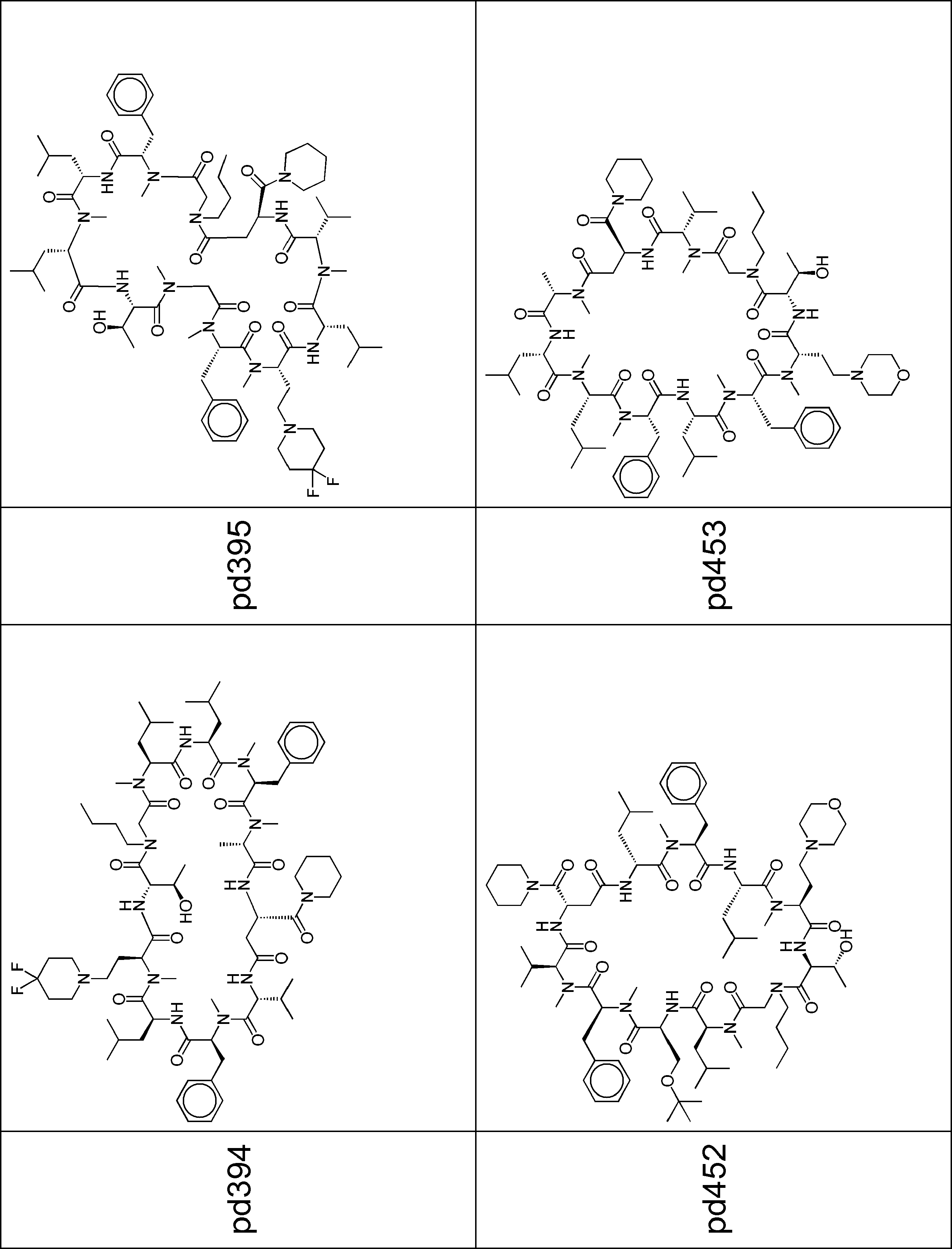


(参照例3-7)Fmocアミノ酸の合成
pKa実測に用いた3残基ペプチドおよび膜透過性を評価した環状ペプチドを合成するために使用したFmoc-Ser(Et-2-NMe2)-OH(化合物tm01)、Fmoc―MeAbu(pip-4-F2)-OH(化合物tm04)、Fmoc―MeAbu(pip-3-F2)-OH(化合物tm10)、Fmoc-MeAbu(Mor)-OH(化合物tm19)、Fmoc-Ser(Et-2-Mor)-OH(化合物tm20)、Fmoc-Abu(5-Oxo-Odz)-OH(化合物tm21)、Fmoc-Gln(Ms)-OH(化合物tm22)は以下のように合成した。
(Reference Example 3-7) Synthesis of Fmoc amino acid Fmoc-Ser(Et-2-NMe2)-OH (compound tm01), Fmoc-MeAbu(pip-4-F2)-OH (Compound tm04), Fmoc-MeAbu(pip-3-F2)-OH (Compound tm10), Fmoc-MeAbu(Mor)-OH (Compound tm19), Fmoc-Ser(Et-2-Mor)-OH (Compound tm20), Fmoc-Abu(5-Oxo-Odz)-OH (Compound tm21), Fmoc-Gln(Ms)-OH (Compound tm22) are as follows. Was synthesized.
N-(((9H-フルオレン-9-イル)メトキシ)カルボニル)-O-(2-(ジメチルアミノ)エチル)-L-セリン(化合物tm01、Fmoc-Ser(Et-2-NMe2)-OH)の合成

得られた、O-(2-(ジメチルアミノ)エチル)-N-トリチル-L-セリン(Trt-Ser(Et-2-NMe2)-OH)(4.1g、9.80mmol)にジクロロメタン(10mL)を加えた後、4N塩酸/1,4-ジオキサン溶液(40mL、160mmol)、水(4mL)を加え、室温で3時間撹拌した。反応液に水(80mL)を加え、ヘキサンで2回洗浄し、得られた水層に0度にて炭酸ナトリウム(26.0g、245mmol)、1、4-ジオキサン(120mL)、N-(9-フルオレニルメトキシカルボニルオキシ)スクシンイミド(Fmoc-OSu)(3.97g、11.76mmol)を加え、室温にて2時間撹拌した。反応液にギ酸(11.28mL、294mmol)を加えた後、減圧下1,4-ジオキサンを留去し、得られた水層を逆相カラムクロマトグラフィー(0.1%ギ酸水溶液/0.1%ギ酸アセトニトリル溶液)で精製することでN-(((9H-フルオレン-9-イル)メトキシ)カルボニル)-O-(2-(ジメチルアミノ)エチル)-L-セリン(化合物tm01、Fmoc-Ser(Et-2-NMe2)-OH)のギ酸塩(3.07g、3工程69%)を得た。得られたN-(((9H-フルオレン-9-イル)メトキシ)カルボニル)-O-(2-(ジメチルアミノ)エチル)-L-セリン(化合物tm01、Fmoc-Ser(Et-2-NMe2)-OH)のギ酸塩(3.0g、7.53mmol)にジクロロメタン(4mL)、4N塩酸/1、4-ジオキサン溶液(9.411mL、37.6mmol)を加え、室温にて20分撹拌した。反応液を減圧濃縮することで、N-(((9H-フルオレン-9-イル)メトキシ)カルボニル)-O-(2-(ジメチルアミノ)エチル)-L-セリン(化合物tm01、Fmoc-Ser(Et-2-NMe2)-OH)の塩酸塩(2.7g、82%)を得た。
LCMS(ESI) m/z = 399 (M+H)+
保持時間:0.50分(分析条件SQDFA05)
N-(((9H-fluoren-9-yl)methoxy)carbonyl)-O-(2-(dimethylamino)ethyl)-L-serine (Compound tm01, Fmoc-Ser(Et-2-NMe2)-OH) Synthesis of
The obtained O-(2-(dimethylamino)ethyl)-N-trityl-L-serine (Trt-Ser(Et-2-NMe2)-OH) (4.1 g, 9.80 mmol) was added to dichloromethane (10 mL). ) Was added, 4N hydrochloric acid/1,4-dioxane solution (40 mL, 160 mmol) and water (4 mL) were added, and the mixture was stirred at room temperature for 3 hours. Water (80 mL) was added to the reaction solution, and the mixture was washed twice with hexane, and the obtained aqueous layer was stirred at 0°C with sodium carbonate (26.0 g, 245 mmol), 1,4-dioxane (120 mL), N-(9. -Fluorenylmethoxycarbonyloxy)succinimide (Fmoc-OSu) (3.97 g, 11.76 mmol) was added, and the mixture was stirred at room temperature for 2 hours. Formic acid (11.28 mL, 294 mmol) was added to the reaction solution, 1,4-dioxane was distilled off under reduced pressure, and the obtained aqueous layer was subjected to reverse phase column chromatography (0.1% formic acid aqueous solution/0.1%). % N-((9H-fluoren-9-yl)methoxy)carbonyl)-O-(2-(dimethylamino)ethyl)-L-serine (Compound tm01, Fmoc-Ser) A formate salt of (Et-2-NMe2)-OH) (3.07 g, 3 steps 69%) was obtained. Obtained N-(((9H-fluoren-9-yl)methoxy)carbonyl)-O-(2-(dimethylamino)ethyl)-L-serine (Compound tm01, Fmoc-Ser(Et-2-NMe2)) -OH) formate salt (3.0 g, 7.53 mmol) was added with dichloromethane (4 mL), 4N hydrochloric acid/1, 4-dioxane solution (9.411 mL, 37.6 mmol), and the mixture was stirred at room temperature for 20 minutes. The reaction mixture was concentrated under reduced pressure to give N-(((9H-fluoren-9-yl)methoxy)carbonyl)-O-(2-(dimethylamino)ethyl)-L-serine (Compound tm01, Fmoc-Ser( Et-2-NMe2)-OH) hydrochloride salt (2.7 g, 82%) was obtained.
LCMS (ESI) m/z = 399 (M+H) +
Retention time: 0.50 minutes (Analysis condition SQDFA05)
(S)-2-((((9H-フルオレン-9-イル)メトキシ)カルボニル)アミノ)-4-(4,4-ジフルオロピペリジン-1-イル)-4-オキソブタン酸tert-ブチル(化合物tm02、Fmoc-Asp(pip-4-F2)-OtBu)の合成

LCMS(ESI)m/z = 515 (M+H)+
保持時間:0.97分(分析条件SQDFA05)
Tert-butyl (S)-2-((((9H-fluoren-9-yl)methoxy)carbonyl)amino)-4-(4,4-difluoropiperidin-1-yl)-4-oxobutanoate (compound tm02 , Fmoc-Asp(pip-4-F2)-OtBu)
LCMS (ESI) m/z = 515 (M+H) +
Retention time: 0.97 minutes (Analysis condition SQDFA05)
(S)-2-((((9H-フルオレン-9-イル)メトキシ)カルボニル)アミノ)-4-(4,4-ジフルオロピペリジン-1-イル)ブタン酸(化合物tm03、Fmoc-Abu(pip-4-F2)-OH)の合成

LCMS(ESI)m/z = 445 (M+H)+
保持時間:0.56分(分析条件SQDFA05)
(S)-2-((((9H-fluoren-9-yl)methoxy)carbonyl)amino)-4-(4,4-difluoropiperidin-1-yl)butanoic acid (Compound tm03, Fmoc-Abu(pip -4-F2)-OH)
LCMS (ESI) m/z = 445 (M+H) +
Retention time: 0.56 minutes (Analysis condition SQDFA05)
(S)-2-((((9H-フルオレン-9-イル)メトキシ)カルボニル)(メチル)アミノ)-4-(4,4-ジフルオロピペリジン-1-イル)ブタン酸(化合物tm04、Fmoc-MeAbu(pip-4-F2)-OH)の合成

LCMS(ESI)m/z = 459 (M+H)+
保持時間:2.71分(分析条件SMD method28)
(S)-2-((((9H-fluoren-9-yl)methoxy)carbonyl)(methyl)amino)-4-(4,4-difluoropiperidin-1-yl)butanoic acid (Compound tm04, Fmoc- Synthesis of MeAbu(pip-4-F2)-OH)
LCMS (ESI) m/z = 459 (M+H) +
Retention time: 2.71 minutes (analysis condition SMD method 28)
1-ベンジル-3,3-ジフルオロピペリジン(化合物tm05)の合成

LCMS(ESI)m/z = 212 (M+H)+
保持時間:0.94分(分析条件SMD method31)
Synthesis of 1-benzyl-3,3-difluoropiperidine (Compound tm05)
LCMS (ESI) m/z = 212 (M+H) +
Retention time: 0.94 minutes (Analysis condition SMD method31)
(S)-2-(((ベンジルオキシ)カルボニル)(メチル)アミノ)-4-(3,3-ジフルオロピペリジン-1-イル)ブタン酸ベンジル(化合物tm07、Cbz-MeAbu(pip-3-F2)-OBn)の合成

別途合成した、(S)-2-(((ベンジルオキシ)カルボニル)(メチル)アミノ)-4-(エチルチオ)-4-オキソブタン酸ベンジル(化合物tm08、Cbz-MeAsp(SEt)-OBn)(20g、48.13mmol)、3,3-ジフルオロピペリジン(化合物tm06)(8.26g、68.19mmol)、トリエチルシラン(40mL)、10%パラジウム/炭素(2.6g)のN,N-ジメチルホルムアミド溶液(20mL)に0度にてナトリウムトリアセトキシボロヒドリド(NaBH(OAc)3)(20.4g、204mmol)を加え、室温にて30分間撹拌した。反応液をろ過、減圧濃縮することで得た粗生成物を順相シリカゲルクロマトグラフィー(ヘキサン/酢酸エチル)にて精製し、(S)-2-(((ベンジルオキシ)カルボニル)(メチル)アミノ)-4-(3,3-ジフルオロピペリジン-1-イル)ブタン酸ベンジル(化合物tm07、Cbz-MeAbu(pip-3-F2)-OBn)(11g、50%)を得た。
LCMS(ESI)m/z = 461 (M+H)+
保持時間:1.42分(分析条件SMD method32)
Benzyl (S)-2-(((benzyloxy)carbonyl)(methyl)amino)-4-(3,3-difluoropiperidin-1-yl)butanoate (Compound tm07, Cbz-MeAbu(pip-3-F2 )-OBn) synthesis
Separately synthesized (S)-2-(((benzyloxy)carbonyl)(methyl)amino)-4-(ethylthio)-4-oxobutanoic acid benzyl compound (tm08, Cbz-MeAsp(SEt)-OBn) (20 g , 48.13 mmol), 3,3-difluoropiperidine (compound tm06) (8.26 g, 68.19 mmol), triethylsilane (40 mL), 10% palladium/carbon (2.6 g) in N,N-dimethylformamide. Sodium triacetoxyborohydride (NaBH(OAc) 3 ) (20.4 g, 204 mmol) was added to (20 mL) at 0°C, and the mixture was stirred at room temperature for 30 minutes. The crude product obtained by filtering the reaction solution and concentrating under reduced pressure is purified by normal phase silica gel chromatography (hexane/ethyl acetate) to obtain (S)-2-(((benzyloxy)carbonyl)(methyl)amino. )-4-(3,3-Difluoropiperidin-1-yl)butanoic acid benzyl (Compound tm07, Cbz-MeAbu(pip-3-F2)-OBn) (11 g, 50%) was obtained.
LCMS (ESI) m/z = 461 (M+H) +
Retention time: 1.42 minutes (analysis condition SMD method32)
(S)-2-((((9H-フルオレン-9-イル)メトキシ)カルボニル)(メチル)アミノ)-4-(3,3-ジフルオロピペリジン-1-イル)ブタン酸(化合物tm10、Fmoc-MeAbu(pip-3-F2)-OH)の合成

上述の粗生成物である(2S)-4-(3,3-ジフルオロピペリジン-1-イル)-2-(メチルアミノ)ブタン酸の臭化物(化合物tm09)(7.08g、29.97mmol)とN-(9-フルオレニルメトキシカルボニルオキシ)スクシンイミド(Fmoc-OSu)(16g、47.48mmol)を炭酸カリウムの水/1,4-ジオキサン溶液=1/1(300mL)に溶解し室温にて4時間撹拌した。その後反応液をジエチルエーテルにて3回洗浄し、塩酸で水層のpHを3に調節し、酢酸エチルにて2度抽出した。得られた有機層を合わせ、無水硫酸ナトリウムで乾燥、ろ過、減圧濃縮し、得られた残渣を逆相カラムクロマトグラフィー(10mmol炭酸水素アンモニウム水溶液/アセトニトリル)にて精製し、(S)-2-((((9H-フルオレン-9-イル)メトキシ)カルボニル)(メチル)アミノ)-4-(3,3-ジフルオロピペリジン-1-イル)ブタン酸(化合物tm10、Fmoc-MeAbu(pip-3-F2)-OH))(7.2g、71%)を得た。
LCMS(ESI)m/z = 459 (M+H)+
保持時間:1.61分(分析条件SMD method5)
(S)-2-((((9H-fluoren-9-yl)methoxy)carbonyl)(methyl)amino)-4-(3,3-difluoropiperidin-1-yl)butanoic acid (Compound tm10, Fmoc- Synthesis of MeAbu(pip-3-F2)-OH)
Bromide (compound tm09) (7.08 g, 29.97 mmol) of the above-mentioned crude product (2S)-4-(3,3-difluoropiperidin-1-yl)-2-(methylamino)butanoic acid; N-(9-fluorenylmethoxycarbonyloxy)succinimide (Fmoc-OSu) (16 g, 47.48 mmol) was dissolved in potassium carbonate in water/1,4-dioxane solution=1/1 (300 mL) and the mixture was stirred at room temperature. Stir for 4 hours. Thereafter, the reaction solution was washed with diethyl ether three times, the pH of the aqueous layer was adjusted to 3 with hydrochloric acid, and the mixture was extracted twice with ethyl acetate. The obtained organic layers were combined, dried over anhydrous sodium sulfate, filtered, and concentrated under reduced pressure, and the obtained residue was purified by reverse phase column chromatography (10 mmol aqueous ammonium hydrogen carbonate solution/acetonitrile), (S)-2- ((((9H-Fluoren-9-yl)methoxy)carbonyl)(methyl)amino)-4-(3,3-difluoropiperidin-1-yl)butanoic acid (Compound tm10, Fmoc-MeAbu(pip-3- F2)-OH)) (7.2 g, 71%) was obtained.
LCMS (ESI) m/z = 459 (M+H) +
Retention time: 1.61 minutes (analysis condition SMD method5)
(S)-2-(((ベンジルオキシ)カルボニル)(メチル)アミノ)-4-(エチルチオ)-4-オキソブタン酸(化合物tm13、Cbz-MeAsp(SEt)-OH)の合成

上述と同様の方法で合成した(S)-2-(3-((ベンジルオキシ)カルボニル)-5-オキソオキサゾリジン-4-イル)酢酸(化合物tm11)(265g、948.99mmol)の粗生成物とエタンチオール(88.3g、1.42mol)と4-ジメチルアミノピリジン(DMAP)(11.59g、95mmol)のジクロロメタン溶液に0度にてN,N’-ジシクロヘキシルカルボジイミド(DCC)(214g、1.04mol)を加え、室温にて5時間撹拌した。反応溶液をろ過し、得られたろ液を飽和食塩水で洗浄し、得られた有機層を無水硫酸ナトリウムで乾燥させた後、ろ過、減圧濃縮した。得られた粗生成物を順相シリカゲルクロマトグラフィー(石油エーテル/酢酸エチル)にて精製し、(S)-4-(2-(エチルチオ)-2-オキソエチル)-5-オキソオキサゾリジン-3-カルボン酸ベンジル(化合物tm12)(167g)の混合物を得た。
得られた(S)-4-(2-(エチルチオ)-2-オキソエチル)-5-オキソオキサゾリジン-3-カルボン酸ベンジル(化合物tm12)(139g、1.20mol)のジクロロメタン(DCM)とトリフルオロ酢酸溶液(1500mL/1500mL)にトリエチルシラン(139g、1.2mol)を加え、室温にて3日間撹拌した。反応液を減圧濃縮し得られた残渣に炭酸カリウム水溶液を加え、ジエチルエーテルで3度洗浄した。得られた水層を2N塩酸水溶液でpHを3に調節したものに対して酢酸エチルで2度抽出した。合わせた有機層を飽和食塩水で洗浄し、有機層を無水硫酸ナトリウムで乾燥させた後、ろ過、減圧濃縮し、(S)-2-(((ベンジルオキシ)カルボニル)(メチル)アミノ)-4-(エチルチオ)-4-オキソブタン酸(化合物tm13、Cbz-MeAsp(SEt)-OH)(75g)の粗生成物を得た。
LCMS(ESI)m/z = 326 (M+H)+
保持時間:1.00分(分析条件SMD method16)
Synthesis of (S)-2-(((benzyloxy)carbonyl)(methyl)amino)-4-(ethylthio)-4-oxobutanoic acid (Compound tm13, Cbz-MeAsp(SEt)-OH)
A crude product of (S)-2-(3-((benzyloxy)carbonyl)-5-oxooxazolidin-4-yl)acetic acid (Compound tm11) (265 g, 948.99 mmol) synthesized in the same manner as above. A solution of ethanethiol (88.3 g, 1.42 mol) and 4-dimethylaminopyridine (DMAP) (11.59 g, 95 mmol) in dichloromethane was added to N,N′-dicyclohexylcarbodiimide (DCC) (214 g, 1 0.04 mol) was added and the mixture was stirred at room temperature for 5 hours. The reaction solution was filtered, the obtained filtrate was washed with saturated brine, the obtained organic layer was dried over anhydrous sodium sulfate, filtered, and concentrated under reduced pressure. The obtained crude product was purified by normal phase silica gel chromatography (petroleum ether/ethyl acetate) to obtain (S)-4-(2-(ethylthio)-2-oxoethyl)-5-oxooxazolidine-3-carboxylic acid. A mixture of benzyl acidate (Compound tm12) (167 g) was obtained.
The resulting benzyl (S)-4-(2-(ethylthio)-2-oxoethyl)-5-oxooxazolidine-3-carboxylate (Compound tm12) (139 g, 1.20 mol) in dichloromethane (DCM) and trifluoro Triethylsilane (139 g, 1.2 mol) was added to an acetic acid solution (1500 mL/1500 mL), and the mixture was stirred at room temperature for 3 days. The reaction mixture was concentrated under reduced pressure, an aqueous potassium carbonate solution was added to the obtained residue, and the mixture was washed 3 times with diethyl ether. The obtained aqueous layer was adjusted to
LCMS (ESI) m/z = 326 (M+H) +
Retention time: 1.00 minutes (Analysis condition SMD method16)
(S)-2-(((ベンジルオキシ)カルボニル)(メチル)アミノ)-4-(エチルチオ)-4-オキソブタン酸ベンジル(化合物tm08、Cbz-MeAsp(SEt)-OBn)の合成

1HNMR(300MHz,CDCl3):δ7.36-7.31(m,10H),5.19-4.89(m,5H),3.34-2.85(m,7H),1.30-1.21(m,3H)
Synthesis of benzyl (S)-2-(((benzyloxy)carbonyl)(methyl)amino)-4-(ethylthio)-4-oxobutanoate (Compound tm08, Cbz-MeAsp(SEt)-OBn)
1 HNMR (300 MHz, CDCl 3 ): δ7.36-7.31 (m, 10H), 5.19-4.89 (m, 5H), 3.34-2.85 (m, 7H), 1. 30-1.21 (m, 3H)
(S)-2-((((9H-フルオレン-9-イル)メトキシ)カルボニル)アミノ)-4-モルホリノブタン酸(化合物tm17、Fmoc-Abu(Mor)-OH)の合成は、以下のスキームに従って行った。

(S)-2-((((9H-フルオレン-9-イル)メトキシ)カルボニル)アミノ)-4-(エチルチオ)-4-オキソブタン酸tert-ブチル(化合物tm14、Fmoc-Asp(SEt)-OtBu)の合成

LCMS(ESI) m/z = 478 (M+Na)+
保持時間:3.13分(分析条件 SMD method14)
(S)-2-((((9H-fluoren-9-yl)methoxy)carbonyl)amino)-4-(ethylthio)-4-oxobutanoate tert-butyl (Compound tm14, Fmoc-Asp(SEt)-OtBu ) Synthesis
LCMS (ESI) m/z = 478 (M+Na) +
Retention time: 3.13 minutes (analysis condition SMD method14)
(S)-2-((((9H-フルオレン-9-イル)メトキシ)カルボニル)アミノ)-4-オキソブタン酸tert-ブチル(化合物tm15)の合成

LCMS(ESI) m/z = 418 (M+Na)+
保持時間:2.07分(分析条件 SMD method40)
Synthesis of (S)-2-((((9H-fluoren-9-yl)methoxy)carbonyl)amino)-4-oxobutanoate tert-butyl (Compound tm15)
LCMS (ESI) m/z = 418 (M+Na) +
Retention time: 2.07 minutes (analysis condition SMD method 40)
(S)-2-((((9H-フルオレン-9-イル)メトキシ)カルボニル)アミノ)-4-モルホリノブタン酸tert-ブチル(化合物tm16、Fmoc-Abu(Mor)-OtBu)の合成

LCMS(ESI) m/z = 467 (M+H)+
保持時間:2.02分(分析条件 SMD method41)
Synthesis of tert-butyl (S)-2-((((9H-fluoren-9-yl)methoxy)carbonyl)amino)-4-morpholinobinotanate (Compound tm16, Fmoc-Abu(Mor)-OtBu)
LCMS (ESI) m/z = 467 (M+H) +
Retention time: 2.02 minutes (analysis condition SMD method41)
(S)-2-((((9H-フルオレン-9-イル)メトキシ)カルボニル)アミノ)-4-モルホリノブタン酸(化合物tm17、Fmoc-Abu(Mor)-OH)の合成

LCMS(ESI) m/z = 411 (M+H)+
保持時間:1.20分(分析条件 SMD method42)
Synthesis of (S)-2-((((9H-fluoren-9-yl)methoxy)carbonyl)amino)-4-morpholinobutanoic acid (Compound tm17, Fmoc-Abu(Mor)-OH)
LCMS (ESI) m/z = 411 (M+H) +
Retention time: 1.20 minutes (Analysis condition SMD method42)
(S)-2-((((9H-フルオレン-9-イル)メトキシ)カルボニル)(メチル)アミノ)-4-モルホリノブタン酸(化合物tm19、Fmoc-MeAbu(Mor)-OH)の合成は、以下のスキームに従って行った。

(S)-4-(2-モルホリノエチル)-5-オキソオキサゾリジン-3-カルボン酸(9H-フルオレン-9-イル)メチル(化合物tm18)の合成

LCMS(ESI) m/z = 423 (M+H)+
保持時間:1.14分(分析条件 SMD method40)
Synthesis of (S)-4-(2-morpholinoethyl)-5-oxooxazolidin-3-carboxylic acid (9H-fluoren-9-yl)methyl (Compound tm18)
LCMS (ESI) m/z = 423 (M+H) +
Retention time: 1.14 minutes (analysis condition SMD method 40)
(S)-2-((((9H-フルオレン-9-イル)メトキシ)カルボニル)(メチル)アミノ)-4-モルホリノブタン酸(化合物tm19、Fmoc-MeAbu(Mor)-OH)の合成

LCMS(ESI) m/z = 425 (M+H)+
保持時間:1.40分(分析条件 SMD method34)
Synthesis of (S)-2-((((9H-fluoren-9-yl)methoxy)carbonyl)(methyl)amino)-4-morpholinobutanic acid (Compound tm19, Fmoc-MeAbu(Mor)-OH)
LCMS (ESI) m/z = 425 (M+H) +
Retention time: 1.40 minutes (Analysis condition SMD method34)
N-(((9H-フルオレン-9-イル)メトキシ)カルボニル)-O-(2-モルホリノエチル)-L-セリン(化合物tm20、Fmoc-Ser(Et-2-Mor)-OH)の合成

N-(tert-ブトキシカルボニル)-O-(2-モルホリノエチル)-L-セリン(Boc-Ser(Et-2-Mor)-OH)(5.6g、17.59mmol)に4N塩酸/1,4-ジオキサン溶液(28.0mL、921.53mmol)を室温にて加え、1時間撹拌した。減圧下溶媒を留去し、得られた残渣をジクロロメタンで洗浄した後、水(10mL)を加え溶液とした。得られた溶液に炭酸カリウムを加えpH7に調節し、水(100mL)と1.4-ジオキサン(150mL)を加えた後、室温にて炭酸カリウム(4.465g、32.07mmol)、N-(9-フルオレニルメトキシカルボニルオキシ)スクシンイミド(Fmoc-OSu)(5.68g、16.84mmol)を加え、16時間撹拌した。反応液をジエチルエーテルで洗浄し、濃塩酸を用いて水層のpHを1に調節し、ジクロロメタンで3回抽出した。得られた有機層を水で洗浄し、無水硫酸ナトリウムで乾燥、ろ過を行った。ろ液を減圧下濃縮し、得られた残渣を逆相カラムクロマトグラフィー(0.1%塩酸水溶液/0.1%塩酸アセトニトリル溶液)で精製することでN-(((9H-フルオレン-9-イル)メトキシ)カルボニル)-O-(2-モルホリノエチル)-L-セリン(化合物tm20、Fmoc-Ser(Et-2-Mor)-OH)の塩酸塩(3.2g、2工程48%)を得た。
LCMS(ESI) m/z = 441 (M+H)+
保持時間:0.50分(分析条件SQDFA05)
Synthesis of N-(((9H-fluoren-9-yl)methoxy)carbonyl)-O-(2-morpholinoethyl)-L-serine (Compound tm20, Fmoc-Ser(Et-2-Mor)-OH)
N-(tert-butoxycarbonyl)-O-(2-morpholinoethyl)-L-serine (Boc-Ser(Et-2-Mor)-OH) (5.6 g, 17.59 mmol) in 4N hydrochloric acid/1, 4-Dioxane solution (28.0 mL, 921.53 mmol) was added at room temperature, and the mixture was stirred for 1 hour. The solvent was evaporated under reduced pressure, the obtained residue was washed with dichloromethane, and then water (10 mL) was added to give a solution. To the resulting solution was added potassium carbonate to adjust the pH to 7, water (100 mL) and 1.4-dioxane (150 mL) were added, and then potassium carbonate (4.465 g, 32.07 mmol) and N-( were added at room temperature. 9-Fluorenylmethoxycarbonyloxy)succinimide (Fmoc-OSu) (5.68 g, 16.84 mmol) was added and stirred for 16 hours. The reaction solution was washed with diethyl ether, the pH of the aqueous layer was adjusted to 1 with concentrated hydrochloric acid, and extracted three times with dichloromethane. The obtained organic layer was washed with water, dried over anhydrous sodium sulfate, and filtered. The filtrate was concentrated under reduced pressure, and the obtained residue was purified by reverse phase column chromatography (0.1% hydrochloric acid aqueous solution/0.1% hydrochloric acid acetonitrile solution) to give N-(((9H-fluorene-9- Yield)methoxy)carbonyl)-O-(2-morpholinoethyl)-L-serine (compound tm20, Fmoc-Ser(Et-2-Mor)-OH) hydrochloride (3.2 g, 2 steps 48%) Obtained.
LCMS (ESI) m/z = 441 (M+H) +
Retention time: 0.50 minutes (Analysis condition SQDFA05)
(S)-2-((((9H-フルオレン-9-イル)メトキシ)カルボニル)アミノ)-4-(5-オキソ-4,5-ジヒドロ-1,2,4-オキサジアゾール-3-イル)ブタン酸(化合物tm21、Fmoc-Abu(5-Oxo-Odz)-OH)の合成

上述のように得られた(S)-2-((tert-ブトキシカルボニル)アミノ)-4-シアノブタン酸(50g、219.06mmol)のエタノール溶液(500mL)に室温にてヒドロキシルアミンの塩酸塩(32g、460.50mmol)とトリエチルアミン(83mL)を加え、80度で2時間撹拌した。反応液を減圧下濃縮することで、(S)-2-((tert-ブトキシカルボニル)アミノ)-5-(ヒドロキシアミノ)-5-イミノペンタン酸(107g)を粗生成物として得た。
窒素雰囲気下、上述の粗生成物である(S)-2-((tert-ブトキシカルボニル)アミノ)-5-(ヒドロキシアミノ)-5-イミノペンタン酸(44g、168.40mmol)の1,4-ジオキサン溶液(500mL)に室温にて1,1’-カルボニルジイミダゾール(CDI)(39g、240.52mmol)と1,8-ジアザビシクロ[5.4.0]-7-ウンデセン(DBU)(55g、361.27mmol)を加え、110度で4時間撹拌した。反応液を室温にて冷却した後、濃塩酸を加えpH=2になるように調整し、ジクロロメタンで2回抽出した。得られた有機層を無水硫酸ナトリウムで乾燥、ろ過を行った後、減圧下溶媒留去することで、(S)-2-((tert-ブトキシカルボニル)アミノ)-4-(5-オキソ-4,5-ジヒドロ-1,2,4-オキサジアゾール-3-イル)ブタン酸(Boc-Abu(5-Oxo-Odz)-OH)(11g)を粗生成物として得た。
窒素雰囲気下、上述のように得られた(S)-2-((tert-ブトキシカルボニル)アミノ)-4-(5-オキソ-4,5-ジヒドロ-1,2,4-オキサジアゾール-3-イル)ブタン酸(Boc-Abu(5-Oxo-Odz)-OH)(13.5g、46.99mmol)の1,4-ジオキサン溶液(10mL)に室温にて4N塩酸/1,4-ジオキサン溶液(140mL)を加え、16時間撹拌した。反応液を減圧下濃縮することで、(S)-2-アミノ-4-(5-オキソ-4,5-ジヒドロ-1,2,4-オキサジアゾール-3-イル)ブタン酸(H-Abu(5-Oxo-Odz)-OH)(8.8g)を粗生成物として得た。
窒素雰囲気下、得られた粗生成物である(S)-2-アミノ-4-(5-オキソ-4,5-ジヒドロ-1,2,4-オキサジアゾール-3-イル)ブタン酸(H-Abu(5-Oxo-Odz)-OH)(8.8g、47.02mmol)と炭酸カリウム(13g、94.06mmol)の水/1,4-ジオキサン溶液(100mL/100mL)に室温にて、N-(9-フルオレニルメトキシカルボニルオキシ)スクシンイミド(Fmoc-OSu)(14.3g、42.4mmol)を加え、3時間撹拌した。反応液をt-ブチルメチルエーテル/ヘキサン(1/3)で洗浄し、濃塩酸を用いて水層のpHを2に調節し、ジクロロメタンで2回抽出した。得られた有機層を無水硫酸ナトリウムで乾燥、ろ過を行った。ろ液を減圧下濃縮し、得られた残渣を逆相カラムクロマトグラフィー(水/アセトニトリル)で精製することで、(S)-2-((((9H-フルオレン-9-イル)メトキシ)カルボニル)アミノ)-4-(5-オキソ-4,5-ジヒドロ-1,2,4-オキサジアゾール-3-イル)ブタン酸(化合物tm21、Fmoc-Abu(5-Oxo-Odz)-OH)(2.67g)を得た。
LCMS(ESI) m/z = 410 (M+H)+
保持時間:0.66分(分析条件SQDFA05)
(S)-2-((((9H-Fluoren-9-yl)methoxy)carbonyl)amino)-4-(5-oxo-4,5-dihydro-1,2,4-oxadiazole-3- Ile)butanoic acid (Compound tm21, Fmoc-Abu(5-Oxo-Odz)-OH)
A solution of hydroxylamine hydrochloride (500 mL) in ethanol (500 mL) of (S)-2-((tert-butoxycarbonyl)amino)-4-cyanobutanoic acid (50 g, 219.06 mmol) obtained as described above at room temperature ( 32 g, 460.50 mmol) and triethylamine (83 mL) were added, and the mixture was stirred at 80° C. for 2 hr. The reaction solution was concentrated under reduced pressure to obtain (S)-2-((tert-butoxycarbonyl)amino)-5-(hydroxyamino)-5-iminopentanoic acid (107 g) as a crude product.
Under a nitrogen atmosphere, 1,4 of the above-mentioned crude product (S)-2-((tert-butoxycarbonyl)amino)-5-(hydroxyamino)-5-iminopentanoic acid (44 g, 168.40 mmol) was obtained. -In a dioxane solution (500 mL) at
(S)-2-((tert-butoxycarbonyl)amino)-4-(5-oxo-4,5-dihydro-1,2,4-oxadiazole-obtained as described above under nitrogen atmosphere 3-yl)butanoic acid (Boc-Abu(5-Oxo-Odz)-OH) (13.5 g, 46.99 mmol) in 1,4-dioxane (10 mL) at room temperature in 4N hydrochloric acid/1,4- A dioxane solution (140 mL) was added, and the mixture was stirred for 16 hours. The reaction mixture was concentrated under reduced pressure to give (S)-2-amino-4-(5-oxo-4,5-dihydro-1,2,4-oxadiazol-3-yl)butanoic acid (H- Abu(5-Oxo-Odz)-OH) (8.8 g) was obtained as a crude product.
The resulting crude product (S)-2-amino-4-(5-oxo-4,5-dihydro-1,2,4-oxadiazol-3-yl)butanoic acid ( H-Abu(5-Oxo-Odz)-OH) (8.8 g, 47.02 mmol) and potassium carbonate (13 g, 94.06 mmol) in water/1,4-dioxane (100 mL/100 mL) at room temperature. , N-(9-fluorenylmethoxycarbonyloxy)succinimide (Fmoc-OSu) (14.3 g, 42.4 mmol) was added, and the mixture was stirred for 3 hours. The reaction solution was washed with t-butyl methyl ether/hexane (1/3), the pH of the aqueous layer was adjusted to 2 with concentrated hydrochloric acid, and extracted twice with dichloromethane. The obtained organic layer was dried over anhydrous sodium sulfate and filtered. The filtrate was concentrated under reduced pressure, and the obtained residue was purified by reverse phase column chromatography (water/acetonitrile) to give (S)-2-((((9H-fluoren-9-yl)methoxy)carbonyl. )Amino)-4-(5-oxo-4,5-dihydro-1,2,4-oxadiazol-3-yl)butanoic acid (Compound tm21, Fmoc-Abu(5-Oxo-Odz)-OH) (2.67 g) was obtained.
LCMS (ESI) m/z = 410 (M+H) +
Retention time: 0.66 minutes (Analysis condition SQDFA05)
N2-(((9H-フルオレン-9-イル)メトキシ)カルボニル)-N5-(メチルスルホニル)-L-グルタミン(化合物tm22、Fmoc-Gln(Ms)-OH)の合成

窒素雰囲気下、上述のようにして得られた、tert-ブチルN2-(((9H-フルオレン-9-イル)メトキシ)カルボニル)-N5-(メチルスルホニル)-L-グルタミナート(Fmoc-Gln(Ms)-OtBu)(5.5g、10.9mmol)の2,2,2-トリフルオロエタノール(TFE)溶液(100mL)に0度にてクロロトリメチルシラン(TMSCl)(3.57g、32.861mmol))を加え、1時間撹拌した。反応液を減圧下濃縮し、得られた残渣にt-ブチルメチルエーテルを加え再び濃縮した。この操作をさらに2回繰り返し、アセトニトリル/ジクロロメタンで再結晶を行うことで、N2-(((9H-フルオレン-9-イル)メトキシ)カルボニル)-N5-(メチルスルホニル)-L-グルタミン(化合物tm22、Fmoc-Gln(Ms)-OH)(3.8178g、77%)を白色固体として得た。
LCMS(ESI) m/z = 447 (M+H)+
保持時間:0.65分(分析条件SQDFA05)
Synthesis of N2-(((9H-fluoren-9-yl)methoxy)carbonyl)-N5-(methylsulfonyl)-L-glutamine (Compound tm22, Fmoc-Gln(Ms)-OH)
The tert-butyl N2-(((9H-fluoren-9-yl)methoxy)carbonyl)-N5-(methylsulfonyl)-L-glutaminate (Fmoc-Gln( Ms)-OtBu) (5.5 g, 10.9 mmol) in 2,2,2-trifluoroethanol (TFE) solution (100 mL) at 0° C. chlorotrimethylsilane (TMSCl) (3.57 g, 32.861 mmol) )) was added and stirred for 1 hour. The reaction mixture was concentrated under reduced pressure, t-butyl methyl ether was added to the obtained residue, and the mixture was concentrated again. This operation was repeated twice more and recrystallized from acetonitrile/dichloromethane to give N2-(((9H-fluoren-9-yl)methoxy)carbonyl)-N5-(methylsulfonyl)-L-glutamine (compound tm22 , Fmoc-Gln(Ms)-OH) (3.8178 g, 77%) was obtained as a white solid.
LCMS (ESI) m/z = 447 (M+H) +
Retention time: 0.65 minutes (Analysis condition SQDFA05)
(参照例4)ClogPが膜透過性に与える影響
Trpの側鎖を有する環状ペプチド化合物、及び同側鎖を有しない環状ペプチド化合物を合成し、改良法により膜透過性試験を行った。なお、MeTrpはTrpの側鎖を含むことから、構成アミノ酸にMeTrpを含む環状ペプチド化合物も、Trpの側鎖を有する環状ペプチド化合物に含まれる。その結果、Trpの側鎖を持たない環状ペプチド化合物はClogPを上昇させることによりPapp≧1.0×10⁻⁶cm/秒を達成することが可能であった(図1-1)。一方、Trpの側鎖を1つ以上有しているとClogPを上昇させてもPapp≧1.0×10-6cm/秒まで膜透過性を上げるのは難しかった(図1-2)。例えばTrp側鎖の位置、Nアルキルのパターンを変えたもので、1.06≦ClogP/total aa≦1.43の範囲にある環状ペプチド化合物の配列を表31に示すが、これらはPapp≧1.0×10⁻⁶cm/秒の膜透過性を達成することは難しかった。
以上のことから、Trpの側鎖を持たない環状ペプチド化合物の膜透過性を評価したところ、ClogPを上昇させることにより膜透過性が向上することが確認できたため(図1-1)、比較する2つのペプチドのClogP/total AAの値が±0.03の間となるように調節した。
(Reference Example 4) Effect of ClogP on membrane permeability A cyclic peptide compound having a side chain of Trp and a cyclic peptide compound having no side chain of Trp were synthesized, and a membrane permeability test was conducted by an improved method. Since MeTrp contains the side chain of Trp, a cyclic peptide compound containing MeTrp as a constituent amino acid is also included in the cyclic peptide compound having the side chain of Trp. As a result, a cyclic peptide compound having no Trp side chain was able to achieve P app ≧1.0×10 −6 cm/sec by increasing ClogP (FIG. 1-1). On the other hand, if one or more side chains of Trp were present, it was difficult to increase the membrane permeability up to P app ≧1.0×10 −6 cm/sec even if ClogP was increased (FIG. 1-2). . For example, the position of the Trp side chain and the pattern of N alkyl are changed, and the sequences of cyclic peptide compounds in the range of 1.06≦ClogP/total aa≦1.43 are shown in Table 31. These are P app ≧ It was difficult to achieve a membrane permeability of 1.0×10 −6 cm/sec.
From the above, when the membrane permeability of a cyclic peptide compound having no Trp side chain was evaluated, it was confirmed that the membrane permeability was improved by increasing ClogP (Fig. 1-1). The ClogP/total AA values of the two peptides were adjusted to be between ±0.03.

環状ペプチドpd100~pd111の構造を以下に示す。(なお環状ペプチドの構造式において、構造を明瞭にする目的でヘテロ原子に結合している水素原子を省略している場合もある) The structures of cyclic peptides pd100 to pd111 are shown below. (Note that in the structural formula of the cyclic peptide, the hydrogen atom bonded to the hetero atom may be omitted in order to clarify the structure.)


(参照例5)Tyr(3-F)又はTyrの側鎖を有する環状ペプチド化合物の膜透過性試験
Tyr(3-F)又はTyrの側鎖を有する環状ペプチド化合物を合成し、改良法により膜透過性試験を行った。その結果、Tyr(3-F)又はTyrの側鎖を有する環状ペプチド化合物もTrpの側鎖を有する環状ペプチド化合物と同様の傾向であった。1.06≦ClogP/total aa≦1.29の範囲にある環状ペプチド化合物の配列を表33に示すが、Trpの場合と同様、これらがPapp≧1.0×10⁻⁶cm/秒を達成することは困難であった。
Reference Example 5 Membrane Permeability Test of Cyclic Peptide Compound Having Side Chain of Tyr(3-F) or Tyr A cyclic peptide compound having a side chain of Tyr(3-F) or Tyr was synthesized, and a membrane was prepared by an improved method. A permeability test was performed. As a result, the cyclic peptide compound having a side chain of Tyr(3-F) or Tyr had the same tendency as the cyclic peptide compound having a side chain of Trp. The sequences of cyclic peptide compounds in the range of 1.06≦ClogP/total aa≦1.29 are shown in Table 33. As in the case of Trp, these show P app ≧1.0×10 −6 cm/sec. It was difficult to achieve.

環状ペプチドpd112~pd129の構造を以下に示す。(なお環状ペプチドの構造式において、構造を明瞭にする目的でヘテロ原子に結合している水素原子を省略している場合もある) The structures of the cyclic peptides pd112 to pd129 are shown below. (Note that in the structural formula of the cyclic peptide, the hydrogen atom bonded to the hetero atom may be omitted in order to clarify the structure.)


(参照例6)環状ペプチド中の芳香環の数(ARC)が膜透過性に与える影響
ARCが増加するにともなって環状ペプチド化合物のPappが低下、すなわち膜透過性が低下する傾向が確認できた(図2)。そのため、比較する2つのペプチドの芳香環の数(Aromatic Ring Count: ARC)を揃えた。
なお、本解析では、環状部の側鎖に縮環構造を有するもの、並びに置換及び無置換のヒドロキシフェニル基を有する環状ペプチド化合物を解析対象から除外した。ARC=3の場合、ClogP/total AAが0.88以上の配列で、1.0×10⁻⁶以上のPappが認められた。一方、ARC=4の場合は前記ARC=3の化合物群と同程度のClogP/total AA(0.88以上)の化合物であっても、Pappが1.0×10⁻⁶以上となるものはほとんど存在しなかった。このことから、同程度の脂溶性の配列群であるにも関わらず、ARC=3とARC=4を比較すると、ARC=3の方が良好な膜透過性を示すことが示された(表35、表36、表37)。
また、pd198を例にとり、表35、表36及び表37のカラムについて説明する。pd198は12残基からなる環状ペプチドであり、10残基のアミノ酸で環を形成している。環化部分を1番目のアミノ酸と定義し、pd198の場合ではAspが該当する。Aspの隣で環状部を構成するアミノ酸を2番目のアミノ酸と定義し(pd198の場合Pheが該当)、以下3番目、4番目とN末端まで繰り返す(pd198の場合3番目MeVal、4番目MeLeuとなり、環状部が10残基からなるためN末端は10番目のg-MeAbu)。また環化部のアミノ酸のC末端から近い順に、H-1、H-2、H-3と示している。pd198の場合H-1はMePhe、H-2はAlaであるので、AspのC末端にMePheが結合しており、ついでAlaが結合していることを意味している。またC-termのカラムはC末端のアミノ酸のカルボン酸部位と縮合する官能基を意味しており、pipはピペリジンを表し、pyrroはピロリジンを意味している(pd198の場合、C末端のアミノ酸はH-2のAlaであり、そのカルボン酸部位がpip(ピペリジン)と縮合した構造になる)。そして、N末端のアミノ基と環化部のアミノ酸の側鎖カルボン酸をアミド結合により環化させたペプチドであるということを表35、表36及び表37で表している。例えば、pd198はN末端であるg-MeAbuのアミノ基と環化部のAspの側鎖カルボン酸がアミド結合により環化している。本文中に記載の環状ペプチドに関しては特に記述が無い限り、全て同様の手法で表現している。
Reference Example 6 Effect of Number of Aromatic Rings (ARC) in Cyclic Peptide on Membrane Permeability As the ARC increases, P app of the cyclic peptide compound decreases, that is, a tendency that membrane permeability decreases. (Fig. 2). Therefore, the numbers of aromatic rings (Aromatic Ring Count: ARC) of the two peptides to be compared were aligned.
In this analysis, those having a condensed ring structure in the side chain of the cyclic portion and cyclic peptide compounds having a substituted or unsubstituted hydroxyphenyl group were excluded from the analysis targets. For ARC = 3, ClogP / total AA is an array of 0.88 or more, 1.0 × 10 -6 or more P app was observed. On the other hand, in the case of ARC=4, even if the compounds have the same ClogP/total AA (0.88 or more) as the compound group of ARC=3, the P app is 1.0×10 −6 or more. Was almost nonexistent. From this, it was shown that ARC=3 showed better membrane permeability when ARC=3 and ARC=4 were compared, although the sequences were of lipophilic sequences of the same degree (Table 35, Table 36, Table 37).
The columns of Table 35, Table 36, and Table 37 will be described using pd198 as an example. pd198 is a cyclic peptide consisting of 12 residues and forms a ring with 10 residues of amino acids. The cyclized portion is defined as the 1st amino acid, and Asp corresponds in the case of pd198. The amino acid that forms the cyclic part next to Asp is defined as the second amino acid (Phe is applicable in the case of pd198), and then the third, fourth and N-terminals are repeated (the third MeVal, the fourth MeLeu in the case of pd198). , The N-terminal is the 10th g-MeAbu since the cyclic part consists of 10 residues). In addition, H-1, H-2, and H-3 are shown in order from the C-terminal of the amino acid in the cyclized portion. In the case of pd198, H-1 is MePhe and H-2 is Ala, which means that MePhe is bound to the C-terminal of Asp, and then Ala is bound. The C-term column means a functional group that is condensed with the carboxylic acid moiety of the C-terminal amino acid, pip means piperidine, and pyrro means pyrrolidine (in the case of pd198, the C-terminal amino acid is It is Ala of H-2 and has a structure in which its carboxylic acid site is condensed with pip (piperidine)). Then, Tables 35, 36 and 37 show that the peptide is a peptide in which the N-terminal amino group and the side chain carboxylic acid of the amino acid in the cyclization part are cyclized by an amide bond. For example, in pd198, the N-terminal amino group of g-MeAbu and the side chain carboxylic acid of Asp in the cyclization portion are cyclized by an amide bond. All cyclic peptides described in the present text are expressed in the same manner unless otherwise specified.


上記に記載の環状ペプチドの構造を以下に示す。(なお環状ペプチドの構造式において、構造を明瞭にする目的でヘテロ原子に結合している水素原子を省略している場合もある) The structure of the cyclic peptide described above is shown below. (Note that in the structural formula of the cyclic peptide, the hydrogen atom bonded to the hetero atom may be omitted in order to clarify the structure.)


参照例において膜透過性を評価した環状ペプチドの分析情報を以下に示す。 The analytical information of the cyclic peptide evaluated for membrane permeability in the reference example is shown below.


本発明は、ペプチドの膜透過性を改善するアミノ酸、および該アミノ酸を含むペプチド化合物を提供することができる。 The present invention can provide an amino acid that improves the membrane permeability of a peptide, and a peptide compound containing the amino acid.
Claims (16)

R1は、水素、もしくはC1-C6アルキルであるか、または式1もしくは式2で表される基であり、この場合、R2AおよびR2Bは、R2Aが水素、もしくはC1-C6アルキルであるか、または式1もしくは式2で表される基であり、かつR2Bは、水素またはC1-C6アルキルであるか、あるいは、R2AおよびR2Bは、それらが結合している炭素原子と一緒になって4~6員の環を形成し、あるいは
R1は、R1が結合する窒素原子、R2A、およびR2Aが結合する炭素原子と一緒になって4~6員の複素環を形成し、該複素環は、式1もしくは式2で表される基、-OH、およびアルコキシ基からなる群より選択される、1つまたは複数の置換基を有していてもよく、この場合、R2Bは、水素またはC1-C6アルキルであり、
R3は、単結合、または-CHR4-であり、
R4は、水素、もしくはC1-C4アルキルであるか、または式1もしくは式2で表される基であり、
式1および式2は、それぞれ下記式:

*は、結合点を示し、
Q1およびQ2は、独立して、単結合、C1-C4アルキレン、または酸素原子を1つ含むC2-C4ヘテロアルキレンであり、
A1は、-O-、または-S-であり、
L1は、フッ素、C1-C2アルキル基、C1-C2フルオロアルキル、およびオキソ(=O)からなる群より選択される1つまたは複数の置換基によって置換されていてもよい直鎖のC1-C3アルキレンであり、
A2は、単結合、-O-、または-S-であり、
L2は、単結合であるか、またはフッ素、C1-C2アルキル基、C1-C2フルオロアルキル、およびオキソ(=O)からなる群より選択される1つまたは複数の置換基によって置換されていてもよい直鎖のC1-C3アルキレンであり、
Xは、-OH、-NRZ1RZ2、もしくは-CONRZ1RZ2であるか、または1~3個のヘテロ原子を含有し、オキソもしくは1つまたは複数のハロゲンによって置換されていてもよい5~6員の飽和もしくは不飽和ヘテロシクリルであり;
RZ1およびRZ2は、独立して、水素、-OH、C1-C4アルキル、およびC1-C4アルキルスルホニルからなる群より選択され、
Yは、-OH、C1-C4アルキルスルホニルアミノ、-NRZ3RZ4、もしくは-CONRZ3RZ4であるか、または1~3個のヘテロ原子を含有し、オキソもしくはハロゲンによって置換されていてもよい5~6員の飽和もしくは不飽和ヘテロシクリルであり、
RZ3およびRZ4は、独立して、水素、-OH、C1-C4アルキル、およびC1-C4アルキルスルホニルからなる群より選択され、
Zは、水素またはC1-C4アルキルであり、
但し、A2が-O-、または-S-である場合、Zは水素ではなく、
ここで、式Aで表されるアミノ酸は、式1または式2で表される基のいずれかを少なくとも1つ含む。 The peptide compound according to claim 1 or 2, wherein the amino acid capable of forming a hydrogen bond in the side chain is represented by the following formula A:
R 1 is hydrogen, or C 1 -C 6 alkyl, or a group represented by formula 1 or formula 2, and in this case, R 2A and R 2B are hydrogen in which R 2A is hydrogen or C 1 -. C 6 alkyl, or a group represented by formula 1 or formula 2, and R 2B is hydrogen or C 1 -C 6 alkyl, or R 2A and R 2B are the groups to which they are attached. To form a 4- to 6-membered ring together with the carbon atom which R 1 is attached to, or R 1 is combined with the nitrogen atom to which R 1 is bound, R 2A , and the carbon atom to which R 2A is bound to 4 Form a 6-membered heterocycle having one or more substituents selected from the group consisting of a group represented by Formula 1 or Formula 2, —OH, and an alkoxy group. Wherein R 2B is hydrogen or C 1 -C 6 alkyl,
R 3 is a single bond or —CHR 4 —,
R 4 is hydrogen, or C 1 -C 4 alkyl, or a group represented by formula 1 or formula 2,
Formula 1 and Formula 2 are respectively the following formulas:
* Indicates the point of attachment,
Q 1 and Q 2 are independently a single bond, C 1 -C 4 alkylene, or C 2 -C 4 heteroalkylene containing one oxygen atom,
A 1 is -O- or -S-,
L 1 is a direct group which may be substituted with one or more substituents selected from the group consisting of fluorine, C 1 -C 2 alkyl group, C 1 -C 2 fluoroalkyl, and oxo (═O). A chain C 1 -C 3 alkylene,
A 2 is a single bond, —O—, or —S—,
L 2 is a single bond or is one or more substituents selected from the group consisting of fluorine, C 1 -C 2 alkyl group, C 1 -C 2 fluoroalkyl, and oxo (═O). A linear C 1 -C 3 alkylene which may be substituted,
X is —OH, —NR Z1 R Z2 , or —CONR Z1 R Z2 , or contains 1 to 3 heteroatoms, optionally substituted by oxo or one or more halogen 5 ~ 6-membered saturated or unsaturated heterocyclyl;
R Z1 and R Z2 are independently selected from the group consisting of hydrogen, —OH, C 1 -C 4 alkyl, and C 1 -C 4 alkylsulfonyl,
Y is —OH, C 1 -C 4 alkylsulfonylamino, —NR Z3 R Z4 , or —CONR Z3 R Z4 , or contains 1 to 3 heteroatoms and is substituted by oxo or halogen. 5 to 6 membered saturated or unsaturated heterocyclyl which may be
R Z3 and R Z4 are independently selected from the group consisting of hydrogen, —OH, C 1 -C 4 alkyl, and C 1 -C 4 alkylsulfonyl,
Z is hydrogen or C 1 -C 4 alkyl,
However, when A 2 is —O— or —S—, Z is not hydrogen,
Here, the amino acid represented by formula A contains at least one group represented by formula 1 or formula 2.


R1は、水素、もしくはC1-C6アルキルであるか、または式1もしくは式2で表される基であり、この場合、R2AおよびR2Bは、R2Aが水素、もしくはC1-C6アルキルであるか、または式1もしくは式2で表される基であり、かつR2Bは、水素またはC1-C6アルキルであるか、あるいは、R2AおよびR2Bは、それらが結合している炭素原子と一緒になって4~6員の環を形成し、あるいは
R1は、R1が結合する窒素原子、R2A、およびR2Aが結合する炭素原子と一緒になって4~6員の複素環を形成し、該複素環は、式1もしくは式2で表される基、-OH、およびアルコキシ基からなる群より選択される、1つまたは複数の置換基を有していてもよく、この場合、R2Bは、水素またはC1-C6アルキルであり、
R3は、単結合、または-CHR4-であり、
R4は、水素、もしくはC1-C4アルキルであるか、または式1もしくは式2で表される基であり、
式1および式2は、それぞれ下記式:

*は、結合点を示し、
Q1およびQ2は、独立して、単結合、C1-C4アルキレン、または酸素原子を1つ含むC2-C4ヘテロアルキレンであり、
A1は、-O-、または-S-であり、
L1は、フッ素、C1-C2アルキル基、C1-C2フルオロアルキル、およびオキソ(=O)からなる群より選択される1つまたは複数の置換基によって置換されていてもよい直鎖のC1-C3アルキレンであり、
A2は、単結合、-O-、または-S-であり、
L2は、単結合であるか、またはフッ素、C1-C2アルキル基、C1-C2フルオロアルキル、およびオキソ(=O)からなる群より選択される1つまたは複数の置換基によって置換されていてもよい直鎖のC1-C3アルキレンであり、
Xは、-OH、-NRZ1RZ2、もしくは-CONRZ1RZ2であるか、または1~3個のヘテロ原子を含有し、オキソもしくは1つまたは複数のハロゲンによって置換されていてもよい5~6員の飽和もしくは不飽和ヘテロシクリルであり;
RZ1およびRZ2は、独立して、水素、-OH、C1-C4アルキル、およびC1-C4アルキルスルホニルからなる群より選択され、
Yは、-OH、C1-C4アルキルスルホニルアミノ、-NRZ3RZ4、もしくは-CONRZ3RZ4であるか、または1~3個のヘテロ原子を含有し、オキソもしくはハロゲンによって置換されていてもよい5~6員の飽和もしくは不飽和ヘテロシクリルであり、
RZ3およびRZ4は、独立して、水素、-OH、C1-C4アルキル、およびC1-C4アルキルスルホニルからなる群より選択され、
Zは、水素またはC1-C4アルキルであり、
但し、A2が-O-、または-S-である場合、Zは水素ではなく、
ここで、式Aで表されるアミノ酸は、式1または式2で表される基のいずれかを少なくとも1つ含む。 An amino acid represented by the following formula A:
R 1 is hydrogen, or C 1 -C 6 alkyl, or a group represented by formula 1 or formula 2, and in this case, R 2A and R 2B are hydrogen in which R 2A is hydrogen or C 1 -. C 6 alkyl, or a group represented by formula 1 or formula 2, and R 2B is hydrogen or C 1 -C 6 alkyl, or R 2A and R 2B are the groups to which they are attached. To form a 4- to 6-membered ring together with the carbon atom which R 1 is attached to, or R 1 is combined with the nitrogen atom to which R 1 is bound, R 2A , and the carbon atom to which R 2A is bound to 4 Form a 6-membered heterocycle having one or more substituents selected from the group consisting of a group represented by Formula 1 or Formula 2, —OH, and an alkoxy group. Wherein R 2B is hydrogen or C 1 -C 6 alkyl,
R 3 is a single bond or —CHR 4 —,
R 4 is hydrogen, or C 1 -C 4 alkyl, or a group represented by formula 1 or formula 2,
Formula 1 and Formula 2 are respectively the following formulas:
* Indicates the point of attachment,
Q 1 and Q 2 are independently a single bond, C 1 -C 4 alkylene, or C 2 -C 4 heteroalkylene containing one oxygen atom,
A 1 is -O- or -S-,
L 1 is a direct group which may be substituted with one or more substituents selected from the group consisting of fluorine, C 1 -C 2 alkyl group, C 1 -C 2 fluoroalkyl, and oxo (═O). A chain C 1 -C 3 alkylene,
A 2 is a single bond, —O—, or —S—,
L 2 is a single bond or is one or more substituents selected from the group consisting of fluorine, C 1 -C 2 alkyl group, C 1 -C 2 fluoroalkyl, and oxo (═O). A linear C 1 -C 3 alkylene which may be substituted,
X is —OH, —NR Z1 R Z2 , or —CONR Z1 R Z2 , or contains 1 to 3 heteroatoms, optionally substituted by oxo or one or more halogen 5 ~ 6-membered saturated or unsaturated heterocyclyl;
R Z1 and R Z2 are independently selected from the group consisting of hydrogen, —OH, C 1 -C 4 alkyl, and C 1 -C 4 alkylsulfonyl,
Y is —OH, C 1 -C 4 alkylsulfonylamino, —NR Z3 R Z4 , or —CONR Z3 R Z4 , or contains 1 to 3 heteroatoms and is substituted by oxo or halogen. 5 to 6 membered saturated or unsaturated heterocyclyl which may be
R Z3 and R Z4 are independently selected from the group consisting of hydrogen, —OH, C 1 -C 4 alkyl, and C 1 -C 4 alkylsulfonyl,
Z is hydrogen or C 1 -C 4 alkyl,
However, when A 2 is —O— or —S—, Z is not hydrogen,
Here, the amino acid represented by formula A contains at least one group represented by formula 1 or formula 2.


カルボキシル基の保護基が、メチル基、アリル基、t-Bu基、トリチル基、クミル基、メトキシトリチル基、およびベンジル基からなる群より選択される、請求項15に記載の保護アミノ酸。 The protecting group for the amino group is selected from the group consisting of a Fmoc group, a Boc group, a Cbz group, an Alloc group, a nosyl group, a dinitronosyl group, a t-Bu group, a trityl group, and a cumyl group, and/or a carboxyl group The protected amino acid according to claim 15, wherein the protecting group is selected from the group consisting of a methyl group, an allyl group, a t-Bu group, a trityl group, a cumyl group, a methoxytrityl group, and a benzyl group.
Priority Applications (7)
| Application Number | Priority Date | Filing Date | Title |
|---|---|---|---|
| CN202410282724.3A CN118184532A (en) | 2018-12-12 | 2019-12-12 | Amino acid having a functional group capable of forming an intramolecular hydrogen bond, peptide compound containing the amino acid, and preparation method thereof |
| CN201980091739.9A CN113454058B (en) | 2018-12-12 | 2019-12-12 | Amino acid having functional group capable of forming intramolecular hydrogen bond, peptide compound containing the amino acid, and process for producing the same |
| JP2020559315A JP7531401B2 (en) | 2018-12-12 | 2019-12-12 | Amino acids having functional groups capable of intramolecular hydrogen bonding, peptide compounds containing such amino acids, and methods for producing the same |
| EP19896830.7A EP3896056A4 (en) | 2018-12-12 | 2019-12-12 | AMINO ACID HAVING A FUNCTIONAL GROUP CAPABLE OF FORMING AN INTERMOLECULAR HYDROGEN BOND, PEPTIDE COMPOUND CONTAINING IT AND METHOD FOR PRODUCTION |
| KR1020217021220A KR20210102326A (en) | 2018-12-12 | 2019-12-12 | Amino acids having an intramolecular hydrogen bondable functional group, peptide compounds containing these amino acids, and methods for their preparation |
| US17/312,296 US20230096766A1 (en) | 2018-12-12 | 2019-12-12 | Amino acid having functional group capable of intermolecular hydrogen bonding, peptide compound containing same and method for production thereof |
| JP2024103888A JP7757469B2 (en) | 2018-12-12 | 2024-06-27 | Amino acids having functional groups capable of intramolecular hydrogen bonding, peptide compounds containing such amino acids, and methods for producing the same |
Applications Claiming Priority (2)
| Application Number | Priority Date | Filing Date | Title |
|---|---|---|---|
| JP2018232144 | 2018-12-12 | ||
| JP2018-232144 | 2018-12-12 |
Publications (1)
| Publication Number | Publication Date |
|---|---|
| WO2020122182A1 true WO2020122182A1 (en) | 2020-06-18 |
Family
ID=71076440
Family Applications (1)
| Application Number | Title | Priority Date | Filing Date |
|---|---|---|---|
| PCT/JP2019/048720 Ceased WO2020122182A1 (en) | 2018-12-12 | 2019-12-12 | Amino acid having functional group capable of intermolecular hydrogen bonding, peptide compound containing same and method for production thereof |
Country Status (6)
| Country | Link |
|---|---|
| US (1) | US20230096766A1 (en) |
| EP (1) | EP3896056A4 (en) |
| JP (2) | JP7531401B2 (en) |
| KR (1) | KR20210102326A (en) |
| CN (2) | CN118184532A (en) |
| WO (1) | WO2020122182A1 (en) |
Cited By (21)
| Publication number | Priority date | Publication date | Assignee | Title |
|---|---|---|---|---|
| WO2022138891A1 (en) | 2020-12-25 | 2022-06-30 | 中外製薬株式会社 | Method for producing peptide compound containing n-substituted-amino acid residue |
| WO2022145444A1 (en) | 2020-12-28 | 2022-07-07 | 中外製薬株式会社 | Method for supporting amino acid on resin for solid-phase synthesis |
| US11492369B2 (en) | 2017-12-15 | 2022-11-08 | Chugai Seiyaku Kabushiki Kaisha | Method for producing peptide, and method for processing bases |
| WO2022234850A1 (en) | 2021-05-07 | 2022-11-10 | 中外製薬株式会社 | Preparation containing cyclic peptide compound and method for producing same |
| WO2022234853A1 (en) * | 2021-05-07 | 2022-11-10 | 中外製薬株式会社 | Cyclic compound having inhibitory effect selective for kras but not for hras and nras |
| US11542299B2 (en) | 2017-06-09 | 2023-01-03 | Chugai Seiyaku Kabushiki Kaisha | Method for synthesizing peptide containing N-substituted amino acid |
| WO2023127869A1 (en) | 2021-12-28 | 2023-07-06 | 中外製薬株式会社 | Method for producing n-alkyl amino acid and peptide including n-alkyl amino acid |
| US11732002B2 (en) | 2018-11-30 | 2023-08-22 | Chugai Seiyaku Kabushiki Kaisha | Deprotection method and resin removal method in solid-phase reaction for peptide compound or amide compound, and method for producing peptide compound |
| US11891457B2 (en) | 2011-12-28 | 2024-02-06 | Chugai Seiyaku Kabushiki Kaisha | Peptide-compound cyclization method |
| WO2024043251A1 (en) | 2022-08-23 | 2024-02-29 | 富士フイルム株式会社 | Method for predicting cell membrane permeability of cyclic peptide |
| WO2024096023A1 (en) | 2022-11-01 | 2024-05-10 | 中外製薬株式会社 | Method for removing dibenzofulvene or dibenzofulvene derivative |
| WO2024143514A1 (en) | 2022-12-28 | 2024-07-04 | 中外製薬株式会社 | Purification method and production method of cyclic peptide |
| US12071396B2 (en) | 2019-03-15 | 2024-08-27 | Chugai Seiyaku Kabushiki Kaisha | Method for preparing aromatic amino acid derivative |
| US12163134B2 (en) | 2015-03-13 | 2024-12-10 | Chugai Seiyaku Kabushiki Kaisha | Modified aminoacyl-tRNA synthetase and use thereof |
| WO2025100405A1 (en) * | 2023-11-06 | 2025-05-15 | 中外製薬株式会社 | Macrocyclic peptide compound having cell membrane permeability and metabolic stability, and library containing same |
| US12312297B2 (en) | 2018-11-07 | 2025-05-27 | Chugai Seiyaku Kabushiki Kaisha | O-substituted serine derivative production method |
| US12312379B2 (en) | 2021-05-07 | 2025-05-27 | Chugai Seiyaku Kabushiki Kaisha | Methods for producing cyclic compounds comprising N-substituted amino acid residues |
| US12371454B2 (en) | 2019-11-07 | 2025-07-29 | Chugai Seiyaku Kabushiki Kaisha | Cyclic peptide compound having Kras inhibitory action |
| US12391971B2 (en) | 2017-01-31 | 2025-08-19 | Chugai Seiyaku Kabushiki Kaisha | Method for synthesizing peptides in cell-free translation system |
| US12404299B2 (en) | 2019-11-07 | 2025-09-02 | Chugai Seiyaku Kabushiki Kaisha | Method for producing peptide compound comprising highly sterically hindered amino acid |
| US12410212B2 (en) | 2022-05-06 | 2025-09-09 | Chugai Seiyaku Kabushiki Kaisha | Cyclic compound having selective KRAS inhibitory effect on HRAS and NRAS |
Families Citing this family (2)
| Publication number | Priority date | Publication date | Assignee | Title |
|---|---|---|---|---|
| CN113929649B (en) * | 2021-11-22 | 2022-11-01 | 河北化工医药职业技术学院 | A kind of preparation method of Coryllide derivative |
| CN116924946B (en) * | 2023-09-15 | 2023-11-21 | 成都泰和伟业生物科技有限公司 | Compound, preparation method thereof and application of compound as amino protection reagent |
Citations (6)
| Publication number | Priority date | Publication date | Assignee | Title |
|---|---|---|---|---|
| WO2013100132A1 (en) | 2011-12-28 | 2013-07-04 | 中外製薬株式会社 | Peptide-compound cyclization method |
| WO2015179823A2 (en) | 2014-05-23 | 2015-11-26 | The California Institute For Biomedical Research | Lung localized inhibitors of alpha(v)beta 6 |
| WO2016148044A1 (en) | 2015-03-13 | 2016-09-22 | 中外製薬株式会社 | MODIFIED AMINOACYL-tRNA SYNTHETASE AND USE THEREOF |
| WO2018124162A1 (en) | 2016-12-28 | 2018-07-05 | 中外製薬株式会社 | Self-emulsifying drug formulation for improving membrane permeability of compound |
| WO2018143145A1 (en) * | 2017-01-31 | 2018-08-09 | 中外製薬株式会社 | Method for synthesizing peptides in cell-free translation system |
| WO2018225864A1 (en) * | 2017-06-09 | 2018-12-13 | 中外製薬株式会社 | Cyclic peptide compound having high membrane permeability, and library containing same |
Family Cites Families (10)
| Publication number | Priority date | Publication date | Assignee | Title |
|---|---|---|---|---|
| GB8916901D0 (en) * | 1989-07-24 | 1989-09-06 | Sandoz Ltd | Improvements in or relating to organic compounds |
| GB9203886D0 (en) * | 1992-02-24 | 1992-04-08 | Sandoz Ltd | Improvements in or relating to organic compounds |
| US5800804A (en) * | 1993-09-09 | 1998-09-01 | The Gillette Company | O-acyl serines and threonines as deodorants |
| US5672584A (en) * | 1995-04-25 | 1997-09-30 | The University Of Kansas | Cyclic prodrugs of peptides and peptide nucleic acids having improved metabolic stability and cell membrane permeability |
| JP2008515768A (en) | 2004-06-17 | 2008-05-15 | エム ユー エス シー ファンデーション フォー リサーチ ディベロップメント | Unnatural amino acid |
| US9260479B2 (en) | 2009-03-16 | 2016-02-16 | The Governing Council Of The University Of Toronto | Cyclic amino acid molecules and methods of preparing the same |
| JP5818237B2 (en) | 2010-09-09 | 2015-11-18 | 国立大学法人 東京大学 | Translational construction and search for active species of special peptide compound library containing N-methylamino acid and other special amino acids |
| CN103328648B (en) | 2010-12-03 | 2015-11-25 | 国立大学法人东京大学 | There is the peptide of stable secondary structure and peptide storehouse and their manufacture method |
| CN118324867A (en) * | 2016-05-17 | 2024-07-12 | 美国科技环球有限公司 | Novel cyclosporin derivatives and uses thereof |
| CN112105364A (en) * | 2018-03-07 | 2020-12-18 | 坦普尔大学 | Compositions and methods for treating insulin resistance |
-
2019
- 2019-12-12 WO PCT/JP2019/048720 patent/WO2020122182A1/en not_active Ceased
- 2019-12-12 EP EP19896830.7A patent/EP3896056A4/en active Pending
- 2019-12-12 CN CN202410282724.3A patent/CN118184532A/en active Pending
- 2019-12-12 US US17/312,296 patent/US20230096766A1/en active Pending
- 2019-12-12 JP JP2020559315A patent/JP7531401B2/en active Active
- 2019-12-12 KR KR1020217021220A patent/KR20210102326A/en active Pending
- 2019-12-12 CN CN201980091739.9A patent/CN113454058B/en active Active
-
2024
- 2024-06-27 JP JP2024103888A patent/JP7757469B2/en active Active
Patent Citations (6)
| Publication number | Priority date | Publication date | Assignee | Title |
|---|---|---|---|---|
| WO2013100132A1 (en) | 2011-12-28 | 2013-07-04 | 中外製薬株式会社 | Peptide-compound cyclization method |
| WO2015179823A2 (en) | 2014-05-23 | 2015-11-26 | The California Institute For Biomedical Research | Lung localized inhibitors of alpha(v)beta 6 |
| WO2016148044A1 (en) | 2015-03-13 | 2016-09-22 | 中外製薬株式会社 | MODIFIED AMINOACYL-tRNA SYNTHETASE AND USE THEREOF |
| WO2018124162A1 (en) | 2016-12-28 | 2018-07-05 | 中外製薬株式会社 | Self-emulsifying drug formulation for improving membrane permeability of compound |
| WO2018143145A1 (en) * | 2017-01-31 | 2018-08-09 | 中外製薬株式会社 | Method for synthesizing peptides in cell-free translation system |
| WO2018225864A1 (en) * | 2017-06-09 | 2018-12-13 | 中外製薬株式会社 | Cyclic peptide compound having high membrane permeability, and library containing same |
Non-Patent Citations (42)
| Title |
|---|
| "Experimental Chemistry Lecture", vol. 5, MARUZEN CO., article "Thermal Measurements and Equilibrium", pages: 460 |
| "Solid-phase Synthesis Handbook", 1 May 2002, MERCK |
| ALEXANDER ALEX, DAVID S. MILLAN, MANUEL PEREZ, FLORIAN WAKENHUT, GAVIN A. WHITLOCK: "Intramolecular hydrogen bonding to improve membrane permeability and absorption in beyond rule of five chemical space", MEDCHEMCOMM, ROYAL SOCIETY OF CHEMISTRY, UNITED KINGDOM, vol. 2, no. 7, 1 January 2011 (2011-01-01), United Kingdom, pages 669, XP055720117, ISSN: 2040-2503, DOI: 10.1039/c1md00093d * |
| ANDERSON, JC.SCHULTZ, PG.: "Adaptation of an orthogonal archaeal leucyl-tRNA and synthetase pair for four-base, amber, and opal suppression", BIOCHEMISTRY, vol. 42, 2003, pages 9598 - 608, XP002479161, DOI: 10.1021/bi034550w |
| ANGEW. CHEM., vol. 57, 2018, pages 14414 - 14438 |
| BEILSTEIN, JOURNAL OF ORGANIC CHEMISTRY, vol. 13, 2017, pages 2428 - 2441 |
| BERND KUHN, PETER MOHR, MARTIN STAHL: "Intramolecular Hydrogen Bonding in Medicinal Chemistry", JOURNAL OF MEDICINAL CHEMISTRY, AMERICAN CHEMICAL SOCIETY, US, vol. 53, no. 6, 25 March 2010 (2010-03-25), US, pages 2601 - 2611, XP055720106, ISSN: 0022-2623, DOI: 10.1021/jm100087s * |
| CAS , no. 6290-03-5 |
| CAS, no. 741288-31-3 |
| CHIN, JW.CROPP, TA.ANDERSON, JC.MUKHERJI, M.ZHANG, Z.SCHULTZ, PG.CHIN, JW.: "An expanded eukaryotic genetic code", SCIENCE, vol. 301, 2003, pages 964 - 7 |
| DEDKOVA LM ET AL.: "Construction of modified ribosomes for incorporation of D-amino acids into proteins", BIOCHEMISTRY, vol. 45, 2006, pages 15541 - 51 |
| DOI Y ET AL.: "Elongation factor Tu mutants expand amino acid tolerance of protein biosynthesis system", JAM CHEM SOC, vol. 129, 2007, pages 14458 - 62 |
| FUTURE MED. CHEM., vol. 1, 2009, pages 289 - 1310 |
| HARTMAN, MCJOSEPHSON, K.SZOSTAK, JW.: "Enzymatic aminoacylation of tRNA with unnatural amino acids", PROC. NATL. ACAD. SCI. USA., vol. 103, 2006, pages 4356 - 61, XP055311246, DOI: 10.1073/pnas.0509219103 |
| HASHIMOTO, N., NINOMIYA, K., ENDO, T., SISIDO, M.: "Simple and quick chemical aminoacylation of tRNA in cationic micellar solution under ultrasonic agitation", CHEM. COMMUN. (CAMB, no. 34, 2005, pages 4321 - 3 |
| HECKLER, TG.CHANG, LH.ZAMA, Y.NAKA, T.CHORGHADE, MS.HECHT, SM.: "T4 RNA ligase mediated preparation of novel ''chemically misacylated'' tRNAPheS", BIOCHEMISTRY, vol. 23, 1984, pages 1468 - 73 |
| J. AM. CHEM. SOC., vol. 121, 1999, pages 6519 |
| JOSEPHSON, K.HARTMAN, MC.SZOSTAK, JW.: "Ribosomal synthesis of unnatural peptides", J. AM. CHEM. SOC., vol. 127, 2005, pages 11727 - 35, XP055236675, DOI: 10.1021/ja0515809 |
| JOURNAL OF MEDICINAL CHEMISTRY, vol. 34, no. 4, 1991, pages 1297 - 1301 |
| JOURNAL OF ORGANIC CHEMISTRY, vol. 75, 2010, pages 245 |
| JOURNAL OF ORGANIC CHEMISTRY, vol. 79, no. 20, 2014, pages 9699 - 9703 |
| KAWAKAMI, T. ET AL.: "Diverse backbone-cyclized peptides via codon reprogramming", NAT. CHEM. BIOL., vol. 5, 2009, pages 888 - 90, XP055143411, DOI: 10.1038/nchembio.259 |
| KAWAKAMI, T. ET AL.: "Ribosomal synthesis of polypeptoids and peptoid-peptide hybrids", J. AM. CHEM. SOC., vol. 130, 2008, pages 16861 - 3 |
| KIGA, D.SAKAMOTO, K.KODAMA, K.KIGAWA, T.MATSUDA, T.YABUKI, T.SHIROUZU, M.HARADA, YNAKAYAMA, H.TAKIO, K.: "An engineered Escherichia coli tyrosyl-tRNA synthetase for site-specific incorporation of an unnatural amino acid into proteins in eukaryotic translation and its application in a wheat germ cell-free system", PROC. NATL. ACAD. SCI. USA., vol. 99, 2002, pages 9715 - 20 |
| KWON, I ET AL.: "Breaking the degeneracy of the genetic code", J. AM. CHEM. SOC., vol. 125, 2003, pages 7512 - 3 |
| MATTHEAKIS LCBHATT RRDOWER WJ: "An in vitro polysome display system for identifying ligands from very large peptide libraries", PROC NATL ACAD SCI USA., vol. 91, 1994, pages 9022 - 6, XP002043737, DOI: 10.1073/pnas.91.19.9022 |
| MURAKAMI, H.BONZAGNI, NJ.SUGA, H.: "Aminoacyl-tRNA synthesis by a resin-immobilized ribozyme", J. AM. CHEM. SOC., vol. 124, 2002, pages 6834 - 5 |
| MURAKAMI, H.KOUROUKLIS, D.SUGA, H.: "Using a solid-phase ribozyme aminoacylation system to reprogram the genetic code", CHEM. BIOL., vol. 10, 2003, pages 1077 - 84, XP003013895, DOI: 10.1016/j.chembiol.2003.10.010 |
| NEMOTO NMIYAMOTO-SATO EHUSIMI Y: "In vitro virus: bonding of mRNA bearing puromycin at the 3'-terminal end to the C-terminal end of its encoded protein on the ribosome in vitro", FEBS LETT, vol. 414, 1997, pages 405 - 8, XP004366358, DOI: 10.1016/S0014-5793(97)01026-0 |
| NINOMIYA, K.MINOHATA, T.NISHIMURA, M.SISIDO, M.: "In situ chemical aminoacylation with amino acid thioesters linked to a peptide nucleic acid", J. AM. CHEM. SOC., vol. 126, 2004, pages 15984 - 9, XP002337183, DOI: 10.1021/ja048200o |
| ODEGRIP RCOOMBER DELDRIDGE BHEDERERRKUHLMAN PAULLMAN CFITZGERALD KMCGREGOR D: "CIS display: In vitro selection of peptides from librariesof protein-DNA complexes", PROC NATL ACAD SCI USA., vol. 101, 2004, pages 2806 - 10, XP002364430, DOI: 10.1073/pnas.0400219101 |
| PARK HS ET AL.: "Expanding the genetic code of Escherichia coli with phosphoserine", SCIENCE, vol. 333, 2011, pages 1151 - 4, XP055014139, DOI: 10.1126/science.1207203 |
| RAFI, SALMA B. ET AL.: "Predicting and improving the Membrane Permeability of Peptidic Small Molecules", JOURNAL OF MEDICINAL CHEMISTRY, vol. 55, 2012, pages 3163 - 3169, XP055498323, DOI: 10.1021/jm201634q * |
| REIERSEN HLOBERSLI ILOSET GAHVATTUM ESIMONSEN BSTACY JEMCGREGOR DFITZGERALD KWELSCHOF MBREKKE OH: "Covalent antibody display--an in vitro antibody-DNA library selection system", NUCLEIC ACIDSRES., vol. 33, 2005, pages e10, XP055154764, DOI: 10.1093/nar/gni010 |
| ROBERTS RWSZOSTAK JW: "RNA-peptide fusions for the in vitro selection of peptides and proteins", PROC NATL ACAD SCI USA., vol. 94, 1997, pages 12297 - 302, XP002913434, DOI: 10.1073/pnas.94.23.12297 |
| See also references of EP3896056A4 |
| SHIMIZU, Y, INOUE, A., TOMARI, Y, SUZUKI, T., YOKOGAWA, T., NISHIKAWA, K., UEDA, T.: "Cell-free translation reconstituted with purified components", NAT. BIOTECHNOL., vol. 19, 2001, pages 751 - 5, XP037163597, DOI: 10.1038/90802 |
| SHIMIZU, YUEDA, T.: "PURE technology", METHODS MOL. BIOL., vol. 607, 2010, pages 11 - 21 |
| SUBTELNY, AO.HARTMAN, MC.SZOSTAK, JW.: "Ribosomal synthesis of N-methyl peptides", J. AM. CHEM. SOC., vol. 130, 2008, pages 6131 - 6, XP055376645, DOI: 10.1021/ja710016v |
| TAWFIK DSGRIFFITHS AD: "Man-made cell-like compartments for molecular evolution", NAT BIOTECHNOL., vol. 16, 1998, pages 652 - 6, XP002669764, DOI: 10.1038/nbt0798-652 |
| THE PRACTICE OF MEDICINAL CHEMISTRY, vol. 1, pages 87 |
| YAMAGUCHI J, NAIMUDDIN M, BIYANI M, SASAKI T, MACHIDA M, KUBO T, FUNATSU T, HUSIMI Y, NEMOTO N.: "cDNA display: a novel screening method for functional disulfide-rich peptides by solid-phase synthesis and stabilization of mRNA-protein fusions", NUCLEIC ACIDS RES., vol. 37, no. 16, 2009, pages e108, XP008154704, DOI: 10.1093/nar/gkp514 |
Cited By (31)
| Publication number | Priority date | Publication date | Assignee | Title |
|---|---|---|---|---|
| US12415835B2 (en) | 2011-12-28 | 2025-09-16 | Chugai Seiyaku Kabushiki Kaisha | Peptide-compound cyclization method |
| US11891457B2 (en) | 2011-12-28 | 2024-02-06 | Chugai Seiyaku Kabushiki Kaisha | Peptide-compound cyclization method |
| US12163134B2 (en) | 2015-03-13 | 2024-12-10 | Chugai Seiyaku Kabushiki Kaisha | Modified aminoacyl-tRNA synthetase and use thereof |
| US12391971B2 (en) | 2017-01-31 | 2025-08-19 | Chugai Seiyaku Kabushiki Kaisha | Method for synthesizing peptides in cell-free translation system |
| US11787836B2 (en) | 2017-06-09 | 2023-10-17 | Chugai Seiyaku Kabushiki Kaisha | Method for synthesizing peptide containing N-substituted amino acid |
| US12281141B2 (en) | 2017-06-09 | 2025-04-22 | Chugai Seiyaku Kabushiki Kaisha | Method for synthesizing peptide containing N-substituted amino acid |
| US11542299B2 (en) | 2017-06-09 | 2023-01-03 | Chugai Seiyaku Kabushiki Kaisha | Method for synthesizing peptide containing N-substituted amino acid |
| US11492369B2 (en) | 2017-12-15 | 2022-11-08 | Chugai Seiyaku Kabushiki Kaisha | Method for producing peptide, and method for processing bases |
| US12312297B2 (en) | 2018-11-07 | 2025-05-27 | Chugai Seiyaku Kabushiki Kaisha | O-substituted serine derivative production method |
| US11732002B2 (en) | 2018-11-30 | 2023-08-22 | Chugai Seiyaku Kabushiki Kaisha | Deprotection method and resin removal method in solid-phase reaction for peptide compound or amide compound, and method for producing peptide compound |
| US12331072B2 (en) | 2018-11-30 | 2025-06-17 | Chugai Seiyaku Kabushiki Kaisha | Deprotection method and resin removal method in solid-phase reaction for peptide compound or amide compound, and method for producing peptide compound |
| US12071396B2 (en) | 2019-03-15 | 2024-08-27 | Chugai Seiyaku Kabushiki Kaisha | Method for preparing aromatic amino acid derivative |
| US12404299B2 (en) | 2019-11-07 | 2025-09-02 | Chugai Seiyaku Kabushiki Kaisha | Method for producing peptide compound comprising highly sterically hindered amino acid |
| US12371454B2 (en) | 2019-11-07 | 2025-07-29 | Chugai Seiyaku Kabushiki Kaisha | Cyclic peptide compound having Kras inhibitory action |
| KR20230124935A (en) | 2020-12-25 | 2023-08-28 | 추가이 세이야쿠 가부시키가이샤 | Method for preparing peptide compounds containing N-substituted-amino acid residues |
| WO2022138891A1 (en) | 2020-12-25 | 2022-06-30 | 中外製薬株式会社 | Method for producing peptide compound containing n-substituted-amino acid residue |
| KR20230125807A (en) | 2020-12-28 | 2023-08-29 | 추가이 세이야쿠 가부시키가이샤 | Method for supporting amino acids on resin for solid phase synthesis |
| WO2022145444A1 (en) | 2020-12-28 | 2022-07-07 | 中外製薬株式会社 | Method for supporting amino acid on resin for solid-phase synthesis |
| KR20230020548A (en) | 2021-05-07 | 2023-02-10 | 추가이 세이야쿠 가부시키가이샤 | Formulations containing cyclic peptide compounds and methods for their preparation |
| KR20230169093A (en) | 2021-05-07 | 2023-12-15 | 추가이 세이야쿠 가부시키가이샤 | Preparation containing cyclic peptide compound and method for producing same |
| US12312379B2 (en) | 2021-05-07 | 2025-05-27 | Chugai Seiyaku Kabushiki Kaisha | Methods for producing cyclic compounds comprising N-substituted amino acid residues |
| WO2022234853A1 (en) * | 2021-05-07 | 2022-11-10 | 中外製薬株式会社 | Cyclic compound having inhibitory effect selective for kras but not for hras and nras |
| WO2022234850A1 (en) | 2021-05-07 | 2022-11-10 | 中外製薬株式会社 | Preparation containing cyclic peptide compound and method for producing same |
| KR20240113971A (en) | 2021-12-28 | 2024-07-23 | 추가이 세이야쿠 가부시키가이샤 | Method for producing N-alkyl amino acids and peptides containing N-alkyl amino acids |
| WO2023127869A1 (en) | 2021-12-28 | 2023-07-06 | 中外製薬株式会社 | Method for producing n-alkyl amino acid and peptide including n-alkyl amino acid |
| US12410212B2 (en) | 2022-05-06 | 2025-09-09 | Chugai Seiyaku Kabushiki Kaisha | Cyclic compound having selective KRAS inhibitory effect on HRAS and NRAS |
| WO2024043251A1 (en) | 2022-08-23 | 2024-02-29 | 富士フイルム株式会社 | Method for predicting cell membrane permeability of cyclic peptide |
| WO2024096023A1 (en) | 2022-11-01 | 2024-05-10 | 中外製薬株式会社 | Method for removing dibenzofulvene or dibenzofulvene derivative |
| WO2024143514A1 (en) | 2022-12-28 | 2024-07-04 | 中外製薬株式会社 | Purification method and production method of cyclic peptide |
| EP4631955A1 (en) | 2022-12-28 | 2025-10-15 | Chugai Seiyaku Kabushiki Kaisha | Purification method and production method of cyclic peptide |
| WO2025100405A1 (en) * | 2023-11-06 | 2025-05-15 | 中外製薬株式会社 | Macrocyclic peptide compound having cell membrane permeability and metabolic stability, and library containing same |
Also Published As
| Publication number | Publication date |
|---|---|
| CN113454058B (en) | 2024-03-22 |
| EP3896056A4 (en) | 2023-03-15 |
| EP3896056A1 (en) | 2021-10-20 |
| US20230096766A1 (en) | 2023-03-30 |
| CN118184532A (en) | 2024-06-14 |
| JP7757469B2 (en) | 2025-10-21 |
| KR20210102326A (en) | 2021-08-19 |
| JPWO2020122182A1 (en) | 2021-10-28 |
| JP7531401B2 (en) | 2024-08-09 |
| CN113454058A (en) | 2021-09-28 |
| JP2024124450A (en) | 2024-09-12 |
Similar Documents
| Publication | Publication Date | Title |
|---|---|---|
| JP7757469B2 (en) | Amino acids having functional groups capable of intramolecular hydrogen bonding, peptide compounds containing such amino acids, and methods for producing the same | |
| JP7611279B2 (en) | Cyclic peptide compounds with high membrane permeability and libraries containing the same | |
| JP7526243B2 (en) | Method for synthesizing peptides in a cell-free translation system | |
| JP7351968B2 (en) | A non-cyclic peptide-nucleic acid complex having an amino acid having a thiol group near the amino group at the N-terminus, a library thereof, and a method for producing a cyclic peptide-nucleic acid complex library derived therefrom | |
| Hu et al. | Ynamide coupling reagents: origin and advances | |
| TW201900670A (en) | Peptide compound cyclization method to provide an effective new drug development technique for tough target which is difficult to develop in the past, novel peptide compounds and database comprising such peptides | |
| Kawamura et al. | Design and synthesis of the stabilized analogs of belactosin A with the unnatural cis-cyclopropane structure | |
| Jacobsen et al. | Synthesis of cyclic peptide analogues of the 3 10 helical Pro138-Gly144 segment of human aquaporin-4 by olefin metathesis | |
| US20240409524A1 (en) | Compound having photocleavable moiety, conjugate, and screening method using same | |
| Zhang et al. | Synthesis of Enediamino Amino Acid Analogues and Peptides | |
| Bellucci et al. | Synthesis of hexafluorovaline-containing di-and tripeptides | |
| WO2025100405A1 (en) | Macrocyclic peptide compound having cell membrane permeability and metabolic stability, and library containing same | |
| Elbatrawi | Total Synthesis and Conformational Analysis of Cyclic Hydrazino Acid Natural Products and Peptidomimetics | |
| Jamali | Synthesis of bimodal inhibitors of the 20S proteasome | |
| Robertson | Chemical biology tools to explore the activities and mechanisms of Class I HDAC corepressor complexes | |
| Gardiner | Conformationally restricted amino acid analogues based on lactams | |
| Marimganti | Synthesis and conformational analysis of jasplakinolide analogues and approach towards the synthesis of the stereotetrad of cruentaren A | |
| Guitot | ON A PIPERAZINONE AND γ-BUTYROLACTONE SCAFFOLDS. |
Legal Events
| Date | Code | Title | Description |
|---|---|---|---|
| 121 | Ep: the epo has been informed by wipo that ep was designated in this application |
Ref document number: 19896830 Country of ref document: EP Kind code of ref document: A1 |
|
| ENP | Entry into the national phase |
Ref document number: 2020559315 Country of ref document: JP Kind code of ref document: A |
|
| NENP | Non-entry into the national phase |
Ref country code: DE |
|
| ENP | Entry into the national phase |
Ref document number: 20217021220 Country of ref document: KR Kind code of ref document: A |
|
| ENP | Entry into the national phase |
Ref document number: 2019896830 Country of ref document: EP Effective date: 20210712 |