EP3875128A1 - Devices a for delivering a beneficial agent to a user - Google Patents
Devices a for delivering a beneficial agent to a user Download PDFInfo
- Publication number
- EP3875128A1 EP3875128A1 EP21170272.5A EP21170272A EP3875128A1 EP 3875128 A1 EP3875128 A1 EP 3875128A1 EP 21170272 A EP21170272 A EP 21170272A EP 3875128 A1 EP3875128 A1 EP 3875128A1
- Authority
- EP
- European Patent Office
- Prior art keywords
- drug delivery
- reservoir
- dip tube
- apertures
- tubular wall
- Prior art date
- Legal status (The legal status is an assumption and is not a legal conclusion. Google has not performed a legal analysis and makes no representation as to the accuracy of the status listed.)
- Withdrawn
Links
Images













Classifications
-
- A—HUMAN NECESSITIES
- A61—MEDICAL OR VETERINARY SCIENCE; HYGIENE
- A61M—DEVICES FOR INTRODUCING MEDIA INTO, OR ONTO, THE BODY; DEVICES FOR TRANSDUCING BODY MEDIA OR FOR TAKING MEDIA FROM THE BODY; DEVICES FOR PRODUCING OR ENDING SLEEP OR STUPOR
- A61M5/00—Devices for bringing media into the body in a subcutaneous, intra-vascular or intramuscular way; Accessories therefor, e.g. filling or cleaning devices, arm rests
- A61M5/14—Infusion devices, e.g. infusing by gravity; Blood infusion; Accessories therefor
- A61M5/168—Means for controlling media flow to the body or for metering media to the body, e.g. drip meters, counters
- A61M5/16804—Active flow controllers
-
- A—HUMAN NECESSITIES
- A61—MEDICAL OR VETERINARY SCIENCE; HYGIENE
- A61M—DEVICES FOR INTRODUCING MEDIA INTO, OR ONTO, THE BODY; DEVICES FOR TRANSDUCING BODY MEDIA OR FOR TAKING MEDIA FROM THE BODY; DEVICES FOR PRODUCING OR ENDING SLEEP OR STUPOR
- A61M5/00—Devices for bringing media into the body in a subcutaneous, intra-vascular or intramuscular way; Accessories therefor, e.g. filling or cleaning devices, arm rests
- A61M5/14—Infusion devices, e.g. infusing by gravity; Blood infusion; Accessories therefor
- A61M5/142—Pressure infusion, e.g. using pumps
- A61M5/14212—Pumping with an aspiration and an expulsion action
- A61M5/14228—Pumping with an aspiration and an expulsion action with linear peristaltic action, i.e. comprising at least three pressurising members or a helical member
-
- A—HUMAN NECESSITIES
- A61—MEDICAL OR VETERINARY SCIENCE; HYGIENE
- A61M—DEVICES FOR INTRODUCING MEDIA INTO, OR ONTO, THE BODY; DEVICES FOR TRANSDUCING BODY MEDIA OR FOR TAKING MEDIA FROM THE BODY; DEVICES FOR PRODUCING OR ENDING SLEEP OR STUPOR
- A61M5/00—Devices for bringing media into the body in a subcutaneous, intra-vascular or intramuscular way; Accessories therefor, e.g. filling or cleaning devices, arm rests
- A61M5/14—Infusion devices, e.g. infusing by gravity; Blood infusion; Accessories therefor
- A61M5/142—Pressure infusion, e.g. using pumps
- A61M5/14212—Pumping with an aspiration and an expulsion action
- A61M5/14232—Roller pumps
-
- A—HUMAN NECESSITIES
- A61—MEDICAL OR VETERINARY SCIENCE; HYGIENE
- A61M—DEVICES FOR INTRODUCING MEDIA INTO, OR ONTO, THE BODY; DEVICES FOR TRANSDUCING BODY MEDIA OR FOR TAKING MEDIA FROM THE BODY; DEVICES FOR PRODUCING OR ENDING SLEEP OR STUPOR
- A61M5/00—Devices for bringing media into the body in a subcutaneous, intra-vascular or intramuscular way; Accessories therefor, e.g. filling or cleaning devices, arm rests
- A61M5/14—Infusion devices, e.g. infusing by gravity; Blood infusion; Accessories therefor
- A61M5/162—Needle sets, i.e. connections by puncture between reservoir and tube
-
- A—HUMAN NECESSITIES
- A61—MEDICAL OR VETERINARY SCIENCE; HYGIENE
- A61J—CONTAINERS SPECIALLY ADAPTED FOR MEDICAL OR PHARMACEUTICAL PURPOSES; DEVICES OR METHODS SPECIALLY ADAPTED FOR BRINGING PHARMACEUTICAL PRODUCTS INTO PARTICULAR PHYSICAL OR ADMINISTERING FORMS; DEVICES FOR ADMINISTERING FOOD OR MEDICINES ORALLY; BABY COMFORTERS; DEVICES FOR RECEIVING SPITTLE
- A61J1/00—Containers specially adapted for medical or pharmaceutical purposes
- A61J1/05—Containers specially adapted for medical or pharmaceutical purposes for collecting, storing or administering blood, plasma or medical fluids ; Infusion or perfusion containers
- A61J1/10—Bag-type containers
-
- A—HUMAN NECESSITIES
- A61—MEDICAL OR VETERINARY SCIENCE; HYGIENE
- A61M—DEVICES FOR INTRODUCING MEDIA INTO, OR ONTO, THE BODY; DEVICES FOR TRANSDUCING BODY MEDIA OR FOR TAKING MEDIA FROM THE BODY; DEVICES FOR PRODUCING OR ENDING SLEEP OR STUPOR
- A61M2205/00—General characteristics of the apparatus
- A61M2205/12—General characteristics of the apparatus with interchangeable cassettes forming partially or totally the fluid circuit
- A61M2205/123—General characteristics of the apparatus with interchangeable cassettes forming partially or totally the fluid circuit with incorporated reservoirs
Definitions
- the disclosed subject matter relates to devices, systems and methods for controlling and delivering fluids, for example for delivery of a beneficial agent to a user.
- the disclosed subject matter is generally related to devices, systems and methods for controlling and delivering fluids, for example for delivery of a beneficial agent to a user.
- fluid transport devices and systems have been developed for controlling and delivering beneficial agents in fluid form.
- Such fluid flow systems can include 1) volumetric-based aspiration flow systems using positive displacement pumps, and 2) vacuum-based aspiration systems using a vacuum source.
- volumetric aspiration systems include peristaltic pumps for the delivery of therapeutic agents to a user.
- peristaltic pumps are known, such as using rotating rollers to press against a flexible tubing to induce flow therethrough.
- Cassette systems or other drug delivery reservoir configurations can be coupled with the pump device to provide a source of beneficial agent fluid via the flexible tubing.
- Such devices and systems are particularly beneficial as portable infusion pumps capable of being worn or carried by the user.
- the concentration of beneficial agent is not or will not remain uniform throughout the fluid reservoir.
- a drug delivery reservoir capable of providing more uniform delivery of the beneficial agent throughout the delivery process.
- the disclosed subject matter includes a drug delivery reservoir for delivery of a beneficial agent to a user.
- the drug delivery reservoir generally includes a drug delivery reservoir housing, a dip tube and an adaptor.
- the drug delivery reservoir housing has a fluid reservoir defined therein and a drug delivery reservoir base region.
- the dip tube extends inside the fluid reservoir and includes a tubular wall defining a flow lumen.
- the tubular wall has at least one aperture defined therein and spaced proximally from a distal end of the tubular wall in fluid communication with the fluid reservoir.
- the adaptor is disposed external to the drug delivery reservoir housing and coupled to a proximal end of the dip tube.
- the fluid reservoir can be a flexible bag disposed within the housing.
- the dip tube can be disposed diagonally across an interior region of the fluid reservoir. Additionally or alternatively, the dip tube can be disposed along a perimeter of the fluid reservoir, or at least a portion of the dip tube can be disposed proximate a center region.
- the tubular wall can have a plurality of apertures spaced apart along a length of the tubular wall.
- One of the plurality of apertures nearest the outlet end can spaced from the outlet end a distance of at least 15% of the length of the tubular wall. In some embodiments, one of the plurality of apertures nearest the outlet end is spaced from the outlet end a distance of about 20% of the length of the tubular wall.
- the plurality of apertures can be configured to provide a generally uniform distribution of flow through the plurality of apertures along the length of the tubular member.
- the plurality of apertures can vary in spacing between adjacent apertures along the length of the tubular wall. In some embodiments, the plurality of apertures can decrease in spacing toward the distal end of the tubular wall. Additionally or alternatively, the plurality of apertures can vary in cross dimension along the length of the tubular wall. In some embodiments, the plurality of apertures can increase in cross dimension along the length of the tubular wall. For example, and as embodied herein, a size of the plurality of apertures can increase along the tubular wall from the outlet end toward the distal end.
- the plurality of apertures can have a slotted shape.
- the plurality of apertures can have a circular shape.
- At least two of the plurality of apertures can be aligned axially along the length of the tubular wall and spaced circumferentially about the tubular wall. Additionally or alternatively, at least three of the plurality of apertures are aligned axially along the length of the tubular wall and spaced circumferentially about the tubular wall.
- the drug delivery reservoir can include fluid beneficial agent in the reservoir.
- concentration of the beneficial agent may be generally uniform throughout the reservoir, or may be non-uniform.
- the fluid beneficial agent can have a volume and a concentration increasing from a region proximate the outlet end to a region proximate the distal end.
- the dip tube can be configured to deliver the volume of the fluid beneficial agent at a substantially uniform concentration.
- the drug delivery reservoir can include a junction with a first dip tube section and a second dip tube section each extending from an outlet thereof.
- a drug delivery reservoir for use with a pump or the like to deliver a beneficial agent to a user.
- the drug delivery reservoir includes a housing having a fluid reservoir defined therein.
- the housing can be in the form of a cassette or similar rigid body.
- the fluid reservoir containing a fluid substance can be joined to a delivery tube system.
- the pump can operate on the drug delivery reservoir to deliver the fluid substance through the tubing system.
- the device is capable of administering a dosage of the fluid substance, such as a therapeutic agent, including a formulation in a liquid or gel form, through the delivery tube system and to a patient.
- the fluid therapeutic agent can include one or more pharmaceutical or biologic agents.
- a drug delivery reservoir for delivery of a beneficial agent to a user.
- the drug delivery reservoir generally includes a drug delivery reservoir housing having a fluid reservoir defined therein.
- the drug delivery reservoir housing includes a drug delivery reservoir base region.
- the drug delivery reservoir includes a dip tube extending inside the fluid reservoir.
- the dip tube includes a tubular wall defining a flow lumen.
- the tubular wall can include at least one aperture defined therein and spaced proximally from a distal end of the tubular wall in fluid communication with the fluid reservoir.
- the drug delivery reservoir further includes an adaptor coupled to a proximal end of the dip tube. The adaptor can be disposed external to the drug delivery reservoir housing.
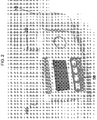
- the device 100 is provided in the form of a cassette 10.
- the cassette 10 has a cassette housing 11 and a fluid reservoir 12 defined within the cassette housing 11.
- the cassette housing 11 can include a cassette base region 83 to join with the pump mechanism 30 having a pump housing 31, as discussed further herein.
- the device can also include a delivery tube 20, as discussed further herein.
- the delivery tube 20 can have a first portion 21 disposed within the cassette housing 11 and second portion 22 disposed outside the cassette housing 11.
- the housing 11 is a rigid member.
- the housing itself can be in the form of a flexible pouch or the like to define the fluid reservoir 12.
- the fluid reservoir 12 can be defined by the interior surface of the cassette housing 11. Alternatively, as depicted here, the fluid reservoir 12 can be defined by a separate member disposed inside the cassette housing 11.
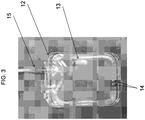
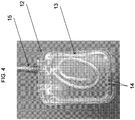
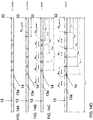
- the fluid reservoir 12 shown in the various embodiments of FIGS. 3 , 4 , and 5A-C , respectively, for the purpose of illustration and not limitation, can be configured as a flexible pouch.
- the fluid reservoir 12 of each embodiment can also have a textured inner surface as described further below.
- Opposing sides of the pouch can be secured about a perimeter (such as denoted by "Perimeter B" in FIG. 5A ) to form the fluid reservoir 12, for example by thermal or radio frequency (RF) welding or the like.
- RF radio frequency
- the fluid reservoir 12 can have a "rounded square shape.” As shown for example in Figs. 3-5E , and as embodied herein, the fluid reservoir 12 can be generally square-shaped with rounded corners. The rounded corners can allow the bag to fit more easily into the cassette housing 11, allow the bag to fill more evenly with a fluid beneficial agent, and inhibit or prevent the fluid beneficial agent from becoming trapped or otherwise unable to be removed from the fluid reservoir during normal operation of the cassette and pump. Additionally or alternatively, ridges can be formed on the surface of the fluid reservoir 12. The ridges can allow the fluid beneficial agent to be more easily drawn into the tube.
- the fluid reservoir 12 can be formed from a flexible material having low oxygen permeability.
- the fluid reservoir 12 can be made of EVA/EVOH/EVA, TOTM Plasticized PVC, combinations thereof, or other suitable materials, and as embodied herein, can be made of Renolit Solmed® Medipak UVO 9002.
- the fluid reservoir 12 can have a thickness of about 12 mil.
- the fluid reservoir 12 can be formed using an adhesive, by RF welding, or any other suitable technique.
- a dip tube 13 is disposed inside the fluid reservoir 12.
- the dip tube 13 includes a tubular wall 13a defining a flow lumen.
- the tubular wall 13a of the dip tube 13 disclosed herein can have at least one aperture 14 defined therein and be spaced proximally from a distal end of the tubular wall 13a.
- the aperture 14 is in fluid communication with the reservoir 12 to receive a beneficial agent contained within the reservoir 12.
- the inner surface of the fluid reservoir 12 can have a textured, ribbed or grooved configuration to further enhance fluid flow by preventing unintended occlusion of the apertures 14.
- fluid reservoir 12 can include a plurality of horizontal grooves formed therein, as shown in FIG. 5D .
- dip tube 13 can include a plurality of apertures 14, as shown for example in FIG. 5A .
- the plurality of apertures 14 each can be the same or similar size with the same or similar spacing therebetween.
- the plurality of apertures can be configured to provide generally uniform flow distribution through the apertures along a length of the tubular wall of the dip tube.
- the plurality of apertures 14 can have different sizes and/or have uneven distribution along the length of the dip tube 13.
- apertures can be formed by machining, laser perforation or any other suitable techniques.
- the dip tube is configured to bridge or otherwise extend at least through the area expected to have the highest concentration of beneficial agent within the fluid reservoir.
- the dip tube 13 can be arranged in any of a number of suitable configurations within the fluid reservoir 12.
- the dip tube 13 can extend along the perimeter of the fluid reservoir 12.
- the dip tube 13 can be coiled within a central region of the fluid reservoir 12, as depicted in FIG. 4 .
- the dip tube 13 can form a serpentine configuration within all or a portion of the fluid reservoir 12.
- FIG. 3 the dip tube 13 can be arranged in any of a number of suitable configurations within the fluid reservoir 12.
- the dip tube 13 can extend along the perimeter of the fluid reservoir 12.
- the dip tube 13 can be coiled within a central region of the fluid reservoir 12, as depicted in FIG. 4 .
- the dip tube 13 can form a serpentine configuration within all or a portion of the fluid reservoir 12.
- FIG. 1 as shown in FIG.
- the dip tube 13 can extend diagonally across the fluid reservoir 12 from one extreme end or corner to another.
- the dip tube 13 can extend diagonally across the fluid reservoir 12 from one extreme end or corner to another, and having a bend to define an arcuate shape therebetween.
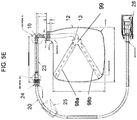
- the dip tube 13 can extend to a junction 99 disposed within the reservoir 12 with dip tube sections 98a, 98b extending from the junction 99.
- dip tube 13 can be free of apertures between the outlet end 33 and the junction 99.
- dip tube 13 can include one or more apertures between the outlet end 33 and the junction 99 in any configuration described herein.
- Sections 98a, 98b can extend from the junction 99, for example and as embodied herein, with a first section 98a extending toward an upper region of the reservoir 12 and a second section 98b extending toward a lower region of the reservoir 12 relative the outlet.
- sections 98a, 98b each can include one or more apertures in any configuration described herein.
- sections 98a, 98b can include similar aperture configurations.
- sections 98a, 98b each can include varied aperture configurations.
- the upper and lower regions can have different concentrations of a beneficial agent, and as such, having a dip tube 13 with sections 98a, 98b disposed in the upper and lower regions can be configured to allow different concentrations of a beneficial agent to be drawn from the reservoir through the different apertures 14 at substantially the same time for an overall more uniform concentration of beneficial agent delivered from the device during the delivery process.
- the perforated dip tube 13 of each embodiment according to the disclosed subject matter allows fluid to be drawn from the fluid reservoir 12 regardless of the orientation of the reservoir 12.
- the dip tube 13 can be disposed generally along the perimeter of the reservoir 12, which can include placing the dip tube 13 proximate the "corners" of the reservoir 12, if provided.
- the dip tube 13 can have one or more portions disposed proximate the center of the reservoir 12. In this manner, if liquid becomes trapped in the center of the reservoir 12, for example if the reservoir 12 becomes oriented horizontally, the dip tube 13 can receive the fluid from the center of the reservoir 12.
- the dip tube 13 embodied herein for use within a fluid reservoir as shown can be configured using SUNLITE VYSUN 102-80-26 (Non-DEHP PVC) tube material, resin material such as Dupont Elvax 3182-2 EVA or silicone tube material, for example Saint-Gobain's Biosil Precision silicone tubing.
- the dip tube 13 can have a length of approximately 105 mm, and the tubular wall 13a can have a plurality of approximately 2 mm diameter apertures (denoted as "Holes C" in FIG.
- apertures C can be disposed along the tubular wall 13a of the dip tube 13 starting from a location 8.5 mm from the tube interior or distal end (denoted as "End A1" in FIG. 5A ).
- the distal end of the dip tube 13 can have any suitable size or shape.
- the distal end of the dip tube 13 can be closed to ensure all fluid flow is through the apertures 14.
- the distal end of the dip tube 13 can be flattened, tapered, or flared.
- each aperture C can be spaced apart 8 mm along the length of the tubular wall 13a of dip tube 13 and rotated 90 degrees about the tubular wall 13a of dip tube 13 relative to adjacent apertures C.
- Representative dimensions of exemplary fluid reservoir and dip tube assemblies are set forth below.
- FIG.5A Exemplary Dimensions (mm) W 1,1 58 W 1,2 7.165 W 1,3 1.6 W 1,4 80.2 h 1,1 74.2 h 1,2 1.5 h 1,3 4.78 h 1,4 9.9 h 1,5 12
- FIG.5A Exemplary Dimensions (mm) W 1,1 58 W 1,2 7.165 W 1,3 1.6 W 1,4 80.2 h 1,1 74.2 h 1,2 1.5 h 1,3 4.78 h 1,4 9.9 h 1,5 12
- FIG.5A Exemplary Dimensions (mm) W 1,1 58 W 1,2 7.165 W 1,3 1.6 W 1,4 80.2 h 1,1 74.2 h 1,2 1.5 h 1,3 4.78 h 1,4 9.9 h 1,5 12
- FIG.5A Exemplary
- FIG. 5B & 5E Exemplary Dimensions (mm) W 2,1 63.34 ⁇ 1.60 W 2,2 5.6 ⁇ 0.4 W 2,3 0.8 ⁇ 0.4 W 2,4 74.6 h 2,1 70.6 h 2,2 1.5 h 2,3 4.8 h 2,4 11.9 h 2,5 14
- FIG. 5C Exemplary Dimensions (mm) W 3,1 4.6 W 3,2 5.6 W 3,3 0.8 W 3,4 74.6 h 3,1 70.6 h 3,2 4.8 h 3,3 11.9
- the dip tube 13 can have an inside diameter of 3 mm and an outside diameter of 4.6 mm. In some embodiments, the dip tube 13 can have a thickness of at least about 1.5 mm; in some embodiments, the dip tube 13 can have a thickness of at least about 1.6 mm. As shown for example in FIG. 5A , the dip tube 13 can be disposed diagonally across the interior of the fluid reservoir 12 (i.e., bisecting fluid reservoir 12). In accordance with yet another embodiment, as shown in FIG. 5B , the dip tube 14, can extend diagonally across the fluid reservoir 12 from one corner or end to another, having a bend to define an arcuate shape therebetween.
- the dip tube 13 can be joined to the reservoir 12 at a reservoir entry port (denoted as "End A2" in FIG. 5A ) as well as at the opposing end of the tube A1 inside the reservoir 12. As such, the dip tube 13 can be inhibited or prevented from movement within the reservoir 12.
- the dip tube 13 can extend from the fluid reservoir 12 to serve as a delivery tube if desired or appropriate.
- an adaptor disposed external to the cassette housing 11 can be provided and coupled to a proximal end of the dip tube 13.
- a separate delivery tube can be coupled to the adaptor for delivery of the beneficial agent from the fluid reservoir 12 to the user due to operation of the pump 30.
- a peristaltic tube can be provided between or as a part of the dip tube 13 and/or the delivery tube for interaction with the pump 30.
- the fluid reservoir 12 includes an adaptor 15 disposed external to the cassette housing 11.
- the adaptor 15 of FIG. 5 is coupled to a proximal end of the dip tube 13.
- a polypropylene-barbed elbow fitting 16 is provided at the proximal end of the dip tube 13.
- the elbow fitting 16 can be adhered to the exterior end of the dip tube 13 and oriented in plane with the fluid reservoir 12.
- a peristaltic tube 23 can be installed or coupled to an opposing end of the elbow fitting 16.
- the peristaltic tube 23 can be formed from a section of Saint Gobain Biosil Precision PCS-Silicone tubing material.
- the peristaltic tube 23 can have an inside diameter of 1.6 mm and an outside diameter of 4.8 mm.
- a junction fitting 24 is joined to the peristaltic tube 23, and a delivery tube 20 can be adhered into the junction fitting 24.
- the delivery tube 20 can be fluidly coupled with the fluid reservoir 12.
- the delivery tube 20 can be formed from any suitable polymeric material or combination of materials, and as embodied herein, with an inner diameter of Dupont Elvax 3182-2 EVA and an outer diameter Colorite 8088G-015 Non-DEHP PVC.
- a device having a fluid reservoir 12 and dip tube 13 as disclosed in FIGS. 5A-5B thus ensures delivery of a significant portion of beneficial agent regardless of the orientation of the fluid reservoir 12. Additionally, the use of a plurality of apertures reduces the risk associated with one or more apertures becoming occluded during delivery.
- the plurality of apertures can be configured to provide a generally uniform distribution of flow through the plurality of apertures along the length of the tubular member. For example, apertures 14 disposed closer to the reservoir 12 outlet, where vacuum pressure is greatest, can be reduced in size, can be removed, and/or can be spaced further away from the outlet.
- a number of apertures 14 spaced closer to the reservoir 12 outlet can be reduced. Additionally or alternatively, apertures 14 spaced further away from the reservoir 12 outlet can be increased in size. As a further alternative, the shape of some or all of the apertures 14 along the length of the tube can be modified, for example to have a slotted shape.
- the spacing between adjacent apertures can be varied along the length of the tubular wall.
- the plurality of apertures decrease in spacing toward the distal end of the tubular wall.
- the plurality of apertures can increase in spacing toward the distal end of the tubular wall.
- the plurality of apertures can vary in cross dimension along the length of the tubular wall.
- the size of apertures 14 can increase along the length of the dip tube 13 from the reservoir 12 outlet toward the end of the dip tube.
- dip tube 13 can have apertures 12 varying in size along the length of the dip tube, spaced apart from the outlet end 33 of the dip tube 13 by varying distances along the length of the tubular wall 13a of the dip tube 13, and rotated varying degrees about the tubular wall 13a of the dip tube 13.
- Increasing the size of apertures 14 along the length of the dip tube 13 from the outlet end 33 toward the distal end of the dip tube 13 can compensate for the decreasing vacuum pressure. For example, increasing the size of apertures 14 the length of the dip tube 13 can result in a more uniform uptake of fluid along the dip tube 13.
- Table 1 illustrates an exemplary dip tube aperture configuration.
- hole number or hole location refers to an axial distance from the outlet end 33 of the dip tube 13, with the distance increasing as the hole number or location number increases.
- hole number or location number 1 corresponds to an axial distance 18.18 mm from the outlet end 33 of the dip tube 13, and each successive hole number represents a distance of about an additional 8 mm from the outlet end 33 of the dip tube 13.
- a fractional hole number or location number represents a fraction of the 8 mm spacing.
- Table 2 illustrates another exemplary dip tube aperture configuration. As shown, no apertures were formed in the first two hole locations (e.g., spaced about 18.18 mm and 26.18 mm from the outlet end 33). As such, the first aperture was formed in hole location 3, spaced about 34.18 mm from the outlet end 33, which is about 20% of the length of the dip tube 13. Apertures were formed at 9 axial locations along the dip tube 13 and have a uniform diameter. For purpose of comparison and confirmation of the disclosed subject matter, as illustrated in Table 3, flow uniformity is improved over dip tube configurations having constant diameter apertures, uniform spacing, and apertures formed closer to the outlet end 33 of the dip tube 13. In this configuration, the initial aperture can be located in a region of relatively low concentration gradient, which can provide more uniform concentration of beneficial agent delivered during the delivery process.
- a representative formulation having a high viscosity and varied concentration was produced for purpose of illustration.
- the representative formulation was formed with Boron Nitride (BN) and a highly viscous gel, as embodied herein at a ratio of 6.77%(w/w) of Boron Nitride to the gel.
- the composition of the representative formulation is shown in Table A.
- Table A -- Representative Formulation Composition Ingredient Lot # (Vendor) Percent Weight Theoretical Weight (g) Actual Weight (g) Boron Nitride Powder 3-5048-00-21 (ZYP Coatings) 6.77 241.4 241.6 NaCMC 2000 2C1550NEFC (Bio ground) 1.58 56.21 56.5 NaCMC 700 212250NEFA (Bio ground) 1.29 45.99 46.1 DI Water N/A 90.37 3222.8 3221.4 Total 100 3566.4 3565.6
- Sample fluid reservoirs for example as illustrated in FIG. 5A and 5D , were filled with 50 mL of the representative formulation and assembled into a drug delivery reservoir.
- the drug delivery reservoirs were installed on a centrifuge, which was operated for a duration of 66 hours to accelerate the BN within the gel to produce a varied concentration of BN throughout the gel.
- the operating conditions of the centrifuge are shown in Table B.
- Table B Centrifuge Operating Conditions Radius (in) Radius (m) Frequency (Hz) Speed (RPM) Speed (rad/s) Acceleration (m/s ⁇ 2) Relative centrifugal force (G's) 36.5 0.93 2.04 122.4 12.82 152.32 15.53
- the drug delivery reservoirs were mounted at a 3 foot radius to reduce or minimize differences in acceleration within the drug delivery reservoir.
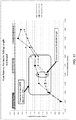
- a varied concentration of the representative formulation throughout the reservoir was produced, as shown for example in FIG. 23 .
- the concentration of the representative formulation after being accelerated for 66 hours is illustrated along the vertical broken line.
- Each section of the fluid reservoir in the diagram represents one-tenth of the volume of the reservoir from a top section of the reservoir to a bottom section of the reservoir.
- the top section of the fluid reservoir has about 65-70% of the concentration of BN compared to the bottom section.
- FIG. 19 is a diagram illustrating exemplary nominal concentration per dispensed volume for drug delivery reservoirs using a dip tube having a constant hole size and spacing (referred to herein as "Hybrid 1" or “Baseline”) compared to drug delivery reservoirs using no dip tube.
- the representative formulation with varied concentration as discussed above with respect to FIG. 23 was utilized, and the fluid was dispensed from the reservoir at a rate of 1 mL/min.
- the drug delivery reservoir using a dip tube having constant hole spacing can draw from the top of the bag initially, and then progressively down into the bag as the bag empties and collapses.
- fluid draw can be a function of the bag collapse pattern.
- the results of the concentration dispensed over the volume for the Hybrid 1 establish a baseline for purpose of comparison with modified aperture configurations discussed herein.
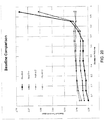
- FIG. 20 is a diagram illustrating exemplary nominal concentration per dispensed volume for cassettes using a dip tube having a uniform hole size and spacing (Baseline) compared to cassettes using a dip tube having an aperture configuration described in Table 2 (Hybrid 2).
- the representative formulation with varied concentration as discussed above with respect to FIG. 23 was utilized, and the fluid was dispensed from the reservoir at a rate of 1 mL/min.
- the aperture configuration of Table 2 provides a relatively consistent fluid concentration of the representative formulation over the entire dispensing volume compared to the Baseline.
- Table 3 illustrates another exemplary dip tube aperture configuration. Compared to the configuration of Table 1, an additional aperture is added toward the distal end of the dip tube 13, opposite the outlet end 33.
- Table 3 illustrates another exemplary dip tube aperture configuration. Compared to the configuration of Table 1, an additional aperture is added toward the distal end of the dip tube 13, opposite the outlet end 33.
- the % flow indicates a percentage of fluid taken into the dip tube 13 through the aperture or apertures 14 formed at the corresponding hole location during the flow period.
- flow uniformity is improved over dip tube configurations having constant diameter apertures and uniform spacing. As such, when used with a product having variable concentration, the increased flow uniformity can reduce variations in concentration by drawing fluid at different rates from different locations.
- Table 4 illustrates another exemplary dip tube aperture configuration. As shown, relatively smaller apertures were formed in the first 3 hole locations, and larger apertures were formed in 9 subsequent hole locations. For purpose of comparison and confirmation of the disclosed subject matter, as illustrated in Table 4, flow uniformity is improved for the representative formulation over dip tube configurations having constant diameter apertures and uniform spacing.
- Table 5-1 illustrates another exemplary dip tube aperture configuration. As shown, no aperture was formed in hole location 1, and a non-uniform aperture spacing is used. In hole positions 2.0, 2.9, 3.8 and 4.8, a single hole is formed in the dip tube at the corresponding axial distance. In the subsequent hole positions, two holes were formed in the dip tube at the corresponding axial distance, for example, by forming a through-hole. Table 5-2 and FIG. 14 illustrates another exemplary dip tube aperture configuration. As shown, no aperture was formed in hole location 1, and a non-uniform aperture spacing is used. In hole positions 2.0, 2.9 and 3.8, a single hole is formed in the dip tube at the corresponding axial distance.
- Table 5-2 Exemplary Dip Tube Aperture Configuration and Flow Hole Axial Location Hole Diameter Flown Rate Position Axial Dimension (mm) mm inch m ⁇ 3/s ml/hr % flow 1 18.18 None 2 26.2 (x 2,1 ) 0.84 ( ⁇ 2,1 ) 0.033 single hole 2.22E-09 8.00E+00 20% 2.9 33.6 (x 2,2 ) 0.84( ⁇ 2,2 ) 0.033 single hole 1.48E-09 5.33E+00 13% 3.8 40.5 (x 2,3 ) 0.84( ⁇ 2,3 ) 0.033 single hole 9.99E-10 3.60E+00 9% 4.8 48.4 (x 2,4 ) 0.84 ( ⁇ 2,4 ) 0.033 two holes 1.23E-09 4.42E+00 11% 5.6 55.1 (x 2,5 ) 0.84( ⁇ 2,5 ) 0.033 two holes 7.58E-10 2.73E+00 7% 6.7 63.5 (x 2,6 ) 1.25 ( ⁇ 2,6 )
- Table 6 illustrates the exemplary dip tube aperture configuration of FIGS. 13A-13C . As shown, no aperture was formed in hole location 1, and a non-uniform aperture spacing is used. For purpose of comparison and confirmation of the disclosed subject matter, as illustrated in Table 6, flow uniformity is improved over known dip tube configurations having constant diameter apertures, uniform spacing, and apertures formed closer to the outlet end 33 of the dip tube 13.
- FIG. 21 is a diagram illustrating exemplary nominal concentration per dispensed volume for drug delivery reservoirs using a dip tube having a uniform hole size and spacing (Baseline) compared to drug delivery reservoirs using a dip tube having an aperture configuration described in Table 6 (Config 4). The representative formulation with varied concentration as discussed above with respect to FIG.
- the fluid was dispensed from the reservoir at a rate of 1 mL/min.
- the dispensed concentration was substantially uniform over the entire displacement from the bag, and thus provides about a nine-fold improvement in dose accuracy compared to the uniform hole dip tube for the representative formulation.
- Table 6 Exemplary Dip Tube Aperture Configuration and Flow Hole Axial Location Hole Diameter Concentration Sampled Position Axial Dimension (mm) mm inch % flow % Remaining Concentration 1 18.18 None 90% 0.00% 2 26.2 (x 1,1 ) 0.51 ( ⁇ 1,1 ) 0.02 four holes 13% 90% 11.30% 2.9 33.6 (x 1,2 0.51 ( ⁇ 1,2 ) 0.02 four holes 8% 95% 7.80% 3.8 40.5 (x 1,3 ) 0.84( ⁇ 1,3 ) 0.033 two holes 19% 99% 18.40% 4.8 48.4 (x 1,4 ) 0.84( ⁇ 1,4 ) 0.033 two holes 11% 100% 11.20% 5.6 55.1 (x 1,5 ) 0.84 ( ⁇ 1,5 ) 0.033 three holes 10% 100% 10.10% 6.7 63.5 (x 1,6 ) 1.24 ( ⁇ 1,6 ) 0.049 two holes 15% 100% 14.60% 7.5 70.1(x 1,7 ) 1.24 ( ⁇ 1,7 ) 0.049 two holes
- Table 7 and FIG. 15 illustrate another exemplary dip tube aperture configuration.
- FIG. 15 shows the exemplary dip tube 13 in a flattened configuration, for purpose of illustration of the configuration of apertures 14 of the dip tube 13.
- a slotted aperture configuration is used in the configuration of Table 7 and FIG. 15 .
- no aperture is formed in hole location 1, and a non-uniform slot length is used.
- flow uniformity is improved over known dip tube configurations having constant diameter apertures, uniform spacing, and apertures formed closer to the outlet end 33 of the dip tube 13.
- FIG. 15 shows the exemplary dip tube 13 in a flattened configuration, for purpose of illustration of the configuration of apertures 14 of the dip tube 13.
- a slotted aperture configuration is used in the configuration of Table 7 and FIG. 15 .
- no aperture is formed in hole location 1
- a non-uniform slot length is used for purpose of comparison and confirmation of the disclosed subject matter, as illustrated in Table 7, flow uniformity is improved over known dip tube configurations having constant diameter apertures, uniform spacing, and apertures
- FIG. 22 is a diagram illustrating exemplary nominal concentration per dispensed volume for cassettes using a dip tube having a uniform hole size and spacing (Hybrid 1) compared to drug delivery reservoirs using a dip tube having an aperture configuration described in Table 7 (Config 5).
- the representative formulation with varied concentration as discussed above with respect to FIG. 23 was utilized, and the fluid was dispensed from the reservoir at a rate of 1 mL/min.
- the configuration of Table 7 provides about a 50% improvement in dose accuracy versus the uniform hole dip tube for the representative formulation. Additionally, the configuration of Table 7 can reduce or minimize the effects of manufacturing tolerances by providing a substantially uniform slit width.
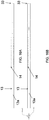
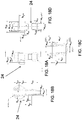
- FIG. 16A illustrate another exemplary dip tube aperture configuration.
- FIG. 16B shows the exemplary dip tube 13 rotated 90 degrees with respect to FIG. 16A .
- FIG. 16C shows the exemplary dip tube 13 joined to an exemplary peristaltic tube.
- FIG. 16D shows the exemplary dip tube 13 in a flattened configuration, for purpose of illustration of the configuration of apertures 14 of the dip tube 13.
- each aperture has the same diameter. Additionally, no aperture is formed in hole location 1. Flow distribution can be adjusted by the number of holes at each location and the spacing between holes.
- Table 8 Exemplary Dip Tube Aperture Configuration and Flow Hole Axial Hole Diameter Flow Rate Concentration Sampled Dimension mm inch No: of holes m ⁇ 3/2 ml/hr % Remaining ' Concentration 26.2 (x 3,1 ) 0.86 0.0339 1( ⁇ 3,1 ) 2.04E-09 7.33E+00 90 % 16.50% 31.2 (x 3,2 ) 0.86 0.0339 1( ⁇ 3,4 ) 1.53E-09 5.51E+00 95% 13.10% 40.5 (x 3,3 ) 0.86 0.0339 2( ⁇ 3,2 , ⁇ 3,6 ) 1.75E-09 6.29E+00 99% 15.60% 48.4 (x 3,4 ) 0.86 0.0339 2( ⁇ 3,1 , ⁇ 3,4 ) 1.
- the plurality of apertures can be configured to provide a generally uniform distribution of flow through the plurality of apertures along the length of the tubular member.
- the plurality of apertures can vary in spacing between adjacent apertures along the length of the tubular wall.
- the plurality of apertures can decrease in spacing toward the distal end of the tubular wall.
- the plurality of apertures can vary in cross dimension along the length of the tubular wall.
- the plurality of apertures can increase in cross dimension along the length of the tubular wall.
- the plurality of apertures can have one or more shapes, for example and without limitation, a slotted shape, a circular shape, and/or any other suitable shape.
- one of the plurality of apertures nearest the outlet end can be spaced from the outlet end a distance of at least 15% of the length of the tubular wall, and as embodied herein, the one of the plurality of apertures nearest the outlet end can be spaced from the outlet a distance of about 20% of the length of the tubular wall.
- a fluid beneficial agent in the reservoir can have a volume and a concentration increasing from a region proximate the outlet end to a region proximate the distal end, and as embodied herein, the dip tube can be configured to deliver the volume of the fluid beneficial agent at a substantially uniform concentration.
- flow accuracy of the peristaltic pump can be improved by controlling the tension of the peristaltic tube 23.
- the tube tension fit can be achieved by controlling the length and diameter of the peristaltic tube 23 to achieve a desired tension. That is, reducing the length of the peristaltic tube 23 increases tension and reduces the overall flow rate. Increasing the length of the peristaltic tube 23 reduces tension and can cause buckling in the peristaltic tube 23 and create issues with installation and repeatability.
- FIG. 17 is a diagram illustrating the accumulated flow rate (mL/hr) plotted against fitting-to fitting length (in.) for a section of peristaltic tubing with a nominal length of 2.275" stretched or relaxed by +/1 1/8" in 1/32" steps. The tests were run with 3 samples of each tubing length, sweeping test runs from low length to high length, then back from high to low, to randomize runs and allow for data on all lengths.
- FIG. 16 shows that as tension was increased, the flow rate decreased. In contrast, as slacking/buckling increased, flow rate increased. Furthermore, FIG.
- 17 illustrates that for a peristaltic tube having a nominal length of 2.275" and stretched about a 1/32" there is a tolerance window of +/- 1/16" such that the flow rate will remain between about 91 ml/hr and 96 ml/hr.
- peristaltic tube 23 can be stretched at least about 0.782 mm (0.031 in). The specific length can be held in place by the cassette housing 11, along with elbow fitting 16 and junction fitting 24. Controlling the tension of the peristaltic tube 23 can allow for increased pump flow accuracy and repeatability.
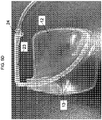
- FIG. 18 illustrates an exemplary junction fitting 24.
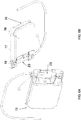
- a tubing clamp 25 (illustrated in FIG. 5B ) can be connected to the delivery tube 20 to allow a user to align and secure the tubing at a desired orientation and position.
- a connection sub-assembly 26 (illustrated in FIG. 5B ) can be provided on the end of delivery tube 20 to allow the tubing and reservoir to be joined to a pump device. Representative dimensions of an exemplary junction fitting, for purpose of illustration and not limitation, are set forth below. FIG.
- the fluid reservoir 12 can be installed into the cassette housing 11.
- the cassette housing 11 can be configured with two enclosure clamshell portions 17 and 18 (as shown for example in FIG. 6B ), which can receive and contain the fluid reservoir 12.
- the two clamshell portions 17 and 18 can be adhered or otherwise joined together, for example by ultrasonic welding.
- the peristaltic tube portion 23 can be received by a RFID enclosure shell 19 on one side of the cassette housing 11 and by a frictional engagement (for example as denoted by "D" in FIG. 6A ) or other receiving feature on an opposing side of the cassette housing 11.
- the peristaltic tube 23 can be suspended within the housing 11, which can allow for increased shape or dimensional control of the peristaltic tube 23 inside the pump mechanism, and can reduce the profile of the peristaltic tube 23 within the cassette housing 11.
- the cassette 10 disclosed herein can be used with a variety of pumps or similar fluid delivery devices.
- the pump 30 can include a pump housing 31.
- the pump housing 31 can include a pump assembly having a fluid drive component.
- the pump assembly can be configured, for example, as a peristaltic pump.
- a peristaltic pump can include, a motor, a cam shaft, and a plurality of finger plates disposed along the length of the cam shaft.
- the cam shaft can be coupled to the motor for rotation about a longitudinal axis of the cam shaft, and can have at least one radially-outward projection defining a helical engagement portion disposed along a length of the cam shaft.
- the plurality of finger plates can be disposed along the length of the cam shaft. Each finger plate can be mounted for movement in a transverse direction relative to the longitudinal axis of the cam shaft, and can have an aperture defined therein to receive the cam shaft therethrough.
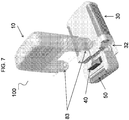
- the pump housing 31 can have a receiving region 32 (for example as shown in FIG. 7 ) to receive the cassette base region 83.
- the fluid drive component can be disposed proximate the receiving region.
- the cassette 10 can be joined to the receiving region 32 of the pump 30 with the delivery tube or peristaltic tube, if provided, in alignment with the fluid drive component of the pump 30.
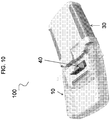
- the cassette 10 can be received by the pump housing 31 at a 90 degree angle (as shown for example in FIGS. 7-8 ) and rotated 90 degrees relative the pump housing 31 into an orientation generally parallel with the pump housing 31 (as shown for example in FIGS. 9-11 ).
- the cassette 10 can be rotated into engagement with a spring loaded clip 50 (shown in FIG. 11 ), to thereby retain the cassette 10 within the housing 31. Furthermore, and as embodied herein, the clip 50 can be retracted to disengage the cassette 10 from the housing 31.
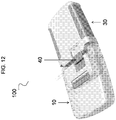
- the device 100 can include a latch 40 coupled to the pump housing 31 and movable between an open position and a closed position.
- FIG. 7 shows an exploded view of the cassette 10 and pump 30 separated.
- FIGS. 8-11 each sequentially shows the cassette 10 and pump being joined, with latch 40 in the open position.
- FIG. 12 shows the latch 40 moved to the closed position.
- the cassette 10 can be inserted into and removed from the receiving region 32 when the latch 40 is in the open position.
- the latch 40 is in the closed position, the cassette 10 can be secured to the pump 30 with the cassette base region 83 disposed within the receiving region.
- the delivery tube and/or peristaltic tube can be in operative engagement with the fluid drive component along the length of the delivery tube.
- the latch 40 can be configured, for example and as embodied herein, as a spring latch.
- the latch 40 can be disposed within a recess of the pump body 31, and as such, when the latch 40 is in the closed position, the latch 40 can be substantially flush with the pump body 31.
Landscapes
- Health & Medical Sciences (AREA)
- Vascular Medicine (AREA)
- Engineering & Computer Science (AREA)
- Anesthesiology (AREA)
- Biomedical Technology (AREA)
- Heart & Thoracic Surgery (AREA)
- Hematology (AREA)
- Life Sciences & Earth Sciences (AREA)
- Animal Behavior & Ethology (AREA)
- General Health & Medical Sciences (AREA)
- Public Health (AREA)
- Veterinary Medicine (AREA)
- Infusion, Injection, And Reservoir Apparatuses (AREA)
- Medical Preparation Storing Or Oral Administration Devices (AREA)
Applications Claiming Priority (3)
| Application Number | Priority Date | Filing Date | Title |
|---|---|---|---|
| US201462054146P | 2014-09-23 | 2014-09-23 | |
| PCT/US2015/051777 WO2016049224A1 (en) | 2014-09-23 | 2015-09-23 | Devices and methods for delivering a beneficial agent to a user |
| EP15775882.2A EP3197523A1 (en) | 2014-09-23 | 2015-09-23 | Devices and methods for delivering a beneficial agent to a user |
Related Parent Applications (1)
| Application Number | Title | Priority Date | Filing Date |
|---|---|---|---|
| EP15775882.2A Division EP3197523A1 (en) | 2014-09-23 | 2015-09-23 | Devices and methods for delivering a beneficial agent to a user |
Publications (1)
| Publication Number | Publication Date |
|---|---|
| EP3875128A1 true EP3875128A1 (en) | 2021-09-08 |
Family
ID=54261109
Family Applications (2)
| Application Number | Title | Priority Date | Filing Date |
|---|---|---|---|
| EP21170272.5A Withdrawn EP3875128A1 (en) | 2014-09-23 | 2015-09-23 | Devices a for delivering a beneficial agent to a user |
| EP15775882.2A Withdrawn EP3197523A1 (en) | 2014-09-23 | 2015-09-23 | Devices and methods for delivering a beneficial agent to a user |
Family Applications After (1)
| Application Number | Title | Priority Date | Filing Date |
|---|---|---|---|
| EP15775882.2A Withdrawn EP3197523A1 (en) | 2014-09-23 | 2015-09-23 | Devices and methods for delivering a beneficial agent to a user |
Country Status (5)
| Country | Link |
|---|---|
| US (4) | US20160082184A1 (enExample) |
| EP (2) | EP3875128A1 (enExample) |
| JP (1) | JP6805151B2 (enExample) |
| CA (1) | CA2961023A1 (enExample) |
| WO (1) | WO2016049224A1 (enExample) |
Families Citing this family (25)
| Publication number | Priority date | Publication date | Assignee | Title |
|---|---|---|---|---|
| USD762850S1 (en) | 2013-04-23 | 2016-08-02 | Covidien Lp | Cassette |
| TR201907037T4 (tr) * | 2015-01-16 | 2019-06-21 | Sanofi Aventis Deutschland | Bir sıvı ilaç maddesine yönelik konteyner. |
| USD843563S1 (en) * | 2015-06-22 | 2019-03-19 | Novartis Ag | Injector and insert for an injector |
| US10576207B2 (en) | 2015-10-09 | 2020-03-03 | West Pharma. Services IL, Ltd. | Angled syringe patch injector |
| US11311674B2 (en) | 2016-01-21 | 2022-04-26 | West Pharma. Services IL, Ltd. | Medicament delivery device comprising a visual indicator |
| USD805190S1 (en) * | 2016-09-26 | 2017-12-12 | West Pharmaceutical Services, Inc. | Injector device |
| USD805187S1 (en) * | 2016-09-26 | 2017-12-12 | West Pharmaceutical Services, Inc. | Injector device |
| USD804019S1 (en) * | 2016-09-26 | 2017-11-28 | West Pharmaceutical Services, Inc. | Injector device |
| USD805186S1 (en) * | 2016-09-26 | 2017-12-12 | West Pharmaceutical Services, Inc. | Injector device |
| USD805188S1 (en) * | 2016-09-26 | 2017-12-12 | West Pharmaceutical Services, Inc. | Injector device |
| USD804650S1 (en) * | 2016-09-26 | 2017-12-05 | West Pharmaceutical Services, Inc. | Injector device |
| USD805189S1 (en) * | 2016-09-26 | 2017-12-12 | West Pharmaceutical Services, Inc. | Injector device |
| USD806235S1 (en) | 2016-10-26 | 2017-12-26 | West Pharmaceutical Services, Inc. | Injector device |
| USD806234S1 (en) | 2016-10-26 | 2017-12-26 | West Pharmaceutical Services, Inc. | Injector device |
| USD878557S1 (en) | 2016-10-26 | 2020-03-17 | West Pharmaceutical Services, Inc. | Injector device |
| USD808011S1 (en) | 2016-10-26 | 2018-01-16 | West Pharmaceutical Services, Inc. | Injector device |
| USD878556S1 (en) | 2016-10-26 | 2020-03-17 | West Pharmaceutical Services, Inc. | Injector device |
| USD806863S1 (en) | 2016-10-26 | 2018-01-02 | West Pharmaceutical Services, Inc. | Injector device |
| USD878555S1 (en) | 2016-10-26 | 2020-03-17 | West Pharmaceutical Services, Inc. | Injector device |
| USD882765S1 (en) | 2016-10-26 | 2020-04-28 | West Pharmaceutical Services, Inc. | Injector device |
| USD805633S1 (en) | 2016-10-26 | 2017-12-19 | West Pharmaceutical Services, Inc. | Injector device |
| USD805632S1 (en) | 2016-10-26 | 2017-12-19 | West Pharmaceutical Services, Inc. | Injector device |
| USD807499S1 (en) | 2016-10-26 | 2018-01-09 | West Pharmaceutical Services, Inc. | Injector device |
| USD948037S1 (en) * | 2019-11-15 | 2022-04-05 | Kpr U.S., Llc | Cassette |
| JP2025532169A (ja) * | 2022-09-23 | 2025-09-29 | ベクトン・ディキンソン・アンド・カンパニー | フレキシブルリザーババッグに一体化された耐自己シール要素及びその製造の方法 |
Citations (5)
| Publication number | Priority date | Publication date | Assignee | Title |
|---|---|---|---|---|
| US5538399A (en) * | 1993-10-28 | 1996-07-23 | Sims Deltec, Inc. | Reservoir enclosure methods |
| WO2004062711A2 (en) * | 2003-01-06 | 2004-07-29 | Glaxo Group Limited | Nasal pump spray dispenser |
| WO2009029010A1 (en) * | 2007-08-30 | 2009-03-05 | Carmel Pharma Ab | Device, sealing member and fluid container |
| DE102011088798A1 (de) * | 2011-07-21 | 2013-01-24 | Mtp Medical Technical Promotion Gmbh | Kanülen-Vorrichung zum Anschließen eines Spülschlauchs |
| WO2014164455A1 (en) * | 2013-03-13 | 2014-10-09 | Bayer Medical Care Inc. | Fluid efficient spike |
Family Cites Families (20)
| Publication number | Priority date | Publication date | Assignee | Title |
|---|---|---|---|---|
| US3257036A (en) * | 1963-05-06 | 1966-06-21 | Leeds | Pressure discharge container |
| US3490655A (en) * | 1966-08-17 | 1970-01-20 | Colgate Palmolive Co | Material blending silo |
| US4215689A (en) * | 1977-07-27 | 1980-08-05 | Koken Co., Ltd. | Injecting apparatus for medical liquid |
| JPS57117372U (enExample) * | 1981-01-14 | 1982-07-21 | ||
| US4530450A (en) * | 1983-02-07 | 1985-07-23 | American Cyanamid Co. | Aerosol dispensing system |
| US5143294A (en) * | 1991-04-08 | 1992-09-01 | Lintvedt Arnold M | Pliant container for storage of a liquid and liquid application therefrom |
| JPH07502239A (ja) * | 1991-12-18 | 1995-03-09 | ザ、プロクター、エンド、ギャンブル、カンパニー | 一体成形された大きな取り付け部分を持つ交換自在の内容器を備えたパッケージ |
| EP0687640B1 (de) * | 1994-06-15 | 2001-09-05 | Präzisions-Werkzeuge AG | Perforiertes Tauchrohr für doppelwandige Druckbehälter |
| JPH08133358A (ja) * | 1994-11-04 | 1996-05-28 | Masayuki Hayashi | 可変容量式スプレー容器 |
| US5573526A (en) * | 1995-05-08 | 1996-11-12 | Minntech Corporation | Soft shell reservoir |
| JP3565450B2 (ja) * | 1995-05-12 | 2004-09-15 | 株式会社吉野工業所 | 液体注出ポンプ |
| IT1294572B1 (it) * | 1997-06-05 | 1999-04-12 | Hydor Srl | Dispositivo filtrante per acquari, del tipo da appendere all'esterno dell'acquario e comunemente conosciuto come"power filter"o"hang on |
| US6337049B1 (en) * | 1998-08-28 | 2002-01-08 | Yehuda Tamari | Soft shell venous reservoir |
| JP2000118579A (ja) * | 1998-10-16 | 2000-04-25 | Kao Corp | 粉末吐出容器 |
| US6491463B1 (en) * | 2002-03-08 | 2002-12-10 | Patricia A. Richard | Fluid applicator system |
| US7395949B2 (en) * | 2005-01-27 | 2008-07-08 | Vincent Ehret | Volumetric displacement dispenser |
| US20090044397A1 (en) * | 2007-07-09 | 2009-02-19 | Cohen Ben Z | Ophthalmic pump assembly |
| US8651327B2 (en) * | 2011-02-09 | 2014-02-18 | Sartorius Stedim North America Inc. | Systems and methods for use in storing biopharmaceutical materials |
| CN104717992B (zh) * | 2012-10-12 | 2018-11-09 | 史密斯医疗Asd公司 | 药物或流体输送装置 |
| US20150001259A1 (en) * | 2013-06-28 | 2015-01-01 | John Nguyen | Apparatus for transferring a fluid to a dispensing mechanism |
-
2015
- 2015-09-23 WO PCT/US2015/051777 patent/WO2016049224A1/en not_active Ceased
- 2015-09-23 EP EP21170272.5A patent/EP3875128A1/en not_active Withdrawn
- 2015-09-23 CA CA2961023A patent/CA2961023A1/en not_active Abandoned
- 2015-09-23 US US14/863,312 patent/US20160082184A1/en not_active Abandoned
- 2015-09-23 JP JP2017535633A patent/JP6805151B2/ja not_active Expired - Fee Related
- 2015-09-23 EP EP15775882.2A patent/EP3197523A1/en not_active Withdrawn
-
2020
- 2020-03-12 US US16/816,458 patent/US20200276385A1/en not_active Abandoned
-
2023
- 2023-04-28 US US18/140,944 patent/US20230285667A1/en not_active Abandoned
-
2025
- 2025-07-25 US US19/281,047 patent/US20260007823A1/en active Pending
Patent Citations (5)
| Publication number | Priority date | Publication date | Assignee | Title |
|---|---|---|---|---|
| US5538399A (en) * | 1993-10-28 | 1996-07-23 | Sims Deltec, Inc. | Reservoir enclosure methods |
| WO2004062711A2 (en) * | 2003-01-06 | 2004-07-29 | Glaxo Group Limited | Nasal pump spray dispenser |
| WO2009029010A1 (en) * | 2007-08-30 | 2009-03-05 | Carmel Pharma Ab | Device, sealing member and fluid container |
| DE102011088798A1 (de) * | 2011-07-21 | 2013-01-24 | Mtp Medical Technical Promotion Gmbh | Kanülen-Vorrichung zum Anschließen eines Spülschlauchs |
| WO2014164455A1 (en) * | 2013-03-13 | 2014-10-09 | Bayer Medical Care Inc. | Fluid efficient spike |
Also Published As
| Publication number | Publication date |
|---|---|
| US20260007823A1 (en) | 2026-01-08 |
| EP3197523A1 (en) | 2017-08-02 |
| US20160082184A1 (en) | 2016-03-24 |
| US20200276385A1 (en) | 2020-09-03 |
| US20230285667A1 (en) | 2023-09-14 |
| JP6805151B2 (ja) | 2020-12-23 |
| CA2961023A1 (en) | 2016-03-31 |
| WO2016049224A1 (en) | 2016-03-31 |
| JP2017529219A (ja) | 2017-10-05 |
Similar Documents
| Publication | Publication Date | Title |
|---|---|---|
| US20230285667A1 (en) | Devices and methods for delivering a beneficial agent to a user | |
| US8734396B2 (en) | Flexible medicine reservoir with an internal reservoir port | |
| US10532835B2 (en) | Automated reservoir fill system | |
| EP0606450B1 (en) | Cannula for use in drug delivery systems | |
| CN102844073B (zh) | 一种药物输送连接器 | |
| CN108883230A (zh) | 便携式输注泵及与其使用的组件 | |
| WO2005016408A3 (en) | Multichannel fluid delivery device | |
| CN109310818B (zh) | 分配流体的装置 | |
| JP2012533405A (ja) | 薬剤容器ホルダー及びポンプアセンブリを備える薬剤投与システム | |
| US20170203029A1 (en) | Drug or fluid delivery devices | |
| CN106039461A (zh) | 注入针单元以及液体注入装置 | |
| CN219230995U (zh) | 药瓶适配器 | |
| EP3471797B1 (en) | Multi-use disposable system and syringe therefor | |
| US20160287781A1 (en) | Compact Intravenous Pump and Medication Container Holder | |
| CN205515569U (zh) | 配液泵用输送管及配液装置 | |
| US20230071053A1 (en) | Delivery device for delivering a drug | |
| CN115361928A (zh) | 用于耳蜗内药物输送的具有集成微型泵和药物储存器的手持工具 | |
| EP4299089A1 (en) | Needle assembly for an injection or infusion device | |
| US20240269381A1 (en) | Chain composition preparation apparatus and preparation method | |
| EP2436413A1 (en) | Syringe assembly | |
| CN116999674A (zh) | 输注系统和用于这样的输注系统的导管 | |
| JP2022548732A (ja) | 高精度に整合される免疫グロブリン輸液用システム及び方法 | |
| HK1187290B (en) | Container for storing medical or pharmaceutical liquids |
Legal Events
| Date | Code | Title | Description |
|---|---|---|---|
| PUAI | Public reference made under article 153(3) epc to a published international application that has entered the european phase |
Free format text: ORIGINAL CODE: 0009012 |
|
| STAA | Information on the status of an ep patent application or granted ep patent |
Free format text: STATUS: THE APPLICATION HAS BEEN PUBLISHED |
|
| AC | Divisional application: reference to earlier application |
Ref document number: 3197523 Country of ref document: EP Kind code of ref document: P |
|
| AK | Designated contracting states |
Kind code of ref document: A1 Designated state(s): AL AT BE BG CH CY CZ DE DK EE ES FI FR GB GR HR HU IE IS IT LI LT LU LV MC MK MT NL NO PL PT RO RS SE SI SK SM TR |
|
| STAA | Information on the status of an ep patent application or granted ep patent |
Free format text: STATUS: REQUEST FOR EXAMINATION WAS MADE |
|
| 17P | Request for examination filed |
Effective date: 20220308 |
|
| RBV | Designated contracting states (corrected) |
Designated state(s): AL AT BE BG CH CY CZ DE DK EE ES FI FR GB GR HR HU IE IS IT LI LT LU LV MC MK MT NL NO PL PT RO RS SE SI SK SM TR |
|
| STAA | Information on the status of an ep patent application or granted ep patent |
Free format text: STATUS: EXAMINATION IS IN PROGRESS |
|
| 17Q | First examination report despatched |
Effective date: 20230328 |
|
| P01 | Opt-out of the competence of the unified patent court (upc) registered |
Effective date: 20230331 |
|
| STAA | Information on the status of an ep patent application or granted ep patent |
Free format text: STATUS: THE APPLICATION IS DEEMED TO BE WITHDRAWN |
|
| 18D | Application deemed to be withdrawn |
Effective date: 20250401 |