EP3872829A1 - Gasschutzschalter - Google Patents
Gasschutzschalter Download PDFInfo
- Publication number
- EP3872829A1 EP3872829A1 EP19877047.1A EP19877047A EP3872829A1 EP 3872829 A1 EP3872829 A1 EP 3872829A1 EP 19877047 A EP19877047 A EP 19877047A EP 3872829 A1 EP3872829 A1 EP 3872829A1
- Authority
- EP
- European Patent Office
- Prior art keywords
- puffer chamber
- circuit breaker
- axis line
- gas circuit
- movable
- Prior art date
- Legal status (The legal status is an assumption and is not a legal conclusion. Google has not performed a legal analysis and makes no representation as to the accuracy of the status listed.)
- Granted
Links
Images




Classifications
-
- H—ELECTRICITY
- H01—ELECTRIC ELEMENTS
- H01H—ELECTRIC SWITCHES; RELAYS; SELECTORS; EMERGENCY PROTECTIVE DEVICES
- H01H33/00—High-tension or heavy-current switches with arc-extinguishing or arc-preventing means
- H01H33/70—Switches with separate means for directing, obtaining, or increasing flow of arc-extinguishing fluid
- H01H33/7015—Switches with separate means for directing, obtaining, or increasing flow of arc-extinguishing fluid characterised by flow directing elements associated with contacts
- H01H33/7023—Switches with separate means for directing, obtaining, or increasing flow of arc-extinguishing fluid characterised by flow directing elements associated with contacts characterised by an insulating tubular gas flow enhancing nozzle
-
- H—ELECTRICITY
- H01—ELECTRIC ELEMENTS
- H01H—ELECTRIC SWITCHES; RELAYS; SELECTORS; EMERGENCY PROTECTIVE DEVICES
- H01H33/00—High-tension or heavy-current switches with arc-extinguishing or arc-preventing means
- H01H33/70—Switches with separate means for directing, obtaining, or increasing flow of arc-extinguishing fluid
- H01H33/7015—Switches with separate means for directing, obtaining, or increasing flow of arc-extinguishing fluid characterised by flow directing elements associated with contacts
- H01H33/7023—Switches with separate means for directing, obtaining, or increasing flow of arc-extinguishing fluid characterised by flow directing elements associated with contacts characterised by an insulating tubular gas flow enhancing nozzle
- H01H33/703—Switches with separate means for directing, obtaining, or increasing flow of arc-extinguishing fluid characterised by flow directing elements associated with contacts characterised by an insulating tubular gas flow enhancing nozzle having special gas flow directing elements, e.g. grooves, extensions
-
- H—ELECTRICITY
- H01—ELECTRIC ELEMENTS
- H01H—ELECTRIC SWITCHES; RELAYS; SELECTORS; EMERGENCY PROTECTIVE DEVICES
- H01H33/00—High-tension or heavy-current switches with arc-extinguishing or arc-preventing means
- H01H33/70—Switches with separate means for directing, obtaining, or increasing flow of arc-extinguishing fluid
- H01H33/88—Switches with separate means for directing, obtaining, or increasing flow of arc-extinguishing fluid the flow of arc-extinguishing fluid being produced or increased by movement of pistons or other pressure-producing parts
- H01H2033/888—Deflection of hot gasses and arcing products
-
- H—ELECTRICITY
- H01—ELECTRIC ELEMENTS
- H01H—ELECTRIC SWITCHES; RELAYS; SELECTORS; EMERGENCY PROTECTIVE DEVICES
- H01H33/00—High-tension or heavy-current switches with arc-extinguishing or arc-preventing means
- H01H33/70—Switches with separate means for directing, obtaining, or increasing flow of arc-extinguishing fluid
- H01H33/88—Switches with separate means for directing, obtaining, or increasing flow of arc-extinguishing fluid the flow of arc-extinguishing fluid being produced or increased by movement of pistons or other pressure-producing parts
- H01H33/90—Switches with separate means for directing, obtaining, or increasing flow of arc-extinguishing fluid the flow of arc-extinguishing fluid being produced or increased by movement of pistons or other pressure-producing parts this movement being effected by or in conjunction with the contact-operating mechanism
- H01H2033/908—Switches with separate means for directing, obtaining, or increasing flow of arc-extinguishing fluid the flow of arc-extinguishing fluid being produced or increased by movement of pistons or other pressure-producing parts this movement being effected by or in conjunction with the contact-operating mechanism using valves for regulating communication between, e.g. arc space, hot volume, compression volume, surrounding volume
-
- H—ELECTRICITY
- H01—ELECTRIC ELEMENTS
- H01H—ELECTRIC SWITCHES; RELAYS; SELECTORS; EMERGENCY PROTECTIVE DEVICES
- H01H33/00—High-tension or heavy-current switches with arc-extinguishing or arc-preventing means
- H01H33/70—Switches with separate means for directing, obtaining, or increasing flow of arc-extinguishing fluid
- H01H33/7015—Switches with separate means for directing, obtaining, or increasing flow of arc-extinguishing fluid characterised by flow directing elements associated with contacts
- H01H33/7076—Switches with separate means for directing, obtaining, or increasing flow of arc-extinguishing fluid characterised by flow directing elements associated with contacts characterised by the use of special materials
-
- H—ELECTRICITY
- H01—ELECTRIC ELEMENTS
- H01H—ELECTRIC SWITCHES; RELAYS; SELECTORS; EMERGENCY PROTECTIVE DEVICES
- H01H33/00—High-tension or heavy-current switches with arc-extinguishing or arc-preventing means
- H01H33/70—Switches with separate means for directing, obtaining, or increasing flow of arc-extinguishing fluid
- H01H33/76—Switches with separate means for directing, obtaining, or increasing flow of arc-extinguishing fluid wherein arc-extinguishing gas is evolved from stationary parts; Selection of material therefor
-
- H—ELECTRICITY
- H01—ELECTRIC ELEMENTS
- H01H—ELECTRIC SWITCHES; RELAYS; SELECTORS; EMERGENCY PROTECTIVE DEVICES
- H01H33/00—High-tension or heavy-current switches with arc-extinguishing or arc-preventing means
- H01H33/70—Switches with separate means for directing, obtaining, or increasing flow of arc-extinguishing fluid
- H01H33/88—Switches with separate means for directing, obtaining, or increasing flow of arc-extinguishing fluid the flow of arc-extinguishing fluid being produced or increased by movement of pistons or other pressure-producing parts
- H01H33/90—Switches with separate means for directing, obtaining, or increasing flow of arc-extinguishing fluid the flow of arc-extinguishing fluid being produced or increased by movement of pistons or other pressure-producing parts this movement being effected by or in conjunction with the contact-operating mechanism
Definitions
- the present invention relates to a gas circuit breaker that performs an opening operation for power interruption and a closing operation for power supply.
- a conventional gas circuit breaker includes a mechanical compression chamber (mechanical puffer chamber) and a thermally pressurizing chamber (thermal puffer chamber).
- the mechanical puffer chamber includes a mechanism that mechanically compresses an insulating gas in the mechanical puffer chamber and blows, in current interruption, the compressed insulating gas onto an arc discharge generated between contacts.
- arc discharge an area where the arc discharge is occurring is also referred to simply as "arc discharge”.
- the thermal puffer chamber plays a role of pressurizing the insulating gas by means of thermal energy of the arc discharge and blowing the pressurized insulating gas onto the arc discharge .
- Patent Literature 1 Japanese Patent Application Laid-open No. 2003-297200
- the thermal puffer chamber is disposed in a passage for the insulating gas that comes from the mechanical puffer chamber and thus can inhibit, in the low -current interruption duty, the pressure rise of the insulating gas in the mechanical puffer chamber. Moreover, the gas flows from the mechanical puffer chamber at a reduced speed toward the arc discharge. This may contribute to a decline in the interruption performance of the gas circuit breaker.
- the conventional gas circuit breaker problematically has deteriorated current interruption performance in the low -current interruption duty.
- the present invention has been made to solve these problems, and an object of the present invention is to provide a gas circuit breaker that is capable of suppressing a decline in current interruption performance even in a low-current interruption duty.
- a gas circuit breaker includes a tank filled with an insulating gas.
- the tank comprises: a stationary electrode that is conductive; a movable electrode configured to be movable along an axis line of the stationary electrode and to be connectable to and separable from the stationary electrode; a first movable housing configured to be interlocked with the movable electrode and to encircle the axis line; a piston configured to form a mechanical puffer chamber with the first movable housing; a second movable housing configured to be interlocked with the movable electrode and to be positioned in series with the first movable housing along the axis line; and a nozzle configured to form a first thermal puffer chamber with the second movable housing.
- the first movable housing includes a first suck-out port configured to allow the insulating gas to be taken into the mechanical puffer chamber and to allow the insulating gas to be ejected out of the mechanical puffer chamber.
- the nozzle includes an intake port configured to allow the insulating gas to be taken into the first thermal puffer chamber, and a squirt hole configured to allow the insulating gas to be squirted out of the first thermal puffer chamber toward a position between the stationary electrode and the movable electrode.
- the gas circuit breaker according to the present invention is capable of suppressing a decline in current interruption performance even in a low-current interruption duty and thus has higher current interruption performance.
- FIGS. 1 to 11 illustrate the first embodiment of the present invention.
- FIGS. 1 to 4 a description is provided of structure of a gas circuit breaker 100 according to the first embodiment of the present invention.
- FIGS. 5 to 11 a description is provided of current interruption operation of the gas circuit breaker 100.
- the structure of the gas circuit breaker 100 according to the first embodiment is described first with reference to FIGS. 1 to 4 .
- FIG. 1 is a sectional view illustrating a closed state of the gas circuit breaker 100 according to the first embodiment of the present invention, the section being a plane including an axis line A that is described later.
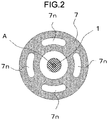
- FIG. 2 illustrates a cross section, being orthogonal to the axis line A, of the gas circuit breaker 100, the cross section being taken at a position along dotted-and-dashed line C1 of FIG. 1 .
- FIG. 3 illustrates a cross section, being orthogonal to the axis line A, of the gas circuit breaker 100, the cross section being taken at a position along dotted-and-dashed line C2 of FIG. 1 .
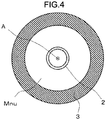
- FIG. 4 illustrates a cross section, being orthogonal to the axis line A, of the gas circuit breaker 100, the cross section being taken at a position along dotted-and-dashed line C3 of FIG. 1 .
- FIG. 1 also serves as a sectional view of a gas circuit breaker 101 (described later) according to the second embodiment.
- a tank 10 is made of, for example, a metal.
- An interior 10n of the tank 10 is where an insulating gas such as SF 6 gas is filled.
- a movable electrode 2 While being supported by a support cylinder 9, a movable electrode 2 is movable, by means of a drive mechanism (not illustrated), along the axis line A (indicated by a dotted-and-dashed line) of a stationary electrode 1.
- the axis line A serves the movable electrode 2 as a movement line along which the movable electrode 2 is connected to and separated from the stationary electrode 1, thus having an extension of this movement line.
- the stationary electrode 1 is electrically connected to one terminal (not illustrated) external to the tank 10.
- the movable electrode 2 is electrically connected to another terminal (not illustrated) external to the tank 10.
- a movable housing 3 encircling the movable electrode 2 is interlocked with the movable electrode 2 and has a nozzle 7 attached to its end.
- a cylinder 8 is attached covering the nozzle 7.
- a space enclosed by a wall surface of the nozzle 7 and a wall surface of the cylinder 8 defines a first thermal puffer chamber Tp.
- the movable housing 3 and the cylinder 8 are disposed in series along the axis line A while encircling the axis line A.
- the nozzle 7 includes intake ports 7n through which the insulating gas is taken into the first thermal puffer chamber Tp, and squirt holes 7u through which the insulating gas is squirted out of the first thermal puffer chamber Tp toward a position between the stationary electrode 1 and the movable electrode 2.
- the movable electrode 2, the movable housing 3, the nozzle 7, the cylinder 8, and the first thermal puffer chamber Tp interlock composing a movable part 21.
- a space enclosed with a wall surface of the movable housing 3 and a piston 4 that is fixed in position defines a mechanical puffer chamber Mp.
- a volume of the mechanical puffer chamber Mp varies as the movable part 21 is operated.
- a space between the movable housing 3 and the movable electrode 2 serves as a first suck-out port Mnu through which the insulating gas is taken into the mechanical puffer chamber Mp and is ejected out of the mechanical puffer chamber Mp.
- a cooling cylinder 5 is connected to the stationary electrode 1 and radiates generated heat of the stationary electrode 1 into the interior 10n of the tank 10.
- a stationary housing 6 is attached to the cooling cylinder 5 and fits over the movable housing 3 so that the connection between the stationary electrode 1 and the movable electrode 2 is supported.
- the stationary electrode 1, the cooling cylinder 5, and the stationary housing 6 compose a stationary part 11.
- the movable housing 3 is a first movable housing described in the claims
- the cylinder 8 is a second movable housing described in the claims.
- the intake ports 7n of the nozzle 7 are four in number and each intake port 7n opens in a direction parallel to the axis line A.
- the squirt holes 7u of the nozzle 7 are four in number and each squirt hole 7u opens from a lateral side of the axis line A toward the axis line A.
- an opening direction of each of the squirt holes 7u is arranged to intersect the axis line A in a plane that includes the opening direction of each squirt hole 7u and the axis line A.
- the first suck-out port Mnu opens in a direction parallel to the axis line A.
- the intake ports 7n illustrated in FIG. 1 face the first suck-out port Mnu.
- FIG. 5 illustrates time dependence of parameters during the operation of the gas circuit breaker 100;
- FIG. 5 (a) illustrates the time dependence of alternating current flowing between the stationary electrode 1 and the movable electrode 2; and
- FIG. 5 (b) illustrates varying distance between a leading end of the stationary electrode 1 and a leading end of the movable electrode 2 (interelectrode distance D).
- FIG. 6 is a sectional view illustrating a state of a main part of the gas circuit breaker 100 before a time T0 shown in FIG. 5 .
- FIG. 7 is a sectional view illustrating a state of the main part of the gas circuit breaker 100 from after a time T1 through a time T2 shown in FIG. 5 .
- FIG. 8 is a sectional view illustrating a state of the main part of the gas circuit breaker 100 from after the time T2 through the time T3 shown in FIG. 5 .
- FIG. 9 is a cross section taken at the position along dotted-and-dashed line C2 as with FIG. 3 , illustrating the state of the gas circuit breaker 100 from after the time T2 through the time T3.
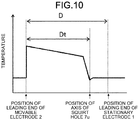
- FIG. 10 illustrates temperature distribution of the insulating gas along the axis line A at a fixed time that comes after the time T2 and before the time T3 with a vertical axis representing temperature of the insulating gas and with a horizontal axis representing positions along the axis line A.
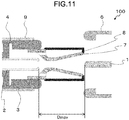
- FIG. 11 is a sectional view illustrating a state of the main part of the gas circuit breaker 100 after a time T4 shown in FIG. 5 .
- the alternating current flows steadily between the stationary electrode 1 and the movable electrode 2.
- the interelectrode distance D illustrated in FIG. 6 is shown as a distance between the leading end of the stationary electrode 1 and the leading end of the movable electrode 2. With the stationary electrode 1 and the movable electrode 2 fitted together and touching each other at their respective leading ends, the interelectrode distance D is defined as a negative value.
- the interelectrode distance D approximates a value of zero.
- the interelectrode distance D is defined as a positive value.
- a distance Dt is a length component along the axis line A between the leading end of the movable electrode 2 and center of the squirt holes 7u of the nozzle 7.
- the interelectrode distance D is a negative value, and the stationary electrode 1 and the movable electrode 2 touch each other, the alternating current directly flows between the stationary electrode 1 and the movable electrode 2 without via an arc discharge E.
- the interelectrode distance D becomes a positive value, and the stationary electrode 1 and the movable electrode 2 become separated. Therefore, the current flows between the stationary electrode 1 and the movable electrode 2 through the arc discharge E.
- the arc discharge E between the stationary electrode 1 and the movable electrode 2 has a high temperature.
- the arc discharge E has a discharge direction along the axis line A.
- the insulating gas near the arc discharge E is heated, and pressure of the insulating gas increases. Accordingly, an insulating gas flow Se having a direction toward the movable housing 3 is generated in the vicinity of the arc discharge E.
- the gas flow Se branches into: a gas flow Smn that has a direction toward the mechanical puffer chamber Mp through the first suck-out port Mnu; and gas flow Stn that has a direction toward the first thermal puffer chamber Tp through the intake ports 7n.
- Amount of heat generated by the arc discharge E increases with an increasing absolute value of the current.
- the alternating current reaches maximum absolute values (a minimum current value and a maximum current value), so that the amount of heat generated by the arc discharge E increases sharply. Accordingly, the pressure of the insulating gas increases sharply, and the gas flow Se also increases sharply.
- the gas flow Smn and the gas flow Stn similarly increase sharply. With the gas flow Smn entering the mechanical puffer chamber Mp through the first suck-out port Mnu, internal pressure of the mechanical puffer chamber Mp increases sharply. With the gas flowStn entering the first thermal puffer chamber Tp through the intake ports 7n, internal pressure of the first thermal puffer chamber Tp also increases sharply.
- FIGS. 5 and 8 As the gas circuit breaker 100 progresses with the current interruption operation, the interelectrode distance D increases further. In other words, the volume of the mechanical puffer chamber Mp is compressed in proportion as the interelectrode distance D increases.
- the gas flow Smu is ejected through the first suck-out port Mnu toward the intake ports 7n. For this reason, a leakage of the insulating gas through each of the intake ports 7n toward the first suck-out port Mnu is suppressed. Accordingly, volume of the gas flow Stu that squirts out through the squirt holes 7u of the nozzle 7 advantageously increases.
- the interelectrode distance D increases further and becomes greater than the distance Dt.
- the squirt holes 7u of the nozzle 7 pass the leading end of the stationary electrode 1. Therefore, during the movement of the movable part 21, the gas flow Stu strike the arc discharge E so that the arc discharge E is struck from sideways relative to the discharge direction.
- the gas flow Stu strikes the arc discharge E through the four squirt holes 7u.
- the arc discharge E is struck from sideways by the gas flow Stu squirting out through the four squirt holes 7u toward the arc discharge E.
- the temperature of the insulating gas is relatively high between a position of the leading end of the movable electrode 2 and a position near the center of the squirt holes 7u, but is drastically lower on a side of the stationary electrode 1 with respect to the center of the squirt holes 7u.
- This phenomenon is due to the fact that the gas flow Stu strikes a particular location of the arc discharge E depending on the displacement of the interelectrode D, causing a temperature drop of the insulating gas at the location, which is struck by the gas flows Stu.
- the interelectrode distance D reaches a maximum value Dmax, and the operation of the movable part 21 stops. This means that the current interruption operation is complete.
- the gas flow Stn that is branched off from the gas flow Se is taken into the first thermal puffer chamber Tp through the intake ports 7n without passing through the mechanical puffer chamber Mp.
- the internal pressure of the first thermal puffer chamber Tp increases with the arrival of the gas flows Stn, and accordingly, the gas flow Stu strikes the arc discharge E through the squirt holes 7u from after the time T2 through the time T3.
- the gas flow Smn branched off from the gas flow Se enters the mechanical puffer chamber Mp without passing through the first thermal puffer chamber Tp from after the time T1 through the time T2. With the volume of the mechanical puffer chamber Mp compressed by the piston 4, the gas flow Smu strikes the arc discharge E from after the time T2 through the time T3.
- the gas flow Stu from the first thermal puffer chamber Tp and the gas flow Smu from the mechanical puffer chamber Mp strike the arc discharge E from after the time T2 through the time T3, and by the time T4 the operation of the movable part 21 stops, the arc discharge E is quenched to complete the current interruption operation.
- the first thermal puffer chamber Tp does not serve as a passage for the mechanically compressed insulating gas that comes from the mechanical puffer chamber Mp, and the pressure rise of the insulating gas in the mechanical puffer chamber Mp is not inhibited. Moreover, flow speed of the gas flow Smu from the mechanical puffer chamber Mp to the arc discharge E does not slow down, so that there is no decline in interruption performance of the gas circuit breaker 100.
- the first thermal puffer chamber Tp does not serve as the passage for the mechanically compressed insulating gas that comes from the mechanical puffer chamber Mp, and the pressure rise of the insulating gas in the mechanical puffer chamber Mp is not inhibited by a leakage of the insulating gas to the first thermal puffer chamber Tp.
- the first embodiment provides higher current interruption performance regardless of magnitude of the current value. Therefore, the gas circuit breaker 100 capable of handling a wide range of current values is provided.
- the intake ports 7n for the first thermal puffer chamber Tp are disposed in a different position from the squirt holes 7u, so that compared to when the same ports or holes are used for the intake of the insulating gas and the ejection of the insulating gas, no time is required for switching between the intake of the insulating gas and the ejection of the insulating gas. In other words, the time between the intake of the insulating gas and the ejection of the insulating gas is shortened as compared to the conventional gas circuit breaker.
- the gas flow Smu is ejected through the first suck-out port Mnu toward the intake ports 7n. For this reason, the leakage of the insulating gas through each of the intake ports 7n toward the first suck-out port Mnu is suppressed. Accordingly, volume of the gas flow Stu that squirts out through the squirt holes 7u of the nozzle 7 is advantageously increased.
- the gas circuit breaker 100 can be downsized compared to when the first thermal puffer chamber Tp and the mechanical puffer chamber Mp are disposed side by side in a direction perpendicular to the axis line A.
- each squirt hole 7u is arranged to intersect the axis line A in the plane that includes the opening direction of each squirt hole 7u and the axis line AA.
- an opening direction v1, v2, v3, or v4 of each of squirt holes 7v is not arranged to intersect the axis line A in the same plane as the axis line A.
- the opening direction v1, v2, v3, or v4 of each squirt hole 7v and the axis line A are arranged in twisted positions from each other in the same plane. Arranging the squirt holes 7v in this manner enables the gas flows Stu and the gas flow Smu to efficiently strike the arc discharge E for quenching the arc discharge E even when the arc discharge E does not cross the axis line A.
- FIG. 1 serves as the sectional view of the gas circuit breaker 100 according to first embodiment and also as the sectional view of the gas circuit breaker 101 according to the second embodiment.
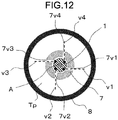
- FIG. 12 illustrates a cross section, being orthogonal to the axis line A of the gas circuit breaker 101, the cross section being taken at the position along dotted-and-dashed line C2 of FIG. 1 .
- the four squirt holes 7v1 to 7v4 open from the lateral side of the axis line A.
- the opening direction v1 of the squirt hole 7v1 is not arranged in the same plane as the axis line A and is not arranged to intersect the axis line A. In other words, the opening direction v1 of the squirt hole 7v1 and the axis line A are arranged in twisted positions from each other.
- the opening direction v2 of the squirt hole 7v2 and the axis line A are arranged in twisted positions from each other; the opening direction v3 of the squirt hole 7v3 and the axis line A are arranged in twisted positions from each other; and the opening direction v4 of the squirt hole 7v4and the axis line A are arranged in twisted positions from each other.
- the opening direction v1 of the squirt hole 7v1, the opening direction v2 of the squirt hole 7v2, the opening direction v3 of the squirt hole 7v3, and the opening direction v4 of the squirt hole 7v4 are arranged to be shifted from the axis line A of the stationary electrode 1 when projected onto a plane having the axis line A of the stationary electrode 1 as a normal.
- Such an arrangement enables the gas flows Stu to efficiently strike the arc discharge E for quenching the arc discharge E even when the arc discharge E does not cross the axis line A, but extends along a path that does not include the axis line A.
- the second embodiment provides higher current interruption performance regardless of magnitude of the current value similarly as the first embodiment. Therefore, the gas circuit breaker 101 applicable to a wide range of current values can be provided.
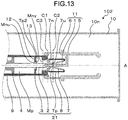
- FIG. 13 is a sectional view of a gas circuit breaker 102 according to the third embodiment of the present invention.
- the present embodiment differs from the first embodiment in that a second thermal puffer chamber Tp2 is provided further.
- parts that are similar or equivalent to those of the first embodiment have the same numerals and references that are seen in FIGS. 1 to 12 and thus are not described in detail.
- a partition 12 is formed on an inner wall surface of the movable housing 3, dividing an internal space of the movable housing 3 into the mechanical puffer chamber Mp and the second thermal puffer chamber Tp2.
- the mechanical puffer chamber Mp is a space enclosed by the partition 12, the movable housing 3, the piston 4, and the movable electrode 2.
- the second thermal puffer chamber Tp2 is a space enclosed with the partition 12, the movable housing 3, and the movable electrode 2.
- the mechanical puffer chamber Mp, the second thermal puffer chamber Tp2, and the first thermal puffer chamber Tp are disposed in series along the axis line A.
- the mechanical puffer chamber Mp is disposed on an opposite side of the first thermal puffer chamber Tp sandwiching the second thermal puffer chamber Tp2 in-between along the axis line A.
- the second thermal puffer chamber Tp2 is disposed between the mechanical puffer chamber Mp and the first thermal puffer chamber Tp along the axis line A.
- the partition 12 is a disk-shaped part having a through hole in its center.
- the movable electrode 2 is passed through the through hole of the partition 12. A diameter of the through hole of the partition 12 is larger than an outside diameter of the movable electrode 2. Therefore, a clearance is formed between the partition 12 and the movable electrode 2.
- the through hole of the partition 12 has this clearance as a portion that does not engage in the passage of the movable electrode 2, so that the clearance is the first suck-out port Mnu serving as a communication between the mechanical puffer chamber Mp and the second thermal puffer chamber Tp2.
- the first suck-out port Mnu serves as a passage for an insulating gas.
- the insulating gas flows out of the second thermal puffer chamber Tp2 into the mechanical puffer chamber Mp through the first suck-out port Mnu.
- the insulating gas also flows out of the mechanical puffer chamber Mp into the second thermal puffer chamber Tp2 through the first suck-out port Mnu.
- An annular check valve 13 is disposed on an outer peripheral surface of the movable electrode 2.
- the check valve 13 has, in its center, a through hole that the movable electrode 2 is passed through.
- the check valve 13 is disposed inside the second thermal puffer chamber Tp2.
- the check valve 13 is movable relative to the movable part 21 along the axis line A.
- the check valve 13 blocks the first suck-out port Mnu and opens the first suck-out port Mnu.
- the first suck-out port Mnu being blocked by the check valve 13 is hereinafter referred to as "the first suck-out port Mnu in the blocked state”; and the first suck-out port Mnu being opened by the check valve 13 is hereinafter referred to as "the first suck-out port Mnu in the opened state”.
- a second suck-out port Mnv is formed on an opposite side of the partition 12 sandwiching the second thermal puffer chamber Tp2 in-between.
- the second suck-out port Mnv serves as a passage for the insulating gas.
- the insulating gas flows into the second thermal puffer chamber Tp2 through the second suck-out port Mnv.
- the insulating gas also flows out of the second thermal puffer chamber Tp2 through the second suck-out port Mnv.
- the second suck-out port Mnv is formed between the movable electrode 2 and a part of the nozzle 7 that touches the inner wall surface of the movable housing 3.
- the second suck-out port Mnv may be formed between the inner wall surface of the movable housing 3 and the movable electrode 2. It is to be noted that the first thermal puffer chamber Tp is disposed in a different position from a passage for the insulating gas that heads from the mechanical puffer chamber Mp toward the arc discharge E.
- the arc discharge E that is generated in the high-current interruption has higher thermal energy and thus sufficiently increases pressure of the insulating gas in the second thermal puffer chamber Tp2.
- the pressure of the insulating gas in the second thermal puffer chamber Tp2 is higher than a pressure of the insulating gas in the mechanical puffer chamber Mp.
- the check valve 13 moves toward the mechanical puffer chamber Mp.
- the check valve 13 comes into contact with a surface of the partition 12 that faces the second thermal puffer chamber Tp2, thus blocking the first suck-out port Mnu.
- the insulating gas surrounding the arc discharge E flows into the first thermal puffer chamber Tp through the intake ports 7n and into the second thermal puffer chamber Tp2 through the second suck-out port Mnv with the first suck-out port Mnu in the blocked state. Accordingly, the insulating gas has an increased pressure in the first thermal puffer chamber Tp and an increased pressure in the second thermal puffer chamber Tp2. From after the time T2 through the time T3 shown in FIG.
- the insulating gas in the second thermal puffer chamber Tp2 passes through the second suck-out port Mnv and is blown onto the arc discharge E; and the insulating gas in the first thermal puffer chamber Tp passes through the squirt holes 7u and is blown onto the arc discharge E. With the insulating gases blown onto the arc discharge E, the arc discharge E is quenched.
- the arc discharge E that is generated in the low-current interruption has lower thermal energy and thus does not sufficiently increase the pressure of the insulating gas in the second thermal puffer chamber Tp2.
- the pressure of the insulating gas in the mechanical puffer chamber Mp is higher than the pressure of the insulating gas in the second thermal puffer chamber Tp2. Therefore, the check valve 13 moves away from the mechanical puffer chamber Mp.
- the check valve 13 leaves the partition 12, thus opening the first suck-out port Mnu.
- the insulating gas surrounding the arc discharge E flows into the first thermal puffer chamber Tp through the intake ports 7n and into the second thermal puffer chamber Tp2 through the second suck-out port Mnv with the first suck-out port Mnu in the opened state. Accordingly, the insulating gas has an increased pressure in the first thermal puffer chamber Tp and an increased pressure in the second thermal puffer chamber Tp2. From after the time T1 through the time T2 shown in FIG. 5 , the insulating gas in the mechanical puffer chamber Mp also flows into the second thermal puffer chamber Tp2 through the first suck-out port Mnu that is in the opened state. From after the time T2 through the time T3 shown in FIG.
- the insulating gas that has flowed out of the mechanical puffer chamber Mp into the second thermal puffer chamber Tp2 through the first suck-out port Mnu is blown onto the arc discharge E through the second suck-out port Mnv.
- the second thermal puffer chamber Tp2 serves as a passage for the insulating gas heading from the mechanical puffer chamber Mp toward the arc discharge E. From after the time T2 through the time T3 shown in FIG.
- the insulating gas in the first thermal puffer chamber Tp also passes through the squirt holes 7u and is blown onto the arc discharge E with the first suck-out port Mnu in the opened state. With the insulating gases blown onto the arc discharge E, the arc discharge E is quenched.
- thermal puffer chamber volume is determined by required high-current interruption performance of the gas circuit breaker 102.
- the two thermal puffer chambers are provided as the first thermal puffer chamber Tp and the second thermal puffer chamber Tp2. This enables the thermal puffer chamber volume, which is required to achieve the required high-current interruption performance of the gas circuit breaker 102, to be divided between the first thermal puffer chamber Tp and the second thermal puffer chamber Tp2.
- the second thermal puffer chamber Tp2 is enabled to have volume decreased as much as a volume of the first thermal puffer chamber Tp.
- the gas circuit breaker 102 can be downsized.
- Low-current interruption performance of the gas circuit breaker 102 is determined by a compressibility of the insulating gas in the mechanical puffer chamber Mp and the second thermal puffer chamber Tp2. Specifically, the higher the compressibility of the insulating gas in the mechanical puffer chamber Mp and the second thermal puffer chamber Tp2, the better the low-current interruption performance of the gas circuit breaker 102.
- the second thermal puffer chamber Tp2 is enabled to have the volume decreased as much as the volume of the first thermal puffer chamber Tp in the present embodiment, the compressibility of the insulating gas in the second thermal puffer chamber Tp2 is higher than when the thermal puffer chamber is provided only in the passage for the insulating gas that heads from the mechanical puffer chamber Mp toward the arc discharge E. Therefore, this enables the gas circuit breaker 102 to have the improved low-current interruption performance.
- the nozzle 7 may be made of an ablative material.
- the ablative material is evaporated by heat of the gas flows Stn that enter the first thermal puffer chamber Tp respectively through the intake ports 7n. Accordingly, the internal pressure of the first thermal puffer chamber Tp increases, and the gas flow Stu has an increased pressure when squirting out through the squirt holes 7u.
- the highpressure gas flow Stu is enabled to strike and efficiently quench the arc discharge E.
- the first thermal puffer chamber Tp may be formed using an ablative material, and further an ablative material may be disposed inside the first thermal puffer chamber Tp. Even in these cases, the internal pressure of the first thermal puffer chamber Tp increases, and the gas flow Stu has an increased pressure when squirting out through the squirt holes 7u.
- the ablative material include polytetrafluoroethylene (PTFE) and a perfluoroalkylvinyl ether copolymer (PFA).
- PTFE polytetrafluoroethylene
- PFA perfluoroalkylvinyl ether copolymer
- ablative material is at least one compound selected from the group consisting of a perfluoroether polymer, a fluoroelastomer, and a 4-vinyloxy-1-butene (BVE) cyclized polymer.
- the nozzle 7 has the four intake ports 7n and the four squirt holes 7u.
- the number of intake ports 7n and the number of squirt holes 7u are not limiting in the present invention and are determined as appropriate when the gas circuit breakers 100 to 102 are designed.
- each squirt hole 7u is arranged to intersect the axis line A in a plane that includes the opening direction of each squirt hole 7u and the axis line A.
- the opening direction of each squirt hole 7v and the axis line A are arranged in twisted positions from each other in a plane that includes the opening direction of each squirt hole 7u and the axis line A.
- the opening direction of each squirt hole (7u, 7v) is not limiting in the present invention.
- the nozzle 7 may include both the squirt hole 7u that is arranged to intersect the axis line A, and the squirt hole 7v that is arranged not to intersect the axis line A.
Landscapes
- Circuit Breakers (AREA)
Applications Claiming Priority (2)
| Application Number | Priority Date | Filing Date | Title |
|---|---|---|---|
| JP2018200097 | 2018-10-24 | ||
| PCT/JP2019/037360 WO2020084984A1 (ja) | 2018-10-24 | 2019-09-24 | ガス遮断器 |
Publications (3)
| Publication Number | Publication Date |
|---|---|
| EP3872829A1 true EP3872829A1 (de) | 2021-09-01 |
| EP3872829A4 EP3872829A4 (de) | 2021-12-22 |
| EP3872829B1 EP3872829B1 (de) | 2024-07-10 |
Family
ID=70330985
Family Applications (1)
| Application Number | Title | Priority Date | Filing Date |
|---|---|---|---|
| EP19877047.1A Active EP3872829B1 (de) | 2018-10-24 | 2019-09-24 | Gasschutzschalter |
Country Status (3)
| Country | Link |
|---|---|
| EP (1) | EP3872829B1 (de) |
| JP (1) | JP6961105B2 (de) |
| WO (1) | WO2020084984A1 (de) |
Families Citing this family (1)
| Publication number | Priority date | Publication date | Assignee | Title |
|---|---|---|---|---|
| JP2024124633A (ja) * | 2023-03-03 | 2024-09-13 | 株式会社東芝 | ガス遮断器 |
Family Cites Families (9)
| Publication number | Priority date | Publication date | Assignee | Title |
|---|---|---|---|---|
| US3946180A (en) * | 1974-04-22 | 1976-03-23 | I-T-E Imperial Corporation | Downstream injection nozzle for puffer circuit interrupter |
| DE2710868A1 (de) * | 1977-03-12 | 1978-09-14 | Licentia Gmbh | Autopneumatischer leistungsschalter mit isolierstoffduese |
| JPS5916234A (ja) * | 1982-07-19 | 1984-01-27 | 株式会社富士電機総合研究所 | ガスしや断器のしや断室 |
| JPS61118919A (ja) * | 1984-11-14 | 1986-06-06 | 株式会社東芝 | ガス絶縁遮断器 |
| JPH04284319A (ja) * | 1991-03-13 | 1992-10-08 | Hitachi Ltd | ガス遮断器 |
| JP3132573B2 (ja) * | 1991-03-18 | 2001-02-05 | 富士電機株式会社 | パッファ形ガス遮断器 |
| JP2003297200A (ja) | 2002-04-01 | 2003-10-17 | Toshiba Corp | ガス遮断器 |
| JP2012054097A (ja) * | 2010-09-01 | 2012-03-15 | Mitsubishi Electric Corp | ガス遮断器 |
| JP5328991B2 (ja) * | 2010-12-07 | 2013-10-30 | 三菱電機株式会社 | ガス遮断器 |
-
2019
- 2019-09-24 JP JP2020552997A patent/JP6961105B2/ja active Active
- 2019-09-24 WO PCT/JP2019/037360 patent/WO2020084984A1/ja not_active Ceased
- 2019-09-24 EP EP19877047.1A patent/EP3872829B1/de active Active
Also Published As
| Publication number | Publication date |
|---|---|
| WO2020084984A1 (ja) | 2020-04-30 |
| EP3872829B1 (de) | 2024-07-10 |
| EP3872829A4 (de) | 2021-12-22 |
| JPWO2020084984A1 (ja) | 2021-04-30 |
| JP6961105B2 (ja) | 2021-11-05 |
Similar Documents
| Publication | Publication Date | Title |
|---|---|---|
| US9058947B2 (en) | Puffer-type gas circuit-breaker | |
| US10964498B2 (en) | Gas-insulated low- or medium-voltage load break switch | |
| US20170178845A1 (en) | Gas insulated circuit breaker | |
| CN102117713A (zh) | 气体绝缘高压开关 | |
| JP6818604B2 (ja) | ガス遮断器 | |
| US10347446B2 (en) | Gas blast switch comprising an optimized gas storage chamber | |
| EP3872829B1 (de) | Gasschutzschalter | |
| US20210074496A1 (en) | Gas Circuit Breaker | |
| US10573475B2 (en) | Gas-blast circuit breaker | |
| US11764012B2 (en) | Gas circuit breaker | |
| US11217408B2 (en) | Gas circuit breaker | |
| CN112912983B (zh) | 气体断路器 | |
| US20250385059A1 (en) | High voltage circuit-breaker having an optimized contacts design | |
| JP2016143473A (ja) | ガス遮断器 | |
| JP2013246904A (ja) | ガス遮断器 | |
| WO2019092865A1 (ja) | ガス遮断器 | |
| JP2010061858A (ja) | ガス遮断器 | |
| WO2019092862A1 (ja) | ガス遮断器 | |
| JP2014186796A (ja) | ガス遮断器 | |
| JP2015023006A (ja) | ガス遮断器 | |
| WO2018229972A1 (ja) | ガス遮断器 | |
| KR20200117421A (ko) | 가스절연개폐장치의 차단기 | |
| WO2019092861A1 (ja) | ガス遮断器 | |
| WO2019092863A1 (ja) | ガス遮断器 | |
| WO2019106841A1 (ja) | ガス遮断器 |
Legal Events
| Date | Code | Title | Description |
|---|---|---|---|
| STAA | Information on the status of an ep patent application or granted ep patent |
Free format text: STATUS: THE INTERNATIONAL PUBLICATION HAS BEEN MADE |
|
| PUAI | Public reference made under article 153(3) epc to a published international application that has entered the european phase |
Free format text: ORIGINAL CODE: 0009012 |
|
| STAA | Information on the status of an ep patent application or granted ep patent |
Free format text: STATUS: REQUEST FOR EXAMINATION WAS MADE |
|
| 17P | Request for examination filed |
Effective date: 20210416 |
|
| AK | Designated contracting states |
Kind code of ref document: A1 Designated state(s): AL AT BE BG CH CY CZ DE DK EE ES FI FR GB GR HR HU IE IS IT LI LT LU LV MC MK MT NL NO PL PT RO RS SE SI SK SM TR |
|
| A4 | Supplementary search report drawn up and despatched |
Effective date: 20211123 |
|
| RIC1 | Information provided on ipc code assigned before grant |
Ipc: H01H 33/915 20060101AFI20211117BHEP |
|
| DAV | Request for validation of the european patent (deleted) | ||
| DAX | Request for extension of the european patent (deleted) | ||
| GRAP | Despatch of communication of intention to grant a patent |
Free format text: ORIGINAL CODE: EPIDOSNIGR1 |
|
| STAA | Information on the status of an ep patent application or granted ep patent |
Free format text: STATUS: GRANT OF PATENT IS INTENDED |
|
| INTG | Intention to grant announced |
Effective date: 20240220 |
|
| GRAS | Grant fee paid |
Free format text: ORIGINAL CODE: EPIDOSNIGR3 |
|
| GRAA | (expected) grant |
Free format text: ORIGINAL CODE: 0009210 |
|
| STAA | Information on the status of an ep patent application or granted ep patent |
Free format text: STATUS: THE PATENT HAS BEEN GRANTED |
|
| AK | Designated contracting states |
Kind code of ref document: B1 Designated state(s): AL AT BE BG CH CY CZ DE DK EE ES FI FR GB GR HR HU IE IS IT LI LT LU LV MC MK MT NL NO PL PT RO RS SE SI SK SM TR |
|
| REG | Reference to a national code |
Ref country code: CH Ref legal event code: EP |
|
| REG | Reference to a national code |
Ref country code: DE Ref legal event code: R096 Ref document number: 602019055142 Country of ref document: DE |
|
| REG | Reference to a national code |
Ref country code: LT Ref legal event code: MG9D |
|
| REG | Reference to a national code |
Ref country code: NL Ref legal event code: MP Effective date: 20240710 |
|
| PG25 | Lapsed in a contracting state [announced via postgrant information from national office to epo] |
Ref country code: PT Free format text: LAPSE BECAUSE OF FAILURE TO SUBMIT A TRANSLATION OF THE DESCRIPTION OR TO PAY THE FEE WITHIN THE PRESCRIBED TIME-LIMIT Effective date: 20241111 |
|
| REG | Reference to a national code |
Ref country code: AT Ref legal event code: MK05 Ref document number: 1702805 Country of ref document: AT Kind code of ref document: T Effective date: 20240710 |
|
| PG25 | Lapsed in a contracting state [announced via postgrant information from national office to epo] |
Ref country code: NL Free format text: LAPSE BECAUSE OF FAILURE TO SUBMIT A TRANSLATION OF THE DESCRIPTION OR TO PAY THE FEE WITHIN THE PRESCRIBED TIME-LIMIT Effective date: 20240710 |
|
| PG25 | Lapsed in a contracting state [announced via postgrant information from national office to epo] |
Ref country code: PT Free format text: LAPSE BECAUSE OF FAILURE TO SUBMIT A TRANSLATION OF THE DESCRIPTION OR TO PAY THE FEE WITHIN THE PRESCRIBED TIME-LIMIT Effective date: 20241111 Ref country code: NL Free format text: LAPSE BECAUSE OF FAILURE TO SUBMIT A TRANSLATION OF THE DESCRIPTION OR TO PAY THE FEE WITHIN THE PRESCRIBED TIME-LIMIT Effective date: 20240710 |
|
| PG25 | Lapsed in a contracting state [announced via postgrant information from national office to epo] |
Ref country code: NO Free format text: LAPSE BECAUSE OF FAILURE TO SUBMIT A TRANSLATION OF THE DESCRIPTION OR TO PAY THE FEE WITHIN THE PRESCRIBED TIME-LIMIT Effective date: 20241010 |
|
| PG25 | Lapsed in a contracting state [announced via postgrant information from national office to epo] |
Ref country code: GR Free format text: LAPSE BECAUSE OF FAILURE TO SUBMIT A TRANSLATION OF THE DESCRIPTION OR TO PAY THE FEE WITHIN THE PRESCRIBED TIME-LIMIT Effective date: 20241011 Ref country code: FI Free format text: LAPSE BECAUSE OF FAILURE TO SUBMIT A TRANSLATION OF THE DESCRIPTION OR TO PAY THE FEE WITHIN THE PRESCRIBED TIME-LIMIT Effective date: 20240710 Ref country code: PL Free format text: LAPSE BECAUSE OF FAILURE TO SUBMIT A TRANSLATION OF THE DESCRIPTION OR TO PAY THE FEE WITHIN THE PRESCRIBED TIME-LIMIT Effective date: 20240710 |
|
| PG25 | Lapsed in a contracting state [announced via postgrant information from national office to epo] |
Ref country code: BG Free format text: LAPSE BECAUSE OF FAILURE TO SUBMIT A TRANSLATION OF THE DESCRIPTION OR TO PAY THE FEE WITHIN THE PRESCRIBED TIME-LIMIT Effective date: 20240710 |
|
| PG25 | Lapsed in a contracting state [announced via postgrant information from national office to epo] |
Ref country code: LV Free format text: LAPSE BECAUSE OF FAILURE TO SUBMIT A TRANSLATION OF THE DESCRIPTION OR TO PAY THE FEE WITHIN THE PRESCRIBED TIME-LIMIT Effective date: 20240710 |
|
| PG25 | Lapsed in a contracting state [announced via postgrant information from national office to epo] |
Ref country code: AT Free format text: LAPSE BECAUSE OF FAILURE TO SUBMIT A TRANSLATION OF THE DESCRIPTION OR TO PAY THE FEE WITHIN THE PRESCRIBED TIME-LIMIT Effective date: 20240710 Ref country code: IS Free format text: LAPSE BECAUSE OF FAILURE TO SUBMIT A TRANSLATION OF THE DESCRIPTION OR TO PAY THE FEE WITHIN THE PRESCRIBED TIME-LIMIT Effective date: 20241110 |
|
| PG25 | Lapsed in a contracting state [announced via postgrant information from national office to epo] |
Ref country code: HR Free format text: LAPSE BECAUSE OF FAILURE TO SUBMIT A TRANSLATION OF THE DESCRIPTION OR TO PAY THE FEE WITHIN THE PRESCRIBED TIME-LIMIT Effective date: 20240710 |
|
| PG25 | Lapsed in a contracting state [announced via postgrant information from national office to epo] |
Ref country code: ES Free format text: LAPSE BECAUSE OF FAILURE TO SUBMIT A TRANSLATION OF THE DESCRIPTION OR TO PAY THE FEE WITHIN THE PRESCRIBED TIME-LIMIT Effective date: 20240710 Ref country code: RS Free format text: LAPSE BECAUSE OF FAILURE TO SUBMIT A TRANSLATION OF THE DESCRIPTION OR TO PAY THE FEE WITHIN THE PRESCRIBED TIME-LIMIT Effective date: 20241010 |
|
| PG25 | Lapsed in a contracting state [announced via postgrant information from national office to epo] |
Ref country code: RS Free format text: LAPSE BECAUSE OF FAILURE TO SUBMIT A TRANSLATION OF THE DESCRIPTION OR TO PAY THE FEE WITHIN THE PRESCRIBED TIME-LIMIT Effective date: 20241010 Ref country code: PL Free format text: LAPSE BECAUSE OF FAILURE TO SUBMIT A TRANSLATION OF THE DESCRIPTION OR TO PAY THE FEE WITHIN THE PRESCRIBED TIME-LIMIT Effective date: 20240710 Ref country code: NO Free format text: LAPSE BECAUSE OF FAILURE TO SUBMIT A TRANSLATION OF THE DESCRIPTION OR TO PAY THE FEE WITHIN THE PRESCRIBED TIME-LIMIT Effective date: 20241010 Ref country code: LV Free format text: LAPSE BECAUSE OF FAILURE TO SUBMIT A TRANSLATION OF THE DESCRIPTION OR TO PAY THE FEE WITHIN THE PRESCRIBED TIME-LIMIT Effective date: 20240710 Ref country code: IS Free format text: LAPSE BECAUSE OF FAILURE TO SUBMIT A TRANSLATION OF THE DESCRIPTION OR TO PAY THE FEE WITHIN THE PRESCRIBED TIME-LIMIT Effective date: 20241110 Ref country code: HR Free format text: LAPSE BECAUSE OF FAILURE TO SUBMIT A TRANSLATION OF THE DESCRIPTION OR TO PAY THE FEE WITHIN THE PRESCRIBED TIME-LIMIT Effective date: 20240710 Ref country code: GR Free format text: LAPSE BECAUSE OF FAILURE TO SUBMIT A TRANSLATION OF THE DESCRIPTION OR TO PAY THE FEE WITHIN THE PRESCRIBED TIME-LIMIT Effective date: 20241011 Ref country code: FI Free format text: LAPSE BECAUSE OF FAILURE TO SUBMIT A TRANSLATION OF THE DESCRIPTION OR TO PAY THE FEE WITHIN THE PRESCRIBED TIME-LIMIT Effective date: 20240710 Ref country code: ES Free format text: LAPSE BECAUSE OF FAILURE TO SUBMIT A TRANSLATION OF THE DESCRIPTION OR TO PAY THE FEE WITHIN THE PRESCRIBED TIME-LIMIT Effective date: 20240710 Ref country code: BG Free format text: LAPSE BECAUSE OF FAILURE TO SUBMIT A TRANSLATION OF THE DESCRIPTION OR TO PAY THE FEE WITHIN THE PRESCRIBED TIME-LIMIT Effective date: 20240710 Ref country code: AT Free format text: LAPSE BECAUSE OF FAILURE TO SUBMIT A TRANSLATION OF THE DESCRIPTION OR TO PAY THE FEE WITHIN THE PRESCRIBED TIME-LIMIT Effective date: 20240710 |
|
| REG | Reference to a national code |
Ref country code: DE Ref legal event code: R097 Ref document number: 602019055142 Country of ref document: DE |
|
| PG25 | Lapsed in a contracting state [announced via postgrant information from national office to epo] |
Ref country code: DK Free format text: LAPSE BECAUSE OF FAILURE TO SUBMIT A TRANSLATION OF THE DESCRIPTION OR TO PAY THE FEE WITHIN THE PRESCRIBED TIME-LIMIT Effective date: 20240710 Ref country code: RO Free format text: LAPSE BECAUSE OF FAILURE TO SUBMIT A TRANSLATION OF THE DESCRIPTION OR TO PAY THE FEE WITHIN THE PRESCRIBED TIME-LIMIT Effective date: 20240710 Ref country code: SM Free format text: LAPSE BECAUSE OF FAILURE TO SUBMIT A TRANSLATION OF THE DESCRIPTION OR TO PAY THE FEE WITHIN THE PRESCRIBED TIME-LIMIT Effective date: 20240710 |
|
| PG25 | Lapsed in a contracting state [announced via postgrant information from national office to epo] |
Ref country code: MC Free format text: LAPSE BECAUSE OF FAILURE TO SUBMIT A TRANSLATION OF THE DESCRIPTION OR TO PAY THE FEE WITHIN THE PRESCRIBED TIME-LIMIT Effective date: 20240710 Ref country code: EE Free format text: LAPSE BECAUSE OF FAILURE TO SUBMIT A TRANSLATION OF THE DESCRIPTION OR TO PAY THE FEE WITHIN THE PRESCRIBED TIME-LIMIT Effective date: 20240710 |
|
| PG25 | Lapsed in a contracting state [announced via postgrant information from national office to epo] |
Ref country code: CZ Free format text: LAPSE BECAUSE OF FAILURE TO SUBMIT A TRANSLATION OF THE DESCRIPTION OR TO PAY THE FEE WITHIN THE PRESCRIBED TIME-LIMIT Effective date: 20240710 |
|
| PG25 | Lapsed in a contracting state [announced via postgrant information from national office to epo] |
Ref country code: SK Free format text: LAPSE BECAUSE OF FAILURE TO SUBMIT A TRANSLATION OF THE DESCRIPTION OR TO PAY THE FEE WITHIN THE PRESCRIBED TIME-LIMIT Effective date: 20240710 Ref country code: IT Free format text: LAPSE BECAUSE OF FAILURE TO SUBMIT A TRANSLATION OF THE DESCRIPTION OR TO PAY THE FEE WITHIN THE PRESCRIBED TIME-LIMIT Effective date: 20240710 |
|
| PLBE | No opposition filed within time limit |
Free format text: ORIGINAL CODE: 0009261 |
|
| STAA | Information on the status of an ep patent application or granted ep patent |
Free format text: STATUS: NO OPPOSITION FILED WITHIN TIME LIMIT |
|
| PG25 | Lapsed in a contracting state [announced via postgrant information from national office to epo] |
Ref country code: LU Free format text: LAPSE BECAUSE OF NON-PAYMENT OF DUE FEES Effective date: 20240924 |
|
| 26N | No opposition filed |
Effective date: 20250411 |
|
| GBPC | Gb: european patent ceased through non-payment of renewal fee |
Effective date: 20241010 |
|
| PG25 | Lapsed in a contracting state [announced via postgrant information from national office to epo] |
Ref country code: GB Free format text: LAPSE BECAUSE OF NON-PAYMENT OF DUE FEES Effective date: 20241010 |
|
| REG | Reference to a national code |
Ref country code: BE Ref legal event code: MM Effective date: 20240930 |
|
| PG25 | Lapsed in a contracting state [announced via postgrant information from national office to epo] |
Ref country code: BE Free format text: LAPSE BECAUSE OF NON-PAYMENT OF DUE FEES Effective date: 20240930 |
|
| PG25 | Lapsed in a contracting state [announced via postgrant information from national office to epo] |
Ref country code: IE Free format text: LAPSE BECAUSE OF NON-PAYMENT OF DUE FEES Effective date: 20240924 |
|
| PG25 | Lapsed in a contracting state [announced via postgrant information from national office to epo] |
Ref country code: SE Free format text: LAPSE BECAUSE OF FAILURE TO SUBMIT A TRANSLATION OF THE DESCRIPTION OR TO PAY THE FEE WITHIN THE PRESCRIBED TIME-LIMIT Effective date: 20240710 |
|
| P01 | Opt-out of the competence of the unified patent court (upc) registered |
Free format text: CASE NUMBER: UPC_APP_4937_3872829/2025 Effective date: 20250827 |
|
| REG | Reference to a national code |
Ref country code: CH Ref legal event code: U11 Free format text: ST27 STATUS EVENT CODE: U-0-0-U10-U11 (AS PROVIDED BY THE NATIONAL OFFICE) Effective date: 20251001 |
|
| PGFP | Annual fee paid to national office [announced via postgrant information from national office to epo] |
Ref country code: DE Payment date: 20250730 Year of fee payment: 7 |
|
| PGFP | Annual fee paid to national office [announced via postgrant information from national office to epo] |
Ref country code: FR Payment date: 20250808 Year of fee payment: 7 |
|
| PGFP | Annual fee paid to national office [announced via postgrant information from national office to epo] |
Ref country code: CH Payment date: 20251001 Year of fee payment: 7 |
|
| PG25 | Lapsed in a contracting state [announced via postgrant information from national office to epo] |
Ref country code: CY Free format text: LAPSE BECAUSE OF FAILURE TO SUBMIT A TRANSLATION OF THE DESCRIPTION OR TO PAY THE FEE WITHIN THE PRESCRIBED TIME-LIMIT; INVALID AB INITIO Effective date: 20190924 |
|
| PG25 | Lapsed in a contracting state [announced via postgrant information from national office to epo] |
Ref country code: HU Free format text: LAPSE BECAUSE OF FAILURE TO SUBMIT A TRANSLATION OF THE DESCRIPTION OR TO PAY THE FEE WITHIN THE PRESCRIBED TIME-LIMIT; INVALID AB INITIO Effective date: 20190924 |