EP3856549B1 - Elektrische architektur zum betrieb einer transportkühleinheit - Google Patents
Elektrische architektur zum betrieb einer transportkühleinheit Download PDFInfo
- Publication number
- EP3856549B1 EP3856549B1 EP19780484.2A EP19780484A EP3856549B1 EP 3856549 B1 EP3856549 B1 EP 3856549B1 EP 19780484 A EP19780484 A EP 19780484A EP 3856549 B1 EP3856549 B1 EP 3856549B1
- Authority
- EP
- European Patent Office
- Prior art keywords
- power
- converter
- energy storage
- bus
- grid
- Prior art date
- Legal status (The legal status is an assumption and is not a legal conclusion. Google has not performed a legal analysis and makes no representation as to the accuracy of the status listed.)
- Active
Links
Images





Classifications
-
- B—PERFORMING OPERATIONS; TRANSPORTING
- B60—VEHICLES IN GENERAL
- B60H—ARRANGEMENTS OF HEATING, COOLING, VENTILATING OR OTHER AIR-TREATING DEVICES SPECIALLY ADAPTED FOR PASSENGER OR GOODS SPACES OF VEHICLES
- B60H1/00—Heating, cooling or ventilating devices
- B60H1/00007—Combined heating, ventilating, or cooling devices
- B60H1/00014—Combined heating, ventilating, or cooling devices for load cargos on load transporting vehicles
-
- B—PERFORMING OPERATIONS; TRANSPORTING
- B60—VEHICLES IN GENERAL
- B60H—ARRANGEMENTS OF HEATING, COOLING, VENTILATING OR OTHER AIR-TREATING DEVICES SPECIALLY ADAPTED FOR PASSENGER OR GOODS SPACES OF VEHICLES
- B60H1/00—Heating, cooling or ventilating devices
- B60H1/00357—Air-conditioning arrangements specially adapted for particular vehicles
- B60H1/00364—Air-conditioning arrangements specially adapted for particular vehicles for caravans or trailers
-
- B—PERFORMING OPERATIONS; TRANSPORTING
- B60—VEHICLES IN GENERAL
- B60H—ARRANGEMENTS OF HEATING, COOLING, VENTILATING OR OTHER AIR-TREATING DEVICES SPECIALLY ADAPTED FOR PASSENGER OR GOODS SPACES OF VEHICLES
- B60H1/00—Heating, cooling or ventilating devices
- B60H1/00421—Driving arrangements for parts of a vehicle air-conditioning
- B60H1/00428—Driving arrangements for parts of a vehicle air-conditioning electric
-
- B—PERFORMING OPERATIONS; TRANSPORTING
- B60—VEHICLES IN GENERAL
- B60H—ARRANGEMENTS OF HEATING, COOLING, VENTILATING OR OTHER AIR-TREATING DEVICES SPECIALLY ADAPTED FOR PASSENGER OR GOODS SPACES OF VEHICLES
- B60H1/00—Heating, cooling or ventilating devices
- B60H1/32—Cooling devices
- B60H1/3204—Cooling devices using compression
- B60H1/3232—Cooling devices using compression particularly adapted for load transporting vehicles
-
- B—PERFORMING OPERATIONS; TRANSPORTING
- B60—VEHICLES IN GENERAL
- B60K—ARRANGEMENT OR MOUNTING OF PROPULSION UNITS OR OF TRANSMISSIONS IN VEHICLES; ARRANGEMENT OR MOUNTING OF PLURAL DIVERSE PRIME-MOVERS IN VEHICLES; AUXILIARY DRIVES FOR VEHICLES; INSTRUMENTATION OR DASHBOARDS FOR VEHICLES; ARRANGEMENTS IN CONNECTION WITH COOLING, AIR INTAKE, GAS EXHAUST OR FUEL SUPPLY OF PROPULSION UNITS IN VEHICLES
- B60K11/00—Arrangement in connection with cooling of propulsion units
- B60K11/06—Arrangement in connection with cooling of propulsion units with air cooling
-
- F—MECHANICAL ENGINEERING; LIGHTING; HEATING; WEAPONS; BLASTING
- F25—REFRIGERATION OR COOLING; COMBINED HEATING AND REFRIGERATION SYSTEMS; HEAT PUMP SYSTEMS; MANUFACTURE OR STORAGE OF ICE; LIQUEFACTION SOLIDIFICATION OF GASES
- F25D—REFRIGERATORS; COLD ROOMS; ICE-BOXES; COOLING OR FREEZING APPARATUS NOT OTHERWISE PROVIDED FOR
- F25D29/00—Arrangement or mounting of control or safety devices
- F25D29/003—Arrangement or mounting of control or safety devices for movable devices
-
- H—ELECTRICITY
- H02—GENERATION; CONVERSION OR DISTRIBUTION OF ELECTRIC POWER
- H02J—ELECTRIC POWER NETWORKS; CIRCUIT ARRANGEMENTS OR SYSTEMS FOR SUPPLYING OR DISTRIBUTING ELECTRIC POWER; SYSTEMS FOR STORING ELECTRIC ENERGY
- H02J1/00—Circuit arrangements for DC mains or DC distribution networks
- H02J1/10—Parallel operation of DC sources
- H02J1/102—Parallel operation of DC sources being switching converters
-
- H—ELECTRICITY
- H02—GENERATION; CONVERSION OR DISTRIBUTION OF ELECTRIC POWER
- H02J—ELECTRIC POWER NETWORKS; CIRCUIT ARRANGEMENTS OR SYSTEMS FOR SUPPLYING OR DISTRIBUTING ELECTRIC POWER; SYSTEMS FOR STORING ELECTRIC ENERGY
- H02J3/00—Circuit arrangements for AC mains or AC distribution networks
- H02J3/28—Arrangements for balancing of the load in networks by storage of energy
- H02J3/32—Arrangements for balancing of the load in networks by storage of energy using batteries or super capacitors with converting means
-
- H—ELECTRICITY
- H02—GENERATION; CONVERSION OR DISTRIBUTION OF ELECTRIC POWER
- H02J—ELECTRIC POWER NETWORKS; CIRCUIT ARRANGEMENTS OR SYSTEMS FOR SUPPLYING OR DISTRIBUTING ELECTRIC POWER; SYSTEMS FOR STORING ELECTRIC ENERGY
- H02J7/00—Circuit arrangements for charging or discharging batteries or for supplying loads from batteries
- H02J7/14—Circuit arrangements for charging or discharging batteries or for supplying loads from batteries for charging batteries from dynamo-electric generators driven at varying speed, e.g. on vehicle
- H02J7/1415—Circuit arrangements for charging or discharging batteries or for supplying loads from batteries for charging batteries from dynamo-electric generators driven at varying speed, e.g. on vehicle with a generator driven by a prime mover other than the motor of a vehicle
-
- B—PERFORMING OPERATIONS; TRANSPORTING
- B60—VEHICLES IN GENERAL
- B60H—ARRANGEMENTS OF HEATING, COOLING, VENTILATING OR OTHER AIR-TREATING DEVICES SPECIALLY ADAPTED FOR PASSENGER OR GOODS SPACES OF VEHICLES
- B60H1/00—Heating, cooling or ventilating devices
- B60H1/32—Cooling devices
- B60H2001/3236—Cooling devices information from a variable is obtained
- B60H2001/3255—Cooling devices information from a variable is obtained related to temperature
- B60H2001/3261—Cooling devices information from a variable is obtained related to temperature of the air at an evaporating unit
-
- B—PERFORMING OPERATIONS; TRANSPORTING
- B60—VEHICLES IN GENERAL
- B60H—ARRANGEMENTS OF HEATING, COOLING, VENTILATING OR OTHER AIR-TREATING DEVICES SPECIALLY ADAPTED FOR PASSENGER OR GOODS SPACES OF VEHICLES
- B60H1/00—Heating, cooling or ventilating devices
- B60H1/32—Cooling devices
- B60H2001/3286—Constructional features
- B60H2001/3292—Compressor drive is electric only
-
- B—PERFORMING OPERATIONS; TRANSPORTING
- B60—VEHICLES IN GENERAL
- B60Y—INDEXING SCHEME RELATING TO ASPECTS CROSS-CUTTING VEHICLE TECHNOLOGY
- B60Y2200/00—Type of vehicle
- B60Y2200/10—Road Vehicles
- B60Y2200/14—Trucks; Load vehicles, Busses
- B60Y2200/147—Trailers, e.g. full trailers or caravans
-
- H—ELECTRICITY
- H02—GENERATION; CONVERSION OR DISTRIBUTION OF ELECTRIC POWER
- H02J—ELECTRIC POWER NETWORKS; CIRCUIT ARRANGEMENTS OR SYSTEMS FOR SUPPLYING OR DISTRIBUTING ELECTRIC POWER; SYSTEMS FOR STORING ELECTRIC ENERGY
- H02J2105/00—Networks for supplying or distributing electric power characterised by their spatial reach or by the load
- H02J2105/30—Networks for supplying or distributing electric power characterised by their spatial reach or by the load the load networks being external to vehicles, i.e. exchanging power with vehicles
- H02J2105/33—Networks for supplying or distributing electric power characterised by their spatial reach or by the load the load networks being external to vehicles, i.e. exchanging power with vehicles exchanging power with road vehicles
-
- Y—GENERAL TAGGING OF NEW TECHNOLOGICAL DEVELOPMENTS; GENERAL TAGGING OF CROSS-SECTIONAL TECHNOLOGIES SPANNING OVER SEVERAL SECTIONS OF THE IPC; TECHNICAL SUBJECTS COVERED BY FORMER USPC CROSS-REFERENCE ART COLLECTIONS [XRACs] AND DIGESTS
- Y02—TECHNOLOGIES OR APPLICATIONS FOR MITIGATION OR ADAPTATION AGAINST CLIMATE CHANGE
- Y02T—CLIMATE CHANGE MITIGATION TECHNOLOGIES RELATED TO TRANSPORTATION
- Y02T10/00—Road transport of goods or passengers
- Y02T10/80—Technologies aiming to reduce greenhouse gasses emissions common to all road transportation technologies
- Y02T10/88—Optimized components or subsystems, e.g. lighting, actively controlled glasses
Definitions
- the present invention relates to a power system architecture for powering a transport refrigeration system.
- the invention may be implemented in relation to transportation refrigeration units, and more specifically via an apparatus and a method for powering a transportation refrigeration unit with a generator and an energy storage device.
- Refrigeration systems typically include a compressor, a condenser, an expansion valve, and an evaporator serially connected by refrigerant lines in a closed refrigerant circuit in accord with known refrigerant vapor compression cycles.
- a power unit such as a combustion engine, drives the compressor of the refrigeration unit, and may be diesel powered, natural gas powered, or other type of engine.
- the compressor is driven by the engine shaft either through a belt drive or by a mechanical shaft-to-shaft link.
- the engine of the refrigeration unit drives a generator that generates electrical power, which inturn drives the compressor.
- US 2017/349078 A1 discloses hybrid power systems which include an internal combustion engine and a motor/generator connectable with the engine.
- a reefer unit is configured to receive power from the motor/generator via a reefer power system that includes an export power inverter and an energy storage device.
- JP 2002 081825 A discloses a refrigerator-freezer capable of improving cooling performance by effectively utilizing available power in the refrigerator-freezer of which refrigerators installed side by side is cooled by circulating cold from a heat exchanger inside a freezer.
- An electric fan is stopped when the cooling of the inside of a freezer A is necessary and the cooling of the inside of a refrigerator B is not necessary, and surplus power generated by the stop of the electric fan is fed to an electric fan.
- the power fed to an electric fan can be decreased and the power fed to either or both of the electric fans can be increased according to the amount of the decreased power.
- the invention provides a power system architecture configured to power a transport refrigeration system based on a determined an AC power requirement.
- the system includes a generator power converter configured to receive a generator three phase AC power from an alternating current (AC) generator operably coupled to an axle or wheel hub, and provide a generator DC power.
- AC alternating current
- the system also includes a grid power converter configured to receive a grid three phase AC power from a grid power source, the grid power converter operable to provide a grid DC power, an energy storage device, the energy storage device operable to provide a variable DC power and connected to a DC bus, a power management system operably connected to direct power the transport refrigeration unit TRU based on at least the AC power requirement, and a DC/DC converter operably connected to a variable DC bus, the DC/DC converter configured to convert a DC power to a fixed DC power on a fixed DC bus.
- the energy storage system includes the energy storage device and at least one of a first energy storage system DC/DC converter configured to convert the variable DC power on the variable DC bus to a fixed DC power on a fixed DC bus to provide the fixed DC power to the power management system based at least in part on the AC power requirement and a second energy storage system DC/DC converter configured to convert at least a portion of the fixed DC power on the fixed DC bus to supply the variable DC bus and the energy storage device.
- a first energy storage system DC/DC converter configured to convert the variable DC power on the variable DC bus to a fixed DC power on a fixed DC bus to provide the fixed DC power to the power management system based at least in part on the AC power requirement
- a second energy storage system DC/DC converter configured to convert at least a portion of the fixed DC power on the fixed DC bus to supply the variable DC bus and the energy storage device.
- the generator power converter includes an AC/DC converter and the generator three phase AC power exhibits a first AC voltage and a first AC current, at a first frequency, and the generator DC power exhibits a second DC voltage and a second DC current.
- the generator power converter includes a voltage control function, and a current control function, wherein at least the voltage control function is responsive at least in part to the AC power requirement.
- the grid power converter is configured to receive a first three phase AC power provided by the grid power source and transmit the grid DC power to one of the fixed DC bus or the variable DC bus.
- the grid power converter includes an AC/DC converter and the grid three phase AC power exhibits a grid AC voltage and a grid AC current, at a grid frequency, and the grid DC power exhibits a grid DC voltage and a grid DC current.
- the grid power converter includes a voltage control function, and a current control function, wherein at least the voltage control function is responsive at least in part to the AC power requirement.
- embodiments may include a battery management system operably connected to the TRU controller and configured to monitor at least a state of charge of the energy storage device.
- embodiments may include that the energy storage system DC/DC converter and the second energy storage system DC/DC converter are integrated
- the energy storage device comprises at least one of a battery, fuel cell, and flow battery.
- the power management system is configured to receive the fixed DC power from the fixed DC bus, and to provide a second three phase AC power to the TRU based at least on the AC power requirement.
- the power management system includes a DC/AC converter and the second three phase AC power exhibits a second three phase AC voltage and a second AC current, at a second frequency.
- the grid power converter, generator power converter, energy storage device, and power management system are operably connected to the variable DC bus.
- the grid power converter, generator power converter, the power management system, and energy storage system DC/DC converter are operably connected to the fixed DC bus, and the energy storage system DC/DC converter and energy storage device are operably connected to the variable DC bus.
- the grid power converter and power management system and energy storage system DC/DC converter are connected to the fixed DC bus, and the energy storage system DC/DC converter and generator power converter and energy storage device are operably connected to the variable DC bus.
- the grid power converter, the generator power converter, energy storage system DC/DC converter and energy storage device are connected to the variable DC bus, and the energy storage system DC/DC converter and the power management system are operably connected to the fixed DC bus.
- the grid power converter, power management system, the energy storage system DC/DC converter, and energy storage device are connected to the variable DC bus, and the energy storage system DC/DC converter and the generator power converter are operably connected to the fixed DC bus.
- the grid power converter, the generator power converter, the energy storage system DC/DC converter are connected to the fixed DC bus, and the energy storage system DC/DC converter and the energy storage device are operably connected to the variable DC bus.
- the grid power converter, and the energy storage system DC/DC converter are connected to the fixed DC bus, and the energy storage system DC/DC converter, the generator power converter and the energy storage device are operably connected to the variable DC bus.
- the generator power converter and power management system and energy storage system DC/DC converter are connected to the fixed DC bus, and the energy storage system DC/DC converter and grid power converter and energy storage device are operably connected to the variable DC bus.
- embodiments may include a return air temperature (RAT) sensor disposed in the return airflow and configured measure the temperature of the return airflow, the RAT sensor operably connected to the TRU controller, the TRU controller configured to execute a process to determine the AC power requirement for the TRU based at least in part on the RAT.
- RAT return air temperature
- inventions of the present disclosure include a transportation refrigeration unit coupled to and powered by an external generator system via a generator power converter, where the power generated by the generator and converted by the generator power converter is based on an AC power requirement of the transportation refrigeration unit.
- the transport refrigeration systems 20 may include a tractor or vehicle 22, a container 24, and an engineless transportation refrigeration unit (TRU) 26.
- the container 24 may be pulled by a vehicle 22. It is understood that embodiments described herein may be applied to shipping containers that are shipped by rail, sea, air, or any other suitable container, thus the vehicle may be a truck, train, boat, airplane, helicopter, etc.
- the vehicle 22 may include an operator's compartment or cab 28 and a combustion engine 42 which is part of the powertrain or drive system of the vehicle 22.
- the vehicle 22 may be a hybrid or all electric configuration having electric motors to provide propulsive force for the vehicle.
- the TRU system 26 may be engineless. A small engine or the engine of the vehicle 22 may be employed to power or partially power the TRU 26.
- the container 24 may be coupled to the vehicle 22 and is thus pulled or propelled to desired destinations.
- the trailer may include a top wall 30, a bottom wall 32 opposed to and spaced from the top wall 30, two side walls 34 spaced from and opposed to one-another, and opposing front and rear walls 36, 38 with the front wall 36 being closest to the vehicle 22.
- the container 24 may further include doors (not shown) at the rear wall 38, or any other wall.
- the walls 30, 32, 34, 36, 38 together define the boundaries of a cargo compartment 40.
- transport refrigeration systems 20 are used to transport and distribute cargo, such as, for example perishable goods and environmentally sensitive goods (herein referred to as perishable goods).
- the perishable goods may include but are not limited to fruits, vegetables, grains, beans, nuts, eggs, dairy, seed, flowers, meat, poultry, fish, ice, blood, pharmaceuticals, or any other suitable cargo requiring cold chain transport.
- the TRU 26 is associated with a container 24 to provide desired environmental parameters, such as, for example temperature, pressure, humidity, carbon dioxide, ethylene, ozone, light exposure, vibration exposure, and other conditions to the cargo compartment 40.
- desired environmental parameters such as, for example temperature, pressure, humidity, carbon dioxide, ethylene, ozone, light exposure, vibration exposure, and other conditions to the cargo compartment 40.
- the TRU 26 is a refrigeration system capable of providing a desired temperature and humidity range.
- the container 24 is generally constructed to store a cargo (not shown) in the compartment 40.
- the engineless TRU 26 is generally integrated into the container 24 and may be mounted to the front wall 36.
- the cargo is maintained at a desired temperature by cooling of the compartment 40 via the TRU 26 that circulates refrigerated airflow into and through the cargo compartment 40 of the container 24.
- the TRU 26 may be applied to any transport compartments (e.g., shipping or transport containers) and not necessarily those used in tractor trailer systems.
- the transport container 24 may be a part of the of the vehicle 22 or constructed to be removed from a framework and wheels (not shown) of the container 24 for alternative shipping means (e.g., marine, railroad, flight, and others).
- the components of the engineless TRU 26 include a compressor 58, evaporator 76, an evaporator fan assembly 78 and a controller 82, and may further include an electric compressor motor 60, a condenser 64 that may be air cooled, a condenser fan assembly 66, a receiver 68, a filter dryer 70, a heat exchanger 72, an expansion valve 74, a suction modulation valve 80, and that may include a computer-based processor (e.g., microprocessor) and the like as will be described further herein.
- a computer-based processor e.g., microprocessor
- Operation of the engineless TRU 26 may best be understood by starting at the compressor 58, where the suction gas (e.g., natural refrigerant, hydrofluorocarbon (HFC) R-404a, HFC R-134a... etc.) enters the compressor 58 at a suction port 84 and is compressed to a higher temperature and pressure.
- the refrigerant gas is emitted from the compressor 58 at an outlet port 85 and may then flow into tube(s) 86 of the condenser 64.
- the air flow across the condenser 64 may be facilitated by one or more fans 88 of the condenser fan assembly 66.
- the condenser fans 88 may be driven by respective condenser fan motors 90 of the fan assembly 66 that may be electric.
- the refrigerant gas within the tubes 86 condenses to a high pressure and high temperature liquid and flows to the receiver 68 that provides storage for excess liquid refrigerant during low temperature operation.
- the liquid refrigerant may pass through a sub-cooler heat exchanger 92 of the condenser 64, through the filter-dryer 70 that keeps the refrigerant clean and dry, then to the heat exchanger 72 that increases the refrigerant sub-cooling, and finally to the expansion valve 74.
- the liquid refrigerant passes through the orifices of the expansion valve 74, some of the liquid vaporizes into a gas (i.e., flash gas).
- a gas i.e., flash gas
- Return air from the refrigerated space i.e., cargo compartment 40
- the refrigerant flows through a plurality of tubes 94 of the evaporator 76, the remaining liquid refrigerant absorbs heat from the return air, and in so doing, is vaporized and thereby cools the return air.
- the evaporator fan assembly 78 includes one or more evaporator fans 96 that may be driven by respective fan motors 98 that may be electric. The air flow across the evaporator 76 is facilitated by the evaporator fans 96. From the evaporator 76, the refrigerant, in vapor form, may then flow through the suction modulation valve 80, and back to the compressor 58.
- the expansion valve 74 may be thermostatic or electrically adjustable. In an embodiment, as depicted, the expansion valve 74 is thermostatic.
- a thermostatic expansion valve bulb sensor 100 may be located proximate to an outlet of the evaporator tube 94.
- the bulb sensor 100 is intended to control the thermostatic expansion valve 74, thereby controlling refrigerant superheat at an outlet of the evaporator tube 94. It is further contemplated and understood that the above generally describes a single stage vapor compression system that may be used for HFCs such as R-404a and R-134a and natural refrigerants such as propane and ammonia. Other refrigerant systems may also be applied that use carbon dioxide (CO 2 ) refrigerant, and that may be a two-stage vapor compression system.
- the expansion valve 74 could be an electronic expansion valve. In this case the expansion valve is commanded to a selected position by the controller 82 based on the operating conditions of the vapor compression cycle and the demands of the system.
- a bypass valve may facilitate the flash gas of the refrigerant to bypass the evaporator 76. This will allow the evaporator coil to be filled with liquid and completely 'wetted' to improve heat transfer efficiency. With CO 2 refrigerant, this bypass flash gas may be re-introduced into a mid-stage of a two-stage compressor 58.
- the compressor 58 and the compressor motor 60 may be linked via an interconnecting drive shaft 102.
- the compressor 58, the compressor motor 60 and the drive shaft 102 may all be sealed within a common housing 104.
- the compressor 58 may be a single compressor.
- the single compressor may be a two-stage compressor, a scroll-type compressor or other compressors adapted to compress HFCs or natural refrigerants.
- the natural refrigerant may be CO 2 , propane, ammonia, or any other natural refrigerant that may include a global-warming potential (GWP) of about one (1).
- GWP global-warming potential
- FIG. 2 also illustrates airflow through the TRU 26 and the cargo compartment 40.
- Airflow is circulated into and through and out of the cargo compartment 40 of the container 24 by means of the TRU 26.
- a return airflow 134 flows into the TRU 26 from the cargo compartment 40 through a return air intake 136, and across the evaporator 76 via the fan 96, thus conditioning the return airflow 134 to a selected or predetermined temperature.
- the conditioned return airflow 134 now referred to as supply airflow 138, is supplied into the cargo compartment 40 of the container 24 through the refrigeration unit outlet 140, which in some embodiments is located near the top wall 30 of the container 24.
- the supply airflow 138 cools the perishable goods in the cargo compartment 40 of the container 24.
- the TRU 26 can further be operated in reverse to warm the container 24 when, for example, the outside temperature is very low.
- a temperature sensor 142 i.e., thermistor, thermocouples, RTD, and the like is placed in the air stream, on the evaporator 76, at the return air intake 136 , and the like, to monitor the temperature return airflow 134 from the cargo compartment 40.
- a sensor signal indicative of the return airflow temperature denoted RAT is operably connected via line 144 to the TRU controller 82 to facilitate control and operation of the TRU 26.
- a temperature sensor 146 is placed in the supply airflow 138, on the evaporator 76, at the refrigeration unit outlet 140 to monitor the temperature of the supply airflow 138 directed into the cargo compartment 40.
- a sensor signal indicative of the supply airflow temperature denoted SAT 14 is operably connected via line 148 to the TRU controller 82 to facilitate control and operation of the TRU 26.
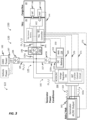
- the TRU 26 may include or be operably interfaced with a power supply interface shown generally as 120.
- the power supply interface 120 may include, interfaces to/from various power sources denoted generally as 122 and more specifically as follows herein as well as one or more DC busses shown generally as 125 and more specifically 125a, 125b, ... 125n.
- the power sources 122 may include, but not be limited to an energy storage device 152, generator 162, and grid power, 182.
- Each of the power sources 122 may be configured to selectively power the TRU 26 as described further herein, including compressor motor 60, the condenser fan motors 90, the evaporator fan motors 98, the controller 82, and other components 99 of the TRU 26 that may include various solenoids and/or sensors).
- the controller 82 through a series of data and command signals over various pathways 108 may, for example, control the application of power to the electric motors 60, 90, 98 as dictated by the cooling needs of the TRU 26.
- the engineless TRU 26 may include an AC or DC architecture with selected components employing alternating current (AC), and others employing direct current (DC).
- the motors 60, 90, 98 may be configured as AC motors, while in other embodiments, the motors 60, 90, 98 may be configured as DC motors.
- the operation of the of the power sources 122 as they supply power to the TRU 26 is managed and monitored by the TRU controller 82 and interfaced from the DC bus 125 to the power management system 190.
- the power management system 190 is configured direct the power from the various power sources 122, and the like, via DC bus 125 based on various requirements of the TRU 26.
- the TRU controller 82 receives various signals indicative of the operational state of the TRU 26 and determines the power requirements for the TRU system 26 accordingly and directs the components of the power supply interface 120 and specifically the power management system 190 to direct power accordingly to address the requirements of the TRU 26.
- the TRU system 26 is controlled to a temperature setpoint value selected by the user.
- the TRU controller 82 monitors the RAT and optionally the SAT as measured by the temperature sensors 142 and 146 respectively.
- the TRU controller 82 estimates the power requirements for the TRU 26 based on the RAT (among others) and provides commands accordingly to the various components of the power supply interface 120 and specifically the power management system 190, energy storage system 150, and generator power converter 164 to manage the generation, conversion, and routing of power in the power supply interface 120 and TRU system 26.
- the measured RAT and the setpoint value an estimate to power demand is made.
- the (RAT-setpoint value) is above a first threshold (e.g., > 10 degrees F)
- full power e.g., at a known voltage supply, current demand is known
- first threshold e.g., > 10 degrees F
- full power e.g., at a known voltage supply, current demand is known
- second threshold current requirement is limited (at known voltage) to achieve a mid-range power (e.g., -50% power or something less than 100%).
- a minimum power e.g., -20% power.
- the TRU controller 82 is configured to control the components in the TRU 26 as well as the components of the power supply interface 120 in accordance with operating needs of the transport refrigeration system 20.
- the TRU controller 82 is communicatively coupled to the power management system 190, the grid power source 182, the energy storage system 150, and the generator power converter 164 or generator 162.
- the TRU controller 82 using additional information from each of the power sources 122 provides instructions to affect the grid power source 182 output, the generator 162 and generator power converter 164 output, the charge/discharge of the energy storage system 150, all to enable and configure providing power as required by the TRU 26.
- the TRU controller 82 provides instructions for various components in the power supply interface 120 to manage the power flow to the DC Bus 125 and thereby to the power management system 190 depending upon the operational status of the various power sources (i.e. grid power 182, energy storage device 152 and generator 162) and as based on the TRU 26 power demand.
- various power sources i.e. grid power 182, energy storage device 152 and generator 162
- the power management system 190 includes a DC/AC converter 194.
- the DC/AC converter 194 is configured to receive DC power on the DC bus 125 denoted in this instance 125a (e.g., second DC voltage V 2 , a second DC current I 2 from the generator power converter 165; and/or V G , I G 185; and/or DC voltage 155 from the energy storage device 152; alone or as combined) and generate three phase AC power 195 (e.g., at AC voltage V 2 , AC current I 2 a frequency f 2 ), for providing power to the TRU system 26.
- the DC/AC converter 194 includes a voltage control function, a current control function, and a frequency control function, each configured to facilitate the conversion.
- the TRU controller 82 provides command signals denoted by line 191, to the power management system 190.
- the commands are based, at least, on the power consumption requirements of the TRU 26 as discussed further herein.
- the TRU controller 82 may receive status information also depicted by line 191 regarding the DC/AC converter 194.
- the communications may be over standard communication interfaces such as CAN, RS-485, and the like.
- the communications may be wired or wireless.
- the TRU controller 82 knows, the power requirements for the TRU system 26, and thereby, what power is needed.
- the TRU controller 82 is also programmed to ascertain whether or not grid power (e.g., 182) is available or not. If the grid power is available and TRU is On and energy storage device 152 (e.g., battery) SOC indicates a full charge, grid power will satisfy TRU system 26 power demand.
- TRU power demand is satisfied as first priority and then DC/DC converter 156 is be activated to provide necessary charging to energy storage device 152 as second priority. Moreover, if grid power 182 is available and TRU is "Off' and the energy storage device 152 is not fully charged, the DC/DC converter156 will be activated to provide necessary charging current. If grid power 182 is not available and generator/generator power converter 162/164 is not operable, all TRU power demand is satisfied by the energy storage system 150 via the energy storage device 152. Finally, if grid power 182 is not available and generator/generator power converter 162/164 is operable, then TRU power demand is satisfied by both the generator 162 & energy storage system 150.
- the TRU controller 82 identifies the power requirements for the TRU 26 at least partially based on the RAT.
- the TRU controller 82 conveys the power requirements to the power management system 190 and/or the generator power converter 164 to convert the first three phase AC power 163 or first DC power 163a to the second DC power 165 as necessary to satisfy the requirements of the TRU 26 and the energy storage system 150 and specifically the charging requirements of the energy storage device 152.
- the DC bus 125 and thereby, the power management system 190 may receive power from a grid power source 182 when it is available.
- the grid power source 182 is interfaced to the DC bus 125 and the power management system 190 via a grid power converter 184.
- the power management system 190 may be a stand-alone unit, or integral with the TRU 26.
- the grid power source 182 is generally conventional three phase AC power 220/480VAC at 60 or 400Hz.
- the grid power converter 184 is a conventional AC/DC converter operable to convert the three phase AC power from the grid power source 182 to a DC voltage and current.
- one of the power sources 122 includes an energy storage system 150 operably coupled to the power management system 190.
- the energy storage system 150 transmits DC power 155 via DC bus 125b to, and receives DC power 157 from the DC bus 125.
- the energy storage system 150 includes the energy storage device 152, and may include a battery management system 154.
- the battery management system 154 is a part of, and integral with, the energy storage device 152.
- DC bus 125a and 125b are directly connected.
- the DC voltages from the power sources 122 including DC voltage 185 from the grid power source 182 and/or DC voltage V 2 , I 2 165 from the generator power converter 164 combines to form the DC voltage on the and current on bus 125a, 125b which is directly coupled to the energy storage device 152 to the to charge and store energy on the energy storage device 152.
- the energy storage device 152 supplies DC voltage and current 155 directly to the DC bus 125b,125a and the power management system 190 for powering the TRU 26.
- the energy storage system 150 further includes a DC/DC converter 156.
- the DC bus 125 provides DC power 157 to a DC/DC converter 156 to formulate a DC voltage and current 155 on DC bus 125b to charge and store energy on the energy storage device 152.
- the energy storage device 152 supplies DC voltage and current 155 via DC bus 125b to the DC/DC converter 156 operating as a DC/DC converter to supply a DC power 157 to the DC bus 125, 125a, and the power management system 190 for powering the TRU 26.
- the DC/DC converter 156 is bidirectional, enabling conversions in both directions to facilitate charging and discharging the energy storage device 152.
- DC/DC converter 156 is described as bidirectional, such description is merely for the purposes of illustration. In operation, the DC/DC converter 156 may be a single integrated unit, or multiple units configured in parallel to operate in opposite directions. It is also noteworthy to appreciate that in the various embodiments described herein, numerous architectures are described based on the interconnection between the various power sources 122. More specifically, the interconnection between power sources 122, e.g., grid power source 182, generator 162 and the DC/AC converter 194 of the power management system 190 with the energy storage device 152, based on the optional application of the optional DC/DC converter 156. In the various architectures, where the energy storage device 152 is directly connected (e.g.
- that portion of the bus is termed variable as the voltage is capable of variation based on the state of charge of the energy storage device 152.
- the portions of the DC bus directly connected (e.g., 125b) to the energy storage device 152 and at the input connection to the DC/DC converter are considered variable, while the portion at the output of the DC/DC converter 156 connected to the DC bus 125, (e.g., 125a) are considered fixed and regulated.
- the battery management system 154 monitors the performance of the energy storage device 152. For example, monitoring the state of charge of the energy storage device 152, a state of health of the energy storage device 152, and a temperature of the energy storage device 152.
- Examples of the energy storage device 152 may include a battery system (e.g., a battery or bank of batteries), fuel cells, flow battery, ultracapacitors, and others devices capable of storing and outputting electric energy that may be direct current (DC).
- the energy storage device 152 may include a battery system, which may employ multiple batteries organized into battery banks.
- the battery system 150 may have a voltage potential within a range of about two-hundred volts (200V) to about six-hundred volts (600V). Generally, the higher the voltage, the greater is the sustainability of electric power which is preferred. However, with increases in the voltage, the size and weight of the battery/batteries in an energy storage device 152 increase. Increased size and weight are generally not preferred when transporting cargo. Additionally, if the energy storage device 152 is a battery, then in order to increase either voltage and/or current, the batteries need to be connected in series or parallel depending upon electrical needs.
- the energy storage device 152 may be contained within the structure 27 of the TRU 26. In an embodiment, the energy storage device 152 is located with the TRU 26, however, other configurations are possible. In another embodiment, the energy storage device 152 may be located with the container 24 such as, for example, underneath the cargo compartment 40. Likewise, the DC/DC converter 156 may be located with the container 24 such as, for example, underneath the cargo compartment 40, however, in some embodiments it may be desirable to have the DC/DC converter 156 in close proximity to the power management system 190 and/or the TRU 26 and TRU controller 82.
- the battery management system 154 and DC/DC converter 156 are operably connected to and interface with the TRU controller 82.
- the TRU controller 82 receives information regarding the status of energy storage system 150, including the energy storage device 152 to provide control inputs to the DC/DC converter 156 to monitor the energy storage device 152, as well as control charge and discharge rates for the energy storage device 152.
- the generator power converter 164 is an AC/DC converter and configured to receive the three phase AC power 163 (e.g., at AC voltage V 1 , AC current I 1 a frequency f 1 ), from the generator 162 and convert it to a DC power denoted 165 comprising a second DC voltage V 2 , a second DC current I 2 .
- the second DC power 165 is transmitted from the generator power converter 164 to the DC bus 125 and power management system 190.
- the generator power converter 164 is configured to provide the second DC power 165 based of the requirements of the TRU 26.
- the generator power converter 164 includes a voltage control function 166, a current control function 167, are each configured to facilitate the conversion.
- the TRU controller 82 provides command signals denoted 169, and 170 to a voltage control function 166, current control function 167, respectively.
- the command signals 169, and 170 are generated by the TRU controller 82 based on the power consumption requirements of the TRU 26 as discussed further herein.
- the TRU controller 82 may receive status information as depicted by 171, 172 regarding the generator power converter 164, and generator 162 respectively.
- the generator power converter may receive control signal or provide status signals to TRU controller 82, the power management system 190, or energy storage system 150 for mode selection and diagnostic purposes.
- the communications may be over standard communication interfaces such as CAN, RS-485, and the like.
- the communications may be wired or wireless.
- the generator power converter 164, the voltage control function 166 includes a voltage regulation function and is configured to monitor the output voltage from the generator 162 and maintains a constant DC voltage out of the voltage control function 166.
- the voltage control function 166 communicates status to the TRU Controller 82.
- the current control function 167 monitors and communicates to the TRU 26 the status of current draw from the generator 162. In an embodiment, the current may be limited depending on the power demands of the TRU 26.
- a frequency converter function 168 may also monitors the frequency of the three phase power 163 produced by the generator 162 to facilitate the conversion of the three phase power 163 to the second DC power 165 as determined by the voltage control function 166 and the TRU controller 82 for supply to the power management system 190 and ultimately the TRU 26.
- the generator power converter 164 may be a stand-alone unit configured to be in close proximity to or even integral with the generator 162.
- the power supply interface 120 may include, interfaces to various power sources 122 managed and monitored by the TRU controller 82.
- the TRU controller 82 and the power management system 190 manages and determines electrical power flows in the power supply interface 120 based upon the operational needs of the TRU 26 and the capabilities of the components in the power supply interface 120, (e.g., generator 162, converter 164, energy storage device 152, and the like.
- the TRU controller determines the status of various power sources 122, controls their operation, and directs the power to and from the various power sources 122 and the like based on various requirements of the TRU 26.
- the power flows will be transferred through different paths based on the requirements placed on the power management system 190 and particular configuration of the power supply interface 120.
- the DC bus 125 and the power management system 190 operates as a central power bus to connect various power sources 122 together to supply the power needs of the TRU 26.
- the TRU controller and power management system 190 controls switching, directing, or redirecting power to/from the five power flows as needed to satisfy the power requirements of the TRU 26.
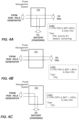
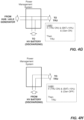
- FIGS 4A-4H each providing a simplified diagram depicting each of the various possible power flow combinations in the power supply interface 120 associated with the DC bus 125.
- FIGS. 4A-4C depict power flows for power supplied from the generator 162 and/or generator power converter 164 (e.g., second DC power).
- the power on the DC bus 125 is directed to the power management system 190 and thereby the TRU 26 and the energy storage system 150 for recharging the energy storage device 152.
- priority is given to satisfying the power requirements of the TRU 26. Any remaining power may be directed to the recharging application for the energy storage system 150.
- the logic employed by the TRU controller 82 for directing the power to the power management system 190 addresses an instance when the TRU 26 is inoperative, and the energy storage system 150 indicates that the energy storage device 152 is exhibiting a state of charge that is less than a selected threshold (in this instance 100%, though other thresholds are possible).
- the DC power on the DC bus 125 is directed only to the energy storage system 150 for recharging the energy storage device 152.
- FIGS. 4D-4F depict power flows for power supplied from the grid power source 182.
- the logic employed by the TRU controller 82 for directing the power from the grid power source 182 determines if the TRU 26 is operating and the generator 162 (or the generator power converter 164) is inoperative. If so, and the energy storage system 150 indicates that the energy storage device 152 is exhibiting a charge state that is less than a selected threshold, then power is directed from the DC bus 125 to both the power management system 190 and then the TRU system 26 and the energy storage system 150 for recharging the energy storage device 152. In an embodiment, once again, priority is given to satisfying the power requirements of the TRU system 26.
- any remaining power may be directed to the recharging application for the energy storage system 150. It should be appreciated that while particular threshold of 80% is disclosed and employed for the described embodiments, such values and description are merely illustrative. Other values and applications for the thresholds are possible.
- FIG 4E the figure depicts a second instance for power flows for power supplied from the grid power source 182 when the generator 162 is inoperative.
- the DC power on the DC bus 125 is directed only to the power management system 190 directs and to the TRU 26, (as the energy storage system 150 does not yet require recharging).
- FIG 4F a third power flow for power supplied from the grid power source 182 when the generator 162 is inoperative.
- the logic employed by the TRU controller 82 for directing the power on the DC bus 125 addresses an instance when the TRU 26 is also inoperative, and the energy storage system 150 indicates that the energy storage device 152 is exhibiting a state of charge that is less than a selected threshold (in this instance 100%, though other thresholds are possible).
- the power on the DC bus 125 is directed only to the energy storage system 150 for recharging the energy storage device 152. In an embodiment, priority is given to satisfying the power requirements of energy storage system 150.
- FIGS. 4G and 4H depict power flows for power supplied to the power management system 190 and the TRU 26 under selected conditions for operating from the energy storage system 150 as well.
- power flows to the TRU 26 are provided from the generator 162 and/or generator power converter 164 (e.g., second DC power 165) as well as from the energy storage system 150.
- the logic employed by the TRU controller 82 for directing the power to the DC bus 125 and the power management system 190 determines if the TRU 26 is operating.
- the energy storage system 150 indicates that the energy storage device 152 is exhibiting a charge state of greater than a selected threshold
- power from both the generator 162 (or generator power converter 164) and the energy storage system 150 is directed to DC bus 125 and then to the power management system 190 and thereby the TRU 26.
- a threshold of 10 percent is employed for the state of charge of the energy storage device 152.
- power is provided by the energy storage system 150 and thereby discharging the energy storage device 152.
- priority is given to satisfying the power requirements of the TRU 26. This embodiment may be employed under conditions where the output power of the generator 162 and/or generator power converter 164 is less that that needed to operate the TRU 26.
- threshold of 10% is disclosed and employed for the described embodiments, such values and description are merely illustrative. Other values and applications for the thresholds are possible. For example, in some instances it may be desirable prioritize operation of the TRU 26 such that fully draining the energy storage device 152 is acceptable. Likewise, in other embodiments, it may be desirable to modify the function or curtail the operation of the TRU 26 to avoid excessively discharging the energy storage device 152.
- the figure depicts a second instance for power flows from the energy storage system 150 alone.
- the energy storage system 150 indicates that the energy storage device 152 is exhibiting a state of charge that is in excess of a selected threshold, then the power on the DC bus is directed to the power management system 190, which then provides power to the TRU 26.
- a threshold of 10 percent is employed for the state of charge of the energy storage device 152.
- power is provided by the energy storage system 150 and thereby discharging the energy storage device 152.
- priority is given to satisfying the power requirements of the TRU 26.
- this embodiment may be employed under conditions where the output power of the generator 162 and/or generator power converter 164 is less that that needed to operate the TRU 26.
- threshold of 10% is disclosed and employed for the described embodiments, such values and description are merely illustrative. Other values and applications for the thresholds are possible. For example, in some instances it may be desirable prioritize operation of the TRU 26 such that fully draining the energy storage device 152 is acceptable. Likewise, in other embodiments, it may be desirable to modify the function or curtail the operation of the TRU to avoid excessively discharging the energy storage device 152.
- the power supply interface 120 is configured such that, in selected modes of operation power is directed to the TRU 26 from the tractor or vehicle 22.
- the energy storage device 152 exhibit a SOC below a selected threshold e.g., ⁇ 10% and the generator 162/generator power converter 164 is not operable but the TRU system 26 is operable and requires power
- TRU power could be drawn from the power system of the tractor or truck. (i.e. tie into the energy storage device or generator of the tractor/truck).
- the described embodiments while generally referring the generator 162 being installed on the trailer portion of the vehicle, 22, such description is merely illustrative. In another embodiment, the generator 162 or another generator could be installed at a hub or axle of the tractor portion of the vehicle 22 without loss of generality and still be fully applicable to the described embodiments.
- the tractor/truck power may be routed to the power supply interface 120 through a grid plug 189. Alternately connectable between the grid power source 182 and the vehicle power. For example, in operation, when vehicle 22 trailer is in operation, for example, on delivery, grid plug 189 would be plugged into the tractor/trailer's electric PTO and act as mobile grid source.
- the TRU controller 82 would be programmed to determine if the grid plug is active and if so, to pull power (or supplement generator power) only if energy storage device SOC is below threshold as alternative to modify the function or curtail the operation of the TRU system 26.
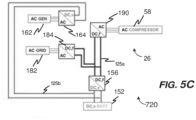
- FIGS 5A-5C depict a plurality of possible configurations for the power supply interface 120.
- FIG 5A depicts a simplified block diagram of the power supply interface 220 as described herein.
- FIG. 5A depicts the single DC bus 125 in a fixed configuration.
- the DC bus is split with a variable side 125b between the energy storage device 152 and the DC/DC converter 156 and a fixed DC bus 125, 125a on the output side of the DC/DC converter 156 of the energy storage system 150.
- FIG 5B depicts a simplified block diagram of the power supply interface 320 in accordance with another embodiment as described herein.
- FIG. 5B depicts a configuration of the power supply interface 320 where the grid power supply 182 and grid power converter 184 are commonly connected with the energy storage device 152 on the DC bus 125b in a variable configuration.
- the DC/DC converter 156 isolates the variable DC bus 125b from the fixed DC bus 125a which includes the output of the DC/DC converter 156 of the energy storage system 150 and the output of the generator power converter 164 commonly connected with the DC/AC converter 192 of the power management system 190 to provide power to the TRU system 26.
- FIG 5C depicts a simplified block diagram of the power supply interface 720 in accordance with still yet another embodiment as described herein.
- FIG. 5C depicts a configuration of the power supply interface 720 where the generator 162 and the output of the generator power converter 164 are connected with the energy storage device 152 on the variable DC bus 125b in a variable configuration.
- the DC/DC converter 156 of the energy storage system forming the fixed DC bus denoted once again 125a, once again DC/DC converter 156 isolates the fixed DC bus 125a from the variable DC bus 125b.
- the output of the DC/DC converter 156 of the energy storage system 150 is connected along with grid power converter 184 to fixed DC bus 125a, providing power the DC/AC converter 192 of the power management system 190 to provide power to the TRU system 26.
- the TRU 26 may further include a renewable power source 110 ( FIG. 1 ) configured to recharge the batteries of the energy storage device 152.
- a renewable power source 110 may be solar panels mounted, for example, to the outside of the top wall 30 of the container 24 (also see FIG. 1 ).
- the renewable power source 110 could generate all or a portion of the needed low voltage DC power for the TRU controller 82.
- Benefits of the present disclosure when compared to more traditional systems include no fuel carriage, fuel system and fuel consumption, and a refrigeration unit that emits less noise and no combustion byproducts. Yet further, the present disclosure includes an energy storage device that is conveniently and efficiently recharged to meet the power demands of the refrigeration unit.
- embodiments can be in the form of processor-implemented processes and devices for practicing those processes, such as a processor.
- Embodiments can also be in the form of computer program code containing instructions embodied in tangible media, such as network cloud storage, SD cards, flash drives, floppy diskettes, CD ROMs, hard drives, or any other computer-readable storage medium, wherein, when the computer program code is loaded into and executed by a computer, the computer becomes a device for practicing the embodiments.
- Embodiments can also be in the form of computer program code, for example, whether stored in a storage medium, loaded into and/or executed by a computer, or transmitted over some transmission medium, loaded into and/or executed by a computer, or transmitted over some transmission medium, such as over electrical wiring or cabling, through fiber optics, or via electromagnetic radiation, wherein, when the computer program code is loaded into an executed by a computer, the computer becomes a device for practicing the embodiments.
- the computer program code segments configure the microprocessor to create specific logic circuits.
Landscapes
- Engineering & Computer Science (AREA)
- Mechanical Engineering (AREA)
- Physics & Mathematics (AREA)
- Thermal Sciences (AREA)
- Power Engineering (AREA)
- Chemical & Material Sciences (AREA)
- Combustion & Propulsion (AREA)
- General Engineering & Computer Science (AREA)
- Transportation (AREA)
- Supply And Distribution Of Alternating Current (AREA)
Claims (12)
- Leistungssystemarchitektur zum Betrieb eines Transportkühlsystems (20), umfassend:eine Transportkühleinheit TRU (26), die in einem Dampfkompressionskreislauf betreibbar ist, wobei die TRU (26) einen Kompressor (58), der dazu konfiguriert ist, ein Kühlmittel zu komprimieren, einen Verdampferwärmetauscher (72), der funktional an den Kompressor (58) gekoppelt ist, einen Verdampferlüfter (96), der dazu konfiguriert ist, einen Rückluftstrom von einem Rücklufteinlass bereitzustellen und den Rückluftstrom über den Verdampferwärmetauscher (72) strömen zu lassen, aufweist, wobei die TRU (26) auch eine TRU-Steuereinrichtung (82) aufweist, die dazu konfiguriert ist, einen Prozess auszuführen, um einen AC-Leistungsbedarf für die TRU (26) zu bestimmen;einen Generatorleistungswandler (164), der dazu konfiguriert ist, eine erste dreiphasige Generator-AC-Leistung (163) von einem Wechselstrom-AC-Generator (162), der funktional an eine Achse oder Radnabe gekoppelt ist, aufzunehmen, und der dazu konfiguriert ist, eine Generator-DC-Leistung (165) bereitzustellen;einen Netzleistungswandler (184), der dazu konfiguriert ist, eine dreiphasige Netz-AC-Leistung von einer Netzleistungsquelle (182) aufzunehmen, die betreibbar ist, um die dreiphasige Netz-AC-Leistung bereitzustellen; wobei der Netzleistungswandler (184) betreibbar ist, um eine Netz-DC-Leistung (185) bereitzustellen;eine Energiespeichervorrichtung (152), wobei die Energiespeichervorrichtung (152) betreibbar ist, um eine variable DC-Leistung (155) bereitzustellen, und mit einer Variable-DC-Verteilerschiene (125b) verbunden ist;ein Leistungsmanagementsystem (190), das funktional verbunden ist, um mindestens teilweise auf Grundlage der AC-Leistungsanforderung Leistung (195) an die TRU (26) zu leiten; und gekennzeichnet durchein Energiespeichersystem (150), das die Energiespeichervorrichtung (152), einen ersten Energiespeichersystem-DC/DC-Wandler (156), der dazu konfiguriert ist, die variable DC-Leistung (155) auf der Variable-DC-Verteilerschiene (125b) in eine Fest-DC-Leistung (157) auf einer Fest-DC-Verteilerschiene (125a) umzuwandeln, um die Fest-DC-Leistung (157) mindestens teilweise auf Grundlage der AC-Leistungsanforderung an das Leistungsmanagementsystem (190) bereitzustellen, und einen zweiten Energiespeichersystem-DC/DC-Wandler (156) beinhaltet, der dazu konfiguriert ist, mindestens einen Teil der Fest-DC-Leistung (157) auf der Fest-DC-Verteilerschiene (125a) umzuwandeln, um die Variable-DC-Verteilerschiene (125b) und die Energiespeichervorrichtung (152) zu versorgen.
- Leistungssystemarchitektur nach Anspruch 1, wobei der Generatorleistungswandler (164) dazu konfiguriert ist, die von dem AC-Generator (162) bereitgestellte erste dreiphasige Generator-AC-Leistung (163) aufzunehmen und die Generator-DC-Leistung (165) an eine von der Fest-DC-Verteilerschiene (125a) oder der Variable-DC-Verteilerschiene (125b) zu übertragen; oder:
wobei der Generatorleistungswandler (164) einen AC/DC-Wandler beinhaltet und die erste dreiphasige Generator-AC-Leistung (163) eine erste AC-Spannung (V1) und einen ersten AC-Strom (I1) bei einer ersten Frequenz (f1) aufweist, und die Generator-DC-Leistung (165) eine zweite DC-Spannung (V2) und einen zweiten DC-Strom (I2) aufweist;
oder:
wobei der Generatorleistungswandler (164) eine Spannungssteuerungsfunktion (166) und eine Stromsteuerungsfunktion (167) beinhaltet, wobei mindestens die Spannungssteuerungsfunktion (166) mindestens teilweise auf die AC-Leistungsanforderung anspricht. - Leistungssystemarchitektur nach Anspruch 1, wobei der Netzleistungswandler (184) dazu konfiguriert ist, die erste dreiphasige Netz-AC-Leistung, die von der Netzleistungsquelle (182) bereitgestellt wird, aufzunehmen und die Netz-DC-Leistung (185) an eine von der Fest-DC-Verteilerschiene (125a) oder der Variable-DC-Verteilerschiene (125b) zu übertragen;
oder:
wobei der Netzleistungswandler (184) einen AC/DC-Wandler beinhaltet und die dreiphasige Netz-AC-Leistung eine Netz-AC-Spannung und einen Netz-AC-Strom bei einer Netzfrequenz aufweist und die Netz-DC-Spannung (185) eine Netz-DC-Spannung (VG) und einen Netz-DC-Strom (IG) aufweist;
oder:
wobei der Netzleistungswandler (184) eine Spannungssteuerungsfunktion und eine Stromsteuerungsfunktion beinhaltet, wobei mindestens die Spannungssteuerungsfunktion mindestens teilweise auf die AC-Leistungsanforderung anspricht. - Leistungssystemarchitektur nach Anspruch 1, ferner beinhaltend ein Batteriemanagementsystem (154), das funktional mit der TRU-Steuereinrichtung (82) verbunden und dazu konfiguriert ist, mindestens einen Ladezustand der Energiespeichervorrichtung (152) zu überwachen.
- Leistungssystemarchitektur nach Anspruch 4, wobei der erste Energiespeichersystem-DC/DC-Wandler (156) und der zweite Energiespeichersystem-DC/DC-Wandler (156) integriert sind.
- Leistungssystemarchitektur nach Anspruch 1, wobei die Energiespeichervorrichtung (152) mindestens eines von einer Batterie, einer Brennstoffzelle und einer Durchflussbatterie umfasst.
- Leistungssystemarchitektur nach Anspruch 1, wobei das Leistungsmanagementsystem (190) dazu konfiguriert ist, die Fest-C-Leistung (157) von der Fest-DC-Verteilerschiene (125a) aufzunehmen und mindestens auf Grundlage der AC-Leistungsanforderung eine zweite dreiphasige AC-Leistung (195) an die TRU (26) bereitzustellen.
- Leistungssystemarchitektur nach Anspruch 7, wobei das Leistungsmanagementsystem (190) einen DC/AC-Wandler (194) beinhaltet und die zweite dreiphasige AC-Leistung (195) eine zweite dreiphasige AC-Spannung (V2) und einen zweiten AC-Strom (I2) bei einer zweiten Frequenz (f2) aufweist.
- Leistungssystemarchitektur nach Anspruch 1, wobei der Netzleistungswandler (184), der Generatorleistungswandler (164), das Energiemanagementsystem (190) und der erste Energiespeichersystem-DC/DC-Wandler (156) funktional mit der Fest-DC-Verteilerschiene (125a) verbunden sind und der zweite Energiespeichersystem-DC/DC-Wandler (156) und die Energiespeichervorrichtung (152) funktional mit der Variable-DC-Verteilerschiene (125b) verbunden sind;
oder:
wobei der Netzleistungswandler (184) und das Energiemanagementsystem (190) und der erste Energiespeichersystem-DC/DC-Wandler (156) mit der Fest-DC-Verteilerschiene (125a) verbunden sind und der zweite Energiespeichersystem-DC/DC-Wandler (156) und der Generatorleistungswandler (164) und die Energiespeichervorrichtung (152) funktional mit der Variable-DC-Verteilerschiene (125b) verbunden sind;
oder:
wobei der Netzleistungswandler (184), der Generatorleistungswandler (164), der zweite Energiespeichersystem-DC/DC-Wandler (156) und die Energiespeichervorrichtung (150) mit der Variable-DC-Verteilerschiene (125b) verbunden sind und der erste Energiespeichersystem-DC/DC-Wandler (156) und das Energiemanagementsystem (190) funktional mit der Fest-DC-Verteilerschiene (125a) verbunden sind;
oder:
wobei der Netzleistungswandler (184), der Generatorleistungswandler (164), der erste Energiespeichersystem-DC/DC-Wandler (156) mit der Fest-DC-Verteilerschiene (125a) verbunden sind und der zweite Energiespeichersystem-DC/DC-Wandler (156) und die Energiespeichervorrichtung (150) funktional mit der Variable-DC-Verteilerschiene (125b) verbunden sind. - Leistungssystemarchitektur nach Anspruch 1, wobei der Netzleistungswandler (184) und der erste Energiespeichersystem-DC/DC-Wandler (156) mit der Fest-DC-Verteilerschiene (125a) verbunden sind, der zweite Energiespeichersystem-DC/DC-Wandler (156), der Generatorleistungswandler (164) und die Energiespeichervorrichtung (150) funktional mit der Variable-DC-Verteilerschiene (125b) verbunden sind.
- Leistungssystemarchitektur nach Anspruch 1, wobei der Generatorleistungswandler (164) und das Energiemanagementsystem (190) und der erste Energiespeichersystem-DC/DC-Wandler (156) mit der Fest-DC-Verteilerschiene (125a) verbunden sind und der zweite Energiespeichersystem-DC/DC-Wandler (156) und der Netzleistungswandler (184) und die Energiespeichervorrichtung (150) funktional mit der Variable-DC-Verteilerschiene (125b) verbunden sind.
- Leistungssystemarchitektur nach Anspruch 1, ferner beinhaltend einen Rücklufttemperatur-, RAT-, Sensor (142), der in einem Rückluftstrom (134) angeordnet ist und dazu konfiguriert ist, die Temperatur des Rückluftstroms zu messen, wobei der RAT-Sensor (142) funktional mit der TRU-Steuereinrichtung (82) verbunden ist, wobei die TRU-Steuereinrichtung (82) dazu konfiguriert ist, einen Prozess zum Bestimmen der AC-Leistungsanforderung für die TRU (26) mindestens teilweise auf Grundlage der RAT auszuführen.
Priority Applications (1)
| Application Number | Priority Date | Filing Date | Title |
|---|---|---|---|
| EP24193739.0A EP4477487A3 (de) | 2018-09-28 | 2019-09-19 | Elektrische architektur zur versorgung einer transportkühleinheit |
Applications Claiming Priority (2)
| Application Number | Priority Date | Filing Date | Title |
|---|---|---|---|
| US201862738689P | 2018-09-28 | 2018-09-28 | |
| PCT/US2019/051963 WO2020068556A1 (en) | 2018-09-28 | 2019-09-19 | Electrical architecture for powering transportation refrigeration unit |
Related Child Applications (2)
| Application Number | Title | Priority Date | Filing Date |
|---|---|---|---|
| EP24193739.0A Division EP4477487A3 (de) | 2018-09-28 | 2019-09-19 | Elektrische architektur zur versorgung einer transportkühleinheit |
| EP24193739.0A Division-Into EP4477487A3 (de) | 2018-09-28 | 2019-09-19 | Elektrische architektur zur versorgung einer transportkühleinheit |
Publications (2)
| Publication Number | Publication Date |
|---|---|
| EP3856549A1 EP3856549A1 (de) | 2021-08-04 |
| EP3856549B1 true EP3856549B1 (de) | 2024-09-11 |
Family
ID=68109479
Family Applications (2)
| Application Number | Title | Priority Date | Filing Date |
|---|---|---|---|
| EP19780484.2A Active EP3856549B1 (de) | 2018-09-28 | 2019-09-19 | Elektrische architektur zum betrieb einer transportkühleinheit |
| EP24193739.0A Pending EP4477487A3 (de) | 2018-09-28 | 2019-09-19 | Elektrische architektur zur versorgung einer transportkühleinheit |
Family Applications After (1)
| Application Number | Title | Priority Date | Filing Date |
|---|---|---|---|
| EP24193739.0A Pending EP4477487A3 (de) | 2018-09-28 | 2019-09-19 | Elektrische architektur zur versorgung einer transportkühleinheit |
Country Status (4)
| Country | Link |
|---|---|
| US (1) | US12240296B2 (de) |
| EP (2) | EP3856549B1 (de) |
| CN (1) | CN112334341B (de) |
| WO (1) | WO2020068556A1 (de) |
Families Citing this family (41)
| Publication number | Priority date | Publication date | Assignee | Title |
|---|---|---|---|---|
| EP3626489A1 (de) | 2018-09-19 | 2020-03-25 | Thermo King Corporation | Verfahren und systeme zur energieverwaltung einer klimaanlage für transportfahrzeuge |
| EP3626490A1 (de) | 2018-09-19 | 2020-03-25 | Thermo King Corporation | Verfahren und systeme zur leistungs- und lastverwaltung einer klimaanlage für den transport |
| US11273684B2 (en) | 2018-09-29 | 2022-03-15 | Thermo King Corporation | Methods and systems for autonomous climate control optimization of a transport vehicle |
| US11034213B2 (en) | 2018-09-29 | 2021-06-15 | Thermo King Corporation | Methods and systems for monitoring and displaying energy use and energy cost of a transport vehicle climate control system or a fleet of transport vehicle climate control systems |
| US10875497B2 (en) | 2018-10-31 | 2020-12-29 | Thermo King Corporation | Drive off protection system and method for preventing drive off |
| US10926610B2 (en) | 2018-10-31 | 2021-02-23 | Thermo King Corporation | Methods and systems for controlling a mild hybrid system that powers a transport climate control system |
| US10870333B2 (en) | 2018-10-31 | 2020-12-22 | Thermo King Corporation | Reconfigurable utility power input with passive voltage booster |
| US11059352B2 (en) | 2018-10-31 | 2021-07-13 | Thermo King Corporation | Methods and systems for augmenting a vehicle powered transport climate control system |
| US11022451B2 (en) | 2018-11-01 | 2021-06-01 | Thermo King Corporation | Methods and systems for generation and utilization of supplemental stored energy for use in transport climate control |
| US11554638B2 (en) | 2018-12-28 | 2023-01-17 | Thermo King Llc | Methods and systems for preserving autonomous operation of a transport climate control system |
| EP3906175A1 (de) | 2018-12-31 | 2021-11-10 | Thermo King Corporation | Verfahren und systeme zur bereitstellung von prädiktiver energieverbrauchsrückkopplung zur speisung eines transportklimaregelungssystems unter verwendung externer daten |
| EP3906173B1 (de) | 2018-12-31 | 2024-05-22 | Thermo King LLC | Verfahren und systemen mit feedback eines prädiktiven abgeschätzten energieverbrauch es zur steuerung eines klimaaggregates für eine transportvorrichtung |
| US11993131B2 (en) | 2018-12-31 | 2024-05-28 | Thermo King Llc | Methods and systems for providing feedback for a transport climate control system |
| US11072321B2 (en) | 2018-12-31 | 2021-07-27 | Thermo King Corporation | Systems and methods for smart load shedding of a transport vehicle while in transit |
| US12072193B2 (en) | 2018-12-31 | 2024-08-27 | Thermo King Llc | Methods and systems for notifying and mitigating a suboptimal event occurring in a transport climate control system |
| ES2965029T3 (es) | 2019-06-28 | 2024-04-10 | Thermo King Llc | Vehículo climatizado, equipo de control climático para el transporte, método de readaptación de un vehículo y método de funcionamiento |
| ES2992855T3 (en) | 2019-09-09 | 2024-12-19 | Thermo King Llc | Prioritized power delivery for facilitating transport climate control |
| US10985511B2 (en) | 2019-09-09 | 2021-04-20 | Thermo King Corporation | Optimized power cord for transferring power to a transport climate control system |
| US11203262B2 (en) | 2019-09-09 | 2021-12-21 | Thermo King Corporation | Transport climate control system with an accessory power distribution unit for managing transport climate control loads |
| US11214118B2 (en) | 2019-09-09 | 2022-01-04 | Thermo King Corporation | Demand-side power distribution management for a plurality of transport climate control systems |
| EP3790157A1 (de) | 2019-09-09 | 2021-03-10 | Thermo King Corporation | Optimierte energieverteilung für transportklimatisierungssysteme zwischen einer oder mehreren stationen der elektrischen versorgungsanlagen |
| US11458802B2 (en) | 2019-09-09 | 2022-10-04 | Thermo King Corporation | Optimized power management for a transport climate control energy source |
| US11376922B2 (en) | 2019-09-09 | 2022-07-05 | Thermo King Corporation | Transport climate control system with a self-configuring matrix power converter |
| US11135894B2 (en) | 2019-09-09 | 2021-10-05 | Thermo King Corporation | System and method for managing power and efficiently sourcing a variable voltage for a transport climate control system |
| US11420495B2 (en) | 2019-09-09 | 2022-08-23 | Thermo King Corporation | Interface system for connecting a vehicle and a transport climate control system |
| US11489431B2 (en) | 2019-12-30 | 2022-11-01 | Thermo King Corporation | Transport climate control system power architecture |
| EP3901542B1 (de) * | 2020-04-22 | 2026-04-01 | Carrier Corporation | Spannungswandlungssystem für ein transportkühlsystem |
| WO2021257563A2 (en) * | 2020-06-15 | 2021-12-23 | Arizona Board Of Regents On Behalf Of Arizona State University | Systems, methods, and apparatus for implementing aggregable, environment-controlled mini-containers for the efficient logistics of perishable products |
| EP4063151B1 (de) | 2021-03-23 | 2024-04-24 | Carrier Corporation | Elektrische architektur zur versorgung mehrerer transportkühleinheiten |
| EP4071981B1 (de) * | 2021-04-06 | 2023-05-31 | Carrier Fire & Security EMEA BV | Stromverwaltungssystem für eine transportkühleinheit |
| EP4101695A1 (de) * | 2021-06-08 | 2022-12-14 | Carrier Corporation | Stromverwaltungssystem für eine transportkühleinheit |
| CN115885447B (zh) * | 2021-07-29 | 2024-02-02 | 宁德时代新能源科技股份有限公司 | 充放电装置、电池充电和放电的方法、以及充放电系统 |
| EP4206007A1 (de) | 2022-01-04 | 2023-07-05 | Carrier Corporation | Niederspannungs-energiesystem für eine transportkühleinheit |
| US12409709B2 (en) | 2022-01-04 | 2025-09-09 | Carrier Corporation | Medium-to-high voltage power system for a transport refrigeration unit |
| EP4234287B1 (de) * | 2022-02-28 | 2025-08-06 | Carrier Corporation | Hybridisierte brennstoffzellentransportkühleinheiten |
| US20230373416A1 (en) * | 2022-05-23 | 2023-11-23 | Carrier Corporation | Transport refrigeration energy storage system |
| US12355339B2 (en) * | 2022-07-18 | 2025-07-08 | Carrier Corporation | Hybrid power system for transport refrigeration systems |
| EP4321355A1 (de) * | 2022-08-08 | 2024-02-14 | Thermo King LLC | Gerät mit einem photovoltaischen system |
| US20250112491A1 (en) * | 2023-09-29 | 2025-04-03 | Carrier Corporation | Power system for transportation refrigeration unit and method for controlling power thereof |
| EP4613520A3 (de) * | 2024-03-05 | 2025-10-29 | Carrier Corporation | Stromversorgungsverwaltung in einer transportkühleinheit |
| EP4675881A1 (de) * | 2024-07-02 | 2026-01-07 | Carrier Corporation | Rekonfigurierbare elektrische architektur zum effizienten betrieb einer anhängerkühleinheit |
Family Cites Families (47)
| Publication number | Priority date | Publication date | Assignee | Title |
|---|---|---|---|---|
| JPH0490472A (ja) * | 1990-08-02 | 1992-03-24 | Hino Motors Ltd | 冷凍車両用冷却装置 |
| KR0168094B1 (ko) | 1993-10-19 | 1999-01-15 | 김광호 | 공기조화기의 운전제어장치 및 그 제어방법 |
| US5568023A (en) * | 1994-05-18 | 1996-10-22 | Grayer; William | Electric power train control |
| JP4426737B2 (ja) | 2000-06-28 | 2010-03-03 | 東芝キヤリア株式会社 | 車両用冷凍装置 |
| AU2001278046A1 (en) | 2000-07-28 | 2002-02-13 | International Power Systems, Inc. | Dc to dc converter and power management system |
| JP2002081825A (ja) | 2000-09-01 | 2002-03-22 | Denso Corp | 冷凍冷蔵庫 |
| US7207183B2 (en) | 2004-04-12 | 2007-04-24 | York International Corp. | System and method for capacity control in a multiple compressor chiller system |
| US20070151272A1 (en) | 2006-01-03 | 2007-07-05 | York International Corporation | Electronic control transformer using DC link voltage |
| US7573145B2 (en) | 2006-11-16 | 2009-08-11 | Cummins Power Generation Ip, Inc. | Electric power generation system controlled to reduce perception of operational changes |
| EP1935712A1 (de) * | 2006-12-22 | 2008-06-25 | Nederlandse Organisatie voor Toegepast-Natuuurwetenschappelijk Onderzoek TNO | Fahrzeugsystem und -verfahren |
| WO2008094148A1 (en) | 2007-01-31 | 2008-08-07 | Carrier Corporation | Integrated multiple power conversion system for transport refrigeration units |
| US20090045782A1 (en) | 2007-08-16 | 2009-02-19 | General Electric Company | Power conversion system |
| JP4939355B2 (ja) | 2007-09-28 | 2012-05-23 | 三菱重工業株式会社 | 車載空気調和機用インバータシステム |
| US8360180B2 (en) | 2007-12-31 | 2013-01-29 | Caterpillar Inc. | System for controlling a hybrid energy system |
| ES2699628T3 (es) * | 2008-07-25 | 2019-02-12 | Carrier Corp | Protección continua de la envoltura de un compresor |
| US8324846B2 (en) | 2008-09-15 | 2012-12-04 | Caterpillar Inc. | Electric drive retarding system and method |
| US8008808B2 (en) | 2009-01-16 | 2011-08-30 | Zbb Energy Corporation | Method and apparatus for controlling a hybrid power system |
| US8115334B2 (en) | 2009-02-18 | 2012-02-14 | General Electric Company | Electrically driven power take-off system and method of manufacturing same |
| US9689598B2 (en) | 2009-03-10 | 2017-06-27 | Thermo King Corporation | Systems and methods of powering a refrigeration unit of a hybrid vehicle |
| CN102803865A (zh) * | 2010-03-08 | 2012-11-28 | 开利公司 | 运输制冷系统中的能力和压力控制 |
| US8590330B2 (en) | 2010-06-03 | 2013-11-26 | Thermo King Corporation | Electric transport refrigeration unit with temperature-based diesel operation |
| US20130121844A1 (en) | 2010-06-17 | 2013-05-16 | Dresser-Rand Company | Variable Speed High Efficiency Gas Compressor System |
| WO2012138500A1 (en) | 2011-04-04 | 2012-10-11 | Carrier Corporation | Transport refrigeration system and method for operating |
| EP2694304B1 (de) | 2011-04-04 | 2018-05-02 | Carrier Corporation | Halbelektrisches mobiles gekühltes system |
| CN203965988U (zh) | 2011-10-25 | 2014-11-26 | K·卡梅伦 | 电力调节器电路藉由非线性发电机以最大化功率的输出 |
| US9562715B2 (en) | 2012-03-21 | 2017-02-07 | Thermo King Corporation | Power regulation system for a mobile environment-controlled unit and method of controlling the same |
| CN104661842A (zh) | 2012-09-20 | 2015-05-27 | 冷王公司 | 电动运输制冷系统 |
| US9389007B1 (en) * | 2013-01-09 | 2016-07-12 | New West Technologies, LLC | Transportation refrigeration system with integrated power generation and energy storage |
| JP6082886B2 (ja) | 2013-02-22 | 2017-02-22 | 株式会社高砂製作所 | 電力調整装置及び電力調整方法 |
| US9898018B2 (en) | 2013-03-14 | 2018-02-20 | Arda Power Inc. | Power clipping method and system |
| US9705324B2 (en) | 2013-12-03 | 2017-07-11 | Abb Schweiz Ag | Converter system for AC power sources |
| WO2015112531A1 (en) | 2014-01-27 | 2015-07-30 | Netronex, Inc. | Ac motor drive powered concurrently by ac grid and dc solar array |
| US10046641B2 (en) | 2014-03-19 | 2018-08-14 | Motivo Engineering LLC | Mobile power conversion and distribution system |
| KR101451787B1 (ko) | 2014-06-19 | 2014-10-21 | 국방과학연구소 | 전기추진 차량의 고효율 전력변환 제어방법 |
| WO2016036832A1 (en) | 2014-09-03 | 2016-03-10 | Kettering University | Wireless power transfer system |
| US9948108B2 (en) | 2014-09-30 | 2018-04-17 | Sparq Systems Inc. | DC-bus controller for an inverter |
| CA2865612C (en) | 2014-09-30 | 2021-01-26 | Queen's University At Kingston | Dc-bus controller for an inverter |
| US9701175B2 (en) | 2015-04-14 | 2017-07-11 | Ford Global Technologies, Llc | Hybrid vehicle split exhaust system with exhaust driven electric machine and A/C compressor |
| US10283966B2 (en) | 2015-07-31 | 2019-05-07 | Bluvert Technologies Ltd. | System and methods for power generation |
| CN105751851B (zh) | 2016-02-19 | 2018-11-30 | 成都雅骏新能源汽车科技股份有限公司 | 一种冷藏车电气控制系统 |
| KR101836230B1 (ko) | 2016-04-14 | 2018-03-09 | 금오공과대학교 산학협력단 | 가변 전압 dc 마이크로그리드 시스템 및 이의 운전 방법 |
| US10300831B2 (en) * | 2016-06-01 | 2019-05-28 | Cummins Inc. | Hybrid reefer systems |
| US9969273B2 (en) | 2016-07-12 | 2018-05-15 | Hamilton Sundstrand Corporation | Integrated modular electric power system for a vehicle |
| GB2554954B (en) | 2016-10-17 | 2018-11-21 | Zhong Qingchang | Operating doubly-fed induction generators as virtual synchronous generators |
| GB2557283A (en) | 2016-12-04 | 2018-06-20 | Entrust Microgrid Llp | Microgrid for Use in a Built Environment and Associated Apparatuses and Methods of Operating the Same |
| CN110431027B (zh) | 2017-01-20 | 2023-05-09 | 开利公司 | 运输制冷单元(tru)直流(dc)架构 |
| EP3634792B1 (de) | 2017-06-07 | 2024-10-23 | Carrier Corporation | Hybrides leistungsumwandlungssystem für ein kühltransportfahrzeug und verfahren |
-
2019
- 2019-09-19 EP EP19780484.2A patent/EP3856549B1/de active Active
- 2019-09-19 CN CN201980042624.0A patent/CN112334341B/zh active Active
- 2019-09-19 EP EP24193739.0A patent/EP4477487A3/de active Pending
- 2019-09-19 WO PCT/US2019/051963 patent/WO2020068556A1/en not_active Ceased
- 2019-09-19 US US17/252,170 patent/US12240296B2/en active Active
Also Published As
| Publication number | Publication date |
|---|---|
| EP4477487A2 (de) | 2024-12-18 |
| WO2020068556A1 (en) | 2020-04-02 |
| CN112334341B (zh) | 2025-02-28 |
| US20210252947A1 (en) | 2021-08-19 |
| EP4477487A3 (de) | 2025-03-12 |
| CN112334341A (zh) | 2021-02-05 |
| EP3856549A1 (de) | 2021-08-04 |
| US12240296B2 (en) | 2025-03-04 |
Similar Documents
| Publication | Publication Date | Title |
|---|---|---|
| EP3856549B1 (de) | Elektrische architektur zum betrieb einer transportkühleinheit | |
| EP3856550B1 (de) | Transportkühleinheit mit externer wechselstromgeneratorstromquelle | |
| EP3856545B1 (de) | Transportkühleinheit mit gleichstromgenerator zur aufladung der energiespeichervorrichtung einer kraftmaschine | |
| EP3856551B1 (de) | Transportkühleinheit mit energiespeichersystem und externer gleichstromquelle | |
| EP4212369B1 (de) | Transportkühleinheit mit externer gleichstromgeneratorstromquelle | |
| EP4219202B1 (de) | Transportkühleinheit mit wechselstromgenerator zur aufladung der energiespeichervorrichtung einer kraftmaschine | |
| US11951800B2 (en) | Simultaneous charge/discharge of battery for transportation refrigeration usage | |
| US20250313056A1 (en) | Transportation refrigeration unit with ac generator charging of prime mover energy storage device |
Legal Events
| Date | Code | Title | Description |
|---|---|---|---|
| STAA | Information on the status of an ep patent application or granted ep patent |
Free format text: STATUS: UNKNOWN |
|
| STAA | Information on the status of an ep patent application or granted ep patent |
Free format text: STATUS: THE INTERNATIONAL PUBLICATION HAS BEEN MADE |
|
| PUAI | Public reference made under article 153(3) epc to a published international application that has entered the european phase |
Free format text: ORIGINAL CODE: 0009012 |
|
| STAA | Information on the status of an ep patent application or granted ep patent |
Free format text: STATUS: REQUEST FOR EXAMINATION WAS MADE |
|
| 17P | Request for examination filed |
Effective date: 20201231 |
|
| AK | Designated contracting states |
Kind code of ref document: A1 Designated state(s): AL AT BE BG CH CY CZ DE DK EE ES FI FR GB GR HR HU IE IS IT LI LT LU LV MC MK MT NL NO PL PT RO RS SE SI SK SM TR |
|
| DAV | Request for validation of the european patent (deleted) | ||
| DAX | Request for extension of the european patent (deleted) | ||
| STAA | Information on the status of an ep patent application or granted ep patent |
Free format text: STATUS: EXAMINATION IS IN PROGRESS |
|
| 17Q | First examination report despatched |
Effective date: 20221014 |
|
| P01 | Opt-out of the competence of the unified patent court (upc) registered |
Effective date: 20230527 |
|
| GRAP | Despatch of communication of intention to grant a patent |
Free format text: ORIGINAL CODE: EPIDOSNIGR1 |
|
| STAA | Information on the status of an ep patent application or granted ep patent |
Free format text: STATUS: GRANT OF PATENT IS INTENDED |
|
| INTG | Intention to grant announced |
Effective date: 20240405 |
|
| GRAS | Grant fee paid |
Free format text: ORIGINAL CODE: EPIDOSNIGR3 |
|
| GRAA | (expected) grant |
Free format text: ORIGINAL CODE: 0009210 |
|
| STAA | Information on the status of an ep patent application or granted ep patent |
Free format text: STATUS: THE PATENT HAS BEEN GRANTED |
|
| AK | Designated contracting states |
Kind code of ref document: B1 Designated state(s): AL AT BE BG CH CY CZ DE DK EE ES FI FR GB GR HR HU IE IS IT LI LT LU LV MC MK MT NL NO PL PT RO RS SE SI SK SM TR |
|
| REG | Reference to a national code |
Ref country code: GB Ref legal event code: FG4D |
|
| REG | Reference to a national code |
Ref country code: CH Ref legal event code: EP |
|
| REG | Reference to a national code |
Ref country code: DE Ref legal event code: R096 Ref document number: 602019058745 Country of ref document: DE |
|
| REG | Reference to a national code |
Ref country code: IE Ref legal event code: FG4D |
|
| REG | Reference to a national code |
Ref country code: LT Ref legal event code: MG9D |
|
| PG25 | Lapsed in a contracting state [announced via postgrant information from national office to epo] |
Ref country code: NO Free format text: LAPSE BECAUSE OF FAILURE TO SUBMIT A TRANSLATION OF THE DESCRIPTION OR TO PAY THE FEE WITHIN THE PRESCRIBED TIME-LIMIT Effective date: 20241211 |
|
| REG | Reference to a national code |
Ref country code: NL Ref legal event code: MP Effective date: 20240911 |
|
| PG25 | Lapsed in a contracting state [announced via postgrant information from national office to epo] |
Ref country code: FI Free format text: LAPSE BECAUSE OF FAILURE TO SUBMIT A TRANSLATION OF THE DESCRIPTION OR TO PAY THE FEE WITHIN THE PRESCRIBED TIME-LIMIT Effective date: 20240911 Ref country code: GR Free format text: LAPSE BECAUSE OF FAILURE TO SUBMIT A TRANSLATION OF THE DESCRIPTION OR TO PAY THE FEE WITHIN THE PRESCRIBED TIME-LIMIT Effective date: 20241212 |
|
| PG25 | Lapsed in a contracting state [announced via postgrant information from national office to epo] |
Ref country code: BG Free format text: LAPSE BECAUSE OF FAILURE TO SUBMIT A TRANSLATION OF THE DESCRIPTION OR TO PAY THE FEE WITHIN THE PRESCRIBED TIME-LIMIT Effective date: 20240911 |
|
| PG25 | Lapsed in a contracting state [announced via postgrant information from national office to epo] |
Ref country code: LV Free format text: LAPSE BECAUSE OF FAILURE TO SUBMIT A TRANSLATION OF THE DESCRIPTION OR TO PAY THE FEE WITHIN THE PRESCRIBED TIME-LIMIT Effective date: 20240911 |
|
| PG25 | Lapsed in a contracting state [announced via postgrant information from national office to epo] |
Ref country code: HR Free format text: LAPSE BECAUSE OF FAILURE TO SUBMIT A TRANSLATION OF THE DESCRIPTION OR TO PAY THE FEE WITHIN THE PRESCRIBED TIME-LIMIT Effective date: 20240911 |
|
| PG25 | Lapsed in a contracting state [announced via postgrant information from national office to epo] |
Ref country code: RS Free format text: LAPSE BECAUSE OF FAILURE TO SUBMIT A TRANSLATION OF THE DESCRIPTION OR TO PAY THE FEE WITHIN THE PRESCRIBED TIME-LIMIT Effective date: 20241211 Ref country code: ES Free format text: LAPSE BECAUSE OF FAILURE TO SUBMIT A TRANSLATION OF THE DESCRIPTION OR TO PAY THE FEE WITHIN THE PRESCRIBED TIME-LIMIT Effective date: 20240911 |
|
| PG25 | Lapsed in a contracting state [announced via postgrant information from national office to epo] |
Ref country code: RS Free format text: LAPSE BECAUSE OF FAILURE TO SUBMIT A TRANSLATION OF THE DESCRIPTION OR TO PAY THE FEE WITHIN THE PRESCRIBED TIME-LIMIT Effective date: 20241211 Ref country code: NO Free format text: LAPSE BECAUSE OF FAILURE TO SUBMIT A TRANSLATION OF THE DESCRIPTION OR TO PAY THE FEE WITHIN THE PRESCRIBED TIME-LIMIT Effective date: 20241211 Ref country code: LV Free format text: LAPSE BECAUSE OF FAILURE TO SUBMIT A TRANSLATION OF THE DESCRIPTION OR TO PAY THE FEE WITHIN THE PRESCRIBED TIME-LIMIT Effective date: 20240911 Ref country code: HR Free format text: LAPSE BECAUSE OF FAILURE TO SUBMIT A TRANSLATION OF THE DESCRIPTION OR TO PAY THE FEE WITHIN THE PRESCRIBED TIME-LIMIT Effective date: 20240911 Ref country code: GR Free format text: LAPSE BECAUSE OF FAILURE TO SUBMIT A TRANSLATION OF THE DESCRIPTION OR TO PAY THE FEE WITHIN THE PRESCRIBED TIME-LIMIT Effective date: 20241212 Ref country code: FI Free format text: LAPSE BECAUSE OF FAILURE TO SUBMIT A TRANSLATION OF THE DESCRIPTION OR TO PAY THE FEE WITHIN THE PRESCRIBED TIME-LIMIT Effective date: 20240911 Ref country code: ES Free format text: LAPSE BECAUSE OF FAILURE TO SUBMIT A TRANSLATION OF THE DESCRIPTION OR TO PAY THE FEE WITHIN THE PRESCRIBED TIME-LIMIT Effective date: 20240911 Ref country code: BG Free format text: LAPSE BECAUSE OF FAILURE TO SUBMIT A TRANSLATION OF THE DESCRIPTION OR TO PAY THE FEE WITHIN THE PRESCRIBED TIME-LIMIT Effective date: 20240911 |
|
| REG | Reference to a national code |
Ref country code: AT Ref legal event code: MK05 Ref document number: 1722405 Country of ref document: AT Kind code of ref document: T Effective date: 20240911 |
|
| PG25 | Lapsed in a contracting state [announced via postgrant information from national office to epo] |
Ref country code: NL Free format text: LAPSE BECAUSE OF FAILURE TO SUBMIT A TRANSLATION OF THE DESCRIPTION OR TO PAY THE FEE WITHIN THE PRESCRIBED TIME-LIMIT Effective date: 20240911 |
|
| PG25 | Lapsed in a contracting state [announced via postgrant information from national office to epo] |
Ref country code: PT Free format text: LAPSE BECAUSE OF FAILURE TO SUBMIT A TRANSLATION OF THE DESCRIPTION OR TO PAY THE FEE WITHIN THE PRESCRIBED TIME-LIMIT Effective date: 20250113 Ref country code: IS Free format text: LAPSE BECAUSE OF FAILURE TO SUBMIT A TRANSLATION OF THE DESCRIPTION OR TO PAY THE FEE WITHIN THE PRESCRIBED TIME-LIMIT Effective date: 20250111 |
|
| PG25 | Lapsed in a contracting state [announced via postgrant information from national office to epo] |
Ref country code: RO Free format text: LAPSE BECAUSE OF FAILURE TO SUBMIT A TRANSLATION OF THE DESCRIPTION OR TO PAY THE FEE WITHIN THE PRESCRIBED TIME-LIMIT Effective date: 20240911 Ref country code: SM Free format text: LAPSE BECAUSE OF FAILURE TO SUBMIT A TRANSLATION OF THE DESCRIPTION OR TO PAY THE FEE WITHIN THE PRESCRIBED TIME-LIMIT Effective date: 20240911 |
|
| PG25 | Lapsed in a contracting state [announced via postgrant information from national office to epo] |
Ref country code: EE Free format text: LAPSE BECAUSE OF FAILURE TO SUBMIT A TRANSLATION OF THE DESCRIPTION OR TO PAY THE FEE WITHIN THE PRESCRIBED TIME-LIMIT Effective date: 20240911 Ref country code: AT Free format text: LAPSE BECAUSE OF FAILURE TO SUBMIT A TRANSLATION OF THE DESCRIPTION OR TO PAY THE FEE WITHIN THE PRESCRIBED TIME-LIMIT Effective date: 20240911 |
|
| PG25 | Lapsed in a contracting state [announced via postgrant information from national office to epo] |
Ref country code: PL Free format text: LAPSE BECAUSE OF FAILURE TO SUBMIT A TRANSLATION OF THE DESCRIPTION OR TO PAY THE FEE WITHIN THE PRESCRIBED TIME-LIMIT Effective date: 20240911 Ref country code: CZ Free format text: LAPSE BECAUSE OF FAILURE TO SUBMIT A TRANSLATION OF THE DESCRIPTION OR TO PAY THE FEE WITHIN THE PRESCRIBED TIME-LIMIT Effective date: 20240911 |
|
| PG25 | Lapsed in a contracting state [announced via postgrant information from national office to epo] |
Ref country code: SK Free format text: LAPSE BECAUSE OF FAILURE TO SUBMIT A TRANSLATION OF THE DESCRIPTION OR TO PAY THE FEE WITHIN THE PRESCRIBED TIME-LIMIT Effective date: 20240911 Ref country code: IT Free format text: LAPSE BECAUSE OF FAILURE TO SUBMIT A TRANSLATION OF THE DESCRIPTION OR TO PAY THE FEE WITHIN THE PRESCRIBED TIME-LIMIT Effective date: 20240911 |
|
| REG | Reference to a national code |
Ref country code: CH Ref legal event code: PL |
|
| PG25 | Lapsed in a contracting state [announced via postgrant information from national office to epo] |
Ref country code: LU Free format text: LAPSE BECAUSE OF NON-PAYMENT OF DUE FEES Effective date: 20240919 |
|
| REG | Reference to a national code |
Ref country code: DE Ref legal event code: R097 Ref document number: 602019058745 Country of ref document: DE |
|
| PG25 | Lapsed in a contracting state [announced via postgrant information from national office to epo] |
Ref country code: MC Free format text: LAPSE BECAUSE OF FAILURE TO SUBMIT A TRANSLATION OF THE DESCRIPTION OR TO PAY THE FEE WITHIN THE PRESCRIBED TIME-LIMIT Effective date: 20240911 |
|
| PG25 | Lapsed in a contracting state [announced via postgrant information from national office to epo] |
Ref country code: DK Free format text: LAPSE BECAUSE OF FAILURE TO SUBMIT A TRANSLATION OF THE DESCRIPTION OR TO PAY THE FEE WITHIN THE PRESCRIBED TIME-LIMIT Effective date: 20240911 |
|
| REG | Reference to a national code |
Ref country code: BE Ref legal event code: MM Effective date: 20240930 |
|
| PG25 | Lapsed in a contracting state [announced via postgrant information from national office to epo] |
Ref country code: BE Free format text: LAPSE BECAUSE OF NON-PAYMENT OF DUE FEES Effective date: 20240930 |
|
| PLBE | No opposition filed within time limit |
Free format text: ORIGINAL CODE: 0009261 |
|
| STAA | Information on the status of an ep patent application or granted ep patent |
Free format text: STATUS: NO OPPOSITION FILED WITHIN TIME LIMIT |
|
| PG25 | Lapsed in a contracting state [announced via postgrant information from national office to epo] |
Ref country code: CH Free format text: LAPSE BECAUSE OF NON-PAYMENT OF DUE FEES Effective date: 20240930 |
|
| PG25 | Lapsed in a contracting state [announced via postgrant information from national office to epo] |
Ref country code: IE Free format text: LAPSE BECAUSE OF NON-PAYMENT OF DUE FEES Effective date: 20240919 |
|
| 26N | No opposition filed |
Effective date: 20250612 |
|
| PG25 | Lapsed in a contracting state [announced via postgrant information from national office to epo] |
Ref country code: SE Free format text: LAPSE BECAUSE OF FAILURE TO SUBMIT A TRANSLATION OF THE DESCRIPTION OR TO PAY THE FEE WITHIN THE PRESCRIBED TIME-LIMIT Effective date: 20240911 |
|
| PGFP | Annual fee paid to national office [announced via postgrant information from national office to epo] |
Ref country code: DE Payment date: 20250820 Year of fee payment: 7 |
|
| PGFP | Annual fee paid to national office [announced via postgrant information from national office to epo] |
Ref country code: GB Payment date: 20250820 Year of fee payment: 7 |
|
| PGFP | Annual fee paid to national office [announced via postgrant information from national office to epo] |
Ref country code: FR Payment date: 20250820 Year of fee payment: 7 |
|
| PG25 | Lapsed in a contracting state [announced via postgrant information from national office to epo] |
Ref country code: CY Free format text: LAPSE BECAUSE OF FAILURE TO SUBMIT A TRANSLATION OF THE DESCRIPTION OR TO PAY THE FEE WITHIN THE PRESCRIBED TIME-LIMIT; INVALID AB INITIO Effective date: 20190919 |
|
| PG25 | Lapsed in a contracting state [announced via postgrant information from national office to epo] |
Ref country code: HU Free format text: LAPSE BECAUSE OF FAILURE TO SUBMIT A TRANSLATION OF THE DESCRIPTION OR TO PAY THE FEE WITHIN THE PRESCRIBED TIME-LIMIT; INVALID AB INITIO Effective date: 20190919 |