EP3852947B1 - Herstellung einer wendel, dauerform für eine wendel sowie wendel - Google Patents
Herstellung einer wendel, dauerform für eine wendel sowie wendel Download PDFInfo
- Publication number
- EP3852947B1 EP3852947B1 EP19778445.7A EP19778445A EP3852947B1 EP 3852947 B1 EP3852947 B1 EP 3852947B1 EP 19778445 A EP19778445 A EP 19778445A EP 3852947 B1 EP3852947 B1 EP 3852947B1
- Authority
- EP
- European Patent Office
- Prior art keywords
- coil
- mold
- parting plane
- flat sides
- mold parting
- Prior art date
- Legal status (The legal status is an assumption and is not a legal conclusion. Google has not performed a legal analysis and makes no representation as to the accuracy of the status listed.)
- Active
Links
Images





Classifications
-
- B—PERFORMING OPERATIONS; TRANSPORTING
- B21—MECHANICAL METAL-WORKING WITHOUT ESSENTIALLY REMOVING MATERIAL; PUNCHING METAL
- B21J—FORGING; HAMMERING; PRESSING METAL; RIVETING; FORGE FURNACES
- B21J5/00—Methods for forging, hammering, or pressing; Special equipment or accessories therefor
- B21J5/002—Hybrid process, e.g. forging following casting
-
- B—PERFORMING OPERATIONS; TRANSPORTING
- B22—CASTING; POWDER METALLURGY
- B22C—FOUNDRY MOULDING
- B22C9/00—Moulds or cores; Moulding processes
- B22C9/06—Permanent moulds for shaped castings
-
- B—PERFORMING OPERATIONS; TRANSPORTING
- B22—CASTING; POWDER METALLURGY
- B22D—CASTING OF METALS; CASTING OF OTHER SUBSTANCES BY THE SAME PROCESSES OR DEVICES
- B22D17/00—Pressure die casting or injection die casting, i.e. casting in which the metal is forced into a mould under high pressure
- B22D17/20—Accessories: Details
- B22D17/22—Dies; Die plates; Die supports; Cooling equipment for dies; Accessories for loosening and ejecting castings from dies
-
- B—PERFORMING OPERATIONS; TRANSPORTING
- B22—CASTING; POWDER METALLURGY
- B22D—CASTING OF METALS; CASTING OF OTHER SUBSTANCES BY THE SAME PROCESSES OR DEVICES
- B22D25/00—Special casting characterised by the nature of the product
- B22D25/02—Special casting characterised by the nature of the product by its peculiarity of shape; of works of art
-
- B—PERFORMING OPERATIONS; TRANSPORTING
- B22—CASTING; POWDER METALLURGY
- B22D—CASTING OF METALS; CASTING OF OTHER SUBSTANCES BY THE SAME PROCESSES OR DEVICES
- B22D31/00—Cutting-off surplus material, e.g. gates; Cleaning and working on castings
- B22D31/002—Cleaning, working on castings
-
- H—ELECTRICITY
- H01—ELECTRIC ELEMENTS
- H01F—MAGNETS; INDUCTANCES; TRANSFORMERS; SELECTION OF MATERIALS FOR THEIR MAGNETIC PROPERTIES
- H01F41/00—Apparatus or processes specially adapted for manufacturing or assembling magnets, inductances or transformers; Apparatus or processes specially adapted for manufacturing materials characterised by their magnetic properties
- H01F41/02—Apparatus or processes specially adapted for manufacturing or assembling magnets, inductances or transformers; Apparatus or processes specially adapted for manufacturing materials characterised by their magnetic properties for manufacturing cores, coils, or magnets
- H01F41/04—Apparatus or processes specially adapted for manufacturing or assembling magnets, inductances or transformers; Apparatus or processes specially adapted for manufacturing materials characterised by their magnetic properties for manufacturing cores, coils, or magnets for manufacturing coils
-
- H—ELECTRICITY
- H01—ELECTRIC ELEMENTS
- H01F—MAGNETS; INDUCTANCES; TRANSFORMERS; SELECTION OF MATERIALS FOR THEIR MAGNETIC PROPERTIES
- H01F5/00—Coils
-
- H—ELECTRICITY
- H02—GENERATION; CONVERSION OR DISTRIBUTION OF ELECTRIC POWER
- H02K—DYNAMO-ELECTRIC MACHINES
- H02K15/00—Processes or apparatus specially adapted for manufacturing, assembling, maintaining or repairing of dynamo-electric machines
- H02K15/04—Processes or apparatus specially adapted for manufacturing, assembling, maintaining or repairing of dynamo-electric machines of windings prior to their mounting into the machines
- H02K15/043—Processes or apparatus specially adapted for manufacturing, assembling, maintaining or repairing of dynamo-electric machines of windings prior to their mounting into the machines winding flat conductive wires or sheets
- H02K15/0431—Concentrated windings
Definitions
- the present invention relates to a method for producing a coil. It also relates to a permanent mold used to produce a coil, as well as to a coil produced by means of the method or by means of the permanent mold.
- Coils used as electrical coils are often wound according to the state of the art. Winding is sometimes carried out manually in order to improve the fill level compared to series processes. A significant improvement in performance has recently been achieved through cast coils.
- document FR 1 580 467 A shows a molding process characterized in that a plurality of elementary cores in the form of a disc, laterally delimited by connecting surfaces converging towards a center and having a circular-arc-shaped surface groove allowing a portion of a turn of said coil to be molded, are arranged side by side and successively superimposed in a helical manner.
- the connecting surfaces are arranged radially with respect to an axis, each elementary core being provided with at least one opening communicating with the groove, in such a way that the openings of the successive layers of elementary cores are axially aligned to form vessels capable of receiving molten metal.
- the mold is subjected to high stress due to high casting temperatures, which can lead to washing out and cracks in the mold. This damage leads to the formation of raised burrs on the coil surface.
- the burrs can negatively affect the quality of the coils produced and make complex post-processing necessary.
- the manufacturing processes are complex and the service life of the molds used is very short, so that the production of cast coils has often not been very economical.
- the helix or the bent helix, which is determined by the cavity has a flattened winding cross-sectional profile with two opposite flat sides, an outer side and an inner side opposite the outer side.
- the mold parting plane runs in sections along the flat sides from the inside to the outside.
- the permanent mold has a bulge extending along the mold parting plane and protruding into the cavity, at least in an area where the mold parting plane runs along one of the flat sides. The bulge tapers the cavity and creates an indentation in the cast body to be produced with the permanent mold.
- a casting material is introduced into the cavity to produce a cast body that has the shape of the helix specified by the cavity or the shape of the bent helix specified by the cavity.
- the permanent mold is opened and the cast body is removed. Due to the bulges of the permanent mold extending along the flat sides, the cast body has corresponding indentations on its flat sides.
- burrs can form in the mold parting plane during casting of the spiral if the casting material gets between the mold halves in the mold parting plane.
- One advantage of the process is that at least some of the burrs that form on the flat sides can be shifted into the indentations that are positioned exactly where burrs can form.
- the permanent mold for at least one of the areas in which the mold parting plane runs along the flat sides, the permanent mold, as mentioned, has a bulge that extends along the mold parting plane, so that the cast body receives a corresponding indentation on the corresponding flat side. A burr that forms there then lies in the indentation. If the cast body is in the shape of a spiral, this burr, which lies in the indentation on the flat side, cannot touch neighboring flat sides and is therefore harmless.
- the mold parting plane and thus also the ridges run several times along the flat sides of the spiral. This can be the case in particular with permanent molds that have exactly two mold halves.
- the mold parting plane then runs, for example, twice per turn on each of the flat sides from the inside to the outside.
- each of the indentations may extend from the inside to the outside.
- such an indentation is provided in the coil for each region in which the mold parting plane extends along one of the flat sides.
- an indentation is provided in the coil only on a first of the flat sides for each region in which the mold parting plane extends along these flat sides. Ridges extending on the opposite second flat side may be positioned in a plane with the ridges or indentations of the first flat side such that they are positioned in the indentations of the first flat side when the coil is compressed.
- indentations are provided on the first of the flat sides of the spiral, it is also possible to provide bulges that extend along the mold parting plane on the second of the flat sides instead of further indentations. These bulges come to lie within the indentations when the cast body is in the shape of the spiral and is compressed, but preferably in such a way that the ridges that lie in the indentations and the ridges that lie on the bulges do not touch the other flat side, in that the indentation is correspondingly larger than the bulge. In this way, a loss of cross-section caused by the indentations can be at least partially compensated.
- the mold parting plane it is possible for the mold parting plane to run, at least in sections, along the outside and/or along the inside and/or along edges of the winding cross-sectional profile.
- the process makes it possible to remove burrs on the outside and/or inside and/or edges of the casting after the casting has been removed from the permanent mold.
- the inner sides define an inner cavity of the coil, into which, for example, a coil core can be inserted.
- the outer side facing away from the inner side is typically freely accessible when the cast body is in the shape of the coil or is being shaped into the shape of the coil.
- One advantage of the method can therefore be that the outside and the inside and the edges along which the mold parting plane runs at least in sections are easily accessible when the cast body is in the form of the coil or is being shaped into the form of the coil.
- the burrs run at least in sections along the easily accessible areas mentioned and can be removed with little effort.
- the mold parting plane runs predominantly along the outside and/or the inside and/or the edges.
- a length of a cutting line can be defined in which the mold parting plane runs along the molded part lying in the cavity. Burrs can form along this cutting line.
- this cutting line runs over at least 60% of its length along the outside and/or the inside and/or the edges, preferably over at least 75% of its length, particularly preferably over at least 90% of its length.
- the burrs can run along the flat sides and be rendered harmless by the indentations on the flat sides of the cast part described above.
- the cast body can be bent into the shape of the helix after removal. This is done, for example, by pressing it together, orthogonal to the flat sides. The pressing can also be done by inserting a mandrel into the cavity of the helix, whereby the mandrel can have a flat part at one end, which is pressed against the flat side of the helix. Alternatively or in addition to bending into the shape of the helix, ridges protruding into the cavity can be bent by inserting the mandrel.
- the mold parting plane can be designed in the sections in which it runs along the outside and/or the inside and/or the edges of the winding cross-sectional profile in such a way that it encloses an angle of more than 0° and less than 180° with the outside and/or the inside, so that burrs that are created extend further inwards from the inside or further outwards from the outside.
- This means that the mold parting plane and the burrs caused by it are in particular not parallel to the outside and the inside. This makes the burrs that are created particularly easy to remove.
- the permanent mold can have additional indentations in at least some of the areas in which the mold parting plane runs along the outside and/or the inside and/or the edges of the winding cross-sectional profile.
- the additional indentations in the cavity produce additional material on the cast body.
- the additional material is not required for the intended coil and represents sacrificial structures that extend along the outside and/or the inside and/or the edges of the helical cast body in the mold parting plane.
- the sacrificial structures are removed in a post-processing step after the cast body has been removed, together with the burrs that run along them.
- the casting material can include aluminum and/or copper, for example.
- a casting temperature can be above 1100°C, for example.
- Possible casting processes include die casting, permanent mold casting, or low-pressure casting.
- the permanent mold for the spiral which is suitable for carrying out the method presented, comprises two mold halves that can be joined together along a mold parting plane, wherein the mold halves of the permanent mold have a cavity in the joined state, which determines the shape of the spiral or the bent spiral for the cast body.
- the spiral or bent spiral has the flattened winding cross-sectional profile, wherein the winding cross-sectional profile has the two opposite flat sides, the outside and the inside opposite the outside. The flat sides are facing each other when the cast body is in the form of a spiral or is made into the form of a spiral.
- the mold parting plane runs at least once - particularly in a possible design within each turn of the spiral or bent spiral defined by the cavity - along the flat sides from the inside to the outside.
- the mold parting plane may run twice along the inside and twice along the outside per turn.
- the permanent mold has a bulge extending along the mold parting planes, which tapers the cavity, at least in one of the areas in which the mold parting plane runs along the flat sides. The bulge is used to produce the indentation on the flat side of the cast part.
- the permanent mold comprises a recess complementary to the bulge, which enlarges the cavity and runs along the mold parting plane. The casting material entering this recess can then form the bulge.
- the mold parting plane can run at least in sections along the outside and/or along the inside and/or along edges of the winding cross-sectional profile.
- burrs may be present on the cast part that extend in the mold parting plane described.
- the removed cast part may represent a typical intermediate product before possible further processing, which is characterized by the described position of the burrs.
- the coil can, for example, have more than two turns in total.
- the cast coil the coil that can be produced using the described method or using the described permanent mold, has a flattened coil cross-sectional profile.
- the coil cross-sectional profile has two opposing flat sides, an outside and an inside opposite the outside. The flat sides face each other.
- the helix has at least one indentation on at least one of the two flat sides, which runs from the outside to the inside. It can also have several such indentations on the first flat side or several such indentations on both flat sides. The ridges can run in these indentations.
- burrs are usually only visible on the flat sides and run between the inside and the outside. Their course can be chosen so that the length of each burr running over the flat side in this way is as short as possible, for example no more than 50% longer than the width of the flat side. At least some of the burrs that run along the flat sides run in indentations.
- Figures 1 ad show a cast body that is in the Figures 1 ac in the form of a spiral 2 and in Figure 1d in the form of a bent spiral 2'. From the Figure 1d The cast body can be shaped into the shape of the spiral 2 (as in Fig. 1a-c shown).
- Figure 1a shows an oblique view of the cast body as spiral 2
- Figure 1b a side view
- Figure 1c a top view.
- the coil has a flattened winding cross-sectional profile.
- the winding cross-sectional profile is rectangular and has two opposite flat sides 2.1, 2.1', an outer side 2.2 and an inner side 2.3 opposite the outer side 2.2.
- the external dimensions of the helix, surrounding the outer side 2.2, are also rectangular or cuboid-shaped.
- adjacent turns can be defined so that each turn describes a complete 360° revolution around the inner cavity. Seven turns are shown.
- the winding cross-section and the design of the cavity cannot be achieved by winding.
- External dimensions of the coil can be between 2 cm and 20 cm in each direction.
- This application relates, on the one hand, to the type of cast body shown here as a helix or bent helix.
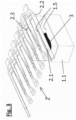
- Figure 2 shows the cast body during a step of the process for its production, within a cavity 1.3 of a permanent mold 1. Only one mold half 1.1 of the permanent mold 1 is shown. A second mold half 1.2 of the permanent mold 1 is constructed complementarily to the first mold half 1.1 and was for better illustration in the Figure 2 omitted. The second mold half is designed in such a way that the first 1.1 and the second mold half 1.2 can be joined in a mold parting plane 1.5 and the cavity 1.3 extends between the two mold halves.
- the course of the cavity 1.3 can be seen in the figure by the cast body shown, which has the shape of the helix 2 and fills the cavity 1.3.
- the features of the helix 2 can be transferred to the cavity 1.3 and vice versa. This means that the cavity is also rectangular and has the opposite flat sides 2.1, 2.1', the outside 2.2 and the inside 2.3 opposite the outside 2.2.
- the mold parting plane 1.5 runs at least in sections along the outside 2.2, along the inside 2.3 and along edges of the winding cross-sectional profile. In particular, it extends in areas parallel to the inside 2.3 and the outside 2.2. Within each winding, it runs over each of the two flat sides 2.1, 2.1' twice.
- burrs 3 it is possible that casting material outside the cavity 1.3 gets into the mold parting plane 1.5 between the two mold halves 1.1, 1.2. This can cause burrs 3 to form. The position of the burrs 3 can thus be determined from the course of the mold parting plane 1.5. Possible burrs 3 therefore extend from the Figure 2 Casting taken from the permanent mold shown starting from the outside 2.2 or the inner side 2.3 parallel to the outer side 2.2 or inner side 2.3 and in areas in which the mold parting plane 1.5 runs along the flat sides 2.1, 2.1', along the respective flat side 2.1, 2.1' and orthogonal thereto.
- Figures 2b and 2c show the view again Figure 2a , where two areas are marked for each, for which sections through the helix 2 are shown enlarged below the respective view. The position and orientation of the possible ridges 3 are illustrated in the sections. As in connection with Figure 2a As explained, due to the course of the division plane 1.5, they extend from inner and outer edges on the outside 2.2 and the inside 2.3. They run parallel to the outside 2.2 and the inside 2.3, each only in the direction of one of the flat sides 2.1, 2.1'.
- the burrs are removed in one process step after the casting is removed from the permanent mold 1. Due to their position, removal is easy.
- Figures 3 and 4 show permanent molds 1 with cavities 1.3, which are designed in such a way that the mold produced therein has the shape of the bent spiral 2', which is bent into the shape of the spiral 2 after removal. Again, only the first mold half 1.1 is shown and the second mold half 1.2 is omitted for reasons of visibility.
- the bent spiral 2' can be produced here with only two mold halves and without the use of cores or slides.
- a casting material is poured into cavity 1.3 of the Permanent mold 1 is filled.
- Permanent mold 1 has a corresponding opening for this purpose. Die casting, permanent mold casting or low-pressure casting can be used.
- the casting material includes aluminum and/or copper.
- the casting temperature is over 1100°C.
- the mold parting plane 1.5 which is in the Figures 3 and 4 Each example is shown in a section, in the case of the Figure 3 an angle ⁇ of approximately 45° to both the outside 2.2 and the inside 2.3 of the bent spiral 2'. Accordingly, possible ridges 3, one of which is shown as an example, extend away from the outside 2.2 or the inside 2.3 at this angle ⁇ . This is in contrast to the design from Figure 2 , where the burrs 3 run parallel to the outside 2.2 or the inside 2.3. This has the effect that the burrs 3 can be removed even more easily.
- the mold parting plane 1.5 is designed such that the angle ⁇ of the ridges 3 to the inner side 2.3 is approximately 45° and to the outer side 90°.
- Figure 5 Sections are shown through the two mold halves 1.1, 1.2 of the permanent mold 1 and the cast body lying in the cavity 1.3 formed between them, with the mold parting plane 1.5 and its position in relation to the cast body being illustrated in particular.
- the cast body can be in the form of the helix 2 or in the form of the bent helix 2'.
- the angle ⁇ between the outside 2.2 and the mold parting plane 1.5 is approximately 45°.
- the mold parting plane 1.5 extends from an edge on the outside 2.2.
- the angle ⁇ between the inside 2.2 and the mold parting plane 1.5 is also approximately 45° and the mold parting plane 1.5 extends from an edge on the inside 2.2.
- Figure 5c shows a modification of the illustration from Figure 5b .
- the mold parting plane 1.5 does not extend directly from the edge of the casting on the outside, but borders on a sacrificial structure 2.4, which is provided as additional casting material arranged on the outside 2.2 and can then be removed together with a possible burr 3.
- the mold parting plane 1.5 therefore forms an angle of more than 0 degrees and less than 180 degrees with the outside 2.2 and/or the inside 2.3, and is therefore not parallel to either side.
- Figure 6 shows how, in a method according to this application, burrs 3 located on the inside 2.3 of the cast part are removed.
- the burrs extend in the inner cavity of the cast part when it is in the form of the helix 2.
- a mandrel 4 is inserted into the inner cavity, which has the dimensions of the inner cavity. Any excess material that extends from the cast part into the inner cavity is thereby bent or removed.
- This excess material comprises in particular the burrs 3.
- it can comprise the sacrificial structures 2.4, which are positioned on the inside 2.3 of the helix 2.
- the mandrel 4 can also be inserted into the inner cavity when the cast part is initially in the form of the helix 2 after removal from the permanent mold 1, but is slightly pulled apart.
- the mandrel 4 can also be introduced into the inner cavity if the cast body is initially in the form of the bent spiral 2 after removal from the permanent mold 1.
- the mandrel 4 has a flat part at one end which engages the flat side 2.1' and can bend the cast part into the shape of the spiral with simultaneous counterpressure from the other flat side 2.1.
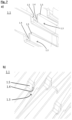
- Figure 7 a shows a view obliquely from the side and Figure 7 b a view from above at an angle.
- the permanent mold 1 has bulges 1.4 extending along the mold parting planes 1.5, which protrude into the cavity 1.3 and taper it.
- the cast body produced with this permanent mold 1 thus receives corresponding indentations 2.5 on the flat sides 2.1, 2.1', which are complementary to the bulges 1.4 and run from the inside 2.3 to the outside 2.2.
- the ridges 3 can be moved into the indentations 2.5 with this permanent mold.
- a casting material is filled into the cavity 1.3 of the permanent mold 1.
- the permanent mold 1 has a corresponding opening for this purpose. Die casting processes, permanent mold casting processes or low-pressure casting processes can be used.
- the casting material includes aluminum and/or copper.
- a casting temperature is over 1100°C.
- Figures 8 and 9 illustrate cast bodies, for example, made with the permanent mold 1 from Figure 7 They have the indentations 2.5 on one or both of the flat sides 2.1, 2.1'.
- FIG 8 Sections of turns of the cast body are shown in which indentations are arranged on the first flat side 2.1.
- the indentations 2.5 run orthogonally to the edges of the cast body, connecting the outside 2.2 and the inside 2.3.
- the position of possible ridges 3 is shown in the Figure 8 They run according to the Figure 7 shown design of the permanent mold 1 diagonally through the indentations 2.5 and are therefore harmless, since they do not touch the second flat side 2.1' even when the cast part is compressed as a spiral 2.
- Figure 9 illustrates further possible designs in which burrs 3 on flat sides are rendered harmless by indentations 2.5.
- the spiral 2 is shown in side view from Figure 1 b shown.
- an area Z is marked, which is located at the bottom of the Figure 9 for three versions (i), (ii), (iii) of the helix is shown enlarged.
- Version (i) is a version in which there is no indentation 2.5 at all. In such versions, it may be that the burrs 3 have to be removed in a post-processing step on the outside 2.2 and/or inside 2.3 and/or the flat sides 2.3.
- Design (iii) is a design in which the indentations 2.5 are present on both flat sides 2.1, 2.1'.
- the burrs 3 are offset from one another as in (ii) and cannot touch one another. In this design, even larger burrs 3 can be tolerated than in (ii).
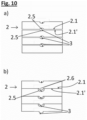
- Figure 10 shows again the spiral 2, where burrs running along the flat sides are to be made harmless.
- the view is as in Figure 9 chosen below.
- Figure 10 a has, similar to design (iii), indentations 2.5 on both flat sides 2.1, 2.1'.
- the corresponding permanent form 1 therefore has bulges 1.4 on both flat sides 2.1, 2.1' that complement the indentations 2.5.
- the additional material which is made available in the form of the bulges 2.6 on the flat side 2.1, can at least partially compensate for a loss of cross-section.
- the permanent mold 1 has for the production of such a casting as shown in Figure 10 b shown is recesses on one of the flat sides 2.1, 2.1', which extend in the mold parting plane 1.5 and, by correspondingly enlarging the cavity 1.3, define the bulges 2.6.
- On the other of the two flat sides 2.1, 2.1' however, it has the bulges 1.4, which define the indentations 2.5.
Landscapes
- Engineering & Computer Science (AREA)
- Mechanical Engineering (AREA)
- Power Engineering (AREA)
- Manufacturing & Machinery (AREA)
- Moulds For Moulding Plastics Or The Like (AREA)
- Molds, Cores, And Manufacturing Methods Thereof (AREA)
- Manufacturing Cores, Coils, And Magnets (AREA)
- Shaping Metal By Deep-Drawing, Or The Like (AREA)
Applications Claiming Priority (2)
| Application Number | Priority Date | Filing Date | Title |
|---|---|---|---|
| DE102018215987.4A DE102018215987B4 (de) | 2018-09-19 | 2018-09-19 | Herstellung einer Wendel, Dauerform für eine Wendel sowie Wendel |
| PCT/EP2019/075179 WO2020058407A1 (de) | 2018-09-19 | 2019-09-19 | Herstellung einer wendel, dauerform für eine wendel sowie wendel |
Publications (3)
| Publication Number | Publication Date |
|---|---|
| EP3852947A1 EP3852947A1 (de) | 2021-07-28 |
| EP3852947C0 EP3852947C0 (de) | 2025-03-05 |
| EP3852947B1 true EP3852947B1 (de) | 2025-03-05 |
Family
ID=68069735
Family Applications (1)
| Application Number | Title | Priority Date | Filing Date |
|---|---|---|---|
| EP19778445.7A Active EP3852947B1 (de) | 2018-09-19 | 2019-09-19 | Herstellung einer wendel, dauerform für eine wendel sowie wendel |
Country Status (7)
| Country | Link |
|---|---|
| US (1) | US12296375B2 (https=) |
| EP (1) | EP3852947B1 (https=) |
| JP (1) | JP7380989B2 (https=) |
| CN (1) | CN113165050B (https=) |
| CA (1) | CA3111344A1 (https=) |
| DE (1) | DE102018215987B4 (https=) |
| WO (1) | WO2020058407A1 (https=) |
Families Citing this family (3)
| Publication number | Priority date | Publication date | Assignee | Title |
|---|---|---|---|---|
| DE102018215986A1 (de) | 2018-09-19 | 2020-03-19 | Fraunhofer-Gesellschaft zur Förderung der angewandten Forschung e.V. | Herstellung einer Wendel, Dauerform für eine Wendel sowie Wendel |
| DE102019212850A1 (de) * | 2019-08-27 | 2021-03-04 | Volkswagen Aktiengesellschaft | Gusswerkzeug für gegossene elektrotechnische Spulen |
| CN113078783B (zh) * | 2021-03-09 | 2022-03-29 | 哈尔滨工业大学 | 一种电动汽车驱动电机用Hairpin绕组成型装置 |
Family Cites Families (17)
| Publication number | Priority date | Publication date | Assignee | Title |
|---|---|---|---|---|
| FR1580467A (https=) | 1968-07-11 | 1969-09-05 | ||
| JP4857041B2 (ja) * | 2006-07-18 | 2012-01-18 | 株式会社トスカ | 可塑性材製の螺旋状部品及びその製造方法 |
| US8980154B2 (en) * | 2008-10-03 | 2015-03-17 | The Patent Store Llc | Making twist-on wire connectors |
| DE102010020897A1 (de) | 2010-05-10 | 2011-11-10 | Fraunhofer-Gesellschaft zur Förderung der angewandten Forschung e.V. | Elektrotechnische Spule in Gusstechnik, Herstellungsverfahren für eine solche Spule und Elektromaschinen verwendend solche Spulen |
| DE102012212637A1 (de) * | 2012-07-18 | 2014-01-23 | Fraunhofer-Gesellschaft zur Förderung der angewandten Forschung e.V. | Gießtechnisch hergestellte elektrische Spule |
| DE102013000899A1 (de) | 2013-01-18 | 2014-08-07 | Volkswagen Aktiengesellschaft | Elektrotechnische Spule und/oder Spulenwicklung, Verfahren zu ihrer Herstellung sowie elektrisches Gerät |
| DE102013204047B4 (de) | 2013-03-08 | 2018-08-30 | Fraunhofer-Gesellschaft zur Förderung der angewandten Forschung e.V. | Elektrische Einrichtung mit einer Spule |
| JP2015002614A (ja) | 2013-06-14 | 2015-01-05 | アイシン・エィ・ダブリュ株式会社 | コイル鋳造装置及びコイル鋳造方法 |
| DE102013212087C5 (de) * | 2013-06-25 | 2019-12-12 | Breuckmann GmbH & Co. KG | Verfahren zur Herstellung einer Spule |
| JP6044470B2 (ja) | 2013-06-28 | 2016-12-14 | アイシン・エィ・ダブリュ株式会社 | コイル鋳造装置、コイル鋳造方法、及び金型 |
| CN203695881U (zh) | 2014-03-08 | 2014-07-09 | 浙江恒通机械有限公司 | 一种减震器套筒铸造模具 |
| CN107206479B (zh) | 2014-03-31 | 2020-06-12 | 伯尔霍夫连接技术有限公司 | 铸模,用于铸模的嵌件,铸件及其铸造方法 |
| DE102014106851A1 (de) | 2014-05-15 | 2015-11-19 | Dr. Ing. H.C. F. Porsche Aktiengesellschaft | Elektrische Maschine, Spulenpaket für eine elektrische Maschine und Verfahren zum Herstellen desselben |
| DE102014113570B3 (de) * | 2014-09-19 | 2015-12-24 | Ksm Castings Group Gmbh | Einrichtung zur Messung von Drücken in einem mit Schmelze füllbaren Formhohlraum einer Gießform, insbesondere einer Vakuumdruckgussform |
| DE102015212224A1 (de) | 2015-06-30 | 2017-01-05 | Breuckmann GmbH & Co. KG | VERFAHREN UND GIEßFORM ZUR HERSTELLUNG EINES LÄUFERS |
| KR101627802B1 (ko) | 2015-12-14 | 2016-06-07 | 대림정밀공업(주) | 다이캐스팅용 금형 |
| DE102016202657A1 (de) | 2016-02-22 | 2017-08-24 | Fraunhofer-Gesellschaft zur Förderung der angewandten Forschung e.V. | Verfahren zum Gießen eines Bauteils komplexer Geometrie mit einer Gießform in Segmentbauweise |
-
2018
- 2018-09-19 DE DE102018215987.4A patent/DE102018215987B4/de active Active
-
2019
- 2019-09-19 EP EP19778445.7A patent/EP3852947B1/de active Active
- 2019-09-19 JP JP2021512517A patent/JP7380989B2/ja active Active
- 2019-09-19 CN CN201980061404.2A patent/CN113165050B/zh active Active
- 2019-09-19 WO PCT/EP2019/075179 patent/WO2020058407A1/de not_active Ceased
- 2019-09-19 CA CA3111344A patent/CA3111344A1/en active Pending
- 2019-09-19 US US17/250,866 patent/US12296375B2/en active Active
Also Published As
| Publication number | Publication date |
|---|---|
| CN113165050A (zh) | 2021-07-23 |
| CA3111344A1 (en) | 2020-03-26 |
| EP3852947C0 (de) | 2025-03-05 |
| US20220040751A1 (en) | 2022-02-10 |
| EP3852947A1 (de) | 2021-07-28 |
| JP7380989B2 (ja) | 2023-11-15 |
| CN113165050B (zh) | 2023-09-08 |
| DE102018215987B4 (de) | 2020-07-30 |
| JP2022500250A (ja) | 2022-01-04 |
| US12296375B2 (en) | 2025-05-13 |
| DE102018215987A1 (de) | 2020-03-19 |
| WO2020058407A1 (de) | 2020-03-26 |
Similar Documents
| Publication | Publication Date | Title |
|---|---|---|
| EP3208013B1 (de) | Verfahren zum giessen eines bauteils komplexer geometrie mit einer giessform in segmentbauweise | |
| EP2933901B1 (de) | Stator einer elektrischen Maschine und dessen Herstellung | |
| EP2946462B1 (de) | Elektrotechnische spule und/oder spulenwicklung, verfahren zu ihrer herstellung sowie elektrisches gerät | |
| EP2819276B1 (de) | Verfahren zur Herstellung einer Spule und Spule | |
| EP3178155B1 (de) | Rotor, reluktanzmaschine und herstellungsverfahren für rotor | |
| EP3178152B1 (de) | Rotor und reluktanzmaschine | |
| EP3852947B1 (de) | Herstellung einer wendel, dauerform für eine wendel sowie wendel | |
| DE102018202945A1 (de) | Elektrische Maschine und Fahrzeug mit einer solchen | |
| DE102013012659B4 (de) | Verfahren und Prägewerkzeug zur Herstellung einer elektrotechnischen Spule | |
| EP3270489A1 (de) | Formspule zum herstellen einer selbsttragenden luftspalt-wicklung, insbesondere schrägwicklung eines elektro-kleinmotors | |
| EP1374352B1 (de) | Trommelkommutator sowie verfahren zu seiner herstellung | |
| EP4253051A2 (de) | Verfahren zur herstellung eines stators und stator | |
| DE102009044321A1 (de) | Endabdeckung und externer Rotormotor, der selbige verwendet | |
| EP3853983B1 (de) | Herstellung einer wendel, dauerform für eine wendel sowie wendel | |
| EP1921730A2 (de) | Verfahren zur Herstellung einer Transversalflussmaschine | |
| WO2018091210A1 (de) | Rotor für eine elektromaschine mit aufschiebbaren wicklungen | |
| CH619624A5 (https=) | ||
| EP3554730B1 (de) | Verfahren zur biegeumformung von strangprofilen | |
| EP3771506A1 (de) | Gussverfahren mit einer formgebenden kontur zur herstellung eines kernes, bauteil und system zur herstellung eines bauteils | |
| WO2012089404A2 (de) | Wicklungszahn für eine elektrische maschine, maschinenkomponente und elektrische maschine | |
| DE102017100891A1 (de) | Motorständer und Verfahren zum Bilden des Motorständers | |
| EP3852948A1 (de) | Verfahren und vorrichtung zur herstellung eines wendelförmigen metallkörpers | |
| DE102019220173A1 (de) | Verfahren zum Biegeverdrehen von Kupferstäben | |
| DE102017213106B4 (de) | Verfahren zur Herstellung einer elektrotechnischen Spule | |
| EP4398454A1 (de) | Nutkeil für statoranordnung und statoranordnung |
Legal Events
| Date | Code | Title | Description |
|---|---|---|---|
| STAA | Information on the status of an ep patent application or granted ep patent |
Free format text: STATUS: UNKNOWN |
|
| STAA | Information on the status of an ep patent application or granted ep patent |
Free format text: STATUS: THE INTERNATIONAL PUBLICATION HAS BEEN MADE |
|
| PUAI | Public reference made under article 153(3) epc to a published international application that has entered the european phase |
Free format text: ORIGINAL CODE: 0009012 |
|
| STAA | Information on the status of an ep patent application or granted ep patent |
Free format text: STATUS: REQUEST FOR EXAMINATION WAS MADE |
|
| 17P | Request for examination filed |
Effective date: 20210317 |
|
| AK | Designated contracting states |
Kind code of ref document: A1 Designated state(s): AL AT BE BG CH CY CZ DE DK EE ES FI FR GB GR HR HU IE IS IT LI LT LU LV MC MK MT NL NO PL PT RO RS SE SI SK SM TR |
|
| DAV | Request for validation of the european patent (deleted) | ||
| DAX | Request for extension of the european patent (deleted) | ||
| RAP3 | Party data changed (applicant data changed or rights of an application transferred) |
Owner name: FRAUNHOFER-GESELLSCHAFT ZUR FOERDERUNG DER ANGEWANDTEN FORSCHUNG E.V. |
|
| REG | Reference to a national code |
Ref country code: DE Ref legal event code: R079 Free format text: PREVIOUS MAIN CLASS: B21J0005000000 Ipc: B22C0009060000 Ref country code: DE Ref legal event code: R079 Ref document number: 502019013027 Country of ref document: DE Free format text: PREVIOUS MAIN CLASS: B21J0005000000 Ipc: B22C0009060000 |
|
| RIC1 | Information provided on ipc code assigned before grant |
Ipc: H02K 15/04 20060101ALI20240827BHEP Ipc: B22D 31/00 20060101ALI20240827BHEP Ipc: B22D 17/22 20060101ALI20240827BHEP Ipc: B21J 5/00 20060101ALI20240827BHEP Ipc: B22D 25/02 20060101ALI20240827BHEP Ipc: B22C 9/06 20060101AFI20240827BHEP |
|
| GRAP | Despatch of communication of intention to grant a patent |
Free format text: ORIGINAL CODE: EPIDOSNIGR1 |
|
| STAA | Information on the status of an ep patent application or granted ep patent |
Free format text: STATUS: GRANT OF PATENT IS INTENDED |
|
| INTG | Intention to grant announced |
Effective date: 20241009 |
|
| GRAS | Grant fee paid |
Free format text: ORIGINAL CODE: EPIDOSNIGR3 |
|
| GRAA | (expected) grant |
Free format text: ORIGINAL CODE: 0009210 |
|
| STAA | Information on the status of an ep patent application or granted ep patent |
Free format text: STATUS: THE PATENT HAS BEEN GRANTED |
|
| AK | Designated contracting states |
Kind code of ref document: B1 Designated state(s): AL AT BE BG CH CY CZ DE DK EE ES FI FR GB GR HR HU IE IS IT LI LT LU LV MC MK MT NL NO PL PT RO RS SE SI SK SM TR |
|
| REG | Reference to a national code |
Ref country code: GB Ref legal event code: FG4D Free format text: NOT ENGLISH |
|
| REG | Reference to a national code |
Ref country code: CH Ref legal event code: EP |
|
| REG | Reference to a national code |
Ref country code: IE Ref legal event code: FG4D Free format text: LANGUAGE OF EP DOCUMENT: GERMAN |
|
| REG | Reference to a national code |
Ref country code: DE Ref legal event code: R096 Ref document number: 502019013027 Country of ref document: DE |
|
| U01 | Request for unitary effect filed |
Effective date: 20250324 |
|
| U07 | Unitary effect registered |
Designated state(s): AT BE BG DE DK EE FI FR IT LT LU LV MT NL PT RO SE SI Effective date: 20250328 |
|
| PG25 | Lapsed in a contracting state [announced via postgrant information from national office to epo] |
Ref country code: RS Free format text: LAPSE BECAUSE OF FAILURE TO SUBMIT A TRANSLATION OF THE DESCRIPTION OR TO PAY THE FEE WITHIN THE PRESCRIBED TIME-LIMIT Effective date: 20250605 |
|
| PG25 | Lapsed in a contracting state [announced via postgrant information from national office to epo] |
Ref country code: ES Free format text: LAPSE BECAUSE OF FAILURE TO SUBMIT A TRANSLATION OF THE DESCRIPTION OR TO PAY THE FEE WITHIN THE PRESCRIBED TIME-LIMIT Effective date: 20250305 |
|
| PG25 | Lapsed in a contracting state [announced via postgrant information from national office to epo] |
Ref country code: NO Free format text: LAPSE BECAUSE OF FAILURE TO SUBMIT A TRANSLATION OF THE DESCRIPTION OR TO PAY THE FEE WITHIN THE PRESCRIBED TIME-LIMIT Effective date: 20250605 |
|
| PG25 | Lapsed in a contracting state [announced via postgrant information from national office to epo] |
Ref country code: HR Free format text: LAPSE BECAUSE OF FAILURE TO SUBMIT A TRANSLATION OF THE DESCRIPTION OR TO PAY THE FEE WITHIN THE PRESCRIBED TIME-LIMIT Effective date: 20250305 |
|
| PG25 | Lapsed in a contracting state [announced via postgrant information from national office to epo] |
Ref country code: GR Free format text: LAPSE BECAUSE OF FAILURE TO SUBMIT A TRANSLATION OF THE DESCRIPTION OR TO PAY THE FEE WITHIN THE PRESCRIBED TIME-LIMIT Effective date: 20250606 |
|
| REG | Reference to a national code |
Ref country code: CH Ref legal event code: U11 Free format text: ST27 STATUS EVENT CODE: U-0-0-U10-U11 (AS PROVIDED BY THE NATIONAL OFFICE) Effective date: 20251001 |
|
| PG25 | Lapsed in a contracting state [announced via postgrant information from national office to epo] |
Ref country code: SM Free format text: LAPSE BECAUSE OF FAILURE TO SUBMIT A TRANSLATION OF THE DESCRIPTION OR TO PAY THE FEE WITHIN THE PRESCRIBED TIME-LIMIT Effective date: 20250305 |
|
| PG25 | Lapsed in a contracting state [announced via postgrant information from national office to epo] |
Ref country code: PL Free format text: LAPSE BECAUSE OF FAILURE TO SUBMIT A TRANSLATION OF THE DESCRIPTION OR TO PAY THE FEE WITHIN THE PRESCRIBED TIME-LIMIT Effective date: 20250305 |
|
| PGFP | Annual fee paid to national office [announced via postgrant information from national office to epo] |
Ref country code: GB Payment date: 20250923 Year of fee payment: 7 |
|
| PG25 | Lapsed in a contracting state [announced via postgrant information from national office to epo] |
Ref country code: CZ Free format text: LAPSE BECAUSE OF FAILURE TO SUBMIT A TRANSLATION OF THE DESCRIPTION OR TO PAY THE FEE WITHIN THE PRESCRIBED TIME-LIMIT Effective date: 20250305 |
|
| PG25 | Lapsed in a contracting state [announced via postgrant information from national office to epo] |
Ref country code: SK Free format text: LAPSE BECAUSE OF FAILURE TO SUBMIT A TRANSLATION OF THE DESCRIPTION OR TO PAY THE FEE WITHIN THE PRESCRIBED TIME-LIMIT Effective date: 20250305 |
|
| PG25 | Lapsed in a contracting state [announced via postgrant information from national office to epo] |
Ref country code: IS Free format text: LAPSE BECAUSE OF FAILURE TO SUBMIT A TRANSLATION OF THE DESCRIPTION OR TO PAY THE FEE WITHIN THE PRESCRIBED TIME-LIMIT Effective date: 20250705 |
|
| U20 | Renewal fee for the european patent with unitary effect paid |
Year of fee payment: 7 Effective date: 20250923 |
|
| PLBE | No opposition filed within time limit |
Free format text: ORIGINAL CODE: 0009261 |
|
| STAA | Information on the status of an ep patent application or granted ep patent |
Free format text: STATUS: NO OPPOSITION FILED WITHIN TIME LIMIT |
|
| REG | Reference to a national code |
Ref country code: CH Ref legal event code: L10 Free format text: ST27 STATUS EVENT CODE: U-0-0-L10-L00 (AS PROVIDED BY THE NATIONAL OFFICE) Effective date: 20260114 |
|
| PGFP | Annual fee paid to national office [announced via postgrant information from national office to epo] |
Ref country code: CH Payment date: 20251001 Year of fee payment: 7 |
|
| 26N | No opposition filed |
Effective date: 20251208 |