EP3843371B1 - Relaisvorrichtung und sprachkommunikationsüberwachungsverfahren - Google Patents
Relaisvorrichtung und sprachkommunikationsüberwachungsverfahren Download PDFInfo
- Publication number
- EP3843371B1 EP3843371B1 EP19867211.5A EP19867211A EP3843371B1 EP 3843371 B1 EP3843371 B1 EP 3843371B1 EP 19867211 A EP19867211 A EP 19867211A EP 3843371 B1 EP3843371 B1 EP 3843371B1
- Authority
- EP
- European Patent Office
- Prior art keywords
- communication
- terminal
- participating
- voice
- communication session
- Prior art date
- Legal status (The legal status is an assumption and is not a legal conclusion. Google has not performed a legal analysis and makes no representation as to the accuracy of the status listed.)
- Active
Links
Images



Classifications
-
- H—ELECTRICITY
- H04—ELECTRIC COMMUNICATION TECHNIQUE
- H04M—TELEPHONIC COMMUNICATION
- H04M3/00—Automatic or semi-automatic exchanges
- H04M3/42—Systems providing special services or facilities to subscribers
- H04M3/42221—Conversation recording systems
-
- H—ELECTRICITY
- H04—ELECTRIC COMMUNICATION TECHNIQUE
- H04L—TRANSMISSION OF DIGITAL INFORMATION, e.g. TELEGRAPHIC COMMUNICATION
- H04L65/00—Network arrangements, protocols or services for supporting real-time applications in data packet communication
- H04L65/1066—Session management
- H04L65/1076—Screening of IP real time communications, e.g. spam over Internet telephony [SPIT]
-
- H—ELECTRICITY
- H04—ELECTRIC COMMUNICATION TECHNIQUE
- H04L—TRANSMISSION OF DIGITAL INFORMATION, e.g. TELEGRAPHIC COMMUNICATION
- H04L65/00—Network arrangements, protocols or services for supporting real-time applications in data packet communication
- H04L65/1066—Session management
- H04L65/1083—In-session procedures
-
- H—ELECTRICITY
- H04—ELECTRIC COMMUNICATION TECHNIQUE
- H04M—TELEPHONIC COMMUNICATION
- H04M3/00—Automatic or semi-automatic exchanges
- H04M3/22—Arrangements for supervision, monitoring or testing
- H04M3/2281—Call monitoring, e.g. for law enforcement purposes; Call tracing; Detection or prevention of malicious calls
-
- H—ELECTRICITY
- H04—ELECTRIC COMMUNICATION TECHNIQUE
- H04M—TELEPHONIC COMMUNICATION
- H04M3/00—Automatic or semi-automatic exchanges
- H04M3/42—Systems providing special services or facilities to subscribers
- H04M3/56—Arrangements for connecting several subscribers to a common circuit, i.e. affording conference facilities
- H04M3/567—Multimedia conference systems
-
- H—ELECTRICITY
- H04—ELECTRIC COMMUNICATION TECHNIQUE
- H04M—TELEPHONIC COMMUNICATION
- H04M7/00—Arrangements for interconnection between switching centres
- H04M7/12—Arrangements for interconnection between switching centres for working between exchanges having different types of switching equipment, e.g. power-driven and step by step or decimal and non-decimal
- H04M7/1205—Arrangements for interconnection between switching centres for working between exchanges having different types of switching equipment, e.g. power-driven and step by step or decimal and non-decimal where the types of switching equipement comprises PSTN/ISDN equipment and switching equipment of networks other than PSTN/ISDN, e.g. Internet Protocol networks
- H04M7/121—Details of network access arrangements or protocols
- H04M7/122—Details of network access arrangements or protocols where the PSTN/ISDN access is used as an access to networks other than PSTN/ISDN
-
- H—ELECTRICITY
- H04—ELECTRIC COMMUNICATION TECHNIQUE
- H04M—TELEPHONIC COMMUNICATION
- H04M7/00—Arrangements for interconnection between switching centres
- H04M7/12—Arrangements for interconnection between switching centres for working between exchanges having different types of switching equipment, e.g. power-driven and step by step or decimal and non-decimal
- H04M7/1205—Arrangements for interconnection between switching centres for working between exchanges having different types of switching equipment, e.g. power-driven and step by step or decimal and non-decimal where the types of switching equipement comprises PSTN/ISDN equipment and switching equipment of networks other than PSTN/ISDN, e.g. Internet Protocol networks
- H04M7/1225—Details of core network interconnection arrangements
- H04M7/1235—Details of core network interconnection arrangements where one of the core networks is a wireless network
-
- H—ELECTRICITY
- H04—ELECTRIC COMMUNICATION TECHNIQUE
- H04M—TELEPHONIC COMMUNICATION
- H04M2203/00—Aspects of automatic or semi-automatic exchanges
- H04M2203/50—Aspects of automatic or semi-automatic exchanges related to audio conference
- H04M2203/5018—Initiating a conference during a two-party conversation, i.e. three-party service or three-way call
-
- H—ELECTRICITY
- H04—ELECTRIC COMMUNICATION TECHNIQUE
- H04M—TELEPHONIC COMMUNICATION
- H04M3/00—Automatic or semi-automatic exchanges
- H04M3/42—Systems providing special services or facilities to subscribers
- H04M3/56—Arrangements for connecting several subscribers to a common circuit, i.e. affording conference facilities
Definitions
- the present invention relates to a relaying device that relays voice communication, and more particularly to a recording function of a voice signal to be relaying.
- Relaying devices that relay voice communication such as radio transceiver, a telephone, or the like made by a network are proposed (refer to Patent Literature 1, 2, and 3).
- As a result of connecting a plurality of relaying devices to a network it is also possible that different type of communication apparatuses such as IP telephone and radio perform voice communication to each other. If the relaying device outputs a relaying voice signal to outside, it is possible to record the voice signal.
- Patent Literature 1 JP 2014-087027A
- Patent Literature 2 WO 2015/068663
- Patent Literature 3 WO 2016/002866
- Patent Literature 4 US 2011/116492 A1
- Patent Literature 5 JP 2011 147007 A
- the present invention aims to provide a relaying device that can record the communicated voice in the relaying device using a mixing function of the relaying device.
- the communication monitoring unit associates the virtual device with a predetermined communication terminal or a predetermined group constituted by a plurality of communication terminals, and if the communication terminal or group with which the virtual device is associated is registered as a participating terminal of the communication session in the mixing table, registers the virtual device as a participating terminal of the communication session.
- a monitoring method of the voice communication according to the present invention in the relaying device that communicates with the plurality of communication terminals that perform voice communication, establishes the communication session in which the communication terminal that has called and the at least one communication terminal that has been called are registered as participating terminals in a mixing table of the relaying device when one communication terminal has called another at least one communication terminal, transmits this voice signal to another participating terminal in the same communication session when the voice signal is transmitted from a participating terminal in the established communication session wherein the another participating terminal is determined by referring to the mixing table, registers the virtual device as a participating terminal of the communication session that is a virtual communication terminal for transmitting the voice signal to a communication monitoring unit provided in the mixing table of the relaying device, and records or reproduces the voice signal transmitted from the communication session processing unit to the virtual device, by using the communication monitoring unit.
- the method further associates the virtual device with a predetermined communication terminal or a predetermined group constituted by a plurality of communication terminals, and if the communication terminal or group with which the virtual device is associated is registered as a participating terminal of the communication session, registers the virtual device as a participating terminal of the communication session in the mixing table.
- a plurality of virtual devices may be provided, and a plurality of communication sessions may be separately recorded or reproduced in parallel, at same time.
- the communication session that includes each of a terminal that performs telephone communication, a terminal that performs wireless communication, and a terminal that performs voice communication over a network may be established.
- communicated voices of each communication session can be acquired inside the relaying device, and the voices can be recorded or output.
- FIG. 1 is a diagram illustrating a configuration of a voice communication system 1, which is an embodiment of the present invention.
- FIG. 2 is a diagram illustrating a configuration of a relaying device 2.
- the voice communication system 1 realizes voice communication between a plurality of communication terminals by the relaying device 2 relaying voice signals.
- a SIP phone 20, an extension telephone 22, a WLAN transceiver 23, an LTE transceiver 24, an analog transceiver 26, a digital transceiver 28, and the like, which will be described later, are prepared as the communication terminals.
- These communication terminals are devices that transmit and receive voice signals in forms that are different to each other, and the relaying device 2 relays voice communication between these different types of communication terminals.
- the relaying device 2 can monitor voices in communication. When two or more communication terminals communicate to each other, the relaying device 2 establishes a communication session for this communication.
- the relaying device 2 can establish a plurality of communication sessions at the same time, but selects and monitors, from the established sessions, a communication session in which a specific communication terminal (or a group) participates.
- the monitoring means is one of or both of recording and audio output.
- the relaying device 2 relays voice communication between a plurality of communication systems including an IP telephone system 13, a WLAN transceiver system 14, an LTE transceiver system 15, and a wireless communication system 16.
- the relaying device 2 includes a telephone relaying unit 3, a network communication relaying unit 4, and a wireless communication relaying unit 5 in order to perform these relays.
- the IP telephone system 13 is connected to the telephone relaying unit 3.
- the IP telephone system 13 includes the SIP phone 20 and a VoIP gateway 21 that are connected to a network 10, and the extension telephone 22 connected to the VoIP gateway 21.
- the VoIP gateway 21 has a PBX function and is also connected to a telephone line (external line).
- a network 10 including a wireless access point (not illustrated) and an LTE communication network 11 including a base station (not illustrated) are connected to the network communication relaying unit 4.
- the WLAN transceiver system 14 is constructed on the network 10, and the LTE transceiver system 15 is constructed on the LTE communication network 11.
- the WLAN transceiver system 14 includes WLAN transceivers 23 that access the network 10 via the wireless access point.
- the LTE transceiver system 15 includes LTE transceivers 24 that access the LTE communication network 11 via the base station.
- a plurality of the external apparatus interfaces 34 which are portions of a signal processing unit 33 are connected to the wireless communication relaying unit 5.
- An analog-type radio transceiver (repeater) 25 and a digital-type radio transceiver (repeater) 27 are connected to the external apparatus interfaces 34.
- the repeater 25 communicates with a handy radio transceiver (analog transceiver) 26 of the same analog type.
- the repeater 27 communicates with a handy radio transceiver (digital transceiver) 28 of the same digital type.
- FIG. 2 is a block diagram of the relaying device 2.
- the relaying device 2 includes the telephone relaying unit 3, the network communication relaying unit 4, the wireless communication relaying unit 5, and a communication monitoring unit 6. The functions of these units are mainly realized by software.
- the relaying device 2 includes a control unit 30.
- the control unit 30 is constituted by a computer including a CPU, a ROM, a RAM, and the like.
- An external storage device 7, a network connection unit 31, an LTE connection unit 32, and the signal processing unit 33 are connected to the control unit 30.
- the external storage device 7 is a nonvolatile and large capacity storage device such as a USB hard disk, for example, and stores a voice file in which a communicated voice of a communication terminal is recorded.
- the network connection unit 31 is connected to the networks 10.
- the LTE connection unit 32 is connected to the LTE communication network 11. Although the networks 10 connected to the telephone relaying unit 3 and the network communication relaying unit 4 are separately described in FIG. 1 , these networks may be
- the telephone relaying unit 3 includes an interface 3A for transmitting and receiving a voice signal and the like to and from the network communication relaying unit 4.
- the network communication relaying unit 4 includes an interface 4A for transmitting and receiving a voice signal and the like to and from the wireless communication relaying unit 5.
- the wireless communication relaying unit 5 includes an interface 5A for transmitting and receiving a voice signal and the like to and from the signal processing unit 33.
- the signal processing unit 33 extracts a voice signal from an RTP packet received from the control unit 30 (interface 5A), converts the voice signal to a digital or analog signal wave, and outputs the signal wave to the external apparatus interface 34. Also, the signal processing unit 33 compresses and encodes a digital or analog voice signal received from the external apparatus interface 34, and also packetizes the encoded data into an RTP packet, and inputs the RTP packet to the control unit 30 (interface 5A).
- Three external apparatus interfaces 34 (34-1 to 34-3) are provided, namely an analog interface 34-1, a digital interface 34-2, and an analog (microphone at hand/speaker) interface 34-3.
- An analog interface 34-1 a digital interface 34-2
- an analog (microphone at hand/speaker) interface 34-3 a state in which repeaters 25 and 27 are respectively connected to the analog interface 34-1 and the digital interface 34-2 is shown in FIG. 1 .
- the network communication relaying unit 4 relays communication between the WLAN transceivers 23, communication between the LTE transceivers 24, and communication between a WLAN transceiver 23 and an LTE transceiver 24. Also, in response to a call from the telephone relaying unit 3, the network communication relaying unit 4 relays communication between the telephone 20 or 22 (SIP phone 20, extension telephone 22) and a WLAN transceiver 23 or an LTE transceiver 24, and the communication between the telephone 20 or 22 and the radio transceiver 26 or 28. Also, the control of a communication session and the mixing of voice signals, which will be described later, are executed by the network communication relaying unit 4.
- the network communication relaying unit 4 corresponds to a communication session processing unit of the present invention.
- the telephone relaying unit 3 upon receiving a call from the SIP phone 20 or the extension telephone 22, determines the communication partner communication apparatus (destination radio), which is the call destination, and inputs the information regarding the destination radio and the voice signal received from the telephone 20 or 22 to the network communication relaying unit 4. It should be noted that the entirety or some of the telephone relaying unit 3, the network communication relaying unit 4, and the wireless communication relaying unit 5 including the signal processing unit 33 corresponds to a communication unit of the present invention.
- the communication monitoring unit 6 monitors voices in a communication session in which, out of the plurality of communication terminals, the communication terminal to be monitored participates. As described above, the monitoring refers to recording and/or outputting a communicated voice. In the following description, a case where recording is performed will be described. Recorded voices (voice files) are stored in the external storage device 7.
- Each communication terminal is registered in a terminal table (call destination table) 40 shown in FIG. 3A .
- a user who intends to start communication calls a communication terminal of the communication partner using a possessing communication terminal.
- a call message is generated and transmitted to the relaying device 2.
- the relaying device 2 Upon the relaying device 2 receiving the call message, the relaying device 2 registers the communication session to a mixing table 41 shown in FIG. 3B (establishes the communication session), and calls the communication terminal of the communication partner. With this, communication between the communication terminals is started.
- the communication terminals excluding the telephones 20 and 22 start communication by transmitting an RTP packet in which a voice signal is stored as a data body. That is, communication is started in a form such as a radio transceiver with which communication is started by a PTT switch being pressed.
- the RTP packet that is first transmitted when starting communication is referred to as a call packet.
- This call packet functions as the call message.
- This RTP packet used in the voice communication system 1 is configured as shown in FIG. 4 .
- the telephone 20 or 22 starts communication, first, the telephone transmits a SIP message (INVITE) to the relaying device 2.
- the relaying device 2 establishes a communication session with another communication apparatus following a SIP procedure.
- a communication terminal such as the WLAN transceiver 23 transmitting a call packet
- FIG. 3A is a diagram illustrating the terminal table (call destination table) 40.
- Pieces of information regarding each communication terminal and each group that are registered in the voice communication system 1 are registered in the terminal table 40.
- a plurality of communication terminals belong to each group, and when the group is called, the plurality of communication terminals that belong to the group are simultaneously called.
- an identification number (ID) In association with each communication terminal, an identification number (ID), address information for accessing the communication terminal, and a participating session number indicating the communication session in which the communication terminal is participating are stored in the terminal table 40.
- ID an identification number
- the identification numbers of communication terminals that belong to this group are stored.
- the identification number (ID) corresponds to identification information of the present invention.
- the group "plenary" to which all the communication terminals belong is treated similarly to other groups.
- the call type is information indicating that, when this ID is called, what type of communication will be executed.
- “Individual” communication indicates one to one communication between individual communication terminals.
- “Group” communication is communication in which a plurality of communication terminals (three or more, in general) exchange voice signals to each other.
- “Plenary” communication is communication in which all the communicable communication terminals that are connected to the network 10, the LTE communication network 11, and the external apparatus interface 34 exchange voice signals to each other.
- FIG. 4 is a diagram illustrating a configuration of the RTP packet to be used in this voice communication system.
- the RTP packet includes a header and a data body (payload), and a transmission destination address and a transmission source address are described in the header.
- the data body includes a voice signal and session information for voice communication.
- the session information is information regarding a communication session to be registered in the mixing table 41 in FIG. 3B , and with this, the communication session to which this RTP packet relates to can be identified.
- the session information includes a session number, a destination ID, and a calling ID. It should be noted that in the case of a call packet that is a voice packet to be transmitted first when communication is started, because the communication session for this voice packet is not yet established (communication session is not registered in the mixing table 41), the session number field is empty.
- FIG. 3B is a diagram illustrating the mixing table 41.
- a communication session that has been established and is being executed is registered in the mixing table 41.
- the relaying device 2 transfers a voice signal received from one communication terminal that is participating in a communication session to at least one other communication terminal that is participating in the communication session. If a plurality of voice signals are input at the same time, these voice signals are mixed and transmitted to communication terminals. Even in a case where voice signals are mixed and transmitted to each communication terminal, the relaying device 2 performs echo-canceling mixing for the communication terminal such that a voice signal transmitted from this communication terminal is not returned to the same communication terminal.
- the mixing table 41 is provided with a session number field, a calling ID field, a destination ID field, a participating terminal field, an excluded terminal field, and a retention time timer (TS) field for each communication session.
- the session number is a number for identifying the communication session, and is assigned a serial number that indicates the order of establishment (order of registration) of the communication session.
- the identification number of a communication terminal that has made a call is stored in the calling ID field.
- the identification number of a communication terminal or a group that has been called by the call packet is stored in the destination ID field.
- the identification number of a communication terminal that is participating in the communication session is registered in the participating terminal field. Also, the identification number of a communication terminal that has been called in (belongs to) the communication session but is not participating in the communication session, because the communication terminal is participating in another communication session and performs communication, is registered in the excluded terminal field.
- the control unit 30 transfers this voice signal to the other participating terminal(s).
- the identification number of a calling terminal and the identification numbers of communication terminals that belong to the group designated as the communication partner are registered in the participating terminal field.
- a communication terminal that belongs to the group, but is participating in a different communication session is excluded from the participating terminal, because the communication terminal cannot participate in the group communication session, and the identification number thereof is registered in the excluded terminal field.
- the calling terminal is a communication terminal that does not belong to the group, which is a case where the calling terminal calls a group other than the group to which the calling terminal belongs, the identification number of the calling terminal is also registered in the participating terminal field.
- all of the communication terminals that can perform communication are registered as the participating terminals.
- the retention time of each communication session is set to 30 seconds, for example.
- the retention time timer (TS) in the mixing table 41 is a timer that is counted down when a voice signal is transmitted from none of the participating terminals.
- the retention time timer TS is reset by communication session management processing (refer to FIG. 9 ) (30 seconds being set), and is also counted down. If a voice signal is transmitted from none of the participating terminals for 30 seconds, and the time counted down by the timer TS reaches "0", this communication session is canceled, and the information regarding this communication session is erased from the mixing table 41.
- FIG. 3C is a diagram illustrating a priority table 42.
- the priority of each call type of communication is stored in the priority table 42.
- the priority is represented by a numerical value, and the smaller the value is, the priority is higher.
- which of the communication sessions the communication terminal is to be participated in is determined based on the priorities in the priority table 42.
- the case where one communication terminal is called from a plurality of communication sessions in an overlapped manner includes a case where the communication terminal is called from a plurality of communication sessions at the same time, and a case where, while the communication terminal is participating in one communication session, the communication terminal is called from another communication session, for example.
- the communication terminal continues to participate in the current session, and will not move to the new communication session.
- the configuration may also be such that the communication terminal is moved to the new communication session even if the priorities are the same.
- the contents of the priority table 42 are not limited thereto, and the individual communication session may be priority number 1, for example.
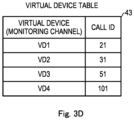
- FIG. 3D is a diagram illustrating a virtual device table 43.
- the identification code such as VD1
- ID identification number
- a recording target a communication terminal or a group that is to be monitored
- the mixing function of the communication session also transmits the voice signals that are transmitted and received in the communication session to the virtual device.
- the communication monitoring unit 6 acquires and records the voice signals.
- the virtual device is a virtually working device that is caused to participate in the communication session in order to acquire voice signals for recording, from a function unit (network communication relaying unit 4) that performs mixing of voice signals, and the communication monitoring unit 6 causes the virtual device to participate in the communication session in which the communication target participates.
- the network communication relaying unit 4 outputs voice signals to the communication monitoring unit 6 as the voice signals to be transmitted to the virtual device when mixing is performed, and the communication monitoring unit 6 can acquire all of the voice signals of the communication session (in which the recording target is participating).
- the virtual device also leaves the session.
- the configuration may also be such that the communication monitoring unit 6 outputs voice signals to a speaker or the like for allowing the user to hear, and recording (or without recording) the voice signals of the communication session that is the recording target.
- the communication monitoring unit 6 continuously buffers voices in the communication session that the recording target is participating, divides the voice data into data of a predetermined size (e.g. 100 MB), and makes a file of the data. Also, when the state of a communication session in which the recording target is participating is changed, e.g. when the communication session in which the recording target is participating is started/moved/ended, a file of the buffered voice signals is made at the timing of each change of the state.
- a predetermined size e.g. 100 MB
- the relaying device 2 transmits voice packets (voice signals), that is transmitted from a communication terminal and that is input over the network 10 or via the LTE communication network 11 or the external apparatus interface 34, to another communication terminal further over the network 10 or via the LTE communication network 11 or the external apparatus interface 34.
- voice signals voice signals
- a voice signal is transmitted to a plurality of communication terminals that belong to the group.
- the users of a plurality of communication terminals speak at the same time, and voice packets are transmitted from the plurality of communication terminals at the same time.
- the relaying device 2 edits new voice packets by mixing these voice signals of the plurality of voice packets, and transmits these new voice packets to the respective communication terminals.
- a voice packet in which all of the voice signals are mixed is transmitted to a communication terminal that has not transmitted a voice signal, and with respect to a communication terminal that has transmitted a voice signal, a voice packet in which all of the voice signals excluding the voice signal that the communication terminal has transmitted are mixed is transmitted to the communication terminal. With this, an echo of a voice signal that a communication terminal has transmitted will not occur in the communication terminal.
- mixing is performed in a manner similar to the group communication. Since a virtual device does not transmit a voice signal, all of the voice signals in the communication session is transmitted to the virtual device.
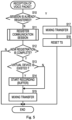
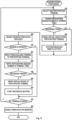
- FIG. 5 illustrates the processing operations of the control unit 30 at the time of receiving a voice packet.
- the control unit 30 Upon receiving a voice packet, the control unit 30 reads session information of this voice packet, and determines whether or not the communication session has already been registered in the mixing table 41 (step S10). If the communication session has already been registered in the mixing table 41 (YES in step S10), the control unit 30 transmits the voice signal of the received voice packet to at least one other communication terminal that is participating in the communication session by referring to the participating terminal field of the mixing table 41 (step S17). The control unit 30 further resets the retention time timer TS in the mixing table 41 to 30 seconds (step S18).
- step S10 If the communication session of the received voice packet is not registered in the mixing table 41 (NO in step S10), that is, if this voice packet is a call packet, which is a first voice packet, the control unit 30 performs registration processing for registering a new communication session due to this voice packet to the mixing table 41 (step S11). Hereinafter, this registration processing will be described using FIG. 6 .
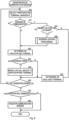
- FIG. 6 is a flowchart illustrating operations of the registration processing of the communication session that is executed in step S11 in FIG. 5 .
- the control unit 30 extracts participating terminal candidates constituted by the calling terminal and communication terminals to be called in the new communication session based on the destination ID and the calling ID included in the received call packet, and selects one of the participating terminal candidates (step S20).
- the control unit 30 determines whether or not the communication terminal of this participating terminal candidate is engaged (participating in another communication session) (step S21). If it is determined, in step S21, that the communication terminal is not engaged (NO in step S21), the control unit 30 determines that this communication terminal is a participating terminal of the communication session to be established this time (step S22).
- the control unit 30 determines whether this communication terminal is a recording target communication terminal (step S23). If the communication terminal is a recording target (YES in step S23), a virtual device VDn associated with this communication terminal is also included in the participating terminals (step S24).
- step S21 If it is determined, in step S21, that the communication terminal of this participating terminal candidate is engaged (YES in step S21), the control unit 30 compares the priority of the communication session in which this communication terminal is currently participating with the priority of this new communication session (step S25). If the priority of the new communication session is higher (YES in step S25), the control unit 30 executes leaving processing for causing this communication terminal to leave the currently participating communication session (step S26), and determines that this communication terminal as the participating terminal of the new communication session (step S22). If this communication terminal is a recording target (YES in step S23), the control unit 30 also includes a corresponding virtual device VDn in the participating terminals (step S24).
- step S25 if the priority of the new communication session is the same as or lower than the priority of the communication session in which this communication terminal is currently participating (NO in step S25), the control unit 30 does not cause this communication terminal to participate in the new communication session, and determines to be an excluded terminal of the new communication session (step S27).
- the control unit 30 repeats the processing from step S20 to step S27 with respect to all of the participating terminal candidates (step S28).
- step S29 determines the number of communication terminals that have been determined as the participating terminals. If the number of participating terminals excluding the virtual devices is two or more (YES in step S29), the control unit 30 registers this new communication session to the mixing table 41 (step S30), and ends this processing. Also, in step S29, if the number of participating terminals is less than two (NO in step S29), the control unit 30 determines that this new communication session cannot be established, and does not register the new communication session to the mixing table 41, and ends this registration processing.
- the control unit 30 determines, in step S12, whether or not a new communication session has been registered in the communication session registration processing (step S11 in FIG. 6 ). If a new communication session has not been registered (NO in step S12), the control unit 30 ends the processing incurred by the reception of this voice packet. On the other hand, if a new communication session has been registered in step S12 (YES in step S12), the control unit 30, if the virtual device is included in the participating terminals (YES in step S14), starts buffering of the new communication session is started (step S14) , and transfers the voice signal of the received voice packet to a communication terminal that is participating in the communication session by referring to the participating terminal field of the mixing table 41 (step S15).
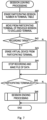
- This processing is processing for causing a communication terminal that is participating in a communication session to leave the communication session in order to move the communication terminal to another communication session whose priority is higher, as shown in FIG. 6 .
- the control unit 30 erases the participating session number in the terminal table 40 (step S40), and moves the identification number of this communication terminal from the participating terminal field, in the mixing table 41, of the communication session that the communication terminal is currently participating to the excluded terminal field (step S41). Then, it is determined whether this communication terminal is a recording target or not (step S42).
- step S42 If this communication terminal is a recording target (YES in step S42), the control unit 30 erases the virtual device VDn from the participating terminal field (step S43), stops recording (buffering) of this communication session, and makes a file of the data of voice that has been buffered until this point in time (step S44). If, as a result of the communication terminal having left the communication session, the number of the participating terminals thereof has decreased to less than two (YES in step S45), session ending processing for ending this communication session (step S46) is executed (step S46). If the recording target communication terminal has left the communication session, recording is immediately started in a communication session in which this communication terminal has newly participated (See step S24 in FIG. 6 and step S14 in FIG. 5 ).
- FIG. 8 is a flowchart illustrating the session ending processing. This processing is executed when, as a result of a participating terminal having left, the number of participating terminals has decreased to less than two, as described above, and when the voices in the communication session have stopped, and a predetermined time (30 seconds) has elapsed in a soundless state.
- the control unit 30 selects one participating terminal in the communication session that is caused to be ended (step S50), erases the participating session number of this communication terminal in the terminal table 40 (step S51), and determines whether this communication terminal is a recording target (step S52).
- control unit 30 erases the virtual device VDn from the participating terminal field (step S53), stops recording (buffering) of this communication session, and makes a file of the data of voice that has been buffered until this point in time (step S54) .
- the control unit 30 searches whether the identification number of this communication terminal is registered in the excluded terminal fields of the other communication sessions registered in the mixing table 41 (step S55). If a communication session in which this communication terminal is registered as an excluded terminal is present (YES in step S56), in order to make the excluded communication terminal participate in this communication session in which the communication terminal has been excluded, the control unit 30 moves the identification number of this communication terminal from the excluded terminal field to the participating terminal field of this communication session (step S57), and writes the session number of this communication session to the participating session number field of this communication terminal in the terminal table 40 (step S58). The control unit 30 then determines whether this communication terminal is a recording target (step S59).
- step S59 If it is determined to be a recording target (YES in step S59), the control unit 30 writes the virtual device VDn in the participating terminal field of the communication session (step S60), and starts recording (buffering) of this communication session (step S61). After having executed the processing from step S50 to step S61 with respect to all of the participating terminals (YES in step S62), the control unit 30 erases this communication session from the mixing table 41 (step S63), and ends the session ending processing.
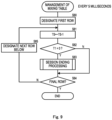
- FIG. 9 is a flowchart illustrating the communication session management processing.
- the control unit 30 counts the soundless time of each communication session registered in the mixing table 41, and when a predetermined time (30 seconds) has elapsed, ends the communication session. This processing is regularly (e.g. every 20 milliseconds) executed repeatedly.
- the control unit 30, first, designates the communication session in the first row of the mixing table 41 (step S80).
- the control unit 30 reduces the retention time timer TS of the designated communication session by one count (20 milliseconds worth) (step S81), and determines whether or not the retention time timer TS reaches 0 due to this reduction (step S82).
- step S82 the control unit 30 determines that this communication session has ended, and erases the session ending processing with respect to the communication session of this row (step S83, FIG. 8 ).
- the control unit 30 manages the mixing table 41 by successively performing the processing described above until the last row of the mixing table 41 (steps S84 and S85).
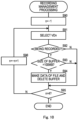
- FIG. 10 is a flowchart illustrating recording management processing operations to be executed by the communication monitoring unit 6 of the control unit 30.
- This processing is a processing for managing the communication session and executed at fixed intervals (20 milliseconds) with respect to a virtual device VDn.
- the communication monitoring unit 6 sets "1" to "n” (step S90), and selects the virtual device VDn (step S91).
- the communication monitoring unit 6 determines whether or not this virtual device VDn is recording data of voice, that is, determines whether or not the communication terminal which is a recording target is participating in the communication session (step S92) .
- step S92 determines whether or not size of the buffered recorded voice reaches a predetermined size (100 MB) (step S93). If the size of the buffered data of recorded voice reaches 100 MB (YES in step S93), the communication monitoring unit 6 makes a file of the buffered recorded voice and deletes the buffered recorded voice until this point in time (step S94). Note that newly recorded voice is continuously buffered. If the virtual device VDn is not recording voice (NO in step S92), and the size of the buffered recorded voice does not reach 100 MB, the communication monitoring unit 6 performs nothing. While sequentially adding "1" to "n" (step S96), processing of step S90 to step S94 are performed, and the processing are ended after abovementioned processing are performed to all the virtual device VDn (YES in step S95).
- a file of recorded voices are stored in the external storage device 7.
- a folder for each date is created under each directory. "Date in which saving is started” is used as the folder name. For example, the folder for the virtual device VD1 for September 10th, 2018 is "/voice_data1/20180910".
- the file name of a voice file that is created every 100 MB is named such that a communication type is added to MM(month)DD(day)HH(hour)DD(minutes)SS(seconds) at which buffering has started.
- the communication type includes "_all” in the case of plenary communication, "_group100” (100 is a group ID) in the case of group communication, “_uid10” (transceiver ID) or “_tel1234" (telephone number of IP telephone) in the case of individual communication, and the like.
- the file name of a voice signal in a communication session having a group ID 100 whose buffering has started at 18:01 on September 10th is "0910180100_group100.wav”. Therefore, the voice signal of the communication session having the group ID 100 with respect to which the virtual device VD1 has started buffering at 18:01 on September 10th is saved as "/voice_data1/20180910/0910180100_group100.wav", for example.
- the recorded voice data is in WAVE format, but an any encoded format can be used.
- An MP3 format can be used, for example.
- older files of recorded voice may be sequentially deleted (overwritten).
- the virtual device may be associated with the communication terminal or the communication group by a user of the relaying device 2 without making the virtual device associate with the communication terminal or the communication group in advance.
- a file is made every time the size of the buffered recorded voice reaches a predetermined size, but a file may be made every time the recording time reaches a predetermined time length.
Landscapes
- Engineering & Computer Science (AREA)
- Signal Processing (AREA)
- Computer Networks & Wireless Communication (AREA)
- Multimedia (AREA)
- Business, Economics & Management (AREA)
- General Business, Economics & Management (AREA)
- Computer Security & Cryptography (AREA)
- Technology Law (AREA)
- Telephonic Communication Services (AREA)
- Data Exchanges In Wide-Area Networks (AREA)
Claims (6)
- Relaisvorrichtung (2), umfassend:eine Kommunikationseinheit (3, 33, 5), die dazu eingerichtet ist, mit mehreren Kommunikationsendgeräten (20, 22, 23, 24, 25, 26, 27, 28), die Sprachkommunikation durchführen, zu kommunizieren;eine Kommunikationssitzungs-Verarbeitungseinheit (4), die eine Mischtabelle umfasst, wobei die Kommunikationssitzungs-Verarbeitungseinheit dazu eingerichtet ist, wenn ein Kommunikationsendgerät (20, 22, 23, 24, 25, 26, 27, 28) ein anderes mindestens ein Kommunikationsendgerät (20, 22, 23, 24, 25, 26, 27, 28) gerufen hat, eine Kommunikationssitzung aufzubauen, in der das Kommunikationsendgerät (20, 22, 23, 24, 25, 26, 27, 28), das gerufen hat, und das mindestens eine Kommunikationsendgerät (20, 22, 23, 24, 25, 26, 27, 28), das gerufen wurde, als teilnehmende Endgeräte in der Mischtabelle registriert sind, und, nachdem ein Sprachsignal von einem teilnehmenden Endgerät in der aufgebauten Kommunikationssitzung gesendet wurde, dieses Sprachsignal an ein anderes teilnehmendes Endgerät in derselben Kommunikationssitzung zu senden, wobei das andere teilnehmende Endgerät unter Bezug auf die Mischtabelle bestimmt wird; undeine Kommunikationsüberwachungseinheit (6), die dazu eingerichtet ist, eine virtuelle Vorrichtung, die ein virtuelles Kommunikationsendgerät ist, als ein teilnehmendes Endgerät der Kommunikationssitzung in der Mischtabelle zu registrieren, ein Sprachsignal zu erfassen, das von der Kommunikationssitzungs-Verarbeitungseinheit (4) an die virtuelle Vorrichtung gesendet wird, und das Sprachsignal aufzuzeichnen oder wiederzugeben,wobei die Kommunikationsüberwachungseinheit (6) die virtuelle Vorrichtung mit einem zuvor festgelegten Kommunikationsendgerät (20, 22, 23, 24, 25, 26, 27, 28) oder einer zuvor festgelegten Gruppe, die von mehreren Kommunikationsendgeräten (20, 22, 23, 24, 25, 26, 27, 28) gebildet ist, verknüpft und, falls das Kommunikationsendgerät (20, 22, 23, 24, 25, 26, 27, 28) oder die Gruppe, mit dem bzw mit der die virtuelle Vorrichtung verknüpft ist, als ein teilnehmendes Endgerät der Kommunikationssitzung in der Mischtabelle registriert ist, die virtuelle Vorrichtung als ein teilnehmendes Endgerät der Kommunikationssitzung registriert.
- Relaisvorrichtung (2) nach Anspruch 1, wobei die Kommunikationsüberwachungseinheit (6) mehrere virtuelle Vorrichtungen bereitstellt und das Aufzeichnen oder Wiedergeben bezüglich mehrerer Kommunikationssitzungen separat, parallel und gleichzeitig durchführt.
- Relaisvorrichtung (2) nach Anspruch 1,wobei die Kommunikationseinheit (3, 33, 5) mit einem Kommunikationsendgerät (20, 22), das eine Telefonkommunikation durchführt, einem Kommunikationsendgerät (25, 26, 27, 28), das eine drahtlose Kommunikation durchführt, und einem Kommunikationsendgerät (23, 24), das eine Sprachkommunikation über ein Netzwerk durchführt, kommuniziert, undwobei die Kommunikationssitzungs-Verarbeitungseinheit (4) eine Kommunikationssitzung aufbaut, in der diese Kommunikationsendgeräte (20, 22, 23, 24, 25, 26, 27, 28) als teilnehmende Endgeräte registriert sind.
- Überwachungsverfahren für eine Sprachkommunikation in einer Relaisvorrichtung (2), die mit mehreren Kommunikationsendgeräten (20, 22, 23, 24, 25, 26, 27, 28), die Sprachkommunikation durchführen, kommuniziert, wobei das Überwachungsverfahren umfasst:wenn ein Kommunikationsendgerät (20, 22, 23, 24, 25, 26, 27, 28) ein anderes mindestens ein Kommunikationsendgerät (20, 22, 23, 24, 25, 26, 27, 28) gerufen hat, Aufbauen einer Kommunikationssitzung, in der das Kommunikationsendgerät (20, 22, 23, 24, 25, 26, 27, 28), das gerufen hat, und das mindestens eine Kommunikationsendgerät (20, 22, 23, 24, 25, 26, 27, 28), das gerufen wurde, als teilnehmende Endgeräte in einer Mischtabelle der Relaisvorrichtung registriert sind;wenn ein Sprachsignal von einem teilnehmenden Endgerät in der aufgebauten Kommunikationssitzung gesendet wird, Senden dieses Sprachsignals an ein anderes teilnehmendes Endgerät in derselben Kommunikationssitzung, wobei das andere teilnehmende Endgerät unter Bezug auf die Mischtabelle bestimmt wird;Registrieren einer virtuellen Vorrichtung als ein teilnehmendes Endgerät der Kommunikationssitzung, die ein virtuelles Kommunikationsendgerät zum Senden des Sprachsignals an eine Kommunikationsüberwachungseinheit (6) ist, die in der Mischtabelle der Relaisvorrichtung (2) bereitgestellt ist;Aufzeichnen oder Wiedergeben eines Sprachsignals, das von einer Kommunikationssitzungs-Verarbeitungseinheit (4) an die virtuelle Vorrichtung gesendet wird, unter Verwendung der Kommunikationsüberwachungseinheit (6);Verknüpfen der virtuellen Vorrichtung mit einem zuvor festgelegten Kommunikationsendgerät (20, 22, 23, 24, 25, 26, 27, 28) oder einer zuvor festgelegten Gruppe, die von mehreren Kommunikationsendgeräten (20, 22, 23, 24, 25, 26, 27, 28) gebildet ist; und,falls das Kommunikationsendgerät (20, 22, 23, 24, 25, 26, 27, 28) oder die Gruppe, mit dem bzw mit der die virtuelle Vorrichtung verknüpft ist, als ein teilnehmendes Endgerät der Kommunikationssitzung in der Mischtabelle registriert ist, Registrieren der virtuellen Vorrichtung als ein teilnehmendes Endgerät der Kommunikationssitzung.
- Überwachungsverfahren für eine Sprachkommunikation nach Anspruch 4, wobei mehrere virtuelle Vorrichtungen bereitgestellt werden und das Aufzeichnen oder Wiedergeben bezüglich mehrerer Kommunikationssitzungen separat, parallel und gleichzeitig durchgeführt wird.
- Überwachungsverfahren für eine Sprachkommunikation nach Anspruch 4, wobei die mehreren Kommunikationsendgeräte (20, 22, 23, 24, 25, 26, 27, 28) mindestens eines von einem Endgerät, das eine Telefonkommunikation durchführt, einem Endgerät, das eine drahtlose Kommunikation durchführt, und einem Endgerät, das eine Sprachkommunikation über ein Netzwerk durchführt, umfassen.
Applications Claiming Priority (2)
| Application Number | Priority Date | Filing Date | Title |
|---|---|---|---|
| JP2018181218A JP7201897B2 (ja) | 2018-09-27 | 2018-09-27 | 中継装置および音声通信のモニタ方法 |
| PCT/JP2019/017870 WO2020066105A1 (ja) | 2018-09-27 | 2019-04-26 | 中継装置および音声通信のモニタ方法 |
Publications (3)
| Publication Number | Publication Date |
|---|---|
| EP3843371A1 EP3843371A1 (de) | 2021-06-30 |
| EP3843371A4 EP3843371A4 (de) | 2022-04-20 |
| EP3843371B1 true EP3843371B1 (de) | 2024-11-20 |
Family
ID=69953015
Family Applications (1)
| Application Number | Title | Priority Date | Filing Date |
|---|---|---|---|
| EP19867211.5A Active EP3843371B1 (de) | 2018-09-27 | 2019-04-26 | Relaisvorrichtung und sprachkommunikationsüberwachungsverfahren |
Country Status (5)
| Country | Link |
|---|---|
| US (1) | US11425257B2 (de) |
| EP (1) | EP3843371B1 (de) |
| JP (1) | JP7201897B2 (de) |
| CN (1) | CN112673615B (de) |
| WO (1) | WO2020066105A1 (de) |
Families Citing this family (2)
| Publication number | Priority date | Publication date | Assignee | Title |
|---|---|---|---|---|
| JP7201897B2 (ja) * | 2018-09-27 | 2023-01-11 | アイコム株式会社 | 中継装置および音声通信のモニタ方法 |
| JP7355996B2 (ja) | 2019-05-17 | 2023-10-04 | アイコム株式会社 | 中継装置および音声通信の録音方法 |
Family Cites Families (19)
| Publication number | Priority date | Publication date | Assignee | Title |
|---|---|---|---|---|
| DE10019001A1 (de) * | 2000-04-17 | 2001-10-18 | Siemens Ag | Verfahren und Anordnung zur Aufzeichnungvon Kommunikationsdaten. |
| JP2005033311A (ja) * | 2003-07-08 | 2005-02-03 | Nippon Telegr & Teleph Corp <Ntt> | 音声通話録音方法 |
| US20090055548A1 (en) * | 2007-08-24 | 2009-02-26 | Verint Americas Inc. | Systems and methods for multi-stream recording |
| JP2009212908A (ja) * | 2008-03-05 | 2009-09-17 | Iwatsu Electric Co Ltd | 多チャンネル通話録音システム |
| US8582728B2 (en) * | 2008-05-05 | 2013-11-12 | Freddie B. Ross | Web-type audio information system using phone communication lines (audio net pages) |
| US9071684B2 (en) * | 2009-11-17 | 2015-06-30 | Cisco Technology, Inc. | Media forking |
| US8380872B2 (en) * | 2009-12-31 | 2013-02-19 | Nice Systems Ltd. | Peer-to-peer telephony recording |
| JP2011147007A (ja) | 2010-01-15 | 2011-07-28 | Mitsubishi Electric Corp | 通話録音装置及び通話録音システム |
| JP6098114B2 (ja) * | 2012-10-26 | 2017-03-22 | アイコム株式会社 | 中継装置および通信システム |
| KR20140092630A (ko) * | 2013-01-16 | 2014-07-24 | 삼성전자주식회사 | 사용자장치, 통신서버 및 그 제어방법 |
| JP6347115B2 (ja) * | 2013-02-28 | 2018-06-27 | 株式会社リコー | 通信管理システム、通信管理方法、及びプログラム |
| CN105706433B (zh) * | 2013-11-07 | 2019-03-22 | 艾可慕株式会社 | 中继装置、声音通信系统、记录介质以及中继方法 |
| US10194372B2 (en) * | 2013-11-07 | 2019-01-29 | Icom Incorporated | Relaying device, audio-communication system and relaying method for relaying audio signal |
| JP6583270B2 (ja) | 2014-07-04 | 2019-10-02 | アイコム株式会社 | 中継装置、通信システムおよび音声信号の中継方法 |
| EP3226526B1 (de) * | 2014-11-28 | 2022-09-07 | Icom Incorporated | Relaisvorrichtung, sprachkommunikationsvorrichtung, sprachkommunikationsverfahren und programm |
| JP2016167656A (ja) * | 2015-03-09 | 2016-09-15 | 株式会社リコー | 伝送管理システム、伝送システム、伝送管理方法、及びプログラム |
| US20180077204A1 (en) * | 2016-09-15 | 2018-03-15 | Takeru Inoue | Information processing terminal, communication system, information processing method, and recording medium |
| JP7201897B2 (ja) * | 2018-09-27 | 2023-01-11 | アイコム株式会社 | 中継装置および音声通信のモニタ方法 |
| CN109462753B (zh) * | 2018-11-19 | 2021-12-03 | 视联动力信息技术股份有限公司 | 一种视联网多会议测试系统和方法 |
-
2018
- 2018-09-27 JP JP2018181218A patent/JP7201897B2/ja active Active
-
2019
- 2019-04-26 US US17/273,025 patent/US11425257B2/en active Active
- 2019-04-26 EP EP19867211.5A patent/EP3843371B1/de active Active
- 2019-04-26 CN CN201980059048.0A patent/CN112673615B/zh active Active
- 2019-04-26 WO PCT/JP2019/017870 patent/WO2020066105A1/ja not_active Ceased
Also Published As
| Publication number | Publication date |
|---|---|
| WO2020066105A1 (ja) | 2020-04-02 |
| US11425257B2 (en) | 2022-08-23 |
| EP3843371A4 (de) | 2022-04-20 |
| JP2020053835A (ja) | 2020-04-02 |
| CN112673615A (zh) | 2021-04-16 |
| JP7201897B2 (ja) | 2023-01-11 |
| CN112673615B (zh) | 2023-08-04 |
| US20210329130A1 (en) | 2021-10-21 |
| EP3843371A1 (de) | 2021-06-30 |
Similar Documents
| Publication | Publication Date | Title |
|---|---|---|
| JP2005124183A (ja) | 通信セッション上で起動中の複数個の通信機器の識別情報を情報受信コンポーネントに送信する装置および方法 | |
| EP3843370B1 (de) | Relaisvorrichtung und sprachkommunikationsaufzeichnungsverfahren | |
| CN102769633A (zh) | 通话录音系统和通话录音方法 | |
| EP3843371B1 (de) | Relaisvorrichtung und sprachkommunikationsüberwachungsverfahren | |
| KR20060016887A (ko) | 이동통신 단말기에서의 푸시투토크 방식의 그룹 통화 방법 | |
| EP3843369B1 (de) | Relaisvorrichtung und verfahren zur weiterleitung von sprachsignalen | |
| US12185199B2 (en) | Relay device and voice communication recording method | |
| CN102118705B (zh) | 一种来电信息的通知方法和设备 | |
| CN114651436B (zh) | 声音通信系统、声音通信方法以及记录介质 | |
| JP2005102033A (ja) | 携帯電話での同報通話システム | |
| HK40042157A (en) | Relay device and voice communication monitoring method | |
| CN1117496C (zh) | 用于提供带外拨号数字信令的方法与设备 | |
| HK40042158A (en) | Relay device and voice communication recording method | |
| HK40042157B (zh) | 中继装置以及声音通信的监控方法 | |
| HK40060749A (en) | Relay device and voice communication recording method | |
| HK40042158B (zh) | 中继装置以及声音通信的录音方法 | |
| HK40068310A (en) | Voice communication system, voice communication method, and recording medium | |
| HK40068310B (zh) | 声音通讯系统、声音通讯方法以及记录介质 | |
| HK40060749B (zh) | 中继装置以及声音通信的录音方法 |
Legal Events
| Date | Code | Title | Description |
|---|---|---|---|
| STAA | Information on the status of an ep patent application or granted ep patent |
Free format text: STATUS: THE INTERNATIONAL PUBLICATION HAS BEEN MADE |
|
| PUAI | Public reference made under article 153(3) epc to a published international application that has entered the european phase |
Free format text: ORIGINAL CODE: 0009012 |
|
| STAA | Information on the status of an ep patent application or granted ep patent |
Free format text: STATUS: REQUEST FOR EXAMINATION WAS MADE |
|
| 17P | Request for examination filed |
Effective date: 20210323 |
|
| AK | Designated contracting states |
Kind code of ref document: A1 Designated state(s): AL AT BE BG CH CY CZ DE DK EE ES FI FR GB GR HR HU IE IS IT LI LT LU LV MC MK MT NL NO PL PT RO RS SE SI SK SM TR |
|
| DAV | Request for validation of the european patent (deleted) | ||
| DAX | Request for extension of the european patent (deleted) | ||
| A4 | Supplementary search report drawn up and despatched |
Effective date: 20220318 |
|
| RIC1 | Information provided on ipc code assigned before grant |
Ipc: H04L 65/1076 20220101ALI20220314BHEP Ipc: H04L 65/1083 20220101ALI20220314BHEP Ipc: H04M 3/42 20060101ALI20220314BHEP Ipc: H04M 3/00 20060101ALI20220314BHEP Ipc: H04M 3/56 20060101AFI20220314BHEP |
|
| GRAP | Despatch of communication of intention to grant a patent |
Free format text: ORIGINAL CODE: EPIDOSNIGR1 |
|
| STAA | Information on the status of an ep patent application or granted ep patent |
Free format text: STATUS: GRANT OF PATENT IS INTENDED |
|
| INTG | Intention to grant announced |
Effective date: 20240809 |
|
| GRAS | Grant fee paid |
Free format text: ORIGINAL CODE: EPIDOSNIGR3 |
|
| GRAA | (expected) grant |
Free format text: ORIGINAL CODE: 0009210 |
|
| STAA | Information on the status of an ep patent application or granted ep patent |
Free format text: STATUS: THE PATENT HAS BEEN GRANTED |
|
| AK | Designated contracting states |
Kind code of ref document: B1 Designated state(s): AL AT BE BG CH CY CZ DE DK EE ES FI FR GB GR HR HU IE IS IT LI LT LU LV MC MK MT NL NO PL PT RO RS SE SI SK SM TR |
|
| REG | Reference to a national code |
Ref country code: GB Ref legal event code: FG4D |
|
| REG | Reference to a national code |
Ref country code: CH Ref legal event code: EP |
|
| REG | Reference to a national code |
Ref country code: DE Ref legal event code: R096 Ref document number: 602019062385 Country of ref document: DE |
|
| REG | Reference to a national code |
Ref country code: IE Ref legal event code: FG4D |
|
| REG | Reference to a national code |
Ref country code: LT Ref legal event code: MG9D |
|
| REG | Reference to a national code |
Ref country code: NL Ref legal event code: MP Effective date: 20241120 |
|
| PG25 | Lapsed in a contracting state [announced via postgrant information from national office to epo] |
Ref country code: PT Free format text: LAPSE BECAUSE OF FAILURE TO SUBMIT A TRANSLATION OF THE DESCRIPTION OR TO PAY THE FEE WITHIN THE PRESCRIBED TIME-LIMIT Effective date: 20250320 Ref country code: HR Free format text: LAPSE BECAUSE OF FAILURE TO SUBMIT A TRANSLATION OF THE DESCRIPTION OR TO PAY THE FEE WITHIN THE PRESCRIBED TIME-LIMIT Effective date: 20241120 Ref country code: IS Free format text: LAPSE BECAUSE OF FAILURE TO SUBMIT A TRANSLATION OF THE DESCRIPTION OR TO PAY THE FEE WITHIN THE PRESCRIBED TIME-LIMIT Effective date: 20250320 |
|
| PG25 | Lapsed in a contracting state [announced via postgrant information from national office to epo] |
Ref country code: FI Free format text: LAPSE BECAUSE OF FAILURE TO SUBMIT A TRANSLATION OF THE DESCRIPTION OR TO PAY THE FEE WITHIN THE PRESCRIBED TIME-LIMIT Effective date: 20241120 Ref country code: NL Free format text: LAPSE BECAUSE OF FAILURE TO SUBMIT A TRANSLATION OF THE DESCRIPTION OR TO PAY THE FEE WITHIN THE PRESCRIBED TIME-LIMIT Effective date: 20241120 |
|
| REG | Reference to a national code |
Ref country code: AT Ref legal event code: MK05 Ref document number: 1744603 Country of ref document: AT Kind code of ref document: T Effective date: 20241120 |
|
| PG25 | Lapsed in a contracting state [announced via postgrant information from national office to epo] |
Ref country code: BG Free format text: LAPSE BECAUSE OF FAILURE TO SUBMIT A TRANSLATION OF THE DESCRIPTION OR TO PAY THE FEE WITHIN THE PRESCRIBED TIME-LIMIT Effective date: 20241120 |
|
| PG25 | Lapsed in a contracting state [announced via postgrant information from national office to epo] |
Ref country code: ES Free format text: LAPSE BECAUSE OF FAILURE TO SUBMIT A TRANSLATION OF THE DESCRIPTION OR TO PAY THE FEE WITHIN THE PRESCRIBED TIME-LIMIT Effective date: 20241120 |
|
| PG25 | Lapsed in a contracting state [announced via postgrant information from national office to epo] |
Ref country code: NO Free format text: LAPSE BECAUSE OF FAILURE TO SUBMIT A TRANSLATION OF THE DESCRIPTION OR TO PAY THE FEE WITHIN THE PRESCRIBED TIME-LIMIT Effective date: 20250220 |
|
| PG25 | Lapsed in a contracting state [announced via postgrant information from national office to epo] |
Ref country code: LV Free format text: LAPSE BECAUSE OF FAILURE TO SUBMIT A TRANSLATION OF THE DESCRIPTION OR TO PAY THE FEE WITHIN THE PRESCRIBED TIME-LIMIT Effective date: 20241120 Ref country code: GR Free format text: LAPSE BECAUSE OF FAILURE TO SUBMIT A TRANSLATION OF THE DESCRIPTION OR TO PAY THE FEE WITHIN THE PRESCRIBED TIME-LIMIT Effective date: 20250221 Ref country code: AT Free format text: LAPSE BECAUSE OF FAILURE TO SUBMIT A TRANSLATION OF THE DESCRIPTION OR TO PAY THE FEE WITHIN THE PRESCRIBED TIME-LIMIT Effective date: 20241120 |
|
| PG25 | Lapsed in a contracting state [announced via postgrant information from national office to epo] |
Ref country code: PL Free format text: LAPSE BECAUSE OF FAILURE TO SUBMIT A TRANSLATION OF THE DESCRIPTION OR TO PAY THE FEE WITHIN THE PRESCRIBED TIME-LIMIT Effective date: 20241120 |
|
| PGFP | Annual fee paid to national office [announced via postgrant information from national office to epo] |
Ref country code: FR Payment date: 20250310 Year of fee payment: 7 |
|
| PGFP | Annual fee paid to national office [announced via postgrant information from national office to epo] |
Ref country code: GB Payment date: 20250306 Year of fee payment: 7 |
|
| PG25 | Lapsed in a contracting state [announced via postgrant information from national office to epo] |
Ref country code: RS Free format text: LAPSE BECAUSE OF FAILURE TO SUBMIT A TRANSLATION OF THE DESCRIPTION OR TO PAY THE FEE WITHIN THE PRESCRIBED TIME-LIMIT Effective date: 20250220 |
|
| PG25 | Lapsed in a contracting state [announced via postgrant information from national office to epo] |
Ref country code: SM Free format text: LAPSE BECAUSE OF FAILURE TO SUBMIT A TRANSLATION OF THE DESCRIPTION OR TO PAY THE FEE WITHIN THE PRESCRIBED TIME-LIMIT Effective date: 20241120 |
|
| PGFP | Annual fee paid to national office [announced via postgrant information from national office to epo] |
Ref country code: DE Payment date: 20250305 Year of fee payment: 7 |
|
| PG25 | Lapsed in a contracting state [announced via postgrant information from national office to epo] |
Ref country code: DK Free format text: LAPSE BECAUSE OF FAILURE TO SUBMIT A TRANSLATION OF THE DESCRIPTION OR TO PAY THE FEE WITHIN THE PRESCRIBED TIME-LIMIT Effective date: 20241120 |
|
| PG25 | Lapsed in a contracting state [announced via postgrant information from national office to epo] |
Ref country code: EE Free format text: LAPSE BECAUSE OF FAILURE TO SUBMIT A TRANSLATION OF THE DESCRIPTION OR TO PAY THE FEE WITHIN THE PRESCRIBED TIME-LIMIT Effective date: 20241120 |
|
| PG25 | Lapsed in a contracting state [announced via postgrant information from national office to epo] |
Ref country code: RO Free format text: LAPSE BECAUSE OF FAILURE TO SUBMIT A TRANSLATION OF THE DESCRIPTION OR TO PAY THE FEE WITHIN THE PRESCRIBED TIME-LIMIT Effective date: 20241120 |
|
| PG25 | Lapsed in a contracting state [announced via postgrant information from national office to epo] |
Ref country code: SK Free format text: LAPSE BECAUSE OF FAILURE TO SUBMIT A TRANSLATION OF THE DESCRIPTION OR TO PAY THE FEE WITHIN THE PRESCRIBED TIME-LIMIT Effective date: 20241120 |
|
| PG25 | Lapsed in a contracting state [announced via postgrant information from national office to epo] |
Ref country code: CZ Free format text: LAPSE BECAUSE OF FAILURE TO SUBMIT A TRANSLATION OF THE DESCRIPTION OR TO PAY THE FEE WITHIN THE PRESCRIBED TIME-LIMIT Effective date: 20241120 |
|
| PG25 | Lapsed in a contracting state [announced via postgrant information from national office to epo] |
Ref country code: IT Free format text: LAPSE BECAUSE OF FAILURE TO SUBMIT A TRANSLATION OF THE DESCRIPTION OR TO PAY THE FEE WITHIN THE PRESCRIBED TIME-LIMIT Effective date: 20241120 |
|
| REG | Reference to a national code |
Ref country code: DE Ref legal event code: R097 Ref document number: 602019062385 Country of ref document: DE |
|
| PG25 | Lapsed in a contracting state [announced via postgrant information from national office to epo] |
Ref country code: SE Free format text: LAPSE BECAUSE OF FAILURE TO SUBMIT A TRANSLATION OF THE DESCRIPTION OR TO PAY THE FEE WITHIN THE PRESCRIBED TIME-LIMIT Effective date: 20241120 |
|
| PLBE | No opposition filed within time limit |
Free format text: ORIGINAL CODE: 0009261 |
|
| STAA | Information on the status of an ep patent application or granted ep patent |
Free format text: STATUS: NO OPPOSITION FILED WITHIN TIME LIMIT |
|
| 26N | No opposition filed |
Effective date: 20250821 |
|
| REG | Reference to a national code |
Ref country code: CH Ref legal event code: H13 Free format text: ST27 STATUS EVENT CODE: U-0-0-H10-H13 (AS PROVIDED BY THE NATIONAL OFFICE) Effective date: 20251125 |
|
| PG25 | Lapsed in a contracting state [announced via postgrant information from national office to epo] |
Ref country code: LU Free format text: LAPSE BECAUSE OF NON-PAYMENT OF DUE FEES Effective date: 20250426 |
|
| PG25 | Lapsed in a contracting state [announced via postgrant information from national office to epo] |
Ref country code: MC Free format text: LAPSE BECAUSE OF FAILURE TO SUBMIT A TRANSLATION OF THE DESCRIPTION OR TO PAY THE FEE WITHIN THE PRESCRIBED TIME-LIMIT Effective date: 20241120 |
|
| REG | Reference to a national code |
Ref country code: BE Ref legal event code: MM Effective date: 20250430 |
|
| PG25 | Lapsed in a contracting state [announced via postgrant information from national office to epo] |
Ref country code: BE Free format text: LAPSE BECAUSE OF NON-PAYMENT OF DUE FEES Effective date: 20250430 |
|
| PG25 | Lapsed in a contracting state [announced via postgrant information from national office to epo] |
Ref country code: CH Free format text: LAPSE BECAUSE OF NON-PAYMENT OF DUE FEES Effective date: 20250430 |