EP3838234B1 - Excrement care robot with integrated analysis function for motion and condition of bedridden patient - Google Patents
Excrement care robot with integrated analysis function for motion and condition of bedridden patient Download PDFInfo
- Publication number
- EP3838234B1 EP3838234B1 EP20210181.2A EP20210181A EP3838234B1 EP 3838234 B1 EP3838234 B1 EP 3838234B1 EP 20210181 A EP20210181 A EP 20210181A EP 3838234 B1 EP3838234 B1 EP 3838234B1
- Authority
- EP
- European Patent Office
- Prior art keywords
- axis
- excrement
- change
- care robot
- condition
- Prior art date
- Legal status (The legal status is an assumption and is not a legal conclusion. Google has not performed a legal analysis and makes no representation as to the accuracy of the status listed.)
- Active
Links
Images


Classifications
-
- A—HUMAN NECESSITIES
- A61—MEDICAL OR VETERINARY SCIENCE; HYGIENE
- A61G—TRANSPORT, PERSONAL CONVEYANCES, OR ACCOMMODATION SPECIALLY ADAPTED FOR PATIENTS OR DISABLED PERSONS; OPERATING TABLES OR CHAIRS; CHAIRS FOR DENTISTRY; FUNERAL DEVICES
- A61G9/00—Bed-pans, urinals or other sanitary devices for bed-ridden persons; Cleaning devices therefor, e.g. combined with toilet-urinals
- A61G9/003—Bed-pans
-
- A—HUMAN NECESSITIES
- A61—MEDICAL OR VETERINARY SCIENCE; HYGIENE
- A61F—FILTERS IMPLANTABLE INTO BLOOD VESSELS; PROSTHESES; DEVICES PROVIDING PATENCY TO, OR PREVENTING COLLAPSING OF, TUBULAR STRUCTURES OF THE BODY, e.g. STENTS; ORTHOPAEDIC, NURSING OR CONTRACEPTIVE DEVICES; FOMENTATION; TREATMENT OR PROTECTION OF EYES OR EARS; BANDAGES, DRESSINGS OR ABSORBENT PADS; FIRST-AID KITS
- A61F5/00—Orthopaedic methods or devices for non-surgical treatment of bones or joints; Nursing devices ; Anti-rape devices
- A61F5/44—Devices worn by the patient for reception of urine, faeces, catamenial or other discharge; Colostomy devices
-
- A—HUMAN NECESSITIES
- A61—MEDICAL OR VETERINARY SCIENCE; HYGIENE
- A61F—FILTERS IMPLANTABLE INTO BLOOD VESSELS; PROSTHESES; DEVICES PROVIDING PATENCY TO, OR PREVENTING COLLAPSING OF, TUBULAR STRUCTURES OF THE BODY, e.g. STENTS; ORTHOPAEDIC, NURSING OR CONTRACEPTIVE DEVICES; FOMENTATION; TREATMENT OR PROTECTION OF EYES OR EARS; BANDAGES, DRESSINGS OR ABSORBENT PADS; FIRST-AID KITS
- A61F5/00—Orthopaedic methods or devices for non-surgical treatment of bones or joints; Nursing devices ; Anti-rape devices
- A61F5/44—Devices worn by the patient for reception of urine, faeces, catamenial or other discharge; Colostomy devices
- A61F5/451—Genital or anal receptacles
-
- A—HUMAN NECESSITIES
- A61—MEDICAL OR VETERINARY SCIENCE; HYGIENE
- A61B—DIAGNOSIS; SURGERY; IDENTIFICATION
- A61B5/00—Measuring for diagnostic purposes; Identification of persons
- A61B5/103—Measuring devices for testing the shape, pattern, colour, size or movement of the body or parts thereof, for diagnostic purposes
- A61B5/11—Measuring movement of the entire body or parts thereof, e.g. head or hand tremor or mobility of a limb
- A61B5/1116—Determining posture transitions
-
- A—HUMAN NECESSITIES
- A61—MEDICAL OR VETERINARY SCIENCE; HYGIENE
- A61B—DIAGNOSIS; SURGERY; IDENTIFICATION
- A61B5/00—Measuring for diagnostic purposes; Identification of persons
- A61B5/103—Measuring devices for testing the shape, pattern, colour, size or movement of the body or parts thereof, for diagnostic purposes
- A61B5/11—Measuring movement of the entire body or parts thereof, e.g. head or hand tremor or mobility of a limb
- A61B5/1118—Determining activity level
-
- A—HUMAN NECESSITIES
- A61—MEDICAL OR VETERINARY SCIENCE; HYGIENE
- A61B—DIAGNOSIS; SURGERY; IDENTIFICATION
- A61B5/00—Measuring for diagnostic purposes; Identification of persons
- A61B5/68—Arrangements of detecting, measuring or recording means, e.g. sensors, in relation to patient
- A61B5/6801—Arrangements of detecting, measuring or recording means, e.g. sensors, in relation to patient specially adapted to be attached to or worn on the body surface
- A61B5/6802—Sensor mounted on worn items
-
- A—HUMAN NECESSITIES
- A61—MEDICAL OR VETERINARY SCIENCE; HYGIENE
- A61F—FILTERS IMPLANTABLE INTO BLOOD VESSELS; PROSTHESES; DEVICES PROVIDING PATENCY TO, OR PREVENTING COLLAPSING OF, TUBULAR STRUCTURES OF THE BODY, e.g. STENTS; ORTHOPAEDIC, NURSING OR CONTRACEPTIVE DEVICES; FOMENTATION; TREATMENT OR PROTECTION OF EYES OR EARS; BANDAGES, DRESSINGS OR ABSORBENT PADS; FIRST-AID KITS
- A61F5/00—Orthopaedic methods or devices for non-surgical treatment of bones or joints; Nursing devices ; Anti-rape devices
- A61F5/44—Devices worn by the patient for reception of urine, faeces, catamenial or other discharge; Colostomy devices
- A61F5/4404—Details or parts
- A61F5/4408—Means for securing receptacles or bags to the body otherwise than by adhesives, e.g. belts, straps or harnesses
-
- A—HUMAN NECESSITIES
- A61—MEDICAL OR VETERINARY SCIENCE; HYGIENE
- A61F—FILTERS IMPLANTABLE INTO BLOOD VESSELS; PROSTHESES; DEVICES PROVIDING PATENCY TO, OR PREVENTING COLLAPSING OF, TUBULAR STRUCTURES OF THE BODY, e.g. STENTS; ORTHOPAEDIC, NURSING OR CONTRACEPTIVE DEVICES; FOMENTATION; TREATMENT OR PROTECTION OF EYES OR EARS; BANDAGES, DRESSINGS OR ABSORBENT PADS; FIRST-AID KITS
- A61F5/00—Orthopaedic methods or devices for non-surgical treatment of bones or joints; Nursing devices ; Anti-rape devices
- A61F5/44—Devices worn by the patient for reception of urine, faeces, catamenial or other discharge; Colostomy devices
- A61F5/442—Devices worn by the patient for reception of urine, faeces, catamenial or other discharge; Colostomy devices having irrigation ports or means
-
- A—HUMAN NECESSITIES
- A61—MEDICAL OR VETERINARY SCIENCE; HYGIENE
- A61B—DIAGNOSIS; SURGERY; IDENTIFICATION
- A61B5/00—Measuring for diagnostic purposes; Identification of persons
- A61B5/103—Measuring devices for testing the shape, pattern, colour, size or movement of the body or parts thereof, for diagnostic purposes
- A61B5/11—Measuring movement of the entire body or parts thereof, e.g. head or hand tremor or mobility of a limb
- A61B5/1116—Determining posture transitions
- A61B5/1117—Fall detection
-
- A—HUMAN NECESSITIES
- A61—MEDICAL OR VETERINARY SCIENCE; HYGIENE
- A61G—TRANSPORT, PERSONAL CONVEYANCES, OR ACCOMMODATION SPECIALLY ADAPTED FOR PATIENTS OR DISABLED PERSONS; OPERATING TABLES OR CHAIRS; CHAIRS FOR DENTISTRY; FUNERAL DEVICES
- A61G2200/00—Information related to the kind of patient or his position
- A61G2200/30—Specific positions of the patient
- A61G2200/32—Specific positions of the patient lying
-
- A—HUMAN NECESSITIES
- A61—MEDICAL OR VETERINARY SCIENCE; HYGIENE
- A61G—TRANSPORT, PERSONAL CONVEYANCES, OR ACCOMMODATION SPECIALLY ADAPTED FOR PATIENTS OR DISABLED PERSONS; OPERATING TABLES OR CHAIRS; CHAIRS FOR DENTISTRY; FUNERAL DEVICES
- A61G2203/00—General characteristics of devices
- A61G2203/30—General characteristics of devices characterised by sensor means
- A61G2203/36—General characteristics of devices characterised by sensor means for motion
-
- A—HUMAN NECESSITIES
- A61—MEDICAL OR VETERINARY SCIENCE; HYGIENE
- A61G—TRANSPORT, PERSONAL CONVEYANCES, OR ACCOMMODATION SPECIALLY ADAPTED FOR PATIENTS OR DISABLED PERSONS; OPERATING TABLES OR CHAIRS; CHAIRS FOR DENTISTRY; FUNERAL DEVICES
- A61G2203/00—General characteristics of devices
- A61G2203/70—General characteristics of devices with special adaptations, e.g. for safety or comfort
-
- A—HUMAN NECESSITIES
- A61—MEDICAL OR VETERINARY SCIENCE; HYGIENE
- A61G—TRANSPORT, PERSONAL CONVEYANCES, OR ACCOMMODATION SPECIALLY ADAPTED FOR PATIENTS OR DISABLED PERSONS; OPERATING TABLES OR CHAIRS; CHAIRS FOR DENTISTRY; FUNERAL DEVICES
- A61G9/00—Bed-pans, urinals or other sanitary devices for bed-ridden persons; Cleaning devices therefor, e.g. combined with toilet-urinals
- A61G9/02—Cleaning devices
-
- B—PERFORMING OPERATIONS; TRANSPORTING
- B25—HAND TOOLS; PORTABLE POWER-DRIVEN TOOLS; MANIPULATORS
- B25J—MANIPULATORS; CHAMBERS PROVIDED WITH MANIPULATION DEVICES
- B25J11/00—Manipulators not otherwise provided for
- B25J11/008—Manipulators for service tasks
- B25J11/009—Nursing, e.g. carrying sick persons, pushing wheelchairs, distributing drugs
Definitions
- the present invention relates to an excrement care robot which is formed to be wearable on a human body to treat excrement, and more particularly, to an excrement care robot which is formed to perform an integrated analysis of the motion and condition of a bedridden patient to quantify a position change of the bedridden patient and induce an appropriate pressure distribution based on a position change history.
- an excrement treating apparatus that comes into direct contact with a human body to collect the excrement have been conducted.
- Such an excrement treating apparatus is designed to receive the user's excrement, suck the received excrement, and then discharge the sucked excrement to the outside, so that the excrement can be automatically treated even if a guardian or caregiver does not reside around the user.
- US 5 681 297 A describes a device for disposing excrement, comprising a diaper cup having a main body for encompassing a human body's hip and buttocks, a washing water sending hose connected to the main body for passing washing water to an interior of the diaper cup, and a human waste sucking hose connected to the main body for sucking washing water and waste from the interior of the diaper cup.
- An object of the present invention is to induce an appropriate pressure distribution in a body of a bedridden patient by performing an integrated analysis on the motion and condition of the bedridden patient.
- an excrement care robot as set out in claim 1.
- the sensor unit may include an inertial sensor that measures rotation angles with respect to a X (pitch) axis, a Y (roll) axis, and a Z (yaw) axis of the body.
- the motion analysis unit may determine that a user takes a position of lying on his/her side when an amount of change in rotation angle of the X-axis is less than a first angle range in a + direction or - direction within a predetermined first time range.
- the motion analysis unit may determine that the user is in a poor wearing condition when the amount of change in rotation angle of the X-axis is equal to or greater than the first angle range in the + direction or - direction within the predetermined first time range.
- the motion analysis unit determines that the user takes a sitting position or is in a poor wearing condition when the amount of change in rotation angle of the Y-axis is equal to or greater than a second angle range in the - direction within a predetermined second time range.
- the motion analysis unit determines that the user is in a removal condition or is in a poor wearing condition when the amount of change in rotation angle of the Y-axis is equal to or greater than the second angle range in the + direction within the predetermined second time range.
- the motion analysis unit may determine that the user is in a removal condition or in a poor wearing condition when the amount of change in rotation angle of the Z-axis is equal to or greater than a third angle range in a + direction or - direction within a predetermined third time range.
- the motion analysis unit may determine that the user is in any one of a fall condition, an emergency condition, or a removal condition when the amount of change in rotation angle of the X-axis is equal to or greater than the first angle range in the + direction or - direction, the amount of change in rotation angle of the Y-axis is equal to or greater than the second angle range in the + direction or - direction, and the amount of change in rotation angle of the Z-axis is equal to or greater than the third angle range in the + direction or - direction.
- the motion analysis unit may generate history information on position change of the user over time through the sensor data measured by the sensor unit.
- the excrement care robot of the present invention may further include a communication unit that transmits the sensor data measured by the sensor unit to the motion analysis unit.
- the sensor unit and the motion analysis unit are formed to perform an integrated analysis on the motion and condition of the bedridden patient to qualify a position change of the bedridden patient and induce an appropriate pressure distribution based on a position change history.
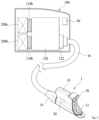
- FIG. 1 is a view illustrating an appearance of a body-fitted type treating apparatus in an excrement care robot according to an embodiment of the present invention
- FIG. 2 is a view illustrating all components of the excrement care robot according to an embodiment of the present invention.
- an excrement care robot includes a body-fitted type treating apparatus 1 that is a component directly worn by a user, that is, a bedridden patient, and a main treating device 100 connected to the body-fitted type treating apparatus.
- the body-fitted type treating apparatus 1 includes a body 10, a discharge unit 14, a contact member 20, and a sensor unit 30.
- the body 10 has a shape corresponding to bends of the genitals and buttocks of a human body, and includes a fitting part formed with a treatment space 12 that is opened in a direction of the genitals and buttocks of the human body to receive excrement discharged from the human body, and a main body part which is connected to the fitting part so as to be fitted between the legs of the human body and has a receiving space formed therein.
- the genitals of the human body refer to an area around the genitals of men and women
- the buttocks refer to an area around the anus connected with the genitals. That is, the fitting part is formed to be fitted on the groin of the human body, and has a curved shape to correspond to the bends thereof.
- the fitting part may include the contact member 20 having elasticity.
- a receiving space is provided inside the main body part, and various components required for the excrement treating apparatus may be provided in the receiving space.
- the components provided in the receiving space are obvious to those skilled in the art, and since the structure thereof may be variously formed without limitation, a detailed description thereof will be omitted.
- the discharge unit 14 is provided at the rear of the body 10 and communicates with the treatment space 12 through a discharge passage to discharge the excrement of the treatment space 12 to the outside.
- the discharge unit 14 protrudes to the rear side of the body 10 to be provided on the main treating device 100 side, and may be connected with a waste tank 120 having a collection space formed therein so that the excrement discharged by the discharge unit 14 is collected through an excrement flow hose 16.
- the excrement is sucked into the waste tank 120 side by a suck force generated from blow motors 200a and 200b which are provided in the main treating device 100 to provide a vacuum suck force on the flow passage of the excrement.
- a user H may stably wear the body-fitted type treating apparatus 1 of the excrement care robot by contacting a fitting part of the body 10 of the body-fitted type treating apparatus 1 with the genitals and buttocks in a state lying on a bed and extending user's legs to both sides of the main body part.
- the body-fitted type treating apparatus 1 of the excrement care robot since the body-fitted type treating apparatus 1 of the excrement care robot according to the embodiment is formed to correspond to the shape of the human body, the user H does not need to forcefully change a position in accordance with the body-fitted type treating apparatus 1, but may maintain a natural position.
- the excretion care robot further includes a sensor unit 30, a motion analysis unit (not illustrated), and a communication unit 40
- the sensor unit 30 is provided on the body 10 of the body-fitted type treating apparatus 1 and serves to measure a direction of movement of the body 10.
- the sensor unit 30 may include an inertial sensor that measures rotation angles with respect to a pitch axis, a roll axis, and a yaw axis of the body 10. In other words, the sensor unit 30 may derive a position change of the bedridden patient based on the three-axis movement angles.
- the motion analysis unit is a component that receives sensor data of the sensor unit 30 and analyzes the motion of the human body through the movement of the body 10, and may be provided in various positions.
- the motion analysis unit may be directly embedded in the body 10 of the body-fitted type treating apparatus 1, or also provided on the main treating device 100 side.
- the motion analysis unit may also be provided in an external terminal or the like separately from the body-fitted type treating apparatus 1 and the main treating device 100.
- the motion analysis unit is illustrated as being provided in the external terminal. Accordingly, in the embodiment, the communication unit 40 transmits the sensor data measured by the sensor unit 30 to the motion analysis unit.
- the communication unit 40 may also be directly embedded in the body 10 of the body-fitted type treating apparatus 1, or also provided on the main treating device 100 side.
- the communication unit 40 may also be provided in an external terminal or the like separately from the body-fitted type treating apparatus 1 and the main treating device 100.
- the communication unit 40 is illustrated as being provided on the main treating device 100.
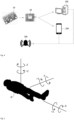
- FIG. 4 is a view schematically illustrating a data flow through the excrement care robot according to an embodiment of the present invention.
- the sensor data generated by the sensor unit 30 may be transmitted to at least one of a management server 310 and a user terminal 320 in the form of a smartphone through the communication unit 40 in a wired or wireless communication manner.
- the motion analysis unit may be directly embedded in the excrement care robot, but may be separately provided in an external terminal or the like.
- the motion analysis unit is provided in the management server 310 and the user terminal 320, and the sensor data transmitted through the communication unit 40 may be analyzed by the motion analysis unit.
- the motion analysis unit may generate history information on position change of the user over time while monitoring a patient's condition in real time through the sensor data measured by the sensor unit.
- the motion analysis unit may perform an alarm through an alarm unit 300 provided at various locations.
- FIG. 5 is a view illustrating a 3-axis based body rotation concept of a user wearing the body-fitted type treating apparatus 1 of the excrement care robot according to an embodiment of the present invention.
- the sensor unit 30 may include an inertial sensor, and the inertial sensor may measure rotation angles with respect to an X (pitch) axis, a Y (roll) axis, and a Z (yaw) axis of the body 10.
- the present invention it is possible to determine the left and right movement and the front and rear movement of the bedridden patient while lying down on a bed, etc., and to determine a risk of falling and a form of position change.
- the motion analysis unit may determine that a user H takes a position of lying on his/her side when an amount of change in rotation angle of the X-axis is less than a first angle range in a + direction or - direction within a predetermined first time range.
- the X-axis corresponds to the left and right motion of the human body, and when the angle change in the X-axis is made within the predetermined range, the user H is considered in a normal condition.
- the motion analysis unit may determine that the user H is in a poor wearing condition in which the user H does not normally wear the body-fitted type treating apparatus 1 of the excrement care robot.
- the motion analysis unit determines that the user H takes a sitting position or is in a poor wearing condition when the amount of change in rotation angle of the Y-axis is equal to or greater than a second angle range in the - direction within a predetermined second time range.
- the Y-axis may be determined to correspond to the movement of the head or legs of the human body.
- the motion analysis unit determines that the user H is in a removal condition or in a poor wearing condition when the amount of change in rotation angle of the Y-axis is equal to or greater than the second angle range in the + direction within the predetermined second time range.
- the motion analysis unit may determine that the user H is in a removal condition or in a poor wearing condition when the amount of change in rotation angle of the Z-axis is equal to or greater than a third angle range in a + direction or - direction within a predetermined third time range. This is because, when the user H is lying on the bed normally, a change in rotation angle of the Z-axis hardly occurs.
- the motion analysis unit may determine that the user H is currently in any one of a fall condition, an emergency condition, or a removal condition when the amount of change in rotation angle of the X-axis is equal to or greater than the first angle range in the + direction or - direction, the amount of change in rotation angle of the Y-axis is equal to or greater than the second angle range in the + direction or - direction, and the amount of change in rotation angle of the Z-axis is equal to or greater than the third angle range in the + direction or - direction.
- the sensor unit and the control unit are formed to perform an integrated analysis on the motion and condition of the bed patient to qualify a position change of the bedridden patient.
- the present invention has an advantage of inducing an appropriate pressure distribution based on the quantified position change history, and preventing bedsores and the like that may occur when the user H maintains the same position for a long time.
- the prepared embodiment of the present invention has been as described, and in addition to the embodiments described above, a fact that the present invention can be materialized in other specific forms without departing from the gist or scope thereof will be apparent to those skilled in the art. Therefore, the aforementioned embodiments are not limited but should be considered to be illustrative, and accordingly, the present invention is not limited to the above description and may be modified within the scope of the appended claims and a range equivalent thereto.
Landscapes
- Health & Medical Sciences (AREA)
- Life Sciences & Earth Sciences (AREA)
- General Health & Medical Sciences (AREA)
- Veterinary Medicine (AREA)
- Public Health (AREA)
- Animal Behavior & Ethology (AREA)
- Engineering & Computer Science (AREA)
- Heart & Thoracic Surgery (AREA)
- Biomedical Technology (AREA)
- Epidemiology (AREA)
- Nursing (AREA)
- Vascular Medicine (AREA)
- Orthopedic Medicine & Surgery (AREA)
- Biophysics (AREA)
- Physics & Mathematics (AREA)
- Pathology (AREA)
- Medical Informatics (AREA)
- Molecular Biology (AREA)
- Surgery (AREA)
- Dentistry (AREA)
- Physiology (AREA)
- Oral & Maxillofacial Surgery (AREA)
- Orthopedics, Nursing, And Contraception (AREA)
- Invalid Beds And Related Equipment (AREA)
- Measurement Of The Respiration, Hearing Ability, Form, And Blood Characteristics Of Living Organisms (AREA)
- Measuring And Recording Apparatus For Diagnosis (AREA)
- Robotics (AREA)
- Mechanical Engineering (AREA)
Description
- The present invention relates to an excrement care robot which is formed to be wearable on a human body to treat excrement, and more particularly, to an excrement care robot which is formed to perform an integrated analysis of the motion and condition of a bedridden patient to quantify a position change of the bedridden patient and induce an appropriate pressure distribution based on a position change history.
- In general, people such as patients, the elderly, etc., who have difficulty in moving or who have difficulty moving their lower bodies at will, have no ability capable of treating excrement on their own, so that there is a discomfort that a guardian or caregiver must always reside around the people.
- Therefore, in order to solve such discomfort, the research and development of an excrement treating apparatus that comes into direct contact with a human body to collect the excrement have been conducted. Such an excrement treating apparatus is designed to receive the user's excrement, suck the received excrement, and then discharge the sucked excrement to the outside, so that the excrement can be automatically treated even if a guardian or caregiver does not reside around the user.
- However, conventional excrement treating apparatuses which have been developed up to date often focus on only an excrement treatment function, and are designed without considering the user's body, and thus, there is a problem that the usability is very poor. In general, the periphery of the buttocks or genitals from which the excrement is excreted has a structure that is difficult to be in close contact with the excrement treating apparatus due to severe bends, and accordingly, there are many cases where the excrement leaks between the human body and the excrement treating apparatus.
- In addition, users who use an excrement treating apparatus, such as patients or the elderly, often live while lying on a bed, and cannot change their positions by themselves in many cases. When such a condition persists for a long time, bedsores and the like occur, and thus, it is necessary to change a position periodically. However, since the users could not change the positions while wearing the excrement treating apparatus, there was an inconvenience to remove the excrement treating apparatus.
- Therefore, there is a need for a method for solving these problems.
- [Prior Art Document]/[Patent Document]
Korean Patent No. 10-0893733 - The above information disclosed in this Background section is only for enhancement of understanding of the background of the invention and therefore it may contain information that does not form the prior art that is already known in this country to a person of ordinary skill in the art.
-
US 5 681 297 A describes a device for disposing excrement, comprising a diaper cup having a main body for encompassing a human body's hip and buttocks, a washing water sending hose connected to the main body for passing washing water to an interior of the diaper cup, and a human waste sucking hose connected to the main body for sucking washing water and waste from the interior of the diaper cup. - The present invention has been made in an effort to solve the above-described problems associated with prior art. An object of the present invention is to induce an appropriate pressure distribution in a body of a bedridden patient by performing an integrated analysis on the motion and condition of the bedridden patient.
- The objects of the present invention are not limited to the aforementioned objects, and other objects, which are not mentioned above, will be apparent to those skilled l in the art from the following description.
- In order to achieve the objects described above, according to an embodiment of the present invention, there is provided an excrement care robot as set out in
claim 1. - The sensor unit may include an inertial sensor that measures rotation angles with respect to a X (pitch) axis, a Y (roll) axis, and a Z (yaw) axis of the body.
- In addition, the motion analysis unit may determine that a user takes a position of lying on his/her side when an amount of change in rotation angle of the X-axis is less than a first angle range in a + direction or - direction within a predetermined first time range.
- Further, the motion analysis unit may determine that the user is in a poor wearing condition when the amount of change in rotation angle of the X-axis is equal to or greater than the first angle range in the + direction or - direction within the predetermined first time range.
- Furthermore, the motion analysis unit determines that the user takes a sitting position or is in a poor wearing condition when the amount of change in rotation angle of the Y-axis is equal to or greater than a second angle range in the - direction within a predetermined second time range.
- In addition, the motion analysis unit determines that the user is in a removal condition or is in a poor wearing condition when the amount of change in rotation angle of the Y-axis is equal to or greater than the second angle range in the + direction within the predetermined second time range.
- Further, the motion analysis unit may determine that the user is in a removal condition or in a poor wearing condition when the amount of change in rotation angle of the Z-axis is equal to or greater than a third angle range in a + direction or - direction within a predetermined third time range.
- In addition, the motion analysis unit may determine that the user is in any one of a fall condition, an emergency condition, or a removal condition when the amount of change in rotation angle of the X-axis is equal to or greater than the first angle range in the + direction or - direction, the amount of change in rotation angle of the Y-axis is equal to or greater than the second angle range in the + direction or - direction, and the amount of change in rotation angle of the Z-axis is equal to or greater than the third angle range in the + direction or - direction.
- Meanwhile, the motion analysis unit may generate history information on position change of the user over time through the sensor data measured by the sensor unit.
- The excrement care robot of the present invention may further include a communication unit that transmits the sensor data measured by the sensor unit to the motion analysis unit.
- According to the present invention to solve the problems, in the excrement care robot with the integrated analysis function on the motion and condition of the bedridden patient, the sensor unit and the motion analysis unit are formed to perform an integrated analysis on the motion and condition of the bedridden patient to qualify a position change of the bedridden patient and induce an appropriate pressure distribution based on a position change history.
- The effects of the present invention are not limited to the aforementioned effect, and other effects not mentioned above will be clearly understood to those skilled in the art from the description of the appended claims.
- The above and other features of the present invention will now be described in detail with reference to certain exemplary embodiments thereof illustrated the accompanying drawings which are given hereinbelow by way of illustration only, and thus are not limitative of the present invention, and wherein:
-
FIG. 1 is a view illustrating an appearance of a body-fitted type treating apparatus in an excrement care robot according to an embodiment of the present invention; -
FIG. 2 is a view illustrating all components of the excrement care robot according to an embodiment of the present invention; -
FIG. 3 is a view illustrating an appearance of wearing the body-fitted type treating apparatus on a human body in the excrement care robot according to an embodiment of the present invention; and -
FIG. 4 is a view schematically illustrating a data flow through the excrement care robot according to an embodiment of the present invention; and -
FIG. 5 is a view illustrating a 3-axis based body rotation concept of a user wearing the body-fitted type treating apparatus of the excrement care robot according to an embodiment of the present invention. - It should be understood that the appended drawings are not necessarily to scale, presenting a somewhat simplified representation of various preferred features illustrative of the basic principles of the invention. The specific design features of the present invention as disclosed herein, including, for example, specific dimensions, orientations, locations, and shapes will be determined in part by the particular intended application and use environment.
- In the figures, reference numbers refer to the same or equivalent parts of the present invention throughout the several figures of the drawing.
- Hereinafter, a preferred embodiment of the present invention, of which an object of the present invention may be realized in detail, will be described with reference to the accompanying drawings. In describing the embodiment, like names and like reference numerals will be used with respect to like components and the resulting additional description will be omitted.
-
FIG. 1 is a view illustrating an appearance of a body-fitted type treating apparatus in an excrement care robot according to an embodiment of the present invention andFIG. 2 is a view illustrating all components of the excrement care robot according to an embodiment of the present invention. - As illustrated in
FIGS. 1 to 2 , an excrement care robot according to an embodiment of the present invention includes a body-fittedtype treating apparatus 1 that is a component directly worn by a user, that is, a bedridden patient, and a main treatingdevice 100 connected to the body-fitted type treating apparatus. - In addition, the body-fitted
type treating apparatus 1 includes abody 10, adischarge unit 14, acontact member 20, and asensor unit 30. - The
body 10 has a shape corresponding to bends of the genitals and buttocks of a human body, and includes a fitting part formed with atreatment space 12 that is opened in a direction of the genitals and buttocks of the human body to receive excrement discharged from the human body, and a main body part which is connected to the fitting part so as to be fitted between the legs of the human body and has a receiving space formed therein. - Here, the genitals of the human body refer to an area around the genitals of men and women, and the buttocks refer to an area around the anus connected with the genitals. That is, the fitting part is formed to be fitted on the groin of the human body, and has a curved shape to correspond to the bends thereof.
- In addition, in order to maximize the wearing feeling when the fitting part is fitted on the human body, the fitting part may include the
contact member 20 having elasticity. - In addition, although not illustrated in the drawing, a receiving space is provided inside the main body part, and various components required for the excrement treating apparatus may be provided in the receiving space. As such, the components provided in the receiving space are obvious to those skilled in the art, and since the structure thereof may be variously formed without limitation, a detailed description thereof will be omitted.
- The
discharge unit 14 is provided at the rear of thebody 10 and communicates with thetreatment space 12 through a discharge passage to discharge the excrement of thetreatment space 12 to the outside. - In particular, in the embodiment, the
discharge unit 14 protrudes to the rear side of thebody 10 to be provided on the main treatingdevice 100 side, and may be connected with awaste tank 120 having a collection space formed therein so that the excrement discharged by thedischarge unit 14 is collected through anexcrement flow hose 16. - In addition, the excrement is sucked into the
waste tank 120 side by a suck force generated fromblow motors device 100 to provide a vacuum suck force on the flow passage of the excrement. - Meanwhile, as illustrated in
FIG. 3 , a user H may stably wear the body-fittedtype treating apparatus 1 of the excrement care robot by contacting a fitting part of thebody 10 of the body-fittedtype treating apparatus 1 with the genitals and buttocks in a state lying on a bed and extending user's legs to both sides of the main body part. - As such, since the body-fitted
type treating apparatus 1 of the excrement care robot according to the embodiment is formed to correspond to the shape of the human body, the user H does not need to forcefully change a position in accordance with the body-fittedtype treating apparatus 1, but may maintain a natural position. - Referring to
FIGS. 1 to 3 , the excretion care robot according to an embodiment of the present invention further includes asensor unit 30, a motion analysis unit (not illustrated), and acommunication unit 40 - The
sensor unit 30 is provided on thebody 10 of the body-fittedtype treating apparatus 1 and serves to measure a direction of movement of thebody 10. - At this time, in the embodiment, the
sensor unit 30 may include an inertial sensor that measures rotation angles with respect to a pitch axis, a roll axis, and a yaw axis of thebody 10. In other words, thesensor unit 30 may derive a position change of the bedridden patient based on the three-axis movement angles. - The motion analysis unit is a component that receives sensor data of the
sensor unit 30 and analyzes the motion of the human body through the movement of thebody 10, and may be provided in various positions. - For example, the motion analysis unit may be directly embedded in the
body 10 of the body-fittedtype treating apparatus 1, or also provided on the main treatingdevice 100 side. Alternatively, the motion analysis unit may also be provided in an external terminal or the like separately from the body-fittedtype treating apparatus 1 and the main treatingdevice 100. - In the embodiment, the motion analysis unit is illustrated as being provided in the external terminal. Accordingly, in the embodiment, the
communication unit 40 transmits the sensor data measured by thesensor unit 30 to the motion analysis unit. - Here, the
communication unit 40 may also be directly embedded in thebody 10 of the body-fittedtype treating apparatus 1, or also provided on the main treatingdevice 100 side. Alternatively, thecommunication unit 40 may also be provided in an external terminal or the like separately from the body-fittedtype treating apparatus 1 and the main treatingdevice 100. - In the case of the embodiment, the
communication unit 40 is illustrated as being provided on the main treatingdevice 100. -
FIG. 4 is a view schematically illustrating a data flow through the excrement care robot according to an embodiment of the present invention. - As illustrated in
FIG. 3 , in the embodiment, the sensor data generated by thesensor unit 30 may be transmitted to at least one of a management server 310 and a user terminal 320 in the form of a smartphone through thecommunication unit 40 in a wired or wireless communication manner. - As described above, the motion analysis unit may be directly embedded in the excrement care robot, but may be separately provided in an external terminal or the like.
- In the embodiment, the motion analysis unit is provided in the management server 310 and the user terminal 320, and the sensor data transmitted through the
communication unit 40 may be analyzed by the motion analysis unit. In addition, the motion analysis unit may generate history information on position change of the user over time while monitoring a patient's condition in real time through the sensor data measured by the sensor unit. - In particular, when it is determined that an emergency situation or the like has occurred during the monitoring process for the patient, the motion analysis unit may perform an alarm through an
alarm unit 300 provided at various locations. - Hereinafter, a method capable of accurately analyzing the condition of a user, that is, a bedridden patient by the motion analysis unit will be described.
-
FIG. 5 is a view illustrating a 3-axis based body rotation concept of a user wearing the body-fittedtype treating apparatus 1 of the excrement care robot according to an embodiment of the present invention. - As described above, the
sensor unit 30 may include an inertial sensor, and the inertial sensor may measure rotation angles with respect to an X (pitch) axis, a Y (roll) axis, and a Z (yaw) axis of thebody 10. - Accordingly, according to the present invention, it is possible to determine the left and right movement and the front and rear movement of the bedridden patient while lying down on a bed, etc., and to determine a risk of falling and a form of position change.
- In addition, according to the present invention, it is possible to determine the patient's motion in detail even when the bedridden patient performs external activities or care activities while leaving the bed.
- First, the motion analysis unit may determine that a user H takes a position of lying on his/her side when an amount of change in rotation angle of the X-axis is less than a first angle range in a + direction or - direction within a predetermined first time range.
- This is because the X-axis corresponds to the left and right motion of the human body, and when the angle change in the X-axis is made within the predetermined range, the user H is considered in a normal condition.
- However, when the amount of change in rotation angle of the X-axis is equal to or greater than the first angle range in the + direction or - direction within the predetermined first time range, the motion analysis unit may determined that the user H is in a poor wearing condition in which the user H does not normally wear the body-fitted
type treating apparatus 1 of the excrement care robot. - This is a case in which the angle change in the X-axis of the user is greater than the angle change that may be made during a general position change, and it is determined that the user H is a poor wearing condition and thus, following measures may be performed.
- Next, the motion analysis unit determines that the user H takes a sitting position or is in a poor wearing condition when the amount of change in rotation angle of the Y-axis is equal to or greater than a second angle range in the - direction within a predetermined second time range.
- This is because the Y-axis may be determined to correspond to the movement of the head or legs of the human body.
- Further, the motion analysis unit determines that the user H is in a removal condition or in a poor wearing condition when the amount of change in rotation angle of the Y-axis is equal to or greater than the second angle range in the + direction within the predetermined second time range.
- In other words, when the amount of change in rotation angle of the Y-axis is in the + direction, it is difficult to come out in a normal position. Accordingly, this situation is because it is considered that the user H does not properly wear the body-fitted
type treating apparatus 1 of the excrement care robot. - Further, the motion analysis unit may determine that the user H is in a removal condition or in a poor wearing condition when the amount of change in rotation angle of the Z-axis is equal to or greater than a third angle range in a + direction or - direction within a predetermined third time range. This is because, when the user H is lying on the bed normally, a change in rotation angle of the Z-axis hardly occurs.
- Meanwhile, the motion analysis unit may determine that the user H is currently in any one of a fall condition, an emergency condition, or a removal condition when the amount of change in rotation angle of the X-axis is equal to or greater than the first angle range in the + direction or - direction, the amount of change in rotation angle of the Y-axis is equal to or greater than the second angle range in the + direction or - direction, and the amount of change in rotation angle of the Z-axis is equal to or greater than the third angle range in the + direction or - direction.
- This is because a sudden change in rotation angle has occurred in all three axes, and it may be considered that a serious change has occurred in the body position of the user H.
- As described above, in the present invention, the sensor unit and the control unit are formed to perform an integrated analysis on the motion and condition of the bed patient to qualify a position change of the bedridden patient.
- Furthermore, the present invention has an advantage of inducing an appropriate pressure distribution based on the quantified position change history, and preventing bedsores and the like that may occur when the user H maintains the same position for a long time.
- As described above, the prepared embodiment of the present invention has been as described, and in addition to the embodiments described above, a fact that the present invention can be materialized in other specific forms without departing from the gist or scope thereof will be apparent to those skilled in the art. Therefore, the aforementioned embodiments are not limited but should be considered to be illustrative, and accordingly, the present invention is not limited to the above description and may be modified within the scope of the appended claims and a range equivalent thereto.
Claims (10)
- An excrement care robot (1) with an integrated analysis function on the motion and condition of a bedridden patient, the excrement care robot (1) comprising:a body-fitted type treating apparatus including an apparatus body (10) which has a shape corresponding to bends of the genitals and buttocks of a human body and is formed with a treatment space (12) that is opened in a direction of the genitals and buttocks of the human body to receive excrement discharged from the human body, a discharge unit (14) which is provided in the apparatus body (10) and communicates with the treatment space (12) to discharge the excrement of the treatment space (12) to the outside, and a sensor unit (30) that is provided in the apparatus body (10), wherein the sensor unit (30) is configured to derive a position change of the bedridden patient based on three-axis movement angles,a motion analysis unit that receives sensor data of the sensor unit (30) to analyze the motion of the human body through the movement of the apparatus body (10).
- The excrement care robot (1) of claim 1, wherein the sensor unit (30) comprises an inertial sensor that measures rotation angles with respect to a X (pitch) axis, a Y (roll) axis, and a Z (yaw) axis of the apparatus body (10).
- The excrement care robot (1) of claim 1 or 2, wherein the motion analysis unit is configured to determine that a user (H) takes a position of lying on his/her side when an amount of change in rotation angle of the X-axis is less than a first angle range in a + direction or - direction within a predetermined first time range.
- The excrement care robot (1) of claim 1 or 2, wherein the motion analysis unit is configured determine that the user (H) is in a poor wearing condition when the amount of change in rotation angle of the X-axis is equal to or greater than the first angle range in the + direction or - direction within the predetermined first time range.
- The excrement care robot (1) of claim 1 or 2, wherein the motion analysis unit is configured to determine that the user (H) takes a sitting position or is in a poor wearing condition when the amount of change in rotation angle of the Y-axis is equal to or greater than a second angle range in the - direction within a predetermined second time range.
- The excrement care robot (1) of claim 1 or 2, wherein the motion analysis unit is configured to determine that the user (H) is in a removal condition or in a poor wearing condition when the amount of change in rotation angle of the Y-axis is equal to or greater than the second angle range in the + direction within the predetermined second time range.
- The excrement care robot (1) of claim 1 or 2, wherein the motion analysis unit is configured to determine that the user (H) is in a removal condition or in a poor wearing condition when the amount of change in rotation angle of the Z-axis is equal to or greater than a third angle range in a + direction or - direction within a predetermined third time range.
- The excrement care robot (1) of claim 1 or 2, wherein the motion analysis unit is configured to determine that the user (H) is in any one of a fall condition, an emergency condition, or a removal condition when the amount of change in rotation angle of the X-axis is equal to or greater than the first angle range in the + direction or - direction, the amount of change in rotation angle of the Y-axis is equal to or greater than the second angle range in the + direction or - direction, and the amount of change in rotation angle of the Z-axis is equal to or greater than the third angle range in the + direction or - direction.
- The excrement care robot (1) of any one of the preceding claims, wherein the motion analysis unit is configured to generate history information on position change of the user (H) over time through the sensor data measured by the sensor unit (30).
- The excrement care robot (1) of any one of the preceding claims, further comprising:
a communication unit (40) configured to transmit the sensor data measured by the sensor unit (30) to the motion analysis unit.
Applications Claiming Priority (1)
| Application Number | Priority Date | Filing Date | Title |
|---|---|---|---|
| KR1020190169829A KR20210078091A (en) | 2019-12-18 | 2019-12-18 | Excrement Care Robot with Integrated Analysis Function for Motion and Condition of Bedridden Patient |
Publications (2)
| Publication Number | Publication Date |
|---|---|
| EP3838234A1 EP3838234A1 (en) | 2021-06-23 |
| EP3838234B1 true EP3838234B1 (en) | 2023-05-24 |
Family
ID=73642584
Family Applications (1)
| Application Number | Title | Priority Date | Filing Date |
|---|---|---|---|
| EP20210181.2A Active EP3838234B1 (en) | 2019-12-18 | 2020-11-27 | Excrement care robot with integrated analysis function for motion and condition of bedridden patient |
Country Status (5)
| Country | Link |
|---|---|
| US (1) | US11432765B2 (en) |
| EP (1) | EP3838234B1 (en) |
| JP (1) | JP2021094379A (en) |
| KR (1) | KR20210078091A (en) |
| CN (1) | CN112972103A (en) |
Families Citing this family (2)
| Publication number | Priority date | Publication date | Assignee | Title |
|---|---|---|---|---|
| JP7638794B2 (en) | 2021-06-04 | 2025-03-04 | 株式会社ジャパンディスプレイ | Display device |
| CN115897745B (en) * | 2022-11-28 | 2025-11-18 | 戴恩医疗科技(浙江)股份有限公司 | A distributed intelligent waste treatment system and method |
Citations (3)
| Publication number | Priority date | Publication date | Assignee | Title |
|---|---|---|---|---|
| US20070032765A1 (en) * | 2003-10-31 | 2007-02-08 | Toshiharu Honda | Excrement treating apparatus |
| KR101292812B1 (en) * | 2012-11-19 | 2013-08-02 | 정국현 | Automatic excretion care apparatus |
| EP2676643B1 (en) * | 2012-04-02 | 2018-03-07 | Saitoh, Keiko | Excreta-handling device |
Family Cites Families (13)
| Publication number | Priority date | Publication date | Assignee | Title |
|---|---|---|---|---|
| US4723952A (en) * | 1985-02-25 | 1988-02-09 | Thomas Esposito | Ostomy devices and their method of use |
| JP3077083B2 (en) * | 1995-05-30 | 2000-08-14 | ナイルス部品株式会社 | Excrement disposal device |
| ATE322862T1 (en) * | 1998-06-29 | 2006-04-15 | Procter & Gamble | DISPOSABLE ITEM WITH EARLY WARNING MEASUREMENT DEVICE |
| KR100893733B1 (en) | 2007-09-14 | 2009-04-17 | 라니쎄인트웰 주식회사 | Patient excretion automatic processing device with safety device |
| WO2010032853A1 (en) * | 2008-09-19 | 2010-03-25 | ユニ・チャーム株式会社 | Excretory fluid detection device |
| US8407838B2 (en) * | 2010-06-22 | 2013-04-02 | Minoru Nakamura | Automatic fecal and urinary treatment device |
| JP3174412U (en) * | 2011-12-20 | 2012-03-22 | 清乃 喜屋武 | Absorbent articles |
| EP3102165A1 (en) * | 2014-02-06 | 2016-12-14 | Aslan Ali Pirli | Support unit for physically handicapped patients |
| CN204033326U (en) * | 2014-04-23 | 2014-12-24 | 深圳星脉医疗仪器有限公司 | With the sphygomanometer of position information data collection and analysis |
| KR101606896B1 (en) * | 2015-10-13 | 2016-03-28 | 주식회사 큐라코 | Excrement treating apparatus fit for human body for analyzing user's urination and evacuation condition and user monitoring system using the same and monitoring method thereof |
| JP6560790B2 (en) * | 2017-05-30 | 2019-08-14 | 花王株式会社 | Device for suggesting how to apply absorbent articles |
| CN107890387B (en) * | 2017-11-27 | 2024-02-23 | 湖北航普科技有限公司 | Portable automatic urine suction and automatic excrement alarm combined device |
| US20220133522A1 (en) * | 2019-02-27 | 2022-05-05 | Secretary, Department Of Biotechnology | Intestinal waste management system |
-
2019
- 2019-12-18 KR KR1020190169829A patent/KR20210078091A/en not_active Ceased
-
2020
- 2020-11-20 US US16/953,374 patent/US11432765B2/en active Active
- 2020-11-27 EP EP20210181.2A patent/EP3838234B1/en active Active
- 2020-11-30 CN CN202011381803.8A patent/CN112972103A/en not_active Withdrawn
- 2020-11-30 JP JP2020198665A patent/JP2021094379A/en active Pending
Patent Citations (3)
| Publication number | Priority date | Publication date | Assignee | Title |
|---|---|---|---|---|
| US20070032765A1 (en) * | 2003-10-31 | 2007-02-08 | Toshiharu Honda | Excrement treating apparatus |
| EP2676643B1 (en) * | 2012-04-02 | 2018-03-07 | Saitoh, Keiko | Excreta-handling device |
| KR101292812B1 (en) * | 2012-11-19 | 2013-08-02 | 정국현 | Automatic excretion care apparatus |
Also Published As
| Publication number | Publication date |
|---|---|
| EP3838234A1 (en) | 2021-06-23 |
| US20210187753A1 (en) | 2021-06-24 |
| JP2021094379A (en) | 2021-06-24 |
| KR20210078091A (en) | 2021-06-28 |
| CN112972103A (en) | 2021-06-18 |
| US11432765B2 (en) | 2022-09-06 |
Similar Documents
| Publication | Publication Date | Title |
|---|---|---|
| US20160146848A1 (en) | Subject monitor | |
| JP5285600B2 (en) | Moisture monitoring system | |
| US11432765B2 (en) | Excrement care robot with integrated analysis function for motion and condition of bedridden patient | |
| EP3178460A1 (en) | Movement assistance device | |
| EP1287783A3 (en) | Rotating patient chair with ear diagnosis and treatment unit | |
| AU2010231550A1 (en) | Method and system for detecting a fall of a user | |
| JP3718136B2 (en) | Health management system combined with treatment of bodily fluids and excreta, and server connectable to the system | |
| KR101606896B1 (en) | Excrement treating apparatus fit for human body for analyzing user's urination and evacuation condition and user monitoring system using the same and monitoring method thereof | |
| CN103720558A (en) | Excrement collecting instrument and automatic nursing device for micturating and defecating | |
| KR20210041469A (en) | Glove for assisting finger movement | |
| WO2022146157A1 (en) | The smart finger aid for prevention of infectious diseases | |
| KR101606901B1 (en) | Excrement treating apparatus fit for human body for supplying discriminated information by distance and method thereof | |
| KR20210078094A (en) | Excrement Care Robot for Precision Checking of Wearing State by Measuring Vacuum Pressure | |
| KR101544569B1 (en) | Excrement Treating Apparatus Having Male Module Having Body-Subtend Opening | |
| EP3838235A1 (en) | Excrement care robot with precision control function of adjacent region to the genitals for making optimal environment insidewearing part of body-fitted type treating apparatus | |
| JPH10234761A (en) | Incontinence informing device | |
| KR101592354B1 (en) | Method for Monitoring Diaper Cup | |
| Hirukawa | Overview of Robotic Devices for Nursing Care Project. | |
| KR20210055325A (en) | Excrement Care Robot with Integrated Analysis Function for Motion and Condition of Bedridden Patient | |
| KR102330008B1 (en) | Excrement Treating Apparatus Having Bracket Tube Having Air Flow Path | |
| KR101889968B1 (en) | Underwear using iot | |
| Leggieri et al. | The Smart Suit: A novel tool platform for learning and assessment at work | |
| KR101603559B1 (en) | Variable Excrement Treating Apparatus Human Body Shape | |
| KR101979356B1 (en) | Protecting pad | |
| KR20080063904A (en) | Computer Interface Device and Method for Handicapped Persons with Disabilities |
Legal Events
| Date | Code | Title | Description |
|---|---|---|---|
| PUAI | Public reference made under article 153(3) epc to a published international application that has entered the european phase |
Free format text: ORIGINAL CODE: 0009012 |
|
| STAA | Information on the status of an ep patent application or granted ep patent |
Free format text: STATUS: REQUEST FOR EXAMINATION WAS MADE |
|
| 17P | Request for examination filed |
Effective date: 20201127 |
|
| AK | Designated contracting states |
Kind code of ref document: A1 Designated state(s): AL AT BE BG CH CY CZ DE DK EE ES FI FR GB GR HR HU IE IS IT LI LT LU LV MC MK MT NL NO PL PT RO RS SE SI SK SM TR |
|
| RBV | Designated contracting states (corrected) |
Designated state(s): AL AT BE BG CH CY CZ DE DK EE ES FI FR GB GR HR HU IE IS IT LI LT LU LV MC MK MT NL NO PL PT RO RS SE SI SK SM TR |
|
| GRAP | Despatch of communication of intention to grant a patent |
Free format text: ORIGINAL CODE: EPIDOSNIGR1 |
|
| STAA | Information on the status of an ep patent application or granted ep patent |
Free format text: STATUS: GRANT OF PATENT IS INTENDED |
|
| INTG | Intention to grant announced |
Effective date: 20221207 |
|
| GRAS | Grant fee paid |
Free format text: ORIGINAL CODE: EPIDOSNIGR3 |
|
| GRAA | (expected) grant |
Free format text: ORIGINAL CODE: 0009210 |
|
| STAA | Information on the status of an ep patent application or granted ep patent |
Free format text: STATUS: THE PATENT HAS BEEN GRANTED |
|
| AK | Designated contracting states |
Kind code of ref document: B1 Designated state(s): AL AT BE BG CH CY CZ DE DK EE ES FI FR GB GR HR HU IE IS IT LI LT LU LV MC MK MT NL NO PL PT RO RS SE SI SK SM TR |
|
| REG | Reference to a national code |
Ref country code: GB Ref legal event code: FG4D |
|
| REG | Reference to a national code |
Ref country code: CH Ref legal event code: EP |
|
| REG | Reference to a national code |
Ref country code: DE Ref legal event code: R096 Ref document number: 602020011074 Country of ref document: DE |
|
| REG | Reference to a national code |
Ref country code: AT Ref legal event code: REF Ref document number: 1569093 Country of ref document: AT Kind code of ref document: T Effective date: 20230615 |
|
| REG | Reference to a national code |
Ref country code: IE Ref legal event code: FG4D |
|
| REG | Reference to a national code |
Ref country code: LT Ref legal event code: MG9D |
|
| REG | Reference to a national code |
Ref country code: NL Ref legal event code: MP Effective date: 20230524 |
|
| REG | Reference to a national code |
Ref country code: AT Ref legal event code: MK05 Ref document number: 1569093 Country of ref document: AT Kind code of ref document: T Effective date: 20230524 |
|
| PG25 | Lapsed in a contracting state [announced via postgrant information from national office to epo] |
Ref country code: SE Free format text: LAPSE BECAUSE OF FAILURE TO SUBMIT A TRANSLATION OF THE DESCRIPTION OR TO PAY THE FEE WITHIN THE PRESCRIBED TIME-LIMIT Effective date: 20230524 Ref country code: PT Free format text: LAPSE BECAUSE OF FAILURE TO SUBMIT A TRANSLATION OF THE DESCRIPTION OR TO PAY THE FEE WITHIN THE PRESCRIBED TIME-LIMIT Effective date: 20230925 Ref country code: NO Free format text: LAPSE BECAUSE OF FAILURE TO SUBMIT A TRANSLATION OF THE DESCRIPTION OR TO PAY THE FEE WITHIN THE PRESCRIBED TIME-LIMIT Effective date: 20230824 Ref country code: NL Free format text: LAPSE BECAUSE OF FAILURE TO SUBMIT A TRANSLATION OF THE DESCRIPTION OR TO PAY THE FEE WITHIN THE PRESCRIBED TIME-LIMIT Effective date: 20230524 Ref country code: ES Free format text: LAPSE BECAUSE OF FAILURE TO SUBMIT A TRANSLATION OF THE DESCRIPTION OR TO PAY THE FEE WITHIN THE PRESCRIBED TIME-LIMIT Effective date: 20230524 Ref country code: AT Free format text: LAPSE BECAUSE OF FAILURE TO SUBMIT A TRANSLATION OF THE DESCRIPTION OR TO PAY THE FEE WITHIN THE PRESCRIBED TIME-LIMIT Effective date: 20230524 |
|
| PG25 | Lapsed in a contracting state [announced via postgrant information from national office to epo] |
Ref country code: RS Free format text: LAPSE BECAUSE OF FAILURE TO SUBMIT A TRANSLATION OF THE DESCRIPTION OR TO PAY THE FEE WITHIN THE PRESCRIBED TIME-LIMIT Effective date: 20230524 Ref country code: PL Free format text: LAPSE BECAUSE OF FAILURE TO SUBMIT A TRANSLATION OF THE DESCRIPTION OR TO PAY THE FEE WITHIN THE PRESCRIBED TIME-LIMIT Effective date: 20230524 Ref country code: LV Free format text: LAPSE BECAUSE OF FAILURE TO SUBMIT A TRANSLATION OF THE DESCRIPTION OR TO PAY THE FEE WITHIN THE PRESCRIBED TIME-LIMIT Effective date: 20230524 Ref country code: LT Free format text: LAPSE BECAUSE OF FAILURE TO SUBMIT A TRANSLATION OF THE DESCRIPTION OR TO PAY THE FEE WITHIN THE PRESCRIBED TIME-LIMIT Effective date: 20230524 Ref country code: IS Free format text: LAPSE BECAUSE OF FAILURE TO SUBMIT A TRANSLATION OF THE DESCRIPTION OR TO PAY THE FEE WITHIN THE PRESCRIBED TIME-LIMIT Effective date: 20230924 Ref country code: HR Free format text: LAPSE BECAUSE OF FAILURE TO SUBMIT A TRANSLATION OF THE DESCRIPTION OR TO PAY THE FEE WITHIN THE PRESCRIBED TIME-LIMIT Effective date: 20230524 Ref country code: GR Free format text: LAPSE BECAUSE OF FAILURE TO SUBMIT A TRANSLATION OF THE DESCRIPTION OR TO PAY THE FEE WITHIN THE PRESCRIBED TIME-LIMIT Effective date: 20230825 |
|
| PG25 | Lapsed in a contracting state [announced via postgrant information from national office to epo] |
Ref country code: FI Free format text: LAPSE BECAUSE OF FAILURE TO SUBMIT A TRANSLATION OF THE DESCRIPTION OR TO PAY THE FEE WITHIN THE PRESCRIBED TIME-LIMIT Effective date: 20230524 |
|
| PG25 | Lapsed in a contracting state [announced via postgrant information from national office to epo] |
Ref country code: SK Free format text: LAPSE BECAUSE OF FAILURE TO SUBMIT A TRANSLATION OF THE DESCRIPTION OR TO PAY THE FEE WITHIN THE PRESCRIBED TIME-LIMIT Effective date: 20230524 |
|
| PG25 | Lapsed in a contracting state [announced via postgrant information from national office to epo] |
Ref country code: SM Free format text: LAPSE BECAUSE OF FAILURE TO SUBMIT A TRANSLATION OF THE DESCRIPTION OR TO PAY THE FEE WITHIN THE PRESCRIBED TIME-LIMIT Effective date: 20230524 Ref country code: SK Free format text: LAPSE BECAUSE OF FAILURE TO SUBMIT A TRANSLATION OF THE DESCRIPTION OR TO PAY THE FEE WITHIN THE PRESCRIBED TIME-LIMIT Effective date: 20230524 Ref country code: RO Free format text: LAPSE BECAUSE OF FAILURE TO SUBMIT A TRANSLATION OF THE DESCRIPTION OR TO PAY THE FEE WITHIN THE PRESCRIBED TIME-LIMIT Effective date: 20230524 Ref country code: EE Free format text: LAPSE BECAUSE OF FAILURE TO SUBMIT A TRANSLATION OF THE DESCRIPTION OR TO PAY THE FEE WITHIN THE PRESCRIBED TIME-LIMIT Effective date: 20230524 Ref country code: DK Free format text: LAPSE BECAUSE OF FAILURE TO SUBMIT A TRANSLATION OF THE DESCRIPTION OR TO PAY THE FEE WITHIN THE PRESCRIBED TIME-LIMIT Effective date: 20230524 Ref country code: CZ Free format text: LAPSE BECAUSE OF FAILURE TO SUBMIT A TRANSLATION OF THE DESCRIPTION OR TO PAY THE FEE WITHIN THE PRESCRIBED TIME-LIMIT Effective date: 20230524 |
|
| REG | Reference to a national code |
Ref country code: DE Ref legal event code: R097 Ref document number: 602020011074 Country of ref document: DE |
|
| PLBE | No opposition filed within time limit |
Free format text: ORIGINAL CODE: 0009261 |
|
| STAA | Information on the status of an ep patent application or granted ep patent |
Free format text: STATUS: NO OPPOSITION FILED WITHIN TIME LIMIT |
|
| 26N | No opposition filed |
Effective date: 20240227 |
|
| PG25 | Lapsed in a contracting state [announced via postgrant information from national office to epo] |
Ref country code: SI Free format text: LAPSE BECAUSE OF FAILURE TO SUBMIT A TRANSLATION OF THE DESCRIPTION OR TO PAY THE FEE WITHIN THE PRESCRIBED TIME-LIMIT Effective date: 20230524 |
|
| PG25 | Lapsed in a contracting state [announced via postgrant information from national office to epo] |
Ref country code: SI Free format text: LAPSE BECAUSE OF FAILURE TO SUBMIT A TRANSLATION OF THE DESCRIPTION OR TO PAY THE FEE WITHIN THE PRESCRIBED TIME-LIMIT Effective date: 20230524 Ref country code: IT Free format text: LAPSE BECAUSE OF FAILURE TO SUBMIT A TRANSLATION OF THE DESCRIPTION OR TO PAY THE FEE WITHIN THE PRESCRIBED TIME-LIMIT Effective date: 20230524 |
|
| REG | Reference to a national code |
Ref country code: CH Ref legal event code: PL |
|
| PG25 | Lapsed in a contracting state [announced via postgrant information from national office to epo] |
Ref country code: MC Free format text: LAPSE BECAUSE OF FAILURE TO SUBMIT A TRANSLATION OF THE DESCRIPTION OR TO PAY THE FEE WITHIN THE PRESCRIBED TIME-LIMIT Effective date: 20230524 |
|
| PG25 | Lapsed in a contracting state [announced via postgrant information from national office to epo] |
Ref country code: LU Free format text: LAPSE BECAUSE OF NON-PAYMENT OF DUE FEES Effective date: 20231127 |
|
| PG25 | Lapsed in a contracting state [announced via postgrant information from national office to epo] |
Ref country code: CH Free format text: LAPSE BECAUSE OF NON-PAYMENT OF DUE FEES Effective date: 20231130 |
|
| PG25 | Lapsed in a contracting state [announced via postgrant information from national office to epo] |
Ref country code: MC Free format text: LAPSE BECAUSE OF FAILURE TO SUBMIT A TRANSLATION OF THE DESCRIPTION OR TO PAY THE FEE WITHIN THE PRESCRIBED TIME-LIMIT Effective date: 20230524 Ref country code: LU Free format text: LAPSE BECAUSE OF NON-PAYMENT OF DUE FEES Effective date: 20231127 Ref country code: CH Free format text: LAPSE BECAUSE OF NON-PAYMENT OF DUE FEES Effective date: 20231130 |
|
| REG | Reference to a national code |
Ref country code: BE Ref legal event code: MM Effective date: 20231130 |
|
| REG | Reference to a national code |
Ref country code: IE Ref legal event code: MM4A |
|
| PG25 | Lapsed in a contracting state [announced via postgrant information from national office to epo] |
Ref country code: IE Free format text: LAPSE BECAUSE OF NON-PAYMENT OF DUE FEES Effective date: 20231127 |
|
| PG25 | Lapsed in a contracting state [announced via postgrant information from national office to epo] |
Ref country code: BE Free format text: LAPSE BECAUSE OF NON-PAYMENT OF DUE FEES Effective date: 20231130 |
|
| PG25 | Lapsed in a contracting state [announced via postgrant information from national office to epo] |
Ref country code: FR Free format text: LAPSE BECAUSE OF NON-PAYMENT OF DUE FEES Effective date: 20231130 |
|
| PG25 | Lapsed in a contracting state [announced via postgrant information from national office to epo] |
Ref country code: IE Free format text: LAPSE BECAUSE OF NON-PAYMENT OF DUE FEES Effective date: 20231127 Ref country code: FR Free format text: LAPSE BECAUSE OF NON-PAYMENT OF DUE FEES Effective date: 20231130 Ref country code: BE Free format text: LAPSE BECAUSE OF NON-PAYMENT OF DUE FEES Effective date: 20231130 |
|
| PG25 | Lapsed in a contracting state [announced via postgrant information from national office to epo] |
Ref country code: BG Free format text: LAPSE BECAUSE OF FAILURE TO SUBMIT A TRANSLATION OF THE DESCRIPTION OR TO PAY THE FEE WITHIN THE PRESCRIBED TIME-LIMIT Effective date: 20230524 |
|
| PG25 | Lapsed in a contracting state [announced via postgrant information from national office to epo] |
Ref country code: BG Free format text: LAPSE BECAUSE OF FAILURE TO SUBMIT A TRANSLATION OF THE DESCRIPTION OR TO PAY THE FEE WITHIN THE PRESCRIBED TIME-LIMIT Effective date: 20230524 |
|
| GBPC | Gb: european patent ceased through non-payment of renewal fee |
Effective date: 20241127 |
|
| PG25 | Lapsed in a contracting state [announced via postgrant information from national office to epo] |
Ref country code: CY Free format text: LAPSE BECAUSE OF FAILURE TO SUBMIT A TRANSLATION OF THE DESCRIPTION OR TO PAY THE FEE WITHIN THE PRESCRIBED TIME-LIMIT; INVALID AB INITIO Effective date: 20201127 |
|
| PG25 | Lapsed in a contracting state [announced via postgrant information from national office to epo] |
Ref country code: HU Free format text: LAPSE BECAUSE OF FAILURE TO SUBMIT A TRANSLATION OF THE DESCRIPTION OR TO PAY THE FEE WITHIN THE PRESCRIBED TIME-LIMIT; INVALID AB INITIO Effective date: 20201127 |
|
| PG25 | Lapsed in a contracting state [announced via postgrant information from national office to epo] |
Ref country code: GB Free format text: LAPSE BECAUSE OF NON-PAYMENT OF DUE FEES Effective date: 20241127 |
|
| PG25 | Lapsed in a contracting state [announced via postgrant information from national office to epo] |
Ref country code: TR Free format text: LAPSE BECAUSE OF FAILURE TO SUBMIT A TRANSLATION OF THE DESCRIPTION OR TO PAY THE FEE WITHIN THE PRESCRIBED TIME-LIMIT Effective date: 20230524 |
|
| PGFP | Annual fee paid to national office [announced via postgrant information from national office to epo] |
Ref country code: DE Payment date: 20251126 Year of fee payment: 6 |