EP3836094A2 - Verfahren und einrichtung zur darstellung eines bildes, elektronische vorrichtung, speichermedium und computerprogrammprodukt - Google Patents
Verfahren und einrichtung zur darstellung eines bildes, elektronische vorrichtung, speichermedium und computerprogrammprodukt Download PDFInfo
- Publication number
- EP3836094A2 EP3836094A2 EP21166272.1A EP21166272A EP3836094A2 EP 3836094 A2 EP3836094 A2 EP 3836094A2 EP 21166272 A EP21166272 A EP 21166272A EP 3836094 A2 EP3836094 A2 EP 3836094A2
- Authority
- EP
- European Patent Office
- Prior art keywords
- parameter
- lighting
- image
- updated
- real
- Prior art date
- Legal status (The legal status is an assumption and is not a legal conclusion. Google has not performed a legal analysis and makes no representation as to the accuracy of the status listed.)
- Withdrawn
Links
Images




Classifications
-
- G—PHYSICS
- G06—COMPUTING OR CALCULATING; COUNTING
- G06T—IMAGE DATA PROCESSING OR GENERATION, IN GENERAL
- G06T15/00—3D [Three Dimensional] image rendering
- G06T15/50—Lighting effects
- G06T15/506—Illumination models
-
- G—PHYSICS
- G06—COMPUTING OR CALCULATING; COUNTING
- G06T—IMAGE DATA PROCESSING OR GENERATION, IN GENERAL
- G06T15/00—3D [Three Dimensional] image rendering
- G06T15/04—Texture mapping
-
- G—PHYSICS
- G06—COMPUTING OR CALCULATING; COUNTING
- G06T—IMAGE DATA PROCESSING OR GENERATION, IN GENERAL
- G06T19/00—Manipulating 3D models or images for computer graphics
- G06T19/006—Mixed reality
-
- G—PHYSICS
- G06—COMPUTING OR CALCULATING; COUNTING
- G06T—IMAGE DATA PROCESSING OR GENERATION, IN GENERAL
- G06T7/00—Image analysis
- G06T7/40—Analysis of texture
-
- G—PHYSICS
- G06—COMPUTING OR CALCULATING; COUNTING
- G06T—IMAGE DATA PROCESSING OR GENERATION, IN GENERAL
- G06T7/00—Image analysis
- G06T7/90—Determination of colour characteristics
-
- G—PHYSICS
- G06—COMPUTING OR CALCULATING; COUNTING
- G06T—IMAGE DATA PROCESSING OR GENERATION, IN GENERAL
- G06T2207/00—Indexing scheme for image analysis or image enhancement
- G06T2207/10—Image acquisition modality
- G06T2207/10024—Color image
-
- G—PHYSICS
- G06—COMPUTING OR CALCULATING; COUNTING
- G06T—IMAGE DATA PROCESSING OR GENERATION, IN GENERAL
- G06T2207/00—Indexing scheme for image analysis or image enhancement
- G06T2207/30—Subject of image; Context of image processing
- G06T2207/30196—Human being; Person
- G06T2207/30201—Face
-
- G—PHYSICS
- G06—COMPUTING OR CALCULATING; COUNTING
- G06T—IMAGE DATA PROCESSING OR GENERATION, IN GENERAL
- G06T2215/00—Indexing scheme for image rendering
- G06T2215/16—Using real world measurements to influence rendering
-
- Y—GENERAL TAGGING OF NEW TECHNOLOGICAL DEVELOPMENTS; GENERAL TAGGING OF CROSS-SECTIONAL TECHNOLOGIES SPANNING OVER SEVERAL SECTIONS OF THE IPC; TECHNICAL SUBJECTS COVERED BY FORMER USPC CROSS-REFERENCE ART COLLECTIONS [XRACs] AND DIGESTS
- Y02—TECHNOLOGIES OR APPLICATIONS FOR MITIGATION OR ADAPTATION AGAINST CLIMATE CHANGE
- Y02B—CLIMATE CHANGE MITIGATION TECHNOLOGIES RELATED TO BUILDINGS, e.g. HOUSING, HOUSE APPLIANCES OR RELATED END-USER APPLICATIONS
- Y02B20/00—Energy efficient lighting technologies, e.g. halogen lamps or gas discharge lamps
- Y02B20/40—Control techniques providing energy savings, e.g. smart controller or presence detection
Definitions
- the present disclosure relates to the field of computer technology, in particular to the fields of feature recognition technology, image rendering technology, and deep learning technology, and more particular to a method and apparatus for rendering an image, an electronic device and a computer readable storage medium.
- an interactive gameplay of virtual 3D head model has become a common gameplay in live broadcast, short video and other scenarios.
- a host or blogger may load a head model such as cartoon, or animal to cover his real head image to interact with other viewers using the synthesized image.
- This method can not only increase the entertaining of a video, but also reduce the host's appearance burden.
- presented virtual head model effects are all realized at a preset fixed lighting, which produces large deviations from specific lighting backgrounds, and the presented virtual head model effects obviously are not in harmony with the backgrounds.
- Embodiments of the present disclosure provide a method and apparatus for rendering an image, an electronic device, a storage medium, and a computer program product.
- an embodiment of the present disclosure provides a method for rendering an image, including: acquiring a real color parameter and a face skin color parameter in a real user image, the real user image including a face image area; determining lighting parameter information based on the real color parameter and the face skin color parameter; acquiring a to-be-rendered image obtained based on the real user image; and generating a texture parameter based on the lighting parameter information, and using the texture parameter to perform lighting rendering on the to-be-rendered image to obtain a rendered image.
- an embodiment of the present disclosure provides an apparatus for rendering an image, including: an image parameter acquisition unit, configured to acquire a real color parameter and a face skin color parameter in a real user image, the real user image including a face image area; a lighting parameter information determination unit, configured to determine lighting parameter information based on the real color parameter and the face skin color parameter; a to-be-rendered image acquisition unit, configured to acquire a to-be-rendered image obtained based on the real user image; and an image rendering unit, configured to generate a texture parameter based on the lighting parameter information, and use the texture parameter to perform lighting rendering on the to-be-rendered image to obtain a rendered image.
- an embodiment of the present disclosure provides an electronic device, the electronic device includes: at least one processor; and a memory, communicatively connected to the at least one processor, the memory storing instructions executable by the at least one processor, the instructions, when executed by the at least one processor, cause the at least one processor to perform the method according to any one of the implementations of the first aspect.
- an embodiment of the present disclosure provides a non-transitory computer storage medium, storing computer instructions thereon, the computer instructions, when executed by a processor, causing the processor to perform the method according to any one of the implementations of the first aspect.
- an embodiment of the present disclosure provides a computer program product including a computer program, the computer program, when executed by a processor, causes the processor to implement the method according to any one of the implementations of the first aspect.
- a real color parameter and a face skin color parameter in a real user image including a face image area are acquired, lighting parameter information is determined based on the real color parameter and the face skin color parameter, a to-be-rendered image obtained based on the real user image is acquired, and a texture parameter is generated based on the lighting parameter information, and the texture parameter is used to perform lighting rendering on the to-be-rendered image to obtain a rendered image.
- the lighting parameter information is dynamically determined, and the corresponding texture parameter is generated to realize dynamic rendering of the rendered image, which reduces a sense of violation of the rendered image and improves the image quality.
- Fig. 1 illustrates a system architecture 100 of a method and apparatus for rendering an image, an electronic device and a storage medium in which embodiments of the present disclosure may be implemented.
- the system architecture 100 may include terminal devices 101, 102, 103, a network 104, and a server 105.
- the network 104 is used to provide a communication link medium between the terminal devices 101, 102, 103 and the server 105.
- the network 104 may include various types of connections, such as wired, wireless communication links, or optic fibers.
- a user may use the terminal devices 101, 102, 103 to interact with the server 105 through the network 104 to achieve the purpose of sending a rendered image or data stream generated based on rendered images.
- the terminal devices 101, 102, and 103 may be installed with an application that may provide an image acquisition function, such as an image processing application, a live broadcast application, or a video recording application.
- the terminal devices 101, 102, 103 may be hardware or software.
- the terminal devices 101, 102, 103 When the terminal devices 101, 102, 103 are hardware, they may be various electronic devices having display screens, including but not limited to smart phones, tablet computers, laptop portable computers, desktop computers and the like.
- the terminal devices 101, 102, 103 When the terminal devices 101, 102, 103 are software, they may be installed in the above-listed electronic devices. They may be implemented as a plurality of software or software modules (such as a module for acquiring a real color parameter and a face skin color parameter in a real user image), or as a single software or software module, which is not specifically limited herein.
- the terminal devices 101, 102, 103 may be terminal devices that provide various services, for example, terminal devices that provide a rendered image or data streams generated based on rendered images for the server 105, for example, after acquiring a real color parameter and a face skin color parameter in a real user image including a face image area, based on the real color parameter and the face skin color parameter, determining lighting parameter information, acquiring a to-be-rendered image obtained based on the real user image, generating a texture parameter based on the lighting parameter information, and using the texture parameter to perform lighting rendering on the to-be-rendered image to obtain a rendered image.
- the method for rendering an image provided in an embodiment of the present disclosure is generally performed by the terminal device 101, 102, or 103. Accordingly, the apparatus for rendering an image is generally provided in the terminal device 101, 102, or 103. In this regard, the example system architecture 100 may not include the server 105 and the network 104.
- the server may be hardware or software.
- the server When the server is hardware, it may be implemented as a distributed server cluster composed of a plurality of servers, or as a single server.
- the server When the server is software, for example, it may be implemented as a plurality of software or software modules for providing distributed services, or as a single software or software module, which is not particularly limited herein.
- the method for rendering an image may also be performed by the server 105.
- the apparatus for rendering an image may also be provided in the server 105.
- the example system architecture 100 includes the server 105 and the network 104.
- terminal devices, networks, and servers in Fig. 1 is merely illustrative. Depending on the implementation needs, there may be any number of terminal devices, networks, and servers.
- a flow 200 of a method for rendering an image includes the following steps: Step 201, acquiring a real color parameter and a face skin color parameter in a real user image.
- an executing body of the method for rendering an image may acquire the real user image including a face image area from a local shooting equipment or a local or non-local human-computer interaction device (for example, the server 105 shown in Fig. 1 ).
- the real user image usually refers to a three-dimensional image of a user in a live broadcast collected by an image acquisition device such as a camera of the executing body. Then, based on the user real image, the real color parameter and the face skin color parameter in the real user image are acquired.
- the real color parameter and the face skin color parameter refer to the pixel color RGB value of a real color and the pixel color RGB value of a face skin color in the real user image.
- the pixel color RGB values that is, the pixel color RGB values of the real color parameter and the face skin color parameter, of a corresponding pixel area may be extracted from the real user image using a lighting predictor, a lighting prediction model, etc.
- the executing body may also directly acquire the real color parameter and the face skin color parameter in the real user image including the face image area from the local or non-local human-computer interaction device.
- Step 202 determining lighting parameter information based on the real color parameter and the face skin color parameter.
- the lighting parameter information is determined based on the real color parameter and the face skin color parameter.
- a bidirectional reflectance distribution function (BRDF) model or a spherical harmonic lighting algorithm or other methods may be used to estimate parametric lighting, that is, the actual lighting condition feedback from the real user image, based on the real color parameter and the face skin color parameter, to obtain the lighting parameter information in the real user image.
- BRDF bidirectional reflectance distribution function
- the real user image may be obtained based on a three-dimensional scenario.
- a corresponding processing result is obtained and stored, and then high-quality rendering and shadow effects are generated based on the stored information.
- Fig. 3 illustrates a flow 300 of an implementation of determining a pixel color RGB value corresponding to a two-dimensional image point Q which corresponds to point P in a three-dimensional image using the spherical harmonic lighting algorithm.
- the normal vector of point P are nx, ny, nz, and texture color RGB corresponding to this point is respectively (T r , T g , T b ), and the spherical harmonic coefficients of ambient light are also known, which are L0, L1, L2,...
- a rendered pixel result corresponding to the three-dimensional space point P on a rendered image is the two-dimensional image point Q
- steps of obtaining the pixel color RGB value (Q r , Q g , Q b ) corresponding to the two-dimensional image point Q include: Step 301, introducing nine calculation constants.
- a ⁇ 4
- e ⁇ 8 5 4 ⁇
- i 3 8 ⁇ 5 ⁇ 12 ⁇ .
- Step 302 calculating intermediate coefficients based on a normal vector of a curved surface.
- Step 303 obtaining the pixel color RGB value corresponding to point Q according to a spherical function diffuse reflection formula.
- the pixel color RGB value corresponding to point Q is obtained according to the following spherical function diffuse reflection calculation formulas:
- Q r T r ⁇ sh 0 ⁇ L 0 ⁇ sh 1 ⁇ L 1 + ... + sh 9 ⁇ L 9
- Q g T g ⁇ sh 0 ⁇ L 0 + sh 1 ⁇ L 1 + ... + sh 9 ⁇ L 9
- Q b T b ⁇ sh 0 ⁇ L 0 + sh 1 ⁇ L 1 + ... + sh 9 ⁇ L 9
- Step 304 determining lighting parameter information based on the real color parameter and the face skin color parameter.
- Q Color is the RGB value of the real color parameter
- P Color is the RGB value of the face skin color parameter
- L is the lighting parameter information.
- the characteristics of the spherical harmonic transformation and the pre-stored coefficient information are combined to restore an original lighting equation and shading the scenario, so that a dynamic lighting rendering effect is achieved and the rendering effect is provided.
- Step 203 acquiring a to-be-rendered image obtained based on the real user image.
- the to-be-rendered image obtained based on the real user image may be a synthesized image.
- a template image is acquired, and the template image is added to a position in the real user image to obtain the to-be-rendered image, that is, the position of the face image included in the real user image is replaced with an image of the content in the template image, for example, an image obtained after replacing the face image in the live broadcast with a dog portrait, a skeleton portrait, etc.
- the rendered image obtained based on the real user image may also be an image determined based on such as deforming, stretching the real user image, or an image that needs to be edited to generate using the real user image in the prior art, which is not limited herein.
- Step 204 generating a texture parameter based on the lighting parameter information, and using the texture parameter to perform lighting rendering on the to-be-rendered image to obtain a rendered image.
- the lighting parameter information may be converted into the texture parameter that may be used to perform lighting rendering on the to-be-rendered image obtained in step 203 by using, for example, the OpenGL tool or the CCRenderTexture interface, and then the to-be-rendered image is rendered based on the texture parameter to obtain the rendered image.
- the method for rendering an image acquires a real color parameter and a face skin color parameter in a real user image including a face image area, determines lighting parameter information based on the real color parameter and the face skin color parameter, acquires a to-be-rendered image obtained based on the real user image, and generates a texture parameter based on the lighting parameter information, and uses the texture parameter to perform lighting rendering on the to-be-rendered image to obtain a rendered image.
- the lighting parameter information is dynamically determined, and the corresponding texture parameter is generated to realize dynamic rendering of the rendered image, reduce a sense of violation of the rendered image, and improve the image quality.
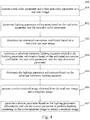
- FIG. 4 illustrating a flow 400 of a method for rendering an image according to another embodiment of the present disclosure.
- a spherical harmonic lighting algorithm is used to implement the method for rendering an image, including the following steps:
- the value of SH T ( nx, ny, nz ) in the conversion relationship between the real color parameter, the face skin color parameter, and the lighting parameter information in step 304 in the implementation shown in Fig. 3 is used as the estimated conversion coefficient.
- the value of the estimated conversion coefficient SH T (nx, ny, nz) is a value dynamically changing with changes of the face part, changes of the real color parameter, the face skin color parameter and the lighting parameter information.
- a set of estimated conversion coefficients may be generated corresponding to the values of estimated conversion coefficients determined under different conditions, so that the estimated conversion coefficients under different conditions may be subsequently acquired based on the set of estimated conversion coefficients.
- Step 404 constructing a spherical harmonic lighting equation related to the lighting parameter information based on the estimated conversion coefficient, the real color parameter, and the face skin color parameter.
- Q Color is the RGB value of the real color parameter
- P Color is the RGB value of the face skin color parameter
- L is the lighting parameter information.
- Step 405 determining the lighting parameter information based on the spherical harmonic lighting equation.
- the lighting parameter information L is obtained.
- Step 406 acquiring a to-be-rendered image obtained from the real user image and a template image.
- Step 407 generating a texture parameter based on the lighting parameter information, and using the texture parameter to perform lighting rendering on the to-be-rendered image to obtain a rendered image.
- the corresponding rendering texture parameter is generated based on the lighting parameter information obtained in step 405.
- the rendering texture parameter may be P 1 Color obtained using the spherical harmonic lighting equation, based on the lighting parameter information L and the re-determined estimated conversion coefficient SH T ( nx, ny, nz ) .
- P 1 Color is used as the texture parameter to perform lighting rendering on the to-be-rendered image to obtain the rendered image.
- the using the texture parameter to perform lighting rendering on the to-be-rendered image to obtain the rendered image includes: using the texture parameter as an updated face skin color parameter; determining updated lighting parameter information based on the real color parameter and the updated face skin color parameter; and determining an updated texture parameter based on the updated lighting parameter information, and using the updated texture parameter to perform the lighting rendering on the to-be-rendered image to obtain the rendered image.
- the obtained texture parameter may be used as the updated face skin color parameter, then the updated lighting parameter information is determined based on the spherical harmonic lighting equation constructed in step 404 of the present embodiment, and then similarly, the method in above steps 405-407 is used to determine the updated texture parameter, and the updated texture parameter is used to perform lighting rendering on the to-be-rendered image to obtain the rendered image, and the texture parameter is optimized in an iterative manner to further improve the quality of lighting rendering.
- the determining an updated texture parameter based on the updated lighting parameter information, and using the updated texture parameter to perform lighting rendering on the to-be-rendered image to obtain the rendered image includes: re-determining the updated texture parameter as the updated face skin color parameter, and jumping to execution of the determining updated lighting parameter information based on the real color parameter and the updated face skin color parameter; and determining, in response to the number of times of the execution of the jumping meeting a predetermined threshold condition, a final updated texture parameter, and using the final updated texture parameter to perform the lighting rendering on the to-be-rendered image to obtain the rendered image.
- the updated texture parameter is determined as the updated face skin color parameter again, so that correspondingly an updated lighting parameter is re-determined based thereon.
- the cycles of the operations are performed repeatedly.
- the final updated texture parameter is determined.
- An iterative update on the texture parameter is achieved through the repeated cycles of operations, and the final updated texture parameter is determined to approach the lighting situation in the real user image, and the final updated texture parameter is used to perform lighting rendering on the to-be-rendered image to obtain the rendered image, so as to realize a lighting rendering that is closer to the ambient lighting in the real user image.
- Fig. 5 shows an example schematic diagram of an implementation effect of a rendered image finally obtained by the iterative update implemented based on the above cycling method with the number of execution times predetermined as 10.
- the acquiring a real color parameter and a face skin color parameter in a real user image includes: acquiring the real color parameter and a predetermined face skin color parameter in the real user image.
- the standard RGB value of a face skin color parameter may be pre-determined based on a historical real user image, and the lighting parameter in the real user image may be approached by multiple iterations, so as to avoid affecting a rendering quality of the image due to inaccurate acquisition of the face skin color parameter.
- P Color that is, the RGB value of the face skin color parameter may be preset to (240, 183, 155), and the lighting parameter information may be obtained by calculation and iteratively updated to determine the final texture parameter.
- steps 401-402 and step 406 are respectively similar to steps 201-202 and 203 in the embodiment shown in Fig. 2 , and detailed description thereof will be omitted.
- the spherical harmonic lighting algorithm is used to dynamically determine the lighting parameter information based on the skin color information in the real image and generate the corresponding texture parameter, to realize dynamic rendering of the rendered image, which reduces a sense of violation of the rendered image and improves the image quality.
- the implementation scheme includes: Referring to Figs. 601a , 602a , and 603a , three different real user images including face areas are shown, the real color parameters A11, A21, A31 and the face skin color parameters B1, B2, B3 in the real user images including face image areas are respectively acquired.
- the normal vectors of different face parts in a historical real user image are acquired, to obtain the estimated conversion coefficient SH T ( nx, ny, nz ) .
- the real user image 601a as an example (the processing processes of the real user images 602a, 603a are similar to that of the real user image 601a, and detailed description thereof will be omitted)
- the lighting parameter information L is obtained therefrom, and then a different face skin color parameter B11 (the real user image 602a corresponds to different face skin color parameters B21, and the real user image 603a corresponds to different face skin color parameters B31) is obtained based on L and a different estimated conversion coefficient, and the B11 is substituted into the above spherical harmonic lighting equation to determine the updated lighting parameter L A11 (the updated lighting parameter corresponding to the real user image 602a is L A21 , and the real user image 603a corresponds to different face skin color parameters L A31 ).
- the render effect diagrams corresponding to the real user images 601a, 602a, and 603a are as shown in Figs. 601b , 602b , and 603b .
- the updated face skin color parameters B12, B22, B32 are determined and used as the updated texture parameters B12, B22, B32, and the updated texture parameters B12, B22, B32 are used to perform lighting rendering on the to-be-rendered images to obtain the rendered images.
- the render effect diagrams corresponding to the real user images 601a, 602a, and 603a are as shown in Figs. 601c , 602c , and 603c .
- the method for rendering an image determines the lighting parameter information based on the real color parameter and the face skin color parameter, then uses the lighting parameter information to obtain the texture parameter (that is, the re-determined face skin color parameter), and then uses the texture parameter to perform lighting rendering on the to-be-rendered image to obtain the rendered image.
- an apparatus 700 for rendering an image may include: an image parameter acquisition unit 701, configured to acquire a real color parameter and a face skin color parameter in a real user image, the real user image including a face image area; a lighting parameter information determination unit 702, configured to determine lighting parameter information based on the real color parameter and the face skin color parameter; a to-be-rendered image acquisition unit 703, configured to acquire a to-be-rendered image obtained based on the real user image; and an image rendering unit 704, configured to generate a texture parameter based on the lighting parameter information, and use the texture parameter to perform lighting rendering on the to-be-rendered image to obtain a rendered image.
- the determining lighting parameter information based on the real color parameter and the face skin color parameter in the lighting parameter information determination unit 702 includes: determining the lighting parameter information using a spherical harmonic lighting algorithm based on the real color parameter and the face skin color parameter.
- the determining the lighting parameter information using a spherical harmonic lighting algorithm based on the real color parameter and the face skin color parameter in the lighting parameter information determination unit 702 include: determining an estimated conversion coefficient based on a historical real user image; constructing a spherical harmonic lighting equation related to the lighting parameter information based on the estimated conversion coefficient, the real color parameter, and the face skin color parameter; and determining the lighting parameter information based on the spherical harmonic lighting equation.
- the image rendering unit 704 further includes: a texture parameter update subunit, configured to use the texture parameter as an updated face skin color parameter; determine updated lighting parameter information based on the real color parameter and the updated face skin color parameter; and the image rendering unit is further configured to: determine an updated texture parameter based on the updated lighting parameter information, and use the updated texture parameter to perform lighting rendering on the to-be-rendered image to obtain the rendered image.
- a texture parameter update subunit configured to use the texture parameter as an updated face skin color parameter
- the image rendering unit is further configured to: determine an updated texture parameter based on the updated lighting parameter information, and use the updated texture parameter to perform lighting rendering on the to-be-rendered image to obtain the rendered image.
- the image rendering unit 704 includes: re-determine the updated texture parameter as the updated face skin color parameter, and jump to execution of the determining the updated lighting parameter information based on the real color parameter and the updated face skin color parameter; and the image rendering unit is further configured to: determine, in response to a number of execution of the jumping meeting a predetermined threshold condition, a final updated texture parameter, and use the final updated texture parameter to perform lighting rendering on the to-be-rendered image to obtain the rendered image.
- the acquiring a real color parameter and a face skin color parameter in a real user image in the image parameter acquisition unit 701 includes: acquiring the real color parameter and a predetermined face skin color parameter in the real user image.
- the present embodiment exists as an apparatus embodiment corresponding to the foregoing method embodiment, and for the same content, reference may be made to the description of the foregoing method embodiment, and detailed description thereof will be omitted.
- the lighting parameter information is dynamically determined based on the skin color information in the real image, and the corresponding texture parameter is generated to realize dynamic rendering of the rendered image, reducing a sense of violation of the rendered image, and improving the image quality.
- an electronic device and a readable storage medium are also provided.
- FIG. 8 a block diagram of an electronic device of the method for rendering an image according to an embodiment of the present disclosure is illustrated.
- the electronic device is intended to represent various forms of digital computers, such as laptop computers, desktop computers, workbenches, personal digital assistants, servers, blade servers, mainframe computers, and other suitable computers.
- the electronic device may also represent various forms of mobile apparatuses, such as personal digital processors, cellular phones, smart phones, wearable devices, and other similar computing apparatuses.
- the components shown herein, their connections and relationships, and their functions are merely examples, and are not intended to limit the implementation of the present disclosure described and/or claimed herein.
- the electronic device includes: one or more processors 801, a memory 802, and interfaces for connecting various components, including high-speed interfaces and low-speed interfaces.
- the various components are connected to each other using different buses, and may be installed on a common motherboard or in other methods as needed.
- the processor may process instructions executed within the electronic device, including instructions stored in or on the memory to display graphic information of GUI on an external input/output apparatus (such as a display device coupled to the interface).
- a plurality of processors and/or a plurality of buses may be used together with a plurality of memories and a plurality of memories if desired.
- a plurality of electronic device may be connected, and the devices provide some necessary operations, for example, as a server array, a set of blade servers, or a multi-processor system.
- one processor 801 is used as an example.
- the memory 802 is a non-transitory computer readable storage medium provided by the present disclosure.
- the memory stores instructions executable by at least one processor, so that the at least one processor performs the method for rendering an image provided by embodiments of the present disclosure.
- the non-transitory computer readable storage medium of the present disclosure stores computer instructions for causing a computer to perform the method for rendering an image provided by embodiments of the present disclosure.
- the memory 802 may be used to store non-transitory software programs, non-transitory computer executable programs and modules, such as program instructions/modules corresponding to the method for rendering an image in the embodiments of the present disclosure (for example, the image parameter acquisition unit 701, the lighting parameter information determination unit 702, the to-be-rendered image acquisition unit 703 and the image rendering unit 704 as shown in Fig. 7 ).
- the processor 801 executes the non-transitory software programs, instructions, and modules stored in the memory 802 to execute various functional applications and data processing of the server, that is, to implement the method for rendering an image in the foregoing method embodiments.
- the memory 802 may include a storage program area and a storage data area, where the storage program area may store an operating system and at least one function required application program; and the storage data area may store data created by the use of the electronic device for rendering an image.
- the memory 802 may include a high-speed random access memory, and may also include a non-transitory memory, such as at least one magnetic disk storage device, a flash memory device, or other non-transitory solid-state storage devices.
- the memory 802 may optionally include memories remotely provided with respect to the processor 801, and these remote memories may be connected to the electronic device for rendering an image through a network. Examples of the above network include but are not limited to the Internet, intranet, local area network, mobile communication network, and combinations thereof.
- the electronic device for rendering an image may further include: an input apparatus 803 and an output apparatus 804.
- the processor 801, the memory 802, the input apparatus 803, and the output apparatus 804 may be connected through a bus or in other methods. In Fig. 8 , connection through the bus is used as an example.
- the input apparatus 803 may receive input digital or character information, and generate key signal inputs related to user settings and function control of the electronic device for rendering an image such as touch screen, keypad, mouse, trackpad, touchpad, pointing stick, one or more mouse buttons, trackball, joystick and other input apparatuses.
- the output apparatus 804 may include a display device, an auxiliary lighting apparatus (for example, LED), a tactile feedback apparatus (for example, a vibration motor), and the like.
- the display device may include, but is not limited to, a liquid crystal display (LCD), a light emitting diode (LED) display, and a plasma display. In some embodiments, the display device may be a touch screen.
- Various embodiments of the systems and technologies described herein may be implemented in digital electronic circuit systems, integrated circuit systems, dedicated ASICs (application specific integrated circuits), computer hardware, firmware, software, and/or combinations thereof. These various embodiments may include: being implemented in one or more computer programs that can be executed and/or interpreted on a programmable system that includes at least one programmable processor.
- the programmable processor may be a dedicated or general-purpose programmable processor, and may receive data and instructions from a storage system, at least one input apparatus, and at least one output apparatus, and transmit the data and instructions to the storage system, the at least one input apparatus, and the at least one output apparatus.
- These computing programs include machine instructions of the programmable processor and may use high-level processes and/or object-oriented programming languages, and/or assembly/machine languages to implement these computing programs.
- machine readable medium and “computer readable medium” refer to any computer program product, device, and/or apparatus (for example, magnetic disk, optical disk, memory, programmable logic apparatus (PLD)) used to provide machine instructions and/or data to the programmable processor, including machine readable medium that receives machine instructions as machine readable signals.
- machine readable signal refers to any signal used to provide machine instructions and/or data to the programmable processor.
- the systems and technologies described herein may be implemented on a computer, the computer has: a display apparatus for displaying information to the user (for example, CRT (cathode ray tube) or LCD (liquid crystal display) monitor); and a keyboard and a pointing apparatus (for example, mouse or trackball), and the user may use the keyboard and the pointing apparatus to provide input to the computer.
- a display apparatus for displaying information to the user
- LCD liquid crystal display
- keyboard and a pointing apparatus for example, mouse or trackball
- Other types of apparatuses may also be used to provide interaction with the user; for example, feedback provided to the user may be any form of sensory feedback (for example, visual feedback, auditory feedback, or tactile feedback); and any form (including acoustic input, voice input, or tactile input) may be used to receive input from the user.
- the systems and technologies described herein may be implemented in a computing system that includes backend components (e.g., as a data server), or a computing system that includes middleware components (e.g., application server), or a computing system that includes frontend components (for example, a user computer having a graphical user interface or a web browser, through which the user may interact with the implementations of the systems and the technologies described herein), or a computing system that includes any combination of such backend components, middleware components, or frontend components.
- the components of the system may be interconnected by any form or medium of digital data communication (e.g., communication network). Examples of the communication network include: local area networks (LAN), wide area networks (WAN), the Internet, and blockchain networks.
- the computer system may include a client and a server.
- the client and the server are generally far from each other and usually interact through the communication network.
- the relationship between the client and the server is generated by computer programs that run on the corresponding computer and have a client-server relationship with each other.
- a real color parameter and a face skin color parameter in a real user image of a face image area are acquired, lighting parameter information is determined based on the real color parameter and the face skin color parameter, a to-be-rendered image obtained based on the real user image is acquired, and a texture parameter is generated based on the lighting parameter information, and the texture parameter is used to perform lighting rendering on the to-be-rendered image to obtain a rendered image.
- the lighting parameter information is dynamically determined, and the corresponding texture parameter is generated to realize dynamic rendering of the rendered image, which reduces a sense of violation of the rendered image and improves the image quality.
Landscapes
- Engineering & Computer Science (AREA)
- General Physics & Mathematics (AREA)
- Theoretical Computer Science (AREA)
- Physics & Mathematics (AREA)
- Computer Graphics (AREA)
- Computer Vision & Pattern Recognition (AREA)
- General Engineering & Computer Science (AREA)
- Software Systems (AREA)
- Computer Hardware Design (AREA)
- Image Generation (AREA)
- Image Processing (AREA)
- Image Analysis (AREA)
- Processing Or Creating Images (AREA)
Applications Claiming Priority (1)
| Application Number | Priority Date | Filing Date | Title |
|---|---|---|---|
| CN202011033517.2A CN112102462B (zh) | 2020-09-27 | 2020-09-27 | 图像的渲染方法、装置 |
Publications (2)
| Publication Number | Publication Date |
|---|---|
| EP3836094A2 true EP3836094A2 (de) | 2021-06-16 |
| EP3836094A3 EP3836094A3 (de) | 2023-03-22 |
Family
ID=73782417
Family Applications (1)
| Application Number | Title | Priority Date | Filing Date |
|---|---|---|---|
| EP21166272.1A Withdrawn EP3836094A3 (de) | 2020-09-27 | 2021-03-31 | Verfahren und einrichtung zur darstellung eines bildes, elektronische vorrichtung, speichermedium und computerprogrammprodukt |
Country Status (5)
| Country | Link |
|---|---|
| US (1) | US11636646B2 (de) |
| EP (1) | EP3836094A3 (de) |
| JP (1) | JP7293277B2 (de) |
| KR (1) | KR102552532B1 (de) |
| CN (1) | CN112102462B (de) |
Families Citing this family (10)
| Publication number | Priority date | Publication date | Assignee | Title |
|---|---|---|---|---|
| CN112669404B (zh) * | 2020-12-28 | 2023-11-14 | 北京达佳互联信息技术有限公司 | 一种图像处理方法、装置、电子设备和存储介质 |
| CN113379884B (zh) * | 2021-07-05 | 2023-11-17 | 北京百度网讯科技有限公司 | 地图渲染方法、装置、电子设备、存储介质以及车辆 |
| CN113421335B (zh) * | 2021-07-21 | 2022-04-26 | 北京百度网讯科技有限公司 | 图像处理方法、图像处理装置、电子设备和存储介质 |
| CN113870404B (zh) * | 2021-09-23 | 2024-05-07 | 聚好看科技股份有限公司 | 一种3d模型的皮肤渲染方法及显示设备 |
| CN114120062B (zh) * | 2021-11-26 | 2023-07-28 | 北京百度网讯科技有限公司 | 样本生成方法及装置 |
| CN114419182B (zh) * | 2022-02-25 | 2025-03-28 | 北京百度网讯科技有限公司 | 图像处理方法和装置 |
| CN116127587B (zh) * | 2023-04-17 | 2023-06-16 | 矩阵纵横设计股份有限公司 | 室内设计中的渲染方法和系统 |
| US12430934B2 (en) * | 2023-05-12 | 2025-09-30 | Adobe Inc. | Utilizing implicit neural representations to parse visual components of subjects depicted within visual content |
| US12444055B2 (en) * | 2023-05-12 | 2025-10-14 | Qualcomm Incorporated | Convolution and transformer-based image segmentation |
| US20250322586A1 (en) * | 2024-04-16 | 2025-10-16 | Htc Corporation | Method for generating texture map of physical object, electronic device, and computer readable storage medium |
Family Cites Families (11)
| Publication number | Priority date | Publication date | Assignee | Title |
|---|---|---|---|---|
| US7324688B2 (en) | 2005-02-14 | 2008-01-29 | Mitsubishi Electric Research Laboratories, Inc. | Face relighting for normalization of directional lighting |
| US8031936B2 (en) * | 2006-03-20 | 2011-10-04 | Accenture Global Services Limited | Image processing system for skin detection and localization |
| US8705855B2 (en) | 2009-01-27 | 2014-04-22 | Nec Corporation | Color image processing method, color image processing device, and color image processing program |
| CN101763636B (zh) * | 2009-09-23 | 2012-07-04 | 中国科学院自动化研究所 | 视频序列中的三维人脸位置和姿态跟踪的方法 |
| US9288374B1 (en) * | 2012-09-10 | 2016-03-15 | Amazon Technologies, Inc. | Systems and methods for updating camera characteristics using a remote computing device |
| EP3475920A4 (de) * | 2016-06-23 | 2020-01-15 | Loomai, Inc. | Systeme und verfahren zur erzeugung von computerbereiten animationsmodellen eines menschlichen kopfes aus bildern erfasster daten |
| FR3053509B1 (fr) | 2016-06-30 | 2019-08-16 | Fittingbox | Procede d’occultation d’un objet dans une image ou une video et procede de realite augmentee associe |
| CN111445582A (zh) * | 2019-01-16 | 2020-07-24 | 南京大学 | 一种基于光照先验的单张图像人脸三维重建方法 |
| CN111192223B (zh) * | 2020-01-07 | 2022-09-30 | 腾讯科技(深圳)有限公司 | 人脸纹理图像的处理方法、装置、设备及存储介质 |
| CN111695471B (zh) * | 2020-06-02 | 2023-06-27 | 北京百度网讯科技有限公司 | 虚拟形象生成方法、装置、设备以及存储介质 |
| US11615587B2 (en) * | 2020-06-13 | 2023-03-28 | Qualcomm Incorporated | Object reconstruction with texture parsing |
-
2020
- 2020-09-27 CN CN202011033517.2A patent/CN112102462B/zh active Active
-
2021
- 2021-03-24 US US17/211,600 patent/US11636646B2/en active Active
- 2021-03-26 JP JP2021053898A patent/JP7293277B2/ja active Active
- 2021-03-31 EP EP21166272.1A patent/EP3836094A3/de not_active Withdrawn
- 2021-04-05 KR KR1020210043843A patent/KR102552532B1/ko active Active
Also Published As
| Publication number | Publication date |
|---|---|
| CN112102462A (zh) | 2020-12-18 |
| US20210209837A1 (en) | 2021-07-08 |
| CN112102462B (zh) | 2023-07-21 |
| EP3836094A3 (de) | 2023-03-22 |
| KR20210045371A (ko) | 2021-04-26 |
| JP2022036319A (ja) | 2022-03-07 |
| KR102552532B1 (ko) | 2023-07-05 |
| JP7293277B2 (ja) | 2023-06-19 |
| US11636646B2 (en) | 2023-04-25 |
Similar Documents
| Publication | Publication Date | Title |
|---|---|---|
| EP3836094A2 (de) | Verfahren und einrichtung zur darstellung eines bildes, elektronische vorrichtung, speichermedium und computerprogrammprodukt | |
| US11854118B2 (en) | Method for training generative network, method for generating near-infrared image and device | |
| KR102627802B1 (ko) | 가상 형상 생성 모델의 트레이닝 방법 및 가상 형상 생성 방법 | |
| CN111199269B (zh) | 图像处理装置及其操作方法 | |
| US11641446B2 (en) | Method for video frame interpolation, and electronic device | |
| US20210390346A1 (en) | Method and apparatus for training cross-modal face recognition model, device and storage medium | |
| JP7393388B2 (ja) | 顔編集方法、装置、電子デバイス及び可読記憶媒体 | |
| US20220358675A1 (en) | Method for training model, method for processing video, device and storage medium | |
| CN112149634B (zh) | 图像生成器的训练方法、装置、设备以及存储介质 | |
| US20220351455A1 (en) | Method of processing image, electronic device, and storage medium | |
| CN115147523B (zh) | 虚拟形象驱动方法及装置、设备、介质和程序产品 | |
| CN111695699A (zh) | 用于模型蒸馏的方法、装置、电子设备及可读存储介质 | |
| WO2020156058A1 (zh) | 基于终端的图像拖拽变形实现方法和装置 | |
| CN116309983B (zh) | 虚拟人物模型的训练方法、生成方法、装置和电子设备 | |
| CN111462269B (zh) | 图像处理方法及装置、存储介质及电子设备 | |
| CN114241378B (zh) | 生成转场视频的方法、装置、电子设备、存储介质 | |
| CN114358198A (zh) | 实例分割方法、装置及电子设备 | |
| CN116883587B (zh) | 训练方法、3d物体生成方法、装置、设备和介质 | |
| US20240265687A1 (en) | Method of fusing image feature, electronic device, and storage medium | |
| CN114140560B (zh) | 动画生成方法、装置、设备和存储介质 | |
| CN119228946B (zh) | 基于大模型的对象生成方法、装置、智能体、设备及介质 | |
| CN116152403B (zh) | 一种形象生成方法、装置、存储介质及电子设备 | |
| CN113608615B (zh) | 对象数据处理方法、处理装置、电子设备以及存储介质 | |
| CN119990081A (zh) | 图表生成大模型的训练方法、图表生成方法及相关装置 | |
| KR20240115657A (ko) | 전자 장치 및 이의 제어 방법 |
Legal Events
| Date | Code | Title | Description |
|---|---|---|---|
| PUAI | Public reference made under article 153(3) epc to a published international application that has entered the european phase |
Free format text: ORIGINAL CODE: 0009012 |
|
| STAA | Information on the status of an ep patent application or granted ep patent |
Free format text: STATUS: REQUEST FOR EXAMINATION WAS MADE |
|
| 17P | Request for examination filed |
Effective date: 20210331 |
|
| AK | Designated contracting states |
Kind code of ref document: A2 Designated state(s): AL AT BE BG CH CY CZ DE DK EE ES FI FR GB GR HR HU IE IS IT LI LT LU LV MC MK MT NL NO PL PT RO RS SE SI SK SM TR |
|
| RIC1 | Information provided on ipc code assigned before grant |
Ipc: G06T 19/00 20110101ALI20220126BHEP Ipc: G06T 15/50 20110101ALI20220126BHEP Ipc: G06T 15/04 20110101AFI20220126BHEP |
|
| PUAL | Search report despatched |
Free format text: ORIGINAL CODE: 0009013 |
|
| AK | Designated contracting states |
Kind code of ref document: A3 Designated state(s): AL AT BE BG CH CY CZ DE DK EE ES FI FR GB GR HR HU IE IS IT LI LT LU LV MC MK MT NL NO PL PT RO RS SE SI SK SM TR |
|
| RIC1 | Information provided on ipc code assigned before grant |
Ipc: G06T 19/00 20110101ALI20220502BHEP Ipc: G06T 15/50 20110101ALI20220502BHEP Ipc: G06T 15/04 20110101AFI20220502BHEP |
|
| PUAF | Information related to the publication of a search report (a3 document) modified or deleted |
Free format text: ORIGINAL CODE: 0009199SEPU |
|
| D17D | Deferred search report published (deleted) | ||
| REG | Reference to a national code |
Ref country code: DE Ref legal event code: R079 Free format text: PREVIOUS MAIN CLASS: G06T0015500000 Ipc: G06T0015040000 |
|
| PUAL | Search report despatched |
Free format text: ORIGINAL CODE: 0009013 |
|
| AK | Designated contracting states |
Kind code of ref document: A3 Designated state(s): AL AT BE BG CH CY CZ DE DK EE ES FI FR GB GR HR HU IE IS IT LI LT LU LV MC MK MT NL NO PL PT RO RS SE SI SK SM TR |
|
| RIC1 | Information provided on ipc code assigned before grant |
Ipc: G06T 19/00 20110101ALI20230214BHEP Ipc: G06T 15/50 20060101ALI20230214BHEP Ipc: G06T 15/04 20110101AFI20230214BHEP |
|
| STAA | Information on the status of an ep patent application or granted ep patent |
Free format text: STATUS: EXAMINATION IS IN PROGRESS |
|
| 17Q | First examination report despatched |
Effective date: 20231114 |
|
| STAA | Information on the status of an ep patent application or granted ep patent |
Free format text: STATUS: THE APPLICATION HAS BEEN WITHDRAWN |
|
| 18W | Application withdrawn |
Effective date: 20240312 |