EP3825355A1 - Formulierungen mit hohen glasübergangstemperaturen für laminate - Google Patents
Formulierungen mit hohen glasübergangstemperaturen für laminate Download PDFInfo
- Publication number
- EP3825355A1 EP3825355A1 EP19211024.5A EP19211024A EP3825355A1 EP 3825355 A1 EP3825355 A1 EP 3825355A1 EP 19211024 A EP19211024 A EP 19211024A EP 3825355 A1 EP3825355 A1 EP 3825355A1
- Authority
- EP
- European Patent Office
- Prior art keywords
- hours
- resin composition
- cured
- epoxy
- resin
- Prior art date
- Legal status (The legal status is an assumption and is not a legal conclusion. Google has not performed a legal analysis and makes no representation as to the accuracy of the status listed.)
- Pending
Links
- 239000000203 mixture Substances 0.000 title claims abstract description 73
- 230000009477 glass transition Effects 0.000 title claims description 13
- 238000009472 formulation Methods 0.000 title description 7
- 239000011342 resin composition Substances 0.000 claims abstract description 50
- 238000000034 method Methods 0.000 claims abstract description 27
- 230000008569 process Effects 0.000 claims abstract description 19
- 229920000647 polyepoxide Polymers 0.000 claims description 45
- 239000002245 particle Substances 0.000 claims description 42
- 239000003822 epoxy resin Substances 0.000 claims description 34
- 239000004848 polyfunctional curative Substances 0.000 claims description 33
- 239000000835 fiber Substances 0.000 claims description 29
- 229920005989 resin Polymers 0.000 claims description 29
- 239000011347 resin Substances 0.000 claims description 29
- 239000011258 core-shell material Substances 0.000 claims description 26
- -1 3,4-epoxycyclohexylmethyl Chemical group 0.000 claims description 17
- 150000008064 anhydrides Chemical class 0.000 claims description 17
- 239000010954 inorganic particle Substances 0.000 claims description 15
- 239000004593 Epoxy Substances 0.000 claims description 14
- 239000007924 injection Substances 0.000 claims description 12
- 238000002347 injection Methods 0.000 claims description 12
- 238000004519 manufacturing process Methods 0.000 claims description 10
- 150000001875 compounds Chemical class 0.000 claims description 7
- 238000000465 moulding Methods 0.000 claims description 7
- KNDQHSIWLOJIGP-UHFFFAOYSA-N 826-62-0 Chemical group C1C2C3C(=O)OC(=O)C3C1C=C2 KNDQHSIWLOJIGP-UHFFFAOYSA-N 0.000 claims description 6
- 239000011353 cycloaliphatic epoxy resin Substances 0.000 claims description 5
- 238000001721 transfer moulding Methods 0.000 claims description 4
- YXSMNOHOLATKLF-UHFFFAOYSA-N 4-methyl-5-[(4-methyl-7-oxabicyclo[4.1.0]heptan-4-yl)methyl]-7-oxabicyclo[4.1.0]heptane-4-carboxylic acid Chemical compound C1CC2OC2CC1(C)CC1C2OC2CCC1(C)C(O)=O YXSMNOHOLATKLF-UHFFFAOYSA-N 0.000 claims description 3
- NHJIDZUQMHKGRE-UHFFFAOYSA-N 7-oxabicyclo[4.1.0]heptan-4-yl 2-(7-oxabicyclo[4.1.0]heptan-4-yl)acetate Chemical compound C1CC2OC2CC1OC(=O)CC1CC2OC2CC1 NHJIDZUQMHKGRE-UHFFFAOYSA-N 0.000 claims description 3
- IDSLNGDJQFVDPQ-UHFFFAOYSA-N bis(7-oxabicyclo[4.1.0]heptan-4-yl) hexanedioate Chemical compound C1CC2OC2CC1OC(=O)CCCCC(=O)OC1CC2OC2CC1 IDSLNGDJQFVDPQ-UHFFFAOYSA-N 0.000 claims description 3
- DJUWPHRCMMMSCV-UHFFFAOYSA-N bis(7-oxabicyclo[4.1.0]heptan-4-ylmethyl) hexanedioate Chemical compound C1CC2OC2CC1COC(=O)CCCCC(=O)OCC1CC2OC2CC1 DJUWPHRCMMMSCV-UHFFFAOYSA-N 0.000 claims description 3
- LHQZPSHKKVHDTB-UHFFFAOYSA-N bis(7-oxabicyclo[4.1.0]heptan-4-ylmethyl) oxalate Chemical compound C1CC2OC2CC1COC(=O)C(=O)OCC1CC2OC2CC1 LHQZPSHKKVHDTB-UHFFFAOYSA-N 0.000 claims description 3
- LMMDJMWIHPEQSJ-UHFFFAOYSA-N bis[(3-methyl-7-oxabicyclo[4.1.0]heptan-4-yl)methyl] hexanedioate Chemical compound C1C2OC2CC(C)C1COC(=O)CCCCC(=O)OCC1CC2OC2CC1C LMMDJMWIHPEQSJ-UHFFFAOYSA-N 0.000 claims description 3
- WLJVNTCWHIRURA-UHFFFAOYSA-N pimelic acid Chemical compound OC(=O)CCCCCC(O)=O WLJVNTCWHIRURA-UHFFFAOYSA-N 0.000 claims description 3
- 229920000642 polymer Polymers 0.000 description 15
- 229920001971 elastomer Polymers 0.000 description 11
- 239000005060 rubber Substances 0.000 description 11
- 239000011257 shell material Substances 0.000 description 11
- PPBRXRYQALVLMV-UHFFFAOYSA-N Styrene Chemical compound C=CC1=CC=CC=C1 PPBRXRYQALVLMV-UHFFFAOYSA-N 0.000 description 10
- 150000002118 epoxides Chemical class 0.000 description 10
- LNEPOXFFQSENCJ-UHFFFAOYSA-N haloperidol Chemical compound C1CC(O)(C=2C=CC(Cl)=CC=2)CCN1CCCC(=O)C1=CC=C(F)C=C1 LNEPOXFFQSENCJ-UHFFFAOYSA-N 0.000 description 8
- 239000000853 adhesive Substances 0.000 description 7
- 230000001070 adhesive effect Effects 0.000 description 7
- 238000006243 chemical reaction Methods 0.000 description 7
- 239000011146 organic particle Substances 0.000 description 7
- OFOBLEOULBTSOW-UHFFFAOYSA-N Malonic acid Chemical compound OC(=O)CC(O)=O OFOBLEOULBTSOW-UHFFFAOYSA-N 0.000 description 6
- IISBACLAFKSPIT-UHFFFAOYSA-N bisphenol A Chemical compound C=1C=C(O)C=CC=1C(C)(C)C1=CC=C(O)C=C1 IISBACLAFKSPIT-UHFFFAOYSA-N 0.000 description 6
- 239000002131 composite material Substances 0.000 description 6
- 235000014113 dietary fatty acids Nutrition 0.000 description 6
- 125000003700 epoxy group Chemical group 0.000 description 6
- 239000000194 fatty acid Substances 0.000 description 6
- 229930195729 fatty acid Natural products 0.000 description 6
- 230000000704 physical effect Effects 0.000 description 6
- 239000011541 reaction mixture Substances 0.000 description 6
- 238000009745 resin transfer moulding Methods 0.000 description 6
- 229920002430 Fibre-reinforced plastic Polymers 0.000 description 5
- VYPSYNLAJGMNEJ-UHFFFAOYSA-N Silicium dioxide Chemical compound O=[Si]=O VYPSYNLAJGMNEJ-UHFFFAOYSA-N 0.000 description 5
- 229910000831 Steel Inorganic materials 0.000 description 5
- 239000007795 chemical reaction product Substances 0.000 description 5
- 239000003795 chemical substances by application Substances 0.000 description 5
- 239000000470 constituent Substances 0.000 description 5
- 239000011151 fibre-reinforced plastic Substances 0.000 description 5
- 239000000047 product Substances 0.000 description 5
- 239000010959 steel Substances 0.000 description 5
- KAKZBPTYRLMSJV-UHFFFAOYSA-N Butadiene Chemical compound C=CC=C KAKZBPTYRLMSJV-UHFFFAOYSA-N 0.000 description 4
- PXKLMJQFEQBVLD-UHFFFAOYSA-N bisphenol F Chemical compound C1=CC(O)=CC=C1CC1=CC=C(O)C=C1 PXKLMJQFEQBVLD-UHFFFAOYSA-N 0.000 description 4
- 229920001577 copolymer Polymers 0.000 description 4
- 150000002170 ethers Chemical class 0.000 description 4
- 239000007788 liquid Substances 0.000 description 4
- 239000000178 monomer Substances 0.000 description 4
- JFNLZVQOOSMTJK-KNVOCYPGSA-N norbornene Chemical compound C1[C@@H]2CC[C@H]1C=C2 JFNLZVQOOSMTJK-KNVOCYPGSA-N 0.000 description 4
- 239000004014 plasticizer Substances 0.000 description 4
- 239000002904 solvent Substances 0.000 description 4
- MUTGBJKUEZFXGO-OLQVQODUSA-N (3as,7ar)-3a,4,5,6,7,7a-hexahydro-2-benzofuran-1,3-dione Chemical compound C1CCC[C@@H]2C(=O)OC(=O)[C@@H]21 MUTGBJKUEZFXGO-OLQVQODUSA-N 0.000 description 3
- MCTWTZJPVLRJOU-UHFFFAOYSA-N 1-methyl-1H-imidazole Chemical compound CN1C=CN=C1 MCTWTZJPVLRJOU-UHFFFAOYSA-N 0.000 description 3
- 125000004203 4-hydroxyphenyl group Chemical group [H]OC1=C([H])C([H])=C(*)C([H])=C1[H] 0.000 description 3
- UHOVQNZJYSORNB-UHFFFAOYSA-N Benzene Chemical compound C1=CC=CC=C1 UHOVQNZJYSORNB-UHFFFAOYSA-N 0.000 description 3
- 229920000049 Carbon (fiber) Polymers 0.000 description 3
- BRLQWZUYTZBJKN-UHFFFAOYSA-N Epichlorohydrin Chemical compound ClCC1CO1 BRLQWZUYTZBJKN-UHFFFAOYSA-N 0.000 description 3
- LYCAIKOWRPUZTN-UHFFFAOYSA-N Ethylene glycol Chemical compound OCCO LYCAIKOWRPUZTN-UHFFFAOYSA-N 0.000 description 3
- WSFSSNUMVMOOMR-UHFFFAOYSA-N Formaldehyde Chemical compound O=C WSFSSNUMVMOOMR-UHFFFAOYSA-N 0.000 description 3
- VVQNEPGJFQJSBK-UHFFFAOYSA-N Methyl methacrylate Chemical compound COC(=O)C(C)=C VVQNEPGJFQJSBK-UHFFFAOYSA-N 0.000 description 3
- MUBZPKHOEPUJKR-UHFFFAOYSA-N Oxalic acid Chemical compound OC(=O)C(O)=O MUBZPKHOEPUJKR-UHFFFAOYSA-N 0.000 description 3
- YXFVVABEGXRONW-UHFFFAOYSA-N Toluene Chemical compound CC1=CC=CC=C1 YXFVVABEGXRONW-UHFFFAOYSA-N 0.000 description 3
- 229910052799 carbon Inorganic materials 0.000 description 3
- 239000004917 carbon fiber Substances 0.000 description 3
- 230000000052 comparative effect Effects 0.000 description 3
- 238000010276 construction Methods 0.000 description 3
- 238000004132 cross linking Methods 0.000 description 3
- QGBSISYHAICWAH-UHFFFAOYSA-N dicyandiamide Chemical compound NC(N)=NC#N QGBSISYHAICWAH-UHFFFAOYSA-N 0.000 description 3
- MTHSVFCYNBDYFN-UHFFFAOYSA-N diethylene glycol Chemical compound OCCOCCO MTHSVFCYNBDYFN-UHFFFAOYSA-N 0.000 description 3
- 150000002148 esters Chemical class 0.000 description 3
- 150000004665 fatty acids Chemical class 0.000 description 3
- 239000002657 fibrous material Substances 0.000 description 3
- 150000002357 guanidines Chemical class 0.000 description 3
- 239000000463 material Substances 0.000 description 3
- 239000011159 matrix material Substances 0.000 description 3
- 125000002496 methyl group Chemical group [H]C([H])([H])* 0.000 description 3
- VYKXQOYUCMREIS-UHFFFAOYSA-N methylhexahydrophthalic anhydride Chemical compound C1CCCC2C(=O)OC(=O)C21C VYKXQOYUCMREIS-UHFFFAOYSA-N 0.000 description 3
- 238000002156 mixing Methods 0.000 description 3
- 239000003960 organic solvent Substances 0.000 description 3
- 150000008442 polyphenolic compounds Chemical class 0.000 description 3
- 235000013824 polyphenols Nutrition 0.000 description 3
- VZXTWGWHSMCWGA-UHFFFAOYSA-N 1,3,5-triazine-2,4-diamine Chemical class NC1=NC=NC(N)=N1 VZXTWGWHSMCWGA-UHFFFAOYSA-N 0.000 description 2
- DMYOHQBLOZMDLP-UHFFFAOYSA-N 1-[2-(2-hydroxy-3-piperidin-1-ylpropoxy)phenyl]-3-phenylpropan-1-one Chemical compound C1CCCCN1CC(O)COC1=CC=CC=C1C(=O)CCC1=CC=CC=C1 DMYOHQBLOZMDLP-UHFFFAOYSA-N 0.000 description 2
- XMTQQYYKAHVGBJ-UHFFFAOYSA-N 3-(3,4-DICHLOROPHENYL)-1,1-DIMETHYLUREA Chemical compound CN(C)C(=O)NC1=CC=C(Cl)C(Cl)=C1 XMTQQYYKAHVGBJ-UHFFFAOYSA-N 0.000 description 2
- QVELTISXJPCJRR-UHFFFAOYSA-N 3-but-2-enyl-4-ethyloxolane-2,5-dione Chemical compound CCC1C(CC=CC)C(=O)OC1=O QVELTISXJPCJRR-UHFFFAOYSA-N 0.000 description 2
- GZVHEAJQGPRDLQ-UHFFFAOYSA-N 6-phenyl-1,3,5-triazine-2,4-diamine Chemical class NC1=NC(N)=NC(C=2C=CC=CC=2)=N1 GZVHEAJQGPRDLQ-UHFFFAOYSA-N 0.000 description 2
- IKHGUXGNUITLKF-UHFFFAOYSA-N Acetaldehyde Chemical compound CC=O IKHGUXGNUITLKF-UHFFFAOYSA-N 0.000 description 2
- YNQLUTRBYVCPMQ-UHFFFAOYSA-N Ethylbenzene Chemical compound CCC1=CC=CC=C1 YNQLUTRBYVCPMQ-UHFFFAOYSA-N 0.000 description 2
- CTKINSOISVBQLD-UHFFFAOYSA-N Glycidol Chemical compound OCC1CO1 CTKINSOISVBQLD-UHFFFAOYSA-N 0.000 description 2
- QIGBRXMKCJKVMJ-UHFFFAOYSA-N Hydroquinone Chemical compound OC1=CC=C(O)C=C1 QIGBRXMKCJKVMJ-UHFFFAOYSA-N 0.000 description 2
- BAPJBEWLBFYGME-UHFFFAOYSA-N Methyl acrylate Chemical compound COC(=O)C=C BAPJBEWLBFYGME-UHFFFAOYSA-N 0.000 description 2
- ISWSIDIOOBJBQZ-UHFFFAOYSA-N Phenol Chemical compound OC1=CC=CC=C1 ISWSIDIOOBJBQZ-UHFFFAOYSA-N 0.000 description 2
- NQRYJNQNLNOLGT-UHFFFAOYSA-N Piperidine Chemical group C1CCNCC1 NQRYJNQNLNOLGT-UHFFFAOYSA-N 0.000 description 2
- DNIAPMSPPWPWGF-UHFFFAOYSA-N Propylene glycol Chemical compound CC(O)CO DNIAPMSPPWPWGF-UHFFFAOYSA-N 0.000 description 2
- 229910004298 SiO 2 Inorganic materials 0.000 description 2
- KKEYFWRCBNTPAC-UHFFFAOYSA-N Terephthalic acid Chemical compound OC(=O)C1=CC=C(C(O)=O)C=C1 KKEYFWRCBNTPAC-UHFFFAOYSA-N 0.000 description 2
- 229920001079 Thiokol (polymer) Polymers 0.000 description 2
- XTXRWKRVRITETP-UHFFFAOYSA-N Vinyl acetate Chemical compound CC(=O)OC=C XTXRWKRVRITETP-UHFFFAOYSA-N 0.000 description 2
- BZHJMEDXRYGGRV-UHFFFAOYSA-N Vinyl chloride Chemical compound ClC=C BZHJMEDXRYGGRV-UHFFFAOYSA-N 0.000 description 2
- 239000002253 acid Substances 0.000 description 2
- 150000007513 acids Chemical class 0.000 description 2
- 239000000654 additive Substances 0.000 description 2
- 125000001931 aliphatic group Chemical group 0.000 description 2
- 125000003118 aryl group Chemical group 0.000 description 2
- 235000013877 carbamide Nutrition 0.000 description 2
- 150000001721 carbon Chemical group 0.000 description 2
- 239000004918 carbon fiber reinforced polymer Substances 0.000 description 2
- 239000003054 catalyst Substances 0.000 description 2
- YCIMNLLNPGFGHC-UHFFFAOYSA-N catechol Chemical compound OC1=CC=CC=C1O YCIMNLLNPGFGHC-UHFFFAOYSA-N 0.000 description 2
- GYZLOYUZLJXAJU-UHFFFAOYSA-N diglycidyl ether Chemical compound C1OC1COCC1CO1 GYZLOYUZLJXAJU-UHFFFAOYSA-N 0.000 description 2
- 239000000539 dimer Substances 0.000 description 2
- 230000000694 effects Effects 0.000 description 2
- 239000004744 fabric Substances 0.000 description 2
- XXOYNJXVWVNOOJ-UHFFFAOYSA-N fenuron Chemical compound CN(C)C(=O)NC1=CC=CC=C1 XXOYNJXVWVNOOJ-UHFFFAOYSA-N 0.000 description 2
- 239000003365 glass fiber Substances 0.000 description 2
- 125000001183 hydrocarbyl group Chemical group 0.000 description 2
- 238000001802 infusion Methods 0.000 description 2
- 239000004615 ingredient Substances 0.000 description 2
- 239000004850 liquid epoxy resins (LERs) Substances 0.000 description 2
- CHJJGSNFBQVOTG-UHFFFAOYSA-N methylguanidine Chemical compound CNC(N)=N CHJJGSNFBQVOTG-UHFFFAOYSA-N 0.000 description 2
- BMLIZLVNXIYGCK-UHFFFAOYSA-N monuron Chemical compound CN(C)C(=O)NC1=CC=C(Cl)C=C1 BMLIZLVNXIYGCK-UHFFFAOYSA-N 0.000 description 2
- 229920003023 plastic Polymers 0.000 description 2
- 239000004033 plastic Substances 0.000 description 2
- 229920001515 polyalkylene glycol Polymers 0.000 description 2
- 238000011417 postcuring Methods 0.000 description 2
- GHMLBKRAJCXXBS-UHFFFAOYSA-N resorcinol Chemical compound OC1=CC=CC(O)=C1 GHMLBKRAJCXXBS-UHFFFAOYSA-N 0.000 description 2
- 239000000377 silicon dioxide Substances 0.000 description 2
- 235000012239 silicon dioxide Nutrition 0.000 description 2
- 229920002379 silicone rubber Polymers 0.000 description 2
- 239000004945 silicone rubber Substances 0.000 description 2
- 239000007787 solid Substances 0.000 description 2
- 238000003860 storage Methods 0.000 description 2
- 239000000758 substrate Substances 0.000 description 2
- 150000005846 sugar alcohols Polymers 0.000 description 2
- 229920001187 thermosetting polymer Polymers 0.000 description 2
- ZIBGPFATKBEMQZ-UHFFFAOYSA-N triethylene glycol Chemical compound OCCOCCOCCO ZIBGPFATKBEMQZ-UHFFFAOYSA-N 0.000 description 2
- 150000003672 ureas Chemical class 0.000 description 2
- 239000000080 wetting agent Substances 0.000 description 2
- 239000002759 woven fabric Substances 0.000 description 2
- KMOUUZVZFBCRAM-OLQVQODUSA-N (3as,7ar)-3a,4,7,7a-tetrahydro-2-benzofuran-1,3-dione Chemical compound C1C=CC[C@@H]2C(=O)OC(=O)[C@@H]21 KMOUUZVZFBCRAM-OLQVQODUSA-N 0.000 description 1
- NQOFYFRKWDXGJP-UHFFFAOYSA-N 1,1,2-trimethylguanidine Chemical compound CN=C(N)N(C)C NQOFYFRKWDXGJP-UHFFFAOYSA-N 0.000 description 1
- KYVBNYUBXIEUFW-UHFFFAOYSA-N 1,1,3,3-tetramethylguanidine Chemical compound CN(C)C(=N)N(C)C KYVBNYUBXIEUFW-UHFFFAOYSA-N 0.000 description 1
- LINDOXZENKYESA-UHFFFAOYSA-N 1,2-dimethylguanidine Chemical compound CNC(N)=NC LINDOXZENKYESA-UHFFFAOYSA-N 0.000 description 1
- MCMFEZDRQOJKMN-UHFFFAOYSA-N 1-butylimidazole Chemical compound CCCCN1C=CN=C1 MCMFEZDRQOJKMN-UHFFFAOYSA-N 0.000 description 1
- RTBFRGCFXZNCOE-UHFFFAOYSA-N 1-methylsulfonylpiperidin-4-one Chemical compound CS(=O)(=O)N1CCC(=O)CC1 RTBFRGCFXZNCOE-UHFFFAOYSA-N 0.000 description 1
- HYZJCKYKOHLVJF-UHFFFAOYSA-N 1H-benzimidazole Chemical compound C1=CC=C2NC=NC2=C1 HYZJCKYKOHLVJF-UHFFFAOYSA-N 0.000 description 1
- NBNGHXWJFSMASY-UHFFFAOYSA-N 2,3,4-tris(dimethylamino)phenol Chemical group CN(C)C1=CC=C(O)C(N(C)C)=C1N(C)C NBNGHXWJFSMASY-UHFFFAOYSA-N 0.000 description 1
- GOXQRTZXKQZDDN-UHFFFAOYSA-N 2-Ethylhexyl acrylate Chemical compound CCCCC(CC)COC(=O)C=C GOXQRTZXKQZDDN-UHFFFAOYSA-N 0.000 description 1
- QFRHTANKIYQYLO-UHFFFAOYSA-N 2-ethyl-2-methylimidazole Chemical compound CCC1(C)N=CC=N1 QFRHTANKIYQYLO-UHFFFAOYSA-N 0.000 description 1
- RXNYJUSEXLAVNQ-UHFFFAOYSA-N 4,4'-Dihydroxybenzophenone Chemical compound C1=CC(O)=CC=C1C(=O)C1=CC=C(O)C=C1 RXNYJUSEXLAVNQ-UHFFFAOYSA-N 0.000 description 1
- MWSKJDNQKGCKPA-UHFFFAOYSA-N 6-methyl-3a,4,5,7a-tetrahydro-2-benzofuran-1,3-dione Chemical compound C1CC(C)=CC2C(=O)OC(=O)C12 MWSKJDNQKGCKPA-UHFFFAOYSA-N 0.000 description 1
- NLHHRLWOUZZQLW-UHFFFAOYSA-N Acrylonitrile Chemical compound C=CC#N NLHHRLWOUZZQLW-UHFFFAOYSA-N 0.000 description 1
- LCFVJGUPQDGYKZ-UHFFFAOYSA-N Bisphenol A diglycidyl ether Chemical compound C=1C=C(OCC2OC2)C=CC=1C(C)(C)C(C=C1)=CC=C1OCC1CO1 LCFVJGUPQDGYKZ-UHFFFAOYSA-N 0.000 description 1
- ZOXJGFHDIHLPTG-UHFFFAOYSA-N Boron Chemical compound [B] ZOXJGFHDIHLPTG-UHFFFAOYSA-N 0.000 description 1
- 244000025254 Cannabis sativa Species 0.000 description 1
- 235000012766 Cannabis sativa ssp. sativa var. sativa Nutrition 0.000 description 1
- 235000012765 Cannabis sativa ssp. sativa var. spontanea Nutrition 0.000 description 1
- OKTJSMMVPCPJKN-UHFFFAOYSA-N Carbon Chemical group [C] OKTJSMMVPCPJKN-UHFFFAOYSA-N 0.000 description 1
- 240000000491 Corchorus aestuans Species 0.000 description 1
- 235000011777 Corchorus aestuans Nutrition 0.000 description 1
- 235000010862 Corchorus capsularis Nutrition 0.000 description 1
- 239000005510 Diuron Substances 0.000 description 1
- JIGUQPWFLRLWPJ-UHFFFAOYSA-N Ethyl acrylate Chemical compound CCOC(=O)C=C JIGUQPWFLRLWPJ-UHFFFAOYSA-N 0.000 description 1
- VZCYOOQTPOCHFL-OWOJBTEDSA-N Fumaric acid Chemical compound OC(=O)\C=C\C(O)=O VZCYOOQTPOCHFL-OWOJBTEDSA-N 0.000 description 1
- 229920013646 Hycar Polymers 0.000 description 1
- 240000006240 Linum usitatissimum Species 0.000 description 1
- 235000004431 Linum usitatissimum Nutrition 0.000 description 1
- 229920000877 Melamine resin Chemical class 0.000 description 1
- 229920000459 Nitrile rubber Polymers 0.000 description 1
- CTQNGGLPUBDAKN-UHFFFAOYSA-N O-Xylene Chemical compound CC1=CC=CC=C1C CTQNGGLPUBDAKN-UHFFFAOYSA-N 0.000 description 1
- ALQSHHUCVQOPAS-UHFFFAOYSA-N Pentane-1,5-diol Chemical compound OCCCCCO ALQSHHUCVQOPAS-UHFFFAOYSA-N 0.000 description 1
- LGRFSURHDFAFJT-UHFFFAOYSA-N Phthalic anhydride Natural products C1=CC=C2C(=O)OC(=O)C2=C1 LGRFSURHDFAFJT-UHFFFAOYSA-N 0.000 description 1
- 239000004952 Polyamide Substances 0.000 description 1
- 239000004698 Polyethylene Substances 0.000 description 1
- 239000004642 Polyimide Substances 0.000 description 1
- 239000004743 Polypropylene Substances 0.000 description 1
- KDYFGRWQOYBRFD-UHFFFAOYSA-N Succinic acid Natural products OC(=O)CCC(O)=O KDYFGRWQOYBRFD-UHFFFAOYSA-N 0.000 description 1
- ZJCCRDAZUWHFQH-UHFFFAOYSA-N Trimethylolpropane Chemical compound CCC(CO)(CO)CO ZJCCRDAZUWHFQH-UHFFFAOYSA-N 0.000 description 1
- 229920004482 WACKER® Polymers 0.000 description 1
- NIXOWILDQLNWCW-UHFFFAOYSA-N acrylic acid group Chemical group C(C=C)(=O)O NIXOWILDQLNWCW-UHFFFAOYSA-N 0.000 description 1
- 125000002015 acyclic group Chemical group 0.000 description 1
- 239000002318 adhesion promoter Substances 0.000 description 1
- 230000002411 adverse Effects 0.000 description 1
- 230000032683 aging Effects 0.000 description 1
- 239000003513 alkali Substances 0.000 description 1
- 125000005250 alkyl acrylate group Chemical group 0.000 description 1
- 150000003973 alkyl amines Chemical group 0.000 description 1
- 125000000217 alkyl group Chemical group 0.000 description 1
- 229910052782 aluminium Inorganic materials 0.000 description 1
- XAGFODPZIPBFFR-UHFFFAOYSA-N aluminium Chemical compound [Al] XAGFODPZIPBFFR-UHFFFAOYSA-N 0.000 description 1
- JFCQEDHGNNZCLN-UHFFFAOYSA-N anhydrous glutaric acid Natural products OC(=O)CCCC(O)=O JFCQEDHGNNZCLN-UHFFFAOYSA-N 0.000 description 1
- 239000004760 aramid Substances 0.000 description 1
- 229920006231 aramid fiber Polymers 0.000 description 1
- 150000004982 aromatic amines Chemical class 0.000 description 1
- ZPOLOEWJWXZUSP-WAYWQWQTSA-N bis(prop-2-enyl) (z)-but-2-enedioate Chemical compound C=CCOC(=O)\C=C/C(=O)OCC=C ZPOLOEWJWXZUSP-WAYWQWQTSA-N 0.000 description 1
- 238000009835 boiling Methods 0.000 description 1
- 229910052796 boron Inorganic materials 0.000 description 1
- NTXGQCSETZTARF-UHFFFAOYSA-N buta-1,3-diene;prop-2-enenitrile Chemical compound C=CC=C.C=CC#N NTXGQCSETZTARF-UHFFFAOYSA-N 0.000 description 1
- WERYXYBDKMZEQL-UHFFFAOYSA-N butane-1,4-diol Chemical compound OCCCCO WERYXYBDKMZEQL-UHFFFAOYSA-N 0.000 description 1
- KDYFGRWQOYBRFD-NUQCWPJISA-N butanedioic acid Chemical compound O[14C](=O)CC[14C](O)=O KDYFGRWQOYBRFD-NUQCWPJISA-N 0.000 description 1
- JHIWVOJDXOSYLW-UHFFFAOYSA-N butyl 2,2-difluorocyclopropane-1-carboxylate Chemical compound CCCCOC(=O)C1CC1(F)F JHIWVOJDXOSYLW-UHFFFAOYSA-N 0.000 description 1
- CQEYYJKEWSMYFG-UHFFFAOYSA-N butyl acrylate Chemical compound CCCCOC(=O)C=C CQEYYJKEWSMYFG-UHFFFAOYSA-N 0.000 description 1
- 235000009120 camo Nutrition 0.000 description 1
- 125000004432 carbon atom Chemical group C* 0.000 description 1
- 150000001244 carboxylic acid anhydrides Chemical class 0.000 description 1
- 235000005607 chanvre indien Nutrition 0.000 description 1
- 239000007859 condensation product Substances 0.000 description 1
- 230000007797 corrosion Effects 0.000 description 1
- 238000005260 corrosion Methods 0.000 description 1
- 239000007822 coupling agent Substances 0.000 description 1
- 125000004122 cyclic group Chemical group 0.000 description 1
- 150000004985 diamines Chemical class 0.000 description 1
- 150000001991 dicarboxylic acids Chemical class 0.000 description 1
- 150000001993 dienes Chemical class 0.000 description 1
- 239000003085 diluting agent Substances 0.000 description 1
- SWSQBOPZIKWTGO-UHFFFAOYSA-N dimethylaminoamidine Natural products CN(C)C(N)=N SWSQBOPZIKWTGO-UHFFFAOYSA-N 0.000 description 1
- XXBDWLFCJWSEKW-UHFFFAOYSA-N dimethylbenzylamine Chemical group CN(C)CC1=CC=CC=C1 XXBDWLFCJWSEKW-UHFFFAOYSA-N 0.000 description 1
- 239000006185 dispersion Substances 0.000 description 1
- 239000002612 dispersion medium Substances 0.000 description 1
- 239000000975 dye Substances 0.000 description 1
- GKIPXFAANLTWBM-UHFFFAOYSA-N epibromohydrin Chemical compound BrCC1CO1 GKIPXFAANLTWBM-UHFFFAOYSA-N 0.000 description 1
- 238000006735 epoxidation reaction Methods 0.000 description 1
- SUPCQIBBMFXVTL-UHFFFAOYSA-N ethyl 2-methylprop-2-enoate Chemical compound CCOC(=O)C(C)=C SUPCQIBBMFXVTL-UHFFFAOYSA-N 0.000 description 1
- 125000001495 ethyl group Chemical group [H]C([H])([H])C([H])([H])* 0.000 description 1
- 239000000945 filler Substances 0.000 description 1
- 239000003063 flame retardant Substances 0.000 description 1
- 229910021485 fumed silica Inorganic materials 0.000 description 1
- 125000003055 glycidyl group Chemical group C(C1CO1)* 0.000 description 1
- VOZRXNHHFUQHIL-UHFFFAOYSA-N glycidyl methacrylate Chemical compound CC(=C)C(=O)OCC1CO1 VOZRXNHHFUQHIL-UHFFFAOYSA-N 0.000 description 1
- 229910052736 halogen Inorganic materials 0.000 description 1
- 150000002367 halogens Chemical class 0.000 description 1
- 238000010438 heat treatment Methods 0.000 description 1
- 239000011487 hemp Substances 0.000 description 1
- 125000000623 heterocyclic group Chemical group 0.000 description 1
- 239000008241 heterogeneous mixture Substances 0.000 description 1
- XXMIOPMDWAUFGU-UHFFFAOYSA-N hexane-1,6-diol Chemical compound OCCCCCCO XXMIOPMDWAUFGU-UHFFFAOYSA-N 0.000 description 1
- 239000008240 homogeneous mixture Substances 0.000 description 1
- 229920001519 homopolymer Polymers 0.000 description 1
- 150000002430 hydrocarbons Chemical group 0.000 description 1
- 150000002460 imidazoles Chemical class 0.000 description 1
- 239000003112 inhibitor Substances 0.000 description 1
- 229940079865 intestinal antiinfectives imidazole derivative Drugs 0.000 description 1
- 239000001282 iso-butane Substances 0.000 description 1
- 125000000959 isobutyl group Chemical group [H]C([H])([H])C([H])(C([H])([H])[H])C([H])([H])* 0.000 description 1
- 239000004922 lacquer Substances 0.000 description 1
- 239000004849 latent hardener Substances 0.000 description 1
- 125000005647 linker group Chemical group 0.000 description 1
- FPYJFEHAWHCUMM-UHFFFAOYSA-N maleic anhydride Chemical compound O=C1OC(=O)C=C1 FPYJFEHAWHCUMM-UHFFFAOYSA-N 0.000 description 1
- 150000002734 metacrylic acid derivatives Chemical class 0.000 description 1
- 229910052751 metal Inorganic materials 0.000 description 1
- 239000002184 metal Substances 0.000 description 1
- VNWKTOKETHGBQD-UHFFFAOYSA-N methane Chemical compound C VNWKTOKETHGBQD-UHFFFAOYSA-N 0.000 description 1
- 125000004108 n-butyl group Chemical group [H]C([H])([H])C([H])([H])C([H])([H])C([H])([H])* 0.000 description 1
- 229910052575 non-oxide ceramic Inorganic materials 0.000 description 1
- 239000011225 non-oxide ceramic Substances 0.000 description 1
- 239000004745 nonwoven fabric Substances 0.000 description 1
- 150000002848 norbornenes Chemical class 0.000 description 1
- 125000003518 norbornenyl group Chemical group C12(C=CC(CC1)C2)* 0.000 description 1
- 229920003986 novolac Polymers 0.000 description 1
- 235000014593 oils and fats Nutrition 0.000 description 1
- 235000006408 oxalic acid Nutrition 0.000 description 1
- 239000011224 oxide ceramic Substances 0.000 description 1
- 229910052574 oxide ceramic Inorganic materials 0.000 description 1
- 150000002924 oxiranes Chemical class 0.000 description 1
- TWNQGVIAIRXVLR-UHFFFAOYSA-N oxo(oxoalumanyloxy)alumane Chemical compound O=[Al]O[Al]=O TWNQGVIAIRXVLR-UHFFFAOYSA-N 0.000 description 1
- 239000011236 particulate material Substances 0.000 description 1
- PNJWIWWMYCMZRO-UHFFFAOYSA-N pent‐4‐en‐2‐one Natural products CC(=O)CC=C PNJWIWWMYCMZRO-UHFFFAOYSA-N 0.000 description 1
- 239000003208 petroleum Substances 0.000 description 1
- 150000003053 piperidines Chemical group 0.000 description 1
- 229920002647 polyamide Polymers 0.000 description 1
- 229920000768 polyamine Polymers 0.000 description 1
- 229920000728 polyester Polymers 0.000 description 1
- 229920000573 polyethylene Polymers 0.000 description 1
- 229920001721 polyimide Polymers 0.000 description 1
- 239000002952 polymeric resin Substances 0.000 description 1
- 229920001155 polypropylene Polymers 0.000 description 1
- FBCQUCJYYPMKRO-UHFFFAOYSA-N prop-2-enyl 2-methylprop-2-enoate Chemical compound CC(=C)C(=O)OCC=C FBCQUCJYYPMKRO-UHFFFAOYSA-N 0.000 description 1
- 239000001294 propane Substances 0.000 description 1
- 230000001681 protective effect Effects 0.000 description 1
- 239000002994 raw material Substances 0.000 description 1
- 230000009257 reactivity Effects 0.000 description 1
- 239000005871 repellent Substances 0.000 description 1
- 229920006395 saturated elastomer Polymers 0.000 description 1
- 229930195734 saturated hydrocarbon Natural products 0.000 description 1
- 150000004756 silanes Chemical class 0.000 description 1
- HBMJWWWQQXIZIP-UHFFFAOYSA-N silicon carbide Chemical compound [Si+]#[C-] HBMJWWWQQXIZIP-UHFFFAOYSA-N 0.000 description 1
- 229910010271 silicon carbide Inorganic materials 0.000 description 1
- 239000000243 solution Substances 0.000 description 1
- 239000003381 stabilizer Substances 0.000 description 1
- 230000035882 stress Effects 0.000 description 1
- 239000000126 substance Substances 0.000 description 1
- 125000001424 substituent group Chemical group 0.000 description 1
- 229920002994 synthetic fiber Polymers 0.000 description 1
- 239000012209 synthetic fiber Substances 0.000 description 1
- 229920003002 synthetic resin Polymers 0.000 description 1
- SJMYWORNLPSJQO-UHFFFAOYSA-N tert-butyl 2-methylprop-2-enoate Chemical compound CC(=C)C(=O)OC(C)(C)C SJMYWORNLPSJQO-UHFFFAOYSA-N 0.000 description 1
- 239000013008 thixotropic agent Substances 0.000 description 1
- VZCYOOQTPOCHFL-UHFFFAOYSA-N trans-butenedioic acid Natural products OC(=O)C=CC(O)=O VZCYOOQTPOCHFL-UHFFFAOYSA-N 0.000 description 1
- SRPWOOOHEPICQU-UHFFFAOYSA-N trimellitic anhydride Chemical compound OC(=O)C1=CC=C2C(=O)OC(=O)C2=C1 SRPWOOOHEPICQU-UHFFFAOYSA-N 0.000 description 1
- 125000000391 vinyl group Chemical group [H]C([*])=C([H])[H] 0.000 description 1
- 229920002554 vinyl polymer Polymers 0.000 description 1
- 239000008096 xylene Substances 0.000 description 1
Classifications
-
- C—CHEMISTRY; METALLURGY
- C08—ORGANIC MACROMOLECULAR COMPOUNDS; THEIR PREPARATION OR CHEMICAL WORKING-UP; COMPOSITIONS BASED THEREON
- C08K—Use of inorganic or non-macromolecular organic substances as compounding ingredients
- C08K7/00—Use of ingredients characterised by shape
- C08K7/16—Solid spheres
-
- C—CHEMISTRY; METALLURGY
- C08—ORGANIC MACROMOLECULAR COMPOUNDS; THEIR PREPARATION OR CHEMICAL WORKING-UP; COMPOSITIONS BASED THEREON
- C08L—COMPOSITIONS OF MACROMOLECULAR COMPOUNDS
- C08L63/00—Compositions of epoxy resins; Compositions of derivatives of epoxy resins
-
- C—CHEMISTRY; METALLURGY
- C08—ORGANIC MACROMOLECULAR COMPOUNDS; THEIR PREPARATION OR CHEMICAL WORKING-UP; COMPOSITIONS BASED THEREON
- C08J—WORKING-UP; GENERAL PROCESSES OF COMPOUNDING; AFTER-TREATMENT NOT COVERED BY SUBCLASSES C08B, C08C, C08F, C08G or C08H
- C08J5/00—Manufacture of articles or shaped materials containing macromolecular substances
- C08J5/04—Reinforcing macromolecular compounds with loose or coherent fibrous material
-
- B—PERFORMING OPERATIONS; TRANSPORTING
- B29—WORKING OF PLASTICS; WORKING OF SUBSTANCES IN A PLASTIC STATE IN GENERAL
- B29C—SHAPING OR JOINING OF PLASTICS; SHAPING OF MATERIAL IN A PLASTIC STATE, NOT OTHERWISE PROVIDED FOR; AFTER-TREATMENT OF THE SHAPED PRODUCTS, e.g. REPAIRING
- B29C70/00—Shaping composites, i.e. plastics material comprising reinforcements, fillers or preformed parts, e.g. inserts
- B29C70/04—Shaping composites, i.e. plastics material comprising reinforcements, fillers or preformed parts, e.g. inserts comprising reinforcements only, e.g. self-reinforcing plastics
- B29C70/28—Shaping operations therefor
- B29C70/40—Shaping or impregnating by compression not applied
- B29C70/42—Shaping or impregnating by compression not applied for producing articles of definite length, i.e. discrete articles
- B29C70/46—Shaping or impregnating by compression not applied for producing articles of definite length, i.e. discrete articles using matched moulds, e.g. for deforming sheet moulding compounds [SMC] or prepregs
- B29C70/48—Shaping or impregnating by compression not applied for producing articles of definite length, i.e. discrete articles using matched moulds, e.g. for deforming sheet moulding compounds [SMC] or prepregs and impregnating the reinforcements in the closed mould, e.g. resin transfer moulding [RTM], e.g. by vacuum
-
- C—CHEMISTRY; METALLURGY
- C08—ORGANIC MACROMOLECULAR COMPOUNDS; THEIR PREPARATION OR CHEMICAL WORKING-UP; COMPOSITIONS BASED THEREON
- C08G—MACROMOLECULAR COMPOUNDS OBTAINED OTHERWISE THAN BY REACTIONS ONLY INVOLVING UNSATURATED CARBON-TO-CARBON BONDS
- C08G59/00—Polycondensates containing more than one epoxy group per molecule; Macromolecules obtained by polymerising compounds containing more than one epoxy group per molecule using curing agents or catalysts which react with the epoxy groups
- C08G59/18—Macromolecules obtained by polymerising compounds containing more than one epoxy group per molecule using curing agents or catalysts which react with the epoxy groups ; e.g. general methods of curing
- C08G59/20—Macromolecules obtained by polymerising compounds containing more than one epoxy group per molecule using curing agents or catalysts which react with the epoxy groups ; e.g. general methods of curing characterised by the epoxy compounds used
- C08G59/22—Di-epoxy compounds
- C08G59/24—Di-epoxy compounds carbocyclic
-
- C—CHEMISTRY; METALLURGY
- C08—ORGANIC MACROMOLECULAR COMPOUNDS; THEIR PREPARATION OR CHEMICAL WORKING-UP; COMPOSITIONS BASED THEREON
- C08G—MACROMOLECULAR COMPOUNDS OBTAINED OTHERWISE THAN BY REACTIONS ONLY INVOLVING UNSATURATED CARBON-TO-CARBON BONDS
- C08G59/00—Polycondensates containing more than one epoxy group per molecule; Macromolecules obtained by polymerising compounds containing more than one epoxy group per molecule using curing agents or catalysts which react with the epoxy groups
- C08G59/18—Macromolecules obtained by polymerising compounds containing more than one epoxy group per molecule using curing agents or catalysts which react with the epoxy groups ; e.g. general methods of curing
- C08G59/40—Macromolecules obtained by polymerising compounds containing more than one epoxy group per molecule using curing agents or catalysts which react with the epoxy groups ; e.g. general methods of curing characterised by the curing agents used
- C08G59/42—Polycarboxylic acids; Anhydrides, halides or low molecular weight esters thereof
-
- C—CHEMISTRY; METALLURGY
- C08—ORGANIC MACROMOLECULAR COMPOUNDS; THEIR PREPARATION OR CHEMICAL WORKING-UP; COMPOSITIONS BASED THEREON
- C08J—WORKING-UP; GENERAL PROCESSES OF COMPOUNDING; AFTER-TREATMENT NOT COVERED BY SUBCLASSES C08B, C08C, C08F, C08G or C08H
- C08J7/00—Chemical treatment or coating of shaped articles made of macromolecular substances
- C08J7/08—Heat treatment
-
- C—CHEMISTRY; METALLURGY
- C08—ORGANIC MACROMOLECULAR COMPOUNDS; THEIR PREPARATION OR CHEMICAL WORKING-UP; COMPOSITIONS BASED THEREON
- C08K—Use of inorganic or non-macromolecular organic substances as compounding ingredients
- C08K3/00—Use of inorganic substances as compounding ingredients
- C08K3/01—Use of inorganic substances as compounding ingredients characterized by their specific function
- C08K3/013—Fillers, pigments or reinforcing additives
-
- C—CHEMISTRY; METALLURGY
- C08—ORGANIC MACROMOLECULAR COMPOUNDS; THEIR PREPARATION OR CHEMICAL WORKING-UP; COMPOSITIONS BASED THEREON
- C08L—COMPOSITIONS OF MACROMOLECULAR COMPOUNDS
- C08L51/00—Compositions of graft polymers in which the grafted component is obtained by reactions only involving carbon-to-carbon unsaturated bonds; Compositions of derivatives of such polymers
- C08L51/04—Compositions of graft polymers in which the grafted component is obtained by reactions only involving carbon-to-carbon unsaturated bonds; Compositions of derivatives of such polymers grafted on to rubbers
-
- C—CHEMISTRY; METALLURGY
- C08—ORGANIC MACROMOLECULAR COMPOUNDS; THEIR PREPARATION OR CHEMICAL WORKING-UP; COMPOSITIONS BASED THEREON
- C08J—WORKING-UP; GENERAL PROCESSES OF COMPOUNDING; AFTER-TREATMENT NOT COVERED BY SUBCLASSES C08B, C08C, C08F, C08G or C08H
- C08J2363/00—Characterised by the use of epoxy resins; Derivatives of epoxy resins
Definitions
- the present invention relates to curable resin compositions, processes for producing cured compositions using those curable resin compositions, as well as articles produced by means of such processes, in particular molded parts.
- CFRP carbon fiber reinforced plastic
- Such molded parts are installed, for example, in the form of rims, which are exposed to high temperatures during braking. Consequently, it is essential to use matrix resins in the production of the corresponding molded parts, which have very high glass transition temperatures T g in the cured state, since otherwise a heat-repellent protective lacquer would have to be applied, which would make the production process even more complex.
- T g glass transition temperatures
- high glass transition temperatures and good impact strength are contrary properties.
- the present invention is based on the discovery of the inventors that epoxy resin-based curable formulations can be obtained through the addition of organic core-shell particles and inorganic particles, which in the cured state have both a high glass transition temperature and excellent impact strength.
- plastics obtainable in this way thus show advantageous mechanical properties and are therefore particularly suitable for use in automobile construction, in particular in the form of fiber-reinforced plastic molded parts.
- the present invention relates to a cured composition obtainable by a process as described herein.
- At least one refers to 1 or more, for example 1, 2, 3, 4, 5, 6, 7, 8, 9 or more. In connection with components of the catalyst compositions described herein, this information does not refer to the absolute amount of molecules, but to the type of component. "At least one epoxide” therefore means, for example, one or more different epoxides, i.e. one or more different types of epoxides. Together with the quantitative information, the quantitative information relates to the total amount of the correspondingly designated type of constituent, as already defined above.
- the viscosity of the liquid composition described herein is in particular low enough that the composition can be pumped and, for example, fiber materials such as those used for fiber-reinforced plastic parts can be wetted and impregnated.
- the reaction mixture has a viscosity of ⁇ 100 mPas at a temperature of 100 ° C.
- the resin mixture is prepared at room temperature with a suitable mixer and, on a plate / plate rheometer with a diameter of 25 mm, a gap of 0.05 mm and a shear rate of 100 s, the viscosity is determined in rotation as the temperature rises at a heating rate of 6 K / min determined.
- the present invention relates to resin compositions comprising at least one epoxy resin component and at least one hardener component, which is further characterized in that it also contains organic particles with a core-shell structure and inorganic particles.
- the organic particles with a core-shell structure are preferably rubber particles.
- the rubber particles with a core-shell structure can be all particulate materials with a rubber core which are known and suitable for the purpose described herein.
- the rubber core preferably has a glass transition temperature T g of below -25 ° C, more preferably less than -50 ° C and even more preferably less than -70 ° C.
- the T g of the core can even be well below -100 ° C.
- the core-shell particles also have a shell portion which preferably has a T g of at least 50.degree.
- core is meant the inner part of the particle herein.
- the core can represent the center of the core-shell particle or an inner shell or domain of the particle.
- shell or “shell” is meant the part outside the core and usually forms the outer shell, ie the outermost part of the particle.
- the shell material is preferably grafted onto or cross-linked to the core.
- the rubber core can make up 50 to 95% by weight, in particular 60 to 90% by weight, of the particle.
- the core of the particle can be a polymer or copolymer of a conjugated diene such as butadiene, or a lower alkyl acrylate such as n-butyl, ethyl, isobutyl or 2-ethylhexyl acrylate.
- the core polymer can additionally contain up to 20% by weight of further copolymerized monounsaturated monomers, such as styrene, vinyl acetate, vinyl chloride, methyl methacrylate and the like.
- the core polymer is optionally cross-linked.
- it contains up to 5% by weight of a copolymerized graft monomer that contains two or more unsaturated bonds with different reactivity, such as diallyl maleate, monoallyl fumarate, allyl methacrylate and the like, with at least one of the unsaturated bonds not being conjugated.
- a copolymerized graft monomer that contains two or more unsaturated bonds with different reactivity, such as diallyl maleate, monoallyl fumarate, allyl methacrylate and the like, with at least one of the unsaturated bonds not being conjugated.
- the core polymer can also be a silicone rubber. These materials often have glass transition temperatures below -100 ° C. Core-shell particles which have such silicone rubber cores include those which are commercially available under the trade name Genioperl from Wacker Chemie (Munich, DE).
- the shell polymer is preferably a polymer of a lower alkyl methacrylate such as methyl methacrylate, ethyl methacrylate or t-butyl methacrylate. Homopolymers of such methacrylates can be used. Furthermore, up to 40% by weight of the shell polymer can be formed from other vinyl monomers such as styrene, vinyl acetates, vinyl chloride, methyl acrylate, ethyl acrylate, butyl acrylate and the like. The molecular weight of the grafted shell polymer is generally between 20,000 and 500,000.
- the rubber particles usually have average particle sizes from about 0.03 to about 2 micrometers or from about 0.05 to about 1 micrometer. In certain embodiments of the invention, the rubber particles have an average diameter of less than about 500 nm. In other embodiments, the average particle size is less than about 200 nm to about 200 nm or from about 50 to 150 nm.
- the core-shell particles can have reactive groups in the shell polymer which can react with an epoxy resin or an epoxy resin hardener.
- glycidyl groups are suitable.
- Particularly preferred core-shell particles are those described in the European patent application EP 1 632 533 A1 to be discribed.
- the core-shell particles described therein include a cross-linked rubber core, in most cases a cross-linked copolymer of butadiene, and a shell, which is preferably a copolymer of styrene, methyl methacrylate, glycidyl methacrylate and optionally acrylonitrile.
- core-shell particles are used, as they are also in FIG WO 2007/025007 to be discribed.
- the rubber particles with a core-shell structure are preferably dispersed in a polymer or epoxy resin, as also described in the document cited above.
- Preferred core-shell particles include those available from Kaneka Corporation under the name Kaneka Kane Ace, including Kaneka Kane Ace 15 and the 120 line of products, including Kaneka Kane Ace MX 153, Kaneka Kane Ace MX 156, Kaneka Kane Ace MX 257 and Kaneka Kane Ace MX 120 core-shell particle dispersions and mixtures thereof. These products contain the core-shell rubber particles predispersed in an epoxy resin, at concentrations of approximately 33 or 25%.
- the resin compositions according to the invention preferably contain the core-shell particles in total amounts of 1% by weight to 30% by weight, in particular 15 to 25% by weight, based in each case on the total weight of the resin composition and the core-shell particles as such, ie without the dispersion medium that may be present.
- compositions according to the invention furthermore comprise inorganic particles.
- Suitable inorganic particles have a particle diameter in the range from 20 to 400 nm, in particular in the range from 20 to 300 nm, even more preferably in the range from 20 to 250 nm.
- the inorganic particles are inorganic silicon dioxide particles.
- Suitable inorganic particles are, for example, commercially available under the name Nanopox from Evonik.
- the resin compositions according to the invention preferably contain the inorganic particles in total amounts of 1% by weight to 10% by weight, in particular 4% by weight to 8% by weight, in each case based on the total weight of the resin composition.
- the total amount of organic particles (A) and inorganic particles (B) in the resin compositions according to the invention is in the range from 1 to 30% by weight, preferably in the range from 15-25% by weight, in each case based on the total weight of the resin composition.
- the resin compositions furthermore comprise at least one epoxy resin component.
- a suitable epoxy resin component comprises one or more epoxy compounds, as described below.
- an epoxy resin can comprise monomers, prepolymers and polymers containing epoxy groups and also mixtures of the aforementioned and will also be used below referred to as epoxy or resin containing epoxy groups.
- Suitable resins containing epoxy groups are in particular resins with 1 to 10, preferably 2 to 10, epoxy groups per molecule.
- Epoxy groups as used herein refers to 1,2-epoxy groups (oxiranes).
- the epoxy resins useful herein can vary and include conventional and commercially available epoxy resins, each of which can be used individually or in combination of two or more different epoxy resins.
- epoxy resins not only the properties of the end product play a role, but also the properties of the epoxy resin, such as viscosity and other properties that influence processability.
- the epoxy equivalent of the polyepoxides can vary between 75 and 50,000, preferably between 170 and 5,000.
- the polyepoxides can in principle be saturated, unsaturated, cyclic or acyclic, aliphatic, cycloaliphatic, aromatic or heterocyclic polyepoxide compounds.
- the at least one epoxy resin component comprises a cycloaliphatic epoxy resin.
- Suitable cycloaliphatic epoxides are compounds which have a saturated hydrocarbon ring with an epoxide oxygen atom bonded to two adjacent carbon atoms of the carbon ring, as shown in the following formula: where R is a linking group and n is an integer from 2 to 10, preferably from 2 to 4, and even more preferably from 2 to 3. These are di- or polyepoxides when n is 2 or more.
- Such cycloaliphatic epoxy resins can have an epoxy equivalent weight of approximately 95 to 250, in particular from 100 to 150. Mixtures of mono-, di- and / or polyepoxides can be used.
- Suitable cycloaliphatic epoxides are in particular the epoxides of cycloaliphatic esters of dicarboxylic acids such as bis- (3,4-epoxycyclohexylmethyl) oxalate, bis- (3,4-epoxy-cyclohexylmethyl) adipate, bis- (3,4-epoxy-6 -Methylcyclohexylmethyl) adipate, bis- (3,4-epoxycyclohexylmethyl) pimelate.
- cycloaliphatic esters are, for example, in US-A-2750395 described.
- cycloaliphatic epoxides are, for example, 3,4-epoxycyclohexylmethyl-3,4-epoxycyclohexane carboxylate, bis- (3,4-epoxycyclohexyl) adipate, and 3,4-epoxy-1-methylcyclohexylmethyl-3,4-epoxy-1-methylcyclohexane carboxylate.
- cycloaliphatic epoxides are, for example, in US-A-2890194 described.
- the at least one epoxy resin component comprises an epoxy compound selected from the group consisting of bis- (3,4-epoxycyclohexylmethyl) oxalate, bis- (3,4-epoxy-cyclohexylmethyl) adipate, bis- (3,4-epoxy -6-methylcyclohexylmethyl) adipate, bis- (3,4-epoxycyclohexylmethyl) pimelate, 3,4-epoxycyclohexylmethyl-3,4-epoxycyclohexane carboxylate, bis- (3,4-epoxycyclohexyl) adipate, 3,4-epoxy-1-methylcyclohexylmethyl -3,4-epoxy-1-methylcyclohexane carboxylate, and mixtures thereof.
- an epoxy compound selected from the group consisting of bis- (3,4-epoxycyclohexylmethyl) oxalate, bis- (3,4-epoxy-cyclohexy
- polyepoxides suitable for use in the resin compositions of the invention include, for example, the polyglycidyl ethers which are prepared by reacting epichlorohydrin or epibromohydrin with a polyphenol in the presence of alkali.
- Polyphenols suitable for this purpose are, for example, resorcinol, pyrocatechol, hydroquinone, bisphenol A (bis- (4-hydroxyphenyl) -2,2-propane)), bisphenol F (bis (4-hydroxyphenyl) methane), bis (4-hydroxyphenyl) -1 , 1-isobutane, 4,4'-dihydroxybenzophenone, bis (4-hydroxyphenyl) -1,1-ethane, 1,5-hydroxynaphthalene.
- Further suitable polyphenols as a basis for the polyglycidyl ethers are the known condensation products of phenol and formaldehyde or acetaldehyde of the novolak resin type.
- polyglycidyl ethers of polyalcohols or diamines. These polyglycidyl ethers are derived from polyalcohols such as ethylene glycol, diethylene glycol, triethylene glycol, 1,2-propylene glycol, 1,4-butylene glycol, triethylene glycol, 1,5-pentanediol, 1,6-hexanediol or trimethylolpropane.
- polyepoxides are polyglycidyl esters of polycarboxylic acids, for example reactions of glycidol or epichlorohydrin with aliphatic or aromatic polycarboxylic acids such as oxalic acid, succinic acid, glutaric acid, terephthalic acid or dimer fatty acid.
- epoxy resins are known in the prior art and can, for example Lee H. & Neville, K., Handbook of Epoxy Resins, McGraw-Hill Book Company, 1982 reissue en.
- epoxides are derived from the epoxidation products of olefinically unsaturated cycloaliphatic compounds or from native oils and fats.
- the composition additionally contains a resin that has a flexibilizing effect.
- This can also be an epoxy resin.
- the adducts of carboxyl-terminated butadiene-acrylonitrile copolymers (CTBN) and liquid epoxy resins based on the diglycidyl ether of bisphenol A, known per se, can be used as epoxy resins with a flexibilizing effect.
- CBN carboxyl-terminated butadiene-acrylonitrile copolymers
- liquid epoxy resins based on the diglycidyl ether of bisphenol A, known per se
- Specific examples are the reaction products of the Hycar CTBN 1300 X8, 1300 X13 or 1300 X15 from BF Goodrich with liquid epoxy resins.
- the reaction products of amino-terminated polyalkylene glycols (Jeffamines) can also be used with an excess of liquid polyepoxides.
- reaction products of mercapto-functional prepolymers or liquid Thiokol polymers with an excess of polyepoxides can be used according to the invention as flexibilizing epoxy resins.
- reaction products of polymeric fatty acids, in particular dimer fatty acid with epichlorohydrin, glycidol or, in particular, diglycidyl ether of bisphenol A (DGBA) are very particularly preferred.
- the resin compositions according to the invention furthermore comprise at least one hardener component.
- the at least one hardener component comprises at least one anhydride hardener.
- Suitable anhydride-based hardeners are norbornene-based dicarboxylic acid anhydrides.
- Suitable norbornene-based dicarboxylic acid anhydrides are represented by the following formula: wherein each R independently represents hydrocarbyl, halogen, or inertly substituted hydrocarbyl; z is an integer from 0 to 8, preferably an integer from 0 to 2, in particular from 0 to 1; and R 2 , when present, represents an alkyl group, preferably a methyl group.
- the term "inertly substituted” means that the substituent does not adversely affect the ability of the anhydride group to react with and cure the epoxy resin.
- the dicarboxylic acid anhydride group can be in the exo or endo conformation.
- both isomers and mixtures of both isomers are basically suitable.
- Preferred examples of a norbornene-based dicarboxylic acid anhydride as described herein are bicyclo [2.2.1] -5-hepten-2,3-dicarboxylic acid anhydride, ie an anhydride of the aforementioned structure, where z is 0); Bicyclo [2.2.1] methylhept-5-en-2,3-dicarboxylic acid anhydride, ie an anhydride of the aforementioned structure, where R 2 is methyl and z is 1, the methyl group preferably being bonded to the carbon atom in the 5-position.
- the at least one hardener component of the resin compositions described herein comprises at least one anhydride hardener, the at least one anhydride hardener being selected from bicyclo [2.2.1] -5-hepten-2,3-dicarboxylic anhydride, bicyclo [2.2 .1] Methylhept-5-ene-2,3-dicarboxylic anhydride and mixtures thereof.
- Other suitable anhydride-based hardeners are saturated norbornene-based dicarboxylic acid anhydrides. These are derived from the structures mentioned above, the double bond in the norbornene structure being hydrogenated.
- anhydride hardeners are aliphatic anhydrides, such as, for example, hexahydrophthalic anhydride, tetrahydrophthalic anhydride, methyltetrahydrophthalic anhydride, methylhexahydrophthalic anhydride and mixtures of the aforementioned; as well as aromatic anhydrides such as phthalic anhydride, trimellitic anhydride and mixtures thereof.
- Particularly suitable anhydride hardeners are hexahydrophthalic anhydride, methylhexahydrophthalic anhydride and mixtures thereof.
- Further suitable anhydride hardeners are copolymers of styrene and maleic anhydride and other anhydrides which are copolymerizable with styrene.
- the at least one hardener component of the resin compositions described herein comprises at least one anhydride hardener, the at least one anhydride hardener being selected from hexahydrophthalic anhydride, methylhexahydrophthalic anhydride and mixtures thereof.
- guanidines substituted guanidines, substituted ureas, melamine resins, guanamine derivatives, cyclic tertiary amines, aromatic amines and / or mixtures thereof can be used as thermally activatable or latent hardeners.
- the hardeners can be included stoichiometrically in the hardening reaction. However, they can also be catalytically active.
- substituted guanidines are methylguanidine, dimethylguanidine, trimethylguanidine, tetramethylguanidine, methylisobiguanidine, dimethylisobiguanidine, tetramethylisobiguanidine, hexamethylisobiguanidine, hepamethylisobiguanidine and very particularly cyanoguanidine (dicyandiamide).
- Alkylated benzoguanamine resins, benzoguanamine resins or methoxymethyl-ethoxymethylbenzoguanamine may be mentioned as representatives of suitable guanamine derivatives.
- thermosetting moldings For one-component, thermosetting moldings, the selection criterion is the low solubility of these substances at room temperature in the resin system, so that solid, finely ground hardeners are preferred here. Dicyandiamide is particularly suitable. This ensures good storage stability of the thermosetting moldings.
- catalytically active substituted ureas can be used. These are in particular p-chlorophenyl-N, N-dimethylurea (Monuron), 3-phenyl-1,1-dimethylurea (Fenuron) or 3,4-dichlorophenyl-N, N-dimethylurea (Diuron).
- catalytically active tertiary acrylic or alkyl amines such as, for example, benzyldimethylamine, tris (dimethylamino) phenol, piperidine or piperidine derivatives, can also be used.
- imidazole derivatives can be used as catalytically active accelerators.
- Representative examples are 2-ethyl-2-methylimidazole, N-butylimidazole, benzimidazole and NC 1-12 -alkylimidazoles or N-arylimidazoles.
- the use of a combination of hardener and accelerator in the form of so-called accelerated dicyandiamides in finely ground form is particularly preferred. This makes the separate addition of catalytically active accelerators to the epoxy curing system superfluous.
- compositions according to the invention can also be formulated as two-component compositions in which the two reaction components are only mixed with one another shortly before application, curing then taking place at room temperature or at a moderately elevated temperature.
- the reaction components known per se for two-component epoxy compositions can be used as the second reaction component, for example di- or polyamines, amino-terminated polyalkylene glycols (e.g. Jeffamines, amino-poly-THF) or polyaminoamides.
- Further reactive partners can be mercapto-functional prepolymers, such as the liquid Thiokol polymers, and the epoxy compositions according to the invention can also preferably be cured in 2K formulations with carboxylic acid anhydrides as the second reaction component.
- the present invention further relates to a method for producing a cured composition comprising the steps of (1) providing a resin composition as described above and (2) curing the resin composition to thereby obtain a cured composition.
- Correspondingly cured compositions have increased mechanical resistance, in particular increased impact strength, without lowering the glass transition temperature, so that the compositions obtained can be exposed to increased temperatures during manufacture and their appropriate use. They are therefore particularly suitable for the production of fiber-reinforced plastic molded parts, such as automobile parts.
- providing refers to mixing the ingredients of the resin composition in any order. It can be advantageous, for example, to first combine two or more constituents and, if necessary, mix them to form a heterogeneous or homogeneous mixture before adding the remaining constituents.
- the at least one epoxy resin component can first be mixed with the organic and / or inorganic particles and then, for example shortly before curing, the at least one hardener component can be added and mixed into the other constituents that have already been mixed.
- it can be advantageous to cool the reaction mixture to room temperature.
- the individual constituents of the resin composition can be used as such or as a solution in a solvent, such as, for example, an organic solvent or a mixture of organic solvents.
- a solvent such as, for example, an organic solvent or a mixture of organic solvents.
- Any known solvent suitable for the purpose according to the invention can be used for this purpose.
- the solvent can be a high-boiling organic solvent.
- the solvent can be selected be from the group consisting of petroleum, benzene, toluene, xylene, ethylbenzene, and mixtures thereof.
- the resin composition described herein can be combined with other ingredients known in the art in the form of an adhesive composition or an injection resin.
- Such adhesive compositions or injection resins may contain a variety of other components, all of which are known to those skilled in the art, including, but not limited to, commonly used auxiliaries and additives such as fillers, plasticizers, reactive and / or non-reactive diluents, flow agents , Coupling agents (e.g. silanes), release agents, adhesion promoters, wetting agents, adhesives, flame retardants, wetting agents, thixotropic agents and / or rheological auxiliaries (e.g. fumed silica), aging and / or corrosion inhibitors, stabilizers and / or dyes.
- auxiliaries and additives are incorporated into the composition in different amounts.
- compositions of the invention contain no plasticizers, or less than 0.1% by weight plasticizers, since these tend to lower the T g.
- the resin composition is applied to a substrate, for example when used as an adhesive, or filled into a molding tool when used as a molding compound for the production of plastic parts.
- the process is a transfer molding (RTM) process and the resin composition is a reactive injection resin.
- Reactive as used in this context refers to the fact that the injection resin is chemically crosslinkable.
- the provision of the resin composition, i.e. step (1) of the process described can comprise the filling, in particular injection (injection), of the injection resin into a molding tool.
- fibers or semi-finished fiber products can be inserted into this before injection into the molding tool.
- such resin compositions are adhesive compositions or injection resins.
- the injection resins are preferably pumpable and particularly suitable for transfer molding (RTM process).
- the reaction mixture therefore has a viscosity of ⁇ 100 mPas at a temperature of 100 ° C., ie a typical infusion temperature.
- the invention therefore also relates to the molded parts obtainable by means of the resin systems according to the invention in the RTM process.
- the RTM processes in which the resin systems described can be used are known as such in the prior art and can easily be adapted by the person skilled in the art in such a way that the reaction mixture according to the invention can be used.
- the opening times of the resin compositions, as described herein, are preferably greater than 90 seconds and are particularly preferably in the range from 2 to 5 minutes, in particular around 3 minutes.
- "About” or “about” as used herein in connection with a numerical value means the numerical value ⁇ 10%.
- the resin composition can be cured in step (2) of the process according to the invention at different reaction temperatures.
- the curing temperature can be between 70 ° C and 280 ° C.
- curing can take place at an elevated temperature, i.e.> 25 ° C.
- the resins are cured between 80 ° C and 280 ° C and more preferably between 100 ° C and 240 ° C.
- the curing time also depends on the resins to be cured and the catalyst composition and can be between 0.01 hours and 10 hours.
- the curing cycle lasts a few minutes, i.e. more preferably 1 to 15 minutes.
- the hardening can take place in one or more stages.
- the resin composition described herein is in a one-step process at a temperature between 100 ° C and 240 ° C, preferably between 160 ° C and 240 ° C and preferably between 180 ° C and 240 ° C for 0.01 to 10 hours Cured hours, preferably for 0.1 hour to 5 hours, preferably for 1 hour.
- a resin composition as described herein can be cured in a multi-step process.
- Such a multi-step process includes a first step of pre-curing, wherein the resin composition is at a temperature between 110 ° C and 200 ° C, preferably 130 ° C and 190 ° C and preferably at 180 ° C for 0.1 hours to 3 hours, preferably pre-cured for 0.5 hours to 2 hours, preferably for 1 hour, and then post-cured in a second step.
- This second step of post-curing can include one or more sub-steps so that the pre-cured resin composition at least once, preferably at least twice and preferably at least three times each at a temperature between 110 ° C and 260 ° C, preferably 130 ° C and 190 ° C and preferably is post-cured at 180 ° C for 0.1 hours to 3 hours, preferably for 0.5 hours to 2 hours, preferably for 1 hour.
- such a second curing step can post-curing the precured resin composition at a temperature between 130 ° C and 230 ° C, preferably 180 ° C and 220 ° C and preferably at 200 ° C for 0.1 hours to 3 hours, preferably for 0, 5 hours to 2 hours, preferably for 1 hour; then at a temperature between 150 ° C and 250 ° C, preferably 190 ° C and 230 ° C and preferably at 220 ° C for 0.1 hours to 3 hours, preferably for 0.5 hours to 2 hours, preferably for 1 hour; and then at a temperature between 170 ° C. and 260 ° C., preferably 200 ° C. and 250 ° C. and preferably at 240 ° C. for 0.1 hours to 3 hours, preferably for 0.5 hours to 2 hours, preferably for 1 hour Include hour.
- the resins cured as described herein preferably have a critical stress intensity factor K1c of ⁇ 0.8, preferably ⁇ 0.9, more preferably ⁇ 0.95, and most preferably ⁇ 1.0.
- the glass transition temperature of the cured resins is, in various embodiments, in the range of 250 ° C, in particular 255 ° C, typically in the range up to 300 ° C.
- the modulus of elasticity of the cured resins is preferably at least 2000 N / mm 2 , preferably at least 2100 N / mm 2 , typically in the range from 2200 to 5000 N / mm 2 .
- the present invention further relates to the cured composition obtainable by the process described herein. Depending on the method, this can be present as a molded part, in particular as a fiber-reinforced plastic molded part. Such molded parts are preferably used in automobile construction or aerospace.
- the cured compositions are particularly suitable as matrix resins for fiber composite materials. These can be used in various application processes, for example in the resin transfer molding process (RTM process) or in the infusion process.
- RTM process resin transfer molding process
- infusion process for example in the resin transfer molding process (RTM process) or in the infusion process.
- High-strength fiber materials are suitable as fiber components of the fiber composite materials. These can, for example, be made of glass fibers; synthetic fibers such as polyester fibers, polyethylene fibers, polypropylene fibers, polyamide fibers, polyimide fibers or aramid fibers; Carbon fiber; Boron fibers; oxide or non-oxide ceramic fibers, such as aluminum oxide / silicon dioxide fibers, silicon carbide fibers; Metal fibers, for example made of steel or aluminum; or made of natural fibers such as flax, hemp or jute. These fibers can be introduced in the form of mats, woven fabrics, knitted fabrics, scrims, fleeces or rovings. Two or more of these fiber materials can also be used as a mixture. Short cut fibers can be selected, but synthetic long fibers are preferred, in particular woven and non-woven fabrics. Such high-strength fibers, scrims, fabrics and rovings are known to the person skilled in the art.
- the fiber composite material should contain fibers in a volume fraction of more than 40% by volume, preferably more than 50% by volume, particularly preferably between 50 and 70% by volume, based on the entire fiber composite material, in order to achieve particularly good mechanical properties .
- the volume fraction is determined in accordance with the standard DIN EN 2564: 1998-08, in the case of glass fibers in accordance with the standard DIN EN ISO 1172: 1998-12.
- Such a fiber composite material is particularly suitable as an automobile component.
- Such fiber composite materials have several advantages over steel, for example they are lighter, are characterized by improved crash resistance and are also more durable.
- the epoxy resin component and the hardener component were homogenized and then poured into a steel mold.
- the pre-curing took place at 130 ° C over a period of 30 minutes.
- the mixture was then post-cured for one hour at 180 ° C., for one hour at 200 ° C., for one hour at 220 ° C. and finally for one hour at 240 ° C. in order to ensure complete crosslinking. In this way, approximately 4 mm thick polymer plates with an area of 20 cm ⁇ 20 cm were produced.
- the epoxy resin component and the hardener component were homogenized and then poured into a steel mold.
- the pre-curing took place at 130 ° C over a period of 30 minutes.
- the mixture was then post-cured for one hour at 180 ° C., for one hour at 200 ° C., for one hour at 220 ° C. and finally for one hour at 240 ° C. in order to ensure complete crosslinking. In this way, approximately 4 mm thick polymer plates with an area of 20 cm ⁇ 20 cm were produced.
- the epoxy resin component and the hardener component were homogenized and then poured into a steel mold.
- the pre-curing took place at 130 ° C over a period of 30 minutes.
- the mixture was then post-cured for one hour at 180 ° C., for one hour at 200 ° C., for one hour at 220 ° C. and finally for one hour at 240 ° C. in order to achieve complete crosslinking to guarantee. In this way, approximately 4 mm thick polymer plates with an area of 20 cm ⁇ 20 cm were produced.
Landscapes
- Chemical & Material Sciences (AREA)
- Polymers & Plastics (AREA)
- Organic Chemistry (AREA)
- Health & Medical Sciences (AREA)
- Chemical Kinetics & Catalysis (AREA)
- Medicinal Chemistry (AREA)
- Engineering & Computer Science (AREA)
- Manufacturing & Machinery (AREA)
- Materials Engineering (AREA)
- Thermal Sciences (AREA)
- Physics & Mathematics (AREA)
- Composite Materials (AREA)
- Mechanical Engineering (AREA)
- Compositions Of Macromolecular Compounds (AREA)
- Epoxy Resins (AREA)
- Reinforced Plastic Materials (AREA)
- Injection Moulding Of Plastics Or The Like (AREA)
- Laminated Bodies (AREA)
Abstract
Description
- Die vorliegende Erfindung betrifft härtbare Harzzusammensetzungen, Verfahren zur Herstellung gehärteter Zusammensetzung unter Verwendung jener härtbaren Harzzusammensetzungen, sowie mittels solcher Verfahren hergestellte Artikel, insbesondere Formteile.
- Die Leichtbauweise von Automobilen nimmt einen immer größer werdenden Stellenwert in der Automobilindustrie ein, wobei insbesondere Formteile aus karbonfaserverstärktem Kunststoff (CFRP) von der Automobilindustrie verstärkt nachgefragt werden. Derartige Formteile werden beispielsweise in Form von Felgen verbaut, welche bei Bremsvorgängen hohen Temperaturen ausgesetzt sind. Folglich ist es unabdingbar, bei der Herstellung entsprechender Formteile Matrixharze zu verwenden, welche im gehärteten Zustand sehr hohe Glasübergangstemperaturen Tg aufweisen, da andernfalls ein hitzeabweisender Schutzlack aufgetragen werden müsste, wodurch sich der Herstellungsprozess noch aufwendiger gestalten würde. Neben einer möglichst hohen Glasübergangstemperatur ist ebenso wichtig, das System mit einer guten Schlagzähigkeit auszustatten, um Mikrorisse zu vermeiden, weclhe das Entweichen von Luft zur Folge hätten. Allerdings handelt es sich bei hohen Glasübergangstemperaturen und guter Schlagzähigkeit um konträre Eigenschaften. So ist zwar bekannt, dass cycloaliphatische Epoxidharze, welche mit Anhydriden gehärtet werden, gehärtete Materialien mit hohen Glasübergangstemperaturen ergeben, allerdings erniedrigen viele Rohstoffe, die die Schlagzähigkeit erhöhen, wie beispielsweise Weichmacher, die Glasübergangstemperaturen derartiger Matrixsysteme.
- Die vorliegende Erfindung basiert auf der Erkenntnis der Erfinder, dass durch den Zusatz von organischen Kern-Schale-Partikeln und anorganischen Partikeln Epoxidharz-basierte härtbare Formulierungen erhalten werden können, welche im gehärteten Zustand sowohl eine hohe Glasübergangstemperatur als auch eine hervorragende Schlagzähigkeit aufweisen.
- Die so erhältlichen Kunststoffe zeigen somit vorteilhafte mechanische Eigenschaften und sind deshalb für den Einsatz im Automobilbau, insbesondere in Form von faserverstärkten Kunststoffformteilen, besonders geeignet.
- Die vorliegende Erfindung betrifft daher in einem ersten Aspekt eine Harzzusammensetzung umfassend mindestens eine Epoxidharz-Komponente und mindestens eine Härter-Komponente, dadurch gekennzeichnet, dass die Harzzusammensetzung, bezogen auf deren Gesamtgewicht,
- (A) 1-30 Gew.-% Partikel mit Kern-Schale-Struktur und
- (B) 1-10 Gew.-% anorganische Partikel enthält.
- Einen weiteren Aspekt der vorliegenden Erfindung stellt ein Verfahren zur Herstellung einer gehärteten Zusammensetzung, umfassend die Schritte des
- (1) Bereitstellens einer Harzzusammensetzung, wie hierin beschrieben; und
- (2) Härtens der Harzzusammensetzung, um eine gehärtete Zusammensetzung zu erhalten.
- Die vorliegende Erfindung betrifft in einem weiteren Aspekt eine gehärtete Zusammensetzung erhältlich nach einem wie hierin beschriebenen Verfahren.
- "Mindestens ein", wie hierin verwendet, bezieht sich auf 1 oder mehr, beispielsweise 1, 2, 3, 4, 5, 6, 7, 8, 9 oder mehr. Im Zusammenhang mit Bestandteilen der hierin beschriebenen KatalysatorZusammensetzungen bezieht sich diese Angabe nicht auf die absolute Menge an Molekülen, sondern auf die Art des Bestandteils. "Mindestens ein Epoxid" bedeutet daher beispielsweise ein oder mehrere verschiedene Epoxide, d.h. eine oder mehrere verschiedene Arten von Epoxiden. Zusammen mit Mengenangaben beziehen sich die Mengenangaben auf die Gesamtmenge der entsprechend bezeichneten Art von Bestandteil, wie bereits oben definiert.
- Die Viskosität der hierin beschriebenen flüssigen Zusammensetzung ist insbesondere niedrig genug, damit die Zusammensetzung pumpbar ist und beispielsweise Fasermaterialien, wie sie für faserverstärkte Kunststoffteile verwendet werden, benetzen und imprägnieren zu können. In verschiedenen Ausführungsformen hat das Reaktionsgemisch bei einer Temperatur von 100°C eine Viskosität von <100 mPas. Zur Bestimmung der Viskosität wird die Harzmischung bei Raumtemperatur mit einem geeigneten Mischer hergestellt und auf einem Platte/Platte Rheometer mit 25 mm Durchmesser, einem Spalt von 0,05 mm und einer Scherrate von 100s in Rotation die Viskosität bei steigender Temperatur mit einer Heizrate von 6 K/min bestimmt.
- Die vorliegende Erfindung betrifft Harzzusammensetzungen umfassend mindestens eine Epoxidharz-Komponente und mindestens eine Härter-Komponente, welche des Weiteren dadurch gekennzeichnet ist, dass ferner organische Partikel mit Kern-Schale-Struktur und anorganische Partikel enthalten sind.
- Bei den organischen Partikeln mit Kern-Schale-Struktur handelt es sich bevorzugt um Kautschukpartikel. Die Kautschukpartikel mit Kern-Schale Struktur können alle für den hierin beschriebenen Zweck bekannten und geeigneten partikulären Materialien mit einem Kautschukkern sein. Der Kautschukkern hat vorzugsweise eine Glasübergangstemperatur Tg von unter -25°C, bevorzugter weniger als -50°C und noch bevorzugter weniger als -70°C. Die Tg des Kerns kann sogar deutlich unter -100°C liegen. Die Kern-Schale-Partikel haben ebenfalls einen Schalenanteil, der vorzugsweise eine Tg von mindestens 50°C.
- Mit "Kern" ist hierin der innere Teil des Partikels gemeint. Der Kern kann das Zentrum des Kern-Schale-Partikels oder eine innere Hülle oder Domäne des Partikels darstellen. Mit "Hülle" oder "Schale" ist hierin der Teil außerhalb des Kerns gemeint und bildet üblicherweise die äußere Hülle, d.h. den äußersten Teil des Partikels. Das Schalenmaterial ist vorzugsweise auf den Kern gepfropft oder mit diesem quervernetzt. Der Kautschukkern kann 50 bis 95 Gew.-%, insbesondere 60 bis 90 Gew.-%, des Partikels ausmachen.
- Der Kern des Partikels kann ein Polymer oder Copolymer eines konjugierten Diens, wie z.B. Butadien, sein oder ein Niederalkylacrylat, wie z.B. n-Butyl-, Ethyl-, Isobutyl- oder 2-Ethylhexylacrylat. Das Kernpolymer kann zusätzlich bis zu 20 Gew.-% von weiteren copolymerisierten einfach ungesättigten Monomeren, wie Styrol, Vinylacetat, Vinylchlorid, Methylmethacrylat und ähnlichen, enthalten. Das Kernpolymer ist optional quervernetzt. In bestimmten Ausführungsformen enthält es bis zu 5 Gew.-% eines copolymerisierten Pfropfmonomers, das zwei oder mehr ungesättigte Bindungen mit unterschiedliche Reaktivität enthält, wie beispielsweise Diallylmaleat, Monoallylfumarat, Allylmethacrylat und ähnliche, wobei mindestens eine der ungesättigten Bindungen nicht konjugiert ist.
- Das Kernpolymer kann auch ein Silikonkautschuk sein. Diese Materialien haben oftmals Glasübergangstemperaturen von unter -100°C. Kern-Schale-Partikel, die solche Silikonkautschukkerne haben schließen solche ein, die kommerziell unter dem Handelsnamen Genioperl von Wacker Chemie (München, DE) erhältlich sind.
- Das Schalenpolymer, das optional auf den Kern gepfropft oder mit diesem vernetzt ist, ist vorzugsweise ein Polymer von einem Niederalkylmethacrylat, wie Methlymethacrylat, Ethylmethacrylat oder t-Butylmethacrylat. Es können Homopolymere solcher Methacrylate verwendet werden. Des Weiteren können bis zu 40 Gew.-% des Schalenpolymers aus anderen Vinyl-Monomeren, wie Styrol, Vinylacetate, Vinylchlorid, Methylacrylat, Ethylacrylat, Butylacrylat und ähnlichen gebildet werden. Das Molekulargewicht des gepfropften Schalepolymers beträgt im Allgemeinen zwischen 20,000 und 500,000.
- Die Kautschukpartikel haben üblicherweise durchschnittliche Partikelgrößen von etwa 0,03 bis etwa 2 Mikrometer oder von etwa 0,05 bis etwa 1 Mikrometer. In bestimmten Ausführungsformen der Erfindung haben die Kautschukteilchen einen durchschnittlichen Durchmesser von weniger als etwa 500 nm. In anderen Ausführungsformen beträgt die durchschnittliche Partikelgröße weniger als etwa 200 nm. Zum Beispiel können die Kern-Schale-Kautschuk-Teilchen einen mittleren Durchmesser im Bereich von etwa 25 bis etwa 200 nm oder von etwa 50 bis 150 nm haben.
- Verfahren zur Herstellung von Kautschuk-Teilchen mit einer Kern-Schale-Struktur sind im Stand der Technik gut bekannt und werden zum Beispiel in
US-Patenten Nr. 3,985,703 ,4,180,529 ,4,315,085 ,4,419,496 ,4,778,851 ,5,223,586 ,5,290,857 ,5,534,594 ,5,686,509 ,5,789,482 ,5,981,659 ,6,111,015 ,6,147,142 und6,180,693 ,6,331,580 und2005/124,761 beschrieben. - Die Kern-Schale-Partikel können in dem Schale-Polymer reaktive Gruppen aufweisen, die mit einem Epoxidharz oder einem Epoxidharz-Härter reagieren können. So sind beispielsweise Glycidylgruppen geeignet. Besonders bevorzugte Kern-Schale-Partikel sind die, die in der europäischen Patentanmeldung
EP 1 632 533 A1 beschrieben werden. Die darin beschriebenen Kern-Schale-Partikel schließen einen quervernetzten Kautschukkern, in den meisten Fällen ein quervernetztes Copolymer von Butadien, und eine Schale, die vorzugsweise ein Copolymer von Styrol, Methylmethacrylat, Glycidylmethacrylat und optional Acrylonitril ist. - In verschiedenen Ausführungsformen werden Kern-Schale-Partikel verwendet, wie sie auch in der
WO 2007/025007 beschrieben werden. - Die Kautschukpartikel mit Kern-Schale-Struktur sind vorzugsweise in einem Polymer oder Epoxidharz dispergiert, wie ebenfalls in dem oben zitierten Dokument beschrieben. Bevorzugte Kern-Schale-Partikel schließen die ein, die von der Kaneka Corporation unter der Bezeichnung Kaneka Kane Ace erhältlich sind, einschließlich Kaneka Kane Ace 15 und der 120er Produkt-Reihe, einschließlich Kaneka Kane Ace MX 153, Kaneka Kane Ace MX 156, Kaneka Kane Ace MX 257 und Kaneka Kane Ace MX 120 Kern-Schale-Partikel Dispersionen und Mischungen davon. Diese Produkte enthalten die Kern-Schale-Kautschukpartikel vordispergiert in einem Epoxidharz, mit Konzentrationen von ungefähr 33 oder 25 %.
- Die erfindungsgemäßen Harzzusammensetzungen enthalten die Kern-Schale-Partikel vorzugsweise in Gesamtmengen von 1 Gew.-% bis 30 Gew.-%, insbesondere 15 bis 25 Gew.-%, jeweils bezogen auf das Gesamtgewicht der Harzzusammensetzung und die Kern-Schale-Partikel als solche, d.h. ohne das eventuell vorhandene Dispersionsmedium.
- Die erfindungsgemäßen Zusammensetzungen umfassen des Weiteren anorganische Partikel. Geeignete anorganische Partikel haben einen Teilchendurchmesser im Bereich von 20 bis 400 nm, insbesondere im Bereich von 20 bis 300 nm, noch bevorzugter im Bereich von 20 bis 250 nm.
- Gemäß einigen Ausführungsformen handelt es sich bei den anorganischen Partikeln um anorganische Siliziumdioxid-Partikel. Geeignete anorganische Partikel sind beispielsweise kommerziell erhältlich unter dem Namen Nanopox von Evonik.
- Die erfindungsgemäßen Harzzusammensetzungen enthalten die anorganischen Partikel vorzugsweise in Gesamtmengen von 1 Gew.-% bis 10 Gew.-%, insbesondere 4 Gew.-% bis 8 Gew.-%, jeweils bezogen auf das Gesamtgewicht der Harzzusammensetzung.
- Gemäß einigen Ausführungsformen liegt die Menge an organischen Partikeln (A) und anorganischen Partikeln (B) in den erfindungsgemäßen Harzzusammensetzungen in Summe im Bereich von 1 bis 30 Gew.-%, vorzugsweise im Bereich von 15-25 Gew,-%, jeweils bezogen auf das Gesamtgewicht der Harzzusammensetzung.
- Erfindungsgemäß umfassen die Harzzusammensetzungen des Weiteren mindestens eine Epoxidharz-Komponente. Eine geeignete Epoxidharz-Komponente umfasst dabei eine oder mehrere EpoxidVerbindungen, wie nachfolgend beschrieben.
- Im Kontext der vorliegenden Erfindung kann ein Epoxidharz Epoxidgruppen-haltige Monomere, Präpolymere und Polymere sowie Gemische der vorgenannten umfassen und wird im Folgenden auch als Epoxid bzw. Epoxidgruppen-haltiges Harz bezeichnet. Geeignete Epoxidgruppen-haltige Harze sind insbesondere Harze mit 1 bis 10, bevorzugt 2 bis 10 Epoxidgruppen pro Molekül. "Epoxidgruppen", wie hierin verwendet, bezieht sich auf 1,2-Epoxidgruppen (Oxirane).
- Die hierin verwendbaren Epoxidharze können variieren und schließen konventionelle und kommerziell erhältlich Epoxidharze, die jeweils individuell oder in Kombination von zwei oder mehr verschiedenen Epoxidharzen eingesetzt werden können, ein. Bei der Auswahl der Epoxidharze spielen nicht nur die Eigenschaften des Endprodukts, sondern auch die Eigenschaften des Epoxidharzes, wie zum Beispiel die Viskosität und andere Eigenschaften, die die Verarbeitbarkeit beeinflussen, eine Rolle.
- Das Epoxid-Äquivalent der Polyepoxide kann zwischen 75 und 50000, vorzugsweise zwischen 170 und 5000, variieren. Die Polyepoxide können grundsätzlich gesättigte, ungesättigte, cyclische oder acyclische, aliphatische, cycloaliphatische, aromatische oder heterocyclische Polyepoxidverbindungen sein.
- Gemäß einigen Ausführungsformen umfasst die mindestens eine Epoxidharz-Komponente ein cycloaliphatisches Epoxidharz.
- Beispiele für geeignete cycloaliphatische Epoxide sind Verbindungen, die einen gesättigten Kohlenwasserstoffring mit einem an zwei benachbarte Kohlenstoffatome des Kohlenstoffrings gebundenen Epoxid-Sauerstoffatom aufweisen, wie in nachfolgender Formel dargestellt:

- Weitere Beispiele für geeignete cycloaliphatische Epoxide sind insbesondere die Epoxide von cycloaliphatischen Estern von Dicarbonsäuren wie bis-(3,4-Epoxycyclohexylmethyl)oxalat, bis-(3,4-Epoxy-cyclohexylmethyl)adipat, bis-(3,4-Epoxy-6-Methylcyclohexylmethyl)adipat, bis-(3,4-Epoxycyclohexylmethyl)pimelat. Weitere geeignete Diepoxide von cycloaliphatischen Estern sind z.B. in der
US-A-2750395 beschrieben. - Weitere geeignete cycloaliphatische Epoxide sind beispielsweise 3,4-Epoxycyclohexylmethyl-3,4-Epoxycyclohexancarboxylat, bis-(3,4-Epoxycyclohexyl)adipat, und 3,4-Epoxy-1-Methylcyclohexylmethyl-3,4-epoxy-1-methylcyclohexancarboxylat. Weitere geeignete cycloaliphatische Epoxide sind beispielsweise in der
US-A-2890194 beschrieben. - Gemäß einigen Ausführungsformen umfasst die mindestens eine Epoxidharz-Komponente eine Epoxidverbindung ausgewählt aus der Gruppe bestehend aus bis-(3,4-Epoxycyclohexylmethyl)oxalat, bis-(3,4-Epoxy-cyclohexylmethyl)adipat, bis-(3,4-Epoxy-6-Methylcyclohexylmethyl)adipat, bis-(3,4-Epoxycyclohexylmethyl)pimelat, 3,4-Epoxycyclohexylmethyl-3,4-Epoxycyclohexancarboxylat, bis-(3,4-Epoxycyclohexyl)adipat, 3,4-Epoxy-1-Methylcyclohexylmethyl-3,4-epoxy-1-methylcyclohexan-carboxylat, und Mischungen davon.
- Weitere, zur Verwendung in den erfindungsgemäßen Harzzusammensetzungen geeignete Polyepoxide schließen beispielsweise die Polyglycidylether ein, die durch Reaktion von Epichlorhydrin oder Epibromhydrin mit einem Polyphenol in Gegenwart von Alkali hergestellt werden. Hierfür geeignete Polyphenole sind beispielsweise Resorcin, Brenzkatechin, Hydrochinon, Bisphenol A (Bis-(4-Hydroxyphenyl)-2,2-propan)), Bisphenol F (Bis(4-hydroxyphenyl)methan), Bis(4-hydroxyphenyl)-1,1-isobutan, 4,4'-Dihydroxybenzophenon, Bis(4-hydroxyphenyl)-1,1-ethan, 1,5-Hydroxynaphthalin. Weitere geeignete Polyphenole als Basis für die Polyglycidylether sind die bekannten Kondensationsprodukte aus Phenol und Formaldehyd oder Acetaldehyd vom Typ der Novolakharze.
- Weitere prinzipiell geeignete Polyepoxide sind die Polyglycidylether von Polyalkoholen oder Diaminen. Diese Polyglycidylether leiten sich von Polyalkoholen wie Ethylenglykol, Diethylenglykol, Triethylenglykol, 1,2-Propylenglykol, 1,4-Butylenglykol, Triethylenglykol, 1,5-Pentandiol, 1,6-Hexandiol oder Trimethylolpropan ab.
- Weitere Polyepoxide sind Polyglycidylester von Polycarbonsäuren, beispielsweise Umsetzungen von Glycidol oder Epichlorhydrin mit aliphatischen oder aromatischen Polycarbonsäuren wie Oxalsäure, Bernsteinsäure, Glutarsäure, Terephthalsäure oder Dimerfettsäure.
- Weitere geeignete Epoxidharze sind im Stand der Technik bekannt und können beispielsweise Lee H. & Neville, K., Handbook of Epoxy Resins, McGraw-Hill Book Company, Neuauflage von 1982 entnommen werden.
- Weitere Epoxide leiten sich von den Epoxidierungsprodukten olefinisch ungesättigter cycloaliphatischer Verbindungen oder von nativen Ölen und Fetten ab.
- Je nach Anwendungszweck kann es bevorzugt sein, dass die Zusammensetzung zusätzlich ein flexibilisierend wirkendes Harz enthält. Hierbei kann es sich ebenfalls um ein Epoxidharz handeln. Als flexibilisierend wirkende Epoxyharze können die an sich bekannten Addukte aus Carboxyl-terminierten Butadienacrylnitrilcopolymeren (CTBN) und flüssigen Epoxidharzen auf der Basis des Diglycidylethers vom Bisphenol A eingesetzt werden. Konkrete Beispiele sind die Umsetzungsprodukte der Hycar CTBN 1300 X8, 1300 X13 oder 1300 X15 der Firma B. F. Goodrich mit flüssigen Epoxidharzen. Weiterhin lassen sich auch die Umsetzungsprodukte von aminoterminierten Polyalkylenglykolen (Jeffamine) mit einem Überschuss an flüssigen Polyepoxiden einsetzen. Grundsätzlich können auch Umsetzungsprodukte von Mercapto-funktionellen Prepolymeren oder flüssige Thiokol-Polymere mit einem Überschuss an Polyepoxiden als flexibilisierende Epoxidharze erfindungsgemäß eingesetzt werden. Ganz besonders bevorzugt sind jedoch die Umsetzungsprodukte von polymeren Fettsäuren, insbesondere der Dimerfettsäure mit Epichlorhydrin, Glycidol oder insbesondere Diglycidylether des Bisphenols A (DGBA).
- Die erfindungsgemäßen Harzzusammensetzungen umfassen des Weiteren mindestens eine Härter-Komponente.
- Gemäß einigen Ausführungsformen umfasst die mindestens eine Härter-Komponente mindestens einen Anhydrid-Härter.
- Beispiele für geeignete Anhydrid-basierte Härter sind Norbornen-basierte Dicarbonsäureanhydride. Geeignete Norbornen-basierte Dicarbonsäureanhydride werden durch die nachfolgende Formel dargestellt:
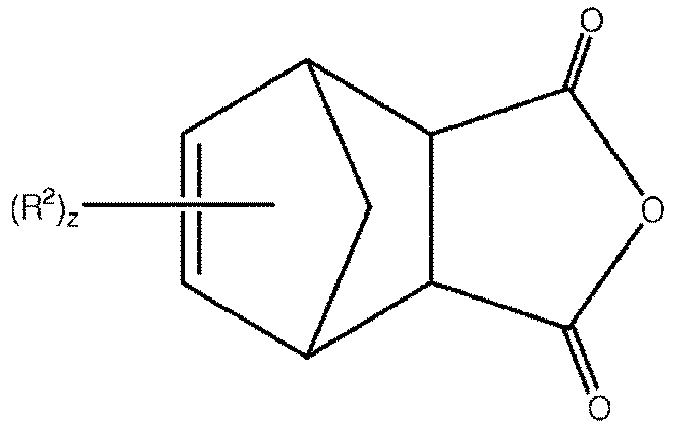
- Weitere Anhydrid-Härter sind aliphatische Anhydride, wie beispielsweise Hexahydrophthalsäureanhydrid, Tetrahydrophthalsäureanhydrid, Methyltetrahydrophthalsäureanhydrid, Methylhexahydrophthalsäureanhydrid und Mischungen der vorgenannten; sowie aromatische Anhydride, wie beispielsweise Phthalsäureanhydrid, Trimellitsäureanhydrid und Mischungen davon. Insbesondere geeignete Anhydrid-Härter sind Hexahydrophthalsäureanhydrid, Methylhexahydrophthalsäureanhydrid und Mischungen daraus. Weitere geeignete Anhydrid-Härter sind Copolymere von Styrol und Maleinsäureanhydrid sowie anderen Anhydriden, welche mit Styrol copolymerisierbar sind.
- Gemäß bevorzugten Ausführungsformen umfasst die mindestens eine Härter-Komponente der hierin beschriebenen Harzzusammensetzungen mindestens einen Anhydrid-Härter, wobei der mindestens eine Anhydrid-Härter ausgewählt ist aus Hexahydrophthalsäureanhydrid, Methylhexahydrophthalsäureanhydrid und Mischungen davon.
- Als thermisch aktivierbare oder latente Härter können des Weiteren Guanidine, substituierte Guanidine, substituierte Harnstoffe, Melaminharze, Guanamin-Derivate, cyclische tertiäre Amine, aromatische Amine und/oder deren Mischungen eingesetzt werden. Dabei können die Härter stöchiometrisch mit in die Härtungsreaktion einbezogen sein. Sie können jedoch auch katalytisch wirksam sein. Beispiele für substituierte Guanidine sind Methylguanidin, Dimethylguanidin, Trimethylguanidin, Tetramethylguanidin, Methylisobiguanidin, Dimethylisobiguanidin, Tetramethylisobiguanidin, Hexamethylisobiguanidin, Hepamethylisobiguanidin und ganz besonders Cyanoguanidin (Dicyandiamid). Als Vertreter für geeignete Guanamin-Derivate seien alkylierte Benzoguanamin-Harze, Benzoguanamin-Harze oder Methoximethyl-ethoxymethylbenzoguanamin genannt. Für einkomponentige, hitzehärtende Formkörper ist das Auswahlkriterium die niedrige Löslichkeit dieser Stoffe bei Raumtemperatur in dem Harzsystem, so dass hier feste, feinvermahlene Härter den Vorzug haben. Insbesondere ist Dicyandiamid geeignet. Damit ist eine gute Lagerstabilität der hitzehärtbaren Formkörper gewährleistet.
- Zusätzlich zu oder anstelle von den vorgenannten Härtern können katalytisch wirksame substituierte Harnstoffe eingesetzt werden. Dies sind insbesondere der p-Chlorphenyl-N,N-dimethylharnstoff (Monuron), 3-Phenyl-1,1-dimethylharnstoff (Fenuron) oder 3,4-Dichlorphenyl-N,N-dimethylharnstoff (Diuron). Prinzipiell können auch katalytisch wirksame tertiäre Acryl- oder Alkyl-Amine, wie beispielsweise das Benzyldimethylamin, Tris(dimethylamino)phenol, Piperidin oder Piperidinderivate eingesetzt werden. Diese haben jedoch vielfach eine zu hohe Löslichkeit in dem Klebstoffsystem, so dass hier keine brauchbare Lagerstabilität des einkomponentigen Systems erreicht wird. Weiterhin können diverse, vorzugsweise feste Imidazolderivate als katalytisch wirksame Beschleuniger eingesetzt werden. Stellvertretend genannt seien 2-Ethyl-2-methylimidazol, N-Butylimidazol, Benzimidazol sowie N-C1-12-Alkylimidazole oder N-Arylimidazole. Besonders bevorzugt ist der Einsatz einer Kombination aus Härter und Beschleuniger in Form von sog. beschleunigten Dicyandiamiden in feinvermahlener Form. Dadurch erübrigt sich der separate Zusatz von katalytisch wirksamen Beschleunigern zu dem Epoxid-Härtungssystem.
- Die erfindungsgemäßen Zusammensetzungen können auch als zweikomponentige Zusammensetzungen formuliert werden, bei denen die beiden Reaktionskomponenten erst kurz vor der Applikation miteinander vermischt werden, wobei die Aushärtung dann bei Raumtemperatur oder mäßig erhöhter Temperatur stattfindet. Als zweite Reaktionskomponente können hierbei die für zweikomponentige Epoxyzusammensetzungen an sich bekannten Reaktionskomponenten eingesetzt werden, beispielsweise Di- oder Polyamine, aminoterminierte Polyalkylenglykole (z. B. Jeffamine, Amino-Poly-THF) oder Polyaminoamide. Weitere Reaktivpartner können mercaptofunktionelle Prepolymere sein, wie z.B. die flüssigen Thiokol-Polymere, ebenso können die erfindungsgemäßen Epoxyzusammensetzungen auch bevorzugt mit Carbonsäureanhydriden als zweiter Reaktionskomponente in 2K Formulierungen ausgehärtet werden.
- Die vorliegende Erfindung betrifft des Weiteren ein Verfahren zur Herstellung einer gehärteten Zusammensetzung, umfassend die Schritte des (1) Bereitstellens einer Harzzusammensetzung, wie vorstehend beschrieben, und des (2) Härtens der Harzzusammensetzung, um auf diese Weise eine gehärtete Zusammensetzung zu erhalten.
- Entsprechend gehärtete Zusammensetzungen weisen eine erhöhte mechanische Beständigkeit, insbesondere eine erhöhte Schlagzähigkeit auf, ohne die Glasübergangstemperatur herabzusetzen, so dass die erhaltenen Zusammensetzungen bei der Fertigung und ihrer zweckmäßigen Bestimmung erhöhten Temperaturen ausgesetzt werden können. Daher sind diese für die Herstellung von faserverstärkten Kunststoffformteilen, wie Automobilteilen, besonders geeignet.
- "Bereitstellen", wie hierhin verwendet, bezieht sich auf das Mischen der Bestandteile der Harzzusammensetzung in beliebiger Reihenfolge. Es kann beispielsweise vorteilhaft sein, zunächst zwei oder mehr Bestandteile zusammenzugeben und gegebenenfalls zu einem heterogenen oder homogenen Gemisch zu mischen, bevor die restlichen Bestandteile hinzuzugeben werden. So kann beispielsweise zunächst die mindestens eine Epoxidharz-Komponente mit den organischen und/oder anorganischen Partikeln gemischt und anschließend, beispielsweise kurz vor dem Härten, die mindestens eine Härter-Komponente zugegeben und in die anderen bereits durchmischten Bestandteile eingemischt werden. Zwischen den verschiedenen Kombinations- und Mischschritten kann es vorteilhaft sein, das Reaktionsgemisch auf Raumtemperatur abzukühlen. In einer anderen Ausführungsform kann es zwischen den verschiedenen Kombinations- und Mischschritten vorteilhaft sein, das Reaktionsgemisch aufzuheizen, um die Löslichkeit zu verbessern.
- Generell können die einzelnen Bestandteile der Harzzusammensetzung als solche oder als Lösung in einem Lösungsmittel, wie beispielsweise einem organischen Lösungsmittel oder einem Gemisch organischer Lösungsmittel, eingesetzt werden. Hierzu ist jedes bekannte und für den erfindungsgemäßen Zweck geeignete Lösungsmittel einsetzbar. So kann das Lösungsmittel beispielsweise ein hochsiedendes organisches Lösungsmittel sein. Das Lösungsmittel kann ausgewählt sein aus der Gruppe bestehend aus Petroleum, Benzen, Toluen, Xylen, Ethylbenzen und Mischungen davon.
- Die hierin beschriebene Harzzusammensetzung kann mit weiteren im Stand der Technik bekannten Bestandteilen in Form einer Klebstoffzusammensetzung oder eines Injektionsharzes kombiniert werden.
- Derartige Klebstoffzusammensetzungen bzw. Injektionsharze können eine Vielzahl anderer Komponenten enthalten, von denen alle dem Fachmann auf dem Gebiet bekannt sind, einschließlich, aber nicht beschränkt auf häufig verwendete Hilfsstoffe und Additive, wie zum Beispiel Füllstoffe, Weichmacher, reaktive und/oder nichtreaktive Verdünnungsmittel, Fließmittel, Kopplungsmittel (z.B. Silane), Trennmittel, Haftvermittler, Netzmittel, Haftmittel, Flammschutzmittel, Netzmittel, Thixotropiermittel und/oder rheologische Hilfsstoffe (z.B. pyrogene Kieselsäure), Alterungs- und/oder Korrosionsinhibitoren, Stabilisatoren und/oder Farbstoffe. Je nach Anforderung an den Klebstoff bzw. das Injektionsharz und seine Anwendung und im Hinblick auf die Produktion, Flexibilität, Festigkeit und Verklebung mit Substraten, werden die Hilfs- und Zusatzstoffe in unterschiedlichen Mengen in die Zusammensetzung eingearbeitet.
- In bevorzugten Ausführungsformen enthalten die Zusammensetzungen der Erfindung keine Weichmacher, bzw. weniger als 0,1 Gew.-% Weichmacher, da diese dazu neigen, die Tg zu senken.
- In verschiedenen Ausführungsformen der Erfindung, wird die Harzzusammensetzung je nach gewünschter Verwendung auf ein Substrat aufgetragen, beispielsweise bei Verwendung als Klebstoff, oder in ein Formwerkzeug eingefüllt, bei der Verwendung als Formmasse zur Herstellung von Kunststoffteilen. In bevorzugten Ausführungsformen ist das Verfahren ein Spritzpress(RTM)-Verfahren und die Harzzusammensetzung ein reaktives Injektionsharz. "Reaktiv", wie in diesem Zusammenhang verwendet, bezieht sich auf die Tatsache, dass das Injektionsharz chemisch vernetzbar ist. Bei dem RTM-Verfahren kann das Bereitstellen der Harzzusammensetzung, d.h. Schritt (1) des beschriebenen Verfahrens, das Einfüllen, insbesondere Einspritzen (Injektion), des Injektionsharzes in ein Formwerkzeug umfassen. Bei der Herstellung von faserverstärkten Kunststoffteilen, wofür die beschriebenen Verfahren und Reaktionsgemische besonders geeignet sind, können vor dem Einspritzen in das Formwerkzeug in dieses Fasern oder Faserhalbzeuge (Prewovens/Preform) eingelegt werden. Als Fasern und/oder Faserhalbzeuge können die im Stand der Technik für diese Anwendung bekannten Materialien, insbesondere Kohlenstofffasern verwendet werden.
- In verschiedenen Ausführungsformen sind derartige Harzzusammensetzungen Klebstoffzusammensetzungen oder Injektionsharze. Die Injektionsharze sind vorzugsweise pumpbar und insbesondere für das Spritzpressen (RTM-Verfahren) geeignet. In verschiedenen Ausführungsformen hat das Reaktionsgemisch daher bei einer Temperatur von 100°C, d.h. einer typischen Infusionstemperatur, eine Viskosität von <100 mPas.
- Die Erfindung betrifft in einer Ausführungsform daher auch die mittels der erfindungsgemäßen Harzsysteme im RTM-Verfahren erhältlichen Formteile. Die RTM-Verfahren, in denen die beschriebenen Harzsysteme eingesetzt werden können, sind als solche im Stand der Technik bekannt und können von dem Fachmann ohne Weiteres derart angepasst werden, dass das erfindungsgemäße Reaktionsgemisch eingesetzt werden kann.
- Die Öffnungszeiten der Harzzusammensetzungen, wie hierin beschrieben, sind vorzugsweise größer als 90 Sekunden und liegen besonders bevorzugt im Bereich von 2 bis 5 Minuten, insbesondere bei ungefähr 3 Minuten. "Ungefähr" oder "ca.", wie hierin im Zusammenhang mit einem Zahlenwert verwendet, bedeutet der Zahlenwert ±10%.
- Je nach Art der eingesetzten Epoxide und Härter und der Verwendung der ausgehärteten Zusammensetzung kann die Harzzusammensetzung in Schritt (2) des erfindungsgemäßen Verfahrens bei unterschiedlichen Reaktionstemperaturen gehärtet werden. So kann die Härtungstemperatur zwischen 70°C und 280°C legen.
- Generell kann die Härtung bei erhöhter Temperatur, d.h. >25°C, erfolgen. Vorzugsweise werden die Harze zwischen 80°C und 280°C und bevorzugt zwischen 100°C und 240°C gehärtet. Die Dauer der Härtung hängt ebenfalls von den zu härtenden Harzen und der Katalysator-Zusammensetzung ab und kann zwischen 0,01 Stunden bis 10 Stunden liegen. Vorzugsweise dauert der Härtungszyklus wenige Minuten, d.h. insbesondere 1 bis 15 Minuten. Die Härtung kann ein- oder auch mehrstufig erfolgen.
- In einigen Ausführungsformen wird die hierin beschriebene Harzzusammensetzung in einem einstufigen Verfahren bei einer Temperatur zwischen 100 °C und 240 °C, vorzugsweise zwischen 160 °C und 240 °C und bevorzugt zwischen 180 °C und 240 °C für 0,01 Stunden bis 10 Stunden, vorzugsweise für 0,1 Stunden bis 5 Stunden bevorzugt für 1 Stunde gehärtet.
- In alternativen Ausführungsformen kann eine wie hierin beschriebene Harzzusammensetzung in einem mehrstufigen Verfahren gehärtet werden. Ein solches mehrstufiges Verfahren beinhaltet einen ersten Schritt des Vorhärtens, wobei die Harzzusammensetzung bei einer Temperatur zwischen 110 °C und 200 °C, vorzugsweise 130 °C und 190 °C und bevorzugt bei 180 °C für 0,1 Stunden bis 3 Stunden, vorzugsweise für 0,5 Stunden bis 2 Stunden, bevorzugt für 1 Stunde vorgehärtet und anschließend, in einem zweiten Schritt nachgehärtet wird. Dieser zweite Schritt des Nachhärtens kann dabei eine oder mehrere Unterschritte umfassen, sodass die vorgehärtete Harzzusammensetzung mindestens einmal, vorzugsweise mindestens zweimal und bevorzugt mindestens dreimal jeweils bei einer Temperatur zwischen 110 °C und 260 °C, vorzugsweise 130 °C und 190 °C und bevorzugt bei 180 °C für jeweils 0,1 Stunden bis 3 Stunden, vorzugsweise für 0,5 Stunden bis 2 Stunden, bevorzugt für 1 Stunde nachgehärtet wird. Beispielsweise kann ein solcher zweiter Härtungsschritt das Nachhärten der vorgehärteten Harzzusammensetzung bei einer Temperatur zwischen 130 °C und 230 °C, vorzugsweise 180 °C und 220 °C und bevorzugt bei 200 °C für 0,1 Stunden bis 3 Stunden, vorzugsweise für 0,5 Stunden bis 2 Stunden, bevorzugt für 1 Stunde; anschließend bei einer Temperatur zwischen 150 °C und 250 °C, vorzugsweise 190 °C und 230 °C und bevorzugt bei 220 °C für 0,1 Stunden bis 3 Stunden, vorzugsweise für 0,5 Stunden bis 2 Stunden, bevorzugt für 1 Stunde; und anschließend bei einer Temperatur zwischen 170 °C und 260 °C, vorzugsweise 200 °C und 250 °C und bevorzugt bei 240 °C für 0,1 Stunden bis 3 Stunden, vorzugsweise für 0,5 Stunden bis 2 Stunden, bevorzugt für 1 Stunde umfassen.
- Die wie hierin beschrieben gehärteten Harze haben vorzugsweise einen kritischen Spannungsintensitätsfaktor K1c von ≥0,8, vorzugsweise von ≥0,9, noch bevorzugter von ≥0,95 und am bevorzugtesten von ≥1,0. Die Glasübergangstemperatur der ausgehärteten Harze liegt, in verschiedenen Ausführungsformen, im Bereich von ≥ 250 °C, insbesondere ≥ 255 °C, typischerweise im Bereich bis 300°C. Der Elastizitätsmodul der ausgehärteten Harze liegt vorzugsweise bei mindestens 2000 N/mm2, vorzugsweise mindestens 2100 N/mm2, typischerweise im Bereich von 2200 bis 5000 N/mm2.
- Des Weiteren betrifft die vorliegende Erfindung die gehärtete Zusammensetzung, die nach dem hierin beschriebenen Verfahren erhältlich ist. Diese kann, abhängig von dem Verfahren, als Formteil, insbesondere als faserverstärktes Kunststoffformteil vorliegen. Derartige Formteile werden vorzugsweise im Automobilbau oder Aerospace eingesetzt.
- So eignen sich die gehärteten Zusammensetzungen besonders als Matrixharz für Faserverbundwerkstoffe. Dabei können diese in verschiedenen Anwendungsverfahren eingesetzt werden, beispielsweise im Resin-Transfer-Moulding-Verfahren (RTM-Verfahren) oder im Infusionsverfahren.
- Als Faserbestandteile der Faserverbundwerkstoffe sind bekannte hochfeste Faserwerkstoffe geeignet. Diese können beispielsweise aus Glasfasern; synthetischen Fasern, wie Polyesterfasern, Polyethylenfasern, Polypropylenfasern, Polyamidfasern, Polyimidfasern oder Aramidfasern; Kohlenstofffasern; Borfasern; oxidischen oder nicht oxidischen Keramikfasern, wie Aluminiumoxid/Siliciumdioxidfasern, Siliciumcarbidfasern; Metallfasern, beispielsweise aus Stahl oder Aluminium; oder aus Naturfasern, wie Flachs, Hanf oder Jute bestehen. Diese Fasern können in Form von Matten, Geweben, Gewirken, Gelegen, Vliesen oder Rovings eingebracht werden. Es können auch zwei oder mehr dieser Fasermaterialien als Gemisch verwendet werden. Es können Kurzschnittfasern ausgewählt werden, bevorzugt werden jedoch synthetische Langfasern eingesetzt, insbesondere Gewebe und Gelege. Solche hochfesten Fasern, Gelege, Gewebe und Rovings sind dem Fachmann bekannt.
- Insbesondere soll der Faserverbundwerkstoff Fasern in einem Volumenanteil von mehr als 40 Vol.-%, bevorzugt mehr als 50 Vol.-%, insbesondere bevorzugt zwischen 50 und 70 Vol.-% bezogen auf den gesamten Faserverbundwerkstoff enthalten, um besonders gute mechanische Eigenschaften zu erzielen. Im Falle von Kohlefasern wird der Volumenanteil gemäß der Norm DIN EN 2564:1998-08 bestimmt, im Falle von Glasfasern gemäß der Norm DIN EN ISO 1172:1998-12.
- Ein solcher Faserverbundwerkstoff eignet sich insbesondere als Automobilbauteil. Solche Faserverbundwerkstoffe weisen gegenüber Stahl mehrere Vorteile auf, so sind sie leichter, zeichnen sich durch eine verbesserte Crash-Resistenz aus und sind außerdem langlebiger.
- Es ist im Übrigen selbstverständlich, dass alle Ausführungsformen, die oben im Zusammenhang mit den erfindungsgemäßen Verfahren offenbart wurden, auch genauso in den beschriebenen Harzsystemen und gehärteten Zusammensetzungen anwendbar sind und umgekehrt.
- 97,7 g Cycloaliphatisches Epoxid mit 30 % organischen Kern-Schale-Struktur Partikeln)
4,1 g organische Kern-Schale-Struktur-Partikel)
42,5 g Cycloaliphatisches Epoxid mit 40 % SiO2-Partikeln
3,0 g mehrfunktioneller Fettsäureester (Trennmittel) - 132,0 g Mischung aus Bicyclo[2.2.1]-5-hepten-2,3-dicarbonsäureanhydrid und Bicyclo[2.2.1]-methylhept-5-en-2,3-dicarbonsäureanhydrid
2,0 g 1-Methylimidazol - Die Epoxidharz-Komponente und die Härter-Komponente wurden homogenisiert und anschließend in eine Stahlform gegossen. Die Vorhärtung erfolgte bei 130 °C über einen Zeitraum von 30 Minuten. Im Anschluss wurde die Mischung für eine Stunde bei 180 °C, für eine Stunde bei 200 °C, für eine Stunde bei 220 °C und schließlich für eine Stunde bei 240 °C nachgehärtet, um eine vollständige Vernetzung zu gewährleisten. Auf diese Weise wurden ca. 4 mm dicke Polymerplatten mit einer Fläche von 20 cm x 20 cm hergestellt.
- Die Gesamtmenge an organischen Partikeln betrug ca. 12 %, die an anorganischen Partikeln ca. 6 %. Die physikalischen Eigenschaften der so hergestellten Platte sind in nachfolgender Tabelle übersichtlich zusammengestellt.
Tabelle 1: physikalische Eigenschaften Beispielzusammensetzung 1 Biegemodul [MPa] 2159 Biegefestigkeit [MPa] 96 K1c [MPa*m1/2] 1,0 Tg DMA tan delta [°C] 280 Tg DMA E' onset [°C) 255 - 81,6 g Cycloaliphatisches Epoxid mit 30 % Kern-Schale-Struktur Partikeln
3,4 g Kern-Schale-Struktur Partikel
60,0 g Cycloaliphatisches Epoxid mit 40 % SiO2 Partikeln
3,0 g mehrfunktioneller Fettsäureester (Trennmittel) - 132,0 g Mischung aus Bicyclo[2.2.1]-5-hepten-2,3-dicarbonsäureanhydrid und Bicyclo[2.2.1]-methylhept-5-en-2,3-dicarbonsäureanhydrid
2,0 g 1-Methylimidazol - Die Epoxidharz-Komponente und die Härter-Komponente wurden homogenisiert und anschließend in eine Stahlform gegossen. Die Vorhärtung erfolgte bei 130 °C über einen Zeitraum von 30 Minuten. Im Anschluss wurde die Mischung für eine Stunde bei 180 °C, für eine Stunde bei 200 °C, für eine Stunde bei 220 °C und schließlich für eine Stunde bei 240 °C nachgehärtet, um eine vollständige Vernetzung zu gewährleisten. Auf diese Weise wurden ca. 4 mm dicke Polymerplatten mit einer Fläche von 20 cm x 20 cm hergestellt.
- Die Gesamtmenge an organischen Partikeln betrug ca. 10 %, die an anorganischen Partikeln ca. 8 %. Die physikalischen Eigenschaften der so hergestellten Platte sind in nachfolgender Tabelle übersichtlich zusammengestellt.
Tabelle 2: physikalische Eigenschaften Beispielzusammensetzung 2 Biegemodul [MPa] 2400 Biegefestigkeit [MPa] 96 K1c [MPa*m1/2] 0,9 Tg DMA tan delta [°C] 275 Tg DMA E' onset [°C) 250 - 137,0 g Cycloaliphatisches Epoxid mit 30 % Kern-Schale-Struktur Partikeln
3,0 g mehrfunktioneller Fettsäureester (Trennmittel) - 137,0 g Mischung aus Bicyclo[2.2.1]-5-hepten-2,3-dicarbonsäureanhydrid und Bicyclo[2.2.1]-methylhept-5-en-2,3-dicarbonsäureanhydrid
2,0 g 1-Methylimidazol - Die Epoxidharz-Komponente und die Härter-Komponente wurden homogenisiert und anschließend in eine Stahlform gegossen. Die Vorhärtung erfolgte bei 130 °C über einen Zeitraum von 30 Minuten. Im Anschluss wurde die Mischung für eine Stunde bei 180 °C, für eine Stunde bei 200 °C, für eine Stunde bei 220 °C und schließlich für eine Stunde bei 240 °C nachgehärtet, um eine vollständige Vernetzung zu gewährleisten. Auf diese Weise wurden ca. 4 mm dicke Polymerplatten mit einer Fläche von 20 cm x 20 cm hergestellt.
- Die Gesamtmenge an organischen Partikeln betrug ca. 15 %. Die physikalischen Eigenschaften der so hergestellten Platte sind in nachfolgender Tabelle übersichtlich zusammengestellt.
Tabelle 3: physikalische Eigenschaften der Vergleichsbeispielzusammensetzung Biegemodul [MPa] 2182 Biegefestigkeit [MPa] 79 K1c [MPa*m1/2] 0,7 Tg DMA tan delta [°C] 281 Tg DMA E' onset [°C) 252 - Der direkte Vergleich der beiden beispielhaften Formulierungen 1 und 2 gemäß der vorliegenden Erfindung mit der Formulierung des Vergleichsbeispiels zeigt, dass eine Kombination aus organischen Kern-Schale-Strukturpartikeln und anorganischen Partikeln in cycloaliphatischen Epoxidharzzusammensetzungen eine Erhöhung des K1c Wertes zur Folge hat, ohne die Glasübergangstemperatur der gehärteten Zusammensetzung herabzusetzen.
Claims (14)
- Harzzusammensetzung umfassend mindestens eine Epoxidharz-Komponente und mindestens eine Härter-Komponente, dadurch gekennzeichnet, dass die Harzzusammensetzung, bezogen auf deren Gesamtgewicht,(A) 1-30 Gew.-% Partikel mit Kern-Schale-Struktur und(B) 1-10 Gew.-% anorganische Partikel enthält.
- Die Harzzusammensetzung gemäß Anspruch 1, dadurch gekennzeichnet, dass die mindestens eine Epoxidharz-Komponente ein cycloaliphatisches Epoxidharz umfasst.
- Die Harzzusammensetzung gemäß Anspruch 1 oder 2, dadurch gekennzeichnet, dass(a) die Menge an Partikeln (A) und Partikeln (B) in Summe im Bereich von 1 bis 30 Gew.-%, vorzugsweise im Bereich von 15-25 Gew,-%, jeweils bezogen auf das Gesamtgewicht der Harzzusammensetzung, liegt; und/oder(b) die Menge an anorganischen Partikeln (B) im Bereich von 4-8 Gew.-% liegt; und/oder(c) die Partikel (A) und die Partikel (B) in der Epoxidharz-Komponente enthalten sind.
- Die Harzzusammensetzung gemäß einem der Ansprüche 1 bis 3, dadurch gekennzeichnet, dass die mindestens eine Epoxidharz-Komponente eine Epoxidverbindung ausgewählt aus der Gruppe bestehend aus bis-(3,4-Epoxycyclohexylmethyl)oxalat, bis-(3,4-Epoxycyclohexylmethyl)adipat, bis-(3,4-Epoxy-6-Methylcyclohexylmethyl)adipat, bis-(3,4-Epoxycyclohexylmethyl)pimelat, 3,4-Epoxycyclohexylmethyl-3,4-Epoxycyclohexancarboxylat, bis-(3,4-Epoxycyclohexyl)adipat, 3,4-Epoxy-1-Methylcyclohexylmethyl-3,4-epoxy-1-methylcyclohexancarboxylat, und Mischungen davon ist.
- Die Harzzusammensetzung gemäß einem der Ansprüche 1 bis 4, dadurch gekennzeichnet, dass die mindestens eine Härter-Komponente mindestens einen Anhydrid-Härter umfasst.
- Die Harzzusammensetzung gemäß Anspruch 5, dadurch gekennzeichnet, dass der mindestens eine Anhydrid-Härter ausgewählt ist aus Bicyclo[2.2.1]-5-hepten-2,3-dicarbonsäureanhydrid, Bicyclo[2.2.1]-methylhept-5-en-2,3-dicarbonsäureanhydrid und Mischungen davon.
- Verfahren zur Herstellung einer gehärteten Zusammensetzung, umfassend die Schritte des(1) Bereitstellens einer Harzzusammensetzung gemäß einem der Ansprüche 1 bis 6; und(2) Härtens der Harzzusammensetzung, um eine gehärtete Zusammensetzung zu erhalten.
- Das Verfahren gemäß Anspruch 7, dadurch gekennzeichnet, dass das Verfahren ein Spritzpress(RTM)-Verfahren und die Harzzusammensetzung ein reaktives Injektionsharz ist.
- Das Verfahren gemäß einem der Ansprüche 7 oder 8, dadurch gekennzeichnet, dass Schritt (1) das Einspritzen der Harzzusammensetzung in ein Formwerkzeug, in das Fasern oder Faserhalbzeuge (Prewovens/Preform) eingelegt sind, umfasst.
- Das Verfahren gemäß einem der Ansprüche 7 bis 9, dadurch gekennzeichnet, dass(a) die Harzzusammensetzung in Schritt (2) bei einer Temperatur zwischen 100 °C und 240 °C, vorzugsweise zwischen 160 °C und 240 °C und bevorzugt zwischen 180 °C und 240 °C für 0,01 Stunden bis 10 Stunden, vorzugsweise für 0,1 Stunden bis 5 Stunden bevorzugt für 1 Stunde gehärtet wird; oder(b) die Harzzusammensetzung in Schritt (2) zunächst bei einer Temperatur zwischen 70 °C und 150 °C, vorzugsweise 100 °C und 140 °C und bevorzugt bei 130 °C für 0,1 Stunden bis 3 Stunden, vorzugsweise für 0,5 Stunden bis 2 Stunden, bevorzugt für 0,5 Stunden vorgehärtet und anschließend mindestens einmal, vorzugsweise mindestens zweimal und bevorzugt mindestens dreimal jeweils bei einer Temperatur zwischen 110 °C und 260 °C, vorzugsweise 130 °C und 190 °C und bevorzugt bei 180 °C für jeweils 0,1 Stunden bis 3 Stunden, vorzugsweise für 0,5 Stunden bis 2 Stunden, bevorzugt für 1 Stunde nachgehärtet wird.
- Gehärtete Zusammensetzung erhältlich nach einem Verfahren der Ansprüche 7 bis 10.
- Die gehärtete Zusammensetzung gemäß Anspruch 11, dadurch gekennzeichnet, dass der K1c Wert der gehärteten Zusammensetzung mindestens 0,8 beträgt.
- Die gehärtete Zusammensetzung gemäß Anspruch 11 oder 12, dadurch gekennzeichnet, dass die gehärtete Zusammensetzung eine Glasübergangstemperatur Tg ≥ 250 °C aufweist.
- Gehärtete Zusammensetzung gemäß einem der Ansprüche 11 bis 13, dadurch gekennzeichnet, dass die gehärtete Zusammensetzung ein Formteil, insbesondere ein faserverstärktes Formteil ist.
Priority Applications (8)
| Application Number | Priority Date | Filing Date | Title |
|---|---|---|---|
| EP19211024.5A EP3825355A1 (de) | 2019-11-22 | 2019-11-22 | Formulierungen mit hohen glasübergangstemperaturen für laminate |
| CN202080080629.5A CN114729157B (zh) | 2019-11-22 | 2020-11-19 | 用于层合物的具有高玻璃化转变温度的配制物 |
| KR1020227016811A KR20220105641A (ko) | 2019-11-22 | 2020-11-19 | 적층체용 높은 유리 전이 온도를 갖는 포뮬레이션 |
| MX2022004890A MX2022004890A (es) | 2019-11-22 | 2020-11-19 | Formulaciones con altas temperaturas de transicion vitrea para laminados. |
| PCT/EP2020/082630 WO2021099441A1 (de) | 2019-11-22 | 2020-11-19 | Formulierungen mit hohen glasübergangstemperaturen für laminate |
| JP2022529615A JP7685494B2 (ja) | 2019-11-22 | 2020-11-19 | 積層品のための高いガラス転移温度を有する組成物 |
| AU2020388241A AU2020388241A1 (en) | 2019-11-22 | 2020-11-19 | Formulations with high glass transition temperatures, for laminates |
| US17/750,595 US20220306820A1 (en) | 2019-11-22 | 2022-05-23 | Formulations with high glass transition temperatures, for laminates |
Applications Claiming Priority (1)
| Application Number | Priority Date | Filing Date | Title |
|---|---|---|---|
| EP19211024.5A EP3825355A1 (de) | 2019-11-22 | 2019-11-22 | Formulierungen mit hohen glasübergangstemperaturen für laminate |
Publications (1)
| Publication Number | Publication Date |
|---|---|
| EP3825355A1 true EP3825355A1 (de) | 2021-05-26 |
Family
ID=68886705
Family Applications (1)
| Application Number | Title | Priority Date | Filing Date |
|---|---|---|---|
| EP19211024.5A Pending EP3825355A1 (de) | 2019-11-22 | 2019-11-22 | Formulierungen mit hohen glasübergangstemperaturen für laminate |
Country Status (8)
| Country | Link |
|---|---|
| US (1) | US20220306820A1 (de) |
| EP (1) | EP3825355A1 (de) |
| JP (1) | JP7685494B2 (de) |
| KR (1) | KR20220105641A (de) |
| CN (1) | CN114729157B (de) |
| AU (1) | AU2020388241A1 (de) |
| MX (1) | MX2022004890A (de) |
| WO (1) | WO2021099441A1 (de) |
Families Citing this family (1)
| Publication number | Priority date | Publication date | Assignee | Title |
|---|---|---|---|---|
| US12202932B2 (en) * | 2022-04-07 | 2025-01-21 | Cnpc Usa Corporation | Formulation and processing of degradable high Tg epoxy composite that can be degradable at extremely low temperature |
Citations (24)
| Publication number | Priority date | Publication date | Assignee | Title |
|---|---|---|---|---|
| US2750395A (en) | 1954-01-05 | 1956-06-12 | Union Carbide & Carbon Corp | Diepoxides |
| US2890194A (en) | 1956-05-24 | 1959-06-09 | Union Carbide Corp | Compositions of epoxides and polycarboxylic acid compounds |
| US3985703A (en) | 1975-06-24 | 1976-10-12 | Rohm And Haas Company | Process for manufacture of acrylic core/shell polymers |
| US4180529A (en) | 1977-12-08 | 1979-12-25 | E. I. Du Pont De Nemours And Company | Acrylic multistage graft copolymer products and processes |
| US4315085A (en) | 1980-07-25 | 1982-02-09 | Gaf Corporation | Core-shell composite polymers having high amounts of carboxylic acid units in the shell |
| US4419496A (en) | 1982-02-22 | 1983-12-06 | The Dow Chemical Company | Particle agglomeration in rubber latices |
| US4778851A (en) | 1985-06-26 | 1988-10-18 | The Dow Chemical Company | Rubber-modified epoxy compounds |
| US5223586A (en) | 1990-12-20 | 1993-06-29 | Wacker-Chemie Gmbh | Elastomeric graft copolymers having a core/shell structure |
| US5290857A (en) | 1991-09-04 | 1994-03-01 | Nippon Zeon Co., Ltd. | Epoxy resin adhesive composition |
| US5534594A (en) | 1994-12-05 | 1996-07-09 | Rohm And Haas Company | Preparation of butadiene-based impact modifiers |
| US5686509A (en) | 1993-05-24 | 1997-11-11 | Nippon Zeon Co., Ltd. | Epoxy resin structural adhesive composition |
| US5789482A (en) | 1990-03-30 | 1998-08-04 | Ciba Specialty Chemicals Corporation | Epoxy resin with anhydride, toughener and active hydrogen-containing compound |
| US5981659A (en) | 1995-09-26 | 1999-11-09 | Wacker-Chemie Gmbh | Precross-linked silicone elastomer particles with organopolymer shell as formulation constituent in powder coating materials |
| US6111015A (en) | 1992-07-09 | 2000-08-29 | Ciba Specialty Chemicals Corp. | Core/shell polymer toughener suspended in epoxy resin |
| US6147142A (en) | 1996-04-30 | 2000-11-14 | Wacker-Chemie Gmbh | Previously cross-linked silicone elastomer particles with an organopolymer shell as a constituent for formulating aqueous coating compositions |
| US6180693B1 (en) | 1995-11-29 | 2001-01-30 | Vantico Inc. | Core/shell particles, and curable epoxy resin composition comprising same |
| US6331580B1 (en) | 1998-09-09 | 2001-12-18 | Rohm And Haas Company | MBS impact modifiers |
| EP1176171A2 (de) * | 2000-06-29 | 2002-01-30 | Kabushiki Kaisha Toshiba | Dielektrisches Material und dessen Herstellungsverfahren |
| US20050124761A1 (en) | 2002-02-06 | 2005-06-09 | Klaus Schultes | Core-shell structured silicone rubber graft polymers, impact-resistant modified molding compounds and molded bodies and method for producing the same |
| EP1632533A1 (de) | 2003-06-09 | 2006-03-08 | Kaneka Corporation | Verfahren zur herstellung von modifiziertem epoxidharz |
| WO2007025007A1 (en) | 2005-08-24 | 2007-03-01 | Henkel Kommanditgesellschaft Auf Aktien | Epoxy compositions having improved impact resistance |
| US20100016494A1 (en) * | 2008-07-17 | 2010-01-21 | Henkel Ireland Limited | Low temperature, cationically curable compositions with improved cure speed and toughness |
| US20130115442A1 (en) * | 2011-11-09 | 2013-05-09 | Cytec Technology Corp. | Structural adhesive and bonding application thereof |
| WO2016137671A1 (en) * | 2015-02-27 | 2016-09-01 | 3M Innovative Properties Company | Two-part adhesive including toughened curative |
Family Cites Families (21)
| Publication number | Priority date | Publication date | Assignee | Title |
|---|---|---|---|---|
| JP2004059778A (ja) * | 2002-07-30 | 2004-02-26 | Harima Chem Inc | 封止充填剤用液状エポキシ樹脂組成物 |
| US7157509B2 (en) * | 2003-06-27 | 2007-01-02 | Henkel Corporation | Curable compositions |
| CN101578332B (zh) * | 2006-11-13 | 2014-04-16 | 汉高公司 | 具有核壳橡胶的苯并噁嗪组合物 |
| DE102008020441A1 (de) * | 2008-04-23 | 2009-10-29 | Merck Patent Gmbh | Klebstoff |
| US20100280151A1 (en) * | 2009-05-04 | 2010-11-04 | Toray Industries, Inc. | Toughened fiber reinforced polymer composite with core-shell particles |
| DE102009028100A1 (de) * | 2009-07-29 | 2011-02-03 | Henkel Ag & Co. Kgaa | Schlagzähmodifizierte Zusammensetzung auf Epoxidharzbasis |
| JP5130397B2 (ja) * | 2010-01-21 | 2013-01-30 | 積水化学工業株式会社 | 熱硬化性樹脂組成物、先塗布型フリップチップ実装用接着剤、半導体装置の製造方法、及び、半導体装置 |
| DE102011007897A1 (de) * | 2011-04-12 | 2012-10-18 | Henkel Ag & Co. Kgaa | Schlagzähmodifizierte Klebstoffe |
| WO2014062407A2 (en) * | 2012-10-19 | 2014-04-24 | Dow Global Technologies Llc | Anhydride-cured epoxy resin systems containing divinylarene dioxides |
| WO2015013084A1 (en) * | 2013-07-24 | 2015-01-29 | Dow Global Technologies Llc | Curable compositions |
| JP6438271B2 (ja) * | 2013-10-24 | 2018-12-12 | 三菱エンジニアリングプラスチックス株式会社 | 熱可塑性ポリエステル樹脂組成物 |
| KR102408039B1 (ko) * | 2014-12-18 | 2022-06-13 | 사이텍 인더스트리스 인코포레이티드 | 액상 수지 주입에 적합한 개질된 수지 시스템 |
| EP3112419B1 (de) * | 2015-06-30 | 2020-11-18 | Airbus Defence and Space GmbH | Flammefeste und hochtemperaturbeständige duromere auf der grundlage von naphthalin-basierten epoxidharzen und cyanatestern |
| JP2017149887A (ja) * | 2016-02-26 | 2017-08-31 | 東レ株式会社 | 繊維強化複合材料用エポキシ樹脂組成物、および繊維強化複合材料 |
| EP3260481B1 (de) * | 2016-06-20 | 2022-02-23 | Henkel AG & Co. KGaA | Gehärtete zusammensetzung mit hoher schlagfestigkeit und temperaturbeständigkeit, basierend auf einem epoxidharz und einem polyisocyanat |
| EP3323843A1 (de) * | 2016-11-22 | 2018-05-23 | Henkel AG & Co. KGaA | Härtbares epoxid/polyurethan hybridharzsystem für smcs |
| US20200140722A1 (en) * | 2016-12-29 | 2020-05-07 | 3M Innovative Properties Company | Curable compositions |
| JP2017125212A (ja) * | 2017-04-10 | 2017-07-20 | 株式会社ダイセル | 硬化性エポキシ樹脂組成物及びその硬化物、並びに光半導体装置 |
| CN112739742A (zh) * | 2018-09-21 | 2021-04-30 | 东丽株式会社 | 环氧树脂组合物、预浸料坯、以及纤维增强复合材料 |
| WO2021096654A1 (en) * | 2019-11-12 | 2021-05-20 | Sabic Global Technologies B.V. | Curing composition for high heat adhesive epoxy resin |
| EP3825341A1 (de) * | 2019-11-22 | 2021-05-26 | Henkel AG & Co. KGaA | Matrixharz für laminate mit hoher transparenz, geringer vergilbung und hohen glasübergangstemperaturen |
-
2019
- 2019-11-22 EP EP19211024.5A patent/EP3825355A1/de active Pending
-
2020
- 2020-11-19 JP JP2022529615A patent/JP7685494B2/ja active Active
- 2020-11-19 CN CN202080080629.5A patent/CN114729157B/zh active Active
- 2020-11-19 MX MX2022004890A patent/MX2022004890A/es unknown
- 2020-11-19 WO PCT/EP2020/082630 patent/WO2021099441A1/de not_active Ceased
- 2020-11-19 AU AU2020388241A patent/AU2020388241A1/en active Pending
- 2020-11-19 KR KR1020227016811A patent/KR20220105641A/ko active Pending
-
2022
- 2022-05-23 US US17/750,595 patent/US20220306820A1/en active Pending
Patent Citations (25)
| Publication number | Priority date | Publication date | Assignee | Title |
|---|---|---|---|---|
| US2750395A (en) | 1954-01-05 | 1956-06-12 | Union Carbide & Carbon Corp | Diepoxides |
| US2890194A (en) | 1956-05-24 | 1959-06-09 | Union Carbide Corp | Compositions of epoxides and polycarboxylic acid compounds |
| US3985703A (en) | 1975-06-24 | 1976-10-12 | Rohm And Haas Company | Process for manufacture of acrylic core/shell polymers |
| US4180529A (en) | 1977-12-08 | 1979-12-25 | E. I. Du Pont De Nemours And Company | Acrylic multistage graft copolymer products and processes |
| US4315085A (en) | 1980-07-25 | 1982-02-09 | Gaf Corporation | Core-shell composite polymers having high amounts of carboxylic acid units in the shell |
| US4419496A (en) | 1982-02-22 | 1983-12-06 | The Dow Chemical Company | Particle agglomeration in rubber latices |
| US4778851B1 (en) | 1985-06-26 | 1999-02-09 | David E Henton | Rubber-modified epoxy compounds |
| US4778851A (en) | 1985-06-26 | 1988-10-18 | The Dow Chemical Company | Rubber-modified epoxy compounds |
| US5789482A (en) | 1990-03-30 | 1998-08-04 | Ciba Specialty Chemicals Corporation | Epoxy resin with anhydride, toughener and active hydrogen-containing compound |
| US5223586A (en) | 1990-12-20 | 1993-06-29 | Wacker-Chemie Gmbh | Elastomeric graft copolymers having a core/shell structure |
| US5290857A (en) | 1991-09-04 | 1994-03-01 | Nippon Zeon Co., Ltd. | Epoxy resin adhesive composition |
| US6111015A (en) | 1992-07-09 | 2000-08-29 | Ciba Specialty Chemicals Corp. | Core/shell polymer toughener suspended in epoxy resin |
| US5686509A (en) | 1993-05-24 | 1997-11-11 | Nippon Zeon Co., Ltd. | Epoxy resin structural adhesive composition |
| US5534594A (en) | 1994-12-05 | 1996-07-09 | Rohm And Haas Company | Preparation of butadiene-based impact modifiers |
| US5981659A (en) | 1995-09-26 | 1999-11-09 | Wacker-Chemie Gmbh | Precross-linked silicone elastomer particles with organopolymer shell as formulation constituent in powder coating materials |
| US6180693B1 (en) | 1995-11-29 | 2001-01-30 | Vantico Inc. | Core/shell particles, and curable epoxy resin composition comprising same |
| US6147142A (en) | 1996-04-30 | 2000-11-14 | Wacker-Chemie Gmbh | Previously cross-linked silicone elastomer particles with an organopolymer shell as a constituent for formulating aqueous coating compositions |
| US6331580B1 (en) | 1998-09-09 | 2001-12-18 | Rohm And Haas Company | MBS impact modifiers |
| EP1176171A2 (de) * | 2000-06-29 | 2002-01-30 | Kabushiki Kaisha Toshiba | Dielektrisches Material und dessen Herstellungsverfahren |
| US20050124761A1 (en) | 2002-02-06 | 2005-06-09 | Klaus Schultes | Core-shell structured silicone rubber graft polymers, impact-resistant modified molding compounds and molded bodies and method for producing the same |
| EP1632533A1 (de) | 2003-06-09 | 2006-03-08 | Kaneka Corporation | Verfahren zur herstellung von modifiziertem epoxidharz |
| WO2007025007A1 (en) | 2005-08-24 | 2007-03-01 | Henkel Kommanditgesellschaft Auf Aktien | Epoxy compositions having improved impact resistance |
| US20100016494A1 (en) * | 2008-07-17 | 2010-01-21 | Henkel Ireland Limited | Low temperature, cationically curable compositions with improved cure speed and toughness |
| US20130115442A1 (en) * | 2011-11-09 | 2013-05-09 | Cytec Technology Corp. | Structural adhesive and bonding application thereof |
| WO2016137671A1 (en) * | 2015-02-27 | 2016-09-01 | 3M Innovative Properties Company | Two-part adhesive including toughened curative |
Non-Patent Citations (1)
| Title |
|---|
| LEE HNEVILLE, K.: "Handbook of Epoxy Resins", 1982, MCGRAW-HILL BOOK COMPANY |
Also Published As
| Publication number | Publication date |
|---|---|
| WO2021099441A1 (de) | 2021-05-27 |
| KR20220105641A (ko) | 2022-07-27 |
| JP2023502717A (ja) | 2023-01-25 |
| US20220306820A1 (en) | 2022-09-29 |
| CN114729157A (zh) | 2022-07-08 |
| CN114729157B (zh) | 2025-04-25 |
| AU2020388241A1 (en) | 2022-07-14 |
| JP7685494B2 (ja) | 2025-05-29 |
| MX2022004890A (es) | 2022-05-16 |
Similar Documents
| Publication | Publication Date | Title |
|---|---|---|
| EP3237486B1 (de) | Epoxidharz-zusammensetzung | |
| WO2021099440A1 (de) | Matrixharz für laminate mit hoher transparenz, geringer vergilbung und hohen glasübergangstemperaturen | |
| DE60304895T2 (de) | Härterzusammensetzung für epoxidharze | |
| DE69501771T2 (de) | Epoxidharzformmasse zur Einkapselung elektronischer Bauelemente und eingekapselte Halbleiteranordnung unter Verwendung dieser Formmasse | |
| JP5403184B1 (ja) | 繊維強化複合材料 | |
| EP3178861B1 (de) | Latente epoxidharzformulierungen für flüssigimprägnierprozesse zur herstellung von faserverbundwerkstoffen | |
| WO2016102359A1 (de) | Oxazolidinon- und isocyanurat-vernetzte matrix für faserverstärktes material | |
| EP3255103B1 (de) | Zusammensetzung enthaltend ein polymer auf der basis von epoxidverbindungen | |
| EP3472217A1 (de) | Gehärtete zusammensetzung mit hoher schlagfestigkeit und temperaturbeständigkeit, basierend auf einem epoxidharz und einem polyisocyanat | |
| DE102016117183A1 (de) | Lichtfixierbare Vergussmasse und Verfahren zum selektiven Verguss von Substraten/Bauteilen unter Verwendung der Massen | |
| DE102015208320A1 (de) | Klebeband mit Temporär-Fixier-Klebstoff | |
| EP3323843A1 (de) | Härtbares epoxid/polyurethan hybridharzsystem für smcs | |
| WO2021099439A1 (de) | Peo-ppo-peo triblockcopolymere als additive für epoxid-anhydrid-systeme | |
| WO2021099441A1 (de) | Formulierungen mit hohen glasübergangstemperaturen für laminate | |
| DE102006032063B4 (de) | Verfahren zur Herstellung einer Formmasse | |
| JPH04180956A (ja) | エポキシ‐ゴム混合組成物 | |
| CH672492A5 (de) | ||
| DE2044720C3 (de) | Verfahren zum Herstellen von mit EpoxkJ-GieBharzen vorimprägnierten Kohlenstoff-Fase rgeweben | |
| DE102024126349A1 (de) | Durch Wärme härtbare Unterfüllmasse, Verfahren zum Verkleben eines Substrats mit wenigstens einem Fügepartner und Verwendung als Underfill | |
| JPH0580945B2 (de) | ||
| WO2024195880A1 (ja) | エポキシ樹脂組成物及びその製造方法 |
Legal Events
| Date | Code | Title | Description |
|---|---|---|---|
| PUAI | Public reference made under article 153(3) epc to a published international application that has entered the european phase |
Free format text: ORIGINAL CODE: 0009012 |
|
| STAA | Information on the status of an ep patent application or granted ep patent |
Free format text: STATUS: THE APPLICATION HAS BEEN PUBLISHED |
|
| AK | Designated contracting states |
Kind code of ref document: A1 Designated state(s): AL AT BE BG CH CY CZ DE DK EE ES FI FR GB GR HR HU IE IS IT LI LT LU LV MC MK MT NL NO PL PT RO RS SE SI SK SM TR |
|
| STAA | Information on the status of an ep patent application or granted ep patent |
Free format text: STATUS: REQUEST FOR EXAMINATION WAS MADE |
|
| 17P | Request for examination filed |
Effective date: 20211125 |
|
| RBV | Designated contracting states (corrected) |
Designated state(s): AL AT BE BG CH CY CZ DE DK EE ES FI FR GB GR HR HU IE IS IT LI LT LU LV MC MK MT NL NO PL PT RO RS SE SI SK SM TR |
|
| STAA | Information on the status of an ep patent application or granted ep patent |
Free format text: STATUS: EXAMINATION IS IN PROGRESS |
|
| 17Q | First examination report despatched |
Effective date: 20240605 |