EP3821479B1 - Distanzausgleichselement, verwendung einer metallfolie als distanzausgleichselement und anordnung mit distanzausgleichselement - Google Patents
Distanzausgleichselement, verwendung einer metallfolie als distanzausgleichselement und anordnung mit distanzausgleichselement Download PDFInfo
- Publication number
- EP3821479B1 EP3821479B1 EP19749590.6A EP19749590A EP3821479B1 EP 3821479 B1 EP3821479 B1 EP 3821479B1 EP 19749590 A EP19749590 A EP 19749590A EP 3821479 B1 EP3821479 B1 EP 3821479B1
- Authority
- EP
- European Patent Office
- Prior art keywords
- metal
- metal foil
- component
- compensation element
- distance compensation
- Prior art date
- Legal status (The legal status is an assumption and is not a legal conclusion. Google has not performed a legal analysis and makes no representation as to the accuracy of the status listed.)
- Active
Links
Images






Classifications
-
- H—ELECTRICITY
- H01—ELECTRIC ELEMENTS
- H01M—PROCESSES OR MEANS, e.g. BATTERIES, FOR THE DIRECT CONVERSION OF CHEMICAL ENERGY INTO ELECTRICAL ENERGY
- H01M50/00—Constructional details or processes of manufacture of the non-active parts of electrochemical cells other than fuel cells, e.g. hybrid cells
- H01M50/20—Mountings; Secondary casings or frames; Racks, modules or packs; Suspension devices; Shock absorbers; Transport or carrying devices; Holders
- H01M50/218—Mountings; Secondary casings or frames; Racks, modules or packs; Suspension devices; Shock absorbers; Transport or carrying devices; Holders characterised by the material
- H01M50/22—Mountings; Secondary casings or frames; Racks, modules or packs; Suspension devices; Shock absorbers; Transport or carrying devices; Holders characterised by the material of the casings or racks
- H01M50/222—Inorganic material
- H01M50/224—Metals
-
- H—ELECTRICITY
- H01—ELECTRIC ELEMENTS
- H01M—PROCESSES OR MEANS, e.g. BATTERIES, FOR THE DIRECT CONVERSION OF CHEMICAL ENERGY INTO ELECTRICAL ENERGY
- H01M50/00—Constructional details or processes of manufacture of the non-active parts of electrochemical cells other than fuel cells, e.g. hybrid cells
- H01M50/20—Mountings; Secondary casings or frames; Racks, modules or packs; Suspension devices; Shock absorbers; Transport or carrying devices; Holders
-
- B—PERFORMING OPERATIONS; TRANSPORTING
- B21—MECHANICAL METAL-WORKING WITHOUT ESSENTIALLY REMOVING MATERIAL; PUNCHING METAL
- B21H—MAKING PARTICULAR METAL OBJECTS BY ROLLING, e.g. SCREWS, WHEELS, RINGS, BARRELS, BALLS
- B21H8/00—Rolling metal of indefinite length in repetitive shapes specially designed for the manufacture of particular objects, e.g. checkered sheets
- B21H8/005—Embossing sheets or rolls
-
- B—PERFORMING OPERATIONS; TRANSPORTING
- B32—LAYERED PRODUCTS
- B32B—LAYERED PRODUCTS, i.e. PRODUCTS BUILT-UP OF STRATA OF FLAT OR NON-FLAT, e.g. CELLULAR OR HONEYCOMB, FORM
- B32B15/00—Layered products comprising a layer of metal
- B32B15/01—Layered products comprising a layer of metal all layers being exclusively metallic
-
- B—PERFORMING OPERATIONS; TRANSPORTING
- B32—LAYERED PRODUCTS
- B32B—LAYERED PRODUCTS, i.e. PRODUCTS BUILT-UP OF STRATA OF FLAT OR NON-FLAT, e.g. CELLULAR OR HONEYCOMB, FORM
- B32B15/00—Layered products comprising a layer of metal
- B32B15/01—Layered products comprising a layer of metal all layers being exclusively metallic
- B32B15/012—Layered products comprising a layer of metal all layers being exclusively metallic one layer being formed of an iron alloy or steel, another layer being formed of aluminium or an aluminium alloy
-
- H—ELECTRICITY
- H01—ELECTRIC ELEMENTS
- H01M—PROCESSES OR MEANS, e.g. BATTERIES, FOR THE DIRECT CONVERSION OF CHEMICAL ENERGY INTO ELECTRICAL ENERGY
- H01M10/00—Secondary cells; Manufacture thereof
- H01M10/60—Heating or cooling; Temperature control
- H01M10/61—Types of temperature control
- H01M10/613—Cooling or keeping cold
-
- H—ELECTRICITY
- H01—ELECTRIC ELEMENTS
- H01M—PROCESSES OR MEANS, e.g. BATTERIES, FOR THE DIRECT CONVERSION OF CHEMICAL ENERGY INTO ELECTRICAL ENERGY
- H01M10/00—Secondary cells; Manufacture thereof
- H01M10/60—Heating or cooling; Temperature control
- H01M10/62—Heating or cooling; Temperature control specially adapted for specific applications
- H01M10/625—Vehicles
-
- H—ELECTRICITY
- H01—ELECTRIC ELEMENTS
- H01M—PROCESSES OR MEANS, e.g. BATTERIES, FOR THE DIRECT CONVERSION OF CHEMICAL ENERGY INTO ELECTRICAL ENERGY
- H01M10/00—Secondary cells; Manufacture thereof
- H01M10/60—Heating or cooling; Temperature control
- H01M10/64—Heating or cooling; Temperature control characterised by the shape of the cells
- H01M10/647—Prismatic or flat cells, e.g. pouch cells
-
- H—ELECTRICITY
- H01—ELECTRIC ELEMENTS
- H01M—PROCESSES OR MEANS, e.g. BATTERIES, FOR THE DIRECT CONVERSION OF CHEMICAL ENERGY INTO ELECTRICAL ENERGY
- H01M10/00—Secondary cells; Manufacture thereof
- H01M10/60—Heating or cooling; Temperature control
- H01M10/65—Means for temperature control structurally associated with the cells
- H01M10/653—Means for temperature control structurally associated with the cells characterised by electrically insulating or thermally conductive materials
-
- H—ELECTRICITY
- H01—ELECTRIC ELEMENTS
- H01M—PROCESSES OR MEANS, e.g. BATTERIES, FOR THE DIRECT CONVERSION OF CHEMICAL ENERGY INTO ELECTRICAL ENERGY
- H01M10/00—Secondary cells; Manufacture thereof
- H01M10/60—Heating or cooling; Temperature control
- H01M10/65—Means for temperature control structurally associated with the cells
- H01M10/655—Solid structures for heat exchange or heat conduction
- H01M10/6554—Rods or plates
- H01M10/6555—Rods or plates arranged between the cells
-
- H—ELECTRICITY
- H01—ELECTRIC ELEMENTS
- H01M—PROCESSES OR MEANS, e.g. BATTERIES, FOR THE DIRECT CONVERSION OF CHEMICAL ENERGY INTO ELECTRICAL ENERGY
- H01M10/00—Secondary cells; Manufacture thereof
- H01M10/60—Heating or cooling; Temperature control
- H01M10/65—Means for temperature control structurally associated with the cells
- H01M10/655—Solid structures for heat exchange or heat conduction
- H01M10/6556—Solid parts with flow channel passages or pipes for heat exchange
- H01M10/6557—Solid parts with flow channel passages or pipes for heat exchange arranged between the cells
-
- H—ELECTRICITY
- H01—ELECTRIC ELEMENTS
- H01M—PROCESSES OR MEANS, e.g. BATTERIES, FOR THE DIRECT CONVERSION OF CHEMICAL ENERGY INTO ELECTRICAL ENERGY
- H01M50/00—Constructional details or processes of manufacture of the non-active parts of electrochemical cells other than fuel cells, e.g. hybrid cells
- H01M50/20—Mountings; Secondary casings or frames; Racks, modules or packs; Suspension devices; Shock absorbers; Transport or carrying devices; Holders
- H01M50/204—Racks, modules or packs for multiple batteries or multiple cells
-
- H—ELECTRICITY
- H01—ELECTRIC ELEMENTS
- H01M—PROCESSES OR MEANS, e.g. BATTERIES, FOR THE DIRECT CONVERSION OF CHEMICAL ENERGY INTO ELECTRICAL ENERGY
- H01M50/00—Constructional details or processes of manufacture of the non-active parts of electrochemical cells other than fuel cells, e.g. hybrid cells
- H01M50/20—Mountings; Secondary casings or frames; Racks, modules or packs; Suspension devices; Shock absorbers; Transport or carrying devices; Holders
- H01M50/204—Racks, modules or packs for multiple batteries or multiple cells
- H01M50/207—Racks, modules or packs for multiple batteries or multiple cells characterised by their shape
- H01M50/213—Racks, modules or packs for multiple batteries or multiple cells characterised by their shape adapted for cells having curved cross-section, e.g. round or elliptic
-
- H—ELECTRICITY
- H01—ELECTRIC ELEMENTS
- H01M—PROCESSES OR MEANS, e.g. BATTERIES, FOR THE DIRECT CONVERSION OF CHEMICAL ENERGY INTO ELECTRICAL ENERGY
- H01M50/00—Constructional details or processes of manufacture of the non-active parts of electrochemical cells other than fuel cells, e.g. hybrid cells
- H01M50/20—Mountings; Secondary casings or frames; Racks, modules or packs; Suspension devices; Shock absorbers; Transport or carrying devices; Holders
- H01M50/233—Mountings; Secondary casings or frames; Racks, modules or packs; Suspension devices; Shock absorbers; Transport or carrying devices; Holders characterised by physical properties of casings or racks, e.g. dimensions
- H01M50/238—Flexibility or foldability
-
- H—ELECTRICITY
- H01—ELECTRIC ELEMENTS
- H01M—PROCESSES OR MEANS, e.g. BATTERIES, FOR THE DIRECT CONVERSION OF CHEMICAL ENERGY INTO ELECTRICAL ENERGY
- H01M50/00—Constructional details or processes of manufacture of the non-active parts of electrochemical cells other than fuel cells, e.g. hybrid cells
- H01M50/20—Mountings; Secondary casings or frames; Racks, modules or packs; Suspension devices; Shock absorbers; Transport or carrying devices; Holders
- H01M50/233—Mountings; Secondary casings or frames; Racks, modules or packs; Suspension devices; Shock absorbers; Transport or carrying devices; Holders characterised by physical properties of casings or racks, e.g. dimensions
- H01M50/242—Mountings; Secondary casings or frames; Racks, modules or packs; Suspension devices; Shock absorbers; Transport or carrying devices; Holders characterised by physical properties of casings or racks, e.g. dimensions adapted for protecting batteries against vibrations, collision impact or swelling
-
- H—ELECTRICITY
- H01—ELECTRIC ELEMENTS
- H01M—PROCESSES OR MEANS, e.g. BATTERIES, FOR THE DIRECT CONVERSION OF CHEMICAL ENERGY INTO ELECTRICAL ENERGY
- H01M50/00—Constructional details or processes of manufacture of the non-active parts of electrochemical cells other than fuel cells, e.g. hybrid cells
- H01M50/20—Mountings; Secondary casings or frames; Racks, modules or packs; Suspension devices; Shock absorbers; Transport or carrying devices; Holders
- H01M50/249—Mountings; Secondary casings or frames; Racks, modules or packs; Suspension devices; Shock absorbers; Transport or carrying devices; Holders specially adapted for aircraft or vehicles, e.g. cars or trains
-
- H—ELECTRICITY
- H01—ELECTRIC ELEMENTS
- H01M—PROCESSES OR MEANS, e.g. BATTERIES, FOR THE DIRECT CONVERSION OF CHEMICAL ENERGY INTO ELECTRICAL ENERGY
- H01M50/00—Constructional details or processes of manufacture of the non-active parts of electrochemical cells other than fuel cells, e.g. hybrid cells
- H01M50/20—Mountings; Secondary casings or frames; Racks, modules or packs; Suspension devices; Shock absorbers; Transport or carrying devices; Holders
- H01M50/251—Mountings; Secondary casings or frames; Racks, modules or packs; Suspension devices; Shock absorbers; Transport or carrying devices; Holders specially adapted for stationary devices, e.g. power plant buffering or backup power supplies
-
- H—ELECTRICITY
- H01—ELECTRIC ELEMENTS
- H01M—PROCESSES OR MEANS, e.g. BATTERIES, FOR THE DIRECT CONVERSION OF CHEMICAL ENERGY INTO ELECTRICAL ENERGY
- H01M50/00—Constructional details or processes of manufacture of the non-active parts of electrochemical cells other than fuel cells, e.g. hybrid cells
- H01M50/50—Current conducting connections for cells or batteries
- H01M50/528—Fixed electrical connections, i.e. not intended for disconnection
-
- H—ELECTRICITY
- H01—ELECTRIC ELEMENTS
- H01R—ELECTRICALLY-CONDUCTIVE CONNECTIONS; STRUCTURAL ASSOCIATIONS OF A PLURALITY OF MUTUALLY-INSULATED ELECTRICAL CONNECTING ELEMENTS; COUPLING DEVICES; CURRENT COLLECTORS
- H01R13/00—Details of coupling devices of the kinds covered by groups H01R12/70 or H01R24/00 - H01R33/00
- H01R13/02—Contact members
- H01R13/22—Contacts for co-operating by abutting
- H01R13/24—Contacts for co-operating by abutting resilient; resiliently-mounted
-
- Y—GENERAL TAGGING OF NEW TECHNOLOGICAL DEVELOPMENTS; GENERAL TAGGING OF CROSS-SECTIONAL TECHNOLOGIES SPANNING OVER SEVERAL SECTIONS OF THE IPC; TECHNICAL SUBJECTS COVERED BY FORMER USPC CROSS-REFERENCE ART COLLECTIONS [XRACs] AND DIGESTS
- Y02—TECHNOLOGIES OR APPLICATIONS FOR MITIGATION OR ADAPTATION AGAINST CLIMATE CHANGE
- Y02E—REDUCTION OF GREENHOUSE GAS [GHG] EMISSIONS, RELATED TO ENERGY GENERATION, TRANSMISSION OR DISTRIBUTION
- Y02E60/00—Enabling technologies; Technologies with a potential or indirect contribution to GHG emissions mitigation
- Y02E60/10—Energy storage using batteries
Definitions
- the invention relates to a distance compensation element, a use of a metal foil as a distance compensation element and an arrangement of two components with a distance compensation element arranged between them.
- Component groups in which individual components with varying dimensions are installed require a distance compensation element, also known as a gap filler, for a secure arrangement.
- the distance compensation element is arranged in a housing when the component group is assembled and is suitable for holding other components with different dimensions caused by production or thermal expansion through elastic deformability. The elasticity of the distance compensation element clamps the component securely in the housing so that the component is held securely and firmly in its specified position during use of the component group.
- An example of such a component group is a battery arrangement in a battery tray that is closed with a lid.
- the lengths and/or widths of the individual battery units or battery cells such as round cells, pouch cells or solid-state cells, differ from one another by a few millimeters due to production reasons. Nevertheless, the battery units must be positioned in the battery tray in such a way that the dimensional differences are compensated and the battery tray can be reliably closed.
- movement of the battery units within the tray must be reliably prevented, or at least limited, despite vibrations that occur during use, for example in a vehicle.
- battery is primarily used for a rechargeable battery, i.e. an accumulator, but also a non-rechargeable battery.
- Distance compensation elements are also required for other electrical or electronic component groups.
- smart devices smart devices (smartphones, tablets, notebooks)
- a distance compensation element is required in a very small space, as is the case with any type of built-in display, particularly in vehicles, display panels or signs.
- both mechanical distance compensation and heat dissipation are necessary to protect against overheating. This can also result in requirements for electrical and/or magnetic shielding. These can only be inadequately met by the known distance compensation elements mentioned.
- US 2001/007728 A1 , US 2016/260946 A1 and US 2016/164061 disclose battery arrangements in which elements for improved heat transfer are arranged between the individual cells.
- the present invention is based on the technical problem of improving a spacer element and an arrangement consisting of two components and a spacer element.
- a distance compensation element for arrangement between two components with a metal foil and with spring elements formed integrally with the metal foil, wherein the spring elements protrude from the plane of the metal foil and wherein the spring elements are formed with at least one of the components in To be in contact, a slot arrangement with a plurality of slots is introduced into the metal foil.
- the metal foil is also deformed by stretching.
- the spring elements protrude on one or both sides of the metal foil and are elastically deformable.
- the protruding spring elements run at any angle or even perpendicular to the plane of the metal foil.
- the protrusion of the spring elements creates an elastic height profile.
- the spring elements When installed in a housing, the spring elements are in contact with one of the components or with both components.
- the elastic spring elements can compensate for a dimensional tolerance and at the same time ensure that the components are arranged securely and firmly in the housing.
- the metal foil described above Due to the metal properties, the metal foil described above has good elasticity for distance compensation and at the same time good thermal conductivity, so that the distance compensation element described can not only provide good mechanical stability but also good heat dissipation.
- a slot arrangement with a plurality of slots is introduced into the metal foil, so that individual sections are formed that can be specifically formed into the protruding spring elements, while the other areas of the metal foil remain essentially in the original plane of the metal foil.
- the slots can have any shape and in particular can be completely or partially straight, curved, bent and/or round or even spiral-shaped
- the slot arrangement can be produced inexpensively and at high process speed by punching.
- Cutting, knives or punching are also used for endless metal foils.
- the use of mechanical tools allows the initial metal foil to be processed quickly, but this can result in cracks and sharp edges that can have a detrimental effect on further use, especially for small dimensions.
- the slot arrangement can be produced with greater precision using etching, but with greater effort.
- etching for example, the etching is prepared using UV lithography in order to then apply the acidic etchant. Etching allows the geometry of the edge area of the slots (bevels, roundings) to be set very precisely, so that the sections of the metal foil created by the slots can be deformed more precisely. The production is therefore particularly suitable for small dimensions of the distance compensation element.
- the slot arrangement described above can have a regular pattern of slots, so that after deformation a regular arrangement of spring elements results. It is also preferably possible for the slot arrangement to form a pattern with variable length values and/or spacing values. The arrangement of the spring elements on the metal foil can thus be arranged, grouped or separated in a targeted manner.
- the sections formed by the slot arrangement and intended for forming can be formed by applying mechanical force.
- the force can be applied in different ways.
- the metal foil is deformed by stretching and forms what is known as expanded metal.
- the sections separated from one another by the slots are pulled apart.
- the material of the foil yields to the forces in such a way that sections arranged transversely to the stretching direction between the slots twist and are deformed out of the plane.
- the spring elements are thus formed in sections during stretching.
- the shape of the spring elements is determined by the structure of the slot arrangement. The protruding sections protrude at an angle, are bent over when they come into contact with a component and thus form a flat contact with the component.
- the metal foil is possible for the metal foil to be provided with spring elements in sections and for it to be designed as a flat metal foil in sections. This makes it possible to have an asymmetrical arrangement of the spring elements on the one hand and a flat section without spring elements for better heat transfer.
- the section of the metal foil with the spring elements can thus be used to position and secure a battery, while the flat section of the metal foil can dissipate the heat to another component such as a housing.
- a metal foil as described above typically has a thickness in the range of 0.02 to 1.0 mm, in particular up to 2.0 mm.
- the height of the spring elements protruding from the metal foil is preferably in the range of 0.05 to 5 mm, in particular up to 10 mm, whereby the height can be adapted to the respective application.
- the spring elements can then bridge tolerances, for example in the size of up to 3 mm, in particular up to 5 mm, and at the same time also ensure a safe arrangement of the components relative to one another in the event of mechanical stress caused by shocks or vibrations.
- the metal foil can have a single-layer structure and consists in particular of one of the following metals: copper alloy, in particular a so-called sol or K alloy, copper-beryllium alloy, copper-zinc alloy, copper-zirconium alloy, copper-tin alloy.
- the metal foil further consists of at least two metal layers, wherein at least one metal layer consists of a first metal, wherein at least one metal layer consists of a second metal, wherein the first metal has a greater modulus of elasticity than the second metal and wherein the second metal has a greater thermal conductivity than the first metal.
- the metal foil consists of three layers, with the two outer layers consisting of the first metal and the middle layer consisting of the second metal. Bi-metal effects are thus avoided, so that the dimensional stability of the metal foil is guaranteed even at different operating temperatures.
- a structure consisting of only two metal layers is also possible in order to specifically achieve the bi-metal effect for generating mechanical forces when assembling the components.
- the first metal with a larger modulus of elasticity is selected from the group: ferritic and austenitic steel or stainless steel, low-carbon forming steel (DD11/1.0332), stainless steel (magnetic), in particular X6Cr17/1.4016, stainless steel (non-magnetic), in particular X5CrNi18-10/1.4301, iron-nickel alloys, nickel, in particular Ni99.2/2.4066, nickel alloy and titanium, in particular Ti Grade 1/3.7025.
- ferritic and austenitic steel or stainless steel low-carbon forming steel (DD11/1.0332)
- stainless steel (magnetic) in particular X6Cr17/1.4016, stainless steel (non-magnetic), in particular X5CrNi18-10/1.4301
- iron-nickel alloys nickel, in particular Ni99.2/2.4066, nickel alloy and titanium, in particular Ti Grade 1/3.7025.
- the second metal with greater thermal conductivity is selected from the group: copper, low-alloy copper alloys, in particular Cu-ETP (E-Cu)/CW004A, aluminum, in particular Al99.5 / EN-AW-1050A, aluminum alloys with proportions of magnesium, zinc, copper, manganese, lead and/or silicon, bronze alloys, in particular CuSn4/CW450K, silver, gold.
- the first metals mentioned have a modulus of elasticity in the order of magnitude of in particular 90 - 210 kN/mm 2 and the second metals in the order of magnitude of less than 70 - 140 kN/mm 2 .
- the second metals mentioned have a thermal conductivity in the order of greater than 100 W/(m*K) and up to 400 W/(m*K) and the first metals in the order of between 10 and 100 W/(m*K).
- the thermal conductivity of the second metal is 10-1000 times greater than when using plastics, as is common in the state of the art.
- the first metal consists of an aluminum alloy and the second metal consists of a stainless steel.
- the metal layers of the metal foil are preferably plated and form a solid bond.
- the metal layers of the metal foil have different thicknesses, with the at least one metal layer made of the first metal with a higher modulus of elasticity preferably being thinner than the at least one layer made of the second metal with a higher thermal conductivity. This is because the thickness required to create a resilient property of the spring element is small, while the thickness of the layer made of the second metal should be as large as possible for good heat dissipation.
- the thickness of the layer made of the first metal is preferably 5 to 20% of the total thickness of the metal foil, so that in a two-layer structure the layer made of the second metal preferably makes up 80 to 95% of the total thickness. In a three-layer structure, the thickness of the middle layer made of the second metal has a relative thickness of 60 to 90% in particular.
- the metals are in terms of their thermal conductivity and their modulus of elasticity
- the metals are electrically conductive and form a shield against electrical fields.
- the distance compensation element therefore has the additional properties of electrical shielding, which is particularly advantageous when used with electronic devices.
- the metal foil has a ferromagnetic metal at least in sections, preferably over the entire surface, and in at least one layer. This not only enables the metal foil to provide shielding against electrical fields, but the metal foil also provides additional protection for the component against magnetic fields and thus improves the electromagnetic compatibility (EMC) of the component.
- EMC electromagnetic compatibility
- ferromagnetic metals are pure iron, carbon steels, tinplate, iron-nickel alloys, cobalt-iron alloys, ⁇ -metal, amorphous materials, ferritic alloys, stainless steel, in particular X6Cr17 / 1.4016 or a higher alloyed ferritic steel 1.4568.
- the distance compensation element is preferably used with electronic or electrical components. These components are usually electrically insulated per se, but it can be advantageous for an electrically insulating layer to be arranged on at least one side of the metal foil.
- This layer can be formed as a foil, in particular as a Kapton foil, or by applying a liquid material.
- the insulating layer can be applied over the entire surface or partially for electrical insulation. When applying the insulating layer to the protruding spring elements, it must be taken into account that the spring elements are not or only slightly restricted in their function after the insulating layer has been applied.
- the insulating coating achieves improved electrical insulation to prevent electrical currents and leakage currents, as well as improved dielectric strength of the distance compensation element.
- the distance compensation element can also be used to electrically contact components with each other, for example batteries with the same polarity.
- the contact points or contact surfaces of the components are in contact with the metal foil, in particular with the protruding spring elements.
- the other properties of the distance compensation element already described can ensure that the components are securely contacted.
- the distance compensation elements in the area of the worked-out spring elements can be improved by applying adhesive elements, e.g. heat-conducting foil with adhesive on both sides, pastes or similar, by targeted surface treatment, for example by structuring or embossing, or by coating.
- adhesive elements e.g. heat-conducting foil with adhesive on both sides, pastes or similar
- targeted surface treatment for example by structuring or embossing, or by coating.
- the additional components listed can be made of metallic or non-metallic, organic or inorganic materials.
- the technical problem outlined above is also solved according to the invention by the use of a metal foil as a distance compensation element for arrangement between two components, wherein the metal foil is designed according to one of the previously explained examples and variants.
- the technical problem is also solved by an arrangement comprising a first component, a distance compensation element and a second component, wherein the metal foil is designed according to one of the previously explained examples and variants, wherein the distance compensation element is arranged between the two components and wherein the spring elements of the distance compensation element compensate for dimensional variations of the first component and wherein the distance compensation element transfers thermal energy from the first component to the second component.
- the spring elements protrude only to one side of the plane of the metal foil, the spring elements are in contact with one of the components and the metal foil with the non-deformed sections is in contact with the other component. If the spring elements protrude to both sides of the metal foil, then the spring elements are in contact with the components on both sides of the distance compensation element.
- a further preferred embodiment of the described arrangement consists in that at least two distance compensation elements of the type described above are arranged between the first component and the second component. The resilient and heat-conducting properties of the at least two distance compensation elements are thus added together.
- the arrangement described in general can be used in various applications.
- the first component can be an electrical component, in particular a battery, a battery cell arrangement or a display
- the second component can be a mechanical component, in particular a battery tray, a housing, a dashboard of a vehicle or an aircraft, a display panel or a road sign.
- the distance compensation element is the use in a battery arrangement for a vehicle.
- the rechargeable batteries preferably round cells, have manufacturing tolerances in the range of up to 3 mm, for example.
- the battery cells are arranged next to one another in a battery tray, which is closed with a lid.
- the distance compensation element is arranged on the floor of the battery tray and the battery cells are placed on the distance compensation element - individually or in groups. When the lid is closed, the upper ends of the batteries or battery groups come into contact with the inside of the lid and are pressed downwards against the distance compensation element. Since the distance compensation element has the elastically deformable spring elements, The distance compensation element adjusts section by section depending on the load so that the different lengths of the batteries are compensated.
- the distance compensation element therefore initially has a mechanical safety function in that the batteries or battery groups are held elastically within the battery housing consisting of the battery tray and cover. This protects the batteries against movement within the battery housing caused by impacts or vibrations.
- the distance compensation element can also absorb heat from the batteries and dissipate this heat by attaching it to the battery tray. In addition to the mechanical protection, the distance compensation element also takes on the function of heat dissipation.
- the metal foil of the distance compensation element can have an electrically insulating coating that rests against the batteries or battery groups when installed. This prevents electrical energy from being dissipated via the distance compensation element.
- the metal foil of the distance compensation element can also be uncoated, so that the metal foil connects the electrical contacts of the batteries and is also connected to an electrical line to transmit the electrical energy.
- Another application area of the described arrangement is the mechanical securing and heat relief of electronic devices such as smartphones, tablets, notebooks or other smart devices.
- the dimensions are considerably smaller than in the previously described example of the vehicle battery, so that the spring elements of the metal foil of the distance compensation element are significantly smaller. Nevertheless, the same functionalities as previously described can be fulfilled in such electronic devices.
- the metal foil can also be provided with spring elements only in sections and be designed as a flat metal foil in sections. This makes it possible to achieve an asymmetrical arrangement of the spring elements in the area of the battery on the one hand and a flat section without spring elements for better heat transfer outside the area of the battery arranged in the housing.
- the section of the metal foil with the spring elements can thus be used to position and secure a battery, while the flat section of the metal foil can dissipate the heat to the housing.
- Another area of application for the arrangement is the mounting and securing of screens, for example in vehicles or aircraft. Since the surface area of the screens used is constantly increasing and curved screens are also being used, the use of the distance compensation elements described for screens is advantageous. This is because the respective screen is inserted into a housing in which a distance compensation element is already arranged. By pressing and locking the screen to the housing, the screen is held securely in position by means of the distance compensation element, whereby manufacturing tolerances or dimensional changes are also compensated for by heating by the spring elements of the metal foil. The dissipation of heat is also advantageous in this application.
- the metal foil consists at least in sections of a ferromagnetic metal. This allows better electromagnetic compatibility (EMC) of the screen to be achieved.
- EMC electromagnetic compatibility
- This EMC is particularly advantageous for large screens, since the increasing electronic control and digitalization of vehicles means that more electrical signals are transported in the vehicle, which can lead to interference with the control signals of the screen.
- the distance compensation element can also achieve the electromagnetic compatibility of screens.
- distance compensation elements described can also be used in display boards and signs to secure screens or lighting devices or at least their power supply by batteries and to improve their thermal management.
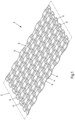
- Fig. 1 to 4 show a first embodiment of a distance compensation element 2 according to the invention for arrangement between two components, wherein the figures represent different states and views of the metal foil 4.
- the completed distance compensation element 2 is initially in Fig. 1 shown in a perspective view and consists of a metal foil 4 and spring elements 6 formed integrally with the metal foil 4.
- the spring elements 6 protrude from the plane E of the metal foil 4 and are designed to be in contact with at least one of the components. Such an arrangement is shown in Fig. 12 and is explained in more detail below.
- the still unprocessed metal foil 4 is first provided with a slot arrangement 8.
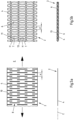
- Fig. 2 shows a section of the metal foil 4 with the slot arrangement 8 before further processing.
- the slot arrangement 8 consists of a large number of slots 10 that are made parallel to one another and form a functional geometry.
- the slots 10 are made in the metal foil 4 using knives, cutting or punching, or alternatively by etching.
- Fig. 3 shows the same section of the metal foil after forming the metal foil 4 and Fig. 1 shows the perspective view of the entire metal foil 2.
- a section between two slots 10 has been formed, i.e. embossed, towards one side from the plane E of the metal foil 4, while the adjacent section between the slots 10 has been embossed towards the other side.
- the formed sections thus alternate on both sides of the metal foil 4 and form the spring elements 6.
- the spring elements 6 each have a flat section that is in contact with one of the components when installed.
- the flanks of the protruding spring elements 6 are deep-drawn.
- Fig. 4 shows a cross-section of the metal foil 4, where Fig. 4a the alternating course of the spring elements 6 becomes clear.
- the material selection of the metal foil 4 described above enables a combination of good elasticity and good thermal conductivity at the same time, so that the distance compensation element 2 fulfills two different functionalities in one component.
- Fig. 5 shows a further embodiment of a distance compensation element 2 according to the invention, which is produced by stretching a metal foil 4.
- Fig. 5a shows the metal foil 4 in its initial state with slots 10 a slot arrangement 8 before stretching.
- the slots 10 have a distance a.
- Fig. 5b the metal foil 4 is shown after stretching, i.e. as expanded metal.
- the slots are pulled apart so that they form oval openings 11 with webs 13 arranged between them.
- this results in a greater length of the stretched metal foil 4, so that the distance a' is greater than the original distance a.
- the webs 13 are usually positioned transversely to the plane E (drawing plane in the upper section of the Fig. 5 ) of the metal foil 4, wherein the webs 13 are arranged according to Fig. 5 are deflected upwards and downwards and form spring elements 6 projecting upwards and downwards.
- the bridges 13 are in Fig. 5b shown as diagonal lines.
- the letters H and T indicate that the corresponding edge of the webs 13 protrudes upwards (H - high) or downwards (T - low) between two oval openings 11.
- the metal foil 4 has thus been transformed into a distance compensation element by stretching.
- the protruding spring elements 6 run obliquely at an angle to the plane E of the metal foil 4, causing a change in height and thus forming the elastic spring elements 6.
- Fig. 6a to 6f show six further designs of metal foils 4 in detail, which have slot arrangements 10 with different geometries.
- the direction of tension is vertical and the sections of the metal foil 4, which are hatched as an example and delimited by slots 8, are aligned transversely to the plane E (drawing plane of the Fig. 6 ) and form the spring elements 6.
- Fig. 7a and 7b show an embodiment in which the non-stretched metal foil 4 in Fig. 7a is shown.
- Fig. 7b shows the metal foil 4 after stretching.
- the middle section twists and forms on both sides transverse to the plane E (drawing plane of the Fig. 7a, 7b ) protruding spring elements 6.
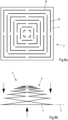
- Fig. 8 shows a further embodiment of a distance compensation element 2 according to the invention.
- the metal foil 4 has a slot arrangement 10 which has a rectangular or square outline.
- the square slots 10 arranged one inside the other have interruptions alternately at the corners or in the middle along the side edges.
- Fig. 8b shows the forming of the metal foil 4, whereby in the outer areas of the slot structure the metal foil is pressed relatively downwards and the middle area is pressed relatively upwards. This creates an accordion-like structure that protrudes from the plane E of the metal foil 4 like a pyramid.
- the distance compensation element 2 can comprise a plurality of previously determined Fig. 8 described spring elements 2.
- Fig. 9 shows an application example of a distance compensation element 2 according to Fig. 8 in the form of a battery holder 12 with a receptacle 14 for a cylindrical battery 16.
- the receptacle 14 has the distance compensation element 2 on the right edge with the protruding spring element 6, in Fig. 9a in the relaxed state.
- the spring element 6 With battery 16 inserted after Fig. 9b the spring element 6 is partially compressed and holds the battery 16 securely in the holder 14.
- the distance compensation element 2 ensures both heat dissipation and electrical contact and transmission of the electrical energy through the flat contact of the spring element 6 on the negative pole of the battery 16.
- Fig. 10a, 10b and 11 show two further embodiments of distance compensation elements 2, each consisting of a gathered metal foil 4.
- Fig. 10a shows a cross section through the metal foil 4 and Fig. 10b shows a partially sectioned three-dimensional representation.
- the metal foil 4 does not have a slotted structure, but is made from a flat starting metal foil by folding and bending along parallel lines and at regularly recurring intervals. This creates a three-dimensional structure with elongated spring elements 6 protruding on both sides.
- each spring element 6 has inner sections 6a which are inclined in cross-section and which give way under vertically acting forces and produce the required elasticity of the spring elements 6.
- the spring elements 6 have spaced-apart protruding contact elements 18 which have been introduced by embossing into the flat spring elements 6 before folding and bending. With the contact elements 18, the spring force of the spring elements 6 is concentrated on a few contact sections.
- Fig. 11 shows another embodiment similar to the example according to Fig. 10 .
- the distance compensation element 2 according to Fig. 10 has a straight course of the protruding surfaces of the spring elements 6 and the inner sections 6a.
- the Distance compensation element according to Fig. 11 shows a slightly curved course of the protruding surfaces of the spring elements 6.
- Fig. 12 shows an arrangement 20 according to the invention consisting of a first component in the form of a plurality of rechargeable batteries 22, a distance compensation element according to Fig. 1 and a second component in the form of a battery tray 24.
- the distance compensation element 2 is arranged between the two components 22 and 24.
- the spring elements 6 of the distance compensation element 2 thus compensate for dimensional variations of the batteries 22, since the individual spring elements 6 can be deformed independently of one another and can apply different spring forces.
- the distance compensation element 2 transfers the thermal energy in the batteries during use or during charging from the batteries 22 to the battery tray 24 by resting on both components 22 and 24.
- FIG. 12 The representation of the arrangement in Fig. 12 is schematic and does not take into account the electrical connections necessary for such a battery cell arrangement.
Landscapes
- Chemical & Material Sciences (AREA)
- Chemical Kinetics & Catalysis (AREA)
- Electrochemistry (AREA)
- General Chemical & Material Sciences (AREA)
- Engineering & Computer Science (AREA)
- Manufacturing & Machinery (AREA)
- Aviation & Aerospace Engineering (AREA)
- Inorganic Chemistry (AREA)
- Mechanical Engineering (AREA)
- Battery Mounting, Suspending (AREA)
- Springs (AREA)
Description
- Die Erfindung betrifft ein Distanzausgleichselement, eine Verwendung einer Metallfolie als Distanzausgleichselement und eine Anordnung aus zwei Bauteilen mit einem dazwischen angeordneten Distanzausgleichselement.
- Bauteilgruppen, in denen einzelne Bauteile mit variierenden Abmessungen eingebaut sind, benötigen für eine sichere Anordnung ein Distanzausgleichselement, das auch als Gapfiller bezeichnet wird. Das Distanzausgleichselement wird beim Zusammenbau der Bauteilgruppe in einem Gehäuse angeordnet und ist geeignet, weitere Bauteile mit unterschiedlichen, durch die Produktion oder durch thermische Ausdehnung bedingten Abmessungen durch elastische Verformbarkeit zu halten. Durch die Elastizität des Distanzausgleichselements wird das Bauteil sicher in dem Gehäuse eingespannt, so dass während der Benutzung der Bauteilgruppe das Bauteil sicher und fest an seiner vorgegebenen Position gehalten wird.
- Ein Beispiel einer solchen Bauteilgruppe ist eine Batterieanordnung in einer Batteriewanne, die mit einem Deckel verschlossen wird. Die Längen und/oder Breiten der einzelnen Batterieeinheiten bzw. Batteriezellen wie Rundzellen, Pouchzellen oder Festkörperzellen, weichen produktionsbedingt im Millimeterbereich voneinander ab. Gleichwohl müssen die Batterieeinheiten so in der Batteriewanne positioniert werden, dass die Abmessungsunterschiede ausgeglichen werden und das Verschließen der Batteriewanne zuverlässig möglich ist. Zudem soll bei verschlossener Batteriewanne trotz während der Benutzung, beispielsweise in einem Fahrzeug, entstehender Vibrationen eine Bewegung der Batterieeinheiten innerhalb der Wanne sicher verhindert, zumindest aber eingeschränkt werden.
- Der Begriff "Batterie" wird vorrangig für eine aufladbare Batterie, also einen Akkumulator, aber auch eine nicht aufladbare Batterie verwendet.
- Für diese Anwendung ist das Anordnen von Keramikplatten aus der
DE 10 2010 001 033 A1 oder von Acrylpolster (der Firma 3M) bekannt. Da die genannten Materialien jedoch eine schlechte Wärmeleitfähigkeit aufweisen, müssen zusätzliche Maßnahmen wie das Anordnen von Wärmeleitfolien getroffen werden. - Distanzausgleichselemente werden auch bei weiteren elektrischen oder elektronischen Bauteilgruppen benötigt. In Smart Devices (Smart Phones, Tablets, Notebooks) wird auf engstem Raum ein Distanzausgleichselement benötigt, ebenso bei jeder Form von eingebauten Displays, insbesondere in Fahrzeugen, Anzeigetafeln oder Schildern. Auch hier ist sowohl ein mechanischer Distanzausgleich als auch eine Wärmeabführung als Schutz vor Überhitzung notwendig. Dazu können auch Anforderungen an die elektrische und/oder magnetische Abschirmung auftreten. Diese können durch die genannten bekannten Distanzausgleichselemente nur unzulänglich erfüllt werden.
- Die
US 2001/007728 A1 ,US 2016/260946 A1 undUS 2016/164061 offenbaren Batterieanordnungen, wobei zwischen den einzelnen Zellen Elemente für eine verbesserte Wärmeübertragung angebracht sind. - Daher liegt der vorliegenden Erfindung das technische Problem zugrunde, ein Distanzelement sowie eine Anordnung aus zwei Bauteilen und einem Distanzelement zu verbessern.
- Das zuvor aufgeführte technische Problem wird erfindungsgemäß nach einer ersten Lehre gelöst durch ein Distanzausgleichselement zur Anordnung zwischen zwei Bauteilen mit einer Metallfolie und mit integral mit der Metallfolie ausgebildeten Federelementen, wobei die Federelemente von der Ebene der Metallfolie vorstehen und wobei die Federelemente ausgebildet sind, mit zumindest einem der Bauteile in Kontakt zu stehen, wobei eine Schlitzanordnung mit einer Mehrzahl von Schlitzen in die Metallfolie eingebracht ist. Die Metallfolie ist zudem durch Strecken verformt.
- Die Federelemente stehen zu einer oder beiden Seiten der Metallfolie vor und sind elastisch verformbar. Die vorstehenden Federelemente verlaufen dabei unter einem beliebigen schrägen Winkel oder gar senkrecht zur Ebene der Metallfolie. Durch das Vorstehen der Federelemente bilden diese ein elastisches Höhenprofil aus. Bei einem Einbau in einem Gehäuse stehen die Federelemente mit einem der Bauteile oder mit beiden Bauteilen in Kontakt. Je nachdem, welche Länge oder Dicke die Bauteile aufweisen, können die elastischen Federelemente eine Abmessungstoleranz ausgleichen und gleichzeitig eine sichere und feste Anordnung der Bauteile in dem Gehäuse gewährleisten.
- Die zuvor beschriebene Metallfolie weist somit aufgrund der Metalleigenschaften eine gute Elastizität für den Distanzausgleich sowie gleichzeitig eine gute Wärmeleitfähigkeit auf, so dass das beschriebene Distanzausgleichselement nicht nur eine gute mechanische Stabilität, sondern gleichzeitig auch eine gute Wärmeableitung bewirken kann.
- Für die Ausbildung der Federelemente der Metallfolie gibt es verschiedene Möglichkeiten, die nachfolgend beschrieben werden.
- Bei einer bevorzugten Ausgestaltung des Distanzausgleichselements ist eine Schlitzanordnung mit einer Mehrzahl von Schlitzen in die Metallfolie eingebracht, so dass einzelne Abschnitte gebildet werden, die gezielt zu den vorstehenden Federelementen umgeformt werden können, während die weiteren Bereiche der Metallfolie im Wesentlichen in der ursprünglichen Ebene der Metallfolie verbleiben. Somit wird eine Funktionsgeometrie gebildet, die in einem weiteren Herstellungsschritt verformt wird. Die Schlitze können dabei eine beliebige Form aufweisen und insbesondere ganz oder abschnittsweise gerade, gekrümmt, gebogen und/oder rund bis hin zu spiralförmig ausgebildet sein
- Die Schlitzanordnung kann einerseits durch Stanzen preiswert und mit großer Prozessgeschwindigkeit erzeugt werden. Dazu kommen Schneiden, Messer oder Stanzen bei endlosen Metallfolien zur Anwendung. Die Anwendung von mechanischen Werkzeugen erlaubt eine schnelle Bearbeitung der Ausgangsmetallfolie, jedoch können hierbei Risse und scharfe Kanten auftreten, die sich nachteilig auf die weitere Verwendung, insbesondere bei kleinen Dimensionen auswirken können.
- Andererseits kann die Schlitzanordnung mittels Ätzen mit größerer Genauigkeit, aber mit größerem Aufwand hergestellt werden. Beim Ätzen wird beispielsweise mittels UV Lithographie das Ätzen vorbereitet, um anschließend das säurehaltige Ätzmittel aufzubringen. Das Ätzen erlaubt eine sehr genaue Einstellung der Geometrie des Kantenbereichs der Schlitze (Fasen, Abrundungen), so dass das Verformen der durch die Schlitze erzeugten Abschnitte der Metallfolie genauer durchgeführt werden kann. Die Herstellung ist daher für kleine Abmessungen des Distanzausgleichelements besonders gut geeignet.
- Die zuvor beschriebene Schlitzanordnung kann ein regelmäßiges Muster von Schlitzen aufweisen, so dass sich nach dem Verformen eine regelmäßige Anordnung von Federelementen ergibt. Ebenso ist es vorzugsweise möglich, dass die Schlitzanordnung ein Muster mit variablen Längenwerten und/oder Abstandswerten bildet. Somit kann die Anordnung der Federelemente auf der Metallfolie gezielt angeordnet, gruppiert oder vereinzelt werden.
- Die durch die Schlitzanordnung ausgebildeten und für ein Umformen vorgesehenen Abschnitte können durch eine mechanische Krafteinleitung umgeformt werden. Die Krafteinleitung kann in unterschiedlicher Weise erfolgen.
- Erfindungsgemäß ist die Metallfolie durch Strecken verformt und bildet ein sogenanntes Streckmetall. Beim Strecken der Metallfolie werden die voneinander durch die Schlitze getrennten Abschnitte auseinander gezogen. Gleichzeitig gibt das Material der Folie den Kräften derart nach, dass sich quer zur Streckrichtung zwischen den Schlitzen angeordnete Abschnitte verdrehen und aus der Ebene heraus verformt werden. Somit werden die Federelemente während des Streckens abschnittsweise ausgebildet. Die Form der Federelemente wird durch die Struktur der Schlitzanordnung bestimmt. Die vorstehenden Abschnitte stehen in einem Winkel vor, werden bei Kontakt mit einem Bauteil umgebogen und bilden somit einen flächigen Kontakt mit dem Bauteil aus.
- Des Weiteren ist es möglich, dass die Metallfolie abschnittsweise mit Federelementen versehen ist und abschnittsweis als plane Metallfolie ausgebildet ist. Dadurch kann eine asymmetrische Anordnung der Federelemente einerseits und eines planen Abschnitts ohne Federelemente für eine bessere Wärmeübertragung realisiert werden. Somit kann der Abschnitt der Metallfolie mit den Federelemente für die Positionierung und Sicherung einer Batterie dienen, während der plane Abschnitt der Metallfolie die Wärme an ein weiteres Bauteil wie ein Gehäuse ableiten kann.
- Eine zuvor beschriebene Metallfolie weist typischer Weise eine Dicke im Bereich von 0,02 bis 1,0 mm, insbesondere bis zu 2,0 mm auf. Die Höhe der von der Metallfolie vorstehenden Federelemente liegt bevorzugt im Bereich von 0,05 bis 5 mm, insbesondere bis zu 10 mm, wobei die Höhe an die jeweilige Anwendung angepasst werden kann. Die Federelemente können dann Toleranzen beispielsweise in der Größe von bis zu 3 mm, insbesondere bis zu 5 mm überbrücken und gleichzeitig auch bei mechanischer Belastung durch Stöße oder Vibrationen eine sichere Anordnung der Bauteile relativ zueinander gewährleisten.
- Die Metallfolie kann einen einlagigen Aufbau aufweisen und besteht insbesondere aus einem der folgenden Metalle: Kupferlegierung, insbesondere eine sogenannte Sol-oder K-Legierung, Kupfer-Beryllium-Legierung, Kupfer-Zink-Legierung, Kupfer-Zirkonium-Legierung, Kupfer-Zinn-Legierung.
- Erfindungsgemäß besteht die Metallfolie weiterhin aus mindestens zwei Metallschichten, wobei mindestens eine Metallschicht aus einem ersten Metall besteht, wobei mindestens eine Metallschicht aus einem zweiten Metall besteht, wobei das erste Metall einen gegenüber dem zweiten Metall größeren Elastizitätsmodul aufweist und wobei das zweite Metall eine gegenüber dem ersten Metall größere Wärmeleitfähigkeit aufweist.
- In bevorzugter Weise besteht die Metallfolie aus drei Schichten, wobei die beiden äußeren Schichten aus dem ersten Metall und die mittlere Schicht aus dem zweite Metall bestehen. Bi-Metalleffekte werden dadurch vermieden, so dass auch bei unterschiedlichen Betriebstemperaturen die Formstabilität der Metallfolie gewährleistet bleibt. Ebenso ist ein Aufbau aus nur zwei Metallschichten möglich, um gezielt den Bi-Metalleffekt zum Erzeugen von mechanischen Kräften im Zusammenbau der Bauteile zu erzielen.
- In bevorzugter Weise ist das erste Metall mit größerem Elastizitätsmodul ausgewählt aus der Gruppe: ferritischer und austenitischer Stahl bzw. Edelstahl, kohlenstoffarmer Umformstahl (DD11/1.0332), nichtrostender Edelstahl (magnetisch), insbesondere X6Cr17/1.4016, nichtrostender Edelstahl (nicht magnetisch), insbesondere X5CrNi18-10/1.4301, Eisen-Nickel-Legierungen, Nickel, insbesondere Ni99,2/2.4066, Nickellegierung und Titan, insbesondere Ti Grade 1/3.7025.
- In bevorzugter Weise ist das zweite Metall mit größerer Wärmeleitfähigkeit ausgewählt ist aus der Gruppe: Kupfer, niedriglegierte Kupfer-Legierungen, insbesondere Cu-ETP (E-Cu)/CW004A, Aluminium, insbesondere Al99,5 / EN-AW-1050A, Aluminiumlegierungen mit Anteilen an Magnesium, Zink, Kupfer, Mangan, Blei und/oder Silizium, Bronzelegierungen, insbesondere CuSn4/CW450K, Silber, Gold.
- Die genannten ersten Metalle weisen ein Elastizitätsmodul in der Größenordnung von insbesondere 90 - 210 kN/mm2 und die zweiten Metalle in der Größenordnung von weniger als 70 - 140 kN/mm2 auf.
- Die genannten zweiten Metalle weisen eine Wärmeleitfähigkeit in der Größenordnung von größer 100 W/(m*K) und bis zu 400 W/(m*K) und die ersten Metalle in der Größenordnung zwischen 10 und 100 W/(m*K) auf.
- Somit ist die Wärmeleitfähigkeit des zweiten Metalls um den Faktor 10-1000 mal größer als bei Verwendung von Kunststoffen, wie es im Stand der Technik üblich ist.
- Bei einer besonders bevorzugten Ausgestaltung der Metallfolie bestehen das erste Metall aus einer Aluminiumlegierung und das zweite Metall aus einem Edelstahl.
- Die Metallschichten der Metallfolie sind vorzugsweise plattiert und bilden einen festen Verbund.
- Die Metallschichten der Metallfolie weisen unterschiedliche Dicken auf, wobei die mindestens eine Metallschicht aus dem ersten Metall mit höherem Elastizitätsmodul bevorzugt dünner als die mindestens eine Schicht aus dem zweiten Metall mit höherer Wärmeleitfähigkeit. Denn die zum Erzeugen einer federnden Eigenschaft des Federelements erforderliche Dicke ist gering, während für eine gute Wärmeableitung die Dicke der Schicht aus dem zweiten Metall möglichst groß sein sollte. Die Dicke der Schicht aus dem ersten Metall beträgt dabei vorzugsweise 5 bis 20 % der Gesamtdicke der Metallfolie, so dass bei einem zweischichtigen Aufbau die Schicht aus dem zweiten Metall vorzugsweise 80 bis 95 % der Gesamtdicke ausmacht. Bei einem dreischichtigen Aufbau weist die Dicke der mittleren Schicht aus dem zweiten Metall insbesondere eine relative Dicke von 60 bis 90 % auf.
- Bei den zuvor beschriebenen Ausführungsbeispielen des Distanzausgleichselements sind die Metalle hinsichtlich ihrer Wärmeleitfähigkeit und ihres Elastizitätsmoduls beschrieben worden. Die Metalle sind elektrisch leitfähig und bilden eine Abschirmung gegenüber elektrischen Feldern. Somit weist das Distanzausgleichselement die zusätzliche Eigenschaften der elektrischen Abschirmung auf, die insbesondere bei der Anwendung mit elektronischen Geräten vorteilhaft ist.
- Bei einer weiteren Ausgestaltung des Distanzausgleichselements weist die Metallfolie zumindest abschnittsweise, vorzugsweise ganzflächig, und in mindestens einer Schicht ein ferromagnetisches Metall auf. Dadurch kann nicht nur eine Abschirmung gegen elektrische Felder durch die Metallfolie erreicht werden, sondern die Metallfoie bewirkt auch einen zusätzlichen Schutz des Bauteils gegen magnetische Felder und sorgt somit für eine Verbesserung der elektromagnetischen Verträglichkeit (EMV) des Bauteils. Beispiele für ferromagnetische Metalle sind Reineisen, Kohlenstoffstähle, Weißblech, Eisen-Nickel-Legierungen, Kobalt-Eisen-Legierungen, µ-Metall, amorphe Materialien, ferritische Legierungen, nichtrostender Edelstahl, insbesondere X6Cr17 / 1.4016 oder ein höher legierter ferritischer Stahl 1.4568.
- Das Distanzausgleichselement wird bevorzugt mit elektronischen oder elektrischen Bauteilen eingesetzt. Diese Bauteile sind in der Regel an sich elektrisch isoliert, jedoch kann es vorteilhaft sein, dass auf mindestens einer Seite der Metallfolie eine elektrisch isolierende Schicht angeordnet ist. Diese Schicht kann als Folie, insbesondere als Kapton-Folie, oder durch einen flüssigen Materialauftrag gebildet sein. Dabei kann die isolierende Schicht vollflächig oder partiell zur elektrischen Isolation aufgebracht sein. Beim Aufbringen der isolierenden Schicht auf die vorstehenden Federelemente ist zu berücksichtigen, dass die Federelemente nach dem Aufbringen der isolierenden Schicht nicht oder nur geringfügig in ihrer Funktion eingeschränkt sind. Durch die isolierende Beschichtung wird eine verbesserte elektrische Isolierung zur Vermeidung von elektrischen Strömen und Kriechströmen sowie eine verbesserte Durchschlagsfestigkeit des Distanzausgleichselements erreicht.
- Alternativ dazu kann das Distanzausgleichselement auch zur elektrischen Kontaktierung der Bauteile untereinander, beispielsweise von Batterien mit gleicher Polung, eingesetzt werden. Dazu ist vorgesehen, dass die Kontaktpunkte bzw. Kontaktflächen der Bauteile an der Metallfolie, insbesondere an den vorstehenden Federelementen anliegen. Durch die weiteren schon beschriebenen Eigenschaften des Distanzausgleichselements kann eine sichere Kontaktierung der Bauteile gewährleistet werden.
- Zur Verbesserung der Kontaktierung und dadurch zum Vermeiden von hohen Übergangswiderständen bei der Wärmeleitung kann das Distanzausgleichselemente im Bereich der herausgearbeiteten Federelemente durch aufgebrachte Klebeelemente, z.B. beidseitig mit Kleber versehene Wärmeleitfolie, Pasten o.a., durch eine gezielte Oberflächenbearbeitung, beispielsweise durch Strukturieren oder Prägen, oder durch Beschichten verbessert werden. Die aufgeführten zusätzlichen Komponenten können aus metallischen oder nicht- metallischen, organischen oder anorganischen Materialien hergestellt sein.
- Das oben aufgezeigte technische Problem wird erfindungsgemäß auch durch die Verwendung einer Metallfolie als Distanzausgleichselement zur Anordnung zwischen zwei Bauteilen gelöst, wobei die Metallfolie nach einem der zuvor erläuterten Beispiele und Varianten ausgebildet ist.
- Das technische Problem wird auch durch eine Anordnung aus einem ersten Bauteil, einem Distanzausgleichselement und einem zweiten Bauteil gelöst, wobei die Metallfolie nach einem der zuvor erläuterten Beispiele und Varianten ausgebildet ist, wobei das Distanzausgleichselement zwischen den beiden Bauteilen angeordnet ist und wobei die Federelemente des Distanzausgleichselements Abmessungsvariationen des ersten Bauteils ausgleichen und wobei das Distanzausgleichselement Wärmeenergie von dem ersten Bauteil auf das zweite Bauteil überträgt.
- In bevorzugter Weise stehen dann, wenn die Federelemente nur zu einer Seite der Ebene der Metallfolie vorstehen, die Federelemente mit einem der Bauteile und die Metallfolie mit den nicht verformten Abschnitten mit dem anderen Bauteil in Kontakt. Stehen die Federelemente zu beiden Seiten der Metallfolie hervor, dann stehen auf beiden Seiten des Distanzausgleichselements die Federelemente mit den Bauteilen in Kontakt.
- Eine weitere bevorzugte Ausgestaltung der beschriebenen Anordnung besteht darin, dass mindestens zwei Distanzausgleichelemente der zuvor beschriebenen Art zwischen dem ersten Bauteil und dem zweiten Bauteil angeordnet sind. Somit addieren sich die federnden und wärmeleitenden Eigenschaften der mindestens zwei Distanzausgleichselemente.
- Die allgemein beschriebene Anordnung kann in verschiedenen Anwendungen zum Einsatz kommen. Das erste Bauteil kann eine elektrisches Bauteil, insbesondere eine Batterie, eine Batteriezellenanordnung oder ein Display sein und das zweite Bauteil kann ein mechanisches Bauteil, insbesondere eine Batteriewanne, ein Gehäuse, ein Armaturenbrett eines Fahrzeugs oder eines Flugzeugs, eine Anzeigetafel oder ein Straßenschild sein.
- Eine wichtige Anwendung des Distanzausgleichselements ist die Anwendung in einer Batterieanordnung für ein Fahrzeug. Wie einleitend ausgeführt worden ist, weisen die aufladbaren Batterien, vorzugsweise Rundzellen, Herstellungstoleranzen im Bereich von beispielsweise bis zu 3 mm auf. Die Batteriezellen werden nebeneinander in einer Batteriewanne angeordnet, die mit einem Deckel verschlossen wird. In der Batteriewanne wird das Distanzausgleichselement auf dem Boden angeordnet und die Batteriezellen werden - einzeln oder gruppenweise im Verbund - auf das Distanzausgleichselement aufgesetzt. Beim Schließen des Deckels kommen die oberen Enden der Batterien bzw. der Batteriegruppen mit der Deckelinnenseite in Kontakt und werden gegen das Distanzausgleichselement nach unten gedrückt. Da das Distanzausgleichselement die elastisch verformbaren Federelemente aufweist, gibt das Distanzausgleichselement je nach Belastung abschnittsweise so nach, so dass ein Ausgleich der unterschiedlichen Längen der Batterien erreicht wird.
- Das Distanzausgleichselement weist somit zunächst eine mechanische Sicherungsfunktion auf, indem die Batterien bzw. Batteriegruppen elastisch federnd innerhalb des Batteriegehäuses bestehend aus Batteriewanne und Deckel gehalten werden. Dadurch werden die Batterien gegen eine Bewegung innerhalb der Batteriegehäuses ausgelöst durch Stöße oder Vibrationen gesichert.
- Durch den festen Kontakt mit den Batterien kann das Distanzausgleichselement zusätzlich auch Wärme von den Batterien aufnehmen und durch die Anlage an der Batteriewanne diese Wärme ableiten. Neben der mechanischen Sicherung wird also auch die Funktion der Wärmeabführung durch das Distanzausgleichselement übernommen.
- Wie oben beschrieben, kann die Metallfolie des Distanzausgleichselements eine elektrisch isolierende Beschichtung aufweisen, die im eingebauten Zustand an den Batterien bzw. Batteriegruppen anliegt. Dadurch wird vermieden, dass elektrische Energie über das Distanzausgleichselement abgeführt wird.
- Alternativ dazu kann die Metallfolie des Distanzausgleichselements auch unbeschichtet sein, so dass die Metallfolie die elektrischen Kontakte der Batterien verbindet und zudem mit einer elektrischen Leitung verbunden ist, um die elektrische Energie weiterzuleiten.
- Ein weiterer Einsatzbereich der beschriebenen Anordnung ist die mechanische Sicherung und Wärmeentlastung von elektronischen Geräten wie Smart Phones, Tablets, Notebooks oder anderen Smart Devices. Die Dimensionierung ist gegenüber dem zuvor beschriebenen Beispiel der Fahrzeugbatterie erheblich kleiner, so dass die Federelemente der Metallfolie des Distanzausgleichselements deutlich kleiner dimensioniert sind. Gleichwohl können in solchen elektronischen Geräten die gleichen Funktionalitäten erfüllt werden, wie sie zuvor beschrieben worden sind.
- Wie oben beschrieben, kann die Metallfolie auch nur abschnittsweise mit Federelementen versehen und abschnittsweis als plane Metallfolie ausgebildet sein. Dadurch kann eine asymmetrische Anordnung der Federelemente im Bereich der Batterie einerseits und eines planen Abschnitts ohne Federelemente für eine bessere Wärmeübertragung außerhalb des Bereichs der im Gehäuse angeordneten Batterie realisiert werden. Somit kann der Abschnitt der Metallfolie mit den Federelementen für die Positionierung und Sicherung einer Batterie dienen, während der plane Abschnitt der Metallfolie die Wärme an das Gehäuse ableiten kann
- Ein weiterer Einsatzbereich der Anordnung ist die Halterung und Sicherung von Bildschirmen, beispielsweise in Fahrzeugen oder Flugzeugen. Da die Fläche der eingesetzten Bildschirme stetig größer wird und zudem auch gebogene Bildschirme Anwendung finden, ist eine Anwendung der beschriebenen Distanzausgleichselemente bei Bildschirmen vorteilhaft. Denn der jeweilige Bildschirm wird in ein Gehäuse eingesetzt, in dem bereits ein Distanzausgleichselement angeordnet ist. Durch Andrücken und Verrasten des Bildschirms mit dem Gehäuse wird der Bildschirm mittels des Distanzausgleichselements sicher in Position gehalten, wobei auch hier Herstellungstoleranzen oder Maßveränderungen durch Erwärmung durch die Federelemente der Metallfolie ausgeglichen werden. Das Abführen von Wärme ist auch bei dieser Anwendung vorteilhaft.
- Bevorzugt ist dabei weiterhin, dass die Metallfolie zumindest abschnittsweise aus einem ferromagnetischen Metall besteht. Dadurch kann eine bessere elektromagnetische Verträglichkeit (EMV) des Bildschirms erreicht werden. Diese EMV ist insbesondere bei großen Bildschirmen von Vorteil, da durch die zunehmende elektronische Steuerung und Digitalisierung der Fahrzeuge mehr elektrische Signale im Fahrzeug transportiert werden, die zu einer Störung der Ansteuersignale des Bildschirms führen können. Somit kann das Distanzausgleichselement neben der verbesserten mechanischen Sicherung und des vergrößerten Wärmeausgleichs auch die elektromagnetische Verträglichkeit von Bildschirmen erreichen.
- Des Weiteren können die beschriebenen Distanzausgleichselemente auch in Anzeigetafeln und Schildern eingesetzt werden, um dort Bildschirme oder Beleuchtungseinrichtungen oder zumindest deren Stromversorgung durch Batterien zu sichern und deren Wärmemanagement zu verbessern.
- Im Folgenden wird die Erfindung anhand von Ausführungsbeispielen mit Bezug auf die Zeichnung erläutert. In der Zeichnung zeigen
- Fig. 1
- ein Ausführungsbeispiel eines nicht zur Erfindung gehörenden Distanzausgleichselements,
- Fig. 2
- die Metallfolie zur Herstellung des Distanzausgleichselements nach
Fig. 1 mit einer eingebrachten Schlitzanordnung, - Fig. 3
- das in
Fig. 1 dargestellte Distanzausgleichselement in einer Draufsicht, - Fig. 4, 4a
- das in
Fig. 1 dargestellte Distanzausgleichselement in einer Seitenansicht, - Fig. 5a, b
- ein Ausführungsbeispiel eines erfindungsgemäßen Distanzausgleichselements,
- Fig. 6a-f
- Ausführungsbeispiele von Metallfolien mit unterschiedlichen Schlitzanordnungen zur Herstellung von Distanzausgleichselementen,
- Fig. 7a, b
- einen Ausschnitt aus einer Metallfolie mit einer Schlitzanordnung zur Herstellung eines Distanzausgleichselements,
- Fig. 8a, b
- einen Ausschnitt aus einer Metallfolie mit einer Schlitzanordnung zur Herstellung eines Distanzausgleichselements,
- Fig. 9a, b
- eine erfindungsgemäße Anordnung mit einem Distanzausgleichselement nach
Fig. 8 , - Fig. 10
- ein Ausführungsbeispiel eines nicht zur Erfindung gehörenden Distanzausgleichselements,
- Fig. 11
- ein Ausführungsbeispiel eines nicht zur Erfindung gehörenden Distanzausgleichselements und
- Fig. 12
- eine erfindungsgemäße Anordnung.
- In der nachfolgenden Beschreibung der verschiedenen erfindungsgemäßen Ausführungsbeispiele werden gleiche Bauteile mit gleichen Bezugszeichen versehen, auch wenn die Bauteile bei den verschiedenen Ausführungsbeispielen in ihrer Dimension oder Form Unterschiede aufweisen können.
- Die
Fig. 1 bis 4 zeigen ein erstes Ausführungsbeispiel eines erfindungsgemäßen Distanzausgleichselements 2 zur Anordnung zwischen zwei Bauteilen, wobei die Figuren unterschiedliche Zustände und Ansichten der Metallfolie 4 darstellen. - Das fertiggestellte Distanzausgleichselement 2 ist zunächst in
Fig. 1 in einer perspektivischen Ansicht dargestellt und besteht aus einer Metallfolie 4 und integral mit der Metallfolie 4 ausgebildeten Federelementen 6. Die Federelemente 6 stehen von der Ebene E der Metallfolie 4 vor und sind ausgebildet, mit zumindest einem der Bauteile in Kontakt zu stehen. Eine solche Anordnung ist inFig. 12 dargestellt und wird weiter unten näher erläutert. - Die noch unbearbeitete Metallfolie 4 wird zunächst mit einer Schlitzanordnung 8 versehen.
Fig. 2 zeigt ausschnittsweise die Metallfolie 4 mit der Schlitzanordnung 8 vor deren Weiterverarbeitung. Die Schlitzanordnung 8 besteht aus einer Vielzahl von parallel zueinander eingebrachten Schlitzen 10, die eine Funktionsgeometrie bilden. Die Schlitze 10 werden dabei mit Messern, Schneiden oder Stanzen oder alternativ durch Ätzen in die Metallfolie 4 eingebracht. -
Fig. 3 zeigt den gleichen Ausschnitt der Metallfolie nach der Umformung der Metallfolie 4 undFig. 1 zeigt die perspektivische Darstellung der gesamten Metallfolie 2. Jeweils ein Abschnitt zwischen zwei Schlitzen 10 ist zur einen Seite hin aus der Ebene E der Metallfolie 4 heraus umgeformt, also geprägt worden, während jeweils der benachbarte Abschnitt zwischen den Schlitzen 10 zur anderen Seite hin geprägt worden ist. Somit alternieren die umgeformten Abschnitte zu beiden Seiten der Metallfolie 4 und bilden die Federelemente 6 aus. Die Federelemente 6 weisen dabei jeweils einen flächigen Abschnitt auf, der im eingebauten Zustand mit einem der Bauteile in Kontakt ist. Die Flanken der vorstehenden Federelemente 6 sind dabei tiefgezogen ausgebildet. - Diese Anordnung der Federelemente 6 wird auch aus den
Fig. 4 und 4a , die eine Ausschnittsvergrößerung darstellt, deutlich.Fig. 4 zeigt einen Querschnitt der Metallfolie 4, wobei aus derFig. 4a der alternierende Verlauf der Federelemente 6 deutlich wird. - Die oben beschriebene Materialauswahl der Metallfolie 4 ermöglicht eine Kombination von gleichzeitig guter Elastizität und guter Wärmeleitfähigkeit, so dass das Distanzausgleichselement 2 zwei verschiedene Funktionalitäten in einem Bauteil erfüllt.
-
Fig. 5 zeigt ein weiteres Ausführungsbeispiel eines erfindungsgemäßen Distanzausgleichselements 2, das mittels Strecken einer Metallfolie 4 erzeugt wird.Fig. 5a zeigt die Metallfolie 4 im Ausgangszustand mit eingebrachten Schlitzen 10 einer Schlitzanordnung 8 vor dem Strecken. Die Schlitze 10 weisen einen Abstand a auf. - In
Fig. 5b ist die Metallfolie 4 nach dem Strecken gezeigt, also als Streckmetall. Durch das Strecken der Metallfolie 4 in Richtung der beiden links dargestellten Pfeile werden die Schlitze auseinandergezogen, so dass diese ovale Öffnungen 11 mit dazwischen angeordneten Stegen 13 bilden. Dadurch wird einerseits eine größere Länge der gestreckten Metallfolie 4 erreicht, so dass der Abstand a' größer als der ursprüngliche Abstand a ist.. Andererseits kommt es zu beim Strecken üblichen Aufstellen der Stege 13 quer zur Ebene E (Zeichenebene im oberen Abschnitt derFig. 5 ) der Metallfolie 4, wobei die Stege 13 gemäßFig. 5 nach oben und nach unten ausgelenkt sind und nach oben und nach unten vorstehende Federelemente 6 ausbilden. - Die Stege 13 sind in
Fig. 5b als schräg verlaufende Linien dargestellt. Im vergrößert dargestellten Ausschnitt ist mit den Buchstaben H und T gekennzeichnet, dass die entsprechende Kante der Stege 13 zwischen jeweils zwei ovalen Öffnungen 11 nach oben (H - hoch) oder nach unten (T - tief) vorstehen. - Die Metallfolie 4 ist also durch Strecken zum Distanzausgleichselement umgeformt worden. Die vorstehenden Federelemente 6 verlaufen schräg im Winkel zur Ebene E der Metallfolie 4, bewirken eine Höhenänderung und bilden so die elastischen Federelemente 6.
-
Fig. 6a bis 6f zeigen sechs weitere Ausgestaltungen von Metallfolien 4 im Ausschnitt, die Schlitzanordnungen 10 mit unterschiedlichen Geometrien aufweisen. In allen Beispielen ist die Zugrichtung senkrecht und die jeweils beispielhaft schraffierten und von Schlitzen 8 begrenzten Abschnitte der Metallfolie 4 richten sich beim Strecken der Metallfolie 4 quer zur Ebene E (Zeichenebene derFig. 6 ) auf und bilden die Federelemente 6. -
Fig. 7a und 7b zeigen ein Ausführungsbeispiel, bei der die nicht gestreckte Metallfolie 4 inFig. 7a dargestellt ist.Fig. 7b zeigt die Metallfolie 4 nach dem Strecken. Durch das Strecken in Richtung der dargestellten Pfeile verdreht sich der mittlere Abschnitt und bildet nach beiden Seiten quer zur Ebene E (Zeichenebene derFig. 7a, 7b ) vorstehende Federelemente 6 aus. - Die zuvor anhand der
Fig. 6 und7 erläuterten Federelemente 6 stehen in einem Winkel quer zur Ebene E der Metallfolie 4 vor. Wenn die Federelemente 6 mit einem Bauteil in Berührung und zur Anlage kommen, werden die Federelemente 6 teilweise umgebogen und erzeugen somit die elastische Federkraft. Dabei kommen die Federelemente 6 zumindest teilweise flächig in Kontakt mit dem Bauteil, um die Wärmeübertragung zu realisieren. -
Fig. 8 zeigt eine weitere Ausbildung eines erfindungsgemäßen Distanzausgleichselements 2. GemäßFig. 8a weist die Metallfolie 4 im Ausgangszustand eine Schlitzanordnung 10 auf, die einen rechteckigen bzw. quadratischen Grundriss aufweist. Die ineinander angeordneten quadratischen Schlitze 10 weisen wechselseitig an den Ecken oder mittig entlang der Seitenkanten Unterbrechungen auf. -
Fig. 8b zeigt das Umformen der Metallfolie 4, wobei in den äußeren Bereichen der Schlitzstruktur die Metallfolie relativ nach unten gedrückt und der mittlere Bereich relativ nach oben gedrückt wird. Dadurch entsteht eine Ziehharmonika-ähnliche Struktur, die ähnliche einer Pyramide aus der Ebene E der Metallfolie 4 vorsteht. - Bei einer weiteren Ausgestaltung kann das Distanzausgleichselement 2 eine Mehrzahl von zuvor anhand von
Fig. 8 beschriebenen Federelementen 2 versehen sein. -
Fig. 9 zeigt ein Anwendungsbeispiel eines Distanzausgleichselements 2 nachFig. 8 in Form einer Batteriehalterung 12 mit einer Aufnahme 14 für eine zylinderförmigen Batterie 16. Die Aufnahme 14 weist am rechten Rand das Distanzausgleichselement 2 mit dem vorstehenden Federelement 6, inFig. 9a im entspannten Zustand. Bei eingesetzter Batterie 16 nachFig. 9b ist das Federelement 6 teilweise zusammengedrückt und hält die Batterie 16 sicher in der Aufnahme 14. Gleichzeitig sorgt das Distanzausgleichselement 2 durch die flächige Anlage des Federelements 6 an dem Minuspol der Batterie 16 sowohl für eine Wärmeableitung als auch für eine elektrische Kontaktierung und Weiterleitung der elektrischen Energie. - Die
Fig. 10a, 10b und11 zeigen zwei weitere Ausführungsbeispiele von Distanzausgleichselementen 2, die jeweils aus einer gerafften Metallfolie 4 bestehen. -
Fig. 10a zeigt einen Querschnitt durch die Metallfolie 4 undFig. 10b zeigt eine teilweise geschnittene dreidimensionale Darstellung. Die Metallfolie 4 weist im Unterschied zu bisherigen Ausführungsbeispielen keine Schlitzstruktur auf, sondern wird aus einer flachen Ausgangsmetallfolie durch Falten und Umbiegen entlang paralleler Linien und in regelmäßig wiederkehrenden Abständen hergestellt. Dadurch entsteht eine dreidimensionale Struktur mit nach beiden Seiten vorstehenden langgestreckten Federelementen 6. Im Querschnitt nachFig. 10a ist zu erkennen, dass jedes Federelement 6 im Querschnitt schräg verlaufenden innere Abschnitte 6a aufweist, die bei vertikal einwirkenden Kräften nachgeben und die erforderliche Elastizität der Federelemente 6 hervorrufen. - In
Fig. 10b ist weiterhin zu erkennen, dass die Federelemente 6 beabstandete vorstehende Kontaktelemente 18 aufweisen, die durch Einprägen in den flächigen Federelementen 6 vor dem Falten und Umbiegen eingebracht worden sind. Mit den Kontaktelementen 18 wird die Federkraft der Federelemente 6 auf wenige Anlageabschnitte konzentriert. -
Fig. 11 zeigt ein weiteres Ausführungsbeispiel ähnlich zu dem Beispiel nachFig. 10 . Das Distanzausgleichselement 2 nachFig. 10 weist einen geraden Verlauf der vorstehenden Flächen der Federelemente 6 und der inneren Abschnitte 6a auf. Das Distanzausgleichselement nachFig. 11 zeigt dagegen einen leicht gebogenen Verlauf der vorstehenden Flächen der Federelemente 6. -
Fig. 12 zeigt eine erfindungsgemäße Anordnung 20 bestehend aus einem ersten Bauteil in Form einer Mehrzahl von aufladbaren Batterien 22, einem Distanzausgleichselement nachFig. 1 und einem zweiten Bauteil in Form einer Batteriewanne 24. Das Distanzausgleichselement 2 ist zwischen den beiden Bauteilen 22 und 24 angeordnet. Durch Schließen und ggf. Verrasten eines Deckels 26 werden die Batterien 22 nach unten gegen das Distanzausgleichselement 2 gedrückt und somit innerhalb des aus Batteriewanne 24 und Deckel 26 gebildeten Batteriegehäuse fixiert. - Die Federelemente 6 des Distanzausgleichselements 2 gleichen somit Abmessungsvariationen der Batterien 22 aus, da die einzelnen Federelemente 6 unabhängig voneinander verformbar sind und unterschiedliche Federkräfte aufbringen können. Zudem überträgt das Distanzausgleichselement 2 durch die Anlage an beiden Bauteilen 22 und 24 die in den Batterien während der Benutzung oder während des Aufladens Wärmeenergie von den Batterien 22 auf die Batteriewanne 24.
- Die Darstellung der Anordnung in
Fig. 12 ist schematisch und berücksichtigt nicht die für eine solche Batteriezellenanordnung notwendigen elektrischen Verbindungen.
Claims (11)
- Distanzausgleichselement zur Anordnung zwischen zwei Bauteilen- mit einer Metallfolie (4) und- mit integral mit der Metallfolie (4) ausgebildeten Federelementen (6),- wobei die Federelemente (6) von der Ebene (E) der Metallfolie (4) vorstehen und- wobei die Federelemente (6) dazu eingerichtet sind, mit zumindest einem der Bauteile in Kontakt zu stehen, und- wobei eine Schlitzanordnung (8) mit einer Mehrzahl von Schlitzen (10) in die Metallfolie (4) eingebracht ist,- wobei die Metallfolie (4) durch Strecken verformt ist,dadurch gekennzeichnet,- dass die Metallfolie (4) aus mindestens zwei Metallschichten besteht,- dass mindestens eine Metallschicht aus einem ersten Metall besteht,- dass mindestens eine Metallschicht aus einem zweiten Metall besteht,- dass das erste Metall ein gegenüber dem zweiten Metall größeres Elastizitätsmodul aufweist und- dass das zweite Metall eine gegenüber dem ersten Metall größere Wärmeleitfähigkeit aufweist.
- Distanzausgleichselement nach Anspruch 1,
dadurch gekennzeichnet,
dass das erste Metall aus einer Aluminiumlegierung besteht und das zweite Metall aus einem Edelstahl besteht. - Distanzausgleichselement nach Anspruch 1 oder 2,
dadurch gekennzeichnet,
dass die Metallfolie aus drei Schichten besteht, wobei die beiden äußeren Schichten aus dem ersten Metall und die mittlere Schicht aus dem zweiten Metall bestehen. - Distanzausgleichselement nach einem der Ansprüche 1 bis 3,
dadurch gekennzeichnet,
dass die Metallfolie zumindest abschnittsweise und in mindestens einer Schicht ein ferromagnetisches Metall aufweist. - Distanzausgleichselement nach einem der Ansprüche 1 bis 4,
dadurch gekennzeichnet,
dass auf mindestens einer Seite der Metallfolie (4) eine elektrisch isolierende Schicht angeordnet ist. - Verwendung einer Metallfolie als Distanzausgleichselement zur Anordnung zwischen zwei Bauteilen,
wobei die Metallfolie (4) nach einem der Ansprüche 1 bis 5 ausgebildet ist. - Anordnung aus einem ersten Bauteil (22), einem Distanzausgleichselement (2) und einem zweiten Bauteil (24),- wobei das Distanzausgleichselement (2) nach einem der Ansprüche 1 bis 5 ausgebildet ist,- wobei das Distanzausgleichselement (2) zwischen den beiden Bauteilen (22, 24) angeordnet ist,- wobei die Federelemente (6) des Distanzausgleichselements (2) Abmessungsvariationen des ersten Bauteils (22) ausgleichen und- wobei das Distanzausgleichselement (2) Wärmeenergie von dem ersten Bauteil (22) auf das zweite Bauteil (24) überträgt.
- Anordnung nach Anspruch 7,
dadurch gekennzeichnet,
dass dann, wenn die Federelemente (6) nur zu einer Seite der Ebene der Metallfolie (4) vorstehen, die Federelemente (6) mit einem der Bauteile in Kontakt stehen und die Metallfolie (4) mit den nicht verformten Abschnitten mit dem anderen Bauteil in Kontakt steht. - Anordnung nach Anspruch 7 oder 8,
dadurch gekennzeichnet,
dass das mindestens zwei Distanzausgleichelemente (2) nach einem der Ansprüche 1 bis 12 zwischen dem ersten Bauteil (22) und dem zweiten Bauteil (24) angeordnet sind. - Anordnung nach einem der Ansprüche 7 bis 9,
dadurch gekennzeichnet,- dass das erste Bauteil (22) ein elektrisches Bauteil, insbesondere eine Batterie, eine Batteriezellenanordnung oder ein Display ist und- dass das zweite Bauteil (24) ein mechanisches Bauteil, insbesondere eine Batteriewanne, ein Gehäuse, ein Armaturenbrett eines Fahrzeugs oder eines Flugzeugs, eine Anzeigetafel oder ein Straßenschild ist. - Anordnung nach einem der Ansprüche 7 bis 10,
dadurch gekennzeichnet,
dass die Metallfolie (4) die elektrischen Kontakte von Batterien verbindet und mit einer elektrischen Leitung verbunden ist.
Applications Claiming Priority (2)
| Application Number | Priority Date | Filing Date | Title |
|---|---|---|---|
| DE102018116683.4A DE102018116683B4 (de) | 2018-07-10 | 2018-07-10 | Distanzausgleichselement, Verwendung einer Metallfolie als Distanzausgleichselement und Anordnung mit Distanzausgleichselement |
| PCT/EP2019/068498 WO2020011833A1 (de) | 2018-07-10 | 2019-07-10 | Distanzausgleichselement, verwendung einer metallfolie als distanzausgleichselement und anordnung mit distanzausgleichselement |
Publications (3)
| Publication Number | Publication Date |
|---|---|
| EP3821479A1 EP3821479A1 (de) | 2021-05-19 |
| EP3821479C0 EP3821479C0 (de) | 2024-10-23 |
| EP3821479B1 true EP3821479B1 (de) | 2024-10-23 |
Family
ID=67226081
Family Applications (1)
| Application Number | Title | Priority Date | Filing Date |
|---|---|---|---|
| EP19749590.6A Active EP3821479B1 (de) | 2018-07-10 | 2019-07-10 | Distanzausgleichselement, verwendung einer metallfolie als distanzausgleichselement und anordnung mit distanzausgleichselement |
Country Status (10)
| Country | Link |
|---|---|
| US (1) | US11967726B2 (de) |
| EP (1) | EP3821479B1 (de) |
| JP (1) | JP7461924B2 (de) |
| KR (1) | KR102920689B1 (de) |
| CN (1) | CN113348586A (de) |
| DE (2) | DE102018116683B4 (de) |
| ES (1) | ES3009669T3 (de) |
| HU (1) | HUE069855T2 (de) |
| PL (1) | PL3821479T3 (de) |
| WO (1) | WO2020011833A1 (de) |
Families Citing this family (9)
| Publication number | Priority date | Publication date | Assignee | Title |
|---|---|---|---|---|
| DE102019211083A1 (de) * | 2019-07-25 | 2021-01-28 | Audi Ag | Verbindungselement für eine Fahrzeugbatterieeinrichtung, Fahrzeugbatterieeinrichtung sowie Verfahren zur Herstellung eines Verbindungselements für eine Fahrzeugbatterieeinrichtung |
| DE202019106508U1 (de) * | 2019-11-22 | 2021-02-26 | Reinz-Dichtungs-Gmbh | Batteriezellenanordnung |
| EP4022711B1 (de) * | 2020-02-04 | 2024-07-31 | GKD - Gebr. Kufferath AG | Anordnung aus einer batterie und einem kühlsystem mit einem füllelement zur wärmeübertragung von der batterie auf das kühlsystem |
| FR3138737B1 (fr) * | 2022-08-02 | 2026-01-02 | Renault Sas | Dispositif pour le maintien d’un élément de stockage d’énergie sur un socle d’un système de stockage d’énergie. |
| CN116011211B (zh) * | 2022-12-29 | 2025-04-29 | 昆山国显光电有限公司 | 掩膜单元及掩膜板的制作方法和掩膜板 |
| DE102023101088A1 (de) | 2023-01-18 | 2024-07-18 | Audi Aktiengesellschaft | Verbindungsanordnung, Kühleinrichtung und Verfahren zum toleranzausgleichenden, fluidischen Verbinden eines ersten Anschlusses eines ersten Bauteils und eines zweiten Anschlusses eines zweiten Bauteils |
| DE102023103641A1 (de) * | 2023-02-15 | 2024-08-22 | Dr. Ing. H.C. F. Porsche Aktiengesellschaft | Kompressionsplatte für Batteriezellen einer Batterie |
| DE102023108766A1 (de) | 2023-04-05 | 2024-10-10 | Audi Aktiengesellschaft | Zelltrennelement mit Swellinganpassung und Batteriemodul für ein Kraftfahrzeug |
| DE102023136235A1 (de) * | 2023-12-21 | 2025-06-26 | Wickeder Westfalenstahl Gmbh | Thermoelektrisches Schaltelement, Verwendung eines thermoelektrischen Schaltelements und Verfahren zur Herstellung eines thermoelektrischen Schaltelements |
Citations (1)
| Publication number | Priority date | Publication date | Assignee | Title |
|---|---|---|---|---|
| DE102007017340B4 (de) * | 2007-04-12 | 2015-12-03 | Federal-Mogul Sealing Systems Gmbh | Schutzschild zur thermischen und akustischen Abschirmung von Bauteilen einer Verbrennungskraftmaschine |
Family Cites Families (26)
| Publication number | Priority date | Publication date | Assignee | Title |
|---|---|---|---|---|
| US2074764A (en) | 1934-12-15 | 1937-03-23 | Rca Corp | Deflection device for cathode-ray tubes |
| DE68929291T2 (de) * | 1988-12-06 | 2001-10-31 | Shaikh, Ghaleb Mohammad Y.A. | Verfahren und Anlage zur Herstellung eines streckbaren Produkts zum Gebrauch beim Löschen von Bränden und zur Verhütung von Explosionen |
| US5645955A (en) * | 1994-02-15 | 1997-07-08 | Mag Instrument, Inc. | Battery |
| CN1086342C (zh) | 1995-07-06 | 2002-06-19 | 株式会社昭和铅铁 | 包层材料 |
| US5939212A (en) * | 1997-06-09 | 1999-08-17 | Atd Corporation | Flexible corrugated multilayer metal foil shields and method of making |
| JP3432171B2 (ja) * | 1999-04-26 | 2003-08-04 | エヌイーシートーキン株式会社 | 非水電解液二次電池 |
| US6372280B1 (en) | 1999-11-02 | 2002-04-16 | Kraft Foods, Inc. | Stable foams in a high acid environment |
| JP2001196103A (ja) * | 2000-01-12 | 2001-07-19 | Matsushita Electric Ind Co Ltd | 組電池の冷却構造 |
| JP4307046B2 (ja) * | 2001-12-20 | 2009-08-05 | パナソニック株式会社 | 電極用芯材およびその製造方法ならびに電池 |
| JP4339071B2 (ja) * | 2003-10-15 | 2009-10-07 | 有限会社ファインチューン | 人体用放熱シート |
| JP2006317283A (ja) | 2005-05-12 | 2006-11-24 | Matsushita Electric Works Ltd | ポジションセンサ用の検出部、及びそれを用いたポジションセンサ |
| US8578577B2 (en) * | 2005-09-20 | 2013-11-12 | Helix International, Inc. | Machine to produce expanded metal spirally lock-seamed tubing from solid coil stock |
| US7527893B2 (en) * | 2006-05-23 | 2009-05-05 | Microsoft Corporation | Eliminating incorrect battery installation |
| ES2555652T3 (es) | 2007-07-16 | 2016-01-07 | Lg Chem, Ltd. | Elemento de conexión eléctrica para batería secundaria |
| DE102009052508A1 (de) | 2009-11-11 | 2011-05-12 | Carl Freudenberg Kg | Mechanisch flexibles und poröses Ausgleichselement zur Temperierung elektrochemischer Zellen |
| DE102010001033A1 (de) | 2010-01-20 | 2011-07-21 | Robert Bosch GmbH, 70469 | Batteriesystem mit Wärmespeicherplatte |
| EP2355204B1 (de) | 2010-02-02 | 2012-10-10 | Dana Canada Corporation | Konformer Wärmetauscher für Batteriezellenstapel |
| JP2014060012A (ja) | 2012-09-14 | 2014-04-03 | Nissan Motor Co Ltd | 積層構造電池 |
| US9905374B2 (en) * | 2013-05-09 | 2018-02-27 | Woo Yong LIE | Electric energy storage device |
| US9828770B2 (en) * | 2014-03-25 | 2017-11-28 | Steven B. Tipping | Wall sheathing with passive energy dissipation |
| JP6392323B2 (ja) * | 2014-03-25 | 2018-09-19 | 三洋電機株式会社 | バッテリシステム |
| DE102014219609A1 (de) | 2014-09-26 | 2016-03-31 | Robert Bosch Gmbh | Ausgleichsvorrichtung und Akkumulatormodul mit derselben |
| KR20160069807A (ko) * | 2014-12-09 | 2016-06-17 | 삼성에스디아이 주식회사 | 전지 모듈 |
| US9985266B1 (en) * | 2016-04-28 | 2018-05-29 | Boston Dynamics, Inc. | Battery connection devices |
| KR101809189B1 (ko) * | 2016-05-23 | 2017-12-14 | 한국제이씨씨(주) | 금속박, 금속박 제조방법 및 이를 이용한 전극 제조방법 |
| KR101793084B1 (ko) * | 2017-08-23 | 2017-11-20 | 이선근 | 차량용 방음방진 매트 및 그 제조방법 |
-
2018
- 2018-07-10 DE DE102018116683.4A patent/DE102018116683B4/de active Active
- 2018-10-29 DE DE202018106177.1U patent/DE202018106177U1/de active Active
-
2019
- 2019-07-10 HU HUE19749590A patent/HUE069855T2/hu unknown
- 2019-07-10 CN CN201980046026.0A patent/CN113348586A/zh active Pending
- 2019-07-10 ES ES19749590T patent/ES3009669T3/es active Active
- 2019-07-10 JP JP2021500898A patent/JP7461924B2/ja active Active
- 2019-07-10 US US17/258,199 patent/US11967726B2/en active Active
- 2019-07-10 EP EP19749590.6A patent/EP3821479B1/de active Active
- 2019-07-10 WO PCT/EP2019/068498 patent/WO2020011833A1/de not_active Ceased
- 2019-07-10 PL PL19749590.6T patent/PL3821479T3/pl unknown
- 2019-07-10 KR KR1020217000981A patent/KR102920689B1/ko active Active
Patent Citations (1)
| Publication number | Priority date | Publication date | Assignee | Title |
|---|---|---|---|---|
| DE102007017340B4 (de) * | 2007-04-12 | 2015-12-03 | Federal-Mogul Sealing Systems Gmbh | Schutzschild zur thermischen und akustischen Abschirmung von Bauteilen einer Verbrennungskraftmaschine |
Also Published As
| Publication number | Publication date |
|---|---|
| PL3821479T3 (pl) | 2025-03-17 |
| US20210288369A1 (en) | 2021-09-16 |
| KR20210030933A (ko) | 2021-03-18 |
| JP7461924B2 (ja) | 2024-04-04 |
| ES3009669T3 (en) | 2025-03-31 |
| DE102018116683A1 (de) | 2020-01-16 |
| DE102018116683B4 (de) | 2025-03-06 |
| JP2021529426A (ja) | 2021-10-28 |
| HUE069855T2 (hu) | 2025-04-28 |
| DE202018106177U1 (de) | 2019-10-14 |
| WO2020011833A1 (de) | 2020-01-16 |
| CN113348586A (zh) | 2021-09-03 |
| EP3821479C0 (de) | 2024-10-23 |
| EP3821479A1 (de) | 2021-05-19 |
| KR102920689B1 (ko) | 2026-01-30 |
| US11967726B2 (en) | 2024-04-23 |
Similar Documents
| Publication | Publication Date | Title |
|---|---|---|
| EP3821479B1 (de) | Distanzausgleichselement, verwendung einer metallfolie als distanzausgleichselement und anordnung mit distanzausgleichselement | |
| EP2514005B1 (de) | Flexibler zellverbinder | |
| EP3200261B1 (de) | Kontaktierungssystem für energiespeicherzellen und energiespeicher | |
| DE102007058555A1 (de) | Mehrschichtiges Substrat und Verfahren zur Herstellung desselben | |
| DE2314247B2 (de) | Halbleiteranordnung mit einer biegsamen isolierenden Folie | |
| WO2012163453A1 (de) | Energiespeichermodul aus mehreren prismatischen speicherzellen | |
| WO2012016644A1 (de) | Elektrische verbindungsanordnung und elektrisches verbindungselement sowie akkumulatoranordnung dafür | |
| DE102013111963A1 (de) | Plattenelement mit Tiefziehbohrung für Einpresskontakte | |
| EP2649870B1 (de) | Elektrische schaltungsanordnung sowie verfahren zur herstellung einer elektrischen schaltungsanordnung | |
| DE102012219509A1 (de) | Steckverbindung mit einer Schirmkontaktfeder | |
| EP3536134B1 (de) | Leistungselektronikeinheit mit einem eine hochvoltseite von einer niedervoltseite entkoppelnden trennelement | |
| DE102014019092A1 (de) | Zellhalter, Zellblock und elektrische Batterie | |
| WO2008110402A1 (de) | Kupfer-inlay für leiterplatten | |
| EP2684247A1 (de) | Verbindungsschicht, batterie mit dieser verbindungsschicht und kraftfahrzeug mit dieser batterie | |
| DE102008049852A1 (de) | Vorrichtung zur elektrischen Verbindung von Zellableitern | |
| DE102022205764A1 (de) | Abstandselement für eine leiterplattenanordnung | |
| DE102009005234A1 (de) | Verfahren und Vorrichtung zur Befestigung eines Heizleiterdrahtes | |
| DE102012217108B4 (de) | Verbindungselement zum elektrischen Verbinden von zwei Batteriezellen oder Batteriemodulen und Verfahren zum Herstellen eines solchen Verbindungselementes | |
| DE102011076578A1 (de) | Energiespeichermodul aus mehreren prismatischen Speicherzellen | |
| DE102019134369B4 (de) | Leadframe für Drahtbauteile mit Kulissenstruktur | |
| DE102014017131A1 (de) | Vorrichtung zum elektrischen Verbinden einer Anzahl von Einzelzellen und Zellblock | |
| WO2025032217A1 (de) | Dichtungselement und dichtungsanordnung | |
| DE102014111369A1 (de) | Vorrichtung zum elektrischen verbinden mehrerer rundzellen und darauf basierende batterie | |
| DE102023211844A1 (de) | Elektronikanordnung und Verfahren zum Ausbilden einer Elektronikanordnung | |
| DE102015216732B4 (de) | Gehäuse mit einer darin angeordneten Leiterplatte |
Legal Events
| Date | Code | Title | Description |
|---|---|---|---|
| STAA | Information on the status of an ep patent application or granted ep patent |
Free format text: STATUS: UNKNOWN |
|
| STAA | Information on the status of an ep patent application or granted ep patent |
Free format text: STATUS: THE INTERNATIONAL PUBLICATION HAS BEEN MADE |
|
| PUAI | Public reference made under article 153(3) epc to a published international application that has entered the european phase |
Free format text: ORIGINAL CODE: 0009012 |
|
| STAA | Information on the status of an ep patent application or granted ep patent |
Free format text: STATUS: REQUEST FOR EXAMINATION WAS MADE |
|
| 17P | Request for examination filed |
Effective date: 20201221 |
|
| AK | Designated contracting states |
Kind code of ref document: A1 Designated state(s): AL AT BE BG CH CY CZ DE DK EE ES FI FR GB GR HR HU IE IS IT LI LT LU LV MC MK MT NL NO PL PT RO RS SE SI SK SM TR |
|
| DAV | Request for validation of the european patent (deleted) | ||
| DAX | Request for extension of the european patent (deleted) | ||
| REG | Reference to a national code |
Ref country code: DE Free format text: PREVIOUS MAIN CLASS: H01M0002100000 Ipc: B21H0008000000 Ref country code: DE Ref legal event code: R079 Ref document number: 502019012351 Country of ref document: DE Free format text: PREVIOUS MAIN CLASS: H01M0002100000 Ipc: B21H0008000000 |
|
| GRAP | Despatch of communication of intention to grant a patent |
Free format text: ORIGINAL CODE: EPIDOSNIGR1 |
|
| STAA | Information on the status of an ep patent application or granted ep patent |
Free format text: STATUS: GRANT OF PATENT IS INTENDED |
|
| INTG | Intention to grant announced |
Effective date: 20240307 |
|
| RIC1 | Information provided on ipc code assigned before grant |
Ipc: H01M 50/20 20210101ALI20240223BHEP Ipc: H01M 10/6557 20140101ALI20240223BHEP Ipc: H01M 10/647 20140101ALI20240223BHEP Ipc: H01M 10/625 20140101ALI20240223BHEP Ipc: H01M 10/613 20140101ALI20240223BHEP Ipc: B32B 15/01 20060101ALI20240223BHEP Ipc: B21H 8/00 20060101AFI20240223BHEP |
|
| GRAJ | Information related to disapproval of communication of intention to grant by the applicant or resumption of examination proceedings by the epo deleted |
Free format text: ORIGINAL CODE: EPIDOSDIGR1 |
|
| STAA | Information on the status of an ep patent application or granted ep patent |
Free format text: STATUS: REQUEST FOR EXAMINATION WAS MADE |
|
| GRAP | Despatch of communication of intention to grant a patent |
Free format text: ORIGINAL CODE: EPIDOSNIGR1 |
|
| STAA | Information on the status of an ep patent application or granted ep patent |
Free format text: STATUS: GRANT OF PATENT IS INTENDED |
|
| INTC | Intention to grant announced (deleted) | ||
| INTG | Intention to grant announced |
Effective date: 20240515 |
|
| GRAS | Grant fee paid |
Free format text: ORIGINAL CODE: EPIDOSNIGR3 |
|
| GRAA | (expected) grant |
Free format text: ORIGINAL CODE: 0009210 |
|
| STAA | Information on the status of an ep patent application or granted ep patent |
Free format text: STATUS: THE PATENT HAS BEEN GRANTED |
|
| AK | Designated contracting states |
Kind code of ref document: B1 Designated state(s): AL AT BE BG CH CY CZ DE DK EE ES FI FR GB GR HR HU IE IS IT LI LT LU LV MC MK MT NL NO PL PT RO RS SE SI SK SM TR |
|
| REG | Reference to a national code |
Ref country code: GB Ref legal event code: FG4D Free format text: NOT ENGLISH |
|
| REG | Reference to a national code |
Ref country code: CH Ref legal event code: EP |
|
| REG | Reference to a national code |
Ref country code: DE Ref legal event code: R096 Ref document number: 502019012351 Country of ref document: DE |
|
| REG | Reference to a national code |
Ref country code: IE Ref legal event code: FG4D Free format text: LANGUAGE OF EP DOCUMENT: GERMAN |
|
| U01 | Request for unitary effect filed |
Effective date: 20241107 |
|
| U07 | Unitary effect registered |
Designated state(s): AT BE BG DE DK EE FI FR IT LT LU LV MT NL PT RO SE SI Effective date: 20241115 |
|
| REG | Reference to a national code |
Ref country code: SK Ref legal event code: T3 Ref document number: E 45772 Country of ref document: SK |
|
| REG | Reference to a national code |
Ref country code: ES Ref legal event code: FG2A Ref document number: 3009669 Country of ref document: ES Kind code of ref document: T3 Effective date: 20250331 |
|
| PG25 | Lapsed in a contracting state [announced via postgrant information from national office to epo] |
Ref country code: IS Free format text: LAPSE BECAUSE OF FAILURE TO SUBMIT A TRANSLATION OF THE DESCRIPTION OR TO PAY THE FEE WITHIN THE PRESCRIBED TIME-LIMIT Effective date: 20250223 Ref country code: HR Free format text: LAPSE BECAUSE OF FAILURE TO SUBMIT A TRANSLATION OF THE DESCRIPTION OR TO PAY THE FEE WITHIN THE PRESCRIBED TIME-LIMIT Effective date: 20241023 |
|
| PG25 | Lapsed in a contracting state [announced via postgrant information from national office to epo] |
Ref country code: NO Free format text: LAPSE BECAUSE OF FAILURE TO SUBMIT A TRANSLATION OF THE DESCRIPTION OR TO PAY THE FEE WITHIN THE PRESCRIBED TIME-LIMIT Effective date: 20250123 |
|
| PG25 | Lapsed in a contracting state [announced via postgrant information from national office to epo] |
Ref country code: GR Free format text: LAPSE BECAUSE OF FAILURE TO SUBMIT A TRANSLATION OF THE DESCRIPTION OR TO PAY THE FEE WITHIN THE PRESCRIBED TIME-LIMIT Effective date: 20250124 |
|
| REG | Reference to a national code |
Ref country code: HU Ref legal event code: AG4A Ref document number: E069855 Country of ref document: HU |
|
| PG25 | Lapsed in a contracting state [announced via postgrant information from national office to epo] |
Ref country code: RS Free format text: LAPSE BECAUSE OF FAILURE TO SUBMIT A TRANSLATION OF THE DESCRIPTION OR TO PAY THE FEE WITHIN THE PRESCRIBED TIME-LIMIT Effective date: 20250123 |
|
| PG25 | Lapsed in a contracting state [announced via postgrant information from national office to epo] |
Ref country code: SM Free format text: LAPSE BECAUSE OF FAILURE TO SUBMIT A TRANSLATION OF THE DESCRIPTION OR TO PAY THE FEE WITHIN THE PRESCRIBED TIME-LIMIT Effective date: 20241023 |
|
| PGFP | Annual fee paid to national office [announced via postgrant information from national office to epo] |
Ref country code: SK Payment date: 20250604 Year of fee payment: 7 |
|
| PGFP | Annual fee paid to national office [announced via postgrant information from national office to epo] |
Ref country code: CZ Payment date: 20250604 Year of fee payment: 7 |
|
| PGFP | Annual fee paid to national office [announced via postgrant information from national office to epo] |
Ref country code: HU Payment date: 20250606 Year of fee payment: 7 |
|
| U20 | Renewal fee for the european patent with unitary effect paid |
Year of fee payment: 7 Effective date: 20250722 |
|
| PLBE | No opposition filed within time limit |
Free format text: ORIGINAL CODE: 0009261 |
|
| STAA | Information on the status of an ep patent application or granted ep patent |
Free format text: STATUS: NO OPPOSITION FILED WITHIN TIME LIMIT |
|
| 26N | No opposition filed |
Effective date: 20250724 |
|
| PGFP | Annual fee paid to national office [announced via postgrant information from national office to epo] |
Ref country code: ES Payment date: 20250829 Year of fee payment: 7 |
|
| PGFP | Annual fee paid to national office [announced via postgrant information from national office to epo] |
Ref country code: TR Payment date: 20250702 Year of fee payment: 7 Ref country code: PL Payment date: 20250703 Year of fee payment: 7 |
|
| PGFP | Annual fee paid to national office [announced via postgrant information from national office to epo] |
Ref country code: GB Payment date: 20250722 Year of fee payment: 7 |
|
| REG | Reference to a national code |
Ref country code: CH Ref legal event code: H13 Free format text: ST27 STATUS EVENT CODE: U-0-0-H10-H13 (AS PROVIDED BY THE NATIONAL OFFICE) Effective date: 20260224 |
|
| PG25 | Lapsed in a contracting state [announced via postgrant information from national office to epo] |
Ref country code: CH Free format text: LAPSE BECAUSE OF NON-PAYMENT OF DUE FEES Effective date: 20250731 |