EP3813675B1 - Détection par onde de cisaillement de viscosité anatomique et dispositifs, systèmes et procédés associés - Google Patents
Détection par onde de cisaillement de viscosité anatomique et dispositifs, systèmes et procédés associés Download PDFInfo
- Publication number
- EP3813675B1 EP3813675B1 EP19733778.5A EP19733778A EP3813675B1 EP 3813675 B1 EP3813675 B1 EP 3813675B1 EP 19733778 A EP19733778 A EP 19733778A EP 3813675 B1 EP3813675 B1 EP 3813675B1
- Authority
- EP
- European Patent Office
- Prior art keywords
- anatomy
- shear wave
- frequency
- wave
- viscosity
- Prior art date
- Legal status (The legal status is an assumption and is not a legal conclusion. Google has not performed a legal analysis and makes no representation as to the accuracy of the status listed.)
- Active
Links
Images



Classifications
-
- A—HUMAN NECESSITIES
- A61—MEDICAL OR VETERINARY SCIENCE; HYGIENE
- A61B—DIAGNOSIS; SURGERY; IDENTIFICATION
- A61B8/00—Diagnosis using ultrasonic, sonic or infrasonic waves
- A61B8/48—Diagnostic techniques
- A61B8/485—Diagnostic techniques involving measuring strain or elastic properties
-
- A—HUMAN NECESSITIES
- A61—MEDICAL OR VETERINARY SCIENCE; HYGIENE
- A61B—DIAGNOSIS; SURGERY; IDENTIFICATION
- A61B8/00—Diagnosis using ultrasonic, sonic or infrasonic waves
- A61B8/46—Ultrasonic, sonic or infrasonic diagnostic devices with special arrangements for interfacing with the operator or the patient
- A61B8/461—Displaying means of special interest
- A61B8/463—Displaying means of special interest characterised by displaying multiple images or images and diagnostic data on one display
-
- A—HUMAN NECESSITIES
- A61—MEDICAL OR VETERINARY SCIENCE; HYGIENE
- A61B—DIAGNOSIS; SURGERY; IDENTIFICATION
- A61B8/00—Diagnosis using ultrasonic, sonic or infrasonic waves
- A61B8/52—Devices using data or image processing specially adapted for diagnosis using ultrasonic, sonic or infrasonic waves
- A61B8/5215—Devices using data or image processing specially adapted for diagnosis using ultrasonic, sonic or infrasonic waves involving processing of medical diagnostic data
- A61B8/5223—Devices using data or image processing specially adapted for diagnosis using ultrasonic, sonic or infrasonic waves involving processing of medical diagnostic data for extracting a diagnostic or physiological parameter from medical diagnostic data
-
- A—HUMAN NECESSITIES
- A61—MEDICAL OR VETERINARY SCIENCE; HYGIENE
- A61B—DIAGNOSIS; SURGERY; IDENTIFICATION
- A61B8/00—Diagnosis using ultrasonic, sonic or infrasonic waves
- A61B8/54—Control of the diagnostic device
-
- G—PHYSICS
- G16—INFORMATION AND COMMUNICATION TECHNOLOGY [ICT] SPECIALLY ADAPTED FOR SPECIFIC APPLICATION FIELDS
- G16H—HEALTHCARE INFORMATICS, i.e. INFORMATION AND COMMUNICATION TECHNOLOGY [ICT] SPECIALLY ADAPTED FOR THE HANDLING OR PROCESSING OF MEDICAL OR HEALTHCARE DATA
- G16H50/00—ICT specially adapted for medical diagnosis, medical simulation or medical data mining; ICT specially adapted for detecting, monitoring or modelling epidemics or pandemics
- G16H50/30—ICT specially adapted for medical diagnosis, medical simulation or medical data mining; ICT specially adapted for detecting, monitoring or modelling epidemics or pandemics for calculating health indices; for individual health risk assessment
-
- A—HUMAN NECESSITIES
- A61—MEDICAL OR VETERINARY SCIENCE; HYGIENE
- A61B—DIAGNOSIS; SURGERY; IDENTIFICATION
- A61B8/00—Diagnosis using ultrasonic, sonic or infrasonic waves
- A61B8/52—Devices using data or image processing specially adapted for diagnosis using ultrasonic, sonic or infrasonic waves
- A61B8/5207—Devices using data or image processing specially adapted for diagnosis using ultrasonic, sonic or infrasonic waves involving processing of raw data to produce diagnostic data, e.g. for generating an image
Definitions
- an ultrasound system can include an ultrasound imaging device and a vibration source configured to induce shear waves in the anatomy at one or more frequencies.
- a cancerous tumor may be stiffer than the surrounding healthy tissue.
- One way of assessing the stiffness or rigidity of a material is by determining or measuring the material's elasticity.
- a liver exhibiting steatosis may have increased fatty tissue in certain portions that exhibit a higher viscosity than other healthy portions of the liver.
- ultrasound elastography involves applying stress while measuring the resulting strain in tissue (strain imaging) and using ultrasound waves to induce shear waves in the anatomy, and detecting the characteristics of the wave propagating in the tissue of the anatomy and/or the effects of the wave on the anatomy.
- strain imaging strain imaging
- shear wave elastography an ultrasonic push-pulse induces a shear wave in the anatomy that propagates outward away from the push-pulse.
- the shear wave can be analyzed by an ultrasound transducer operating at a high frame rate to detect oscillatory displacement of the tissue caused by propagation of the shear wave through the tissue.
- Observing changes in elasticity is useful in detecting and diagnosing diseases in organs and tissue.
- some diseases such as steatosis, may not exhibit the same changes in elasticity, but may manifest themselves by other mechanical characteristics, such as the tissue's viscosity.
- US 2018/0098752 discloses a system and method for determining viscoelastic properties in soft tissue, by determining a first group shear wave speed having a first frequency spectra and a second group shear wave speed having a second frequency spectra.
- US 2009/140607 discloses another shear wave detection system and method for shear wave dispersion ultrasound vibrometry.
- an ultrasound probe may include one or more vibration sources configured to induce a shear wave in the anatomy at different frequencies. Because the speed of the induced shear wave is partially dependent on the frequency of the shear wave and the viscosity of the anatomy, one way to determine the viscosity of the anatomy is to induce shear waves at different frequencies, and compare the speed of the shear waves at each frequency. A comparison of the speeds of the shear waves can be a measure or representation of the viscosity of the anatomy.
- This process can be performed for a plurality of points on an ultrasound image of the anatomy, such as a B-mode image, to create a visual depiction of the viscosity of the anatomy at each of the plurality of points.
- the visual depiction can then assist a physician in determining the presence and extent of one or more diseases detectable by viscosity measurements.
- a system for determining a viscosity of an anatomy according to claims 1 - 6 is disclosed.
- Fig. 1 is a diagrammatic schematic view of an ultrasound imaging system 100, according to aspects of the present disclosure.
- the ultrasound imaging system 100 may include an imaging device 120, a processing system 106, a user display 108, and a vibration source 130.
- the processing system 106 is in communication with the imaging device 120 and the user display 108 to control one or more aspects of the system 100.
- the ultrasound imaging system 100 may be any type of imaging system suitable for use in visualizing the tissue, organs, and anatomy of a patient.
- the ultrasound imaging system 100 is a shear wave elastography imaging system.
- the system 100 may include additional elements and/or may be implemented without one or more of the elements illustrated in Fig. 1 .
- the imaging device 120 is sized and shaped to be placed on or near the anatomy of the subject to perform an ultrasound imaging procedure.
- the imaging device 120 may be placed directly on the body of the subject and/or adjacent the body of the subject.
- the imaging device 120 may be directly in contact with the body of the subject while obtaining imaging data.
- the device 120 includes one or more imaging elements which may be placed directly on or adjacent the body of the subject.
- a housing of the imaging device is placed directly in contact with the body of the subject such that the imaging elements are adjacent the body of the subject.
- the subject may be a human patient or animal.
- the imaging device 120 may be portable and may be suitable to be used by a user in a medical setting.
- the imaging device 120 may be a shear wave ultrasound imaging probe.
- the imaging device 120 may include a transducer array 124.
- a housing surrounds and protects the various components of the imaging device 120.
- the housing is portable and may be sized and shaped for handheld grasping by an operator.
- the housing may be suitable for sterilization processes.
- the housing may include internal structure for securing the various components.
- the transducer array may be placed in a compartment on a distal portion of the housing.
- the transducer array 124 may include a number of transducer elements. These elements may be placed in a one-dimensional or two-dimensional array. In some embodiments, the transducer elements of the array 124 are configured to emit ultrasound signals and receive ultrasound echo signals corresponding to the emitted ultrasound signals. Transmit and receive data of the imaging device 120 and array 124 may be transmitted between the processing system and the imaging device 120 via a first communication line 114. For example, the received ultrasound echo signals may be transmitted by the first communication line 114 to the processing system 106 for processing.
- the transducer array 124 may include a number of transducer elements. These elements may be arranged in a one-dimensional array, 1.x-dimensional array, such as a 1.5-dimensional array, or a two-dimensional array, in some instances. Any number of elements may be included in the ultrasound transducer assembly 120, for example, 1, 2, 4, 8, 16, 32, 64, 128, 256, 512, etc.
- the array 124 can be any suitable configuration, such as phased array including a planar array, a curved array, etc.
- the array 124 can be a matrix array, including one or more segments of ultrasound elements (e.g., one or more rows, one or more columns, and/or one or more orientations) that can be uniformly or independently controlled and activated.
- the imaging device 120 can include any suitable transducer type, including a piezoelectric micromachined ultrasound transducer (PMUT), capacitive micromachined ultrasonic transducer (CMUT), single crystal, lead zirconate titanate (PZT), PZT composite, other suitable transducer type, and/or combinations thereof.
- the transducer elements of the array 124 are configured to emit ultrasound signals and receive ultrasound echo signals corresponding to the emitted ultrasound signals.
- the ultrasound transducer or imaging device 120 can be configured obtain one-dimensional, two-dimensional, and/or three-dimensional images of the anatomy of the patient.
- the ultrasound echo signals may be stored in the memory and/or transmitted to the processing system 106 for further processing.
- the device 120 may be used in combination with a vibration source 130 in communication with the processing system 106 via a second communication line 116.
- the vibration source 130 is configured to vibrate at various frequencies to induce vibrations or waves in the anatomy of the patient.
- the vibration source 130 may be configured to induce shear waves in the anatomy at various frequencies.
- the vibration source 130 may comprise one or more vibrators, or vibrating elements, in some embodiments.
- the vibration source 130 includes a first vibrator 131, and a second vibrator 132.
- the first and/or second vibrator 131, 132 can comprise a variety of shapes including spherical (ball), bar, cylindrical, etc.
- Mechanical vibration sources for shear wave elastography have been described in, for example, U.S.
- the first and second vibrators 131, 132 may be configured to vibrate simultaneously, or at different times.
- the vibration source 130 may comprise a separate component from the imaging device 120.
- the vibration source 130 may be coupled to the imaging device 120 by a housing.
- the housing may encapsulate the imaging device 120 and the vibration source 130 to form one integral component of the system 100.
- the vibration source 130 shown in Fig. 1 includes two vibrators 131, 132, it will be understood that the present disclosure contemplates embodiments that include fewer or more vibrators.
- the vibration source 130 may comprise 1, 2, 3, 4, 5, or more vibrators.
- Fig. 2 shows a diagrammatic view of a shear wave elastography ultrasound device 120 inducing a shear wave 150 into the tissue 10, of a patient.
- the device 120 directs a push-pulse 140 into the tissue 10.
- the push-pulse 140 may be induced by an ultrasound transducer or transducer array, such as the array 124 depicted in Fig. 1 .
- the shear wave 150 may be induced by activating an external vibration source (e.g., Fig. 1 , 130) to vibrate at one or more frequencies.
- the shear wave 150 can be a transverse wave or compression wave that displaces the tissue 10 in its trajectory.
- the shear wave 150 may propagate spherically outward from a target of the push-pulse 140. In some embodiments, the shear wave 150 may propagate away from the device 120 and/or a vibration source 130.
- the device 120 can obtain ultrasound data from the tissue 10 exhibiting the shear wave 150 as it travels through the tissue 10. For example, by determining or measuring the velocity of the shear wave 150 at a plurality of locations in the tissue 10, the system 100 can determine the relative and/or absolute elasticity of the tissue 10 at each of the plurality of locations.
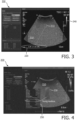
- Fig. 3 shows a graphical user interface 200 of a shear wave elastography system, according to some embodiments.
- the graphical interface 200 can include an ultrasound image 210 of an anatomy, such as a B-mode image. Additionally, the interface 200 can display a visual depiction 220, such as a value, associated with the elasticity of the tissue at a selected location or region 212 on the image 210.
- the visual depiction 220 associated with the elasticity of the anatomy may vary depending on the selected location 212. For example, a physician may identify a feature in the B-mode image 210 that she wishes to inspect. By selecting a location associated with the identified feature, the physician can update the visual depiction 220 to indicate the elasticity of the tissue at the identified feature.
- Fig. 4 shows the graphical user interface 200 of a shear wave elastography system, according to another embodiment.
- the graphical interface 200 can include a map 230 associated with the elasticity of the tissue at a plurality of points in a region of the anatomy.
- the map 230 is a two-dimensional visualization of the elasticity of the imaged anatomy overlaid on the B-mode image 210.
- the map 230 comprises a confidence map and/or a heat map.
- the map 230 may represent elasticity values by various colors or hues. In some embodiments, an elasticity value may correspond to a particular color or hue.
- a relative difference in elasticity may correspond to a particular color or hue.
- a legend 240 on the right side of the interface 200 shows the correlation between the color of a pixel or area of the map 230 and an elasticity value.
- the map 230 may comprise a smaller or larger portion of the image 210.
- the map 230 may comprise substantially all of the image 210 such that the physician can observe the elasticity of the imaged anatomy at all points in the image 210.
- a physician may choose to select only a small portion of the image 210 to overlay with the map 230.
- the interface 200 may also comprise an analytics panel 250 configured to display one or more characteristics of the image 210, system, and/or imaged anatomy.
- the panel 250 can include various numerical values associated with the elasticity of the anatomy, the cross-sectional area of the anatomy associated with the map 230 in the image 210, and statistical calculations associated with the elasticity measurements.
- the embodiments depicted in Figs. 3 and 4 represent elasticity by Young's modulus, measured in kilopascals (kPa).
- kPa kilopascals
- the elasticity of the anatomy may be represented by a detected speed of the shear wave, measured in meters per second.
- the elasticity may be represented by a dimensionless value, such as a proportion.
- elasticity is a useful characteristic in diagnosing various diseases
- some diseases may not be as easily detected by observing elasticity.
- Some diseases may manifest themselves through other properties of the tissue, such as viscosity.
- viscosity For example, in steatosis, the liver accumulates fat in various regions of the liver tissue. The excess fat and other changes in the liver properties may be more readily identified by observing the viscosity of the liver.
- detecting shear waves and determining one or more aspects of the shear waves can also be used to determine the viscosity of the anatomy.
- Fig. 5 is an exemplary illustration of a shear wave ultrasound device 120 of a shear wave imaging system shown inducing a first shear wave 151 and a second shear wave 152 in an anatomy, according to embodiments of the present disclosure.
- the device 120 of Fig. 5 may be similar to the device of Fig. 1 , in some aspects.
- the device 120 of Fig. 5 comprises a vibration source 130.
- the first and second shear waves 151, 152 may be induced, or powered, by the vibration source 130.
- the vibration source 130 may be a separate component of the imaging system, or may be part of the device 120.
- the vibration source 130 comprises a mechanical vibrator or vibrating element.
- the vibration source 130 may comprise an ultrasound transducer that induces shear waves by mechanically vibrating the whole transducer surface.
- the shear waves can be generated by emitting a long push-pulse into the anatomy.
- the ultrasound transducer can be configured to obtain ultrasound imaging data of the anatomy in addition to tracking the propagation of the shear waves.
- the vibration source 130 comprises both a mechanical vibrator and an ultrasound transducer, either of which can be used to accommodate different circumstances. For example, some areas of the anatomy may not be suited to facilitate propagation of a mechanical vibration, in which case the ultrasound transducer can be used to induce a shear wave in the anatomy.
- the processing system 106 is configured to determine, based on imaging data, whether a mechanical vibration or an ultrasonic push-pulse should be used to induce the shear wave.
- the vibration source 130 can be activated by the processing system to induce the first shear wave 151 at a first frequency f1.
- the first shear wave 151 may propagate through an area of the anatomy associated with a field of view 160 of the device 120.
- the field of view 160 can be the area of the anatomy that is imaged by an ultrasound transducer of the device 120.
- the field of view 160 may be imaged and represented by the ultrasound system 100 as a B-mode image.
- the ultrasound system 100 is configured to obtain ultrasound data of the field of view 160 at a high frame rate.
- the frame rate may be sufficiently high to observe the effects of the first shear wave 151 traveling through the field of view 160 in the anatomy.
- the imaging system 100 can determine a first shear wave speed of the first shear wave 151 at a plurality of locations in the field of view 160.
- the imaging system 100 may be configured to detect or determine the displacement of tissue caused by the first shear wave 151 as a function of time at a plurality of tracked positions within the field of view 160 to create a displacement plot for each of the tracked positions.
- the speed of the first shear wave 151 can be obtained by, for example, comparing a plot of the displacement of the anatomy at a first tracked position to a plot of the displacement of the anatomy at a second tracked position.
- a relative distance between the tracked positions is known, and in other embodiments, an absolute distance between the tracked positions is known.
- the imaging system 100 may then compile the first shear wave speed information associated with each of the plurality of locations in the field of view 160 (e.g., each pixel in the associated B-mode image) to generate a first map or plot 162a of the first shear wave speed in the field of view 160.
- the imaging system activates the vibration source 130 to induce a second shear wave 152 in the anatomy at a second frequency f2.
- the second frequency f2 can be different from the first frequency f1.
- the second frequency f2 is shown to be greater than the first frequency f1.
- the second frequency f2 can be less than the first frequency f1.
- the imaging system 100 can obtain high frame rate ultrasound data of the field of view 160 of the anatomy exhibiting the second shear wave 152. Based on the ultrasound data exhibiting the traveling second shear wave 152, the system can determine a second shear wave speed of the second shear wave 152 at a plurality of locations in the field of view 160.
- the plurality of locations associated with the second shear wave 152 may be identical to or associated with the plurality of locations for which data was obtained of the first shear wave 151.
- the system may then compile the shear wave speed information associated with the second shear wave 152 at each of the plurality of locations in the field of view to generate a second map or plot 162b of the second shear wave speed in the field of view 160.
- the first and second maps 162a, 162b may or may not be generated as visual depictions to be output to a display.
- the first and second maps 162a 162b do not comprise visual depictions configured to be output to a display, but comprise data used by the processing system to generate other visual depictions, such as a viscosity map 164.
- the viscosity map 164 can be generated by comparing the first map 162a to the second map 162b.
- the viscosity map 164 can be created by subtracting the first map 162a from the second map 162b, or vice versa.
- the viscosity map 164 is also normalized by the difference of the frequencies f1-f2, or vice versa.
- This relationship can be used to calculate the viscosity of the anatomy for each of a plurality of locations in the field of view 160 (e.g., each pixel in the B-mode image).
- a viscosity map and/or a visual depiction can be generated to indicate the viscosity of the anatomy at each of the plurality of locations.
- Figs. 6 and 7 depict graphs or plots of the displacement of the tissue or anatomy caused by the first shear wave 151 and the second shear wave 152, respectively.
- the first shear wave 151 can be detected by a shear wave ultrasound system by detecting a displacement of tissue at each of a plurality of tracked positions, the displacement at each tracked position shown as a separate plot or curve.
- a separate plot 312, 314, 316 is created for each of tracked position 1, tracked position 2, and tracked position 3.
- the plots 312, 314, 316 are shown as having a wave or oscillating pattern, indicative of the of the first shear wave 151.
- Each of the plots 312, 314, 316 for tracked positions 1, 2, and 3, are spaced from one another, indicating a delay 320a of the first shear wave 151 traveling from tracked position 1, to tracked position 2, to tracked position 3.
- the first wave speed of the first shear wave 151 can be determined by the delay 320a, measured in milliseconds, of the first shear wave 151 traveling from tracked position 2 to tracked position 3, for example.
- the delay 320a may be determined by locating corresponding peaks 324, 326 of a second plot 314 associated with tracked position 2, and a third plot 316 associated with tracked position 3, respectively.
- the known distance between tracked position 3 and tracked position 2 can be divided by the delay 320a between the location of peaks 326 and 324 to determine the first wave speed at the location between tracked position 2 and tracked position 3. This process can be repeated for each of a plurality of locations in the field of view to generate the first map 162a.
- the graph 300 depicts the plots 312, 314, and 316, now showing the displacement of the second shear wave 152 at the second frequency f2.
- the second frequency f2 of the second shear wave 152 represented by the graph 300 in Fig. 7 is greater than the first frequency f1 of the first shear wave 151 represented by the graph 300 in Fig. 6 .
- the plots 312, 314, 316 of Fig. 7 can be compared similarly as discussed above with respect to Fig. 6 .
- a delay 320b can be calculated as the difference of the time position (i.e., time axis of the graph 300) of a third peak 326 and a second peak 324.
- the delay 320b between tracked positions 2 and 3 is greater than the delay 320a between the same tracked positions associated with the first shear wave 151 at the first frequency f1.
- the second shear wave speed associated with the second shear wave 152 is less than the first shear wave speed associated with the first shear wave 151.
- the process of determining a delay (e.g., 320b) for each of a plurality of locations in the field of view 160 where a distance between each of the plurality of locations is known the system can generate the second map 162b showing the second wave speed at each of the plurality of locations on the second map 162b.
- viscosity can be represented as the difference in wave speeds of a first and second shear wave, normalized by a difference in frequency
- other formulas and relationships can also be used to determine viscosity based on one or more characteristics of a traveling shear wave.
- shear wave speed and attenuation can indicate elasticity and viscosity of the medium (e.g., organs, tissue).
- Viscosity ⁇ ( ⁇ ) can be defined as the ratio of loss modulus G l ( ⁇ ) to frequency.
- the viscoelastic properties of the anatomy can be determined.
- these relationships can be used to determine the elasticity and viscosity of the anatomy where only one shear wave is induced, and/or shear waves exhibiting a single frequency are used.
- the above relationships may facilitate a "model-free" approach to determining viscosity.
- one or more material models can be used to determine the elastic modulus and the loss modulus, and therefore the viscoelastic properties of the anatomy.
- Some common models shown in the table below, include the Kelvin-Voigt model, the Maxwell model, and the Zener model: Model G s ( ⁇ ) G l ( ⁇ ) Kelvin-Voigt ⁇ ⁇ Maxwell ⁇ 2 ⁇ 2 ⁇ 2 + ⁇ 2 ⁇ 2 ⁇ 2 ⁇ 2 + ⁇ 2 ⁇ 2 Zener ⁇ 1 ⁇ 2 2 + ⁇ 2 ⁇ 2 ⁇ 1 + ⁇ 2 ⁇ 2 2 + ⁇ 2 ⁇ 2 ⁇ 2 2 2 ⁇ ⁇ 2 2 + ⁇ 2 ⁇ 2 ⁇ 2 where ⁇ is the elastic modulus, ⁇ is the frequency of the shear wave, and ⁇ is the viscosity.
- the above models can be used to translate a known elastic modulus G s and loss modulus G l into an approximation of elasticity and/or viscosity. In some embodiments, these models can be used to determine viscosity by determining the shear wave speed and attenuation of a shear wave at one frequency.
- the present disclosure includes methods, systems, and devices, to determine the viscosity of an anatomy by determining the difference in the speed of a shear wave at more than one frequency, and normalizing the difference in wave speed by the difference in frequency.
- Fig. 8 shows an exemplary embodiment of a graphical user interface 400 configured to indicate a viscosity of an anatomy associated with one or more locations on an ultrasound image 410.
- the interface 400 can include an ultrasound image 410 of an anatomy of a patient, such as the tissue of the patient.
- the image 410 can be a B-mode ultrasound image.
- the interface 400 can further include a viscosity plot 420 and a visual depiction 430.
- the interface 400 of the illustrated embodiment also comprises an analytics panel 450 configured to display one or more characteristics of the image 410, system 100, and/or imaged anatomy.
- the panel 450 can include various numerical values associated with the elasticity and/or viscosity of the anatomy, the cross-sectional area of the anatomy associated with the visual depiction 430 and/or plot, and statistical calculations associated with the viscosity and/or elasticity measurements.
- the plot 420 may depict wave speeds of a plurality of shear waves induced in the anatomy at different frequencies.
- the plot 420 shows the wave speeds for seven shear waves induced at seven different frequencies.
- the individual points on the plot 420 may all be associated with one location on the image 410.
- the location may comprise a point, a line between two points, or an area of the image 410.
- the plot 420 may depict the average shear wave speeds of shear waves traveling through an area 440 demarcated by borders overlaid on the image 410.
- the visual depiction 430 comprises a numerical value of the viscosity at a location on the image 410 in terms of shear wave speed normalized by frequency.
- the visual depiction 430 may include numerical values associated with viscosity, such as poiseuille (PI), or Pascal-seconds.
- the visual depiction 430 may comprise non-numerical indicators, such as plots, graphs, heat maps, or scales. The visual depiction 430 and plot 420 may be useful in analyzing the properties and features of the anatomy, for example, in the diagnosis of steatosis in the liver, or other diseases that affect the viscosity of the patient's organs and tissues.
- Figs. 9 and 10 show configurations of graphical user interfaces 500 displaying various properties of an anatomy.
- the interface 500 depicted in Fig. 9 includes an ultrasound image 510 of an anatomy, and a two-dimensional map 520 of the elasticity of a portion of the anatomy associated with an area of the image 510.
- the map 520 can be a heat map 520, in some instances.
- the heat map can assign and/or display various hues or colors associated with various elasticity values for each location represented in the map 520. For example, in some embodiments, each pixel included in the area of the map 520 is associated with an elasticity value, and a different color or hue is applied based on the elasticity values.
- a scale 540 on the right side of the interface 500 allows the physician to relate the colors in the map 520 to elasticity values.
- the colors of the map 520 are associated with "absolute" elasticity values, such as Young's modulus.
- the colors of the map 520 indicate relative elasticity values and are configured to indicate relative differences of elasticity of the tissue associated with the area of the map 520.
- the colors of the map 520 indicate shear wave speeds at a certain frequency, for example 150 Hz.
- the interface 500 includes a viscosity map 530 overlaid on the image 510 that indicates a viscosity associated with a plurality of locations in the image 510.
- the map 530 may comprise and overlay a similar area of the image 510 overlaid by the map 520 in Fig. 9 .
- the map 530 may comprise a heat map configured to indicate values and/or differences in viscosity across the maps by applying a variety of colors or hues related to variety of viscosity values for each of a plurality of locations in the map 530.
- the scale 540 on the right side of the interface 500 can allow the physician to relate the colors or hues in the map 530 to viscosity values.
- the colors of the map 530 are associated with "absolute" viscosity values, such as meters/second-Hz, or Pascal-seconds. In other embodiments, the colors of the map 530 indicate relative viscosity values of the anatomy associated with the area of the map 530.
- the maps 520 may overlay a larger or smaller portion of the image 510.
- the maps 520, 530 may overlay the entirety of the image 510.
- the maps 520, 530 may overlay a relatively small area of the image 510.
- the interfaces 500 of Figs. 9 and 10 may be combined into a single interface.
- the interfaces 500 may be displayed side-by-side.
- the interfaces 500 are shown in separate windows.
- a user may toggle between the interface 500 of Fig. 9 and the interface 400 of Fig. 10 .
- Fig. 11 is a flow diagram of a method 600 for determining a viscosity of an anatomy, according to some embodiments.
- One or more steps of the method 600 may be performed and/or facilitated by a shear wave ultrasound imaging system, such as the system 100 shown in Fig. 1 .
- the system via the processing system, activates a vibration source to induce a first shear wave in the anatomy at a first frequency.
- the first frequency may be any suitable frequency detectable by the system.
- the frequency ranges from 50 Hz to 400 Hz.
- the frequency may range from 100 Hz to 300 Hz.
- the vibration source can be configured to vibrate at the first frequency for one or more cycles, for example for 2 - 100 cycles.
- the system obtains ultrasound data representative of the anatomy that exhibits the first shear wave.
- the ultrasound data may be ultrasound imaging data obtained by an external ultrasound probe.
- the obtained ultrasound data may be used to compile a B-mode image of the anatomy, in some instances.
- the ultrasound data may be obtained at frame rate sufficiently high for the imaging system to determine a first wave speed of the first shear wave.
- the system via the processing system, activates the vibration source to induce a second shear wave in the anatomy at a second frequency.
- the second frequency may lie in similar ranges as described above, such as 50 Hz to 400 Hz, and vibration source may vibrate at the second frequency for 2-100 cycles, for example, or continuously until the tracking stops, for example in 100 ms.
- the system obtains ultrasound data representative of the anatomy that exhibits the second shear wave.
- the ultrasound data may be ultrasound imaging data obtained by an external ultrasound probe.
- the obtained ultrasound data may be used to compile a B-mode image of the anatomy, in some instances.
- the ultrasound data may be obtained at frame rate sufficiently high for the imaging system to determine a first wave speed of the first shear wave.
- a first wave speed of the first shear wave and a second wave speed of the second shear wave are determined in block 650.
- the first and second wave speeds may be determined in accordance with the method described with respect to Figs. 6 and 7 .
- the ultrasound data may indicate a displacement of the tissue or anatomy at one or more locations in the anatomy over time.
- the tissue displacement at a given location e.g., tracked positions 1, 2, or 3
- the imaging system can determine the first and second wave speeds of the first and second shear waves.
- the wave speeds can be compared and normalized by the difference in the first frequency and second frequency to determine a viscosity, or a property of the anatomy representative of or associated with viscosity.
- the imaging system may obtain ultrasound data of the anatomy exhibiting the first and second shear waves at the same time the first and second shear waves are induced.
- the first and second shear waves may be induced simultaneously.
- the vibration source is configured to emit a broad band vibration where the multiple vibration frequencies are encoded in a long-duration vibration resulting in a shear wave exhibiting a wide range of frequencies, and the imaging system is configured to obtain ultrasound data of the anatomy exhibiting the broad band shear wave.
- the imaging system can identify a first shear wave, or a first component of the broadband shear wave, propagating at a first frequency (or first range of frequencies), and a second shear wave, or a second component of the broadband shear wave, propagating at a second frequency (or range of frequencies).
- the wave speeds of the first and second shear waves can be compared to determine the viscosity of the anatomy.
- Fig. 12 is an exemplary illustration of a shear wave ultrasound device 120 shown inducing a first shear wave 151, a second shear wave 152, and a third shear wave 153 in an anatomy, according to embodiments of the present disclosure.
- the device 120 may be similar or identical to the device 120 shown in Fig. 5 .
- the device 120 further induces the third shear wave 153 at a third frequency f3, in addition to the first and second shear waves 151, 152.
- the first, second, and third shear waves 151, 152, 153 may be induced by a single vibration source 130, or each of the first, second, and third shear waves 151, 152, 153, may be induced by separate vibrations sources.
- the first, second, and third shear waves 151, 152, 153 may be induced at separate times, or one or more of the first, second, and third shear waves 151, 152, 153 can be induced at the same time.
- the first, second, and third shear waves 151, 152, 153 are induced sequentially by the same vibration source 130.
- the second frequency f2 is greater than the first frequency f1
- the third frequency f3 is greater than the second frequency f2.
- any suitable order or arrangement of frequencies f1, f2, f3 are contemplated by the present disclosure, including ascending or descending frequencies.
- the imaging system of Fig. 12 is further configured to detect the third shear wave 153, in addition to the first and second shear waves 151, 152, and to determine a third wave speed of the third shear wave 153.
- the imaging system can obtain ultrasound data representative of the anatomy exhibiting the third shear wave 153 in a field of view 160. By determining the third wave speed at a plurality of locations in the field of view 160, the imaging system can be configured to compile or generate a third wave speed map 162c.
- the third wave speed map 162c can be compared to the first and/or second wave speed maps 162a, 162b and normalized by the frequency difference to determine the viscosity of the tissue.
- the system may improve one or more aspects of determining the viscosity of the anatomy, such as an improvement in signal-to-noise ratio (SNR) and/or more accuracy in individual viscosity measurements.
- SNR signal-to-noise ratio
- Fig. 13 shows a shear wave ultrasound device 120 of a shear wave imaging system inducing a first shear wave 151 and a second shear wave 152, according to some embodiments of the present disclosure.
- the device 120 includes a first vibration source 131 and a second vibration source 132.
- the device 120 can also be described as including a single vibration source comprising a first vibrator 131 and a second vibrator 132.
- the device 120 is shown inducing the first shear wave 151 at a first frequency f1 via the first vibrator, or vibration source 131, and inducing the second shear wave 152 at a second frequency f2 via the second vibrator, or vibration source 132.
- the device is configured to induce the first and second shear waves simultaneously via the first and second vibrators 131, 132.
- the system can reduce acquisition time for each viscosity map.
- the system is configured to obtain ultrasonic data representative of the anatomy exhibiting the first and second shear waves 151, 152 in the field of view 160. If the first and second shear wave are simultaneously propagating, or traveling through the field of view 160, the imaging system can be configured to apply a directional filter to the obtained ultrasonic data in order to detect the first shear wave and the second shear wave.
- the system can determine a first wave speed and a second wave speed associated with the first and second shear waves for a plurality of locations within the field of view.
- the system can then generate a first wave speed map and a second wave speed map representative of the first and second wave speeds of the first and second shear waves at each location in the field of view 160 (e.g., each pixel in the field of view).
- the first and second maps can be compared by, for example, subtracting the wave speeds of the second map from the wave speeds of the first map, and normalizing each wave speed by the difference of the first frequency and the second frequency.
- both vibrators 131, 132 can be configured to induce the first shear wave at the first frequency at a first time, and to induce the second shear wave at the second frequency at a second time.
- Such a configuration may improve SNR, and may at least partially resolve biased attenuation of the shear wave traveling across the field of view 160.
- a shear wave induced by the first vibrator 131 may experience increased attenuation at the bottom right corner of the field of view as compared with the bottom left corner.
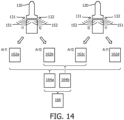
- Fig. 14 depicts the shear wave ultrasound device 120 of Fig. 13 , according to another embodiment of the present disclosure.
- the ultrasound device including the first and second vibrator 131, 132, can be configured to induce a first and second shear wave, respectively, at a first time.
- the device 120 can then alternate the vibrators 131, 132 at a second time, such that the first vibrator 131 induces the second shear wave 152 at the second frequency f2, and the second vibrator 132 induces the first shear wave 151 at the first frequency f1.
- the first vibrator 131 is said to induce the first shear wave 151 at the first time, and the second shear wave 152 at the second time
- the first shear wave 151 induced by the second vibrator 132 at the second time can alternatively be referred to as a third shear wave.
- the second shear wave 152 induced by the first vibrator 131 at the second time can be referred to as a fourth shear wave.
- Fig. 14 proposes another solution, which includes alternating the vibrators 131, 132 to induce shear waves at the first and second frequencies f1, f2 at different times. Such a configuration may also improve SNR and compensate for biased attenuation of signals.
- the system obtains ultrasound data, and applies a directional filter to individually detect the first and second shear waves 151, 152.
- the ultrasound data is used to generate a first wave speed map 162a and a second wave speed map 162b.
- the system obtains additional ultrasound data and applies a directional filter to individually detect the first and second shear waves 151, 152 (or fourth and third shear waves, respectively).
- the ultrasound data obtained at the second time is used to generate a third wave speed map 162c and a fourth wave speed map 162d.
- the first and fourth wave speed maps 162a, 162d associated with the first frequency f1 can then be combined by, e.g., averaging the individual values of the first and fourth wave speed maps 162a, 162d to create a first combined wave speed map 164a for frequency f1.
- the second and third wave speed maps 162b, 162c are also combined to produce a second combined wave speed map 164b associated with the second frequency f2.
- the first and second combined wave speed maps 164a, 164b, having better SNR compared to individual speed maps 162a-162d at two different frequencies f1 and f2 can then be used to create a viscosity map 166 as described previously.
Landscapes
- Health & Medical Sciences (AREA)
- Life Sciences & Earth Sciences (AREA)
- Engineering & Computer Science (AREA)
- Public Health (AREA)
- Medical Informatics (AREA)
- Biomedical Technology (AREA)
- General Health & Medical Sciences (AREA)
- Pathology (AREA)
- Surgery (AREA)
- Biophysics (AREA)
- Radiology & Medical Imaging (AREA)
- Molecular Biology (AREA)
- Physics & Mathematics (AREA)
- Animal Behavior & Ethology (AREA)
- Nuclear Medicine, Radiotherapy & Molecular Imaging (AREA)
- Heart & Thoracic Surgery (AREA)
- Veterinary Medicine (AREA)
- Computer Vision & Pattern Recognition (AREA)
- Physiology (AREA)
- Data Mining & Analysis (AREA)
- Databases & Information Systems (AREA)
- Epidemiology (AREA)
- Primary Health Care (AREA)
- Ultra Sonic Daignosis Equipment (AREA)
Claims (9)
- Système (100) pour déterminer une viscosité d'une anatomie, comprenant:un transducteur à ultrasons (120);une source de vibrations (130); etun système de traitement (106) en communication avec le transducteur à ultrasons et la source de vibrations, le système de traitement étant configuré pour:activer la source de vibrations (130) pour émettre une vibration à large bande comprenant une première fréquence et une deuxième fréquence et induire ainsi une première onde de cisaillement dans l'anatomie à la première fréquence et une deuxième onde de cisaillement dans l'anatomie à la deuxième fréquence simultanément, avec la première fréquence qui est différente de la deuxième fréquence;activer le transducteur à ultrasons (120) pour obtenir des données ultrasonores représentatives de l'anatomie qui présentent la première onde de cisaillement et la deuxième onde de cisaillement;appliquer un filtre passe-bande aux données ultrasonores, pour identifier la première onde de cisaillement se propageant à une première fréquence et la deuxième onde de cisaillement se propageant à une deuxième fréquence;déterminer une première vitesse d'onde de la première onde de cisaillement dans l'anatomie et une deuxième vitesse d'onde de la deuxième onde de cisaillement dans l'anatomie;
etdéterminer la viscosité de l'anatomie en comparant la première vitesse d'onde et la deuxième vitesse d'onde. - Système selon la revendication 1, dans lequel le système de traitement (106) est configuré pour appliquer un filtre directionnel aux données ultrasonores obtenues.
- Système selon la revendication 1, comprenant en outre un affichage utilisateur (108) en communication avec le système de traitement, dans lequel le système de traitement est configuré pour:déterminer une viscosité de l'anatomie en une pluralité de points dans un champ de vision de l'anatomie;générer, par le système de traitement, une représentation visuelle associée à la viscosité de l'anatomie à chacun de la pluralité de points dans le champ de vision; etafficher la représentation visuelle sur l'affichage utilisateur.
- Système selon la revendication 3, dans lequel le système de traitement (106) est configuré pour:activer le transducteur à ultrasons pour obtenir des données d'imagerie ultrasonore de l'anatomie;générer une image ultrasonore de l'anatomie sur la base des données d'imagerie ultrasonore obtenues; etafficher, sur l'affichage utilisateur, la représentation visuelle superposée sur l'image ultrasonore.
- Système selon la revendication 4, dans lequel la représentation visuelle comprend au moins l'un entre un diagramme associé aux première et deuxième vitesses d'onde ou une carte représentative de la viscosité dans le champ de vision.
- Système selon la revendication 1, dans lequel le système de traitement est configuré pour:activer la source de vibrations pour induire une troisième onde de cisaillement à une troisième fréquence;déterminer une troisième vitesse d'onde de la troisième onde de cisaillement; etdéterminer la viscosité de l'anatomie en comparant la première vitesse d'onde, la deuxième vitesse d'onde, et la troisième vitesse d'onde.
- Procédé de détermination d'une viscosité d'une anatomie, consistant à:induire, par une source de vibration, une vibration à large bande comprenant une première fréquence et une deuxième fréquence et induire ainsi une première onde de cisaillement dans l'anatomie à la première fréquence et une deuxième onde de cisaillement dans l'anatomie à la deuxième fréquence simultanément, avec la première fréquence qui est différente de la deuxième fréquence;obtenir, par un transducteur à ultrasons, des données ultrasonores représentatives de l'anatomie qui présentent la première onde de cisaillement et la deuxième onde de cisaillement;appliquer un filtre passe-bande aux données ultrasonores et ainsi identifier par un système de traitement en communication avec la source de vibration et le transducteur à ultrasons, la première onde de cisaillement se propageant à une première fréquence et une deuxième onde de cisaillement se propageant à une deuxième fréquence;déterminer, par le système de traitement, une première vitesse d'onde de la première onde de cisaillement dans l'anatomie et une deuxième vitesse d'onde de la deuxième onde de cisaillement dans l'anatomie; etdéterminer, par le système de traitement, la viscosité de l'anatomie en comparant la première vitesse d'onde et la deuxième vitesse d'onde.
- Procédé selon la revendication 7, consistant en outre à:déterminer, par le système de traitement, une viscosité de l'anatomie en une pluralité de points dans un champ de vision de l'anatomie; etgénérer, par le système de traitement, une représentation visuelle associée à la viscosité de l'anatomie à chacun de la pluralité de points dans le champ de vision.
- Procédé selon la revendication 8, consistant en outre à:obtenir, par le transducteur à ultrasons, des données d'imagerie ultrasonore de l'anatomie;générer, par le système de traitement, une image ultrasonore de l'anatomie sur la base des données d'imagerie ultrasonore obtenues; etafficher, par le système de traitement sur un afficheur utilisateur, la représentation visuelle superposée sur l'image ultrasonore.
Applications Claiming Priority (2)
| Application Number | Priority Date | Filing Date | Title |
|---|---|---|---|
| US201862690429P | 2018-06-27 | 2018-06-27 | |
| PCT/EP2019/067031 WO2020002445A1 (fr) | 2018-06-27 | 2019-06-26 | Détection par onde de cisaillement de viscosité anatomique et dispositifs, systèmes et procédés associés |
Publications (2)
| Publication Number | Publication Date |
|---|---|
| EP3813675A1 EP3813675A1 (fr) | 2021-05-05 |
| EP3813675B1 true EP3813675B1 (fr) | 2023-10-25 |
Family
ID=67070864
Family Applications (1)
| Application Number | Title | Priority Date | Filing Date |
|---|---|---|---|
| EP19733778.5A Active EP3813675B1 (fr) | 2018-06-27 | 2019-06-26 | Détection par onde de cisaillement de viscosité anatomique et dispositifs, systèmes et procédés associés |
Country Status (5)
| Country | Link |
|---|---|
| US (1) | US12023200B2 (fr) |
| EP (1) | EP3813675B1 (fr) |
| JP (1) | JP7284769B2 (fr) |
| CN (1) | CN112638275B (fr) |
| WO (1) | WO2020002445A1 (fr) |
Families Citing this family (7)
| Publication number | Priority date | Publication date | Assignee | Title |
|---|---|---|---|---|
| CN112438751B (zh) * | 2019-09-04 | 2024-11-08 | 通用电气精准医疗有限责任公司 | 用于剪切波弹性成像的方法和系统以及存储有对应程序的介质 |
| KR102830355B1 (ko) * | 2020-01-17 | 2025-07-04 | 삼성메디슨 주식회사 | 초음파 진단 장치 및 그 동작방법 |
| CN119745425A (zh) * | 2020-04-24 | 2025-04-04 | 深圳迈瑞生物医疗电子股份有限公司 | 粘弹性测量方法和超声测量系统 |
| WO2021226955A1 (fr) * | 2020-05-14 | 2021-11-18 | 深圳迈瑞生物医疗电子股份有限公司 | Procédé de mesure d'élasticité transitoire, procédé de mesure de paramètre d'atténuation acoustique, et système d'imagerie ultrasonore |
| JP2022115506A (ja) * | 2021-01-28 | 2022-08-09 | ジーイー・プレシジョン・ヘルスケア・エルエルシー | 超音波診断装置、超音波診断システム及び超音波診断装置の制御プログラム |
| JP7077433B1 (ja) * | 2021-02-10 | 2022-05-30 | ジーイー・プレシジョン・ヘルスケア・エルエルシー | 超音波診断装置、超音波診断システム及び超音波診断装置の制御プログラム |
| CN115486872B (zh) * | 2022-10-15 | 2026-01-16 | 深圳市影越医疗科技有限公司 | 一种弹性成像组件、超声检测仪、超声检测系统及方法 |
Family Cites Families (27)
| Publication number | Priority date | Publication date | Assignee | Title |
|---|---|---|---|---|
| JPH0614932B2 (ja) * | 1989-05-29 | 1994-03-02 | 株式会社東芝 | 超音波診断装置 |
| CN1222772C (zh) | 1995-10-04 | 2005-10-12 | 日光超声波技术有限公司 | 确定骨特征的超声装置 |
| IL116701A0 (en) * | 1995-10-04 | 1996-10-16 | Sunlight Ultrasound Technologi | Ultrasonic device for determining bone characteristics |
| WO2009140607A1 (fr) * | 2008-05-15 | 2009-11-19 | Mayo Foundation For Medical Education And Research | Production et détection de vibration grâce à un vibromètre aux ultrasons à dispersion d'onde de cisaillement ayant de grands mouvements d'arrière-plan |
| CN1383374A (zh) | 2000-04-26 | 2002-12-04 | 皇家菲利浦电子有限公司 | 用于切变波参数估算的超声波方法和系统 |
| US7753847B2 (en) * | 2003-10-03 | 2010-07-13 | Mayo Foundation For Medical Education And Research | Ultrasound vibrometry |
| FR2902308B1 (fr) | 2006-06-15 | 2009-03-06 | Echosens Sa | Procede de mesure de proprietes viscoelastiques de tissus biologiques mettant en oeuvre un transducteur ultrasonore |
| CN102123666B (zh) | 2008-08-15 | 2013-09-25 | 皇家飞利浦电子股份有限公司 | 用于采集材料的声弹性成像数据和超声数据的换能器装置和方法 |
| US10368843B2 (en) * | 2009-11-25 | 2019-08-06 | Koninklijke Philips N.V. | Ultrasonic shear wave imaging with focused scanline beamforming |
| EP2561380B1 (fr) * | 2010-04-20 | 2014-02-26 | Super Sonic Imagine | Procédé et appareil d'imagerie utilisant des ondes de cisaillement |
| EP2940487B1 (fr) * | 2011-10-19 | 2016-07-20 | Verasonics, Inc. | Estimation et affichage pour imagerie doppler vectoriel utilisant des émissions d'ondes planes |
| CN103800038B (zh) * | 2012-11-12 | 2016-09-21 | 通用电气公司 | 改善的系统和装置以用于确定目标组织的机械特性 |
| PT2959312T (pt) | 2013-02-19 | 2018-03-13 | Echosens | Método de elastografia multi-impulsos |
| CN105392428B (zh) * | 2013-06-26 | 2019-06-04 | 皇家飞利浦有限公司 | 用于映射超声剪切波弹性成像测量的系统和方法 |
| US10512450B2 (en) | 2013-09-24 | 2019-12-24 | Siemens Medical Solutions Usa, Inc. | Shear wave estimation from analytic data |
| US20150272547A1 (en) | 2014-03-31 | 2015-10-01 | Siemens Medical Solutions Usa, Inc. | Acquisition control for elasticity ultrasound imaging |
| JP6006769B2 (ja) * | 2014-10-16 | 2016-10-12 | 株式会社日立製作所 | 超音波診断装置 |
| JP2017533031A (ja) | 2014-10-29 | 2017-11-09 | メイヨ フォンデーシヨン フォー メディカル エジュケーション アンド リサーチ | 超音波トランスデューサの連続振動による超音波エラストグラフィのための方法 |
| CN106999162B (zh) | 2014-12-08 | 2020-05-19 | 株式会社日立制作所 | 超声波诊断装置以及弹性评价方法 |
| CN107405133B (zh) | 2014-12-24 | 2021-06-08 | 声科影像有限公司 | 适用于各向异性介质成像的剪切波弹性成像方法及装置 |
| CN105147327B (zh) * | 2015-06-12 | 2018-03-09 | 深圳大学 | 一种多频率剪切波的产生方法 |
| US10631775B2 (en) * | 2015-08-28 | 2020-04-28 | Wisconsin Alumni Research Foundation | Apparatus for dynamic stress measurement |
| US10206651B2 (en) * | 2015-09-30 | 2019-02-19 | General Electric Company | Methods and systems for measuring cardiac output |
| JP6987496B2 (ja) | 2015-12-04 | 2022-01-05 | キヤノンメディカルシステムズ株式会社 | 解析装置 |
| JP6734079B2 (ja) * | 2016-03-11 | 2020-08-05 | キヤノンメディカルシステムズ株式会社 | 医用診断装置、および医用解析プログラム |
| JP7133480B2 (ja) * | 2016-06-30 | 2022-09-08 | ザ・ユニバーシティ・オブ・ブリティッシュ・コロンビア | 腹部の超音波せん断波振動エラストグラフィ |
| US20180098752A1 (en) * | 2016-10-06 | 2018-04-12 | Duke University | Systems and methods for determining viscoelastic properties in soft tissue using ultrasound |
-
2019
- 2019-06-26 JP JP2020570688A patent/JP7284769B2/ja active Active
- 2019-06-26 US US17/252,093 patent/US12023200B2/en active Active
- 2019-06-26 EP EP19733778.5A patent/EP3813675B1/fr active Active
- 2019-06-26 WO PCT/EP2019/067031 patent/WO2020002445A1/fr not_active Ceased
- 2019-06-26 CN CN201980056108.3A patent/CN112638275B/zh active Active
Also Published As
| Publication number | Publication date |
|---|---|
| JP2021528157A (ja) | 2021-10-21 |
| US12023200B2 (en) | 2024-07-02 |
| CN112638275A (zh) | 2021-04-09 |
| US20210251607A1 (en) | 2021-08-19 |
| CN112638275B (zh) | 2024-09-24 |
| JP7284769B2 (ja) | 2023-05-31 |
| WO2020002445A1 (fr) | 2020-01-02 |
| EP3813675A1 (fr) | 2021-05-05 |
Similar Documents
| Publication | Publication Date | Title |
|---|---|---|
| US12023200B2 (en) | Shear wave detection of anatomical viscosity and associated devices, systems, and methods | |
| US6511427B1 (en) | System and method for assessing body-tissue properties using a medical ultrasound transducer probe with a body-tissue parameter measurement mechanism | |
| US5836894A (en) | Apparatus for measuring mechanical parameters of the prostate and for imaging the prostate using such parameters | |
| EP0500801B1 (fr) | Procede et appareil de mesure et de mise en images de la compressibilite ou elasticite de tissus | |
| US5922018A (en) | Method for using a transrectal probe to mechanically image the prostate gland | |
| US6221019B1 (en) | Ultrasonic device for determining bone characteristics | |
| JP5334413B2 (ja) | 超音波診断装置 | |
| EP0955890B1 (fr) | Dispositif d'imagerie de la prostate | |
| US10835202B2 (en) | System and method for analyzing tissue using shear waves | |
| EP3240484B1 (fr) | Procédé pour la quantification de l'élasticité d'un matériau par ultrasons | |
| CN106232013B (zh) | 用于表征弱的各向异性软介质的超声波方法和设备、以及用于该表征设备的超声探头组件 | |
| EP3890615B1 (fr) | Système de cathéter endobronchique de diagnostic rapide de maladie pulmonaire | |
| US20050240101A1 (en) | Ultrasonograph and method for controlling ultrasonograph | |
| US11490876B2 (en) | Ultrasonic diagnostic device and method for evaluating physical properties of biological tissue | |
| JP6767575B2 (ja) | 超音波トランスデューサ・タイル位置合わせ | |
| US6086538A (en) | Methods and apparatus for evaluation of bone condition | |
| KR20180070990A (ko) | 초음파 영상장치 및 그 제어방법 | |
| JP4711775B2 (ja) | 超音波診断装置 | |
| US20090030324A1 (en) | Ultrasonic diagnostic apparatus and method for controlling the same | |
| WO2008029728A1 (fr) | Échographe | |
| JP2003230560A (ja) | 超音波画像診断装置 | |
| KR101027600B1 (ko) | 초음파 진단기기 및 그 제어 방법 | |
| US10383597B2 (en) | Yukov tissue characterization method and apparatus | |
| WO2019088169A1 (fr) | Système de diagnostic ultrasonore et procédé de diagnostic ultrasonore | |
| JP2005074077A (ja) | 超音波診断装置 |
Legal Events
| Date | Code | Title | Description |
|---|---|---|---|
| STAA | Information on the status of an ep patent application or granted ep patent |
Free format text: STATUS: UNKNOWN |
|
| STAA | Information on the status of an ep patent application or granted ep patent |
Free format text: STATUS: THE INTERNATIONAL PUBLICATION HAS BEEN MADE |
|
| PUAI | Public reference made under article 153(3) epc to a published international application that has entered the european phase |
Free format text: ORIGINAL CODE: 0009012 |
|
| STAA | Information on the status of an ep patent application or granted ep patent |
Free format text: STATUS: REQUEST FOR EXAMINATION WAS MADE |
|
| 17P | Request for examination filed |
Effective date: 20210127 |
|
| AK | Designated contracting states |
Kind code of ref document: A1 Designated state(s): AL AT BE BG CH CY CZ DE DK EE ES FI FR GB GR HR HU IE IS IT LI LT LU LV MC MK MT NL NO PL PT RO RS SE SI SK SM TR |
|
| DAV | Request for validation of the european patent (deleted) | ||
| DAX | Request for extension of the european patent (deleted) | ||
| REG | Reference to a national code |
Ref country code: DE Ref country code: DE Ref legal event code: R079 Ref document number: 602019040048 Country of ref document: DE Free format text: PREVIOUS MAIN CLASS: A61B0008080000 Ipc: A61B0008000000 |
|
| GRAP | Despatch of communication of intention to grant a patent |
Free format text: ORIGINAL CODE: EPIDOSNIGR1 |
|
| STAA | Information on the status of an ep patent application or granted ep patent |
Free format text: STATUS: GRANT OF PATENT IS INTENDED |
|
| RIC1 | Information provided on ipc code assigned before grant |
Ipc: G16H 50/30 20180101ALI20230429BHEP Ipc: A61B 8/08 20060101ALI20230429BHEP Ipc: A61B 8/00 20060101AFI20230429BHEP |
|
| INTG | Intention to grant announced |
Effective date: 20230519 |
|
| GRAS | Grant fee paid |
Free format text: ORIGINAL CODE: EPIDOSNIGR3 |
|
| GRAA | (expected) grant |
Free format text: ORIGINAL CODE: 0009210 |
|
| STAA | Information on the status of an ep patent application or granted ep patent |
Free format text: STATUS: THE PATENT HAS BEEN GRANTED |
|
| AK | Designated contracting states |
Kind code of ref document: B1 Designated state(s): AL AT BE BG CH CY CZ DE DK EE ES FI FR GB GR HR HU IE IS IT LI LT LU LV MC MK MT NL NO PL PT RO RS SE SI SK SM TR |
|
| REG | Reference to a national code |
Ref country code: GB Ref legal event code: FG4D |
|
| REG | Reference to a national code |
Ref country code: CH Ref legal event code: EP |
|
| REG | Reference to a national code |
Ref country code: DE Ref legal event code: R096 Ref document number: 602019040048 Country of ref document: DE |
|
| REG | Reference to a national code |
Ref country code: IE Ref legal event code: FG4D |
|
| REG | Reference to a national code |
Ref country code: DE Ref legal event code: R084 Ref document number: 602019040048 Country of ref document: DE |
|
| REG | Reference to a national code |
Ref country code: LT Ref legal event code: MG9D |
|
| REG | Reference to a national code |
Ref country code: NL Ref legal event code: MP Effective date: 20231025 |
|
| REG | Reference to a national code |
Ref country code: AT Ref legal event code: MK05 Ref document number: 1623833 Country of ref document: AT Kind code of ref document: T Effective date: 20231025 |
|
| PG25 | Lapsed in a contracting state [announced via postgrant information from national office to epo] |
Ref country code: NL Free format text: LAPSE BECAUSE OF FAILURE TO SUBMIT A TRANSLATION OF THE DESCRIPTION OR TO PAY THE FEE WITHIN THE PRESCRIBED TIME-LIMIT Effective date: 20231025 |
|
| PG25 | Lapsed in a contracting state [announced via postgrant information from national office to epo] |
Ref country code: GR Free format text: LAPSE BECAUSE OF FAILURE TO SUBMIT A TRANSLATION OF THE DESCRIPTION OR TO PAY THE FEE WITHIN THE PRESCRIBED TIME-LIMIT Effective date: 20240126 |
|
| PG25 | Lapsed in a contracting state [announced via postgrant information from national office to epo] |
Ref country code: IS Free format text: LAPSE BECAUSE OF FAILURE TO SUBMIT A TRANSLATION OF THE DESCRIPTION OR TO PAY THE FEE WITHIN THE PRESCRIBED TIME-LIMIT Effective date: 20240225 |
|
| REG | Reference to a national code |
Ref country code: GB Ref legal event code: 746 Effective date: 20240314 |
|
| PG25 | Lapsed in a contracting state [announced via postgrant information from national office to epo] |
Ref country code: LT Free format text: LAPSE BECAUSE OF FAILURE TO SUBMIT A TRANSLATION OF THE DESCRIPTION OR TO PAY THE FEE WITHIN THE PRESCRIBED TIME-LIMIT Effective date: 20231025 |
|
| PG25 | Lapsed in a contracting state [announced via postgrant information from national office to epo] |
Ref country code: AT Free format text: LAPSE BECAUSE OF FAILURE TO SUBMIT A TRANSLATION OF THE DESCRIPTION OR TO PAY THE FEE WITHIN THE PRESCRIBED TIME-LIMIT Effective date: 20231025 |
|
| PG25 | Lapsed in a contracting state [announced via postgrant information from national office to epo] |
Ref country code: ES Free format text: LAPSE BECAUSE OF FAILURE TO SUBMIT A TRANSLATION OF THE DESCRIPTION OR TO PAY THE FEE WITHIN THE PRESCRIBED TIME-LIMIT Effective date: 20231025 |
|
| PG25 | Lapsed in a contracting state [announced via postgrant information from national office to epo] |
Ref country code: LT Free format text: LAPSE BECAUSE OF FAILURE TO SUBMIT A TRANSLATION OF THE DESCRIPTION OR TO PAY THE FEE WITHIN THE PRESCRIBED TIME-LIMIT Effective date: 20231025 Ref country code: IS Free format text: LAPSE BECAUSE OF FAILURE TO SUBMIT A TRANSLATION OF THE DESCRIPTION OR TO PAY THE FEE WITHIN THE PRESCRIBED TIME-LIMIT Effective date: 20240225 Ref country code: GR Free format text: LAPSE BECAUSE OF FAILURE TO SUBMIT A TRANSLATION OF THE DESCRIPTION OR TO PAY THE FEE WITHIN THE PRESCRIBED TIME-LIMIT Effective date: 20240126 Ref country code: ES Free format text: LAPSE BECAUSE OF FAILURE TO SUBMIT A TRANSLATION OF THE DESCRIPTION OR TO PAY THE FEE WITHIN THE PRESCRIBED TIME-LIMIT Effective date: 20231025 Ref country code: BG Free format text: LAPSE BECAUSE OF FAILURE TO SUBMIT A TRANSLATION OF THE DESCRIPTION OR TO PAY THE FEE WITHIN THE PRESCRIBED TIME-LIMIT Effective date: 20240125 Ref country code: AT Free format text: LAPSE BECAUSE OF FAILURE TO SUBMIT A TRANSLATION OF THE DESCRIPTION OR TO PAY THE FEE WITHIN THE PRESCRIBED TIME-LIMIT Effective date: 20231025 Ref country code: PT Free format text: LAPSE BECAUSE OF FAILURE TO SUBMIT A TRANSLATION OF THE DESCRIPTION OR TO PAY THE FEE WITHIN THE PRESCRIBED TIME-LIMIT Effective date: 20240226 |
|
| PG25 | Lapsed in a contracting state [announced via postgrant information from national office to epo] |
Ref country code: SE Free format text: LAPSE BECAUSE OF FAILURE TO SUBMIT A TRANSLATION OF THE DESCRIPTION OR TO PAY THE FEE WITHIN THE PRESCRIBED TIME-LIMIT Effective date: 20231025 Ref country code: RS Free format text: LAPSE BECAUSE OF FAILURE TO SUBMIT A TRANSLATION OF THE DESCRIPTION OR TO PAY THE FEE WITHIN THE PRESCRIBED TIME-LIMIT Effective date: 20231025 Ref country code: PL Free format text: LAPSE BECAUSE OF FAILURE TO SUBMIT A TRANSLATION OF THE DESCRIPTION OR TO PAY THE FEE WITHIN THE PRESCRIBED TIME-LIMIT Effective date: 20231025 Ref country code: NO Free format text: LAPSE BECAUSE OF FAILURE TO SUBMIT A TRANSLATION OF THE DESCRIPTION OR TO PAY THE FEE WITHIN THE PRESCRIBED TIME-LIMIT Effective date: 20240125 Ref country code: LV Free format text: LAPSE BECAUSE OF FAILURE TO SUBMIT A TRANSLATION OF THE DESCRIPTION OR TO PAY THE FEE WITHIN THE PRESCRIBED TIME-LIMIT Effective date: 20231025 Ref country code: HR Free format text: LAPSE BECAUSE OF FAILURE TO SUBMIT A TRANSLATION OF THE DESCRIPTION OR TO PAY THE FEE WITHIN THE PRESCRIBED TIME-LIMIT Effective date: 20231025 |
|
| PG25 | Lapsed in a contracting state [announced via postgrant information from national office to epo] |
Ref country code: DK Free format text: LAPSE BECAUSE OF FAILURE TO SUBMIT A TRANSLATION OF THE DESCRIPTION OR TO PAY THE FEE WITHIN THE PRESCRIBED TIME-LIMIT Effective date: 20231025 |
|
| PG25 | Lapsed in a contracting state [announced via postgrant information from national office to epo] |
Ref country code: CZ Free format text: LAPSE BECAUSE OF FAILURE TO SUBMIT A TRANSLATION OF THE DESCRIPTION OR TO PAY THE FEE WITHIN THE PRESCRIBED TIME-LIMIT Effective date: 20231025 |
|
| REG | Reference to a national code |
Ref country code: DE Ref legal event code: R097 Ref document number: 602019040048 Country of ref document: DE |
|
| PG25 | Lapsed in a contracting state [announced via postgrant information from national office to epo] |
Ref country code: SK Free format text: LAPSE BECAUSE OF FAILURE TO SUBMIT A TRANSLATION OF THE DESCRIPTION OR TO PAY THE FEE WITHIN THE PRESCRIBED TIME-LIMIT Effective date: 20231025 |
|
| PG25 | Lapsed in a contracting state [announced via postgrant information from national office to epo] |
Ref country code: SM Free format text: LAPSE BECAUSE OF FAILURE TO SUBMIT A TRANSLATION OF THE DESCRIPTION OR TO PAY THE FEE WITHIN THE PRESCRIBED TIME-LIMIT Effective date: 20231025 Ref country code: SK Free format text: LAPSE BECAUSE OF FAILURE TO SUBMIT A TRANSLATION OF THE DESCRIPTION OR TO PAY THE FEE WITHIN THE PRESCRIBED TIME-LIMIT Effective date: 20231025 Ref country code: RO Free format text: LAPSE BECAUSE OF FAILURE TO SUBMIT A TRANSLATION OF THE DESCRIPTION OR TO PAY THE FEE WITHIN THE PRESCRIBED TIME-LIMIT Effective date: 20231025 Ref country code: IT Free format text: LAPSE BECAUSE OF FAILURE TO SUBMIT A TRANSLATION OF THE DESCRIPTION OR TO PAY THE FEE WITHIN THE PRESCRIBED TIME-LIMIT Effective date: 20231025 Ref country code: EE Free format text: LAPSE BECAUSE OF FAILURE TO SUBMIT A TRANSLATION OF THE DESCRIPTION OR TO PAY THE FEE WITHIN THE PRESCRIBED TIME-LIMIT Effective date: 20231025 Ref country code: DK Free format text: LAPSE BECAUSE OF FAILURE TO SUBMIT A TRANSLATION OF THE DESCRIPTION OR TO PAY THE FEE WITHIN THE PRESCRIBED TIME-LIMIT Effective date: 20231025 Ref country code: CZ Free format text: LAPSE BECAUSE OF FAILURE TO SUBMIT A TRANSLATION OF THE DESCRIPTION OR TO PAY THE FEE WITHIN THE PRESCRIBED TIME-LIMIT Effective date: 20231025 |
|
| PLBE | No opposition filed within time limit |
Free format text: ORIGINAL CODE: 0009261 |
|
| STAA | Information on the status of an ep patent application or granted ep patent |
Free format text: STATUS: NO OPPOSITION FILED WITHIN TIME LIMIT |
|
| 26N | No opposition filed |
Effective date: 20240726 |
|
| PG25 | Lapsed in a contracting state [announced via postgrant information from national office to epo] |
Ref country code: SI Free format text: LAPSE BECAUSE OF FAILURE TO SUBMIT A TRANSLATION OF THE DESCRIPTION OR TO PAY THE FEE WITHIN THE PRESCRIBED TIME-LIMIT Effective date: 20231025 |
|
| PG25 | Lapsed in a contracting state [announced via postgrant information from national office to epo] |
Ref country code: SI Free format text: LAPSE BECAUSE OF FAILURE TO SUBMIT A TRANSLATION OF THE DESCRIPTION OR TO PAY THE FEE WITHIN THE PRESCRIBED TIME-LIMIT Effective date: 20231025 |
|
| PG25 | Lapsed in a contracting state [announced via postgrant information from national office to epo] |
Ref country code: MC Free format text: LAPSE BECAUSE OF FAILURE TO SUBMIT A TRANSLATION OF THE DESCRIPTION OR TO PAY THE FEE WITHIN THE PRESCRIBED TIME-LIMIT Effective date: 20231025 |
|
| REG | Reference to a national code |
Ref country code: CH Ref legal event code: PL |
|
| PG25 | Lapsed in a contracting state [announced via postgrant information from national office to epo] |
Ref country code: LU Free format text: LAPSE BECAUSE OF NON-PAYMENT OF DUE FEES Effective date: 20240626 |
|
| PG25 | Lapsed in a contracting state [announced via postgrant information from national office to epo] |
Ref country code: IE Free format text: LAPSE BECAUSE OF NON-PAYMENT OF DUE FEES Effective date: 20240626 |
|
| PG25 | Lapsed in a contracting state [announced via postgrant information from national office to epo] |
Ref country code: BE Free format text: LAPSE BECAUSE OF NON-PAYMENT OF DUE FEES Effective date: 20240630 Ref country code: CH Free format text: LAPSE BECAUSE OF NON-PAYMENT OF DUE FEES Effective date: 20240630 |
|
| PG25 | Lapsed in a contracting state [announced via postgrant information from national office to epo] |
Ref country code: FR Free format text: LAPSE BECAUSE OF NON-PAYMENT OF DUE FEES Effective date: 20240630 |
|
| REG | Reference to a national code |
Ref country code: BE Ref legal event code: MM Effective date: 20240630 |
|
| PGFP | Annual fee paid to national office [announced via postgrant information from national office to epo] |
Ref country code: DE Payment date: 20250626 Year of fee payment: 7 |
|
| PGFP | Annual fee paid to national office [announced via postgrant information from national office to epo] |
Ref country code: GB Payment date: 20250617 Year of fee payment: 7 |
|
| PG25 | Lapsed in a contracting state [announced via postgrant information from national office to epo] |
Ref country code: FI Free format text: LAPSE BECAUSE OF FAILURE TO SUBMIT A TRANSLATION OF THE DESCRIPTION OR TO PAY THE FEE WITHIN THE PRESCRIBED TIME-LIMIT Effective date: 20231025 |
|
| PG25 | Lapsed in a contracting state [announced via postgrant information from national office to epo] |
Ref country code: CY Free format text: LAPSE BECAUSE OF FAILURE TO SUBMIT A TRANSLATION OF THE DESCRIPTION OR TO PAY THE FEE WITHIN THE PRESCRIBED TIME-LIMIT; INVALID AB INITIO Effective date: 20190626 |
|
| PG25 | Lapsed in a contracting state [announced via postgrant information from national office to epo] |
Ref country code: HU Free format text: LAPSE BECAUSE OF FAILURE TO SUBMIT A TRANSLATION OF THE DESCRIPTION OR TO PAY THE FEE WITHIN THE PRESCRIBED TIME-LIMIT; INVALID AB INITIO Effective date: 20190626 |