EP3810080B1 - Milde kosmetische reinigungszubereitung - Google Patents
Milde kosmetische reinigungszubereitung Download PDFInfo
- Publication number
- EP3810080B1 EP3810080B1 EP19731915.5A EP19731915A EP3810080B1 EP 3810080 B1 EP3810080 B1 EP 3810080B1 EP 19731915 A EP19731915 A EP 19731915A EP 3810080 B1 EP3810080 B1 EP 3810080B1
- Authority
- EP
- European Patent Office
- Prior art keywords
- preparation
- inci name
- glycolipids
- cosmetic cleansing
- acid
- Prior art date
- Legal status (The legal status is an assumption and is not a legal conclusion. Google has not performed a legal analysis and makes no representation as to the accuracy of the status listed.)
- Active
Links
Classifications
-
- A—HUMAN NECESSITIES
- A61—MEDICAL OR VETERINARY SCIENCE; HYGIENE
- A61K—PREPARATIONS FOR MEDICAL, DENTAL OR TOILETRY PURPOSES
- A61K8/00—Cosmetics or similar toiletry preparations
- A61K8/02—Cosmetics or similar toiletry preparations characterised by special physical form
- A61K8/0208—Tissues; Wipes; Patches
-
- A—HUMAN NECESSITIES
- A61—MEDICAL OR VETERINARY SCIENCE; HYGIENE
- A61K—PREPARATIONS FOR MEDICAL, DENTAL OR TOILETRY PURPOSES
- A61K8/00—Cosmetics or similar toiletry preparations
- A61K8/18—Cosmetics or similar toiletry preparations characterised by the composition
- A61K8/30—Cosmetics or similar toiletry preparations characterised by the composition containing organic compounds
- A61K8/40—Cosmetics or similar toiletry preparations characterised by the composition containing organic compounds containing nitrogen
- A61K8/44—Aminocarboxylic acids or derivatives thereof, e.g. aminocarboxylic acids containing sulfur; Salts; Esters or N-acylated derivatives thereof
- A61K8/442—Aminocarboxylic acids or derivatives thereof, e.g. aminocarboxylic acids containing sulfur; Salts; Esters or N-acylated derivatives thereof substituted by amido group(s)
-
- A—HUMAN NECESSITIES
- A61—MEDICAL OR VETERINARY SCIENCE; HYGIENE
- A61K—PREPARATIONS FOR MEDICAL, DENTAL OR TOILETRY PURPOSES
- A61K8/00—Cosmetics or similar toiletry preparations
- A61K8/18—Cosmetics or similar toiletry preparations characterised by the composition
- A61K8/30—Cosmetics or similar toiletry preparations characterised by the composition containing organic compounds
- A61K8/60—Sugars; Derivatives thereof
-
- A—HUMAN NECESSITIES
- A61—MEDICAL OR VETERINARY SCIENCE; HYGIENE
- A61K—PREPARATIONS FOR MEDICAL, DENTAL OR TOILETRY PURPOSES
- A61K8/00—Cosmetics or similar toiletry preparations
- A61K8/18—Cosmetics or similar toiletry preparations characterised by the composition
- A61K8/30—Cosmetics or similar toiletry preparations characterised by the composition containing organic compounds
- A61K8/60—Sugars; Derivatives thereof
- A61K8/602—Glycosides, e.g. rutin
-
- A—HUMAN NECESSITIES
- A61—MEDICAL OR VETERINARY SCIENCE; HYGIENE
- A61Q—SPECIFIC USE OF COSMETICS OR SIMILAR TOILETRY PREPARATIONS
- A61Q19/00—Preparations for care of the skin
- A61Q19/10—Washing or bathing preparations
-
- A—HUMAN NECESSITIES
- A61—MEDICAL OR VETERINARY SCIENCE; HYGIENE
- A61K—PREPARATIONS FOR MEDICAL, DENTAL OR TOILETRY PURPOSES
- A61K2800/00—Properties of cosmetic compositions or active ingredients thereof or formulation aids used therein and process related aspects
- A61K2800/20—Chemical, physico-chemical or functional or structural properties of the composition as a whole
- A61K2800/30—Characterized by the absence of a particular group of ingredients
-
- A—HUMAN NECESSITIES
- A61—MEDICAL OR VETERINARY SCIENCE; HYGIENE
- A61K—PREPARATIONS FOR MEDICAL, DENTAL OR TOILETRY PURPOSES
- A61K2800/00—Properties of cosmetic compositions or active ingredients thereof or formulation aids used therein and process related aspects
- A61K2800/40—Chemical, physico-chemical or functional or structural properties of particular ingredients
- A61K2800/59—Mixtures
- A61K2800/596—Mixtures of surface active compounds
Definitions
- Cleansing the human body means removing (environmental) dirt and thus increases mental and physical well-being. Cleaning the surface of skin and hair is a very complex process that depends on many parameters. On the one hand, substances coming from outside, such as hydrocarbons or inorganic pigments from a wide variety of environments, as well as residues from cosmetics or unwanted microorganisms, should be removed as completely as possible. On the other hand, the body's own excretions such as sweat, sebum, skin and hair flakes should be washed away without profoundly interfering with the physiological balance.
- Cosmetic cleansing products are so-called "rinse off” products, which are rinsed off the skin after use. They are usually applied in the form of a foam with water to the parts of the body to be cleaned.
- the basis of all cosmetic or dermatological cleansing products are washing-active surfactants.
- Surfactants are amphiphilic substances that can dissolve organic, non-polar substances in water. They are characterized by an ambivalent behavior towards water and lipids: The surfactant molecule contains at least one hydrophilic and one lipophilic group, which facilitates the attachment to the Interface between these two classes of substances. In this way, surfactants reduce the surface tension of the water, wet the skin, facilitate the removal and dissolution of dirt, make rinsing easy and - if desired - also regulate foam. This provides the basis for the removal of lipid-containing dirt.
- Cosmetic cleansing preparations usually have to contain a relatively high proportion of surfactants that foam well (e.g. soaps, sodium lauryl ether sulfate), which are needed to introduce air into the preparation and to foam it up. Furthermore, cleansing preparations, if they are not already solid, should be thickened into a gel in order to be easier to handle during application.
- surfactants e.g. soaps, sodium lauryl ether sulfate
- the expert can use systems with polyethylene glycol compounds (PEG compounds), for example ethoxylated fatty alcohols (e.g. PEG-120 Methylglucose Dioleate), PEG-200 Hydrogenated Glyceryl Palmitate.
- PEG compounds polyethylene glycol compounds
- ethoxylated fatty alcohols e.g. PEG-120 Methylglucose Dioleate
- PEG-200 Hydrogenated Glyceryl Palmitate ethoxylated fatty alcohols
- PEG-200 Hydrogenated Glyceryl Palmitate e.g. PEG-120 Methylglucose Dioleate
- PEG-200 Hydrogenated Glyceryl Palmitate ethoxylated fatty alcohols
- This solution is also not a really satisfactory option for people with sensitive skin, such as babies.
- biopolymers such as xanthan gum, cellulose or starches. When using these compounds, the problem arises that the aqueous preparations must be
- the specialist can also resort to synthetically produced polymers, the use of which should be avoided for environmental reasons due to their slow biodegradability.
- the object of the present invention to produce a particularly skin-friendly, mild and well-foaming thickened cleaning preparation that can, if possible, dispense with controversial ingredients such as PEG compounds and preservatives.
- the preparation should be relatively biodegradable and ideally contain as large a proportion of ingredients as possible that are based on renewable raw materials.
- the task is surprisingly solved by a cosmetic cleaning preparation according to claim 1.
- the preparation according to the invention has a pH value of less than or equal to 5. In such a case, the amount of preservatives used can be greatly reduced.
- glycolipids are natural compounds that are formed from sugar and fatty acids.
- the glycolipids according to the invention can be obtained from sugar in the fermentation process. They are available, for example, from Evonik under the trade name "Rheance ® One". Since this raw material is usually preserved with approx. 0.6% by weight of sodium benzoate, this substance is usually also detectable in the preparations according to the invention.
- the cosmetic cleaning preparation is characterized in that the preparation contains glycolipids (INCI: glycolipids) with an active content of at least 2% by weight, based on the total weight of the preparation.
- the active content is preferably from 4 to 6% by weight, based on the total weight of the preparation.
- the preparation according to the invention contains cocamidopropyl betaine (INCI: cocamidopropyl betaine) with an active content of at least 2
- the active content is preferably from 5 to 7 % by weight, based on the total weight of the preparation.
- the preparation contains sodium cocoamphoacetate (INCI: Sodium Cocoamphoacetate) with an active content of at least 2% by weight, based on the total weight of the preparation.
- the active content is preferred to be between 5 and 7% by weight, based on the total weight of the preparation.
- the preparation contains decyl glucoside (INCI: Decyl Glucoside) with an active content of at least 2% by weight, based on the total weight of the preparation.
- the active content is preferred to be from 5 to 7% by weight, based on the total weight of the preparation.
- Preparations according to the invention are characterized in that the preparation contains phenoxyethanol, ethylhexylglycerin, butylene glycol, 2-methylpropane-1,3-diol, 1,2-pentanediol, 1,2-hexanediol, 1,2-octanediol and/or 1,2-decanediol.
- the preparation preferably contains phenoxyethanol, ethylhexylglycerin, Butylene glycol, 2-methylpropane-1,3-diol, 1,2-pentanediol, 1,2-octanediol and/or 1,2-decanediol.
- the preparation contains xylitylsesquicaprylate, hydroxyacetophenone, glyceryl caprylate, sodium chloride, sodium benzoate, sodium salicylate, dehydroacetic acid, anisic acid, levulinic acid, hydroxypropyl guar, hydroxypropyl trimonium chloride, polyquaternium-7, polyquaternium-10 and/or lecithin.
- the preparation according to the invention contains one or more active ingredients from the group of the compounds alpha-lipoic acid, folic acid, phytoene, D-biotin, coenzyme Q10, alpha-glucosylrutin, carnitine, carnosine, natural and/or synthetic isoflavonoids, flavonoids, creatine, creatinine, taurine, ⁇ -alanine, panthenol, polydocanol, magnolol, honokiol, tocopheryl acetate, dihydroxyacetone, 8-hexadecene-1,16-dicarboxylic acid, glyceryl glycose, (2-hydroxyethyl)urea, vitamin E or its derivatives, hyaluronic acid and/or its salts and/or licochalcone A.
- the use of panthenol and/or tocopheryl acetate is particularly preferred.
- the preparation according to the invention can also advantageously contain glycerin. This is usually used in a concentration of 0.01 to 10% by weight, based on the total weight of the preparation.
- the preparation according to the invention can advantageously also contain ethanol. This is usually used in a concentration of 0.01 to 5.0% by weight, based on the total weight of the preparation.
- the preparation according to the invention can be colored with colorants approved for cosmetic use, such as CI 74160, CI 61570, CI 42090, CI 42051, CI 47005, CI 13015, CI 10316, CI 19140, CI 15985, CI 17200, CI 14720, CI 28440, CI 14720, CI 19140, CI 28440, CI 61565, CI 42053, CI 16035, CI 51319, CI 77491, CI 77891.
- colorants approved for cosmetic use such as CI 74160, CI 61570, CI 42090, CI 42051, CI 47005, CI 13015, CI 10316, CI 19140, CI 15985, CI 17200, CI 14720, CI 28440, CI 14720, CI 19140, CI 28440, CI 61565, CI 42053, CI 16035, CI 51319, CI 77491
- the preparations according to the invention are transparent, particularly when they form micelles.
- a preparation is considered transparent according to the invention and the claims if it is possible to look through a disposable cuvette (Brand, 2.5 ml, wavelength range: 220 nm-900 nm) filled with the preparation according to the invention with the naked eye in daylight. Characters (Arial font, size 10) located directly behind the disposable cuvette should be recognizable and legible.
- the preparation according to the invention contains one or more perfumes.
- perfumes can be selected, for example, from the list of compounds limonene, citral, linalool, alpha-isomethylionone, geraniol, citronellol, 2-isobutyl-4-hydroxy-4-methyltetrahydropyran, 2-tert-pentylcyclohexyl acetate, 3-methyl-5-phenyl-1-pentanol, 7-acetyl-1,1,3,4,4,6-hexamethyltetralin, adipic acid diester, alpha-amylcinnamaldehyde, alpha-methylionone, amyl C butylphenylmethylpropional cinnamal, amyl salicylate, amyl cinnamyl alcohol, anise alcohol, benzoin, benzyl alcohol, benzyl benzoate, benzyl cinnamate, benzy
- the cloth material contains viscose fibers, PET, polylactic acid (PLA), cellulose, a mixture of cellulose acetate with viscose fibers (Tencel) or cotton fibers.
- Impregnation medium for wipes (viscosity preferably ⁇ 500mpas) degree of impregnation Grammage g/m2 cloth material 3.1 43 100% viscose 2.8 50 Tencel 2.5 43 PET
Landscapes
- Health & Medical Sciences (AREA)
- Life Sciences & Earth Sciences (AREA)
- Animal Behavior & Ethology (AREA)
- General Health & Medical Sciences (AREA)
- Public Health (AREA)
- Veterinary Medicine (AREA)
- Birds (AREA)
- Epidemiology (AREA)
- Dermatology (AREA)
- Engineering & Computer Science (AREA)
- Biomedical Technology (AREA)
- Cosmetics (AREA)
Description
- Die vorliegende Erfindung betrifft eine kosmetische Reinigungszubereitung enthaltend
- a) ein oder mehrere Glycolipide (INCI: Glycolipids)
- b) mindestens zwei oberflächenaktiven Verbindungen gewählt aus der Gruppe Cocamidopropylbetain, Natriumcocoamphoacetat, Laurylglucosid, Decylglucosid, Coco-Glucoside mit Ausnahme der Kombination aus Natriumcocoamphoacetat und Laurylglucoside und mit der Maßgabe, dass bei der Kombination aus Cocamidopropylbetain und Natriumcocoamphoacetat die Zubereitung frei ist von Laurylsulfosuccinaten, sowie ein Tuch, welches mit dieser Zubereitung getränkt ist.
- Die Produktion von kosmetischen Reinigungsmitteln zeigt seit Jahren eine steigende Tendenz. Dies ist vor allem auf das zunehmende Gesundheitsbewusstsein und Hygienebedürfnis der Verbraucher zurückzuführen.
- Reinigung des menschlichen Körpers bedeutet das Entfernen von (Umwelt-) Schmutz und bewirkt damit eine Erhöhung des psychischen und physischen Wohlbefindens. Die Reinigung der Oberfläche von Haut und Haaren ist ein sehr komplexer, von vielen Parametern abhängiger Vorgang. Zum einen sollen von außen kommende Substanzen wie beispielsweise Kohlenwasserstoffe oder anorganische Pigmente aus unterschiedlichsten Umfeldern sowie Rückstände von Kosmetika oder auch unerwünschte Mikroorganismen möglichst vollständig entfernt werden. Zum anderen sind körpereigene Ausscheidungen wie Schweiß, Sebum, Haut- und Haarschuppen ohne tiefgreifende Eingriffe in das physiologische Gleichgewicht abzuwaschen.
- Kosmetische Reinigungspräparate sind sogenannte "rinse off" Präparate, welche nach der Anwendung von der Haut abgespült werden. Sie werden in aller Regel in Form eines Schaums mit Wasser auf die zu reinigenden Körperpartien aufgetragen. Basis aller kosmetischen oder dermatologischen Reinigungspräparate sind waschaktive Tenside. Tenside sind amphiphile Stoffe, die organische, unpolare Substanzen in Wasser lösen können. Sie zeichnen sich durch ein ambivalentes Verhalten gegenüber Wasser und Lipiden aus: Das Tensidmolekül enthält mindestens je eine hydrophile und eine lipophile Gruppe, die die Anlagerung an der Grenzfläche zwischen diesen beiden Substanzklassen ermöglichen. Auf diese Weise sorgen Tenside für eine Herabsetzung der Oberflächenspannung des Wassers, die Benetzung der Haut, die Erleichterung der Schmutzentfernung und -lösung, ein leichtes Abspülen und - je nach Wunsch - auch für Schaumregulierung. Damit ist die Grundlage für die Schmutzentfernung lipidhaltiger Verschmutzungen gegeben.
- Üblicherweise müssen kosmetische Reinigungszubereitungen einen relativ hohen Anteil an gut schäumenden Tensiden (z.B. Seifen, Natriumlaurylethersulfat) enthalten, die benötigt werden, um Luft in die Zubereitung einzutragen und diese aufzuschäumen. Ferner sollten Reinigungszubereitungen, wenn sie nicht fest bereits vorliegen, zu einem Gel verdickt werden, um bei der Anwendung leichter handhabbar zu sein.
- Nach dem Stande der Technik kennt der Fachmann verschiedene Lösungswege, um kosmetische Reinigungsgele herzustellen.
- Zum einen kann er Laurylethersulfat-haltige Zubereitungen einsetzen, die durch Zusatz von Salz eine Gel-artige Konsistenz erhalten. Dieser Lösungsweg hat jedoch den Nachteil, dass nicht besonders hautverträgliche Tenside (Laurylethersulfate) eingesetzt werden. Dieser Lösungsweg ist damit keine Option für Menschen mit empfindlicher Haut, beispielsweise Babies.
- Zum anderen kann der Fachmann auf Systeme mit Polyethylenglycol-Verbindungen (PEG-Verbindungen) zurückgreifen, beispielsweise ethoxylierte Fettalkohole (z.B. PEG-120 Methylglucose Dioleate), PEG-200 Hydrogenated Glyceryl Palmitate. Dieser Lösungsweg hat den Nachteil, dass die beim Verbraucher unbeliebten PEG-Verbindungen eingesetzt werden, von denen einige Forscher vermuten, dass sie aus toxikologischer Sicht nicht ganz unbedenklich sein könnten. Auch für diesen Lösungsweg gilt, dass er für Menschen mit empfindlicher Haut, beispielsweise Babies, keine wirklich befriedigende Option darstellt. Ferner kann der Fachmann auf Biopolymere wie Xanthan Gum, Zellulosen oder Stärken zurückgreifen. Beim Einsatz dieser Verbindungen tritt dann das Problem auf, dass die wässrigen Zubereitungen mit hohen Konzentrationen an Konservierungsmitteln versetzt werden müssen, um vor mikrobieller Zersetzung geschützt zu werden. Da der Einsatz von Konservierungsmitteln beim Verbraucher ebenfalls aus diversen Gründen unerwünscht und mit Skepsis betrachtet wird, stellt dieser Lösungsweg bisher keine befriedigende Option für Menschen mit empfindlicher Haut, beispielsweise Babies, dar.
- Nicht zuletzt kann der Fachmann auch auf synthetisch hergestellte Polymere zurückgreifen, deren Einsatz aufgrund ihrer langsamen biologischen Abbaubarkeit aus Umweltschutzgründen vermieden werden sollte.
- Es war daher die Aufgabe der vorliegenden Erfindung, eine besonders hautfreundliche, milde und gut schäumende verdickte Reinigungszubereitung herzustellen, die möglichst auf umstrittene Inhaltsstoffe wie PEG-Verbindungen und Konservierungsmittel verzichten kann. Die Zubereitung sollte relativ gut biologisch abbaubar sein und idealerweise einen möglichst großen Anteil an Inhaltsstoffen enthalten, die auf nachwachsenden Rohstoffen basieren. Überraschend gelöst wird die Aufgabe durch eine kosmetische Reinigungszubereitung gemäß Anspruch 1.
- Zwar kennt der Fachmann die Offenbarungen
WO 2013/098066 ,DE 102013206314 ,EP2786742 , den Datenbank-Eintrag in der GNPD Datenbank "Mintel" "Mild Bath & Shampoo" (Eintragungsnummer 4369333) und die Internet-Publikation zu "EcoSense Surfactants-Dow" vom April 2013 der Firma Dow, doch konnten diese Schriften nicht den Weg zur vorliegenden Erfindung weisen. - Dabei war es für den Fachmann insbesondere überraschend, dass die viskositätssteigernde Wirkung allein auf der Kombination der eingesetzten Tenside basiert und ein Zusatz weiterer Verdickungsmittel nicht mehr notwendig ist.
- Ferner war es für den Fachmann nicht naheliegend, dass die Zubereitungen in der Lage sind, ausreichend Micellen zu bilden.
- Diese Kombination an Inhaltsstoffen zeigt eine relativ hohe Viskosität, während die Einzelkomponenten die Zubereitung nicht verdicken können.
- Sie ist insbesondere vorteilhaft, um Zubereitungen mit einer Viskosität von 1200 bis 1600 mPas (Rheomat proRheo 123, Spindel 1, 25°C, 62,5rpm) herzustellen.
- Es ist erfindungsgemäß bevorzugt, wenn die erfindungsgemäße Zubereitung einen pH-Wert von kleiner oder gleich 5 aufweist. In einem solchen Fall kann die Einsatzmenge an Konservierungsmitteln stark reduziert werden.
- Überraschend war es für den Fachmann dabei, dass die erfindungsgemäßen Zubereitungen auch noch in diesem relativ niedrigen pH-Bereich noch eine ausreichende Viskosität aufweisen und transparent sind, während viele Zubereitungen des Standes der Technik (z.B. mit Polyacrylaten verdickte Zubereitungen) in diesem pH-Bereich nicht mehr verdicken und trüb sind.
- Glycolipide stellen natürliche Verbindungen dar, die aus Zucker und Fettsäuren gebildet werden. Die erfindungsgemäßen Glycolipide können im Fermentationsprozess aus Zucker gewonnen werden. Sie sind beispielsweise bei der Firma Evonik unter dem Handelsnamen "Rheance® One" erhältlich. Da dieser Rohstoff üblicherweise mit ca. 0,6 Gew.-% Natriumbenzoat konserviert ist, ist dieser Stoff üblicherweise auch in den erfindungsgemäßen Zubereitungen nachweisbar.
- Erfindungsgemäß ist die kosmetische Reinigungszubereitung, dadurch gekennzeichnet, dass die Zubereitung Glycolipide (INCI: Glycolipids) mit einem Aktivgehalt von mindestens 2 Gewichts-%, bezogen auf das Gesamtgewicht der Zubereitung enthält. Erfindungsgemäß bevorzugt ist dabei der Aktivgehalt von 4 bis 6 Gewichts-%, bezogen auf das Gesamtgewicht der Zubereitung.
- Ferner ist es erfindungsgemäß von Vorteil, wenn die erfindungsgemäße Zubereitung Cocamidopropylbetain (INCI: Cocamidopropyl betaine) mit einem Aktivgehalt von mindestens 2
- Gewichts-%, bezogen auf das Gesamtgewicht der Zubereitung enthält. Erfindungsgemäß bevorzugt ist dabei der Aktivgehalt von 5 bis 7 Gewichts-%, bezogen auf das Gesamtgewicht der Zubereitung.
- Es ist vorteilhaft im Sinne der vorliegenden Erfindung, wenn die Zubereitung Natriumcocoamphoacetat (INCI: Sodium Cocoamphoacetate) mit einem Aktivgehalt von mindestens 2 Gewichts-%, bezogen auf das Gesamtgewicht der Zubereitung enthält. Erfindungsgemäß bevorzugt ist dabei der Aktivgehalt von 5 bis 7 Gewichts-%, bezogen auf das Gesamtgewicht der Zubereitung.
- Für Decylglucosid ist es erfindungsgemäß von Vorteil, wenn die Zubereitung Decylglucosid (INCI: Decyl Glucoside) mit einem Aktivgehalt von mindestens 2 Gewichts-%, bezogen auf das Gesamtgewicht der Zubereitung enthält. Erfindungsgemäß bevorzugt ist dabei der Aktivgehalt von 5 bis 7 Gewichts-%, bezogen auf das Gesamtgewicht der Zubereitung.
- Erfindungsgemäße Zubereitungen sind dadurch gekennzeichnet, dass die Zubereitung Phenoxyethanol, Ethylhexylglycerin, Butylenglycol, 2-Methylpropan-1,3-diol, 1,2-Pentandiol, 1,2-Hexandiol, 1,2-Octandiol und/oder 1,2-Decandiol enthält. Dabei wird, erfindungsgemäß bevorzugt Zubereitung Phenoxyethanol, Ethylhexylglycerin,
Butylenglycol, 2-Methylpropan-1,3-diol, 1,2-Pentandiol, 1,2-Octandiol und/oder 1,2-Decandiol. - Ferner ist es erfindungsgemäß von Vorteil, wenn die Zubereitung Xylitylsesquicaprylate, Hydroxyacetophenone, Glyceryl Caprylate, Natrium Chlorid, Natrium Benzoate, Natrium Salicylate, Dehydroacetic Acid, Anisic Acid, Levulinic Acid, Hydroxypropyl Guar Hydroxypropyl Trimonium Chlorid, Polyquaternium-7, Polyquaternium-10 und/oder Lecithin enthält.
- Vorteilhaft im Sinne der vorliegenden Erfindung ist es auch, wenn die erfindungsgemäße Zubereitung einen oder mehrere Wirkstoffe aus der Gruppe der Verbindungen alpha-Liponsäure, Folsäure, Phytoen, D-Biotin, Coenzym Q10, alpha-Glucosylrutin, Carnitin, Carnosin, natürliche und/oder synthetische Isoflavonoide, Flavonoide, Kreatin, Kreatinin, Taurin, β-Alanin, Panthenol, Polydocanol, Magnolol, Honokiol, Tocopherylacetat, Dihydroxyaceton; 8-Hexadecen-1,16-dicarbonsäure, Glycerylglycose, (2-Hydroxyethyl)harnstoff, Vitamin E bzw. seine Derivate, Hyaluronsäure und/oder deren Salze und/oder Licochalcon A enthält. Dabei ist insbesondere der Einsatz von Panthenol und/oder Tocopherylacetat bevorzugt.
- Die erfindungsgemäße Zubereitung kann darüber hinaus erfindungsgemäß vorteilhaft Glycerin enthalten. Dieses wird üblicherweise in einer Konzentration von 0,01 bis 10 Gewichts-%, bezogen auf das Gesamtgewicht der Zubereitung eingesetzt.
- Ferner kann die erfindungsgemäße Zubereitung darüber hinaus erfindungsgemäß vorteilhaft Ethanol enthalten. Dieses wird üblicherweise in einer Konzentration von 0,01 bis 5,0 Gewichts-%, bezogen auf das Gesamtgewicht der Zubereitung eingesetzt.
- Darüber hinaus kann die erfindungsgemäße Zubereitung mit für die Kosmetik zugelassenen Farbstoffen wie CI 74160, CI 61570, CI 42090, CI 42051, CI 47005, CI 13015, CI 10316, CI 19140, CI 15985, CI 17200, CI 14720, CI 28440, Cl 14720, CI 19140, CI 28440, CI 61565, CI 42053, CI 16035, CI 51319, Cl 77491, Cl 77891 einfärbt sein.
- Die erfindungsgemäßen Zubereitungen sind, insbesondere wenn sie Micellen bilden, transparent. Dabei gilt eine Zubereitung erfindungsgemäß und anspruchsgemäß als transparent, wenn es möglich ist, bei Tageslicht durch eine mit der erfindungsgemäßen Zubereitung gefüllten Einmal-Küvette (Firma Brand, 2,5ml, Wellenlängenbereich: 220nm-900nm) mit dem bloßen Auge zu schauen. Schriftzeichen (Schrifttyp Arial Schriftgröße 10), die sich unmittelbar hinter der Einmal-Küvette befinden, sollten erkennbar und lesbar sein.
- Ferner kann es erfindungsgemäß von Vorteil sein, wenn die erfindungsgemäße Zubereitung einen oder mehrere Parfümstoffe enthält. Diese können beispielsweise gewählt werden aus der Liste der Verbindungen Limonen, Citral, Linalool, alpha-Isomethylionon, Geraniol, Citronellol, 2-Isobutyl-4-hydroxy-4-methyltetrahydropyran, 2-tert-Pentylcyclohexylacetat, 3-Methyl-5-phenyl-1-pentanol, 7-Acetyl-1,1,3,4,4,6-hexamethyltetralin, Adipinsäurediester, alpha-Amylcinnamaldehyd, Alpha-Methylionon, Amyl C Butylphenylmethylpropionalcinnamal, Amylsalicylat, Amylcinnamylalkohol, Anisalkohol, Benzoin, Benzylalkohol, Benzylbenzoat, Benzylcinnamat, Benzylsalicylat, Bergamotöl, bitteres Orangenöl, Butylphenylmethylpropioal, Cardamomöl, Cedrol, Cinnamal, Cinnamylalkohol, Citronellylmethylcrotonat, Citronenöl, Coumarin, Diethylsuccinat, Ethyllinalool, Eugenol, Evernia Furfuracea Extract, Evernia Prunastri Extract, Farnesol, Guajakholzöl, Hexylcinnamal, Hexylsalicylat, Hydroxycitronellal, Lavendelöl, Lemonenöl, Linaylacetat, Mandarinenöl, Menthyl PCA, Methylheptenon, Muskatnussöl, Rosmarinöl, süßes Orangenöl, Terpineol, Tonkabohnenöl, Triethylcitrat und/oder Vanillin. Erfindungsgemäß ist auch ein kosmetisches Reinigungstuch getränkt mit einer erfindungsgemäßen Reinigungszubereitung.
- In einem solchen Fall ist es erfindungsgemäß bevorzugt, wenn das Tuchmaterial Viskosefasern, PET, Polylacticacid (PLA), Cellulose, Mischung aus Celluloseacetat mit Viskosefasern (Tencel) oder Baumwollfasern enthält.
- Die nachfolgenden Beispiele sollen die vorliegende Erfindung verdeutlichen, ohne sie einzuschränken. Alle Mengenangaben, Anteile und Prozentanteile sind, soweit nicht anders angegeben, auf das Gewicht und die Gesamtmenge bzw. auf das Gesamtgewicht der Zubereitungen bezogen.
Tränkungsmedium für wipes (Viskosität vorzugsweise <500mpas) Tränkungsgrad Grammage g/m2 Tuchmaterial 3,1 43 100% Viskose 2,8 50 Tencel 2,5 43 PET 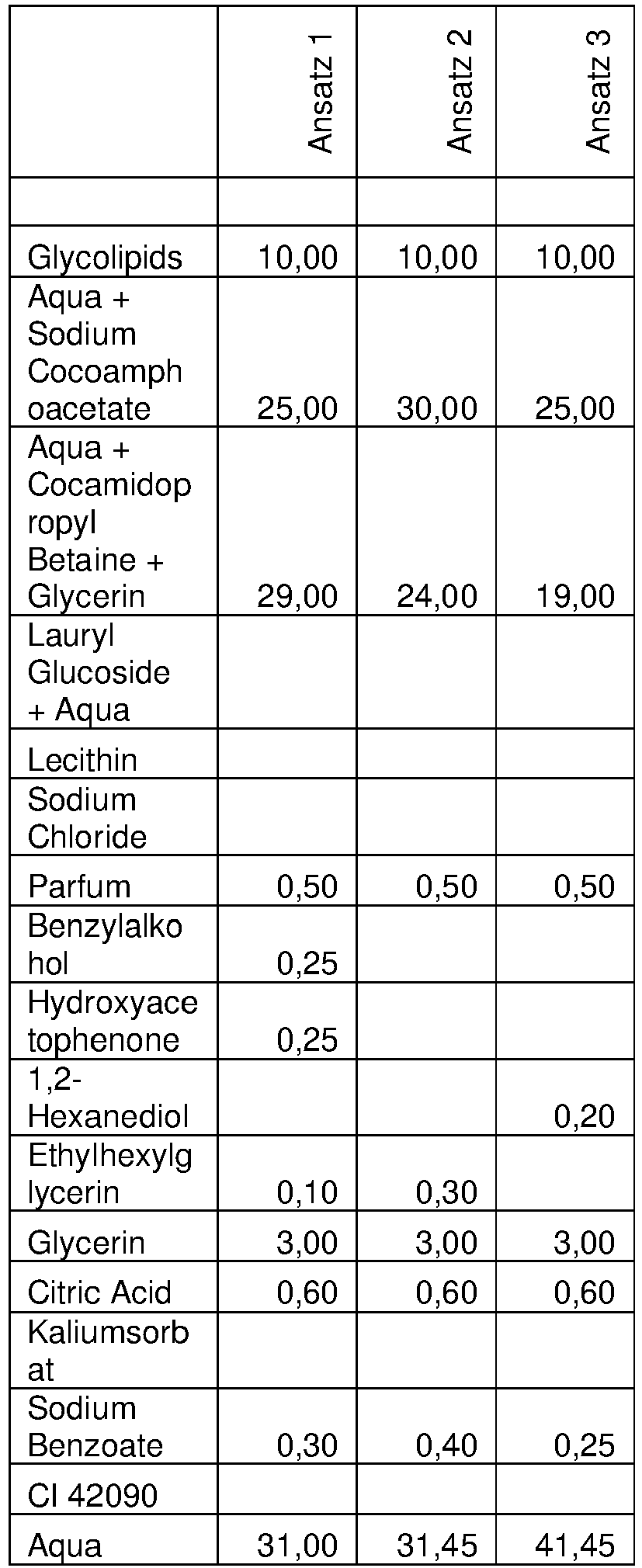
- Die folgenden Ansätze 11-17liegen außerhalb der Erfindung.

Claims (9)
- Kosmetische Reinigungszubereitung enthaltenda) ein oder mehrere Glycolipide mit der INCI Bezeichnung Glycolipids,b) mindestens zwei oberflächenaktiven Verbindungen gewählt aus der Gruppe Cocamidopropylbetain, Natriumcocoamphoacetat, Laurylglucosid, Decylglucosid, Coco-Glucoside mit Ausnahme der Kombination aus Natriumcocoamphoacetat und Laurylglucoside und mit der Maßgabe, dass bei der Kombination aus Cocamidopropylbetain und Natriumcocoamphoacetat die Zubereitung frei ist von Laurylsulfosuccinaten, wobei die Zubereitung Phenoxyethanol, Ethylhexylglycerin, Butylenglycol, 2-Methylpropan-1,3-diol, 1,2-Pentandiol, 1,2-Hexandiol, 1,2-Octandiol und/oder 1,2-Decandiol enthält und die Zubereitung frei ist von Polyethylenglycol-Fettalkoholethern oder -estern, Acylisethionaten, Sulfosuccinaten, Propyl- und Butylparaben, 3-lod-2-propinylbutylcarbamat, DMDM Hydantoin, Methylisothiazolinon, Chlormethylisothiazolinon und Hydroxyisohexyl 3-Cyclohexene Carboxalhdehyde, wobei die Zubereitung Glycolipide mit der INCI-Bezeichnung Gylcolipids mit einem Aktivgehalt von mindestens 2 Gewichts-%, bezogen auf das Gesamtgewicht der Zubereitung enthält, dadurch gekennzeichnet, dass die Zubereitung eine Kombination ausa) ein oder mehreren Glycolipiden mit der INCI Bezeichnung Glycolipids,b) Cocamidopropylbetain mit der INCI-Bezeichnung Cocamidopropyl Betaine undc) Natriumcocoamphoacetat mit der INCI-Bezeichnnung Sodium Cocoamphoacetate enthält.
- Kosmetische Reinigungszubereitung nach Anspruch 1, dadurch gekennzeichnet, dass die Zubereitung einen pH-Wert von kleiner oder gleich 5 aufweist.
- Kosmetische Reinigungszubereitung nach einem der vorhergehenden Ansprüche, dadurch gekennzeichnet, dass die Zubereitung Cocamidopropylbetain mit der INCI-Bezeichnung Cocamidopropyl Betaine mit einem Aktivgehalt von mindestens 2 Gewichts-%, bezogen auf das Gesamtgewicht der Zubereitung enthält.
- Kosmetische Reinigungszubereitung nach einem der vorhergehenden Ansprüche, dadurch gekennzeichnet, dass die Zubereitung Natriumcocoamphoacetat mit der INCI-Bezeichnung Sodium Cocoamphoacetate mit einem Aktivgehalt von mindestens 2 Gewichts-%, bezogen auf das Gesamtgewicht der Zubereitung enthält.
- Kosmetische Reinigungszubereitung nach einem der vorhergehenden Ansprüche, dadurch gekennzeichnet, dass die Zubereitung Decylglucosid mit der INCI-Bezeichnung Decyl Glucoside mit einem Aktivgehalt von mindestens 2 Gewichts-%, bezogen auf das Gesamtgewicht der Zubereitung enthält.
- Kosmetische Reinigungszubereitung nach einem der vorhergehenden Ansprüche, dadurch gekennzeichnet, dass die Zubereitung Xylitylsesquicaprylate, Hydroxyacetophenone, Glyceryl Caprylate, Natrium Chlorid, Natrium Benzoate, Natrium Salicylate, Dehydroacetic Acid, Anisic Acid, Levulinic Acid, Hydroxypropyl Guar Hydroxypropyl Trimonium Chlorid, Polyquaternium-7, Polyquaternium-10 und/oder Lecithin enthält
- Kosmetische Reinigungszubereitung nach einem der vorhergehenden Ansprüche, dadurch gekennzeichnet, dass die Zubereitung einen oder mehrere Wirkstoffe aus der Gruppe der Verbindungen alpha-Liponsäure, Folsäure, Phytoen, D-Biotin, Coenzym Q10, alpha-Glucosylrutin, Carnitin, Carnosin, natürliche und/oder synthetische Isoflavonoide, Flavonoide, Kreatin, Kreatinin, Taurin, β-Alanin, Panthenol, Polydocanol, Magnolol, Honokiol, Tocopherylacetat, Dihydroxyaceton; 8-Hexadecen-1,16-dicarbonsäure, Glycerylglycose, (2-Hydroxyethyl)harnstoff, Vitamin E bzw. seine Derivate, Hyaluronsäure und/oder deren Salze und/oder Licochalcon A enthält.
- Kosmetische Reinigungstuch getränkt mit einer Reinigungszubereitung nach einem der vorhergehenden Ansprüche.
- Reinigungstuch nach Anspruch 8, dadurch gekennzeichnet, dass das Tuchmaterial Viskosefasern enthält.
Applications Claiming Priority (2)
| Application Number | Priority Date | Filing Date | Title |
|---|---|---|---|
| DE102018210175.2A DE102018210175A1 (de) | 2018-06-22 | 2018-06-22 | Milde kosmetische Reinigungszubereitung |
| PCT/EP2019/065470 WO2019243151A1 (de) | 2018-06-22 | 2019-06-13 | Milde kosmetische reinigungszubereitung |
Publications (3)
| Publication Number | Publication Date |
|---|---|
| EP3810080A1 EP3810080A1 (de) | 2021-04-28 |
| EP3810080B1 true EP3810080B1 (de) | 2024-11-20 |
| EP3810080C0 EP3810080C0 (de) | 2024-11-20 |
Family
ID=66998361
Family Applications (1)
| Application Number | Title | Priority Date | Filing Date |
|---|---|---|---|
| EP19731915.5A Active EP3810080B1 (de) | 2018-06-22 | 2019-06-13 | Milde kosmetische reinigungszubereitung |
Country Status (4)
| Country | Link |
|---|---|
| EP (1) | EP3810080B1 (de) |
| DE (1) | DE102018210175A1 (de) |
| ES (1) | ES3008930T3 (de) |
| WO (1) | WO2019243151A1 (de) |
Families Citing this family (7)
| Publication number | Priority date | Publication date | Assignee | Title |
|---|---|---|---|---|
| DE102019202723A1 (de) * | 2019-02-28 | 2020-09-03 | Beiersdorf Ag | Reinigungstücher getränkt mit Tränkungsmitteln enthaltend Biotenside |
| WO2021236927A1 (en) * | 2020-05-20 | 2021-11-25 | Manhattan College | Silicone-free conditioning cleansing composition |
| CN113712892B (zh) * | 2021-08-11 | 2023-09-22 | 中山市天图精细化工有限公司 | 一种宠物术后专用免洗清洁泡沫气雾剂及其制备方法 |
| CN114469769A (zh) * | 2022-03-22 | 2022-05-13 | 广州天玺生物科技有限公司 | 一种婴童用沐浴油及其制备方法 |
| DE102023213066A1 (de) * | 2023-12-20 | 2025-06-26 | Henkel Ag & Co. Kgaa | Stabile Reinigungsmittel mit Hydrogelpartikeln und Polysaccharid Verdickungsmittel |
| WO2025222366A1 (en) * | 2024-04-23 | 2025-10-30 | L'oreal | Composition for cleansing and/or removing makeups from keratin materials |
| CN118831014A (zh) * | 2024-06-28 | 2024-10-25 | 广州环亚化妆品科技股份有限公司 | 一种含天然表面活性剂的组合物及其制备方法和应用 |
Citations (5)
| Publication number | Priority date | Publication date | Assignee | Title |
|---|---|---|---|---|
| DE3724460A1 (de) * | 1986-07-29 | 1988-02-04 | Lion Corp | Hautfreundliche netzmittelmasse |
| WO2013098066A2 (de) | 2011-12-28 | 2013-07-04 | Evonik Industries Ag | Wässrige haar- und hautreinigungszusammensetzungen, enthaltend biotenside |
| WO2014166796A1 (de) | 2013-04-10 | 2014-10-16 | Evonik Industries Ag | Kosmetische formulierung enthaltend copolymer sowie sulfosuccinat und/oder biotensid |
| KR20160059263A (ko) * | 2014-11-18 | 2016-05-26 | 정석훈 | 거품식 워터리스 샴푸 조성물 |
| CN106511144A (zh) * | 2016-12-16 | 2017-03-22 | 广州市科能化妆品科研有限公司 | 一种眼唇卸妆水及其制备方法 |
Family Cites Families (2)
| Publication number | Priority date | Publication date | Assignee | Title |
|---|---|---|---|---|
| EP2786742A1 (de) * | 2013-04-02 | 2014-10-08 | Evonik Industries AG | Kosmetika enthaltend Rhamnolipide |
| WO2017197396A1 (en) * | 2016-05-13 | 2017-11-16 | Sanjeevita By Audubon, Llc | Saponin-containing compositions for use in textile wipes and related dispensers |
-
2018
- 2018-06-22 DE DE102018210175.2A patent/DE102018210175A1/de not_active Withdrawn
-
2019
- 2019-06-13 ES ES19731915T patent/ES3008930T3/es active Active
- 2019-06-13 WO PCT/EP2019/065470 patent/WO2019243151A1/de not_active Ceased
- 2019-06-13 EP EP19731915.5A patent/EP3810080B1/de active Active
Patent Citations (5)
| Publication number | Priority date | Publication date | Assignee | Title |
|---|---|---|---|---|
| DE3724460A1 (de) * | 1986-07-29 | 1988-02-04 | Lion Corp | Hautfreundliche netzmittelmasse |
| WO2013098066A2 (de) | 2011-12-28 | 2013-07-04 | Evonik Industries Ag | Wässrige haar- und hautreinigungszusammensetzungen, enthaltend biotenside |
| WO2014166796A1 (de) | 2013-04-10 | 2014-10-16 | Evonik Industries Ag | Kosmetische formulierung enthaltend copolymer sowie sulfosuccinat und/oder biotensid |
| KR20160059263A (ko) * | 2014-11-18 | 2016-05-26 | 정석훈 | 거품식 워터리스 샴푸 조성물 |
| CN106511144A (zh) * | 2016-12-16 | 2017-03-22 | 广州市科能化妆品科研有限公司 | 一种眼唇卸妆水及其制备方法 |
Non-Patent Citations (12)
| Title |
|---|
| ALTMEYER PETER: "Glycereth-25- pca isostearates (inci)", ALTMEYERS ENCYCLOPEDIA, 29 October 2020 (2020-10-29), pages 1 - 4, XP093097724, Retrieved from the Internet <URL:https://www.altmeyers.org/en/cosmetology/glycereth-25-pca-isostearates-inci-144775> [retrieved on 20231103] * |
| ANONYMOUS: "BESCHLUSS DER KOMMISSION vom 9. Dezember 2014 zur Festlegung der Umweltkriterien f�r die Vergabe des EU-Umweltzeichens f�r "Rinse-off"-Kosmetikprodukte", AMTSBLATT DER EUROP�ISCHEN UNION, 11 December 2014 (2014-12-11), pages L 354/47 - L 354/61, XP093097726, Retrieved from the Internet <URL:https://eur-lex.europa.eu/legal-content/DE/TXT/PDF/?uri=CELEX:32014D0893> [retrieved on 20231103] * |
| ANONYMOUS: "Polysorbat 20", WIKIPEDIA, 2 March 2022 (2022-03-02), pages 1 - 3, XP093097722, Retrieved from the Internet <URL:https://de.wikipedia.org/wiki/Polysorbat_20> [retrieved on 20231103] * |
| ANONYMOUS: "Polysorbat 80", WIKIPEDIA, 28 February 2022 (2022-02-28), pages 1 - 4, XP093097723, Retrieved from the Internet <URL:https://de.wikipedia.org/w/index.php?title=Polysorbat_80&oldid=220671491> [retrieved on 20231103] * |
| ANONYMOUS: "Product Safety Assessment NEOLONE(TM) PE Preservative", 6 December 2011 (2011-12-06), pages 1 - 7, XP093097728, Retrieved from the Internet <URL:https://www.soapmakingstudio.com/soapmaking-supplies/sds/preservatives/neolone-pe.pdf> * |
| ANONYMOUS: "Product Safety Assessment NEOLONE™ PE Preservative", PRODUCT SAFETY ASSESSMENT, DOW CHEMICAL COMPANY, 6 December 2011 (2011-12-06), pages 1 - 7, XP093097728 |
| DATABASE GNPD [online] MINTEL; 12 April 2017 (2017-04-12), ANONYMOUS: "Wash", XP055878414, retrieved from https://www.gnpd.com/sinatra/recordpage/4750187/ Database accession no. 4750187 * |
| DATABASE GNPD [online] MINTEL; 13 November 2014 (2014-11-13), ANONYMOUS: "Cleansing Cream for the Face", XP055878233, retrieved from https://www.gnpd.com/sinatra/recordpage/2772023/ Database accession no. 2772023 * |
| DATABASE GNPD [online] MINTEL; 18 August 2015 (2015-08-18), ANONYMOUS: "Shampoo", XP055878236, retrieved from https://www.gnpd.com/sinatra/recordpage/3366011/ Database accession no. 3366011 * |
| DATABASE GNPD [online] MINTEL; 22 September 2017 (2017-09-22), ANONYMOUS: "Shampoo", XP055878228, retrieved from https://www.gnpd.com/sinatra/recordpage/5116041/ Database accession no. 5116041 * |
| DATABASE GNPD [online] MINTEL; 28 August 2012 (2012-08-28), ANONYMOUS: "Shampoo", XP055878221, retrieved from https://www.gnpd.com/sinatra/recordpage/1864980/ Database accession no. 1864980 * |
| DATABASE GNPD [online] MINTEL; 9 January 2017 (2017-01-09), ANONYMOUS: "Foaming Cleanser", XP055878413, retrieved from https://www.gnpd.com/sinatra/recordpage/4535939/ Database accession no. 4535939 * |
Also Published As
| Publication number | Publication date |
|---|---|
| DE102018210175A1 (de) | 2019-12-24 |
| EP3810080A1 (de) | 2021-04-28 |
| ES3008930T3 (en) | 2025-03-25 |
| WO2019243151A1 (de) | 2019-12-26 |
| EP3810080C0 (de) | 2024-11-20 |
Similar Documents
| Publication | Publication Date | Title |
|---|---|---|
| EP3810080B1 (de) | Milde kosmetische reinigungszubereitung | |
| EP3168251B1 (de) | Vernetzte polyglycerinester | |
| WO2020114793A1 (de) | O/w-emulsion mit rhamnolipiden | |
| EP2881381B1 (de) | Polyglycerinpartialester, ihre Herstellung und Verwendung | |
| DE102009001748A1 (de) | Formulierungen enthaltend Sorbitancarbonsäureester | |
| WO2011051083A2 (de) | Reibmittel auf natürlicher rohstoffbasis mit die rheologie verbessernden eigenschaften | |
| DE202011110814U1 (de) | Körperreinigungsmittel mit milden Tensidsystemen | |
| EP2018889B1 (de) | Wässrige tensidische Formulierung enthaltend Polypropylenglykol(3)myristylether | |
| DE102019202723A1 (de) | Reinigungstücher getränkt mit Tränkungsmitteln enthaltend Biotenside | |
| EP3634367A1 (de) | Alkandiole in salzhaltigen kosmetischen zubereitungen | |
| EP3661605B1 (de) | Kosmetikum zur gesichtsreinigung | |
| EP1663119B1 (de) | Schäumbare kosmetische reinigungszubereitung | |
| EP4041412B1 (de) | Reinigungszubereitung enthaltend caesalpinia spinosa gum | |
| DE10236063A1 (de) | Milde Reinigungszubereitung | |
| WO2007042410A1 (de) | Desodorierende reinigungszubereitung | |
| DE10157543A1 (de) | Emulsionsgetränkte Tücher | |
| DE102020212221B3 (de) | Verbesserte Reinigungstücher getränkt mit Tränkungsmitteln basierend auf Hydrodispersionen | |
| DE10231736A1 (de) | Vesikelbildende tensidhaltige Reinigungszubereitung mit hohem Wirkstoffanteil, Verfahren zu ihrer Herstellung sowie ihre Verwendung | |
| DE102024204527A1 (de) | Reinigungszubereitung enthaltend Rhamnolipide und Dehydroxanthan Gum | |
| DE102022211303A1 (de) | Kosmetisches Reinigungsgel mit hoher Transparenz | |
| DE102019211138A1 (de) | Kosmetische Zusammensetzung | |
| EP2293763A1 (de) | Zusammensetzungen zur formgebung keratinischer fasern auf basis einer natürlichen, haltgebenden polymerkombination | |
| EP2288331A1 (de) | Zusammensetzungen zur formgebung keratinischer fasern auf basis einer natürlichen, haltgebenden polymerkombination |
Legal Events
| Date | Code | Title | Description |
|---|---|---|---|
| STAA | Information on the status of an ep patent application or granted ep patent |
Free format text: STATUS: UNKNOWN |
|
| STAA | Information on the status of an ep patent application or granted ep patent |
Free format text: STATUS: THE INTERNATIONAL PUBLICATION HAS BEEN MADE |
|
| PUAI | Public reference made under article 153(3) epc to a published international application that has entered the european phase |
Free format text: ORIGINAL CODE: 0009012 |
|
| STAA | Information on the status of an ep patent application or granted ep patent |
Free format text: STATUS: REQUEST FOR EXAMINATION WAS MADE |
|
| 17P | Request for examination filed |
Effective date: 20210122 |
|
| AK | Designated contracting states |
Kind code of ref document: A1 Designated state(s): AL AT BE BG CH CY CZ DE DK EE ES FI FR GB GR HR HU IE IS IT LI LT LU LV MC MK MT NL NO PL PT RO RS SE SI SK SM TR |
|
| AX | Request for extension of the european patent |
Extension state: BA ME |
|
| RAP3 | Party data changed (applicant data changed or rights of an application transferred) |
Owner name: BEIERSDORF AG |
|
| TPAC | Observations filed by third parties |
Free format text: ORIGINAL CODE: EPIDOSNTIPA |
|
| DAV | Request for validation of the european patent (deleted) | ||
| DAX | Request for extension of the european patent (deleted) | ||
| STAA | Information on the status of an ep patent application or granted ep patent |
Free format text: STATUS: EXAMINATION IS IN PROGRESS |
|
| 17Q | First examination report despatched |
Effective date: 20220121 |
|
| TPAC | Observations filed by third parties |
Free format text: ORIGINAL CODE: EPIDOSNTIPA |
|
| RAP3 | Party data changed (applicant data changed or rights of an application transferred) |
Owner name: BEIERSDORF AG |
|
| GRAP | Despatch of communication of intention to grant a patent |
Free format text: ORIGINAL CODE: EPIDOSNIGR1 |
|
| STAA | Information on the status of an ep patent application or granted ep patent |
Free format text: STATUS: GRANT OF PATENT IS INTENDED |
|
| INTG | Intention to grant announced |
Effective date: 20240723 |
|
| GRAS | Grant fee paid |
Free format text: ORIGINAL CODE: EPIDOSNIGR3 |
|
| GRAA | (expected) grant |
Free format text: ORIGINAL CODE: 0009210 |
|
| STAA | Information on the status of an ep patent application or granted ep patent |
Free format text: STATUS: THE PATENT HAS BEEN GRANTED |
|
| AK | Designated contracting states |
Kind code of ref document: B1 Designated state(s): AL AT BE BG CH CY CZ DE DK EE ES FI FR GB GR HR HU IE IS IT LI LT LU LV MC MK MT NL NO PL PT RO RS SE SI SK SM TR |
|
| REG | Reference to a national code |
Ref country code: GB Ref legal event code: FG4D Free format text: NOT ENGLISH |
|
| REG | Reference to a national code |
Ref country code: CH Ref legal event code: EP |
|
| REG | Reference to a national code |
Ref country code: DE Ref legal event code: R096 Ref document number: 502019012516 Country of ref document: DE |
|
| REG | Reference to a national code |
Ref country code: IE Ref legal event code: FG4D Free format text: LANGUAGE OF EP DOCUMENT: GERMAN |
|
| U01 | Request for unitary effect filed |
Effective date: 20241209 |
|
| U07 | Unitary effect registered |
Designated state(s): AT BE BG DE DK EE FI FR IT LT LU LV MT NL PT RO SE SI Effective date: 20241219 |
|
| REG | Reference to a national code |
Ref country code: ES Ref legal event code: FG2A Ref document number: 3008930 Country of ref document: ES Kind code of ref document: T3 Effective date: 20250325 |
|
| PG25 | Lapsed in a contracting state [announced via postgrant information from national office to epo] |
Ref country code: IS Free format text: LAPSE BECAUSE OF FAILURE TO SUBMIT A TRANSLATION OF THE DESCRIPTION OR TO PAY THE FEE WITHIN THE PRESCRIBED TIME-LIMIT Effective date: 20250320 Ref country code: HR Free format text: LAPSE BECAUSE OF FAILURE TO SUBMIT A TRANSLATION OF THE DESCRIPTION OR TO PAY THE FEE WITHIN THE PRESCRIBED TIME-LIMIT Effective date: 20241120 |
|
| PG25 | Lapsed in a contracting state [announced via postgrant information from national office to epo] |
Ref country code: NO Free format text: LAPSE BECAUSE OF FAILURE TO SUBMIT A TRANSLATION OF THE DESCRIPTION OR TO PAY THE FEE WITHIN THE PRESCRIBED TIME-LIMIT Effective date: 20250220 |
|
| PG25 | Lapsed in a contracting state [announced via postgrant information from national office to epo] |
Ref country code: GR Free format text: LAPSE BECAUSE OF FAILURE TO SUBMIT A TRANSLATION OF THE DESCRIPTION OR TO PAY THE FEE WITHIN THE PRESCRIBED TIME-LIMIT Effective date: 20250221 |
|
| PG25 | Lapsed in a contracting state [announced via postgrant information from national office to epo] |
Ref country code: PL Free format text: LAPSE BECAUSE OF FAILURE TO SUBMIT A TRANSLATION OF THE DESCRIPTION OR TO PAY THE FEE WITHIN THE PRESCRIBED TIME-LIMIT Effective date: 20241120 |
|
| PG25 | Lapsed in a contracting state [announced via postgrant information from national office to epo] |
Ref country code: RS Free format text: LAPSE BECAUSE OF FAILURE TO SUBMIT A TRANSLATION OF THE DESCRIPTION OR TO PAY THE FEE WITHIN THE PRESCRIBED TIME-LIMIT Effective date: 20250220 |
|
| PG25 | Lapsed in a contracting state [announced via postgrant information from national office to epo] |
Ref country code: SM Free format text: LAPSE BECAUSE OF FAILURE TO SUBMIT A TRANSLATION OF THE DESCRIPTION OR TO PAY THE FEE WITHIN THE PRESCRIBED TIME-LIMIT Effective date: 20241120 |
|
| PGFP | Annual fee paid to national office [announced via postgrant information from national office to epo] |
Ref country code: GB Payment date: 20250618 Year of fee payment: 7 |
|
| PG25 | Lapsed in a contracting state [announced via postgrant information from national office to epo] |
Ref country code: SK Free format text: LAPSE BECAUSE OF FAILURE TO SUBMIT A TRANSLATION OF THE DESCRIPTION OR TO PAY THE FEE WITHIN THE PRESCRIBED TIME-LIMIT Effective date: 20241120 |
|
| PG25 | Lapsed in a contracting state [announced via postgrant information from national office to epo] |
Ref country code: CZ Free format text: LAPSE BECAUSE OF FAILURE TO SUBMIT A TRANSLATION OF THE DESCRIPTION OR TO PAY THE FEE WITHIN THE PRESCRIBED TIME-LIMIT Effective date: 20241120 |
|
| U21 | Renewal fee for the european patent with unitary effect paid with additional fee |
Year of fee payment: 7 Effective date: 20250709 |
|
| PLBI | Opposition filed |
Free format text: ORIGINAL CODE: 0009260 |
|
| PLAX | Notice of opposition and request to file observation + time limit sent |
Free format text: ORIGINAL CODE: EPIDOSNOBS2 |
|
| 26 | Opposition filed |
Opponent name: HENKEL AG & CO. KGAA Effective date: 20250819 |
|
| PGFP | Annual fee paid to national office [announced via postgrant information from national office to epo] |
Ref country code: ES Payment date: 20250731 Year of fee payment: 7 |
|
| PLBB | Reply of patent proprietor to notice(s) of opposition received |
Free format text: ORIGINAL CODE: EPIDOSNOBS3 |
|
| REG | Reference to a national code |
Ref country code: CH Ref legal event code: H13 Free format text: ST27 STATUS EVENT CODE: U-0-0-H10-H13 (AS PROVIDED BY THE NATIONAL OFFICE) Effective date: 20260127 |
|
| PG25 | Lapsed in a contracting state [announced via postgrant information from national office to epo] |
Ref country code: MC Free format text: LAPSE BECAUSE OF FAILURE TO SUBMIT A TRANSLATION OF THE DESCRIPTION OR TO PAY THE FEE WITHIN THE PRESCRIBED TIME-LIMIT Effective date: 20241120 |