EP3802195B1 - Ladestation zum aufladen eines energiespeichers eines elektrofahrzeugs - Google Patents
Ladestation zum aufladen eines energiespeichers eines elektrofahrzeugs Download PDFInfo
- Publication number
- EP3802195B1 EP3802195B1 EP19714382.9A EP19714382A EP3802195B1 EP 3802195 B1 EP3802195 B1 EP 3802195B1 EP 19714382 A EP19714382 A EP 19714382A EP 3802195 B1 EP3802195 B1 EP 3802195B1
- Authority
- EP
- European Patent Office
- Prior art keywords
- housing
- charging station
- connection unit
- charging
- membrane element
- Prior art date
- Legal status (The legal status is an assumption and is not a legal conclusion. Google has not performed a legal analysis and makes no representation as to the accuracy of the status listed.)
- Active
Links
Images


Classifications
-
- B—PERFORMING OPERATIONS; TRANSPORTING
- B60—VEHICLES IN GENERAL
- B60L—PROPULSION OF ELECTRICALLY-PROPELLED VEHICLES; SUPPLYING ELECTRIC POWER FOR AUXILIARY EQUIPMENT OF ELECTRICALLY-PROPELLED VEHICLES; ELECTRODYNAMIC BRAKE SYSTEMS FOR VEHICLES IN GENERAL; MAGNETIC SUSPENSION OR LEVITATION FOR VEHICLES; MONITORING OPERATING VARIABLES OF ELECTRICALLY-PROPELLED VEHICLES; ELECTRIC SAFETY DEVICES FOR ELECTRICALLY-PROPELLED VEHICLES
- B60L53/00—Methods of charging batteries, specially adapted for electric vehicles; Charging stations or on-board charging equipment therefor; Exchange of energy storage elements in electric vehicles
- B60L53/10—Methods of charging batteries, specially adapted for electric vehicles; Charging stations or on-board charging equipment therefor; Exchange of energy storage elements in electric vehicles characterised by the energy transfer between the charging station and the vehicle
- B60L53/14—Conductive energy transfer
-
- B—PERFORMING OPERATIONS; TRANSPORTING
- B60—VEHICLES IN GENERAL
- B60L—PROPULSION OF ELECTRICALLY-PROPELLED VEHICLES; SUPPLYING ELECTRIC POWER FOR AUXILIARY EQUIPMENT OF ELECTRICALLY-PROPELLED VEHICLES; ELECTRODYNAMIC BRAKE SYSTEMS FOR VEHICLES IN GENERAL; MAGNETIC SUSPENSION OR LEVITATION FOR VEHICLES; MONITORING OPERATING VARIABLES OF ELECTRICALLY-PROPELLED VEHICLES; ELECTRIC SAFETY DEVICES FOR ELECTRICALLY-PROPELLED VEHICLES
- B60L53/00—Methods of charging batteries, specially adapted for electric vehicles; Charging stations or on-board charging equipment therefor; Exchange of energy storage elements in electric vehicles
- B60L53/30—Constructional details of charging stations
-
- B—PERFORMING OPERATIONS; TRANSPORTING
- B60—VEHICLES IN GENERAL
- B60L—PROPULSION OF ELECTRICALLY-PROPELLED VEHICLES; SUPPLYING ELECTRIC POWER FOR AUXILIARY EQUIPMENT OF ELECTRICALLY-PROPELLED VEHICLES; ELECTRODYNAMIC BRAKE SYSTEMS FOR VEHICLES IN GENERAL; MAGNETIC SUSPENSION OR LEVITATION FOR VEHICLES; MONITORING OPERATING VARIABLES OF ELECTRICALLY-PROPELLED VEHICLES; ELECTRIC SAFETY DEVICES FOR ELECTRICALLY-PROPELLED VEHICLES
- B60L2240/00—Control parameters of input or output; Target parameters
- B60L2240/60—Navigation input
- B60L2240/66—Ambient conditions
- B60L2240/662—Temperature
-
- B—PERFORMING OPERATIONS; TRANSPORTING
- B60—VEHICLES IN GENERAL
- B60L—PROPULSION OF ELECTRICALLY-PROPELLED VEHICLES; SUPPLYING ELECTRIC POWER FOR AUXILIARY EQUIPMENT OF ELECTRICALLY-PROPELLED VEHICLES; ELECTRODYNAMIC BRAKE SYSTEMS FOR VEHICLES IN GENERAL; MAGNETIC SUSPENSION OR LEVITATION FOR VEHICLES; MONITORING OPERATING VARIABLES OF ELECTRICALLY-PROPELLED VEHICLES; ELECTRIC SAFETY DEVICES FOR ELECTRICALLY-PROPELLED VEHICLES
- B60L2240/00—Control parameters of input or output; Target parameters
- B60L2240/60—Navigation input
- B60L2240/66—Ambient conditions
- B60L2240/667—Precipitation
-
- H—ELECTRICITY
- H02—GENERATION; CONVERSION OR DISTRIBUTION OF ELECTRIC POWER
- H02G—INSTALLATION OF ELECTRIC CABLES OR LINES, OR OF COMBINED OPTICAL AND ELECTRIC CABLES OR LINES
- H02G3/00—Installations of electric cables or lines or protective tubing therefor in or on buildings, equivalent structures or vehicles
- H02G3/02—Details
- H02G3/04—Protective tubing or conduits, e.g. cable ladders or cable troughs
- H02G3/0493—Service poles
-
- H—ELECTRICITY
- H02—GENERATION; CONVERSION OR DISTRIBUTION OF ELECTRIC POWER
- H02G—INSTALLATION OF ELECTRIC CABLES OR LINES, OR OF COMBINED OPTICAL AND ELECTRIC CABLES OR LINES
- H02G3/00—Installations of electric cables or lines or protective tubing therefor in or on buildings, equivalent structures or vehicles
- H02G3/02—Details
- H02G3/08—Distribution boxes; Connection or junction boxes
- H02G3/088—Dustproof, splashproof, drip-proof, waterproof, or flameproof casings or inlets
-
- Y—GENERAL TAGGING OF NEW TECHNOLOGICAL DEVELOPMENTS; GENERAL TAGGING OF CROSS-SECTIONAL TECHNOLOGIES SPANNING OVER SEVERAL SECTIONS OF THE IPC; TECHNICAL SUBJECTS COVERED BY FORMER USPC CROSS-REFERENCE ART COLLECTIONS [XRACs] AND DIGESTS
- Y02—TECHNOLOGIES OR APPLICATIONS FOR MITIGATION OR ADAPTATION AGAINST CLIMATE CHANGE
- Y02T—CLIMATE CHANGE MITIGATION TECHNOLOGIES RELATED TO TRANSPORTATION
- Y02T10/00—Road transport of goods or passengers
- Y02T10/60—Other road transportation technologies with climate change mitigation effect
- Y02T10/70—Energy storage systems for electromobility, e.g. batteries
-
- Y—GENERAL TAGGING OF NEW TECHNOLOGICAL DEVELOPMENTS; GENERAL TAGGING OF CROSS-SECTIONAL TECHNOLOGIES SPANNING OVER SEVERAL SECTIONS OF THE IPC; TECHNICAL SUBJECTS COVERED BY FORMER USPC CROSS-REFERENCE ART COLLECTIONS [XRACs] AND DIGESTS
- Y02—TECHNOLOGIES OR APPLICATIONS FOR MITIGATION OR ADAPTATION AGAINST CLIMATE CHANGE
- Y02T—CLIMATE CHANGE MITIGATION TECHNOLOGIES RELATED TO TRANSPORTATION
- Y02T10/00—Road transport of goods or passengers
- Y02T10/60—Other road transportation technologies with climate change mitigation effect
- Y02T10/7072—Electromobility specific charging systems or methods for batteries, ultracapacitors, supercapacitors or double-layer capacitors
-
- Y—GENERAL TAGGING OF NEW TECHNOLOGICAL DEVELOPMENTS; GENERAL TAGGING OF CROSS-SECTIONAL TECHNOLOGIES SPANNING OVER SEVERAL SECTIONS OF THE IPC; TECHNICAL SUBJECTS COVERED BY FORMER USPC CROSS-REFERENCE ART COLLECTIONS [XRACs] AND DIGESTS
- Y02—TECHNOLOGIES OR APPLICATIONS FOR MITIGATION OR ADAPTATION AGAINST CLIMATE CHANGE
- Y02T—CLIMATE CHANGE MITIGATION TECHNOLOGIES RELATED TO TRANSPORTATION
- Y02T10/00—Road transport of goods or passengers
- Y02T10/60—Other road transportation technologies with climate change mitigation effect
- Y02T10/72—Electric energy management in electromobility
-
- Y—GENERAL TAGGING OF NEW TECHNOLOGICAL DEVELOPMENTS; GENERAL TAGGING OF CROSS-SECTIONAL TECHNOLOGIES SPANNING OVER SEVERAL SECTIONS OF THE IPC; TECHNICAL SUBJECTS COVERED BY FORMER USPC CROSS-REFERENCE ART COLLECTIONS [XRACs] AND DIGESTS
- Y02—TECHNOLOGIES OR APPLICATIONS FOR MITIGATION OR ADAPTATION AGAINST CLIMATE CHANGE
- Y02T—CLIMATE CHANGE MITIGATION TECHNOLOGIES RELATED TO TRANSPORTATION
- Y02T90/00—Enabling technologies or technologies with a potential or indirect contribution to GHG emissions mitigation
- Y02T90/10—Technologies relating to charging of electric vehicles
- Y02T90/12—Electric charging stations
-
- Y—GENERAL TAGGING OF NEW TECHNOLOGICAL DEVELOPMENTS; GENERAL TAGGING OF CROSS-SECTIONAL TECHNOLOGIES SPANNING OVER SEVERAL SECTIONS OF THE IPC; TECHNICAL SUBJECTS COVERED BY FORMER USPC CROSS-REFERENCE ART COLLECTIONS [XRACs] AND DIGESTS
- Y02—TECHNOLOGIES OR APPLICATIONS FOR MITIGATION OR ADAPTATION AGAINST CLIMATE CHANGE
- Y02T—CLIMATE CHANGE MITIGATION TECHNOLOGIES RELATED TO TRANSPORTATION
- Y02T90/00—Enabling technologies or technologies with a potential or indirect contribution to GHG emissions mitigation
- Y02T90/10—Technologies relating to charging of electric vehicles
- Y02T90/14—Plug-in electric vehicles
-
- Y—GENERAL TAGGING OF NEW TECHNOLOGICAL DEVELOPMENTS; GENERAL TAGGING OF CROSS-SECTIONAL TECHNOLOGIES SPANNING OVER SEVERAL SECTIONS OF THE IPC; TECHNICAL SUBJECTS COVERED BY FORMER USPC CROSS-REFERENCE ART COLLECTIONS [XRACs] AND DIGESTS
- Y02—TECHNOLOGIES OR APPLICATIONS FOR MITIGATION OR ADAPTATION AGAINST CLIMATE CHANGE
- Y02T—CLIMATE CHANGE MITIGATION TECHNOLOGIES RELATED TO TRANSPORTATION
- Y02T90/00—Enabling technologies or technologies with a potential or indirect contribution to GHG emissions mitigation
- Y02T90/10—Technologies relating to charging of electric vehicles
- Y02T90/16—Information or communication technologies improving the operation of electric vehicles
Definitions
- the invention relates to a charging station for charging an energy store of an electric vehicle, which has a housing with a space arranged within the housing for accommodating electronic components, and a cover module which can be connected to the housing and which comprises at least one cover element and/or a connection unit, the Connection unit is provided for arranging and / or connecting a charging element, in particular a charging plug or a charging socket, wherein at least one first sealing element is provided at least between the housing and the cover module.
- a charging station is known from the prior art, which is used to charge an energy store of an electric vehicle.
- the charging station has a housing with a space in which electronic components such as printed circuit boards, plug contacts, capacitors and the like are arranged.
- the housing is closed with a cover, with a rubber seal being arranged between the housing and the cover, which protects the electronic components from ingress of dust and liquid into the space arranged inside the housing.
- This rubber seal ensures such a seal that only a small and limited exchange of air takes place between an external environment of the charging station and the sealed space of the charging station in the housing. If the temperature in the environment changes, undesirable condensation can form inside the charging station, particularly in the area of the housing, which could damage the electronic components.
- DE 10 2012 011606 A1 discloses a charging station for charging an energy store of an electric vehicle, which has a housing with a space arranged within the housing for accommodating electronic components, and a cover module which can be connected to the housing and which comprises at least one cover element and a connection unit, the connection unit for arranging and /or connection of a charging element, in particular a charging plug or a charging socket is provided, further having an air flow channel outside the housing.
- EP 2 573 880 A1 discloses a charging socket having a drainage hole.
- DE 10 2016 205117 A1 discloses a charging socket having a membrane.
- the cover module and/or the housing has at least one membrane element, which is used to exchange air and/or water molecules between the space within the Is formed housing and arranged outside of the housing environment.
- the charging station can be arranged, for example, in an open environment, in particular on a street or in a garage, so that temperature fluctuations can always be expected. The temperature fluctuations in the external environment can lead to the formation of condensation inside the space of the housing.
- the membrane element advantageously ensures that air and/or water molecules are exchanged. This measure prevents excessive humidity, in particular condensation, from accumulating inside the housing and damaging or even destroying the electronic components. The membrane element therefore increases the service life of the electronic components.
- the membrane element is significantly more environmentally friendly than other protective elements such as the use of casting compounds.
- the membrane element can be applied easily and inexpensively using label technology and can be combined with various additional uses. Gluing and welding can therefore be used as connection technologies.
- connection unit is provided with at least one, preferably cylindrical, contact element, which is mounted floating within the connection unit, in particular in the axial direction.
- the contact elements are connected to electronics, in particular to a circuit board, which is arranged inside the housing, directly or indirectly, preferably via a cable.
- the floating mounting has the advantage that tolerances can be compensated, specifically between a contact element receptacle arranged in the connection unit and the contact element itself.
- several contact elements are required, for example to electrically connect the charging station to the charging plug. Due to the preferably floating mounting of the contact elements, pressure equalization can also take place between the external environment and the space inside the housing. Nevertheless, essentially hardly any liquid or no liquid at all can escape from the space inside the housing via the contact element receptacle. Consequently, the contact element is watertight and/or dustproof in the connection unit.
- the connection unit has a bearing section, in particular a trough for arranging and/or connecting the charging element, in particular the charging plug or the charging socket.
- the trough is designed, for example, as a closed chamber in which the charging element, in particular the charging plug, can be stowed away when it is not in use.
- any contact elements and contact element receptacles that could penetrate the chamber are dispensed with. It is therefore absolutely necessary to provide the charging station with a membrane element, because otherwise the space inside the housing would then also be pressure-tight with respect to the outside environment. The cover module with the corresponding sealing element would then not allow any fluid exchange at all between the space inside the housing and the outside environment.
- the connection unit, in particular the chamber designed as a trough for example, could be provided with the at least one contact element are used, which is used in particular for connecting to the charging element, preferably with the charging plug.
- connection unit is arranged on the housing and the cover element is connected both to the housing and to the connection unit, with a second sealing element being arranged between the connection unit and the cover element.
- the assembly of the membrane element can be carried out easily if the housing and/or the cover module has a recess or opening which is designed for the non-positive and/or positive and/or material connection arrangement of the membrane element.
- the membrane element can thus be securely and firmly attached to or in the housing and/or cover module when the membrane element is latched into the opening or recess and/or is inserted and/or overmoulded and/or glued.
- the encapsulation also offers the advantage that the cover module and/or housing can be produced easily and inexpensively, in particular when the cover module, in particular the connection unit and the cover element and/or the housing are made of plastic.
- At least one movable cover element is provided on the connection unit, which in the closed state covers the membrane element and/or the bearing section, in particular the contact element, and in the open state releases the bearing section, in particular the contact element.
- the cover element covers the membrane element at least in the open state and/or in the closed state, with the cover element being arranged at a distance from the membrane element, with an air gap being arranged between the membrane element and the cover element.
- the membrane element is designed to be fluid-permeable, in particular gas-permeable.
- the charging station can have a very simple and compact structure if the connection unit has a first section for arranging the contact elements and a second section for arranging at least one spring element, preferably two spring elements, and a third section for arranging the membrane element.
- the cover element can be moved from an operating position back to a rest position using simple design means if the at least one spring element is provided for the movable mounting of the cover element, with at least one spring element being fastened to the second section, in particular to the housing and additionally to the Cover is attached.
- the space required in the housing can be reduced if the first section is designed as a depression in the housing and/or the second section is designed as a preferably U-shaped groove in the housing and/or the third section is designed as a shell in the Housing is formed. If, for example, liquid flows from the space of the housing via the membrane element into the environment, this liquid can accumulate in the shell and flows via the preferably U-shaped section to a water drainage outlet opening, which is arranged, for example, in the second section.
- the water drain outlet opening can be connected to a water drain which is aligned with the environment in order to discharge the liquid into the environment. For these reasons, it can therefore be useful for the second section of the housing, in particular the groove, to open into the third section of the housing, in particular into the shell.
- the membrane element is designed as a pressure equalization element, which equalizes the pressure between the space inside the housing and the environment arranged outside the housing.
- a convenient solution can be made possible for a user if the housing of the charging station is connected to a pillar or a wall.
- a charging station 1 for charging an energy store of an electric vehicle is shown schematically, which is connected to a stele 100 or alternatively to a wall that is arranged, for example, in a garage.
- the charging station 1 comprises a housing 2 which has a space 3 for accommodating electronic components.
- the housing 2 is connected to a cover module 4 .
- the cover module 4 has at least two separate components, namely a cover element 5 and a connection unit 6, the connection unit 6 being provided for arranging and/or connecting a charging element, in particular a charging plug.
- a first sealing element 7 is arranged at least between the housing 2 and the cover module 4 , in particular the cover element 5 .
- a circumferential sealing groove 8 is therefore provided on the housing 2 and serves to accommodate the first sealing element 7 .
- the connection unit 6 is also connected to the housing 2 within the space 3 in a non-positive and/or positive manner by means of a snap-in connection.
- the cover element 5 is connected both to the housing 2 and to the connection unit 6, with a second sealing element (not shown in detail) being arranged between the connection unit 6 and the cover element 5, for example within a circumferential sealing groove of the connection unit 6, in order to seal the inner space 3 of the housing 2 to protect against moisture and dirt.
- connection unit 6 is provided with at least one, preferably cylindrical, contact element 9, which is mounted floating within the connection unit 6, in particular in the axial direction.
- the contact element 9 is arranged in the connection unit 6 in a watertight and/or dustproof manner.
- connection unit 6 comprises a bearing section 10 which is designed here as a trough and which is provided for connecting the charging element, in particular the charging plug.
- the trough 10 could be used for arranging or stowing the charging plug.
- At least one movable cover element 11 is provided on the connection unit 6, which covers the bearing section 10, in particular the contact element 9, when the charging station 1 is not in operation. In an operating position of the charging station 1, the cover element 11 is in an open position.
- a handle 12 is arranged on the cover element 11 so that a user of the charging station 1 can move the cover element 11 comfortably.
- the housing 2 of the charging station 1 is shown in more detail.
- the housing 2 includes a plurality of openings 13 which are used, for example, to arrange the electronic components.
- the housing 2 is connected to the stele 100 in such a way that the inner space 3 of the housing 2 is sealed off from the environment, preferably in a fluid-tight manner.
- the charging station 1 in particular the cover module 4 and/or the housing 2, has a fluid-permeable, in particular gas-permeable, membrane element 14.
- the membrane element 14 could also be designed as a pressure-equalizing element, which equalizes the pressure between the space 3 inside the housing 2 and the environment outside the housing 2 .
- the membrane element 14 which serves to exchange air and/or water molecules between the space 3 inside the housing 2 and the environment outside the housing 2 , is preferably arranged on the connection unit 6 .
- the membrane element 14 or another membrane element could also be arranged on the housing 2 and/or on the cover element 5 .
- an opening 15 or alternatively a recess is provided, which is designed for the non-positive and/or positive and/or material connection of the membrane element 14.
- the membrane element 14 is latched to the opening 15 . It would also be conceivable to inject or insert the membrane element 14 into the opening 15 or into the recess. It would also be possible to inject or encapsulate the membrane element 14 in the connection unit 6 , which is preferably made of plastic, during the production process of the connection unit 6 .
- connection unit has a first section 16 designed as a depression in the housing 2 for arranging the contact element 9, and a second section 17 for arranging at least one spring element and a third section 18 designed as a shell for arranging the membrane element 14.
- the second section 17 of the housing 2 which is preferably designed as a U-shaped groove 19, opens into the third section 18.
- a water outlet channel 20 which is connected, for example, to a water outlet 21 in order to discharge the water or liquid into the environment.
- the cover element 11, which can be moved by the user, is arranged on the connection unit 6, which in the closed state covers the membrane element 14 and/or the bearing section 10, in particular the contact element 9, and in the open state reveals the bearing section 10, in particular the contact element 9 .
- the cover element 11 covers the membrane element 14 at least in the open state and/or in the closed state, with the cover element 11 being arranged at a distance from the membrane element 14. Consequently, an air gap is arranged between the membrane element 14 and the cover element 11 .
- the membrane element 14 basically increases the service life of the electronic components in the housing 2.
- the membrane element 14 is significantly more environmentally friendly than other protective elements such as the use of casting compounds.
- the membrane element 14 can be applied easily and inexpensively using the label technology and can be combined with various additional uses. Gluing and/or welding can be used as connection technologies.
Landscapes
- Engineering & Computer Science (AREA)
- Power Engineering (AREA)
- Transportation (AREA)
- Mechanical Engineering (AREA)
- Connector Housings Or Holding Contact Members (AREA)
- Casings For Electric Apparatus (AREA)
Description
- Die Erfindung betrifft eine Ladestation zum Aufladen eines Energiespeichers eines Elektrofahrzeugs, welche ein Gehäuse mit einem innerhalb des Gehäuses angeordneten Raum zur Aufnahme von elektronischen Komponenten aufweist, und einen mit dem Gehäuse verbindbaren Abdeckmodul, welches mindestens ein Deckelelement und/oder eine Anschlusseinheit umfasst, wobei die Anschlusseinheit zum Anordnen und/oder Verbinden eines Aufladeelements, insbesondere eines Ladesteckers oder einer Ladesteckdose vorgesehen ist, wobei zumindest zwischen dem Gehäuse und dem Abdeckmodul mindestens ein erstes Dichtelement vorgesehen ist.
- Aus dem Stand der Technik ist eine Ladestation bekannt, welche zum Aufladen eines Energiespeichers eines Elektrofahrzeugs dient. Die Ladestation weist ein Gehäuse mit einem Raum auf, in welchem elektronische Komponenten, wie beispielsweise Leiterplatten, Steckkontakte, Kondensatoren und dergleichen angeordnet sind. Das Gehäuse wird mit einem Deckel verschlossen, wobei zwischen dem Gehäuse und dem Deckel eine Gummidichtung angeordnet ist, welche die elektronischen Komponenten vor dem Eindringen von Staub und Flüssigkeit in den innerhalb des Gehäuses angeordneten Raum schützt. Diese Gummidichtung sorgt für eine derartige Abdichtung, dass nur ein geringer und eingeschränkter Luftaustausch zwischen einer äußeren Umgebung der Ladesäule und dem in dem Gehäuse abgedichteten Raum der Ladestation stattfindet. Verändert sich nun die Temperatur in der Umgebung kann es innerhalb der Ladestation, insbesondere in dem Raum des Gehäuses zu einer unerwünschten Tauwasserbildung kommen, die die elektronischen Komponenten beschädigen könnte.
DE 10 2012 011606 A1 offenbart eine Ladestation zum Aufladen eines Energiespeichers eines Elektrofahrzeugs, welche ein Gehäuse mit einem innerhalb des Gehäuses angeordneten Raum zur Aufnahme von elektronischen Komponenten aufweist, und einen mit dem Gehäuse verbindbaren Abdeckmodul, welches mindestens ein Deckelelement und eine Anschlusseinheit umfasst, wobei die Anschlusseinheit zum Anordnen und/oder Verbinden eines Aufladeelements, insbesondere eines Ladesteckers oder einer Ladesteckdose vorgesehen ist, weiterhin aufweisend ein Luftstromkanal ausser dem Gehäuse.EP 2 573 880 A1 offenbart eine Ladebuchse aufweisend eine Drainageöffnung.DE 10 2016 205117 A1 offenbart eine Ladebuchse aufweisend eine Membrane. - Daher ist es die Aufgabe der Erfindung eine Ladestation bereitzustellen, welche unabhängig von umweltbedingten Temperaturschwankungen zuverlässig betreibbar ist.
- Die Aufgabe wird gelöst durch den Patentanspruch 1, insbesondere durch den kennzeichnenden Teil des Patentanspruchs 1. Dabei ist vorgesehen, dass das Abdeckmodul und/oder das Gehäuse mindestens ein Membranelement aufweist, welches zum Austausch von Luft- und/oder Wassermolekülen zwischen dem Raum innerhalb des Gehäuses und einer außerhalb des Gehäuses angeordneten Umwelt ausgebildet ist. Die Ladestation kann beispielsweise in einer freien Umgebung, insbesondere an einer Straße oder in einer Garage angeordnet sein, so dass stets mit Temperaturschwankungen zu rechnen ist. Die Temperaturschwankungen in der äußeren Umgebung können zu einer Tauwasserbildung innerhalb des Raums des Gehäuses führen. Das Membranelement sorgt in vorteilhafterweise dafür, dass zwischen der äußeren Umgebung und dem innerhalb des Gehäuses angeordneten Raum, in welchem die elektronischen Komponenten, wie beispielsweise Leiterplatten, Steckkontakte, Kondensatoren und dergleichen angeordnet sind, Luft- und/oder Wassermoleküle ausgetauscht werden. Durch diese Maßnahme wird ausgeschlossen, dass eine zu hohe Luftfeuchtigkeit, insbesondere Tauwasser innerhalb des Gehäuses sich ansammelt und die elektronischen Komponenten beschädigt oder sogar zerstört. Das Membranelement erhöht daher die Lebensdauer der elektronischen Komponenten.
- Das Membranelement ist deutlich umweltfreundlicher als andere Schutzelemente wie etwa der Einsatz von Vergussmassen. Das Membranelement ist durch eine Label-Technologie einfach und kostengünstig aufzubringen und lässt sich mit diversen Zusatznutzen kombinieren. Als Verbindungstechnologien können daher das Kleben und das Schweißen dienen.
- Nach einer bevorzugten Ausführung der Ladestation ist vorgesehen, dass die Anschlusseinheit mit mindestens einem, vorzugsweise zylinderförmigen Kontaktelement versehen ist, welches insbesondere in Axialrichtung schwimmend innerhalb der Anschlusseinheit gelagert ist. Die Kontaktelemente sind mit einer Elektronik, insbesondere mit einer Platine, welche innerhalb des Gehäuses angeordnet ist, mittelbar oder unmittelbar vorzugsweise über ein Kabel verbunden. Die schwimmende Lagerung weist den Vorteil auf, dass Toleranzen ausgeglichen werden können, und zwar zwischen einer in der Anschlusseinheit angeordneten Kontaktelementaufnahme und dem Kontaktelement selbst. Gewöhnlich werden mehrere Kontaktelemente benötigt, um beispielsweise die Ladestation mit dem Ladestecker elektrisch zu verbinden. Aufgrund der vorzugsweise schwimmenden Lagerung der Kontaktelemente kann auch ein Druckausgleich zwischen der äußeren Umgebung und dem Raum innerhalb des Gehäuses erfolgen. Gleichwohl kann im Wesentlichen kaum oder gar nicht Flüssigkeit über die Kontaktelementaufnahme aus dem Raum innerhalb des Gehäuses entweichen. Folglich ist das Kontaktelement wasserdicht und/oder staubdicht in der Anschlusseinheit angeordnet.
- Nach einer weiteren bevorzugten Ausführung der Ladestation kann vorgesehen sein, dass die Anschlusseinheit einen Lagerabschnitt, insbesondere eine Mulde zum Anordnen und/oder Verbinden des Aufladeelements, insbesondere des Ladesteckers oder der Ladesteckdose aufweist. Die Mulde ist beispielsweise als geschlossene Kammer ausgebildet, in welche das Aufladeelement, insbesondere der Ladestecker verstaubar ist, wenn dieser außer Betrieb ist. In diesem Fall wird auf jegliche Kontaktelemente und auch Kontaktelementaufnahmen, welche die Kammer durchdringen könnten, verzichtet. Es ist daher zwingend notwendig, die Ladestation mit einem Membranelement zu versehen, weil ansonsten der Raum innerhalb des Gehäuses dann auch druckdicht gegenüber der äußeren Umgebung ausgebildet wäre. Das Abdeckmodul mit dem entsprechenden Dichtelement würde dann überhaupt keinen Fluidaustausch zwischen dem Raum innerhalb des Gehäuses und der äußeren Umgebung zulassen. Andererseits könnte die Anschlusseinheit, insbesondere die beispielsweise als Mulde ausgebildete Kammer mit dem mindestens einen Kontaktelement versehen werden, welches insbesondere zum Verbinden mit dem Aufladelement, vorzugsweise mit dem Ladestecker dient.
- Nach einer weiteren bevorzugten Ausführung der Ladestation kann vorgesehen sein, dass die Anschlusseinheit an dem Gehäuse angeordnet ist und das Deckelelement sowohl mit dem Gehäuse als auch mit der Anschlusseinheit verbunden ist, wobei zwischen der Anschlusseinheit und dem Deckelelement ein zweites Dichtelement angeordnet ist. Durch diese Maßnahme gelingt es, eine modulare Ladestation bereitzustellen, welche die elektronischen Komponenten vor Umwelteinflüssen, insbesondere Feuchtigkeit und Staub schützt.
- Die Montage des Membranelements kann einfach durchgeführt werden, wenn das Gehäuse und/oder das Abdeckmodul eine Ausnehmung oder Öffnung aufweist, die zur kraftschlüssigen und/oder formschlüssigen und/oder stoffschlüssigen Anordnung des Membranelements ausgebildet ist. Das Membranelement kann somit sicher und fest an oder in dem Gehäuse und/oder Abdeckmodul befestigt werden, wenn das Membranelement in die Öffnung oder Ausnehmung verrastet ist und/oder eingelegt ist und/oder umspritzt ist und/oder eingeklebt ist. Das Umspritzen bietet zusätzlich den Vorteil, dass das Abdeckmodul und/oder Gehäuse einfach und kostengünstig herstellbar ist, insbesondere dann, wenn das Abdeckmodul, insbesondere die Anschlusseinheit und das Deckelelement und/oder das Gehäuse aus Kunststoff ausgebildet sind.
- Nach einer weiteren bevorzugten Ausführung der Ladestation kann vorgesehen sein, dass an der Anschlusseinheit mindestens ein bewegbares Abdeckelement vorgesehen ist, welches im geschlossenen Zustand das Membranelement und/oder den Lagerabschnitt, insbesondere das Kontaktelement verdeckt und im geöffneten Zustand den Lagerabschnitt, insbesondere das Kontaktelement freigibt. Durch diese vorteilhafte Ausgestaltung der Ladestation wird sichergestellt, dass das Membranelement und vorzugsweise die Kontaktelemente vor äußeren Umwelteinflüssen geschützt werden. Ein beabsichtigtes und unbeabsichtigtes Zerstören des dünnschichtig ausgebildeten Membranelements wird somit in vorteilhafterweise verhindert, weil es stets von dem Abdeckelement geschützt wird.
- Nach einer weiteren bevorzugten Ausführung der Ladestation kann vorgesehen sein, dass das Abdeckelement das Membranelement zumindest im geöffneten Zustand und/oder im geschlossenen Zustand verdeckt, wobei das Abdeckelement beabstandet zu dem Membranelement angeordnet ist, wobei zwischen dem Membranelement und dem Abdeckelement ein Luftspalt angeordnet ist. Durch diese vorteilhafte Maßnahme gelingt es, das Membranelement weiter vor einer Beschädigung zu schützen. Aufgrund der Beabstandung des Abdeckelements zu dem Membranelement kann zudem sichergestellt werden, dass das Membranelement bei einer Betätigung des Abdeckelements von einer Person oder dem Benutzer beschädigt wird.
- Um einen Druckausgleich zwischen dem Raum des Gehäuses und/oder einen Flüssigkeitsaustausch von dem Raum des Gehäuses zu einer Umgebung zu gewährleisten, kann vorgesehen sein, dass das Membranelement fluiddurchlässig, insbesondere gasdurchlässig ausgebildet ist.
- Einen sehr einfachen und kompakten Aufbau kann die Ladestation aufweisen, wenn die Anschlusseinheit einen ersten Abschnitt zum Anordnen der Kontaktelemente und einen zweiten Abschnitt zum Anordnen mindestens eines Federelements, vorzugsweise zwei Federelementen sowie einen dritten Abschnitt zum Anordnen des Membranelements aufweist.
- Das Abdeckelement kann mit einfachen konstruktiven Mitteln von einer Betriebsstellung wieder zurück in eine Ruhestellung bewegt werden, wenn das mindestens eine Federelement zur bewegbaren Lagerung des Abdeckelements vorgesehen ist, wobei mindestens ein Federelement an dem zweiten Abschnitt, insbesondere an dem Gehäuse befestigt ist und zusätzlich an dem Abdeckelement befestigt ist.
- Der in dem Gehäuse benötigte Bauraum kann reduziert werden, wenn der erste Abschnitt als Mulde in dem Gehäuse ausgebildet ist und/oder der zweite Abschnitt als, vorzugsweise U-förmige, Nut in dem Gehäuse ausgebildet ist und/oder der dritte Abschnitt als Schale in dem Gehäuse ausgebildet ist. Wenn beispielsweise Flüssigkeit aus dem Raum des Gehäuses über das Membranelement in die Umgebung strömt, kann diese Flüssigkeit sich in der Schale ansammeln und fließt über den vorzugsweise U-förmig ausgebildeten Abschnitt zu einer Wasserablaufaustrittsöffnung, welche beispielsweise in dem zweiten Abschnitt angeordnet ist. Die Wasserablaufaustrittsöffnung kann mit einem Wasserablauf verbunden sein, welcher zu der Umgebung ausgerichtet ist, um die Flüssigkeit in die Umgebung abzuführen. Aus diesen Gründen kann es daher sinnvoll sein, dass der zweite Abschnitt des Gehäuses, insbesondere die Nut in den dritten Abschnitt des Gehäuses, insbesondere in die Schale mündet.
- Wie bereits oben erwähnt, kann es Sinn machen, wenn dass das Membranelement als Druckausgleichselement ausgebildet ist, welches den Druck zwischen dem Raum innerhalb des Gehäuses und der außerhalb des Gehäuses angeordneten Umwelt ausgleicht.
- Eine komfortable Lösung kann für einen Benutzer ermöglicht werden, wenn das Gehäuse der Ladestation mit einer Stele oder einer Wandung verbunden ist.
- Die erfindungsgemäße Ladestation wird nachfolgend anhand eines Ausführungsbeispiels näher beschrieben. Die Figuren zeigen:
- Figur 1
- Eine schematisch dargestellte erfindungsgemäße Ladestation, welche an einer Stele angeordnet ist,
- Figur 2
- ein Gehäuse der erfindungsgemäßen Ladestation in einer Ansicht von oben
- Figur 3
- das Gehäuse aufweisend eine Anschlusseinheit der erfindungsgemäßen Ladestation in einer Ansicht von oben, und
- Figur 4
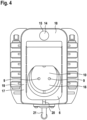
- die Anschlusseinheit der erfindungsgemäßen Ladestation in einer vergrößerten Ansicht von oben.
- In der
Figur 1 ist eine Ladestation 1 zum Aufladen eines Energiespeichers eines nicht näher dargestellten Elektrofahrzeugs schematisch abgebildet, welche an einer Stele 100 oder alternativ mit einer Wandung, die beispielsweise in einer Garage angeordnet ist, verbunden ist. Die Ladestation 1 umfasst ein Gehäuse 2, welches einen Raum 3 zur Aufnahme von elektronischen Komponenten aufweist. Das Gehäuse 2 ist mit einem Abdeckmodul 4 verbunden. Im vorliegenden Ausführungsbeispiel der Ladestation 1 weist das Abdeckmodul 4 mindestens zwei separate Bauteile auf, nämlich ein Deckelelement 5 und eine Anschlusseinheit 6, wobei die Anschlusseinheit 6 zum Anordnen und/oder Verbinden eines Aufladeelements, insbesondere eines Ladesteckers vorgesehen ist. Um den inneren Raum 3 des Gehäuses 2 vor Feuchtigkeit und Schmutz zu schützen, ist zumindest zwischen dem Gehäuse 2 und dem Abdeckmodul 4, insbesondere dem Deckelelement 5 ein erstes Dichtelement 7 angeordnet. Daher ist an dem Gehäuse 2 eine umlaufende Dichtnut 8 vorgesehen, welche als Aufnahme des ersten Dichtelements 7 dient. Die Anschlusseinheit 6 ist ebenfalls mittels einer Rastverbindung kraftschlüssig und/oder formschlüssig mit dem Gehäuse 2 innerhalb des Raums 3 verbunden. Das Deckelelement 5 ist sowohl mit dem Gehäuse 2 als auch mit der Anschlusseinheit 6 verbunden, wobei zwischen der Anschlusseinheit 6 und dem Deckelelement 5 ein zweites nicht näher dargestelltes Dichtelement beispielsweise innerhalb einer umlaufende Dichtnut der Anschlusseinheit 6 angeordnet ist, um den inneren Raum 3 des Gehäuses 2 vor Feuchtigkeit und Schmutz zu schützen. - Des Weiteren ist die Anschlusseinheit 6 mit mindestens einem, vorzugsweise zylinderförmigen Kontaktelement 9 versehen, welches insbesondere in axialer Richtung schwimmend innerhalb der Anschlusseinheit 6 gelagert ist. Dabei ist das Kontaktelement 9 wasserdicht und/oder staubdicht in der Anschlusseinheit 6 angeordnet.
- Ferner umfasst die Anschlusseinheit 6 einen hier als Mulde ausgebildeten Lagerabschnitt 10 welcher zum Verbinden des Aufladeelements, insbesondere des Ladesteckers vorgesehen ist. Bei einem Fehlen der Kontaktelement 9 könnte die Mulde 10 zum Anordnen bzw. Verstauen des Ladesteckers dienen.
- Außerdem ist an der Anschlusseinheit 6 mindestens ein bewegbares Abdeckelement 11 vorgesehen, welches den Lagerabschnitt 10, insbesondere das Kontaktelement 9 verdeckt, wenn die Ladestation 1 außer Betrieb ist. In einer Betriebsstellung der Ladestation 1 befindet sich das Abdeckelement 11 in einer geöffneten Stellung. Damit ein Benutzer der Ladestation 1 das Abdeckelement 11 komfortabel bewegen kann, ist auf dem Abdeckelement 11 eine Handhabe 12 angeordnet.
- In der
Figur 2 ist das Gehäuse 2 der Ladestation 1 näher gezeigt. Das Gehäuse 2 umfasst mehrere Durchbrüche 13, welche beispielsweise zur Anordnung der elektronischen Komponenten dienen. Das Gehäuse 2 wird derart mit der Stele 100 verbunden, dass der innere Raum 3 des Gehäuses 2 vorzugsweise fluiddicht gegenüber der Umwelt abgedichtet ist. - Aufgrund von Temperaturschwankungen in der Umwelt kann es dazu führen, dass sich innerhalb des Gehäuses 2 in dem Raum 3 Feuchtigkeit ansammelt, welche die elektronischen Komponenten zerstören könnte. Aus diesem Grund weist die Ladestation 1, insbesondere das Abdeckmodul 4 und/oder das Gehäuse 2 ein fluiddurchlässiges, insbesondere gasdurchlässiges Membranelement 14 auf. Zusätzlich könnte das Membranelement 14 auch als Druckausgleichselement ausgebildet sein, welches den Druck zwischen dem Raum 3 innerhalb des Gehäuses 2 und der außerhalb des Gehäuses 2 angeordneten Umwelt ausgleicht.
- Im vorliegenden Ausführungsbeispiel ist vorzugsweise das Membranelement 14, welches zum Austausch von Luft- und/oder Wassermolekülen zwischen dem Raum 3 innerhalb des Gehäuses 2 und der außerhalb des Gehäuses 2 angeordneten Umwelt dient, an der Anschlusseinheit 6 angeordnet. Alternativ oder zusätzlich könnte das Membranelement 14 oder ein weiteres Membranelement auch an dem Gehäuse 2 und/oder an dem Deckelelement 5 angeordnet sein.
- Zur sicheren und einfachen Anordnung bzw. Verbindung des Membranelements 14 mit dem Abdeckmodul 4, insbesondere mit der Anschlusseinheit 6 ist eine Öffnung 15 oder alternativ eine Ausnehmung vorgesehen, die zur kraftschlüssigen und/oder formschlüssigen und/oder stoffschlüssigen Anordnung des Membranelements 14 ausgebildet ist. Im vorliegenden Ausführungsbeispiel ist das Membranelement 14 mit der Öffnung 15 verrastet. Denkbar wäre es auch das Membranelement 14 in die Öffnung 15 oder in die Ausnehmung einzuspritzen oder einzulegen. Ebenfalls wäre es möglich, das Membranelement 14 in die vorzugsweise aus Kunststoff ausgebildete Anschlusseinheit 6 beim Herstellungsprozess der Anschlusseinheit 6 einzuspritzen oder zu umspritzen.
- Wie man gut in der
Figur 4 erkennen kann, weist die Anschlusseinheit einen als Mulde in dem Gehäuse 2 ausgebildeten ersten Abschnitt 16 zum Anordnen der Kontaktelement 9 auf, und einen zweiten Abschnitt 17 zum Anordnen mindestens eines Federelements auf und einen als Schale ausgebildeten dritten Abschnitt 18 zum Anordnen des Membranelements 14 auf. Dabei mündet der zweite Abschnitt 17 des Gehäuses 2, welcher vorzugsweise als u-förmige Nut 19 ausgebildet ist in den dritten Abschnitt 18. Wenn Flüssigkeit aus dem inneren Raum 3 des Gehäuses 2 durch das Membranelement 14 hindurchströmt, kann dieses in der Schale gesammelt werden und fließt über die u-förmige Nut 19 in einen Wasserauslasskanal 20, welcher beispielsweise mit einem Wasserablauf 21 verbunden ist, um das Wasser bzw. die Flüssigkeit in die Umwelt abzuführen. - Im vorliegenden Fall ist das durch den Benutzer bewegbare Abdeckelement 11 an der Anschlusseinheit 6 angeordnet, welches im geschlossenen Zustand das Membranelement 14 und/oder den Lagerabschnitt 10 verdeckt, insbesondere das Kontaktelement 9 verdeckt und im geöffneten Zustand den Lagerabschnitt 10, insbesondere das Kontaktelement 9 freigibt. Um das Membranelement 14 zu schützen, kann es vorteilhaft sein, wenn das Abdeckelement 11 das Membranelement 14 zumindest im geöffneten Zustand und/oder im geschlossenen Zustand verdeckt, wobei das Abdeckelement 11 beabstandet zu dem Membranelement 14 angeordnet ist. Folglich ist zwischen dem Membranelement 14 und dem Abdeckelement 11 ein Luftspalt angeordnet.
- Das Membranelement 14 erhöht grundsätzlich die Lebensdauer der elektronischen Bauteile in dem Gehäuse 2. Das Membranelement 14 ist deutlich umweltfreundlicher als andere Schutzelemente wie etwa der Einsatz von Vergussmassen. Das Membranelement 14 ist durch die Label-Technologie einfach und kostengünstig aufzubringen und lässt sich mit diversen Zusatznutzen kombinieren. Als Verbindungstechnologien können das Kleben und/oder Schweißen dienen.
-
- 1
- Ladestation
- 2
- Gehäuse
- 3
- Raum innerhalb des Gehäuses
- 4
- Abdeckmodul
- 5
- Deckelelement
- 6
- Anschlusseinheit
- 7
- Dichtelement
- 8
- Dichtnut
- 9
- Kontaktelement
- 10
- Lagerabschnitt
- 11
- Abdeckelement
- 12
- Handhabe
- 13
- Durchbruch
- 14
- Membranelement
- 15
- Öffnung
- 16
- erster Abschnitt
- 17
- zweiter Abschnitt
- 18
- dritter Abschnitt
- 19
- Nut
- 20
- Wasserauslasskanal
- 21
- Wasserablauf
- 100
- Stele
Claims (16)
- Ladestation (1) zum Aufladen eines Energiespeichers eines Elektrofahrzeugs, welche ein Gehäuse (2) mit einem innerhalb des Gehäuses (2) angeordneten Raum (3) zur Aufnahme von elektronischen Komponenten aufweist, und einen mit dem Gehäuse (2) verbindbaren Abdeckmodul (4), welches mindestens ein Deckelelement (5) und eine Anschlusseinheit (6) umfasst, wobei die Anschlusseinheit (6) zum Anordnen und/oder Verbinden eines Aufladeelements, insbesondere eines Ladesteckers oder einer Ladesteckdose vorgesehen ist, wobei zumindest zwischen dem Gehäuse (2) und dem Abdeckmodul (4) mindestens ein erstes Dichtelement (7) vorgesehen ist,
dadurch gekennzeichnet, dass
das Abdeckmodul (4) und/oder das Gehäuse (2) mindestens ein Membranelement (14) aufweist, welches zum Austausch von Luft- und/oder Wassermolekülen zwischen dem Raum (3) innerhalb des Gehäuses (2) und einer außerhalb des Gehäuses (2) angeordneten Umwelt ausgebildet ist. - Ladestation (1) nach Anspruch 1, dadurch gekennzeichnet, dass die Anschlusseinheit (6) mit mindestens einem, vorzugsweise zylinderförmigen Kontaktelement (9) versehen ist, welches insbesondere in Axialrichtung schwimmend innerhalb der Anschlusseinheit (6) gelagert ist.
- Ladestation (1) nach Anspruch 2, dadurch gekennzeichnet, dass das Kontaktelement (9) wasserdicht und/oder staubdicht in der Anschlusseinheit (6) angeordnet ist.
- Ladestation (1) nach mindestens einem der Ansprüche 1 bis 3 , dadurch gekennzeichnet, dass die Anschlusseinheit (6) an dem Gehäuse (2) angeordnet ist und das Deckelelement (5) sowohl mit dem Gehäuse (2) als auch mit der Anschlusseinheit (6) verbunden ist, wobei zwischen der Anschlusseinheit (6) und dem Deckelelement (5) ein zweites Dichtelement angeordnet ist.
- Ladestation (1) nach mindestens einem der Ansprüche 1 bis 4, dadurch gekennzeichnet, dass die Anschlusseinheit (6) einen Lagerabschnitt (10), insbesondere eine Mulde zum Anordnen und/oder Verbinden des Aufladeelements, insbesondere des Ladesteckers oder der Ladesteckdose aufweist.
- Ladestation nach mindestens einem der Ansprüche 1 bis 5, dadurch gekennzeichnet, dass das Gehäuse (2) und/oder das Abdeckmodul (4) eine Ausnehmung oder Öffnung (15) aufweist, die zur kraftschlüssigen und/oder formschlüssigen und/oder stoffschlüssigen Anordnung des Membranelements (14) ausgebildet ist.
- Ladestation (1) nach Anspruch 6, dadurch gekennzeichnet, dass das Membranelement (14) in die Öffnung (15) oder Ausnehmung verrastet ist und/oder eingelegt ist und/oder umspritzt ist und/oder eingeklebt ist.
- Ladestation (1) nach mindestens einem der Ansprüche 1 bis 7, dadurch gekennzeichnet, dass an der Anschlusseinheit (6) mindestens ein bewegbares Abdeckelement (11) vorgesehen ist, welches im geschlossenen Zustand das Membranelement (14) und/oder den Lagerabschnitt, insbesondere das Kontaktelement (9) verdeckt und im geöffneten Zustand den Lagerabschnitt, insbesondere das Kontaktelement (9) freigibt.
- Ladestation (1) nach Anspruch 8, dadurch gekennzeichnet, dass das Abdeckelement das Membranelement (14) zumindest im geöffneten Zustand und/oder im geschlossenen Zustand verdeckt, wobei das Abdeckelement 11 beabstandet zu dem Membranelement (14) angeordnet ist, wobei zwischen dem Membranelement (14) und dem Abdeckelement (11) ein Luftspalt angeordnet ist.
- Ladestation (1) nach mindestens einem der Ansprüche 1 bis 9, dadurch gekennzeichnet, dass das Membranelement (14) fluiddurchlässig, insbesondere gasdurchlässig ausgebildet ist.
- Ladestation (1) nach mindestens einem der Ansprüche 1 bis 10, dadurch gekennzeichnet, dass die Anschlusseinheit (6) einen ersten Abschnitt (16) zum Anordnen der Kontaktelemente und einen zweiten Abschnitt (17) zum Anordnen mindestens eines Federelements, vorzugsweise zwei Federelementen sowie einen dritten Abschnitt (18) zum Anordnen des Membranelements (14) aufweist.
- Ladestation (1) nach Anspruch 11, dadurch gekennzeichnet, dass das mindestens eine Federelement zur bewegbaren Lagerung des Abdeckelements (11) vorgesehen ist, wobei mindestens ein Federelement an dem zweiten Abschnitt (17), insbesondere an dem Gehäuse (2) befestigt ist und zusätzlich an dem Abdeckelement (11) befestigt ist.
- Ladestation (1) nach mindestens einem der Ansprüche 1 bis 12, dadurch gekennzeichnet, dass der erste Abschnitt (16) als Mulde in dem Gehäuse (2) ausgebildet ist und/oder der zweite Abschnitt (17) als, vorzugsweise U-förmige, Nut in dem Gehäuse ausgebildet ist und/oder der dritte Abschnitt (18) als Schale in dem Gehäuse ausgebildet ist.
- Ladestation (1) nach mindestens einem der Ansprüche 1 bis 13, dadurch gekennzeichnet, dass der zweite Abschnitt (17) des Gehäuses (2), insbesondere die Nut in den dritten Abschnitt (18) des Gehäuses (2), insbesondere in die Schale mündet.
- Ladestation (1) nach mindestens einem der Ansprüche 1 bis 14, dadurch gekennzeichnet, dass das Membranelement (14) als Druckausgleichselement ausgebildet ist, welches den Druck zwischen dem Raum (3) innerhalb des Gehäuses (2) und der außerhalb des Gehäuses (2) angeordneten Umwelt ausgleicht.
- Ladestation (1) nach mindestens einem der Ansprüche 1 bis 15, dadurch gekennzeichnet, dass das das Gehäuse (2) der Ladestation mit einer Stele (100) oder einer Wandung verbunden ist.
Priority Applications (1)
| Application Number | Priority Date | Filing Date | Title |
|---|---|---|---|
| EP23188976.7A EP4296110A1 (de) | 2018-05-30 | 2019-03-26 | Ladestation zum aufladen eines energiespeichers eines elektrofahrzeugs |
Applications Claiming Priority (2)
| Application Number | Priority Date | Filing Date | Title |
|---|---|---|---|
| DE102018112985.8A DE102018112985A1 (de) | 2018-05-30 | 2018-05-30 | Ladestation zum Aufladen eines Energiespeichers eines Elektrofahrzeugs |
| PCT/EP2019/057592 WO2019228690A1 (de) | 2018-05-30 | 2019-03-26 | Ladestation zum aufladen eines energiespeichers eines elektrofahrzeugs |
Related Child Applications (1)
| Application Number | Title | Priority Date | Filing Date |
|---|---|---|---|
| EP23188976.7A Division EP4296110A1 (de) | 2018-05-30 | 2019-03-26 | Ladestation zum aufladen eines energiespeichers eines elektrofahrzeugs |
Publications (2)
| Publication Number | Publication Date |
|---|---|
| EP3802195A1 EP3802195A1 (de) | 2021-04-14 |
| EP3802195B1 true EP3802195B1 (de) | 2023-08-02 |
Family
ID=65991802
Family Applications (2)
| Application Number | Title | Priority Date | Filing Date |
|---|---|---|---|
| EP19714382.9A Active EP3802195B1 (de) | 2018-05-30 | 2019-03-26 | Ladestation zum aufladen eines energiespeichers eines elektrofahrzeugs |
| EP23188976.7A Withdrawn EP4296110A1 (de) | 2018-05-30 | 2019-03-26 | Ladestation zum aufladen eines energiespeichers eines elektrofahrzeugs |
Family Applications After (1)
| Application Number | Title | Priority Date | Filing Date |
|---|---|---|---|
| EP23188976.7A Withdrawn EP4296110A1 (de) | 2018-05-30 | 2019-03-26 | Ladestation zum aufladen eines energiespeichers eines elektrofahrzeugs |
Country Status (5)
| Country | Link |
|---|---|
| EP (2) | EP3802195B1 (de) |
| DE (1) | DE102018112985A1 (de) |
| DK (1) | DK3802195T3 (de) |
| FI (1) | FI3802195T3 (de) |
| WO (1) | WO2019228690A1 (de) |
Families Citing this family (4)
| Publication number | Priority date | Publication date | Assignee | Title |
|---|---|---|---|---|
| DE102020113211B4 (de) | 2020-05-15 | 2022-09-15 | Ads-tec Energy GmbH | Verfahren und System zum Schutz einer Elektronik vor Kondenswasser |
| DE102020125584A1 (de) | 2020-09-30 | 2022-03-31 | KEBA Energy Automation GmbH | Ladestation zum Laden eines Energiespeichers eines Elektrofahrzeuges |
| WO2022104417A1 (en) * | 2020-11-17 | 2022-05-27 | Tritium Holdings Pty Ltd | An assembly for an electric vehicle charger |
| CN117681699B (zh) * | 2023-11-28 | 2024-06-04 | 信阳职业技术学院 | 一种人工智能充电桩 |
Citations (5)
| Publication number | Priority date | Publication date | Assignee | Title |
|---|---|---|---|---|
| FR2924276A1 (fr) * | 2007-11-27 | 2009-05-29 | Peugeot Citroen Automobiles Sa | Connecteur electrique |
| FR2972145A1 (fr) * | 2011-03-01 | 2012-09-07 | Peugeot Citroen Automobiles Sa | Trappe de prise de charge pour vehicule electrique et vehicule equipe d'une telle trappe. |
| EP2573880A1 (de) * | 2011-09-21 | 2013-03-27 | Delphi Technologies, Inc. | Gehäuse für einen elektrischer Verbinder mit einer Entwässerungsvorrichtung |
| DE102016205117A1 (de) * | 2015-04-30 | 2016-11-03 | Siemens Aktiengesellschaft | Kopplungselement und Stecker |
| DE202015104315U1 (de) * | 2015-08-17 | 2016-11-18 | Phoenix Contact E-Mobility Gmbh | Steckverbinderteil mit einer Entwässerung |
Family Cites Families (4)
| Publication number | Priority date | Publication date | Assignee | Title |
|---|---|---|---|---|
| DE102012103213A1 (de) * | 2012-04-13 | 2013-10-17 | Keba Ag | Verfahren zum Betreiben einer Ladeanschlussvorrichtung für Elektrofahrzeuge |
| DE102012011606B4 (de) * | 2012-06-12 | 2024-01-25 | Volkswagen Aktiengesellschaft | Ladestation, insbesondere zur Ladung der Batterie eines Elektrofahrzeugs |
| DE102012016481B4 (de) * | 2012-08-17 | 2021-03-18 | Langmatz Gmbh | Stromtankstelle |
| DE102016220110A1 (de) * | 2016-10-14 | 2018-04-19 | Phoenix Contact E-Mobility Gmbh | Temperaturüberwachtes Ladesystem zur Übertragung von elektrischen Ladeströmen |
-
2018
- 2018-05-30 DE DE102018112985.8A patent/DE102018112985A1/de not_active Withdrawn
-
2019
- 2019-03-26 EP EP19714382.9A patent/EP3802195B1/de active Active
- 2019-03-26 DK DK19714382.9T patent/DK3802195T3/da active
- 2019-03-26 EP EP23188976.7A patent/EP4296110A1/de not_active Withdrawn
- 2019-03-26 WO PCT/EP2019/057592 patent/WO2019228690A1/de not_active Ceased
-
2023
- 2023-11-01 FI FIEP19714382.9T patent/FI3802195T3/en active
Patent Citations (5)
| Publication number | Priority date | Publication date | Assignee | Title |
|---|---|---|---|---|
| FR2924276A1 (fr) * | 2007-11-27 | 2009-05-29 | Peugeot Citroen Automobiles Sa | Connecteur electrique |
| FR2972145A1 (fr) * | 2011-03-01 | 2012-09-07 | Peugeot Citroen Automobiles Sa | Trappe de prise de charge pour vehicule electrique et vehicule equipe d'une telle trappe. |
| EP2573880A1 (de) * | 2011-09-21 | 2013-03-27 | Delphi Technologies, Inc. | Gehäuse für einen elektrischer Verbinder mit einer Entwässerungsvorrichtung |
| DE102016205117A1 (de) * | 2015-04-30 | 2016-11-03 | Siemens Aktiengesellschaft | Kopplungselement und Stecker |
| DE202015104315U1 (de) * | 2015-08-17 | 2016-11-18 | Phoenix Contact E-Mobility Gmbh | Steckverbinderteil mit einer Entwässerung |
Also Published As
| Publication number | Publication date |
|---|---|
| DE102018112985A1 (de) | 2019-12-05 |
| FI3802195T3 (en) | 2023-11-06 |
| EP4296110A1 (de) | 2023-12-27 |
| DK3802195T3 (da) | 2023-11-06 |
| EP3802195A1 (de) | 2021-04-14 |
| WO2019228690A1 (de) | 2019-12-05 |
Similar Documents
| Publication | Publication Date | Title |
|---|---|---|
| EP3802195B1 (de) | Ladestation zum aufladen eines energiespeichers eines elektrofahrzeugs | |
| DE102013213336B4 (de) | Elektrischer steckverbinder, ladedose und steckverbindersystem für ein elektro- oder hybridfahrzeug | |
| EP0338394B1 (de) | Elektromotor, insbesondere Wischermotor zum Antrieb einer Scheibenwischeranlage in einem Kraftfahrzeug | |
| EP1181505B1 (de) | Sensorbaugruppe mit einem an einer wand montierbaren gehäuse | |
| EP0555434B1 (de) | Elektrisches gerät, insbesondere schalt- und steuergerät für kraftfahrzeuge | |
| EP0268742B1 (de) | Gehäuseeinrichtung mit Druckausgleich | |
| EP0705183B1 (de) | Anbausteuergerät | |
| EP0221304A1 (de) | Kommutatormotor in geschlossener Bauart | |
| DE202007012070U1 (de) | Stromdurchführung einer Vakuumpumpe | |
| DE102019005171A1 (de) | Elektromotor, insbesondere Außenläufermotor | |
| EP2186387B1 (de) | Gehäuse für eine elektrische/elektronische schaltung | |
| EP2811091A2 (de) | Kraftfahrzeug-Türaußengriff | |
| EP2798921B1 (de) | Gehäuse zur aufnahme einer elektronikeinheit | |
| DE202018101278U1 (de) | Steckverbindermodul für einen modularen Industriesteckverbinder zur Übertragung hoher Datenraten | |
| EP0312740A1 (de) | Druckwandler mit einer Schaltungsplatine, insbesondere zur Steuerung eines Kraftfahrzeugs | |
| DE102004007230B4 (de) | Gehäuse mit flüssigkeitsdichter elektrischer Durchführung | |
| DE102006046488B4 (de) | Abgedichteter elektrischer Anschluss eines Gehäuses einer elektrischen Steuereinheit und Hydraulikmaschine mit einem Gehäuse mit einem derartigen Anschluss | |
| DE3851798T2 (de) | Gehäuseanordnung für Personenrufempfänger. | |
| DE202007013162U1 (de) | Pumpenbaugruppe zum Fördern von Flüssigkeiten | |
| DE102007026446A1 (de) | Schnell montierbares Sensorgehäuse für Sensoren mit Luftkontakt | |
| EP0473242B1 (de) | Schutzgehäuse mit einem darin enthaltenen Elektronikbaustein | |
| DE3315900C2 (de) | ||
| DE10226136B3 (de) | Elektrisches Gerät, insbesondere für ein Kraftfahrzeug | |
| DE102018211857A1 (de) | Steuergerät mit einsetzbarem Funkmodul, sowie Funkmodul, Deckel und Stecker | |
| DE20305734U1 (de) | Adapter und damit ausgestattete fluidtechnische Ventilbatterie |
Legal Events
| Date | Code | Title | Description |
|---|---|---|---|
| STAA | Information on the status of an ep patent application or granted ep patent |
Free format text: STATUS: UNKNOWN |
|
| STAA | Information on the status of an ep patent application or granted ep patent |
Free format text: STATUS: THE INTERNATIONAL PUBLICATION HAS BEEN MADE |
|
| PUAI | Public reference made under article 153(3) epc to a published international application that has entered the european phase |
Free format text: ORIGINAL CODE: 0009012 |
|
| STAA | Information on the status of an ep patent application or granted ep patent |
Free format text: STATUS: REQUEST FOR EXAMINATION WAS MADE |
|
| 17P | Request for examination filed |
Effective date: 20201214 |
|
| AK | Designated contracting states |
Kind code of ref document: A1 Designated state(s): AL AT BE BG CH CY CZ DE DK EE ES FI FR GB GR HR HU IE IS IT LI LT LU LV MC MK MT NL NO PL PT RO RS SE SI SK SM TR |
|
| AX | Request for extension of the european patent |
Extension state: BA ME |
|
| DAV | Request for validation of the european patent (deleted) | ||
| DAX | Request for extension of the european patent (deleted) | ||
| STAA | Information on the status of an ep patent application or granted ep patent |
Free format text: STATUS: EXAMINATION IS IN PROGRESS |
|
| 17Q | First examination report despatched |
Effective date: 20211126 |
|
| RAP1 | Party data changed (applicant data changed or rights of an application transferred) |
Owner name: COMPLEO CHARGING SOLUTIONS AG |
|
| GRAP | Despatch of communication of intention to grant a patent |
Free format text: ORIGINAL CODE: EPIDOSNIGR1 |
|
| STAA | Information on the status of an ep patent application or granted ep patent |
Free format text: STATUS: GRANT OF PATENT IS INTENDED |
|
| RIC1 | Information provided on ipc code assigned before grant |
Ipc: H02G 3/08 20060101ALI20230201BHEP Ipc: H02G 3/04 20060101ALI20230201BHEP Ipc: B60L 53/30 20190101ALI20230201BHEP Ipc: B60L 53/14 20190101AFI20230201BHEP |
|
| INTG | Intention to grant announced |
Effective date: 20230222 |
|
| GRAS | Grant fee paid |
Free format text: ORIGINAL CODE: EPIDOSNIGR3 |
|
| GRAA | (expected) grant |
Free format text: ORIGINAL CODE: 0009210 |
|
| STAA | Information on the status of an ep patent application or granted ep patent |
Free format text: STATUS: THE PATENT HAS BEEN GRANTED |
|
| AK | Designated contracting states |
Kind code of ref document: B1 Designated state(s): AL AT BE BG CH CY CZ DE DK EE ES FI FR GB GR HR HU IE IS IT LI LT LU LV MC MK MT NL NO PL PT RO RS SE SI SK SM TR |
|
| REG | Reference to a national code |
Ref country code: GB Ref legal event code: FG4D Free format text: NOT ENGLISH |
|
| REG | Reference to a national code |
Ref country code: CH Ref legal event code: EP |
|
| REG | Reference to a national code |
Ref country code: DE Ref legal event code: R096 Ref document number: 502019008758 Country of ref document: DE |
|
| REG | Reference to a national code |
Ref country code: IE Ref legal event code: FG4D Free format text: LANGUAGE OF EP DOCUMENT: GERMAN |
|
| REG | Reference to a national code |
Ref country code: FI Ref legal event code: FGE Ref country code: DK Ref legal event code: T3 Effective date: 20231103 |
|
| REG | Reference to a national code |
Ref country code: SE Ref legal event code: TRGR |
|
| REG | Reference to a national code |
Ref country code: NL Ref legal event code: PD Owner name: COMPLEO CHARGING SOLUTIONS GMBH & CO. KG; DE Free format text: DETAILS ASSIGNMENT: CHANGE OF OWNER(S), ASSIGNMENT; FORMER OWNER NAME: COMPLEO CHARGING SOLUTIONS AG Effective date: 20231113 Ref country code: NL Ref legal event code: FP |
|
| REG | Reference to a national code |
Ref country code: LT Ref legal event code: MG9D |
|
| REG | Reference to a national code |
Ref country code: GB Ref legal event code: 732E Free format text: REGISTERED BETWEEN 20231102 AND 20231108 |
|
| RAP2 | Party data changed (patent owner data changed or rights of a patent transferred) |
Owner name: COMPLEO CHARGING SOLUTIONS GMBH & CO. KG |
|
| REG | Reference to a national code |
Ref country code: NO Ref legal event code: T2 Effective date: 20230802 |
|
| PG25 | Lapsed in a contracting state [announced via postgrant information from national office to epo] |
Ref country code: GR Free format text: LAPSE BECAUSE OF FAILURE TO SUBMIT A TRANSLATION OF THE DESCRIPTION OR TO PAY THE FEE WITHIN THE PRESCRIBED TIME-LIMIT Effective date: 20231103 |
|
| PG25 | Lapsed in a contracting state [announced via postgrant information from national office to epo] |
Ref country code: IS Free format text: LAPSE BECAUSE OF FAILURE TO SUBMIT A TRANSLATION OF THE DESCRIPTION OR TO PAY THE FEE WITHIN THE PRESCRIBED TIME-LIMIT Effective date: 20231202 |
|
| PG25 | Lapsed in a contracting state [announced via postgrant information from national office to epo] |
Ref country code: RS Free format text: LAPSE BECAUSE OF FAILURE TO SUBMIT A TRANSLATION OF THE DESCRIPTION OR TO PAY THE FEE WITHIN THE PRESCRIBED TIME-LIMIT Effective date: 20230802 Ref country code: PT Free format text: LAPSE BECAUSE OF FAILURE TO SUBMIT A TRANSLATION OF THE DESCRIPTION OR TO PAY THE FEE WITHIN THE PRESCRIBED TIME-LIMIT Effective date: 20231204 Ref country code: LV Free format text: LAPSE BECAUSE OF FAILURE TO SUBMIT A TRANSLATION OF THE DESCRIPTION OR TO PAY THE FEE WITHIN THE PRESCRIBED TIME-LIMIT Effective date: 20230802 Ref country code: LT Free format text: LAPSE BECAUSE OF FAILURE TO SUBMIT A TRANSLATION OF THE DESCRIPTION OR TO PAY THE FEE WITHIN THE PRESCRIBED TIME-LIMIT Effective date: 20230802 Ref country code: IS Free format text: LAPSE BECAUSE OF FAILURE TO SUBMIT A TRANSLATION OF THE DESCRIPTION OR TO PAY THE FEE WITHIN THE PRESCRIBED TIME-LIMIT Effective date: 20231202 Ref country code: HR Free format text: LAPSE BECAUSE OF FAILURE TO SUBMIT A TRANSLATION OF THE DESCRIPTION OR TO PAY THE FEE WITHIN THE PRESCRIBED TIME-LIMIT Effective date: 20230802 Ref country code: GR Free format text: LAPSE BECAUSE OF FAILURE TO SUBMIT A TRANSLATION OF THE DESCRIPTION OR TO PAY THE FEE WITHIN THE PRESCRIBED TIME-LIMIT Effective date: 20231103 |
|
| PG25 | Lapsed in a contracting state [announced via postgrant information from national office to epo] |
Ref country code: PL Free format text: LAPSE BECAUSE OF FAILURE TO SUBMIT A TRANSLATION OF THE DESCRIPTION OR TO PAY THE FEE WITHIN THE PRESCRIBED TIME-LIMIT Effective date: 20230802 |
|
| PG25 | Lapsed in a contracting state [announced via postgrant information from national office to epo] |
Ref country code: ES Free format text: LAPSE BECAUSE OF FAILURE TO SUBMIT A TRANSLATION OF THE DESCRIPTION OR TO PAY THE FEE WITHIN THE PRESCRIBED TIME-LIMIT Effective date: 20230802 |
|
| PG25 | Lapsed in a contracting state [announced via postgrant information from national office to epo] |
Ref country code: SM Free format text: LAPSE BECAUSE OF FAILURE TO SUBMIT A TRANSLATION OF THE DESCRIPTION OR TO PAY THE FEE WITHIN THE PRESCRIBED TIME-LIMIT Effective date: 20230802 Ref country code: RO Free format text: LAPSE BECAUSE OF FAILURE TO SUBMIT A TRANSLATION OF THE DESCRIPTION OR TO PAY THE FEE WITHIN THE PRESCRIBED TIME-LIMIT Effective date: 20230802 Ref country code: ES Free format text: LAPSE BECAUSE OF FAILURE TO SUBMIT A TRANSLATION OF THE DESCRIPTION OR TO PAY THE FEE WITHIN THE PRESCRIBED TIME-LIMIT Effective date: 20230802 Ref country code: EE Free format text: LAPSE BECAUSE OF FAILURE TO SUBMIT A TRANSLATION OF THE DESCRIPTION OR TO PAY THE FEE WITHIN THE PRESCRIBED TIME-LIMIT Effective date: 20230802 Ref country code: CZ Free format text: LAPSE BECAUSE OF FAILURE TO SUBMIT A TRANSLATION OF THE DESCRIPTION OR TO PAY THE FEE WITHIN THE PRESCRIBED TIME-LIMIT Effective date: 20230802 Ref country code: SK Free format text: LAPSE BECAUSE OF FAILURE TO SUBMIT A TRANSLATION OF THE DESCRIPTION OR TO PAY THE FEE WITHIN THE PRESCRIBED TIME-LIMIT Effective date: 20230802 |
|
| REG | Reference to a national code |
Ref country code: DE Ref legal event code: R097 Ref document number: 502019008758 Country of ref document: DE |
|
| PLBE | No opposition filed within time limit |
Free format text: ORIGINAL CODE: 0009261 |
|
| STAA | Information on the status of an ep patent application or granted ep patent |
Free format text: STATUS: NO OPPOSITION FILED WITHIN TIME LIMIT |
|
| 26N | No opposition filed |
Effective date: 20240503 |
|
| PG25 | Lapsed in a contracting state [announced via postgrant information from national office to epo] |
Ref country code: SI Free format text: LAPSE BECAUSE OF FAILURE TO SUBMIT A TRANSLATION OF THE DESCRIPTION OR TO PAY THE FEE WITHIN THE PRESCRIBED TIME-LIMIT Effective date: 20230802 |
|
| REG | Reference to a national code |
Ref country code: DE Ref legal event code: R081 Ref document number: 502019008758 Country of ref document: DE Owner name: COMPLEO CHARGING SOLUTIONS GMBH & CO. KG, DE Free format text: FORMER OWNER: COMPLEO CHARGING SOLUTIONS AG, 44309 DORTMUND, DE |
|
| PG25 | Lapsed in a contracting state [announced via postgrant information from national office to epo] |
Ref country code: BG Free format text: LAPSE BECAUSE OF FAILURE TO SUBMIT A TRANSLATION OF THE DESCRIPTION OR TO PAY THE FEE WITHIN THE PRESCRIBED TIME-LIMIT Effective date: 20230802 |
|
| PG25 | Lapsed in a contracting state [announced via postgrant information from national office to epo] |
Ref country code: LU Free format text: LAPSE BECAUSE OF NON-PAYMENT OF DUE FEES Effective date: 20240326 |
|
| PG25 | Lapsed in a contracting state [announced via postgrant information from national office to epo] |
Ref country code: MC Free format text: LAPSE BECAUSE OF FAILURE TO SUBMIT A TRANSLATION OF THE DESCRIPTION OR TO PAY THE FEE WITHIN THE PRESCRIBED TIME-LIMIT Effective date: 20230802 |
|
| PG25 | Lapsed in a contracting state [announced via postgrant information from national office to epo] |
Ref country code: MC Free format text: LAPSE BECAUSE OF FAILURE TO SUBMIT A TRANSLATION OF THE DESCRIPTION OR TO PAY THE FEE WITHIN THE PRESCRIBED TIME-LIMIT Effective date: 20230802 Ref country code: LU Free format text: LAPSE BECAUSE OF NON-PAYMENT OF DUE FEES Effective date: 20240326 Ref country code: BG Free format text: LAPSE BECAUSE OF FAILURE TO SUBMIT A TRANSLATION OF THE DESCRIPTION OR TO PAY THE FEE WITHIN THE PRESCRIBED TIME-LIMIT Effective date: 20230802 |
|
| REG | Reference to a national code |
Ref country code: BE Ref legal event code: MM Effective date: 20240331 |
|
| PG25 | Lapsed in a contracting state [announced via postgrant information from national office to epo] |
Ref country code: BE Free format text: LAPSE BECAUSE OF NON-PAYMENT OF DUE FEES Effective date: 20240331 |
|
| PG25 | Lapsed in a contracting state [announced via postgrant information from national office to epo] |
Ref country code: IE Free format text: LAPSE BECAUSE OF NON-PAYMENT OF DUE FEES Effective date: 20240326 |
|
| PG25 | Lapsed in a contracting state [announced via postgrant information from national office to epo] |
Ref country code: IE Free format text: LAPSE BECAUSE OF NON-PAYMENT OF DUE FEES Effective date: 20240326 Ref country code: BE Free format text: LAPSE BECAUSE OF NON-PAYMENT OF DUE FEES Effective date: 20240331 |
|
| PGFP | Annual fee paid to national office [announced via postgrant information from national office to epo] |
Ref country code: SE Payment date: 20250311 Year of fee payment: 7 |
|
| PGFP | Annual fee paid to national office [announced via postgrant information from national office to epo] |
Ref country code: DE Payment date: 20250320 Year of fee payment: 7 |
|
| PGFP | Annual fee paid to national office [announced via postgrant information from national office to epo] |
Ref country code: DK Payment date: 20250325 Year of fee payment: 7 Ref country code: NL Payment date: 20250321 Year of fee payment: 7 Ref country code: FI Payment date: 20250321 Year of fee payment: 7 |
|
| PGFP | Annual fee paid to national office [announced via postgrant information from national office to epo] |
Ref country code: NO Payment date: 20250326 Year of fee payment: 7 |
|
| PGFP | Annual fee paid to national office [announced via postgrant information from national office to epo] |
Ref country code: AT Payment date: 20250321 Year of fee payment: 7 |
|
| PGFP | Annual fee paid to national office [announced via postgrant information from national office to epo] |
Ref country code: FR Payment date: 20250325 Year of fee payment: 7 |
|
| PGFP | Annual fee paid to national office [announced via postgrant information from national office to epo] |
Ref country code: IT Payment date: 20250306 Year of fee payment: 7 Ref country code: GB Payment date: 20250324 Year of fee payment: 7 |
|
| PGFP | Annual fee paid to national office [announced via postgrant information from national office to epo] |
Ref country code: CH Payment date: 20250429 Year of fee payment: 7 |
|
| PG25 | Lapsed in a contracting state [announced via postgrant information from national office to epo] |
Ref country code: CY Free format text: LAPSE BECAUSE OF FAILURE TO SUBMIT A TRANSLATION OF THE DESCRIPTION OR TO PAY THE FEE WITHIN THE PRESCRIBED TIME-LIMIT; INVALID AB INITIO Effective date: 20190326 |
|
| PG25 | Lapsed in a contracting state [announced via postgrant information from national office to epo] |
Ref country code: HU Free format text: LAPSE BECAUSE OF FAILURE TO SUBMIT A TRANSLATION OF THE DESCRIPTION OR TO PAY THE FEE WITHIN THE PRESCRIBED TIME-LIMIT; INVALID AB INITIO Effective date: 20190326 |
|
| PG25 | Lapsed in a contracting state [announced via postgrant information from national office to epo] |
Ref country code: TR Free format text: LAPSE BECAUSE OF FAILURE TO SUBMIT A TRANSLATION OF THE DESCRIPTION OR TO PAY THE FEE WITHIN THE PRESCRIBED TIME-LIMIT Effective date: 20230802 |