EP3802040B1 - Formenträgersystem - Google Patents
Formenträgersystem Download PDFInfo
- Publication number
- EP3802040B1 EP3802040B1 EP19733964.1A EP19733964A EP3802040B1 EP 3802040 B1 EP3802040 B1 EP 3802040B1 EP 19733964 A EP19733964 A EP 19733964A EP 3802040 B1 EP3802040 B1 EP 3802040B1
- Authority
- EP
- European Patent Office
- Prior art keywords
- mold
- locking
- mold support
- clamping plate
- support system
- Prior art date
- Legal status (The legal status is an assumption and is not a legal conclusion. Google has not performed a legal analysis and makes no representation as to the accuracy of the status listed.)
- Active
Links
Images



Classifications
-
- B—PERFORMING OPERATIONS; TRANSPORTING
- B29—WORKING OF PLASTICS; WORKING OF SUBSTANCES IN A PLASTIC STATE IN GENERAL
- B29C—SHAPING OR JOINING OF PLASTICS; SHAPING OF MATERIAL IN A PLASTIC STATE, NOT OTHERWISE PROVIDED FOR; AFTER-TREATMENT OF THE SHAPED PRODUCTS, e.g. REPAIRING
- B29C33/00—Moulds or cores; Details thereof or accessories therefor
- B29C33/20—Opening, closing or clamping
-
- B—PERFORMING OPERATIONS; TRANSPORTING
- B29—WORKING OF PLASTICS; WORKING OF SUBSTANCES IN A PLASTIC STATE IN GENERAL
- B29C—SHAPING OR JOINING OF PLASTICS; SHAPING OF MATERIAL IN A PLASTIC STATE, NOT OTHERWISE PROVIDED FOR; AFTER-TREATMENT OF THE SHAPED PRODUCTS, e.g. REPAIRING
- B29C45/00—Injection moulding, i.e. forcing the required volume of moulding material through a nozzle into a closed mould; Apparatus therefor
- B29C45/17—Component parts, details or accessories; Auxiliary operations
- B29C45/64—Mould opening, closing or clamping devices
- B29C45/66—Mould opening, closing or clamping devices mechanical
Definitions
- the invention relates to a mold carrier system according to the preamble of patent claim 1.
- a generic mold carrier system is off AT 513 131 B1 is known, in which a movable mold platen arranged on a holding device can be positioned by means of a locking drive in one of several relatively coarse latching positions arranged vertically one above the other.
- Another mold carrier system is known from the applicant's in-house company brochure High Speed Systems.
- a mold carrier upper part is locked to a frame by means of a locking means, which is formed from two locking bushes on a frame support and at least one locking bolt on the mold carrier upper part engaging in these locking bushes.
- a locking position of the upper part of the mold carrier with the frame is only possible for a maximum of two different mold heights.
- WO 93/16828 A1 discloses a locking device for a closing device of an injection molding machine, in which a push rod is provided with grooves and projections, into which corresponding projections and grooves of a nut-like locking ring engage.
- a clamping unit for molds is known in which long-stroke cylinders are provided for lowering and raising the upper mold half and additional short-stroke cylinders are provided to reduce the working time.
- a use of a compressed air cushion on a mold is out DE 699 07 227 T2 known per se, but is used there only for the purpose of compensating for material shrinkage and not for fine positioning of tools.
- the object of the invention is to create a mold carrier system that enables fine adjustment to different tool heights in a large number of positions.
- Mold carrier systems for encapsulating glass covers or panes with foam are used, for example, in the manufacture of sunroofs for vehicles.
- the mold carrier system comprises a portal-like frame with a mold carrier upper part that can be moved relative to the frame and has a first mold clamping plate and a mold carrier lower part with a second mold clamping plate. Furthermore, first locking means are provided on the frame and second locking means are provided on the upper part of the mold carrier. These two locking means enable the upper part of the mold carrier to be locked in a variable locking position relative to the frame.
- the first and the second locking means are formed by a large number of locking elements which are spaced evenly apart and which can be brought into engagement in different locking positions.
- the first locking element is designed as a plate and the second locking element is designed as a bolt.
- the locking elements of the first and second locking means are formed by projections and depressions. In the locking position, the projections of the bolt then engage in the depressions of the plate and the projections of the plate engage in the depressions of the bolt. This creates a kind of interlocking of the two locking means.
- the first locking element can be designed as a bolt and the second locking element can be designed as a plate.
- variable air gap is additionally provided according to the invention between the mold clamping plate and the upper or lower part of the mold carrier.
- This variable air gap enables a so-called floating mounting of the mold clamping plate.
- Inflatable or deaerable compressed air cushions with variable volumes between the mold clamping plate and the upper or lower part of the mold carrier allow stepless fine positioning of the mold clamping plates with different mold height settings.
- the first and second locking means are engageable by means of a locking device.
- the locking element comprises at least one horizontally movable locking element, which can be moved by a drive.
- the drive can be formed as an electric motor, hydraulic cylinder or pneumatic cylinder.
- a sensor for measuring a distance between the first mold mounting plate and the frame.
- the sensor determines a target value for the locking position of the first mold clamping plate by laser measurement.
- This target value of the locking position is determined by a manual process in a creeper.
- the first mold clamping plate is moved very slowly against the second mold clamping plate until the desired locking position is reached.
- the desired value determined in this way can be transferred to a memory of a programmable logic controller (PLC) for subsequent, automated traversing operations of the first mold mounting plate.
- PLC programmable logic controller
- the lower part of the mold carrier with the second mold clamping plate can also be movably mounted on the frame. Both or just one of the platens can be moved.
- the mold carrier system 10 is shown with a portal-like frame 20 .
- the frame 20 is formed by a first portal support 21, a second portal support 22, a yoke 23 arranged at the top horizontally connecting the two portal supports 21 and 22, and a lower traverse 28 horizontally connecting the two portal supports 21 and 22.
- a mold carrier upper part 30 and a mold carrier lower part 40 are arranged pivotably about the axes A30 and A40.
- the swiveling storage is used for more convenient insertion and removal of the components and for easier cleaning of the molds.
- the upper mold carrier part 30 has a first mold clamping plate 31 with a clamping surface 311 and the lower mold carrier part 40 has a second mold clamping plate 41 with a clamping surface 411 .
- the mounting surface 311 is for mounting an upper mold and the mounting surface 411 is for mounting a lower mold, both of which are not shown to simplify the drawing.
- a running rail 26 On the two portal supports 21 and 22 there is a running rail 26 with a guide carriage 25 sliding therein for the vertical movement of the upper part 30 of the mold carrier.
- the guide carriages 25 are driven by a drive 24 which is arranged, for example, on an outside 212 of the portal support 21 .
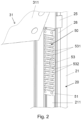
- a first locking means 50 is arranged, which is designed as a plate 51 and a plurality of evenly spaced Locking elements 53 has.
- the second locking element 60 is arranged on an outer side 312 of the mold carrier upper part 30 (shown in detail in FIGS Figures 3 to 5 ).
- a sensor 27 for measuring a distance between the first platen 31 and the frame 20 is provided on the yoke 23 of the frame 20 to determine the desired locking position.
- the sensor 27 uses a laser to determine a target value for the locking position of the first mold clamping plate 31.
- This target value of the locking position is determined by a manual process in a crawling or crawling speed. After the introduction of a new mold, the first mold clamping plate 31 is moved very slowly against the second mold clamping plate 41 until the desired locking position is reached. The target value determined in this way as the distance A between the stationary yoke 23 and the movable first mold clamping plate 30 can be converted into an in 1 indicated memory 82 of a programmable logic controller (PLC) 80 are transmitted.
- PLC programmable logic controller
- the locking elements 53 are designed as projections 531 and depressions 532 .
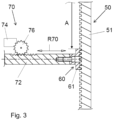
- the figure 3 shows a schematic sectional view of the locking elements 50 and 60, as well as a locking device 70 connected to the bolt 61 of the second locking means 60.
- the locking device 70 comprises a horizontally movable locking element 72, a drive 74 for a gear wheel 76, which moves the locking element 72 in one direction of movement makes the R70 moveable.
- the drive can be designed, for example, as an electric motor, as a hydraulic cylinder or as a pneumatic cylinder.
- Such a synchronously horizontally movable bolt 61 is also on the opposite Side with a arranged on the inside of the second portal support 22, not shown, plate 51 engageable.
- the locking element 53 is brought into engagement with a locking element 63 by the movement of the horizontal locking element 72 .
- Projections 631 and depressions 632 are also formed on the locking element 63 .
- the projections 631 of the latch 61 engage in the indentations 532 of the plate 51 and the projections 531 of the plate 51 in the indentations 632 of the latch 61 (see FIG Figures 4 and 5 ).
- a variable air gap L is provided in the vertical direction between the projections 531 and 631 and the depressions 532 and 632, respectively.
- the air gap L enables a so-called floating mounting of the first mold clamping plate 31.
- the air gap L is about 2 mm according to the invention .
- the second mold clamping plate 41 can also be mounted in a floating manner. Finer teeth with a tooth spacing of 3 mm between the projections 531 and 631 can also be realized.
- the first mold mounting plate 31 is moved to a specific height, so that the locking elements 63 can engage in the locking elements 53 .
- the floating mounting through the air gap L is necessary in order to enable the desired, almost infinitely variable adjustment of the tool height.
- the desired gap S is determined by at least one in 6 illustrated inflatable or ventable compressed air cushion 32 is set, which is effective between the mold mounting plate 31 and the upper mold carrier upper part 30 carrying it and/or between the mold mounting plate 41 and the mold carrier lower part 40 carrying it.
- the setpoint for the required Filling level of the compressed air cushion 32 can also be transferred to a memory 82 of the programmable logic controller (PLC) 80 .
- PLC programmable logic controller
- FIGS. 4 and 5 show a schematic sectional view through the two locking means 50 and 60 in an unlocked and a locked position.
- the reference numbers correspond to those previously described Figures 1 to 3 .
Landscapes
- Engineering & Computer Science (AREA)
- Mechanical Engineering (AREA)
- Manufacturing & Machinery (AREA)
- Moulds For Moulding Plastics Or The Like (AREA)
Description
- Die Erfindung betrifft ein Formenträgersystem gemäß dem Oberbegriff des Patentanspruchs 1.
- Ein gattungsgemäßes Formenträgersystem ist aus
AT 513 131 B1 - Ein weiteres Formenträgersystem ist aus dem hauseigenen Firmenprospekt High Speed Systems der Anmelderin bekannt. Bei dem darin gezeigten Formenträgersystem BFT-P V7 erfolgt die Verriegelung eines Formenträgeroberteils mit einem Rahmen mittels eines Verriegelungsmittels, welches aus zwei Verriegelungsbuchsen an einer Rahmenstütze und wenigstens einem in diese Verriegelungsbuchsen eingreifenden Verriegelungsbolzen am Formenträgeroberteil gebildet wird. Dabei ist eine Verriegelungsposition des Formenträgeroberteils mit dem Rahmen nur für maximal zwei unterschiedliche Werkzeughöhen möglich.
- Aus der
WO 93/16828 A1 - Aus der
DE 43 09 496 A1 ist eine Gießform mit einem Formenoberteil und einem Formenunterteil bekannt, das angehoben und durch Verriegelungselemente verriegelt werden kann. - Aus der
DE 35 38 683 A1 ist eine Schließeinheit für Formwerkzeuge bekannt, bei der für das Absenken und Anheben der oberen Formwerkzeughälfte Langhubzylinder und zur Verkürzung der Arbeitszeit zusätzliche Kurzhubzylinder vorgesehen sind. - Eine Verwendung eines Druckluftkissens an einer Gießform ist aus
DE 699 07 227 T2 für sich gesehen bekannt, dient dort aber nur zum Zwecke einer Kompensation einer Materialschrumpfung und nicht zu einer Feinpositionierung von Werkzeugen. - Aufgabe der Erfindung ist es, ein Formenträgersystem zu schaffen, mit dem eine Fein-Anpassung an unterschiedliche Werkzeughöhen in einer Vielzahl von Positionen ermöglicht wird.
- Diese Aufgabe wird durch ein Formenträgersystem mit den Merkmalen des Anspruchs 1 gelöst. Vorteilhafte Ausgestaltungen der Erfindung sind in den Unteransprüchen angegeben.
- Formenträgersysteme für eine Umschäumung von Glasdeckeln oder -scheiben finden beispielsweise in der Herstellung von Schiebedächern für Fahrzeuge Verwendung.
- Das erfindungsgemäße Formenträgersystem umfasst einen portalartigen Rahmen mit einem relativ zum Rahmen bewegbaren Formenträgeroberteil mit einer ersten Formenaufspannplatte und ein Formenträgerunterteil mit einer zweiten Formenaufspannplatte. Des Weiteren sind am Rahmen erste Verriegelungsmittel und am Formenträgeroberteil zweite Verriegelungsmittel vorgesehen. Mittels dieser beiden Verriegelungsmittel wird ein Verriegeln des Formenträgeroberteils relativ zum Rahmen in einer variablen Verriegelungsposition ermöglicht. Die ersten und die zweiten Verriegelungsmittel werden dabei durch eine Vielzahl von gleichmäßig beabstandeten Verriegelungselementen gebildet, die in unterschiedlichen Verriegelungspositionen in Eingriff bringbar sind.
- In einer vorteilhaften Ausgestaltung ist das erste Verriegelungselement als Platte und das zweite Verriegelungselement als Riegel ausgebildet. Die Verriegelungselemente des ersten und zweiten Verriegelungsmittels werden dabei von Vorsprüngen und Vertiefungen gebildet. In der Verriegelungsposition greifen sodann die Vorsprünge des Riegels in die Vertiefungen der Platte und die Vorsprünge der Platte in die Vertiefungen des Riegels. So entsteht eine Art Verzahnung der beiden Verriegelungsmittel. In einer alternativen Ausgestaltungsform kann das erste Verriegelungselement als Riegel und das zweite Verriegelungselement als Platte ausgebildet sein.
- Befinden sich die beiden Verriegelungsmittel in der Verriegelungsposition, ist gemäß der Erfindung zusätzlich zwischen der Formenaufspannplatte und dem Formenträgerober- oder unterteil ein variabler Luftspalt vorgesehen. Dieser variable Luftspalt ermöglicht eine so genannte schwimmende Lagerung der Formenaufspannplatte. Durch mit veränderbaren Volumina aufblasbare oder entlüftbare Druckluftkissen zwischen Formenaufspannplatte und Formenträgerober- oder unterteil wird eine stufenlose Fein-Positionierung der Formenaufspannplatten bei unterschiedlichen Einstellungen von Werkzeughöhen ermöglicht.
- Vorteilhafterweise sind die ersten und zweiten Verriegelungsmittel mittels einer Verriegelungsvorrichtung in Eingriff bringbar. Das Verriegelungselement umfasst wenigstens ein horizontal bewegbares Riegelelement, welches durch einen Antrieb verfahrbar ist. Der Antrieb kann dabei als Elektromotor, Hydraulikzylinder oder auch Pneumatikzylinder gebildet sein.
- In einer besonders vorteilhaften Ausgestaltung der Erfindung ist ein Sensor zum Messen eines Abstands zwischen der ersten Formenaufspannplatte und dem Rahmen vorgesehen. Durch Lasermessung ermittelt der Sensor einen Sollwert für die Verriegelungsposition der ersten Formenaufspannplatte.
- Dieser Sollwert der Verriegelungsposition wird durch ein manuelles Verfahren in einem Kriechgang ermittelt. Dabei wird die erste Formenaufspannplatte sehr langsam gegen die zweite Formaufspannplatte verfahren bis die gewünschte Verriegelungsposition erreicht ist. Der so ermittelte Sollwert kann in einer besonders vorteilhaften Weiterbildung für darauf folgende, automatisierte Verfahrvorgänge der ersten Formenaufspannplatte in einen Speicher einer speicherprogrammierbaren Steuerung (SPS) übertragen werden. Somit ist nur einmalig nach einem Wechsel eines Formwerkzeugs an der ersten Formenaufspannplatte eine Neukalibrierung des Verfahrwegs zum Schließen des oberen Formwerkzeugs gegenüber einem unteren Formwerkzeug erforderlich. Bei den anschließenden Öffnungs- und Schließvorgängen zum Erzeugen von umschäumten Bauteilen fährt die speicherprogrammierbaren Steuerung (SPS) automatisch den neu ermittelten Sollwert an.
- In einem alternativen Ausführungsbeispiel kann auch das Formenträgerunterteil mit der zweiten Formenaufspannplatte verfahrbar am Rahmen gelagert sein. Dabei können beide oder auch nur eine der Formenaufspannplatten verfahrbar sein.
- Nachfolgend werden Ausführungsbeispiele der Erfindung unter Bezugnahme auf die Zeichnungen näher erläutert. Es zeigt:
- Fig. 1
- eine schematische perspektivische Ansicht des Formenträgersystems mit einem Formenträgeroberteil und einem Formenträgerunterteil in einem geöffnetem Zustand, wobei die daran befestigbaren Formwerkzeuge weggelassen wurden,
- Fig. 2
- eine schematische perspektivische Darstellung des ersten Verriegelungsmittels an einer Portalstütze,
- Fig. 3
- eine schematische Schnittdarstellung des ersten Verriegelungsmittels in Eingriff mit dem zweiten Verriegelungsmittel, welches mit der Verriegelungsvorrichtung verbunden ist,
- Fig. 4
- eine schematische Schnittdarstellung durch das erste und das zweite Verriegelungsmittel in einer unverriegelten/geöffneten Position
- Fig. 5
- eine schematische Schnittdarstellung durch das erste und das zweite Verriegelungsmittel in einer verriegelten Position, und
- Fig. 6
- einen schematischen Teilschnitt durch die rechte Seite eines Formenträgersystems mit zusätzlichen Luftkissen für eine stufenlose Feinjustierung der Höhe einer oberen Formenaufspannplatte.
- In der
Figur 1 ist das Formenträgersystem 10 mit einem portalartigen Rahmen 20 dargestellt. Der Rahmen 20 wird von einer ersten Portalstütze 21, einer zweiten Portalstütze 22, einem die beiden Portalstützen 21 und 22 horizontal verbindenden oben angeordneten Joch 23 und einer die beiden Portalstützen 21 und 22 horizontal verbindenden unteren Traverse 28 gebildet. Zwischen den Portalstützen 21 und 22 sind ein Formenträgeroberteil 30 und ein Formenträgerunterteil 40 schwenkbar um die Achsen A30 und A40 angeordnet. - Die schwenkbare Lagerung dient zum bequemeren Einlegen und Entnehmen der Bauteile und zum leichteren Reinigen der Formwerkzeuge.
- Das Formenträgeroberteil 30 weist dabei eine erste Formenaufspannplatte 31 mit einer Aufspannfläche 311 und das Formenträgerunterteil 40 eine zweite Formenaufspannplatte 41 mit einer Aufspannfläche 411 auf. Die Aufspannfläche 311 dient zur Befestigung eines oberen Formwerkzeugs und die Aufspannfläche 411 dient zur Befestigung eines unteren Formwerkzeugs, die aus Gründen der Zeichnungsvereinfachung beide nicht gezeigt sind.
- An beiden Portalstützen 21 und 22 ist eine Laufschiene 26 mit einem darin gleitenden Führungsschlitten 25 zum vertikalen Verfahren des Formenträgeroberteils 30 vorgesehen. Die Führungsschlitten 25 werden dabei durch einen Antrieb 24 angetrieben, der beispielhaft an einer Außenseite 212 der Portalstütze 21 angeordnet ist.
- Auf einer Innenseite 211 der ersten Portalstütze 21 und auch an der zweiten Portalstütze 22 ist ein erstes Verriegelungsmittel 50 angeordnet, welches als Platte 51 ausgebildet ist und eine Vielzahl an gleichmäßig voneinander beabstandeten Verriegelungselementen 53 aufweist. An einer Außenseite 312 des Formenträgeroberteils 30 ist hierzu korrespondierend das zweite Verriegelungselement 60 angeordnet (detailliert dargestellt in den
Figuren 3 bis 5 ). - Zum Festlegen der gewünschten Verriegelungsposition ist ein Sensor 27 zum Messen eines Abstands zwischen der ersten Formenaufspannplatte 31 und dem Rahmen 20 am Joch 23 des Rahmens 20 vorgesehen. Der Sensor 27 ermittelt dabei mittels eines Lasers einen Sollwert für die Verriegelungsposition der ersten Formenaufspannplatte 31.
- Dieser Sollwert der Verriegelungsposition wird durch ein manuelles Verfahren in einem Kriech- bzw. Schleichgang ermittelt. Dabei wird die erste Formenaufspannplatte 31 nach Einbringen eines neuen Formwerkzeugs sehr langsam gegen die zweite Formaufspannplatte 41 verfahren bis die gewünschte Verriegelungsposition erreicht ist. Der so als Abstand A zwischen dem feststehenden Joch 23 und der verfahrbaren ersten Formenaufspannplatte 30 ermittelte Sollwert kann für darauf folgende, automatisierte Verfahrvorgänge der ersten Formenaufspannplatte in einen in
Fig. 1 angedeuteten Speicher 82 einer speicherprogrammierbaren Steuerung (SPS) 80 übertragen werden. - In der
Figur 2 des detailliert dargestellten Verriegelungsmittels 50 ist deutlich zu erkennen, dass die Verriegelungselemente 53 als Vorsprünge 531 und Vertiefungen 532 ausgebildet sind. - Die
Figur 3 zeigt eine schematische Schnittdarstellung der Verriegelungselemente 50 und 60, sowie eine mit dem Riegel 61 des zweiten Verriegelungsmittels 60 verbundene Verriegelungsvorrichtung 70. Die Verriegelungsvorrichtung 70 umfasst dabei ein horizontal bewegbares Riegelelement 72, einen Antrieb 74 für ein Zahnrad 76, welches das Riegelelement 72 in einer Bewegungsrichtung R70 verfahrbar macht. Der Antrieb kann dabei beispielsweise als Elektromotor, als Hydraulikzylinder oder auch als Pneumatikzylinder ausgebildet sein. Ein derartiger synchron horizontal verfahrbarer Riegel 61 ist auch auf der gegenüberliegenden Seite mit einer an der Innenseite der zweiten Portalstütze 22 angeordneten, nicht gezeigten, Platte 51 in Eingriff bringbar. - Durch das Verfahren des horizontalen Riegelelements 72 wird das Verriegelungselement 53 mit einem Verriegelungselement 63 in Eingriff gebracht. Am Verriegelungselement 63 sind ebenfalls Vorsprünge 631 und Vertiefungen 632 ausgebildet. Beim Ineingriffbringen der beiden Verriegelungselemente 53 und 63 greifen die Vorsprünge 631 des Riegels 61 in die Vertiefungen 532 der Platte 51 und die Vorsprünge 531 der Platte 51 in die Vertiefungen 632 des Riegels 61 ein (siehe
Figuren 4 und 5 ). - Zwischen den Vorsprüngen 531 bzw.631 und den Vertiefungen 532 bzw. 632 ist in vertikaler Richtung ein variabler Luftspalt L vorgesehen. Der Luftspalt L ermöglicht eine so genannte schwimmende Lagerung der ersten Formenaufspannplatte 31. Bei einer beispielhaft ausgeführten Verzahnung mit einem Abstand von zwei benachbarten Vertiefungen 532 von etwa 7 mm und einer Höhe der Vorsprünge 631 von etwa 5 mm beträgt dabei der Luftspalt L erfindungsgemäß etwa 2 mm. Alternativ zur ersten Formenaufspannplatte 31 kann auch die zweite Formenaufspannplatte 41 schwimmend gelagert sein. Es sind auch feinere Verzahnungen mit einem Zahnabstand von 3 mm zwischen den Vorsprüngen 531 bzw.631 realisierbar.
- Je nach Werkzeughöhe wird die erste Formenaufspannplatte 31 auf eine bestimmte Höhe verfahren, so dass die die Verriegelungselemente 63 in die Verriegelungselemente 53 eingreifen können. Da die Verriegelungselemente 53 und 63 jedoch gleichmäßig voneinander beabstandet sind, ist die schwimmende Lagerung durch den Luftspalt L erforderlich, um die gewünschte nahezu stufenlose Einstellung der Werkzeughöhe zu ermöglichen. Der gewünschte Spalt S wird bei einer Fein-Positionierung durch wenigstens ein in
Fig. 6 dargestelltes aufblasbares oder entlüftbares Druckluftkissen 32 eingestellt, das zwischen der Formenaufspannplatte 31 und dem diese tragenden oberen Formenträgeroberteil 30 und/oder zwischen der Formenaufspannplatte 41 und dem diese tragenden Formenträgerunterteil 40 wirksam ist. Der Sollwert für den jeweils erforderlichen Befüllungsgrad der Druckluftkissen 32 kann ebenfalls in einen Speicher 82 der speicherprogrammierbaren Steuerung (SPS) 80 übertragen werden. - In der
Figur 3 ist ebenfalls deutlich zu erkennen, dass die Platte 51 des ersten Verriegelungsmittels 50 - ähnlich einer Zahnstange - wesentlich länger ist als der Riegel 61 des zweiten Verriegelungsmittels 60. - Die
Figuren 4 und 5 zeigen eine schematische Schnittdarstellung durch die beiden Verriegelungsmittel 50 und 60 in einer unverriegelten bzw. einer verriegelten Position. Die Bezugszeichen entsprechen denen der vorher beschriebenenFiguren 1 bis 3 . -
- 10
- Formenträgersystem
- 20
- Rahmen
- 21
- (erste) Portalstütze (von 20)
- 211
- Innenseite (von 21)
- 212
- Außenseite (von 21)
- 22
- (zweite) Portalstütze (von 20)
- 221
- Innenseite (von 22)
- 23
- Joch
- 24
- Antrieb (für 25 an 20)
- 25
- Führungsschlitten
- 26
- Laufschiene
- 27
- Sensor
- 28
- (untere) Traverse
- 30
- Formenträgeroberteil
- 31
- (erste) Formenaufspannplatte
- 311
- Aufspannfläche (von 31)
- 312
- Außenseite (von 31)
- 32
- Druckluftkissen
- 40
- Formenträgerunterteil
- 41
- (zweite) Formenaufspannplatte
- 411
- Aufspannfläche (von 41)
- 50
- (erstes) Verriegelungsmittel (an 20)
- 51
- Platte
- 53
- Verriegelungselement
- 531
- Vorsprung (von 53 an 51)
- 532
- Vertiefung (von 53 an 51)
- 60
- (zweites) Verriegelungsmittel (an 30)
- 61
- Riegel
- 63
- Verriegelungselement
- 631
- Vorsprung (von 63 an 61)
- 632
- Vertiefung (von 63 an 61)
- 70
- Verriegelungsvorrichtung
- 72
- Riegelelement (von 70)
- 74
- Antrieb (für 72)
- 76
- Zahnrad
- 80
- (speicherprogrammierbare) Steuerung
- 82
- Speicher (in 80)
- A
- Abstand (zwischen 23 und 30 in der Verriegelungsposition)
- A30
- Schwenkachse (von 30)
- A40
- Schwenkachse (von 40)
- L
- Luftspalt (zwischen 531 und 532 bzw. zwischen 631 und 632)
- S
- Spalt (zwischen 31 und 30 bzw. 41 und 40)
- R70
- Bewegungsrichtung (von 70)
Claims (11)
- Formenträgersystem (10), umfassend einen portalartigen Rahmen (20), ein relativ zum Rahmen (20) bewegbares Formenträgeroberteil (30) mit einer ersten Formenaufspannplatte (31), ein Formenträgerunterteil (40) mit einer zweiten Formenaufspannplatte (41), erste, am Rahmen (20) vorgesehene Verriegelungsmittel (50) und zweite, am Formenträgeroberteil (30) vorgesehene Verriegelungsmittel (60) zum Verriegeln des Formenträgeroberteils (30) relativ zum Rahmen (20) in einer Verriegelungsposition, wobei die ersten Verriegelungsmittel (50) und/oder die zweiten Verriegelungsmittel (60) durch eine Vielzahl von gleichmäßig beabstandeten Verriegelungselementen (53; 63) gebildet werden, die in unterschiedlichen Verriegelungspositionen in Eingriff bringbar sind, dadurch gekennzeichnet, dass für eine stufenlose Fein-Positionierung der ersten Formenaufspannplatte (31) und/oder der zweiten Formenaufspannplatte (41) am Formenträgeroberteil (30) und/oder am Formenträgerunterteil (40) wenigstens ein Druckluftkissen (32) vorgesehen ist.
- Formenträgersystem (10) nach Anspruch 1, dadurch gekennzeichnet, dass das erste Verriegelungsmittel (50) und das zweite Verriegelungsmittel (60) als Platte (51) und/oder als Riegel (61) ausgebildet ist, an welchen die Verriegelungselemente (53; 63) als Vorsprünge (531; 631) und Vertiefungen (532; 632) ausgebildet oder angeordnet sind, wobei in einer Verriegelungsposition die Vorsprünge (631) des Riegels (61) in die Vertiefungen (532) der Platte (51) und die Vorsprünge (531) der Platte (51) in die Vertiefungen (632) des Riegels (61) eingreifen.
- Formenträgersystem (10) nach Anspruch 2, dadurch gekennzeichnet, dass zwischen den Vorsprüngen (531; 631) und Vertiefungen (532; 632) ein variabler Luftspalt (L) vorgesehen ist, der am Formenträgeroberteil (30) eine schwimmende Lagerung der ersten Formenaufspannplatte (31) und/oder am Formenträgerunterteil (40) eine schwimmende Lagerung der zweiten Formenaufspannplatte (41) für eine stufenlose Einstellung von Werkzeughöhen ermöglicht.
- Formenträgersystem (10) nach einem der vorhergehenden Ansprüche, dadurch gekennzeichnet, dass die Verriegelungsmittel (53; 63) mittels einer Verriegelungsvorrichtung (70) in Eingriff bringbar sind.
- Formenträgersystem (10) nach Anspruch 4, dadurch gekennzeichnet, dass die Verriegelungsvorrichtung (70) wenigstens ein horizontal bewegbares Riegelelement (72) umfasst.
- Formenträgersystem (10) nach Anspruch 5, dadurch gekennzeichnet, dass das Riegelelement (72) mittels eines Antriebs (74) verfahrbar ist.
- Formenträgersystem (10) nach Anspruch 6, dadurch gekennzeichnet, dass der Antrieb (74) von einem Elektromotor, einem Hydraulikzylinder oder einem Pneumatikzylinder gebildet ist.
- Formenträgersystem (10) nach einem der vorhergehenden Ansprüche, dadurch gekennzeichnet, dass ein Sensor (27) zum Messen eines Abstands (A) zwischen der ersten Formenaufspannplatte (31) und dem Rahmen (20) vorgesehen ist.
- Formenträgersystem (10) nach Anspruch 8, dadurch gekennzeichnet, dass der Sensor (27) mittels eines Lasers einen Sollwert für eine Verriegelungsposition der ersten Formenaufspannplatte (31) ermittelt.
- Formenträgersystem (10) nach Anspruch 9, dadurch gekennzeichnet, dass der Sollwert durch ein manuelles Verfahren der ersten Formenaufspannplatte (31) gegen die zweite Formenaufspannplatte (41) in einem Kriechgang ermittelt und für folgende, automatisierte Verfahrvorgänge der ersten Formenaufspannplatte (31) als Sollwert in einen Speicher einer speicherprogrammierbaren Steuerung (SPS) übertragen wird.
- Formenträgersystem (10) nach einem der vorhergehenden Ansprüche, dadurch gekennzeichnet, dass das Formenträgerunterteil (40) mit der zweiten Formenaufspannplatte (41) verfahrbar am Rahmen (20) gelagert ist.
Applications Claiming Priority (3)
| Application Number | Priority Date | Filing Date | Title |
|---|---|---|---|
| DE102018113657 | 2018-06-08 | ||
| DE102018117586.8A DE102018117586A1 (de) | 2018-06-08 | 2018-07-20 | Formenträgersystem |
| PCT/EP2019/064903 WO2019234206A1 (de) | 2018-06-08 | 2019-06-06 | Formenträgersystem |
Publications (3)
| Publication Number | Publication Date |
|---|---|
| EP3802040A1 EP3802040A1 (de) | 2021-04-14 |
| EP3802040C0 EP3802040C0 (de) | 2023-06-07 |
| EP3802040B1 true EP3802040B1 (de) | 2023-06-07 |
Family
ID=68651507
Family Applications (1)
| Application Number | Title | Priority Date | Filing Date |
|---|---|---|---|
| EP19733964.1A Active EP3802040B1 (de) | 2018-06-08 | 2019-06-06 | Formenträgersystem |
Country Status (3)
| Country | Link |
|---|---|
| EP (1) | EP3802040B1 (de) |
| DE (1) | DE102018117586A1 (de) |
| WO (1) | WO2019234206A1 (de) |
Families Citing this family (2)
| Publication number | Priority date | Publication date | Assignee | Title |
|---|---|---|---|---|
| DE102020101061A1 (de) | 2020-01-17 | 2021-07-22 | Bbg Gmbh & Co. Kg | Formenträgersystem |
| CN116100729B (zh) * | 2023-04-14 | 2023-06-20 | 晋江全信机械有限公司 | 一种全自动eva二次成型圆盘机 |
Family Cites Families (6)
| Publication number | Priority date | Publication date | Assignee | Title |
|---|---|---|---|---|
| DE3538683A1 (de) * | 1985-10-31 | 1987-05-07 | Hennecke Gmbh Maschf | Schliesseinheit fuer formwerkzeuge, insbesondere solchen fuer die herstellung von polyurethan-formteilen |
| ATA30692A (de) * | 1992-02-20 | 1993-07-15 | Engel Gmbh Maschbau | Verriegelungsvorrichtung, insbesondere für eine schliessvorrichtung einer spritzgiessmaschine |
| DE4309496A1 (de) * | 1993-03-24 | 1994-09-29 | Spiess Kunststoff Recycling | Verfahren und Vorrichtung zum Befüllen von Gießformen mit plastifiziertem Kunststoff, insbesondere mit stark verunreinigtem Kunststoff-Recycling |
| DE19612018B4 (de) * | 1996-03-18 | 2005-09-29 | Dreier Technology Ag | Formmaschine |
| GB9819415D0 (en) * | 1998-09-07 | 1998-10-28 | Ici Plc | A mould and apparatus thereof |
| AT513131B1 (de) * | 2013-01-28 | 2014-02-15 | Engel Austria Gmbh | Schließeinheit für eine Spritzgießmaschine |
-
2018
- 2018-07-20 DE DE102018117586.8A patent/DE102018117586A1/de active Pending
-
2019
- 2019-06-06 WO PCT/EP2019/064903 patent/WO2019234206A1/de not_active Ceased
- 2019-06-06 EP EP19733964.1A patent/EP3802040B1/de active Active
Also Published As
| Publication number | Publication date |
|---|---|
| DE102018117586A1 (de) | 2019-12-12 |
| EP3802040A1 (de) | 2021-04-14 |
| WO2019234206A1 (de) | 2019-12-12 |
| EP3802040C0 (de) | 2023-06-07 |
Similar Documents
| Publication | Publication Date | Title |
|---|---|---|
| EP3697597B1 (de) | Hubeinrichtung für einen bauzylinder in einer maschine, maschine zur herstellung von dreidimensionalen bauteilen mit einer hubeinrichtung sowie verfahren zur ansteuerung der hubeinrichtung | |
| EP0895848B1 (de) | Vorrichtung zur Herstellung von Spritzgiessartikeln aus mindestens zwei Kunststoffschmelzen | |
| EP1226916A1 (de) | Vorrichtung und Verfahren zur Herstellung von Objekten aus Kunststoff | |
| DE2550824C2 (de) | Karussell-Formmaschine | |
| AT522911B1 (de) | Gusswerkzeug-Spannvorrichtung mit einer Halbmutter und Spritzgießvorrichtung | |
| AT403134B (de) | Formwechseleinrichtung für spritzgiessmaschinen | |
| DE3522377A1 (de) | Verfahren und vorrichtung zum herstellen von formteilen aus einem massiven oder mikrozellularen kunststoff, insbesondere polyurethan bildenden, fliessfaehigen reaktionsgemisch aus mindestens zwei fliessfaehigen reaktionskomponenten | |
| DE3312539C1 (de) | Vorrichtung zum Herstellen von kastenlosen Sandgießformen | |
| DE4237169C2 (de) | Aufbau für Werkzeugmaschinen, insbesondere Elektro-Erosionsmaschinen | |
| WO2020070210A1 (de) | Formschliesseinheit für eine spritzgiessmaschine sowie verfahren zum verriegeln eines kraftübertragungselements | |
| EP3802040A1 (de) | Formenträgersystem | |
| EP0761401A2 (de) | Form zur Herstellung von Formsteinen | |
| EP0583718B1 (de) | Kunststoff-Spritzgiessmaschine | |
| WO2013072459A2 (de) | Verriegelungsvorrichtung für holme einer kunststoffverarbeitungsmaschine | |
| EP0317721A2 (de) | Presse zum Herstellen von Sanitärartikeln, insbesondere WC-Schüsseln, durch Druckgiessen | |
| EP0896866B1 (de) | Verfahren und Vorrichtung zur Herstellung von Formkörpern | |
| EP0087575B1 (de) | Formmaschine zur Herstellung kastenloser Formen | |
| DE3529775C2 (de) | ||
| DE19922684C2 (de) | Blasformmaschine für das abfallarme Blasen | |
| EP0693351B1 (de) | Vorrichtung zur Herstellung von Betonsteinen | |
| EP4003692B1 (de) | Schliesseinheit für eine blasformmaschine | |
| EP1848577B1 (de) | Spritzgiessmaschine zur verarbeitung von kunststoffen | |
| DE10115653B4 (de) | Spannsystem zum Spannen und ggf. Zentrieren von Profilrahmen in Kombination mit einer Putzvorrichtung mit wenigstens zwei Bearbeitungseinheiten und zugehöriges Verfahren | |
| DE102011014783B4 (de) | Verriegelungsvorrichtung für Holme einer Kunststoffverarbeitungsmaschine | |
| DD298073A5 (de) | Werkzeugwechselvorrichtung fuer kunststofformmaschinen |
Legal Events
| Date | Code | Title | Description |
|---|---|---|---|
| STAA | Information on the status of an ep patent application or granted ep patent |
Free format text: STATUS: UNKNOWN |
|
| STAA | Information on the status of an ep patent application or granted ep patent |
Free format text: STATUS: THE INTERNATIONAL PUBLICATION HAS BEEN MADE |
|
| PUAI | Public reference made under article 153(3) epc to a published international application that has entered the european phase |
Free format text: ORIGINAL CODE: 0009012 |
|
| STAA | Information on the status of an ep patent application or granted ep patent |
Free format text: STATUS: REQUEST FOR EXAMINATION WAS MADE |
|
| 17P | Request for examination filed |
Effective date: 20201221 |
|
| AK | Designated contracting states |
Kind code of ref document: A1 Designated state(s): AL AT BE BG CH CY CZ DE DK EE ES FI FR GB GR HR HU IE IS IT LI LT LU LV MC MK MT NL NO PL PT RO RS SE SI SK SM TR |
|
| AX | Request for extension of the european patent |
Extension state: BA ME |
|
| DAV | Request for validation of the european patent (deleted) | ||
| DAX | Request for extension of the european patent (deleted) | ||
| GRAP | Despatch of communication of intention to grant a patent |
Free format text: ORIGINAL CODE: EPIDOSNIGR1 |
|
| STAA | Information on the status of an ep patent application or granted ep patent |
Free format text: STATUS: GRANT OF PATENT IS INTENDED |
|
| INTG | Intention to grant announced |
Effective date: 20230123 |
|
| GRAS | Grant fee paid |
Free format text: ORIGINAL CODE: EPIDOSNIGR3 |
|
| GRAA | (expected) grant |
Free format text: ORIGINAL CODE: 0009210 |
|
| STAA | Information on the status of an ep patent application or granted ep patent |
Free format text: STATUS: THE PATENT HAS BEEN GRANTED |
|
| AK | Designated contracting states |
Kind code of ref document: B1 Designated state(s): AL AT BE BG CH CY CZ DE DK EE ES FI FR GB GR HR HU IE IS IT LI LT LU LV MC MK MT NL NO PL PT RO RS SE SI SK SM TR |
|
| REG | Reference to a national code |
Ref country code: GB Ref legal event code: FG4D Free format text: NOT ENGLISH |
|
| REG | Reference to a national code |
Ref country code: CH Ref legal event code: EP Ref country code: AT Ref legal event code: REF Ref document number: 1573688 Country of ref document: AT Kind code of ref document: T Effective date: 20230615 Ref country code: DE Ref legal event code: R096 Ref document number: 502019008061 Country of ref document: DE |
|
| U01 | Request for unitary effect filed |
Effective date: 20230626 |
|
| U07 | Unitary effect registered |
Designated state(s): AT BE BG DE DK EE FI FR IT LT LU LV MT NL PT SE SI Effective date: 20230630 |
|
| REG | Reference to a national code |
Ref country code: LT Ref legal event code: MG9D |
|
| PG25 | Lapsed in a contracting state [announced via postgrant information from national office to epo] |
Ref country code: NO Free format text: LAPSE BECAUSE OF FAILURE TO SUBMIT A TRANSLATION OF THE DESCRIPTION OR TO PAY THE FEE WITHIN THE PRESCRIBED TIME-LIMIT Effective date: 20230907 Ref country code: ES Free format text: LAPSE BECAUSE OF FAILURE TO SUBMIT A TRANSLATION OF THE DESCRIPTION OR TO PAY THE FEE WITHIN THE PRESCRIBED TIME-LIMIT Effective date: 20230607 |
|
| PG25 | Lapsed in a contracting state [announced via postgrant information from national office to epo] |
Ref country code: RS Free format text: LAPSE BECAUSE OF FAILURE TO SUBMIT A TRANSLATION OF THE DESCRIPTION OR TO PAY THE FEE WITHIN THE PRESCRIBED TIME-LIMIT Effective date: 20230607 Ref country code: HR Free format text: LAPSE BECAUSE OF FAILURE TO SUBMIT A TRANSLATION OF THE DESCRIPTION OR TO PAY THE FEE WITHIN THE PRESCRIBED TIME-LIMIT Effective date: 20230607 Ref country code: GR Free format text: LAPSE BECAUSE OF FAILURE TO SUBMIT A TRANSLATION OF THE DESCRIPTION OR TO PAY THE FEE WITHIN THE PRESCRIBED TIME-LIMIT Effective date: 20230908 |
|
| PG25 | Lapsed in a contracting state [announced via postgrant information from national office to epo] |
Ref country code: SK Free format text: LAPSE BECAUSE OF FAILURE TO SUBMIT A TRANSLATION OF THE DESCRIPTION OR TO PAY THE FEE WITHIN THE PRESCRIBED TIME-LIMIT Effective date: 20230607 |
|
| PG25 | Lapsed in a contracting state [announced via postgrant information from national office to epo] |
Ref country code: IS Free format text: LAPSE BECAUSE OF FAILURE TO SUBMIT A TRANSLATION OF THE DESCRIPTION OR TO PAY THE FEE WITHIN THE PRESCRIBED TIME-LIMIT Effective date: 20231007 |
|
| PG25 | Lapsed in a contracting state [announced via postgrant information from national office to epo] |
Ref country code: SM Free format text: LAPSE BECAUSE OF FAILURE TO SUBMIT A TRANSLATION OF THE DESCRIPTION OR TO PAY THE FEE WITHIN THE PRESCRIBED TIME-LIMIT Effective date: 20230607 Ref country code: SK Free format text: LAPSE BECAUSE OF FAILURE TO SUBMIT A TRANSLATION OF THE DESCRIPTION OR TO PAY THE FEE WITHIN THE PRESCRIBED TIME-LIMIT Effective date: 20230607 Ref country code: RO Free format text: LAPSE BECAUSE OF FAILURE TO SUBMIT A TRANSLATION OF THE DESCRIPTION OR TO PAY THE FEE WITHIN THE PRESCRIBED TIME-LIMIT Effective date: 20230607 Ref country code: IS Free format text: LAPSE BECAUSE OF FAILURE TO SUBMIT A TRANSLATION OF THE DESCRIPTION OR TO PAY THE FEE WITHIN THE PRESCRIBED TIME-LIMIT Effective date: 20231007 Ref country code: CZ Free format text: LAPSE BECAUSE OF FAILURE TO SUBMIT A TRANSLATION OF THE DESCRIPTION OR TO PAY THE FEE WITHIN THE PRESCRIBED TIME-LIMIT Effective date: 20230607 |
|
| PG25 | Lapsed in a contracting state [announced via postgrant information from national office to epo] |
Ref country code: PL Free format text: LAPSE BECAUSE OF FAILURE TO SUBMIT A TRANSLATION OF THE DESCRIPTION OR TO PAY THE FEE WITHIN THE PRESCRIBED TIME-LIMIT Effective date: 20230607 |
|
| REG | Reference to a national code |
Ref country code: DE Ref legal event code: R097 Ref document number: 502019008061 Country of ref document: DE |
|
| PLBE | No opposition filed within time limit |
Free format text: ORIGINAL CODE: 0009261 |
|
| STAA | Information on the status of an ep patent application or granted ep patent |
Free format text: STATUS: NO OPPOSITION FILED WITHIN TIME LIMIT |
|
| 26N | No opposition filed |
Effective date: 20240308 |
|
| U20 | Renewal fee for the european patent with unitary effect paid |
Year of fee payment: 6 Effective date: 20240506 |
|
| PG25 | Lapsed in a contracting state [announced via postgrant information from national office to epo] |
Ref country code: MC Free format text: LAPSE BECAUSE OF FAILURE TO SUBMIT A TRANSLATION OF THE DESCRIPTION OR TO PAY THE FEE WITHIN THE PRESCRIBED TIME-LIMIT Effective date: 20230607 |
|
| REG | Reference to a national code |
Ref country code: CH Ref legal event code: PL |
|
| GBPC | Gb: european patent ceased through non-payment of renewal fee |
Effective date: 20240606 |
|
| PG25 | Lapsed in a contracting state [announced via postgrant information from national office to epo] |
Ref country code: IE Free format text: LAPSE BECAUSE OF NON-PAYMENT OF DUE FEES Effective date: 20240606 |
|
| PG25 | Lapsed in a contracting state [announced via postgrant information from national office to epo] |
Ref country code: CH Free format text: LAPSE BECAUSE OF NON-PAYMENT OF DUE FEES Effective date: 20240630 |
|
| PG25 | Lapsed in a contracting state [announced via postgrant information from national office to epo] |
Ref country code: GB Free format text: LAPSE BECAUSE OF NON-PAYMENT OF DUE FEES Effective date: 20240606 |
|
| U20 | Renewal fee for the european patent with unitary effect paid |
Year of fee payment: 7 Effective date: 20250627 |
|
| PG25 | Lapsed in a contracting state [announced via postgrant information from national office to epo] |
Ref country code: CY Free format text: LAPSE BECAUSE OF FAILURE TO SUBMIT A TRANSLATION OF THE DESCRIPTION OR TO PAY THE FEE WITHIN THE PRESCRIBED TIME-LIMIT; INVALID AB INITIO Effective date: 20190606 |
|
| PG25 | Lapsed in a contracting state [announced via postgrant information from national office to epo] |
Ref country code: HU Free format text: LAPSE BECAUSE OF FAILURE TO SUBMIT A TRANSLATION OF THE DESCRIPTION OR TO PAY THE FEE WITHIN THE PRESCRIBED TIME-LIMIT; INVALID AB INITIO Effective date: 20190606 |