EP3795672B1 - System und verfahren zur erzeugung einer saatkultur mit hoher zelldichte - Google Patents
System und verfahren zur erzeugung einer saatkultur mit hoher zelldichte Download PDFInfo
- Publication number
- EP3795672B1 EP3795672B1 EP19198072.1A EP19198072A EP3795672B1 EP 3795672 B1 EP3795672 B1 EP 3795672B1 EP 19198072 A EP19198072 A EP 19198072A EP 3795672 B1 EP3795672 B1 EP 3795672B1
- Authority
- EP
- European Patent Office
- Prior art keywords
- hcdc
- medium
- cryo
- cpa
- device volume
- Prior art date
- Legal status (The legal status is an assumption and is not a legal conclusion. Google has not performed a legal analysis and makes no representation as to the accuracy of the status listed.)
- Active
Links
Images



Classifications
-
- C—CHEMISTRY; METALLURGY
- C12—BIOCHEMISTRY; BEER; SPIRITS; WINE; VINEGAR; MICROBIOLOGY; ENZYMOLOGY; MUTATION OR GENETIC ENGINEERING
- C12M—APPARATUS FOR ENZYMOLOGY OR MICROBIOLOGY; APPARATUS FOR CULTURING MICROORGANISMS FOR PRODUCING BIOMASS, FOR GROWING CELLS OR FOR OBTAINING FERMENTATION OR METABOLIC PRODUCTS, i.e. BIOREACTORS OR FERMENTERS
- C12M41/00—Means for regulation, monitoring, measurement or control, e.g. flow regulation
- C12M41/30—Means for regulation, monitoring, measurement or control, e.g. flow regulation of concentration
- C12M41/36—Means for regulation, monitoring, measurement or control, e.g. flow regulation of concentration of biomass, e.g. colony counters or by turbidity measurements
-
- C—CHEMISTRY; METALLURGY
- C12—BIOCHEMISTRY; BEER; SPIRITS; WINE; VINEGAR; MICROBIOLOGY; ENZYMOLOGY; MUTATION OR GENETIC ENGINEERING
- C12M—APPARATUS FOR ENZYMOLOGY OR MICROBIOLOGY; APPARATUS FOR CULTURING MICROORGANISMS FOR PRODUCING BIOMASS, FOR GROWING CELLS OR FOR OBTAINING FERMENTATION OR METABOLIC PRODUCTS, i.e. BIOREACTORS OR FERMENTERS
- C12M41/00—Means for regulation, monitoring, measurement or control, e.g. flow regulation
- C12M41/46—Means for regulation, monitoring, measurement or control, e.g. flow regulation of cellular or enzymatic activity or functionality, e.g. cell viability
-
- C—CHEMISTRY; METALLURGY
- C12—BIOCHEMISTRY; BEER; SPIRITS; WINE; VINEGAR; MICROBIOLOGY; ENZYMOLOGY; MUTATION OR GENETIC ENGINEERING
- C12M—APPARATUS FOR ENZYMOLOGY OR MICROBIOLOGY; APPARATUS FOR CULTURING MICROORGANISMS FOR PRODUCING BIOMASS, FOR GROWING CELLS OR FOR OBTAINING FERMENTATION OR METABOLIC PRODUCTS, i.e. BIOREACTORS OR FERMENTERS
- C12M41/00—Means for regulation, monitoring, measurement or control, e.g. flow regulation
- C12M41/48—Automatic or computerized control
-
- C—CHEMISTRY; METALLURGY
- C12—BIOCHEMISTRY; BEER; SPIRITS; WINE; VINEGAR; MICROBIOLOGY; ENZYMOLOGY; MUTATION OR GENETIC ENGINEERING
- C12M—APPARATUS FOR ENZYMOLOGY OR MICROBIOLOGY; APPARATUS FOR CULTURING MICROORGANISMS FOR PRODUCING BIOMASS, FOR GROWING CELLS OR FOR OBTAINING FERMENTATION OR METABOLIC PRODUCTS, i.e. BIOREACTORS OR FERMENTERS
- C12M45/00—Means for pre-treatment of biological substances
- C12M45/22—Means for packing or storing viable microorganisms
Definitions
- the invention relates to a method and to systems for an automated production of High Cell Density Seed Culture (HCDC) preparations (HCDC-preparations) for cryo-preservation.
- HCDC High Cell Density Seed Culture
- HCDCs meet the need for shortening the seed train, i.e. making it more cost efficient.
- cryo-preserved HCDC-preparations particularly HCDC-aliquots help improving production bioprocesses.
- HCDC-preparations can vary in quality. An important measure for the quality is the physiological status at which the HCDC experiences a cryo-treatment.
- WO 2004/040976 A1 describes viral delivery systems and methods for infecting cells with viruses.
- the viral delivery systems may be cryogenically preserved and they may be used in the manufacture of vaccines, polypeptides, and polynucleotides.
- the invention includes a cryogenically protected viral delivery system for infecting host cells that comprises a cryogenic vessel and a plurality of virally infected cells in admixture with a cryo-protective agent contained in the cryogenic vessel.
- US 2019/223433 A1 describes a method for the creation of a high-density cryopreserved cell bank using perfusion culture techniques and non-centrifugal concentration of cells. Methods of production using this high-density cryopreserved cell bank are also provided.
- US 2017/112122 A1 describes methods of freezing mammalian cells for storage or improving thaw recovery of cell banks comprising freezing mammalian cells in a freezing medium having a pH of 6.7 to 8.5.
- US 2019/274299 A1 describes the application of a viable cell monitor to the cryopreservation of plant cells.
- the viable cell monitor is, for the first time, used in a method for rapidly evaluating the effect of cell freezing-preservation.
- the effect of a cryoprotectant on cell preservation is evaluated through the change in the capacitance of viable cells before and after cell freezing and resuscitation.
- the object relates to improving the quality of HCDC-preparations before cryo-preservation.
- HCDC comprising HCDC-cells rather than a HCDC preparation.
- a system for an automated production of high cell density seed culture, HCDC, preparations, for cryo-preservation comprising
- the system allows for automatic replacement of the medium at least partially by the CPA.
- the system can provide HCDC-preparations for cryo-preservation of high quality.
- all or at least most elements of the system can be controlled and/or regulated by the control unit, such that their functions can automatically be requested and/or initiated.
- Monitoring a process online may help finding the ideal process time to initiate a treatment of the cells which are dispersed in a broth containing the HCDC, particularly a preparation of the HCDC for cryo-conservation. Further, the system can reproducibly start the preparation of the HCDC, i.e. the treatment of the HCDC cells, under predefined conditions, thus keeping alterations low between generations of different cell banks and/or cell stems or strains.
- Such on-line data may be collected by means of capacitance probes (also called capacitance sensors) and/or optical spectroscopy, pH-sensors, gas detectors etc. or a combination of several of the named sensors and probes.
- Methods which are considered particularly useful comprise optical probes that do not discriminate between viable and dead cells, capacitance probes and radio-frequency impedance (RFI) probes, wherein a capacitance probe and an RFI probe can detect living cells in a capacitance measurement.
- RFID radio-frequency impedance
- permittivity measurements may be useful because of the robust real-time data indicating the state of a viable cell density of HCDC. Permittivity measurements correlate well to off-line cell counting in the exponential phase without the risk of counting errors. The corresponding permittivity sensors can be used to increase process quality across many cell lines, process types, and scales.
- the system may help to reduce the cell expansion phase, i.e. the time period which is needed for a cell expansion. Hence, less medium is required and operational efforts and costs may be reduced as a consequence.
- the system helps keeping the cells in a beneficial condition by monitoring the physiological cellular state, for example the metabolism and the cell growth, and therefore the system may improve the performance and reproducibility of subsequent cultures.
- the production of a HCDC may be more reliable, provide a higher reproducibility, a better efficiency.
- the system has the advantage of reducing or even avoiding failure rates and of being more cost-efficient in the seed culture handling. The risk of a (high) variability and of performance fluctuations may hence be reduced or eliminated.
- a further advantage of the system is given by the fact, that the number of steps, which need to be performed manually, can be reduced or even eliminated.
- the system may run the production of HCDC-preparations for cryo-preservation autonomously, for example overnight and/or over a long period and/or permanently without a person to interact with while providing an improved quality of HCDC-preparations with a high density of viable cells.
- a manual monitoring of the process particularly a manual sampling of the HCDC and a determination of the viable cell density of the HCDC, can be avoided. Hence, the risk of contamination through a manual process step can be avoided or at least reduced.
- the handling may for example comprise merely providing the material required to start the production of HCDC-preparations including the HCDC growth and instructing the system to start the production. Further steps which may be performed by an operator may comprise presetting at least one predetermined criterion and potentially programming the system for specified functions.
- the at least one sensor comprises a capacitance probe, also called capacitance sensor, for collecting data by at least temporally monitoring at least one parameter comprising a capacitance, preferably online, i.e. substantially in real time during the measurement, wherein the parameter, particularly the capacitance is indicative of the physiological status of the HCDC.
- a capacitance probe also called capacitance sensor
- the at least one parameter preferably comprises at least one of: the viable cell density or any parameter which is substantially indicative of the viable cell density, the overall cell density comprising viable and non-viable cells, a gas concentration, a gas pressure (for example oxygen and/or carbon dioxide), a capacitance, a permittivity, a resistance, a molecular vibrational absorption of light, an amount of scattered light, the pH, the amount and/or weight of bio mass, particularly of the HCDC.
- the step of determining whether at least one predetermined criterion is fulfilled by the monitored parameter preferably comprises at least one of the following: determining whether the viable cell density of the HCDC exceeds or equals or falls below a threshold value, determining whether the viable cell density of the HCDC reaches a plateau value, determining whether the change of viable cell density of the HCDC in time exceeds, equals or falls below a predetermined value, determining whether the gas pressure inside the device volume reaches or falls below a predetermined value, determining whether the weight of HCDC exceed or equals or falls below a threshold value.
- the cell expansion device is arranged on a rocker which is configured to produce a movement of the cell expansion device, such that a liquid can be moved inside the device volume of the cell expansion device.
- the cell expansion device is arranged on a magnetic stirrer which is configured to move a magnetic element inside the device volume such that a liquid can be moved inside the device volume.
- the cell expansion device is arranged on a tempering device such as a heating plate configured to control, i.e. heat and/or cool a substance, for example a gas and/or a liquid inside the device volume.
- the rocker, the magnetic stirrer and/or the tempering device are controlled by the control unit, such that the control unit can set parameters such as rocking strength, temperature and/or stirring frequency.
- the control unit is configured to control the rocker, the magnetic stirrer and/or the tempering device based on at least one criterion which is fulfilled or met by the monitored parameter.
- the parameter may show a substantially exponential growth in a certain time window and a flattening in another time window.
- the control unit preferably is configured to determine when a certain degree of flattening is reaches by the parameter. As a response to the determined flattening, the control unit may decrease or increase the rocking frequency or rocking strength, or the control unit may decrease the temperature to substantially stop further cell growth.
- one of the at least one sensor is substantially arranged on or at the outside wall or skin of the cell expansion device.
- a sensor is substantially arranged on or at the inside wall or skin of the cell expansion device.
- a gas sensor may be arranged on the inside wall of the cell expansion device.
- a sensor is reaching from the outside into the inside device volume through the wall or skin of the cell expansion device.
- the cell expansion device comprises
- the draining of at least a portion of the medium from inside the device volume through the membrane element to the outside of the device volume is preferably performed before the adding the CPA to the HCDC inside the device volume.
- the system allows for automatic replacement of the medium at least partially by the CPA, in that the medium is drained through the membrane element and through the drain from the inside of the device volume to the outside, wherein the HCDC is retained inside the device volume while a CPA is added to the HCDC substantially inside the device volume, simultaneously or afterwards.
- a membrane element may be used not only for the at least partial exchange of the medium by the CPA but also for draining waste substances from the inside of the device volume towards the outside, or for rinsing purposes.
- steps may for example be done substantially at the same time, such that the concentration of viable cells inside the device volume remains substantially stable over the time of exchanging at least a portion of the medium by the CPA. This might be advantageous, as cells might potentially denature if the concentration is becoming too high.
- the system can provide HCDC-preparations for cryo-preservation of high quality.
- all or at least most elements of the system can be controlled and/or regulated by the control unit, such that their functions can automatically be requested and/or initiated.
- the system helps keeping the cells in a beneficial condition by monitoring the physiological cellular state, for example the metabolism and the cell growth, and therefore the system may improve the performance and reproducibility of subsequent cultures.
- the production of a HCDC may be more reliable, provide a higher reproducibility, a better efficiency.
- the system has the advantage of reducing or even avoiding failure rates and of being more cost-efficient in the seed culture handling. The risk of a (high) variability and of performance fluctuations may hence be reduced or eliminated.
- the transfer unit is configured to automatically transfer at least a portion of the HCDC with CPA from the device volume into one or more receiving devices to obtain HCDC-preparations for cryo-preservation.
- transfer into receiving devices can be conducted using an automated process.
- Automatically transferring the HDCD with CPA into a device volume particularly refers to autonomously transferring, i.e. the transfer unit is not required to be called or instructed to perform the step of transferring but performs this step independently.
- the transfer step may be initiated by the control unit.
- at least one switch controls the flow of substance from the cell expansion device towards at least one portion of the transfer unit. The switch may be controlled manually and/or automatically and/or by a command of the control unit.
- multiple elements of the system exchange data with the control unit and/or are controlled by the control unit.
- the cell expansion device one of the units having a rocker function, a balance function, a heating function and/or a cooling function, the transfer unit, at least one sensor, at least one flow control, at least one switch, at least one port and/or at least one valve.
- the system further comprises
- a system for an automated production of HCDC-preparations for cryo-preservation, comprising
- the present aspect has the advantage that cells are separated from the medium by centrifuging the cells with the medium in the centrifuge. After a physical separation, for example by sucking out at least a portion of the medium with a needle which is preferably performed by the control unit, controlling a needle for sucking out the medium, the CPA is added to the cells.
- This aspect represents an alternative or supplementary aspect to the separation according to the first aspect, which is performed via the membrane element. Both aspects may be combined in one single system.
- the centrifuge is optional, if CPA is added in the bag, no centrifuge is required, however, it may still be existent in the system but not used. It is however also not excluded that a case may arise in which options A) and B) are applied to produce a HCDC preparation.
- the system comprises at least one transfer unit which may be configured to transfer the HCDC with the medium into one or more centrifuge containers, such as centrifuge tubes, which are provided inside the centrifuge.
- the centrifuge tubes inside the centrifuge are used for centrifuging the HCDC with the medium.
- the medium may be removed at least partially, for example drained from the centrifuge containers and CPA is added into the same centrifuge container which is later also used for the cryo-treatment. If several centrifuge containers are also used for the cryo-treatment, the step of transferring the HCDC with medium into the centrifuge containers may equal a step of aliquoting substantially the produced and prepared volume of HCDC, as the produced volume of HCDC is partitioned into smaller portions.
- the system may comprise a second transfer unit, controlled by the control unit, for transferring at least a portion of the HCDC with CPA from the centrifuge unit, particularly from at least one centrifuge containers into one or more receiving devices.
- the CPA may be added to the HCDC inside the centrifuge container and/or inside the receiving device to obtain HCDC-preparations for cryo-preservation.
- the centrifuge container is not identical with the receiving device.
- the receiving device may comprise at least one of a vial, a container and a tube.
- the system comprises the units combining the options A) and B), a particular advantage may arise. It may for example be the case that some cell types may be better suited for one of the system types whereas other cell types might be well suited for the other system. For example, a concentration of the HCDC may be very well controlled if a substance is drained via the membrane element while another substance is refilled to replace the drained substance and to control the cell density. Some cells may be particularly sensitive and hence, the membrane technique might be preferred in such a case. For other types of cells, it may the system comprising the centrifuge unit may be better suited.
- control unit is configured, based on the collected data, to decide which technique is best suited for the HCDC. Alternatively, an operator may meet that decision.
- the senor forms an integral unit with the cell expansion device), preferably, wherein the sensor is welded into at least a portion of a wall of the cell expansion device and/or wherein the sensor inserts into the device volume through a port of the cell expansion device.
- the senor reaches through the wall of the cell expansion device via a port into the device volume, where the sensor can substantially physically contact the substance.
- the sensor is a capacitance probe for detecting the capacitance of the broth with the HCDC.
- the wall of the cell expansion device is at least partially the skin of a bag, particularly a single-use bag.
- the membrane element forms an integral unit with the cell expansion device.
- the cell expansion device may be a single use cell expansion device, wherein the element which is formed integrally with the cell expansion device may also be a single use element, such that the entire cell expansion device together with the integral element may be disposed after use.
- the cell expansion device being formed integrally with at least one element may be configured for sterilization or disinfection. The risk of contamination may hence be reduced.
- a capacitance sensor is formed integrally with the cell expansion device, particularly arranged on the outside or inside skin or wall of the cell expansion device.
- the cell expansion device comprises a bag substantially comprising the device volume, particularly a single-use bag.
- elements such as the sensor or the membrane may be removed from the cell expansion device and/or added to the cell expansion device.
- elements which are not configured for single-use may be reused.
- elements may be sterilized apart from the cell expansion device, possibly due to different material requirements.
- the senor comprises at least one out of: a capacitance sensor, an optical sensor, a pH-sensor, a gas sensor, a permittivity sensor, a radio-frequency impedance (RFI) sensor or the like, wherein an optical sensor may be configured for Raman, Infrared and/or UV-vis spectroscopy.
- the sensor used a substantially non-invasive method which does substantially not influence or change the physical, chemical and/or biological parameters inside the cell expansion device.
- the sensor is configured to monitor at least one parameter without physically contacting a substance, particularly a gas and/or a liquid inside the cell expansion device.
- the sensor is configured to monitor at least one parameter from the outside of the cell expansion device.
- the system has the advantage that the sensor is capable of adding benefit to the process chain as the process can be online monitored. This allows for versatility and freedom to operate in the field of HCDC frozen seed culture generation.
- the membrane element comprises at least one of: a membrane filter, a dialysis membrane, a hydrophilic filter, a hydrophobic filter, a microfilter, a nanofilter.
- the membrane element may be configured for filtration, microfiltration, ultrafiltration or nanofiltration, wherein filtration is considered to be performed with a pore size of approximately 10 ⁇ m or bigger, wherein microfiltration is considered to be performed with a pore size of approximately 0,1 ⁇ m or bigger, wherein ultrafiltration is considered to be performed with a pore size of approximately 100 nm to 2 nm and wherein nanofiltration is considered to be performed with a pore size of approximately 2 nm to 0,5 nm.
- a membrane element as described in here is preferably configured to retain all the cells, viable of not, inside the device volume, when a substance is drained outside from that device volume.
- the membrane element is preferably configured to allow at least a microfiltration or an ultrafiltration.
- the membrane element is substantially impermeable for the HCDC and substantially permeable for liquids, for the medium, for feed media and the CPA.
- the HCDC can be retained when a liquid is drained from the device volume.
- control unit is configured to, based on the monitored parameter, automatically control at least one second parameter, wherein the second parameter is preferably configured to control and/or regulate the physiological status of the HCDC.
- the at least one second parameter is a system specific parameter which is substantially not indicative of the physiological status of the HCDC but may regulate the physiological status.
- the at least one second parameter comprises at least one of: a rocking frequency, a stirring frequency, a temperature, a concentration of feed medium, a salt concentration for example of the medium, an oxygen concentration, a proton concentration, a pressure, a light to which the HCDC can be exposed etc.
- a second parameter may be controlled, for example by the control unit, in that the rocking and/or a stirring frequency, the temperature and/or the pressure is or are controlled.
- At least one of the following may be controlled, preferably by the control unit: influx into the device volume of a fresh medium, a feed medium, a pH correctant, a gas, such as oxygen, a buffer, an aqueous salt solution or other substances which may be suitable to control the physiological state of the HCDC.
- At least one out of the cell expansion device, the sensor, the centrifuge unit the receiving devices comprising a bag, a tube and/or a vial, and at least a portion of the transfer unit is or are one or more single-use element and/or a single use consumable.
- a part of the system may also be a single-element which may be for reuse, for single-use, for removal and/or exchange.
- the single-use centrifuge and/or element is particularly configured to be sterilized.
- a method is for an automated production of high cell density seed culture preparations, HCDC-preparations, for cryo-preservation, comprising the steps of
- the method comprises, based on whether or not the monitored parameter fulfills the at least one criterion:
- a method is for an automated production of high cell density seed culture preparations, HCDC-preparations, for cryo-preservation, comprising the steps of
- the step of adding the CPA to the HCDC may comprise filling the CPA into the centrifuge container to the HCDC, particularly when the centrifuge container is used for storage and/or cryo-treatment.
- the step of separating at least partially the centrifuged the medium from the HCDC may comprise transferring the HCDC at least partially from the at least one centrifuge container into at least one receiving device, optionally comprising aliquoting at least apportion of the HCDC.
- the CPA may be added, in this particular case, to the HCDC for example, when the HCDC is inside the at least one centrifuge container and/or inside the receiving device.
- the method further comprises, based on the monitored parameter, automatically controlling at least one second parameter, wherein the second parameter is preferably configured to control and/or regulate the physiological status of the HCDC.
- the method further comprises based on the monitored parameter, automated controlling, by the control unit, of at least one second parameter, wherein the second parameter is configured for controlling and/or regulating a physiological status of the HCDC.
- the processing of the collected data comprises automatically analyzing the collected data by fitting a function and/or model building afunction to at least a portion of the collected data to obtain a fit result.
- a theory may for example comprise an exponential growth of cells for a certain period of time.
- at least a portion of the collected data which reflect the cell growth in time can be analyzed by fitting an exponential function to them.
- a prediction and/or an assessment of the growth can be made, for example.
- a function of an element of the system according to any one aspect may be called. For example, an influx of feed medium may be initiated by the control unit.
- the determining whether at least one predetermined criterion is fulfilled by the monitored parameter is based on automatically analyzing of the fit result.
- control unit of such systems is configured to determine whether at least one predetermined criterion is fulfilled by the monitored parameter based automatically analyzing the collected data by fitting a function to at least a portion of the collected data to obtain a fit result and preferably, automatically analyzing the fit result.
- the step of analyzing the fit result may comprise calculating at least one derivative and comparing the derivative with a predetermined value. If the derivative exceeds the predetermined value, the control unit may cause an action such as initiating an influx of fresh medium and/or a feed medium and/or CPA into the device volume and/or terminate the cell growth by causing a cooling down of the device volume and the HCDC.
- the method further comprises the step of cryo-preserving the HCDC-preparations, i.e. substantially freezing and/or cooling down the HCDC with the CPA in the one or more receiving devices to obtain cryo-preserved HCDC, such as cryo-preserved aliquots of HCDC in tubes.
- the system may comprise a cryo-preserving unit for cryo-preserving the HCDC-preparations.
- the method or the systems according to any one of the above aspects may hence comprise a step, particularly an automated step of cryo-treatment. If this step is automated, it has the advantage of fulfilling precisely preset conditions, which for example were found to be optimal.
- the reproducibility to obtain high quality cryo-preserved HCDC is particularly high.
- the quality of the cryo-preserved HCDC may depend on an exact cryo-treatment protocol, which may include the time which passes between producing or preparing the HCDC-preparations and the cryo-treatment, and/or a stepwise or immediate or instant cryo-treatment procedure.
- the method further comprises further comprises, in at least one iteration step, determining the quality of the obtained HCDC-preparations and
- the quality of the obtained HCDC-preparations may for example comprise a viable cell density of a cryo-preserved HCDC-preparation after defrosting.
- the predetermined criterion may for example be a threshold value which is exceeded by the viable cell density right before the cryo-treatment.
- the threshold value might not necessarily linearly correlate with the quality. Hence, this threshold value may be varied to determine at which threshold value the best quality after defrosting can be obtained.
- the method further comprises at least one iteration step of determining the quality of the obtained HCDC-preparations before or after cryo-preservation and varying at least one of the at least one second parameter(s) and repeating the method according to any aspect, particularly until an optimal quality is obtained.
- the method according to the present aspect and the related systems are high in precision and help finding the optimal conditions under which high quality HDC can be obtained.
- the above aspects are particularly well suited for mammalian cell culture based bioprocesses using online sensors to determine the ideal time point for initiating the treatment of cells for cryo-preservation. Given a good correlation of cell density to online sensor signals (like capacitance) other possible areas of application can be considered, such as microbial applications and/or stem cell applications.
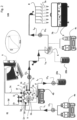
- Fig. 1 is a schematic view of a system 10A for an automated production of (cryo-preserved) HCDC-preparations which comprises the option A) in which a membrane element 1a is used to produce the HCDC-preparations.
- An extension device 1 is provided on a unit 4b, preferably a rocker having a rocking function, which may be combined with a heating and/or cooling function, a balance function, and/or a magnetic stirrer function.
- the unit 4b may be controlled by the control unit 5 and may send data to and/or receive data from the control unit 5.
- the extension device 1 comprises ports 1e, 1k used as an inlet for example for liquid and/or gaseous substances, a port 1l used as an outlet for cell-free substances and ports 1j, 1k for used as outlets for cell-containing substances.
- the port 1j is connected fluidly with a path 11 3 , for example a tubing.
- Ports 1h, 1i are used as inlets and/or outlets mainly for gaseous substances.
- Another port 1i is used for a second sensor 3b.
- Further ports may be arranged on the extension device 1, for example a port for an optical measurement may also be arranged on the extension device 1. All ports may be opened and/or closed manually and/or automatically, controlled by the control unit 5. All ports may comprise valves and/or filters, opening- and/or closing mechanisms.
- the extension device 1 comprises a skin 1b or wall which comprises a bottom section 1d and a top ceiling section 1c.
- the extension device 1 comprises a device volume V for receiving and storing the HCDC 2 and wherein the HCDC 2 can grow to reach the preferred viable cell density.
- the HCDC cells 2, for simplicity merely called HCDC 2 may be dispersed in a medium b.
- the substance comprising the HCDC 2 and the medium b may be considered a so-called broth.
- the the broth has a volume V HCDC which may equal the device volume V if the broth is substantially completely filling the device volume V. It may however be likely that also a gas is taking up space in the device volume V. The gas may stand above the broth and have a volume V gas .
- the gas may enter or exit through an inlet and/or outlet 1g.
- the inlets and/or outlets may have at least one valve function to let a gas only through in one direction, either inwards or outwards.
- a gas pressure may be built up by filling a gas through an inlet 1g into the device volume V and the gas pressure may be reduced by releasing the pressure through an outlet 1g or by sucking gas out through the outlet 1g.
- the gas may comprise for example oxygen and/or CO 2 .
- the inlets and/or outlets 1g may comprise filter elements 1i, 1h.
- the filter elements 1i, 1h may for example preserve the device volume V from contaminations from the outside.
- the device volume V is fluidly connected by at least one port 1e to reservoirs of substances a, b, c: a fresh liquid culture medium b, denoted medium for simplicity, a base and/or a nutrition feed medium c and a CPA.
- the reservoirs of the substances a, b, c share a common port 1e connected by a common path L 1 into the device volume V.
- the reservoirs of the substances a, b, c may alternatively be fluidly connected with the device volume V by individual branches, which are connected to individual ports on the cell extension device 1.
- the substances a, b, c may flow into the device volume V individually and on demand, for example, when the control unit 5 initiates a flow of each individual substance a, b, c, at different times and/or at the same time.
- the reservoirs of the substances a, b, c are arranged on a unit 4a which may have at least one of the following functions: rocking, heating, cooling, balance and magnetic stirring.
- the unit 4a may be controlled by the control unit 5 and may send data to and/or receive data from the control unit 5.
- the control unit 5 may cause the flow control unit 11 1 to specifically drive the CPA (substance a) from the reservoir into the device volume V as a consequence when the predetermined criterion is fulfilled by a parameter.
- the predetermined criterion may for example be a preset or predetermined threshold of a viable cell concentration.
- the parameter which may be a capacitance, indicates that the viable cell concentration surpasses the threshold, the flow of CPA (substance a) into the device volume V is initiated by the control unit.
- the control unit 5 may heat the CPA (substance a) to a suitable temperature by means of the unit 4a having a heating function in that particular case, for example.
- the physiological state of the HCDC 2 may be monitored at least over a period of time by means of the electrode sensor 3a which is provided on or at the skin 1b of the cell expansion device 1.
- the electrode sensor is a capacitance sensor 3a and is configured to record a capacitance which is indicative of the physiological state of the HCDC 2, since the capacitance substantially linearly correlates in at least a capacitance range with the viable cell density.
- the capacitance sensor 3a comprises a data transfer unit 3d for transferring the collected data comprising the capacitances measured in time to the control unit 5.
- the data transfer unit 3d may be a data cable or a wireless connection, for example Bluetooth or internet or the like.
- a second sensor 3b is used to monitor at least one further parameter.
- the second sensor 3b reaches through a sensor port 1f from the outside of the skin 1b to the inside of the device volume V.
- the second sensor 3b is arranged on the top ceiling section 1c.
- the second sensor 3b may be a pH sensor which is configured to monitor a pH inside the broth.
- the second sensor may provide complementary information in addition to the capacitance sensor 3a. The information may help to assess the physiological status of the HCDC 2 more precisely and/or may help to predict changes due to known correlations between the second parameter, such as the pH and the physiological status of the HCDC 2.
- the second sensor 3b also comprises a data transfer unit 3c for transferring the collected data comprising the second parameter such as the pH measured in time to the control unit 5.
- the data transfer unit 3c may also be a data cable or a wireless connection, for example Bluetooth or internet or the like.
- the system 10A being based on option A) comprises a membrane element 1a, which may in the present example be a membrane filter arranged substantially inside the device volume V to substantially separate the HCDC from the drain 1l, which is a port for cell-free harvest.
- the drain is arranged on the bottom section of the extension device 1 to substantially fluidly connect the device volume with the outside.
- the membrane element 1a however retains the HCDC inside the device volume V when a substance of the broth, for example a medium b is drained from the inside of the device volume V outwards.
- the substance which is drained is guided by a path L 2 into a container 20a, for example a bin or a container for recycling the substance.
- the flow of the substance may be controlled by the second flow control 11 2 .
- the second flow control 11 2 may be configured to produce an underpressure for sucking out the substance through the drain 1l and the membrane element 1a.
- the second flow control 11 2 may also be controlled by the control unit 5.
- the port 1j When the control unit 5 initiates a cell harvesting, for example when a threshold of a viable cell density is reached or surpassed, the port 1j may be opened and the substance, preferably containing HCDC 2 and CPA (substance a) can be guided along a path L 3a from the device volume V to a distribution unit 8.
- a third flow control unit 11 3 may be configured to produce an underpressure for sucking out the substance through the port 1j.
- the third flow control 11 3 is preferably also controlled by the control unit 5.
- the distribution unit 8 aliquots, i.e. distributes the substance containing HCDC 2 and CPA (substance a) in equal volume partitions into tubes 7a which are used for storage and for freezing of substances.
- the control unit 5 may control the amount and the ratio in which the substance is partitioned. Further, a mechanism controlled by the control unit 5 may seal the tubes 7a to prevent that the substance to leak out of the tubes 7a.
- the tubes containing the substance which comprises HCDC and CPA may be considered HCDC-preparations, particularly HCDC-aliquots for cryo-preservation.
- the HCDC-preparations are then cryo-treated by freezing the single tubes with the substance using a cryo-unit 9, which is a freezer in the present case.
- the cryo-treated HCDC-aliquots may be considered cryo-preserved HCDC preparations 7b.
- the cryo-preserved HCDC preparations 7b may later be defrosted on demand to make use of the cells for other purposes.
- the option A) as illustrated in Fig. 1 is based on the steps of draining a cell-free substance, such as a medium b, from the device volume V via the membrane element 1a and the drain 1l to the outside, whereas a CPA (substance a), for example a CPA solution, such as DMSO is filled from the reservoir into the device volume V to the HCDC 2 to at least partially replace the volume of the substance which has been drained from the device volume V.
- the product of this procedure may substantially be a mix of HCDC and CPA or it may substantially be a mix of CPA (substance a), HCDC and the medium (substance b) and/or residuals of a base and/or a nutrition feed (substance c).
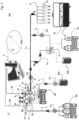
- Fig. 2 is a schematic view of a system 10B for an automated production of (cryo-preserved) HCDC-preparations according to another embodiment.
- the system 10B relies on the option B) which is based on the use of a centrifuge to separate at least a portion of the medium b from the HCDC 2 to which CPA (substance a) is added.
- the present exemplary system 10B however also comprises a membrane element 1a which is however in the pure option B) not used for separating the medium b from the HCDC 2.
- the present system 10B does not comprise a fluid connection between the device volume V and a reservoir of the CPA (substance a).
- the substances b and c, a medium and a base and/or a nutrition feed, i.e. a feed medium can be transferred into the device volume V.
- the control unit 5 is required to stop or to slow down the growth, the substance inside the device volume V comprising for example a feed medium c, may be drained cell-free from the device volume V via the drain 1l and the membrane element 1a.
- the cell extension device 1 may as well be a cell extension device 1 without a membrane element 1a.
- the control unit 5 initiates a flow of the substance comprising HCDC 2 and the medium b from the device volume V via a path L 3 and L 3b into at least one or more centrifuge container of a centrifuge, wherein the centrifuge containers are preferably arranged inside the centrifuge.
- the control unit 5 may control the third flow control 11s to produce an underpressure to cause the substance to flow.
- the centrifuge containers may for example comprise centrifuge tubes.
- the centrifuge 6 is controlled by the control unit 5.
- the control unit 5 particularly initiates the step of centrifuging the substance to separate the phases of the HCDC 2 and the medium b from each other.
- the centrifuge 6 is a single-use centrifuge.
- the medium b is at least partially physically separated from the HCDC 2, i.e. guided from the centrifuge container into another container 20b outside the centrifuge 6. This is particularly, also controlled by the control unit 5.
- the CPA substance a
- a fresh medium and/or a buffer solution is also added to the HCDC 2. This may be performed for example by addition into the centrifuge containers.
- substances a, b which can be added to the centrifuged HCDC are arranged on a unit 4c which may be configured to condition the substances a, b.
- the unit 4a may particularly act as a rocker and/or a balance and/or a magnetic stirrer and/or temperature regulator.
- control unit 5 may cause a flow of the substance comprising HCDC 2 and CPA, regulated by the fourth flow control 11 4 to be guided to the distribution unit 8.
- the vials such as the centrifuge tubes are also used for the cryo-treatment of the HCDC-preparations.
- the CPA is added into the centrifuge tubes to obtain HCDC-preparations for cryo-treatment.
- cryo-treatment may be substantially similar as the steps described already in system 10A).
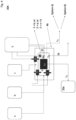
- Fig. 3 is a schematic view of a system 10C for an automated production of (cryo-preserved) HCDC-preparations according to a further embodiment.
- the system 10C comprises all aspects realized in system 10A and 10B, particularly the options A) and B), reflected in Fig. 1 and Fig. 2 , respectively.
- the control unit may switch between the two options A) and B), i.e. the operation mode using the membrane element 1a or the centrifuge 6 for separating at least partially the medium b from the HCDC 2. It may even be the case that both operation modes are run parallel, for example when two different substances should be used as CPA, wherein one CPA is added using option A) and the second CPA is added using option B).
- Fig. 4 is a schematic view of a part or a section of a system 30A for an automated production of (cryo-preserved) HCDC-preparations according to an embodiment.
- the section of the system resembles the front portion of the above systems 10A-10C.
- the scheme may particularly refer to a system as it is typically used for the production of HCDC-preparations.
- reservoirs of substances a, b, c, a freezing medium used as CPA (substance a), a medium (substance b) and a base and/or nutrient feed (substance c) are each fluidly connected to the device volume V.
- the substances a and b share a common port into the device volume V, wherein the substance c is guided by an individual port into the device volume V.
- Fig. 4 includes a top view onto the extension device 1.
- a membrane element 1a is arranged in the center of the extension device 1 position on the bottom of the extension device 1 right over a drain, such that the drain is covered an the cells of the HCDC is substantially retained in the device volume V when a substance such as a medium b is drained from the device volume V.
- the membrane element 1a which is a membrane here, is sealed to the inner bottom of the cell extension device 1, which is a bag in the present case.
- a cell-free harvest line to a container 20a is substantially directly attached to the membrane element 1a.
- the bag 1 is positioned on a rocker 4b, which is configured for rocking the bag 1 and controlling a temperature inside the bag 1 and for agitation (the rocker being heating coild and providing a sensor).
- the bag 1 typically provides four or five ports with paths or lines being fluidly connected from the device volume V, i.e. the bag volume, towards the outside.
- three exhaust air filters 1h,1i are arranged at or on two ports of the the bag 1 for filtering the gas, which may be air for example, which is either introduced into the device volume V or released from the device volume V.
- a capacitance probe 3a is arranged on the bag 1.
- the capacitance probe 3a may be in physical contact with the broth, comprising medium b and HCDC 2 inside the device volume V or it may be attached such that no direct physical contact is allowed.
- the capacitance probe 3a can transfer data to the control unit 5, also called control systems.
- Further sensors 3b for example gas sensors and/or pH probes reach into the device volume V to detect parameters such as a gas concentration and/or a pH. These recorded data are also transferred to the control unit 5.
- the control unit 5 is configured to control parameters comprising at least one of: a pH, a temperature, an oxygen concentration inside the device volume V, but also a rocking speed and an angle used for the rocker 4b. Further, the control unit 5 is configured to trigger a process wherein the steps of the process are based on online signals, i.e. the data related to the parameters measured over a certain period of time and being substantially instantly transferred to the control unit 5.
- the port 1k may guide the broth containing HCDC 2 and medium b and/or CPA (substance a) via a path towards a tube with a dip tube, which is used for filling, for inoculation and/or for cell transfer to further processing.
- the line L 3 is a cell sample line which may guide the broth towards further sections and/or units of the system either based on option A) or option B).
- the cell sample line may be a dip tube, i.e. a tube to the inside of the device volume V, which is used for sampling.
- Fig. 5 is a schematic view of a further part of a system 30B for an automated production of (cryo-preserved) HCDC-preparations according to an embodiment.
- the part 30B may be directly connected with the part 30A described in view of Fig. 4 .
- the line L 3 which is the cell sample line may guide towards the part 30B.
- the part is based on the above described option A) in which the membrane element has been used to separate at least a portion of the medium from the HCDC and to replace at least a portion of the drained medium by filling the CPA into the device volume V.
- option A) comprises the media exchange inside the bag utilizing the in-built membrane.
- a distribution unit 8 comprising a single-use manifold for even liquid distribution 8a is used to aliquot or partition the substance comprising HCDC and CPA and fill the partitioned substance into single containers, tubes 7a, and/or vessels.
- the distribution may be supported by the quick sealing feature 8b arranged on each line towards the tubes 7a.
- the parts 8, 8a, 8b and the lines may be considered the transfer unit.
- the distribution or transfer, comprising the filling mechanism is based on a feed-back signal, for example a bag weight.
- Fig. 6 is a schematic view of a part of a system 30C for an automated production of (cryo-preserved) HCDC-preparations according to another embodiment.
- the part 30C may be in addition or instead to part 30B be directly connected with the part 30A described in view of Fig. 4 .
- the line L 3 which is the cell sample line may guide towards the part 30C.
- option B) comprises the media exchange using centrifugation.
- the part 30B described above in view of Fig. 5 is comprised in part 30C. If both system parts based on option A) and option B), respectively are realized in one system, the part 30C may hence be shared such that a switch can switch between a bypass L 3a , bypassing the centrifuge and the centrifuge.
- the line L 3b guides the broth from the device volume V into a single use centrifuge 6, particularly centrifuge containers positioned inside the centrifuge 6.
- a cryo medium reservoir with the substance a, i.e. CPA, as well as a reservoir for a medium b, a buffer, or the like are fluidly connected with the centrifuge container(s).
- the centrifuge container is fluidly connected to a further container (not shown) for storing the medium which is separated from the HCDC, for example drained from the centrifuge container(s).
- the centrifuge is further fluidly connected by line L 3c with the single-use manifold 8a of the distribution unit which has already been described above in view of Fig. 5 . It may be possible that in a combined system based on option A) and option B), the lines Lsa and L 3c meet or fluidly connect substantially before or in the single-use manifold 8a.
- the part which is following the single-use manifold 8a may be identical to the respective part described in view of Fig. 5 .
- the vials or tubes 7a comprise a temp-port for freezing 7c and a second line 7d.
- Fig. 7 is a schematic view of the method 100 for an automated production of (cryo-preserved) HCDC-preparations.
- the method 100 allows producing and preparing cryo-treated, i.e. cryo-preserved HCDC-preparations, which are HCDC aliquots in this particular case.
- a HCDC-preparation may comprise an amount of HCDC which is substantially not partitioned, whereas a HCDC aliquot refers to one of many partitions of the HCDC-preparation.
- An aliquot preferably comprises a volume of approximately 1 ⁇ l to 10 ml, preferably approximately 5 ⁇ l to 1 ml and more preferably approximately 20 ⁇ l to 0,5 ml.
- the method 100 substantially starts with a step comprising cell expansion 101. Starter cells are combined in the device volume cell expansion device with a medium and/or a feed medium.
- a step is performed in which the CPA is added 102 to the HCDC.
- This step may comprise removal, particularly draining the medium through the drain and the membrane while retaining the HCDC inside the device volume.
- the CPA may at least partially replace the volume of the drained medium.
- the volume of the drained medium is substantially replaced by addition of the CPA, as in this case, the cell concentration, particularly the viable cell concentration can be maintained stable.
- the step 102 may comprise the centrifugation of the HCDC with the medium, the physical separation of the HCDC from a least a portion of the medium, for example by draining and/or sucking out the medium, and the addition of CPA to the HCDC.
- the volume of the drained or sucked out medium is preferably substantially replaced by addition of the CPA, as in this case, the cell concentration, particularly the viable cell concentration can be maintained stable.
- the addition of CPA 102 is followed by the step of transferring the HCDC with the CPA into vials and/or containers for cryo-storage.
- the step of transferring comprises aliquoting 103 the HCDC with the CPA into smaller volume portions of the generated volume of the HCDC with the CPA.
- the volume which has been generated and prepared is partitioned into smaller volumes and transferred, for example filled into vials, (storage) containers, and/or tubes, such as polymer tubes suited for freezing.
- the step of aliquoting may already be performed before the addition of CPA, particularly referring to option B).
- HCDC and medium is transferred, particularly aliquoted into centrifuge containers which are used for centrifugation and for cryo-treatment.
- the CPA may be added into the centrifuge containers after the step of aliquoting.
- the aliquotation 103 or a second aliquotation may be performed after the addition of CPA, particularly when the HCDC with CPA is transferred from the centrifuge container(s) into receiving containers.
- the aliquoted HCDC with CPA in vials, vessels, containers and/or tubes can be considered HCDC-preparations, particularly HCDC-aliquots for cryo-treatment.
- the step of cryo-treatment comprising the step of freezing 104 the HCDC-aliquots is the last step of the exemplary method described in Fig. 7 .
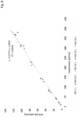
- Fig. 8 is an exemplary plot of viable cell concentration depending plotted against the measured capacitance.
- the at least one sensor for collecting data comprises an electrode sensor, particularly a capacitance probe or capacitance sensor.
- the capacitance probe at least temporally monitors at least one parameter, i.e. the capacitance of the substance inside the device volume comprising the HCDC.
- the parameter is indicative of a physiological status of the HCDC, as the viable cell density indicates a linear correlation with the increase of a measured capacitance at least in the range of the illustrated capacitance (approximately 5 to 400 pF/cm).
- the linear correlation is indicated by the dotted line.
- the measured capacitance is a direct linear indicator for the viable cell density (VDC), wherein the VDC is considered a dimension also describing the physiological status of the HCDC.
- Fig. 8 refers to the viable cell density (VCD)-capacitance correlation for CHO cells for different RM bag sizes.
- Capacitance probes like the BioPAT ViaMass, are very suitable to monitor the viable cell densities online without physical interaction with the bag.
- This sensor platform allows automatic determination of the ideal time-point for further processing of the culture, alternative sensor solutions (amongst others) would be Raman spectrometry.
- additional and complementing sensors do help to determine substrate or product concentration online. Inhibitory process conditions like nutrient depletion can be prevented by keeping nutrient level at ideal conditions.
- cell specific consumption or production rates as well as specific growth rates can be determined (in combination with the viable cell density read-out) and serve as an indicator for cellular state.
- Raman spectrometry and enzyme-based online sensors e.g. BioPAT Trace
- HCDCs High Cell Density Seed Cultures
- HCDCs refers to cell cultures having a high density of cells particularly viable cells, i.e. a volume concentration of cells which are at least alive.
- HCDCs comprise at least approximately 5 Mio. cells per mL (5 x 10 6 cells/mL), preferably at least approximately 20 Mio. cells per mL (20 x 10 6 cells/mL) and more preferably at least approximately 100 to 120 Mio. cells per mL (20 x 10 6 cells/mL), wherein the cells are preferably viable.
- the term may however also refer to the very beginning of the growth of a HCDC, i.e.
- HCDC when for example only a couple of hundreds or thousands of viable cells per mL start growing to cultivate a HCDC in the above sense.
- HCDC as used herein may hence also refer to a cell culture which is any state of its growth being grown for the purpose of having a high density of viable cells in the above sense.
- cell culture preferably refers to the process by which cells are grown under controlled conditions, generally outside their natural environment, i.e. ex situ. After the cells are isolated from a living tissue, they can subsequently be maintained under carefully controlled conditions. Such conditions can vary for each cell type, but generally they may depend on a suitable vessel, for example a cell expansion device, with a substrate or medium that supplies the essential nutrients particularly, amino acids, carbohydrates, vitamins and/or minerals. Further, the conditions may relate to growth factors, hormones, and gases, such as CO 2 and O 2 , and the physio-chemical environment, particularly the pH buffer, the osmotic pressure, and/or the temperature.
- controlled conditions generally outside their natural environment, i.e. ex situ. After the cells are isolated from a living tissue, they can subsequently be maintained under carefully controlled conditions. Such conditions can vary for each cell type, but generally they may depend on a suitable vessel, for example a cell expansion device, with a substrate or medium that supplies the essential nutrients particularly, amino acids, carbohydrates, vitamins and/or minerals. Further, the conditions
- Some cells require a surface or an artificial substrate (particularly an adherent or a monolayer culture) whereas others can be grown free floating in culture medium (suspension culture).
- cells are referred to herein which can be grown free floating in a culture medium, which is referred to a "a medium”.
- a medium The lifetime of most types of cells is genetically determined, but some cell culturing cells have been "transformed” into immortal cells which will reproduce indefinitely if the optimal conditions are provided. The lifetime and reproduction rate of cells may hence vary.
- the "HCDC-preparation” as described herein is considered a product which is substantially ready for cryo-treatment and which is generated by one of the systems and the method according to any one aspect.
- the "HCDC-preparation” is preferably in a continuous operation. It is also possible, that the HCDC-preparation is generated in a batch operation or in a fed-batch operation. In general, a distinction can be made between:
- a HCDC preparation which is substantially ready for the cryo-treatment preferably is a substance comprising HCDC and CPA.
- the substance may also comprise residual portions of the medium in which the cells have grown. At least a portion of the substance volume is stored in one or more receiving devices.
- the substance volume is partitioned into multiple portions of small volumes being filled into tubes.
- the substance volume is substantially liquid before the cryo-treatment and may substantially be solid after the cryo-treatment.
- the freezing point i.e. the temperature at which the substance may become substantially solid may deviate from the freezing point of water, i.e. approximately 0°C under normal conditions.
- a "cryo-preserved HCDC-preparation” is referred to as a HCDC preparation after cryo-treatment, i.e. a HCDC-preparation which is cooled down to a certain temperature, particularly frozen.
- cryo-treatment which is substantially the same as “cryo-preservation” refers to a procedure of cooling down, particularly freezing the substance which comprises HCDC and CPA.
- the procedure may be a step-wise freezing of the substance.
- the substance may be cooled down from a room temperature to approximately 4°C (typical fridge temperature) and/or to approximately -6 to -20°C (typical freezer temperature) and/or to approximately -78,5°C (sublimation point of dry ice) and/or to approximately -196 °C (boiling point of liquid nitrogen).
- the cryo-treatment may also refer to a sudden step of cooling the substance down to a certain temperature, for example from approximately room temperature down to approximately -196 °C. Before the cryo-treatment any other step that can be required or advantageous to prepare the substance for the cryo-treatment, such as the addition of other compounds, are possible.
- aliquots Small portions of the volume of substance comprising HCDC and CPA, and possibly the medium and/or other compounds is referred to as aliquots or HCDC aliquots, herein.
- Monitoring a process particularly comprises detecting, recording and potentially but not necessarily displaying of at least one parameter of a process, particularly a parameter which is indicative of the state of the process.
- Monitoring also refers to at least temporally collecting a set of data. The monitoring may be performed by a continuous data collection over a period of time or by a discrete data collection, i.e. a collection of data only at discrete points in time.
- online monitoring particularly refers to detecting at least one parameter which is indicative of the state of a bio process substantially in real time, particularly the physiological state of the cell culture, herein the HCDC.
- a process permanently changes the state of a HCDC.
- at least one parameter is detected, i.e. measured at least once but preferably it is detected over a period of time or at least a couple of distinct times.
- the measurement is substantially instantaneous, i.e. the measurement result indicating an instantaneous state can be obtained substantially at the same time, i.e. in a moment in which the state has not substantially changed.
- viable cell density particularly refers to the density of substantially viable cells per volume.
- the term "sensor” particularly refers to a detector and/or a probe configured to sense, probe or detect at least one parameter or physical dimension, quantity, variable or value.
- a membrane element arranged with the drain particularly refers to an arrangement of the membrane element inside the device volume and in front of the drain, for example covering the drain such that the HCDC inside the device volume is retained when at least a portion of the medium is drained from the device volume through the membrane element.
- the membrane element may however also be arranged inside the device volume to partition the device volume into two device volume compartments, a first and a second compartment, wherein the drain is arranged such that a fluid connection between the outside and the inside of one of both compartments can be generated when the drain is opened, for example to drain a substance from the first compartment through the drain.
- a substance for example a liquid from the second compartment may be drained if this substance can diffuse through the membrane element.
- a cryo-protective agent usually also referred to as cryoprotectant, preferably comprises at least any one of: dimethyl sulfoxide (DMSO), glycerol, ethylene glycol, terahalose, sucrose, propylene glycol and 2-Methyl-2,4-pentanediol (MPD).
- DMSO dimethyl sulfoxide
- MPD 2-Methyl-2,4-pentanediol
- a medium which is considered a growth medium herein, preferably comprises a carbon source such as Glucose, water, various salts, particularly a buffer medium, a source of amino acids and nitrogen.
- a feed medium may for example comprise similar substances, wherein the nutrition may be present at higher concentrations.
- the medium is considered a substantially liquid medium, herein. All substances which support the growth of the cells or which have a function related to the physiological condition or state of the HCDC may be comprised in a medium and/or a feed medium.
- a buffer substantially comprising only ions, i.e. salt and water may be considered a medium.
- a medium may even be considered water without any compounds.
- the phrase "at least one predetermined criterion is fulfilled by the monitored parameter" refers to a setting that is chosen by an operator for example.
- the operator preferably choses a threshold for the viable cell density, at which a process step is initiated. For example, when the HCDC reaches a viable cell density threshold of approximately 20 x 10 6 viable cells /ml, a fresh feed medium may be introduced into the device volume. For example, when the HCDC reaches a viable cell density threshold of approximately 80 x 10 6 viable cells /ml, a fresh medium may be introduced into the device volume.
- a CPA may be introduced into the device volume while or after a substance, such as a portion of the medium is drained from the device volume.
- a function according to a theory is fitted automatically by the control unit to the viable cell density as a function of time.
- the at least one predetermined criterion may also comprise a value for a derivative of the fitted function.
- a receiving unit is preferably a bag, a vial, a tube or a container.
- Transfer units preferably comprise units for clipping, sterile adapters and/or sealing units.
- Cryo-units particularly comprise controlled rate-free freezing units or non-controlled-rate freezing.
- a transfer unit preferably comprises at least one out of a distribution unit 8, and paths guiding a substance out of the device volume L3a, L3b and/or towards a distribution unit L3a, L3c.
- the cryo-preserved HCDC-preparations can be transferred for a mid-term storage or a long-term storage being available to the end user on demand.
- Device volumes V and volumes of substances inside the device volume V preferably range between approximately 0,5 I and 150 I, preferably between approximately 0,75 I and 50 I, and more preferably between approximately 11 and 25 I.
- Flow control devices preferably comprise at least one out of: a flowmeter, a balance, a calibrated pump.
- Liquid transfer devices preferably comprise at least one out of: a pump, pneumatic, gravimetric, a balance, pressure driven units.
- Distribution units preferably comprise at least one out of: a multi-way valve, a manifold.
- Distribution units preferably comprise at least one out of: a multi-way valve, a manifold.
- a system for the generation of HCDC frozen seed cultures may comprise
- a system for the generation of high cell density cryo-cultures may comprise particularly
- a system for the generation of high cell density cryo-cultures may also comprise
- a method for the generation of high cell density cryo-cultures may also comprise
- a method for the generation of high cell density cryo-cultures may also comprise
Landscapes
- Chemical & Material Sciences (AREA)
- Life Sciences & Earth Sciences (AREA)
- Health & Medical Sciences (AREA)
- Engineering & Computer Science (AREA)
- Wood Science & Technology (AREA)
- Zoology (AREA)
- Organic Chemistry (AREA)
- Bioinformatics & Cheminformatics (AREA)
- General Engineering & Computer Science (AREA)
- Genetics & Genomics (AREA)
- Biomedical Technology (AREA)
- Microbiology (AREA)
- Biochemistry (AREA)
- Biotechnology (AREA)
- General Health & Medical Sciences (AREA)
- Sustainable Development (AREA)
- Analytical Chemistry (AREA)
- Molecular Biology (AREA)
- Cell Biology (AREA)
- Computer Hardware Design (AREA)
- Apparatus Associated With Microorganisms And Enzymes (AREA)
- Micro-Organisms Or Cultivation Processes Thereof (AREA)
Claims (12)
- System (10A; 10B; 10C) für eine automatisierte Produktion von Zubereitungen einer Saatkultur mit hoher Zelldichte (High Cell Density Seed Culture), HCDC, zur Kryokonservierung, umfassend:- eine Zellexpansionsvorrichtung (1) zum Züchten einer HCDC (2) in einem Medium (b) im Inneren eines Vorrichtungsvolumens (V) der Zellexpansionsvorrichtung (1),- mindestens einen Sensor (3a, 3b) zum Sammeln von Daten durch mindestens zeitweiliges Überwachen mindestens eines Parameters, der auf den physiologischen Zustand der HCDC hindeutet; und- eine Steuereinheit (5) zum Verarbeiten der gesammelten Daten, um zu bestimmen, ob mindestens ein vorbestimmtes Kriterium von dem zu überwachenden Parameter erfüllt ist, um basierend darauf, ob das mindestens eine vorbestimmte Kriterium von dem überwachten Parameter erfüllt ist, mindestens einen partiellen Austausch des Mediums (b) mit einem Kryoschutzmittel (Cryo-Protective Agent), CPA, (a) zu steuern;wobei die Zellexpansionsvorrichtung (1) umfasst:- mindestens einen Ablass (11) zum Ablassen mindestens eines Teils des Mediums (b) von dem Vorrichtungsvolumen (V) hin zur Außenseite des Vorrichtungsvolumens (V); und- ein Membranelement (1a), das derart an dem Ablass (11) angeordnet ist, dass die HCDC (2) im Inneren des Vorrichtungsvolumens (V) zurückgehalten wird, wenn mindestens ein Teil des Mediums (b) von dem Vorrichtungsvolumen (V) durch das Membranelement (1a) und durch den Ablass (11) zur Außenseite des Vorrichtungsvolumens (V) abgelassen wird; undwobei die Steuereinheit (5) dazu ausgestaltet ist, basierend darauf, ob das Kriterium erfüllt ist oder nicht, die folgenden Schritte einzuleiten:- Ablassen mindestens eines Teils des Mediums (b) im Inneren des Vorrichtungsvolumens (V) durch das Membranelement (1a); und- Hinzufügen des CPA (a) zu der HCDC (2) in dem Vorrichtungsvolumen (V), undwobei das System eine Transfereinheit (8; L3a; L3b, L3c), die von der Steuereinheit (5) gesteuert wird, zum Transferieren mindestens eines Teils der HCDC (2) mit CPA (a) von dem Vorrichtungsvolumen (V) in eine oder mehrere Aufnahmevorrichtungen (7a) umfasst, um HCDC-Zubereitungen zur Kryokonservierung zu erhalten; undwobei das System (10A; 10B; 10C) ferner umfasst:- eine Zentrifugeneinheit (6) zum Zentrifugieren der HCDC (2) mit dem Medium (b);- mindestens eine Transfereinheit, die von der Steuereinheit (5) gesteuert wird, zum Transferieren mindestens eines Teils der HCDC (2) mit dem Medium (b) in mindestens einen Zentrifugenbehälter der Zentrifugeneinheit (6); undwobei die Steuereinheit (5) dazu ausgestaltet ist, basierend darauf, ob das Kriterium erfüllt ist oder nicht, die Schritte des Transferierens mindestens eines Teils der HCDC (2) mit dem Medium (b) von dem Vorrichtungsvolumen (V) in den mindestens einen Zentrifugenbehälter der Zentrifugeneinheit (6), des Zentrifugierens der transferierten HCDC (2) mit dem Medium (b) mit der Zentrifugeneinheit (6), des mindestens partiellen Trennens des zentrifugierten Mediums (b) von der HCDC (2) und des Hinzufügens eines Kryoschutzmittels, CPA, (a) zu der HCDC (2) einzuleiten.
- System nach Anspruch 1, wobei die Transfereinheit (8; L3a; L3b, L3c) dazu ausgestaltet ist, mindestens einen Teil der HCDC (2) mit CPA (a) automatisch von dem Vorrichtungsvolumen (V) in eine oder mehrere Aufnahmevorrichtungen (7a) zu transferieren, um HCDC-Zubereitungen zur Kryokonservierung zu erhalten.
- System (10A; 10B; 10C) nach einem der vorhergehenden Ansprüche, wobei der Sensor (3a, 3b) eine einteilige Einheit mit der Zellexpansionsvorrichtung (1) bildet, wobei der Sensor (3a, 3b) vorzugsweise in mindestens einen Abschnitt einer Wand (1b) der Zellexpansionsvorrichtung (1) geschweißt ist und/oder wobei der Sensor (3a, 3b) sich durch eine Öffnung der Zellexpansionsvorrichtung (1) in das Vorrichtungsvolumen (V) einsetzt.
- System (10A; 10C) nach einem der Ansprüche 1 bis 3, wobei das Membranelement (1a) eine einteilige Einheit mit der Zellexpansionsvorrichtung (1) bildet.
- System (10A; 10B; 10C) nach einem der vorhergehenden Ansprüche, wobei die Steuereinheit (5) dazu ausgestaltet ist, basierend auf dem überwachten Parameter mindestens einen zweiten Parameter automatisch zu steuern, wobei der zweite Parameter vorzugsweise dazu ausgestaltet ist, den physiologischen Zustand der HCDC zu steuern und/oder zu regeln.
- System (10A; 10B; 10C) nach einem der vorhergehenden Ansprüche, wobei mindestens eines von der Zellexpansionsvorrichtung (1), dem Sensor (3a, 3b), der Zentrifugeneinheit (6) und den Aufnahmevorrichtungen einen Beutel, einen Schlauch und/oder ein Fläschchen umfasst und mindestens ein Teil der Transfereinheit (8; L3a; L3b, L3c) ein Einwegelement und/oder ein Einwegverbrauchsmaterial ist.
- Verfahren zur automatisierten Herstellung von Zubereitungen von Saatkulturen mit hoher Zelldichte, HCDC-Zubereitungen, zur Kryokonservierung, das die folgenden Schritte umfasst:- Züchten einer HCDC (2) in einem Medium (b) im Inneren eines Vorrichtungsvolumens (V) der Zellexpansionsvorrichtung (1);- Sammeln von Daten durch mindestens zeitweiliges Überwachen mindestens eines Parameters, wobei der Parameter auf einen physiologischen Zustand der HCDC (2) hindeutet;- Senden der gesammelten Daten an eine Steuereinheit (5);- Verarbeiten der gesammelten Daten durch die Steuereinheit (5), das mindestens das Bestimmen, ob mindestens ein vorbestimmtes Kriterium von dem überwachten Parameter erfüllt wird, umfasst; und- Steuern mindestens eines partiellen Austauschs des Mediums (b) mit einem Kryoschutzmittel, CPA, (a), basierend darauf, ob das mindestens eine vorbestimmte Kriterium von dem überwachten Parameter erfüllt wird;wobei, basierend darauf, ob der überwachte Parameter das mindestens eine Kriterium erfüllt oder nicht:- Einleiten, durch die Steuereinheit (5), der Schritte, die umfassen:Option A)Ablassen, über ein Membranelement (1a) zum Zurückhalten der HCDC (2) im Inneren des Vorrichtungsvolumens (V) und über einen Ablass (11), mindestens eines Teils des Mediums (b) von dem Vorrichtungsvolumen (V),Hinzufügen eines Kryoschutzmittels, CPA, (a) zu der HCDC (2) in dem Vorrichtungsvolumen (V), undTransferieren mindestens eines Teils der HCDC (2) in dem CPA (a) von dem Vorrichtungsvolumen (V) in eine oder mehrere Aufnahmevorrichtungen (7a), um HCDC-Zubereitungen zur Kryokonservierung zu erhalten, wobei der Schritt des Transferierens automatisch durchgeführt wird; und/oderOption B)Transferieren mindestens eines Teils der HCDC (2) mit dem Medium (b) von dem Vorrichtungsvolumen (V) in mindestens einen Zentrifugenbehälter der Zentrifugeneinheit (6),Zentrifugieren, mit der Zentrifugeneinheit (6), der transferierten HCDC (2) mit dem Medium (b),mindestens partielles Trennen des zentrifugierten Mediums (b) von der HCDC (2), undHinzufügen von CPA (a) zu der HCDC (2), um HCDC-Zubereitungen zur Kryokonservierung zu erhalten, wobei das Transferieren mindestens eines Teils der HCDC (2) mit dem CPA (a) von dem Zentrifugenbehälter in eine oder mehrere Aufnahmevorrichtungen (7a), um HCDC-Zubereitungen zur Kryokonservierung zu erhalten, wobei der Schritt des Transferierens mindestens eines Teils der HCDC (2) mit dem Medium (b) von dem Vorrichtungsvolumen (V) in mindestens einen Zentrifugenbehälter und/oder des Transferierens mindestens eines Teils der HCDC (2) mit dem CPA (a) von dem Zentrifugenbehälter in eine oder mehrere Aufnahmevorrichtungen (7a) automatisch durchgeführt wird.
- Verfahren nach Anspruch 7, das ferner basierend auf dem überwachten Parameter das automatisierte Steuern, durch die Steuereinheit (5), mindestens eines zweiten Parameters umfasst, wobei der zweite Parameter dazu ausgestaltet ist, einen physiologischen Zustand der HCDC (2) zu steuern und/oder zu regeln.
- Verfahren nach einem der Ansprüche 7 oder 8, wobei das Verarbeiten der gesammelten Daten das automatische Analysieren der gesammelten Daten durch Anpassen einer Funktion und/oder Modellbildung an mindestens einen Teil der gesammelten Daten umfasst, um ein Anpassungsergebnis zu erhalten.
- Verfahren nach Anspruch 9, wobei das Bestimmen, ob mindestens ein vorbestimmtes Kriterium von dem überwachten Parameter erfüllt wird, auf dem automatischen Analysieren des Anpassungsergebnisses basiert.
- Verfahren nach einem der Ansprüche 7 bis 10, das ferner den Schritt des automatischen Kryokonservierens der HCDC-Zubereitungen in der einen oder den mehreren Aufnahmevorrichtungen (7a) umfasst, um kryokonservierte HCDC-Zubereitungen (2) zu erhalten.
- Verfahren nach einem der Ansprüche 7 bis 11, das ferner, in mindestens einem Iterationsschritt, das Bestimmen der Qualität der erhaltenen HCDC-Zubereitungen und Folgendes umfasst:- Verändern des vorbestimmten, von dem überwachten Parameter zu erfüllenden Kriteriums, und/oder- Verändern mindestens eines zweiten Parameters; und- Wiederholen des Verfahrens nach einem der Ansprüche 8 bis 13, insbesondere, bis eine optimale Qualität erhalten wird.
Priority Applications (4)
| Application Number | Priority Date | Filing Date | Title |
|---|---|---|---|
| EP19198072.1A EP3795672B1 (de) | 2019-09-18 | 2019-09-18 | System und verfahren zur erzeugung einer saatkultur mit hoher zelldichte |
| PCT/EP2020/075329 WO2021052857A1 (en) | 2019-09-18 | 2020-09-10 | System and method for the generation of high cell density seed culture |
| CN202080059556.1A CN114302948A (zh) | 2019-09-18 | 2020-09-10 | 用于产生高细胞密度种子培养物的系统和方法 |
| US17/761,156 US20220372425A1 (en) | 2019-09-18 | 2020-09-10 | System and method for the generation of high cell density seed culture |
Applications Claiming Priority (1)
| Application Number | Priority Date | Filing Date | Title |
|---|---|---|---|
| EP19198072.1A EP3795672B1 (de) | 2019-09-18 | 2019-09-18 | System und verfahren zur erzeugung einer saatkultur mit hoher zelldichte |
Publications (2)
| Publication Number | Publication Date |
|---|---|
| EP3795672A1 EP3795672A1 (de) | 2021-03-24 |
| EP3795672B1 true EP3795672B1 (de) | 2024-11-20 |
Family
ID=67997498
Family Applications (1)
| Application Number | Title | Priority Date | Filing Date |
|---|---|---|---|
| EP19198072.1A Active EP3795672B1 (de) | 2019-09-18 | 2019-09-18 | System und verfahren zur erzeugung einer saatkultur mit hoher zelldichte |
Country Status (4)
| Country | Link |
|---|---|
| US (1) | US20220372425A1 (de) |
| EP (1) | EP3795672B1 (de) |
| CN (1) | CN114302948A (de) |
| WO (1) | WO2021052857A1 (de) |
Families Citing this family (4)
| Publication number | Priority date | Publication date | Assignee | Title |
|---|---|---|---|---|
| EP4218897B1 (de) | 2021-03-09 | 2025-05-07 | Magenta Medical Ltd. | Ventrikuläre hilfsvorrichtung |
| US20230030092A1 (en) | 2021-07-28 | 2023-02-02 | Sartorius Stedim North America Inc. | Thermal Capacitors, Systems, and Methods for Rapid Freezing or Heating of Biological Materials |
| US12239127B2 (en) | 2021-07-28 | 2025-03-04 | Sartorius Stedim North America Inc. | Thermal capacitors, systems, and methods for rapid freezing or heating of biological materials |
| EP4483940A1 (de) | 2022-09-14 | 2025-01-01 | Magenta Medical Ltd. | Einlassschutz und drucklager für blutpumpen |
Family Cites Families (9)
| Publication number | Priority date | Publication date | Assignee | Title |
|---|---|---|---|---|
| JP2006505264A (ja) * | 2002-11-06 | 2006-02-16 | ファイザー・プロダクツ・インク | 低温学的に保護されたウイルスデリバリー系及び関連する製造及び使用 |
| KR20210095233A (ko) * | 2013-03-15 | 2021-07-30 | 젠자임 코포레이션 | 고-밀도 세포 뱅킹 방법 |
| CN106232801A (zh) * | 2014-04-28 | 2016-12-14 | 维瓦生物细胞股份公司 | 自动化细胞培养和收获装置 |
| HRP20201663T1 (hr) * | 2014-07-09 | 2020-12-25 | F. Hoffmann - La Roche Ag | PRILAGOĐAVANJE pH VRIJEDNOSTI RADI POBOLJŠANJA OPORAVKA BANAKA STANICA USLIJED ODMRZAVANJA |
| GB201416233D0 (en) * | 2014-09-15 | 2014-10-29 | Stratophase Ltd | Method, system and controller for process control in a bioreactor |
| WO2018087558A1 (en) * | 2016-11-11 | 2018-05-17 | Oribiotech Ltd | Cell culture device system and methods of use thereof |
| CN108077241B (zh) * | 2016-11-22 | 2021-01-01 | 华东理工大学 | 活细胞传感仪在植物细胞低温保藏中的应用 |
| US11359172B2 (en) * | 2017-08-09 | 2022-06-14 | Sartorius Stedim Biotech Gmbh | Upstream and downstream processing within single-use containers |
| US10647954B1 (en) * | 2018-11-15 | 2020-05-12 | Flaskworks, Llc | Dendritic cell generating apparatus and method |
-
2019
- 2019-09-18 EP EP19198072.1A patent/EP3795672B1/de active Active
-
2020
- 2020-09-10 US US17/761,156 patent/US20220372425A1/en active Pending
- 2020-09-10 WO PCT/EP2020/075329 patent/WO2021052857A1/en not_active Ceased
- 2020-09-10 CN CN202080059556.1A patent/CN114302948A/zh active Pending
Also Published As
| Publication number | Publication date |
|---|---|
| WO2021052857A1 (en) | 2021-03-25 |
| CN114302948A (zh) | 2022-04-08 |
| EP3795672A1 (de) | 2021-03-24 |
| US20220372425A1 (en) | 2022-11-24 |
Similar Documents
| Publication | Publication Date | Title |
|---|---|---|
| EP3795672B1 (de) | System und verfahren zur erzeugung einer saatkultur mit hoher zelldichte | |
| EP2321403B1 (de) | Mittel zur vorhersage des erntezeitpunkts für in einem bioreaktor kultivierte zellen | |
| JP7337784B2 (ja) | 灌流バイオリアクタ及び関連する使用方法 | |
| US11345882B2 (en) | Extra-capillary fluid cycling system and method for a cell culture device | |
| EP1508791A1 (de) | Vorrichtung zur automatischen Probenentnahme aus einem Bioreaktor | |
| JP4022878B2 (ja) | 樹枝状凍結境界面速度が制御される冷凍保存システム | |
| US5316905A (en) | Culture medium supplying method and culture system | |
| KR102282939B1 (ko) | 고-밀도 세포 뱅킹 방법 | |
| JP2011528907A (ja) | 卵母細胞、胚または胚盤胞の凍結保存のための自動化システム | |
| US20210144990A1 (en) | Improved ultra-fast cooling system and methods of use | |
| JP7100858B2 (ja) | 移植または生体外実験を目的として、ヒトまたは動物の少なくとも1つの組織を保存および輸送するためのデバイスおよび方法 | |
| US20170211027A1 (en) | Method and system for suspension culture | |
| WO2025041047A1 (en) | Bioreactors and methods of their use in automatic cell processing systems | |
| CN116548430B (zh) | 一种干细胞收集系统 | |
| US20150010994A1 (en) | Non-invasive sensing of bioprocess parameters | |
| US20160135447A1 (en) | Method and Apparatus for Collecting and Preserving Biological Specimens | |
| US20100136608A1 (en) | Multiple Filter Array Assay | |
| CN116471932A (zh) | 用于深低温保存由生物细胞形成的多个细胞簇的方法 | |
| ES2882050T3 (es) | Procedimiento de aislamiento y de análisis de microorganismos contenidos en una muestra | |
| Giddings et al. | Preparing fission yeast for electron microscopy | |
| HK1217407A1 (zh) | 具有測定器官或組織活力的葡萄糖傳感器的轉運裝置 | |
| US11591558B2 (en) | Method for analysis and cell culture and an associated system | |
| Hwang et al. | Evaluation of the paratrend multi-analyte sensor for potential utilization in long-duration automated cell culture monitoring | |
| US20230348838A1 (en) | Cell proliferation bioreactor |
Legal Events
| Date | Code | Title | Description |
|---|---|---|---|
| PUAI | Public reference made under article 153(3) epc to a published international application that has entered the european phase |
Free format text: ORIGINAL CODE: 0009012 |
|
| STAA | Information on the status of an ep patent application or granted ep patent |
Free format text: STATUS: THE APPLICATION HAS BEEN PUBLISHED |
|
| AK | Designated contracting states |
Kind code of ref document: A1 Designated state(s): AL AT BE BG CH CY CZ DE DK EE ES FI FR GB GR HR HU IE IS IT LI LT LU LV MC MK MT NL NO PL PT RO RS SE SI SK SM TR |
|
| AX | Request for extension of the european patent |
Extension state: BA ME |
|
| STAA | Information on the status of an ep patent application or granted ep patent |
Free format text: STATUS: REQUEST FOR EXAMINATION WAS MADE |
|
| 17P | Request for examination filed |
Effective date: 20210923 |
|
| RBV | Designated contracting states (corrected) |
Designated state(s): AL AT BE BG CH CY CZ DE DK EE ES FI FR GB GR HR HU IE IS IT LI LT LU LV MC MK MT NL NO PL PT RO RS SE SI SK SM TR |
|
| P01 | Opt-out of the competence of the unified patent court (upc) registered |
Effective date: 20230508 |
|
| GRAP | Despatch of communication of intention to grant a patent |
Free format text: ORIGINAL CODE: EPIDOSNIGR1 |
|
| STAA | Information on the status of an ep patent application or granted ep patent |
Free format text: STATUS: GRANT OF PATENT IS INTENDED |
|
| INTG | Intention to grant announced |
Effective date: 20240812 |
|
| GRAS | Grant fee paid |
Free format text: ORIGINAL CODE: EPIDOSNIGR3 |
|
| GRAA | (expected) grant |
Free format text: ORIGINAL CODE: 0009210 |
|
| STAA | Information on the status of an ep patent application or granted ep patent |
Free format text: STATUS: THE PATENT HAS BEEN GRANTED |
|
| AK | Designated contracting states |
Kind code of ref document: B1 Designated state(s): AL AT BE BG CH CY CZ DE DK EE ES FI FR GB GR HR HU IE IS IT LI LT LU LV MC MK MT NL NO PL PT RO RS SE SI SK SM TR |
|
| REG | Reference to a national code |
Ref country code: GB Ref legal event code: FG4D |
|
| REG | Reference to a national code |
Ref country code: CH Ref legal event code: EP |
|
| REG | Reference to a national code |
Ref country code: DE Ref legal event code: R096 Ref document number: 602019062148 Country of ref document: DE |
|
| REG | Reference to a national code |
Ref country code: IE Ref legal event code: FG4D |
|
| RAP4 | Party data changed (patent owner data changed or rights of a patent transferred) |
Owner name: SARTORIUS STEDIM BIOTECH GMBH |
|
| REG | Reference to a national code |
Ref country code: LT Ref legal event code: MG9D |
|
| REG | Reference to a national code |
Ref country code: NL Ref legal event code: MP Effective date: 20241120 |
|
| PG25 | Lapsed in a contracting state [announced via postgrant information from national office to epo] |
Ref country code: PT Free format text: LAPSE BECAUSE OF FAILURE TO SUBMIT A TRANSLATION OF THE DESCRIPTION OR TO PAY THE FEE WITHIN THE PRESCRIBED TIME-LIMIT Effective date: 20250320 Ref country code: HR Free format text: LAPSE BECAUSE OF FAILURE TO SUBMIT A TRANSLATION OF THE DESCRIPTION OR TO PAY THE FEE WITHIN THE PRESCRIBED TIME-LIMIT Effective date: 20241120 Ref country code: IS Free format text: LAPSE BECAUSE OF FAILURE TO SUBMIT A TRANSLATION OF THE DESCRIPTION OR TO PAY THE FEE WITHIN THE PRESCRIBED TIME-LIMIT Effective date: 20250320 |
|
| PG25 | Lapsed in a contracting state [announced via postgrant information from national office to epo] |
Ref country code: FI Free format text: LAPSE BECAUSE OF FAILURE TO SUBMIT A TRANSLATION OF THE DESCRIPTION OR TO PAY THE FEE WITHIN THE PRESCRIBED TIME-LIMIT Effective date: 20241120 Ref country code: NL Free format text: LAPSE BECAUSE OF FAILURE TO SUBMIT A TRANSLATION OF THE DESCRIPTION OR TO PAY THE FEE WITHIN THE PRESCRIBED TIME-LIMIT Effective date: 20241120 |
|
| REG | Reference to a national code |
Ref country code: AT Ref legal event code: MK05 Ref document number: 1743594 Country of ref document: AT Kind code of ref document: T Effective date: 20241120 |
|
| PG25 | Lapsed in a contracting state [announced via postgrant information from national office to epo] |
Ref country code: BG Free format text: LAPSE BECAUSE OF FAILURE TO SUBMIT A TRANSLATION OF THE DESCRIPTION OR TO PAY THE FEE WITHIN THE PRESCRIBED TIME-LIMIT Effective date: 20241120 |
|
| PG25 | Lapsed in a contracting state [announced via postgrant information from national office to epo] |
Ref country code: ES Free format text: LAPSE BECAUSE OF FAILURE TO SUBMIT A TRANSLATION OF THE DESCRIPTION OR TO PAY THE FEE WITHIN THE PRESCRIBED TIME-LIMIT Effective date: 20241120 |
|
| PG25 | Lapsed in a contracting state [announced via postgrant information from national office to epo] |
Ref country code: NO Free format text: LAPSE BECAUSE OF FAILURE TO SUBMIT A TRANSLATION OF THE DESCRIPTION OR TO PAY THE FEE WITHIN THE PRESCRIBED TIME-LIMIT Effective date: 20250220 |
|
| PG25 | Lapsed in a contracting state [announced via postgrant information from national office to epo] |
Ref country code: AT Free format text: LAPSE BECAUSE OF FAILURE TO SUBMIT A TRANSLATION OF THE DESCRIPTION OR TO PAY THE FEE WITHIN THE PRESCRIBED TIME-LIMIT Effective date: 20241120 Ref country code: GR Free format text: LAPSE BECAUSE OF FAILURE TO SUBMIT A TRANSLATION OF THE DESCRIPTION OR TO PAY THE FEE WITHIN THE PRESCRIBED TIME-LIMIT Effective date: 20250221 Ref country code: LV Free format text: LAPSE BECAUSE OF FAILURE TO SUBMIT A TRANSLATION OF THE DESCRIPTION OR TO PAY THE FEE WITHIN THE PRESCRIBED TIME-LIMIT Effective date: 20241120 |
|
| PG25 | Lapsed in a contracting state [announced via postgrant information from national office to epo] |
Ref country code: PL Free format text: LAPSE BECAUSE OF FAILURE TO SUBMIT A TRANSLATION OF THE DESCRIPTION OR TO PAY THE FEE WITHIN THE PRESCRIBED TIME-LIMIT Effective date: 20241120 |
|
| PG25 | Lapsed in a contracting state [announced via postgrant information from national office to epo] |
Ref country code: RS Free format text: LAPSE BECAUSE OF FAILURE TO SUBMIT A TRANSLATION OF THE DESCRIPTION OR TO PAY THE FEE WITHIN THE PRESCRIBED TIME-LIMIT Effective date: 20250220 |
|
| PG25 | Lapsed in a contracting state [announced via postgrant information from national office to epo] |
Ref country code: SM Free format text: LAPSE BECAUSE OF FAILURE TO SUBMIT A TRANSLATION OF THE DESCRIPTION OR TO PAY THE FEE WITHIN THE PRESCRIBED TIME-LIMIT Effective date: 20241120 |
|
| PG25 | Lapsed in a contracting state [announced via postgrant information from national office to epo] |
Ref country code: DK Free format text: LAPSE BECAUSE OF FAILURE TO SUBMIT A TRANSLATION OF THE DESCRIPTION OR TO PAY THE FEE WITHIN THE PRESCRIBED TIME-LIMIT Effective date: 20241120 |
|
| PG25 | Lapsed in a contracting state [announced via postgrant information from national office to epo] |
Ref country code: EE Free format text: LAPSE BECAUSE OF FAILURE TO SUBMIT A TRANSLATION OF THE DESCRIPTION OR TO PAY THE FEE WITHIN THE PRESCRIBED TIME-LIMIT Effective date: 20241120 |
|
| PG25 | Lapsed in a contracting state [announced via postgrant information from national office to epo] |
Ref country code: RO Free format text: LAPSE BECAUSE OF FAILURE TO SUBMIT A TRANSLATION OF THE DESCRIPTION OR TO PAY THE FEE WITHIN THE PRESCRIBED TIME-LIMIT Effective date: 20241120 |
|
| PG25 | Lapsed in a contracting state [announced via postgrant information from national office to epo] |
Ref country code: SK Free format text: LAPSE BECAUSE OF FAILURE TO SUBMIT A TRANSLATION OF THE DESCRIPTION OR TO PAY THE FEE WITHIN THE PRESCRIBED TIME-LIMIT Effective date: 20241120 |
|
| PG25 | Lapsed in a contracting state [announced via postgrant information from national office to epo] |
Ref country code: CZ Free format text: LAPSE BECAUSE OF FAILURE TO SUBMIT A TRANSLATION OF THE DESCRIPTION OR TO PAY THE FEE WITHIN THE PRESCRIBED TIME-LIMIT Effective date: 20241120 |
|
| PG25 | Lapsed in a contracting state [announced via postgrant information from national office to epo] |
Ref country code: IT Free format text: LAPSE BECAUSE OF FAILURE TO SUBMIT A TRANSLATION OF THE DESCRIPTION OR TO PAY THE FEE WITHIN THE PRESCRIBED TIME-LIMIT Effective date: 20241120 |
|
| REG | Reference to a national code |
Ref country code: DE Ref legal event code: R097 Ref document number: 602019062148 Country of ref document: DE |
|
| PG25 | Lapsed in a contracting state [announced via postgrant information from national office to epo] |
Ref country code: SE Free format text: LAPSE BECAUSE OF FAILURE TO SUBMIT A TRANSLATION OF THE DESCRIPTION OR TO PAY THE FEE WITHIN THE PRESCRIBED TIME-LIMIT Effective date: 20241120 |
|
| PLBE | No opposition filed within time limit |
Free format text: ORIGINAL CODE: 0009261 |
|
| STAA | Information on the status of an ep patent application or granted ep patent |
Free format text: STATUS: NO OPPOSITION FILED WITHIN TIME LIMIT |
|
| PGFP | Annual fee paid to national office [announced via postgrant information from national office to epo] |
Ref country code: DE Payment date: 20250919 Year of fee payment: 7 |
|
| PGFP | Annual fee paid to national office [announced via postgrant information from national office to epo] |
Ref country code: GB Payment date: 20250923 Year of fee payment: 7 |
|
| PGFP | Annual fee paid to national office [announced via postgrant information from national office to epo] |
Ref country code: FR Payment date: 20250924 Year of fee payment: 7 |
|
| 26N | No opposition filed |
Effective date: 20250821 |