EP3792612A1 - Vorrichtung zur verarbeitung und infiltrierung histologischer und biologischer proben - Google Patents
Vorrichtung zur verarbeitung und infiltrierung histologischer und biologischer proben Download PDFInfo
- Publication number
- EP3792612A1 EP3792612A1 EP18918312.2A EP18918312A EP3792612A1 EP 3792612 A1 EP3792612 A1 EP 3792612A1 EP 18918312 A EP18918312 A EP 18918312A EP 3792612 A1 EP3792612 A1 EP 3792612A1
- Authority
- EP
- European Patent Office
- Prior art keywords
- containers
- sample
- axis
- processing
- housing
- Prior art date
- Legal status (The legal status is an assumption and is not a legal conclusion. Google has not performed a legal analysis and makes no representation as to the accuracy of the status listed.)
- Granted
Links
Images




Classifications
-
- G—PHYSICS
- G01—MEASURING; TESTING
- G01N—INVESTIGATING OR ANALYSING MATERIALS BY DETERMINING THEIR CHEMICAL OR PHYSICAL PROPERTIES
- G01N1/00—Sampling; Preparing specimens for investigation
- G01N1/28—Preparing specimens for investigation including physical details of (bio-)chemical methods covered elsewhere, e.g. G01N33/50, C12Q
- G01N1/2813—Producing thin layers of samples on a substrate, e.g. smearing, spinning-on
-
- G—PHYSICS
- G01—MEASURING; TESTING
- G01N—INVESTIGATING OR ANALYSING MATERIALS BY DETERMINING THEIR CHEMICAL OR PHYSICAL PROPERTIES
- G01N1/00—Sampling; Preparing specimens for investigation
- G01N1/28—Preparing specimens for investigation including physical details of (bio-)chemical methods covered elsewhere, e.g. G01N33/50, C12Q
- G01N1/30—Staining; Impregnating ; Fixation; Dehydration; Multistep processes for preparing samples of tissue, cell or nucleic acid material and the like for analysis
- G01N1/31—Apparatus therefor
-
- B—PERFORMING OPERATIONS; TRANSPORTING
- B01—PHYSICAL OR CHEMICAL PROCESSES OR APPARATUS IN GENERAL
- B01F—MIXING, e.g. DISSOLVING, EMULSIFYING OR DISPERSING
- B01F29/00—Mixers with rotating receptacles
- B01F29/80—Mixers with rotating receptacles rotating about a substantially vertical axis
- B01F29/81—Mixers with rotating receptacles rotating about a substantially vertical axis with stationary mixing elements
-
- B—PERFORMING OPERATIONS; TRANSPORTING
- B01—PHYSICAL OR CHEMICAL PROCESSES OR APPARATUS IN GENERAL
- B01F—MIXING, e.g. DISSOLVING, EMULSIFYING OR DISPERSING
- B01F29/00—Mixers with rotating receptacles
- B01F29/80—Mixers with rotating receptacles rotating about a substantially vertical axis
- B01F29/82—Mixers with rotating receptacles rotating about a substantially vertical axis the receptacle comprising a rotary part, e.g. the bottom, and a stationary part, e.g. the wall, with optional use of a stirrer; the receptacle comprising parts moving in opposite directions
-
- B—PERFORMING OPERATIONS; TRANSPORTING
- B05—SPRAYING OR ATOMISING IN GENERAL; APPLYING FLUENT MATERIALS TO SURFACES, IN GENERAL
- B05C—APPARATUS FOR APPLYING FLUENT MATERIALS TO SURFACES, IN GENERAL
- B05C3/00—Apparatus in which the work is brought into contact with a bulk quantity of liquid or other fluent material
- B05C3/02—Apparatus in which the work is brought into contact with a bulk quantity of liquid or other fluent material the work being immersed in the liquid or other fluent material
-
- G—PHYSICS
- G01—MEASURING; TESTING
- G01N—INVESTIGATING OR ANALYSING MATERIALS BY DETERMINING THEIR CHEMICAL OR PHYSICAL PROPERTIES
- G01N1/00—Sampling; Preparing specimens for investigation
- G01N1/28—Preparing specimens for investigation including physical details of (bio-)chemical methods covered elsewhere, e.g. G01N33/50, C12Q
- G01N1/286—Preparing specimens for investigation including physical details of (bio-)chemical methods covered elsewhere, e.g. G01N33/50, C12Q involving mechanical work, e.g. chopping, disintegrating, compacting, homogenising
-
- G—PHYSICS
- G01—MEASURING; TESTING
- G01N—INVESTIGATING OR ANALYSING MATERIALS BY DETERMINING THEIR CHEMICAL OR PHYSICAL PROPERTIES
- G01N1/00—Sampling; Preparing specimens for investigation
- G01N1/28—Preparing specimens for investigation including physical details of (bio-)chemical methods covered elsewhere, e.g. G01N33/50, C12Q
- G01N1/36—Embedding or analogous mounting of samples
-
- G—PHYSICS
- G01—MEASURING; TESTING
- G01N—INVESTIGATING OR ANALYSING MATERIALS BY DETERMINING THEIR CHEMICAL OR PHYSICAL PROPERTIES
- G01N35/00—Automatic analysis not limited to methods or materials provided for in any single one of groups G01N1/00 - G01N33/00; Handling materials therefor
- G01N35/02—Automatic analysis not limited to methods or materials provided for in any single one of groups G01N1/00 - G01N33/00; Handling materials therefor using a plurality of sample containers moved by a conveyor system past one or more treatment or analysis stations
- G01N35/025—Automatic analysis not limited to methods or materials provided for in any single one of groups G01N1/00 - G01N33/00; Handling materials therefor using a plurality of sample containers moved by a conveyor system past one or more treatment or analysis stations having a carousel or turntable for reaction cells or cuvettes
-
- B—PERFORMING OPERATIONS; TRANSPORTING
- B05—SPRAYING OR ATOMISING IN GENERAL; APPLYING FLUENT MATERIALS TO SURFACES, IN GENERAL
- B05C—APPARATUS FOR APPLYING FLUENT MATERIALS TO SURFACES, IN GENERAL
- B05C13/00—Means for manipulating or holding work, e.g. for separate articles
- B05C13/02—Means for manipulating or holding work, e.g. for separate articles for particular articles
-
- B—PERFORMING OPERATIONS; TRANSPORTING
- B05—SPRAYING OR ATOMISING IN GENERAL; APPLYING FLUENT MATERIALS TO SURFACES, IN GENERAL
- B05C—APPARATUS FOR APPLYING FLUENT MATERIALS TO SURFACES, IN GENERAL
- B05C3/00—Apparatus in which the work is brought into contact with a bulk quantity of liquid or other fluent material
- B05C3/02—Apparatus in which the work is brought into contact with a bulk quantity of liquid or other fluent material the work being immersed in the liquid or other fluent material
- B05C3/09—Apparatus in which the work is brought into contact with a bulk quantity of liquid or other fluent material the work being immersed in the liquid or other fluent material for treating separate articles
- B05C3/109—Passing liquids or other fluent materials into or through chambers containing stationary articles
-
- G—PHYSICS
- G01—MEASURING; TESTING
- G01N—INVESTIGATING OR ANALYSING MATERIALS BY DETERMINING THEIR CHEMICAL OR PHYSICAL PROPERTIES
- G01N1/00—Sampling; Preparing specimens for investigation
- G01N1/02—Devices for withdrawing samples
- G01N1/04—Devices for withdrawing samples in the solid state, e.g. by cutting
- G01N1/06—Devices for withdrawing samples in the solid state, e.g. by cutting providing a thin slice, e.g. microtome
-
- G—PHYSICS
- G01—MEASURING; TESTING
- G01N—INVESTIGATING OR ANALYSING MATERIALS BY DETERMINING THEIR CHEMICAL OR PHYSICAL PROPERTIES
- G01N1/00—Sampling; Preparing specimens for investigation
- G01N1/28—Preparing specimens for investigation including physical details of (bio-)chemical methods covered elsewhere, e.g. G01N33/50, C12Q
- G01N1/30—Staining; Impregnating ; Fixation; Dehydration; Multistep processes for preparing samples of tissue, cell or nucleic acid material and the like for analysis
- G01N1/31—Apparatus therefor
- G01N2001/315—Basket-type carriers for tissues
Definitions
- the invention relates to examination methods and in particular to devices for preparing histological and biological samples for microscopic examination.
- tissue samples taken for examination Before tissue samples taken for examination can be cut, they must be fixed with an aqueous or aqueous-alcoholic formaldehyde solution and then clarified with the help of an organic liquid that can be mixed well with a dehydrating liquid and paraffin (or other wax) and finally impregnated with molten paraffin or other wax.
- the paraffin-impregnated sample For sectioning, the paraffin-impregnated sample must be fixed in a microtome holder. In order to be able to fix the sample in a standard micro-volume holder, the sample must be embedded in a paraffin block. The paraffin is cut along with the sample, and the resulting sections are then spread out in the water and placed on the slide glass. The formation of the wax block is a separate process.
- the histological sample, which has been dehydrated and impregnated with wax is placed in a mold of suitable size, oriented so that the part of the sample to be examined is pressed onto the bottom of the mold, the mold is filled with paraffin and covered with a labeled cassette that the sample was in during dehydration and growth with the cassette lid removed. The cassette becomes a block holder for fixation in the microtome.
- the act of forming blocks is called blocking and special pouring equipment is used to carry it out, comprising a container with a paraffin melt, heated containers for molds and sample cassettes, and a cooled surface to complete the block formation.
- the histological sample handling and pouring devices Pathos Delta and Logos from Milestone SRL [company catalog Milestone + Klinipath "Rapid Tissue Processing and Auto-embedding ALL-IN-ONE Synergy"] comprise a ring-shaped frame with the sample cassettes arranged in the processor chamber. During the sample handling process, the cassettes in the rack are aligned at an angle; In the transition to the casting process, the cassettes are aligned horizontally.
- cassettes are removed from the processor and placed on the cooling plate for cooling (see brochure).
- specially prefabricated cassette casting mold units by Klinipath BV [ EP 2439510 , IPC G01N1 / 36, 2016], with a recess on the bottom of which a histological specimen is placed, which is covered with a sponge permeable to the processing liquids and the paraffin melt; the mold has yielding edges and a central opening; the opening is covered by a standard cassette for histological samples, which is clamped between the edges of the casting mold.
- the block with the sample and cassette can easily be separated from the casting mold after cooling and sent for cutting.
- the liquid inside the ring frame can be stirred with a magnetic stirrer; however, this is not sufficient for an effective exchange of the liquid in the sample, which is firmly pressed against the bottom of the mold, so microwave irradiation is recommended to speed up the process.
- the installation and filling time for 1 mm thick samples is 1 hour 35 minutes, 5 mm thick samples require 5 hours 35 minutes (see brochure, page 5). Therefore, the loading of the device should be done by cassettes with samples of the same thickness, since when loading samples of different thicknesses, some of them may be overexposed during tissue pretreatment and others may not go through the tissue pretreatment completely, thereby limiting the use of the tissue processor concerned.
- both the device and the method of operation do not allow simultaneous loading of different cassettes - both ordinary and cassette-mold units; this severely limits the loading capacity - 40 cassette-mold units, while the loading capacity with standard cassettes is 300 pieces.
- the device for processing and impregnating histological and biological samples (RU2150097 , IPC G01N1 / 28, 2000) enables the productivity of machining to be increased while maintaining its high efficiency.
- the device comprises a rotating device enclosed in the housing, the axis of rotation of which is arranged horizontally, with sample cassette containers which are mounted in the form of a vertically arranged ring on the axis, means for rotating the axis of rotation at variable speed and vessels with processing and impregnating liquids, which are outside the Housing arranged and connected to this by pipelines for the supply and discharge of these liquids. Sample cassettes are placed in the containers.
- the level of the processing and impregnation liquids is set approximately at the height of the axis of rotation.
- the containers are alternately moved in and out of the processing liquid; whereby the processing liquid flows out of and refills the containers and sample cassettes.
- Said device makes it possible to process and impregnate histological samples in cassette-casting-mold units with high efficiency and productivity. However, it is not suitable for pouring because the sample cassettes are not held in a horizontal orientation in the containers, which is necessary to hold the paraffin melt in cassette-mold units during pouring.
- the invention is based on the object of creating a device in which effective processing and impregnation of histological and biological samples and the subsequent blocking for microtomy can be carried out.
- a device for processing and impregnating histological and biological samples having a rotating device enclosed in a housing, the axis of rotation of which is arranged horizontally, with in the form of a vertically arranged ring mounted thereon containers for sample cassettes, means for rotating the axis of rotation with variable speed and containers with processing and impregnation liquids, which are arranged outside the housing and connected to it by pipelines for supply and discharge of these liquids, in addition a mechanism for aligning sample cassette containers, which is arranged between the container ring and the housing wall, and which has separate means to bring sample cassette containers into a horizontal or inclined position and to keep them horizontal or inclined.
- the mechanism for aligning and holding containers in a horizontal or inclined position can be in the form of mechanisms known in the art, but never before in devices for the pretreatment, impregnation or pouring of biological and histological specimens were used, such as a gear transmission or in the form of a planetary gear or as a parallelogram mechanism.
- the cassette containers in the device according to the invention have a square cross-section.
- samples which are present in standard cassettes and in cassette-form units can be processed at the same time, since the containers for standard cassettes and cassette-form units are interchangeable.
- the processor shown schematically has a housing 1 in which the axis of rotation 2 extends horizontally.
- a rotary support 3 is connected to the axis 2, to which container 4 with cassettes or cassette-casting mold units with histological samples are attached.
- the containers are fastened with the axes 5 on the support disc 6 ( Figure 1B ).
- the axis 2 is rotated by the drive 7.
- Mechanism 8 for orienting the containers, holding them horizontally or inclined, is placed between the wall of the housing 1 and the rotating support 3 ( Figure 2A ) arranged.
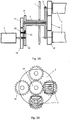
- Mechanism 8 comprises a central pinion 10 ( Figure 2B ), which is mounted on the hollow axle 9 which is part of the processor.
- the axis of rotation 2, to which the rotary carrier 3 is connected, is located within the hollow axis 9.
- the intermediate pinions 11 and outer pinions 12 are mounted on the rotary carrier 3, the intermediate pinions 11 being in mesh with the central pinion 10 and the outer pinions 12 at the same time.
- the containers 4 are attached to the outer pinions 12.
- a separate drive 13 is used to move the containers to a horizontal or inclined position.
- the planetary gear is located between the container 4 and the rotary carrier 3 and comprises a central pinion 14 and an outer pinion 15 which are attached to the container 4 ( Figures 3A and 3B ).
- the rotary carrier 3 is connected to the pinion 16 by the hollow shaft 2. Inside the hollow axle 2 there is an axle which connects the central pinion 14 of the planetary gear with the outer pinion 17 which is in engagement with the pinion 18 which is arranged on the drive axle 7.
- Pinion 19, which meshes with pinion 16, is formed coaxially with pinion 18.
- the parallelogram mechanism is located between the rotating support 3 and the housing wall 1 ( Figures 4A-4C ).
- the mechanism comprises a ring 22 which is located above the rotary support 3 and is carried by a support roller 23 which is mounted on a pivot arm 24 with an axis, and an additional drive 25 which is located outside the processor.
- the axes of the container holders 26 are connected by levers 27 to the corresponding axes 28, which are located on ring 22.
- the mechanisms for moving the wells for the sample cassettes to a horizontal or inclined position are as follows.
- Transmission (switching) of the planetary gear The drive 7 rotates the pinion 18 counterclockwise; while the driver pin 20 moves in the arcuate groove 21.
- the second pinion 19 is until the driver pin 20 reaches the end of the groove 21 - while its pinion 14 rotates and rotates the outer pinion 15 with the container holders 4, the Container position changes relative to the horizontal.
- the driving pin 20 has reached the end of the groove 21, the pinions 18 and 19, the rotary carrier 3 and the middle pinion 14 begin to rotate together, and the position of the outer pinion 15 with the container holders 4 remains unchanged until the next planetary gear shift.
- the device according to the invention works as follows: At the beginning of the cycle, when loading containers with cassettes and cassette-casting mold units, the containers are arranged horizontally for better handling during loading. The containers loaded with cassettes and cassette-mold units are brought into an inclined (5 - 90 ° to the horizontal) position with the aid of the alignment mechanism used.
- a small vacuum is generated in the housing 1, under the influence of which the first liquid is sucked into the housing from a vessel located outside the housing (not pictured).
- the level of the process fluids is set below or at the level of axis 2.
- the drive 7 begins to rotate the container 4 at a speed of 1-10 rpm. As the axis rotates, the containers are alternately immersed in and out of the processing liquid; the processing liquid dripping down from the containers and cassettes or cassette-mold units and replenishing them. At the end of each processing step, the liquid is removed from the housing into an appropriate vessel and the drive speed is increased to remove dripping moisture from containers and sample cassettes (and pre-made molds).
- the processing can be carried out under a vacuum of 200 - 600 mm Hg.
- the containers are brought into a horizontal position with the help of the orientation mechanism used, which enables paraffin to be poured out to produce the blocks required for cutting.
- the paraffin is drained from the chamber and the chamber heating is switched off so that the paraffin solidifies in the cassette-mold units.
- the device according to the invention enables not only the processing and impregnation of histological samples with high efficiency and productivity, whereby both standard cassettes and cassette-mold units can be used in one load, but also the casting of blocks in prefabricated cassette-mold units in the same Device, which eliminates the time-consuming and laborious process of manual casting and possible errors in the identification of the samples.
- the device according to the invention for processing and impregnating histological and biological samples can be used in laboratories that specialize in histological (pathological) and cytological examinations, as well as in all other biological and medical institutions that deal with the microscopic examination of tissues and cells .
Landscapes
- Chemical & Material Sciences (AREA)
- Health & Medical Sciences (AREA)
- Life Sciences & Earth Sciences (AREA)
- General Physics & Mathematics (AREA)
- Physics & Mathematics (AREA)
- Analytical Chemistry (AREA)
- Biochemistry (AREA)
- General Health & Medical Sciences (AREA)
- Immunology (AREA)
- Pathology (AREA)
- Chemical Kinetics & Catalysis (AREA)
- Engineering & Computer Science (AREA)
- Biomedical Technology (AREA)
- Molecular Biology (AREA)
- Sampling And Sample Adjustment (AREA)
- Investigating Or Analysing Biological Materials (AREA)
Abstract
Description
- Die Erfindung gehört zu Untersuchungsmethoden und insbesondere zu Vorrichtungen zur Vorbereitung histologischer und biologischer Proben für die mikroskopische Untersuchung.
- Bevor zur Untersuchung entnommene Gewebeproben geschnitten werden können, müssen diese mit einer wässerigen oder wässrig-alkoholischen Formaldehydlösung fixiert und dann anschließend mit Hilfe einer organischen Flüssigkeit, die gut mit einer dehydrierenden Flüssigkeit und Paraffin (oder anderem Wachs) vermischt werden kann, geklärt und zum Schluss mit geschmolzenem Paraffin oder anderem Wachs imprägniert werden.
- Zum Schneiden muss die mit Paraffin imprägnierte Probe in einem Mikrotomhalter fixiert werden. Um die Probe in einem Standard-Mikrovolumenhalter befestigen zu können, muss die Probe in einen Paraffinblock eingebettet werden. Das Paraffin wird zusammen mit der Probe geschnitten, und die entstandenen Schnitte werden dann im Wasser ausgebreitet und auf das Objektträgerglas gelegt. Die Bildung des Wachsblocks ist ein separates Verfahren. Die histologische Probe, die dehydriert und mit Wachs imprägniert wurde, wird in eine Gießform geeigneter Größe gelegt, so ausgerichtet, dass der zu untersuchende Teil der Probe auf den Boden der Gießform gedrückt wird, die Gießform wird mit Paraffin gefüllt und mit einer beschrifteten Kassette abgedeckt, in der sich die Probe während der Dehydrierung und des Wachsens befand, wobei der Kassettendeckel entfernt wird. Die Kassette wird zum Blockhalter für die Fixierung im Mikrotom.
- Der Vorgang des Formens von Blöcken wird als Einblocken bezeichnet, und für seine Durchführung werden spezielle Gießvorrichtungen verwendet, aufweisend einen Behälter mit einer Paraffinschmelze, beheizte Behälter für Formen und Probenkassetten und eine gekühlte Oberfläche zur Vervollständigung der Blockbildung.
- Die Nachteile des Standard-Gießverfahrens sind die arbeitsintensive, unergonomische und chemisch gefährliche Arbeitsweise für das Personals (Rest der Klärflüssigkeit - Xylol) sowie die Möglichkeit von Fehlern in der Kassettennummerierung beim Probentransfer.
- Versuche, den Gießprozess zu automatisieren, sind wiederholt unternommen worden. Um diesen Prozess zu automatisieren, müssen zwei Bedingungen erfüllt sein: Zum einen muss die Probe so auf dem Boden der Gießform angeordnet sein, dass sie oben auf dem Block zu liegen kommt, zum anderen muss die Probe in einer bestimmten Weise ausgerichtet werden, um Schnitte zu erhalten.
- Die histologischen Probenhandhabungs- und Gießgeräte Pathos Delta und Logos von Milestone SRL [Unternehmenskatalog Milestone+Klinipath «Rapid Tissue Processing and Auto-embedding ALL-IN-ONE Synergy»] umfassen ein ringförmiges Gestell mit den in der Prozessorkammer angeordneten Probenkassetten. Während des Prozesses zur Probenbehandlung werden die Kassetten im Gestell schräg ausgerichtet; im Übergang zum Gießvorgang werden die Kassetten horizontal ausgerichtet.
- Nach dem Gießen werden die Kassetten aus dem Prozessor entnommen und zur Kühlung auf die Kühlplatte gelegt (siehe Prospekt). Für den Betrieb dieser Geräte werden speziell von Klinipath B.V. vorgefertigte Kassetten-Gießform-Einheiten [
EP 2439510 , IPC G01N1/36, 2016] verwendet, mit einer Aussparung, auf deren Boden eine histologische Probe gelegt wird, die mit einem Schwamm bedeckt wird, der für die Verarbeitungsflüssigkeiten und die Paraffinschmelze durchlässig ist; die Gießform hat nachgebende Kanten und eine zentrale Öffnung; die Öffnung wird durch eine Standardkassette für histologische Proben abgedeckt, welche zwischen den Kanten der Gießform eingespannt ist. Wie in der Broschüre dargestellt, kann der Block mit Probe und Kassette nach dem Abkühlen leicht von der Gießform getrennt und dem Schneiden zugeführt werden. - Während der Gewebebehandlung kann die Flüssigkeit im Inneren des Ringgestells mit einem Magnetrührer gerührt werden; dies ist jedoch für einen effektiven Austausch der Flüssigkeit in der Probe, die fest an den Boden der Form gepresst ist, nicht ausreichend, so dass zur Beschleunigung des Prozesses Mikrowellenbestrahlung empfohlen wird. Beträgt die Einbau- und Füllzeit für 1 mm dicke Proben 1 Stunde 35 min, so benötigen 5 mm dicke Proben 5 Stunden 35 min (siehe Prospekt, Seite 5). Daher sollte das Laden des Geräts durch Kassetten mit Proben gleicher Dicke erfolgen, da beim Laden von Proben mit unterschiedlichen Dicken, einige von ihnen während der Gewebevorbehandlung überexponiert werden können und andere die Gewebevorbehandlung möglicherweise nicht vollständig durchlaufen, wodurch der Einsatz des betreffenden Gewebeprozessors eingeschränkt wird. Außerdem erlauben sowohl Vorrichtung als auch Arbeitsweise nicht die gleichzeitige Beladung mit unterschiedlichen Kassetten - sowohl von gewöhnlichen als auch Kassette-Gießform-Einheiten; dies schränkt die Ladekapazität stark ein - 40 Kassette-Gießform-Einheiten, während die Ladekapazität mit Standard-Kassetten 300 Stück ist.
- Prozessoren, in denen sowohl die Vorbehandlung als auch das Einblocken von histologischen und biologischen Proben in Kassette-Gießform-Einheiten durchgeführt werden kann, sind wiederholt angeboten worden (siehe z.B.,
US8900857 , IPC C12M3/00, 2014;US9733166 US9194776 US9568402 - Die Vorrichtung zur Bearbeitung und Imprägnierung von histologischen und biologischen Proben (
RU2150097 - Die Erfindung beruht auf der Aufgabe, eine Vorrichtung zu schaffen, in der eine wirksame Bearbeitung und Imprägnierung von histologischen und biologischen Proben und das anschließende Einblocken für die Mikrotomie durchgeführt werden kann.
- Die angegebene Aufgabe wird dadurch gelöst, dass eine Vorrichtung zur Bearbeitung und Imprägnierung von histologischen und biologischen Proben, aufweisend eine in einem Gehäuse eingeschlossene Drehvorrichtung, deren Drehachse horizontal angeordnet ist, mit in Form eines vertikal angeordneten Rings daran montierten Behältern für Probenkassetten, Mittel zur Drehung der Drehachse mit variabler Geschwindigkeit und Behälter mit Bearbeitungs- und Imprägnierungsflüssigkeiten, die außerhalb des Gehäuses angeordnet und mit diesem durch Rohrleitungen für Zufuhr und Ableitung dieser Flüssigkeiten verbunden sind, zusätzlich einen Mechanismus zur Ausrichtung von Probenkassettenbehältern aufweist, der zwischen dem Behälterring und der Gehäusewand angeordnet ist, und der über separate Mittel verfügt, um Probenkassettenbehälter in horizontale oder geneigte Position zu bringen und sie horizontal oder geneigt zu halten.
- Der Mechanismus für die Ausrichtung und das Festhalten von Behältern in horizontaler oder geneigter Position kann in Form von Mechanismen erfolgen, die vom Stand der Technik her bekannt sind, jedoch noch nie zuvor in Geräten für die Vorbehandlung, Imprägnierung oder das Ausgießen von biologischen und histologischen Proben verwendet wurden, wie z.B. ein Zahnradgetriebe oder in Form eines Planetengetriebes oder als Parallelogrammmechanismus.
- Die Kassettenbehälter in der erfindungsgemäßen Vorrichtung haben einen quadratischen Querschnitt. In der erfindungsgemäßen Vorrichtung können Proben, die in Standardkassetten und in Kassette-Form-Einheiten vorliegen, gleichzeitig verarbeitet werden, da die Behälter für Standardkassetten und Kassette-Formeinheiten austauschbar sind.
- Der erfindungsgemäße Prozessor ist in den
Fig.. 1 - 4 dargestellt. -
Fig. 1A und 1B zeigen schematisch die Anordnung eines Rings von Behältern mit eingelegten Kassetten, die an einer Drehachse befestigt sind. -
Fig. 2A und 2B stellen ein Zahnradgetriebe dar, das zwischen dem Behälterring und der Wand des Prozessors angeordnet ist. -
Fig. 3A - 3C zeigt ein Planetengetriebe, das sich zwischen dem Behälterring und der Wand des Prozessors befindet. -
Fig. 4A - 4C stellt einen Parallelogramm-Mechanismus zum Bewegen von Behältern in eine horizontale oder geneigte Position dar. - Der in
Fig. 1A und 1B schematisch dargestellte Prozessor hat ein Gehäuse 1, in dem die Drehachse 2 horizontal verläuft. Mit der Achse 2 ist ein Drehträger 3 verbunden, an dem Behälter 4 mit Kassetten oder Kassette-Gießform-Einheiten mit histologischen Proben befestigt sind. Die Behälter werden mit den Achsen 5 auf der Stützscheibe 6 befestigt (Fig. 1B ). Die Achse 2 wird durch Antrieb 7 gedreht. - Im Falle der Verwendung eines Zahnradgetriebes (
Fig. 2A - 2B ) wird der Mechanismus 8 zur Orientierung der Behälter, der sie horizontal oder geneigt hält, zwischen der Wand des Gehäuses 1 und dem Drehträger 3 (Fig. 2A ) angeordnet. Mechanismus 8 umfasst ein zentrales Ritzel 10 (Fig. 2B ), das auf der Hohlachse 9 montiert ist, die Teil des Prozessors ist. Innerhalb der Hohlachse 9 befindet sich die Drehachse 2, mit der der Drehträger 3 verbunden ist. Auf dem Drehträger 3 sind die Zwischenritzel 11 und Außenritzel 12 montiert, wobei die Zwischenritzel 11 gleichzeitig mit dem zentralen Ritzel 10 und den Außenritzeln 12 im Eingriff stehen. Die Behälter 4 sind an den Außenritzeln 12 befestigt. Ein separater Antrieb 13 wird verwendet, um die Behälter in eine horizontale oder geneigte Position zu bewegen. - Das Planetengetriebe befindet sich zwischen Behälter 4 und Drehträger 3 und umfasst ein zentrales Ritzel 14 und ein äußeres Ritzel 15, die am Behälter 4 befestigt sind (
Fig. 3A und 3B ). Der Drehträger 3 ist durch die hohle Achse 2 mit dem Ritzel 16 verbunden. Im Inneren der hohlen Achse 2 befindet sich eine Achse, die das zentrale Ritzel 14 des Planetengetriebes mit dem äußeren Ritzel 17 verbindet, das im Eingriff mit dem Ritzel 18 ist, das auf der Antriebsachse 7 angeordnet ist. Ritzel 19, das mit Ritzel 16 in Eingriff steht, ist koaxial mit Ritzel 18 ausgebildet. Zur Beschränkung des Drehwinkels ist auf dem Ritzel 18 ein außermittiger Mitnehmerstift 20 und auf dem Ritzel 19 eine bogenförmige Nut 21 (sieheFig. 3C ) angeordnet, in die der Mitnehmerstift 20 eingreift. - Der Parallelogrammmechanismus befindet sich zwischen Drehträger 3 und der Gehäusewand 1 (
Fig. 4A-4C ). Der Mechanismus umfasst einen Ring 22, der sich oberhalb des Drehträgers 3 befindet und von einer Stützrolle 23 getragen wird, die auf einem Schwenkarm 24 mit einer Achse montiert ist, und einen zusätzlichen Antrieb 25, der sich außerhalb des Prozessors befindet. Die Achsen der Behälterhalterungen 26 sind durch Hebel 27 mit den entsprechenden Achsen 28 verbunden, die sich auf Ring 22 befinden. - Die Mechanismen zum Bewegen der Behältern für die Probenkassetten in eine horizontale oder geneigte Position sind wie folgt.
- Übertragung (Schalten) des Zahnradgetriebes: Beim Anhalten des Drehträgers 3 wird das mittlere Ritzel 10 durch einen separaten Antrieb 13 um einen bestimmten Winkel gedreht, während das äußere Ritzel 12 und die zugehörigen Behälter 4 ebenfalls um den gleichen Winkel gedreht werden. Dann wird der Antrieb 13 angehalten, Antrieb 7 wird eingeschaltet, und die Außenritzel 12 und die zugehörigen Behälter 4 drehen zusammen mit dem Drehträger 3 in einer neuen, relativ zur Horizontalen unveränderten Position.
- Übertragung (Schalten) des Planetengetriebes: Durch den Antrieb 7 wird das Ritzel 18 gegen den Uhrzeigersinn gedreht; dabei bewegt sich der Mitnehmerstift 20 in der bogenförmigen Nut 21. Das zweite Ritzel 19 steht, bis der Mitnehmerstift 20 das Ende der Nut 21 erreicht - während dessen Ritzel 14 dreht sich und dreht dabei das äußere Ritzel 15 mit den Behälterhalterungen 4, wobei sich die Behälterposition relativ zur Horizontalen ändert. Nachdem der Mitnehmerstift 20 das Ende der Nut 21 erreicht hat, beginnen Ritzel 18 und 19, der Drehträger 3 und das mittlere Ritzel 14 gemeinsam zu drehen, und die Position der äußeren Ritzel 15 mit den Behälterhalterungen 4 bleibt bis zur nächsten Planetengetriebeschaltung unverändert.
- Übertragung (Schaltung) des Parallelogrammsmechanismus: Bei vertikaler Hebelposition 24 (
Fig. 4B ) der Stützrolle 23 stehen die Verbindungshebel 27 der Achsen 28 der Behälter ebenfalls senkrecht, und die Behälter 4 befinden sich in horizontaler Position. Um die Position der Behälter zu verändern, wird der Hebel 24 der Stützrolle gedreht, der Ring 22 wird in die gleiche Richtung verschoben, die Verbindungshebel 27 drehen synchron die Achsen 26 der Halterungen der Behälter 4, die eine Schräglage einnehmen (Fig. 4C ), die während der Drehung des Drehträgers 3 erhalten bleibt. - Die erfindungsgemäße Vorrichtung funktioniert wie folgt:
Zu Beginn des Zyklus, beim Beladen von Behältern mit Kassetten und Kassette-Gießform-Einheiten, werden die Behälter zur besseren Handhabbarkeit bei der Beladung horizontal angeordnet. Die mit Kassetten und Kassette-Gießform-Einheiten beladenen Behälter werden mit Hilfe des verwendeten Ausrichtungsmechanismus in eine geneigte (5 - 90° zur Horizontalen) Position gebracht. - Im Gehäuse 1 wird ein kleines Vakuum erzeugt, unter dessen Einfluss die erste Flüssigkeit aus einem außerhalb des Gehäuses befindlichen Gefäß in das Gehäuse gesaugt wird (nicht abgebildet). Der Spiegel der Prozessflüssigkeiten wird unterhalb oder auf Höhe der Achse 2 eingestellt. Der Antrieb 7 beginnt den Behälter 4 mit einer Geschwindigkeit von 1 - 10 U/min zu drehen. Während sich die Achse dreht, tauchen die Behälter abwechselnd in die Verarbeitungsflüssigkeit ein und wieder heraus; wobei die Verarbeitungsflüssigkeit aus den Behältern und Kassetten oder Kassette-Gießform-Einheiten nach unten tropft und sie wieder auffüllt. Am Ende jedes Verarbeitungsschritts wird die Flüssigkeit aus dem Gehäuse in ein entsprechendes Gefäß entfernt und die Antriebsgeschwindigkeit erhöht, um Tropffeuchtigkeit aus Behältern und Probenkassetten (und vorgefertigten Formen) zu entfernen. Die Verarbeitung kann unter einem Vakuum von 200 - 600 mm Hg durchgeführt werden.
- Nachdem die Proben verarbeitet und imprägniert wurden, werden die Behälter mit Hilfe des verwendeten Orientierungsmechanismus in horizontale Position gebracht, die das Ausgießen mit Paraffin zur Herstellung der für das Schneiden benötigten Blöcke ermöglicht. Am Ende des Gießens wird das Paraffin aus der Kammer abgelassen und die Kammerheizung abgeschaltet, so dass das Paraffin in den Kassette-Gießform-Einheiten fest wird.
- Die erfindungsgemäße Vorrichtung ermöglicht nicht nur die Bearbeitung und Imprägnierung histologischer Proben mit hoher Effizienz und Produktivität, wobei sowohl Standardkassetten als auch Kassette-Form-Einheiten in einer Beladung verwendet werden können, sondern auch das Gießen von Blöcken in vorgefertigten Kassette-Gießform-Einheiten in derselben Vorrichtung, was ein zeit- und arbeitsaufwendiges Verfahren des manuellen Gießens sowie mögliche Fehler bei der Identifizierung der Proben ausschließt.
- Die erfindungsgemäße Vorrichtung zur Verarbeitung und Imprägnierung von histologischen und biologischen Proben kann in Labors verwendet werden, die auf histologische (pathologische) und zytologische Untersuchungen spezialisiert sind, sowie in allen anderen biologischen und medizinischen Einrichtungen, die sich mit der mikroskopischen Untersuchung von Geweben und Zellen befassen.
Claims (5)
- Vorrichtung zur Bearbeitung und Imprägnierung histologischer und biologischer Proben, aufweisend eine in einem Gehäuse eingeschlossene Drehvorrichtung, deren Drehachse horizontal angeordnet ist, mit in Form eines vertikal angeordneten Rings daran montierten Behältern für Probenkassetten, Mittel zur Drehung der Drehachse mit variabler Geschwindigkeit und Gefäße mit Verarbeitungs- und Imprägnierungsflüssigkeiten, die außerhalb des Gehäuses angeordnet und mit diesem durch Rohrleitungen für Zufuhr und Ableitung dieser Flüssigkeiten verbunden sind,
dadurch gekennzeichnet,
dass sie zusätzlich einen Mechanismus zur Ausrichtung von Behältern für Probenkassetten aufweist, der zwischen dem Behälterring und der Gehäusewand angeordnet ist, und der über separate Mittel verfügt, um Probenkassettenbehälter in eine horizontale oder geneigte Position zu bringen und diese in einer horizontalen oder geneigten Position zu halten. - Vorrichtung nach Anspruch 1,
dadurch gekennzeichnet,
dass der Mechanismus zur Behälterausrichtung in Form eines Zahnradgetriebes mit Zwischenritzeln ausgebildet ist, wobei die Zwischenritzel mit einem zentralen und Außenritzeln in Eingriff stehen. - Die Vorrichtung nach Anspruch 1,
dadurch gekennzeichnet,
dass der Mechanismus zur Behälterausrichtung in Form eines Planetengetriebes ausgeführt ist. - Vorrichtung nach Anspruch 1,
dadurch gekennzeichnet,
dass der Mechanismus zur Behälterausrichtung in Form eines Parallelogrammmechanismus ausgeführt ist. - Vorrichtung nach Anspruch 1,
dadurch gekennzeichnet,
dass die Kassettenbehälter quadratischen Querschnitt haben.
Applications Claiming Priority (1)
| Application Number | Priority Date | Filing Date | Title |
|---|---|---|---|
| PCT/RU2018/000294 WO2019216783A1 (ru) | 2018-05-07 | 2018-05-07 | Устройство для обработки и пропитки гистологических и биологических образцов |
Publications (3)
| Publication Number | Publication Date |
|---|---|
| EP3792612A1 true EP3792612A1 (de) | 2021-03-17 |
| EP3792612A4 EP3792612A4 (de) | 2022-02-23 |
| EP3792612B1 EP3792612B1 (de) | 2022-11-23 |
Family
ID=68467533
Family Applications (1)
| Application Number | Title | Priority Date | Filing Date |
|---|---|---|---|
| EP18918312.2A Active EP3792612B1 (de) | 2018-05-07 | 2018-05-07 | Vorrichtung zur verarbeitung und infiltrierung histologischer und biologischer proben |
Country Status (4)
| Country | Link |
|---|---|
| US (2) | US20210072123A1 (de) |
| EP (1) | EP3792612B1 (de) |
| ES (1) | ES2939866T3 (de) |
| WO (1) | WO2019216783A1 (de) |
Families Citing this family (2)
| Publication number | Priority date | Publication date | Assignee | Title |
|---|---|---|---|---|
| CN115957927B (zh) * | 2023-01-09 | 2025-09-16 | 嘉兴雅港复合材料股份有限公司 | 一种蜂窝块加工用全自动浸胶机械手 |
| CN117139513B (zh) * | 2023-09-04 | 2024-04-05 | 乐宏线缆有限公司 | 一种线缆切片装置 |
Family Cites Families (13)
| Publication number | Priority date | Publication date | Assignee | Title |
|---|---|---|---|---|
| DE3042578A1 (de) * | 1980-11-12 | 1982-06-24 | C. Reichert Optische Werke Ag, Wien | Inkubationseinrichtung zur fixation, entwaesserung und einbettung biologischer objekte fuer mikroskopische, insbesondere elektronenmikroskopische untersuchungen |
| SU1719257A1 (ru) * | 1989-03-16 | 1992-03-15 | Опытно-Конструкторское Производство Института Физиологии Им.А.А.Богомольца | Устройство дл подготовки биологической ткани к гистологическому исследованию |
| DE19647662C1 (de) * | 1996-11-19 | 1998-03-12 | Leica Instr Gmbh | Antriebseinrichtung für einen Einbettautomaten zur Behandlung von Proben für histologische Untersuchungen |
| RU2150097C1 (ru) | 1997-03-17 | 2000-05-27 | Извозчиков Илья Борисович | Устройство для обработки и пропитки гистологических образцов |
| ES2171124B1 (es) * | 2000-08-04 | 2003-11-16 | Hlt Gmbh | Procedimiento para la preparacion de muestras organicas o inorganicas para su examen clinico o cientifico y maquina para realizar dicho procedimiento. |
| RU2001113669A (ru) * | 2001-05-10 | 2003-05-10 | Иль Борисович Извозчиков | Устройство для обработки и пропитки гистологических образцов |
| EP2102627B1 (de) | 2006-12-18 | 2016-07-27 | Leica Biosystems Melbourne Pty Ltd | Vorrichtung und verfahren zur gewebehandhabung und -einbettung |
| DE202007013921U1 (de) * | 2007-09-16 | 2007-12-27 | Leica Biosystems Nussloch Gmbh | Gewebeinfiltrationsvorrichtung |
| AU2009260119B2 (en) | 2008-06-18 | 2016-01-28 | Leica Biosystems Melbourne Pty Ltd | Improvements in devices and methods for tissue handling and embedding |
| NL2005461C2 (nl) * | 2010-10-06 | 2012-04-11 | Klinipath B V | Gietmal, samenstel van zo een gietmal en opsluitelement, werkwijze voor het prepareren van weefsel en inrichting voor het onttrekken van water uit weefselmateriaal. |
| DE102011002195B4 (de) * | 2011-04-20 | 2020-07-02 | Leica Biosystems Nussloch Gmbh | Verfahren und Vorrichtung zum Ablösen und/oder Vereinzeln einer histologischen Probe |
| GB2510466B (en) | 2012-12-28 | 2015-05-06 | Leica Biosystems Nussloch Gmbh | Processor for processing histological samples |
| DE102013204647A1 (de) | 2013-03-15 | 2014-10-02 | Leica Biosystems Nussloch Gmbh | Prozessor zum Bearbeiten von histologischen Proben |
-
2018
- 2018-05-07 US US17/053,377 patent/US20210072123A1/en not_active Abandoned
- 2018-05-07 EP EP18918312.2A patent/EP3792612B1/de active Active
- 2018-05-07 ES ES18918312T patent/ES2939866T3/es active Active
- 2018-05-07 WO PCT/RU2018/000294 patent/WO2019216783A1/ru not_active Ceased
-
2024
- 2024-07-26 US US18/785,006 patent/US20240385086A1/en active Pending
Also Published As
| Publication number | Publication date |
|---|---|
| WO2019216783A1 (ru) | 2019-11-14 |
| US20240385086A1 (en) | 2024-11-21 |
| EP3792612B1 (de) | 2022-11-23 |
| EP3792612A4 (de) | 2022-02-23 |
| US20210072123A1 (en) | 2021-03-11 |
| ES2939866T3 (es) | 2023-04-27 |
Similar Documents
| Publication | Publication Date | Title |
|---|---|---|
| DE69130345T2 (de) | Verfahren und Vorrichtung zur Vorbereitung von Zellen für die Untersuchung | |
| DE2341149C3 (de) | ||
| DE69634911T2 (de) | Verfahren und vorrichtung zur bearbeitung von menschlichen oder tierischen zellproben | |
| EP2203776B1 (de) | Verfahren zum positionieren von biologischen proben in einer mikroskopischen anordnung und vorrichtungen zum ausführen dieser verfahren | |
| DE3882507T2 (de) | Gerät für das automatische Färben von Schnittproben. | |
| DE3042578C2 (de) | ||
| DE2341149B2 (de) | Automatisches analysiergeraet fuer proben, insbesondere fuer klinische und pharmazeutische zwecke | |
| DE102007047797A1 (de) | Vorrichtung und Verfahren zum Aufbringen eines an einer Klinge eines Mikrotoms erzeugbaren histologischen Schnitts auf einem Objektträger | |
| US20240385086A1 (en) | Device for Processing and Infiltrating Histological and Biological Samples | |
| EP3625540A1 (de) | Vorrichtung zum aufbereiten einer gewebeprobe und insbesondere zum herstellen eines eine gewebeprobe enthaltenden wachsblocks | |
| CH684214A5 (de) | Vorrichtung zum Beschicken von thermoanalytischen Messgeräten mit in Behältern abgefüllten Materialproben. | |
| DE2737589A1 (de) | Apparat zur sequentiellen behandlung einer oder mehrerer proben von zellmaterial mit einer mehrzahl von behandlungsfluessigkeiten | |
| DE3882675T2 (de) | Automatisches probenvorbereitungsgeraet und filter fuer ein solches geraet. | |
| EP0611445B1 (de) | Verfahren und vorrichtung zur vorbereitung mikroskopischer, insbesondere elektronenmikroskopischer präparate für die schnittpräparation | |
| DE2449622A1 (de) | Mikrotom | |
| DE3144083A1 (de) | Vorrichtung zur entnahme von proben | |
| EP0969277A1 (de) | Vorrichtung zur behandlung und infiltration von histologischen proben | |
| DE102009004043A1 (de) | Vorrichtung zur Behandlung von Präparaten und Verfahren zum Ermitteln des Füllstandes von Reagenzbehältern | |
| DE10163487B4 (de) | Behandlungskammer für die Behandlung von histologischen Proben | |
| DE102009010667A1 (de) | Vorrichtung zum Verbringen und Trennen von Zellmaterial aus einer flüssigen Probe auf einen Objektträger | |
| DE3047414C2 (de) | ||
| WO2007090392A1 (de) | Verfahren und vorrichtung zum präparieren von biologischen proben | |
| DE69227194T2 (de) | Verfahren und vorrichtung zur behandlung und reinigung von platten mit einem zentralen reaktor | |
| DE102011115743A1 (de) | Vorrichtung bestehend aus Gießform und aus einer auf dieser aufsetzbaren gehäuseförmigen Super-Mega-Gewebeeinbettungskassette zum Präparieren und zur Einbettung einer Gewebeprobe in einem Einbettungsmaterial für Großflächenschnitte an der Gewebeprobe sowie Super-Mega-Gewebeeinbindungskassette dafür | |
| WO2008092697A9 (de) | Vorrichtung und verfahren zur mechanischen vereinzelung von zellen aus einem zellverbund |
Legal Events
| Date | Code | Title | Description |
|---|---|---|---|
| STAA | Information on the status of an ep patent application or granted ep patent |
Free format text: STATUS: THE INTERNATIONAL PUBLICATION HAS BEEN MADE |
|
| PUAI | Public reference made under article 153(3) epc to a published international application that has entered the european phase |
Free format text: ORIGINAL CODE: 0009012 |
|
| STAA | Information on the status of an ep patent application or granted ep patent |
Free format text: STATUS: REQUEST FOR EXAMINATION WAS MADE |
|
| 17P | Request for examination filed |
Effective date: 20201123 |
|
| AK | Designated contracting states |
Kind code of ref document: A1 Designated state(s): AL AT BE BG CH CY CZ DE DK EE ES FI FR GB GR HR HU IE IS IT LI LT LU LV MC MK MT NL NO PL PT RO RS SE SI SK SM TR |
|
| AX | Request for extension of the european patent |
Extension state: BA ME |
|
| DAV | Request for validation of the european patent (deleted) | ||
| DAX | Request for extension of the european patent (deleted) | ||
| A4 | Supplementary search report drawn up and despatched |
Effective date: 20220126 |
|
| RIC1 | Information provided on ipc code assigned before grant |
Ipc: B05C 13/02 20060101ALI20220120BHEP Ipc: B05C 3/109 20060101ALI20220120BHEP Ipc: G01N 1/06 20060101ALI20220120BHEP Ipc: G01N 1/31 20060101ALI20220120BHEP Ipc: G01N 1/36 20060101ALI20220120BHEP Ipc: B05C 3/02 20060101ALI20220120BHEP Ipc: G01N 1/28 20060101AFI20220120BHEP |
|
| GRAP | Despatch of communication of intention to grant a patent |
Free format text: ORIGINAL CODE: EPIDOSNIGR1 |
|
| STAA | Information on the status of an ep patent application or granted ep patent |
Free format text: STATUS: GRANT OF PATENT IS INTENDED |
|
| RIC1 | Information provided on ipc code assigned before grant |
Ipc: B05C 13/02 20060101ALI20220812BHEP Ipc: B05C 3/109 20060101ALI20220812BHEP Ipc: G01N 1/06 20060101ALI20220812BHEP Ipc: G01N 1/31 20060101ALI20220812BHEP Ipc: G01N 1/36 20060101ALI20220812BHEP Ipc: B05C 3/02 20060101ALI20220812BHEP Ipc: G01N 1/28 20060101AFI20220812BHEP |
|
| GRAS | Grant fee paid |
Free format text: ORIGINAL CODE: EPIDOSNIGR3 |
|
| INTG | Intention to grant announced |
Effective date: 20220914 |
|
| GRAA | (expected) grant |
Free format text: ORIGINAL CODE: 0009210 |
|
| STAA | Information on the status of an ep patent application or granted ep patent |
Free format text: STATUS: THE PATENT HAS BEEN GRANTED |
|
| AK | Designated contracting states |
Kind code of ref document: B1 Designated state(s): AL AT BE BG CH CY CZ DE DK EE ES FI FR GB GR HR HU IE IS IT LI LT LU LV MC MK MT NL NO PL PT RO RS SE SI SK SM TR |
|
| REG | Reference to a national code |
Ref country code: GB Ref legal event code: FG4D Free format text: NOT ENGLISH |
|
| REG | Reference to a national code |
Ref country code: CH Ref legal event code: EP |
|
| REG | Reference to a national code |
Ref country code: DE Ref legal event code: R096 Ref document number: 502018011114 Country of ref document: DE |
|
| REG | Reference to a national code |
Ref country code: AT Ref legal event code: REF Ref document number: 1533409 Country of ref document: AT Kind code of ref document: T Effective date: 20221215 |
|
| REG | Reference to a national code |
Ref country code: IE Ref legal event code: FG4D Free format text: LANGUAGE OF EP DOCUMENT: GERMAN |
|
| REG | Reference to a national code |
Ref country code: LT Ref legal event code: MG9D |
|
| REG | Reference to a national code |
Ref country code: NL Ref legal event code: MP Effective date: 20221123 |
|
| REG | Reference to a national code |
Ref country code: ES Ref legal event code: FG2A Ref document number: 2939866 Country of ref document: ES Kind code of ref document: T3 Effective date: 20230427 |
|
| PG25 | Lapsed in a contracting state [announced via postgrant information from national office to epo] |
Ref country code: SE Free format text: LAPSE BECAUSE OF FAILURE TO SUBMIT A TRANSLATION OF THE DESCRIPTION OR TO PAY THE FEE WITHIN THE PRESCRIBED TIME-LIMIT Effective date: 20221123 Ref country code: PT Free format text: LAPSE BECAUSE OF FAILURE TO SUBMIT A TRANSLATION OF THE DESCRIPTION OR TO PAY THE FEE WITHIN THE PRESCRIBED TIME-LIMIT Effective date: 20230323 Ref country code: NO Free format text: LAPSE BECAUSE OF FAILURE TO SUBMIT A TRANSLATION OF THE DESCRIPTION OR TO PAY THE FEE WITHIN THE PRESCRIBED TIME-LIMIT Effective date: 20230223 Ref country code: LT Free format text: LAPSE BECAUSE OF FAILURE TO SUBMIT A TRANSLATION OF THE DESCRIPTION OR TO PAY THE FEE WITHIN THE PRESCRIBED TIME-LIMIT Effective date: 20221123 Ref country code: FI Free format text: LAPSE BECAUSE OF FAILURE TO SUBMIT A TRANSLATION OF THE DESCRIPTION OR TO PAY THE FEE WITHIN THE PRESCRIBED TIME-LIMIT Effective date: 20221123 |
|
| PG25 | Lapsed in a contracting state [announced via postgrant information from national office to epo] |
Ref country code: RS Free format text: LAPSE BECAUSE OF FAILURE TO SUBMIT A TRANSLATION OF THE DESCRIPTION OR TO PAY THE FEE WITHIN THE PRESCRIBED TIME-LIMIT Effective date: 20221123 Ref country code: PL Free format text: LAPSE BECAUSE OF FAILURE TO SUBMIT A TRANSLATION OF THE DESCRIPTION OR TO PAY THE FEE WITHIN THE PRESCRIBED TIME-LIMIT Effective date: 20221123 Ref country code: LV Free format text: LAPSE BECAUSE OF FAILURE TO SUBMIT A TRANSLATION OF THE DESCRIPTION OR TO PAY THE FEE WITHIN THE PRESCRIBED TIME-LIMIT Effective date: 20221123 Ref country code: IS Free format text: LAPSE BECAUSE OF FAILURE TO SUBMIT A TRANSLATION OF THE DESCRIPTION OR TO PAY THE FEE WITHIN THE PRESCRIBED TIME-LIMIT Effective date: 20230323 Ref country code: HR Free format text: LAPSE BECAUSE OF FAILURE TO SUBMIT A TRANSLATION OF THE DESCRIPTION OR TO PAY THE FEE WITHIN THE PRESCRIBED TIME-LIMIT Effective date: 20221123 Ref country code: GR Free format text: LAPSE BECAUSE OF FAILURE TO SUBMIT A TRANSLATION OF THE DESCRIPTION OR TO PAY THE FEE WITHIN THE PRESCRIBED TIME-LIMIT Effective date: 20230224 |
|
| PG25 | Lapsed in a contracting state [announced via postgrant information from national office to epo] |
Ref country code: NL Free format text: LAPSE BECAUSE OF FAILURE TO SUBMIT A TRANSLATION OF THE DESCRIPTION OR TO PAY THE FEE WITHIN THE PRESCRIBED TIME-LIMIT Effective date: 20221123 |
|
| PG25 | Lapsed in a contracting state [announced via postgrant information from national office to epo] |
Ref country code: SM Free format text: LAPSE BECAUSE OF FAILURE TO SUBMIT A TRANSLATION OF THE DESCRIPTION OR TO PAY THE FEE WITHIN THE PRESCRIBED TIME-LIMIT Effective date: 20221123 Ref country code: RO Free format text: LAPSE BECAUSE OF FAILURE TO SUBMIT A TRANSLATION OF THE DESCRIPTION OR TO PAY THE FEE WITHIN THE PRESCRIBED TIME-LIMIT Effective date: 20221123 Ref country code: EE Free format text: LAPSE BECAUSE OF FAILURE TO SUBMIT A TRANSLATION OF THE DESCRIPTION OR TO PAY THE FEE WITHIN THE PRESCRIBED TIME-LIMIT Effective date: 20221123 Ref country code: DK Free format text: LAPSE BECAUSE OF FAILURE TO SUBMIT A TRANSLATION OF THE DESCRIPTION OR TO PAY THE FEE WITHIN THE PRESCRIBED TIME-LIMIT Effective date: 20221123 Ref country code: CZ Free format text: LAPSE BECAUSE OF FAILURE TO SUBMIT A TRANSLATION OF THE DESCRIPTION OR TO PAY THE FEE WITHIN THE PRESCRIBED TIME-LIMIT Effective date: 20221123 |
|
| REG | Reference to a national code |
Ref country code: DE Ref legal event code: R097 Ref document number: 502018011114 Country of ref document: DE |
|
| PG25 | Lapsed in a contracting state [announced via postgrant information from national office to epo] |
Ref country code: SK Free format text: LAPSE BECAUSE OF FAILURE TO SUBMIT A TRANSLATION OF THE DESCRIPTION OR TO PAY THE FEE WITHIN THE PRESCRIBED TIME-LIMIT Effective date: 20221123 Ref country code: AL Free format text: LAPSE BECAUSE OF FAILURE TO SUBMIT A TRANSLATION OF THE DESCRIPTION OR TO PAY THE FEE WITHIN THE PRESCRIBED TIME-LIMIT Effective date: 20221123 |
|
| PLBE | No opposition filed within time limit |
Free format text: ORIGINAL CODE: 0009261 |
|
| STAA | Information on the status of an ep patent application or granted ep patent |
Free format text: STATUS: NO OPPOSITION FILED WITHIN TIME LIMIT |
|
| 26N | No opposition filed |
Effective date: 20230824 |
|
| PG25 | Lapsed in a contracting state [announced via postgrant information from national office to epo] |
Ref country code: SI Free format text: LAPSE BECAUSE OF FAILURE TO SUBMIT A TRANSLATION OF THE DESCRIPTION OR TO PAY THE FEE WITHIN THE PRESCRIBED TIME-LIMIT Effective date: 20221123 |
|
| REG | Reference to a national code |
Ref country code: CH Ref legal event code: PL |
|
| PG25 | Lapsed in a contracting state [announced via postgrant information from national office to epo] |
Ref country code: MC Free format text: LAPSE BECAUSE OF FAILURE TO SUBMIT A TRANSLATION OF THE DESCRIPTION OR TO PAY THE FEE WITHIN THE PRESCRIBED TIME-LIMIT Effective date: 20221123 |
|
| REG | Reference to a national code |
Ref country code: BE Ref legal event code: MM Effective date: 20230531 |
|
| PG25 | Lapsed in a contracting state [announced via postgrant information from national office to epo] |
Ref country code: MC Free format text: LAPSE BECAUSE OF FAILURE TO SUBMIT A TRANSLATION OF THE DESCRIPTION OR TO PAY THE FEE WITHIN THE PRESCRIBED TIME-LIMIT Effective date: 20221123 Ref country code: LU Free format text: LAPSE BECAUSE OF NON-PAYMENT OF DUE FEES Effective date: 20230507 Ref country code: LI Free format text: LAPSE BECAUSE OF NON-PAYMENT OF DUE FEES Effective date: 20230531 Ref country code: CH Free format text: LAPSE BECAUSE OF NON-PAYMENT OF DUE FEES Effective date: 20230531 |
|
| REG | Reference to a national code |
Ref country code: IE Ref legal event code: MM4A |
|
| PG25 | Lapsed in a contracting state [announced via postgrant information from national office to epo] |
Ref country code: IE Free format text: LAPSE BECAUSE OF NON-PAYMENT OF DUE FEES Effective date: 20230507 |
|
| PG25 | Lapsed in a contracting state [announced via postgrant information from national office to epo] |
Ref country code: IE Free format text: LAPSE BECAUSE OF NON-PAYMENT OF DUE FEES Effective date: 20230507 |
|
| PG25 | Lapsed in a contracting state [announced via postgrant information from national office to epo] |
Ref country code: BE Free format text: LAPSE BECAUSE OF NON-PAYMENT OF DUE FEES Effective date: 20230531 |
|
| REG | Reference to a national code |
Ref country code: AT Ref legal event code: MM01 Ref document number: 1533409 Country of ref document: AT Kind code of ref document: T Effective date: 20230507 |
|
| PGFP | Annual fee paid to national office [announced via postgrant information from national office to epo] |
Ref country code: ES Payment date: 20240614 Year of fee payment: 7 |
|
| PG25 | Lapsed in a contracting state [announced via postgrant information from national office to epo] |
Ref country code: AT Free format text: LAPSE BECAUSE OF NON-PAYMENT OF DUE FEES Effective date: 20230507 |
|
| PG25 | Lapsed in a contracting state [announced via postgrant information from national office to epo] |
Ref country code: AT Free format text: LAPSE BECAUSE OF NON-PAYMENT OF DUE FEES Effective date: 20230507 |
|
| PGFP | Annual fee paid to national office [announced via postgrant information from national office to epo] |
Ref country code: FR Payment date: 20240522 Year of fee payment: 7 |
|
| PG25 | Lapsed in a contracting state [announced via postgrant information from national office to epo] |
Ref country code: BG Free format text: LAPSE BECAUSE OF FAILURE TO SUBMIT A TRANSLATION OF THE DESCRIPTION OR TO PAY THE FEE WITHIN THE PRESCRIBED TIME-LIMIT Effective date: 20221123 |
|
| PG25 | Lapsed in a contracting state [announced via postgrant information from national office to epo] |
Ref country code: BG Free format text: LAPSE BECAUSE OF FAILURE TO SUBMIT A TRANSLATION OF THE DESCRIPTION OR TO PAY THE FEE WITHIN THE PRESCRIBED TIME-LIMIT Effective date: 20221123 |
|
| PGFP | Annual fee paid to national office [announced via postgrant information from national office to epo] |
Ref country code: DE Payment date: 20250415 Year of fee payment: 8 |
|
| PGFP | Annual fee paid to national office [announced via postgrant information from national office to epo] |
Ref country code: IT Payment date: 20250530 Year of fee payment: 8 |
|
| PG25 | Lapsed in a contracting state [announced via postgrant information from national office to epo] |
Ref country code: CY Free format text: LAPSE BECAUSE OF FAILURE TO SUBMIT A TRANSLATION OF THE DESCRIPTION OR TO PAY THE FEE WITHIN THE PRESCRIBED TIME-LIMIT; INVALID AB INITIO Effective date: 20180507 |
|
| PG25 | Lapsed in a contracting state [announced via postgrant information from national office to epo] |
Ref country code: HU Free format text: LAPSE BECAUSE OF FAILURE TO SUBMIT A TRANSLATION OF THE DESCRIPTION OR TO PAY THE FEE WITHIN THE PRESCRIBED TIME-LIMIT; INVALID AB INITIO Effective date: 20180507 |
|
| PG25 | Lapsed in a contracting state [announced via postgrant information from national office to epo] |
Ref country code: TR Free format text: LAPSE BECAUSE OF FAILURE TO SUBMIT A TRANSLATION OF THE DESCRIPTION OR TO PAY THE FEE WITHIN THE PRESCRIBED TIME-LIMIT Effective date: 20221123 |
|
| PGFP | Annual fee paid to national office [announced via postgrant information from national office to epo] |
Ref country code: GB Payment date: 20260324 Year of fee payment: 9 |
|
| PG25 | Lapsed in a contracting state [announced via postgrant information from national office to epo] |
Ref country code: FR Free format text: LAPSE BECAUSE OF NON-PAYMENT OF DUE FEES Effective date: 20250531 |