EP3792079B1 - Heavy-duty pneumatic tire - Google Patents
Heavy-duty pneumatic tire Download PDFInfo
- Publication number
- EP3792079B1 EP3792079B1 EP20193513.7A EP20193513A EP3792079B1 EP 3792079 B1 EP3792079 B1 EP 3792079B1 EP 20193513 A EP20193513 A EP 20193513A EP 3792079 B1 EP3792079 B1 EP 3792079B1
- Authority
- EP
- European Patent Office
- Prior art keywords
- cover
- carcass
- tire
- core
- cord
- Prior art date
- Legal status (The legal status is an assumption and is not a legal conclusion. Google has not performed a legal analysis and makes no representation as to the accuracy of the status listed.)
- Active
Links
Images


Classifications
-
- B—PERFORMING OPERATIONS; TRANSPORTING
- B60—VEHICLES IN GENERAL
- B60C—VEHICLE TYRES; TYRE INFLATION; TYRE CHANGING; CONNECTING VALVES TO INFLATABLE ELASTIC BODIES IN GENERAL; DEVICES OR ARRANGEMENTS RELATED TO TYRES
- B60C15/00—Tyre beads, e.g. ply turn-up or overlap
- B60C15/04—Bead cores
-
- B—PERFORMING OPERATIONS; TRANSPORTING
- B60—VEHICLES IN GENERAL
- B60C—VEHICLE TYRES; TYRE INFLATION; TYRE CHANGING; CONNECTING VALVES TO INFLATABLE ELASTIC BODIES IN GENERAL; DEVICES OR ARRANGEMENTS RELATED TO TYRES
- B60C15/00—Tyre beads, e.g. ply turn-up or overlap
- B60C15/0009—Tyre beads, e.g. ply turn-up or overlap features of the carcass terminal portion
- B60C15/0036—Tyre beads, e.g. ply turn-up or overlap features of the carcass terminal portion with high ply turn-up, i.e. folded around the bead core and terminating radially above the point of maximum section width
-
- B—PERFORMING OPERATIONS; TRANSPORTING
- B60—VEHICLES IN GENERAL
- B60C—VEHICLE TYRES; TYRE INFLATION; TYRE CHANGING; CONNECTING VALVES TO INFLATABLE ELASTIC BODIES IN GENERAL; DEVICES OR ARRANGEMENTS RELATED TO TYRES
- B60C15/00—Tyre beads, e.g. ply turn-up or overlap
- B60C15/0009—Tyre beads, e.g. ply turn-up or overlap features of the carcass terminal portion
- B60C15/0072—Tyre beads, e.g. ply turn-up or overlap features of the carcass terminal portion with ply reverse folding, i.e. carcass layer folded around the bead core from the outside to the inside
-
- B—PERFORMING OPERATIONS; TRANSPORTING
- B60—VEHICLES IN GENERAL
- B60C—VEHICLE TYRES; TYRE INFLATION; TYRE CHANGING; CONNECTING VALVES TO INFLATABLE ELASTIC BODIES IN GENERAL; DEVICES OR ARRANGEMENTS RELATED TO TYRES
- B60C15/00—Tyre beads, e.g. ply turn-up or overlap
- B60C15/06—Flipper strips, fillers, or chafing strips and reinforcing layers for the construction of the bead
-
- B—PERFORMING OPERATIONS; TRANSPORTING
- B60—VEHICLES IN GENERAL
- B60C—VEHICLE TYRES; TYRE INFLATION; TYRE CHANGING; CONNECTING VALVES TO INFLATABLE ELASTIC BODIES IN GENERAL; DEVICES OR ARRANGEMENTS RELATED TO TYRES
- B60C9/00—Reinforcements or ply arrangement of pneumatic tyres
- B60C9/02—Carcasses
- B60C9/04—Carcasses the reinforcing cords of each carcass ply arranged in a substantially parallel relationship
- B60C9/08—Carcasses the reinforcing cords of each carcass ply arranged in a substantially parallel relationship the cords extend transversely from bead to bead, i.e. radial ply
-
- B—PERFORMING OPERATIONS; TRANSPORTING
- B60—VEHICLES IN GENERAL
- B60C—VEHICLE TYRES; TYRE INFLATION; TYRE CHANGING; CONNECTING VALVES TO INFLATABLE ELASTIC BODIES IN GENERAL; DEVICES OR ARRANGEMENTS RELATED TO TYRES
- B60C9/00—Reinforcements or ply arrangement of pneumatic tyres
- B60C2009/0035—Reinforcements made of organic materials, e.g. rayon, cotton or silk
-
- B—PERFORMING OPERATIONS; TRANSPORTING
- B60—VEHICLES IN GENERAL
- B60C—VEHICLE TYRES; TYRE INFLATION; TYRE CHANGING; CONNECTING VALVES TO INFLATABLE ELASTIC BODIES IN GENERAL; DEVICES OR ARRANGEMENTS RELATED TO TYRES
- B60C9/00—Reinforcements or ply arrangement of pneumatic tyres
- B60C9/02—Carcasses
- B60C2009/0269—Physical properties or dimensions of the carcass coating rubber
- B60C2009/0276—Modulus; Hardness; Loss modulus or "tangens delta"
-
- B—PERFORMING OPERATIONS; TRANSPORTING
- B60—VEHICLES IN GENERAL
- B60C—VEHICLE TYRES; TYRE INFLATION; TYRE CHANGING; CONNECTING VALVES TO INFLATABLE ELASTIC BODIES IN GENERAL; DEVICES OR ARRANGEMENTS RELATED TO TYRES
- B60C9/00—Reinforcements or ply arrangement of pneumatic tyres
- B60C9/02—Carcasses
- B60C2009/0269—Physical properties or dimensions of the carcass coating rubber
- B60C2009/0284—Thickness
-
- B—PERFORMING OPERATIONS; TRANSPORTING
- B60—VEHICLES IN GENERAL
- B60C—VEHICLE TYRES; TYRE INFLATION; TYRE CHANGING; CONNECTING VALVES TO INFLATABLE ELASTIC BODIES IN GENERAL; DEVICES OR ARRANGEMENTS RELATED TO TYRES
- B60C9/00—Reinforcements or ply arrangement of pneumatic tyres
- B60C9/02—Carcasses
- B60C9/04—Carcasses the reinforcing cords of each carcass ply arranged in a substantially parallel relationship
- B60C2009/0416—Physical properties or dimensions of the carcass cords
- B60C2009/0425—Diameters of the cords; Linear density thereof
-
- B—PERFORMING OPERATIONS; TRANSPORTING
- B60—VEHICLES IN GENERAL
- B60C—VEHICLE TYRES; TYRE INFLATION; TYRE CHANGING; CONNECTING VALVES TO INFLATABLE ELASTIC BODIES IN GENERAL; DEVICES OR ARRANGEMENTS RELATED TO TYRES
- B60C15/00—Tyre beads, e.g. ply turn-up or overlap
- B60C15/0009—Tyre beads, e.g. ply turn-up or overlap features of the carcass terminal portion
- B60C2015/009—Height of the carcass terminal portion defined in terms of a numerical value or ratio in proportion to section height
-
- B—PERFORMING OPERATIONS; TRANSPORTING
- B60—VEHICLES IN GENERAL
- B60C—VEHICLE TYRES; TYRE INFLATION; TYRE CHANGING; CONNECTING VALVES TO INFLATABLE ELASTIC BODIES IN GENERAL; DEVICES OR ARRANGEMENTS RELATED TO TYRES
- B60C15/00—Tyre beads, e.g. ply turn-up or overlap
- B60C15/04—Bead cores
- B60C2015/044—Bead cores characterised by a wrapping layer
-
- B—PERFORMING OPERATIONS; TRANSPORTING
- B60—VEHICLES IN GENERAL
- B60C—VEHICLE TYRES; TYRE INFLATION; TYRE CHANGING; CONNECTING VALVES TO INFLATABLE ELASTIC BODIES IN GENERAL; DEVICES OR ARRANGEMENTS RELATED TO TYRES
- B60C15/00—Tyre beads, e.g. ply turn-up or overlap
- B60C15/04—Bead cores
- B60C2015/048—Polygonal cores characterised by the winding sequence
-
- B—PERFORMING OPERATIONS; TRANSPORTING
- B60—VEHICLES IN GENERAL
- B60C—VEHICLE TYRES; TYRE INFLATION; TYRE CHANGING; CONNECTING VALVES TO INFLATABLE ELASTIC BODIES IN GENERAL; DEVICES OR ARRANGEMENTS RELATED TO TYRES
- B60C15/00—Tyre beads, e.g. ply turn-up or overlap
- B60C15/06—Flipper strips, fillers, or chafing strips and reinforcing layers for the construction of the bead
- B60C2015/0614—Flipper strips, fillers, or chafing strips and reinforcing layers for the construction of the bead characterised by features of the chafer or clinch portion, i.e. the part of the bead contacting the rim
-
- B—PERFORMING OPERATIONS; TRANSPORTING
- B60—VEHICLES IN GENERAL
- B60C—VEHICLE TYRES; TYRE INFLATION; TYRE CHANGING; CONNECTING VALVES TO INFLATABLE ELASTIC BODIES IN GENERAL; DEVICES OR ARRANGEMENTS RELATED TO TYRES
- B60C2200/00—Tyres specially adapted for particular applications
- B60C2200/06—Tyres specially adapted for particular applications for heavy duty vehicles
-
- B—PERFORMING OPERATIONS; TRANSPORTING
- B60—VEHICLES IN GENERAL
- B60C—VEHICLE TYRES; TYRE INFLATION; TYRE CHANGING; CONNECTING VALVES TO INFLATABLE ELASTIC BODIES IN GENERAL; DEVICES OR ARRANGEMENTS RELATED TO TYRES
- B60C9/00—Reinforcements or ply arrangement of pneumatic tyres
- B60C9/0007—Reinforcements made of metallic elements, e.g. cords, yarns, filaments or fibres made from metal
Definitions
- the present invention relates to a heavy-duty pneumatic tire.
- Portions of a tire that are fitted to a rim include beads.
- Each bead includes a core, and the core is formed by winding a wire made of steel.
- a carcass extends on and between one of the beads and the other bead.
- the carcass is composed of at least one carcass ply, and the carcass ply is turned up around the core.
- a steel cord is ordinarily used as a carcass cord for tires to be mounted to vehicles such as trucks and buses, i.e., heavy-duty tires.
- each wrapping material is disposed between a carcass ply and the corresponding core.
- a core portion since the core is wrapped by the wrapping material, a core portion apparently has a large outer diameter.
- the core is rotated by tensile force exerted to the carcass ply, and rotational movement of the core portion is greater than that of the core alone. Therefore, there is a concern that a damage that involves peeling (bead core looseness) occurs between the core and the carcass ply depending on the degree of shear strain that is generated between the core and the carcass ply. In this case, the integrity between the core and the carcass ply cannot be maintained. Thus, a portion of the carcass ply that is located around the core, i.e., a turned-up portion of the carcass ply, may be pulled out owing to tensile force exerted to the carcass ply.
- a heavy-duty pneumatic tire according to the preamble of claim 1 is known from EP 2 292 450 A1 .
- the present invention has been made in consideration of these circumstances, and an object of the present invention is to provide a heavy-duty pneumatic tire in which not only occurrence of a damage of CBU but also occurrence of pulling-out of a carcass ply can be inhibited, and which has excellent durability.
- a heavy-duty pneumatic tire includes: a pair of beads; and a carcass extending on and between one of the beads and another bead.
- Each bead includes a core, an apex located radially outward of the core, and a cover enclosing at least a part of the core.
- the carcass includes a carcass ply including a large number of aligned carcass cords and further including a carcass topping rubber covering the carcass cords.
- Each carcass cord is a steel cord, and the carcass ply is turned up around the core from an inner side to an outer side in an axial direction.
- the cover is located, between the core and the carcass ply, in a portion at which the carcass ply encloses the core.
- the cover is composed of one cover ply including a large number of aligned cover cords and further including a cover topping rubber covering the cover cords.
- Each cover cord is a cord formed from an organic fiber.
- a ratio of a distance between the cover cords to an outer diameter of each carcass cord is not lower than 0.35 and not higher than 0.85.
- a difference between a hardness of the cover topping rubber and a hardness of the carcass topping rubber is not less than -5 and not greater than 5.
- the hardness of the cover topping rubber is lower than the hardness of the carcass topping rubber.
- the hardness of the cover topping rubber is not lower than 62 and not higher than 75.
- a thickness of the cover ply is not smaller than 0.7 mm and not larger than 1.4 mm.
- a thickness of each cover cord is not lower than 700 dtex and not higher than 1300 dtex.
- an angle of each cover cord relative to a circumferential direction is not smaller than 25° and not larger than 75°.
- the heavy-duty pneumatic tire further includes a pair of chafers located axially outward of the beads.
- a hardness of each chafer is equal to the hardness of the carcass topping rubber or higher than the hardness of the carcass topping rubber.
- the tire has excellent durability.
- a state where a tire is mounted to a normal rim, the internal pressure of the tire is adjusted to a normal internal pressure, and no load is applied to the tire is referred to as a normal state.
- the dimensions and the angles of components of the tire are measured in the normal state unless otherwise specified.
- the normal rim means a rim that is specified in a standard on which the tire is based.
- the "standard rim” in the JATMA standard, the "Design Rim” in the TRA standard, and the “Measuring Rim” in the ETRTO standard, are normal rims.
- the normal internal pressure means an internal pressure that is specified in a standard on which the tire is based.
- the "maximum air pressure” in the JATMA standard, the “maximum value” indicated in “TIRE LOAD LIMITS AT VARIOUS COLD INFLATION PRESSURES" in the TRA standard, and the “INFLATION PRESSURE” in the ETRTO standard, are normal internal pressures.
- a normal load means a load that is specified in a standard on which the tire is based.
- the "maximum load capacity" in the JATMA standard, the “maximum value” indicated in “TIRE LOAD LIMITS AT VARIOUS COLD INFLATION PRESSURES" in the TRA standard, and the “LOAD CAPACITY” in the ETRTO standard, are normal loads.
- FIG. 1 shows a part of a heavy-duty pneumatic tire 2 according to an embodiment of the present invention (hereinafter, sometimes referred to simply as "tire 2").
- the tire 2 is mounted to a vehicle such as a truck or a bus.
- the tire 2 shown in FIG. 1 is mounted to a rim R.
- the rim R is a normal rim.
- FIG. 1 shows a partial cross section of the tire 2 taken along a plane that includes a rotation axis of the tire 2.
- the right-left direction is the axial direction of the tire 2
- the up-down direction is the radial direction of the tire 2.
- a direction perpendicular to the sheet surface of FIG. 1 is the circumferential direction of the tire 2.
- the alternate long and short dash line CL indicates an equator plane of the tire 2.
- the solid line BBL extending in the axial direction is a bead base line.
- the bead base line is a line that defines the diameter of the rim R (refer to the JATMA standard or the like).
- the tire 2 includes a tread 4, a pair of sidewalls 6, a pair of beads 8, a pair of chafers 10, a carcass 12, a belt 14, an inner liner 16, and a pair of reinforcing layers 18.
- the tread 4 is formed from crosslinked rubber.
- the tread 4 is, at an outer surface 20 thereof (i.e., tread surface 20), brought into contact with a road surface.
- tread surface 20 i.e., tread surface 20
- at least three circumferential grooves 22 are formed in the tread 4.
- Each sidewall 6 connects to the corresponding end of the tread 4.
- the sidewall 6 extends radially inward from the end of the tread 4.
- the sidewall 6 is formed from crosslinked rubber.
- Each bead 8 is located radially inward of the corresponding sidewall 6.
- the bead 8 includes a core 24, an apex 26, and a cover 28.
- the core 24 extends in a circumferential direction.
- the core 24 includes wound wires 30 made of steel.
- each wire 30 extends in the circumferential direction.
- a cross-sectional shape of the core 24 has round corners and six sides.
- the core 24 has a hexagonal cross-sectional shape.
- the cross-sectional shape of the core 24 is not particularly limited, and the cross-sectional shape may be quadrangular or circular.
- the corner indicated by the reference character PA is the axially inner end of the core 24, and the corner indicated by the reference character PB is the radially inner end of the core 24.
- the axially inner end PA and the radially inner end PB are specified based on the cross-sectional shape, of the core 24, that is formed by a bunch of cross sections of the wires 30.
- the cover 28 encloses at least a part of the core 24. In the tire 2, the cover 28 encloses the entire core 24 as shown in FIG. 1 . The cover 28 encloses the core 24 and binds the spirally wound wires 30. The cover 28 prevents the bunch of wound wires 30 from being undone.
- the apex 26 is located radially outward of the core 24.
- the apex 26 includes an inner apex 32 and an outer apex 34.
- the inner apex 32 extends radially outward from the core 24.
- the inner apex 32 is tapered toward an outer side in the radial direction.
- the outer apex 34 is located radially outward of the inner apex 32.
- the outer apex 34 has a large thickness at a portion thereof on which an outer end 32a of the inner apex 32 is located.
- An outer portion of the outer apex 34 is tapered toward the outer side in the radial direction, and an inner portion of the outer apex 34 is tapered toward an inner side in the radial direction.
- the inner apex 32 and the outer apex 34 are formed from crosslinked rubber.
- the hardness Hu of the inner apex 32 is not lower than 80 and not higher than 95.
- the hardness Hs of the outer apex 34 is not lower than 50 and not higher than 65.
- the outer apex 34 is softer than the inner apex 32.
- the hardness of each element forming the tire 2 such as the aforementioned inner apex 32 and outer apex 34 is measured according to a standard of JIS K6253 with use of a type A durometer under a temperature condition of 23°C.
- Each chafer 10 is located axially outward of the corresponding bead 8.
- the chafer 10 is located radially inward of the corresponding sidewall 6.
- the chafer 10 is brought into contact with the rim R.
- the chafer 10 is formed from crosslinked rubber.
- the chafer 10 is softer than the inner apex 32 and harder than the outer apex 34.
- the hardness Hc of the chafer 10 is not lower than 60 and not higher than 85.
- the carcass 12 is located inward of the tread 4, the sidewall 6, and the chafer 10.
- the carcass 12 extends on and between one of the beads 8 and the other bead 8.
- the carcass 12 includes at least one carcass ply 36.
- the carcass 12 of the tire 2 is composed of one carcass ply 36.
- the carcass ply 36 is turned up around each core 24 from an inner side to an outer side in the axial direction.
- the carcass ply 36 has: a ply body 38 extending on and between one of the cores 24 and the other core 24; and a pair of turned-up portions 40 connecting to the ply body 38 and turned up around the respective cores 24 from the inner side to the outer side in the axial direction.
- an end 40a of each turned-up portion 40 is located radially inward of the outer end 32a of the corresponding inner apex 32.
- the reference character PC indicates the intersection point between the equator plane and the inner surface of the carcass 12.
- the double-headed arrow HS indicates the distance in the radial direction between the bead base line and the intersection point PC. The distance HS in the radial direction is the height of a cross section of the carcass 12.
- the double-headed arrow HF indicates the distance in the radial direction between the bead base line and the end 40a of the turned-up portion 40. The distance HF in the radial direction is the height of the turned-up portion 40.
- the ratio of the height HF of the turned-up portion 40 to the height HS of the cross section of the carcass 12 is preferably not lower than 0.15 from the viewpoint of inhibiting the turned-up portion 40 from being pulled out.
- the ratio (HF/HS) is preferably not higher than 0.25 from the viewpoint of inhibiting strain from being concentrated at the end 40a of the turned-up portion 40.
- the carcass ply 36 includes a large number of aligned carcass cords. Each carcass cord intersects with the equator plane. The angle of the carcass cord relative to the equator plane is not smaller than 70° and not larger than 90°.
- the carcass cord is a steel cord.
- a steel cord generally used as a tire cord is used as the carcass cord.
- the outer diameter of the carcass cord i.e., a cord diameter, is not smaller than 0.65 mm and not larger than 1.50 mm.
- the cord diameter is expressed by the diameter of a circle circumscribing the element wires.
- the belt 14 is located radially inward of the tread 4.
- the belt 14 is located radially outward of the carcass 12.
- the belt 14 is composed of a plurality of belt plies 42 stacked in the radial direction.
- the belt 14 of the tire 2 is composed of four belt plies 42.
- the number of belt plies 42 composing the belt 14 is not particularly limited.
- the configuration of the belt 14 is determined as appropriate in consideration of the specifications of the tire 2.
- each belt ply 42 includes a large number of aligned belt cords.
- the belt cords are covered with a topping rubber.
- the material of each belt cord is steel.
- the belt cord is tilted relative to the equator plane.
- the inner liner 16 is located inward of the carcass 12.
- the inner liner 16 is formed from crosslinked rubber.
- the inner liner 16 maintains the internal pressure of the tire 2.
- Each reinforcing layer 18 is located at the corresponding bead 8 portion.
- the reinforcing layer 18 is, on the inner side of the carcass 12, turned up along the carcass 12 around the core 24 from the inner side to the outer side in the axial direction.
- the reinforcing layer 18 has: a bottom portion 44 located radially inward of the core 24; an inner portion 46 connecting to one end of the bottom portion 44 and extending substantially outward in the radial direction; and an outer portion 48 connecting to the other end of the bottom portion 44 and extending substantially outward in the radial direction.
- the inner portion 46 is located axially inward of the ply body 38, and the outer portion 48 is located axially outward of the turned-up portion 40.
- the tire 2 may be configured such that the reinforcing layer 18 is not turned up around the core 24 but covers, from the outer side, a radially inner portion and an axially outer portion of the bead 8 with the carcass ply 36 therebetween.
- the tire 2 may also be configured such that the reinforcing layer 18 covers, from the outer side, only the axially outer portion of the bead 8 with the carcass ply 36 therebetween.
- the reinforcing layer 18 includes a large number of aligned filler cords. Each filler cord is a steel cord.
- the reinforcing layer 18 is referred to also as a reinforcing steel layer.
- a strip 50 and an inner sidewall 52 are disposed between the bead 8 and the chafer 10.
- the strip 50 is formed from crosslinked rubber and covers the end 40a of the turned-up portion 40 from the axially outer side.
- the inner sidewall 52 is formed from crosslinked rubber and covers the strip 50 and an end 48a of the outer portion 48 from the axially outer side.
- FIG. 2 shows the bead 8 portion (hereinafter, referred to also as "fitted portion 54") of the tire 2 shown in FIG. 1 .
- FIG. 2 shows, in an enlarged manner, a core 24 portion included in the fitted portion 54.
- the carcass cords 56 are covered with a carcass topping rubber 58.
- the carcass ply 36 includes: the large number of aligned carcass cords 56; and the carcass topping rubber 58 covering the carcass cords 56.
- the carcass topping rubber 58 is formed from crosslinked rubber. In the tire 2, the hardness Ht of the carcass topping rubber 58 is not lower than 68 and not higher than 85.
- the filler cords 60 are covered with a filler topping rubber 62.
- the reinforcing layer 18 includes: the large number of aligned filler cords 60; and the filler topping rubber 62 covering the filler cords 60.
- the filler topping rubber 62 is formed from crosslinked rubber. In the tire 2, the material of the filler topping rubber 62 is the same as the material of the carcass topping rubber 58.
- the cover 28 is composed of one cover ply 64.
- the cover ply 64 includes: a large number of aligned cover cords 66; and a cover topping rubber 68 covering the cover cords 66.
- the cover topping rubber 68 is formed from crosslinked rubber.
- each cover cord 66 is a cord formed from an organic fiber.
- the organic fiber include nylon fibers, rayon fibers, polyester fibers, and aramid fibers.
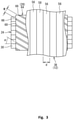
- FIG. 3 shows the configuration of the cover 28 as well as that of the carcass ply 36.
- the right-left direction is the circumferential direction of the tire 2
- the up-down direction is the radial direction of the tire 2.
- the cover cords 66 covered with the cover topping rubber 68 and the carcass cords 56 covered with the carcass topping rubber 58 are indicated by solid lines in FIG. 3 .
- the large number of aligned cover cords 66 are arranged at predetermined intervals.
- the double-headed arrow W indicates the interval between the cover cords 66, i.e., the distance between the cover cords 66.
- the double-headed arrow d indicates the outer diameter of each carcass cord 56.
- the cover 28 is located, between the core 24 and the carcass ply 36, in a portion at which the carcass ply 36 encloses the core 24. Since the cover 28 is interposed between the core 24 and the carcass ply 36, fretting between the core 24 and the carcass cord 56 is prevented.
- the distance W between the cover cords 66 is shorter than the outer diameter d of the carcass cord 56.
- the ratio of the distance W between the cover cords 66 to the outer diameter d of the carcass cord 56 (W/d) is not higher than 0.85. Accordingly, the carcass cord 56 is inhibited from sinking into a portion between the cover cords 66. Thus, the distance between the core 24 and the carcass cord 56 is ensured, whereby fretting between the core 24 and the carcass cord 56 is effectively prevented. Therefore, occurrence of a damage of CBU is inhibited in the tire 2.
- the ratio (W/d) is preferably not higher than 0.75 and more preferably not higher than 0.70.
- the ratio of the distance W between the cover cords 66 to the outer diameter d of the carcass cord 56 (W/d) is not lower than 0.35. Accordingly, the volume of the cover topping rubber 68 between the cover cords 66 is ensured, whereby the cover cords 66 are stably retained by the cover 28 in the tire 2. Thus, the cover cords 66 are prevented from peeling, whereby the cover 28 contributes to prevention of fretting between the core 24 and the carcass cord 56. Therefore, occurrence of a damage of CBU is inhibited in the tire 2.
- the ratio (W/d) is preferably not lower than 0.45 and more preferably not lower than 0.50.
- the cover 28 wrapping the core 24 is composed of the one cover ply 64.
- the cover 28 is thinner than a cover composed of two or more cover plies 64 or a cover obtained by winding the cover ply 64 for two or more turns. Since the outer diameter of a portion formed by the core 24 and the cover 28 wrapping the core 24 is appropriately maintained, the tire 2 allows suppression of rotational movement of the core 24 in a running state. Thus, the thin cover 28 contributes to inhibition of occurrence of bead core looseness.
- the core 24 includes the wires 30 made of steel, and a steel cord is used as each carcass cord 56.
- the cover 28 and the carcass topping rubber 58 are located between the core 24 and the carcass cord 56 which are hard.
- the thin cover 28 is used in the tire 2. Therefore, even though the employment of the thin cover 28 allows inhibition of rotation of the core 24, there is a concern that damage occurs between the core 24 and the carcass cord 56 depending on the degree of shear strain generated between the core 24 and the carcass cord 56.
- the difference between the hardness Hv of the cover topping rubber 68 and the hardness Ht of the carcass topping rubber 58 (Hv-Ht) is not less than - 5 and not greater than 5.
- the difference (Hv-Ht) falls within the predetermined range, and thus, in the tire 2, a portion between the core 24 and the carcass cord 56 can contribute as a whole to reduction in shear strain generated between the core 24 and the carcass cord 56. Therefore, in the tire 2, damage is inhibited from occurring between the core 24 and the carcass cord 56.
- the integrity between the core 24 and the carcass ply 36 is maintained. Accordingly, even when tensile force is exerted to the carcass ply 36, a portion of the carcass ply 36 disposed around the core 24, specifically, the turned-up portion 40, is stably retained. Thus, in the tire 2, the carcass ply 36 is inhibited from being pulled out. As described above, in the tire 2, occurrence of a damage of CBU is also inhibited. That is, in the tire 2, not only occurrence of a damage of CBU but also occurrence of pulling-out of the carcass ply 36 is inhibited. Therefore, the tire 2 has excellent durability.
- the hardness Hv of the cover topping rubber 68 is lower than the hardness Ht of the carcass topping rubber 58. Accordingly, a part, on the core 24 side, of the portion between the core 24 and the carcass cord 56 particularly effectively contributes to reduction in shear strain. Thus, damage is effectively inhibited from occurring between the core 24 and the carcass cord 56, whereby the durability of the tire 2 can be further improved. From this viewpoint, the hardness Hv of the cover topping rubber 68 is preferably lower than the hardness Ht of the carcass topping rubber 58.
- the hardness Hv of the cover topping rubber 68 is preferably not lower than 62, and meanwhile, preferably not higher than 75. If the hardness Hv is set to be 62 or higher, the rigidity of the cover 28 is sufficiently ensured. Therefore, in the tire 2, favorable durability is maintained. From this viewpoint, the hardness Hv is more preferably not lower than 65 and further preferably not lower than 68. If the hardness Hv is set to be 75 or lower, abnormal strain is inhibited from being generated between the core 24 and the carcass cord 56. Therefore, in the tire 2, the integrity between the core 24 and the carcass ply 36 is effectively maintained. From this viewpoint, the hardness Hv is more preferably not higher than 74.
- the double-headed arrow Tv indicates the thickness of the cover ply 64.
- the thickness Tv of the cover ply 64 is expressed by the thickness of a portion of the cover ply 64 that is located between the axially inner end PA and the radially inner end PB of the core 24. Since the cover 28 of the tire 2 is composed of the one cover ply 64, the thickness Tv is the thickness of the cover 28.
- the thickness Tv of the cover ply 64 is preferably not smaller than 0.7 mm, and meanwhile, preferably not larger than 1.4 mm. If the thickness Tv is set to be 0.7 mm or larger, the distance between the core 24 and the carcass cord 56 is appropriately ensured. Thus, the cover 28 contributes to prevention of fretting between the core 24 and the carcass cord 56. From this viewpoint, the thickness Tv is more preferably not smaller than 0.8 mm. If the thickness Tv is set to be 1.4 mm or smaller, rotation of the core 24 is effectively inhibited. Thus, the cover 28 contributes to inhibition of occurrence of bead core looseness. From this viewpoint, the thickness Tv is more preferably not larger than 1.2 mm.
- each cover cord 66 is a cord formed from an organic fiber.
- the thickness of the cover cord 66 is preferably not lower than 700 dtex, and meanwhile, preferably not higher than 1300 dtex.
- the thickness of the cover cord 66 is indicated according to "Fineness Based on Corrected Mass of Cord" in the standards of JIS L1017.
- the cover cord 66 contributes to prevention of fretting between the core 24 and the carcass cord 56. From this viewpoint, the thickness of the cover cord 66 is more preferably not lower than 800 dtex. If the thickness of the cover cord 66 is set to be 1300 dtex or lower, the thickness Tv of the cover 28 is maintained at an appropriate value. Accordingly, rotation of the core 24 is inhibited, whereby occurrence of bead core looseness is effectively inhibited. From this viewpoint, the thickness of the cover cord 66 is more preferably not higher than 1200 dtex.
- the angle ⁇ is the angle of the cover cord 66 relative to the circumferential direction.
- the angle ⁇ of the cover cord 66 relative to the circumferential direction is preferably not smaller than 25°, and meanwhile, preferably not larger than 75°.
- the cover cord 66 is inhibited from sinking into a portion between the wires 30 forming the core 24. Accordingly, in the tire 2, the cover 28 contributes to prevention of fretting between the core 24 and the carcass cord 56. From this viewpoint, the angle ⁇ is more preferably not smaller than 35°. If the angle ⁇ is set to be 75° or smaller, the carcass cord 56 is inhibited from sinking into the portion between the cover cords 66. In this case as well, the cover 28 can contribute to prevention of fretting between the core 24 and the carcass cord 56. From this viewpoint, the angle ⁇ is more preferably not larger than 65°.
- the tire 2 includes the pair of reinforcing layers 18 including the large number of aligned filler cords 60.
- the reinforcing layer 18 shown in FIG. 1 is, on the inner side of the carcass 12, turned up along the carcass 12 around the core 24 from the inner side to the outer side in the axial direction.
- Each filler cord 60 is a steel cord.
- the reinforcing layer 18 effectively restricts movement of the core 24. Accordingly, rotation of the core 24 is inhibited, and thus occurrence of bead core looseness is effectively inhibited.
- the tire 2 includes the pair of reinforcing layers 18 including the large number of aligned filler cords 60; each reinforcing layer 18 is, on the inner side of the carcass 12, turned up along the carcass 12 around the corresponding core 24 from the inner side to the outer side in the axial direction; and each filler cord 60 is a steel cord. From the viewpoint of being able to more effectively restrict the movement of the core 24, an end 46a of the inner portion 46 and the end 48a of the outer portion 48 of the reinforcing layer 18 are more preferably located radially outward of the core 24.
- the end 46a of the inner portion 46 and the end 48a of the outer portion 48 of the reinforcing layer 18 are preferably located radially inward of the outer end 32a of the inner apex 32.
- the hardness Hc of each chafer 10 is equal to the hardness Ht of the carcass topping rubber 58 or higher than the hardness Ht of the carcass topping rubber 58.
- the difference between the hardness Hv of the cover topping rubber 68 and the hardness Ht of the carcass topping rubber 58 is not less than -5 and not greater than 5, and the hardness Hv of the cover topping rubber 68 is preferably lower than the hardness Ht of the carcass topping rubber 58. Accordingly, since the hardness Hc of the chafer 10 is equal to the hardness Ht of the carcass topping rubber 58 or higher than the hardness Ht of the carcass topping rubber 58, the rigidity of the fitted portion 54 is set in a balanced manner.
- the cover topping rubber 68 and the carcass topping rubber 58 located between the core 24 and the carcass cord 56 can effectively contribute to suppression of shear strain, whereby the durability of the tire 2 is further improved.
- the hardness Hc of the chafer 10 is preferably higher than the hardness Ht of the carcass topping rubber 58. From the viewpoint of setting the rigidity of the fitted portion 54 in a more balanced manner, it is more preferable that: the hardness Hc of the chafer 10 is higher than the hardness Ht of the carcass topping rubber 58; and the hardness Hv of the cover topping rubber 68 is lower than the hardness Ht of the carcass topping rubber 58.
- the difference between the hardness Hc of the chafer 10 and the hardness Ht of the carcass topping rubber 58 is preferably not less than 1, and meanwhile, preferably not greater than 10 from the viewpoint of setting the rigidity of the fitted portion 54 in a balanced manner.
- a producing method for the tire 2 includes: a forming step of combining the elements composing the tire 2, to prepare a tire 2 in an unvulcanized state (hereinafter, "green tire”); and a vulcanizing step of pressurizing and heating the green tire in a mold (not shown).
- the green tire is pressurized and heated in the mold in the vulcanizing step.
- the cover 28 is located between the core 24 and the carcass cord 56. Therefore, there is the following concern.
- the cover topping rubber 68 which is included in the green tire, being in an unvulcanized state, the cover topping rubber 68 flows in the vulcanizing step, and thus no cover 28 having an appropriate thickness Tv is formed.
- the large number of cover cords 66 are aligned with each other so as to be formed as cover cord-aligned members, and then each cover cord-aligned member is covered with the corresponding cover topping rubber 68. Accordingly, a sheet-like cover 28 in an unvulcanized state (hereinafter, referred to also as "green cover”) is prepared. Then, an electron beam is applied to the green cover, thereby preparing a cover precursor in which the cover topping rubber 68 is slightly vulcanized. The cover precursor is wound around the core 24, and the apex 26 is combined with the core 24 around which the cover precursor has been wound, thereby forming the bead 8. The bead 8 is combined with the other elements, thereby forming the green tire.
- the cover topping rubber 68 of the cover 28 included in the green tire is slightly vulcanized. Therefore, even when the green tire is pressurized and heated in the vulcanizing step, the cover topping rubber 68 is effectively inhibited from flowing.
- the producing method for the tire 2 allows a tire 2 including a cover 28 having an appropriate thickness Tv to be obtained. In the tire 2, since the distance between the core 24 and the carcass cord 56 is reliably ensured, fretting between the core 24 and the carcass cord 56 is effectively prevented. Thus, in the tire 2, occurrence of a damage of CBU is more effectively inhibited.
- the cover 28 of the tire 2 is obtained by pressurizing and heating, in a mold, the cover precursor which is obtained by applying an electron beam to the green cover.
- the cover 28 is preferably a vulcanizationmolded product of an electron beam-applied member of the cover 28 in an unvulcanized state.
- the voltage of the electron beam to be applied is preferably not lower than 200 kV and not higher than 600 kV from the viewpoint of effectively reducing the fluidity of the cover topping rubber 68 in the vulcanizing step.
- the amount of the electron beam to be applied is preferably not lower than 50 kGy and not higher than 200 kGy.
- Examples of a device for electron beam application include a scan-type electron beam applying device and an area-type electron beam applying device.
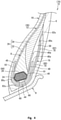
- FIG. 4 shows a fitted portion 74 of a heavy-duty pneumatic tire 72 according to another embodiment of the present invention (hereinafter, sometimes referred to simply as "tire 72").
- FIG. 4 shows a partial cross section of the tire 72 taken along a plane that includes a rotation axis of the tire 72.
- the right-left direction is the axial direction of the tire 72
- the up-down direction is the radial direction of the tire 72.
- a direction perpendicular to the sheet surface of FIG. 4 is the circumferential direction of the tire 72.
- the tire 72 has the same configuration as that of the tire 2 shown in FIG. 1 , except that the fitted portion 74 thereof includes a second reinforcing layer 76 instead of the inner sidewall 52.
- the same elements as the elements of the tire 2 shown in FIG. 1 are denoted by the same reference characters, and description thereof is omitted.
- the tire 72 includes a pair of second reinforcing layers 76.
- Each second reinforcing layer 76 is located axially outward of the corresponding bead 8, and covers an axially outer portion of the corresponding reinforcing layer 18 (hereinafter, "reinforcing steel layer 18"), specifically, the end 48a of the outer portion 48.
- the second reinforcing layer 76 includes a large number of aligned second filler cords.
- Each second filler cord is formed from an organic fiber.
- the organic fiber include nylon fibers, rayon fibers, polyester fibers, and aramid fibers.
- the second reinforcing layer 76 is referred to also as a reinforcing fiber layer 76.
- the reinforcing fiber layer 76 is composed of at least two reinforcing plies 78.
- the reinforcing fiber layer 76 of the tire 72 is composed of two reinforcing plies 78 which are an inner reinforcing ply 80 and an outer reinforcing ply 82.
- each reinforcing ply 78 includes a large number of aligned second filler cords.
- the inner reinforcing ply 80 is in contact with the reinforcing steel layer 18.
- An outer end 80s of the inner reinforcing ply 80 is located radially outward of the end 48a of the outer portion 48 which is a part of the reinforcing steel layer 18.
- the inner reinforcing ply 80 covers the end 48a of the outer portion 48 from the axially outer side.
- An inner end 80u of the inner reinforcing ply 80 is located axially inward of the core 24.
- the inner end 80u of the inner reinforcing ply 80 overlaps the core 24 in the axial direction.
- the outer reinforcing ply 82 is in contact with the inner reinforcing ply 80.
- An outer end 82s of the outer reinforcing ply 82 is located radially outward of the outer end 80s of the inner reinforcing ply 80.
- the outer reinforcing ply 82 covers the outer end 80s of the inner reinforcing ply 80 from the axially outer side.
- An inner end 82u of the outer reinforcing ply 82 is located axially outward of the inner end 80u of the inner reinforcing ply 80 and located radially inward of the core 24.
- the tire 72 is the same as the tire 2 shown in FIG. 1 in that: the cover 28 is composed of the one cover ply 64 including the large number of aligned cover cords 66; the ratio of the distance W between the cover cords 66 to the outer diameter d of the carcass cord 56 (W/d) is not lower than 0.35 and not higher than 0.85; and the difference between the hardness Hv of the cover topping rubber 68 covering the cover cords 66 and the hardness Ht of the carcass topping rubber 58 covering the carcass cords 56 (Hv-Ht) is not less than -5 and not greater than 5.
- the tire 72 In the tire 72, not only occurrence of a damage of CBU but also occurrence of pulling-out of the carcass ply 36 is inhibited. Therefore, the tire 72 has excellent durability.
- the reinforcing fiber layer 76 contributes to the rigidity of the fitted portion 74.
- the reinforcing fiber layer 76 effectively restricts, together with the reinforcing steel layer 18, movement of the core 24. Accordingly, rotation of the core 24 is inhibited, and thus occurrence of bead core looseness is effectively inhibited. Therefore, occurrence of pulling-out of the carcass ply 36 is effectively inhibited, whereby the durability of the tire 72 can be further improved.
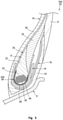
- FIG. 5 shows a fitted portion 94 of a heavy-duty pneumatic tire 92 according to another embodiment of the present invention (hereinafter, sometimes referred to simply as "tire 92").
- FIG. 5 shows a partial cross section of the tire 92 taken along a plane that includes a rotation axis of the tire 92.
- the right-left direction is the axial direction of the tire 92
- the up-down direction is the radial direction of the tire 92.
- a direction perpendicular to the sheet surface of FIG. 5 is the circumferential direction of the tire 92.
- the tire 92 has the same configuration as that of the tire 72 shown in FIG. 4 , except that a cover 96 of the fitted portion 94 thereof has a different configuration.
- FIG. 5 the same elements as the elements of the tire 72 shown in FIG. 4 are denoted by the same reference characters, and description thereof is omitted.
- the cover 96 is the same as the cover 28 shown in FIG. 1 and FIG. 4 in that the cover 96 is composed of the one cover ply 64 including the large number of aligned cover cords 66 and further including the cover topping rubber 68 covering the cover cords 66.
- Each cover cord 66 is a cord formed from an organic fiber.
- the cover topping rubber 68 is formed from crosslinked rubber.
- the cover 96 does not enclose the entire core 24 but encloses a part of the core 24. As shown in FIG. 5 , the cover 96 is disposed so as to face an axially inner portion, a radially inner portion , and an axially outer portion of the core 24. In the tire 92, the inner apex 32 is placed on the core 24 without the cover 96 being interposed between the inner apex 32 and a radially outer portion of the core 24.
- Each bead 8 of the tire 92 shown in FIG. 5 is formed as follows.
- the wires 30 are spirally wound to be formed as the cores 24.
- Each apex 26 is combined with the corresponding core 24, and then the aforementioned cover precursor is attached so as to enclose the core 24 portion. Accordingly, the bead 8 is formed.
- a green tire including the bead 8 is prepared, and the green tire is pressurized and heated in a mold, thereby obtaining the tire 92 including the fitted portion 94 shown in FIG. 5 .
- the tire 92 is the same as the tire 2 in FIG. 1 and the tire 72 in FIG. 4 in that the cover 96 is located, between the core 24 and the carcass ply 36, in the portion at which the carcass ply 36 encloses the core 24. Since the cover 96 is interposed between the core 24 and the carcass ply 36, fretting between the core 24 and the carcass cord 56 is prevented.
- the core 24 is not wrapped by the cover 96.
- rotational movement of the core 24 in a running state is more effectively inhibited than in the tire 2 in FIG. 1 and the tire 72 in FIG. 4 .
- the ratio of the distance W between the cover cords 66 to the outer diameter d of the carcass cord 56 (W/d) is not lower than 0.35 and not higher than 0.85, and the difference between the hardness Hv of the cover topping rubber 68 covering the cover cords 66 and the hardness Ht of the carcass topping rubber 58 covering the carcass cords 56 (Hv-Ht) is not less than -5 and not greater than 5.
- the tire 92 has excellent durability.
- a heavy-duty pneumatic tire in which not only occurrence of a damage of CBU but also occurrence of pulling-out of the carcass ply can be inhibited and which has excellent durability, is obtained.
- Example 1 Each fitted portion in Example 1 has the configuration shown in FIG. 1 , as indicated in the row "Configuration" in Table 1.
- Example 1 the entire cores were enclosed by the covers.
- Each cover was composed of one cover ply, and the thickness Tv of the cover ply was 1.0 mm.
- As each cover cord a nylon fiber cord having a thickness of 940 dtex was used.
- the hardness Hv of each cover topping rubber was 70.
- As each carcass cord a steel cord having an outer diameter d of 0.85 mm was used. The ratio of the distance W between the cover cords to the outer diameter d of the carcass cord (W/d) was 0.65.
- the hardness Ht of the carcass topping rubber was 71.
- the difference between the hardness Ht of the carcass topping rubber and the hardness Tv of the cover topping rubber (Ht-Hv) was 1.
- the hardness Hc of each chafer was 72.
- Example 1 reinforcing steel layers were used, but no reinforcing fiber layer was used. These features are expressed as "Y" in the row “Reinforcing steel layer” and "0" in the row “Reinforcing fiber layer”, respectively, in Table 1.
- Example 3 A tire in Example 3 was obtained in the same manner as in Example 1, except that each fitted portion was provided with a reinforcing fiber layer so that the fitted portion had the configuration shown in FIG. 4 .
- the reinforcing fiber layer was composed of two reinforcing plies. This feature is expressed as "2" in the row “Reinforcing fiber layer” in Table 1.
- nylon fiber cords were used for each reinforcing ply.
- Example 2 A tire in Example 2 was obtained in the same manner as in Example 3, except that the reinforcing fiber layer was composed of one reinforcing ply.
- a tire in Comparative Example 1 was obtained in the same manner as in Example 1, except that each cover was composed of two cover plies. In Comparative Example 1, a conventional tire was used.
- a tire in Comparative Example 3 was obtained in the same manner as in Example 3, except that the cover was composed of two cover plies. In Comparative Example 3, a conventional tire was used.
- a tire in Comparative Example 2 was obtained in the same manner as in Example 2, except that the cover was composed of two cover plies. In Comparative Example 2, a conventional tire was used.
- Tires in Examples 4-7 and Comparative Example 4 were obtained in the same manner as in Example 1, except that the ratios (W/d) were set as indicated in Table 2 below with different distances W between the cover cords. Production of a tire having a ratio (W/d) lower than 0.35 with a different distance W was attempted. However, it was difficult to form cover plies, and thus such a tire was unable to be produced.
- Tires in Examples 10 and 11 were obtained in the same manner as in Example 1, except that the differences (Ht-Hv) were set as indicated in Table 3 below with different hardnesses Hv and different hardnesses Ht, and the hardnesses Hc were also set as indicated in Table 3.
- Example 12 A tire in Example 12 was obtained in the same manner as in Example 1, except that the differences (Ht-Hv) were set as indicated in Table 3 below with different hardnesses Hv and different hardnesses Ht.
- Tires in Examples 15 and 16 were obtained in the same manner as in Example 1, except that the thicknesses Tv of the cover plies were set as indicated in Table 4 below.
- Example 17 A tire in Example 17 was obtained in the same manner as in Example 1, except that each fitted portion had the configuration shown in FIG. 5 . In Example 17, a part of the core was enclosed by the cover.
- the internal pressure of the tire was adjusted to 850 kPa.
- the tire was set on a drum tester. With a vertical load of 69.54 kN being applied to the tire at a slip angle of 0 (zero) degrees and a camber angle of 0 (zero) degrees, running with the tire was performed at a speed of 20 km/h on the outer circumferential surface of the drum having a diameter of 1707 mm. The time taken before the tire was broken, was measured. The results of the measurement are indicated in Tables 1-4 below. Tires of which the running times had exceeded 450 hours were regarded as passing the test.
- a durability test was conducted with reference to "Durability Test Method for Tire” described in Japanese Laid-Open Patent Publication No. 2013-257190 .
- the internal pressure of the tire was adjusted to 850 kPa.
- the tire was set on the drum tester. With a vertical load of 29.60 kN being applied to the tire at a slip angle of 0 (zero) degrees and a camber angle of 0 (zero) degrees, running with the tire was performed at a speed of 30 km/h on the outer circumferential surface of the drum having a diameter of 1707 mm.
- each fitted portion was heated by a heater such that the temperature of the fitted portion became 140°C.
- Tires of which the running times had exceeded 150 hours were regarded as passing the test.
- the tire was disassembled, and the damage state thereof was checked. The results of the check are indicated in the row “Test 2" in Tables 1-4 below.
- PP means pulling-out of a carcass ply, which is a damage in which the carcass ply is peeled so as to come apart from a core.
- BC means a base crack which is a damage in which a chafer is cracked.
- FIG. 1 FIG. 1 FIG. 1 FIG. 1 FIG. 1 FIG. 1 FIG. 1 FIG. 1 Cover ply Number 1 1 1 1 1 1 Tv [mm] 1.0 1.0 1.0 1.0 1.0 1.0 1.0 W/d [-] 0.35 0.53 0.71 0.85 1.18 Thickness [dtex] 940 940 940 940 940 940 Hardness Hv 70 70 70 70 70 Hardness Ht 71 71 71 71 Ht-Hv 1 1 1 1 Hc 72 72 72 72 72 72 72 72 72 72 72 72 72 72 72 72 72 72 72 72 72 72 72 72 72 Reinforcing fiber layer 0 0 0 0 0 Test 1 Time 500 500 500 480 300 Damage PTL PTL PTL PTL CBU Test 2 Time 180 180 180 175 160 Damage BC BC BC BC [Table 3] Comparative Example 5 Example 8 Example 9 Comparative Example 6 Example 10 Example 11 Example 12 Configuration FIG. 1 FIG.
- FIG. 1 FIG. 1 FIG. 1 FIG. 1 FIG. 1 FIG. 1 FIG. 1 FIG. 1 FIG. 1 FIG. 1 Cover ply Number 1 1 1 1 1 1 1 1 Tv [mm] 1.0 1.0 1.0 1.0 1.0 1.0 1.0 1.0 1.0 1.0 W/d [-] 0.65 0.65 0.65 0.65 0.65 0.65 0.65 Thickness [dtex] 940 940 940 940 940 940 940 940 940 940 940 940 940 940 940 940 940 940 940 940 940 940 940 940 940 940 940 940 940 940 940 940 940 940 Hardness Hv 65 68 74 77 75 75 75 75 Hardness Ht 71 71 71 71 76 78 76 Ht-Hv 6 3 -3 -6 1 3 1 Hc 72 72 72 72 80 80 72 Reinforcing steel layer Y Y Y Y Y Y Reinforcing fiber layer 0 0 0 0 0
- FIG. 1 FIG. 1 FIG. 1 FIG. 1 FIG. 5 Cover ply Number 1 1 1 1 1 1 Tv [mm] 1.0 1.0 0.7 1.4 1.0 W/d [-] 0.65 0.65 0.65 0.65 0.65 Thickness [dtex] 700 1100 940 940 940 Hardness Hv 70 70 70 70 70 Hardness Ht 71 71 71 71 71 Ht-Hv 1 1 1 1 Hc 72 72 72 72 Reinforcing steel layer Y Y Y Y Y Reinforcing fiber layer 0 0 0 0 0 Test 1 Time 480 480 480 500 Damage PTL PTL PTL PTL PTL Test 2 Time 175 175 175 175 180 Damage BC BC BC BC BC BC BC BC
Landscapes
- Engineering & Computer Science (AREA)
- Mechanical Engineering (AREA)
- Tires In General (AREA)
Description
- The present invention relates to a heavy-duty pneumatic tire.
- Portions of a tire that are fitted to a rim (hereinafter, referred to also as "fitted portions") include beads. Each bead includes a core, and the core is formed by winding a wire made of steel. A carcass extends on and between one of the beads and the other bead. The carcass is composed of at least one carcass ply, and the carcass ply is turned up around the core. A steel cord is ordinarily used as a carcass cord for tires to be mounted to vehicles such as trucks and buses, i.e., heavy-duty tires.
- Force is exerted to each fitted portion of the tire so as to cause the core and the carcass cord to come close to each other. Heavy-duty tires are used under high internal pressure and high load. Therefore, there is a concern that fretting between the core and the carcass cord occurs and a damage that involves a break of the carcass cord (Cord Broken Up: CBU) occurs. In order to improve the durabilities of tires, studies regarding prevention of a damage of CBU have been conducted (for example,
Japanese Laid-Open Patent Publication No. 2011-51568 - In a tire described in
Japanese Laid-Open Patent Publication No. 2011-51568 - Since the wrapping material is disposed between the carcass ply and the core, the distance between the carcass ply and the core is ensured. Thus, in the tire described in the aforementioned
Japanese Laid-Open Patent Publication No. 2011-51568 - However, since the core is wrapped by the wrapping material, a core portion apparently has a large outer diameter. The core is rotated by tensile force exerted to the carcass ply, and rotational movement of the core portion is greater than that of the core alone. Therefore, there is a concern that a damage that involves peeling (bead core looseness) occurs between the core and the carcass ply depending on the degree of shear strain that is generated between the core and the carcass ply. In this case, the integrity between the core and the carcass ply cannot be maintained. Thus, a portion of the carcass ply that is located around the core, i.e., a turned-up portion of the carcass ply, may be pulled out owing to tensile force exerted to the carcass ply.
- A heavy-duty pneumatic tire according to the preamble of claim 1 is known from
EP 2 292 450 A1 - The present invention has been made in consideration of these circumstances, and an object of the present invention is to provide a heavy-duty pneumatic tire in which not only occurrence of a damage of CBU but also occurrence of pulling-out of a carcass ply can be inhibited, and which has excellent durability.
- A heavy-duty pneumatic tire according to one mode of the present invention includes: a pair of beads; and a carcass extending on and between one of the beads and another bead. Each bead includes a core, an apex located radially outward of the core, and a cover enclosing at least a part of the core. The carcass includes a carcass ply including a large number of aligned carcass cords and further including a carcass topping rubber covering the carcass cords. Each carcass cord is a steel cord, and the carcass ply is turned up around the core from an inner side to an outer side in an axial direction. The cover is located, between the core and the carcass ply, in a portion at which the carcass ply encloses the core. The cover is composed of one cover ply including a large number of aligned cover cords and further including a cover topping rubber covering the cover cords. Each cover cord is a cord formed from an organic fiber. A ratio of a distance between the cover cords to an outer diameter of each carcass cord is not lower than 0.35 and not higher than 0.85. A difference between a hardness of the cover topping rubber and a hardness of the carcass topping rubber is not less than -5 and not greater than 5.
- In the heavy-duty pneumatic tire, the hardness of the cover topping rubber is lower than the hardness of the carcass topping rubber.
- It is preferable that, in the heavy-duty pneumatic tire, the hardness of the cover topping rubber is not lower than 62 and not higher than 75.
- It is preferable that, in the heavy-duty pneumatic tire, a thickness of the cover ply is not smaller than 0.7 mm and not larger than 1.4 mm.
- It is preferable that, in the heavy-duty pneumatic tire, a thickness of each cover cord is not lower than 700 dtex and not higher than 1300 dtex.
- It is preferable that, in the heavy-duty pneumatic tire, an angle of each cover cord relative to a circumferential direction is not smaller than 25° and not larger than 75°.
- It is preferable that the heavy-duty pneumatic tire further includes a pair of chafers located axially outward of the beads. A hardness of each chafer is equal to the hardness of the carcass topping rubber or higher than the hardness of the carcass topping rubber.
- In the heavy-duty pneumatic tire according to the present invention, not only occurrence of a damage of CBU but also occurrence of pulling-out of the carcass ply is inhibited. Therefore, the tire has excellent durability.
-
-
FIG. 1 is a partial cross-sectional view of a heavy-duty pneumatic tire according to an embodiment of the present invention; -
FIG. 2 is an enlarged cross-sectional view of a fitted portion of the tire inFIG. 1 ; -
FIG. 3 is a schematic diagram for explaining arrangement of cover cords; -
FIG. 4 is a partial cross-sectional view of a heavy-duty pneumatic tire according to another embodiment of the present invention; and -
FIG. 5 is a partial cross-sectional view of a heavy-duty pneumatic tire according to still another embodiment of the present invention. - Hereinafter, the present invention will be described in detail based on preferred embodiments with appropriate reference to the drawings.
- In the present invention, a state where a tire is mounted to a normal rim, the internal pressure of the tire is adjusted to a normal internal pressure, and no load is applied to the tire, is referred to as a normal state. In the present invention, the dimensions and the angles of components of the tire are measured in the normal state unless otherwise specified.
- The normal rim means a rim that is specified in a standard on which the tire is based. The "standard rim" in the JATMA standard, the "Design Rim" in the TRA standard, and the "Measuring Rim" in the ETRTO standard, are normal rims.
- The normal internal pressure means an internal pressure that is specified in a standard on which the tire is based. The "maximum air pressure" in the JATMA standard, the "maximum value" indicated in "TIRE LOAD LIMITS AT VARIOUS COLD INFLATION PRESSURES" in the TRA standard, and the "INFLATION PRESSURE" in the ETRTO standard, are normal internal pressures.
- A normal load means a load that is specified in a standard on which the tire is based. The "maximum load capacity" in the JATMA standard, the "maximum value" indicated in "TIRE LOAD LIMITS AT VARIOUS COLD INFLATION PRESSURES" in the TRA standard, and the "LOAD CAPACITY" in the ETRTO standard, are normal loads.
-
FIG. 1 shows a part of a heavy-dutypneumatic tire 2 according to an embodiment of the present invention (hereinafter, sometimes referred to simply as "tire 2"). Thetire 2 is mounted to a vehicle such as a truck or a bus. Thetire 2 shown inFIG. 1 is mounted to a rim R. The rim R is a normal rim. -
FIG. 1 shows a partial cross section of thetire 2 taken along a plane that includes a rotation axis of thetire 2. InFIG. 1 , the right-left direction is the axial direction of thetire 2, and the up-down direction is the radial direction of thetire 2. A direction perpendicular to the sheet surface ofFIG. 1 is the circumferential direction of thetire 2. InFIG. 1 , the alternate long and short dash line CL indicates an equator plane of thetire 2. - In
FIG. 1 , the solid line BBL extending in the axial direction is a bead base line. The bead base line is a line that defines the diameter of the rim R (refer to the JATMA standard or the like). - The
tire 2 includes atread 4, a pair ofsidewalls 6, a pair ofbeads 8, a pair ofchafers 10, acarcass 12, abelt 14, aninner liner 16, and a pair of reinforcing layers 18. - The
tread 4 is formed from crosslinked rubber. Thetread 4 is, at anouter surface 20 thereof (i.e., tread surface 20), brought into contact with a road surface. In thetire 2, at least threecircumferential grooves 22 are formed in thetread 4. - Each
sidewall 6 connects to the corresponding end of thetread 4. Thesidewall 6 extends radially inward from the end of thetread 4. Thesidewall 6 is formed from crosslinked rubber. - Each
bead 8 is located radially inward of thecorresponding sidewall 6. Thebead 8 includes a core 24, an apex 26, and acover 28. - The
core 24 extends in a circumferential direction. Thecore 24 includes woundwires 30 made of steel. In thecore 24, eachwire 30 extends in the circumferential direction. A cross-sectional shape of thecore 24 has round corners and six sides. Thecore 24 has a hexagonal cross-sectional shape. In thetire 2, the cross-sectional shape of thecore 24 is not particularly limited, and the cross-sectional shape may be quadrangular or circular. - In
FIG. 1 , the corner indicated by the reference character PA is the axially inner end of the core 24, and the corner indicated by the reference character PB is the radially inner end of thecore 24. The axially inner end PA and the radially inner end PB are specified based on the cross-sectional shape, of the core 24, that is formed by a bunch of cross sections of thewires 30. - The
cover 28 encloses at least a part of thecore 24. In thetire 2, thecover 28 encloses theentire core 24 as shown inFIG. 1 . Thecover 28 encloses thecore 24 and binds thespirally wound wires 30. Thecover 28 prevents the bunch ofwound wires 30 from being undone. - The apex 26 is located radially outward of the
core 24. The apex 26 includes aninner apex 32 and anouter apex 34. Theinner apex 32 extends radially outward from thecore 24. Theinner apex 32 is tapered toward an outer side in the radial direction. Theouter apex 34 is located radially outward of theinner apex 32. Theouter apex 34 has a large thickness at a portion thereof on which anouter end 32a of theinner apex 32 is located. An outer portion of theouter apex 34 is tapered toward the outer side in the radial direction, and an inner portion of theouter apex 34 is tapered toward an inner side in the radial direction. - In the
tire 2, theinner apex 32 and theouter apex 34 are formed from crosslinked rubber. In thetire 2, the hardness Hu of theinner apex 32 is not lower than 80 and not higher than 95. The hardness Hs of theouter apex 34 is not lower than 50 and not higher than 65. Theouter apex 34 is softer than theinner apex 32. - In the
tire 2, the hardness of each element forming thetire 2 such as the aforementionedinner apex 32 andouter apex 34 is measured according to a standard of JIS K6253 with use of a type A durometer under a temperature condition of 23°C. - Each
chafer 10 is located axially outward of thecorresponding bead 8. Thechafer 10 is located radially inward of thecorresponding sidewall 6. Thechafer 10 is brought into contact with the rim R. - The
chafer 10 is formed from crosslinked rubber. Thechafer 10 is softer than theinner apex 32 and harder than theouter apex 34. In thetire 2, the hardness Hc of thechafer 10 is not lower than 60 and not higher than 85. - The
carcass 12 is located inward of thetread 4, thesidewall 6, and thechafer 10. Thecarcass 12 extends on and between one of thebeads 8 and theother bead 8. Thecarcass 12 includes at least onecarcass ply 36. Thecarcass 12 of thetire 2 is composed of onecarcass ply 36. - The carcass ply 36 is turned up around each core 24 from an inner side to an outer side in the axial direction. The carcass ply 36 has: a
ply body 38 extending on and between one of thecores 24 and theother core 24; and a pair of turned-upportions 40 connecting to theply body 38 and turned up around therespective cores 24 from the inner side to the outer side in the axial direction. In thetire 2, anend 40a of each turned-upportion 40 is located radially inward of theouter end 32a of the correspondinginner apex 32. - In
FIG. 1 , the reference character PC indicates the intersection point between the equator plane and the inner surface of thecarcass 12. The double-headed arrow HS indicates the distance in the radial direction between the bead base line and the intersection point PC. The distance HS in the radial direction is the height of a cross section of thecarcass 12. InFIG. 1 , the double-headed arrow HF indicates the distance in the radial direction between the bead base line and theend 40a of the turned-upportion 40. The distance HF in the radial direction is the height of the turned-upportion 40. - In the
tire 2, the ratio of the height HF of the turned-upportion 40 to the height HS of the cross section of the carcass 12 (HF/HS) is preferably not lower than 0.15 from the viewpoint of inhibiting the turned-upportion 40 from being pulled out. The ratio (HF/HS) is preferably not higher than 0.25 from the viewpoint of inhibiting strain from being concentrated at theend 40a of the turned-upportion 40. - Although not shown, the carcass ply 36 includes a large number of aligned carcass cords. Each carcass cord intersects with the equator plane. The angle of the carcass cord relative to the equator plane is not smaller than 70° and not larger than 90°.
- The carcass cord is a steel cord. In the
tire 2, a steel cord generally used as a tire cord is used as the carcass cord. In thetire 2, the outer diameter of the carcass cord, i.e., a cord diameter, is not smaller than 0.65 mm and not larger than 1.50 mm. In a case where the steel cord as the carcass cord is obtained by twisting a plurality of element wires together, the cord diameter is expressed by the diameter of a circle circumscribing the element wires. - The
belt 14 is located radially inward of thetread 4. Thebelt 14 is located radially outward of thecarcass 12. - The
belt 14 is composed of a plurality of belt plies 42 stacked in the radial direction. Thebelt 14 of thetire 2 is composed of four belt plies 42. In thetire 2, the number of belt plies 42 composing thebelt 14 is not particularly limited. The configuration of thebelt 14 is determined as appropriate in consideration of the specifications of thetire 2. - Although not shown, each belt ply 42 includes a large number of aligned belt cords. The belt cords are covered with a topping rubber. The material of each belt cord is steel. The belt cord is tilted relative to the equator plane.
- The
inner liner 16 is located inward of thecarcass 12. Theinner liner 16 is formed from crosslinked rubber. Theinner liner 16 maintains the internal pressure of thetire 2. - Each reinforcing
layer 18 is located at thecorresponding bead 8 portion. The reinforcinglayer 18 is, on the inner side of thecarcass 12, turned up along thecarcass 12 around the core 24 from the inner side to the outer side in the axial direction. The reinforcinglayer 18 has: abottom portion 44 located radially inward of the core 24; aninner portion 46 connecting to one end of thebottom portion 44 and extending substantially outward in the radial direction; and anouter portion 48 connecting to the other end of thebottom portion 44 and extending substantially outward in the radial direction. Theinner portion 46 is located axially inward of theply body 38, and theouter portion 48 is located axially outward of the turned-upportion 40. - The
tire 2 may be configured such that the reinforcinglayer 18 is not turned up around thecore 24 but covers, from the outer side, a radially inner portion and an axially outer portion of thebead 8 with the carcass ply 36 therebetween. Thetire 2 may also be configured such that the reinforcinglayer 18 covers, from the outer side, only the axially outer portion of thebead 8 with the carcass ply 36 therebetween. - Although not shown, the reinforcing
layer 18 includes a large number of aligned filler cords. Each filler cord is a steel cord. The reinforcinglayer 18 is referred to also as a reinforcing steel layer. - In the
tire 2, astrip 50 and aninner sidewall 52 are disposed between thebead 8 and thechafer 10. Thestrip 50 is formed from crosslinked rubber and covers theend 40a of the turned-upportion 40 from the axially outer side. Theinner sidewall 52 is formed from crosslinked rubber and covers thestrip 50 and anend 48a of theouter portion 48 from the axially outer side. -
FIG. 2 shows thebead 8 portion (hereinafter, referred to also as "fittedportion 54") of thetire 2 shown inFIG. 1 .FIG. 2 shows, in an enlarged manner, a core 24 portion included in the fittedportion 54. - As shown in
FIG. 2 , in thecarcass ply 36, thecarcass cords 56 are covered with acarcass topping rubber 58. The carcass ply 36 includes: the large number of alignedcarcass cords 56; and thecarcass topping rubber 58 covering thecarcass cords 56. Thecarcass topping rubber 58 is formed from crosslinked rubber. In thetire 2, the hardness Ht of thecarcass topping rubber 58 is not lower than 68 and not higher than 85. - In the reinforcing
layer 18, thefiller cords 60 are covered with afiller topping rubber 62. The reinforcinglayer 18 includes: the large number of alignedfiller cords 60; and thefiller topping rubber 62 covering thefiller cords 60. Thefiller topping rubber 62 is formed from crosslinked rubber. In thetire 2, the material of thefiller topping rubber 62 is the same as the material of thecarcass topping rubber 58. - As shown in
FIG. 2 , in thetire 2, thecover 28 is composed of onecover ply 64. The cover ply 64 includes: a large number of alignedcover cords 66; and acover topping rubber 68 covering thecover cords 66. Thecover topping rubber 68 is formed from crosslinked rubber. - In the
tire 2, eachcover cord 66 is a cord formed from an organic fiber. Examples of the organic fiber include nylon fibers, rayon fibers, polyester fibers, and aramid fibers. -
FIG. 3 shows the configuration of thecover 28 as well as that of thecarcass ply 36. InFIG. 3 , the right-left direction is the circumferential direction of thetire 2, and the up-down direction is the radial direction of thetire 2. For convenience of description, thecover cords 66 covered with thecover topping rubber 68 and thecarcass cords 56 covered with thecarcass topping rubber 58 are indicated by solid lines inFIG. 3 . - In the
cover 28 of thetire 2, the large number of alignedcover cords 66 are arranged at predetermined intervals. InFIG. 3 , the double-headed arrow W indicates the interval between thecover cords 66, i.e., the distance between thecover cords 66. The double-headed arrow d indicates the outer diameter of eachcarcass cord 56. - In the
tire 2, when tensile force is exerted to thecarcass ply 36, force is exerted so as to cause the carcass ply 36 to come close to thecore 24. In thetire 2, thecover 28 is located, between the core 24 and thecarcass ply 36, in a portion at which the carcass ply 36 encloses thecore 24. Since thecover 28 is interposed between the core 24 and thecarcass ply 36, fretting between the core 24 and thecarcass cord 56 is prevented. - In the
tire 2, in particular, the distance W between thecover cords 66 is shorter than the outer diameter d of thecarcass cord 56. Specifically, the ratio of the distance W between thecover cords 66 to the outer diameter d of the carcass cord 56 (W/d) is not higher than 0.85. Accordingly, thecarcass cord 56 is inhibited from sinking into a portion between thecover cords 66. Thus, the distance between the core 24 and thecarcass cord 56 is ensured, whereby fretting between the core 24 and thecarcass cord 56 is effectively prevented. Therefore, occurrence of a damage of CBU is inhibited in thetire 2. From this viewpoint, the ratio (W/d) is preferably not higher than 0.75 and more preferably not higher than 0.70. - In the
tire 2, the ratio of the distance W between thecover cords 66 to the outer diameter d of the carcass cord 56 (W/d) is not lower than 0.35. Accordingly, the volume of thecover topping rubber 68 between thecover cords 66 is ensured, whereby thecover cords 66 are stably retained by thecover 28 in thetire 2. Thus, thecover cords 66 are prevented from peeling, whereby thecover 28 contributes to prevention of fretting between the core 24 and thecarcass cord 56. Therefore, occurrence of a damage of CBU is inhibited in thetire 2. From this viewpoint, the ratio (W/d) is preferably not lower than 0.45 and more preferably not lower than 0.50. - As described above, in the
tire 2, thecover 28 wrapping thecore 24 is composed of the onecover ply 64. Thecover 28 is thinner than a cover composed of two or more cover plies 64 or a cover obtained by winding the cover ply 64 for two or more turns. Since the outer diameter of a portion formed by thecore 24 and thecover 28 wrapping thecore 24 is appropriately maintained, thetire 2 allows suppression of rotational movement of the core 24 in a running state. Thus, thethin cover 28 contributes to inhibition of occurrence of bead core looseness. - Meanwhile, in the
tire 2, thecore 24 includes thewires 30 made of steel, and a steel cord is used as eachcarcass cord 56. In thetire 2, thecover 28 and thecarcass topping rubber 58 are located between the core 24 and thecarcass cord 56 which are hard. As described above, thethin cover 28 is used in thetire 2. Therefore, even though the employment of thethin cover 28 allows inhibition of rotation of the core 24, there is a concern that damage occurs between the core 24 and thecarcass cord 56 depending on the degree of shear strain generated between the core 24 and thecarcass cord 56. - However, in the
tire 2, the difference between the hardness Hv of thecover topping rubber 68 and the hardness Ht of the carcass topping rubber 58 (Hv-Ht) is not less than - 5 and not greater than 5. The difference (Hv-Ht) falls within the predetermined range, and thus, in thetire 2, a portion between the core 24 and thecarcass cord 56 can contribute as a whole to reduction in shear strain generated between the core 24 and thecarcass cord 56. Therefore, in thetire 2, damage is inhibited from occurring between the core 24 and thecarcass cord 56. - In the
tire 2, the integrity between the core 24 and the carcass ply 36 is maintained. Accordingly, even when tensile force is exerted to thecarcass ply 36, a portion of the carcass ply 36 disposed around thecore 24, specifically, the turned-upportion 40, is stably retained. Thus, in thetire 2, the carcass ply 36 is inhibited from being pulled out. As described above, in thetire 2, occurrence of a damage of CBU is also inhibited. That is, in thetire 2, not only occurrence of a damage of CBU but also occurrence of pulling-out of the carcass ply 36 is inhibited. Therefore, thetire 2 has excellent durability. - In the
tire 2, the hardness Hv of thecover topping rubber 68 is lower than the hardness Ht of thecarcass topping rubber 58. Accordingly, a part, on the core 24 side, of the portion between the core 24 and thecarcass cord 56 particularly effectively contributes to reduction in shear strain. Thus, damage is effectively inhibited from occurring between the core 24 and thecarcass cord 56, whereby the durability of thetire 2 can be further improved. From this viewpoint, the hardness Hv of thecover topping rubber 68 is preferably lower than the hardness Ht of thecarcass topping rubber 58. - In the
tire 2, the hardness Hv of thecover topping rubber 68 is preferably not lower than 62, and meanwhile, preferably not higher than 75. If the hardness Hv is set to be 62 or higher, the rigidity of thecover 28 is sufficiently ensured. Therefore, in thetire 2, favorable durability is maintained. From this viewpoint, the hardness Hv is more preferably not lower than 65 and further preferably not lower than 68. If the hardness Hv is set to be 75 or lower, abnormal strain is inhibited from being generated between the core 24 and thecarcass cord 56. Therefore, in thetire 2, the integrity between the core 24 and the carcass ply 36 is effectively maintained. From this viewpoint, the hardness Hv is more preferably not higher than 74. - In
FIG. 2 , the double-headed arrow Tv indicates the thickness of thecover ply 64. In thetire 2, the thickness Tv of the cover ply 64 is expressed by the thickness of a portion of the cover ply 64 that is located between the axially inner end PA and the radially inner end PB of thecore 24. Since thecover 28 of thetire 2 is composed of the onecover ply 64, the thickness Tv is the thickness of thecover 28. - In the
tire 2, the thickness Tv of the cover ply 64 is preferably not smaller than 0.7 mm, and meanwhile, preferably not larger than 1.4 mm. If the thickness Tv is set to be 0.7 mm or larger, the distance between the core 24 and thecarcass cord 56 is appropriately ensured. Thus, thecover 28 contributes to prevention of fretting between the core 24 and thecarcass cord 56. From this viewpoint, the thickness Tv is more preferably not smaller than 0.8 mm. If the thickness Tv is set to be 1.4 mm or smaller, rotation of thecore 24 is effectively inhibited. Thus, thecover 28 contributes to inhibition of occurrence of bead core looseness. From this viewpoint, the thickness Tv is more preferably not larger than 1.2 mm. - As described above, in the
tire 2, eachcover cord 66 is a cord formed from an organic fiber. In thetire 2, the thickness of thecover cord 66 is preferably not lower than 700 dtex, and meanwhile, preferably not higher than 1300 dtex. In thetire 2, the thickness of thecover cord 66 is indicated according to "Fineness Based on Corrected Mass of Cord" in the standards of JIS L1017. - In the
tire 2, if the thickness of thecover cord 66 is set to be 700 dtex or higher, thecover cord 66 has an adequate thickness. Thus, thecover cord 66 contributes to prevention of fretting between the core 24 and thecarcass cord 56. From this viewpoint, the thickness of thecover cord 66 is more preferably not lower than 800 dtex. If the thickness of thecover cord 66 is set to be 1300 dtex or lower, the thickness Tv of thecover 28 is maintained at an appropriate value. Accordingly, rotation of thecore 24 is inhibited, whereby occurrence of bead core looseness is effectively inhibited. From this viewpoint, the thickness of thecover cord 66 is more preferably not higher than 1200 dtex. - In
FIG. 3 , the angle α is the angle of thecover cord 66 relative to the circumferential direction. In thetire 2, the angle α of thecover cord 66 relative to the circumferential direction is preferably not smaller than 25°, and meanwhile, preferably not larger than 75°. - If the angle α is set to be 25° or larger, the
cover cord 66 is inhibited from sinking into a portion between thewires 30 forming thecore 24. Accordingly, in thetire 2, thecover 28 contributes to prevention of fretting between the core 24 and thecarcass cord 56. From this viewpoint, the angle α is more preferably not smaller than 35°. If the angle α is set to be 75° or smaller, thecarcass cord 56 is inhibited from sinking into the portion between thecover cords 66. In this case as well, thecover 28 can contribute to prevention of fretting between the core 24 and thecarcass cord 56. From this viewpoint, the angle α is more preferably not larger than 65°. - As described above, the
tire 2 includes the pair of reinforcinglayers 18 including the large number of alignedfiller cords 60. The reinforcinglayer 18 shown inFIG. 1 is, on the inner side of thecarcass 12, turned up along thecarcass 12 around the core 24 from the inner side to the outer side in the axial direction. Eachfiller cord 60 is a steel cord. The reinforcinglayer 18 effectively restricts movement of thecore 24. Accordingly, rotation of thecore 24 is inhibited, and thus occurrence of bead core looseness is effectively inhibited. From this viewpoint, it is preferable that: thetire 2 includes the pair of reinforcinglayers 18 including the large number of alignedfiller cords 60; each reinforcinglayer 18 is, on the inner side of thecarcass 12, turned up along thecarcass 12 around the correspondingcore 24 from the inner side to the outer side in the axial direction; and eachfiller cord 60 is a steel cord. From the viewpoint of being able to more effectively restrict the movement of the core 24, anend 46a of theinner portion 46 and theend 48a of theouter portion 48 of the reinforcinglayer 18 are more preferably located radially outward of thecore 24. From the viewpoint of appropriately maintaining the rigidity of the fittedportion 54, theend 46a of theinner portion 46 and theend 48a of theouter portion 48 of the reinforcinglayer 18 are preferably located radially inward of theouter end 32a of theinner apex 32. - In the
tire 2, it is preferable that the hardness Hc of eachchafer 10 is equal to the hardness Ht of thecarcass topping rubber 58 or higher than the hardness Ht of thecarcass topping rubber 58. - As described above, in the
tire 2, the difference between the hardness Hv of thecover topping rubber 68 and the hardness Ht of the carcass topping rubber 58 (Hv-Ht) is not less than -5 and not greater than 5, and the hardness Hv of thecover topping rubber 68 is preferably lower than the hardness Ht of thecarcass topping rubber 58. Accordingly, since the hardness Hc of thechafer 10 is equal to the hardness Ht of thecarcass topping rubber 58 or higher than the hardness Ht of thecarcass topping rubber 58, the rigidity of the fittedportion 54 is set in a balanced manner. In particular, thecover topping rubber 68 and thecarcass topping rubber 58 located between the core 24 and thecarcass cord 56 can effectively contribute to suppression of shear strain, whereby the durability of thetire 2 is further improved. From this viewpoint, the hardness Hc of thechafer 10 is preferably higher than the hardness Ht of thecarcass topping rubber 58. From the viewpoint of setting the rigidity of the fittedportion 54 in a more balanced manner, it is more preferable that: the hardness Hc of thechafer 10 is higher than the hardness Ht of thecarcass topping rubber 58; and the hardness Hv of thecover topping rubber 68 is lower than the hardness Ht of thecarcass topping rubber 58. - In the case where the hardness Hc of the
chafer 10 is higher than the hardness Ht of thecarcass topping rubber 58, the difference between the hardness Hc of thechafer 10 and the hardness Ht of the carcass topping rubber 58 (Hc-Ht) is preferably not less than 1, and meanwhile, preferably not greater than 10 from the viewpoint of setting the rigidity of the fittedportion 54 in a balanced manner. - The
tire 2 described above is produced as follows. A producing method for thetire 2 includes: a forming step of combining the elements composing thetire 2, to prepare atire 2 in an unvulcanized state (hereinafter, "green tire"); and a vulcanizing step of pressurizing and heating the green tire in a mold (not shown). - In the producing method, the green tire is pressurized and heated in the mold in the vulcanizing step. In the
tire 2, thecover 28 is located between the core 24 and thecarcass cord 56. Therefore, there is the following concern. With thecover topping rubber 68, which is included in the green tire, being in an unvulcanized state, thecover topping rubber 68 flows in the vulcanizing step, and thus nocover 28 having an appropriate thickness Tv is formed. - In the producing method, the large number of
cover cords 66 are aligned with each other so as to be formed as cover cord-aligned members, and then each cover cord-aligned member is covered with the correspondingcover topping rubber 68. Accordingly, a sheet-like cover 28 in an unvulcanized state (hereinafter, referred to also as "green cover") is prepared. Then, an electron beam is applied to the green cover, thereby preparing a cover precursor in which thecover topping rubber 68 is slightly vulcanized. The cover precursor is wound around thecore 24, and the apex 26 is combined with thecore 24 around which the cover precursor has been wound, thereby forming thebead 8. Thebead 8 is combined with the other elements, thereby forming the green tire. - In the producing method, the
cover topping rubber 68 of thecover 28 included in the green tire is slightly vulcanized. Therefore, even when the green tire is pressurized and heated in the vulcanizing step, thecover topping rubber 68 is effectively inhibited from flowing. The producing method for thetire 2 allows atire 2 including acover 28 having an appropriate thickness Tv to be obtained. In thetire 2, since the distance between the core 24 and thecarcass cord 56 is reliably ensured, fretting between the core 24 and thecarcass cord 56 is effectively prevented. Thus, in thetire 2, occurrence of a damage of CBU is more effectively inhibited. From this viewpoint, it is preferable that thecover 28 of thetire 2 is obtained by pressurizing and heating, in a mold, the cover precursor which is obtained by applying an electron beam to the green cover. In other words, thecover 28 is preferably a vulcanizationmolded product of an electron beam-applied member of thecover 28 in an unvulcanized state. - In the producing method, the voltage of the electron beam to be applied is preferably not lower than 200 kV and not higher than 600 kV from the viewpoint of effectively reducing the fluidity of the
cover topping rubber 68 in the vulcanizing step. The amount of the electron beam to be applied is preferably not lower than 50 kGy and not higher than 200 kGy. Examples of a device for electron beam application include a scan-type electron beam applying device and an area-type electron beam applying device. -
FIG. 4 shows a fittedportion 74 of a heavy-duty pneumatic tire 72 according to another embodiment of the present invention (hereinafter, sometimes referred to simply as "tire 72").FIG. 4 shows a partial cross section of the tire 72 taken along a plane that includes a rotation axis of the tire 72. InFIG. 4 , the right-left direction is the axial direction of the tire 72, and the up-down direction is the radial direction of the tire 72. A direction perpendicular to the sheet surface ofFIG. 4 is the circumferential direction of the tire 72. - The tire 72 has the same configuration as that of the
tire 2 shown inFIG. 1 , except that the fittedportion 74 thereof includes a second reinforcinglayer 76 instead of theinner sidewall 52. InFIG. 4 , the same elements as the elements of thetire 2 shown inFIG. 1 are denoted by the same reference characters, and description thereof is omitted. - The tire 72 includes a pair of second reinforcing layers 76. Each second reinforcing
layer 76 is located axially outward of thecorresponding bead 8, and covers an axially outer portion of the corresponding reinforcing layer 18 (hereinafter, "reinforcingsteel layer 18"), specifically, theend 48a of theouter portion 48. - Although not shown, the second reinforcing
layer 76 includes a large number of aligned second filler cords. Each second filler cord is formed from an organic fiber. Examples of the organic fiber include nylon fibers, rayon fibers, polyester fibers, and aramid fibers. The second reinforcinglayer 76 is referred to also as a reinforcingfiber layer 76. - The reinforcing
fiber layer 76 is composed of at least two reinforcingplies 78. The reinforcingfiber layer 76 of the tire 72 is composed of two reinforcingplies 78 which are an inner reinforcingply 80 and an outer reinforcingply 82. In the tire 72, each reinforcingply 78 includes a large number of aligned second filler cords. - The inner reinforcing
ply 80 is in contact with the reinforcingsteel layer 18. Anouter end 80s of the inner reinforcingply 80 is located radially outward of theend 48a of theouter portion 48 which is a part of the reinforcingsteel layer 18. The inner reinforcingply 80 covers theend 48a of theouter portion 48 from the axially outer side. Aninner end 80u of the inner reinforcingply 80 is located axially inward of thecore 24. Theinner end 80u of the inner reinforcingply 80 overlaps the core 24 in the axial direction. - The outer reinforcing
ply 82 is in contact with the inner reinforcingply 80. Anouter end 82s of the outer reinforcingply 82 is located radially outward of theouter end 80s of the inner reinforcingply 80. The outer reinforcingply 82 covers theouter end 80s of the inner reinforcingply 80 from the axially outer side. Aninner end 82u of the outer reinforcingply 82 is located axially outward of theinner end 80u of the inner reinforcingply 80 and located radially inward of thecore 24. - The tire 72 is the same as the
tire 2 shown inFIG. 1 in that: thecover 28 is composed of the one cover ply 64 including the large number of alignedcover cords 66; the ratio of the distance W between thecover cords 66 to the outer diameter d of the carcass cord 56 (W/d) is not lower than 0.35 and not higher than 0.85; and the difference between the hardness Hv of thecover topping rubber 68 covering thecover cords 66 and the hardness Ht of thecarcass topping rubber 58 covering the carcass cords 56 (Hv-Ht) is not less than -5 and not greater than 5. - In the tire 72, not only occurrence of a damage of CBU but also occurrence of pulling-out of the carcass ply 36 is inhibited. Therefore, the tire 72 has excellent durability.
- Furthermore, in the tire 72, the reinforcing
fiber layer 76 contributes to the rigidity of the fittedportion 74. In particular, the reinforcingfiber layer 76 effectively restricts, together with the reinforcingsteel layer 18, movement of thecore 24. Accordingly, rotation of thecore 24 is inhibited, and thus occurrence of bead core looseness is effectively inhibited. Therefore, occurrence of pulling-out of the carcass ply 36 is effectively inhibited, whereby the durability of the tire 72 can be further improved. -
FIG. 5 shows a fittedportion 94 of a heavy-duty pneumatic tire 92 according to another embodiment of the present invention (hereinafter, sometimes referred to simply as "tire 92").FIG. 5 shows a partial cross section of the tire 92 taken along a plane that includes a rotation axis of the tire 92. InFIG. 5 , the right-left direction is the axial direction of the tire 92, and the up-down direction is the radial direction of the tire 92. A direction perpendicular to the sheet surface ofFIG. 5 is the circumferential direction of the tire 92. - The tire 92 has the same configuration as that of the tire 72 shown in
FIG. 4 , except that acover 96 of the fittedportion 94 thereof has a different configuration. InFIG. 5 , the same elements as the elements of the tire 72 shown inFIG. 4 are denoted by the same reference characters, and description thereof is omitted. - The
cover 96 is the same as thecover 28 shown inFIG. 1 andFIG. 4 in that thecover 96 is composed of the one cover ply 64 including the large number of alignedcover cords 66 and further including thecover topping rubber 68 covering thecover cords 66. Eachcover cord 66 is a cord formed from an organic fiber. Thecover topping rubber 68 is formed from crosslinked rubber. - In the tire 92, the
cover 96 does not enclose theentire core 24 but encloses a part of thecore 24. As shown inFIG. 5 , thecover 96 is disposed so as to face an axially inner portion, a radially inner portion , and an axially outer portion of thecore 24. In the tire 92, theinner apex 32 is placed on thecore 24 without thecover 96 being interposed between theinner apex 32 and a radially outer portion of thecore 24. - Each
bead 8 of the tire 92 shown inFIG. 5 is formed as follows. Thewires 30 are spirally wound to be formed as thecores 24. Each apex 26 is combined with the correspondingcore 24, and then the aforementioned cover precursor is attached so as to enclose the core 24 portion. Accordingly, thebead 8 is formed. A green tire including thebead 8 is prepared, and the green tire is pressurized and heated in a mold, thereby obtaining the tire 92 including the fittedportion 94 shown inFIG. 5 . - The tire 92 is the same as the
tire 2 inFIG. 1 and the tire 72 inFIG. 4 in that thecover 96 is located, between the core 24 and thecarcass ply 36, in the portion at which the carcass ply 36 encloses thecore 24. Since thecover 96 is interposed between the core 24 and thecarcass ply 36, fretting between the core 24 and thecarcass cord 56 is prevented. - In the tire 92, the
core 24 is not wrapped by thecover 96. In the tire 92, rotational movement of the core 24 in a running state is more effectively inhibited than in thetire 2 inFIG. 1 and the tire 72 inFIG. 4 . Moreover, as in thetire 2 inFIG. 1 and the tire 72 inFIG. 4 , the ratio of the distance W between thecover cords 66 to the outer diameter d of the carcass cord 56 (W/d) is not lower than 0.35 and not higher than 0.85, and the difference between the hardness Hv of thecover topping rubber 68 covering thecover cords 66 and the hardness Ht of thecarcass topping rubber 58 covering the carcass cords 56 (Hv-Ht) is not less than -5 and not greater than 5. - In the tire 92, not only occurrence of a damage of CBU but also occurrence of pulling-out of the carcass ply 36 is inhibited. Therefore, the tire 92 has excellent durability.
- As is obvious from the above description, according to the present invention, a heavy-duty pneumatic tire in which not only occurrence of a damage of CBU but also occurrence of pulling-out of the carcass ply can be inhibited and which has excellent durability, is obtained.
- The embodiments disclosed herein are in all aspects illustrative and not restrictive. The technological scope of the present invention is not limited to the aforementioned embodiments, but includes all modifications within a scope of the appended claims.
- Hereinafter, the present invention will be described in more detail by means of examples and the like. However, the present invention is not limited to the examples alone.
- A heavy-duty pneumatic tire (tire size=295/80R22.5) having the configuration shown in
FIG. 1 and conforming to the specifications indicated in Table 1 below, was obtained. - Each fitted portion in Example 1 has the configuration shown in
FIG. 1 , as indicated in the row "Configuration" in Table 1. In Example 1, the entire cores were enclosed by the covers. Each cover was composed of one cover ply, and the thickness Tv of the cover ply was 1.0 mm. As each cover cord, a nylon fiber cord having a thickness of 940 dtex was used. The hardness Hv of each cover topping rubber was 70. As each carcass cord, a steel cord having an outer diameter d of 0.85 mm was used. The ratio of the distance W between the cover cords to the outer diameter d of the carcass cord (W/d) was 0.65. The hardness Ht of the carcass topping rubber was 71. The difference between the hardness Ht of the carcass topping rubber and the hardness Tv of the cover topping rubber (Ht-Hv) was 1. The hardness Hc of each chafer was 72. - In Example 1, reinforcing steel layers were used, but no reinforcing fiber layer was used. These features are expressed as "Y" in the row "Reinforcing steel layer" and "0" in the row "Reinforcing fiber layer", respectively, in Table 1.
- A tire in Example 3 was obtained in the same manner as in Example 1, except that each fitted portion was provided with a reinforcing fiber layer so that the fitted portion had the configuration shown in
FIG. 4 . The reinforcing fiber layer was composed of two reinforcing plies. This feature is expressed as "2" in the row "Reinforcing fiber layer" in Table 1. For each reinforcing ply, nylon fiber cords were used. - A tire in Example 2 was obtained in the same manner as in Example 3, except that the reinforcing fiber layer was composed of one reinforcing ply.
- A tire in Comparative Example 1 was obtained in the same manner as in Example 1, except that each cover was composed of two cover plies. In Comparative Example 1, a conventional tire was used.
- A tire in Comparative Example 3 was obtained in the same manner as in Example 3, except that the cover was composed of two cover plies. In Comparative Example 3, a conventional tire was used.
- A tire in Comparative Example 2 was obtained in the same manner as in Example 2, except that the cover was composed of two cover plies. In Comparative Example 2, a conventional tire was used.
- Tires in Examples 4-7 and Comparative Example 4 were obtained in the same manner as in Example 1, except that the ratios (W/d) were set as indicated in Table 2 below with different distances W between the cover cords. Production of a tire having a ratio (W/d) lower than 0.35 with a different distance W was attempted. However, it was difficult to form cover plies, and thus such a tire was unable to be produced.
- Tires in Examples 8 and 9 and Comparative Examples 5 and 6 were obtained in the same manner as in Example 1, except that the differences (Ht-Hv) were set as indicated in Table 3 below with different hardnesses Hv.
- Tires in Examples 10 and 11 were obtained in the same manner as in Example 1, except that the differences (Ht-Hv) were set as indicated in Table 3 below with different hardnesses Hv and different hardnesses Ht, and the hardnesses Hc were also set as indicated in Table 3.
- A tire in Example 12 was obtained in the same manner as in Example 1, except that the differences (Ht-Hv) were set as indicated in Table 3 below with different hardnesses Hv and different hardnesses Ht.
- Tires in Examples 13 and 14 were obtained in the same manner as in Example 1, except that the thicknesses of the cover cords were set as indicated in Table 4 below.
- Tires in Examples 15 and 16 were obtained in the same manner as in Example 1, except that the thicknesses Tv of the cover plies were set as indicated in Table 4 below.
- A tire in Example 17 was obtained in the same manner as in Example 1, except that each fitted portion had the configuration shown in
FIG. 5 . In Example 17, a part of the core was enclosed by the cover. - Each tire was mounted to a rim (size=9.00×22.5), and the inside of the tire was filled with air. The internal pressure of the tire was adjusted to 850 kPa. The tire was set on a drum tester. With a vertical load of 69.54 kN being applied to the tire at a slip angle of 0 (zero) degrees and a camber angle of 0 (zero) degrees, running with the tire was performed at a speed of 20 km/h on the outer circumferential surface of the drum having a diameter of 1707 mm. The time taken before the tire was broken, was measured. The results of the measurement are indicated in Tables 1-4 below. Tires of which the running times had exceeded 450 hours were regarded as passing the test. After the test was ended, the tire was disassembled, and the damage state thereof was checked. The results of the check are indicated in the row "Test 1" in Tables 1-4 below. "PTL" means a damage in which an end of a turned-up portion of the carcass ply is peeled (Ply Turn-up Loose). "CBU" means a damage that involves a break of a carcass cord as described above (Cord Broken Up).
- A durability test was conducted with reference to "Durability Test Method for Tire" described in
Japanese Laid-Open Patent Publication No. 2013-257190 Test 2" in Tables 1-4 below. "PP" means pulling-out of a carcass ply, which is a damage in which the carcass ply is peeled so as to come apart from a core. "BC" means a base crack which is a damage in which a chafer is cracked.[Table 1] Comparative Example 1 Comparative Example 2 Comparative Example 3 Example 1 Example 2 Example 3 Configuration - - - FIG. 1 - FIG. 4 Cover ply Number 2 2 2 1 1 1 Tv [mm] 1.0 1.0 1.0 1.0 1.0 1.0 W/d [-] 0.65 0.65 0.65 0.65 0.65 0.65 Thickness [dtex] 940 940 940 940 940 940 Hardness Hv 70 70 70 70 70 70 Hardness Ht 71 71 71 71 71 71 Ht-Hv 1 1 1 1 1 1 Hc 72 72 72 72 72 72 Reinforcing steel layer Y Y Y Y Y Y Reinforcing fiber layer 0 1 2 0 1 2 Test 1 Time 480 550 650 500 580 700 Damage PTL PTL PTL PTL PTL PTL Test 2 Time 80 100 130 180 210 250 Damage PP PP PP BC BC BC [Table 2] Example 4 Example 5 Example 6 Example 7 Comparative Example 4 Configuration FIG. 1 FIG. 1 FIG. 1 FIG. 1 FIG. 1 Cover ply Number 1 1 1 1 1 Tv [mm] 1.0 1.0 1.0 1.0 1.0 W/d [-] 0.35 0.53 0.71 0.85 1.18 Thickness [dtex] 940 940 940 940 940 Hardness Hv 70 70 70 70 70 Hardness Ht 71 71 71 71 71 Ht-Hv 1 1 1 1 1 Hc 72 72 72 72 72 Reinforcing fiber layer 0 0 0 0 0 Test 1 Time 500 500 500 480 300 Damage PTL PTL PTL PTL CBU Test 2 Time 180 180 180 175 160 Damage BC BC BC BC BC [Table 3] Comparative Example 5 Example 8 Example 9 Comparative Example 6 Example 10 Example 11 Example 12 Configuration FIG. 1 FIG. 1 FIG. 1 FIG. 1 FIG. 1 FIG. 1 FIG. 1 Cover ply Number 1 1 1 1 1 1 1 Tv [mm] 1.0 1.0 1.0 1.0 1.0 1.0 1.0 W/d [-] 0.65 0.65 0.65 0.65 0.65 0.65 0.65 Thickness [dtex] 940 940 940 940 940 940 940 Hardness Hv 65 68 74 77 75 75 75 Hardness Ht 71 71 71 71 76 78 76 Ht-Hv 6 3 -3 -6 1 3 1 Hc 72 72 72 72 80 80 72 Reinforcing steel layer Y Y Y Y Y Y Y Reinforcing fiber layer 0 0 0 0 0 0 0 Test 1 Time 180 480 450 350 500 480 450 Damage CBU PTL PTL CBU PTL PTL PTL Test 2 Time 160 175 170 100 180 175 170 Damage BC BC BC BC BC BC BC [Table 4] Example 13 Example 14 Example 15 Example 16 Example 17 Configuration FIG. 1 FIG. 1 FIG. 1 FIG. 1 FIG. 5 Cover ply Number 1 1 1 1 1 Tv [mm] 1.0 1.0 0.7 1.4 1.0 W/d [-] 0.65 0.65 0.65 0.65 0.65 Thickness [dtex] 700 1100 940 940 940 Hardness Hv 70 70 70 70 70 Hardness Ht 71 71 71 71 71 Ht-Hv 1 1 1 1 1 Hc 72 72 72 72 72 Reinforcing steel layer Y Y Y Y Y Reinforcing fiber layer 0 0 0 0 0 Test 1 Time 480 480 480 480 500 Damage PTL PTL PTL PTL PTL Test 2 Time 175 175 175 175 180 Damage BC BC BC BC BC - As indicated in Tables 1-4, not only occurrence of a damage of CBU but also occurrence of pulling-out of a carcass ply is inhibited in the examples. From the evaluation results, advantages of the present invention are obvious.
- The above-described technology for improving durability is applicable to various tires.
Claims (6)
- A heavy-duty pneumatic tire (2, 72, 92) comprising:a pair of beads (8); anda carcass (12) extending on and between one of the beads (8) and another bead (8), whereineach bead (8) includes a core (24), an apex (26) located radially outward of the core (24), and a cover (28, 96) enclosing at least a part of the core (24),the carcass (12) includes a carcass ply (36) including a large number of aligned carcass cords (56) and further including a carcass topping rubber (58) covering the carcass cords (56),each carcass cord (56) is a steel cord,the carcass ply (36) is turned up around the core (24) from an inner side to an outer side in an axial direction,the cover (28, 96) is located, between the core (24) and the carcass ply (36), in a portion at which the carcass ply (36) encloses the core (24),the cover (28, 96) is composed of one cover ply (64) including a large number of aligned cover cords (66) and further including a cover topping rubber (68) covering the cover cords (66),each cover cord (66) is a cord formed from an organic fiber, anda difference between a hardness (Hv) of the cover topping rubber (68) and a hardness (Ht) of the carcass topping rubber (58) is not less than -5 and not greater than 5,characterized in thata ratio of a distance (W) between the cover cords (66) to an outer diameter (d) of each carcass cord (56) is not lower than 0.35 and not higher than 0.85, andthe hardness (Hv) of the cover topping rubber (68) is lower than the hardness (Ht) of the carcass topping rubber (58).
- The heavy-duty pneumatic tire (2, 72, 92) according to claim 1, wherein the hardness (Hv) of the cover topping rubber (68) is not lower than 62 and not higher than 75.
- The heavy-duty pneumatic tire (2, 72, 92) according to claim 1 or 2, wherein a thickness (Tv) of the cover ply (64) is not smaller than 0.7 mm and not larger than 1.4 mm.
- The heavy-duty pneumatic tire (2, 72, 92) according to any one of claims 1 to 3, wherein a thickness of each cover cord (66) is not lower than 700 dtex and not higher than 1300 dtex.
- The heavy-duty pneumatic tire (2, 72, 92) according to any one of claims 1 to 4, wherein an angle (α) of each cover cord (66) relative to a circumferential direction is not smaller than 25° and not larger than 75°.
- The heavy-duty pneumatic tire (2, 72, 92) according to any one of claims 1 to 5, further comprising a pair of chafers (10) located axially outward of the beads (8), wherein
a hardness (Hc) of each chafer (10) is equal to the hardness (Ht) of the carcass topping rubber (58) or higher than the hardness (Ht) of the carcass topping rubber (58).
Applications Claiming Priority (1)
| Application Number | Priority Date | Filing Date | Title |
|---|---|---|---|
| JP2019165450A JP7302400B2 (en) | 2019-09-11 | 2019-09-11 | Heavy duty pneumatic tire |
Publications (2)
| Publication Number | Publication Date |
|---|---|
| EP3792079A1 EP3792079A1 (en) | 2021-03-17 |
| EP3792079B1 true EP3792079B1 (en) | 2022-03-02 |
Family
ID=72292293
Family Applications (1)
| Application Number | Title | Priority Date | Filing Date |
|---|---|---|---|
| EP20193513.7A Active EP3792079B1 (en) | 2019-09-11 | 2020-08-31 | Heavy-duty pneumatic tire |
Country Status (4)
| Country | Link |
|---|---|
| US (1) | US11541697B2 (en) |
| EP (1) | EP3792079B1 (en) |
| JP (1) | JP7302400B2 (en) |
| CN (1) | CN112477524A (en) |
Families Citing this family (1)
| Publication number | Priority date | Publication date | Assignee | Title |
|---|---|---|---|---|
| CN113829803A (en) * | 2021-09-17 | 2021-12-24 | 南通顺驰橡胶制品有限公司 | Co-extruded self-repairing tire and production process thereof |
Family Cites Families (19)
| Publication number | Priority date | Publication date | Assignee | Title |
|---|---|---|---|---|
| JPS5279406A (en) * | 1975-12-25 | 1977-07-04 | Bridgestone Corp | Reinforced bead for pneumatic tire |
| JP3708667B2 (en) * | 1997-04-15 | 2005-10-19 | 株式会社ブリヂストン | Pneumatic bias tire for construction vehicles |
| JP3358985B2 (en) * | 1998-01-07 | 2002-12-24 | 住友ゴム工業株式会社 | Radial tires for heavy loads |
| US6752188B2 (en) * | 1998-04-10 | 2004-06-22 | Sumitomo Rubber Industries, Ltd. | Pneumatic tire with specified bead portion |
| JP2001206027A (en) * | 2000-01-26 | 2001-07-31 | Bridgestone Corp | Pneumatic radial tire |
| DE60137668D1 (en) * | 2000-06-05 | 2009-04-02 | Sumitomo Rubber Ind | Vehicle tires |
| JP4267892B2 (en) * | 2002-10-21 | 2009-05-27 | 株式会社ブリヂストン | Steel radial tire and manufacturing method thereof |
| FR2882691B1 (en) * | 2005-03-07 | 2009-07-03 | Michelin Soc Tech | PNEUMATIC BOURRELET STRUCTURE |
| JP4431075B2 (en) * | 2005-03-29 | 2010-03-10 | 住友ゴム工業株式会社 | Heavy duty tire |
| US8813804B2 (en) * | 2009-07-30 | 2014-08-26 | Compagnie Generale Des Etablissements Michelin | Tire for heavy goods vehicle having a reinforced bead |
| JP4934178B2 (en) * | 2009-09-04 | 2012-05-16 | 住友ゴム工業株式会社 | Heavy duty pneumatic tire |
| JP5297488B2 (en) * | 2011-03-10 | 2013-09-25 | 住友ゴム工業株式会社 | Pneumatic tire |
| JP5918035B2 (en) | 2012-06-12 | 2016-05-18 | 住友ゴム工業株式会社 | Tire durability test method and test apparatus |
| JP6668916B2 (en) * | 2016-04-26 | 2020-03-18 | 住友ゴム工業株式会社 | Pneumatic tire |
| JP6815102B2 (en) * | 2016-06-09 | 2021-01-20 | 株式会社ブリヂストン | tire |
| JP6465094B2 (en) * | 2016-10-26 | 2019-02-06 | 横浜ゴム株式会社 | Pneumatic tire |
| JP6996243B2 (en) * | 2017-11-14 | 2022-01-17 | 住友ゴム工業株式会社 | Pneumatic tires for heavy loads |
| JP6989370B2 (en) * | 2017-12-12 | 2022-01-05 | Toyo Tire株式会社 | Pneumatic radial tire |
| JP7172213B2 (en) * | 2018-07-13 | 2022-11-16 | 住友ゴム工業株式会社 | Heavy duty pneumatic tire |
-
2019
- 2019-09-11 JP JP2019165450A patent/JP7302400B2/en active Active
-
2020
- 2020-07-15 CN CN202010678590.9A patent/CN112477524A/en active Pending
- 2020-08-31 EP EP20193513.7A patent/EP3792079B1/en active Active
- 2020-09-10 US US17/016,826 patent/US11541697B2/en active Active
Also Published As
| Publication number | Publication date |
|---|---|
| JP7302400B2 (en) | 2023-07-04 |
| US11541697B2 (en) | 2023-01-03 |
| CN112477524A (en) | 2021-03-12 |
| JP2021041831A (en) | 2021-03-18 |
| EP3792079A1 (en) | 2021-03-17 |
| US20210070109A1 (en) | 2021-03-11 |
Similar Documents
| Publication | Publication Date | Title |
|---|---|---|
| EP3599108B1 (en) | Pneumatic tire | |
| EP2308694B1 (en) | Pneumatic tire | |
| EP3118027B1 (en) | Heavy-duty pneumatic tire | |
| US9038682B2 (en) | Pneumatic tire | |
| EP3189987B1 (en) | Pneumatic tire | |
| EP3845396B1 (en) | Pneumatic tire | |
| EP3281805B1 (en) | Pneumatic tire | |
| US12605972B2 (en) | Pneumatic tire | |
| EP3357715B1 (en) | Pneumatic tire | |
| EP3235664B1 (en) | Pneumatic tire | |
| EP3202599B1 (en) | Pneumatic tire | |
| EP3178666A1 (en) | Tire for two-wheeled vehicles | |
| EP3354487B1 (en) | Pneumatic tire | |
| EP3792079B1 (en) | Heavy-duty pneumatic tire | |
| US11554615B2 (en) | Pneumatic tire | |
| CN109476188B (en) | Tyre comprising a carcass reinforcement formed by two plies | |
| EP3978275B1 (en) | Pneumatic tire | |
| EP3643536B1 (en) | Heavy duty pneumatic tire | |
| EP2910390B1 (en) | Pneumatic tire and production method therefor | |
| EP4059741B1 (en) | Pneumatic tire | |
| EP3189988B1 (en) | Pneumatic tire | |
| EP4321351B1 (en) | Tire | |
| EP3228476B1 (en) | Pneumatic tire |
Legal Events
| Date | Code | Title | Description |
|---|---|---|---|
| PUAI | Public reference made under article 153(3) epc to a published international application that has entered the european phase |
Free format text: ORIGINAL CODE: 0009012 |
|
| STAA | Information on the status of an ep patent application or granted ep patent |
Free format text: STATUS: THE APPLICATION HAS BEEN PUBLISHED |
|
| AK | Designated contracting states |
Kind code of ref document: A1 Designated state(s): AL AT BE BG CH CY CZ DE DK EE ES FI FR GB GR HR HU IE IS IT LI LT LU LV MC MK MT NL NO PL PT RO RS SE SI SK SM TR |
|
| AX | Request for extension of the european patent |
Extension state: BA ME |
|
| STAA | Information on the status of an ep patent application or granted ep patent |
Free format text: STATUS: REQUEST FOR EXAMINATION WAS MADE |
|
| 17P | Request for examination filed |
Effective date: 20210817 |
|
| RBV | Designated contracting states (corrected) |
Designated state(s): AL AT BE BG CH CY CZ DE DK EE ES FI FR GB GR HR HU IE IS IT LI LT LU LV MC MK MT NL NO PL PT RO RS SE SI SK SM TR |
|
| RIC1 | Information provided on ipc code assigned before grant |
Ipc: B60C 9/04 20060101ALI20210906BHEP Ipc: B60C 9/02 20060101ALI20210906BHEP Ipc: B60C 15/06 20060101ALI20210906BHEP Ipc: B60C 15/04 20060101ALI20210906BHEP Ipc: B60C 9/00 20060101AFI20210906BHEP |
|
| GRAP | Despatch of communication of intention to grant a patent |
Free format text: ORIGINAL CODE: EPIDOSNIGR1 |
|
| STAA | Information on the status of an ep patent application or granted ep patent |
Free format text: STATUS: GRANT OF PATENT IS INTENDED |
|
| INTG | Intention to grant announced |
Effective date: 20211028 |
|
| GRAS | Grant fee paid |
Free format text: ORIGINAL CODE: EPIDOSNIGR3 |
|
| GRAA | (expected) grant |
Free format text: ORIGINAL CODE: 0009210 |
|
| STAA | Information on the status of an ep patent application or granted ep patent |
Free format text: STATUS: THE PATENT HAS BEEN GRANTED |
|
| AK | Designated contracting states |
Kind code of ref document: B1 Designated state(s): AL AT BE BG CH CY CZ DE DK EE ES FI FR GB GR HR HU IE IS IT LI LT LU LV MC MK MT NL NO PL PT RO RS SE SI SK SM TR |
|
| REG | Reference to a national code |
Ref country code: GB Ref legal event code: FG4D |
|
| REG | Reference to a national code |
Ref country code: CH Ref legal event code: EP Ref country code: AT Ref legal event code: REF Ref document number: 1471940 Country of ref document: AT Kind code of ref document: T Effective date: 20220315 |
|
| REG | Reference to a national code |
Ref country code: DE Ref legal event code: R096 Ref document number: 602020002049 Country of ref document: DE |
|
| REG | Reference to a national code |
Ref country code: IE Ref legal event code: FG4D |
|
| REG | Reference to a national code |
Ref country code: LT Ref legal event code: MG9D |
|
| REG | Reference to a national code |
Ref country code: NL Ref legal event code: MP Effective date: 20220302 |
|
| PG25 | Lapsed in a contracting state [announced via postgrant information from national office to epo] |
Ref country code: SE Free format text: LAPSE BECAUSE OF FAILURE TO SUBMIT A TRANSLATION OF THE DESCRIPTION OR TO PAY THE FEE WITHIN THE PRESCRIBED TIME-LIMIT Effective date: 20220302 Ref country code: RS Free format text: LAPSE BECAUSE OF FAILURE TO SUBMIT A TRANSLATION OF THE DESCRIPTION OR TO PAY THE FEE WITHIN THE PRESCRIBED TIME-LIMIT Effective date: 20220302 Ref country code: NO Free format text: LAPSE BECAUSE OF FAILURE TO SUBMIT A TRANSLATION OF THE DESCRIPTION OR TO PAY THE FEE WITHIN THE PRESCRIBED TIME-LIMIT Effective date: 20220602 Ref country code: LT Free format text: LAPSE BECAUSE OF FAILURE TO SUBMIT A TRANSLATION OF THE DESCRIPTION OR TO PAY THE FEE WITHIN THE PRESCRIBED TIME-LIMIT Effective date: 20220302 Ref country code: HR Free format text: LAPSE BECAUSE OF FAILURE TO SUBMIT A TRANSLATION OF THE DESCRIPTION OR TO PAY THE FEE WITHIN THE PRESCRIBED TIME-LIMIT Effective date: 20220302 Ref country code: ES Free format text: LAPSE BECAUSE OF FAILURE TO SUBMIT A TRANSLATION OF THE DESCRIPTION OR TO PAY THE FEE WITHIN THE PRESCRIBED TIME-LIMIT Effective date: 20220302 Ref country code: BG Free format text: LAPSE BECAUSE OF FAILURE TO SUBMIT A TRANSLATION OF THE DESCRIPTION OR TO PAY THE FEE WITHIN THE PRESCRIBED TIME-LIMIT Effective date: 20220602 |
|
| REG | Reference to a national code |
Ref country code: AT Ref legal event code: MK05 Ref document number: 1471940 Country of ref document: AT Kind code of ref document: T Effective date: 20220302 |
|
| PG25 | Lapsed in a contracting state [announced via postgrant information from national office to epo] |
Ref country code: PL Free format text: LAPSE BECAUSE OF FAILURE TO SUBMIT A TRANSLATION OF THE DESCRIPTION OR TO PAY THE FEE WITHIN THE PRESCRIBED TIME-LIMIT Effective date: 20220302 Ref country code: LV Free format text: LAPSE BECAUSE OF FAILURE TO SUBMIT A TRANSLATION OF THE DESCRIPTION OR TO PAY THE FEE WITHIN THE PRESCRIBED TIME-LIMIT Effective date: 20220302 Ref country code: GR Free format text: LAPSE BECAUSE OF FAILURE TO SUBMIT A TRANSLATION OF THE DESCRIPTION OR TO PAY THE FEE WITHIN THE PRESCRIBED TIME-LIMIT Effective date: 20220603 Ref country code: FI Free format text: LAPSE BECAUSE OF FAILURE TO SUBMIT A TRANSLATION OF THE DESCRIPTION OR TO PAY THE FEE WITHIN THE PRESCRIBED TIME-LIMIT Effective date: 20220302 |
|
| PG25 | Lapsed in a contracting state [announced via postgrant information from national office to epo] |
Ref country code: NL Free format text: LAPSE BECAUSE OF FAILURE TO SUBMIT A TRANSLATION OF THE DESCRIPTION OR TO PAY THE FEE WITHIN THE PRESCRIBED TIME-LIMIT Effective date: 20220302 |
|
| PG25 | Lapsed in a contracting state [announced via postgrant information from national office to epo] |
Ref country code: SM Free format text: LAPSE BECAUSE OF FAILURE TO SUBMIT A TRANSLATION OF THE DESCRIPTION OR TO PAY THE FEE WITHIN THE PRESCRIBED TIME-LIMIT Effective date: 20220302 Ref country code: SK Free format text: LAPSE BECAUSE OF FAILURE TO SUBMIT A TRANSLATION OF THE DESCRIPTION OR TO PAY THE FEE WITHIN THE PRESCRIBED TIME-LIMIT Effective date: 20220302 Ref country code: RO Free format text: LAPSE BECAUSE OF FAILURE TO SUBMIT A TRANSLATION OF THE DESCRIPTION OR TO PAY THE FEE WITHIN THE PRESCRIBED TIME-LIMIT Effective date: 20220302 Ref country code: PT Free format text: LAPSE BECAUSE OF FAILURE TO SUBMIT A TRANSLATION OF THE DESCRIPTION OR TO PAY THE FEE WITHIN THE PRESCRIBED TIME-LIMIT Effective date: 20220704 Ref country code: EE Free format text: LAPSE BECAUSE OF FAILURE TO SUBMIT A TRANSLATION OF THE DESCRIPTION OR TO PAY THE FEE WITHIN THE PRESCRIBED TIME-LIMIT Effective date: 20220302 Ref country code: CZ Free format text: LAPSE BECAUSE OF FAILURE TO SUBMIT A TRANSLATION OF THE DESCRIPTION OR TO PAY THE FEE WITHIN THE PRESCRIBED TIME-LIMIT Effective date: 20220302 Ref country code: AT Free format text: LAPSE BECAUSE OF FAILURE TO SUBMIT A TRANSLATION OF THE DESCRIPTION OR TO PAY THE FEE WITHIN THE PRESCRIBED TIME-LIMIT Effective date: 20220302 |
|
| PG25 | Lapsed in a contracting state [announced via postgrant information from national office to epo] |
Ref country code: IS Free format text: LAPSE BECAUSE OF FAILURE TO SUBMIT A TRANSLATION OF THE DESCRIPTION OR TO PAY THE FEE WITHIN THE PRESCRIBED TIME-LIMIT Effective date: 20220702 Ref country code: AL Free format text: LAPSE BECAUSE OF FAILURE TO SUBMIT A TRANSLATION OF THE DESCRIPTION OR TO PAY THE FEE WITHIN THE PRESCRIBED TIME-LIMIT Effective date: 20220302 |
|
| REG | Reference to a national code |
Ref country code: DE Ref legal event code: R097 Ref document number: 602020002049 Country of ref document: DE |
|
| PLBE | No opposition filed within time limit |
Free format text: ORIGINAL CODE: 0009261 |
|
| STAA | Information on the status of an ep patent application or granted ep patent |
Free format text: STATUS: NO OPPOSITION FILED WITHIN TIME LIMIT |
|
| PG25 | Lapsed in a contracting state [announced via postgrant information from national office to epo] |
Ref country code: DK Free format text: LAPSE BECAUSE OF FAILURE TO SUBMIT A TRANSLATION OF THE DESCRIPTION OR TO PAY THE FEE WITHIN THE PRESCRIBED TIME-LIMIT Effective date: 20220302 |
|
| 26N | No opposition filed |
Effective date: 20221205 |
|
| PG25 | Lapsed in a contracting state [announced via postgrant information from national office to epo] |
Ref country code: SI Free format text: LAPSE BECAUSE OF FAILURE TO SUBMIT A TRANSLATION OF THE DESCRIPTION OR TO PAY THE FEE WITHIN THE PRESCRIBED TIME-LIMIT Effective date: 20220302 |
|
| PG25 | Lapsed in a contracting state [announced via postgrant information from national office to epo] |
Ref country code: MC Free format text: LAPSE BECAUSE OF FAILURE TO SUBMIT A TRANSLATION OF THE DESCRIPTION OR TO PAY THE FEE WITHIN THE PRESCRIBED TIME-LIMIT Effective date: 20220302 |
|
| PG25 | Lapsed in a contracting state [announced via postgrant information from national office to epo] |
Ref country code: LU Free format text: LAPSE BECAUSE OF NON-PAYMENT OF DUE FEES Effective date: 20220831 |
|
| REG | Reference to a national code |
Ref country code: BE Ref legal event code: MM Effective date: 20220831 |
|
| P01 | Opt-out of the competence of the unified patent court (upc) registered |
Effective date: 20230510 |
|
| PG25 | Lapsed in a contracting state [announced via postgrant information from national office to epo] |
Ref country code: IT Free format text: LAPSE BECAUSE OF FAILURE TO SUBMIT A TRANSLATION OF THE DESCRIPTION OR TO PAY THE FEE WITHIN THE PRESCRIBED TIME-LIMIT Effective date: 20220302 Ref country code: IE Free format text: LAPSE BECAUSE OF NON-PAYMENT OF DUE FEES Effective date: 20220831 |
|
| PG25 | Lapsed in a contracting state [announced via postgrant information from national office to epo] |
Ref country code: BE Free format text: LAPSE BECAUSE OF NON-PAYMENT OF DUE FEES Effective date: 20220831 |
|
| REG | Reference to a national code |
Ref country code: CH Ref legal event code: PL |
|
| PG25 | Lapsed in a contracting state [announced via postgrant information from national office to epo] |
Ref country code: CY Free format text: LAPSE BECAUSE OF FAILURE TO SUBMIT A TRANSLATION OF THE DESCRIPTION OR TO PAY THE FEE WITHIN THE PRESCRIBED TIME-LIMIT Effective date: 20220302 Ref country code: CH Free format text: LAPSE BECAUSE OF NON-PAYMENT OF DUE FEES Effective date: 20230831 |
|
| PG25 | Lapsed in a contracting state [announced via postgrant information from national office to epo] |
Ref country code: MK Free format text: LAPSE BECAUSE OF FAILURE TO SUBMIT A TRANSLATION OF THE DESCRIPTION OR TO PAY THE FEE WITHIN THE PRESCRIBED TIME-LIMIT Effective date: 20220302 Ref country code: HU Free format text: LAPSE BECAUSE OF FAILURE TO SUBMIT A TRANSLATION OF THE DESCRIPTION OR TO PAY THE FEE WITHIN THE PRESCRIBED TIME-LIMIT; INVALID AB INITIO Effective date: 20200831 |
|
| PG25 | Lapsed in a contracting state [announced via postgrant information from national office to epo] |
Ref country code: TR Free format text: LAPSE BECAUSE OF FAILURE TO SUBMIT A TRANSLATION OF THE DESCRIPTION OR TO PAY THE FEE WITHIN THE PRESCRIBED TIME-LIMIT Effective date: 20220302 |
|
| PG25 | Lapsed in a contracting state [announced via postgrant information from national office to epo] |
Ref country code: MT Free format text: LAPSE BECAUSE OF FAILURE TO SUBMIT A TRANSLATION OF THE DESCRIPTION OR TO PAY THE FEE WITHIN THE PRESCRIBED TIME-LIMIT Effective date: 20220302 |
|
| GBPC | Gb: european patent ceased through non-payment of renewal fee |
Effective date: 20240831 |
|
| PG25 | Lapsed in a contracting state [announced via postgrant information from national office to epo] |
Ref country code: GB Free format text: LAPSE BECAUSE OF NON-PAYMENT OF DUE FEES Effective date: 20240831 |
|
| PGFP | Annual fee paid to national office [announced via postgrant information from national office to epo] |
Ref country code: DE Payment date: 20250702 Year of fee payment: 6 |
|
| PGFP | Annual fee paid to national office [announced via postgrant information from national office to epo] |
Ref country code: FR Payment date: 20250703 Year of fee payment: 6 |