EP3784485B1 - Verfahren zum abdichten eines einsatzes an einem flexiblen behälter und flexibler behälter mit einem einsatz - Google Patents
Verfahren zum abdichten eines einsatzes an einem flexiblen behälter und flexibler behälter mit einem einsatz Download PDFInfo
- Publication number
- EP3784485B1 EP3784485B1 EP19722441.3A EP19722441A EP3784485B1 EP 3784485 B1 EP3784485 B1 EP 3784485B1 EP 19722441 A EP19722441 A EP 19722441A EP 3784485 B1 EP3784485 B1 EP 3784485B1
- Authority
- EP
- European Patent Office
- Prior art keywords
- fitment
- multiseal
- sealing
- seals
- flexible container
- Prior art date
- Legal status (The legal status is an assumption and is not a legal conclusion. Google has not performed a legal analysis and makes no representation as to the accuracy of the status listed.)
- Active
Links
Images


Classifications
-
- B—PERFORMING OPERATIONS; TRANSPORTING
- B65—CONVEYING; PACKING; STORING; HANDLING THIN OR FILAMENTARY MATERIAL
- B65D—CONTAINERS FOR STORAGE OR TRANSPORT OF ARTICLES OR MATERIALS, e.g. BAGS, BARRELS, BOTTLES, BOXES, CANS, CARTONS, CRATES, DRUMS, JARS, TANKS, HOPPERS, FORWARDING CONTAINERS; ACCESSORIES, CLOSURES, OR FITTINGS THEREFOR; PACKAGING ELEMENTS; PACKAGES
- B65D75/00—Packages comprising articles or materials partially or wholly enclosed in strips, sheets, blanks, tubes or webs of flexible sheet material, e.g. in folded wrappers
- B65D75/008—Standing pouches, i.e. "Standbeutel"
-
- B—PERFORMING OPERATIONS; TRANSPORTING
- B65—CONVEYING; PACKING; STORING; HANDLING THIN OR FILAMENTARY MATERIAL
- B65D—CONTAINERS FOR STORAGE OR TRANSPORT OF ARTICLES OR MATERIALS, e.g. BAGS, BARRELS, BOTTLES, BOXES, CANS, CARTONS, CRATES, DRUMS, JARS, TANKS, HOPPERS, FORWARDING CONTAINERS; ACCESSORIES, CLOSURES, OR FITTINGS THEREFOR; PACKAGING ELEMENTS; PACKAGES
- B65D75/00—Packages comprising articles or materials partially or wholly enclosed in strips, sheets, blanks, tubes or webs of flexible sheet material, e.g. in folded wrappers
- B65D75/52—Details
- B65D75/58—Opening or contents-removing devices added or incorporated during package manufacture
- B65D75/5861—Spouts
- B65D75/5872—Non-integral spouts
- B65D75/5883—Non-integral spouts connected to the package at the sealed junction of two package walls
-
- B—PERFORMING OPERATIONS; TRANSPORTING
- B31—MAKING ARTICLES OF PAPER, CARDBOARD OR MATERIAL WORKED IN A MANNER ANALOGOUS TO PAPER; WORKING PAPER, CARDBOARD OR MATERIAL WORKED IN A MANNER ANALOGOUS TO PAPER
- B31B—MAKING CONTAINERS OF PAPER, CARDBOARD OR MATERIAL WORKED IN A MANNER ANALOGOUS TO PAPER
- B31B70/00—Making flexible containers, e.g. envelopes or bags
- B31B70/74—Auxiliary operations
- B31B70/81—Forming or attaching accessories, e.g. opening devices, closures or tear strings
- B31B70/84—Forming or attaching means for filling or dispensing contents, e.g. valves or spouts
- B31B70/844—Applying rigid valves, spouts, or filling tubes
-
- B—PERFORMING OPERATIONS; TRANSPORTING
- B65—CONVEYING; PACKING; STORING; HANDLING THIN OR FILAMENTARY MATERIAL
- B65D—CONTAINERS FOR STORAGE OR TRANSPORT OF ARTICLES OR MATERIALS, e.g. BAGS, BARRELS, BOTTLES, BOXES, CANS, CARTONS, CRATES, DRUMS, JARS, TANKS, HOPPERS, FORWARDING CONTAINERS; ACCESSORIES, CLOSURES, OR FITTINGS THEREFOR; PACKAGING ELEMENTS; PACKAGES
- B65D2575/00—Packages comprising articles or materials partially or wholly enclosed in strips, sheets, blanks, tubes or webs of flexible sheet material, e.g. in folded wrappers
- B65D2575/52—Details
- B65D2575/58—Opening or contents-removing devices added or incorporated during package manufacture
- B65D2575/583—Opening or contents-removing devices added or incorporated during package manufacture the non-integral spout having an elongate cross-sectional shape, e.g. canoe or boat shaped
Definitions
- This invention generally relates to the field of flexible containers. More particularly, the invention relates to optionally refillable containers fabricated from flexible film and comprising a fitment, wherein the fitment is connected to the container at a sealed junction formed by the film comprising the container, such as at a neck of the container.
- Canoe style fitments are illustrated in, e.g., U.S. Pat. No. 4,415,085 , U.S. Pat. No. 4,732,299 , and U.S. Pat. No. 5,660,477 .
- the canoe type of fitment was an attempt to minimize the change in direction of pouch material as it comes into contact with the fitment.
- the canoe type of fitment is designed to minimize the angle of divergence of two portions of container material that separate and move apart to envelope (and subsequently be sealed to) the fitment.
- canoe style fitments improved the integrity of the joint where the two sides of the pouch come together at the fitment.
- even the use of a canoe shaped fitment does not completely solve the difficulties in sealing a fitment into a pouch, and a more reliable sealing means is desirable.
- sealing steps include: (i) clamping bottle material to the fitment with a heated clamping means to create a seal between the bottle material and the fitment, and (ii) clamping the bottle material to the fitment with a heated clamp a second time, the second clamping being at a different radial angle.
- the fitment is installed ( i.e., adhered to by heat and pressure) in a neck of the bottle by way of a leakproof seal formed by the clamps.
- Suitable optionally refillable flexible containers for use in connection with the present invention may be formed, by way of non-limiting example, in accordance with the disclosures of the '852 and '597 patents, as well as U.S. Pat. Nos. 8,231,029 , 8,348,509 , and 8,840,305 .
- the containers of the '852, '597, '029, '509, and '305 patents can stand up on their own at volumes of 20 liters, whereas Doyen style pouches will typically fall over and/or are very unwieldy at such large volumes, particularly where the pouches have no carrying handles.
- These larger volumes which are highly desirable in the flexible container market, put higher physical stresses on the fitment and the film structure, particularly at the junction of the fitment and the film neck of the container.
- WO02/055402A2 describes standup bags made of a flexible material and methods of producing these standup bags.
- US 2018/071991 A1 relates to a process for producing a flexible container with a dispensing fitment and a standup flexible container with a dispensing fitment in particular.
- the present invention meets the aforementioned unmet need by providing the method for sealing a fitment to a flexible container according to claim 1 and the flexible container and fitment combination according to claim 8.
- the present invention provides for a substantial improvement in drop performance when the container is dropped vertically on its cap ( i.e., on the fitment portion).
- Testing has shown that a 10 liter container provided in accordance with a preferred embodiment of the present invention and filled with water can be dropped from one meter on its cap and not rupture, whereas containers of the prior art may rupture under the same testing parameters except that the drop distance is merely 14 centimeters. This is especially important when shipping hazardous liquids in containers formed in accordance with the present invention.
- United Nations (“UN”) testing of containers for hazardous liquids requires the container to be tested by being dropped on all sides including with the top and cap pointing downwardly and making first impact with a surface.
- 10 liter volume containers formed in accordance with the present invention passed UN #1760 Class 8 tests.
- An advantage of the present invention is that it provides devices and methods that form a reliable and robust multiseal of flexible material at specific locations about the circumferential surface of a base of a fitment, thereby allowing greater heat and pressure to be applied as desired to multiple material layers adhered to the base of the fitment to form a leakproof seal at the multiseal, while concurrently preserving the enhanced integrity of other thinner sealed portions that require less heat and pressure to be effectively sealed to the fitment.
- preferred embodiments of the present invention comprise flexible containers, such as optionally refillable bottles formed of a flexible material, such as webs of plastic film.
- a flexible material such as webs of plastic film.
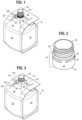
- Fig. 1 is a perspective view illustration of a finished flexible container 10 comprising a fitment 40 sealed therein and provided in accordance with a preferred embodiment of the present invention.
- the container 10 preferably comprises a multi-panel construction.
- container 10 comprises a front panel 20, back panel 21 (not shown), first side panel 22, second side panel 23 (not shown), as well as top segment 24, handle 25, container edges 26, optional cap 27 (not shown), neck 30, fitment 40, and multiseal 100.
- container 10 may comprise a different number of panels and/or additional features, such as a bottom handle.
- the container 10 may also omit handles altogether.
- panels 22, 23 are gusseted.
- Non-limiting examples of methods of fabricating the container 10 are disclosed in U.S. Pat. Nos. 6,832,852 , 7,147,597 , 8,231,029 , 8,348,509 , and 8,840,305 , except that all methods disclosed therein should be deemed to exclude disclosure of steps comprising the improved sealing of fitment 40 to the neck 30, as provided in accordance with preferred embodiments of the present invention and as will be described below in further detail.
- Container 10 is preferably formed by coextrusion of flexible film.
- the film comprising container 10 is preferably a film formed of a coextrusion of high-density polyethylene (“HDPE”) outer portion and a low-density polyethylene (“LDPE”), or linear low density polyethylene (“LLDPE”) inner sealant portion.
- the outer HDPE portion of the film is preferably approximately 0,076 mm (3 mils) thick
- the LDPE or LLDPE inner sealant portion of the film is preferably approximately 0,178 mm (7 mils) thick. Therefore, in preferred embodiments of the present invention, the film comprising container 10 is preferably approximately 0,254 mm (10 mils) thick.
- the film comprising container 10 may be formed of a single coextruded film comprising HDPE and LDPE or LLDPE portions, or one or more layers of coextruded film coupled with one or more layers of film that may or may not be coextruded.
- the container 10 comprises two separate layers of film, wherein an outer layer is a coextrusion of HDPE and LDPE film that is preferably approximately 0,254 mm (10 mils) thick (consistent with the above description of such a layer) and an inner layer of LDPE that is preferably approximately 0,10 mm (4 mils) thick.
- container 10 is formed from a coextruded multilayer film wherein each layer is composed of polyethylene.
- a coextruded multilayer film wherein each layer is composed of a polyethylene is interchangeably referred to as an "all-polyethylene" film.
- container 10 is formed from an all-polyethylene film that is a five layer film.
- the five layer film has the following layer structure: HDPE(skin)/LLDPE/LLDPE/LLDPE/polyolefin plastomer (seal).
- Fig. 2 is a perspective view illustration of a fitment 40 provided in accordance with a preferred embodiment of the present invention.
- fitment 40 comprises a base 41, a base surface 42, a top base edge 43 (at the lower edge of registration portion 45), a bottom base edge 44, a registration portion 45, and a threaded portion 49.
- the fitment 40 is preferably cylindrical, although fitments of other shapes may be used.
- the base 41 is also preferably cylindrical and round in cross-section, having a circumference and a diameter.
- the base surface 42 is preferably smooth, although it is contemplated that the surface 42 may be ribbed or undulated.
- the fitment 40 is preferably comprised of HDPE, but other material combinations of film and fitment 40 may also be used, such as polypropylene film and fitment.
- Fig. 3 is a perspective view illustration of the fitment 40 prepared for sealing to a neck 30 of the flexible container 10 ( i.e., prior to sealing) as provided in accordance with a preferred embodiment of the present invention.
- the panels 20, 21, 22, 23 preferably extend toward the neck 30 to form the top segment 24.
- the panels 20, 21, 22, 23 are sealed together at container edges 26, such that the multiseal 100 is formed at the neck 30.
- the multiseal 100 preferably comprises flaps 110, and sealing portions 120.
- the flaps 110 are formed by the confluence and sealing together of two of the panels 20, 21, 22, 23, whereas the sealing portions 120 are formed by the material of a single panel 20, 21, 22, 23.
- one of the flaps 110 is formed by the sealing together of the front panel 20 and first side panel 22 at a container edge 26, whereas an adjacent flap 110 is formed by the sealing together of the front panel 20 and the second side panel 23 at adjacent container edge 26. Therefore, the flaps 110 are preferably comprised of two layers of film.
- the sealing portions 120 spanning between the flaps 110 as shown in Fig. 3 , preferably comprising a single layer of film.
- the sealing portion 120 spanning between the flaps 110 is comprised of the single layer of film forming the front panel 20. Such will be discussed in further detail below.
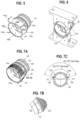
- Fig. 4 is a perspective view illustration of the fitment 40 as installed in a sealing machine 200 (a corresponding flexible container body being omitted for clarity) as provided in accordance with a preferred embodiment of the present invention.
- the sealing machine 200 comprises a plurality of sealing jaws, including first sealing jaws 210, second sealing jaws 220, and third sealing jaws 230.
- the sealing jaws 210, 220, 230 are used to seal the multiseal 100 to the fitment 40, thereby installing the fitment 40 in the container 10.
- the sealing jaws 210, 220, 230 are adjustable relative to each other and the fitment 40, such that the sealing jaws 210, 220, 230 may be made to engage the base 41 at different portions ( i.e., heights and widths along the circumference) of the base surface 42.
- the sealing jaws 210, 220, 230 preferably comprise first sealing faces 212, second sealing faces 222, and third sealing faces 232, respectively, that are preferably complementary to the shape of the base 41, such that an indirect engagement of the sealing faces 212, 222, and 232 against the base surface 42 may be achieved, thereby forming a robust seal of the multiseal 100 to the base surface 42.
- the sealing machine 200 further comprises a heating means and a pressure means, such that the sealing jaws 210, 220, 230 seal the multiseal 100 to the base surface 42 by engaging the fitment 40 and applying heat and pressure.
- Fig. 5 is a perspective view illustration of the fitment 40 prepared for sealing to the neck 30 via the multiseal 100 of the flexible container 10 (i.e., flaps 110 "up,” prior to sealing), the illustration being shown in cross-section at axis A-A of Fig. 3 (the remainder of the corresponding flexible container being omitted for clarity), as provided in accordance with a preferred embodiment of the present invention.
- a method for an incremental (i.e., stepwise) sealing of the multiseal 100 to the base surface 42 of the fitment 40 is referred to as the Multiseal Process.
- multiseal 100 is integrally formed from the confluence and sealing together of the panels 20, 21, 22, 23 at the neck 30 to form the flaps 110 and sealing portions 120.
- multiseal 100 preferably comprises flaps 110a,b,c,d and sealing portions 120a,b,c,d.
- sealing portions 120a,c comprise the single film layer portions of the front and back panels 20, 21 respectively
- sealing portions 120b,d comprise the single film layer portions of the first and second side panels 22, 23, respectively. Therefore, the sealing portions 120a,b,c,d are preferably approximately 10 mils thick.
- Flap 110a comprises the film of front panel 20 and second side panel 23 sealed together at container edges 26 in the neck 30, as described above.
- Flap 110b comprises the film of second side panel 23 and back panel 21 sealed together at container edges 26.
- Flap 110c comprises the film of back panel 21 and first side panel 22 sealed together at container edges 26.
- Flap 110d comprises the film of first side panel 22 and front panel 20 sealed together at container edges 26.
- sealing jaws 210 enclose the fitment 40 to form primary seals 130, 131.
- Fig. 6 is a perspective view illustration of the fitment 40 and multiseal 100 of Fig. 5 engaged with first sealing jaws 210 pursuant to Multiseal Process Step 1 to form first and second primary seals 130, 131 (see Fig. 7A ) of the multiseal 100 as provided in accordance with a preferred embodiment of the present invention.
- the base surface 42 has a height of preferably approximately 0.625 from a top base edge 43 to bottom base edge 44.
- the two first sealing jaws 210 of the sealing machine 200 engage the unfinished multiseal 100 at opposite sides of the fitment base surface 42.
- sealing faces 212 are preferably complementary in shape to the fitment base surface 42, and the sealing jaws 210 apply heat and pressure at the sealing faces 212 to the multiseal 100 to seal it to the fitment base surface 42.
- the heat applied by the sealing jaws 210 is preferably approximately 149°C (300°F), at a pressure of preferably approximately 689,5 kPa (100 psi), and a dwell of preferably approximately 3 seconds.
- the sealing jaws 210 engage the fitment 40 preferably simultaneously from opposing sides so the pressure applied to the fitment 40 is evenly distributed.
- sealing parameters listed herein correspond to the constituent materials and methods described herein with respect to the preferred embodiment of container 10. Accordingly, such parameters in the various steps of the Multiseal Process may be amended to accommodate the sealing of alternative embodiments of the present invention, such as embodiments comprising different thicknesses and material compositions of the film, as well as different container sizes and corresponding fitments.
- first primary seal portions 135 of the first and second primary seals 130, 131 adhere the single layer of film (i.e., 0,254 mm (10 mils) thick) of the sealing portions 120b,d, respectively, to the base surface 42.
- Second primary seal portions 136 of the first and second primary seals 130, 131 adhere an overlapping portion comprising the two layers of film of the flaps 110 ( i.e., 0,508 mm (20 mils) thick) and the single layer of film of the sealing portions 120b,d, respectively, to the base surface 42, thereby forming second primary seal portions 136 of the multiseal 100 that comprise film layers approximately 30 mils thick that have been partially sealed to the fitment 40.
- Third primary seal portions 137 of the first and second primary seals 130, 131 adhere the single layer of film (i.e., 0,254 mm (10 mils) thick) of the sealing portions 120a,c, respectively, to the base surface 42. As shown, the primary seals 130, 131 primarily affect the sealing portions 120b, d and the sealing portions comprising the flaps 110.
- the primary seals 130, 131 as formed adhere by welding the sealing portions 120a,c to the base surface 42. Moreover, the primary seals 130, 131 partially adhere by welding flaps 110 to sealing portions 120b,d, which are correspondingly partially adhered by welding to the base surface 42.
- partially adhered it is meant that although the primary seals 130, 131 are formed, such seals 130, 131 will be made more robust and reliable by way of additional steps of the Multiseal Process provided in accordance with the present invention.
- a gap between bottom edges 133 of the primary seals 130, 131 and the bottom base edge 44 that is preferably approximately 2,79 mm (0,110 inches) wide, and preferably approximately 2,54 mm (0,100 inches) from top base edge 43 to fitment.
- the primary seals 130, 131 in this example of a preferred embodiment are preferably approximately 11,2 mm (0,44 inches) wide.
- the arc length between outer edges 111 of flaps 110a,d is preferably approximately 137 degrees, as is the arc length between outer edges 111 of flaps 110b,c.
- the arc length between the respective outer edges 138 of the first primary seal 130 is preferably approximately 150 degrees, as is the arc length between the respective outer edges 138 of the second primary seal 131. These lengths are complementary to the lengths of the sealing faces 221. Moreover, the arc length between the respective outer edges 138 first and second primary seals 130, 131 ( i.e ., where there exists no seal as of yet) is preferably approximately 30 degrees at each side. Although Fig. 7C depicts seal 130 only, it should be understood that seal 131 occurs in a complementary position on the opposite side of the fitment base surface 42.
- sealing jaws 220 enclose the fitment 40 to form secondary seals 140, 141, 142, 143, which overlap with the primary seals 130, 131.
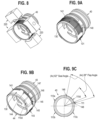
- Fig. 8 is a perspective view illustration of the fitment 40 and multiseal 100 of Fig. 7A engaged with second sealing jaws 220 pursuant to multiseal process step 2 to form first, second, third, and fourth secondary seals 140, 141, 142, 143 (see Fig. 9A ) of the multiseal 100 as provided in accordance with a preferred embodiment of the present invention.
- the four second sealing jaws 220 of the sealing machine 200 engage the partially finished multiseal 100 at opposite sides of the fitment base surface 42.
- sealing faces 222 are preferably complementary in shape to the fitment base surface 42, and the sealing jaws 220 apply heat and pressure at the sealing faces 222 to the multiseal 100 to further seal it to the fitment base surface 42.
- the heat applied by the sealing jaws 220 is preferably approximately 204 °C (400°F), at a pressure of preferably approximately 300 psi, and a dwell of preferably approximately 3 seconds.
- the second sealing jaws 220 engage the fitment 40 preferably simultaneously from opposition sides so the pressure applied to the fitment 40 is evenly distributed.
- the second sealing jaws 220 substantially overlap the primary seals 130, 131, including in particular at the flaps 100.
- the secondary seals 140, 141, 142, 143 formed by the second sealing jaws 220 are substantially thinner, having a width that is preferably approximately 0.125 inches wide.
- the secondary seals 140, 141, 142, 143 are preferably located in close proximity to top base edge 43, the gap between the seals 140, 141, 142, 143 and edge 43 being preferably approximately 2,54 mm (0,10 inches).
- first secondary seal portions 145 of the secondary seals 140, 141, 142, 143 overlap with the first primary seal portions 135 and further adhere the single layer of film ( i.e., 25,4 mm (10 mils) thick) of the sealing portions 120b,d, respectively, to the base surface 42.
- Second secondary seal portions 146 of the secondary seals 140, 141, 142, 143 further adhere the overlapping portion comprising the two layers of film of the flaps 110 ( i.e., 50,8 mm (20 mils) thick) and the single layer of film of the sealing portions 120b,d, respectively, to the base surface 42, thereby forming second secondary seal portions 146 of the multiseal 100 that reinforce the second primary seal portions 136, which is particularly important in view of the thickness of the film in those portions of the multiseal 100 at the flaps 110.
- third secondary seal portions 147 of the secondary seals 140, 141, 142, 143 overlap with the third primary seal portions 137 and further adhere the single layer of film ( i.e. , 25,4 mm (10 mils) thick) of the sealing portions 120a,c, respectively, to the base surface 42.
- the secondary seals 140, 141, 142, 143 primarily affect the sealing portions 120 comprising the flaps 110.
- the secondary seals 140, 141, 142, 143 as formed further adhere by welding the sealing portions 120a,c to the base surface 42. Moreover, the secondary seals 140, 141, 142, 143 further adhere by welding flaps 110 to sealing portions 120b,d, which are correspondingly partially adhered by welding to the base surface 42. In this manner the multiseal 100 is made more robust and reliable by way of additional steps of the Multiseal Process provided in accordance with the present invention.
- the secondary seals 140, 141, 142, 143 there is preferably a gap between bottom edges 144 of the secondary seals 140, 141, 142, 143 and the bottom base edge 44 that is preferably approximately 0.44 inches, and preferably approximately 2,54 mm (0,1 inches) from top base edge 43 to top edges 149.
- the secondary seals 140, 141, 142, 143 in this example of a preferred embodiment are preferably approximately 3,175 mm (0,125 inches) wide.
- the arc length between the edges of a single flap 110 is preferably approximately 28 degrees.
- the arc length between the respective outer edges 148 of the first secondary seal 140 is preferably approximately 62 degrees, as is the arc length between the respective outer edges 148 of the other secondary seals 141, 142, 143. These lengths are complementary to the lengths of the sealing faces 222.
- Fig. 9C depicts seal 140 only, it should be understood that seals 141, 142, and 143 occur in complementary positions ( i.e., at the flaps 110) of the fitment base surface 42. As shown in Figs.
- a particular benefit of the reduced size and particular location of the secondary seals 140, 141, 142, 143 is that additional heat may be applied to reinforce the sealing of the flaps 110 to the fitment 40 where the thickness of the film is greater. It is also advantageous to apply the secondary seals 140, 141, 142, 143 nearer to the top base edge 43 so as to mitigate the possibility that single layer portions of the multiseal 100 may be made brittle or unreliable in view of the enhanced heat toward the bottom base edge 44, where the pressure among the junction of the neck 30 and the fitment 40 is often the greatest and where most ruptures tend to occur in prior art containers.
- sealing jaws 230 enclose the fitment 40 to form tertiary seals 150, 151, which overlap with the primary seals 130, 131 and secondary seals 140, 141, 142, 143.
- Fig. 10 is a perspective view illustration of the fitment 40 and multiseal 100 of Fig. 9A engaged with second sealing jaws 230 pursuant to multiseal process step 3 to form first and second tertiary seals 150, 151 (see Fig. 11A ) of the multiseal 100 as provided in accordance with a preferred embodiment of the present invention.
- the two tertiary sealing jaws 230 of the sealing machine 200 engage the partially finished multiseal 100 at opposite sides of the fitment base surface 42.
- sealing faces 232 are preferably complementary in shape to the fitment base surface 42, and the sealing jaws 230 apply heat and pressure at the sealing faces 232 to the multiseal 100 to further seal it to the fitment base surface 42.
- the heat applied by the sealing jaws 230 is preferably approximately 149 degrees Celsius (300 degrees Fahrenheit), at a pressure of preferably approximately 1034 kPa (150 psi) and a dwell of preferably approximately 3 seconds.
- the tertiary sealing jaws 230 engage the fitment 40 preferably simultaneously from opposition sides so the pressure applied to the fitment 40 is evenly distributed.
- first tertiary seal portions 155 of the tertiary seals 150, 151 overlap with the first primary seal portions 135 and the first secondary seal portions 145 to further adhere the single layer of film ( i.e., 10 mils thick) of the sealing portions 120b,d, respectively, to the base surface 42.
- tertiary seals 150, 151 also serve to seal the portions of sealing portions 120b,d that were previously unsealed to the base surface 42.
- Second tertiary seal portions 156 of the tertiary seals 150, 151 further adhere the overlapping portion comprising the two layers of film of the flaps 110 ( i.e., 20 mils thick) and the single layer of film of the sealing portions 120b,d, respectively, to the base surface 42, thereby forming second tertiary seal portions 156 of the multiseal 100 that reinforce the second primary seal portions 136 and the second secondary seal portions 146, which is particularly important in view of the thickness of the film in those portions of the multiseal 100 at the flaps 110.
- third tertiary seal portions 157 of the tertiary seals 150, 151 overlap with the third primary seal portions 137 and the third secondary seal portions 147 to further adhere the single layer of film ( i.e., 10 mils thick) of the sealing portions 120a,c respectively, to the base surface 42.
- the tertiary seals 150, 151 as formed further adhere by welding the sealing portions 120b,d to the base surface 42. Moreover, the tertiary seals 150, 151 further adhere by welding flaps 110 to sealing portions 120b,d, which are correspondingly partially adhered by welding to the base surface 42. In this manner the multiseal 100 is made more robust and reliable by way of additional steps of the Multiseal Process provided in accordance with the present invention.
- a gap between bottom edges 154 of the tertiary seals 150, 151 and the bottom base edge 44 that is preferably approximately 0.185 inches, and preferably approximately 0.10 inches from top base edge 43 to top edges 159.
- the tertiary seals 150, 151 in this example of a preferred embodiment are preferably approximately 0.31 inches wide.
- the arc length between the respective outer edges 158 of the first tertiary seal 150 is preferably approximately 128 degrees, as is the arc length between the respective outer edges 158 of the second tertiary seal 151.
- Fig. 11C depicts seal 150 only, it should be understood that seal 151 occurs in a complementary position on the opposite side of the fitment base surface 42.
- Fig. 12 illustrates for clarity a flattened depiction of a fitment base surface 42 and a corresponding multiseal 100.
- the fitment base surface 42 has a circumference of preferably approximately 5.2 inches and height of preferably approximately 0.625 inches.
- the preferably two seals 130, four seals 140, and two seals 150 are spaced apart and overlap as shown and also described above.
- the portions of the multiseal 100 where one each of seals 130, 140, and 150 overlap is at the flaps 110.
- the flaps 110 in this example have a width of preferably approximately 0.42 inches and the width of the overlap portion of one each of seals 130, 140, and 150 is preferably approximately 0.54 inches and directly overlapping flap 110.
- the integrity and drop performance of the container 10 at the juncture of the fitment 40 and the film of the neck 30 is dramatically improved because the flaps 110 have been made leak-proof at the fitment base surface 42 by, in particular the thinner, higher pressure, and higher temperature seal 140 near the top edge 43.
- portions of the multiseal 100 such as at third primary seal portions 137 and first tertiary seal portions 155 that seal single layer sealing portions 120 to the fitment base surface 42 are likewise leak-proof but have not been made weak or brittle by excessive sealing.
- jaws 220 may be a pair of complementary jaws 220 instead of four jaws 220, wherein a gap is machined between pairs of sealing faces 222 such that although jaws 220 are two instead of four, preferably four secondary seals 140, 141, 142, 143 are still imparted on the multiseal 100.
- a Multiseal Process Step 4 comprising a repeat of Multiseal Process 1 for a one second dwell smooths out surface indents that may be imparted on the multiseal 100 by jaws 220 during the higher pressure and temperature Multiseal Process Step 2.
- multiseal process step 1 utilizing sealing jaws 210 (and hereafter “sealing step 1 "), multiseal process step 2, utilizing sealing jaws 220 (and hereafter “sealing step 2 "), and multiseal process step 3, utilizing sealing jaws 230 (and hereafter “sealing step 3" ) may be employed in different sequential orders.
- the multiseal sealing sequence can be sealing step 1 followed by sealing step 2, followed by sealing step 3.
- the multiseal sealing sequence can be sealing step 1 followed by sealing step 3, followed by sealing step 2.
- container 10 is formed from a five layer all-polyethylene film and container 10 has one, some, or all of the following properties:
- the five-layer film is an "all-polyethylene" multilayer film.
- Each of the four panels is made with the five-layer film shown in Table 1.
- the four-panel flexible containers have a volume of one gallon (3.875L).
- Density is measured in accordance with ASTM D 792.
- Melt index (Ml) is measured in accordance with ASTM D 1238, Condition 190°C/2.16 kg (g/10 minutes).
- the four-sided flexible containers have the geometry and design of the flexible containers as shown in FIG.1 and in FIG. 3 , without a fitment.
- the flexible containers have a volume of one gallon (3.875L).
- a fitment with a base diameter of 41 mm is inserted into the neck for each respective flexible container.
- Each fitment is made from the same high density polyethylene (HDPE).
- HDPE high density polyethylene
- a 38mm diameter mandrel inserted into the base of the fitment.
- the mandrel includes an expandable collar.
- the expandable collar is made of Shore A 30 +/- 5 durometer FDA approved silicone rubber.
- the flexible container with fitment sealed thereto is evaluated for burst test, top drop test, and seal appearance.
- the procedure for the burst test and the procedure for the top drop test are provided below.
- Each flexible container is filled with 3800 grams of water was held by bottom handle with the cap directly aligned to the drop surface. The distance is measured from the cap to the drop surface. The drop surface is smooth concrete. Data was only collected from samples where the cap struck the drop surface first. Failure is defined as any leakage of the package after dropping.
- Table 3 The results for the burst test, the top drop test, and seal appearance are provided in Table 3 below.
- Table 3 Flexible Package Performance Package type Burst test Vacuum Seal 18 mm Hg Top Drop Test (0.5 meters) s Top drop (1.0 meters)
- Seal Appearance IE1 5 / 5 - Passed 5 / 5 - Passed 5 / 5 - Passed Seal interface is smooth and free from heat damage CS1 5 / 5 - Passed 0 / 5 - Passed 0 / 5 - Passed Heat damage to the film but at optimal seal conditions
- the present three step multiseal process utilizing sealing jaws 210, 220, and 230 unexpectedly enables a reduction in heat seal temperature during heat sealing, thereby enabling an all-polyethylene film to be used for the flexible container.
- the present multiseal process with sealing jasws 210, 220, 230 eliminates the need for a polyamide skin layer or a polyester skin layer, typically required to provide heat resistance during the heat sealing procedure.
- a flexible package made from an all-polyethylene multilayer film is advantageous for processability (multilayer film with all-polyethylene layers is co-extrudable and does not require a lamination step). Another benefit of an all-polyethylene film is its recyclability.
Landscapes
- Engineering & Computer Science (AREA)
- Mechanical Engineering (AREA)
- Lining Or Joining Of Plastics Or The Like (AREA)
- Bag Frames (AREA)
- Packages (AREA)
- Closing Of Containers (AREA)
Claims (14)
- Verfahren zum Versiegeln eines Einsatzes an einem flexiblen Behälter, umfassend die Schritte:Bereitstellen eines flexiblen Behälters (10), der aus flexibler Folie ausgebildet ist und eine Vielzahl von Platten (20, 21, 22, 23) aufweist, und eines Halses (30), der konfiguriert ist, um über ein Mehrfachsiegel (100) mit einem Einsatz (40) verbunden zu sein, wobei das Mehrfachsiegel, das aus der Vielzahl von Platten ausgebildet ist, an dem Hals versiegelt ist und umfassend eine Oberkante (149), eine Unterkante (144), eine Vielzahl von Versiegelungsoberflächen und eine Vielzahl von Klappen (110);Bereitstellen des Einsatzes (40), der Einsatz umfassend eine Basisoberfläche (42);Platzieren des Einsatzes (40) in dem Hals (30), wobei das Mehrfachsiegel (100) um die Basisoberfläche (42) herum derart bereitgestellt ist, dass das Mehrfachsiegel (100) und die Basisoberfläche (42) komplementär ausgerichtet sind;Bereitstellen einer Vielzahl von Primärsiegeln (130, 131) des Mehrfachsiegels (100) über ein Ineingriffnehmen des Mehrfachsiegels (100) durch eine Vielzahl von Primärversiegelungsbacken (230), wobei die Primärversiegelungsbacken (230) die Primärsiegel (130, 131) an den Versiegelungsoberflächen und Klappen des Mehrfachsiegels ausbilden, wobei die Versiegelungsoberflächen mit der Basisoberfläche (42) versiegelt sind und die Klappen (110) in Richtung der Versiegelungsoberflächen gefaltet und mit diesen versiegelt sind;Bereitstellen einer Vielzahl von Sekundärsiegeln (140, 141, 142, 143) des Mehrfachsiegels (100) über das Ineingriffnehmen des Mehrfachsiegels (100) durch eine Vielzahl von Sekundärversiegelungsbacken (230), wobei die Sekundärversiegelungsbacken (230) die Sekundärsiegel an den Versiegelungsoberflächen und Klappen des Mehrfachsiegels ausbilden, wobei die Sekundärsiegel (140, 141, 142, 143) mit den Primärsiegeln (130, 131) überlappen und wobei sich die Sekundärsiegel (140, 141, 142, 143) im Wesentlichen näher an der Oberkante (149) des Mehrfachsiegels als an der Unterkante (144) des Mehrfachsiegels befinden; undBereitstellen einer Vielzahl von Tertiärsiegeln (150, 151) des Mehrfachsiegels (100) über das Ineingriffnehmen des Mehrfachsiegels durch eine Vielzahl von Tertiärversiegelungsbacken (230), wobei die Tertiärversiegelungsbacken die Tertiärsiegel (150, 151) an den Versiegelungsoberflächen und Klappen des Mehrfachsiegels ausbilden, wobei die Tertiärsiegel (150, 151) mit den Primärsiegeln (130, 131) und den Sekundärsiegeln (140, 141) überlappen.
- Verfahren nach Anspruch 1, umfassend ein Coextrudieren einer flexiblen Folie, um den flexiblen Behälter (10) auszubilden.
- Verfahren nach Anspruch 2, umfassend das Coextrudieren einer flexiblen Folie aus Polyethylen hoher Dichte, um einen äußeren Abschnitt des flexiblen Behälters (10) auszubilden und aus Polyethylen niedriger Dichte oder linearem Polyethylen niedriger Dichte, um einen inneren Versiegelungsmittelabschnitt des flexiblen Behälters (10) auszubilden.
- Verfahren nach einem der vorstehenden Ansprüche, wobei der Einsatz (40) eine Basis (41), eine obere Basiskante (43), eine untere Basiskante (44), einen Deckungsabschnitt (45) und einen Gewindeabschnitt (49) umfasst.
- Verfahren nach Anspruch 4, wobei der Einsatz (40) zylindrisch ist.
- Verfahren nach Anspruch 5, wobei die Basis (41) zylindrisch ist.
- Verfahren nach einem der vorstehenden Ansprüche, wobei die Basisoberfläche (42) glatt ist.
- Flexible Behälter- und Einsatzkombination, umfassend:einen flexiblen Behälter (10), der aus flexibler Folie ausgebildet ist und eine Vielzahl von Platten (20, 21, 22, 23) aufweist, und einen Hals (30), der konfiguriert ist, um über ein Mehrfachsiegel (100) mit einem Einsatz (40) verbunden zu sein, wobei das Mehrfachsiegel, das aus der Vielzahl von Platten ausgebildet ist, an dem Hals versiegelt ist und umfassend eine Oberkante (149), eine Unterkante (144), eine Vielzahl von Versiegelungsoberflächen und eine Vielzahl von Klappen (110);einen Einsatz (40), der Einsatz umfassend eine Basisoberfläche;den Einsatz (40) in dem Hals (30), wobei das Mehrfachsiegel um die Basisoberfläche (42) herum derart bereitgestellt ist, dass das Mehrfachsiegel (100) und die Basisoberfläche (42) komplementär ausgerichtet sind;eine Vielzahl von Primärsiegeln (130, 131) des Mehrfachsiegels über das Ineingriffnehmen des Mehrfachsiegels durch eine Vielzahl von Primärversiegelungsbacken (230), wobei die Primärversiegelungsbacken (230) die Primärsiegel an den Versiegelungsoberflächen und Klappen des Mehrfachsiegels ausbilden, wobei die Versiegelungsoberflächen mit der Basisoberfläche versiegelt sind und die Klappen (110) in Richtung der Versiegelungsoberflächen gefaltet und mit diesen versiegelt sind;eine Vielzahl von Sekundärsiegeln (140, 141, 142, 143) des Mehrfachsiegels über das Ineingriffnehmen des Mehrfachsiegels durch eine Vielzahl von Sekundärversiegelungsbacken (230), wobei die Sekundärversiegelungsbacken die Sekundärsiegel an den Versiegelungsoberflächen und Klappen des Mehrfachsiegels ausbilden, wobei die Sekundärsiegel mit den Primärsiegeln überlappen und wobei sich die Sekundärsiegel im Wesentlichen näher an der Oberkante des Mehrfachsiegels als an der Unterkante des Mehrfachsiegels befinden; undeine Vielzahl von Tertiärsiegeln (150, 151) des Mehrfachsiegels über das Ineingriffnehmen des Mehrfachsiegels durch eine Vielzahl von Tertiärversiegelungsbacken (230), wobei die Tertiärversiegelungsbacken die Tertiärsiegel (150, 151) an den Versiegelungsoberflächen und Klappen des Mehrfachsiegels ausbilden, wobei die Tertiärsiegel (150, 151) mit den Primärsiegeln (130, 131) und den Sekundärsiegeln (140, 141, 142, 143) überlappen.
- Flexible Behälter- und Einsatzkombination nach Anspruch 8, wobei der flexible Behälter durch Coextrusion von flexibler Folie (10) ausgebildet ist.
- Flexible Behälter- und Einsatzkombination nach Anspruch 9, wobei der flexible Behälter (10) Folie ist, die aus einer Coextrusion von Polyethylen hoher Dichte, um einen äußeren Abschnitt auszubilden, und Polyethylen niedriger Dichte oder linearem Polyethylen niedriger Dichte ausgebildet ist, um einen inneren Versiegelungsmittelabschnitt auszubilden.
- Flexible Behälter- und Einsatzkombination nach einem der Ansprüche 8 bis 10, wobei der Einsatz (40) eine Basis (41), eine Basisoberfläche (42), eine obere Basiskante (43), eine untere Basiskante (44), einen Deckungsabschnitt (45) und einen Gewindeabschnitt (49) umfasst.
- Flexible Behälter- und Einsatzkombination nach Anspruch 11, wobei der Einsatz (40) zylindrisch ist.
- Flexible Behälter- und Einsatzkombination nach Anspruch 12, wobei die Basis (41) zylindrisch ist.
- Flexible Behälter- und Einsatzkombination nach einem der Ansprüche 8 bis 13, wobei die Basisoberfläche (42) glatt ist.
Applications Claiming Priority (2)
| Application Number | Priority Date | Filing Date | Title |
|---|---|---|---|
| US201862663157P | 2018-04-26 | 2018-04-26 | |
| PCT/US2019/029326 WO2019210151A1 (en) | 2018-04-26 | 2019-04-26 | Method for sealing a fitment to a flexible container and flexible container comprising a fitment |
Publications (2)
| Publication Number | Publication Date |
|---|---|
| EP3784485A1 EP3784485A1 (de) | 2021-03-03 |
| EP3784485B1 true EP3784485B1 (de) | 2025-01-01 |
Family
ID=66429663
Family Applications (1)
| Application Number | Title | Priority Date | Filing Date |
|---|---|---|---|
| EP19722441.3A Active EP3784485B1 (de) | 2018-04-26 | 2019-04-26 | Verfahren zum abdichten eines einsatzes an einem flexiblen behälter und flexibler behälter mit einem einsatz |
Country Status (6)
| Country | Link |
|---|---|
| US (1) | US11479398B2 (de) |
| EP (1) | EP3784485B1 (de) |
| CN (1) | CN112105498B (de) |
| AR (1) | AR115063A1 (de) |
| BR (1) | BR112020021757A2 (de) |
| WO (1) | WO2019210151A1 (de) |
Families Citing this family (1)
| Publication number | Priority date | Publication date | Assignee | Title |
|---|---|---|---|---|
| CN113840783B (zh) * | 2019-05-31 | 2024-04-05 | 陶氏环球技术有限责任公司 | 具有把手的柔性容器 |
Citations (1)
| Publication number | Priority date | Publication date | Assignee | Title |
|---|---|---|---|---|
| US20180071991A1 (en) * | 2015-04-10 | 2018-03-15 | Dow Global Technologies Llc | Processing for Producing Flexible Container with Fitment Using Expandable Mandrel |
Family Cites Families (22)
| Publication number | Priority date | Publication date | Assignee | Title |
|---|---|---|---|---|
| NL126868C (de) | 1962-11-14 | 1900-01-01 | ||
| US4415085A (en) | 1981-12-21 | 1983-11-15 | Eli Lilly And Company | Dry pharmaceutical system |
| US4732299A (en) | 1986-02-10 | 1988-03-22 | Hoyt Earl E | Collapsible container |
| US5606844A (en) * | 1993-12-27 | 1997-03-04 | Sumitomo Bakelite Company, Limited | Process for producing a self-supporting package having an outlet stopper and an apparatus for producing said package |
| JP3048888B2 (ja) | 1995-06-28 | 2000-06-05 | 株式会社細川洋行 | 液体充填容器およびその製造方法 |
| US5851072A (en) * | 1996-11-26 | 1998-12-22 | Custom Packaging Systems, Inc. | Spout construction for bulk box liquid liner |
| US6050451A (en) * | 1998-11-19 | 2000-04-18 | Aptargroup, Inc. | Dispensing structure incorporating a valve-containing fitment for mounting to a container and a package with a dispensing structure |
| US6164822A (en) * | 2000-02-10 | 2000-12-26 | Fres-Co System Usa, Inc. | Dual compartment stand-up pouch |
| US6745923B2 (en) * | 2000-02-18 | 2004-06-08 | Sig Combibloc International Ag | Pouring spout attachment with automatic opening feature |
| CA2434794C (en) * | 2001-01-12 | 2009-12-29 | Scholle Corporation | Flexible bag and method |
| US6860406B2 (en) * | 2001-08-13 | 2005-03-01 | Illinois Tool Works Inc. | Flexible pouch fitment structure |
| US6832852B2 (en) | 2002-04-27 | 2004-12-21 | Kenneth R. Wilkes | Gusseted flexible bottle with fitment and method of fabrication |
| EP1501736B1 (de) | 2002-04-27 | 2012-11-21 | Smart Bottle, Inc | Verfahren zum einsetzen eines einsatzes in den hals eines flexiblen behälters |
| US7350669B2 (en) * | 2002-10-11 | 2008-04-01 | Novartis Ag | Closure device for flexible pouches |
| US6991121B1 (en) * | 2003-04-16 | 2006-01-31 | Bristol-Myers Squibb Company | Disposable infant formula feeding pouch |
| US8348509B2 (en) | 2009-09-10 | 2013-01-08 | Smart Bottle, Inc. | Flexible container with fitment and handle |
| CN102625771B (zh) | 2009-09-10 | 2014-08-27 | 斯玛特博图公司 | 具有柔性提手的柔性容器及从柔性容器传送可流动物质的方法 |
| CN102892687B (zh) * | 2010-03-31 | 2016-03-02 | 艾利丹尼森公司 | 用于热密封包装的可再密封的层压材料 |
| TWI688524B (zh) | 2015-03-17 | 2020-03-21 | 美商陶氏全球科技有限責任公司 | 用於撓性容器之撓性配件 |
| US10035621B2 (en) * | 2015-04-08 | 2018-07-31 | Double Double D, Llc | Multi-barrier bottles having tabbed preforms, and methods of forming the same |
| CA2981847C (en) | 2015-04-10 | 2019-03-12 | The Procter & Gamble Company | Flexible containers with reinforcing seals |
| EP3280648B1 (de) * | 2015-04-10 | 2019-07-03 | Dow Global Technologies LLC | Flexibler behälter mit zubehör |
-
2019
- 2019-04-26 EP EP19722441.3A patent/EP3784485B1/de active Active
- 2019-04-26 US US17/049,513 patent/US11479398B2/en active Active
- 2019-04-26 WO PCT/US2019/029326 patent/WO2019210151A1/en not_active Ceased
- 2019-04-26 CN CN201980031285.6A patent/CN112105498B/zh active Active
- 2019-04-26 BR BR112020021757-3A patent/BR112020021757A2/pt not_active Application Discontinuation
- 2019-04-26 AR ARP190101115A patent/AR115063A1/es active IP Right Grant
Patent Citations (1)
| Publication number | Priority date | Publication date | Assignee | Title |
|---|---|---|---|---|
| US20180071991A1 (en) * | 2015-04-10 | 2018-03-15 | Dow Global Technologies Llc | Processing for Producing Flexible Container with Fitment Using Expandable Mandrel |
Also Published As
| Publication number | Publication date |
|---|---|
| US11479398B2 (en) | 2022-10-25 |
| AR115063A1 (es) | 2020-11-25 |
| US20210053738A1 (en) | 2021-02-25 |
| WO2019210151A1 (en) | 2019-10-31 |
| CN112105498A (zh) | 2020-12-18 |
| EP3784485A1 (de) | 2021-03-03 |
| BR112020021757A2 (pt) | 2021-01-26 |
| CN112105498B (zh) | 2023-03-10 |
Similar Documents
| Publication | Publication Date | Title |
|---|---|---|
| EP3140219B1 (de) | Verfahren zur herstellung eines flexibeln behälters | |
| AU2015289669B2 (en) | Flexible container with fitment and process for producing same | |
| TWI665134B (zh) | Flexible package | |
| EP3140218B1 (de) | Flexibler behälter | |
| US20100172600A1 (en) | Flexible container and method of making the same | |
| US10589882B2 (en) | Flexible container with fitment and process for producing same | |
| EP3280648B1 (de) | Flexibler behälter mit zubehör | |
| EP3784485B1 (de) | Verfahren zum abdichten eines einsatzes an einem flexiblen behälter und flexibler behälter mit einem einsatz | |
| US20180071991A1 (en) | Processing for Producing Flexible Container with Fitment Using Expandable Mandrel | |
| US20180244418A1 (en) | Process for Producing a Flexible Container | |
| JP2025116631A (ja) | 口栓、及び口栓付きパウチ | |
| WO1998021032A2 (en) | Multi-layer flexible container for flowable materials | |
| NZ728493B2 (en) | A packaging system | |
| HK1169629A (zh) | 袋管形瓶包装和分配装置 |
Legal Events
| Date | Code | Title | Description |
|---|---|---|---|
| STAA | Information on the status of an ep patent application or granted ep patent |
Free format text: STATUS: UNKNOWN |
|
| STAA | Information on the status of an ep patent application or granted ep patent |
Free format text: STATUS: THE INTERNATIONAL PUBLICATION HAS BEEN MADE |
|
| PUAI | Public reference made under article 153(3) epc to a published international application that has entered the european phase |
Free format text: ORIGINAL CODE: 0009012 |
|
| STAA | Information on the status of an ep patent application or granted ep patent |
Free format text: STATUS: REQUEST FOR EXAMINATION WAS MADE |
|
| 17P | Request for examination filed |
Effective date: 20201117 |
|
| AK | Designated contracting states |
Kind code of ref document: A1 Designated state(s): AL AT BE BG CH CY CZ DE DK EE ES FI FR GB GR HR HU IE IS IT LI LT LU LV MC MK MT NL NO PL PT RO RS SE SI SK SM TR |
|
| AX | Request for extension of the european patent |
Extension state: BA ME |
|
| DAV | Request for validation of the european patent (deleted) | ||
| DAX | Request for extension of the european patent (deleted) | ||
| P01 | Opt-out of the competence of the unified patent court (upc) registered |
Effective date: 20230526 |
|
| GRAP | Despatch of communication of intention to grant a patent |
Free format text: ORIGINAL CODE: EPIDOSNIGR1 |
|
| STAA | Information on the status of an ep patent application or granted ep patent |
Free format text: STATUS: GRANT OF PATENT IS INTENDED |
|
| INTG | Intention to grant announced |
Effective date: 20240416 |
|
| GRAJ | Information related to disapproval of communication of intention to grant by the applicant or resumption of examination proceedings by the epo deleted |
Free format text: ORIGINAL CODE: EPIDOSDIGR1 |
|
| STAA | Information on the status of an ep patent application or granted ep patent |
Free format text: STATUS: REQUEST FOR EXAMINATION WAS MADE |
|
| GRAP | Despatch of communication of intention to grant a patent |
Free format text: ORIGINAL CODE: EPIDOSNIGR1 |
|
| STAA | Information on the status of an ep patent application or granted ep patent |
Free format text: STATUS: GRANT OF PATENT IS INTENDED |
|
| INTC | Intention to grant announced (deleted) | ||
| INTG | Intention to grant announced |
Effective date: 20240919 |
|
| GRAS | Grant fee paid |
Free format text: ORIGINAL CODE: EPIDOSNIGR3 |
|
| GRAA | (expected) grant |
Free format text: ORIGINAL CODE: 0009210 |
|
| STAA | Information on the status of an ep patent application or granted ep patent |
Free format text: STATUS: THE PATENT HAS BEEN GRANTED |
|
| AK | Designated contracting states |
Kind code of ref document: B1 Designated state(s): AL AT BE BG CH CY CZ DE DK EE ES FI FR GB GR HR HU IE IS IT LI LT LU LV MC MK MT NL NO PL PT RO RS SE SI SK SM TR |
|
| REG | Reference to a national code |
Ref country code: GB Ref legal event code: FG4D |
|
| REG | Reference to a national code |
Ref country code: CH Ref legal event code: EP |
|
| REG | Reference to a national code |
Ref country code: DE Ref legal event code: R096 Ref document number: 602019064240 Country of ref document: DE |
|
| REG | Reference to a national code |
Ref country code: IE Ref legal event code: FG4D |
|
| PGFP | Annual fee paid to national office [announced via postgrant information from national office to epo] |
Ref country code: FR Payment date: 20250310 Year of fee payment: 7 |
|
| REG | Reference to a national code |
Ref country code: LT Ref legal event code: MG9D |
|
| REG | Reference to a national code |
Ref country code: NL Ref legal event code: MP Effective date: 20250101 |
|
| REG | Reference to a national code |
Ref country code: AT Ref legal event code: MK05 Ref document number: 1755824 Country of ref document: AT Kind code of ref document: T Effective date: 20250101 |
|
| PG25 | Lapsed in a contracting state [announced via postgrant information from national office to epo] |
Ref country code: NL Free format text: LAPSE BECAUSE OF FAILURE TO SUBMIT A TRANSLATION OF THE DESCRIPTION OR TO PAY THE FEE WITHIN THE PRESCRIBED TIME-LIMIT Effective date: 20250101 |
|
| PG25 | Lapsed in a contracting state [announced via postgrant information from national office to epo] |
Ref country code: FI Free format text: LAPSE BECAUSE OF FAILURE TO SUBMIT A TRANSLATION OF THE DESCRIPTION OR TO PAY THE FEE WITHIN THE PRESCRIBED TIME-LIMIT Effective date: 20250101 |
|
| PG25 | Lapsed in a contracting state [announced via postgrant information from national office to epo] |
Ref country code: PL Free format text: LAPSE BECAUSE OF FAILURE TO SUBMIT A TRANSLATION OF THE DESCRIPTION OR TO PAY THE FEE WITHIN THE PRESCRIBED TIME-LIMIT Effective date: 20250101 |
|
| PGFP | Annual fee paid to national office [announced via postgrant information from national office to epo] |
Ref country code: DE Payment date: 20250305 Year of fee payment: 7 |
|
| PG25 | Lapsed in a contracting state [announced via postgrant information from national office to epo] |
Ref country code: ES Free format text: LAPSE BECAUSE OF FAILURE TO SUBMIT A TRANSLATION OF THE DESCRIPTION OR TO PAY THE FEE WITHIN THE PRESCRIBED TIME-LIMIT Effective date: 20250101 |
|
| PG25 | Lapsed in a contracting state [announced via postgrant information from national office to epo] |
Ref country code: NO Free format text: LAPSE BECAUSE OF FAILURE TO SUBMIT A TRANSLATION OF THE DESCRIPTION OR TO PAY THE FEE WITHIN THE PRESCRIBED TIME-LIMIT Effective date: 20250401 Ref country code: IS Free format text: LAPSE BECAUSE OF FAILURE TO SUBMIT A TRANSLATION OF THE DESCRIPTION OR TO PAY THE FEE WITHIN THE PRESCRIBED TIME-LIMIT Effective date: 20250501 |
|
| PG25 | Lapsed in a contracting state [announced via postgrant information from national office to epo] |
Ref country code: HR Free format text: LAPSE BECAUSE OF FAILURE TO SUBMIT A TRANSLATION OF THE DESCRIPTION OR TO PAY THE FEE WITHIN THE PRESCRIBED TIME-LIMIT Effective date: 20250101 |
|
| PG25 | Lapsed in a contracting state [announced via postgrant information from national office to epo] |
Ref country code: PT Free format text: LAPSE BECAUSE OF FAILURE TO SUBMIT A TRANSLATION OF THE DESCRIPTION OR TO PAY THE FEE WITHIN THE PRESCRIBED TIME-LIMIT Effective date: 20250502 Ref country code: LV Free format text: LAPSE BECAUSE OF FAILURE TO SUBMIT A TRANSLATION OF THE DESCRIPTION OR TO PAY THE FEE WITHIN THE PRESCRIBED TIME-LIMIT Effective date: 20250101 |
|
| PG25 | Lapsed in a contracting state [announced via postgrant information from national office to epo] |
Ref country code: GR Free format text: LAPSE BECAUSE OF FAILURE TO SUBMIT A TRANSLATION OF THE DESCRIPTION OR TO PAY THE FEE WITHIN THE PRESCRIBED TIME-LIMIT Effective date: 20250402 Ref country code: BG Free format text: LAPSE BECAUSE OF FAILURE TO SUBMIT A TRANSLATION OF THE DESCRIPTION OR TO PAY THE FEE WITHIN THE PRESCRIBED TIME-LIMIT Effective date: 20250101 |
|
| PG25 | Lapsed in a contracting state [announced via postgrant information from national office to epo] |
Ref country code: AT Free format text: LAPSE BECAUSE OF FAILURE TO SUBMIT A TRANSLATION OF THE DESCRIPTION OR TO PAY THE FEE WITHIN THE PRESCRIBED TIME-LIMIT Effective date: 20250101 |
|
| PG25 | Lapsed in a contracting state [announced via postgrant information from national office to epo] |
Ref country code: CZ Free format text: LAPSE BECAUSE OF FAILURE TO SUBMIT A TRANSLATION OF THE DESCRIPTION OR TO PAY THE FEE WITHIN THE PRESCRIBED TIME-LIMIT Effective date: 20250101 |
|
| PG25 | Lapsed in a contracting state [announced via postgrant information from national office to epo] |
Ref country code: SE Free format text: LAPSE BECAUSE OF FAILURE TO SUBMIT A TRANSLATION OF THE DESCRIPTION OR TO PAY THE FEE WITHIN THE PRESCRIBED TIME-LIMIT Effective date: 20250101 |
|
| REG | Reference to a national code |
Ref country code: DE Ref legal event code: R097 Ref document number: 602019064240 Country of ref document: DE |
|
| PG25 | Lapsed in a contracting state [announced via postgrant information from national office to epo] |
Ref country code: SM Free format text: LAPSE BECAUSE OF FAILURE TO SUBMIT A TRANSLATION OF THE DESCRIPTION OR TO PAY THE FEE WITHIN THE PRESCRIBED TIME-LIMIT Effective date: 20250101 |
|
| PG25 | Lapsed in a contracting state [announced via postgrant information from national office to epo] |
Ref country code: DK Free format text: LAPSE BECAUSE OF FAILURE TO SUBMIT A TRANSLATION OF THE DESCRIPTION OR TO PAY THE FEE WITHIN THE PRESCRIBED TIME-LIMIT Effective date: 20250101 |
|
| PG25 | Lapsed in a contracting state [announced via postgrant information from national office to epo] |
Ref country code: IT Free format text: LAPSE BECAUSE OF FAILURE TO SUBMIT A TRANSLATION OF THE DESCRIPTION OR TO PAY THE FEE WITHIN THE PRESCRIBED TIME-LIMIT Effective date: 20250101 |
|
| PG25 | Lapsed in a contracting state [announced via postgrant information from national office to epo] |
Ref country code: EE Free format text: LAPSE BECAUSE OF FAILURE TO SUBMIT A TRANSLATION OF THE DESCRIPTION OR TO PAY THE FEE WITHIN THE PRESCRIBED TIME-LIMIT Effective date: 20250101 |
|
| PG25 | Lapsed in a contracting state [announced via postgrant information from national office to epo] |
Ref country code: RO Free format text: LAPSE BECAUSE OF FAILURE TO SUBMIT A TRANSLATION OF THE DESCRIPTION OR TO PAY THE FEE WITHIN THE PRESCRIBED TIME-LIMIT Effective date: 20250101 |
|
| PG25 | Lapsed in a contracting state [announced via postgrant information from national office to epo] |
Ref country code: SK Free format text: LAPSE BECAUSE OF FAILURE TO SUBMIT A TRANSLATION OF THE DESCRIPTION OR TO PAY THE FEE WITHIN THE PRESCRIBED TIME-LIMIT Effective date: 20250101 |
|
| PLBE | No opposition filed within time limit |
Free format text: ORIGINAL CODE: 0009261 |
|
| STAA | Information on the status of an ep patent application or granted ep patent |
Free format text: STATUS: NO OPPOSITION FILED WITHIN TIME LIMIT |
|
| REG | Reference to a national code |
Ref country code: CH Ref legal event code: L10 Free format text: ST27 STATUS EVENT CODE: U-0-0-L10-L00 (AS PROVIDED BY THE NATIONAL OFFICE) Effective date: 20251112 |
|
| REG | Reference to a national code |
Ref country code: CH Ref legal event code: H13 Free format text: ST27 STATUS EVENT CODE: U-0-0-H10-H13 (AS PROVIDED BY THE NATIONAL OFFICE) Effective date: 20251125 |
|
| 26N | No opposition filed |
Effective date: 20251002 |
|
| PG25 | Lapsed in a contracting state [announced via postgrant information from national office to epo] |
Ref country code: LU Free format text: LAPSE BECAUSE OF NON-PAYMENT OF DUE FEES Effective date: 20250426 |
|
| PG25 | Lapsed in a contracting state [announced via postgrant information from national office to epo] |
Ref country code: MC Free format text: LAPSE BECAUSE OF FAILURE TO SUBMIT A TRANSLATION OF THE DESCRIPTION OR TO PAY THE FEE WITHIN THE PRESCRIBED TIME-LIMIT Effective date: 20250101 |
|
| GBPC | Gb: european patent ceased through non-payment of renewal fee |
Effective date: 20250426 |