EP3781408B1 - Smartphone verifizierbares, leuchtstoffbasiertes sicherheitsmerkmal und anordnung zur verifizierung - Google Patents
Smartphone verifizierbares, leuchtstoffbasiertes sicherheitsmerkmal und anordnung zur verifizierung Download PDFInfo
- Publication number
- EP3781408B1 EP3781408B1 EP19722000.7A EP19722000A EP3781408B1 EP 3781408 B1 EP3781408 B1 EP 3781408B1 EP 19722000 A EP19722000 A EP 19722000A EP 3781408 B1 EP3781408 B1 EP 3781408B1
- Authority
- EP
- European Patent Office
- Prior art keywords
- security feature
- luminescent material
- smartphone
- security
- emission
- Prior art date
- Legal status (The legal status is an assumption and is not a legal conclusion. Google has not performed a legal analysis and makes no representation as to the accuracy of the status listed.)
- Active
Links
Images


Classifications
-
- B—PERFORMING OPERATIONS; TRANSPORTING
- B42—BOOKBINDING; ALBUMS; FILES; SPECIAL PRINTED MATTER
- B42D—BOOKS; BOOK COVERS; LOOSE LEAVES; PRINTED MATTER CHARACTERISED BY IDENTIFICATION OR SECURITY FEATURES; PRINTED MATTER OF SPECIAL FORMAT OR STYLE NOT OTHERWISE PROVIDED FOR; DEVICES FOR USE THEREWITH AND NOT OTHERWISE PROVIDED FOR; MOVABLE-STRIP WRITING OR READING APPARATUS
- B42D25/00—Information-bearing cards or sheet-like structures characterised by identification or security features; Manufacture thereof
- B42D25/20—Information-bearing cards or sheet-like structures characterised by identification or security features; Manufacture thereof characterised by a particular use or purpose
- B42D25/29—Securities; Bank notes
-
- B—PERFORMING OPERATIONS; TRANSPORTING
- B42—BOOKBINDING; ALBUMS; FILES; SPECIAL PRINTED MATTER
- B42D—BOOKS; BOOK COVERS; LOOSE LEAVES; PRINTED MATTER CHARACTERISED BY IDENTIFICATION OR SECURITY FEATURES; PRINTED MATTER OF SPECIAL FORMAT OR STYLE NOT OTHERWISE PROVIDED FOR; DEVICES FOR USE THEREWITH AND NOT OTHERWISE PROVIDED FOR; MOVABLE-STRIP WRITING OR READING APPARATUS
- B42D25/00—Information-bearing cards or sheet-like structures characterised by identification or security features; Manufacture thereof
- B42D25/30—Identification or security features, e.g. for preventing forgery
- B42D25/36—Identification or security features, e.g. for preventing forgery comprising special materials
- B42D25/378—Special inks
- B42D25/382—Special inks absorbing or reflecting infrared light
-
- B—PERFORMING OPERATIONS; TRANSPORTING
- B42—BOOKBINDING; ALBUMS; FILES; SPECIAL PRINTED MATTER
- B42D—BOOKS; BOOK COVERS; LOOSE LEAVES; PRINTED MATTER CHARACTERISED BY IDENTIFICATION OR SECURITY FEATURES; PRINTED MATTER OF SPECIAL FORMAT OR STYLE NOT OTHERWISE PROVIDED FOR; DEVICES FOR USE THEREWITH AND NOT OTHERWISE PROVIDED FOR; MOVABLE-STRIP WRITING OR READING APPARATUS
- B42D25/00—Information-bearing cards or sheet-like structures characterised by identification or security features; Manufacture thereof
- B42D25/30—Identification or security features, e.g. for preventing forgery
- B42D25/36—Identification or security features, e.g. for preventing forgery comprising special materials
- B42D25/378—Special inks
- B42D25/387—Special inks absorbing or reflecting ultraviolet light
-
- G—PHYSICS
- G07—CHECKING-DEVICES
- G07D—HANDLING OF COINS OR VALUABLE PAPERS, e.g. TESTING, SORTING BY DENOMINATIONS, COUNTING, DISPENSING, CHANGING OR DEPOSITING
- G07D7/00—Testing specially adapted to determine the identity or genuineness of valuable papers or for segregating those which are unacceptable, e.g. banknotes that are alien to a currency
- G07D7/06—Testing specially adapted to determine the identity or genuineness of valuable papers or for segregating those which are unacceptable, e.g. banknotes that are alien to a currency using wave or particle radiation
- G07D7/12—Visible light, infrared or ultraviolet radiation
- G07D7/1205—Testing spectral properties
-
- G—PHYSICS
- G07—CHECKING-DEVICES
- G07D—HANDLING OF COINS OR VALUABLE PAPERS, e.g. TESTING, SORTING BY DENOMINATIONS, COUNTING, DISPENSING, CHANGING OR DEPOSITING
- G07D7/00—Testing specially adapted to determine the identity or genuineness of valuable papers or for segregating those which are unacceptable, e.g. banknotes that are alien to a currency
- G07D7/20—Testing patterns thereon
- G07D7/202—Testing patterns thereon using pattern matching
- G07D7/205—Matching spectral properties
Definitions
- the present invention relates to a security feature with a phosphor that can be verified using a commercially available smartphone.
- the invention also relates to an arrangement for verifying a security document with such a security feature.
- WO 2012/083469 A1 a device for authentication of marked with photochromic systems documents known.
- the photochromic security feature shows a color change and/or a change in shape under the action of a flash light excitation. It is also described that the security feature is based on a retinal protein.
- an identification feature with at least two identification elements arranged in a defined, limited area for identifying an object is known.
- a first identification element made of ink becomes visually visible and a second identification element is not visually visible.
- the EP 0 091 184 A1 names a sulfide phosphor that emits green to orange light with a long afterglow time.
- This phosphor is described by the general formula (Zn 1-x , Cd x ) S:eM I' , fM III' , gX', where M I' is selected from copper and gold, M III' is selected from gallium and indium , and X' is selected from chloro, bromo, iodo, fluoro and aluminum.
- the WO 02/071347 A1 describes a method and a device for the authentication of security documents or objects which have a luminescent compound.
- the compound is excitable by excitation light.
- the EP 1 672 568 A1 describes counterfeit-proof security labels and an optical scanner for Illuminating, detecting and classifying a sample or the security label.
- the U.S. 2016/0314374 A1 describes a device for a portable smart device and a method for authenticating an object to be authenticated.
- the material consists of a first particle of a first inorganic host lattice with at least one first substance and a second particle of a second inorganic host lattice with at least one second substance.
- the WO 2018/007444 A1 describes a method for authenticating a security marking, as well as the security marking and a reader capable of carrying out the method.
- the security marking can emit a long-lasting luminescent light.
- the reading device with CPU unit and memory unit, for example a smartphone, is used to generate and record the emission.
- the WO 2013/012656 A1 discloses various phosphor compositions comprising one or more emissive ions and one or more impurity ions.
- An emitting ion is defined by a first decay time constant im undisturbed state marked.
- the impurity ions result in a predetermined decay behavior with a modified decay time that is greater than zero and less than the unperturbed decay time.
- An authentication system is configured to measure the decay time when this phosphor composition is attached to an article.
- a light generating device e.g. an LED flash unit
- an image recording device e.g. a digital camera of a mobile communication device
- the disclosed phosphors regularly have decay times that do not allow the emission to be evaluated using widely used devices, in particular an authenticity check using commercially available smartphones.
- the WO 2013/034603 A1 describes a method for verifying a security document with a security feature in the form of a fluorescent printing element.
- the method provides that the printing element by means of a light source is excited and it emits electromagnetic radiation as a result of this excitation, which can be detected in a further step by means of a sensor.
- the recorded data is evaluated by comparing it with specified data.
- the verification result is output depending on the result of the comparison.
- the method is to be carried out with a smartphone, the flash module of the smartphone being used as the excitation source and the photo sensor of the camera of the smartphone being used as the detection unit.
- Inorganic phosphors namely nitride phosphors, are mentioned as phosphors for the pigment-like fluorescent printing element; europium-doped alkaline earth orthosilicate and alkaline earth oxyorthosilicate phosphors; cerium-doped rare earth aluminum gallium garnet phosphors; red light emitting (Ca,Sr)S:Eu 2+ ; and green light emitting SrGa 2 S 4 :Eu 2+ .
- the proposed phosphors are so-called LED conversion phosphors which decay extremely quickly.
- one object of the present invention is to provide an improved luminescent-based security feature that can be verified solely using a smartphone or a comparable multifunctional, widely used data processing device.
- a further object of the present invention is to provide an arrangement for verifying such a security feature.
- the object is achieved by a luminescent-based security feature that can be verified with a smartphone according to appended claim 1 and by an arrangement for verifying such a security feature according to appended independent claim 9.
- a security feature is equipped with a specific phosphor that avoids the problems described above.
- this phosphor must be configured in such a way that it can be excited with a light source of a smartphone or a similar mobile data processing device, ie in particular a flashing LED of a smartphone.
- the luminescent material must have such a luminescence characteristic that it is still possible to detect the luminescence signals with a high degree of certainty using the image acquisition unit of the same smartphone (mobile data processing device) even after the excitation process has ended.
- this primarily requires a decay time of the phosphor according to the invention that is adapted to the exceptional speed of the image acquisition unit of the smartphone.
- the invention provides a security feature that can be reliably evaluated, which allows exclusive luminescence properties such as the spectral emission and decay characteristics of the special phosphors used to create the security feature to be included in the test as authenticity criteria.
- exclusive luminescence properties such as the spectral emission and decay characteristics of the special phosphors used to create the security feature to be included in the test as authenticity criteria.
- the decaying luminescence signals of the security feature according to the invention are not visible to the human eye either during or after the end of the excitation. It has been shown that the options for providing suitable phosphors for realizing the inventive solution shown are severely limited. This applies in particular to the required decay characteristics.
- the invention provides a level 3 feature or at least a feature with level 2+ functionality, as can be used in security and value documents for authenticity verification.
- Such features are generally invisible to the human eye, for example even after excitation with UV or IR light sources. Until now, their characteristics could only be tested with great technical effort, for example with the help of high-speed sorting machines.
- the present invention makes it possible for the first time to check the authenticity of such exclusive features using commercially available smartphones.
- the security feature according to the invention can be applied to or in a valuable or security document and comprises a luminescent material that can be excited to luminescence with electromagnetic radiation of a predetermined wavelength, such as can be generated by a lighting unit of a smartphone, whereupon the luminescent material is emitted by the camera device a smartphone emits detectable radiation.
- the emission of the phosphor has a decay time in the ms range. According to the invention, the decay times are selected in the range between 1 and 100 ms, preferably in the range between 5 and 50 ms, again preferably between 10 and 30 ms.
- the decay process basically characterizes the time-dependent decrease in the intensity of the radiation emitted by a phosphor.
- multi-exponential (e.g. bi- or tri-exponential) decay curves may also result from the superimposition of different relaxation processes.
- Ce 3+ - and Mn 2+ - co-doped silicate garnet phosphors have proven to be a particularly suitable class of phosphors for the security feature, with the formula: Ca 3 Sc 2 Si 3 O 12 : Ce 3+ , Mn 2 + can be described.
- Such phosphors are characterized by a high absorption strength at 450 nm, a high luminescence intensity and an efficient energy transfer between the Ce 3+ and the Mn 2+ ions.
- the phosphor can be written with the formula: (Ca 1-x Ce x ) 3 (Sc 1-z Mn z ) 2 Si 3 O 12 be described, whereby on the basis of the known ionic radii in the technical literature it is often assumed that the Ce 3+ ions are preferentially installed on Ca 2+ and the Mn 2+ ions preferentially on Sc 3+ lattice positions.
- this corresponds to the specified ratio for the occupation of the Ca 2+ or Sc 3+ lattice sites by Mn 2+ coactivator ions.
- the emission spectra of the phosphors according to the invention each consist of three bands, the direct luminescence of the Ce 3+ activator ions (band with a ⁇ max of about 505 nm), and the Ce 3+ - Mn 2+ energy transfer enabled emissions of the different lattice site positioned Mn 2+ coactivators.
- the maxima of the last-mentioned emission bands are around 570 nm (Mn 2+ on Ca 2+ place) and around 700 nm (Mn 2+ on Sc 3+ place).
- the relative intensities of the different emission bands can be determined via the concentrations of the activator and coactivator ions and via the respective concentration ratios be varied and adjusted.
- the individual emissions have different spectral decay times. While the decay time of the quantum-mechanically permitted Ce 3+ emission is in the nanosecond range, decay times for the two Mn 2+ emission bands resulting from quantum-mechanically forbidden optical transitions are in the single-digit (Mn 2+ on Ca 2+ place) or in the two-digit millisecond range (Mn 2+ on Sc 3+ place) achieved.
- the special decay behavior described makes a major contribution to the exclusivity of the Ca 3 Sc 2 Si 3 O 12 :Ce 3+ ,Mn 2+ phosphors according to the invention.
- the named phosphors practically not excitable in the ultraviolet spectral range and on the other hand the body color of the corresponding luminescent pigments is such that it can be easily matched to the color design of the security and valuable documents to be protected (banknotes, identity cards, passports, driver's licenses, etc.) or adapted to the production of these Documents used inks can be covered.
- the table contains information on the measured maxima of the respective emission bands and on the decay times.
- Verbal scaling was used to assess luminescence yield and spectral excitability at 450 nm.
- the phosphors listed are essentially Ce 3+ - and Mn 2+ - co-doped silicate garnets or germanate garnets, activated with Mn 2+ ions and possibly additionally with certain rare earth ions (Ce 3+ , Eu 2 + , Dy 3+ ) co-activated complex silicate or phosphate basic lattices, around Cr 3+ - activated gallate compounds and around the Mn 4+ - activated phosphors BaGeF 6 :Mn 4+ and K 2 SiF 6 :Mn 4+ .
- a further embodiment of the invention is characterized in that phosphor mixtures are used to create the security features, the individual, preferably exclusive components of which have different and sensorically distinguishable decay times. In this case, too, there is an increase in the protection against forgery of the security features according to the invention.
- the phosphor preferably has a decay time in the one-digit or two-digit ms range, so that the emission of the phosphor can be detected with an image acquisition unit, in particular with a camera of a smartphone.
- an image acquisition unit in particular with a camera of a smartphone.
- smartphone cameras have an image frequency in the range of 240 fps (frames per second) up to 960 fps. Higher frame rates are conceivable, above all, in future devices, but this makes it possible to use the invention described here not opposed. With the frame rates currently known, the smartphone camera can record the first image after around 4.2 ms or, in exceptional cases, after 1 ms.
- the image frequency of the image sensor used determines a lower limit for the decay time of the phosphors that can be used within the meaning of the invention.
- an upper limit is specified by the physiology of human vision.
- the decay time of the phosphor should be less than 1 s in this case, since an afterglow of the phosphor that lasts longer than 1 s can be perceived by a normal human observer.
- the decay time of the phosphor of the security feature is preferably in the range from 1 ms to 50 ms.
- the phosphor of the security feature particularly preferably has a decay time of 10 ms to 30 ms.
- the phosphor is configured in such a way that it can be excited in the visible spectral range, in particular in the blue spectral range, so that the flash light source of the smartphone can deliver this excitation radiation. Furthermore, the phosphor is configured in such a way that it emits in the visible spectral range in order to ensure that it can be detected with the camera module of a commercially available smartphone. In addition, the phosphor is configured in such a way that its luminescence decays in the ms range after the flash excitation is completed, so that reliable verification is possible after the excitation has ended.
- the white light of a lighting unit of a smartphone is generated by an LED, which consists of an LED semiconductor chip emitting at approximately 450 nm, for example, and one or more LED conversion phosphors placed above the LED semiconductor chip. These conversion phosphors are capable of converting the emission of the blue LED proportionately into longer-wave visible luminescence radiation (broadband emissions in the green, yellow and red spectral range) with an emission maximum of around 560 nm, for example.
- the white light of the LED available as the lighting unit of commercially available smartphones results from the additive color mixture of the individual luminescence components described, with the blue spectral component having a significantly higher intensity.
- the phosphor that can be used to provide the security feature according to the invention must preferably be configured in such a way that it has a high efficiency of spectral excitability, particularly in the range between 420 nm and 470 nm.
- the maximum of the spectral excitability of the phosphor is particularly preferably at about 450 nm.
- the smartphone camera is available as an image acquisition unit for detecting the luminescence signals of the phosphor.
- the image acquisition unit is preferably equipped with a CMOS sensor and an IR filter. It therefore has a spectral sensitivity that covers the entire visible spectral range up to about 750 nm. Single images, image series or video recordings can be recorded by means of the image acquisition unit.
- the phosphor used to create the security feature this means that it must be configured in such a way that, after the excitation has taken place, it emits with the highest possible intensity, preferably in the spectral range between 480 nm and 750 nm.
- the mobile terminal device used according to the invention for verifying the security feature is preferably a conventional smartphone. It is understandable for the person skilled in the art that the same functionality can also be integrated into a tablet or a similar multifunctional data processing device, for which purpose it must be equipped with a camera with an image acquisition unit and/or lighting unit and a data processing unit. Devices of this type that have the same effect should also be included in the invention.
- the data processing unit is preferably a processor, in particular a microprocessor.
- the phosphor is preferably arranged in the security feature in such a way that it forms a pattern.
- the phosphor pigments are preferably applied to a carrier as a defined pattern.
- the pattern can be arranged as a shape such as a triangle or a star.
- the pattern of the security feature formed by the phosphor itself can contain data and be arranged as a code, for example a QR code.
- the luminescent pigments are printed as a security feature, for example on a security document.
- the printing or application can be done using known printing methods such as gravure printing, flexographic printing, offset printing or screen printing.
- the phosphor can be applied to the security document or introduced into the security document by coating processes or lamination processes.
- the grain size distribution of the phosphor pigments is preferably adapted to the respective printing and application process.
- the security feature in particular the phosphor, preferably has high processing stability.
- the phosphor has high thermal and mechanical stability.
- the phosphor preferably has high aging resistance to environmental influences. Stability and resistance to aging are required in order to ensure that the security feature can be reliably verified over the entire life cycle of the security document.
- An advantage of the security feature according to the invention which comprises a phosphor, can be seen in the fact that the security feature can be excited by means of a smartphone flash light due to the specially configured luminescence characteristics of the phosphor and its emission can be detected by the smartphone camera, which is a simple, enables quick and user-friendly verification of the security feature.
- An authenticity check and/or integrity check can be carried out. It has proven to be advantageous to select a special phosphor with decay times in the ms range for providing the security feature, the luminescence signals of which can still be reliably measured even after the end of the excitation process.
- the verification advantageously does not relate exclusively to the proof of the presence of the security feature, it also includes the emission spectrum, the specific form of the decay curve (decay characteristic) and the pattern formed by the luminescent pigments in the authenticity test as authenticity criteria.
- Another advantage of the security feature is that it cannot be visually perceived by humans.
- the arrangement according to the invention comprises a security feature according to the invention in one of the embodiments described above, which is attached to a valuable or security document or incorporated into a valuable or security document.
- the arrangement includes a smartphone, which includes an illumination unit, an image acquisition unit and a data processing unit.
- the exposure time must be adapted to the decay time of the phosphor used.
- the emission intensity of the phosphor should be zero, just as it was before the flash light was excited.
- This frame can then be used as a reference for calculating the image differences (B 1 -R; B 2 -R;... B n -R).
- the analysis of the image differences, the contrast adjustment to be made and the consideration and inclusion of other methods for image analysis can be regarded as an essential prerequisite for not only proving the presence of a selected inventive phosphor with the help of the smartphone, but also at the same time verify spectral emission and exclusive decay characteristics.
- the distance between the smartphone and the security feature can be checked as small as possible when verifying the authenticity of the security document.
- the intensity of flash light excitation can be increased and the disturbing influence of extraneous light can be significantly reduced.
- the distance between the detection device and the security document can be selected to be smaller than the shaft adjustment range of the smartphone; sharp images are not required for the exception and verification of the diffuse luminescence signals.
- the smartphone must be configured with an app in such a way that at least the following steps are carried out to verify the security feature:
- the security feature is excited to luminescence by means of the lighting unit of the smartphone, preferably by triggering a single flash of the LED flash light module, so that the security feature emits electromagnetic radiation in the visible spectral range.
- the decaying luminescence signals of the phosphor of the security feature according to the invention occurring after the end of the excitation are detected by means of the image acquisition unit, ie with the aid of the camera module of the smartphone.
- the luminescence characteristics in the captured images are evaluated by the data processing unit and compared with reference data in order to verify the security feature and to confirm the authenticity of the security document.
- the security feature 01 serves to prove the authenticity of the security document 02.
- the security feature 01 has the shape of a star here. It is positioned below a visible feature 03, in this case the denomination of the banknote.
- the security feature 01 consists of a phosphor that can be excited by the lighting unit of a smartphone, preferably in the blue spectral range, to luminescence that decays in the ms range, as disclosed above in the context of the description of the invention.
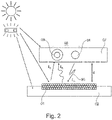
- FIG. 2 shows a schematic representation of an arrangement for verifying the security feature 01, the security feature being excited to luminescence by means of a lighting unit 04 of an image recording unit 06 of a mobile terminal device, namely a smartphone 07, in that the lighting unit 04 excites light, in particular white LED flashlight 08 with a spectral maximum of about 450 nm.
- the flashlight 08 has an intensity I A .
- the phosphor of the security feature 01 emits stationary electromagnetic radiation in the visible spectral range, which decays in the ms range after the end of the excitation.
- the decaying emission I E of the phosphor is detected with a camera 09 of the image recording unit 06 of the smartphone 07 by triggering a series or video recording.
- the camera 09 operating as a detector detects ambient radiation I 0 of daylight or room light that impinges on the security feature 01 and the bank note 02 and is reflected there.
- the influence of the ambient radiation I 0 can be kept small in the method according to the invention by keeping a distance d between the security feature 01 and the smartphone 07 small. Due to the small distance d, which is preferably below the focus range of the image recording unit 06, the smartphone 07 shields the ambient radiation I 0 for the most part. This is because sharp images are not required for reliable verification of the diffuse luminescence signals of the security feature.
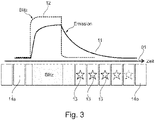
- FIG. 3 shows a schematic representation of the rise and fall behavior of the phosphor used in security feature 01.
- An emission curve 11 of the security feature 01 excited to luminescence is shown in the diagram along a time axis t. Furthermore, a flash light excitation curve 12 is plotted along the time axis. If the single flash is fired using the smartphone 07 ( 2 ) is generated, the LED flashlight excitation curve 12 rises steeply, holds its level for a short time and then falls to zero in the ns to ⁇ s range. The phosphor of the security feature 01 is excited to luminescence by the electromagnetic radiation of the flashlight, with its emission curve 11 rising almost simultaneously with the flashlight excitation curve 12 .
- the emission of the phosphor 11 decays significantly more slowly than the stimulating radiation of the smartphone's lighting unit, which is preferably equipped with white-emitting LEDs.
- the decay time of the phosphor is in the ms range.
- a reference image 14b can be recorded as the last image of the recorded image sequence.
- an additional reference image 14a can also be recorded before the activation of the excitation radiation (triggering of the flash).
- a start image 14a can optionally be recorded as an additional reference image before the series or video recordings that are decisive for the detection of the decaying luminescence signals of the security feature are triggered.
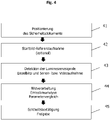
- a positioning step 41 the secure document to be verified is positioned in such a way that it can be securely captured by the smartphone's image capture unit.
- the start image 14a of the security feature is already generated before the triggering of the flash light excitation of the smartphone.
- a detection step 43 a single flash is triggered with the help of the image recording unit of the lighting unit of the smartphone and a serial image or video recording is carried out in order to capture the luminescence signals of the phosphor used to create the security feature that are present after the end of the flash light excitation and decay in the ms range to record.
- an emission analysis step 44 the recorded series of images and the reference recordings are compared using the data processing unit.
- other methods of image processing such as contrast adjustment and histogram analysis are used of the different color channels is applied in order to verify in this way both the spectral emission and the exclusive decay characteristics of the phosphor used according to the invention.
- the authenticity of the checked security document can be confirmed in a release step 45 by comparing the calculated parameters with the authenticity parameters of the security feature that are preferably stored in the data memory of the smartphone.
- the authenticity and integrity of the security document can be confirmed by the verification of the security feature on the security document.
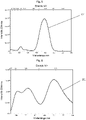
- figure 5 shows an excitation spectrum 121 of the 700 nm emission band of a phosphor according to embodiment 1.
- 0.2822 g CaCO 3 , 0.5335 g Sc 2 (C 2 O 4 ) 3 ⁇ 10.723H 2 O, 0.1803 g SiO 2 , 0.0052 g CeO 2 , and 0.0358 g MnC 2 O 4 .2H 2 O are completely homogenized using a mortar with the addition of acetone. After evaporating the solvent, the dry powder mixture is transferred to a corundum crucible. The sample is first precalcined in a chamber furnace at 500° C. for 2 h in an air atmosphere and then annealed in a tube furnace at 1400° C.
- This phosphor has the formula (Ca 2.82 Ce 0.03 Mn 0.15 )(Sc 1.95 Mn 0.05 )Si 3 O 12 .
- the excitation spectrum makes it clear that the exemplary inventive phosphor has a maximum spectral excitability in the range from 440 to 450 nm.
- FIG. 6 shows a corresponding emission spectrum 111 of the phosphor according to exemplary embodiment 1 at 450 nm excitation. It is found that the phosphor specially configured via the phosphor composition and the selected preparation conditions has broadband emissions over the has the entire visible spectral range. Three emission bands with maxima at about 505 nm, 570 nm and about 700 nm are visible, the band with a maximum of about 700 nm having the highest relative intensity.
- these bands can be attributed to the direct luminescence of the Ce 3+ activator ions (Ce 3+ on Ca 2+ site), as well as the emissions made possible by the Ce 3+ - Mn 2+ energy transfer of the Mn 2 + Coactivators (Mn 2+ on Ca 2+ -place or Mn 2+ on Assign Sc 3+ place).
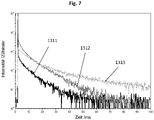
- Curve 1311 is the decay curve for the 505 nm emission
- curve 1312 is the decay curve for the 570 nm emission
- curve 1313 is the decay curve for the 700 nm emission. It can be clearly seen that the spectral decay curves for the individual emissions differ significantly. As already explained, a decay in the nanosecond range is determined for the emission with a maximum of approximately 505 nm, while the luminescence bands with maxima of approximately 570 and approximately 700 nm have decay times in the single-digit and double-digit millisecond range. In addition, it is apparent to the person skilled in the art that the individual decay curves are very unlikely to run exponentially. Rather, the measured curves appear to have multi-exponential decay characteristics.
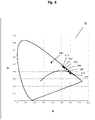
- the 8 illustrates the color shift that results when the decaying luminescence is detected over the entire visible spectral range.
- the 8 first a schematic representation of a CIE standard color table 15 of the CIE standard valence system.
- the CIE standard valence system was Defined in 1931 in order to establish a relation between human color perception and the physical causes of the color stimulus and typically records all perceptible colors, whereby the color perception refers to that of a defined normal observer.
- Each color or emission spectrum of a self-luminous object is represented by a single xy coordinate in the CIE table of norms.
- the color coordinates of the luminescence signals measured integrally as a function of the decay time are shown in FIG 8 140 to 147 elements shown with the reference numerals.
- the data determined for a phosphor according to exemplary embodiment 1 can be taken from the following table.
- the color shift which tends to lead from the green to the red spectral range, results from the superimposition of the 6 emission bands shown and from the differences and the superimposition of the corresponding in the 7 illustrated decay curves of the phosphor according to the invention according to embodiment 1.
- the special decay behavior described contributes to a large extent exclusivity of the Ca 3 Sc 2 Si 3 O 12 :Ce 3+ , Mn 2+ phosphor according to the invention.
- 9 shows the emission spectra 1123, 113 of the stationary photoluminescence of the phosphors excited at 450 nm according to exemplary embodiments 2 and 3.
- 10 shows the associated decay curves 132, 133 of the main emission bands of the phosphors excited at 450 nm according to exemplary embodiments 2 and 3.
- the mixture is annealed for 2 h at 1000° C. in the air atmosphere of a chamber furnace in order to decompose the remaining organic residues.
- the annealed material which now has a white body colour, is then mixed with two percent by mass of boric acid and annealed again this time for 4 hours at 1300° C. in a 5% forming gas atmosphere.
- the resulting phosphor has the composition (Ca 2.895 Ce 0.03 Mn 0.075 ) (Sc 1.975 Mn 0.025 )Si 3 O 12 .
- the curve 112 in the 9 shows the emission spectrum of this phosphor.
- the curve 132 designates the decay curve for this phosphor, which preferably emits in the green spectral range.
- the resulting black foam is dried in a drying cabinet at 150 °C, then finely ground and transferred to a porcelain crucible. After an initial two-hour annealing at 1000 °C in the air atmosphere of a chamber furnace and the subsequent addition of two percent by mass of boric acid to the cooled annealed material, another four-hour thermal treatment takes place at 1100 °C in a 5% forming gas atmosphere.
- the emission spectrum of the phosphor obtained, measured at 450 nm excitation, is shown in curve 113 of FIG 9 shown, the associated decay curve is the curve 133 of 10 refer to.
- the Ca 3 Sc 2 Si 3 O 12 :Ce 3+ , Mn 2+ phosphors are a particularly suitable class of phosphors for forming a security feature according to the invention.
- numerous exclusive phosphor compositions can be created with different decay behavior and distinguishable emission spectra and, for this reason, with a markedly high level of security and authenticity.
- the exclusive properties of the phosphors that can be used to protect valuable and security documents in the form of security features can be reliably verified with the help of commercially available smartphones.
Landscapes
- Physics & Mathematics (AREA)
- Health & Medical Sciences (AREA)
- Spectroscopy & Molecular Physics (AREA)
- Toxicology (AREA)
- General Physics & Mathematics (AREA)
- General Health & Medical Sciences (AREA)
- Computer Vision & Pattern Recognition (AREA)
- Finance (AREA)
- Accounting & Taxation (AREA)
- Business, Economics & Management (AREA)
- Engineering & Computer Science (AREA)
- Luminescent Compositions (AREA)
- Telephone Function (AREA)
Applications Claiming Priority (2)
| Application Number | Priority Date | Filing Date | Title |
|---|---|---|---|
| DE102018109141.9A DE102018109141A1 (de) | 2018-04-17 | 2018-04-17 | Smartphone verifizierbares, leuchtstoffbasiertes Sicherheitsmerkmal und Anordnung zur VerifizierungSmartphone verifizierbares, leuchtstoffbasiertes Sicherheitsmerkmal und Anordnung zur Verifizierung |
| PCT/EP2019/059709 WO2019201877A1 (de) | 2018-04-17 | 2019-04-15 | Smartphone verifizierbares, leuchtstoffbasiertes sicherheitsmerkmal und anordnung zur verifizierung |
Publications (2)
| Publication Number | Publication Date |
|---|---|
| EP3781408A1 EP3781408A1 (de) | 2021-02-24 |
| EP3781408B1 true EP3781408B1 (de) | 2022-12-21 |
Family
ID=66429314
Family Applications (1)
| Application Number | Title | Priority Date | Filing Date |
|---|---|---|---|
| EP19722000.7A Active EP3781408B1 (de) | 2018-04-17 | 2019-04-15 | Smartphone verifizierbares, leuchtstoffbasiertes sicherheitsmerkmal und anordnung zur verifizierung |
Country Status (6)
| Country | Link |
|---|---|
| EP (1) | EP3781408B1 (pl) |
| CN (1) | CN112203863B (pl) |
| DE (1) | DE102018109141A1 (pl) |
| ES (1) | ES2940565T3 (pl) |
| PL (1) | PL3781408T3 (pl) |
| WO (1) | WO2019201877A1 (pl) |
Cited By (1)
| Publication number | Priority date | Publication date | Assignee | Title |
|---|---|---|---|---|
| WO2025021691A1 (de) * | 2023-07-21 | 2025-01-30 | Giesecke+Devrient Currency Technology Gmbh | Sicherheitsmerkmal, druckfarbe, wertdokument und echtheitsüberprüfungsverfahren |
Families Citing this family (5)
| Publication number | Priority date | Publication date | Assignee | Title |
|---|---|---|---|---|
| DE102019210761A1 (de) * | 2019-07-19 | 2021-01-21 | Bundesdruckerei Gmbh | Photolumineszenz-Sensorvorrichtung zum Verifizieren eines Sicherheitsmerkmals eines Objekts und Verfahren zum Kalibrieren einer Photolumineszenz-Sensorvorrichtung |
| DE102019122010A1 (de) * | 2019-08-15 | 2021-02-18 | Polysecure Gmbh | Gegenstand, der Fluoreszenz-Markerpartikel umfasst, und Verfahren zur Identifizierung desselben |
| DE102020104115A1 (de) * | 2020-02-17 | 2021-08-19 | Bundesdruckerei Gmbh | Verfahren zum Überprüfen eines smartphone-verifizierbaren Sicherheitsmerkmals, Smartphone-verifizierbares Sicherheitsmerkmal und Wert- oder Sicherheitsdokument |
| DE102020120567B4 (de) | 2020-08-04 | 2022-07-14 | Bundesdruckerei Gmbh | Verfahren zur echtheitsverifikation eines leuchtstoffbasierten sicherheitsmerkmals unter verwendung eines mobilen endgeräts sowie mobiles endgerät |
| GB202017778D0 (en) * | 2020-11-11 | 2020-12-23 | Security Fibres Uk Ltd | Authentication of security documents |
Family Cites Families (21)
| Publication number | Priority date | Publication date | Assignee | Title |
|---|---|---|---|---|
| DE3373824D1 (en) * | 1982-02-19 | 1987-10-29 | Kasei Optonix | Phosphors and their use in electron-excited fluorescent displays |
| US7079230B1 (en) | 1999-07-16 | 2006-07-18 | Sun Chemical B.V. | Portable authentication device and method of authenticating products or product packaging |
| PT1237128E (pt) | 2001-03-01 | 2012-10-30 | Sicpa Holding Sa | Detector de características de luminescência melhorado |
| DE10127837A1 (de) * | 2001-06-08 | 2003-01-23 | Giesecke & Devrient Gmbh | Vorrichtung und Verfahren zur Untersuchung von Dokumenten |
| EP1672568A1 (en) | 2004-12-17 | 2006-06-21 | Ncr International Inc. | Security labels which are difficult to counterfeit |
| JP5578597B2 (ja) * | 2007-09-03 | 2014-08-27 | 独立行政法人物質・材料研究機構 | 蛍光体及びその製造方法、並びにそれを用いた発光装置 |
| DE102008034021A1 (de) * | 2008-07-16 | 2010-01-21 | Merck Patent Gmbh | Verfahren zur Herstellung eines Sicherheits- und/oder Wertprodukts mit Zufallsmuster und korrelierter Identzeichenfolge |
| US8822954B2 (en) | 2008-10-23 | 2014-09-02 | Intematix Corporation | Phosphor based authentication system |
| DE102010014912A1 (de) * | 2010-04-14 | 2011-10-20 | Giesecke & Devrient Gmbh | Sensor zur Prüfung von Wertdokumenten |
| CN102971397B (zh) * | 2010-07-09 | 2016-01-20 | 德国捷德有限公司 | 防伪特征 |
| US9418282B2 (en) | 2010-12-22 | 2016-08-16 | U-Nica Technology Ag | Method and device for authenticating documents marked with photochromic systems |
| CN102250617B (zh) * | 2011-05-19 | 2013-07-03 | 中国科学院长春光学精密机械与物理研究所 | 一种基于紫外光激发的红色荧光粉 |
| CN102277165B (zh) * | 2011-06-13 | 2013-08-21 | 中国科学院长春光学精密机械与物理研究所 | 一种基于紫外光或蓝光激发的荧光粉及其制备方法和应用 |
| US20130015651A1 (en) * | 2011-07-15 | 2013-01-17 | Honeywell International Inc. | Luminescent phosphor compounds, articles including such compounds, and methods for their production and use |
| CN103875026B (zh) | 2011-09-06 | 2016-10-26 | 德国联邦印制有限公司 | 验证带有形式为荧光印刷元件的安全特征的安全文件的方法和装置以及这种装置的应用 |
| DE102011082174A1 (de) * | 2011-09-06 | 2013-03-07 | Bundesdruckerei Gmbh | Vorrichtung zum mobilen Erkennen eines Dokumentes |
| US9250183B2 (en) * | 2011-12-19 | 2016-02-02 | Honeywell International Inc. | Luminescent materials, articles incorporating luminescent materials, and methods for performing article authentication |
| US8759794B2 (en) * | 2012-07-20 | 2014-06-24 | Honeywell International Inc. | Articles, methods of validating the same, and validation systems employing decay constant modulation |
| DE102015005304B3 (de) | 2015-04-27 | 2016-08-18 | Sensor Instruments Entwicklungs- Und Vertriebs Gmbh | Vorrichtung für ein portables Smart-Gerät |
| DE102015219395B4 (de) * | 2015-10-07 | 2019-01-17 | Koenig & Bauer Ag | Identifikationsmerkmal mit mindestens zwei in einer definiert begrenzten Fläche angeordneten Identifikationselementen zur Identifikation eines Gegenstandes |
| TWI742100B (zh) * | 2016-07-06 | 2021-10-11 | 瑞士商西克帕控股有限公司 | 用於鑑別利用長餘輝發光之保全標記的方法,及包括一或更多種餘輝化合物的保全標記 |
-
2018
- 2018-04-17 DE DE102018109141.9A patent/DE102018109141A1/de active Pending
-
2019
- 2019-04-15 CN CN201980025993.9A patent/CN112203863B/zh active Active
- 2019-04-15 EP EP19722000.7A patent/EP3781408B1/de active Active
- 2019-04-15 WO PCT/EP2019/059709 patent/WO2019201877A1/de not_active Ceased
- 2019-04-15 ES ES19722000T patent/ES2940565T3/es active Active
- 2019-04-15 PL PL19722000.7T patent/PL3781408T3/pl unknown
Cited By (1)
| Publication number | Priority date | Publication date | Assignee | Title |
|---|---|---|---|---|
| WO2025021691A1 (de) * | 2023-07-21 | 2025-01-30 | Giesecke+Devrient Currency Technology Gmbh | Sicherheitsmerkmal, druckfarbe, wertdokument und echtheitsüberprüfungsverfahren |
Also Published As
| Publication number | Publication date |
|---|---|
| CN112203863A (zh) | 2021-01-08 |
| DE102018109141A1 (de) | 2019-10-17 |
| CN112203863B (zh) | 2023-01-31 |
| EP3781408A1 (de) | 2021-02-24 |
| WO2019201877A1 (de) | 2019-10-24 |
| ES2940565T3 (es) | 2023-05-09 |
| PL3781408T3 (pl) | 2023-04-24 |
Similar Documents
| Publication | Publication Date | Title |
|---|---|---|
| EP3781408B1 (de) | Smartphone verifizierbares, leuchtstoffbasiertes sicherheitsmerkmal und anordnung zur verifizierung | |
| EP0053148B1 (de) | Wertpapier mit echtheitsmerkmalen in form von lumineszierenden substanzen und verfahren zur echtheitsbestimmung | |
| EP0052624B1 (de) | Wertpapier mit echtheitsmerkmalen in form von lumineszierenden substanzen | |
| DE3020652C2 (pl) | ||
| DE69915855T2 (de) | Sicherheitsdruck | |
| EP0053183B1 (de) | Wertpapier mit echtheitsmerkmalen in form von nur im unsichtbaren bereich des optischen spektrums lumineszierenden substanzen und verfahren zur prüfung derselben | |
| EP3107739B1 (de) | Sicherheitsmerkmal und verwendung desselben, wertdokument und verfahren zur prüfung der echtheit desselben | |
| EP2512821B1 (de) | Echtheitsmerkmal in form von lumineszierenden substanzen | |
| WO2002020695A1 (de) | Dotierte nanopartikel | |
| EP3083882B1 (de) | Zinksulfidischer leuchtstoff mit photo- und elektrolumineszenzverhalten, verfahren zu dessen herstellung sowie sicherheitsdokument, sicherheitsmerkmal und verfahren zu dessen detektion | |
| EP2718911B1 (de) | Verfahren zur verifikation eines sicherheitsdokuments mit einem sicherheitsmerkmal in form eines fluoreszierenden druckelementes sowie verwendung einer entsprechenden anordnung | |
| WO1999038703A1 (de) | Bedrucktes wertdokument mit einem lumineszierenden echtheitsmerkmal | |
| DE3121523C2 (pl) | ||
| EP3850594A1 (de) | Wertdokumentsystem | |
| EP3717273A1 (de) | Codierungssystem zum ausbilden eines sicherheitsmerkmals in oder an einem sicherheits- oder wertdokument oder einer mehrzahl von sicherheits- oder wertdokumenten | |
| EP3782136B1 (de) | Verfahren zur verifikation eines leuchtstoffbasierten sicherheitsmerkmals | |
| DE102005032831A1 (de) | Holmiumdotierte Anti-Stokes-Leuchtstoffe und Sicherheitsmerkmale mit diesen Leuchtstoffen | |
| EP2915146B1 (de) | Verfahren und vorrichtung zur prüfung eines sicherheitselements | |
| EP1631719B1 (de) | Wertdokument mit einem sicherheitselement und verfahren zur herstellung des wertdokuments | |
| EP3866126A1 (de) | Verfahren zum überprüfen eines smartphone-verifizierbaren sicherheitsmerkmals, smartphone-verifizierbares sicherheitsmerkmal und wert- oder sicherheitsdokument | |
| DE19926980A1 (de) | Verstärkung der Leuchtdichte von langnachleuchtenden und/oder fluoreszierenden Oberflächen | |
| EP3883783B1 (de) | Codierungssystem zum ausbilden eines sicherheitsmerkmals in oder an einem sicherheits- oder wertdokument oder einer mehrzahl von sicherheits- oder wertdokumenten | |
| DE102020120567B4 (de) | Verfahren zur echtheitsverifikation eines leuchtstoffbasierten sicherheitsmerkmals unter verwendung eines mobilen endgeräts sowie mobiles endgerät | |
| AT377028B (de) | Wertpapier mit echtheitsmerkmalen in form von nur im unsichtbaren bereich des optischen spektrums lumineszierenden substanzen | |
| DE102016120979A1 (de) | Verfahren zur Echtheitsprüfung eines Sicherheitsmerkmals und Anordnung zur Echtheitsprüfung eines Sicherheitsdokuments mit einem Sicherheitsmerkmal |
Legal Events
| Date | Code | Title | Description |
|---|---|---|---|
| STAA | Information on the status of an ep patent application or granted ep patent |
Free format text: STATUS: UNKNOWN |
|
| STAA | Information on the status of an ep patent application or granted ep patent |
Free format text: STATUS: THE INTERNATIONAL PUBLICATION HAS BEEN MADE |
|
| PUAI | Public reference made under article 153(3) epc to a published international application that has entered the european phase |
Free format text: ORIGINAL CODE: 0009012 |
|
| STAA | Information on the status of an ep patent application or granted ep patent |
Free format text: STATUS: REQUEST FOR EXAMINATION WAS MADE |
|
| 17P | Request for examination filed |
Effective date: 20201016 |
|
| AK | Designated contracting states |
Kind code of ref document: A1 Designated state(s): AL AT BE BG CH CY CZ DE DK EE ES FI FR GB GR HR HU IE IS IT LI LT LU LV MC MK MT NL NO PL PT RO RS SE SI SK SM TR |
|
| AX | Request for extension of the european patent |
Extension state: BA ME |
|
| TPAC | Observations filed by third parties |
Free format text: ORIGINAL CODE: EPIDOSNTIPA |
|
| STAA | Information on the status of an ep patent application or granted ep patent |
Free format text: STATUS: EXAMINATION IS IN PROGRESS |
|
| DAV | Request for validation of the european patent (deleted) | ||
| DAX | Request for extension of the european patent (deleted) | ||
| 17Q | First examination report despatched |
Effective date: 20210712 |
|
| GRAP | Despatch of communication of intention to grant a patent |
Free format text: ORIGINAL CODE: EPIDOSNIGR1 |
|
| STAA | Information on the status of an ep patent application or granted ep patent |
Free format text: STATUS: GRANT OF PATENT IS INTENDED |
|
| INTG | Intention to grant announced |
Effective date: 20220727 |
|
| GRAS | Grant fee paid |
Free format text: ORIGINAL CODE: EPIDOSNIGR3 |
|
| GRAA | (expected) grant |
Free format text: ORIGINAL CODE: 0009210 |
|
| STAA | Information on the status of an ep patent application or granted ep patent |
Free format text: STATUS: THE PATENT HAS BEEN GRANTED |
|
| AK | Designated contracting states |
Kind code of ref document: B1 Designated state(s): AL AT BE BG CH CY CZ DE DK EE ES FI FR GB GR HR HU IE IS IT LI LT LU LV MC MK MT NL NO PL PT RO RS SE SI SK SM TR |
|
| REG | Reference to a national code |
Ref country code: GB Ref legal event code: FG4D Free format text: NOT ENGLISH |
|
| REG | Reference to a national code |
Ref country code: DE Ref legal event code: R096 Ref document number: 502019006583 Country of ref document: DE |
|
| REG | Reference to a national code |
Ref country code: CH Ref legal event code: EP |
|
| REG | Reference to a national code |
Ref country code: AT Ref legal event code: REF Ref document number: 1538836 Country of ref document: AT Kind code of ref document: T Effective date: 20230115 |
|
| REG | Reference to a national code |
Ref country code: IE Ref legal event code: FG4D Free format text: LANGUAGE OF EP DOCUMENT: GERMAN |
|
| REG | Reference to a national code |
Ref country code: NL Ref legal event code: FP |
|
| REG | Reference to a national code |
Ref country code: LT Ref legal event code: MG9D |
|
| PG25 | Lapsed in a contracting state [announced via postgrant information from national office to epo] |
Ref country code: SE Free format text: LAPSE BECAUSE OF FAILURE TO SUBMIT A TRANSLATION OF THE DESCRIPTION OR TO PAY THE FEE WITHIN THE PRESCRIBED TIME-LIMIT Effective date: 20221221 Ref country code: NO Free format text: LAPSE BECAUSE OF FAILURE TO SUBMIT A TRANSLATION OF THE DESCRIPTION OR TO PAY THE FEE WITHIN THE PRESCRIBED TIME-LIMIT Effective date: 20230321 Ref country code: LT Free format text: LAPSE BECAUSE OF FAILURE TO SUBMIT A TRANSLATION OF THE DESCRIPTION OR TO PAY THE FEE WITHIN THE PRESCRIBED TIME-LIMIT Effective date: 20221221 Ref country code: FI Free format text: LAPSE BECAUSE OF FAILURE TO SUBMIT A TRANSLATION OF THE DESCRIPTION OR TO PAY THE FEE WITHIN THE PRESCRIBED TIME-LIMIT Effective date: 20221221 |
|
| REG | Reference to a national code |
Ref country code: ES Ref legal event code: FG2A Ref document number: 2940565 Country of ref document: ES Kind code of ref document: T3 Effective date: 20230509 |
|
| PG25 | Lapsed in a contracting state [announced via postgrant information from national office to epo] |
Ref country code: RS Free format text: LAPSE BECAUSE OF FAILURE TO SUBMIT A TRANSLATION OF THE DESCRIPTION OR TO PAY THE FEE WITHIN THE PRESCRIBED TIME-LIMIT Effective date: 20221221 Ref country code: LV Free format text: LAPSE BECAUSE OF FAILURE TO SUBMIT A TRANSLATION OF THE DESCRIPTION OR TO PAY THE FEE WITHIN THE PRESCRIBED TIME-LIMIT Effective date: 20221221 Ref country code: HR Free format text: LAPSE BECAUSE OF FAILURE TO SUBMIT A TRANSLATION OF THE DESCRIPTION OR TO PAY THE FEE WITHIN THE PRESCRIBED TIME-LIMIT Effective date: 20221221 Ref country code: GR Free format text: LAPSE BECAUSE OF FAILURE TO SUBMIT A TRANSLATION OF THE DESCRIPTION OR TO PAY THE FEE WITHIN THE PRESCRIBED TIME-LIMIT Effective date: 20230322 |
|
| PG25 | Lapsed in a contracting state [announced via postgrant information from national office to epo] |
Ref country code: SM Free format text: LAPSE BECAUSE OF FAILURE TO SUBMIT A TRANSLATION OF THE DESCRIPTION OR TO PAY THE FEE WITHIN THE PRESCRIBED TIME-LIMIT Effective date: 20221221 Ref country code: RO Free format text: LAPSE BECAUSE OF FAILURE TO SUBMIT A TRANSLATION OF THE DESCRIPTION OR TO PAY THE FEE WITHIN THE PRESCRIBED TIME-LIMIT Effective date: 20221221 Ref country code: PT Free format text: LAPSE BECAUSE OF FAILURE TO SUBMIT A TRANSLATION OF THE DESCRIPTION OR TO PAY THE FEE WITHIN THE PRESCRIBED TIME-LIMIT Effective date: 20230421 Ref country code: EE Free format text: LAPSE BECAUSE OF FAILURE TO SUBMIT A TRANSLATION OF THE DESCRIPTION OR TO PAY THE FEE WITHIN THE PRESCRIBED TIME-LIMIT Effective date: 20221221 Ref country code: CZ Free format text: LAPSE BECAUSE OF FAILURE TO SUBMIT A TRANSLATION OF THE DESCRIPTION OR TO PAY THE FEE WITHIN THE PRESCRIBED TIME-LIMIT Effective date: 20221221 |
|
| PG25 | Lapsed in a contracting state [announced via postgrant information from national office to epo] |
Ref country code: SK Free format text: LAPSE BECAUSE OF FAILURE TO SUBMIT A TRANSLATION OF THE DESCRIPTION OR TO PAY THE FEE WITHIN THE PRESCRIBED TIME-LIMIT Effective date: 20221221 Ref country code: IS Free format text: LAPSE BECAUSE OF FAILURE TO SUBMIT A TRANSLATION OF THE DESCRIPTION OR TO PAY THE FEE WITHIN THE PRESCRIBED TIME-LIMIT Effective date: 20230421 Ref country code: AL Free format text: LAPSE BECAUSE OF FAILURE TO SUBMIT A TRANSLATION OF THE DESCRIPTION OR TO PAY THE FEE WITHIN THE PRESCRIBED TIME-LIMIT Effective date: 20221221 |
|
| REG | Reference to a national code |
Ref country code: DE Ref legal event code: R097 Ref document number: 502019006583 Country of ref document: DE |
|
| PLBE | No opposition filed within time limit |
Free format text: ORIGINAL CODE: 0009261 |
|
| STAA | Information on the status of an ep patent application or granted ep patent |
Free format text: STATUS: NO OPPOSITION FILED WITHIN TIME LIMIT |
|
| PG25 | Lapsed in a contracting state [announced via postgrant information from national office to epo] |
Ref country code: DK Free format text: LAPSE BECAUSE OF FAILURE TO SUBMIT A TRANSLATION OF THE DESCRIPTION OR TO PAY THE FEE WITHIN THE PRESCRIBED TIME-LIMIT Effective date: 20221221 |
|
| 26N | No opposition filed |
Effective date: 20230922 |
|
| PG25 | Lapsed in a contracting state [announced via postgrant information from national office to epo] |
Ref country code: LU Free format text: LAPSE BECAUSE OF NON-PAYMENT OF DUE FEES Effective date: 20230415 |
|
| REG | Reference to a national code |
Ref country code: BE Ref legal event code: MM Effective date: 20230430 |
|
| PG25 | Lapsed in a contracting state [announced via postgrant information from national office to epo] |
Ref country code: MC Free format text: LAPSE BECAUSE OF FAILURE TO SUBMIT A TRANSLATION OF THE DESCRIPTION OR TO PAY THE FEE WITHIN THE PRESCRIBED TIME-LIMIT Effective date: 20221221 |
|
| PG25 | Lapsed in a contracting state [announced via postgrant information from national office to epo] |
Ref country code: SI Free format text: LAPSE BECAUSE OF FAILURE TO SUBMIT A TRANSLATION OF THE DESCRIPTION OR TO PAY THE FEE WITHIN THE PRESCRIBED TIME-LIMIT Effective date: 20221221 Ref country code: MC Free format text: LAPSE BECAUSE OF FAILURE TO SUBMIT A TRANSLATION OF THE DESCRIPTION OR TO PAY THE FEE WITHIN THE PRESCRIBED TIME-LIMIT Effective date: 20221221 |
|
| REG | Reference to a national code |
Ref country code: IE Ref legal event code: MM4A |
|
| PG25 | Lapsed in a contracting state [announced via postgrant information from national office to epo] |
Ref country code: BE Free format text: LAPSE BECAUSE OF NON-PAYMENT OF DUE FEES Effective date: 20230430 |
|
| PG25 | Lapsed in a contracting state [announced via postgrant information from national office to epo] |
Ref country code: IE Free format text: LAPSE BECAUSE OF NON-PAYMENT OF DUE FEES Effective date: 20230415 |
|
| PG25 | Lapsed in a contracting state [announced via postgrant information from national office to epo] |
Ref country code: IE Free format text: LAPSE BECAUSE OF NON-PAYMENT OF DUE FEES Effective date: 20230415 |
|
| PG25 | Lapsed in a contracting state [announced via postgrant information from national office to epo] |
Ref country code: BG Free format text: LAPSE BECAUSE OF FAILURE TO SUBMIT A TRANSLATION OF THE DESCRIPTION OR TO PAY THE FEE WITHIN THE PRESCRIBED TIME-LIMIT Effective date: 20221221 |
|
| PG25 | Lapsed in a contracting state [announced via postgrant information from national office to epo] |
Ref country code: BG Free format text: LAPSE BECAUSE OF FAILURE TO SUBMIT A TRANSLATION OF THE DESCRIPTION OR TO PAY THE FEE WITHIN THE PRESCRIBED TIME-LIMIT Effective date: 20221221 |
|
| PGFP | Annual fee paid to national office [announced via postgrant information from national office to epo] |
Ref country code: NL Payment date: 20250422 Year of fee payment: 7 |
|
| PGFP | Annual fee paid to national office [announced via postgrant information from national office to epo] |
Ref country code: PL Payment date: 20250407 Year of fee payment: 7 Ref country code: DE Payment date: 20250417 Year of fee payment: 7 |
|
| PGFP | Annual fee paid to national office [announced via postgrant information from national office to epo] |
Ref country code: ES Payment date: 20250519 Year of fee payment: 7 |
|
| PGFP | Annual fee paid to national office [announced via postgrant information from national office to epo] |
Ref country code: IT Payment date: 20250430 Year of fee payment: 7 |
|
| PGFP | Annual fee paid to national office [announced via postgrant information from national office to epo] |
Ref country code: FR Payment date: 20250422 Year of fee payment: 7 |
|
| PGFP | Annual fee paid to national office [announced via postgrant information from national office to epo] |
Ref country code: CH Payment date: 20250501 Year of fee payment: 7 |
|
| PGFP | Annual fee paid to national office [announced via postgrant information from national office to epo] |
Ref country code: AT Payment date: 20250416 Year of fee payment: 7 |
|
| PG25 | Lapsed in a contracting state [announced via postgrant information from national office to epo] |
Ref country code: CY Free format text: LAPSE BECAUSE OF FAILURE TO SUBMIT A TRANSLATION OF THE DESCRIPTION OR TO PAY THE FEE WITHIN THE PRESCRIBED TIME-LIMIT; INVALID AB INITIO Effective date: 20190415 |
|
| PG25 | Lapsed in a contracting state [announced via postgrant information from national office to epo] |
Ref country code: HU Free format text: LAPSE BECAUSE OF FAILURE TO SUBMIT A TRANSLATION OF THE DESCRIPTION OR TO PAY THE FEE WITHIN THE PRESCRIBED TIME-LIMIT; INVALID AB INITIO Effective date: 20190415 |
|
| PG25 | Lapsed in a contracting state [announced via postgrant information from national office to epo] |
Ref country code: TR Free format text: LAPSE BECAUSE OF FAILURE TO SUBMIT A TRANSLATION OF THE DESCRIPTION OR TO PAY THE FEE WITHIN THE PRESCRIBED TIME-LIMIT Effective date: 20221221 |
|
| PGFP | Annual fee paid to national office [announced via postgrant information from national office to epo] |
Ref country code: GB Payment date: 20260324 Year of fee payment: 8 |