EP3781228B1 - Physiologisches kardiovaskuläres ph-ausgeglichenes gegenstrom-elektrolyttransfer- und flüssigkeitsentfernungssystem - Google Patents
Physiologisches kardiovaskuläres ph-ausgeglichenes gegenstrom-elektrolyttransfer- und flüssigkeitsentfernungssystem Download PDFInfo
- Publication number
- EP3781228B1 EP3781228B1 EP19788284.8A EP19788284A EP3781228B1 EP 3781228 B1 EP3781228 B1 EP 3781228B1 EP 19788284 A EP19788284 A EP 19788284A EP 3781228 B1 EP3781228 B1 EP 3781228B1
- Authority
- EP
- European Patent Office
- Prior art keywords
- blood
- wash solution
- pump
- electrolyte
- filter chamber
- Prior art date
- Legal status (The legal status is an assumption and is not a legal conclusion. Google has not performed a legal analysis and makes no representation as to the accuracy of the status listed.)
- Active
Links
Images

Classifications
-
- A—HUMAN NECESSITIES
- A61—MEDICAL OR VETERINARY SCIENCE; HYGIENE
- A61M—DEVICES FOR INTRODUCING MEDIA INTO, OR ONTO, THE BODY; DEVICES FOR TRANSDUCING BODY MEDIA OR FOR TAKING MEDIA FROM THE BODY; DEVICES FOR PRODUCING OR ENDING SLEEP OR STUPOR
- A61M1/00—Suction or pumping devices for medical purposes; Devices for carrying-off, for treatment of, or for carrying-over, body-liquids; Drainage systems
- A61M1/36—Other treatment of blood in a by-pass of the natural circulatory system, e.g. temperature adaptation, irradiation ; Extra-corporeal blood circuits
- A61M1/3621—Extra-corporeal blood circuits
- A61M1/3666—Cardiac or cardiopulmonary bypass, e.g. heart-lung machines
-
- A—HUMAN NECESSITIES
- A61—MEDICAL OR VETERINARY SCIENCE; HYGIENE
- A61M—DEVICES FOR INTRODUCING MEDIA INTO, OR ONTO, THE BODY; DEVICES FOR TRANSDUCING BODY MEDIA OR FOR TAKING MEDIA FROM THE BODY; DEVICES FOR PRODUCING OR ENDING SLEEP OR STUPOR
- A61M1/00—Suction or pumping devices for medical purposes; Devices for carrying-off, for treatment of, or for carrying-over, body-liquids; Drainage systems
- A61M1/02—Blood transfusion apparatus
- A61M1/0281—Apparatus for treatment of blood or blood constituents prior to transfusion, e.g. washing, filtering or thawing
-
- A—HUMAN NECESSITIES
- A61—MEDICAL OR VETERINARY SCIENCE; HYGIENE
- A61M—DEVICES FOR INTRODUCING MEDIA INTO, OR ONTO, THE BODY; DEVICES FOR TRANSDUCING BODY MEDIA OR FOR TAKING MEDIA FROM THE BODY; DEVICES FOR PRODUCING OR ENDING SLEEP OR STUPOR
- A61M1/00—Suction or pumping devices for medical purposes; Devices for carrying-off, for treatment of, or for carrying-over, body-liquids; Drainage systems
- A61M1/14—Dialysis systems; Artificial kidneys; Blood oxygenators ; Reciprocating systems for treatment of body fluids, e.g. single needle systems for hemofiltration or pheresis
- A61M1/16—Dialysis systems; Artificial kidneys; Blood oxygenators ; Reciprocating systems for treatment of body fluids, e.g. single needle systems for hemofiltration or pheresis with membranes
- A61M1/1698—Blood oxygenators with or without heat-exchangers
-
- A—HUMAN NECESSITIES
- A61—MEDICAL OR VETERINARY SCIENCE; HYGIENE
- A61M—DEVICES FOR INTRODUCING MEDIA INTO, OR ONTO, THE BODY; DEVICES FOR TRANSDUCING BODY MEDIA OR FOR TAKING MEDIA FROM THE BODY; DEVICES FOR PRODUCING OR ENDING SLEEP OR STUPOR
- A61M1/00—Suction or pumping devices for medical purposes; Devices for carrying-off, for treatment of, or for carrying-over, body-liquids; Drainage systems
- A61M1/14—Dialysis systems; Artificial kidneys; Blood oxygenators ; Reciprocating systems for treatment of body fluids, e.g. single needle systems for hemofiltration or pheresis
- A61M1/32—Oxygenators without membranes
-
- A—HUMAN NECESSITIES
- A61—MEDICAL OR VETERINARY SCIENCE; HYGIENE
- A61M—DEVICES FOR INTRODUCING MEDIA INTO, OR ONTO, THE BODY; DEVICES FOR TRANSDUCING BODY MEDIA OR FOR TAKING MEDIA FROM THE BODY; DEVICES FOR PRODUCING OR ENDING SLEEP OR STUPOR
- A61M1/00—Suction or pumping devices for medical purposes; Devices for carrying-off, for treatment of, or for carrying-over, body-liquids; Drainage systems
- A61M1/34—Filtering material out of the blood by passing it through a membrane, i.e. hemofiltration or diafiltration
-
- A—HUMAN NECESSITIES
- A61—MEDICAL OR VETERINARY SCIENCE; HYGIENE
- A61M—DEVICES FOR INTRODUCING MEDIA INTO, OR ONTO, THE BODY; DEVICES FOR TRANSDUCING BODY MEDIA OR FOR TAKING MEDIA FROM THE BODY; DEVICES FOR PRODUCING OR ENDING SLEEP OR STUPOR
- A61M1/00—Suction or pumping devices for medical purposes; Devices for carrying-off, for treatment of, or for carrying-over, body-liquids; Drainage systems
- A61M1/34—Filtering material out of the blood by passing it through a membrane, i.e. hemofiltration or diafiltration
- A61M1/3403—Regulation parameters
-
- A—HUMAN NECESSITIES
- A61—MEDICAL OR VETERINARY SCIENCE; HYGIENE
- A61M—DEVICES FOR INTRODUCING MEDIA INTO, OR ONTO, THE BODY; DEVICES FOR TRANSDUCING BODY MEDIA OR FOR TAKING MEDIA FROM THE BODY; DEVICES FOR PRODUCING OR ENDING SLEEP OR STUPOR
- A61M1/00—Suction or pumping devices for medical purposes; Devices for carrying-off, for treatment of, or for carrying-over, body-liquids; Drainage systems
- A61M1/36—Other treatment of blood in a by-pass of the natural circulatory system, e.g. temperature adaptation, irradiation ; Extra-corporeal blood circuits
- A61M1/3607—Regulation parameters
- A61M1/3609—Physical characteristics of the blood, e.g. haematocrit, urea
-
- A—HUMAN NECESSITIES
- A61—MEDICAL OR VETERINARY SCIENCE; HYGIENE
- A61M—DEVICES FOR INTRODUCING MEDIA INTO, OR ONTO, THE BODY; DEVICES FOR TRANSDUCING BODY MEDIA OR FOR TAKING MEDIA FROM THE BODY; DEVICES FOR PRODUCING OR ENDING SLEEP OR STUPOR
- A61M1/00—Suction or pumping devices for medical purposes; Devices for carrying-off, for treatment of, or for carrying-over, body-liquids; Drainage systems
- A61M1/36—Other treatment of blood in a by-pass of the natural circulatory system, e.g. temperature adaptation, irradiation ; Extra-corporeal blood circuits
- A61M1/3692—Washing or rinsing blood or blood constituents
-
- A—HUMAN NECESSITIES
- A61—MEDICAL OR VETERINARY SCIENCE; HYGIENE
- A61M—DEVICES FOR INTRODUCING MEDIA INTO, OR ONTO, THE BODY; DEVICES FOR TRANSDUCING BODY MEDIA OR FOR TAKING MEDIA FROM THE BODY; DEVICES FOR PRODUCING OR ENDING SLEEP OR STUPOR
- A61M1/00—Suction or pumping devices for medical purposes; Devices for carrying-off, for treatment of, or for carrying-over, body-liquids; Drainage systems
- A61M1/36—Other treatment of blood in a by-pass of the natural circulatory system, e.g. temperature adaptation, irradiation ; Extra-corporeal blood circuits
- A61M1/3621—Extra-corporeal blood circuits
- A61M1/3623—Means for actively controlling temperature of blood
-
- A—HUMAN NECESSITIES
- A61—MEDICAL OR VETERINARY SCIENCE; HYGIENE
- A61M—DEVICES FOR INTRODUCING MEDIA INTO, OR ONTO, THE BODY; DEVICES FOR TRANSDUCING BODY MEDIA OR FOR TAKING MEDIA FROM THE BODY; DEVICES FOR PRODUCING OR ENDING SLEEP OR STUPOR
- A61M2202/00—Special media to be introduced, removed or treated
- A61M2202/0085—Special media to be introduced, removed or treated product washed out
-
- A—HUMAN NECESSITIES
- A61—MEDICAL OR VETERINARY SCIENCE; HYGIENE
- A61M—DEVICES FOR INTRODUCING MEDIA INTO, OR ONTO, THE BODY; DEVICES FOR TRANSDUCING BODY MEDIA OR FOR TAKING MEDIA FROM THE BODY; DEVICES FOR PRODUCING OR ENDING SLEEP OR STUPOR
- A61M2202/00—Special media to be introduced, removed or treated
- A61M2202/04—Liquids
- A61M2202/0413—Blood
-
- A—HUMAN NECESSITIES
- A61—MEDICAL OR VETERINARY SCIENCE; HYGIENE
- A61M—DEVICES FOR INTRODUCING MEDIA INTO, OR ONTO, THE BODY; DEVICES FOR TRANSDUCING BODY MEDIA OR FOR TAKING MEDIA FROM THE BODY; DEVICES FOR PRODUCING OR ENDING SLEEP OR STUPOR
- A61M2230/00—Measuring parameters of the user
- A61M2230/20—Blood composition characteristics
- A61M2230/208—Blood composition characteristics pH-value
Definitions
- the invention relates to a system for establishing physiological conditions in a patient's blood. Also generally disclosed are a system or device for adjusting the concentration of at least one electrolyte in a fluid, such as blood, and methods related to the same.
- Cardiopulmonary bypass includes a heart/lung machine, with various pumps, an artificial lung or oxygenator, a heater/cooler for temperature control and an artificial kidney or hemofilter. None of these features of cardiopulmonary bypass is actually physiological in comparison to the patient's physiological process under normal circumstances. However, the clinical practitioners or perfusionist is in charge of monitoring and maintaining physiological conditions of the patient's circulation, ventilation, oxygenation, anticoagulation, fluid and electrolyte balance throughout the entire bypass surgery. Although, there have been vast improvements in the heart/lung machine, as well as the disposables over the past half century, the process of fluid and electrolyte balance has not changed much, if at all.
- This antiquated, yet singular option for restoring the electrolytes causes a host of other imbalances.
- the patient can all but be guaranteed metabolic acidosis, hypocalcemia, hyperchloremia, and/or hypernatremia.
- US 9,649,423 B2 relates to treatment of transfusion blood and describes that blood treatment may be achieved by countercurrent flow.
- CN 204 815 042 U relates to a blood cell washing device for haemodialysis.
- WO 2006/057473 A1 relates to haemodialysis and describes a filter module for blood purification and/or oxygenation.
- US 2015/335807 A1 relates to methods and devices for removal of carbon dioxide from blood via dialysis.
- US 2018/015419 A1 relates to a mass exchanger for treatment of a liquid such as blood.
- the traditional method of achieving electrolyte balance while on cardiopulmonary bypass is slow, inefficient, unreliable and has not changed for decades.
- the device, system, and/or methods described herein can be employed during cardiopulmonary bypass to reduce or balance electrolytes in a quick and safe manner.
- the conventional hemofilter is modified to facilitate the transfer of electrolytes, as well as facilitating fluid removal from the circuit.
- the pH balanced electrolyte solutions are customized to maintain the physiological conditions of the patients, for example, during heart surgery.
- a system according to the present invention comprises the technical features as defined in independent claim 1.
- Embodiments of devices or systems described herein can be incorporated into or used with a cardiopulmonary bypass machine so that electrolyte balance can be regulated in a faster and more efficient manner, providing a solution to the electrolyte and pH problems associated with current methods that use crystalloids.
- the device and methods described herein safely and quickly change electrolytes within the bypass/patient circulation. 74360621.1
- the devices, systems, or methods described herein is capable of restoring banked blood, regardless of its age or decomposition.
- the inventors have designed a system and related process to quickly and efficient maintain electrolyte balance and pH of blood, as well as restore such in non-circulating blood, which results in a more physiologically acceptable blood product having appropriate electrolyte balance and pH.
- Modes include, but are not limited to (1) "zero balanced” electrolyte transfer mode, (2) fluid removal mode, (3) a combination of both electrolyte transfer and fluid removal mode, and (4) physiological restoration mode.
- the various modes provide a user with the appropriate functionality to maintain blood or a patient at or about a physiologic condition.
- the banked blood mode allows for the restoration of banked blood to an approximate normal physiologic state.
- Devices described herein can be portable. The portability of the device allows its use in a variety of locations, such as areas of a medical facility, e.g., operating rooms (OR), intensive care units (ICU), emergency rooms (ER) or blood banks.
- Certain aspects described herein are directed to methods of adjusting the concentration of one or more electrolytes in a patient's blood, the method comprising: (a) providing an extracorporeal blood circuit comprising the following components in fluid communication with a patient's circulatory system: blood flow tubing, an oxygenator, a blood pump, and a hemofilter, wherein the hemofilter comprises a first filter chamber and a second filter chamber separated by a semi-permeable barrier; (b) flowing the patient's blood through the first filter chamber; (c) adjusting the concentration of at least one electrolyte in the patient's blood by flowing a first wash solution through the second filter chamber in a direction of flow opposite to the direction which the patient's blood is flowing through the first filter chamber.
- the at least one electrolyte in the patient's blood comprises at least one of hydrogen ion, sodium, potassium, calcium, chloride, glucose, bicarbonate, and lactate.
- at least one electrolyte is hydrogen ions and 1, 2, 3, 4, 5, 6, or 7 of sodium, potassium, calcium, chloride, glucose, bicarbonate, and lactate.
- at least one electrolyte is sodium and 1, 2, 3, 4, 5, 6, or 7 of hydrogen ions, potassium, calcium, chloride, glucose, bicarbonate, and lactate.
- at least one electrolyte is potassium and 1, 2, 3, 4, 5, 6, or 7 of hydrogen ions, sodium, calcium, chloride, glucose, bicarbonate, and lactate.
- At least one electrolyte is calcium and 1, 2, 3, 4, 5, 6, or 7 of hydrogen ions, sodium, potassium, chloride, glucose, bicarbonate, and lactate.
- at least one electrolyte is chloride and 1, 2, 3, 4, 5, 6, or 7 of hydrogen ions, sodium, potassium, calcium, glucose, bicarbonate, and lactate.
- at least one electrolyte is glucose and 1, 2, 3, 4, 5, 6, or 7 of hydrogen ions, sodium, potassium, calcium, chloride, bicarbonate, and lactate.
- at least one electrolyte is bicarbonate and 1, 2, 3, 4, 5, 6, or 7 of hydrogen ions, sodium, potassium, calcium, chloride, glucose, and lactate.
- At least one electrolyte is lactate and 1, 2, 3, 4, 5, 6, or 7 of hydrogen ions, sodium, potassium, calcium, chloride, glucose, and bicarbonate.
- Step (c) can be performed for a time sufficient to cause the concentration of the at least one electrolyte in the patient's blood to adjust from a concentration outside a desired range to a concentration within the desired range.
- the desired range for hydrogen ion is pH 7.35 to 7.45
- the desired range for sodium is 135 to 145 mM
- the desired range for potassium is 3.5 to 4.5 mM
- the desired range for calcium is 0.8 to 1.2 mM
- the desired range for chloride is 95 to 115 mM
- the desired range for glucose is 80 to 120 mg/dL
- the desired range for bicarbonate is 22 to 28 mM
- the desired range for lactate is 0 to 2 mM.
- the concentration of the at least one electrolyte is adjusted to a concentration within the desired range within 4, 6, 8, 10, 15, 20 minutes, including all values there between (e.g., 4, 6, 8 to 10, 15, 20 minutes), of initiating flow of the first wash solution through the second filter chamber.
- the concentration of the at least one electrolyte is adjusted to a concentration within the desired range within 6 minutes of initiating flow of the first wash solution through the second filter chamber.
- performance of step (c) causes the concentration of the at least one electrolyte to adjust by at least 5, 10, 15, 20, 25, 30%, including all values there between (e.g., 5, 10, 15 to 20, 25, 30%, 5 to 15%, 10 to 15%, 10 to 20%, 15 to 30%), within 3 minutes.
- the concentration of the at least one electrolyte to adjust is changed by at least 15% within 3 minutes.
- the concentration of an electrolyte in the wash solution can be adjusted to effect a desired change in the electrolyte in the blood, e.g., if a blood electrolyte is elevated the wash solution can have a lower concentration of that electrolyte relative to the blood, alternatively if the blood electrolyte is low the was solution can have a higher concentration of that electrolyte relative to the blood.
- the first wash solution either does not comprise the at least one electrolyte (a target electrolyte) or comprises the at least one electrolyte at a concentration below the concentration of the at least one electrolyte in the blood before step (c) is performed.
- the first wash solution comprises the at least one electrolyte at a concentration above the concentration of the at least one electrolyte in the blood before step (c) is performed.
- the first wash solution can have a pH of 7.35 to 7.45 and comprises 135-145 mmol/L of sodium, 22-28 mmol/L bicarbonate, 80-100 mmol/L glucose, 0.8-1.0 mmol/L calcium, 0 mmol/L potassium in one wash solution and 3.5 mmol/L potassium in another.
- the volume of the first wash solution flowed through the second filter chamber in step (c) is less than 200, 300, 400, 500, 600, 700, 800, 900, or 1000 mL, including all values there between, e.g., 200 to 1000 mL, 500 to 700 mL. In a particular aspect the volume of the first wash solution flowed through the second filter chamber in step (c) is less than 600 mL.
- the rate of flow of the first wash solution through the second filter chamber can be from 20, 30, 40, 50 to 60, 70, 80, 90 100 ml/min, including all values and ranges there between.
- the rate of flow of the patient's blood through the first filter chamber can be from 20, 30, 40, 50, 60, 70, 80, 90, 100 to 120, 140, 160, 180, 200 ml/min, including any value and range there between.
- the method can further comprise stopping the flow of wash solution through the second filter chamber when the concentration of the at least one electrolyte in the patient's blood is within a desired range.
- the method can further comprise flowing a second wash solution through the second filter chamber after the concentration of the at least one electrolyte in the patient's blood is adjusted to be within a desired range, wherein the second wash solution comprises the at least one electrolyte at a concentration within the desired range.
- the method can further comprise monitoring the concentration of the at least one electrolyte in the patient's blood.
- concentration of sodium in the patient's blood remains below 140 mM or does not increase by more than 5% while the method is being performed.
- performance of the method does not cause a decrease in the hematocrit of the patient's blood of more than 1, 2, 3, 4, 5, to 6%, including all values there between, e.g., 1 to 6%, 2 to 4%, etc.
- performance of the method does not cause a decrease in the hematocrit of the patient's blood of more than 3%.
- step (c) further comprises: (i) flowing the wash solution from a wash solution reservoir through wash solution tubing coupled to a wash solution inlet port, the wash solution inlet port being in fluid communication with the second filter chamber; and (ii) flowing wash solution effluent from an effluent outlet port in fluid communication with the second filter chamber and through effluent tubing coupled to the effluent output port.
- the blood flow tubing is coupled to a blood input port and a blood outlet port, the blood input port and the blood output port being in fluid communication with the first filter chamber.
- An extracorporeal blood circuit can be coupled to a heat exchange unit.
- the extracorporeal blood circuit is comprised in a cardiopulmonary bypass system.
- the extracorporeal blood circuit is comprised in an extracorporeal membrane oxygenation system.
- the patient is undergoing cardiac surgery. The patient can be of any age. In certain aspects the patient is 1 to 12 months old, 1, 10, 20, 30, 40 to 50, 60, 70, 80, 90 years old, including all ages there between.
- the concentration of the at least one electrolyte is adjusted without adding fluid to a reservoir of the patient's blood. In a further aspect the concentration of the at least one electrolyte is adjusted without a transient or permanent net influx of fluid into the patient's blood.
- Traditional ultrafiltration methods add the wash solution into the patient circuit reservoir making direct contact with the patient's blood circulation.
- the wash solution comes in contact with a counter current semipermeable membrane inside the hemoconcentrator, pulling fluid across the membrane, providing a more efficient method.
- the concentration of the at least one electrolyte is adjusted without a transient or permanent net efflux of fluid from the patient's blood.
- the volume of the patient's blood in the extracorporeal circuit remains constant throughout the performance of the method. In other aspects the volume of the patient's blood in the extracorporeal circuit does not vary by more than 0.5, 1, 2, 3, 4, 5% throughout performance of the method. In a particular aspect the volume of the patient's blood in the extracorporeal circuit does not vary by more than 1% throughout performance of the method. In certain aspects the concentration of the at least one electrolyte is adjusted without addition of fluid to a patient's blood other than fluid that flows across the semipermeable barrier in the filter. In certain aspects the concentration of the at least one electrolyte is adjusted without withdrawing fluid from the patient's blood other than fluid that flows across the semipermeable barrier in the filter.
- the second filter chamber is in fluid communication with a wash solution input pump controlling the rate of flow of wash solution into the second filter chamber and an effluent pump controlling the rate of flow of effluent out of the second filter chamber.
- the method can further comprise adjusting the rates of the wash solution input pump and the effluent pump to cause a lower pressure in the second filter chamber than the pressure in the first filter chamber and a net efflux of fluid from the patient's blood.
- the method can further comprise measuring the pressure in the second filter chamber. In certain aspects the pressure in the second filter chamber is 0 to -300 mmHg relative to the first filter chamber.
- the method can include adjusting the rate of the wash solution input pump and/or the effluent outlet pump based on the pressure measurement or pressure differential between the first filter chamber and the second filter chamber.
- the method includes adjusting the rate of the wash solution input pump and/or the effluent pump comprises stopping the wash solution input pump and/or the effluent pump if the pressure in the second filter chamber is higher than the pressure in the first filter chamber.
- the second filter chamber can be in fluid communication with a plurality of wash solutions, 2, 3, 4, 5, 6, 7, 8, 9, 10 or more wash solutions, including all values and ranges there between.
- the wash solution input pump and the effluent outlet pump are electrically coupled to (i) a sensor that senses the concentration of the at least one electrolyte in the patient's blood and (ii) a processor that receives electrolyte concentration data from the sensor and controls the rate of flow of wash solution through the second filter chamber by adjusting the rates of the wash solution input pump and the effluent pump based on the electrolyte concentration data.
- Certain aspects are directed to methods of preparing stored blood for injection into a patient comprising.
- the methods can include (a) providing a filter in fluid communication with a reservoir containing the stored blood, wherein the filter comprises a first filter chamber and a second filter chamber separated by a semipermeable barrier; (b) flowing the stored blood through the first filter chamber; (c) adjusting the concentration of at least one electrolyte in the stored banked blood by flowing a wash solution through the second filter chamber in a direction of flow opposite to the direction that the patient's blood is flowing through the first filter chamber.
- Certain embodiments are directed to a system for adjusting the concentration of at least one electrolyte in a patient's blood.
- the system according to the invention as claimed comprises (a) blood flow tubing configured to be in fluid communication with the patient's circulatory system; (b) an oxygenator in fluid communication with the blood flow tubing; (c) a blood pump configured to cause blood to flow within the blood flow tubing; (d) a filter comprising a first filter chamber and a second filter chamber separated by a semipermeable barrier, wherein the first filter chamber is in fluid communication with the blood flow tubing; (e) a wash solution reservoir in fluid communication with the second filter chamber; and (f) a wash solution input pump in fluid communication with the wash solution reservoir configured to cause a wash solution to flow within the second filter chamber in a direction opposite the direction of blood flow.
- the wash solution input pump is upstream from and in fluid communication with a wash solution inlet port, the wash solution inlet port being in fluid communication with the second filter chamber.
- the system can further include an effluent pump downstream from and in fluid communication with an effluent outlet port, the effluent outlet port being in fluid communication with the second filter chamber.
- the system includes a pump speed controller that can adjust the speed of the wash solution input pump and/or the effluent pump.
- the system can also include a display that indicates the rate of the wash solution input pump and/or the effluent pump.
- the wash solution input pump, the effluent pump, the pump speed controller, and the display are comprised in a single, portable console.
- the system can also include a sensor that can detect the concentration of at least one electrolyte in the patient's blood.
- the sensor can be configured to communicate electrolyte concentration data to a processor.
- the processor can cause a change in speed of the wash solution input pump and/or the effluent pump based on the electrolyte concentration data.
- the system can also include a pressure sensor in fluid communication with the second filter chamber.
- a safety shut-off mechanism can be included that can stop the wash solution pump and/or the effluent pump if the pressure in the second filter chamber is outside a predetermined range.
- the wash solution reservoir contains a wash solution having 133-145 mmol/L sodium, a pH of 7.35-7.45, 22-28 mmol/L bicarbonate, 95-115 mmol/L chloride.
- crystalloid refers to small molecules (usually less than 10 ⁇ ) such as salts, sugars, and buffers.
- the words “comprising” (and any form of comprising, such as “comprise” and “comprises”), “having” (and any form of having, such as “have” and “has”), "including” (and any form of including, such as “includes” and “include”) or “containing” (and any form of containing, such as “contains” and “contain”) are inclusive or open-ended and do not exclude additional, unrecited elements or method steps.
- compositions and methods of making and using the same of the present invention can "comprise,” “consist essentially of,” or “consist of” particular ingredients, components, blends, method steps, etc., disclosed throughout the specification.
- the device, system, and methods described herein can be used to maintain the physiologic state of a patient through the entire electrolyte spectrum. It began with the quest to create a crystalloid solution that would maintain the appropriate electrolyte ranges while lowering targeted values. A custom pH balanced perfusion specific crystalloid solution had been used in the past. This simple crystalloid solution was beneficial but another problem that was not solved by the customized crystalloid solution was the unmet need for removing fluid quickly via a hemofilter. As mentioned before, the electrolytes are a major focus during the surgeries, but one of the most important factors that is directly affected while the blood is "washed" is the hematocrit. As volume is added to the patient to dilute the electrolytes it also dilutes the total red cell volume.
- Acute changes like this can affect the oxygen carrying capacity of the patient, the vascular tone, and can impact end organ perfusion. Hemofiltration is a great tool but very slow relative to a rapid paced cardiac surgery.
- the limitation is that one cannot add a large bolus of fluid to a patient repeatedly because of its negative affects so the fluid must be dividedled and removed, add fluid then remove fluid and add fluid then remove fluid. This is where the term "washing" the blood originates.
- the problem is that the excessive amount of volume takes a certain amount of time to remove before the process can continue.
- the inventors contemplated modifying or manipulating the hemofilter to increase its efficiency when used in conjunction with customized physiologic crystalloid solutions.
- the device described herein is a small, light-weight, self-contained system that can be adapted to any cardiopulmonary bypass Heart/Lung machine, extracorporeal membrane oxygenation console, or stand-alone unit for restoration of undesirable banked blood.
- Device described herein can be operated in 1, 2, 3, 4 or more different modes: (1) "zero balanced” electrolyte transfer, (2) fluid removal, (3) a combination of both electrolyte transfer and fluid removal simultaneously, and (4) physiological restoration of banked blood. Buttons can be present to select modes or dictate pump speeds during the combo mode. This system can provide a more precise and efficient level of ultrafiltration, thus allowing the patient to maintain an optimum pH and electrolyte balance during heart surgery, during application of ventricular assist devices (VAD's), as well as during extracorporeal membrane oxygenation (ECMO) runs.
- VAD's ventricular assist devices
- ECMO extracorporeal membrane oxygenation
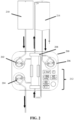
- the system is comprised of console 100 with dual roller pumps 102 and 104 to be used in conjunction with preassembled sterile disposable, hemofilter 108 as well as an optimum pH and electrolyte balanced cardiovascular solution 110.
- Multiple displays 112 on the console show each pumps flow rate (ml/min) and the pressure (mmHg) on the negative side of the outlet pump.
- Hemofilters are used in many cardiovascular cases. Blood is usually shunted through the hemofilter which contains hundreds of semipermeable microporous fibers and then reenters the patients cardiopulmonary support circuit. The pores are small enough to allow only small molecules, like aqueous solutions, electrolytes or anything else that is smaller than 50,000 Daltons. If molecules are greater than 50,000, like plasma proteins, blood cells, and most other blood components, they will not pass through the pores and will remain in the circuit and patient circulation. As a negative pressure is applied to the hemofilter, the aqueous fluid is removed which essentially concentrates the contents of the blood.
- the two roller pumps e.g ., 102 and 104 of FIG. 1
- the inlet (102) and outlet (104) pumps can perform synchronously or independently from each other.
- different modes have been incorporated, for example Z-buf (1), Concentration (2), Combo (3) and Restoration (4).
- the different modes can be utilized during the following examples.
- top pump or inlet pump 102 pulls the sterile pH/electrolyte balanced cardiovascular solution from bag 110 and pumps it into hemofilter 108. This solution moves counter current outside of the fibers, as the blood pathway moves inside the hemofilter fibers.
- Outlet pump 104 draws fluid from within the hemofilter and can expel it to a proper waste container.
- a pressure monitor is attached on the negative side of outlet pump 104 from hemofilter 108, in order to assure that a negative pressure is maintained.
- Safe guards can be provided or built in to stop both the pumps if the pressure becomes positive or if it becomes too negative.
- Another safety feature that can be incorporated is that the inlet pump that pushes fluid into the hemofilter can be regulated to never to run at a higher flow rate than the outlet pump which pulls fluid from the system. As the pH/electrolyte balanced cardiovascular solution runs through the hemofilter, the electrolytes within the blood shift to establish an equilibrium between the solution and the blood.
- this device can be employed to rapidly, yet safely, reduce and balance the pH and electrolyte levels to their normal physiological state in a very short amount of time.
- inlet 102 and outlet 104 pumps move at the same speed there is a net zero balance of fluid between the patient and the electrolyte transfer system.
- the system has a mode that will remove fluid more efficiently than the traditional ultrafiltration method of vacuum only.
- This mode will require that the inlet pump does not rotate and the outlet pump responds to the users designated removal rate.
- This combo mode can be used in the event that the patient's electrolytes require to be normalized, but fluid also needs to be removed. For example electrolyte imbalances can occur when the hematocrit needs to be elevated. This can occur because even "fresh" packed red blood cells typically have an elevated potassium and pH imbalance. With the combo mode engaged one can increase the hematocrit and restore the optimum physiologic state of the blood in a matter of minutes.
- the console is electrically powered, small, light-weight and water resistant.
- a bracket can be provided, preferably on the back side, so the console can easily be attached to any brand of cardiopulmonary bypass machines or ECMO consoles.
- the accompanying sterile disposable can come fully assembled and easily pops onto the device.
- the sterile disposable can be used as an additional component to a cardiovascular bypass system, the primary use.
- the device has a secondary use which can be implemented as a stand-alone unit.
- the sterile disposable is functionally different and can be used for the restoration of banked blood.
- the two different systems can employ custom pH/electrolyte balanced cardiovascular solutions.
- the pH/electrolyte balanced cardiovascular solution can be broken down into two types.
- Solution A will be composed of a physiologic pH balanced crystalloid that includes sodium, calcium, chloride and glucose within their normal ranges.
- Solution B will contain the same components but will also incorporate potassium in a normal physiologic range.
- the secondary use disposable will also include a pH balance crystalloid solution similar to solution B but it will not contain calcium. The calcium will interfere with the anticoagulant, citrate, of the banked blood causing it to clot.
- console 200 having inlet pump 202, outlet pump 204 in communication with solution bag 210 and hemofilter 208.
- Console 200 has display 212.
- the device is also configured to be in communication with blood source 214 which is in communication with hemofilter 208.
- the blood is counter flow circulated relative to the solution provided by solution bag 210 by pump 206.
- the devices, systems, and methods described herein could be used safely on any cardiopulmonary bypass circuit, ECMO, or temporary ventricular assist device.
- This device could be used to normalize a cardiopulmonary circuit before it is used on a patient.
- the cell wall of the red blood cell begins to deteriorate and can eventually rupture.
- the patient will be exposed to the noxious contents of the ruptured cell if they are transfused with this blood.
- the secondary use of the device/system will help normalize the electrolytes, primarily potassium and glucose of banked blood.
- the speed, efficiency, and portability of the device in tandem with the custom crystalloid solutions, and sterile disposables make it a unique system that can be utilized in various hospital settings.
- the traditional method for fluid removal has been to simply remove fluid with a hemofilter from the cardiopulmonary bypass circuit.
- the device/system described herein allows for fluid removal as well as a counter current fluid transfer to quickly manipulate the patient's electrolytes or return banked blood to a physiologic state.
- the pH/electrolyte balanced solutions in conjunction with the counter current flow is distinct from the current industry wide practice.
- a representative system was tested on a circuit of expired blood with adverse pH/electrolyte levels.
- the device was used with a pH/electrolyte balanced cardiovascular solution and the pH/electrolyte levels were normalized within minutes of starting the mechanism.
- the potassium was lowered from 8.7 to 3.9 in approximately 6 minutes. This is a significant achievement when compared to the traditional method.
- Wash A has a sodium level of 138 mmol/L and balance pH, where 0.9% NaCl has a sodium of 154 and a pH of 5.0. Over a 12 minute span 305 mL of packed red blood cells were given to increase the hematocrit and 600 mL of Wash A was added to lower the potassium level. A reminder is that this large amount of volume added to a circuit takes a certain amount of time to reach its original volume when using a hemoconcentrator.
- Rapid ETS method 3 Minutes 3 Minutes Rapid ETS Method Simulated circuit Gas 300 mL of Wash A 300 mL Wash A pH 7.33 7.35 7.38 Sodium (mmol/L) 130 134 137 Potassium (mmol/L) 8.7 6.4 3.9 Calcium (mmol/L) 1.05 0.9 0.69 Chloride (mmol/L) 100 101 102 Glucose (mg/dL) 249 208 153 Base Excess (mmol/L) -3.1 -1.4 0.6 Bicarb (mmol/L) 22.7 24.3 26 Hematocrit (%) 30 31 31 Lactate 2.3 2.0 1.5 6 minutes and 600 mL of zero balance
Landscapes
- Health & Medical Sciences (AREA)
- Heart & Thoracic Surgery (AREA)
- Vascular Medicine (AREA)
- Hematology (AREA)
- Animal Behavior & Ethology (AREA)
- Engineering & Computer Science (AREA)
- Anesthesiology (AREA)
- Biomedical Technology (AREA)
- Veterinary Medicine (AREA)
- Life Sciences & Earth Sciences (AREA)
- Public Health (AREA)
- General Health & Medical Sciences (AREA)
- Cardiology (AREA)
- Emergency Medicine (AREA)
- Urology & Nephrology (AREA)
- Pulmonology (AREA)
- External Artificial Organs (AREA)
Claims (12)
- System (100) zum Herstellen physiologischer Bedingungen im Blut eines Patienten, wobei das System (100) umfasst:(a) eine Blutflussleitung, die so konfiguriert ist, dass sie in Fluidverbindung mit dem Kreislaufsystem des Patienten steht;(b) einen Oxygenator in Fluidverbindung mit der Blutflussleitung;(c) eine Blutpumpe (106), die so konfiguriert ist, dass sie einen Blutfluss in der Blutflussleitung bewirkt;(d) einen Filter (108), der eine erste Filterkammer und eine zweite Filterkammer umfasst, die durch eine semipermeable Barriere getrennt sind, wobei die erste Filterkammer in Fluidverbindung mit dem Blutflussschlauch steht;(e) ein Waschlösungsreservoir (110) in Fluidverbindung mit der zweiten Filterkammer; und(f) eine Waschlösungs-Einlasspumpe (102) in Fluidverbindung mit dem Waschlösungsreservoir, die so konfiguriert ist, dass sie eine Waschlösung in der zweiten Filterkammer in einer Richtung entgegengesetzt zur Richtung des Blutflusses fließen lässt, dadurch gekennzeichnet, dassder Waschlösungsbehälter eine Waschlösung mit 133-145 mmol/L Natrium, einem pH-Wert von 7.35-7.45, 22-28 mmol/L Bicarbonat und 95-115 mmol/L Chlorid enthält.
- System nach Anspruch 1, wobei die Waschlösungs-Einlasspumpe (102) sich stromaufwärts von einer Waschlösungs-Einlassöffnung befindet und in Fluidverbindung mit dieser steht, wobei die Waschlösungs-Einlassöffnung in Fluidverbindung mit der zweiten Filterkammer steht.
- Das System nach Anspruch 1 oder 2, das ferner eine Ausflusspumpe (104) umfasst, die sich stromabwärts von einer Ausflussauslassöffnung befindet und mit dieser in Fluidverbindung steht, wobei die Ausflussauslassöffnung in Fluidverbindung mit der zweiten Filterkammer steht.
- Das System nach einem der Ansprüche 1 bis 3, das ferner einen Pumpendrehzahlregler umfasst, der die Drehzahl (Geschwindigkeit) der Waschlösungs-Einlasspumpe (102) und/oder der Ausflusspumpe (104) einstellen kann.
- Das System nach einem der Ansprüche 1 bis 4, das ferner eine Anzeige (112) umfasst, die die Drehzahl (Geschwindigkeit) der Waschlösungs-Einlasspumpe und/oder der Ausflusspumpe anzeigt.
- Das System nach Anspruch 5, wobei die Waschlösungs-Einlasspumpe (102), die Ausflusspumpe (104), der Pumpendrehzahlregler und die Anzeige (112) in einer einzigen tragbaren Konsole enthalten sind.
- System nach einem der Ansprüche 1 bis 6, das ferner einen Sensor umfasst, der die Konzentration mindestens eines Elektrolyts im Blut des Patienten erfassen kann.
- System nach Anspruch 7, wobei der Sensor Elektrolytkonzentrationsdaten an einen Prozessor übermitteln kann.
- System nach Anspruch 8, wobei der Prozessor eine Änderung der Geschwindigkeit der Waschlösungs-Einlasspumpe (102) und/oder der Ausflusspumpe (104) auf der Grundlage der Elektrolytkonzentrationsdaten bewirken kann.
- System nach einem der Ansprüche 1 bis 9, das ferner einen Drucksensor in Fluidverbindung mit der zweiten Filterkammer umfasst.
- System nach einem der Ansprüche 1 bis 10, das ferner einen Sicherheitsabschaltmechanismus umfasst, der die Waschlösungspumpe (102) und/oder die Ausflusspumpe (104) anhalten kann, wenn der Druck in der zweiten Filterkammer außerhalb eines vorgegebenen Bereichs liegt.
- System nach einem der Ansprüche 1 bis 11, wobei der Waschlösungsbehälter (110) eine Waschlösung mit einer Natriumkonzentration von 138 mM, einem pH-Wert von 7,4, Bicarbonat 24-28 mM, Chlorid 95-115 mM umfasst.
Applications Claiming Priority (2)
| Application Number | Priority Date | Filing Date | Title |
|---|---|---|---|
| US201862659951P | 2018-04-19 | 2018-04-19 | |
| PCT/US2019/028101 WO2019204589A1 (en) | 2018-04-19 | 2019-04-18 | Physiologic cardiovascular ph balanced counter current electrolyte transfer and fluid removal system |
Publications (4)
| Publication Number | Publication Date |
|---|---|
| EP3781228A1 EP3781228A1 (de) | 2021-02-24 |
| EP3781228A4 EP3781228A4 (de) | 2022-06-01 |
| EP3781228B1 true EP3781228B1 (de) | 2025-01-22 |
| EP3781228C0 EP3781228C0 (de) | 2025-01-22 |
Family
ID=68239915
Family Applications (1)
| Application Number | Title | Priority Date | Filing Date |
|---|---|---|---|
| EP19788284.8A Active EP3781228B1 (de) | 2018-04-19 | 2019-04-18 | Physiologisches kardiovaskuläres ph-ausgeglichenes gegenstrom-elektrolyttransfer- und flüssigkeitsentfernungssystem |
Country Status (4)
| Country | Link |
|---|---|
| US (2) | US12415025B2 (de) |
| EP (1) | EP3781228B1 (de) |
| ES (1) | ES3009086T3 (de) |
| WO (1) | WO2019204589A1 (de) |
Families Citing this family (1)
| Publication number | Priority date | Publication date | Assignee | Title |
|---|---|---|---|---|
| US20210213190A1 (en) * | 2020-01-09 | 2021-07-15 | Terumo Kabushiki Kaisha | Prediction display system and treatment method |
Family Cites Families (17)
| Publication number | Priority date | Publication date | Assignee | Title |
|---|---|---|---|---|
| US5308320A (en) * | 1990-12-28 | 1994-05-03 | University Of Pittsburgh Of The Commonwealth System Of Higher Education | Portable and modular cardiopulmonary bypass apparatus and associated aortic balloon catheter and associated method |
| US6887214B1 (en) * | 2000-09-12 | 2005-05-03 | Chf Solutions, Inc. | Blood pump having a disposable blood passage cartridge with integrated pressure sensors |
| US6689083B1 (en) * | 2000-11-27 | 2004-02-10 | Chf Solutions, Inc. | Controller for ultrafiltration blood circuit which prevents hypotension by monitoring osmotic pressure in blood |
| JP4903583B2 (ja) * | 2003-12-24 | 2012-03-28 | ケミカ テクノロジーズ, インコーポレイテッド | 携帯式個人透析用透析液再生システム |
| KR100721054B1 (ko) | 2004-11-23 | 2007-05-25 | 주식회사 뉴하트바이오 | 혈액정화 및/또는 혈액산화용 필터모듈, 그를 이용한혈액정화 및 혈액산화 방법 그리고 그를 포함하는혈액정화 장치 |
| US20140199193A1 (en) * | 2007-02-27 | 2014-07-17 | Deka Products Limited Partnership | Blood treatment systems and methods |
| CN102802719B (zh) * | 2009-06-17 | 2018-02-09 | 弗雷泽纽斯医疗保健控股有限公司 | 局部柠檬酸盐抗凝剂透析方法 |
| US20170304516A1 (en) * | 2011-04-29 | 2017-10-26 | Medtronic, Inc. | Dialysate potassium control during a dialysis session |
| GB201207543D0 (en) | 2012-05-01 | 2012-06-13 | Haemair Ltd | Treatment of transfusion blood |
| US10905816B2 (en) * | 2012-12-10 | 2021-02-02 | Medtronic, Inc. | Sodium management system for hemodialysis |
| US10322221B2 (en) | 2013-01-18 | 2019-06-18 | University of Pittsburgh—of the Commonwealth System of Higher Education | Removal of carbon dioxide via dialysis |
| US10004762B2 (en) * | 2013-05-08 | 2018-06-26 | Gambro Lundia Ab | Dialysis formulation |
| DE102014011250A1 (de) * | 2014-08-01 | 2016-02-04 | Fresenius Medical Care Deutschland Gmbh | Vorrichtung zur Erkennung der Richtung der Flüssigkeitsströmung durch einen Dialysator |
| GB201501411D0 (en) | 2015-01-28 | 2015-03-11 | Haemair Ltd | Mass exchange apparatus and methods for the use thereof |
| KR20180022721A (ko) * | 2015-06-15 | 2018-03-06 | 바이탈 쎄러피스, 인코포레이티드 | 체외 혈액 처리를 위한 시스템과 방법 |
| CN204815042U (zh) | 2015-06-18 | 2015-12-02 | 闫国超 | 一种红细胞洗涤装置 |
| EP3576806B1 (de) * | 2017-02-03 | 2024-12-04 | NxStage Medical Inc. | Vorrichtungen, verfahren und systeme zur multimodalen behandlung |
-
2019
- 2019-04-18 EP EP19788284.8A patent/EP3781228B1/de active Active
- 2019-04-18 WO PCT/US2019/028101 patent/WO2019204589A1/en not_active Ceased
- 2019-04-18 ES ES19788284T patent/ES3009086T3/es active Active
- 2019-04-18 US US17/048,855 patent/US12415025B2/en active Active
-
2025
- 2025-08-18 US US19/302,738 patent/US20250381335A1/en active Pending
Also Published As
| Publication number | Publication date |
|---|---|
| EP3781228A4 (de) | 2022-06-01 |
| EP3781228A1 (de) | 2021-02-24 |
| US20210236710A1 (en) | 2021-08-05 |
| US12415025B2 (en) | 2025-09-16 |
| US20250381335A1 (en) | 2025-12-18 |
| WO2019204589A1 (en) | 2019-10-24 |
| EP3781228C0 (de) | 2025-01-22 |
| ES3009086T3 (en) | 2025-03-26 |
Similar Documents
| Publication | Publication Date | Title |
|---|---|---|
| US7311689B2 (en) | Method and apparatus for peripheral vein fluid removal in heart failure | |
| CN112672678B (zh) | 用于移动治疗器官衰竭的可穿戴模块化体外生命支持设备 | |
| US20250381335A1 (en) | Physiologic cardiovascular ph balanced counter current electrolyte transfer and fluid removal system | |
| US20210379265A1 (en) | Method and system for controlled hyperthermia | |
| Carcillo | Multiple organ system extracorporeal support in critically ill children | |
| US11185622B1 (en) | Method and system for controlled hyperthermia | |
| Firmin et al. | Extracorporeal membrane oxygenation | |
| RU2812169C2 (ru) | Носимое модульное устройство экстракорпорального жизнеобеспечения для мобильного лечения единичной или полиорганной недостаточности | |
| Osipov et al. | Hemoconcentration during open heart operations | |
| US11191883B1 (en) | Method and system for controlled hyperthermia | |
| US11219551B1 (en) | Method and system for controlled hyperthermia | |
| Takahashi | Low Invasive Pediatric Cardiac Surgery | |
| HK40116801A (en) | Wearable modular extracorporeal life support device for mobile treatment of single and multiorgan failure | |
| CN117398539A (zh) | 具备呼吸支持功能的血液净化设备 | |
| 馬堅毅 et al. | Continuous Venovenous Hemofiltration (CVVH) and Continuous Venovenous Hemodialysis (CVVHD) Treatment Alternating with Hemodialysis in Critically ill Patients | |
| HK40052518B (en) | Wearable modular extracorporeal life support device for mobile treatment of single and multiorgan failure | |
| Steimle et al. | Further Development of Extracorporeal Life Support | |
| WO2013026118A1 (pt) | Formulação eletrolítica pronta para uso, bolsa pronta para uso, kit, usos e método para tratamento de insuficiência renal |
Legal Events
| Date | Code | Title | Description |
|---|---|---|---|
| STAA | Information on the status of an ep patent application or granted ep patent |
Free format text: STATUS: THE INTERNATIONAL PUBLICATION HAS BEEN MADE |
|
| PUAI | Public reference made under article 153(3) epc to a published international application that has entered the european phase |
Free format text: ORIGINAL CODE: 0009012 |
|
| STAA | Information on the status of an ep patent application or granted ep patent |
Free format text: STATUS: REQUEST FOR EXAMINATION WAS MADE |
|
| 17P | Request for examination filed |
Effective date: 20201029 |
|
| AK | Designated contracting states |
Kind code of ref document: A1 Designated state(s): AL AT BE BG CH CY CZ DE DK EE ES FI FR GB GR HR HU IE IS IT LI LT LU LV MC MK MT NL NO PL PT RO RS SE SI SK SM TR |
|
| AX | Request for extension of the european patent |
Extension state: BA ME |
|
| DAV | Request for validation of the european patent (deleted) | ||
| DAX | Request for extension of the european patent (deleted) | ||
| RIC1 | Information provided on ipc code assigned before grant |
Ipc: A61M 1/34 20060101ALI20211207BHEP Ipc: A61M 1/02 20060101ALI20211207BHEP Ipc: A61M 1/36 20060101ALI20211207BHEP Ipc: A61M 1/16 20060101ALI20211207BHEP Ipc: A61M 1/14 20060101AFI20211207BHEP |
|
| A4 | Supplementary search report drawn up and despatched |
Effective date: 20220429 |
|
| RIC1 | Information provided on ipc code assigned before grant |
Ipc: A61M 1/34 20060101ALI20220422BHEP Ipc: A61M 1/02 20060101ALI20220422BHEP Ipc: A61M 1/36 20060101ALI20220422BHEP Ipc: A61M 1/16 20060101ALI20220422BHEP Ipc: A61M 1/14 20060101AFI20220422BHEP |
|
| STAA | Information on the status of an ep patent application or granted ep patent |
Free format text: STATUS: EXAMINATION IS IN PROGRESS |
|
| 17Q | First examination report despatched |
Effective date: 20230901 |
|
| GRAP | Despatch of communication of intention to grant a patent |
Free format text: ORIGINAL CODE: EPIDOSNIGR1 |
|
| STAA | Information on the status of an ep patent application or granted ep patent |
Free format text: STATUS: GRANT OF PATENT IS INTENDED |
|
| INTG | Intention to grant announced |
Effective date: 20240603 |
|
| RAP3 | Party data changed (applicant data changed or rights of an application transferred) |
Owner name: MCGARRY, MARY CLAIRE Owner name: DENISON, RICHARD |
|
| RIN1 | Information on inventor provided before grant (corrected) |
Inventor name: MCGARRY, MARY CLAIRE Inventor name: DENISON, RICHARD |
|
| GRAJ | Information related to disapproval of communication of intention to grant by the applicant or resumption of examination proceedings by the epo deleted |
Free format text: ORIGINAL CODE: EPIDOSDIGR1 |
|
| STAA | Information on the status of an ep patent application or granted ep patent |
Free format text: STATUS: EXAMINATION IS IN PROGRESS |
|
| GRAS | Grant fee paid |
Free format text: ORIGINAL CODE: EPIDOSNIGR3 |
|
| STAA | Information on the status of an ep patent application or granted ep patent |
Free format text: STATUS: GRANT OF PATENT IS INTENDED |
|
| GRAP | Despatch of communication of intention to grant a patent |
Free format text: ORIGINAL CODE: EPIDOSNIGR1 |
|
| INTC | Intention to grant announced (deleted) | ||
| INTG | Intention to grant announced |
Effective date: 20241010 |
|
| GRAA | (expected) grant |
Free format text: ORIGINAL CODE: 0009210 |
|
| STAA | Information on the status of an ep patent application or granted ep patent |
Free format text: STATUS: THE PATENT HAS BEEN GRANTED |
|
| AK | Designated contracting states |
Kind code of ref document: B1 Designated state(s): AL AT BE BG CH CY CZ DE DK EE ES FI FR GB GR HR HU IE IS IT LI LT LU LV MC MK MT NL NO PL PT RO RS SE SI SK SM TR |
|
| REG | Reference to a national code |
Ref country code: GB Ref legal event code: FG4D |
|
| REG | Reference to a national code |
Ref country code: CH Ref legal event code: EP |
|
| REG | Reference to a national code |
Ref country code: IE Ref legal event code: FG4D |
|
| REG | Reference to a national code |
Ref country code: DE Ref legal event code: R096 Ref document number: 602019065145 Country of ref document: DE |
|
| U01 | Request for unitary effect filed |
Effective date: 20250206 |
|
| U07 | Unitary effect registered |
Designated state(s): AT BE BG DE DK EE FI FR IT LT LU LV MT NL PT RO SE SI Effective date: 20250212 |
|
| REG | Reference to a national code |
Ref country code: ES Ref legal event code: FG2A Ref document number: 3009086 Country of ref document: ES Kind code of ref document: T3 Effective date: 20250326 |
|
| U20 | Renewal fee for the european patent with unitary effect paid |
Year of fee payment: 7 Effective date: 20250424 |
|
| PG25 | Lapsed in a contracting state [announced via postgrant information from national office to epo] |
Ref country code: RS Free format text: LAPSE BECAUSE OF FAILURE TO SUBMIT A TRANSLATION OF THE DESCRIPTION OR TO PAY THE FEE WITHIN THE PRESCRIBED TIME-LIMIT Effective date: 20250422 |
|
| PG25 | Lapsed in a contracting state [announced via postgrant information from national office to epo] |
Ref country code: PL Free format text: LAPSE BECAUSE OF FAILURE TO SUBMIT A TRANSLATION OF THE DESCRIPTION OR TO PAY THE FEE WITHIN THE PRESCRIBED TIME-LIMIT Effective date: 20250122 |
|
| PGFP | Annual fee paid to national office [announced via postgrant information from national office to epo] |
Ref country code: ES Payment date: 20250519 Year of fee payment: 7 |
|
| PG25 | Lapsed in a contracting state [announced via postgrant information from national office to epo] |
Ref country code: NO Free format text: LAPSE BECAUSE OF FAILURE TO SUBMIT A TRANSLATION OF THE DESCRIPTION OR TO PAY THE FEE WITHIN THE PRESCRIBED TIME-LIMIT Effective date: 20250422 Ref country code: IS Free format text: LAPSE BECAUSE OF FAILURE TO SUBMIT A TRANSLATION OF THE DESCRIPTION OR TO PAY THE FEE WITHIN THE PRESCRIBED TIME-LIMIT Effective date: 20250522 |
|
| PG25 | Lapsed in a contracting state [announced via postgrant information from national office to epo] |
Ref country code: HR Free format text: LAPSE BECAUSE OF FAILURE TO SUBMIT A TRANSLATION OF THE DESCRIPTION OR TO PAY THE FEE WITHIN THE PRESCRIBED TIME-LIMIT Effective date: 20250122 |
|
| PG25 | Lapsed in a contracting state [announced via postgrant information from national office to epo] |
Ref country code: GR Free format text: LAPSE BECAUSE OF FAILURE TO SUBMIT A TRANSLATION OF THE DESCRIPTION OR TO PAY THE FEE WITHIN THE PRESCRIBED TIME-LIMIT Effective date: 20250423 |
|
| PG25 | Lapsed in a contracting state [announced via postgrant information from national office to epo] |
Ref country code: SM Free format text: LAPSE BECAUSE OF FAILURE TO SUBMIT A TRANSLATION OF THE DESCRIPTION OR TO PAY THE FEE WITHIN THE PRESCRIBED TIME-LIMIT Effective date: 20250122 |
|
| PG25 | Lapsed in a contracting state [announced via postgrant information from national office to epo] |
Ref country code: CZ Free format text: LAPSE BECAUSE OF FAILURE TO SUBMIT A TRANSLATION OF THE DESCRIPTION OR TO PAY THE FEE WITHIN THE PRESCRIBED TIME-LIMIT Effective date: 20250122 |
|
| PG25 | Lapsed in a contracting state [announced via postgrant information from national office to epo] |
Ref country code: SK Free format text: LAPSE BECAUSE OF FAILURE TO SUBMIT A TRANSLATION OF THE DESCRIPTION OR TO PAY THE FEE WITHIN THE PRESCRIBED TIME-LIMIT Effective date: 20250122 |
|
| REG | Reference to a national code |
Ref country code: CH Ref legal event code: H13 Free format text: ST27 STATUS EVENT CODE: U-0-0-H10-H13 (AS PROVIDED BY THE NATIONAL OFFICE) Effective date: 20251125 |
|
| PLBE | No opposition filed within time limit |
Free format text: ORIGINAL CODE: 0009261 |
|
| STAA | Information on the status of an ep patent application or granted ep patent |
Free format text: STATUS: NO OPPOSITION FILED WITHIN TIME LIMIT |
|
| PG25 | Lapsed in a contracting state [announced via postgrant information from national office to epo] |
Ref country code: MC Free format text: LAPSE BECAUSE OF FAILURE TO SUBMIT A TRANSLATION OF THE DESCRIPTION OR TO PAY THE FEE WITHIN THE PRESCRIBED TIME-LIMIT Effective date: 20250122 |
|
| 26N | No opposition filed |
Effective date: 20251023 |
|
| PG25 | Lapsed in a contracting state [announced via postgrant information from national office to epo] |
Ref country code: CH Free format text: LAPSE BECAUSE OF NON-PAYMENT OF DUE FEES Effective date: 20250430 |
|
| PGFP | Annual fee paid to national office [announced via postgrant information from national office to epo] |
Ref country code: GB Payment date: 20260324 Year of fee payment: 8 |
|
| PG25 | Lapsed in a contracting state [announced via postgrant information from national office to epo] |
Ref country code: IE Free format text: LAPSE BECAUSE OF NON-PAYMENT OF DUE FEES Effective date: 20250418 |