EP3776144B1 - Elektronische fingervorrichtungen mit lade- und speichersystemen - Google Patents
Elektronische fingervorrichtungen mit lade- und speichersystemen Download PDFInfo
- Publication number
- EP3776144B1 EP3776144B1 EP18786088.7A EP18786088A EP3776144B1 EP 3776144 B1 EP3776144 B1 EP 3776144B1 EP 18786088 A EP18786088 A EP 18786088A EP 3776144 B1 EP3776144 B1 EP 3776144B1
- Authority
- EP
- European Patent Office
- Prior art keywords
- finger
- mounted device
- head
- housing
- user
- Prior art date
- Legal status (The legal status is an assumption and is not a legal conclusion. Google has not performed a legal analysis and makes no representation as to the accuracy of the status listed.)
- Active
Links
Images




Classifications
-
- G—PHYSICS
- G06—COMPUTING OR CALCULATING; COUNTING
- G06F—ELECTRIC DIGITAL DATA PROCESSING
- G06F3/00—Input arrangements for transferring data to be processed into a form capable of being handled by the computer; Output arrangements for transferring data from processing unit to output unit, e.g. interface arrangements
- G06F3/01—Input arrangements or combined input and output arrangements for interaction between user and computer
- G06F3/011—Arrangements for interaction with the human body, e.g. for user immersion in virtual reality
- G06F3/014—Hand-worn input/output arrangements, e.g. data gloves
-
- G—PHYSICS
- G02—OPTICS
- G02B—OPTICAL ELEMENTS, SYSTEMS OR APPARATUS
- G02B27/00—Optical systems or apparatus not provided for by any of the groups G02B1/00 - G02B26/00, G02B30/00
- G02B27/01—Head-up displays
- G02B27/017—Head mounted
- G02B27/0176—Head mounted characterised by mechanical features
-
- G—PHYSICS
- G06—COMPUTING OR CALCULATING; COUNTING
- G06F—ELECTRIC DIGITAL DATA PROCESSING
- G06F1/00—Details not covered by groups G06F3/00 - G06F13/00 and G06F21/00
- G06F1/16—Constructional details or arrangements
- G06F1/1613—Constructional details or arrangements for portable computers
- G06F1/163—Wearable computers, e.g. on a belt
-
- G—PHYSICS
- G06—COMPUTING OR CALCULATING; COUNTING
- G06F—ELECTRIC DIGITAL DATA PROCESSING
- G06F3/00—Input arrangements for transferring data to be processed into a form capable of being handled by the computer; Output arrangements for transferring data from processing unit to output unit, e.g. interface arrangements
- G06F3/01—Input arrangements or combined input and output arrangements for interaction between user and computer
- G06F3/016—Input arrangements with force or tactile feedback as computer generated output to the user
-
- G—PHYSICS
- G06—COMPUTING OR CALCULATING; COUNTING
- G06F—ELECTRIC DIGITAL DATA PROCESSING
- G06F3/00—Input arrangements for transferring data to be processed into a form capable of being handled by the computer; Output arrangements for transferring data from processing unit to output unit, e.g. interface arrangements
- G06F3/01—Input arrangements or combined input and output arrangements for interaction between user and computer
- G06F3/017—Gesture based interaction, e.g. based on a set of recognized hand gestures
-
- H—ELECTRICITY
- H02—GENERATION; CONVERSION OR DISTRIBUTION OF ELECTRIC POWER
- H02J—ELECTRIC POWER NETWORKS; CIRCUIT ARRANGEMENTS OR SYSTEMS FOR SUPPLYING OR DISTRIBUTING ELECTRIC POWER; SYSTEMS FOR STORING ELECTRIC ENERGY
- H02J50/00—Circuit arrangements or systems for wireless supply or distribution of electric power
- H02J50/05—Circuit arrangements or systems for wireless supply or distribution of electric power using capacitive coupling
-
- H—ELECTRICITY
- H02—GENERATION; CONVERSION OR DISTRIBUTION OF ELECTRIC POWER
- H02J—ELECTRIC POWER NETWORKS; CIRCUIT ARRANGEMENTS OR SYSTEMS FOR SUPPLYING OR DISTRIBUTING ELECTRIC POWER; SYSTEMS FOR STORING ELECTRIC ENERGY
- H02J50/00—Circuit arrangements or systems for wireless supply or distribution of electric power
- H02J50/10—Circuit arrangements or systems for wireless supply or distribution of electric power using inductive coupling
-
- H—ELECTRICITY
- H02—GENERATION; CONVERSION OR DISTRIBUTION OF ELECTRIC POWER
- H02J—ELECTRIC POWER NETWORKS; CIRCUIT ARRANGEMENTS OR SYSTEMS FOR SUPPLYING OR DISTRIBUTING ELECTRIC POWER; SYSTEMS FOR STORING ELECTRIC ENERGY
- H02J7/00—Circuit arrangements for charging or discharging batteries or for supplying loads from batteries
-
- H—ELECTRICITY
- H02—GENERATION; CONVERSION OR DISTRIBUTION OF ELECTRIC POWER
- H02J—ELECTRIC POWER NETWORKS; CIRCUIT ARRANGEMENTS OR SYSTEMS FOR SUPPLYING OR DISTRIBUTING ELECTRIC POWER; SYSTEMS FOR STORING ELECTRIC ENERGY
- H02J7/00—Circuit arrangements for charging or discharging batteries or for supplying loads from batteries
- H02J7/32—Circuit arrangements for charging or discharging batteries or for supplying loads from batteries for charging batteries from a charging set comprising a non-electric prime mover rotating at constant speed
-
- G—PHYSICS
- G02—OPTICS
- G02B—OPTICAL ELEMENTS, SYSTEMS OR APPARATUS
- G02B27/00—Optical systems or apparatus not provided for by any of the groups G02B1/00 - G02B26/00, G02B30/00
- G02B27/01—Head-up displays
- G02B27/017—Head mounted
- G02B2027/0178—Eyeglass type
-
- G—PHYSICS
- G02—OPTICS
- G02B—OPTICAL ELEMENTS, SYSTEMS OR APPARATUS
- G02B27/00—Optical systems or apparatus not provided for by any of the groups G02B1/00 - G02B26/00, G02B30/00
- G02B27/01—Head-up displays
- G02B27/0179—Display position adjusting means not related to the information to be displayed
- G02B2027/0187—Display position adjusting means not related to the information to be displayed slaved to motion of at least a part of the body of the user, e.g. head, eye
-
- G—PHYSICS
- G06—COMPUTING OR CALCULATING; COUNTING
- G06F—ELECTRIC DIGITAL DATA PROCESSING
- G06F2203/00—Indexing scheme relating to G06F3/00 - G06F3/048
- G06F2203/033—Indexing scheme relating to G06F3/033
- G06F2203/0331—Finger worn pointing device
-
- Y—GENERAL TAGGING OF NEW TECHNOLOGICAL DEVELOPMENTS; GENERAL TAGGING OF CROSS-SECTIONAL TECHNOLOGIES SPANNING OVER SEVERAL SECTIONS OF THE IPC; TECHNICAL SUBJECTS COVERED BY FORMER USPC CROSS-REFERENCE ART COLLECTIONS [XRACs] AND DIGESTS
- Y02—TECHNOLOGIES OR APPLICATIONS FOR MITIGATION OR ADAPTATION AGAINST CLIMATE CHANGE
- Y02B—CLIMATE CHANGE MITIGATION TECHNOLOGIES RELATED TO BUILDINGS, e.g. HOUSING, HOUSE APPLIANCES OR RELATED END-USER APPLICATIONS
- Y02B40/00—Technologies aiming at improving the efficiency of home appliances, e.g. induction cooking or efficient technologies for refrigerators, freezers or dish washers
Definitions
- This relates generally to electronic devices, and, more particularly, to input-output components for electronic devices.
- Electronic devices such as computers can be controlled using computer mice and other input accessories.
- force-feedback gloves can be used to control virtual objects.
- Cellular telephones may have touch screen displays and vibrators that are used to create haptic feedback in response to touch input.
- US 2011/210931 A1 relates to a finger-worn user input device for use with position detecting system, has indication mechanism which relays indication corresponding to relative position between stationary and rotatable sections.
- US 2017/235332 A1 relates to a wearable computing device that has a flexible printed circuit board disposed between an interior wall and an exterior wall in the shape of a ring.
- An internal housing is placed near a user's finger.
- a component is disposed on the circuit board.
- the interior wall and the exterior wall defines a window that facilitates data transmission, battery recharge and status indication.
- the window has exteriors which facilitate battery charging and data transmission, respectively.
- US 2015/277559 A1 relates to a method for a user to control an external electronic device with a finger-ring-mounted touch screen that includes a computer processor, wireless transceiver, and rechargeable power source; the ring is worn on a first finger receives an input from a second finger, selects one of a plurality of touch events associated with the input, and wirelessly transmits a command associated with the touch event to the external electronic device.
- US 2017/045948 A1 relates to methods, systems, and apparatuses for controlling a target device.
- the apparatus is a wearable apparatus in the form of a ring.
- the apparatus may include a gesture recognition module that recognizes a gesture made by a user, e.g., onto a capacitive track-pad.
- the apparatus may also include a microcontroller that correlates the gesture with a command recognizable by the target device.
- the ring has also a rechargeable battery and a haptic module.
- Devices such as these may not be convenient for a user.
- computer mice generally require flat surfaces for operation and are mostly used with desktop computers in fixed locations.
- Force-feedback gloves can be cumbersome and uncomfortable.
- Touch screen displays with haptic feedback only provide haptic output when a user is interacting with the displays.
- a system may include one or more finger-mounted devices as defined by claim 1.
- the finger devices have power receiving circuitry configured to receive power from a power source.
- the power source is incorporated into an electronic device such as a battery case, a head-mounted display, a wireless charging mat or stand, or other electronic equipment.
- the power source supplies power through terminals that form ohmic contacts with mating terminals in the finger device or may transmit power wirelessly using capacitive coupling or inductive charging arrangements.
- a finger device has hinge structures that allow portions of the device to rotate relative to each other. This allows the finger device to be placed in a U-shaped configuration for normal use on a user's finger or a flattened configuration or other configuration in which the device is being provided with power from a power source.
- Electronic devices that are configured to be mounted on the body of a user may be used to gather user input and to provide a user with output.
- electronic devices that are configured to be worn on one or more of a user's fingers which are sometimes referred to as finger devices or finger-mounted devices, may be used to gather user input and to supply output.
- a finger device may, as an example, include an inertial measurement unit with an accelerometer for gathering information on figure motions such as finger taps or free-space finger gestures, may include force sensors for gathering information on normal and shear forces in the finger device and the user's finger, and may include other sensors for gathering information on the interactions between the finger device (and the user's finger on which the device is mounted) and the surrounding environment.
- the finger device may include a haptic output device to provide the user's finger with haptic output and may include other output components.
- a user of a virtual reality or mixed reality device e.g., head-mounted equipment such as glasses, goggles, a helmet, etc.
- may gather information on interactions between the finger device(s) and the surrounding environment e.g., interactions between a user's fingers and the environment, including finger motions and other interactions associated with virtual content displayed for a user
- Haptic output may be used, for example, to provide the fingers of a user with a desired texture sensation as a user is touching a real object or as a user is touching a virtual object.
- Finger devices can be worn on any or all of a user's fingers (e.g., the index finger, the index finger and thumb, three of a user's fingers on one of the user's hands, some or all fingers on both hands, etc.).
- finger devices may have inverted U shapes or other configurations that allow the finger devices to be worn over the top and sides of a user's finger tips while leaving the user's finger pads exposed. This allows a user to touch objects with the finger pad portions of the user's fingers during use. Users can use the finger devices to interact with any suitable electronic equipment.
- a user may use one or more finger devices to interact with a virtual reality or mixed reality system (e.g., a head-mounted device with a display), to supply input to a desktop computer, tablet computer, cellular telephone, watch, ear buds, or other accessory, or to interact with other electronic equipment.
- a virtual reality or mixed reality system e.g., a head-mounted device with a display
- FIG. 1 is a schematic diagram of an illustrative system of the type that may include one or more finger devices.
- system 8 may include electronic device(s) such as finger device(s) 10 and other electronic device(s) 24.
- Each finger device 10 may be worn on a finger of a user's hand.
- Additional electronic devices in system 8 such as devices 24 may include devices such as a laptop computer, a computer monitor containing an embedded computer, a tablet computer, a desktop computer, a cellular telephone, a media player, or other handheld or portable electronic device, a smaller device such as a wristwatch device, a pendant device, a headphone or earpiece device, a head-mounted device such as glasses, goggles, a helmet, or other equipment worn on a user's head, or other wearable or miniature device, a television, a computer display that does not contain an embedded computer, a gaming device, a remote control, a navigation device, an embedded system such as a system in which equipment is mounted in a kiosk, in an automobile, airplane, or other vehicle, a removable external case for electronic equipment, a strap, a wrist band or head band, a removable cover for a device, a case or bag that has straps or that has other structures to receive and carry electronic equipment and other items, a necklace or arm band, a wallet, sleeve,
- device 10 is a finger-mounted device having a finger-mounted housing with a U-shaped body that grasps a user's finger or a finger-mounted housing with other shapes and device(s) 24 is a cellular telephone, tablet computer, laptop computer, wristwatch device, head-mounted device, a device with a speaker, or other electronic device (e.g., a device with a display, audio components, and/or other output components).
- device(s) 24 is a cellular telephone, tablet computer, laptop computer, wristwatch device, head-mounted device, a device with a speaker, or other electronic device (e.g., a device with a display, audio components, and/or other output components).
- Control circuitry 12 and 26 may include storage and processing circuitry for supporting the operation of system 8.
- the storage and processing circuitry may include storage such as nonvolatile memory (e.g., flash memory or other electrically-programmable-read-only memory configured to form a solid state drive), volatile memory (e.g., static or dynamic random-access-memory), etc.
- Processing circuitry in control circuitry 12 and 26 may be used to gather input from sensors and other input devices and may be used to control output devices.
- the processing circuitry may be based on one or more microprocessors, microcontrollers, digital signal processors, baseband processors and other wireless communications circuits, power management units, audio chips, application specific integrated circuits, etc.
- control circuitry 12 may communicate using communications circuitry 14 and/or control circuitry 26 may communicate using communications circuitry 28.
- Circuitry 14 and/or 28 may include antennas, radio-frequency transceiver circuitry, and other wireless communications circuitry and/or wired communications circuitry.
- Circuitry 14 and/or 26 which may sometimes be referred to as control circuitry and/or control and communications circuitry, may, for example, support bidirectional wireless communications between devices 10 and 24 over wireless link 38 (e.g., a wireless local area network link, a near-field communications link, or other suitable wired or wireless communications link (e.g., a Bluetooth ® link, a WiFi ® link, a 60 GHz link or other millimeter wave link, etc.).
- Devices 10 and 24 may also include power circuits for transmitting and/or receiving wired and/or wireless power.
- in-band wireless communications may be supported using inductive power transfer coils (as an example).
- Devices 10 and 24 may include input-output devices such as devices 16 and 30. Input-output devices 16 and/or 30 may be used in gathering user input, in gathering information on the environment surrounding the user, and/or in providing a user with output. Devices 16 may include sensors 18 and devices 24 may include sensors 32.
- Sensors 18 and/or 32 may include force sensors (e.g., strain gauges, capacitive force sensors, resistive force sensors, etc.), audio sensors such as microphones, touch and/or proximity sensors such as capacitive sensors, optical sensors such as optical sensors that emit and detect light, ultrasonic sensors, and/or other touch sensors and/or proximity sensors, monochromatic and color ambient light sensors, image sensors, sensors for detecting position, orientation, and/or motion (e.g., accelerometers, magnetic sensors such as compass sensors, gyroscopes, and/or inertial measurement units that contain some or all of these sensors), muscle activity sensors (EMG) for detecting finger actions, radio-frequency sensors, depth sensors (e.g., structured light sensors and/or depth sensors based on stereo imaging devices), optical sensors such as self-mixing sensors and light detection and ranging (lidar) sensors, humidity sensors, moisture sensors, and/or other sensors.
- force sensors e.g., strain gauges, capacitive force sensors, resistive force sensors, etc.
- devices 10 and/or 24 may use sensors 18 and/or 32 and/or other input-output devices 16 and/or 30 to gather user input (e.g., buttons may be used to gather button press input, touch sensors overlapping displays can be used for gathering user touch screen input, touch pads may be used in gathering touch input, microphones may be used for gathering audio input, accelerometers may be used in monitoring when a finger contacts an input surface and may therefore be used to gather finger press input, etc.).
- user input e.g., buttons may be used to gather button press input, touch sensors overlapping displays can be used for gathering user touch screen input, touch pads may be used in gathering touch input, microphones may be used for gathering audio input, accelerometers may be used in monitoring when a finger contacts an input surface and may therefore be used to gather finger press input, etc.
- Devices 16 and/or 30 may include haptic output devices 20 and/or 34.
- Haptic output devices 20 and/or 34 can produce motion that is sensed by the user (e.g., through the user's fingertips).
- Haptic output devices 20 and/or 34 may include actuators such as electromagnetic actuators, motors, piezoelectric actuators, electroactive polymer actuators, vibrators, linear actuators, rotational actuators, actuators that bend bendable members, actuator devices that create and/or control repulsive and/or attractive forces between devices 10 and/or 24 (e.g., components for creating electrostatic repulsion and/or attraction such as electrodes, components for producing ultrasonic output such as ultrasonic transducers, components for producing magnetic interactions such as electromagnets for producing direct-current and/or alternating-current magnetic fields, permanent magnets, magnetic materials such as iron or ferrite, and/or other circuitry for producing repulsive and/or attractive forces between devices 10 and/or 24).
- actuators such as electromagnetic actuators, motors
- actuators for creating forces in device 10 may be used in squeezing a user's finger and/or otherwise directly interacting with a user's finger pulp. In other situations, these components may be used to interact with each other (e.g., by creating a dynamically adjustable electromagnetic repulsion and/or attraction force between a pair of devices 10 and/or between device(s) 10 and device(s) 24 using electromagnets).
- input-output devices 16 and/or 30 may include other devices 22 and/or 36 such as displays (e.g., in device 24 to display images for a user), status indicator lights (e.g., a light-emitting diode in device 10 and/or 24 that serves as a power indicator, and other light-based output devices), speakers and other audio output devices, electromagnets, permanent magnets, structures formed from magnetic material (e.g., iron bars or other ferromagnetic members that are attracted to magnets such as electromagnets and/or permanent magnets), batteries, etc.
- Devices 10 and/or 24 may also include power transmitting and/or receiving circuits configured to transmit and/or receive wired and/or wireless power signals, etc.
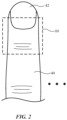
- FIG. 2 is a top view of a user's finger (finger 40) and an illustrative finger-mounted device 10.
- device 10 may be formed from a finger-mounted unit that is mounted on or near the tip of finger 40 (e.g., partly or completely overlapping fingernail 42). If desired, device 10 may be worn elsewhere on a user's fingers.
- a user may wear one or more of devices 10 simultaneously.
- a user may wear a single one of devices 10 on the user's ring finger or index finger.
- a user may wear a first device 10 on the user's thumb, a second device 10 on the user's index finger, and an optional third device 10 on the user's middle finger.
- Arrangements in which devices 10 are worn on other fingers and/or all fingers of one or both hands of a user may also be used.
- Control circuitry 12 may be contained entirely within device 10 (e.g., in a housing for a fingertip-mounted unit) and/or may include circuitry that is coupled to a fingertip structure (e.g., by wires from an associated wrist band, glove, fingerless glove, etc.). Configurations in which devices 10 have bodies that are mounted on individual user fingertips are sometimes described herein as an example.
- FIG. 3 is a cross-sectional side view of an illustrative finger device (finger-mounted device) 10 showing illustrative mounting locations 46 for electrical components (e.g., control circuitry 12, communications circuitry 14, and/or input-output devices 16) within and/or on the surface(s) of finger device housing 44. These components may, if desired, be incorporated into other portions of housing 44.
- electrical components e.g., control circuitry 12, communications circuitry 14, and/or input-output devices 16
- housing 44 may have a U shape (e.g., housing 44 may be a U-shaped housing structure that faces downwardly and covers the tip of user finger 40 and fingernail 42).
- a user may press against structures such as structure 50.
- the bottom of finger 40 e.g., finger pulp 40P
- the user's finger may compress and force portions of the finger outwardly against the sidewall portions of housing 44 (e.g., for sensing by force sensors in these locations).
- Lateral movement of finger 40 in the X-Y plane may also be sensed using force sensors on the sidewalls of housing 44 or other portions of housing 44 (e.g., because lateral movement will tend to press portions of finger 40 against some sensors more than others and/or will create shear forces that are measured by force sensors that are configured to sense shear forces).
- the force sensors and/or other sensors in device 10 can measure how forcefully a user is moving device 10 (and finger 40) against surface 48 (e.g., in a direction parallel to the surface normal n of surface 48 such as the -Z direction of FIG. 3 ) and/or how forcefully a user is moving device 10 (and finger 40) within the X-Y plane, tangential to surface 48.
- the direction of movement of device 10 in the X-Y plane and/or in the Z direction can also be measured by the force sensors and/or other sensors 18 at locations 46.
- Structure 50 may be a portion of a housing of device 24, may be a portion of another device 10 (e.g., another housing 44), may be a portion of a user's finger 40 or other body part, may be a surface of a real-world object such as a table, a movable real-world object such as a bottle or pen, or other inanimate object external to device 10, and/or may be any other structure that the user can contact with finger 40 while moving finger 40 in a desired direction with a desired force.
- another device 10 e.g., another housing 44
- a user's finger 40 or other body part may be a surface of a real-world object such as a table, a movable real-world object such as a bottle or pen, or other inanimate object external to device 10, and/or may be any other structure that the user can contact with finger 40 while moving finger 40 in a desired direction with a desired force.
- device(s) 10 can be used to gather pointing input (e.g., input moving a cursor or other virtual object on a display such as a display in devices 36), can be used to gather tap input, swipe input, pinch-to-zoom input (e.g., when a pair of devices 10 is used), or other gesture input, and/or other user input.
- pointing input e.g., input moving a cursor or other virtual object on a display such as a display in devices 36
- tap-to-zoom input e.g., when a pair of devices 10 is used
- other gesture input e.g., when a pair of devices 10 is used
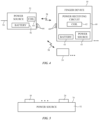
- Device 10 may include a battery such as battery 61 of FIG. 4 . Power can be conveyed to device 10 from an external power source such as power source 52 to power circuitry in device 10 and/or to charge battery 61. If desired, device 10 may also include an internal power source such as internal power source 63. Power source 63 may be an energy harvesting device. With one illustrative configuration, power source 63 is a solar cell. The solar cell may convert ambient light (e.g., sunlight, etc.) into electrical power for powering device 10 (e.g., to power circuitry in device 10 and/or to charge battery 61).
- ambient light e.g., sunlight, etc.
- power source 63 may be an energy harvesting device such as an electromechanical system or piezoelectric component that coverts kinetic energy (e.g., kinetic energy associated with vibrations and/or other movement of device 10 as device 10 is worn on a user's finger) to into electrical power for powering device 10. Energy may also be harvested using a thermoelectric device that converts heat into electrical power, or other energy harvesting devices.
- an energy harvesting device such as an electromechanical system or piezoelectric component that coverts kinetic energy (e.g., kinetic energy associated with vibrations and/or other movement of device 10 as device 10 is worn on a user's finger) to into electrical power for powering device 10.
- Energy may also be harvested using a thermoelectric device that converts heat into electrical power, or other energy harvesting devices.
- External power source 52 may receive wall outlet power (mains alternating-current power) at input 54 and/or may contain a battery such as battery 56 for suppling power source 52 with direct-current power.
- Power can be conveyed from power source 52 (e.g., a base station) to device 10 using contacts 66 (e.g., positive and ground terminals) on power source 52 and matching ohmically-contacted contacts 68 on device 10 (e.g., positive and ground terminals in a power receiving circuit in device 10). If desired, power can be conveyed wirelessly between device 52 and device 10.
- contacts 66 and 68 may be capacitively coupled (without forming ohmic contact) to allow power to be transferred and/or power can be conveyed using a wireless power transmitter with a coil in source 52 to transmit wireless power signals (e.g., electromagnetic signals 58) to a wireless power receiver with a coil in device 10 (and/or devices 24).
- wireless power signals e.g., electromagnetic signals 58
- Inductive power transfer techniques may be used (e.g., wireless power can be transmitted using one or more wireless power transmitting coils in source 52 such as wireless power transmitting coil 64 and transmitted wireless power signals can be received in power receiving circuit 60 using power receiving coil 62).
- Received alternating-current wireless power signals from coil 62 can be converted to direct-current power using a rectifier in power receiving circuit 60 for charging battery 61 and/or for powering circuitry in device 10.
- the power receiving circuit of device 10 may provide the received power to battery 61 and/or other circuitry in device 10.
- Power source 52 may be a stand-alone wired and/or wireless charging device (e.g., a wireless charging puck, a wireless and/or wired charging stand or base station, a wireless charging mat, or other wired and/or wireless power device) and/or may be incorporated into one or more of devices 24 for providing device 10 with power.
- power source 52 has a planar housing or other housing with a planar charging surface so that power source 52 can serve as a wireless charging mat.
- Device(s) 10 and/or device(s) 24 can be wirelessly charged by power source 52 when placed in the vicinity of power source 52 (e.g., on charging mat surface 70).
- Configurations in which wireless power signals can be transmitted and received over larger distances may also be used.
- larger distances e.g., at least 1 cm, at least 10 cm, at least 100 cm, at least 1 m, at least 10 m, less than 20 m, less than 2 m, less than 200 cm, less than 20 cm, less than 5 cm, or other suitable distance.
- FIG. 6 is a cross-sectional side view of finger device 10 and power source 52 in an illustrative configuration in which power source 52 has a protruding portion 52P that is received between sidewalls (side portions) 44W of U-shaped housing 44.
- Contacts 68 on device 10 may mate with contacts 66 of power source 52 when device 10 is placed onto protruding portion (protrusion) 52P and/or wireless power can be transmitted by coil 64 in power source 52 to wireless power receiving circuitry with coil 62 in device 10.
- device 10 may have hinges or other structures that allow device 10 to be place in multiple configurations.
- device 10 may be placed in a first configuration such as a normal operating configuration in which device 10 is configured to be worn on a finger of a user or may be placed in a second configuration (sometimes referred to as a stowed configuration, storage configuration, folded configuration, flattened configuration, or charging configuration) in which device 10 is configured for storage and charging.
- Device 10 may, as an example, have one or more hinges 76 as shown in FIG. 7 . As shown in FIG. 7 , hinges 76 may allow side housing portions such as sidewalls (side portions) 44W to be moved so as to be co-planar with central (top) housing portion 44C. In this charging configuration, device 10 can be placed flat on charging surface 70 of a wireless charging mat or other power source 52 to receive power.
- device 10 and power source 52 may be provided with mating alignment features 72 and 74, respectively.
- Features 72 and 74 may be, for example, mating protrusions and recesses and/or other interlocking alignment structures (e.g., key and keyhole structures that allow device 10 and/or power source 52 to interlock when engaged by twisting or other locking motions), magnets (or ferromagnetic elements such as iron bars), and/or other alignment structures.
- the magnets used in forming features 72 and 74 may be configured so that features 72 and 74 are initially difficult to separate and become easier to separate (and may even spontaneously separate due to magnetic repulsion) once a threshold separation distance has been exceeded. Multiple smaller permanent magnets may be combined in forming features 72 and/or 74 with desired attributes.
- one or both of magnetic alignment features 72 and 74 may be formed using electromagnets.
- a highly coercible (easily magnetized) permanent magnet formed from a magnetic material such as alnico may be used in forming a magnetic alignment feature.
- An associated electromagnet may be energized whenever it is desired to change the permanent magnetic field created by the magnetic alignment feature (e.g. when desired to connect or disconnect features 74 and 72). At other times, the electromagnet need not be energized, because the permanent magnetic field of the highly coercible permanent magnet will hold features 72 and 74 together (or will repel these features from each other).
- device 10 may be held against the interior and/or exterior of device 24 using the magnetic attachment structures.
- device 24 may be a battery case with a groove or other recess that receives device 10. Magnetic attachment structures in device 24 (e.g., near the groove) and in device 10 may corporate (magnetically attached) to help secure device 10 within the interior of the case (e.g., without allowing device 10 to rattle excessively inside the case).
- device 24 may be a head-mounted device (e.g., goggles and/or glasses) or a strap or other wearable device.
- magnetic attachment structures may be held against an exterior surface of device 24 (e.g., against a portion of the housing of a pair of goggles or glasses such as along the frame of a pair of glasses, to the front, top, or side surface of a pair of goggles, etc.).
- device 24 may be a case (e.g., a storage enclosure for device 10, which may sometimes be referred to as a battery case).
- device 24 may include power source 52 (e.g., a power source with a battery) for charging device 10 when device 10 is placed within the case.
- power source 52 e.g., a power source with a battery
- device 24 has a first portion (e.g., a first housing portion) such as portion 24-1 that rotates about rotational (hinge) axis 80 relative to a second portion (e.g., a second housing portion) such as portion 24-2.
- Flexible housing portions e.g., portions of a plastic layer
- interlocking metal hinge members, and/or other hinge structures along axis 80 may be provided to allow the first and second portions to rotate.
- Recesses 82 e.g., device-shaped grooves or other structures
- a magnet such as magnet 84 may interact with a corresponding magnetic base such as base 86 (e.g., a stand-alone support structure, a portion of a charging mat with a power source.
- magnetic structures e.g., one or more permanent magnets
- a battery case may help hold device 10 (e.g., so that a user may place device 10 loosely in a recess 82, after which the magnets or other magnetic structures in the case and/or device 10 may pull device 10 completely into recess 82).
- Magnetic structures (e.g., a permanent magnet) in the case may also be used to temporarily secure device 10 to the outer surface of the case.
- FIG. 9 is a top view of an illustrative storage case that is configured to receive multiple devices 10.
- Device 24 of FIG. 9 e.g., a battery case
- Recesses 82 and/or other device structures may be configured to receive three devices 10 (or other suitable number of devices 10) in interior 24I.
- Recesses 82 may be sufficiently shallow to allow the ends of each device 10 to protrude outwardly towards a user's fingertips.
- a user can insert the tips of a thumb, index finger, and middle finger simultaneously into the exposed ends of three corresponding devices 10 in device 24 so that these three devices 10 can be easily placed onto the user's fingertips and removed from interior 24I in a one-handed operation.
- FIG. 10 is a perspective view of device 24 in an illustrative configuration in which device 24 is a head-mounted device such as a pair of glasses.
- Device 24 may, as an example, have displays, lenses, and/or other components for displaying images for a user in a support structure such as lens portion 84 of the housing of device 24 and may have head-mountable support structures 86 in the housing of device 24 that help support device 24 on the head of the user.
- Head-mountable support structures 86 may be, for example, temples (sometimes referred to as a frame) for a pair of glasses.
- Device 24 may be a virtual reality device (and may block a user's direct line-of-sight to real-world objects) or may be a mixed reality device.
- a front-facing camera may gather images of real-world content to display for a user and/or a user may view the real-world through an optical coupler in lens portion 84 (e.g., an optical coupler that merges computer-generated content and other display content from a display in device 24 with directly viewed light from real-world objects).
- support structures 86 e.g., a glasses frame
- devices 10 e.g., devices 10 may be temporarily placed on support structures 86 for storage and charging.
- Magnets, press-fit structures, clips, hook-and-loop fastener material, straps, and/or other coupling structures may be used to help hold devices 10 in place (e.g., temporarily).
- a power source in device 24 such as power source 52 may supply power to devices 10 (e.g., via direct contact, capacitive coupling, inductive power transfer, etc.).
- magnetic structures may be used.
- permanent magnets or other magnetic structures may be formed in the frame of a pair of glasses, in the housing of a pair of goggles, or elsewhere in the body of device 24.
- the magnetic field produced by the permanent magnet(s) may be sufficiently strong to pass through the housing of device 24 and attract a magnetic material and/or permanent magnet in device 10.
- device 10 may be secured to the frame of the glasses or other housing structure (e.g., device 10 may be held against the outer surface of one or more portions of support structures 86).
- device 10 can be pulled off of device 24 and reattached to device 24 rapidly and without need for complex alignment operations.
- a user of a head-mounted display who may be distracted and/or may not be able to view the real world because of the presence of the head-mounted display, may easily place device 10 on a magnetic surface of the head-mounted display (e.g., without looking at this surface).
- both mechanical engagement techniques press fitting, clips, etc.
- magnetic attachment techniques may be used to help secure device 10.
- magnets may be used for removable (temporary) storage, whereas press fit housing structures and other mechanical attachment structures may be used when longer storage of device 10 on device 24 is desired.
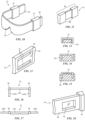
- FIG. 11 shows how housing structures in device 24 such as support structures 86 may have one or more recesses 88 that are configured to receive devices 10.
- Devices 10 may, for example, be pressed into recesses 88 so that the sides of devices 10 clip over the portion of support structures 86 in recesses 88.
- the presence of recesses 88 may allow devices 10 to be mounted so that some or all of the exposed surfaces of devices 10 are flush with adjacent exposed surfaces of support structures 86 (as an example).
- FIG. 12 Another illustrative configuration for a finger device storage recess in device 24 is shown in FIG. 12 .
- housing structures in device 24 such as support structures 86 or other portions of the housing of device 24 may have a recess such as recess 90 that includes groves 92 (e.g., locally deepened portions of recess 90) to receive the sides of the housing of device 10.
- FIGS. 13, 14, and 15 are cross-sectional side views of device 24 in illustrative configurations in which housing structures such as support structure 86 or other housing structures for device 24 have configurations that allow device 10 to clip over the outside of support structures 86 ( FIG. 13 ), to be received within recesses that accommodate both the sides and top portion of device 10 (e.g., so that the exposed upper surface of device 10 lies flush with the exposed adjacent surface of support structures 86 as shown in FIG. 14 ), or to be received within recesses so that the top of housing of device 10 is proud of the exposed adjacent surface of support structures 86 ( FIG. 15 ).
- housing structures such as support structure 86 or other housing structures for device 24 have configurations that allow device 10 to clip over the outside of support structures 86 ( FIG. 13 ), to be received within recesses that accommodate both the sides and top portion of device 10 (e.g., so that the exposed upper surface of device 10 lies flush with the exposed adjacent surface of support structures 86 as shown in FIG. 14 ), or to be received within recesses
- hinges 98 allow housing sidewalls 44W to be rotated or otherwise moved relative to top (central) housing portion 44C.
- Device 10 of FIG. 16 has a normal operating configuration.
- sidewalls 44W have been rotated relative to central portion 44C (to be planar or to fold under portion 44C as indicated by the dashed-line outlines of portions 44W of FIG. 17 ), thereby placing device 10 in a storage (charging) configuration.
- FIG. 18 shows how device 24 may have a recess such as recess 94 in a device housing structure such as support structures 86.
- Support structures 86 may be coupled to other housing structures in device 24 such as structures 96 (e.g., support structures 86 may form a strap or other holding structure and structures 96 may form a main housing unit for a wristwatch, head-mounted device, or other device (as an example).
- Recess 94 may be configured to receive device 10 when device 10 is in a flattened state or other configuration for storage and charging (e.g., one of the storage configurations of FIG. 17 ).
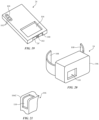
- FIG. 19 is a perspective view of device 24 in an illustrative configuration in which device 24 is serving as a battery case for another electronic device (electronic device 24').
- Device 24 may have a housing formed from fabric, polymer, metal, glass, and/or other materials and may have openings such as openings 100. Openings 100 may be configured to allow device components 102 (e.g., cameras, sensors, data ports, etc.) of device 24' to be exposed and not covered by device 24.
- the rear face of device 24 is shown in FIG. 19 .
- device 24 On the opposing front face of device 24, device 24 has a recess configured to receive device 24'.
- FIG. 19 On the rear face of device 24 that is shown in FIG.
- the housing for device 24 has recess 104, which is configured to receive device 10 for charging and/or storage (e.g., when device 10 is in a flattened configuration or other configuration suitable for storage and charging).
- Power for device 10 can be provided by a power source 52 in device 24 and/or a power source 52 in device 24'.
- device 24 is a head-mounted device (e.g., a pair of virtual reality goggles).
- Housing portion 106 of device 24 of FIG. 20 forms a goggles housing that is configured to be worn on a head of a user.
- the goggles housing (housing portion 106) supports an internal display and optical components for displaying images (e.g., virtual reality content) to the user while blocking and thereby preventing light from external real-world objects from being viewed by the user.
- camera images from a camera on housing portion 106 can be merged with computer-generated content to provide the user with a mixed reality environment.
- Straps 108 or other head-mountable support structures such as portions of housing portion 106 may be configured to support device 24 (e.g., the goggles housing) on the user's head.
- Device 10 may be mounted in recess 110 of housing portion 106 (e.g., when device 10 is in a configuration for charging and storage).
- Power source 52 in device 24 can supply power to device 10 when device 10 is stored in recess 110.
- FIG. 21 shows how recess 110 may be formed over one or more corner portions of housing portion 106 such as corner portion 106C.
- hinges 98 or other flexible structures in device 10 may allow portions of device 10 to rotate relative to each other so that device 10 fits within recess 110.
- power can be conveyed via wired or wireless connections between a power source 52 in device 24 and power receiving circuitry 60 of device 10.
- device 10 and device 24 can communicate wirelessly over communications link 38 (e.g., a bidirectional wireless communications link or a wired communications link).
- communications link 38 e.g., a bidirectional wireless communications link or a wired communications link.
- in-band wireless communications can be performed over a wireless charging link (e.g., bidirectional wireless communications can be performed between device 10 and device 24 using coils 62 and 64 during charging operations).
- a user may move finger device(s) 10.
- Motion data from devices 10 e.g., motions tracked using inertial measurement units and/or other tracking systems such as visual tracking systems
- proximity and/or touch data from sensors in device 10 is gathered and used in providing haptic output and other output using devices 20 and/or other devices 22 in devices 10 and/or is used in providing haptic output and other output using devices 34 and/or other devices 36 in devices 24.
- the input gathered from devices 10 can be used to allow a user to interact with computer-generated content displayed on displays in devices 36 (e.g., virtual reality content on the display of a pair of virtual reality goggles, computer-generated content for a mixed reality environment that is displayed with a display in a mixed-reality head-mounted device, etc.) and can be gathered as a user interacts with real-world objects.
- Haptic device output from devices 20 and/or 34 can be used to provide the fingers of the user with textures, motion sensations, sensations of resistance and vibration, and/or other tactile sensations as the user interacts with computer-generated content and real-world content.
- Devices 10 and/or 24 can also provide non-haptic output in response to the input gathered using devices 10 and/or the input components of input-output devices 30.
Landscapes
- Engineering & Computer Science (AREA)
- General Engineering & Computer Science (AREA)
- Theoretical Computer Science (AREA)
- Physics & Mathematics (AREA)
- General Physics & Mathematics (AREA)
- Human Computer Interaction (AREA)
- Power Engineering (AREA)
- Computer Networks & Wireless Communication (AREA)
- Computer Hardware Design (AREA)
- Optics & Photonics (AREA)
- User Interface Of Digital Computer (AREA)
- Telephone Set Structure (AREA)
Claims (13)
- Fingergetragene Vorrichtung (10), die so konfiguriert ist, dass sie an einem Finger (40) eines Benutzers getragen werden kann und so konfiguriert ist, dass sie eine kopfgetragene Vorrichtung (24) steuert, umfassend:ein Gehäuse (44), das so konfiguriert ist, dass es über eine Spitze des Fingers (40) gelegt werden kann;Kraftsensoren (18, 46), die mit Seitenwänden des Gehäuses (44) gekoppelt sind und Kräfte messen, die durch den Finger (40) auf das Gehäuse (44) ausgeübt werden, wenn der Benutzer den Finger (40) gegen eine Oberfläche (48) drückt, wobei das Gehäuse (44) über der Spitze des Fingers (40) angeordnet ist, und wobei die Kraftsensoren (18, 46) so konfiguriert sind, dass sie eine seitliche Bewegung des Fingers (40) in der X-Y-Ebene erfassen, während der Benutzer den Finger (40) gegen die Oberfläche (48) drückt;eine haptische Ausgabevorrichtung (20);eine Steuerschaltungsanordnung (12), die so konfiguriert ist, dass sie Eingaben von den Kraftsensoren (18) erfasst, wenn sich der Finger (40) bewegt, und so konfiguriert ist, dass sie unter Verwendung der haptischen Ausgabevorrichtung (20) eine haptische Ausgabe an den Finger (40) liefert; undeine Stromempfangsschaltung (60), die so konfiguriert ist, dass sie Strom von einer externen Stromquelle (52) in der kopfgetragenen Vorrichtung (24) empfängt, wobei die Stromempfangsschaltung (60) eine Spule (62) beinhaltet, die so konfiguriert ist, dass sie drahtlose Stromsignale empfängt, die von der externen Stromquelle (52) übertragen werden, während die fingergetragene Vorrichtung (10) vorübergehend mit der am Kopf getragenen Vorrichtung (24) verbunden ist; undeine Batterie (61), die so konfiguriert ist, dass sie mit der empfangenen Energie aufgeladen wird.
- Fingergetragene Vorrichtung (10) nach Anspruch 1, wobei das Gehäuse (44) ein U-förmiges Gehäuse umfasst.
- Fingergetragene Vorrichtung (10) nach Anspruch 1, wobei die fingergetragene Vorrichtung (10) einen Magneten beinhaltet, der so konfiguriert ist, dass er das Gehäuse (44) in Bezug auf die externe Stromquelle (52) ausrichtet.
- Fingergetragene Vorrichtung (10) nach Anspruch 1, wobei das Gehäuse (44) Scharniere aufweist, die so konfiguriert sind, dass Teile des Gehäuses (44) relativ zueinander gedreht werden können, wobei die Teile des Gehäuses (44) zwischen einer ersten Konfiguration, in der das Gehäuse (44) so konfiguriert ist, dass es mit dem Finger (40) gekoppelt ist, und einer zweiten Konfiguration, in der das Gehäuse (44) so konfiguriert ist, dass es mit der externen Stromquelle (52) gekoppelt ist, beweglich sind.
- Kopfgetragene Vorrichtung (24), die so konfiguriert ist, dass sie von der fingergetragenen Vorrichtung (10) nach Anspruch 1 gesteuert werden kann, wobei die kopfgetragene Vorrichtung (24) Folgendes umfasst:eine Anzeige;eine kopftragbare Stützstruktur (86), die so konfiguriert ist, dass sie die Anzeige stützt und so konfiguriert ist, dass sie fingergetragene Vorrichtung (10) vorübergehend aufnimmt; undeine Stromquelle (52), die so konfiguriert ist, dass sie die fingergetragene Vorrichtung (10) mit Strom versorgt, während die fingergetragene Vorrichtung (10) von der kopftragbaren Stützstruktur (86) aufgenommen wird.
- Kopfgetragene Vorrichtung (24) nach Anspruch 5, wobei die fingergetragene Vorrichtung (10) ein U-förmiges Gehäuse (44) aufweist und wobei die kopftragbare Stützstruktur (86) so konfiguriert ist, dass sie das U-förmige Gehäuse (44) aufnimmt.
- Kopfgetragene Vorrichtung (24) nach Anspruch 6, wobei die kopftragbare Stützstruktur (86) eine Aussparung aufweist, die zur Aufnahme von Seitenwandabschnitten des U-förmigen Gehäuses (44) konfiguriert ist.
- Kopfgetragene Vorrichtung (24) nach Anspruch 5, wobei die fingergetragene Vorrichtung (10) Scharniere aufweist, die so konfiguriert sind, dass die fingergetragene Vorrichtung (10) in eine gefaltete Konfiguration gebracht werden kann, und wobei die kopftragbare Stützstruktur (86) eine Aussparung (82) aufweist, die so konfiguriert ist, dass sie die fingergetragene Vorrichtung (10) in der gefalteten Konfiguration aufnimmt.
- Kopfgetragene Vorrichtung (24) nach Anspruch 8, wobei die Energiequelle (52) so konfiguriert ist, dass sie drahtlos Energie an die fingergetragene Vorrichtung (10) überträgt, wenn die fingergetragene Vorrichtung (10) in der Aussparung (82) aufgenommen ist.
- Kopfgetragene Vorrichtung (24) nach Anspruch 5, wobei die kopftragbare Stützstruktur (86) eine Aussparung (82) aufweist, die zur Aufnahme der fingergetragenen Vorrichtung (10) konfiguriert ist.
- Kopfgetragene Vorrichtung (24) nach Anspruch 10, wobei die kopftragbare Stützstruktur (86) ein Brillengehäuse umfasst, das die Aussparung (82) beinhaltet.
- Kopfgetragene Vorrichtung (24), die in Anspruch 11 definiert ist, wobei das Brillengehäuse (106) so konfiguriert ist, dass es auf dem Kopf eines Benutzers getragen wird, wobei die Anzeige in dem Brillengehäuse (106) montiert ist, und wobei das Brillengehäuse (106) verhindert, dass Licht von externen Objekten der realen Welt vom Benutzer gesehen wird, wenn das Brillengehäuse (106) auf dem Kopf getragen wird und die Anzeige vom Benutzer gesehen wird.
- Kopfgetragene Vorrichtung (24) nach Anspruch 10, wobei die kopftragbare Stützstruktur (86) ein Brillengestell umfasst, das die Aussparung (82) beinhaltet.
Applications Claiming Priority (3)
| Application Number | Priority Date | Filing Date | Title |
|---|---|---|---|
| US201862653157P | 2018-04-05 | 2018-04-05 | |
| US16/127,603 US10795438B2 (en) | 2018-04-05 | 2018-09-11 | Electronic finger devices with charging and storage systems |
| PCT/US2018/051216 WO2019194859A1 (en) | 2018-04-05 | 2018-09-14 | Electronic finger devices with charging and storage systems |
Publications (2)
| Publication Number | Publication Date |
|---|---|
| EP3776144A1 EP3776144A1 (de) | 2021-02-17 |
| EP3776144B1 true EP3776144B1 (de) | 2023-08-16 |
Family
ID=68097177
Family Applications (1)
| Application Number | Title | Priority Date | Filing Date |
|---|---|---|---|
| EP18786088.7A Active EP3776144B1 (de) | 2018-04-05 | 2018-09-14 | Elektronische fingervorrichtungen mit lade- und speichersystemen |
Country Status (4)
| Country | Link |
|---|---|
| US (2) | US10795438B2 (de) |
| EP (1) | EP3776144B1 (de) |
| CN (1) | CN111936953B (de) |
| WO (1) | WO2019194859A1 (de) |
Families Citing this family (17)
| Publication number | Priority date | Publication date | Assignee | Title |
|---|---|---|---|---|
| US10156029B1 (en) | 2017-06-14 | 2018-12-18 | Apple Inc. | Fabric control device |
| EP3710913A1 (de) * | 2017-11-13 | 2020-09-23 | Telefonaktiebolaget LM Ericsson (PUBL) | Eingabevorrichtung für eine rechenvorrichtung |
| WO2019123880A1 (ja) * | 2017-12-19 | 2019-06-27 | 日本ゼオン株式会社 | 電力配線装置 |
| US10579099B2 (en) * | 2018-04-30 | 2020-03-03 | Apple Inc. | Expandable ring device |
| US11262797B1 (en) * | 2019-01-16 | 2022-03-01 | Apple Inc. | Computer systems with wearable force sensing devices |
| US10948976B1 (en) | 2019-02-06 | 2021-03-16 | Facebook Technologies, Llc | Systems and methods for electric discharge-based sensing via wearables donned by users of artificial reality systems |
| US11670962B2 (en) * | 2019-04-09 | 2023-06-06 | Apple Inc. | Electronic device with coil for wireless charging and haptic outputs |
| US12314471B2 (en) * | 2019-09-13 | 2025-05-27 | Apple Inc. | Head-mounted display with haptic output |
| US11755107B1 (en) * | 2019-09-23 | 2023-09-12 | Apple Inc. | Finger devices with proximity sensors |
| US20210399578A1 (en) * | 2020-06-17 | 2021-12-23 | Sonos, Inc. | Wireless charger for playback devices |
| US11287886B1 (en) * | 2020-09-15 | 2022-03-29 | Apple Inc. | Systems for calibrating finger devices |
| US11211963B1 (en) * | 2020-10-15 | 2021-12-28 | Peak Design | Mobile device case system |
| US11722166B2 (en) * | 2020-10-15 | 2023-08-08 | Peak Design | Mobile device case system |
| US11797130B2 (en) * | 2021-03-16 | 2023-10-24 | Htc Corporation | Finger touch detecting method based on finger distribution area detected on touch detection area and handheld device |
| US12404612B2 (en) | 2021-08-30 | 2025-09-02 | Apple Inc. | Fabric with electrical components |
| KR102772075B1 (ko) * | 2022-07-07 | 2025-02-25 | 주식회사 피앤씨솔루션 | 압전 소자를 활용한 에너지 하베스팅이 가능한 증강현실 글래스 장치 |
| US12259560B2 (en) | 2022-08-23 | 2025-03-25 | Apple Inc. | Handheld controllers with charging and storage systems |
Citations (3)
| Publication number | Priority date | Publication date | Assignee | Title |
|---|---|---|---|---|
| US20150198811A1 (en) * | 2008-09-30 | 2015-07-16 | Apple Inc. | Head-Mounted Display Apparatus for Retaining a Portable Electronic Device with Display |
| US20150234189A1 (en) * | 2014-02-18 | 2015-08-20 | Merge Labs, Inc. | Soft head mounted display goggles for use with mobile computing devices |
| US20150263565A1 (en) * | 2014-03-14 | 2015-09-17 | Lenovo (Singapore) Pte. Ltd. | Wireless charging system with auto-positioning |
Family Cites Families (47)
| Publication number | Priority date | Publication date | Assignee | Title |
|---|---|---|---|---|
| US5631861A (en) | 1990-02-02 | 1997-05-20 | Virtual Technologies, Inc. | Force feedback and texture simulating interface device |
| US5581484A (en) | 1994-06-27 | 1996-12-03 | Prince; Kevin R. | Finger mounted computer input device |
| JP2000501033A (ja) | 1995-11-30 | 2000-02-02 | ヴァーチャル テクノロジーズ インコーポレイテッド | 触覚をフィードバックする人間/機械インターフェース |
| US6388247B2 (en) | 1998-02-20 | 2002-05-14 | Massachusetts Institute Of Technology | Fingernail sensors for measuring finger forces and finger posture |
| JP2001104256A (ja) | 1999-10-04 | 2001-04-17 | Toriumu Kk | 指先接触圧センサー |
| US20030214481A1 (en) | 2002-05-14 | 2003-11-20 | Yongming Xiong | Finger worn and operated input device and method of use |
| US7042438B2 (en) | 2003-09-06 | 2006-05-09 | Mcrae Michael William | Hand manipulated data apparatus for computers and video games |
| KR100682901B1 (ko) | 2004-11-17 | 2007-02-15 | 삼성전자주식회사 | 화상표시장치에서 전기활성폴리머를 사용하여 영상정보의핑거팁 햅틱을 제공하는 장치 및 방법 |
| ITPI20040084A1 (it) | 2004-11-18 | 2005-02-18 | Massimo Bergamasco | Interfaccia aptica portabile |
| US20090278798A1 (en) | 2006-07-26 | 2009-11-12 | The Research Foundation Of The State University Of New York | Active Fingertip-Mounted Object Digitizer |
| JP5108485B2 (ja) | 2006-12-12 | 2012-12-26 | トヨタ自動車株式会社 | 触覚に作用する方法およびそれを実現する触覚デバイス、屈曲可変機構 |
| US20110210931A1 (en) * | 2007-08-19 | 2011-09-01 | Ringbow Ltd. | Finger-worn device and interaction methods and communication methods |
| US8031172B2 (en) | 2007-10-12 | 2011-10-04 | Immersion Corporation | Method and apparatus for wearable remote interface device |
| US20090267892A1 (en) * | 2008-04-24 | 2009-10-29 | Research In Motion Limited | System and method for generating energy from activation of an input device in an electronic device |
| US8032730B2 (en) | 2008-05-15 | 2011-10-04 | Hitachi, Ltd. | Method and apparatus for I/O priority control in storage systems |
| US8610548B1 (en) | 2009-02-03 | 2013-12-17 | University Of Utah Research Foundation | Compact shear tactile feedback device and related methods |
| US20130135223A1 (en) * | 2009-12-13 | 2013-05-30 | Ringbow Ltd. | Finger-worn input devices and methods of use |
| US20110213664A1 (en) | 2010-02-28 | 2011-09-01 | Osterhout Group, Inc. | Local advertising content on an interactive head-mounted eyepiece |
| US9110505B2 (en) | 2010-04-16 | 2015-08-18 | Innovative Devices Inc. | Wearable motion sensing computing interface |
| FR2962566B1 (fr) | 2010-07-06 | 2013-05-17 | Commissariat Energie Atomique | Systeme de simulation d'un contact avec une surface par stimulation tactile |
| US8724861B1 (en) | 2010-12-06 | 2014-05-13 | University Of South Florida | Fingertip force, location, and orientation sensor |
| US9104271B1 (en) | 2011-06-03 | 2015-08-11 | Richard Adams | Gloved human-machine interface |
| JP5472539B2 (ja) | 2011-06-22 | 2014-04-16 | 株式会社村田製作所 | 指刺激呈示装置 |
| US8941560B2 (en) * | 2011-09-21 | 2015-01-27 | Google Inc. | Wearable computer with superimposed controls and instructions for external device |
| US9554484B2 (en) | 2012-03-30 | 2017-01-24 | The Board Of Trustees Of The University Of Illinois | Appendage mountable electronic devices conformable to surfaces |
| US9317123B2 (en) | 2012-06-13 | 2016-04-19 | University Of Utah Research Foundation | Skin stretch feedback devices, systems, and methods |
| US9891718B2 (en) | 2015-04-22 | 2018-02-13 | Medibotics Llc | Devices for measuring finger motion and recognizing hand gestures |
| US20140101755A1 (en) * | 2012-10-10 | 2014-04-10 | Research In Motion Limited | Mobile wireless communications device providing security features based upon wearable near field communication (nfc) device and related methods |
| US8994827B2 (en) | 2012-11-20 | 2015-03-31 | Samsung Electronics Co., Ltd | Wearable electronic device |
| JP6251957B2 (ja) | 2013-01-23 | 2017-12-27 | セイコーエプソン株式会社 | 表示装置、頭部装着型表示装置および表示装置の制御方法 |
| CN105473021B (zh) * | 2013-03-15 | 2018-01-19 | 智能专利有限责任公司 | 可穿戴设备及相关系统 |
| US9318915B2 (en) * | 2013-03-20 | 2016-04-19 | Halo2Cloud Llc | Portable power charger with wireless and direct charging connectivity |
| US9696802B2 (en) * | 2013-03-20 | 2017-07-04 | Microsoft Technology Licensing, Llc | Short range wireless powered ring for user interaction and sensing |
| US10585478B2 (en) * | 2013-09-13 | 2020-03-10 | Nod, Inc. | Methods and systems for integrating one or more gestural controllers into a head mounted wearable display or other wearable devices |
| EP3074838A4 (de) | 2013-11-29 | 2017-08-02 | Motiv Inc. | Tragbare berechnungsvorrichtung |
| CN103853332B (zh) * | 2014-03-20 | 2016-08-31 | 东南大学 | 一种用于移动终端的指套式力触觉交互装置及交互方法 |
| KR101933289B1 (ko) | 2014-04-01 | 2018-12-27 | 애플 인크. | 링 컴퓨팅 디바이스를 위한 디바이스 및 방법 |
| JP2015219887A (ja) | 2014-05-21 | 2015-12-07 | 日本メクトロン株式会社 | 電気触覚提示装置 |
| KR20160015050A (ko) | 2014-07-30 | 2016-02-12 | 엘지전자 주식회사 | 반지형 이동 단말기 |
| US10404089B2 (en) * | 2014-09-29 | 2019-09-03 | Apple Inc. | Inductive charging between electronic devices |
| JP6524661B2 (ja) | 2014-12-19 | 2019-06-05 | 富士通株式会社 | 入力支援方法、入力支援プログラムおよび入力支援装置 |
| US10001836B2 (en) * | 2016-06-18 | 2018-06-19 | Xiong Huang | Finger mounted computer input device and method for making the same |
| US10042438B2 (en) | 2015-06-30 | 2018-08-07 | Sharp Laboratories Of America, Inc. | Systems and methods for text entry |
| CN204888968U (zh) * | 2015-07-29 | 2015-12-23 | 颜柯武 | 一种智能戒指以及首饰盒 |
| US20170045948A1 (en) | 2015-08-12 | 2017-02-16 | Fin Robotics, Inc. | Controlling target devices |
| KR20170062876A (ko) * | 2015-11-30 | 2017-06-08 | 삼성전자주식회사 | 헤드 마운트 장치 및 이에 탈부착 가능한 장치 |
| DE102016111634B4 (de) | 2016-06-24 | 2019-04-25 | Deutsches Zentrum für Luft- und Raumfahrt e.V. | Vorrichtung und Verfahren zum Erzeugen eines taktilen Reizes |
-
2018
- 2018-09-11 US US16/127,603 patent/US10795438B2/en active Active
- 2018-09-14 WO PCT/US2018/051216 patent/WO2019194859A1/en not_active Ceased
- 2018-09-14 EP EP18786088.7A patent/EP3776144B1/de active Active
- 2018-09-14 CN CN201880091995.3A patent/CN111936953B/zh active Active
-
2020
- 2020-10-05 US US17/063,560 patent/US11720174B2/en active Active
Patent Citations (3)
| Publication number | Priority date | Publication date | Assignee | Title |
|---|---|---|---|---|
| US20150198811A1 (en) * | 2008-09-30 | 2015-07-16 | Apple Inc. | Head-Mounted Display Apparatus for Retaining a Portable Electronic Device with Display |
| US20150234189A1 (en) * | 2014-02-18 | 2015-08-20 | Merge Labs, Inc. | Soft head mounted display goggles for use with mobile computing devices |
| US20150263565A1 (en) * | 2014-03-14 | 2015-09-17 | Lenovo (Singapore) Pte. Ltd. | Wireless charging system with auto-positioning |
Also Published As
| Publication number | Publication date |
|---|---|
| US10795438B2 (en) | 2020-10-06 |
| US20210018981A1 (en) | 2021-01-21 |
| CN111936953B (zh) | 2023-07-07 |
| US20190310706A1 (en) | 2019-10-10 |
| CN111936953A (zh) | 2020-11-13 |
| EP3776144A1 (de) | 2021-02-17 |
| WO2019194859A1 (en) | 2019-10-10 |
| US11720174B2 (en) | 2023-08-08 |
Similar Documents
| Publication | Publication Date | Title |
|---|---|---|
| US11720174B2 (en) | Electronic finger devices with charging and storage systems | |
| EP3797344B1 (de) | Rechnersysteme mit fingervorrichtungen | |
| US11526133B2 (en) | Electronic devices and systems | |
| CN105429662B (zh) | 戒指型移动终端 | |
| CN112540669A (zh) | 手指安装的输入设备 | |
| US20230004231A1 (en) | Sensors for Electronic Finger Devices | |
| US11360587B1 (en) | Deployment systems for computer system finger devices | |
| US20240061520A1 (en) | Handheld Input Devices with Sleeves | |
| US12399561B2 (en) | Ring device | |
| KR20210108886A (ko) | 무선 전력 시스템 | |
| US10871837B2 (en) | Wearable electronic devices having a rotatable input structure | |
| US12259560B2 (en) | Handheld controllers with charging and storage systems | |
| CN205485058U (zh) | 项链穿戴式智能眼镜 | |
| US20250044880A1 (en) | Handheld Input Devices | |
| Headon et al. | Supporting gestural input for users on the move | |
| CN219609597U (zh) | 穿戴式遥控设备 | |
| WO2022203697A1 (en) | Split architecture for a wristband system and related devices and methods | |
| KR101851633B1 (ko) | 와치 타입 단말기 | |
| CN119563150A (zh) | 具有手持式控制器的计算机系统 | |
| CN118502580A (zh) | 环设备 |
Legal Events
| Date | Code | Title | Description |
|---|---|---|---|
| STAA | Information on the status of an ep patent application or granted ep patent |
Free format text: STATUS: UNKNOWN |
|
| STAA | Information on the status of an ep patent application or granted ep patent |
Free format text: STATUS: THE INTERNATIONAL PUBLICATION HAS BEEN MADE |
|
| PUAI | Public reference made under article 153(3) epc to a published international application that has entered the european phase |
Free format text: ORIGINAL CODE: 0009012 |
|
| STAA | Information on the status of an ep patent application or granted ep patent |
Free format text: STATUS: REQUEST FOR EXAMINATION WAS MADE |
|
| 17P | Request for examination filed |
Effective date: 20200918 |
|
| AK | Designated contracting states |
Kind code of ref document: A1 Designated state(s): AL AT BE BG CH CY CZ DE DK EE ES FI FR GB GR HR HU IE IS IT LI LT LU LV MC MK MT NL NO PL PT RO RS SE SI SK SM TR |
|
| AX | Request for extension of the european patent |
Extension state: BA ME |
|
| DAV | Request for validation of the european patent (deleted) | ||
| DAX | Request for extension of the european patent (deleted) | ||
| STAA | Information on the status of an ep patent application or granted ep patent |
Free format text: STATUS: EXAMINATION IS IN PROGRESS |
|
| 17Q | First examination report despatched |
Effective date: 20211014 |
|
| GRAP | Despatch of communication of intention to grant a patent |
Free format text: ORIGINAL CODE: EPIDOSNIGR1 |
|
| STAA | Information on the status of an ep patent application or granted ep patent |
Free format text: STATUS: GRANT OF PATENT IS INTENDED |
|
| INTG | Intention to grant announced |
Effective date: 20230303 |
|
| GRAS | Grant fee paid |
Free format text: ORIGINAL CODE: EPIDOSNIGR3 |
|
| GRAA | (expected) grant |
Free format text: ORIGINAL CODE: 0009210 |
|
| STAA | Information on the status of an ep patent application or granted ep patent |
Free format text: STATUS: THE PATENT HAS BEEN GRANTED |
|
| AK | Designated contracting states |
Kind code of ref document: B1 Designated state(s): AL AT BE BG CH CY CZ DE DK EE ES FI FR GB GR HR HU IE IS IT LI LT LU LV MC MK MT NL NO PL PT RO RS SE SI SK SM TR |
|
| REG | Reference to a national code |
Ref country code: CH Ref legal event code: EP |
|
| REG | Reference to a national code |
Ref country code: DE Ref legal event code: R096 Ref document number: 602018055530 Country of ref document: DE |
|
| REG | Reference to a national code |
Ref country code: IE Ref legal event code: FG4D |
|
| REG | Reference to a national code |
Ref country code: LT Ref legal event code: MG9D |
|
| REG | Reference to a national code |
Ref country code: NL Ref legal event code: MP Effective date: 20230816 |
|
| REG | Reference to a national code |
Ref country code: AT Ref legal event code: MK05 Ref document number: 1600693 Country of ref document: AT Kind code of ref document: T Effective date: 20230816 |
|
| PG25 | Lapsed in a contracting state [announced via postgrant information from national office to epo] |
Ref country code: GR Free format text: LAPSE BECAUSE OF FAILURE TO SUBMIT A TRANSLATION OF THE DESCRIPTION OR TO PAY THE FEE WITHIN THE PRESCRIBED TIME-LIMIT Effective date: 20231117 |
|
| PG25 | Lapsed in a contracting state [announced via postgrant information from national office to epo] |
Ref country code: IS Free format text: LAPSE BECAUSE OF FAILURE TO SUBMIT A TRANSLATION OF THE DESCRIPTION OR TO PAY THE FEE WITHIN THE PRESCRIBED TIME-LIMIT Effective date: 20231216 |
|
| PG25 | Lapsed in a contracting state [announced via postgrant information from national office to epo] |
Ref country code: SE Free format text: LAPSE BECAUSE OF FAILURE TO SUBMIT A TRANSLATION OF THE DESCRIPTION OR TO PAY THE FEE WITHIN THE PRESCRIBED TIME-LIMIT Effective date: 20230816 Ref country code: RS Free format text: LAPSE BECAUSE OF FAILURE TO SUBMIT A TRANSLATION OF THE DESCRIPTION OR TO PAY THE FEE WITHIN THE PRESCRIBED TIME-LIMIT Effective date: 20230816 Ref country code: PT Free format text: LAPSE BECAUSE OF FAILURE TO SUBMIT A TRANSLATION OF THE DESCRIPTION OR TO PAY THE FEE WITHIN THE PRESCRIBED TIME-LIMIT Effective date: 20231218 Ref country code: NO Free format text: LAPSE BECAUSE OF FAILURE TO SUBMIT A TRANSLATION OF THE DESCRIPTION OR TO PAY THE FEE WITHIN THE PRESCRIBED TIME-LIMIT Effective date: 20231116 Ref country code: NL Free format text: LAPSE BECAUSE OF FAILURE TO SUBMIT A TRANSLATION OF THE DESCRIPTION OR TO PAY THE FEE WITHIN THE PRESCRIBED TIME-LIMIT Effective date: 20230816 Ref country code: LV Free format text: LAPSE BECAUSE OF FAILURE TO SUBMIT A TRANSLATION OF THE DESCRIPTION OR TO PAY THE FEE WITHIN THE PRESCRIBED TIME-LIMIT Effective date: 20230816 Ref country code: LT Free format text: LAPSE BECAUSE OF FAILURE TO SUBMIT A TRANSLATION OF THE DESCRIPTION OR TO PAY THE FEE WITHIN THE PRESCRIBED TIME-LIMIT Effective date: 20230816 Ref country code: IS Free format text: LAPSE BECAUSE OF FAILURE TO SUBMIT A TRANSLATION OF THE DESCRIPTION OR TO PAY THE FEE WITHIN THE PRESCRIBED TIME-LIMIT Effective date: 20231216 Ref country code: HR Free format text: LAPSE BECAUSE OF FAILURE TO SUBMIT A TRANSLATION OF THE DESCRIPTION OR TO PAY THE FEE WITHIN THE PRESCRIBED TIME-LIMIT Effective date: 20230816 Ref country code: GR Free format text: LAPSE BECAUSE OF FAILURE TO SUBMIT A TRANSLATION OF THE DESCRIPTION OR TO PAY THE FEE WITHIN THE PRESCRIBED TIME-LIMIT Effective date: 20231117 Ref country code: FI Free format text: LAPSE BECAUSE OF FAILURE TO SUBMIT A TRANSLATION OF THE DESCRIPTION OR TO PAY THE FEE WITHIN THE PRESCRIBED TIME-LIMIT Effective date: 20230816 Ref country code: AT Free format text: LAPSE BECAUSE OF FAILURE TO SUBMIT A TRANSLATION OF THE DESCRIPTION OR TO PAY THE FEE WITHIN THE PRESCRIBED TIME-LIMIT Effective date: 20230816 |
|
| PG25 | Lapsed in a contracting state [announced via postgrant information from national office to epo] |
Ref country code: PL Free format text: LAPSE BECAUSE OF FAILURE TO SUBMIT A TRANSLATION OF THE DESCRIPTION OR TO PAY THE FEE WITHIN THE PRESCRIBED TIME-LIMIT Effective date: 20230816 |
|
| PG25 | Lapsed in a contracting state [announced via postgrant information from national office to epo] |
Ref country code: ES Free format text: LAPSE BECAUSE OF FAILURE TO SUBMIT A TRANSLATION OF THE DESCRIPTION OR TO PAY THE FEE WITHIN THE PRESCRIBED TIME-LIMIT Effective date: 20230816 |
|
| PG25 | Lapsed in a contracting state [announced via postgrant information from national office to epo] |
Ref country code: SM Free format text: LAPSE BECAUSE OF FAILURE TO SUBMIT A TRANSLATION OF THE DESCRIPTION OR TO PAY THE FEE WITHIN THE PRESCRIBED TIME-LIMIT Effective date: 20230816 Ref country code: RO Free format text: LAPSE BECAUSE OF FAILURE TO SUBMIT A TRANSLATION OF THE DESCRIPTION OR TO PAY THE FEE WITHIN THE PRESCRIBED TIME-LIMIT Effective date: 20230816 Ref country code: ES Free format text: LAPSE BECAUSE OF FAILURE TO SUBMIT A TRANSLATION OF THE DESCRIPTION OR TO PAY THE FEE WITHIN THE PRESCRIBED TIME-LIMIT Effective date: 20230816 Ref country code: EE Free format text: LAPSE BECAUSE OF FAILURE TO SUBMIT A TRANSLATION OF THE DESCRIPTION OR TO PAY THE FEE WITHIN THE PRESCRIBED TIME-LIMIT Effective date: 20230816 Ref country code: DK Free format text: LAPSE BECAUSE OF FAILURE TO SUBMIT A TRANSLATION OF THE DESCRIPTION OR TO PAY THE FEE WITHIN THE PRESCRIBED TIME-LIMIT Effective date: 20230816 Ref country code: CZ Free format text: LAPSE BECAUSE OF FAILURE TO SUBMIT A TRANSLATION OF THE DESCRIPTION OR TO PAY THE FEE WITHIN THE PRESCRIBED TIME-LIMIT Effective date: 20230816 Ref country code: SK Free format text: LAPSE BECAUSE OF FAILURE TO SUBMIT A TRANSLATION OF THE DESCRIPTION OR TO PAY THE FEE WITHIN THE PRESCRIBED TIME-LIMIT Effective date: 20230816 |
|
| REG | Reference to a national code |
Ref country code: CH Ref legal event code: PL |
|
| PG25 | Lapsed in a contracting state [announced via postgrant information from national office to epo] |
Ref country code: LU Free format text: LAPSE BECAUSE OF NON-PAYMENT OF DUE FEES Effective date: 20230914 |
|
| REG | Reference to a national code |
Ref country code: DE Ref legal event code: R097 Ref document number: 602018055530 Country of ref document: DE |
|
| REG | Reference to a national code |
Ref country code: BE Ref legal event code: MM Effective date: 20230930 |
|
| PG25 | Lapsed in a contracting state [announced via postgrant information from national office to epo] |
Ref country code: LU Free format text: LAPSE BECAUSE OF NON-PAYMENT OF DUE FEES Effective date: 20230914 Ref country code: MC Free format text: LAPSE BECAUSE OF FAILURE TO SUBMIT A TRANSLATION OF THE DESCRIPTION OR TO PAY THE FEE WITHIN THE PRESCRIBED TIME-LIMIT Effective date: 20230816 |
|
| PLBE | No opposition filed within time limit |
Free format text: ORIGINAL CODE: 0009261 |
|
| STAA | Information on the status of an ep patent application or granted ep patent |
Free format text: STATUS: NO OPPOSITION FILED WITHIN TIME LIMIT |
|
| REG | Reference to a national code |
Ref country code: IE Ref legal event code: MM4A |
|
| PG25 | Lapsed in a contracting state [announced via postgrant information from national office to epo] |
Ref country code: IE Free format text: LAPSE BECAUSE OF NON-PAYMENT OF DUE FEES Effective date: 20230914 |
|
| PG25 | Lapsed in a contracting state [announced via postgrant information from national office to epo] |
Ref country code: CH Free format text: LAPSE BECAUSE OF NON-PAYMENT OF DUE FEES Effective date: 20230930 |
|
| 26N | No opposition filed |
Effective date: 20240517 |
|
| GBPC | Gb: european patent ceased through non-payment of renewal fee |
Effective date: 20231116 |
|
| PG25 | Lapsed in a contracting state [announced via postgrant information from national office to epo] |
Ref country code: IT Free format text: LAPSE BECAUSE OF FAILURE TO SUBMIT A TRANSLATION OF THE DESCRIPTION OR TO PAY THE FEE WITHIN THE PRESCRIBED TIME-LIMIT Effective date: 20230816 Ref country code: IE Free format text: LAPSE BECAUSE OF NON-PAYMENT OF DUE FEES Effective date: 20230914 Ref country code: FR Free format text: LAPSE BECAUSE OF NON-PAYMENT OF DUE FEES Effective date: 20231016 Ref country code: CH Free format text: LAPSE BECAUSE OF NON-PAYMENT OF DUE FEES Effective date: 20230930 Ref country code: SI Free format text: LAPSE BECAUSE OF FAILURE TO SUBMIT A TRANSLATION OF THE DESCRIPTION OR TO PAY THE FEE WITHIN THE PRESCRIBED TIME-LIMIT Effective date: 20230816 |
|
| PG25 | Lapsed in a contracting state [announced via postgrant information from national office to epo] |
Ref country code: BE Free format text: LAPSE BECAUSE OF NON-PAYMENT OF DUE FEES Effective date: 20230930 |
|
| PGFP | Annual fee paid to national office [announced via postgrant information from national office to epo] |
Ref country code: DE Payment date: 20240702 Year of fee payment: 7 |
|
| PG25 | Lapsed in a contracting state [announced via postgrant information from national office to epo] |
Ref country code: GB Free format text: LAPSE BECAUSE OF NON-PAYMENT OF DUE FEES Effective date: 20231116 |
|
| PG25 | Lapsed in a contracting state [announced via postgrant information from national office to epo] |
Ref country code: GB Free format text: LAPSE BECAUSE OF NON-PAYMENT OF DUE FEES Effective date: 20231116 |
|
| PG25 | Lapsed in a contracting state [announced via postgrant information from national office to epo] |
Ref country code: BG Free format text: LAPSE BECAUSE OF FAILURE TO SUBMIT A TRANSLATION OF THE DESCRIPTION OR TO PAY THE FEE WITHIN THE PRESCRIBED TIME-LIMIT Effective date: 20230816 |
|
| PG25 | Lapsed in a contracting state [announced via postgrant information from national office to epo] |
Ref country code: BG Free format text: LAPSE BECAUSE OF FAILURE TO SUBMIT A TRANSLATION OF THE DESCRIPTION OR TO PAY THE FEE WITHIN THE PRESCRIBED TIME-LIMIT Effective date: 20230816 |
|
| PG25 | Lapsed in a contracting state [announced via postgrant information from national office to epo] |
Ref country code: CY Free format text: LAPSE BECAUSE OF FAILURE TO SUBMIT A TRANSLATION OF THE DESCRIPTION OR TO PAY THE FEE WITHIN THE PRESCRIBED TIME-LIMIT; INVALID AB INITIO Effective date: 20180914 |
|
| PG25 | Lapsed in a contracting state [announced via postgrant information from national office to epo] |
Ref country code: HU Free format text: LAPSE BECAUSE OF FAILURE TO SUBMIT A TRANSLATION OF THE DESCRIPTION OR TO PAY THE FEE WITHIN THE PRESCRIBED TIME-LIMIT; INVALID AB INITIO Effective date: 20180914 |
|
| PG25 | Lapsed in a contracting state [announced via postgrant information from national office to epo] |
Ref country code: TR Free format text: LAPSE BECAUSE OF FAILURE TO SUBMIT A TRANSLATION OF THE DESCRIPTION OR TO PAY THE FEE WITHIN THE PRESCRIBED TIME-LIMIT Effective date: 20230816 |