EP3770860B1 - Stilübertragung eines bildes auf der grundlage von informationen, die sich auf eine nutzungsumgebung beziehen - Google Patents
Stilübertragung eines bildes auf der grundlage von informationen, die sich auf eine nutzungsumgebung beziehen Download PDFInfo
- Publication number
- EP3770860B1 EP3770860B1 EP20186127.5A EP20186127A EP3770860B1 EP 3770860 B1 EP3770860 B1 EP 3770860B1 EP 20186127 A EP20186127 A EP 20186127A EP 3770860 B1 EP3770860 B1 EP 3770860B1
- Authority
- EP
- European Patent Office
- Prior art keywords
- image
- style
- model
- electronic apparatus
- information related
- Prior art date
- Legal status (The legal status is an assumption and is not a legal conclusion. Google has not performed a legal analysis and makes no representation as to the accuracy of the status listed.)
- Active
Links
Images




Classifications
-
- G—PHYSICS
- G06—COMPUTING OR CALCULATING; COUNTING
- G06F—ELECTRIC DIGITAL DATA PROCESSING
- G06F3/00—Input arrangements for transferring data to be processed into a form capable of being handled by the computer; Output arrangements for transferring data from processing unit to output unit, e.g. interface arrangements
- G06F3/14—Digital output to display device ; Cooperation and interconnection of the display device with other functional units
- G06F3/1423—Digital output to display device ; Cooperation and interconnection of the display device with other functional units controlling a plurality of local displays, e.g. CRT and flat panel display
-
- G—PHYSICS
- G09—EDUCATION; CRYPTOGRAPHY; DISPLAY; ADVERTISING; SEALS
- G09G—ARRANGEMENTS OR CIRCUITS FOR CONTROL OF INDICATING DEVICES USING STATIC MEANS TO PRESENT VARIABLE INFORMATION
- G09G5/00—Control arrangements or circuits for visual indicators common to cathode-ray tube indicators and other visual indicators
- G09G5/36—Control arrangements or circuits for visual indicators common to cathode-ray tube indicators and other visual indicators characterised by the display of a graphic pattern, e.g. using an all-points-addressable [APA] memory
- G09G5/37—Details of the operation on graphic patterns
-
- G—PHYSICS
- G06—COMPUTING OR CALCULATING; COUNTING
- G06F—ELECTRIC DIGITAL DATA PROCESSING
- G06F15/00—Digital computers in general; Data processing equipment in general
- G06F15/76—Architectures of general purpose stored program computers
- G06F15/78—Architectures of general purpose stored program computers comprising a single central processing unit
- G06F15/7807—System on chip, i.e. computer system on a single chip; System in package, i.e. computer system on one or more chips in a single package
-
- G—PHYSICS
- G06—COMPUTING OR CALCULATING; COUNTING
- G06N—COMPUTING ARRANGEMENTS BASED ON SPECIFIC COMPUTATIONAL MODELS
- G06N3/00—Computing arrangements based on biological models
- G06N3/02—Neural networks
- G06N3/04—Architecture, e.g. interconnection topology
- G06N3/0464—Convolutional networks [CNN, ConvNet]
-
- G—PHYSICS
- G06—COMPUTING OR CALCULATING; COUNTING
- G06T—IMAGE DATA PROCESSING OR GENERATION, IN GENERAL
- G06T11/00—Two-dimensional [2D] image generation
- G06T11/10—Texturing; Colouring; Generation of textures or colours
-
- G—PHYSICS
- G06—COMPUTING OR CALCULATING; COUNTING
- G06T—IMAGE DATA PROCESSING OR GENERATION, IN GENERAL
- G06T3/00—Geometric image transformations in the plane of the image
-
- G—PHYSICS
- G06—COMPUTING OR CALCULATING; COUNTING
- G06T—IMAGE DATA PROCESSING OR GENERATION, IN GENERAL
- G06T5/00—Image enhancement or restoration
- G06T5/90—Dynamic range modification of images or parts thereof
-
- G—PHYSICS
- G06—COMPUTING OR CALCULATING; COUNTING
- G06N—COMPUTING ARRANGEMENTS BASED ON SPECIFIC COMPUTATIONAL MODELS
- G06N3/00—Computing arrangements based on biological models
- G06N3/02—Neural networks
- G06N3/04—Architecture, e.g. interconnection topology
- G06N3/045—Combinations of networks
-
- G—PHYSICS
- G06—COMPUTING OR CALCULATING; COUNTING
- G06T—IMAGE DATA PROCESSING OR GENERATION, IN GENERAL
- G06T2207/00—Indexing scheme for image analysis or image enhancement
- G06T2207/20—Special algorithmic details
- G06T2207/20081—Training; Learning
-
- G—PHYSICS
- G06—COMPUTING OR CALCULATING; COUNTING
- G06T—IMAGE DATA PROCESSING OR GENERATION, IN GENERAL
- G06T2207/00—Indexing scheme for image analysis or image enhancement
- G06T2207/20—Special algorithmic details
- G06T2207/20084—Artificial neural networks [ANN]
Definitions
- the disclosure relates to a display apparatus that processes an image or the like visual content and a control method thereof, and more particularly to a display apparatus, which generates a new image by transferring a style of an input image, and a control method thereof.
- an electronic apparatus includes a central processing unit (CPU), a chipset, a memory, and the like electronic components for the computation.
- CPU central processing unit
- Such an electronic apparatus may be variously classified in accordance with what information will be processed and what it is used for.
- the electronic apparatus is classified into an information processing apparatus such as a personal computer (PC), a server or the like for processing general information; an image processing apparatus for processing image data; an audio apparatus for audio processing; home appliances for miscellaneous household chores; etc.
- the image processing apparatus may be embodied by a display apparatus that displays an image based on processed image data on the display panel.
- the display apparatus displays a moving image, a still image and the like content, and also may provide a service of transferring the corresponding content by reflecting various functions required by a user to the corresponding content.
- An example of such service is a style transfer.
- the style transfer is a method of transferring the style of the input image while keeping the content of the input image.
- the related art display apparatus displays a list of various styles applicable to the input image, and identifies one or more styles selected by a user on the list.
- a related art method of style transfer allows a user to directly select the style.
- To identify which style among various styles provided by the display apparatus is optimized to or best matching with an input image a user needs to select many styles one by one to be individually applied to the input image, and visually see and compare the output images based on the respective styles in person. Such operations might be difficult, time consuming, and cumbersome.
- a specific service or application of supporting the style transfer may provide a basic transfer scenario.
- a basic transfer scenario may result in reflecting an unoptimized or mismatched style to an input image because the input image is converted by one fixed method unless otherwise intervened by a user.
- WO 2018111786 discloses image stylization based on learning network.
- JP 2008 269305 discloses an image processing method for performing color conversion.
- US 2016/364625 discloses automatically selecting example stylized images for image stylization operations based on semantic content.
- apparatuses and methods providing a style transfer service that possesses models corresponding to various styles to provide a style optimized to an input image while minimizing a user intervention, thereby automatically providing the best output image to a user.
- an ordinal number used in terms such as a first element, a second element, etc. is employed for describing variety of elements, and the terms are used for distinguishing between one element and another element. Therefore, the meanings of the elements are not limited by the terms, and the terms are also used just for explaining the corresponding embodiment without limiting the disclosure.
- a term "at least one" among a plurality of elements used herein represents all of the elements and also each one of the elements, which excludes the other elements or all combinations of the elements.
- the terms “1st” or “first” and “2nd” or “second” may use corresponding components regardless of importance or order and are used to distinguish one component from another without limiting the components.
- the style transfer refers to a function that applies a style designated by a user to an input image to convert the input image and generate a new output image.
- the style transfer is a method of transferring the style of the input image while keeping the content of the input image.
- There may be various methods of transferring the style of the input image and one example may be a modeling method based on machine-learning or deep-learning of artificial intelligence (AI).
- the display apparatus is configured to possess or access convolutional neural network (CNN)-based models corresponding to various styles.
- CNN convolutional neural network
- the display apparatus displays a list of various styles applicable to the input image, and identifies one or more styles selected by a user on the list.
- the display apparatus obtains a model corresponding to one or more identified style, and converts an input image into an output image by the obtained model.
- the output image has the content of the input image in the style of the obtained model.
- FIG. 1 illustrates examples of providing a processing service for an input image input to an electronic apparatus.
- the electronic apparatus 110 is embodied by a display apparatus capable of displaying an image.
- the electronic apparatus 110 includes a television (TV), a computer, a tablet computer, a portable media player, a wearable device, other mobile devices, etc.
- the electronic apparatus 110 may be embodied by various kinds of apparatuses such as an image processing apparatus, home appliances, an information processing apparatus, etc.
- the electronic apparatus 110 is embodied by the display apparatus capable of autonomously displaying an input image 131 and an output image 132.
- the electronic apparatus 110 provides a style transfer service for the input image 131 to a user by itself or together with a server 120 capable of communicating with the electronic apparatus 110.
- the style transfer service may for example be provided through a predetermined application operating in the electronic apparatus 110.
- the style transfer service refers to a service that transfers the style of the input image 131 to generate the output image 132.
- the input image 131 is formed as various objects to be represented are visually represented according to the style.
- the style may be set based on a technique or the like by which an object is represented in an image.
- the input image 131 shows a street at midday, the street, buildings surrounding the street, people on the street, etc. in the input image 131 are regarded as objects to be represented. Further, high quantity of sunlight giving an impression of the midday, a yellowish impression of the sunlight, etc. in the input image 131 are regarded as styles.
- a style corresponding to night instead of the style corresponding to the midday is applied to the input image 131.
- the style corresponding to the night may for example be achieved by low quantity of light giving an overall dark impression, a black-based color impression, a contrast emphasis between a light source for emitting light and its surroundings, etc.
- the input image 131 is converted to the output image 132 showing the street at night.
- the input image 131 taken in summer may be converted into the output image 132 giving an impression of winter.
- the same objects are represented in different styles so that the output image 132 can give various impressions of the input image 131 to a user.
- the style transfer service transfers the style of representing the input image 131, thereby providing the output image 132, which includes the objects of the input image 131 but is different in style from the input image 131, to a user.
- the style may include various detailed items, for example, the hue, saturation, brightness and contrast of the input image 131, the kinds of edge or outline for the object, the kinds of texture applied to the object, etc.
- the electronic apparatus 110 or the server 120 is configured to store DB 141 and 142 containing a plurality of models respectively corresponding to a plurality of styles.
- a plurality of models of DB 141 may be the same as a plurality of models of DB 142, or may be different.
- the model corresponding to the style is based on the CNN model. When one or more styles are selected under a preset condition, the model corresponding to the selected style is identified from the DBs 141 and 142, and the style of the input image 131 is transferred by the identified model.
- the electronic apparatus 110 may for example be used to transfer the style of the input image 131 or the server 120 may for example be used to transfer the style of the input image 131.
- the server 120 may for example be used to transfer the style of the input image 131.
- an embodiment is not limited to these examples, and another external apparatus may be used.
- the electronic apparatus 110 when the electronic apparatus 110 obtains the input image 131, the electronic apparatus 110 identifies the model corresponding to the style based on a predetermined condition from the DB 141, and converts the input image 131 into the output image 132 by the identified model.
- the electronic apparatus 110 may store or display the converted output image 132 to be provided to a user.
- the electronic apparatus 110 when the electronic apparatus 110 obtains the input image 131, the electronic apparatus 110 transmits the obtained input image 131 to the server 120 through a network.
- the server 120 identifies the model corresponding to the style based on a predetermined condition from the DB 142, converts the input image 131 into the output image 132 by the identified model, and transmits the output image 132 to the electronic apparatus 110.
- the electronic apparatus 110 provides the received output image 132 to a user.
- description is based on the electronic apparatus 110 transferring the style of the input image 131.
- the case of using the server 120 is equivalent to the case of using the electronic apparatus 110, and therefore detailed descriptions thereof will be omitted.
- an electronic apparatus 110 includes a communicator 211, e.g., a communication circuit or a communication interface, a signal input/output unit 212, a display 213, a user input unit 214, a storage 215, and a processor 216.
- a server 120 includes a server communicator 221, e.g., a communication circuit or a communication interface, a server storage 222, and a server processor 223.
- the electronic apparatus 110 is a display apparatus.
- the electronic apparatus 110 may be embodied by various kinds of apparatuses, and therefore the configuration of the electronic apparatus 110 is not limited to an embodiment.
- the electronic apparatus 110 might not be embodied by the display apparatus, and the electronic apparatus 110 in this case might not include elements for displaying an image like the display 213.
- the communicator 211 refers to an interactive communication circuit that includes at least one of elements, such as a communication module, a communication chip, etc. corresponding to various wired and wireless communication protocols.
- the communicator 211 may be embodied by a wireless communication module that performs wireless communication with an access point (AP) based on Wi-Fi, or a local area network (LAN) card connected to a router or a gateway by a wire.
- AP access point
- LAN local area network
- the communicator 211 communicates with a server 120 on a network thereby transmitting and receiving a data packet to and from the server 120.
- the display 213 includes a display panel capable of displaying an image on a screen.
- the display panel is provided to have a light receiving structure such as a liquid crystal type, or a selfemissive structure such as an organic light emitting diode (OLED).
- the display 213 may include an additional element according to the structures of the display panel.
- the display panel is the liquid crystal type
- the display 213 includes a liquid crystal display panel, a backlight unit configured to emit light, and a panel driving substrate configured to drive liquid crystal of the liquid crystal display panel.
- the user input unit 214 includes circuitry related to various input interfaces provided to be controlled by a user to make an input.
- the user input unit 214 may be variously configured according to the kinds of electronic apparatus 110, and may for example include a mechanical or electronic button of the electronic apparatus 110, a remote controller separated from the electronic apparatus 110, a touch pad, a touch screen installed in the display 213, etc.
- the storage 215 is accessed by the processor 216, and performs operations such as reading, recording, modifying, deleting, updating, etc. for data under control of the processor 216.
- the storage 215 includes a nonvolatile memory such as a flash memory, a hard disc drive (HDD), a solid state drive (SSD), a read only memory (ROM), and the like that retains data regardless of whether power is turned on or off; and a volatile memory such as a buffer, a random access memory (RAM) and the like to which data for processes is loaded.
- the storage 215 is configured to store an operating system, various applications provided to run on the operating system, and a model for transferring a style of an image.
- the processor 216 includes one or more hardware processors achieved by a CPU, a chipset, a buffer, a circuit, etc. which are mounted on a printed circuit board (PCB).
- the processor 216 may be designed as a system on chip (SoC).
- SoC system on chip
- the processor 216 includes modules corresponding to various processes, such as a demultiplexer, a decoder, a scaler, an audio digital signal processor (DSP), an amplifier, etc. when the electronic apparatus 110 is embodied by a display apparatus.
- some or all of the modules may be achieved by the SoC.
- a demultiplexer, a decoder, a scaler, and the like module related to an image process may be achieved as an image processing SoC
- an audio DSP may be achieved as a chipset separated from the SoC.
- the processor 216 When the processor 216 obtains an input image from the communicator 211, the signal input/output unit 212, the storage 215, etc., the processor 216 performs a style transfer process for the input image based on the model stored in the storage 215 or prepared in the server 120.
- the server communicator 221 is an interactive communication circuit that includes at least one of elements, such as a communication module, a communication chip, etc. corresponding to various wired and wireless communication protocols.
- the server communicator 221 is connected to a wide area network and communicates with various kinds of clients such as the electronic apparatus 110 through the network.
- the server storage 222 performs operations such as reading, recording, modifying, deleting, updating, etc. for data under control of the server processor 223.
- the server storage 222 may include various nonvolatile and volatile memories such as a flash memory, an HDD, an SSD, a buffer, a RAM, etc.
- the server storage 222 may be configured to store the model for transferring the style.
- the server processor 223 includes one or more hardware processors achieved by a CPU, a chipset, a buffer, a circuit, etc. which are mounted on a PCB, and may be designed as an SoC.
- the server processor 223 may perform various processes based on information received from the electronic apparatus 110. For example, in the case where the server 120 is provided to transfer the style of the image, when the input image is received from the electronic apparatus 110 through the server communicator 221, the server processor 223 performs the style transfer process for the input image based on the model stored in the server storage 222.
- FIG. 3 is a flowchart of a style transfer method performed in an electronic apparatus.
- the electronic apparatus obtains information about a use environment of the electronic apparatus.
- the use environment of the electronic apparatus may include many items, for example, a current time, a use area of the electronic apparatus, a use history of the electronic apparatus, device information about the electronic apparatus, etc.
- the use environment in an embodiment is not restricted to a neighboring environment of the electronic apparatus.
- the use environment in an embodiment is related to intrinsic environments and/or parameters such as the electronic apparatus's own attributes and extrinsic environments and/or parameters such as the date, season, place, local area, communication conditions, etc., of using the electronic apparatus.
- the electronic apparatus identifies a first image.
- the first image may be identified based on a user input.
- the first image may be selected among a plurality of images previously stored in the electronic apparatus based on a user input, or may be received from an external apparatus.
- an application related to an image conversion process is running on the electronic apparatus, the first image may be identified through the running application.
- the electronic apparatus identifies at least one style based on obtained information about the use environment, among a plurality of styles applicable to the first image.
- the electronic apparatus converts the first image into a second image based on the information about the identified style.
- the conversion method is a style transfer method based on deep learning
- the information about the identified style may for example be a CNN model corresponding to the corresponding style.
- the electronic apparatus displays the second image to be provided to a user.
- the electronic apparatus automatically selects the style, which matches the use environment of the electronic apparatus, in terms of generating the second image by transferring the style of the first image. Therefore, the electronic apparatus can provide the second image of the optimized style to a user even without the user's input for selecting the style.
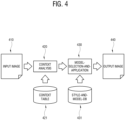
- FIG. 4 illustrates schematic operations in a style transfer process performed by an electronic apparatus.
- the electronic apparatus when the input image 410 is identified, the electronic apparatus performs a context analysis 420 for analyzing and filtering context information corresponding to a current point in time.
- the electronic apparatus performs model-selection-and-application 430 corresponding to the obtained context information.
- the model-selection-and-application 430 the electronic apparatus finally obtains an output image 440.
- the context analysis 420 corresponds to the operation 330 of FIG. 3
- the model-selection-and-application 430 includes identification of style corresponding to the operation 330 of FIG. 3 and identification and application of the model corresponding to the operation 340 of FIG. 3 .
- the first obtained context information includes various pieces of information related to the use environment of the electronic apparatus at the current point in time.
- the first obtained context information may include information about the style transfer process and irrelevant information. Further, even though the context information is related to the style transfer process, this information might not be formalized to be used in the style transfer process.
- the context analysis 420 of the electronic apparatus performs a task for normalizing necessary information while excluding unnecessary information from the first obtained context information, by using a previously prepared context table 421.
- the electronic apparatus calls a previously stored context table 421 in response to the obtainment of the input image 410.
- a plurality of attribute items related to the use environment of the electronic apparatus, and a plurality of attribute values respectively corresponding to the attributes are tabulated.
- the context table 421 may for example be a look-up table.
- the context table 421 may be obtained when the electronic apparatus is manufactured, or may be received and updated from a server.
- the electronic apparatus obtains various pieces of first context information corresponding to the current point in time, and converts the first context information into the second context information corresponding to the input image 410 based on the context table 421.
- the electronic apparatus uses the identified model corresponding to the style to transfer the style of the input image 410, thereby generating the output image 440.
- the server is configured to store the context table 421 and the style-and-model-DB 431, and perform the context analysis 420 and the model-selection-and-application 430.
- the electronic apparatus transmits the input image 410 to the server when the input image 410 is identified.
- the server performs the context analysis 420 and the model-selection-and-application 430 to convert the input image 410 into the output image 440, and transmits the output image 440 to the electronic apparatus.
- the electronic apparatus obtains the output image 440.
- the server may be provided to perform only one process between the context analysis 420 and the model-selection-and-application 430.
- the electronic apparatus transmits a result of an ongoing process to the server, and receives a result of a process performed in the server from the server.
- FIG. 5 illustrates a context table to be referred to by an electronic apparatus.
- the electronic apparatus uses a context table 421 to perform a context analysis for obtaining the second context information from the first context information 510.
- the electronic apparatus may obtain the first context information 510 from its own elements or from the server or another external apparatus.
- the first context information 510 may include information of various categories. Examples of such categories are time attributes such as time, dates, seasons, etc., place attributes such as installation positions or places, areas, countries, etc., of the electronic apparatus; user attributes such as a user account, a use history, etc., of the electronic apparatus; and surrounding environment attributes of the electronic apparatus such as current weather, ambient brightness, etc.
- the electronic apparatus may identify the installation area or country of the electronic apparatus based on network information such as Internet protocol (IP) address, etc. for communication connection with a network.
- IP Internet protocol
- the electronic apparatus may identify the current date, year, season, etc. based on time information obtained from the server or from its own clock.
- the electronic apparatus may identify the current temperature based on an Internet of Things (loT).
- the electronic apparatus may identify the ambient brightness from a brightness sensor.
- the electronic apparatus may identify the current weather from a weather management server.
- the foregoing examples are merely some of instances, and the first context information 510 includes various pieces of unrestricted information related to the use environment of the electronic apparatus.
- the context table 421 shows only very few data as compared with actual one, to shorten the description of an embodiment.
- the context table 421 may include attribute items such as time, seasons, device positions, weather, etc.
- the attribute item "time” has attribute values dawn, morning, afternoon, evening, night, etc.
- the attribute item "seasons” has attribute values spring, summer, autumn, winter, etc. In this manner, each attribute item may be assigned a plurality of attribute values.
- the electronic apparatus analyzes whether information corresponding to each attribute of the context table 421 is present in the first context information 510, and identifies the attribute values of the attribute items based on analysis results.
- the first context information 510 may show that the current time obtained from an electronic clock among the loT devices communicating with the electronic apparatus is night, the current season information obtained from the server is winter, a device position obtained from a closed circuit (CC) TV among the loT devices communicating with the electronic apparatus is indoors, and weather information obtained from the server indicates a snowy day.
- CC closed circuit
- the electronic apparatus generates second context information 520 based on the identified attribute values of the attribute items. For example, the electronic apparatus may obtain the second context information 520 having content of "time: night, season: winter, device position: indoors, and weather: snow" based on the first context information 510.
- Such second context information 520 is merely an example, and an embodiment is not limited thereto.
- the electronic apparatus selects a style and a model corresponding to the second context information 520.
- FIG. 6 illustrates a DB of styles and models to be referred to by an electronic apparatus.
- a style-and-model-DB 431 is configured to store a plurality of styles respectively corresponding to a plurality of pieces of context information, and model data corresponding to the styles.
- the style-and-model-DB 431 may be configured to additionally store additional effect data corresponding to each style.
- the additional effect data corresponding to the style is not essential, and the additional effect data might not be prepared according to the styles.
- the electronic apparatus identifies the style corresponding to second context information 520 from the style-and-model-DB 431, and obtains the model data and the additional effect data corresponding to the identified style.
- the electronic apparatus converts an input image 610 into an output image 620 based on the obtained model data, or the obtained model data and additional effect data.
- the model data may be an Al model previously generated by learning, which is designed to be optimized to context information. For example, it will be taken into account that the context information corresponding to the style #2 shows "time: night, season: winter, device position: outdoors, and weather: snow". Because sunlight is absent in a predetermined place corresponding to an indoor position and night time, the sky or the like except an artificial light source has an overall darkish color. Because the artificial light source is relatively bright but its surroundings are suddenly dark, a surrounding contrast of the artificial light source will be emphasized.
- the model #2 is designed to represent the foregoing feeling in a predetermined image.
- the additional effect data reflects various visual effects on an image separately from the model data. For example, snow flurries are expected in a place corresponding to a winter season and snowy weather.
- the effect #2 corresponding to the style #2 gives an effect of snow flurries to the whole image or some objects within the image, to which the model data is reflected.
- context information corresponding to the style #4 shows "time: day, season: autumn, device position: outdoors, and weather: sunny".
- time: day, season: autumn, device position: outdoors, and weather: sunny When a place corresponds to an outdoor position, daytime and sunny weather, this place has high quantity of light due to sunlight and is overall bright. Further, when the season is autumn and the place is outdoors, the sky in this place will be prominently blue.
- the model #4 is designed to represent such a feeling in a predetermined image.
- the method of designing and realizing the model corresponding to the style is based on an Albased learning model.
- the model data may for example be embodied by a deep-learning based CNN model.
- input data of an artificial neural network configured with only a fully connected layer is restricted to one-dimensional (1D) form.
- a color picture has three-dimensional (3D) data.
- 3D picture data needs to be planarized into 1D.
- FCNN fully connected neural network
- the CNN is a model in which learning is possible while keeping the spatial information of the image.
- the CNN is divided into extraction of features from an image and classification of classes.
- a feature extracting area is configured by stacking up a convolution layer and a pooling layer over and over.
- the convolution layer is essential to reflect an activation function after applying a filter to input data.
- the pooling layer following the convolution layer is a selective layer.
- the fully connected layer is added for the classification of the image.
- a flatten layer is provided to convert data from an image format into an array format.
- the filter is convolved with input data to extract the image features, and a result of convolution operation is used to form a feature map.
- the convolution layer is varied in a shape of output data depending on a filter size, a stride, whether or not padding is applied, and a max pooling size.
- the style transfer process may be a process that converts an input image by a model based on the above-described principle, so that the style of the model can be newly reflected to the input image instead of the original style of the input image.
- the electronic apparatus employs the style-and-model-DB 431 to automatically select a model matching the input image 610, and generate the output image 620 based on the selected model.
- the electronic apparatus uses the model matching the context information about the use environment of the electronic apparatus.
- a criterion for selecting the model to be used by the electronic apparatus is not limited only to the use environment of the electronic apparatus.
- the electronic apparatus generates the output image by considering both the use environment of the electronic apparatus and the attributes of the input image.
- FIG. 7 illustrates schematic operations in a style transfer process of an electronic apparatus taking attributes of an input image and a use environment of an electronic apparatus into account.
- the description of embodiments in FIGs. 1-6 relates to their incorporation in the embodiment of FG. 7.
- the electronic apparatus when an input image 710 is identified, the electronic apparatus performs an image analysis 720 for analyzing image information corresponding to the attributes of the input image 710, and a context analysis 420 for analyzing and filtering context information corresponding to a current point in time.
- the electronic apparatus finally obtains an output image 750 through a model-selection-and-application 430.
- the image information includes information about the input image 710
- the context information includes information about the use environment except the input image 710.
- the operations up to the operation of identifying the style in the image analysis 720 and the context analysis 420 and in the model-selection-and-application 430 are equivalent to the operation 330 of FIG. 3 .
- the operations of identifying and applying the model in the model-selection-and-application 430 are equivalent to the operation 340 of FIG. 3 .
- a method of the electronic apparatus in an embodiment using a context table 421 to perform the context analysis 420 is substantially the same as described above, and thus detailed descriptions thereof will be omitted.
- the electronic apparatus uses an image information table 721 to additionally perform the image analysis 720.
- the image information table 721 items related to a plurality of image attributes and a plurality of attribute values of the items are tabulated.
- the image information table 721 may for example be provided as a look-up table.
- the image information table 721 may be provided when the electronic apparatus is manufactured, or updated as received from the server.
- the electronic apparatus analyzes content forming the input image 710 in the image analysis 720.
- the electronic apparatus uses the image information table 721 to obtain image information about content attributes of the input image 710.
- a style-and-model-DB 431 includes styles and models corresponding to the context information, and styles and models corresponding to the image information.
- the electronic apparatus may identify a first style corresponding to the image information and a second style corresponding to the context information from the style-and-model-DB 431 in the model-selection-and-application 430.
- the electronic apparatus obtains the first model corresponding to the first style and the second model corresponding to the second style from the style-and-model-DB 431.
- the electronic apparatus applies the obtained first and second models to the input image 710, thereby generating the output image 750.
- the electronic apparatus converts the input image 710 based on the first model.
- the converted input image 710 reflects the first style based on the first model.
- the electronic apparatus allows the input image 710, to which the first style is reflected, to be converted again based on the second model, and additionally reflect the second style based on the second model.
- the input image 710 is finally converted into the output image 750 to which the first style and the second style are reflected.
- the first model is not necessarily applied prior to the second model, but the second model may be applied prior to the first model.
- the server is configured to store the image information table 721, the context table 421 and the style-and-model-DB 431 and perform the image analysis 720, the context analysis 420 and the model-selection-and-application 430.
- the electronic apparatus transmits the identified input image 710 to the server.
- the server may perform the image analysis 720, the context analysis 420 and the model-selection-and-application 430 to convert the input image 710 into the output image 750, and transmit the output image 750 to the electronic apparatus.
- the electronic apparatus obtains the output image 750.
- the server may be provided to perform only some processes among the image analysis 720, the context analysis 420 and the model-selection-and-application 430.
- the electronic apparatus may transmit a result of an ongoing process to the server, and receive a result of a process performed in the server.
- FIG. 8 illustrates an image information table to be referred to by an electronic apparatus.
- the electronic apparatus uses an image information table 721 to analyze the input image 810, thereby performing an image analysis for obtaining image information 820 about the input image 810.
- the image information table 721 a plurality of attribute items and the attribute values of the attribute items are tabulated.
- the image information table 721 shows only very few data as compared with actual one. This is to make an embodiment concise.
- the image information table 721 includes attribute items such as a scene corresponding to an overall background of an image, an object forming a background or foreground in the image, a depth corresponding to a relative distance to an object, an emotion corresponding to an emotional state of an object, e.g., of a human or an animal, etc.
- each attribute item may be assigned a plurality of attribute values.
- the electronic apparatus analyzes how the attribute items tabulated in the image information table 721 are displayed in the input image 810, and identifies the attribute values of the input image 810 with regard to the attribute items to thereby obtain image information 820.
- image analysis one or more methods among various methods may be applied. For example, there may be applied a neural network model based on deep-learning of Al, a method of identifying an object by scanning the whole image, or a method of referring to metadata of an image. Besides, various methods may be used for analyzing an image.
- the electronic apparatus analyzes the input image 810 to thereby identify various elements in content of the input image 810, i.e. items tabulated in the image information table 721.
- the electronic apparatus identifies the attribute values of the input image 810 among the plurality of attribute values provided in the identified items, and generates the image information 820 by combining the identified attribute values.
- the electronic apparatus may generate the image information 820 corresponding to the input image 810 having content of "scene: forest, object: human, object: animal, depth: human-long range, depth: animal-short range, emotion: human-delighted, emotion: animal-delighted" based on the image information table 721.
- image information 820 is merely an example, and therefore an embodiment is not limited thereto.
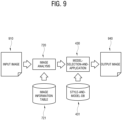
- an electronic apparatus generates an output image by taking the attributes of an input image into account.
- the electronic apparatus when an input image 910 is identified, the electronic apparatus performs an image analysis 720 for analyzing image information corresponding to the attributes of the input image 910.
- the electronic apparatus performs a model-selection-and-application 430 based on the obtained image information.
- the electronic apparatus finally obtains an output image 940 through the model-selection-and-application 430.
- the electronic apparatus uses an image information table 721 to obtain the image information.
- the image information table 721 items related to a plurality of image attributes and a plurality of attribute values of the items are tabulated.
- the image information table 721 is substantially the same as described above, and thus detailed descriptions thereof will be avoided.
- the image analysis 720 the electronic apparatus analyzes content forming the input image 910.
- the electronic apparatus uses the image information table 721 to obtain the image information about the content attributes of the input image 910.
- all of the processes may be carried out by the electronic apparatus, or some processes may be shared and performed by the server.
- the electronic apparatus selects a style and a model further corresponding to image information.
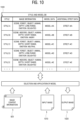
- FIG. 10 illustrates a style-and-model-DB to be referred to by an electronic apparatus.
- a style-and-model-DB 1040 is configured to store a plurality of styles respectively corresponding to a plurality of pieces of image information, and model data corresponding to the styles.
- the style-and-model-DB 1040 may be configured to additionally store additional effect data corresponding to each style.
- the additional effect data corresponding to the style is not essential, and might not be prepared according to the styles.
- the electronic apparatus identifies the style corresponding to image information 820 from the style-and-model-DB 1040, and obtains the model data and the additional effect data corresponding to the identified style.
- the electronic apparatus converts an input image 1010 into an output image 1020 based on the obtained model data, or the obtained model data and additional effect data.
- the model data may be an Al model previously generated by learning, which is designed to be optimized to image information. For example, it may be taken into account that image information corresponding to a style A shows "scene: forest, object: human, depth: long range, emotion: delighted", and image information corresponding to a style B shows "scene: indoors, object: human, depth: short range, emotion: angry.”
- a forest place is emphasized in natural color rather than artificial color. For example, in summer, greenish color dominates the forest place.
- the person in a short range may need to be more emphasized in bright color than the person in a long range.
- a relatively bright color is provided to a delighted person, or a relatively dark color may be provided to an angry person, to emphasize the emotion or the mood.
- Each model is designed to take this point into account.
- the method of designing and realizing the model corresponding to the style is based on an Albased learning model, and therefore detailed descriptions thereof will be omitted.
- the electronic apparatus can automatically select a model corresponding to the input image 1010 based on the style-and-model-DB 1040, and generate the output image 1020 based on the selected model.
- the operations of the apparatus described in embodiments may be performed by artificial intelligence provided in the corresponding apparatus.
- the artificial intelligence may be applied to various general systems by utilizing a machine learning algorithm.
- An artificial intelligence system may be a computer system with intelligence of a human or being second to a human.
- a machine, an apparatus or a system autonomously performs leaning and identifying and is improved in accuracy of recognition and identification based on accumulated experiences.
- the artificial intelligence is based on elementary technology by utilizing machine learning technology and algorithms based on an algorithm of autonomously classifying and learning features of input data, and copying perception, identification and the like functions of a human brain.
- the elementary technology may for example include at least one of language comprehension technology for recognizing a language and a text of a human, visual understanding technology for recognizing a thing like a human sense of vision, inference and prediction technology for identifying information and logically making inference and prediction, knowledge representation technology for processing experience information of a human into knowledge data, and motion control technology for controlling a vehicle's automatic driving or a robot's motion.
- the linguistic comprehension refers to technology of recognizing, applying and processing a human language or text, and includes natural language processing, machine translation, conversation system, question and answer, voice recognition and synthesis, etc.
- Inference and prediction refer to technology of identifying information and logically making prediction, and includes knowledge-based and/or probability-based inference, optimized prediction, preference-based plan, recommendation, etc.
- Knowledge representation refers to technology of automating a human experience information into knowledge data, and includes knowledge building such as data creation and classification, knowledge management such as data utilization, etc.
- the methods according to embodiments may be implemented by executing a program instruction that can be implemented in various computers, and recorded in a computer-readable medium.
- a computer-readable medium may include a program instruction, a data file, a data structure or the like, or combination thereof.
- software e.g., the program
- a machine-readable storage medium e.g., internal memory
- external memory e.g., external memory
- the computer-readable medium may be a nonvolatile storage such as an USB memory, for example, a RAM, a ROM, a flash memory, a memory chip, an integrated circuit (IC) or the like memory, or an optically or magnetically recordable or machine (e.g., a computer)-readable storage medium, for example, a compact disc (CD), a digital versatile disc (DVD), a magnetic disc, a magnetic tape or the like.
- a memory which can be included in the electronic apparatus 110, the server 120, and/or another external apparatus, is an example of the machine-readable storage medium suitable for storing a program having instructions for realizing embodiments.
- the program instruction recorded in this storage medium may be specifically designed and configured according to embodiments, or may be known to those skilled in the art.
- the computer program instruction may be implemented by a computer program product.
Landscapes
- Engineering & Computer Science (AREA)
- Theoretical Computer Science (AREA)
- Physics & Mathematics (AREA)
- General Physics & Mathematics (AREA)
- General Engineering & Computer Science (AREA)
- Computer Hardware Design (AREA)
- Computing Systems (AREA)
- Software Systems (AREA)
- Artificial Intelligence (AREA)
- Mathematical Physics (AREA)
- Data Mining & Analysis (AREA)
- Evolutionary Computation (AREA)
- Life Sciences & Earth Sciences (AREA)
- Biophysics (AREA)
- Biomedical Technology (AREA)
- General Health & Medical Sciences (AREA)
- Computational Linguistics (AREA)
- Health & Medical Sciences (AREA)
- Molecular Biology (AREA)
- Human Computer Interaction (AREA)
- Microelectronics & Electronic Packaging (AREA)
- User Interface Of Digital Computer (AREA)
- Computer Vision & Pattern Recognition (AREA)
- Medical Informatics (AREA)
- Image Analysis (AREA)
- Processing Or Creating Images (AREA)
Claims (12)
- Anzeigevorrichtung (110), umfassend:eine Anzeige (213); undeinen Prozessor (216), der dazu konfiguriert ist:als Reaktion auf das Erhalten eines ersten Bildes einen Stil zu identifizieren, der einer Nutzungsumgebung der Anzeigevorrichtung entspricht, indem Kontextinformationen bezüglich der Nutzungsumgebung der elektronischen Vorrichtung zum aktuellen Zeitpunkt erhalten werden und eine Kontexttabelle verwendet wird, um aus den Kontextinformationen einen Stil unter einer Vielzahl von Stilen zu identifizieren, die auf das erste Bild anwendbar sind, wobei die Informationen bezüglich der Nutzungsumgebung Informationen über mindestens eine Nutzungszeit, einen Nutzungsort, einen Nutzungsverlauf oder eine Umgebung der Anzeigevorrichtung umfassen, und wobei der identifizierte Stil mindestens einen Farbton des ersten Bildes, eine Sättigung des ersten Bildes, eine Helligkeit des ersten Bildes, einen Kontrast des ersten Bildes, einen Kantentyp für ein Objekt im ersten Bild oder einen auf das Objekt angewendeten Texturtyp umfasst,Modelldaten zu erhalten, die dem identifizierten Stil entsprechen, aus einer Stil- und Modelldatenbank, wobei die Modelldaten ein KI-Modell umfassen, das zuvor durch Lernen einer Vielzahl von Bildern erzeugt wurde,ein zweites Bild zu erhalten, indem ein Stil des ersten Bildes basierend auf den erhaltenen Modelldaten konvertiert wird und das zweite Bild basierend auf dem KI-Modell erzeugt wird, unddie Anzeige zu steuern, um das zweite Bild anzuzeigen.
- Anzeigevorrichtung (110) nach Anspruch 1, wobei die Informationen, die sich auf den identifizierten Stil beziehen, ein künstliches neuronales Netzwerkmodell umfassen, das auf Deep Learning basiert.
- Anzeigevorrichtung (110) nach Anspruch 2, wobei der Prozessor (216) ferner dazu konfiguriert ist, das erste Bild basierend auf einem Modell umzuwandeln, das dem identifizierten Stil entspricht, aus einer Vielzahl von Modellen, die jeweils der Vielzahl von Stilen entsprechen.
- Anzeigevorrichtung (110) nach Anspruch 1, wobei der Prozessor (216) ferner dazu konfiguriert ist, die mit der Nutzungsumgebung in Zusammenhang stehenden Informationen auf der Grundlage einer Nachschlagetabelle zu verarbeiten, in der Attributwerte definiert sind, die einer Vielzahl von Attributelementen entsprechen, die mit der Nutzungsumgebung der Anzeigevorrichtung in Zusammenhang stehen.
- Anzeigevorrichtung nach Anspruch 1, wobei der Prozessor ferner dazu konfiguriert ist: einen zweiten Stil basierend auf Informationen zu Attributen des ersten Bildes unter der Vielzahl von Stilen zu identifizieren und
das erste Bild basierend auf den Informationen zu dem Stil und den Informationen zu dem zweiten Stil umzuwandeln. - Anzeigevorrichtung (110) nach Anspruch 5, wobei der Prozessor (216) ferner dazu konfiguriert ist, die mit den Attributen des ersten Bildes in Zusammenhang stehenden Informationen auf der Grundlage einer Nachschlagetabelle zu verarbeiten, in der Attributwerte in Übereinstimmung mit einer Vielzahl von mit einem Bild in Zusammenhang stehenden Attributelementen definiert sind.
- Anzeigevorrichtung (110) nach Anspruch 5, wobei die Informationen zu den Attributen des ersten Bildes Informationen zu einem Objekt im ersten Bild umfassen.
- Anzeigevorrichtung (110) nach Anspruch 1, ferner umfassend eine Kommunikationsschaltung (211), die zur Kommunikation mit einem Server (120) konfiguriert ist, wobei der Prozessor (216) ferner dazu konfiguriert ist:die Informationen zu der Nutzungsumgebung und dem ersten Bild über die Kommunikationsschaltung an den Server zu übertragen undInformationen zu dem zweiten Bild, das vom Server konvertiert wird, über die Kommunikationsschaltung vom Server zu erhalten.
- Verfahren zum Steuern einer Anzeigevorrichtung (110), wobei das Verfahren Folgendes umfasst:als Reaktion auf das Erhalten eines ersten Bildes, Identifizieren eines Stils, der einer Nutzungsumgebung der Anzeigevorrichtung entspricht, durch Erhalten von Kontextinformationen, die sich auf die Nutzungsumgebung der elektronischen Vorrichtung zum aktuellen Zeitpunkt beziehen, und Verwenden der Kontexttabelle zum Identifizieren eines Stils aus den Kontextinformationen unter einer Vielzahl von Stilen, die auf das erste Bild anwendbar sind, wobei die Informationen, die sich auf die Nutzungsumgebung beziehen, Informationen über mindestens eine Nutzungszeit, einen Nutzungsort, einen Nutzungsverlauf oder eine Umgebung der Anzeigevorrichtung umfassen, und wobei der identifizierte Stil mindestens einen Farbton des ersten Bilds, eine Sättigung des ersten Bilds, eine Helligkeit des ersten Bilds, einen Kontrast des ersten Bilds, einen Kantentyp für ein Objekt im ersten Bild oder einen auf das Objekt angewendeten Texturtyp umfasst;Erhalten von Modelldaten, die dem identifizierten Stil entsprechen, aus einer Stil- und Modelldatenbank, wobei die Modelldaten ein KI-Modell umfassen, das zuvor durch Lernen einer Vielzahl von Bildern erzeugt wurde;Erhalten eines zweiten Bildes durch Konvertieren eines Stils des ersten Bildes basierend auf den erhaltenen Modelldaten und Erzeugen des zweiten Bildes basierend auf dem KI-Modell undAnzeigen des zweiten Bildes.
- Verfahren nach Anspruch 9, wobei die Informationen, die sich auf den identifizierten Stil beziehen, ein künstliches neuronales Netzwerkmodell umfassen, das auf Deep Learning basiert.
- Verfahren nach Anspruch 10, wobei das Erhalten des zweiten Bildes ferner das Konvertieren des ersten Bildes auf der Grundlage eines Modells umfasst, das dem identifizierten Stil entspricht, aus einer Vielzahl von Modellen, die jeweils der Vielzahl von Stilen entsprechen.
- Verfahren nach Anspruch 9, wobei das Identifizieren des Stils ferner das Verarbeiten der Informationen, die sich auf die Nutzungsumgebung beziehen, auf der Grundlage einer Nachschlagetabelle umfasst, in der Attributwerte definiert sind, die einer Vielzahl von Attributelementen entsprechen, die sich auf die Nutzungsumgebung der Anzeigevorrichtung (110) beziehen.
Applications Claiming Priority (1)
| Application Number | Priority Date | Filing Date | Title |
|---|---|---|---|
| KR1020190088228A KR102757183B1 (ko) | 2019-07-22 | 2019-07-22 | 디스플레이장치 및 그 제어방법 |
Publications (2)
| Publication Number | Publication Date |
|---|---|
| EP3770860A1 EP3770860A1 (de) | 2021-01-27 |
| EP3770860B1 true EP3770860B1 (de) | 2025-03-05 |
Family
ID=71661667
Family Applications (1)
| Application Number | Title | Priority Date | Filing Date |
|---|---|---|---|
| EP20186127.5A Active EP3770860B1 (de) | 2019-07-22 | 2020-07-16 | Stilübertragung eines bildes auf der grundlage von informationen, die sich auf eine nutzungsumgebung beziehen |
Country Status (4)
| Country | Link |
|---|---|
| US (1) | US11355089B2 (de) |
| EP (1) | EP3770860B1 (de) |
| KR (1) | KR102757183B1 (de) |
| WO (1) | WO2021015492A1 (de) |
Families Citing this family (5)
| Publication number | Priority date | Publication date | Assignee | Title |
|---|---|---|---|---|
| EP4325427A4 (de) | 2021-10-18 | 2024-09-25 | Samsung Electronics Co., Ltd. | Elektronische vorrichtung zur verarbeitung eines bildes und verfahren zur steuerung davon |
| KR20230089215A (ko) | 2021-12-13 | 2023-06-20 | 삼성전자주식회사 | 획득된 정보에 기반하여 화면을 구성하기 위한 전자 장치 및 방법 |
| CN116717948B (zh) * | 2022-02-28 | 2025-11-11 | 青岛海尔电冰箱有限公司 | 制冷设备面板的控制方法、控制系统及制冷设备 |
| KR20230137732A (ko) * | 2022-03-22 | 2023-10-05 | 삼성전자주식회사 | 사용자 선호 콘텐트를 생성하는 전자 장치 및 그 동작 방법 |
| US20250117976A1 (en) * | 2023-10-04 | 2025-04-10 | Yahoo Assets Llc | Systems and methods for generating images of locations affected by weather conditions |
Citations (1)
| Publication number | Priority date | Publication date | Assignee | Title |
|---|---|---|---|---|
| KR20140094161A (ko) * | 2013-01-21 | 2014-07-30 | 삼성전자주식회사 | 주위 광원에 따른 디스플레이 영상의 변환 방법 및 장치 |
Family Cites Families (13)
| Publication number | Priority date | Publication date | Assignee | Title |
|---|---|---|---|---|
| US6573932B1 (en) * | 2002-03-15 | 2003-06-03 | Eastman Kodak Company | Method for automatic white balance of digital images |
| JP2006018740A (ja) * | 2004-07-05 | 2006-01-19 | Canon Inc | 画像処理手段、装置及び方法 |
| JP2007036963A (ja) * | 2005-07-29 | 2007-02-08 | Noritsu Koki Co Ltd | 撮影画像処理装置 |
| JP5092524B2 (ja) * | 2007-04-20 | 2012-12-05 | 株式会社ニコン | 画像処理方法、画像処理プログラム、画像処理装置、カメラ |
| WO2008133951A2 (en) * | 2007-04-24 | 2008-11-06 | Massachusetts Institute Of Technology | Method and apparatus for image processing |
| US9154709B2 (en) * | 2012-12-21 | 2015-10-06 | Google Inc. | Recommending transformations for photography |
| KR102246762B1 (ko) * | 2014-11-10 | 2021-04-30 | 삼성전자주식회사 | 전자 장치의 주변 환경에 기반한 컨텐트 적응 방법 및 그 전자 장치 |
| US9594977B2 (en) * | 2015-06-10 | 2017-03-14 | Adobe Systems Incorporated | Automatically selecting example stylized images for image stylization operations based on semantic content |
| US9857953B2 (en) * | 2015-11-17 | 2018-01-02 | Adobe Systems Incorporated | Image color and tone style transfer |
| US11137884B2 (en) * | 2016-06-14 | 2021-10-05 | International Business Machines Corporation | Modifying an appearance of a GUI to improve GUI usability |
| WO2018075927A1 (en) * | 2016-10-21 | 2018-04-26 | Google Llc | Stylizing input images |
| CN108205813B (zh) * | 2016-12-16 | 2022-06-03 | 微软技术许可有限责任公司 | 基于学习网络的图像风格化 |
| US10984286B2 (en) * | 2018-02-02 | 2021-04-20 | Nvidia Corporation | Domain stylization using a neural network model |
-
2019
- 2019-07-22 KR KR1020190088228A patent/KR102757183B1/ko active Active
-
2020
- 2020-07-16 WO PCT/KR2020/009401 patent/WO2021015492A1/en not_active Ceased
- 2020-07-16 EP EP20186127.5A patent/EP3770860B1/de active Active
- 2020-07-21 US US16/934,619 patent/US11355089B2/en active Active
Patent Citations (1)
| Publication number | Priority date | Publication date | Assignee | Title |
|---|---|---|---|---|
| KR20140094161A (ko) * | 2013-01-21 | 2014-07-30 | 삼성전자주식회사 | 주위 광원에 따른 디스플레이 영상의 변환 방법 및 장치 |
Also Published As
| Publication number | Publication date |
|---|---|
| WO2021015492A1 (en) | 2021-01-28 |
| US20210027748A1 (en) | 2021-01-28 |
| KR20210011162A (ko) | 2021-02-01 |
| EP3770860A1 (de) | 2021-01-27 |
| KR102757183B1 (ko) | 2025-01-21 |
| US11355089B2 (en) | 2022-06-07 |
Similar Documents
| Publication | Publication Date | Title |
|---|---|---|
| US11355089B2 (en) | Display apparatus and control method thereof | |
| US11132547B2 (en) | Emotion recognition-based artwork recommendation method and device, medium, and electronic apparatus | |
| KR102499203B1 (ko) | 신뢰도에 기반하여 객체를 인식하는 전자 장치 및 방법 | |
| US20220132198A1 (en) | Electronic apparatus and control method thereof | |
| KR102613309B1 (ko) | 다중 디스플레이 시스템을 구성하는 디스플레이 장치 및 그 제어 방법 | |
| CN118155023A (zh) | 一种文生图及模型训练方法、装置、电子设备和存储介质 | |
| CN114332301B (zh) | 图像配色方法、装置及设备 | |
| CN114693611B (zh) | 渲染质量评估方法、装置、计算机设备及介质 | |
| US20200098336A1 (en) | Display apparatus and control method thereof | |
| US10373346B2 (en) | Methods and systems of customized digital-image projection | |
| CN109598689A (zh) | 实时图像处理方法及装置、电子设备、存储介质 | |
| CN111080746A (zh) | 图像处理方法、装置、电子设备和存储介质 | |
| CN110929146A (zh) | 数据处理方法、装置、设备和存储介质 | |
| US11145088B2 (en) | Electronic apparatus and method for controlling thereof | |
| CN118509718B (zh) | 图像处理方法、模型训练方法及相关设备 | |
| CN118192145B (zh) | 一种灯光切换方法、装置、设备及介质 | |
| CN119311237A (zh) | 一种显示方法及电子设备 | |
| US20150199835A1 (en) | Tools for creating digital art | |
| CN117412450A (zh) | 氛围灯设备及其灯效配色方法和相应的装置、介质 | |
| CN115880180A (zh) | 一种自适应画质pq调试方法、系统、平台及存储介质 | |
| CN112672209A (zh) | 视频编辑方法和视频编辑装置 | |
| CN119383807B (zh) | 灯效配置方法及装置、设备、介质 | |
| EP4582919A1 (de) | Elektronische vorrichtung und steuerungsverfahren dafür | |
| CN102654919A (zh) | 图像加工装置及图像加工方法 | |
| WO2025146376A1 (en) | Determining light settings based on a generated image |
Legal Events
| Date | Code | Title | Description |
|---|---|---|---|
| PUAI | Public reference made under article 153(3) epc to a published international application that has entered the european phase |
Free format text: ORIGINAL CODE: 0009012 |
|
| STAA | Information on the status of an ep patent application or granted ep patent |
Free format text: STATUS: THE APPLICATION HAS BEEN PUBLISHED |
|
| AK | Designated contracting states |
Kind code of ref document: A1 Designated state(s): AL AT BE BG CH CY CZ DE DK EE ES FI FR GB GR HR HU IE IS IT LI LT LU LV MC MK MT NL NO PL PT RO RS SE SI SK SM TR |
|
| AX | Request for extension of the european patent |
Extension state: BA ME |
|
| STAA | Information on the status of an ep patent application or granted ep patent |
Free format text: STATUS: REQUEST FOR EXAMINATION WAS MADE |
|
| 17P | Request for examination filed |
Effective date: 20210324 |
|
| RBV | Designated contracting states (corrected) |
Designated state(s): AL AT BE BG CH CY CZ DE DK EE ES FI FR GB GR HR HU IE IS IT LI LT LU LV MC MK MT NL NO PL PT RO RS SE SI SK SM TR |
|
| STAA | Information on the status of an ep patent application or granted ep patent |
Free format text: STATUS: EXAMINATION IS IN PROGRESS |
|
| 17Q | First examination report despatched |
Effective date: 20220407 |
|
| GRAP | Despatch of communication of intention to grant a patent |
Free format text: ORIGINAL CODE: EPIDOSNIGR1 |
|
| STAA | Information on the status of an ep patent application or granted ep patent |
Free format text: STATUS: GRANT OF PATENT IS INTENDED |
|
| INTG | Intention to grant announced |
Effective date: 20241223 |
|
| GRAS | Grant fee paid |
Free format text: ORIGINAL CODE: EPIDOSNIGR3 |
|
| GRAA | (expected) grant |
Free format text: ORIGINAL CODE: 0009210 |
|
| STAA | Information on the status of an ep patent application or granted ep patent |
Free format text: STATUS: THE PATENT HAS BEEN GRANTED |
|
| AK | Designated contracting states |
Kind code of ref document: B1 Designated state(s): AL AT BE BG CH CY CZ DE DK EE ES FI FR GB GR HR HU IE IS IT LI LT LU LV MC MK MT NL NO PL PT RO RS SE SI SK SM TR |
|
| REG | Reference to a national code |
Ref country code: GB Ref legal event code: FG4D |
|
| REG | Reference to a national code |
Ref country code: CH Ref legal event code: EP |
|
| REG | Reference to a national code |
Ref country code: DE Ref legal event code: R096 Ref document number: 602020047100 Country of ref document: DE |
|
| REG | Reference to a national code |
Ref country code: IE Ref legal event code: FG4D |
|
| PG25 | Lapsed in a contracting state [announced via postgrant information from national office to epo] |
Ref country code: RS Free format text: LAPSE BECAUSE OF FAILURE TO SUBMIT A TRANSLATION OF THE DESCRIPTION OR TO PAY THE FEE WITHIN THE PRESCRIBED TIME-LIMIT Effective date: 20250605 |
|
| PG25 | Lapsed in a contracting state [announced via postgrant information from national office to epo] |
Ref country code: FI Free format text: LAPSE BECAUSE OF FAILURE TO SUBMIT A TRANSLATION OF THE DESCRIPTION OR TO PAY THE FEE WITHIN THE PRESCRIBED TIME-LIMIT Effective date: 20250305 |
|
| REG | Reference to a national code |
Ref country code: NL Ref legal event code: MP Effective date: 20250305 |
|
| PG25 | Lapsed in a contracting state [announced via postgrant information from national office to epo] |
Ref country code: ES Free format text: LAPSE BECAUSE OF FAILURE TO SUBMIT A TRANSLATION OF THE DESCRIPTION OR TO PAY THE FEE WITHIN THE PRESCRIBED TIME-LIMIT Effective date: 20250305 |
|
| PGFP | Annual fee paid to national office [announced via postgrant information from national office to epo] |
Ref country code: GB Payment date: 20250624 Year of fee payment: 6 |
|
| REG | Reference to a national code |
Ref country code: LT Ref legal event code: MG9D |
|
| PG25 | Lapsed in a contracting state [announced via postgrant information from national office to epo] |
Ref country code: NO Free format text: LAPSE BECAUSE OF FAILURE TO SUBMIT A TRANSLATION OF THE DESCRIPTION OR TO PAY THE FEE WITHIN THE PRESCRIBED TIME-LIMIT Effective date: 20250605 |
|
| PG25 | Lapsed in a contracting state [announced via postgrant information from national office to epo] |
Ref country code: HR Free format text: LAPSE BECAUSE OF FAILURE TO SUBMIT A TRANSLATION OF THE DESCRIPTION OR TO PAY THE FEE WITHIN THE PRESCRIBED TIME-LIMIT Effective date: 20250305 |
|
| PG25 | Lapsed in a contracting state [announced via postgrant information from national office to epo] |
Ref country code: LV Free format text: LAPSE BECAUSE OF FAILURE TO SUBMIT A TRANSLATION OF THE DESCRIPTION OR TO PAY THE FEE WITHIN THE PRESCRIBED TIME-LIMIT Effective date: 20250305 |
|
| PG25 | Lapsed in a contracting state [announced via postgrant information from national office to epo] |
Ref country code: BG Free format text: LAPSE BECAUSE OF FAILURE TO SUBMIT A TRANSLATION OF THE DESCRIPTION OR TO PAY THE FEE WITHIN THE PRESCRIBED TIME-LIMIT Effective date: 20250305 Ref country code: GR Free format text: LAPSE BECAUSE OF FAILURE TO SUBMIT A TRANSLATION OF THE DESCRIPTION OR TO PAY THE FEE WITHIN THE PRESCRIBED TIME-LIMIT Effective date: 20250606 |
|
| REG | Reference to a national code |
Ref country code: AT Ref legal event code: MK05 Ref document number: 1773647 Country of ref document: AT Kind code of ref document: T Effective date: 20250305 |
|
| PG25 | Lapsed in a contracting state [announced via postgrant information from national office to epo] |
Ref country code: NL Free format text: LAPSE BECAUSE OF FAILURE TO SUBMIT A TRANSLATION OF THE DESCRIPTION OR TO PAY THE FEE WITHIN THE PRESCRIBED TIME-LIMIT Effective date: 20250305 |
|
| PG25 | Lapsed in a contracting state [announced via postgrant information from national office to epo] |
Ref country code: SE Free format text: LAPSE BECAUSE OF FAILURE TO SUBMIT A TRANSLATION OF THE DESCRIPTION OR TO PAY THE FEE WITHIN THE PRESCRIBED TIME-LIMIT Effective date: 20250305 |
|
| PG25 | Lapsed in a contracting state [announced via postgrant information from national office to epo] |
Ref country code: SM Free format text: LAPSE BECAUSE OF FAILURE TO SUBMIT A TRANSLATION OF THE DESCRIPTION OR TO PAY THE FEE WITHIN THE PRESCRIBED TIME-LIMIT Effective date: 20250305 |
|
| PG25 | Lapsed in a contracting state [announced via postgrant information from national office to epo] |
Ref country code: PT Free format text: LAPSE BECAUSE OF FAILURE TO SUBMIT A TRANSLATION OF THE DESCRIPTION OR TO PAY THE FEE WITHIN THE PRESCRIBED TIME-LIMIT Effective date: 20250707 |
|
| PGFP | Annual fee paid to national office [announced via postgrant information from national office to epo] |
Ref country code: DE Payment date: 20250624 Year of fee payment: 6 |
|
| PG25 | Lapsed in a contracting state [announced via postgrant information from national office to epo] |
Ref country code: IT Free format text: LAPSE BECAUSE OF FAILURE TO SUBMIT A TRANSLATION OF THE DESCRIPTION OR TO PAY THE FEE WITHIN THE PRESCRIBED TIME-LIMIT Effective date: 20250305 Ref country code: PL Free format text: LAPSE BECAUSE OF FAILURE TO SUBMIT A TRANSLATION OF THE DESCRIPTION OR TO PAY THE FEE WITHIN THE PRESCRIBED TIME-LIMIT Effective date: 20250305 |
|
| PG25 | Lapsed in a contracting state [announced via postgrant information from national office to epo] |
Ref country code: AT Free format text: LAPSE BECAUSE OF FAILURE TO SUBMIT A TRANSLATION OF THE DESCRIPTION OR TO PAY THE FEE WITHIN THE PRESCRIBED TIME-LIMIT Effective date: 20250305 |
|
| PG25 | Lapsed in a contracting state [announced via postgrant information from national office to epo] |
Ref country code: CZ Free format text: LAPSE BECAUSE OF FAILURE TO SUBMIT A TRANSLATION OF THE DESCRIPTION OR TO PAY THE FEE WITHIN THE PRESCRIBED TIME-LIMIT Effective date: 20250305 Ref country code: EE Free format text: LAPSE BECAUSE OF FAILURE TO SUBMIT A TRANSLATION OF THE DESCRIPTION OR TO PAY THE FEE WITHIN THE PRESCRIBED TIME-LIMIT Effective date: 20250305 |
|
| PG25 | Lapsed in a contracting state [announced via postgrant information from national office to epo] |
Ref country code: RO Free format text: LAPSE BECAUSE OF FAILURE TO SUBMIT A TRANSLATION OF THE DESCRIPTION OR TO PAY THE FEE WITHIN THE PRESCRIBED TIME-LIMIT Effective date: 20250305 |
|
| PG25 | Lapsed in a contracting state [announced via postgrant information from national office to epo] |
Ref country code: SK Free format text: LAPSE BECAUSE OF FAILURE TO SUBMIT A TRANSLATION OF THE DESCRIPTION OR TO PAY THE FEE WITHIN THE PRESCRIBED TIME-LIMIT Effective date: 20250305 |
|
| PG25 | Lapsed in a contracting state [announced via postgrant information from national office to epo] |
Ref country code: IS Free format text: LAPSE BECAUSE OF FAILURE TO SUBMIT A TRANSLATION OF THE DESCRIPTION OR TO PAY THE FEE WITHIN THE PRESCRIBED TIME-LIMIT Effective date: 20250705 |
|
| REG | Reference to a national code |
Ref country code: DE Ref legal event code: R097 Ref document number: 602020047100 Country of ref document: DE |
|
| PLBE | No opposition filed within time limit |
Free format text: ORIGINAL CODE: 0009261 |
|
| STAA | Information on the status of an ep patent application or granted ep patent |
Free format text: STATUS: NO OPPOSITION FILED WITHIN TIME LIMIT |
|
| PG25 | Lapsed in a contracting state [announced via postgrant information from national office to epo] |
Ref country code: DK Free format text: LAPSE BECAUSE OF FAILURE TO SUBMIT A TRANSLATION OF THE DESCRIPTION OR TO PAY THE FEE WITHIN THE PRESCRIBED TIME-LIMIT Effective date: 20250305 |
|
| REG | Reference to a national code |
Ref country code: CH Ref legal event code: L10 Free format text: ST27 STATUS EVENT CODE: U-0-0-L10-L00 (AS PROVIDED BY THE NATIONAL OFFICE) Effective date: 20260114 |
|
| 26N | No opposition filed |
Effective date: 20251208 |
|
| REG | Reference to a national code |
Ref country code: CH Ref legal event code: H13 Free format text: ST27 STATUS EVENT CODE: U-0-0-H10-H13 (AS PROVIDED BY THE NATIONAL OFFICE) Effective date: 20260224 |
|
| PG25 | Lapsed in a contracting state [announced via postgrant information from national office to epo] |
Ref country code: LU Free format text: LAPSE BECAUSE OF NON-PAYMENT OF DUE FEES Effective date: 20250716 |
|
| REG | Reference to a national code |
Ref country code: BE Ref legal event code: MM Effective date: 20250731 |
|
| PG25 | Lapsed in a contracting state [announced via postgrant information from national office to epo] |
Ref country code: BE Free format text: LAPSE BECAUSE OF NON-PAYMENT OF DUE FEES Effective date: 20250731 |
|
| PG25 | Lapsed in a contracting state [announced via postgrant information from national office to epo] |
Ref country code: FR Free format text: LAPSE BECAUSE OF NON-PAYMENT OF DUE FEES Effective date: 20250731 |
|
| PG25 | Lapsed in a contracting state [announced via postgrant information from national office to epo] |
Ref country code: CH Free format text: LAPSE BECAUSE OF NON-PAYMENT OF DUE FEES Effective date: 20250731 |