EP3768818B1 - Verfahren zur aquakultur für garnelen - Google Patents
Verfahren zur aquakultur für garnelen Download PDFInfo
- Publication number
- EP3768818B1 EP3768818B1 EP19770609.6A EP19770609A EP3768818B1 EP 3768818 B1 EP3768818 B1 EP 3768818B1 EP 19770609 A EP19770609 A EP 19770609A EP 3768818 B1 EP3768818 B1 EP 3768818B1
- Authority
- EP
- European Patent Office
- Prior art keywords
- support surfaces
- shrimp
- exemplary embodiments
- depicted
- aquaculture
- Prior art date
- Legal status (The legal status is an assumption and is not a legal conclusion. Google has not performed a legal analysis and makes no representation as to the accuracy of the status listed.)
- Active
Links
Images




Classifications
-
- A—HUMAN NECESSITIES
- A01—AGRICULTURE; FORESTRY; ANIMAL HUSBANDRY; HUNTING; TRAPPING; FISHING
- A01K—ANIMAL HUSBANDRY; AVICULTURE; APICULTURE; PISCICULTURE; FISHING; REARING OR BREEDING ANIMALS, NOT OTHERWISE PROVIDED FOR; NEW BREEDS OF ANIMALS
- A01K61/00—Culture of aquatic animals
- A01K61/50—Culture of aquatic animals of shellfish
- A01K61/59—Culture of aquatic animals of shellfish of crustaceans, e.g. lobsters or shrimps
-
- A—HUMAN NECESSITIES
- A01—AGRICULTURE; FORESTRY; ANIMAL HUSBANDRY; HUNTING; TRAPPING; FISHING
- A01K—ANIMAL HUSBANDRY; AVICULTURE; APICULTURE; PISCICULTURE; FISHING; REARING OR BREEDING ANIMALS, NOT OTHERWISE PROVIDED FOR; NEW BREEDS OF ANIMALS
- A01K63/00—Receptacles for live fish, e.g. aquaria; Terraria
- A01K63/04—Arrangements for treating water specially adapted to receptacles for live fish
-
- A—HUMAN NECESSITIES
- A01—AGRICULTURE; FORESTRY; ANIMAL HUSBANDRY; HUNTING; TRAPPING; FISHING
- A01K—ANIMAL HUSBANDRY; AVICULTURE; APICULTURE; PISCICULTURE; FISHING; REARING OR BREEDING ANIMALS, NOT OTHERWISE PROVIDED FOR; NEW BREEDS OF ANIMALS
- A01K63/00—Receptacles for live fish, e.g. aquaria; Terraria
- A01K63/04—Arrangements for treating water specially adapted to receptacles for live fish
- A01K63/047—Liquid pumps for aquaria
-
- A—HUMAN NECESSITIES
- A01—AGRICULTURE; FORESTRY; ANIMAL HUSBANDRY; HUNTING; TRAPPING; FISHING
- A01K—ANIMAL HUSBANDRY; AVICULTURE; APICULTURE; PISCICULTURE; FISHING; REARING OR BREEDING ANIMALS, NOT OTHERWISE PROVIDED FOR; NEW BREEDS OF ANIMALS
- A01K63/00—Receptacles for live fish, e.g. aquaria; Terraria
- A01K63/10—Cleaning bottoms or walls of ponds or receptacles
-
- Y—GENERAL TAGGING OF NEW TECHNOLOGICAL DEVELOPMENTS; GENERAL TAGGING OF CROSS-SECTIONAL TECHNOLOGIES SPANNING OVER SEVERAL SECTIONS OF THE IPC; TECHNICAL SUBJECTS COVERED BY FORMER USPC CROSS-REFERENCE ART COLLECTIONS [XRACs] AND DIGESTS
- Y02—TECHNOLOGIES OR APPLICATIONS FOR MITIGATION OR ADAPTATION AGAINST CLIMATE CHANGE
- Y02A—TECHNOLOGIES FOR ADAPTATION TO CLIMATE CHANGE
- Y02A40/00—Adaptation technologies in agriculture, forestry, livestock or agroalimentary production
- Y02A40/80—Adaptation technologies in agriculture, forestry, livestock or agroalimentary production in fisheries management
- Y02A40/81—Aquaculture, e.g. of fish
Definitions
- the invention is in the field of aquaculture systems and methods.
- shrimp is used to refer to various decapod crustaceans.
- Shrimp covers any of the groups with elongated bodies and a primarily swimming mode of locomotion - most commonly Caridea and Dendrobranchiata. In some shrimp is used more narrowly and may be restricted to Caridea , to smaller species of either group or to only the marine species.
- shrimp is synonymous with prawn, covering stalk-eyed swimming crustaceans with long narrow muscular tails, long whiskers and slender legs. In the broadest usage, any small crustacean that resembles a shrimp is included.
- the term "shrimp" is to be construed in its broadest sense.
- Shrimp are widespread and abundant with thousands of species adapted to a wide range of habitats. Shrimp are be found feeding near the seafloor on most coasts and estuaries, as well as in rivers and lakes. Some shrimp species flip off the seafloor and dive into the sediment to avoid predators.
- US 2015/342156 A1 discloses a method comprising providing a multilayer closed conduit aquaculture enclosure, said aquaculture enclosure comprising a vertical array of horizontal support surfaces, each surface having an inlet side and an outlet side, an inlet pipe in fluid communication with a common reservoir, and an efflux tank in fluid communication with said vertical array of support surfaces and having one or more drain holes, said method further comprising stocking said enclosure with shrimp.
- a "floor" surface in a stack serves as a ceiling for the layer immediately below it in the stack.
- the distance between tiers in a stack is effectively zero.
- each layer in the stack is flooded with water from floor to ceiling.
- each layer in the stack is divided by one or more vertical partitions to form compartments or tubes.
- tubes each indicate a volume defined by 2 contiguous growth surfaces in a stack and 2 vertical walls that contact them.
- variables defined in “M 3" indicate volume of tubes in the system or enclosure volume.
- variables defined in "M 2" indicate either area of support surfaces or area of floor layout space covered by a stack of support surfaces as indicated.
- the present disclosure further relates to use of differences in water level to insure a desired flow direction and/or flow rate along stacked growth surfaces in a crustacean aquaculture system.
- a difference in height between an upper surface of liquid in a common supply reservoir and a drain in a common efflux tank contributes to behavior of the system.
- a method including: providing a multilayer closed conduit aquaculture enclosure; stocking the enclosure with shrimp; and growing with standing biomass of at least 12.5 kg/M 3 of enclosure volume.
- the method includes harvesting at least 450 kg/M 3 of enclosure volume/year.
- the method includes harvesting at least 18.8 kg/M 3 of enclosure volume at the end of each growth cycle.
- the method includes harvesting at a frequency of every 120 days or less.
- the method according to the invention comprises providing a multilayer closed conduit aquaculture enclosure including: a vertical array of horizontal support surfaces, each surface connected to sidewalls and having an inlet side and an outlet side; a plurality of inlet pipes, each inlet pipe in fluid communication with a common reservoir and with an inlet side of one of the support surfaces in the vertical array; and an efflux tank in fluid communication with all of the outlet sides in the vertical array of support surfaces and having one or more drain holes situated above a level of an uppermost support surface in the array of support surfaces.
- an aquaculture system including: a vertical array of horizontal support surfaces, each surface connected to sidewalls and having an inlet side and an outlet side; a common reservoir in fluid communication with the inlet sides of all of the support surfaces in the vertical array; and an efflux tank in fluid communication with all of the outlet sides in the vertical array of support surfaces and having one or more drain holes situated above a level of an uppermost support surface in the array of support surfaces.
- either of these aquaculture systems includes one or more vertical dividers parallel to the sidewalls of each of the horizontal support surfaces dividing each support surface into two or more tubes; wherein each inlet pipe in the plurality of inlet pipes is in fluid communication with the common reservoir and with an inlet side of one of the tubes.
- either of the systems includes a waste removal port in proximity to a bottom of the efflux tank.
- the system includes a valve operable to open and close the waste removal port.
- the system includes a pump operable to circulate water from the common reservoir through the plurality of inlet pipes to the support surfaces.
- the system includes a control mechanism operable to differentially regulate a flow from the pump through each inlet pipe in the plurality of inlet pipes.
- the system includes a plurality of flow sensors, each sensor situated in an inlet pipe in the plurality of inlet pipes, or on a growth substrate, each sensor providing an output signal indicative of a flow rate to the control mechanism.
- the system includes a pump operable to collect water emanating from the drain holes and return it to the common reservoir.
- an aquaculture method including: flooding a vertical array of horizontal support surfaces with water and stocking the water with crustaceans; causing water to flow from a common reservoir through a plurality of inlet pipes, each inlet pipe in fluid communication with the common reservoir and with an inlet side one of the support surfaces in the vertical array; collecting an efflux of water from the vertical array of horizontal support surfaces in an efflux tank; and draining water from the efflux tank via one or more drain holes situated above a level of an uppermost support surface in the array of support surfaces.
- the method includes dividing each support surface into two or more tubes; wherein each inlet pipe in the plurality of inlet pipes is in fluid communication with the common reservoir and with an inlet side of one of the tubes.
- the method includes removing waste via a waste removal port in proximity to a bottom of the efflux tank.
- the method includes pumping water from the common reservoir through the plurality of inlet pipes.
- the method includes differentially regulating a flow from the pump through each inlet pipe in the plurality of inlet pipes.
- the method includes monitoring flow rate in each inlet pipe in the plurality of inlet pipes.
- the method includes collecting water emanating from the drain holes and returning it to the common reservoir.
- an aquaculture method including: filling an upper reservoir at altitude A with aquaculture medium; causing the medium to flow through a plurality of pipes, each pipe separately connected to one culture vessel in a plurality of stacked culture vessels; and collecting the medium in a common efflux tank with one or more drain holes at altitude a; wherein altitude a is below altitude A.
- serial array of one or more aquaculture systems as described hereinabove5 wherein an efflux tank of one system serves as the common reservoir of a next system in the array.
- method including: tilting a vertical array of horizontal support surfaces so that crustaceans residing thereon move to a common efflux tank; and collecting the crustaceans from the efflux tank.
- the collecting is via a drain.
- an aquaculture system including: a vertical array of horizontal support surfaces, each surface connected to solid sidewalls and having an inlet side and an outlet side; and mesh covering the inlet side and the outlet side, the mesh having holes sized to retain shrimp on the support surfaces.
- the system includes one or more solid vertical dividers parallel to the sidewalls of each of the horizontal support surfaces dividing each support surface into two or more tubes.
- the system includes one or more floats having sufficient buoyancy to prevent the system from sinking beyond a desired degree when deployed in a body of water.
- the system includes one or more ballasts with weight sufficient to prevent the system from floating beyond a desired degree when deployed in a body of water.
- the system includes one or more anchor attachment points.
- an aquaculture system including: multiple layers of stacked growth surfaces for crustaceans; and textured substrata applied to the growth surfaces.
- the textured substrata includes artificial grass.
- the textured substrata includes a hatching substrate.
- Embodiments relate to methods.
- some embodiments of the invention can be used for commercial production of shrimp or other crustaceans.
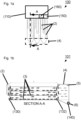
- Fig. 1a is a front view (inlet side), indicate generally as 100, of a crustacean aquaculture system according to some exemplary embodiments of the invention.
- Fig. 1b is a lateral transverse cross section of the exemplary system depicted in Fig. 1a through line A-A indicated generally as 101.
- Fig. 1c is a top perspective view of the exemplary system depicted in Fig. 1a indicated generally as 102.
- Fig. 1d is a top perspective view of the exemplary system depicted in Fig. 1a indicated generally as 103.
- Fig. 1e is a frontal transverse cross section of the exemplary system depicted in Fig. 1d through line B-B indicated generally as 104.
- the depicted exemplary crustacean aquaculture system relies on stacks of horizontal support surfaces 3 to increase the yield of cultured crustaceans per M 3 of enclosure volume and per M 2 of production/layout space.
- various exemplary embodiments of the invention employ 5, 10, 20, 50, 100, 150, 200, 250, 300, 350, 400, 450 or 500 or intermediate or greater numbers of horizontal support surfaces 3.
- various exemplary embodiments of the invention employ 5, 10, 20, 25, 35, 50, 75 or 100 or intermediate or greater numbers of vertical walls 120 to divide horizontal support surfaces 3.
- vertical walls 120 are solid.
- each tube is supplied with water by an inlet pipe 2.
- inlet pipe 2 provides a flow of water from inlet end 130 along support surface 3 to outlet end 132 ( Fig. 1b ).
- the flow of water is enriched with particulate food and/or nutrients in solution.
- inlet pipes 2 draw water from a common reservoir 110 ( Fig. 1a ).
- a pump 150 pumps water from reservoir 110 through pipes 2.
- a control mechanism 160 differentially regulates a flow from pump 150 through each inlet pipe 2.
- control mechanism 160 receives feedback signals from flow sensors in pipes 2 and/or at other places in the system and regulates flow in one or more pipes 2 according and/or across surfaces 3 to those signals.
- system 100 operates without pipes 2.
- common reservoir 110 is in in fluid communication with inlet sides 130 of all of support surfaces 3 in the vertical array.
- efflux tank 4 provides fluid communication among vertical support surfaces 3 and/or adjacent tubes on the same level. According to some of these embodiments, shrimp are free to move among different compartments via efflux tank 4. According to other embodiments, a screen is assembled at the end of each tube to prevent shrimp from moving from tube to tube.
- efflux tank 4 is equipped with a waste removal port 6. Waste removal port 6 allows efflux tank 4 to serve as a settling tank.
- a setting tank contributes to ease of removal of solid waste from the system and/or contributes to a reduction in wear on pumps in other parts of the system.
- a valve 140 is operable to close/open port 6.
- Drain holes 5 (most easily seen in Fig. 1c ) allow water to flow out of the system. Elevation of drain holes 5 governs the height of water in the system.
- water flowing out of drain holes 5 is collected and recirculated to reservoir 110.
- recirculation employs a pump and/or airlift.
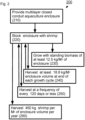
- Fig. 2 is a simplified flow diagram, indicated generally as 200, of an aquaculture method according to some exemplary embodiments of the invention.
- Depicted exemplary method 200 includes providing 210 a multilayer closed conduit aquaculture enclosure, stocking 220 the enclosure with shrimp and growing 230 with at least standing biomass 12.5 kg/M 3 of enclosure volume.
- the standing biomass is 15 kg/M 3 , 20 kg/M 3 , 25 kg/M 3 , 35 kg/M 3 , 40 kg/M 3 , 50 kg/M 3 , 75 kg/M 3 , or 100 kg/M 3 of enclosure volume or intermediate or greater standing biomass. It is noted that during practice of method 200, virtually all of the enclosure volume is filled with water. This represents a significant departure from many previously available alternatives in which spaces between growth surfaces are much greater than water depth.
- practice of method 200 results in an annual harvest 260 of 50 kg/M 3 , 100 kg/M 3 , 150 kg/M 3 , 200 kg/M 3 , 250 kg/, 300 kg/M 3 , 450 kg/M 3 , 500 kg/M 3 , 600 kg/M 3 , 700 kg/M 3 or intermediate or greater annual yields.
- method 200 includes, harvesting 240 at least 8 kg/M 3 , 10 kg/M 3 , 15 kg/M 3 , 18.8 kg/M 3 , 20 kg/M 3 , 30 kg/M 3 , 35 kg/M 3 , 45 kg/M 3 , 50 kg/M 3 , 55 kg/M 3 , 60kg/M 3 or 65 kg/M 3 enclosure volume at the end of each growth cycle.
- method 200 includes, harvesting 250 at a frequency of every 120 days or less.
- some embodiments of the invention are an aquaculture system including a vertical array of horizontal support surfaces 3.
- each surface 3 is connected to sidewalls 120 and has an inlet side 130 and an outlet side 132.
- sidewalls 120 are solid.
- the system includes a plurality of inlet pipes 2.
- each inlet pipe 2 is in fluid communication with a common reservoir 110 and with an inlet side of one of support surfaces 3 in the vertical array.
- the system includes an efflux tank 4 in fluid communication with all of the outlet sides 132 in the vertical array of support surfaces 3.
- Depicted exemplary efflux tank 4 has one or more drain holes 5 situated above a level of an uppermost support surface 3 in the array of support surfaces.
- surfaces 3 and walls 120 are depicted as discrete units in the drawing, in some embodiments surfaces 3 and walls 120 are provided as pipes or tubes of round, rectangular, hexagonal or triangular shape. Alternatively or additionally, in many embodiments vertical distance (height) between support surfaces 3 varies in the range of 2cm to 60 cm.
- the term "horizontal" indicates the surface is at an angle of 0° to 45°.
- the system includes one or more vertical dividers (see 120a and 120b in Fig. 1e ) parallel to the sidewalls of each of horizontal support surfaces 3 dividing each support surface into two or more tubes.
- dividers 120a and 120 b are solid.
- each inlet pipe in the plurality of inlet pipes is in fluid communication with the common reservoir and with an inlet side 130 of one of the tubes. This pipe configuration is depicted in Figs. 1a and 1c although the tubes themselves are hidden in those views.
- common reservoir 110 is in fluid communication with inlet sides 130 of all of support surfaces 3 in the vertical array. This configuration obviates a need for pipes 2.
- the system includes a waste removal port 6 in proximity to a bottom of efflux tank 4.
- the system includes a valve 140 operable to open and close waste removal port 6.
- the depicted embodiment also includes an optional pump 150 operable to circulate water from common reservoir 110 through the plurality of inlet pipes 2 to support surfaces 3.
- pump 150 operates on airlift principle.
- water pumped by pump 150 proceeds to outlet side 132 and into efflux tank 4.
- water is recirculated from efflux tank 4 back to pump 150.
- an additional pump (not depicted) handles this recirculation.
- a filtration system (not depicted) filters water being pumped through inlet pipes 2.
- the depicted embodiment also includes an optional control mechanism 160 operable to differentially regulate a flow from pump 150 through each inlet pipe 2 in the plurality of inlet pipes and/or across support surfaces 3.
- control mechanism 160 includes a plurality of flow sensors (not depicted).
- each sensor is situated in an inlet pipe 2 in the plurality of inlet pipes and/or on of support surfaces 3. According to these embodiments, each sensor provides an output signal indicative of a flow rate to control mechanism 160.
- the system includes a pump operable to collect water emanating from drain holes 5 and return it to common reservoir 110.
- this function is provided by pump 150, which has intake tubes (not depicted) in communication with drain holes 5.
- a separate pump is used for water emanating from drain holes 5.
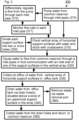
- Fig. 3 is a simplified flow diagram of an aquaculture method, indicated generally as 300, according to some exemplary embodiments which do not form part of the invention.
- Depicted exemplary method 300 includes flooding 310 a vertical array of horizontal support surfaces with water and stocking the water with crustaceans.
- each support surface is covered with water that touches the bottom of the next support surface above it.
- the uppermost support surface is fitted with a cover to govern water depth during flooding 310.
- Depicted exemplary method 300 also includes causing 320 water to flow from a common reservoir through a plurality of inlet pipes.
- Each inlet pipe is in fluid communication with the common reservoir and with an inlet side one of the support surfaces in the vertical array.
- Depicted exemplary method 300 also includes collecting 330 an efflux of water from the vertical array of horizontal support surfaces in an efflux tank.
- Depicted exemplary method 300 also includes draining 340 water from said efflux tank via one or more drain holes situated above a level of an uppermost support surface in said array of support surfaces.
- the drain holes are configured as a gap.
- Depicted exemplary method 300 also optionally includes dividing 350 each support surface into two or more tubes. According to embodiments including this optional feature, each inlet pipe in the plurality of inlet pipes is in fluid communication with the common reservoir and with an inlet side of one of the tubes.
- Depicted exemplary method 300 also optionally includes removing waste 360 via a waste removal port in proximity to a bottom of the efflux tank.
- Depicted exemplary method 300 also optionally includes pumping 370 water from said common reservoir through said plurality of inlet pipes and/or across support surface 3. In some embodiments pumping 370 contributes to flooding 310. Alternatively or additionally, in some embodiments pumping 370 includes differentially regulating 375 a flow from the pump through each inlet pipe in the plurality of inlet pipes. In some embodiments method 300 includes monitoring 377 flow rate in each inlet pipe in said plurality of inlet pipes. In some embodiments monitoring 377 regulates pumping 370 in a feedback loop.
- Depicted exemplary method 300 also optionally includes collecting 380 water emanating from the drain holes and returning it to the common reservoir.
- collection and/or return involve use of a pump (e.g. airlift).
- Fig. 4a is a simplified flow diagram, of a flow dynamics method indicated generally as 400, according to some exemplary embodiments which do not form part of the invention.
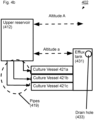
- Fig. 4b is a schematic representation of an exemplary system configuration, indicated generally as 402, compatible with the method(s) illustrated in Fig 4a .
- depicted exemplary method 400 includes filling 410 an upper reservoir 412 at altitude A with aquaculture medium.
- Altitude A indicates an upper surface of liquid in reservoir 412.
- Depicted exemplary method 400 also includes causing 420 the medium to flow through a plurality of pipes 419, each pipe separately connected to one culture vessel in a plurality of stacked culture vessels (421a; 421b and 421c).
- causing 420 includes pumping and/or relies on gravity feed.
- three pipes and three culture vessels are depicted for clarity, in actual practice a much larger number may be present.
- the stacked culture vessels include multiple vessels at the same height as depicted in Fig. 1e .
- Depicted exemplary method 400 also includes collecting 430 the medium in a common efflux tank 431 with one or more drain holes 433 at altitude a.
- Altitude a is below altitude A as depicted.
- a difference between Altitude A and Altitude a contributes to a rate of flow of the medium throughout the system.
- culture vessels 421a, 421b and 421c are either horizontal (as depicted) or inclined.
- method 400 includes re-circulating medium for drain holes 433 to upper reservoir 412.
- Fig. 5a is a schematic representation of an exemplary system configuration, indicated generally as 500, according to some exemplary embodiments which do not form part of the invention.
- Fig. 5b is a schematic representation of an exemplary system configuration, indicated generally as 501, according to some exemplary embodiments which do not form part of the invention.
- Some exemplary embodiments relate to a serial array of aquaculture systems as described hereinabove, wherein an efflux tank of one system serves as the common reservoir of a next system in the array.
- Fig. 5a depicts an embodiment in which reservoir 510 is in communication with culture stack 512 via pipes with a length of zero.
- the tubes in stack 512 are in fluid communication with efflux tank 514.
- Retention wall 515 creates a drain gap 516 and water flowing through gap 516 is channeled into adjacent culture stack 520.
- Efflux tank 514 serves as the reservoir for stack 520. Water flows through stack 520 into efflux tank 522 where retention wall 525 guides the flow through drain gap 526 to the next culture stack (not depicted).
- Fig. 5b depicts another embodiment in which each culture stack 532 is separated by an efflux zone 530, a retention wall 535 and a drain gap 536.
- shrimp may move between the stages and may be kept in the layers/tubes only.
- serial configuration enables utilization of water through more surface area before cleaning.
- depicted configurations enable using one cleaning system with sequential stages.
- serial horizontal array is depicted, serial vertical arrays are also possible.
- the depicted serial configuration allows more solids and molt separation areas and/or provides intermediate areas for dead shrimp separation and sheltering of weak pre or post molting shrimp.
- the serial configuration allows shrimp to move between culture stacks.
- Fig. 6 is a simplified flow diagram of an aquaculture harvest method, indicated generally as 600, according to some exemplary embodiments which do not form part of the invention.
- Depicted exemplary method 600 includes tilting 610 or lifting a vertical array of horizontal support surfaces so that crustaceans residing thereon move to a common efflux tank and collecting 620 the crustaceans from the efflux tank.
- collecting 620 is via a drain in the efflux tank (e.g. port 6 in Fig. 1b ).
- thickness of each component of the assembly and/or height and/or width and/or length of the tubes is adjusted according to structural engineering requirements for each embodiment.
- a tube height of 5 cm is sufficient.
- Adult shrimp may be more comfortable in a tube with a height of 15 cm.
- small fry are stocked in tubes with a 15cm height.
- shrimp are transferred from tubes of 5 cm to tubes with a greater height during the production cycle.
- tube length varies in the range of 0.5 M to 500 M.
- tube length is at least 0.5M, 5M, at least 10 M, at least 20 M, at least 50 M, at least 100M at or intermediate or greater lengths.
- tube length is less than 500m, less than 400 M, less than 300 M, less than 200 M, or less than 100 M or intermediate or shorter lengths.
- tube width varies in the range of 0.5 M to 20 M.
- tube width is at least 0.5 M, at least 1 M, at least 2 M, at least 5 M at least 10M or intermediate or greater widths.
- tube width is less than 20m, less than 15 M, less than 10 M, less than 5 M, or less than 1M or intermediate or shorter widths.
- tube height varies in the range of 0.02 M to 5 M.
- tube height is at least 0.05 M, at least 0.1 M, at least 0.2 M, at least 0.5 M at least 1.0M or intermediate or greater heights.
- tube height is less than 2 m, less than 1.5 M, less than 1.0 M, less than 0.5 M, or less than 0.1M or intermediate or shorter heights.
- efflux tank e.g. 4 in Fig. 1c has a width equivalent to support surface 3 in a single layer and/or a height equivalent to the composite height of all support surfaces 3 in the stack.
- a length of efflux tank 4 is 0.2 M, 0.3M, 0.4 M, 0.5M 0.6 M, 0.7M, 0.8 M, 0.9M, 1 M, 1.5M, 2 M, 2.5 M or 3M or intermediate or greater lengths.
- reservoir 110 ranges from 1% of the total enclosure volume (defined by support surfaces 3 and walls/dividers 120) to 1000% of total enclosure volume.
- reservoir 110 provides a buffer of water in case there is a mechanical or electrical problem that prevents the supply of water from a clear water system. In submerged system configurations, reservoir 110 is absent.
- reservoir 110 is provided as part of an RAS water treatment system connected to pipes 2.
- the system is constructed with 1-500 layers/tiers of culture spaces on a vertical axis and with 1-100 adjacent culture spaces on a horizontal axis.
- Stocking 7.5 kg of shrimp in a tube having 1m length and 1m width with a height of 60cm will result in a shrimp standing biomass of at least 12.5 kg/m 3 .
- stocking 10 kg of shrimp in a tube having 1m length and 1m width with a height of 10cm will result in a shrimp standing biomass of at least 100 kg/m 3 .
- the obtained biomass increases to the value of 67 kg Biomass/m 3 enclosure volume at the 4 th life stage and to an average of 38 kg/m3 enclosure volume in a full life cycle.
- the system can be installed in an inclined structure or sloped adjusted from time to time for allowing drainage and/or shrimp harvest.
- the system is built with inclined support surfaces 3.
- inclined support surfaces 3 contribute to ease of solid separation and/or to ease of harvesting.
- support surfaces 3 have a permanent incline angle or adjustable incline angle.
- the aquaculture system is submerged in an open basin such as in the ocean, in a pond, in a river or in an estuary.
- Embodiments using submerged tubes contribute to an ability to use thinner materials for support surfaces 3 and/or vertical walls 120.
- a low differential pressure contributes to a reduction in need for material thickness.
- submerged installation enables the usage of thin layers due to lower pressure differences between the internal and external surfaces.
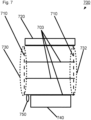
- Fig. 7 is a schematic side view of a submergible aquaculture system, indicated generally as 700, according to some exemplary embodiments, which do not form part of the invention.
- system 700 includes a vertical array of horizontal support surfaces 703, each surface connected to solid sidewalls (not visible; similar to 120 in Fig. 1c ) and having an inlet side 730 and an outlet side 732.
- support surfaces 703 are solid.
- solid excludes mesh or netting.
- mesh 710 covers inlet side 730 and outlet side 732.
- mesh 710 has holes sized to retain shrimp on support surfaces 703 while allowing water to flow across surfaces 703.
- flow is natural (e.g. river current or ocean waves).
- flow is provided by one or more pumps (not depicted).
- system 700 includes solid vertical dividers (not visible; similar to 120 a and 120 b in Fig. 1e ) parallel to the sidewalls of each of horizontal support surfaces 103 dividing each support surface into two or more tubes.
- Depicted exemplary system 700 includes float 720 having sufficient buoyancy to prevent the system from sinking beyond a desired degree when deployed in a body of water.
- the floats are constructed of a low-density polymer.
- the floats are filled with air.
- depicted exemplary system 700 includes ballast 740 with weight sufficient to prevent the system from floating beyond a desired degree when deployed in a body of water.
- ballast 740 is provided as a floodable ballast tank.
- ballast 740 is constructed of a high-density material such as concrete or metal.
- ballast 740 and float 720 resides in a single tank with a pump that can alternately fill the tank with air or water.
- depicted exemplary system 700 includes an anchor attachment point 750.
- attachment point 750 is provided as a ring, a hook or a chain.
- several anchor attachments are provided in system 700.
- attachment to an anchor limits lateral shifting of system 700 with respect to a "floor" of the body of water in which the system is deployed.
- the growth tubes are equipped with lighting.
- surfaces of substrate 3 and/or walls 120 are coated with high surface area material to promote biofilm or algae formation and/or to provide shelter and/or to increase survival rates.
- Biofilm and/or algae can serve as a source of feed or feed supplement for shrimp.
- the tubes include shelters for sheltering weak or molting shrimp to prevent cannibalism.
- surfaces of substrate 3 and/or walls 120 are coated with a textured substrata for absorbing physical shock as a result of Caridoid Escape Reaction to minimize subsequent injuries and infection
- roughening of support surfaces 3 and/or vertical walls 120 contributes to a reduction in injuries and/or infection and/or provides sheltering of fragile shrimp.
- 10 mm Polypropylene fiber artificial grass serves as substrata (e.g. model GLLC-10; Zhonglian, China)
- BIOMAT hatching substrate (Dynamic Aqua Supply LTD; Surrey BC; Canada) serves as substrata.
- the tubes include process and and/or analytical sensors and/or cameras and/or audio sensors to record feeding activity, biomass measurements and general shrimp behavior.
- pipes 2 provide an adjustable flow.
- flow adjustment is manual or automatic.
- flow adjustment is used to regulate culture spaces replenishing rate and/or to regulate oxygen and/or nitrogen and/or CO 2 and/or other metabolic byproducts and/or to maintain a desired feed quality.
- the aquaculture system includes water treatment by RAS (Recirculating Aquaculture System) and/or by circulation of water in a closed loop through an external water cleaning system and/or by one flow through method and/or by the biofloc method and/or combinations thereof.
- RAS Recirculating Aquaculture System
- the aquaculture system allows monitoring and controlling separately each tube, or pipe for one or more parameters including but not limited to oxygen, turbidity, feed amount, pH and ammonia.
- Many embodiments of the invention have a growth surface layout that is substantially rectangular when viewed from above.
- sidewalls 120 and/or vertical dividers 120 contribute to structural integrity of the system in the face of the combined weight of water and shrimp.
- support surfaces 3 contribute to structural integrity of the system in the face of the combined weight of water and shrimp.
- an aspect ratio (Length to width) of 100:1; 500:1; 250:1; 100:1 or 50:1 contributes sufficiently to structural strength.
- an aspect ratio (Length to height) of 20,000:1; 10,000:1; 5000:1; 2500:1; 1000:1 or 500:1 contributes sufficiently to structural strength.
- an aspect ratio (width to height) of 1,000:1; 500:1; 250:1; 100:1; 50: 1 or 25: 1 contributes sufficiently to structural strength.
- implementation of systems and/or methods as described hereinabove contribute to an increase in yield per unit area of farm space. Much of that increase comes from more efficient utilization of the vertical dimension. Multiple tiers of growth substrate (e.g. support surfaces 3) contribute to more efficient utilization of the vertical dimension. A decrease in intervening space between multiple tiers of growth substrate (relative to previously described stacked aquaculture systems such as US 8,336,498 to Lawrence ) also contributes to more efficient utilization of the vertical dimension.
- Table 1 illustrates theoretical production yields using a small aquaculture system of the general configuration depicted in Figs. 1a to 1e .
- Table 1 summary of theoretical production parameters
- Example 1 Calculation example Small system Suggested layer dimensionshrimp stage 1shrimp stage 2shrimp stage 3shrimp stage 4 B cell width, m 0.5 1 1 1 C Cell height , m 0.05 0.05 0.1 0.15 A Cell length, m 2 4 14 25 Stage Duration (month) 1 1 1 1 1 Standing biomass, [kg] 47 263 561 1,000 Design Density [kg/m2 of tube bottom surface] 3.5 4.9 6.5 10 Required area[ m2] 13 54 86 100 Design Specific biomass [kg/m3] 70.0 97.6 65.0 66.7 No of cell tiers 12 12 6 4 System total height, m 0.60 0.60 0.60 0.60 Top view area, m2 1.0 4.2 14.0 25.0 Standing biomass [kg/m2 top view area] 47 62 40 40 Actual Standing Biomass/volume [kg/m3] 77
- This example illustrates that the projected annual shrimp yield for a small system having a total tiers height of 0.6 m (12 tiers at stages 1 and 2, and 6 an 4 tiers at stages 3 and 4 respectively) according to one exemplary embodiment reaches 271 kg/m 2 of floor surface (top view) and/or 452 kg/m 3 of system volume.
- the exemplary embodiment shows 37.7 kg/m3 per growth cycle.
- This example illustrates the projected annual shrimp yield for a system with monthly stages of growth and at the end of each stage the shrimp are moved into the next stage and the first stage is stocked with a new batch of shrimp. Therefore there are 12 harvests possible each year.
- This exemplary embodiment holds the tube cell combination for each stage to the same total height of 0.6 meters and the number of stacked tubes according to the cell height.
- This exemplary embodiment adjusts total area for shrimp growth by adjusting cell length and or width to maintain planned maximum biomass densities of kg/m 2 of tube bottom surface as listed.
- the embodiment attains 271 kg/m 2 of production area (e.g. building size) and 452 kg/m 3 of system water volume or approximately building volume since the space between layers is the thickness of the cell floor.
- the same Annual yield kg/m2 of production area (e.g. building size) can be maintained at 271 kg/m2 with a decrease in shrimp density kg/m2 of tube bottom surface by proportionally increasing the number of cell layers.
- the density at the end of each month could be reduced to 50% of the values listed by increasing the number of cell layers from 4 to 8.
- required area is a result of dividing total standing biomass (kg) by the growth density (e.g. 3.5 kg/m2) - since standing biomass in each step is different, and the required growth area per kg is different, the required total area is different for each stage. It is by a coincidence (of the standing biomass and growth density) that in stage 3 and 4, the required area result is the same.
- tube length can be equal or vary between growth stages.
- total height remained constant in each stage, so different lengths were used in each stage in each stage.
- growth stages are connected or not.
- each stage has its own stack. In other exemplary embodiments stages are serially connected.
- Table 1 shows that standing biomass per unit area and per unit volume varies from stage 1 to 4. This is an artifact caused by small tube heights in stages 1 and 2.
- Table 2 illustrates theoretical production yields using a medium aquaculture system of the general configuration depicted in Figs. 1a to 1e .
- Table 2 summary of theoretical production parameters
- Example 2 Calculation example Medium system Suggested layer dimensionshrimp stage 1 Vietnamesemp stage 2 Shrimp stage 3shrimp stage 4 B cell width, m 0.5 0.75 1 1 C Cell height, m 0.05 0.05 0.1 0.15 A Cell length, m 4 11 28 50 Stage Duration (month) 1 1 1 1 1 Standing biomass, [kg] 931 5,256 11,215 20,000 Design Density [kg/m2 of tube bottom surface] 3.5 4.9 6.5 10 Required area] m2] 266 1,077 1,725 2,000 Design Specific biomass [kg/m3] 70.0 97.6 65.0 66.7 No of cell tiers 120.0 120.0 60.0 40 System total height, m 6.0 6.0 6.0 6 Top view area, m2 2.0 8.5 28 50 Standing biomass [kg/m2 top view area] 467.0 618.6 400.8 400 Actual Standing Biomas
- This example illustrates that the projected annual shrimp yield for a medium system having a total tiers height of 6m (120 tiers at stages 1 and 2, and 60 and 40 tiers at stages 3 and 4 respectively) according to one exemplary embodiment reaches 2,713 kg/m 2 of floor surface (top view) and/or 452 kg/m 3 of system volume.
- the exemplary embodiment shows 37.7 kg/m3 per growth cycle.
- the increased yield per m 2 of floor surface shows the yield per unit area is scalable by increasing the number of horizontal support surfaces upon which shrimp are grown.
Landscapes
- Life Sciences & Earth Sciences (AREA)
- Environmental Sciences (AREA)
- Marine Sciences & Fisheries (AREA)
- Animal Husbandry (AREA)
- Biodiversity & Conservation Biology (AREA)
- Zoology (AREA)
- Farming Of Fish And Shellfish (AREA)
Claims (8)
- Ein Verfahren, das Folgendes umfasst:(a) Bereitstellen eines mehrschichtigen Aquakulturgehäuses mit geschlossener Leitung, das eine vertikale Anordnung von horizontalen Stützflächen (3) umfasst, wobei jede Fläche (3) mit Seitenwänden (120) verbunden ist und eine Einlassseite und eine Auslassseite aufweist, eine Vielzahl von Einlassrohren (2), wobei jedes Einlassrohr (2) in Fluidverbindung mit einem gemeinsamen Behälter (110) und mit einer Einlassseite von einer der Stützflächen (3) in der vertikalen Anordnung steht; und einen Abflussbehälter (4), der in Fluidverbindung mit allen Auslassseiten in der vertikalen Anordnung von Stützflächen (3) steht und ein oder mehrere Abflusslöcher (5) aufweist, die oberhalb des Niveaus einer obersten Stützfläche in der Anordnung von Stützflächen (3) liegen;(b) Besetzen des Gehäuses mit Garnelen; und(c) Züchten mit einer stehenden Biomasse von mindestens 12,5 kg/M3 des Gehäusevolumens.
- Das Verfahren nach Anspruch 1, umfassend das Ernten von mindestens 450 kg/M3 des Gehäusevolumens/Jahr.
- Das Verfahren nach Anspruch 1 oder Anspruch 2, bei dem am Ende jedes Wachstumszyklus mindestens 18,8 kg/M3 des Gehäusevolumens geerntet werden.
- Das Verfahren nach einem der Ansprüche 1 bis 3, bei dem alle 120 Tage oder weniger geerntet wird.
- Das Verfahren nach einem der Ansprüche 1 bis 4, wobei das mehrschichtige Aquakulturgehäuse mit geschlossenen Kanälen umfasst:einen oder mehrere vertikale Teiler, die parallel zu den Seitenwänden jeder der horizontalen Stützflächen verlaufen und jede Stützfläche in zwei oder mehr Röhren unterteilen;wobei jedes Einlassrohr in der Vielzahl der Einlassrohre in Fluidverbindung mit dem gemeinsamen Reservoir und mit einer Einlassseite eines der Rohre steht.
- Das Verfahren nach einem der Ansprüche 1 bis 5, wobei Schritt (a) die Bereitstellung umfasst:
eine Abfallentnahmeöffnung (6) in der Nähe eines Bodens des Abflussbehälters (4). - Das Verfahren nach Anspruch 6, wobei Schritt (a) die Bereitstellung eines Ventils (140) umfasst, das zum Öffnen und Schließen der Abfallentnahmeöffnung (6) betätigt werden kann.
- Das Verfahren nach einem der Ansprüche 1 bis 7, wobei Schritt (a) das Bereitstellen einer Pumpe umfasst, die so betrieben werden kann, dass sie Wasser aus dem gemeinsamen Behälter (110) durch die Vielzahl von Einlassrohren zu den Stützflächen (3) zirkulieren lässt.
Applications Claiming Priority (2)
| Application Number | Priority Date | Filing Date | Title |
|---|---|---|---|
| US201862645304P | 2018-03-20 | 2018-03-20 | |
| PCT/IB2019/052226 WO2019180615A1 (en) | 2018-03-20 | 2019-03-19 | Aquaculture systems and methods for shrimp or other crustaceans |
Publications (3)
| Publication Number | Publication Date |
|---|---|
| EP3768818A1 EP3768818A1 (de) | 2021-01-27 |
| EP3768818A4 EP3768818A4 (de) | 2022-04-06 |
| EP3768818B1 true EP3768818B1 (de) | 2024-09-25 |
Family
ID=67986033
Family Applications (1)
| Application Number | Title | Priority Date | Filing Date |
|---|---|---|---|
| EP19770609.6A Active EP3768818B1 (de) | 2018-03-20 | 2019-03-19 | Verfahren zur aquakultur für garnelen |
Country Status (4)
| Country | Link |
|---|---|
| US (1) | US20210029973A1 (de) |
| EP (1) | EP3768818B1 (de) |
| CN (1) | CN112041419B (de) |
| WO (1) | WO2019180615A1 (de) |
Families Citing this family (8)
| Publication number | Priority date | Publication date | Assignee | Title |
|---|---|---|---|---|
| CN110881431A (zh) * | 2019-12-16 | 2020-03-17 | 海南晨海水产有限公司 | 一种白虾分段式高产养殖方法 |
| WO2022043953A1 (en) * | 2020-08-31 | 2022-03-03 | Bloom-Frea Aqua Ip Pte. Ltd | Aquaculture system |
| CN113661957B (zh) * | 2021-08-23 | 2023-08-08 | 泗县微腾知识产权运营有限公司 | 一种渔光一体池塘循环水养殖系统 |
| CN113711961B (zh) * | 2021-08-30 | 2023-04-11 | 深圳市澳华集团股份有限公司 | 一种用于虾类分级养殖的养殖箱及其养殖方法 |
| WO2023139582A1 (en) * | 2022-01-19 | 2023-07-27 | Eco Shrimp Ltd. | Intensive culture of benthic invertebrates |
| CN114794000B (zh) * | 2022-04-15 | 2023-04-25 | 浙江省淡水水产研究所 | 一种适合温棚鱼虾标苗养殖的高压丝杠曝气设备 |
| CN115152682B (zh) * | 2022-08-22 | 2023-06-20 | 江苏电子信息职业学院 | 一种小龙虾精养复合饲料的撒料智能装置 |
| EP4434333B1 (de) | 2023-03-23 | 2025-11-12 | Klaipeda University | Aquakultursystem und verfahren zur kultivierung von garnelen und anderen krustentieren |
Family Cites Families (11)
| Publication number | Priority date | Publication date | Assignee | Title |
|---|---|---|---|---|
| GB969030A (en) * | 1961-05-30 | 1964-09-09 | Lobster Bridlington Ltd | Improvements in and relating to the storage of shellfish |
| US4467744A (en) * | 1982-09-30 | 1984-08-28 | Mark C. Davidson | Apparatus and method for raising lobsters |
| US5377624A (en) * | 1993-05-07 | 1995-01-03 | The Cultured Abalone Incorporated | Abalone farming system |
| TW587913B (en) * | 2003-10-17 | 2004-05-21 | Ding-Rung Lin | 3D high density aquafarm device |
| CN101120661B (zh) * | 2007-09-13 | 2011-08-17 | 中国科学院水生生物研究所 | 一种基于复合垂直流人工湿地的生态渔业养殖装置 |
| DE202008013223U1 (de) * | 2008-10-08 | 2010-02-18 | Big Dutchman International Gmbh | Indoor-Fischfarm mit aufgeständertem Becken |
| US9374986B2 (en) * | 2014-05-29 | 2016-06-28 | Richard L. Sheriff | Shrimp culturing system |
| CN204104528U (zh) * | 2014-09-09 | 2015-01-21 | 顾向前 | 多层式循环水鱼类养殖系统 |
| CN204104530U (zh) * | 2014-10-10 | 2015-01-21 | 獐子岛集团股份有限公司 | 一种工厂化鲜活海产品循环水暂养系统 |
| EP3220736B1 (de) * | 2014-11-19 | 2021-03-10 | Planet Shrimp Inc. | Aquakulturfliesskanal, -system, und -verfahren für garnelen |
| SMT202400073T1 (it) * | 2015-03-30 | 2024-03-13 | Royal Caridea Llc | Sistema e metodo di produzione di gamberi modulare multifasico |
-
2019
- 2019-03-19 EP EP19770609.6A patent/EP3768818B1/de active Active
- 2019-03-19 US US16/982,131 patent/US20210029973A1/en not_active Abandoned
- 2019-03-19 CN CN201980020403.3A patent/CN112041419B/zh active Active
- 2019-03-19 WO PCT/IB2019/052226 patent/WO2019180615A1/en not_active Ceased
Also Published As
| Publication number | Publication date |
|---|---|
| CN112041419A (zh) | 2020-12-04 |
| CN112041419B (zh) | 2025-03-25 |
| EP3768818A1 (de) | 2021-01-27 |
| US20210029973A1 (en) | 2021-02-04 |
| WO2019180615A1 (en) | 2019-09-26 |
| EP3768818A4 (de) | 2022-04-06 |
Similar Documents
| Publication | Publication Date | Title |
|---|---|---|
| EP3768818B1 (de) | Verfahren zur aquakultur für garnelen | |
| KR101867109B1 (ko) | 쌍각류 등의 저서 생물의 양식 장치 | |
| CN102548391B (zh) | 用于超密集虾生产的系统和方法 | |
| CN105075946B (zh) | 贝类工程化养殖方法和贝类多层流水养殖设备 | |
| CN104872048B (zh) | 一种池塘鱼类水槽式集约化循环水养殖模式 | |
| CN105724304B (zh) | 叠式鱼虾循环水混养系统 | |
| CN109548720A (zh) | 基于异位生物絮团培育和原位硝化的复合对虾养殖系统 | |
| CN104756933A (zh) | 一种分层高密度底栖养殖鱼池 | |
| CN105850838A (zh) | 一种高效循环水环保养殖系统 | |
| CN106359198A (zh) | 一种船载养殖舱 | |
| CN210017491U (zh) | 一种养殖工船或养殖平台用立体分层养殖装置 | |
| CN2694747Y (zh) | 立体多层式高密度养虾的设备 | |
| CA3239534A1 (en) | A submersible fish farm with a fish rearing tank adapted to separate sludge from water and a method of operating such a farm | |
| JPH07274767A (ja) | 養殖生簀 | |
| CN205018089U (zh) | 一种贝类多层流水养殖设备 | |
| Menasveta et al. | A comparative study on larviculture techniques for the giant freshwater prawn, Macrobrachium rosenbergii (de Man) | |
| JP2005095137A (ja) | 魚介類の飼育装置 | |
| JPH07284355A (ja) | 養殖生簀のための海水濾過装置 | |
| CN106719152A (zh) | 一种养殖泥鳅的方法和装置 | |
| CN206879850U (zh) | 一种水产养殖装置 | |
| CN117865401A (zh) | 一种阶梯爆气式养殖尾水分级处理系统 | |
| CN212414381U (zh) | 一种水产养殖用海水沙滤取水装置 | |
| CN117796354B (zh) | 一种海上渔光互补单元和系统 | |
| CN222621951U (zh) | 具有多层次平面水产的养殖结构 | |
| CN117882673B (zh) | 一种智慧光伏渔业立体结合的生态养殖系统 |
Legal Events
| Date | Code | Title | Description |
|---|---|---|---|
| STAA | Information on the status of an ep patent application or granted ep patent |
Free format text: STATUS: THE INTERNATIONAL PUBLICATION HAS BEEN MADE |
|
| PUAI | Public reference made under article 153(3) epc to a published international application that has entered the european phase |
Free format text: ORIGINAL CODE: 0009012 |
|
| STAA | Information on the status of an ep patent application or granted ep patent |
Free format text: STATUS: REQUEST FOR EXAMINATION WAS MADE |
|
| 17P | Request for examination filed |
Effective date: 20201007 |
|
| AK | Designated contracting states |
Kind code of ref document: A1 Designated state(s): AL AT BE BG CH CY CZ DE DK EE ES FI FR GB GR HR HU IE IS IT LI LT LU LV MC MK MT NL NO PL PT RO RS SE SI SK SM TR |
|
| AX | Request for extension of the european patent |
Extension state: BA ME |
|
| DAV | Request for validation of the european patent (deleted) | ||
| DAX | Request for extension of the european patent (deleted) | ||
| RIC1 | Information provided on ipc code assigned before grant |
Ipc: A01K 61/59 20170101ALI20211116BHEP Ipc: A01K 97/20 20060101ALI20211116BHEP Ipc: A01K 63/00 20170101ALI20211116BHEP Ipc: A01K 63/04 20060101ALI20211116BHEP Ipc: C12M 1/00 20060101AFI20211116BHEP |
|
| A4 | Supplementary search report drawn up and despatched |
Effective date: 20220307 |
|
| RIC1 | Information provided on ipc code assigned before grant |
Ipc: A01K 61/59 20170101ALI20220301BHEP Ipc: A01K 97/20 20060101ALI20220301BHEP Ipc: A01K 63/00 20170101ALI20220301BHEP Ipc: A01K 63/04 20060101ALI20220301BHEP Ipc: C12M 1/00 20060101AFI20220301BHEP |
|
| GRAP | Despatch of communication of intention to grant a patent |
Free format text: ORIGINAL CODE: EPIDOSNIGR1 |
|
| STAA | Information on the status of an ep patent application or granted ep patent |
Free format text: STATUS: GRANT OF PATENT IS INTENDED |
|
| INTG | Intention to grant announced |
Effective date: 20240417 |
|
| GRAS | Grant fee paid |
Free format text: ORIGINAL CODE: EPIDOSNIGR3 |
|
| GRAA | (expected) grant |
Free format text: ORIGINAL CODE: 0009210 |
|
| STAA | Information on the status of an ep patent application or granted ep patent |
Free format text: STATUS: THE PATENT HAS BEEN GRANTED |
|
| AK | Designated contracting states |
Kind code of ref document: B1 Designated state(s): AL AT BE BG CH CY CZ DE DK EE ES FI FR GB GR HR HU IE IS IT LI LT LU LV MC MK MT NL NO PL PT RO RS SE SI SK SM TR |
|
| P01 | Opt-out of the competence of the unified patent court (upc) registered |
Free format text: CASE NUMBER: APP_47756/2024 Effective date: 20240820 |
|
| REG | Reference to a national code |
Ref country code: GB Ref legal event code: FG4D |
|
| REG | Reference to a national code |
Ref country code: CH Ref legal event code: EP |
|
| REG | Reference to a national code |
Ref country code: DE Ref legal event code: R096 Ref document number: 602019059459 Country of ref document: DE |
|
| REG | Reference to a national code |
Ref country code: IE Ref legal event code: FG4D |
|
| REG | Reference to a national code |
Ref country code: LT Ref legal event code: MG9D |
|
| PG25 | Lapsed in a contracting state [announced via postgrant information from national office to epo] |
Ref country code: NO Free format text: LAPSE BECAUSE OF FAILURE TO SUBMIT A TRANSLATION OF THE DESCRIPTION OR TO PAY THE FEE WITHIN THE PRESCRIBED TIME-LIMIT Effective date: 20241225 |
|
| PG25 | Lapsed in a contracting state [announced via postgrant information from national office to epo] |
Ref country code: GR Free format text: LAPSE BECAUSE OF FAILURE TO SUBMIT A TRANSLATION OF THE DESCRIPTION OR TO PAY THE FEE WITHIN THE PRESCRIBED TIME-LIMIT Effective date: 20241226 Ref country code: FI Free format text: LAPSE BECAUSE OF FAILURE TO SUBMIT A TRANSLATION OF THE DESCRIPTION OR TO PAY THE FEE WITHIN THE PRESCRIBED TIME-LIMIT Effective date: 20240925 |
|
| PG25 | Lapsed in a contracting state [announced via postgrant information from national office to epo] |
Ref country code: BG Free format text: LAPSE BECAUSE OF FAILURE TO SUBMIT A TRANSLATION OF THE DESCRIPTION OR TO PAY THE FEE WITHIN THE PRESCRIBED TIME-LIMIT Effective date: 20240925 |
|
| PG25 | Lapsed in a contracting state [announced via postgrant information from national office to epo] |
Ref country code: LV Free format text: LAPSE BECAUSE OF FAILURE TO SUBMIT A TRANSLATION OF THE DESCRIPTION OR TO PAY THE FEE WITHIN THE PRESCRIBED TIME-LIMIT Effective date: 20240925 |
|
| PG25 | Lapsed in a contracting state [announced via postgrant information from national office to epo] |
Ref country code: RS Free format text: LAPSE BECAUSE OF FAILURE TO SUBMIT A TRANSLATION OF THE DESCRIPTION OR TO PAY THE FEE WITHIN THE PRESCRIBED TIME-LIMIT Effective date: 20241225 |
|
| REG | Reference to a national code |
Ref country code: NL Ref legal event code: MP Effective date: 20240925 |
|
| PG25 | Lapsed in a contracting state [announced via postgrant information from national office to epo] |
Ref country code: RS Free format text: LAPSE BECAUSE OF FAILURE TO SUBMIT A TRANSLATION OF THE DESCRIPTION OR TO PAY THE FEE WITHIN THE PRESCRIBED TIME-LIMIT Effective date: 20241225 Ref country code: NO Free format text: LAPSE BECAUSE OF FAILURE TO SUBMIT A TRANSLATION OF THE DESCRIPTION OR TO PAY THE FEE WITHIN THE PRESCRIBED TIME-LIMIT Effective date: 20241225 Ref country code: LV Free format text: LAPSE BECAUSE OF FAILURE TO SUBMIT A TRANSLATION OF THE DESCRIPTION OR TO PAY THE FEE WITHIN THE PRESCRIBED TIME-LIMIT Effective date: 20240925 Ref country code: GR Free format text: LAPSE BECAUSE OF FAILURE TO SUBMIT A TRANSLATION OF THE DESCRIPTION OR TO PAY THE FEE WITHIN THE PRESCRIBED TIME-LIMIT Effective date: 20241226 Ref country code: FI Free format text: LAPSE BECAUSE OF FAILURE TO SUBMIT A TRANSLATION OF THE DESCRIPTION OR TO PAY THE FEE WITHIN THE PRESCRIBED TIME-LIMIT Effective date: 20240925 Ref country code: BG Free format text: LAPSE BECAUSE OF FAILURE TO SUBMIT A TRANSLATION OF THE DESCRIPTION OR TO PAY THE FEE WITHIN THE PRESCRIBED TIME-LIMIT Effective date: 20240925 |
|
| REG | Reference to a national code |
Ref country code: AT Ref legal event code: MK05 Ref document number: 1726655 Country of ref document: AT Kind code of ref document: T Effective date: 20240925 |
|
| PG25 | Lapsed in a contracting state [announced via postgrant information from national office to epo] |
Ref country code: NL Free format text: LAPSE BECAUSE OF FAILURE TO SUBMIT A TRANSLATION OF THE DESCRIPTION OR TO PAY THE FEE WITHIN THE PRESCRIBED TIME-LIMIT Effective date: 20240925 |
|
| PG25 | Lapsed in a contracting state [announced via postgrant information from national office to epo] |
Ref country code: PT Free format text: LAPSE BECAUSE OF FAILURE TO SUBMIT A TRANSLATION OF THE DESCRIPTION OR TO PAY THE FEE WITHIN THE PRESCRIBED TIME-LIMIT Effective date: 20250127 Ref country code: IS Free format text: LAPSE BECAUSE OF FAILURE TO SUBMIT A TRANSLATION OF THE DESCRIPTION OR TO PAY THE FEE WITHIN THE PRESCRIBED TIME-LIMIT Effective date: 20250125 |
|
| PGFP | Annual fee paid to national office [announced via postgrant information from national office to epo] |
Ref country code: DE Payment date: 20250319 Year of fee payment: 7 |
|
| PG25 | Lapsed in a contracting state [announced via postgrant information from national office to epo] |
Ref country code: RO Free format text: LAPSE BECAUSE OF FAILURE TO SUBMIT A TRANSLATION OF THE DESCRIPTION OR TO PAY THE FEE WITHIN THE PRESCRIBED TIME-LIMIT Effective date: 20240925 Ref country code: SM Free format text: LAPSE BECAUSE OF FAILURE TO SUBMIT A TRANSLATION OF THE DESCRIPTION OR TO PAY THE FEE WITHIN THE PRESCRIBED TIME-LIMIT Effective date: 20240925 |
|
| PG25 | Lapsed in a contracting state [announced via postgrant information from national office to epo] |
Ref country code: ES Free format text: LAPSE BECAUSE OF FAILURE TO SUBMIT A TRANSLATION OF THE DESCRIPTION OR TO PAY THE FEE WITHIN THE PRESCRIBED TIME-LIMIT Effective date: 20240925 |
|
| PG25 | Lapsed in a contracting state [announced via postgrant information from national office to epo] |
Ref country code: EE Free format text: LAPSE BECAUSE OF FAILURE TO SUBMIT A TRANSLATION OF THE DESCRIPTION OR TO PAY THE FEE WITHIN THE PRESCRIBED TIME-LIMIT Effective date: 20240925 Ref country code: AT Free format text: LAPSE BECAUSE OF FAILURE TO SUBMIT A TRANSLATION OF THE DESCRIPTION OR TO PAY THE FEE WITHIN THE PRESCRIBED TIME-LIMIT Effective date: 20240925 |
|
| PGFP | Annual fee paid to national office [announced via postgrant information from national office to epo] |
Ref country code: BE Payment date: 20250319 Year of fee payment: 7 |
|
| PG25 | Lapsed in a contracting state [announced via postgrant information from national office to epo] |
Ref country code: PL Free format text: LAPSE BECAUSE OF FAILURE TO SUBMIT A TRANSLATION OF THE DESCRIPTION OR TO PAY THE FEE WITHIN THE PRESCRIBED TIME-LIMIT Effective date: 20240925 Ref country code: CZ Free format text: LAPSE BECAUSE OF FAILURE TO SUBMIT A TRANSLATION OF THE DESCRIPTION OR TO PAY THE FEE WITHIN THE PRESCRIBED TIME-LIMIT Effective date: 20240925 |
|
| PG25 | Lapsed in a contracting state [announced via postgrant information from national office to epo] |
Ref country code: SK Free format text: LAPSE BECAUSE OF FAILURE TO SUBMIT A TRANSLATION OF THE DESCRIPTION OR TO PAY THE FEE WITHIN THE PRESCRIBED TIME-LIMIT Effective date: 20240925 Ref country code: IT Free format text: LAPSE BECAUSE OF FAILURE TO SUBMIT A TRANSLATION OF THE DESCRIPTION OR TO PAY THE FEE WITHIN THE PRESCRIBED TIME-LIMIT Effective date: 20240925 |
|
| PGFP | Annual fee paid to national office [announced via postgrant information from national office to epo] |
Ref country code: GB Payment date: 20250324 Year of fee payment: 7 |
|
| REG | Reference to a national code |
Ref country code: DE Ref legal event code: R097 Ref document number: 602019059459 Country of ref document: DE |
|
| PG25 | Lapsed in a contracting state [announced via postgrant information from national office to epo] |
Ref country code: DK Free format text: LAPSE BECAUSE OF FAILURE TO SUBMIT A TRANSLATION OF THE DESCRIPTION OR TO PAY THE FEE WITHIN THE PRESCRIBED TIME-LIMIT Effective date: 20240925 |
|
| PLBE | No opposition filed within time limit |
Free format text: ORIGINAL CODE: 0009261 |
|
| STAA | Information on the status of an ep patent application or granted ep patent |
Free format text: STATUS: NO OPPOSITION FILED WITHIN TIME LIMIT |
|
| 26N | No opposition filed |
Effective date: 20250626 |
|
| PG25 | Lapsed in a contracting state [announced via postgrant information from national office to epo] |
Ref country code: SE Free format text: LAPSE BECAUSE OF FAILURE TO SUBMIT A TRANSLATION OF THE DESCRIPTION OR TO PAY THE FEE WITHIN THE PRESCRIBED TIME-LIMIT Effective date: 20240925 |
|
| PG25 | Lapsed in a contracting state [announced via postgrant information from national office to epo] |
Ref country code: MC Free format text: LAPSE BECAUSE OF FAILURE TO SUBMIT A TRANSLATION OF THE DESCRIPTION OR TO PAY THE FEE WITHIN THE PRESCRIBED TIME-LIMIT Effective date: 20240925 |
|
| REG | Reference to a national code |
Ref country code: CH Ref legal event code: H13 Free format text: ST27 STATUS EVENT CODE: U-0-0-H10-H13 (AS PROVIDED BY THE NATIONAL OFFICE) Effective date: 20251023 |
|
| PG25 | Lapsed in a contracting state [announced via postgrant information from national office to epo] |
Ref country code: LU Free format text: LAPSE BECAUSE OF NON-PAYMENT OF DUE FEES Effective date: 20250319 |
|
| PG25 | Lapsed in a contracting state [announced via postgrant information from national office to epo] |
Ref country code: HR Free format text: LAPSE BECAUSE OF FAILURE TO SUBMIT A TRANSLATION OF THE DESCRIPTION OR TO PAY THE FEE WITHIN THE PRESCRIBED TIME-LIMIT Effective date: 20240925 |
|
| PG25 | Lapsed in a contracting state [announced via postgrant information from national office to epo] |
Ref country code: CH Free format text: LAPSE BECAUSE OF NON-PAYMENT OF DUE FEES Effective date: 20250331 |
|
| PG25 | Lapsed in a contracting state [announced via postgrant information from national office to epo] |
Ref country code: IE Free format text: LAPSE BECAUSE OF NON-PAYMENT OF DUE FEES Effective date: 20250319 |
|
| PGFP | Annual fee paid to national office [announced via postgrant information from national office to epo] |
Ref country code: FR Payment date: 20260331 Year of fee payment: 8 |