EP3766842B1 - Verfahren zur herstellung einer hohlkernfaser und zur herstellung einer vorform für eine hohlkernfaser - Google Patents
Verfahren zur herstellung einer hohlkernfaser und zur herstellung einer vorform für eine hohlkernfaser Download PDFInfo
- Publication number
- EP3766842B1 EP3766842B1 EP19186735.7A EP19186735A EP3766842B1 EP 3766842 B1 EP3766842 B1 EP 3766842B1 EP 19186735 A EP19186735 A EP 19186735A EP 3766842 B1 EP3766842 B1 EP 3766842B1
- Authority
- EP
- European Patent Office
- Prior art keywords
- sheath tube
- longitudinal
- preform
- hollow core
- collapse
- Prior art date
- Legal status (The legal status is an assumption and is not a legal conclusion. Google has not performed a legal analysis and makes no representation as to the accuracy of the status listed.)
- Active
Links
Images

Classifications
-
- C—CHEMISTRY; METALLURGY
- C03—GLASS; MINERAL OR SLAG WOOL
- C03B—MANUFACTURE, SHAPING, OR SUPPLEMENTARY PROCESSES
- C03B37/00—Manufacture or treatment of flakes, fibres, or filaments from softened glass, minerals, or slags
- C03B37/01—Manufacture of glass fibres or filaments
- C03B37/02—Manufacture of glass fibres or filaments by drawing or extruding, e.g. direct drawing of molten glass from nozzles; Cooling fins therefor
- C03B37/025—Manufacture of glass fibres or filaments by drawing or extruding, e.g. direct drawing of molten glass from nozzles; Cooling fins therefor from reheated softened tubes, rods, fibres or filaments, e.g. drawing fibres from preforms
- C03B37/027—Fibres composed of different sorts of glass, e.g. glass optical fibres
- C03B37/02781—Hollow fibres, e.g. holey fibres
-
- C—CHEMISTRY; METALLURGY
- C03—GLASS; MINERAL OR SLAG WOOL
- C03B—MANUFACTURE, SHAPING, OR SUPPLEMENTARY PROCESSES
- C03B37/00—Manufacture or treatment of flakes, fibres, or filaments from softened glass, minerals, or slags
- C03B37/01—Manufacture of glass fibres or filaments
- C03B37/012—Manufacture of preforms for drawing fibres or filaments
- C03B37/01205—Manufacture of preforms for drawing fibres or filaments starting from tubes, rods, fibres or filaments
-
- C—CHEMISTRY; METALLURGY
- C03—GLASS; MINERAL OR SLAG WOOL
- C03B—MANUFACTURE, SHAPING, OR SUPPLEMENTARY PROCESSES
- C03B37/00—Manufacture or treatment of flakes, fibres, or filaments from softened glass, minerals, or slags
- C03B37/01—Manufacture of glass fibres or filaments
- C03B37/012—Manufacture of preforms for drawing fibres or filaments
- C03B37/01205—Manufacture of preforms for drawing fibres or filaments starting from tubes, rods, fibres or filaments
- C03B37/01211—Manufacture of preforms for drawing fibres or filaments starting from tubes, rods, fibres or filaments by inserting one or more rods or tubes into a tube
- C03B37/0122—Manufacture of preforms for drawing fibres or filaments starting from tubes, rods, fibres or filaments by inserting one or more rods or tubes into a tube for making preforms of photonic crystal, microstructured or holey optical fibres
-
- C—CHEMISTRY; METALLURGY
- C03—GLASS; MINERAL OR SLAG WOOL
- C03B—MANUFACTURE, SHAPING, OR SUPPLEMENTARY PROCESSES
- C03B37/00—Manufacture or treatment of flakes, fibres, or filaments from softened glass, minerals, or slags
- C03B37/01—Manufacture of glass fibres or filaments
- C03B37/012—Manufacture of preforms for drawing fibres or filaments
- C03B37/01205—Manufacture of preforms for drawing fibres or filaments starting from tubes, rods, fibres or filaments
- C03B37/01225—Means for changing or stabilising the shape, e.g. diameter, of tubes or rods in general, e.g. collapsing
-
- C—CHEMISTRY; METALLURGY
- C03—GLASS; MINERAL OR SLAG WOOL
- C03B—MANUFACTURE, SHAPING, OR SUPPLEMENTARY PROCESSES
- C03B37/00—Manufacture or treatment of flakes, fibres, or filaments from softened glass, minerals, or slags
- C03B37/01—Manufacture of glass fibres or filaments
- C03B37/012—Manufacture of preforms for drawing fibres or filaments
- C03B37/01205—Manufacture of preforms for drawing fibres or filaments starting from tubes, rods, fibres or filaments
- C03B37/01225—Means for changing or stabilising the shape, e.g. diameter, of tubes or rods in general, e.g. collapsing
- C03B37/01228—Removal of preform material
- C03B37/01234—Removal of preform material to form longitudinal grooves, e.g. by chamfering
-
- C—CHEMISTRY; METALLURGY
- C03—GLASS; MINERAL OR SLAG WOOL
- C03B—MANUFACTURE, SHAPING, OR SUPPLEMENTARY PROCESSES
- C03B37/00—Manufacture or treatment of flakes, fibres, or filaments from softened glass, minerals, or slags
- C03B37/01—Manufacture of glass fibres or filaments
- C03B37/012—Manufacture of preforms for drawing fibres or filaments
- C03B37/01205—Manufacture of preforms for drawing fibres or filaments starting from tubes, rods, fibres or filaments
- C03B37/01225—Means for changing or stabilising the shape, e.g. diameter, of tubes or rods in general, e.g. collapsing
- C03B37/0124—Means for reducing the diameter of rods or tubes by drawing, e.g. for preform draw-down
-
- G—PHYSICS
- G02—OPTICS
- G02B—OPTICAL ELEMENTS, SYSTEMS OR APPARATUS
- G02B6/00—Light guides; Structural details of arrangements comprising light guides and other optical elements, e.g. couplings
- G02B6/02—Optical fibres with cladding with or without a coating
- G02B6/02295—Microstructured optical fibre
- G02B6/02314—Plurality of longitudinal structures extending along optical fibre axis, e.g. holes
- G02B6/02319—Plurality of longitudinal structures extending along optical fibre axis, e.g. holes characterised by core or core-cladding interface features
- G02B6/02323—Core having lower refractive index than cladding, e.g. photonic band gap guiding
- G02B6/02328—Hollow or gas filled core
-
- C—CHEMISTRY; METALLURGY
- C03—GLASS; MINERAL OR SLAG WOOL
- C03B—MANUFACTURE, SHAPING, OR SUPPLEMENTARY PROCESSES
- C03B2203/00—Fibre product details, e.g. structure, shape
- C03B2203/10—Internal structure or shape details
- C03B2203/14—Non-solid, i.e. hollow products, e.g. hollow clad or with core-clad interface
-
- C—CHEMISTRY; METALLURGY
- C03—GLASS; MINERAL OR SLAG WOOL
- C03B—MANUFACTURE, SHAPING, OR SUPPLEMENTARY PROCESSES
- C03B2203/00—Fibre product details, e.g. structure, shape
- C03B2203/10—Internal structure or shape details
- C03B2203/14—Non-solid, i.e. hollow products, e.g. hollow clad or with core-clad interface
- C03B2203/16—Hollow core
-
- C—CHEMISTRY; METALLURGY
- C03—GLASS; MINERAL OR SLAG WOOL
- C03B—MANUFACTURE, SHAPING, OR SUPPLEMENTARY PROCESSES
- C03B2203/00—Fibre product details, e.g. structure, shape
- C03B2203/42—Photonic crystal fibres, e.g. fibres using the photonic bandgap PBG effect, microstructured or holey optical fibres
Definitions
- hollow core fibers in which the core comprises an evacuated cavity filled with gas or liquid.
- the interaction of light with the glass is less than in solid core fibers.
- the refractive index of the core is smaller than that of the cladding, so that light conduction by total internal reflection is not possible and the light would normally escape from the core into the cladding.
- hollow core fibers are divided into “photonic band gap fibers” and “anti-resonance reflection fibers”.
- the hollow core area is surrounded by a cladding in which small hollow channels are periodically arranged.
- the periodic structure of the hollow channels in the cladding causes the effect known as the "photonic band gap" in reference to semiconductor technology, whereby light of certain wavelength ranges scattered by the cladding structures interferes constructively in the central cavity due to Bragg reflection and cannot propagate transversely in the cladding.
- antiresonant hollow-core fibers In the form of hollow core fiber known as "antiresonant hollow-core fibers" (AR-HCF), the hollow core region is surrounded by an inner cladding region in which so-called “antiresonant elements” (or “antiresonant elements”; in short: “AREs”) are arranged.
- the walls of the antiresonant elements, which are evenly distributed around the hollow core, can act as Fabry-Perot cavities operated in antiresonance, which reflect the incident light and guide it through the fiber core.
- This fiber technology promises low optical attenuation, a very broad transmission spectrum (also in the UV or IR wavelength range) and low latency in data transmission.
- hollow core fibers are in the field of data transmission, high-performance beam guidance, for example for
- a disadvantage of antiresonant hollow core fibers is that higher order modes are not necessarily suppressed, so that over long transmission lengths they are often not purely single-mode and the quality of the output beam deteriorates.
- the effective mode suppression depends on the center wavelength of the transmitted light and on structural parameters of the fiber design, such as the radius of the hollow core and the diameter difference of nested ring structures in the antiresonance elements.
- An anti-resonant hollow core fiber is known (there referred to as “hollow core fiber without band gap”), in which the core can conduct other modes in addition to the fundamental mode. For this purpose, it is surrounded by an inner cladding with "non-resonant elements” that provide a phase match of anti-resonant modes with the higher modes.
- the hollow core fiber is manufactured using a so-called “stack-and-draw technique" in which the starting elements are arranged in an axially parallel ensemble and fixed to form a preform, and the preform is then elongated.
- a cladding tube with a hexagonal inner cross-section is used and six so-called "ARE preforms" (anti-resonance element preforms) are fixed in the inner edges of the cladding tube.
- This preform is drawn out in two stages to form a hollow core fiber.
- a method for producing a preform for anti-resonant hollow core fibers in which a first cladding region comprises a plurality of rods and a second cladding region comprises a plurality of tubes which are surrounded by an outer cladding tube. Rods, tubes and cladding tube are joined together using the "stack and draw" technique to form a preform. Before the preform is elongated, the end of the preform is sealed, which is done by applying a sealing compound. A UV adhesive, for example, is used as a sealing compound.
- a method for producing a preform for an antiresonant hollow core optical fiber with the method steps (a) to (d) mentioned above is known.
- the arrangement of the ARE outer tubes (antiresonant cladding tubes) at predefined peripheral locations within the cladding tube comprises the use of spacer elements, each of which is in contact with two adjacent ARE outer tubes.
- the radial distance r 2 between these contact points and the cladding tube longitudinal axis is greater than the radial distance r 1 between the longitudinal axes of the ARE outer tube and the cladding tube longitudinal axis.
- the spacer elements can form an integral structure with the cladding tube.
- the cladding tube can be shaped in such a way that it contains radially protruding parts, for example by molding or by mechanical processing of the inner wall.
- glass material is removed in order to create concave areas from which the spacer elements protrude as convex projections.
- the spacers have a rectangular cross-section that protrudes from the concave inner wall of the cladding tube.
- the inner wall is formed with a series of alternating concave areas to receive the ARE outer tubes and convex projections that act as spacers.
- the WO 2002/072489 A2 describes a process for producing a microstructured optical fiber in which a glass tube with longitudinal grooves or slots is used to form hollow channels.
- the longitudinal grooves or slots can be created by mechanical processing.
- Antiresonant hollow core fibers and especially those with nested structural elements, have complex internal geometries, which makes their precise and reproducible manufacture difficult. This is all the more true because, in order to comply with the resonance or antiresonance conditions, even small dimensional deviations in the order of magnitude of the working wavelength of the light to be guided are not tolerable. Deviations from the target geometry can be caused by the configuration of the fiber preform, and they can also occur due to unwanted non-scale deformations during the fiber drawing process.
- anti-resonance element preforms each consisting of an anti-resonance element outer tube (abbreviated to ARE outer tube) and an anti-resonance element inner tube (abbreviated to ARE inner tube) welded on one side to the inner surface of the ARE outer tube, have to be attached to the inside of a cladding tube.
- ARE outer tube an anti-resonance element outer tube
- ARE inner tube an anti-resonance element inner tube
- the azimuthal position of the anti-resonance elements within the cladding tube is important in addition to a uniform wall thickness of the walls. This cannot be easily achieved using the "stack-and-draw" technique.
- the aim of the invention is to provide a method for the cost-effective production of an anti-resonant hollow core fiber that avoids the limitations of conventional production methods.
- the provision of the cladding tube according to method step (a) comprises a processing measure in which the cladding tube wall is provided with a longitudinal structure extending in the direction of the cladding tube longitudinal axis by machining in the region of the target positions, which has longitudinal slots distributed around the circumference of the cladding tube wall and in that the anti-resonant element preforms are each arranged on a longitudinal slot.
- the starting point for the production of the anti-resonant hollow core fiber is a preform, which is also referred to here as a “cane” or “primary preform”. It comprises a cladding tube in which or on which precursors or preforms for the formation of anti-resonant elements in the hollow core fibers (here referred to as "anti-resonant elements” for short) are contained.
- the primary preform can be elongated to form the hollow core fiber, but additional cladding material is usually added to the primary preform in order to create a preform referred to here as a "secondary preform". If necessary, the hollow core fiber is created by elongating the secondary preform.
- the primary preform or the secondary preform are surrounded by a covering cylinder or several covering cylinders to form a coaxial ensemble of components and the coaxial ensemble is elongated directly to form the hollow core fiber.
- the general term "preform" is understood here to refer to the component or coaxial ensemble of components from which the hollow core fiber is ultimately drawn.
- the accuracy of the positioning of the preforms is improved by structuring the cladding tube in advance by machining.
- Machining refers to mechanical machining techniques that remove material, such as turning, cutting, drilling, sawing, milling or grinding. Compared to other known forming techniques using heat and pressure, these machining techniques produce more precise and delicate structures and they avoid contamination of the surfaces by forming tools such as nozzles, presses or melting molds.
- the longitudinal structure of the inner wall of the cladding tube is preferably created by drilling, sawing, milling, cutting or grinding.
- This processing creates a longitudinal structure that extends in the direction of the cladding tube's longitudinal axis and serves as a positioning aid for the anti-resonance element preforms. It makes it easier for the anti-resonance element preforms to assume predetermined, defined positions on the inside of the cladding tube.
- the longitudinal structure is accessible at least from the inside of the cladding tube; it can also extend through the entire cladding tube wall to the outside.
- the longitudinal structure has longitudinal slots distributed around the circumference of the cladding tube wall, wherein the anti-resonance element preforms are arranged at a longitudinal slot.
- the longitudinal slots penetrate the cladding tube wall from the inside to the outside, with the exception of the two front end areas of the cladding tube. They have parallel longitudinal edges and a maximum slot width S B , with the anti-resonance element preforms preferably being connected to the longitudinal edges.
- the anti-resonance element preforms have a width dimension that is larger than the maximum width S B , so that they do not completely penetrate into the longitudinal slots.
- anti-resonant hollow core fibers and preforms for them can be manufactured precisely and reproducibly.
- a cladding tube with a circular inner cross-section is provided.
- a cladding tube with a round inner cross-section is provided for the purpose of structuring the cladding tube inside results in lower manufacturing costs for the cladding tube itself, for example in comparison to a cladding tube with an inner bore in the form of a hexagon socket.
- the positioning points can have different shapes. Longitudinal structures that are designed as longitudinal slots running in the radial direction can be manufactured easily and precisely, for example by milling, drilling or cutting.
- the internal geometry of the slot is, for example, semi-circular, semi-oval, V-shaped, U-shaped or polygonal. It can also form a depression or recess that narrows from the inside to the outside.
- the cladding tube has front ends, wherein the longitudinal structure ends before the front ends.
- the fixing between the anti-resonance element preform and the longitudinal structure results in one contact point, several contact points or larger contact areas.
- a procedure in which the anti-resonance element preforms touch the longitudinal structure at two edges when arranged in the desired position according to process step (c) has proven particularly effective.
- the external dimension (for example the external diameter) of the preform can be larger than the maximum width S B of the longitudinal structure, so that the preform rests on the longitudinal slot and is not completely immersed in it.
- a cavity may be formed in the longitudinal slot into which a gas can be introduced or from which a gas can be extracted.
- a process variant has proven successful in which the anti-resonance element preforms each have at least one anti-resonance element and at least one capillary connected to the anti-resonance element, wherein the capillary is received in a recess of the longitudinal structure and is deformed during elongation of the preform and/or the semi-finished product by applying an internal pressure in the capillary inner bore.
- the capillary serves both to fix the anti-resonance element preform to the longitudinal structure, which for this purpose has a recess with dimensions that are sufficient to accommodate the capillary, and the capillary is additionally subjected to pressure during the elongation process so that it positions the actual anti-resonance element of the preform as a result of its deformation and expansion.
- the wall of the deformed capillary can form an additional anti-resonance element of the preform.
- the bond between the anti-resonance element preform and the respective longitudinal edges is produced by softening and at the same time elongating the bond.
- the ensemble of the cladding tube and anti-resonance element preforms which is also referred to as the "cane" in the following, is elongated.
- the anti-resonance element preforms are connected to the cut edges inside the cladding tube over their entire length.
- the area below the longitudinal edges forms a cavity into which a gas can be introduced or from which a gas can be extracted.
- the anti-resonance element preforms are arranged around the hollow core with an odd symmetry.
- the arrangement of the anti-resonance element preforms and/or the elongation of the primary preform, and/or the drawing of the hollow core fiber comprises a fixing measure and/or a sealing measure using a sealing or bonding compound containing amorphous SiO 2 particles.
- the sealing or bonding compound used for sealing or fixing contains amorphous SiO 2 particles, which are absorbed in a dispersion liquid, for example. This compound is applied between the surfaces to be bonded or sealed and is usually pasty when used. When dried at low temperatures, the dispersion liquid is partially or completely removed and the compound solidifies. The sealing or bonding compound and in particular the SiO 2 particles after drying The resulting solidified SiO 2 -containing sealing or bonding compound satisfies the requirements for fixing and compaction.
- the temperature required for drying is below 300 °C, which helps to maintain the dimensional stability of the preform and avoids thermal impairments.
- the sealing or bonding compound can thus be fully compacted by heating and vitrified by heating during the hot forming process.
- the sealing or bonding compound does not decompose and releases few impurities. It is therefore characterized by thermal stability and purity during the hot forming process and it avoids deformations due to different thermal expansion coefficients.
- the sealing and bonding compound can also be used advantageously to wear out open ends of the anti-resonance element preforms and/or individual structural elements of the anti-resonance element preforms and/or any annular gap between tube elements during elongation of the primary preform and/or during drawing of the hollow core fiber.
- the individual components of the primary preform and/or secondary preform can be exposed to different internal pressures during the elongation or fiber drawing process.
- the technical problem specified above is solved according to the invention on the basis of a method of the type mentioned at the outset in that the provision of the cladding tube according to method step (a) comprises a processing measure in which the cladding tube wall is provided with a longitudinal structure extending in the direction of the cladding tube longitudinal axis by machining in the region of the target position, which longitudinal structure is distributed around the circumference of the cladding tube wall. longitudinal slots and that the anti-resonance element preforms are each arranged on a longitudinal slot.
- the preform is the starting point for the production of the anti-resonant hollow core fiber.
- the anti-resonant hollow core fiber is either drawn directly or another semi-finished product is first produced by further processing the primary preform, which is also referred to here as a "secondary preform" and from which the anti-resonant hollow core fiber can be drawn.
- the manufacture of the preform includes the installation and connection of anti-resonance element preforms to a cladding tube.
- the accuracy of the positioning of the preforms is improved by pre-structuring the cladding tube. Measures for the manufacture of the preform are explained above in the context of the manufacture of the hollow core fiber and these explanations are hereby incorporated.
- the anti-resonance elements can be simple or nested structural elements of the hollow core fiber. They have at least two walls that have a negative curvature (convex) or no curvature (flat, straight) when viewed from the direction of the hollow core. They are usually made of a material that is transparent to the working light, for example glass, in particular doped or non-doped SiO 2 , a plastic, in particular a polymer, a composite material or a crystalline material.
- anti-resonance element preform / anti-resonance element precursor
- Anti-resonance element preforms are components or parts of the preform that essentially become anti-resonance elements in the hollow core fiber by simply stretching them during the fiber drawing process.
- Anti-resonance element precursors are components or parts of the preform that only become anti-resonance element preforms or directly anti-resonance elements through forming.
- the anti-resonance element preforms can be simple or nested components to which positioning aids can also be fixed. They are originally present in the primary preform (cane).
- intermediate products can be created in which the original anti-resonance element preforms are in a form that is different from the original.
- the changed form is also referred to here as an anti-resonance element preform or anti-resonance element precursor.
- the primary preform is lengthened. Elongation can occur without simultaneous collapse. Elongation can be carried out to scale, so that, for example, the shape and arrangement of components or parts of the primary preform are reflected in the elongated end product. During elongation, the primary preform can also be drawn non-to-scale and its geometry can be changed.
- the ensemble of at least one cladding tube and loosely or firmly fixed preforms or precursors for anti-resonance elements is also referred to here as the "primary preform” or “cane".
- the primary preform (cane) comprises the hollow core and a sheath region.
- This sheath region is also referred to as the “inner sheath region” if there is also an “outer sheath region” that has been created, for example, by collapsing onto the cane, and if a distinction is to be made between these sheath regions.
- the terms “inner sheath region” and “outer sheath region” are also used for the corresponding regions in the hollow core fiber or in intermediate products that are obtained by further processing the primary preform.
- pipe inside is also used as a synonym for "pipe inner surface” and the term “pipe outside” is also used as a synonym for "pipe outer surface”.
- inner bore in connection with a pipe does not mean that the inner bore was created by a drilling process.
- This processing creates a longitudinal structure that extends in the direction of the cladding tube's longitudinal axis and serves as a positioning aid for the anti-resonance element preforms.
- the longitudinal structure is accessible from the inside of the cladding tube; it can also extend through the entire cladding tube wall to the outside.
- Particle size and particle size distribution of the SiO 2 particles are characterized using the D 50 values. These values are taken from particle size distribution curves that show the cumulative volume of the SiO 2 particles as a function of the particle size.
- the particle size distributions are often characterized using the respective D 10 , D 50 and D 90 values.
- the D 10 value indicates the particle size that is not reached by 10% of the cumulative volume of the SiO 2 particles, and accordingly the D 50 value and the D 90 value indicate the particle sizes that are not reached by 50% and 90% of the cumulative volume of the SiO 2 particles, respectively.
- the particle size distribution is determined by light scattering and laser diffraction spectroscopy according to ISO 13320.
- a sealing or bonding compound based on SiO 2 is used, as is known from the DE 10 2004 054 392 A1 is known.
- An aqueous slip is produced by wet grinding quartz glass grains, which contains amorphous SiO 2 particles with a particle size distribution characterized by a D 50 value of about 5 ⁇ m and a D 90 value of about 23 ⁇ m. Additional amorphous SiO 2 grains with an average grain size of about 5 ⁇ m are mixed into the base slip.
- the slip used as a bonding mass has a solids content of 90%, which consists of at least 99.9% by weight of SiO 2 .
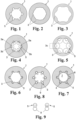
- the Figures 1 to 8 each show a schematic plan view of the cladding tube front side.
- the cladding tubes 1 have on the inside of the cladding tube wall 1a each have longitudinal grooves 3.
- the longitudinal grooves 3 are evenly distributed around the inner circumference of the respective cladding tube 1 in six-fold symmetry.
- the cladding tubes 1 are made of quartz glass. They have a length of 500 mm, an outer diameter of 73 mm and an inner diameter of 24 mm.
- Figure 1 shows deep, narrow and in cross-section almost closed circular longitudinal grooves 3, which are created by drilling.
- the maximum depth is 3 mm and the inner diameter is 4 mm.
- Figure 2 shows flat, narrow and in cross-section semicircular longitudinal grooves 3, which are produced by milling.
- Figure 3 shows flat, wide, bowl-shaped longitudinal grooves 3 in cross-section, which are also produced by milling.
- the longitudinal grooves 3 serve as positioning aids for anti-resonance element preforms 5.
- These can be present as an ensemble of nested elements consisting of an ARE outer tube 5a and an ARE inner tube 5b, as shown in the Figures 4 and 5 shown.
- Figure 4 shows deep, narrow and in cross-section almost closed, circular longitudinal grooves 3, which are created by drilling and on which the anti-resonance element preforms 5 rest on two edges 3a, 3b.
- the ARE outer tube has an outer diameter of 73 mm.
- the wall thickness of the ARE inner tube and ARE outer tube are approximately the same and are 0.35 mm.
- Figure 5 shows flat, wide and, in cross-section, bowl-shaped longitudinal grooves 3, which are produced by milling and on which the anti-resonance element preforms 5 rest on larger contact surfaces 3c.
- the ARE outer tube has an outer diameter of 73 mm.
- the wall thickness of the ARE inner tube and ARE outer tube are approximately the same and are 0.35 mm.
- Figure 6 shows deep, narrow and in cross-section almost closed, circular longitudinal grooves 3, which are created by drilling and in which the anti-resonance element preforms 5 are accommodated.
- the anti-resonance element preforms 5 are in this case designed as simple capillary tubes.
- Figure 7 shows deep, narrow and in cross-section almost closed circular longitudinal grooves 3, which are produced by drilling and in which the anti-resonance element preforms 5 are accommodated.
- the anti-resonance element preforms 5 are in this case designed as simple capillary tubes.
- An insert tube 8 is inserted into the cladding tube inner bore coaxially to the cladding tube longitudinal axis.
- the outer diameter of the insert tube 8 is similar to the inner diameter of the cladding tube 1 (as Fig. 1 ) and its wall thickness is similar to that of the anti-resonance element preforms.
- the cladding tube 1 is collapsed onto the insert tube 8 so that the longitudinal grooves 3 are closed.
- the closed longitudinal grooves form hollow channels which are then inflated (for example when the preform is elongated). This forms protuberances with convex surfaces on the insert tube 8 which are directed inwards towards the inner bore and act as an additional anti-resonance boundary layer.
- almost closed circular longitudinal grooves are created in the cross-section by drilling.
- An insert tube is inserted into the inner bore of the cladding tube coaxially to the longitudinal axis of the cladding tube.
- the outer diameter of the insert tube 8 is similar to the inner diameter of the cladding tube (as Fig. 1 ) and its wall thickness is similar to that of the anti-resonance element preforms.
- the cladding tube is collapsed onto the insert tube so that the longitudinal grooves are closed.
- the closed longitudinal grooves form hollow channels, which are then inflated (for example when the preform is elongated). This creates protuberances with convex surfaces on the insert tube that are directed inwards towards the inner bore and act as anti-resonance elements.
- the anti-resonance element preforms 5 are equipped with anti-resonance elements and additionally with a positioning capillary 9.
- the positioning capillaries 9 are each inserted into the longitudinal grooves 3, which are almost circular in cross-section and created by drilling.
- the positioning capillaries 9 form hollow channels which can be inflated when the ensemble softens, for example when the preform elongates, so that the anti-resonance elements fixed to them can be pushed closer to the center (the core area).
- the extent of the displacement can be easily adjusted and regulated via the internal pressure in the hollow channels (positioning capillaries 9). This allows not only a precise adjustment of the azimuthal position but also the radial position of the anti-resonance elements and thus the core diameter of the anti-resonant hollow core fibers.
- Figure 9 shows two different embodiments of anti-resonance element preforms 5, each equipped with a positioning capillary 9.
- FIGs 10 to 12 show schematically process steps for producing hollow core fibers, wherein a quartz glass cladding tube 1 with longitudinal slots 3 is used for precise positioning of the anti-resonance element preforms.
- the wall of the cladding tube 1 is cut longitudinally at previously defined azimuthal positions at equal intervals, for example by means of a mechanical saw, water jet cutting, laser or the like.
- the number of longitudinal cuts 3 corresponds to the number of anti-resonance element preforms 5 to be positioned, in the exemplary embodiment there are six preforms 5.
- the longitudinal cuts 3 end in front of the cladding tube ends, so that the front end regions 12 remain closed all the way around and connect the remaining webs 14. The cut edges are then glazed.
- the cutting width of the longitudinal slots 3 is uniform and amounts to 2 mm.
- the anti-resonance element preforms 5 have a substantially round outer cross-section with a diameter of 7.4 mm.
- the six longitudinal slots 3 are evenly distributed around the tube wall 1a, and it shows the anti-resonance element preforms 5, which rest on the longitudinal slots 3 at two contact lines, the cutting edges 3a; 3b, and protrude into the cladding tube inner bore 16.
- the two ends of the anti-resonance element preforms 5 are glued to the inside of the cladding tube 1, for example, or fused to it.
- the anti-resonance element preforms are connected to the cladding tube inner surface using the SiO 2 -containing sealing and connecting compound described above. Local fixing is sufficient for this, in particular in the two end areas on the front side.
- the anti-resonance element preforms 5 are connected over their entire length to the cut edges 3a; 3b inside the cladding tube 1.
- the longitudinal slots 3 thus serve as an exact positioning aid, on which each anti-resonance element preform 5 can be precisely positioned and fixed.
- the ensemble 17 consisting of the cladding tube 1 and the anti-resonance element preforms 5 positioned therein is often also referred to as a "cane" (17).
- gas can be introduced into or withdrawn from the hollow channels formed in the cut joints 3 between the overlay tube 15 and the melted anti-resonance element preforms 5 via the annular gap 19 in order to generate overpressure or underpressure in the hollow channels.
- the radial position of the anti-resonance elements 5 in the cladding tube inner bore 16 can be changed and corrected, as shown in Figure 11 sketched.
- Sketch (a) shows an anti-resonance element preform 5 with ARE outer tube 5a and nested inner element (ARE inner tube 5b) in the starting position.
- Sketch (b) shows the ARE outer tube wall deformed by pressure and heat and partially folded inwards with the ARE inner tube 5b fixed to the folded in position in a different radial position compared to the starting position.
- fiber designs can be realized that, in contrast to the classic "stack-and-draw technique", also have non-hexagonal symmetry and in particular non-integer symmetry.
- FIG 12(a) shows an anti-resonance element preform 5 with a simple ARE outer tube 5a (without an additional nested ARE inner tube) in the starting position. Under the influence of heat and pressure, the wall section between the two contact lines is inflated inwards. As in Figure 12b As shown, a further glass membrane 5c with a negatively (convex) curved surface is created within the ARE outer tube 5a, which can replace a nested inner element such as the ARE inner tube 5b ("nested element").
Landscapes
- Chemical & Material Sciences (AREA)
- Engineering & Computer Science (AREA)
- Geochemistry & Mineralogy (AREA)
- Life Sciences & Earth Sciences (AREA)
- General Life Sciences & Earth Sciences (AREA)
- Manufacturing & Machinery (AREA)
- Materials Engineering (AREA)
- Organic Chemistry (AREA)
- Physics & Mathematics (AREA)
- Optics & Photonics (AREA)
- General Physics & Mathematics (AREA)
- Crystallography & Structural Chemistry (AREA)
- Manufacture, Treatment Of Glass Fibers (AREA)
- Optical Fibers, Optical Fiber Cores, And Optical Fiber Bundles (AREA)
Priority Applications (5)
| Application Number | Priority Date | Filing Date | Title |
|---|---|---|---|
| EP19186735.7A EP3766842B1 (de) | 2019-07-17 | 2019-07-17 | Verfahren zur herstellung einer hohlkernfaser und zur herstellung einer vorform für eine hohlkernfaser |
| CN202080034652.0A CN113939482B (zh) | 2019-07-17 | 2020-07-15 | 制造空芯光纤和空芯光纤预制件的方法 |
| JP2021570389A JP7623959B2 (ja) | 2019-07-17 | 2020-07-15 | 中空コアファイバの製造方法および中空コアファイバ用プリフォームの製造方法 |
| PCT/EP2020/069973 WO2021009208A1 (de) | 2019-07-17 | 2020-07-15 | Verfahren zur herstellung einer hohlkernfaser und zur herstellung einer vorform für eine hohlkernfaser |
| US17/617,220 US12378150B2 (en) | 2019-07-17 | 2020-07-15 | Methods for producing a hollow-core fiber and for producing a preform for a hollow-core fiber |
Applications Claiming Priority (1)
| Application Number | Priority Date | Filing Date | Title |
|---|---|---|---|
| EP19186735.7A EP3766842B1 (de) | 2019-07-17 | 2019-07-17 | Verfahren zur herstellung einer hohlkernfaser und zur herstellung einer vorform für eine hohlkernfaser |
Publications (3)
| Publication Number | Publication Date |
|---|---|
| EP3766842A1 EP3766842A1 (de) | 2021-01-20 |
| EP3766842B1 true EP3766842B1 (de) | 2025-02-12 |
| EP3766842C0 EP3766842C0 (de) | 2025-02-12 |
Family
ID=67402845
Family Applications (1)
| Application Number | Title | Priority Date | Filing Date |
|---|---|---|---|
| EP19186735.7A Active EP3766842B1 (de) | 2019-07-17 | 2019-07-17 | Verfahren zur herstellung einer hohlkernfaser und zur herstellung einer vorform für eine hohlkernfaser |
Country Status (5)
| Country | Link |
|---|---|
| US (1) | US12378150B2 (https=) |
| EP (1) | EP3766842B1 (https=) |
| JP (1) | JP7623959B2 (https=) |
| CN (1) | CN113939482B (https=) |
| WO (1) | WO2021009208A1 (https=) |
Families Citing this family (19)
| Publication number | Priority date | Publication date | Assignee | Title |
|---|---|---|---|---|
| GB2576190B (en) | 2018-08-08 | 2022-03-09 | Univ Southampton | Hollow core optical fibre |
| CN117836247A (zh) | 2021-08-06 | 2024-04-05 | 康宁股份有限公司 | 抗谐振空心光纤预制件及其制备方法 |
| CN115072983B (zh) * | 2022-06-10 | 2024-01-16 | 武汉长盈通光电技术股份有限公司 | 空芯反谐振光纤中间体预制棒的制备方法 |
| CN114924345B (zh) * | 2022-06-14 | 2023-04-11 | 东北大学 | 内六角毛细管及其制法和在多芯空分复用器的应用 |
| CN115745391B (zh) * | 2022-11-10 | 2024-07-12 | 长飞光纤光缆股份有限公司 | 一种一体式空芯光纤预制棒、光纤及其制备方法 |
| CN116148972B (zh) * | 2023-01-06 | 2026-04-10 | 江西师范大学 | 一种基于负曲率外套介质管的无节点反谐振空芯光纤 |
| CN116047653A (zh) * | 2023-01-06 | 2023-05-02 | 江西师范大学 | 一种基于多边形外套管的空芯反谐振光纤 |
| AU2024270457A1 (en) * | 2023-05-11 | 2026-01-15 | University Of Central Florida Research Foundation, Inc. | Anti-resonant hollow-core fibers featuring support structures |
| WO2025006663A2 (en) * | 2023-06-29 | 2025-01-02 | Ofs Fitel, Llc | Sleeve for aligning hollow-core preform components |
| CN117420632A (zh) * | 2023-10-19 | 2024-01-19 | 长飞光纤光缆股份有限公司 | 带增材标记的空芯微结构光纤、预制棒及拉丝检测方法 |
| CN117420629A (zh) * | 2023-10-19 | 2024-01-19 | 长飞光纤光缆股份有限公司 | 一种方位角标记的空芯光纤及空芯光纤端面检测方法 |
| CN117420631A (zh) * | 2023-10-19 | 2024-01-19 | 长飞光纤光缆股份有限公司 | 带减材标记的空芯微结构光纤、预制棒及拉丝检测方法 |
| CN117420630A (zh) * | 2023-10-19 | 2024-01-19 | 长飞光纤光缆股份有限公司 | 带折射率标记的空芯微结构光纤、其制备及检测方法 |
| WO2026030264A1 (en) * | 2024-08-02 | 2026-02-05 | Corning Incorporated | Anti-resonant hollow core optical fiber with recessed cladding tube |
| US20260036742A1 (en) * | 2024-08-02 | 2026-02-05 | Corning Incorporated | Anti-resonant hollow core optical fiber with contacting capillaries |
| US20260035282A1 (en) * | 2024-08-02 | 2026-02-05 | Corning Incorporated | Method of manufacturing a hollow core optical fiber |
| CN119828286B (zh) * | 2025-01-10 | 2026-03-13 | 江苏亨通光导新材料有限公司 | 一种空芯光纤及其制备方法 |
| CN120090103B (zh) * | 2025-04-30 | 2025-08-15 | 陕西普利美材料科技有限公司 | 一种预埋导线包覆套及成型方法 |
| CN120294905B (zh) * | 2025-06-12 | 2026-01-30 | 深圳市同昇光电有限公司 | 一种反谐振空芯光纤 |
Family Cites Families (30)
| Publication number | Priority date | Publication date | Assignee | Title |
|---|---|---|---|---|
| JP2000137143A (ja) | 1998-10-30 | 2000-05-16 | Kyocera Corp | 光ファイバ装置及びその製造方法 |
| US7155097B2 (en) * | 2001-03-09 | 2006-12-26 | Crystal Fibre A/S | Fabrication of microstructured fibres |
| US6529653B1 (en) | 2001-04-11 | 2003-03-04 | Optical Switch Corporation | System and method for orienting and positioning optical fibers |
| US7359603B2 (en) * | 2001-07-20 | 2008-04-15 | The University Of Syndey | Constructing preforms from capillaries and canes |
| JP4466813B2 (ja) | 2002-03-14 | 2010-05-26 | 日本電気硝子株式会社 | ガラスプリフォームおよびその製造方法 |
| US20030230118A1 (en) | 2002-06-12 | 2003-12-18 | Dawes Steven B. | Methods and preforms for drawing microstructured optical fibers |
| US6917741B2 (en) * | 2002-11-18 | 2005-07-12 | Corning Incorporated | Methods for manufacturing microstructured optical fibers with arbitrary core size |
| CA2643338C (en) * | 2003-08-13 | 2014-01-07 | Nippon Telegraph And Telephone Corporation | Structured doped tellurite glass optical fiber exhibiting controlled zero dispersion within a wavelength band centered at 1.55 mm |
| GB0408082D0 (en) | 2004-04-08 | 2004-05-12 | Blazephotonics Ltd | Method for making an optical fibre |
| DE102004054392A1 (de) | 2004-08-28 | 2006-03-02 | Heraeus Quarzglas Gmbh & Co. Kg | Verfahren zum Verbinden von Bauteilen aus hochkieselsäurehaltigem Werkstoff, sowie aus derartigen Bauteilen zusammengefügter Bauteil-Verbund |
| US20060130528A1 (en) | 2004-12-22 | 2006-06-22 | Nelson Brian K | Method of making a hole assisted fiber device and fiber preform |
| DK1846784T3 (en) * | 2004-12-30 | 2016-10-03 | Imra America Inc | Fiber with photonic band gap |
| DE102005028219B3 (de) | 2005-05-16 | 2006-10-12 | Heraeus Tenevo Gmbh | Verfahren zur Herstellung eines Rohres aus Quarzglas durch Elongieren eines Quarzglas-Hohlzylinders |
| US7343074B1 (en) * | 2007-02-27 | 2008-03-11 | Corning Incorporated | Optical waveguide environmental sensor and method of manufacture |
| US7496260B2 (en) * | 2007-03-27 | 2009-02-24 | Imra America, Inc. | Ultra high numerical aperture optical fibers |
| JP5170863B2 (ja) | 2007-06-14 | 2013-03-27 | 古河電気工業株式会社 | ホーリーファイバの製造方法 |
| DE102007033086A1 (de) * | 2007-07-15 | 2009-01-29 | Heraeus Quarzglas Gmbh & Co. Kg | Verfahren zur Herstellung eines optischen Bauteils mit Längsbohrungen, sowie mikrostrukturierte optische Faser |
| US8133593B2 (en) * | 2008-06-26 | 2012-03-13 | Corning Incorporated | Pre-form for and methods of forming a hollow-core slotted PBG optical fiber for an environmental sensor |
| FR2952726B1 (fr) * | 2009-11-16 | 2012-05-25 | Ixfiber | Procede de fabrication d'une preforme a fibrer et fibre optique a maintien de polarisation ou polarisante obtenue par fibrage de ladite preforme |
| RU2437129C1 (ru) * | 2010-03-24 | 2011-12-20 | Закрытое акционерное общество "Профотек" | Способ изготовления двулучепреломляющего микроструктурного оптического волокна |
| DE102014011041A1 (de) | 2014-07-23 | 2016-01-28 | Leibniz-Institut für Photonische Technologien e. V. | Optische Durchflussmesshohlfaser, Verfahren zu ihrer Herstellung und ihre Verwendung |
| EP3136143B1 (en) | 2015-08-26 | 2020-04-01 | Max-Planck-Gesellschaft zur Förderung der Wissenschaften e.V. | Hollow-core fibre and method of manufacturing thereof |
| CN105807363B (zh) | 2016-05-13 | 2019-01-29 | 北京工业大学 | 一种空芯反谐振光纤 |
| WO2018067445A2 (en) | 2016-10-03 | 2018-04-12 | The Government Of The United States Of America, As Represented By The Secretary Of The Navy | Method to make optical fibers with multiple openings |
| JP2018150184A (ja) * | 2017-03-10 | 2018-09-27 | 古河電気工業株式会社 | 光ファイバの製造方法 |
| US20200115270A1 (en) | 2017-03-14 | 2020-04-16 | Nanyang Technological University | Fiber preform, optical fiber and methods for forming the same |
| GB201710813D0 (en) * | 2017-07-05 | 2017-08-16 | Univ Southampton | Method for fabricating an optical fibre preform |
| GB2566466A (en) * | 2017-09-13 | 2019-03-20 | Univ Southampton | Antiresonant hollow core preforms and optical fibres and methods of fabrication |
| DE102018112739B4 (de) * | 2018-05-28 | 2025-03-27 | J-Fiber Gmbh | Verfahren zum Herstellen einer Preform zum Herstellen einer Mehrkernfaser sowie Preform und Mehrkernfaser |
| GB2583352B (en) * | 2019-04-24 | 2023-09-06 | Univ Southampton | Antiresonant hollow core fibre, preform therefor and method of fabrication |
-
2019
- 2019-07-17 EP EP19186735.7A patent/EP3766842B1/de active Active
-
2020
- 2020-07-15 WO PCT/EP2020/069973 patent/WO2021009208A1/de not_active Ceased
- 2020-07-15 JP JP2021570389A patent/JP7623959B2/ja active Active
- 2020-07-15 CN CN202080034652.0A patent/CN113939482B/zh active Active
- 2020-07-15 US US17/617,220 patent/US12378150B2/en active Active
Also Published As
| Publication number | Publication date |
|---|---|
| JP2022541097A (ja) | 2022-09-22 |
| EP3766842A1 (de) | 2021-01-20 |
| WO2021009208A1 (de) | 2021-01-21 |
| US12378150B2 (en) | 2025-08-05 |
| US20220227658A1 (en) | 2022-07-21 |
| JP7623959B2 (ja) | 2025-01-29 |
| EP3766842C0 (de) | 2025-02-12 |
| CN113939482A (zh) | 2022-01-14 |
| CN113939482B (zh) | 2023-12-26 |
Similar Documents
| Publication | Publication Date | Title |
|---|---|---|
| EP3766842B1 (de) | Verfahren zur herstellung einer hohlkernfaser und zur herstellung einer vorform für eine hohlkernfaser | |
| EP3766847B1 (de) | Verfahren zur herstellung einer hohlkernfaser und zur herstellung einer vorform für eine hohlkernfaser | |
| EP3766845B1 (de) | Verfahren zur herstellung einer hohlkernfaser und zur herstellung einer vorform für eine hohlkernfaser | |
| EP3766843B1 (de) | Verfahren zur herstellung einer hohlkernfaser und zur herstellung einer vorform für eine hohlkernfaser | |
| EP3766848B1 (de) | Verfahren zur herstellung einer hohlkernfaser und zur herstellung einer vorform für eine hohlkernfaser | |
| EP3766844B1 (de) | Verfahren zur herstellung einer hohlkernfaser und zur herstellung einer vorform für eine hohlkernfaser | |
| EP3766850B1 (de) | Verfahren zur herstellung einer hohlkernfaser und zur herstellung einer vorform für eine hohlkernfaser | |
| EP3766849B1 (de) | Verfahren zur herstellung einer hohlkernfaser und zur herstellung einer vorform für eine hohlkernfaser | |
| EP3766840B1 (de) | Verfahren zur herstellung einer hohlkernfaser und zur herstellung einer vorform für eine hohlkernfaser | |
| EP3766851B1 (de) | Verfahren zur herstellung einer hohlkernfaser und zur herstellung einer vorform für eine hohlkernfaser | |
| EP3766846A1 (de) | Verfahren zur herstellung einer hohlkernfaser und zur herstellung einer vorform für eine hohlkernfaser | |
| EP3766841B1 (de) | Verfahren zur herstellung einer hohlkernfaser und zur herstellung einer vorform für eine hohlkernfaser | |
| WO2022128271A1 (de) | Verfahren zur herstellung einer vorform für eine antiresonanten hohlkernfaser mit verschachtelten kapillaren, vorform und zwischenprodukt | |
| EP3771696A1 (de) | Verfahren und zwischenprodukt für die herstellung einer hohlkernfaser sowie verfahren zur herstellung einer vorform für eine hohlkernfaser | |
| EP4574783A1 (de) | Verfahren und vorform für die herstellung einer hohlkernfaser sowie verfahren zur herstellung einer vorform für eine hohlkernfaser | |
| WO2026037827A1 (de) | Verfahren zur herstellung einer antiresonanten hohlkernfaser | |
| EP4660162A1 (de) | Verfahren für die herstellung einer vorform für eine hohlkernfaser | |
| EP4660160A1 (de) | Verfahren und vorform für die herstellung einer hohlkernfaser sowie verfahren zur herstellung einer vorform für eine hohlkernfaser | |
| EP4660163A1 (de) | Positionierhilfe sowie verfahren zur herstellung einer hohlkernfaser und einer vorform dafür unter einsatz der positionierhilfe |
Legal Events
| Date | Code | Title | Description |
|---|---|---|---|
| PUAI | Public reference made under article 153(3) epc to a published international application that has entered the european phase |
Free format text: ORIGINAL CODE: 0009012 |
|
| STAA | Information on the status of an ep patent application or granted ep patent |
Free format text: STATUS: THE APPLICATION HAS BEEN PUBLISHED |
|
| AK | Designated contracting states |
Kind code of ref document: A1 Designated state(s): AL AT BE BG CH CY CZ DE DK EE ES FI FR GB GR HR HU IE IS IT LI LT LU LV MC MK MT NL NO PL PT RO RS SE SI SK SM TR |
|
| AX | Request for extension of the european patent |
Extension state: BA ME |
|
| STAA | Information on the status of an ep patent application or granted ep patent |
Free format text: STATUS: REQUEST FOR EXAMINATION WAS MADE |
|
| 17P | Request for examination filed |
Effective date: 20210719 |
|
| RBV | Designated contracting states (corrected) |
Designated state(s): AL AT BE BG CH CY CZ DE DK EE ES FI FR GB GR HR HU IE IS IT LI LT LU LV MC MK MT NL NO PL PT RO RS SE SI SK SM TR |
|
| RAP3 | Party data changed (applicant data changed or rights of an application transferred) |
Owner name: HERAEUS QUARZGLAS GMBH & CO. KG |
|
| STAA | Information on the status of an ep patent application or granted ep patent |
Free format text: STATUS: EXAMINATION IS IN PROGRESS |
|
| 17Q | First examination report despatched |
Effective date: 20231005 |
|
| GRAP | Despatch of communication of intention to grant a patent |
Free format text: ORIGINAL CODE: EPIDOSNIGR1 |
|
| STAA | Information on the status of an ep patent application or granted ep patent |
Free format text: STATUS: GRANT OF PATENT IS INTENDED |
|
| INTG | Intention to grant announced |
Effective date: 20241127 |
|
| GRAS | Grant fee paid |
Free format text: ORIGINAL CODE: EPIDOSNIGR3 |
|
| GRAA | (expected) grant |
Free format text: ORIGINAL CODE: 0009210 |
|
| STAA | Information on the status of an ep patent application or granted ep patent |
Free format text: STATUS: THE PATENT HAS BEEN GRANTED |
|
| AK | Designated contracting states |
Kind code of ref document: B1 Designated state(s): AL AT BE BG CH CY CZ DE DK EE ES FI FR GB GR HR HU IE IS IT LI LT LU LV MC MK MT NL NO PL PT RO RS SE SI SK SM TR |
|
| REG | Reference to a national code |
Ref country code: GB Ref legal event code: FG4D Free format text: NOT ENGLISH |
|
| REG | Reference to a national code |
Ref country code: CH Ref legal event code: EP |
|
| REG | Reference to a national code |
Ref country code: DE Ref legal event code: R096 Ref document number: 502019012907 Country of ref document: DE |
|
| REG | Reference to a national code |
Ref country code: IE Ref legal event code: FG4D Free format text: LANGUAGE OF EP DOCUMENT: GERMAN |
|
| U01 | Request for unitary effect filed |
Effective date: 20250220 |
|
| U07 | Unitary effect registered |
Designated state(s): AT BE BG DE DK EE FI FR IT LT LU LV MT NL PT RO SE SI Effective date: 20250226 |
|
| PG25 | Lapsed in a contracting state [announced via postgrant information from national office to epo] |
Ref country code: RS Free format text: LAPSE BECAUSE OF FAILURE TO SUBMIT A TRANSLATION OF THE DESCRIPTION OR TO PAY THE FEE WITHIN THE PRESCRIBED TIME-LIMIT Effective date: 20250512 |
|
| PG25 | Lapsed in a contracting state [announced via postgrant information from national office to epo] |
Ref country code: PL Free format text: LAPSE BECAUSE OF FAILURE TO SUBMIT A TRANSLATION OF THE DESCRIPTION OR TO PAY THE FEE WITHIN THE PRESCRIBED TIME-LIMIT Effective date: 20250212 |
|
| PG25 | Lapsed in a contracting state [announced via postgrant information from national office to epo] |
Ref country code: ES Free format text: LAPSE BECAUSE OF FAILURE TO SUBMIT A TRANSLATION OF THE DESCRIPTION OR TO PAY THE FEE WITHIN THE PRESCRIBED TIME-LIMIT Effective date: 20250212 |
|
| PG25 | Lapsed in a contracting state [announced via postgrant information from national office to epo] |
Ref country code: IS Free format text: LAPSE BECAUSE OF FAILURE TO SUBMIT A TRANSLATION OF THE DESCRIPTION OR TO PAY THE FEE WITHIN THE PRESCRIBED TIME-LIMIT Effective date: 20250612 Ref country code: NO Free format text: LAPSE BECAUSE OF FAILURE TO SUBMIT A TRANSLATION OF THE DESCRIPTION OR TO PAY THE FEE WITHIN THE PRESCRIBED TIME-LIMIT Effective date: 20250512 |
|
| PG25 | Lapsed in a contracting state [announced via postgrant information from national office to epo] |
Ref country code: HR Free format text: LAPSE BECAUSE OF FAILURE TO SUBMIT A TRANSLATION OF THE DESCRIPTION OR TO PAY THE FEE WITHIN THE PRESCRIBED TIME-LIMIT Effective date: 20250212 |
|
| PG25 | Lapsed in a contracting state [announced via postgrant information from national office to epo] |
Ref country code: GR Free format text: LAPSE BECAUSE OF FAILURE TO SUBMIT A TRANSLATION OF THE DESCRIPTION OR TO PAY THE FEE WITHIN THE PRESCRIBED TIME-LIMIT Effective date: 20250513 |
|
| U20 | Renewal fee for the european patent with unitary effect paid |
Year of fee payment: 7 Effective date: 20250728 |
|
| PG25 | Lapsed in a contracting state [announced via postgrant information from national office to epo] |
Ref country code: SM Free format text: LAPSE BECAUSE OF FAILURE TO SUBMIT A TRANSLATION OF THE DESCRIPTION OR TO PAY THE FEE WITHIN THE PRESCRIBED TIME-LIMIT Effective date: 20250212 |
|
| PGFP | Annual fee paid to national office [announced via postgrant information from national office to epo] |
Ref country code: GB Payment date: 20250722 Year of fee payment: 7 |
|
| PG25 | Lapsed in a contracting state [announced via postgrant information from national office to epo] |
Ref country code: CZ Free format text: LAPSE BECAUSE OF FAILURE TO SUBMIT A TRANSLATION OF THE DESCRIPTION OR TO PAY THE FEE WITHIN THE PRESCRIBED TIME-LIMIT Effective date: 20250212 |
|
| PG25 | Lapsed in a contracting state [announced via postgrant information from national office to epo] |
Ref country code: SK Free format text: LAPSE BECAUSE OF FAILURE TO SUBMIT A TRANSLATION OF THE DESCRIPTION OR TO PAY THE FEE WITHIN THE PRESCRIBED TIME-LIMIT Effective date: 20250212 |
|
| PLBE | No opposition filed within time limit |
Free format text: ORIGINAL CODE: 0009261 |
|
| STAA | Information on the status of an ep patent application or granted ep patent |
Free format text: STATUS: NO OPPOSITION FILED WITHIN TIME LIMIT |
|
| REG | Reference to a national code |
Ref country code: CH Ref legal event code: L10 Free format text: ST27 STATUS EVENT CODE: U-0-0-L10-L00 (AS PROVIDED BY THE NATIONAL OFFICE) Effective date: 20251224 |
|
| 26N | No opposition filed |
Effective date: 20251113 |
|
| REG | Reference to a national code |
Ref country code: CH Ref legal event code: H13 Free format text: ST27 STATUS EVENT CODE: U-0-0-H10-H13 (AS PROVIDED BY THE NATIONAL OFFICE) Effective date: 20260224 |
|
| PG25 | Lapsed in a contracting state [announced via postgrant information from national office to epo] |
Ref country code: CH Free format text: LAPSE BECAUSE OF NON-PAYMENT OF DUE FEES Effective date: 20250731 |