EP3764089B1 - Röntgenstrahlenschweissnahtinspektion - Google Patents
Röntgenstrahlenschweissnahtinspektion Download PDFInfo
- Publication number
- EP3764089B1 EP3764089B1 EP19185750.7A EP19185750A EP3764089B1 EP 3764089 B1 EP3764089 B1 EP 3764089B1 EP 19185750 A EP19185750 A EP 19185750A EP 3764089 B1 EP3764089 B1 EP 3764089B1
- Authority
- EP
- European Patent Office
- Prior art keywords
- weld
- ray
- section
- ray detector
- detector
- Prior art date
- Legal status (The legal status is an assumption and is not a legal conclusion. Google has not performed a legal analysis and makes no representation as to the accuracy of the status listed.)
- Active
Links
Images



Classifications
-
- G—PHYSICS
- G01—MEASURING; TESTING
- G01N—INVESTIGATING OR ANALYSING MATERIALS BY DETERMINING THEIR CHEMICAL OR PHYSICAL PROPERTIES
- G01N23/00—Investigating or analysing materials by the use of wave or particle radiation, e.g. X-rays or neutrons, not covered by groups G01N3/00 – G01N17/00, G01N21/00 or G01N22/00
- G01N23/02—Investigating or analysing materials by the use of wave or particle radiation, e.g. X-rays or neutrons, not covered by groups G01N3/00 – G01N17/00, G01N21/00 or G01N22/00 by transmitting the radiation through the material
- G01N23/04—Investigating or analysing materials by the use of wave or particle radiation, e.g. X-rays or neutrons, not covered by groups G01N3/00 – G01N17/00, G01N21/00 or G01N22/00 by transmitting the radiation through the material and forming images of the material
-
- B—PERFORMING OPERATIONS; TRANSPORTING
- B23—MACHINE TOOLS; METAL-WORKING NOT OTHERWISE PROVIDED FOR
- B23K—SOLDERING OR UNSOLDERING; WELDING; CLADDING OR PLATING BY SOLDERING OR WELDING; CUTTING BY APPLYING HEAT LOCALLY, e.g. FLAME CUTTING; WORKING BY LASER BEAM
- B23K31/00—Processes relevant to this subclass, specially adapted for particular articles or purposes, but not covered by only one of the preceding main groups
- B23K31/02—Processes relevant to this subclass, specially adapted for particular articles or purposes, but not covered by only one of the preceding main groups relating to soldering or welding
-
- B—PERFORMING OPERATIONS; TRANSPORTING
- B23—MACHINE TOOLS; METAL-WORKING NOT OTHERWISE PROVIDED FOR
- B23K—SOLDERING OR UNSOLDERING; WELDING; CLADDING OR PLATING BY SOLDERING OR WELDING; CUTTING BY APPLYING HEAT LOCALLY, e.g. FLAME CUTTING; WORKING BY LASER BEAM
- B23K31/00—Processes relevant to this subclass, specially adapted for particular articles or purposes, but not covered by only one of the preceding main groups
- B23K31/02—Processes relevant to this subclass, specially adapted for particular articles or purposes, but not covered by only one of the preceding main groups relating to soldering or welding
- B23K31/027—Making tubes with soldering or welding
-
- B—PERFORMING OPERATIONS; TRANSPORTING
- B23—MACHINE TOOLS; METAL-WORKING NOT OTHERWISE PROVIDED FOR
- B23K—SOLDERING OR UNSOLDERING; WELDING; CLADDING OR PLATING BY SOLDERING OR WELDING; CUTTING BY APPLYING HEAT LOCALLY, e.g. FLAME CUTTING; WORKING BY LASER BEAM
- B23K31/00—Processes relevant to this subclass, specially adapted for particular articles or purposes, but not covered by only one of the preceding main groups
- B23K31/12—Processes relevant to this subclass, specially adapted for particular articles or purposes, but not covered by only one of the preceding main groups relating to investigating the properties, e.g. the weldability, of materials
- B23K31/125—Weld quality monitoring
-
- G—PHYSICS
- G01—MEASURING; TESTING
- G01N—INVESTIGATING OR ANALYSING MATERIALS BY DETERMINING THEIR CHEMICAL OR PHYSICAL PROPERTIES
- G01N23/00—Investigating or analysing materials by the use of wave or particle radiation, e.g. X-rays or neutrons, not covered by groups G01N3/00 – G01N17/00, G01N21/00 or G01N22/00
- G01N23/02—Investigating or analysing materials by the use of wave or particle radiation, e.g. X-rays or neutrons, not covered by groups G01N3/00 – G01N17/00, G01N21/00 or G01N22/00 by transmitting the radiation through the material
- G01N23/04—Investigating or analysing materials by the use of wave or particle radiation, e.g. X-rays or neutrons, not covered by groups G01N3/00 – G01N17/00, G01N21/00 or G01N22/00 by transmitting the radiation through the material and forming images of the material
- G01N23/043—Investigating or analysing materials by the use of wave or particle radiation, e.g. X-rays or neutrons, not covered by groups G01N3/00 – G01N17/00, G01N21/00 or G01N22/00 by transmitting the radiation through the material and forming images of the material using fluoroscopic examination, with visual observation or video transmission of fluoroscopic images
-
- G—PHYSICS
- G01—MEASURING; TESTING
- G01N—INVESTIGATING OR ANALYSING MATERIALS BY DETERMINING THEIR CHEMICAL OR PHYSICAL PROPERTIES
- G01N23/00—Investigating or analysing materials by the use of wave or particle radiation, e.g. X-rays or neutrons, not covered by groups G01N3/00 – G01N17/00, G01N21/00 or G01N22/00
- G01N23/02—Investigating or analysing materials by the use of wave or particle radiation, e.g. X-rays or neutrons, not covered by groups G01N3/00 – G01N17/00, G01N21/00 or G01N22/00 by transmitting the radiation through the material
- G01N23/04—Investigating or analysing materials by the use of wave or particle radiation, e.g. X-rays or neutrons, not covered by groups G01N3/00 – G01N17/00, G01N21/00 or G01N22/00 by transmitting the radiation through the material and forming images of the material
- G01N23/044—Investigating or analysing materials by the use of wave or particle radiation, e.g. X-rays or neutrons, not covered by groups G01N3/00 – G01N17/00, G01N21/00 or G01N22/00 by transmitting the radiation through the material and forming images of the material using laminography or tomosynthesis
-
- G—PHYSICS
- G01—MEASURING; TESTING
- G01N—INVESTIGATING OR ANALYSING MATERIALS BY DETERMINING THEIR CHEMICAL OR PHYSICAL PROPERTIES
- G01N23/00—Investigating or analysing materials by the use of wave or particle radiation, e.g. X-rays or neutrons, not covered by groups G01N3/00 – G01N17/00, G01N21/00 or G01N22/00
- G01N23/02—Investigating or analysing materials by the use of wave or particle radiation, e.g. X-rays or neutrons, not covered by groups G01N3/00 – G01N17/00, G01N21/00 or G01N22/00 by transmitting the radiation through the material
- G01N23/04—Investigating or analysing materials by the use of wave or particle radiation, e.g. X-rays or neutrons, not covered by groups G01N3/00 – G01N17/00, G01N21/00 or G01N22/00 by transmitting the radiation through the material and forming images of the material
- G01N23/046—Investigating or analysing materials by the use of wave or particle radiation, e.g. X-rays or neutrons, not covered by groups G01N3/00 – G01N17/00, G01N21/00 or G01N22/00 by transmitting the radiation through the material and forming images of the material using tomography, e.g. computed tomography [CT]
-
- G—PHYSICS
- G01—MEASURING; TESTING
- G01N—INVESTIGATING OR ANALYSING MATERIALS BY DETERMINING THEIR CHEMICAL OR PHYSICAL PROPERTIES
- G01N23/00—Investigating or analysing materials by the use of wave or particle radiation, e.g. X-rays or neutrons, not covered by groups G01N3/00 – G01N17/00, G01N21/00 or G01N22/00
- G01N23/02—Investigating or analysing materials by the use of wave or particle radiation, e.g. X-rays or neutrons, not covered by groups G01N3/00 – G01N17/00, G01N21/00 or G01N22/00 by transmitting the radiation through the material
- G01N23/06—Investigating or analysing materials by the use of wave or particle radiation, e.g. X-rays or neutrons, not covered by groups G01N3/00 – G01N17/00, G01N21/00 or G01N22/00 by transmitting the radiation through the material and measuring the absorption
- G01N23/083—Investigating or analysing materials by the use of wave or particle radiation, e.g. X-rays or neutrons, not covered by groups G01N3/00 – G01N17/00, G01N21/00 or G01N22/00 by transmitting the radiation through the material and measuring the absorption the radiation being X-rays
-
- G—PHYSICS
- G01—MEASURING; TESTING
- G01N—INVESTIGATING OR ANALYSING MATERIALS BY DETERMINING THEIR CHEMICAL OR PHYSICAL PROPERTIES
- G01N23/00—Investigating or analysing materials by the use of wave or particle radiation, e.g. X-rays or neutrons, not covered by groups G01N3/00 – G01N17/00, G01N21/00 or G01N22/00
- G01N23/02—Investigating or analysing materials by the use of wave or particle radiation, e.g. X-rays or neutrons, not covered by groups G01N3/00 – G01N17/00, G01N21/00 or G01N22/00 by transmitting the radiation through the material
- G01N23/06—Investigating or analysing materials by the use of wave or particle radiation, e.g. X-rays or neutrons, not covered by groups G01N3/00 – G01N17/00, G01N21/00 or G01N22/00 by transmitting the radiation through the material and measuring the absorption
- G01N23/083—Investigating or analysing materials by the use of wave or particle radiation, e.g. X-rays or neutrons, not covered by groups G01N3/00 – G01N17/00, G01N21/00 or G01N22/00 by transmitting the radiation through the material and measuring the absorption the radiation being X-rays
- G01N23/087—Investigating or analysing materials by the use of wave or particle radiation, e.g. X-rays or neutrons, not covered by groups G01N3/00 – G01N17/00, G01N21/00 or G01N22/00 by transmitting the radiation through the material and measuring the absorption the radiation being X-rays using polyenergetic X-rays
-
- G—PHYSICS
- G01—MEASURING; TESTING
- G01N—INVESTIGATING OR ANALYSING MATERIALS BY DETERMINING THEIR CHEMICAL OR PHYSICAL PROPERTIES
- G01N23/00—Investigating or analysing materials by the use of wave or particle radiation, e.g. X-rays or neutrons, not covered by groups G01N3/00 – G01N17/00, G01N21/00 or G01N22/00
- G01N23/02—Investigating or analysing materials by the use of wave or particle radiation, e.g. X-rays or neutrons, not covered by groups G01N3/00 – G01N17/00, G01N21/00 or G01N22/00 by transmitting the radiation through the material
- G01N23/06—Investigating or analysing materials by the use of wave or particle radiation, e.g. X-rays or neutrons, not covered by groups G01N3/00 – G01N17/00, G01N21/00 or G01N22/00 by transmitting the radiation through the material and measuring the absorption
- G01N23/18—Investigating the presence of flaws defects or foreign matter
-
- G—PHYSICS
- G06—COMPUTING OR CALCULATING; COUNTING
- G06T—IMAGE DATA PROCESSING OR GENERATION, IN GENERAL
- G06T7/00—Image analysis
- G06T7/0002—Inspection of images, e.g. flaw detection
- G06T7/0004—Industrial image inspection
-
- H—ELECTRICITY
- H04—ELECTRIC COMMUNICATION TECHNIQUE
- H04N—PICTORIAL COMMUNICATION, e.g. TELEVISION
- H04N25/00—Circuitry of solid-state image sensors [SSIS]; Control thereof
- H04N25/70—SSIS architectures; Circuits associated therewith
- H04N25/76—Addressed sensors, e.g. MOS or CMOS sensors
- H04N25/768—Addressed sensors, e.g. MOS or CMOS sensors for time delay and integration [TDI]
-
- B—PERFORMING OPERATIONS; TRANSPORTING
- B23—MACHINE TOOLS; METAL-WORKING NOT OTHERWISE PROVIDED FOR
- B23K—SOLDERING OR UNSOLDERING; WELDING; CLADDING OR PLATING BY SOLDERING OR WELDING; CUTTING BY APPLYING HEAT LOCALLY, e.g. FLAME CUTTING; WORKING BY LASER BEAM
- B23K2101/00—Articles made by soldering, welding or cutting
- B23K2101/04—Tubular or hollow articles
- B23K2101/06—Tubes
-
- G—PHYSICS
- G01—MEASURING; TESTING
- G01N—INVESTIGATING OR ANALYSING MATERIALS BY DETERMINING THEIR CHEMICAL OR PHYSICAL PROPERTIES
- G01N2223/00—Investigating materials by wave or particle radiation
- G01N2223/30—Accessories, mechanical or electrical features
- G01N2223/306—Accessories, mechanical or electrical features computer control
-
- G—PHYSICS
- G01—MEASURING; TESTING
- G01N—INVESTIGATING OR ANALYSING MATERIALS BY DETERMINING THEIR CHEMICAL OR PHYSICAL PROPERTIES
- G01N2223/00—Investigating materials by wave or particle radiation
- G01N2223/30—Accessories, mechanical or electrical features
- G01N2223/33—Accessories, mechanical or electrical features scanning, i.e. relative motion for measurement of successive object-parts
- G01N2223/3303—Accessories, mechanical or electrical features scanning, i.e. relative motion for measurement of successive object-parts object fixed; source and detector move
-
- G—PHYSICS
- G01—MEASURING; TESTING
- G01N—INVESTIGATING OR ANALYSING MATERIALS BY DETERMINING THEIR CHEMICAL OR PHYSICAL PROPERTIES
- G01N2223/00—Investigating materials by wave or particle radiation
- G01N2223/40—Imaging
- G01N2223/401—Imaging image processing
-
- G—PHYSICS
- G01—MEASURING; TESTING
- G01N—INVESTIGATING OR ANALYSING MATERIALS BY DETERMINING THEIR CHEMICAL OR PHYSICAL PROPERTIES
- G01N2223/00—Investigating materials by wave or particle radiation
- G01N2223/40—Imaging
- G01N2223/417—Imaging recording with co-ordinate markings
-
- G—PHYSICS
- G01—MEASURING; TESTING
- G01N—INVESTIGATING OR ANALYSING MATERIALS BY DETERMINING THEIR CHEMICAL OR PHYSICAL PROPERTIES
- G01N2223/00—Investigating materials by wave or particle radiation
- G01N2223/60—Specific applications or type of materials
- G01N2223/628—Specific applications or type of materials tubes, pipes
-
- G—PHYSICS
- G01—MEASURING; TESTING
- G01N—INVESTIGATING OR ANALYSING MATERIALS BY DETERMINING THEIR CHEMICAL OR PHYSICAL PROPERTIES
- G01N2223/00—Investigating materials by wave or particle radiation
- G01N2223/60—Specific applications or type of materials
- G01N2223/629—Specific applications or type of materials welds, bonds, sealing compounds
-
- G—PHYSICS
- G06—COMPUTING OR CALCULATING; COUNTING
- G06T—IMAGE DATA PROCESSING OR GENERATION, IN GENERAL
- G06T2207/00—Indexing scheme for image analysis or image enhancement
- G06T2207/10—Image acquisition modality
- G06T2207/10116—X-ray image
Definitions
- the present invention relates to x-ray inspection of welds, such as pipeline welds, for example.
- Pipelines of the type used to convey gas, oil, or other fluids over long distances are typically formed of metallic sections. These may be joined together with welds or more specifically girth welds.
- the pipelines are constructed by adding sections sequentially, one section after another. When a section is added it is welded to the immediately preceding section, to build a pipeline. Because the end of the newly added section is open, may be possible to inspect the new weld from both sides, that is, from the inside and outside, which may be done using x-ray penetration of the weld and a suitable detection system such as x-ray sensitive film or a semiconductor detector substrate, for example.
- internal access to the pipeline is difficult to obtain. For example, where a pipeline has already been built and needs to be inspected for wear, the pipeline may be in use, or at least partly clogged, during inspection. Therefore, a system of inspection completely external to the pipeline is of interest.
- a weld in pipelines could also be longitudinal, that is, in the direction of the pipeline or a weld in a T-shaped connection or any other relevant shape.
- the term weld also refers to other welds in containers, tanks, automobiles or other constructions where such technology would be suitable and is thus not limited to pipelines.
- a high strength, broad beam radioactive source such as an x-ray or gamma-ray source
- x-rays is employed to refer to high-energy photons.
- Using semiconductor detector substrates in x-ray imaging provides benefits in that digital processing of x-ray images is faster and more versatile, and the detector substrates are more sensitive to incoming high-energy photons than film.
- Document US4694479A discloses a video radiographic process, wherein a weld inspection is carried out by obtaining, using plates and video cameras, radiographic images which are compared to previously recorded flawless welds. A lack of identity in the images indicates a flaw.
- Document DE3818542A1 discloses a method to test a technical body, such as a pipe, using a x-ray source and detector which are arranged to rotate about the technical body.
- Document WO2011/023960A1 discloses an external pipeline weld inspection arrangement, wherein plural x-ray detectors may be illuminated using a fan-shaped x-ray beam.
- document US6324249B1 discloses a planar laminography method, wherein higher speed is obtained over conventional laminography by using an electronically scanned system.
- the weld may be a circumferential, longitudinal or T-shaped weld, for example.
- the weld may be a pipeline weld, for example the circumferential or longitudinal weld may be a pipeline wed.
- Further examples of weld types include a cryogenic tank, such as liquid natural gas (LNG) section weld, and an automotive part weld.
- LNG liquid natural gas
- X-rays may be generated using various suitable methods, such as linear accelerators, synchrotrons, x-ray tubes or isotope sources, for example. X-ray energies may fall in the range of 50 kilo electronvolt (keV), 160 keV - 225 keV or even 2 mega electronvolt (MeV), for example.
- keV kilo electronvolt
- MeV 2 mega electronvolt
- the x-ray beam is used to illuminate the active area (or the area with pixels) of a detector, or part of it. In case only part of the active area is illuminated, system performance may be optimized by cropping the produced image data to exclude non-illuminated areas.
- the non-illuminated areas might receive scattered x-rays, so they may also be used to measure or estimate the amount of scattering in the object.
- FIGURE 1A illustrates an example system for inspecting a circumferential or girth weld in accordance with at least some embodiments of the present invention. Some elements of the system are not illustrated for clarity.
- Pipe 100 consists of segments, which are attached in a sequential manner using welds, such as circumferential or girth weld 101.
- a weld inspection process is ongoing with x-ray source 110 and x-ray detector 120 arranged externally to pipe 100, about weld 101.
- X-ray detector 120 may comprise a semiconductor substrate detector, for example, based on direct conversion semiconductor technology such as cadmium telluride (CdTe) or cadmium zinc telluride (CdZnTe or CZT).
- CdTe cadmium telluride
- CdZnTe or CZT cadmium zinc telluride
- X-ray detector 120 is on the reverse side of the pipe (or opposite side of the pipe to the x-ray source 110) in the perspective drawing, wherefore its outline is produced in dotted line in FIGURE 1A .
- the location of an x-ray detector 120 is not limited to any particular position but shall always be such that the weld section or in general the object to be imaged is between the x-ray detector 120 and the x-ray source 110.
- X-ray source 110 on the obverse side is arranged on a mounting 100a.
- x-ray detector 120 on the reverse side is arranged on a mounting 100c of its own.
- the mountings 100a, 100c are separately controllable to enable moving the x-ray source 110 and the x-ray detector 120 about the weld independently of each other, using a motor arrangement 100b, 100d, for example.
- the mountings 100a, 100c may also be mechanically coupled with each other and there may be additional manipulators on the mountings, such as electric actuators, which allow moving the x-ray source or the x-ray detector relative to each other.
- the motor arrangement 100b, 100d may comprise an electric motor arrangement, for example.
- the mountings may comprise motorized buggies, rails, or combinations thereof, for example.
- a rail or rails may be attached around pipe 100 at the weld 101 location to inspect the weld.
- a movement 110A of the x-ray source 110 is schematically illustrated in FIGURE 1A
- likewise a movement 120A of x-ray detector 120 is schematically illustrated in FIGURE 1A .
- a circumferential movement is a movement along the pipe which aims to directly move around the pipe without movement in the direction of the length of the pipe.
- the outer surface of the pipe may be represented by coordinates (1, phi), where 1 is a distance from a beginning of the pipe and phi is an angle from a reference orientation of the pipe.
- phi 0 may be selected as the direction directly upward from a centre of the pipe.
- phi is a circumferential angle. Angle phi is illustrated in FIGURE 1A at the end of the visible pipe segment.
- x-ray source 110 emits a beam of x-rays with a central ray 111, which may be generated according to processes known in the art.
- the central ray 111 of the beam of x-rays is the portion of the beam with the highest energy level.
- the beam may be a fan shaped beam or a cone shaped beam, for example.
- the beam may be directed by a control device 100e of the inspection system to illuminate a section of the weld 101B, and the detector 120 behind the weld section 101B. Thus, an image of the weld section 101B may be obtained on the detector.
- control system can be coupled to at least one of the motor arrangement 100b, 100d, at least one of the additional manipulators on the mountings 100a, 100c, at least one of the x-ray sources 110, and at least one of x-ray detectors 120.
- the section of the weld 101B or the weld section 101B can be any pipe feature or other object that can be imaged using x-rays with the pipe feature or other between the x-ray source 110 and the x-ray detector 120.
- the section of the weld 101B refers to a portion of the weld, the pipe, or other feature that can be captured into one or more images.
- Multiple sets of imaging information or imaging data sets may be used to generate one or more images of the weld section 101B.
- sets of imaging information and imaging data sets may be used interchangeably.
- Movement profiles, which may comprise speeds and locations, of the x-ray source and the x-ray detector influence the layer of the weld which are in focus. Therefore adjustment of the profiles may be used to select the layer to be in focus in the resulting image or images.
- the process of forming, from the imaging information or imaging data sets, a set of resulting images is called the imaging process or merely imaging.
- the imaging information may comprise pixel data originating from the at least one x-ray detector 120.
- the imaging information may further comprise position data indicating, directly or indirectly, where the at least one x-ray source 110 and the at least one x-ray detector 120 were when the pixel data was obtained in the at least one x-ray detector 120.
- the imaging information is usable in the generation of images of the weld and/or sections 101B thereof.
- the x-ray detector may comprise an x-ray sensitive sensor configured to output two-dimensional image frames, or other imaging information, corresponding to the pixels on the active area of the x-ray detector, and one or more communication links, such as Ethernet, WiFi, wireless local area networking (WLAN) links, Universal Serial Bus (USB) or other suitable technologies, to transfer the collected imaging information to a computer or to other type of equipment used to view, process and/or analyze the imaging information.
- the imaging apparatus overall may further comprise components, such as at least one processor or processing core, to reconstruct an image from the imaging information.
- the image can be reconstructed either on the x-ray detector, a dedicated processing unit, a central processing unit (CPU), a computer, a graphical processing unit (GPU), a digital signal processor (DSP), an application specific integrated circuit (ASIC), a microcontroller, a programmable logic array (PLA), device such as a field programmable logic controller (PLC), a field-programmable gate array (FPGA), or on another suitable processing device.
- the imaging apparatus may likewise comprise memory (for example volatile memory, like dynamic random-access memory (DRAM) or electronic solid-state non-volatile computer storage) configured to store computer program instructions arranged to control the functioning of the imaging apparatus, when these instructions are executed by the processor or processing core.
- memory for example volatile memory, like dynamic random-access memory (DRAM) or electronic solid-state non-volatile computer storage
- the memory can include volatile memory, such as dynamic random-access memory (DRAM), or electronic solid-state non-volatile computer storage, such as flash memory.
- volatile memory such as dynamic random-access memory (DRAM)
- flash memory such as flash memory.
- the x-ray detector assembly may be cooled to a constant temperature to ensure stable operation.
- the x-ray detector used has resolution and contrast capabilities which are sufficient for imaging as disclosed herein, as the skilled person will understand. In some applications different sensitivities may be used.
- the x-ray detector may be sufficiently sensitive to be able to collect x-ray quanta at a sensitivity which is several orders of magnitude better than what conventional x-ray film plates are able to detect.
- the detector may be configured to operate in a frame output mode in which consecutive collected image frames may have overlap with respect to the section of weld 101B being imaged.
- the image frames output from the detector correspond to at least part of the two-dimensional spatial representation of the values of the physical pixels on the detector.
- the values of the physical pixels are related to the incident x-ray photons arriving to the corresponding pixels and thus may either correspond to the charge deposited by the photons or the number of the photons with possibly one or more energy discriminating circuits.
- the image frames or parts of the image frames may then be used as imaging information to reconstruct a final image using a time delayed integration (TDI) method either digitally or in analog domain.
- TDI time delayed integration
- the image frames may be used to reconstruct the final image of three-dimensional voxel volume by using another reconstruction method, such as, for example, tomosynthesis, computed laminography or computer tomography (CT).
- CT computer tomography
- the consecutive image frames are shifted one or two-dimensionally according to the movement profile of the x-ray detector along the weld, and values of the pixels are added to the values of the pixels in the final image.
- the shifting can be over either an integer number of pixels or over an arbitrary number, in which case the addition would be performed using a form of filtering such as finite impulse response (FIR) or infinite impulse response (IIR) filters or interpolation such as linear interpolation, spline interpolation or wavelet interpolation or by using a transform such as the Fourier transform, for example.
- FIR finite impulse response
- IIR infinite impulse response
- interpolation such as linear interpolation, spline interpolation or wavelet interpolation
- a transform such as the Fourier transform
- the x-ray detector has a two-dimensional pixel matrix with dimensions, for example, of 75 millimeter (mm) x 12.8 mm or 75 mm x 25.6 mm. Where the longer dimension is typically, but not necessarily perpendicular to the weld and the short dimension along the weld.
- the detector may have a pixel size of 55 micron ( ⁇ m or micrometer), 75 ⁇ m, 100 ⁇ m or 200 ⁇ m, for example.
- a preferred pixel size is 100 ⁇ m or less or even 75 ⁇ m or less.
- the thickness of the converter material, such as CdTe, in the x-ray detector may be 0.75, 0.76 - 0.94 mm, 0.95 mm, 1.0 mm, 1.4 mm, 2.0 mm and 3.0 mm for example.
- the thickness of the of the converter material is more than 0.75 mm or 1.0 mm or even 2.0 mm or more.
- the x-ray detector electronics may be synchronized to the scanning mechanism via a master clock such that data from the x-ray detector is sampled each time the detector has advanced by a predefined distance.
- the master clock can be generated by the processing device 420, the x-ray source 110, the x-ray detector 120, by other components in the system or by an external component or device in which case it is transmitted using a wire or wireless connection to the system.
- the x-ray detector electronics may be asynchronous to the movement of the scanning mechanism.
- the imaging apparatus may comprise or use additional position information or signals generated by the scanning mechanism, an optical encoder, an optical position sensor producing image data, a gyroscope, an accelerometer or other device configured to measure movement and/or position.
- the image data used for the additional position information may be distinct from the final x-ray images produced using the x-ray weld inspection apparatus.
- the position and/or speed profile can also be estimated from the output data of the detector by either tracking prominent features in the weld, such as defects or changes in thickness, or by tracking artificial fiducial markers.
- the artificial fiducial markers may be printed, etched, painted, ground or otherwise manufactured markers on the surface on or near the weld.
- the artificial fiducial markers may be part of the mechanical manipulators or other features of the system or part of an object containing a pattern of the markers.
- This position information or signals may be used to record the location of the x-ray detector and/or the x-ray source and/or other components in the system to thereby contribute to the imaging information, and may be used by the reconstruction algorithm to align the measured image frames to produce the desired results.
- This additional position information may also be used as the master clock in the synchronous mode.
- This additional position information may contain translation and/or rotation information and may therefore be used to rotate, scale, warp or otherwise transform the imaging information output from the x-ray detector before the reconstruction is performed.
- One-or two-dimensional TDI reconstruction may be employed, for example to x-ray detector output transformed based on the additional position information.
- Frame output mode may be used instead of, or in addition to, TDI reconstruction.
- Outputted image frames may be used in other reconstruction techniques, for example to compile three-dimensional images.
- the positioning signal may indicate, for example, the actual relative or absolute movement and/or position profile of the x-ray detector and/or the x-ray source.
- the movement and/or position profile may be expressed, for example, in terms of a distances, 2-D or 3-D coordinates, angular or arbitrary expressions characterizing the movement and/or place as a function of time.
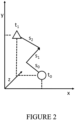
- FIGURE 2 illustrates an example of a movement profile of the x-ray detector and/or an x-ray source.
- FIGURE 2 is in Cartesian coordinates x, y and z, and a movement from a position at time instant t 0 (shown as a circle) to time instant t 1 (shown as a triangle) is expressed in terms of the Cartesian coordinates is illustrated.
- the overall movement consists of sub-trajectories s 0 , s 1 and s 2 .
- a different coordinate basis could be employed, such as, for example, polar or cylindrical coordinates.
- At least some sections of the weld may be imaged more than once using different movement and/or position profile in the respective images. Where a certain section of the weld is imaged using more than one geometry, featuring, for example, different angles of incidence, an enhanced understanding of the weld may be obtained in the depth direction.
- the angle may correspond to an angle of incidence of the x-ray beam on the section of the weld and/or an angle of arrival of an x-ray beam on a detector surface.
- the angle of incidence i.e., angles ⁇ 1 and ⁇ 2
- the angle of arrival i.e., angle ⁇
- the angle may be in any coordinate system and is not limited to any coordinate system used in or by the apparatus or components thereof.
- An obtained depth resolution of a section of the weld is proportional to a range of angles at which said section is imaged. In general, increasing the range of used angles may increase the depth resolution.
- the angular range can also be optimized to certain directions if there exists knowledge of the direction of a possible defect, or of other structures of interest.
- the master clock and/or the position signal may also be modulated during the inspection process.
- the positioning signals may be recorded, for example in the imaging information, the positioning signals may be used to vary the alignment of the collected image frames after the inspection. If the TDI method is used, this enables varying the shift between the consecutive image frames which in turn results in a different layer (depth) to be focused. Multiple images can be reconstructed by this method with different position signal modulations, which provides more information of the weld at different depths. These images can also be combined to provide a 3D representation of the weld.
- the master clock and/or position signal modulation may be performed by selecting the modulation producing an image of a layer of interest. This can be either specified as a physical dimension, such as depth in the weld, or by, for example, finding the layer of maximum sharpness, contrast or other measure calculated from the image frame data. Finding maximum sharpness may involve methods similar to optical photography where the focusing distance is adjusted by analysing the image. Other possibilities, for example, include image processing means such as maximizing the response of edge detection filters such as the Sober filter or difference of Gaussian (DoG) filter.
- DoG Gaussian
- the master clock modulation may also be calculated by actively following a feature or features in in the reconstructed image. In case the feature becomes less sharp, the modulation can be adjusted slightly to either direction. If the resulting sharpness is better, the modulation is accepted. On the other hand, if the resulting sharpness is worse, the opposite direction may be tried.
- the x-ray source 110 may be positioned to illuminate the weld section 101B closest to the x-ray detector 120, while directing beam 111 past the weld closest to the x-ray source 110.
- beam 111 may be slightly angled to only illuminate one section of the weld.
- the x-ray beam 111 may be aligned so as to traverse the circumferential weld 101 only once, at the side closest to x-ray detector 120.
- the x-ray beam 111 may also be directed through both the weld on the x-source side and the weld on the x-ray detector side. These two welds would both appear superpositioned in the image frames or image data, but the reconstruction method could selectively reduce or eliminate the image of either one of them.
- the x-ray source may be collimated to a narrow fan beam, for example. This directs the beam substantially at the area of the weld, also thereby reducing the scattering of unused x-rays. Scattered x-rays could hit detector pixels from random directions, causing undesired graininess or noise in images.
- FIGURE 1B illustrates a pipe built of different sections than the pipe of the upper part of the figure, namely bent panels. Joining such panels involves longitudinal welds 102, which may have T-shaped or X-shaped intersections with each other.
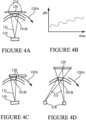
- FIGURES 4A-4D illustrate ways of imaging a weld section more than once.
- the illustrated planes comprising the weld sections 101B are curved to suggest a pipe, however, more generally these planes may be non-curved where the weld inspection does not involve a pipe.
- a single x-ray detector 120 is used with a single x-ray source 110, such that beam 111 illuminates weld section 101B more than once.
- the x-ray detector 120 is moved tangentially to the surface (for example, back and forth, in an oscillating movement), arrows 210, while moving it along an overall circumferential (or in the direction of the weld or along the axis defined by the weld if the weld is not circumferential) trajectory during the scan of the pipe (for example, circumferential modulation, parallel modulation or movement 470 in a direction substantially parallel to the overall direction of the weld, as shown in FIGURE 5B ).
- one imaging of weld section 101B is obtained moving x-ray detector in one direction, generating one set of imaging information or a first imaging data set, and another imaging of the same weld section 101B is obtained moving x-ray detector 120 in another direction, generating a second set of imaging information or a second imaging data set, and/or again in the same direction.
- the x-ray source may be moved between the imaging positions, such that the x-ray source is not in the same place during the acquisition of the two imaging data sets, thus changing the angle of arrival of x-ray beam 111 upon x-ray detector 120 and the angle of incidence at section of the weld 101B.
- the movement of the detector may thus resemble the back-and-forth oscillating motion of a vacuum cleaner head on a carpet, while the carpet is being vacuumed.
- a plot of the circumferential angle phi against time is plotted in FIGURE 4B . Therefore, in this option, a smaller-amplitude back-and-forth (oscillating or sine wave) circumferential movement is superimposed on the broader, overall circumferential movement 120A (slope of the sine wave) about the weld.
- a second back-and-forth (oscillating) movement substantially transverse to the circumferential movement (for example, perpendicular modulation or movement 460 in a direction substantially perpendicular to the overall direction of the weld, as shown in FIGURE 5B ), is also, or alternatively, used to obtain more imaging information of weld section 101B.
- This combination of uni-directional circumferential (or along the weld) direction and either circumferential or perpendicular modulation allows more depth information to be collected either on the whole weld of selected section of the weld.
- the direction along the weld is not limited to exactly follow the weld nor the perpendicular direction to be exactly perpendicular to the weld, but either of the directions may differ up to ⁇ 15°, ⁇ 30°, ⁇ 45° or even ⁇ 65°.
- the angle of at least one x-ray source or at least one x-ray detector to the surface of weld can be up to ⁇ 15°, ⁇ 30°, ⁇ 45° or even ⁇ 65° in a transverse direction 460 to the overall direction of the weld and/or the angle of at least one x-ray source or at least one x-ray detector to the surface of weld can be up to ⁇ 15°, ⁇ 30°, ⁇ 45° or even ⁇ 65° in parallel direction 470 to the overall direction of the weld.
- Having an orientation other than the perpendicular direction may be useful due to space constraints. For example, in industrial facilities pipes may be laid out close to each other, restricting freedom of movement.
- the proposed system and method are able to perform both types of imaging (that is movement oscillating across the weld and movement along the weld) in single scan through the weld.
- one or two smaller-amplitude back-and-forth (oscillating) movements are superposed on the overall movement along the length of the weld.
- an overall corkscrew (spiral) type movement may be generated as an example, which is illustrated in FIGURE 5B .
- the superimposed smaller-amplitude movement comprises translations and/or rotations of the x-ray source and/or the x-ray detector. Such translations and/or rotations are not necessarily completely aligned with the broader overall movement along the weld.
- the superimposed movement may be at least in part simultaneous with the broader overall movement along the weld.
- the benefit of having simultaneous movement is a more stable system with less vibrations which would normally be caused by accelerations and decelerations.
- the system may also be faster for the same reason as the average imaging movement speed may be higher.
- the combination of multiple movement components, illustrated in FIGURE 5B allows increasing the range of angles of incidence of x-rays 111 at the section of the weld, as illustrated in FIGURE 3B . This may result in better depth resolution in the weld or section thereof.
- FIGURE 4C another way to obtain plural imaging data sets of weld section 101B is illustrated.
- there are two x-ray detectors 120 which are moved circumferentially about the weld.
- a single x-ray source 110 illuminates weld section 101B first for a first detector, and then x-ray source 110 illuminates weld section 101B for the other detector.
- X-ray source 110 may move or rotate in between the imaging positions, to provide a separate imaging information sets with different angles of incidence of the x-ray beam 111 upon the x-ray detector 120, via the weld section 101B.
- FIGURE 4D there are two x-ray sources 110, and one x-ray detector is moved along the length of the weld, obtaining one imaging by illuminating the detector by the x-ray source and a second imaging by illuminating the detector by the second x-ray source.
- the x-ray sources 110 are separated by a nonzero distance (e.g., not co-located in the same place).
- the angles of incidence of x-ray beams 111 are different.
- two imaging data sets are obtained, with different x-ray source locations, which is here caused by having two distinct x-ray sources.
- the two x-ray sources may illuminate different parts of the detector or they can be toggled on and off in a synchronous manner so that the frames corresponding to the separate x-ray source illuminations can be separated. More than two detector - x-ray source pairs can be included for better image quality and/or faster scan speeds.
- One benefit of using multiple x-ray sources is that in a typical weld inspection application, the cooling capacity of an individual x-ray source can be limited and thus using multiple sources allows a longer operational time.
- the part of the active area of the detector illuminated by the x-ray sources can vary from one x-ray source to another.
- the movement of the at least one x-ray detector and the at least one x-ray source may be non-circular to obtain the differing angles of incidence for the imaging data sets generated for the respective section(s) of the weld.
- An effect similar to the movement of the one or more x-ray sources may also be achieved by moving the beam collimation, adjusting possible monochromator or diffractor angle or by focusing the x-ray beam by changing the x-ray source control signals, voltages and parameters such as the anode angle.
- a monochromator is a device installed between the x-ray source and object to adjust the spectrum of the x-ray beam. Any of these means may be used to redirect, that is, change the direction of, the x-ray beam which allows, for example, illuminating more than one detector from a single x-ray source.
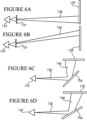
- FIGURES 6A-6B illustrate an effect of moving a collimator 710.
- collimator 710 is in a first position relative to the x-ray source 110, causing post-collimator beam 720 to fall on the detector 120 in a first way
- the collimator 710 is in a second position relative to the x-ray source 110, causing post-collimator beam 720 to fall on the detector 120 in a second way, as illustrated.
- a similar effect may be obtained by moving the focal spot of the x-ray tube or source 120 is moved electrically or mechanically.
- FIGURES 6A-6D illustrate an effect of moving a monochromator 750.
- monochromator 750 is in a first position, receiving polychromatic beam 730 from the x-ray source 110 and directing a monochromatic beam 740 onto a first part of the detector 120.
- monochromator 750 is in a second position, being tilted with respect to the first position, receiving polychromatic beam 730 from the x-ray source 110 and directing a monochromatic beam 740 onto a second part of the detector 120.
- the one or more x-ray sources and one or more detectors may be used in a synchronous way to increase the image quality.
- the source-detector sub-systems (each containing one or more x-ray sources and one or more detectors) can be operated in such a way that the x-rays emitted by a sub-system are not detected by any other sub-systems. Reducing x-ray interference from between sub-systems may be achieved by not collecting data in a detector of another subsystem when an x-ray source of a subsystem is active, for example. For example, minimizing the scattered x-rays from one sub-system can reduce the degradation of the image quality of a second sub-system.
- This decoupling of the systems may be performed by adequate collimation of the x-ray beams, synchronized movement sub-systems to minimize overlap of the x-ray beams or scattered x-rays, or by temporal synchronization in which the one or more of the sub-systems are toggled on and off to reduce the effect of neighbouring sub-systems.
- the plural imaging data sets may be used to enhance the understanding the inspection gains of the weld, for example, the plural imaging data sets may be focused at different depths in the weld to generate a three-dimensional model of the weld, and/or the imaging data sets may be used to average out noise and effects of x-ray scattering.
- FIGURE 3A illustrates x-ray imaging geometries in accordance with at least some embodiments of the present invention. Illustrated is an arrangement similar to those in FIGURES 4A-4D , with two positions of x-ray source 110 and two positions of x-ray detector 120 depicted. The figure may also be interpreted as depicting two x-ray sources and two x-ray detectors, to similar effect.
- the object of the imaging of FIGURE 3A is marked with an "x" in the weld section 101B. Two imaging positions are thus illustrated in FIGURE 3A , with different imaging geometries.
- the angle ⁇ indicates an angle between x-ray beam 111 of the two imaging positions concerning a specific point in the weld.
- the x-ray weld inspection apparatus may be configured to image at least some sections of the weld more than once, during a single x-ray scan along the direction of the weld, such that ⁇ between the imaging positions correspond to at least half a detector width (or the width of the x-ray beam at the detector in case it is narrower) in the imaging geometry used.
- the angle ⁇ may be defined in 3D space and is thus not tied to any particular 2D projection.
- detector width means effectively the size of the x-ray beam in the chosen direction.
- sin( ⁇ ) > (x)/(2d) may be satisfied, where x is the size of the x-ray beam inside the active area of the x-ray detector in the any direction of ⁇ and d the distance between x-ray source and x-ray detector.
- a scan refers to an imaging process during which a substantially entire weld is imaged, from a starting point to an ending point, allowing for a range of movements along the way.
- a scan refers to an imaging process the x-ray weld inspection apparatus performs based on a configuration without user intervention.
- the at least one x-.ray source may continuously emit x-rays, or may alternatingly emit and not emit x-rays.
- the at least one x-ray detector may be continuously active, or alternatingly active and inactive.
- the x-ray weld imaging apparatus may further be configured to autonomously modify at least one movement profile of x-ray source(s) and/or x-ray detector(s) during the scan, for example responsive to machine vision determinations.
- the angle of arrival ⁇ of x-rays x-ray detector 120 may vary between imaging positions of a same section of the weld.
- the angle of arrival it is meant the primary arrival angle of an x-ray beam from an x-ray source.
- the angle of arrival may be determined at a specific phase of a data collection period, such as a midpoint or start point of the data collection period of the imaging of the section of the weld. Using different ⁇ between imaging positions enhances the diversity of imaging data obtained of the weld section, improving the quality of the resulting image.
- FIGURE 3B illustrates angles of incidence ⁇ 1 and ⁇ 2 .
- the beam geometry is similar to that in FIGURE 3A , in that two x-ray beams 111 are incident on a specific point in the weld.
- the specific point is in the origin of a coordinate system comprised of a tangential axis 301 and a normal axis 302, which are orthogonal to each other.
- Angle ⁇ 1 is an angle of incidence of a first one of the x-ray beams 111
- angle ⁇ 2 is an angle of incidence of a second one of the x-ray beams 111.
- the angle of incidence may be defined as an angle between a normal axis and the x-ray. Normal in this sense refers to perpendicular to the tangent, and applies also to welds which are on a flat surface.
- FIGURE 5A illustrates an example detector substrate in accordance with at least some embodiments of the present invention.
- the system of FIGURE 5A is a weld imaging system.
- the weld imaging system may comprise an x-ray/gamma-ray imaging system, for example.
- the system of FIGURE 5A is arranged to image radiation 401 incident from an x-ray source to detector substrate 410 from the top.
- Detector substrate 410 is arranged to convert the incident radiation 401 to a plurality of electrical signals, each such signal representing a value of a pixel 416 of detector substrate 410.
- the electric signals can be charges, voltages, currents or digital values related to the deposited x-ray dose at the pixels.
- the electric signals may also be one or more digital numbers corresponding to the number of photons received by the detector with one or more energy thresholds.
- the electric signals are collected by detector circuits 440 and output to a processing device 420 as the imaging data sets.
- the processing device may be comprised in or as the control device 100e ( FIG. 1A ), for example.
- the processing device 420 may perform, selectably, operations on information encoded in the electrical signals from detector circuit 440, to result in a digital image 430.
- this image comprises an image of an object 432, which may comprise a weld defect, for example.
- Detector substrate 410 may comprise CdTe substrate, CZT substrate, a gallium arsenide (GaAs) substrate, a silicon (Si) substrate, a selenium (Se) substrate or a mercury(II) iodide (HgI 2 ) substrate, for example.
- the detector substrate 410 may also be of indirect conversion type and consist of a scintillating layer which converts the x-rays to light such as cesium iodide (CsI) substrate, cadmium tungstate (CdWO 4 or CWO) substrate or gadolinium oxysulfide (Gd 2 O 2 S) substrate, and a complementary metal-oxide-semiconductor (CMOS), charge-coupled device (CCD) or thin-film transistor (TFT) layer converting the incident light to electricity.
- CMOS complementary metal-oxide-semiconductor
- CCD charge-coupled device
- TFT thin-film transistor
- the imaging system may be furnished with information characterizing the individual pixels such as dark currents of the detector substrate or pixel specific tuning values such as gain and/or offset values, for example, each detector circuit 440 interfaced with detector substrate 410 may have a memory with such information relating to the pixel 416 linked to the particular detector circuit, or the information may otherwise be stored in or for detector circuit 440.
- FIGURE 5B illustrates a corkscrew (spiral) movement of superimposed component movements.
- Direction 450 is the overall direction of the weld, which may be a circumferential direction where a pipe is being inspected, or a linear weld, for example, depending on the application at hand.
- Back-and-forth (oscillating) movement 470 is in a direction substantially parallel to the overall direction of the weld
- back-and-forth (oscillating) movement 460 is in a direction substantially perpendicular to the overall direction of the weld.
- an overall corkscrew (spiral) movement 480 is generated, moving along the direction of the weld.
- the movement 480 may be a path of motion of an x-ray detector, for example.
- the angle of incidence may be defined in accordance with an x-ray beam direction, in at least one point of the beam intersecting with the section of the weld.
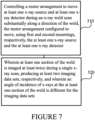
- FIGURE 7 is a flow graph of a method.
- the phases of the illustrated method may be performed in by the weld inspection apparatus described herein above, for example.
- Phase 510 comprises controlling a motor arrangement to move at least one x-ray source and at least one x-ray detector during an x-ray weld scan substantially along the direction of a weld, the motor arrangement configured to move, using first and second mountings, respectively, the at least one x-ray source and the at least one x-ray detector.
- phase 520 at least one section of the weld is imaged at least twice during a single x-ray scan, producing at least two imaging data sets, respectively, wherein an angle of incidence of x-rays at the at least one section of the weld is different for the imaging data sets.
- One set of imaging information may be generated per each imaging.
- Each of the at least one x-ray source and the at least one x-ray detector may be moved along spline trajectories.
- an x-ray weld inspection apparatus comprising at least one x-ray source 110 attached on a first mounting 100a, at least one x-ray detector 120 attached on a second mounting 100c, a motor arrangement 100b, 100d configured to move, using the first 100a and second mountings 100c, respectively, the at least one x-ray source 110 and the at least one x-ray detector 120 substantially along a weld, and a control device 100e comprising memory and at least one processing core, configured to control the motor arrangement 100b, 100d to move the at least one x-ray source 110 and the at least one x-ray detector 120 during an x-ray weld scan substantially along the direction of the weld, wherein at least one section of the weld 101B is imaged at least twice during a single x-ray scan, producing at least two imaging data sets, respectively, and wherein an angle of incidence of x-rays at the at least one section of the weld 101B is
- a method of x-ray weld inspection comprising controlling, 510, a motor arrangement 100b, 100d to move at least one x-ray source 110 and at least one x-ray detector 120 during an x-ray weld scan substantially along the direction of the weld, the motor arrangement 100b, 100d configured to move, using first 100a and second 100c mountings, respectively, the at least one x-ray source 110 and the at least one x-ray detector 120, wherein, 520, at least one section of the weld 101B is imaged at least twice during a single x-ray scan, producing at least two imaging data sets, respectively, and wherein an angle of incidence of x-rays at the at least one section of the weld 101B is different for the imaging data sets.
- an apparatus comprising means for controlling, 100e, a motor arrangement 100b, 100d to move at least one x-ray source 110 and at least one x-ray detector 120 during an x-ray weld scan substantially along the direction of the weld, the motor arrangement 100b, 100d configured to move, using first 100a and second 100c mountings, respectively, the at least one x-ray source 110 and the at least one x-ray detector 120, wherein at least one section of the weld 101B is imaged at least twice during a single x-ray scan, producing at least two imaging data sets, respectively, and wherein an angle of incidence of x-rays at the at least one section of the weld 101B is different for the imaging data sets.
- a non-transitory computer readable medium having stored thereon a set of computer readable instructions that, when executed by at least one processor, cause an apparatus to at least control, 510, a motor arrangement 100b, 100d to move at least one x-ray source 110 and at least one x-ray detector 120 during an x-ray weld scan substantially along the direction of the weld, the motor arrangement 100b, 100d configured to move, using first 100a and second 100c mountings, respectively, the at least one x-ray source 110 and the at least one x-ray detector 120, wherein, 520, at least one section of the weld 101B is imaged at least twice during a single x-ray scan, producing at least two imaging data sets, respectively, and wherein an angle of incidence of x-rays at the at least one section of the weld 101B is different for the imaging data sets.
- an x-ray weld inspection apparatus comprising at least one x-ray source 110 attached on a first mounting 100a and at least one x-ray detector 120 attached on a second mounting 100c, a motor arrangement 100b, 100d configured to move, using the first 100a and second 100c mountings, respectively, the at least one x-ray source 110 and the at least one x-ray detector 120 substantially along a weld, and a control device 100e comprising memory and at least one processing core, configured to control the motor arrangement 100b, 100d to move the at least one x-ray source 110 and the at least one x-ray detector 120 during an x-ray weld scan substantially along the direction of the weld, and compile imaging information from the at least one x-ray detector, such that at least one part of the image is reconstructed based on additional position information estimated from image data.
- At least some embodiments of the present invention find industrial application in high energy photon based weld inspection, such as pipeline weld inspection.
Landscapes
- Health & Medical Sciences (AREA)
- Engineering & Computer Science (AREA)
- General Physics & Mathematics (AREA)
- Physics & Mathematics (AREA)
- Chemical & Material Sciences (AREA)
- Life Sciences & Earth Sciences (AREA)
- Pathology (AREA)
- Analytical Chemistry (AREA)
- Biochemistry (AREA)
- General Health & Medical Sciences (AREA)
- Immunology (AREA)
- Mechanical Engineering (AREA)
- Quality & Reliability (AREA)
- Multimedia (AREA)
- Toxicology (AREA)
- Nuclear Medicine, Radiotherapy & Molecular Imaging (AREA)
- Radiology & Medical Imaging (AREA)
- Theoretical Computer Science (AREA)
- Signal Processing (AREA)
- Pulmonology (AREA)
- Computer Vision & Pattern Recognition (AREA)
- Analysing Materials By The Use Of Radiation (AREA)
Claims (15)
- Röntgenstrahlenschweißnahtinspektionseinrichtung, umfassend:- mindestens eine Röntgenstrahlenquelle (110), die an einer ersten Halterung (100a) angebracht ist;- mindestens einen Röntgenstrahlendetektor (120), der an einer zweiten Halterung (100c) angebracht ist;- eine Motoranordnung (100b), die konfiguriert ist, um unter Verwendung von jeweils der ersten und zweiten Halterung (100a, 100c) die mindestens eine Röntgenstrahlenquelle (110) und den mindestens einen Röntgenstrahlendetektor (120) im Wesentlichen entlang einer Schweißnaht (101) zu bewegen, wobei die Schweißnaht (101) eine Rohrleitungsschweißnaht ist; und- eine Steuervorrichtung (100e), die einen Speicher und mindestens einen Verarbeitungskern umfasst, die konfiguriert ist, um:- die Motoranordnung (100b) zu steuern, um die mindestens eine Röntgenstrahlenquelle (110) und den mindestens einen Röntgenstrahlendetektor (120) während eines Röntgenstrahlenschweißnahtabtastung im Wesentlichen entlang der Richtung der Schweißnaht (101) zu bewegen;- wobei mindestens ein Abschnitt der Schweißnaht (101) während einer einzigen Röntgenstrahlenabtastung durch Bewegen von mindestens einem des mindestens einen Röntgenstrahlendetektors (120) in einer oszillierenden Bewegung im Wesentlichen entlang der Richtung der Schweißnaht (101) mindestens zweimal abgebildet wird, wobei die oszillierende Bewegung der Bewegung des mindestens einen Röntgenstrahlendetektors (120) im Wesentlichen entlang der Richtung der Schweißnaht (101) während der Abtastung der Schweißnaht (101) überlagert ist, wodurch jeweils mindestens zwei Bilddatensätze erzeugt werden, und- wobei ein Einfallswinkel von Röntgenstrahlen auf den mindestens einen Abschnitt der Schweißnaht (101) für die Bilddatensätze unterschiedlich ist.
- Schweißnahtinspektionseinrichtung nach Anspruch 1, wobei der mindestens eine Röntgenstrahlendetektor (120) konfiguriert ist, um im Einzelbild-Ausgabemodus zu arbeiten, in dem aufeinanderfolgende erfasste Einzelbilder eine Überlappung in Bezug auf einen Abschnitt der Schweißnaht (101) aufweisen.
- Schweißnahtinspektionseinrichtung nach Anspruch 2, wobei die Steuervorrichtung (100e) konfiguriert ist, um den mindestens einen Abschnitt der Schweißnaht (101) durch Weiterbewegen des mindestens einen Röntgenstrahlendetektors (120) in einer oszillierenden Bewegung in einer Richtung, die im Wesentlichen senkrecht zu der Bewegung entlang der Schweißnaht (101) ist, mindestens zwei Mal abzubilden.
- Schweißnahtinspektionseinrichtung nach Anspruch 1, wobei der mindestens eine Röntgenstrahlendetektor (120) mindestens zwei Röntgenstrahlendetektoren (120) umfasst, und wobei die Steuervorrichtung (100e) konfiguriert ist, um den mindestens einen Abschnitt der Schweißnaht (101) durch Bewegen der Röntgenstrahlendetektoren (120) entlang der Richtung der Schweißnaht (101) mindestens zweimal abzubilden, wobei der mindestens eine Schweißnahtabschnitt einmal von jedem Röntgenstrahlendetektor (120) abgebildet wird.
- Schweißnahtinspektionseinrichtung nach Anspruch 4, wobei die Einrichtung konfiguriert ist, um einen Röntgenstrahl der mindestens einen Röntgenstrahlenquelle (110) während der Abtastung mindestens einmal umzulenken, um die mindestens zwei Röntgenstrahlendetektoren (120) zu beleuchten.
- Schweißnahtinspektionseinrichtung nach Anspruch 1, wobei die mindestens eine Röntgenstrahlenquelle (110) mindestens zwei Röntgenstrahlenquellen (110) umfasst und wobei die Steuervorrichtung (100e) konfiguriert ist, um den mindestens einen Abschnitt der Schweißnaht durch Bewegen des mindestens einen Röntgenstrahlendetektors (120) in Richtung der Schweißnaht und Abbilden des mindestens einen Abschnitts der Schweißnaht durch Beleuchten des mindestens einen Röntgenstrahlendetektors (120) mit jeder der mindestens zwei Röntgenstrahlenquellen (110) mindestens zweimal abzubilden.
- Schweißnahtinspektionseinrichtung nach Anspruch 6, wobei die Einrichtung konfiguriert ist, um die mindestens zwei Röntgenstrahlenquellen (110) zu veranlassen, unterschiedliche Teile eines gleichen Röntgenstrahlendetektors (120) unter dem mindestens einen Röntgenstrahlendetektor (120) zu beleuchten.
- Schweißnahtinspektionseinrichtung nach Anspruch 6, wobei die Einrichtung konfiguriert ist, um die mindestens zwei Röntgenstrahlenquellen (110) zu veranlassen, mindestens teilweise denselben Teil eines gleichen Röntgenstrahlendetektors (120) unter dem mindestens einen Röntgenstrahlendetektor (120) zu beleuchten, wobei die Beleuchtung der mindestens zwei Röntgenstrahlenquellen (110) mindestens teilweise zu unterschiedlichen Zeiten erfolgt.
- Schweißnahtinspektionseinrichtung nach einem der Ansprüche 1-8, wobei die Einrichtung konfiguriert ist, um den mindestens einen Abschnitt der Schweißnaht (101) mindestens zwei Mal unter Verwendung einer zeitverzögerten Integrationsbildgebung oder einer dreidimensionalen Rekonstruktion basierend auf einer Einzelbild-Sequenz abzubilden.
- Schweißnahtinspektionseinrichtung nach Anspruch 9, wobei die Einrichtung konfiguriert ist, um durch Verwendung einer zeitverzögerten Integrationsbildgebung mit unterschiedlichen Verschiebungen zwischen aufeinanderfolgenden Einzelbildern den mindestens einen Abschnitt der Schweißnaht zu veranlassen, mindestens zwei Mal abgebildet zu werden, was zu einer unterschiedlichen Tiefenschicht des zu fokussierenden Abschnitts der Schweißnaht (101) führt.
- Schweißnahtinspektionseinrichtung nach einem der Ansprüche 1-10, wobei die Einrichtung konfiguriert ist, um den mindestens einen Abschnitt der Schweißnaht (101) zu veranlassen, durch Erzeugen eines oder mehrerer zweidimensionaler Bilder des Abschnitts der Schweißnaht (101) und eines oder mehrerer dreidimensionaler Bilder des Abschnitts der Schweißnaht (101) mindestens zwei Mal abgebildet zu werden.
- Schweißnahtinspektionseinrichtung nach einem der Ansprüche 1-11, wobei die Einrichtung konfiguriert ist, um den mindestens einen Abschnitt der Schweißnaht (101) zu veranlassen, mindestens zwei Mal abgebildet zu werden, sodass ein Winkel a zwischen Röntgenstrahlen zwischen verschiedenen Zeitpunkten, entsprechend den Zeitpunkten, zu denen der Abschnitt der Schweißnaht abgebildet wird, die Ungleichung sin(a) > (x)/(2d) erfüllt, wobei x eine Größe des Röntgenstrahls innerhalb eines aktiven Bereichs des Röntgenstrahlendetektors (120) in der Richtung a ist und d ein Abstand zwischen einer Röntgenstrahlenquelle (110) und einem Röntgenstrahlendetektor (120) während der Bildgebung ist.
- Schweißnahtinspektionseinrichtung nach einem der Ansprüche 1-12, wobei die Steuervorrichtung (100e) konfiguriert ist, um die Motoranordnung (100b) zu veranlassen, während der Abtastung mindestens eines von der mindestens einen Röntgenstrahlenquelle (110) und des mindestens einen Röntgenstrahlendetektors (120) entlang der Richtung der Schweißnaht (101) in einem Winkel von ± 45° von einer Normalachse der Schweißnaht in einer Querrichtung zu der Schweißnahtrichtung oder in einem Winkel von ± 45° von einer Tangentialachse der Schweißnaht (101) in einer parallelen Richtung zu der Schweißnahtrichtung zu bewegen.
- Verfahren zur Röntgenstrahlenschweißnahtinspektion, umfassend:- Steuern (510) einer Motoranordnung, mindestens eine Röntgenstrahlenquelle und mindestens einen Röntgenstrahlendetektor während einer Röntgenstrahlenschweißnahtabtastung im Wesentlichen entlang der Richtung der Schweißnaht zu bewegen, wobei es sich bei der Schweißnaht um eine Rohrleitungsschweißnaht handelt, wobei die Motoranordnung dazu konfiguriert ist, unter Verwendung erster bzw. zweiter Halterungen die mindestens eine Röntgenstrahlenquelle und den mindestens einen Röntgenstrahlendetektor zu bewegen;- wobei mindestens ein Abschnitt der Schweißnaht während einer einzigen Röntgenstrahlenabtastung durch Bewegen von mindestens einem des mindestens einen Röntgenstrahlendetektors in einer oszillierenden Bewegung im Wesentlichen entlang der Richtung der Schweißnaht mindestens zweimal abgebildet (520) wird, wobei die oszillierende Bewegung der Bewegung des mindestens einen Röntgenstrahlendetektors im Wesentlichen entlang der Richtung der Schweißnaht während der Abtastung der Schweißnaht überlagert ist, wodurch jeweils mindestens zwei Bilddatensätze erzeugt werden, und- wobei ein Einfallswinkel von Röntgenstrahlen auf den mindestens einen Abschnitt der Schweißnaht für die Bilddatensätze unterschiedlich ist.
- Nichtflüchtiges computerlesbares Medium, auf dem ein Satz computerlesbarer Anweisungen gespeichert ist, die, wenn sie von mindestens einem Prozessor ausgeführt werden, eine Einrichtung nach Anspruch 1 mindestens dazu veranlassen:- eine Motoranordnung zu steuern (510), um mindestens eine Röntgenstrahlenquelle und mindestens einen Röntgenstrahlendetektor während einer Röntgenstrahlenschweißnahtabtastung im Wesentlichen entlang der Richtung der Schweißnaht zu bewegen, wobei die Schweißnaht eine Rohrleitungsschweißnaht ist, wobei die Motoranordnung konfiguriert ist, um unter Verwendung jeweils erster und zweiter Halterungen die mindestens eine Röntgenstrahlenquelle und den mindestens einen Röntgenstrahlendetektor zu bewegen;- wobei mindestens ein Abschnitt der Schweißnaht während einer einzigen Röntgenstrahlenabtastung durch Bewegen von mindestens einem des mindestens einen Röntgenstrahlendetektors in einer oszillierenden Bewegung im Wesentlichen entlang der Richtung der Schweißnaht mindestens zweimal abgebildet (520) wird, wobei die oszillierende Bewegung der Bewegung des mindestens einen Röntgenstrahlendetektors im Wesentlichen entlang der Richtung der Schweißnaht während der Abtastung der Schweißnaht überlagert ist, wodurch jeweils mindestens zwei Bilddatensätze erzeugt werden, und- wobei ein Einfallswinkel von Röntgenstrahlen auf den mindestens einen Abschnitt der Schweißnaht für die Bilddatensätze unterschiedlich ist.
Priority Applications (7)
| Application Number | Priority Date | Filing Date | Title |
|---|---|---|---|
| EP24210726.6A EP4481371A3 (de) | 2019-07-11 | 2019-07-11 | Röntgenstrahlschweissnahtinspektion |
| EP19185750.7A EP3764089B1 (de) | 2019-07-11 | 2019-07-11 | Röntgenstrahlenschweissnahtinspektion |
| CN202411653320.7A CN119510450A (zh) | 2019-07-11 | 2020-07-08 | x射线焊缝检查 |
| CN202080050146.0A CN114127547B (zh) | 2019-07-11 | 2020-07-08 | x射线焊缝检查 |
| PCT/IB2020/056415 WO2021005523A1 (en) | 2019-07-11 | 2020-07-08 | X-ray weld inspection |
| US17/571,511 US12163902B2 (en) | 2019-07-11 | 2020-07-08 | X-ray weld inspection |
| US18/934,052 US20250164420A1 (en) | 2019-07-11 | 2024-10-31 | X-ray weld inspection |
Applications Claiming Priority (1)
| Application Number | Priority Date | Filing Date | Title |
|---|---|---|---|
| EP19185750.7A EP3764089B1 (de) | 2019-07-11 | 2019-07-11 | Röntgenstrahlenschweissnahtinspektion |
Related Child Applications (1)
| Application Number | Title | Priority Date | Filing Date |
|---|---|---|---|
| EP24210726.6A Division EP4481371A3 (de) | 2019-07-11 | 2019-07-11 | Röntgenstrahlschweissnahtinspektion |
Publications (3)
| Publication Number | Publication Date |
|---|---|
| EP3764089A1 EP3764089A1 (de) | 2021-01-13 |
| EP3764089C0 EP3764089C0 (de) | 2024-11-20 |
| EP3764089B1 true EP3764089B1 (de) | 2024-11-20 |
Family
ID=67437702
Family Applications (2)
| Application Number | Title | Priority Date | Filing Date |
|---|---|---|---|
| EP19185750.7A Active EP3764089B1 (de) | 2019-07-11 | 2019-07-11 | Röntgenstrahlenschweissnahtinspektion |
| EP24210726.6A Pending EP4481371A3 (de) | 2019-07-11 | 2019-07-11 | Röntgenstrahlschweissnahtinspektion |
Family Applications After (1)
| Application Number | Title | Priority Date | Filing Date |
|---|---|---|---|
| EP24210726.6A Pending EP4481371A3 (de) | 2019-07-11 | 2019-07-11 | Röntgenstrahlschweissnahtinspektion |
Country Status (4)
| Country | Link |
|---|---|
| US (2) | US12163902B2 (de) |
| EP (2) | EP3764089B1 (de) |
| CN (2) | CN119510450A (de) |
| WO (1) | WO2021005523A1 (de) |
Families Citing this family (5)
| Publication number | Priority date | Publication date | Assignee | Title |
|---|---|---|---|---|
| EP3764089B1 (de) | 2019-07-11 | 2024-11-20 | Oy Varex Imaging Finland Ltd. | Röntgenstrahlenschweissnahtinspektion |
| US11733182B2 (en) | 2019-12-20 | 2023-08-22 | Varex Imaging Corporation | Radiographic inspection system for pipes and other structures using radioisotopes |
| CN112858354A (zh) * | 2021-03-22 | 2021-05-28 | 国营芜湖机械厂 | 一种飞机升降轴焊缝射线探伤自动旋转角度装置及其使用方法 |
| CN114112939B (zh) * | 2021-12-06 | 2023-07-14 | 南京信息工程大学 | 一种具有自动校正功能的地物光谱多角度连续观测系统 |
| CN114674852A (zh) * | 2022-03-31 | 2022-06-28 | 中国科学院合肥物质科学研究院 | 焊缝无损检测方法 |
Family Cites Families (72)
| Publication number | Priority date | Publication date | Assignee | Title |
|---|---|---|---|---|
| US3124689A (en) | 1964-03-10 | shure | ||
| US2645720A (en) | 1950-12-13 | 1953-07-14 | Gen Aniline & Film Corp | X-ray diffraction device |
| US2719926A (en) | 1952-08-15 | 1955-10-04 | Isotope Products Ltd | Method and apparatus for radiographic examination of hollow articles |
| US3214586A (en) | 1962-10-29 | 1965-10-26 | Gen Motors Corp | Underwater radiographic exposure device |
| US3396272A (en) | 1964-10-26 | 1968-08-06 | Atomic Energy Commission Usa | Isotope-powered X-ray instrument for detecting the arrival of an interface in a pipeline |
| US3721825A (en) | 1970-12-03 | 1973-03-20 | J Rasmussen | Method and apparatus for analysis of liquid residues using nuclear reactions |
| US3835324A (en) * | 1972-10-04 | 1974-09-10 | O Weigle | Pipe weld inspection method and apparatus |
| BE817121A (fr) | 1974-07-01 | 1974-11-04 | Dispositif de mesure des parametres du talus de matiere contenue dans un cylindre entraine en rotation autour de son axe | |
| US4203021A (en) * | 1976-07-30 | 1980-05-13 | Steigerwald Strahltechnik Gmbh | Method and apparatus for control of method parameters in energy beam welding |
| US4095106A (en) * | 1977-03-16 | 1978-06-13 | The United States Of America As Represented By The United States Department Of Energy | Radiation attenuation gauge with magnetically coupled source |
| DE2846702C2 (de) | 1978-10-26 | 1983-11-17 | Habermehl, Adolf, Prof. Dr., 3550 Marburg | Verfahren und Vorrichtung für die zerstörungsfreie Materialprüfung, insbesondere zum Feststellen der Rotfäule und anderer Baumerkrankungen in den Stämmen lebender Bäume |
| DE2915986C2 (de) | 1979-04-20 | 1982-04-08 | Kernforschungszentrum Karlsruhe Gmbh, 7500 Karlsruhe | Verfahren zur kontinuierlichen Messung von Elementgehalten |
| US4490832A (en) | 1982-07-12 | 1984-12-25 | Middle East Trade Alliance, Inc. | Technique and apparatus for two-phase systems analysis directly in a flow |
| FI68320C (fi) | 1982-12-01 | 1985-08-12 | Valtion Teknillinen | Foerfarande foer att medelst straolning fraon en radioisotopkaella utan att foerstoera provet maeta foerdelningen av fyll-och/eller belaeggningsmedel i tjockleksriktningen av papp erartong eller liknande och halten av dessa medel anordnin rgafoer tillaempande av foerfarandet samt anvaendningar av erfoarandet och anordningarna |
| GB8331914D0 (en) | 1983-11-30 | 1984-01-04 | Atomic Energy Authority Uk | Inspection of buried pipelines |
| HU190197B (en) * | 1983-12-05 | 1986-08-28 | Kohaszati Gyarepitoe Vallalat,Hu | Method and device for testing quality of the welds by videoradiography |
| US4725963A (en) * | 1985-05-09 | 1988-02-16 | Scientific Measurement Systems I, Ltd. | Method and apparatus for dimensional analysis and flaw detection of continuously produced tubular objects |
| DE3818542C2 (de) * | 1988-05-31 | 1994-05-11 | Gerhard Dipl Ing Hoeper | Vorrichtung zum Prüfen eines technischen Körpers |
| US5524038A (en) | 1995-01-03 | 1996-06-04 | The United States Of America As Represented By The United States Department Of Energy | Method of non-destructively inspecting a curved wall portion |
| US5648996A (en) | 1995-08-04 | 1997-07-15 | Omega International Technology, Inc. | Tangential computerized tomography scanner |
| US6459760B1 (en) * | 2000-07-28 | 2002-10-01 | Exotic Metals Forming Company, Inc. | Apparatuses and methods for non-destructive inspection |
| US6324249B1 (en) * | 2001-03-21 | 2001-11-27 | Agilent Technologies, Inc. | Electronic planar laminography system and method |
| US6968034B2 (en) | 2001-04-03 | 2005-11-22 | L-3 Communications Security And Detection Systems, Inc. | X-ray inspection system |
| US20030058991A1 (en) | 2001-09-24 | 2003-03-27 | Paul Lott | Digital radioscopic testing system patent |
| US7356115B2 (en) * | 2002-12-04 | 2008-04-08 | Varian Medical Systems Technology, Inc. | Radiation scanning units including a movable platform |
| US7672426B2 (en) | 2002-12-04 | 2010-03-02 | Varian Medical Systems, Inc. | Radiation scanning units with reduced detector requirements |
| CN100518635C (zh) | 2003-06-20 | 2009-07-29 | 杰克·E·朱尼 | 单光子发射计算机断层摄影系统 |
| US6928141B2 (en) | 2003-06-20 | 2005-08-09 | Rapiscan, Inc. | Relocatable X-ray imaging system and method for inspecting commercial vehicles and cargo containers |
| US7120226B2 (en) | 2003-11-24 | 2006-10-10 | Passport Systems, Inc. | Adaptive scanning of materials using nuclear resonance fluorescence imaging |
| US7319733B2 (en) | 2004-09-27 | 2008-01-15 | General Electric Company | System and method for imaging using monoenergetic X-ray sources |
| US7319738B2 (en) | 2004-10-08 | 2008-01-15 | General Electric Company | Delivering X-ray systems to pipe installations |
| DE102005055423A1 (de) | 2005-11-21 | 2007-05-31 | Yxlon International X-Ray Gmbh | CT-Verfahren zur Aufnahme von Projektionsdaten |
| CN100565336C (zh) | 2005-11-21 | 2009-12-02 | 清华大学 | 成像系统 |
| CN100483120C (zh) | 2006-09-05 | 2009-04-29 | 同方威视技术股份有限公司 | 一种用射线对液态物品进行安全检查的方法及设备 |
| US7912273B2 (en) * | 2007-02-01 | 2011-03-22 | Florida Power & Light Company | Radiography test system and method |
| EP1985998A1 (de) | 2007-04-26 | 2008-10-29 | Hitachi-GE Nuclear Energy, Ltd. | Verfahren zur Prüfung von Rohren und zerstörungsfreies radiographisches Prüfgerät |
| US7693261B2 (en) | 2007-05-17 | 2010-04-06 | Durham Scientific Crystals Limited | Method and apparatus for inspection of materials |
| JP2009276285A (ja) | 2008-05-16 | 2009-11-26 | Hitachi-Ge Nuclear Energy Ltd | 放射線断層撮影装置および放射線断層撮影方法 |
| WO2009141766A2 (en) | 2008-05-21 | 2009-11-26 | Koninklijke Philips Electronics, N.V. | Dynamic adjustable source collimation during fly-by scanning |
| US7656997B1 (en) | 2008-09-15 | 2010-02-02 | VJ Technologies | Method and apparatus for automated, digital, radiographic inspection of piping |
| WO2010034323A1 (de) | 2008-09-24 | 2010-04-01 | Ge Sensing & Inspection Technologies Gmbh | Vorrichtung zur materialprüfung von prüfobjekten mittels röntgenstrahlung |
| US8054939B2 (en) * | 2009-07-30 | 2011-11-08 | The Boeing Company | Tangent radiography using brilliant x-ray source |
| GB0915141D0 (en) * | 2009-08-28 | 2009-10-07 | Shawcor Ltd | Method and apparatus for external pipeline weld inspection |
| GB0917950D0 (en) * | 2009-10-13 | 2009-11-25 | Shawcor Ltd | X-ray inspection method and apparatus for pipeline girth weld inspection |
| KR100975417B1 (ko) * | 2010-02-22 | 2010-08-11 | 나우기연주식회사 | 디지털 방사선 투과 검사 시스템 및 방법 |
| US8238518B2 (en) | 2010-06-23 | 2012-08-07 | The Institute Of Cancer Research | Radiotherapy system |
| US8662749B2 (en) | 2010-08-12 | 2014-03-04 | Omid Ebrahimi Kia | Digital radiographic device having a linear scanner |
| US8750594B2 (en) | 2010-12-17 | 2014-06-10 | Florida Power And Light Company | System and method for non-destructively examining degradation of an interior of a device |
| CN104067112B (zh) * | 2011-11-02 | 2017-03-01 | 庄信万丰股份有限公司 | 扫描方法和扫描设备 |
| CN105612416B (zh) | 2013-07-25 | 2019-01-01 | 模拟技术公司 | 对象内物品的衍射特征的生成 |
| WO2015053787A1 (en) | 2013-10-11 | 2015-04-16 | Analogic Corporation | Tomosynthesis imaging |
| WO2015081134A2 (en) | 2013-11-26 | 2015-06-04 | Flir Detection, Inc. | SiPM-BASED RADIATION DETECTION SYSTEMS AND METHODS |
| EP3087377B1 (de) | 2013-12-23 | 2021-05-05 | Johnson Matthey Public Limited Company | Abtastverfahren |
| US10732131B2 (en) * | 2014-03-13 | 2020-08-04 | General Electric Company | Curved digital X-ray detector for weld inspection |
| CN103954637A (zh) | 2014-05-04 | 2014-07-30 | 东北石油大学 | 一种管道焊缝检测系统 |
| US9753150B2 (en) | 2014-09-23 | 2017-09-05 | Sharpxview AS | Low-rate inexpensive digital γ-ray imaging/inspection system |
| CN108472000A (zh) | 2015-02-06 | 2018-08-31 | 通用电气公司 | 采用x射线检测的多检测器成像系统 |
| GB201504471D0 (en) | 2015-03-17 | 2015-04-29 | Johnson Matthey Plc | Apparatus and method for scanning a structure |
| US9874507B2 (en) | 2015-04-28 | 2018-01-23 | Delta Subsea, Llc | Systems, apparatuses, and methods for measuring submerged surfaces |
| EP3316781B1 (de) | 2015-06-30 | 2019-05-01 | Koninklijke Philips N.V. | Röntgenstrahlenvorrichtung mit reduzierter auftürmung |
| US10151716B2 (en) | 2015-08-06 | 2018-12-11 | Georgetown Rail Equipment Company | System and method for internal inspection of rail components |
| US10168288B2 (en) | 2015-09-21 | 2019-01-01 | General Electric Company | System for radiography imaging and method of operating such system |
| WO2017057821A1 (ko) | 2015-10-01 | 2017-04-06 | 대우조선해양 주식회사 | 방사선 차폐 튜브, 차폐 장치 및 방법 |
| US10295480B2 (en) | 2016-03-31 | 2019-05-21 | The Boeing Company | Apparatuses and methods for high-precision measurement |
| US10580614B2 (en) | 2016-04-29 | 2020-03-03 | Battelle Memorial Institute | Compressive scanning spectroscopy |
| HUP1600469A2 (en) * | 2016-07-27 | 2018-01-29 | Peter Teleki | Method for determining the geometric parameters and/or material state of a specimen based on in-situ radiographic imaging |
| WO2018118847A1 (en) * | 2016-12-22 | 2018-06-28 | Carestream Health, Inc. | Flexible digital radiography detector |
| CN108240997B (zh) | 2016-12-26 | 2020-09-04 | 同方威视技术股份有限公司 | 检查设备和对集装箱进行检查的方法 |
| US20190186658A1 (en) | 2017-12-18 | 2019-06-20 | Chevron U.S.A. Inc. | Nonmetallic joints and methods for formation and inspection thereof |
| US11150203B2 (en) | 2019-02-14 | 2021-10-19 | Schlumberger Technology Corporation | Dual-beam multiphase fluid analysis systems and methods |
| CN109932375B (zh) | 2019-04-23 | 2023-08-08 | 中国石油天然气集团有限公司 | 管板厚焊缝dr长焦距透照灵敏度校准数字成像检测方法 |
| EP3764089B1 (de) | 2019-07-11 | 2024-11-20 | Oy Varex Imaging Finland Ltd. | Röntgenstrahlenschweissnahtinspektion |
-
2019
- 2019-07-11 EP EP19185750.7A patent/EP3764089B1/de active Active
- 2019-07-11 EP EP24210726.6A patent/EP4481371A3/de active Pending
-
2020
- 2020-07-08 CN CN202411653320.7A patent/CN119510450A/zh active Pending
- 2020-07-08 WO PCT/IB2020/056415 patent/WO2021005523A1/en not_active Ceased
- 2020-07-08 CN CN202080050146.0A patent/CN114127547B/zh active Active
- 2020-07-08 US US17/571,511 patent/US12163902B2/en active Active
-
2024
- 2024-10-31 US US18/934,052 patent/US20250164420A1/en active Pending
Also Published As
| Publication number | Publication date |
|---|---|
| WO2021005523A1 (en) | 2021-01-14 |
| EP4481371A3 (de) | 2025-01-22 |
| EP3764089C0 (de) | 2024-11-20 |
| CN114127547A (zh) | 2022-03-01 |
| EP3764089A1 (de) | 2021-01-13 |
| CN119510450A (zh) | 2025-02-25 |
| US20250164420A1 (en) | 2025-05-22 |
| EP4481371A2 (de) | 2024-12-25 |
| CN114127547B (zh) | 2024-10-29 |
| US20230349840A1 (en) | 2023-11-02 |
| US12163902B2 (en) | 2024-12-10 |
Similar Documents
| Publication | Publication Date | Title |
|---|---|---|
| US20250164420A1 (en) | X-ray weld inspection | |
| EP2675358B1 (de) | Detektoranordnung mit effektiver grösse über der tatsächlichen grösse | |
| US7236564B2 (en) | Linear array detector system and inspection method | |
| US8262288B2 (en) | Focal spot position determiner | |
| JP6242683B2 (ja) | X線ct装置及び制御方法 | |
| US7505554B2 (en) | Apparatus and methods of an X-ray and tomosynthesis and dual spectra machine | |
| CN107427271B (zh) | X射线摄影装置 | |
| JP7011052B2 (ja) | 物品安全検査のためのスキャンによるイメージングシステム及びそのイメージング方法 | |
| JP2016147055A (ja) | X線ct装置及び補正方法 | |
| JP2016131886A (ja) | X線ct装置 | |
| KR20180082445A (ko) | 시간 오프셋된 심도 구획부를 구비한 에지-온 검출기를 사용하는 고해상도 전산화 단층촬영(high-resolution computed tomography using edge-on detectors with temporally offset depth-segments) | |
| JP6753342B2 (ja) | 放射線格子検出器およびx線検査装置 | |
| JP6727155B2 (ja) | 画像処理装置、x線ct装置及び画像処理方法 | |
| EP2583088B1 (de) | Probenanalyse mittels einer Kombination von Absorption und Streuung eines röhrenförmigen Strahlenbündels | |
| US12193867B2 (en) | Adaptive data acquisition for computed tomography systems | |
| JP2020516896A (ja) | タルボx線顕微鏡 | |
| Niese et al. | NanoXCT—A High‐Resolution Technique For TSV Characterization | |
| WO2013027536A1 (ja) | 放射線撮影装置及び放射線撮影方法 | |
| Habl et al. | Concept for a nanometer-resolution X-ray computed tomography system for non-destructive testing based on room temperature semiconductor detector modules | |
| CN110520716A (zh) | Talbot x射线显微镜 | |
| JP2025501901A (ja) | 検査システム | |
| Schrapp et al. | Artifact reduction in industrial computed tomography via data fusion | |
| JP2000051195A (ja) | 放射線撮像装置 |
Legal Events
| Date | Code | Title | Description |
|---|---|---|---|
| PUAI | Public reference made under article 153(3) epc to a published international application that has entered the european phase |
Free format text: ORIGINAL CODE: 0009012 |
|
| STAA | Information on the status of an ep patent application or granted ep patent |
Free format text: STATUS: THE APPLICATION HAS BEEN PUBLISHED |
|
| AK | Designated contracting states |
Kind code of ref document: A1 Designated state(s): AL AT BE BG CH CY CZ DE DK EE ES FI FR GB GR HR HU IE IS IT LI LT LU LV MC MK MT NL NO PL PT RO RS SE SI SK SM TR |
|
| AX | Request for extension of the european patent |
Extension state: BA ME |
|
| STAA | Information on the status of an ep patent application or granted ep patent |
Free format text: STATUS: REQUEST FOR EXAMINATION WAS MADE |
|
| 17P | Request for examination filed |
Effective date: 20210708 |
|
| RBV | Designated contracting states (corrected) |
Designated state(s): AL AT BE BG CH CY CZ DE DK EE ES FI FR GB GR HR HU IE IS IT LI LT LU LV MC MK MT NL NO PL PT RO RS SE SI SK SM TR |
|
| RIN1 | Information on inventor provided before grant (corrected) |
Inventor name: PANTSAR, TUOMAS Inventor name: STEWART, ALEX Inventor name: ULLBERG, CHRISTER |
|
| STAA | Information on the status of an ep patent application or granted ep patent |
Free format text: STATUS: EXAMINATION IS IN PROGRESS |
|
| 17Q | First examination report despatched |
Effective date: 20220407 |
|
| GRAP | Despatch of communication of intention to grant a patent |
Free format text: ORIGINAL CODE: EPIDOSNIGR1 |
|
| STAA | Information on the status of an ep patent application or granted ep patent |
Free format text: STATUS: GRANT OF PATENT IS INTENDED |
|
| INTG | Intention to grant announced |
Effective date: 20240430 |
|
| GRAS | Grant fee paid |
Free format text: ORIGINAL CODE: EPIDOSNIGR3 |
|
| GRAA | (expected) grant |
Free format text: ORIGINAL CODE: 0009210 |
|
| STAA | Information on the status of an ep patent application or granted ep patent |
Free format text: STATUS: THE PATENT HAS BEEN GRANTED |
|
| AK | Designated contracting states |
Kind code of ref document: B1 Designated state(s): AL AT BE BG CH CY CZ DE DK EE ES FI FR GB GR HR HU IE IS IT LI LT LU LV MC MK MT NL NO PL PT RO RS SE SI SK SM TR |
|
| RAP1 | Party data changed (applicant data changed or rights of an application transferred) |
Owner name: OY VAREX IMAGING FINLAND LTD. |
|
| REG | Reference to a national code |
Ref country code: GB Ref legal event code: FG4D |
|
| REG | Reference to a national code |
Ref country code: CH Ref legal event code: EP |
|
| REG | Reference to a national code |
Ref country code: DE Ref legal event code: R096 Ref document number: 602019062139 Country of ref document: DE |
|
| REG | Reference to a national code |
Ref country code: IE Ref legal event code: FG4D |
|
| U01 | Request for unitary effect filed |
Effective date: 20241209 |
|
| U07 | Unitary effect registered |
Designated state(s): AT BE BG DE DK EE FI FR IT LT LU LV MT NL PT RO SE SI Effective date: 20241219 |
|
| PG25 | Lapsed in a contracting state [announced via postgrant information from national office to epo] |
Ref country code: HR Free format text: LAPSE BECAUSE OF FAILURE TO SUBMIT A TRANSLATION OF THE DESCRIPTION OR TO PAY THE FEE WITHIN THE PRESCRIBED TIME-LIMIT Effective date: 20241120 Ref country code: IS Free format text: LAPSE BECAUSE OF FAILURE TO SUBMIT A TRANSLATION OF THE DESCRIPTION OR TO PAY THE FEE WITHIN THE PRESCRIBED TIME-LIMIT Effective date: 20250320 |
|
| PG25 | Lapsed in a contracting state [announced via postgrant information from national office to epo] |
Ref country code: ES Free format text: LAPSE BECAUSE OF FAILURE TO SUBMIT A TRANSLATION OF THE DESCRIPTION OR TO PAY THE FEE WITHIN THE PRESCRIBED TIME-LIMIT Effective date: 20241120 |
|
| PG25 | Lapsed in a contracting state [announced via postgrant information from national office to epo] |
Ref country code: NO Free format text: LAPSE BECAUSE OF FAILURE TO SUBMIT A TRANSLATION OF THE DESCRIPTION OR TO PAY THE FEE WITHIN THE PRESCRIBED TIME-LIMIT Effective date: 20250220 |
|
| PG25 | Lapsed in a contracting state [announced via postgrant information from national office to epo] |
Ref country code: GR Free format text: LAPSE BECAUSE OF FAILURE TO SUBMIT A TRANSLATION OF THE DESCRIPTION OR TO PAY THE FEE WITHIN THE PRESCRIBED TIME-LIMIT Effective date: 20250221 |
|
| PG25 | Lapsed in a contracting state [announced via postgrant information from national office to epo] |
Ref country code: PL Free format text: LAPSE BECAUSE OF FAILURE TO SUBMIT A TRANSLATION OF THE DESCRIPTION OR TO PAY THE FEE WITHIN THE PRESCRIBED TIME-LIMIT Effective date: 20241120 |
|
| PG25 | Lapsed in a contracting state [announced via postgrant information from national office to epo] |
Ref country code: RS Free format text: LAPSE BECAUSE OF FAILURE TO SUBMIT A TRANSLATION OF THE DESCRIPTION OR TO PAY THE FEE WITHIN THE PRESCRIBED TIME-LIMIT Effective date: 20250220 |
|
| PG25 | Lapsed in a contracting state [announced via postgrant information from national office to epo] |
Ref country code: SM Free format text: LAPSE BECAUSE OF FAILURE TO SUBMIT A TRANSLATION OF THE DESCRIPTION OR TO PAY THE FEE WITHIN THE PRESCRIBED TIME-LIMIT Effective date: 20241120 |
|
| PG25 | Lapsed in a contracting state [announced via postgrant information from national office to epo] |
Ref country code: SK Free format text: LAPSE BECAUSE OF FAILURE TO SUBMIT A TRANSLATION OF THE DESCRIPTION OR TO PAY THE FEE WITHIN THE PRESCRIBED TIME-LIMIT Effective date: 20241120 |
|
| PG25 | Lapsed in a contracting state [announced via postgrant information from national office to epo] |
Ref country code: CZ Free format text: LAPSE BECAUSE OF FAILURE TO SUBMIT A TRANSLATION OF THE DESCRIPTION OR TO PAY THE FEE WITHIN THE PRESCRIBED TIME-LIMIT Effective date: 20241120 |
|
| U20 | Renewal fee for the european patent with unitary effect paid |
Year of fee payment: 7 Effective date: 20250620 |
|
| PLBE | No opposition filed within time limit |
Free format text: ORIGINAL CODE: 0009261 |
|
| STAA | Information on the status of an ep patent application or granted ep patent |
Free format text: STATUS: NO OPPOSITION FILED WITHIN TIME LIMIT |
|
| 26N | No opposition filed |
Effective date: 20250821 |