EP3759745B1 - Herstellung von piezoelektrischen vorrichtungen - Google Patents
Herstellung von piezoelektrischen vorrichtungen Download PDFInfo
- Publication number
- EP3759745B1 EP3759745B1 EP19716472.6A EP19716472A EP3759745B1 EP 3759745 B1 EP3759745 B1 EP 3759745B1 EP 19716472 A EP19716472 A EP 19716472A EP 3759745 B1 EP3759745 B1 EP 3759745B1
- Authority
- EP
- European Patent Office
- Prior art keywords
- piezoelectric material
- layer
- substrate
- piezoelectric
- deposited
- Prior art date
- Legal status (The legal status is an assumption and is not a legal conclusion. Google has not performed a legal analysis and makes no representation as to the accuracy of the status listed.)
- Active
Links
Images


Classifications
-
- B—PERFORMING OPERATIONS; TRANSPORTING
- B06—GENERATING OR TRANSMITTING MECHANICAL VIBRATIONS IN GENERAL
- B06B—METHODS OR APPARATUS FOR GENERATING OR TRANSMITTING MECHANICAL VIBRATIONS OF INFRASONIC, SONIC, OR ULTRASONIC FREQUENCY, e.g. FOR PERFORMING MECHANICAL WORK IN GENERAL
- B06B1/00—Methods or apparatus for generating mechanical vibrations of infrasonic, sonic, or ultrasonic frequency
- B06B1/02—Methods or apparatus for generating mechanical vibrations of infrasonic, sonic, or ultrasonic frequency making use of electrical energy
- B06B1/06—Methods or apparatus for generating mechanical vibrations of infrasonic, sonic, or ultrasonic frequency making use of electrical energy operating with piezoelectric effect or with electrostriction
- B06B1/0607—Methods or apparatus for generating mechanical vibrations of infrasonic, sonic, or ultrasonic frequency making use of electrical energy operating with piezoelectric effect or with electrostriction using multiple elements
-
- H—ELECTRICITY
- H10—SEMICONDUCTOR DEVICES; ELECTRIC SOLID-STATE DEVICES NOT OTHERWISE PROVIDED FOR
- H10N—ELECTRIC SOLID-STATE DEVICES NOT OTHERWISE PROVIDED FOR
- H10N30/00—Piezoelectric or electrostrictive devices
- H10N30/01—Manufacture or treatment
- H10N30/06—Forming electrodes or interconnections, e.g. leads or terminals
-
- H—ELECTRICITY
- H10—SEMICONDUCTOR DEVICES; ELECTRIC SOLID-STATE DEVICES NOT OTHERWISE PROVIDED FOR
- H10N—ELECTRIC SOLID-STATE DEVICES NOT OTHERWISE PROVIDED FOR
- H10N30/00—Piezoelectric or electrostrictive devices
- H10N30/01—Manufacture or treatment
- H10N30/07—Forming of piezoelectric or electrostrictive parts or bodies on an electrical element or another base
- H10N30/074—Forming of piezoelectric or electrostrictive parts or bodies on an electrical element or another base by depositing piezoelectric or electrostrictive layers, e.g. aerosol or screen printing
-
- H—ELECTRICITY
- H10—SEMICONDUCTOR DEVICES; ELECTRIC SOLID-STATE DEVICES NOT OTHERWISE PROVIDED FOR
- H10N—ELECTRIC SOLID-STATE DEVICES NOT OTHERWISE PROVIDED FOR
- H10N30/00—Piezoelectric or electrostrictive devices
- H10N30/01—Manufacture or treatment
- H10N30/07—Forming of piezoelectric or electrostrictive parts or bodies on an electrical element or another base
- H10N30/074—Forming of piezoelectric or electrostrictive parts or bodies on an electrical element or another base by depositing piezoelectric or electrostrictive layers, e.g. aerosol or screen printing
- H10N30/076—Forming of piezoelectric or electrostrictive parts or bodies on an electrical element or another base by depositing piezoelectric or electrostrictive layers, e.g. aerosol or screen printing by vapour phase deposition
-
- H—ELECTRICITY
- H10—SEMICONDUCTOR DEVICES; ELECTRIC SOLID-STATE DEVICES NOT OTHERWISE PROVIDED FOR
- H10N—ELECTRIC SOLID-STATE DEVICES NOT OTHERWISE PROVIDED FOR
- H10N30/00—Piezoelectric or electrostrictive devices
- H10N30/01—Manufacture or treatment
- H10N30/08—Shaping or machining of piezoelectric or electrostrictive bodies
- H10N30/082—Shaping or machining of piezoelectric or electrostrictive bodies by etching, e.g. lithography
-
- H—ELECTRICITY
- H10—SEMICONDUCTOR DEVICES; ELECTRIC SOLID-STATE DEVICES NOT OTHERWISE PROVIDED FOR
- H10N—ELECTRIC SOLID-STATE DEVICES NOT OTHERWISE PROVIDED FOR
- H10N30/00—Piezoelectric or electrostrictive devices
- H10N30/704—Piezoelectric or electrostrictive devices based on piezoelectric or electrostrictive films or coatings
- H10N30/706—Piezoelectric or electrostrictive devices based on piezoelectric or electrostrictive films or coatings characterised by the underlying bases, e.g. substrates
-
- H—ELECTRICITY
- H10—SEMICONDUCTOR DEVICES; ELECTRIC SOLID-STATE DEVICES NOT OTHERWISE PROVIDED FOR
- H10N—ELECTRIC SOLID-STATE DEVICES NOT OTHERWISE PROVIDED FOR
- H10N30/00—Piezoelectric or electrostrictive devices
- H10N30/80—Constructional details
- H10N30/85—Piezoelectric or electrostrictive active materials
- H10N30/853—Ceramic compositions
-
- H—ELECTRICITY
- H10—SEMICONDUCTOR DEVICES; ELECTRIC SOLID-STATE DEVICES NOT OTHERWISE PROVIDED FOR
- H10N—ELECTRIC SOLID-STATE DEVICES NOT OTHERWISE PROVIDED FOR
- H10N30/00—Piezoelectric or electrostrictive devices
- H10N30/80—Constructional details
- H10N30/87—Electrodes or interconnections, e.g. leads or terminals
-
- H—ELECTRICITY
- H10—SEMICONDUCTOR DEVICES; ELECTRIC SOLID-STATE DEVICES NOT OTHERWISE PROVIDED FOR
- H10N—ELECTRIC SOLID-STATE DEVICES NOT OTHERWISE PROVIDED FOR
- H10N39/00—Integrated devices, or assemblies of multiple devices, comprising at least one piezoelectric, electrostrictive or magnetostrictive element covered by groups H10N30/00 – H10N35/00
Definitions
- the present disclosure relates to the formation of piezoelectric devices such as ultrasonic transducers.
- Ultrasound spans the range of sound frequencies that are higher than the range that can be heard by humans, and generally have frequencies of greater than 20kHz. Typical ranges of operation extend from 100kHz up to several Gigahertz. Due to the much higher frequencies involved, ultrasonic devices are typically very different from those generally used for audible applications.
- ultrasound imaging using ultrasonic techniques is one example of a suitable application, wherein the ultrasound imaging can be used to determine properties of the layers of the tooth, e.g. of the enamel, dentine and pulp, and determine and characterise the thickness of the layers and any defect, disease or other issues therein.
- ultrasound has a wide range of uses and the applications of ultrasound are not limited to these examples.
- the ultrasound transducer is operable to produce ultrasonic waves that are transmitted into the sample (e.g. a tooth or hard material) and detect reflections of the ultrasonic waves that are reflected from the interfaces between the layers of the sample (e.g. the interfaces between the enamel and dentine or between the dentine and pulp).
- the sample e.g. a tooth or hard material
- reflections of the ultrasonic waves that are reflected from the interfaces between the layers of the sample (e.g. the interfaces between the enamel and dentine or between the dentine and pulp).
- ultrasonic transducers are generally formed from bulk ceramic materials, which can be high cost, bulky and difficult to manufacture, particularly with the shapes and properties desired for many applications.
- Traditional ceramic materials used in ultrasound are generally not suitable for very high temperature operation, making them unsuitable for some applications.
- the combination of being able to operate at high temperature and with sufficient resolution is problematic for many traditional ultrasound transducers.
- traditional ultrasound transducers are not easy to manufacture using automated techniques and often require a high degree of manual operation. Improved ultrasonic transducers and methods for manufacturing them are therefore desirable.
- US4156050 describes piezoelectric crystalline films which consist essentially of a crystalline zinc oxide film with a c-axis perpendicular to a substrate surface, containing 0.01 to 20.0 atomic percent of vanadium. These films are prepared by radio-frequency sputtering.
- a first aspect of the present disclosure is a method for producing a piezoelectric device, such as an ultrasound transducer or ultrasonic transducer array, the method comprising: providing or depositing a layer of piezoelectric material on a substrate comprising a metal foil.
- the piezoelectric material is or comprises a doped or alloyed piezoelectric material.
- the sputter coating may comprise using a sputtering target that is formed from, comprises, or has the same constituents as, the piezoelectric material that forms the layer of piezoelectric material in the final piezoelectric device.
- the piezoelectric material and/or sputtering target may be or comprise a primary piezoelectric material such as a metal oxide or metal nitride, such as zinc oxide or aluminium nitride, or a doped or alloyed metal oxide or metal nitride.
- the piezoelectric material and/or sputtering target may comprise a dopant or further material (such as an alloying material or a co-deposited material), which may be or comprise a transition metal or compound thereof.
- the dopant or further material may be vanadium, for example.
- the dopant or further material may be present in the piezoelectric material and/or sputtering target at a level up to 10% with respect to weight, e.g.
- the primary piezoelectric material e.g. the metal oxide or metal nitride, may be present in the layer of piezoelectric material in levels from 90% w/w up to 99.99% w/w.
- the dopant or other material may be integrated, co-deposited or reacted into the primary piezoelectric material, e.g. alloyed with or doped into the primary piezoelectric material, and may not be mixed with or coated onto or in discrete domains with the primary piezoelectric material.
- the method may comprise depositing the piezoelectric coating using magnetron sputter deposition, e.g. direct current (DC), pulsed DC, radio-frequency, closed field magnetron (CFM) sputtering and/or high power impulse magnetron sputtering (HIPIMS). Further enhancement may be obtained using substrate biasing (e.g. DC and/or RF), which may optimise sputter plasma ion energy during film growth. These particular techniques may provide beneficial film growth morphology and/or enhanced piezoelectric properties of the piezoelectric layer.
- magnetron sputter deposition e.g. direct current (DC), pulsed DC, radio-frequency, closed field magnetron (CFM) sputtering and/or high power impulse magnetron sputtering (HIPIMS).
- substrate biasing e.g. DC and/or RF
- the dopant or further material may be incorporated with the primary piezoelectric material such as the metal, metal oxide or metal nitride during deposition of the layer of piezoelectric material.
- the dopant or further material may be incorporated within the sputtering target, e.g. by doping or alloying with the primary piezoelectric material such as the metal oxide or metal nitride or through co-deposition, e.g. from multiple sputter magnetrons.
- the dopant or further material may not be coated, adhered or provided separately to the primary piezoelectric material in the sputtering target and/or in the layer of piezoelectric material.
- the dopant or further material may be co-deposited with the primary piezoelectric material (e.g. the metal, metal oxide or metal nitride).
- the dopant or further material may be provided by a target or sputtering arrangement and the primary piezoelectric material (e.g. the metal, metal oxide or metal nitride) may be provided by a different target or sputtering arrangement.
- Providing the layer of piezoelectric material by co-depositing the primary piezoelectric material and the dopant or other material may allow the stoichiometry to be more easily adjusted or otherwise varied, e.g. on the fly.
- the method may comprise depositing the layer of piezoelectric material on the substrate using a rotating drum arrangement, e.g. the substrate may be provided on a rotating drum whilst the piezoelectric layer is deposited onto the substrate.
- the arrangement may facilitate a higher throughput.
- the deposition process may be accelerated and/or thicker layers of piezoelectric material achieved in a given processing time.
- the amount of pinholes and other defects may be reduced.
- the layer of piezoelectric material may be, comprise or be comprised in a film of piezoelectric material.
- the layer of piezoelectric material may be configured and/or operable to produce ultrasound, i.e. the layer of piezoelectric material may be or comprise an ultrasound production layer.
- the piezoelectric material may be or comprise an inorganic material.
- the piezoelectric material may be a crystalline, e.g. polycrystalline or columnar piezoelectric material.
- the layer of piezoelectric material may be a layer of non-polymeric piezoelectric material.
- the piezoelectric material may be or comprise a continuous layer of material having piezoelectric properties, e.g.
- the piezoelectric material may not comprise discrete domains of piezoelectric material having piezoelectric properties within a matrix of non-piezoelectric material.
- the layer of piezoelectric material has a thickness in the range of 2 to 20 ⁇ m.
- the layer of piezoelectric material may be thinner than the substrate.
- the method may comprise providing at least one electrode on the layer of piezoelectric material.
- the method may comprise providing a plurality of the electrodes in an electrode array on the layer of piezoelectric material.
- the method may comprise providing at least one electrical conduction track and/or at least one electrical connector, e.g. on the surface of the piezoelectric material or on an electrically resistive layer disposed thereon. Respective electrical conduction tracks may electrically connect a respective electrode to a respective electrical connector.
- other arrangements for providing electrodes and/or electrically connecting the electrodes and/or electrically coupling the layer of piezoelectric material may be used.
- the method may comprise providing a secondary layer.
- the secondary layer may comprise an encapsulating material.
- the secondary layer may be or comprise a dielectric material.
- the secondary layer may be or comprise a polymeric material, such as a dielectric polymer.
- the secondary layer may be thinner than the substrate.
- the secondary layer may be less than 50 ⁇ m thick, e.g. between 1 and 50 ⁇ m thick.
- the secondary layer may comprise or be formed from an epoxy, a polyimide, a poly para-xylene, or the like.
- the method may comprise applying the secondary layer by spin coating, vapour deposition and/or the like.
- the frequency of vibrations may be controlled, e.g. depending on the thickness of the secondary layer.
- the secondary layer may lower the frequency of operation of the piezoelectric device and/or damp higher frequency vibrations (such as those above 20MHz), e.g. to tailor the piezoelectric device for lower frequency operations (such as those from 1 to 20MHz).
- the provision of the secondary layer may reduce pinholes or other defects.
- the provision of the secondary layer may result in a higher yield of the piezoelectric devices and/or permit larger electrode sizes.
- the provision of the secondary layer may permit high voltage operations and may improve electrical durability.
- the provision of the secondary layer may result in a lower failure rate, e.g. due to curving and flexing, which may improve mechanical durability.
- the substrate may be, comprise, or be comprised in an electrical ground electrode.
- the substrate may be, comprise, or be comprised in a counter electrode to the working electrode(s).
- the counter or ground electrode may form an electrode pair with the at least one working electrode (e.g. the working electrodes of the electrode array), which may be provided on an opposing side of the piezoelectric material to the counter or ground electrode.
- a surface of the substrate that is opposite to a surface of the substrate upon which the layer of piezoelectric material is disposed may be a radiating surface from which ultrasonic waves are radiated in use.
- the substrate is or comprises a thin foil.
- the substrate has a thickness in the range of 20 to 200 ⁇ m.
- the substrate may be thicker than the layer of piezoelectric material, e.g. by at least a factor of 6 or by a factor of 10 or more.
- the method may comprise removing selected portions of the layer of piezoelectric material, e.g. so as to expose a corresponding area of a surface of the substrate upon which the rest of the layer of piezoelectric material is disposed.
- the method may comprise removing or etching selected portions of the layer of piezoelectric material using acid, such as hydrochloric acid, or other suitable chemical agent.
- the method may comprise making an electrical connection directly to the surface of the substrate upon which the rest of the layer of piezoelectric material is disposed, e.g. to the area of the substrate from which the piezoelectric material was removed.
- the electrical connection may be to ground such that the substrate is connected to ground via the connection, e.g. so that the substrate functions as a ground electrode. No direct electrical connections may be made to the substrate other than to the surface of the substrate upon which the piezoelectric material is disposed.
- the piezoelectric device is flexible.
- the substrate, the layer of piezoelectric material and the at least one electrode, at least one electrical conduction track and/or at least one electrical connector may be flexible.
- the ultrasonic transducer produced by the above method may provide a continuous efficiency of acoustic output at high temperature operation. This may be particularly beneficial in non-destructive testing applications.
- the flexibility in the resulting transducer may allow the transducer to be more easily conformed to a desired shape, which may be particularly beneficial in certain applications, such as non-destructive testing.
- the resulting ultrasonic transducer may be capable of high resolution, which may be particularly beneficial in certain applications such as medical and dental applications.
- the above method may be used to achieve scaleable mass manufacturing at low cost.
- the piezoelectric material may be or comprise a metal oxide or metal nitride, such as zinc oxide or aluminium nitride, or a doped or alloyed metal oxide or metal nitride.
- the piezoelectric material and/or sputtering target may comprise a dopant or further (e.g. alloying or co-deposited) material, which may be or comprise a transition metal or a compound thereof.
- the dopant or further material may be or comprise vanadium, for example.
- the dopant or further material may be present in the piezoelectric material at a level up to 10% w/w, e.g. from 0.01 to 10% w/w.
- the layer of piezoelectric material may be, comprise or be comprised in a film of piezoelectric material.
- the layer of piezoelectric material may be configured and/or operable to produce ultrasound, i.e. the layer of piezoelectric material may be or comprise an ultrasound production layer.
- the layer of piezoelectric material may be or comprise a layer of inorganic material.
- the layer of piezoelectric material may be or comprise a layer of crystalline, e.g. polycrystalline and/or columnar, piezoelectric material.
- the layer of piezoelectric material may be or comprise a layer of non-polymeric piezoelectric material.
- the piezoelectric material may be or comprise a continuous layer of material having piezoelectric properties, e.g. the piezoelectric material may not comprise discrete domains of piezoelectric material having piezoelectric properties within a matrix of non-piezoelectric material.
- the layer of piezoelectric material has a thickness in the range of 2 to 20 ⁇ m
- the layer of piezoelectric material may be thinner than the substrate.
- the piezoelectric device may comprise at least one electrode on the layer of piezoelectric material.
- the piezoelectric device e.g. the ultrasonic transducer or transducer array, may comprise a plurality of the electrodes in an electrode array on the layer of piezoelectric material.
- the piezoelectric device e.g. the ultrasonic transducer or transducer array, may comprise at least one electrical conduction track and/or at least one electrical connector, e.g. on the surface of the piezoelectric material or on an electrically resistive layer disposed thereon. Respective electrical conduction tracks may electrically connect a respective electrode to a respective electrical connector.
- other electrode and/or electrical connector arrangements and/or other methods for electrically coupling the layer of piezoelectric material to external systems may be used.
- the piezoelectric device may comprise a secondary layer.
- the secondary layer may comprise an encapsulating material.
- the secondary layer may be or comprise a dielectric material.
- the secondary layer may be or comprise a polymeric material, such as a dielectric polymer.
- the secondary layer may be thinner than the substrate.
- the secondary layer may be less than 50 ⁇ m thick, e.g. between 1 and 50 ⁇ m thick.
- the secondary layer may comprise or be formed from an epoxy, a polyimide, a poly para-xylene, or the like.
- the substrate may be electrically conductive, i.e. it may be an electrical conductor.
- the substrate may be planar.
- the substrate is or comprises a metallic foil such as aluminium foil.
- the substrate may be, comprise, or be comprised in an electrical ground electrode.
- the substrate may be, comprise, or be comprised in a counter electrode to the working electrode(s).
- the counter or ground electrode may form an electrode pair with the at least one working electrode (e.g. the working electrodes of the electrode array), which may be provided on an opposing side of the piezoelectric material to the counter or ground electrode.
- a surface of the substrate that is opposite to a surface of the substrate upon which the layer of piezoelectric material is disposed may be a radiating surface from which ultrasonic waves are radiated in use.
- the piezoelectric device is flexible.
- the substrate, the layer of piezoelectric material and the at least one electrode, at least one electrical conduction track and/or at least one electrical connector may be flexible.
- a third aspect of the present disclosure is a set of computer readable instructions or computer code configured such that, when processed by manufacturing equipment, permit, control or cause the manufacturing equipment, or provide instructions or data for the manufacturing equipment, to produce at least part of the piezoelectric device, e.g. the ultrasonic transducer or ultrasonic transducer array, of the second aspect or to perform at least some of the steps of the method of the first aspect.
- the piezoelectric device e.g. the ultrasonic transducer or ultrasonic transducer array
- the manufacturing equipment may be computer controlled or controllable.
- a fourth aspect of the present disclosure is an ultrasonic device configured to produce and emit ultrasonic waves, the ultrasonic device comprising the piezoelectric device of the second aspect.
- the ultrasonic device may be a medical ultrasound imager.
- the ultrasonic device may be a non-destructive testing device.
- the ultrasonic device may be a dental ultrasound imager for imaging the structure or teeth.
- the method may comprise depositing the piezoelectric coating using magnetron sputter deposition, e.g. direct current (DC), pulsed DC, radio-frequency, closed field magnetron (CFM) sputtering and/or high power impulse magnetron sputtering (HIPIMS). Further enhancement may be obtained using substrate biasing (e.g. DC and/or RF), which may optimise sputter plasma ion energy during film growth. These particular techniques may provide beneficial film growth morphology and/or enhanced piezoelectric properties of the piezoelectric layer.
- magnetron sputter deposition e.g. direct current (DC), pulsed DC, radio-frequency, closed field magnetron (CFM) sputtering and/or high power impulse magnetron sputtering (HIPIMS).
- substrate biasing e.g. DC and/or RF
- a sixth aspect of the present disclosure is an ultrasonic transducer or ultrasonic transducer array comprising a layer of piezoelectric material on a metal foil substrate, wherein the piezoelectric material is or comprises a doped, co-deposited or alloyed piezoelectric material.
- the ultrasonic transducer or transducer array may further comprise any of the features described above in relation to the second aspect.
- the ultrasonic transducer or transducer array may be produced using the method of the fifth aspect.
- An eighth aspect of the present disclosure is an ultrasonic transducer or ultrasonic transducer array comprising:
- a ninth aspect not forming part of the claimed present invention is a method for producing an ultrasonic transducer or ultrasonic transducer array, the method comprising:
- the method may comprise removing selected portions of the layer of piezoelectric material, e.g. so as to expose a corresponding area of a surface of the substrate upon which the rest of the layer of piezoelectric material is disposed.
- the method may comprise removing or etching selected portions of the layer of piezoelectric material using acid, such as hydrochloric acid, or other suitable chemical agent.
- the method may comprise making the electrical connection directly to the exposed area of the substrate from which the piezoelectric material was removed.
- the electrical connection may be a ground connection such that the substrate is operable as a ground electrode.
- the method may further comprise any of the features or steps described above in relation to the first aspect.
- a tenth aspect of the present disclosure not forming part of the invention as claimed is an ultrasound transducer or ultrasonic transducer array comprising:
- the ultrasonic transducer or transducer array may further comprise any of the features described above in relation to the second aspect.
- a further aspect of the present disclosure not forming part of the invention as claimed is a material, such as a piezoelectric material, comprising a doped, co-deposited, fused or alloyed metal compound, such as a metal oxide or metal nitride, the metal compound (e.g. the metal oxide or metal nitride) being doped, co-deposited, fused or alloyed with a transition metal or a compound thereof.
- the metal oxide may be a zinc oxide, e.g. ZnO.
- the metal nitride may be an aluminium nitride, e.g. AIN.
- the transition metal or compound thereof may be or comprise vanadium or a compound thereof.
- the material may comprise a doped, co-deposited, fused or alloyed metal oxide or metal nitride, and the metal oxide or metal nitride may be doped, co-deposited, fused or alloyed with vanadium or a compound thereof.
- the material may be or comprise a zinc oxide doped, co-deposited, fused or alloyed with a transition metal or a compound thereof.
- the material may be used or formed as the piezoelectric material in the method or device of any of the previous aspects.
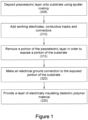
- FIG. 1 shows a flowchart of the manufacturing process.
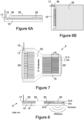
- Figures 2 to 6 illustrate the steps in the manufacturing process.
- Figures 3A, 4A, 5A and 6A show a side cross sectional view of the part that will become the ultrasonic transducer 5 and
- Figures 3B, 4B, 5B and 6B show a planar view.
- a substrate 10 in the form of a metal foil, such as aluminium foil is sputter coated on one side with a thin layer of polycrystalline piezoelectric material 15, such as transition metal doped metal oxide.
- the piezoelectric material is a vanadium doped zinc oxide (ZnO) or aluminium nitride (AIN), but other transition metal dopants or other metal salts exhibiting piezoelectric properties could be used.
- the substrate is from 20 to 200 ⁇ m thick.
- the layer of piezoelectric material 15 is of the order of a 10 th of the thickness of the substrate 10, e.g. from 2 to 20 ⁇ m thick.
- the layer of piezoelectric material 15 is deposited onto the substrate 10 by sputter coating.
- the piezoelectric material 15 could be deposited using a magnetron based sputtering, such as closed field magnetron sputtering or high power impulse magnetron sputtering, which may optimize the piezoelectric properties of the film and/or the growth morphology.
- the coating of the piezoelectric material 15 onto the substrate 10 is performed using high power impulse magnetron sputtering (HIPIMS), but the invention is not limited to this.
- HIPIMS high power impulse magnetron sputtering
- sputter coating is generally performed in a low pressure chamber 405 having an outlet 410 to a vacuum pump, an inlet 415 for allowing inert gasses to be admitted, an electrode 420, a counter electrode 425 in the form of a rotating drum, a target 430 electrically connected to the electrode 420, and the substrate 10 being provided on a surface of the rotating drum counter electrode 425.
- a grounded magnetron anode 431 is provided proximate the target 430.
- a pulsed high voltage power supply (not shown) is connected to the electrode 420 that is coupled to the target 430.
- a separate substrate bias voltage power supply 432 is electrically connected to the rotating drum electrode 425 and operable to provide DC or RF biasing to the substrate 10.
- An electric field is generated to guide ionized sputtered material from the target 430 onto the substrate 10.
- the substrate bias voltage can be varied or selected in order to attract ionized sputtered material from the target 430 to the substrate 10 to control the energy of the arriving ions. This may optimise sputter plasma ion energy during film growth.
- the drum 425 would normally float electrically and the substrate bias voltage from the substrate bias voltage power supply 432 is applied through a rotational feedthrough / shaft of the rotating drum 425, thereby applying a voltage (bias) direct to the drum 425.
- the target 430 is formed from the transition metal doped piezoelectric material, e.g. from vanadium doped zinc oxide.
- the elements that will form the layer of piezoelectric material are combined within the target, e.g. by being alloyed or doped, rather than being provided separately or discretely, e.g. as mixtures or by the doping transition metals being adhered or otherwise provided on the surface of the metal oxide. In this way, the resultant layer of piezoelectric material 15 may have improved piezoelectric properties.
- the target 430 and the layer of piezoelectric material 15 have levels of the active piezoelectric material, e.g. the metal oxide or nitride such as the ZnO or AIN, of 90% w/w and above, e.g. from 90% to 99.99% w/w.
- the dopant/alloying material e.g. the transition metal, is present in the target 420 and the layer of piezoelectric material 15 in levels of 10% w/w and less, e.g. from 0.01% to 10% w/w.
- a high voltage is provided between the electrode 420 and the counter electrode 425 that acts to form a plasma in the chamber. Ions from the plasma are accelerated into the target 430, sputtering the doped piezoelectric material from the target 430, which is then deposited on the surface of the substrate 10 by a process of adsorption. The result of this is the substrate 10 being coated on one side with the layer of transition metal doped piezoelectric material 15.
- the plurality of working electrodes 20 respectively connected by corresponding conductive tracks 25 to corresponding electrical connectors 30 are provided on a surface of the layer of piezoelectric material 15 that is opposite to the substrate 10. These may be provided by techniques such as photo-masking and deposition, printing, selective patterning, and/or the like.
- a portion of the layer of piezoelectric material 15 is removed to expose a corresponding portion of a surface of the substrate 10 upon which the layer of piezoelectric material 15 is disposed.
- the portion of piezoelectric material 15 may be removed by selective etching, e.g. using an acid such as hydrochloric acid.
- the electrical ground connection 17 is directly attached to this exposed portion of the surface of the substrate 10 upon which the layer of piezoelectric material 15 is disposed.
- all of the electrical connections of the substrate 10 i.e. the ground connection 17 and the connection to the layer of piezoelectric material 15 and thereby to the working electrodes 20
- the opposite surface of the substrate i.e. the radiating surface from which the ultrasonic waves are radiated in use.
- no folding of the material is required, which may otherwise provide a point of potential failure.
- the electrically insulating dielectric material 35 is provided over and around the outer surface of the layer of piezoelectric material 15 (i.e. the surface that is opposite to the surface that abuts the substrate 10), the electrodes 20 and the conductive tracks 25 in order to protect and insulate them.
- the dielectric material 35 is also disposed between the electrodes 20 and between the conductive tracks 25.
- the dielectric material 35 can be any suitable dielectric polymer material, such as an epoxy, a polyimide, a poly para-xylene, or the like.
- the contacts 30 and the ground connection 17 are left exposed so that they can form the required electrical connections.
- the dielectric material 35 is generally thinner than the substrate, e.g. being 50 ⁇ m or less in thickness.
- the dielectric material 35 can be applied by suitable techniques known in the art such as by spin coating or by vapour deposition.
- the above provision of the dielectric material 35 may confer advantages in the ultrasonic transducer array 5.
- the operational frequency may be lowered or high frequency vibrations (e.g. those greater than 20MHz) may be damped, which is particularly beneficial in low frequency applications (e.g. in the range from 1 to 20MHz).
- the electrical insulation it provides may reduce pinhole and other defect failures. It may also help the transducer array 5 withstand higher voltage pulsing and improve electrical durability. It may also improve mechanical durability and recue failure due to curving and flexing.
- FIG 7 shows a schematic planar view of an exemplary ultrasonic transducer array 5 that could be produced using the method of claims 1 to 6 and
- Figure 8 shows a schematic side view of the ultrasonic transducer array 5.
- the ultrasonic transducer 5 shown in Figures 7 and 8 is provided only as an example of an ultrasonic transducer that can be produced using the method of Figures 1 to 6 and the method could also be applied to produce other ultrasonic transducers and transducer arrays.
- the exemplary ultrasonic transducer array 5 comprises the electrically conductive substrate 10 in the form of a metal foil, in this case an aluminium foil, and the layer of crystalline piezoelectric material 15 disposed on one planar surface of the substrate 10.
- the substrate 10 acts to support the layer of piezoelectric material 15 and also functions as a ground electrode.
- a surface of the substrate 10 that is opposite to a surface upon which the layer of piezoelectric material is provided acts as an ultrasonic wave radiation surface from which ultrasonic waves are emitted from the transducer array in use.
- a portion of the surface of the substrate 10 that contacts the layer of piezoelectric material 15 is free of piezoelectric material and instead provided with an electrical ground connection 17.
- the substrate 10 is much thicker (i.e. in the order of magnitude of 10 times thicker) than the layer of piezoelectric material 15 and in this example, the substrate 10 is between 20 and 200 ⁇ m thick and the layer of piezoelectric material 15 is between 2 and 20 ⁇ m thick.
- the piezoelectric material is vanadium doped ZnO but it will be appreciated that other suitable piezoelectric materials such as AIN and/or other dopants, particularly other transition metal dopants, could be used.
- One or more working electrodes 20 are provided on a surface of the layer of piezoelectric material 15 that is on an opposite side of the layer of piezoelectric material 15 to the substrate 10. Each of the working electrodes 20 is connected to a corresponding electrically conductive track 25 that is in turn electrically connected to an associated electrical connector 30.
- a layer of electrically insulating dielectric polymer material 35 is provided on the layer piezoelectric material and over and in between the electrodes 20 and the conductive tracks 25.
- suitable electrically insulating dielectric polymer material 35 include epoxy, polyimide, poly para-xylene, or the like.
- the connectors 30 and the connection of the substrate 10 to electrical ground are left exposed to allow electrical connections to a controller or processing device to be made.
- the radiating surface of the substrate 10 i.e. the surface of the substrate opposite to the piezoelectric material 15
- the thickness of the layer of dielectric material 35 is in the range from 1 to 50 ⁇ m thick.
- an alternating electrical driving current is applied to the appropriate connector 30 or connectors 30 and thereby via the conductive tracks 25 to the corresponding working electrode 20 or electrodes 20.
- the working electrodes 20 form a couple with the conductive substrate 10 that acts as a ground electrode (by virtue of the ground connection 17) in order to apply an alternating electrical current across the corresponding sections of the piezoelectric material 15.
- This causes the corresponding sections of layer of piezoelectric material 15 to vibrate at high frequency along with the corresponding portion of the substrate 10 to thereby generate ultrasonic waves, which are emitted from portions of the outer surface of the substrate 10 that correspond to the driven working electrode(s) 20.
- piezoelectric materials being ZnO or AIN are given above, it will be appreciated that other piezoelectric materials could be used instead.
- transition metal doped piezoelectric materials are described, it will be appreciated that non-doped piezoelectric materials could be used within the limitations defined by the claims.
- various thicknesses, dimensions, numbers and geometric arrangements of electrodes, conductive tracks and contacts are given above, it will be appreciated that other thicknesses, dimensions, numbers and geometric arrangements of electrodes, conductive tracks and contacts could be used.
- the electrodes are all shown as the same size and shape, it will be appreciated that at least some or all of the electrodes may be of different sizes and/or shapes.
- dielectric materials are given, other suitable dielectrics could be used.
- specific examples of etching agents are used, other suitable etching agents could alternatively be used.
- transition metal doped metal oxide or metal nitride beneficially uses sputter coating of a transition metal doped metal oxide or metal nitride using a doped, alloyed or amalgam target
- other methods of producing a suitably integral transition metal / metal oxide or metal nitride piezoelectric could be used.
- the transition metal and the metal oxide or metal nitride could be co-deposited from a dual source system.
- the substrate 10 is shown in Figure 2 on a rotating drum whilst the piezoelectric layer 15 is deposited onto the substrate 10, it will be appreciated that the substrate 10 may be provided on a flat, stationary surface.
Landscapes
- Engineering & Computer Science (AREA)
- Manufacturing & Machinery (AREA)
- Chemical & Material Sciences (AREA)
- Ceramic Engineering (AREA)
- Mechanical Engineering (AREA)
- Transducers For Ultrasonic Waves (AREA)
- Ultra Sonic Daignosis Equipment (AREA)
- Investigating Or Analyzing Materials By The Use Of Ultrasonic Waves (AREA)
- Physical Vapour Deposition (AREA)
Claims (15)
- Verfahren zum Erzeugen eines flexiblen Ultraschallwandlers (5) oder eines Ultraschallwandler-Arrays zur Bildgebung, zur Messung oder zum zerstörungsfreiem Prüfen, wobei das Verfahren Folgendes umfasst:Bereitstellen oder Abscheiden einer Schicht aus piezoelektrischem Material (15) auf einem Substrat (10), umfassend eine Metallfolie, wobeidie Schicht aus piezoelektrischem Material (15) eine Dicke im Bereich von 2 bis 20 µm aufweist, und das Substrat (10) 20 bis 200 µm dick ist,das piezoelektrische Material (15) ein dotiertes, gleichzeitig abgeschiedenes oder legiertes piezoelektrisches Material ist; unddas piezoelektrische Material (15) Folgendes umfasst:ein dotiertes, gleichzeitig abgeschiedenes oder legiertes Metalloxid oder Metallnitrid, wobei das Metalloxid oder Metallnitrid mit Vanadium oder einer Verbindung davon dotiert, gleichzeitig abgeschieden oder legiert ist; oderZinkoxid, das mit einem Übergangsmetall oder einer Verbindung davon dotiert, gleichzeitig abgeschieden oder legiert ist.
- Verfahren nach Anspruch 1, wobei die Abscheidung der Schicht aus piezoelektrischem Material (15) durch Sputter-Beschichtung unter Verwendung von einem Sputter-Ziel (430) erfolgt, das ein dotiertes oder legiertes Material umfasst.
- Verfahren nach einem vorhergehenden Anspruch, wobei das dotierte, gleichzeitig abgeschiedene oder legierte piezoelektrische Material(15) ein primäres piezoelektrisches Material und einen Dotierstoff oder ein weiteres Material umfasst, wobei der Dotierstoff oder das weitere Material in dem piezoelektrischen Material und/oder dem Sputter-Ziel mit einem Gehalt von 0,01 bis 10 % vorhanden ist und das primäre piezoelektrische Material in der Schicht aus piezoelektrischem Material mit Gehalten von 90 % bis zu 99,99 % vorhanden ist.
- Verfahren nach einem vorhergehenden Anspruch, wobei das Sputter-Beschichten das Verwenden von Gleichstrom-Sputtern, Sputtern mit gepulstem Gleichstrom, Hochfrequenz-Sputtern, Magnetron-Sputtern bei geschlossenem Magnetfeld (CFM), Hochleistungsimpulsmagnetronsputtern (HIPIMS) oder einem anderen Magnetron-Sputter-Verfahren umfasst, optional
wobei der Dotierstoff oder das weitere Material mit dem primären piezoelektrischen Material (15) gleichzeitig abgeschieden wird, wobei der Dotierstoff oder das weitere Material durch das Sputter-Ziel (430) oder die Sputter-Anordnung bereitgestellt wird und das primäre piezoelektrische Material durch ein unterschiedliches Ziel oder eine unterschiedliche Sputter-Anordnung bereitgestellt wird. - Verfahren nach einem vorhergehenden Anspruch, wobei das Substrat (10) auf einer rotierenden Trommel oder einer sich linear bewegenden Platte bereitgestellt wird, während die piezoelektrische Schicht auf das Substrat abgeschieden wird.
- Verfahren nach einem vorhergehenden Anspruch, wobei mindestens eines von Folgendem gilt:die Schicht aus piezoelektrischem Material (15) ist eine Ultraschallerzeugungsschicht, die konfiguriert und/oder funktionsfähig ist, Ultraschall zur Bildgebung, zur Messung oder zum zerstörungsfreien Prüfen zu erzeugen, oderdie Schicht aus piezoelektrischem Material (15) eine Schicht aus anorganischem kristallinem, z. B. polykristallinem, säulenartigem nicht-polymerem piezoelektrischem Material ist.
- Verfahren nach einem vorhergehenden Anspruch, das Bereitstellen einer sekundären Schicht (35) umfassend, die ein elektrisch isolierendes dielektrisches Material (35) direkt auf, über mindestens einem Teil einer Oberfläche der Schicht aus piezoelektrischem Material (15), oder diesen überlagernd umfasst, optional
wobei die sekundäre Schicht (35) weniger als 50 µm dick ist. - Verfahren nach einem vorhergehenden Anspruch, wobei das Substrat (10) ein elektrischer Leiter ist und eine elektrische Masseelektrode der piezoelektrischen Vorrichtung bildet.
- Verfahren nach einem vorhergehenden Anspruch, wobei das Verfahren das Entfernen ausgewählter Abschnitte der Schicht aus piezoelektrischem Material (15) umfasst, sodass ein entsprechender Bereich einer Oberfläche des Substrats (10) freiliegt, auf die der Rest der Schicht aus piezoelektrischem Material (15) abgeschieden ist, optional
wobei das Verfahren das Entfernen oder Ätzen ausgewählter Abschnitte der Schicht aus piezoelektrischem Material (15) unter Verwendung von Säure oder einem anderen geeigneten chemischen Mittel umfasst. - Verfahren nach einem vorhergehenden Anspruch, das Herstellen einer elektrischen Verbindung direkt mit einer Oberfläche des Substrats (10) umfassend, auf die das piezoelektrische Material (15) abgeschieden wird.
- Verfahren nach Anspruch 10, wenn abhängig von Anspruch 9, wobei das Verfahren das Herstellen einer elektrischen Verbindung direkt mit dem Bereich des Substrats (10) umfasst, von dem das piezoelektrische Material (15) entfernt wurde
- Verfahren nach einem der Ansprüche 10 bis 11, wobei die elektrische Verbindung eine Masseverbindung ist.
- Satz aus computerlesbaren Anweisungen oder Prozessprotokollen oder Computercode, der derart konfiguriert ist, dass er bei Verarbeitung durch Fertigungsausrüstung es der Fertigungsausrüstung erlaubt, sie steuert oder veranlasst, oder Anweisungen oder Daten für die Fertigungsausrüstung bereitstellt, das Verfahren nach einem der Ansprüche 1 bis 12 durchzuführen.
- Computerlesbare Anweisungen oder Computercode nach Anspruch 13, wobei die Fertigungsausrüstung ein computergesteuertes Sputter-System ist, dieses umfasst oder in diesem enthalten ist.
- Ultraschallwandler (5) zur Bildgebung, zur Messung oder zum zerstörungsfreien Prüfen, wobei der Ultraschallwandler Folgendes umfasst:eine flexible Schicht aus piezoelektrischem Material (15) auf einem flexiblen Substrat (10), umfassend eine Metallfolie, wobeidie Schicht aus piezoelektrischem Material (15) eine Dicke im Bereich von 2 bis 20 µm aufweist, und das Substrat (10) 20 bis 200 µm dick ist,das piezoelektrische Material (15) ein dotiertes, gleichzeitig abgeschiedenes oder legiertes piezoelektrisches Material ist; unddas piezoelektrische Material (15) Folgendes umfasst:ein dotiertes, gleichzeitig abgeschiedenes oder legiertes Metalloxid oder Metallnitrid, wobei das Metalloxid oder Metallnitrid mit Vanadium oder einer Verbindung davon dotiert, gleichzeitig abgeschieden oder legiert ist; oderZinkoxid, das mit einem Übergangsmetall oder einer Verbindung davon dotiert, gleichzeitig abgeschieden oder legiert ist.
Applications Claiming Priority (2)
| Application Number | Priority Date | Filing Date | Title |
|---|---|---|---|
| GB1803257.3A GB2571529B (en) | 2018-02-28 | 2018-02-28 | Formation of piezoelectric devices |
| PCT/GB2019/050549 WO2019166805A2 (en) | 2018-02-28 | 2019-02-27 | Formation of piezoelectric devices |
Publications (3)
| Publication Number | Publication Date |
|---|---|
| EP3759745A2 EP3759745A2 (de) | 2021-01-06 |
| EP3759745B1 true EP3759745B1 (de) | 2024-06-12 |
| EP3759745B8 EP3759745B8 (de) | 2024-07-24 |
Family
ID=61903159
Family Applications (1)
| Application Number | Title | Priority Date | Filing Date |
|---|---|---|---|
| EP19716472.6A Active EP3759745B8 (de) | 2018-02-28 | 2019-02-27 | Herstellung von piezoelektrischen vorrichtungen |
Country Status (9)
| Country | Link |
|---|---|
| US (1) | US11882767B2 (de) |
| EP (1) | EP3759745B8 (de) |
| CN (1) | CN112088438B (de) |
| CA (1) | CA3092312A1 (de) |
| DK (1) | DK3759745T3 (de) |
| ES (1) | ES2986661T3 (de) |
| GB (1) | GB2571529B (de) |
| IL (1) | IL276977B2 (de) |
| WO (1) | WO2019166805A2 (de) |
Families Citing this family (7)
| Publication number | Priority date | Publication date | Assignee | Title |
|---|---|---|---|---|
| GB2571361B (en) * | 2018-03-02 | 2020-04-22 | Novosound Ltd | Ultrasound array transducer manufacturing |
| GB2582562B (en) | 2019-03-22 | 2021-07-21 | Novosound Ltd | Ultrasonic device |
| GB2594328B (en) | 2020-04-24 | 2024-04-10 | Novosound Ltd | Secure ultrasound system |
| GB2603887A (en) | 2020-11-24 | 2022-08-24 | Novosound Ltd | Tamper proof ultrasound sensor |
| CN116939442A (zh) * | 2022-04-01 | 2023-10-24 | 深圳市韶音科技有限公司 | 一种声学设备 |
| GB2636143A (en) | 2023-11-30 | 2025-06-11 | Novosound Ltd | Wide area monitoring system |
| CN118719517B (zh) * | 2024-06-20 | 2025-05-16 | 中山大学 | 多阵列超声换能器、多阵列超声换能器制造方法及内窥镜 |
Family Cites Families (13)
| Publication number | Priority date | Publication date | Assignee | Title |
|---|---|---|---|---|
| JPS5396495A (en) * | 1977-02-02 | 1978-08-23 | Murata Manufacturing Co | Piezooelectric crystal film of zinc oxide |
| JPS5830749B2 (ja) * | 1977-07-28 | 1983-07-01 | 株式会社村田製作所 | 酸化亜鉛の圧電結晶膜 |
| JP3947443B2 (ja) * | 2002-08-30 | 2007-07-18 | Tdk株式会社 | 電子デバイス用基板および電子デバイス |
| JP4451104B2 (ja) * | 2003-09-16 | 2010-04-14 | 学校法人桐蔭学園 | Pzt圧電結晶膜の製法及び超音波トランスデューサ |
| CN101118948A (zh) * | 2007-09-03 | 2008-02-06 | 清华大学 | 具有大压电常数和高电阻率的V掺杂ZnO薄膜材料 |
| JP5449970B2 (ja) * | 2009-10-09 | 2014-03-19 | 富士フイルム株式会社 | 圧電体膜の成膜方法、圧電素子、液体吐出装置、及び圧電型超音波振動子 |
| CN102163687A (zh) * | 2010-12-10 | 2011-08-24 | 清华大学 | 一种高压电响应氧化锌柔性压力传感器及其制备方法 |
| US9166141B2 (en) * | 2011-09-09 | 2015-10-20 | Dvx, Llc | Process of manufacturing a piezopolymer transducer with matching layer |
| JP6164405B2 (ja) * | 2013-03-28 | 2017-07-19 | セイコーエプソン株式会社 | 圧電素子モジュール、超音波トランスデューサー、超音波デバイス、液体噴射ヘッド、液体噴射装置及び圧電素子モジュールの製造方法 |
| JP2017117981A (ja) * | 2015-12-25 | 2017-06-29 | セイコーエプソン株式会社 | 圧電素子、圧電モジュール、電子機器、及び圧電素子の製造方法 |
| US20170263847A1 (en) * | 2016-03-09 | 2017-09-14 | Teledyne Dalsa Semiconductor, Inc. | Piezoelectric Alloy Films |
| GB2555835B (en) * | 2016-11-11 | 2018-11-28 | Novosound Ltd | Ultrasound transducer |
| CN108231998A (zh) * | 2017-12-31 | 2018-06-29 | 中国科学院声学研究所 | 一种掺钒ZnO厚膜及其制备方法 |
-
2018
- 2018-02-28 GB GB1803257.3A patent/GB2571529B/en active Active
-
2019
- 2019-02-27 CN CN201980028976.0A patent/CN112088438B/zh active Active
- 2019-02-27 US US16/976,142 patent/US11882767B2/en active Active
- 2019-02-27 WO PCT/GB2019/050549 patent/WO2019166805A2/en not_active Ceased
- 2019-02-27 ES ES19716472T patent/ES2986661T3/es active Active
- 2019-02-27 IL IL276977A patent/IL276977B2/en unknown
- 2019-02-27 CA CA3092312A patent/CA3092312A1/en active Pending
- 2019-02-27 DK DK19716472.6T patent/DK3759745T3/da active
- 2019-02-27 EP EP19716472.6A patent/EP3759745B8/de active Active
Also Published As
| Publication number | Publication date |
|---|---|
| GB2571529B (en) | 2021-04-14 |
| IL276977B2 (en) | 2025-06-01 |
| CN112088438A (zh) | 2020-12-15 |
| WO2019166805A3 (en) | 2019-10-03 |
| EP3759745B8 (de) | 2024-07-24 |
| GB2571529A (en) | 2019-09-04 |
| ES2986661T3 (es) | 2024-11-12 |
| CA3092312A1 (en) | 2019-09-06 |
| US11882767B2 (en) | 2024-01-23 |
| GB201803257D0 (en) | 2018-04-11 |
| IL276977B1 (en) | 2025-02-01 |
| EP3759745A2 (de) | 2021-01-06 |
| US20200411750A1 (en) | 2020-12-31 |
| IL276977A (en) | 2020-10-29 |
| DK3759745T3 (da) | 2024-09-16 |
| WO2019166805A2 (en) | 2019-09-06 |
| CN112088438B (zh) | 2025-11-25 |
Similar Documents
| Publication | Publication Date | Title |
|---|---|---|
| EP3759745B1 (de) | Herstellung von piezoelektrischen vorrichtungen | |
| JP3610364B2 (ja) | 医療画像化のための多重圧電層超音波変換器 | |
| US9263663B2 (en) | Method of making thick film transducer arrays | |
| EP3538289B1 (de) | Ultraschallwandler | |
| CN112041091A (zh) | 超声换能器 | |
| EP2922707B1 (de) | Mikromechanisch hergestellter kapazitiver wandler und verfahren zur herstellung davon | |
| CN106412780A (zh) | 超声波探头及其制造方法 | |
| US11575080B2 (en) | Piezoelectric member, ultrasonic oscillation element, ultrasonic probe, ultrasound diagnostic system, and method for producing piezoelectric member | |
| WO2019235080A1 (ja) | 圧電薄膜及び圧電薄膜素子 | |
| JP3602684B2 (ja) | 超音波トランスデューサ及びその製造方法 | |
| US12280399B2 (en) | Method for manufacturing an acoustic wave transducing unit | |
| US7951272B2 (en) | Thin film producing method | |
| JPH07312799A (ja) | 超音波探触子とその製造方法 | |
| US20090115290A1 (en) | Ultrawideband Ultrasonic Transducer | |
| JP3313171B2 (ja) | 超音波探触子とその製造方法 | |
| JP2000143335A (ja) | 磁器材料及び超音波探触子及び圧電振動子及びそれらの製造方法 | |
| JP2013026682A (ja) | 医用複合単結晶圧電振動子、医用超音波プローブ、医用複合単結晶圧電振動子製造方法および医用超音波プローブ製造方法 | |
| CN218691247U (zh) | 一种环形阵列超声波换能器 | |
| Kline-Schoder et al. | Physical vapor deposition of multilayered lead-zirconate-titanate films for ultrasonic transducer fabrication | |
| JPS59141060A (ja) | 超音波探触子 | |
| KR100369861B1 (ko) | 반도체 박막형 초음파 트랜스듀서 및 그 제조 방법 | |
| JP3101461B2 (ja) | 超音波探触子 | |
| JP3353962B2 (ja) | 超音波探触子の製造方法 | |
| JPH0870497A (ja) | 超音波トランスデューサおよびその製造方法 | |
| JPS62187248A (ja) | 薄膜aeセンサ− |
Legal Events
| Date | Code | Title | Description |
|---|---|---|---|
| STAA | Information on the status of an ep patent application or granted ep patent |
Free format text: STATUS: UNKNOWN |
|
| STAA | Information on the status of an ep patent application or granted ep patent |
Free format text: STATUS: THE INTERNATIONAL PUBLICATION HAS BEEN MADE |
|
| PUAI | Public reference made under article 153(3) epc to a published international application that has entered the european phase |
Free format text: ORIGINAL CODE: 0009012 |
|
| STAA | Information on the status of an ep patent application or granted ep patent |
Free format text: STATUS: REQUEST FOR EXAMINATION WAS MADE |
|
| 17P | Request for examination filed |
Effective date: 20200928 |
|
| AK | Designated contracting states |
Kind code of ref document: A2 Designated state(s): AL AT BE BG CH CY CZ DE DK EE ES FI FR GB GR HR HU IE IS IT LI LT LU LV MC MK MT NL NO PL PT RO RS SE SI SK SM TR |
|
| AX | Request for extension of the european patent |
Extension state: BA ME |
|
| DAV | Request for validation of the european patent (deleted) | ||
| DAX | Request for extension of the european patent (deleted) | ||
| REG | Reference to a national code |
Ref country code: DE Ref legal event code: R079 Free format text: PREVIOUS MAIN CLASS: H01L0041047000 Ipc: H10N0030870000 Ref country code: DE Ref legal event code: R079 Ref document number: 602019053533 Country of ref document: DE Free format text: PREVIOUS MAIN CLASS: H01L0041047000 Ipc: H10N0030870000 |
|
| RIC1 | Information provided on ipc code assigned before grant |
Ipc: H10N 30/082 20230101ALI20231116BHEP Ipc: H10N 30/076 20230101ALI20231116BHEP Ipc: H10N 30/853 20230101ALI20231116BHEP Ipc: B06B 1/06 20060101ALI20231116BHEP Ipc: H10N 30/87 20230101AFI20231116BHEP |
|
| GRAP | Despatch of communication of intention to grant a patent |
Free format text: ORIGINAL CODE: EPIDOSNIGR1 |
|
| STAA | Information on the status of an ep patent application or granted ep patent |
Free format text: STATUS: GRANT OF PATENT IS INTENDED |
|
| INTG | Intention to grant announced |
Effective date: 20240103 |
|
| GRAS | Grant fee paid |
Free format text: ORIGINAL CODE: EPIDOSNIGR3 |
|
| GRAA | (expected) grant |
Free format text: ORIGINAL CODE: 0009210 |
|
| STAA | Information on the status of an ep patent application or granted ep patent |
Free format text: STATUS: THE PATENT HAS BEEN GRANTED |
|
| AK | Designated contracting states |
Kind code of ref document: B1 Designated state(s): AL AT BE BG CH CY CZ DE DK EE ES FI FR GB GR HR HU IE IS IT LI LT LU LV MC MK MT NL NO PL PT RO RS SE SI SK SM TR |
|
| REG | Reference to a national code |
Ref country code: GB Ref legal event code: FG4D |
|
| REG | Reference to a national code |
Ref country code: CH Ref legal event code: EP |
|
| REG | Reference to a national code |
Ref country code: CH Ref legal event code: PK Free format text: BERICHTIGUNG B8 |
|
| REG | Reference to a national code |
Ref country code: IE Ref legal event code: FG4D |
|
| REG | Reference to a national code |
Ref country code: DE Ref legal event code: R096 Ref document number: 602019053533 Country of ref document: DE |
|
| RBV | Designated contracting states (corrected) |
Designated state(s): AL AT BE BG CH CY CZ DE DK EE ES FI FR GR HR HU IE IS IT LI LT LU LV MC MK MT NL NO PL PT RO RS SE SI SK SM TR |
|
| REG | Reference to a national code |
Ref country code: DK Ref legal event code: T3 Effective date: 20240911 |
|
| REG | Reference to a national code |
Ref country code: NL Ref legal event code: FP |
|
| REG | Reference to a national code |
Ref country code: SE Ref legal event code: TRGR |
|
| PG25 | Lapsed in a contracting state [announced via postgrant information from national office to epo] |
Ref country code: BG Free format text: LAPSE BECAUSE OF FAILURE TO SUBMIT A TRANSLATION OF THE DESCRIPTION OR TO PAY THE FEE WITHIN THE PRESCRIBED TIME-LIMIT Effective date: 20240612 |
|
| PG25 | Lapsed in a contracting state [announced via postgrant information from national office to epo] |
Ref country code: FI Free format text: LAPSE BECAUSE OF FAILURE TO SUBMIT A TRANSLATION OF THE DESCRIPTION OR TO PAY THE FEE WITHIN THE PRESCRIBED TIME-LIMIT Effective date: 20240612 Ref country code: HR Free format text: LAPSE BECAUSE OF FAILURE TO SUBMIT A TRANSLATION OF THE DESCRIPTION OR TO PAY THE FEE WITHIN THE PRESCRIBED TIME-LIMIT Effective date: 20240612 |
|
| REG | Reference to a national code |
Ref country code: LT Ref legal event code: MG9D |
|
| PG25 | Lapsed in a contracting state [announced via postgrant information from national office to epo] |
Ref country code: GR Free format text: LAPSE BECAUSE OF FAILURE TO SUBMIT A TRANSLATION OF THE DESCRIPTION OR TO PAY THE FEE WITHIN THE PRESCRIBED TIME-LIMIT Effective date: 20240913 |
|
| PG25 | Lapsed in a contracting state [announced via postgrant information from national office to epo] |
Ref country code: LV Free format text: LAPSE BECAUSE OF FAILURE TO SUBMIT A TRANSLATION OF THE DESCRIPTION OR TO PAY THE FEE WITHIN THE PRESCRIBED TIME-LIMIT Effective date: 20240612 |
|
| PG25 | Lapsed in a contracting state [announced via postgrant information from national office to epo] |
Ref country code: BG Free format text: LAPSE BECAUSE OF FAILURE TO SUBMIT A TRANSLATION OF THE DESCRIPTION OR TO PAY THE FEE WITHIN THE PRESCRIBED TIME-LIMIT Effective date: 20240612 Ref country code: LV Free format text: LAPSE BECAUSE OF FAILURE TO SUBMIT A TRANSLATION OF THE DESCRIPTION OR TO PAY THE FEE WITHIN THE PRESCRIBED TIME-LIMIT Effective date: 20240612 Ref country code: HR Free format text: LAPSE BECAUSE OF FAILURE TO SUBMIT A TRANSLATION OF THE DESCRIPTION OR TO PAY THE FEE WITHIN THE PRESCRIBED TIME-LIMIT Effective date: 20240612 Ref country code: GR Free format text: LAPSE BECAUSE OF FAILURE TO SUBMIT A TRANSLATION OF THE DESCRIPTION OR TO PAY THE FEE WITHIN THE PRESCRIBED TIME-LIMIT Effective date: 20240913 Ref country code: FI Free format text: LAPSE BECAUSE OF FAILURE TO SUBMIT A TRANSLATION OF THE DESCRIPTION OR TO PAY THE FEE WITHIN THE PRESCRIBED TIME-LIMIT Effective date: 20240612 Ref country code: RS Free format text: LAPSE BECAUSE OF FAILURE TO SUBMIT A TRANSLATION OF THE DESCRIPTION OR TO PAY THE FEE WITHIN THE PRESCRIBED TIME-LIMIT Effective date: 20240912 |
|
| REG | Reference to a national code |
Ref country code: ES Ref legal event code: FG2A Ref document number: 2986661 Country of ref document: ES Kind code of ref document: T3 Effective date: 20241112 |
|
| REG | Reference to a national code |
Ref country code: AT Ref legal event code: MK05 Ref document number: 1695306 Country of ref document: AT Kind code of ref document: T Effective date: 20240612 |
|
| PG25 | Lapsed in a contracting state [announced via postgrant information from national office to epo] |
Ref country code: PT Free format text: LAPSE BECAUSE OF FAILURE TO SUBMIT A TRANSLATION OF THE DESCRIPTION OR TO PAY THE FEE WITHIN THE PRESCRIBED TIME-LIMIT Effective date: 20241014 |
|
| PG25 | Lapsed in a contracting state [announced via postgrant information from national office to epo] |
Ref country code: PT Free format text: LAPSE BECAUSE OF FAILURE TO SUBMIT A TRANSLATION OF THE DESCRIPTION OR TO PAY THE FEE WITHIN THE PRESCRIBED TIME-LIMIT Effective date: 20241014 |
|
| PG25 | Lapsed in a contracting state [announced via postgrant information from national office to epo] |
Ref country code: PL Free format text: LAPSE BECAUSE OF FAILURE TO SUBMIT A TRANSLATION OF THE DESCRIPTION OR TO PAY THE FEE WITHIN THE PRESCRIBED TIME-LIMIT Effective date: 20240612 |
|
| PG25 | Lapsed in a contracting state [announced via postgrant information from national office to epo] |
Ref country code: EE Free format text: LAPSE BECAUSE OF FAILURE TO SUBMIT A TRANSLATION OF THE DESCRIPTION OR TO PAY THE FEE WITHIN THE PRESCRIBED TIME-LIMIT Effective date: 20240612 |
|
| PG25 | Lapsed in a contracting state [announced via postgrant information from national office to epo] |
Ref country code: IS Free format text: LAPSE BECAUSE OF FAILURE TO SUBMIT A TRANSLATION OF THE DESCRIPTION OR TO PAY THE FEE WITHIN THE PRESCRIBED TIME-LIMIT Effective date: 20241012 Ref country code: AT Free format text: LAPSE BECAUSE OF FAILURE TO SUBMIT A TRANSLATION OF THE DESCRIPTION OR TO PAY THE FEE WITHIN THE PRESCRIBED TIME-LIMIT Effective date: 20240612 |
|
| PG25 | Lapsed in a contracting state [announced via postgrant information from national office to epo] |
Ref country code: CZ Free format text: LAPSE BECAUSE OF FAILURE TO SUBMIT A TRANSLATION OF THE DESCRIPTION OR TO PAY THE FEE WITHIN THE PRESCRIBED TIME-LIMIT Effective date: 20240612 |
|
| PG25 | Lapsed in a contracting state [announced via postgrant information from national office to epo] |
Ref country code: SK Free format text: LAPSE BECAUSE OF FAILURE TO SUBMIT A TRANSLATION OF THE DESCRIPTION OR TO PAY THE FEE WITHIN THE PRESCRIBED TIME-LIMIT Effective date: 20240612 Ref country code: RO Free format text: LAPSE BECAUSE OF FAILURE TO SUBMIT A TRANSLATION OF THE DESCRIPTION OR TO PAY THE FEE WITHIN THE PRESCRIBED TIME-LIMIT Effective date: 20240612 |
|
| PG25 | Lapsed in a contracting state [announced via postgrant information from national office to epo] |
Ref country code: SM Free format text: LAPSE BECAUSE OF FAILURE TO SUBMIT A TRANSLATION OF THE DESCRIPTION OR TO PAY THE FEE WITHIN THE PRESCRIBED TIME-LIMIT Effective date: 20240612 |
|
| PG25 | Lapsed in a contracting state [announced via postgrant information from national office to epo] |
Ref country code: SM Free format text: LAPSE BECAUSE OF FAILURE TO SUBMIT A TRANSLATION OF THE DESCRIPTION OR TO PAY THE FEE WITHIN THE PRESCRIBED TIME-LIMIT Effective date: 20240612 Ref country code: SK Free format text: LAPSE BECAUSE OF FAILURE TO SUBMIT A TRANSLATION OF THE DESCRIPTION OR TO PAY THE FEE WITHIN THE PRESCRIBED TIME-LIMIT Effective date: 20240612 Ref country code: RO Free format text: LAPSE BECAUSE OF FAILURE TO SUBMIT A TRANSLATION OF THE DESCRIPTION OR TO PAY THE FEE WITHIN THE PRESCRIBED TIME-LIMIT Effective date: 20240612 Ref country code: PL Free format text: LAPSE BECAUSE OF FAILURE TO SUBMIT A TRANSLATION OF THE DESCRIPTION OR TO PAY THE FEE WITHIN THE PRESCRIBED TIME-LIMIT Effective date: 20240612 Ref country code: IS Free format text: LAPSE BECAUSE OF FAILURE TO SUBMIT A TRANSLATION OF THE DESCRIPTION OR TO PAY THE FEE WITHIN THE PRESCRIBED TIME-LIMIT Effective date: 20241012 Ref country code: EE Free format text: LAPSE BECAUSE OF FAILURE TO SUBMIT A TRANSLATION OF THE DESCRIPTION OR TO PAY THE FEE WITHIN THE PRESCRIBED TIME-LIMIT Effective date: 20240612 Ref country code: CZ Free format text: LAPSE BECAUSE OF FAILURE TO SUBMIT A TRANSLATION OF THE DESCRIPTION OR TO PAY THE FEE WITHIN THE PRESCRIBED TIME-LIMIT Effective date: 20240612 Ref country code: AT Free format text: LAPSE BECAUSE OF FAILURE TO SUBMIT A TRANSLATION OF THE DESCRIPTION OR TO PAY THE FEE WITHIN THE PRESCRIBED TIME-LIMIT Effective date: 20240612 |
|
| PG25 | Lapsed in a contracting state [announced via postgrant information from national office to epo] |
Ref country code: IT Free format text: LAPSE BECAUSE OF FAILURE TO SUBMIT A TRANSLATION OF THE DESCRIPTION OR TO PAY THE FEE WITHIN THE PRESCRIBED TIME-LIMIT Effective date: 20240612 |
|
| REG | Reference to a national code |
Ref country code: DE Ref legal event code: R097 Ref document number: 602019053533 Country of ref document: DE |
|
| PGFP | Annual fee paid to national office [announced via postgrant information from national office to epo] |
Ref country code: SE Payment date: 20250326 Year of fee payment: 7 |
|
| PGFP | Annual fee paid to national office [announced via postgrant information from national office to epo] |
Ref country code: DE Payment date: 20250325 Year of fee payment: 7 |
|
| PGFP | Annual fee paid to national office [announced via postgrant information from national office to epo] |
Ref country code: DK Payment date: 20250325 Year of fee payment: 7 Ref country code: NL Payment date: 20250326 Year of fee payment: 7 |
|
| PLBE | No opposition filed within time limit |
Free format text: ORIGINAL CODE: 0009261 |
|
| STAA | Information on the status of an ep patent application or granted ep patent |
Free format text: STATUS: NO OPPOSITION FILED WITHIN TIME LIMIT |
|
| PGFP | Annual fee paid to national office [announced via postgrant information from national office to epo] |
Ref country code: NO Payment date: 20250325 Year of fee payment: 7 |
|
| PGFP | Annual fee paid to national office [announced via postgrant information from national office to epo] |
Ref country code: FR Payment date: 20250328 Year of fee payment: 7 |
|
| 26N | No opposition filed |
Effective date: 20250313 |
|
| PGFP | Annual fee paid to national office [announced via postgrant information from national office to epo] |
Ref country code: ES Payment date: 20250331 Year of fee payment: 7 |
|
| PG25 | Lapsed in a contracting state [announced via postgrant information from national office to epo] |
Ref country code: MC Free format text: LAPSE BECAUSE OF FAILURE TO SUBMIT A TRANSLATION OF THE DESCRIPTION OR TO PAY THE FEE WITHIN THE PRESCRIBED TIME-LIMIT Effective date: 20240612 |
|
| REG | Reference to a national code |
Ref country code: CH Ref legal event code: PL |
|
| PG25 | Lapsed in a contracting state [announced via postgrant information from national office to epo] |
Ref country code: LU Free format text: LAPSE BECAUSE OF NON-PAYMENT OF DUE FEES Effective date: 20250227 |
|
| PG25 | Lapsed in a contracting state [announced via postgrant information from national office to epo] |
Ref country code: CH Free format text: LAPSE BECAUSE OF NON-PAYMENT OF DUE FEES Effective date: 20250228 |
|
| REG | Reference to a national code |
Ref country code: BE Ref legal event code: MM Effective date: 20250228 |