EP3759059B1 - Verfahren zur behandlung eines behälters mit einer glaswand und zugehörige vorrichtung - Google Patents
Verfahren zur behandlung eines behälters mit einer glaswand und zugehörige vorrichtung Download PDFInfo
- Publication number
- EP3759059B1 EP3759059B1 EP19713529.6A EP19713529A EP3759059B1 EP 3759059 B1 EP3759059 B1 EP 3759059B1 EP 19713529 A EP19713529 A EP 19713529A EP 3759059 B1 EP3759059 B1 EP 3759059B1
- Authority
- EP
- European Patent Office
- Prior art keywords
- glass wall
- glass
- container
- station
- spraying
- Prior art date
- Legal status (The legal status is an assumption and is not a legal conclusion. Google has not performed a legal analysis and makes no representation as to the accuracy of the status listed.)
- Active
Links
Images



Classifications
-
- C—CHEMISTRY; METALLURGY
- C03—GLASS; MINERAL OR SLAG WOOL
- C03C—CHEMICAL COMPOSITION OF GLASSES, GLAZES OR VITREOUS ENAMELS; SURFACE TREATMENT OF GLASS; SURFACE TREATMENT OF FIBRES OR FILAMENTS MADE FROM GLASS, MINERALS OR SLAGS; JOINING GLASS TO GLASS OR OTHER MATERIALS
- C03C17/00—Surface treatment of glass, not in the form of fibres or filaments, by coating
- C03C17/34—Surface treatment of glass, not in the form of fibres or filaments, by coating with at least two coatings having different compositions
-
- C—CHEMISTRY; METALLURGY
- C03—GLASS; MINERAL OR SLAG WOOL
- C03C—CHEMICAL COMPOSITION OF GLASSES, GLAZES OR VITREOUS ENAMELS; SURFACE TREATMENT OF GLASS; SURFACE TREATMENT OF FIBRES OR FILAMENTS MADE FROM GLASS, MINERALS OR SLAGS; JOINING GLASS TO GLASS OR OTHER MATERIALS
- C03C17/00—Surface treatment of glass, not in the form of fibres or filaments, by coating
- C03C17/001—General methods for coating; Devices therefor
- C03C17/003—General methods for coating; Devices therefor for hollow ware, e.g. containers
- C03C17/004—Coating the inside
-
- C—CHEMISTRY; METALLURGY
- C03—GLASS; MINERAL OR SLAG WOOL
- C03C—CHEMICAL COMPOSITION OF GLASSES, GLAZES OR VITREOUS ENAMELS; SURFACE TREATMENT OF GLASS; SURFACE TREATMENT OF FIBRES OR FILAMENTS MADE FROM GLASS, MINERALS OR SLAGS; JOINING GLASS TO GLASS OR OTHER MATERIALS
- C03C17/00—Surface treatment of glass, not in the form of fibres or filaments, by coating
- C03C17/001—General methods for coating; Devices therefor
- C03C17/003—General methods for coating; Devices therefor for hollow ware, e.g. containers
- C03C17/005—Coating the outside
-
- C—CHEMISTRY; METALLURGY
- C03—GLASS; MINERAL OR SLAG WOOL
- C03C—CHEMICAL COMPOSITION OF GLASSES, GLAZES OR VITREOUS ENAMELS; SURFACE TREATMENT OF GLASS; SURFACE TREATMENT OF FIBRES OR FILAMENTS MADE FROM GLASS, MINERALS OR SLAGS; JOINING GLASS TO GLASS OR OTHER MATERIALS
- C03C17/00—Surface treatment of glass, not in the form of fibres or filaments, by coating
- C03C17/22—Surface treatment of glass, not in the form of fibres or filaments, by coating with other inorganic material
-
- C—CHEMISTRY; METALLURGY
- C03—GLASS; MINERAL OR SLAG WOOL
- C03C—CHEMICAL COMPOSITION OF GLASSES, GLAZES OR VITREOUS ENAMELS; SURFACE TREATMENT OF GLASS; SURFACE TREATMENT OF FIBRES OR FILAMENTS MADE FROM GLASS, MINERALS OR SLAGS; JOINING GLASS TO GLASS OR OTHER MATERIALS
- C03C21/00—Treatment of glass, not in the form of fibres or filaments, by diffusing ions or metals in the surface
- C03C21/001—Treatment of glass, not in the form of fibres or filaments, by diffusing ions or metals in the surface in liquid phase, e.g. molten salts, solutions
- C03C21/006—Treatment of glass, not in the form of fibres or filaments, by diffusing ions or metals in the surface in liquid phase, e.g. molten salts, solutions to perform an exchange of the type Xn+ ----> nH+
-
- C—CHEMISTRY; METALLURGY
- C03—GLASS; MINERAL OR SLAG WOOL
- C03C—CHEMICAL COMPOSITION OF GLASSES, GLAZES OR VITREOUS ENAMELS; SURFACE TREATMENT OF GLASS; SURFACE TREATMENT OF FIBRES OR FILAMENTS MADE FROM GLASS, MINERALS OR SLAGS; JOINING GLASS TO GLASS OR OTHER MATERIALS
- C03C2217/00—Coatings on glass
- C03C2217/20—Materials for coating a single layer on glass
- C03C2217/28—Other inorganic materials
-
- C—CHEMISTRY; METALLURGY
- C03—GLASS; MINERAL OR SLAG WOOL
- C03C—CHEMICAL COMPOSITION OF GLASSES, GLAZES OR VITREOUS ENAMELS; SURFACE TREATMENT OF GLASS; SURFACE TREATMENT OF FIBRES OR FILAMENTS MADE FROM GLASS, MINERALS OR SLAGS; JOINING GLASS TO GLASS OR OTHER MATERIALS
- C03C2218/00—Methods for coating glass
- C03C2218/10—Deposition methods
- C03C2218/11—Deposition methods from solutions or suspensions
- C03C2218/112—Deposition methods from solutions or suspensions by spraying
-
- C—CHEMISTRY; METALLURGY
- C03—GLASS; MINERAL OR SLAG WOOL
- C03C—CHEMICAL COMPOSITION OF GLASSES, GLAZES OR VITREOUS ENAMELS; SURFACE TREATMENT OF GLASS; SURFACE TREATMENT OF FIBRES OR FILAMENTS MADE FROM GLASS, MINERALS OR SLAGS; JOINING GLASS TO GLASS OR OTHER MATERIALS
- C03C2218/00—Methods for coating glass
- C03C2218/10—Deposition methods
- C03C2218/17—Deposition methods from a solid phase
-
- C—CHEMISTRY; METALLURGY
- C03—GLASS; MINERAL OR SLAG WOOL
- C03C—CHEMICAL COMPOSITION OF GLASSES, GLAZES OR VITREOUS ENAMELS; SURFACE TREATMENT OF GLASS; SURFACE TREATMENT OF FIBRES OR FILAMENTS MADE FROM GLASS, MINERALS OR SLAGS; JOINING GLASS TO GLASS OR OTHER MATERIALS
- C03C2218/00—Methods for coating glass
- C03C2218/30—Aspects of methods for coating glass not covered above
- C03C2218/31—Pre-treatment
-
- C—CHEMISTRY; METALLURGY
- C03—GLASS; MINERAL OR SLAG WOOL
- C03C—CHEMICAL COMPOSITION OF GLASSES, GLAZES OR VITREOUS ENAMELS; SURFACE TREATMENT OF GLASS; SURFACE TREATMENT OF FIBRES OR FILAMENTS MADE FROM GLASS, MINERALS OR SLAGS; JOINING GLASS TO GLASS OR OTHER MATERIALS
- C03C2218/00—Methods for coating glass
- C03C2218/30—Aspects of methods for coating glass not covered above
- C03C2218/355—Temporary coating
Definitions
- the invention relates to the general field of methods and installations for treating glass-walled containers.
- the invention relates more specifically to a method for treating a container comprising a glass wall delimiting a receiving cavity for a product, said glass wall having an internal face located opposite said receiving cavity and an opposite external face, said glass wall being provided with a first coating which includes a solid residual compound resulting from a surface treatment step of said glass wall to which said container has previously been subjected.
- the invention also relates to an installation for treating a container comprising a glass wall delimiting a receiving cavity for a product, said glass wall having an internal face located opposite said receiving cavity and an opposite external face, said installation comprising a surface treatment station for said glass wall for subjecting said container to a surface treatment step for said glass wall leading to the formation on said glass wall of a first coating which includes a solid residual compound.
- the aim is to provide containers, particularly of the bottle type, which have excellent chemical compatibility with the product or preparation which they are intended to contain.
- the aim is to prevent any harmful interaction between a species originating from the glass forming the container and the product which the latter contains.
- pharmacopoeias identify three different major types of glass containers, which may be acceptable for pharmaceutical use depending on the nature of the preparation in question. These containers are classified according to their level of hydrolytic resistance, that is to say according to the resistance offered by the glass from which they are formed to the transfer of water-soluble inorganic substances under fixed conditions of contact between the surface of the glass container in question and water. A distinction is thus made between containers made of borosilicate glass, known as “Type I ", which intrinsically have excellent hydrolytic resistance and are therefore suitable for most pharmaceutical preparations, and containers made of conventional sodium-calcium silicic glass, known as “Type III ", whose hydrolytic resistance is much less advantageous.
- Type II glass containers which are conventional sodium-calcium silico glass containers, like Type III, but whose internal face has been subjected to a specific surface treatment in order to significantly improve their hydrolytic resistance. Type II glass containers thus have very good hydrolytic resistance, which makes them suitable for packaging most acidic and neutral aqueous preparations.
- a method for treating the surface of a Type III glass container to obtain a Type II glass container which consists in substance in extracting, over a depth of several tens of nanometers, the sodium present in the vicinity of the surface of the internal face of the sodium-calcium silico glass container.
- This is referred to as a glass dealkalization treatment, and it is usually carried out in-line by the container manufacturer, i.e. using means directly integrated into the glass production line.
- this surface treatment method may provide for the injection into the interior of a container to be treated, when the latter is still at a high temperature after leaving the forming machine, of a sulfur compound such as in particular ammonium sulfate (NH 4 ) 2 SO 4 in powdered crystalline form.
- a sulfur compound such as in particular ammonium sulfate (NH 4 ) 2 SO 4 in powdered crystalline form.
- the ammonium sulfate crystals sublimate and form a gas which reacts with the sodium contained in the glass in the immediate vicinity of the internal surface of the treated container.
- the sodium thus extracted from the glass is then deposited on the surface of the internal face of the container in the form of a more or less pronounced veil of a compound residual powdery sodium sulfate Na 2 SO 4 .
- Milky or whitish in appearance, this film is generally not formed homogeneously on the surface of the container, so that some areas of it appear locally more opaque than others. Small, more particularly marked spots can also be
- this residual film does not generally pose any particular problem for the subsequent packaging of preparations, since the glass containers concerned are usually carefully washed prior to packaging, it can, however, prove particularly inconvenient for certain quality control operations at the exit of the glass production line. Firstly, the lack of transparency of this film can make optical inspection of glass defects difficult, to the detriment of the quality of the container. Secondly, the heterogeneous, non-uniform appearance of the residual deposit and the presence of stains on the surface of the Type II glass container can lead to unjustified scrapping (false rejection).
- the document FR-1 461 182 A discloses a method for treating the surfaces of glass articles to lower their surface alkalinity, comprising subjecting the surfaces to be treated to sulfuric anhydride gas and then subjecting the articles to an elevated temperature to react the sulfuric anhydride with alkali metal oxides on the surface of the article.
- the objects assigned to the present invention therefore aim to remedy the various drawbacks listed above and to propose a new treatment method, as well as a corresponding installation, which make it possible to facilitate the optical inspection of the glass wall of a container on the surface of which a solid residual compound has been deposited.
- Another object of the invention aims to propose a new method which is simple and inexpensive to implement, requiring only simple and standard industrial means for its implementation, while being particularly effective.
- Another object of the invention aims to propose a new method which is particularly reliable, robust and repeatable, while being safe to implement.
- Another object of the invention is to propose a new processing method which can be implemented online, and allows high processing rates.
- Another object of the invention is to propose a new installation which allows efficient, safe and rapid treatment of a glass-walled container.
- Another object of the invention is to propose a new installation whose design and implementation are particularly simple and economical.
- Another object of the invention is to propose a new installation which is particularly robust and reliable.
- the invention relates to a method for treating a container 1 comprising a glass wall 2 delimiting a receiving cavity 3 for a product (or substance), said glass wall 2 having an internal face 4, located opposite said receiving cavity 3 and preferably intended to come into direct contact with said product, and an opposite external face 5.
- the container 1 concerned is therefore preferably a hollow glass container.
- said product is advantageously fluid, that is to say capable of flowing, such as for example a liquid, pasty (such as a liquid with a high degree of viscosity) or powdery substance.
- the container 1 forms a container designed to contain a product or a substance of a pharmaceutical nature, such as for example a drug, possibly intended to be administered parenterally (general or locoregional) or to be ingested or absorbed by a patient, or a substance of a diagnostic nature, such as for example a chemical or biological reagent.
- a substance of a biological nature or body fluid
- body fluid such as for example blood, a blood product or by-product, urine, etc.
- the invention is however not limited to containers for pharmaceutical or diagnostic use and also relates, as an alternative variant, to a container designed to contain a liquid, pasty or powdery substance for industrial use (storage of chemical products, etc.), veterinary, food, or even cosmetic.
- the container 1 concerned may have any shape suited to its function, such as for example the shape of a flask or a bottle.
- the glass wall 2 is advantageously formed by a glass bottom 6, a glass side wall 7 which rises from and at the periphery of the bottom 6 and a neck 8 provided with a ring 9 which closes the container 1 while providing a filling/dispensing opening 10 allowing the cavity 3 to be connected to the outside.
- Said opening 10 is advantageously designed to be able to be closed by a removable or perforable stopper or cover).
- the container 1 has any other shape, and in particular a shape without a neck, such as for example a shape of a pot, tube, ampoule, syringe, or other, depending on the intended use.
- a container 1 with a glass wall, and in particular in the shape of a bottle can be obtained by any conventional glassmaking process (molded glass, blown glass, drawn glass, Vello process or Danner process, etc.).
- glass should here preferably be understood in its classical meaning, and therefore designates a mineral glass.
- glass constituting the wall 2 of the container 1 is transparent (or at least translucent) as such, so as to allow visual inspection of said container 1, by conventional optical means, in search of possible glass defects present, in particular, in the thickness of said wall 2 or at its internal face 4.
- the transparent (or at least translucent) nature of the glass may prove imperative, in the case of a pharmaceutical product, to allow visual inspection of said product, once the latter has been packaged in said container.
- the glass constituting the wall of the container is colorless (white glass), but may nevertheless alternatively be colored, for example by metal oxides, to protect the fluid substance contained within the container from the effects of light, in particular in certain wavelength ranges (UV, etc.).
- the glass wall 2 of the container 1 concerned by the method of the invention is provided with a first coating which includes a solid residual compound resulting from a surface treatment step of said glass wall 2 to which said container 1 has been previously (and preferably voluntarily) subjected.
- said residual compound is a solid substance, the formation and deposition of which on the surface of the glass wall 2 of the container 1 in the form of said first coating are the consequence of a surface treatment step that said container 1, and in particular the glass wall 2 of the latter, has undergone prior to the implementation of the method according to the invention.
- said residual compound is powdery, granular.
- residual compound here refers preferentially to a product or by-product not specifically desired from said surface treatment step.
- said residual compound is a substance capable of giving the first coating an optically observable character, preferably in the visible range.
- said first coating takes the form of a whitish or colored veil, which is preferably non-uniform, non-homogeneous and/or has a certain opacity in the visible range.
- Said first coating is not necessarily continuous and does not necessarily cover the entire surface of said glass wall 2.
- surface treatment preferably refers, in the context of the present invention, to an operation aimed at modifying the physical and/or chemical properties of the glass on the surface or in the immediate vicinity of the surface of the glass wall 2 of the container 1.
- said glass wall 2 of the container 1 is made of glass containing at least one alkaline or alkaline-earth oxide (such as preferably a sodium-silica glass), and the surface treatment step, to which the container concerned by the method according to the invention has previously been subjected, is a step of dealkalization of the glass in the vicinity of the surface of the internal face 4 of the glass wall 2 of the container 1.
- said dealkalization step may also have affected, to a certain extent, the glass in the vicinity of the surface of the external face 5 of the glass wall 2 of said container 1.
- said surface treatment step will have consisted in depleting the glass forming the wall 2 of the container 1 of alkaline ions (for example, sodium ions), at the surface of the internal face 4 of said glass wall 2 (as well as, optionally, at the surface of the external face 5 of the glass wall 2). external 5 of the latter), and preferably over a depth of several tens of nanometers.
- alkaline ions for example, sodium ions
- the container 1 concerned by the method according to the invention can advantageously be a Type II glass container, which has been obtained from a Type III glass container (conventional sodium-calcium silico glass) which has undergone a dealkalization step.
- Type I glass container borosilicate glass
- aluminosilicate glass container which has undergone a dealkalization step, provided that it is indeed a glass containing at least one alkali or alkaline-earth oxide.
- said dealkalization step comprises a treatment of said internal face 4 with a substance containing sulfur, which substance is preferentially introduced into the receiving cavity 3 of the container 1 while the latter is at a high temperature (typically of the order of 500 to 650°C), by example immediately at the outlet of a forming step of the container 1 or while said container 1 is subjected to an annealing step, after such a forming step of the container 1.
- said substance is ammonium sulfate (NH 4 ) 2 SO 4 in powdery crystalline form.
- Said solid residual compound thus contains sodium sulfate Na 2 SO 4 , in powdery form, which can be deposited in a particularly non-uniform manner on the surface of the internal face 4 of said glass wall 2 of the container 1 (and possibly also on the surface of the external face 5 of the latter), as illustrated in figure 1 .
- said substance could be sulfur dioxide SO 2 or sulfur trioxide SO 3 , or a substance containing sulfur and fluorine, the use of which could also lead, under certain conditions, to the formation, on the surface of the glass wall 2, of a coating whose uniformity could be improved.
- the method for treating the container 1 with a glass wall comprises a step of spraying, towards, the surface of said glass wall 2 (or at least part of it) droplets of a liquid, in order to form on said glass wall 2, from said first coating, a second coating which is advantageously more transparent and/or more uniform than said first coating, as will be explained below.
- the second coating thus formed includes said residual compound.
- the liquid spraying step of the method according to the invention differs from a step of washing the glass wall 2, in that the residual compound is still present on the surface of said glass wall 2 at the end of said spraying step.
- the first coating of the glass wall 2 includes, before the spraying step of the method according to the invention, a first mass quantity of residual compound
- the second coating formed at the end of said spraying step advantageously includes a second mass quantity of said residual compound, which is substantially equal to (or possibly very slightly less than) said first mass quantity.
- the presence, at the end of the process according to the invention, of the residual compound in the second coating formed on the surface of the glass wall 2 may advantageously be observed visually (presence of a visible veil or cloudiness), and may in all cases be verified by observation using more advanced optical analysis means, for example by microscopy.
- the invention is based on the idea of projecting droplets, i.e. fine drops, of liquid onto said first coating previously formed on the surface of the glass wall 2 of the container 1, so as to advantageously form a layer (or carpet) of distinct and spaced droplets on the surface of said glass wall 2 on which said first coating has been formed which includes the solid residual compound.
- the latter having been preferentially formed at least on the surface of the internal face 4 of the glass wall 2 of the container 1, said projection step consists in projecting said droplets at least on the surface of said internal face 4, and more specifically still, at the level of the side wall 7 of said container 1.
- Said liquid droplets thus brought into local contact in direct contact with the first coating including the residual compound, then interact with the latter so as to modify at least one characteristic thereof, which influences the optical properties of the coated glass wall 2.
- the projection of such droplets can advantageously make it possible to modify, on the surface of the glass wall 2, the configuration of the residual compound.
- the projection of droplets advantageously makes it possible to locally dissociate the clusters of grains and to redistribute the grains in a more spread out, more uniform manner, with respect to the surface of the glass wall 2.
- the method according to the invention can thus make it possible to obtain, on the surface of the glass wall of the container 1, a second coating which is more uniform, more homogeneous than the first coating initially present on the surface of the glass wall 2 of the container 1.
- This advantageously leads to an attenuation of local variations in the quantity of residual compound on the surface of said wall 2, likely to form areas which appear more opaque than others.
- the effects of stains initially observable on the surface of the glass wall 2 are notably attenuated, or even completely eliminated.
- FIG 2 illustrates as an example containers obtained at the end of the process according to the invention, from containers with a wall made of sodium-calcium silico glass subjected to a ammonium sulfate dealkalization treatment, such as these are illustrated in figure 1 .
- the uniform, homogeneous nature of the second coating formed at the end of said projection step can be characterized as follows.
- the container 1 with a glass wall 2, treated in accordance with the invention is placed vertically in front of a background of homogeneous color (for example, black), and the container 1 is illuminated using a lamp positioned below and facing the bottom 6 of the container 1.
- a digital SLR camera or a similar device a front photograph of the container 1 and the background of homogeneous color is taken.
- image processing software for example, using the “ ImageJ ” software developed by the National Institutes of Health of the United States of America
- the photograph taken is converted into an 8-bit grayscale digital image.
- a rectangular surface is selected, preferably corresponding to a more or less extensive area of the side wall 7 of the container 1, and the gray level curve is plotted over the entire selected rectangular surface.
- the variance of the gray levels of the rectangular surface is calculated (for example using spreadsheet software). The variance thus calculated is representative of the degree of uniformity of the shade of the selected surface area of the side wall 7, and therefore of the degree of uniformity of the coating formed in accordance with the invention. The lower the value of the variance, the more uniform the coating.
- the projection step of the method according to the invention allows, as introduced above, the formation of a second coating which, although still including said residual compound, is more transparent than the first coating initially present on the surface of the glass wall 2 of the container 1.
- the projection of droplets can allow, to a certain extent, and depending on the nature and the amount of residual compound deposited, to increase the transparency of the coated glass wall 2 of the container 1.
- said glass wall 2 provided with the first coating has, before said projection step, a first transparency level (i.e. it allows the transmission through it of a certain quantity of light to which it is exposed)
- said wall 2 indeed advantageously has, after said projection step, a second transparency level, which is higher than said first transparency level.
- a method for characterizing, verifying, the gain in transparency advantageously provided by the method according to the invention is set out below.
- the spraying step of the method according to the invention makes it possible, in a particularly interesting and unexpected manner, to form on said glass wall 2, from said first coating, a second coating which includes said residual compound and which is not only more transparent, but also more uniform than the first coating initially present on the surface of said glass wall 2.
- the method according to the invention thus makes it possible to greatly facilitate the subsequent optical inspection of the container 1 concerned, in search of glass defects at the level of the glass wall of the container, without requiring the glass wall 2 of the container 1 to be first cleared of the residual compound deposit.
- the formation of a second, more uniform coating, although still containing said residual compound advantageously contributes to better identification of high-contrast glass defects and to reducing the risk of false rejection.
- Obtaining a second, more transparent coating advantageously makes it possible to facilitate the detection of most glass defects with lower contrast (such as, for example, stains).
- said liquid is sprayed onto the surface of said glass wall 2, during said spraying step, in the form of a mist, i.e.
- a projection by nebulization and/or atomization will be preferred, for example, so that at least 95% of said projected droplets have a diameter of between 1 and 10 ⁇ m, and preferably between 2 and 3 ⁇ m.
- the use of droplets of very small diameter makes it possible not only to advantageously limit the phenomenon of coalescence of the latter on the surface of the glass wall 2, and the runoff effects which could result therefrom, but also to facilitate the contacting of said droplets with a glass wall 2 of complex geometry.
- liquid projection step it is furthermore and/or alternatively possible to project said droplets using a carrier gas, preferably inert (Ar, N 2 , etc.).
- a carrier gas preferably inert (Ar, N 2 , etc.).
- the liquid flow rate (and therefore the quantity and volume of the projected droplets) and/or the pressure of the carrier gas are of course advantageously regulated, adapted, according to the surface area of the glass wall 2 of the container 1 to be treated, and so as to limit the risk of coalescence of the droplets on the surface of the glass wall 2.
- the liquid sprayed during the spraying step of the method according to the invention is a transparent liquid and, even more advantageously, colorless.
- said liquid is a liquid in which the solid residual compound is capable of dispersing, of being suspended.
- said liquid is a solvent for the solid residual compound, i.e. a liquid in which said solid residual compound is capable of dissolving, at least partially.
- the use of a solvent proves favorable to obtaining a particularly uniform second coating, whether this coating is wet, i.e. formed of the residual compound dissolved in the solvent droplets, or on the contrary dry, i.e. formed of the only residual compound redeposited on the surface of the glass wall 2 after drying/evaporation of the solvent.
- the use of a solvent can advantageously contribute to obtaining a second coating that is significantly more transparent than the first coating.
- said solvent is water, more preferably ultrapure water.
- said solvent is water, more preferably ultrapure water.
- ultrapure water will be preferred to glycerol or even diluted sulfuric acid, which are also known as solvents for sodium sulfate. The process according to the invention is thus particularly simple, inexpensive and safe to implement.
- said spraying step is carried out on said container 1, the latter being at a temperature between 0 and 100°C, and more preferably at room temperature.
- Said liquid is advantageously sprayed onto the surface of said glass wall 2 at room temperature, or possibly at a higher temperature (for example at 70°C). If the increase in temperature is indeed likely to promote the dissolution or suspension of the residual compound in the sprayed liquid droplets, however, too great a temperature difference between the glass wall 2 and the sprayed liquid will be avoided, in order to limit in particular the risk of rapid coalescence of the droplets on the surface of said wall 2.
- the use of excessively high temperatures could cause the liquid to evaporate too quickly, with insufficient dissolution or suspension of the residual compound, which would be detrimental to the proper functioning of the method according to the invention, i.e. its optimal functioning.
- said spraying step is carried out simultaneously on the surface of said inner 4 and outer 5 faces of said glass wall 2 of the container 1.
- said surface treatment step may nevertheless have also affected, voluntarily or not, the surface of the outer face 5 of said wall 2.
- said first coating may also have been formed on the surface of said outer face 5.
- said surface treatment step is a step of dealkalization of the glass in the vicinity of the surface of the inner face 4 of the glass wall 2 of the container 1
- reactive species escape from the receiving cavity 3 of the container 1 during the dealkalization step and also react with the glass in the vicinity of the surface of the outer face 5 of the glass wall 2.
- the simultaneous projection of the liquid droplets on the surface of said internal 4 and external 5 faces thus advantageously makes it possible to simultaneously modify, on the surface of the latter, one or more characteristics of the residual compound to form on each of these surfaces a more uniform and/or more transparent coating including said residual compound.
- said liquid droplets are preferentially projected, during said projection step, substantially according to a projection cone which is advantageously full, and with an angle ⁇ preferentially between 20 and 100°, depending on the geometry and dimensions of the container to be treated and depending on the distance separating the projection device from the ring 9 and the opening 10 of the container 1.
- the method according to the invention comprises, after said spraying step, a step of forced drying of said glass wall 2, i.e. a step of accelerated and controlled drying of the latter.
- Said drying step can advantageously be carried out by spraying, towards the surface of the glass wall 2, a forced flow of dry gas (air or inert gas, such as Ar, N 2 , etc.), so as to dry said glass wall 2 by controlled evaporation of the liquid droplets.
- dry gas air or inert gas, such as Ar, N 2 , etc.
- the container 1 is placed vertically, ring 9 upwards, in a forced upward flow of dry gas.
- this forced drying step is carried out after a contact time between said liquid droplets and the first coating of the order of a few seconds (typically between 1 and 5 s, depending in particular on the geometry and dimensions of the container to be treated, or even according to the nature of the residual compound and/or the sprayed liquid).
- said second coating is thus obtained, by redeposition of said residual compound on the surface of the glass wall 2, said second coating being more uniform and/or transparent than the initial first coating.
- the method according to the invention comprises, after said projection step, an optical inspection step (preferably visual), of said glass wall 2, aimed in particular at searching for the possible presence of glass defects.
- said optical inspection step can be carried out using any known device and according to any known visual inspection method.
- said optical inspection step can be carried out using a known artificial vision inspection device, advantageously automated, designed for example to detect and identify contrast defects.
- the optical inspection step can on the contrary be carried out manually by an operator, for example with the naked eye.
- said optical inspection step is carried out after said forced drying step.
- any visual disturbance, any undesirable optical effect, which could possibly be generated by the presence of liquid droplets on the surface of the glass wall 2 of the inspected container 1, and their possible coalescence and runoff during inspection, is limited as much as possible.
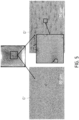
- a scanning electron microscopy (SEM) study was conducted by the proprietor in order to observe the influence, at the microscopic scale, of the method according to the invention on the surface appearance of the glass wall 2.
- SEM scanning electron microscopy
- wall fragments of a first and a second Type II glass bottle both obtained from conventional soda-silicon-calcium glass bottles (Type III) subjected to a surface dealkalization treatment with ammonium sulfate, were compared.
- the second bottle was subjected to the method according to the invention, the liquid sprayed in the form of droplets being ultrapure water.
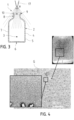
- FIG 4 SEM images of a portion of the surface of a fragment of the glass wall of the first bottle are presented.
- figure 5 are presented for comparison SEM images of a surface portion of a fragment of glass wall of the second bottle, treated in accordance with the invention.
- FIG 7 schematically illustrates the experimental setup used to measure the respective transparency of these containers R 1 , R 2 and R 3 .
- Each of the containers R 1 , R 2 and R 3 is positioned on a horizontal support 11 in front of a black background 12 provided with horizontal white stripes (target). These white stripes are formed by slits 13 cut in the black background, behind which a white light source (not illustrated) is positioned.
- a digital SLR camera Using a digital SLR camera, a photograph is taken of each of the containers R 1 , R 2 and R 3 positioned in front of the black background 12, in complete darkness.
- image processing software for example, the “ ImageJ ” software mentioned above
- the photographs taken are each converted into an 8-bit grayscale digital image.
- a grayscale graph corresponding to the light intensity transmitted through the glass wall of the containers R 1 , R 2 and R 3 , along a vertical line corresponding to the height of the containers along their axis of revolution.
- the graph thus obtained is presented in figure 8 .
- the transmitted light intensity is represented (in gray level) on the ordinate, and the distance between the ring and the bottom of the containers R 1 , R 2 and R 3 , according to the axis of revolution of the latter, is represented (in pixels) on the abscissa.
- Table 1 below compares the average values of the transmitted light intensity recorded for each of the containers R 1 , R 2 and R 3 , considering only the light intensity relative to the two central horizontal white bands.
- Table 1 Containers R 1 R 2 R 3 Luminous intensity I i transmitted through the glass wall of the container R i (gray level) 166 108 152 Relative luminous intensity I i / I 1 (%) 100 65 92
- the container R 3 obtained according to the method of the invention, appears significantly more transparent than the container R 2 which has not been subjected to the method according to the invention.
- the container R 3 appears slightly less transparent than the container R 1 which has not undergone a dealkalization treatment, due to the presence of the residual compound (in this case, sodium sulfate) on the surface of the glass wall of the container R 3 .
- the container R 3 (obtained after having subjected the container R 1 to a dealkalization treatment, then after having subjected it to the treatment method according to the invention) advantageously has a relative transparency of between 80 and 100%, depending in particular on whether or not the optional forced drying step of the treatment method according to the invention is implemented.
- Tests were also carried out in order to study the influence of the process according to the invention on the surface hydrolytic resistance RH of the glass-walled container at the end of said process.
- comparative measurements were carried out, as described below, between a Type II glass container not subjected to the process according to the invention and a Type II glass container subjected to said process.
- the surface hydrolytic resistance RH of the glass wall of each of these R 4 and R 5 containers was measured according to the indications of the European Pharmacopoeia, 9th edition, Chapter 3.2.1, after sterilization at 121°C for 1 h in an autoclave with ultrapure water.
- the RH limit value according to the European Pharmacopoeia is 0.5 ml HCl N/100 per 100 ml of autoclavate (extraction water).
- the surface RH hydrolytic resistance measurements thus demonstrate that the method according to the invention advantageously has no significant impact on the level of hydrolytic resistance conferred on the container by the dealkalization treatment step to which it was previously subjected.
- the RH value advantageously remains substantially between 5% and 25% of the limit RH value indicated by the European Pharmacopoeia for the type of container considered.
- the method of the invention is an in-line method, intended for industrial implementation.
- the various steps described above can therefore advantageously be directly integrated into a method for the industrial manufacture of glass-walled containers, preferably implemented in an automated manner.
- the invention also relates, as such, to an installation 14 for treating a container 1 comprising a glass wall 2 delimiting a receiving cavity 3 for a product, said glass wall 2 having an internal face 4 located opposite said receiving cavity 3 and an opposite external face 5.
- the installation 14 in question is advantageously an installation allowing the implementation of a treatment method in accordance with the invention, so that the description set out in the foregoing in relation to the method according to the invention remains valid and applicable, mutatis mutandis , to the present installation. It is preferably an industrial installation, advantageously automated, designed to treat a large number of containers in a substantially uninterrupted manner.
- installation 14 is designed to be directly integrated into a glass production line, downstream of the container forming machine 1.
- FIG. 9 A particularly preferred embodiment of the installation 14 according to the invention is illustrated schematically in figure 9 .
- the arrow on the figure 9 indicates the preferred direction of progression of said container 1 relative to the various stations comprising said installation 14, and which will be the subject of a detailed description below.
- the terms “ upstream ” and “ downstream ” used in the following will preferably be interpreted in consideration of the direction of progression, indicated by this arrow, of the container 1 within the installation 14 according to the invention.
- said installation 14 comprises a surface treatment station 15 for said glass wall 2 to subject said container 1 to a surface treatment step for said glass wall 2 leading to the formation, on said glass wall 2, of a first coating which includes a solid residual compound.
- said surface treatment station 15 is designed to allow the implementation of the surface treatment step which has been described above in connection with the method according to the invention. More precisely, said surface treatment station 15 is a station for dealkalizing the glass in the vicinity of the surface of said internal face 4 of said glass wall 2. As such, said dealkalizing station may be advantageously designed to allow the introduction into the receiving cavity 3 of the container 1, through the opening 10 of the latter, of a substance containing sulfur, such as in particular ammonium sulfate.
- the installation 14 comprises a station for annealing said container 1, for example of the arch type.
- said surface treatment station 15 may possibly be merged with (or integrated into) said annealing station.
- said surface treatment station 15 may be positioned upstream of said annealing station.
- the installation 14 comprises a station 16 for spraying droplets of a liquid onto the surface of said glass wall 2, said spraying station 16 being positioned downstream of said surface treatment station 15.
- said spraying station 16 is designed to allow the implementation of the projection step which has been described above in connection with the method according to the invention.
- said projection station 16 is designed and configured to ultimately allow the formation on said glass wall, from said first coating, of a second coating which includes said residual compound and which is more transparent and/or more uniform than said first coating.
- said projection station 16 comprises at least one projection device 17 (for example of the nozzle or jet type), which is advantageously configured to be positioned, in operation, outside the container 1, and even more preferably, above and opposite the ring 9 and the opening 10 of the container 1, as illustrated schematically in FIG. figures 3 and 10.
- said projection device 17 is designed to be immobile relative to the container 3 when said projection device 17 is in operation.
- Said projection station 16 is thus advantageously free of any complex mobile injection device (for example of the pipette or tube type) which would be designed to be introduced into the receiving cavity 3 of the container 1 to be treated, through the opening 10 of the latter, to project the liquid droplets.
- Such a configuration contributes to the simplicity of design and implementation, as well as to the robustness, of the installation 14 according to the invention.
- the installation 14 according to the invention could nevertheless comprise a projection station 16 which would be provided with such a mobile injection device.
- said projection station 16 is designed and configured to project said droplets in the form of a mist, that is to say in the form of very fine droplets with an average diameter typically less than or much less than 1 mm, suspended in the ambient air (liquid aerosol).
- the projection device 17 of the projection station 16 may comprise a nozzle, provided with an outlet orifice with a fixed or variable diameter, from which the droplets will be projected in the average form of a preferably full projection cone.
- said projection device 17 is designed to project droplets of said liquid, the average diameter of which is between 1 and 10 ⁇ m, and preferably between 2 and 3 ⁇ m.
- said projection device 17 preferably comprises a piezoelectric nebulizer or ultrasonic, or even an atomizer. Other suitable projection devices can of course be considered alternatively.
- said projection device 17 can be designed and configured to project said droplets using a pressurized vector gas, preferably inert (Ar, N 2 , etc.).
- the projection station 16 comprises means for regulating the quantity and temperature of the projected droplets, as well as, where appropriate, the pressure of the vector gas.
- said projection station 16 is designed and configured to project the droplets of said liquid simultaneously onto the surface of said inner 4 and outer 5 faces of said glass wall 2.
- said projection station 16 may comprise a plurality of projection devices 17 or nozzles, at least one being configured to come opposite the opening 10 of the container 1, as mentioned above, the others being configured to come opposite the outer face 5 of the glass wall 2 of the container 1.
- the projection device(s) 17 is/are all configured to be positioned, in operation, above and opposite the ring 9 and the opening 10 of the container 1.
- said projection station 16 comprises means for adjusting (not illustrated) the distance between said projection device 17 and said glass wall 2, and in particular the distance between the projection device 17 on the one hand, and the ring 9 and the opening 10 of the container 1 to be treated on the other hand.
- the projection station 16 preferably comprises, also or alternatively, means for adjusting the angle ⁇ of the projection cone of said projection device 17 ( figure 3 ), so that said angle ⁇ is preferably between 20 and 100°.
- said projection station 16 can adapt to different geometries and dimensions of containers to be treated.
- the adjustment of the angle ⁇ of the droplet projection cone by the projection device 17 advantageously facilitates, in addition, the simultaneous projection of the droplets of said liquid simultaneously on the surface of said internal 4 and external 5 faces of said glass wall 2.
- the installation 14 comprises a forced drying station 18 for said glass wall 2, which is positioned downstream of said projection station 16.
- said forced drying station 18 is designed to allow the implementation of the forced drying step which has been described above in connection with the method according to the invention.
- the forced drying station 18 preferably comprises a projection system (not illustrated, for example of the nozzle or ramp type) towards the surface of the glass wall 2, and preferably from the outside of the container 3, of a forced flow of dry gas (air or inert gas, such as Ar, N 2 , etc.).
- the forced drying station 18 is designed and configured to project a forced flow of dry gas simultaneously onto the respective surfaces of the internal 4 and external 5 faces of the glass wall 2.
- the installation 14 comprises an optical inspection station 19 of said glass wall 2, positioned downstream of said projection station 16.
- said forced drying station 18 is designed to allow the implementation of the optical inspection step which has been described above in connection with the method according to the invention.
- Said optical inspection station 19 may comprise any known optical inspection device, and in particular visual inspection, capable of detecting glass defects at the level of the glass wall 2 of the container 1.
- it comprises at least one artificial vision inspection device, advantageously automated, designed for example to detect and identify contrast defects at the level of the glass wall 2 of the container 1.
- this is a means operating in the visible range of the electromagnetic spectrum.
- said optical inspection station 19 may on the contrary comprise known means of manual visual inspection of said glass wall 2.
- said optical inspection station 19 is positioned downstream of said forced drying station 18, so that the glass wall 2 of the container 1 is advantageously substantially free of liquid droplets when said container 1 arrives at the level of the optical inspection station 19 from said forced drying station 18.
- said installation 10 also comprises conveying means 20, for example of the belt, chain or roller conveyor type, to ensure the transfer of the container 1 from the surface treatment station 15 to the projection station 16 and, advantageously, from said projection station 16 to the optical inspection station 19, preferably passing through the forced drying station 18.
- conveying means 20 for example of the belt, chain or roller conveyor type
- the invention finds its industrial application in the field of processes and installations for treating glass-walled containers, and in particular in the field of processes and installations for treating primary glass packaging for pharmaceutical or diagnostic use.
Landscapes
- Chemical & Material Sciences (AREA)
- Life Sciences & Earth Sciences (AREA)
- Engineering & Computer Science (AREA)
- Chemical Kinetics & Catalysis (AREA)
- General Chemical & Material Sciences (AREA)
- Geochemistry & Mineralogy (AREA)
- Materials Engineering (AREA)
- Organic Chemistry (AREA)
- Surface Treatment Of Glass (AREA)
- Details Of Rigid Or Semi-Rigid Containers (AREA)
- Medical Preparation Storing Or Oral Administration Devices (AREA)
Claims (15)
- Verfahren zur Behandlung eines Behälters (1), umfassend eine Glaswand (2), die einen Aufnahmehohlraum (3) für ein Produkt begrenzt, wobei die Glaswand (2) eine Innenseite (4), die sich gegenüber dem Aufnahmehohlraum (3) befindet, und eine entgegengesetzt angeordnete Außenseite (5) aufweist, wobei die Glaswand (2) des Behälters (1) aus Glas, umfassend mindestens ein alkalisches oder erdalkalisches Oxid, ist, wobei die Glaswand (2) mit einer ersten Beschichtung versehen ist, die eine feste Restverbindung enthält, die aus einem Oberflächenbehandlungsschritt der Glaswand (2) stammt, welchem der Behälter (1) vorher unterzogen wurde, wobei der Oberflächenbehandlungsschritt ein Schritt einer Entalkalisierung des Glases in der Nähe der Oberfläche der Innenseite (4) der Glaswand (2) ist, wobei das Verfahren einen Schritt des Spritzens von Tröpfchen einer Flüssigkeit auf die Oberfläche der Glaswand (2) umfasst, um auf der Glaswand (2) ausgehend von der ersten Beschichtung eine zweite Beschichtung zu bilden, die die Restverbindung enthält und transparenter und/oder einheitlicher als die erste Beschichtung ist, wobei die Flüssigkeit transparent ist und entweder eine Flüssigkeit, in der die feste Restverbindung suspendiert werden kann, oder ein Lösungsmittel für die feste Restverbindung ist.
- Verfahren nach dem vorhergehenden Anspruch, bei dem die Restverbindung pulverförmig ist.
- Verfahren nach einem der vorhergehenden Ansprüche, bei dem der Schritt der Entalkalisierung eine Behandlung der Innenseite (4) mit einer Schwefel enthaltenden Substanz umfasst, wobei die feste Restverbindung vorzugsweise Natriumsulfat enthält.
- Verfahren nach einem der vorhergehenden Ansprüche, bei dem der Spritzschritt auf den Behälter (1) durchgeführt wird, wobei dieser letztgenannte auf einer Temperatur zwischen 0 und 100 °C und vorzugsweise auf Zimmertemperatur ist.
- Verfahren nach einem der vorhergehenden Ansprüche, bei dem die Flüssigkeit in Form eines Sprühnebels aufgespritzt wird, wobei vorzugsweise mindestens 95 % der Tröpfchen einen Durchmesser zwischen 1 und 10 µm und vorzugsweise zwischen 2 und 3 µm haben.
- Verfahren nach einem der vorhergehenden Ansprüche, bei dem die Flüssigkeit ein Lösungsmittel der festen Restverbindung ist.
- Verfahren nach dem vorhergehenden Anspruch, bei dem das Lösungsmittel Wasser, vorzugsweise ultrareines Wasser, ist.
- Verfahren nach einem der vorhergehenden Ansprüche, welches nach dem Spritzschritt einen Schritt einer forcierten Trocknung der Glaswand (2) umfasst.
- Verfahren nach einem der vorhergehenden Ansprüche, welches nach dem Spritzschritt einen Schritt einer optischen Überprüfung der Glaswand (2) umfasst.
- Vorrichtung (14), die den Einsatz eines Behandlungsverfahrens nach einem der vorhergehenden Ansprüche ermöglicht, wobei die Vorrichtung (14) eine Station zur Oberflächenbehandlung (15) der Glaswand (2) umfasst, um den Behälter (1) einem Schritt einer Oberflächenbehandlung der Glaswand (2) zu unterziehen, der zur Bildung einer ersten Beschichtung auf der Glaswand (2), die eine feste Restverbindung einschließt, führt, wobei die Station zur Oberflächenbehandlung (15) eine Station zur Entalkalisierung des Glases in der Nähe der Oberfläche der Innenseite (4) der Glaswand (2) ist, wobei die Vorrichtung (14) eine Station (16) zum Spritzen von Tröpfchen einer Flüssigkeit auf die Oberfläche der Glaswand (2) umfasst, wobei die Flüssigkeit transparent ist und entweder eine Flüssigkeit, in der die feste Restverbindung suspendiert werden kann, oder ein Lösungsmittel für die feste Restverbindung ist, wobei die Spritzstation (16) stromabwärts zu der Oberflächenbehandlungsstation (15) angeordnet ist.
- Vorrichtung (14) nach dem vorhergehenden Anspruch, bei der die Spritzstation (16) eingerichtet und dazu vorgesehen ist, die Tröpfchen der Flüssigkeit gleichzeitig auf die Oberfläche der Innen- (4) und Außenseiten (5) der Glaswand (2) aufzuspritzen.
- Vorrichtung (14) nach einem der Ansprüche 10 und 11, bei der die Spritzstation (16) eine Spritzvorrichtung (17) und Mittel zur Einstellung des Abstands zwischen der Spritzvorrichtung (17) und der Glaswand (2) und des Winkels (θ) des Spritzkegels der Spritzvorrichtung (17) umfasst, wobei der Winkel (θ) vorzugsweise zwischen 20 und 100 ° beträgt.
- Vorrichtung (14) nach einem der Ansprüche 10 bis 12, bei der die Spritzstation (16) eingerichtet und dazu vorgesehen ist, die Tröpfchen in Form eines Sprühnebels aufzuspritzen, wobei der mittlere Durchmesser der Tröpfchen vorzugsweise zwischen 1 und 10 µm und vorzugsweise zwischen 2 und 3 µm beträgt.
- Vorrichtung (14) nach einem der Ansprüche 10 bis 13, welche stromabwärts zu der Spritzstation (16) eine Station einer forcierten Trocknung (18) der Glaswand (2) umfasst.
- Vorrichtung (14) nach einem der Ansprüche 10 bis 14, welche stromabwärts zu der Spritzstation (16) eine Station zur optischen Überprüfung (19) der Glaswand (2) umfasst.
Applications Claiming Priority (2)
| Application Number | Priority Date | Filing Date | Title |
|---|---|---|---|
| FR1851747A FR3078329B1 (fr) | 2018-02-27 | 2018-02-27 | Procede de traitement d'un recipient a paroi en verre et installation afferente |
| PCT/FR2019/050410 WO2019166719A1 (fr) | 2018-02-27 | 2019-02-22 | Procede de traitement d'un recipient a paroi en verre et installation afferente |
Publications (4)
| Publication Number | Publication Date |
|---|---|
| EP3759059A1 EP3759059A1 (de) | 2021-01-06 |
| EP3759059C0 EP3759059C0 (de) | 2024-08-21 |
| EP3759059B1 true EP3759059B1 (de) | 2024-08-21 |
| EP3759059B8 EP3759059B8 (de) | 2024-10-09 |
Family
ID=62683325
Family Applications (1)
| Application Number | Title | Priority Date | Filing Date |
|---|---|---|---|
| EP19713529.6A Active EP3759059B8 (de) | 2018-02-27 | 2019-02-22 | Verfahren zur behandlung eines behälters mit einer glaswand und zugehörige vorrichtung |
Country Status (6)
| Country | Link |
|---|---|
| US (1) | US11912611B2 (de) |
| EP (1) | EP3759059B8 (de) |
| CN (1) | CN111712472B (de) |
| CA (1) | CA3086758A1 (de) |
| FR (1) | FR3078329B1 (de) |
| WO (1) | WO2019166719A1 (de) |
Families Citing this family (5)
| Publication number | Priority date | Publication date | Assignee | Title |
|---|---|---|---|---|
| FR3098512B1 (fr) | 2019-07-11 | 2022-08-26 | Sgd Sa | Procede et installation de desalcalinisation de recipients en verre par voie liquide |
| FR3104151B1 (fr) * | 2019-12-05 | 2021-11-26 | Sgd Sa | Installation de traitement de recipients en verre comprenant une chambre de dosage de substance de traitement a double obturateur et procede afferent |
| FR3105932B1 (fr) * | 2020-01-08 | 2021-12-17 | Sgd Sa | Procede de traitement de recipients en verre comprenant un controle optique d’une quantite de substance de traitement distribuee et installation de traitement afferente |
| FR3118770A1 (fr) * | 2021-01-11 | 2022-07-15 | Sgd S.A. | Recipient en verre sodocalcique a resistance chimique amelioree pour substance pharmaceutique ou de diagnostic |
| US11278634B1 (en) * | 2021-02-12 | 2022-03-22 | Extrovis Ag | Stable parenteral composition of lacosamide |
Family Cites Families (11)
| Publication number | Priority date | Publication date | Assignee | Title |
|---|---|---|---|---|
| US3348934A (en) * | 1964-12-23 | 1967-10-24 | Owens Illinois Inc | Method of treating the surfaces of glass containers |
| US3451796A (en) * | 1966-05-16 | 1969-06-24 | Corning Glass Works | Method of treating strengthened glass surface to increase acid durability |
| JPS5845126A (ja) * | 1981-09-08 | 1983-03-16 | Yamamura Glass Kk | ガラス壜の製造方法 |
| JPS5864248A (ja) * | 1981-10-13 | 1983-04-16 | Nippon Taisanbin Kogyo Kk | ガラスびんの表面処理方法 |
| DE4124136A1 (de) * | 1991-07-20 | 1993-01-21 | Goldschmidt Ag Th | Verfahren zum vergueten von hohlglaskoerpern |
| FR2700764B1 (fr) * | 1993-01-26 | 1995-04-14 | Lalique | Procédé pour le traitement de surface d'articles en verre, notamment en cristal et articles ainsi obtenus. |
| MX2008006999A (es) * | 2005-11-30 | 2008-10-23 | Gerresheimer Essen Gmbh | Proceso de tratamiento interno y dispositivo para el tratamiento interno de recipientes de vidrio. |
| FI122502B (fi) * | 2007-12-20 | 2012-02-29 | Beneq Oy | Menetelmä ja laite lasin pinnoittamiseksi |
| US8389052B2 (en) * | 2010-03-30 | 2013-03-05 | Toyo Glass Co., Ltd. | Method for treating inside surface of glass container and glass container |
| EP2662148A1 (de) * | 2012-05-09 | 2013-11-13 | Arkema Vlissingen B.V. | Verbessertes Verfahren zur Aufbringung einer Kaltendvergütung, die in einem Glasbehälterherstellungsverfahren integriert ist |
| FR3041956B1 (fr) * | 2015-10-06 | 2017-12-01 | Sgd Sa | Procede de recouvrement d'un article en verre |
-
2018
- 2018-02-27 FR FR1851747A patent/FR3078329B1/fr active Active
-
2019
- 2019-02-22 CA CA3086758A patent/CA3086758A1/en active Pending
- 2019-02-22 CN CN201980013474.0A patent/CN111712472B/zh active Active
- 2019-02-22 WO PCT/FR2019/050410 patent/WO2019166719A1/fr not_active Ceased
- 2019-02-22 US US16/971,146 patent/US11912611B2/en active Active
- 2019-02-22 EP EP19713529.6A patent/EP3759059B8/de active Active
Also Published As
| Publication number | Publication date |
|---|---|
| CN111712472B (zh) | 2023-02-10 |
| EP3759059C0 (de) | 2024-08-21 |
| US11912611B2 (en) | 2024-02-27 |
| CN111712472A (zh) | 2020-09-25 |
| US20210114921A1 (en) | 2021-04-22 |
| CA3086758A1 (en) | 2019-09-06 |
| EP3759059B8 (de) | 2024-10-09 |
| FR3078329A1 (fr) | 2019-08-30 |
| EP3759059A1 (de) | 2021-01-06 |
| WO2019166719A1 (fr) | 2019-09-06 |
| FR3078329B1 (fr) | 2022-09-30 |
Similar Documents
| Publication | Publication Date | Title |
|---|---|---|
| EP3759059B1 (de) | Verfahren zur behandlung eines behälters mit einer glaswand und zugehörige vorrichtung | |
| EP3916380B1 (de) | Verfahren und maschine zur steuerung eines formverfahrens | |
| CN103930771B (zh) | 容器的检测与回收 | |
| KR102697722B1 (ko) | 물로 습윤화하기 위한 접촉각을 지닌 표면 영역 및 유리층을 갖는 중공체, 특히 약학 조성물을 포장하기 위한 중공체 | |
| EP4457507B1 (de) | Verfahren und vorrichtung zur inspektion von heissen glasbehältern zur erkennung von defekten | |
| EP3107873B1 (de) | Verfahren und vorrichtung zur passivierung der innenfläche eines glasflakons und mit diesem verfahren hergestellter flakon | |
| EP2356429A1 (de) | Vorrichtung zur analyse eines mehrphasengemischs über einen durch das gemisch zurückgestreuten lichtstrahl | |
| EP3997043B1 (de) | Verfahren und anlage zum entalkalisieren von glasbehältern mittels flüssigkeit | |
| EP3956652B1 (de) | System und verfahren zum nachweis von glaskeramik | |
| FR3051690A1 (fr) | Procede de fabrication d'une couche de revetement de la face interne d'un recipient et recipient obtenu avec un tel procede | |
| JP2006343138A (ja) | 検査装置 | |
| WO2002055407A2 (fr) | Recipient distribuant des quantites de produit constantes jusqu'a ce que ledit recipient soit presque completement vide | |
| EP4087826A1 (de) | Verfahren zur behandlung von glasbehältern mit einer optischen kontrolle einer menge einer abgegebenen behandlungssubstanz und zugehörige behandlungseinrichtung | |
| CN113135337A (zh) | 用于药物、医疗或化妆品应用的玻璃容器 | |
| KR20200050403A (ko) | 복수 입자에 의해 중첩된 유리 벽을 갖는 용기 전구체 | |
| FR3118771A1 (fr) | Recipient en verre borosilicate a resistance chimique amelioree pour substance pharmaceutique ou de diagnostic | |
| WO2013021137A1 (fr) | Procede et appareil optoelectronique pour mesurer le diametre interne d'un corps creux | |
| JP2018115864A (ja) | 合成樹脂製シートの防曇性評価方法、及び、包装用容器又は包装用容器の蓋の防曇性評価方法 | |
| EP3956859A1 (de) | Verfahren zur detektion von glaskeramikmaterialien | |
| FR3118770A1 (fr) | Recipient en verre sodocalcique a resistance chimique amelioree pour substance pharmaceutique ou de diagnostic | |
| FR2902514A1 (fr) | Procede pour controler l'epaisseur d'un revetement sur un substrat | |
| WO2007144517A2 (fr) | Procédé pour mesurer l'épaisseur d'un revêtement sur un substrat |
Legal Events
| Date | Code | Title | Description |
|---|---|---|---|
| STAA | Information on the status of an ep patent application or granted ep patent |
Free format text: STATUS: UNKNOWN |
|
| STAA | Information on the status of an ep patent application or granted ep patent |
Free format text: STATUS: THE INTERNATIONAL PUBLICATION HAS BEEN MADE |
|
| PUAI | Public reference made under article 153(3) epc to a published international application that has entered the european phase |
Free format text: ORIGINAL CODE: 0009012 |
|
| STAA | Information on the status of an ep patent application or granted ep patent |
Free format text: STATUS: REQUEST FOR EXAMINATION WAS MADE |
|
| 17P | Request for examination filed |
Effective date: 20200630 |
|
| AK | Designated contracting states |
Kind code of ref document: A1 Designated state(s): AL AT BE BG CH CY CZ DE DK EE ES FI FR GB GR HR HU IE IS IT LI LT LU LV MC MK MT NL NO PL PT RO RS SE SI SK SM TR |
|
| AX | Request for extension of the european patent |
Extension state: BA ME |
|
| RIN1 | Information on inventor provided before grant (corrected) |
Inventor name: DEPOILLY, CHRISTOPHE Inventor name: ETCHEPARE, PIERRE-LUC Inventor name: ZHANG, JINGWEI |
|
| DAV | Request for validation of the european patent (deleted) | ||
| DAX | Request for extension of the european patent (deleted) | ||
| STAA | Information on the status of an ep patent application or granted ep patent |
Free format text: STATUS: EXAMINATION IS IN PROGRESS |
|
| 17Q | First examination report despatched |
Effective date: 20220119 |
|
| GRAP | Despatch of communication of intention to grant a patent |
Free format text: ORIGINAL CODE: EPIDOSNIGR1 |
|
| STAA | Information on the status of an ep patent application or granted ep patent |
Free format text: STATUS: GRANT OF PATENT IS INTENDED |
|
| INTG | Intention to grant announced |
Effective date: 20240419 |
|
| GRAS | Grant fee paid |
Free format text: ORIGINAL CODE: EPIDOSNIGR3 |
|
| GRAA | (expected) grant |
Free format text: ORIGINAL CODE: 0009210 |
|
| STAA | Information on the status of an ep patent application or granted ep patent |
Free format text: STATUS: THE PATENT HAS BEEN GRANTED |
|
| AK | Designated contracting states |
Kind code of ref document: B1 Designated state(s): AL AT BE BG CH CY CZ DE DK EE ES FI FR GB GR HR HU IE IS IT LI LT LU LV MC MK MT NL NO PL PT RO RS SE SI SK SM TR |
|
| RAP3 | Party data changed (applicant data changed or rights of an application transferred) |
Owner name: SGD S.A. |
|
| REG | Reference to a national code |
Ref country code: GB Ref legal event code: FG4D Free format text: NOT ENGLISH |
|
| REG | Reference to a national code |
Ref country code: CH Ref legal event code: EP |
|
| REG | Reference to a national code |
Ref country code: IE Ref legal event code: FG4D Free format text: LANGUAGE OF EP DOCUMENT: FRENCH |
|
| REG | Reference to a national code |
Ref country code: DE Ref legal event code: R096 Ref document number: 602019057349 Country of ref document: DE |
|
| REG | Reference to a national code |
Ref country code: CH Ref legal event code: PK Free format text: RECTIFICATION B8 |
|
| RAP4 | Party data changed (patent owner data changed or rights of a patent transferred) |
Owner name: SGD S.A. |
|
| U01 | Request for unitary effect filed |
Effective date: 20240920 |
|
| U07 | Unitary effect registered |
Designated state(s): AT BE BG DE DK EE FI FR IT LT LU LV MT NL PT RO SE SI Effective date: 20241015 |
|
| PG25 | Lapsed in a contracting state [announced via postgrant information from national office to epo] |
Ref country code: NO Free format text: LAPSE BECAUSE OF FAILURE TO SUBMIT A TRANSLATION OF THE DESCRIPTION OR TO PAY THE FEE WITHIN THE PRESCRIBED TIME-LIMIT Effective date: 20241121 |
|
| PG25 | Lapsed in a contracting state [announced via postgrant information from national office to epo] |
Ref country code: GR Free format text: LAPSE BECAUSE OF FAILURE TO SUBMIT A TRANSLATION OF THE DESCRIPTION OR TO PAY THE FEE WITHIN THE PRESCRIBED TIME-LIMIT Effective date: 20241122 Ref country code: PL Free format text: LAPSE BECAUSE OF FAILURE TO SUBMIT A TRANSLATION OF THE DESCRIPTION OR TO PAY THE FEE WITHIN THE PRESCRIBED TIME-LIMIT Effective date: 20240821 |
|
| PG25 | Lapsed in a contracting state [announced via postgrant information from national office to epo] |
Ref country code: IS Free format text: LAPSE BECAUSE OF FAILURE TO SUBMIT A TRANSLATION OF THE DESCRIPTION OR TO PAY THE FEE WITHIN THE PRESCRIBED TIME-LIMIT Effective date: 20241221 |
|
| PG25 | Lapsed in a contracting state [announced via postgrant information from national office to epo] |
Ref country code: HR Free format text: LAPSE BECAUSE OF FAILURE TO SUBMIT A TRANSLATION OF THE DESCRIPTION OR TO PAY THE FEE WITHIN THE PRESCRIBED TIME-LIMIT Effective date: 20240821 |
|
| PG25 | Lapsed in a contracting state [announced via postgrant information from national office to epo] |
Ref country code: RS Free format text: LAPSE BECAUSE OF FAILURE TO SUBMIT A TRANSLATION OF THE DESCRIPTION OR TO PAY THE FEE WITHIN THE PRESCRIBED TIME-LIMIT Effective date: 20241121 Ref country code: ES Free format text: LAPSE BECAUSE OF FAILURE TO SUBMIT A TRANSLATION OF THE DESCRIPTION OR TO PAY THE FEE WITHIN THE PRESCRIBED TIME-LIMIT Effective date: 20240821 |
|
| PG25 | Lapsed in a contracting state [announced via postgrant information from national office to epo] |
Ref country code: RS Free format text: LAPSE BECAUSE OF FAILURE TO SUBMIT A TRANSLATION OF THE DESCRIPTION OR TO PAY THE FEE WITHIN THE PRESCRIBED TIME-LIMIT Effective date: 20241121 Ref country code: PL Free format text: LAPSE BECAUSE OF FAILURE TO SUBMIT A TRANSLATION OF THE DESCRIPTION OR TO PAY THE FEE WITHIN THE PRESCRIBED TIME-LIMIT Effective date: 20240821 Ref country code: NO Free format text: LAPSE BECAUSE OF FAILURE TO SUBMIT A TRANSLATION OF THE DESCRIPTION OR TO PAY THE FEE WITHIN THE PRESCRIBED TIME-LIMIT Effective date: 20241121 Ref country code: IS Free format text: LAPSE BECAUSE OF FAILURE TO SUBMIT A TRANSLATION OF THE DESCRIPTION OR TO PAY THE FEE WITHIN THE PRESCRIBED TIME-LIMIT Effective date: 20241221 Ref country code: HR Free format text: LAPSE BECAUSE OF FAILURE TO SUBMIT A TRANSLATION OF THE DESCRIPTION OR TO PAY THE FEE WITHIN THE PRESCRIBED TIME-LIMIT Effective date: 20240821 Ref country code: GR Free format text: LAPSE BECAUSE OF FAILURE TO SUBMIT A TRANSLATION OF THE DESCRIPTION OR TO PAY THE FEE WITHIN THE PRESCRIBED TIME-LIMIT Effective date: 20241122 Ref country code: ES Free format text: LAPSE BECAUSE OF FAILURE TO SUBMIT A TRANSLATION OF THE DESCRIPTION OR TO PAY THE FEE WITHIN THE PRESCRIBED TIME-LIMIT Effective date: 20240821 |
|
| U20 | Renewal fee for the european patent with unitary effect paid |
Year of fee payment: 7 Effective date: 20250219 |
|
| PG25 | Lapsed in a contracting state [announced via postgrant information from national office to epo] |
Ref country code: SM Free format text: LAPSE BECAUSE OF FAILURE TO SUBMIT A TRANSLATION OF THE DESCRIPTION OR TO PAY THE FEE WITHIN THE PRESCRIBED TIME-LIMIT Effective date: 20240821 |
|
| PG25 | Lapsed in a contracting state [announced via postgrant information from national office to epo] |
Ref country code: CZ Free format text: LAPSE BECAUSE OF FAILURE TO SUBMIT A TRANSLATION OF THE DESCRIPTION OR TO PAY THE FEE WITHIN THE PRESCRIBED TIME-LIMIT Effective date: 20240821 |
|
| PG25 | Lapsed in a contracting state [announced via postgrant information from national office to epo] |
Ref country code: SK Free format text: LAPSE BECAUSE OF FAILURE TO SUBMIT A TRANSLATION OF THE DESCRIPTION OR TO PAY THE FEE WITHIN THE PRESCRIBED TIME-LIMIT Effective date: 20240821 |
|
| PLBE | No opposition filed within time limit |
Free format text: ORIGINAL CODE: 0009261 |
|
| STAA | Information on the status of an ep patent application or granted ep patent |
Free format text: STATUS: NO OPPOSITION FILED WITHIN TIME LIMIT |
|
| 26N | No opposition filed |
Effective date: 20250522 |
|
| PG25 | Lapsed in a contracting state [announced via postgrant information from national office to epo] |
Ref country code: MC Free format text: LAPSE BECAUSE OF FAILURE TO SUBMIT A TRANSLATION OF THE DESCRIPTION OR TO PAY THE FEE WITHIN THE PRESCRIBED TIME-LIMIT Effective date: 20240821 |
|
| REG | Reference to a national code |
Ref country code: CH Ref legal event code: PL |
|
| PG25 | Lapsed in a contracting state [announced via postgrant information from national office to epo] |
Ref country code: CH Free format text: LAPSE BECAUSE OF NON-PAYMENT OF DUE FEES Effective date: 20250228 |
|
| GBPC | Gb: european patent ceased through non-payment of renewal fee |
Effective date: 20250222 |