EP3758924B1 - Verfahren zur herstellung eines gegenstandes aus einem verbundwerkstoff und dadurch hergestellter gegenstand - Google Patents
Verfahren zur herstellung eines gegenstandes aus einem verbundwerkstoff und dadurch hergestellter gegenstand Download PDFInfo
- Publication number
- EP3758924B1 EP3758924B1 EP19717600.1A EP19717600A EP3758924B1 EP 3758924 B1 EP3758924 B1 EP 3758924B1 EP 19717600 A EP19717600 A EP 19717600A EP 3758924 B1 EP3758924 B1 EP 3758924B1
- Authority
- EP
- European Patent Office
- Prior art keywords
- proof coating
- polyester resin
- layer
- matrix
- fibre
- Prior art date
- Legal status (The legal status is an assumption and is not a legal conclusion. Google has not performed a legal analysis and makes no representation as to the accuracy of the status listed.)
- Active
Links
Images
Classifications
-
- B—PERFORMING OPERATIONS; TRANSPORTING
- B29—WORKING OF PLASTICS; WORKING OF SUBSTANCES IN A PLASTIC STATE IN GENERAL
- B29C—SHAPING OR JOINING OF PLASTICS; SHAPING OF MATERIAL IN A PLASTIC STATE, NOT OTHERWISE PROVIDED FOR; AFTER-TREATMENT OF THE SHAPED PRODUCTS, e.g. REPAIRING
- B29C70/00—Shaping composites, i.e. plastics material comprising reinforcements, fillers or preformed parts, e.g. inserts
- B29C70/04—Shaping composites, i.e. plastics material comprising reinforcements, fillers or preformed parts, e.g. inserts comprising reinforcements only, e.g. self-reinforcing plastics
- B29C70/28—Shaping operations therefor
- B29C70/30—Shaping by lay-up, i.e. applying fibres, tape or broadsheet on a mould, former or core; Shaping by spray-up, i.e. spraying of fibres on a mould, former or core
-
- B—PERFORMING OPERATIONS; TRANSPORTING
- B32—LAYERED PRODUCTS
- B32B—LAYERED PRODUCTS, i.e. PRODUCTS BUILT-UP OF STRATA OF FLAT OR NON-FLAT, e.g. CELLULAR OR HONEYCOMB, FORM
- B32B27/00—Layered products comprising a layer of synthetic resin
- B32B27/38—Layered products comprising a layer of synthetic resin comprising epoxy resins
-
- B—PERFORMING OPERATIONS; TRANSPORTING
- B05—SPRAYING OR ATOMISING IN GENERAL; APPLYING FLUENT MATERIALS TO SURFACES, IN GENERAL
- B05C—APPARATUS FOR APPLYING FLUENT MATERIALS TO SURFACES, IN GENERAL
- B05C1/00—Apparatus in which liquid or other fluent material is applied to the surface of the work by contact with a member carrying the liquid or other fluent material, e.g. a porous member loaded with a liquid to be applied as a coating
- B05C1/04—Apparatus in which liquid or other fluent material is applied to the surface of the work by contact with a member carrying the liquid or other fluent material, e.g. a porous member loaded with a liquid to be applied as a coating for applying liquid or other fluent material to work of indefinite length
-
- B—PERFORMING OPERATIONS; TRANSPORTING
- B05—SPRAYING OR ATOMISING IN GENERAL; APPLYING FLUENT MATERIALS TO SURFACES, IN GENERAL
- B05C—APPARATUS FOR APPLYING FLUENT MATERIALS TO SURFACES, IN GENERAL
- B05C5/00—Apparatus in which liquid or other fluent material is projected, poured or allowed to flow on to the surface of the work
-
- B—PERFORMING OPERATIONS; TRANSPORTING
- B29—WORKING OF PLASTICS; WORKING OF SUBSTANCES IN A PLASTIC STATE IN GENERAL
- B29C—SHAPING OR JOINING OF PLASTICS; SHAPING OF MATERIAL IN A PLASTIC STATE, NOT OTHERWISE PROVIDED FOR; AFTER-TREATMENT OF THE SHAPED PRODUCTS, e.g. REPAIRING
- B29C70/00—Shaping composites, i.e. plastics material comprising reinforcements, fillers or preformed parts, e.g. inserts
- B29C70/04—Shaping composites, i.e. plastics material comprising reinforcements, fillers or preformed parts, e.g. inserts comprising reinforcements only, e.g. self-reinforcing plastics
- B29C70/06—Fibrous reinforcements only
- B29C70/10—Fibrous reinforcements only characterised by the structure of fibrous reinforcements, e.g. hollow fibres
- B29C70/16—Fibrous reinforcements only characterised by the structure of fibrous reinforcements, e.g. hollow fibres using fibres of substantial or continuous length
- B29C70/22—Fibrous reinforcements only characterised by the structure of fibrous reinforcements, e.g. hollow fibres using fibres of substantial or continuous length oriented in at least two directions forming a two dimensional structure
-
- B—PERFORMING OPERATIONS; TRANSPORTING
- B32—LAYERED PRODUCTS
- B32B—LAYERED PRODUCTS, i.e. PRODUCTS BUILT-UP OF STRATA OF FLAT OR NON-FLAT, e.g. CELLULAR OR HONEYCOMB, FORM
- B32B27/00—Layered products comprising a layer of synthetic resin
- B32B27/06—Layered products comprising a layer of synthetic resin as the main or only constituent of a layer, which is next to another layer of the same or of a different material
-
- B—PERFORMING OPERATIONS; TRANSPORTING
- B32—LAYERED PRODUCTS
- B32B—LAYERED PRODUCTS, i.e. PRODUCTS BUILT-UP OF STRATA OF FLAT OR NON-FLAT, e.g. CELLULAR OR HONEYCOMB, FORM
- B32B27/00—Layered products comprising a layer of synthetic resin
- B32B27/18—Layered products comprising a layer of synthetic resin characterised by the use of special additives
-
- B—PERFORMING OPERATIONS; TRANSPORTING
- B32—LAYERED PRODUCTS
- B32B—LAYERED PRODUCTS, i.e. PRODUCTS BUILT-UP OF STRATA OF FLAT OR NON-FLAT, e.g. CELLULAR OR HONEYCOMB, FORM
- B32B27/00—Layered products comprising a layer of synthetic resin
- B32B27/18—Layered products comprising a layer of synthetic resin characterised by the use of special additives
- B32B27/20—Layered products comprising a layer of synthetic resin characterised by the use of special additives using fillers, pigments, thixotroping agents
-
- B—PERFORMING OPERATIONS; TRANSPORTING
- B32—LAYERED PRODUCTS
- B32B—LAYERED PRODUCTS, i.e. PRODUCTS BUILT-UP OF STRATA OF FLAT OR NON-FLAT, e.g. CELLULAR OR HONEYCOMB, FORM
- B32B5/00—Layered products characterised by the non- homogeneity or physical structure, i.e. comprising a fibrous, filamentary, particulate or foam layer; Layered products characterised by having a layer differing constitutionally or physically in different parts
- B32B5/02—Layered products characterised by the non- homogeneity or physical structure, i.e. comprising a fibrous, filamentary, particulate or foam layer; Layered products characterised by having a layer differing constitutionally or physically in different parts characterised by structural features of a fibrous or filamentary layer
-
- B—PERFORMING OPERATIONS; TRANSPORTING
- B29—WORKING OF PLASTICS; WORKING OF SUBSTANCES IN A PLASTIC STATE IN GENERAL
- B29K—INDEXING SCHEME ASSOCIATED WITH SUBCLASSES B29B, B29C OR B29D, RELATING TO MOULDING MATERIALS OR TO MATERIALS FOR MOULDS, REINFORCEMENTS, FILLERS OR PREFORMED PARTS, e.g. INSERTS
- B29K2105/00—Condition, form or state of moulded material or of the material to be shaped
- B29K2105/06—Condition, form or state of moulded material or of the material to be shaped containing reinforcements, fillers or inserts
- B29K2105/16—Fillers
- B29K2105/162—Nanoparticles
-
- B—PERFORMING OPERATIONS; TRANSPORTING
- B29—WORKING OF PLASTICS; WORKING OF SUBSTANCES IN A PLASTIC STATE IN GENERAL
- B29K—INDEXING SCHEME ASSOCIATED WITH SUBCLASSES B29B, B29C OR B29D, RELATING TO MOULDING MATERIALS OR TO MATERIALS FOR MOULDS, REINFORCEMENTS, FILLERS OR PREFORMED PARTS, e.g. INSERTS
- B29K2307/00—Use of elements other than metals as reinforcement
- B29K2307/04—Carbon
-
- B—PERFORMING OPERATIONS; TRANSPORTING
- B32—LAYERED PRODUCTS
- B32B—LAYERED PRODUCTS, i.e. PRODUCTS BUILT-UP OF STRATA OF FLAT OR NON-FLAT, e.g. CELLULAR OR HONEYCOMB, FORM
- B32B2250/00—Layers arrangement
- B32B2250/04—4 layers
-
- B—PERFORMING OPERATIONS; TRANSPORTING
- B32—LAYERED PRODUCTS
- B32B—LAYERED PRODUCTS, i.e. PRODUCTS BUILT-UP OF STRATA OF FLAT OR NON-FLAT, e.g. CELLULAR OR HONEYCOMB, FORM
- B32B2255/00—Coating on the layer surface
- B32B2255/02—Coating on the layer surface on fibrous or filamentary layer
-
- B—PERFORMING OPERATIONS; TRANSPORTING
- B32—LAYERED PRODUCTS
- B32B—LAYERED PRODUCTS, i.e. PRODUCTS BUILT-UP OF STRATA OF FLAT OR NON-FLAT, e.g. CELLULAR OR HONEYCOMB, FORM
- B32B2255/00—Coating on the layer surface
- B32B2255/10—Coating on the layer surface on synthetic resin layer or on natural or synthetic rubber layer
-
- B—PERFORMING OPERATIONS; TRANSPORTING
- B32—LAYERED PRODUCTS
- B32B—LAYERED PRODUCTS, i.e. PRODUCTS BUILT-UP OF STRATA OF FLAT OR NON-FLAT, e.g. CELLULAR OR HONEYCOMB, FORM
- B32B2255/00—Coating on the layer surface
- B32B2255/26—Polymeric coating
-
- B—PERFORMING OPERATIONS; TRANSPORTING
- B32—LAYERED PRODUCTS
- B32B—LAYERED PRODUCTS, i.e. PRODUCTS BUILT-UP OF STRATA OF FLAT OR NON-FLAT, e.g. CELLULAR OR HONEYCOMB, FORM
- B32B2260/00—Layered product comprising an impregnated, embedded, or bonded layer wherein the layer comprises an impregnation, embedding, or binder material
- B32B2260/02—Composition of the impregnated, bonded or embedded layer
- B32B2260/021—Fibrous or filamentary layer
-
- B—PERFORMING OPERATIONS; TRANSPORTING
- B32—LAYERED PRODUCTS
- B32B—LAYERED PRODUCTS, i.e. PRODUCTS BUILT-UP OF STRATA OF FLAT OR NON-FLAT, e.g. CELLULAR OR HONEYCOMB, FORM
- B32B2260/00—Layered product comprising an impregnated, embedded, or bonded layer wherein the layer comprises an impregnation, embedding, or binder material
- B32B2260/04—Impregnation, embedding, or binder material
- B32B2260/046—Synthetic resin
-
- B—PERFORMING OPERATIONS; TRANSPORTING
- B32—LAYERED PRODUCTS
- B32B—LAYERED PRODUCTS, i.e. PRODUCTS BUILT-UP OF STRATA OF FLAT OR NON-FLAT, e.g. CELLULAR OR HONEYCOMB, FORM
- B32B2262/00—Composition or structural features of fibres which form a fibrous or filamentary layer or are present as additives
- B32B2262/10—Inorganic fibres
- B32B2262/106—Carbon fibres, e.g. graphite fibres
-
- B—PERFORMING OPERATIONS; TRANSPORTING
- B32—LAYERED PRODUCTS
- B32B—LAYERED PRODUCTS, i.e. PRODUCTS BUILT-UP OF STRATA OF FLAT OR NON-FLAT, e.g. CELLULAR OR HONEYCOMB, FORM
- B32B2264/00—Composition or properties of particles which form a particulate layer or are present as additives
- B32B2264/10—Inorganic particles
- B32B2264/107—Ceramic
- B32B2264/108—Carbon, e.g. graphite particles
-
- B—PERFORMING OPERATIONS; TRANSPORTING
- B32—LAYERED PRODUCTS
- B32B—LAYERED PRODUCTS, i.e. PRODUCTS BUILT-UP OF STRATA OF FLAT OR NON-FLAT, e.g. CELLULAR OR HONEYCOMB, FORM
- B32B2305/00—Condition, form or state of the layers or laminate
- B32B2305/07—Parts immersed or impregnated in a matrix
- B32B2305/076—Prepregs
-
- B—PERFORMING OPERATIONS; TRANSPORTING
- B32—LAYERED PRODUCTS
- B32B—LAYERED PRODUCTS, i.e. PRODUCTS BUILT-UP OF STRATA OF FLAT OR NON-FLAT, e.g. CELLULAR OR HONEYCOMB, FORM
- B32B2305/00—Condition, form or state of the layers or laminate
- B32B2305/30—Fillers, e.g. particles, powders, beads, flakes, spheres, chips
-
- B—PERFORMING OPERATIONS; TRANSPORTING
- B32—LAYERED PRODUCTS
- B32B—LAYERED PRODUCTS, i.e. PRODUCTS BUILT-UP OF STRATA OF FLAT OR NON-FLAT, e.g. CELLULAR OR HONEYCOMB, FORM
- B32B2307/00—Properties of the layers or laminate
- B32B2307/70—Other properties
- B32B2307/726—Permeability to liquids, absorption
- B32B2307/7265—Non-permeable
Definitions
- This invention relates to composite materials.
- this application relates to fibre / fabric reinforced composite materials with improved service life relative to known fibre / fabric reinforced composite materials.
- EP 2345528 A2 discloses a manufacturing process for a composite part having a reinforcement structure comprising at least one reinforcement layer for example based on fibres and at least one matrix impregnating the reinforcement structure.
- the process consisting of providing the reinforcement structure with at least a functional finishing layer, characterized in that it consists of using an open mould who shape corresponds to the future composite part, optimally placing a functional thermoplastic sheet in the open mould, arranging the reinforcement structure on the functional thermoplastic sheet inside the mould, sealing the mould with a functional thermoplastic sheet, applying a vacuum to the inside of the sealed mould, next solidifying the resulting composite part by subjecting it to the final solidification temperature for a set period, and extracting the composite part from the mould.
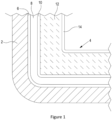
- Figure 1 shows a partial schematic section through a mould and an embodiment of an object according to the present invention within that mould.
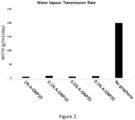
- Figure 2 shows the results of a test of water vapour transmission rate for a coating comprising two types of commercially available graphene / graphitic platelets and a control.
- Fibre / fabric reinforced composite materials are well known and are comprised of fibres and or fabric bonded within a matrix.
- the most well known fibres and fabrics used in composite materials are glass fibre and fabrics or cloths made with glass fibres and carbon fibre and fabrics or cloths made with carbon fibres.
- Other types of fibre and fabrics or cloths made therefrom, both man-made and organic, are, however, known to be used in fibre and or fabric reinforced composite materials.
- More than one type of fibre and or fabric can be used in a composite material. The choice of the fibre(s) and or fabric(s) to be used in a composite material is often determined by mechanical requirements or economics.
- the matrix in a fibre and or fabric reinforced composite material is typically a polyester resin, a vinyl ester resin or an epoxy resin.
- the choice of the type of resin used will depend, at least in part, on the proposed use of the object to be made from the composite material, the desired mechanical properties of the composite material and the different costs of the various resins.
- the matrix is combined with the fibre and or fabric reinforcement by known techniques so that once the matrix is cured the fibre and or fabric reinforcement is bonded within the matrix.
- objects made from fibre and or fabric reinforced composite materials also comprise a coating of a gelcoat covering at least one surface of the object.
- a gel coat covers the or each surface of the object that is expected to be exposed to the most damaging environmental conditions.
- damaging environmental conditions include but are not limited to exposure to liquids such as water, that exposure can be constant (for example the hull of a boat) or intermittent (for example a bath or liquid storage tank).
- Gelcoats are typically thermosetting polymers based on epoxy or unsaturated polyester resin chemistry and may contain pigments for aesthetic reasons. Gelcoats are designed to be durable and provide resistance to ultraviolet degradation and hydrolysis, but they do not contribute in any significant fashion to the structural properties of the composite material.
- Fibre and or fabric reinforced composite materials are a material of choice in many applications due to the ability of objects and structures manufactured from such materials to be manufactured to a lower weight and with fewer components than would typically be the case for traditional building materials such as metal.
- the mechanical properties of such composite materials are determined by the strength and rigidity of the fibres and or fabric reinforcement, the strength and rigidity of the matrix, the strength of the interface between the fibre and or fabric and the matrix, and environmental conditions such as temperature.
- An object or structure made from a fibre and or fabric reinforced composite material is, when in use or installed, typically exposed to one or more environmental conditions which might reduce the mechanical integrity of the material either immediately or over time.
- environmental conditions need to be taken into account when designing the object or structure and the composite material with which to manufacture the object or structure. Typically, this will result in a design that utilizes higher performance materials or thicker sections than would otherwise be required in order to allow for a reduction in mechanical performance of the composite material as a result of the environmental conditions.
- a typical environmental condition that has an effect on the mechanical properties of a fibre and or fabric reinforced composite material is exposure to water and or other liquids, especially when such exposure is frequent or for prolonged periods of time. This is because the materials that comprise the matrix and gelcoat, are permeable and as such water and or other liquids can migrate through the material over time.
- voids may be the result of gaps between and within the molecules of the matrix and or gelcoat, manufacturing defects such as entrapped air bubbles, cracks, and or dry fibre and or fabric (that is fibre and or fabric not saturated with the matrix material). Once water and or other liquids have permeated through the matrix and or gelcoat it will build up in these voids.
- the irreversible changes / damage that may occur are:
- Hydrolysis is particularly damaging to fibre and or fabric reinforced composite materials because once water and or other liquids have entered a void in the composite material, any water-soluble materials in the void or adjacent the void will enter the water in solution. This will then cause an osmotic gradient between the solution in the void and any moisture on the surface of the composite material. As a result, further water will be drawn into the void as a result of osmosis. This will lead to the solution applying pressure to the composite material and may result in delamination and or the formation of blisters in the composite material.
- the steps typically involved with the manufacture of an object from a fibre and or fabric reinforced composite material are known and will, at least in part, depend on the nature of the object to be made and the matrix and fibre and or fabric reinforcement used.
- the object manufactured may be a mould for use in the manufacture of other objects or products, a product, or a structure. Examples of such products, without limiting the field in which the present invention is of utility, may include structural components of boats, road vehicles and aeroplanes; liquid containment vessels such as storage tanks, baths, hot tubs, swimming pools; and turbine blades.
- a suitable mould for use in shaping the composite material is obtained.
- the mould may be a male or female mould. With a male mould the composite material is formed around the outside of the mould. With a female mould the composite material is formed inside the mould.
- a release agent is applied to the surface of the mould on which the composite material is to be formed.
- Such release agents are known.
- the surface of the mould on which the composite material is to be formed may optionally then have one or more coatings of a gelcoat applied to it.
- a gelcoat applied to it.
- the application is by brushing, rolling or spraying.
- the desired thickness of the gelcoat is typically between 0.30 mm and 0.56 mm (0.012 inch to 0.022 inch) but other thicknesses may be appropriate.
- the gelcoat is then allowed to cure.
- the outer surface or outer face of the gelcoat is proximal to the surface of the mould and the inner surface or inner face of the gelcoat is remote from the surface of the mould.
- layup of the fibre and or fabric reinforcement over the inner surface of the gelcoat occurs using known techniques. If no gelcoat is being used, layup of the fibre and or fabric reinforcement over the surface of the mould occurs using known techniques.
- the fibre and or fabric reinforcement may be in the form of a prepreg (a fibre and or fabric reinforcement that is impregnated with the matrix ready for curing by the application of appropriate curing conditions, for example a sufficiently high temperature), or in the form of fibre and or fabric to which a liquid matrix has been applied prior to being put in place or to which a liquid matrix is applied after the fibre and or fabric has been put in place. Sufficient fibre and or fabric is used to achieve the desired thickness of composite material.
- the matrix is allowed to cure or subjected to conditions that will cause it to cure dependent on the particular matrix used.
- the object is removed from the mould. That object may be ready for use or may require further processing.
- a method of manufacture of an object from a fibre and or fabric reinforced composite material comprising at least a first layer of a proof coating, a first or composite matrix, and one or more fibre and or fabric reinforcement materials, characterised in that the manufacture steps comprise
- the 2D nanomaterial platelets of the proof coating comprise one or a mixture of graphene nanoplates and graphite flakes in which the graphite flakes have one nanoscale dimension and 35 or less layers of atoms (simply referred to as "layers").
- the graphene nanoplates comprise one of or a mixture of two or more of graphene, graphene oxide, and / or reduced graphene oxide nanoplates, bilayer graphene, graphene oxide, and / or reduced graphene oxide nanoplatelets, and few-layer graphene, graphene oxide, and / or reduced graphene oxide nanoplatelets.
- the 2D nano-material platelets further comprise one or a mixture of hexagonal boron nitride (hBN) nanoplates, molybdenum disulphide (MoS 2 ) nanoplates, tungsten diselenide (WSe 2 ) nanoplates, silicene (Si) nanoplates, germanene (Ge) nanoplates, graphyne (C) nanoplates, borophene (B) nanoplates, phosphorene (P) nanoplates, or a 2D in-plane heterostructure of two or more of the aforesaid materials.
- hBN hexagonal boron nitride
- MoS 2 molybdenum disulphide
- WSe 2 tungsten diselenide
- silicene (Si) nanoplates germanene (Ge) nanoplates
- graphyne (C) nanoplates borophene (B) nanoplates
- P phosphorene
- the 2D nanomaterial platelets are graphene / graphitic platelets.
- the 2D nano-materials comprise Layered 2D materials which comprise one or a mixture of graphite flakes in which the graphite flakes have one nanoscale dimension and 35 or less layers, multi-layered graphene (C) nanoplates, multi-layered graphene oxide nanoplates, or multi-layered reduced graphene oxide nanoplates.
- the 2D nano-materials further comprise multi-layered hexagonal boron nitride (hBN) nanoplates, multi-layered molybdenum disulphide (MoS 2 ) nanoplates, multi-layered tungsten diselenide (WSe 2 ) nanoplates, multi-layered silicene (Si) nanoplates, multi-layered germanene (Ge) nanoplates, multi-layered graphyne (C) nanoplates, multi-layered borophene (B) nanoplates, multi-layered phosphorene (P) nanoplates, or a 2D vertical heterostructure of two or more of the aforesaid materials.
- hBN hexagonal boron nitride
- MoS 2 molybdenum disulphide
- WSe 2 multi-layered tungsten diselenide
- Si silicene
- Ge germanene
- C multi-layered graphyne
- B multi-layered borophene
- P multi-layered phosphorene
- epoxy resins and other materials that are suitable for use as the composite matrix for the present invention will, after a relatively short period of exposure to water or humidity, become saturated with water which can exacerbate the effects of hydrolysis on composite materials.
- the mechanism of hydrolysis is well known and does not need to be discussed herein.
- Graphene has many forms and growth of a film by CVD (Chemical Vapor Deposition) is well understood and can give rise to graphene films of 1-3 atomic layers. Such films are used in most experimentation in connection with graphene. Such techniques have limited commercial applicability because they enable only relatively small areas of film to be created or substrate to be coated. In commercial applications it is more typical for graphene to be used in the form of graphene nanoplates (also known as nanoplatelets). Graphene nanoplatelets may be produced by either exfoliation of graphite or via synthetic solvothermal processes. Such graphene nanoplatelets may vary substantially in number of atomic layers, surface area, functionality and sp 2 content.
- CVD Chemical Vapor Deposition
- graphite flakes with nanoscale dimensions and 40 or less layers of carbon atoms may be produced by either exfoliation of graphite or via synthetic solvothermal processes.
- Epoxy resins and other materials that are suitable for use as the second matrix of the present invention will, after a relatively short period of exposure to water, humidity, and or other liquids become saturated with water and or other liquids.
- the dispersal of 2D nanomaterial platelets in the second matrix to form the proof coating of the present invention will, depending on the applied dry film thickness of the proof coating layer, result in multiple layers of 2D nanomaterial platelets in that layer. Each platelet is potentially several atomic layers thick.
- the presence of multiple layers of 2D nanomaterial platelets in the proof coating provides a complex and tortuous (labyrinthine) path for the penetration of water and or other liquids. This labyrinthine path significantly reduces the diffusion rate of water and or other liquids and substances dissolved in the water through the second matrix and hence across the proof coating layer.
- Graphene / graphitic platelets typically have a thickness of between 0.3 nm and 12 nm and lateral dimensions ranging from around 100 nm to 100 ⁇ m. As a result, and because of the graphene / graphitic platelet's high lateral aspect and surface area, a coating layer comprised of graphene / graphitic platelets dispersed in the second matrix may be relatively thin. As a result, the coating is unlikely to have any significant effect on the mechanical properties of the composite element of the present invention.
- the 2D nanomaterial platelets are graphene / graphitic platelets and have a D50 particle size of less than 45 ⁇ m, less than 30 ⁇ m, or less than 15 ⁇ m as measured by a Mastersizer 3000.
- An advantage of employing the method of manufacture according to the first aspect of the present invention is that the rate of permeation of water or other liquid into the composite or structural element of the object being manufactured, the fibres and or fabrics bonded in the composite matrix, is significantly reduced. This will have the effect that the damage to the structural properties of the object from water and or other liquids will also be significantly reduced. This leads to an increased life span for the object manufactured employing the method of manufacture according to the first aspect of the present invention. This also leads to the designer of an object being able to include less material in the design because they do not have to compensate for the damage expected from the water and or other liquid. The use of less material will lead to less materials being used in an object with the environmental and economic benefits that brings. It will also lead to lighter objects which is again likely to lead to environmental and economic benefits.
- the manufacture steps further comprise
- a free surface of a coating, layer or composite element is one which is not overlaid by a coating, layer or composite element.
- a gelcoat layer it is beneficial in these embodiments to include a gelcoat layer because although it is known that gelcoats are permeable, especially as the gelcoats age, the use of a gelcoat helps to physically protect the proof coating layer. Use of a gelcoat can also give aesthetic benefits in terms of colour and or surface finish. A further advantage of a gelcoat layer is that although it becomes permeable, it is when permeable flow rate limiting for water or other liquids.
- the method of manufacture of the first aspect of the present invention includes the incorporation of at least one proof coating layer which acts as a barrier to permeation of that water or other liquid into the fibres and or fabrics bonded in a matrix.
- the manufacture steps comprise creation of at least two proof coating layers. In some of these embodiments, the manufacture steps comprise creating second and optionally further layers of the proof coating, with each layer of proof coating overlying different surfaces of the composite element.
- first and second proof coating layers may be different to suit the nature of the fibres and or fabrics bonded in the composite matrix and the exact method of manufacture.
- the manufacture steps further comprise overlaying at least one proof coating layer with at least one further proof coating layer.
- the proofing layers may be of different compositions relative to each other. This approach offers even greater resistance to permeation by water or other liquids than a single proof coating layer.
- the proof coating layers may be separated from each other by an intermediate layer.
- the intermediate layer may be of a material suitable for use in separating the proof coating layers.
- the or each layer of proof coating is created by brushing, spraying or printing.
- the proof coating may be applied to the surface of a mould, the surface of a gelcoat layer, or the surface of the fibres and or fabrics bonded in the composite matrix which may be in the form of prepreg, tape or tow or fibre and where manufacturing methods include prepreg layup, hand layup automatic tape layup, filament winding, resin transfer moulding (RTM) including flexible RTM, Continuous RTM, Vacuum assisted RTM, High Speed RTM, and pultrusion.
- the proof coating may be applied to the surface of a mould, the surface of a gelcoat layer of composite products manufactured using short or discontinuous fibre where manufacturing includes chopped strand spray layup, sheet moulding compound and bulk moulding compound.
- the proof coating layer has a thickness in the range of 5 ⁇ m to 100 ⁇ m, 5 ⁇ m to 50 ⁇ m, 10 ⁇ m to 30 ⁇ m, 25 ⁇ m to 100 ⁇ m or 40 ⁇ m to 60 ⁇ m.
- the proof coating is comprised of 0.1 wt% to 0.5 wt% of 2D nanomaterial platelets.
- the composite matrix is comprised of one or more thermoset matrices, an unsaturated polyester resin, an orthophthalic polyester resin, a terephthalic polyester resin, an Isophthalic polyester resin, a dicyclopentadiene polyester resin, a chlorendic polyester resin, a vinyl ester resin, an epoxy resin, a cyanate ester, a bismaleimide, a urethane acrylate, a phenolic, a furan or poly(furfuralalcohol), a polyimide, a benzoxazine and mixtures and combinations thereof.
- the second matrix is comprised of suitable crosslinkable resins, epoxy resin, a polyester resin, a vinyl ester resin, acrylics, aminoplasts, urethanes, carbamates, alkyds, silicones, polyureas, silicates, polydimethyl siloxanes, vinyl esters, unsaturated polyesters, an orthophthalic polyester resin, a terephthalic polyester resin, an Isophthalic polyester resin, a dicyclopentadiene polyester resin, a chlorendic polyester resin, phenolics, furans or poly(furfurylalcohols), polyimides, bezoxazines and suitable non-crosslinkable resins mixtures and combinations thereof.
- the proof coating further comprises a hardener.
- a hardener Such hardeners are known and ensure that the second matrix in the proof coating properly cures.
- an object constructed from a fibre and or fabric reinforced composite material characterised in that the object is comprised of a composite element and a proof coating layer in which the composite element is formed from a mixture of the fibre and or fabric reinforcement material and the composite matrix, and the proof coating is comprised of a second matrix having dispersed therein 2D nanomaterial platelets, wherein the 2D nanomaterial platelets are graphene / graphitic platelets and have a D50 particle size of less than 45 ⁇ m, less than 30 ⁇ m, or less than 15 ⁇ m as determined by laser diffraction.
- the 2D nanomaterial platelets of the proof coating comprise one or a mixture of graphene nanoplates and graphite flakes in which the graphite flakes have one nanoscale dimension and 35 or less layers of atoms (simply referred to as "layers").
- the graphene nanoplates comprise one of or a mixture of two or more of graphene, graphene oxide, and / or reduced graphene oxide nanoplates, bilayer graphene, graphene oxide, and / or reduced graphene oxide nanoplatelets, and few-layer graphene, graphene oxide, and / or reduced graphene oxide nanoplatelets.
- the 2D nanomaterial platelets further comprise one or a mixture of hexagonal boron nitride (hBN) nanoplates, molybdenum disulphide (MoS 2 ) nanoplates, tungsten diselenide (WSe 2 ) nanoplates, silicene (Si) nanoplates, germanene (Ge) nanoplates, graphyne (C) nanoplates, borophene (B) nanoplates, phosphorene (P) nanoplates, or a 2D in-plane heterostructure of two or more of the aforesaid materials.
- hBN hexagonal boron nitride
- MoS 2 molybdenum disulphide
- WSe 2 tungsten diselenide
- silicene (Si) nanoplates germanene (Ge) nanoplates
- graphyne (C) nanoplates borophene (B) nanoplates
- P phosphorene
- the 2D nanomaterials comprise Layered 2D materials which comprise one or a mixture of graphite flakes in which the graphite flakes have one nanoscale dimension and 35 or less layers, multi-layered graphene (C) nanoplates, multi-layered graphene oxide nanoplates, or multi-layered reduced graphene oxide nanoplates.
- the 2D nanomaterials further comprise multi-layered hexagonal boron nitride (hBN) nanoplates, multi-layered molybdenum disulphide (MoS 2 ) nanoplates, multi-layered tungsten diselenide (WSe 2 ) nanoplates, multi-layered silicene (Si) nanoplates, multi-layered germanene (Ge) nanoplates, multi-layered graphyne (C) nanoplates, multi-layered borophene (B) nanoplates, multi-layered phosphorene (P) nanoplates , or a 2D vertical heterostructure of two or more of the aforesaid materials.
- hBN hexagonal boron nitride
- MoS 2 molybdenum disulphide
- WSe 2 multi-layered tungsten diselenide
- Si silicene
- Ge germanene
- C multi-layered graphyne
- B multi-layered borophene
- P multi-layered phosphorene
- Objects according to the second aspect of the present invention have the same advantages and benefits as objects made according to the methods of the first aspect of the present invention.
- the object further comprises a layer of a gelcoat and in which a proof coating layer is between the gelcoat layer and the composite element.
- the object comprises at least two proof coating layers.
- the object comprises a second proof coating layer in which the first and second proof coating layers overlie first and second surfaces of the composite element.
- each proof coating layer is created by brushing, spraying or printing.
- the proof coating layer has a thickness in the range of 5 ⁇ m to 100 ⁇ m, 5 ⁇ m to 50 ⁇ m, 10 ⁇ m to 30 ⁇ m, 25 ⁇ m to 100 ⁇ m or 40 ⁇ m to 60 ⁇ m, 25 ⁇ m to 100 ⁇ m or 40 ⁇ m to 60 ⁇ m.
- the proof coating is comprised of 0.1 wt% to 0.5 wt% of 2D nanomaterial platelets.
- the composite matrix is comprised of one or more thermoset matrices, an unsaturated polyester resin, an orthophthalic polyester resin, a terephthalic polyester resin, an Isophthalic polyester resin, a dicyclopentadiene polyester resin, a chlorendic polyester resin, a vinyl ester resin, an epoxy resin, a cyanate ester, a bismaleimide, a urethane acrylate, a phenolic, a furan or poly(furfuralalcohol), a polyimide, a benzoxazine and mixtures and combinations thereof.
- the second matrix is comprised of suitable crosslinkable resins, epoxy resin, a polyester resin, a vinyl ester resin, acrylics, aminoplasts, urethanes, carbamates, alkyds, silicones, polyureas, silicates, polydimethyl siloxanes, vinyl esters, unsaturated polyesters , an orthophthalic polyester resin, a terephthalic polyester resin, an Isophthalic polyester resin, a dicyclopentadiene polyester resin, a chlorendic polyester resin, phenolics, furans or poly(furfurylalcohols), polyimides, bezoxazines and suitable non-crosslinkable resins mixtures and combinations thereof.
- the proof coating further comprises a hardener.
- the object is a mould for use in the making of objects from composite materials.
- a proof coating for use in the method of manufacture according to the first aspect of the present invention and the object according to the second aspect of the present invention characterised in that the proof coating is comprised of 0.1 wt% to 0.5 wt% of 2D nanomaterial platelets.
- the 2D nanomaterial platelets of the proof coating comprise one or a mixture of graphene nanoplates and graphite flakes in which the graphite flakes have one nanoscale dimension and 35 or less layers of atoms (simply referred to as "layers").
- the graphene nanoplates comprise one of or a mixture of two or more of graphene, graphene oxide, and / or reduced graphene oxide nanoplates, bilayer graphene, graphene oxide, and / or reduced graphene oxide nanoplatelets, and few-layer graphene, graphene oxide, and / or reduced graphene oxide nanoplatelets.
- the 2D nano-material platelets comprise one or a mixture of hexagonal boron nitride (hBN) nanoplates, molybdenum disulphide (MoS 2 ) nanoplates, tungsten diselenide (WSe 2 ) nanoplates, silicene (Si) nanoplates, germanene (Ge) nanoplates, graphyne (C) nanoplates, borophene (B) nanoplates, phosphorene (P) nanoplates, or a 2D in-plane heterostructure of two or more of the aforesaid materials.
- hBN hexagonal boron nitride
- MoS 2 molybdenum disulphide
- WSe 2 tungsten diselenide
- silicene (Si) nanoplates germanene (Ge) nanoplates
- graphyne (C) nanoplates borophene (B) nanoplates
- P phosphorene
- the 2D nano-materials comprise Layered 2D materials which comprise one or a mixture of graphite flakes in which the graphite flakes have one nanoscale dimension and 35 or less layers, multi-layered graphene (C) nanoplates, multi-layered graphene oxide nanoplates, or multi-layered reduced graphene oxide nanoplates.
- the 2D nano-materials further comprise multi-layered hexagonal boron nitride (hBN) nanoplates, multi-layered molybdenum disulphide (MoS 2 ) nanoplates, multi-layered tungsten diselenide (WSe 2 ) nanoplates, multi-layered silicene (Si) nanoplates, multi-layered germanene (Ge) nanoplates, multi-layered graphyne (C) nanoplates, multi-layered borophene (B) nanoplates, multi-layered phosphorene (P) nanoplates , or a 2D vertical heterostructure of two or more of the aforesaid materials.
- hBN hexagonal boron nitride
- MoS 2 molybdenum disulphide
- WSe 2 multi-layered tungsten diselenide
- Si silicene
- Ge germanene
- C multi-layered graphyne
- B multi-layered borophene
- P multi-layered phosphorene
- Objects manufactured using a proof coating according to the third aspect of the present invention have the same advantages and benefits as objects manufactured according to the methods of the first aspect of the present invention.
- the proof coating is comprised of 0.1 wt% to 0.5 wt% of graphene / graphitic nanoplates of 6 to 14 layers of carbon atoms or graphite flakes with nanoscale dimensions and 25 to 35 layers of carbon atoms.
- the second matrix is comprised of suitable crosslinkable resins, epoxy resin, a polyester resin, a vinyl ester resin, acrylics, aminoplasts, urethanes, carbamates, alkyds, silicones, polyureas, silicates, polydimethyl siloxanes, vinyl esters, unsaturated polyesters , an orthophthalic polyester resin, a terephthalic polyester resin, an Isophthalic polyester resin, a dicyclopentadiene polyester resin, a chlorendic polyester resin, phenolics, furans or poly(furfurylalcohols), polyimides, bezoxazines and suitable non-crosslinkable resins mixtures and combinations thereof.
- the proof coating further comprises a hardener.
- a proof coating according in the method of manufacture according to the first aspect of the present invention is provided.
- kits comprising a quantity of a proof coating according to the fourth aspect of the present invention, and instructions for use of that proof coating in the method of manufacture according the first aspect of the present invention.
- a partial section of a mould 2 is shown.
- an object 4 made from a composite material.
- the object 4 is made or manufactured in the following fashion: A layer of a release agent 6 is applied to the inside face of the mould 2 using a spray applicator. This allows the finished object 4 to be removed from the mould 2 with ease.
- the release agent 6 is a commercially available release agent suitable for use in association with the composition of the gelcoat 8.
- a layer of a gelcoat 8 is applied to the surface or face of the layer of release agent 6 remote from the mould 2 using a spray applicator.
- the layer of the gelcoat 8 is allowed to at least partially cure.
- the gelcoat layer 8 is a commercially available gelcoat suitable for use in association with the composition of the proof coating 10.
- a layer of the proof coating 10 is applied to the face of the gelcoat layer 8 remote from the mould 2 using a brush.
- the proof coating layer 10 is allowed to at least partially cure.
- the proof coating 10 is comprised of a second matrix in the form of an epoxy resin in which between 0.1 wt% and 0.5 wt% of graphene / graphitic nanoplates of 6 to 14 layers of carbon atoms or graphite flakes with nanoscale dimensions and 25 to 35 layers of carbon atoms is dispersed.
- the dried / cured thickness of the proof coating layer 10 is between 5 ⁇ m and 50 ⁇ m.
- reinforcement fibres mixed with the composite matrix to make a composite 12 are placed against the face of the proof coating layer 10 remote from the mould 2 using known hand layup techniques.
- the composite layer 12 is allowed to at least partially cure.
- the reinforcement fibres are carbon fibres and the composite matrix is a resin chosen to give the desired mechanical properties to the object 4.
- the material of the first and second matrix may be the same but are more likely different given the different roles of each matrix.
- a second proof coating layer 14 is applied to the surface of the composite layer 12 remote from the mould 2.
- the second proof coating layer 14 is applied by spraying and is of the same composition as first proof coating layer 10. Again, the average thickness of the second proof coating layer 14 was between 5 ⁇ m and 50 ⁇ m.
- the first proof coating layer 10 is applied to the surface of the mould 2.
- the proof coating may be applied to the surface of the continuous fibres and or fabrics bonded in the composite matrix which may be in the form of prepreg, tape or tow or fibre and where manufacturing methods include prepreg lay up, hand lay up automatic tape lay up, filament winding, resin transfer moulding (RTM) including flexible RTM, Continuous RTM, Vacuum assisted RTM, High Speed RTM, and pultrusion.
- RTM resin transfer moulding
- the coated fibres and or fabrics are then used in the same manner as uncoated fibres and or fabrics are currently used.
Landscapes
- Engineering & Computer Science (AREA)
- Chemical & Material Sciences (AREA)
- Composite Materials (AREA)
- Mechanical Engineering (AREA)
- Textile Engineering (AREA)
- Laminated Bodies (AREA)
- Moulding By Coating Moulds (AREA)
Claims (14)
- Verfahren zur Herstellung eines Gegenstandes (4) aus einem faser- und/oder gewebeverstärkten Verbundwerkstoff, der mindestens eine erste Schicht einer Schutzbeschichtung (10), eine erste oder verbundene Matrix und ein oder mehrere Faser- und/oder Gewebeverstärkungsmaterialien aufweist, dadurch gekennzeichnet, dass die Herstellungsschritte Folgendes aufweisena) Bilden einer ersten Schicht der Schutzbeschichtung, undb) Auflegen einer Mischung aus dem Faser- und/oder Gewebeverstärkungsmaterial und der Verbundmatrix zur Bildung eines Verbundelements,bei demi) Schritt (a) zuerst durchgeführt wird, wobei die erste Schicht der Schutzbeschichtung auf eine Form (2) oder einen Träger aufgebracht wird, gefolgt von Schritt (b), wobei das Auflegen auf einer Oberfläche der ersten Schicht der Schutzbeschichtung von Schritt (a) durchgeführt wird;ii) Schritt (b) wird zuerst durchgeführt, wobei das Auflegen auf eine Form oder einen Träger erfolgt, gefolgt von Schritt (a), wobei die erste Schicht der Schutzbeschichtung auf mindestens eine Oberfläche des Verbundelements von Schritt (b) aufgebracht wirddadurch gekennzeichnet, dass die Schutzbeschichtung aus einer zweiten Matrix gebildet ist, in der 2D-Nanomaterialplättchen verteilt sind, wobei die 2D-Nanomaterialplättchen Graphen/Graphitplättchen aufweisen und eine durch Laserbeugung bestimmte D50-Teilchengröße von weniger als 45 µm, weniger als 30 µm oder weniger als 15 µm haben.
- Herstellungsverfahren nach Anspruch 1, dadurch gekennzeichnet, dass die 2D-Nanomaterialplättchen der Schutzbeschichtung ein oder ein Gemisch aus Graphen-Nanoplättchen und Graphitflocken aufweisen, wobei die Graphitflocken eine Dimension im Nanomaßstab und 35 oder weniger Atomschichten haben.
- Herstellungsverfahren nach einem der Ansprüche 1 bis 2, dadurch gekennzeichnet, dass die Herstellungsschritte ferner aufweisen
c) Ausbilden einer Schicht aus einem Gelcoat (8)
bei demiii) Schritt (c) zuerst durchgeführt wird, wobei der Gelcoat auf eine Form oder einen Träger aufgebracht wird, gefolgt von Schritt (a), wobei die Schutzbeschichtung auf einer Oberfläche des Gelcoats gebildet wird, gefolgt von Schritt (b), wobei der Aufbau auf einer freien Oberfläche der Schutzbeschichtung durchgeführt wird; oderiv) Schritt (b) wird zuerst durchgeführt, wobei das Auflegen auf einer Form oder einem Träger durchgeführt wird, gefolgt von Schritt (a), wobei die erste Schicht der Schutzbeschichtung auf mindestens eine Oberfläche des Verbundelements von Schritt (b) aufgebracht wird, gefolgt von Schritt (c), wobei der Gelcoat auf eine freie Oberfläche der Schutzbeschichtung aufgebracht wird. - Herstellungsverfahren nach einem der Ansprüche 1 bis 3, dadurch gekennzeichnet, dass die Herstellungsschritte ferner die Bildung von mindestens zwei Schutzbeschichtungen aufweisen.
- Herstellungsverfahren nach Anspruch 4, dadurch gekennzeichnet, dass die Herstellungsschritte ferner mindestens zwei Schutzbeschichtungen aufweisen, die über verschiedenen Oberflächen des Verbundelements liegen.
- Herstellungsverfahren nach Anspruch 4 oder 5, dadurch gekennzeichnet, dass die Herstellungsschritte ferner das Überlagern mindestens einer Schutzbeschichtung mit einer weiteren Schutzbeschichtung aufweisen.
- Herstellungsverfahren nach einem der Ansprüche 1 bis 6, dadurch gekennzeichnet, dass die Schutzbeschichtung eine getrocknete Dicke im Bereich von 5 µm bis 100 µm, 5 µm bis 50 µm, 10 µm bis 30 µm, 25 µm bis 100 µm oder 40 µm bis 60 µm, 25 µm bis 100 µm, von 40 µm bis 60 µm aufweist.
- Herstellungsverfahren nach einem der Ansprüche 1 bis 7, dadurch gekennzeichnet, dass die Schutzbeschichtung 0,1 Gew.-% bis 0,5 Gew.-% 2D-Nanomaterialplättchen aufweist.
- Herstellungsverfahren nach einem der Ansprüche 1 bis 8, dadurch gekennzeichnet, dass die Verbundmatrix eine oder mehrere duroplastische Matrizen, ein ungesättigtes Polyesterharz, ein orthophthaltiges Polyesterharz, ein terephthaltiges Polyesterharz, ein isophthaltiges Polyesterharz, einem Dicyclopentadien-Polyesterharz, einem Chlorpolyesterharz, einem Vinylesterharz, einem Epoxidharz, einem Cyanatester, einem Bismimid, einem Urethanacrylat, einem Phenol, einem Furan oder Poly(furfuralalkohol), einem Polyimid, einem Benzoxazin und Mischungen und Kombinationen daraus aufweist.
- Herstellungsverfahren nach einem der Ansprüche 1 bis 9, dadurch gekennzeichnet, dass die zweite Matrix eines oder mehrere vernetzbare Harze, Epoxidharz, ein Polyesterharz, ein Vinylesterharz, Acryle, Aminoplaste, Urethane, Carbamate, Alkydharze, Silikone, Polyharnstoffe, Silikate, Polydimethylsiloxane, Vinylester, ungesättigte Polyester, ein Orthophthalpolyesterharz, ein Terephthalpolyesterharz, ein Isophthalpolyesterharz, ein Dicyclopentadienpolyesterharz, ein Chlorendpolyesterharz, Phenole, Furane oder Poly(furfurylalkohole), Polyimide, Bezoxazine und nicht vernetzbare Harze aufweist.
- Verfahren zur Herstellung nach einem der Ansprüche 1 bis 10, dadurch gekennzeichnet, dass die Schutzbeschichtung zusätzlich einen Härter enthält.
- Gegenstand (4), der zumindest teilweise aus einem faser- und/oder gewebeverstärkten Verbundwerkstoff hergestellt ist, dadurch gekennzeichnet, dass der Gegenstand mindestens eine erste Schutzbeschichtung (10), eine erste oder verbundene Matrix und ein oder mehrere Faser- und/oder Gewebeverstärkungsmaterialien aufweist, wobei das Faser- und/oder Gewebeverstärkungsmaterial und die Verbundmatrix ein Verbundelement bilden, und die Schutzbeschichtung eine zweite Matrix aufweist, in der 2D-Nanomaterialplättchen verteilt sind, wobei die 2D-Nanomaterialplättchen Graphen/Graphitplättchen aufweisen und eine durch Laserbeugung bestimmte D50-Teilchengröße von weniger als 45 µm, weniger als 30 µm oder weniger als 15 µm haben.
- Gegenstand nach Anspruch 12, dadurch gekennzeichnet, dass die Schutzbeschichtung mehrere Schichten aus 2D-Nanomaterialplättchen aufweist, die einen labyrinthartigen Pfad für das Eindringen von Wasser und/oder anderen Flüssigkeiten bilden.
- Gegenstand nach Anspruch 12 oder 13, dadurch gekennzeichnet, dass die Schutzbeschichtung 0,1 Gew.-% bis 0,5 Gew.-% Graphen/Graphitplättchen mit 6 bis 14 Schichten von Kohlenstoffatomen oder Graphitflocken mit einer Dimension im Nanomaßstab und 25 bis 35 Schichten von Kohlenstoffatomen aufweist.
Applications Claiming Priority (2)
| Application Number | Priority Date | Filing Date | Title |
|---|---|---|---|
| GB1805858.6A GB2572765B (en) | 2018-04-09 | 2018-04-09 | Composite materials |
| PCT/GB2019/051035 WO2019197823A1 (en) | 2018-04-09 | 2019-04-09 | A method of manufacturing an object from a composite material and an object formed thereby |
Publications (3)
| Publication Number | Publication Date |
|---|---|
| EP3758924A1 EP3758924A1 (de) | 2021-01-06 |
| EP3758924C0 EP3758924C0 (de) | 2024-06-19 |
| EP3758924B1 true EP3758924B1 (de) | 2024-06-19 |
Family
ID=62202720
Family Applications (1)
| Application Number | Title | Priority Date | Filing Date |
|---|---|---|---|
| EP19717600.1A Active EP3758924B1 (de) | 2018-04-09 | 2019-04-09 | Verfahren zur herstellung eines gegenstandes aus einem verbundwerkstoff und dadurch hergestellter gegenstand |
Country Status (9)
| Country | Link |
|---|---|
| US (1) | US11731376B2 (de) |
| EP (1) | EP3758924B1 (de) |
| JP (2) | JP2021521022A (de) |
| KR (1) | KR20200137008A (de) |
| CN (1) | CN112218752B (de) |
| ES (1) | ES2992905T3 (de) |
| GB (1) | GB2572765B (de) |
| SG (1) | SG11202009961WA (de) |
| WO (1) | WO2019197823A1 (de) |
Families Citing this family (10)
| Publication number | Priority date | Publication date | Assignee | Title |
|---|---|---|---|---|
| CN110472361A (zh) * | 2019-08-22 | 2019-11-19 | 成都市银隆新能源产业技术研究有限公司 | 硼烯/硫化钼复合材料构型的模拟方法 |
| CN111495351B (zh) * | 2019-12-31 | 2022-12-30 | 青岛科技大学 | 一种高寿命摩擦敏感型石墨炔基压电材料的制备及应用方法 |
| GB2596293B (en) * | 2020-06-22 | 2025-05-28 | Univ Cranfield | A method and system for forming a fibre composite and a composite |
| CN113441094B (zh) * | 2021-05-21 | 2023-06-20 | 安徽大学 | 一种硼烯-石墨烯复合气凝胶及制备与应用 |
| CN114031880B (zh) * | 2021-11-09 | 2023-08-22 | 广东省亚克迪新材料科技有限公司 | 一种石墨烯改性共轭二烯烃树脂及其制备方法和应用 |
| US20230191744A1 (en) * | 2021-12-22 | 2023-06-22 | United Arab Emirates University | Meta-material embedded knitted-fabric or blanket for space applications |
| CN114572567A (zh) * | 2022-02-25 | 2022-06-03 | 贵州至当科技有限公司 | 聚合物基复合材料增强玻璃酒瓶或护肤品瓶及制备方法 |
| CN114434841B (zh) * | 2022-02-25 | 2024-09-20 | 贵州至当科技有限公司 | 一种聚合物基复合材料酒瓶或汽水瓶及其制备方法 |
| CN114408339A (zh) * | 2022-02-25 | 2022-04-29 | 贵州至当科技有限公司 | 聚合物基复合材料增强金属酒壶、酒瓶或水杯及制备方法 |
| WO2025038048A1 (en) * | 2023-08-16 | 2025-02-20 | Kordsa Tekni̇k Teksti̇l Anoni̇m Şi̇rketi̇ | Honeycomb composite panel |
Family Cites Families (16)
| Publication number | Priority date | Publication date | Assignee | Title |
|---|---|---|---|---|
| US7981501B2 (en) * | 2008-12-02 | 2011-07-19 | GM Global Technology Operations LLC | Laminated composites and methods of making the same |
| DE102009036120A1 (de) | 2009-08-05 | 2011-02-10 | Hexion Specialty Chemicals Gmbh | Beschichteter Festigkeitsträger |
| EP2345528B1 (de) * | 2010-01-18 | 2016-01-06 | AIRBUS HELICOPTERS DEUTSCHLAND GmbH | Herstellungsverfahren für Teile aus Verbundstoffmaterial mit funktionaler Oberfläche |
| EP2384884A1 (de) | 2010-05-07 | 2011-11-09 | Eurocopter Deutschland GmbH | Verfahren zur Herstellung eines verstärkten Verbundstoffteils und verstärktes Verbundstoffteil aus diesem Verfahren |
| US10005917B2 (en) * | 2013-04-30 | 2018-06-26 | Kimberly-Clark Worldwide, Inc. | Non-fluorinated water-based superhydrophobic compositions |
| US20150064458A1 (en) | 2013-08-28 | 2015-03-05 | Eaton Corporation | Functionalizing injection molded parts using nanofibers |
| KR101666154B1 (ko) | 2015-01-07 | 2016-10-13 | 주식회사 엘엠에스 | 기체 및 수분 차단체와 이를 구비하는 표시장치 |
| JP6640241B2 (ja) * | 2015-03-17 | 2020-02-05 | 日東電工株式会社 | 官能化グラフェンバリア要素 |
| CA2984160C (en) * | 2015-04-30 | 2023-10-10 | Board Of Trustees Of Michigan State University | Composite article and method of manufacture |
| DE102015109597A1 (de) | 2015-06-16 | 2017-01-05 | Bond-Laminates Gmbh | Verfahren zum Herstellen eines Kunststoffformkörpers, Kunststoffformkörper und Formwerkzeug |
| CN107131236A (zh) * | 2016-01-19 | 2017-09-05 | 庄建文 | 一种改进的弹簧制动气室 |
| JP6769109B2 (ja) * | 2016-05-24 | 2020-10-14 | 凸版印刷株式会社 | ガスバリア性フィルムの製造方法 |
| CN106346871A (zh) * | 2016-08-22 | 2017-01-25 | 滁州恒盛农业科技有限公司 | 一种农用薄膜及制备方法 |
| CN106671525B (zh) * | 2016-12-27 | 2019-02-01 | 中国航空工业集团公司北京航空材料研究院 | 杂化改性的高导电及高增韧结构复合材料及其制备方法 |
| CN107225814A (zh) * | 2017-06-05 | 2017-10-03 | 合肥永泰新型建材有限公司 | 一种隔间用板材及制备方法 |
| CN107351486A (zh) * | 2017-07-17 | 2017-11-17 | 合肥威斯伏新材料有限公司 | 一种屋顶绿化用防水卷材及制备方法 |
-
2018
- 2018-04-09 GB GB1805858.6A patent/GB2572765B/en active Active
-
2019
- 2019-04-09 CN CN201980037177.XA patent/CN112218752B/zh active Active
- 2019-04-09 WO PCT/GB2019/051035 patent/WO2019197823A1/en not_active Ceased
- 2019-04-09 EP EP19717600.1A patent/EP3758924B1/de active Active
- 2019-04-09 ES ES19717600T patent/ES2992905T3/es active Active
- 2019-04-09 JP JP2020555116A patent/JP2021521022A/ja active Pending
- 2019-04-09 US US17/046,645 patent/US11731376B2/en active Active
- 2019-04-09 SG SG11202009961WA patent/SG11202009961WA/en unknown
- 2019-04-09 KR KR1020207032079A patent/KR20200137008A/ko active Pending
-
2023
- 2023-12-11 JP JP2023208405A patent/JP7589877B2/ja active Active
Also Published As
| Publication number | Publication date |
|---|---|
| GB2572765A (en) | 2019-10-16 |
| GB201805858D0 (en) | 2018-05-23 |
| ES2992905T3 (en) | 2024-12-19 |
| JP2021521022A (ja) | 2021-08-26 |
| WO2019197823A1 (en) | 2019-10-17 |
| SG11202009961WA (en) | 2020-11-27 |
| US11731376B2 (en) | 2023-08-22 |
| US20210162685A1 (en) | 2021-06-03 |
| EP3758924C0 (de) | 2024-06-19 |
| EP3758924A1 (de) | 2021-01-06 |
| GB2572765B (en) | 2023-06-21 |
| CN112218752A (zh) | 2021-01-12 |
| JP7589877B2 (ja) | 2024-11-26 |
| CN112218752B (zh) | 2023-04-28 |
| KR20200137008A (ko) | 2020-12-08 |
| JP2024028939A (ja) | 2024-03-05 |
Similar Documents
| Publication | Publication Date | Title |
|---|---|---|
| EP3758924B1 (de) | Verfahren zur herstellung eines gegenstandes aus einem verbundwerkstoff und dadurch hergestellter gegenstand | |
| CN102658687B (zh) | 用于飞行器外部防护的环境稳定的混合织物系统 | |
| US8273448B2 (en) | Reinforced silicone resin films | |
| EP2956498A1 (de) | Silikonbeschichtete trennfolien mit besonderer vakuumtiefziehfähigkeit | |
| US11559967B2 (en) | Multifunctional surfacing films | |
| US11504925B2 (en) | Lightning strike protection surfacer and method of manufacturing the same | |
| US20120257983A1 (en) | Component having an erosion resistant layer | |
| Chawla | Polymer matrix composites | |
| CA2996744C (en) | Composite materials cured with thermoplastic thin film coating | |
| US11326064B2 (en) | Ultraviolet protective coating for fabricating epoxy-based components | |
| US11466136B2 (en) | Multifunctional diffusion barrier | |
| US20250135748A1 (en) | Surfacing material | |
| KR101785625B1 (ko) | Bio 복합재료 제조방법 및 이에 의해 제조된 bio 복합재료 | |
| US12466574B2 (en) | Co-cured UV-resistant fiberglass coated composite material for aircraft wing fuel tank assembly | |
| KR102025851B1 (ko) | 실리카를 이용한 탄소복합소재의 물성 향상 기술 | |
| EP3865272A1 (de) | Verfahren zur herstellung eines feuerbeständigen und hitzebeständigen vorimprägnierten fasermaterials | |
| Berry et al. | Overview of polymer nanocomposites in aerospace and automotive applications | |
| Savva | Accelerated aging test on composite boat hulls produced by infusion process | |
| WO2025017271A1 (en) | Lightning strike surfacing material | |
| JP2024174818A (ja) | 複合材料アセンブリ用の共硬化可能な及び共硬化されるuv/可視光耐性ピールプライ付加 | |
| CN116890495A (zh) | 用于结构性飞行器组件的共固化的抗uv/可见光复合材料 |
Legal Events
| Date | Code | Title | Description |
|---|---|---|---|
| STAA | Information on the status of an ep patent application or granted ep patent |
Free format text: STATUS: UNKNOWN |
|
| STAA | Information on the status of an ep patent application or granted ep patent |
Free format text: STATUS: THE INTERNATIONAL PUBLICATION HAS BEEN MADE |
|
| PUAI | Public reference made under article 153(3) epc to a published international application that has entered the european phase |
Free format text: ORIGINAL CODE: 0009012 |
|
| STAA | Information on the status of an ep patent application or granted ep patent |
Free format text: STATUS: REQUEST FOR EXAMINATION WAS MADE |
|
| 17P | Request for examination filed |
Effective date: 20200929 |
|
| AK | Designated contracting states |
Kind code of ref document: A1 Designated state(s): AL AT BE BG CH CY CZ DE DK EE ES FI FR GB GR HR HU IE IS IT LI LT LU LV MC MK MT NL NO PL PT RO RS SE SI SK SM TR |
|
| AX | Request for extension of the european patent |
Extension state: BA ME |
|
| DAV | Request for validation of the european patent (deleted) | ||
| DAX | Request for extension of the european patent (deleted) | ||
| STAA | Information on the status of an ep patent application or granted ep patent |
Free format text: STATUS: EXAMINATION IS IN PROGRESS |
|
| 17Q | First examination report despatched |
Effective date: 20230628 |
|
| GRAP | Despatch of communication of intention to grant a patent |
Free format text: ORIGINAL CODE: EPIDOSNIGR1 |
|
| STAA | Information on the status of an ep patent application or granted ep patent |
Free format text: STATUS: GRANT OF PATENT IS INTENDED |
|
| INTG | Intention to grant announced |
Effective date: 20240109 |
|
| RAP3 | Party data changed (applicant data changed or rights of an application transferred) |
Owner name: UNIVERSAL MATTER GBR LIMITED |
|
| GRAS | Grant fee paid |
Free format text: ORIGINAL CODE: EPIDOSNIGR3 |
|
| GRAA | (expected) grant |
Free format text: ORIGINAL CODE: 0009210 |
|
| STAA | Information on the status of an ep patent application or granted ep patent |
Free format text: STATUS: THE PATENT HAS BEEN GRANTED |
|
| AK | Designated contracting states |
Kind code of ref document: B1 Designated state(s): AL AT BE BG CH CY CZ DE DK EE ES FI FR GB GR HR HU IE IS IT LI LT LU LV MC MK MT NL NO PL PT RO RS SE SI SK SM TR |
|
| REG | Reference to a national code |
Ref country code: GB Ref legal event code: FG4D |
|
| REG | Reference to a national code |
Ref country code: CH Ref legal event code: EP |
|
| REG | Reference to a national code |
Ref country code: DE Ref legal event code: R096 Ref document number: 602019053859 Country of ref document: DE |
|
| U01 | Request for unitary effect filed |
Effective date: 20240710 |
|
| U07 | Unitary effect registered |
Designated state(s): AT BE BG DE DK EE FI FR IT LT LU LV MT NL PT RO SE SI Effective date: 20240902 |
|
| PG25 | Lapsed in a contracting state [announced via postgrant information from national office to epo] |
Ref country code: HR Free format text: LAPSE BECAUSE OF FAILURE TO SUBMIT A TRANSLATION OF THE DESCRIPTION OR TO PAY THE FEE WITHIN THE PRESCRIBED TIME-LIMIT Effective date: 20240619 |
|
| PG25 | Lapsed in a contracting state [announced via postgrant information from national office to epo] |
Ref country code: GR Free format text: LAPSE BECAUSE OF FAILURE TO SUBMIT A TRANSLATION OF THE DESCRIPTION OR TO PAY THE FEE WITHIN THE PRESCRIBED TIME-LIMIT Effective date: 20240920 |
|
| PG25 | Lapsed in a contracting state [announced via postgrant information from national office to epo] |
Ref country code: NO Free format text: LAPSE BECAUSE OF FAILURE TO SUBMIT A TRANSLATION OF THE DESCRIPTION OR TO PAY THE FEE WITHIN THE PRESCRIBED TIME-LIMIT Effective date: 20240919 Ref country code: HR Free format text: LAPSE BECAUSE OF FAILURE TO SUBMIT A TRANSLATION OF THE DESCRIPTION OR TO PAY THE FEE WITHIN THE PRESCRIBED TIME-LIMIT Effective date: 20240619 Ref country code: GR Free format text: LAPSE BECAUSE OF FAILURE TO SUBMIT A TRANSLATION OF THE DESCRIPTION OR TO PAY THE FEE WITHIN THE PRESCRIBED TIME-LIMIT Effective date: 20240920 Ref country code: RS Free format text: LAPSE BECAUSE OF FAILURE TO SUBMIT A TRANSLATION OF THE DESCRIPTION OR TO PAY THE FEE WITHIN THE PRESCRIBED TIME-LIMIT Effective date: 20240919 |
|
| REG | Reference to a national code |
Ref country code: ES Ref legal event code: FG2A Ref document number: 2992905 Country of ref document: ES Kind code of ref document: T3 Effective date: 20241219 |
|
| PG25 | Lapsed in a contracting state [announced via postgrant information from national office to epo] |
Ref country code: PL Free format text: LAPSE BECAUSE OF FAILURE TO SUBMIT A TRANSLATION OF THE DESCRIPTION OR TO PAY THE FEE WITHIN THE PRESCRIBED TIME-LIMIT Effective date: 20240619 |
|
| PG25 | Lapsed in a contracting state [announced via postgrant information from national office to epo] |
Ref country code: IS Free format text: LAPSE BECAUSE OF FAILURE TO SUBMIT A TRANSLATION OF THE DESCRIPTION OR TO PAY THE FEE WITHIN THE PRESCRIBED TIME-LIMIT Effective date: 20241019 |
|
| PG25 | Lapsed in a contracting state [announced via postgrant information from national office to epo] |
Ref country code: CZ Free format text: LAPSE BECAUSE OF FAILURE TO SUBMIT A TRANSLATION OF THE DESCRIPTION OR TO PAY THE FEE WITHIN THE PRESCRIBED TIME-LIMIT Effective date: 20240619 |
|
| PG25 | Lapsed in a contracting state [announced via postgrant information from national office to epo] |
Ref country code: SK Free format text: LAPSE BECAUSE OF FAILURE TO SUBMIT A TRANSLATION OF THE DESCRIPTION OR TO PAY THE FEE WITHIN THE PRESCRIBED TIME-LIMIT Effective date: 20240619 |
|
| PG25 | Lapsed in a contracting state [announced via postgrant information from national office to epo] |
Ref country code: SM Free format text: LAPSE BECAUSE OF FAILURE TO SUBMIT A TRANSLATION OF THE DESCRIPTION OR TO PAY THE FEE WITHIN THE PRESCRIBED TIME-LIMIT Effective date: 20240619 |
|
| PG25 | Lapsed in a contracting state [announced via postgrant information from national office to epo] |
Ref country code: SM Free format text: LAPSE BECAUSE OF FAILURE TO SUBMIT A TRANSLATION OF THE DESCRIPTION OR TO PAY THE FEE WITHIN THE PRESCRIBED TIME-LIMIT Effective date: 20240619 Ref country code: SK Free format text: LAPSE BECAUSE OF FAILURE TO SUBMIT A TRANSLATION OF THE DESCRIPTION OR TO PAY THE FEE WITHIN THE PRESCRIBED TIME-LIMIT Effective date: 20240619 Ref country code: PL Free format text: LAPSE BECAUSE OF FAILURE TO SUBMIT A TRANSLATION OF THE DESCRIPTION OR TO PAY THE FEE WITHIN THE PRESCRIBED TIME-LIMIT Effective date: 20240619 Ref country code: IS Free format text: LAPSE BECAUSE OF FAILURE TO SUBMIT A TRANSLATION OF THE DESCRIPTION OR TO PAY THE FEE WITHIN THE PRESCRIBED TIME-LIMIT Effective date: 20241019 Ref country code: CZ Free format text: LAPSE BECAUSE OF FAILURE TO SUBMIT A TRANSLATION OF THE DESCRIPTION OR TO PAY THE FEE WITHIN THE PRESCRIBED TIME-LIMIT Effective date: 20240619 |
|
| PLBE | No opposition filed within time limit |
Free format text: ORIGINAL CODE: 0009261 |
|
| STAA | Information on the status of an ep patent application or granted ep patent |
Free format text: STATUS: NO OPPOSITION FILED WITHIN TIME LIMIT |
|
| PGFP | Annual fee paid to national office [announced via postgrant information from national office to epo] |
Ref country code: GB Payment date: 20250306 Year of fee payment: 7 |
|
| 26N | No opposition filed |
Effective date: 20250320 |
|
| U20 | Renewal fee for the european patent with unitary effect paid |
Year of fee payment: 7 Effective date: 20250422 |
|
| PGFP | Annual fee paid to national office [announced via postgrant information from national office to epo] |
Ref country code: ES Payment date: 20250505 Year of fee payment: 7 |
|
| REG | Reference to a national code |
Ref country code: CH Ref legal event code: H13 Free format text: ST27 STATUS EVENT CODE: U-0-0-H10-H13 (AS PROVIDED BY THE NATIONAL OFFICE) Effective date: 20251125 |