EP3757192A1 - Liquid crystalline medium - Google Patents
Liquid crystalline medium Download PDFInfo
- Publication number
- EP3757192A1 EP3757192A1 EP20181815.0A EP20181815A EP3757192A1 EP 3757192 A1 EP3757192 A1 EP 3757192A1 EP 20181815 A EP20181815 A EP 20181815A EP 3757192 A1 EP3757192 A1 EP 3757192A1
- Authority
- EP
- European Patent Office
- Prior art keywords
- compounds
- medium according
- denotes
- formula
- atoms
- Prior art date
- Legal status (The legal status is an assumption and is not a legal conclusion. Google has not performed a legal analysis and makes no representation as to the accuracy of the status listed.)
- Pending
Links
- 0 *c(cc1)ccc1-c1ccc(*c(cc(c(*)c2F)F)c2O)cc1 Chemical compound *c(cc1)ccc1-c1ccc(*c(cc(c(*)c2F)F)c2O)cc1 0.000 description 28
- SAXRQGFHVRXLIC-UHFFFAOYSA-N CCCC1COC(c(cc2C(C)(C)C)cc(C(C)(C)C)c2O)OC1 Chemical compound CCCC1COC(c(cc2C(C)(C)C)cc(C(C)(C)C)c2O)OC1 SAXRQGFHVRXLIC-UHFFFAOYSA-N 0.000 description 2
- BTLYMLKEWQFEIJ-UHFFFAOYSA-N C=CC(OCCCc(cc1)ccc1-c(cc1)ccc1OC(C=C)=O)=O Chemical compound C=CC(OCCCc(cc1)ccc1-c(cc1)ccc1OC(C=C)=O)=O BTLYMLKEWQFEIJ-UHFFFAOYSA-N 0.000 description 1
- KDGZFVBOJNKLLP-UHFFFAOYSA-N C=CC(OCc(cc1)ccc1-c(cc1)ccc1OC(C=C)=O)=O Chemical compound C=CC(OCc(cc1)ccc1-c(cc1)ccc1OC(C=C)=O)=O KDGZFVBOJNKLLP-UHFFFAOYSA-N 0.000 description 1
- XOZZCLNQBUTQDC-UHFFFAOYSA-N C=CC(Oc(ccc(-c(ccc(OC(C=C)=O)c1F)c1F)c1F)c1F)=O Chemical compound C=CC(Oc(ccc(-c(ccc(OC(C=C)=O)c1F)c1F)c1F)c1F)=O XOZZCLNQBUTQDC-UHFFFAOYSA-N 0.000 description 1
- HYNGRHCOGGZKCQ-UHFFFAOYSA-N CC(C(OCCCc(cc1)ccc1-c(cc1)cc(F)c1-c(cc1)ccc1OC(C(C)=C)=O)=O)=C Chemical compound CC(C(OCCCc(cc1)ccc1-c(cc1)cc(F)c1-c(cc1)ccc1OC(C(C)=C)=O)=O)=C HYNGRHCOGGZKCQ-UHFFFAOYSA-N 0.000 description 1
- UNGKBGGYQCDAPK-UHFFFAOYSA-N CC(C(OCCN(CCOC(C(C)=C)=O)C(c(cc1)ccc1-c(cc1)ccc1OC(C(C)=C)=O)=O)=O)=C Chemical compound CC(C(OCCN(CCOC(C(C)=C)=O)C(c(cc1)ccc1-c(cc1)ccc1OC(C(C)=C)=O)=O)=O)=C UNGKBGGYQCDAPK-UHFFFAOYSA-N 0.000 description 1
- GFGYTFCVDYUETJ-UHFFFAOYSA-N CC(C(OCCc(cc1)ccc1-c1cc(-c(cc2)ccc2OC(C(C)=C)=O)ccc1)=O)=C Chemical compound CC(C(OCCc(cc1)ccc1-c1cc(-c(cc2)ccc2OC(C(C)=C)=O)ccc1)=O)=C GFGYTFCVDYUETJ-UHFFFAOYSA-N 0.000 description 1
- WKPXJNQXDLRWRO-UHFFFAOYSA-N CC(C(Oc(cc1)cc(F)c1-c(ccc(OC(C(C)=C)=O)c1)c1F)=O)=C Chemical compound CC(C(Oc(cc1)cc(F)c1-c(ccc(OC(C(C)=C)=O)c1)c1F)=O)=C WKPXJNQXDLRWRO-UHFFFAOYSA-N 0.000 description 1
- ZDYYOOORHSKQPU-UHFFFAOYSA-N CC(C(Oc(cc12)ccc1OC(c(cc1)ccc1OC)=CC2=O)=O)=C Chemical compound CC(C(Oc(cc12)ccc1OC(c(cc1)ccc1OC)=CC2=O)=O)=C ZDYYOOORHSKQPU-UHFFFAOYSA-N 0.000 description 1
- UPVYFJALDJUSOV-UHFFFAOYSA-N CC(C)(C)c1cc(C(OC)=O)cc(C(C)(C)C)c1O Chemical compound CC(C)(C)c1cc(C(OC)=O)cc(C(C)(C)C)c1O UPVYFJALDJUSOV-UHFFFAOYSA-N 0.000 description 1
- XITRBUPOXXBIJN-UHFFFAOYSA-N CC(C)(C1)NC(C)(C)CC1OC(CCCCCCCCC(OC1CC(C)(C)NC(C)(C)C1)=O)=O Chemical compound CC(C)(C1)NC(C)(C)CC1OC(CCCCCCCCC(OC1CC(C)(C)NC(C)(C)C1)=O)=O XITRBUPOXXBIJN-UHFFFAOYSA-N 0.000 description 1
- KTIZKSJSRBIEBR-UHFFFAOYSA-R CC(C)(CC(CC1(C)C)OC(CC(C(CC(OC(CC2(C)C)CC(C)(C)N2[OH2+])=O)C(OC(CC2(C)C)CC(C)(C)N2[OH2+])=O)C(OC(CC2(C)C)CC(C)(C)N2[OH2+])=O)=O)N1[OH2+] Chemical compound CC(C)(CC(CC1(C)C)OC(CC(C(CC(OC(CC2(C)C)CC(C)(C)N2[OH2+])=O)C(OC(CC2(C)C)CC(C)(C)N2[OH2+])=O)C(OC(CC2(C)C)CC(C)(C)N2[OH2+])=O)=O)N1[OH2+] KTIZKSJSRBIEBR-UHFFFAOYSA-R 0.000 description 1
- ZXDIQRGIYADNBI-UHFFFAOYSA-N CC(C)(CC(CC1(C)C)OC(CCC(OC(CC2(C)C)CC(C)(C)N2O)=O)=O)N1O Chemical compound CC(C)(CC(CC1(C)C)OC(CCC(OC(CC2(C)C)CC(C)(C)N2O)=O)=O)N1O ZXDIQRGIYADNBI-UHFFFAOYSA-N 0.000 description 1
- HLJMSLVSCYBUBO-UHFFFAOYSA-N CC1COC(C(CC2)CCC2c(cc2F)cc(F)c2F)OC1 Chemical compound CC1COC(C(CC2)CCC2c(cc2F)cc(F)c2F)OC1 HLJMSLVSCYBUBO-UHFFFAOYSA-N 0.000 description 1
- VGFITIAIPDSMDO-UHFFFAOYSA-N CCC(C)c1ccc(C(CC2)CCC2C2CCC(C)CC2)cc1 Chemical compound CCC(C)c1ccc(C(CC2)CCC2C2CCC(C)CC2)cc1 VGFITIAIPDSMDO-UHFFFAOYSA-N 0.000 description 1
- ZCJOEJKXQFWSQF-UHFFFAOYSA-N CCCCCC(CC1)CCC1C(CC1)CCC1C(CC1)CCC1c(cc1CCCOC(C(C)=C)=O)cc(CCCOC(C(C)=C)=O)c1OCCC(CO)CO Chemical compound CCCCCC(CC1)CCC1C(CC1)CCC1C(CC1)CCC1c(cc1CCCOC(C(C)=C)=O)cc(CCCOC(C(C)=C)=O)c1OCCC(CO)CO ZCJOEJKXQFWSQF-UHFFFAOYSA-N 0.000 description 1
- MJGNPDWUTRFXCM-UHFFFAOYSA-N CCCCCc(cc1)ccc1-c(cc1)cc(CC)c1-c(cc1)cc(CCCOC(C(C)=C)=O)c1OCC(C)(CO)CO Chemical compound CCCCCc(cc1)ccc1-c(cc1)cc(CC)c1-c(cc1)cc(CCCOC(C(C)=C)=O)c1OCC(C)(CO)CO MJGNPDWUTRFXCM-UHFFFAOYSA-N 0.000 description 1
- RYYBGUGRHHAUBF-UHFFFAOYSA-N CNC(CC1=C)OC1=C Chemical compound CNC(CC1=C)OC1=C RYYBGUGRHHAUBF-UHFFFAOYSA-N 0.000 description 1
- WPFAZGVSSFOTHH-UHFFFAOYSA-N COc(cc(cc1)-c(cc2)ccc2OC(C=C)=O)c1OC(C=C)=O Chemical compound COc(cc(cc1)-c(cc2)ccc2OC(C=C)=O)c1OC(C=C)=O WPFAZGVSSFOTHH-UHFFFAOYSA-N 0.000 description 1
- PTEKZESSWHEMSC-UHFFFAOYSA-N COc(cc1)ccc1C(C(Oc1c2)=O)=Cc1ccc2OC(C=C)=O Chemical compound COc(cc1)ccc1C(C(Oc1c2)=O)=Cc1ccc2OC(C=C)=O PTEKZESSWHEMSC-UHFFFAOYSA-N 0.000 description 1
- YXFVVABEGXRONW-UHFFFAOYSA-N Cc1ccccc1 Chemical compound Cc1ccccc1 YXFVVABEGXRONW-UHFFFAOYSA-N 0.000 description 1
Classifications
-
- C—CHEMISTRY; METALLURGY
- C09—DYES; PAINTS; POLISHES; NATURAL RESINS; ADHESIVES; COMPOSITIONS NOT OTHERWISE PROVIDED FOR; APPLICATIONS OF MATERIALS NOT OTHERWISE PROVIDED FOR
- C09K—MATERIALS FOR MISCELLANEOUS APPLICATIONS, NOT PROVIDED FOR ELSEWHERE
- C09K19/00—Liquid crystal materials
- C09K19/04—Liquid crystal materials characterised by the chemical structure of the liquid crystal components, e.g. by a specific unit
- C09K19/06—Non-steroidal liquid crystal compounds
- C09K19/34—Non-steroidal liquid crystal compounds containing at least one heterocyclic ring
- C09K19/3402—Non-steroidal liquid crystal compounds containing at least one heterocyclic ring having oxygen as hetero atom
-
- G—PHYSICS
- G02—OPTICS
- G02F—OPTICAL DEVICES OR ARRANGEMENTS FOR THE CONTROL OF LIGHT BY MODIFICATION OF THE OPTICAL PROPERTIES OF THE MEDIA OF THE ELEMENTS INVOLVED THEREIN; NON-LINEAR OPTICS; FREQUENCY-CHANGING OF LIGHT; OPTICAL LOGIC ELEMENTS; OPTICAL ANALOGUE/DIGITAL CONVERTERS
- G02F1/00—Devices or arrangements for the control of the intensity, colour, phase, polarisation or direction of light arriving from an independent light source, e.g. switching, gating or modulating; Non-linear optics
- G02F1/01—Devices or arrangements for the control of the intensity, colour, phase, polarisation or direction of light arriving from an independent light source, e.g. switching, gating or modulating; Non-linear optics for the control of the intensity, phase, polarisation or colour
- G02F1/13—Devices or arrangements for the control of the intensity, colour, phase, polarisation or direction of light arriving from an independent light source, e.g. switching, gating or modulating; Non-linear optics for the control of the intensity, phase, polarisation or colour based on liquid crystals, e.g. single liquid crystal display cells
- G02F1/137—Devices or arrangements for the control of the intensity, colour, phase, polarisation or direction of light arriving from an independent light source, e.g. switching, gating or modulating; Non-linear optics for the control of the intensity, phase, polarisation or colour based on liquid crystals, e.g. single liquid crystal display cells characterised by the electro-optical or magneto-optical effect, e.g. field-induced phase transition, orientation effect, guest-host interaction or dynamic scattering
- G02F1/13706—Devices or arrangements for the control of the intensity, colour, phase, polarisation or direction of light arriving from an independent light source, e.g. switching, gating or modulating; Non-linear optics for the control of the intensity, phase, polarisation or colour based on liquid crystals, e.g. single liquid crystal display cells characterised by the electro-optical or magneto-optical effect, e.g. field-induced phase transition, orientation effect, guest-host interaction or dynamic scattering the liquid crystal having positive dielectric anisotropy
-
- C—CHEMISTRY; METALLURGY
- C09—DYES; PAINTS; POLISHES; NATURAL RESINS; ADHESIVES; COMPOSITIONS NOT OTHERWISE PROVIDED FOR; APPLICATIONS OF MATERIALS NOT OTHERWISE PROVIDED FOR
- C09K—MATERIALS FOR MISCELLANEOUS APPLICATIONS, NOT PROVIDED FOR ELSEWHERE
- C09K19/00—Liquid crystal materials
- C09K19/04—Liquid crystal materials characterised by the chemical structure of the liquid crystal components, e.g. by a specific unit
- C09K19/06—Non-steroidal liquid crystal compounds
- C09K19/08—Non-steroidal liquid crystal compounds containing at least two non-condensed rings
- C09K19/30—Non-steroidal liquid crystal compounds containing at least two non-condensed rings containing saturated or unsaturated non-aromatic rings, e.g. cyclohexane rings
- C09K19/3001—Cyclohexane rings
- C09K19/3003—Compounds containing at least two rings in which the different rings are directly linked (covalent bond)
-
- C—CHEMISTRY; METALLURGY
- C09—DYES; PAINTS; POLISHES; NATURAL RESINS; ADHESIVES; COMPOSITIONS NOT OTHERWISE PROVIDED FOR; APPLICATIONS OF MATERIALS NOT OTHERWISE PROVIDED FOR
- C09K—MATERIALS FOR MISCELLANEOUS APPLICATIONS, NOT PROVIDED FOR ELSEWHERE
- C09K19/00—Liquid crystal materials
- C09K19/02—Liquid crystal materials characterised by optical, electrical or physical properties of the components, in general
-
- C—CHEMISTRY; METALLURGY
- C09—DYES; PAINTS; POLISHES; NATURAL RESINS; ADHESIVES; COMPOSITIONS NOT OTHERWISE PROVIDED FOR; APPLICATIONS OF MATERIALS NOT OTHERWISE PROVIDED FOR
- C09K—MATERIALS FOR MISCELLANEOUS APPLICATIONS, NOT PROVIDED FOR ELSEWHERE
- C09K19/00—Liquid crystal materials
- C09K19/02—Liquid crystal materials characterised by optical, electrical or physical properties of the components, in general
- C09K19/0208—Twisted Nematic (T.N.); Super Twisted Nematic (S.T.N.); Optical Mode Interference (O.M.I.)
-
- C—CHEMISTRY; METALLURGY
- C09—DYES; PAINTS; POLISHES; NATURAL RESINS; ADHESIVES; COMPOSITIONS NOT OTHERWISE PROVIDED FOR; APPLICATIONS OF MATERIALS NOT OTHERWISE PROVIDED FOR
- C09K—MATERIALS FOR MISCELLANEOUS APPLICATIONS, NOT PROVIDED FOR ELSEWHERE
- C09K19/00—Liquid crystal materials
- C09K19/04—Liquid crystal materials characterised by the chemical structure of the liquid crystal components, e.g. by a specific unit
- C09K19/06—Non-steroidal liquid crystal compounds
- C09K19/08—Non-steroidal liquid crystal compounds containing at least two non-condensed rings
- C09K19/10—Non-steroidal liquid crystal compounds containing at least two non-condensed rings containing at least two benzene rings
- C09K19/20—Non-steroidal liquid crystal compounds containing at least two non-condensed rings containing at least two benzene rings linked by a chain containing carbon and oxygen atoms as chain links, e.g. esters or ethers
-
- C—CHEMISTRY; METALLURGY
- C09—DYES; PAINTS; POLISHES; NATURAL RESINS; ADHESIVES; COMPOSITIONS NOT OTHERWISE PROVIDED FOR; APPLICATIONS OF MATERIALS NOT OTHERWISE PROVIDED FOR
- C09K—MATERIALS FOR MISCELLANEOUS APPLICATIONS, NOT PROVIDED FOR ELSEWHERE
- C09K19/00—Liquid crystal materials
- C09K19/04—Liquid crystal materials characterised by the chemical structure of the liquid crystal components, e.g. by a specific unit
- C09K19/06—Non-steroidal liquid crystal compounds
- C09K19/08—Non-steroidal liquid crystal compounds containing at least two non-condensed rings
- C09K19/30—Non-steroidal liquid crystal compounds containing at least two non-condensed rings containing saturated or unsaturated non-aromatic rings, e.g. cyclohexane rings
- C09K19/3001—Cyclohexane rings
-
- C—CHEMISTRY; METALLURGY
- C09—DYES; PAINTS; POLISHES; NATURAL RESINS; ADHESIVES; COMPOSITIONS NOT OTHERWISE PROVIDED FOR; APPLICATIONS OF MATERIALS NOT OTHERWISE PROVIDED FOR
- C09K—MATERIALS FOR MISCELLANEOUS APPLICATIONS, NOT PROVIDED FOR ELSEWHERE
- C09K19/00—Liquid crystal materials
- C09K19/04—Liquid crystal materials characterised by the chemical structure of the liquid crystal components, e.g. by a specific unit
- C09K19/06—Non-steroidal liquid crystal compounds
- C09K19/08—Non-steroidal liquid crystal compounds containing at least two non-condensed rings
- C09K19/30—Non-steroidal liquid crystal compounds containing at least two non-condensed rings containing saturated or unsaturated non-aromatic rings, e.g. cyclohexane rings
- C09K19/3001—Cyclohexane rings
- C09K19/3028—Cyclohexane rings in which at least two rings are linked by a carbon chain containing carbon to carbon single bonds
-
- C—CHEMISTRY; METALLURGY
- C09—DYES; PAINTS; POLISHES; NATURAL RESINS; ADHESIVES; COMPOSITIONS NOT OTHERWISE PROVIDED FOR; APPLICATIONS OF MATERIALS NOT OTHERWISE PROVIDED FOR
- C09K—MATERIALS FOR MISCELLANEOUS APPLICATIONS, NOT PROVIDED FOR ELSEWHERE
- C09K19/00—Liquid crystal materials
- C09K19/04—Liquid crystal materials characterised by the chemical structure of the liquid crystal components, e.g. by a specific unit
- C09K19/06—Non-steroidal liquid crystal compounds
- C09K19/08—Non-steroidal liquid crystal compounds containing at least two non-condensed rings
- C09K19/30—Non-steroidal liquid crystal compounds containing at least two non-condensed rings containing saturated or unsaturated non-aromatic rings, e.g. cyclohexane rings
- C09K19/3001—Cyclohexane rings
- C09K19/3048—Cyclohexane rings in which at least two rings are linked by a carbon chain containing carbon to carbon double bonds
-
- C—CHEMISTRY; METALLURGY
- C09—DYES; PAINTS; POLISHES; NATURAL RESINS; ADHESIVES; COMPOSITIONS NOT OTHERWISE PROVIDED FOR; APPLICATIONS OF MATERIALS NOT OTHERWISE PROVIDED FOR
- C09K—MATERIALS FOR MISCELLANEOUS APPLICATIONS, NOT PROVIDED FOR ELSEWHERE
- C09K19/00—Liquid crystal materials
- C09K19/04—Liquid crystal materials characterised by the chemical structure of the liquid crystal components, e.g. by a specific unit
- C09K19/06—Non-steroidal liquid crystal compounds
- C09K19/08—Non-steroidal liquid crystal compounds containing at least two non-condensed rings
- C09K19/30—Non-steroidal liquid crystal compounds containing at least two non-condensed rings containing saturated or unsaturated non-aromatic rings, e.g. cyclohexane rings
- C09K19/3001—Cyclohexane rings
- C09K19/3066—Cyclohexane rings in which the rings are linked by a chain containing carbon and oxygen atoms, e.g. esters or ethers
-
- C—CHEMISTRY; METALLURGY
- C09—DYES; PAINTS; POLISHES; NATURAL RESINS; ADHESIVES; COMPOSITIONS NOT OTHERWISE PROVIDED FOR; APPLICATIONS OF MATERIALS NOT OTHERWISE PROVIDED FOR
- C09K—MATERIALS FOR MISCELLANEOUS APPLICATIONS, NOT PROVIDED FOR ELSEWHERE
- C09K19/00—Liquid crystal materials
- C09K19/04—Liquid crystal materials characterised by the chemical structure of the liquid crystal components, e.g. by a specific unit
- C09K19/42—Mixtures of liquid crystal compounds covered by two or more of the preceding groups C09K19/06 - C09K19/40
- C09K19/44—Mixtures of liquid crystal compounds covered by two or more of the preceding groups C09K19/06 - C09K19/40 containing compounds with benzene rings directly linked
-
- C—CHEMISTRY; METALLURGY
- C09—DYES; PAINTS; POLISHES; NATURAL RESINS; ADHESIVES; COMPOSITIONS NOT OTHERWISE PROVIDED FOR; APPLICATIONS OF MATERIALS NOT OTHERWISE PROVIDED FOR
- C09K—MATERIALS FOR MISCELLANEOUS APPLICATIONS, NOT PROVIDED FOR ELSEWHERE
- C09K19/00—Liquid crystal materials
- C09K19/04—Liquid crystal materials characterised by the chemical structure of the liquid crystal components, e.g. by a specific unit
- C09K2019/0444—Liquid crystal materials characterised by the chemical structure of the liquid crystal components, e.g. by a specific unit characterized by a linking chain between rings or ring systems, a bridging chain between extensive mesogenic moieties or an end chain group
- C09K2019/0448—Liquid crystal materials characterised by the chemical structure of the liquid crystal components, e.g. by a specific unit characterized by a linking chain between rings or ring systems, a bridging chain between extensive mesogenic moieties or an end chain group the end chain group being a polymerizable end group, e.g. -Sp-P or acrylate
-
- C—CHEMISTRY; METALLURGY
- C09—DYES; PAINTS; POLISHES; NATURAL RESINS; ADHESIVES; COMPOSITIONS NOT OTHERWISE PROVIDED FOR; APPLICATIONS OF MATERIALS NOT OTHERWISE PROVIDED FOR
- C09K—MATERIALS FOR MISCELLANEOUS APPLICATIONS, NOT PROVIDED FOR ELSEWHERE
- C09K19/00—Liquid crystal materials
- C09K19/04—Liquid crystal materials characterised by the chemical structure of the liquid crystal components, e.g. by a specific unit
- C09K2019/0444—Liquid crystal materials characterised by the chemical structure of the liquid crystal components, e.g. by a specific unit characterized by a linking chain between rings or ring systems, a bridging chain between extensive mesogenic moieties or an end chain group
- C09K2019/0466—Liquid crystal materials characterised by the chemical structure of the liquid crystal components, e.g. by a specific unit characterized by a linking chain between rings or ring systems, a bridging chain between extensive mesogenic moieties or an end chain group the linking chain being a -CF2O- chain
-
- C—CHEMISTRY; METALLURGY
- C09—DYES; PAINTS; POLISHES; NATURAL RESINS; ADHESIVES; COMPOSITIONS NOT OTHERWISE PROVIDED FOR; APPLICATIONS OF MATERIALS NOT OTHERWISE PROVIDED FOR
- C09K—MATERIALS FOR MISCELLANEOUS APPLICATIONS, NOT PROVIDED FOR ELSEWHERE
- C09K19/00—Liquid crystal materials
- C09K19/04—Liquid crystal materials characterised by the chemical structure of the liquid crystal components, e.g. by a specific unit
- C09K19/06—Non-steroidal liquid crystal compounds
- C09K19/08—Non-steroidal liquid crystal compounds containing at least two non-condensed rings
- C09K19/10—Non-steroidal liquid crystal compounds containing at least two non-condensed rings containing at least two benzene rings
- C09K19/12—Non-steroidal liquid crystal compounds containing at least two non-condensed rings containing at least two benzene rings at least two benzene rings directly linked, e.g. biphenyls
- C09K2019/121—Compounds containing phenylene-1,4-diyl (-Ph-)
- C09K2019/122—Ph-Ph
-
- C—CHEMISTRY; METALLURGY
- C09—DYES; PAINTS; POLISHES; NATURAL RESINS; ADHESIVES; COMPOSITIONS NOT OTHERWISE PROVIDED FOR; APPLICATIONS OF MATERIALS NOT OTHERWISE PROVIDED FOR
- C09K—MATERIALS FOR MISCELLANEOUS APPLICATIONS, NOT PROVIDED FOR ELSEWHERE
- C09K19/00—Liquid crystal materials
- C09K19/04—Liquid crystal materials characterised by the chemical structure of the liquid crystal components, e.g. by a specific unit
- C09K19/06—Non-steroidal liquid crystal compounds
- C09K19/08—Non-steroidal liquid crystal compounds containing at least two non-condensed rings
- C09K19/10—Non-steroidal liquid crystal compounds containing at least two non-condensed rings containing at least two benzene rings
- C09K19/12—Non-steroidal liquid crystal compounds containing at least two non-condensed rings containing at least two benzene rings at least two benzene rings directly linked, e.g. biphenyls
- C09K2019/121—Compounds containing phenylene-1,4-diyl (-Ph-)
- C09K2019/123—Ph-Ph-Ph
-
- C—CHEMISTRY; METALLURGY
- C09—DYES; PAINTS; POLISHES; NATURAL RESINS; ADHESIVES; COMPOSITIONS NOT OTHERWISE PROVIDED FOR; APPLICATIONS OF MATERIALS NOT OTHERWISE PROVIDED FOR
- C09K—MATERIALS FOR MISCELLANEOUS APPLICATIONS, NOT PROVIDED FOR ELSEWHERE
- C09K19/00—Liquid crystal materials
- C09K19/04—Liquid crystal materials characterised by the chemical structure of the liquid crystal components, e.g. by a specific unit
- C09K19/06—Non-steroidal liquid crystal compounds
- C09K19/08—Non-steroidal liquid crystal compounds containing at least two non-condensed rings
- C09K19/30—Non-steroidal liquid crystal compounds containing at least two non-condensed rings containing saturated or unsaturated non-aromatic rings, e.g. cyclohexane rings
- C09K19/3001—Cyclohexane rings
- C09K19/3003—Compounds containing at least two rings in which the different rings are directly linked (covalent bond)
- C09K2019/3004—Cy-Cy
-
- C—CHEMISTRY; METALLURGY
- C09—DYES; PAINTS; POLISHES; NATURAL RESINS; ADHESIVES; COMPOSITIONS NOT OTHERWISE PROVIDED FOR; APPLICATIONS OF MATERIALS NOT OTHERWISE PROVIDED FOR
- C09K—MATERIALS FOR MISCELLANEOUS APPLICATIONS, NOT PROVIDED FOR ELSEWHERE
- C09K19/00—Liquid crystal materials
- C09K19/04—Liquid crystal materials characterised by the chemical structure of the liquid crystal components, e.g. by a specific unit
- C09K19/06—Non-steroidal liquid crystal compounds
- C09K19/08—Non-steroidal liquid crystal compounds containing at least two non-condensed rings
- C09K19/30—Non-steroidal liquid crystal compounds containing at least two non-condensed rings containing saturated or unsaturated non-aromatic rings, e.g. cyclohexane rings
- C09K19/3001—Cyclohexane rings
- C09K19/3003—Compounds containing at least two rings in which the different rings are directly linked (covalent bond)
- C09K2019/3007—Cy-Cy-Cy-Cy or more Cy rings
-
- C—CHEMISTRY; METALLURGY
- C09—DYES; PAINTS; POLISHES; NATURAL RESINS; ADHESIVES; COMPOSITIONS NOT OTHERWISE PROVIDED FOR; APPLICATIONS OF MATERIALS NOT OTHERWISE PROVIDED FOR
- C09K—MATERIALS FOR MISCELLANEOUS APPLICATIONS, NOT PROVIDED FOR ELSEWHERE
- C09K19/00—Liquid crystal materials
- C09K19/04—Liquid crystal materials characterised by the chemical structure of the liquid crystal components, e.g. by a specific unit
- C09K19/06—Non-steroidal liquid crystal compounds
- C09K19/08—Non-steroidal liquid crystal compounds containing at least two non-condensed rings
- C09K19/30—Non-steroidal liquid crystal compounds containing at least two non-condensed rings containing saturated or unsaturated non-aromatic rings, e.g. cyclohexane rings
- C09K19/3001—Cyclohexane rings
- C09K19/3003—Compounds containing at least two rings in which the different rings are directly linked (covalent bond)
- C09K2019/301—Cy-Cy-Ph
-
- C—CHEMISTRY; METALLURGY
- C09—DYES; PAINTS; POLISHES; NATURAL RESINS; ADHESIVES; COMPOSITIONS NOT OTHERWISE PROVIDED FOR; APPLICATIONS OF MATERIALS NOT OTHERWISE PROVIDED FOR
- C09K—MATERIALS FOR MISCELLANEOUS APPLICATIONS, NOT PROVIDED FOR ELSEWHERE
- C09K19/00—Liquid crystal materials
- C09K19/04—Liquid crystal materials characterised by the chemical structure of the liquid crystal components, e.g. by a specific unit
- C09K19/06—Non-steroidal liquid crystal compounds
- C09K19/08—Non-steroidal liquid crystal compounds containing at least two non-condensed rings
- C09K19/30—Non-steroidal liquid crystal compounds containing at least two non-condensed rings containing saturated or unsaturated non-aromatic rings, e.g. cyclohexane rings
- C09K19/3001—Cyclohexane rings
- C09K19/3003—Compounds containing at least two rings in which the different rings are directly linked (covalent bond)
- C09K2019/3025—Cy-Ph-Ph-Ph
-
- C—CHEMISTRY; METALLURGY
- C09—DYES; PAINTS; POLISHES; NATURAL RESINS; ADHESIVES; COMPOSITIONS NOT OTHERWISE PROVIDED FOR; APPLICATIONS OF MATERIALS NOT OTHERWISE PROVIDED FOR
- C09K—MATERIALS FOR MISCELLANEOUS APPLICATIONS, NOT PROVIDED FOR ELSEWHERE
- C09K19/00—Liquid crystal materials
- C09K19/04—Liquid crystal materials characterised by the chemical structure of the liquid crystal components, e.g. by a specific unit
- C09K19/06—Non-steroidal liquid crystal compounds
- C09K19/34—Non-steroidal liquid crystal compounds containing at least one heterocyclic ring
- C09K19/3402—Non-steroidal liquid crystal compounds containing at least one heterocyclic ring having oxygen as hetero atom
- C09K2019/3422—Non-steroidal liquid crystal compounds containing at least one heterocyclic ring having oxygen as hetero atom the heterocyclic ring being a six-membered ring
-
- C—CHEMISTRY; METALLURGY
- C09—DYES; PAINTS; POLISHES; NATURAL RESINS; ADHESIVES; COMPOSITIONS NOT OTHERWISE PROVIDED FOR; APPLICATIONS OF MATERIALS NOT OTHERWISE PROVIDED FOR
- C09K—MATERIALS FOR MISCELLANEOUS APPLICATIONS, NOT PROVIDED FOR ELSEWHERE
- C09K2219/00—Aspects relating to the form of the liquid crystal [LC] material, or by the technical area in which LC material are used
- C09K2219/15—Aspects relating to the form of the liquid crystal [LC] material, or by the technical area in which LC material are used used as a medium, in which chemical reactions take place
-
- G—PHYSICS
- G02—OPTICS
- G02F—OPTICAL DEVICES OR ARRANGEMENTS FOR THE CONTROL OF LIGHT BY MODIFICATION OF THE OPTICAL PROPERTIES OF THE MEDIA OF THE ELEMENTS INVOLVED THEREIN; NON-LINEAR OPTICS; FREQUENCY-CHANGING OF LIGHT; OPTICAL LOGIC ELEMENTS; OPTICAL ANALOGUE/DIGITAL CONVERTERS
- G02F1/00—Devices or arrangements for the control of the intensity, colour, phase, polarisation or direction of light arriving from an independent light source, e.g. switching, gating or modulating; Non-linear optics
- G02F1/01—Devices or arrangements for the control of the intensity, colour, phase, polarisation or direction of light arriving from an independent light source, e.g. switching, gating or modulating; Non-linear optics for the control of the intensity, phase, polarisation or colour
- G02F1/13—Devices or arrangements for the control of the intensity, colour, phase, polarisation or direction of light arriving from an independent light source, e.g. switching, gating or modulating; Non-linear optics for the control of the intensity, phase, polarisation or colour based on liquid crystals, e.g. single liquid crystal display cells
- G02F1/137—Devices or arrangements for the control of the intensity, colour, phase, polarisation or direction of light arriving from an independent light source, e.g. switching, gating or modulating; Non-linear optics for the control of the intensity, phase, polarisation or colour based on liquid crystals, e.g. single liquid crystal display cells characterised by the electro-optical or magneto-optical effect, e.g. field-induced phase transition, orientation effect, guest-host interaction or dynamic scattering
Definitions
- the present invention relates to LC (LC) media and to LC displays (LCDs) containing these media, especially to LCDs addressed by an active matrix and in particular to LCDs of the IPS, PS-IPS, FFS, PS-FFS, HB-FFS, U-IPS, TN, PS-TN, STN or TN-TFT mode.
- LC LC
- LCDs LC displays
- LCDs are used in many areas for the display of information. LCDs are used both for direct-view displays and for projection-type displays.
- the electro-optical modes used are, for example, the t wisted n ematic (TN), s uper t wisted n ematic (STN), o ptically c ompensated b end (OCB) and e lectrically c ontrolled b irefringence (ECB) modes together with their various modifications, as well as others. All these modes utilise an electric field which is substantially perpendicular to the substrates or the LC layer.
- electro-optical modes that utilise an electric field which is substantially parallel to the substrates or the LC layer, such as, for example, the i n- p lane s witching (IPS) mode (as disclosed, for example, in DE 40 00 451 and EP 0 588 568 ) and the f ringe f ield s witching (FFS) mode, in which a strong "fringe field" is present, i.e. a strong electric field close to the edge of the electrodes and, throughout the cell, an electric field which has both a strong vertical component and a strong horizontal component.
- IPS i n- p lane s witching
- FFS f ringe f ield s witching
- liquid crystals according to the present invention are preferably used in displays of this type.
- dielectrically positive LC media having rather lower values of the dielectric anisotropy are used in FFS displays, but in some cases LC media having a dielectric anisotropy of only about 3 or even less are also used in IPS displays.
- PS polymer sustained
- PSA polymer sustained alignment
- a small amount for example 0.3% by weight, typically ⁇ 1% by weight
- the polymerisation is carried out at a temperature where the LC medium exhibits an LC phase, usually at room temperature.
- RMs reactive mesogens
- LC media having improved properties are required.
- the addressing times in particular have to be improved for many types of application.
- LC media having lower viscosities ( ⁇ ), especially having lower rotational viscosities ( ⁇ 1 ) are required.
- the media must have a nematic phase range of suitable width and position and an appropriate birefringence ( ⁇ n), and the dielectric anisotropy ( ⁇ ) should be sufficiently high to allow a reasonably low operating voltage.
- the displays according to the present invention are preferably addressed by an active matrix (a ctive m atrix LC D s, AMDs for short), preferably by a matrix of t hin f ilm t ransistors (TFTs).
- active matrix a ctive m atrix LC D s, AMDs for short
- TFTs matrix of t hin f ilm t ransistors
- the liquid crystals according to the invention can also advantageously be used in displays having other known addressing means.
- LC media which are suitable for LCDs and especially for IPS displays are known, for example, from JP 07-181 439 (A ), EP 0 667 555 , EP 0 673 986 , DE 195 09 410 , DE 195 28 106 , DE 195 28 107 , WO 96/23 851 and WO 96/28 521 .
- these LC media have certain disadvantages. Amongst other deficiencies, most of them result in disadvantageously long addressing times, have inadequate values of the resistivity and/or require excessively high operating voltages. Both an improvement in the operating properties and also in the shelf life are necessary here.
- LC media for use in the expanding market of public information displays (PIDs) and automotive displays a high reliability and a wide operating range are highly important factors.
- LC media with high clearing temperature (Tni), good LTS (Low Temperature Stability) and high reliability are therefore desired.
- the invention has the object of providing media, in particular for FFS, IPS, TN or STN displays of this type, in particular for active matrix displays like those of the TFT (thin film transistor) type, which do not exhibit the disadvantages indicated above or only do so to a lesser extent and preferably exhibit one or more of a wide operating range, a high clearing temperature, a high reliability, a low threshold voltage, a high dielectric anisotropy, a good low temperature stability (LTS), a low rotational viscosity and fast response times.
- TFT thin film transistor
- the invention relates to an LC medium with positive dielectric anisotropy, characterised in that it contains one or more compounds of formula I in a concentration of >0 and ⁇ 10% in which R 1 and R 2 independently of each other denote alkyl having 1 to 6 C atoms.
- the LC medium has a birefringence ⁇ 0.15, more preferably from 0.8 to 0.15.
- the invention further relates to the use of an LC medium as described above and below for electro-optical purposes, in particular for the use in shutter glasses, for 3D applications, in IPS, PS-IPS, FFS, PS-FFS, HB-FFS, U-IPS, TN, PS-TN, STN or TN-TFT displays.
- the invention further relates to an electro-optical LC display containing an LC medium as described above and below, in particular an IPS, PS-IPS, FFS, PS-FFS, HB-FFS, U-IPS, TN, PS-TN, STN or TN-TFT display.
- an IPS, PS-IPS, FFS, PS-FFS, HB-FFS, U-IPS, TN, PS-TN, STN or TN-TFT display in particular an IPS, PS-IPS, FFS, PS-FFS, HB-FFS, U-IPS, TN, PS-TN, STN or TN-TFT display.
- the invention furthermore relates to a process for preparing an LC medium as described above and below, comprising the steps of mixing one or more compounds of formula I with one or more further LC compounds and optionally one or more additives.
- all atoms also include their isotopes.
- one or more hydrogen atoms (H) may be replaced by deuterium (D), which is particularly preferred in some embodiments; a high degree of deuteration enables or simplifies analytical determination of compounds, in particular in the case of low concentrations.
- R 0 denotes an alkyl radical and/or an alkoxy radical, this may be straight-chain or branched. It is preferably straight-chain, has 2, 3, 4, 5, 6 or 7 C atoms and accordingly preferably denotes ethyl, propyl, butyl, pentyl, hexyl, heptyl, ethoxy, propoxy, butoxy, pentoxy, hexyloxy or heptyloxy, furthermore methyl, octyl, nonyl, decyl, undecyl, dodecyl, tridecyl, tetradecyl, pentadecyl, methoxy, octyloxy, nonyloxy, decyloxy, undecyloxy, dodecyloxy, tridecyloxy or tetradecyloxy.
- R 0 preferably denotes straight-chain alkyl having 2-6 C atoms.
- R 0 denotes an alkyl or alkenyl radical which is at least monosubstituted by halogen
- this radical is preferably straight-chain, and halogen is preferably F or Cl.
- halogen is preferably F.
- the resultant radicals also include perfluorinated radicals.
- the fluorine or chlorine substituent may be in any desired position, but is preferably in the ⁇ -position.
- X 0 is preferably F, Cl or a mono- or polyfluorinated alkyl or alkoxy radical having 1, 2 or 3 C atoms or a mono- or polyfluorinated alkenyl radical having 2 or 3 C atoms.
- X 0 denotes F or OCF 3 , preferably F.
- R 1 and R 2 are preferably selected from ethyl, propyl, butyl and pentyl, all of which are straight-chain.
- Preferred compounds of the formula I are selected from the following subformulae.
- the concentration of the compounds of formula I and its subformulae in the LC medium is preferably from 0.2 to 10%, more preferably from 1.0 to 10%, very preferably from 1.0 to 8%.
- the LC medium contains 1, 2 or 3 compounds of formula I or its subformulae.
- LC media are selected from the following preferred embodiments, including any combination thereof:
- alkyl or "alkyl*" in this application encompasses straight-chain and branched alkyl groups having 1-6 carbon atoms, in particular the straight-chain groups methyl, ethyl, propyl, butyl, pentyl and hexyl. Groups having 2-5 carbon atoms are generally preferred.
- alkenyl or “alkenyl*” encompasses straight-chain and branched alkenyl groups having 2-6 carbon atoms, in particular the straight-chain groups.
- Preferred alkenyl groups are C 2 -C 7 -1 E-alkenyl, C 4 -C 6 -3E-alkenyl, in particular C 2 -C 6 -1 E-alkenyl.
- alkenyl groups are vinyl, 1E-propenyl, 1E-butenyl, 1E-pentenyl, 1E-hexenyl, 3-butenyl, 3E-pentenyl, 3E-hexenyl, 4-pentenyl, 4Z-hexenyl, 4E-hexenyl and 5-hexenyl.
- fluoroalkyl preferably encompasses straight-chain groups having a terminal fluorine, i.e. fluoromethyl, 2-fluoroethyl, 3-fluoropropyl, 4-fluorobutyl, 5-fluoropentyl, 6-fluorohexyl and 7-fluoroheptyl.
- fluorine i.e. fluoromethyl, 2-fluoroethyl, 3-fluoropropyl, 4-fluorobutyl, 5-fluoropentyl, 6-fluorohexyl and 7-fluoroheptyl.
- other positions of the fluorine are not excluded.
- R 0 and X 0 Through a suitable choice of the meanings of R 0 and X 0 , the addressing times, the threshold voltage, the steepness of the transmission characteristic lines, etc., can be modified in the desired manner.
- 1E-alkenyl radicals, 3E-alkenyl radicals, 2E-alkenyloxy radicals and the like generally result in shorter addressing times, improved nematic tendencies and a higher ratio between the elastic constants k 33 (bend) and k 11 (splay) compared with alkyl and alkoxy radicals.
- 4-Alkenyl radicals, 3-alkenyl radicals and the like generally give lower threshold voltages and lower values of k 33 /k 11 compared with alkyl and alkoxy radicals.
- the mixtures according to the invention are distinguished, in particular, by high ⁇ values and thus have significantly faster response times than the mixtures from the prior art.
- the optimum mixing ratio of the compounds of the above-mentioned formulae depends substantially on the desired properties, on the choice of the components of the above-mentioned formulae and on the choice of any further components that may be present.
- the total amount of compounds of the above-mentioned formulae in the LC media according to the invention is not crucial.
- the mixtures can therefore comprise one or more further components for the purposes of optimisation of various properties.
- the observed effect on the desired improvement in the properties of the medium is generally greater, the higher the total concentration of compounds of the above-mentioned formulae.
- the LC medium additionally comprises one or more polymerisable compounds.
- the polymerisable compounds are preferably selected from formula M R a -B 1 -(Z b -B 2 ) m -R b M in which the individual radicals, on each occurrence identically or differently, and each, independently of one another, have the following meaning:
- Particularly preferred compounds of the formula I are those in which B 1 and B 2 each, independently of one another, denote 1,4-phenylene, 1,3-phenylene, naphthalene-1,4-diyl, naphthalene-2,6-diyl, phenanthrene-2,7-diyl, 9,10-dihydro-phenanthrene-2,7-diyl, anthracene-2,7-diyl, fluorene-2,7-diyl, coumarine, flavone, where, in addition, one or more CH groups in these groups may be replaced by N, cyclohexane-1,4-diyl, in which, in addition, one or more non-adjacent CH 2 groups may be replaced by O and/or S, 1,4-cyclohexenylene, bicycle[1.1.1]pentane-1,3-diyl, bicyclo[2.2.2]octane-1,4-diyl,
- Particularly preferred compounds of the formula M are those in which B 1 and B 2 each, independently of one another, denote 1,4-phenylene, 1,3-phenylene, naphthalene-1,4-diyl or naphthalene-2,6-diyl,
- Very preferred compounds of formula M are selected from the following formulae: in which the individual radicals, on each occurrence identically or differently, and each, independently of one another, have the following meaning:
- trireactive compounds M15 to M31 in particular M17, M18, M19, M22, M23, M24, M25, M30, M31 and M32.
- the group is preferably wherein L on each occurrence, identically or differently, has one of the meanings given above or below, and is preferably F, Cl, CN, NO 2 , CH 3 , C 2 H 5 , C(CH 3 ) 3 , CH(CH 3 ) 2 , CH 2 CH(CH 3 )C 2 H 5 , OCH 3 , OC 2 H 5 , COCH 3 , COC 2 H 5 , COOCH 3 , COOC 2 H 5 , CF 3 , OCF 3 , OCHF 2 , OC 2 F 5 or P-Sp-, very preferably F, Cl, CN, CH 3 , C 2 H 5 , OCH 3 , COCH 3 , OCF 3 or P-Sp-, more preferably F, Cl, CH 3 , OCH 3 , COCH 3 oder OCF 3 , especially F or CH 3 .
- Preferred compounds of formulae M1 to M32 are those wherein P 1 , P 2 and P 3 denote an acrylate, methacrylate, oxetane or epoxy group, very preferably an acrylate or methacrylate group.
- Further preferred compounds of formulae M1 to M32 are those wherein one of Sp 1 , Sp 2 and Sp 3 is a single bond and another one of Sp 1 , Sp 2 and Sp 3 is different from a single bond.
- Further preferred compounds of formulae M1 to M32 are those wherein those groups Sp 1 , Sp 2 and Sp 3 that are different from a single bond denote -(CH 2 ) s1 -X"-, wherein s1 is an integer from 1 to 6, preferably 2, 3, 4 or 5, and X" is X" is the linkage to the benzene ring and is -O-, -O-CO-, -CO-O-, -O-CO-O- or a single bond.
- polymerisable compounds of formulae M1 to M32 are those selected from Table D below.
- LC media comprising one, two or three polymerisable compounds of formula M, preferably selected from formulae M1 to M32.
- the proportion of polymerisable compounds, including those of formula M and its subformulae, in the LC medium is from 0.01 to 5%, very preferably from 0.05 to 1%, most preferably from 0.1 to 0.5%.
- Such an LC medium is especially suitable for use in PSA displays where it shows low image sticking, a quick and complete polymerisation, the quick generation of a low pretilt angle which is stable after UV exposure, a high reliability, high VHR value after UV exposure, and a high birefringence.
- the polymerisable compounds it is possible to increase the absorption of the LC medium at longer UV wavelengths, so that it is possible to use such longer UV wavelengths for polymerisation, which is advantageous for the display manufacturing process.
- the polymerisable group P is a group which is suitable for a polymerisation reaction, such as, for example, free-radical or ionic chain polymerisation, polyaddition or polycondensation, or for a polymer-analogous reaction, for example addition or condensation onto a main polymer chain.
- a polymerisation reaction such as, for example, free-radical or ionic chain polymerisation, polyaddition or polycondensation, or for a polymer-analogous reaction, for example addition or condensation onto a main polymer chain.
- groups which are suitable for polymerisation with ring opening such as, for example, oxetane or epoxide groups.
- polymerisable groups P are selected from the group consisting of vinyloxy, acrylate, methacrylate, fluoroacrylate, chloroacrylate, oxetane and epoxide, most preferably from acrylate and methacrylate.
- Sp is different from a single bond, it is preferably of the formula Sp"-X", so that the respective radical P-Sp- conforms to the formula P-Sp"-X"-, wherein
- X" is preferably -O-, -S-, -CO-, -COO-, -OCO-, -O-COO-, -CO-NR 0 -, -NR 0 -CO-, -NR 0 -CO-NR 00 - or a single bond.
- Typical spacer groups Sp and -Sp"-X"- are, for example, -(CH 2 ) p1 -, - (CH 2 CH 2 O) q1 -CH 2 CH 2 -, -CH 2 CH 2 -S-CH 2 CH 2 -, -CH 2 CH 2 -NH-CH 2 CH 2 - or - (SiR 0 R 00 -O) p1 -, in which p1 is an integer from 1 to 12, q1 is an integer from 1 to 3, and R 0 and R 00 have the meanings indicated above.
- Particularly preferred groups Sp and -Sp"-X"- are -(CH 2 ) p1 -, -(CH 2 ) p1 -O-, -(CH 2 ) p1 -O-CO-, -(CH 2 ) p1 -CO-O-, -(CH 2 ) p1 -O-CO-O-, in which p1 and q1 have the meanings indicated above.
- Particularly preferred groups Sp" are, in each case straight-chain, ethylene, propylene, butylene, pentylene, hexylene, heptylene, octylene, nonylene, decylene, undecylene, dodecylene, octadecylene, ethyleneoxyethylene, methyleneoxybutylene, ethylenethioethylene, ethylene-N-methylimino-ethylene, 1-methylalkylene, ethenylene, propenylene and butenylene.
- the polymerisable compounds contained in the LC medium are polymerised or crosslinked (if one compound contains two or more polymerisable groups) by in-situ polymerisation in the LC medium between the substrates of the LC display, optionally while a voltage is applied to the electrodes.
- the structure of the PSA displays according to the invention corresponds to the usual geometry for PSA displays, as described in the prior art cited at the outset. Geometries without protrusions are preferred, in particular those in which, in addition, the electrode on the colour filter side is unstructured and only the electrode on the TFT side has slots. Particularly suitable and preferred electrode structures for PS-VA displays are described, for example, in US 2006/0066793 A1 .
- LC media containing polymerisable compounds allows the rapid establishment of a particularly low pretilt angle in PSA displays.
- the LC media exhibit significantly shortened response times, in particular also the grey-shade response times, in PSA displays compared with the media from the prior art.
- the invention also relates to the use of an LC medium according to the present invention as described above and below for electro-optical purposes, in particular for the use is in shutter glasses, for 3D applications, in IPS, PS-IPS, FFS, PS-FFS, HB-FFS, U-IPS, TN, PS-TN, STN or TN-TFT displays, and to electro-optical displays, in particular of the aforementioned types, containing an LC medium according to the present invention as described above and below, in particular an IPS, PS-IPS, FFS, PS-FFS, HB-FFS, U-IPS, TN, PS-TN, STN or TN-TFT display.
- the invention also relates to electro-optical displays, such as, for example, STN or MLC displays, having two plane-parallel outer plates, which, together with a frame, form a cell, integrated non-linear elements for switching individual pixels on the outer plates, and a nematic LC mixture having positive dielectric anisotropy and high specific resistance located in the cell, wherein the a nematic LC mixture is an LC medium according to the present invention as described above and below.
- electro-optical displays such as, for example, STN or MLC displays, having two plane-parallel outer plates, which, together with a frame, form a cell, integrated non-linear elements for switching individual pixels on the outer plates, and a nematic LC mixture having positive dielectric anisotropy and high specific resistance located in the cell, wherein the a nematic LC mixture is an LC medium according to the present invention as described above and below.
- the LC media according to the invention enable a significant broadening of the available parameter latitude.
- the achievable combinations of clearing point, viscosity at low temperature, thermal and UV stability and high optical anisotropy are far superior to previous materials from the prior art.
- the LC media according to the invention are suitable for mobile applications and TFT applications, such as, for example, mobile telephones and PDAs. Furthermore, the LC media according to the invention are particularly suitably for use in FFS and IPS displays.
- the LC media according to the invention preferably retain the nematic phase down to -20°C very preferably down to -30°C, most preferably down to -40°C.
- the LC media according to the invention preferably have a clearing point ⁇ 85°C, very preferably ⁇ 95°C, most preferably ⁇ 105°C.
- the LC media according to the invention preferably have a rotational viscosity ⁇ 1 of ⁇ 130 mPa ⁇ s, very preferably ⁇ 115 mPa ⁇ s, enabling excellent MLC displays having fast response times to be achieved.
- the rotational viscosities are determined at 20°C.
- the dielectric anisotropy ⁇ of the LC media according to the invention at 20°C is preferably ⁇ +4, very preferably ⁇ +6, most preferably ⁇ +8.
- the birefringence ⁇ n of the LC media according to the invention at 20°C is preferably in the range of from 0.080 to 0.150, more preferably from 0.090 to 0.140, particularly preferably 0.100 to 0.130.
- the nematic phase range of the LC media according to the invention preferably has a width of at least 100°, more preferably of at least 110 °C, in particular at least 130°. This range preferably extends at least from -25° to +105°C.
- the MLC displays according to the invention preferably operate at the first Gooch and Tarry transmission minimum [ C.H. Gooch and H.A. Tarry, Electron. Lett. 10, 2-4, 1974 ; C.H. Gooch and H.A. Tarry, Appl. Phys., Vol.
- the light stability and UV stability of the LC media according to the invention are considerably better, i.e. they exhibit a significantly smaller decrease in the HR on exposure to light, heat or UV.
- the construction of the MLC display according to the invention from polarisers, electrode base plates and surface-treated electrodes corresponds to the usual design for displays of this type.
- the term usual design is broadly drawn here and also encompasses all derivatives and modifications of the MLC display, in particular including matrix display elements based on poly-Si TFTs or MIM.
- the LC media which can be used in accordance with the invention are prepared in a manner conventional per se, for example by mixing one or more compounds of Claim 1 with one or more compounds of the formulae IV-XXX or with further LC compounds and/or additives.
- the desired amount of the components used in lesser amount is dissolved in the components making up the principal constituent, advantageously at elevated temperature. It is also possible to mix solutions of the components in an organic solvent, for example in acetone, chloroform or methanol, and to remove the solvent again, for example by distillation, after thorough mixing.
- the LC media may also comprise further additives known to the person skilled in the art and described in the literature, such as, for example, polymerisation initiators, inhibitors, surface-active substances, light stabilisers, antioxidants, e.g. BHT, TEMPOL, microparticles, free-radical scavengers, nanoparticles, etc.
- polymerisation initiators e.g. BHT, TEMPOL
- antioxidants e.g. BHT, TEMPOL
- microparticles e.g. BHT, TEMPOL
- microparticles e.g. ethylene glycol dimethoxys
- free-radical scavengers e.g., TEMPOL
- nanoparticles e.g., etc.
- 0-15% of pleochroic dyes or chiral dopants or initiators like Irgacure651® or Irgacure907® can be added.
- the LC media contain one or more chiral dopants, preferably in a concentration from 0.01 to 1% by weight, very preferably from 0.05 to 0.5% by weight.
- the chiral dopants are preferably selected from the group consisting of compounds from Table B below, very preferably from the group consisting of R- or S-1011, R- or S-2011, R- or S-3011, R- or S-4011, and R- or S-5011.
- the LC media contain a racemate of one or more chiral dopants, which are preferably selected from the chiral dopants mentioned in the previous paragraph.
- the LC media contain one or more further stabilisers, preferably selected from the the group consisting of the following formulae wherein the individual radicals, independently of each other and on each occurrence identically or differently, have the following meanings
- Preferred stabilisers of formula S3 are selected from formulaS3A wherein n2 is an integer from 1 to 12, and wherein one or more H atoms in the group (CH 2 ) n2 are optionally replaced by methyl, ethyl, propyl, butyl, pentyl or hexyl.
- Very preferred stabilisers are selected from the group consisting of the following formulae
- the LC medium comprises one or more stabilisers selected from the group consisting of formulae S1-1, S2-1, S3-1, S3-1 and S3-3.
- the LC medium comprises one or more stabilisers selected from Table D.
- the proportion of stabilisers, like those of formula S1-S3, in the LC medium is from 10 to 500 ppm,very preferably from 20 to 100 ppm.
- the LC medium according to the present invention contains a self-aligning (SA) additive, preferably in a concentration of 0.1 to 2.5 %.
- SA self-aligning
- Preferred SA additives for use in this preferred embodiment are selected from compounds comprising a mesogenic group and a straight-chain or branched alkyl side chain that is terminated with one or more polar anchor groups selected from hydroxy, carboxy, amino or thiol groups.
- SA additives contain one or more polymerisable groups which are attached, optionally via spacer groups, to the mesogenic group.
- These polymerisable SA additives can be polymerised in the LC medium under similar conditions as applied for the RMs in the PSA process.
- Suitable SA additives are disclosed for example in US 2013/0182202 A1 , US 2014/0838581 A1 , US 2015/0166890 A1 and US 2015/0252265 A1 .
- an LC medium or a polymer stabilised display according to the present invention contains one or more self-aligning additives selected from Table E below.
- the display according to the present invention does not contain an alignment layer.
- LC media for example, 0 to 15% by weight of pleochroic dyes, furthermore nanoparticles, conductive salts, preferably ethyldimethyldodecylammonium 4-hexoxybenzoate, tetrabutylammonium tetraphenylborate or complex salts of crown ethers (cf., for example, Haller et al., Mol. Cryst. Liq. Cryst. 24, 249-258 (1973 )), for improving the conductivity, or substances for modifying the dielectric anisotropy, the viscosity and/or the alignment of the nematic phases. Substances of this type are described, for example, in DE-A 22 09 127 , 22 40 864 , 23 21 632 , 23 38 281 , 24 50 088 , 26 37 430 and 28 53 728 .
- conductive salts preferably ethyldimethyldodecylammonium 4-hexoxybenz
- n and m each, independently of one another, denote 0, 1, 2, 3, 4, 5, 6, 7, 8, 9, 10, 11 or 12, in particular 2, 3, 5, furthermore 0, 4, 6.
- LC media which, besides the compounds of the formula I, comprise at least one, two, three, four or more compounds from Table B.
- Table C Table C indicates possible dopants which are generally added to the LC media according to the invention.
- the LC media preferably comprise 0-10% by weight, in particular 0.01-5% by weight and particularly preferably 0.01-3% by weight of dopants.
- Table D Stabilisers which can additionally be added, for example, to the LC media according to the invention in amounts of 0-10% by weight, are mentioned below.
- Table E shows illustrative reactive mesogenic compounds (RMs) which can be used in the LC media in accordance with the present invention.
- the LC media according to the invention comprise one or more polymerisable compounds, preferably selected from the polymerisable compounds of the formulae RM-1 to RM-143.
- compounds RM-1, RM-4, RM-8, RM-17, RM-19, RM-35, RM-37, RM-39, RM-40, RM-41, RM-48, RM-52, RM-54, RM-57, RM-64, RM-74, RM-76, RM-88, RM-102, RM-103, RM-109, RM-117, RM-120, RM-121 and RM-122 are particularly preferred.
- Table E Table E shows self-alignment additives for vertical alignment which can be used in LC media according to the present invention together with the polymerizable compounds of formula I:
- the LC media and displays according to the present invention comprise one or more SA additives selected from formulae SA-1 to SA-48, preferably from formulae SA-14 to SA-48, very preferably from formulae SA-20 to SA-34 and SA-48, preferably in combination with one or more RMs of formula M.
- threshold voltage for the present invention relates to the capacitive threshold (V 0 ), also known as the Freedericks threshold, unless explicitly indicated otherwise.
- the optical threshold may also, as generally usual, be quoted for 10% relative contrast (V 10 ).
- the LC mixture C1 is formulated as follows: CDUQU-3-F 6.0% cl.p. 110.1°C DPGU-4-F 3.0% ⁇ n 0.1108 PGUQU-4-F 7.0% ⁇ +5.8 CCP-30CF3 8.0% ⁇ 8.9 CCP-40CF3 4.0% K 1 17.7 CCP-50CF3 3.0% K 3 18.7 CCP-V-1 18.0% K 3 /K 1 1.06 CCP-V2-1 9.0% V 0 1.84 V CLP-3-T 4.5% ⁇ 1 112 mPa ⁇ s PGP-2-2V 6.5% LTS -20°C 1000 h CC-3-V1 8.0% CCH-301 10.0% CCH-303 3.0% PCH-301 10.0%
- the LC mixture N1 is formulated as follows: CPGP-5-2 1.0% cl.p. 110.5°C CPGU-3-OT 1.5% ⁇ n 0.1105 CCG-V-F 8.5% ⁇ +5.8 CCP-3-1 5.0% ⁇ 8.9 CCP-3F.F.F 10.0% K 1 17.2 CCP-V-1 16.0% K 3 19.7 CCP-V2-1 9.0% K 3 /K 1 1.14 CCQU-2-F 5.0% V 0 1.82 V CCQU-3-F 10.0% CDU-2-F 10.0% LTS -20°C 1000 h PGP-2-2V 5.5% CC-3-V1 10.0% PP-1-2V1 7.0% PP-1-3 1.5%
- the mixture contains 1.0% of the compound CPGP-5-2 of formula I.
- the LC mixture N2 is formulated as follows: CPGP-5-2 1.0% cl.p. 109.7°C CPGU-3-OT 2.5% ⁇ n 0.1115 DGUQU-4-F 3.0% ⁇ +5.8 CCG-V-F 9.0% ⁇ 8.8 CCP-3-1 6.0% K 1 17.2 CCP-2F.F.F 5.0% K 3 19.4 CCP-3F.F.F 10.0% K 3 /K 1 1.13 CCP-5F.F.F 8.0% V 0 1.81 V CCP-V-1 16.0% CCP-V2-1 4.5% LTS -20°C 1000 h CCQU-3-F 10.0% PGP-2-2V 4.5% CC-3-V1 11.0% PP-1-2V1 4.5% PP-1-3 5.0%
- the mixture contains 1.0% of the compound CPGP-5-2 of formula I.
- VHR values of mixtures C11, N11 and N22 are measured at 100C, 3Hz and 1V in VHR test cell before and after light exposure using a LED lamp.
- the LC mixture C2 is formulated as follows: CPGU-3-OT 2.0% cl.p. 109.9°C DGUQU-4-F 2.5% ⁇ n 0.1116 CCG-V-F 11.0% ⁇ +5.6 CCP-3-1 5.0% ⁇ 8.6 CCP-3F.F.F 10.0% K 1 17.5 CCP-5F.F.F 8.0% K 3 19.2 CCP-V-1 12.0% K 3 /K 1 1.10 CCP-V2-1 6.0% V 0 1.85 V CCQU-2-F 5.0% CCQU-3-F 10.0% PGP-2-2V 8.0% CC-3-2V1 2.5% CC-3-V1 11.0% PP-1-2V1 2.5% PP-1-3 4.5%
- the mixture does not show satisfying LTS.
- the LC mixture N3 is formulated as follows: CPGP-5-2 0.5% cl.p. 110.0°C CPGU-3-OT 2.0% ⁇ n 0.1107 DGUQU-4-F 3.0% ⁇ +5.7 CCG-V-F 9.5% ⁇ 8.7 CCP-3-1 5.0% K 1 17.6 CCP-3F.F.F 10.0% K 3 19.2 CCP-5F.F.F 6.5% K 3 /K 1 1.09 CCP-V-1 14.0% V 0 CCP-V2-1 5.5% CCQU-2-F 6.0% CCQU-3-F 10.0% PGP-2-2V 6.5% CC-3-2V1 3.0% CC-3-V1 11.0% PP-1-2V1 2.5% PP-1-3 5.0%
- the mixture contains 0.5% of the compound CPGP-5-2 of formula I.
- the LC mixture N4 is formulated as follows: CPGP-5-2 1.0% cl.p. 109.4°C CPGU-3-OT 2.0% ⁇ n 0.1109 DGUQU-4-F 3.0% ⁇ +5.8 CCG-V-F 10.0% ⁇ 8.7 CCP-3-1 5.0% K 1 17.5 CCP-3F.F.F 10.0% K 3 19.4 CCP-5F.F.F 8.0% K 3 /K 1 1.11 CCP-V-1 12.5% V 0 1.83 V CCP-V2-1 5.5% LTS -20°C 1000 h CCQU-2-F 5.0% CCQU-3-F 10.0% PGP-2-2V 6.0% CC-3-2V1 3.0% CC-3-V1 11.0% PP-1-2V1 3.0% PP-1-3 5.0%
- the mixture contains 1.0% of the compound CPGP-5-2 of formula I, and shows good LTS at -20°C.
- the LC mixture N5 is formulated as follows: CPGP-5-2 2.0% cl.p. 109.3°C CPGU-3-OT 1.5% ⁇ n 0.1104 DGUQU-4-F 3.0% ⁇ +5.7 CCG-V-F 9.5% ⁇ 8.7 CCP-3-1 5.0% K 1 17.5 CCP-3F.F.F 10.0% K 3 19.3 CCP-5F.F.F 7.5% K 3 /K 1 1.10 CCP-V-1 14.0% V 0 1.84 V CCP-V2-1 4.0% LTS -20°C 1000 h CCQU-2-F 6.0% CCQU-3-F 10.0% PGP-2-2V 5.0% CC-3-2V1 3.0% CC-3-V1 11.0% PP-1-2V1 3.5% PP-1-3 5.0%
- the mixture contains 2.0% of the compound CPGP-5-2 of formula I, and shows good LTS at -20°C.
- the LC mixture N6 is formulated as follows: CPGP-5-2 4.0% cl.p. 109.3°C CPGU-3-OT 1.5% ⁇ n 0.1100 DGUQU-4-F 3.0% ⁇ +5.7 CCG-V-F 9.5% ⁇ 8.7 CCP-3-1 5.0% K 1 17.5 CCP-3F.F.F 10.0% K 3 19.6 CCP-5F.F.F 8.0% K 3 /K 1 1.12 CCP-V-1 14.0% V 0 1.83 V CCP-V2-1 2.5% LTS -20°C 1000 h CCQU-2-F 6.0% LTS -30°C 1000 h CCQU-3-F 10.0% PGP-2-2V 2.5% CC-3-2V1 3.0% CC-3-V1 11.0% PP-1-2V1 5.0% PP-1-3 5.0%
- the mixture contains 4.0% of the compound CPGP-5-2 of formula I, and shows good LTS at -20°C and -30°C.
- the LC mixture N7 is formulated as follows: CPGP-5-2 6.0% cl.p. 110.0°C CPGU-3-OT 1.5% ⁇ n 0.1094 DGUQU-4-F 2.0% ⁇ +5.8 CCG-V-F 10.0% ⁇ 8.8 CCP-3-1 4.5% K 1 17.5 CCP-3F.F.F 10.0% K 3 19.6 CCP-5F.F.F 9.5% K 3 /K 1 1.12 CCP-V-1 6.0% V 0 1.83 V CCP-V2-1 6.5% LTS -20°C 1000 h CCQU-2-F 8.0% LTS -30°C 1000 h CCQU-3-F 10.0% LTS -40°C 1000 h PGP-2-2V 1.5% CC-3-2V1 4.0% CC-3-V1 10.5% PP-1-2V1 5.0% PP-1-3 5.0%
- the mixture contains 6.0% of the compound CPGP-5-2 of formula I, and shows good LTS at -20°C, -30°C and -40°C.
- VHR values of mixtures C2, N4, N5, N6 and N7 are measured at at 60C, 60Hz/3Hz and 1V in VHR test cell before and after light exposure for varying using a LED lamp.
- Table 2 VHR values before and after BL load, 60Hz/60°C C2 N4 N5 N6 N7 VHR / % Initial 99.2 99.1 99.3 99.3 99.4 After BL 24h 93.8 94.0 94.1 94.3 94.5 After BL 120h 76.7 76.6 76.7 77.5 78.8
- Table 3 - VHR values before and after BL load, 3Hz/60°C C2 N4 N5 N6 N7 VHR / % Initial 93.0 93.6 94.5 94.4 94.8
- BL 24h 70.7 71.0 72.3 73.6 74.8 After BL 120h 21.6 21.7 22.0 23.0 24.5
- Example 7 To 99.65% of the LC mixture of Example 7 are added 0.05% of stabiliser S1-1 and 0.3% of the monomer RM-1.
- Example 7 To 99.7% of the LC mixture of Example 7 are added 0.3% of the monomer RM-35.
- Example 6 To 99.7% of the LC mixture of Example 6 are added 0.3% of the monomer RM-120.
- Example 5 To 99.699% of the LC mixture of Example 5 are added 0.3% of the monomer RM-19 and 0.001% of Irgacure 651®.
Landscapes
- Chemical & Material Sciences (AREA)
- Crystallography & Structural Chemistry (AREA)
- Engineering & Computer Science (AREA)
- Materials Engineering (AREA)
- Organic Chemistry (AREA)
- Physics & Mathematics (AREA)
- Nonlinear Science (AREA)
- General Physics & Mathematics (AREA)
- Optics & Photonics (AREA)
- Liquid Crystal Substances (AREA)
- Liquid Crystal (AREA)
- Organic Low-Molecular-Weight Compounds And Preparation Thereof (AREA)
Abstract
Description
- The present invention relates to LC (LC) media and to LC displays (LCDs) containing these media, especially to LCDs addressed by an active matrix and in particular to LCDs of the IPS, PS-IPS, FFS, PS-FFS, HB-FFS, U-IPS, TN, PS-TN, STN or TN-TFT mode.
- LCDs are used in many areas for the display of information. LCDs are used both for direct-view displays and for projection-type displays. The electro-optical modes used are, for example, the twisted nematic (TN), super twisted nematic (STN), optically compensated bend (OCB) and electrically controlled birefringence (ECB) modes together with their various modifications, as well as others. All these modes utilise an electric field which is substantially perpendicular to the substrates or the LC layer. Besides these modes, there are also electro-optical modes that utilise an electric field which is substantially parallel to the substrates or the LC layer, such as, for example, the in-plane switching (IPS) mode (as disclosed, for example, in
DE 40 00 451 andEP 0 588 568 ) and the fringe field switching (FFS) mode, in which a strong "fringe field" is present, i.e. a strong electric field close to the edge of the electrodes and, throughout the cell, an electric field which has both a strong vertical component and a strong horizontal component. These latter two electro-optical modes in particular are used for LCDs in modern desktop monitors and displays for TV sets and multimedia applications. The liquid crystals according to the present invention are preferably used in displays of this type. In general, dielectrically positive LC media having rather lower values of the dielectric anisotropy are used in FFS displays, but in some cases LC media having a dielectric anisotropy of only about 3 or even less are also used in IPS displays. - A further development are displays of the so-called PS ("polymer sustained") or PSA ("polymer sustained alignment") type, for which the term "polymer stabilised" is also occasionally used. In these, a small amount (for example 0.3% by weight, typically < 1% by weight) of one or more polymerisable, compound(s), preferably polymerisable monomeric compound(s), is added to the LC medium and, after filling the LC medium into the display, is polymerised or crosslinked in situ, usually by UV photopolymerisation, optionally while a voltage is applied to the electrodes of the display. The polymerisation is carried out at a temperature where the LC medium exhibits an LC phase, usually at room temperature. The addition of polymerisable mesogenic or LC compounds, also known as reactive mesogens or "RMs", to the LC mixture has proven particularly suitable.
- For these displays, novel LC media having improved properties are required. The addressing times in particular have to be improved for many types of application. Thus, LC media having lower viscosities (η), especially having lower rotational viscosities (γ1), are required. Besides these viscosity parameters, the media must have a nematic phase range of suitable width and position and an appropriate birefringence (Δn), and the dielectric anisotropy (Δε) should be sufficiently high to allow a reasonably low operating voltage.
- The displays according to the present invention are preferably addressed by an active matrix (active matrix LCDs, AMDs for short), preferably by a matrix of thin film transistors (TFTs). However, the liquid crystals according to the invention can also advantageously be used in displays having other known addressing means.
- LC media which are suitable for LCDs and especially for IPS displays are known, for example, from
JP 07-181 439 (A EP 0 667 555 ,EP 0 673 986 ,DE 195 09 410 ,DE 195 28 106 ,DE 195 28 107 ,WO 96/23 851 WO 96/28 521 - Especially in case of LC media for use in the expanding market of public information displays (PIDs) and automotive displays a high reliability and a wide operating range are highly important factors. For these applications LC media with high clearing temperature (Tni), good LTS (Low Temperature Stability) and high reliability are therefore desired.
- The invention has the object of providing media, in particular for FFS, IPS, TN or STN displays of this type, in particular for active matrix displays like those of the TFT (thin film transistor) type, which do not exhibit the disadvantages indicated above or only do so to a lesser extent and preferably exhibit one or more of a wide operating range, a high clearing temperature, a high reliability, a low threshold voltage, a high dielectric anisotropy, a good low temperature stability (LTS), a low rotational viscosity and fast response times.
- This object was achieved by providing an LC medium as described and claimed hereinafter.
- The invention relates to an LC medium with positive dielectric anisotropy, characterised in that it contains one or more compounds of formula I in a concentration of >0 and ≤ 10%

- Preferably the LC medium has a birefringence <0.15, more preferably from 0.8 to 0.15.
- The invention further relates to the use of an LC medium as described above and below for electro-optical purposes, in particular for the use in shutter glasses, for 3D applications, in IPS, PS-IPS, FFS, PS-FFS, HB-FFS, U-IPS, TN, PS-TN, STN or TN-TFT displays.
- The invention further relates to an electro-optical LC display containing an LC medium as described above and below, in particular an IPS, PS-IPS, FFS, PS-FFS, HB-FFS, U-IPS, TN, PS-TN, STN or TN-TFT display.
- The invention furthermore relates to a process for preparing an LC medium as described above and below, comprising the steps of mixing one or more compounds of formula I with one or more further LC compounds and optionally one or more additives.
- In the present application, all atoms also include their isotopes. In particular, one or more hydrogen atoms (H) may be replaced by deuterium (D), which is particularly preferred in some embodiments; a high degree of deuteration enables or simplifies analytical determination of compounds, in particular in the case of low concentrations.
- If R0 denotes an alkyl radical and/or an alkoxy radical, this may be straight-chain or branched. It is preferably straight-chain, has 2, 3, 4, 5, 6 or 7 C atoms and accordingly preferably denotes ethyl, propyl, butyl, pentyl, hexyl, heptyl, ethoxy, propoxy, butoxy, pentoxy, hexyloxy or heptyloxy, furthermore methyl, octyl, nonyl, decyl, undecyl, dodecyl, tridecyl, tetradecyl, pentadecyl, methoxy, octyloxy, nonyloxy, decyloxy, undecyloxy, dodecyloxy, tridecyloxy or tetradecyloxy. R0 preferably denotes straight-chain alkyl having 2-6 C atoms.
- Oxaalkyl preferably denotes straight-chain 2-oxapropyl (= methoxymethyl), 2- (= ethoxymethyl) or 3-oxabutyl (= 2-methoxyethyl), 2-, 3- or 4-oxapentyl, 2-, 3-, 4- or 5-oxahexyl, 2-, 3-, 4-, 5- or 6-oxaheptyl, 2-, 3-, 4-, 5-, 6- or 7-oxaoctyl, 2-, 3-, 4-, 5-, 6-, 7- or 8-oxanonyl, 2-, 3-, 4-, 5-, 6-, 7-, 8- or 9-oxadecyl.
- If R0 denotes an alkyl radical in which one CH2 group has been replaced by -CH=CH-, this may be straight-chain or branched. It is preferably straight-chain and has 2 to 10 C atoms. Accordingly, it denotes, in particular, vinyl, prop-1- or -2-enyl, but-1-, -2- or -3-enyl, pent-1-, -2-, -3- or -4-enyl, hex-1-, - 2-, -3-, -4- or -5-enyl, hept-1-, -2-, -3-, -4-, -5- or -6-enyl, oct-1-, -2-, -3-, -4-, - 5-, -6- or -7-enyl, non-1-, -2-, -3-, -4-, -5-, -6-, -7- or -8-enyl, dec-1-, -2-, -3-, -4-, -5-, -6-, -7-, -8- or -9-enyl.
- If R0 denotes an alkyl or alkenyl radical which is at least monosubstituted by halogen, this radical is preferably straight-chain, and halogen is preferably F or Cl. In the case of polysubstitution, halogen is preferably F. The resultant radicals also include perfluorinated radicals. In the case of monosubstitution, the fluorine or chlorine substituent may be in any desired position, but is preferably in the ω-position.
- In the formulae above and below, X0 is preferably F, Cl or a mono- or polyfluorinated alkyl or alkoxy radical having 1, 2 or 3 C atoms or a mono- or polyfluorinated alkenyl radical having 2 or 3 C atoms. X0 is particularly preferably F, Cl, CF3, CHF2, OCF3, OCHF2, OCFHCF3, OCFHCHF2, OCFHCHF2, OCF2CH3, OCF2CHF2, OCF2CHF2, OCF2CF2CHF2, OCF2CF2CHF2, OCFHCF2CF3, OCFHCF2CHF2, OCF2CF2CF3, OCF2CF2CCIF2, OCClFCF2CF3, OCH=CF2 or CH=CF2, very particularly preferably F or OCF3, furthermore CF3, OCF=CF2, OCHF2 or OCH=CF2.
- Particular preference is given to compounds in which X0 denotes F or OCF3, preferably F.
- In the compounds of formulae I R1 and R2 are preferably selected from ethyl, propyl, butyl and pentyl, all of which are straight-chain.
- Preferred compounds of the formula I are selected from the following subformulae.


- Very preferred are compounds of formula I2.
- The concentration of the compounds of formula I and its subformulae in the LC medium is preferably from 0.2 to 10%, more preferably from 1.0 to 10%, very preferably from 1.0 to 8%.
- Preferably the LC medium contains 1, 2 or 3 compounds of formula I or its subformulae.
- Further preferred embodiments of an LC medium according to the present invention are indicated below, including any combination thereof:
- The medium additionally comprises one or more compounds selected from the following formulae


- R0
- an unsubstituted or halogenated alkyl or alkoxy radical having 1 to 15 C atoms, where, in addition, one or more CH2 groups in these radicals may each be replaced, independently of one another, by -C≡C-, -CF2O-, -CH=CH-,


- X0
- F, Cl, CN, SF5, SCN, NCS, a halogenated alkyl radical, a halogenated alkenyl radical, a halogenated alkoxy radical or a halogenated alkenyloxy radical having up to 6 C atoms, and
- Y0
- H or CH3,
- Y1-6
- H or F.
- The LC medium comprises one or more compounds of formula II wherein Y0 is H, preferably selected from the group consisting of the following subformulae


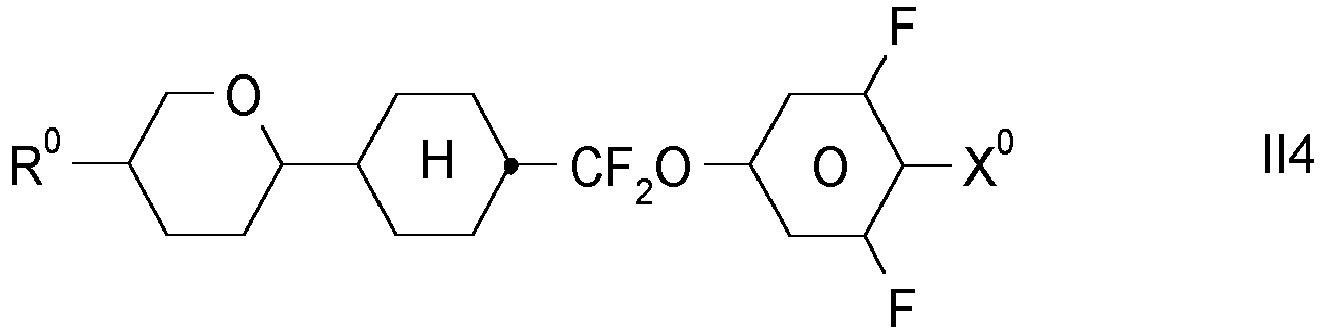


Preferred compounds are those of formula II1, II2 and II3, very preferred those of formula II1 and II2.
In the compounds of formulae II1 to II7 R0 preferably denotes alkyl having 1 to 6 C atoms, very preferably ethyl or propyl, and X0 preferably denotes F or OCF3, very preferably F. - The medium comprises one or more compounds of formula II wherein Y0 is CH3, preferably selected from the group consisting of the following subformulae
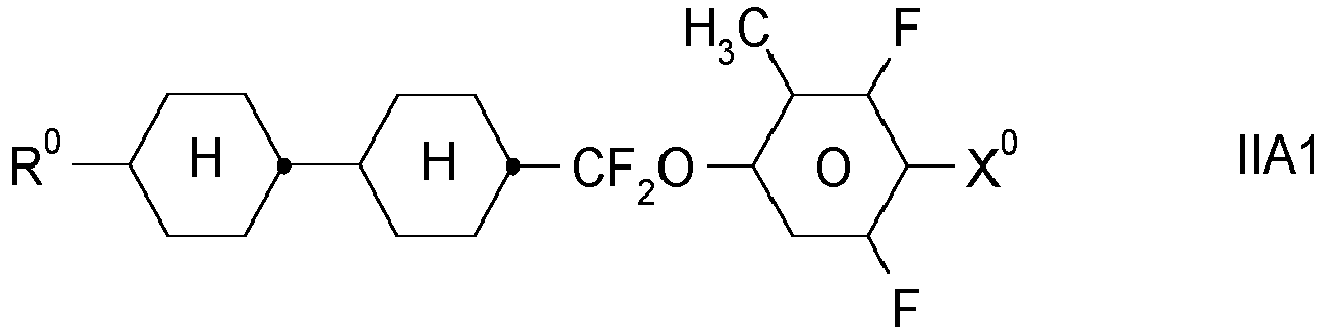

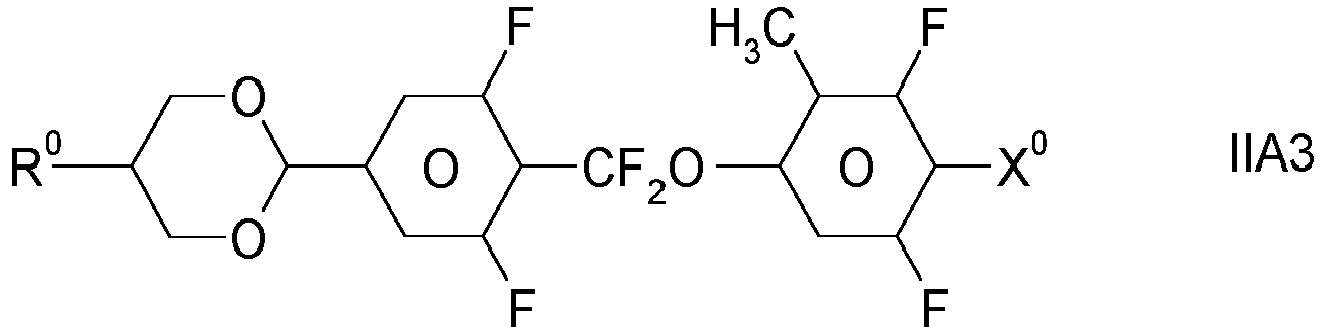

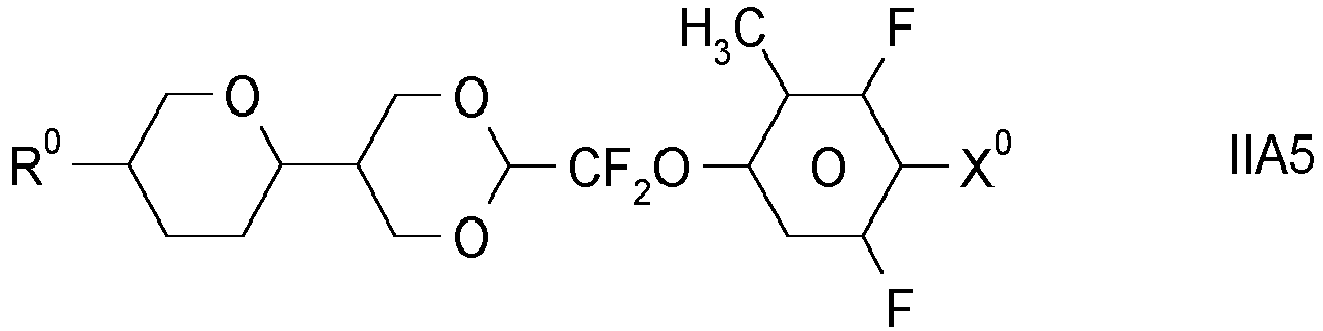


Preferred compounds are those of formula IIA1, IIA2 and IIA3, very preferred those of formula IIA1 and IIA2.
In the compounds of formulae IIA1 to IIA7 R0 preferably denotes alkyl having 1 to 6 C atoms, very preferably ethyl or propyl, and X0 preferably denotes F or OCF3, very preferably F. - The medium comprises one or more compounds of formula III wherein Y0 is H, preferably selected from the group consisting of the following subformulae


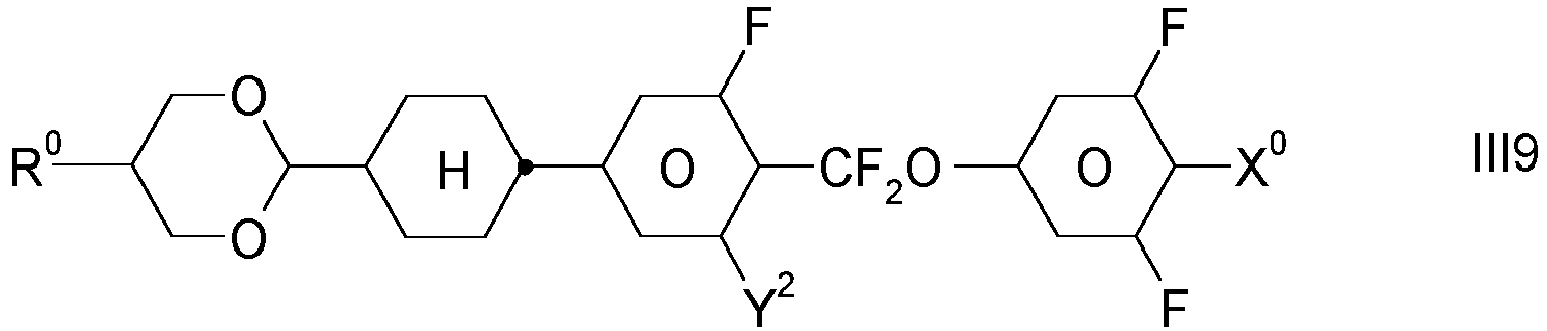

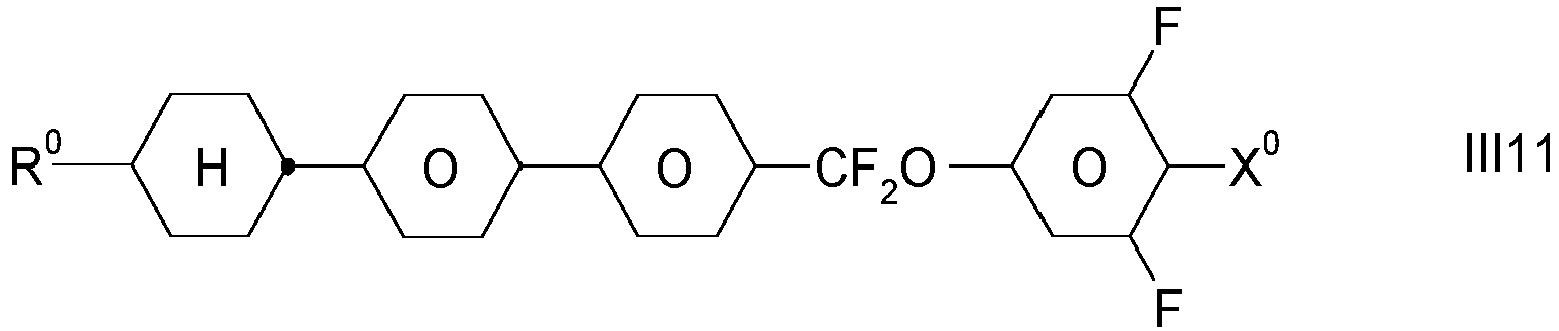


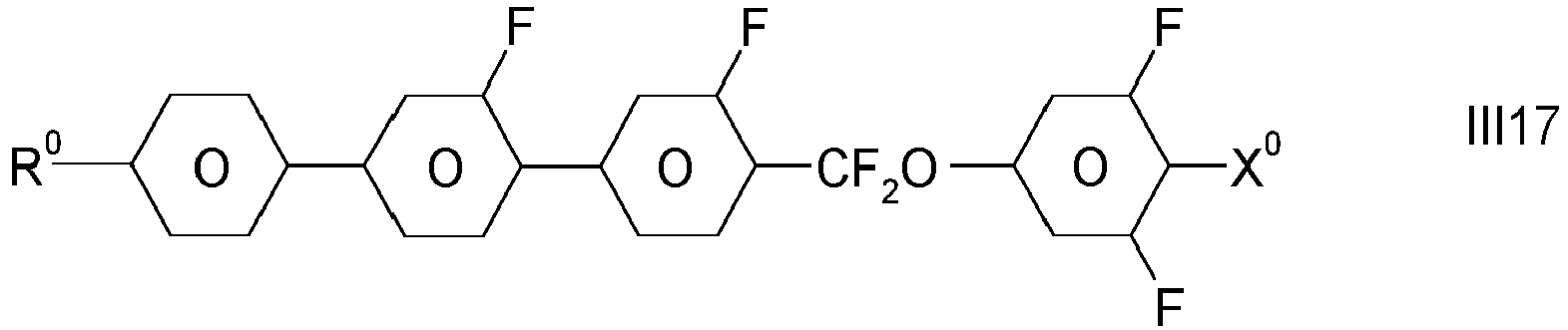


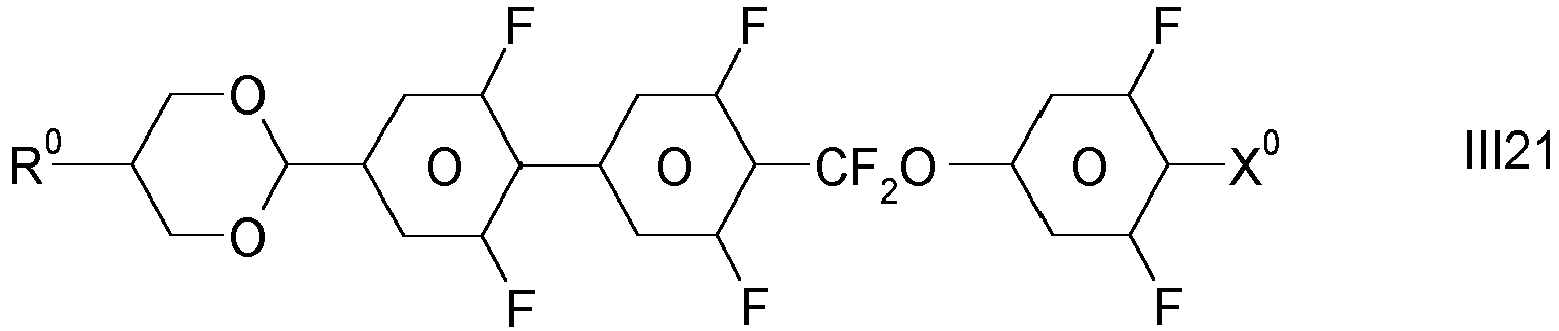
Preferred compounds are those of formula III1, III4, III6, III16, III19 and III20.
In the compounds of formulae III1 to III21 R0 preferably denotes alkyl having 1 to 6 C atoms, very preferably ethyl or propyl, X0 preferably denotes F or OCF3, very preferably F, and Y2 preferably denotes F. - The medium comprises one or more compounds of formula III wherein Y0 is CH3, preferably selected from the group consisting of the following subformulae


Preferred compounds are those of formula IIIA1, IIIA4, IIIA6, IIIA16, IIIA19 and IIIA20.
In the compounds of formulae IIIA1 to IIIA21 R0 preferably denotes alkyl having 1 to 6 C atoms, very preferably ethyl or propyl, X0 preferably denotes F or OCF3, very preferably F, and Y2 preferably denotes F. - The medium additionally comprises one or more compounds selected from the following formulae:


- R0, X0 and Y1-4
- have the meanings indicated above, and
- Z0
- denotes -C2H4-, -(CH2)4-, -CH=CH-, -CF=CF-, -C2F4-, -CH2CF2-,-CF2CH2-, -CH2O-, -OCH2-, -COO- or -OCF2-, in formulae V and VI also a single bond, in formulae V and VIII also -CF2O-,
- r
- denotes 0 or 1, and
- s
- denotes 0 or 1;
- The medium comprises one or more compounds of the formula IV selected from the following subformulae:


- in which R0 and X0 have the meanings indicated above.
- R0 preferably denotes alkyl having 1 to 6 C atoms. X0 preferably denotes F or OCF3, furthermore OCF=CF2 or Cl;
- The medium comprises one or more compounds of the formula IVa selected from the following subformula:

- The medium comprises one or more compounds of the formula IVc selected from the following subformula:

- The medium comprises one or more compounds of the formula V selected from the following subformulae:


- in which R0 and X0 have the meanings indicated above.
- R0 preferably denotes alkyl having 1 to 6 C atoms. X0 preferably denotes F and OCF3, furthermore OCHF2, CF3, OCF=CF2 and OCH=CF2;
- The medium comprises one or more compounds of the formula VI selected from the following subformulae:


- in which R0 and X0 have the meanings indicated above.
- R0 preferably denotes alkyl having 1 to 6 C atoms. X0 preferably denotes F, furthermore OCF3, CF3, CF=CF2, OCHF2 and OCH=CF2;
- The medium comprises one or more compounds of the formula VII selected from the following subformulae:


- in which R0 and X0 have the meanings indicated above.
- R0 preferably denotes alkyl having 1 to 6 C atoms. X0 preferably denotes F, furthermore OCF3, OCHF2 and OCH=CF2.
- The medium additionally comprises one or more compounds selected from the following formulae:


- "alkyl"
- denotes C1-6-alkyl,
- "alkenyl"
- denote C2-6-alkenyl,
- L
- denotes H or F,
- R"
- denotes C1-6-alkyl, C1-6-alkoxy or C2-6-alkenyl,
- Ra1, Rb1
- denote independently of each other CH3 or C2H5,
- i, k
- are independently of each other 0, 1, 2 or 3,
- The medium comprises one or more compounds of the formulae IX-XII selected from the following subformulae:


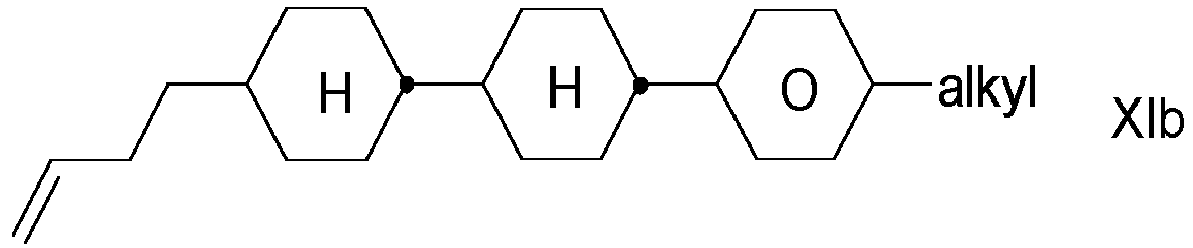

In formula IX, IXa and IXb "alkyl" preferably denotes C2H5, n-C3H7, n-C4H9 or n-C5H11, in particular n-C3H7.
In formula IXa and IXb "alkyl" preferably denotes CH3 or C2H5, in particular CH3. - The medium comprises one or more compounds of formulae IX-XII selected from the following subformulae;





- The medium does not contain any compounds of the following formulae:



- The medium additionally comprises one or more compounds selected from the following formula:

- The medium comprises one or more compounds of the formula XV selected from the following subformulae:


- The medium comprises one or more compounds of the formula XV selected from the following subformulae:


- The medium comprises one or more compounds of the formula XVI,

Particularly preferred compounds of the formula XVI are those of the sub-formulae


- alkyl and alkyl*
- each, independently of one another, denote a straight-chain alkyl radical having 1-6 C atoms, in particular ethyl, propyl or pentyl,
- alkenyl and alkenyl*
- each, independently of one another, denote a straight-chain alkenyl radical having 2-6 C atoms, in particular CH2=CHC2H4, CH3CH=CHC2H4, CH2=CH and CH3CH=CH.


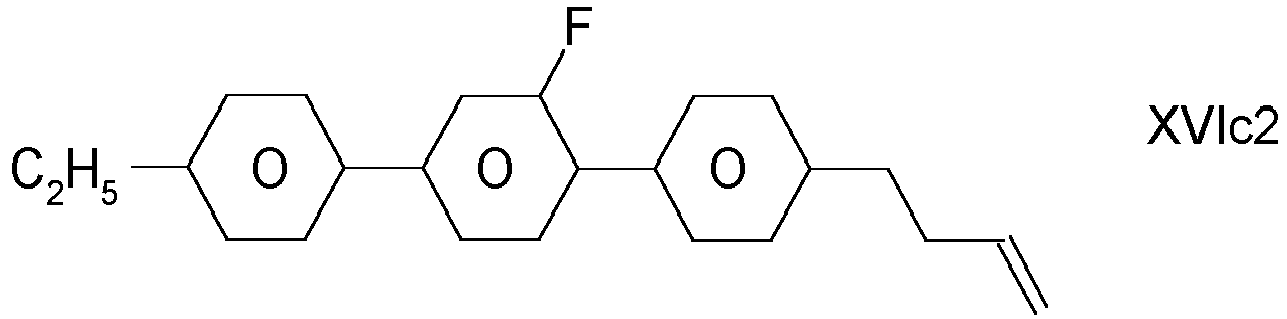


- The medium comprises one or more compounds of the following formula:

- The medium additionally comprises one or more compounds selected from the following formulae:


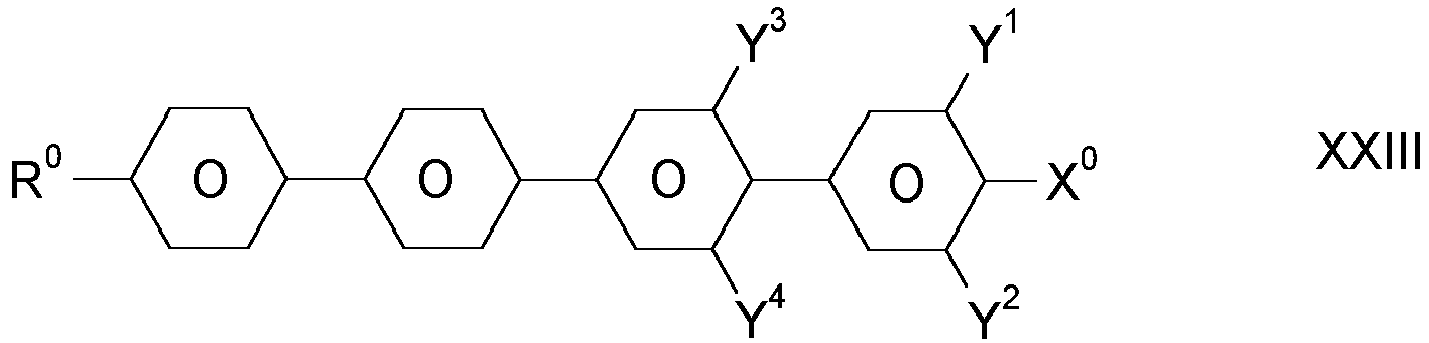
Very preferably the mixture according to the invention comprises one or more compounds of the formula XXIa,
Further preferably the mixture according to the invention comprises one or more compounds of the formula XXIIIa,
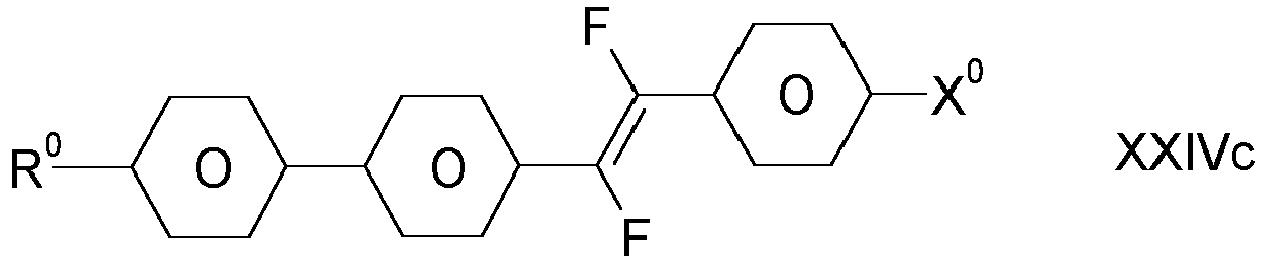
- The medium additionally comprises one or more compounds of the formula XXIV,
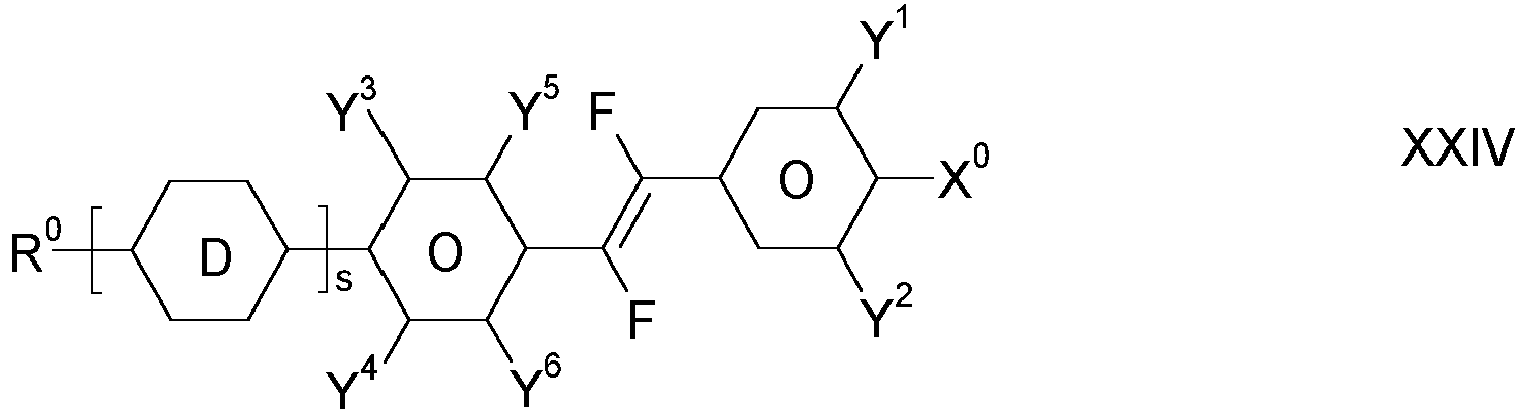


R0 preferably denotes alkyl having 1 to 6 C atoms. X0 preferably denotes F; - The compounds of the formula XXIV are preferably selected from the following formulae:




-


- R0 is straight-chain alkyl or alkenyl having 2 to 6 C atoms;
- The medium comprises one or more compounds of the following formulae:


- The medium comprises one or more compounds of the following formulae:


Very preferably the mixture according to the invention comprises one or more compounds of the formula XXIXa,
- The medium comprises one or more compounds of the following formula

Preferred compounds of formula XXX are those of formula XXXa
- Further preferred LC media are selected from the following preferred embodiments, including any combination thereof:
- The medium comprises one or more compounds of the formula II, preferably selected from formulae II1, II2 and II3, very preferably from formulae II1 and II2. The individual concentration of each of these compounds is preferably from 1 to 15% by weight. The total concentration of these compounds is preferably from 5 to 25% by weight
- The medium comprises one or more compounds of the formula III, preferably selected from formulae III1, III4, III6, III16, III19 and III20, very preferably from formulae III16 and III20. The individual concentration of each of these compounds is preferably from 1 to 15% by weight. The total concentration of these compounds is preferably from 2 to 25% by weight
- The medium comprises one or more compounds of the formula IV, preferably selected from formulae IVa or IVc, very preferably from formula IVa1 or IVc1. The individual concentration of each of these compounds is preferably from 1 to 15% by weight. The total concentration of these compounds is preferably from 5 to 25% by weight.
- The medium comprises one or more compounds of the formula IX, preferably selected from formulae IXa and IXb, very preferably from formulae IXa2 and Xb1. The individual concentration of each of these compounds is preferably from 1 to 15% by weight. The total concentration of these compounds is preferably from 5 to 25% by weight.
- The medium comprises one or more compounds of the formula XI, preferably selected from formulae XIa and XIb. The individual concentration of each of these compounds is preferably from 1 to 20% by weight. The total concentration of these compounds is preferably from 5 to 25% by weight.
- The medium comprises one or more compounds of the formula XII, preferably of formula XIIa. The total concentration of these compounds is preferably from 3 to 20% by weight.
- The medium comprises one or more compounds of the formula XV, preferably selected from formulae formulae XVd and XVe, very preferably from formulae XVd1 and XVe1. The individual concentration of each of these compounds is preferably from 1 to 10% by weight. The total concentration of these compounds is preferably from 2 to 15% by weight.
- The medium comprises one or more compounds of the formula XVIc, preferably of formula XVIc2. The concentration of these compounds is preferably from 1 to 15% by weight.
- The medium comprises one or more compounds of the formula XVIg, preferably of the formula XVIg1 and/or XVIg2. The concentration of these compounds is preferably from 5 to 25% by weight.
- The medium comprises one or more compounds of the formula XVIIa or XVIIb. The concentration of these compounds is preferably from 0.5 to 5% by weight.
- The medium comprises one or more compounds of the formula XXI, preferably of the formula XXIa. The concentration of these compounds is preferably from 0.5 to 8% by weight.
- The medium comprises one or more compounds of the formula XXIII, preferably of the formula XXIIIa. The concentration of these compounds is preferably from 0.5 to 5% by weight.
- The medium comprises one or more compounds of the formula XXIX, preferably of the formula XXIXa. The concentration of these compounds is preferably from 2 to 10% by weight.
- The medium comprises one or more compounds of the formula XXX, preferably of the formula XXXa. The concentration of these compounds is preferably from 2 to 10% by weight.
- The medium comprises one or more compounds of formula I and one or more compounds selected from the group consisting of the formulae II, III, IV, IX, XI, XII, XV, XVI, XXI, XXIX and XXX
- The medium comprises one or more compounds of formula I and one or more compounds selected from the group consisting of the formulae II1, II2, II3, III1, III4, III6, III16, III19, III20, IVa, IVc, IXa, IXb, XIa, XIb, XIIa, XVd, XVe, XVIc, XXIa, XXIXa and XXXa.
- The proportion of compounds of the formulae II, III, IV, IX, XI, XII, XV, XVI, XXI, XXIX and XXX in the mixture as a whole is 90 to 99% by weight.
- The proportion of compounds of the formulae II1, II2, II3, III1, III4, III6, III16, III19, III20, IVa, IVc, IXa, IXb, XIa, XIb, XIIa, XVd, XVe, XVIc, XXIa, XXIXa and XXXa in the mixture as a whole is 90 to 99% by weight.
- The term "alkyl" or "alkyl*" in this application encompasses straight-chain and branched alkyl groups having 1-6 carbon atoms, in particular the straight-chain groups methyl, ethyl, propyl, butyl, pentyl and hexyl. Groups having 2-5 carbon atoms are generally preferred.
- The term "alkenyl" or "alkenyl*" encompasses straight-chain and branched alkenyl groups having 2-6 carbon atoms, in particular the straight-chain groups. Preferred alkenyl groups are C2-C7-1 E-alkenyl, C4-C6-3E-alkenyl, in particular C2-C6-1 E-alkenyl. Examples of particularly preferred alkenyl groups are vinyl, 1E-propenyl, 1E-butenyl, 1E-pentenyl, 1E-hexenyl, 3-butenyl, 3E-pentenyl, 3E-hexenyl, 4-pentenyl, 4Z-hexenyl, 4E-hexenyl and 5-hexenyl. Groups having up to 5 carbon atoms are generally preferred, in particular CH2=CH, CH3CH=CH.
- The term "fluoroalkyl" preferably encompasses straight-chain groups having a terminal fluorine, i.e. fluoromethyl, 2-fluoroethyl, 3-fluoropropyl, 4-fluorobutyl, 5-fluoropentyl, 6-fluorohexyl and 7-fluoroheptyl. However, other positions of the fluorine are not excluded.
- The term "oxaalkyl" or "alkoxy" preferably encompasses straight-chain radicals of the formula CnH2n+1-O-(CH2)m, in which n and m each, independently of one another, denote 1 to 6. m may also denote 0. Preferably, n = 1 and m = 1-6 or m = 0 and n = 1-3.
- Through a suitable choice of the meanings of R0 and X0, the addressing times, the threshold voltage, the steepness of the transmission characteristic lines, etc., can be modified in the desired manner. For example, 1E-alkenyl radicals, 3E-alkenyl radicals, 2E-alkenyloxy radicals and the like generally result in shorter addressing times, improved nematic tendencies and a higher ratio between the elastic constants k33 (bend) and k11 (splay) compared with alkyl and alkoxy radicals. 4-Alkenyl radicals, 3-alkenyl radicals and the like generally give lower threshold voltages and lower values of k33/k11 compared with alkyl and alkoxy radicals. The mixtures according to the invention are distinguished, in particular, by high Δε values and thus have significantly faster response times than the mixtures from the prior art.
- The optimum mixing ratio of the compounds of the above-mentioned formulae depends substantially on the desired properties, on the choice of the components of the above-mentioned formulae and on the choice of any further components that may be present.
- Suitable mixing ratios within the range indicated above can easily be determined from case to case.
- The total amount of compounds of the above-mentioned formulae in the LC media according to the invention is not crucial. The mixtures can therefore comprise one or more further components for the purposes of optimisation of various properties. However, the observed effect on the desired improvement in the properties of the medium is generally greater, the higher the total concentration of compounds of the above-mentioned formulae.
- In a particularly preferred embodiment, the LC media according to the invention comprise compounds of the formulae IV to VIII (preferably IV and V) in which X0 denotes F, OCF3, OCHF2, OCH=CF2, OCF=CF2 or OCF2-CF2H. A favourable synergistic action with the compounds of the formulae IA, IIA, IB and IIB results in particularly advantageous properties. In particular, mixtures comprising compounds of the formulae IA or IIA and IB or IIB are distinguished by their low threshold voltage.
- The individual compounds of the above-mentioned formulae and the sub-formulae thereof which can be used in the LC media according to the invention are either known or can be prepared analogously to the known compounds.
- In another preferred embodiment of the present invention the LC medium additionally comprises one or more polymerisable compounds. The polymerisable compounds are preferably selected from formula M
Ra-B1-(Zb-B2)m-Rb M
in which the individual radicals, on each occurrence identically or differently, and each, independently of one another, have the following meaning: - Ra and Rb
- P, P-Sp-, H, F, Cl, Br, I, -CN, -NO2, -NCO, -NCS, -OCN, -SCN, SF5 or straight-chain or branched alkyl having 1 to 25 C atoms, in which, in addition, one or more non-adjacent CH2 groups may each be replaced, independently of one another, by -C(R0)=C(R00)-, -C≡C-, -N(R00)-, -O-, -S-, -CO-, -CO-O-, -O-CO-, -O-CO-O- in such a way that O and/or S atoms are not linked directly to one another, and in which, in addition, one or more H atoms may be replaced by F, Cl, Br, I, CN, P or P-Sp-, where, if B1 and/or B2 contain a saturated C atom, Ra and/or Rb may also denote a radical which is spiro-linked to this saturated C atom,
- P
- a polymerisable group,
- Sp
- a spacer group or a single bond,
- B1 and B2
- an aromatic, heteroaromatic, alicyclic or heterocyclic group, preferably having 4 to 25 ring atoms, which may also contain fused rings, and which is unsubstituted, or mono- or polysubstituted by L,
- Zb
- -O-, -S-, -CO-, -CO-O-, -OCO-, -O-CO-O-, -OCH2-, -CH2O-, -SCH2-, -CH2S-, -CF2O-, -OCF2-, -CF2S-, -SCF2-, -(CH2)n1-, -CF2CH2-, -CH2CF2-, -(CF2)n1-, -CH=CH-, -CF=CF-, -C≡C-, -CH=CH-COO-, -OCO-CH=CH-, CR0R00 or a single bond,
- R0 and R00
- each, independently of one another, denote H or alkyl having 1 to 12 C atoms,
- m
- denotes 0, 1, 2, 3 or 4,
- n1
- denotes 1, 2, 3 or 4,
- L
- P, P-Sp-, OH, CH2OH, F, Cl, Br, I, -CN, -NO2, -NCO, -NCS, -OCN, -SCN, -C(=O)N(Rx)2, -C(=O)Y1, -C(=O)Rx, -N(Rx)2, optionally substituted silyl, optionally substituted aryl having 6 to 20 C atoms, or straight-chain or branched alkyl, alkoxy, alkylcarbonyl, alkoxycarbonyl, alkylcarbonyloxy or alkoxy-carbonyloxy having 1 to 25 C atoms, in which, in addition, one or more H atoms may be replaced by F, Cl, P or P-Sp-,
- P and Sp
- have the meanings indicated above,
- Y1
- denotes halogen,
- Rx
- denotes P, P-Sp-, H, halogen, straight-chain, branched or cyclic alkyl having 1 to 25 C atoms, in which, in addition, one or more non-adjacent CH2 groups may be replaced by -O-, -S-,-CO-,
-CO-O-, -O-CO-, -O-CO-O- in such a way that O and/or S atoms are not linked directly to one another, and in which, in addition, one or more H atoms may be replaced by F, Cl, P or P-Sp-, an optionally substituted aryl or aryloxy group having 6 to 40 C atoms, or an optionally substituted heteroaryl or heteroaryloxy group having 2 to 40 C atoms. - Particularly preferred compounds of the formula I are those in which B1 and B2 each, independently of one another, denote 1,4-phenylene, 1,3-phenylene, naphthalene-1,4-diyl, naphthalene-2,6-diyl, phenanthrene-2,7-diyl, 9,10-dihydro-phenanthrene-2,7-diyl, anthracene-2,7-diyl, fluorene-2,7-diyl, coumarine, flavone, where, in addition, one or more CH groups in these groups may be replaced by N, cyclohexane-1,4-diyl, in which, in addition, one or more non-adjacent CH2 groups may be replaced by O and/or S, 1,4-cyclohexenylene, bicycle[1.1.1]pentane-1,3-diyl, bicyclo[2.2.2]octane-1,4-diyl, spiro[3.3]heptane-2,6-diyl, piperidine-1,4-diyl, decahydronaphthalene-2,6-diyl, 1,2,3,4-tetrahydronaphthalene-2,6-diyl, indane-2,5-diyl or octahydro-4,7-methanoindane-2,5-diyl, where all these groups may be unsubstituted or mono- or polysubstituted by L as defined above.
- Particularly preferred compounds of the formula M are those in which B1 and B2 each, independently of one another, denote 1,4-phenylene, 1,3-phenylene, naphthalene-1,4-diyl or naphthalene-2,6-diyl,
- Very preferred compounds of formula M are selected from the following formulae:



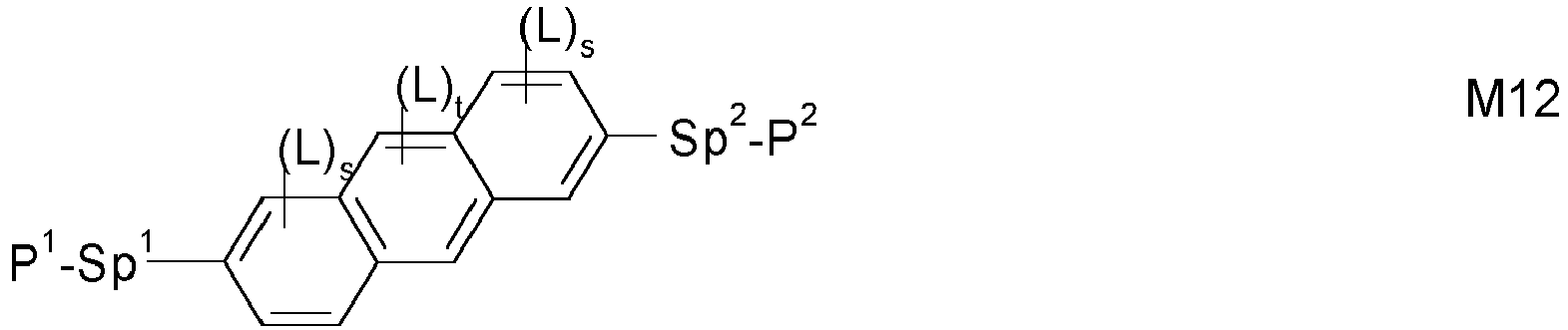


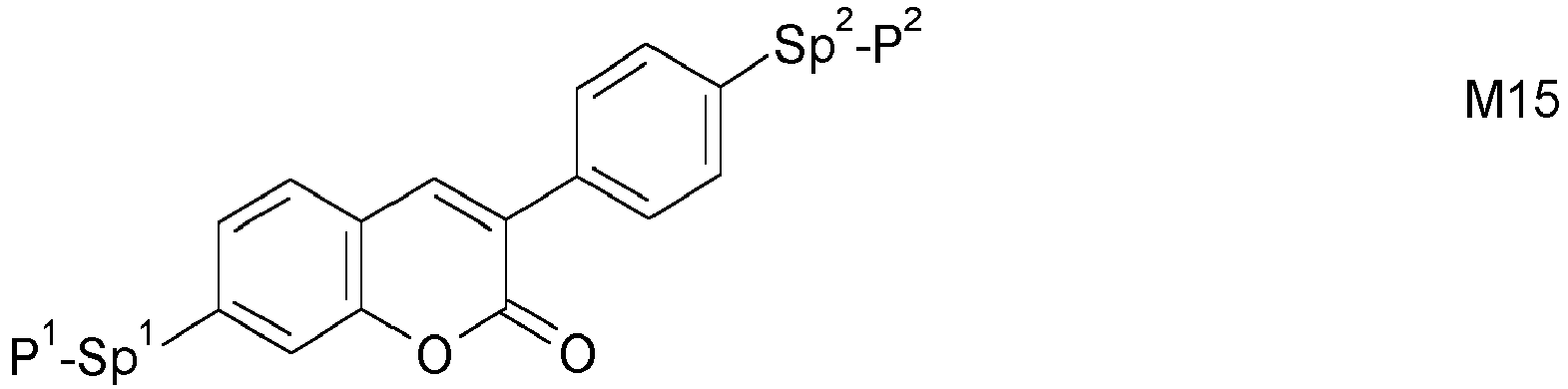


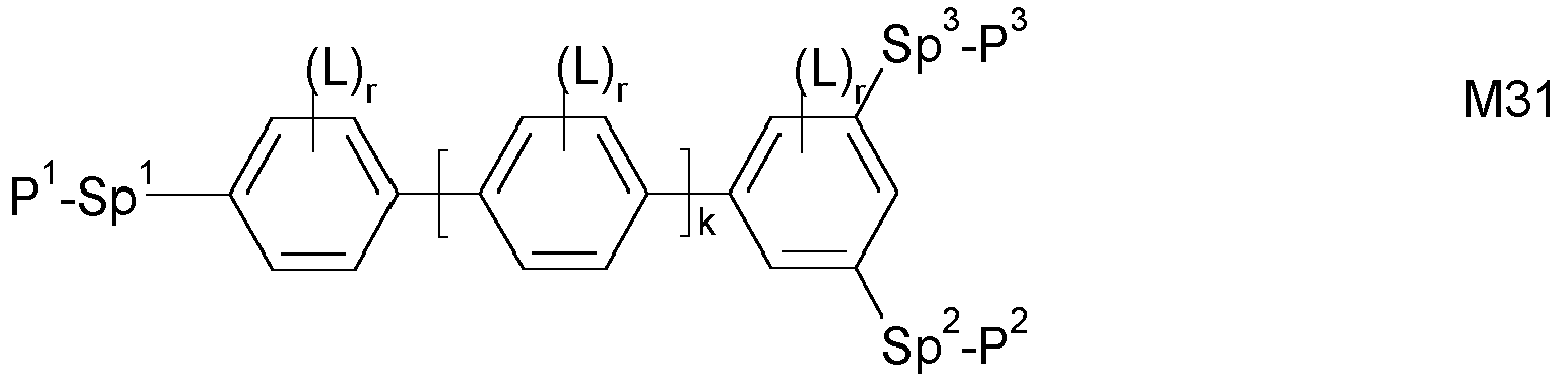

- P1, P2, P3
- a polymerisable group, preferably selected from vinyloxy, acrylate, methacrylate, fluoroacrylate, chloroacrylate, oxetane and epoxy,
- Sp1, Sp2, Sp3
- a single bond or a spacer group where, in addition, one or more of the radicals P1-Sp1-, P1-Sp2- and P3-Sp3- may denote Raa, with the proviso that at least one of the radicals P1-Sp1-, P2-Sp2 and P3-Sp3- present is different from Raa, preferably -(CH2)p1-, -(CH2)p1-O-, -(CH2)p1-CO-O- or-(CH2)p1-O-CO-O- bedeuten, wherein p1 is an integer from 1 to 12,
- Raa
- H, F, Cl, CN or straight-chain or branched alkyl having 1 to 25 C atoms, in which, in addition, one or more non-adjacent CH2 groups may each be replaced, independently of one another, by -C(R0)=C(R00)-, -C≡C-, -N(R0)-, -O-, -S-, -CO-, -CO-O-, -O-CO-, -O-CO-O- in such a way that O and/or S atoms are not linked directly to one another, and in which, in addition, one or more H atoms may be replaced by F, Cl, CN or P1-Sp1-, particularly preferably straight-chain or branched, optionally mono- or polyfluorinated alkyl, alkoxy, alkenyl, alkynyl, alkylcarbonyl, alkoxycarbonyl, alkylcarbonyloxy or alkoxycarbonyloxy having 1 to 12 C atoms (where the alkenyl and alkynyl radicals have at least two C atoms and the branched radicals have at least three C atoms),
- R0, R00
- H or alkyl having 1 to 12 C atoms,
- Ry and Rz
- H, F, CH3 or CF3,
- X1, X2, X3
- -CO-O-, -O-CO- or a single bond,
- ZM1
- -O-, -CO-, -C(RyRz)- or -CF2CF2-,
- ZM2, ZM3
- -CO-O-, -O-CO-, -CH2O-, -OCH2-, -CF2O-, -OCF2- or -(CH2)n-, where n is 2, 3 or 4,
- L
- F, Cl, CN or straight-chain or branched, optionally mono- or polyfluorinated alkyl, alkoxy, alkenyl, alkynyl, alkylcarbonyl, alkoxycarbonyl, alkylcarbonyloxy or alkoxycarbonyloxy having 1 to 12 C atoms,
- L', L"
- H, For Cl,
- k
- 0 or 1,
- r
- 0, 1, 2, 3 or 4,
- s
- 0, 1, 2 or 3,
- t
- 0, 1 or 2,
- x
- 0 or 1.
- Especially preferred are compounds of formulae M2 and M13.
- Further preferred are trireactive compounds M15 to M31, in particular M17, M18, M19, M22, M23, M24, M25, M30, M31 and M32.
- In the compounds of formulae M1 to M32 the group


- Preferred compounds of formulae M1 to M32 are those wherein P1, P2 and P3 denote an acrylate, methacrylate, oxetane or epoxy group, very preferably an acrylate or methacrylate group.
- Further preferred compounds of formulae M1 to M32 are those wherein Sp1, Sp2 and Sp3 are a single bond.
- Further preferred compounds of formulae M1 to M32 are those wherein one of Sp1, Sp2 and Sp3 is a single bond and another one of Sp1, Sp2 and Sp3 is different from a single bond.
- Further preferred compounds of formulae M1 to M32 are those wherein those groups Sp1, Sp2 and Sp3 that are different from a single bond denote -(CH2)s1-X"-, wherein s1 is an integer from 1 to 6, preferably 2, 3, 4 or 5, and X" is X" is the linkage to the benzene ring and is -O-, -O-CO-, -CO-O-, -O-CO-O- or a single bond.
- Further preferred polymerisable compounds of formulae M1 to M32 are those selected from Table D below.
- Particular preference is given to LC media comprising one, two or three polymerisable compounds of formula M, preferably selected from formulae M1 to M32.
- Preferably the proportion of polymerisable compounds, including those of formula M and its subformulae, in the LC medium is from 0.01 to 5%, very preferably from 0.05 to 1%, most preferably from 0.1 to 0.5%.
- It was observed that the addition of one or more polymerisable compounds of formula M to the LC medium leads to advantageous properties like fast response times. Such an LC medium is especially suitable for use in PSA displays where it shows low image sticking, a quick and complete polymerisation, the quick generation of a low pretilt angle which is stable after UV exposure, a high reliability, high VHR value after UV exposure, and a high birefringence. By appropriate selection of the polymerisable compounds it is possible to increase the absorption of the LC medium at longer UV wavelengths, so that it is possible to use such longer UV wavelengths for polymerisation, which is advantageous for the display manufacturing process.
- The polymerisable group P is a group which is suitable for a polymerisation reaction, such as, for example, free-radical or ionic chain polymerisation, polyaddition or polycondensation, or for a polymer-analogous reaction, for example addition or condensation onto a main polymer chain. Particular preference is given to groups for chain polymerisation, in particular those containing a C=C double bond or -C≡C- triple bond, and groups which are suitable for polymerisation with ring opening, such as, for example, oxetane or epoxide groups.
- Preferred groups P are selected from the group consisting of CH2=CW1-COO-, CH2=CW1-CO-,


- Very preferred groups P are selected from the group consisting of CH2=CW1-CO-O-, CH2=CW1-CO-,


- Very particularly preferred groups P are selected from the group consisting of CH2=CW1-CO-O-, in particular CH2=CH-CO-O-, CH2=C(CH3)-CO-O- and CH2=CF-CO-O-, furthermore CH2=CH-O-, (CH2=CH)2CH-O-CO-, (CH2=CH)2CH-O-,

- Further preferred polymerisable groups P are selected from the group consisting of vinyloxy, acrylate, methacrylate, fluoroacrylate, chloroacrylate, oxetane and epoxide, most preferably from acrylate and methacrylate.
- If Sp is different from a single bond, it is preferably of the formula Sp"-X", so that the respective radical P-Sp- conforms to the formula P-Sp"-X"-, wherein
- Sp"
- denotes alkylene having 1 to 20, preferably 1 to 12, C atoms, which is optionally mono- or polysubstituted by F, Cl, Br, I or CN and in which, in addition, one or more non-adjacent CH2 groups may each be replaced, independently of one another, by -O-, -S-, -NH-, -N(R0)-,-Si(R0R00)-,
-CO-, -CO-O-, -O-CO-, -O-CO-O-, -S-CO-, -CO-S-, -N(R00)-CO-O-, -O-CO-N(R0)-, -N(R0)-CO-N(R00)-, -CH=CH- or -C≡C- in such a way that O and/or S atoms are not linked directly to one another, - X"
- denotes -O-, -S-, -CO-, -CO-O-, -O-CO-, -O-CO-O-, -CO-N(R0)-, -N(R0)-CO-, -N(R0)-CO-N(R00)-, -OCH2-, -CH2O-, -SCH2-, -CH2S-, -CF2O-, -OCF2-, -CF2S-, -SCF2-, -CF2CH2-, -CH2CF2-, -CF2CF2-, -CH=N-, -N=CH-, -N=N-, -CH=CR0-, -CY2=CY3-, -C≡C-, -CH=CH-CO-O-, -O-CO-CH=CH- or a single bond,
- R0 and R00
- each, independently of one another, denote H or alkyl having 1 to 20 C atoms, and
- Y2 and Y3
- each, independently of one another, denote H, F, Cl or CN.
- X" is preferably -O-, -S-, -CO-, -COO-, -OCO-, -O-COO-, -CO-NR0-, -NR0-CO-, -NR0-CO-NR00- or a single bond.
- Typical spacer groups Sp and -Sp"-X"- are, for example, -(CH2)p1-, - (CH2CH2O)q1-CH2CH2-, -CH2CH2-S-CH2CH2-, -CH2CH2-NH-CH2CH2- or - (SiR0R00-O)p1-, in which p1 is an integer from 1 to 12, q1 is an integer from 1 to 3, and R0 and R00 have the meanings indicated above.
- Particularly preferred groups Sp and -Sp"-X"- are -(CH2)p1-, -(CH2)p1-O-, -(CH2)p1-O-CO-, -(CH2)p1-CO-O-, -(CH2)p1-O-CO-O-, in which p1 and q1 have the meanings indicated above.
- Particularly preferred groups Sp" are, in each case straight-chain, ethylene, propylene, butylene, pentylene, hexylene, heptylene, octylene, nonylene, decylene, undecylene, dodecylene, octadecylene, ethyleneoxyethylene, methyleneoxybutylene, ethylenethioethylene, ethylene-N-methylimino-ethylene, 1-methylalkylene, ethenylene, propenylene and butenylene.
- For the production of PSA displays, the polymerisable compounds contained in the LC medium are polymerised or crosslinked (if one compound contains two or more polymerisable groups) by in-situ polymerisation in the LC medium between the substrates of the LC display, optionally while a voltage is applied to the electrodes.
- The structure of the PSA displays according to the invention corresponds to the usual geometry for PSA displays, as described in the prior art cited at the outset. Geometries without protrusions are preferred, in particular those in which, in addition, the electrode on the colour filter side is unstructured and only the electrode on the TFT side has slots. Particularly suitable and preferred electrode structures for PS-VA displays are described, for example, in
US 2006/0066793 A1 . - The combination of compounds of the preferred embodiments mentioned above with the polymerised compounds described above causes low threshold voltages, low rotational viscosities and very good low-temperature stabilities in the LC media according to the invention at the same time as constantly high clearing points and high VHR values.
- The use of LC media containing polymerisable compounds allows the rapid establishment of a particularly low pretilt angle in PSA displays. In particular, the LC media exhibit significantly shortened response times, in particular also the grey-shade response times, in PSA displays compared with the media from the prior art.
- Preference is generally given to LC media which have a nematic LC phase, and preferably have no chiral liquid crystal phase.
- The invention also relates to the use of an LC medium according to the present invention as described above and below for electro-optical purposes, in particular for the use is in shutter glasses, for 3D applications, in IPS, PS-IPS, FFS, PS-FFS, HB-FFS, U-IPS, TN, PS-TN, STN or TN-TFT displays, and to electro-optical displays, in particular of the aforementioned types, containing an LC medium according to the present invention as described above and below, in particular an IPS, PS-IPS, FFS, PS-FFS, HB-FFS, U-IPS, TN, PS-TN, STN or TN-TFT display.
- The invention also relates to electro-optical displays, such as, for example, STN or MLC displays, having two plane-parallel outer plates, which, together with a frame, form a cell, integrated non-linear elements for switching individual pixels on the outer plates, and a nematic LC mixture having positive dielectric anisotropy and high specific resistance located in the cell, wherein the a nematic LC mixture is an LC medium according to the present invention as described above and below.
- The LC media according to the invention enable a significant broadening of the available parameter latitude. The achievable combinations of clearing point, viscosity at low temperature, thermal and UV stability and high optical anisotropy are far superior to previous materials from the prior art.
- The LC media according to the invention are suitable for mobile applications and TFT applications, such as, for example, mobile telephones and PDAs. Furthermore, the LC media according to the invention are particularly suitably for use in FFS and IPS displays.
- The LC media according to the invention preferably retain the nematic phase down to -20°C very preferably down to -30°C, most preferably down to -40°C. The LC media according to the invention preferably have a clearing point ≥ 85°C, very preferably ≥ 95°C, most preferably ≥ 105°C.
- The LC media according to the invention preferably have a rotational viscosity γ1 of ≤ 130 mPa·s, very preferably ≤ 115 mPa·s, enabling excellent MLC displays having fast response times to be achieved. The rotational viscosities are determined at 20°C.
- In a preferred embodiment, the dielectric anisotropy Δε of the LC media according to the invention at 20°C is preferably ≥ +4, very preferably ≥ +6, most preferably ≥ +8.
- The birefringence Δn of the LC media according to the invention at 20°C is preferably in the range of from 0.080 to 0.150, more preferably from 0.090 to 0.140, particularly preferably 0.100 to 0.130.
- The nematic phase range of the LC media according to the invention preferably has a width of at least 100°, more preferably of at least 110 °C, in particular at least 130°. This range preferably extends at least from -25° to +105°C.
- It goes without saying that, through a suitable choice of the components of the LC media according to the invention, it is also possible for higher clearing points (for example above 100°C) to be achieved at higher threshold voltages or lower clearing points to be achieved at lower threshold voltages with retention of the other advantageous properties. At viscosities correspondingly increased only slightly, it is likewise possible to obtain LC media having a higher Δε and thus low thresholds. The MLC displays according to the invention preferably operate at the first Gooch and Tarry transmission minimum [C.H. Gooch and H.A. Tarry, Electron. Lett. 10, 2-4, 1974; C.H. Gooch and H.A. Tarry, Appl. Phys., Vol. 8, 1575-1584, 1975], where, besides particularly favourable electro-optical properties, such as, for example, high steepness of the characteristic line and low angle dependence of the contrast (German patent
30 22 818 ), lower dielectric anisotropy is sufficient at the same threshold voltage as in an analogous display at the second minimum. This enables significantly higher specific resistance values to be achieved using the mixtures according to the invention at the first minimum than in the case of LC media comprising cyano compounds. Through a suitable choice of the individual components and their proportions by weight, the person skilled in the art is able to set the birefringence necessary for a pre-specified layer thickness of the MLC display using simple routine methods. - Measurements of the voltage holding ratio (HR) [S. Matsumoto et al., Liquid Crystals 5, 1320 (1989); K. Niwa et al., Proc. SID Conference, San Francisco, June 1984, p. 304 (1984); G. Weber et al., Liquid Crystals 5, 1381 (1989)] have shown that LC media according to the invention comprising compounds of the formulae ST-1, ST-2, RV, IA and IB exhibit a significantly smaller decrease in the HR on UV exposure than analogous mixtures comprising cyanophenylcyclohexanes of the formula

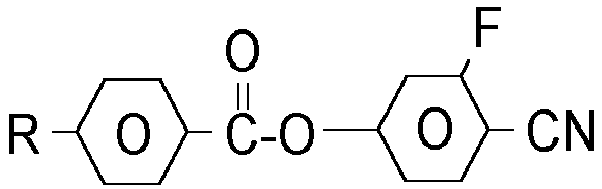
- The light stability and UV stability of the LC media according to the invention are considerably better, i.e. they exhibit a significantly smaller decrease in the HR on exposure to light, heat or UV.
- The construction of the MLC display according to the invention from polarisers, electrode base plates and surface-treated electrodes corresponds to the usual design for displays of this type. The term usual design is broadly drawn here and also encompasses all derivatives and modifications of the MLC display, in particular including matrix display elements based on poly-Si TFTs or MIM.
- A significant difference between the displays according to the invention and the hitherto conventional displays based on the twisted nematic cell consists, however, in the choice of the LC parameters of the LC layer.
- The LC media which can be used in accordance with the invention are prepared in a manner conventional per se, for example by mixing one or more compounds of Claim 1 with one or more compounds of the formulae IV-XXX or with further LC compounds and/or additives. In general, the desired amount of the components used in lesser amount is dissolved in the components making up the principal constituent, advantageously at elevated temperature. It is also possible to mix solutions of the components in an organic solvent, for example in acetone, chloroform or methanol, and to remove the solvent again, for example by distillation, after thorough mixing.
- The LC media may also comprise further additives known to the person skilled in the art and described in the literature, such as, for example, polymerisation initiators, inhibitors, surface-active substances, light stabilisers, antioxidants, e.g. BHT, TEMPOL, microparticles, free-radical scavengers, nanoparticles, etc. For example, 0-15% of pleochroic dyes or chiral dopants or initiators like Irgacure651® or Irgacure907® can be added. Suitable stabilisers and dopants are mentioned below in Tables C and D.
- In a preferred embodiment the LC media contain one or more chiral dopants, preferably in a concentration from 0.01 to 1% by weight, very preferably from 0.05 to 0.5% by weight. The chiral dopants are preferably selected from the group consisting of compounds from Table B below, very preferably from the group consisting of R- or S-1011, R- or S-2011, R- or S-3011, R- or S-4011, and R- or S-5011.
- In another preferred embodiment the LC media contain a racemate of one or more chiral dopants, which are preferably selected from the chiral dopants mentioned in the previous paragraph.
- In another preferred embodiment of the present invention the LC media contain one or more further stabilisers, preferably selected from the the group consisting of the following formulae


- Ra-d
- straight-chain or branched alkyl with 1 to 10, preferably 1 to 6, very preferably 1 to 4 C atoms, most preferably methyl,
- Xs
- H, CH3, OH or O•,
- As
- straight-chain, branched or cyclic alkylene with 1 to 20 C atoms which is optionally substituted,
- n
- an integer from 1 to 6, preferably 3.
- Preferred stabilisers of formula S3 are selected from formulaS3A
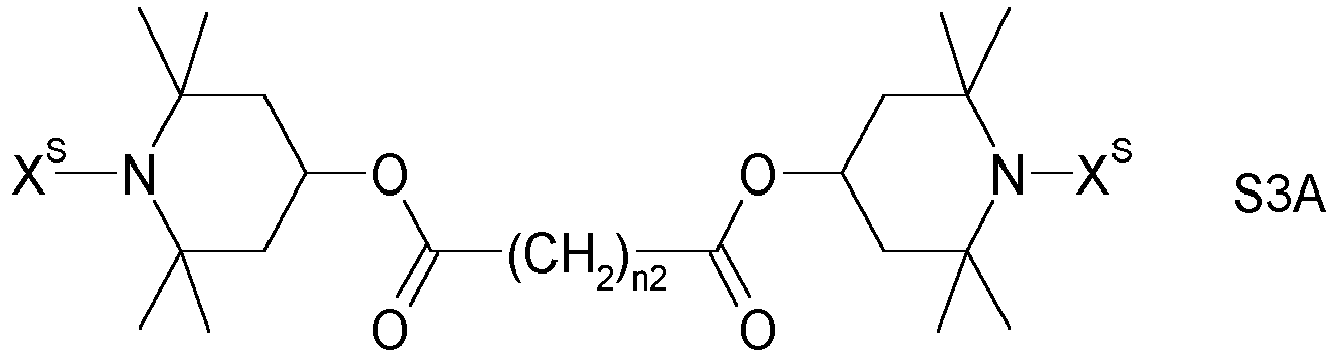
- Very preferred stabilisers are selected from the group consisting of the following formulae


- In a preferred embodiment the LC medium comprises one or more stabilisers selected from the group consisting of formulae S1-1, S2-1, S3-1, S3-1 and S3-3.
- In a preferred embodiment the LC medium comprises one or more stabilisers selected from Table D.
- Preferably the proportion of stabilisers, like those of formula S1-S3, in the LC medium is from 10 to 500 ppm,very preferably from 20 to 100 ppm.
- In another preferred embodiment the LC medium according to the present invention contains a self-aligning (SA) additive, preferably in a concentration of 0.1 to 2.5 %.
- Preferred SA additives for use in this preferred embodiment are selected from compounds comprising a mesogenic group and a straight-chain or branched alkyl side chain that is terminated with one or more polar anchor groups selected from hydroxy, carboxy, amino or thiol groups.
- Further preferred SA additives contain one or more polymerisable groups which are attached, optionally via spacer groups, to the mesogenic group. These polymerisable SA additives can be polymerised in the LC medium under similar conditions as applied for the RMs in the PSA process.
- Suitable SA additives are disclosed for example in
US 2013/0182202 A1 ,US 2014/0838581 A1 ,US 2015/0166890 A1 andUS 2015/0252265 A1 . - In another preferred embodiment an LC medium or a polymer stabilised display according to the present invention contains one or more self-aligning additives selected from Table E below.
- In a preferred embodiment the display according to the present invention does not contain an alignment layer.
- Furthermore, it is possible to add to the LC media, for example, 0 to 15% by weight of pleochroic dyes, furthermore nanoparticles, conductive salts, preferably ethyldimethyldodecylammonium 4-hexoxybenzoate, tetrabutylammonium tetraphenylborate or complex salts of crown ethers (cf., for example, Haller et al., Mol. Cryst. Liq. Cryst. 24, 249-258 (1973)), for improving the conductivity, or substances for modifying the dielectric anisotropy, the viscosity and/or the alignment of the nematic phases. Substances of this type are described, for example, in
DE-A 22 09 127 ,22 40 864 ,23 21 632 ,23 38 281 ,24 50 088 ,26 37 430 and28 53 728 . - In the present application and in the examples below, the structures of the LC compounds are indicated by means of acronyms, the transformation into chemical formulae taking place in accordance with Table A. All radicals CnH2n+1 and CmH2m+1 are straight-chain alkyl radicals having n and m C atoms respectively; n, m and k are integers and preferably denote 0, 1, 2, 3, 4, 5, 6, 7, 8, 9, 10, 11 or 12. The coding in Table B is self-evident. In Table A, only the acronym for the parent structure is indicated. In individual cases, the acronym for the parent structure is followed, separated by a dash, by a code for the substituents R1*, R2*, L1* and L2*:
Code for R1*, R2* , L1* , L2* , L3* R1* R2* L1* L2* nm CnH2n+1 CmH2m+1 H H nOm CnH2n+1 OCmH2m+1 H H nO.m OCnH2n+1 CmH2m+1 H H n CnH2n+1 CN H H nN.F CnH2n+1 CN F H nN.F.F CnH2n+1 CN F F nF CnH2n+1 F H H nCl CnH2n+1 Cl H H nOF OCnH2n+1 F H H nF.F CnH2n+1 F F H nF.F.F CnH2n+1 F F F nOCF3 CnH2n+1 OCF3 H H nOCF3.F CnH2n+1 OCF3 F H n-Vm CnH2n+1 -CH=CH-CmH2m+1 H H nV-Vm CnH2n+1-CH=CH- -CH=CH-CmH2m+1 H H - Preferred mixture components are shown in Tables A and B.
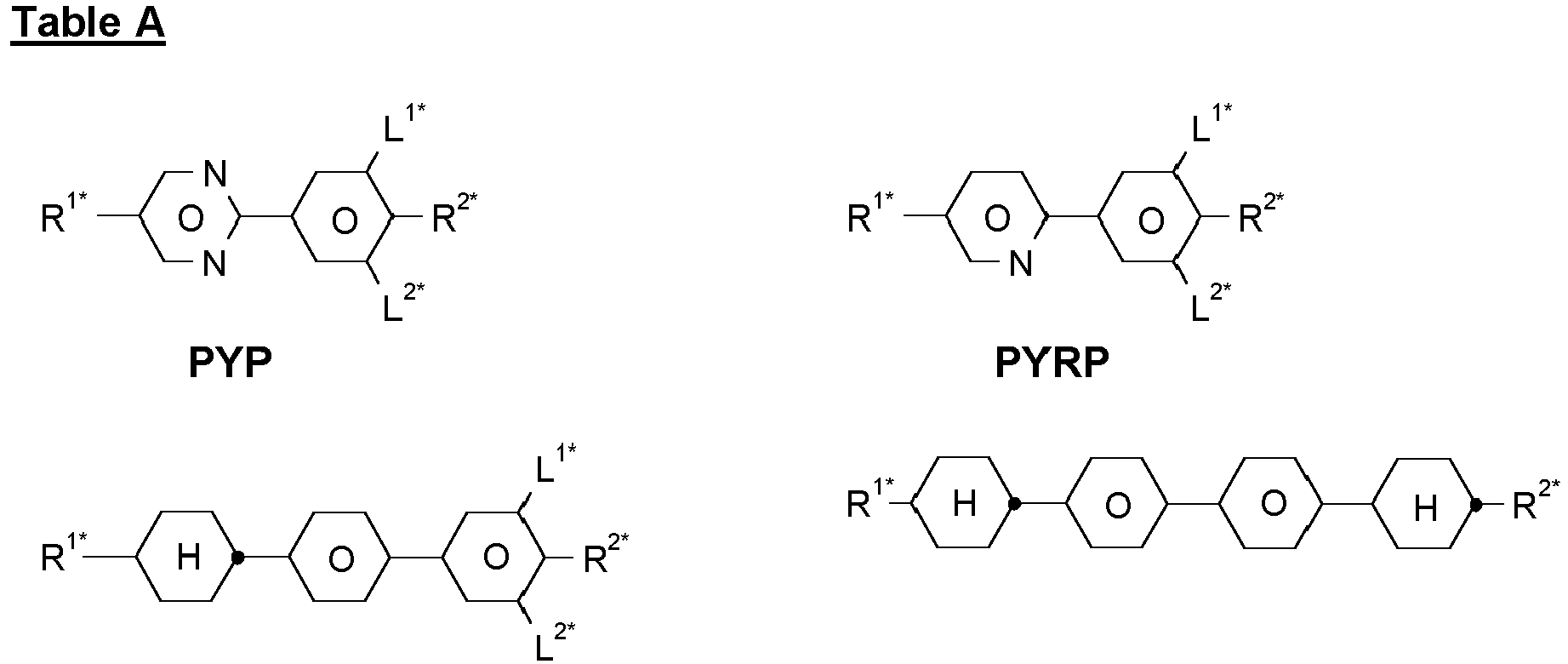


Table B In the following formulae, n and m each, independently of one another, denote 0, 1, 2, 3, 4, 5, 6, 7, 8, 9, 10, 11 or 12, in particular 2, 3, 5, furthermore 0, 4, 6. 


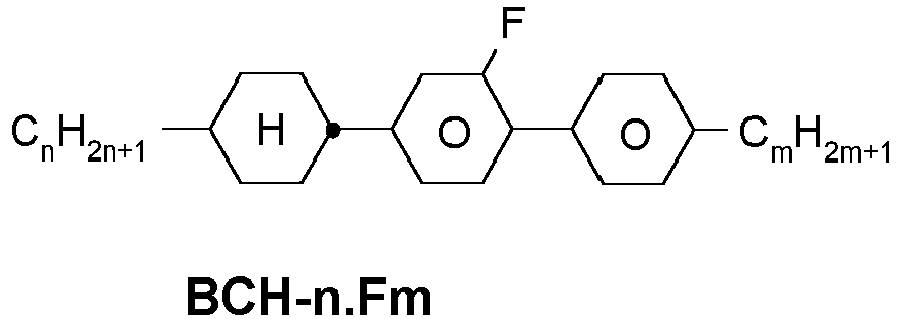


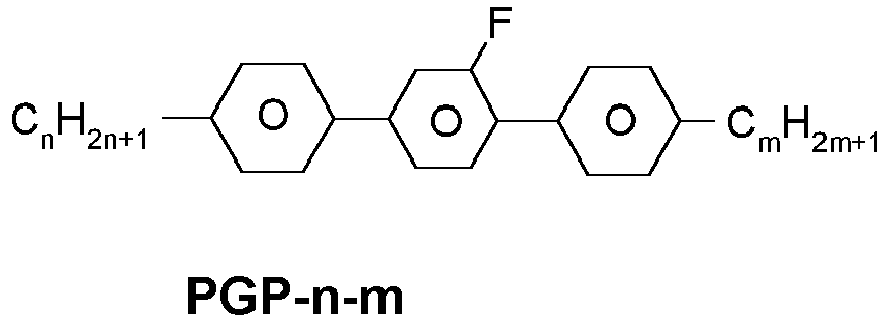

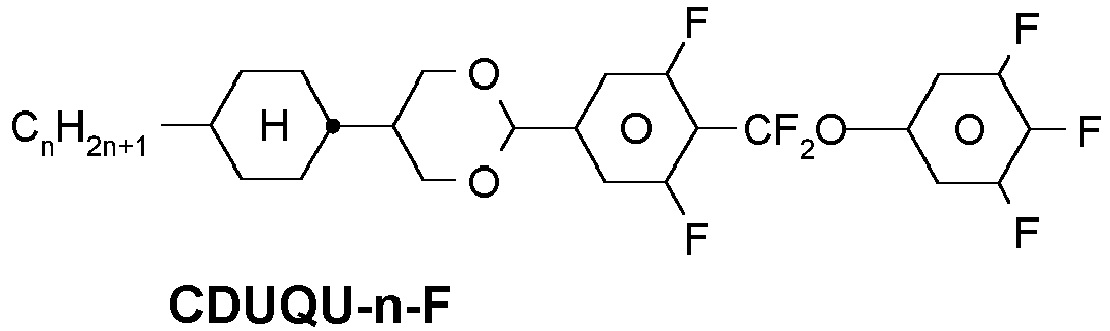


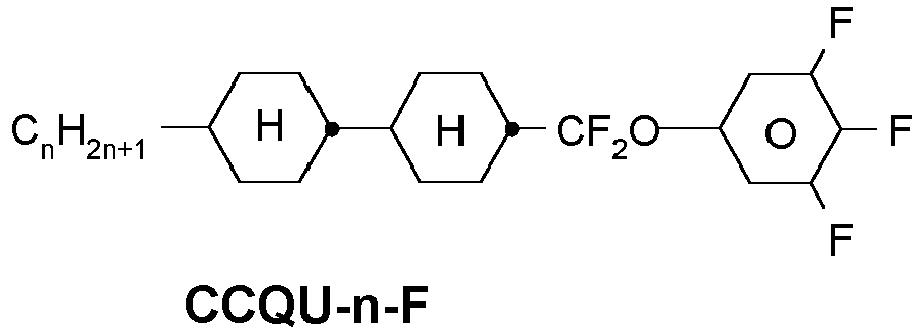


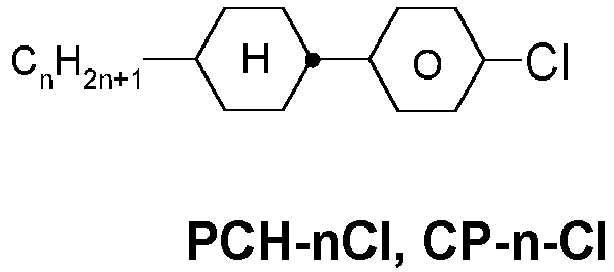
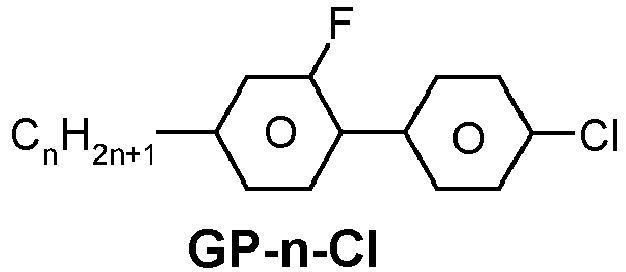


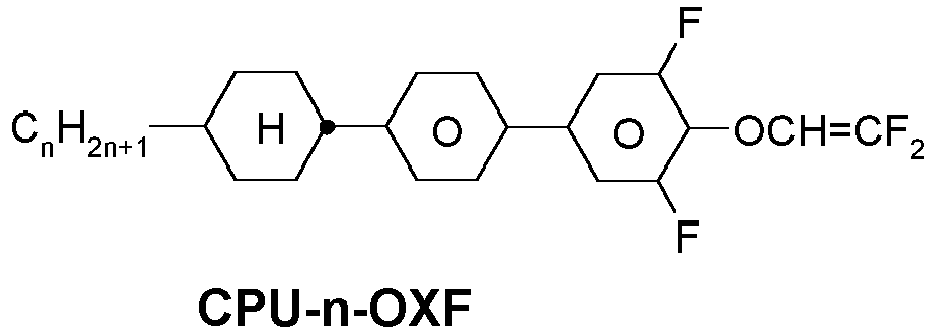


- Particular preference is given to LC media which, besides the compounds of the formula I, comprise at least one, two, three, four or more compounds from Table B.
Table C Table C indicates possible dopants which are generally added to the LC media according to the invention. The LC media preferably comprise 0-10% by weight, in particular 0.01-5% by weight and particularly preferably 0.01-3% by weight of dopants. 


Table D Stabilisers, which can additionally be added, for example, to the LC media according to the invention in amounts of 0-10% by weight, are mentioned below. 


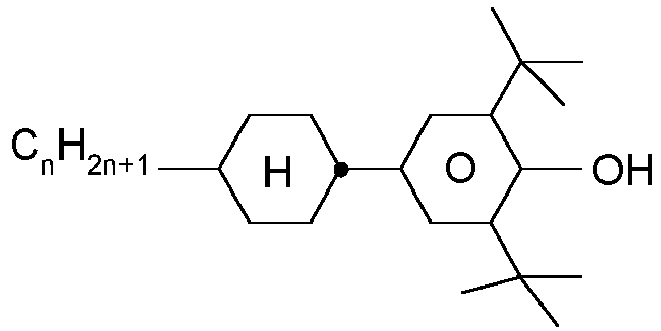
n = 1, 2, 3, 4, 5, 6 or 7 

n = 1, 2, 3, 4, 5, 6 or 7 

n = 1, 2, 3, 4, 5, 6 or 7 q = 1,2,3,4,5,6 or 7 
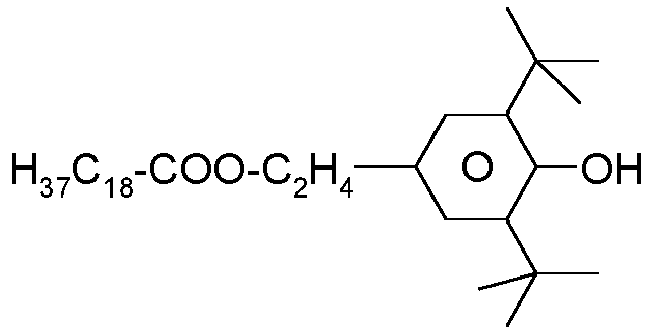
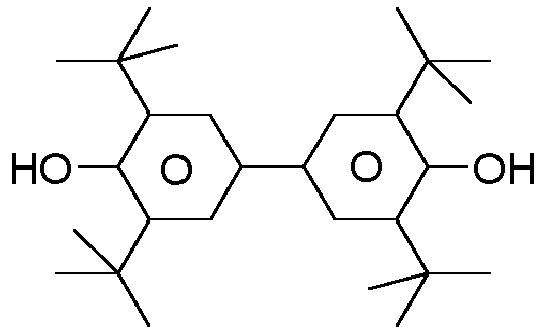

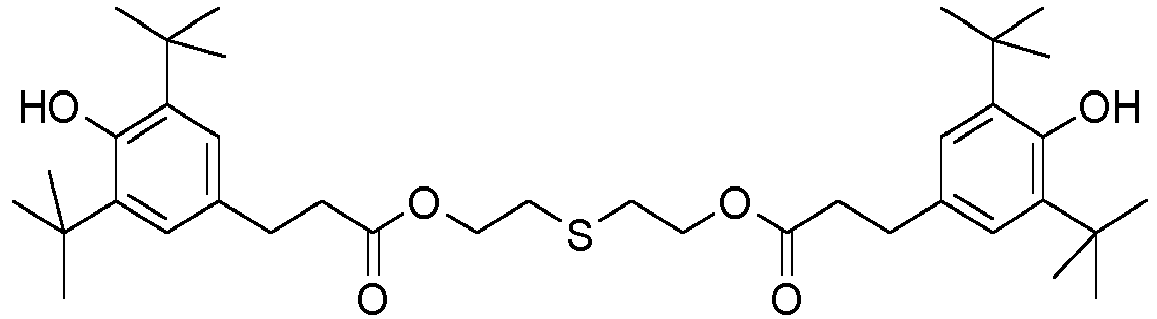


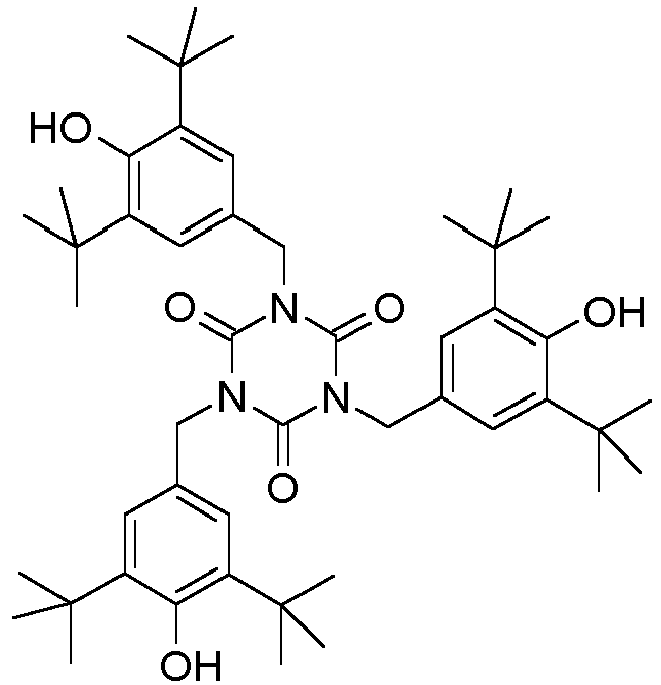
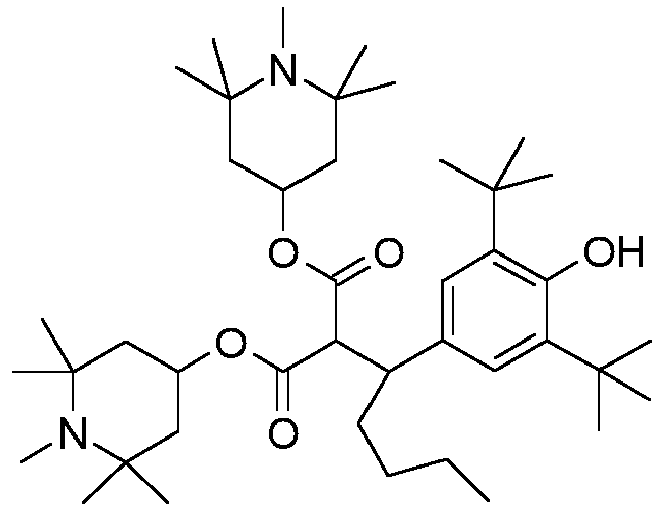


q = 1, 2, 3, 4, 5, 6, 7, 8, 9 or 10 Table E Table E shows illustrative reactive mesogenic compounds (RMs) which can be used in the LC media in accordance with the present invention. 








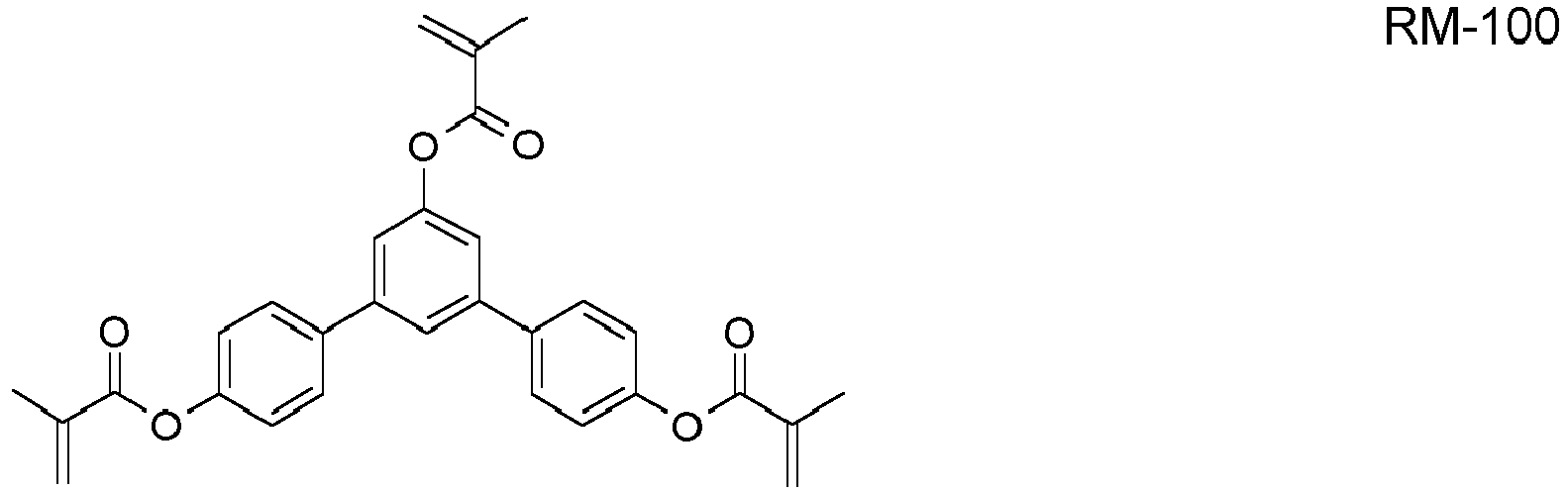


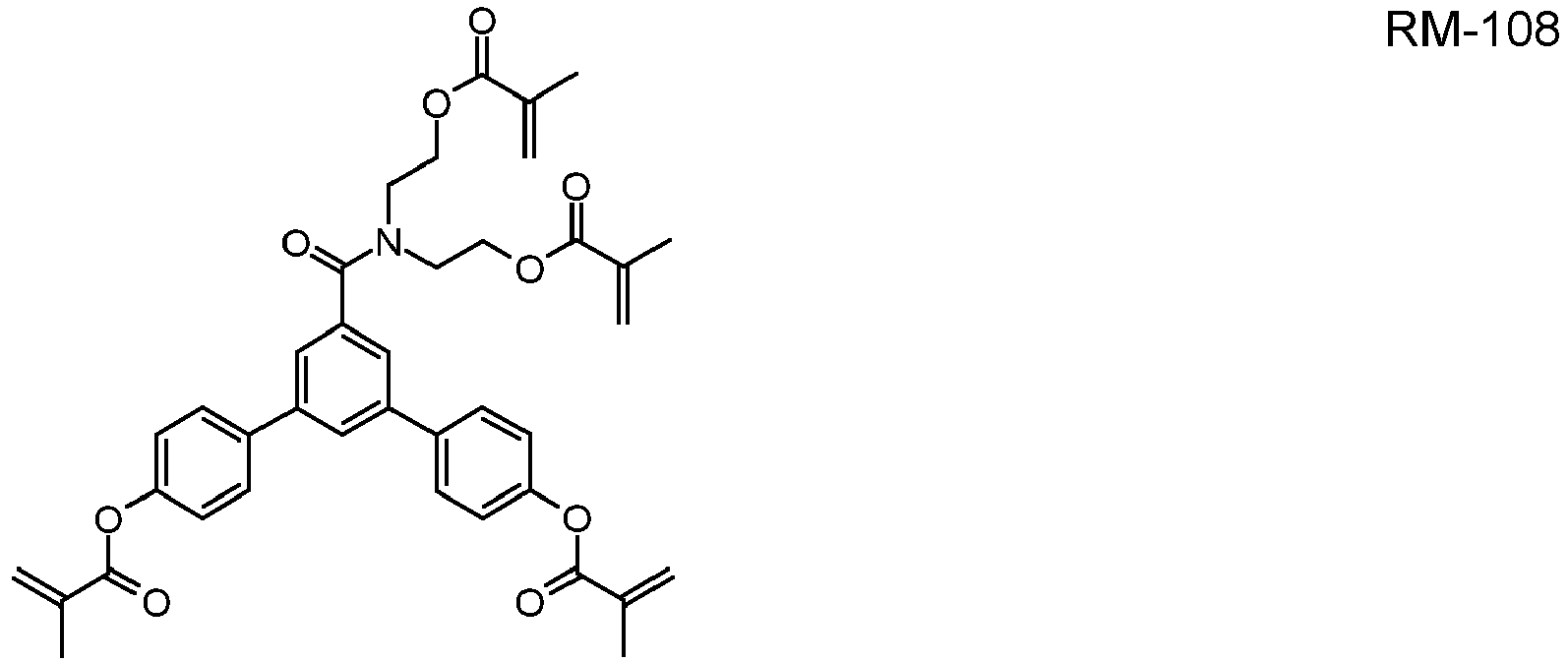


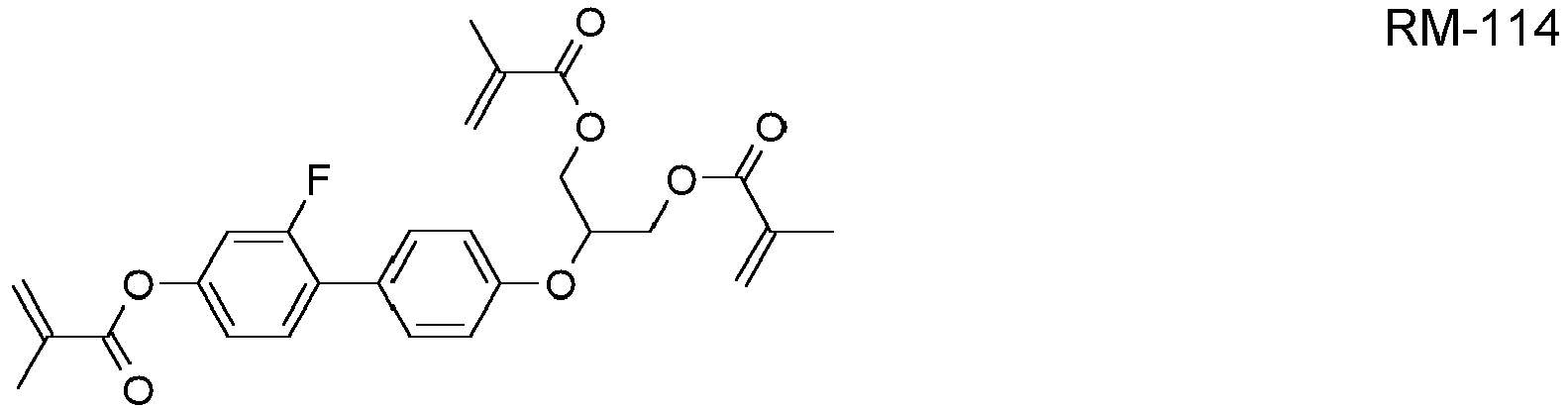


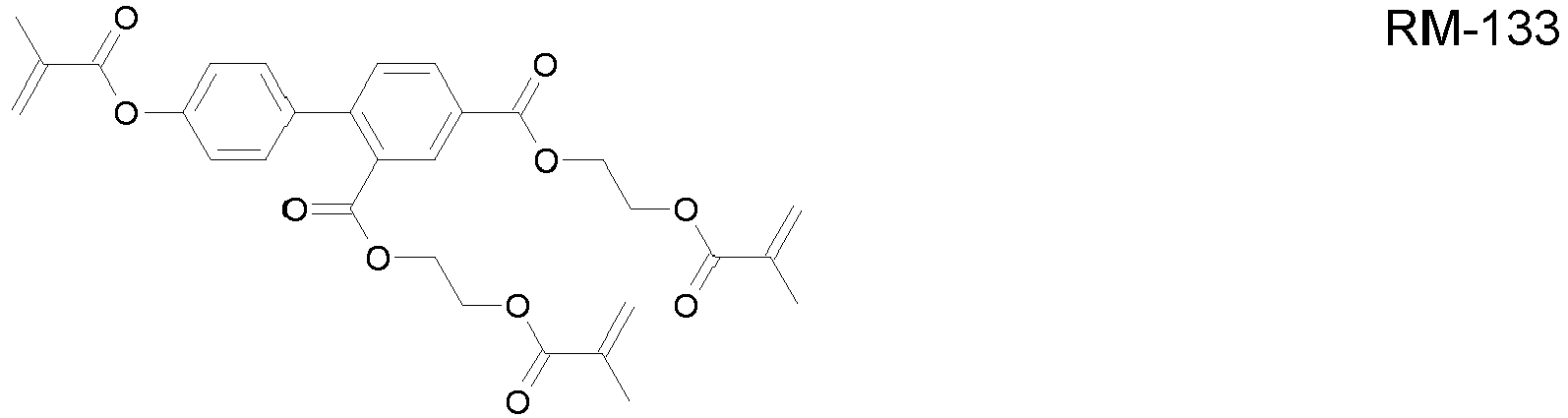


- In a preferred embodiment, the LC media according to the invention comprise one or more polymerisable compounds, preferably selected from the polymerisable compounds of the formulae RM-1 to RM-143. Of these, compounds RM-1, RM-4, RM-8, RM-17, RM-19, RM-35, RM-37, RM-39, RM-40, RM-41, RM-48, RM-52, RM-54, RM-57, RM-64, RM-74, RM-76, RM-88, RM-102, RM-103, RM-109, RM-117, RM-120, RM-121 and RM-122 are particularly preferred.
Table E Table E shows self-alignment additives for vertical alignment which can be used in LC media according to the present invention together with the polymerizable compounds of formula I: 


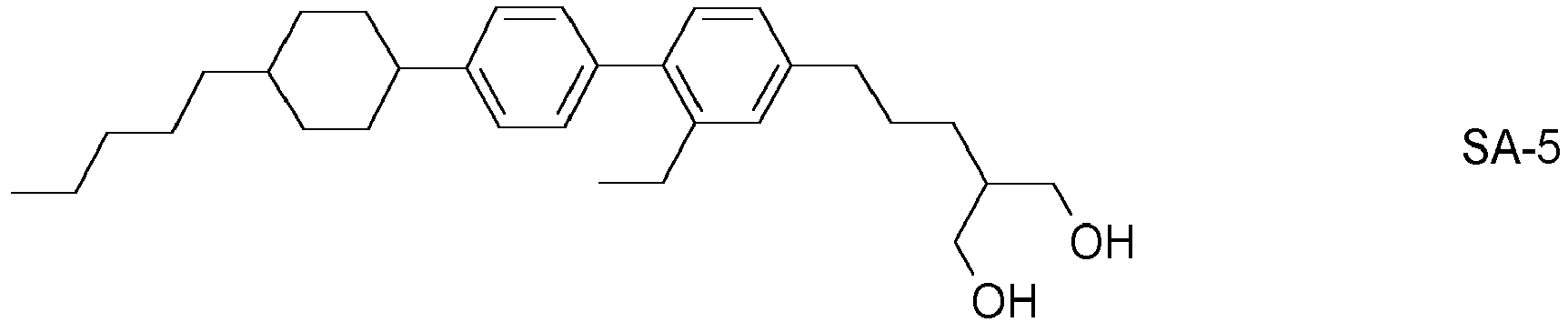


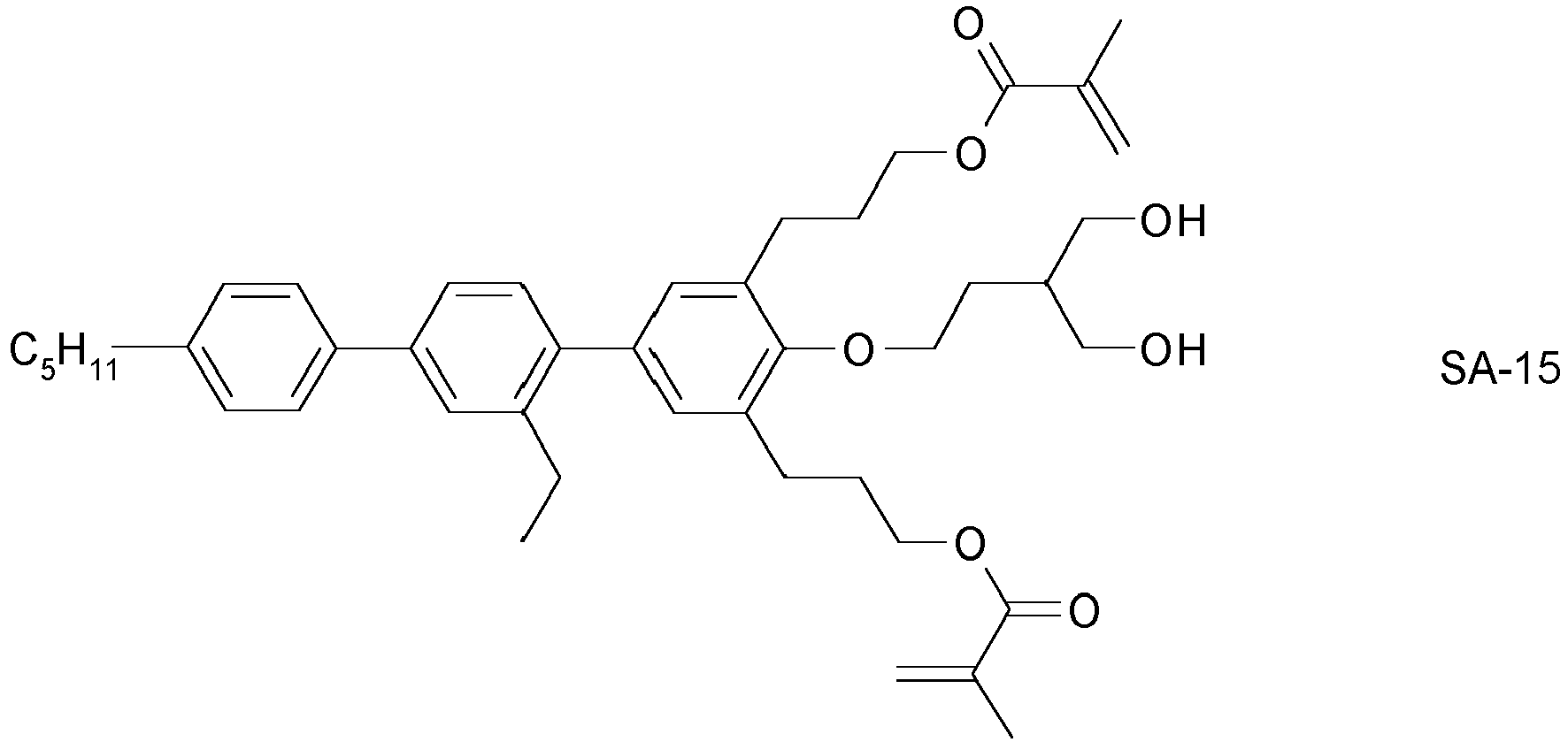


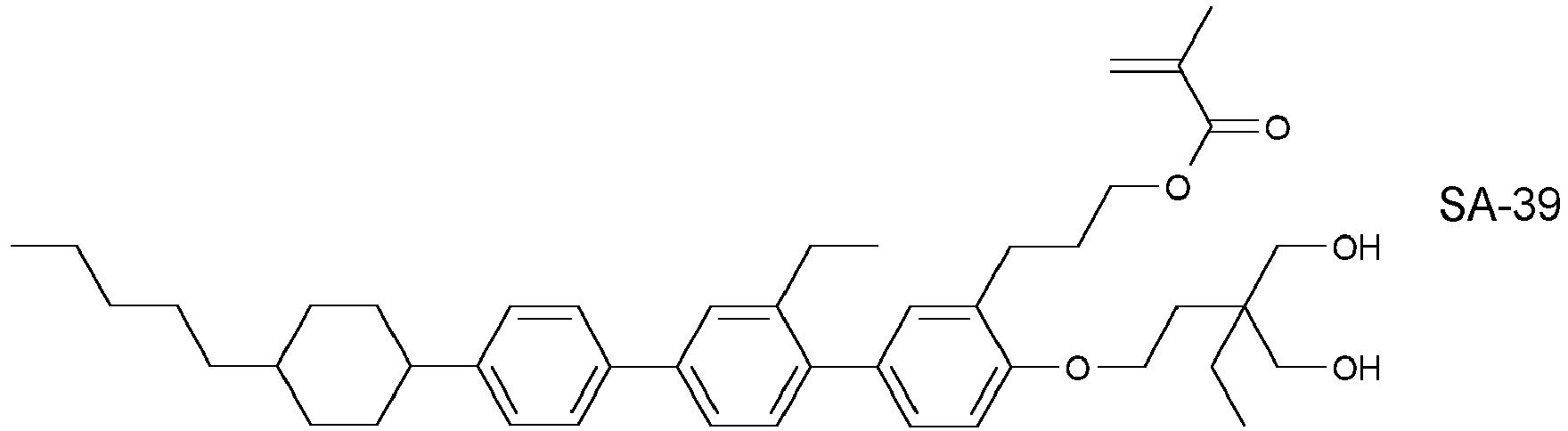


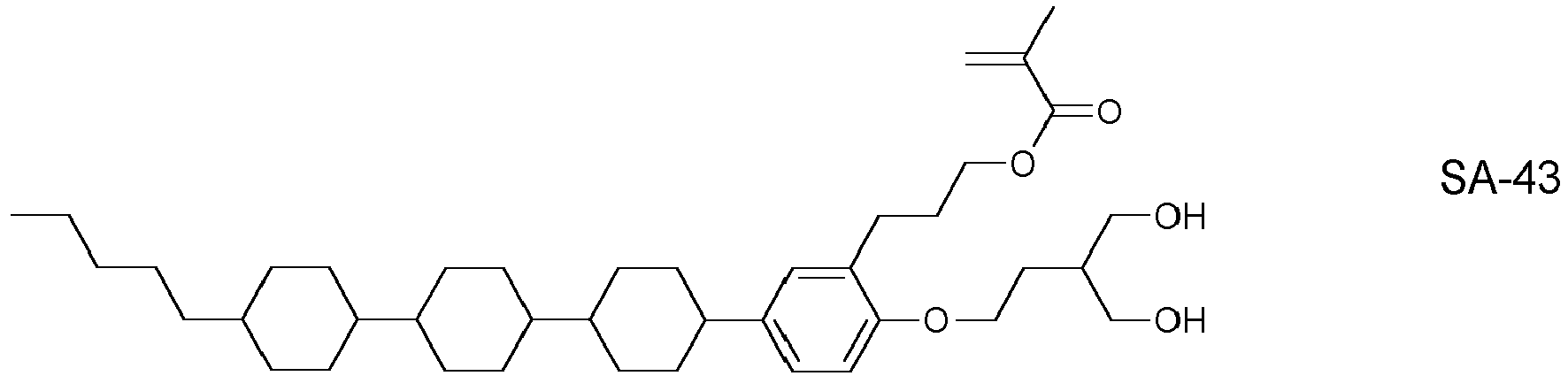


- In a preferred embodiment, the LC media and displays according to the present invention comprise one or more SA additives selected from formulae SA-1 to SA-48, preferably from formulae SA-14 to SA-48, very preferably from formulae SA-20 to SA-34 and SA-48, preferably in combination with one or more RMs of formula M.
- The following examples are intended to explain the invention without limiting it.
- Above and below, unless explicitly noted otherwise, all percentage data denote per cent by weight, and relate to the corresponding mixture as a whole, comprising all solid or liquid-crystalline components, without solvents.
- Furthermore, unless explicitly noted otherwise, all temperatures are indicated in in degrees Celsius (°C). m.p. denotes melting point, cl.p. = clearing point. Furthermore, C = crystalline state, N = nematic phase, S = smectic phase and I = isotropic phase. The data between these symbols represent the transition temperatures.
- In addition, the following abbreviations and symbols are used:
- V0
- threshold voltage, capacitive [V] at 20°C,
- ne
- extraordinary refractive index at 20°C and 589 nm,
- n0
- ordinary refractive index at 20°C and 589 nm,
- Δn
- optical anisotropy at 20°C and 589 nm,
- ε⊥
- dielectric permittivity perpendicular to the director at 20°C and 1 kHz,
- ε∥
- dielectric permittivity parallel to the director at 20°C and 1 kHz,
- Δε
- dielectric anisotropy at 20°C and 1 kHz,
- cl.p., Tni
- clearing point [°C],
- γ1
- rotational viscosity at 20°C [mPa·s],
- K1
- elastic constant, "splay" deformation at 20°C [pN],
- K2
- elastic constant, "twist" deformation at 20°C [pN],
- K3
- elastic constant, "bend" deformation at 20°C [pN].
- All physical properties are and have been determined in accordance with "Merck Liquid Crystals, Physical Properties of Liquid Crystals", Status Nov. 1997, Merck KGaA, Germany, and apply for a temperature of 20°C unless explicitly indicated otherwise in each case.
- The term "threshold voltage" for the present invention relates to the capacitive threshold (V0), also known as the Freedericks threshold, unless explicitly indicated otherwise. In the examples, the optical threshold may also, as generally usual, be quoted for 10% relative contrast (V10).
- The LC mixture C1 is formulated as follows:
CDUQU-3-F 6.0% cl.p. 110.1°C DPGU-4-F 3.0% Δn 0.1108 PGUQU-4-F 7.0% Δε +5.8 CCP-30CF3 8.0% ε∥ 8.9 CCP-40CF3 4.0% K1 17.7 CCP-50CF3 3.0% K3 18.7 CCP-V-1 18.0% K3/K1 1.06 CCP-V2-1 9.0% V0 1.84 V CLP-3-T 4.5% γ1 112 mPa·s PGP-2-2V 6.5% LTS -20°C 1000 h CC-3-V1 8.0% CCH-301 10.0% CCH-303 3.0% PCH-301 10.0% - To 99.95% of the mixture C1 are added 0.05% of the stabiliser S2-1:
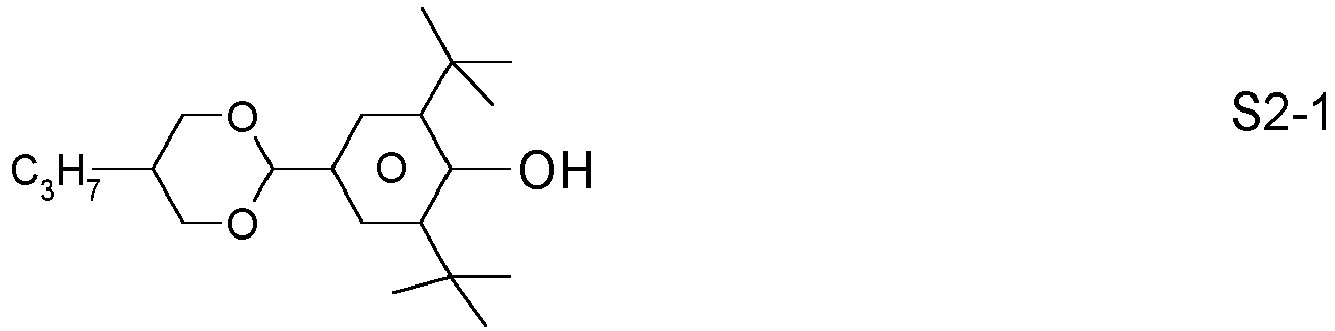
- To 99.85% of the resulting LC mixture are added 0.05% of the stabiliser S2-1 and 0.1% of the stabiliser S3-1 to give the mixture C11.

- The LC mixture N1 is formulated as follows:
CPGP-5-2 1.0% cl.p. 110.5°C CPGU-3-OT 1.5% Δn 0.1105 CCG-V-F 8.5% Δε +5.8 CCP-3-1 5.0% ε∥ 8.9 CCP-3F.F.F 10.0% K1 17.2 CCP-V-1 16.0% K3 19.7 CCP-V2-1 9.0% K3/K1 1.14 CCQU-2-F 5.0% V0 1.82 V CCQU-3-F 10.0% CDU-2-F 10.0% LTS -20°C 1000 h PGP-2-2V 5.5% CC-3-V1 10.0% PP-1-2V1 7.0% PP-1-3 1.5% - The mixture contains 1.0% of the compound CPGP-5-2 of formula I.
- To 99.9% of the mixture N1 are added 0.1% of the stabiliser S3-1 to give the mixture N11.
- The LC mixture N2 is formulated as follows:
CPGP-5-2 1.0% cl.p. 109.7°C CPGU-3-OT 2.5% Δn 0.1115 DGUQU-4-F 3.0% Δε +5.8 CCG-V-F 9.0% ε∥ 8.8 CCP-3-1 6.0% K1 17.2 CCP-2F.F.F 5.0% K3 19.4 CCP-3F.F.F 10.0% K3/K1 1.13 CCP-5F.F.F 8.0% V0 1.81 V CCP-V-1 16.0% CCP-V2-1 4.5% LTS -20°C 1000 h CCQU-3-F 10.0% PGP-2-2V 4.5% CC-3-V1 11.0% PP-1-2V1 4.5% PP-1-3 5.0% - The mixture contains 1.0% of the compound CPGP-5-2 of formula I.
- To 99.9% of the mixture N2 are added 0.1% of the stabiliser S3-1 to give the mixture N22.
- The VHR values of mixtures C11, N11 and N22 are measured at 100C, 3Hz and 1V in VHR test cell before and after light exposure using a LED lamp.
- The results are shown in Table 1.
Table 1 - VHR values before and after BL load, 3Hz/100°C C11 N11 N22 VHR/% Initial 61.5 74.9 79.6 After BL 144h 75.4 78.9 82.7 - From Table 1 it can be seen that the mixtures N11 and N22 according to the present invention, which contain a compound of formula I, show significantly higher VHR values that mixture C11, both before and after backlight stress.
- The LC mixture C2 is formulated as follows:
CPGU-3-OT 2.0% cl.p. 109.9°C DGUQU-4-F 2.5% Δn 0.1116 CCG-V-F 11.0% Δε +5.6 CCP-3-1 5.0% ε∥ 8.6 CCP-3F.F.F 10.0% K1 17.5 CCP-5F.F.F 8.0% K3 19.2 CCP-V-1 12.0% K3/K1 1.10 CCP-V2-1 6.0% V0 1.85 V CCQU-2-F 5.0% CCQU-3-F 10.0% PGP-2-2V 8.0% CC-3-2V1 2.5% CC-3-V1 11.0% PP-1-2V1 2.5% PP-1-3 4.5% - The mixture does not show satisfying LTS.
- The LC mixture N3 is formulated as follows:
CPGP-5-2 0.5% cl.p. 110.0°C CPGU-3-OT 2.0% Δn 0.1107 DGUQU-4-F 3.0% Δε +5.7 CCG-V-F 9.5% ε∥ 8.7 CCP-3-1 5.0% K1 17.6 CCP-3F.F.F 10.0% K3 19.2 CCP-5F.F.F 6.5% K3/K1 1.09 CCP-V-1 14.0% V0 CCP-V2-1 5.5% CCQU-2-F 6.0% CCQU-3-F 10.0% PGP-2-2V 6.5% CC-3-2V1 3.0% CC-3-V1 11.0% PP-1-2V1 2.5% PP-1-3 5.0% - The mixture contains 0.5% of the compound CPGP-5-2 of formula I.
- The LC mixture N4 is formulated as follows:
CPGP-5-2 1.0% cl.p. 109.4°C CPGU-3-OT 2.0% Δn 0.1109 DGUQU-4-F 3.0% Δε +5.8 CCG-V-F 10.0% ε∥ 8.7 CCP-3-1 5.0% K1 17.5 CCP-3F.F.F 10.0% K3 19.4 CCP-5F.F.F 8.0% K3/K1 1.11 CCP-V-1 12.5% V0 1.83 V CCP-V2-1 5.5% LTS -20°C 1000 h CCQU-2-F 5.0% CCQU-3-F 10.0% PGP-2-2V 6.0% CC-3-2V1 3.0% CC-3-V1 11.0% PP-1-2V1 3.0% PP-1-3 5.0% - The mixture contains 1.0% of the compound CPGP-5-2 of formula I, and shows good LTS at -20°C.
- The LC mixture N5 is formulated as follows:
CPGP-5-2 2.0% cl.p. 109.3°C CPGU-3-OT 1.5% Δn 0.1104 DGUQU-4-F 3.0% Δε +5.7 CCG-V-F 9.5% ε∥ 8.7 CCP-3-1 5.0% K1 17.5 CCP-3F.F.F 10.0% K3 19.3 CCP-5F.F.F 7.5% K3/K1 1.10 CCP-V-1 14.0% V0 1.84 V CCP-V2-1 4.0% LTS -20°C 1000 h CCQU-2-F 6.0% CCQU-3-F 10.0% PGP-2-2V 5.0% CC-3-2V1 3.0% CC-3-V1 11.0% PP-1-2V1 3.5% PP-1-3 5.0% - The mixture contains 2.0% of the compound CPGP-5-2 of formula I, and shows good LTS at -20°C.
- The LC mixture N6 is formulated as follows:
CPGP-5-2 4.0% cl.p. 109.3°C CPGU-3-OT 1.5% Δn 0.1100 DGUQU-4-F 3.0% Δε +5.7 CCG-V-F 9.5% ε∥ 8.7 CCP-3-1 5.0% K1 17.5 CCP-3F.F.F 10.0% K3 19.6 CCP-5F.F.F 8.0% K3/K1 1.12 CCP-V-1 14.0% V0 1.83 V CCP-V2-1 2.5% LTS -20°C 1000 h CCQU-2-F 6.0% LTS -30°C 1000 h CCQU-3-F 10.0% PGP-2-2V 2.5% CC-3-2V1 3.0% CC-3-V1 11.0% PP-1-2V1 5.0% PP-1-3 5.0% - The mixture contains 4.0% of the compound CPGP-5-2 of formula I, and shows good LTS at -20°C and -30°C.
- The LC mixture N7 is formulated as follows:
CPGP-5-2 6.0% cl.p. 110.0°C CPGU-3-OT 1.5% Δn 0.1094 DGUQU-4-F 2.0% Δε +5.8 CCG-V-F 10.0% ε∥ 8.8 CCP-3-1 4.5% K1 17.5 CCP-3F.F.F 10.0% K3 19.6 CCP-5F.F.F 9.5% K3/K1 1.12 CCP-V-1 6.0% V0 1.83 V CCP-V2-1 6.5% LTS -20°C 1000 h CCQU-2-F 8.0% LTS -30°C 1000 h CCQU-3-F 10.0% LTS -40°C 1000 h PGP-2-2V 1.5% CC-3-2V1 4.0% CC-3-V1 10.5% PP-1-2V1 5.0% PP-1-3 5.0% - The mixture contains 6.0% of the compound CPGP-5-2 of formula I, and shows good LTS at -20°C, -30°C and -40°C.
- The VHR values of mixtures C2, N4, N5, N6 and N7 are measured at at 60C, 60Hz/3Hz and 1V in VHR test cell before and after light exposure for varying using a LED lamp.
- The results are shown in Tables 2 and 3.
Table 2 - VHR values before and after BL load, 60Hz/60°C C2 N4 N5 N6 N7 VHR / % Initial 99.2 99.1 99.3 99.3 99.4 After BL 24h 93.8 94.0 94.1 94.3 94.5 After BL 120h 76.7 76.6 76.7 77.5 78.8 Table 3 - VHR values before and after BL load, 3Hz/60°C C2 N4 N5 N6 N7 VHR / % Initial 93.0 93.6 94.5 94.4 94.8 After BL 24h 70.7 71.0 72.3 73.6 74.8 After BL 120h 21.6 21.7 22.0 23.0 24.5 - From Tables 2 and 3 it can be seen that the mixtures N4-N7 according to the present invention, which contain a compound of formula I, show higher VHR values than mixture C2 after backlight stress.
- To 99.95% of the LC mixture of Example 7 are added 0.05% of stabiliser S1-1.

- To 99.65% of the LC mixture of Example 7 are added 0.05% of stabiliser S1-1 and 0.3% of the monomer RM-1.

- To 99.7% of the LC mixture of Example 7 are added 0.3% of the monomer RM-35.

- To 99.65% of the LC mixture of Example 7 are added 0.05% of stabiliser S2-1 and 0.3% of the monomer RM-64.

- To 99.7% of the LC mixture of Example 6 are added 0.3% of the monomer RM-120.

- To 99.699% of the LC mixture of Example 5 are added 0.3% of the monomer RM-19 and 0.001% of Irgacure 651®.

- To 99.7% of the LC mixture of Example 4 are added 0.3% of the monomer RM-121.

- To 99.7% of the LC mixture of Example 6 are added 0.3% of the monomer RM-122.
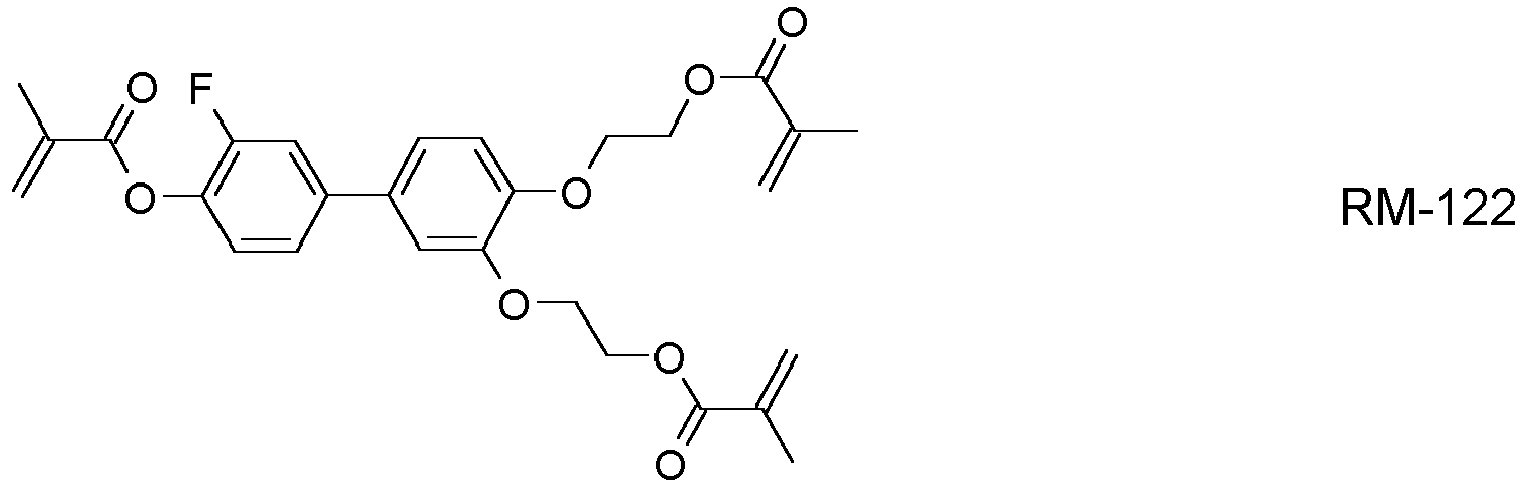
- To 99.7% of the LC mixture of Example 7 are added 0.3% of the monomer RM-91.

- To 99.98% of the LC mixture of Example 7 are added 0.02% of stabiliser S1-1.
- To 99.99% of the LC mixture of Example 7 are added 0.01 % of stabiliser S2-1.

- To 99.98% of the LC mixture of Example 3 are added 0.02% of stabiliser stabiliser S3-1.

- To 99.95% of the LC mixture of Example 6 are added 0.05% of stabiliser S3-2.
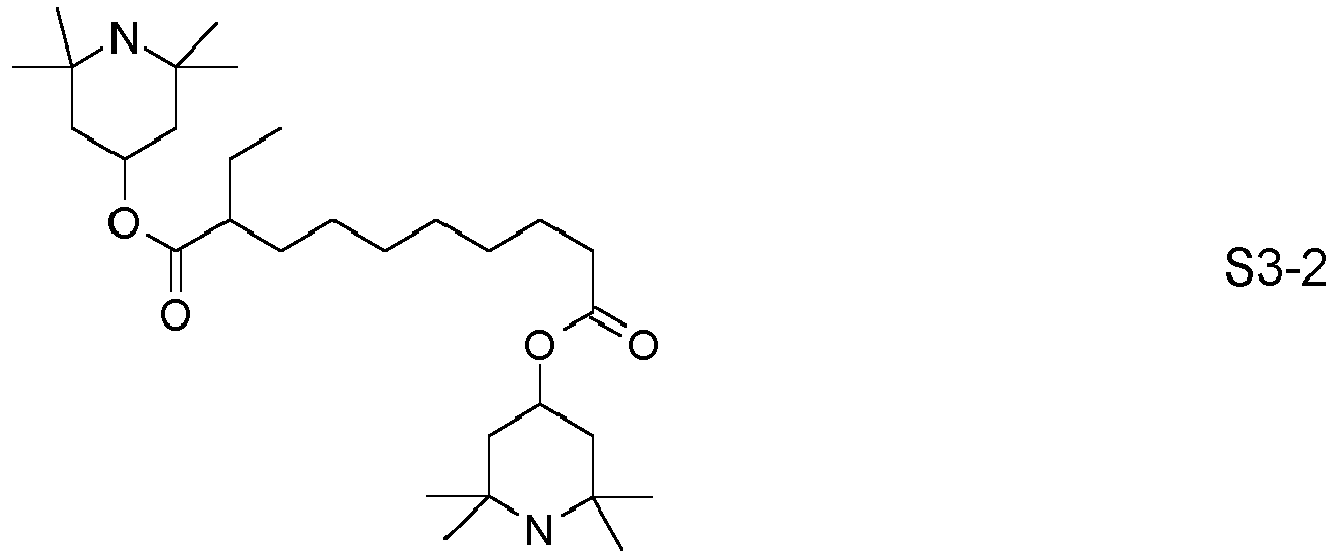
- To 99.98% of the LC mixture of Example 7 are added 0.02% of stabiliser S3-3.

- To 99.7% of the LC mixture of Example 4 are added 0.3% of the monomer RM-39.

Claims (26)
- An LC medium with positive dielectric anisotropy, characterized in that it contains one or more compounds of formula I in a concentration of >0 and ≤ 10%

- The LC medium according to Claim 1, characterized in that it has a birefringence <0.15.
- The LC medium according to Claim 1 or 2, characterized in that it comprises one or more compounds of the formula I selected from the following subformulae.


- The LC medium according to one or more of Claims 1 to 3,
characterized in that the concentration of the compounds of formula I or its subformulae in the LC medium is from 1.0 to 10%. - The LC medium according to one or more of Claims 1 to 4,
characterised in that it additionally comprises one or more compounds selected from the following formulae


 R0 an unsubstituted or halogenated alkyl or alkoxy radical having 1 to 15 C atoms, where, in addition, one or more CH2 groups in these radicals may each be replaced, independently of one another, by -C≡C-, -CF2O-, -CH=CH-,
 X0 F, Cl, CN, SF5, SCN, NCS, a halogenated alkyl radical, a halogenated alkenyl radical, a halogenated alkoxy radical or a halogenated alkenyloxy radical having up to 6 C atoms, andY0 H or CH3,Y1-6 H or F.
 - The LC medium according to one or more of Claims 1 to 5,
characterized in that it comprises one or more compounds selected from the group consisting of the following subformulae


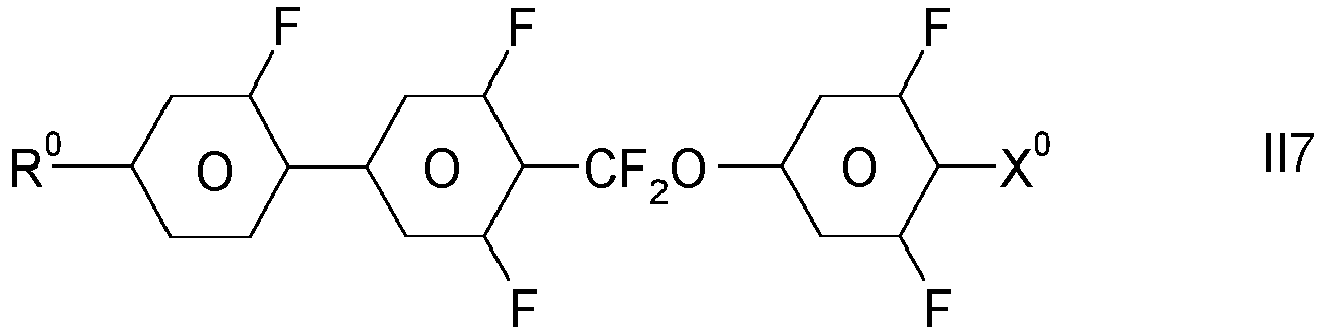
- The LC medium according to one or more of Claims 1 to 6,
characterized in that it comprises one or more compounds selected from the group consisting of the following subformulae

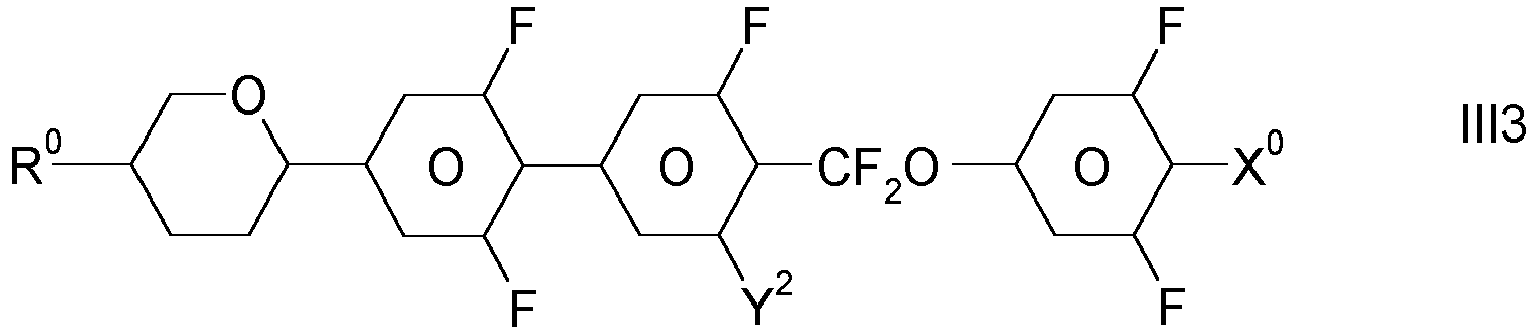


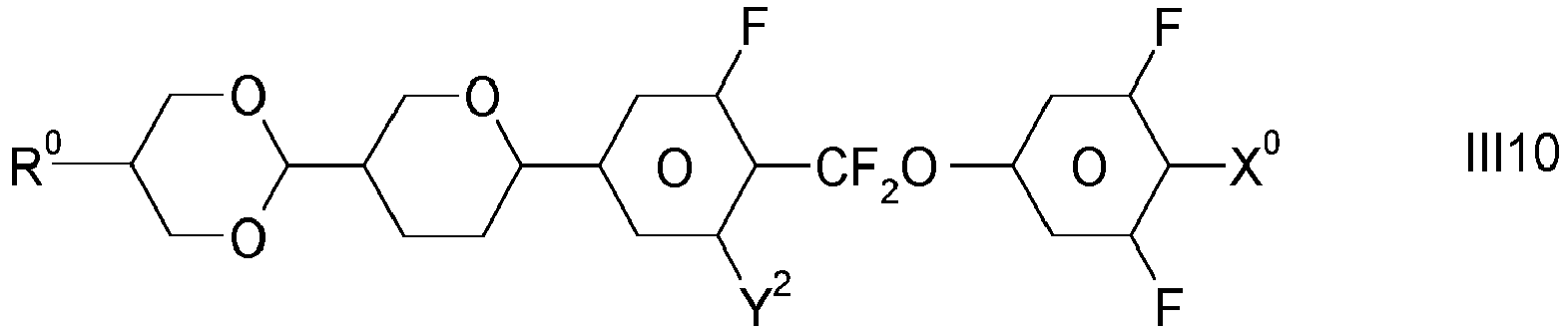


- The LC medium according to one or more of Claims 1 to 7,
characterized in that it additionally comprises one or more compounds selected from the group consisting of the following formulae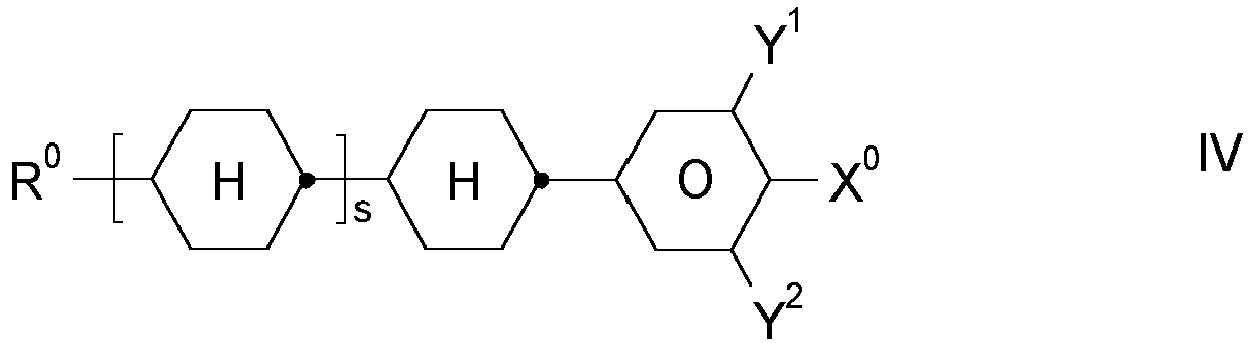


 Z0 denotes -C2H4-, -(CH2)4-, -CH=CH-, -CF=CF-, -C2F4-, -CH2CF2-,-CF2CH2-, -CH2O-, -OCH2-, -COO- or -OCF2-, in formulae V and VI also a single bond, in formulae V and VIII also -CF2O-,r denotes 0 or 1, ands denotes 0 or 1.
 - The LC medium according to one or more of Claims 1 to 8,
characterised in that it comprises one or more compounds selected from group consisting of the following formulae

- The LC medium according to one or more of Claims 1 to 9,
characterised in that it additionally comprises one or more compounds selected from the following formulae:


 "alkyl" denotes C1-6-alkyl,"alkenyl" denote C2-6-alkenyl,L denotes H or F,R" denotes C1-6-alkyl, C1-6-alkoxy or C2-6-alkenyl,Ra1, Rb1 denote independently of each other CH3 or C2H5,i, k are independently of each other 0, 1, 2 or 3,
 - The LC medium according to one or more of Claims 1 to 10,
characterised in that it comprises one or more compounds selected from the following subformulae:


- The LC medium according to one or more of Claims 1 to 10,
characterised in that it does not contain any compounds of the following formulae:


- The LC medium according to one or more of Claims 1 to 12,
characterised in that it additionally comprises one or more compounds selected from the following formulae:
- The LC medium according to one or more of Claims 1 to 13,
characterised in that it additionally comprises one or more compounds selected from the following subformulae:




- The LC medium according to one or more of Claims 1 to 14,
characterised in that it comprises one or more compounds of the formula XVI
- The LC medium according to one or more of Claims 1 to 15,
characterised in that it comprises a compound of formula XVIc2
- The LC medium according to one or more of Claims 1 to 16,
characterised in that it comprises one or more compounds of formula IA1
- The LC medium according to one or more of Claims 1 to 17,
characterised in that it comprises one or more compounds selected from the group consisting of the compounds of the following formulae
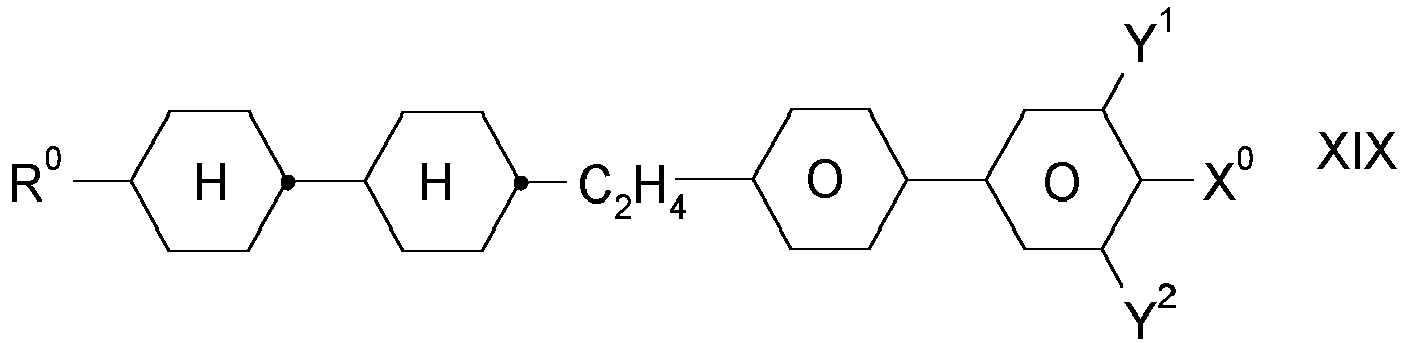


- The LC medium according to one or more of Claims 1 to 18,
characterised in that it comprises one or more compounds of the formula XXIa
- The LC medium according to one or more of Claims 1 to 19,
characterised in that it comprises one or more compounds selected from the group of the compounds of the following formulae
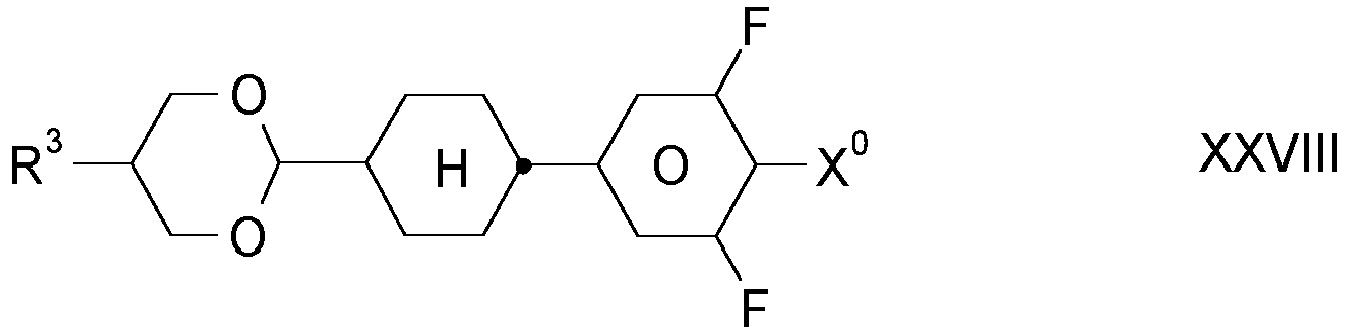

- The LC medium according to one or more of Claims 1 to 20,
characterised in that it comprises one or more compounds of the formula XXIXa
- A process for the preparation of an LC medium according to one or more of Claims 1 to 21, characterised in that one or more compounds of the formula I or its subformulae as defined in Claim 1 or 3 are mixed with one or more compounds according to one or more of Claims 4 to 21 or with further LC compounds.
- Use of an LC medium according to one or more of Claims 1 to 21 for electro-optical purposes.
- The use according to Claim 23, where the use is in shutter glasses, for 3D applications, or in IPS, PS-IPS, FFS, PS-FFS, HB-FFS, U-IPS, TN, PS-TN, STN or TN-TFT displays.
- An LC display containing an LC medium according to one or more of Claims 1 to 21.
- The LC display according to Claim 25, characterized in that it is an IPS, PS-IPS, FFS, PS-FFS, HB-FFS, U-IPS, TN, PS-TN, STN or TN-TFT display.
Applications Claiming Priority (1)
| Application Number | Priority Date | Filing Date | Title |
|---|---|---|---|
| EP19183112 | 2019-06-28 |
Publications (1)
| Publication Number | Publication Date |
|---|---|
| EP3757192A1 true EP3757192A1 (en) | 2020-12-30 |
Family
ID=67137555
Family Applications (1)
| Application Number | Title | Priority Date | Filing Date |
|---|---|---|---|
| EP20181815.0A Pending EP3757192A1 (en) | 2019-06-28 | 2020-06-24 | Liquid crystalline medium |
Country Status (5)
| Country | Link |
|---|---|
| US (1) | US11739267B2 (en) |
| EP (1) | EP3757192A1 (en) |
| JP (1) | JP7687809B2 (en) |
| KR (1) | KR20210002001A (en) |
| CN (2) | CN112143507B (en) |
Families Citing this family (2)
| Publication number | Priority date | Publication date | Assignee | Title |
|---|---|---|---|---|
| CN113214083B (en) * | 2021-04-06 | 2022-04-22 | 北京八亿时空液晶科技股份有限公司 | Self-alignment polymerizable compound and application thereof |
| KR102907636B1 (en) * | 2024-12-30 | 2026-01-05 | 주식회사 나노솔루션 | Carbon black mixtures and light shutter manufactured by using the same |
Citations (35)
| Publication number | Priority date | Publication date | Assignee | Title |
|---|---|---|---|---|
| US2240864A (en) | 1939-12-28 | 1941-05-06 | Segre Massimo | Coupling device for temporary structures |
| US2321632A (en) | 1941-05-10 | 1943-06-15 | Greenview Mfg Company | Stick handling mechanism |
| US2338281A (en) | 1942-09-08 | 1944-01-04 | Campbell John Bernard | Electrical connector |
| US2450088A (en) | 1947-04-08 | 1948-09-28 | E O Henderson & Sons | Open-front refrigerated display cabinet |
| US2637430A (en) | 1948-06-07 | 1953-05-05 | Katz Martin | Mail chute |
| US2853728A (en) | 1957-04-17 | 1958-09-30 | Nadai Alexander | Dispenser-applicator for liquid containers |
| DE2209127A1 (en) | 1972-02-26 | 1973-09-06 | Merck Patent Gmbh | MODIFIED NEMATIC PHASES |
| DE3022818A1 (en) | 1980-06-19 | 1982-01-14 | Merck Patent Gmbh, 6100 Darmstadt | LIQUID CRYSTAL DISPLAY ELEMENT |
| DE4000451A1 (en) | 1990-01-09 | 1991-07-11 | Fraunhofer Ges Forschung | ELECTROOPTICAL LIQUID CRYSTAL SWITCHING ELEMENT |
| EP0588568A2 (en) | 1992-09-18 | 1994-03-23 | Hitachi, Ltd. | A liquid crystal display device |
| JPH07181439A (en) | 1993-12-24 | 1995-07-21 | Hitachi Ltd | Active matrix liquid crystal display device |
| EP0667555A1 (en) | 1994-02-14 | 1995-08-16 | Hitachi, Ltd. | Active matrix type liquid crystal display apparatus |
| EP0673986A2 (en) | 1994-03-17 | 1995-09-27 | Hitachi, Ltd. | Active matrix type liquid crystal display apparatus |
| WO1996023851A1 (en) | 1995-02-03 | 1996-08-08 | Merck Patent Gmbh | Electro-optic liquid crystal display |
| DE19528106A1 (en) | 1995-02-03 | 1996-08-08 | Merck Patent Gmbh | In-plane-switching electro=optical LCD with short switching times |
| WO1996028521A1 (en) | 1995-03-15 | 1996-09-19 | Merck Patent Gmbh | Electro-optical liquid crystal display |
| DE19528107A1 (en) | 1995-03-17 | 1996-09-19 | Merck Patent Gmbh | In-plane-switching electro=optical LCD with short switching times |
| US20060066793A1 (en) | 2004-09-24 | 2006-03-30 | Fujitsu Display Technologies Corporation | Liquid crystal display device |
| US20120256124A1 (en) * | 2011-04-07 | 2012-10-11 | Merck Patent Gesellschaft Mit Beschrankter Haftung | Liquid-crystalline medium and liquid-crystal display |
| US20130182202A1 (en) | 2010-09-25 | 2013-07-18 | Merck Patent Gesellschaft Mit Beschrankter Haftung | Liquid crystal displays and liquid crystalline media with homeotropic alignment |
| EP2628779A2 (en) * | 2012-02-15 | 2013-08-21 | Merck Patent GmbH | Liquid-crystalline medium |
| US20130327984A1 (en) * | 2008-02-20 | 2013-12-12 | Merck Patent Gmbh | Liquid-crystalline medium |
| US20140306158A1 (en) * | 2013-04-15 | 2014-10-16 | Jnc Petrochemical Corporation | Liquid crystal composition and liquid crystal display device |
| US20150166890A1 (en) | 2013-12-16 | 2015-06-18 | Merck Patent Gmbh | Liquid-crystalline medium |
| US20150252265A1 (en) | 2014-03-10 | 2015-09-10 | Merck Patent Gmbh | Liquid-crystalline media having homeotropic alignment |
| WO2016177445A1 (en) * | 2015-05-04 | 2016-11-10 | Merck Patent Gmbh | Liquid-crystal medium |
| WO2016206774A1 (en) * | 2015-06-26 | 2016-12-29 | Merck Patent Gmbh | Liquid crystal medium containing polymerisable compounds |
| WO2016206772A1 (en) * | 2015-06-26 | 2016-12-29 | Merck Patent Gmbh | Liquid crystal medium containing polymerisable compounds |
| EP3127991A1 (en) * | 2015-08-05 | 2017-02-08 | Merck Patent GmbH | Liquid crystalline medium |
| EP3127989A1 (en) * | 2015-08-07 | 2017-02-08 | Merck Patent GmbH | Liquid crystalline medium |
| EP3246374A2 (en) * | 2016-05-19 | 2017-11-22 | Merck Patent GmbH | Liquid-crystal medium |
| WO2018001919A1 (en) * | 2016-06-28 | 2018-01-04 | Merck Patent Gmbh | Liquid crystalline medium |
| EP3275973A1 (en) * | 2015-03-24 | 2018-01-31 | JNC Corporation | Liquid crystal composition and liquid crystal display element |
| US20180223187A1 (en) * | 2015-08-05 | 2018-08-09 | Merck Patent Gmbh | Liquid crystal medium |
| EP3375842A1 (en) * | 2017-03-16 | 2018-09-19 | Merck Patent GmbH | Liquid-crystalline medium |
Family Cites Families (24)
| Publication number | Priority date | Publication date | Assignee | Title |
|---|---|---|---|---|
| JP5412721B2 (en) * | 2006-10-31 | 2014-02-12 | Jnc株式会社 | Liquid crystal composition and liquid crystal display element |
| WO2009100810A1 (en) * | 2008-02-15 | 2009-08-20 | Merck Patent Gmbh | Liquid crystalline medium and liquid crystal display |
| KR20110046481A (en) * | 2008-08-28 | 2011-05-04 | 짓쏘 가부시끼가이샤 | Liquid crystal composition and liquid crystal display element |
| DE102010006691A1 (en) * | 2009-02-06 | 2010-10-28 | Merck Patent Gmbh | Liquid-crystalline medium and liquid-crystal display |
| DE102010045370A1 (en) * | 2009-09-25 | 2011-04-14 | Merck Patent Gmbh | Components for high-frequency technology and liquid-crystalline media |
| EP2598604B1 (en) | 2010-07-29 | 2015-11-25 | Merck Patent GmbH | Liquid crystal medium containing thiophene derivatives |
| JP5360309B1 (en) * | 2012-07-03 | 2013-12-04 | Dic株式会社 | Nematic liquid crystal composition and liquid crystal display device using the same |
| TW201432032A (en) * | 2012-11-09 | 2014-08-16 | Dainippon Ink & Chemicals | Liquid crystal composition, and liquid crystal display element using same |
| WO2014155479A1 (en) * | 2013-03-25 | 2014-10-02 | Dic株式会社 | Liquid crystal composition and liquid crystal display element using same |
| EP3018186B1 (en) * | 2013-07-03 | 2019-07-24 | JNC Corporation | Liquid crystal composition, and liquid crystal display element |
| DE102013021279A1 (en) * | 2013-12-18 | 2015-06-18 | Merck Patent Gmbh | Process for cleaning a liquid crystal mixture |
| KR102352667B1 (en) | 2014-05-09 | 2022-01-19 | 메르크 파텐트 게엠베하 | Liquid-crystalline medium and high-frequency components comprising same |
| JP2017524046A (en) | 2014-07-18 | 2017-08-24 | メルク パテント ゲゼルシャフト ミット ベシュレンクテル ハフツングMerck Patent Gesellschaft mit beschraenkter Haftung | Liquid crystal medium and high frequency component including the same |
| WO2016096084A1 (en) * | 2014-12-19 | 2016-06-23 | Merck Patent Gmbh | Liquid-crystalline medium and high-frequency components comprising same |
| EP3048159B1 (en) * | 2015-01-22 | 2019-08-07 | Merck Patent GmbH | Liquid crystal medium |
| KR102312261B1 (en) * | 2015-04-30 | 2021-10-13 | 삼성디스플레이 주식회사 | Liquid crystal composition and liquid crystal display including the same |
| JP2017132847A (en) * | 2016-01-26 | 2017-08-03 | Jnc株式会社 | Liquid crystal composition and liquid crystal display element |
| EP3434750B1 (en) * | 2016-03-25 | 2020-11-18 | JNC Corporation | Liquid-crystal composition and liquid-crystal display element |
| US11299673B2 (en) * | 2016-08-12 | 2022-04-12 | Merck Patent Gmbh | Liquid-crystal medium |
| EP3299438B1 (en) * | 2016-09-23 | 2020-01-15 | Merck Patent GmbH | Liquid-crystalline medium and liquid-crystal display comprising the same |
| WO2018123184A1 (en) * | 2016-12-27 | 2018-07-05 | Jnc株式会社 | Liquid crystal composition and liquid crystal display element |
| JP7420717B2 (en) | 2017-12-06 | 2024-01-23 | メルク・パテント・ゲゼルシヤフト・ミツト・ベシユレンクテル・ハフツング | Liquid crystal media for use in switching elements |
| EP3720925B1 (en) | 2017-12-06 | 2023-02-15 | Merck Patent GmbH | Window element |
| JP2019143115A (en) * | 2018-02-22 | 2019-08-29 | Jnc株式会社 | Liquid crystal composition and liquid crystal high-frequency antenna |
-
2020
- 2020-06-24 CN CN202010587078.3A patent/CN112143507B/en active Active
- 2020-06-24 CN CN202510228673.0A patent/CN120059761A/en active Pending
- 2020-06-24 EP EP20181815.0A patent/EP3757192A1/en active Pending
- 2020-06-25 KR KR1020200077472A patent/KR20210002001A/en not_active Withdrawn
- 2020-06-26 JP JP2020110185A patent/JP7687809B2/en active Active
- 2020-06-26 US US16/913,971 patent/US11739267B2/en active Active
Patent Citations (36)
| Publication number | Priority date | Publication date | Assignee | Title |
|---|---|---|---|---|
| US2240864A (en) | 1939-12-28 | 1941-05-06 | Segre Massimo | Coupling device for temporary structures |
| US2321632A (en) | 1941-05-10 | 1943-06-15 | Greenview Mfg Company | Stick handling mechanism |
| US2338281A (en) | 1942-09-08 | 1944-01-04 | Campbell John Bernard | Electrical connector |
| US2450088A (en) | 1947-04-08 | 1948-09-28 | E O Henderson & Sons | Open-front refrigerated display cabinet |
| US2637430A (en) | 1948-06-07 | 1953-05-05 | Katz Martin | Mail chute |
| US2853728A (en) | 1957-04-17 | 1958-09-30 | Nadai Alexander | Dispenser-applicator for liquid containers |
| DE2209127A1 (en) | 1972-02-26 | 1973-09-06 | Merck Patent Gmbh | MODIFIED NEMATIC PHASES |
| DE3022818A1 (en) | 1980-06-19 | 1982-01-14 | Merck Patent Gmbh, 6100 Darmstadt | LIQUID CRYSTAL DISPLAY ELEMENT |
| DE4000451A1 (en) | 1990-01-09 | 1991-07-11 | Fraunhofer Ges Forschung | ELECTROOPTICAL LIQUID CRYSTAL SWITCHING ELEMENT |
| EP0588568A2 (en) | 1992-09-18 | 1994-03-23 | Hitachi, Ltd. | A liquid crystal display device |
| JPH07181439A (en) | 1993-12-24 | 1995-07-21 | Hitachi Ltd | Active matrix liquid crystal display device |
| EP0667555A1 (en) | 1994-02-14 | 1995-08-16 | Hitachi, Ltd. | Active matrix type liquid crystal display apparatus |
| EP0673986A2 (en) | 1994-03-17 | 1995-09-27 | Hitachi, Ltd. | Active matrix type liquid crystal display apparatus |
| WO1996023851A1 (en) | 1995-02-03 | 1996-08-08 | Merck Patent Gmbh | Electro-optic liquid crystal display |
| DE19528106A1 (en) | 1995-02-03 | 1996-08-08 | Merck Patent Gmbh | In-plane-switching electro=optical LCD with short switching times |
| WO1996028521A1 (en) | 1995-03-15 | 1996-09-19 | Merck Patent Gmbh | Electro-optical liquid crystal display |
| DE19509410A1 (en) | 1995-03-15 | 1996-09-19 | Merck Patent Gmbh | Electro-optical liquid crystal display |
| DE19528107A1 (en) | 1995-03-17 | 1996-09-19 | Merck Patent Gmbh | In-plane-switching electro=optical LCD with short switching times |
| US20060066793A1 (en) | 2004-09-24 | 2006-03-30 | Fujitsu Display Technologies Corporation | Liquid crystal display device |
| US20130327984A1 (en) * | 2008-02-20 | 2013-12-12 | Merck Patent Gmbh | Liquid-crystalline medium |
| US20130182202A1 (en) | 2010-09-25 | 2013-07-18 | Merck Patent Gesellschaft Mit Beschrankter Haftung | Liquid crystal displays and liquid crystalline media with homeotropic alignment |
| US20120256124A1 (en) * | 2011-04-07 | 2012-10-11 | Merck Patent Gesellschaft Mit Beschrankter Haftung | Liquid-crystalline medium and liquid-crystal display |
| EP2628779A2 (en) * | 2012-02-15 | 2013-08-21 | Merck Patent GmbH | Liquid-crystalline medium |
| US20140306158A1 (en) * | 2013-04-15 | 2014-10-16 | Jnc Petrochemical Corporation | Liquid crystal composition and liquid crystal display device |
| US20150166890A1 (en) | 2013-12-16 | 2015-06-18 | Merck Patent Gmbh | Liquid-crystalline medium |
| US20150252265A1 (en) | 2014-03-10 | 2015-09-10 | Merck Patent Gmbh | Liquid-crystalline media having homeotropic alignment |
| EP3275973A1 (en) * | 2015-03-24 | 2018-01-31 | JNC Corporation | Liquid crystal composition and liquid crystal display element |
| WO2016177445A1 (en) * | 2015-05-04 | 2016-11-10 | Merck Patent Gmbh | Liquid-crystal medium |
| WO2016206774A1 (en) * | 2015-06-26 | 2016-12-29 | Merck Patent Gmbh | Liquid crystal medium containing polymerisable compounds |
| WO2016206772A1 (en) * | 2015-06-26 | 2016-12-29 | Merck Patent Gmbh | Liquid crystal medium containing polymerisable compounds |
| EP3127991A1 (en) * | 2015-08-05 | 2017-02-08 | Merck Patent GmbH | Liquid crystalline medium |
| US20180223187A1 (en) * | 2015-08-05 | 2018-08-09 | Merck Patent Gmbh | Liquid crystal medium |
| EP3127989A1 (en) * | 2015-08-07 | 2017-02-08 | Merck Patent GmbH | Liquid crystalline medium |
| EP3246374A2 (en) * | 2016-05-19 | 2017-11-22 | Merck Patent GmbH | Liquid-crystal medium |
| WO2018001919A1 (en) * | 2016-06-28 | 2018-01-04 | Merck Patent Gmbh | Liquid crystalline medium |
| EP3375842A1 (en) * | 2017-03-16 | 2018-09-19 | Merck Patent GmbH | Liquid-crystalline medium |
Non-Patent Citations (6)
| Title |
|---|
| "Merck Liquid Crystals, Physical Properties of Liquid Crystals", November 1997, MERCK KGAA |
| C.H. GOOCHH.A. TARRY, APPL. PHYS., vol. 8, 1975, pages 1575 - 1584 |
| C.H. GOOCHH.A. TARRY, ELECTRON. LETT., vol. 10, 1974, pages 2 - 4 |
| HALLER ET AL., MOL. CRYST. LIQ. CRYST., vol. 24, 1973, pages 249 - 258 |
| K. NIWA ET AL., PROC. SID CONFERENCE, June 1984 (1984-06-01), pages 304 |
| S. MATSUMOTO ET AL., LIQUID CRYSTALS, vol. 5, 1989, pages 1381 |
Also Published As
| Publication number | Publication date |
|---|---|
| JP2021008607A (en) | 2021-01-28 |
| JP7687809B2 (en) | 2025-06-03 |
| US11739267B2 (en) | 2023-08-29 |
| US20200407640A1 (en) | 2020-12-31 |
| CN120059761A (en) | 2025-05-30 |
| CN112143507A (en) | 2020-12-29 |
| KR20210002001A (en) | 2021-01-06 |
| CN112143507B (en) | 2025-03-18 |
Similar Documents
| Publication | Publication Date | Title |
|---|---|---|
| KR102803501B1 (en) | Liquid-crystal medium | |
| EP4428213B1 (en) | Liquid-crystalline medium | |
| EP4022009B1 (en) | Lc medium | |
| EP3870671B1 (en) | Liquid-crystalline medium | |
| EP3985085A2 (en) | Liquid-crystal medium | |
| EP4508163A1 (en) | Liquid-crystalline medium | |
| EP4516879A1 (en) | Liquid-crystalline medium | |
| EP4249570B1 (en) | Liquid-crystalline medium | |
| JP7687809B2 (en) | liquid crystal medium | |
| EP4508161A1 (en) | Liquid-crystalline medium | |
| EP4306614A1 (en) | Liquid-crystalline medium | |
| EP4508162A1 (en) | Liquid-crystalline medium | |
| WO2024126567A1 (en) | Liquid-crystalline medium | |
| WO2024132893A1 (en) | Liquid-crystalline medium | |
| WO2024175518A1 (en) | Liquid-crystalline medium |
Legal Events
| Date | Code | Title | Description |
|---|---|---|---|
| PUAI | Public reference made under article 153(3) epc to a published international application that has entered the european phase |
Free format text: ORIGINAL CODE: 0009012 |
|
| STAA | Information on the status of an ep patent application or granted ep patent |
Free format text: STATUS: REQUEST FOR EXAMINATION WAS MADE |
|
| 17P | Request for examination filed |
Effective date: 20200624 |
|
| AK | Designated contracting states |
Kind code of ref document: A1 Designated state(s): AL AT BE BG CH CY CZ DE DK EE ES FI FR GB GR HR HU IE IS IT LI LT LU LV MC MK MT NL NO PL PT RO RS SE SI SK SM TR |
|
| AX | Request for extension of the european patent |
Extension state: BA ME |
|
| RIN1 | Information on inventor provided before grant (corrected) |
Inventor name: CHOI, CHANG-SUK Inventor name: KIM, DONG-HYUN Inventor name: JIN, HEUI-SEOK Inventor name: HAN, YEON-JEONG |
|
| STAA | Information on the status of an ep patent application or granted ep patent |
Free format text: STATUS: EXAMINATION IS IN PROGRESS |
|
| 17Q | First examination report despatched |
Effective date: 20230214 |
|
| P01 | Opt-out of the competence of the unified patent court (upc) registered |
Effective date: 20230519 |