EP3757028B1 - Folienverpackungsmaterial zur herstellung versiegelter verpackungen für flüssige lebensmittelprodukte; dichte verpackung - Google Patents
Folienverpackungsmaterial zur herstellung versiegelter verpackungen für flüssige lebensmittelprodukte; dichte verpackung Download PDFInfo
- Publication number
- EP3757028B1 EP3757028B1 EP20182072.7A EP20182072A EP3757028B1 EP 3757028 B1 EP3757028 B1 EP 3757028B1 EP 20182072 A EP20182072 A EP 20182072A EP 3757028 B1 EP3757028 B1 EP 3757028B1
- Authority
- EP
- European Patent Office
- Prior art keywords
- crease
- pair
- packaging material
- sections
- sheet packaging
- Prior art date
- Legal status (The legal status is an assumption and is not a legal conclusion. Google has not performed a legal analysis and makes no representation as to the accuracy of the status listed.)
- Active
Links
Images


Classifications
-
- B—PERFORMING OPERATIONS; TRANSPORTING
- B65—CONVEYING; PACKING; STORING; HANDLING THIN OR FILAMENTARY MATERIAL
- B65D—CONTAINERS FOR STORAGE OR TRANSPORT OF ARTICLES OR MATERIALS, e.g. BAGS, BARRELS, BOTTLES, BOXES, CANS, CARTONS, CRATES, DRUMS, JARS, TANKS, HOPPERS, FORWARDING CONTAINERS; ACCESSORIES, CLOSURES, OR FITTINGS THEREFOR; PACKAGING ELEMENTS; PACKAGES
- B65D5/00—Rigid or semi-rigid containers of polygonal cross-section, e.g. boxes, cartons or trays, formed by folding or erecting one or more blanks made of paper
- B65D5/02—Rigid or semi-rigid containers of polygonal cross-section, e.g. boxes, cartons or trays, formed by folding or erecting one or more blanks made of paper by folding or erecting a single blank to form a tubular body with or without subsequent folding operations, or the addition of separate elements, to close the ends of the body
- B65D5/06—Rigid or semi-rigid containers of polygonal cross-section, e.g. boxes, cartons or trays, formed by folding or erecting one or more blanks made of paper by folding or erecting a single blank to form a tubular body with or without subsequent folding operations, or the addition of separate elements, to close the ends of the body with end-closing or contents-supporting elements formed by folding inwardly a wall extending from, and continuously around, an end of the tubular body
-
- B—PERFORMING OPERATIONS; TRANSPORTING
- B65—CONVEYING; PACKING; STORING; HANDLING THIN OR FILAMENTARY MATERIAL
- B65D—CONTAINERS FOR STORAGE OR TRANSPORT OF ARTICLES OR MATERIALS, e.g. BAGS, BARRELS, BOTTLES, BOXES, CANS, CARTONS, CRATES, DRUMS, JARS, TANKS, HOPPERS, FORWARDING CONTAINERS; ACCESSORIES, CLOSURES, OR FITTINGS THEREFOR; PACKAGING ELEMENTS; PACKAGES
- B65D5/00—Rigid or semi-rigid containers of polygonal cross-section, e.g. boxes, cartons or trays, formed by folding or erecting one or more blanks made of paper
- B65D5/02—Rigid or semi-rigid containers of polygonal cross-section, e.g. boxes, cartons or trays, formed by folding or erecting one or more blanks made of paper by folding or erecting a single blank to form a tubular body with or without subsequent folding operations, or the addition of separate elements, to close the ends of the body
- B65D5/06—Rigid or semi-rigid containers of polygonal cross-section, e.g. boxes, cartons or trays, formed by folding or erecting one or more blanks made of paper by folding or erecting a single blank to form a tubular body with or without subsequent folding operations, or the addition of separate elements, to close the ends of the body with end-closing or contents-supporting elements formed by folding inwardly a wall extending from, and continuously around, an end of the tubular body
- B65D5/064—Rectangular containers having a body with gusset-flaps folded outwardly or adhered to the side or the top of the container
-
- B—PERFORMING OPERATIONS; TRANSPORTING
- B65—CONVEYING; PACKING; STORING; HANDLING THIN OR FILAMENTARY MATERIAL
- B65D—CONTAINERS FOR STORAGE OR TRANSPORT OF ARTICLES OR MATERIALS, e.g. BAGS, BARRELS, BOTTLES, BOXES, CANS, CARTONS, CRATES, DRUMS, JARS, TANKS, HOPPERS, FORWARDING CONTAINERS; ACCESSORIES, CLOSURES, OR FITTINGS THEREFOR; PACKAGING ELEMENTS; PACKAGES
- B65D5/00—Rigid or semi-rigid containers of polygonal cross-section, e.g. boxes, cartons or trays, formed by folding or erecting one or more blanks made of paper
- B65D5/02—Rigid or semi-rigid containers of polygonal cross-section, e.g. boxes, cartons or trays, formed by folding or erecting one or more blanks made of paper by folding or erecting a single blank to form a tubular body with or without subsequent folding operations, or the addition of separate elements, to close the ends of the body
- B65D5/029—Rigid or semi-rigid containers of polygonal cross-section, e.g. boxes, cartons or trays, formed by folding or erecting one or more blanks made of paper by folding or erecting a single blank to form a tubular body with or without subsequent folding operations, or the addition of separate elements, to close the ends of the body the tubular body presenting a special shape
-
- B—PERFORMING OPERATIONS; TRANSPORTING
- B65—CONVEYING; PACKING; STORING; HANDLING THIN OR FILAMENTARY MATERIAL
- B65D—CONTAINERS FOR STORAGE OR TRANSPORT OF ARTICLES OR MATERIALS, e.g. BAGS, BARRELS, BOTTLES, BOXES, CANS, CARTONS, CRATES, DRUMS, JARS, TANKS, HOPPERS, FORWARDING CONTAINERS; ACCESSORIES, CLOSURES, OR FITTINGS THEREFOR; PACKAGING ELEMENTS; PACKAGES
- B65D5/00—Rigid or semi-rigid containers of polygonal cross-section, e.g. boxes, cartons or trays, formed by folding or erecting one or more blanks made of paper
- B65D5/42—Details of containers or of foldable or erectable container blanks
- B65D5/4266—Folding lines, score lines, crease lines
-
- B—PERFORMING OPERATIONS; TRANSPORTING
- B65—CONVEYING; PACKING; STORING; HANDLING THIN OR FILAMENTARY MATERIAL
- B65D—CONTAINERS FOR STORAGE OR TRANSPORT OF ARTICLES OR MATERIALS, e.g. BAGS, BARRELS, BOTTLES, BOXES, CANS, CARTONS, CRATES, DRUMS, JARS, TANKS, HOPPERS, FORWARDING CONTAINERS; ACCESSORIES, CLOSURES, OR FITTINGS THEREFOR; PACKAGING ELEMENTS; PACKAGES
- B65D5/00—Rigid or semi-rigid containers of polygonal cross-section, e.g. boxes, cartons or trays, formed by folding or erecting one or more blanks made of paper
- B65D5/42—Details of containers or of foldable or erectable container blanks
- B65D5/54—Lines of weakness to facilitate opening of container or dividing it into separate parts by cutting or tearing
- B65D5/5405—Lines of weakness to facilitate opening of container or dividing it into separate parts by cutting or tearing for opening containers formed by erecting a blank in tubular form
-
- B—PERFORMING OPERATIONS; TRANSPORTING
- B65—CONVEYING; PACKING; STORING; HANDLING THIN OR FILAMENTARY MATERIAL
- B65D—CONTAINERS FOR STORAGE OR TRANSPORT OF ARTICLES OR MATERIALS, e.g. BAGS, BARRELS, BOTTLES, BOXES, CANS, CARTONS, CRATES, DRUMS, JARS, TANKS, HOPPERS, FORWARDING CONTAINERS; ACCESSORIES, CLOSURES, OR FITTINGS THEREFOR; PACKAGING ELEMENTS; PACKAGES
- B65D85/00—Containers, packaging elements or packages, specially adapted for particular articles or materials
- B65D85/70—Containers, packaging elements or packages, specially adapted for particular articles or materials for materials not otherwise provided for
- B65D85/72—Containers, packaging elements or packages, specially adapted for particular articles or materials for materials not otherwise provided for for edible or potable liquids, semiliquids, or plastic or pasty materials
Definitions
- the invention relates to a sheet packaging material for producing a sealed package containing a liquid food product. It also relates to a sealed package made of the sheet packaging material and containing a liquid food product.
- liquid food products such as fruit juice, pasteurized milk, UHT (ultra-high-temperature treated) milk, yoghurt and other fermented dairy products, wine, tomato sauce, soups etc. are sold in different types of packages, some of which are made of a packaging material that has been sterilized.
- a typical package example is the package for liquid or pourable food products known as Tetra Brik Aseptic (registered trademark), which is made by folding, sealing and cutting a web of laminated packaging material.
- the packaging material has a multilayer structure comprising a base layer, e.g. of paper, covered on both sides with layers of heat-seal plastic material, e.g. polyethylene.
- the packaging material also comprises a layer of oxygen-barrier material, e.g. an aluminum foil, which is superimposed on a layer of heat-seal plastic material, and is in turn covered with another layer of heat-seal plastic material forming the inner face of the package eventually contacting the food product.
- Packages of this sort are normally produced by fully automatic packaging machines in which a continuous tube is formed from the web-fed packaging material; the web of packaging material is often sterilized on the packaging machine, e.g. by applying a chemical sterilizing agent, such as a hydrogen peroxide solution, which, once sterilization is completed, is removed from the surfaces of the packaging material, e.g. evaporated by heating.
- a chemical sterilizing agent such as a hydrogen peroxide solution
- the tube is filled with the liquid food product, which may be sterilized as applicable, and is sealed and subsequently cut along equally spaced cross sections; pillow packs are so obtained, which are then folded mechanically to form respective finished packages at a final folder.
- the liquid food product which may be sterilized as applicable, and is sealed and subsequently cut along equally spaced cross sections; pillow packs are so obtained, which are then folded mechanically to form respective finished packages at a final folder.
- crease lines i.e. weakening lines
- the crease lines define folding lines along which the pillow packs are folded to obtain the desired final configuration.
- the packaging material may be cut into blanks, which are formed into packages on forming spindles. The resulting packages are then filled with the food product and sealed.
- This type of package is the so-called "gable-top” package known by the trade name Tetra Rex (registered trademark).
- the removable portion is formed on the packaging material prior to folding and sealing the packaging material to form the finished package.
- the removable portion may comprise a so-called "prelaminated” hole, i.e. a circular hole formed through the base layer only of the packaging material and covered, when the material is laminated, with the layers of heat-seal plastic material and barrier material, which adhere to one another at the hole.
- prelaminated hole i.e. a circular hole formed through the base layer only of the packaging material and covered, when the material is laminated, with the layers of heat-seal plastic material and barrier material, which adhere to one another at the hole.
- Each package of the above type is obtained from a basic unit of packaging material having given crease lines.
- the above-mentioned basic unit represents the exact length of the packaging material used to produce one single package.
- the original web includes a plurality of basic units joined to each other; in the case of packages made on forming spindles, the basic unit is defined by the blank cut from the web prior to starting the forming and sealing operations.
- the basic unit typically has a rectangular or square configuration with two boundary edges parallel to a longitudinal direction and two other boundary edges parallel to a transversal direction orthogonal to the longitudinal direction.
- the longitudinal direction becomes the direction along which the total height of the package itself is defined; the longitudinal direction also represents the main direction of extension of the web from which the basic unit is obtained.
- the basic unit usually includes at least two transversal crease lines extending transversally to the longitudinal direction and dividing the basic unit itself into: a bottom region containing a bottom crease pattern and configured to form a bottom portion of the finished package; a top region containing a top crease pattern and configured to form a top portion of the finished package; and an intermediate region contained between the transversal crease lines, interposed between the bottom region and the top region and usually having a plurality of longitudinal crease lines designed to form lateral edges of a plurality of side walls of the finished package.
- the intermediate region of the basic unit may instead form the top, the bottom and two opposite sides of the package, while the bottom and top region of the basic unit form the two remaining, opposite sides of the package.
- the bottom portion of the finished package normally includes a flat and horizontal bottom panel defining the resting surface of the package itself.
- the top portion of the finished package may include a flat and horizontal top panel, parallel to the bottom panel.
- slanted top panels are conveniently used in combination with opening devices because they are wider than corresponding flat top panels of parallelepiped or prismatic packages and therefore allow the application of larger opening devices, e.g. provided with screw caps or the like.
- Other opening devices and principles then those mentioned are often used.
- a sheet packaging material according to claim 1 and a package according to claim 11 are provided.
- the sheet packing material and package are advantageous in that they offer a package that has a shape which resembles a cup having a base that is narrower than its top, i.e. the area of the bottom of the package is smaller than the area of the top of the package. This provides for making it easier to empty the product from the package, in particular when spooning the product out from the package.
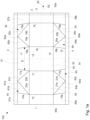
- the sheet packaging material 100 correspond to a "basic unit" as desired above. It is made of a web of laminated packaging material that has a multilayer structure comprising a base layer, e.g. of paper, covered on both sides with layers of heat-seal plastic material, e.g. polyethylene. It may have a layer of oxygen-barrier material, e.g. an aluminium foil, which is superimposed on a layer of heat-seal plastic material, and is in turn covered with another layer of heat-seal plastic material forming the inner face of the package eventually contacting the food product.
- a base layer e.g. of paper
- heat-seal plastic material e.g. polyethylene
- It may have a layer of oxygen-barrier material, e.g. an aluminium foil, which is superimposed on a layer of heat-seal plastic material, and is in turn covered with another layer of heat-seal plastic material forming the inner face of the package eventually contacting the food product.
- crease lines i.e. weakening lines
- the folding of the sheet packaging material 100 to form the package 101 is done along these crease lines.
- the manufacturing of the web of laminated packaging material that the sheet packaging material 100 is made of is per se accomplished according to suitable and commonly available techniques. Also, any suitable and commonly available techniques may be used for creating the crease lines on the sheet packaging material 100.
- Known techniques may also be used for folding the sheet packaging material 100 into the sealed package 101, for filling liquid food product and for performing the final sealing that forms the sealed package 101 containing the product.
- the invention herein concerns in particular the specific configuration of the crease lines and thus the final shape of the sealed package 101.
- the sheet packaging material 100 has four edges.
- the first edge 1 and the second edge 2 are two opposite and parallel edges.
- the third edge 3 and the fourth edge 4 are two opposite and parallel edges.
- the third and fourth edges 3, 4 join the first and second edges 1, 2, which thereby gives the sheet packaging material 100 a rectangular shape.
- a first crease line 11 and a second crease line 12 extend in parallel between the first and second edges 1, 2, i.e. from the first edge 1 to the second edge 2.
- a third crease line 13 and a fourth crease line 14 extend in parallel between the first and second edges 1, 2 and intermediate the first and second crease lines 11, 12. The third crease line 13 and a fourth crease line 14 are thus closer to a center of the sheet packaging material 100 than the first crease line 11 and the second crease line 12.
- a fifth crease line 15 and a sixth crease line 16 extend between the first and second crease lines 11, 12.
- a seventh crease line 17 and an eight crease line 18 extend between the first and second crease lines 11, 12 and intermediate the fifth and sixth crease lines 15, 16. The seventh crease line 17 and a eight crease line 18 are thus closer to the center of the sheet packaging material 100 than the fifth crease line 15 and the sixth crease line 16.
- the crease lines 11-18 divide the sheet packaging material 100 into seven portions: a central portion 50, a first side portion 51, a second side portion 52, a third side portion 53, a fourth side portion 54 and two end portions 55a, 55b.
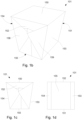
- the central portion 50 has a rectangular shape and forms a top panel 150 of the sealed package 101, see Fig. 1b .
- the first side portion 51 and a second side portion 52 are adjacent the central portion 51 and opposite each other, and form a first side panel 151 and a second side panel 152 of the sealed package 101.
- the third side portion 53 and the fourth side portion 54 are adjacent the central portion 51 and opposite each other and form a third side panel 153 and a fourth side panel 154 of the sealed package 101.
- the two end portions 55a, 55b are adjacent two of the side portions 53, 54, more specifically and in the illustrated embodiment adjacent the third side portion 53 and the fourth side portion 54.
- the end portions 55a, 55b are arranged to, when the sheet packaging material 100 is folded into the sealed package 101, be joined to each other to form a bottom panel 155 of the sealed package 101.
- the end portions 55a, 55b overlap at the line indicated by reference numeral 6.
- the seventh and eight crease lines 17, 18 has a first pair of crease sections 17a, 18a that define two opposite sides of the first side portion 51.
- the first pair of crease sections 17a, 18a are angled towards each other such that the first side portion 51 has a trapezoidal shape.
- the seventh and eight crease lines 17, 18 also has a second pair of crease sections 17b, 18b that define two opposite sides of the second side portion 52.
- the second pair of crease sections 17b, 18b are angled towards each other such that the second side portion 52 also has a trapezoidal shape.
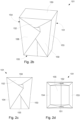
- the obtained trapezoidal shapes gives the sealed package 101, when folded from the sheet packaging material 100, side panels that also have a trapezoidal shape, see the two panels 153 and 154 in Figs 1b-1d and the four panels 151-154 in Figs 2b-2d respectively 3b-3d. More particularly, the trapezoidal panels have the shape of isosceles trapezoids. As a result an area of the bottom panel 155 is smaller than the area of the top panel 150. This provides for making it easier to empty product from the package, in particular when spooning the product out from the sealed package 101. Some examples of products that might be contained in the sealed package 101 are yoghurt and other fermented dairy products.
- the first pair of crease sections 17a, 18a is, as seen relative the central portion 50, located opposite the second pair of crease sections 17b, 18b.
- the distance D between the angled crease sections of the first crease section 17a, 18a and the second crease section 17b, 18b decreases with the distance from central portion 50. This gives the top 150 of the sealed package 101 an area that is larger than the area the bottom 155 of the sealed package 101.
- the first pair of crease sections 17a, 18a may be slanted towards each other with same angles, such that the first side portion 51 has the shape of an isosceles trapezoid.
- Corresponding situation may apply for the second pair of crease sections 17b, 18b, i.e. they may be slanted towards each other with same angles, such that the second side portion 52 has the shape of an isosceles trapezoid.
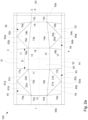
- the packaging material 100 into the sealed package 101 it may have the crease lines 11-18 dividing the sheet packaging material 100 also into four flap portions 61-64. Then the first flap portion 61 and the second flap portion 62 are adjacent to and on opposite sides of the first side portion 51 and form a first flap and a second flap that are folded on the first side panel 151 of the sealed package 101.
- the third flap portion 63 and the fourth flap portion 64 are adjacent to and on opposite sides of the second side portion 52 and form a third flap 158 and a fourth flap 159 that are folded on the second panel 152 of the sealed package 101.
- the fifth and sixth crease lines 15, 16 has a third pair of crease sections 15a, 16a that together with the first pair of crease section 17a, 18a define sides of the first flap portion 61 and the second flap portion 62.
- the third pair of crease sections 17a, 18a are angled towards each other such that the first flap portion 61 and the second flap portion 62 have the shape of a quadrilateral.
- the fifth and sixth crease lines 15, 16 have also a fourth pair of crease sections 15b, 16b that together with the second pair of crease section 17b, 18b define sides of the third flap portion 63 and the fourth flap portion 64.
- the fourth pair of crease sections 15b, 16b are angled towards each other such that the third flap portion 63 and the fourth flap portion 62 have the shape of quadrilaterals.
- the flap portions 61-64 have the shape of a parallelogram ( Figs 1a-1d ) while in other they have the shape of quadrilaterals ( Figs 2a-2d and Figs 3a-3d ).
- the first flap portion 61 may have a respective pair of crease lines 22a, 22b that divide the first flap portion 61 into three sections 61a, 61b, 61c each having a triangular shape.
- the first crease line 22a of the pair of crease lines 22a, 22b is, as compared to the second crease line 22b of the pair of crease lines 22a, 22b, longer and located further away from a central line A1 that extends through the centers of the first and second side portions 51, 52.
- Another central line A2 is perpendicular to central line A1 and extends through the centers of the third and fourth side portions 53, 54.
- the second, third and fourth flap portions 62-64 may have corresponding pair of crease lines 19a, 19b, 21a, 21b, 20a, 20b that divide these flap portions 62-64 into respective three sections 62a-62c, 63a-63c and 64a-64c each having a triangular shape.
- the third and fourth crease lines 13, 14 may have a fifth pair of crease sections 13a, 14a that define two opposite sides of the third side portion 53.
- the fifth pair of crease sections 13a, 14a are angled towards each other such that the third side portion 53 has a trapezoidal shape.
- the third and fourth crease lines 13, 14 may comprise a sixth pair of crease sections 13b, 14b that define two opposite sides of the fourth side portion 54.
- the sixth pair of crease sections 13b, 14b are angled towards each other such that the fourth side portion 54 has a trapezoidal shape.
- the crease lines 13, 14 From the fifth pair of crease sections 13a, 14a and the sixth pair of crease sections 13b, 14b, the crease lines 13, 14 have end sections 13c, 14c and 13d, 14d that extend to the first and second edges 1, 2 respectively, in parallel to the third and fourth edges 3, 4.
- the distance between the angled crease sections of the fifth crease section 13a, 14a and the sixth crease section 13b, 14b may decrease with the distance from the central portion 50. As a result, the area of the top 150 of the sealed package 101 becomes even larger than the area the bottom 155 of the sealed package 101.
- the fifth pair of crease sections 13a, 14a may be slanted towards each other with same angles, such that the third side portion 53 has the shape of an isosceles trapezoid.
- the sixth pair of crease sections 13b, 13b may also be slanted towards each other with same angles, such that the fourth side portion 54 has the shape of an isosceles trapezoid.
- the four flap portions 61-64 and their respective crease lines 22a, 22b may, as illustrated, be given such shapes and proportions that the flaps do not overlap when folded towards each other on the sealed package 101, see in particular Fig. 3b .
- the sheet packaging material 100 may have an opening structure 200 that extends along at least three sides of the central portion 50. This allows the top panel 150 to be released such that the sealed package 101 can be opened.
- opening structures are conventional plastic steering ribbons that are made part of the relevant edges of the central portion 50. Pull tab system that rips the package along the edges of the central portion may also be used.
- the opening structure 200 may be a weekend portion that allows a consumer to push though the package such the it rips open along the weekend portion.
- the package has no opening structure, in which case it may be opened with e.g. a knife or a pair of pointed scissors.
- Other shapes of the opening structure than the illustrated one may be used. For example, it may have the form of a cross that is located on the top panel 150.
- a sealed package 101 may be produced, which may be sealed to contain a liquid food product that is enclosed within the sealed package 101.
Landscapes
- Engineering & Computer Science (AREA)
- Mechanical Engineering (AREA)
- Cartons (AREA)
- Packages (AREA)
Claims (11)
- Verpackungsmaterialbahn (100) zur Herstellung einer versiegelten Verpackung (101), die ein Lebensmittelprodukt enthält, wobei die Verpackungsmaterialbahn (100) Folgendes umfasst:eine erste Kante (1), eine zur ersten Kante (1) parallel verlaufende zweite Kante (2), eine dritte Kante (3), eine zur dritten Kante (3) parallel verlaufende vierte Kante (4), wobei die dritte und vierte Kante (3, 4) derart mit der ersten und zweiten Kante (1, 2) verbunden sind, dass die Verpackungsmaterialbahn (100) eine rechteckige Form aufweist,eine erste Falzlinie (11) und eine zweite Falzlinie (12), die sich parallel zwischen der ersten und zweiten Kante (1, 2) erstrecken,eine dritte Falzlinie (13) und eine vierte Falzlinie (14), die sich parallel zwischen der ersten und zweiten Kante (1, 2) und zwischen der ersten und zweiten Falzlinie (11, 12) erstrecken,eine fünfte Falzlinie (15) und eine sechste Falzlinie (16), die sich zwischen der ersten und zweiten Falzlinie (11, 12) erstrecken,eine siebte Falzlinie (17) und einer achte Falzlinie (18), die sich zwischen der ersten und zweiten Falzlinie (11, 12) und zwischen der fünften und sechsten Falzlinie (15, 16) erstrecken,wobei die Falzlinien (11-18) die Verpackungsmaterialbahn (100) wie folgt aufteilen:- in einen rechteckigen, mittigen Abschnitt (50), der dazu ausgelegt ist, ein oberes Paneel (150) der versiegelten Verpackung (101) auszubilden,- in einen ersten Seitenabschnitt (51) und einen zweiten Seitenabschnitt (52), die an den mittigen Abschnitt (51) angrenzen und einander entgegengesetzt sind und dazu ausgelegt sind, ein erstes Seitenpaneel (151) und ein zweites Seitenpaneel (152) der versiegelten Verpackung (101) auszubilden,- in einen dritten Seitenabschnitt (53) und einen vierten Seitenabschnitt (54), die an den mittigen Abschnitt (51) angrenzen und einander entgegengesetzt sind und dazu ausgelegt sind, ein drittes Seitenpaneel (153) und ein viertes Seitenpaneel (154) der versiegelten Verpackung (101) auszubilden, und- in zwei Endabschnitte (55a, 55b), die an die zwei der Seitenabschnitte (53, 54) angrenzen und dazu ausgelegt sind, miteinander verbunden zu sein, um ein Bodenpaneel (155) der versiegelten Verpackung (101) auszubilden, dadurch gekennzeichnet, dass die siebte und achte Falzlinie (17, 18) ein erstes Paar Falzabschnitte (17a, 18a) umfassen, das zwei entgegengesetzte Seiten des ersten Seitenabschnitts (51) definiert, wobei das erste Paar Falzabschnitte (17a, 18a) derart zueinander angewinkelt ist, dass der erste Seitenabschnitt (51) eine Trapezform aufweist, unddie siebte und achte Falzlinie (17, 18) ein zweites Paar Falzabschnitte (17b, 18b) umfassen, das zwei entgegengesetzte Seiten des zweiten Seitenabschnitts (52) definiert, wobei das zweite Paar Falzabschnitte (17b, 18b) derart zueinander angewinkelt ist, dass der zweite Seitenabschnitt (52) eine Trapezform aufweist.
- Verpackungsmaterialbahn (100) nach Anspruch 1, wobei das erste Paar Falzabschnitte (17a, 18a), in Bezug zum mittigen Abschnitt (50) betrachtet, dem zweiten Paar Falzabschnitte (17b, 18b) entgegengesetzt angeordnet ist.
- Verpackungsmaterialbahn (100) nach Anspruch 1 oder 2, wobei die Entfernung (D) zwischen den angewinkelten Falzabschnitten des ersten Falzabschnitts (17a, 18a) und des zweiten Falzabschnitts (17b, 18b) mit der Entfernung vom mittigen Abschnitt (50) derart abnimmt, dass die Fläche der Oberseite (150) der versiegelten Verpackung (101) größer ist als die Fläche des Bodens (155) der versiegelten Verpackung (101).
- Verpackungsmaterialbahn (100) nach einem der vorstehenden Ansprüche, wobeidas erste Paar Falzabschnitte (17a, 18a) in demselben Winkel zueinander geneigt ist, sodass der erste Seitenabschnitt (51) die Form eines gleichschenkligen Trapezes aufweist, unddas zweite Paar Falzabschnitte (17b, 18b) in demselben Winkel zueinander geneigt ist, sodass der zweite Seitenabschnitt (52) die Form eines gleichschenkligen Trapezes aufweist.
- Verpackungsmaterialbahn (100) nach einem der vorstehenden Ansprüche, wobeidie Falzlinien (11-18) die Verpackungsmaterialbahn (100) wie folgt aufteilen:- in einen ersten Klappenabschnitt (61) und einen zweiten Klappenabschnitt (62), die an den ersten Seitenabschnitt (51) angrenzen und auf entgegengesetzten Seiten dessen angeordnet sind und dazu ausgelegt sind, eine erste Klappe und eine zweite Klappe auszubilden, die am ersten Seitenpaneel (151) der versiegelten Verpackung (101) gefaltet sind,- in einen dritten Klappenabschnitt (63) und einen vierten Klappenabschnitt (64), die an den zweiten Seitenabschnitt (52) angrenzen und auf entgegengesetzten Seiten dessen angeordnet sind und dazu ausgelegt sind, eine dritte Klappe (158) und eine vierte Klappe (159) auszubilden, die am zweiten Paneel (152) der versiegelten Verpackung (101) gefaltet sind,wobei die fünfte und sechste Falzlinie (15, 16) ein drittes Paar Falzabschnitte (15a, 16a) umfassen, das zusammen mit dem ersten Paar Falzabschnitte (17a, 18a) Seiten des ersten Klappenabschnitts (61) und des zweiten Klappenabschnitts (62) definiert, wobei das dritte Paar Falzabschnitte (17a, 18a) derart zueinander angewinkelt ist, dass der erste Klappenabschnitt (61) und der zweite Klappenabschnitt (62) die Form von Parallelogrammen aufweisen, undwobei die fünfte und sechste Falzlinie (15, 16) ein viertes Paar Falzabschnitte (15b, 16b) umfassen, das zusammen mit dem zweiten Paar Falzabschnitte (17b, 18b) Seiten des dritten Klappenabschnitts (63) und des vierten Klappenabschnitts (64) definiert, wobei das viere Paar Falzabschnitte (15b, 16b) derart zueinander angewinkelt ist, dass der dritte Klappenabschnitt (63) und der vierte Klappenabschnitt (62) die Form von Parallelogrammen aufweisen.
- Verpackungsmaterialbahn (100) nach Anspruch 5, wobei jeder Klappenabschnitt (61) ein jeweiliges Paar Falzlinien (22a, 22b) umfasst, das den Klappenabschnitt (61) in drei Abschnitte (61a, 61b, 61c) aufteilt, die jeweils eine dreieckige Form aufweisen, wobei die erste Falzlinie (22a) des Paars Falzlinien (22a, 22b) im Vergleich zur zweiten Falzlinie (22b) des Paars Falzlinien (22a, 22b)- länger ist und- weiter von einer Mittellinie (A1) entfernt ist, die sich jeweils durch die Mitte des ersten und zweiten Seitenabschnitts (51, 52) erstreckt.
- Verpackungsmaterialbahn (100) nach einem der vorstehenden Ansprüche, wobei
die dritte und vierte Falzlinie (13, 14) ein fünftes Paar Falzabschnitte (13a, 14a) umfassen, das zwei entgegengesetzte Seiten des dritten Seitenabschnitts (53) definiert, wobei das fünfte Paar Falzabschnitte (13a, 14a) derart zueinander angewinkelt ist, dass der dritte Seitenabschnitt (53) eine Trapezform aufweist, und die dritte und vierte Falzlinie (13, 14) ein sechstes Paar Falzabschnitte (13b, 14b) umfassen, das zwei entgegengesetzte Seiten des vierten Seitenabschnitts (54) definiert, wobei das sechste Paar Falzabschnitte (13b, 14b) derart zueinander angewinkelt ist, dass der vierte Seitenabschnitt (54) eine Trapezform aufweist. - Verpackungsmaterialbahn (100) nach Anspruch 7, wobei die Entfernung zwischen den angewinkelten Falzabschnitten des fünften Falzabschnitts (13a, 14a) und des sechsten Falzabschnitts (13b, 14b) mit der Entfernung vom mittigen Abschnitt (50) derart abnimmt, dass die Fläche der Oberseite (150) der versiegelten Verpackung (101) größer ist als die Fläche des Bodens (155) der versiegelten Verpackung (101).
- Verpackungsmaterialbahn (100) nach Anspruch 7 oder 8, wobeidas fünfte Paar Falzabschnitte (13a, 14a) in demselben Winkel zueinander geneigt ist, sodass der dritte Seitenabschnitt (53) die Form eines gleichschenkligen Trapezes aufweist, unddas sechste Paar Falzabschnitte (13b, 13b) in demselben Winkel zueinander geneigt ist, sodass der vierte Seitenabschnitt (54) die Form eines gleichschenkligen Trapezes aufweist.
- Verpackungsmaterialbahn (100) nach einem der vorstehenden Ansprüche, umfassend eine Öffnungsstruktur (200), die sich entlang mindestens drei Seiten des mittigen Abschnitts (50) erstreckt, um zuzulassen, dass das obere Paneel (150) gelöst werden kann, sodass die versiegelte Verpackung (101) geöffnet werden kann.
- Versiegelte Verpackung (101), die aus einer Verpackungsmaterialbahn (100) nach einem der vorstehenden Ansprüche hergestellt ist, umfassend ein flüssiges Lebensmittelprodukt, das innerhalb der versiegelten Verpackung (101) enthalten ist.
Applications Claiming Priority (1)
| Application Number | Priority Date | Filing Date | Title |
|---|---|---|---|
| EP19183042 | 2019-06-27 |
Publications (2)
| Publication Number | Publication Date |
|---|---|
| EP3757028A1 EP3757028A1 (de) | 2020-12-30 |
| EP3757028B1 true EP3757028B1 (de) | 2023-03-29 |
Family
ID=67145524
Family Applications (1)
| Application Number | Title | Priority Date | Filing Date |
|---|---|---|---|
| EP20182072.7A Active EP3757028B1 (de) | 2019-06-27 | 2020-06-24 | Folienverpackungsmaterial zur herstellung versiegelter verpackungen für flüssige lebensmittelprodukte; dichte verpackung |
Country Status (5)
| Country | Link |
|---|---|
| US (1) | US11932461B2 (de) |
| EP (1) | EP3757028B1 (de) |
| JP (1) | JP7633949B2 (de) |
| CN (1) | CN114026025B (de) |
| WO (1) | WO2020260409A1 (de) |
Family Cites Families (17)
| Publication number | Priority date | Publication date | Assignee | Title |
|---|---|---|---|---|
| US416817A (en) * | 1889-12-10 | Paper vessel | ||
| US996746A (en) * | 1910-02-21 | 1911-07-04 | Charles T Bloomer | Paper vessel. |
| JPS5017315U (de) * | 1973-06-13 | 1975-02-25 | ||
| JPS60184828U (ja) * | 1984-05-18 | 1985-12-07 | 花王株式会社 | パツキングケ−ス |
| SE502669C2 (sv) * | 1993-11-03 | 1995-12-04 | Tetra Laval Holdings & Finance | Förpackningsbehållare och ämne för framställning av densamma |
| US6119928A (en) * | 1998-02-04 | 2000-09-19 | Tetra Laval Holdings & Finance, Sa | Laminated packaging material having fluted medium |
| EP1275588A1 (de) * | 2001-07-12 | 2003-01-15 | Tetra Laval Holdings & Finance SA | Giebelbehälter für fliessfähige Nahrungsmittel |
| EP1584563A1 (de) * | 2004-04-09 | 2005-10-12 | Tetra Laval Holdings & Finance S.A. | Giebelpackung für fliessfähige Nahrungsmitteln und Konstruktionsmethode dafür |
| EP1826125B1 (de) * | 2006-02-28 | 2009-10-07 | Tetra Laval Holdings & Finance SA | Biegevorrichtung und -verfahren zur Formung von einem Giebelteil einer versiegelten Verpackung mit fliessfähigen Nahrungsmitteln |
| CA124243S (en) * | 2007-07-05 | 2008-09-29 | Tetra Laval Holdings & Finance | Material for packaging |
| TWD146764S1 (zh) * | 2010-06-07 | 2012-05-01 | 利樂拉伐控股財務公司 | 包裝盒(一) |
| JP2012121577A (ja) | 2010-12-05 | 2012-06-28 | Nihon Tetra Pak Kk | 包装容器の製造法及び包装容器 |
| MX337224B (es) | 2010-12-06 | 2016-02-18 | Tetra Laval Holdings & Finance | Metodo para fabricar recipiente de empaque y recipiente de empaque. |
| EP2650222A4 (de) * | 2010-12-07 | 2014-11-26 | Tetra Laval Holdings & Finance | Herstellungsverfahren für einen verpackungsbehälter und verpackungsbehälter |
| ES2741731T3 (es) * | 2014-10-29 | 2020-02-12 | Tetra Laval Holdings & Finance | Material de envasado en láminas para la producción de envases sellados para productos alimenticios vertibles |
| EP3219630B1 (de) * | 2016-03-17 | 2018-09-26 | Tetra Laval Holdings & Finance SA | Verfahren zum betrieb einer verpackungsmaschine |
| CN108357749A (zh) * | 2018-02-09 | 2018-08-03 | 朱双海 | 一种包装材料 |
-
2020
- 2020-06-24 EP EP20182072.7A patent/EP3757028B1/de active Active
- 2020-06-24 JP JP2021577228A patent/JP7633949B2/ja active Active
- 2020-06-24 WO PCT/EP2020/067737 patent/WO2020260409A1/en not_active Ceased
- 2020-06-24 CN CN202080045861.5A patent/CN114026025B/zh active Active
- 2020-06-24 US US17/622,449 patent/US11932461B2/en active Active
Also Published As
| Publication number | Publication date |
|---|---|
| CN114026025B (zh) | 2025-01-28 |
| US11932461B2 (en) | 2024-03-19 |
| JP2022538593A (ja) | 2022-09-05 |
| JP7633949B2 (ja) | 2025-02-20 |
| US20220355969A1 (en) | 2022-11-10 |
| EP3757028A1 (de) | 2020-12-30 |
| CN114026025A (zh) | 2022-02-08 |
| WO2020260409A1 (en) | 2020-12-30 |
Similar Documents
| Publication | Publication Date | Title |
|---|---|---|
| EP3656689B1 (de) | Folienverpackungsmaterial zur herstellung einer versiegelten verpackung mit einem giessfähigen produkt sowie daraus hergestellte verpackung | |
| EP3556674B1 (de) | Folienverpackungsmaterial zur herstellung einer versiegelten verpackung mit einem fliessfähigen lebensmittelprodukt sowie aus einem folienverpackungsmaterial hergestellte versiegelte verpackung | |
| EP1440010B1 (de) | Giebelbehälter für fliessfähige nahrungsmittel | |
| KR101811459B1 (ko) | 유동 음식물의 밀봉 패키지를 생산하기 위한 시트 패키징 재료 | |
| EP3556673B1 (de) | Versiegelte packung für ein giessbares lebensmittelprodukt und folienverpackungsmaterial zur herstellung einer versiegelten packung für ein giessbares lebensmittelprodukt | |
| US11932461B2 (en) | Sheet packaging material for producing sealed packages for liquid food products | |
| EP3597551B1 (de) | Folienverpackungsmaterial zur herstellung versiegelter verpackungen für giessbare lebensmittelprodukte, versiegelte verpackung für giessbare lebensmittelprodukte und verfahren zur herstellung einer versiegelten verpackung für giessbare produkte | |
| EP4431409A2 (de) | Mehrschichtige verpackungsmaterialbahn zur herstellung einer versiegelten verpackung | |
| EP4458708B1 (de) | Verpackungszuschnitt zur herstellung einer verpackung und aus einem verpackungszuschnitt hergestellte verpackung | |
| EP4420872A1 (de) | Mehrschichtige verpackungsmaterialbahn zur herstellung einer versiegelten verpackung | |
| EP4741305A1 (de) | Verpackungszuschnitt zum formen einer verpackung, verpackung aus einem verpackungszuschnitt und verpackung | |
| EP4506272A1 (de) | Mit einem fliessfähigen produkt gefüllte verpackung und verfahren zur herstellung einer verpackung | |
| WO2026098986A1 (en) | Packaging blank for forming a package, package formed from a packaging blank and package | |
| CN119562924A (zh) | 用于形成包装的包装坯料和由包装坯料形成的包装 |
Legal Events
| Date | Code | Title | Description |
|---|---|---|---|
| PUAI | Public reference made under article 153(3) epc to a published international application that has entered the european phase |
Free format text: ORIGINAL CODE: 0009012 |
|
| STAA | Information on the status of an ep patent application or granted ep patent |
Free format text: STATUS: THE APPLICATION HAS BEEN PUBLISHED |
|
| AK | Designated contracting states |
Kind code of ref document: A1 Designated state(s): AL AT BE BG CH CY CZ DE DK EE ES FI FR GB GR HR HU IE IS IT LI LT LU LV MC MK MT NL NO PL PT RO RS SE SI SK SM TR |
|
| AX | Request for extension of the european patent |
Extension state: BA ME |
|
| STAA | Information on the status of an ep patent application or granted ep patent |
Free format text: STATUS: REQUEST FOR EXAMINATION WAS MADE |
|
| 17P | Request for examination filed |
Effective date: 20210630 |
|
| RBV | Designated contracting states (corrected) |
Designated state(s): AL AT BE BG CH CY CZ DE DK EE ES FI FR GB GR HR HU IE IS IT LI LT LU LV MC MK MT NL NO PL PT RO RS SE SI SK SM TR |
|
| GRAP | Despatch of communication of intention to grant a patent |
Free format text: ORIGINAL CODE: EPIDOSNIGR1 |
|
| STAA | Information on the status of an ep patent application or granted ep patent |
Free format text: STATUS: GRANT OF PATENT IS INTENDED |
|
| INTG | Intention to grant announced |
Effective date: 20221114 |
|
| GRAS | Grant fee paid |
Free format text: ORIGINAL CODE: EPIDOSNIGR3 |
|
| GRAA | (expected) grant |
Free format text: ORIGINAL CODE: 0009210 |
|
| STAA | Information on the status of an ep patent application or granted ep patent |
Free format text: STATUS: THE PATENT HAS BEEN GRANTED |
|
| AK | Designated contracting states |
Kind code of ref document: B1 Designated state(s): AL AT BE BG CH CY CZ DE DK EE ES FI FR GB GR HR HU IE IS IT LI LT LU LV MC MK MT NL NO PL PT RO RS SE SI SK SM TR |
|
| REG | Reference to a national code |
Ref country code: CH Ref legal event code: EP |
|
| REG | Reference to a national code |
Ref country code: DE Ref legal event code: R096 Ref document number: 602020009157 Country of ref document: DE |
|
| REG | Reference to a national code |
Ref country code: AT Ref legal event code: REF Ref document number: 1556523 Country of ref document: AT Kind code of ref document: T Effective date: 20230415 |
|
| REG | Reference to a national code |
Ref country code: IE Ref legal event code: FG4D |
|
| P01 | Opt-out of the competence of the unified patent court (upc) registered |
Effective date: 20230426 |
|
| REG | Reference to a national code |
Ref country code: LT Ref legal event code: MG9D |
|
| PG25 | Lapsed in a contracting state [announced via postgrant information from national office to epo] |
Ref country code: RS Free format text: LAPSE BECAUSE OF FAILURE TO SUBMIT A TRANSLATION OF THE DESCRIPTION OR TO PAY THE FEE WITHIN THE PRESCRIBED TIME-LIMIT Effective date: 20230329 Ref country code: NO Free format text: LAPSE BECAUSE OF FAILURE TO SUBMIT A TRANSLATION OF THE DESCRIPTION OR TO PAY THE FEE WITHIN THE PRESCRIBED TIME-LIMIT Effective date: 20230629 Ref country code: LV Free format text: LAPSE BECAUSE OF FAILURE TO SUBMIT A TRANSLATION OF THE DESCRIPTION OR TO PAY THE FEE WITHIN THE PRESCRIBED TIME-LIMIT Effective date: 20230329 Ref country code: LT Free format text: LAPSE BECAUSE OF FAILURE TO SUBMIT A TRANSLATION OF THE DESCRIPTION OR TO PAY THE FEE WITHIN THE PRESCRIBED TIME-LIMIT Effective date: 20230329 Ref country code: HR Free format text: LAPSE BECAUSE OF FAILURE TO SUBMIT A TRANSLATION OF THE DESCRIPTION OR TO PAY THE FEE WITHIN THE PRESCRIBED TIME-LIMIT Effective date: 20230329 |
|
| REG | Reference to a national code |
Ref country code: NL Ref legal event code: MP Effective date: 20230329 |
|
| REG | Reference to a national code |
Ref country code: AT Ref legal event code: MK05 Ref document number: 1556523 Country of ref document: AT Kind code of ref document: T Effective date: 20230329 |
|
| PG25 | Lapsed in a contracting state [announced via postgrant information from national office to epo] |
Ref country code: SE Free format text: LAPSE BECAUSE OF FAILURE TO SUBMIT A TRANSLATION OF THE DESCRIPTION OR TO PAY THE FEE WITHIN THE PRESCRIBED TIME-LIMIT Effective date: 20230329 Ref country code: NL Free format text: LAPSE BECAUSE OF FAILURE TO SUBMIT A TRANSLATION OF THE DESCRIPTION OR TO PAY THE FEE WITHIN THE PRESCRIBED TIME-LIMIT Effective date: 20230329 Ref country code: GR Free format text: LAPSE BECAUSE OF FAILURE TO SUBMIT A TRANSLATION OF THE DESCRIPTION OR TO PAY THE FEE WITHIN THE PRESCRIBED TIME-LIMIT Effective date: 20230630 Ref country code: FI Free format text: LAPSE BECAUSE OF FAILURE TO SUBMIT A TRANSLATION OF THE DESCRIPTION OR TO PAY THE FEE WITHIN THE PRESCRIBED TIME-LIMIT Effective date: 20230329 |
|
| PG25 | Lapsed in a contracting state [announced via postgrant information from national office to epo] |
Ref country code: SM Free format text: LAPSE BECAUSE OF FAILURE TO SUBMIT A TRANSLATION OF THE DESCRIPTION OR TO PAY THE FEE WITHIN THE PRESCRIBED TIME-LIMIT Effective date: 20230329 Ref country code: RO Free format text: LAPSE BECAUSE OF FAILURE TO SUBMIT A TRANSLATION OF THE DESCRIPTION OR TO PAY THE FEE WITHIN THE PRESCRIBED TIME-LIMIT Effective date: 20230329 Ref country code: PT Free format text: LAPSE BECAUSE OF FAILURE TO SUBMIT A TRANSLATION OF THE DESCRIPTION OR TO PAY THE FEE WITHIN THE PRESCRIBED TIME-LIMIT Effective date: 20230731 Ref country code: ES Free format text: LAPSE BECAUSE OF FAILURE TO SUBMIT A TRANSLATION OF THE DESCRIPTION OR TO PAY THE FEE WITHIN THE PRESCRIBED TIME-LIMIT Effective date: 20230329 Ref country code: EE Free format text: LAPSE BECAUSE OF FAILURE TO SUBMIT A TRANSLATION OF THE DESCRIPTION OR TO PAY THE FEE WITHIN THE PRESCRIBED TIME-LIMIT Effective date: 20230329 Ref country code: AT Free format text: LAPSE BECAUSE OF FAILURE TO SUBMIT A TRANSLATION OF THE DESCRIPTION OR TO PAY THE FEE WITHIN THE PRESCRIBED TIME-LIMIT Effective date: 20230329 |
|
| PG25 | Lapsed in a contracting state [announced via postgrant information from national office to epo] |
Ref country code: SK Free format text: LAPSE BECAUSE OF FAILURE TO SUBMIT A TRANSLATION OF THE DESCRIPTION OR TO PAY THE FEE WITHIN THE PRESCRIBED TIME-LIMIT Effective date: 20230329 Ref country code: PL Free format text: LAPSE BECAUSE OF FAILURE TO SUBMIT A TRANSLATION OF THE DESCRIPTION OR TO PAY THE FEE WITHIN THE PRESCRIBED TIME-LIMIT Effective date: 20230329 Ref country code: IS Free format text: LAPSE BECAUSE OF FAILURE TO SUBMIT A TRANSLATION OF THE DESCRIPTION OR TO PAY THE FEE WITHIN THE PRESCRIBED TIME-LIMIT Effective date: 20230729 |
|
| REG | Reference to a national code |
Ref country code: DE Ref legal event code: R097 Ref document number: 602020009157 Country of ref document: DE |
|
| PG25 | Lapsed in a contracting state [announced via postgrant information from national office to epo] |
Ref country code: MC Free format text: LAPSE BECAUSE OF FAILURE TO SUBMIT A TRANSLATION OF THE DESCRIPTION OR TO PAY THE FEE WITHIN THE PRESCRIBED TIME-LIMIT Effective date: 20230329 |
|
| PG25 | Lapsed in a contracting state [announced via postgrant information from national office to epo] |
Ref country code: MC Free format text: LAPSE BECAUSE OF FAILURE TO SUBMIT A TRANSLATION OF THE DESCRIPTION OR TO PAY THE FEE WITHIN THE PRESCRIBED TIME-LIMIT Effective date: 20230329 Ref country code: DK Free format text: LAPSE BECAUSE OF FAILURE TO SUBMIT A TRANSLATION OF THE DESCRIPTION OR TO PAY THE FEE WITHIN THE PRESCRIBED TIME-LIMIT Effective date: 20230329 Ref country code: CZ Free format text: LAPSE BECAUSE OF FAILURE TO SUBMIT A TRANSLATION OF THE DESCRIPTION OR TO PAY THE FEE WITHIN THE PRESCRIBED TIME-LIMIT Effective date: 20230329 |
|
| REG | Reference to a national code |
Ref country code: CH Ref legal event code: PL |
|
| PLBE | No opposition filed within time limit |
Free format text: ORIGINAL CODE: 0009261 |
|
| STAA | Information on the status of an ep patent application or granted ep patent |
Free format text: STATUS: NO OPPOSITION FILED WITHIN TIME LIMIT |
|
| REG | Reference to a national code |
Ref country code: BE Ref legal event code: MM Effective date: 20230630 |
|
| PG25 | Lapsed in a contracting state [announced via postgrant information from national office to epo] |
Ref country code: LU Free format text: LAPSE BECAUSE OF NON-PAYMENT OF DUE FEES Effective date: 20230624 |
|
| 26N | No opposition filed |
Effective date: 20240103 |
|
| REG | Reference to a national code |
Ref country code: IE Ref legal event code: MM4A |
|
| PG25 | Lapsed in a contracting state [announced via postgrant information from national office to epo] |
Ref country code: LU Free format text: LAPSE BECAUSE OF NON-PAYMENT OF DUE FEES Effective date: 20230624 |
|
| PG25 | Lapsed in a contracting state [announced via postgrant information from national office to epo] |
Ref country code: IE Free format text: LAPSE BECAUSE OF NON-PAYMENT OF DUE FEES Effective date: 20230624 |
|
| PG25 | Lapsed in a contracting state [announced via postgrant information from national office to epo] |
Ref country code: IE Free format text: LAPSE BECAUSE OF NON-PAYMENT OF DUE FEES Effective date: 20230624 Ref country code: CH Free format text: LAPSE BECAUSE OF NON-PAYMENT OF DUE FEES Effective date: 20230630 |
|
| PG25 | Lapsed in a contracting state [announced via postgrant information from national office to epo] |
Ref country code: SI Free format text: LAPSE BECAUSE OF FAILURE TO SUBMIT A TRANSLATION OF THE DESCRIPTION OR TO PAY THE FEE WITHIN THE PRESCRIBED TIME-LIMIT Effective date: 20230329 |
|
| PG25 | Lapsed in a contracting state [announced via postgrant information from national office to epo] |
Ref country code: SI Free format text: LAPSE BECAUSE OF FAILURE TO SUBMIT A TRANSLATION OF THE DESCRIPTION OR TO PAY THE FEE WITHIN THE PRESCRIBED TIME-LIMIT Effective date: 20230329 Ref country code: FR Free format text: LAPSE BECAUSE OF NON-PAYMENT OF DUE FEES Effective date: 20230630 Ref country code: BE Free format text: LAPSE BECAUSE OF NON-PAYMENT OF DUE FEES Effective date: 20230630 |
|
| PG25 | Lapsed in a contracting state [announced via postgrant information from national office to epo] |
Ref country code: BG Free format text: LAPSE BECAUSE OF FAILURE TO SUBMIT A TRANSLATION OF THE DESCRIPTION OR TO PAY THE FEE WITHIN THE PRESCRIBED TIME-LIMIT Effective date: 20230329 |
|
| PG25 | Lapsed in a contracting state [announced via postgrant information from national office to epo] |
Ref country code: BG Free format text: LAPSE BECAUSE OF FAILURE TO SUBMIT A TRANSLATION OF THE DESCRIPTION OR TO PAY THE FEE WITHIN THE PRESCRIBED TIME-LIMIT Effective date: 20230329 |
|
| GBPC | Gb: european patent ceased through non-payment of renewal fee |
Effective date: 20240624 |
|
| PG25 | Lapsed in a contracting state [announced via postgrant information from national office to epo] |
Ref country code: GB Free format text: LAPSE BECAUSE OF NON-PAYMENT OF DUE FEES Effective date: 20240624 |
|
| PGFP | Annual fee paid to national office [announced via postgrant information from national office to epo] |
Ref country code: DE Payment date: 20250626 Year of fee payment: 6 |
|
| PG25 | Lapsed in a contracting state [announced via postgrant information from national office to epo] |
Ref country code: CY Free format text: LAPSE BECAUSE OF FAILURE TO SUBMIT A TRANSLATION OF THE DESCRIPTION OR TO PAY THE FEE WITHIN THE PRESCRIBED TIME-LIMIT; INVALID AB INITIO Effective date: 20200624 |
|
| PGFP | Annual fee paid to national office [announced via postgrant information from national office to epo] |
Ref country code: TR Payment date: 20250612 Year of fee payment: 6 |
|
| PG25 | Lapsed in a contracting state [announced via postgrant information from national office to epo] |
Ref country code: HU Free format text: LAPSE BECAUSE OF FAILURE TO SUBMIT A TRANSLATION OF THE DESCRIPTION OR TO PAY THE FEE WITHIN THE PRESCRIBED TIME-LIMIT; INVALID AB INITIO Effective date: 20200624 |
|
| PGFP | Annual fee paid to national office [announced via postgrant information from national office to epo] |
Ref country code: IT Payment date: 20250623 Year of fee payment: 6 |