EP3755992B1 - Procédé et système informatisés pour l'analyse spectroscopique d'un matériau biologique - Google Patents
Procédé et système informatisés pour l'analyse spectroscopique d'un matériau biologique Download PDFInfo
- Publication number
- EP3755992B1 EP3755992B1 EP19715054.3A EP19715054A EP3755992B1 EP 3755992 B1 EP3755992 B1 EP 3755992B1 EP 19715054 A EP19715054 A EP 19715054A EP 3755992 B1 EP3755992 B1 EP 3755992B1
- Authority
- EP
- European Patent Office
- Prior art keywords
- sample
- biological material
- spectroscopic analysis
- analysis
- flow cell
- Prior art date
- Legal status (The legal status is an assumption and is not a legal conclusion. Google has not performed a legal analysis and makes no representation as to the accuracy of the status listed.)
- Active
Links
Images




Classifications
-
- G—PHYSICS
- G01—MEASURING; TESTING
- G01N—INVESTIGATING OR ANALYSING MATERIALS BY DETERMINING THEIR CHEMICAL OR PHYSICAL PROPERTIES
- G01N21/00—Investigating or analysing materials by the use of optical means, i.e. using sub-millimetre waves, infrared, visible or ultraviolet light
- G01N21/01—Arrangements or apparatus for facilitating the optical investigation
- G01N21/03—Cuvette constructions
- G01N21/05—Flow-through cuvettes
-
- G—PHYSICS
- G01—MEASURING; TESTING
- G01N—INVESTIGATING OR ANALYSING MATERIALS BY DETERMINING THEIR CHEMICAL OR PHYSICAL PROPERTIES
- G01N35/00—Automatic analysis not limited to methods or materials provided for in any single one of groups G01N1/00 - G01N33/00; Handling materials therefor
- G01N35/00584—Control arrangements for automatic analysers
- G01N35/00594—Quality control, including calibration or testing of components of the analyser
- G01N35/00603—Reinspection of samples
-
- G—PHYSICS
- G01—MEASURING; TESTING
- G01N—INVESTIGATING OR ANALYSING MATERIALS BY DETERMINING THEIR CHEMICAL OR PHYSICAL PROPERTIES
- G01N35/00—Automatic analysis not limited to methods or materials provided for in any single one of groups G01N1/00 - G01N33/00; Handling materials therefor
- G01N35/10—Devices for transferring samples or any liquids to, in, or from, the analysis apparatus, e.g. suction devices, injection devices
- G01N35/1095—Devices for transferring samples or any liquids to, in, or from, the analysis apparatus, e.g. suction devices, injection devices for supplying the samples to flow-through analysers
-
- G—PHYSICS
- G01—MEASURING; TESTING
- G01N—INVESTIGATING OR ANALYSING MATERIALS BY DETERMINING THEIR CHEMICAL OR PHYSICAL PROPERTIES
- G01N21/00—Investigating or analysing materials by the use of optical means, i.e. using sub-millimetre waves, infrared, visible or ultraviolet light
- G01N21/84—Systems specially adapted for particular applications
- G01N2021/8411—Application to online plant, process monitoring
- G01N2021/8416—Application to online plant, process monitoring and process controlling, not otherwise provided for
-
- G—PHYSICS
- G01—MEASURING; TESTING
- G01N—INVESTIGATING OR ANALYSING MATERIALS BY DETERMINING THEIR CHEMICAL OR PHYSICAL PROPERTIES
- G01N21/00—Investigating or analysing materials by the use of optical means, i.e. using sub-millimetre waves, infrared, visible or ultraviolet light
- G01N21/17—Systems in which incident light is modified in accordance with the properties of the material investigated
- G01N21/25—Colour; Spectral properties, i.e. comparison of effect of material on the light at two or more different wavelengths or wavelength bands
- G01N21/31—Investigating relative effect of material at wavelengths characteristic of specific elements or molecules, e.g. atomic absorption spectrometry
-
- G—PHYSICS
- G01—MEASURING; TESTING
- G01N—INVESTIGATING OR ANALYSING MATERIALS BY DETERMINING THEIR CHEMICAL OR PHYSICAL PROPERTIES
- G01N21/00—Investigating or analysing materials by the use of optical means, i.e. using sub-millimetre waves, infrared, visible or ultraviolet light
- G01N21/17—Systems in which incident light is modified in accordance with the properties of the material investigated
- G01N21/25—Colour; Spectral properties, i.e. comparison of effect of material on the light at two or more different wavelengths or wavelength bands
- G01N21/31—Investigating relative effect of material at wavelengths characteristic of specific elements or molecules, e.g. atomic absorption spectrometry
- G01N21/35—Investigating relative effect of material at wavelengths characteristic of specific elements or molecules, e.g. atomic absorption spectrometry using infrared light
- G01N21/359—Investigating relative effect of material at wavelengths characteristic of specific elements or molecules, e.g. atomic absorption spectrometry using infrared light using near infrared light
-
- G—PHYSICS
- G01—MEASURING; TESTING
- G01N—INVESTIGATING OR ANALYSING MATERIALS BY DETERMINING THEIR CHEMICAL OR PHYSICAL PROPERTIES
- G01N21/00—Investigating or analysing materials by the use of optical means, i.e. using sub-millimetre waves, infrared, visible or ultraviolet light
- G01N21/17—Systems in which incident light is modified in accordance with the properties of the material investigated
- G01N21/47—Scattering, i.e. diffuse reflection
-
- G—PHYSICS
- G01—MEASURING; TESTING
- G01N—INVESTIGATING OR ANALYSING MATERIALS BY DETERMINING THEIR CHEMICAL OR PHYSICAL PROPERTIES
- G01N21/00—Investigating or analysing materials by the use of optical means, i.e. using sub-millimetre waves, infrared, visible or ultraviolet light
- G01N21/62—Systems in which the material investigated is excited whereby it emits light or causes a change in wavelength of the incident light
- G01N21/63—Systems in which the material investigated is excited whereby it emits light or causes a change in wavelength of the incident light optically excited
- G01N21/64—Fluorescence; Phosphorescence
-
- G—PHYSICS
- G01—MEASURING; TESTING
- G01N—INVESTIGATING OR ANALYSING MATERIALS BY DETERMINING THEIR CHEMICAL OR PHYSICAL PROPERTIES
- G01N21/00—Investigating or analysing materials by the use of optical means, i.e. using sub-millimetre waves, infrared, visible or ultraviolet light
- G01N21/62—Systems in which the material investigated is excited whereby it emits light or causes a change in wavelength of the incident light
- G01N21/63—Systems in which the material investigated is excited whereby it emits light or causes a change in wavelength of the incident light optically excited
- G01N21/65—Raman scattering
Definitions
- the following description relates to spectroscopic analysis performed on-line for a bioreactor.
- the description relates to a computer-implemented method and system for spectroscopic analysis of biological material.
- bioreactors for cultivating microorganisms under controlled conditions. Processes taking place within bioreactors involve a plurality of variables linked by complex relations, so that bioreactor monitoring and controlling are particularly challenging.
- RT-GM real-time glycosylation monitoring
- RT-GM real-time glycosylation monitoring
- Document EP 1 840 577 A1 discloses a specimen analysis method, comprising: bringing a first specimen vessel to a sucking position for sucking specimens; obtaining a first measurement result of a first specimen contained in the first specimen vessel; bringing a second specimen vessel to the sucking position before the first measurement result is obtained; obtaining a second measurement result of a second specimen contained in the second specimen vessel; bringing a third specimen vessel to the sucking position after the first measurement result is obtained; obtaining a third measurement result of a third specimen contained in the third specimen vessel; and obtaining a fourth measurement result of the second specimen when the first measurement result is higher than a threshold, the second specimen being sucked at the sucking position again for obtaining the fourth measurement result before bringing the third specimen vessel to the sucking position.
- Document EP 2 182 365 discloses a sample analyzer comprising: a sample preparing section for preparing first and second measurement sample including reagent and sample; a first detector for detecting a predetermined component in the first measurement sample prepared by the sample preparing section; a second detector for detecting the predetermined component in the second measurement sample prepared by the sample preparing section; and a controller configured for performing operations, comprising: (a) controlling the first detector to detect the predetermined component in the first measurement sample prepared by the sample preparing section; (b) determining the reliability of the result detected by the first detector; (c) controlling the sample preparing section to prepare the second measurement sample from the same sample when the result has been determined to be unreliable; and (d) controlling the second detector to detect the predetermined component in the second measurement sample.
- a computer-implemented method for spectroscopic analysis of biological material includes an analysis step comprising:
- the media for a bioreactor process include biological material, i.e. material comprising a biological system, such as cells, cell components, cell products, and other molecules, as well as material derived from a biological system, such as proteins, antibodies and growth factors. Further media may include chemical compounds and various substrates.
- biological material i.e. material comprising a biological system, such as cells, cell components, cell products, and other molecules, as well as material derived from a biological system, such as proteins, antibodies and growth factors.
- Further media may include chemical compounds and various substrates.
- a sample of biological material will be used to denote a sample containing at least some biological material, which may or may not contain additional substances.
- a spectroscopic analysis investigates how matter interacts with light in order to obtain information on the matter, e.g. to determine the functional groups in organic compounds or chemical composition. Accordingly, a spectroscopic analysis of biological material may provide information on the biological material, such as cell density or glucose concentration.
- An advantage of spectroscopic analysis is that it is a non-destructive technique.
- An exemplary spectroscopic technique is the Raman spectroscopy, which uses a laser light source and can identify both organic and inorganic substances in various states such as liquid, solid, emulsion and so on.
- Other kinds of spectroscopy include e.g. ultraviolet-visible (UV-Vis), fluorescence, near-infrared (NIR) and scattering spectroscopy.
- the method comprises taking, by a liquid router, a plurality of samples of biological material from a plurality of sources of biological material.
- the plurality of sources may comprise a plurality of disposable bioreactors, e.g. Sartorius products like ambr ® , UniVessel ® and BIOSTAT STR ® .
- the sources may be given by an ambr ® system, which comprises multiple single-use micro bioreactor vessels.
- a bioreactor may be used for a variety of processes, such as industrial processes, particularly biopharmaceutical processes. Other examples include research and development processes or scientific research.
- a bioreactor process may generally comprise converting inputs or ingredients into a finished product.
- Such a production process may involve chemical or microbiological conversion of material in conjunction with the transfer of mass, heat, and momentum.
- the process may include homogeneous or heterogeneous chemical and/or biochemical reactions.
- the process may comprise but is not limited to mixing, filtration, purification, centrifugation and/or cell cultivation.
- Possible products may include a transformed substrate, baker's yeast, lactic acid culture, lipase, invertase, rennet.
- Further exemplary biopharmaceutical products that can be produced include the following: recombinant and non-recombinant proteins, vaccines, gene vectors, DNA, RNA, antibiotics, secondary metabolites, growth factors, cells for cell therapy or regenerative medicine, half-synthesized products (e.g. artificial organs).
- a process occurring in a bioreactor is governed by a plurality of process parameters, e.g. temperature and stirring speed.
- the values of these process parameters may be specifically adjusted prior to and/or during performing the process, e.g. they can be set by an operator or by a control system.
- the process may be described by a series of steps.
- the plurality of sources may partially or in the totality be used to obtain the same product by performing variations of the same production process.
- the production process for a given product may be thought of as comprising some essential steps to be performed with some essential inputs, while the process parameters are constrained within boundaries determined by scientific principles and/or feasibility. Variations of the production process may, thus, be given by one or more of the following: different values of one or more process parameters, additional optional steps, additional optional inputs.
- process variation may be produced by:
- a variation of a given production process may be performed in each source, so that the plurality of sources correspond to a respective plurality of process variations.
- the set point for pH might be 7.2, wherein the accuracy of the pH measurement is +-0.05.
- Process variations with a setpoint of 7.15 and 7.25 may be performed to cover the normal occurring variation.
- Each sample of the plurality of samples is taken from a source of the plurality of sources.
- a sample may be a portion of biological material characterized by its origin, in that samples from different sources, e.g. bioreactors, are considered distinct samples, irrespectively of the specific biological material which constitutes the sample.
- the biological material in two samples may be the same in the sense that it comprises the same elements, e.g. same cells and same nutrients.
- the samples are extracted from two bioreactors performing two different process variations (due to extrinsic or intrinsic variations), the samples are regarded as distinct.
- the samples of biological material are in liquid form although they may have particulates (cellular or other) in suspension.
- a liquid router takes the plurality of samples of biological material from the plurality of sources.
- the liquid router is configured to handle liquid material, e.g. the biological material, by retrieving it, routing it and delivering it.
- liquid material e.g. the biological material
- the liquids handled by the liquid router may be divided into three categories: biological materials, cleaning liquids and standard reference liquids.
- Standard reference liquids may include:
- the liquid router may comprise means for drawing off liquid, e.g. from the bioreactor or a plate well or any other liquid holder, and for dispensing liquid, e.g. to a plate well or into a waste station, such as a pipettes or syringes.
- the liquid router may comprise means for conveying liquid from a first location to a second, different location, such as lines in connection with pumps and/or movable components such as a robotic arm.
- the liquid router may comprise a liquid handling robot that performs automated pipetting, and the pumped lines may also be automatically controlled.
- the liquid router may connect different components of a system for monitoring the bioreactors by means of an on-line analysis.
- monitoring methods for process setups such as bioreactors
- the analysers used therefore are usually classified into four categories: on-line, in-line, at-line and off-line.
- On-line and in-line analyses both involve a real-time, automated monitoring.
- In-line analyses are performed by analysers (sensors or probes or any other measuring devices) that are placed in direct connection with the bioreactor (e.g. located within or in close proximity to the bioreactor) and measure parameters (e.g. pH) that can be directly measured.
- On-line analyses may be considered enhanced in-line analyses comprising elaborating the measurements to interpret them and derive information.
- At-line and off-line analyses involve manual intervention of operators and delayed analysis results.
- At-line analysers may be in a general proximity to the bioreactor, so that an operator can easily collect samples from the bioreactor and feed them to the at-line analyser.
- Off-line analysers may be located remotely from the bioreactor and may offer a large variety of tests at the cost of a long turn-around time.
- the proposed method provides an on-line ex-situ analysis, i.e. the samples are removed from the bioreactors to be analysed.
- Taking the plurality of samples of biological material from the plurality of sources may be performed sequentially, i.e. one sample is taken after the other, or simultaneously, i.e. all samples are taken at the same time, or a combination of both, in the sense that groups of samples may be taken simultaneously and each group after the other sequentially.
- the plurality of samples of biological material are taken sequentially.
- the liquid router delivers the plurality of samples of biological material to at least one on-line ex-situ flow cell for spectroscopy.
- each time a sample is taken it may be transferred from the source to a sample cup before being delivered to the flow cell.
- the flow cell (also called “measurement cell”) comprises a body including at least one inlet through which a liquid can be introduced, at least one outlet through which the liquid can be removed and at least one optical window.
- An optical window is an element (e.g. a plate) that is at least partly transparent, i.e. allows at least partly passage of electromagnetic radiation in a wavelength region of interest for the spectroscopy, e.g. 190 - 2500 nm.
- the electromagnetic radiation may be visible, ultraviolet and/or infrared light.
- the at least one optical window may comprise two plane-parallel windows of at least partially optical transmittant material (transmittance >20%) in the relevant wavelength range, e.g. 190-2500 nm.
- the path length between the two plane-parallel windows may be between about 10 ⁇ m and about 1 cm, in particular between about 0.1 mm and about 2 mm.
- An exemplary volume of a cavity in between the plane-parallel windows may be much less than 1 ml, especially between about 20 and about 200 ⁇ l.
- the flow cell may be designed with straight inlet and outlet in order to reduce the likelihood of clogging and it may be composed by two or more detachable parts in order to allow easy access for cleaning.
- the inlet and the outlet may form two channels on opposite sides of the flow cells that can be connected to tubes and may, thus, represent a bottom opening and a top opening.
- the diameter of the channels may e.g. be between about 0.1 and about 10 mm, in particular between about 0.1 mm and about 1.5 mm.
- at least one of the inlet and outlet may be used both for introducing and removing the liquid.
- the flow cell may be temperature controlled, e.g. by means of a temperature sensor in combination with hot and/or cold fluids (such as via a heat exchanger, a bath circulator, etc.), at least one Peltier element and/or one or more insulation measures.
- Temperature control in the flow cell is advantageous, in that it ensures consistency between sample conditions and, consequently, of the resulting spectral features.
- a temperature-controlled flow cell spectroscopy may provide results that allow a more direct comparison with results obtained from in-vessel measurements. Indeed, in-vessel measurements are always temperature-controlled. If the flow cell measurements have to be combined with in-vessel measurements, it might be beneficial to have the same temperature in both systems and, thus, to have a temperature-controlled flow cell. Accordingly, the spectroscopic results are more suitable for a comparison to results from inline spectroscopy of other bioreactors and, therefore, data can be combined and/or compared more easily.
- the flow cell may allow for simultaneous detection of several measurement modes (transmission, reflection, transflection) and various optical spectroscopies (UV-Vis, NIR, fluorescence, Raman, scattering).
- the applied technique is independent of flow cell design but only depends on fibre design and connected spectrometer / light sources.
- the flow cell may be configured to be connected to a probe comprising an optical fibre.
- the flow cell may be connected to a fibre probe head including beam shaping optics and, via the probe head, to fibres connected to the probe head.
- the beam shaping optics may be integrated into the fibres and the probe head may only fixate the fibres to ensure optimal fibre positioning with regard to the flow cell.
- the fibre head and the flow cell may be detachably connected, e.g. by clipping.
- the fibre head may be either directly connected to fibres (e.g. the fibres may be glued to fibre head) or fibres may be screwed into fibre head via a coupling (e.g. via SMA coupling).
- the light of the fibre is guided by free optics into the flow cell cavity (and back).
- the beam shaping optics may be contained in the probe head, while the flow cell contains no such optics.
- the fibre head may also enable adjustment of the focal point.
- the probe head may be a reusable part.
- the flow cell may be reusable or it may also be single use.
- the single-use flow cell body may be made of a polymer and can be manufactured by injection molding or rapid prototyping (e.g. laser sintering or fused deposition modeling).
- the liquid router may deliver the plurality of samples of biological material sequentially to the at least one flow cell, so that the plurality of samples of biological material are analysed one after the other.
- the liquid router may take cleaning liquid from a cleaning liquid station to cleanse itself, the one or more flow cells and other system components in order to avoid contamination.
- the liquid router may deliver the at least one sample of biological material to a plurality of flow cells.
- the plurality of flow cells might address different modes of spectroscopy, e.g. in different wavelength regions, or different optical paths e.g. absorbance versus transmission.
- Different types of spectroscopy may provide orthogonal information on a sample.
- different types of spectroscopy may be used in combination to resolve analytes that would otherwise be indistinguishable.
- the liquid router may deliver each sample of biological material sequentially to the plurality of flow cells, namely route a given sample of biological material to a first flow cell and, after a first spectroscopic analysis, deliver the given sample of biological material from the first flow cell to a second flow cell and, possibly, from the second flow cell to a third flow cell and so on.
- a given sample of biological material may be divided by the liquid router into two or more subsamples prior to delivery to the flow cells.
- the liquid router may deliver the given sample of biological material as split into two or more subsamples to the plurality of flow cells by routing a subsample to each flow cell.
- the liquid router may perform both sequential delivery and splitting of the at least one sample of biological material, e.g. delivering the given sample of biological material to a first flow cell and, after the first spectroscopic analysis, splitting the sample into two subsamples, one of which is delivered to a second flow cell while the other is delivered to a third flow cell.
- delivery to a given flow cell may modify the sample, so a second spectroscopic analysis in a second flow cell has the potential to quantify any modification of the sample.
- Each sample of the plurality of samples of biological material may be delivered to all or some or only one of the plurality of flow cells.
- all samples may be delivered to all flow cells. This may be done sequentially, in that a first sample is delivered to all flow cells (sequentially or in form of subsamples, as described above), then a second sample is delivered to all flow cells and so on, or simultaneously, e.g. a first sample is delivered to a first flow cell while a second sample is delivered to a second flow cell and then the second sample is delivered to the first flow cell while the first sample is delivered to the second flow cell. In other examples, the delivery may be partly sequential and partly simultaneous.
- a method for delivering a sample to a flow cell may ensure that the sample is substantially bubble-free and, therefore, ensure acquisition of a representative sample, by reducing and/or eliminating the risk of spectral artefacts caused by gas at a gas/liquid interface.
- one such method may be based on one or more of the following arrangements.
- the flow cell may be positioned such that gravity supports filling the flow cell and/or emptying the flow cell through the inlet and/or outlet, thereby preventing air from being trapped within the flow cell, in particular between or adjacent to the one or more windows or transparent substrates through which the spectroscopic measurement is performed.
- the position of the flow cell may be non-horizontal, meaning that a longitudinal axis extending through the inlet/outlet channel(s) (i.e. an axis corresponding to the macroscopic direction of the fluid when it enters/leaves the flow cell) is at an angle different from 0° or 180° with reference to an axis parallel to the ground.
- the longitudinal axis may have the direction (i.e. be parallel to) of the generatrix of the cylindrical surface.
- the longitudinal axis may be positioned at an angle of about 30° to about 150°, in particular approximately in the range of about 75°-105° relating to ground level.
- the flow cell may be positioned vertically, i.e. at an angle of about 90°.
- the inlet and the outlet may be used for the liquid and it may be substantially located at the bottom of the flow cell, i.e. at the surface of the flow cell closer to the ground when the flow cell is located in the automated system.
- the flow cell may be positioned or oriented so that its liquid opening is situated substantially facing the ground. Accordingly, the liquid of the sample may be delivered through the bottom opening when filling the flow cell, while air may be released via the other opening, e.g. a top opening. Then, the flow cell may be emptied via the bottom opening, which was also used for filling the flow cell, and while the flow cell gets emptied of the liquid, air may enter the flow cell via the top opening.
- the at least one flow cell is connected to at least one spectrometer, e.g. via one or more optical fibres that guide electromagnetic radiation from the flow cell to the spectrometer.
- each flow cell is connected to one spectrometer.
- an electromagnetic radiation source such as a laser, emitting in the wavelength region of interest is used to irradiate the content of the flow cell via the at least one optical window.
- the electromagnetic radiation after interaction with the biological material of the sample in the flow cell e.g. scattering, absorption etc.
- the spectrum of this electromagnetic radiation is then analysed by the spectrometer, which accordingly performs the spectroscopic analysis.
- the liquid router may deliver the sample of biological material from the flow cell or one of the flow cells to a waste station for disposal. Afterwards, the liquid router may clean itself and the flow cell(s) with cleaning liquid and proceed to analyse the subsequent sample of the plurality of samples of biological material.
- the liquid router may comprise non-communicating parts that can be washed independently from each other. Accordingly, analysis steps for subsequent samples may partly overlap in order to increase throughput, e.g. while a first sample is in the flow cell being analysed, a second sample may be taken from a bioreactor. However same actions may be performed only sequentially, e.g. taking a first sample may not overlap with taking a second sample, and analysing a first sample may not overlap with analysing a second sample.
- the method comprises an analysis step that, in the simplest example, may comprise taking, by the liquid router, a plurality of samples of biological material from a plurality sources and delivering them to at least one flow cell for spectroscopic analysis, which is performed by a spectrometer, and then discarding the sample in a waste station. Further, the method may comprise performing the plurality of process variations in the plurality of sources. As explained below, the plurality of process variations may be used to calibrate a spectroscopy model used for the spectroscopy analysis.
- the spectroscopic analysis may provide one or more results, wherein a result is a piece of information about the analysed sample, such as a quantitative and/or qualitative determination of the content of the sample, e.g. an estimate of the properties of analytes in the sample. For example, cell concentration or glucose concentration may be determined.
- the information about a sample provided by the spectroscopic analysis can be used for monitoring the evolution and performance of the production process in the bioreactor from which the sample is taken.
- spectroscopy is an indirect analytical method that requires a model to link the spectral features to results. Accordingly, a result is inferred in real time from features of the electromagnetic radiation spectrum on the basis of the model (on-line analysis).
- the spectroscopic analysis may be ambiguous in that it may be affected by two or more non-discriminable factors.
- Non-discriminable factors have the same effect on the spectrum according to the employed model, wherein the term "same" particularly should be interpreted as non-distinguishable within the given sensitivity and model accuracy.
- the non-discriminable factors are strongly correlated and easily confounded on the basis of the model.
- the interpretation of the feature(s) of the spectrum from which a result is obtained may frequently be affected by the at least two non-discriminable factors.
- the spectroscopic analysis may be ambiguous in the sense that it gives different results according to which factor has actually determined the given feature.
- the result may be e.g. a piece of information A or a piece of information B but the model used for the spectroscopic analysis cannot determine whether it is A or B.
- a disambiguating step may be performed. Conversely, if there is no ambiguity, the disambiguating step is not performed.
- the purpose of the disambiguating step is breaking the correlation between the at least two non-discriminable factors.
- the non-discriminable factors may comprise only factors of interest, i.e. whose features/properties (e.g. concentration) are desired to be obtained via the spectroscopic analysis, or both factors of interest and confounding factors whose features/properties are not to be obtained via the spectroscopic analysis, because they are not relevant or they can be obtained by an alternative technique in a more precise manner.
- two non-discriminable factors may comprise two factors of interest such as glucose and lactate, or one factor of interest, glucose, and a confounding factor such as cell debris or temperature.
- Confounding factors may include but are not limited to temperature, pH, fluorescence, scattering, spectral background, process time.
- the determination of whether the spectroscopic analysis is (or is suspected to be) ambiguous may be done on the basis of predictions and/or on the basis of the actual spectroscopic analysis.
- the analysis step may comprise determining, prior to performing the spectroscopic analysis, whether the spectroscopic analysis is predicted to be ambiguous, as well as determining, after performing the spectroscopic analysis, whether the spectroscopic analysis was indeed ambiguous.
- the step of determining whether the spectroscopic analysis for each sample is predicted to be ambiguous may be performed at any moment with respect to the spectroscopic analysis, since it is not bound to its results, namely before or after the spectroscopic analysis. In particular, it may be performed prior to the spectroscopic analysis, e.g. prior to taking the plurality of samples. If no ambiguity is predicted or detected, the analysis step may reduce to the simplest example discussed above. If an ambiguity is predicted before the spectroscopic analysis is performed or identified after the spectroscopic analysis has been performed, the sample may undergo a disambiguating step.
- the spectroscopic analysis may be predicted to be ambiguous e.g. on the basis of theoretical modelling and/or experimental data.
- the spectroscopic analysis may be predicted to be ambiguous based on (the particular variant of) the production process occurring in the source from which the sample is taken.
- the determination step may amount to providing a set of instructions for automatic execution of the analysis step which includes the disambiguating step from the outset.
- the flag may be 0 if the risk of ambiguity is predicted to be null or negligible (such as lower than a specific, predetermined or predeterminable threshold) and 1 if the risk of ambiguity is substantial (such as higher than a specific, predetermined or predeterminable threshold).
- the disambiguating step particularly is performed.
- the one or more control flags related to the process may be (automatically) checked at any moment prior to the spectroscopic analysis, as well as after the spectroscopic analysis.
- the disambiguating step may be a pre-analysis disambiguating step or a post-analysis disambiguating step. In a particular example, it is a post-analysis disambiguating step.
- the spectroscopic analysis may be found to be ambiguous after it has been performed, i.e. on the basis of the actual spectroscopic analysis.
- the one or more results of the spectroscopic analysis may be provided in such a way that ambiguity is indicated (e.g. presence of specific symbols such as '?' or low levels of confidence for certain results).
- the disambiguating step may be performed.
- the disambiguating step is a post-analysis disambiguating step.
- determining the ambiguity on the basis of the actual results may allow for a modulation "on the fly" of the manipulation procedure or even of the production process to which the sample refers to.
- the disambiguating step may comprise routing the sample of biological material for which an ambiguity has been determined (predicted or identified) to a manipulation station.
- the disambiguating step is performed on a different sample from the same source of biological material of the sample for which an ambiguity is determined (predicted or identified). Accordingly, after determining whether the spectroscopic analysis for a sample is or is predicted to be ambiguous, the disambiguating step may comprise one or more of the following:
- the secondary sample is or may be taken for the purpose of disambiguation and may be directly transferred by the liquid router from the source of biological material to a manipulation station without performing a spectroscopy measurement first.
- a sample is characterized by its origin, so that two samples from the same bioreactor can be considered equally "ambiguous" in terms of a spectroscopic analysis.
- the information obtained via the disambiguating step with the secondary sample is then used for the spectroscopic analysis of the original sample.
- the use of a secondary sample may be advantageous, in that the secondary sample is out of the bioreactor for a shorter amount of time in comparison to a sample that has already undergone a spectroscopic analysis, and thus has aged less. It may also reduce/eliminate possible modifications of the sample due to delivery through the system. Further, using a secondary sample simplifies the liquid handling and the automation of the process.
- the manipulation station may be a location within the system at which at least one liquid container for holding the sample during the manipulation is found and means for the manipulation are employed.
- means for the manipulation may comprise tools, e.g. heating/cooling device for modifying temperature, and/or substances, such as water for diluting or an acid for modifying the pH.
- the means for manipulation may be located at the manipulation station or may be moved thereto, e.g. the substances may be stored at a storage station and be routed by the liquid router to the manipulation station.
- the liquid router itself may at least partly perform manipulation of the sample.
- the sample may undergo physical, chemical and/or biological modifications.
- a sample of biological material may be manipulated at a manipulation station for different purposes.
- the aim of the manipulation is to impact the spectroscopic analysis in order to try and break the correlation between the at least two non-discriminable factors.
- the manipulation leads to a modification of the spectrum.
- the manipulation has no effect on the spectrum. Both the presence and the absence of an effect may help break the correlation.
- the correlation to be broken may be between factors of interest or factors of interest and confounding factors.
- manipulating the sample may comprise mixing the sample with a disambiguating substance, which is also known as "spiking".
- the liquid router may draw the disambiguating substance from a source thereof and inject it into the at least one liquid container.
- the disambiguating substance may or may not correspond to one of the non-discriminable factors. For example, if the analyte of interest is lactate, the sample may be spiked with glucose or lactate. Other examples include spiking with water, with cells, with cell debris and/or with ions.
- manipulating may further comprise dividing the given sample of biological material in a plurality of subsamples and each subsample is mixed with a different amount of the disambiguating substance and/or multiple disambiguating substances.
- the at least one liquid container of the manipulation station may comprise a plate with a plurality of wells.
- the sample of biological material may be divided by the liquid router into a plurality of subsamples or aliquots, one contained in each well.
- the liquid router may also deliver one or more substances for spiking the wells, wherein this step may take place before or after the subsamples are placed into the wells.
- each subsample may be differently manipulated, e.g. using different amounts of the disambiguating substance or substances.
- a result of the manipulation may be a plurality of differently manipulated subsamples, which may be sent sequentially to the flow cell for spectroscopic analysis.
- Each manipulated subsample may be analysed and the information obtained from each spectroscopic analysis may be used to break the correlation.
- Manipulations other than spiking may include e.g. warming or cooling the sample, removing cell or cell debris from the sample, changing pH of the sample and/or changing ionic strength of the samples.
- a disambiguating step may be performed for each flow cell. Further, results from one flow cell may be used to disambiguate results obtained from another flow cell.
- At least one disambiguating step may be performed for each sample of the plurality of samples of biological material whose spectroscopic analysis is or is predicted to be ambiguous.
- the described manipulation of the sample for impacting the spectroscopic analysis may have a two-fold purpose: on one hand it allows to provide a result about the analysed sample and on the other hand it allows a calibration of the model. Indeed, since a controlled manipulation of the sample is performed, the sensitivity of the spectral component(s) to a plurality of factors can be accurately studied. In other words, the calibration of the model in which certain properties of the sample are identified as causes of certain features in the spectrum is made possible.
- the process variations carried out in the source of biological material and the manipulation of the samples may be organically considered as part of a procedure for automatic calibration for spectroscopic analysis.
- the method for spectroscopic analysis is both a method for performing spectroscopic analysis based on a model and obtain information about a sample and a method for calibrating a model used in the spectroscopic analysis.
- the manipulation of the sample and the process variations may serve more the function of introducing confounding factors to ensure model robustness, than discriminating two analytes of interest, as mentioned above.
- the disambiguating step may be repeated one or more times. Accordingly, the sample may move from the flow cell to the manipulation station and back to the flow cell, to be then brought again to the manipulation station and once again to the flow cell, and so on.
- the analysis step may further comprise: pre-processing at least one sample of the plurality of samples of biological material prior to performing the spectroscopic analysis, in particular by at least one of: filtering, heating, normalizing pH, modifying ionic strength, diluting, metabolic inactivation.
- sample pre-processing is none other than a form of manipulation of the sample as described above.
- sample pre-processing may include manipulating the at least one sample of biological material in order to physically, chemically and/or biologically alter it.
- the aim of the manipulation in this case is preparing and/or stabilizing the sample for spectroscopic analysis.
- Preparation of a sample for analysis might involve the physical removal of otherwise confounding factors.
- Stabilization of a sample for analysis might involve the inactivation of sample change, to prevent or diminish change in the sample whilst spectral data are being captured.
- sample pre-processing may comprise but is not limited to: filtering or settling to remove particulates, modifying concentration (e.g. of proteins), metabolic inactivation, mixing, cooling, heating, normalizing pH, modifying ionic strength, diluting or any combination thereof.
- Filtering or settling may be used to distinguish spectra with and without cells and therefore reflect the spectral properties of the media relative to that of the cells and the media.
- Metabolic inactivation may be used to diminish sample change over time, particularly in the case of long (e.g. 15min) spectral collection.
- sample pre-processing and sample manipulation for disambiguation may involve, at least partly, the same procedures. For example, diluting the sample with water may be done for pre-processing and for disambiguation. Further, in some examples, sample pre-processing may also comprise dividing the sample into a plurality of subsamples, as described above. In particular, a plate with wells may also be used for pre-processing.
- the pre-processing may take place before, after or together with the pre-analysis disambiguating step.
- the pre-processing may occur at the same manipulation station used for the disambiguating step or at a different manipulation station.
- the liquid router may first route the at least one sample of biological material to the one or more manipulation stations for pre-processing and pre-analysis disambiguating step and then route the at least one sample of biological material from the (last) manipulation station to the flow cell.
- a reference analysis specifically an off-line, at- or on-line reference analysis may be performed, which provides a means of measuring the analytes of interest, for which the spectroscopic analysis provides model-based estimates.
- more than one reference analysis may be performed.
- the method may further comprise: taking, by the liquid router, a subsample of at least one sample of the plurality of samples of biological material; delivering, by the liquid router, the subsample to a transfer container for transfer to an at- or off-line reference system; performing, by the off-line reference system, an at- or off-line reference analysis of the subsample; comparing at least one result of the spectroscopic analysis by the spectrometer for the at least one sample of biological material with at least one result of the at- or off-line reference analysis.
- an off-line reference system is discussed, but the same principles apply for an at-line reference system.
- the liquid router may take a subsample out of a sample of biological material, wherein the subsample is then transported to the off-line reference system and the rest of the sample is routed to the at least one flow cell.
- a sample of biological material may be split into two subsamples, one of which is delivered to the flow cell(s) while the other is sent to the off-line reference system.
- the sample of biological material may be delivered to a transfer container for transfer to the off-line reference system and the transfer container may be manually brought to the off-line reference system.
- the delivery to the transfer container may occur only before, only after or before and after delivery to the at least one flow cell. If the delivery occurs before, the sample of biological material may be transported by the liquid router from one source to the container for transfer and then an aliquot may be taken from the container for delivery to the at least one flow cell. If the delivery occurs after, the sample of biological material may be transported by the liquid router back from the flow cell to the sample cup and then to the transfer container.
- the state of the (sub)sample for spectroscopic analysis is as similar as possible to the state of the (sub)sample used for the reference analysis. Accordingly, the timing of the reference analysis may be coordinated with the timing of the spectroscopic analysis, so that they are performed simultaneously. In this case, the result(s) of the spectroscopic analysis and the result(s) of the off-line reference analysis may be directly compared.
- a first off-line reference analysis may be performed at a point in time antecedent to the point in time at which the spectroscopic analysis is performed and a second off-line reference analysis may be performed at a point in time following the point in time at which the spectroscopic analysis is performed.
- the result(s) of the first off-line reference analysis and the result(s) of the second off-line reference analysis may be interpolated to obtain corresponding information at the time point of the spectroscopic analysis, which can then be compared to the result(s) thereof.
- the subsample sent to the off-line reference system may be taken from the manipulated sample or from the non-manipulated sample. In the latter case, corrections for the manipulation may be made to the results of the off-line reference analysis.
- the off-line reference system may be a measuring device configured to measure at least one property of at least one analyte of interest e.g. YSI glucose analyser, Nova Flex II, Cedex Cell Counter, ViCell Cell Counter, an HPLC system, or a flow cytometer.
- YSI glucose analyser e.g. YSI glucose analyser, Nova Flex II, Cedex Cell Counter, ViCell Cell Counter, an HPLC system, or a flow cytometer.
- the measurement obtained thanks to the off-line reference system for a given property may be compared to the estimate for that same property provided by the spectroscopic analysis by a computing device.
- This may be critical to calibrate the on-line analysis of the flow cell plus spectrometer.
- the model used in the spectroscopic analysis may be adjusted so that there is a match between the result(s) of the off-line reference analysis and of the spectroscopic analysis.
- a plurality of off-line reference systems may be used for measuring different properties. Accordingly, a plurality of subsamples may be drawn for the plurality of off-line reference systems.
- the method may further comprise: taking, by the liquid router, a subsample of at least one sample of the plurality of samples of biological material; delivering, by the liquid router, the subsample to an on-line reference system; performing, by the on-line reference system, an on-line reference analysis of the subsample; comparing at least one result of the spectroscopic analysis by the spectrometer for the at least one sample of biological material with at least one result of the on-line reference analysis.
- the liquid router may deliver the subsample directly to the on-line reference system instead of the transfer container.
- the analysis step may be further performed one or more additional times at different time points, and the method may further comprise determining a time-based profile of results of the spectroscopic analysis.
- the time-based profile may also be referred to as "trajectory”.
- the results of the spectroscopic analysis may provide information on process parameters and/or analytes properties at the different times during the evolution of the process.
- a plurality of trajectories may be obtained corresponding to a plurality of process parameters/analyte properties as evolved when performing the process at a given scale.
- the plurality of sources may operate at a small scale.
- a scale particularly refers to a configuration, e.g. a size of a setup used for executing the production process, wherein the configuration determines, among others, the throughput and the costs of the production process.
- the scale value may refer to the volume of the bioreactors, wherein a small scale in this case may be 15 mL or 250 mL.
- Each trajectory may be implemented as a curve or graph that describes the time evolution of a quantity during the execution of the production process.
- the one or more trajectories may be used when scaling up the production process.
- the trajectories may be transferred to a larger scale (e.g. 2 L, 50 L, 200 L or 2000 L) and used for comparison.
- a larger scale e.g. 2 L, 50 L, 200 L or 2000 L
- an optically similar spectrometry system attached to the larger scale would be used to capture spectral data; multivariate data analyses would be used to extract, from the small and large scale systems, features of the spectral data (e.g.
- a system for automatic spectroscopic analysis of biological material comprises:
- the system may comprise more than one manipulation station.
- the system may further comprise storage stations in which components such as cleaning liquid and substances for manipulation are stored.
- the system may comprise a waste station for disposal of samples.
- the system may comprise one or more on- or at-line reference systems.
- the system is configured to autonomously and automatically perform the method described above.
- the plurality of sources are complemented by an on-line analysis module, comprising the flow cell(s) connected to the spectrometer(s), and one or more manipulation stations.
- a liquid router connects the different components of the system. Accordingly, the system can autonomously perform a set of production processes (e.g. cell cultivations), material manipulations and spectral captures.
- the system is controlled by a control computer via the interface device, which receives instructions from the control computer for automatically controlling operations of the system.
- the liquid router as well as potential manipulation tools may be controlled via the interface device.
- the liquid router and the manipulation tools may comprise robotic components that perform actions on the basis of received instructions.
- the spectrometer(s) connected to the flow cell(s) may also be controlled by the same control computer, directly or indirectly by means of a "slave" spectrometer control computer.
- the control computer may be in communication with the computing device configured to configured to compare results of the spectroscopic analysis with results of the off-line reference analysis.
- the steps of the method may form a protocol defining all procedures that occur within the system, including (the variations of) the production process performed in the plurality of sources of biological material and the analysis step (with disambiguating step).
- This protocol may be written in the form of computer instructions that can be received by the interface device and forwarded to the components of the system that automatically execute the instructions without user interaction.
- these may be the robotic components of the liquid router, such as the liquid handling robot, and the manipulation tools, as well as robotic elements in the bioreactors responsible for performing (the variations of) the production process, e.g. cell cultivation.
- the invention does not only allow for automated process execution and data acquisition but also for on-line data evaluation.
- the spectrum of a given sample is automatically linked to the specific source, i.e. bioreactor, and sampling time as well to the corresponding reference values from the reference system, when present.
- the computer-implemented method described above particularly allows for a spectroscopic analysis executable in an automated fashion by a robotic system.
- the analysis is performed on-line and ex-situ, particularly with the possibility of moving the sample back and forth between the flow cell(s) and the manipulation station(s), as well as from and to a reference system.
- the automatized protocol specifically can control production processes in the bioreactors and/or sampling procedures for spectroscopic analysis and/or reference analysis, including pre-processing and disambiguating manipulation of the samples.
- the combination of process variations and manipulation of the samples allows a comprehensive automated calibration of the spectroscopic analysis.
- the invention particularly allows for automated multi-parallel cultivations with deliberately induced process / parameter variations. Consequently, automated sampling manipulation and spectral measurements allow for an automated root cause analysis.
- spectral deviations can be linked to process / analyte changes, thus enabling process control on the basis of spectroscopy, instead of pure monitoring of spectral deviations.
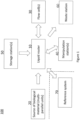
- Figure 1 shows a block diagram of an automated system 100 for spectroscopic analysis of biological material.
- the various components of the automated system 100 are linked among themselves via the liquid router 10, in the sense that the liquid router may convey liquid across different locations in the system.
- the automated system 100 comprises the following components: a plurality of sources of biological material 20, one or more flow cells 30 for spectroscopy, a manipulation station 40, storage stations 50 and a waste station 60. Although a case with one manipulation station 40 will be described, the automated system 100 may comprise a plurality of manipulation stations 40.
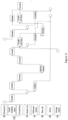
- Figure 2 shows another block diagram of the automated system 100 for spectroscopic analysis of biological material, wherein a schematic spatial distribution of the components is illustrated.
- the automated system 100 may be considered as comprising a bioreactor module and an analysis module.
- the bioreactor module comprises the plurality of bioreactor units 20, the manipulation station 40 and the storage stations 50, i.e. it is the part of the automated system 100 in which the samples are generated and manipulated.
- the analysis module comprises the flow cell(s) 30 and the waste station 60 and it is the part in which the samples are analysed and, after the analysis, discarded.
- a sample cup 15 At the interface between the two modules is a sample cup 15, to which samples just taken from the bioreactors or that have undergone manipulations already are delivered before being then routed to the flow cell(s).
- the liquid router 10 connects the components in both modules and it may assume different forms in each module.
- the liquid router 10 may comprises a liquid handling robot capable of automated pipetting and a system of tubes and pumps.
- the liquid router 10 is in the form of the liquid handling robot and in the analysis module the liquid router 10 is in the form of pumped lines, as shown in Figure 2 .
- the liquid handling robot may comprise at least one arm that can move with at least three degrees of freedom.
- the plurality of sources 20 may be multi-parallel bioreactor units, such as those of Sartorius ambr ® .
- the ambr ® system may comprise the bioreactor module as an integrated unit.
- each bioreactor unit may perform a variation of a production process, such as a cell cultivation process.
- Each of the one or more flow cells 30 is configured to contain a biological material sample and let electromagnetic radiation, such as laser, interact with the sample. The result of the interaction is analysed via the electromagnetic radiation spectrum by a spectrometer that is connected to the flow cell 30 via optical fibres. The spectroscopic analysis performed by the spectrometer provides information about the sample of biological material and, thus, on the process occurring in the bioreactor unit from which the sample has been taken. Accordingly, the process can be monitored in real time.
- the one or more flow cells 30 may be temperature-controlled.
- the liquid router 10 takes a plurality of samples, each from one of the sources, and delivers them to the flow cell 30 for spectroscopic analysis. This is done sequentially, i.e. the liquid router 10 takes a first sample and delivers it to the flow cell 30. Once the analysis is completed, the liquid router 10 routes the first sample from the flow cell 30 to the waste station 60 and then draws cleaning liquid from one of the storage stations 50 in which cleaning liquid is stored in order to clean itself and the flow cell 30. Afterwards, the liquid router 10 repeats the same procedure with a second sample and possibly with a third sample and so on.
- the samples may be delivered to the flow cell 30 ensuring that each sample is substantially bubble-free, thereby reducing and/or eliminating the risk of spectral artefacts e.g. caused by air.
- the flow cell 30 may be positioned such that gravity supports filling the flow cell and/or emptying the flow cell through the inlet and/or outlet, thereby preventing gas (e.g. air) from being trapped within the flow cell, particularly in an area adjacent to one or more transparent substrates (e.g. windows) used to perform the spectroscopic measurement.
- gas e.g. air
- Figures 9a and 9b show two exemplary methods of sample delivery to the flow cell 30 that reduce/eliminate the presence of air.
- the liquid router 30 particularly comprises a valve, which is at least a three-way valve, positioned between the origin of the sample (e.g. one of the sources 20 and/or the sample cup 15), the flow cell 30 and a further destination, e.g. the waste station 60.
- the flow cell 30 substantially is arranged or positioned in a non-horizontal position with respect to the ground or gravity.
- the three-way valve may have a first setting, in which it allows passage of liquid between the origin of the sample and the flow cell 30, and a second setting, in which it allows passage of liquid between the flow cell 30 and the waste station 60.
- the valve may be set to the first setting in order to fill the flow cell 30 with the sample and, after the spectroscopic measurement is performed, the valve may switch to the second setting, enabling delivery of the sample to the waste station 60.
- both the origin of the sample and the further destination are connected with the same opening, the bottom opening, of the flow cell 30.
- the origin of the sample is connected with the top opening of the flow cell 30, while the bottom opening of the flow cell 30 is connected to an intermediate sample storage, such as a tube.
- the sample may be delivered via the top opening of the flow cell 30, with the origin of the sample being positioned substantially above the flow cell 30. By virtue of gravity, the sample may also at least partly enter the intermediate sample storage placed below the flow cell 30.
- the flow cell 30 may be finally filled by pushing or pulling/sucking (e.g. by creating an overpressure in the intermediate sample storage and/or by means of a pump, e.g. syringe or peristaltic pump) the (part of the) sample from the intermediate sample storage back to the flow cell 30.
- the flow cell 30 may be emptied via the bottom opening in the intermediate sample storage and then the sample may be transferred from the intermediate sample storage to another (e.g. final) destination, such as the waste station 60.
- the liquid router 10 delivers each sample to the plurality of flow cells 30, before moving to the following sample.
- the liquid router 10 may deliver the sample sequentially to each flow cell, i.e. one flow cell after the other.
- the liquid router 10 may deliver a sample to the manipulation station 40 before delivering it to the flow cell(s) 30.
- the sample may be modified for pre-processing purposes and/or disambiguation purposes, as discussed in the summary.
- a manipulation for pre-processing purposes modifies the sample in order to bring it in the best conditions for the spectroscopic analysis, e.g. to eliminate possible hindrances to the analysis and/or to create favourable conditions for an uncontaminated analysis.
- a manipulation for disambiguation purposes modifies the sample in order to try and impact the spectral analysis, i.e. the spectrum, so that correlations that are anticipated to be possibly found when interpreting the spectrum may be broken.
- the manipulation prior to the analysis may be done for one purpose or both purposes.
- the liquid router 10 routes the sample from the manipulation station 40 to the flow cell(s) 30 and from there to the waste station 60, as in the simplest scenario.
- the liquid router 10 may deliver the sample to the manipulation station 40 after delivering it to the flow cell(s) 30, i.e. after a first spectroscopic analysis.
- the manipulation is done only for disambiguation purposes when correlations were predicted, suspected or found in the spectrum of the first spectroscopic analysis, and the sample is routed again to the flow cell(s) 30 for a second spectroscopic analysis.
- the sample may be then delivered to the waste station 60 or it may undergo other manipulations before that, in a back-and-forth between the manipulation station 40 and the flow cell(s) 30.
- Manipulation for disambiguation purposes may be performed by taking a secondary sample from the same source of biological material 20.
- the liquid router 10 may take a primary sample from a source and determine that it is or is predicted to be ambiguous and then take a secondary sample from that same source and deliver it to the manipulation station 40.
- the secondary sample may also undergo multiple manipulations before eventually ending at the waste station 60.
- the liquid router 10 may draw one or more substances, such as stock solutions, nutrients, water and others, from a corresponding storage station 50 and convey them to the manipulation station 40.
- the sample for spectroscopic analysis may also undergo an off-line reference analysis at the off-line reference system, wherein the off-line reference analysis may take place simultaneously to the spectroscopic analysis or before and after it, as explained in the summary.
- the sample may be split so that the liquid router 10 can deliver a part of it to the flow cell(s) 30 and another part to a transfer container, which is then manually carried to the off-line reference system 70.
- the transfer container may also be temporarily located in the bioreactor module, so that the liquid handling robot can reach it.
- the analysis module may further comprise a pH probe, which is connected to the sample cup 15 via an alternative tube line with respect to the one leading to the flow cell 30.
- the pH probe may have no direct role in the spectroscopic analysis.
- the pH measurement may be a beneficial (disambiguating) adjunct to spectroscopy or off-line reference, so the capacity to route the sample to the flow cell 30, and then back to the sample cup 15 and thence to the pH probe (as an alternative workflow to that already described) may be beneficial.
- sample may undergo pre-analysis and post-analysis manipulations as well as one or more off-line reference analysis.
- Figure 3 shows an exemplary workflow of a spectroscopic analysis of biological material involving some of the illustrated possibilities.
- Figure 3 shows how some steps in the workflow for subsequent samples may be performed simultaneously in order to increase throughput.
- the liquid handling robot takes a sample from one of the bioreactors 20 and places it in a transfer container, such as a well plate. A part of the sample, or subsample, is removed from the well plate by the liquid handler while the remainder (another subsample) is taken manually to the off-line reference system 70 for a first off-line reference analysis.
- the sample is then transferred via the liquid handling robot to the sample cup 15 and from there to the flow cell 30 via the pumped lines. Spectral capture occurs in the flow cell 30 and a spectroscopic analysis is performed by a spectrometer.
- the sample is transferred back from the analysis module to the bioreactor module, via the pumped lines and then the liquid handling robot, and ends up in the transfer container again.
- the sample is manually delivered to the off-line reference system 70 for a second off-line reference analysis.
- the pumped lines transfer cleaning liquid to the flow cell 30 from a storage station 50.
- the liquid handling robot starts to take the next sample from the bioreactors 20, which is transferred to a well on the well plate, as done before.
- the liquid handling robot removes part of the sample which will be delivered to the flow cell 30, while the pumped lines get washed and the cleaning liquid is deposited in the waste station 60. The sequence is repeated until all samples have been analysed.
- the central control computer 400 comprises a system control module 410 for controlling the automated system 100, both the bioreactor module and the analysis module.
- the automated system 100 comprises an interface device for receiving controls from the central control computer 400, and the interface device may also be configured to send process data from the bioreactor module to the central control computer 400.
- the controls given to the bioreactor module and the analysis module are coordinated.
- the central control computer 400 further comprises a spectrometry control module 420 for controlling a spectrometer control computer 490 configured to control one or more spectrometers connected via optical fibres to the one or more flow cells 30 in the analysis module.
- the central control computer 400 comprises a spectrometry data module 430 for receiving spectroscopic analysis data from the spectrometer(s) via the spectrometer control computer 490.
- the central control computer 400, the automated system 100 and the spectrometer control computer 490 may be part of a network. Communications between the central control computer 400 and the automated system 100 as well as between the central control computer 400 and the spectrometer control computer 490 may occur via data links, e.g. via cable media and/or wireless media.
- the central control computer 400 comprises a database 440 into which process data and spectroscopic analysis data are stored, together with reference data coming from the off-line reference analyses.
- the off-line reference system 70 may also be controlled by an off-line control computer system, which may send the reference data to the central control computer 400 via the Internet. Communications between the off-line control computer system and the central control computer 400 may be secured, e.g. via Internet protocol security (IPSEC) or other security protocols.
- IPSEC Internet protocol security
- the central control computer 400 may send, exemplarily without user intervention, the spectroscopic analysis data and the reference data to a computing device comprising a data analytics module, such as Sartorius-Stedim Data Analytics SIMCA, for elaboration of the data.
- a data analytics module such as Sartorius-Stedim Data Analytics SIMCA
- the automated system 100 is capable of manipulating samples of biological material.
- a particular type of manipulation is spiking, i.e. adding a known amount of an analyte to the sample.
- Figure 5 shows a block diagram of an exemplary spiking process performed with the aid of well plate comprising at least three wells.
- a sample is taken by the liquid router 10 from a bioreactor unit source 20 and split into three subsamples delivered respectively to a first well 510, a second well 520 and a third well 530 in a plate 500.
- the first subsample may be mixed with 100uL of water
- the second subsample may be mixed with 50 uL of water and 50 uL of glucose solution
- the third subsample may be mixed with 100 uL of glucose solution.
- the water and glucose solution may be retrieved by the liquid router 10 from a storage station 50.
- the liquid router 10 routes the three subsamples to the at least one flow cell 30 sequentially.
- Aliquots may be taken from each subsample for the off-line reference system 70, either before spiking or after spiking. If done before spiking, corrections based on the volume and concentration of the spiking solution may be used on the off-line reference analysis results.
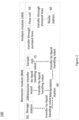
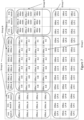
- Figure 6 shows an exemplary spiking plate and Figure 7 shows an exemplary preparation of a spiking plate.
- the plate shown in Figure 6 comprises 96 wells, each containing different amounts (including null amounts) of four different disambiguating substances A, B, C, D. In particular, there are 15 different combinations and each combination is repeated six times. Since each well is used only once, this plate may be used for spiking six samples coming from six sources in 15 different ways. Exemplarily, the spiking may be performed according to the standard addition method.
- Spiking plate preparation needs to take into account the potential for accumulated inaccuracies due to liquid handling. Therefore, typically, the spiking plate would be produced by a series of liquid handling steps, first to put together stock solution combinations, potentially using a serial dilution approach, and then to aliquot these stock solutions to target wells on the plate.
- Figure 7 shows an example thereof: plate is loaded onto system with just the Group A wells filled with stock solution. A plate is also loaded onto the system with a trough of water.
- the wells of Groups C, E and F are used for spiking, with a full matrix design for four vessels.
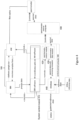
- FIG. 8 The block diagram shows a method for spectroscopic analysis of biological material, wherein the dashed-dotted blocks and arrows indicate optional steps.
- the diagram refers to a single sample of biological material and the method can be repeated for all the plurality of samples of biological material.
- the method starts at S801 and it may always (i.e. for each sample) comprise steps S803, S813, S815, S817 and S819 in this order.
- the method may comprise (not shown) performing a variation of a production process in a bioreactor unit 20.
- the sample of biological material is taken from a bioreactor unit 20 by the liquid router 10, in particular by the liquid handling robot.
- the sample is delivered by the liquid router 10 to the flow cell 30.
- the sample coming from the bioreactor module i.e. from the source, in the simplest case, or from a manipulation station 40
- the liquid handling robot may be delivered by the liquid handling robot to the sample cup 15 and from the sample cup 15 via pumped lines to the flow cell 30.
- a spectroscopic analysis of the sample is exemplarily performed on the basis of a model by the spectrometer connected to the flow cell 30 via optical fibres.
- the spectroscopic analysis may be performed for data acquisition in order to generate a model for it.
- pumped lines of the liquid router 10 transfer the sample to the waste station 60.
- the liquid router 10 draws cleaning liquid from a storage station 50 and washes itself and the flow cell 30.
- the method may further comprise additional steps.
- the method may comprise one or more of the following: pre-processing, pre-analysis disambiguating manipulation, post-analysis disambiguating manipulation, pre-analysis off-line reference analysis, simultaneous off-line reference analysis and post-analysis off-line reference analysis.
- Steps S805 and S807 cover pre-processing and pre-analysis disambiguating manipulation when performed before step S815, while covering post-analysis disambiguating manipulation when performed after step S815.
- step S805 When step S805 is performed right after S803, the sample is routed from the source to the manipulation station 40, where it is manipulated for pre-processing and/or disambiguation (for impacting the spectroscopic analysis), e.g. filtered and/or spiked, at S807.
- step S805 is performed after step S815, the sample is routed from the flow cell 30, i.e. from the analysis module, back to the bioreactor module, namely to the manipulation station 40. There, it is manipulated to impact the spectroscopic analysis at S807. Afterwards, the method moves again to step S813, possibly going through steps S809-S811.
- Step S809 covers pre-analysis off-line reference analysis, simultaneous off-line reference analysis and post-analysis off-line reference analysis.
- the sample may come from the source or from the manipulation station 40.
- the sample is split into two parts, one carried manually to the off-line reference system 70 (not shown) and the other taken at S811 by the liquid handling robot, which is then delivered at S813 to the flow cell 30.
- the spectroscopic analysis and the off-line reference analysis may be coordinated so as to occur simultaneously or the off-line reference analysis may be performed prior to the spectroscopic analysis.
- the sample may be routed from the flow cell 30 to the transfer element, from which it is taken to the off-line reference system 70 for post-analysis off-line or at-line reference analysis. Since the sample has already been used for spectroscopic analysis, there is no need for splitting it into two parts. Further, the flow cell 30 has already been emptied. Accordingly, after S809, the method may directly move to S819.
Landscapes
- Physics & Mathematics (AREA)
- Analytical Chemistry (AREA)
- General Health & Medical Sciences (AREA)
- Health & Medical Sciences (AREA)
- Life Sciences & Earth Sciences (AREA)
- Chemical & Material Sciences (AREA)
- Pathology (AREA)
- Biochemistry (AREA)
- Immunology (AREA)
- General Physics & Mathematics (AREA)
- Quality & Reliability (AREA)
- Engineering & Computer Science (AREA)
- Spectroscopy & Molecular Physics (AREA)
- Apparatus Associated With Microorganisms And Enzymes (AREA)
- Investigating Or Analysing Materials By Optical Means (AREA)
Claims (15)
- Procédé informatisé pour l'analyse spectroscopique d'un matériau biologique, le procédé incluant une étape d'analyse comprenant :le prélèvement (S803), par un dispositif d'acheminement de liquide (10), d'une pluralité d'échantillons de matériau biologique à partir d'une pluralité de sources (20), dans laquelle chaque échantillon parmi la pluralité d'échantillons est prélevé à partir d'une source parmi la pluralité de sources (20) ;la délivrance (S813), par le dispositif d'acheminement de liquide (10), de la pluralité d'échantillons de matériau biologique à au moins une cellule d'écoulement (30) aux fins d'une spectroscopie ;la mise en oeuvre (s815), par au moins un spectromètre connecté à l'au moins une cellule d'écoulement (30), de l'analyse spectroscopique de la pluralité d'échantillons de matériau biologique ;caractérisé en ce que le procédé comprend en outre :la détermination que oui ou non l'analyse spectroscopique pour chaque échantillon parmi la pluralité d'échantillons est ou est prédite être ambiguë en ce sens qu'elle est affectée par au moins deux facteurs non discriminables qui sont temporellement corrélés, dans laquelle les au moins deux facteurs non discriminables comprennent uniquement des facteurs présentant un intérêt dont il est souhaité obtenir les propriétés via l'analyse spectroscopique, ou comprennent à la fois un ou plusieurs facteurs présentant un intérêt et un ou plusieurs facteurs parasites dont les propriétés ne sont pas destinées à être obtenues via l'analyse spectroscopique ;si l'analyse spectroscopique pour un échantillon donné parmi la pluralité d'échantillons de matériau biologique est ou est prédite être ambiguë, la mise en oeuvre d'une étape de désambiguïsation pour rompre la corrélation des au moins deux facteurs non discriminables, l'étape de désambiguïsation comprenant :(a) le prélèvement, par le dispositif d'acheminement de liquide (10), d'un échantillon secondaire de matériau biologique provenant de la même source que celle de l'échantillon donné pour lequel l'analyse spectroscopique est ou est prédite être ambiguë ;(b) l'acheminement, par le dispositif d'acheminement de liquide (10), de l'échantillon secondaire de matériau biologique provenant de la source, vers un poste de manipulation (40) ;(c) la manipulation, au niveau du poste de manipulation (40), de l'échantillon secondaire de matériau biologique de façon que l'analyse spectroscopique soit impactée ;(d) la délivrance, par le dispositif d'acheminement de liquide (10), de l'échantillon secondaire manipulé de matériau biologique provenant du poste de manipulation (40), à l'au moins une cellule d'écoulement (30) ;(e) la mise en oeuvre, par l'au moins un spectromètre, de l'analyse spectroscopique de l'échantillon secondaire manipulé de matériau biologique ;dans lequel l'information obtenue via l'étape de désambiguïsation avec l'échantillon secondaire est utilisée pour l'analyse spectroscopique de l'échantillon donné.
- Procédé selon la revendication 1, dans lequel chaque source parmi la pluralité de sources (20) est un bioréacteur.
- Procédé selon l'une quelconque des revendications précédentes, dans lequel la manipulation de l'échantillon secondaire de matériau biologique comprend le mélange de l'échantillon de matériau biologique avec une substance de désambiguïsation.
- Procédé selon la revendication 3, dans lequel :la manipulation comprend en outre la division de l'échantillon secondaire de matériau biologique en une pluralité de sous-échantillons, et le mélange de chaque sous-échantillon avec une quantité différente de la substance de désambiguïsation et/ou une ou plusieurs parmi une gamme d'autres substances de désambiguïsation ;la délivrance de l'échantillon secondaire manipulé comprend la délivrance de la pluralité de sous-échantillons manipulés ; etla mise en oeuvre de l'analyse spectroscopique de l'échantillon secondaire manipulé comprend la mise en oeuvre de l'analyse spectroscopique de la pluralité de sous-échantillons manipulés.
- Procédé selon l'une quelconque des revendications précédentes, dans lequel la délivrance, par le dispositif d'acheminement de liquide (10), de la pluralité d'échantillons de matériau biologique à au moins une cellule d'écoulement (30) aux fins d'une spectroscopie comprend la délivrance de la pluralité d'échantillons de matériau biologique à une pluralité de cellules d'écoulement.
- Procédé selon l'une quelconque des revendications précédentes, dans lequel l'étape d'analyse comprend en outre :
le prétraitement d'au moins un échantillon parmi la pluralité d'échantillons de matériau biologique avant la mise en oeuvre de l'analyse spectroscopique, en particulier par au moins l'un parmi : une filtration, un chauffage, une normalisation du pH, une modification de la force ionique, une dilution, une inactivation métabolique. - Procédé selon l'une quelconque des revendications précédentes, comprenant en outre :le prélèvement, par le dispositif d'acheminement de liquide (10), d'un sous-échantillon d'au moins un échantillon parmi la pluralité d'échantillons de matériau biologiques pour un système de référence (70) ;la mise en oeuvre, par le système de référence (70), d'une analyse de référence du sous-échantillon ;la comparaison d'un résultat de l'analyse spectroscopique par le spectromètre pour l'au moins un échantillon de matériau biologique avec un résultat de l'analyse de référence.
- Procédé selon l'une quelconque des revendications précédentes, dans lequel l'étape d'analyse est en outre mise en oeuvre une ou plusieurs fois supplémentaires à différents points de temps, le procédé comprenant en outre :
la détermination d'un profil fondé sur le temps de résultats de l'analyse spectroscopique. - Procédé selon l'une quelconque des revendications précédentes, comprenant en outre la mise en oeuvre de variations d'un procédé de production dans la pluralité de sources (20).
- Procédé selon l'une quelconque des revendications précédentes, dans lequel les étapes du procédé font partie d'un protocole qui est exécuté automatiquement.
- Système (100) pour l'analyse spectroscopique d'un matériau biologique, le système comprenant :- une pluralité de sources (20) de matériau biologique ;- un dispositif d'acheminement de liquide (10) ;- au moins une cellule d'écoulement (30) ;- un poste de manipulation (40) ;- un dispositif d'interface ;- un ordinateur de commande (400) ; et- au moins un spectromètre ;dans lequel :- le dispositif d'interface est configuré pour recevoir des instructions provenant de l'ordinateur de commande (400) pour la commande automatique d'opérations du système ;- le dispositif d'acheminement de liquide (10) est configuré pour prélever une pluralité d'échantillons de matériau biologique à partir de la pluralité de sources (20), chaque échantillon parmi la pluralité d'échantillons étant prélevé à partir d'une source parmi la pluralité de sources (20), et pour délivrer la pluralité d'échantillons de matériau biologique à l'au moins une cellule d'écoulement (30) ;- l'au moins une cellule d'écoulement est configurée pour être connectée à l'au moins un spectromètre ;caractérisé en ce quelorsqu'une analyse spectroscopique d'un échantillon donné parmi la pluralité d'échantillons de matériau biologique par l'au moins un spectromètre est ou est prédite, par l'ordinateur de commande (400), être ambiguë en ce sens qu'elle est affectée par au moins deux facteurs non discriminables qui sont temporellement corrélés, le dispositif d'acheminement de liquide (10) est en outre configuré pour :(a) prélever un échantillon secondaire de matériau biologique à partir de la même source que celle de l'échantillon donné pour lequel l'analyse spectroscopique est ou est prédite être ambiguë ;(b) acheminer l'échantillon secondaire de matériau biologique depuis la source vers le poste de manipulation (40), le poste de manipulation (40) étant configuré de sorte que l'échantillon secondaire de matériau biologique soit manipulé de façon que l'analyse spectroscopique soit impactée ; et(c) délivrer l'échantillon secondaire manipulé d'échantillon biologique depuis le poste de manipulation (40) à l'au moins une cellule d'écoulement (30) aux fins d'une analyse spectroscopique,dans lequel l'information obtenue avec l'échantillon secondaire est utilisé par l'ordinateur de commande (400) pour l'analyse spectroscopique de l'échantillon donné ;dans lequel les au moins deux facteurs non discriminables comprennent uniquement des facteurs présentant un intérêt dont il est souhaité obtenir les propriétés via l'analyse spectroscopique, ou comprennent à la fois un ou plusieurs facteurs présentant un intérêt et un ou plusieurs facteurs parasites dont les propriétés ne sont pas destinées à être obtenues via l'analyse spectroscopique.
- Système (100) selon la revendication 11, dans lequel :le dispositif d'acheminement de liquide (10) est en outre configuré, avant l'analyse spectroscopique, pour acheminer au moins un échantillon parmi la pluralité d'échantillons de matériau biologique jusqu'au poste de manipulation (40) aux fins d'un prétraitement ; etle poste de manipulation (40) est configuré de façon que l'au moins un échantillon de matériau biologique soit prétraité avant l'analyse spectroscopique, en particulier par au moins l'un parmi : une filtration, un chauffage, une normalisation du pH, une modification de la force ionique, une dilution, une inactivation métabolique.
- Système (100) selon la revendication 11 ou 12, lequel système (100) est configuré pour être connecté à un dispositif informatique, dans lequel :le dispositif d'acheminement de liquide (10) est en outre configuré pour prélever un sous-échantillon d'au moins un échantillon parmi la pluralité d'échantillons de matériau biologique pour un système de référence (70) ;le système de référence (70) est configuré pour effectuer une analyse de référence du sous-échantillon ; etle dispositif informatique est configuré pour comparer un résultat de l'analyse spectroscopique de l'au moins un échantillon de matériau biologique par l'au moins un spectromètre avec un résultat de l'analyse de référence.
- Système (100) selon l'une quelconque des revendications 11 à 13, dans lequel le dispositif d'acheminement de liquide (10) comprend un robot de manipulation de liquide qui effectue un pipetage automatisé en étant exploitable pour être commandé via le dispositif d'interface.
- Produit de type programme informatique comprenant des instructions lisibles par ordinateur qui, lorsqu'elles sont chargées et exécutées sur le système de l'une quelconque des revendications 11 à 14, effectue les étapes d'un procédé selon l'une quelconque des revendications 1 à 10.
Applications Claiming Priority (2)
| Application Number | Priority Date | Filing Date | Title |
|---|---|---|---|
| EP18000314.7A EP3546922B1 (fr) | 2018-03-29 | 2018-03-29 | Procédé et système informatisés pour l'analyse spectroscopique d'un matériau biologique |
| PCT/EP2019/057992 WO2019185860A1 (fr) | 2018-03-29 | 2019-03-29 | Procédé mis en oeuvre par ordinateur et système d'analyse spectroscopique de matériel biologique |
Publications (2)
| Publication Number | Publication Date |
|---|---|
| EP3755992A1 EP3755992A1 (fr) | 2020-12-30 |
| EP3755992B1 true EP3755992B1 (fr) | 2024-11-06 |
Family
ID=62044454
Family Applications (3)
| Application Number | Title | Priority Date | Filing Date |
|---|---|---|---|
| EP21181956.0A Active EP3910320B1 (fr) | 2018-03-29 | 2018-03-29 | Procédé et système informatisés pour l'analyse spectroscopique d'un matériau biologique |
| EP18000314.7A Active EP3546922B1 (fr) | 2018-03-29 | 2018-03-29 | Procédé et système informatisés pour l'analyse spectroscopique d'un matériau biologique |
| EP19715054.3A Active EP3755992B1 (fr) | 2018-03-29 | 2019-03-29 | Procédé et système informatisés pour l'analyse spectroscopique d'un matériau biologique |
Family Applications Before (2)
| Application Number | Title | Priority Date | Filing Date |
|---|---|---|---|
| EP21181956.0A Active EP3910320B1 (fr) | 2018-03-29 | 2018-03-29 | Procédé et système informatisés pour l'analyse spectroscopique d'un matériau biologique |
| EP18000314.7A Active EP3546922B1 (fr) | 2018-03-29 | 2018-03-29 | Procédé et système informatisés pour l'analyse spectroscopique d'un matériau biologique |
Country Status (4)
| Country | Link |
|---|---|
| US (2) | US11598720B2 (fr) |
| EP (3) | EP3910320B1 (fr) |
| CN (1) | CN111989561B (fr) |
| WO (1) | WO2019185860A1 (fr) |
Families Citing this family (6)
| Publication number | Priority date | Publication date | Assignee | Title |
|---|---|---|---|---|
| EP3910320B1 (fr) * | 2018-03-29 | 2024-09-11 | The Automation Partnership (Cambridge) Ltd. | Procédé et système informatisés pour l'analyse spectroscopique d'un matériau biologique |
| MY204234A (en) | 2018-08-27 | 2024-08-16 | Regeneron Pharma | Use of raman spectroscopy in downstream purification |
| US11054364B2 (en) | 2018-12-17 | 2021-07-06 | Thermo Finnigan Llc | Apparatus and methods for handling and spectrophotometry of small liquid samples |
| CN111257302B (zh) * | 2020-03-20 | 2021-05-04 | 中国科学院微生物研究所 | 用于显微拉曼光谱检测好氧或兼性厌氧病原微生物的液体样品池 |
| US12434075B2 (en) * | 2021-05-11 | 2025-10-07 | Celestial Oncology Inc. | Coupled robotic radiation therapy system |
| WO2025194053A1 (fr) * | 2024-03-15 | 2025-09-18 | Arranta Bio Holdings, Llc | Appareil modulaire de test de de technologie d'analyse des procédés |
Citations (1)
| Publication number | Priority date | Publication date | Assignee | Title |
|---|---|---|---|---|
| EP3546922B1 (fr) * | 2018-03-29 | 2021-06-30 | The Automation Partnership (Cambridge) Limited | Procédé et système informatisés pour l'analyse spectroscopique d'un matériau biologique |
Family Cites Families (26)
| Publication number | Priority date | Publication date | Assignee | Title |
|---|---|---|---|---|
| DE19545130C2 (de) * | 1995-12-04 | 2001-05-17 | Karl Cammann | Verfahren und Vorrichtungen für ein modulares Mikrosystem für hochgenaue chemische Schnell-Analysen |
| US6511814B1 (en) * | 1999-03-26 | 2003-01-28 | Idexx Laboratories, Inc. | Method and device for detecting analytes in fluids |
| EP1285244A4 (fr) * | 2000-03-13 | 2008-04-16 | Food Processing Systems | Appareil et procede de mesure et de correlation de caracteristiques de fruits avec un spectre visible/infrarouge proche |
| US20040241872A1 (en) * | 2003-03-17 | 2004-12-02 | Qiagen Operon, Inc. | Optical detection liquid handling robot system |
| DE102004010217A1 (de) * | 2004-02-27 | 2005-09-15 | Carl Zeiss Jena Gmbh | Anordnung und Verfahren zur spektroskopischen Bestimmung der Bestandteile und Konzentrationen pumpfähiger organischer Verbindungen |
| WO2006007683A1 (fr) * | 2004-07-21 | 2006-01-26 | Tembec Industries Inc. | Procede et dispositif destines a deriver des informations a partir d'une liqueur obtenue pendant une reaction de digestion du bois |
| WO2006010252A1 (fr) * | 2004-07-27 | 2006-02-02 | National Research Council Of Canada | Systeme fluorometrique a longueurs d'ondes multiples destine a la surveillance en ligne de procedes biologiques |
| US20070116600A1 (en) * | 2005-06-23 | 2007-05-24 | Kochar Manish S | Detection device and methods associated therewith |
| US7723120B2 (en) * | 2005-10-26 | 2010-05-25 | General Electric Company | Optical sensor array system and method for parallel processing of chemical and biochemical information |
| JP4805710B2 (ja) * | 2006-03-31 | 2011-11-02 | シスメックス株式会社 | 検体分析装置 |
| CA2692973A1 (fr) * | 2007-07-12 | 2009-01-15 | Tragara Pharmaceuticals, Inc. | Selection de patient et procedes therapeutiques utilisant des marqueurs du metabolisme de la prostaglandine |
| US8102518B2 (en) * | 2007-12-14 | 2012-01-24 | Haught Roy C | Zero angle photon spectrophotometer for monitoring of water systems |
| CA2738578C (fr) * | 2008-09-23 | 2021-05-04 | Quantalife, Inc. | Systeme de dosage base sur des gouttelettes |
| WO2010039975A1 (fr) * | 2008-10-03 | 2010-04-08 | Nanodrop Technologies Llc | Spectrophotomètre à double mode d'échantillon |
| JP5203889B2 (ja) * | 2008-10-28 | 2013-06-05 | シスメックス株式会社 | 検体分析装置及び検体分析方法 |
| JP2012529268A (ja) * | 2009-06-05 | 2012-11-22 | インテジェンクス,インコーポレイテッド | ユニバーサルサンプル調製システムおよび統合解析システムの使用方法 |
| WO2011157655A1 (fr) * | 2010-06-15 | 2011-12-22 | Biocrates Life Sciences Ag | Utilisation des acides de la bile pour la prédiction d'une apparition de sepsie |
| US8941062B2 (en) * | 2010-11-16 | 2015-01-27 | 1087 Systems, Inc. | System for identifying and sorting living cells |
| US10908066B2 (en) * | 2010-11-16 | 2021-02-02 | 1087 Systems, Inc. | Use of vibrational spectroscopy for microfluidic liquid measurement |
| US20130003044A1 (en) * | 2010-12-14 | 2013-01-03 | Chemlmage Corporation | System and Method for Raman Based Chronic Exposure Detection |
| US10101209B2 (en) * | 2012-04-30 | 2018-10-16 | Finesse Solutions, Inc. | Method and apparatus for quantifying solutions comprised of multiple analytes |
| JP2016527494A (ja) * | 2013-07-05 | 2016-09-08 | ユニバーシティ オブ ワシントン スルー イッツ センター フォー コマーシャライゼーション | マイクロ流体アッセイのための方法、組成物およびシステム |
| CN105334184A (zh) * | 2014-08-15 | 2016-02-17 | 富强 | 一种在线近红外光谱分析仪 |
| US20170127983A1 (en) * | 2015-11-10 | 2017-05-11 | Massachusetts Institute Of Technology | Systems and methods for sampling calibration of non-invasive analyte measurements |
| CN106645134A (zh) * | 2017-02-22 | 2017-05-10 | 王飞 | 化学分析用颜色测定仪 |
| CA3054803C (fr) * | 2017-02-28 | 2025-06-17 | MarqMetrix Inc. | Cuve à circulation comprenant un verre sphérique |
-
2018
- 2018-03-29 EP EP21181956.0A patent/EP3910320B1/fr active Active
- 2018-03-29 EP EP18000314.7A patent/EP3546922B1/fr active Active
-
2019
- 2019-03-29 WO PCT/EP2019/057992 patent/WO2019185860A1/fr not_active Ceased
- 2019-03-29 CN CN201980023361.9A patent/CN111989561B/zh active Active
- 2019-03-29 EP EP19715054.3A patent/EP3755992B1/fr active Active
- 2019-03-29 US US17/042,837 patent/US11598720B2/en active Active
-
2023
- 2023-02-07 US US18/106,958 patent/US12055484B2/en active Active
Patent Citations (1)
| Publication number | Priority date | Publication date | Assignee | Title |
|---|---|---|---|---|
| EP3546922B1 (fr) * | 2018-03-29 | 2021-06-30 | The Automation Partnership (Cambridge) Limited | Procédé et système informatisés pour l'analyse spectroscopique d'un matériau biologique |
Also Published As
| Publication number | Publication date |
|---|---|
| EP3546922A1 (fr) | 2019-10-02 |
| CN111989561B (zh) | 2024-08-02 |
| EP3910320B1 (fr) | 2024-09-11 |
| US20210025814A1 (en) | 2021-01-28 |
| US20230184673A1 (en) | 2023-06-15 |
| EP3755992A1 (fr) | 2020-12-30 |
| EP3910320A1 (fr) | 2021-11-17 |
| CN111989561A (zh) | 2020-11-24 |
| US12055484B2 (en) | 2024-08-06 |
| EP3546922B1 (fr) | 2021-06-30 |
| WO2019185860A1 (fr) | 2019-10-03 |
| US11598720B2 (en) | 2023-03-07 |
Similar Documents
| Publication | Publication Date | Title |
|---|---|---|
| EP3755992B1 (fr) | Procédé et système informatisés pour l'analyse spectroscopique d'un matériau biologique | |
| CN101426897B (zh) | 从生物反应器中无菌样品提取机械敏感材料的工艺分析系统 | |
| US7354774B2 (en) | Self aliquoting sample storage plate | |
| EP2600156A1 (fr) | Dispositif d'analyse d'acides nucléiques | |
| EP3573755B1 (fr) | Procédé de production d'échantillons de fluide traités individuellement | |
| US20200371125A1 (en) | System and method of performing a biological experiment with adaptive cybernetic control of procedural conditions | |
| Kroll et al. | Ex situonline monitoring: application, challenges and opportunities for biopharmaceuticals processes | |
| CN107064534B (zh) | 用于操作自动分析机器的方法 | |
| CN117192094A (zh) | 一种自动化单分子免疫分析系统及方法 | |
| US20250034504A1 (en) | On-line biomolecular analysis for monitoring or controlling bioprocesses | |
| Balakirsky | Modular sensing, automation, and control for the production of cellular therapies | |
| TW202345974A (zh) | 生化分子合成及生物氣膠偵測系統及方法 | |
| WO2026053120A1 (fr) | Système d'actionnement de microgouttelettes | |
| JP4906362B2 (ja) | 化学分析前処理装置 | |
| CA3246195A1 (fr) | Systèmes de préparation de bibliothèque et procédés associés | |
| Nano | FREE TECHNICAL INFORMATION |
Legal Events
| Date | Code | Title | Description |
|---|---|---|---|
| STAA | Information on the status of an ep patent application or granted ep patent |
Free format text: STATUS: UNKNOWN |
|
| STAA | Information on the status of an ep patent application or granted ep patent |
Free format text: STATUS: THE INTERNATIONAL PUBLICATION HAS BEEN MADE |
|
| PUAI | Public reference made under article 153(3) epc to a published international application that has entered the european phase |
Free format text: ORIGINAL CODE: 0009012 |
|
| STAA | Information on the status of an ep patent application or granted ep patent |
Free format text: STATUS: REQUEST FOR EXAMINATION WAS MADE |
|
| 17P | Request for examination filed |
Effective date: 20200922 |
|
| AK | Designated contracting states |
Kind code of ref document: A1 Designated state(s): AL AT BE BG CH CY CZ DE DK EE ES FI FR GB GR HR HU IE IS IT LI LT LU LV MC MK MT NL NO PL PT RO RS SE SI SK SM TR |
|
| AX | Request for extension of the european patent |
Extension state: BA ME |
|
| DAV | Request for validation of the european patent (deleted) | ||
| DAX | Request for extension of the european patent (deleted) | ||
| STAA | Information on the status of an ep patent application or granted ep patent |
Free format text: STATUS: EXAMINATION IS IN PROGRESS |
|
| 17Q | First examination report despatched |
Effective date: 20230109 |
|
| GRAP | Despatch of communication of intention to grant a patent |
Free format text: ORIGINAL CODE: EPIDOSNIGR1 |
|
| STAA | Information on the status of an ep patent application or granted ep patent |
Free format text: STATUS: GRANT OF PATENT IS INTENDED |
|
| RIC1 | Information provided on ipc code assigned before grant |
Ipc: G01N 21/84 20060101ALN20240613BHEP Ipc: G01N 21/65 20060101ALN20240613BHEP Ipc: G01N 21/64 20060101ALN20240613BHEP Ipc: G01N 21/47 20060101ALN20240613BHEP Ipc: G01N 21/359 20140101ALN20240613BHEP Ipc: G01N 21/31 20060101ALN20240613BHEP Ipc: G01N 35/00 20060101ALI20240613BHEP Ipc: G01N 35/10 20060101ALI20240613BHEP Ipc: G01N 21/05 20060101AFI20240613BHEP |
|
| INTG | Intention to grant announced |
Effective date: 20240702 |
|
| GRAS | Grant fee paid |
Free format text: ORIGINAL CODE: EPIDOSNIGR3 |
|
| GRAA | (expected) grant |
Free format text: ORIGINAL CODE: 0009210 |
|
| STAA | Information on the status of an ep patent application or granted ep patent |
Free format text: STATUS: THE PATENT HAS BEEN GRANTED |
|
| AK | Designated contracting states |
Kind code of ref document: B1 Designated state(s): AL AT BE BG CH CY CZ DE DK EE ES FI FR GB GR HR HU IE IS IT LI LT LU LV MC MK MT NL NO PL PT RO RS SE SI SK SM TR |
|
| REG | Reference to a national code |
Ref country code: GB Ref legal event code: FG4D |
|
| P01 | Opt-out of the competence of the unified patent court (upc) registered |
Free format text: CASE NUMBER: APP_53299/2024 Effective date: 20240925 |
|
| REG | Reference to a national code |
Ref country code: CH Ref legal event code: EP |
|
| REG | Reference to a national code |
Ref country code: DE Ref legal event code: R096 Ref document number: 602019061465 Country of ref document: DE |
|
| REG | Reference to a national code |
Ref country code: IE Ref legal event code: FG4D |
|
| REG | Reference to a national code |
Ref country code: SE Ref legal event code: TRGR |
|
| REG | Reference to a national code |
Ref country code: LT Ref legal event code: MG9D |
|
| REG | Reference to a national code |
Ref country code: NL Ref legal event code: MP Effective date: 20241106 |
|
| PG25 | Lapsed in a contracting state [announced via postgrant information from national office to epo] |
Ref country code: HR Free format text: LAPSE BECAUSE OF FAILURE TO SUBMIT A TRANSLATION OF THE DESCRIPTION OR TO PAY THE FEE WITHIN THE PRESCRIBED TIME-LIMIT Effective date: 20241106 Ref country code: IS Free format text: LAPSE BECAUSE OF FAILURE TO SUBMIT A TRANSLATION OF THE DESCRIPTION OR TO PAY THE FEE WITHIN THE PRESCRIBED TIME-LIMIT Effective date: 20250306 Ref country code: PT Free format text: LAPSE BECAUSE OF FAILURE TO SUBMIT A TRANSLATION OF THE DESCRIPTION OR TO PAY THE FEE WITHIN THE PRESCRIBED TIME-LIMIT Effective date: 20250306 |
|
| PG25 | Lapsed in a contracting state [announced via postgrant information from national office to epo] |
Ref country code: NL Free format text: LAPSE BECAUSE OF FAILURE TO SUBMIT A TRANSLATION OF THE DESCRIPTION OR TO PAY THE FEE WITHIN THE PRESCRIBED TIME-LIMIT Effective date: 20241106 Ref country code: FI Free format text: LAPSE BECAUSE OF FAILURE TO SUBMIT A TRANSLATION OF THE DESCRIPTION OR TO PAY THE FEE WITHIN THE PRESCRIBED TIME-LIMIT Effective date: 20241106 |
|
| REG | Reference to a national code |
Ref country code: AT Ref legal event code: MK05 Ref document number: 1739841 Country of ref document: AT Kind code of ref document: T Effective date: 20241106 |
|
| PG25 | Lapsed in a contracting state [announced via postgrant information from national office to epo] |
Ref country code: BG Free format text: LAPSE BECAUSE OF FAILURE TO SUBMIT A TRANSLATION OF THE DESCRIPTION OR TO PAY THE FEE WITHIN THE PRESCRIBED TIME-LIMIT Effective date: 20241106 |
|
| PG25 | Lapsed in a contracting state [announced via postgrant information from national office to epo] |
Ref country code: ES Free format text: LAPSE BECAUSE OF FAILURE TO SUBMIT A TRANSLATION OF THE DESCRIPTION OR TO PAY THE FEE WITHIN THE PRESCRIBED TIME-LIMIT Effective date: 20241106 |
|
| PG25 | Lapsed in a contracting state [announced via postgrant information from national office to epo] |
Ref country code: NO Free format text: LAPSE BECAUSE OF FAILURE TO SUBMIT A TRANSLATION OF THE DESCRIPTION OR TO PAY THE FEE WITHIN THE PRESCRIBED TIME-LIMIT Effective date: 20250206 |
|
| PG25 | Lapsed in a contracting state [announced via postgrant information from national office to epo] |
Ref country code: GR Free format text: LAPSE BECAUSE OF FAILURE TO SUBMIT A TRANSLATION OF THE DESCRIPTION OR TO PAY THE FEE WITHIN THE PRESCRIBED TIME-LIMIT Effective date: 20250207 Ref country code: LV Free format text: LAPSE BECAUSE OF FAILURE TO SUBMIT A TRANSLATION OF THE DESCRIPTION OR TO PAY THE FEE WITHIN THE PRESCRIBED TIME-LIMIT Effective date: 20241106 Ref country code: AT Free format text: LAPSE BECAUSE OF FAILURE TO SUBMIT A TRANSLATION OF THE DESCRIPTION OR TO PAY THE FEE WITHIN THE PRESCRIBED TIME-LIMIT Effective date: 20241106 |
|
| PG25 | Lapsed in a contracting state [announced via postgrant information from national office to epo] |
Ref country code: PL Free format text: LAPSE BECAUSE OF FAILURE TO SUBMIT A TRANSLATION OF THE DESCRIPTION OR TO PAY THE FEE WITHIN THE PRESCRIBED TIME-LIMIT Effective date: 20241106 |
|
| PG25 | Lapsed in a contracting state [announced via postgrant information from national office to epo] |
Ref country code: RS Free format text: LAPSE BECAUSE OF FAILURE TO SUBMIT A TRANSLATION OF THE DESCRIPTION OR TO PAY THE FEE WITHIN THE PRESCRIBED TIME-LIMIT Effective date: 20250206 |
|
| PG25 | Lapsed in a contracting state [announced via postgrant information from national office to epo] |
Ref country code: SM Free format text: LAPSE BECAUSE OF FAILURE TO SUBMIT A TRANSLATION OF THE DESCRIPTION OR TO PAY THE FEE WITHIN THE PRESCRIBED TIME-LIMIT Effective date: 20241106 |
|
| PG25 | Lapsed in a contracting state [announced via postgrant information from national office to epo] |
Ref country code: DK Free format text: LAPSE BECAUSE OF FAILURE TO SUBMIT A TRANSLATION OF THE DESCRIPTION OR TO PAY THE FEE WITHIN THE PRESCRIBED TIME-LIMIT Effective date: 20241106 |
|
| PG25 | Lapsed in a contracting state [announced via postgrant information from national office to epo] |
Ref country code: EE Free format text: LAPSE BECAUSE OF FAILURE TO SUBMIT A TRANSLATION OF THE DESCRIPTION OR TO PAY THE FEE WITHIN THE PRESCRIBED TIME-LIMIT Effective date: 20241106 |
|
| PGFP | Annual fee paid to national office [announced via postgrant information from national office to epo] |
Ref country code: CH Payment date: 20250401 Year of fee payment: 7 |
|
| PG25 | Lapsed in a contracting state [announced via postgrant information from national office to epo] |
Ref country code: RO Free format text: LAPSE BECAUSE OF FAILURE TO SUBMIT A TRANSLATION OF THE DESCRIPTION OR TO PAY THE FEE WITHIN THE PRESCRIBED TIME-LIMIT Effective date: 20241106 |
|
| PG25 | Lapsed in a contracting state [announced via postgrant information from national office to epo] |
Ref country code: SK Free format text: LAPSE BECAUSE OF FAILURE TO SUBMIT A TRANSLATION OF THE DESCRIPTION OR TO PAY THE FEE WITHIN THE PRESCRIBED TIME-LIMIT Effective date: 20241106 |
|
| PG25 | Lapsed in a contracting state [announced via postgrant information from national office to epo] |
Ref country code: CZ Free format text: LAPSE BECAUSE OF FAILURE TO SUBMIT A TRANSLATION OF THE DESCRIPTION OR TO PAY THE FEE WITHIN THE PRESCRIBED TIME-LIMIT Effective date: 20241106 |
|
| PG25 | Lapsed in a contracting state [announced via postgrant information from national office to epo] |
Ref country code: IT Free format text: LAPSE BECAUSE OF FAILURE TO SUBMIT A TRANSLATION OF THE DESCRIPTION OR TO PAY THE FEE WITHIN THE PRESCRIBED TIME-LIMIT Effective date: 20241106 |
|
| REG | Reference to a national code |
Ref country code: DE Ref legal event code: R097 Ref document number: 602019061465 Country of ref document: DE |
|
| PLBE | No opposition filed within time limit |
Free format text: ORIGINAL CODE: 0009261 |
|
| STAA | Information on the status of an ep patent application or granted ep patent |
Free format text: STATUS: NO OPPOSITION FILED WITHIN TIME LIMIT |
|
| PG25 | Lapsed in a contracting state [announced via postgrant information from national office to epo] |
Ref country code: MC Free format text: LAPSE BECAUSE OF FAILURE TO SUBMIT A TRANSLATION OF THE DESCRIPTION OR TO PAY THE FEE WITHIN THE PRESCRIBED TIME-LIMIT Effective date: 20241106 |
|
| 26N | No opposition filed |
Effective date: 20250807 |
|
| PG25 | Lapsed in a contracting state [announced via postgrant information from national office to epo] |
Ref country code: LU Free format text: LAPSE BECAUSE OF NON-PAYMENT OF DUE FEES Effective date: 20250329 |
|
| REG | Reference to a national code |
Ref country code: BE Ref legal event code: MM Effective date: 20250331 |
|
| PG25 | Lapsed in a contracting state [announced via postgrant information from national office to epo] |
Ref country code: BE Free format text: LAPSE BECAUSE OF NON-PAYMENT OF DUE FEES Effective date: 20250331 |
|
| PG25 | Lapsed in a contracting state [announced via postgrant information from national office to epo] |
Ref country code: IE Free format text: LAPSE BECAUSE OF NON-PAYMENT OF DUE FEES Effective date: 20250329 |
|
| REG | Reference to a national code |
Ref country code: CH Ref legal event code: U11 Free format text: ST27 STATUS EVENT CODE: U-0-0-U10-U11 (AS PROVIDED BY THE NATIONAL OFFICE) Effective date: 20260401 |
|
| PGFP | Annual fee paid to national office [announced via postgrant information from national office to epo] |
Ref country code: SE Payment date: 20260323 Year of fee payment: 8 |
|
| PGFP | Annual fee paid to national office [announced via postgrant information from national office to epo] |
Ref country code: GB Payment date: 20260324 Year of fee payment: 8 |
|
| PGFP | Annual fee paid to national office [announced via postgrant information from national office to epo] |
Ref country code: DE Payment date: 20260320 Year of fee payment: 8 |
|
| PGFP | Annual fee paid to national office [announced via postgrant information from national office to epo] |
Ref country code: FR Payment date: 20260325 Year of fee payment: 8 |