EP3755816B1 - Methods for prostate cancer detection and treatment - Google Patents
Methods for prostate cancer detection and treatment Download PDFInfo
- Publication number
- EP3755816B1 EP3755816B1 EP19709298.4A EP19709298A EP3755816B1 EP 3755816 B1 EP3755816 B1 EP 3755816B1 EP 19709298 A EP19709298 A EP 19709298A EP 3755816 B1 EP3755816 B1 EP 3755816B1
- Authority
- EP
- European Patent Office
- Prior art keywords
- tmprss2
- score
- expression level
- prostate cancer
- subject
- Prior art date
- Legal status (The legal status is an assumption and is not a legal conclusion. Google has not performed a legal analysis and makes no representation as to the accuracy of the status listed.)
- Active
Links
Images





Classifications
-
- G—PHYSICS
- G16—INFORMATION AND COMMUNICATION TECHNOLOGY [ICT] SPECIALLY ADAPTED FOR SPECIFIC APPLICATION FIELDS
- G16B—BIOINFORMATICS, i.e. INFORMATION AND COMMUNICATION TECHNOLOGY [ICT] SPECIALLY ADAPTED FOR GENETIC OR PROTEIN-RELATED DATA PROCESSING IN COMPUTATIONAL MOLECULAR BIOLOGY
- G16B25/00—ICT specially adapted for hybridisation; ICT specially adapted for gene or protein expression
- G16B25/10—Gene or protein expression profiling; Expression-ratio estimation or normalisation
-
- C—CHEMISTRY; METALLURGY
- C12—BIOCHEMISTRY; BEER; SPIRITS; WINE; VINEGAR; MICROBIOLOGY; ENZYMOLOGY; MUTATION OR GENETIC ENGINEERING
- C12Q—MEASURING OR TESTING PROCESSES INVOLVING ENZYMES, NUCLEIC ACIDS OR MICROORGANISMS; COMPOSITIONS OR TEST PAPERS THEREFOR; PROCESSES OF PREPARING SUCH COMPOSITIONS; CONDITION-RESPONSIVE CONTROL IN MICROBIOLOGICAL OR ENZYMOLOGICAL PROCESSES
- C12Q1/00—Measuring or testing processes involving enzymes, nucleic acids or microorganisms; Compositions therefor; Processes of preparing such compositions
- C12Q1/68—Measuring or testing processes involving enzymes, nucleic acids or microorganisms; Compositions therefor; Processes of preparing such compositions involving nucleic acids
- C12Q1/6876—Nucleic acid products used in the analysis of nucleic acids, e.g. primers or probes
- C12Q1/6883—Nucleic acid products used in the analysis of nucleic acids, e.g. primers or probes for diseases caused by alterations of genetic material
- C12Q1/6886—Nucleic acid products used in the analysis of nucleic acids, e.g. primers or probes for diseases caused by alterations of genetic material for cancer
-
- G—PHYSICS
- G16—INFORMATION AND COMMUNICATION TECHNOLOGY [ICT] SPECIALLY ADAPTED FOR SPECIFIC APPLICATION FIELDS
- G16B—BIOINFORMATICS, i.e. INFORMATION AND COMMUNICATION TECHNOLOGY [ICT] SPECIALLY ADAPTED FOR GENETIC OR PROTEIN-RELATED DATA PROCESSING IN COMPUTATIONAL MOLECULAR BIOLOGY
- G16B40/00—ICT specially adapted for biostatistics; ICT specially adapted for bioinformatics-related machine learning or data mining, e.g. knowledge discovery or pattern finding
-
- C—CHEMISTRY; METALLURGY
- C12—BIOCHEMISTRY; BEER; SPIRITS; WINE; VINEGAR; MICROBIOLOGY; ENZYMOLOGY; MUTATION OR GENETIC ENGINEERING
- C12Q—MEASURING OR TESTING PROCESSES INVOLVING ENZYMES, NUCLEIC ACIDS OR MICROORGANISMS; COMPOSITIONS OR TEST PAPERS THEREFOR; PROCESSES OF PREPARING SUCH COMPOSITIONS; CONDITION-RESPONSIVE CONTROL IN MICROBIOLOGICAL OR ENZYMOLOGICAL PROCESSES
- C12Q2537/00—Reactions characterised by the reaction format or use of a specific feature
- C12Q2537/10—Reactions characterised by the reaction format or use of a specific feature the purpose or use of
- C12Q2537/143—Multiplexing, i.e. use of multiple primers or probes in a single reaction, usually for simultaneously analyse of multiple analysis
-
- C—CHEMISTRY; METALLURGY
- C12—BIOCHEMISTRY; BEER; SPIRITS; WINE; VINEGAR; MICROBIOLOGY; ENZYMOLOGY; MUTATION OR GENETIC ENGINEERING
- C12Q—MEASURING OR TESTING PROCESSES INVOLVING ENZYMES, NUCLEIC ACIDS OR MICROORGANISMS; COMPOSITIONS OR TEST PAPERS THEREFOR; PROCESSES OF PREPARING SUCH COMPOSITIONS; CONDITION-RESPONSIVE CONTROL IN MICROBIOLOGICAL OR ENZYMOLOGICAL PROCESSES
- C12Q2600/00—Oligonucleotides characterized by their use
- C12Q2600/106—Pharmacogenomics, i.e. genetic variability in individual responses to drugs and drug metabolism
-
- C—CHEMISTRY; METALLURGY
- C12—BIOCHEMISTRY; BEER; SPIRITS; WINE; VINEGAR; MICROBIOLOGY; ENZYMOLOGY; MUTATION OR GENETIC ENGINEERING
- C12Q—MEASURING OR TESTING PROCESSES INVOLVING ENZYMES, NUCLEIC ACIDS OR MICROORGANISMS; COMPOSITIONS OR TEST PAPERS THEREFOR; PROCESSES OF PREPARING SUCH COMPOSITIONS; CONDITION-RESPONSIVE CONTROL IN MICROBIOLOGICAL OR ENZYMOLOGICAL PROCESSES
- C12Q2600/00—Oligonucleotides characterized by their use
- C12Q2600/112—Disease subtyping, staging or classification
-
- C—CHEMISTRY; METALLURGY
- C12—BIOCHEMISTRY; BEER; SPIRITS; WINE; VINEGAR; MICROBIOLOGY; ENZYMOLOGY; MUTATION OR GENETIC ENGINEERING
- C12Q—MEASURING OR TESTING PROCESSES INVOLVING ENZYMES, NUCLEIC ACIDS OR MICROORGANISMS; COMPOSITIONS OR TEST PAPERS THEREFOR; PROCESSES OF PREPARING SUCH COMPOSITIONS; CONDITION-RESPONSIVE CONTROL IN MICROBIOLOGICAL OR ENZYMOLOGICAL PROCESSES
- C12Q2600/00—Oligonucleotides characterized by their use
- C12Q2600/158—Expression markers
-
- G—PHYSICS
- G01—MEASURING; TESTING
- G01N—INVESTIGATING OR ANALYSING MATERIALS BY DETERMINING THEIR CHEMICAL OR PHYSICAL PROPERTIES
- G01N2800/00—Detection or diagnosis of diseases
- G01N2800/52—Predicting or monitoring the response to treatment, e.g. for selection of therapy based on assay results in personalised medicine; Prognosis
Definitions
- the present invention relates to prostate cancer detection.
- PCA Prostate cancer
- fusion-bearing tumors do not have a significantly different prognosis to fusion-negative tumors after prostatectomy.
- Androgen receptor variant 7 (AR-V7) in contrast is implicated in the progression to castration resistance prostate cancer (CRPC) and is considered potentially useful as a treatment selection biomarker.
- CRPC castration resistance prostate cancer
- PSA prostate specific antigen
- BPH benign prostatic hyperplasia
- PSA is included in clinical nomograms e.g., the UCSF-CAPRA score for prostate cancer risk, which has some utility in predicting disease free survival after surgery.
- the present disclosure provides a method for detecting a prostate cancer in a subject in need thereof, the method comprising: determining the expression level of at least 38 biomarkers from a test sample from the subject by contacting the test sample with a plurality of agents specific to detect the expression of the at least 38 biomarkers, wherein the at least 38 biomarkers comprise AAMP, ANO7, AR, AR-V7, C16orf89, CHTOP, COL1A1, EDC4, FGFR2, FXYD7, FYCO1, HNRNPU, HPN, KRT15, KRT23, MAN2B2, MAX, MRPS25, NDUFS2, PPARGCl1A, PPRC1, RAD23A, REPIN1, SDR39U1, SETBP1, SLC14A1, SLC18A2, SMC4, SPARC, SQLE, STRIP1, STX12, TMPRSS2_1, TMPRSS2_2, TRIM29, UNC45A, XPC , and a housekeeping gene;
- the present disclosure provides a method for detecting a prostate cancer in a subject in need thereof, the method comprising: (a) determining the expression level of at least 38 biomarkers from a test sample from the subject by contacting the test sample with a plurality of agents specific to detect the expression of the at least 38 biomarkers, wherein the at least 38 biomarkers comprise AAMP, ANO7, AR, AR-V7, C16orf89, CHTOP, COL1A1, EDC4, FGFR2, FXYD7, FYCO1, HNRNPU, HPN, KRT15, KRT23, MAN2B2, MAX, MRPS25, NDUFS2, PPARGC1A, PPRC1, RAD23A, REPIN1, SDR39U1 , SETBP1, SLC14A1, SLC18A2, SMC4, SPARC, SQLE, STRIP1, STX12, TMPRSS2_1, TMPRSS2 _ 2, TRIM29, UNC45A, XPC , and
- the present disclosure also provides a method for determining whether a prostate cancer in a subject is stable or progressive, the method comprising: determining the expression level of at least 38 biomarkers from a test sample from the subject by contacting the test sample with a plurality of agents specific to detect the expression of the at least 38 biomarkers, wherein the at least 38 biomarkers comprise AAMP, ANO7, AR, AR-V7, C16orf89, CHTOP, COL1A1 , EDC4, FGFR2, FXYD7, FYCO1, HNRNPU, HPN, KRT15, KRT23, MAN2B2, MAX, MRPS25, NDUFS2, PPARGC1A, PPRC1, RAD23A, REPIN1, SDR39U1, SETBP1, SLC14A1, SLC18A2, SMC4, SPARC, SQLE, STRIP1, STX12, TMPRSS2_1, TMPRSS2_2, TRIM29, UNC45A, XPC, and a house
- the present disclosure provides a method for determining whether a prostate cancer in a subject is stable or progressive, the method comprising: (a) determining the expression level of at least 38 biomarkers from a test sample from the subject by contacting the test sample with a plurality of agents specific to detect the expression of the at least 38 biomarkers, wherein the at least 38 biomarkers comprise AAMP, ANO7, AR, AR-V7, C16orf89, CHTOP, COL1A1, EDC 4, FGFR2, FXYD7, FYCO1, HNRNPU, HPN, KRT15, KRT23, MAN2B2, MAX, MRPS25, NDUFS2, PPARGC1A, PPRC1, RAD23A, REPIN1, SDR39U1, SETBP1, SLC14A1, SLC18A2, SMC4, SPARC, SQLE, STRIP1 , STX12, TMPRSS2 _ 1.
- the present disclosure also provides a method for determining whether a prostate cancer in a subject is low or high grade, the method comprising: determining the expression level of at least 38 biomarkers from a test sample from the subject by contacting the test sample with a plurality of agents specific to detect the expression of the at least 38 biomarkers, wherein the at least 38 biomarkers comprise AAMP , ANO7, AR, AR-V7, C16orf89, CHTOP, COL1A1 , EDC4, FGFR2, FXYD7, FYCO1, HNRNPU, HPN, KRT15, KRT23, MAN2B2, MAX, MRPS25, NDUFS2, PPARGC1A, PPRC1, RAD23A, REPIN 1, SDR39U1, SETBP1, SLC14A1, SLC18A2, SMC4, SPARC, SQLE, STRIP1, STX12, TMPRSS2_1, TMPRSS2 _ 2, TRIM29, UNC45A, XPC, and
- the present disclosure provides a method for determining whether a prostate cancer in a subject is low or high grade, the method comprising: determining the expression level of at least 38 biomarkers from a test sample from the subject by contacting the test sample with a plurality of agents specific to detect the expression of the at least 38 biomarkers, wherein the at least 38 biomarkers comprise AAMP, ANO7, AR, AR-V7, C16orf89, CHTOP, COL1A1, EDC4, FGFR2, FXYD7, FYCO1, HNRNPU, HPN.
- the present disclosure also provides a method for determining whether a prostate cancer in a subject is a low Gleason score ( ⁇ 6) prostate cancer or a high Gleason score ( > 7) prostate cancer, the method comprising: (a) determining the expression level of at least 38 biomarkers from a test sample from the subject by contacting the test sample with a plurality of agents specific to detect the expression of the at least 38 biomarkers, wherein the at least 38 biomarkers comprise AAMP , ANO7, AR, AR-V7, C16orf89, CHTOP, COL1A1, EDC4, FGFR2, FXYD7, FYCO1, HNRNPU, HPN, KRT15, KRT23, MAN2B2, MAX, MRPS25, NDUFS2, PPARGCl1A, PPRC1, RAD23A, REPIN1, SDR39U1, SETBP1, SLC14A1, SLC18A2, SMC4, SPARC, SQLE, STRIP1, STX12, TM
- the present disclosure provides a method for determining whether a prostate cancer in a subject is a low Gleason score ( ⁇ 6) prostate cancer or a high Gleason score ( ⁇ 7) prostate cancer, the method comprising: (a) determining the expression level of at least 38 biomarkers from a test sample from the subject by contacting the test sample with a plurality of agents specific to detect the expression of the at least 38 biomarkers, wherein the at least 38 biomarkers comprise AAMP, ANO7 , AR, AR-V7, C16orf89, CHTOP, COL1A1, EDC4, FGFR2, FXYD7, FYCO1, HNRNPU, HPN.
- the present disclosure also provides a method for determining the completeness of surgery in a subject having a prostate cancer, the method comprising: determining the expression level of at least 38 biomarkers from a test sample from the subject after the surgery by contacting the test sample with a plurality of agents specific to detect the expression of the at least 38 biomarkers, wherein the 38 biomarkers comprise AAMP, ANO7, AR, AR-V7, C16orf89, CHTOP, COL1A1, EDC4, FGFR2, FXYD7, FYCO1, HNRNPU, HPN, KRT15, KRT23, MAN2B2, MAX, MRPS25, NDUFS2, PPARGC1A, PPRC1, RAD23A, REPIN1, SDR39U1, SETBP1, SLC14A1, SLC18A2, SMC4, SPARC, SQLE, STRIP1, STX12, TMPRSS2_1, TMPRSS2_2, TRIM29, UNC45A, XPC , and a
- the present disclosure provides a method for determining the completeness of surgery in a subject having a prostate cancer, the method comprising: (a) determining the expression level of at least 38 biomarkers from a test sample from the subject after the surgery by contacting the test sample with a plurality of agents specific to detect the expression of the at least 38 biomarkers, wherein the 38 biomarkers comprise AAMP, ANO7, AR, AR-V7, C16orf89, CHTOP, COL1A1, EDC4, FGFR2, FXYD7, FYCO1, HNRNPU, HPN, KRT15, KRT23, MAN2B2, MAX, MRPS25, NDUFS2, PPARGC1A, PPRC1, RAD23A, REPIN1, SDR39U1, SETBP1, SLC14A1, SLC18A2, SMC4, SPARC, SQLE, STRIP1, STX12, TMPRSS2_1, TMPRSS2_2, TRIM29, UNC45A, XPC , and
- the present disclosure also provides a method for differentiating benign prostate hyperplasia from a prostate cancer in a subject having an enlarged prostate, the method comprising: determining the expression level of at least 38 biomarkers from a test sample from the subject by contacting the test sample with a plurality of agents specific to detect the expression of the at least 38 biomarkers, wherein the at least 38 biomarkers comprise AAMP , ANO7, AR, AR-V7, C16orf89, CHTOP, COL1A1, EDC4, FGFR2, FXYD7, FYCO1, HNRNPU, HPN, KRT15, KRT23, MAN2B2, MAX, MRPS25, NDUFS2, PPARGC1A, PPRC1, RAD23A, REPIN1, SDR39U1, SETBP1, SLC14A1.
- the present disclosure provides a method for differentiating benign prostate hyperplasia from a prostate cancer in a subject having an enlarged prostate, the method comprising: (a) determining the expression level of at least 38 biomarkers from a test sample from the subject by contacting the test sample with a plurality of agents specific to detect the expression of the at least 38 biomarkers, wherein the at least 38 biomarkers comprise AAMP , ANO7 , AR, AR-V7, C16orf89, CHTOP, COL1A1, EDC4, FGFR2, FXYD7, FYCO1, HNRNPU, HPN, KRT15, KRT23, MAN2B2, MAX, MRPS25, NDUFS2, PPARGC1A, PPRC1, RAD23A, REPIN1 , SDR39U1, SETBP1, SLC14A1, SLC18A2, SMC4, SPARC, SQLE, STRIP1, STX12, TMPRSS2_1, TMPRSS2_2 , TRIM29
- the present disclosure provides a method for evaluating the response of a subject having a prostate cancer to a first therapy, the method comprising: (1) at a first time point: (a) determining the expression level of at least 38 biomarkers from a test sample from the subject by contacting the test sample with a plurality of agents specific to detect the expression of the at least 38 biomarkers, wherein the at least 38 biomarkers comprise AAMP , ANO7, AR, AR-V7, C16orf89, CHTOP, COL1A1, EDC4, FGFR2, FXYD7, FYCO1, HNRNPU, HPN, KRT15, KRT23, MAN2B2, MAX, MRPS25, NDUFS2, PPARGC1A, PPRC1, RAD23A, REPIN1 , SDR39U1, SETBP1, SLC14A1, SLC18A2, SMC4, SPARC, SQLE, STRIP1, STX12, TMPRSS2 _ 1, TMPRSS2 _ 2, TRI
- the preceding method can further comprise continuing to administer the first therapy to the subject when the second score is significantly decreased as compared to the first score.
- the preceding method can further comprise discontinuing administration of the first therapy to the subject when the second score is not significantly decreased as compared to the first score.
- the preceding method can further comprise administering a second therapy to the subject when the second score is not significantly decreased as compared to the first score.
- the present disclosure provides a method for evaluating the response of a subject having a prostate cancer to a first therapy, the method comprising: (1) at a first time point, (a) determining the expression level of at least 38 biomarkers from a test sample from the subject by contacting the test sample with a plurality of agents specific to detect the expression of the at least 38 biomarkers, wherein the at least 38 biomarkers comprise AAMP , ANO7 , AR, AR-V7, C16orf89, CHTOP, COL1A1, EDC4, FGFR2, FXYD7, FYCO1, HNRNPU, HPN, KRT15, KRT23, MAN2B2, MAX, MRPS25, NDUFS2, PPARGC1A , PPRC1, RAD23A, REPIN1, SDR39U1, SETBP1, SLC14A1, SLC18A2, SMC4, SPARC, SQLE, STRIP1, STX12, TMPRSS2 _ 1, TMPRSS2 _ 2, TRI
- TRIM29, UNC45A, and XPC inputting each normalized expression level into an algorithm to generate a first score; (2) at a second time point, wherein the second time point is after the first time point and after the administration of the therapy to the subject: (d) determining the expression level of the at least 38 biomarkers from a test sample from the subject by contacting the test sample with a plurality of agents specific to detect the expression of the at least 38 biomarkers; (e) normalizing the expression level of each of AAMP, ANO7 , AR, AR-V7, C16orf89, CHTOP, COL1A1, EDC4, FGFR2, FXYD7, FYCO1, HNRNPU, HPN, KRT15, KRT23, MAN2B2, MAX, MRPS25, NDUFS2, PPARGC1A, PPRC1, RAD23A, REPIN1, SDR39U1, SETBP1, SLC14A1, SLC18A2, SMC4, SPARC, SQLE
- the preceding method can further comprise continuing to administer the first therapy to the subject when the second score is significantly decreased as compared to the first score.
- the preceding method can further comprise discontinuing administration of the first therapy to the subject when the second score is not significantly decreased as compared to the first score.
- the preceding method can further comprise administering a second therapy to the subject when the second score is not significantly decreased as compared to the first score.
- the present disclosure also provides a method for treating a prostate cancer in a subject in need thereof, the method comprising: determining the expression level of at least 38 biomarkers from a test sample from the subject by contacting the test sample with a plurality of agents specific to detect the expression of the at least 38 biomarkers, wherein the at least 38 biomarkers comprise AAMP, ANO7, AR, AR-V7, C16orf89, CHTOP, COL1A1, EDC4, FGFR2, FXYD7, FYCO1, HNRNPU, HPN, KRT15, KRT23, MAN2B2, MAX, MRPS25, NDUFS2, PPARGC1A, PPRC1, RAD23A, REPIN1, SDR39U1, SETBP1, SLC14A1, SLC18A2, SMC4, SPARC, SQLE, STRIP1, STX12, TMPRSS2_1, TMPRSS2_2, TRIM29, UNC45A, XPC , and a housekeeping gene; normal
- the housekeeping gene can be selected from the group consisting of ALG9, SEPN, YWHAQ, VPS37A, PRRC2B, DOPEY2, NDUFB11, ND4, MRPL19, PSMC4, SF3A1, PUM1, ACTB, GAPD, GUSB, RPLP0, TFRC, MORF4L1, 18S, PPIA, PGK1, RPL13A, B2M, YWHAZ, SDHA, HPRT1, TOX4 and TPT1.
- the housekeeping gene can be TOX4.
- a predetermined cutoff value can be at least 33% on a scale of 0-100%, or at least 50% on a scale of 0-100%.
- a first predetermined cutoff value can be at least 33% on a scale of 0-100%, or at least 50% on a scale of 0-100%.
- the methods of the present disclosure can further comprise administering a therapy to a subject.
- the methods of the present disclosure can further comprise administering a first therapy a subject.
- the methods of the present disclosure can further comprise administering a second therapy to a subject.
- a therapy can comprise active surveillance, radiation therapy, surgery, cryotherapy, hormone therapy, chemotherapy, vaccine treatment, bone-directed treatment, or any combination thereof.
- a first therapy can comprise active surveillance, radiation therapy, surgery, cryotherapy, hormone therapy, chemotherapy, vaccine treatment, bone-directed treatment, or any combination thereof.
- a second therapy can comprise active surveillance, radiation therapy, surgery, cryotherapy, hormone therapy, chemotherapy, vaccine treatment, bone-directed treatment, or any combination thereof.
- hormone therapy can comprise androgen suppression therapy.
- chemotherapy can comprise docetaxel, cabazitaxel, mitoxantrone, estramustine, or a combination thereof.
- a vaccine treatment can comprise Sipuleucel-T.
- a bone-directed treatment can comprise a bisphosphonate, denosumab, a corticosteroid, or a combination thereof.
- an algorithm can be XGB, RF, glmnet, cforest, CART, treebag, knn, nnet, SVM-radial, SVM-linear, NB, or mlp.
- An algorithm can be XGB.
- a first time point can be either prior to or after the administration of a therapy to the subject.
- a first time point can be either prior to or after the administration of a first therapy to the subject.
- a second score is significantly decreased as compared to the first score when the second score is at least 25% less than the first score.
- the methods of the present diclsoure can have a sensitivity of at least 92%.
- the methods of the present disclosure can have a specificity of at least 95%.
- At least one of the at least 38 biomarkers can be RNA, cDNA, or protein.
- the biomarker when the biomarker is RNA, the RNA can be reverse transcribed to produce cDNA, and the produced cDNA expression level can be detected.
- the expression level of a biomarker can be detected by forming a complex between the biomarker and a labeled probe or primer.
- the protein when the biomarker is protein, the protein can be detected by forming a complex between the protein and a labeled antibody.
- the label can be a fluorescent label.
- the RNA or cDNA when the biomarker is RNA or cDNA, can be detected by forming a complex between the RNA or cDNA and a labeled nucleic acid probe or primer.
- a label can be a fluorescent label.
- a complex between the RNA or cDNA and the labeled nucleic acid probe or primer can be a hybridization complex.
- a predetermined cutoff value can be derived from a plurality of reference samples obtained from subjects not having or not diagnosed with a neoplastic disease.
- the neoplastic disease can be prostate cancer.
- a test sample can be blood, serum, plasma, or neoplastic tissue.
- a reference sample can be blood, serum, plasma, or non-neoplastic tissue.
- a subject can have at least one prostate cancer symptom.
- a subject can have a predisposition or familial history for developing a prostate cancer.
- a subject can have been previously diagnosed with a prostate cancer and is tested for prostate cancer recurrence.
- a subject can be human.
- Described herein are methods to quantitate (score) the circulating prostate cancer molecular signature with high sensitivity and specificity for purposes including, but not limited to, detecting a prostate cancer, determining whether a prostate cancer is stable or progressive, differentiating benign prostate hyperplasia (BPH) from prostate cancer, determining the completeness of surgery, and evaluating the response to a prostate cancer therapy.
- BPH benign prostate hyperplasia
- the present invention is based on the discovery that the expression levels of AAMP, ANO7, AR, AR-V7, C16orf89, CHTOP, COL1A1, EDC4, FGFR2, FXYD7, FYCO1, HNRNPU, HPN, KRT15, KRT23, MAN2B2, MAX, MRPS25, NDUFS2, PPARGC1A, PPRC1, RAD23A, REPIN1, SDR39U1, SETBP1, SLC14A1, SLC18A2, SMC4, SPARC, SQLE, STRIP1, STX12, TMPRSS2 1, TMPRSS2_2, TRIM29, UNC45A, and XPC, normalized by the expression level of a housekeeping gene, are elevated in subjects having prostate cancers as compared to healthy subjects or subjects with BPH.
- Symptoms of prostate cancers include problems urinating, blood in the urine or semen, trouble getting an erection, pain in the hips, back (spine), chest (ribs), or other areas from cancer that has spread to bones, weakness or numbness in the legs or feet, or even loss of bladder or bowel control from cancer pressing on the spinal cord.
- measurements of circulating prostate cancer transcripts - the ProstaTest - diagnoses prostate cancer and decreases in the ProstaTest score in blood correlates with the efficacy of therapeutic interventions such as surgery and chemotherapy.
- a targeted gene expression profile of prostate cancer RNA can be isolated from the peripheral blood of patients. The expression profile is evaluated in an algorithm and converted to an output (score). It can diagnose and identify active disease and provide an assessment of treatment responses in conjunction with standard clinical assessment and imaging.
- the present disclosure provides a method for detecting a prostate cancer in a subject in need thereof, the method comprising: (a) determining the expression level of at least 38 biomarkers from a test sample from the subject by contacting the test sample with a plurality of agents specific to detect the expression of the at least 38 biomarkers, wherein the at least 38 biomarkers comprise AAMP, ANO7, AR, AR-V7, C16orf89, CHTOP, COL1A1, EDC4, FGFR2, FXYD7, FYCO1, HNRNPU, HPN, KRT15, KRT23, MAN2B2, MAX, MRPS25, NDUFS2, PPARGC1A, PPRC1, RAD23A, REPIN1, SDR39U1, SETBP1, SLC14A1, SLC18A2, SMC4, SPARC, SQLE, STRIP1, STX12, TMPRSS2 _ 1, TMPRSS2_2, TRIM29, UNC45A, XPC, and a
- step (e) can comprise producing a report, wherein the report identifies the presence of a prostate cancer in the subject when the score is equal to or greater than the first predetermined cutoff value or identifies the absence of a prostate cancer in the subject when the score is less than the first predetermined cutoff value.
- the first predetermined cutoff value can be 33% on a scale of 0-100%.
- the preceding method can further comprise administering to the subject a first therapy.
- the preceding method can further comprise administering to the subject a first therapy when the score is equal to or greater than the predetermined cutoff value.
- the present disclosure also provides a method for determining whether a prostate cancer in a subject is stable or progressive, the method comprising: (a) determining the expression level of at least 38 biomarkers from a test sample from the subject by contacting the test sample with a plurality of agents specific to detect the expression of the at least 38 biomarkers, wherein the at least 38 biomarkers comprise AAMP, ANO7, AR, AR-V7, C16orf89, CHTOP, COL1A1, EDC4, FGFR2, FXYD7, FYCO1, HNRNPU, HPN, KRT15, KRT23, MAN2B2, MAX, MRPS25, NDUFS2, PPARGC1A, PPRC1, RAD23A, REPIN1, SDR39U1, SETBP1, SLC14A1, SLC18A2, SMC4, SPARC, SQLE, STRIP1, STX12, TMPRSS2 _ 1, TMPRSS2_2, TRIM29, UNC45A, XPC, and
- PPARGC1A, PPRC1, RAD23A REPIN1, SDR39U1, SETBP1, SLC14A1, SLC18A2, SMC4, SPARC, SQLE, STRIP1, STX12, TMPRSS2_1, TMPRSS2 _ 2, TRIM29, UNC45A, and XPC to the expression level of the housekeeping gene, thereby obtaining a normalized expression level of each of AAMP, ANO7, AR, AR-V7, C16orf89, CHTOP, COL1A1, EDC4, FGFR2, FXYD7, FYCO1, HNRNPU, HPN, KRT15, KRT23, MAN2B2, MAX, MRPS25, NDUFS2, PPARGC1A, PPRC1, RAD23A, REPIN1, SDR39U1, SETBP1, SLC14A1, SLC18A2, SMC4, SPARC, SQLE, STRIP1, STX12, TMPRSS2
- step (e) can comprise producing a report, wherein the report identifies that the prostate cancer is progressive when the score is equal to or greater than the first predetermined cutoff value or identifies that the prostate cancer is stable when the score is less than the first predetermined cutoff value.
- the first predetermined cutoff value can be 50% on a scale of 0-100%.
- the preceding method can further comprise administering to the subject a first therapy.
- the preceding method can further comprise administering to the subject a first therapy when the score is equal to or greater than the predetermined cutoff value.
- the present disclosure also provides a method for determining whether a prostate cancer in a subject is low or high grade, the method comprising: (a) determining the expression level of at least 38 biomarkers from a test sample from the subject by contacting the test sample with a plurality of agents specific to detect the expression of the at least 38 biomarkers, wherein the at least 38 biomarkers comprise AAMP, ANO7, AR, AR-V7, C16orf89, CHTOP, COL1A1, EDC4, FGFR2, FXYD7, FYCO1, HNRNPU, HPN, KRT15, KRT23, MAN2B2, MAX, MRPS25, NDUFS2, PPARGC1A, PPRC1, RAD23A, REPIN1, SDR39U1, SETBP1, SLC14A1, SLC18A2, SMC4, SPARC, SQLE, STRIP1, STX12, TMPRSS2_1, TMPRSS2_2, TRIM29, UNC45A, XPC, and
- step (e) can comprise producing a report, wherein the report identifies that the prostate cancer is high grade when the score is equal to or greater than the first predetermined cutoff value or identifies that the prostate cancer is low grade when the score is less than the first predetermined cutoff value.
- the first predetermined cutoff value can be 50% on a scale of 0-100%.
- the preceding method can further comprise administering to the subject a first therapy.
- the preceding method can further comprise administering to the subject a first therapy when the score is equal to or greater than the predetermined cutoff value.
- a low grade prostate cancer is a prostate cancer with a Gleason score that is less than or equal to 6.
- a high grade prostate cancer is a prostate cancer with a Gleason score that is greater than or equal to 7.
- the Gleason Grading System is commonly used in the art as a parameter of prognosis, often used in combination with other prognostic factors or tests, for prostate cancer.
- Prostate biopsy samples are examined, for example, by microscope, and a Gleason score is determined by a pathologist, based on the architectural pattern of the prostate tumor.
- the Gleason score is based upon the degree of loss of the normal glandular tissue architecture (i.e. shape, size and differentiation of the glands).
- the sample is assigned a grade to the most common tumor pattern, and a second grade to the next most common tumor pattern. There may be a primary or most common pattern and then a secondary or second most common pattern which can be identified; alternatively, there may be only a single grade.
- Gleason patterns are associated with the following features: Pattern 1 - The cancerous prostate closely resembles normal prostate tissue. The glands are small, well- formed, and closely packed; Pattern 2 - The tissue still has well-formed glands, but they are larger and have more tissue between them; Pattern 3 - The tissue still has recognizable glands, but the cells are darker. At high magnification, some of these cells have left the glands and are beginning to invade the surrounding tissue; Pattern 4 - The tissue has few recognizable glands. Many cells are invading the surrounding tissue; Pattern 5 - The tissue does not have recognizable glands. There are often just sheets of cells throughout the surrounding tissue. The two grades are added together to get a Gleason Score, also known as a Gleason sum.
- the present disclosure also provides a method for determining whether a prostate cancer in a subject is a low Gleason score ( ⁇ 6) prostate cancer or a high Gleason score ( ⁇ 7) prostate cancer, the method comprising: (a) determining the expression level of at least 38 biomarkers from a test sample from the subject by contacting the test sample with a plurality of agents specific to detect the expression of the at least 38 biomarkers, wherein the at least 38 biomarkers comprise AAMP, ANO7, AR, AR-V7, C16orf89, CHTOP, COL1A1, EDC4, FGFR2, FXYD7, FYCO1, HNRNPU, HPN, KRT15, KRT23, MAN2B2, MAX, MRPS25, NDUFS2, PPARGC1A, PPRC1, RAD23A, REPIN1, SDR39U1, SETBP1, SLC14A1, SLC18A2, SMC4, SPARC, SQLE, STRIP1, STX12, TMPRSS2 _
- step (e) can comprise producing a report, wherein the report identifies that the prostate cancer is a high Gleason score prostate cancer when the score is equal to or greater than the first predetermined cutoff value or identifies that the prostate cancer is a low Gleason score prostate cancer when the score is less than the second predetermined cutoff value,
- the first predetermined cutoff value can be 50% on a scale of 0-100%.
- the preceding method can further comprise administering to the subject a first therapy.
- the preceding method can further comprise administering to the subject a first therapy when the score is equal to or greater than the predetermined cutoff value.
- the present disclosure also provides a method for determining the completeness of surgery in a subject having a prostate cancer, the method comprising: (a) determining the expression level of at least 38 biomarkers from a test sample from the subject after the surgery by contacting the test sample with a plurality of agents specific to detect the expression of the at least 38 biomarkers, wherein the 38 biomarkers comprise AAAFP, ANO7, AR, AR-V7, C16orf89, CHTOP, COLIAI, EDC4, FGFR2, FXYD7, FYCO1, HNRNPU, HPN, KRT15, KRT23, MAN2B2, MAX, MRPS25, NDUFS2, PPARGCIA, PPRC1, RAD23A, REPIN1, SDR39U1, SETBP1, SLC14A1, SLC18A2, SMC4, SPARC, SQLE, STRIP1, STX12, TMPRSS2_1, TMPRSS2_2, TRIM29, UNC45A, XPC, and a house
- step (e) can comprise producing a report, wherein the report identifies that the prostate cancer is not completely removed when the score is equal to or greater than the first predetermined cutoff value or identifies that the prostate cancer is completely removed when the score is less than the first predetermined cutoff value.
- the first predetermined cutoff value can be 33% on a scale of 0-100%.
- the preceding method can further comprise administering to the subject a first therapy.
- the preceding method can further comprise administering to the subject a first therapy when the score is equal to or greater than the predetermined cutoff value.
- the present disclosure also provides a method for differentiating benign prostate hyperplasia from a prostate cancer in a subject having an enlarged prostate, the method comprising: (a) determining the expression level of at least 38 biomarkers from a test sample from the subject by contacting the test sample with a plurality of agents specific to detect the expression of the at least 38 biomarkers, wherein the at least 38 biomarkers comprise AAMP, ANO7, AR, AR-V7, C16orf89, CHTOP, COL1A1, EDC4, FGFR2, FXYD7, FYCO1, HNRNPU, HPN, KRT15, KRT23, MAN2B2, MAX, MRPS25, NDUFS2, PPARGC1A, PPRC1, RAD23A, REPIN1, SDR39U1, SETBP1, SLC14A1, SLC18A2, SMC4, SPARC, SQLE, STRIP1, STX12, TMPRSS2_1, TMPRSS2 _ 2, TRIM29, UNC45
- step (e) can comprise producing a report, wherein the report identifies the presence of a prostate cancer in the subject when the score is equal to or greater than the first predetermined cutoff value or identifies the presence of benign prostate hyperplasia in the subject when the score is less than the first predetermined cutoff value,
- the first predetermined cutoff value can be 33% on a scale of 0-100%.
- the preceding method can further comprise administering to the subject a first therapy.
- the preceding method can further comprise administering to the subject a first therapy when the score is equal to or greater than the predetermined cutoff value.
- the present disclosure provides a method for treating a prostate cancer in a subject in need thereof, the method comprising: (a) determining the expression level of at least 38 biomarkers from a test sample from the subject by contacting the test sample with a plurality of agents specific to detect the expression of the at least 38 biomarkers, wherein the at least 38 biomarkers comprise AAMP, ANO7, AR, AR-V7, C16orf89, CHTOP, COL1A1, EDC4, FGFR2, FXYD7, FYCO1, HNRNPU, HPN, KRT15, KRT23, MAN2B2, MAX, MRPS25, NDUFS2, PPARGC1A, PPRC1, RAD23A, REPIN1, SDR39U1, SETBP1, SLC14A1, SLC18A2, SMC4, SPARC, SQLE, STRIP1, STX12, TMPRSS2_1, TMPRSS22, TRIM29, UNC45A, XPC, and a housekeeping gene; (
- the present disclosure also provides a method for evaluating the response of a subject having a prostate cancer to a first therapy, the method comprising: (1) at a first time point: (a) determining the expression level of at least 38 biomarkers from a test sample from the subject by contacting the test sample with a plurality of agents specific to detect the expression of the at least 38 biomarkers, wherein the at least 38 biomarkers comprise AAMP, ANO7, AR, AR-V7, C16orf89, CHTOP, COL1A1, EDC4, FGFR2, FXYD7, FYCO1, HNRNPU, HPN, KRT15, KRT23, MAN2B2, MAX, MRPS25, NDUFS2, PPARGC1A, PPRC1, RAD23A, REPIN1, SDR39U1, SETBP1, SLC14A1, SLC18A2, SMC4, SPARC, SQLE, STRIP 1, STX12, TMPRSS2_1, TMPRSS2 _ 2, TRIM29,
- step (4) can comprise producing a report, wherein the report identifies that the subject is responsive to the first therapy when the second score is significantly decreased as compared to the first score or identifies that the subject is not responsive to the first therapy when the second score is not significantly decreased as compared to the first score.
- the preceding method can further comprise continuing to administer the first therapy to the subject when the second score is significantly decreased as compared to the first score.
- the preceding method can further comprise discontinuing administration of the first therapy to the subject when the second score is not significantly decreased as compared to the first score.
- the preceding method can further comprise administering a second therapy to the subject when the second score is not significantly decreased as compared to the first score.
- the second score is significantly decreased as compared to the first score when the second score is at least about 10% less than the first score, or at least about 20% less than the first score, or at least about 25% less than the first score, or at least about 30% less than the first score, at least about 40% less than the first score, at least about 50% less than the first score, or at least about 60% less than the first score, or at least about 70°% less than the first score, or at least about 75% less than the first score, or at least about 80% less than the first score, or at least about 90% less than the first score, or at least about 95% less than the first score or at least about 99% less than the first score.
- the subject is considered to be not responsive to the therapy.
- a first time point can be prior to the administration of a first therapy to the subject.
- a first time point can be after the administration of a first therapy to the subject.
- housekeeping genes include, but are not limited to, ALG9, SEPN, YWHAQ, VPS37A, PRRC2B, DOPEY2, NDUFB11, ND4, MRPL19, PSMC4, SF3A1, PUM1, ACTB, GAPD, GUSB, RPLP0, TFRC, MORF4L1, 18S, PPIA, PGK1, RPL13A, B2M, YWHAZ, SDHA, HPRT1, TOX4 and TPT1.
- the housekeeping gene is TOX4.
- a predetermined cutoff value can be about 33% on a scale of 0-100%. In some aspects of the methods of the present disclosure, a predetermined cutoff value can be about 50% on a scale of 0-100%. A predetermined cutoff value can be about 60°% on a scale of 0-100%. A predetermine cutoff value can be about 10%, or about 20%, or about 30%, or about 40%, or about 70%, or about 80%, or about 90% on a scale of 0-100%.
- the methods of the present disclosure can have a sensitivity of at least about 50%, or at least about 60%, or at least about 70%, or at least about 75%, or at least about 80%, or at least about 85%, or at least about 90%, or at least about 95%, or at least about 99%.
- the methods of the present disclosure can have a sensitivity of greater than about 50%, or greater than about 60%, or greater than about 70%, or greater than about 75%, or greater than about 80%, or greater than about 85%, or greater than about 90%, or greater than about 95%, or greater than about 99%.
- the methods of the present disclosure can have a specificity of at least about 50%, or at least about 60%, or at least about 70%, or at least about 75%, or at least about 80%, or at least about 85%, or at least about 90%, or at least about 95%, or at least about 99%.
- the methods of the present disclosure can have a specificity of greater than about 50%, or greater than about 60%, or greater than about 70%, or greater than about 75%, or greater than about 80%, or greater than about 85%, or greater than about 90%, or greater than about 95%, or greater than about 99%.
- the methods of the present disclosure can have an accuracy of at least about 50%, or at least about 60%, or at least about 70%, or at least about 75%, or at least about 80%, or at least about 85%, or at least about 90%, or at least about 95%, or at least about 99%.
- the methods of the present disclosure can have an accuracy of greater than about 50%, or greater than about 60%, or greater than about 70%, or greater than about 75%, or greater than about 80%, or greater than about 85%, or greater than about 90%, or greater than about 95%, or greater than about 99%.
- a predetermined cutoff value is derived from a plurality of reference samples obtained from subjects not having or not diagnosed with a neoplastic disease.
- the plurality of reference samples can be about 2-500, 2-200, 10-100, or 20-80.
- Each reference sample produces a score using the algorithm, and the first predetermined cutoff value can be, for example, an arithmetic mean of these scores.
- Each reference sample can be blood, serum, plasma, or non-neoplastic tissue.
- each reference sample is blood.
- each reference sample is of the same type as the test sample.
- a test sample can comprise any biological fluid obtained from a subject.
- a test sample comprises blood, serum, plasma, neoplastic tissue or any combination thereof.
- a test sample comprises blood.
- a test sample comprises serum.
- a test sample comprises plasma.
- a reference sample can comprise any biological fluid obtained from a subject.
- a reference sample comprises blood, serum, plasma, neoplastic tissue or any combination thereof.
- a reference sample comprises blood.
- a reference sample comprises serum.
- a reference sample comprises plasma.
- Each of the biomarkers disclosed herein may have one or more transcript variants.
- the methods disclosed herein can measure the expression level of any one of the transcript variants for each biomarker.
- the expression level can be measured in a number of ways, including, but not limited to: measuring the mRNA encoded by the selected genes; measuring the amount of protein encoded by the selected genes; and measuring the activity of the protein encoded by the selected genes.
- the biomarker can be RNA, cDNA, or protein.
- the RNA can be reverse transcribed to produce cDNA (such as by RT-PCR), and the produced cDNA expression level is detected.
- the expression level of the biomarker can be detected by forming a complex between the biomarker and a labeled probe or primer.
- the biomarker is RNA or cDNA
- the RNA or cDNA is detected by forming a complex between the RNA or cDNA and a labeled nucleic acid probe or primer.
- the complex between the RNA or cDNA and the labeled nucleic acid probe or primer can be a hybridization complex.
- Gene expression can also be detected by microarray analysis. Differential gene expression can also be identified, or confirmed using the microarray technique. Thus, the expression profile biomarkers can be measured in either fresh or fixed tissue, using microarray technology.
- polynucleotide sequences of interest including cDNAs and oligonucleotides
- the arrayed sequences are then hybridized with specific DNA probes from cells or tissues of interest.
- the source of mRNA typically is total RNA isolated from a biological sample, and corresponding normal tissues or cell lines may be used to determine differential expression.
- PCR amplified inserts of cDNA clones are applied to a substrate in a dense array.
- at least 10,000 nucleotide sequences are applied to the substrate.
- the microarrayed genes, immobilized on the microchip at 10,000 elements each, are suitable for hybridization under stringent conditions.
- Fluorescently labeled cDNA probes may be generated through incorporation of fluorescent nucleotides by reverse transcription of RNA extracted from tissues of interest. Labeled cDNA probes applied to the chip hybridize with specificity to each spot of DNA on the array.
- the microarray chip is scanned by a device such as, confocal laser microscopy or by another detection method, such as a CCD camera. Quantitation of hybridization of each arrayed element allows for assessment of corresponding mRNA abundance. With dual color fluorescence, separately labeled cDNA probes generated from two sources of RNA are hybridized pair-wise to the array. The relative abundance of the transcripts from the two sources corresponding to each specified gene is thus determined simultaneously. Microarray analysis can be performed by commercially available equipment, following manufacturer's protocols.
- the biomarkers can be detected in a biological sample using qRT-PCR.
- the first step in gene expression profiling by RT-PCR is extracting RNA from a biological sample followed by the reverse transcription of the RNA template into cDNA and amplification by a PCR reaction.
- the reverse transcription reaction step is generally primed using specific primers, random hexamers, or oligo-dT primers, depending on the goal of expression profiling.
- the two commonly used reverse transcriptases are avilo myeloblastosis virus reverse transcriptase (AMV-RT) and Moloney murine leukemia virus reverse transcriptase (MLV-RT).
- the protein can be detected by forming a complex between the protein and a labeled antibody.
- the label can be any label for example a fluorescent label, chemiluminescence label, radioactive label, etc.
- Exemplary methods for protein detection include, but are not limited to, enzyme immunoassay (EIA), radioimmunoassay (RIA), Western blot analysis and enzyme linked immunoabsorbant assay (ELISA).
- EIA enzyme immunoassay
- RIA radioimmunoassay
- ELISA enzyme linked immunoabsorbant assay
- the biomarker can be detected in an ELISA, in which the biomarker antibody is bound to a solid phase and an enzyme-antibody conjugate is employed to detect and/or quantify biomarker present in a sample.
- a western blot assay can be used in which solubilized and separated biomarker is bound to nitrocellulose paper. The combination of a highly specific, stable liquid conjugate with a sensitive chromogenic substrate allows rapid and accurate
- the methods described herein can have a specificity, sensitivity, and/or accuracy of at least 75%, 80%, 85%, 90%, 91%, 92%, 93%, 94%, 95%, 96%, 97%, 98%, or 99%.
- a labeled probe, a labeled primer, a labeled antibody or a labeled nucleic acid can comprise a fluorescent label.
- the algorithm analyzes the data (i.e., expression levels) and then assigns a score.
- the algorithm can be a machine-learning algorithm.
- Exemplary algorithms that can be used in the methods disclosed herein can include, but are not limited to, XGBoost (XGB), Random Forest (RF), glmnet, cforest, Classification and Regression Trees for Machine Learning (CART), treebag, K-Nearest Neighbors (kNN), neural network (nnet), Support Vector Machine radial (SVM-radial), Support Vector Machine linear (SVM-linear), Naive Bayes (NB), multilayer perceptron (mlp) or any combination thereof.
- XGBoost XGB
- Random Forest RF
- glmnet Random Forest
- CART Classification and Regression Trees for Machine Learning
- kNN K-Nearest Neighbors
- neural network nnet
- SVM-radial Support Vector Machine radial
- SVM-linear Support Vector Machine linear
- NB Naive Bayes
- mlp multilayer perceptron
- the algorithm can be XGB (also called XGBoost).
- XGB is an implementation of gradient boosted decision trees designed for speed and performance.
- a therapy for example a first therapy or a second therapy, can comprise active surveillance, surgery, radiation therapy, cryotherapy, hormone therapy, chemotherapy, vaccine treatment, bone-directed treatment, immunotherapy or any combination thereof.
- active surveillance can comprise a doctor visit with a prostate-specific antigen blood test and digital rectal exam about every 6 months.
- Active surveillance can also comprise prostate biopsies, which may be done every year.
- surgery can comprise a radical prostatectomy.
- radiation therapy can comprise external beam radiation and brachytherapy.
- Cryotherapy also referred to as cryosurgery or cryoablation, is the use of very cold temperatures to freeze and kill prostate cancer cells.
- hormone therapy can comprise androgen deprivation therapy or androgen suppression therapy.
- the goal is to reduce levels of male hormones, called androgens, in the body, or to stop them from affecting prostate cancer cells.
- Hormone therapy can comprise orchiectomy.
- Hormone therapy can also comprise administration of a compound that lowers the level of androgens, such as Luteinizing hormone-releasing hormone (LHRH) agonists, LHRH antagonists, and CYP17 inhibitors.
- LHRH Luteinizing hormone-releasing hormone
- Known LHRH agonists include, but are not limited to, leuprolide, goserelin, triptorelin, and histrelin.
- Known LHRH antagonists include degarelix.
- Known CYP17 inhibitors include abiraterone.
- Hormone therapy can also comprise administration of an anti-androgen, such as flutamide, bicalutamide, nilutamide, and enzalutamide.
- Hormone therapy can also include administration of an androgen-suppressing drug, such as estrogens and ketoconazole.
- chemotherapy can comprise docetaxel, cabazitaxel, mitoxantrone, estramustine, or a combination thereof.
- vaccine treatment can comprise Sipuleucel-T.
- Bone-directed treatment can comprise bisphosphonates (e.g., zoledronic acid), denosumab, corticosteroids, external radiation therapy, radiopharmaceuticals (e.g., Strontium-89, Samarium-153, or Radium-223), and pain medicines.
- bisphosphonates e.g., zoledronic acid
- denosumab e.g., denosumab
- corticosteroids e.g., zoledronic acid
- external radiation therapy e.g., zoledronic acid
- radiopharmaceuticals e.g., Strontium-89, Samarium-153, or Radium-223
- the response of a subject having a prostate cancer to a therapy can also be evaluated by comparing the scores determined by the same algorithm at different time points of the therapy.
- the first time point can be prior to or after the administration of the therapy to the subject; the second time point is after the first time point and after the administration of the therapy to the subject.
- a first score is generated at the first time point, and a second score is generated at the second time point.
- the second score is significantly decreased as compared to the first score, the subject is considered to be responsive to the therapy.
- the second score is significantly decreased as compared to the first score when the second score is at least 10% less than the first score, e.g., at least 20% less than the first score, at least 25% less than the first score, at least 40% less than the first score, at least 50% less than the first score, at least 75% less than the first score, or at least 90% less than the first score.
- the second score is not significantly decreased as compared to the first score, the subject is considered to be not responsive to the therapy.
- an element means one element or more than one element.
- nucleic acid molecule As used herein, the terms “polynucleotide” and “nucleic acid molecule” are used interchangeably to mean a polymeric form of nucleotides of at least 10 bases or base pairs in length, either ribonucleotides or deoxynucleotides or a modified form of either type of nucleotide, and is meant to include single and double stranded forms of DNA.
- a nucleic acid molecule or nucleic acid sequence that serves as a probe in a microarray analysis preferably comprises a chain of nucleotides, more preferably DNA and/or RNA.
- nucleic acid molecule or nucleic acid sequence comprises other kinds of nucleic acid structures such a for instance a DNA/RNA helix, peptide nucleic acid (PNA), locked nucleic acid (LNA) and/or a ribozyme.
- PNA peptide nucleic acid
- LNA locked nucleic acid
- nucleic acid molecule also encompasses a chain comprising non-natural nucleotides, modified nucleotides and/or non-nucleotide building blocks which exhibit the same function as natural nucleotides.
- hybridize As used herein, the terms “hybridize,” “hybridizing”, “hybridizes,” and the like, used in the context of polynucleotides, are meant to refer to conventional hybridization conditions, such as hybridization in 50% formamide/6XSSC/0.1% SDS/100 ⁇ g/ml ssDNA, in which temperatures for hybridization are above 37 degrees centigrade and temperatures for washing in 0.1 XSSC/0.1% SDS are above 55 degrees C, and preferably to stringent hybridization conditions.
- normalization refers to the expression of a differential value in terms of a standard value to adjust for effects which arise from technical variation due to sample handling, sample preparation, and measurement methods rather than biological variation of biomarker concentration in a sample.
- the absolute value for the expression of the protein can be expressed in terms of an absolute value for the expression of a standard protein that is substantially constant in expression.
- diagnosis also encompass the terms “prognosis” and “prognostics”, respectively, as well as the applications of such procedures over two or more time points to monitor the diagnosis and/or prognosis over time, and statistical modeling based thereupon.
- diagnosis includes: a. prediction (determining if a patient will likely develop aggressive disease (hyperproliferative/invasive)), b. prognosis (predicting whether a patient will likely have a better or worse outcome at a pre-selected time in the future), c. therapy selection, d. therapeutic drug monitoring, and e. relapse monitoring.
- “Accuracy” refers to the degree of conformity of a measured or calculated quantity (a test reported value) to its actual (or true) value. Clinical accuracy relates to the proportion of true outcomes (true positives (TP) or true negatives (TN)) versus misclassified outcomes (false positives (FP) or false negatives (FN)), and may be stated as a sensitivity, specificity, positive predictive values (PPV) or negative predictive values (NPV), or as a likelihood, odds ratio, among other measures.
- biological sample refers to any sample of biological origin potentially containing one or more biomarkers.
- biological samples include tissue, organs, or bodily fluids such as whole blood, plasma, serum, tissue, lavage or any other specimen used for detection of disease.
- subject refers to a mammal, preferably a human.
- the subject has at least one prostate cancer symptom.
- the subject has a predisposition or familial history for developing a prostate cancer.
- the subject could also be previously diagnosed with a prostate cancer and is tested for cancer recurrence.
- the subject has benign prostate hyperplasia.
- Treating” or “treatment” as used herein with regard to a condition may refer to preventing the condition, slowing the onset or rate of development of the condition, reducing the risk of developing the condition, preventing or delaying the development of symptoms associated with the condition, reducing or ending symptoms associated with the condition, generating a complete or partial regression of the condition, or some combination thereof.
- Biomarker levels may change due to treatment of the disease.
- the changes in biomarker levels may be measured by the present disclosure. Changes in biomarker levels may be used to monitor the progression of disease or therapy.
- a change may be an increase or decrease by 5%, 10%, 20%, 30%, 40%, 50%, 60%, 70%, 80%, 90%, 95%, 99%, 100%, or more, or any value in between 0% and 100%.
- the change may be 1-fold, 1.5- fold, 2-fold, 3-fold, 4-fold, 5-fold or more, or any values in between 1-fold and 5-fold.
- the change may be statistically significant with a p value of 0.1, 0.05, 0.001, or 0.0001.
- stable disease refers to a diagnosis for the presence of a prostate cancer, however the prostate cancer has been treated and remains in a stable condition, i.e. one that that is not progressive, as determined by imaging data and/or best clinical judgment.
- progressive disease refers to a diagnosis for the presence of a highly active state of a prostate cancer, i.e. one has not been treated and is not stable or has been treated and has not responded to therapy, or has been treated and active disease remains, as determined by imaging data and/or best clinical judgment.
- neoplastic disease refers to any abnormal growth of cells or tissues being either benign (non-cancerous) or malignant (cancerous).
- the neoplastic disease can be a prostate cancer.
- Neoplastic tissue refers to a mass of cells that grow abnormally.
- non-neoplastic tissue refers to a mass of cells that grow normally.
- immunotherapy can refer to activating immunotherapy or suppressing immunotherapy.
- activating immunotherapy refers to the use of a therapeutic agent that induces, enhances, or promotes an immune response, including, e.g., a T cell response
- suppressing immunotherapy refers to the use of a therapeutic agent that interferes with, suppresses, or inhibits an immune response, including, e.g., a T cell response.
- Activating immunotherapy may comprise the use of checkpoint inhibitors.
- Activating immunotherapy may comprise administering to a subject a therapeutic agent that activates a stimulatory checkpoint molecule.
- Stimulatory checkpoint molecules include, but are not limited to, CD27, CD28, CD40, CD122, CD137, OX40, GITR and ICOS.
- Therapeutic agents that activate a stimulatory checkpoint molecule include, but are not limited to, MEDI0562, TGN1412, CDX-1127, lipocalin.
- antibody herein is used in the broadest sense and encompasses various antibody structures, including but not limited to monoclonal antibodies, polyclonal antibodies, multispecific antibodies (e.g., bispecific antibodies), and antibody fragments so long as they exhibit the desired antigen-binding activity.
- An antibody that binds to a target refers to an antibody that is capable of binding the target with sufficient affinity such that the antibody is useful as a diagnostic and/or therapeutic agent in targeting the target.
- the extent of binding of an anti-target antibody to an unrelated, non-target protein is less than about 10% of the binding of the antibody to target as measured, e.g., by a radioimmunoassay (RIA) or biacore assay.
- RIA radioimmunoassay
- an antibody that binds to a target has a dissociation constant (Kd) of ⁇ 1 ⁇ M, ⁇ 100 nM, ⁇ 10 nM, ⁇ 1 nM, ⁇ 0.1 nM, ⁇ 0.01 nM, or ⁇ 0.001 nM (e.g. 108 M or less, e.g. from 108 M to 1013 M, e.g., from 109 M to 1013 M).
- Kd dissociation constant
- an anti-target antibody binds to an epitope of a target that is conserved among different species.
- blocking antibody or an “antagonist antibody” is one that partially or fully blocks, inhibits, interferes, or neutralizes a normal biological activity of the antigen it binds.
- an antagonist antibody may block signaling through an immune cell receptor (e.g., a T cell receptor) so as to restore a functional response by T cells (e.g., proliferation, cytokine production, target cell killing) from a dysfunctional state to antigen stimulation.
- an immune cell receptor e.g., a T cell receptor
- an "agonist antibody” or “activating antibody” is one that mimics, promotes, stimulates, or enhances a normal biological activity of the antigen it binds.
- Agonist antibodies can also enhance or initiate signaling by the antigen to which it binds.
- agonist antibodies cause or activate signaling without the presence of the natural ligand.
- an agonist antibody may increase memory T cell proliferation, increase cytokine production by memory T cells, inhibit regulatory T cell function, and/or inhibit regulatory T cell suppression of effector T cell function, such as effector T cell proliferation and/or cytokine production.
- antibody fragment refers to a molecule other than an intact antibody that comprises a portion of an intact antibody that binds the antigen to which the intact antibody binds.
- antibody fragments include but are not limited to Fv, Fab, Fab', Fab'-SH, F(ab')2; diabodies; linear antibodies; single-chain antibody molecules (e.g. scFv); and multispecific antibodies formed from antibody fragments.
- Administering chemotherapy to a subject can comprise administering a therapeutically effective dose of at least one chemotherapeutic agent.
- Chemotherapeutic agents include, but are not limited to, 13-cis-Retinoic Acid, 2-CdA, 2-Chlorodeoxyadenosine, 5-Azacitidine, 5-Fluorouracil, 5-FU, 6-Mercaptopurine, 6-MP, 6-TG, 6-Thioguanine, Abemaciclib, Abiraterone acetate, Abraxane, Accutane, Actinomycin-D, Adcetris, Ado-Trastuzumab Emtansine, Adriamycin, Adrucil, Afatinib, Afinitor, Agrylin, Ala-Cort, Aldesleukin, Alemtuzumab, Alecensa, Alectinib, Alimta, Alitretinoin, Alkaban-AQ, Alkeran, All-transretinoic Acid, Alpha Interferon
- Clinical benefit can be measured by assessing various endpoints, e.g., inhibition, to some extent, of disease progression, including slowing down and complete arrest; reduction in the number of disease episodes and/or symptoms; reduction in lesion size; inhibition (i.e., reduction, slowing down or complete stopping) of disease cell infiltration into adjacent peripheral organs and/or tissues; inhibition (i.e.
- cancer and “cancerous” refer to or describe the physiological condition in mammals that is typically characterized by unregulated cell growth. Included in this definition are benign and malignant cancers. Examples of cancer include but are not limited to, carcinoma, lymphoma, blastoma, sarcoma, and leukemia.
- cancers include adrenocortical carcinoma, bladder urothelial carcinoma, breast invasive carcinoma, cervical squamous cell carcinoma, endocervical adenocarcinoma, cholangiocarcinoma, colon adenocarcinoma, lymphoid neoplasm diffuse large B-cell lymphoma, esophageal carcinoma, glioblastoma multiforme, head and neck squamous cell carcinoma, kidney chromophobe, kidney renal clear cell carcinoma, kidney renal papillary cell carcinoma, acute myeloid leukemia, brain lower grade glioma, liver hepatocellular carcinoma, lung adenocarcinoma, lung squamous cell carcinoma, mesothelioma, ovarian serous cystadenocarcinoma, pancreatic adenocarcinoma, pheochromocytoma, paraganglioma, prostate adenocarcinoma, rectum a
- cancers include breast cancer, lung cancer, lymphoma, melanoma, liver cancer, colorectal cancer, ovarian cancer, bladder cancer, renal cancer or gastric cancer.
- cancer include neuroendocrine cancer, non-small cell lung cancer (NSCLC), small cell lung cancer, thyroid cancer, endometrial cancer, biliary cancer, esophageal cancer, anal cancer, salivary, cancer, vulvar cancer or cervical cancer.
- NSCLC non-small cell lung cancer
- esophageal cancer anal cancer
- salivary cancer
- cancer vulvar cancer or cervical cancer.
- tumor refers to all neoplastic cell growth and proliferation, whether malignant or benign, and all pre-cancerous and cancerous cells and tissues.
- cancer refers to all neoplastic cell growth and proliferation, whether malignant or benign, and all pre-cancerous and cancerous cells and tissues.
- cancer refers to all neoplastic cell growth and proliferation, whether malignant or benign, and all pre-cancerous and cancerous cells and tissues.
- the term "about” when used in conjunction with numerical values and/or ranges generally refers to those numerical values and/or ranges near to a recited numerical value and/or range. In some instances, the term “about” can mean within ⁇ 10% of the recited value. For example, in some instances, “about 100 [units]” can mean within ⁇ 10% of 100 (e.g., from 90 to 110).
- n 595 samples.
- Random Forest algorithm was applied to each dataset to identify the most important sets of transcripts that are predictive of phenotypic diversity within each set.
- Each microarray dataset comprised 22,011 and 54,675 probe sets, respectively.
- nucleotide excision repair protein Chr.19: 12945814-12953643 Hs.643267 NM_0012 70362.1 1 - 2 203 74 REPIN1 replication initiator 1 Chr.7: 150368228 - 150374044 Hs.647086 NM_0134 00.3 3 - 4 474 70 SDR39 U1 short chain dehydrogenase/redu ctase family 39U member 1 Chr.14: 24439766 - 24442905 Hs.643552 NM_0201 95.2 4 - 5 358 91 SETBP1 SET binding protein 1 Chr.18: 44680173-45068510 Hs.435458 NM_0011 30110.1 2 - 3 882 70 SLC 14 A1 solute carrier family 14 member 1 (Kidd blood group) Chr.18: 45724123-45752520 Hs.101307 NM_0011 28588.3 7 - 8 1057 80 SLC 18 A2 solute carrier family
- the ProstaTest scores were significantly (p ⁇ 0.001) elevated in PCA (63 ⁇ 19%) compared to men with benign prostate hyperplasia (17 ⁇ 13%) and controls (8 ⁇ 9%) ( FIG. 5 ). There was no difference in levels between controls and hyperplasia.
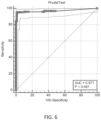
- the score exhibited an area under the curve (AUROC) of 0.97.
- the metrics are: sensitivity: 92% and specificity: 99% ( FIG. 7 ).
- the Youden index J is 0.94 and the Z-statistic for differentiating controls was 38.9.
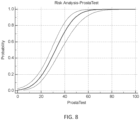
- a Probit-risk assessment plot identified a ProstaTest score >30 was 50% accurate for predicting PCA in a blood sample ( FIG. 8 ). This was increased to 60% at a ProstaTest score ⁇ 32 and was >80% at a score >34. The tool can therefore accurately differentiate between controls and prostate cancer disease.
- the ProstaTest scores were significantly (p ⁇ 0.001) elevated in high grade (Gleason score ⁇ 7: 70 ⁇ 19%) compared to low grade (Gleason 5+6) PCA (41f7°%).
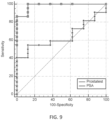
- the data (receiver operator cuve analysis and metrics) for the utility of the test to differentiate high from low grade scores is included in FIG. 9 .
- the score exhibited an area under the curve (AUROC) of 0.98.
- the metrics are: sensitivity: 100% and specificity: 88%.
- the Youden index J is 0.87.
- the sensitivity and specificity were 54% and 87% respectively.
Landscapes
- Health & Medical Sciences (AREA)
- Life Sciences & Earth Sciences (AREA)
- Chemical & Material Sciences (AREA)
- Genetics & Genomics (AREA)
- Engineering & Computer Science (AREA)
- Organic Chemistry (AREA)
- Proteomics, Peptides & Aminoacids (AREA)
- Physics & Mathematics (AREA)
- Pathology (AREA)
- Analytical Chemistry (AREA)
- Zoology (AREA)
- Immunology (AREA)
- Wood Science & Technology (AREA)
- Biophysics (AREA)
- General Health & Medical Sciences (AREA)
- Biotechnology (AREA)
- Bioinformatics & Cheminformatics (AREA)
- Molecular Biology (AREA)
- Medical Informatics (AREA)
- Microbiology (AREA)
- Oncology (AREA)
- Hospice & Palliative Care (AREA)
- Biochemistry (AREA)
- General Engineering & Computer Science (AREA)
- Theoretical Computer Science (AREA)
- Spectroscopy & Molecular Physics (AREA)
- Evolutionary Biology (AREA)
- Bioinformatics & Computational Biology (AREA)
- Databases & Information Systems (AREA)
- Bioethics (AREA)
- Computer Vision & Pattern Recognition (AREA)
- Data Mining & Analysis (AREA)
- Artificial Intelligence (AREA)
- Epidemiology (AREA)
- Evolutionary Computation (AREA)
- Public Health (AREA)
- Software Systems (AREA)
- Measuring Or Testing Involving Enzymes Or Micro-Organisms (AREA)
- Apparatus For Radiation Diagnosis (AREA)
- Medicines That Contain Protein Lipid Enzymes And Other Medicines (AREA)
Priority Applications (1)
| Application Number | Priority Date | Filing Date | Title |
|---|---|---|---|
| EP25156901.8A EP4538393A3 (en) | 2018-02-22 | 2019-02-21 | Methods for prostate cancer detection and treatment |
Applications Claiming Priority (2)
| Application Number | Priority Date | Filing Date | Title |
|---|---|---|---|
| US201862633675P | 2018-02-22 | 2018-02-22 | |
| PCT/US2019/018878 WO2019165021A1 (en) | 2018-02-22 | 2019-02-21 | Methods for prostate cancer detection and treatment |
Related Child Applications (1)
| Application Number | Title | Priority Date | Filing Date |
|---|---|---|---|
| EP25156901.8A Division EP4538393A3 (en) | 2018-02-22 | 2019-02-21 | Methods for prostate cancer detection and treatment |
Publications (2)
| Publication Number | Publication Date |
|---|---|
| EP3755816A1 EP3755816A1 (en) | 2020-12-30 |
| EP3755816B1 true EP3755816B1 (en) | 2025-02-12 |
Family
ID=65686083
Family Applications (2)
| Application Number | Title | Priority Date | Filing Date |
|---|---|---|---|
| EP19709298.4A Active EP3755816B1 (en) | 2018-02-22 | 2019-02-21 | Methods for prostate cancer detection and treatment |
| EP25156901.8A Pending EP4538393A3 (en) | 2018-02-22 | 2019-02-21 | Methods for prostate cancer detection and treatment |
Family Applications After (1)
| Application Number | Title | Priority Date | Filing Date |
|---|---|---|---|
| EP25156901.8A Pending EP4538393A3 (en) | 2018-02-22 | 2019-02-21 | Methods for prostate cancer detection and treatment |
Country Status (15)
| Country | Link |
|---|---|
| US (3) | US11410748B2 (https=) |
| EP (2) | EP3755816B1 (https=) |
| JP (2) | JP7662337B2 (https=) |
| KR (2) | KR102921718B1 (https=) |
| CN (2) | CN119932188A (https=) |
| AU (2) | AU2019224025B2 (https=) |
| BR (1) | BR112020016989A2 (https=) |
| CA (1) | CA3091647A1 (https=) |
| DK (1) | DK3755816T3 (https=) |
| ES (1) | ES3023842T3 (https=) |
| IL (1) | IL276748A (https=) |
| MX (2) | MX2020008702A (https=) |
| PL (1) | PL3755816T3 (https=) |
| SG (1) | SG11202007922XA (https=) |
| WO (1) | WO2019165021A1 (https=) |
Families Citing this family (8)
| Publication number | Priority date | Publication date | Assignee | Title |
|---|---|---|---|---|
| MX2022004372A (es) | 2019-10-10 | 2022-07-27 | Liquid Biopsy Res Llc | Composiciones, métodos y kits para la estabilización de muestras biológicas y de arn. |
| EP4100955A4 (en) * | 2020-02-06 | 2024-02-28 | Oncohost Ltd | MACHINE LEARNING PREDICTION OF THERAPEUTIC RESPONSE |
| CA3227993A1 (en) | 2021-08-11 | 2023-02-16 | OncoHost Ltd. | Predicting patient response |
| EP4602184A1 (en) * | 2022-10-12 | 2025-08-20 | Liquid Biopsy Research LLC | Methods for prostate cancer detection in saliva |
| GB2623570B (en) * | 2022-10-21 | 2025-07-23 | Wobble Genomics Ltd | Method and products for biomarker identification |
| KR102891032B1 (ko) * | 2022-12-29 | 2025-12-03 | 재단법인대구경북과학기술원 | 혈액 단구세포 전사체 생체표지자를 이용한 전이성 전립선암 진단용 바이오마커 및 이의 용도 |
| CN116908444B (zh) * | 2023-09-13 | 2023-12-19 | 中国医学科学院北京协和医院 | 血浆max自身抗体在晚期非小细胞肺癌pd-1单抗联合化疗治疗预后预测中的应用 |
| CN119964650B (zh) * | 2024-12-24 | 2025-09-30 | 深圳大学 | 一种基于集成学习的基因调控网络推断方法和系统 |
Family Cites Families (12)
| Publication number | Priority date | Publication date | Assignee | Title |
|---|---|---|---|---|
| JP2009540852A (ja) * | 2006-07-03 | 2009-11-26 | エグゾニ・テラピューティック・ソシエテ・アノニム | 前立腺特異的な転写物ならびに前立腺癌の治療および診断におけるその使用 |
| US20100303795A1 (en) * | 2009-05-27 | 2010-12-02 | Soerensen Karina Dalsgaard | Marker of prostate cancer |
| MX338883B (es) * | 2010-07-27 | 2016-05-04 | Genomic Health Inc | Metodo para usar expresion de gen para determinar el pronostico de cancer de prostata. |
| US8725426B2 (en) | 2012-01-31 | 2014-05-13 | Genomic Health, Inc. | Gene expression profile algorithm and test for determining prognosis of prostate cancer |
| CA2879557A1 (en) * | 2012-07-20 | 2014-01-23 | Diagnocure Inc. | Methods, kits and compositions for providing a clinical assessment of prostate cancer |
| EP2882869A4 (en) * | 2012-08-07 | 2016-04-20 | Jackson H M Found Military Med | PROSTATE CANCER GENE EXPRESSION PROFILE |
| US10431326B2 (en) * | 2012-11-20 | 2019-10-01 | Phadia Ab | Method for indicating a presence or non-presence of aggressive prostate cancer |
| SG10201907684PA (en) * | 2013-01-15 | 2019-10-30 | Aragon Pharmaceuticals Inc | Androgen receptor modulator and uses thereof |
| CN105209636A (zh) * | 2013-03-15 | 2015-12-30 | 麦塔马克基因股份有限公司 | 用于癌症预后的组合物和方法 |
| EP3800266A1 (en) * | 2013-06-13 | 2021-04-07 | University Of South Australia | Methods for detecting prostate cancer |
| AU2014305994B2 (en) * | 2013-08-06 | 2019-02-21 | Exosome Diagnostics, Inc. | Urine biomarker cohorts, gene expression signatures, and methods of use thereof |
| EP3214444A1 (en) | 2016-03-04 | 2017-09-06 | AIT Austrian Institute of Technology GmbH | Prostate cancer diagnostic method and means |
-
2019
- 2019-02-21 EP EP19709298.4A patent/EP3755816B1/en active Active
- 2019-02-21 WO PCT/US2019/018878 patent/WO2019165021A1/en not_active Ceased
- 2019-02-21 KR KR1020207026864A patent/KR102921718B1/ko active Active
- 2019-02-21 ES ES19709298T patent/ES3023842T3/es active Active
- 2019-02-21 KR KR1020267002939A patent/KR20260018206A/ko active Pending
- 2019-02-21 MX MX2020008702A patent/MX2020008702A/es unknown
- 2019-02-21 BR BR112020016989-7A patent/BR112020016989A2/pt unknown
- 2019-02-21 AU AU2019224025A patent/AU2019224025B2/en active Active
- 2019-02-21 CN CN202510096498.4A patent/CN119932188A/zh active Pending
- 2019-02-21 SG SG11202007922XA patent/SG11202007922XA/en unknown
- 2019-02-21 US US16/281,315 patent/US11410748B2/en active Active
- 2019-02-21 EP EP25156901.8A patent/EP4538393A3/en active Pending
- 2019-02-21 CN CN201980027332.XA patent/CN112673115B/zh active Active
- 2019-02-21 CA CA3091647A patent/CA3091647A1/en active Pending
- 2019-02-21 JP JP2020544261A patent/JP7662337B2/ja active Active
- 2019-02-21 PL PL19709298.4T patent/PL3755816T3/pl unknown
- 2019-02-21 DK DK19709298.4T patent/DK3755816T3/da active
-
2020
- 2020-08-17 IL IL276748A patent/IL276748A/en unknown
- 2020-08-20 MX MX2025000449A patent/MX2025000449A/es unknown
-
2022
- 2022-07-26 US US17/815,102 patent/US20230298695A1/en not_active Abandoned
-
2025
- 2025-04-03 JP JP2025061707A patent/JP2025096376A/ja active Pending
- 2025-04-18 US US19/182,880 patent/US20260066046A1/en active Pending
- 2025-09-26 AU AU2025238057A patent/AU2025238057A1/en active Pending
Also Published As
| Publication number | Publication date |
|---|---|
| AU2019224025A1 (en) | 2020-09-10 |
| SG11202007922XA (en) | 2020-09-29 |
| IL276748A (en) | 2020-10-29 |
| WO2019165021A1 (en) | 2019-08-29 |
| CN112673115A (zh) | 2021-04-16 |
| US20260066046A1 (en) | 2026-03-05 |
| JP2021514624A (ja) | 2021-06-17 |
| US20190259471A1 (en) | 2019-08-22 |
| KR20200123450A (ko) | 2020-10-29 |
| EP4538393A2 (en) | 2025-04-16 |
| MX2025000449A (es) | 2025-03-07 |
| PL3755816T3 (pl) | 2025-06-30 |
| JP2025096376A (ja) | 2025-06-26 |
| CN119932188A (zh) | 2025-05-06 |
| KR20260018206A (ko) | 2026-02-06 |
| JP7662337B2 (ja) | 2025-04-15 |
| CA3091647A1 (en) | 2019-08-29 |
| MX2020008702A (es) | 2020-09-25 |
| BR112020016989A2 (pt) | 2020-12-29 |
| KR102921718B1 (ko) | 2026-02-03 |
| AU2025238057A1 (en) | 2025-11-27 |
| EP4538393A3 (en) | 2025-07-02 |
| EP3755816A1 (en) | 2020-12-30 |
| US11410748B2 (en) | 2022-08-09 |
| DK3755816T3 (da) | 2025-04-28 |
| CN112673115B (zh) | 2025-02-18 |
| US20230298695A1 (en) | 2023-09-21 |
| ES3023842T3 (en) | 2025-06-03 |
| AU2019224025B2 (en) | 2025-06-26 |
Similar Documents
| Publication | Publication Date | Title |
|---|---|---|
| US20230298695A1 (en) | Methods for prostate cancer detection and treatment | |
| US12305240B2 (en) | Methods for colon cancer detection and treatment | |
| US20240042069A1 (en) | Predicting peptide receptor radiotherapy using a gene expression assay | |
| HK40043345B (en) | Methods for prostate cancer detection and treatment | |
| HK40043345A (en) | Methods for prostate cancer detection and treatment | |
| HK40042084B (en) | Methods for colon cancer detection and treatment monitoring | |
| HK40042084A (en) | Methods for colon cancer detection and treatment monitoring | |
| HK40035975A (en) | Predicting peptide receptor radiotherapy using a gene expression assay | |
| HK40035975B (en) | Predicting peptide receptor radiotherapy using a gene expression assay |
Legal Events
| Date | Code | Title | Description |
|---|---|---|---|
| STAA | Information on the status of an ep patent application or granted ep patent |
Free format text: STATUS: UNKNOWN |
|
| STAA | Information on the status of an ep patent application or granted ep patent |
Free format text: STATUS: THE INTERNATIONAL PUBLICATION HAS BEEN MADE |
|
| PUAI | Public reference made under article 153(3) epc to a published international application that has entered the european phase |
Free format text: ORIGINAL CODE: 0009012 |
|
| STAA | Information on the status of an ep patent application or granted ep patent |
Free format text: STATUS: REQUEST FOR EXAMINATION WAS MADE |
|
| 17P | Request for examination filed |
Effective date: 20200901 |
|
| AK | Designated contracting states |
Kind code of ref document: A1 Designated state(s): AL AT BE BG CH CY CZ DE DK EE ES FI FR GB GR HR HU IE IS IT LI LT LU LV MC MK MT NL NO PL PT RO RS SE SI SK SM TR |
|
| AX | Request for extension of the european patent |
Extension state: BA ME |
|
| DAV | Request for validation of the european patent (deleted) | ||
| DAX | Request for extension of the european patent (deleted) | ||
| REG | Reference to a national code |
Ref country code: HK Ref legal event code: DE Ref document number: 40043345 Country of ref document: HK |
|
| STAA | Information on the status of an ep patent application or granted ep patent |
Free format text: STATUS: EXAMINATION IS IN PROGRESS |
|
| 17Q | First examination report despatched |
Effective date: 20220603 |
|
| P01 | Opt-out of the competence of the unified patent court (upc) registered |
Effective date: 20230502 |
|
| GRAP | Despatch of communication of intention to grant a patent |
Free format text: ORIGINAL CODE: EPIDOSNIGR1 |
|
| STAA | Information on the status of an ep patent application or granted ep patent |
Free format text: STATUS: GRANT OF PATENT IS INTENDED |
|
| INTG | Intention to grant announced |
Effective date: 20240424 |
|
| GRAJ | Information related to disapproval of communication of intention to grant by the applicant or resumption of examination proceedings by the epo deleted |
Free format text: ORIGINAL CODE: EPIDOSDIGR1 |
|
| STAA | Information on the status of an ep patent application or granted ep patent |
Free format text: STATUS: EXAMINATION IS IN PROGRESS |
|
| GRAP | Despatch of communication of intention to grant a patent |
Free format text: ORIGINAL CODE: EPIDOSNIGR1 |
|
| INTC | Intention to grant announced (deleted) | ||
| STAA | Information on the status of an ep patent application or granted ep patent |
Free format text: STATUS: GRANT OF PATENT IS INTENDED |
|
| INTG | Intention to grant announced |
Effective date: 20240912 |
|
| GRAS | Grant fee paid |
Free format text: ORIGINAL CODE: EPIDOSNIGR3 |
|
| GRAA | (expected) grant |
Free format text: ORIGINAL CODE: 0009210 |
|
| STAA | Information on the status of an ep patent application or granted ep patent |
Free format text: STATUS: THE PATENT HAS BEEN GRANTED |
|
| AK | Designated contracting states |
Kind code of ref document: B1 Designated state(s): AL AT BE BG CH CY CZ DE DK EE ES FI FR GB GR HR HU IE IS IT LI LT LU LV MC MK MT NL NO PL PT RO RS SE SI SK SM TR |
|
| REG | Reference to a national code |
Ref country code: GB Ref legal event code: FG4D |
|
| REG | Reference to a national code |
Ref country code: CH Ref legal event code: EP |
|
| REG | Reference to a national code |
Ref country code: DE Ref legal event code: R096 Ref document number: 602019065737 Country of ref document: DE |
|
| REG | Reference to a national code |
Ref country code: IE Ref legal event code: FG4D |
|
| REG | Reference to a national code |
Ref country code: NL Ref legal event code: FP |
|
| PGFP | Annual fee paid to national office [announced via postgrant information from national office to epo] |
Ref country code: CH Payment date: 20250305 Year of fee payment: 7 |
|
| REG | Reference to a national code |
Ref country code: DK Ref legal event code: T3 Effective date: 20250423 |
|
| REG | Reference to a national code |
Ref country code: SE Ref legal event code: TRGR |
|
| REG | Reference to a national code |
Ref country code: ES Ref legal event code: FG2A Ref document number: 3023842 Country of ref document: ES Kind code of ref document: T3 Effective date: 20250603 |
|
| PG25 | Lapsed in a contracting state [announced via postgrant information from national office to epo] |
Ref country code: RS Free format text: LAPSE BECAUSE OF FAILURE TO SUBMIT A TRANSLATION OF THE DESCRIPTION OR TO PAY THE FEE WITHIN THE PRESCRIBED TIME-LIMIT Effective date: 20250512 |
|
| PG25 | Lapsed in a contracting state [announced via postgrant information from national office to epo] |
Ref country code: FI Free format text: LAPSE BECAUSE OF FAILURE TO SUBMIT A TRANSLATION OF THE DESCRIPTION OR TO PAY THE FEE WITHIN THE PRESCRIBED TIME-LIMIT Effective date: 20250212 |
|
| PGFP | Annual fee paid to national office [announced via postgrant information from national office to epo] |
Ref country code: PL Payment date: 20250314 Year of fee payment: 7 |
|
| REG | Reference to a national code |
Ref country code: LT Ref legal event code: MG9D |
|
| PG25 | Lapsed in a contracting state [announced via postgrant information from national office to epo] |
Ref country code: IS Free format text: LAPSE BECAUSE OF FAILURE TO SUBMIT A TRANSLATION OF THE DESCRIPTION OR TO PAY THE FEE WITHIN THE PRESCRIBED TIME-LIMIT Effective date: 20250612 Ref country code: NO Free format text: LAPSE BECAUSE OF FAILURE TO SUBMIT A TRANSLATION OF THE DESCRIPTION OR TO PAY THE FEE WITHIN THE PRESCRIBED TIME-LIMIT Effective date: 20250512 |
|
| PG25 | Lapsed in a contracting state [announced via postgrant information from national office to epo] |
Ref country code: HR Free format text: LAPSE BECAUSE OF FAILURE TO SUBMIT A TRANSLATION OF THE DESCRIPTION OR TO PAY THE FEE WITHIN THE PRESCRIBED TIME-LIMIT Effective date: 20250212 |
|
| PG25 | Lapsed in a contracting state [announced via postgrant information from national office to epo] |
Ref country code: LV Free format text: LAPSE BECAUSE OF FAILURE TO SUBMIT A TRANSLATION OF THE DESCRIPTION OR TO PAY THE FEE WITHIN THE PRESCRIBED TIME-LIMIT Effective date: 20250212 Ref country code: PT Free format text: LAPSE BECAUSE OF FAILURE TO SUBMIT A TRANSLATION OF THE DESCRIPTION OR TO PAY THE FEE WITHIN THE PRESCRIBED TIME-LIMIT Effective date: 20250612 |
|
| PG25 | Lapsed in a contracting state [announced via postgrant information from national office to epo] |
Ref country code: BG Free format text: LAPSE BECAUSE OF FAILURE TO SUBMIT A TRANSLATION OF THE DESCRIPTION OR TO PAY THE FEE WITHIN THE PRESCRIBED TIME-LIMIT Effective date: 20250212 Ref country code: GR Free format text: LAPSE BECAUSE OF FAILURE TO SUBMIT A TRANSLATION OF THE DESCRIPTION OR TO PAY THE FEE WITHIN THE PRESCRIBED TIME-LIMIT Effective date: 20250513 |
|
| REG | Reference to a national code |
Ref country code: AT Ref legal event code: MK05 Ref document number: 1766105 Country of ref document: AT Kind code of ref document: T Effective date: 20250212 |
|
| PG25 | Lapsed in a contracting state [announced via postgrant information from national office to epo] |
Ref country code: SM Free format text: LAPSE BECAUSE OF FAILURE TO SUBMIT A TRANSLATION OF THE DESCRIPTION OR TO PAY THE FEE WITHIN THE PRESCRIBED TIME-LIMIT Effective date: 20250212 |
|
| PG25 | Lapsed in a contracting state [announced via postgrant information from national office to epo] |
Ref country code: LU Free format text: LAPSE BECAUSE OF NON-PAYMENT OF DUE FEES Effective date: 20250221 |
|
| PG25 | Lapsed in a contracting state [announced via postgrant information from national office to epo] |
Ref country code: AT Free format text: LAPSE BECAUSE OF FAILURE TO SUBMIT A TRANSLATION OF THE DESCRIPTION OR TO PAY THE FEE WITHIN THE PRESCRIBED TIME-LIMIT Effective date: 20250212 |
|
| PG25 | Lapsed in a contracting state [announced via postgrant information from national office to epo] |
Ref country code: CZ Free format text: LAPSE BECAUSE OF FAILURE TO SUBMIT A TRANSLATION OF THE DESCRIPTION OR TO PAY THE FEE WITHIN THE PRESCRIBED TIME-LIMIT Effective date: 20250212 Ref country code: EE Free format text: LAPSE BECAUSE OF FAILURE TO SUBMIT A TRANSLATION OF THE DESCRIPTION OR TO PAY THE FEE WITHIN THE PRESCRIBED TIME-LIMIT Effective date: 20250212 |
|
| PG25 | Lapsed in a contracting state [announced via postgrant information from national office to epo] |
Ref country code: RO Free format text: LAPSE BECAUSE OF FAILURE TO SUBMIT A TRANSLATION OF THE DESCRIPTION OR TO PAY THE FEE WITHIN THE PRESCRIBED TIME-LIMIT Effective date: 20250212 |
|
| PG25 | Lapsed in a contracting state [announced via postgrant information from national office to epo] |
Ref country code: SK Free format text: LAPSE BECAUSE OF FAILURE TO SUBMIT A TRANSLATION OF THE DESCRIPTION OR TO PAY THE FEE WITHIN THE PRESCRIBED TIME-LIMIT Effective date: 20250212 |
|
| REG | Reference to a national code |
Ref country code: DE Ref legal event code: R097 Ref document number: 602019065737 Country of ref document: DE |
|
| PLBE | No opposition filed within time limit |
Free format text: ORIGINAL CODE: 0009261 |
|
| STAA | Information on the status of an ep patent application or granted ep patent |
Free format text: STATUS: NO OPPOSITION FILED WITHIN TIME LIMIT |
|
| PG25 | Lapsed in a contracting state [announced via postgrant information from national office to epo] |
Ref country code: MC Free format text: LAPSE BECAUSE OF FAILURE TO SUBMIT A TRANSLATION OF THE DESCRIPTION OR TO PAY THE FEE WITHIN THE PRESCRIBED TIME-LIMIT Effective date: 20250212 |
|
| REG | Reference to a national code |
Ref country code: CH Ref legal event code: L10 Free format text: ST27 STATUS EVENT CODE: U-0-0-L10-L00 (AS PROVIDED BY THE NATIONAL OFFICE) Effective date: 20251224 |
|
| 26N | No opposition filed |
Effective date: 20251113 |
|
| REG | Reference to a national code |
Ref country code: CH Ref legal event code: U11 Free format text: ST27 STATUS EVENT CODE: U-0-0-U10-U11 (AS PROVIDED BY THE NATIONAL OFFICE) Effective date: 20260301 |
|
| PGFP | Annual fee paid to national office [announced via postgrant information from national office to epo] |
Ref country code: NL Payment date: 20260206 Year of fee payment: 8 |
|
| PGFP | Annual fee paid to national office [announced via postgrant information from national office to epo] |
Ref country code: SE Payment date: 20260205 Year of fee payment: 8 |
|
| PGFP | Annual fee paid to national office [announced via postgrant information from national office to epo] |
Ref country code: GB Payment date: 20260203 Year of fee payment: 8 |
|
| PGFP | Annual fee paid to national office [announced via postgrant information from national office to epo] |
Ref country code: ES Payment date: 20260310 Year of fee payment: 8 |
|
| PGFP | Annual fee paid to national office [announced via postgrant information from national office to epo] |
Ref country code: DE Payment date: 20260202 Year of fee payment: 8 Ref country code: DK Payment date: 20260205 Year of fee payment: 8 Ref country code: IE Payment date: 20260205 Year of fee payment: 8 |
|
| PGFP | Annual fee paid to national office [announced via postgrant information from national office to epo] |
Ref country code: IT Payment date: 20260210 Year of fee payment: 8 Ref country code: BE Payment date: 20260205 Year of fee payment: 8 |
|
| PGFP | Annual fee paid to national office [announced via postgrant information from national office to epo] |
Ref country code: FR Payment date: 20260206 Year of fee payment: 8 |