EP3752573B1 - Wärmetransferzusammensetzungen als ersatz für r-134a - Google Patents
Wärmetransferzusammensetzungen als ersatz für r-134a Download PDFInfo
- Publication number
- EP3752573B1 EP3752573B1 EP19711645.2A EP19711645A EP3752573B1 EP 3752573 B1 EP3752573 B1 EP 3752573B1 EP 19711645 A EP19711645 A EP 19711645A EP 3752573 B1 EP3752573 B1 EP 3752573B1
- Authority
- EP
- European Patent Office
- Prior art keywords
- hfc
- heat transfer
- hfo
- lubricant
- initial
- Prior art date
- Legal status (The legal status is an assumption and is not a legal conclusion. Google has not performed a legal analysis and makes no representation as to the accuracy of the status listed.)
- Active
Links
Images

Classifications
-
- C—CHEMISTRY; METALLURGY
- C09—DYES; PAINTS; POLISHES; NATURAL RESINS; ADHESIVES; COMPOSITIONS NOT OTHERWISE PROVIDED FOR; APPLICATIONS OF MATERIALS NOT OTHERWISE PROVIDED FOR
- C09K—MATERIALS FOR MISCELLANEOUS APPLICATIONS, NOT PROVIDED FOR ELSEWHERE
- C09K5/00—Heat-transfer, heat-exchange or heat-storage materials, e.g. refrigerants; Materials for the production of heat or cold by chemical reactions other than by combustion
- C09K5/02—Materials undergoing a change of physical state when used
- C09K5/04—Materials undergoing a change of physical state when used the change of state being from liquid to vapour or vice versa
- C09K5/041—Materials undergoing a change of physical state when used the change of state being from liquid to vapour or vice versa for compression-type refrigeration systems
- C09K5/044—Materials undergoing a change of physical state when used the change of state being from liquid to vapour or vice versa for compression-type refrigeration systems comprising halogenated compounds
- C09K5/045—Materials undergoing a change of physical state when used the change of state being from liquid to vapour or vice versa for compression-type refrigeration systems comprising halogenated compounds containing only fluorine as halogen
-
- C—CHEMISTRY; METALLURGY
- C10—PETROLEUM, GAS OR COKE INDUSTRIES; TECHNICAL GASES CONTAINING CARBON MONOXIDE; FUELS; LUBRICANTS; PEAT
- C10M—LUBRICATING COMPOSITIONS; USE OF CHEMICAL SUBSTANCES EITHER ALONE OR AS LUBRICATING INGREDIENTS IN A LUBRICATING COMPOSITION
- C10M105/00—Lubricating compositions characterised by the base-material being a non-macromolecular organic compound
- C10M105/08—Lubricating compositions characterised by the base-material being a non-macromolecular organic compound containing oxygen
- C10M105/32—Esters
- C10M105/38—Esters of polyhydroxy compounds
-
- C—CHEMISTRY; METALLURGY
- C10—PETROLEUM, GAS OR COKE INDUSTRIES; TECHNICAL GASES CONTAINING CARBON MONOXIDE; FUELS; LUBRICANTS; PEAT
- C10M—LUBRICATING COMPOSITIONS; USE OF CHEMICAL SUBSTANCES EITHER ALONE OR AS LUBRICATING INGREDIENTS IN A LUBRICATING COMPOSITION
- C10M171/00—Lubricating compositions characterised by purely physical criteria, e.g. containing as base-material, thickener or additive, ingredients which are characterised exclusively by their numerically specified physical properties, i.e. containing ingredients which are physically well-defined but for which the chemical nature is either unspecified or only very vaguely indicated
- C10M171/008—Lubricant compositions compatible with refrigerants
-
- C—CHEMISTRY; METALLURGY
- C09—DYES; PAINTS; POLISHES; NATURAL RESINS; ADHESIVES; COMPOSITIONS NOT OTHERWISE PROVIDED FOR; APPLICATIONS OF MATERIALS NOT OTHERWISE PROVIDED FOR
- C09K—MATERIALS FOR MISCELLANEOUS APPLICATIONS, NOT PROVIDED FOR ELSEWHERE
- C09K2205/00—Aspects relating to compounds used in compression type refrigeration systems
- C09K2205/10—Components
- C09K2205/12—Hydrocarbons
- C09K2205/126—Unsaturated fluorinated hydrocarbons
-
- C—CHEMISTRY; METALLURGY
- C09—DYES; PAINTS; POLISHES; NATURAL RESINS; ADHESIVES; COMPOSITIONS NOT OTHERWISE PROVIDED FOR; APPLICATIONS OF MATERIALS NOT OTHERWISE PROVIDED FOR
- C09K—MATERIALS FOR MISCELLANEOUS APPLICATIONS, NOT PROVIDED FOR ELSEWHERE
- C09K2205/00—Aspects relating to compounds used in compression type refrigeration systems
- C09K2205/24—Only one single fluoro component present
-
- C—CHEMISTRY; METALLURGY
- C09—DYES; PAINTS; POLISHES; NATURAL RESINS; ADHESIVES; COMPOSITIONS NOT OTHERWISE PROVIDED FOR; APPLICATIONS OF MATERIALS NOT OTHERWISE PROVIDED FOR
- C09K—MATERIALS FOR MISCELLANEOUS APPLICATIONS, NOT PROVIDED FOR ELSEWHERE
- C09K2205/00—Aspects relating to compounds used in compression type refrigeration systems
- C09K2205/40—Replacement mixtures
-
- C—CHEMISTRY; METALLURGY
- C10—PETROLEUM, GAS OR COKE INDUSTRIES; TECHNICAL GASES CONTAINING CARBON MONOXIDE; FUELS; LUBRICANTS; PEAT
- C10M—LUBRICATING COMPOSITIONS; USE OF CHEMICAL SUBSTANCES EITHER ALONE OR AS LUBRICATING INGREDIENTS IN A LUBRICATING COMPOSITION
- C10M2207/00—Organic non-macromolecular hydrocarbon compounds containing hydrogen, carbon and oxygen as ingredients in lubricant compositions
- C10M2207/28—Esters
- C10M2207/283—Esters of polyhydroxy compounds
- C10M2207/2835—Esters of polyhydroxy compounds used as base material
-
- C—CHEMISTRY; METALLURGY
- C10—PETROLEUM, GAS OR COKE INDUSTRIES; TECHNICAL GASES CONTAINING CARBON MONOXIDE; FUELS; LUBRICANTS; PEAT
- C10N—INDEXING SCHEME ASSOCIATED WITH SUBCLASS C10M RELATING TO LUBRICATING COMPOSITIONS
- C10N2020/00—Specified physical or chemical properties or characteristics, i.e. function, of component of lubricating compositions
- C10N2020/01—Physico-chemical properties
- C10N2020/02—Viscosity; Viscosity index
-
- C—CHEMISTRY; METALLURGY
- C10—PETROLEUM, GAS OR COKE INDUSTRIES; TECHNICAL GASES CONTAINING CARBON MONOXIDE; FUELS; LUBRICANTS; PEAT
- C10N—INDEXING SCHEME ASSOCIATED WITH SUBCLASS C10M RELATING TO LUBRICATING COMPOSITIONS
- C10N2020/00—Specified physical or chemical properties or characteristics, i.e. function, of component of lubricating compositions
- C10N2020/09—Characteristics associated with water
- C10N2020/097—Refrigerants
- C10N2020/101—Containing Hydrofluorocarbons
-
- C—CHEMISTRY; METALLURGY
- C10—PETROLEUM, GAS OR COKE INDUSTRIES; TECHNICAL GASES CONTAINING CARBON MONOXIDE; FUELS; LUBRICANTS; PEAT
- C10N—INDEXING SCHEME ASSOCIATED WITH SUBCLASS C10M RELATING TO LUBRICATING COMPOSITIONS
- C10N2030/00—Specified physical or chemical properties which is improved by the additive characterising the lubricating composition, e.g. multifunctional additives
- C10N2030/02—Pour-point; Viscosity index
-
- C—CHEMISTRY; METALLURGY
- C10—PETROLEUM, GAS OR COKE INDUSTRIES; TECHNICAL GASES CONTAINING CARBON MONOXIDE; FUELS; LUBRICANTS; PEAT
- C10N—INDEXING SCHEME ASSOCIATED WITH SUBCLASS C10M RELATING TO LUBRICATING COMPOSITIONS
- C10N2040/00—Specified use or application for which the lubricating composition is intended
- C10N2040/30—Refrigerators lubricants or compressors lubricants
Definitions
- the present invention relates to the use of heat transfer compositions comprising 2,3,3,3-tetrafluoropropene together with a polyol ester lubricant, particularly in the context of replacing heat transfer compositions based on 1,1,1,2-tetrafluoroethane.
- HFCs hydrofluorocarbons
- 1,1,1,2-tetrafluoroethane is an example of an HFC that has seen very wide use, for example in automotive air conditioning.
- HFC-134a can contribute adversely to the greenhouse effect. This contribution is quantified by a numerical parameter, the GWP (Global Warming Potential).
- Hydrofluoroolefins such as 2,3,3,3-tetrafluoropropene (HFO-1234yf) or 1,3,3,3-tetrafluoropropene (HFO-1234ze) are low GWP fluids that are likely to be used in heat transfer applications.
- heat transfer fluids are used in vapor compression circuits.
- the fluid undergoes evaporation, followed by compression, condensation and expansion to complete the cycle.
- a lubricant or lubricating oil
- lubricating oil is generally necessary to ensure the proper functioning of the moving mechanical parts in the circuit, and in particular to ensure the lubrication of the compressor bearings.
- the document WO 2009/124128 describes a method of selecting a heat transfer fluid and lubricant for a vapor compression system.
- the document WO 2010/083100 describes heat transfer compositions comprising carbon dioxide and a POE-based lubricant.
- the document US 2012/024007 describes a compressor for refrigeration or air conditioning charged with a heat transfer fluid which may be, among others, HFO-1234yf, and a lubricant comprising POE.
- compositions comprising a POE-based lubricant and a heat transfer fluid containing at least 99.8% by weight of HFO-1234yf.
- the document FR 2964975 describes a composition comprising a POE or PVE lubricant and a heat transfer fluid of 1-99 wt.% HFO-1234yf and 1-99 wt.% trans-HFO-1234ze.
- WO 2018/069621 describes the use of a composition comprising a POE lubricant and a fluid F comprising at least one tetrafluoropropene and at least one hydrofluorocarbon in a vapor compression circuit comprising an oil separator.
- the document EP 2947136 describes a lubricating oil comprising a base oil, a sulfide compound and a gallate.
- the base oil may be POE, among other things.
- This lubricating oil may be used, among other things, with HFO-1234yf.
- the document WO 2016/209560 describes heat transfer compositions comprising a fluorinated olefin and a POE-based lubricant having a kinematic viscosity at 40°C of 150 to 360 cSt.
- the superheat of the refrigerant is preferably 2 to 10°C, more preferably 3 to 5°C.
- the lubricant comprises a dipentaerythritol ester.
- the lubricant has a kinematic viscosity at 40°C of 10 to 200 cSt, preferably 20 to 100 cSt, and more preferably 30 to 80 cSt.
- the method is a mobile or stationary air conditioning and/or heating, refrigeration, freezing or deep freezing method.
- the evaporation of the refrigerant is carried out at an average temperature less than or equal to 10°C, preferably less than or equal to 0°C, more preferably less than or equal to -10°C.
- the superheat with the replacement heat transfer composition is less than or equal to the superheat when the same method is performed with the initial heat transfer composition; and preferably the superheat with the replacement heat transfer composition is at least 2°C, preferably at least 5°C, more preferably at least 10°C, lower than the superheat when the same method is performed with the initial heat transfer composition.
- the lubricant of the replacement heat transfer composition is the same as the initial lubricant.
- the lubricant of the replacement heat transfer composition is different from the initial lubricant.
- the lubricant of the replacement heat transfer composition has a kinematic viscosity at 40°C less than or equal to the kinematic viscosity at 40°C of the initial lubricant, the difference between the kinematic viscosity at 40°C of the initial lubricant and the kinematic viscosity at 40°C of the lubricant of the replacement heat transfer composition preferably being greater than or equal to 5 cSt, more preferably greater than or equal to 10 cSt.
- the initial lubricant comprises a polyol ester, and preferably comprises a dipentaerythritol ester.
- the initial refrigerant comprises or consists essentially of 1,1,1,2-tetrafluoroethane.
- the present invention makes it possible to meet the need expressed above. More particularly, it provides efficient heat transfer methods, in particular in the context of an efficient substitution of HFC-134a-based heat transfer compositions by low GWP heat transfer compositions.
- the invention is based on the observation that HFO-1234yf is relatively poorly soluble in certain POE oils (and in particular in POE oils of the same type as POE ISO 55 oil), i.e. less soluble than HFO-1234ze and the reference fluid HFC-134a.
- the lubricant is mainly present in the compressor, for the lubrication of moving parts.
- a fraction of the lubricant can, however, be carried out of the compressor and thus circulate throughout the entire circuit containing the refrigerant.
- a first benefit of the invention concerns the reduction of overheating when changing the heat transfer composition.
- the viscosity of the lubricant is relatively little affected in the presence of HFO-1234yf in the compressor. This reduces overheating, and thus increases performance, without negatively affecting foam prevention, lubrication or separation of the lubricant and refrigerant.
- the reduction in superheat is particularly beneficial when the process is implemented for air conditioning.
- a second benefit of the invention concerns the use of an oil of lower viscosity, in order to reduce the friction forces on the bearings of the compressor compared to a reference oil, especially in areas where the oil is not mixed with the refrigerants.
- the power consumed per lubrication stage is proportional to the viscosity of the lubricant.
- Reducing the viscosity of the oil also improves lubrication when the installation is started (which can help limit energy consumption linked to heating the compressor during this start-up); and limits pressure losses in the circuit and therefore reduces energy consumption linked to pumping.
- the invention relates to a heat transfer method carried out by means of a heat transfer installation.
- the installation contains a heat transfer composition.
- the heat transfer installation was originally designed to operate with another heat transfer composition, called an initial heat transfer composition (and in particular with another refrigerant, called an initial refrigerant).
- the heat transfer composition used in the method of the invention is a so-called replacement heat transfer composition, that is to say that the same heat transfer installation was previously used to implement a heat transfer method with another heat transfer composition, called the so-called initial heat transfer composition.
- the initial heat transfer composition consists of a so-called initial refrigerant, a so-called initial lubricant, and possible additives.
- the replacement heat transfer composition consists of a so-called replacement refrigerant, a so-called replacement lubricant, and possible additives.
- a “ refrigerant " or "heat transfer fluid” means a fluid capable of absorbing heat by evaporating at low temperature and low pressure and of rejecting heat by condensing at high temperature and high pressure, in a vapor compression circuit, depending on the application considered.
- a refrigerant may consist essentially of a single compound or be a mixture of several compounds.
- the replacement refrigerant is different from the original refrigerant.
- the replacement lubricant is the same as the initial lubricant.
- the replacement lubricant is different from the initial lubricant.
- lubricant is used synonymously with “lubricating oil” or " oil”.
- the installation is directly implemented with the replacement heat transfer composition, without being implemented with the initial heat transfer composition - even though it is, by its original design, adapted to operate with the initial heat transfer composition.
- the heat transfer method of the invention is implemented in a heat transfer installation.
- the heat transfer installation comprises a vapor compression system.
- the system contains a heat transfer composition, which ensures the heat transfer.
- the heat transfer process may be a process of heating or cooling a fluid or a body.
- the installation can be mobile or stationary.
- the heat transfer process may be a stationary air conditioning process (in residential premises or in industrial or commercial premises), or a mobile air conditioning process, in particular automotive, a stationary refrigeration process, or a mobile refrigeration process (for example refrigerated transport), or a stationary freezing or deep-freezing process, or a mobile freezing or deep-freezing process (for example refrigerated transport), or a stationary heating process, or a mobile heating process (for example automotive).
- a stationary air conditioning process in residential premises or in industrial or commercial premises
- a mobile air conditioning process in particular automotive
- a stationary refrigeration process for example refrigerated transport
- a stationary freezing or deep-freezing process for example refrigerated transport
- a mobile freezing or deep-freezing process for example refrigerated transport
- a stationary heating process for example automotive
- Refrigerant evaporation can be carried out from a liquid phase or from a two-phase liquid/vapor phase.
- the compressor can be hermetic, semi-hermetic or open.
- Hermetic compressors comprise a motor part and a compression part which are confined in a non-dismountable hermetic enclosure.
- Semi-hermetic compressors comprise a motor part and a compression part which are directly assembled against each other. The coupling between the motor part and the compression part is accessible by disassembling the two parts.
- Open compressors comprise a motor part and a compression part which are separate. They can operate by belt drive or by direct coupling.
- the compressor can be driven by an electric motor or by a gas turbine (e.g. powered by the exhaust gases of a vehicle, for mobile applications) or by gearing.
- a gas turbine e.g. powered by the exhaust gases of a vehicle, for mobile applications
- counterflow heat exchanger a heat exchanger in which heat is exchanged between a first fluid and a second fluid, the first fluid at the inlet of the exchanger exchanging heat with the second fluid at the outlet of the exchanger, and the first fluid at the outlet of the exchanger exchanging heat with the second fluid at the inlet of the exchanger.
- counterflow heat exchangers include devices in which the flow of the first fluid and the flow of the second fluid are in opposite, or nearly opposite, directions. Exchangers operating in a crossflow mode with a counterflow tendency are also included among counterflow heat exchangers.
- the installation may also optionally include at least one heat transfer fluid circuit used to transport heat (with or without change of state) between the heat transfer composition circuit and the fluid or body to be heated or cooled.
- the installation may also optionally comprise two (or more) vapor compression circuits, containing identical or distinct heat transfer compositions.
- the vapor compression circuits may be coupled together.
- the refrigerant is superheated between evaporation and compression, that is to say it is brought to a temperature higher than the end of evaporation temperature, between evaporation and compression.
- start of evaporation temperature we mean the temperature of the refrigerant at the inlet of the evaporator.
- Evaporation end temperature means the temperature of the refrigerant when the last drop of refrigerant evaporates in liquid form (saturating vapor temperature or dew point temperature).
- the expansion module can be a thermostatic valve called a thermostatic or electronic expansion valve with one or more ports, or a pressure-controlled expansion valve that regulates the pressure. It can also be a capillary tube in which the expansion of the fluid is obtained by the pressure drop in the tube.
- the expansion module can also be a turbine to produce mechanical work (which can be converted into electricity), or a turbine coupled directly or indirectly to the compressor.
- the invention provides for replacing an initial heat transfer composition with a replacement heat transfer composition in the heat transfer process.
- this replacement may be accomplished by draining, preferably all or substantially all, of the initial heat transfer composition from the facility, and introducing the replacement heat transfer composition in place thereof into the facility.
- the replacement lubricant is different from the initial lubricant.
- the “same” process is considered to be implemented, with the initial heat transfer composition on the one hand, and with the replacement heat transfer composition on the other hand.
- the setting of these elements can optionally be changed upon replacement, to ensure that the average evaporation and condensation temperatures remain the same.
- only the expansion module setting is changed.
- the mean condensation temperature is defined as the arithmetic mean between the condensation start temperature (temperature of the refrigerant in the condenser when the first liquid drop of refrigerant appears, called the vapor saturation temperature or dew point temperature) and the condensation end temperature (temperature of the refrigerant when the last bubble of refrigerant condenses in gaseous form, called the liquid saturation temperature or bubble temperature).
- Subcooling refers to the possible temperature differential (in absolute value) between the minimum temperature reached by the refrigerant before expansion and the end of condensation temperature. Generally, this minimum temperature corresponds to the temperature of the refrigerant at the inlet of the expansion module. It may correspond to the temperature of the refrigerant at the outlet of the condenser. Alternatively, the refrigerant may be at least partially subcooled between the condenser and the expansion module (for example by means of an internal exchanger).
- subcooling (strictly greater than 0°C) is applied, preferably subcooling of 1 to 15°C, more preferably of 2 to 12°C and more preferably of 5 to 10°C.
- the invention is particularly useful when the average evaporation temperature is less than or equal to 10°C; or less than or equal to 5°C; or less than or equal to 0°C; or less than or equal to -5°C; or less than or equal to -10°C.
- the invention is particularly useful for implementing a low temperature refrigeration process, or a moderate temperature cooling process, or a moderate temperature heating process.
- the average evaporation temperature is preferably from -45°C to -15°C, especially from -40°C to -20°C, more preferably from -35°C to -25°C and for example about -30°C; and the average condensation temperature is preferably from 25°C to 80°C, especially from 30°C to 60°C, more preferably from 35°C to 55°C and for example about 40°C.
- These processes include in particular freezing and deep-freezing processes.
- the average evaporation temperature is preferably from -20°C to 10°C, in particular from -15°C to 5°C, more particularly preferably from -10°C to 0°C and for example about -5°C; and the average condensation temperature is preferably from 25°C to 80°C, in particular from 30°C to 60°C, more particularly preferably from 35°C to 55°C and for example about 50°C.
- These processes may in particular be refrigeration or air conditioning processes.
- the average evaporation temperature is preferably from -20°C to 10°C, in particular from -15°C to 5°C, more particularly preferably from -10°C to 0°C and for example approximately -5°C; and the average condensation temperature is preferably from 25°C to 80°C, in particular from 30°C to 60°C, more particularly preferably from 35°C to 55°C and for example approximately 50°C.
- the initial refrigerant may be any refrigerant, for example a refrigerant comprising a CFC, or an HCFC, or an HFC.
- the initial refrigerant may in particular have a GWP greater than or equal to 150, or greater than or equal to 500, or greater than or equal to 1000.
- the initial refrigerant comprises HFC-134a.
- the initial refrigerant comprises at least 10% HFC-134a, or at least 20% HFC-134a, or at least 30% HFC-134a, or at least 40% HFC-134a, or at least 50% HFC-134a, or at least 60% HFC-134a, or at least 70% HFC-134a, or at least 80% HFC-134a, or at least 90% HFC-134a, or at least 95% HFC-134a, based on the total mass of the initial refrigerant.
- the initial refrigerant consists essentially of, or consists of, HFC-134a (excluding impurities).
- the initial refrigerant comprises HFC-134a in admixture with one or more heat transfer compounds, and preferably one or more hydrofluorocarbons and/or hydrocarbons.
- hydrofluorocarbons means saturated hydrofluorocarbons, which are not hydrofluoroolefins.
- hydrofluorocarbons examples include difluoromethane (HFC-32), pentafluoroethane (HFC-125), 1,1,2,2-tetrafluoroethane (HFC-134), 1,1-difluoroethane (HFC-152a), fluoroethane (HFC-161), 1,1,1,2,3,3,3-heptafluoropropane (HFC-227ea), 1,1,1-trifluoropropane (HFC-263fb), and mixtures thereof.
- HFC-32 difluoromethane
- HFC-125 pentafluoroethane
- HFC-134 1,1,2,2-tetrafluoroethane
- HFC-152a 1,1-difluoroethane
- fluoroethane HFC-161
- HFC-227ea 1,1,1,2,3,3,3-heptafluoropropane
- HFC-263fb 1,1,1-trifluoropropane
- the initial refrigerant is free of hydrofluoroolefins and hydrochlorofluoroolefins.
- the initial refrigerant is a binary (consisting of two compounds) or ternary (consisting of three compounds) or quaternary (consisting of four compounds) or quinquenary (consisting of five compounds) composition.
- Impurities may or may not be present in such refrigerants. When present, they may represent less than 1%, preferably less than 0.5%, preferably less than 0.1%, preferably less than 0.05% and most preferably less than 0.01% (by mass) of said fluid.
- the refrigerant used to carry out the method of the invention which is the replacement refrigerant if a replacement is carried out, comprises HFO-1234yf.
- this refrigerant comprises at least 10% HFO-1234yf, or at least 20% HFO-1234yf, or at least 30% HFO-1234yf, or at least 40% HFO-1234yf, or at least 50% HFO-1234yf, or at least 60% HFO-1234yf, or at least 70% HFO-1234yf, or at least 80% HFO-1234yf, or at least 90% HFO-1234yf, or at least 95% HFO-1234yf, based on the total mass of the replacement refrigerant.
- this refrigerant consists essentially of, or consists of, HFO-1234yf (excluding impurities).
- this refrigerant comprises HFO-1234yf in admixture with one or more hydrofluorocarbons and/or hydrofluoroolefins and/or hydrocarbons and/or hydrochlorofluoroolefins and/or CO 2 .
- hydrofluoroolefins we can cite in particular HFO-1234ze, in cis and/or trans form, and preferably in trans form; and trifluoroethylene (HFO-1123).
- hydrochlorofluoroolefins mention may be made in particular of 1-chloro-3,3,3-trifluoropropene (HCFO-1233zd), in cis and/or trans form, and preferably in trans form.
- HCFO-1233zd 1-chloro-3,3,3-trifluoropropene
- hydrofluorocarbons examples include difluoromethane (HFC-32), pentafluoroethane (HFC-125), 1,1,2,2-tetrafluoroethane (HFC-134), 1,1,1,2-tetrafluoroethane (HFC-134a), 1,1-difluoroethane (HFC-152a), fluoroethane (HFC-161), 1,1,1,2,3,3,3-heptafluoropropane (HFC-227ea), 1,1,1-trifluoropropane (HFC-263fb) and mixtures thereof.
- HFC-32 difluoromethane
- HFC-125 pentafluoroethane
- HFC-134 1,1,2,2-tetrafluoroethane
- HFC-134a 1,1,1,2-tetrafluoroethane
- HFC-134a 1,1-difluoroethane
- HFC-152a 1,1-difluoroethan
- this refrigerant is a binary (consisting of two compounds) or ternary (consisting of three compounds) composition. compounds) or quaternary (consisting of four compounds) or quinquenary (consisting of five compounds).
- Impurities may or may not be present in such refrigerants. When present, they may represent less than 1%, preferably less than 0.5%, preferably less than 0.1%, preferably less than 0.05% and most preferably less than 0.01% (by mass) of said fluid.
- the refrigerant of the invention (if any, replacement refrigerant) consists of (excluding impurities): from 74 to 81.5% (preferably from 75.5 to 79.5%) of HFO-1234yf, from 12 to 16% of HFC-152a, and from 6.5 to 10.5% of HFC-134a (by mass).
- a refrigerant has the advantage of being azeotropic.
- the refrigerant of the invention (if any, replacement refrigerant) consists of (excluding impurities) about 77.5% HFO-1234yf, about 14% HFC-152a, and about 8.5% HFC-134a (by mass).
- a refrigerant has the advantage of being azeotropic.
- the refrigerant of the invention (if any, replacement refrigerant) consists of (excluding impurities) about 77.5% HFO-1234yf, about 16% HFC-152a, and about 6.5% HFC-134a (by mass).
- a refrigerant has the advantage of being azeotropic.
- the refrigerant of the invention (if any, replacement refrigerant) consists of (excluding impurities) about 81.5% HFO-1234yf, about 12% HFC-152a, and about 6.5% HFC-134a (by mass).
- a refrigerant has the advantage of being azeotropic.
- the refrigerant of the invention (if any, replacement refrigerant) consists of (excluding impurities) about 75.5% HFO-1234yf, about 14.5% HFC-152a, and about 10% HFC-134a (by mass).
- a refrigerant has the advantage of being azeotropic.
- the refrigerant of the invention (if any, replacement refrigerant) consists of (excluding impurities) about 77.5% HFO-1234yf, about 12% HFC-152a, and about 10.5% HFC-134a (by mass).
- a refrigerant has the advantage of being azeotropic.
- the GWP of the refrigerant used in the process of the invention (which where appropriate is the replacement refrigerant) is preferably less than 1000, more preferably less than 500, or 150, or 100, or 50, or 25.
- the GWP of the replacement refrigerant is lower than the GWP of the original refrigerant.
- GWP is defined relative to carbon dioxide and relative to a duration of 100 years, according to the method indicated in “The scientific assessment of ozone depletion, 2002, a report of the World Meteorological Association's Global Ozone Research and Monitoring Project ".
- HFC-134a (alone) is replaced with HFO-1234yf (alone).
- an initial refrigerant comprising HFC-134a in admixture with one or more other compounds is replaced with a replacement refrigerant comprising HFO-1234yf in admixture with the same other compound(s).
- the mass proportion of HFC-134a in the replacement refrigerant is less than the mass proportion of HFC-134a in the initial refrigerant.
- the mass proportion of all hydrofluorocarbons in the replacement refrigerant is less than the mass proportion of all hydrofluorocarbons in the initial refrigerant.
- the heat transfer composition used for implementing the method comprises a lubricant (so-called replacement lubricant, when a replacement is carried out).
- This lubricant comprises a POE.
- the lubricant is a POE.
- it may be considered that it is a mixture of POE and another product such as a PAG.
- a POE is meant either a single POE or preferably a mixture of several POEs.
- a POE can be obtained by reacting at least one polyol (i.e. compound containing at least two OH groups) with at least one carboxylic acid.
- POEs that may be used in the present invention include POE types A, B, C and D described in more detail below.
- hydrocarbon radical means a radical composed of carbon and hydrogen atoms.
- R 1 is a linear or branched hydrocarbon radical comprising from 4 to 40 carbon atoms, preferably from 4 to 20 carbon atoms.
- R 1 is a linear or branched hydrocarbon radical comprising at least one oxygen atom.
- R 1 is a branched hydrocarbon radical comprising from 4 to 10 carbon atoms, preferably 5 carbon atoms, substituted by two hydroxyl groups.
- the polyols comprise from 2 to 10 hydroxyl groups, preferably from 2 to 6 hydroxyl groups.
- Polyols may contain one or more oxyalkylene groups, in which case they are polyether polyols.
- the polyols may also include one or more nitrogen atoms.
- the polyols may be alkanol amines containing from 3 to 6 hydroxyl groups.
- the polyols are alkanol amines containing at least two hydroxyl groups, and preferably at least three.
- the polyols are selected from the group consisting of ethylene glycol, diethylene glycol, triethylene glycol, propylene glycol, dipropylene glycol, glycerol, neopentyl glycol, 1,2-butanediol, 1,4-butanediol, 1,3-butanediol, pentaerythritol, dipentaerythritol, tripentaerythritol, triglycerol, trimethylolpropane, sorbitol, hexaglycerol, and mixtures thereof.
- R 2 is an aliphatic hydrocarbon radical comprising from 1 to 10, preferably from 1 to 7 carbon atoms, and in particular from 1 to 6 carbon atoms.
- R 2 is a branched hydrocarbon radical comprising from 4 to 20 carbon atoms, in particular from 5 to 14 carbon atoms, and preferentially from 6 to 8 carbon atoms.
- a branched hydrocarbon radical as mentioned above has the following formula (IV): (IV) -C(R 3 )(R 4 )(R 5 ) wherein R 3 , R 4 and R 5 are, independently of each other, an alkyl group, and at least one of the alkyl groups contains at least two carbon atoms.
- R 3 , R 4 and R 5 are, independently of each other, an alkyl group, and at least one of the alkyl groups contains at least two carbon atoms.
- Such branched alkyl groups when linked to the carboxyl group, are known as a " neo group", and the corresponding acid as a "neo acid”.
- R 3 and R 4 are methyl groups and R 5 is an alkyl group comprising at least two carbon atoms.
- the radical R 2 may comprise one or more carboxy groups, or ester groups such as -COOR 6 , with R 6 representing an alkyl, hydroxyalkyl or hydroxyalkyloxy alkyl radical.
- the acid R 2 COOH of formula (III) is a monocarboxylic acid.
- carboxylic acids in which the hydrocarbon radical is aliphatic include: formic acid, acetic acid, propionic acid, butyric acid, pentanoic acid, hexanoic acid and heptanoic acid.
- carboxylic acids in which the hydrocarbon radical is branched include: 2-ethyl-n-butyric acid, 2-hexyldecanoic acid, isostearic acid, 2-methylhexanoic acid, 2-methylbutanoic acid, 3-methylbutanoic acid, 3,5,5-trimethylhexanoic acid, 2-ethylhexanoic acid, neoheptanoic acid, and neodecanoic acid.
- carboxylic acids that can be used in the preparation of POE type A are carboxylic acids comprising an aliphatic hydrocarbon radical comprising from 8 to 14 carbon atoms. Examples include: decanoic acid, dodecanoic acid, lauric acid, stearic acid, myristic acid, behenic acid, etc. Among the dicarboxylic acids, examples include maleic acid, succinic acid, adipic acid, sebacic acid, etc.
- the carboxylic acids used to prepare the type A POEs comprise a mixture of monocarboxylic and dicarboxylic acids, with the proportion of monocarboxylic acids being in the majority.
- the presence of dicarboxylic acids results in particular in the formation of POEs of high viscosity.
- the reaction of forming type A POEs by reaction between carboxylic acid and polyols is an acid-catalyzed reaction.
- it is a reversible reaction, which can be completed by using a large amount of acid or by removing the water formed during the reaction.
- the esterification reaction can be carried out in the presence of organic or inorganic acids, such as sulfuric acid, phosphoric acid, etc.
- the reaction is carried out in the absence of a catalyst.
- the amount of carboxylic acid and polyol may be varied in the mixture depending on the desired results. In the particular case where all the hydroxyl groups are esterified, sufficient carboxylic acid must be added to react with all the hydroxyls.
- these may react sequentially with the polyols.
- a polyol when using a mixture of carboxylic acids, first reacts with a carboxylic acid, typically the higher molecular weight carboxylic acid, followed by reaction with the carboxylic acid having an aliphatic hydrocarbon chain.
- the esters may be formed by reacting the carboxylic acids (or their anhydride or ester derivatives) with the polyols, in the presence of acids at elevated temperature, while removing the water formed during the reaction.
- the reaction may be carried out at a temperature of from 75 to 200°C.
- the POEs formed may comprise hydroxyl groups that have not all reacted, in which case they are partially esterified POEs.
- the POEs are obtained from pentaerythritol alcohol, and a mixture of carboxylic acids: isononanoic acid, at least one acid having an aliphatic hydrocarbon radical comprising from 8 to 10 carbon atoms, and heptanoic acid.
- Preferred polyol esters are obtained from pentaerythritol, and a mixture of 70% isononanoic acid, 15% of at least one carboxylic acid having an aliphatic hydrocarbon radical comprising from 8 to 10 carbon atoms, and 15% heptanoic acid.
- Solest 68 oil marketed by CPI Engineering Services Inc. may be cited.
- Type B POEs comprise at least one ester of one or more branched carboxylic acids comprising at most 8 carbon atoms.
- the ester is in particular obtained by reaction of said branched carboxylic acid with one or more polyols.
- the branched carboxylic acid comprises at least 5 carbon atoms.
- the branched carboxylic acid comprises from 5 to 8 carbon atoms, and preferably it contains 5 carbon atoms.
- the aforementioned branched carboxylic acid does not comprise 9 carbon atoms.
- said carboxylic acid is not 3,5,5-trimethylhexanoic acid.
- the branched carboxylic acid is selected from 2-methylbutanoic acid, 3-methylbutanoic acid, and mixtures thereof.
- the polyol is selected from the group consisting of neopentyl glycol, glycerol, trimethylol propane, pentaerythritol, dipentaerythritol, tripentaerythritol, and mixtures thereof.
- reaction i) is carried out with a molar ratio ranging from 1:4 to 1:2.
- the neopentyl polyol has the following formula (VI): in which each R represents, independently of one another, CH 3 , C 2 H 5 or CH 2 OH.
- Preferred neopentyl polyols are those selected from pentaerythritol, dipentaerythritol, tripentaerythritol, tetraerythritol, trimethylolpropane, trimethylolethane, and neopentyl glycol.
- the neopentyl polyol is dipentaerythritol.
- a single neopentyl polyol is used to produce the lubricant.
- two or more neopentyl polyols are used. This is particularly the case when a commercial pentaerythritol product includes small amounts of dipentaerythritol, tripentaerythritol, and tetraerythritol.
- the aforementioned monocarboxylic acid comprises from 5 to 11 carbon atoms, preferably from 6 to 10 carbon atoms.
- Monocarboxylic acids have the following general formula (VII): (VII) R'C(O)OH in which R' is a linear or branched C1-C12 alkyl radical, a C6-C12 aryl radical, a C6-C30 aralkyl radical.
- R' is a C4-C10 alkyl radical, and preferably a C5-C9 alkyl radical.
- the monocarboxylic acid may be selected from the group consisting of butanoic acid, pentanoic acid, hexanoic acid, heptanoic acid, n-octanoic acid, n-nonanoic acid, n-decanoic acid, 3-methylbutanoic acid, 2-methylbutanoic acid, 2,4-dimethylpentanoic acid, 2-ethylhexanoic acid, 3,3,5-trimethylhexanoic acid, benzoic acid, and mixtures thereof.
- the monocarboxylic acid is n-heptanoic acid, or a mixture of n-heptanoic acid with another linear monocarboxylic acid, particularly n-octanoic acid and/or n-decanoic acid.
- Such a mixture of monocarboxylic acid may in particular comprise between 15 and 100 mol% of heptanoic acid and between 0 and 85 mol% of other monocarboxylic acid(s).
- the mixture may comprise between 75 and 100 mol% of heptanoic acid, and between 0 and 25 mol% of a mixture of octanoic acid and decanoic acid in a molar ratio of 3:2.
- the POEs comprise, by mass, from 0 to 5%, or from 5 to 10%, or from 10 to 15%, or from 15 to 20%, or from 20 to 25%, or from 25 to 30%, or from 30 to 35%, or from 35 to 40%, or from 40 to 45%, or from 45 to 50%, or from 50 to 55%, or from 55 to 60%, or from 60 to 65%, or from 65 to 70%, or from 70 to 75%, or from 75 to 80%, or from 80 to 85%, or from 85 to 90%, or from 90 to 95%, or from 95 to 100%, of a monopentaerythritol ester with at least one monocarboxylic acid containing from 2 to 15 carbon atoms. of carbon.
- each of R 13 , R 14 and R 15 represents, independently of each other, a linear or branched alkyl group, an alkenyl group, a cycloalkyl group, said alkyl, alkenyl or cycloalkyl groups being able to comprise at least one heteroatom selected from N, O, Si, F or S.
- each of R 13 , R 14 and R 15 has, independently of each other, from 3 to 8 carbon atoms, preferably from 5 to 7 carbon atoms.
- a+x, b+y, and c+z are, independently of each other, integers ranging from 1 to 10, preferably from 2 to 8, and even more preferably from 2 to 4.
- R 7 , R 8 , R 9 , R 10 , R 11 and R 12 represent H.
- the POEs of formula (VIII) above can typically be prepared as described in paragraphs [0027] to [0030] of the international application. WO 2012/177742 .
- POEs of formula (VIII) can be obtained by esterification of glycerol alkoxylates (as described in paragraph [0027] of WO 2012/177742 ) with one or more monocarboxylic acids having from 2 to 18 carbon atoms.
- the monocarboxylic acids have one of the following formulas: R 13 COOH, R 14 COOH and R 15 COOH, wherein R 13 , R 14 and R 15 are as defined above.
- Derivatives of the carboxylic acids may also be used, such as anhydrides, esters and acyl halides.
- the esterification may be carried out with one or more monocarboxylic acids.
- Preferred monocarboxylic acids are those selected from the group consisting of acetic acid, propanoic acid, butyric acid, isobutanoic acid, pivalic acid, pentanoic acid, isopentanoic acid, hexanoic acid, heptanoic acid, octanoic acid, 2-ethylhexanoic acid, 3,3,5-trimethylhexanoic acid, nonanoic acid, decanoic acid, neodecanoic acid, undecanoic acid, dodecanoic acid, tridecanoic acid, myristic acid, pentadecanoic acid, palmitic acid, stearic acid, oleic acid, linoleic acid, palmitoleic acid, citronellic acid, undecenoic acid, lauric acid, undecylenic acid, linolenic acid, ar
- the esterification is carried out with one or more monocarboxylic acids selected from the group consisting of pentanoic acid, 2-methylbutanoic acid, n-hexanoic acid, n-heptanoic acid, 3,3,5-trimethylhexanoic acid, 2-ethylhexanoic acid, n-octanoic acid, n-nonanoic acid and isononanoic acid.
- monocarboxylic acids selected from the group consisting of pentanoic acid, 2-methylbutanoic acid, n-hexanoic acid, n-heptanoic acid, 3,3,5-trimethylhexanoic acid, 2-ethylhexanoic acid, n-octanoic acid, n-nonanoic acid and isononanoic acid.
- the esterification is carried out with one or more monocarboxylic acids selected from the group consisting of butyric acid, isobutyric acid, n-pentanoic acid, 2-methylbutanoic acid, 3-methylbutanoic acid, n-hexanoic acid, n-heptanoic acid, n-octanoic acid, 2-ethylhexanoic acid, 3,3,5-trimethylhexanoic acid, n-nonanoic acid, decanoic acid, undecanoic acid, undecelenic acid, lauric acid, stearic acid, isostearic acid, and mixtures thereof.
- monocarboxylic acids selected from the group consisting of butyric acid, isobutyric acid, n-pentanoic acid, 2-methylbutanoic acid, 3-methylbutanoic acid, n-hexanoic acid, n-heptanoic acid, n-octanoic acid, 2-
- each of R 16 and R 19 represents, independently of one another, a linear or branched alkyl group, an alkenyl group, a cycloalkyl group, said alkyl, alkenyl or cycloalkyl groups being able to comprise at least one heteroatom selected from N, O, Si, F or S.
- each of R 16 and R 19 has, independently of one another, from 3 to 8 carbon atoms, preferably from 5 to 7 carbon atoms.
- each of R 17 and R 18 represents H, and/or m+n is an integer ranging from 2 to 8, from 4 to 10, from 2 to 5, or from 3 to 5. In particular, m+n is 2, 3 or 4.
- the POEs of formula (IX) above are triethylene glycol diesters, tetraethylene glycol diesters, in particular with one or two monocarboxylic acids having from 4 to 9 carbon atoms.
- the POEs of formula (IX) above may be prepared by esterifications of an ethylene glycol, a propylene glycol, or an oligo- or polyalkylene glycol, (which may be an oligo- or polyethylene glycol, oligo- or polypropylene glycol, or an ethylene glycol-propylene glycol block copolymer), with one or two monocarboxylic acids having from 2 to 18 carbon atoms.
- the esterification may be carried out in an identical manner to the esterification reaction used to prepare the POEs of formula (VIII) above.
- monocarboxylic acids identical to those used to prepare the POEs of formula (VIII) above can be used to form the POEs of formula (IX).
- the lubricant comprises from 20 to 80%, preferably from 30 to 70%, and preferentially from 40 to 60% by mass of at least one POE of formula (VIII), and from 80 to 20%, preferably from 70 to 30%, and preferentially from 60 to 40% by mass of at least one POE of formula (IX).
- the lubricant used in the process of the invention is such that the solubility of HFO-1234yf in this lubricant is lower than the solubility of HFC-134a in the lubricant.
- solubility of a compound A in the lubricant is meant the maximum mass proportion of compound A in the gaseous state which can be absorbed by the lubricant in the liquid phase (i.e. the maximum relative mass proportion of compound A in the lubricant in the liquid phase, when the lubricant is put into contact with compound A in the gaseous state).
- solubility can be measured as described below in Example 1.
- the replacement lubricant may be the same or different from the original lubricant.
- the initial lubricant may be of any type.
- it may be chosen from mineral oils, silicone oils, natural or synthetic paraffins, naphthenes, alkylbenzenes, poly-alpha olefins, polyalkene glycols (PAG), polyol esters (POE), polyvinyl ethers and mixtures thereof.
- the initial lubricant comprises a POE or is a POE.
- the additives which may be present in the heat transfer composition of the invention may in particular be chosen from nanoparticles, stabilizers, surfactants, tracer agents, fluorescent agents, odorous agents and solubilizing agents.
- the additives are not lubricants.
- the stabilizer(s), when present, preferably represent at most 5% by mass in the heat transfer composition.
- the stabilizers mention may be made in particular of nitromethane, ascorbic acid, terephthalic acid, azoles such as tolutriazole or benzotriazole, phenolic compounds such as tocopherol, hydroquinone, t-butyl hydroquinone, 2,6-di-tert-butyl-4-methylphenol, epoxides (optionally fluorinated or perfluorinated alkyl or alkenyl or aromatic) such as n-butyl glycidyl ether, hexanediol diglycidyl ether, allyl glycidyl ether, butylphenylglycidyl ether, phosphites, phosphonates, thiols and lactones.
- nanoparticles we can notably use carbon nanoparticles, metal oxides (copper, aluminum), TiO 2 , Al 2 O 3 , MoS 2 ...
- tracer agents As tracer agents (capable of being detected), mention may be made of deuterated or non-deuterated hydrofluorocarbons, deuterated hydrocarbons, perfluorocarbons, fluoroethers, brominated compounds, iodinated compounds, alcohols, aldehydes, ketones, nitrous oxide and combinations thereof.
- the tracer agent is different from the compounds constituting the refrigerant fluid.
- Solubilizing agents include hydrocarbons, dimethyl ether, polyoxyalkylene ethers, amides, ketones, nitriles, chlorocarbons, esters, lactones, aryl ethers, fluoroethers, and 1,1,1-trifluoroalkanes.
- the solubilizing agent is different from the heat transfer compound(s) comprising the refrigerant.
- fluorescent agents mention may be made of naphthalimides, perylenes, coumarins, anthracenes, phenanthracenes, xanthenes, thioxanthenes, naphthoxanthenes, fluoresceins and derivatives and combinations thereof.
- alkylacrylates As odorous agents, mention may be made of alkylacrylates, allylacrylates, acrylic acids, acryl esters, alkyl ethers, alkyl esters, alkynes, aldehydes, thiols, thioethers, disulfides, allylisothiocyanates, alkanoic acids, amines, norbornenes, norbornene derivatives, cyclohexene, heterocyclic aromatic compounds, ascaridole, o-methoxy(methyl)phenol and combinations thereof.
- the additives described above may be present in the initial heat transfer composition and/or in the replacement heat transfer composition.
- the same additives are present in the initial heat transfer composition and in the replacement heat transfer composition.
- the mass proportion of refrigerant fluid may represent in particular from 1 to 5% of the composition; or from 5 to 10% of the composition; or from 10 to 15% of the composition; or from 15 to 20% of the composition; or from 20 to 25% of the composition; or from 25 to 30% of the composition; or from 30 to 35% of the composition; or from 35 to 40% of the composition; or from 40 to 45% of the composition; or from 45 to 50% of the composition; or from 50 to 55% of the composition; or from 55 to 60% of the composition; or from 60 to 65% of the composition; or from 65 to 70% of the composition; or 70 to 75% of the composition; or 75 to 80% of the composition; or 80 to 85% of the composition; or 85 to 90% of the composition; or 90 to 95% of the composition; or 95 to 99% of the composition.
- the mass proportion of refrigerant in the heat transfer composition can be from 50 to 55%, and from 55 to 60%, i.e. from 50 to 60%, etc.
- the heat transfer composition of the invention (which where appropriate is a replacement heat transfer composition) comprises at least 50% by mass of refrigerant, and in particular from 50% to 95% by mass.
- the initial heat transfer composition preferably comprises at least 50% by mass of refrigerant, and in particular from 50% to 95% by mass.
- the mass proportion of lubricant may represent in particular from 1 to 5% of the composition; or from 5 to 10% of the composition; or from 10 to 15% of the composition; or from 15 to 20% of the composition; or from 20 to 25% of the composition; or from 25 to 30% of the composition; or from 30 to 35% of the composition; or from 35 to 40% of the composition; or from 40 to 45% of the composition; or from 45 to 50% of the composition; or from 50 to 55% of the composition; or from 55 to 60% of the composition; or from 60 to 65% of the composition; or from 65 to 70% of the composition; or 70 to 75% of the composition; or 75 to 80% of the composition; or 80 to 85% of the composition; or 85 to 90% of the composition; or 90 to 95% of the composition; or 95 to 99% of the composition.
- the additives preferably represent from 0 to 30%, more preferably from 0 to 20%, more preferably from 0 to 10%, more preferably from 0 to 5%, and more preferably from 0 to 2% of each heat transfer composition, in mass proportions.
- Overheating in the heat transfer method of the invention may be in particular from 1 to 2°C; or from 2 to 3°C; or from 3 to 4°C; or from 4 to 5°C; or from 5 to 7°C; or from 7 to 10°C; or from 10 to 15°C; or from 15 to 20°C; or from 20 to 25°C; or from 25 to 30°C; or from 30 to 50°C.
- Examples of preferred ranges are superheat ranges of 1 to 20°C, 2 to 10°C and 3 to 5°C.
- the superheat in the same heat transfer process implemented with the initial heat transfer composition may be in particular 1 to 2°C; or 2 to 3°C; or 3 to 4°C; or 4 to 5°C; or 5 to 7°C; or 7 to 10°C; or 10 to 15°C; or 15 to 20°C; or 20 to 25°C; or 25 to 30°C; or 30 to 50°C.
- Examples of preferred ranges are superheat ranges of 1 to 20°C, 2 to 10°C and 3 to 5°C.
- the superheat is adjusted to essentially the same value, by appropriate adjustment of the parameters of the installation and in particular of the expansion module.
- the overheating is reduced when replacing the heat transfer composition, by an adequate adjustment of the parameters of the installation and in particular of the expansion module.
- the difference between the superheat when the method is implemented with the initial heat transfer composition and the superheat when the method is implemented, according to the invention, with the replacement heat transfer composition may in particular be: from 1 to 2°C; or from 2 to 3°C; or from 3 to 4°C; or from 4 to 5°C; or from 5 to 6°C; or from 6 to 7°C; or from 7 to 8°C; or from 8 to 9°C; or from 9 to 10°C; or from 10 to 15°C; or more than 15°C.
- the lubricant used in the method of the invention (which, where appropriate, is the replacement lubricant, when a replacement is carried out), preferably has a viscosity of 1 to 1000 centiStokes (cSt or mm 2 /s).
- This lubricant can thus have a viscosity of 1 to 5 cSt, or 5 to 10 cSt, or 10 to 20 cSt, or 20 to 30 cSt, or 30 to 40 cSt, or 40 to 50 cSt, or 50 to 60 cSt, or 60 to 70 cSt, or 70 to 80 cSt, or 80 to 90 cSt, or 90 to 100 cSt, or 100 to 150 cSt, or 150 to 200 cSt, or 200 to 250 cSt, or 250 to 300 cSt, or 300 to 400 cSt, or 400 to 500 cSt, or 500 to 600 cSt, or 600 to 700 cSt, or 700 to 800 cSt, or 800 to 900 cSt, or 900 to 1000 cSt.
- Examples of preferred ranges are 10 to 200 cSt, or 20 to 100 cSt, or 30 to 80 cSt.
- the original lubricant may also have a viscosity of 1 to 5 cSt, or 5 to 10 cSt, or 10 to 20 cSt, or 20 to 30 cSt, or 30 to 40 cSt, or 40 to 50 cSt, or 50 to 60 cSt, or 60 to 70 cSt, or 70 to 80 cSt, or 80 to 90 cSt, or 90 to 100 cSt, or 100 to 150 cSt, or 150 to 200 cSt, or 200 to 250 cSt, or 250 to 300 cSt, or 300 to 400 cSt, or 400 to 500 cSt, or 500 to 600 cSt, or from 600 to 700 cSt, or from 700 to 800 cSt, or from 800 to 900 cSt, or from 900 to 1000 cSt.
- Examples of preferred ranges are 10 to 200 cSt, or 20 to 100 cSt, or 30 to 80 cSt.
- the viscosity of the lubricant is advantageously adapted according to the type of heat transfer process implemented and according to the compressor used.
- the heat transfer process is a refrigeration process, performed in a refrigerator; in such a case the viscosity of the lubricant is preferably from 2 to 60 cSt, more preferably from 5 to 50 cSt, and more preferably from 10 to 40 cSt.
- these ranges apply to the initial lubricant and/or the replacement lubricant.
- HFC-134a is used as the initial refrigerant.
- the heat transfer method is performed with a hermetic or semi-hermetic compressor; in such a case the viscosity of the lubricant is preferably 5 to 100 cSt, more preferably 10 to 80 cSt, and more preferably 20 to 70 cSt.
- these ranges apply to the initial lubricant and/or the replacement lubricant.
- HFC-134a is used as the initial refrigerant.
- the heat transfer method is performed with an open compressor; in such a case the viscosity of the lubricant is preferably from 10 to 200 cSt, more preferably from 20 to 150 cSt, and more preferably from 30 to 100 cSt.
- the viscosity of the lubricant is preferably from 10 to 200 cSt, more preferably from 20 to 150 cSt, and more preferably from 30 to 100 cSt.
- these ranges apply to the initial lubricant and/or the replacement lubricant.
- HFC-134a is used as the initial refrigerant.
- the heat transfer process is an industrial or commercial air conditioning or refrigeration process
- the compressor used is a scroll compressor; in such a case the viscosity of the lubricant is preferably from 5 to 250 cSt, more preferably from 10 to 200 cSt, and more preferably from 20 to 150 cSt.
- these ranges apply to the initial lubricant and/or the replacement lubricant.
- HFC-134a is used as the initial refrigerant.
- the replacement lubricant when a replacement is made, is different from the initial lubricant, and the viscosity of the replacement lubricant is lower than that of the initial lubricant. It is preferred that both the initial lubricant and the replacement lubricant are POE lubricants as described above.
- the viscosity of the replacement lubricant (in cSt) may thus be lower by 1 to 2%; or by 2 to 3%; or by 3 to 4%, or by 4 to 5%; or by 5 to 10%; or by 10 to 15%; or by 15 to 20%; or by 20 to 25%; or by 25 to 30%; or by 30 to 40%; or by 40 to 50%; or by more than 50%; compared with the viscosity of the initial lubricant (in cSt).
- the difference between the viscosity of the replacement lubricant and the viscosity of the original lubricant may be, for example, 1 to 2 cSt; or 2 to 3 cSt; or 3 to 4 cSt; or 4 to 5 cSt; or 5 to 10 cSt; or 10 to 15 cSt; or 15 to 20 cSt; or 20 to 25 cSt; or 25 to 30 cSt; or 30 to 40 cSt; or 40 to 50 cSt; or 50 to 60 cSt; or 60 to 70 cSt; or 70 to 80 cSt; or 80 to 90 cSt; or 90 to 100 cSt; or 100 to 150 cSt; or 150 to 200 cSt; or 200 to 250 cSt; or 250 to 300 cSt; or more than 300 cSt.
- Example 1 measurement of solubility, viscosity and density.
- Solubility measurements are carried out according to the following protocol.
- the solubility measuring device consists of a metal cell with a porthole equipped with a camera to view the interior of the cell.
- the cell is also equipped with absolute pressure, high-precision differential pressure, temperature and dynamic viscosity measurement sensors.
- the viscosity measuring sensor is immersed in the liquid phase of the mixture under test.
- the entire cell is kept at a constant temperature thanks to a double jacket system supplied by a heat transfer fluid at adjustable temperature.
- a specific quantity of oil is introduced into the cell.
- the first tests consist of measuring the viscosity of the oil at different temperatures.
- Specific quantities of gas are then gradually introduced. After each addition of gas, measurements are carried out over a specific temperature range.
- the amount of gas in the vapor phase in the cell headspace is calculated using liquid level measurements and prior knowledge of the behavior of pure gas as a function of temperature and pressure.
- the maximum amount of gas dissolved in the liquid is calculated based on the mass of the charged gas and the mass of the gaseous sky.
- Example 2 Determination of solubility in a vapor compression system at the compressor inlet
- the solubility of the oil/refrigerant mixture at the compressor inlet is therefore a function of the operating pressure for each refrigerant and the temperature at the compressor inlet.
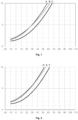
- the oil and refrigerant blends shown contain 22% HFC-134a (curve A), 15% HFO-1234yf (curve B), 23.8% HFO-1234ze (curve C), with a 10°C superheat in the system; or 26% HFC-134a (curve D), 18.5% HFO-1234yf (curve E), and 27.6% HFO-1234ze (curve F) with a 5°C superheat in the system.
- Example 3 Determination of viscosity in a vapor compression system at the compressor inlet
- the kinematic viscosity of the refrigerant/oil mixture at a temperature of 0°C and at the corresponding operating pressures is 44 cSt with HFC-134a and 79 cSt with HFO-1234yf. It is 45.18 cSt with HFO-1234ze
- the kinematic viscosity of the refrigerant/oil mixture at a temperature of -5°C and at the corresponding operating pressures is 38.6 cSt with HFC-134a and 69 cSt with HFO-1234yf. It is 40.3 cSt with HFO-1234ze.
- the kinematic viscosity is plotted as a function of temperature at constant pressure for each refrigerant fluid under the pressure conditions of Example 2.
- the curve marked with a star (*) corresponds to the oil alone.
- HFO-1234yf exhibits a viscosity behavior clearly distinct from that of HFC-134a and that of HFO-1234ze when the temperature of the mixture is below 40°C.
- thermodynamic properties were calculated using Refprop software.
- P max and P min denote the maximum and minimum pressures in the system
- Surch. denotes the superheat
- RI denotes the isentropic efficiency
- CAP denotes the volumetric capacity
- COP denotes the coefficient of performance.
- the reduction of superheat at the compressor inlet is possible thanks to the low solubility of HFO-1234yf with POE oils compared to HFC-134a and HFO-1234ze.
Landscapes
- Chemical & Material Sciences (AREA)
- Organic Chemistry (AREA)
- Chemical Kinetics & Catalysis (AREA)
- Engineering & Computer Science (AREA)
- Oil, Petroleum & Natural Gas (AREA)
- Physics & Mathematics (AREA)
- General Chemical & Material Sciences (AREA)
- Combustion & Propulsion (AREA)
- Thermal Sciences (AREA)
- Materials Engineering (AREA)
- Health & Medical Sciences (AREA)
- Emergency Medicine (AREA)
- Lubricants (AREA)
Claims (13)
- Klimatisierungs- oder Kühlverfahren für Industrie- oder Geschäftsräume mittels einer Wärmeübertragungsanlage, bei der ein Scrollverdichter verwendet wird und die eine Wärmeübertragungszusammensetzung enthält, wobei die Wärmeübertragungszusammensetzung Folgendes umfasst:- ein 2,3,3,3-Tetrafluorpropen umfassendes Kältemittel und- ein Schmiermittel;wobei das Schmiermittel einen Polyolester umfasst, die Löslichkeit von 2,3,3,3-Tetrafluorpropen im Schmiermittel bei 0 °C und bei einem absoluten Druck von 2,2 bar geringer als die Löslichkeit von 1,1,1,2-Tetrafluorethan im Schmiermittel bei 0 °C und bei einem absoluten Druck von 2,0 bar ist;wobei das Verfahren die folgenden aufeinanderfolgenden Schritte umfasst:- das Verdampfen eines Kältemittels;- das Überhitzen des Kältemittels um 1 bis 10 °C;- das Komprimieren des Kältemittels.
- Verfahren nach Anspruch 1, wobei das Überhitzen des Kältemittels von 2 bis 10 °C, noch mehr bevorzugt von 3 bis 5 °C, beträgt.
- Verfahren nach einem der Ansprüche 1 bis 2, wobei das Schmiermittel einen Dipentaerythritester umfasst.
- Verfahren nach einem der Ansprüche 1 bis 3, wobei das Schmiermittel eine kinematische Viskosität bei 40 °C von 10 bis 200 cSt, vorzugsweise von 20 bis 100 cSt und noch mehr bevorzugt von 30 bis 80 cSt aufweist.
- Verfahren nach einem der Ansprüche 1 bis 4, wobei das Verdampfen des Kältemittels bei einer mittleren Temperatur unterhalb von oder gleich 10 °C, vorzugsweise unterhalb von oder gleich 0 °C, noch mehr bevorzugt unterhalb von oder gleich -10 °C, erfolgt.
- Verfahren nach einem der Ansprüche 1 bis 5, wobei es sich bei der Wärmeübertragungsanlage um eine Anlage handelt, die zum Betrieb mit einer ursprünglichen Wärmeübertragungszusammensetzung vorgesehen ist, die Folgendes umfasst:- ein ursprüngliches Kältemittel und- ein ursprüngliches Schmiermittel,wobei die ursprüngliche Wärmeübertragungszusammensetzung von der beim Verfahren verwendeten Wärmeübertragungszusammensetzung verschieden ist.
- Verfahren nach einem der Ansprüche 1 bis 5, wobei es sich bei der Wärmeübertragungszusammensetzung um eine Ersatz-Wärmeübertragungszusammensetzung handelt, die als Ersatz einer ursprünglichen Wärmeübertragungszusammensetzung vorgesehen ist, die Folgendes umfasst:- ein ursprüngliches Kältemittel und- ein ursprüngliches Schmiermittel.
- Verfahren nach Anspruch 7, wobei das Überhitzen mit der Ersatz-Wärmeübertragungszusammensetzung geringer als oder gleich dem Überhitzen ist, wenn dasselbe Verfahren mit der ursprünglichen Wärmeübertragungszusammensetzung durchgeführt wird; und das Überhitzen mit der Ersatz-Wärmeübertragungszusammensetzung vorzugsweise um mindestens 2 °C, vorzugsweise mindestens 5 °C, noch mehr bevorzugt 10 °C geringer ist, bezogen auf das Überhitzen, wenn dasselbe Verfahren mit der ursprünglichen Wärmeübertragungszusammensetzung durchgeführt wird.
- Verfahren nach Anspruch 7 oder 8, wobei das Schmiermittel der Ersatz-Wärmeübertragungszusammensetzung mit dem ursprünglichen Schmiermittel identisch ist.
- Verfahren nach Anspruch 7 oder 8, wobei das Schmiermittel der Ersatz-Wärmeübertragungszusammensetzung vom ursprünglichen Schmiermittel verschieden ist.
- Verfahren nach Anspruch 10, wobei das Schmiermittel der Ersatz-Wärmeübertragungszusammensetzung eine kinematische Viskosität bei 40 °C aufweist, die niedriger als oder gleich der kinematischen Viskosität bei 40 °C des ursprünglichen Schmiermittels ist, wobei der Unterschied zwischen der kinematischen Viskosität bei 40 °C des ursprünglichen Schmiermittels und der kinematischen Viskosität bei 40 °C der Ersatz-Wärmeübertragungszusammensetzung vorzugsweise größer als oder gleich 5 cSt, noch mehr bevorzugt größer oder gleich 10 cSt, ist.
- Verfahren nach einem der Ansprüche 7 bis 11, wobei das ursprüngliche Schmiermittel einen Polyolester und vorzugsweise einen Dipentaerythritester umfasst.
- Verfahren nach einem der Ansprüche 6 bis 12, wobei das ursprüngliche Kältemittel 1,1,1,2-Tetrafluorethan umfasst oder im Wesentlichen aus 1,1,1,2-Tetrafluorethan besteht.
Applications Claiming Priority (2)
| Application Number | Priority Date | Filing Date | Title |
|---|---|---|---|
| FR1851280A FR3077822B1 (fr) | 2018-02-15 | 2018-02-15 | Compositions de transfert de chaleur en remplacement du r-134a |
| PCT/FR2019/050316 WO2019158856A1 (fr) | 2018-02-15 | 2019-02-13 | Compositions de transfert de chaleur en remplacement du r-134a |
Publications (2)
| Publication Number | Publication Date |
|---|---|
| EP3752573A1 EP3752573A1 (de) | 2020-12-23 |
| EP3752573B1 true EP3752573B1 (de) | 2025-03-05 |
Family
ID=61913430
Family Applications (1)
| Application Number | Title | Priority Date | Filing Date |
|---|---|---|---|
| EP19711645.2A Active EP3752573B1 (de) | 2018-02-15 | 2019-02-13 | Wärmetransferzusammensetzungen als ersatz für r-134a |
Country Status (5)
| Country | Link |
|---|---|
| US (1) | US11629278B2 (de) |
| EP (1) | EP3752573B1 (de) |
| ES (1) | ES3027412T3 (de) |
| FR (1) | FR3077822B1 (de) |
| WO (1) | WO2019158856A1 (de) |
Families Citing this family (9)
| Publication number | Priority date | Publication date | Assignee | Title |
|---|---|---|---|---|
| FR2936806B1 (fr) | 2008-10-08 | 2012-08-31 | Arkema France | Fluide refrigerant |
| FR3057272B1 (fr) | 2016-10-10 | 2020-05-08 | Arkema France | Compositions azeotropiques a base de tetrafluoropropene |
| FR3057271B1 (fr) | 2016-10-10 | 2020-01-17 | Arkema France | Utilisation de compositions a base de tetrafluoropropene |
| FR3070982B1 (fr) | 2017-09-12 | 2019-08-30 | Arkema France | Composition a base d'hydrochlorofluoroolefine et d'huile minerale |
| FR3077572B1 (fr) | 2018-02-05 | 2021-10-08 | Arkema France | Composition azeotropique ou quasi-azeotropique ternaire comprenant hf, 2,3,3,3-tetrafluoropropene et 1,1,1,2,2,-pentafluoropropane. |
| CN110845996B (zh) * | 2019-10-16 | 2021-02-09 | 珠海格力电器股份有限公司 | 一种环保冷媒及组合物 |
| US20240117232A1 (en) * | 2022-10-11 | 2024-04-11 | The Coulan Company, L.L.C. | Drop-in recycled refrigerant compositions having no net gwp being a drop-in replacement for r-32 and r-454b |
| US11746271B1 (en) * | 2022-10-11 | 2023-09-05 | The Coulan Company L.L.C. | Drop-in recycled refrigerant compositions having no net GWP |
| WO2025037962A1 (ko) * | 2023-08-16 | 2025-02-20 | 에스케이이노베이션 주식회사 | 혼합 냉매 조성물 및 이를 포함하는 히트 펌프 |
Family Cites Families (66)
| Publication number | Priority date | Publication date | Assignee | Title |
|---|---|---|---|---|
| US4755316A (en) | 1987-10-23 | 1988-07-05 | Allied-Signal Inc. | Refrigeration lubricants |
| US5008028A (en) | 1988-12-14 | 1991-04-16 | The Lubrizol Corporation | Liquid compositions containing carboxylic esters |
| US4975212A (en) | 1988-12-27 | 1990-12-04 | Allied-Signal Inc. | Fluorinated lubricating compositions |
| US4971712A (en) | 1989-06-02 | 1990-11-20 | E. I. Du Pont De Nemours And Company | Compositions for compression refrigeration and methods of using them |
| ATE439416T1 (de) | 1999-12-28 | 2009-08-15 | Idemitsu Kosan Co | Verwendung einer ölzusammensetzung für kohlendioxidkühlmaschine |
| US7279451B2 (en) | 2002-10-25 | 2007-10-09 | Honeywell International Inc. | Compositions containing fluorine substituted olefins |
| BRPI0315633B1 (pt) | 2002-10-25 | 2020-11-10 | Honeywell International Inc. | composição de transferência de calor e método de transferir calor para ou a partir de um fluido ou corpo |
| US20040089839A1 (en) | 2002-10-25 | 2004-05-13 | Honeywell International, Inc. | Fluorinated alkene refrigerant compositions |
| JP4936656B2 (ja) | 2003-11-21 | 2012-05-23 | 日油株式会社 | 冷凍機用潤滑油組成物 |
| CA2487587C (en) | 2003-11-21 | 2012-04-24 | Nof Corporation | A polyol ester for use within a refrigeration lubricant composition compatible with chlorine-free hydrofluorocarbon refrigerants |
| CA2564023C (en) | 2004-04-16 | 2012-07-17 | Honeywell International Inc. | Azeotrope-like compositions of tetrafluoropropene and trifluoroiodomethane |
| US20060243944A1 (en) | 2005-03-04 | 2006-11-02 | Minor Barbara H | Compositions comprising a fluoroolefin |
| US20060243945A1 (en) | 2005-03-04 | 2006-11-02 | Minor Barbara H | Compositions comprising a fluoroolefin |
| WO2007000302A1 (en) | 2005-06-27 | 2007-01-04 | Cognis Ip Management Gmbh | Lubricants for refrigeration systems |
| KR101477832B1 (ko) | 2007-06-12 | 2014-12-30 | 이데미쓰 고산 가부시키가이샤 | 냉동기용 윤활유 조성물 및 이것을 사용한 압축기 |
| CA2703921C (en) | 2007-10-29 | 2016-05-03 | Nippon Oil Corporation | Refrigerator oil and refrigerating machine working fluid composition comprising a polyalkylene glycol and a fluoropropene refrigerant |
| US8322149B2 (en) | 2008-04-01 | 2012-12-04 | Honeywell International Inc. | Method for selecting lubricants for heat pumps |
| FR2932492B1 (fr) | 2008-06-11 | 2010-07-30 | Arkema France | Compositions a base d'hydrofluoroolefines |
| FR2932493B1 (fr) | 2008-06-11 | 2010-07-30 | Arkema France | Compositions a base d'hydrofluoroolefines |
| JP2010024410A (ja) | 2008-07-24 | 2010-02-04 | Sanden Corp | 冷凍回路 |
| US9546311B2 (en) | 2008-08-19 | 2017-01-17 | Honeywell International Inc. | Azeotrope-like compositions of 1,1,1,2-tetrafluoropropene and 1,1,1,2-tetrafluoroethane |
| FR2936806B1 (fr) | 2008-10-08 | 2012-08-31 | Arkema France | Fluide refrigerant |
| FR2937906B1 (fr) | 2008-11-03 | 2010-11-19 | Arkema France | Procede de chauffage et/ou climatisation d'un vehicule. |
| US20170080773A1 (en) | 2008-11-03 | 2017-03-23 | Arkema France | Vehicle Heating and/or Air Conditioning Method |
| FR2938550B1 (fr) | 2008-11-20 | 2010-11-12 | Arkema France | Composition comprenant du 2,3,3,3-tetrafluoropropene procede de chauffage et/ou climatisation d'un vehicule |
| FR2938551B1 (fr) | 2008-11-20 | 2010-11-12 | Arkema France | Procede de chauffage et/ou climatisation d'un vehicule |
| CN102272273A (zh) | 2009-01-16 | 2011-12-07 | 科聚亚公司 | 用于制冷和空调系统的基于二氧化碳的工作流体 |
| FR2942237B1 (fr) | 2009-02-13 | 2013-01-04 | Arkema France | Procede de chauffage et/ou climatisation d'un vehicule |
| GB0915004D0 (en) | 2009-08-28 | 2009-09-30 | Ineos Fluor Holdings Ltd | Heat transfer composition |
| FR2950065B1 (fr) | 2009-09-11 | 2012-02-03 | Arkema France | Fluide refrigerant binaire |
| FR2950067B1 (fr) | 2009-09-11 | 2011-10-28 | Arkema France | Fluide de transfert de chaleur en remplacement du r-410a |
| FR2950069B1 (fr) | 2009-09-11 | 2011-11-25 | Arkema France | Utilisation de compositions ternaires |
| FR2950066B1 (fr) | 2009-09-11 | 2011-10-28 | Arkema France | Refrigeration basse et moyenne temperature |
| FR2950068B1 (fr) | 2009-09-11 | 2012-05-18 | Arkema France | Procede de transfert de chaleur |
| FR2950071B1 (fr) | 2009-09-11 | 2012-02-03 | Arkema France | Compositions ternaires pour refrigeration basse capacite |
| FR2950070B1 (fr) | 2009-09-11 | 2011-10-28 | Arkema France | Compositions ternaires pour refrigeration haute capacite |
| US10035938B2 (en) | 2009-09-11 | 2018-07-31 | Arkema France | Heat transfer fluid replacing R-134a |
| JP6141019B2 (ja) | 2009-12-29 | 2017-06-07 | アーケマ・インコーポレイテッド | 冷媒−潤滑剤の組合せを選択する方法 |
| JP5704837B2 (ja) | 2010-05-26 | 2015-04-22 | 日本サン石油株式会社 | カーエアコン用作動流体 |
| FR2962130B1 (fr) | 2010-06-30 | 2012-07-20 | Arkema France | Composition a base de 2,3,3,3-tetrafluoropropene |
| FR2962442B1 (fr) | 2010-07-09 | 2016-02-26 | Arkema France | Composition stable de 2,3,3,3-tetrafluoropropene |
| JP2012031239A (ja) | 2010-07-29 | 2012-02-16 | Hitachi Appliances Inc | 冷凍空調用圧縮機及び冷凍空調装置 |
| FR2964975B1 (fr) * | 2010-09-20 | 2012-08-24 | Arkema France | Composition a base de 2,3,3,3-tetrafluoropropene |
| FR2971512B1 (fr) | 2011-02-10 | 2013-01-18 | Arkema France | Compositions binaires de 2,3,3,3-tetrafluoropropene et d'ammoniac |
| FR2974812B1 (fr) | 2011-05-04 | 2014-08-08 | Arkema France | Compositions de transfert de chaleur presentant une miscibilite amelioree avec l'huile de lubrification |
| US9187682B2 (en) | 2011-06-24 | 2015-11-17 | Emerson Climate Technologies, Inc. | Refrigeration compressor lubricant |
| FR2986007B1 (fr) | 2012-01-25 | 2015-01-23 | Arkema France | Compositions de transfert de chaleur presentant une miscibilite amelioree avec l'huile de lubrification |
| FR2986236B1 (fr) | 2012-01-26 | 2014-01-10 | Arkema France | Compositions de transfert de chaleur presentant une miscibilite amelioree avec l'huile de lubrification |
| US8685271B2 (en) | 2012-02-08 | 2014-04-01 | Chemtura Corporation | Refrigeration oil and compositions with hydrocarbon refrigerants |
| FR3000093B1 (fr) | 2012-12-26 | 2015-07-17 | Arkema France | Composition azeotropique ou quasi-azeotropique de chloromethane |
| FR3000095B1 (fr) | 2012-12-26 | 2015-02-20 | Arkema France | Composition comprenant du 2,3,3,3-tetrafluoropropene et du 1,2-difluoroethylene |
| FR3000096B1 (fr) | 2012-12-26 | 2015-02-20 | Arkema France | Composition comprenant du 2,3,3,3-tetrafluoropropene |
| KR101987631B1 (ko) | 2013-01-17 | 2019-06-12 | 제이엑스티지 에네루기 가부시키가이샤 | 냉동기유 및 냉동기용 작동 유체 조성물 |
| FR3003565B1 (fr) | 2013-03-20 | 2018-06-29 | Arkema France | Composition comprenant hf et 2,3,3,3-tetrafluoropropene |
| WO2014156737A1 (ja) | 2013-03-25 | 2014-10-02 | Jx日鉱日石エネルギー株式会社 | 冷凍機用作動流体組成物 |
| FR3008419B1 (fr) | 2013-07-11 | 2015-07-17 | Arkema France | Compositions a base de 2,3,3,3-tetrafluoropropene presentant une miscibilite amelioree |
| CN106029853B (zh) * | 2014-02-20 | 2019-04-09 | Agc株式会社 | 热循环系统用组合物及热循环系统 |
| FR3033791B1 (fr) | 2015-03-18 | 2017-04-14 | Arkema France | Stabilisation du 1-chloro-3,3,3-trifluoropropene |
| US9683158B2 (en) | 2015-06-26 | 2017-06-20 | Lanxess Solutions Us, Inc. | Working fluids comprising fluorinated olefins and polyol esters |
| FR3057272B1 (fr) | 2016-10-10 | 2020-05-08 | Arkema France | Compositions azeotropiques a base de tetrafluoropropene |
| FR3057271B1 (fr) * | 2016-10-10 | 2020-01-17 | Arkema France | Utilisation de compositions a base de tetrafluoropropene |
| FR3061906B1 (fr) | 2017-01-19 | 2019-03-15 | Arkema France | Composition comprenant du 2,3,3,3-tetrafluoropropene |
| FR3061905B1 (fr) | 2017-01-19 | 2019-05-17 | Arkema France | Composition comprenant du 2,3,3,3-tetrafluoropropene |
| FR3070982B1 (fr) | 2017-09-12 | 2019-08-30 | Arkema France | Composition a base d'hydrochlorofluoroolefine et d'huile minerale |
| FR3077572B1 (fr) | 2018-02-05 | 2021-10-08 | Arkema France | Composition azeotropique ou quasi-azeotropique ternaire comprenant hf, 2,3,3,3-tetrafluoropropene et 1,1,1,2,2,-pentafluoropropane. |
| FR3080169B1 (fr) | 2018-04-13 | 2020-12-18 | Arkema France | Procede de refroidissement et/ou de chauffage d'un corps ou d'un fluide dans un vehicule automobile |
-
2018
- 2018-02-15 FR FR1851280A patent/FR3077822B1/fr active Active
-
2019
- 2019-02-13 ES ES19711645T patent/ES3027412T3/es active Active
- 2019-02-13 WO PCT/FR2019/050316 patent/WO2019158856A1/fr not_active Ceased
- 2019-02-13 EP EP19711645.2A patent/EP3752573B1/de active Active
- 2019-02-13 US US16/962,143 patent/US11629278B2/en active Active
Also Published As
| Publication number | Publication date |
|---|---|
| FR3077822A1 (fr) | 2019-08-16 |
| US20200407613A1 (en) | 2020-12-31 |
| WO2019158856A1 (fr) | 2019-08-22 |
| US11629278B2 (en) | 2023-04-18 |
| ES3027412T3 (en) | 2025-06-13 |
| FR3077822B1 (fr) | 2020-07-24 |
| EP3752573A1 (de) | 2020-12-23 |
Similar Documents
| Publication | Publication Date | Title |
|---|---|---|
| EP3752573B1 (de) | Wärmetransferzusammensetzungen als ersatz für r-134a | |
| EP3523390B1 (de) | Verwendung von auf tetrafluorpropen basierenden zusammensetzungen | |
| EP3516007B1 (de) | Zusammensetzung mit 1-chlor-3,3,3-trifluorpropen | |
| EP2807225B1 (de) | Wärmeträgerzusammensetzungen mit verbesserter mischbarkeit mit schmieröl | |
| EP3523389B1 (de) | Auf tetrafluorpropen basierende azeotrope zusammensetzungen | |
| EP3630909B1 (de) | Zusammensetzungen auf trifluorethylenbasis und verwendungen davon | |
| WO2018134528A1 (fr) | Composition comprenant du 2,3,3,3-tetrafluoropropene | |
| WO2018134530A1 (fr) | Composition comprenant du 2,3,3,3-tetrafluoropropene | |
| EP3044278A1 (de) | Wärmeübertragungsflüssigkeiten mit difluormethan, pentafluorethan, tetrafluorpropen und optional propan | |
| EP3601468B1 (de) | Tetrafluorpropenbasierte zusammensetzung | |
| EP3752572B1 (de) | Verfahren zum heizen und/oder klimatisieren eines fahrzeugs | |
| EP3592821A1 (de) | Quasi-azeotrope zusammensetzung mit 2,3,3,3-tetrafluorpropen und trans-1,3,3,3-tetrafluorpropen | |
| FR2988729A1 (fr) | Compositions de 2,4,4,4-tetrafluorobut-1-ene et de 1-methoxyheptafluoropropane |
Legal Events
| Date | Code | Title | Description |
|---|---|---|---|
| STAA | Information on the status of an ep patent application or granted ep patent |
Free format text: STATUS: UNKNOWN |
|
| STAA | Information on the status of an ep patent application or granted ep patent |
Free format text: STATUS: THE INTERNATIONAL PUBLICATION HAS BEEN MADE |
|
| PUAI | Public reference made under article 153(3) epc to a published international application that has entered the european phase |
Free format text: ORIGINAL CODE: 0009012 |
|
| STAA | Information on the status of an ep patent application or granted ep patent |
Free format text: STATUS: REQUEST FOR EXAMINATION WAS MADE |
|
| 17P | Request for examination filed |
Effective date: 20200527 |
|
| AK | Designated contracting states |
Kind code of ref document: A1 Designated state(s): AL AT BE BG CH CY CZ DE DK EE ES FI FR GB GR HR HU IE IS IT LI LT LU LV MC MK MT NL NO PL PT RO RS SE SI SK SM TR |
|
| AX | Request for extension of the european patent |
Extension state: BA ME |
|
| DAV | Request for validation of the european patent (deleted) | ||
| DAX | Request for extension of the european patent (deleted) | ||
| STAA | Information on the status of an ep patent application or granted ep patent |
Free format text: STATUS: EXAMINATION IS IN PROGRESS |
|
| 17Q | First examination report despatched |
Effective date: 20210923 |
|
| GRAP | Despatch of communication of intention to grant a patent |
Free format text: ORIGINAL CODE: EPIDOSNIGR1 |
|
| STAA | Information on the status of an ep patent application or granted ep patent |
Free format text: STATUS: GRANT OF PATENT IS INTENDED |
|
| INTG | Intention to grant announced |
Effective date: 20241108 |
|
| GRAS | Grant fee paid |
Free format text: ORIGINAL CODE: EPIDOSNIGR3 |
|
| GRAA | (expected) grant |
Free format text: ORIGINAL CODE: 0009210 |
|
| STAA | Information on the status of an ep patent application or granted ep patent |
Free format text: STATUS: THE PATENT HAS BEEN GRANTED |
|
| AK | Designated contracting states |
Kind code of ref document: B1 Designated state(s): AL AT BE BG CH CY CZ DE DK EE ES FI FR GB GR HR HU IE IS IT LI LT LU LV MC MK MT NL NO PL PT RO RS SE SI SK SM TR |
|
| REG | Reference to a national code |
Ref country code: GB Ref legal event code: FG4D Free format text: NOT ENGLISH |
|
| REG | Reference to a national code |
Ref country code: CH Ref legal event code: EP |
|
| REG | Reference to a national code |
Ref country code: IE Ref legal event code: FG4D Free format text: LANGUAGE OF EP DOCUMENT: FRENCH |
|
| REG | Reference to a national code |
Ref country code: DE Ref legal event code: R096 Ref document number: 602019066819 Country of ref document: DE |
|
| P01 | Opt-out of the competence of the unified patent court (upc) registered |
Free format text: CASE NUMBER: APP_11799/2025 Effective date: 20250311 |
|
| RAP4 | Party data changed (patent owner data changed or rights of a patent transferred) |
Owner name: ARKEMA FRANCE |
|
| REG | Reference to a national code |
Ref country code: ES Ref legal event code: FG2A Ref document number: 3027412 Country of ref document: ES Kind code of ref document: T3 Effective date: 20250613 |
|
| PG25 | Lapsed in a contracting state [announced via postgrant information from national office to epo] |
Ref country code: RS Free format text: LAPSE BECAUSE OF FAILURE TO SUBMIT A TRANSLATION OF THE DESCRIPTION OR TO PAY THE FEE WITHIN THE PRESCRIBED TIME-LIMIT Effective date: 20250605 |
|
| PG25 | Lapsed in a contracting state [announced via postgrant information from national office to epo] |
Ref country code: FI Free format text: LAPSE BECAUSE OF FAILURE TO SUBMIT A TRANSLATION OF THE DESCRIPTION OR TO PAY THE FEE WITHIN THE PRESCRIBED TIME-LIMIT Effective date: 20250305 |
|
| REG | Reference to a national code |
Ref country code: NL Ref legal event code: MP Effective date: 20250305 |
|
| REG | Reference to a national code |
Ref country code: LT Ref legal event code: MG9D |
|
| PG25 | Lapsed in a contracting state [announced via postgrant information from national office to epo] |
Ref country code: NO Free format text: LAPSE BECAUSE OF FAILURE TO SUBMIT A TRANSLATION OF THE DESCRIPTION OR TO PAY THE FEE WITHIN THE PRESCRIBED TIME-LIMIT Effective date: 20250605 |
|
| PG25 | Lapsed in a contracting state [announced via postgrant information from national office to epo] |
Ref country code: HR Free format text: LAPSE BECAUSE OF FAILURE TO SUBMIT A TRANSLATION OF THE DESCRIPTION OR TO PAY THE FEE WITHIN THE PRESCRIBED TIME-LIMIT Effective date: 20250305 |
|
| PG25 | Lapsed in a contracting state [announced via postgrant information from national office to epo] |
Ref country code: LV Free format text: LAPSE BECAUSE OF FAILURE TO SUBMIT A TRANSLATION OF THE DESCRIPTION OR TO PAY THE FEE WITHIN THE PRESCRIBED TIME-LIMIT Effective date: 20250305 |
|
| PG25 | Lapsed in a contracting state [announced via postgrant information from national office to epo] |
Ref country code: GR Free format text: LAPSE BECAUSE OF FAILURE TO SUBMIT A TRANSLATION OF THE DESCRIPTION OR TO PAY THE FEE WITHIN THE PRESCRIBED TIME-LIMIT Effective date: 20250606 Ref country code: BG Free format text: LAPSE BECAUSE OF FAILURE TO SUBMIT A TRANSLATION OF THE DESCRIPTION OR TO PAY THE FEE WITHIN THE PRESCRIBED TIME-LIMIT Effective date: 20250305 |
|
| REG | Reference to a national code |
Ref country code: DE Ref legal event code: R081 Ref document number: 602019066819 Country of ref document: DE Owner name: ARKEMA FRANCE, FR Free format text: FORMER OWNER: ARKEMA FRANCE, COLOMBES, FR |
|
| REG | Reference to a national code |
Ref country code: AT Ref legal event code: MK05 Ref document number: 1772951 Country of ref document: AT Kind code of ref document: T Effective date: 20250305 |
|
| PG25 | Lapsed in a contracting state [announced via postgrant information from national office to epo] |
Ref country code: NL Free format text: LAPSE BECAUSE OF FAILURE TO SUBMIT A TRANSLATION OF THE DESCRIPTION OR TO PAY THE FEE WITHIN THE PRESCRIBED TIME-LIMIT Effective date: 20250305 |
|
| PG25 | Lapsed in a contracting state [announced via postgrant information from national office to epo] |
Ref country code: SE Free format text: LAPSE BECAUSE OF FAILURE TO SUBMIT A TRANSLATION OF THE DESCRIPTION OR TO PAY THE FEE WITHIN THE PRESCRIBED TIME-LIMIT Effective date: 20250305 |
|
| PG25 | Lapsed in a contracting state [announced via postgrant information from national office to epo] |
Ref country code: SM Free format text: LAPSE BECAUSE OF FAILURE TO SUBMIT A TRANSLATION OF THE DESCRIPTION OR TO PAY THE FEE WITHIN THE PRESCRIBED TIME-LIMIT Effective date: 20250305 |
|
| PG25 | Lapsed in a contracting state [announced via postgrant information from national office to epo] |
Ref country code: PT Free format text: LAPSE BECAUSE OF FAILURE TO SUBMIT A TRANSLATION OF THE DESCRIPTION OR TO PAY THE FEE WITHIN THE PRESCRIBED TIME-LIMIT Effective date: 20250707 |
|
| PG25 | Lapsed in a contracting state [announced via postgrant information from national office to epo] |
Ref country code: PL Free format text: LAPSE BECAUSE OF FAILURE TO SUBMIT A TRANSLATION OF THE DESCRIPTION OR TO PAY THE FEE WITHIN THE PRESCRIBED TIME-LIMIT Effective date: 20250305 |
|
| PG25 | Lapsed in a contracting state [announced via postgrant information from national office to epo] |
Ref country code: AT Free format text: LAPSE BECAUSE OF FAILURE TO SUBMIT A TRANSLATION OF THE DESCRIPTION OR TO PAY THE FEE WITHIN THE PRESCRIBED TIME-LIMIT Effective date: 20250305 |
|
| PG25 | Lapsed in a contracting state [announced via postgrant information from national office to epo] |
Ref country code: CZ Free format text: LAPSE BECAUSE OF FAILURE TO SUBMIT A TRANSLATION OF THE DESCRIPTION OR TO PAY THE FEE WITHIN THE PRESCRIBED TIME-LIMIT Effective date: 20250305 Ref country code: EE Free format text: LAPSE BECAUSE OF FAILURE TO SUBMIT A TRANSLATION OF THE DESCRIPTION OR TO PAY THE FEE WITHIN THE PRESCRIBED TIME-LIMIT Effective date: 20250305 |
|
| PG25 | Lapsed in a contracting state [announced via postgrant information from national office to epo] |
Ref country code: RO Free format text: LAPSE BECAUSE OF FAILURE TO SUBMIT A TRANSLATION OF THE DESCRIPTION OR TO PAY THE FEE WITHIN THE PRESCRIBED TIME-LIMIT Effective date: 20250305 |
|
| PG25 | Lapsed in a contracting state [announced via postgrant information from national office to epo] |
Ref country code: SK Free format text: LAPSE BECAUSE OF FAILURE TO SUBMIT A TRANSLATION OF THE DESCRIPTION OR TO PAY THE FEE WITHIN THE PRESCRIBED TIME-LIMIT Effective date: 20250305 |
|
| PG25 | Lapsed in a contracting state [announced via postgrant information from national office to epo] |
Ref country code: IS Free format text: LAPSE BECAUSE OF FAILURE TO SUBMIT A TRANSLATION OF THE DESCRIPTION OR TO PAY THE FEE WITHIN THE PRESCRIBED TIME-LIMIT Effective date: 20250705 |
|
| PG25 | Lapsed in a contracting state [announced via postgrant information from national office to epo] |
Ref country code: DK Free format text: LAPSE BECAUSE OF FAILURE TO SUBMIT A TRANSLATION OF THE DESCRIPTION OR TO PAY THE FEE WITHIN THE PRESCRIBED TIME-LIMIT Effective date: 20250305 |
|
| REG | Reference to a national code |
Ref country code: CH Ref legal event code: L10 Free format text: ST27 STATUS EVENT CODE: U-0-0-L10-L00 (AS PROVIDED BY THE NATIONAL OFFICE) Effective date: 20260114 |
|
| PGFP | Annual fee paid to national office [announced via postgrant information from national office to epo] |
Ref country code: FR Payment date: 20251231 Year of fee payment: 8 |