EP3748635B1 - Akustische vorrichtung und akustisches verarbeitungsverfahren - Google Patents
Akustische vorrichtung und akustisches verarbeitungsverfahren Download PDFInfo
- Publication number
- EP3748635B1 EP3748635B1 EP20177963.4A EP20177963A EP3748635B1 EP 3748635 B1 EP3748635 B1 EP 3748635B1 EP 20177963 A EP20177963 A EP 20177963A EP 3748635 B1 EP3748635 B1 EP 3748635B1
- Authority
- EP
- European Patent Office
- Prior art keywords
- audio signal
- gain
- feature amount
- noise
- acoustic device
- Prior art date
- Legal status (The legal status is an assumption and is not a legal conclusion. Google has not performed a legal analysis and makes no representation as to the accuracy of the status listed.)
- Active
Links
Images





Classifications
-
- G—PHYSICS
- G06—COMPUTING OR CALCULATING; COUNTING
- G06F—ELECTRIC DIGITAL DATA PROCESSING
- G06F3/00—Input arrangements for transferring data to be processed into a form capable of being handled by the computer; Output arrangements for transferring data from processing unit to output unit, e.g. interface arrangements
- G06F3/16—Sound input; Sound output
- G06F3/165—Management of the audio stream, e.g. setting of volume, audio stream path
-
- G—PHYSICS
- G10—MUSICAL INSTRUMENTS; ACOUSTICS
- G10L—SPEECH ANALYSIS TECHNIQUES OR SPEECH SYNTHESIS; SPEECH RECOGNITION; SPEECH OR VOICE PROCESSING TECHNIQUES; SPEECH OR AUDIO CODING OR DECODING
- G10L21/00—Speech or voice signal processing techniques to produce another audible or non-audible signal, e.g. visual or tactile, in order to modify its quality or its intelligibility
- G10L21/02—Speech enhancement, e.g. noise reduction or echo cancellation
- G10L21/0316—Speech enhancement, e.g. noise reduction or echo cancellation by changing the amplitude
- G10L21/0324—Details of processing therefor
- G10L21/034—Automatic adjustment
-
- G—PHYSICS
- G10—MUSICAL INSTRUMENTS; ACOUSTICS
- G10L—SPEECH ANALYSIS TECHNIQUES OR SPEECH SYNTHESIS; SPEECH RECOGNITION; SPEECH OR VOICE PROCESSING TECHNIQUES; SPEECH OR AUDIO CODING OR DECODING
- G10L21/00—Speech or voice signal processing techniques to produce another audible or non-audible signal, e.g. visual or tactile, in order to modify its quality or its intelligibility
- G10L21/02—Speech enhancement, e.g. noise reduction or echo cancellation
- G10L21/0272—Voice signal separating
-
- G—PHYSICS
- G10—MUSICAL INSTRUMENTS; ACOUSTICS
- G10L—SPEECH ANALYSIS TECHNIQUES OR SPEECH SYNTHESIS; SPEECH RECOGNITION; SPEECH OR VOICE PROCESSING TECHNIQUES; SPEECH OR AUDIO CODING OR DECODING
- G10L21/00—Speech or voice signal processing techniques to produce another audible or non-audible signal, e.g. visual or tactile, in order to modify its quality or its intelligibility
- G10L21/02—Speech enhancement, e.g. noise reduction or echo cancellation
-
- G—PHYSICS
- G10—MUSICAL INSTRUMENTS; ACOUSTICS
- G10L—SPEECH ANALYSIS TECHNIQUES OR SPEECH SYNTHESIS; SPEECH RECOGNITION; SPEECH OR VOICE PROCESSING TECHNIQUES; SPEECH OR AUDIO CODING OR DECODING
- G10L21/00—Speech or voice signal processing techniques to produce another audible or non-audible signal, e.g. visual or tactile, in order to modify its quality or its intelligibility
- G10L21/02—Speech enhancement, e.g. noise reduction or echo cancellation
- G10L21/0208—Noise filtering
-
- G—PHYSICS
- G10—MUSICAL INSTRUMENTS; ACOUSTICS
- G10L—SPEECH ANALYSIS TECHNIQUES OR SPEECH SYNTHESIS; SPEECH RECOGNITION; SPEECH OR VOICE PROCESSING TECHNIQUES; SPEECH OR AUDIO CODING OR DECODING
- G10L21/00—Speech or voice signal processing techniques to produce another audible or non-audible signal, e.g. visual or tactile, in order to modify its quality or its intelligibility
- G10L21/02—Speech enhancement, e.g. noise reduction or echo cancellation
- G10L21/0208—Noise filtering
- G10L21/0216—Noise filtering characterised by the method used for estimating noise
-
- G—PHYSICS
- G10—MUSICAL INSTRUMENTS; ACOUSTICS
- G10L—SPEECH ANALYSIS TECHNIQUES OR SPEECH SYNTHESIS; SPEECH RECOGNITION; SPEECH OR VOICE PROCESSING TECHNIQUES; SPEECH OR AUDIO CODING OR DECODING
- G10L21/00—Speech or voice signal processing techniques to produce another audible or non-audible signal, e.g. visual or tactile, in order to modify its quality or its intelligibility
- G10L21/02—Speech enhancement, e.g. noise reduction or echo cancellation
- G10L21/0316—Speech enhancement, e.g. noise reduction or echo cancellation by changing the amplitude
-
- G—PHYSICS
- G10—MUSICAL INSTRUMENTS; ACOUSTICS
- G10L—SPEECH ANALYSIS TECHNIQUES OR SPEECH SYNTHESIS; SPEECH RECOGNITION; SPEECH OR VOICE PROCESSING TECHNIQUES; SPEECH OR AUDIO CODING OR DECODING
- G10L21/00—Speech or voice signal processing techniques to produce another audible or non-audible signal, e.g. visual or tactile, in order to modify its quality or its intelligibility
- G10L21/02—Speech enhancement, e.g. noise reduction or echo cancellation
- G10L21/0316—Speech enhancement, e.g. noise reduction or echo cancellation by changing the amplitude
- G10L21/0364—Speech enhancement, e.g. noise reduction or echo cancellation by changing the amplitude for improving intelligibility
-
- G—PHYSICS
- G10—MUSICAL INSTRUMENTS; ACOUSTICS
- G10L—SPEECH ANALYSIS TECHNIQUES OR SPEECH SYNTHESIS; SPEECH RECOGNITION; SPEECH OR VOICE PROCESSING TECHNIQUES; SPEECH OR AUDIO CODING OR DECODING
- G10L25/00—Speech or voice analysis techniques not restricted to a single one of groups G10L15/00 - G10L21/00
- G10L25/03—Speech or voice analysis techniques not restricted to a single one of groups G10L15/00 - G10L21/00 characterised by the type of extracted parameters
- G10L25/24—Speech or voice analysis techniques not restricted to a single one of groups G10L15/00 - G10L21/00 characterised by the type of extracted parameters the extracted parameters being the cepstrum
-
- G—PHYSICS
- G10—MUSICAL INSTRUMENTS; ACOUSTICS
- G10L—SPEECH ANALYSIS TECHNIQUES OR SPEECH SYNTHESIS; SPEECH RECOGNITION; SPEECH OR VOICE PROCESSING TECHNIQUES; SPEECH OR AUDIO CODING OR DECODING
- G10L25/00—Speech or voice analysis techniques not restricted to a single one of groups G10L15/00 - G10L21/00
- G10L25/78—Detection of presence or absence of voice signals
- G10L25/84—Detection of presence or absence of voice signals for discriminating voice from noise
-
- H—ELECTRICITY
- H04—ELECTRIC COMMUNICATION TECHNIQUE
- H04M—TELEPHONIC COMMUNICATION
- H04M9/00—Arrangements for interconnection not involving centralised switching
- H04M9/08—Two-way loud-speaking telephone systems with means for conditioning the signal, e.g. for suppressing echoes for one or both directions of traffic
- H04M9/082—Two-way loud-speaking telephone systems with means for conditioning the signal, e.g. for suppressing echoes for one or both directions of traffic using echo cancellers
-
- G—PHYSICS
- G10—MUSICAL INSTRUMENTS; ACOUSTICS
- G10L—SPEECH ANALYSIS TECHNIQUES OR SPEECH SYNTHESIS; SPEECH RECOGNITION; SPEECH OR VOICE PROCESSING TECHNIQUES; SPEECH OR AUDIO CODING OR DECODING
- G10L21/00—Speech or voice signal processing techniques to produce another audible or non-audible signal, e.g. visual or tactile, in order to modify its quality or its intelligibility
- G10L21/02—Speech enhancement, e.g. noise reduction or echo cancellation
- G10L21/0208—Noise filtering
- G10L2021/02082—Noise filtering the noise being echo, reverberation of the speech
Definitions
- the present invention relates to an acoustic device and an acoustic processing method.
- JP 2004-20733 A discloses a technique to adjust the level of sound outputted from a speaker, according to the volume of each talker.
- JP H07-039114 U discloses a technique to adjust the level of sound outputted from a speaker, according to a surrounding noise amount.
- JP 2004-20733 A and JP H07-039114 U relate to a technology to simply adjust the level of sound to be outputted from a speaker.
- JP 2004-20733 A nor JP H07-039114 U discloses a technology to adjust an audio signal received from a device on a far-end side.
- JP 2007 060429 A discloses a voice amplifying phone for carrying out voice amplification with a proper voice volume in response to the magnitude of surrounding noise and suppressing production of howling at the same time. Since an estimate value of a near end side surrounding noise level is updated when a near end side voice interval detection section detects no voice interval, a voice volume correction amount adjustment means adjusts a correction amount in a voice volume correction means to a proper value in response to a surround noise level so as to attain a voice amplifying speech in a proper voice volume in response to the magnitude of the surrounding noise. Since the voice volume correction amount adjustment means adjusts the correction amount only when the voice interval is detected, production of howling caused by a sneak path from a speaker to a microphone can be suppressed. Further, since no correction amount is adjusted while an adaptive filter of a first echo canceller updates its coefficient, deterioration in the convergence of the adaptive filter can be prevented.
- KR 2010 0047740 A discloses a method and a device for controlling a volume to extract human voice from noise when automatically controlling a volume according to noise of a surrounding environment, thereby performing an automatic volume control function considering whether voice noise is mixed.
- a noise sensor senses external noise.
- a voice determining unit determines a voice among the external noise.
- An amplification information storage unit stores amplification information which differentiates an amplification ratio to the output sound caused by the external noise by a frequency band.
- a sound processor amplifies the output sound according to the amplification control signal.
- an object of the present invention is to provide an acoustic device and an acoustic processing method that adjust an audio signal received from a far-end side to an appropriate level.
- an acoustic device is provided as set forth in claim 1.
- an acoustic processing method is provided as set forth in claim 7.
- Preferred embodiments of the present invention are set forth in the dependent claims.
- An acoustic device includes a microphone, a voice feature amount extracting portion that extracts a voice feature amount from sound (corresponding to a first audio signal of the present invention) collected by the microphone, an audio signal receiving portion that receives an audio signal (corresponding to a second audio signal of the present invention) from a different device on a far-end side, and a gain determining portion that determines a gain of the audio signal received from the different device on the far-end side, based on the voice feature amount that has been extracted by the voice feature amount extracting portion.
- the voice feature amount includes power level of an audio signal, for example.
- the acoustic device determines a level of voice of a talker on a far-end side, according to voice of a talker on a near-end side. As an example, the talker on a near-end side talks loudly when a surrounding noise level is high. At this time, when the level of the voice of the talker on a far-end side is low, a user on a near-end side has difficulty hearing the voice of the talker on a far-end side. Therefore, as an example, the acoustic device, when the level of the voice of the talker on a near-end side is high, causes the level of the voice on a far-end side to be high. Accordingly, the acoustic device is able to output the voice received from the far-end side at an appropriate volume.
- the acoustic device includes a noise feature amount obtaining portion that obtains a noise feature amount from sound collected by a microphone.
- the gain determining portion determines a gain, based on a voice feature amount and a noise feature amount.
- the noise feature amount includes power level of a noise signal, for example.
- the acoustic device determines the level of the voice of a far-end side, further according to the noise on a near-end side. For example, when the volume of noise is low, even if the level of the voice of the talker on a far-end side is reduced, the user on a near-end side has no difficulty hearing. Therefore, the acoustic device reduces the level of the voice of the talker on a far-end side, when the level of the voice of the talker on a near-end side is high and the level of noise is low.
- the acoustic device includes an echo canceller that removes an echo element from the sound collected by the microphone.
- the noise feature amount obtaining portion may obtain a noise feature amount from the sound of which the echo element has been removed by the echo canceller.
- the acoustic device does not erroneously recognize the voice on a far-end side as noise by removing an echo element. Therefore, the acoustic device is able to obtain a noise feature amount with higher accuracy.
- the acoustic device may include a distinguishing portion that distinguishes a voice section, and the gain determining portion may determine a gain in the voice section that the distinguishing portion has distinguished.
- the acoustic device since performing in a limited (in a each of a distinguished) voice section, is able to determine a gain with higher accuracy.
- FIG. 1 is a diagram showing a configuration of an acoustic processing system 100.
- the acoustic processing system 100 includes a plurality (two in FIG. 1 ) of acoustic devices 1 and 3 that are connected to each other through a network 2.
- the acoustic device 1 is set at a first point.
- the acoustic device 3 is set at a second point. In other words, the acoustic device 1 and the acoustic device 3 are set in places remote from each other.
- the acoustic device 1 and the acoustic device 3 are connected to a remote place through the network 2, and are used for a system that performs interactive communication between remote places.
- the acoustic device 1 and the acoustic device 3 are used for a conference system in a remote place.
- the acoustic device 1 for example, sends the voice of a user of the acoustic device 1 to a user of the acoustic device 3 through the network 2.
- the acoustic device 3 for example, sends the voice of the user of the acoustic device 3 to the user of the acoustic device 1 through the network 2.
- the user of the acoustic device 1 is referred to as a user on a near-end side.
- the user of the acoustic device 3 is referred to as a user on a far-end side.
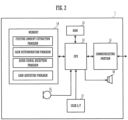
- the acoustic device 1 includes a communicating portion 11, a CPU 12, a RAM 13, a memory 14, a microphone 15, a speaker 16, and a user interface (I/F) 17.
- the communicating portion 11 configures the audio signal receiving portion of the present invention.
- the CPU 12 reads a program from the memory 14 being a storage medium and temporarily stores the program in the RAM 13, and thus performs various operations.
- the memory 14 includes a flash memory or a hard disk drive (HDD).
- the memory 14 stores programs for operating the CPU 12 as described above.
- the memory 14 stores a feature amount extraction program, a gain determination program, an audio signal reception program, and a gain adjusting program.
- the feature amount extraction program is a program to configure a voice feature amount extracting portion 51 to be described below.
- the gain determination program is a program to configure a gain determining portion 52 to be described below.
- the audio signal reception program is a program to configure an audio signal receiving portion 53 to be described below.
- the gain adjusting program is a program to configure a gain adjusting portion 54 to be described below.
- the microphone 15 obtains surrounding sound as an audio signal.
- the surrounding sound includes voice of a talker and noise.
- the microphone 15 digitally converts the obtained audio signal.
- the microphone 15 outputs the digitally converted audio signal to the CPU 12.
- the CPU 12 performs signal processing on the audio signal inputted from the microphone 15.
- the CPU 12 outputs the audio signal on which the signal processing has been performed, to the communicating portion 11.
- the acoustic device 1 may include a processor (DSP: Digital Signal Processor) exclusively used for the signal processing. In such a case, according to instructions of the CPU 12, the DSP performs signal processing.
- DSP Digital Signal Processor
- the CPU 12 outputs the audio signal on which the signal processing has been performed, to the communicating portion 11.
- the communicating portion 11 is connected to the network 2.
- the communicating portion 11 sends the audio signal to the acoustic device 3 on a far-end side through the network 2.
- the communicating portion 11 receives the audio signal from the acoustic device 3 through the network 2.
- the communicating portion 11 outputs the received audio signal to the CPU 12.
- the CPU 12 performs signal processing on the audio signal inputted from the communicating portion 11.
- the CPU 12 outputs the audio signal on which the signal processing has been performed, to the speaker 16.
- the speaker 16 emits sound based on the audio signal inputted from the CPU 12. It is to be noted that the speaker 16, when receiving an input of a digital signal, emits sound based on the audio signal after performing D/A conversion.
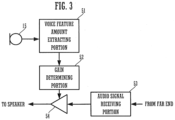
- FIG. 3 is a block diagram showing a functional configuration of the acoustic device 1.
- the acoustic device 1 includes a microphone 15, a voice feature amount extracting portion 51, a gain determining portion 52, an audio signal receiving portion 53, and a gain adjusting portion 54.
- the voice feature amount extracting portion 51, the gain determining portion 52, the gain adjusting portion 54, and the audio signal receiving portion 53 are implemented by programs of the CPU 12.
- the audio signal receiving portion 53 may be configured by the communicating portion 11.
- the voice feature amount extracting portion 51 obtains power level of an inputted audio signal.
- the power level is calculated by the root mean square of an audio signal of a time axis, for example.
- the power level is an example of the voice feature amount.
- the extraction of the voice feature amount may be performed by limiting to a predetermined band (such as an FFT band, an octave band, the Mel band, or the Bark band).
- the voice feature amount extracting portion 51 calculates power level of 1 kHz to 4 kHz. In this manner, the extraction of the voice feature amount may be extracted in a limited band which is a great number of human voice elements. In addition, the extraction of the voice feature amount may be extracted in a plurality of bands.
- the power level of an audio signal is preferably averaged on the time axis.
- the voice feature amount extracting portion 51 by averaging the power level of an audio signal on the time axis, does not erroneously recognize noise as voice even when high noise sound is suddenly inputted.
- the gain determining portion 52 determines a gain based on the voice feature amount extracted by the voice feature amount extracting portion 51.
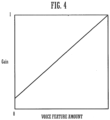
- FIG. 4 is a diagram showing the relationship between the voice feature amount and the gain. As shown in FIG. 4 , the gain determining portion 52 sets the gain higher as the power level of an audio signal is higher. The gain determining portion 52 sets the gain lower as the power level of an audio signal is lower.
- the acoustic device 1 when the level of voice of a talker on a near-end side is high, causes the level of voice on a far-end side to be high as well.
- a talker talks quietly in many cases when the surrounding environment is quiet. When a talker talks quietly, sound to be outputted from the speaker 16 is also reduced. Accordingly, only the sound to be outputted from the speaker 16 is not increased. In other words, the talker does not have to manually adjust volume with caring about the surrounding environment.
- the gain determining portion 52 may average the determined gain on a time axis.
- the gain determining portion 52 suppresses a rapid change in volume by averaging a gain on a time axis, and reduces the sense of incongruity that a user feels.
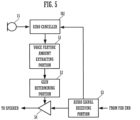
- the acoustic device 1 may remove an echo element by the echo canceller 501.
- the echo canceller 501 generates a pseudo echo element by filtering the audio signal received from the far-end side by transfer characteristics in the environment in which the acoustic device 1 is set.
- the echo canceller 501 by subtracting the pseudo echo element from the audio signal obtained by the microphone 15, removes the echo element.
- the voice feature amount extracting portion 51 extracts a voice feature amount using the audio signal of which the echo element has been removed by the echo canceller 501. In such a case, the voice feature amount extracting portion 51 may adjust a gain during the far-end single talk.
- the echo canceller 501 may be hardware or may be achieved when the CPU 12 reads an echo cancellation program from the memory 14 and executes the program.
- FIG. 6 is a block diagram showing a functional configuration of an acoustic device 1 according to a modification.
- the same reference numerals are given to components common to the components in FIG. 3 , and the description will be omitted.
- the acoustic device 1 further includes a noise feature amount extracting portion 55.
- the noise feature amount extracting portion 55 is also achieved by the program of the CPU 12.
- the noise feature amount extracting portion 55 extracts a noise feature amount from an inputted audio signal.
- the noise feature amount extracting portion 55 obtains a noise level as an example of the noise feature amount. More specifically, the noise feature amount extracting portion 55 obtains power level of an audio signal according to noise.
- the noise feature amount extracting portion 55 in a case of determining that noise is inputted, obtains a noise level by obtaining the power level of an audio signal.
- the noise feature amount extracting portion 55 determines whether or not noise is inputted, for example, by distinguishing a near-end single talk, a far-end single talk, and a double talk.
- the noise feature amount extracting portion 55 distinguishes a far-end single talk in a case in which the audio signal receiving portion 53 receives an audio signal having a level greater than or equal to a predetermined threshold value and the power level of an audio signal inputted from the microphone 15 is less than or equal to a predetermined value.
- the noise feature amount extracting portion 55 distinguishes a double talk in a case in which the audio signal receiving portion 53 receives an audio signal having a level greater than or equal to a predetermined threshold value and the power level of an audio signal inputted from the microphone 15 is greater than or equal to a predetermined value.
- the noise feature amount extracting portion 55 distinguishes a near-end single talk in a case in which the audio signal receiving portion 53 receives an audio signal having a level less than a predetermined threshold value and the power level of an audio signal inputted from the microphone 15 is greater than or equal to a predetermined value.
- the noise feature amount extracting portion 55 calculates a noise feature amount in a case of no correspondence to a near-end single talk, a far-end single talk, and a double talk. More specifically, the noise feature amount extracting portion 55 obtains the power level of the inputted audio signal as a noise feature amount in a case in which the audio signal receiving portion 53 receives an audio signal having a level less than a predetermined threshold value and the power level of an audio signal inputted from the microphone 15 is less than or equal to a predetermined value.
- the noise feature amount extracting portion 55 in a case of removing an echo element by the echo canceller 501, may set the power level of an audio signal inputted during a far-end single talk as a noise feature amount. It is to be noted that the noise feature amount may be averaged on a time axis.
- the voice feature amount extracting portion 51 may perform noise cancellation processing based on the noise feature amount extracted by the noise feature amount extracting portion 55. For example, the voice feature amount extracting portion 51 subtracts the power level of an audio signal that the noise feature amount extracting portion 55 has obtained, from the voice feature amount. As a result, the voice feature amount extracting portion 51 is able to obtain the power level of an audio signal according to voice with higher accuracy, based on the audio signal of which the noise sound has been removed.
- the gain determining portion 52 determines a gain, based on the voice feature amount and the noise feature amount that have been extracted by the voice feature amount extracting portion 51 and the noise feature amount extracting portion 55.
- FIG. 7 is a diagram showing the relationship between the voice feature amount and the gain. As shown in FIG. 7 , the gain determining portion 52 sets the gain higher as the voice feature amount is higher. The gain determining portion 52 sets the gain lower as the voice feature amount is lower. Furthermore, the gain determining portion 52 sets the gain higher as the noise feature amount is higher. The gain determining portion 52 sets the gain lower as the noise feature amount is lower.
- the noise feature amount extracting portion 55 may further detect distant noise. Accordingly, the acoustic device 1, even when a talker other than a user is in a position away from the acoustic device 1, reduces a possibility of erroneously recognizing the voice of a talker on a near-end side.
- FIG. 8 is a diagram showing a functional configuration of the acoustic device 1 in a case of detecting distant noise.
- the acoustic device 1 further includes a second microphone 15B and a correlation calculating portion 57 in addition to the configuration of FIG. 7 .
- the correlation calculating portion 57 receives an input of an audio signal from the microphone 15 and the microphone 15B.
- the correlation calculating portion 57 calculates a correlation of two audio signals.
- the correlation is calculated, for example, by cross-power level spectrum phase analysis.
- Distant sound includes a large number of indirect sound elements, and is a sound of which an arrival direction is not fixed.
- the microphone 15 has a directivity and the microphone 15B has a non-directivity
- sound collection capability with respect to distant sound is greatly different. Therefore, the correlation is reduced in a case of sound from a distant sound source, and is increased in a case of sound from a sound source near the device.
- the noise feature amount extracting portion 55 when the correlation calculated by the correlation calculating portion 57 is small, distinguishes that sound from the distant sound source has been detected, and sets the power level of the inputted audio signal as a noise feature amount.
- the voice feature amount extracting portion 51 in a case in which the correlation calculated by the correlation calculating portion 57 is large, distinguishes that voice of a talker has been detected, and sets the power level of the inputted audio signal as a voice feature amount. Accordingly, the acoustic device 1 is able to obtain the noise feature amount and the voice feature amount with higher accuracy.
- the acoustic device 1 in a case of distinguishing a far-end single talk (S11: Yes), ends the processing. In other words, the acoustic device 1 does not change a gain.
- the acoustic device 1 in a case that a far-end single talk is not performed (in a case of a near-end single talk or a double talk) (S11: No), detects background noise from the inputted audio signal (S12).
- the acoustic device 1 obtains power level of an audio signal according to the detected background noise, and reduces a noise element from the audio signal (S13). Subsequently, the acoustic device 1 obtains the power level of the inputted audio signal as a noise feature amount (S14). Finally, the acoustic device 1 determines a gain of the audio signal received from the far-end side, based on a voice feature amount and the noise feature amount (S15) and adjusts a level of the received audio signal by the gain (S16).
- the processing of S11, S12, and S14 is not required in the present invention.
- the acoustic device 1, in S13 may determine a gain, based on the voice feature amount extracted by the voice feature amount extracting portion 51, without using the noise feature amount.
- the acoustic device may determine a gain, based on the noise feature amount extracted by the noise feature amount extracting portion 55, without using the voice feature amount. For example, the acoustic device 1 increases a gain when the power level of a noise signal is high. In other words, the acoustic device may extract a feature amount from the sound collected by a microphone, and may determine a gain of an audio signal received from a different device on a far-end side, based on the extracted feature amount.
- the storage stores the noise level obtained by the noise level obtaining portion.
- the gain determining portion determines a gain of the audio signal received from the different device on a far-end side, based on a previous noise level stored in the storage and the present noise level obtained by the noise level obtaining portion.
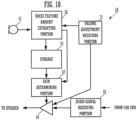
- the acoustic device may include a volume adjustment receiving portion that receives volume adjustment from a user.
- the storage may store a noise level when the user adjusts the volume.
- the acoustic device 1A further includes a volume adjustment receiving portion 71, and a storage 72 that stores a noise feature amount that the noise feature amount extracting portion 55 has extracted.
- the hardware configuration of the acoustic device 1A is the same as the hardware configuration shown in FIG. 2 .
- the storage 72 is configured by the memory 14.
- the volume adjustment receiving portion 71 is configured by the user I/F 17.
- the volume adjustment receiving portion 71 may be implemented when the CPU 12 reads and executes a volume adjustment receive program stored in the memory 14.
- the noise feature amount extracting portion 55 is an example of the noise level obtaining portion.
- the noise feature amount extracting portion 55 is configured by the feature amount extraction program.
- the noise feature amount extracting portion 55 obtains a noise feature amount.
- the way to obtain the noise feature amount is the same as the way previously described, and, for example, obtains a noise level.
- the noise feature amount extracting portion 55 outputs a noise level to the storage 72 when the volume adjustment receiving portion 71 receives the operation of volume adjustment.
- the storage 72 stores the noise level when a user adjust the volume.
- the noise feature amount extracting portion 55 outputs the noise level to the gain determining portion 52.
- the gain determining portion 52 determines a gain, based on the previous noise level stored in the storage 72 and the present noise level outputted from the noise feature amount extracting portion 55. For example, the gain determining portion 52, in a case in which the present noise level is higher than the previous noise level, increases the gain. Accordingly, the volume of a speaker with respect to the noise level as
- the acoustic device 1A in a case of distinguishing a noise section (S101: Yes), obtains a noise level, for example, as a noise feature amount (S102). Subsequently, the acoustic device 1A determines whether or not volume adjustment has been received from a user (S103). The acoustic device 1A, in a case of receiving the volume adjustment from a user (S103: Yes), stores the obtained noise level (S104). The acoustic device 1A, in a case of receiving no volume adjustment (S103: No), determines a gain, based on the stored previous noise level and the obtained present noise level (S105). For example, the acoustic device 1A, in the case in which the present noise level is higher than the previous noise level, increases the gain. Accordingly, the volume of a speaker with respect to the noise level as a reference is automatically determined.
- a gain adjustment may be performed to all the bands or may be performed in a limiting predetermined band (such as an FFT band, an octave band, the Mel band, or the Bark band).
- the voice feature amount extracting portion 51 may perform a gain adjustment in a band of 1 kHz to 4 kHz that has a significant effect on the sensitivity of voice.
- the acoustic device 1A may perform a gain adjustment, based on the obtained noise feature amount. For example, the acoustic device 1A performs a gain adjustment according to a noise spectrum. The acoustic device 1A sets a gain high in a band in which a noise level is high. Accordingly, surrounding people except a user are less likely to feel noisy about the sound outputted from the speaker 16.
- the acoustic device 1A may perform a gain adjustment according to human auditory characteristics (loudness characteristics). For example, low-frequency and high-frequency gains do not greatly change regardless of a change in noise level.
- the voice feature amount is not limited to power level.
- the acoustic device 1 may calculate the peak of a low frequency element of a cepstrum obtained by further applying the Fourier transform to the spectrum of an audio signal.
- the acoustic device 1 may normalize a peak value of the low frequency element of a cepstrum, may convert the value into a value of 0 to 1, and may extract the value as a voice feature amount.
- the noise feature amount is not limited to power level.
- the storage does not need to be built in the acoustic device 1A.
- the storage may be provided in a server. In such a case, the acoustic device 1A obtains a noise level from the storage of the server.
- the acoustic device 1 or the acoustic device 1A may include a feature amount extraction circuit 51A corresponding to the voice feature amount extracting portion 51 or the noise feature amount extracting portion 55, a gain determination circuit 52A corresponding to the gain determining portion 52, an audio signal reception circuit 53A corresponding to the audio signal receiving portion 53, and a gain adjusting circuit 54A corresponding to the gain adjusting portion 54.
- the configuration of the present invention may be implemented by appropriately combining hardware and software.
Landscapes
- Engineering & Computer Science (AREA)
- Multimedia (AREA)
- Health & Medical Sciences (AREA)
- Audiology, Speech & Language Pathology (AREA)
- Human Computer Interaction (AREA)
- Physics & Mathematics (AREA)
- Signal Processing (AREA)
- Acoustics & Sound (AREA)
- Computational Linguistics (AREA)
- Quality & Reliability (AREA)
- Theoretical Computer Science (AREA)
- General Health & Medical Sciences (AREA)
- General Physics & Mathematics (AREA)
- General Engineering & Computer Science (AREA)
- Circuit For Audible Band Transducer (AREA)
- Telephone Function (AREA)
- Cable Transmission Systems, Equalization Of Radio And Reduction Of Echo (AREA)
Claims (9)
- Akustische Vorrichtung (1), die Folgendes aufweist:ein Mikrofon (15);einen Sprachmerkmalsextraktionsteil (51), der so konfiguriert ist, dass er einen Sprachmerkmalbetrag aus einem ersten Audiosignal extrahiert, das den von dem Mikrofon (15) gesammelten Schall darstellt;einen Rauschmerkmalsextraktionsteil (55), der so konfiguriert ist, dass er einen Rauschmerkmalbetrag einschließlich eines Rauschpegels aus dem ersten Audiosignal extrahiert;einen Audiosignalempfangsteil (53), der so konfiguriert ist, dass er ein zweites Audiosignal von einer anderen Vorrichtung (3) auf der Seite eines fernen Endes empfängt;einen Verstärkungsbestimmungsteil (52), der so konfiguriert ist, dass er eine Verstärkung des zweiten Audiosignals auf der Grundlage des extrahierten Sprachmerkmalbetrags und des extrahierten Rauschmerkmalbetrags bestimmt, wobei der Verstärkungsbestimmungsteil (52) so konfiguriert ist, dass er die Verstärkung höher einstellt, wenn der extrahierte Sprachmerkmalbetrag höher ist bzw. wird, wobei der Verstärkungsbestimmungsteil (52) so konfiguriert ist, dass er die Verstärkung niedriger einstellt, wenn der extrahierte Sprachmerkmalbetrag niedriger ist bzw. wird, wobei der Verstärkungsbestimmungsteil (52) so konfiguriert ist, dass er die Verstärkung höher einstellt, wenn der Betrag des extrahierten Rauschmerkmals höher ist bzw. wird, wobei der Verstärkungsbestimmungsteil (52) so konfiguriert ist, dass er die Verstärkung niedriger einstellt, wenn der Betrag des extrahierten Rauschmerkmals niedriger ist bzw. wird, wobei der Verstärkungsbestimmungsteil (52) so konfiguriert ist, dass er die Verstärkung begrenzt auf Werte gleich oder kleiner als eins einstellt, und wobei der Verstärkungsbestimmungsteil (52) so konfiguriert ist, dass er die Verstärkung linear proportional zum Betrag des Sprachmerkmals einstellt; undeinen Verstärkungsanpassungsteil (54), der so konfiguriert ist, dass er das zweite Audiosignal auf der Grundlage der bestimmten Verstärkung des zweiten Audiosignals anpasst,wobei der Rauschmerkmalsextraktionsteil (55) so konfiguriert ist, dass er eine Leistung des ersten Audiosignals als das Rauschmerkmal in einem Fall berechnet, dassdie Leistung des ersten Audiosignals kleiner als oder gleich einem vorbestimmten Wert ist, undeine Leistung des zweiten Audiosignals, das von dem Audiosignalempfangsteil (53) empfangen wird, kleiner als ein vorbestimmter Schwellenwert ist.
- Akustische Vorrichtung (1) nach Anspruch 1, ferner umfassend einen Echokompensator (501), der konfiguriert ist, um ein Echoelement aus dem ersten Audiosignal zu entfernen,
wobei der Rauschmerkmalsextraktionsteil (55) konfiguriert ist, um das Rauschmerkmal aus dem ersten Audiosignal zu extrahieren, in dem das Echoelement durch den Echokompensator (501) entfernt worden ist. - Akustische Vorrichtung (1) nach Anspruch 1, ferner umfassend einen Echokompensator (501), der ein Echoelement aus dem ersten Audiosignal entfernt,
wobei der Sprachmerkmalsextraktionsteil (51) konfiguriert ist, um die Sprachmerkmalmenge aus dem ersten Audiosignal zu extrahieren, in dem das Echoelement durch den Echokompensator (501) entfernt wurde. - Akustische Vorrichtung (1) nach einem der Ansprüche 1 bis 3, wobei der Sprachmerkmalbetrag den Leistungspegel umfasst.
- Akustische Vorrichtung (1) nach einem der Ansprüche 1 bis 4, wobei der Verstärkungsbestimmungsteil (52) so konfiguriert ist, dass er einen Sprachanteil aus dem ersten Audiosignal unterscheidet und die Verstärkung des zweiten Audiosignals aus dem unterschiedenen Sprachanteil bestimmt.
- Akustisches Gerät (1) nach einem der Ansprüche 1 bis 5, wobei der Verstärkungseinstellteil (54) so konfiguriert ist, dass er das eingestellte zweite Audiosignal an einen Lautsprecher (16) ausgibt.
- Akustisches Verarbeitungsverfahren, das von einer akustischen Vorrichtung durchgeführt wird und Folgendes aufweist:Unterscheiden (S101), ob ein Rauschanteil vorhanden ist oder nicht, wobei das Vorhandensein eines Rauschanteils in einem Fall unterschieden wird in einem Fall, dass ein Status kein Nah-Einzelgespräch, kein Fern-Einzelgespräch und kein Doppelgespräch ist, und in einem Fall, dass ein Status ein Fern-Einzelgespräch ist und ein Echoelement durch einen Echokompensator (501) entfernt wird;in einem Fall des unterschiedenen Vorhandenseins eines Rauschanteils, Erhalten (S102) eines aktuellen Geräuschpegels aus einem ersten Audiosignal, das den von einem Mikrofon (15) gesammelten Schall repräsentiert,Bestimmen (S103), ob eine Lautstärkeanpassung von einem Benutzer empfangen wurde oder nicht;in einem Fall des Empfangs einer Lautstärkeanpassung von einem Benutzer, Speichern (S104) des erhaltenen Rauschpegels, und in einem Fall, dass keine Lautstärkeanpassung von einem Benutzer empfangen wird, Bestimmen (S105) einer Verstärkung eines zweiten Audiosignals, das von der akustischen Vorrichtung empfangen wird, und zwar von einer anderen Vorrichtung (3) auf einer Seite eines fernen Endes, basierend auf einem gespeicherten vorbestimmten Rauschpegel und dem erhaltenen aktuellen Rauschpegel; undEinstellen des zweiten Audiosignals basierend auf der bestimmten Verstärkung des zweiten Audiosignals, wobei die Verstärkung des zweiten Audiosignals in einem Fall erhöht wird, in dem der erhaltene aktuelle Rauschpegel höher ist als der gespeicherte vorbestimmte Rauschpegel,wobei der Rauschanteil ein Teil ist, in demeine Leistung des ersten Audiosignals kleiner als oder gleich einem vorbestimmten Wert ist, undeine Leistung des empfangenen zweiten Audiosignals kleiner als ein vorbestimmter Schwellenwert ist.
- Akustisches Verarbeitungsverfahren nach Anspruch 7, wobei der Schritt des Bestimmens einer Verstärkung einen Sprachanteil von dem ersten Audiosignal unterscheidet und die Verstärkung des zweiten Audiosignals von dem unterschiedenen Sprachanteil bestimmt.
- Akustisches Verarbeitungsverfahren nach Anspruch 7 oder 8, ferner umfassend das Ausgeben eines angepassten zweiten Audiosignals an einen Lautsprecher (16).
Applications Claiming Priority (1)
| Application Number | Priority Date | Filing Date | Title |
|---|---|---|---|
| JP2019106860A JP7532748B2 (ja) | 2019-06-07 | 2019-06-07 | 音響装置および音響処理方法 |
Publications (2)
| Publication Number | Publication Date |
|---|---|
| EP3748635A1 EP3748635A1 (de) | 2020-12-09 |
| EP3748635B1 true EP3748635B1 (de) | 2024-12-18 |
Family
ID=70977390
Family Applications (1)
| Application Number | Title | Priority Date | Filing Date |
|---|---|---|---|
| EP20177963.4A Active EP3748635B1 (de) | 2019-06-07 | 2020-06-03 | Akustische vorrichtung und akustisches verarbeitungsverfahren |
Country Status (4)
| Country | Link |
|---|---|
| US (1) | US11373669B2 (de) |
| EP (1) | EP3748635B1 (de) |
| JP (1) | JP7532748B2 (de) |
| CN (1) | CN112130801B (de) |
Families Citing this family (4)
| Publication number | Priority date | Publication date | Assignee | Title |
|---|---|---|---|---|
| US11321047B2 (en) * | 2020-06-11 | 2022-05-03 | Sorenson Ip Holdings, Llc | Volume adjustments |
| JP7639419B2 (ja) * | 2021-03-15 | 2025-03-05 | 株式会社Jvcケンウッド | 音響装置及びプログラム |
| EP4202922A1 (de) * | 2021-12-23 | 2023-06-28 | GN Audio A/S | Audiovorrichtung und verfahren zur sprecherextraktion |
| US11930056B1 (en) | 2023-02-15 | 2024-03-12 | International Business Machines Corporation | Reducing noise for online meetings |
Family Cites Families (27)
| Publication number | Priority date | Publication date | Assignee | Title |
|---|---|---|---|---|
| JPH0739114U (ja) | 1991-01-21 | 1995-07-14 | 三菱電機株式会社 | 自動音量調節装置 |
| JP3070340B2 (ja) | 1993-07-16 | 2000-07-31 | 松下電器産業株式会社 | 小型モータ |
| JP3731228B2 (ja) * | 1995-10-27 | 2006-01-05 | ソニー株式会社 | 音声信号送受信装置及び受話音量制御方法 |
| US6125179A (en) * | 1995-12-13 | 2000-09-26 | 3Com Corporation | Echo control device with quick response to sudden echo-path change |
| US5768601A (en) * | 1996-01-17 | 1998-06-16 | Compaq Computer Corporation | Apparatus for eliminating audio noise when power is cycled to a computer |
| JP3597671B2 (ja) * | 1997-05-16 | 2004-12-08 | 三菱電機株式会社 | ハンズフリー電話機 |
| JP4282260B2 (ja) * | 2001-11-20 | 2009-06-17 | 株式会社リコー | エコーキャンセラ |
| JP2004020733A (ja) | 2002-06-13 | 2004-01-22 | Ricoh Co Ltd | 音量調整装置、プログラムおよび記録媒体 |
| DE602004025089D1 (de) | 2003-02-27 | 2010-03-04 | Ericsson Telefon Ab L M | Hörbarkeitsverbesserung |
| JP4650163B2 (ja) | 2005-08-25 | 2011-03-16 | パナソニック電工株式会社 | 拡声通話装置 |
| JP2007097087A (ja) | 2005-09-30 | 2007-04-12 | Olympus Imaging Corp | 音量調整装置 |
| CN101067927B (zh) * | 2007-04-19 | 2010-11-10 | 北京中星微电子有限公司 | 音量调整方法及装置 |
| JP5219522B2 (ja) * | 2008-01-09 | 2013-06-26 | アルパイン株式会社 | 音声明瞭度改善システム及び音声明瞭度改善方法 |
| JP4957810B2 (ja) * | 2008-02-20 | 2012-06-20 | 富士通株式会社 | 音処理装置、音処理方法及び音処理プログラム |
| KR20100047740A (ko) | 2008-10-29 | 2010-05-10 | 주식회사 대우일렉트로닉스 | 볼륨 제어 장치 및 방법 |
| JP5228932B2 (ja) * | 2009-01-16 | 2013-07-03 | 沖電気工業株式会社 | 音信号調整装置、プログラム及び方法、並びに、電話装置 |
| JP5168162B2 (ja) * | 2009-01-16 | 2013-03-21 | 沖電気工業株式会社 | 音信号調整装置、プログラム及び方法、並びに、電話装置 |
| JPWO2010131470A1 (ja) * | 2009-05-14 | 2012-11-01 | シャープ株式会社 | ゲイン制御装置及びゲイン制御方法、音声出力装置 |
| JP2013005106A (ja) * | 2011-06-14 | 2013-01-07 | Nippon Telegr & Teleph Corp <Ntt> | 場内拡声装置、場内拡声方法、及びそのプログラム |
| WO2014035845A2 (en) * | 2012-09-02 | 2014-03-06 | QoSound, Inc. | Adaptive audio signal shaping for improved playback in a noisy environment |
| US20150063599A1 (en) * | 2013-08-29 | 2015-03-05 | Martin David Ring | Controlling level of individual speakers in a conversation |
| JP6396829B2 (ja) | 2015-03-16 | 2018-09-26 | エヌ・ティ・ティ・コミュニケーションズ株式会社 | 情報処理装置、判定方法及びコンピュータプログラム |
| JP6320963B2 (ja) * | 2015-03-25 | 2018-05-09 | 日本電信電話株式会社 | 音声認識システム、クライアント装置、音声認識方法、プログラム |
| US9380150B1 (en) * | 2015-09-16 | 2016-06-28 | Captioncall, Llc | Methods and devices for automatic volume control of a far-end voice signal provided to a captioning communication service |
| GB2577839B (en) * | 2016-02-19 | 2020-08-26 | Imagination Tech Ltd | Dynamic gain controller |
| KR101934636B1 (ko) * | 2017-04-14 | 2019-01-02 | 한양대학교 산학협력단 | 심화신경망 기반의 잡음 및 에코의 통합 제거 방법 및 장치 |
| CN111726730A (zh) * | 2019-03-18 | 2020-09-29 | 塞舌尔商元鼎音讯股份有限公司 | 声音播放装置及其调整输出声音的方法 |
-
2019
- 2019-06-07 JP JP2019106860A patent/JP7532748B2/ja active Active
-
2020
- 2020-06-02 US US16/890,010 patent/US11373669B2/en active Active
- 2020-06-03 CN CN202010494043.5A patent/CN112130801B/zh active Active
- 2020-06-03 EP EP20177963.4A patent/EP3748635B1/de active Active
Also Published As
| Publication number | Publication date |
|---|---|
| CN112130801B (zh) | 2024-06-14 |
| JP2020202448A (ja) | 2020-12-17 |
| EP3748635A1 (de) | 2020-12-09 |
| JP7532748B2 (ja) | 2024-08-14 |
| US20200388299A1 (en) | 2020-12-10 |
| CN112130801A (zh) | 2020-12-25 |
| US11373669B2 (en) | 2022-06-28 |
Similar Documents
| Publication | Publication Date | Title |
|---|---|---|
| EP3748635B1 (de) | Akustische vorrichtung und akustisches verarbeitungsverfahren | |
| US8903721B1 (en) | Smart auto mute | |
| CN101388216B (zh) | 声音处理装置、控制增益的装置和方法 | |
| KR101461141B1 (ko) | 잡음 억제기를 적응적으로 제어하는 시스템 및 방법 | |
| US7092529B2 (en) | Adaptive control system for noise cancellation | |
| EP1742509B1 (de) | Vorrichtung und Verfahren zum Eliminieren von Feedback-Rauschen in einem Hörgerät | |
| US7464029B2 (en) | Robust separation of speech signals in a noisy environment | |
| DK3005731T3 (en) | METHOD OF OPERATING A HEARING AND HEARING | |
| WO2016089745A1 (en) | Apparatus and method for digital signal processing with microphones | |
| CN113711308B (zh) | 风噪声检测系统和方法 | |
| EP3096318B1 (de) | Rauschverminderung in mehrmikrofonsystemen | |
| EP2700161B1 (de) | Verarbeitung von tonsignalen | |
| EP2143204A1 (de) | Automatische einstellung der lautstärke und des dynamischen bereichs für mobile audiogeräte | |
| EP3337190B1 (de) | Verfahren zur reduzierung von rauschen in einer audioverarbeitungsvorrichtung | |
| CN102084668A (zh) | 处理信号的方法和系统 | |
| CN111935584A (zh) | 用于无线耳机组件的风噪处理方法、装置以及耳机 | |
| US20140064529A1 (en) | Apparatus and method of shielding external noise for use in hearing aid device | |
| JP4153265B2 (ja) | 音声レベル調整システム | |
| US9124985B2 (en) | Hearing aid and method for automatically controlling directivity | |
| EP3863308B1 (de) | Volumenanpassungsvorrichtung und volumenanpassungsverfahren | |
| JP2000278786A (ja) | マイクロホン装置 | |
| CN117939378A (zh) | 一种助听器及自回声消除方法、设备、存储介质 | |
| CN115884023A (zh) | 具有干扰衰减器的音频设备 | |
| CN115884041A (zh) | 具有双波束成形的音频设备 | |
| JPH08317496A (ja) | ディジタル音声信号処理装置 |
Legal Events
| Date | Code | Title | Description |
|---|---|---|---|
| PUAI | Public reference made under article 153(3) epc to a published international application that has entered the european phase |
Free format text: ORIGINAL CODE: 0009012 |
|
| STAA | Information on the status of an ep patent application or granted ep patent |
Free format text: STATUS: THE APPLICATION HAS BEEN PUBLISHED |
|
| AK | Designated contracting states |
Kind code of ref document: A1 Designated state(s): AL AT BE BG CH CY CZ DE DK EE ES FI FR GB GR HR HU IE IS IT LI LT LU LV MC MK MT NL NO PL PT RO RS SE SI SK SM TR |
|
| AX | Request for extension of the european patent |
Extension state: BA ME |
|
| STAA | Information on the status of an ep patent application or granted ep patent |
Free format text: STATUS: REQUEST FOR EXAMINATION WAS MADE |
|
| 17P | Request for examination filed |
Effective date: 20210609 |
|
| RBV | Designated contracting states (corrected) |
Designated state(s): AL AT BE BG CH CY CZ DE DK EE ES FI FR GB GR HR HU IE IS IT LI LT LU LV MC MK MT NL NO PL PT RO RS SE SI SK SM TR |
|
| STAA | Information on the status of an ep patent application or granted ep patent |
Free format text: STATUS: EXAMINATION IS IN PROGRESS |
|
| 17Q | First examination report despatched |
Effective date: 20220330 |
|
| GRAP | Despatch of communication of intention to grant a patent |
Free format text: ORIGINAL CODE: EPIDOSNIGR1 |
|
| STAA | Information on the status of an ep patent application or granted ep patent |
Free format text: STATUS: GRANT OF PATENT IS INTENDED |
|
| INTG | Intention to grant announced |
Effective date: 20240711 |
|
| GRAS | Grant fee paid |
Free format text: ORIGINAL CODE: EPIDOSNIGR3 |
|
| GRAA | (expected) grant |
Free format text: ORIGINAL CODE: 0009210 |
|
| STAA | Information on the status of an ep patent application or granted ep patent |
Free format text: STATUS: THE PATENT HAS BEEN GRANTED |
|
| AK | Designated contracting states |
Kind code of ref document: B1 Designated state(s): AL AT BE BG CH CY CZ DE DK EE ES FI FR GB GR HR HU IE IS IT LI LT LU LV MC MK MT NL NO PL PT RO RS SE SI SK SM TR |
|
| REG | Reference to a national code |
Ref country code: CH Ref legal event code: EP |
|
| REG | Reference to a national code |
Ref country code: DE Ref legal event code: R096 Ref document number: 602020043232 Country of ref document: DE |
|
| REG | Reference to a national code |
Ref country code: IE Ref legal event code: FG4D |
|
| REG | Reference to a national code |
Ref country code: LT Ref legal event code: MG9D |
|
| PG25 | Lapsed in a contracting state [announced via postgrant information from national office to epo] |
Ref country code: HR Free format text: LAPSE BECAUSE OF FAILURE TO SUBMIT A TRANSLATION OF THE DESCRIPTION OR TO PAY THE FEE WITHIN THE PRESCRIBED TIME-LIMIT Effective date: 20241218 |
|
| PG25 | Lapsed in a contracting state [announced via postgrant information from national office to epo] |
Ref country code: FI Free format text: LAPSE BECAUSE OF FAILURE TO SUBMIT A TRANSLATION OF THE DESCRIPTION OR TO PAY THE FEE WITHIN THE PRESCRIBED TIME-LIMIT Effective date: 20241218 |
|
| PG25 | Lapsed in a contracting state [announced via postgrant information from national office to epo] |
Ref country code: BG Free format text: LAPSE BECAUSE OF FAILURE TO SUBMIT A TRANSLATION OF THE DESCRIPTION OR TO PAY THE FEE WITHIN THE PRESCRIBED TIME-LIMIT Effective date: 20241218 |
|
| PG25 | Lapsed in a contracting state [announced via postgrant information from national office to epo] |
Ref country code: NO Free format text: LAPSE BECAUSE OF FAILURE TO SUBMIT A TRANSLATION OF THE DESCRIPTION OR TO PAY THE FEE WITHIN THE PRESCRIBED TIME-LIMIT Effective date: 20250318 |
|
| REG | Reference to a national code |
Ref country code: NL Ref legal event code: MP Effective date: 20241218 |
|
| PG25 | Lapsed in a contracting state [announced via postgrant information from national office to epo] |
Ref country code: GR Free format text: LAPSE BECAUSE OF FAILURE TO SUBMIT A TRANSLATION OF THE DESCRIPTION OR TO PAY THE FEE WITHIN THE PRESCRIBED TIME-LIMIT Effective date: 20250319 Ref country code: LV Free format text: LAPSE BECAUSE OF FAILURE TO SUBMIT A TRANSLATION OF THE DESCRIPTION OR TO PAY THE FEE WITHIN THE PRESCRIBED TIME-LIMIT Effective date: 20241218 |
|
| PG25 | Lapsed in a contracting state [announced via postgrant information from national office to epo] |
Ref country code: RS Free format text: LAPSE BECAUSE OF FAILURE TO SUBMIT A TRANSLATION OF THE DESCRIPTION OR TO PAY THE FEE WITHIN THE PRESCRIBED TIME-LIMIT Effective date: 20250318 |
|
| PG25 | Lapsed in a contracting state [announced via postgrant information from national office to epo] |
Ref country code: NL Free format text: LAPSE BECAUSE OF FAILURE TO SUBMIT A TRANSLATION OF THE DESCRIPTION OR TO PAY THE FEE WITHIN THE PRESCRIBED TIME-LIMIT Effective date: 20241218 |
|
| REG | Reference to a national code |
Ref country code: AT Ref legal event code: MK05 Ref document number: 1752924 Country of ref document: AT Kind code of ref document: T Effective date: 20241218 |
|
| PG25 | Lapsed in a contracting state [announced via postgrant information from national office to epo] |
Ref country code: SM Free format text: LAPSE BECAUSE OF FAILURE TO SUBMIT A TRANSLATION OF THE DESCRIPTION OR TO PAY THE FEE WITHIN THE PRESCRIBED TIME-LIMIT Effective date: 20241218 |
|
| PG25 | Lapsed in a contracting state [announced via postgrant information from national office to epo] |
Ref country code: PL Free format text: LAPSE BECAUSE OF FAILURE TO SUBMIT A TRANSLATION OF THE DESCRIPTION OR TO PAY THE FEE WITHIN THE PRESCRIBED TIME-LIMIT Effective date: 20241218 |
|
| PGFP | Annual fee paid to national office [announced via postgrant information from national office to epo] |
Ref country code: DE Payment date: 20250625 Year of fee payment: 6 |
|
| PG25 | Lapsed in a contracting state [announced via postgrant information from national office to epo] |
Ref country code: ES Free format text: LAPSE BECAUSE OF FAILURE TO SUBMIT A TRANSLATION OF THE DESCRIPTION OR TO PAY THE FEE WITHIN THE PRESCRIBED TIME-LIMIT Effective date: 20241218 |
|
| PG25 | Lapsed in a contracting state [announced via postgrant information from national office to epo] |
Ref country code: IS Free format text: LAPSE BECAUSE OF FAILURE TO SUBMIT A TRANSLATION OF THE DESCRIPTION OR TO PAY THE FEE WITHIN THE PRESCRIBED TIME-LIMIT Effective date: 20250418 |
|
| PG25 | Lapsed in a contracting state [announced via postgrant information from national office to epo] |
Ref country code: PT Free format text: LAPSE BECAUSE OF FAILURE TO SUBMIT A TRANSLATION OF THE DESCRIPTION OR TO PAY THE FEE WITHIN THE PRESCRIBED TIME-LIMIT Effective date: 20250421 |
|
| PG25 | Lapsed in a contracting state [announced via postgrant information from national office to epo] |
Ref country code: EE Free format text: LAPSE BECAUSE OF FAILURE TO SUBMIT A TRANSLATION OF THE DESCRIPTION OR TO PAY THE FEE WITHIN THE PRESCRIBED TIME-LIMIT Effective date: 20241218 |
|
| PG25 | Lapsed in a contracting state [announced via postgrant information from national office to epo] |
Ref country code: AT Free format text: LAPSE BECAUSE OF FAILURE TO SUBMIT A TRANSLATION OF THE DESCRIPTION OR TO PAY THE FEE WITHIN THE PRESCRIBED TIME-LIMIT Effective date: 20241218 Ref country code: RO Free format text: LAPSE BECAUSE OF FAILURE TO SUBMIT A TRANSLATION OF THE DESCRIPTION OR TO PAY THE FEE WITHIN THE PRESCRIBED TIME-LIMIT Effective date: 20241218 |
|
| PG25 | Lapsed in a contracting state [announced via postgrant information from national office to epo] |
Ref country code: SK Free format text: LAPSE BECAUSE OF FAILURE TO SUBMIT A TRANSLATION OF THE DESCRIPTION OR TO PAY THE FEE WITHIN THE PRESCRIBED TIME-LIMIT Effective date: 20241218 |
|
| PG25 | Lapsed in a contracting state [announced via postgrant information from national office to epo] |
Ref country code: CZ Free format text: LAPSE BECAUSE OF FAILURE TO SUBMIT A TRANSLATION OF THE DESCRIPTION OR TO PAY THE FEE WITHIN THE PRESCRIBED TIME-LIMIT Effective date: 20241218 |
|
| PG25 | Lapsed in a contracting state [announced via postgrant information from national office to epo] |
Ref country code: IT Free format text: LAPSE BECAUSE OF FAILURE TO SUBMIT A TRANSLATION OF THE DESCRIPTION OR TO PAY THE FEE WITHIN THE PRESCRIBED TIME-LIMIT Effective date: 20241218 |
|
| PG25 | Lapsed in a contracting state [announced via postgrant information from national office to epo] |
Ref country code: SE Free format text: LAPSE BECAUSE OF FAILURE TO SUBMIT A TRANSLATION OF THE DESCRIPTION OR TO PAY THE FEE WITHIN THE PRESCRIBED TIME-LIMIT Effective date: 20241218 |
|
| REG | Reference to a national code |
Ref country code: DE Ref legal event code: R097 Ref document number: 602020043232 Country of ref document: DE |
|
| PG25 | Lapsed in a contracting state [announced via postgrant information from national office to epo] |
Ref country code: DK Free format text: LAPSE BECAUSE OF FAILURE TO SUBMIT A TRANSLATION OF THE DESCRIPTION OR TO PAY THE FEE WITHIN THE PRESCRIBED TIME-LIMIT Effective date: 20241218 |
|
| PLBE | No opposition filed within time limit |
Free format text: ORIGINAL CODE: 0009261 |
|
| STAA | Information on the status of an ep patent application or granted ep patent |
Free format text: STATUS: NO OPPOSITION FILED WITHIN TIME LIMIT |
|
| REG | Reference to a national code |
Ref country code: CH Ref legal event code: L10 Free format text: ST27 STATUS EVENT CODE: U-0-0-L10-L00 (AS PROVIDED BY THE NATIONAL OFFICE) Effective date: 20251029 |
|
| 26N | No opposition filed |
Effective date: 20250919 |
|
| REG | Reference to a national code |
Ref country code: CH Ref legal event code: H13 Free format text: ST27 STATUS EVENT CODE: U-0-0-H10-H13 (AS PROVIDED BY THE NATIONAL OFFICE) Effective date: 20260127 |
|
| PG25 | Lapsed in a contracting state [announced via postgrant information from national office to epo] |
Ref country code: MC Free format text: LAPSE BECAUSE OF FAILURE TO SUBMIT A TRANSLATION OF THE DESCRIPTION OR TO PAY THE FEE WITHIN THE PRESCRIBED TIME-LIMIT Effective date: 20241218 |
|
| PG25 | Lapsed in a contracting state [announced via postgrant information from national office to epo] |
Ref country code: LU Free format text: LAPSE BECAUSE OF NON-PAYMENT OF DUE FEES Effective date: 20250603 |
|
| GBPC | Gb: european patent ceased through non-payment of renewal fee |
Effective date: 20250603 |
|
| REG | Reference to a national code |
Ref country code: BE Ref legal event code: MM Effective date: 20250630 |