EP3744795A1 - Resin composition for forming hard coating layer - Google Patents
Resin composition for forming hard coating layer Download PDFInfo
- Publication number
- EP3744795A1 EP3744795A1 EP19744434.2A EP19744434A EP3744795A1 EP 3744795 A1 EP3744795 A1 EP 3744795A1 EP 19744434 A EP19744434 A EP 19744434A EP 3744795 A1 EP3744795 A1 EP 3744795A1
- Authority
- EP
- European Patent Office
- Prior art keywords
- group
- hard coating
- resin composition
- coating layer
- component
- Prior art date
- Legal status (The legal status is an assumption and is not a legal conclusion. Google has not performed a legal analysis and makes no representation as to the accuracy of the status listed.)
- Withdrawn
Links
- 239000011342 resin composition Substances 0.000 title claims abstract description 97
- 239000011247 coating layer Substances 0.000 title claims abstract description 70
- -1 oxetane compound Chemical class 0.000 claims abstract description 98
- 150000001875 compounds Chemical class 0.000 claims abstract description 91
- 125000002723 alicyclic group Chemical group 0.000 claims abstract description 35
- 239000004593 Epoxy Substances 0.000 claims abstract description 26
- 239000003505 polymerization initiator Substances 0.000 claims abstract description 23
- 239000011248 coating agent Substances 0.000 claims description 53
- 238000000576 coating method Methods 0.000 claims description 53
- 125000002887 hydroxy group Chemical group [H]O* 0.000 claims description 6
- LFQSCWFLJHTTHZ-UHFFFAOYSA-N Ethanol Chemical compound CCO LFQSCWFLJHTTHZ-UHFFFAOYSA-N 0.000 claims description 5
- 125000000962 organic group Chemical group 0.000 claims description 4
- 238000005452 bending Methods 0.000 abstract description 34
- NIXOWILDQLNWCW-UHFFFAOYSA-M Acrylate Chemical compound [O-]C(=O)C=C NIXOWILDQLNWCW-UHFFFAOYSA-M 0.000 description 46
- 125000003700 epoxy group Chemical group 0.000 description 32
- 125000004432 carbon atom Chemical group C* 0.000 description 19
- 125000000217 alkyl group Chemical group 0.000 description 13
- 239000000758 substrate Substances 0.000 description 13
- 125000000524 functional group Chemical group 0.000 description 11
- 239000000203 mixture Substances 0.000 description 11
- NIXOWILDQLNWCW-UHFFFAOYSA-N acrylic acid group Chemical group C(C=C)(=O)O NIXOWILDQLNWCW-UHFFFAOYSA-N 0.000 description 9
- 125000001495 ethyl group Chemical group [H]C([H])([H])C([H])([H])* 0.000 description 9
- 229920005989 resin Polymers 0.000 description 9
- 239000011347 resin Substances 0.000 description 9
- ZJCCRDAZUWHFQH-UHFFFAOYSA-N Trimethylolpropane Chemical compound CCC(CO)(CO)CO ZJCCRDAZUWHFQH-UHFFFAOYSA-N 0.000 description 8
- 125000001931 aliphatic group Chemical group 0.000 description 8
- 125000002947 alkylene group Chemical group 0.000 description 8
- 238000000034 method Methods 0.000 description 8
- 238000002156 mixing Methods 0.000 description 8
- 150000001252 acrylic acid derivatives Chemical class 0.000 description 7
- 125000003187 heptyl group Chemical group [H]C([*])([H])C([H])([H])C([H])([H])C([H])([H])C([H])([H])C([H])([H])C([H])([H])[H] 0.000 description 7
- 125000001997 phenyl group Chemical group [H]C1=C([H])C([H])=C(*)C([H])=C1[H] 0.000 description 7
- PEDCQBHIVMGVHV-UHFFFAOYSA-N Glycerine Chemical compound OCC(O)CO PEDCQBHIVMGVHV-UHFFFAOYSA-N 0.000 description 6
- 239000004973 liquid crystal related substance Substances 0.000 description 6
- 125000003566 oxetanyl group Chemical group 0.000 description 6
- 238000003756 stirring Methods 0.000 description 6
- HVVWZTWDBSEWIH-UHFFFAOYSA-N [2-(hydroxymethyl)-3-prop-2-enoyloxy-2-(prop-2-enoyloxymethyl)propyl] prop-2-enoate Chemical compound C=CC(=O)OCC(CO)(COC(=O)C=C)COC(=O)C=C HVVWZTWDBSEWIH-UHFFFAOYSA-N 0.000 description 5
- 125000003647 acryloyl group Chemical group O=C([*])C([H])=C([H])[H] 0.000 description 5
- 230000001588 bifunctional effect Effects 0.000 description 5
- 230000000052 comparative effect Effects 0.000 description 5
- 238000011156 evaluation Methods 0.000 description 5
- 125000001183 hydrocarbyl group Chemical group 0.000 description 5
- 125000005647 linker group Chemical group 0.000 description 5
- 239000004417 polycarbonate Substances 0.000 description 5
- 239000007983 Tris buffer Substances 0.000 description 4
- 239000000654 additive Substances 0.000 description 4
- 230000000996 additive effect Effects 0.000 description 4
- 125000003118 aryl group Chemical group 0.000 description 4
- 230000000694 effects Effects 0.000 description 4
- WXZMFSXDPGVJKK-UHFFFAOYSA-N pentaerythritol Chemical compound OCC(CO)(CO)CO WXZMFSXDPGVJKK-UHFFFAOYSA-N 0.000 description 4
- 229920000139 polyethylene terephthalate Polymers 0.000 description 4
- 239000005020 polyethylene terephthalate Substances 0.000 description 4
- 125000004805 propylene group Chemical group [H]C([H])([H])C([H])([*:1])C([H])([H])[*:2] 0.000 description 4
- 230000035939 shock Effects 0.000 description 4
- 239000002904 solvent Substances 0.000 description 4
- 125000001424 substituent group Chemical group 0.000 description 4
- QNODIIQQMGDSEF-UHFFFAOYSA-N (1-hydroxycyclohexyl)-phenylmethanone Chemical compound C=1C=CC=CC=1C(=O)C1(O)CCCCC1 QNODIIQQMGDSEF-UHFFFAOYSA-N 0.000 description 3
- ZWEHNKRNPOVVGH-UHFFFAOYSA-N 2-Butanone Chemical compound CCC(C)=O ZWEHNKRNPOVVGH-UHFFFAOYSA-N 0.000 description 3
- TXBCBTDQIULDIA-UHFFFAOYSA-N 2-[[3-hydroxy-2,2-bis(hydroxymethyl)propoxy]methyl]-2-(hydroxymethyl)propane-1,3-diol Chemical compound OCC(CO)(CO)COCC(CO)(CO)CO TXBCBTDQIULDIA-UHFFFAOYSA-N 0.000 description 3
- RWSOTUBLDIXVET-UHFFFAOYSA-N Dihydrogen sulfide Chemical class S RWSOTUBLDIXVET-UHFFFAOYSA-N 0.000 description 3
- JOYRKODLDBILNP-UHFFFAOYSA-N Ethyl urethane Chemical compound CCOC(N)=O JOYRKODLDBILNP-UHFFFAOYSA-N 0.000 description 3
- LYCAIKOWRPUZTN-UHFFFAOYSA-N Ethylene glycol Chemical compound OCCO LYCAIKOWRPUZTN-UHFFFAOYSA-N 0.000 description 3
- IAYPIBMASNFSPL-UHFFFAOYSA-N Ethylene oxide Chemical compound C1CO1 IAYPIBMASNFSPL-UHFFFAOYSA-N 0.000 description 3
- DNIAPMSPPWPWGF-UHFFFAOYSA-N Propylene glycol Chemical compound CC(O)CO DNIAPMSPPWPWGF-UHFFFAOYSA-N 0.000 description 3
- CREMABGTGYGIQB-UHFFFAOYSA-N carbon carbon Chemical compound C.C CREMABGTGYGIQB-UHFFFAOYSA-N 0.000 description 3
- 239000011203 carbon fibre reinforced carbon Substances 0.000 description 3
- ZWAJLVLEBYIOTI-UHFFFAOYSA-N cyclohexene oxide Chemical group C1CCCC2OC21 ZWAJLVLEBYIOTI-UHFFFAOYSA-N 0.000 description 3
- WVIIMZNLDWSIRH-UHFFFAOYSA-N cyclohexylcyclohexane Chemical group C1CCCCC1C1CCCCC1 WVIIMZNLDWSIRH-UHFFFAOYSA-N 0.000 description 3
- MTHSVFCYNBDYFN-UHFFFAOYSA-N diethylene glycol Chemical compound OCCOCCO MTHSVFCYNBDYFN-UHFFFAOYSA-N 0.000 description 3
- OWZDULOODZHVCQ-UHFFFAOYSA-N diphenyl-(4-phenylsulfanylphenyl)sulfanium Chemical compound C=1C=C([S+](C=2C=CC=CC=2)C=2C=CC=CC=2)C=CC=1SC1=CC=CC=C1 OWZDULOODZHVCQ-UHFFFAOYSA-N 0.000 description 3
- 238000010894 electron beam technology Methods 0.000 description 3
- 125000000816 ethylene group Chemical group [H]C([H])([*:1])C([H])([H])[*:2] 0.000 description 3
- 238000005227 gel permeation chromatography Methods 0.000 description 3
- 235000011187 glycerol Nutrition 0.000 description 3
- 125000001570 methylene group Chemical group [H]C([H])([*:1])[*:2] 0.000 description 3
- 229920000515 polycarbonate Polymers 0.000 description 3
- 229920001296 polysiloxane Polymers 0.000 description 3
- 238000011417 postcuring Methods 0.000 description 3
- 150000005846 sugar alcohols Polymers 0.000 description 3
- 238000002834 transmittance Methods 0.000 description 3
- JFZKOODUSFUFIZ-UHFFFAOYSA-N trifluoro phosphate Chemical compound FOP(=O)(OF)OF JFZKOODUSFUFIZ-UHFFFAOYSA-N 0.000 description 3
- MYWOJODOMFBVCB-UHFFFAOYSA-N 1,2,6-trimethylphenanthrene Chemical compound CC1=CC=C2C3=CC(C)=CC=C3C=CC2=C1C MYWOJODOMFBVCB-UHFFFAOYSA-N 0.000 description 2
- 125000005654 1,2-cyclohexylene group Chemical group [H]C1([H])C([H])([H])C([H])([H])C([H])([*:2])C([H])([*:1])C1([H])[H] 0.000 description 2
- 125000005837 1,2-cyclopentylene group Chemical group [H]C1([H])C([H])([H])C([H])([*:1])C([H])([*:2])C1([H])[H] 0.000 description 2
- 125000005655 1,3-cyclohexylene group Chemical group [H]C1([H])C([H])([H])C([H])([*:1])C([H])([H])C([H])([*:2])C1([H])[H] 0.000 description 2
- 125000005838 1,3-cyclopentylene group Chemical group [H]C1([H])C([H])([H])C([H])([*:2])C([H])([H])C1([H])[*:1] 0.000 description 2
- 125000004955 1,4-cyclohexylene group Chemical group [H]C1([H])C([H])([H])C([H])([*:1])C([H])([H])C([H])([H])C1([H])[*:2] 0.000 description 2
- 239000012956 1-hydroxycyclohexylphenyl-ketone Substances 0.000 description 2
- BTJPUDCSZVCXFQ-UHFFFAOYSA-N 2,4-diethylthioxanthen-9-one Chemical compound C1=CC=C2C(=O)C3=CC(CC)=CC(CC)=C3SC2=C1 BTJPUDCSZVCXFQ-UHFFFAOYSA-N 0.000 description 2
- OECTYKWYRCHAKR-UHFFFAOYSA-N 4-vinylcyclohexene dioxide Chemical compound C1OC1C1CC2OC2CC1 OECTYKWYRCHAKR-UHFFFAOYSA-N 0.000 description 2
- IJGRMHOSHXDMSA-UHFFFAOYSA-N Atomic nitrogen Chemical compound N#N IJGRMHOSHXDMSA-UHFFFAOYSA-N 0.000 description 2
- DKPFZGUDAPQIHT-UHFFFAOYSA-N Butyl acetate Natural products CCCCOC(C)=O DKPFZGUDAPQIHT-UHFFFAOYSA-N 0.000 description 2
- 229920002284 Cellulose triacetate Polymers 0.000 description 2
- 239000004793 Polystyrene Substances 0.000 description 2
- ATUOYWHBWRKTHZ-UHFFFAOYSA-N Propane Chemical compound CCC ATUOYWHBWRKTHZ-UHFFFAOYSA-N 0.000 description 2
- GOOHAUXETOMSMM-UHFFFAOYSA-N Propylene oxide Chemical compound CC1CO1 GOOHAUXETOMSMM-UHFFFAOYSA-N 0.000 description 2
- VYPSYNLAJGMNEJ-UHFFFAOYSA-N Silicium dioxide Chemical compound O=[Si]=O VYPSYNLAJGMNEJ-UHFFFAOYSA-N 0.000 description 2
- NNLVGZFZQQXQNW-ADJNRHBOSA-N [(2r,3r,4s,5r,6s)-4,5-diacetyloxy-3-[(2s,3r,4s,5r,6r)-3,4,5-triacetyloxy-6-(acetyloxymethyl)oxan-2-yl]oxy-6-[(2r,3r,4s,5r,6s)-4,5,6-triacetyloxy-2-(acetyloxymethyl)oxan-3-yl]oxyoxan-2-yl]methyl acetate Chemical compound O([C@@H]1O[C@@H]([C@H]([C@H](OC(C)=O)[C@H]1OC(C)=O)O[C@H]1[C@@H]([C@@H](OC(C)=O)[C@H](OC(C)=O)[C@@H](COC(C)=O)O1)OC(C)=O)COC(=O)C)[C@@H]1[C@@H](COC(C)=O)O[C@@H](OC(C)=O)[C@H](OC(C)=O)[C@H]1OC(C)=O NNLVGZFZQQXQNW-ADJNRHBOSA-N 0.000 description 2
- 239000002253 acid Substances 0.000 description 2
- 125000000129 anionic group Chemical group 0.000 description 2
- 239000012298 atmosphere Substances 0.000 description 2
- 125000004429 atom Chemical group 0.000 description 2
- ISAOCJYIOMOJEB-UHFFFAOYSA-N benzoin Chemical compound C=1C=CC=CC=1C(O)C(=O)C1=CC=CC=C1 ISAOCJYIOMOJEB-UHFFFAOYSA-N 0.000 description 2
- MQDJYUACMFCOFT-UHFFFAOYSA-N bis[2-(1-hydroxycyclohexyl)phenyl]methanone Chemical compound C=1C=CC=C(C(=O)C=2C(=CC=CC=2)C2(O)CCCCC2)C=1C1(O)CCCCC1 MQDJYUACMFCOFT-UHFFFAOYSA-N 0.000 description 2
- WERYXYBDKMZEQL-UHFFFAOYSA-N butane-1,4-diol Chemical compound OCCCCO WERYXYBDKMZEQL-UHFFFAOYSA-N 0.000 description 2
- 125000000484 butyl group Chemical group [H]C([*])([H])C([H])([H])C([H])([H])C([H])([H])[H] 0.000 description 2
- 125000002915 carbonyl group Chemical group [*:2]C([*:1])=O 0.000 description 2
- 125000002091 cationic group Chemical group 0.000 description 2
- 238000006243 chemical reaction Methods 0.000 description 2
- 239000003795 chemical substances by application Substances 0.000 description 2
- 229920006026 co-polymeric resin Polymers 0.000 description 2
- 125000002993 cycloalkylene group Chemical group 0.000 description 2
- FWFSEYBSWVRWGL-UHFFFAOYSA-N cyclohexene oxide Natural products O=C1CCCC=C1 FWFSEYBSWVRWGL-UHFFFAOYSA-N 0.000 description 2
- 125000000113 cyclohexyl group Chemical group [H]C1([H])C([H])([H])C([H])([H])C([H])(*)C([H])([H])C1([H])[H] 0.000 description 2
- 150000002148 esters Chemical class 0.000 description 2
- RTZKZFJDLAIYFH-UHFFFAOYSA-N ether Substances CCOCC RTZKZFJDLAIYFH-UHFFFAOYSA-N 0.000 description 2
- 125000003055 glycidyl group Chemical group C(C1CO1)* 0.000 description 2
- 125000005843 halogen group Chemical group 0.000 description 2
- FUZZWVXGSFPDMH-UHFFFAOYSA-N hexanoic acid Chemical compound CCCCCC(O)=O FUZZWVXGSFPDMH-UHFFFAOYSA-N 0.000 description 2
- 125000004051 hexyl group Chemical group [H]C([H])([H])C([H])([H])C([H])([H])C([H])([H])C([H])([H])C([H])([H])* 0.000 description 2
- 125000004435 hydrogen atom Chemical group [H]* 0.000 description 2
- 239000010954 inorganic particle Substances 0.000 description 2
- 150000002500 ions Chemical class 0.000 description 2
- ZFSLODLOARCGLH-UHFFFAOYSA-N isocyanuric acid Chemical class OC1=NC(O)=NC(O)=N1 ZFSLODLOARCGLH-UHFFFAOYSA-N 0.000 description 2
- 125000001449 isopropyl group Chemical group [H]C([H])([H])C([H])(*)C([H])([H])[H] 0.000 description 2
- 239000010410 layer Substances 0.000 description 2
- QSHDDOUJBYECFT-UHFFFAOYSA-N mercury Chemical compound [Hg] QSHDDOUJBYECFT-UHFFFAOYSA-N 0.000 description 2
- 125000005395 methacrylic acid group Chemical group 0.000 description 2
- 125000002496 methyl group Chemical group [H]C([H])([H])* 0.000 description 2
- 125000004430 oxygen atom Chemical group O* 0.000 description 2
- FZUGPQWGEGAKET-UHFFFAOYSA-N parbenate Chemical compound CCOC(=O)C1=CC=C(N(C)C)C=C1 FZUGPQWGEGAKET-UHFFFAOYSA-N 0.000 description 2
- 239000002245 particle Substances 0.000 description 2
- 229920002223 polystyrene Polymers 0.000 description 2
- 125000001436 propyl group Chemical group [H]C([*])([H])C([H])([H])C([H])([H])[H] 0.000 description 2
- 238000012360 testing method Methods 0.000 description 2
- 125000003258 trimethylene group Chemical group [H]C([H])([*:2])C([H])([H])C([H])([H])[*:1] 0.000 description 2
- MSAHTMIQULFMRG-UHFFFAOYSA-N 1,2-diphenyl-2-propan-2-yloxyethanone Chemical compound C=1C=CC=CC=1C(OC(C)C)C(=O)C1=CC=CC=C1 MSAHTMIQULFMRG-UHFFFAOYSA-N 0.000 description 1
- ALVZNPYWJMLXKV-UHFFFAOYSA-N 1,9-Nonanediol Chemical compound OCCCCCCCCCO ALVZNPYWJMLXKV-UHFFFAOYSA-N 0.000 description 1
- PIZHFBODNLEQBL-UHFFFAOYSA-N 2,2-diethoxy-1-phenylethanone Chemical compound CCOC(OCC)C(=O)C1=CC=CC=C1 PIZHFBODNLEQBL-UHFFFAOYSA-N 0.000 description 1
- LNBMZFHIYRDKNS-UHFFFAOYSA-N 2,2-dimethoxy-1-phenylethanone Chemical compound COC(OC)C(=O)C1=CC=CC=C1 LNBMZFHIYRDKNS-UHFFFAOYSA-N 0.000 description 1
- KWVGIHKZDCUPEU-UHFFFAOYSA-N 2,2-dimethoxy-2-phenylacetophenone Chemical compound C=1C=CC=CC=1C(OC)(OC)C(=O)C1=CC=CC=C1 KWVGIHKZDCUPEU-UHFFFAOYSA-N 0.000 description 1
- OVSKIKFHRZPJSS-UHFFFAOYSA-N 2,4-D Chemical compound OC(=O)COC1=CC=C(Cl)C=C1Cl OVSKIKFHRZPJSS-UHFFFAOYSA-N 0.000 description 1
- MHDULSOPQSUKBQ-UHFFFAOYSA-N 2-(2-chlorophenyl)-1-[2-(2-chlorophenyl)-4,5-diphenylimidazol-2-yl]-4,5-diphenylimidazole Chemical compound ClC1=CC=CC=C1C(N1C2(N=C(C(=N2)C=2C=CC=CC=2)C=2C=CC=CC=2)C=2C(=CC=CC=2)Cl)=NC(C=2C=CC=CC=2)=C1C1=CC=CC=C1 MHDULSOPQSUKBQ-UHFFFAOYSA-N 0.000 description 1
- FVNIIPIYHHEXQA-UHFFFAOYSA-N 2-(4-methoxynaphthalen-1-yl)-4,6-bis(trichloromethyl)-1,3,5-triazine Chemical compound C12=CC=CC=C2C(OC)=CC=C1C1=NC(C(Cl)(Cl)Cl)=NC(C(Cl)(Cl)Cl)=N1 FVNIIPIYHHEXQA-UHFFFAOYSA-N 0.000 description 1
- WMYINDVYGQKYMI-UHFFFAOYSA-N 2-[2,2-bis(hydroxymethyl)butoxymethyl]-2-ethylpropane-1,3-diol Chemical compound CCC(CO)(CO)COCC(CC)(CO)CO WMYINDVYGQKYMI-UHFFFAOYSA-N 0.000 description 1
- OZTLULQGLWDQCZ-UHFFFAOYSA-N 2-[2-(1-benzofuran-2-yl)ethenyl]-5-(trichloromethyl)-1,3,4-oxadiazole Chemical compound O1C(C(Cl)(Cl)Cl)=NN=C1C=CC1=CC2=CC=CC=C2O1 OZTLULQGLWDQCZ-UHFFFAOYSA-N 0.000 description 1
- KMNCBSZOIQAUFX-UHFFFAOYSA-N 2-ethoxy-1,2-diphenylethanone Chemical compound C=1C=CC=CC=1C(OCC)C(=O)C1=CC=CC=C1 KMNCBSZOIQAUFX-UHFFFAOYSA-N 0.000 description 1
- XMLYCEVDHLAQEL-UHFFFAOYSA-N 2-hydroxy-2-methyl-1-phenylpropan-1-one Chemical compound CC(C)(O)C(=O)C1=CC=CC=C1 XMLYCEVDHLAQEL-UHFFFAOYSA-N 0.000 description 1
- BQZJOQXSCSZQPS-UHFFFAOYSA-N 2-methoxy-1,2-diphenylethanone Chemical compound C=1C=CC=CC=1C(OC)C(=O)C1=CC=CC=C1 BQZJOQXSCSZQPS-UHFFFAOYSA-N 0.000 description 1
- LWRBVKNFOYUCNP-UHFFFAOYSA-N 2-methyl-1-(4-methylsulfanylphenyl)-2-morpholin-4-ylpropan-1-one Chemical compound C1=CC(SC)=CC=C1C(=O)C(C)(C)N1CCOCC1 LWRBVKNFOYUCNP-UHFFFAOYSA-N 0.000 description 1
- KBSDLBVPAHQCRY-UHFFFAOYSA-N 307496-19-1 Chemical group C1CC=CCC1CC[Si](O1)(O2)O[Si](O3)(C4CCCC4)O[Si](O4)(C5CCCC5)O[Si]1(C1CCCC1)O[Si](O1)(C5CCCC5)O[Si]2(C2CCCC2)O[Si]3(C2CCCC2)O[Si]41C1CCCC1 KBSDLBVPAHQCRY-UHFFFAOYSA-N 0.000 description 1
- RRXFVFZYPPCDAW-UHFFFAOYSA-N 4-(7-oxabicyclo[4.1.0]heptan-4-ylmethoxymethyl)-7-oxabicyclo[4.1.0]heptane Chemical compound C1CC2OC2CC1COCC1CC2OC2CC1 RRXFVFZYPPCDAW-UHFFFAOYSA-N 0.000 description 1
- ZLPMHOSKRYECTK-UHFFFAOYSA-N 4-[2-(7-oxabicyclo[4.1.0]heptan-4-yl)ethyl]-7-oxabicyclo[4.1.0]heptane Chemical compound C1CC2OC2CC1CCC1CC2OC2CC1 ZLPMHOSKRYECTK-UHFFFAOYSA-N 0.000 description 1
- HVMHLMJYHBAOPL-UHFFFAOYSA-N 4-[2-(7-oxabicyclo[4.1.0]heptan-4-yl)propan-2-yl]-7-oxabicyclo[4.1.0]heptane Chemical compound C1CC2OC2CC1C(C)(C)C1CC2OC2CC1 HVMHLMJYHBAOPL-UHFFFAOYSA-N 0.000 description 1
- GPCJIIDPVLEBGD-UHFFFAOYSA-N 4-[3-(7-oxabicyclo[4.1.0]heptan-4-yl)oxiran-2-yl]-7-oxabicyclo[4.1.0]heptane Chemical compound C1CC2OC2CC1C1OC1C1CCC2OC2C1 GPCJIIDPVLEBGD-UHFFFAOYSA-N 0.000 description 1
- KWOLFJPFCHCOCG-UHFFFAOYSA-N Acetophenone Natural products CC(=O)C1=CC=CC=C1 KWOLFJPFCHCOCG-UHFFFAOYSA-N 0.000 description 1
- 102100033806 Alpha-protein kinase 3 Human genes 0.000 description 1
- 101710082399 Alpha-protein kinase 3 Proteins 0.000 description 1
- 229910021630 Antimony pentafluoride Inorganic materials 0.000 description 1
- 229910017048 AsF6 Inorganic materials 0.000 description 1
- WKBOTKDWSSQWDR-UHFFFAOYSA-N Bromine atom Chemical class [Br] WKBOTKDWSSQWDR-UHFFFAOYSA-N 0.000 description 1
- LPQBQAXHOAEOAX-UHFFFAOYSA-N C=1C=C(C=2C=CC=CC=2)C=CC=1SC(C=C1)=CC=C1SC(C=C1)=CC=C1C1=CC=CC=C1C1=CC=CC=C1 Chemical compound C=1C=C(C=2C=CC=CC=2)C=CC=1SC(C=C1)=CC=C1SC(C=C1)=CC=C1C1=CC=CC=C1C1=CC=CC=C1 LPQBQAXHOAEOAX-UHFFFAOYSA-N 0.000 description 1
- JHPUICIDXMEKKK-UHFFFAOYSA-N C=1C=CC=CC=1OS(=O)OS(=O)OC1=CC=CC=C1 Chemical compound C=1C=CC=CC=1OS(=O)OS(=O)OC1=CC=CC=C1 JHPUICIDXMEKKK-UHFFFAOYSA-N 0.000 description 1
- 229920000877 Melamine resin Polymers 0.000 description 1
- NQSMEZJWJJVYOI-UHFFFAOYSA-N Methyl 2-benzoylbenzoate Chemical compound COC(=O)C1=CC=CC=C1C(=O)C1=CC=CC=C1 NQSMEZJWJJVYOI-UHFFFAOYSA-N 0.000 description 1
- 229920001774 Perfluoroether Polymers 0.000 description 1
- 229930182556 Polyacetal Natural products 0.000 description 1
- 239000005062 Polybutadiene Substances 0.000 description 1
- 239000004721 Polyphenylene oxide Substances 0.000 description 1
- 229910018557 Si O Inorganic materials 0.000 description 1
- 239000006087 Silane Coupling Agent Substances 0.000 description 1
- XUIMIQQOPSSXEZ-UHFFFAOYSA-N Silicon Chemical group [Si] XUIMIQQOPSSXEZ-UHFFFAOYSA-N 0.000 description 1
- 229910002808 Si–O–Si Inorganic materials 0.000 description 1
- 229910000831 Steel Inorganic materials 0.000 description 1
- 244000028419 Styrax benzoin Species 0.000 description 1
- 235000000126 Styrax benzoin Nutrition 0.000 description 1
- 235000008411 Sumatra benzointree Nutrition 0.000 description 1
- GWEVSGVZZGPLCZ-UHFFFAOYSA-N Titan oxide Chemical compound O=[Ti]=O GWEVSGVZZGPLCZ-UHFFFAOYSA-N 0.000 description 1
- 239000006096 absorbing agent Substances 0.000 description 1
- 125000003342 alkenyl group Chemical group 0.000 description 1
- PNEYBMLMFCGWSK-UHFFFAOYSA-N aluminium oxide Inorganic materials [O-2].[O-2].[O-2].[Al+3].[Al+3] PNEYBMLMFCGWSK-UHFFFAOYSA-N 0.000 description 1
- 125000003277 amino group Chemical group 0.000 description 1
- 150000003863 ammonium salts Chemical class 0.000 description 1
- 150000001448 anilines Chemical class 0.000 description 1
- 239000002518 antifoaming agent Substances 0.000 description 1
- 239000003963 antioxidant agent Substances 0.000 description 1
- 239000002216 antistatic agent Substances 0.000 description 1
- 239000012752 auxiliary agent Substances 0.000 description 1
- 239000011324 bead Substances 0.000 description 1
- WURBFLDFSFBTLW-UHFFFAOYSA-N benzil Chemical compound C=1C=CC=CC=1C(=O)C(=O)C1=CC=CC=C1 WURBFLDFSFBTLW-UHFFFAOYSA-N 0.000 description 1
- 229960002130 benzoin Drugs 0.000 description 1
- RWCCWEUUXYIKHB-UHFFFAOYSA-N benzophenone Chemical compound C=1C=CC=CC=1C(=O)C1=CC=CC=C1 RWCCWEUUXYIKHB-UHFFFAOYSA-N 0.000 description 1
- 239000012965 benzophenone Substances 0.000 description 1
- 230000015572 biosynthetic process Effects 0.000 description 1
- VYHBFRJRBHMIQZ-UHFFFAOYSA-N bis[4-(diethylamino)phenyl]methanone Chemical compound C1=CC(N(CC)CC)=CC=C1C(=O)C1=CC=C(N(CC)CC)C=C1 VYHBFRJRBHMIQZ-UHFFFAOYSA-N 0.000 description 1
- VTJUKNSKBAOEHE-UHFFFAOYSA-N calixarene Chemical compound COC(=O)COC1=C(CC=2C(=C(CC=3C(=C(C4)C=C(C=3)C(C)(C)C)OCC(=O)OC)C=C(C=2)C(C)(C)C)OCC(=O)OC)C=C(C(C)(C)C)C=C1CC1=C(OCC(=O)OC)C4=CC(C(C)(C)C)=C1 VTJUKNSKBAOEHE-UHFFFAOYSA-N 0.000 description 1
- 239000003086 colorant Substances 0.000 description 1
- 238000004040 coloring Methods 0.000 description 1
- 239000000470 constituent Substances 0.000 description 1
- 125000004093 cyano group Chemical group *C#N 0.000 description 1
- 125000004122 cyclic group Chemical group 0.000 description 1
- 125000000392 cycloalkenyl group Chemical group 0.000 description 1
- FOTKYAAJKYLFFN-UHFFFAOYSA-N decane-1,10-diol Chemical compound OCCCCCCCCCCO FOTKYAAJKYLFFN-UHFFFAOYSA-N 0.000 description 1
- 125000002704 decyl group Chemical group [H]C([H])([H])C([H])([H])C([H])([H])C([H])([H])C([H])([H])C([H])([H])C([H])([H])C([H])([H])C([H])([H])C([H])([H])* 0.000 description 1
- 239000012954 diazonium Substances 0.000 description 1
- 150000001989 diazonium salts Chemical class 0.000 description 1
- SZXQTJUDPRGNJN-UHFFFAOYSA-N dipropylene glycol Chemical compound OCCCOCCCO SZXQTJUDPRGNJN-UHFFFAOYSA-N 0.000 description 1
- KPUWHANPEXNPJT-UHFFFAOYSA-N disiloxane Chemical group [SiH3]O[SiH3] KPUWHANPEXNPJT-UHFFFAOYSA-N 0.000 description 1
- 125000003438 dodecyl group Chemical group [H]C([H])([H])C([H])([H])C([H])([H])C([H])([H])C([H])([H])C([H])([H])C([H])([H])C([H])([H])C([H])([H])C([H])([H])C([H])([H])C([H])([H])* 0.000 description 1
- 238000001035 drying Methods 0.000 description 1
- 229920001971 elastomer Polymers 0.000 description 1
- 239000000945 filler Substances 0.000 description 1
- 239000003063 flame retardant Substances 0.000 description 1
- RMBPEFMHABBEKP-UHFFFAOYSA-N fluorene Chemical compound C1=CC=C2C3=C[CH]C=CC3=CC2=C1 RMBPEFMHABBEKP-UHFFFAOYSA-N 0.000 description 1
- 125000001153 fluoro group Chemical group F* 0.000 description 1
- 150000002314 glycerols Chemical class 0.000 description 1
- 235000019382 gum benzoic Nutrition 0.000 description 1
- 238000010438 heat treatment Methods 0.000 description 1
- XXMIOPMDWAUFGU-UHFFFAOYSA-N hexane-1,6-diol Chemical compound OCCCCCCO XXMIOPMDWAUFGU-UHFFFAOYSA-N 0.000 description 1
- XMBWDFGMSWQBCA-UHFFFAOYSA-N hydrogen iodide Chemical class I XMBWDFGMSWQBCA-UHFFFAOYSA-N 0.000 description 1
- 150000002460 imidazoles Chemical class 0.000 description 1
- 125000000959 isobutyl group Chemical group [H]C([H])([H])C([H])(C([H])([H])[H])C([H])([H])* 0.000 description 1
- 150000002576 ketones Chemical class 0.000 description 1
- 238000004519 manufacturing process Methods 0.000 description 1
- 238000005259 measurement Methods 0.000 description 1
- JDSHMPZPIAZGSV-UHFFFAOYSA-N melamine Chemical compound NC1=NC(N)=NC(N)=N1 JDSHMPZPIAZGSV-UHFFFAOYSA-N 0.000 description 1
- 229910001507 metal halide Inorganic materials 0.000 description 1
- 150000005309 metal halides Chemical class 0.000 description 1
- 229910044991 metal oxide Inorganic materials 0.000 description 1
- 150000004706 metal oxides Chemical class 0.000 description 1
- 239000000178 monomer Substances 0.000 description 1
- 125000001624 naphthyl group Chemical group 0.000 description 1
- SLCVBVWXLSEKPL-UHFFFAOYSA-N neopentyl glycol Chemical compound OCC(C)(C)CO SLCVBVWXLSEKPL-UHFFFAOYSA-N 0.000 description 1
- 125000000449 nitro group Chemical group [O-][N+](*)=O 0.000 description 1
- 229910052757 nitrogen Inorganic materials 0.000 description 1
- 229920003986 novolac Polymers 0.000 description 1
- NIHNNTQXNPWCJQ-UHFFFAOYSA-N o-biphenylenemethane Natural products C1=CC=C2CC3=CC=CC=C3C2=C1 NIHNNTQXNPWCJQ-UHFFFAOYSA-N 0.000 description 1
- OTLDLKLSNZMTTA-UHFFFAOYSA-N octahydro-1h-4,7-methanoindene-1,5-diyldimethanol Chemical compound C1C2C3C(CO)CCC3C1C(CO)C2 OTLDLKLSNZMTTA-UHFFFAOYSA-N 0.000 description 1
- 125000002347 octyl group Chemical group [H]C([*])([H])C([H])([H])C([H])([H])C([H])([H])C([H])([H])C([H])([H])C([H])([H])C([H])([H])[H] 0.000 description 1
- 125000005375 organosiloxane group Chemical group 0.000 description 1
- AHHWIHXENZJRFG-UHFFFAOYSA-N oxetane Chemical compound C1COC1 AHHWIHXENZJRFG-UHFFFAOYSA-N 0.000 description 1
- 125000001147 pentyl group Chemical group C(CCCC)* 0.000 description 1
- 125000005010 perfluoroalkyl group Chemical group 0.000 description 1
- 150000004714 phosphonium salts Chemical class 0.000 description 1
- 239000002985 plastic film Substances 0.000 description 1
- 229920006255 plastic film Polymers 0.000 description 1
- 239000004014 plasticizer Substances 0.000 description 1
- 229920002857 polybutadiene Polymers 0.000 description 1
- 229920000728 polyester Polymers 0.000 description 1
- 229920000570 polyether Polymers 0.000 description 1
- 229920001223 polyethylene glycol Polymers 0.000 description 1
- 229920000642 polymer Polymers 0.000 description 1
- 229920000193 polymethacrylate Polymers 0.000 description 1
- 229920006324 polyoxymethylene Polymers 0.000 description 1
- 229920000734 polysilsesquioxane polymer Polymers 0.000 description 1
- 238000002360 preparation method Methods 0.000 description 1
- 239000001294 propane Substances 0.000 description 1
- LLHKCFNBLRBOGN-UHFFFAOYSA-N propylene glycol methyl ether acetate Chemical compound COCC(C)OC(C)=O LLHKCFNBLRBOGN-UHFFFAOYSA-N 0.000 description 1
- 230000001681 protective effect Effects 0.000 description 1
- 150000003254 radicals Chemical class 0.000 description 1
- 238000011160 research Methods 0.000 description 1
- 239000005060 rubber Substances 0.000 description 1
- 125000002914 sec-butyl group Chemical group [H]C([H])([H])C([H])([H])C([H])(*)C([H])([H])[H] 0.000 description 1
- 125000003748 selenium group Chemical class *[Se]* 0.000 description 1
- 239000000377 silicon dioxide Substances 0.000 description 1
- LIVNPJMFVYWSIS-UHFFFAOYSA-N silicon monoxide Inorganic materials [Si-]#[O+] LIVNPJMFVYWSIS-UHFFFAOYSA-N 0.000 description 1
- 229920002050 silicone resin Polymers 0.000 description 1
- 239000000243 solution Substances 0.000 description 1
- 239000010959 steel Substances 0.000 description 1
- 125000000547 substituted alkyl group Chemical group 0.000 description 1
- 239000004094 surface-active agent Substances 0.000 description 1
- 125000000999 tert-butyl group Chemical group [H]C([H])([H])C(*)(C([H])([H])[H])C([H])([H])[H] 0.000 description 1
- UWHCKJMYHZGTIT-UHFFFAOYSA-N tetraethylene glycol Chemical compound OCCOCCOCCOCCO UWHCKJMYHZGTIT-UHFFFAOYSA-N 0.000 description 1
- 125000000383 tetramethylene group Chemical group [H]C([H])([*:1])C([H])([H])C([H])([H])C([H])([H])[*:2] 0.000 description 1
- OXTXYKOWIHKUFN-UHFFFAOYSA-N tetratert-butyl 5-benzoylbenzene-1,2,3,4-tetracarboperoxoate Chemical compound CC(C)(C)OOC(=O)C1=C(C(=O)OOC(C)(C)C)C(C(=O)OOC(C)(C)C)=CC(C(=O)C=2C=CC=CC=2)=C1C(=O)OOC(C)(C)C OXTXYKOWIHKUFN-UHFFFAOYSA-N 0.000 description 1
- OGIDPMRJRNCKJF-UHFFFAOYSA-N titanium oxide Inorganic materials [Ti]=O OGIDPMRJRNCKJF-UHFFFAOYSA-N 0.000 description 1
- 150000003918 triazines Chemical class 0.000 description 1
- ZIBGPFATKBEMQZ-UHFFFAOYSA-N triethylene glycol Chemical compound OCCOCCOCCO ZIBGPFATKBEMQZ-UHFFFAOYSA-N 0.000 description 1
- ZFEAYIKULRXTAR-UHFFFAOYSA-M triphenylsulfanium;chloride Chemical compound [Cl-].C1=CC=CC=C1[S+](C=1C=CC=CC=1)C1=CC=CC=C1 ZFEAYIKULRXTAR-UHFFFAOYSA-M 0.000 description 1
- 238000009281 ultraviolet germicidal irradiation Methods 0.000 description 1
- XLYOFNOQVPJJNP-UHFFFAOYSA-N water Chemical class O XLYOFNOQVPJJNP-UHFFFAOYSA-N 0.000 description 1
- 210000002268 wool Anatomy 0.000 description 1
- 229910052724 xenon Inorganic materials 0.000 description 1
- FHNFHKCVQCLJFQ-UHFFFAOYSA-N xenon atom Chemical compound [Xe] FHNFHKCVQCLJFQ-UHFFFAOYSA-N 0.000 description 1
- PAPBSGBWRJIAAV-UHFFFAOYSA-N ε-Caprolactone Chemical compound O=C1CCCCCO1 PAPBSGBWRJIAAV-UHFFFAOYSA-N 0.000 description 1
Classifications
-
- C—CHEMISTRY; METALLURGY
- C08—ORGANIC MACROMOLECULAR COMPOUNDS; THEIR PREPARATION OR CHEMICAL WORKING-UP; COMPOSITIONS BASED THEREON
- C08F—MACROMOLECULAR COMPOUNDS OBTAINED BY REACTIONS ONLY INVOLVING CARBON-TO-CARBON UNSATURATED BONDS
- C08F2/00—Processes of polymerisation
- C08F2/46—Polymerisation initiated by wave energy or particle radiation
- C08F2/48—Polymerisation initiated by wave energy or particle radiation by ultraviolet or visible light
- C08F2/50—Polymerisation initiated by wave energy or particle radiation by ultraviolet or visible light with sensitising agents
-
- C—CHEMISTRY; METALLURGY
- C08—ORGANIC MACROMOLECULAR COMPOUNDS; THEIR PREPARATION OR CHEMICAL WORKING-UP; COMPOSITIONS BASED THEREON
- C08G—MACROMOLECULAR COMPOUNDS OBTAINED OTHERWISE THAN BY REACTIONS ONLY INVOLVING UNSATURATED CARBON-TO-CARBON BONDS
- C08G59/00—Polycondensates containing more than one epoxy group per molecule; Macromolecules obtained by polymerising compounds containing more than one epoxy group per molecule using curing agents or catalysts which react with the epoxy groups
- C08G59/18—Macromolecules obtained by polymerising compounds containing more than one epoxy group per molecule using curing agents or catalysts which react with the epoxy groups ; e.g. general methods of curing
- C08G59/40—Macromolecules obtained by polymerising compounds containing more than one epoxy group per molecule using curing agents or catalysts which react with the epoxy groups ; e.g. general methods of curing characterised by the curing agents used
- C08G59/44—Amides
- C08G59/46—Amides together with other curing agents
- C08G59/48—Amides together with other curing agents with polycarboxylic acids, or with anhydrides, halides or low-molecular-weight esters thereof
-
- C—CHEMISTRY; METALLURGY
- C08—ORGANIC MACROMOLECULAR COMPOUNDS; THEIR PREPARATION OR CHEMICAL WORKING-UP; COMPOSITIONS BASED THEREON
- C08F—MACROMOLECULAR COMPOUNDS OBTAINED BY REACTIONS ONLY INVOLVING CARBON-TO-CARBON UNSATURATED BONDS
- C08F236/00—Copolymers of compounds having one or more unsaturated aliphatic radicals, at least one having two or more carbon-to-carbon double bonds
- C08F236/02—Copolymers of compounds having one or more unsaturated aliphatic radicals, at least one having two or more carbon-to-carbon double bonds the radical having only two carbon-to-carbon double bonds
- C08F236/20—Copolymers of compounds having one or more unsaturated aliphatic radicals, at least one having two or more carbon-to-carbon double bonds the radical having only two carbon-to-carbon double bonds unconjugated
-
- C—CHEMISTRY; METALLURGY
- C08—ORGANIC MACROMOLECULAR COMPOUNDS; THEIR PREPARATION OR CHEMICAL WORKING-UP; COMPOSITIONS BASED THEREON
- C08F—MACROMOLECULAR COMPOUNDS OBTAINED BY REACTIONS ONLY INVOLVING CARBON-TO-CARBON UNSATURATED BONDS
- C08F236/00—Copolymers of compounds having one or more unsaturated aliphatic radicals, at least one having two or more carbon-to-carbon double bonds
- C08F236/22—Copolymers of compounds having one or more unsaturated aliphatic radicals, at least one having two or more carbon-to-carbon double bonds the radical having three or more carbon-to-carbon double bonds
-
- C—CHEMISTRY; METALLURGY
- C08—ORGANIC MACROMOLECULAR COMPOUNDS; THEIR PREPARATION OR CHEMICAL WORKING-UP; COMPOSITIONS BASED THEREON
- C08G—MACROMOLECULAR COMPOUNDS OBTAINED OTHERWISE THAN BY REACTIONS ONLY INVOLVING UNSATURATED CARBON-TO-CARBON BONDS
- C08G59/00—Polycondensates containing more than one epoxy group per molecule; Macromolecules obtained by polymerising compounds containing more than one epoxy group per molecule using curing agents or catalysts which react with the epoxy groups
- C08G59/18—Macromolecules obtained by polymerising compounds containing more than one epoxy group per molecule using curing agents or catalysts which react with the epoxy groups ; e.g. general methods of curing
- C08G59/20—Macromolecules obtained by polymerising compounds containing more than one epoxy group per molecule using curing agents or catalysts which react with the epoxy groups ; e.g. general methods of curing characterised by the epoxy compounds used
- C08G59/32—Epoxy compounds containing three or more epoxy groups
-
- C—CHEMISTRY; METALLURGY
- C08—ORGANIC MACROMOLECULAR COMPOUNDS; THEIR PREPARATION OR CHEMICAL WORKING-UP; COMPOSITIONS BASED THEREON
- C08G—MACROMOLECULAR COMPOUNDS OBTAINED OTHERWISE THAN BY REACTIONS ONLY INVOLVING UNSATURATED CARBON-TO-CARBON BONDS
- C08G59/00—Polycondensates containing more than one epoxy group per molecule; Macromolecules obtained by polymerising compounds containing more than one epoxy group per molecule using curing agents or catalysts which react with the epoxy groups
- C08G59/18—Macromolecules obtained by polymerising compounds containing more than one epoxy group per molecule using curing agents or catalysts which react with the epoxy groups ; e.g. general methods of curing
- C08G59/20—Macromolecules obtained by polymerising compounds containing more than one epoxy group per molecule using curing agents or catalysts which react with the epoxy groups ; e.g. general methods of curing characterised by the epoxy compounds used
- C08G59/32—Epoxy compounds containing three or more epoxy groups
- C08G59/38—Epoxy compounds containing three or more epoxy groups together with di-epoxy compounds
-
- C—CHEMISTRY; METALLURGY
- C08—ORGANIC MACROMOLECULAR COMPOUNDS; THEIR PREPARATION OR CHEMICAL WORKING-UP; COMPOSITIONS BASED THEREON
- C08G—MACROMOLECULAR COMPOUNDS OBTAINED OTHERWISE THAN BY REACTIONS ONLY INVOLVING UNSATURATED CARBON-TO-CARBON BONDS
- C08G59/00—Polycondensates containing more than one epoxy group per molecule; Macromolecules obtained by polymerising compounds containing more than one epoxy group per molecule using curing agents or catalysts which react with the epoxy groups
- C08G59/18—Macromolecules obtained by polymerising compounds containing more than one epoxy group per molecule using curing agents or catalysts which react with the epoxy groups ; e.g. general methods of curing
- C08G59/40—Macromolecules obtained by polymerising compounds containing more than one epoxy group per molecule using curing agents or catalysts which react with the epoxy groups ; e.g. general methods of curing characterised by the curing agents used
- C08G59/4007—Curing agents not provided for by the groups C08G59/42 - C08G59/66
- C08G59/4064—Curing agents not provided for by the groups C08G59/42 - C08G59/66 sulfur containing compounds
-
- C—CHEMISTRY; METALLURGY
- C08—ORGANIC MACROMOLECULAR COMPOUNDS; THEIR PREPARATION OR CHEMICAL WORKING-UP; COMPOSITIONS BASED THEREON
- C08J—WORKING-UP; GENERAL PROCESSES OF COMPOUNDING; AFTER-TREATMENT NOT COVERED BY SUBCLASSES C08B, C08C, C08F, C08G or C08H
- C08J5/00—Manufacture of articles or shaped materials containing macromolecular substances
- C08J5/04—Reinforcing macromolecular compounds with loose or coherent fibrous material
- C08J5/046—Reinforcing macromolecular compounds with loose or coherent fibrous material with synthetic macromolecular fibrous material
-
- C—CHEMISTRY; METALLURGY
- C08—ORGANIC MACROMOLECULAR COMPOUNDS; THEIR PREPARATION OR CHEMICAL WORKING-UP; COMPOSITIONS BASED THEREON
- C08J—WORKING-UP; GENERAL PROCESSES OF COMPOUNDING; AFTER-TREATMENT NOT COVERED BY SUBCLASSES C08B, C08C, C08F, C08G or C08H
- C08J7/00—Chemical treatment or coating of shaped articles made of macromolecular substances
- C08J7/04—Coating
- C08J7/046—Forming abrasion-resistant coatings; Forming surface-hardening coatings
-
- C—CHEMISTRY; METALLURGY
- C08—ORGANIC MACROMOLECULAR COMPOUNDS; THEIR PREPARATION OR CHEMICAL WORKING-UP; COMPOSITIONS BASED THEREON
- C08L—COMPOSITIONS OF MACROMOLECULAR COMPOUNDS
- C08L63/00—Compositions of epoxy resins; Compositions of derivatives of epoxy resins
- C08L63/10—Epoxy resins modified by unsaturated compounds
-
- C—CHEMISTRY; METALLURGY
- C08—ORGANIC MACROMOLECULAR COMPOUNDS; THEIR PREPARATION OR CHEMICAL WORKING-UP; COMPOSITIONS BASED THEREON
- C08L—COMPOSITIONS OF MACROMOLECULAR COMPOUNDS
- C08L83/00—Compositions of macromolecular compounds obtained by reactions forming in the main chain of the macromolecule a linkage containing silicon with or without sulfur, nitrogen, oxygen or carbon only; Compositions of derivatives of such polymers
- C08L83/04—Polysiloxanes
- C08L83/06—Polysiloxanes containing silicon bound to oxygen-containing groups
-
- C—CHEMISTRY; METALLURGY
- C09—DYES; PAINTS; POLISHES; NATURAL RESINS; ADHESIVES; COMPOSITIONS NOT OTHERWISE PROVIDED FOR; APPLICATIONS OF MATERIALS NOT OTHERWISE PROVIDED FOR
- C09D—COATING COMPOSITIONS, e.g. PAINTS, VARNISHES OR LACQUERS; FILLING PASTES; CHEMICAL PAINT OR INK REMOVERS; INKS; CORRECTING FLUIDS; WOODSTAINS; PASTES OR SOLIDS FOR COLOURING OR PRINTING; USE OF MATERIALS THEREFOR
- C09D133/00—Coating compositions based on homopolymers or copolymers of compounds having one or more unsaturated aliphatic radicals, each having only one carbon-to-carbon double bond, and at least one being terminated by only one carboxyl radical, or of salts, anhydrides, esters, amides, imides, or nitriles thereof; Coating compositions based on derivatives of such polymers
- C09D133/04—Homopolymers or copolymers of esters
-
- C—CHEMISTRY; METALLURGY
- C09—DYES; PAINTS; POLISHES; NATURAL RESINS; ADHESIVES; COMPOSITIONS NOT OTHERWISE PROVIDED FOR; APPLICATIONS OF MATERIALS NOT OTHERWISE PROVIDED FOR
- C09D—COATING COMPOSITIONS, e.g. PAINTS, VARNISHES OR LACQUERS; FILLING PASTES; CHEMICAL PAINT OR INK REMOVERS; INKS; CORRECTING FLUIDS; WOODSTAINS; PASTES OR SOLIDS FOR COLOURING OR PRINTING; USE OF MATERIALS THEREFOR
- C09D133/00—Coating compositions based on homopolymers or copolymers of compounds having one or more unsaturated aliphatic radicals, each having only one carbon-to-carbon double bond, and at least one being terminated by only one carboxyl radical, or of salts, anhydrides, esters, amides, imides, or nitriles thereof; Coating compositions based on derivatives of such polymers
- C09D133/04—Homopolymers or copolymers of esters
- C09D133/14—Homopolymers or copolymers of esters of esters containing halogen, nitrogen, sulfur or oxygen atoms in addition to the carboxy oxygen
-
- C—CHEMISTRY; METALLURGY
- C09—DYES; PAINTS; POLISHES; NATURAL RESINS; ADHESIVES; COMPOSITIONS NOT OTHERWISE PROVIDED FOR; APPLICATIONS OF MATERIALS NOT OTHERWISE PROVIDED FOR
- C09D—COATING COMPOSITIONS, e.g. PAINTS, VARNISHES OR LACQUERS; FILLING PASTES; CHEMICAL PAINT OR INK REMOVERS; INKS; CORRECTING FLUIDS; WOODSTAINS; PASTES OR SOLIDS FOR COLOURING OR PRINTING; USE OF MATERIALS THEREFOR
- C09D163/00—Coating compositions based on epoxy resins; Coating compositions based on derivatives of epoxy resins
-
- B—PERFORMING OPERATIONS; TRANSPORTING
- B32—LAYERED PRODUCTS
- B32B—LAYERED PRODUCTS, i.e. PRODUCTS BUILT-UP OF STRATA OF FLAT OR NON-FLAT, e.g. CELLULAR OR HONEYCOMB, FORM
- B32B27/00—Layered products comprising a layer of synthetic resin
- B32B27/36—Layered products comprising a layer of synthetic resin comprising polyesters
-
- B—PERFORMING OPERATIONS; TRANSPORTING
- B32—LAYERED PRODUCTS
- B32B—LAYERED PRODUCTS, i.e. PRODUCTS BUILT-UP OF STRATA OF FLAT OR NON-FLAT, e.g. CELLULAR OR HONEYCOMB, FORM
- B32B27/00—Layered products comprising a layer of synthetic resin
- B32B27/38—Layered products comprising a layer of synthetic resin comprising epoxy resins
-
- C—CHEMISTRY; METALLURGY
- C08—ORGANIC MACROMOLECULAR COMPOUNDS; THEIR PREPARATION OR CHEMICAL WORKING-UP; COMPOSITIONS BASED THEREON
- C08J—WORKING-UP; GENERAL PROCESSES OF COMPOUNDING; AFTER-TREATMENT NOT COVERED BY SUBCLASSES C08B, C08C, C08F, C08G or C08H
- C08J2363/00—Characterised by the use of epoxy resins; Derivatives of epoxy resins
- C08J2363/10—Epoxy resins modified by unsaturated compounds
-
- C—CHEMISTRY; METALLURGY
- C08—ORGANIC MACROMOLECULAR COMPOUNDS; THEIR PREPARATION OR CHEMICAL WORKING-UP; COMPOSITIONS BASED THEREON
- C08L—COMPOSITIONS OF MACROMOLECULAR COMPOUNDS
- C08L2203/00—Applications
- C08L2203/16—Applications used for films
-
- C—CHEMISTRY; METALLURGY
- C08—ORGANIC MACROMOLECULAR COMPOUNDS; THEIR PREPARATION OR CHEMICAL WORKING-UP; COMPOSITIONS BASED THEREON
- C08L—COMPOSITIONS OF MACROMOLECULAR COMPOUNDS
- C08L2203/00—Applications
- C08L2203/20—Applications use in electrical or conductive gadgets
-
- C—CHEMISTRY; METALLURGY
- C08—ORGANIC MACROMOLECULAR COMPOUNDS; THEIR PREPARATION OR CHEMICAL WORKING-UP; COMPOSITIONS BASED THEREON
- C08L—COMPOSITIONS OF MACROMOLECULAR COMPOUNDS
- C08L2205/00—Polymer mixtures characterised by other features
- C08L2205/03—Polymer mixtures characterised by other features containing three or more polymers in a blend
Definitions
- the present invention relates to a resin composition for forming a hard coating layer, and a hard coating film, an electronic device, and a molded product including a hard coating layer formed of a cured product of the resin composition.
- a hard coating film is adhered to touch screens and displays of electronic devices, such as liquid crystal televisions, liquid crystal displays, notebook-size personal computers, mobile displays, tablet PCs, and smartphones, the hard coating film including a hard coating layer with high surface hardness and scratch resistance, thus imparting effects of preventing a scratch on a screen, preventing a fingerprint on a screen, and facilitating wiping off dirt attached on a screen.
- lenses and sensors are provided with a hard coating layer to prevent scratches on a surface and maintain performances.
- application of a hard coating layer is also considered for interior components, exterior components, electrical components, windshields, and the like of automobiles to maintain appearance and prevent decrease in transmittance. Furthermore, in recent years, further enhancement of scratch resistance and surface hardness of a hard coating layer has been demanded.
- Examples of a method known in the art for improving scratch resistance of a hard coating layer includes a method of blending inorganic particles of alumina, silica, titanium oxide, or the like in a resin, that is, a method called organic-inorganic hybrid (Patent Documents 1 to 3, etc.).
- Patent Document 4 describes a resin composition containing a tri- or higher-functional radically polymerizable compound and a bifunctional alicyclic epoxy compound.
- Patent Document 5 describes a resin composition containing a polyfunctional urethane (meth)acrylate and a (meth)acrylic-based copolymer resin.
- the method of blending inorganic particles in a resin and the method of polyfunctionalization of a resin improve the scratch resistance and surface hardness of the hard coating layer but on the other hand have a drawback in that the cured product becomes brittle with increasing hardness.
- difference in the coefficient of thermal expansion between the cured product and a substrate is large, and thus a crack due to a stress of cure shrinkage is apt to occur in the hard coating layer when a thermal shock is applied to the hard coating layer or when the thickness of the hard coating layer is increased.
- a cured product of the composition containing a tri- or higher-functional radically polymerizable compound and a bifunctional epoxy compound to achieve both scratch resistance and crack resistance (e.g., Comparative Examples 1 and 2 of the present application).
- the cured product of the composition containing a polyfunctional urethane (meth)acrylate and a (meth)acrylic-based copolymer resin exhibits a high curling property, and thus when such a composition is coated on a film, it is necessary to coat the composition on both sides or use a thick substrate.
- such a coated product has turned out to have drawbacks in that the coating layer cannot follow the bending of the film, thus resulting in crack formation (bending resistance is insufficient), and the coating layer with an increased thickness has a crack formed when a thermal shock is applied thereto (crack resistance is insufficient).
- an object of the present invention is to provide a resin composition for forming a hard coating layer, which is capable of forming a cured product having not only high hardness but also excellent scratch resistance, bending resistance, and crack resistance.
- Another object of the present invention is to provide a hard coating film, an electronic device, and a molded product including a hard coating layer having not only high hardness but also excellent scratch resistance, bending resistance, and crack resistance.
- the present inventor found that irradiation with an active energy ray to a resin composition containing a tri- or higher-functional alicyclic epoxy compound, a polyfunctional (meth)acrylic compound, a photocationic polymerization initiator, and a photoradical polymerization initiator provides a cured product having not only high hardness but also excellent scratch resistance, bending resistance, and crack resistance.
- the present invention was completed based on these findings.
- an embodiment of the present invention provides a resin composition for forming a hard coating layer, the resin composition containing components (A) to (D) below:
- a content of the component (A) according to an embodiment of the present invention is preferably from 1 to 75 wt.% of a total amount of curable compounds contained in the resin composition.
- the component (A) preferably contains, as the tri- or higher-functional alicyclic epoxy compound, at least one selected from the group consisting of:
- An embodiment of the present invention also provides a hard coating film including a hard coating layer formed of a cured product of the resin composition for forming a hard coating layer.
- An embodiment of the present invention also provides an electronic device including a hard coating layer formed of a cured product of the resin composition for forming a hard coating layer.
- An embodiment of the present invention also provides a molded product including a hard coating layer formed of a cured product of the resin composition for forming a hard coating layer.
- the resin composition for forming a hard coating layer according to an embodiment of the present invention has the above constitution and thus is capable of forming a hard coating layer having not only high hardness but also excellent scratch resistance, bending resistance, and crack resistance by irradiation with an active energy ray.
- use of the resin composition for forming a hard coating layer according to an embodiment of the present invention can provide a hard coating film, a molded product, and an electronic device including a hard coating layer having not only high hardness but also excellent scratch resistance, bending resistance, and crack resistance.
- a resin composition for forming a hard coating layer according to an embodiment of the present invention contains components (A) and (B) below as curable compounds and further contains components (C) and (D) below as polymerization initiators: the component (A): a tri- or higher-functional alicyclic epoxy compound and/or a tri- or higher-functional oxetane compound; the component (B): a polyfunctional (meth)acrylic compound; the component (C): a photocationic polymerization initiator; and the component (D): a photoradical polymerization initiator.
- the component (A) a tri- or higher-functional alicyclic epoxy compound and/or a tri- or higher-functional oxetane compound
- the component (B) a polyfunctional (meth)acrylic compound
- the component (C) a photocationic polymerization initiator
- the component (D) a photoradical polymerization initiator.
- (meth)acrylic means acrylic and/or methacrylic (either acrylic or methacrylic or both), and the same applies to (meth)acrylate and (meth)acryloyl.
- the component (A) is a tri- or higher-functional alicyclic epoxy compound and/or a tri- or higher-functional oxetane compound.
- the component (A) does not include a component (E) described below (a siloxane compound having two or more epoxy groups in a molecule).
- the tri- or higher-functional alicyclic epoxy compound means a compound having three or more epoxy groups as functional groups in one molecule and having an alicyclic ring (aliphatic ring).
- the tri- or higher-functional alicyclic epoxy compound may have a functional group other than an epoxy group.
- the functional group other than an epoxy group include reactive functional groups, such as cationically polymerizable groups and radically polymerizable groups excluding an epoxy group, and non-reactive functional groups, such as alkyl groups.
- Examples of the tri- or higher-functional alicyclic epoxy compound include a compound (i) having three or more epoxy groups (alicyclic epoxy groups) composed of two adjacent carbon atoms and an oxygen atom constituting an alicyclic ring and a compound (ii) having three or more epoxy groups directly bonded to an alicyclic ring by a single bond.
- Examples of the compound (i) having three or more epoxy groups (alicyclic epoxy groups) composed of two adjacent carbon atoms and an oxygen atom constituting an alicyclic ring include a compound represented by Formula (a-1) below and a compound represented by Formula (a-2) below.
- n1 represents an integer of 3 or greater
- n2 represents an integer of 1 or greater
- X 1 , X 2 , and X 3 represent linking groups (divalent groups having one or more atoms) that may have a substituent.
- X 2 and X 3 in Formula (a-2) may be identical or different.
- n2 X 2 s each may be identical or different.
- n1 is any integer of 3 or greater and not particularly limited but is preferably, for example, from 3 to 15, more preferably from 3 to 9, even more preferably from 3 to 8, and particularly preferably from 3 to 6.
- n2 is any integer of 1 or greater and not particularly limited but is preferably, for example, from 1 to 10, more preferably from 1 to 6, and even more preferably from 1 to 4. With n1 and n2 within the above ranges, the resulting resin composition tends to have excellent coating properties.
- Examples of the substituent that the linking groups may have include an alkyl group having from 1 to 6 carbon atoms, an aryl group having from 6 to 10 carbon atoms, a hydroxy group, an amino group, a nitro group, a cyano group, and a halogen atom.
- Examples of the alkyl group having from 1 to 6 carbon atoms may include a linear or branched alkyl group, such as a methyl group, an ethyl group, a propyl group, an isopropyl group, a butyl group, an isobutyl group, an s-butyl group, a t-butyl group, a pentyl group, and hexyl group.
- Examples of the aryl group having from 6 to 10 carbon atoms may include a phenyl group and a naphthyl group.
- linking group examples include a divalent hydrocarbon group, a carbonyl group, an ether bond, an ester bound, a carbonate bond, an amide bond, and a group in which a plurality of them are linked, and preferably include a group containing a divalent hydrocarbon group and an ester bond.
- divalent hydrocarbon group examples include a linear or branched alkylene group and a divalent alicyclic hydrocarbon group.
- linear or branched alkylene group examples include a linear or branched alkylene group having from 1 to 18 (preferably from 2 to 12 and more preferably from 3 to 6) carbon atoms, such as a methylene group, a methylmethylene group, a dimethylmethylene group, an ethylene group, a propylene group, a butylene group, and a trimethylene group.
- divalent alicyclic hydrocarbon group examples include a cycloalkylene group having from 3 to 18 (preferably from 4 to 12 and more preferably from 5 to 6) carbon atoms (including a cycloalkylidene group), such as a 1,2-cyclopentylene group, a 1,3-cyclopentylene group, a cyclopentylidene group, a 1,2-cyclohexylene group, a 1,3-cyclohexylene group, a 1,4-cyclohexylene group, and a cyclohexylidene group.
- a cycloalkylene group having from 3 to 18 (preferably from 4 to 12 and more preferably from 5 to 6) carbon atoms (including a cycloalkylidene group) such as a 1,2-cyclopentylene group, a 1,3-cyclopentylene group, a cyclopentylidene group, a 1,2-cyclohexylene group, a 1,3-cyclohex
- a substituent such as an alkyl group (e.g., an alkyl group having from 1 to 6 carbon atoms) may be bonded to one or more of the carbon atoms constituting the cyclohexane ring (cyclohexene oxide group) in Formula (a-1) and Formula (a-2).
- Representative examples of the compounds represented by Formula (a-1) and Formula (a-2) include compounds represented by Formula (a-3) and Formula (a-4) below, where n3 to n8 each are identical or different and represent an integer of 1 to 30, preferably from 1 to 20 more preferably from 1 to 10.
- Examples of a specific product include an alicyclic epoxy compound, such as butanetetracarboxylate tetra(3,4-epoxycyclohexylmethyl)-modified ⁇ -caprolactone (e.g., trade name "Epolead GT401" available from Daicel Corporation).
- Examples of the compound (ii) having three or more epoxy groups directly bonded to an alicyclic ring by a single bond include a compound represented by Formula (a') below.
- R is a group (p-valent organic group) obtained by removing p hydroxy groups (-OH) from a structural formula of a p-hydric alcohol, and p and n each represent a natural number.
- the p-hydric alcohol [R-(OH) p ] include a polyhydric alcohol (preferably a polyhydric alcohol having from 1 to 15 carbon atoms), such as 2,2-bis(hydroxymethyl)-1-butanol.
- p is preferably from 1 to 6
- n is preferably from 1 to 30.
- n in a group in each square bracket (outer parenthesis) may be identical or different.
- p and n satisfy a condition that groups in the square brackets (outer parentheses) are three or more.
- Examples of the compound represented by Formula (a') specifically include 1,2-epoxy-4-(2-oxiranyl)cyclohexane adduct of 2,2-bis(hydroxymethyl)-1-butanol (e.g., such as trade name "EHPE 3150" available from Daicel Corporation).
- the tri- or higher-functional oxetane compound means a compound having three or more oxetanyl groups as functional groups in one molecule.
- the tri- or higher-functional oxetane compound may have a functional group other than an oxetanyl group.
- the functional group other than an oxetanyl group include reactive functional groups, such as cationically polymerizable groups and radically polymerizable groups excluding an oxetanyl group, and non-reactive functional groups, such as alkyl groups.
- the tri- or higher-functional oxetane compound does not include a compound corresponding to the tri- or higher-functional alicyclic epoxy compound.
- Examples of the tri- or higher-functional oxetane compound include an oxetanated compound of a resin having three or more hydroxy groups, such as a novolac resin, poly(p-hydroxystyrene), a calixarene, a calixresorcinarene, or silsesquioxane; and a resin containing an unsaturated monomer having an oxetanyl group (e.g., an oxetanyl group-containing (meth)acrylate) as a constituent unit.
- Examples of the tri- or higher-functional oxetane compound specifically include Aron Oxetane PNOX-1009 and OX-SC (available from Toagosei Co., Ltd.).
- the component (B) in an embodiment of the present invention is a polyfunctional (meth)acrylic compound and a radically curable compound having two or more (meth)acryloyl groups in one molecule. However, compounds corresponding to the component (A) are excluded.
- the molecular weight of the polyfunctional (meth)acrylic compound is not particularly limited but is less than 5000, preferably from 2000 to 100, more preferably from 1000 to 200, and particularly preferably from 500 to 250. With the molecular weight of the polyfunctional (meth)acrylic compound within the above ranges, the resulting resin composition tends to have excellent in coating properties.
- the number (total number) of the (meth)acryloyl group contained in a molecule of the polyfunctional (meth)acrylic compound is 2 or more and not particularly limited, but the lower limit is preferably 3 and more preferably 4. In addition, the upper limit is, for example, 15, preferably 12, and more preferably 10.
- polyfunctional (meth)acrylic compound examples include aliphatic (meth)acrylates, alicyclic (meth)acrylates, and aromatic (meth)acrylates.
- aliphatic (meth)acrylates e.g., linear or branched aliphatic (meth)acrylates
- non-coloring properties of the cured product are preferred.
- examples of the polyfunctional (meth)acrylic compound include bifunctional (meth)acrylates, such as 2-hydroxy-3-(meth)acryloyloxypropyl (meth)acrylate, tricyclodecane dimethanol di(meth)acrylate, glycerin di(meth)acrylate, ethylene glycol di(meth)acrylate, diethylene glycol di(meth)acrylate, triethylene glycol di(meth)acrylate, tetraethylene glycol di(meth)acrylate, propylene glycol di(meth)acrylate, dipropylene glycol di(meth)acrylate, neopentyl glycol di(meth)acrylate, 1,4-butanediol di(meth)acrylate, 1,6-hexanediol di(meth)acrylate, 1,9-nonanediol di(meth)acrylate, 1,10-decanediol di(meth)acrylate, 9,9-bis[4--me
- polyfunctional (meth)acrylic compounds can be used, and examples of the product include pentaerythritol (tri/tetra)acrylate (a mixture of pentaerythritol triacrylate and pentaerythritol tetraacrylate, product name "PETIA” available from Daicel-Allnex Ltd.).
- pentaerythritol (tri/tetra)acrylate a mixture of pentaerythritol triacrylate and pentaerythritol tetraacrylate, product name "PETIA” available from Daicel-Allnex Ltd.
- the component (C) in an embodiment of the present invention is a photocationic polymerization initiator.
- the photocationic polymerization initiator is a compound that initiates curing reaction of the cationically polymerizable group in the resin composition by generating an acid upon irradiation with light and is composed of a cationic moiety that absorbs light and an anionic moiety that serves as a source for generating the acid.
- photocationic polymerization initiator examples include diazonium salt-based compounds, iodonium salt-based compounds, sulfonium salt-based compounds, phosphonium salt-based compounds, selenium salt-based compounds, oxonium salt-based compounds, ammonium salt-based compounds, and bromine salt-based compounds.
- a sulfonium salt-based compound is preferred in that it can form a cured product excellent in curability.
- arylsulfonium ions in particular, triarylsulfonium ions
- a sulfonium salt-based compound such as a (4-hydroxyphenyl)methylbenzylsulfonium ion, a triphenyl sulfonium ion, a diphenyl[4-(phenylthio)phenyl]sulfonium ion, a 4-(4-biphenylthio)phenyl-4-biphenylylphenylsulfonium ion, and a tri-p-tolylsulfonium ion.
- anionic moiety of the photocationic polymerization initiator examples include [(Y) s B(Phf) 4-s ] - (where Y represents a phenyl group or a biphenylyl group, Phf represents a substituted phenyl group in which at least one of hydrogen atoms is replaced with at least one selected from a perfluoroalkyl group, a perfluoroalkoxy group, and a halogen atom, and s is an integer of 0 to 3.), BF 4 - , [(Rf) t PF 6-t ] - (where Rf represents a substituted alkyl group in which 80% or more of hydrogen atoms are replaced with fluorine atoms, and t represents an integer of 0 to 5.), AsF 6 - , SbF 6 - , and SbF 5 OH - .
- photocationic polymerization initiator examples include (4-hydroxyphenyl)methylbenzylsulfonium tetrakis(pentafluorophenyl)borate; 4-(4-biphenylylthio)phenyl-4-biphenylylphenylsulfonium tetrakis(pentafluorophenyl)borate; 4-(phenylthio)phenyldiphenylsulfonium phenyltris(pentafluorophenyl)borate; [4-(4-biphenylylthio)phenyl]-4-biphenylylphenylsulfonium phenyltris(pentafluorophenyl)borate; diphenyl[4-(phenylthio)phenyl]sulfonium tris(pentafluoroethyl)trifluorophosphate; diphenyl[4-(phenylthio)phenyl
- the component (D) in an embodiment of the present invention is a photoradical polymerization initiator.
- the photoradical polymerization initiator is a compound that initiates curing reaction of the radically polymerizable group in the resin composition by generating a radical upon irradiation with light, and examples of the photoradical polymerization initiator include benzophenone; acetophenone benzyl; benzyldimethyl ketone; benzoin; benzoin methyl ether; benzoin ethyl ether; benzoin isopropyl ether; dimethoxyacetophenone; dimethoxy phenylacetophenone; diethoxyacetophenone; diphenyl disulfite; methyl o-benzoylbenzoate; ethyl 4-dimethylaminobenzoate (such as trade name "Kayacure EPA" available from Nippon Kayaku Co., Ltd.); 2,4-diethylthioxanthone (
- the resin composition according to an embodiment of the present invention may contain, as a component (E), a siloxane compound having two or more epoxy groups in a molecule.
- the siloxane compound is a compound having two or more epoxy groups and having a backbone composed of a siloxane bond (-Si-O-Si-).
- the siloxane backbone (Si-O-Si backbone) in the siloxane compound is not particularly limited, but examples of the siloxane backbone include cyclic siloxane backbones; and polysiloxane backbones, such as linear silicones, and cage or ladder polysilsesquioxanes.
- the siloxane backbone is preferably a cyclic siloxane backbone and a linear silicone backbone in terms of improving the crack resistance of the cured product. That is, the siloxane compound is preferably a cyclic siloxane having two or more epoxy groups in a molecule, and a linear silicone having two or more epoxy groups in a molecule.
- the number of Si-O units forming the siloxane ring is not particularly limited but is preferably from 2 to 12 and more preferably from 4 to 8 in terms of improving the crack resistance of the cured product.
- the weight average molecular weight of the siloxane compound is not particularly limited but is preferably from 100 to 3000 and more preferably from 180 to 2000 in terms of improving the crack resistance of the cured product.
- the weight average molecular weight of the siloxane compound is calculated from the molecular weight based on the standard polystyrene calibration as measured by gel permeation chromatography (GPC).
- the number of epoxy groups contained in a molecule of the siloxane compound is 2 or more and not particularly limited but is preferably from 2 to 4 (2, 3, or 4) in terms of improving the crack resistance of the cured product.
- the epoxy equivalent weight of the siloxane compound is not particularly limited but is preferably from 180 to 2000, more preferably from 180 to 1500, and even more preferably from 180 to 1000 in terms of improving the crack resistance of the cured product.
- the epoxy equivalent weight is a value measured in accordance with JIS K7236.
- the epoxy group contained in the siloxane compound is not particularly limited but is preferably an alicyclic epoxy group and, among them, particularly preferably a cyclohexene oxide group in terms of improving the crack resistance of the cured product.
- siloxane compound examples include a compound represented by Formula (a) below.
- R a s are identical or different and represent a group containing an epoxy group, or an alkyl group. However, at least two (e.g., from 2 to 4) of R a s in Formula (e) are groups containing an epoxy group.
- the group containing an epoxy group is a group containing at least one epoxy group (oxirane ring), and examples of the group include a group in which at least one double bond contained in a linear or branched aliphatic hydrocarbon group having a carbon-carbon unsaturated double bond, such as an alkenyl group, is epoxidized; and a group in which at least one double bond contained in a cyclic aliphatic hydrocarbon group having a carbon-carbon unsaturated double bond (e.g., such as a cycloalkenyl group; and a cycloalkenylalkyl group, such as a cyclohexenylethyl group) is epoxidized.
- a cyclic aliphatic hydrocarbon group having a carbon-carbon unsaturated double bond e.g., such as a cycloalkenyl group; and a cycloalkenylalkyl group, such as a cyclohexenylethyl group
- examples of the group containing an epoxy group include a 1,2-epoxyethyl group (epoxy group), a 1,2-epoxypropyl group, a 2,3-epoxypropyl group (glycidyl group), a 2,3-epoxy-2-methylpropyl group (methylglycidyl group), a 3,4-epoxybutyl group, a 3-glycidyloxypropyl group, a 3,4-epoxycyclohexylmethyl group, and a 2-(3,4-epoxycyclohexyl)ethyl group.
- the group containing an epoxy group is preferably a group in which at least one double bond contained in an aliphatic hydrocarbon group having a carbon-carbon unsaturated double bond is epoxidized.
- the alkyl group include linear or branched alkyl groups having from 1 to 20 carbon atoms, such as a methyl group, an ethyl group, a propyl group, an isopropyl group, a butyl group, a hexyl group, an octyl group, an isooctyl group, a decyl group, and a dodecyl group.
- a linear or branched alkyl group having from 1 to 10 carbon atoms is preferred.
- m represents an integer of 2 to 12.
- m is preferably from 4 to 8 and more preferably from 4 or 5 in terms of improving the crack resistance of the cured product.
- siloxane compound more specifically include 2,4-di[2-(3- ⁇ oxabicyclo[4.1.0]heptyl ⁇ )ethyl]-2,4,6,6,8,8-hexamethyl-cyclotetrasiloxan e, 4,8-di[2-(3- ⁇ oxabicyclo[4.1.0]heptyl ⁇ )ethyl]-2,2,4,6,6,8-hexamethyl-cyclotetrasiloxan e, 2,4-di[2-(3- ⁇ oxabicyclo[4.1.0]heptyl ⁇ )ethyl]-6,8-dipropyl-2,4,6,8-tetramethyl-cyclote trasiloxane, 4,8-di[2-(3- ⁇ oxabicyclo[4.1.0]heptyl ⁇ )ethyl]-2,6-dipropyl-2,4,6,8-tetramethyl-cyclote trasiloxane, 2,4,8-tri[2-(3- ⁇ oxabi
- examples of the siloxane compound that can be used also include an alicyclic epoxy group-containing silicone resin described in JP 2008-248169 A or an organopolysilsesquioxane resin having at least two epoxy functional groups in one molecule described in JP 2008-019422 A .
- one type of the siloxane compound can be used alone, or two or more types can be used in combination.
- the siloxane compound are, for example, cyclic siloxanes having two or more epoxy groups in a molecule, which are commercially available under trade names, such as "X-40-2678", “X-40-2670”, and “X-40-2720” (these are available from Shin-Etsu Chemical Co., Ltd.).
- the siloxane compound can be produced by a well-known or commonly used method.
- the resin composition according to an embodiment of the present invention may contain an additional component in addition to the components described above provided that it does not impair the effects of the present invention.
- the resin composition may contain, for example, a curable compound (which may be hereinafter referred to as the "additional curable compound") other than the components (A), (B), and (E).
- the resin composition may contain an additive of various types (which may be hereinafter referred to as the "additional additive") other than the components (C) and (D).
- Examples of the additional curable compound include monofunctional or bifunctional alicyclic epoxy compounds, epoxy compounds other than alicyclic epoxy compounds, and monofunctional (meth)acrylic compounds.
- Examples of the monofunctional or bifunctional alicyclic epoxy compounds include a compound represented by Formula (f) below.
- X 4 represents a linking group (a divalent group having one or more atoms).
- the linking group include a divalent hydrocarbon group, a carbonyl group, an ether bond, an ester bound, a carbonate bond, an amide bond, and a group in which a plurality of them are linked.
- a substituent, such as an alkyl group e.g., an alkyl group having from 1 to 6 carbon atoms
- Examples of the divalent hydrocarbon group include a linear or branched alkylene group and a divalent alicyclic hydrocarbon group.
- Examples of the linear or branched alkylene group include a linear or branched alkylene group having from 1 to 18 carbon atoms, such as a methylene group, a methylmethylene group, a dimethylmethylene group, an ethylene group, a propylene group, and a trimethylene group.
- Examples of the divalent alicyclic hydrocarbon group include a cycloalkylene group having from 3 to 18 carbon atoms (including a cycloalkylidene group), such as a 1,2-cyclopentylene group, a 1,3-cyclopentylene group, a cyclopentylidene group, a 1,2-cyclohexylene group, a 1,3-cyclohexylene group, a 1,4-cyclohexylene group, and a cyclohexylidene group.
- a cycloalkylene group having from 3 to 18 carbon atoms including a cycloalkylidene group
- a 1,2-cyclopentylene group such as a 1,3-cyclopentylene group, a cyclopentylidene group, a 1,2-cyclohexylene group, a 1,3-cyclohexylene group, a 1,4-cyclohexylene group, and a cyclohexylidene
- Representative examples of the compound represented by Formula (f) include (3,4,3',4'-diepoxy)bicyclohexyl, bis(3,4-epoxycyclohexylmethyl)ether, 1,2-epoxy-1,2-bis(3,4-epoxycyclohexan-1-yl)ethane, 2,2-bis(3,4-epoxycyclohexan-1-yl)propane, 1,2-bis(3,4-epoxycyclohexan-1-yl)ethane, and compounds represented by Formulas (f-1) to (f-8) below.
- L in Formula (f-5) below is an alkylene group having from 1 to 8 carbon atoms and, among them, preferably a linear or branched alkylene group having from 1 to 3 carbon atoms, such as a methylene group, an ethylene group, a propylene group, or an isopropylene group.
- n9 and n10 each represent an integer from 1 to 30.
- additional additive examples include polyhydric alcohols, curing auxiliary agents, organosiloxane compounds, metal oxide particles, rubber particles, defoaming agents, silane coupling agents, fillers, plasticizers, leveling agents, antistatic agents, releasing agents, surfactants, flame retardants, colorants, antioxidants, ultraviolet absorbers, ion adsorbers, and fluorescents.
- a solvent can be appropriately added according to coating conditions.
- the solvent include butyl acetate, methyl ethyl ketone, and 1-methoxy-2-propyl acetate.
- One type of these solvents can be used alone, or two or more types can be used in combination.
- the resin composition according to an embodiment of the present invention can be prepared by stirring and mixing the components described above in a state where the components are heated as necessary.
- a well-known or commonly used stirring and mixing means can be used, for example, including a mixer of various types, such as a dissolver and a homogenizer; a kneader; a roll; a bead mill; and a rotation/revolution stirring apparatus.
- the mixture may be defoamed under vacuum.
- the resin composition according to an embodiment of the present invention may be a one-part composition, which is a composition containing the components described above mixed in advance and used as is, or may be a multi-part (e.g., two-part) composition, which is used by mixing two or more separated components (each component may be a mixture of two or more components) in predetermined proportions before use.
- the resin composition according to an embodiment of the present invention contains, as the component (A), one or more types of a tri- or higher-functional alicyclic epoxy compound and/or a tri- or higher-functional oxetane compound.
- a content of the component (A) is not particularly limited but is, for example, from 1 to 75 wt.% of a total amount of curable compounds contained in the resin composition according to an embodiment of the present invention.
- the upper limit is, for example, preferably 70 wt.%, more preferably 60 wt.%, even more preferably 50 wt.%, particularly preferably 40 wt.%, and most preferably 35 wt.%.
- the lower limit is preferably 3 wt.%, more preferably 5 wt.%, even more preferably 10 wt.%, particularly preferably 20 wt.%, and most preferably 30 wt.%.
- the content of the component (A) within the above range tends to provide excellent scratch resistance, bending resistance, and crack resistance.
- the content of the component (A) is, for example, preferably from 10 to 75 wt.%, more preferably from 20 to 75 wt.%, and even more preferably from 30 to 75 wt.% of a total amount of curable compounds contained in the resin composition in terms of improving the bending resistance and crack resistance.
- the resin composition according to an embodiment of the present invention contains, as the component (B), one or more types of polyfunctional (meth)acrylic compounds.
- a content of the component (B) is not particularly limited but is, for example, from 25 to 99 wt.% of a total amount of curable compounds contained in the resin composition according to an embodiment of the present invention.
- the upper limit is preferably 97 wt.%, more preferably 95 wt.%, even more preferably 90 wt.%, particularly preferably 80 wt.%, and most preferably 70 wt.%.
- the lower limit is preferably 30 wt.%, more preferably 40 wt.%, even more preferably 50 wt.%, particularly preferably 60 wt.%, and most preferably 65 wt.%.
- the content of the component (B) within the above range tends to provide excellent scratch resistance, bending resistance, and crack resistance.
- the content of the component (B) is, for example, preferably from 25 to 90 wt.%, more preferably from 25 to 80 wt.%, and even more preferably from 25 to 70 wt.% of a total amount of curable compounds contained in the resin composition in terms of improving the bending resistance and crack resistance.
- a total content of the component (A) and the component (B) in the resin composition according to an embodiment of the present invention is not particularly limited but is, for example, from 50 to 100 wt.% of a total amount of curable compounds contained in the resin composition according to an embodiment of the present invention.
- the upper limit is preferably 99 wt.%, more preferably 95 wt.%, and particularly preferably 90 wt.%.
- the lower limit is preferably 60 wt.%, more preferably 70 amount%, and particularly preferably 80 wt.%.
- a ratio of the contents of the component (A) and the component (B) (component (A)/component (B)) in the resin composition according to an embodiment of the present invention is not particularly limited but is, for example, from 1/99 to 75/25.
- the upper limit is preferably 70/30, more preferably 60/40, even more preferably 50/50, and particularly preferably 40/60.
- the lower limit is preferably 3/97, more preferably 5/95, even more preferably 10/90, particularly preferably 20/80, and most preferably 30/70.
- Control of the contents and the ratio of the components (A) and (B) in the above range provides an effect of improving the bending resistance and crack resistance while maintaining the scratch resistance.
- the resin composition according to an embodiment of the present invention contains, as the component (C), one or more types of photocationic polymerization initiators.
- a content of the component (C) is, for example, from 0.05 to 5 parts by weight relative to 100 parts by weight of curable compounds contained in the resin composition according to an embodiment of the present invention.
- the content of the component (C) below the above range would cause failure in curing.
- the content of the component (C) exceeding the above range would be apt to cause coloration of the cured product.
- the resin composition according to an embodiment of the present invention contains, as the component (D), one or more types of photoradical polymerization initiators.
- a content of the component (D) is, for example, from 1 to 10 parts by weight relative to 100 parts by weight of curable compounds contained in the resin composition according to an embodiment of the present invention.
- the content of the component (D) below the above range would cause failure in curing.
- the content of the component (D) exceeding the above range would be apt to cause coloration of the cured product.
- the content of the siloxane compound is not particularly limited but is, for example, preferably from 0.1 to 30 wt.%, more preferably from 0.5 to 20 wt.%, and even more preferably from 1.0 to 10 wt.% of a total amount of curable compounds contained in the resin composition of an embodiment of the present invention. Control of the content of the siloxane compound in the above range tends to improve the crack resistance of the cured product.
- a content of the additional curable compound (e.g., a compound represented by Formula (f)) can be appropriately set according to the application but is, for example, not greater than 50 wt.%, preferably not greater than 30 wt.%, more preferably not greater than 20 wt.%, and particularly preferably not greater than 10 wt.% relative to a total amount of curable compounds contained in the resin composition according to an embodiment of the present invention.
- the content of the additional additive can be appropriately set according to the application but is, for example, not greater than 40 parts by weight, preferably not greater than 20 parts by weight, more preferably not greater than 10 parts by weight, and particularly preferably not greater than 5 parts by weight relative to 100 parts by weight of curable compounds contained in the resin composition according to an embodiment of the present invention.
- the resin composition according to an embodiment of the present invention can be cured in a very short time by irradiation with an active energy ray, such as an ultraviolet light or an electron beam, after coating, providing a cured product having high hardness and excellent in scratch resistance and crack resistance.
- an active energy ray such as an ultraviolet light or an electron beam
- Examples of a light source used during the ultraviolet light irradiation include a high-pressure mercury-vapor lamp, an ultra-high-pressure mercury-vapor lamp, a carbon-arc lamp, a xenon lamp, or a metal halide lamp.
- the irradiation time depends on the type of the light source, the distance between the light source and the coated surface, and other conditions but is at most several tens of seconds and typically several seconds.
- an irradiation source with a lamp output of approximately from 80 to 300 W/cm is used.
- the UV irradiation dose is approximately from 50 to 3000 mJ/cm 2 .
- an electron beam with energy in a range from 50 to 1000 KeV is preferably used to provide an irradiation dose from 2 to 5 Mrad.
- heating post curing may be performed as necessary to promote the curing.
- the cured product of the resin composition according to an embodiment of the present invention is excellent in scratch resistance, and the number of times of rubbing until a scratch is made in the test for evaluating scratch resistance described in Examples is, for example, not less than 300 times, preferably not less than 500 times, and particularly preferably not less than 1000 times.
- the cured product of the resin composition according to an embodiment of the present invention has high hardness, and its pencil hardness is, for example, not lower than 2H.
- the cured product of the resin composition according to an embodiment of the present invention is excellent in transparency, and its light transmittance (in terms of a thickness of 20 ⁇ m) of a light with a wavelength of 450 nm is, for example, not lower than 80%.
- the light transmittance can be measured, for example, using a spectrophotometer (e.g., trade name "UV-2400" available from Shimadzu Corporation).
- a hard coating film according to an embodiment of the present invention includes, in at least a portion thereof, one or more hard coating layers formed of the cured product of the resin composition according to an embodiment of the present invention.
- the hard coating film according to an embodiment of the present invention is preferably a laminate having at least one substrate layer and at least one hard coating layer.
- a plastic film such as triacetyl cellulose (TAC) and polyethylene terephthalate (PET), can be suitably used.
- TAC triacetyl cellulose
- PET polyethylene terephthalate
- the hard coating film according to an embodiment of the present invention can be produced, for example, by applying the resin composition for forming a hard coating layer according to an embodiment of the present invention onto at least one surface of the substrate and curing the resin composition.
- the thickness of the hard coating layer is, for example, approximately from 3 to 50 ⁇ m.
- the thickness of the entire hard coating film is, for example, approximately from 30 to 300 ⁇ m.
- the hard coating film according to an embodiment of the present invention has high hardness and is excellent in scratch resistance and crack resistance.
- the hard coating film can be suitably used for applications for adhering it to and protecting touch screens and displays of electronic devices, such as liquid crystal televisions, liquid crystal displays, notebook-size personal computers, mobile displays, tablet PCs, and smartphones. That is, the hard coating film according to an embodiment of the present invention can be suitably used as a protective film for touch screens and displays of electronic devices.
- At least a portion of a surface of the electronic device includes a hard coating layer formed of the cured product of the resin composition according to an embodiment of the present invention.
- Examples of the electronic device according to an embodiment of the present invention include liquid crystal televisions, liquid crystal displays, notebook-size personal computers, mobile displays, tablet PCs, and smartphones.
- the electronic device according to an embodiment of the present invention can be produced, for example, by directly applying the resin composition according to an embodiment of the present invention onto a surface of the electronic device and curing the resin composition, or by adhering the hard coating film to a surface of the electronic device.
- the electronic device has a structure in which a touch screen or a display is protected by a hard coating layer formed of a cured product of the resin composition according to an embodiment of the present invention and excellent in surface hardness and scratch resistance, and thus is resistant to a scratch or dirt and capable of maintaining high quality over a long period of time.
- a molded product according to an embodiment of the present invention includes, in at least a portion of the molded product surface, a hard coating layer formed of a cured product of the resin composition according to an embodiment of the present invention.
- Examples of the molded product according to an embodiment of the present invention include lenses, sensors, glass-alternative resins (or resin windows), and automobile components (e.g., interior components, such as gauge panels; exterior components, such as door handles and roof rails; and electrical components, such as headlight lenses).
- automobile components e.g., interior components, such as gauge panels; exterior components, such as door handles and roof rails; and electrical components, such as headlight lenses.
- the molded product according to an embodiment of the present invention can be produced, for example, by directly applying the resin composition according to an embodiment of the present invention onto a surface of the molded product and curing the resin composition, or by adhering the hard coating film to a surface of the molded product.
- the molded product according to an embodiment of the present invention has a hard coating layer formed of a cured product of the resin composition according to an embodiment of the present invention and excellent in surface hardness and scratch resistance, and thus is resistant to a scratch or dirt and capable of maintaining high quality over a long period of time.
- the components were mixed in the blending proportions (in part by weight) shown in Table 1, stirred and defoamed using a rotation/revolution stirring apparatus (trade name "THINKY MIXER AR-250" available from Thinky Corporation), and a resin composition was obtained.
- the resin composition obtained as described above was applied on a polycarbonate substrate with a thickness of 1 mm by a bar coater to make the film thickness after drying 25 ⁇ m, and a coating film was formed. Thereafter, the coating film was dried at 80°C for 1 minute and then irradiated with ultraviolet light (an irradiation dose is shown in Table 1) in a state where the coating film was placed in a well-closed container purged with nitrogen. The coating film was further post-cured (temperature and time are shown in Table 1), and a cured coating film was formed.
- a laminate (hard coating film (1)) having a structure of "a PC substrate/a cured product (the cured coating film)" thus obtained as described above was obtained.
- a laminate (hard coating film (2)) having a structure of "a PET substrate/a cured product (the cured coating film)" was obtained in the same manner as described above except for changing the polycarbonate substrate to a PET substrate with a thickness of 100 ⁇ m and changing the film thickness of the coating film to 15 ⁇ m.
- a laminate (hard coating film (3)) having a structure of "a PC substrate/a cured product (the cured coating film)" was obtained in the same manner as described above except for changing the thickness of the polycarbonate substrate to 5 mm and changing the film thickness of the coating film to 40 ⁇ m.
- Pencil hardness was evaluated in accordance with JIS K 5600.
- the cured coating film surface of a sample for pencil hardness evaluation was scratched with a pencil with a certain hardness, and when no scratch was made, the cured coating film surface of the sample was scratched with a pencil with a hardness one grade higher.
- the cured coating film surface of the sample was scratched again with a pencil with a hardness one grade lower, and it was observed whether a scratch was made.
- it was observed that no scratch was made it was observed again whether a scratch was made using a pencil with a hardness one grade higher.
- the hardest hardness of the pencil that did not make a scratch was taken as the pencil hardness of the sample.
- the evaluation conditions are as follows.
- Pencil hardness was evaluated by the same method as the pencil hardness (1) except for changing the sample for evaluation from the hard coating film (1) to the hard coating film (2).
- the cured coating film surface of the hard coating film (1) was rubbed with #0000 steel wool at a load of 500 g/cm 2 , and scratch resistance was evaluated from the number of rubbing until a scratch was formed.
- the hard coating film (2) was bent 10 times about a mandrel of 5 mm in diameter with the coated surface of the hard coating film (2) being inside. It was visually observed whether a crack occurred and evaluated according to the following criteria.
- Bending resistance was evaluated in the same manner as in the bending resistance (1) except for bending the hard coating film (2) with the coated surface being outside.
- Bending resistance was evaluated in the same manner as in the bending resistance (1) except for changing the diameter of the mandrel to 1 mm.
- Bending resistance was evaluated in the same manner as in the bending resistance (1) except for changing the diameter of the mandrel to 1 mm and bending the hard coating film (2) with the coated surface being outside.
- the hard coating film (3) was subjected to 200 cycles of thermal shocks using a thermal shock tester, where one cycle includes exposing the film to an atmosphere at -40°C for 30 minutes and subsequently an atmosphere at 100°C for 30 minutes. Thereafter, presence or absence of a crack on the cured coating film surface of the hard coating film (3) was observed using a digital microscope (trade name "VHX-900" available from Keyence Corporation), and the crack resistance was evaluated according to the following criteria.
- Examples 1 to 6 provided cured products having not only high hardness but also excellent scratch resistance, bending resistance, and crack resistance. Among them, cured products from Examples 5 and 6 were revealed to exhibit very high bending resistance.
- PETIA A mixture of pentaerythritol triacrylate and pentaerythritol tetraacrylate, molecular weight of 298/352, available from Daicel-Allnex Ltd.
- CPI-210S Diphenyl[4-(phenylthio)phenyl]sulfonium tris(pentafluoroethyl)trifluorophosphate, available from San-Apro Ltd.
- Irgacure 184 1-hydroxycyclohexyl phenyl ketone, available from BASF
- the resin composition for forming a hard coating layer according to an embodiment of the present invention has the above constitution and thus is capable of form a hard coating layer having not only high hardness but also excellent scratch resistance, bending resistance, and crack resistance by irradiation with an active energy ray.
- use of the resin composition for forming a hard coating layer according to an embodiment of the present invention can provide a hard coating film, a molded product, and an electronic device including a hard coating layer having not only high hardness but also excellent scratch resistance, bending resistance, and crack resistance.
Landscapes
- Chemical & Material Sciences (AREA)
- Organic Chemistry (AREA)
- Chemical Kinetics & Catalysis (AREA)
- Medicinal Chemistry (AREA)
- Polymers & Plastics (AREA)
- Health & Medical Sciences (AREA)
- Materials Engineering (AREA)
- Engineering & Computer Science (AREA)
- Life Sciences & Earth Sciences (AREA)
- Wood Science & Technology (AREA)
- Manufacturing & Machinery (AREA)
- Paints Or Removers (AREA)
- Epoxy Resins (AREA)
- Laminated Bodies (AREA)
Abstract
Description
- The present invention relates to a resin composition for forming a hard coating layer, and a hard coating film, an electronic device, and a molded product including a hard coating layer formed of a cured product of the resin composition. The present application claims priority to
JP 2018-009929 JP 2018-211263 - A hard coating film is adhered to touch screens and displays of electronic devices, such as liquid crystal televisions, liquid crystal displays, notebook-size personal computers, mobile displays, tablet PCs, and smartphones, the hard coating film including a hard coating layer with high surface hardness and scratch resistance, thus imparting effects of preventing a scratch on a screen, preventing a fingerprint on a screen, and facilitating wiping off dirt attached on a screen. In addition, lenses and sensors are provided with a hard coating layer to prevent scratches on a surface and maintain performances. Additionally, application of a hard coating layer is also considered for interior components, exterior components, electrical components, windshields, and the like of automobiles to maintain appearance and prevent decrease in transmittance. Furthermore, in recent years, further enhancement of scratch resistance and surface hardness of a hard coating layer has been demanded.
- Examples of a method known in the art for improving scratch resistance of a hard coating layer includes a method of blending inorganic particles of alumina, silica, titanium oxide, or the like in a resin, that is, a method called organic-inorganic hybrid (Patent Documents 1 to 3, etc.).
- In addition, a widely used means of improving the surface hardness of a hard coating layer is polyfunctionalization of a resin for forming the hard coating layer. Patent Document 4 describes a resin composition containing a tri- or higher-functional radically polymerizable compound and a bifunctional alicyclic epoxy compound. Patent Document 5 describes a resin composition containing a polyfunctional urethane (meth)acrylate and a (meth)acrylic-based copolymer resin.
-
- Patent Document 1:
JP 02-060696 B - Patent Document 2:
JP 2005-076005 A - Patent Document 3:
JP 2003-034761 A - Patent Document 4:
JP 08-073771 A - Patent Document 5:
JP 2006-316249 A - However, the method of blending inorganic particles in a resin and the method of polyfunctionalization of a resin improve the scratch resistance and surface hardness of the hard coating layer but on the other hand have a drawback in that the cured product becomes brittle with increasing hardness. In addition, it has turned out that difference in the coefficient of thermal expansion between the cured product and a substrate is large, and thus a crack due to a stress of cure shrinkage is apt to occur in the hard coating layer when a thermal shock is applied to the hard coating layer or when the thickness of the hard coating layer is increased. Furthermore, it has turned out to be difficult for a cured product of the composition containing a tri- or higher-functional radically polymerizable compound and a bifunctional epoxy compound to achieve both scratch resistance and crack resistance (e.g., Comparative Examples 1 and 2 of the present application). Moreover, the cured product of the composition containing a polyfunctional urethane (meth)acrylate and a (meth)acrylic-based copolymer resin exhibits a high curling property, and thus when such a composition is coated on a film, it is necessary to coat the composition on both sides or use a thick substrate. Still more, such a coated product has turned out to have drawbacks in that the coating layer cannot follow the bending of the film, thus resulting in crack formation (bending resistance is insufficient), and the coating layer with an increased thickness has a crack formed when a thermal shock is applied thereto (crack resistance is insufficient).
- Thus, an object of the present invention is to provide a resin composition for forming a hard coating layer, which is capable of forming a cured product having not only high hardness but also excellent scratch resistance, bending resistance, and crack resistance.
- Another object of the present invention is to provide a hard coating film, an electronic device, and a molded product including a hard coating layer having not only high hardness but also excellent scratch resistance, bending resistance, and crack resistance.
- As a result of diligent research to solve the problems described above, the present inventor found that irradiation with an active energy ray to a resin composition containing a tri- or higher-functional alicyclic epoxy compound, a polyfunctional (meth)acrylic compound, a photocationic polymerization initiator, and a photoradical polymerization initiator provides a cured product having not only high hardness but also excellent scratch resistance, bending resistance, and crack resistance. The present invention was completed based on these findings.
- That is, an embodiment of the present invention provides a resin composition for forming a hard coating layer, the resin composition containing components (A) to (D) below:
- the component (A): a tri- or higher-functional alicyclic epoxy compound and/or a tri- or higher-functional oxetane compound;
- the component (B): a polyfunctional (meth)acrylic compound;
- the component (C): a photocationic polymerization initiator; and
- the component (D): a photoradical polymerization initiator.
- A content of the component (A) according to an embodiment of the present invention is preferably from 1 to 75 wt.% of a total amount of curable compounds contained in the resin composition.
- The component (A) according to an embodiment of the present invention preferably contains, as the tri- or higher-functional alicyclic epoxy compound, at least one selected from the group consisting of:
- a compound represented by Formula (a-3) below
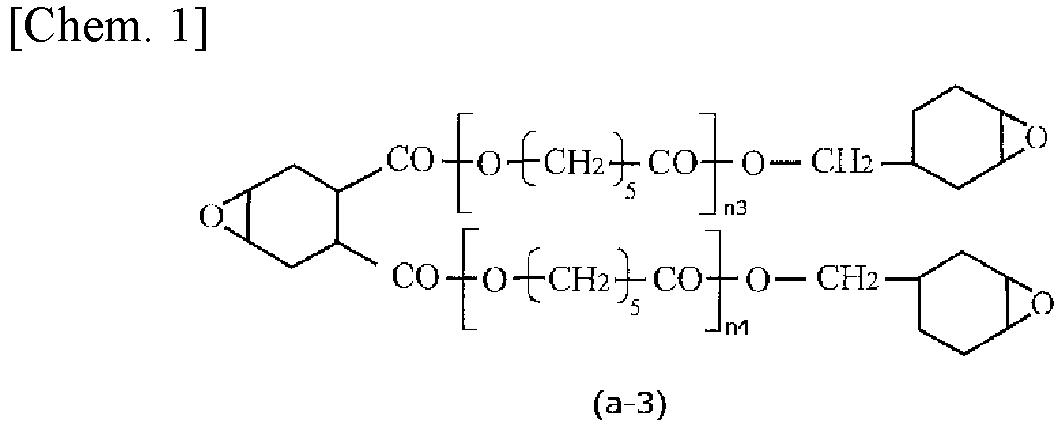
- a compound represented by Formula (a-4) below

- a compound represented by Formula (a') below

- An embodiment of the present invention also provides a hard coating film including a hard coating layer formed of a cured product of the resin composition for forming a hard coating layer.
- An embodiment of the present invention also provides an electronic device including a hard coating layer formed of a cured product of the resin composition for forming a hard coating layer.
- An embodiment of the present invention also provides a molded product including a hard coating layer formed of a cured product of the resin composition for forming a hard coating layer.
- The resin composition for forming a hard coating layer according to an embodiment of the present invention has the above constitution and thus is capable of forming a hard coating layer having not only high hardness but also excellent scratch resistance, bending resistance, and crack resistance by irradiation with an active energy ray.
- In addition, use of the resin composition for forming a hard coating layer according to an embodiment of the present invention can provide a hard coating film, a molded product, and an electronic device including a hard coating layer having not only high hardness but also excellent scratch resistance, bending resistance, and crack resistance.
- A resin composition for forming a hard coating layer according to an embodiment of the present invention (which may be hereinafter referred to simply as "the resin composition") contains components (A) and (B) below as curable compounds and further contains components (C) and (D) below as polymerization initiators: the component (A): a tri- or higher-functional alicyclic epoxy compound and/or a tri- or higher-functional oxetane compound; the component (B): a polyfunctional (meth)acrylic compound; the component (C): a photocationic polymerization initiator; and the component (D): a photoradical polymerization initiator.
- In the present specification, "(meth)acrylic" means acrylic and/or methacrylic (either acrylic or methacrylic or both), and the same applies to (meth)acrylate and (meth)acryloyl.
- The component (A) according to an embodiment of the present invention is a tri- or higher-functional alicyclic epoxy compound and/or a tri- or higher-functional oxetane compound. However, the component (A) does not include a component (E) described below (a siloxane compound having two or more epoxy groups in a molecule).
- The tri- or higher-functional alicyclic epoxy compound means a compound having three or more epoxy groups as functional groups in one molecule and having an alicyclic ring (aliphatic ring). The tri- or higher-functional alicyclic epoxy compound may have a functional group other than an epoxy group. Examples of the functional group other than an epoxy group include reactive functional groups, such as cationically polymerizable groups and radically polymerizable groups excluding an epoxy group, and non-reactive functional groups, such as alkyl groups.
- Examples of the tri- or higher-functional alicyclic epoxy compound include a compound (i) having three or more epoxy groups (alicyclic epoxy groups) composed of two adjacent carbon atoms and an oxygen atom constituting an alicyclic ring and a compound (ii) having three or more epoxy groups directly bonded to an alicyclic ring by a single bond.
- Examples of the compound (i) having three or more epoxy groups (alicyclic epoxy groups) composed of two adjacent carbon atoms and an oxygen atom constituting an alicyclic ring include a compound represented by Formula (a-1) below and a compound represented by Formula (a-2) below.

- In Formula (a-1) and Formula (a-2), n1 represents an integer of 3 or greater, and n2 represents an integer of 1 or greater. X1, X2, and X3 represent linking groups (divalent groups having one or more atoms) that may have a substituent. Here, X2 and X3 in Formula (a-2) may be identical or different. In addition, when n2 is 2 or greater, n2 X2s each may be identical or different.
- Here, n1 is any integer of 3 or greater and not particularly limited but is preferably, for example, from 3 to 15, more preferably from 3 to 9, even more preferably from 3 to 8, and particularly preferably from 3 to 6. In addition, n2 is any integer of 1 or greater and not particularly limited but is preferably, for example, from 1 to 10, more preferably from 1 to 6, and even more preferably from 1 to 4. With n1 and n2 within the above ranges, the resulting resin composition tends to have excellent coating properties.
- Examples of the substituent that the linking groups may have include an alkyl group having from 1 to 6 carbon atoms, an aryl group having from 6 to 10 carbon atoms, a hydroxy group, an amino group, a nitro group, a cyano group, and a halogen atom. Examples of the alkyl group having from 1 to 6 carbon atoms may include a linear or branched alkyl group, such as a methyl group, an ethyl group, a propyl group, an isopropyl group, a butyl group, an isobutyl group, an s-butyl group, a t-butyl group, a pentyl group, and hexyl group. Examples of the aryl group having from 6 to 10 carbon atoms may include a phenyl group and a naphthyl group.
- Examples of the linking group include a divalent hydrocarbon group, a carbonyl group, an ether bond, an ester bound, a carbonate bond, an amide bond, and a group in which a plurality of them are linked, and preferably include a group containing a divalent hydrocarbon group and an ester bond. Examples of the divalent hydrocarbon group include a linear or branched alkylene group and a divalent alicyclic hydrocarbon group. Examples of the linear or branched alkylene group include a linear or branched alkylene group having from 1 to 18 (preferably from 2 to 12 and more preferably from 3 to 6) carbon atoms, such as a methylene group, a methylmethylene group, a dimethylmethylene group, an ethylene group, a propylene group, a butylene group, and a trimethylene group. Examples of the divalent alicyclic hydrocarbon group include a cycloalkylene group having from 3 to 18 (preferably from 4 to 12 and more preferably from 5 to 6) carbon atoms (including a cycloalkylidene group), such as a 1,2-cyclopentylene group, a 1,3-cyclopentylene group, a cyclopentylidene group, a 1,2-cyclohexylene group, a 1,3-cyclohexylene group, a 1,4-cyclohexylene group, and a cyclohexylidene group.
- A substituent, such as an alkyl group (e.g., an alkyl group having from 1 to 6 carbon atoms) may be bonded to one or more of the carbon atoms constituting the cyclohexane ring (cyclohexene oxide group) in Formula (a-1) and Formula (a-2).
- Representative examples of the compounds represented by Formula (a-1) and Formula (a-2) include compounds represented by Formula (a-3) and Formula (a-4) below, where n3 to n8 each are identical or different and represent an integer of 1 to 30, preferably from 1 to 20 more preferably from 1 to 10. Examples of a specific product include an alicyclic epoxy compound, such as butanetetracarboxylate tetra(3,4-epoxycyclohexylmethyl)-modified ε-caprolactone (e.g., trade name "Epolead GT401" available from Daicel Corporation).


- Examples of the compound (ii) having three or more epoxy groups directly bonded to an alicyclic ring by a single bond include a compound represented by Formula (a') below.

- In Formula (a'), R is a group (p-valent organic group) obtained by removing p hydroxy groups (-OH) from a structural formula of a p-hydric alcohol, and p and n each represent a natural number. Examples of the p-hydric alcohol [R-(OH)p] include a polyhydric alcohol (preferably a polyhydric alcohol having from 1 to 15 carbon atoms), such as 2,2-bis(hydroxymethyl)-1-butanol. Here, p is preferably from 1 to 6, and n is preferably from 1 to 30. When p is 2 or greater, n in a group in each square bracket (outer parenthesis) may be identical or different. Here, p and n satisfy a condition that groups in the square brackets (outer parentheses) are three or more. Examples of the compound represented by Formula (a') specifically include 1,2-epoxy-4-(2-oxiranyl)cyclohexane adduct of 2,2-bis(hydroxymethyl)-1-butanol (e.g., such as trade name "EHPE 3150" available from Daicel Corporation).
- The tri- or higher-functional oxetane compound means a compound having three or more oxetanyl groups as functional groups in one molecule. The tri- or higher-functional oxetane compound may have a functional group other than an oxetanyl group. Examples of the functional group other than an oxetanyl group include reactive functional groups, such as cationically polymerizable groups and radically polymerizable groups excluding an oxetanyl group, and non-reactive functional groups, such as alkyl groups. However, the tri- or higher-functional oxetane compound does not include a compound corresponding to the tri- or higher-functional alicyclic epoxy compound.
- Examples of the tri- or higher-functional oxetane compound include an oxetanated compound of a resin having three or more hydroxy groups, such as a novolac resin, poly(p-hydroxystyrene), a calixarene, a calixresorcinarene, or silsesquioxane; and a resin containing an unsaturated monomer having an oxetanyl group (e.g., an oxetanyl group-containing (meth)acrylate) as a constituent unit. Examples of the tri- or higher-functional oxetane compound specifically include Aron Oxetane PNOX-1009 and OX-SC (available from Toagosei Co., Ltd.).
- The component (B) in an embodiment of the present invention is a polyfunctional (meth)acrylic compound and a radically curable compound having two or more (meth)acryloyl groups in one molecule. However, compounds corresponding to the component (A) are excluded.
- The molecular weight of the polyfunctional (meth)acrylic compound [the weight average molecular weight (based on the polystyrene calibration by GPC) when the polyfunctional (meth)acrylic compound is an oligomer or a polymer] is not particularly limited but is less than 5000, preferably from 2000 to 100, more preferably from 1000 to 200, and particularly preferably from 500 to 250. With the molecular weight of the polyfunctional (meth)acrylic compound within the above ranges, the resulting resin composition tends to have excellent in coating properties.
- The number (total number) of the (meth)acryloyl group contained in a molecule of the polyfunctional (meth)acrylic compound is 2 or more and not particularly limited, but the lower limit is preferably 3 and more preferably 4. In addition, the upper limit is, for example, 15, preferably 12, and more preferably 10.
- Examples of the polyfunctional (meth)acrylic compound include aliphatic (meth)acrylates, alicyclic (meth)acrylates, and aromatic (meth)acrylates. In an embodiment of the present invention, among them, aliphatic (meth)acrylates (e.g., linear or branched aliphatic (meth)acrylates) are preferred in terms of non-coloring properties of the cured product.
- Specifically, examples of the polyfunctional (meth)acrylic compound include bifunctional (meth)acrylates, such as 2-hydroxy-3-(meth)acryloyloxypropyl (meth)acrylate, tricyclodecane dimethanol di(meth)acrylate, glycerin di(meth)acrylate, ethylene glycol di(meth)acrylate, diethylene glycol di(meth)acrylate, triethylene glycol di(meth)acrylate, tetraethylene glycol di(meth)acrylate, propylene glycol di(meth)acrylate, dipropylene glycol di(meth)acrylate, neopentyl glycol di(meth)acrylate, 1,4-butanediol di(meth)acrylate, 1,6-hexanediol di(meth)acrylate, 1,9-nonanediol di(meth)acrylate, 1,10-decanediol di(meth)acrylate, 9,9-bis[4-(2-(meth)acryloyloxyethoxy)phenyl]fluorene, 2,2-bis[4-((meth)acryloyloxydiethoxy)phenyl]propane, and derivatives thereof; tri- or higher-functional (meth)acrylates, such as ethoxylated isocyanurate tri(meth)acrylate, ε-caprolactone-modified tris(2-(meth)acryloyloxyethyl)isocyanurate, glycerin tri(meth)acrylate, ethoxylated glycerin tri(meth)acrylate, propoxylated glycerin tri(meth)acrylate, pentaerythritol tri(meth)acrylate, trimethylolpropane tri(meth)acrylate, tri(meth)acrylate of 3 mol ethylene oxide adduct of trimethylolpropane, tri(meth)acrylate of 3 mol propylene oxide adduct of trimethylolpropane, tri(meth)acrylate of 6 mol ethylene oxide adduct of trimethylolpropane, tri(meth)acrylate of 6 mol propylene oxide adduct of trimethylolpropane, ditrimethylol propane tetra(meth)acrylate, ethoxylated pentaerythritol tetra(meth)acrylate, pentaerythritol tetra(meth)acrylate, dipentaerythritol poly(meth)acrylate (e.g., such as dipentaerythritol hexa(meth)acrylate and hexa(meth)acrylate of caprolactone adduct of dipentaerythritol), and derivatives thereof, polyester (meth)acrylate, polyether (meth)acrylate, acryl (meth)acrylate, urethane (meth)acrylate, epoxy (meth)acrylate, polyalkadiene (meth)acrylate (e.g., such as polybutadiene (meth)acrylate), melamine (meth)acrylate, and polyacetal (meth)acrylate.
- Commercially available polyfunctional (meth)acrylic compounds can be used, and examples of the product include pentaerythritol (tri/tetra)acrylate (a mixture of pentaerythritol triacrylate and pentaerythritol tetraacrylate, product name "PETIA" available from Daicel-Allnex Ltd.).
- The component (C) in an embodiment of the present invention is a photocationic polymerization initiator. The photocationic polymerization initiator is a compound that initiates curing reaction of the cationically polymerizable group in the resin composition by generating an acid upon irradiation with light and is composed of a cationic moiety that absorbs light and an anionic moiety that serves as a source for generating the acid.
- Examples of the photocationic polymerization initiator include diazonium salt-based compounds, iodonium salt-based compounds, sulfonium salt-based compounds, phosphonium salt-based compounds, selenium salt-based compounds, oxonium salt-based compounds, ammonium salt-based compounds, and bromine salt-based compounds.
- Among them, use of a sulfonium salt-based compound is preferred in that it can form a cured product excellent in curability. Examples of the cationic moiety of the sulfonium salt-based compound include arylsulfonium ions (in particular, triarylsulfonium ions), such as a (4-hydroxyphenyl)methylbenzylsulfonium ion, a triphenyl sulfonium ion, a diphenyl[4-(phenylthio)phenyl]sulfonium ion, a 4-(4-biphenylthio)phenyl-4-biphenylylphenylsulfonium ion, and a tri-p-tolylsulfonium ion.
- Examples of the anionic moiety of the photocationic polymerization initiator include [(Y)sB(Phf)4-s]- (where Y represents a phenyl group or a biphenylyl group, Phf represents a substituted phenyl group in which at least one of hydrogen atoms is replaced with at least one selected from a perfluoroalkyl group, a perfluoroalkoxy group, and a halogen atom, and s is an integer of 0 to 3.), BF4 -, [(Rf)tPF6-t]- (where Rf represents a substituted alkyl group in which 80% or more of hydrogen atoms are replaced with fluorine atoms, and t represents an integer of 0 to 5.), AsF6 -, SbF6 -, and SbF5OH-.
- Examples of the photocationic polymerization initiator that can be used include (4-hydroxyphenyl)methylbenzylsulfonium tetrakis(pentafluorophenyl)borate; 4-(4-biphenylylthio)phenyl-4-biphenylylphenylsulfonium tetrakis(pentafluorophenyl)borate; 4-(phenylthio)phenyldiphenylsulfonium phenyltris(pentafluorophenyl)borate; [4-(4-biphenylylthio)phenyl]-4-biphenylylphenylsulfonium phenyltris(pentafluorophenyl)borate; diphenyl[4-(phenylthio)phenyl]sulfonium tris(pentafluoroethyl)trifluorophosphate; diphenyl[4-(phenylthio)phenyl]sulfonium tetrakis(pentafluorophenyl)borate; diphenyl[4-(phenylthio)phenyl]sulfonium hexafluorophosphate; 4-(4-biphenylylthio)phenyl-4-biphenylylphenylsulfonium tris(pentafluoroethyl)trifluorophosphate; bis[4-(diphenylsulfonio)phenyl]sulfide phenyltris(pentafluorophenyl)borate; [4-(2-thioxanthonylthio)phenyl]phenyl-2-thioxanthonylsulfonium phenyltris(pentafluorophenyl)borate; 4-(phenylthio)phenyldiphenylsulfonium hexafluoroantimonate; and commercially available products under trade names, such as "Cyracure UVI-6970", "Cyracure UVI-6974", "Cyracure UVI-6990", and "Cyracure UVI-950" (these are available from Union Carbide Corporation, USA), "Irgacure 250", "Irgacure 261", and "Irgacure 264" (these are available from BASF), "CG-24-61" (available from Ciba-Geigy), "Optomer SP-150", "Optomer SP-151", "Optomer SP-170", and "Optomer SP-171" (these are available from Adeka Corporation), "DAICAT II" (available from Daicel Corporation), "UVAC 1590" and "UVAC 1591" (these are available from Daicel-Cytec Co., Ltd.), "CI-2064", "CI-2639", "CI-2624", "CI-2481", "CI-2734", "CI-2855", "CI-2823", "CI-2758", and "CIT-1682" (these are available from Nippon Soda Co., Ltd.), "PI-2074" (tetrakis(pentafluorophenyl)borate tricumyliodonium salt, available from Rhodia), "FFC 509" (available from 3M), "BBI-102", "BBI-101", "BBI-103", "MPI-103", "TPS-103", "MDS-103", "DTS-103", "NAT-103", and "NDS-103" (these are available from Midori Kagaku Co., Ltd.), "CD-1010", "CD-1011", and "CD-1012" (these are available from Sartomer, USA), and "CPI-100P" and "CPI-101A" (these are available from San-Apro Ltd.).
- The component (D) in an embodiment of the present invention is a photoradical polymerization initiator. The photoradical polymerization initiator is a compound that initiates curing reaction of the radically polymerizable group in the resin composition by generating a radical upon irradiation with light, and examples of the photoradical polymerization initiator include benzophenone; acetophenone benzyl; benzyldimethyl ketone; benzoin; benzoin methyl ether; benzoin ethyl ether; benzoin isopropyl ether; dimethoxyacetophenone; dimethoxy phenylacetophenone; diethoxyacetophenone; diphenyl disulfite; methyl o-benzoylbenzoate; ethyl 4-dimethylaminobenzoate (such as trade name "Kayacure EPA" available from Nippon Kayaku Co., Ltd.); 2,4-diethylthioxanthone (such as trade name "Kayacure DETX" available from Nippon Kayaku Co., Ltd.); 2-methyl-1-[4-(methyl)phenyl]-2-morpholino-propanone-1 (such as trade name "Irgacure 907" available from BASF); 1-hydroxycyclohexyl phenyl ketone (such as trade name "Irgacure 184" available from BASF); 2-amino-2-benzoyl-1-phenyl alkane compounds, such as 2-dimethylamino-2-(4-morpholino)benzoyl-1-phenylpropane; amino benzene derivatives, such as tetra(t-butylperoxy carbonyl) benzophenone, benzil, 2-hydroxy-2-methyl-1 -phenyl-propan-1-one, and 4,4'-bis(diethylamino)benzophenone; imidazole compounds, such as 2,2'-bis(2-chlorophenyl)-4,5,4',5'-tetraphenyl-1,2'-biimidazole (such as trade name "B-CIM" available from Hodagaya Chemical Co., Ltd.); halomethylated triazine compounds, such as 2,6-bis(trichloromethyl)-4-(4-methoxynaphthalen-1-yl)-1,3,5-triazine; and halomethyl oxadiazole compounds, such as 2-trichloromethyl-5-(2-benzofuran2-yl-ethenyl)-1,3,4-oxadiazole.
- The resin composition according to an embodiment of the present invention may contain, as a component (E), a siloxane compound having two or more epoxy groups in a molecule. The siloxane compound is a compound having two or more epoxy groups and having a backbone composed of a siloxane bond (-Si-O-Si-). The siloxane backbone (Si-O-Si backbone) in the siloxane compound is not particularly limited, but examples of the siloxane backbone include cyclic siloxane backbones; and polysiloxane backbones, such as linear silicones, and cage or ladder polysilsesquioxanes. Among them, the siloxane backbone is preferably a cyclic siloxane backbone and a linear silicone backbone in terms of improving the crack resistance of the cured product. That is, the siloxane compound is preferably a cyclic siloxane having two or more epoxy groups in a molecule, and a linear silicone having two or more epoxy groups in a molecule.
- When the siloxane compound is a cyclic siloxane having two or more epoxy groups in a molecule, the number of Si-O units forming the siloxane ring (the number is equal to the number of silicon atoms forming the siloxane ring) is not particularly limited but is preferably from 2 to 12 and more preferably from 4 to 8 in terms of improving the crack resistance of the cured product.
- The weight average molecular weight of the siloxane compound is not particularly limited but is preferably from 100 to 3000 and more preferably from 180 to 2000 in terms of improving the crack resistance of the cured product. The weight average molecular weight of the siloxane compound is calculated from the molecular weight based on the standard polystyrene calibration as measured by gel permeation chromatography (GPC).
- The number of epoxy groups contained in a molecule of the siloxane compound is 2 or more and not particularly limited but is preferably from 2 to 4 (2, 3, or 4) in terms of improving the crack resistance of the cured product.
- The epoxy equivalent weight of the siloxane compound is not particularly limited but is preferably from 180 to 2000, more preferably from 180 to 1500, and even more preferably from 180 to 1000 in terms of improving the crack resistance of the cured product. The epoxy equivalent weight is a value measured in accordance with JIS K7236.
- The epoxy group contained in the siloxane compound is not particularly limited but is preferably an alicyclic epoxy group and, among them, particularly preferably a cyclohexene oxide group in terms of improving the crack resistance of the cured product.
- Examples of the siloxane compound include a compound represented by Formula (a) below.

- In Formula (e), Ras are identical or different and represent a group containing an epoxy group, or an alkyl group. However, at least two (e.g., from 2 to 4) of Ras in Formula (e) are groups containing an epoxy group. The group containing an epoxy group is a group containing at least one epoxy group (oxirane ring), and examples of the group include a group in which at least one double bond contained in a linear or branched aliphatic hydrocarbon group having a carbon-carbon unsaturated double bond, such as an alkenyl group, is epoxidized; and a group in which at least one double bond contained in a cyclic aliphatic hydrocarbon group having a carbon-carbon unsaturated double bond (e.g., such as a cycloalkenyl group; and a cycloalkenylalkyl group, such as a cyclohexenylethyl group) is epoxidized. More specifically, examples of the group containing an epoxy group include a 1,2-epoxyethyl group (epoxy group), a 1,2-epoxypropyl group, a 2,3-epoxypropyl group (glycidyl group), a 2,3-epoxy-2-methylpropyl group (methylglycidyl group), a 3,4-epoxybutyl group, a 3-glycidyloxypropyl group, a 3,4-epoxycyclohexylmethyl group, and a 2-(3,4-epoxycyclohexyl)ethyl group. Among them, the group containing an epoxy group is preferably a group in which at least one double bond contained in an aliphatic hydrocarbon group having a carbon-carbon unsaturated double bond is epoxidized. Examples of the alkyl group include linear or branched alkyl groups having from 1 to 20 carbon atoms, such as a methyl group, an ethyl group, a propyl group, an isopropyl group, a butyl group, a hexyl group, an octyl group, an isooctyl group, a decyl group, and a dodecyl group. Among them, a linear or branched alkyl group having from 1 to 10 carbon atoms is preferred.
- In Formula (e), m represents an integer of 2 to 12. In particular, m is preferably from 4 to 8 and more preferably from 4 or 5 in terms of improving the crack resistance of the cured product.
- Examples of the siloxane compound more specifically include 2,4-di[2-(3-{oxabicyclo[4.1.0]heptyl})ethyl]-2,4,6,6,8,8-hexamethyl-cyclotetrasiloxan e, 4,8-di[2-(3-{oxabicyclo[4.1.0]heptyl})ethyl]-2,2,4,6,6,8-hexamethyl-cyclotetrasiloxan e, 2,4-di[2-(3-{oxabicyclo[4.1.0]heptyl})ethyl]-6,8-dipropyl-2,4,6,8-tetramethyl-cyclote trasiloxane, 4,8-di[2-(3-{oxabicyclo[4.1.0]heptyl})ethyl]-2,6-dipropyl-2,4,6,8-tetramethyl-cyclote trasiloxane, 2,4,8-tri[2-(3-{oxabicyclo[4.1.0]heptyl})ethyl]-2,4,6,6,8-pentamethyl-cyclotetrasiloxa ne, 2,4,8-tri[2-(3-{oxabicyclo[4.1.0]heptyl})ethyl]-6-propyl-2,4,6,8-tetramethyl-cyclotetr asiloxane, 2,4,6,8-tetra[2-(3-{oxabicyclo[4.1.0]heptyl})ethyl]-2,4,6,8-tetramethyl-cyclotetrasilox ane, and silsesquioxane having two or more epoxy groups in a molecule. Even more specifically, examples of the siloxane compound include cyclic siloxanes having two or more epoxy groups in a molecule represented by formulas below.

- In addition, examples of the siloxane compound that can be used also include an alicyclic epoxy group-containing silicone resin described in
JP 2008-248169 A JP 2008-019422 A - In the resin composition according to an embodiment of the present invention, one type of the siloxane compound can be used alone, or two or more types can be used in combination.
- The siloxane compound are, for example, cyclic siloxanes having two or more epoxy groups in a molecule, which are commercially available under trade names, such as "X-40-2678", "X-40-2670", and "X-40-2720" (these are available from Shin-Etsu Chemical Co., Ltd.). In addition, the siloxane compound can be produced by a well-known or commonly used method.
- The resin composition according to an embodiment of the present invention may contain an additional component in addition to the components described above provided that it does not impair the effects of the present invention. The resin composition may contain, for example, a curable compound (which may be hereinafter referred to as the "additional curable compound") other than the components (A), (B), and (E). In addition, the resin composition may contain an additive of various types (which may be hereinafter referred to as the "additional additive") other than the components (C) and (D).
- Examples of the additional curable compound include monofunctional or bifunctional alicyclic epoxy compounds, epoxy compounds other than alicyclic epoxy compounds, and monofunctional (meth)acrylic compounds. Examples of the monofunctional or bifunctional alicyclic epoxy compounds include a compound represented by Formula (f) below.

- In Formula (f), X4 represents a linking group (a divalent group having one or more atoms). Examples of the linking group include a divalent hydrocarbon group, a carbonyl group, an ether bond, an ester bound, a carbonate bond, an amide bond, and a group in which a plurality of them are linked. A substituent, such as an alkyl group (e.g., an alkyl group having from 1 to 6 carbon atoms) may be bonded to one or more of the carbon atoms constituting the cyclohexane ring (cyclohexene oxide group) in Formula (f).
- Examples of the divalent hydrocarbon group include a linear or branched alkylene group and a divalent alicyclic hydrocarbon group. Examples of the linear or branched alkylene group include a linear or branched alkylene group having from 1 to 18 carbon atoms, such as a methylene group, a methylmethylene group, a dimethylmethylene group, an ethylene group, a propylene group, and a trimethylene group. Examples of the divalent alicyclic hydrocarbon group include a cycloalkylene group having from 3 to 18 carbon atoms (including a cycloalkylidene group), such as a 1,2-cyclopentylene group, a 1,3-cyclopentylene group, a cyclopentylidene group, a 1,2-cyclohexylene group, a 1,3-cyclohexylene group, a 1,4-cyclohexylene group, and a cyclohexylidene group.
- Representative examples of the compound represented by Formula (f) include (3,4,3',4'-diepoxy)bicyclohexyl, bis(3,4-epoxycyclohexylmethyl)ether, 1,2-epoxy-1,2-bis(3,4-epoxycyclohexan-1-yl)ethane, 2,2-bis(3,4-epoxycyclohexan-1-yl)propane, 1,2-bis(3,4-epoxycyclohexan-1-yl)ethane, and compounds represented by Formulas (f-1) to (f-8) below. L in Formula (f-5) below is an alkylene group having from 1 to 8 carbon atoms and, among them, preferably a linear or branched alkylene group having from 1 to 3 carbon atoms, such as a methylene group, an ethylene group, a propylene group, or an isopropylene group. In Formulas (f-5) and (f-7) below, n9 and n10 each represent an integer from 1 to 30.

- Examples of the additional additive include polyhydric alcohols, curing auxiliary agents, organosiloxane compounds, metal oxide particles, rubber particles, defoaming agents, silane coupling agents, fillers, plasticizers, leveling agents, antistatic agents, releasing agents, surfactants, flame retardants, colorants, antioxidants, ultraviolet absorbers, ion adsorbers, and fluorescents.
- In addition, to the resin composition according to an embodiment of the present invention, a solvent can be appropriately added according to coating conditions. Examples of the solvent include butyl acetate, methyl ethyl ketone, and 1-methoxy-2-propyl acetate. One type of these solvents can be used alone, or two or more types can be used in combination.
- The resin composition according to an embodiment of the present invention can be prepared by stirring and mixing the components described above in a state where the components are heated as necessary. For the stirring and mixing, a well-known or commonly used stirring and mixing means can be used, for example, including a mixer of various types, such as a dissolver and a homogenizer; a kneader; a roll; a bead mill; and a rotation/revolution stirring apparatus. In addition, after the stirring and mixing, the mixture may be defoamed under vacuum. The resin composition according to an embodiment of the present invention may be a one-part composition, which is a composition containing the components described above mixed in advance and used as is, or may be a multi-part (e.g., two-part) composition, which is used by mixing two or more separated components (each component may be a mixture of two or more components) in predetermined proportions before use.
- The resin composition according to an embodiment of the present invention contains, as the component (A), one or more types of a tri- or higher-functional alicyclic epoxy compound and/or a tri- or higher-functional oxetane compound. A content of the component (A) is not particularly limited but is, for example, from 1 to 75 wt.% of a total amount of curable compounds contained in the resin composition according to an embodiment of the present invention. The upper limit is, for example, preferably 70 wt.%, more preferably 60 wt.%, even more preferably 50 wt.%, particularly preferably 40 wt.%, and most preferably 35 wt.%. The lower limit is preferably 3 wt.%, more preferably 5 wt.%, even more preferably 10 wt.%, particularly preferably 20 wt.%, and most preferably 30 wt.%. The content of the component (A) within the above range tends to provide excellent scratch resistance, bending resistance, and crack resistance. The content of the component (A) is, for example, preferably from 10 to 75 wt.%, more preferably from 20 to 75 wt.%, and even more preferably from 30 to 75 wt.% of a total amount of curable compounds contained in the resin composition in terms of improving the bending resistance and crack resistance.
- The resin composition according to an embodiment of the present invention contains, as the component (B), one or more types of polyfunctional (meth)acrylic compounds. A content of the component (B) is not particularly limited but is, for example, from 25 to 99 wt.% of a total amount of curable compounds contained in the resin composition according to an embodiment of the present invention. The upper limit is preferably 97 wt.%, more preferably 95 wt.%, even more preferably 90 wt.%, particularly preferably 80 wt.%, and most preferably 70 wt.%. The lower limit is preferably 30 wt.%, more preferably 40 wt.%, even more preferably 50 wt.%, particularly preferably 60 wt.%, and most preferably 65 wt.%. The content of the component (B) within the above range tends to provide excellent scratch resistance, bending resistance, and crack resistance. The content of the component (B) is, for example, preferably from 25 to 90 wt.%, more preferably from 25 to 80 wt.%, and even more preferably from 25 to 70 wt.% of a total amount of curable compounds contained in the resin composition in terms of improving the bending resistance and crack resistance.
- A total content of the component (A) and the component (B) in the resin composition according to an embodiment of the present invention is not particularly limited but is, for example, from 50 to 100 wt.% of a total amount of curable compounds contained in the resin composition according to an embodiment of the present invention. The upper limit is preferably 99 wt.%, more preferably 95 wt.%, and particularly preferably 90 wt.%. The lower limit is preferably 60 wt.%, more preferably 70 amount%, and particularly preferably 80 wt.%.
- A ratio of the contents of the component (A) and the component (B) (component (A)/component (B)) in the resin composition according to an embodiment of the present invention is not particularly limited but is, for example, from 1/99 to 75/25. The upper limit is preferably 70/30, more preferably 60/40, even more preferably 50/50, and particularly preferably 40/60. The lower limit is preferably 3/97, more preferably 5/95, even more preferably 10/90, particularly preferably 20/80, and most preferably 30/70.
- Control of the contents and the ratio of the components (A) and (B) in the above range provides an effect of improving the bending resistance and crack resistance while maintaining the scratch resistance.
- The resin composition according to an embodiment of the present invention contains, as the component (C), one or more types of photocationic polymerization initiators. A content of the component (C) is, for example, from 0.05 to 5 parts by weight relative to 100 parts by weight of curable compounds contained in the resin composition according to an embodiment of the present invention. The content of the component (C) below the above range would cause failure in curing. On the other hand, the content of the component (C) exceeding the above range would be apt to cause coloration of the cured product.
- The resin composition according to an embodiment of the present invention contains, as the component (D), one or more types of photoradical polymerization initiators. A content of the component (D) is, for example, from 1 to 10 parts by weight relative to 100 parts by weight of curable compounds contained in the resin composition according to an embodiment of the present invention. The content of the component (D) below the above range would cause failure in curing. On the other hand, the content of the component (D) exceeding the above range would be apt to cause coloration of the cured product.
- In the resin composition according to an embodiment of the present invention containing, as the component (E), the siloxane compound having two or more epoxy groups in a molecule, the content of the siloxane compound is not particularly limited but is, for example, preferably from 0.1 to 30 wt.%, more preferably from 0.5 to 20 wt.%, and even more preferably from 1.0 to 10 wt.% of a total amount of curable compounds contained in the resin composition of an embodiment of the present invention. Control of the content of the siloxane compound in the above range tends to improve the crack resistance of the cured product.
- A content of the additional curable compound (e.g., a compound represented by Formula (f)) can be appropriately set according to the application but is, for example, not greater than 50 wt.%, preferably not greater than 30 wt.%, more preferably not greater than 20 wt.%, and particularly preferably not greater than 10 wt.% relative to a total amount of curable compounds contained in the resin composition according to an embodiment of the present invention.
- The content of the additional additive can be appropriately set according to the application but is, for example, not greater than 40 parts by weight, preferably not greater than 20 parts by weight, more preferably not greater than 10 parts by weight, and particularly preferably not greater than 5 parts by weight relative to 100 parts by weight of curable compounds contained in the resin composition according to an embodiment of the present invention.
- The resin composition according to an embodiment of the present invention can be cured in a very short time by irradiation with an active energy ray, such as an ultraviolet light or an electron beam, after coating, providing a cured product having high hardness and excellent in scratch resistance and crack resistance. Examples of a light source used during the ultraviolet light irradiation include a high-pressure mercury-vapor lamp, an ultra-high-pressure mercury-vapor lamp, a carbon-arc lamp, a xenon lamp, or a metal halide lamp. The irradiation time depends on the type of the light source, the distance between the light source and the coated surface, and other conditions but is at most several tens of seconds and typically several seconds. Typically, an irradiation source with a lamp output of approximately from 80 to 300 W/cm is used. The UV irradiation dose is approximately from 50 to 3000 mJ/cm2. For the electron beam irradiation, an electron beam with energy in a range from 50 to 1000 KeV is preferably used to provide an irradiation dose from 2 to 5 Mrad. After the irradiation with the active energy ray, heating (post curing) may be performed as necessary to promote the curing.
- The cured product of the resin composition according to an embodiment of the present invention is excellent in scratch resistance, and the number of times of rubbing until a scratch is made in the test for evaluating scratch resistance described in Examples is, for example, not less than 300 times, preferably not less than 500 times, and particularly preferably not less than 1000 times.
- The cured product of the resin composition according to an embodiment of the present invention has high hardness, and its pencil hardness is, for example, not lower than 2H.
- The cured product of the resin composition according to an embodiment of the present invention is excellent in transparency, and its light transmittance (in terms of a thickness of 20 µm) of a light with a wavelength of 450 nm is, for example, not lower than 80%. The light transmittance can be measured, for example, using a spectrophotometer (e.g., trade name "UV-2400" available from Shimadzu Corporation).
- A hard coating film according to an embodiment of the present invention includes, in at least a portion thereof, one or more hard coating layers formed of the cured product of the resin composition according to an embodiment of the present invention.
- The hard coating film according to an embodiment of the present invention is preferably a laminate having at least one substrate layer and at least one hard coating layer. As a substrate forming the substrate layer, a plastic film, such as triacetyl cellulose (TAC) and polyethylene terephthalate (PET), can be suitably used.
- The hard coating film according to an embodiment of the present invention can be produced, for example, by applying the resin composition for forming a hard coating layer according to an embodiment of the present invention onto at least one surface of the substrate and curing the resin composition.
- The thickness of the hard coating layer is, for example, approximately from 3 to 50 µm. In addition, the thickness of the entire hard coating film is, for example, approximately from 30 to 300 µm.
- The hard coating film according to an embodiment of the present invention has high hardness and is excellent in scratch resistance and crack resistance. Thus, the hard coating film can be suitably used for applications for adhering it to and protecting touch screens and displays of electronic devices, such as liquid crystal televisions, liquid crystal displays, notebook-size personal computers, mobile displays, tablet PCs, and smartphones. That is, the hard coating film according to an embodiment of the present invention can be suitably used as a protective film for touch screens and displays of electronic devices.
- In the electronic device according to an embodiment of the present invention, at least a portion of a surface of the electronic device includes a hard coating layer formed of the cured product of the resin composition according to an embodiment of the present invention.
- Examples of the electronic device according to an embodiment of the present invention include liquid crystal televisions, liquid crystal displays, notebook-size personal computers, mobile displays, tablet PCs, and smartphones.
- The electronic device according to an embodiment of the present invention can be produced, for example, by directly applying the resin composition according to an embodiment of the present invention onto a surface of the electronic device and curing the resin composition, or by adhering the hard coating film to a surface of the electronic device.
- The electronic device according to an embodiment of the present invention has a structure in which a touch screen or a display is protected by a hard coating layer formed of a cured product of the resin composition according to an embodiment of the present invention and excellent in surface hardness and scratch resistance, and thus is resistant to a scratch or dirt and capable of maintaining high quality over a long period of time.
- A molded product according to an embodiment of the present invention includes, in at least a portion of the molded product surface, a hard coating layer formed of a cured product of the resin composition according to an embodiment of the present invention.
- Examples of the molded product according to an embodiment of the present invention include lenses, sensors, glass-alternative resins (or resin windows), and automobile components (e.g., interior components, such as gauge panels; exterior components, such as door handles and roof rails; and electrical components, such as headlight lenses).
- The molded product according to an embodiment of the present invention can be produced, for example, by directly applying the resin composition according to an embodiment of the present invention onto a surface of the molded product and curing the resin composition, or by adhering the hard coating film to a surface of the molded product.
- The molded product according to an embodiment of the present invention has a hard coating layer formed of a cured product of the resin composition according to an embodiment of the present invention and excellent in surface hardness and scratch resistance, and thus is resistant to a scratch or dirt and capable of maintaining high quality over a long period of time.
- Hereinafter, the present invention is described in more detail based on examples, but the present invention is not limited by these examples.
- The components were mixed in the blending proportions (in part by weight) shown in Table 1, stirred and defoamed using a rotation/revolution stirring apparatus (trade name "THINKY MIXER AR-250" available from Thinky Corporation), and a resin composition was obtained.
- The resin composition obtained as described above was applied on a polycarbonate substrate with a thickness of 1 mm by a bar coater to make the film thickness after drying 25 µm, and a coating film was formed. Thereafter, the coating film was dried at 80°C for 1 minute and then irradiated with ultraviolet light (an irradiation dose is shown in Table 1) in a state where the coating film was placed in a well-closed container purged with nitrogen. The coating film was further post-cured (temperature and time are shown in Table 1), and a cured coating film was formed. A laminate (hard coating film (1)) having a structure of "a PC substrate/a cured product (the cured coating film)" thus obtained as described above was obtained.
- Next, a laminate (hard coating film (2)) having a structure of "a PET substrate/a cured product (the cured coating film)" was obtained in the same manner as described above except for changing the polycarbonate substrate to a PET substrate with a thickness of 100 µm and changing the film thickness of the coating film to 15 µm.
- Furthermore, a laminate (hard coating film (3)) having a structure of "a PC substrate/a cured product (the cured coating film)" was obtained in the same manner as described above except for changing the thickness of the polycarbonate substrate to 5 mm and changing the film thickness of the coating film to 40 µm.
- In Comparative Example 3, a cured coating film was formed without post-curing.
- Pencil hardness was evaluated in accordance with JIS K 5600.
- First, the cured coating film surface of a sample for pencil hardness evaluation was scratched with a pencil with a certain hardness, and when no scratch was made, the cured coating film surface of the sample was scratched with a pencil with a hardness one grade higher. When it was observed that a scratch was made, the cured coating film surface of the sample was scratched again with a pencil with a hardness one grade lower, and it was observed whether a scratch was made. When it was observed that no scratch was made, it was observed again whether a scratch was made using a pencil with a hardness one grade higher. When reproducibility of two or more times was confirmed, the hardest hardness of the pencil that did not make a scratch was taken as the pencil hardness of the sample. The evaluation conditions are as follows.
- Sample for evaluation: hard coating film (1)
- Pencil for evaluation: a "pencil for pencil hardness test", available from Mitsubishi Pencil Co., Ltd.
- Load: 750 gf
- Scratch distance: not shorter than 50 mm
- Scratch angle: 45°
- Measurement environment: 23°C, 50% RH
- Pencil hardness was evaluated by the same method as the pencil hardness (1) except for changing the sample for evaluation from the hard coating film (1) to the hard coating film (2).
- The cured coating film surface of the hard coating film (1) was rubbed with #0000 steel wool at a load of 500 g/cm2, and scratch resistance was evaluated from the number of rubbing until a scratch was formed.
- In accordance with JIS K5600-5-1 (bending resistance (cylindrical mandrel method)), the hard coating film (2) was bent 10 times about a mandrel of 5 mm in diameter with the coated surface of the hard coating film (2) being inside. It was visually observed whether a crack occurred and evaluated according to the following criteria.
- Excellent: No crack occurred
- Good: From 1 to 2 fine cracks occurred
- Marginal: From 3 to 5 cracks occurred
- Poor: 6 or more cracks occurred
- Bending resistance was evaluated in the same manner as in the bending resistance (1) except for bending the hard coating film (2) with the coated surface being outside.
- Bending resistance was evaluated in the same manner as in the bending resistance (1) except for changing the diameter of the mandrel to 1 mm.
- Bending resistance was evaluated in the same manner as in the bending resistance (1) except for changing the diameter of the mandrel to 1 mm and bending the hard coating film (2) with the coated surface being outside.
- The hard coating film (3) was subjected to 200 cycles of thermal shocks using a thermal shock tester, where one cycle includes exposing the film to an atmosphere at -40°C for 30 minutes and subsequently an atmosphere at 100°C for 30 minutes. Thereafter, presence or absence of a crack on the cured coating film surface of the hard coating film (3) was observed using a digital microscope (trade name "VHX-900" available from Keyence Corporation), and the crack resistance was evaluated according to the following criteria.
- Good: No crack was present
- Poor: A crack was present
- As a result of the above, Examples 1 to 6 provided cured products having not only high hardness but also excellent scratch resistance, bending resistance, and crack resistance. Among them, cured products from Examples 5 and 6 were revealed to exhibit very high bending resistance.
- Abbreviations in the table are described below.
-
- Epolead GT-401: Butanetetracarboxylate tetra(3,4-epoxycyclohexylmethyl)-modified ε-caprolactone, molecular weight of 789, available from Daicel Corporation
- EHPE3150: 1,2-Epoxy-4-(2-oxiranyl)cyclohexane adduct of 2,2-bis(hydroxymethyl)-1-butanol, available from Daicel Corporation
- (3,4,3',4'-Diepoxy)bicyclohexyl, molecular weight of 194, available from Daicel Corporation
- PETIA: A mixture of pentaerythritol triacrylate and pentaerythritol tetraacrylate, molecular weight of 298/352, available from Daicel-Allnex Ltd.
- CPI-210S: Diphenyl[4-(phenylthio)phenyl]sulfonium tris(pentafluoroethyl)trifluorophosphate, available from San-Apro Ltd.
- Irgacure 184: 1-hydroxycyclohexyl phenyl ketone, available from BASF
- To summarize the above, configurations of the present invention and variations thereof will be described below.
- (1) A resin composition for forming a hard coating layer, the resin composition containing components (A) to (E) below:
- the component (A): a tri- or higher-functional alicyclic epoxy compound and/or a tri- or higher-functional oxetane compound;
- the component (B): a polyfunctional (meth)acrylic compound;
- the component (C): a photocationic polymerization initiator; and
- the component (D): a photoradical polymerization initiator.
- (2) The resin composition for forming a hard coating layer according to (1), wherein a content of the component (A) is from 1 to 75 wt.% of a total amount of curable compounds contained in the resin composition; an upper limit of the content is preferably 70 wt.%, more preferably 60 wt.%, even more preferably 50 wt.%, particularly preferably 40 wt.%, and most preferably 35 wt.%; and a lower limit of the content is preferably 3 wt.%, more preferably 5 wt.%, even more preferably 10 wt.%, particularly preferably 20 wt.%, and most preferably 30 wt.%.
- (3) The resin composition for forming a hard coating layer according to (1) or (2), wherein the component (A) contains, as the tri- or higher-functional alicyclic epoxy compound, at least one selected from the group consisting of: a compound represented by Formula (a-3) where n3 and n4 each are identical or different and represent an integer of 1 to 30; a compound represented by Formula (a-4) where n5, n6, n7, and n8 each are identical or different and represent an integer of 1 to 30; and a compound represented by Formula (a') where R is a group (p-valent organic group) obtained by removing p hydroxy groups (-OH) from a structural formula of a p-hydric alcohol, and p and n each represent a natural number.
- (4) The resin composition for forming a hard coating layer according to any one of (1) to (3), wherein a number (total number) of (meth)acryloyl groups contained in a molecule of the polyfunctional (meth)acrylic compound is 2 or greater; a lower limit is preferably 3 and more preferably 4; and an upper limit is 15, preferably 12, and more preferably 10.
- (5) The resin composition for forming a hard coating layer according to any one of (1) to (4), wherein the component (B) contains, as the polyfunctional (meth)acrylic compound, at least one selected from the group consisting of an aliphatic (meth)acrylate, an alicyclic (meth)acrylate, and an aromatic (meth)acrylate.
- (6) The resin composition for forming a hard coating layer according to any one of (1) to (5), wherein a number (total number) of (meth)acryloyl groups contained in a molecule of the polyfunctional (meth)acrylic compound is 2 or greater; a lower limit is preferably 3 and more preferably 4; and an upper limit is 15, preferably 12, and more preferably 10.
- (7) The resin composition for forming a hard coating layer according to any one of (1) to (6), further containing, as a component (E), a siloxane compound having two or more epoxy groups in a molecule.
- (8) The resin composition for forming a hard coating layer according to any one of (1) to (7), wherein a content of the component (B) is from 25 to 99 wt.% of a total amount of curable compounds contained in the resin composition; an upper limit of the content is preferably 97 wt.%, more preferably 95 wt.%, even more preferably 90 wt.%, particularly preferably 80 wt.%, and most preferably 70 wt.%; and a lower limit of the content is preferably 30 wt.%, more preferably 40 wt.%, even more preferably 50 wt.%, particularly preferably 60 wt.%, and most preferably 65 wt.%.
- (9) The resin composition for forming a hard coating layer according to any one of (1) to (8), wherein a total content of the component (A) and the component (B) is from 50 to 100 wt.% of a total amount of curable compounds contained in the resin composition; an upper limit of the total content is preferably 99 wt.%, more preferably 95 wt.%, and particularly preferably 90 wt.%; and a lower limit of the total content is preferably 60 wt.%, more preferably 70 wt.%, and particularly preferably 80 wt.%.
- (10) The resin composition for forming a hard coating layer according to any one of (1) to (9), wherein a ratio of contents of the component (A) and the component (B) (component (A)/component (B)) is from 1/99 to 75/25; an upper limit of the ratio is preferably 70/30, more preferably 60/40, even more preferably 50/50, and particularly preferably 40/60; and a lower limit of the ratio is preferably 3/97, more preferably 5/95, even more preferably 10/90, particularly preferably 20/80, and most preferably 30/70.
- (11) The resin composition for forming a hard coating layer according to any one of (1) to (10), wherein a content of the component (C) is from 0.05 to 5 parts by weight relative to 100 parts by weight of curable compounds contained in the resin composition.
- (12) The resin composition for forming a hard coating layer according to any one of (1) to (11), wherein a content of the component (D) is from 1 to 10 parts by weight relative to 100 parts by weight of curable compounds contained in the resin composition.
- (13) A hard coating film including a hard coating layer formed of a cured product of the resin composition for forming a hard coating layer described in any one of (1) to (12).
- (14) An electronic device including a hard coating layer formed of a cured product of the resin composition for forming a hard coating layer described in any one of (1) to (12).
- (15) A molded product including a hard coating layer formed of a cured product of the resin composition for forming a hard coating layer described in any one of (1) to (12).
- The resin composition for forming a hard coating layer according to an embodiment of the present invention has the above constitution and thus is capable of form a hard coating layer having not only high hardness but also excellent scratch resistance, bending resistance, and crack resistance by irradiation with an active energy ray. In addition, use of the resin composition for forming a hard coating layer according to an embodiment of the present invention can provide a hard coating film, a molded product, and an electronic device including a hard coating layer having not only high hardness but also excellent scratch resistance, bending resistance, and crack resistance.
| Example 1 | Example 2 | Example 3 | Example 4 | Example 5 | Example 6 | Comparative Example 1 | Comparative Example 2 | Comparative Example 3 | ||
| Component (A) | Epolead GT-401 | 10 | 20 | 40 | 60 | |||||
| EHPE3150 | 10 | 20 | ||||||||
| Additional curable compound | (3,4,3',4'-Diepoxy)bicyclohexyl | 10 | 20 | |||||||
| Component (B) | PETIA | 90 | 80 | 90 | 80 | 60 | 40 | 90 | 80 | 100 |
| Component (C) | CPI-210S | 0.2 | 0.2 | 0.2 | 0.2 | 0.2 | 0.2 | 0.2 | 0.2 | |
| Component (D) | Irgacure 184 | 4 | 4 | 4 | 4 | 4 | 4 | 4 | 4 | 4 |
| Solvent | Butyl acetate | 30 | 30 | 30 | 30 | 30 | 30 | 30 | 30 | 30 |
| Irradiation dose of ultraviolet light | 1000 mJ/cm2 | 1000 mJ/cm2 | 1000 mJ/cm2 | 1000 mJ/cm2 | 1000 mJ/cm2 | 1000 mJ/cm2 | 1000 mJ/cm2 | 1000 mJ/cm2 | 1000 mJ/cm2 | |
| Post curing temperature and time | 80°C, 12 hours | 80°C, 12 hours | 80°C, 12 hours | 80°C, 12 hours | 80°C, 12 hours | 80°C, 12 hours | 80°C, 2 hours | 80°C, 2 hours | - | |
| Pencil hardness (1) | 2H | 2H | 2H | 2H | 1H | 1H | 2H | 2H | 2H | |
| Pencil hardness (2) | 3H | 3H | 3H | 3H | 3H | 3H | 4H | 4H | 4H | |
| Scratch resistance | 6000 times | 1000 times | 2000 times | 300 times | 200 times | 100 times | 700 times | 40 times | 5000 times | |
| Bending resistance (1) | Excellent | Excellent | Excellent | Excellent | Excellent | Excellent | Excellent | Excellent | Poor | |
| Bending resistance (2) | Excellent | Excellent | Excellent | Excellent | Excellent | Excellent | Poor | Poor | Poor | |
| Bending resistance (3) | Excellent | Excellent | Excellent | Excellent | Excellent | Excellent | Poor | Marginal | Poor | |
| Bending resistance (4) | Marginal | Good | Marginal | Good | Excellent | Excellent | Poor | Poor | Poor | |
| Crack resistance | Good | Good | Good | Good | Good | Good | Poor | Good | Poor | |
Claims (6)
- A resin composition for forming a hard coating layer, the resin composition comprising components (A) to (D):the component (A): a tri- or higher-functional alicyclic epoxy compound and/or a tri- or higher-functional oxetane compound;the component (B): a polyfunctional (meth)acrylic compound;the component (C): a photocationic polymerization initiator; andthe component (D): a photoradical polymerization initiator.
- The resin composition for forming a hard coating layer according to claim 1, wherein a content of the component (A) is from 1 to 75 wt.% of a total amount of curable compounds contained in the resin composition.
- The resin composition for forming a hard coating layer according to claim 1 or 2, wherein
the component (A) comprises, as the tri- or higher-functional alicyclic epoxy compound, at least one selected from the group consisting of:a compound represented by Formula (a-3) a compound represented by Formula (a-4)
 a compound represented by Formula (a')
- A hard coating film comprising a hard coating layer formed of a cured product of the resin composition for forming a hard coating layer described in any one of claims 1 to 3.
- An electronic device comprising a hard coating layer formed of a cured product of the resin composition for forming a hard coating layer described in any one of claims 1 to 3.
- A molded product comprising a hard coating layer formed of a cured product of the resin composition for forming a hard coating layer described in any one of claims 1 to 3.
Applications Claiming Priority (3)
| Application Number | Priority Date | Filing Date | Title |
|---|---|---|---|
| JP2018009929 | 2018-01-24 | ||
| JP2018211263 | 2018-11-09 | ||
| PCT/JP2019/002130 WO2019146659A1 (en) | 2018-01-24 | 2019-01-23 | Resin composition for forming hard coating layer |
Publications (2)
| Publication Number | Publication Date |
|---|---|
| EP3744795A1 true EP3744795A1 (en) | 2020-12-02 |
| EP3744795A4 EP3744795A4 (en) | 2021-09-15 |
Family
ID=67396048
Family Applications (1)
| Application Number | Title | Priority Date | Filing Date |
|---|---|---|---|
| EP19744434.2A Withdrawn EP3744795A4 (en) | 2018-01-24 | 2019-01-23 | Resin composition for forming hard coating layer |
Country Status (6)
| Country | Link |
|---|---|
| US (1) | US20200347180A1 (en) |
| EP (1) | EP3744795A4 (en) |
| JP (1) | JP7398960B2 (en) |
| KR (1) | KR102699864B1 (en) |
| CN (1) | CN111630114A (en) |
| WO (1) | WO2019146659A1 (en) |
Families Citing this family (5)
| Publication number | Priority date | Publication date | Assignee | Title |
|---|---|---|---|---|
| JP2019164255A (en) * | 2018-03-20 | 2019-09-26 | 株式会社ダイセル | Antireflection film |
| KR102766812B1 (en) * | 2020-06-29 | 2025-02-17 | 후지필름 가부시키가이샤 | Laminate, method for manufacturing laminate, surface protection film for image display device including laminate, article having laminate, and image display device |
| CN111978836A (en) * | 2020-09-10 | 2020-11-24 | 速固得感光新材料(惠州)有限公司 | PVC floor wear-resistant coating |
| CN113136133A (en) * | 2021-05-08 | 2021-07-20 | 山东泰特尔新材料科技有限公司 | Hybrid UV (ultraviolet) curing composition and preparation method and application thereof |
| JP7214946B1 (en) * | 2022-06-02 | 2023-01-31 | 東洋インキScホールディングス株式会社 | Active energy ray-curable hard coating agents, hard coating layers, laminates, and substrates with inorganic oxide films |
Family Cites Families (27)
| Publication number | Priority date | Publication date | Assignee | Title |
|---|---|---|---|---|
| JPS5774369A (en) | 1980-10-28 | 1982-05-10 | Mitsui Petrochem Ind Ltd | Coating composition |
| JPH07100107B2 (en) | 1988-08-26 | 1995-11-01 | 三菱電機株式会社 | Door opening / closing device for rotating drum |
| JP3408331B2 (en) | 1994-09-12 | 2003-05-19 | 旭電化工業株式会社 | Photocurable hard coat composition and coated article thereof |
| JPH0940760A (en) * | 1995-05-25 | 1997-02-10 | Toyo Ink Mfg Co Ltd | Ultraviolet curable resin composition and coating agent containing the same |
| JP3721770B2 (en) * | 1998-03-10 | 2005-11-30 | 住友化学株式会社 | Colored photosensitive resin composition |
| JP3726568B2 (en) | 1999-07-23 | 2005-12-14 | 東洋インキ製造株式会社 | UV curable coating composition and use thereof |
| JP2003034761A (en) | 2001-04-27 | 2003-02-07 | Nippon Arc Co Ltd | Hard coating composition and hard coating product |
| JP2003252954A (en) | 2002-02-28 | 2003-09-10 | Toppan Printing Co Ltd | Active energy ray-curable resin composition and molded article thereof |
| US20050256219A1 (en) * | 2002-03-11 | 2005-11-17 | Hideaki Takase | Photocurable resin composition and optical component |
| JP2003291239A (en) * | 2002-03-29 | 2003-10-14 | Fuji Photo Film Co Ltd | Antistatic hard coat treatment article |
| US20030198824A1 (en) * | 2002-04-19 | 2003-10-23 | Fong John W. | Photocurable compositions containing reactive polysiloxane particles |
| JP2004141732A (en) | 2002-10-23 | 2004-05-20 | Fuji Photo Film Co Ltd | CURABLE COMPOSITION, HARD COAT TREATED ARTICLE USING THE SAME, AND IMAGE DISPLAY DEVICE |
| JP2005076005A (en) | 2003-09-03 | 2005-03-24 | Nippon Kayaku Co Ltd | Photosensitive resin composition for hard coat |
| JP2005111756A (en) | 2003-10-06 | 2005-04-28 | Fuji Photo Film Co Ltd | Hard-coated article, curable composition, and information recording carrier |
| JP5089889B2 (en) | 2005-04-13 | 2012-12-05 | ダイセル・サイテック株式会社 | Hard coating agent composition and molded article |
| JP4911661B2 (en) | 2005-08-09 | 2012-04-04 | 株式会社Adeka | Cationic polymerizable resin composition, coating agent, and coating layer surface processing method |
| JP2008019422A (en) | 2006-06-16 | 2008-01-31 | Shin Etsu Chem Co Ltd | Epoxy / silicone hybrid resin composition and light emitting semiconductor device |
| US8409715B2 (en) * | 2006-09-29 | 2013-04-02 | Dic Corporation | Cation-polymerizable resin composition containing multi-branched polyether polyol, adhesive agent comprising the composition, and laminate and polarizing plate using the adhesive agent |
| JP5014863B2 (en) | 2007-03-30 | 2012-08-29 | 新日鐵化学株式会社 | Epoxy group-containing silicone resin |
| JP2007217704A (en) | 2007-03-30 | 2007-08-30 | Shin Etsu Chem Co Ltd | Photo-curable curable and expandable coating agent for forming a hard protective film and article formed with the film |
| GB2495227A (en) | 2010-03-26 | 2013-04-03 | Umg Abs Ltd | Acid modified propylene aqueous dispersion, water-based coating composition using same and method for producing these |
| JP6335827B2 (en) * | 2014-06-26 | 2018-05-30 | 富士フイルム株式会社 | Method for producing hard coat film, hard coat film, polarizing plate, and liquid crystal display device |
| CN104152010B (en) * | 2014-08-29 | 2016-08-17 | 张家港彩蝶新材料有限公司 | Ultraviolet light polymerization antifouling paint |
| JP6492799B2 (en) | 2015-03-10 | 2019-04-03 | 大日本印刷株式会社 | Photocurable resin composition for forming protective layer, cured product thereof, and optical film |
| WO2016171024A1 (en) | 2015-04-21 | 2016-10-27 | 株式会社ダイセル | Hard coat layer-forming resin composition and cured product thereof |
| JP6720639B2 (en) * | 2016-03-30 | 2020-07-08 | Jnc株式会社 | Hard coat film |
| JP6733380B2 (en) | 2016-07-15 | 2020-07-29 | セイコーエプソン株式会社 | Electronic timepiece and electronic timepiece control method |
-
2019
- 2019-01-23 WO PCT/JP2019/002130 patent/WO2019146659A1/en not_active Ceased
- 2019-01-23 JP JP2019567122A patent/JP7398960B2/en active Active
- 2019-01-23 KR KR1020207023537A patent/KR102699864B1/en active Active
- 2019-01-23 US US16/964,080 patent/US20200347180A1/en not_active Abandoned
- 2019-01-23 CN CN201980009773.7A patent/CN111630114A/en active Pending
- 2019-01-23 EP EP19744434.2A patent/EP3744795A4/en not_active Withdrawn
Also Published As
| Publication number | Publication date |
|---|---|
| JP7398960B2 (en) | 2023-12-15 |
| KR102699864B1 (en) | 2024-08-29 |
| WO2019146659A1 (en) | 2019-08-01 |
| CN111630114A (en) | 2020-09-04 |
| EP3744795A4 (en) | 2021-09-15 |
| JPWO2019146659A1 (en) | 2021-01-28 |
| US20200347180A1 (en) | 2020-11-05 |
| KR20200112888A (en) | 2020-10-05 |
Similar Documents
| Publication | Publication Date | Title |
|---|---|---|
| JP6147947B2 (en) | Hard coat layer forming resin composition and cured product thereof | |
| JP7398960B2 (en) | Resin composition for forming hard coat layer | |
| KR102131994B1 (en) | Hard coating film | |
| JP7164526B2 (en) | Resin composition for forming hard coat layer | |
| KR102581995B1 (en) | Optical lamiate | |
| JP5356121B2 (en) | Photosensitive resin composition, photosensitive inkjet ink, photosensitive adhesive, photosensitive coating agent, and semiconductor sealing material | |
| WO2014157334A1 (en) | Hard coat film and method for manufacturing same | |
| KR102125052B1 (en) | Hardcoating composition and hard coating film using the same | |
| JP5356928B2 (en) | Photosensitive resin composition, and photosensitive inkjet ink, photosensitive adhesive, photosensitive coating agent, and semiconductor encapsulant using the same | |
| CN111989378B (en) | Sealing agent for display elements and its cured product | |
| CN113646399A (en) | Sheet-like adhesive, sealing sheet, sealing body of electronic device, and manufacturing method of sealing body of electronic device | |
| US12060496B2 (en) | Optical laminate and flexible display device including the same | |
| JP6472684B2 (en) | Active energy ray-curable composition and cured product thereof | |
| JP5234562B2 (en) | Photosensitive composition | |
| JP2007219013A (en) | Hard coat film | |
| KR102654811B1 (en) | Hardcoating composition, hard coating layer and cover window using the same | |
| KR102645754B1 (en) | Preparation method of film and film | |
| CN121843982A (en) | Methods for manufacturing compositions, adhesives, cured products, and cured products | |
| KR20220026065A (en) | Cover window for flexible display device and flexible display device including the same | |
| KR20210007421A (en) | Preparation method of film and film | |
| KR20210029580A (en) | Optical laminate and flexible display device including the same | |
| CN116500717A (en) | Polarizing plate and image display device |
Legal Events
| Date | Code | Title | Description |
|---|---|---|---|
| STAA | Information on the status of an ep patent application or granted ep patent |
Free format text: STATUS: THE INTERNATIONAL PUBLICATION HAS BEEN MADE |
|
| PUAI | Public reference made under article 153(3) epc to a published international application that has entered the european phase |
Free format text: ORIGINAL CODE: 0009012 |
|
| STAA | Information on the status of an ep patent application or granted ep patent |
Free format text: STATUS: REQUEST FOR EXAMINATION WAS MADE |
|
| 17P | Request for examination filed |
Effective date: 20200729 |
|
| AK | Designated contracting states |
Kind code of ref document: A1 Designated state(s): AL AT BE BG CH CY CZ DE DK EE ES FI FR GB GR HR HU IE IS IT LI LT LU LV MC MK MT NL NO PL PT RO RS SE SI SK SM TR |
|
| AX | Request for extension of the european patent |
Extension state: BA ME |
|
| DAV | Request for validation of the european patent (deleted) | ||
| DAX | Request for extension of the european patent (deleted) | ||
| A4 | Supplementary search report drawn up and despatched |
Effective date: 20210818 |
|
| RIC1 | Information provided on ipc code assigned before grant |
Ipc: C09D 133/14 20060101ALI20210812BHEP Ipc: C09D 133/04 20060101ALI20210812BHEP Ipc: C08J 7/046 20200101ALI20210812BHEP Ipc: C08G 59/00 20060101ALI20210812BHEP Ipc: C08F 2/50 20060101ALI20210812BHEP Ipc: C09D 163/00 20060101ALI20210812BHEP Ipc: B32B 27/38 20060101ALI20210812BHEP Ipc: B32B 27/36 20060101ALI20210812BHEP Ipc: C09D 4/02 20060101AFI20210812BHEP |
|
| STAA | Information on the status of an ep patent application or granted ep patent |
Free format text: STATUS: THE APPLICATION HAS BEEN WITHDRAWN |
|
| 18W | Application withdrawn |
Effective date: 20211110 |