EP3743394B1 - Glass-based articles having high stress magnitude at depth - Google Patents
Glass-based articles having high stress magnitude at depth Download PDFInfo
- Publication number
- EP3743394B1 EP3743394B1 EP19707516.1A EP19707516A EP3743394B1 EP 3743394 B1 EP3743394 B1 EP 3743394B1 EP 19707516 A EP19707516 A EP 19707516A EP 3743394 B1 EP3743394 B1 EP 3743394B1
- Authority
- EP
- European Patent Office
- Prior art keywords
- glass
- mol
- mpa
- stress
- based article
- Prior art date
- Legal status (The legal status is an assumption and is not a legal conclusion. Google has not performed a legal analysis and makes no representation as to the accuracy of the status listed.)
- Active
Links
Images





Classifications
-
- C—CHEMISTRY; METALLURGY
- C03—GLASS; MINERAL OR SLAG WOOL
- C03C—CHEMICAL COMPOSITION OF GLASSES, GLAZES OR VITREOUS ENAMELS; SURFACE TREATMENT OF GLASS; SURFACE TREATMENT OF FIBRES OR FILAMENTS MADE FROM GLASS, MINERALS OR SLAGS; JOINING GLASS TO GLASS OR OTHER MATERIALS
- C03C21/00—Treatment of glass, not in the form of fibres or filaments, by diffusing ions or metals in the surface
- C03C21/001—Treatment of glass, not in the form of fibres or filaments, by diffusing ions or metals in the surface in liquid phase, e.g. molten salts, solutions
- C03C21/002—Treatment of glass, not in the form of fibres or filaments, by diffusing ions or metals in the surface in liquid phase, e.g. molten salts, solutions to perform ion-exchange between alkali ions
-
- C—CHEMISTRY; METALLURGY
- C03—GLASS; MINERAL OR SLAG WOOL
- C03C—CHEMICAL COMPOSITION OF GLASSES, GLAZES OR VITREOUS ENAMELS; SURFACE TREATMENT OF GLASS; SURFACE TREATMENT OF FIBRES OR FILAMENTS MADE FROM GLASS, MINERALS OR SLAGS; JOINING GLASS TO GLASS OR OTHER MATERIALS
- C03C17/00—Surface treatment of glass, not in the form of fibres or filaments, by coating
- C03C17/001—General methods for coating; Devices therefor
- C03C17/002—General methods for coating; Devices therefor for flat glass, e.g. float glass
-
- C—CHEMISTRY; METALLURGY
- C03—GLASS; MINERAL OR SLAG WOOL
- C03C—CHEMICAL COMPOSITION OF GLASSES, GLAZES OR VITREOUS ENAMELS; SURFACE TREATMENT OF GLASS; SURFACE TREATMENT OF FIBRES OR FILAMENTS MADE FROM GLASS, MINERALS OR SLAGS; JOINING GLASS TO GLASS OR OTHER MATERIALS
- C03C3/00—Glass compositions
- C03C3/04—Glass compositions containing silica
- C03C3/076—Glass compositions containing silica with 40% to 90% silica, by weight
- C03C3/083—Glass compositions containing silica with 40% to 90% silica, by weight containing aluminium oxide or an iron compound
- C03C3/085—Glass compositions containing silica with 40% to 90% silica, by weight containing aluminium oxide or an iron compound containing an oxide of a divalent metal
-
- C—CHEMISTRY; METALLURGY
- C03—GLASS; MINERAL OR SLAG WOOL
- C03C—CHEMICAL COMPOSITION OF GLASSES, GLAZES OR VITREOUS ENAMELS; SURFACE TREATMENT OF GLASS; SURFACE TREATMENT OF FIBRES OR FILAMENTS MADE FROM GLASS, MINERALS OR SLAGS; JOINING GLASS TO GLASS OR OTHER MATERIALS
- C03C3/00—Glass compositions
- C03C3/04—Glass compositions containing silica
- C03C3/076—Glass compositions containing silica with 40% to 90% silica, by weight
- C03C3/089—Glass compositions containing silica with 40% to 90% silica, by weight containing boron
-
- C—CHEMISTRY; METALLURGY
- C03—GLASS; MINERAL OR SLAG WOOL
- C03C—CHEMICAL COMPOSITION OF GLASSES, GLAZES OR VITREOUS ENAMELS; SURFACE TREATMENT OF GLASS; SURFACE TREATMENT OF FIBRES OR FILAMENTS MADE FROM GLASS, MINERALS OR SLAGS; JOINING GLASS TO GLASS OR OTHER MATERIALS
- C03C3/00—Glass compositions
- C03C3/04—Glass compositions containing silica
- C03C3/076—Glass compositions containing silica with 40% to 90% silica, by weight
- C03C3/097—Glass compositions containing silica with 40% to 90% silica, by weight containing phosphorus, niobium or tantalum
-
- C—CHEMISTRY; METALLURGY
- C03—GLASS; MINERAL OR SLAG WOOL
- C03C—CHEMICAL COMPOSITION OF GLASSES, GLAZES OR VITREOUS ENAMELS; SURFACE TREATMENT OF GLASS; SURFACE TREATMENT OF FIBRES OR FILAMENTS MADE FROM GLASS, MINERALS OR SLAGS; JOINING GLASS TO GLASS OR OTHER MATERIALS
- C03C2217/00—Coatings on glass
- C03C2217/70—Properties of coatings
- C03C2217/78—Coatings specially designed to be durable, e.g. scratch-resistant
Definitions
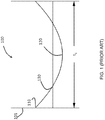
- the thermally treated glass-based article 100 exhibits a CS that decreases from the first surface 101 to a depth of compression (DOC) 130, as defined herein, at which depth the stress changes from compressive to tensile stress.
- DOC depth of compression
- the tensile stress reaches a maximum central tension (CT) at 120.
- Thermal tempering is currently limited to thick glass-based substrates (e.g., glass-based substrates having a thickness t 1 of about 3 millimeters or greater) because, to achieve the thermal strengthening and the desired residual stresses, a sufficient thermal gradient must be formed between the core of such articles and the surface.
- thick articles are undesirable or not practical in many applications such as display (e.g., consumer electronics, including mobile phones, tablets, computers, navigation systems, watches, and the like), architecture (e.g., windows, shower panels, countertops etc.), transportation (e.g., automotive, trains, aircraft, sea craft, etc.), appliance, or any application that would benefit from superior fracture resistance but thin and light-weight articles.
- chemical strengthening is not limited by the thickness of the glass-based substrate in the same manner as thermally tempering
- known chemically strengthened glass-based articles do not exhibit the stress profile of thermally tempered glass-based articles.
- An example of a stress profile generated by chemical strengthening is shown in Figure 2 .
- the chemically strengthened glass-based article 200 includes a first surface 201, a thickness t 2 and a surface CS 210.
- the glass-based article 200 exhibits a CS that decreases from the first surface 201 to a DOC 230, and reaches a maximum CT 220.
- a first aspect of this disclosure pertains to a glass-based article comprising: a first surface and a second surface opposing the first surface defining a thickness ( t ) and a center between the first surface and the second surface, the glass-based article comprising Li 2 O, ion-exchanged potassium and ion-exchanged sodium; and a stress profile comprising a hump stress region extending from the first surface (or a point below the first surface) to an apex in a range of 0.001• t and 0.1• t , a compressive stress at the apex in a range of 25 MPa and 750 MPa (or 25 MPa to 500 MPa), wherein at least one point of the hump stress region between the first surface and the apex comprises a tangent having a slope with a value from 25 MPa/micrometer to 500 MPa/micrometer, a decreasing stress region extending from the apex that decreases such that at least one point of the decreasing stress region extending
- glass-ceramic substrates may be strengthened using the chemical strengthening processes disclosed herein.
- MAS-System glass-ceramic substrates may be strengthened in Li 2 SO 4 molten salt, whereby an exchange of 2Li + for Mg 2+ can occur. Unless otherwise specified, all compositions are expressed in terms of mole percent (mol%).
- substantially is intended to note that a described feature is equal or approximately equal to a value or description.
- a “substantially planar” surface is intended to denote a surface that is planar or approximately planar.
- substantially is intended to denote that two values are equal or approximately equal.
- substantially may denote values within about 10% of each other, such as within about 5% of each other, or within about 2% of each other.
- the terms "chemical depth,” “chemical depth of layer” and “depth of chemical layer” may be used interchangeably and refer to the depth at which an ion of the metal oxide or alkali metal oxide (e.g., the metal ion or alkali metal ion) diffuses into the glass-based article and the depth at which the concentration of the ion reaches a minimum value, as determined by Electron Probe Micro-Analysis (EPMA) or Glow Discharge - Optical Emission Spectroscopy (GD-OES)).
- EPMA Electron Probe Micro-Analysis
- GD-OES Glow Discharge - Optical Emission Spectroscopy
- Compression is expressed as a negative ( ⁇ 0) stress and tension is expressed as a positive (> 0) stress, unless otherwise noted.
- Described herein are thin, chemically strengthened glass-based articles that include glasses, such as silicate glasses including alkali-containing glass, and glass-ceramics that may be used as a cover glass for mobile electronic devices and touch-enabled displays.
- glasses such as silicate glasses including alkali-containing glass, and glass-ceramics that may be used as a cover glass for mobile electronic devices and touch-enabled displays.
- the glass-based articles may also be used in displays (or as display articles) (e.g., billboards, point of sale systems, computers, navigation systems, watches, phones, and the like), architectural articles (walls, fixtures, panels, windows, etc.), transportation articles (e.g., in automotive applications, trains, aircraft, sea craft, etc.), appliances (e.g., washers, dryers, dishwashers, refrigerators and the like), or any article that would benefit from some fracture resistance.
- display articles e.g., billboards, point of sale systems, computers, navigation systems, watches, phones, and the like
- the glass-based articles described herein are thin and exhibit stress profiles that are typically achievable through thermally tempering thick glass-based substrates (i.e., having a thickness of about 3 mm or greater).
- the glass-based articles exhibit unique stress profiles along the thickness thereof.
- the glass-based articles described herein exhibit a greater surface CS than tempered glass-based articles.
- the glass-based articles have a compressive stress layer that extends deeper into the glass-based article (in which the CS decreases and increases more gradually) than known chemically strengthened glass-based articles, such glass-based article exhibits substantially improved fracture resistance, even when the glass-based article or a device including the same is dropped on a hard surface (e.g., granite) or a hard and rough surface (e.g., asphalt).
- the glass-based articles of one or more embodiments exhibit a greater maximum central tension (CT) value than some known chemically strengthened glass-based articles.
- CT central tension
- glass-based articles, including glass-based substrates and glass-based substrates used as cover glass for mobile electronic devices exhibit stable crack growth compared to existing glasses.
- Compressive stress is measured by surface stress meter (FSM) using commercially available instruments such as the FSM-6000, manufactured by Orihara Industrial Co., Ltd. (Japan).
- FSM surface stress meter
- FSM-6000 manufactured by Orihara Industrial Co., Ltd. (Japan).
- SOC stress optical coefficient
- ASTM standard C770-16 entitled "Standard Test Method for Measurement of Glass Stress-Optical Coefficient”.
- Refracted near-field (RNF) method or scattered light polariscope (SCALP) may be used to measure the stress profile.
- RNF Refracted near-field
- SCALP scattered light polariscope
- the maximum CT value provided by SCALP is utilized in the RNF method.
- the stress profile measured by RNF is force balanced and calibrated to the maximum CT value provided by a SCALP measurement.
- the RNF method is described in U.S. Patent No. 8,854,623 , entitled "Systems and methods for measuring a profile characteristic of a glass sample”.
- the RNF method includes placing the glass article adjacent to a reference block, generating a polarization-switched light beam that is switched between orthogonal polarizations at a rate of between 1 Hz and 50 Hz, measuring an amount of power in the polarization-switched light beam and generating a polarization-switched reference signal, wherein the measured amounts of power in each of the orthogonal polarizations are within 50% of each other.
- the method further includes transmitting the polarization-switched light beam through the glass sample and reference block for different depths into the glass sample, then relaying the transmitted polarization-switched light beam to a signal photodetector using a relay optical system, with the signal photodetector generating a polarization-switched detector signal.
- the method also includes dividing the detector signal by the reference signal to form a normalized detector signal and determining the profile characteristic of the glass sample from the normalized detector signal.
- DOC depth of compression
- the DOC is measured by SCALP, since it is believed the exchange depth of sodium indicates the DOC and the exchange depth of potassium ions indicates a change in the magnitude of the compressive stress (but not the change in stress from compressive to tensile); the exchange depth of potassium ions in such glass articles is measured by FSM.
- glass-based articles described herein are chemically strengthened by ion exchange and exhibit stress profiles that are distinguished from those exhibited by known strengthened glass-based articles.
- glass-based substrates are generally unstrengthened and strengthened glass-based articles generally refer to glass-based substrates that have been strengthened (by, for example, ion exchange). In this process, ions at or near the surface of the glass-based article are replaced by ⁇ or exchanged with ⁇ larger ions having the same valence or oxidation state.
- ions in the surface layer of the glass and the larger ions are monovalent alkali metal cations, such as Li + (when present in the glass-based article), Na + , K + , Rb + , and Cs + .
- Ion exchange processes are typically carried out by immersing a glass-based substrate in a molten salt bath (or two or more molten salt baths) containing the larger ions to be exchanged with the smaller ions in the glass-based substrate. It should be noted that aqueous salt baths may also be utilized.
- the composition of the bath(s) according to one or more embodiments includes more than one type of larger ion (e.g., Na+ and K+).
- parameters for the ion exchange process including, but not limited to, bath composition and temperature, immersion time, the number of immersions of the glass-based article in a salt bath (or baths), use of multiple salt baths, additional steps such as annealing, washing, and the like, are generally determined by the composition of the glass-based article (including the structure of the article and any crystalline phases present) and the desired DOC and CS of the glass-based article that results from strengthening.
- ion exchange of glass-based substrates may be achieved by immersion of the glass-based substrates in at least one molten bath containing a salt such as, but not limited to, nitrates, sulfates, and chlorides of the larger alkali metal ion.
- a salt such as, but not limited to, nitrates, sulfates, and chlorides of the larger alkali metal ion.
- Typical nitrates include KNO 3 , NaNO 3 , LiNO 3 , and combinations thereof.
- the temperature of the molten salt bath typically is in a range from about 350°C up to about 480°C, while immersion times range from about 15 minutes up to about 100 hours depending on glass thickness, bath temperature and glass (or monovalent ion) diffusivity. However, temperatures and immersion times different from those described above may also be used.
- the glass-based substrates may be immersed in a molten salt bath of 100% NaNO 3 or 100% KNO 3 having a temperature from about 350 °C to about 480 °C for times ranging from about 15 minutes up to about 100 hours depending on glass thickness, bath temperature and glass (or monovalent ion) diffusivity.
- a molten salt bath of 100% NaNO 3 or 100% KNO 3 having a temperature from about 350 °C to about 480 °C for times ranging from about 15 minutes up to about 100 hours depending on glass thickness, bath temperature and glass (or monovalent ion) diffusivity.
- all percentages are percent by weight.
- the glass-based substrate may be immersed in a molten mixed salt bath having a temperature from about 350 °C to about 480 °C and including from about 5% to about 90% KNO 3 and from about 10% to about 95% NaNO 3 for times ranging from about 15 minutes up to about 100 hours depending on glass thickness, bath temperature and glass (or monovalent ion) diffusivity.
- a molten mixed salt bath having a temperature from about 350 °C to about 480 °C and including from about 5% to about 90% KNO 3 and from about 10% to about 95% NaNO 3 for times ranging from about 15 minutes up to about 100 hours depending on glass thickness, bath temperature and glass (or monovalent ion) diffusivity.
- Ion exchange conditions can be tailored to provide a hump region in the glass-based article.
- This hump region can be achieved by single bath or multiple baths, with the bath(s) having a single composition or mixed composition, due to the unique properties of the glass compositions used in the glass-based articles described herein.
- a glass-based article 300 includes a first surface 302 and a second surface 304 opposing the first surface, defining a thickness t.
- the thickness t may be about 3 millimeters or less (e.g., in the range from about 0.01 millimeter to about 3 millimeters, from about 0.1 millimeter to about 3 millimeters, from about 0.2 millimeter to about 3 millimeters, from about 0.3 millimeter to about 3 millimeters, from about 0.4 millimeter to about 3 millimeters, from about 0.01 millimeter to about 2.5 millimeters, from about 0.01 millimeter to about 2 millimeters, from about 0.01 millimeter to about 1.5 millimeters, from about 0.01 millimeter to about 1 millimeter, from about 0.01 millimeter to about 0.9 millimeter, from about 0.01 millimeter to about 0.8 millimeter, from about 0.01 millimeter to about 0.7 mill
- the stress profile 301 includes a surface stress 310, a hump stress region 315, an apex 317, a decreasing stress region 316, a DOC 330 at which the stress profile 301 turns from compressive to tensile, a tensile stress region 325, and a maximum tensile stress 320.
- the surface stress 310 is a surface CS.
- the surface stress 310 can be a tensile stress.
- the CS at the surface 302 is about 100 MPa.
- the CT layer 325 also has an associated depth or length 327 (along the thickness) defining the CT region or layer.
- one side left, as shown in Figure 3
- the other side right, as shown in Figure 3
- the CT layer 325 for one half of the figure corresponds to the distance between the DOC 330 and the maximum CT 320, whereas for the whole stress profile (as shown in this figure) the CT layer 325 includes the entire distance 327 from DOC 330 on one side to the DOC 330 on the other side.
- the DOC may be in a range from 0.1•t to 0.25•t.
- the glass-based article has a thickness from 0.01 mm to 3 mm.
- the hump stress region 315 extends from the first surface 302 (or a point below the first surface 302) to the apex 317.
- the apex 317 in a range of 0.001•t and 0.1•t.
- the apex is from 0.003•t to 0.03•t.
- "apex" refers to the top or highest part of the hump stress region, and may be a local maximum (in some embodiments it may be higher than the surface CS and thus be an overall maximum CS, and in other embodiments, it may be lower than the surface CS and not be an overall maximum).
- the compressive stress in the hump stress region 315 increases from the first surface 302 (or apoint below the first surface 302) to the apex 317.
- a second hump stress region 315 extends from the second surface 304 (or a point below the second surface 304) to an apex 317 in a range of 0.999•t and 0.9•t.
- the apex is from 0.997•t to 0.97•t.
- the apex 317 has a CS from 25 MPa to 500 MPa (or 25 MPa to 500 MPa).
- the CS at the apex will be higher than the surface stress.
- the CS at the apex 317 is from 100 MPa to 300 MPa.
- the apex 317 has a compressive stress from 25 MPa to 750 MPa, or 25 MPa to 700 MPa, or 25 MPa to 650 MPa, or 25 MPa to 600 MPa, or 25 MPa to 550 MPa, or 25 MPa to 575 MPa, 25 MPa to 450 MPa, 25 MPa and 400 MPa, 25 MPa and 350 MPa, 25 MPa and 300 MPa, 25 MPa and 250 MPa, 25 MPa and 200 MPa, 25 MPA and 150 MPa, 25 MPa and 100 MPa, 25 MPa and 50 MPa, 50 MPa and 450 MPa, 50 MPa and 400 MPa, 50 MPa and 350 MPa, 50 MPa and 300 MPa, 50 MPa and 250 MPa, 50 MPa and 200 MPa, 50 MPA and 150 MPa, 50 MPa and 300 MPa, 50 MPa
- all points of the hump stress region 315 comprise a tangent having a slope with a value from 25 MPa/micrometer to 500 MPa/micrometer. In some embodiments at least one point of the hump stress region 315 comprises a tangent having a slope with a value from 25 MPa/micrometer to 500 MPa/micrometer.
- a stress profile is described as having a "tangent having a slope with a value"
- a mathematical formula, or curve representative of the stress profile includes such a tangent at one or more points along the curve.
- the hump stress region 315 is free, or substantially free, of flat segments.
- the hump stress region 315 includes an increasing stress region 312 that extends between the first surface 302 and the apex 317.
- at least one point of the stress profile in the increasing stress region 312 comprise a tangent having a slope with a value from 20 MPa/micrometer to 200 MPa/micrometer.
- all points of the increasing stress region 312 comprise a tangent having a slope with a value from 20 MPa/micrometer to 200 MPa/micrometer.
- the increasing stress region 312 is fee of flat segments.
- the hump stress region 315 is buried beneath the first surface 302, that is, the hump stress region 315 extends from a position beneath the first surface 302 along the thiskness direction of the substrte, and extends toward the center of the thickness.
- the second hump region is similarly buried beneath the second surface 304.
- the decreasing stress region 316 extends between the apex 317 and the DOC. In some embodiments, all points of the decreasing stress region 316 comprise a tangent having a slope with a value from -20 MPa/micrometer to -200 MPa/micrometer. In some embodiments, at least one point of the decreasing stress region 316 comprises a tangent having a slope with a value from -20 MPa/micrometer to -200 MPa/micrometer. In other embodiments, the decreasing stress region 316 is free, or substantially free, of flat segments.
- all points of the stress profile between the apex 317 and the center are in the form a power-law profile having a power exponent, wherein the power exponent is from about 1.2 to 3.4.
- all points of the stress profile between the apex 317 and the center form a power-law function in which the power exponent is from about 1.3 to about 2.8.
- power-law function refers to a curve in which the stress is exponentially proportional to the depth or thickness.
- the stress profile shown in Figure 3 can be achieved by a two-step ion exchange process.
- the stress profiles described herein and exemplified in Figure 3 provide significantly high stress at deep regions of the profile beneath the first surface 302 and second surface 304. In one or more embodiments, such stress profiles can be enhanced by the diffusion of multiple ions inside the glass.
- Glass-based substrates that contain LiO 2 enable potassium (K), sodium (Na) and lithium (Li) to be exchanged simultaneously (for example by sodium in a salt bath to be exchanged into the glass-based substrate for lithium in the glass-based substrate, and simultaneously for potassium in a salt bath to be exchanged into the glass-based substrate for sodium—either in the glass-based substrate originally or that had been exchanged into the glass-based substrate for lithium in the glass-based substrate) and the production of unique stress profiles that would be difficult to obtain in reasonable ion exchange times achieved by a single potassium ion exchange in a sodium glass-based substrate.
- ion exchange of three ions simultaneously provides for the manufacture of ion-exchanged glass-based articles with unique stress profiles.
- a scratch resistant film/coating can be deposited on one or both of the first surface or the second surface of the glass-based article.
- a high stress at the surface of the glass-based substrate is not necessary to avoid scratches.
- the hump stress region at a depth beneath the first surface can be used to provide improved drop performance or other desired attributes.
- the unique stress profiles provided herein can provide improved scratch behavior compared to existing glass-based articles.
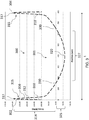
- the glass-based article 400 includes a first surface 402 and a second surface 404 opposing the first surface, defining a thickness t with a center between the first surface and the second surface (at 0.5t, and generally corresponding to the point of maximum CT 420).
- the glass-based article 400 includes a stress profile 401 that extends from the first surface 402 to the second surface 404 (or along the entire dimension of the thickness t ).
- a stress profile 401 as measured by SCALP or RNF as described herein.
- the y-axis represents the stress value and the x-axis represents the thickness or depth within the glass-based article.
- the thickness (t) is 800 micrometers (microns, ⁇ m)
- the stress profile 401 includes a CS layer 414 and a CT region 425 (with a maximum CT 420), and a DOC 430 at which the stress profile 401 turns from compressive to tensile.
- the CS layer 414 includes a surface stress region 413 (or spike region), a transition 421, a hump stress region 415, an apex 417, and a decreasing stress region 416.
- the CT layer 425 has an associated depth or length 427 (along the thickness) defining the CT region or layer.
- one side left, as shown in Figure 4
- the other side (right, as shown in Figure 4 ) may be the same, similar, or different from that explained.
- the CT layer 425 for one half of the figure corresponds to the distance between the DOC 430 and the maximum CT 420, whereas for the whole stress profile (as shown in this figure) the CT layer 425 includes the entire distance 427 from DOC 430 on one side to the DOC 430 on the other side.
- the stress at the first surface 402 can be from 0 to 1500 MPa.
- the surface stress at the first surface 402 is from about 150 MPa to 1500 MPa, or from about 200 MPa to about 1500 MPa, or from about 300 MPa to about 1500, or from about 400 MPa to about 1500, or from about 500 MPa to about 1500 MPa, or from about 600 MPa to about 1500 MPA.
- the maximum surface stress for any of the preceding ranges may be 800 MPa, 900 MPa, 1000 MPa, 1100 MPa, or 1200 MPa.
- the compressive stress at the first surface is from 650 MPa to 1100 MPa.
- the CS at the surface 402 is about 1000 MPa.
- the surface stress region 413 extends between the first surface 402 and the transition 421.
- the surface stress region 413 has a compressive stress that decreases in magnitude moving from the first surface 402 at a surface stress region maximum 419 to a surface stress region minimum that provides a transition 421.
- all points of the surface stress region 413 comprise a tangent having a slope with a value from -25 MPa/micrometer to -200 MPa/micrometer.
- all points of the surface stress region 413 comprise a tangent having a slope with a value from -30 MPa/micrometer to -170 MPa/micrometer, and in more specific embodiments from -35 MPa/micrometer to -140 MPa/micrometer.
- At least one point of the stress profile in the surface stress region 413 comprises a tangent having a slope with a value from -25 MPa/micrometer to -200 MPa/micrometer. In specific embodiments, at least one point of the stress profile in the surface stress region 413 comprises a tangent having a slope with a value from -30 MPa/micrometer to -170 MPa/micrometer, and in more specific embodiments from -35 MPa/micrometer to -140 MPa/micrometer. In some embodiments, the surface stress region 413 is free, or substantially free, of flat segments. The surface stress region 413 may also be referred to as a spike region.
- the hump stress region 415 includes an increasing stress region 412.
- the increasing stress region 412 extends between the transition 421 and the apex 417 such that all points, or at least one point, of the increasing stress region 412 comprise a tangent having a slope with a value from 20 MPa/micrometer to 200 MPa/micrometer.
- the hump stress region 415 is buried beneath the first surface 402.
- a second hump region 415 is similarly buried beneath the second surface 404.
- all points of the increasing stress region 412 comprise a tangent having a slope with a value from 20 MPa/micrometer to 200 MPa/micrometer.
- At least one point of the stress profile in the increasing stress region 412 comprises a tangent having a slope with a value from 20 MPa/micrometer to 200 MPa/micrometer. In some embodiments, the increasing stress region 412 does not include any flat segments.
- Apex 417 may be in a range of 0.001•t and 0.1•t. In specific embodiments, the apex 417 is from 0.003•t to 0.03•t. Likewise, with respect to the second surface 404, in some embodiments, a second hump stress region 415 extends from a point at the second surface 404 (or a point below the second surface 404) to an apex 417 in a range of 0. 999•t and 0.9•t. In specific embodiments, the apex is from 0.997•t and 0.97•t. The apex 417 has a CS at the apex that is from 25 MPa to 500 MPa (or from 25 MPa to 750 MPa).
- the CS at the apex will be lower than the surface stress.
- the CS at the apex 417 is from 100 MPa to 300 MPa.
- the apex 417 has a CS in a range of 25 MPa and 750 MPa, 25 MPa and 700 MPa, 25 MPa and 650 MPa, 25 MPa and 600 MPa, 25 MPa and 550 MPa, 25 MPa and 500 MPa, 25 MPa and 450 MPa, 25 MPa and 400 MPa, 25 MPa and 350 MPa, 25 MPa and 300 MPa, 25 MPa and 250 MPa, 25 MPa and 200 MPa, 25 MPA and 150 MPa, 25 MPa and 100 MPa, 25 MPa and 50 MPa, 50 MPa and 450 MPa, 50 MPa and 400 MPa, 50 MPa and 350 MPa, 50 MPa and 300 MPa, 50 MPa and 250 MPa, 50 MPa and 200 MPa, 50 MPA and 150 MPa, 50 MPa and 400 MPa, 50 MPa and 350 MP
- the surface stress region 413 and the hump stress region 415 allows for the stress profile to decrease from the surface toward the center before increasing to the apex 417.
- the decreasing stress region 416 extends between the apex 417 and the DOC 430.
- all points of the decreasing stress region 416 comprise a tangent having a slope with a value from -20 MPa/micrometer to -200 MPa/micrometer.
- at least one point of the stress profile in the decreasing stress region 416 comprises a tangent having a slope with a value from -20 MPa/micrometer to -200 MPa/micrometer.
- the decreasing stress region 416 is free, or substantially free, of flat segments.
- the DOC is from 0.1•t to 0.25•t, and the tensile stress region 425 extends from the DOC 430 to the maximum tensile stress 420.
- all points of the stress profile between the apex 417 and the center are in the form a power-law function having a power exponent, wherein the power exponent is from about 1.2 to about 3.4. In some embodiments, all points of the stress profile between the apex 417 and the center form a power-law function having a power exponent is from about 1.3 to about 2.8.
- power-law function refers to a curve in which the stress is exponentially proportional to the depth or thickness.
- Li 2 O is present in the glass-based article and/or glass-based substrate in a range of 0.1 mol% and 20 mol%, and in more specific embodiments, from 0.1 mol% to 10 mol%.
- P 2 O 5 is present in the glass-based article and/or glass-based substrate in a range of 0.1 mol% and 10 mol%.
- the glass-based article having the profile 401 shown in Figure 4 is made using a three-step ion exchange process.
- the glass-based articles described herein may be made by a two-step ion exchange process or a three-step ion exchange process, and exhibit improved crack growth stability compared to a glass-based article made by single step ion exchange process.
- the glass based articles described herein may further include a coating on one or both the first surface and the second surface, for example, a scratch resistant coating.
- the glass-based article includes a stress profile that is free, or substantially free, of any flat segments that extend in a depth direction or along at least a portion of the thickness t of the glass-based article.
- the stress profile is substantially continuously increasing or decreasing along the thickness t.
- the stress profile is free, or substantially free, of any flat segments in a depth direction having a length of about 10 micrometers or more, about 50 micrometers or more, or about 100 micrometers or more, or about 200 micrometers or more.
- the term "flat" refers to a slope having a magnitude of less than about 5 MPa/micrometer, or less than about 2 MPa/micrometer, or less than about 1 MPa/micrometer, or less than 0.5 MPa/micrometer, or less than 0.3 MPa/micrometer, or less than 0.2 MPa/micrometer, or less than 0.1 MPa/micrometer, down to and including zero slope, along the segment.
- one or more portions of the stress profile that are free, or substantially free, of any flat segments in a depth direction are present at depths within the glass-based article of about 5 micrometers or greater (e.g., 10 micrometers or greater, or 15 micrometers or greater) from either one or both the first surface or the second surface.
- the stress profile may include flat segments, but from a depth of about 5 micrometers or greater from the first surface, the stress profile may be free, or substantially free, of flat segments.
- the stress profile may be modified by heat treatment.
- the heat treatment may occur before any ion-exchange processes, between ion-exchange processes, or after all ion-exchange processes.
- the heat treatment may reduce the slope of the stress profile at or near the surface.
- an ion-exchange process after the heat treatment may be utilized to provide a "spike" or to increase the slope of the stress profile at or near the surface.
- the stress profile is generated due to a non-zero concentration of a metal oxide(s) that varies along a portion of the thickness.
- the variation in metal oxide concentration may be referred to herein as a metal oxide concentration gradient.
- the concentration of metal oxide may include more than one metal oxide (e.g., a combination of Na 2 O and K 2 O.
- the concentration of ions having a larger radius is greater than the concentration of ions having a smaller radius at shallow depths, while the at deeper depths, the concentration of ions having a smaller radius is greater than the concentration of ions having larger radius.
- the concentration of K+ ions in the glass-based article is greater than the concentration of Na+ ions at shallower depths, while the concentration of Na+ is greater than the concentration of K+ ions at deeper depths.
- the area at or near the surface comprises a greater CS due to the greater amount of larger ions (e.g., K+ ions) at or near the surface.
- This greater CS may be exhibited by a stress profile having a steeper slope at or near the surface (e.g., a spike in the stress profile at the surface).
- the concentration gradient or variation of one or more metal oxides is created by chemically strengthening a glass-based substrate, as previously described herein, in which a plurality of first metal ions in the glass-based substrate is exchanged with a plurality of second metal ions.
- the first ions may be ions of lithium, sodium, potassium, and rubidium.
- the second metal ions may be ions of one of sodium, potassium, rubidium, and cesium, with the proviso that the second alkali metal ion has an ionic radius greater than the ionic radius than the first alkali metal ion.
- the second metal ion is present in the glass-based substrate as an oxide thereof (e.g., Na 2 O, K 2 O, Rb 2 O, Cs 2 O, , or a combination thereof).
- the metal oxide concentration gradient extends through a substantial portion of the thickness t or the entire thickness t of the glass-based article, including the CT layer. In one or more embodiments, the concentration of the metal oxide is about 0.5 mol% or greater in the CT layer. In some embodiments, the concentration of the metal oxide may be about 0.5 mol% or greater (e.g., about 1 mol% or greater) along the entire thickness of the glass-based article, and is greatest at the first surface and/or the second surface and decreases substantially constantly to a value at a point between the first surface and the second surface. At that point, the concentration of the metal oxide is the least along the entire thickness t ; however the concentration is also non-zero at that point.
- the non-zero concentration of that particular metal oxide extends along a substantial portion of the thickness t (as described herein) or the entire thickness t.
- the lowest concentration in the particular metal oxide is in the CT layer.
- the total concentration of the particular metal oxide in the glass-based article may be in the range from about 1 mol% to about 20 mol%.
- the glass-based article includes a first metal oxide concentration and a second metal oxide concentration, such that the first metal oxide concentration is in the range from about 0 mol% to about 15 mol% along a first thickness range from about 0t to about 0.5t, and the second metal oxide concentration is in the range from about 0 mol% to about 10 mol% from a second thickness range from about 0 micrometers to about 25 micrometers (or from about 0 micrometers to about 12 micrometers, or from about 2 microns to about 25 microns, or from about 2 microns to about 22 microns, or from about 2 microns to about 20 microns, or from about 2 microns to about 19 microns, or from about 2 microns to about 18 microns, or from about 2 microns to about 17 microns, or from about 2 microns to about 16 microns, or from about 2 microns to about 15 microns, or from about 2 microns to about 14 microns, or from about
- the glass-based article may include an optional third metal oxide concentration.
- the first metal oxide may include Na 2 O, while the second metal oxide may include K 2 O.
- the concentration of the metal oxide may be determined from a baseline amount of the metal oxide in the glass-based substrate prior to being modified to include the concentration gradient of such metal oxide.
- the glass-based substrate comprises a high liquidus viscosity that enables the formation of the glass-based substrates via down-draw techniques (e.g., fusion draw, slot draw, and other like methods), which can provide high precision surface smoothness.
- liquidus viscosity refers to the viscosity of a molten glass at the liquidus temperature
- liquidus temperature refers to the temperature at which crystals first appear as a molten glass cools down from the melting temperature (or the temperature at which the very last crystals melt away as temperature is increased from room temperature).
- the glasses used to make glass-based substrates (or articles) described herein have a liquidus viscosity of about 100 kilopoise (kP) or greater.
- the glasses used to make the glass-based substrates (or articles) exhibit a liquidus viscosity of about 200 kP or more (e.g., about 300 kP or greater, or about 400 kP or greater, or about 500 kP or greater, or 600 kP or greater).
- the liquidus viscosity is determined by the following method.
- liquidus temperature of the glass is measured in accordance with ASTM C829-81 (2015), titled “Standard Practice for Measurement of Liquidus Temperature of Glass by the Gradient Furnace Method”.
- viscosity of the glass at the liquidus temperature is measured in accordance with ASTM C965-96(2012), titled “Standard Practice for Measuring Viscosity of Glass Above the Softening Point”.
- the glass-based article exhibits improved drop Fracture performance when it includes a compressive stress profile according to the concepts described herein than if the same glass-based article does not include a compressive stress profile according to the concepts described herein. Fracture performance is evaluated with a Drop Test, as described here.
- an abrasive surface of silicon carbide or alumina engineered sandpaper comprising either 30 grit, or 180 grit.
- sandpaper having 30 grit is used, as it has a surface topography that is more consistent than either concrete or asphalt, and a particle size and sharpness that produces the desired level of specimen surface damage.
- the term "fracture" means that a crack propagates across the entire thickness and/or entire surface of a substrate when the substrate is dropped or impacted by an object.
- a glass-based article is retrofit to an i-phone ® 3G as the cover glass.
- the phone is then face-dropped (i.e., with the cover glass facing downward) onto an abrasive surface (specified as either 180 grit sandpaper, or 30 grit sandpaper) which is facing up.
- the sandpaper is supported on a standard aluminum test stage.
- the phone is first dropped from a height of 20 cm. If the glass-based article does not fracture, the phone is dropped again in a similar manner from 10 cm higher (or 30 cm) onto the same sandpaper. If the phone again survives the previous drop height, the height is incremented 10 cm, and so on until the maximum drop height is attained.
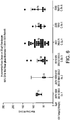
- the maximum drop height is either the stated test maximum, or glass-based article failure by fracture. If a sample fails a particular drop height, that drop height is denoted by a black dot and, accordingly, the sample survived a drop height that is 10 cm less than the height indicated by the black dot. If a sample passes the maximum drop height, such is indicated by a gray dot. Accordingly, for example, looking at FIG. 5 , for Example 1, four samples passed the maximum drop height of 220 cm, and the average drop height survived was 192 cm for the 10 samples shown in that figure. A new piece of sandpaper is used for each sample, and that same piece of sandpaper is used for all drop heights for that sample.
- FIG. 5 shows the results of a Drop Test with various samples (Examples 1 and 2, as well as Comparative Examples 4-6), using 180 grit sandpaper, and a test maximum height of 220 cm.
- FIG. 6 shows the results of a Drop Test with various samples (Examples 1 and 2, as well as Comparative Examples 4-6), using 30 grit sandpaper, and a test maximum height of 220 cm, wherein each of the samples was one that previously survived the Drop Test of FIG. 5 , i.e., they each had survived a 220 cm maximum drop height onto 180 grit sandpaper.
- FIG. 6 although none of the samples survived the full 220 cm drop height, it can be said that for Example 1, for example, four out of four samples (or 100%) survived a maximum height of 50 cm or more.
- At least five identical (or nearly identical) samples i.e., having approximately the same composition and, if strengthened, approximately the same compressive stress and depth of compression / depth of layer
- larger numbers e.g., 10, 20, 30, etc.
- Each sample is dropped from progressively higher heights and, if no fracture occurs, until the predetermined height is reached, and visually (i.e., with the naked eye) examined for evidence of fracture (crack formation and propagation across the entire thickness and/or entire surface of a sample).
- a sample is deemed to have "survived” the drop test if no fracture is observed after being dropped from the predetermined height, and a sample is deemed to have "failed (or "not survived") if fracture is observed when the sample is dropped from a height that is less than or equal to the predetermined height.
- the survivability rate is determined to be the percentage of the sample population that survived the drop test. For example, if 7 samples out of a group of 10 did not fracture when dropped from the predetermined height, the survivability rate of the glass would be 70%.
- embodiments of the glass-based article described herein have about a 60% or more survival rate when dropped onto the specified grit sandpaper from a specified height.
- a glass-based article is described as having a 60% survival rate when dropped from a given height when three of five identical (or nearly identical) samples (as described below) survive the Drop Test without fracture when dropped from the prescribed height (here 100 cm).
- the survival rate in the 100 cm Drop Test (with 180 grit sandpaper) of the glass-based articles that are strengthened is about 70% or more, in other embodiments, about 80% or more, and, in still other embodiments, about 90% or more.
- the survival rate of the strengthened glass-based articles dropped from a height of 50 cm in Drop Test is about 60% or more, in other embodiments, about 70% or more, in still other embodiments, about 80% or more, and, in other embodiments, about 90% or more.
- the survival rate of the strengthened glass-based articles dropped from a height of 225 cm in the Drop Test is about 50% or more, in other embodiments, about 60% or more, in other embodiments, about 70% or more, in still other embodiments, about 80% or more, and, in other embodiments, about 90% or more.
- the average drop height (with at least 10 samples tested) for the strengthened glass-based articles surviving the Drop Test is about 150 cm or more, in some embodiments about 160 cm or more, in some embodiments about 170 cm or more, in some embodiments about 180 cm or more, in some embodiments about 190 cm or more. In some embodiments, the average drop height (with at least 2 samples tested) for the strengthened glass-based articles surviving the Drop Test (with 30 grit sandpaper) is about 40 cm or more, in some embodiments about 50 cm or more, in some embodiments about 60 cm or more, in some embodiments about 70 cm or more.
- the glass-based articles described herein may be transparent.
- the glass-based article may have a thickness of about 1 millimeter or less and exhibit a transmittance of about 88% or greater over a wavelength in the range from about 380 nm to about 780 nm.
- the glass-based articles exhibit a drop performance which averages greater than 100 cm when an 180 grit paper is used for a glass-based article of 0.8 mm is tested in the Drop Test.
- the glass-based article may be described as having a high cation diffusivity for ion exchange.
- the glass or glass-ceramic has fast ion-exchange capability, e.g., where diffusivity is greater than 500 ⁇ m 2 /hr or may be characterized as greater than 450 ⁇ m 2 /hour at 460 °C.
- the glass or glass-ceramic exhibits a sodium ion diffusivity that is about 450 ⁇ m 2 /hour or greater at 460 °C or is about 500 ⁇ m 2 /hour or greater at 460 °C.
- the glass or glass-ceramic exhibits a potassium ion diffusivity that is about 450 ⁇ m 2 /hour or greater at 460 °C or is about 500 ⁇ m 2 /hour or greater at 460 °C.
- the glass-based article may include an amorphous substrate, a crystalline substrate or a combination thereof (e.g., a glass-ceramic substrate).
- the glass-based substrate (prior to being chemically strengthened into a glass-based article, as described herein) may include a glass composition, in mole percent (mole%), including: SiO 2 in the range from about 40 to about 80, Al 2 O 3 in the range from about 10 to about 30, B 2 O 3 in the range from about 0 to about 10, R 2 O in the range from about 0 to about 20, and RO in the range from about 0 to about 15.
- R 2 O refers to the total amount of alkali metal oxides such as Li 2 O, Na 2 O, K 2 O, Rb 2 O, and Cs 2 O.
- RO refers to the total amount of alkaline earth metal oxides such as MgO, CaO, SrO, BaO, ZnO and the like.
- the composition may include either one or both of ZrO 2 in the range from about 0 mol% to about 5 mol% and P 2 O 5 in the range from about 0 to about 15 mol%.
- TiO 2 can be present from about 0 mol% to about 2 mol%.
- the glass composition may include SiO 2 in an amount, in mol%, in the range from about 45 to about 80, from about 45 to about 75, from about 45 to about 70, from about 45 to about 65, from about 45 to about 60, from about 45 to about 65, from about 45 to about 65, from about 50 to about 70, from about 55 to about 70, from about 60 to about 70, from about 60 to about 72, from about 68 to about 75, from about 70 to about 75, from about 70 to about 72, from about 50 to about 65, or from about 60 to about 65.
- the glass composition may include Al 2 O 3 in an amount, in mol%, in the range from about 5 to about 28, from about 5 to about 26, from about 5 to about 25, from about 5 to about 24, from about 5 to about 22, from about 5 to about 20, from about 6 to about 30, from about 6 to about 10, from about 8 to about 30, from about 10 to about 30, from about 12 to about 30, from about 14 to about 30, 15 to about 30, from about 12 to about 18, from about 6 to about 28, from about 6 to about 26, from about 6 to about 25, from about 6 to about 24, from about 6 to about 22, from about 6 to about 20, from about 6 to about 19, from about 7 to about 18, from about 7 to about 17, from about 7 to about 16, from about 7 to about 15, from about 7 to about 28, from about 7 to about 26, from about 7 to about 25, from about 7 to about 24, from about 7 to about 22, from about 7 to about 20, from about 7 to about 19, from about 7 to about 18, from about 7 to about 17, from about 7 to about 16, from about 7 to about 15, from about 7 to about 28, from about 7 to about 26, from about 7 to about 25, from
- the glass composition may include B 2 O 3 in an amount, in mol%, in the range from about 0 to about 8, from about 0 to about 6, from about 0 to about 4, from about 0.1 to about 10, from about 0.1 to about 8, from about 0.1 to about 6, from about 0.1 to about 4, from about 0.5 to about 5, from about 1 to about 10, from about 2 to about 10, from about 4 to about 10, from about 2 to about 8, from about 0.1 to about 5, or from about 1 to about 3.
- the glass composition may be free, or substantially free, of B 2 O 3 .
- the phrases “substantially free” or “free” with respect to the components of the composition means that the component is not actively or intentionally added to the composition during initial batching, but may be present as an impurity in an amount less than about 0.001 mol%.
- the glass composition may include one or more alkaline earth metal oxides, such as MgO, CaO and ZnO.
- the total amount of the one or more alkaline earth metal oxides may be a non-zero amount up to about 15 mol%.
- the total amount of any of the alkaline earth metal oxides may be a non-zero amount up to about 14 mol%, up to about 12 mol%, up to about 10 mol%, up to about 8 mol%, up to about 6 mol%, up to about 4 mol%, up to about 2 mol%, or up about 1.5 mol%.
- the total amount, in mol%, of the one or more alkaline earth metal oxides may be in the range from about 0.01 to 10, from about 0.01 to 8, from about 0.01 to 6, from about 0.01 to 5, from about 0.05 to 10, from about 0.05 to 2, or from about 0.05 to 1.
- the amount of MgO may be in the range from about 0 mol% to about 5 mol% (e.g., from about 0.001 to about 1, from about 0.01 to about 2, or from about 2 to about 4, from about 1 to about 4).
- the amount of CaO may be in the range from about 0 mol% to about 5 mol% (e.g., from about 0.001 to about 1, from about 0.01 to about 2, or from about 2 to about 4, from about 1 to about 4).
- the amount of ZnO may be in the range from about 0 to about 3 mol%, from about 0 to about 2 mol% (e.g., from about 1 mol% to about 2 mol%).
- the amount of CaO may be from about 0 mol% to about 2 mol% (e.g., from about 1 to about 2).
- the glass composition may include MgO and may be free, or substantially free, of CaO and ZnO.
- the glass composition may include any one of CaO or ZnO and may be free, or substantially free, of the others of MgO, CaO and ZnO.
- the glass composition may include only two of the alkaline earth metal oxides of MgO, CaO and ZnO and may be free, or substantially free, of the third of the earth metal oxides.
- the total amount of MgO + CaO + ZnO is, in mol%, from about 0.1 to about 14, from about 0.1 to about 12, from about 0.1 to about 10, from about 0.1 to about 9, from about 0.1 to about 8. from about 0.1 to about 7, from about 0.1 to about 6, from about 0.1 to about 5.
- the total amount, in mol%, of alkali metal oxides R 2 O in the glass composition may be in the range from about 5 to about 20, from about 5 to about 18, from about 5 to about 16, from about 5 to about 15, from about 5 to about 14, from about 5 to about 12, from about 5 to about 10, from about 5 to about 8, from about 5 to about 20, from about 6 to about 20, from about 7 to about 20, from about 8 to about 20, from about 9 to about 20, from about 10 to about 20, from about 11 to about 20, from about 12 to about 18, or from about 14 to about 18.
- the total amount of Li 2 O + Na 2 O + K 2 O is, in mol%, from about 5 to about 15, from about 5 to about 14, from about 5 to about 12, from about 5 to about 10.
- the glass composition includes Na 2 O in an amount in the range from about 0 mol% to about 18 mol%, from about 0 mol% to about 16 mol% or from about 0 mol% to about 14 mol%, from about 0 mol% to about 12 mol%, from about 0 to about 10, from about 0 to about 8, from about 0 to about 6, from about 0.1 to about 6, from about 2 mol% to about 18 mol%, from about 4 mol% to about 18 mol%, from about 6 mol% to about 18 mol%, from about 8 mol% to about 18 mol%, from about 8 mol% to about 14 mol%, from about 8 mol% to about 12 mol%, or from about 10 mol% to about 12 mol%.
- the composition may include about 4 or more mol% Na 2 O.
- the amount of Li 2 O and Na 2 O is controlled to a specific amount or ratio to balance formability and ion exchangeability. For example, as the amount of Li 2 O increases, the liquidus viscosity may be reduced, thus preventing some forming methods from being used; however, such glass compositions are ion exchanged to deeper DOC levels, as described herein.
- the amount of Na 2 O can modify liquidus viscosity but can inhibit ion exchange to deeper DOC levels.
- the glass composition may include K 2 O in an amount less than about 5 mol%, less than about 4 mol%, less than about 3 mol%, less than about 2 mol%, or less than about 1 mol%.
- the glass composition may include Li 2 O in an amount about 0 mol% to about 18 mol%, from about 0 mol% to about 15 mol% or from about 0 mol% to about 10 mol%, from about 0 mol% to about 8 mol%, from about 0 mol% to about 6 mol%, from about 0 mol% to about 4 mol% or from about 0 mol% to about 2 mol%., from about 2 to about 15, from about 2 to about 14, from about 2 to about 12, from about 2 to about 10, from about 2 to about 9.
- the glass composition may include Li 2 O in an amount about 1 mol% to about 20 mol%, 2 mol% to about 10 mol%, from about 4 mol% to about 10 mol%, from about 5 mol% to about 15 mol%, from about 5 mol% to about 10 mol%, from about 6 mol% to about 10 mol, or from about 5 mol% to about 8 mol%.
- the glass composition may include Fe 2 O 3 .
- Fe 2 O 3 may be present in an amount less than about 1 mol%, less than about 0.9 mol%, less than about 0.8 mol%, less than about 0.7 mol%, less than about 0.6 mol%, less than about 0.5 mol%, less than about 0.4 mol%, less than about 0.3 mol%, less than about 0.2 mol%, less than about 0.1 mol% and all ranges and sub-ranges therebetween.
- the glass composition may be free, or substantially free, of Fe 2 O 3 .
- the glass composition may include ZrO 2 .
- ZrO 2 may be present in an amount less than about 1 mol%, less than about 0.9 mol%, less than about 0.8 mol%, less than about 0.7 mol%, less than about 0.6 mol%, less than about 0.5 mol%, less than about 0.4 mol%, less than about 0.3 mol%, less than about 0.2 mol%, less than about 0.1 mol% and all ranges and sub-ranges therebetween, including from about 0.1 to about 1, 0.1 to about 0.9, from about 0.1 to about 0.8 from about 0.1 to about 0.7, from about 0.1 to about 0.6, from about 0.1 to about 0.5.
- the glass composition may be free, or substantially free, of ZrO 2 .
- the glass composition may include P 2 O 5 in a range from about 0 mol% to about 10 mol%, from about 0 mol% to about 8 mol%, from about 0 mol% to about 6mol%, from about 0 mol% to about 4 mol%, from about 0.1 mol% to about 10 mol%, from about 0.1 mol% to about 8 mol%, from about 2 mol% to about 8 mol%, from about 2 mol% to about 6 mol% or from about 2 mol% to about 4 mol%.
- the glass composition may be free, or substantially free, of P 2 O 5 .
- the glass composition may include TiO 2 .
- TiO 2 may be present in an amount less than about 6 mol%, less than about 4 mol%, less than about 2 mol%, or less than about 1 mol%.
- the glass composition may be free, or substantially free, of TiO 2 .
- TiO 2 is present in an amount in the range from about 0.1 mol% to about 6 mol%, or from about 0.1 mol% to about 4 mol%.
- the glass composition includes a combined amount of Al 2 O 3 and Na 2 O greater than about 15 mol% (e.g., greater than 18 mol%, greater than about 20 mol%, or greater than about 23 mol%).
- the combined amount of Al 2 O 3 and Na 2 O may be up to and including about 30 mol%, about 32 mol% or about 35 mol%.
- the compositions used for the glass-based substrate may be batched with from about 0 mol% to about 2 mol% of at least one fining agent selected from a group that includes Na 2 SO 4 , NaCl, NaF, NaBr, K 2 SO 4 , KCl, KF, KBr, and SnO 2 .
- the glass composition according to one or more embodiments may further include SnO 2 in the range from about 0 to about 2, from about 0 to about 1, from about 0.1 to about 2, from about 0.1 to about 1, or from about 1 to about 2.
- the glass compositions disclosed herein may be free, or substantially free, of As 2 O 3 and/or Sb 2 O 3 .
- Some embodiments of this paragraph may further include any one or more of the following: from about 5 mol.% to about 28 mol.% Al 2 O 3 ; Al 2 O 3 is present in an amount from about 5 mol.% to about 20 mol.% from about 0 mol.% to about 8 mol.% B 2 O 3 ; from about 0 mol.% to about 6 mol.% Na 2 O; from about 1 mol.% to about 2 mol.% CaO; the glass is substantially free of ZrO 2 ; a difference between R 2 O and Al 2 O 3 is from about -5 to about 0; a ratio of MgO to RO is from about 0 to about 2, wherein RO is the sum (mol.%) of BaO, CaO, MgO, PbO, SrO, and ZnO in the glass; form about 0 mol.% to about 2 mol.% SnO 2 .
- an easy-to-clean (ETC) coating is on the first surface and/or second surface of the glass based articles described herein.
- ETC coatings are applied to minimize and/or prevent stains and/or fingerprints on the glass-based articles.
- Figure 6 shows the results for 30 grit sandpaper, wherein: Example 1 had an average drop height of 73 cm (above 70 cm) for at least 4 samples, and this drop height is comparable to those of Comparative Examples 3-6; Example 2 had an average drop height of 45 cm (above 40 cm) for at least 2 samples, which is a bit lower than those of Comparative Examples 3-6; Example 1 had a survival rate of 100% for at least 4 samples wherein maximum drop height is 50 cm.
- the two-step IOX Example 1 performs very well, while the three step IOX (Example 2) seemed to not perform as well as the two-step IOX or the comparative examples.
- Comparative Example 4 shows a scratch "length" (horizontal distance between the vertical lines, denoted by double arrow-headed line, at the widest part of the scratch) of 345 microns, 406 microns, and 345 microns, for the three samples.
- the average scratch length was 365 microns, and the shortest length was 345 microns.
- Example 1 shows a scratch length of 233 microns, 224 microns, and 294 microns, for the three samples.
- the average scratch length was 250 microns, and the shortest length was 224 microns.
Landscapes
- Chemical & Material Sciences (AREA)
- Life Sciences & Earth Sciences (AREA)
- Engineering & Computer Science (AREA)
- Chemical Kinetics & Catalysis (AREA)
- General Chemical & Material Sciences (AREA)
- Geochemistry & Mineralogy (AREA)
- Materials Engineering (AREA)
- Organic Chemistry (AREA)
- Ceramic Engineering (AREA)
- Surface Treatment Of Glass (AREA)
- Glass Compositions (AREA)
- Devices For Indicating Variable Information By Combining Individual Elements (AREA)
Applications Claiming Priority (2)
| Application Number | Priority Date | Filing Date | Title |
|---|---|---|---|
| US201862621241P | 2018-01-24 | 2018-01-24 | |
| PCT/US2019/014838 WO2019147733A1 (en) | 2018-01-24 | 2019-01-23 | Glass-based articles having high stress magnitude at depth |
Publications (2)
| Publication Number | Publication Date |
|---|---|
| EP3743394A1 EP3743394A1 (en) | 2020-12-02 |
| EP3743394B1 true EP3743394B1 (en) | 2021-12-15 |
Family
ID=65529770
Family Applications (1)
| Application Number | Title | Priority Date | Filing Date |
|---|---|---|---|
| EP19707516.1A Active EP3743394B1 (en) | 2018-01-24 | 2019-01-23 | Glass-based articles having high stress magnitude at depth |
Country Status (7)
| Country | Link |
|---|---|
| US (1) | US11724965B2 (https=) |
| EP (1) | EP3743394B1 (https=) |
| JP (1) | JP7312756B2 (https=) |
| KR (1) | KR102614080B1 (https=) |
| CN (1) | CN111918845B (https=) |
| TW (1) | TWI705048B (https=) |
| WO (1) | WO2019147733A1 (https=) |
Families Citing this family (5)
| Publication number | Priority date | Publication date | Assignee | Title |
|---|---|---|---|---|
| JP6794866B2 (ja) * | 2017-02-15 | 2020-12-02 | Agc株式会社 | 化学強化ガラスおよびその製造方法 |
| KR20210106515A (ko) * | 2018-12-25 | 2021-08-30 | 니폰 덴키 가라스 가부시키가이샤 | 강화 유리판 및 그 제조 방법 |
| KR102685221B1 (ko) * | 2019-12-16 | 2024-07-16 | 삼성디스플레이 주식회사 | 유리 제품 및 이를 포함하는 디스플레이 장치 |
| KR102816247B1 (ko) * | 2019-12-17 | 2025-06-04 | 삼성디스플레이 주식회사 | 유리 제품 및 그 제조 방법 |
| KR102751151B1 (ko) * | 2019-12-20 | 2025-01-07 | 삼성디스플레이 주식회사 | 유리 제품 및 이를 포함하는 디스플레이 장치 |
Family Cites Families (35)
| Publication number | Priority date | Publication date | Assignee | Title |
|---|---|---|---|---|
| AU3488800A (en) | 1999-02-12 | 2000-08-29 | Pennsylvania State University, The | Strengthening, crack arrest and multiple cracking in brittle materials using residual stresses |
| US6472068B1 (en) | 2000-10-26 | 2002-10-29 | Sandia Corporation | Glass rupture disk |
| ITTO20010673A1 (it) | 2001-07-10 | 2003-01-10 | Uni Di Trento Dipartiment O Di | Vetro con funzionalita' di sensore di frattura, di sforzo e deformazione e relativo metodo di realizzazione. |
| DE102004022629B9 (de) | 2004-05-07 | 2008-09-04 | Schott Ag | Gefloatetes Lithium-Aluminosilikat-Flachglas mit hoher Temperaturbeständigkeit, das chemisch und thermisch vorspannbar ist und dessen Verwendung |
| CN101689376B (zh) | 2007-09-28 | 2012-07-11 | Hoya株式会社 | 磁盘用玻璃基板及其制造方法、磁盘 |
| WO2009041618A1 (ja) | 2007-09-28 | 2009-04-02 | Hoya Corporation | 磁気ディスク用ガラス基板及びその製造方法、磁気ディスク |
| US8232218B2 (en) | 2008-02-29 | 2012-07-31 | Corning Incorporated | Ion exchanged, fast cooled glasses |
| JP2011527661A (ja) | 2008-07-11 | 2011-11-04 | コーニング インコーポレイテッド | 民生用途のための圧縮面を有するガラス |
| US8193128B2 (en) | 2009-06-17 | 2012-06-05 | The Penn State Research Foundation | Treatment of particles for improved performance as proppants |
| BR112012019306A2 (pt) | 2010-02-02 | 2018-05-08 | Apple Inc | vidro de reforço melhorado quimicamente de coberturas para dispositivos eletrônicos portáteis |
| FR2964655B1 (fr) * | 2010-09-13 | 2017-05-19 | Saint Gobain | Feuille de verre |
| US8950215B2 (en) | 2010-10-06 | 2015-02-10 | Apple Inc. | Non-contact polishing techniques for reducing roughness on glass surfaces |
| EP2646243B1 (en) | 2010-11-30 | 2016-02-03 | Corning Incorporated | Glass with surface and central regions under compression |
| US20120216569A1 (en) | 2011-02-24 | 2012-08-30 | Douglas Clippinger Allan | Method of producing constancy of compressive stress in glass in an ion-exchange process |
| US20120216565A1 (en) | 2011-02-24 | 2012-08-30 | Douglas Clippinger Allan | Method of producing constancy of compressive stress in glass in an ion exchange process |
| US9140543B1 (en) | 2011-05-25 | 2015-09-22 | Corning Incorporated | Systems and methods for measuring the stress profile of ion-exchanged glass |
| WO2013116420A1 (en) | 2012-02-01 | 2013-08-08 | Corning Incorporated | Method of producing constancy of compressive stress in glass in an ion-exchange process |
| US9359251B2 (en) | 2012-02-29 | 2016-06-07 | Corning Incorporated | Ion exchanged glasses via non-error function compressive stress profiles |
| US8854623B2 (en) | 2012-10-25 | 2014-10-07 | Corning Incorporated | Systems and methods for measuring a profile characteristic of a glass sample |
| US9714192B2 (en) | 2013-02-08 | 2017-07-25 | Corning Incorporated | Ion exchangeable glass with advantaged stress profile |
| US11079309B2 (en) | 2013-07-26 | 2021-08-03 | Corning Incorporated | Strengthened glass articles having improved survivability |
| US10442730B2 (en) | 2013-11-25 | 2019-10-15 | Corning Incorporated | Method for achieving a stress profile in a glass |
| US20150166407A1 (en) * | 2013-12-08 | 2015-06-18 | Saxon Glass Technologies, Inc. | Strengthened glass and methods for making utilizing electric field assist |
| CN107207315A (zh) | 2014-08-28 | 2017-09-26 | 康宁股份有限公司 | 具有扩散性对比反差的可离子交换芯层和包覆层的层叠玻璃制品及其制造方法 |
| CN108046589A (zh) * | 2014-10-08 | 2018-05-18 | 康宁股份有限公司 | 包含金属氧化物浓度梯度的玻璃和玻璃陶瓷 |
| US10150698B2 (en) | 2014-10-31 | 2018-12-11 | Corning Incorporated | Strengthened glass with ultra deep depth of compression |
| CN108137396B (zh) * | 2015-10-14 | 2022-04-26 | 康宁股份有限公司 | 具有确定的应力分布的层压玻璃制品及其形成方法 |
| US10611681B2 (en) * | 2015-12-08 | 2020-04-07 | Corning Incorporated | S-shaped stress profiles and methods of making |
| TWI697463B (zh) * | 2015-12-11 | 2020-07-01 | 美商康寧公司 | 具有金屬氧化物濃度梯度之可熔融成形的玻璃基物件 |
| WO2017126605A1 (ja) | 2016-01-21 | 2017-07-27 | 旭硝子株式会社 | 化学強化ガラス及び化学強化ガラスの製造方法 |
| KR20200091500A (ko) * | 2016-04-08 | 2020-07-30 | 코닝 인코포레이티드 | 두 영역을 포함하는 응력 프로파일을 포함하는 유리-계 물품, 및 제조 방법 |
| US11059744B2 (en) * | 2016-06-14 | 2021-07-13 | Corning Incorporated | Glasses having improved drop performance |
| JP6794866B2 (ja) | 2017-02-15 | 2020-12-02 | Agc株式会社 | 化学強化ガラスおよびその製造方法 |
| CN112839913B (zh) * | 2018-10-09 | 2023-03-28 | 日本电气硝子株式会社 | 强化玻璃及强化玻璃的制造方法 |
| KR102746130B1 (ko) * | 2019-01-18 | 2024-12-26 | 에이지씨 가부시키가이샤 | 화학 강화 유리 및 그 제조 방법 |
-
2019
- 2019-01-23 WO PCT/US2019/014838 patent/WO2019147733A1/en not_active Ceased
- 2019-01-23 US US16/964,442 patent/US11724965B2/en active Active
- 2019-01-23 CN CN201980020804.9A patent/CN111918845B/zh active Active
- 2019-01-23 KR KR1020207023810A patent/KR102614080B1/ko active Active
- 2019-01-23 EP EP19707516.1A patent/EP3743394B1/en active Active
- 2019-01-23 JP JP2020540793A patent/JP7312756B2/ja active Active
- 2019-01-24 TW TW108102664A patent/TWI705048B/zh not_active IP Right Cessation
Also Published As
| Publication number | Publication date |
|---|---|
| US11724965B2 (en) | 2023-08-15 |
| US20210047237A1 (en) | 2021-02-18 |
| EP3743394A1 (en) | 2020-12-02 |
| KR20200110695A (ko) | 2020-09-24 |
| CN111918845A (zh) | 2020-11-10 |
| JP7312756B2 (ja) | 2023-07-21 |
| KR102614080B1 (ko) | 2023-12-14 |
| CN111918845B (zh) | 2023-06-09 |
| TWI705048B (zh) | 2020-09-21 |
| JP2021511281A (ja) | 2021-05-06 |
| TW201934513A (zh) | 2019-09-01 |
| WO2019147733A1 (en) | 2019-08-01 |
Similar Documents
| Publication | Publication Date | Title |
|---|---|---|
| US20230382784A1 (en) | Glasses with low excess modifier content | |
| US10934209B2 (en) | Glass-based articles having improved fracture performance | |
| TWI810155B (zh) | 具有改良掉落性能之玻璃 | |
| EP3743394B1 (en) | Glass-based articles having high stress magnitude at depth | |
| US11453612B2 (en) | Glass-based articles including a metal oxide concentration gradient | |
| WO2019191480A1 (en) | Glasses having high fracture toughness | |
| US11968794B2 (en) | Glass-based articles having crack resistant stress profiles | |
| EP3429972A1 (en) | Glass-based articles including a metal oxide concentration gradient | |
| US12371365B2 (en) | Glass compositions with high central tension capability | |
| US11680008B2 (en) | Aluminosilicate glasses with high fracture toughness | |
| EP3774677A1 (en) | Glasses having high fracture toughness | |
| EP4065527A2 (en) | Magnesium aluminosilicate glasses with high fracture toughness | |
| JP7611239B2 (ja) | 破壊抵抗性ガラス系物品 | |
| US12122716B2 (en) | Glass-based articles with fracture resistant stress profiles | |
| TW202334056A (zh) | 具有高斷裂韌性的可離子交換玻璃 |
Legal Events
| Date | Code | Title | Description |
|---|---|---|---|
| STAA | Information on the status of an ep patent application or granted ep patent |
Free format text: STATUS: UNKNOWN |
|
| STAA | Information on the status of an ep patent application or granted ep patent |
Free format text: STATUS: THE INTERNATIONAL PUBLICATION HAS BEEN MADE |
|
| PUAI | Public reference made under article 153(3) epc to a published international application that has entered the european phase |
Free format text: ORIGINAL CODE: 0009012 |
|
| STAA | Information on the status of an ep patent application or granted ep patent |
Free format text: STATUS: REQUEST FOR EXAMINATION WAS MADE |
|
| 17P | Request for examination filed |
Effective date: 20200820 |
|
| AK | Designated contracting states |
Kind code of ref document: A1 Designated state(s): AL AT BE BG CH CY CZ DE DK EE ES FI FR GB GR HR HU IE IS IT LI LT LU LV MC MK MT NL NO PL PT RO RS SE SI SK SM TR |
|
| AX | Request for extension of the european patent |
Extension state: BA ME |
|
| DAV | Request for validation of the european patent (deleted) | ||
| DAX | Request for extension of the european patent (deleted) | ||
| GRAP | Despatch of communication of intention to grant a patent |
Free format text: ORIGINAL CODE: EPIDOSNIGR1 |
|
| STAA | Information on the status of an ep patent application or granted ep patent |
Free format text: STATUS: GRANT OF PATENT IS INTENDED |
|
| INTG | Intention to grant announced |
Effective date: 20210625 |
|
| GRAS | Grant fee paid |
Free format text: ORIGINAL CODE: EPIDOSNIGR3 |
|
| GRAA | (expected) grant |
Free format text: ORIGINAL CODE: 0009210 |
|
| STAA | Information on the status of an ep patent application or granted ep patent |
Free format text: STATUS: THE PATENT HAS BEEN GRANTED |
|
| AK | Designated contracting states |
Kind code of ref document: B1 Designated state(s): AL AT BE BG CH CY CZ DE DK EE ES FI FR GB GR HR HU IE IS IT LI LT LU LV MC MK MT NL NO PL PT RO RS SE SI SK SM TR |
|
| REG | Reference to a national code |
Ref country code: GB Ref legal event code: FG4D Ref country code: CH Ref legal event code: EP |
|
| REG | Reference to a national code |
Ref country code: DE Ref legal event code: R096 Ref document number: 602019010098 Country of ref document: DE |
|
| REG | Reference to a national code |
Ref country code: IE Ref legal event code: FG4D |
|
| REG | Reference to a national code |
Ref country code: AT Ref legal event code: REF Ref document number: 1455391 Country of ref document: AT Kind code of ref document: T Effective date: 20220115 |
|
| REG | Reference to a national code |
Ref country code: NL Ref legal event code: FP |
|
| REG | Reference to a national code |
Ref country code: LT Ref legal event code: MG9D |
|
| PG25 | Lapsed in a contracting state [announced via postgrant information from national office to epo] |
Ref country code: RS Free format text: LAPSE BECAUSE OF FAILURE TO SUBMIT A TRANSLATION OF THE DESCRIPTION OR TO PAY THE FEE WITHIN THE PRESCRIBED TIME-LIMIT Effective date: 20211215 Ref country code: LT Free format text: LAPSE BECAUSE OF FAILURE TO SUBMIT A TRANSLATION OF THE DESCRIPTION OR TO PAY THE FEE WITHIN THE PRESCRIBED TIME-LIMIT Effective date: 20211215 Ref country code: FI Free format text: LAPSE BECAUSE OF FAILURE TO SUBMIT A TRANSLATION OF THE DESCRIPTION OR TO PAY THE FEE WITHIN THE PRESCRIBED TIME-LIMIT Effective date: 20211215 Ref country code: BG Free format text: LAPSE BECAUSE OF FAILURE TO SUBMIT A TRANSLATION OF THE DESCRIPTION OR TO PAY THE FEE WITHIN THE PRESCRIBED TIME-LIMIT Effective date: 20220315 |
|
| REG | Reference to a national code |
Ref country code: AT Ref legal event code: MK05 Ref document number: 1455391 Country of ref document: AT Kind code of ref document: T Effective date: 20211215 |
|
| PG25 | Lapsed in a contracting state [announced via postgrant information from national office to epo] |
Ref country code: SE Free format text: LAPSE BECAUSE OF FAILURE TO SUBMIT A TRANSLATION OF THE DESCRIPTION OR TO PAY THE FEE WITHIN THE PRESCRIBED TIME-LIMIT Effective date: 20211215 Ref country code: NO Free format text: LAPSE BECAUSE OF FAILURE TO SUBMIT A TRANSLATION OF THE DESCRIPTION OR TO PAY THE FEE WITHIN THE PRESCRIBED TIME-LIMIT Effective date: 20220315 Ref country code: LV Free format text: LAPSE BECAUSE OF FAILURE TO SUBMIT A TRANSLATION OF THE DESCRIPTION OR TO PAY THE FEE WITHIN THE PRESCRIBED TIME-LIMIT Effective date: 20211215 Ref country code: HR Free format text: LAPSE BECAUSE OF FAILURE TO SUBMIT A TRANSLATION OF THE DESCRIPTION OR TO PAY THE FEE WITHIN THE PRESCRIBED TIME-LIMIT Effective date: 20211215 Ref country code: GR Free format text: LAPSE BECAUSE OF FAILURE TO SUBMIT A TRANSLATION OF THE DESCRIPTION OR TO PAY THE FEE WITHIN THE PRESCRIBED TIME-LIMIT Effective date: 20220316 |
|
| PG25 | Lapsed in a contracting state [announced via postgrant information from national office to epo] |
Ref country code: SM Free format text: LAPSE BECAUSE OF FAILURE TO SUBMIT A TRANSLATION OF THE DESCRIPTION OR TO PAY THE FEE WITHIN THE PRESCRIBED TIME-LIMIT Effective date: 20211215 Ref country code: SK Free format text: LAPSE BECAUSE OF FAILURE TO SUBMIT A TRANSLATION OF THE DESCRIPTION OR TO PAY THE FEE WITHIN THE PRESCRIBED TIME-LIMIT Effective date: 20211215 Ref country code: RO Free format text: LAPSE BECAUSE OF FAILURE TO SUBMIT A TRANSLATION OF THE DESCRIPTION OR TO PAY THE FEE WITHIN THE PRESCRIBED TIME-LIMIT Effective date: 20211215 Ref country code: PT Free format text: LAPSE BECAUSE OF FAILURE TO SUBMIT A TRANSLATION OF THE DESCRIPTION OR TO PAY THE FEE WITHIN THE PRESCRIBED TIME-LIMIT Effective date: 20220418 Ref country code: ES Free format text: LAPSE BECAUSE OF FAILURE TO SUBMIT A TRANSLATION OF THE DESCRIPTION OR TO PAY THE FEE WITHIN THE PRESCRIBED TIME-LIMIT Effective date: 20211215 Ref country code: EE Free format text: LAPSE BECAUSE OF FAILURE TO SUBMIT A TRANSLATION OF THE DESCRIPTION OR TO PAY THE FEE WITHIN THE PRESCRIBED TIME-LIMIT Effective date: 20211215 Ref country code: CZ Free format text: LAPSE BECAUSE OF FAILURE TO SUBMIT A TRANSLATION OF THE DESCRIPTION OR TO PAY THE FEE WITHIN THE PRESCRIBED TIME-LIMIT Effective date: 20211215 |
|
| PG25 | Lapsed in a contracting state [announced via postgrant information from national office to epo] |
Ref country code: PL Free format text: LAPSE BECAUSE OF FAILURE TO SUBMIT A TRANSLATION OF THE DESCRIPTION OR TO PAY THE FEE WITHIN THE PRESCRIBED TIME-LIMIT Effective date: 20211215 Ref country code: AT Free format text: LAPSE BECAUSE OF FAILURE TO SUBMIT A TRANSLATION OF THE DESCRIPTION OR TO PAY THE FEE WITHIN THE PRESCRIBED TIME-LIMIT Effective date: 20211215 |
|
| REG | Reference to a national code |
Ref country code: CH Ref legal event code: PL |
|
| REG | Reference to a national code |
Ref country code: DE Ref legal event code: R097 Ref document number: 602019010098 Country of ref document: DE |
|
| PG25 | Lapsed in a contracting state [announced via postgrant information from national office to epo] |
Ref country code: MC Free format text: LAPSE BECAUSE OF FAILURE TO SUBMIT A TRANSLATION OF THE DESCRIPTION OR TO PAY THE FEE WITHIN THE PRESCRIBED TIME-LIMIT Effective date: 20211215 Ref country code: IS Free format text: LAPSE BECAUSE OF FAILURE TO SUBMIT A TRANSLATION OF THE DESCRIPTION OR TO PAY THE FEE WITHIN THE PRESCRIBED TIME-LIMIT Effective date: 20220415 |
|
| REG | Reference to a national code |
Ref country code: BE Ref legal event code: MM Effective date: 20220131 |
|
| PLBE | No opposition filed within time limit |
Free format text: ORIGINAL CODE: 0009261 |
|
| STAA | Information on the status of an ep patent application or granted ep patent |
Free format text: STATUS: NO OPPOSITION FILED WITHIN TIME LIMIT |
|
| PG25 | Lapsed in a contracting state [announced via postgrant information from national office to epo] |
Ref country code: LU Free format text: LAPSE BECAUSE OF NON-PAYMENT OF DUE FEES Effective date: 20220123 Ref country code: DK Free format text: LAPSE BECAUSE OF FAILURE TO SUBMIT A TRANSLATION OF THE DESCRIPTION OR TO PAY THE FEE WITHIN THE PRESCRIBED TIME-LIMIT Effective date: 20211215 Ref country code: AL Free format text: LAPSE BECAUSE OF FAILURE TO SUBMIT A TRANSLATION OF THE DESCRIPTION OR TO PAY THE FEE WITHIN THE PRESCRIBED TIME-LIMIT Effective date: 20211215 |
|
| 26N | No opposition filed |
Effective date: 20220916 |
|
| PG25 | Lapsed in a contracting state [announced via postgrant information from national office to epo] |
Ref country code: SI Free format text: LAPSE BECAUSE OF FAILURE TO SUBMIT A TRANSLATION OF THE DESCRIPTION OR TO PAY THE FEE WITHIN THE PRESCRIBED TIME-LIMIT Effective date: 20211215 Ref country code: BE Free format text: LAPSE BECAUSE OF NON-PAYMENT OF DUE FEES Effective date: 20220131 |
|
| PG25 | Lapsed in a contracting state [announced via postgrant information from national office to epo] |
Ref country code: LI Free format text: LAPSE BECAUSE OF NON-PAYMENT OF DUE FEES Effective date: 20220131 Ref country code: CH Free format text: LAPSE BECAUSE OF NON-PAYMENT OF DUE FEES Effective date: 20220131 |
|
| PG25 | Lapsed in a contracting state [announced via postgrant information from national office to epo] |
Ref country code: IE Free format text: LAPSE BECAUSE OF NON-PAYMENT OF DUE FEES Effective date: 20220123 |
|
| PG25 | Lapsed in a contracting state [announced via postgrant information from national office to epo] |
Ref country code: IT Free format text: LAPSE BECAUSE OF FAILURE TO SUBMIT A TRANSLATION OF THE DESCRIPTION OR TO PAY THE FEE WITHIN THE PRESCRIBED TIME-LIMIT Effective date: 20211215 |
|
| PGFP | Annual fee paid to national office [announced via postgrant information from national office to epo] |
Ref country code: GB Payment date: 20231218 Year of fee payment: 6 |
|
| PGFP | Annual fee paid to national office [announced via postgrant information from national office to epo] |
Ref country code: NL Payment date: 20231220 Year of fee payment: 6 Ref country code: FR Payment date: 20231214 Year of fee payment: 6 |
|
| PG25 | Lapsed in a contracting state [announced via postgrant information from national office to epo] |
Ref country code: MK Free format text: LAPSE BECAUSE OF FAILURE TO SUBMIT A TRANSLATION OF THE DESCRIPTION OR TO PAY THE FEE WITHIN THE PRESCRIBED TIME-LIMIT Effective date: 20211215 Ref country code: CY Free format text: LAPSE BECAUSE OF FAILURE TO SUBMIT A TRANSLATION OF THE DESCRIPTION OR TO PAY THE FEE WITHIN THE PRESCRIBED TIME-LIMIT Effective date: 20211215 |
|
| PG25 | Lapsed in a contracting state [announced via postgrant information from national office to epo] |
Ref country code: HU Free format text: LAPSE BECAUSE OF FAILURE TO SUBMIT A TRANSLATION OF THE DESCRIPTION OR TO PAY THE FEE WITHIN THE PRESCRIBED TIME-LIMIT; INVALID AB INITIO Effective date: 20190123 |
|
| PG25 | Lapsed in a contracting state [announced via postgrant information from national office to epo] |
Ref country code: TR Free format text: LAPSE BECAUSE OF FAILURE TO SUBMIT A TRANSLATION OF THE DESCRIPTION OR TO PAY THE FEE WITHIN THE PRESCRIBED TIME-LIMIT Effective date: 20211215 |
|
| PG25 | Lapsed in a contracting state [announced via postgrant information from national office to epo] |
Ref country code: MT Free format text: LAPSE BECAUSE OF FAILURE TO SUBMIT A TRANSLATION OF THE DESCRIPTION OR TO PAY THE FEE WITHIN THE PRESCRIBED TIME-LIMIT Effective date: 20211215 |
|
| REG | Reference to a national code |
Ref country code: NL Ref legal event code: MM Effective date: 20250201 |
|
| GBPC | Gb: european patent ceased through non-payment of renewal fee |
Effective date: 20250123 |
|
| PG25 | Lapsed in a contracting state [announced via postgrant information from national office to epo] |
Ref country code: NL Free format text: LAPSE BECAUSE OF NON-PAYMENT OF DUE FEES Effective date: 20250201 |
|
| PG25 | Lapsed in a contracting state [announced via postgrant information from national office to epo] |
Ref country code: GB Free format text: LAPSE BECAUSE OF NON-PAYMENT OF DUE FEES Effective date: 20250123 |
|
| PG25 | Lapsed in a contracting state [announced via postgrant information from national office to epo] |
Ref country code: FR Free format text: LAPSE BECAUSE OF NON-PAYMENT OF DUE FEES Effective date: 20250131 |
|
| PGFP | Annual fee paid to national office [announced via postgrant information from national office to epo] |
Ref country code: DE Payment date: 20251222 Year of fee payment: 8 |